Spring Sale: Get 1 Year, Save 58%

Expert: Misinformation targeting Black voters is rising — and AI could make it more “sophisticated”

Voter suppression tactics have long targeted communities of color but the efforts of two right-wing activists using robocalls to target Black voters in the 2020 presidential election highlight just how “sophisticated” these methods have become, voting rights experts warn.

Far-right operatives Jacob Wohl and Jack Burkman sent 85,000 robocalls targeting Black voters in an attempt to scare them from voting by mail in October 2020. Their actions violated the Voting Rights Act and Ku Klux Klan Act, a judge ruled last week. 

“A little bit of disinformation goes a long way because it prevents people from going to the ballot box because they’re scared,” Mitchell Brown, a senior attorney at the Southern Coalition for Social Justice, told Salon.

Wohl and Burkman targeted neighborhoods in Pennsylvania, Michigan, Ohio, New York and Illinois in a “calculated” plot to “deter Black voters by exploiting fears and stereotypes,” U.S. District Judge Victor Marrero wrote in his opinion. 

Using “a phony civil rights organization and a female speaker with a Black-sounding name”, they tried to scare listeners from voting by mail, according to a release by the Lawyer’s Committee for Civil Rights Under Law.

They falsely claimed that if people sent in their votes by mail, the police may try to track them down, debt collectors may come after them or the CDC may try to use their information to force them to be vaccinated against COVID.

The robocall script “contained racially coded language,” Marrero wrote, adding that “each of the threatening messages contained in the Robocall relied on harmful stereotypes of Black people, related to interactions with the criminal justice system, the amassing of debt, and resistance toward medicine.” 

Wohl and Burkman’s efforts offer an insight into the types of voter suppression challenges Black voters still face as a result of racism, said April England-Albright, national legal director at Black Voters Matter.

“We know that these tactics have historically happened in America against marginalized communities, like Black people,” England-Albright told Salon. “There’s a legacy and history of marginalized communities, having to fight to exercise this right, so there’s already this sense that when Black voters enter this process, their vote is not welcomed.”

“With the spread of AI, the ability to create deep fakes is not going to be something that’s going to require a sophisticated actor or really sophisticated technical abilities.” 

However, when court victories happen, it sends the message that voter suppression efforts will not be tolerated, England-Albright added. It’s equally important that attorneys general prosecute these individuals in their states to send an even stronger message.

Because of the gutting of the Voting Rights Act, we will continue to see methods like this take place, England-Albright warned.

A Senate Intelligence Committee investigation into Russian interference in the 2016 election found that information operatives specifically targeted Black Americans more than any other group. 

Russian operatives used social media to deter Black Americans from voting and planted subtly racist content to incite conflict between ethnicities.


Want a daily wrap-up of all the news and commentary Salon has to offer? Subscribe to our morning newsletter, Crash Course.


These misinformation and disinformation campaigns become even more prevalent closer to election time and take on various forms, including false endorsements by inauthentic social media accounts that pose as Black influencers, activists and community members, said Samir Jain, vice president of policy at the Center for Democracy and Technology.

What’s becoming even more concerning is the rise of deep fakes, where individuals are impersonating someone else, and suggesting they are endorsing a particular candidate, Jain told Salon.  

“That’s going to be something that we see even more of with the growth of artificial intelligence” he added. “With the spread of AI, the ability to create deep fakes is not going to be something that’s going to require a sophisticated actor or really sophisticated technical abilities.” 

Misinformation and disinformation tactics aren’t only targeting voters of color, but also expanding to include candidates of color. In the 2020 congressional elections, women of color were twice as likely as other candidates to be targeted with or be the subject of mis- and disinformation, according to a report by CDT

They were the most likely to be targets of sexist, abuse and violent abuse, the report found. Out of all groups of candidates, Black women were “subject to the highest levels of mis- and disinformation, certain forms of abuse, and tweets with both mis- and disinformation and abuse compared to other women of color and most other candidates.”

Even when platforms interfere and take down the information, “the damage has been done because the message has already been spread,” Jain said. 

These disinformation campaigns often lead to voters growing fearful of casting their ballots,  England-Albright added. As a result, Black Voters Matter tries to counter the misinformation by educating voters about their rights by directly calling them or sending out mail pamphlets.

“It’s a very daunting responsibility of work that we have to layer to try to help communities, who have normally been targeted, know what they need to do, just to vote,” England-Albright said.

Since the system is so convoluted when it comes to voting, it’s easier for people to fall victim to misinformation, Brown said. 

Oftentimes in North Carolina, voters are misinformed into believing that voters with felony convictions are not allowed to vote, but this isn’t true since people can vote after they have finished their sentence, he added. 

The Lawyers Committee for Civil Rights Under Law hosts an election protection hotline every year to inform voters about their rights and address concerns pertaining to any barriers they may be facing when it comes to voting. 

Misinformation and disinformation campaigns targeting Black voters are not just isolated incidents that happen out of nowhere, Brown said, they are a pattern we see time and time again.

“They’re not isolated from voter ID laws, which is not isolated from redistricting, which is not isolated from rollbacks in early voting,” Brown said. “All of these things work together to achieve a common end, which is to disenfranchise Black voters.”

One of the ways to combat the spread of mis- and disinformation is to pass stronger privacy laws, suggested Jain. This would help eliminate the way advertisements specifically target particular groups of people.

Social media companies also need to play an active role in detecting the spread of false information and inauthentic behavior, he added. By monitoring particular narratives targeting communities of color, platforms can help with minimizing the amplification of mis- and disinformation.

“We all need to fight for stronger voter protection…” England-Albright said. “We just need to continue to understand that it’s a fundamental right. We all should have it and we all should be able to exercise it without restriction.”

DeSantis aims to revoke liquor license for hotel that hosted drag show last year

In Gov. Ron DeSantis’s (R) latest action targeting LGBTQ people in Florida, his administration has filed a complaint with a popular hotel in Miami, alleging that the establishment hosted an unlawful drag show.

The Florida Department of Business and Professional Regulation filed its complaint on Tuesday against Hyatt Regency Miami, seeking to have the hotel’s liquor license revoked over a holiday-themed drag show it hosted in December. The program, “A Drag Queen Christmas,” tours 36 cities across the country, and features performers from “RuPaul’s Drag Race.”

The DeSantis administration is alleging that children were present at the show, in violation of the state’s “public nuisances, lewd activity, and disorderly conduct” laws. Tickets to the program — which suggest that it wasn’t a “public” event but a private one — originally stated that the show was for all ages. Advertising was later updated to say that minors in attendance had to be accompanied by an adult.

The department said in its complaint that it had previously warned Hyatt Regency Miami that it could lose its liquor license if it didn’t prohibit minors from seeing the show. “Sexually explicit content is not appropriate to display to children and doing so violates Florida law,” a spokesperson for DeSantis said.

The hotel’s liquor license remains valid for the time being.

DeSantis’s move was condemned by LGBTQ advocates in the state.

“How far will [DeSantis] take this anti-LGBTQ crusade in his desperate attempt to outrace his inevitable presidential primary opponents?” said Brandon Wolf, spokesperson for Equality Florida. “Will he raid movie theaters because parents take their teenagers to see R-rated movies? Will he punish electronics stores because parents buy their children certain video games?”

“How many businesses will DeSantis target, how many families will he force to co-parent with the government in his quest to manufacture right-wing hysteria that he can monetize and weaponize?” he continued.

The complaint itself is vague, stating that children “appearing” under the age of 16 were allowed at the event. Alejandra Caraballo, a clinical instructor at Harvard Law School, noted in a series of tweets that the DeSantis officials “couldn’t even substantiate the allegations.”

“They are launching a case based on speculation that someone ‘appearing’ to be under the age of 16 was present,” Caraballo pointed out. “Even if they were, it’s not grounds for removing a liquor license. Drag is not lewd, nor is it a public nuisance as the state claims.”

“What’s next, banning Halloween & Masquerade parties if your costume doesn’t match your birth gender?” podcaster Lana Quest asked. “If DeSantis could pass a law that women couldn’t wear pants, he would.”

Republican lawmakers in state legislatures across the country have introduced a slew of anti-drag bills meant to restrict or ban such performances, efforts that First Amendment advocates say are blatant attempts to violate performers’ free speech rights.

LGBTQ advocates have warned that the introduction of such legislation is not just an attack on drag performers, but on the LGBTQ community as a whole — and could pose a particular danger to transgender people.

“Drag is a visual expression and creative celebration of LGBTQ+ culture,” said Jane Seu, legal and policy counsel for the ACLU of Nebraska.

Just last weekend, a group of right-wing protesters, including neo-Nazis and white supremacists, stormed a Drag Queen Story Hour event in Wadsworth, Ohio, spewing genocidal rhetoric and yelling racist, homophobic and transphobic slurs at people attending the event.

Expert: Texas’ Houston takeover isn’t about fixing schools — it’s about “racism and political power”

When the state of Texas took over Houston’s public school district on March 15, 2023, it made the district one of more than 100 school districts in the nation that have experienced similar state takeovers during the past 30 years.

The list includes New York City, Chicago, Boston, Philadelphia, Detroit, New Orleans, Baltimore, Oakland and Newark. Houston is the largest school district in Texas and the eighth largest in the U.S.

While the state of Texas claims the planned takeover is about school improvement, my research on state takeovers of school districts suggests that the Houston takeover, like others, is influenced by racism and political power.

States fail to deliver

State governments have used takeovers since the late 1980s to intervene in school districts they have identified as in need of improvement. While state administrations promise that takeovers will improve school systems, 30 years of evidence shows that state takeovers do not meet the states’ promised expectations. For instance, a recent report called Michigan’s 15-year management of the Detroit schools a “costly mistake” because the takeover was not able to address the school system’s major challenges, which included adequately funding the school district.

But while the takeovers don’t deliver promised results, as I show in my book, they do have significant negative political and economic consequences for communities, which overwhelmingly are communities of color. These negative consequences often include the removal of locally elected school boards. They also involve decreases in teachers and staff and the loss of local control of schools.

Despite the highly problematic history of state takeovers, states have justified the takeovers on the grounds that the entire school district is in need of improvement. However, this is not the case for the Houston takeover because by the state’s own standards, the Houston school system is not failing.

Low threshold for state intervention

Following a 2015 law, HB 1842, the state of Texas was granted authority to take over a school district if a single school in that district fails to meet state education standards for five or more years. The bill was passed by the Republican controlled state legislature with Democratic support. However, Democratic state lawmakers representing Houston argue that the law was a mistake and urged for it to be revised.

Although the state has given the Houston Independent School District a B rating, it plans to take over the Houston schools because one school, Wheatley High School, has not made sufficient progress since 2017. According to state law, the state can take over a school district or close a school if it fails to meet standards for five years.

The Houston Independent School District has 280 schools. The district serves over 200,000 students. It employs roughly 12,000 teachers. Wheatley High School serves roughly 800 students and has roughly 50 teachers.

So why would a state take over a school district that has earned a B rating from the state? And why base the takeover on the performance of one school that represents fewer than 1% of the district’s student and teaching population?

In order to understand the logic of the planned state takeover of the Houston schools, it pays to understand the important role that schools have played in the social, political and economic development of communities of color. Historically, communities of color have relied on school level politics as an entry point to broader political participation. School-level politics may involve issues like ending school segregation, demanding more resources for schools, increasing the numbers of teachers and administrators of color, and participating in school board elections.

The process of gaining political power at the local level – and eventually state level – often begins at the schools, particularly the school board. For instance, before Blacks and Latinos elect members of their communities to the city councils, the mayor’s office and the state legislatures, they often elect members to the school board first.

Political representation at stake

In Texas, communities of color are politically underrepresented. Although Blacks, Latinos and Asians represent nearly 60% of the population in Texas, their political power at the state level is not proportional to their population. Whites make up 54% of the state legislature. The Republican Party controls the governorship, state House of Representatives and state Senate, but only 12% of all Republican state legislators are of color. Communities of color in Texas have filed lawsuits arguing that they have been prevented from gaining political representation at the state level by Republicans through racial gerrymandering and voter identification laws that disenfranchise Black and Latino voters.

However, despite years of systematic exclusion of people of color, the political landscape is changing in Texas. Texas is increasingly urbanizing as a result of population growth in the state’s cities. Since urban voters are more likely to vote Democratic, the growth in the urban population may potentially alter political dynamics in the state. Also, while African Americans have solidly identified with the Democratic Party in Texas, Latinos have not. But that, too, is changing. Polls show that Latino support for Republican presidential candidates in Texas went from a high of 49% during George W. Bush’s reelection in 2004 to 35% for John McCain in 2008, 29% for Mitt Romney in 2012 and a low of 18% for Donald Trump in 2016, before bouncing back to 41% for Trump in 2020.

Houston, as the largest urban center in Texas, is at the forefront of this challenge to the Republican grip on state power. The Houston schools, in particular, are representative of the state’s demographic and political future. The nine-member Houston school board is reflective of the community it serves. It has three Latinos, four African Americans and two white school board members. This, in my view, is what has put the Houston public school system and school board at the forefront of a battle that is really about race and political power.

The Houston public school system is not failing. Rather, Republican Gov. Greg Abbott, Education Commissioner Mike Morath and the Republican state legislature are manufacturing an education crisis to prevent people of color in Houston from exercising their citizenship rights and seizing political power.


This is an updated version of an article previously published Jan. 10, 2020.The Conversation

Domingo Morel, Associate Professor of Political Science and Public Service, New York University

This article is republished from The Conversation under a Creative Commons license. Read the original article.

For first time, Democrats sympathize more with Palestinians than Israelis: Poll

Gallup poll results revealed Thursday that while, for the first time, more U.S. Democratic voters now sympathize with Palestinians than with Israelis, left-leaning respondents also “want solutions that respect Israel’s needs as well.”

According to the survey of 1,008 U.S. adults, 49% of Democrats said they sympathize more with Palestinians, while 38% favored Israelis and 13% chose neither side or said they sympathize equally with both. A decade ago, 55% of Democrats sympathized more with Israelis, while only 19% said they had more sympathy for Palestinians.

Republican respondents overwhelmingly continue to favor Israelis, with 78% saying they sympathize with them, compared with just 11% for Palestinians. Independents backed Israelis by 17 percentage points, 49%-32%.

Gallup noted:

Aside from partisan differences, Gallup continues to see generational distinctions in how U.S. adults view the Palestinian-Israeli conflict. Net sympathy toward Israel—the percentage sympathizing more with the Israelis than the Palestinians—is solidly positive among older generations, including baby boomers (+46 points), Generation X (+32), and the silent generation (+31). By contrast, millennials are now evenly divided, with 42% sympathizing more with the Palestinians and 40% with the Israelis, yielding a -2 net-Israel sympathy score.

There are too few adult members of Generation Z (aged 18 to 22) in the recent poll to report, but the limited available data suggest their views on this question are similar to millennials’.

“Today’s attitudes reflect an 11-percentage-point increase over the past year in Democrats’ sympathy with the Palestinians,” Gallup said. “At the same time, the percentages sympathizing more with the Israelis (38%) and those not favoring a side (13%) have dipped to new lows.”

Gallup said “the high number of Palestinians killed” by Israeli forces last year—the deadliest year for West Bank residents since the end of the second intifada a generation ago—”could partly explain the most recent shift in Democrats’ perspective.”

The rise to power of far-right Israeli politicians and parties—who are escalating policies of apartheid and Jewish supremacy at the expense of Palestinian lives, land, and liberty—and the increasingly vocal opposition by congressional Democrats to Israeli crimes including apartheidillegal occupationethnic cleansing, and settler colonization have played a role in the shift as well.

“Just a few years ago, it would have been unthinkable to have 12 members of Congress refer to Israeli occupation as colonialism, so I have no doubt that the needle on Palestinian human rights is moving,” Rep. Rashida Tlaib, D-Mich., the first Palestinian-American woman elected to Congress, said in 2021.

Gallup also said “Democrats’ waning religiosity” could be a factor in declining support for Israel, as “sympathy for Israel has historically been highly correlated with religion.”

The poll was published on the 20th anniversary of the killing of Rachel Corrie, an American volunteer with the International Solidarity Movement who was crushed to death by a Caterpillar bulldozer supplied by the U.S. to the Israeli military while trying to shield Palestinian homes from demolition.

This rancher doesn’t want a border wall on his land. He fears Texas will build it anyway

Sign up for The Brief, The Texas Tribune’s daily newsletter that keeps readers up to speed on the most essential Texas news.


Joseph Hein drives about 20 miles from his Laredo home to the 580-acre Rancho Santo Niño, which has belonged to his family for nearly 100 years.

The 67-year-old makes the trip four times a week, and when he does, he uses the horn of his 2002 Ford Explorer Sport Trac to call his 12 Appaloosa horses to their barn for feeding time.

Hein has been breeding and selling horses for over 40 years at the ranch, which sits on the Webb and Zapata county line. He is often accompanied on his ranch visits by his 16-year-old twin daughters, Alex and Amy, whom he calls his “sidekicks.”

The ranch’s purpose has changed over the years, from raising cattle to goats to horses, but it has always been a fixture in his family.

In recent years, though, Rancho Santo Niño’s location, which includes about a mile of riverbank along the international border, has made it a target as the state, and previously the federal government, vie for the land needed to build Texas’ border wall.

Owner of the 580-acre Rancho Santo Niño Joseph Hein unlocks a gate to his property on the Webb and Zapata County lines on Feb. 15, 2023.

Owner of Rancho Santo Niño, Joseph Hein unlocks a gate to his property located near the Webb and Zapata county line. Credit: Michael Gonzalez for The Texas Tribune

The Rio Grande River seen from Joseph Hein's 580-acre ranch on the Webb and Zapata county lines on Feb. 15, 2023.

The Rio Grande can be seen from Rancho Santo Niño. Credit: Michael Gonzalez for The Texas Tribune

Joseph Hein drives by a deer blind used for deer hunting at his 580-acre ranch on the Webb and Zapata county lines on Feb. 15, 2023.

Joseph Hein drives by a deer blind used for deer hunting on his ranch. Credit: Michael Gonzalez for The Texas Tribune

A wall on his property would drive away game, cut him off from his hobbies and ruin the view of the Rio Grande his family has enjoyed since his great-grandfather first bought the land. More important, he says, it would cut off his herd of spotted horses from their only source of water and force Hein to get rid of them along with the income they provide for his family.

And his property taxes would increase if he gave up his horses because he would no longer qualify for an agriculture exemption.

Hein is concerned that he must make a decision soon or he could end up with a wall built on his land anyway — without compensation.

And he’s not the only landowner feeling pressure to sign over the rights to his land amid a historic rise in migrants requesting asylum along the nation’s southern border, escalating accounts of violence in Mexico and debate over how best to reform the immigration system.

The retirement plans Hein made years ago include hunting deer and wild hogs, along with fishing in the Rio Grande and running a horse-breeding business. But all these dreams are at risk because of what he says is the government’s false assumption that his slice of land along the U.S.-Mexico border is a dangerous place.

He says in his lifetime, he has never thought of his family’s ranch as unsafe, and it’s never been a common crossing point for migrants.

“Do you see them running all over the place? Do you think I would bring my daughters if it was dangerous out here?” Hein said, gesturing to the empty brush surrounding him. “What father in his right mind brings his kids to a dangerous situation?”

A water tower in Rio Bravo on Feb. 16, 2023.

Drivers cross through the tiny town of Rio Bravo on Feb. 16. Credit: Michael Gonzalez for The Texas Tribune

“The ones who hold the power”

Webb County is the only remaining major border county in Texas without a wall, with the exception of a short stretch of an 8-foot-tall iron fence along the Laredo College campus.

The Texas Facilities Commission could change that as it plows ahead at getting permission from private landowners to build a state-funded wall.

Gov. Greg Abbott first announced his border wall project in 2021. The task, helmed by the Texas Facilities Commission, was “way outside the box of what the TFC has done in the past,” said commission Chair Steven D. Alvis.

At its Feb. 16 meeting, Commissioner Mike Novak said the commission is resuming construction on the border wall after months of securing easement agreements with private landowners in what has been a challenging feat.

The commission is pursuing 190 easements for the first 40 to 45 miles of wall in the first phase of the state program but has not said exactly where it’ll be installed. About 56 of these offers are either closed or in the process of closing, Novak said.

“It’s a very time-consuming process. In real estate, time is the enemy,” Novak said. “The fact is when we’re dealing with these land agreements, you’ve got to think in terms of months for each easement. Not weeks.”

Webb County’s residents have historically opposed a physical barrier, and its county seat, Laredo, has become ground zero in the fight, said Tricia Cortez, one of the founding members of the activist group No Border Wall Coalition.

The coalition was formed in February 2019 from a small group of lawyers, teachers and landowners motivated by then-President Donald Trump announcing a national emergency at the southern border to try to secure wall funding without congressional approval.

Since then, coalition members have worked to protect the communities in Laredo, Rio Bravo and El Cenizo from the construction of a wall — one they say would harm their towns.

Jose G. Diaz De Leon, a member of the Chichimeca Tribe, leads the sacred shell ceremony to stop the building of the border wall in Webb and Zapata counties outside of the El Cenizo Public Library on Feb. 16, 2023.

Jose G. Diaz De Leon, a member of the Chichimeca tribe, leads the sacred shell ceremony to stop the building of the border wall in Webb and Zapata counties, outside of the El Cenizo Public Library on Feb. 16. Credit: Michael Gonzalez for The Texas Tribune

They hosted rallies and town halls to encourage landowners in Webb County to prolong communications with Customs and Border Protection planners as much as possible. They knew that with eminent domain, a federal wall could not be stopped at the will of individual landowners, but what they could do was extend the process until the next presidential election in hopes that Trump would be leaving office.

“The game changed after Biden came in. We claimed these as huge victories for our communities,” Cortez said.

But their work wasn’t done. She said the coalition worked in 15 other border communities from California to Texas on an action called “Not Another Foot” to demand newly inaugurated President Joe Biden fulfill his campaign promise of ending Trump-era border wall construction. Their efforts were successful when Biden’s administration canceled all construction contracts.

The No Border Wall Coalition’s brief hiatus from fighting active wall construction ended in January when the Texas Facilities Commission approved the fourth and fifth contracts of its state wall project. The fourth, a $224 million contract with the private company Fisher Sand & Gravel to build just over 9 miles of wall in Webb County, was approved on Jan. 4. Two weeks later, the commission approved a $137 million contract with Sullivan Land Services for close to 7 miles in Webb and neighboring Zapata counties.

Neither of the contracts specifies where in the counties the border wall will be installed. Contract records include plans for 5 miles of border land “northwest of Laredo,” and documents from the facilities commission’s project manager show there are plans for several miles of wall south of Laredo, through the towns of Rio Bravo and El Cenizo.

When the coalition members learned their towns were included in the plans, they were left with more questions than answers and began organizing with two goals: to make their neighbors aware that a border wall could be built in their communities and to piece together what the agency’s planned route might look like based on which landowners the state had been in communication with.

“I heard that the contracts had been signed, but I didn’t know it was in our little town,” said David Delgado, pastor of Rio Bravo Church. Delgado is usually in the know about community happenings. But he was surprised when Cortez called him in January, asking if he had heard the news that the state government was looking into building its border wall in Rio Bravo.

“She said if you don’t know and you’re the town local pastor, imagine the people that live there. Nobody knows,” he recalled.

Executive Director at the Rio Grande International Study Center Tricia Cortez speaks about new border wall contracts affecting Webb and Zapata counties at the No Border Wall Coalition's emergency border wall town hall in El Cenizo on Feb. 15, 2023.

Tricia Cortez, executive director of the No Border Wall Coalition, speaks about how new border wall contracts will affect residents of Webb and Zapata counties at the coalition’s emergency town hall in El Cenizo on Feb. 15. Credit: Michael Gonzalez for The Texas Tribune

Attendees listen to speakers discuss new border wall contracts in Webb and Zapata counties at the No Border Wall Coalition's emergency border wall town hall in El Cenizo on Feb. 15, 2023.

Attendees listen to speakers discuss new border wall contracts in nearby counties at the No Border Wall Coalition’s emergency border wall town hall in El Cenizo. Credit: Michael Gonzalez for The Texas Tribune

He brought it up to his congregants during church services and decided to join the coalition. They hosted several block walks, going door-to-door and handing out flyers advertising two “emergency town hall” events.

“We’re trying to find out who has been approached and make them aware that we need to know where the fence is going to be built,” Delgado said. “That you just can’t sign away your rights.”

Last month, Cortez, along with city officials from both Rio Bravo and El Cenizo, organized a town hall in each city. About 30 El Cenizo residents filed into the Lamar Bruni Vergara public library just blocks away from the border for a bilingual presentation from the No Border Wall Coalition followed by a Q&A.

Cortez said that throughout the organization’s continued fights to stave off a wall, there has been a constant.

“This is all about the landowner,” Cortez said in front of the audience that had gathered on a Wednesday night. “The ones who hold the power are the landowners.”

She explained that signing a right-of-way easement with the state government would give the state permanent access to that portion of a landowner’s property. She stressed that despite the money the state is offering for access, owners’ land would decrease in value once a 30-foot steel barrier is constructed.

“If you do not sign, the government does not have the power to build a wall,” Cortez said. “You all are very powerful.”

Attendees were encouraged to direct anyone who has been in contact with state officials over land easements to speak with the coalition members or to seek legal advice before they make a decision.

Cortez said even though the state is not using eminent domain powers to get access to private property, the “secretive nature” of Abbott’s planned border wall has created an extra challenge. Without any public records showing where the wall is planned, she and other organizers are using town halls to try to identify more landowners and speak with them before they grant the state access to their land.

“They’re dangling money in a very dishonest way,” Cortez said, adding that she heard some residents were being offered around $18,000 for access to their land. “They’re taking advantage, in some cases, of people and not telling them the harm that it’s going to cause to their property value and to the river itself.”

Scaling back promises

Hein said he was first contacted by the federal government in 2017 when the Army Corps of Engineers wanted access to his ranch to survey the land.

For several months, Hein was in contact with the Army Corps through packages in the mail asking him to confirm his ownership of the land, its acreage and other details. He also had several phone calls with officials planning visits to his ranch. Hein said he knew things were “serious” when he realized he would have to get a private appraisal on his land to compare with one conducted by the federal government. That’s when he hired a lawyer to handle future communications.

A portion of the Rio Grande River along Joseph Hein's 580-acre ranch where his horses often drink water on the Webb and Zapata county lines on Feb. 15, 2023. Hein says if the wall is built through his property and restricts access to the river, he will likely have to stop breeding and sell his horses.

The Rio Grande is the international boundary between the United States and Mexico. Portions of the river touch a ranch that has been in Joseph Hein’s family for nearly 100 years. Credit: Michael Gonzalez for The Texas Tribune

For nearly three years, Hein remained in contact with the Corps, offering officials the right to enter his property and survey the ranch. They kept him updated on plans for the proposed wall, and when he expressed concern over a lack of river access,they promised to build a well and pump, he said.

But as the 2020 presidential election approached, Hein said the Corps officers he had been in contact with began scaling back the promises they had made.

“They’re telling me now that after 100 years of using it, they’re entitled to take away our accessibility for water and that they’re not going to compensate me for anything or at least figure out a way where I can still have water, and I was going to have to accept it,” Hein said. “I was shocked how they had lied to me, they led me on and then at the end they changed the whole story.”

Two years after dodging the construction of a federal wall separating him from the river, Hein found himself in a similar situation. He was contacted in September by people he believed were representatives of state-hired contractors. For months they discussed where a wall could be built on his ranch, and Hein again expressed his concern over losing access to the river before their communication abruptly ended.

He hasn’t heard from them in a while, but the yearslong back-and-forth with the federal government left him open to signing a land easement. Hein said if he is a “willing participant,” he could demand access to the river for his horses.

Still, he feels like the fate of his ranch is at the whim of whatever state or federal administration decides to build a border wall along the Rio Grande.

“There has not been an alternative to the wall that would satisfy the fears of the country,” Hein said. “If a Republican gets elected [president] again, they’re going to go back to the same thing and what they didn’t finish will get finished the next time. I’ll have the wall.”

To some, outright rejecting a wall is a no-brainer. But for Hein, he has to think of the financial future of his family and his land.

Joseph Hein's stud horse Tiny Moon Legacy runs at his 580-acre ranch on the Webb and Zapata county lines on Feb. 15, 2023. Hein says a portion of his land is in jeopardy of having a border wall built right through it thus restricting access to the Rio Grande River. If the wall is built through his property and restricts access to the river, he will likely have to stop breeding and sell his horses.

Joseph Hein’s stud horse Tiny Moon Legacy runs at his 580-acre ranch on the Webb and Zapata county line. If the wall is built through his property and restricts access to the river, he will likely have to stop breeding horses and sell them. Credit: Michael Gonzalez for The Texas Tribune

Joseph Hein stands near the Rio Grande River at his 580-acre ranch on the Webb and Zapata county lines on Feb. 15, 2023.

“I have a moral responsibility to my family to see if there’s a way I can still save the value of the ranch and, if it’s coming, then doing the best I can do so that we can still have a life afterwards,” Hein said. Credit: Michael Gonzalez for The Texas Tribune

Moving water from the Rio Grande River along Joseph Hein's 580-acre ranch where his horses often drink water on the Webb and Zapata county lines on Feb. 15, 2023. Hein says if the wall is built through his property and restricts access to the river, he will likely have to stop breeding and sell his horses.

Moving water from the Rio Grande along Joseph Hein’s 580-acre ranch where his horses drink water. Credit: Michael Gonzalez for The Texas Tribune

“I have a moral responsibility to my family to see if there’s a way I can still save the value of the ranch and, if it’s coming, then doing the best I can do so that we can still have a life afterwards,” he said.

Hein has wondered what life and his ranch might look like with a steel border wall running through it. He would no longer have a reason to visit the ranch without his horse-breeding business.

“It would be like going to visit a parking lot. My wife would go crazy having me at the house all the time,” Hein joked, adding that he would lose the best part of his ranch, the lush foliage closest to the river.

“The beauty of the ranch is its life. The wall, people don’t have a concept of what it does. It kills everything. This ecosystem has its own unique wildlife, and the wall is going to destroy most of it,” he said. “Once it’s lost, it’s going to take a long time to get it back.”


We can’t wait to welcome you Sept. 21-23 to the 2023 Texas Tribune Festival, our multiday celebration of big, bold ideas about politics, public policy and the day’s news — all taking place just steps away from the Texas Capitol. When tickets go on sale in May, Tribune members will save big. Donate to join or renew today.

This article originally appeared in The Texas Tribune at https://www.texastribune.org/2023/03/17/texas-border-wall-landowner/.

The Texas Tribune is a member-supported, nonpartisan newsroom informing and engaging Texans on state politics and policy. Learn more at texastribune.org.

Uncovering the violent history of the Canadian sugar industry

Sugar, we are often told, is bad for us. According to recent health advice, adults should restrict their sugar intake to between six and nine teaspoons daily. But what is more upsetting about sugar is its atrocious history.

Western Europe’s appetite for “sweetness” helped fuel the horrific transatlantic trade of enslaved peoples, in which at least 15 million enslaved people from Africa were forced to work on plantations in the Americas. To this day, working conditions in sugar are among the world’s worst.

Given its heinous human rights record, the question becomes: Why do we continue to eat sugar? The answer is complicated. Crucial, however, are the significant profits that sugar represents, together with the low prices that sugar commands.

History of sugar

For nearly five centuries, European planters made dizzying fortunes in sugar, made possible by enslaving workers in colonized lands. Sugar became so integral to European profiteering that it started being produced on a global scale. Canadian investors, too, have reaped massive sugar profits.

During the 1700s and 1800s, most Europeans, in what is now Canada, were implicated in the transatlantic sugar and slave trades. Not only did many consume the fruits of the enslaved sugar industry — including molasses and rum, in addition to sugar, as historian Afua Cooper writes — but some also invested in Caribbean trade, itself powered by enslaved sugar work.

Several Canadian banks — including the Imperial Bank of Commerce and the Bank of Nova Scotia (now known as Scotiabank) — have their origins in the West Indies, where their forerunners established themselves early in the 19th century. According to Cooper, the Bank of Nova Scotia exists “in the shadow of West Indian slavery.”

Western Canadians have also profited from unfree sugar labor. The famed western Canadian brand, Rogers Sugar, was established by American Benjamin Tingley Rogers who moved to Canada in 1889. Having grown up in the sugar industry, Rogers had both sugar connections and expertise.

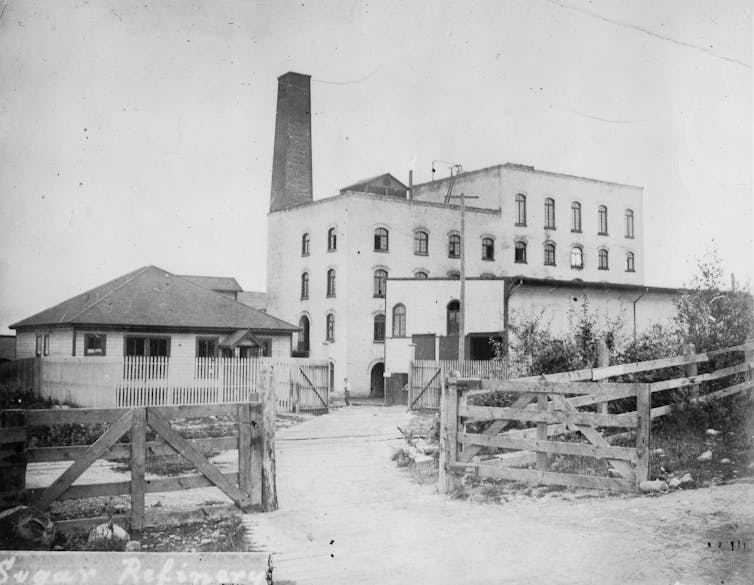
A black and white photo of old factory bulidings

Original B.C. Sugar refinery buildings in Vancouver in 1892.
(City of Vancouver Archives)

Building a refinery in Vancouver, a city newly constructed on the unceded territories of the xʷməθkʷəy̓əm (Musqueam), Sḵwx̱wú7mesh (Squamish) and səlilwətaɬ (Tsleil-Waututh) Nations, Rogers created a western Canadian sugar empire — one that sourced raw sugar cane through the Pacific, refined it in British Columbia and sold it throughout the Canadian West.

Railway magnate William Cornelius Van Horne, together with noted investors such as Richard Bladworth Angus, Edmund Boyd Osler and Donald Alexander Smith, were among the ventures’ early shareholders. By the time of his death in 1918, Rogers had become “quite wealthy.”

Now owned by Lantic Inc., Rogers Sugar remains a recognized Canadian brand. Less well known, though, is Rogers Sugar’s violent past.

Sugar plantations

To make the refined sugar that is so familiar to Canadians today, B.C. Sugar (the name of the company that owned Rogers Sugar) sourced both beet and cane sugars. Canadian beet sugar has its own atrocious labor history, as University of Saskatchewan professor Ron Laliberté, York University professor Mona Oikawa and other experts have demonstrated.

Refined predominantly in Vancouver, Rogers Sugar was made mostly from raw cane sugar. Since sugar cane cannot grow in Canada, B.C. Sugar sourced internationally from places including Mauritius, Java, Peru, Hawaii, Cuba, Fiji and the Dominican Republic.

B.C. Sugar also ventured into sugar cane plantation ownership: in Fiji between 1905 and 1922 and in the Dominican Republic between 1944 and 1955. Notably, it purchased the latter from the Bank of Nova Scotia.

In both cases, workers reported horrendous conditions. The pay was so low and the work was so menial in the Dominican Republic that, as historian Catherine C. Legrand points out, workers left the plantation whenever they could.

In Fiji between 1905 and 1920, B.C. Sugar employed indentured workers from India who migrated to the colony on five-year contracts. As on other Fiji plantations, workers were subject to numerous atrocities and treated in ways similar to how enslaved and indentured people were treated on plantations globally.

Black and white photo of rows of tram cars full of sugar cane. In the distance a factory building can be seen.

Sugar cane cars lined up in front of a cane factory in Fiji in the early 20th century.
(City of Vancouver Archives)

Forced into hard physical labor with little time for sleep, indentured workers at B.C. Sugar’s Fiji plantation endured sickness, confinement, hunger, abuse, injuries, whippings, beatings and more, all for below subsistence pay and the eventual chance to move out of indentured work.

Conditions were so dire that some workers tragically perished in B.C. Sugar’s cane fields. When Fiji de-criminalized the desertion of indenture contracts in 1916, it is little wonder that hundreds of workers left the colony’s sugar plantations. These included plantations operated by B.C. Sugar.

Understanding Canadian history

Refined sugar is now so common it is difficult to imagine life without it. But, by reflecting on its origins, we can trace the pathways that have made this commodity so abundant. Canadian sugar was built upon violence, including upon enslaved and indentured labor.

By building upon existing research into Canadian sugar and by continuing to probe Canadian sugar companies’ local and global histories, we can gain a clearer picture of how sugar became central to the Canadian diet.

And we can also work toward greater recognition for those who have labored in the local and global Canadian sugar industry.

Donica Belisle, Professor of History, University of Regina

This article is republished from The Conversation under a Creative Commons license. Read the original article.

It’s time to rethink the narrative behind “mommy brain,” scientists say

New parents likely know well the concept of “mommy brain” — the notion that forgetfulness and memory loss accompany the birth of a baby, implying mom is so overwhelmed she suffers cognitive decline. But “daddy brain” isn’t really a neologism in the same way, which attests to the way that “mommy brain” can sometimes evoke a sexist stereotype of the doddering, forgetful new mother.

Yet according to scientists, mommy brain isn’t actually a real thing — at least, not in the way our culture conceives of it. Research into how motherhood affects the human female brain reveals that this idea is mostly fiction.

“The idea that motherhood is wrought with memory deficits and is characterized by a brain that no longer functions well is scientifically just not so.”

Still, it persists in public discourse. For example, Meghan Markle telling Kate Middleton she had “baby brain” became a topic of fascination after the account was published in Prince Harry’s memoir.

While there are certainly hormonal and cognitive changes that can cause mental fogginess, forgetfulness or trouble concentrating during motherhood, it’s possible that this “mommy brain” — an event estimated 80 percent of postpartum women say they experience — could be symptoms of other underlying factors. Women scientists who study this are putting out a call to action to change the narrative around “mommy brain” and urge a “rebrand” of an inadequately studied area in maternal health to steer it away from its sexist undertones.

“The idea that motherhood is wrought with memory deficits and is characterized by a brain that no longer functions well is scientifically just not so,” researchers wrote in a commentary in the journal JAMA Neurology last month. “While complaints of mental fogginess should be taken seriously, it is likely the inescapable narrative of mommy brain contributes to these subjective reports, focusing pregnant women’s (and researchers’) attention on what may be a small decrease in particular aspects of cognitive function, while at the same time ignoring the faculties that are gained during this period of life.”

Indeed, researchers say some of the scientific community has latched on to the idea of “mommy brain” as it pertains to cognitive decline, and have spent too much time focusing on it, which could be inadvertently disregarding some of the remarkable changes that actually happen in a woman’s brain during pregnancy and after birth.

We really wanted to push back in a public way against that narrative of stupidity during pregnancy, and say that we haven’t looked to see all of the cognitive benefits that could be attained during this period.

“We know from the animal literature and from some human studies that actually there are a lot of cognitive benefits to pregnancy,” Bridget Callaghan, an associate professor of psychology at the University of California, Los Angeles, and co-author of the paper, told Salon. “If you look at the animal literature, there are lots of studies showing that moms become much better predators, much better protectors of their young, they’re able to catch food in multiple locations and remember where the food was stored, and all of those abilities get massively enhanced during pregnancy and the postpartum period.”

Callaghan said that the human narrative around “mommy brain” does not reflect what animal studies have shown.

“The idea that you just become stupid during pregnancy, doesn’t fit with this idea that we do need to acquire these new skills,” Callaghan said. “So we really wanted to push back in a public way against that narrative of stupidity during pregnancy, and say that we haven’t looked to see all of the cognitive benefits that could be attained during this period.”

“Why don’t we focus on the research on that, and at the same time, why don’t we try to understand what is really underlying this true phenomenon of mommy brain,” Callaghan continued. 


Want more health and science stories in your inbox? Subscribe to Salon’s weekly newsletter The Vulgar Scientist.


Currently, there is limited scientific literature exploring the changes in a human female’s brain during pregnancy and after giving birth. While research has increased over the last five to 10 years, Jodi Pawluski, a cognitive neuroscientist and assistant professor at the University of Rennes in France who co-authored the study with Callaghan, told Salon that science still has a long way to go.

“If you actually compare the literature on what we know about mothers and the brain, and adolescence and the brain, we’ve neglected this area of research significantly,” she said. The comparison between adolescence, and matrescence — a term used to describe the physical, emotional, and hormonal transition — is important as scientists suspect there are similar changes happening in the brain during both life transitions; for example, gray matter changes. 

“We’ve neglected this area of research significantly.”

In 2016, a study published in Nature Neuroscience found that gray matter shrunk in the brains of mothers in areas that are involved in processing and responding to social signals. Two years later, the women who underwent MRI scans for the study were imaged again and researchers found that gray matter loss still remained — except in the hippocampus. Pawluski said media attention around studies like these can often focus on the idea that something is lost, without exploring what perhaps could have been gained, or that the loss could be a way to “fine tune” and make the brain more efficient in motherhood.

“It seems counterintuitive to have a loss during a time when so many things are happening. You’re essentially learning how to parent, but I always think we forget when we talk about this decrease in gray matter volume, we forget to talk about the function,” Pawluski said. “So there’s structure changes, like volume changes, and then there’s functional changes or activity of the brain areas that are important to remember.”

The new mothers had widespread gray matter volume increases, not decreases, in brain regions that are associated with empathy, social cognition, and the ability to multitask.

Despite a loss in gray matter, scientists also have observed increases in brain activity in other areas that are important for parenting. In 2020, one study looked at the brains of women immediately after giving birth and between 4 to 6 weeks postpartum. The results showed that the new mothers had widespread gray matter volume increases, not decreases, in brain regions that are associated with empathy, social cognition, and the ability to multitask. 

“These structural changes occurring within only 4-6 weeks after delivery are reflective of a high degree of neuroplasticity and massive adaptations in the maternal brain,” the authors wrote. “They may suggest a restoration of brain tissue following pregnancy and/or a substantial brain reorganization, possibly to accommodate a multi-faceted repertoire of complex behaviors associated with being a mother.”

One study published in the journal Current Psychology sought to understand the prevalence of “mommy brain” by comparing the results of mothers and non-mothers taking the Attention Network Test (ANT), which measured a person’s attention span. Notably, the researchers found that mothers performed just as well if not better than the women who took the test and had never been pregnant or had children. Notably, in the study, the mothers were 10 years older, making the results even more surprising, Valerie Miller, Valerie Tucker Miller, a Ph.D. student in Purdue University’s Department of Anthropology department who led the study, told Salon. 

“In the attention literature, you almost always see a slight decline with age, so I anticipated having to control for it just because mothers on average were 10 years older,” Miller said. “But that didn’t happen at all — they were the same and then slightly faster in executive control.” 

That’s not to say that “mommy brain” in the context that people usually think about isn’t real, as women consistently report it, but that there could be underlying environmental factors to it. 

“If we were to take away the issue of sleep [deprivation], the issue of stress and all of the things in some kind of experimental model that would give us the best answer,” Dr. Amanda Veile, an assistant professor of anthropology at Purdue University, told Salon. “[Maybe] it doesn’t just have to do with mother and child, it has to do with how mothers’ worlds change as they become mothers, how they interact with others, how they’re treated, the density of social networks, the amount of support they receive — all of that is going to be important in terms of cognition.” 

Veile said if research focuses on mommy brain perhaps in the social context, it could lead to some kind of action. Ideally, that would mean providing “more support for mothers in the postpartum period, which we know that the US is woefully behind in among the wealthiest nations,” Veile added.

Regulatory failure 101: What the collapse of Silicon Valley Bank reveals

ProPublica is a Pulitzer Prize-winning investigative newsroom. Sign up for The Big Story newsletter to receive stories like this one in your inbox.

The collapses of Silicon Valley Bank and Signature Bank this past weekend were the end point in an all-too-familiar cycle: first the boom, then the breathtakingly speedy bust and then the bailout. We are now at the postmortem moment — when everyone wonders where the regulators were.

Silicon Valley Bank has already become notorious for how obvious its red flags were. Perhaps the most telling was the rapid growth of its borrowing from the Federal Home Loan Banks system. Banking experts know this Depression-era group of government-sponsored lenders as the second-to-last resort for banks. (The Fed is, as always, the lender of last resort.) At the end of last year, Silicon Valley Bank had $15 billion of FHLB loans, up from zero a year earlier.

“That’s the type of flag that says you need to look closely,” Kathryn Judge, a Columbia law professor who specializes in financial regulation, told me. But there’s no sign the loans triggered any regulatory attention.

Primary responsibility for the debacle lies, of course, with SVB’s management. But regulators are supposed to grasp that they exist because bankers are always tempted to take risks. Bankers want to grow too fast, borrow cheaply, lend freely and lock their investments up unwisely for long periods in hope of gaining higher returns.

Some commentators are now reiterating calls for banking rules to be tightened, which is probably a wise move. But the collapse of the two banks proves once more that the culture of the regulators is as important as any rules, laws or tools at their disposal.

At least one journalist detected banks’ rising vulnerabilities, including those of Silicon Valley Bank, as early as last November; the Federal Deposit Insurance Corp.’s own chair had also warned about the problem. A few short sellers even started betting against the bank’s stock. Now, however, the combination of reckless bankers and lax regulators has left us with a financial crisis and a federal-government bailout — and the well-rehearsed spectacle of regulators promising to do better next time. (And yes, this was a bailout. Some depositors were facing losses and the federal government, backed by the public, prevented that — at as-yet-unknown scale and cost.)

One troubling aspect of this particular collapse is just how unremarkable a bank run it was, how basic its causes were. Regulators didn’t need any fancy analysis to detect the danger at Silicon Valley Bank. They just needed to notice its financial results. Granted, in 2018 Congress had loosened the post-global-financial-crisis Dodd-Frank regulations that would have required a bank like SVB to undergo more frequent stress tests, but those tests measure exotic or extreme risks. All that was required in this case was regular supervision. The bank had clear risk-control flaws and disclosed losses on its books, right there in its Securities and Exchange Commission filings.

Silicon Valley Bank’s assets had grown dramatically, quadrupling in five years, as had its deposits. Both phenomena are almost always worrying signs. The bank was also overly concentrated in one sector of the economy, and an unusually large proportion of its deposits — about 94% — was uninsured, above the $250,000 limit that the FDIC will guarantee per deposit.

No bank can survive if every creditor asks for their money back at once. The larger the portion of a bank’s clients that could wake up one day to realize that their deposits are not protected, the greater the risk of a run.

What Silicon Valley Bank did with those deposits should have been another warning signal. It used them to buy too many long-term bonds. As interest rates go up, bonds lose value. Nobody should have needed the warning, but the bank itself said that interest-rate risk was the biggest hazard it faced. And regulators should have noticed before the bank began borrowing heavily from the FHLB system.

In its SEC filings in the third quarter of last year, the bank’s parent company disclosed that it was sitting on losses from its bond purchases big enough to swamp its total equity. That would have been a good time for supervisors to tell the bank to get its act together.

Silicon Valley Bank was far from doing so: It hadn’t had a chief risk officer for most of that year. “Regulators had to know that, and it has to matter,” Jeff Hauser, the founder and director of the Revolving Door Project, a Washington nonprofit that tracks the regulatory state, told me. “Once we valorize success as proof of wisdom, it’s hard for a lowly bank examiner to say, ‘This place doesn’t have a risk officer and doesn’t have a plan to address the risk on its books.'”

Bank regulators have awesome powers. They can go into a bank, examine its operations and demand changes. The problem is that they rarely do. “The regulators are like all the conflicted agents in ratings [agencies] and other areas,” Chris Whalen, a longtime financial analyst, told me. “They go with the flow in good times and drop the ball in bad times.”

The San Francisco Fed, which regulated the parent company, and the California regulators, which oversaw the bank itself, could have required SVB to raise capital last year, when it was less vulnerable. They could also have required the bank to increase rates on its savings accounts — in other words, to pay people more to lend it money. That would have eroded earnings but it would’ve kept customers from fleeing. Ask Greg Becker, the bank’s chief executive, today if he would rather have reduced per-share earnings or avoided having superintended the second-largest banking collapse in U.S. history.

So why don’t we have regulators who can be relied on to do their jobs?

Part of the answer is a legacy of the Trump administration’s penchant for installing regulators who are opposed to regulation. Donald Trump appointed Randal Quarles as the first-ever vice chair of banking supervision at the Federal Reserve. (The Fed did not respond to questions for this story.) Quarles saw it as his mission to relax the post-financial-crisis regime. He sent unambiguous signals about how he felt about aggressive regulators — “Changing the tenor of supervision will probably actually be the biggest part of what it is that I do,” he declared in 2017. Translation: Any sign of showing teeth and he’ll get out the pliers. And when Jerome Powell was nominated to be the chair of the Fed, in 2017, he told Congress that Quarles was a “close friend,” adding, “I think we are very well aligned on our approach to the issues that he will face as vice chair for supervision.” Naturally, Quarles supported the 2018 law to roll back stress tests — something that Becker himself had called for. Quarles also did not respond to my request for comment.

This crisis raises the old issue of how strange it is that the Federal Reserve regulates banks at all. In the years leading up to the 2008-09 financial crisis, an alphabet soup of regulators ostensibly shared responsibility for banking oversight along with the Fed: The OTS (Office of Thrift Supervision), the OCC (Office of the Comptroller of the Currency), the SEC (Securities and Exchange Commission), and the CFTC (Commodity Futures Trading Commission). Banks and financial entities played these agencies off against one another to shop for the least restrictive. Policy makers and legislators knew this and toyed with changing the architecture of banking-and-securities regulation. Ultimately, their only action was to close down the least of them, the OTS, and keep the rest, each of which had its own constituency of supporters.

So the Federal Reserve kept its responsibilities. But critics argue that the Fed can never become an effective bank regulator because its chief concern is with the more glamorous business of managing the economy.

The roots of regulatory failure run deeper, however, than the Trump administration’s actions. President Joe Biden’s appointees at the Federal Trade Commission, the Department of Justice, and the Consumer Financial Protection Bureau appear to be trying to wield their powers to make the economy more efficient, safer and more equitable. But pockets of learned governmental helplessness remain. Regulators have an ingrained fear of stepping in, making people uncomfortable, making demands and using their clout.

The Fed’s banking supervisors should have been on heightened alert as its governors started boosting interest rates. Silicon Valley Bank faced not only the interest-rate risk to its treasury-bond holdings but also the likelihood of credit losses accumulating on its books from distressed venture-capital firms and declines in commercial real-estate values last year.

The fact that the Fed supervisors weren’t agile with Silicon Valley Bank indicates that they have failed to internalize how woefully fragile our financial system is. The U.S. has suffered repeated bubbles, manias and crashes since the deregulatory era began under Ronald Reagan: the savings-and-loan crisis, Long-Term Capital Management, the Nasdaq crash, the global financial crisis, the financial convulsions of the early pandemic. Congress and regulators sometimes shore up aspects of the system after the event, but they have failed to foster a resilient financial system that doesn’t inflate serial bubbles. Each time, instead, the regulators reinforce a lesson that if bubble participants huddle as closely together as possible, and fail conventionally, the government will be there to save them.

“One of the most disturbing dynamics here,” Judge, the Columbia Law professor, told me, “is a loss of respect for the Fed as a supervisor, as a regulator.” That is not a good place for the industry’s chief overseer to start rebuilding confidence in the integrity of the American banking system.

ICC issues arrest warrant for Putin and co-conspirator for allegedly abducting Ukrainian children

The International Criminal Court on Friday issued international arrest warrants for Russian President Vladimir Putin and Commissioner for Children’s Rights Maria Lvova-Belova for allegedly abducting Ukrainian children and transporting them to Russia.

The Hague-based ICC said that there are “reasonable grounds to believe” that Putin and Lvova-Belova bear “individual criminal responsibility” for “the war crime of unlawful deportation” of Ukrainian children “from occupied areas of Ukraine to the Russian Federation.”

ICC President Judge Piotr Hofmański said in a video statement announcing the warrant that “it is forbidden by international law for occupying powers to transfer civilians from the territory they live in to other territories. Children enjoy special protection under the Geneva Convention.”

Ukrainian officials accuse Russian forces of taking around 14,000 children from Ukraine to Russia since Putin launched the invasion in February 2022.

“They change their citizenship, give them up for adoption under guardianship, commit sexual violence and other crimes,” Daria Herasymchuk, the commissioner for children’s rights and rehabilitation for Ukraine, told Euronews.

According to an Associated Press investigation published last month:

Russian law prohibits the adoption of foreign children without consent of the home country, which Ukraine has not given. But in May, Putin signed a decree making it easier for Russia to adopt and give citizenship to Ukrainian children without parental care—and harder for Ukraine and surviving relatives to win them back.

Russia also has prepared a register of suitable Russian families for Ukrainian children, and pays them for each child who gets citizenship—up to $1,000 for those with disabilities. It holds summer camps for Ukrainian orphans, offers “patriotic education” classes, and even runs a hotline to pair Russian families with children from Donbas.

Lvova-Belova has defended the deportations as “saving” lost or orphaned children.

The ICC warrants came one day after the United Nations’ Independent International Commission of Inquiry on Ukraine published a report detailing Russian war crimes against Ukrainians including “willful killings, attacks on civilians, unlawful confinement, torture, rape, and forced transfers and deportations of children.”

“This is incredible”: Legal scholar uncovers Trump lawyer’s ethical conflict in Stormy Daniels case

Trump attorney Joe Tacopina may be violating ethics rules by representing the former president in a case involving adult film star Stormy Daniels, according to a legal expert.

Tacopina made the rounds on television this week to accuse Daniels of “extortion” in the $130,000 hush money payment during the 2016 campaign and argued that Trump was the real “victim” in the case. But New York University Law Prof. Ryan Goodman discovered that Tacopina “has had an attorney-client relationship” with Daniels because she once reached out to him about representation, and his representation of Trump in the case may violate American Bar Association and New York state ethics rules.

“Difficult to see how he can represent Trump; call Daniel’s claim of affair untrue; call her an extortionist (and Trump the victim),” Goodman wrote on Twitter.

Goodman cited Tacopina’s March 2018 discussion with CNN’s Don Lemon.

Lemon during the segment noted that before Daniels was represented by attorney Michael Avenatti, she “approached you about representation.”

“Did you get any impression that she may have signed NDA under duress and was she afraid for her physical safety?” Lemon asked.

“Yes, of course, and I can’t really talk about my impressions or any conversations we had because there is an attorney-client privilege that attaches even to a consultation,” Tacopina replied.

During another segment with Lemon that same month, Tacopina acknowledged that he was contacted by Daniels but said he couldn’t say “anything further.”

Tacopina did not represent Daniels but Goodman said that the ABA’s Rule 1.18, which covers duties to a prospective client, had “already kicked in — which he acknowledged.”


Want a daily wrap-up of all the news and commentary Salon has to offer? Subscribe to our morning newsletter, Crash Course.


Attorney Bradley Moss agreed that Tacopina’s representation of Trump in the Daniels hush money payment case is “ethically suspect.”

“Just when you think you’ve seen everything,” tweeted conservative attorney George Conway, a frequent Trump critic. “This is incredible.”

It’s unclear what this could mean for Tacopina’s role in the Manhattan investigation but MSNBC legal analyst Lisa Rubin, a former attorney, suggested that it could be why Daniels met with prosecutors from the Manhattan district attorney’s office this week.

“My understanding is that potential conflicts of interest can be and sometimes are discussed with a target or witness’s counsel in advance of indictment. But there’s no action that can be taken until the case is charged,” Rubin explained on Twitter. “But after indictment, prosecutors will identify a perceived conflict for the judge and ask for a resolution. Why? Because conflicts implicate a defendant’s constitutional right to counsel, and prosecutors want a clean, fair trial with as few avenues for appeals as possible.”

Rubin added that given Tacopina’s “lasting, ethical obligations” to Daniels, Manhattan prosecutors might have wanted to “prepare by confirming the nature of their prior communications, what confidences were shared, etc. Watch this space.”

The color of farmed salmon comes from adding an antioxidant to their feed

A barrage of messages from social media influencers, along with other online blogs and articles, have claimed that farmed salmon are bad for you because the fish are fed dyes to turn their flesh red.

Some have claimed that farmed salmon is naturally gray, suggesting they are malnourished and consumers should avoid eating it for this reason.

These claims are utterly false and perpetuate a myth that can confuse or scare salmon consumers. The truth is that the color of salmon fillets is red due to naturally occurring molecules called carotenoids, such as astaxanthin. This is part of a natural diet of wild salmon and is added to the food for farmed salmon.

Carotenoids are common in the natural world among different plants and animals. Salmon have it in their diet from eating algae, krill and other small crustaceans. Carotenoids are essential pigments produced by bacteria, fungi, algae and plants. Animals cannot make carotenoids on their own, so those found in animals are either directly accumulated from food or partly modified through their own metabolic reactions.

The color of salmon fillets is from the same pigment that we see in shrimp, lobsters and even flamingos.

Why are salmon red?

The red color of salmon flesh — their muscle tissue — is a unique trait in several types of salmon. It’s an evolved genetic trait that likely occurred as an evolutionary mutation and distinguishes salmon from other types of fish.

While the flesh color is a direct result of carotenoids in their diet, there is also a unique genetic component. The gene beta-carotene oxygenase 1 is responsible for carotenoid metabolism and most likely explains flesh color variation in salmon.

Carotenoids, including astaxanthin, can be manufactured and added to the diet of farmed salmon. These can be produced synthetically on a commercial scale or from natural sources, such as algae; the freshwater green microalgae, Haematococcus pluvialis, is a popular source. H. pluvialis is an excellent source of astaxanthin for farmed salmonids like rainbow trout.

More importantly, astaxanthin is a health-sustaining molecule that plays a critical role in fish health and survival and has benefits for humans too.

Health benefits to fish

Astaxanthin is a potent antioxidant, meaning it prevents some types of cellular damage. Antioxidants have multiple health benefits for both fish and humans.

Astaxanthin’s antioxidant activity is 100 times higher than vitamin E, which is a popular antioxidant in human supplements. In fish, it has many important functions related to immunity and reproduction.

Research has shown that astaxanthin has a significant impact on reproductive performance in many different fish species, like egg production and quality, sperm quality, fertilization rate and survival of newly hatched larvae.

Salmon eggs are red or orange in color because of the accumulation of astaxanthin, which plays a beneficial role in protecting the eggs.

Astaxanthin plays an important role in immune function and enhances the production of antibodies and the proliferation of immune cells. It improves liver function in fish, increases defenses against oxidative stress, serves as a source of vitamin A and boosts its activity in fish.

New Canadian research is underway to investigate the role of dietary astaxanthin in inflammatory control and immunity in Atlantic salmon. Overall, studies have consistently found that dietary astaxanthin is an important nutritional factor in stimulating growth and maintaining health and survival of aquatic animals.

Health benefits to humans

In humans, astaxanthin’s antioxidant and anti-inflammatory effects have been shown to protect against stress-associated and inflammatory diseases. There are also potential effects on various diseases, including cardiovascular diseases, cancer, diabetes and obesity.

Additionally, pre-clinical trials predict that astaxanthin may regulate intestinal microbiome and glucose metabolism. People can get astaxanthin in their diet by eating salmon or other salmonids like trout as well as shrimp, crab, krill or supplements.

Astaxanthin in farmed fish feeds is not only for pigmentation, but is also a necessary nutrient for health and reproduction in fish. In turn, it increases the nutritional value of the fish fillets for consumers.

Stefanie Colombo, Canada Research Chair in Aquaculture Nutrition, Dalhousie University

This article is republished from The Conversation under a Creative Commons license. Read the original article.

“It’s ridiculous”: Florida GOP bill would ban young girls from mentioning their periods in school

A Florida Republican admitted that his bill would ban young girls from discussing menstruation with school officials but claimed it wasn’t the “intent” of his legislation.

Republican state Rep. Stan McClain introduced House Bill 1069, which would restrict education materials in schools, require schools to teach the “benefits of monogamous heterosexual marriage,” and require educators to teach that “sex is determined by biology and reproductive function at birth …and that these reproductive roles are binary, stable, and unchangeable.”

The bill also says that “instruction in acquired immune deficiency syndrome, sexually transmitted diseases, or health education, when such instruction and course material contains instruction in human sexuality, such instruction may only occur in grades 6 through 12.”

Democratic state Rep. Ashley Viola Gantt pressed McClain over the bill during a House Education Equality Subcommittee hearing on Wednesday, questioning whether it would effectively ban girls below sixth grade from discussing their periods in school.

“Does this bill prohibit conversations about menstrual cycles ― because we know that typically the ages is between 10 and 15 ― so if little girls experience their menstrual cycle in fifth grade or fourth grade, will that prohibit conversations from them since they are in the grade lower than sixth grade?” Gantt asked the Republican.

“It would,” McClain acknowledged.

Gantt pressed McClain on whether teachers could be punished if their students mention their periods to them.

McClain said that “would not be the intent of the bill” and added that he would be “amenable” to amendments to prevent such scenarios.

The Republican-dominated subcommittee ultimately advanced the bill 13-5 on Wednesday, according to HuffPost.


Want a daily wrap-up of all the news and commentary Salon has to offer? Subscribe to our morning newsletter, Crash Course.


“This bill shines a bright light on Florida’s political leaders’ perpetual thirst for power and control,” Annie Filkowski, policy and political director of the Florida Alliance of Planned Parenthood Affiliates, told the outlet in a statement.

“They are restricting sex education, banning abortion, defunding birth control, and now going so far as to admit that young women cannot discuss menstruation under their absurd legislation,” she said. “Young people start menstruation anytime between nine and 16 years old. It’s ridiculous to prohibit them from discussing it with their teacher.”

Kentucky GOP breaks public meetings law to pass anti-trans bill targeting kids

Republican lawmakers in the Kentucky state legislature passed one of the worst anti-trans bills in the country on Thursday through means that likely violated the state’s public meetings law, experts say.

Senate Bill 150, which was tabled prior to this week, primarily targets transgender children.

The legislation bans transgender students from using restrooms that correspond with their gender and allows teachers and students to misgender trans students without repercussions. It also restricts educators from discussing sexual orientation or gender identity with students of any grade — a provision that goes beyond Florida’s infamous “Don’t Say Gay” law.

The bill bans gender-affirming care for children and requires doctors to set a timeline for children who are receiving such care right now to detransition.

LGBTQ advocates condemned the law and the manner in which it passed the state House of Representatives on Thursday, as it was introduced with little to no notice.

A separate piece of anti-trans legislation that similarly targeted trans kids was tabled on Wednesday night. But Republican lawmakers revived SB 150 on Thursday morning, formally introducing the bill in a committee room where the microphones had been turned off while the House was breaking for lunch.

Discussion on the bill began just six minutes later, despite the fact that state law requires the public to be made aware of meetings 24 hours before they take place. The bill was so rushed that even the House clerk seemed unaware that it had been brought forward, as the clerk did not have access to a digital copy until after it advanced to the full House.

Although the bill’s passage likely violated state public meetings laws, an expert on such rules has suggested that it’s unlikely anything can be done, as the deciding body on determining whether such actions are improper or illegal is the state legislature itself.

Following committee passage and two hours of debate on the House floor, where nearly every Democratic lawmaker spoke out against the bill, the legislation passed by a vote of 75-22, mostly along party lines. The state Senate voted to support changes to the bill shortly after, and the legislation now advances to Gov. Andy Beshear’s (D) desk.

Beshear will likely veto the bill, but because Republicans have a veto-proof majority in both legislative chambers, it will likely become law in a few weeks’ time.

Several LGBTQ advocates spoke out against the passage of the bill. The American Civil Liberties Union (ACLU) of Kentucky, for instance, described SB 150 as “the worst anti-trans bill in the nation.”

“Legislators cannot erase transgender people from existence, and we will continue to fight for equal rights and equal protection under the law,” Amber Duke, interim executive director of the organization, said in a statement on its website.

Kentucky Congressman Morgan McGarvey (D) condemned the bill on Twitter.

“This bill is so miserable, mean, and misinformed the Republicans had to sneak it through late in the session despite having supermajorities,” he wrote.

Trangender activist and author Erin Reed said that the bill’s “far-reaching provisions will result in lives lost in Kentucky,” noting that “gender affirming care saves lives.”

“Kentuckians must ask themselves,” Reed said in a blog post, “if this is what they want from their legislature. Does 6-minute notice meetings held with no public notice in secretive fashion truly represent good legislation? Even those who agree with the bill should question the process in which it was passed.”

Other activists urged LGBTQ people in the state not to lose hope.

“Trans people like me in Kentucky are scared, but we’re also ready to fight back,” said transgender activist Z! Haukeness, the national network director for the organization Showing Up for Racial Justice.

“What’s giving me hope is watching trans people across my state stand up and fight,” Haukeness wrote in a blog post, noting that young trans activists and organizations across Kentucky “are leading their neighbors to fight against the legislature’s laws and hateful messages.”

“They follow in the tradition of the Irish-American school teacher, Appalachian union organizer and freedom fighter, Mother Jones, who said, ‘Mourn for the dead and fight like hell for the living,'” Haukeness said.

With “Swarm,” two “Atlanta” collaborators kick the beehive of toxic fandom

Before watching “Swarm,” I would have politely suggested that the compulsion to describe anything that doesn’t fit neatly into a box as “a provocation” was a cop-out. To be less diplomatic, it’s pretentious and a haphazardly applied catch-all popping up more frequently in recent years.

Here’s a stack of receipts to prove it. Among the recent examined objects and happenings deemed provocations are Madonna’s facean all-black watch, the concept of “Rethinking Sex,” “Drag Race” winner Jinx Monsoon’s toura Russian jet colliding with a U.S. drone over the Black Sea, and Roxy Music’s first album cover.

The military dustup and Monsoon’s insistence on taking up space in hostile partisan territory qualify as provocations. As for the rest, a face is a face whether it’s on a time-keeping device or a person. Skeletal, nearly naked supermodels on covers might have been uncommon in 1972, but in the realm of rock that counts as a tease.

Considering Merriam-Webster’s definition as it applies to Donald Glover‘s collaboration with “Atlanta” writer Janine Nabers – which is to say, “something that provokes, arouses or stimulates”– makes me slightly less hesitant to pass judgment.  

“Swarm” endeavors to be many things concurrently: horror, and true crime with music video interludes and satire piled into a showcase for Dominique Fishback’s versatility. It’s to her credit that the limited series has the feeling of an anthology at first since she takes on several distinct personas both as her main character, Dre, and under various aliases.

“Swarm” is chaos with a plan.

Dre is awkward and aspirational, a young woman who aims to be fashionable and current but wears her mismatched spirit on the surface like an inside-out sweater donned in the dark. Sometimes she moves and acts like a 12-year-old girl. Sometimes she behaves with stiff prudishness. In other scenes as other people, she flops about with the weird violence of a marionette playacting a vixen only to become that sex object after a blood sacrifice.

In the presence of her pop goddess Ni’Jah whether on a TV screen or in person, she’s a slack-jawed, mesmerized cipher ready to be absorbed whole or devour anything in her way.

Dre is all kinds of disturbed, a manifestation of toxic fandom and narrow purview of the extremely online. Fishback ensures you can’t tear your eyes away from any of her faces. 

“Swarm” (Amazon Studios)Title cards opening almost every “Swarm” episode declare, “This is not a work of fiction. Any similarity to actual persons, living or dead, or actual events, is intentional.” Like a juicy urban legend, you can either believe that or not, although a series-ending statement from a legal department makes the truth plain. If you buy it.  

Through these motifs, the show’s creators play into our affinity for toying with reality. They claim that every crime depicted in “Swarm” is inspired by a documented case that took place between 2016 and 2018, whether it be a reported homicide or an Internet rumor that went viral. Some are familiar since Ni’Jah is the show’s Beyonce analog, like a reenactment of the notorious yet still unconfirmed face-biting incident.

But “Swarm” isn’t specifically kicking the Beyhive. Dre’s Ni’Jah zealotry could easily refer to Nicki Minaj’s Barbz army or Swifties, or anyone wrought to a frenzy by the mildest social media dis. Glover has his own experience with Internet mobs acting in his name or against him related to the audience for his FX show or his musical endeavors, recorded under the moniker Childish Gambino

By any name, Dre’s devotion is an extreme version of a type. When we meet Dre in 2016 she’s willing to tumble into massive debt, stiffing her sister Marissa (Chloe Bailey) on her half of the rent for a chance to see her goddess in concert.

Then something terrible happens, and Dre responds with explosive violence. She tears off on a cross-country spree informed less by hiding from the law than running from herself but towards nothing concrete. And if “Swarm” were simply this, it would quickly skitter into a rut.

But right when its velocity skates on that edge, the narrative takes a sharp left. Eventually, it flies over a cliff, but even this is a feat since, in the end, its initial thesis survives the freefall albeit not as cleanly as another series that might have opted for a parachute. Not everyone will love the way “Swarm” ends, but the point is easy to get . . .  and the delivery system, such as it is, is both glamorous and creepy.


Want a daily wrap-up of all the news and commentary Salon has to offer? Subscribe to our morning newsletter, Crash Course.


“Swarm” is chaos with a plan. It begins as something conventional and a few episodes in, transforms from a predictable sedan into a Decepticon. Those who appreciate the way Glover and Nabers treat the medium as an opportunity to blast apart convention won’t be bored. Confused, probably, and a lot, but not in a way that divides your attention.

What I can’t unstick from my brain is how defiant it is of simple determination. To be honest I can’t say I entirely loved “Swarm,” but I appreciate it enough to want to dissect and discuss it, and in the fullness of time that has more value. It’s the rare series that doesn’t aspire to be broadly pleasing while making its case for being carefully watched and evaluated as entertainment, societal critique and high art in one pass. It is accessible enough for anybody to get and leaves a yawning chasm for interpretation.

Glover is fond of describing his creative approach as “punk,” one of those terms lacking a hard definition beyond that you know it when you see it. In “Atlanta” it manifests in surreal episodes or acts within installments operating as small independent films within broader plots. Sometimes they function as comments on the story’s moral. Others interpret “independent” to mean “freestanding and entirely separate.”

Such dedication to craft and experimentation can leave people cold. But it also requires the kind of confidence that makes the goal of mainstream embrace secondary to the value of the moonshot. “Swarm” isn’t quite that far out on the scale between “Law & Order” and European avant-garde cinema in that its targets are as obvious as its meta-narrative winks.

“Swarm” (Amazon Studios)

Incorrectly answering Dre’s question, “Who’s your favorite artist?” might lead to a trivia dump where she lists how many fewer Grammys another artist has compared to Ni’Jah, and possibly grimmer consequences besides.

The show is accessible enough for anybody to get and leaves a yawning chasm for interpretation.

Even these sequences contain smears of farce begging to be noticed alongside casting that marries purpose to stunt. Bailey, who performs as Chlöe, is a Grammy-winning singer songwriter. Placing her as Dre’s best friend operates as something of a trompe l’oeil given Dre’s reason for living is to picture herself in the inner circle of musical royalty. Another casting choice is brilliantly unsubtle and best left to discovery; if you want to be surprised you should probably stay off Twitter until you watch. 

Yet another permits a member of pop royalty to poke at absurd designations of racial identity in the knowing way of a person who has dealt with such questions her entire life. You only comprehend that secondary layer if you immediately recognize who that person is, and not everyone will. If you don’t, she’s still amusing for the reasons she adores her favorite pop star.

Talking around these details is awkward, but preserving their mystery is essential since what they represent is more important than who they are. These things matter as much as the deviations to the overall arc that the writers insert within each episode, distorting the smallest details enough to instill a sense that this world is askew, casually if deliberately off-kilter.

And Nabers, the series showrunner, sets up each role to ensure their celebrity expands the meaning of what they’re representing in “Swarm.” One is like Dre, weaving her life around the illusion that the celebrity she stans understands her, is an extension of her thoughts, and represents who she should be. This mode of thinking is alluring, childish, sexy, frightening and recognizable.

All of it makes the nervy premise of “Swarm” qualify as . . . stimulating, arousing, and that other word we might use to describe something that makes no promises to please but rewards being seen.

All seven episodes of “Swarm” are streaming on Prime Video.

Axios fires reporter for calling DeSantis press release “propaganda” in email

News outlet Axios fired a reporter in Tampa, Florida, this week after he called a press release from the Gov. Ron DeSantis (R) administration “propaganda” in an email that DeSantis officials posted online to smear the reporter.

In a reply to a press release about a DeSantis event called “Exposing the Diversity Equity and Inclusion Scam in Higher Education” from the Florida Department of Education, reporter Ben Montgomery said, “This is propaganda, not a press release.”

A screenshot of the email was posted on Twitter by Florida Education Department Communications Director Alex Lanfranconi almost immediately after it was sent, as timestamps on the email and the tweet suggest.

Hours later, on Monday evening, Montgomery received a call from Axios Local executive editor Jamie Stockwell, Montgomery says, per The Washington Post. Stockwell reportedly asked Montgomery to confirm that he had indeed sent the email before the outlet fired him, saying that Montgomery’s “reputation in the Tampa Bay area” was “irreparably tarnished.”

The press release is available online and is full of thinly veiled racism, which is nothing new from the DeSantis administration, especially in its attacks on education and the teaching of Black history and LGBTQ topics.

The release reads like a far right screed, railing on “divisive concepts such as Diversity, Equity and Inclusion (DEI) initiatives” and critical race theory. The press release suggests, as DeSantis has implied in his actions and essentially outright said, that diversity initiatives in higher education are discriminatory against white people, playing into the far right’s white supremacist and completely fabricated conspiracy theories about the “Great Replacement” of white people in society by global elites.

“This sort of thing has a chilling effect. Nobody wants to have their life disrupted by this machine,” Montgomery said in an interview with Talking Points Memo. “They call it ‘media accountability,’ and it is not that. It’s meaner than that, and more personal, and affecting…. It has a quieting effect and that’s a shame. It’s sad for democracy and sad for all of us.”

Montgomery’s termination by Axios is a show of how supposedly “neutral” news outlets legitimize and elevate fascists like DeSantis as they plunge the U.S. further to the right. This is evidenced by how quickly Montgomery was fired by Axios for a private communication, and by the fact that the outlet would take such a drastic move against Montgomery, whose “propaganda” comment was actually quite mild in describing DeSantis and his war against civil rights and the free press.

DeSantis and many other far right politicians are highly aware of this weak spot in the corporate media, and openly take advantage of it in order to spread their propaganda. Donald Trump is a master in this art, and it has been deployed by other right-wing politicians like West Virginia Republican Gov. Jim Justice, who recently pressured West Virginia Public Broadcasting into terminating a reporter over a story about disabled people being abused in state facilities.

This sort of propagandizing, press complicity and political silencing is, in fact, a fixture of fascists throughout history; historians have documented the ways in which outlets like The New York Times uplifted Adolf Hitler during his rise to power, for instance, ultimately aiding him in taking over as chancellor of Germany and carrying out the Holocaust. Hitler, along with his propaganda minister Joseph Goebbels, whipped up support for the Holocaust through control of the media nationwide, including suppressing journalists who disagreed with Nazism.

A next-level grilled cheese, thanks to halloumi and mint you grew yourself

I’m a natural-born killer. Show me the hardiest, easiest-to-care-for plant in the world, and within three days, I’ll show you a pile of dead leaves. For years, my apartment has contained a single Christmas cactus that I’m explicitly not permitted to tend. And while I live in a city for many reasons, not the least among them is the knowledge that any garden I possessed would immediately turn into a patch of scorched earth.

But I also know we often typecast ourselves in ways that wind up making us feel bad. My track record with plants has always made me feel like a failure, fearful of bringing anything vulnerable and green into my home. So, I’ve decided to become a reformed killer.

Maybe it was the arrival of March, and the small shoots starting to peep through the ground in my park. Or maybe it was something about the phrase in one of my favorite cookbooks — “Don’t take this as a challenge, but mint is almost impossible to kill” — that gave me the courage to try growing something on my windowsill. The worst that could happen would be another dead plant under my belt, one more victim to add to the kill list.

Fresh herbs are among the easiest ways to make almost anything you cook taste so much better. They’re also often obscenely expensive. Recently, at my local supermarket, a tiny bunch was going for $5. Instead, I reasoned to myself, I could buy a plant at the florist shop in the mad hope that I would magically keep on having mint. Let’s just say the relationship is still new, but we haven’t destroyed each other yet.

Mint is supremely suitable for the nascent days of spring, when your eagerness for brighter, longer days might still have to contend with abrupt snowstorms and hostile wind chill factors.

Feeling invincible over the achievement of keeping something that is technically a weed alive for a few days, I started searching for novel ways to bring mint to the table and found a recipe for a Turkish street food called gozleme from the always brilliant Hetty McKinnon. In her version, halloumi, kale and mint are wrapped in a quick, yeast-free dough, then fried to make a satisfyingly cheesy, crunchy, herby dish that works for breakfast, lunch or dinner.


Hungry for more great food writing and recipes? Subscribe to Salon Food’s newsletter, The Bite.


The Australian native McKinnon uses self-rising flour for her dough, but because it’s less popular here, I’ve relied upon a similar recipe that works just fine with all-purpose flour. I’ve also dramatically cut down the resting time to get the gozleme in your mouth that much faster, but if you have a half hour to spare, let the dough hang out longer. And while McKinnon chops and cooks fresh kale, I’ve taken the shortcut of substituting frozen spinach.

I’m not yet convinced I’m a plant person, but I also don’t feel like the kiss of death anymore. I’m not nervous about the little pot of mint on the windowsill either. Instead, I just watch it lean every day more hopefully toward the light, and I try to do the same in turn.

* * *

Inspired by Hetty McKinnon and Jo Cooks

Halloumi Gozleme with Fresh Windowsill Mint
Yields
 4 servings
Prep Time
 15 minutes 
Cook Time
 15 minutes

Ingredients

  • 2 1/4 cups all-purpose flour
  • 1/2 teaspoon sea salt
  • 1/2 cup plain Greek yogurt
  • 1/2 cup warm water
  • 3/4 cup frozen spinach 
  • 8-ounce package halloumi 
  • 2 ounces fresh mint, cleaned and chopped
  • 4 green onions, chopped
  • garlic clove, minced
  • 2 tablespoons light olive oil (or other cooking oil)


Directions

  1. Put the flour and salt in a large bowl or stand mixer bowl. Stir in the yogurt and water. Mix on medium speed for about 3 minutes, until the dough feels smooth and springy. (You may need to add 1 or 2 tablespoons of water if it feels dry.) Cover with a towel and let rest.

  2. While the dough is resting, thaw the spinach on a microwave-safe plate in the microwave for about 3 minutes. Put the spinach on a few paper towels and squeeze to wring out any excess liquid.
  3. In a medium bowl, coarsely grate the halloumi.
  4. Stir in the spinach, green onions, mint and garlic. Add salt and pepper to taste.
  5. On a lightly floured surface, divide the dough into four equal balls. With a rolling pin or the palm of your hand, flatten each ball into a roughly 6-inch circle.
  6. Heat the oil in a large skillet over medium heat.
  7. On half of each circle, place one-quarter of the filling. Fold the dough over to form a half-moon, then fold over the edges to seal.
  8. Working with two at a time, fry the gozleme about 3 minutes per side, until golden and browned. Serve fresh and hot.

Cook’s Notes

Store-bought fresh mint is, of course, fine. If you’re not up for making your own dough, use tortillas and enjoy haloumi and mint quesadillas instead.

Salon Food writes about stuff we think you’ll like. While our editorial team independently selected these products, Salon has affiliate partnerships, so making a purchase through our links may earn us a commission.

Paul Gosar blames Jesus for sneaking Kari Lake into “new” National Prayer Breakfast

In the very first “new” iteration of the National Prayer Breakfast (NPB), Rep. Paul Gosar, R-Ariz., broke the rule limiting members of Congress to inviting either their spouse or a constituent. His office blamed Jesus for failing to check the address of his guest, former Arizona gubernatorial candidate Kari Lake.

The revamped NPB was held for the first time last month under the auspices of a new organization, which publicly announced new rules for attendance. In years past, the NPB has drawn controversy over lobbyists, dictators, and others with political agendas attending to connect with U.S. politicians shielded by a religious cloak from official vetting and media scrutiny.

The lack of enforcement of the new rule lends credence to the suggestion by journalist Jeff Sharlet, who has chronicled the group behind the breakfast, that the event’s changes are “largely cosmetic.” Before the changes, Democrats had begun to shun the event in the wake of reports about its use by right-wing networks opposed to LGBTQ+ and reproductive rights, as well as democratic norms.

Hours after the event, on former Donald Trump aide Steven Bannon’s podcast, Lake rejected the prayer breakfast’s signature theme of reconciliation and hinted at divine retribution for Pres. Joe Biden’s “crimes.”

Both Gosar and Lake have said Biden stole the election. They have defended the Jan. 6, 2021, attack on the Capitol, which was motivated in part by Christian support for then-Pres. Trump. As TYT reported in 2021, Trump’s election lies were supported by a number of leaders of The Family, the secretive Christian group that started the breakfast in 1953 and is still strongly tied to the “new” NPB.

The new event even gave center stage to a congressional election-denier as part of the proceedings.

And when told that Arizona state records list Lake as living outside Gosar’s district, Gosar spokesperson Anthony Foti gave TYT the following statement: “Congressman Gosar and Kari Lake broke bread in the name of Christ. They prayed to Jesus for clarity, guidance and wisdom. At no time did Jesus ask where Kari Lake lived before accepting worship.”

As in the past, the 2023 event was putatively non-sectarian. The website of the new board now running it describes the National Prayer Breakfast as uniting diverse faiths in the spirit of Jesus, but not as worshiping him. And the event did not take place at a church or other house of worship – it was held on Capitol Hill, at the Capitol Visitor’s Center.

Foti did not respond when asked about Gosar’s pattern of subordinating congressional rules to his religion. And Lake is not Gosar’s first NPB guest to fit that pattern.

According to internal Family documents obtained by TYT, in 2016 Gosar invited a Catholic clerical guest who had made headlines less than two years prior for entering a congressional office and secretly taping an aide there. Nor is Gosar an aberration; the Family has a history of its leaders prioritizing their idea of Christianity over national laws and norms, including backing election deniers after the 2020 vote.

Ahead of the 2023 NPB, former Sen. Mark Pryor, D-Ark., the president of the new board running it, told TYT that one reason for the new guest restrictions was to make the event closer in spirit to the weekly prayer breakfasts held in each chamber of Congress. Pryor said those meetings are “just wonderful because everybody sort of checks the politics and the partisanship and all that stuff at the door.”

The new board even decided not to accept funding from overtly political sources on either side of the spectrum. Pryor said that two conservative Christians tied to The Family – Franklin Graham and GOP megadonor Ron Cameron – were not backing the new event. The board has yet to make good, however, on Pryor’s pledge of transparency about the event’s new funders, who remain unknown.

The week before the NPB, Pryor said that most of this year’s congressional guests were observing the intended spirit of the new event. He estimated that only half of the members of Congress were bringing any guest at all.

Of those guests, Pryor said, about 85% were spouses with “three or four, maybe” that were clergy.

But it was Lake who got headlines and a political boost from attending. Grid Politics Reporter Sophie Tatum called Lake’s NPB appearance one of her “by-the-book moves to stay buzzworthy as a potential 2024 candidate.”

With Gosar’s invitation justifying her visit to the Capitol, Lake was pictured in the news and social media alongside national politicians such as House Majority Leader Steve Scalise, R-La. She also spoke with Reps. Kevin Hern, R-Okla., and Nicole Malliotakis, R-N.Y., at the event.

Afterward, Lake was “strolling the halls of Congress,” prompting questions about her political future, and took a meeting with Sen. Marsha Blackburn, R-Tenn.

Lake also appeared after the breakfast on Bannon’s podcast, telling him about the event. “We got some really big, big congressional heroes who were stopping to take pictures,” she said.

Gosar’s history suggests he has little problem with breaking the rules. He spoke with protest organizers prior to Jan. 6, 2021, reportedly dangling the prospect of pardons. On the day itself, Gosar Tweeted that Biden should concede, adding, “Don’t make me come over there” above a picture of the crowd.

Afterward, Gosar said privately to Republicans, “On January 6th, 2021, I was the one who started the revolution in regards to accountability of elections.”

Even before Trump was president, Gosar’s National Prayer Breakfast activity suggested a consistent disregard for congressional norms and possibly the law. Gosar’s guest at the 2016 prayer breakfast was Austin Quick, who’s identified in an internal Family guest list as clergy.

The only apparent reason Gosar might have to invite Quick – who wasn’t even from Gosar’s state – was that Quick made headlines in October 2014, when he was identified as having entered an office of then-Rep. Cheri Bustos, D-Ill., and secretly – allegedly illegally – taped a staff worker there. At the time of the 2014 incident, Quick was wearing a clerical collar, but unbeknownst to the Bustos aide, Quick was also a former employee of the Tea Party candidate running against Bustos.

That Tea Party candidate, Bobby Schilling, initially cited privacy concerns when refusing to identify the man who had carried out the taping – which Schilling then used to attack Bustos. The aide, who soon resigned, identified Quick.

“‘Reconciliation.’ Uh, no.”

Although the new prayer breakfast board says that looking to the life of Jesus can “encourage and promote forgiveness and reconciliation,” Lake seemed immune to the effect.

Just hours afterward, she told Bannon, “I kept hearing ‘reconciliation.’ Uh, no.”

Lake went on to suggest to her fellow election-denier that God might not forgive Biden. “We have a forgiving God,” Lake said, “but we also have a God who enacts justice, right? Y’know, God’s not all-forgiving. Sometimes you have to learn a little bit.”

She added, “God may be forgiving, Jesus may be forgiving, but when it comes to Joe Biden and the crimes he’s done against this country, I’m not forgiving.”

Family insiders have a history of embracing right-wing causes célèbre who violate social norms that clash with their interpretation of Christianity. (Also in 2016, for instance, Franklin Graham invited an Atlanta public official fired for giving workers his book comparing LGBTQ sex to pederasty.)

It’s not clear whether the new National Prayer Breakfast Foundation board would object to Gosar’s violation of the rules. It’s not even clear whether the new board did anything to enforce or police those rules, other than share them with media to promote the event and the ostensible reforms behind it.

Pryor has not responded to TYT’s requests for comment since TYT published an email from former Rep. Zach Wamp, R-Tenn. – Pryor’s fellow board member who ran the breakfast for The Family for years – in which Wamp pressured Pryor not to.

But even before this year’s breakfast, a source close to The Family told TYT that the members of the new board, prayer breakfast veterans, had no major issues with the breakfast in its previous, controversial form under Wamp.

And the presence of Lake, an election-denier, at the Feb. 2 event likely would not be problematic to the new board, regardless of the rule-breaking. It’s hard to object to an election denier in the audience after giving another one center stage at the event itself. And that’s just what the board did.

One of only three congressional speakers at the Feb. 2 event was Rep. Tracey Mann, R-Kan., who even after the Jan. 6, 2021, Capitol attack voted against certifying legitimate state presidential votes. Mann has deep connections to The Family, including having worked for its affiliate, the National Student Leadership Forum, and served as an intern for Family insider Rep. Jerry Moran, R-Kan.

The Republican co-chair of the event was Rep. Tim Walberg, R-Mich., a full-throated advocate of Trump’s election lies. (He has also praised prayer breakfasts for steeling Trump to oppose abortion and LGBTQ+ rights.)

Walberg’s co-chair was Rep. Lucy McBath, D-Ga., one of the few Democrats to have stuck with the event even as its use as an anti-LGBTQ+ tool drew increasing scrutiny and criticism from groups representing a range of constituencies, secular and religious, LGBTQ+, and Black.

And maintaining a bipartisan veneer is vital to The Family’s goals, as Sharlet has reported. It gives the event an official halo under which The Family can parade and elevate its friends and allies, claiming the imprimatur of the presidency and official Washington.

Sharlet has suggested that the new event’s ties to The Family mean that the split is “largely cosmetic.” But the makeover appears to have worked.

With Pryor touting reforms and new rules (including the one Gosar broke by bringing Lake), Democratic leaders who had dropped the event came back this year. The ranks of returning Democratic leaders included Rep. Nancy Pelosi, D-Calif., and Sen. Tim Kaine, D-Va. Sen. Majority Leader Chuck Schumer, D-N.Y., and House Minority Leader Hakeem Jeffries, D-N.Y., also attended.

And Lake’s invitation apparently was extended after Pryor made those rules known publicly. During Bannon’s podcast, she said Gosar invited her when they ran into each other at their state party elections less than a week before the breakfast. As it turned out, the Arizona GOP elected a chair, endorsed by Gosar and Lake, who’s also an election denier.

Anti-democratic rejection of elections, however, is nothing new for The Family. Cameron, the GOP megadonor – and a number of other Family leaders – made campaign contributions after the 2020 election to candidates who were actively engaged in pushing Trump’s election lies, as TYT reported. In fact, some Family insiders engaged in these tactics even before Trump did.

Sen. James Inhofe, R-Okla., who retired in January, in 2011 promoted the lie that Christian Cote D’Ivoire dictator Laurent Gbagbo had his presidency stolen from him in fraudulent elections. Gbagbo’s refusal to step down led to considerably more bloodshed than the U.S. saw on Jan. 6, 2021. The Christian right in the U.S. even had a Fox analogue at the time, with the Christian Broadcasting Network investigating baseless claims of election fraud.

Perhaps the most notorious Big Lie acolyte, MyPillow CEO Mike Lindell, was radicalized both religiously and politically with help from The Family. Lindell himself has cited the National Prayer Breakfast as an important part of his religious and political transformation.

One of Lindell’s attorneys – who has served alongside a Family associate on the board of the Lindell Legal Offense Fund – is now representing Lake in her own legal efforts challenging election integrity. That lawyer, Kurt Olsen, and another Lake attorney, did not respond to TYT’s email requesting comment.

By contrast, Family leaders have been considerably more comfortable with actual election theft when it’s them or their allies doing the stealing.

As TYT revealed last year, a range of Family insiders were involved in a concerted effort to protect Guatemala’s evangelical president when he was suspected of gaining power by violating campaign-finance laws. The Family and some of its top allies in Congress successfully destroyed a popular and effective UN anti-corruption task force before it could investigate then-Pres. Jimmy Morales.

And former Rep. Jeff Fortenberry, R-Okla., is now on probation for lying about illegal campaign donations that helped him get re-elected. But as TYT revealed, first Fortenberry made misleading public statements about how closely The Family was tied to the religious nonprofit at the heart of the campaign funding scheme.

With additional research by TYT Interns Nathan Galang and Madison Shaw.

A magical maple-mint pudding with a secret Irish ingredient

A few weekends ago, I was out to dinner with a friend who informed me that she was going to Ireland for a few weeks and would be there for St. Patrick’s Day. “How fun!” I replied, which led to chatter about Irish food and drink. With lush greenery that invokes the country’s moniker as the Emerald Isle, Ireland is a gem, complete with a robust cuisine and beverage landscape as rich as its verdant countryside.

While certain classics like Irish soda bread, Irish butter or the litany of Irish potato dishes (boxty, colcannon, farl) are some of my favorites, I’ve become really fascinated by Irish sea moss pudding, which is an approximation of the different kinds of pudding-like dishes across many cultures. However, there’s one particular difference: It once featured literal sea moss as the primary thickening component.

The thickening agent in this instance is carrageenan. A common additive in many food products, it’s used as a thickener, stabilizer and emulsifier in a host of various products, both edible and not, from plant-based milk and ice cream to toothpaste and medications. Here, the naturally released carrageenan helps to make the pudding rich and thick while remaining quite neutral in flavor.

Wildly different from the nori in your sushi or the kelp currently floating among the flotsam and jetsam of the Jersey shore, this Irish sea moss (really a type of seaweed) is a very different product altogether. Carrageenan is derived from a dark red-toned, thin, almost wiry seaweed, which is quite different from the dark green, almost mossy seaweed you may have in mind.

As poetically described by Chris Baraniuk for Hakai Magazine, “. . . the seaweed unfurls instantly when touched by water, taking on its customary glossy red color and silky texture. It has a whiff of the sea at this stage, slightly astringent and with some ocean griminess to boot.” Furthermore, it has “a hint of iodine, more medicinal than marine.”

For those who don’t opt to make pudding, the simple mixture of carrageenan or Irish sea moss and water creates a gel of sorts, which can then be used for many purposes, from medicinal to aesthetic. On the flip side, utilizing the thickening agent in a culinary capacity allows it to impart its cool salinity on whatever it’s added to.


Want more great food writing and recipes? Subscribe to Salon Food’s newsletter, The Bite.


Vanessa Rissetto writes for Food Network that “during the Irish potato famine in the 1800s, the Irish would add red seaweed to warmed milk with sugar and nutmeg and drink that when food options were limited.” Then “in the 19th century, carrageenan became a key ingredient in classic Irish pudding.” It was also often used for those who were ill or unable to eat other more abrasive or heavy foods.

As noted by John McKenna in The Irish Times, many Irish chefs’ iterations of the classic pudding are now elevated, including everything from carrageenan panna cotta with port-soaked figs to a lemon-balm version and pudding with cinnamon and ice cream.

If you aren’t near the European coast, making classic, legitimate Irish moss pudding at home might be a bit of a challenge. To enjoy a rich, thick Irish-flavored pudding this St. Patrick’s Day, you can reach for one of many other carrageenan-like thickening agents instead. These include everything from cornstarch and arrowroot to xanthan gum and good ol’ gelatin.

Sláinte!

Irish Sea Moss Maple-Mint Pudding 
Yields
6 servings
Prep Time
30 minutes
Cook Time
20 minutes, plus chill time

Ingredients

  • 1 palmful Irish sea moss (See Cook’s Notes)
  • 1 bunch fresh mint, cleaned
  • Water
  • 1 1/2 cups whole milk
  • 1/2 cup heavy cream
  • 1/3 cup granulated sugar
  • 1 teaspoon vanilla paste
  • 1 teaspoon unsweetened cocoa powder
  • 1 pinch salt
  • 1 egg, optional
  • Maple syrup, for drizzling
  • Fresh fruit, for garnish, optional
  • Whipped cream, for garnish, optional


Directions

  1. Steep the sea moss and mint in hot water for at least 30 minutes.
  2. Strain out the moss and mint, retaining the water.
  3. In a large pot over medium-low heat, add the carrageenan-mint water, milk and cream. Whisk until homogenous and thickened.
  4. Add the sugar, vanilla paste, cocoa powder and salt, whisking well. Cook 2 to 3 minutes.
  5. If using, temper the egg now: In a bowl, crack the egg and whisk in some of the warmed pudding mixture, whisking consistently until slightly thickened. (The point here is to ensure that you’re not nonchalantly throwing an egg into the hot liquid and winding up with chunks of scrambled egg throughout the pudding.)
  6. Slowly, add this back to the pot, whisking consistently, until the mixture has thickened a bit more.
  7. Spoon into 6 small glasses or pudding bowls and place in the refrigerator to set for at least 2 hours. (You can also opt for molds or particular panna cotta-like bowls, which you can then unmold for a particular shape.)
  8. Once firm, serve with maple syrup for drizzling, as well as fresh fruit. 

Cook’s Notes

– Depending on where you live, getting your hands on Irish sea moss might not be a simple feat. If you’re unable to source it, opt for any of the aforementioned thickeners instead. Be mindful, however, that the cooking method may change slightly.

– In many instances, carrageenan is such a stable thickener and emulsifier that the egg isn’t needed. As long as it’s tempered well, though, adding one helps with the texture and consistency.

“Hey, auntie” recognition: Our reliance on each other when the world won’t acknowledge excellence

Who proudly celebrates an obvious snub? Angela Bassett’s response to Jamie Lee Curtis‘ Oscar win for best supporting actress was as honest as it was honorable. 

The 95th Oscars were filled with many memorable moments – as the most notable celebrated ceremony in film returned this year, with attempts to move on from Will Smith open-handedly slapping Chris Rock on live TV in 2022. 

Fans nationwide were excited for big winners like “The Whale” lead Brendan Fraser, and “Everything Everywhere All at Once” stars Michelle Yeoh and Ke Huy Quan – all brilliant actors who performed excellently. But Angela Bassett lost, which sucked the air out of the room for many of her fans, new and old, and lovers of the “Black Panther” wing of the Marvel universe.  

The snub has nothing to do with Curtis and everything to do with the industry – an industry where you can work extremely hard, excel and then be ignored.

The veteran actress was nominated for her role as Ramonda in “Black Panther: Wakanda Forever,” which was significantly the first time a character from the Marvel Universe was nominated for an Academy Award – and clearly, there wasn’t anyone better. Bassett’s undeniable performance pushed the level of performance that actors brought to the table in superhero movies to the next level. At times Bassett made “Wakanda Forever” feel like it was as much a drama as a Marvel movie. Hollywood noticed, and there was plenty of chatter around Bassett finally bringing home the trophy. 

But then the presenters announced Jamie Lee Curtis as the winner.

Curtis exploded with excitement as she made her way to the stage. When the camera cut to the other nominees and their guests, Courtney B. Vance can be seen shooting a confusing smirk as a great husband and celebrated actor who also happens to be a master of craft should have. He knew his wife was the best, and put on the best performance, not because she was his wife, but because it was true. And he, Bassett and their kids had to experience this snub in real time on camera.

Bassett sat calm and still while others in attendance visibly celebrated the Curtis win. Many are acting as if Bassett’s reaction wasn’t warranted. Was she supposed to jump up and down as if the judging was fair, as if she deserved not to win? Bassett is not a sore loser, but she’d have the right to be if she were. The snub has nothing to do with Curtis and everything to do with the industry – an industry where you can work extremely hard, excel and then be ignored. There is no way to call the voting fair. 

Unless you ignore entirely how racist and sexist the industry has been since its beginning, even after the Academy’s DEI attempts, brought on by April Reign’s hashtag #OscarsSoWhite – 81% of voters are white, and 67% are male – and those numbers are reflected when analyzing who usually wins. This is why Bassett, who’s put on dozens of brilliant performances, hasn’t been nominated since playing Tina Turner in the hit biopic “What’s Love Got to Do With It” back in 1994. 

When “Hey, auntie” has to be enough

Michael B. Jordan and Jonathan Majors speak onstage during the 95th Annual Academy Awards at Dolby Theatre on March 12, 2023 in Hollywood, California (Kevin Winter/Getty Images)“Hey, auntie,” Michael B. Jordan and Jonathan Majors say after taking the stage shortly after the snub, “We love you.” 

Every Black artist has a collection of those Hey Auntie, “We see you,” moments.

That moment between Jordan, Majors and Bassett provides a glimpse of what we, as Black people, tend to go through in these industries. We deserve the praise but are often only noticed or recognized if it’s in a performative manner, which feels just as bad as being snubbed. We want to be rewarded at the highest level but suffer because those judging either don’t understand or just look past our efforts.

The love of our people, the Hey aunties, are all we usually have to fall back on, and that has to be enough. 

Bassett is both a queen in the industry and the actual queen of the fictional African country Wakanda in “Black Panther.” Jordan plays Erik Killmonger, Ramonda’s nephew in the movie, and Majors, who is newer to the Marvel Cinematic Universe (“Loki,” “Quantumania”), both realize that they are at the top of the industry because of the history of Bassett’s work ethic, bravery and commitment to excellence. 

Every Black artist has a collection of those Hey Auntie, “We see you,” moments. Mine came back in 2014 when I was shopping for my first book, “The Cook Up.” After being ignored for about two years, a Black woman named Toya, an editor for a major publishing company, connected with my work and invited me in for a meeting. 

“You’re kinda early,” Toya said, approaching me in the lobby with her hand extended, “I can try to see if she can squeeze you in before our scheduled time.” 

I arrived around an hour early because I was extremely excited – this one meeting could change my life forever. I had been rehearsing jokes and exciting stories for over a week in preparation for this moment. Toya couldn’t squeeze me in early; actually her boss left me waiting for a few hours after our meeting time. I felt horrible like, Should I even be here? Am I wasting time? 

“This is so disrespectful,” Toya fumed, “You are too talented to be treated like this. I wouldn’t be mad if you left.”

I thanked her and played it cool because this was my only meeting – this was the only publishing company interested in my book, and I was dedicated to getting a deal. Toya’s comment replenished me with any confidence I lost while being forgotten about in the lobby. Like Jordan and Majors, she saw me. At that moment, I had enough energy to keep pushing forward, performed well when I finally got into the meeting and signed my first book deal shortly after. 

Like Bassett, I have been snubbed and will continue to be snubbed throughout my career; however, we must use these moments to uplift and support other artists by letting them know that we see far past the meritocracy this industry is; we see their work, we see their talent, we see them. 

Bassett will win the end  because her performance in “Wakanda Forever” will be celebrated for ages. After all, an unknown young guy named Spike Lee once had a film called “Do The Right Thing” be nominated, only to lose to “Driving Miss Daisy.” “Do The Right Thing” went on to change cinema and continues to be celebrated worldwide, and who knows where the other movie is? 

MAGA replaces Reaganism

As the GOP presidential primary campaign gets underway it’s fascinating to see how the Republican Party has changed since Donald Trump descended onto the scene back in 2015. Ever since the successful White House runs of Ronald Reagan, virtually every Republican seeking higher office called themselves “conservative” and hewed to the Reagan revolution ideology — described as a “three-legged stool” — that centers global leadership and a strong national defense, traditional family values, low taxes and small government. Within that framework, there were minor differences on specific issues but generally speaking, in order to win the GOP nomination it was required that Republican candidates adhere to that basic philosophy.

In hindsight, it’s clear that this may not have been the huge winner Republicans assumed it to be since the party’s nominee has won the popular vote for president only once in 35 years. But for decades it was an article of faith in the political establishment and among the mainstream media, as well as the Republican party itself, that those policy priorities were held by a majority of the American people. However, over time, and through several incremental changes that were hard to see at the time, Reagan’s conservative movement became a shell of its former self. The right-wing populism popularized by talk radio’s Rush Limbaugh and then Fox’s Bill O’Reilly and ultimately Donald Trump now defines the Republican Party.

The main characteristic of what we are now calling the MAGA movement is the hysterical culture war issue of the day.

Whether it’s immigrants allegedly taking over American society with their unacceptable foreignness or the educational system evolving with the multicultural society that the U.S. has become, modern Republicans are obsessed with grievance and backlash. But we’ve recently learned that they are also so insular and self-segregated in their right-wing media silos that they refuse to accept any facts that interfere with their worldview. They literally can’t handle the truth.

This came to light most recently with their reaction to the reports that Fox News executives and personalities knew that Joe Biden had legitimately won the election but felt obligated to tell their audience that he didn’t for fear of losing them to the competition. The network had reportedly wanted to untether itself from its unethical relationship with Trump but found that it would lose money if it did, so executives backed down. A Fox spokesperson said in a statement that Dominion “mischaracterized the record” and “cherry-picked quotes stripped of key context.”

At this point, I’m actually more interested in the new Big Lie that’s forming around the January 6 insurrection.

Variety commissioned a poll last week to find out whether or not the revelations in the Fox News story have affected their audience and unsurprisingly, for the most part, the 60% of viewers who have heard about it don’t care. I’m frankly surprised that many are aware of the scandal since the network hasn’t covered it. Of that 60%, 21% percent of them said they trust the network less after seeing the evidence. However, I don’t know that we can assume that means they trust it less because the network didn’t tell them the truth that Trump had lost the election. Maybe they trust it less because the Fox News stars don’t really believe that Trump won the election. I suspect there are more than a few of that 21% who are upset about the latter. Nine percent said they were watching less now that they know about this while others said they are watching more for some reason. Perhaps they respect Fox celebrities and executives for being liars? 17% of those who heard about the lies said they now believe the 2020 election was not stolen. Huzzah! But 57% of those who know about it are still convinced it was. Trump’s Big Lie lives on and it seems that absolutely nothing will persuade them otherwise.

It does not appear that any of Trump’s rivals are going to even attempt to address this issue because they don’t want to alienate Fox, their main conduit to the GOP base, so that’s probably as good as it’s going to get. At this point, I’m actually more interested in the new Big Lie that’s forming around the January 6 insurrection. Unlike the 2020 election where skeptics could say that the process was obscure or that those in charge were engaged in subterfuge and fraud, January 6 happened on television screens all over the world in real time. There are hours and hours of footage taken by participants on the internet and hundreds of trials taking place in federal courtrooms in which not one J6 defendant has been found not guilty. That there could be any dispute about what took place that day is mindboggling.

It is unsurprising that some people would suggest that there were plants in the crowd who incited the riot. That’s almost a cliche. But to contend that there was no riot at all is simply deranged. Yet that hasn’t stopped Tucker Carlson from making that case nor has it stopped millions of Trump voters from throwing their last vestige of normal brain function out the window.

The right-wing populism popularized by talk radio’s Rush Limbaugh and then Fox’s Bill O’Reilly and ultimately Donald Trump now defines the Republican Party.

GOP House Speaker Kevin McCarthy’s gift to Carlson was the House security tapes from that day so that he could cherry-pick certain scenes was an extremely audacious maneuver. And it seems to have worked to convince a significant number of Fox News viewers that what they all saw with their own eyes never happened. It is a full blown mass delusion. Donald Trump is running with this new narrative, claiming that the investigations into the events of that day are a witch hunt and that the January 6 defendants are political prisoners. He has promised to pardon all of them if he is elected in 2024. And, as with the Big Lie, the rest of the candidates aren’t exactly jumping up to contradict this new narrative. Sure, they are on record saying the violence was wrong back when it happened, but most, like Florida Governor Ron DeSantis, are trying to walk a fine line with remarks like this on the first anniversary of January 6, playing down the significance:

“They are going to take this and milk this for anything they could to try to be able to smear anyone who ever supported Donald Trump. When they try to act like this is something akin to the September 11 attacks, that is an insult to the people who were going into those buildings.

The last thing you would want to do is insult those very fine people who were beating cops over the head with flagpoles and chanting “Hang Mike Pence.” Of course, most of the voters DeSantis is trying to attract are now convinced that none of those things ever happened because according to Tucker Carlson, the police were actually leading the peaceful protesters on a guided tour of the capital that day.

All Republicans running for office are going to be required to parrot this line to some extent in 2024 because Trump and his accomplices in the House and at Fox News have declared it to be the official MAGA doctrine. If they want the votes of the Republican base they are going to have to run on the new official GOP slogan: “You can believe me or you can believe your lyin’ eyes.” It fits perfectly on a bumper sticker. 

“Top Chef: World All Stars” cooks with sugar and spice (and everything rice)

As I queue up the next episode, I thought it appropriate to include this very on-point observation re: the “Top Chef” prize winnings. These thoughts come to you from “Palo Alto” author Malcolm Harris, who posted on Twitter:

“Top Chef holding the prize at $250K for another year is the straw that’s finally gonna make me write about reality show prizes not keeping up with inflation.”

Things to consider!

Episode 2, titled “Rice, Rice Baby,” opens with our cheftestants generally commiserating with lots of empty, reality competition show platitudes. In the morning, Sara tells us that it is possible to have a family and be a chef, as the audio from her confessional is laid over shots of her pumping to send back to her husband for her younger daughter. As our favorite ragtag group of international chefs walk into the kitchen, we meet Santiago Lastra, who helms the Michelin-starred Mexican restaurant Kol, in London.

Quickfire: the wonderful world of Ritz 

Padma then lets the cheftestants know that the Quickfire this week is to make an amuse bouche with “unique, unexpected ingredients” — and the singular bite needs to fit on a Ritz cracker. We are then privy to a built-in Ritz cracker advertisement, as Lastra tells us that he became obsessed with Ritz crackers when he was younger and paired them with a crab dip he made (from a recipe on the box), and the rest is history. This is followed by Padma’s then making a ludicrous joke that he perhaps wouldn’t have a Michelin star if it weren’t or his love of Ritz crackers (lol), before she asks the cheftestants to “transport us across the globe with just one bite.”

Padma Lakshmi on “Top Chef: World All-Stars” (David Moir/Bravo)After the cheftestants take their pick of “unique” ingredients, Padma arranges everyone into groups of three “since Ritz is so versatile,” informing them that this is not a team challenge, but that the groups will be going head-to-head. The groups are given 30 minutes to prepare a singular amuse bouche featuring all of the special ingredients. The judges will then pick a favorite from each group before selecting an overall winner from the top five. The winner receives immunity and $10,000. And they’re off to the races!

Challenges like this are always fun because they help some chefs focus on their strengths, using ingenuity to minimize ingredients they’re not familiar with. Dale, for example, is unfamiliar with plantains, while both May and Victoire aren’t familiar with yeast extract, which Ali picks and likens to vegemite. May says she’s going to use the yeast extract in a hibiscus jam, in place of using salt. Dawn says that she’s opening a restaurant, and Sara discusses the not-often-utilized tactic of frying Ritz crackers (which she serves in her restaurant). Nicole, who’s making a quajillo pepper, horseradish and goat cheese amuse, says she’s comfortable because she’s owned a “high end catering company for 13 years” but is anxious because she’s unsure if serving a dish with Mexican flavor profiles to such an esteemed Mexican chef is a silly move. Begoña gets frazzled as time runs down and she is only able to plate one amuse. 

In the group of Sara, Nicole and Sylwia, Nicole is the victor with her grilled bavette with goat cheese and agave horseradish black garlic jam and salsa matcha (yum). For Tom, Amar and Begoña, Padma treats us to a “So you ran out of time?” and a “Tell him what he’s eating,” since Begoña only presents a singular amuse. Shady Padma has clocked in! Tom wins with his “shrimp cocktail my way,” which he explains after giving the sassiest facial expression for no discernable reason. It makes me chuckle. (There’s lots of Tom content in this episode that cements the fact that he’s most likely the “fun” cheftestant.)

Shady Padma has clocked in!

Dale wins with his plaintains, which furthers what I feel is a very understated undercurrent throughout these first two episodes that depicts him in a light, positive manner. May wins in her group with her kumquat, hibiscus and yeast extract dish, and then Gabri wins in his group for his take on jackfruit, tamarind and caviar cream. Our top five – consisting of Gabri, Nicole, May, Dale and Tom, stands alert – awaiting to hear the declaration of the winner. 

Santiago states, “The winner was surprised, unexpected and delicious and belonged to . . . Chef May!” This begins what I’d call May’s breakout episode, in which every single moment of May’s focus is inspiring, positive and uplifting, even sometimes eliciting some emotion and some real resonance — but we’ll return to that later. In a confessional, she even says, “Now they know me: My name is Chef May.” If that isn’t an iconic line establishing her as a real contender, I don’t know what is. 

The complexity of rice 

Padma introduces the Elimination challenge by noting that “no ingredient has caused more chefs to pack their knives than . . . rice.” Of course, this is most often in the form of risotto. Our guest judge is Lorna Maseko, the host of “Top Chef: South Africa.” Padma poetically says, “From pilau to paella to tahdig, rice can be temperamental,” which most certainly sums up both the pros and cons of rice at large. The chefs are tasked with making any kind of rice dish: sweet, savory or, as Padma puts if, “if you’re daring, risotto.” The cheftestants will be feeding 100 guests plus the judges at Alexandra Palace. 

On the ride to Whole Foods, we’re treated to a very endearing Ali confessional noting that he is “gentle, sweet and nice” while cooking rice and that he’s not spooked by it, like some of the others. During the shop, Luciana says that she initially planned to leave Brazil for the UK for about three months — and wound up staying 19 years. She’s making kedgeree, Victoire is making maafe, and May is making a dessert. May says that she’s aiming for a Thai black rice pudding with a sweet potato paste, ensuring that the grains are still dense but soft inside. Ali’s making lamb ouzi with basmati rice and in yet another endearing confessional in less than five minutes, tells us how his mother is his main influence and he is very dedicated to hiring female chefs and staff at his restaurant. Gabri is aiming for a mole with 54 (!) ingredients, while Dawn is making black rice congee because she thinks it’ll hold up better over the course of a few hours (. . . I’m already getting anxious). Gabri’s mole extravaganza goes over budget, and he asks May for her remaining money to help cover the cost.


Want a daily wrap-up of all the news and commentary Salon has to offer? Subscribe to our morning newsletter, Crash Course.


The chefs have two hours to cook today, prior to more time just before service tomorrow. Back in the kitchen, Charbel says that he learned all about cooking and growing tough skin at his restaurant jobs and he’s making a traditional chicken and rice “in the Lebanese way,” looking to replicate the experience he had as a kid with 100 people. Dawn is hoping to use pressure cookers because she is unsure if her rice will be cooked and decisively congee-like without. (It is never easy being a Dawn fan, let me tell you). Fun Tom quips that there is a rice dish in every cuisine across the globe — except German. He’s taking inspiration from his colleagues on the ship to make a lamb biryani in the vein of the family meals he often enjoys with them. Amar is aiming to make fesenjan with arancini and plans to bread and fry to order tomorrow (tricky)! 

(It is never easy being a Dawn fan, let me tell you).

Tom and Lorna enter the kitchen and talk to Sara, who’s making everything bagel rice. I wonder if she’s an “Everything Everywhere All At Once” fan? Dale — who’s never made congee before (odd choice) — is aiming to make a sushi rice congee with short ribs. He tells us that he’s a single father, and his son “helped raise him.” See what I mean about the little blips of positive Dale coverage? Sylwia jokes that she’s not a rice girl and prefers potatoes. She’s making a massamam curry-influced coconut rice, while Begoña is making a seaweed and lemon rice with pickled ginger. In a quick moment of drama (said in the tone of Derek from the legendary “Happy Endings”), Amar and Dawn move two pots of water after no one replies claiming them. Of course, moments later, Luciana realizes that the pots for her eggs have been moved. In less than 10-15 seconds, though, everything seems OK? I was unclear on how exactly Luciana then cooked those 100 eggs, because in the next shot and after a joke about her “Brazilian fire,” she’s gleefully wrapping a up her food and joking that she’s dizzy . . . odd.

Buddha Lo, Ali Al Ghzawi on “Top Chef: World All-Stars” (David Moir/Bravo)The very last moment before the kitchen cooking segment ends, Dawn tells us that her rice is too crunchy and not cooked enough, so she’s going to “focus on everything I can do to make it become a congee.” Oh boy . . . 
Cook & service

The next day, Gabri is pleasantly surprised with his mole, noting that it took his grandmother two days to make what he pulled off in two hours. Ali feels a responsibility to showcase Jordanian cuisine and discusses how he’d “normally cook this dish underground,” but is instead smoking the dish today with some charcoal and aluminum foil. May says that her dish is inspired by her mom. She came out to her mother when she was 13 and was not initially accepted, but she eventually “let [me] be whatever [I] want to be” and May swears to do her best to prove to her mom that “being me is OK.” (Note that almost all of the May content/confessionals in this episode is scored with different music than the entire rest of the episode). Sylwia adds vanilla salt (?!) to her rice dish, Fun Tom jokes about perhaps being Indian and not German because he’s so impressed with his biryani, and Dale talks about being from Saskatoon as the guests and judges start rolling in. 

“Top Chef: World All-Stars” contestants (David Moir/Bravo)The judges love Sara’s everything rice with salmon, cucumber and cream cheese, but they’re iffy on Luciana’s kedgeree and Nicole’s negitora maki with crispy furikake rice and pickled ginger aioli. Begoña’s lemon carnaroli rice with pickled ginger, beets and seaweed is a hit, while Sylwia’s dish leaves a bt to be desired. Gabri’s mole works out beautifully and as Gail puts it, presents a “perfect balance of the dark earthiness of the mole and the freshness of the herbs.” Fun Tom makes Sri Lankan biryani with fermented and pickled raisin and goji berry salad with green sauce and gets top marks, May’s rice dessert of puffed rice, sweet potato and salted coconut goes over very well, and Charbel’s dish of spiced basmati with chicken, mint cucumber yogurt, toasted nuts and fried parsley gets positive feedback (and his chicken looks amazing). 
Gabri’s mole works out beautifully and as Gail puts it, presents a “perfect balance of the dark earthiness of the mole and the freshness of the herbs.”

We then see a quick moment of another doubtful Dawn scene, with Amar noting that her dish is one dimensional, followed by an odd edit of Dawn’s trying her food and shrugging. This doesn’t exactly set her up well for judge feedback. Ali’s lamb ouzi goes over very well, while Amar’s dish is not as successful. Dawn’s black venus congee with black bean and five spiced braised oxtail, with rice that was “fried from raw,” is, as expected, not great. Gail thinks that she wouldn’t have known it were a congee had Dawn not introduced it as such, remarking that it feels “like a mix of broth and crispy rice, not a creamy congee like a porridge.” Padma notes, though, that her oxtail is delicious. (Unfortunately, other chefs’s dishes didn’t get much exposure at all: Specifically, it seemed like Buddha and Victoire were almost skipped over). 

Gabri Rodriguez on on “Top Chef: World All-Stars” (David Moir/Bravo)Tom states that picking favorites is tough, but signals out Gabri, Begoña, May and Ali, with a special mention of Dale’s surprisingly great short rib congee. 

Judges’ table

Padma walks in to the stew room and asks for Gabri, Dawn, Luciana, Ali, May and Sywila, in what is — at least to us — a pretty incredibly clear paradigm between the good and the “bad.” Of course, the top group are our two episode stars — May and Ali — as well as Gabri, rounding out the Top 3 with his mole negro and arroz verde, stating that he feels redemption after last week. Ali speaks to the smoking technique in his dish, which was so different that it “woke [Gail] up.” May, in another lovely, heart-warming moment, dedicates her dish to her mother and grandmother. The same sentimental musical note from May’s earlier tender moment also plays over this scene. Padma compliments her in that kind, earnest way that always tells you when Padma is being empathetic and genuine, not putting on airs. When Padma’s voice and demeanor soften in that manner at judges’ table, I harken back to how she interacted with Fatima in such a wholesome, warm manner, as well as many other cheftestants she was particularly fond of. It’s one of my favorite aspects of the best episodes of “Top Chef.” (Something similarly sweet, but in a slightly different, more humorous manner, was how she spoke to Luke last season). 

When Padma’s voice and demeanor soften in that manner at judges’ table, I harken back to how she interacted with Fatima in such a wholesome, warm manner, as well as many other cheftestants she was particularly fond of.

Ali takes the win, joking “sorry, mom, today I cooked better ouzi than you.” Sweet! 

This, of course, leaves us with our bottom trio: Luciana, Sylwia and Dawn. The feedback is what we’ve heard before: Luciana’s fish was cooked well and her eggs were great, but her rice was seemingly both overcooked and undercooked, yet had no flavor. Dawn’s rice ate “like a black rice soup, not a congee,” and Sylwia, while happy with her dish, notes (again) that rice is just not her favorite. The judges also remark that her decision to use vanilla salt is befuddling and off-putting, adding an overtly saccharine note to an other savory dish. Padma even calls it “weird” and unbalanced, but the judges remark that while Sylwia was open about the fact that there were problems and rice wasn’t her forte, they aren’t sure if Dawn or Luciana “understood the issues.” 

Shortly thereafter, our fallen hero Dawn is told to PYKAG. It’s, honestly, a bit of a relief. It’s such a challenge to root for her, but I want her to succeed so badly. She acts brazen and unfazed, but in a confessional, she says that this just wasn’t in the cards and she’s made mistakes, but it’s amazing to even be included. She may have lost on “the world stage,” but she’s not done and says she’ll do her best in “Last Chance Kitchen.” I hope so! I’m rooting for her.

My two pence

This episode has the air of a later-season episode, with such positive moments from Ali and May, as well as lots of continually positive content from Sara and Dale, rounded out by Tom’s light, jocular playfulness and Gabri’s positive presence throughout. This seems, at least from a TV/personality perspective, to be such a well-rounded, good natured, likable cast, who also seem very strong in cookery, as well. Begoña is a bit quieter than this episode, but I’m intrigued by the “Top Chef: Spain” champ, who almost never seems bowled over by her own work, but consistently receives top marks (except for when she’s unable to plate in time). Let’s not forget her Michelin star . . . 

Let’s not forget her Michelin star …

Final takeaways: I’m looking forward to Dawn’s hopefully doing well in “LCK” — as well as Tom C’s absurd hat and glasses as shown in the promo. Until next time! 

“Top Chef: World All Stars” airs Thursdays at 9 p.m. on Bravo and streams next day on Peacock.

Special counsel discovers “suspicious” Trump call — and targets another one of his lawyers: report

Special counsel Jack Smith is seeking to force two attorneys representing former President Donald Trump to testify in the Justice Department’s investigation into classified documents found at Mar-a-Lago.

Smith’s prosecutors last month sought to compel Trump attorney Evan Corcoran’s testimony by asking a judge to grant a crime-fraud exception, which suggests Trump and his allies may have used Corcoran’s services to further a crime. Corcoran handled Trump’s discussions with the DOJ after investigators sought to recover the documents and drafted a statement affirming that all classified materials had been returned after a “diligent search” — before the FBI discovered more than 100 additional classified documents during its search of Mar-a-Lago last August.

Smith is seeking to compel Corcoran’s testimony about an alleged phone call he had with Trump after the government “grew suspicious” that the former president had not actually returned all of the documents, ABC News reported on Thursday.

The alleged phone call took place on June 24, 2022, the same day that prosecutors subpoenaed the Trump Organization for surveillance footage from Mar-a-Lago.

But the report added that it’s not clear how Smith’s team learned about the call or why they are focused on it in their investigation.

Cocoran previously appeared before a grand jury in the probe but declined to answer any questions about his conversations with Trump. Corcoran also refused to answer questions about his efforts to find other potential classified documents and his role in crafting the June 3 statement.

New York University Law Prof. Ryan Goodman, a former Pentagon counsel, predicted that Smith’s team would likely “have a strong hand” if they get access to the information, adding that they “very well might under the crime-fraud exception.”

But Smith is also targeting another Trump attorney, Jennifer Little, who is representing the former president in an unrelated Fulton County, Ga. investigation into his efforts to pressure officials to overturn his election loss in the state.

Investigators are seeking to compel Little’s testimony after she sought to assert attorney-client privilege, though the report does not mention why Smith’s team is seeking to interview her in the documents probe, rather than the DOJ’s probe into Trump’s role in the deadly Jan. 6 Capitol riot.


Want a daily wrap-up of all the news and commentary Salon has to offer? Subscribe to our morning newsletter, Crash Course.


Corcoran has hired his own attorney as Smith attempts to pierce his attorney-client privilege claims, as has fellow Trump lawyer Christina Bobb, who signed the document falsely asserting that Trump had returned all of the classified documents.

“President Trump has done nothing wrong,” a spokesperson for Trump told ABC News in a statement. “Radical Democrats continue to weaponize the justice system against President Trump, including in their attempts to demolish our Constitution by stripping away President Trump’s right to counsel, because they know that he will win back the White House, as he leads both Republicans and Democrats by wide margins. President Trump will not be deterred and will always continue to fight for the American people.”

Smith’s team has also subpoenaed about two dozen people, including members of Trump’s inner circle and Mar-a-Lago staff, to testify before the grand jury, CNN reported on Thursday. Investigators are interested in what people around the resort may have seen or heard during their work duties, including whether they saw boxes or documents in Trump’s office suite and elsewhere.

“They’re casting an extremely wide net – anyone and everyone who might have seen something,” a source familiar with the DOJ efforts told CNN.

Goodman told CNN that the resort staff “may be invisible” to Trump but could hold information valuable to investigators.

“They are the eyes and ears, and they can see things,” he said. “Or they can know things, might even be somewhat rumor, but then they can at least give the investigators leads, so they can tell the investigators who is present in different conversations.”

Rural America gets $315 million for cleaner, more affordable energy

One-sixth of U.S households are in rural communities, where people often pay a larger share of their income for electricity. Reliability can be spotty, and investment in decarbonization scant. Geographically scattered towns and aging infrastructure can make maintaining the grid expensive. Even simple steps to improve energy efficiency, like insulating an attic, can be out of reach for cash-poor residents, especially renters. 

The Department of Energy hopes to address these longstanding challenges by dedicating $315 million toward a sweeping effort to help rural and tribal communities nationwide modernize their electrical grids, invest in renewables, and help residents increase the energy efficiency of their homes. 

The initiative, announced last week, is part of the Energy Improvements in Remote and Rural Areas program. The funding is part of a broader effort to allocate more than $1 billion over the next five years to support energy projects in communities of less than 10,000 people. The goal is to promote climate resilience and address rural energy cost burden — defined as the percentage of a household’s income allocated toward energy bills each month — through “replicable energy projects that lower energy costs, improve energy access/resilience, and/or reduce environmental harm.” 

“There isn’t one ideal project — we’re casting a wide net,” a senior Energy Department official told Grist. “[Rural] communities are not one-size-fits-all.” 

Applications for the funds are due in June, and must include a “community benefits plan” outlining how the project will ensure worker safety, fair wages, and diversity in hiring.

Advocates for rural and tribal communities say the funding does more than facilitate the green energy transition — it facilitates safe, affordable housing. According to a 2018 study by the American Council for an Energy-Efficient Economy, rural households experience a higher energy cost burden than urban households. About a quarter of them occupy poorly insulated mobile homes. Electricity disconnects are high, and storms can knock out power for days. According to the study, even simple household improvements would save the average resident hundreds of dollars every year.  Another study found that renewable energy costs consumers less than coal, with 99 percent of coal-fired generation plants costing more to run than wind and solar facilities.

Small utilities and advocates for energy equity say federal investment is sorely needed, particularly in cash-poor, rural areas. Some communities already have pioneered exactly the types of projects encouraged by the federal program announced last week, and hope to secure the funds to launch more. 

The Ouachita Electric Cooperative in Arkansas is part of the country’s sprawling rural electric co-op system in which ratepayers are both members and owners of their utility and play a role in decision-making. Based in the small town of Camden, 100 miles south of Little Rock, Ouachita Electric recently embraced renewable energy to better serve its members, who often struggle to make ends meet.

“Our median income is $31,000 — blue-collar factory workers,” said co-op membership manager Leslie Holloway. Some members face an energy burden 30 percent above the national average, she said. Many lack the capital to invest in their homes, most of which are over 30 years old and in dire need of upgrades. Although loans for energy-efficiency upgrades are available to homeowners, they’re often out of reach for rural, working-class renters. To address that, Ouachita secured an $8 million federal grant to kickstart an energy savings program and build a solar array. It used the funding to help improve members’ homes with duct sealing, insulation, and other energy-saving upgrades. Ultimately, the program allowed the cooperative to reduce rates 3.4 percent and saved Ouachita Electric enough money to recoup almost all of its investment.

Rural utilities and power companies that are working toward a green transition say half the work lies in overcoming decades of economic disadvantage and disinvestment. Brett Isaac, the founder and executive chairman of public benefit renewable energy corporation Navajo Power, said public assistance in funding the energy transition is essential for communities that have long been left behind.    

“The investment from the various different opportunities under the Biden administration, from infrastructure to the Inflation Reduction Act … these are all monumental, because they’re actually putting quantifiable investments into certain areas that have never really experienced them,” said Isaac, a 2022 Grist 50 honoree. “We don’t have the institutions that created our economies, like we’re not in control of those things.” 

Since its beginning, uranium, coal, and other minerals have been mined on Navajo territory, but nevertheless left most of the people living there in poverty. That era may be passing. The Navajo Generating Station, formerly the largest coal-fired power plant in the country, powered down in 2019, leaving its massive service area in need of both new jobs and new energy resources. Almost 30 percent of the reservation’s homes still don’t have electricity.  But Navajo Power is currently in phase one of a plan to build utility-scale solar projects on tribal land and install panels on residents’ homes.  

In Kentucky, Chris Woolery, a residential energy coordinator with the Mountain Association, can’t wait to help rural power companies and electric cooperatives access the federal funding. Advocates throughout the state have been laying the groundwork for a renewable transition for many years. The Mountain Association, for example, provides loans for small solar projects and works with other groups to push for state policies friendlier to small-scale solar development. “What we are saying is, we know that we have the tools to address our problems. We pioneered them ourselves,” Woolery said.

A big barrier, he said, could be legislative — for instance, state lawmakers are trying to pass a bill banning utilities from accepting federal funds to shut down coal plants. Meanwhile, the outdated grid in central Kentucky left thousands without power for days after a windstorm last month. Woolery said energy efficiency and distributed renewables could increase grid resiliency during extreme weather — a necessity in remote communities where roads can be damaged and emergency services can be hours away. Ultimately, he said, providing energy equity and reliability is a matter of not just savings, but survival — a promise that no one should ever have to choose between their energy bill and their next meal. 

“We’re working towards a vision in which access to energy is just a human right,” Woolery said.


This article originally appeared in Grist at https://grist.org/energy/rural-america-315-million-energy-investment/.

Grist is a nonprofit, independent media organization dedicated to telling stories of climate solutions and a just future. Learn more at Grist.org

A looming El Niño could give us a preview of life at 1.5C of warming

The last three years were objectively hot, numbering among the warmest since records began in 1880. But the scorch factor of recent years was actually tempered by a climate pattern that slightly cools the globe, “La Niña.”

This year and next, La Niña might give way to its hotter counterpart, El Niño. Distinguished by warm surface waters in the tropical Pacific Ocean, the weather pattern has consequences for temperatures, drought, and rainfall around the world. The planet hasn’t seen a strong El Niño since 2016 — the hottest year ever recorded — and the next El Niño will occur on top of all the warming that’s occurred since then. 

El Niño’s return could further strain sensitive ecosystems, like the Great Barrier Reef and the Amazon rainforest, and nudge the planet closer to worrisome tipping points. It might also push the world past a threshold that scientists have been warning about, giving people a temporary glimpse of what it’s like to live on a planet that’s 1.5 degrees Celsius warmer (2.7 degrees Fahrenheit) than preindustrial times — a level that could begin to unleash some of the more drastic consequences of climate change. 

“Looking back at past years when you’ve had El Niños, we have seen those global temperatures kind of boost themselves, sometimes significantly, depending on how big El Niño was,” said Tom Di Liberto, a climate scientist for the National Oceanic and Atmospheric Administration.

El Niño is expected to arrive later this year, and the warmer weather pattern could continue to build up through 2024, sending global temperatures past that 1.5 degrees C marker, or 2.7 degrees Fahrenheit, after which they could ease back when a La Niña returns. But there’s still plenty of uncertainty. According to the most recent forecast from NOAA, El Niño has a 60 percent chance of forming by the fall, although other scientists are more confident it’s on the way. Researchers in Germany and China, some of whom issued an early warning for the El Niño that began in 2015, have predicted an 89 percent chance that the pattern will emerge this year — and have cautioned that it could be a strong one.

The world has already warmed an average of 1.2 degrees C (2.2 degrees F) since the Industrial Revolution ushered in the widespread use of fossil fuels. Most estimates said 1.5 degrees of warming wouldn’t arrive until at least the early 2030s. The chance that El Niño could push the planet above that mark for the first time, however, has about a 50/50 chance of happening in the next five years, Adam Scaife, the head of long-range prediction at the U.K. Met Office, told the Guardian last month.

1.5 degrees is about the level of warming that scientists say would be more likely to start setting off irreversible feedback loops, such as the disintegration of ice sheets in Greenland and the West Antarctic, the abrupt thawing of permafrost in the Arctic, or the collapse of the Atlantic Ocean’s Gulf Stream current (as imagined in the film The Day After Tomorrow). Island nations have spearheaded the effort to keep global temperatures below 1.5 degrees because it’s a matter of survival for low-lying atolls that could be swallowed up by rising ocean waters. When crafting the Paris Agreement in 2015, countries committed to “pursuing efforts” to limit warming to 1.5 degrees. In the spirit of taking the goal more seriously, diplomats asked the Intergovernmental Panel on Climate Change to release a report on the effects of 1.5 degrees. 

When the report came out in 2018, it made a splash, with news headlines warning that the world had “12 years” left to tackle climate change. Activists, including Greta Thunberg, rallied around the goal as a point of no return. But as time wore on and the world failed to dramatically rein in carbon emissions, the target — already considered unrealistic back in 2018slid out of reach. Scientists say that it’s certainly bad news, but it’s not game over. “It’s not like there’s a magical barrier at that number in terms of like, we can never go back, or like it’s a clear tipping point where that number specifically flips a switch,” Di Liberto said. “These things run on a spectrum.” Each incremental increase in warming leads to more catastrophic consequences.

Hitting 1.5 degrees in an El Niño year wouldn’t be the same as averaging those temperatures across several years. “This would be a temporary breaching,” said Josef Ludescher, a scientist at the Potsdam Institute for Climate Impact Research in Germany. “This is a different story compared to if it’s a constant state every year for vegetation or corals. One year might be survivable, but what happens if it’s always those temperatures?”

That said, a strong El Niño like the one in that started in 2015 could cause some permanent damage. That year, the Great Barrier Reef in Australia saw the most devastating coral bleaching event in history, with a marine heat wave killing off more than half of corals in the northern part of the reef. If El Niño appears again, “that would ratchet up concerns, especially for another bleaching event across the Great Barrier Reef,” Di Liberto said. Even La Niña years, such as last year, are getting hot enough to cause mass bleaching

El Niño’s arrival could also be disastrous for the Amazon rainforest, which scientists have warned is nearing a critical “tipping point.” The rainforest, already struggling with challenges from climate change and deforestation, could eventually transform into something more like a grassy savanna, releasing the vast stores of carbon held in its trees. The drought and fires egged on by the last strong El Niño killed roughly 2.5 billion trees in the Amazon, temporarily turning one of the world’s largest carbon-capturing ecosystems into a giant source of carbon emissions.

That same El Niño brought drought to Indonesia, and wildfires took off in forests and peatlands. During their height in September and October that year, the fires in Indonesia and surrounding areas released vast stores of carbon into the atmosphere per day — by one estimate, more than the entire European Union emitted from burning fossil fuels over the same period.

And, just like any other year, ice that melts from the land into the ocean helps lift sea levels. The last big El Niño was likely behind a major bout of melting in Antarctica in January 2016, when a sheet of meltwater developed across the surface of the Ross Ice Shelf, affecting an area larger than the state of Texas. Stronger El Niños may also accelerate the melting of the Antarctic ice sheet by warming up the deep waters of the ice shelf, according to a study by Australian researchers published this week in the journal Nature Climate Change.

But every El Niño is its own thing. Di Liberto likes to talk about it as a “tilt in the odds” towards different weather events. El Niño “may be the most consistent thing that allows us to forecast farther in advance, but we know there are other climate phenomena which could be just as strong an influence in a given month or season,” he said.

The effects would vary, depending on the place. In the United States, for instance, El Niño would likely bring more rain to the South and drier conditions to northern states. It would also cool waters in the Atlantic and lead to stronger wind shear that could tear apart tropical storms, a promising sign for a quieter hurricane season

Climate change may even be starting to affect El Niño itself, leading to “super El Ninos.” Over the last 40 years or so, the world has seen some of the strongest El Niños on record, Ludescher said. But it’s not totally clear whether this is a trend or just plain old chance. In any case, most models forecast that the world will continue to see intense El Niños over the next century — a worrying sign that the hottest years to come will be made even hotter.


This article originally appeared in Grist at https://grist.org/science/el-nino-tipping-points-amazon-great-barrier-reef/.

Grist is a nonprofit, independent media organization dedicated to telling stories of climate solutions and a just future. Learn more at Grist.org