Spring Sale: Get 1 Year, Save 58%

This ghost town is too dangerous for humans because an endless fire burns beneath it

Twelve-year-old Todd Domboski was intrigued by the thin wisps of smoke. They seemed to coil out of the ground from a grassy patch near a tree by his house in the rural town of Centralia, Pennsylvania. Domboski wandered over to investigate — and without warning, the ground gave way beneath his feet.

“Since the scientific evidence was ambiguous, people took sides and fought one another over what to do.”

The young boy screamed as he plummeted into a hidden pit, his body temporarily consumed by smoke and hot mud. Flames leapt up at him from a chasm below the sludge-like mud at which the screaming Domboski clawed, desperately fighting to stay alive. Like quicksand, the thick slurry of sediments was so heavy that Domboski only sank further as he tried to pull himself out.

Fortunately for Domboski, his teenage cousin Eric Wolfgang was nearby, and pulled him out of the hole in less than a minute. Covered in hot mud, Domboski stared down at the location that could have been his early grave. Years later, that hellish imagery inspired video game developers and filmmakers who designed the iconic “Silent Hill” franchise. Yet at that moment, the main significance of Domboski’s discovery was its long-term implications for his community. The year of Domboski’s near-death, 1981, was the year when Centralia began turning into a ghost town.

The culprit? A coal seam fire.

As the name indicates, coal seam fires begin when a layer of coal underneath Earth’s crust manages to ignite. This can happen for reasons ranging from spontaneous combustion to human irresponsibility. An example of the former smolders to this day in Germany; the so-called Brennender Berg (“Burning Mountain”) fire began in the 17th century due to a combination of naturally-occurring oxygen and pressure underneath the Earth. For an instance of the latter, one need only turn to Zimbabwe, where the burgeoning coal mining industry has led to a series of coal seam fires, many of which leave innocent people dead or maimed. Because coal seam fires have a massive supply of fuel and an unlimited supply of oxygen, they can burn for centuries, like the Brennender Berg fire. Indeed, the Burning Mountain (or Mount Wingen) fire in Australia is believed to have been burning for 5,500 years.


Want more health and science stories in your inbox? Subscribe to Salon’s weekly newsletter The Vulgar Scientist.


“It continues to burn because it’s too large to extinguish or stop. There’s plenty of coal left to burn.”

By contrast, the Centralia coal seam fire has been around for a measly few decades — since 1962, in fact. And no one really knows for sure how it started, only how it was found.

“The fire was first discovered in an abandoned coal stripping pit just outside of town,” explains Dr. Stephen R. Couch, Professor Emeritus of Sociology and Science, Technology and Society at Pennsylvania State University. “The pit was used as a trash dump. One theory is that spontaneous combustion caught garbage on fire, which ignited an outcropping of coal. Another is that a controlled burn of the garbage ignited the coal. Others recall an earlier mine fire in the area and think the coal fire ignited the garbage. We’ll never know for sure what started it.”

Once found, though, a company was hired to dig out the fire, and for a decade-and-a-half everyone thought the problem was solved. In 1979, then-Mayor John Coddington was alarmed when he discovered the fuel in his underground gas tanks had reached 172 degrees Fahrenheit. No one did much about the problem, though, until Domboski’s accident forced the matter to their attention.

“My children were uppermost in my mind when I voted to relocate.”

“It continues to burn because it’s too large to extinguish or stop,” Couch told Salon, estimating that it could take up to 200 years before the fire goes out. “There’s plenty of coal left to burn. Stopping air from getting to the fire is impossible; there are too many holes, many of them bootleg holes that are not on any map. Digging the fire out is prohibitively expensive, as is trenching it to stop its advance. The fire will eventually stop on its own because it will burn to rock barriers or to the water table.”

To this day, authorities are unclear as to whether Centralia is safe to visit. Throughout the 1980s, as the debate over the safety of living in Centralia raged on, the town wound up being destroyed regardless of whether it was still safe to inhabit. In the end, it wasn’t ecology that put the final nail in Centralia’s coffin; it was the brutal reality of economics.

“Since the scientific evidence was ambiguous, people took sides and fought one another over what to do,” Couch recalled. While some residents believed the fire was dangerous and insisted on government compensation to help them relocate, others held the position that the public was overreacting. They resented those who wanted to move because it would lower their property values, and it didn’t take a sociologist to anticipate that the panic could destroy their community.

“The conflict became very rancorous, involving lost friendships, neighbors not talking to each other, and indeed fist fights, tire slashings, telephone threats, and a fire bombing,” Couch told Salon. By 1983, an article in a local newspaper known as “The Morning Call” opened with the words “Centralia is dying.” While some residents declared that they felt just fine — and one noted that the government’s attempt to compensate him for moving came nowhere close to covering the cost of his home — there were other stories too. One 27-year-old woman, who had lived in Centralia her entire life, drew the line when all three of her children developed upper respiratory problems.

“My children were uppermost in my mind when I voted to relocate,” Sheila Klementovich later told the newspaper. And it wasn’t only native Centralians who were avoiding Centralia. Outsiders also “refused to go to Centralia because it was too dangerous. Little League baseball teams from surrounding communities stopped playing on Centralia’s baseball field because of the perceived danger,” Couch told Salon.

Let’s give thanks to the “Dilbert” guy

What came over Scott Adams last week, that he would take to his YouTube channel and pour gasoline on his career as a well-compensated, even well-loved cartoonist, and set it on fire? In a rant that was immediately recognized as racist, the “Dilbert” creator called Black Americans “a hate group” and told white people that they should “just get the hell away” from Black people. In a later YouTube segment, Adams dismissed any societal progress as “racist change,” including alterations in the tax code.

I would call Adams’ rant “me-too racism” if the phrase “me too” didn’t have such a powerful association with sexual harassment and violence. Adams did, however, jump on a reverse racism bandwagon that has been around since the passage of the Civil Rights Act in the mid-1960s, when white southerners first started claiming that an end to segregation violated their rights to free association, as they objected to being forced to attend schools and eat at lunch counters with people they held were inferior because they were Black. 

What Adams advocated in his YouTube rant essentially amounted to the same thing. Confronted with the obvious inadvisability of advocating re-segregating the races in schools, public accommodations and neighborhoods, Adams endorsed a kind of mass white flight with his call to “get the hell away from them.”

And that is exactly what happened in the deep South when segregation was finally attacked by the federal courts. Segregation and Jim Crow laws had been working effectively from the point of view of white people, so of course they thought it was wrong when federal courts began to end them. The response across the entire deep South to the landmark Brown v. Board of Education decision and to the Civil Rights laws became known as “massive resistance.” In the state of Virginia, massive resistance was even written into state law, allowing the closing of public schools that were ordered to desegregate by federal judges. In other deep South states, once desegregation started being enforced by the courts in the mid-to-late 60s, white parents pulled their children out of public schools and formed segregated “academies,” private schools that were all white, and began resisting state and local funding of public education that was integrated. All these moves were of course perpetuation of racism, if not by law, then by white people’s personal choice.  

In another YouTube rant after newspapers across the country had stopped carrying his “Dilbert” cartoon, Adams advised his fans that they “should absolutely be racist whenever it’s to your advantage.” He didn’t spell out what such an “advantage” would amount to, but separation of the races would appear to be what he was referring to.

Perhaps the most significant part of Adams’ self-immolation is what caused it. 

Adams referred to a poll by the right-leaning Rasmussen Reports in which respondents were asked whether they agreed or disagreed with the statement, “It’s okay to be white,” followed by the question, do you agree or disagree with the statement “Black people can be racists, too.”  Rasmussen itself admitted that it was attempting to quantify “the ‘Woke’ narrative in America.” The questions Rasmussen used are a known right-wing trolling exercise that originated on the far-right internet forum 4chan as a way to bait progressives in an attempt to “prove” they hated white people, and that Blacks could be, in the words of the poll, “racist too.”

Rasmussen got 1,000 respondents to its poll, of whom it said 13 percent were Black.  Folks, let’s stop right here and point out that a sample of 130 people ended up bringing an end to the career of “Dilbert” creator Scott Adams. When he concluded on his YouTube channel that “nearly half of that team doesn’t think I’m okay to be white,” it was misleading at best and a flat-out lie at worst.  The poll found that only 26 percent of Black respondents disagreed with the statement, and that 21 percent were unsure, leaving 53 percent who agreed that “it’s okay to be white.”  So Adams combined the “disagree” and “unsure” respondents to come up with “nearly half.”  But then he went further, positing, “Suppose it’s a quarter of black Americans, not willing to say being white’s okay. Would that change my point?” 

Answering his own rhetorical question, Adams asserted: “It wouldn’t be any different at all.”


Want a daily wrap-up of all the news and commentary Salon has to offer? Subscribe to our morning newsletter, Crash Course.


So what is going on here, really?  We have a right-wing polling outfit making a naked attempt to come up with some scare numbers on the whole woke panic that’s going around among conservatives by asking leading questions in a poll and, at least according to the now-unemployed Dilbert creator, succeeding in “proving” the point that so-called reverse racism is a real thing.

It’s not.  

Here is what racism is:  During Jim Crow, the state of Virginia didn’t even build schools to educate Black children.  Denied public funds, Black people in many counties in southern states were forced to raise the money necessary to build schools and equip them with desks, paper, pencils, and books necessary to provide even a rudimentary education.  The NAACP in the 1930s challenged the refusal of states to fund Black schools with so-called “equalization” lawsuits, attempting to force southern states to use public monies to build Black schools.  In the 1950s, the NAACP’s emphasis changed from challenging the refusal of southern states to provide funding for Black schools to challenging segregation itself on constitutional grounds, resulting in Brown v. Board of Education, the Supreme Court decision which led to the Civil Rights laws of the 60s and the whole white flight thing Adams likes so much – white flight from schools, from neighborhoods, from entire counties in some parts of the south.  Significantly, Brown did not order white people to stop being racist, it simply ordered them, in the form of state and local governments run by white people, to open the doors of their schools and admit Black people.

Later, of course, the white flight advocated by Adams led to all white schools becoming mixed-race schools which eventually turned into majority Black schools and finally, in some cases, into all-Black schools again, when the last of the children of white parents were finally pulled out of inner-city schools – in the north, as well as the south.  Soon other forms of racism took over, like funding inequalities between white and Black school districts, Black schools being supplied with old schoolbooks that had been used by white students and Black schools with inadequate sports facilities and used sports uniforms.

In the history I just recounted, did you see any instance of white students being discriminated against by having their schools underfunded or supplied with used textbooks or sports fields with no lights for night games or all the other examples I gave? If anti-white racism existed, that would have happened. But it never did.

You have to ask yourself, don’t you, what the attraction is for white people who are suddenly running around and claiming that they are the victims of racism, not Black people? Part of it is no doubt the phenomenon Donald Trump depended on to get elected in 2016 and ran on in 2020 – the whole nexus of victimization and grievance he used to fire up the white working class. Somehow they are the forgotten people, and their kids, who are going to perfectly good, well-funded public schools, need stuff like school choice to get away from those schools…huh…and why is that? Why, it’s diversity’s fault, of course! And now Florida Governor Ron DeSantis has picked up the anti-woke flag and is waving it wildly about trying to convince white people they are the victims of reverse racism, and on and on it goes. Tucker Carlson recently claimed that the federal response to the train wreck in East Palestine, Ohio, was inadequate because – wait for it – the town is nearly all white.

It is helpful, however, when one of the newly discriminated against “victims” like the Dilbert guy loses it and makes his own racism, and anti-woke racism, impossible to ignore. All of it is just plain old-fashioned racism, and that’s why the likes of Trump and DeSantis will keep using it. Appealing to racism still works.

Why North Dakota is preparing to sue Minnesota over clean energy

In early February, lawmakers in Minnesota passed a law requiring the state’s power utilities to supply customers with 100 percent clean electricity by 2040 — one of the more ambitious clean energy standards in the United States. Democrats, who clinched control of the state legislature in last year’s midterm elections, were euphoric. But not everyone in the region is enthused about Minnesota’s clean energy future. The state may soon face a legal challenge from its next-door neighbor, North Dakota. 

Not long after Minnesota’s governor signed the law, the North Dakota Industrial Commission, the three-member body that oversees North Dakota’s utilities, agreed unanimously to consider a lawsuit challenging the new legislation. The law, North Dakota regulators said, infringes on North Dakota’s rights under the Dormant Commerce Clause in the United States Constitution by stipulating what types of energy it can contribute to Minnesota’s energy market. 

“This isn’t about the environment. This is about state sovereignty,” North Dakota Governor Doug Burgum, the chair of the Industrial Commission, said. Minnesota Governor Tim Walz, a longtime proponent of clean energy legislation, was quick to respond. “I trust that this bill is solid,” he told reporters. “I trust that it will stand up because it was written to do exactly that.”

The potential showdown illuminates an underappreciated obstacle to the energy transition: interstate beef. Feuds between neighboring states threaten to make the difficult task of getting regional power grids off fossil fuels even more complicated and expensive.

North Dakota hasn’t filed a lawsuit yet, but the Industrial Commission has requested $3 million from the state legislature for legal fees on top of $1 million the commission has already allocated to the effort from its “Lignite Research Program” — an initiative funded by taxes on fossil fuel revenue that researches and develops new coal projects in the state. 

It’s no mystery why North Dakota was so quick to go on the offensive. Most of the state’s power comes from coal, and it sells some 50 percent of the electricity it generates to nearby states. Its biggest customer is Minnesota. Minnesota’s new law stipulates that all electricity sold in the state come from renewable sources on a set timeline — 80 percent carbon-free by 2030, 90 percent by 2035, and 100 percent by 2040. That means that North Dakota’s coal-fired power will be squeezed out of Minnesota’s electricity market. 

North Dakota regulators are confident they’ll prevail in a legal dispute, but Burgum said the state is waiting to see whether Minnesota will amend its law before taking the disagreement to court. “This is something where if they make a small change we can avoid the certainty of a lawsuit that’s probably going to have a certain outcome to it,” the governor said in early February. The state successfully sued Minnesota over a 2007 law that sought to ban coal imports to the state from new sources. But outside legal experts aren’t so sure the plaintiffs will be victorious this time. 

“Minnesota is under no legal duty to prop up North Dakota power plants,” Michael Gerrard, founder of Columbia University’s Sabin Center for Climate Change Law, told Grist. The state would find itself in legal trouble if it discriminated between in-state and out-of-state power plants, he said. For example, if Minnesota’s law accepted coal-fired power from plants inside its own borders but banned coal power from North Dakota, that would certainly violate federal interstate commerce law. But that’s not what Minnesota has proposed. The state is requiring clean power across the board, from in-state and outside sources. 

Gerrard pointed to a comparable 2015 case in Colorado. A fossil fuel industry group sued the state over a renewable energy standard it passed in 2004 — the very first clean energy standard passed by popular vote in the U.S. The group argued the standard overstepped Colorado’s authority under the U.S. constitution, a similar argument to the one North Dakota is threatening to make. But a federal court upheld the standard. The decision was written by Neil Gorsuch, who is now one of the more conservative judges on the U.S. Supreme Court. 

“We have one of the conservative Supreme Court justices saying that a state clean energy standard is fine,” Gerrard said. “So I think the outlook, if this case gets to the Supreme Court, would be favorable to Minnesota.” 

That’s significant, especially from a climate perspective. With Republicans in control of the U.S. House of Representatives, the chances of new climate legislation passing in this Congress are slim. Looking ahead, Gerrard said, the progress that does take place on combating climate change will likely happen at the state level. “Certainly the moves by some of the blue states to do more on climate change are going to be some of the central elements of climate action for the next two years,” he said. He expects red states and the fossil fuel industry to continue to sue to try to stop clean energy  mandates. “Industry will fight back,” he said.


This article originally appeared in Grist at https://grist.org/politics/why-north-dakota-is-preparing-to-sue-minnesota-over-clean-energy/.

Grist is a nonprofit, independent media organization dedicated to telling stories of climate solutions and a just future. Learn more at Grist.org

Every domestic extremist murder last year was committed by right-wingers: report

Domestic extremists killed at least 25 people in the United States last year and all of them had ties to forms of right-wing extremism, including white supremacy, anti-government extremism and right-wing conspiracy theorists, according to a new report by the Anti-Defamation League

Domestic extremist-related mass killings have increased in the past 12 years with most of them being tied to right-wing extremists, the ADL found. Researchers say the most concerning incidents are shootings inspired by white supremacist “accelerationist” propaganda urging such attacks. 

“White supremacists who consider themselves accelerationist believe that there’s no way they will ever be able to reform or change society to reflect what white supremacists want [and] the only option really is to actually destroy society and from the ashes, build a new white-dominated or white only society,” said Mark Pitcavage, a senior research fellow at the ADL.

Due to this extremist belief, accelerationist white supremacists often encourage acts of violence, like shooting sprees that target minority communities so that they can destabilize or weaken groups they view as a threat, he added.

The report highlighted that while white supremacists have committed the greatest number of domestic extremist-related murders in most years, the percentage increased in 2022 – with 21 of the 25 murders being linked to white supremacists. 

This is primarily due to mass shootings. Almost all the killings in 2022 (93%) were committed with firearms, according to the report.

Five extremist-related murders were committed by members or associates of white supremacist prison gangs such as the Universal Aryan Brotherhood, the United Aryan Brotherhood or the Nazi Low Riders

“For many years while we were battling Islamic extremists… we took our eye off the ball on the domestic scene, in particular, white supremacists and neo-Nazis,” said Heidi Beirich, co-founder of the Global Project Against Hate and Extremism. 

While these efforts shifted under the Obama administration, Beirich added, once Donald Trump took office, programs focused on combatting white supremacy and far-right extremism were undercut once again.

“He made light of white nationalism,” Beirich said of the former president. “The government itself has essentially allowed this situation to metastasize regardless of the warnings.”

One of the main factors motivating white supremacist violence is related to demographic change, Beirich said. This threatens extremists who worry that white Americans will become a minority by the 2040s. 

When this prediction first came to light, the number of hate groups started to rise, she added. What made it even worse was when “the Trump era very much emboldened these actors, mainstreamed racism [and] bigotry against various populations [and] was rapidly anti-immigrant and anti-Muslim,” Beirich said.

She added that “all of this was fuel for the fire for these groups.” 


Want a daily wrap-up of all the news and commentary Salon has to offer? Subscribe to our morning newsletter, Crash Course.


The ADL report found that only a few of the 2022 extremist-related murders did not involve white supremacists, which included a QAnon adherent in Michigan who killed his wife, then died in a subsequent shootout with police.

Another incident involved a convicted Capitol riot defendant who reportedly killed a woman by crashing into her car in what authorities described as a suicide attempt by the person to avoid serving time in prison

The most serious of the non-white supremacist killings took place in Portland, Oregon, where Benjamin Jeffrey Smith allegedly opened fire on a group of left-wing activists gathering outside his home to go to a protest at a nearby park. He shot six people, killing one, before one of the activists was able to disable him with return fire.

Smith’s online activity revealed extreme hostility towards individuals on the left and “communists,” whom he claimed weren’t human beings. In one post he said that “extreme violence” is the “only thing they give any attention to,” and in another, he mentioned that “the only way to win a civil war, and we are in a civil war, is to be the most violent.” 

“In any extremist movement, only a minority of the people in said movement, ever actually engage in violence,” Pitcavage said. “A lot of extremists have histories of domestic violence and sometimes extremists engage in domestic violence murders.”

Some extremists can also engage in acts of terrorism, which could include anything from a bombing, mass shooting, assassination, kidnapping or a type of armed robbery that supports their cause Pitcavage added. 

Only one of the murders in 2022 was committed by a right-wing anti-government extremist—the lowest number since 2017, the report found. 

The two most serious incidents were deadly shooting sprees:  the attack on Club Q, an LGBTQ+ bar in Colorado Springs in November 2022 and the attack on the Tops supermarket in Buffalo in May 2022.

Internal ideological factors, external ideological pressures, and stressors are influencing extremists to engage in acts of violence, Pitcavage pointed out.

Some extremists feel internal pressure from the way they interpret their ideology to commit violence while others are encouraged by their movements to commit violence.

Finally, external stressors are factors that are unrelated to the movement, but can have a major psychological impact on someone. This includes people who run into relationship problems, experience financial instability or lose their jobs, that are at risk of becoming unbalanced and resorting to violence as a result of being unable to process their frustrations. 

“You really have to look at all the indicators that this accelerationist ideology has taken hold,” said Jill Garvey, chief of staff at Western States Center. “When we look at all those indicators, like the number of plots that have been foiled, or how many people have been radicalized online, or how many different groups or networks pop up – like Proud Boys, Patriot Front, Oath Keepers and Boogaloo – that tells a very troubling story about how much bandwidth these ideologies have and that they are rooted in this idea that through violence, they can build political power.”

The embrace of the accelerationist ideology has resulted in creating more acts of violence, Garvey said. People associated with this movement believe that through violence, they will be able to undermine democratic structures and  build political support.

Social media has also played a key role in recruiting for these groups and pushing out ideas supported by these movements. 

Pitcavage, who has been researching extremist-related murders, started compiling data on domestic extremists in 2008. He found that a majority of the recruitment from the alt-right started happening through social media. By 2010, social media was having “a very important effect on extremist movements because it allowed the spread and transmission of ideas, conspiracy theories to spread very far very quickly,” he said.

To this day, Pitcavage added, social media allows the spread of conspiracy theories, disinformation and misinformation, which creates a space for different extremists to work together.

This has given way to newer movements that have formed in the last few years like QAnon and the Boogaloo movement.

What’s changing with far-right extremist movements now is the “shedding of shame,” Garvey said, referencing the Jan. 6 attack on the Capitol. 

“January 6 certainly was a sort of milestone in the far-right extremist narrative and actually from that point forward, I would say this form of extremism has increased, has gained more momentum,” Garvey said.

Even if there were fewer domestic extremist-related killings in 2022 compared with previous years, violent extremism has become more prevalent, she added. “It doesn’t actually point to the full picture of the harm or threat that may be present.”

DeSantis Disney oversight board appointee has questioned if tap water makes people gay

Former pastor Ron Peri, an appointee to Florida Gov. Ron DeSantis‘ Disney oversight board, is being called into question for homophobic comments and the speculation that tap water makes people gay. 

Peri is one of five people brought on by DeSantis after push-back over Disney’s former chairman speaking out against Florida’s “Don’t Say Gay” law. On Monday, a bill was signed allowing the park’s Reedy Creek Improvement District to remain autonomous, but with the newly installed overlording of DeSantis’ board at the helm of governing power. 

On Friday, a CNN investigation into Peri’s background uncovered a 2022 Zoom discussion in which a wealth of anti-gay comments were made by the new appointee which seem to fall in line with DeSantis’ campaign against the LGBTQ community. 

“So why are there homosexuals today? There are any number of reasons, you know, that are given. Some would say the increase in estrogen in our societies. You know, there’s estrogen in the water from birth control pills. They can’t get it out,” Peri says in the video, which can be seen below.


Want a daily wrap-up of all the news and commentary Salon has to offer? Subscribe to our morning newsletter, Crash Course.


In addition to overseeing DeSantis’ “de-wokeified” Disney World, Peri also serves as CEO of The Gathering – a Christian ministry focused on outreach to men, per CNN’s reporting.

In the Zoom call referenced above, Peri can also be heard saying “There are a lot of unhealthy effects of a homosexual lifestyle. There are diseases, but it goes beyond that.” In yet another Zoom call referenced by The New Republic, he branches off to the subject of abortion, comparing it to “Holocaust-levels of genocide.”

“Net-zero greenwashing”: Big companies dupe customers with “dishonest climate accounting”

What the hell is “net zero” anyway?

“Zero” is an elegant word, the last word in a descending line down a scale from something to nothing.

And so, among our nation’s biggest greenhouse gas emitters, it’s getting popular. ExxonMobil claims it’ll be heading there by 2050. So do Shell and Chevron (it’s in their links). Some 400 other signatories, including some of the world’s biggest companies outside the fossil fuel industry, have agreed publicly to a so-called Climate Pledge,  sponsored by the king of overnight delivery Jeff Bezos, to achieve net-zero carbon emissions by 2040. A bandwagon is forming. Heading where?

U.N. Secretary General Antonio Guterres watched such claims falling like droplets from an atmospheric river at the climate negotiations last year and cautioned journalists to be wary of “net-zero commitments [that] have varying degrees of rigor and loopholes wide enough to drive a diesel truck through. We must have zero tolerance for net-zero greenwashing.” A U.N. report called out many “net zero” pledges as what it terms “dishonest climate accounting.”

But the press has too often given companies a free ride when it comes to their claims to be heading toward “net zero.” Even the world’s most prominent gathering of financial elites at the World Economic Forum — the ones who meet each year in the snowy ski chalets of Davos, Switzerland — cautioned against greenwashing by companies maneuvering for position in a suddenly climate-awakened world, and placed “net zero” at the top of their list of possibly misleading claims. Several regulatory agencies in this country and abroad have begun to watch for greenwashers far more closely than ever before in the context of false advertising.

The greenwash shared its moment of introduction into the Oxford English Dictionary with another prop of the late 1990s — Viagra. By now, 20-some years later, the green has been finessed over multiple wash cycles. When it comes to net zero, everything is in the fine print, and the print in ExxonMobil’s declaration, and those of its sister oil companies, is quite fine indeed.

Let’s take a brief foray into carbon accounting. There are three types of emissions, according to the EPA. Scope one are emissions from a physical facility — say, the 21 refineries that produce the 5.4 million barrels a day of ExxonMobil oil and other fossil fuel based products like plastic. Add another 109 refineries run by other companies (there are 130 total in the U.S., according to the Energy Information Administration) and you’ll get a picture of the oil industry’s carbon footprint from its refining operations. Scope two are emissions linked to production of the fuel necessary to keep the processing of fossil fuels running.

But Scope three emissions are where the action is, or isn’t: Those are the ones that result from the use of the final product, in this case the gasoline and other fossil fuels distributed across the land. The Union of Concerned Scientists estimates that Scope 3 accounts for 85% of total company greenhouse gas emissions.

In its net-zero statements, ExxonMobil makes no reference to Scope 3 emissions; same with Chevron. This is why in their promotional campaigns they can on the one hand be touting reduced emissions — mostly by imposing greater efficiencies on their own energy use — while opposing legislation that would reduce Scope 3 emissions, such as higher miles per gallon or promotion of electric vehicles. By promising to go “net zero,” they, like many other companies, simply move the goalposts or, more accurately, carry the ball to their own 15 yard line and call it a touchdown.

Nor are the oil companies alone in this accounting legerdemain: The shareholder action group As You Sow conducted a study of 55 of the country’s biggest companies and concluded that only six were reducing their emissions at all three levels, many of them while claiming to be going “net zero.” The group includes a listing of the “grades” for the 55 companies’ emissions performance: Microsoft at the top (“A”), Disney at the low end (“D-“) and Tesla at the bottom (“F”).

There are, however, ways to go net zero that do represent true declines in emissions. One business group, Science Based Targets, collaborates with the London-based Carbon Disclosure Project (CDP) to work with companies to devise plans that actually get them to net-zero emissions. That includes a commitment to reducing Scope 3 emissions, as well as the other two types. More than 400 global companies — many, but not all, are European — have signed on with policies approved for their emission-reduction potential by the independent CDP. These lists provide a helpful baseline for comparing the veracity of a company’s emission claims.

The International Energy Agency, the foremost global body conducting research and tracking trends in the global energy industry, also offers a list of actions that could actually lead to “net zero” by 2050. They all involve some version of ending or dramatically reducing our use of fossil fuels. The authors of the IEA report declare, “Achieving net zero emissions by 2050 will require nothing short of the complete transformation of the global energy system.” That’s a pretty high bar, but useful for any journalist trying to assess the veracity of net-zero claims.

The City Climate Sweepstakes

Curious how your city will fare as climate extremes accelerate? Hot off the press: Moody Analytics provides a handy picture of which cities will be facing the greatest economic damage from the climate extremes to come.  Moody’s provides a cold-eyed view of the economic consequences of the double-sided extremes — droughts and deluges, the floods and the fires — ahead of us. And why is Moody’s issuing this report? While the rest of us try to survive the disasters, Moody’s clients will either be hit with the losses or reaping the profits. I won’t divulge the most vulnerable cities, but the list is a surprise.

“Disgusting”: Biden embraces GOP effort to kill D.C. criminal justice reforms

Progressives expressed anger Thursday after U.S. President Joe Biden said that he would sign a Republican-authored resolution repealing criminal justice reforms recently approved by the elected leaders of the District of Columbia.

The GOP-controlled House claimed that the Revised Criminal Code Act (RCCA), enacted in January by city council members representing D.C. residents, would make it easier for people convicted of crimes to avoid punishment and contribute to higher crime rates. Last month, 31 Democrats joined 219 Republicans in passing H.J.Res. 26, which would nullify the changes to Washington’s criminal laws that are set to take effect in 2025.

Biden informed Democratic senators during a private meeting on Thursday that he will not veto the resolution if it reaches his desk, The Associated Press reported. The measure is expected to pass the Senate on a bipartisan basis as early as next week.

“In the name of democracy and common sense, the Senate must respect the District of Columbia’s decision to pass the Revised Criminal Code Act.”

Later on Thursday, Biden tweeted: “I support D.C. statehood and home rule—but I don’t support some of the changes D.C. Council put forward over the mayor’s objections—such as lowering penalties for carjackings. If the Senate votes to overturn what D.C. Council did—I’ll sign it.”

Local lawmakers voted to decrease the district’s maximum sentence for carjacking from the current 40 years—equivalent to the penalty for second-degree murder and over twice as long as the penalty for second-degree sexual assault—to 24 years, which is still nine years longer than the harshest carjacking sentences actually handed down in D.C.

Democratic D.C. Mayor Muriel Bowser had opposed the RCCA but supported a Biden veto of H.J.Res. 26 due to the implications for home rule.

Journalist Austin Ahlman called Biden’s decision “disgusting.” Defending “evidence-based tweaks to the D.C. criminal code” through a veto, Ahlman added, would have had little to no impact on the president during the 2024 election cycle.

Markus Batchelor, national political director at People for the American Way, also condemned Biden, juxtaposing his purported support for democracy abroad with his unwillingness to defend it “for those Americans closest to him.”

Democratic U.S. Rep. Eleanor Holmes Norton, who represents D.C. in Congress, told reporters that Biden’s position was “news to me, and I’m very disappointed in it.”

Earlier this week, Holmes Norton thanked 100-plus organizations for signing a letter to Senate leadership that expresses opposition to congressional resolutions aimed at overturning legislation passed by democratically elected D.C. lawmakers.

“D.C. residents elect their own local officials to govern local affairs, like every other jurisdiction in the country,” Holmes Norton said in a statement. “Congressional interference in local affairs is paternalistic, undemocratic, and violates the principle of self-governance.”

Prior to Biden’s announcement, the ACLU’s D.C. chapter wrote on social media, “The 700,000 people who live in D.C. know our community better than anyone else and deserve self-determination.”

The group linked to a recent piece written by policy director Damon King, who argued that “in the name of democracy and common sense, the Senate must respect the District of Columbia’s decision to pass the Revised Criminal Code Act.”

“In order to overturn our democratic will,” King observed, “opponents of the RCCA have spread misinformation about the bill.”

Shortly after the D.C. Council unanimously passed the RCCA and then overrode Bowser’s veto of the bill by a margin of 12-1, Slate legal reporter Mark Joseph Stern wrote, “If you only read conservative and centrist pundits, you’d think the District of Columbia is about to embark upon a frightening experiment to weaken or abolish criminal penalties for violent crime.”

As he explained:

Fox News has devoted frenzied coverage to the claim that D.C. is “softening” its criminal laws. Republican politicians like Sen. Tom Cotton [R-Ark.] have seized on the story, as have conservative commentators like Erick Erickson, who cited it as evidence that Congress should abolish self-governance in the district. The Washington Post editorial board opined that a new “crime bill could make the city more dangerous,” claiming it would “tie the hands of police and prosecutors while overwhelming courts.”

“This coverage all repeats the same two claims: that D.C. is poised to slash prison sentences for violent offenses, and that these reforms will lead to more crime,” wrote Stern. “Neither of these claims is true.”

He continued:

The legislation that D.C. passed in January is not a traditional reform bill, but the result of a 16-year process to overhaul a badly outdated, confusing, and often arbitrary criminal code. The revision’s goal was to modernize the law by defining elements of each crime, eliminating overlap between offenses, establishing proportionate penalties, and removing archaic or unconstitutional provisions. Every single change is justified in meticulous reports that span thousands of pages. Each one was crafted with extensive public input and support from both D.C. and federal prosecutors. Eleventh-hour criticisms of the bill rest on misunderstandings, willful or otherwise, about its purpose and effect. They malign complex, technocratic updates as radical concessions to criminals. In many cases, criticisms rest on sheer legal illiteracy about how criminal sentencing actually works.

The D.C. bill is not a liberal wish list of soft-on-crime policies. It is an exhaustive and entirely mainstream blueprint for a more coherent and consistent legal system.

The RCCA is not the only piece of D.C. legislation the House voted to rescind last month. In addition, 42 Democrats joined 218 Republicans in passing H.J.Res. 24, which would nullify the Local Resident Voting Rights Amendment Act.

That measure, enacted last year by the D.C. Council, would allow noncitizens who meet residency and other requirements to vote in local races.

The bill’s fate in the Senate, and whether Biden would veto a resolution seeking to overturn it, remains unclear.

Biden’s doctor confirms that a lesion removed last month was cancerous

White House physician Dr. Kevin O’Connor issued a statement on Friday revealing that a biopsy conducted on a lesion found on President Biden confirmed it to be cancerous. 

According to ABC, the lesion was removed from the president’s chest during a physical at Walter Reed National Military Medical Center last month. After its removal, it was then sent off for testing as part of Biden’s skin cancer surveillance.

“As expected, the biopsy confirmed that the small lesion was basal cell carcinoma,” O’Connor said on Friday. “All cancerous tissue was successfully removed. … No further treatment is required.

The Skin Cancer Foundation explains basal cell carcinoma as being “the most common form of skin cancer and the most frequently occurring form of all cancers.” Per the foundation’s website, this form of skin cancer grows slowly and “most are curable and cause minimal damage when caught and treated early.” An estimated 3.6 million cases of BCC are diagnosed each year within the U.S. alone.

“Basal cell carcinoma lesions do not tend to ‘spread’ or metastasize, as some more serious skin cancers such as melanoma or squamous cell carcinoma are known to do,” said O’Connor in a quote obtained from ABC. “They do, however, have the potential to increase in size, resulting in a more significant issue as well as increased challenges for surgical removal.”


Want a daily wrap-up of all the news and commentary Salon has to offer? Subscribe to our morning newsletter, Crash Course.


At 80-years-old, Biden is the nation’s oldest sitting president and was otherwise given a clean bill of health and deemed “fit for duty.”

Mississippi GOP seeks to block voters from using ballot initiative for abortion rights

Republican lawmakers in Mississippi are seeking to restore the state’s dormant ballot initiative system, with some major caveats — including a stipulation that would bar voters from pushing initiatives related to abortion policy.

From the 1990s until recently, Mississippi had a ballot initiative system that allowed state residents to vote on changes to state law or the state constitution if such proposals attained enough signatures from voters. In 2021, however, the state Supreme Court ruled that the text of the ballot initiative law rendered it unenforceable.

Previously, state residents had to reach a certain threshold of signatures from Mississippi’s five congressional districts for a proposal to be included on a ballot. But in 2000, the state lost one seat in Congress, making it impossible to secure the signatures needed from the five regions, the state’s highest court ruled.

Though Republicans have drafted legislation to restore the ballot initiative, their proposal would increase the signature limit and prohibit initiatives on the issue of abortion.

Senate Joint Resolution 533 was advanced by the House Constitution Committee on Tuesday. The resolution stipulates that 12 percent of the total number of registered voters in the state is needed for an initiative to move forward — a change from previous threshold requirements that were based on the number of votes in past elections for governor, which were lower than the registered voter total.

The new measure only allows voters to propose changes to state statutes, rather than changes to the state constitution, making it easier for the state legislature — which has been controlled by Republicans for decades — to undo a successful ballot outcome. The proposal also lets the state legislature effectively block successful initiatives by allowing lawmakers to refuse to fund policies if they disagree with voters’ preferences.

The restrictions put forward by Republicans have been widely condemned.

“Regardless of what the issue is, I think people should have the right to have it considered through the initiative process,” said Democratic state Rep. Bryant Clark. “It is almost like a dictatorship telling the people they have the right to speak except on this issue or that issue.”

Republicans likely included the restrictions in their proposal as an attempt to preserve the state’s strict abortion laws. After the U.S. Supreme Court dismantled decades-old federal abortion protections last summer — through a ruling in a case on a Missouri law banning abortions after 15 weeks — a trigger law in the state implemented a near-universal ban on the procedure.

Mississippi residents haven’t proposed ballot initiatives to protect abortion rights in the past, but a 2011 initiative that sought to restrict abortion was soundly defeated by voters. Since the federal Supreme Court upended abortion rights, six states have had elections on the issue of abortion. All six have resulted in the expansion of abortion rights or the reaffirmation of existing abortion protections in those jurisdictions.

In “Operation Fortune,” Aubrey Plaza saves Guy Ritchie’s latest action-packed but lackluster caper

Guy Ritchie is at it again with “Operation Fortune: Ruse de Guerre” an unexceptional comic action film that is closer in spirit to his recent heist flick, “Wrath of Man,” and thankfully, less offensive than his execrable “The Gentlemen.” (Next month promises “Guy Ritchie’s The Covenant,” which, to be clear, is billed as a two-part war thriller, not an agreement to stop making s**tty films.)

Ritchie seems to have an obsession with nuts in this film.

“Operation Fortune” opens competently with Nathan (Cary Elwes) being asked by Norman (Eddie Marsan) to assemble a team because, “Some heavily guarded cargo was ambushed outside of a facility in Johannesburg . . . and it has become extremely popular with the wrong sort of people.” Nathan is tasked with retrieving what went missing as well as finding out “who is selling it, who is buying it and what it is.” As Norman explains, this will be a “ruse de guerre,” meaning Nathan must take an unorthodox and unconventional approach to recovering what has been called “The Handle,” and he needs to hire an unofficial team to do this. 

To this end, Nathan selects Orson Fortune (Jason Statham) who is arguably the best special agent he knows. Norman calls Orson an “administrative nightmare.” Cue a series of unfunny running jokes about Orson overspending much to Nathan’s barely concealed dismay. As Orson’s team is assembled, he is paired with two “comprehensive footmen,” Sarah Fidel (Aubrey Plaza) and JJ (Bugzy Malone), both of whom are as adept with computer skills as they are with firearms. Sarah can also flirt and hold her own against Orson — as when she tells him she controls the turntables, and he controls the dance. Not bad for a girl, as she cheekily points out from time to time. (Credit Ritchie for his so-called feminism!) 

Their first mission, which is to track a bagman with a suitcase in the Madrid airport is a nifty sequence, which gets the film off to a good start. It gives Statham a chance to use his muscle (and taser some goons in the nuts), while Sarah orchestrates the plan, pivoting shrewdly when plans go awry. While the team works well together, they encounter some unexpected trouble from Mike (Peter Ferdinando), Orson’s rival who also seems to be hired for the same job. 

Operation Fortune: Ruse de GuerreLourdes Faberes and Hugh Grant in “Operation Fortune: Ruse de Guerre” (Dan Smith/Lionsgate)“Operation Fortune,” however, starts to flatline after this decent set up. The team learns that the deal for “The Handle” is being brokered by elusive billionaire arms dealer Greg Simmonds (Hugh Grant, looking leathery and sounding like he is doing a Michael Caine impersonation). Simmonds has an obsession with movie star Danny Francesco (Josh Hartnett) that is more of an “Unbearable Weight of Massive Talent” kind of thing, and not sexual — though Danny did decline Greg’s offer of $10 million to jump out of a cake and sing him happy birthday. (Give Ritchie credit for creating an image that isn’t in the film but can’t be unseen.)
As the team heads to Cannes to lure Greg with Danny at a charity event on a yacht, the film’s wit and action hit their nadir. Danny tells an anecdote about testicular cancer that Greg finds funny and naughty. Nathan discovers Mike has a team on the yacht and childishly teases his rival about his unfaithful wife and his micro-penis. (Ritchie cannot resist his inner schoolboy.) Meanwhile, there is a painfully talky scene where Sarah stalls to buy time, and Orson engages in fisticuffs with one of Mike’s ex-special forces that feels like a fight scene rehearsal. The entire extended sequence on the yacht lacks tension and excitement, and the film never quite recovers from this backstep.

Subsequent action scenes also feel slack. Orson burglarizes a house as a bit of misdirection to gain access to a computer and he “breaks a nose, cracks some ribs, and f**ks up some nuts” as he dispatches two security guards as he exits. (Ritchie seems to have an obsession with nuts in this film.) Even a chase scene through the picturesque streets of Ankara feels sluggish, as Orson pursues a man on foot before a death that happens largely off-screen. “Operation Fortune” feels lazy with its action set pieces that should get viewers’ blood flowing but instead feel tiresome. The locations in this globe-hopping film may be more interesting than what transpires with the characters once they are there. 

The cast also seems underused. Statham … remains unflappable, which is why he charms as he disarms with his patented deadpanning and action moves.

As Greg arranges the buying and selling, the big dramatic climax involves shooting and chasing and helicopters and explosions and even a rocket launcher, but all of it comes off as lackluster. Moreover, this episode is edited in such a busy manner that enervated viewers may just wait it out to see who lives, who dies and how any double crosses play out. (Typical Ritchie.)
Ritchie never allows viewers to get invested in the characters or the story. Little seems to be much at stake even after the value of the MacGuffin, er “The Handle,” is revealed to be something that could permanently alter the world forever. There is more of a threat from Mike and his crew than there is from anyone involved in the big deal, which may be one reason “Operation Fortune” underwhelms. There is never any palpable danger from the “wrong sort of people” that might rachet the tension level up to the point of caring.


Want a daily wrap-up of all the news and commentary Salon has to offer? Subscribe to our morning newsletter, Crash Course.


The cast also seems underused. Statham is less violent here than in previous Ritchie outings, but he remains unflappable, which is why he charms as he disarms with his patented deadpanning and action moves. Elwes provides a silky presence as Nathan, and Hartnett is terrific playing Danny as a dumb, vain and hyper-emotive actor. He is quite funny asking Greg how he felt going from a millionaire to a billionaire as part of his “research” for playing a role. But Hartnett disappears for long stretches, much to the film’s detriment. In support, Bugzy Malone exudes cool as JJ, even though his character is a bit vague, and while Grant is appropriately smarmy in his role, he is painful to watch. Thankfully, Aubrey Plaza saves the film with her sassy turn as Sarah. Even when she overworks some crass jokes, Plaza amuses. 

The passable “Operation Fortune” is criminally ho-hum because Ritchie fails to deliver on its potential.

This year, skyrocketing food prices could lead to up to 1 million additional deaths

Food prices in the UK are at their highest in 15 years and something similar is happening in almost every country around the world.

The situation is set to get worse as high fertilizer prices and resulting lower yields from reduced use, may cause further food inflation in 2023. My co-authors and I recently published research in Nature Food which suggests these price rises will lead to many people’s diets becoming poorer, with up to 1 million additional deaths and 100 million more people undernourished.

This isn’t just happening because of reductions in food exports from Ukraine and Russia, which are less of a driver of food price rises than feared. And unlike previous food price spikes higher food prices may be set to last. This could be the end of an era of cheap food.

Disruption to food and fertilizer markets

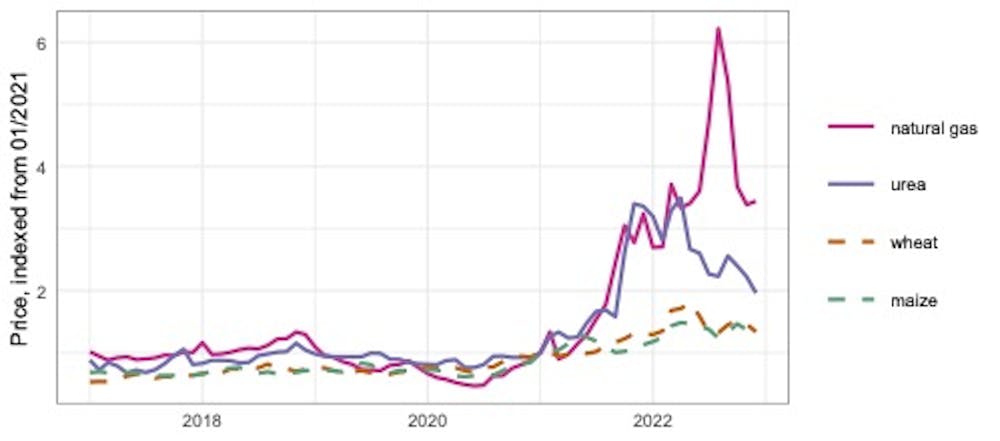
While commodity prices have come down from the peaks of mid-2022, they remain high. At the end of 2022, the global price of maize was up 29% and wheat up 34% since January 2021. This has fed food price inflation, for example in the UK 16.8% inflation in the year to December 2022. Two of the main drivers for these increases are higher energy prices and disruptions to international trade, both with strong links to Russia’s invasion of Ukraine.

Line graph

Commodity market prices for wheat and maize, natural gas and urea, all indexed from 01/2021.
Peter Alexander (Data: World Bank), Author provided

Sanctions and other war-related trade disruptions were high profile, yet appear to have diverted attention away from the more important issue. Energy prices affect food prices directly by increasing the costs of agricultural inputs such as fertilizers, since natural gas is used to make nitrogen fertilizer and accounts for 70%-80% of the total cost of fertilizer production. Additionally, farmers may respond by using less, which leads to lower crop yields, pushing up food prices further.

From 2021 to 2022, urea (a common nitrogen fertilizer) almost doubled in price and natural gas more than doubled, although both are below their mid-2022 peaks. These changes led to cuts in nitrogen fertilizer production as plants became uneconomic, particularly in Europe where 70% of production capacity has been curtailed.

Impacts in 2023 and beyond

In our study, we attempted to better understand how energy and fertilizer price rises and export restrictions affect future global food prices. And we wanted to quantify the scale of harm that hikes in the price of food could have on human nutritional health and the environment. We did this using a global land-use computer model (LandSyMM) which simulates the effects of export restrictions and spikes in production costs on food prices, health and land use.

We found that surging energy and fertilizer prices have by far the greatest impact on food security, with reduced food exports from Ukraine and Russia having less impact on prices. The combined effect of export restrictions, increased energy and fertilizer prices could cause food commodity prices to rise by 81% from 2021 levels.

Such a rise would imply wheat prices increasing in 2023 by the same percentage again as they did in 2022. While the cost of wheat is only a part of the cost of bread, in the UK the average price of a large wholemeal loaf of bread rose from £1.09 at the start of the year to £1.31 at the end. If the inflation rate continues through 2023, that loaf would cost £1.57.

Chart showing average price of bread over the years

After a few stable years, the price of bread in the UK shot up in 2023.
ONS

Export restrictions account for only a small fraction of the simulated price rises. Halting exports from Russia and Ukraine would increase food costs in 2023 by 2.6%, while spikes in energy and fertilizer prices would cause a 74% rise.

Too expensive to eat well

Food price rises will lead to many people’s diets becoming poorer, especially those with the lowest incomes. Our findings suggest there could be up to 1 million additional deaths and more than 100 million people undernourished if high fertilizer prices continue. The greatest increases in deaths would be in Sub-Saharan Africa, North Africa and the Middle East, as people become unable to afford sufficient food for a healthy diet.

Our modeling estimates that sharp increases in the cost of fertilizers – which are key to producing high yields – would greatly reduce their use by farmers. Without fertilizers more agricultural land is needed to produce the world’s food. By 2030 this could increase agricultural land by 200 million hectares, an area the size of much of Western Europe – Belgium, France, Germany, Ireland, Italy, Netherlands, Portugal, Spain plus the UK combined. This would mean lots more deforestation and carbon emissions and a huge loss of biodiversity.

While almost everyone will feel the effects of higher food costs, it’s the poorest people in society, who already struggle to afford enough healthy food, who will be hit hardest.

Subsidizing fertilizers may seem an obvious solution to a problem created in large part by the high cost of fertilizer. However, this just maintains a food system which has given us an obesity epidemic, left millions malnourished, contributes to climate change and is the main factor in the loss of biodiversity.

Targeted actions to ensure healthy and nutritious food is affordable for everyone may be more cost effective in reducing negative consequences from higher food prices and help to transform the food system to a healthier and more sustainable future.

Peter Alexander, Senior lecturer in Global Food Security, The University of Edinburgh

This article is republished from The Conversation under a Creative Commons license. Read the original article.

“Daisy Jones & The Six” and the appeal of the band that breaks their own hearts

I was fortunate enough to see Fleetwood Mac in concert twice before the legendary quintet broke apart and Christine McVie passed away. The first time I saw the band, I thought Lindsey Buckingham was the coolest. The second time, I realized Stevie Nicks is.

Yes, in both shows, the famous pair sang “Silver Springs” while looking directly at each other. They practice looking at each other, the stranger in the seat next to me whispered conspiratorially. But I don’t think you would need to practice eye contact while performing in such proximity – sometimes sharing the same microphone – even for musicians like Buckingham and Nicks with their romantic history. Or, especially for musicians like Buckingham and Nicks. 

It comes out on the stage, all of it, the past and its disappointments, what could have been, what was and maybe what still is. Or at least, we really want it to still be there, the flicker of love between people who created such great songs because of (and despite) each other.

With the arrival of “Daisy Jones & the Six,” Prime Video’s much anticipated series about a band in the 1970s and their rocky rise to fame, we have another example of toxic rock love: musicians who meet, break apart but have to keep coming together, on stage and in song, night after night. What is it about this refrain? Why do we adore this story so much and why do we keep telling it?

Daisy Jones & The Six” is adapted from Taylor Jenkins Reid’s best-selling novel of the same name. Published in 2019, it’s written in the style of an oral history, i.e. the band and those who knew, loved and worked with them speaking as if to a journalist, spilling secrets about each other and trying to unravel the tangled past. Reid was inspired by the story of Fleetwood Mac after first glimpsing Nicks on TV when she was 13. 

You know how easy it is to screw up your entire life by sleeping with somebody in your own band?”

Upon rewatching the Fleetwood Mac televised reunion show “The Dance” as an adult, Reid told Hello Sunshine, “Stevie sung ‘Silver Springs,’ like a woman scorned, holding that microphone like a weapon, drilling holes into Lindsey’s head with her eyes as she sang that her voice would haunt him. I was savvier then, I understood that sometimes looking like you’re in love or in hate are things you ramp up a bit to make a good show. I also understood then what I could never have conceived of in 1997: Love makes no goddamn sense.”

The band in “Daisy Jones” rises to prominence in the ’70s, like Fleetwood Mac. Also like Fleetwood Mac, it includes several couples. Sort of. The frontman of The Six is Billy (Sam Claflin) a handsome, Romantic guitarist and singer/songwriter with the swooping hair and the smolder of a star (like Buckingham). But soon he must share the microphone with Daisy (Riley Keough), an ethereal beauty with the pipes and songwriting prowess to match. And a substance abuse issue. 

Daisy has the wild hair, equally mesmerizing dance moves and flowy dresses of Nicks (with her red hair, Daisy resembles more the contemporary Florence Welch). And like one of rock and roll’s most legendary couples, Billy and Daisy have an intense creative partnership that may go deeper than that.

Daisy Jones and The SixRiley Keough (Daisy Jones) in “Daisy Jones and The Six” (Lacey Terrell/Prime Video)Relationships among band members is not a new or unlikely idea. You’re working with someone, often long into the night. There’s the heightened environment of performing, made more fraught by the prevalence of free-flowing alcohol and drugs. From The Cramps to Ike and Tina Turner, from ABBA to Blondie to Sonic Youth, band members fall in love, get married, break up. 
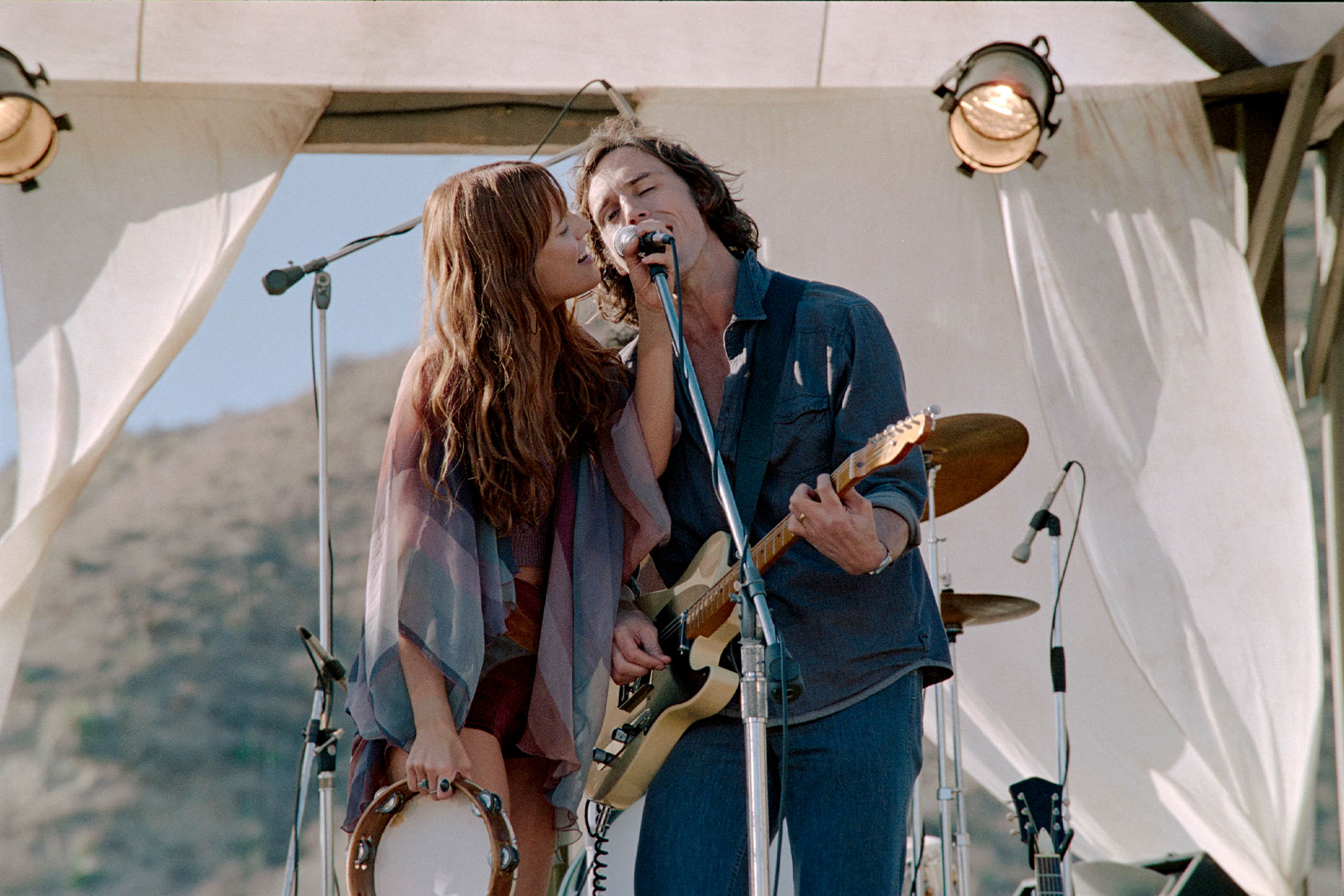
We love rock ‘n roll romances because we want to believe the stories in songs are real, including love stories.

It’s this last stage we’re most interested in. Humans love drama. Way to bring theatrics into music, the issues that aren’t left at the stage door. The White Stripes pretended to be brother and sister, though Jack and Meg White were married (then divorced in 2000). Fans blamed (and some continue to blame) Yoko Ono and her relationship and marriage with John Lennon for the Beatles’ breakup while other fans bemoaned Linda McCartney’s presence in husband Paul McCartney’s later band Wings

It’s playing with fire, to fall (or not fall) for someone you work with, someone you must continue to work with in order to preserve this art, money and career-making thing called the band. As Karen, the keyboardist for The Six, says in the book, “You know how easy it is to screw up your entire life by sleeping with somebody in your own band?”

But when band members fall in and out of love, great art can come from it, as art can come from all experiences, maybe especially the difficult ones. Writing is a way to process. And singing the lyrics you wrote about someone to their face in front of thousands of screaming fans? That’s got to be therapeutic (though more toxic than most therapy).   

Daisy Jones and The SixRiley Keough (Daisy Jones) and Sam Claflin (Billy Dunne) in “Daisy Jones and The Six” (Lacey Terrell/Prime Video)We love the messy band story because it feels like a window into a world most of us will never experience. Here’s what it’s truly like to tour with someone for months, to have feelings for them, to be frustrated or hurt by them but still have to dress up and perform next to them. Drama makes untouchable-seeming rock stars more down-to-earth. They have problems. They fight. They blow up their own lives in the name of love.

We love rock ‘n roll romances because we want to believe the stories in songs are real, including love stories. We all want to be insiders, to know the true tale behind the music. Fleetwood Mac’s “Go Your Own Way”? That’s about Buckingham and Nicks, though Nicks swears the line “packing up, shacking up is all you want to do” was a cruel invention. “He knew it wasn’t true,” she told Rolling Stone in 1997, the year “Daisy Jones & The Six” writer Reid first noticed the band. “It was just an angry thing that he said. Every time those words would come out onstage, I wanted to go over and kill him.”

Nicks’ song “Silver Springs” is about the breakup too. Originally kicked off the album “Rumors,” it became a beloved B-side to . . . “Go Your Own Way.”


Want a daily wrap-up of all the news and commentary Salon has to offer? Subscribe to our morning newsletter, Crash Course.


We also want to believe art is the most important thing, that it can outlast even love. Everything lost, burnt to the ground or tarnished matters not in the face of making something that will last for generations, touch or save millions of lives. But as Nicks told musician Sarah McLachlan (who also married and divorced a band member) in a 2004 interview, “I have been through just about every possible thing that you could go through, and I’ve just about given up everything you could possibly give up for this. And I wonder sometimes if I made the right decisions.”  

Some love – and some bands – burn brightly and hot, and burn themselves out like a comet. Some artists, like the 74-year-old Nicks, endure. She added to McLachlan, “I’ll give you my phone number so that you can call me when you’re in the middle of Toronto, bummed out, and I can tell you that everything’s gonna be all right.”

“Daisy Jones & The Six” premieres on Prime Video March 3. Watch a trailer via YouTube below.


Texas GOPers want to ban reading about abortion — and give tax breaks to straight couples with kids

A new bill introduced in the Texas House would provide property tax cuts for couples who stay married and wants many children — but in order to qualify, they must be heterosexual, never divorced, and their children must be born or adopted after the date of their marriage. 

The bill, H.B. 2889, would give qualifying couples a 40 percent property tax reduction if they have four children, with every additional child increasing the tax break by 10 percent. However, LGBTQ+ couples, single or divorced parents, and blended families will not qualify for full benefits.

Couples with 10 or more children will not have to pay any property tax at all, and any couples meeting the requirements of the bill would get a 10 percent reduction before having any children. 

“Supporting Texas means supporting Texas families. Families are the building blocks of society. We must support families by making it easier for them to have and raise kids,” said Rep. Bryan Slaton, who introduced the bill.

“With HB 2889, Texas will start saying: “Get married, stay married, and be fruitful and multiply,'” he wrote on Twitter.

But as Rolling Stone notes, the bill would only support Texas families that are deemed “morally acceptable by the state’s Republican party.”

The bill defines a “qualifying child” as a “natural child of both spouses of a qualifying married couple born after the date on which the qualifying married couple married,” or an adopted child of one or both spouses, adopted after the couple was married.

A “qualifying married couple,” according to the bill’s language “means a man and a woman who are legally married to each other, neither of whom have ever been divorced.”


Want a daily wrap-up of all the news and commentary Salon has to offer? Subscribe to our morning newsletter, Crash Course.


This is not the first time Slaton, a former minister, has tried to impose an anti-LGBTQ+ policy in the state. The lawmaker has proposed banning minors from all drag performances and has tried to attach anti-LGBTQ+ amendments to seemingly random unrelated legislation, according to reporting from The New Republic.

His former intern, Jake Neidert, is a self-described Christian nationalist who has called for trans people to be “publicly executed,” and has continued to work as legislative director for Rep. Tony Tinderholt, R-Texas, another anti-LGBTQ+ ally of Slaton in the House.

Slaton cited laws implemented in Hungary and Poland that provide tax breaks to large families as motivation for drafting the bill. Fox News star Tucker Carlson heavily promoted Hungarian Prime Minister Viktor Orbán’s family policies on his show last year.

The bill could gain support considering both Texas’ House and Senate are under Republican control. Texas banned abortion in July 2022, after the landmark Supreme Court case Roe v. Wade was overturned. Texas has also implemented various laws penalizing women who attempt to get abortions and any medical providers who try to help them. The state’s infamous “bounty law” came before Roe was overturned, and incentivized Texans to sue anyone trying to assist someone getting an abortion.

Just last week, Texas Republicans introduced the Women and Child Safety Act, which would make it illegal for internet service providers (ISPs) to let users access information about how to get abortion pills. It would also criminalize creating, editing, or hosting a website helping people seek abortions.  

If the bill passes, ISPs will be required to block any websites “operated by or on behalf of an abortion provider or abortion fund,” and they would also be forced to filter websites helping people who “provide or aid or abet elective abortions,” including raising money for abortion funds.

“Right now, if this state law goes into effect, we’re stuck in a situation where we might see ISPs fighting in court saying they have a First Amendment right to host this content,” Evan Greer, director of the non-profit Fight for the Future, told Gizmodo.

“We really need lawmakers to wake up and understand that tech policy issues aren’t wonky concerns,” Greer told the outlet. “These are bread and butter mom and pop issues, and they have just as much of an impact on people’s reproductive rights as legislation moving for or against abortion access in general.”

Jon Stewart expertly corners pro-gun Republican: “You don’t give a flying f**k” about children dying

Comedian Jon Stewart clashed with Oklahoma state Sen. Nathan Dahm in a debate about gun control and drag shows.

Stewart discussed gun violence with Dahm, a “Second Amendment purist,” on the latest episode of his Apple TV+ series The Problem with Jon Stewart. The Republican argued that rather than guns, the country should focus on addressing “fatherless” and broken homes, prompting strong pushback from Stewart.

“You don’t want anything that could help law enforcement or society determine whether or not a person is a good guy with a gun or a bad guy with a gun,” Stewart said. 

“The registry would allow you to have much more effective background checks,” Stewart continued. “I don’t understand why you won’t just admit that you are making it harder for police to manage the streets by allowing all of these guns to go out without permits, without checks, and without background stuff? Why can’t you just stand by that?”

“Because that’s not what I’m doing,” Dahm responded. “I’m defending the individual’s right to keep and bear arms.”

Stewart countered by noting that Americans have to register in order to have voting rights.

“So you have to register for a right. Is that an infringement?” Stewart asked the lawmaker.

“Does the right to vote say ‘shall not be infringed?'” Dahm responded.

“Oh, so this is just a semantic argument?” Stewart retorted, to which Dahm quickly said “no, it’s not.”

Stewart then accused Dahm of being a hypocrite, since he and many other Republicans want to stop children from seeing drag performances.

“Are you infringing on that performer’s free speech?” Stewart asked.

“They can continue to exercise their free speech, just not in front of a child,” Dahm argued.

“Why?” Stewart pressed. 

“Because the government does have a responsibility to protect —” Dahm said before being cut off by Stewart.

“I’m sorry?” Stewart interjected, pushing his ear forward as he waited to hear the word “children.”


Want a daily wrap-up of all the news and commentary Salon has to offer? Subscribe to our morning newsletter, Crash Course.


“What is the leading cause of death among children in this country?” Stewart asked Dahm during the discussion.

“And I’m going to give you a hint,” he said, “it’s not drag show readings to children.”

“Correct, yes,” Dahm responded.

“So what is it?” Stewart asked again.

“I’m presuming you’re going to say it’s firearms,” Dahm said.

“No, I’m not going to say it like it’s an opinion,” Stewart said with indignation. “That’s what it is. It’s firearms. More than cancer, more than car accidents, and what you’re telling me is you don’t mind infringing free speech to protect children from this amorphous thing that you think of, but when it comes to children that have died, you don’t give a flying f**k to stop that because that shall not be infringed.” 

“That is hypocrisy at its highest order,” Stewart concluded.

How science and innovation can strengthen global food systems

Food systems, from production to consumption, are complex in nature and require coordinated efforts at different levels. Food systems are the public policy decisions, the national and global supply chains and the public or private individuals and groups that influence what we eat.

Unfortunately, current global food systems are not sustainable. One in nine people are affected by hunger globally. This situation was worsened by the pandemic.

Global food systems currently do not prevent malnutrition. In fact, they can worsen nutrition and health outcomes with the high rates of obesity and related health issues caused by unhealthy diets. Food today also lacks sufficient nutrients.

Food systems affect the environment negatively, contributing about one-third of global greenhouse gas emissions from 1990–2015. They are susceptible to disruptions like the pandemic, the Russia-Ukraine war or any natural disasters. But science and innovation can offer a way out.

First steps toward scientific innovations

UN Secretary-General António Guterres convened the Food Systems Summit in 2021 with the goal of encouraging stakeholders to collaborate in making tangible, positive changes to global food systems.

With five action tracks, the summit focused on efforts towards achieving the UN Sustainable Development Goals related to food systems, especially Goal 2 (Zero Hunger).

Before the Summit, an independent Scientific Group was set up to provide input from the global scientific community. Information generated was used to recommend seven innovation priorities for transforming food systems. Three are directly related to food science and technology.

Innovations in food science and technology

Innovations in food science and technology are well-positioned to address many food systems challenges. Food processing has enabled nutrient preservation and the enhancement of sensory quality, safety and shelf life of food products. Food fortification — the process of adding micronutrients to food — helps meet specific nutritional needs to mitigate malnutrition.

1) Best out of waste:

The world wastes millions of tonnes of food every year. Reducing food waste and encouraging people to consume diets with lower carbon footprint would therefore be ideal. But since that seems too idealistic, processing technologies (like 3D printing) can be used to convert this waste into new food products, promoting efficient use of resources.

2) Food diversification:

Ongoing food diversification efforts include untapped resources (like millets and baobabs) that have high amounts of nutrients. These neglected, underutilized, minor or orphan crops should be consumed more. Using sustainable alternatives like marine-based foods and edible insects is also gaining popularity in some cultures.

Diversification can help reduce the overuse of the five big staples (maize, rice, wheat, potatoes and cassava) and widen the type of nutrients consumed. It can also encourage local food production, building resilience.

3) Sustainable food processing:

Food processing such as fermentation has proven to unlock the health benefits of food. There is strong scientific evidence that the active components of functional foods — foods that offer health benefits beyond their nutritional value — can prevent diseases like hypertension and Type 2 diabetes.

This preventative approach to health is largely underutilized.

Effective implementation equals success

The main task now is to efficiently implement these recommendations, especially in regions most affected by food insecurity.

Food systems policy initiatives mostly occur at the national and global levels and community-level engagements can help increase the chances of sustaining their impact locally. Local engagement can also help gather and implement traditional knowledge and cultural beliefs that influence innovation.

Food system solutions need to be locally driven and culturally informed.

This calls for inclusive approaches in gathering scientific data, including through citizen science. Data sharing in scientific journals should also expand to include unconventional methods and results, especially those of regional importance, that can expedite the solutions.

Interventions also need to be consumer-focused. Emerging innovations should be driven by public participation and input, instead of industry and funding priorities. Food is an emotive topic and involving the public in discussions on food systems can help reduce misinformation and encourage acceptance of innovations.

At the same time, the political will to drive innovation-focussed food systems locally and globally is also crucial. Industry should be required to prioritize innovations that sustainably produce food with direct public benefit.

Increased financial investment is also needed. The UN Food Systems Summit Scientific Group proposed that governments around the world should spend at least one per cent of their agricultural GDP on food systems science and innovation. This support should also be extended for the creation of small businesses and niche markets for unconventional food products, especially in rural communities and low and middle-income countries.

Lastly, the complexity of food systems today requires the collaboration across different scientific disciplines and sectors when it comes to developing and implementing solutions. Academic and research institutions should therefore update their policies to adequately reward such collaborative approaches that stand a better chance of providing solutions than the status quo.

Chibuike Udenigwe, Professor and University Research Chair in Food Properties and Nutrient Bioavailability, L’Université d’Ottawa/University of Ottawa

This article is republished from The Conversation under a Creative Commons license. Read the original article.

“Seems illegal”: Experts say Murdoch could face FEC fine if he funneled secret info to Kushner

Fox Corp. Chairman Rupert Murdoch could potentially face financial penalties from the Federal Election Commission if the allegations that he shared confidential information with former White House advisor Jared Kushner are true. 

A recent court filing in Dominion Voting Systems’ $1.6 billion defamation lawsuit against Fox News alleged that Murdoch provided former-President Donald Trump’s son-in-law with information about then-candidate Joe Biden’s television ads. 

“During Trump’s campaign, Rupert provided Trump’s son-in-law and senior advisor, Jared Kushner, with Fox confidential information about Biden’s ads, along with debate strategy (providing Kushner a preview of Biden’s ads before they were public),” the Dominion filing states. 

Murdoch and Kushner communicated during the 2020 campaign and on election night. In his deposition, Murdoch discussed how Kushner reached out to him after the network called Arizona for President Biden.

“My friend Jared Kushner called me saying, ‘This is terrible,’ and I could hear Trump’s voice in the background shouting,” he said, according to the filing. “And I said, ‘Well, the numbers are the numbers.'”

The allegations from Dominion cite Murdoch’s deposition, as well as internal communications from Fox obtained during the discovery process, which are still sealed. 

Campaign finance and ethics experts say that if the allegation is proven true, the information that Murdoch provided to Kushner would be considered an unreported “in-kind” contribution.

“Non-monetary goods or services, including non-public opposition research, provided to a candidate free of charge or at a discount for campaign purposes is defined under the campaign finance law as an in-kind contribution, subject to the reporting requirements and contribution limits,” Craig Holman, a government affairs lobbyist at Public Citizen, told Insider

“If the allegations are true, this is precisely what Murdoch provided to the Trump campaign,” he explained.


Want a daily wrap-up of all the news and commentary Salon has to offer? Subscribe to our morning newsletter, Crash Course.


“If Fox News gave Jared Kushner confidential information that could have helped the Trump campaign during the presidential election, that may have been an in-kind contribution that needed to be declared to the Federal Election Commission,” wrote Noah Bookbinder, the president of Citizens for Responsibility and Ethics in Washington.

“From a campaign finance law perspective, a corporation or its agents would be breaking the law if they were to give anything of value – including intangible things like information – to a campaign or its agents in connection with an election,” Saurav Ghosh, the director for federal campaign finance reform at the Campaign Legal Center, told Insider.

Ghosh added that they don’t currently have enough information to determine whether that’s what happened here, but “if a corporate agent passed nonpublic information to a campaign agent, that would likely be considered an illegal in-kind contribution, warranting an investigation and possible enforcement to uphold the law and protect our elections.”

A press officer with the FEC declined to comment on the allegations but told Insider that if they find a violation occurred, “possible outcomes can range from a letter reiterating compliance obligations to a conciliation agreement, which may include a monetary civil penalty.”

Fox Corp. did not comment on the Insider report but has previously denied any wrongdoing in response to Dominion’s lawsuit and accused the company of cherry-picking evidence in filings to smear the network.

Rep. Ted Lieu, D-Calif., wrote that Murdoch’s actions “seem illegal.”

“At the very least, it would appear to be a campaign contribution of significant value, well over federal campaign limits,” he wrote on Twitter.

Corporate expenditures by a press entity do not count under the so-called “media exemption” if the press is engaging in normal functions, such as providing commentary or reporting on the news, Rick Hasen, an election law expert at UCLA, wrote at his Election Law Blog.

Assuming the allegations in Dominion’s complaint are true, Hasen wrote, “sharing one candidate’s ads that have not aired with a competing candidate does not appear to be part of any press function.”

“The ads were not shared for the purpose of newsgathering or opinion writing,” he explained. “They appear to be outside the context of the media exemption, and potentially illegal.”

The Baltimore corner store sandwich that helped me fall in love with breakfast

For $50, you can have five star-level gourmet breakfast sandwiches every day for a week. 

“How’s a bacon, egg and cheese from the bodega?” Linda, my former  publicist, shot me in text. “I’m in the store now.” 

“Turkey bacon, I don’t eat pork, and add jelly,” I reply. 

“That has to be a Baltimore thing, you people crack me up!” 

Linda, a New Yorker,  worked on my book “The Cook Up,” but a few years earlier, she also worked on “Grace After Midnight,” a memoir by “The Wire” star Felicia “Snoop” Pearson. Linda recalled Snoop, who is also a Baltimore native, ordering the same sandwich religiously during their press run. 

“Girl that sounds nasty,” she would tease Snoop, who would  proudly say, “It’s the only way.” 

I agree with Snoop. My mom, my dad, my siblings and everyone required jelly on their egg sandwiches. And other than that exchange with Linda, I normally don’t get a reaction when ordering the bacon, egg, cheese and jelly. That is probably because people with all kinds of palates understand that the savory bacon with the sweet jelly make for a perfect pair, like pasta and wine. 

The bacon, egg and cheese sandwich has been eaten since they invented the pig, but the jelly makes it special–– the age-old sandwich can’t call itself a delicacy without the jelly. I’ve been ordering the sandwich from corner stores around Baltimore for so long that I can’t remember when it entered my life. At Bo Bo’s Kitchen or Lee’s, the cheap carryout spots on my block that also sold trash bags, penny candy and frozen cups — the clerks always used to ask, “With or without jelly?” 

Because they knew that extra ingredient was vital. 

So, a typical bacon, egg, cheese and jelly sandwich requires one slice of American cheese, a teaspoon of Welch’s grape jelly, two pieces of bacon (pork or turkey), one egg mixed with salt and pepper fried hard — all between two slices of basic white bread. This retails for about $3 to $5 anywhere from Baltimore to New York. This is what I grew up on, what raised me, what helped me fall in love with breakfast; however, this is not why we are here.

Bacon, egg and cheese — with jelly
Yields
1 servings
Prep Time
5 minutes
Cook Time
10  minutes

Ingredients

(With prices from Whole Foods)

Brioche Rolls, 6 ct – $6.39

Cabot Cheddar- $5.99

Applegate Turkey Bacon- $8.99

Eggs- $4.79

Olive oil spray-$4.49

Organic strawberry jelly – $4.39

Organic curry powder- $6.99

Organic cayenne pepper- $6.99


Directions

  1. I typically use Challah or the Brioche listed, and toast them lightly before I do anything. Then I fry the bacon. 

  2. While the bacon is sizzling — slice the Cabot Cheese into thin squares. When the bacon is finished, degrease if necessary and place it to the side. Warm up your egg pan and spray it with olive oil. 

  3. I try to avoid salt when I can and since bacon is practically made of salt, I don’t put any in the eggs. Crack two eggs and mix them with a little curry powder and red pepper–– please season to taste. I go for over hard, but over easy is delicious as well. I recommend placing the sliced cheese into the center of the eggs and then folding that egg perfectly so that no cheese escapes, but make your eggs your way because this is your sandwich. 

  4. Spread a thin layer of jelly on each piece of bread, and then assemble your sandwich. After your sandwich is together–– place it back in the pan and fry, smashing in a panini style, until the bread is toasted to your liking. Remove it from the pan and slice in half. 


Cook’s Notes

  • The final product is hardy, delicious and when I eat them, I’m normally able to skip lunch. 
  • I also order the sandwich when I’m about and about in Baltimore or at bodegas wherever I can find a bodega–– but never with American Cheese. You don’t have to use cheddar, but I think many of us understand how much American cheese sucks. This sandwich has grown with me even as I grew out of American cheese.
  • Now, my friends who eat pork always tell me that the pork bacon is 1000% times better on this sandwich and takes everything to the next level — but I don’t eat pork. If you are a pork person, please use pork. 
  • Also abandon the cayenne if you aren’t into spicy–– and enjoy, it’s a local  banger that I’ love to take national. 


California’s rare flowering “superbloom” at risk of being trampled to oblivion by unruly tourists

After several weeks of weird, record-breaking winter storms, California is anticipating another “superbloom” this spring, a rare phenomenon when Southwestern deserts and hills are carpeted in brilliant wildflowers. Superblooms only trigger under precise conditions, but the explosion of blossoms can be so intense that splotches of orange and yellow are visible from space.

These events, which usually peak in late March, can feature everything from desert dandelions to evening primrose to lavender lupine — and of course, plenty of apricot-colored California poppies, the official state flower.

“We’ve seen that the public have not shown restraint in the pursuit of the perfect picture for social media.”

While not technically a botanical term used by plant experts, superblooms are a popular trending topic on social media, with hundreds of thousands of posts on Instagram and TikTok depicting lush meadows teeming with flowers. In 2019, the year of California’s last major superbloom, tourists overwhelmed the hills of Lake Elsinore, as well as Joshua Tree National Park, Lake Tahoe and the Santa Monica Mountains. Many sightseers were seeking that Instagram-perfect snapshot of natural beauty. But such things can come at a cost to nature.

“The flora of California is magnificent. About a third of the [plant] diversity in California are these annual plants that only show themselves when there’s ample precipitation. Otherwise, they’re lying dormant in the soil seed bank,” Naomi Fraga, the director of conservation programs at the California Botanic Garden in Claremont, told Salon. Fraga, who has been studying rare native plants in the state for two decades, says every time the rains get heavy enough, her department fields calls anticipating the next superbloom.

Fraga describes superblooms as showcasing “hidden diversity” that only reveals itself in years of intense rain. Gorgeous buds aren’t a bad reprieve from California’s recent drought, either. “Your senses get overwhelmed by just the sheer mass of flowers all blooming at the same time,” Fraga said.

But botanists like Fraga and other plant experts are trying to encourage folks to skip the superbloom this year, or at least exercise some extreme restraint. That’s because these floral ecosystems are fragile, stressed and repeatedly damaged by careless “nature enthusiasts” who go off-trail, trampling the plants and spreading the seeds of invasive species.

It’s true that witnessing a superbloom can be spectacular. But if people really care about it, they shouldn’t follow the crowds stomping on these plants, leaving trash and clogging up traffic.

“We’ve seen that the public have not shown restraint in the pursuit of the perfect picture for social media,” Fraga said. “It’s this very transactional interaction where people are seeking to get something from nature and to have that moment, that interaction, but they’re not thinking about how their desire for that moment has an impact on the environment.”

Echoing this sentiment, on February 7, Natasha Johnson, the mayor of Lake Elsinore, announced at a press conference that Walker Canyon, a locale blanketed by a superbloom in 2019, would be closed to the public this year. Trespassers were threatened with arrest to avoid what Johnson described as her community being swamped with “Disneyland-sized crowds” numbering as many as 100,000 people in a single weekend. The so-called “poppy apocalypse” gridlocked the Riverside County city, population 70,000, and resulting in the death of a police officer, who was struck by an intoxicated driver.

“We know people want to see a beautiful sea of color,” Johnson said. “We also want the land in our community to thrive.”


Want more health and science stories in your inbox? Subscribe to Salon’s weekly newsletter The Vulgar Scientist.


Fraga isn’t interested in shaming people, but does want to educate folks on the fragile beauty of these sporadic blossoms. Going off the trail is generally where the trouble starts. Crushing the reproductive aspects of plants means that the next generation could be diminished.

“And once you have numerous people creating these user trails and walking in the same area, then that might actually degrade that habitat for those flowers to be able to grow in that area in future years,” Fraga said. “People walk around lots of different places, and they might be carrying around weed seeds in their shoes, and inadvertently be spreading invasive species around.”

“I just wish that people could maybe adjust their expectations for what they think nature should be providing every year. That’s a lot to ask for, like a superbloom every year.”

Despite their stunning displays, Fraga describes these state parks as “boutique ecosystems” that are a shadow of what they once were. For example, Carrizo Plain National Monument, one of the prime wildflower spots in California, was once a massive grassland populated by antelope and elk. Today, it is a mere 200,000 acres, which is less than it sounds, shriveled up by surrounding agriculture and development. In 2020, federal officials approved an oil well and pipeline within the monument, which is also host to several massive solar power plants.

“We’ve marginalized these habitats so much already. And we’re marginalizing them further by loving them to death,” Fraga said. “So how can we get people to recognize that and show restraint, if they want them to exist into the future?”

Fraga says that superblooms can overshadow appreciation for other plants, like the perennials that thrive in California year-round. “It’s always exciting for me to see even just a few flowers,” Fraga said. “I just wish that people could maybe adjust their expectations for what they think nature should be providing every year. That’s a lot to ask for, a superbloom every year.”

Fraga also encourages people to garden, creating their own lush landscapes that don’t involve traveling. By planting local plants, you can also support native pollinators, finding that spark or connection to nature in a less vain and consumptive manner.

“I know it’s not the same [as a superbloom.] We can get our thrills in a variety of ways, I suppose,” Fraga said. “I’d just like people to ask themselves, what is it that they’re seeking? And what are their motivations for their visit? And consider what the impact is.”

8 everyday foods you might not realize are ultra processed – and how to spot them

For years, the term “junk food” has been used to refer to foods considered bad for you, and not very nutritious. But junk can mean different things to different people.

Official dietary guidelines have used more palatable terms such as “discretionary foods”, “sometimes foods” and “foods high in sugar, salt and fat”. But these labels haven’t always made the task of identifying nutritious foods much easier. After all, many fresh fruits are high in sugar and some salad vegetables are low in nutrients – but that doesn’t make them unhealthy. And food products such as soft drinks with “no added sugar” and muesli bars fortified with nutrient additives aren’t necessarily healthy.

In 2009, experts proposed using the extent and purpose of industrial food processing as a key indicator of nutrition problems.

The theory acknowledged some food processing helps make foods more convenient, safer and tastier. But it also nominated a class of foods – called “ultra-processed foods” – as unhealthy, based on more than the content of salt, fat and sugar.

A large body of evidence now shows ultra-processed food consumption is associated with poorer human health (including rates of heart diseases, diabetes and obesity) and planetary health (plastic pollution, excessive energy and land use, biodiversity loss).

But how can you spot those foods when you’re planning what to buy or eat?

What counts as an ultra-processed food?

Ultra-processed foods are made using industrial processing methods and contain ingredients you wouldn’t usually find in your home pantry.

Processing methods used may include extrusion, molding, chemical modification and hydrogenation (which can turn liquid unsaturated fat into a more solid form). But manufacturers don’t need to state the processes foods undergo on the label, so it can be challenging to identify ultra-processed foods. The best place to start is the ingredients list.

There are two types of ingredients that classify ultra-processed foods: industrial food substances and cosmetic additives. Food substances include processed versions of protein and fiber (such as whey powder or inulin), maltodextrin (an intensely processed carbohydrate), fructose or glucose syrups and hydrogenated oils.

Cosmetic additives are used to improve the texture, taste or color of foods. They make ultra-processed foods more attractive and irresistibly tasty (contributing to their over-consumption). Examples are colors and flavors (including those listed as “natural”), non-caloric sweeteners (including stevia), flavor enhancers (such as yeast extract and MSG) and thickeners and emulsifiers (which modify a food’s texture).

Eight foods you might not realize are ultra-processed

Ultra-processed is not just another name for junk – although foods like soft drinks, confectionery and chips are ultra-processed. There are many packaged foods we’d normally consider healthy that are ultra-processed.

1. Breakfast cereals

Many cereals and breakfast drinks marketed as healthy are ultra-processed. They can contain maltodextrins, processed proteins and fibers and colors. Oats, on the other hand, contain just one ingredient: oats!

2. Protein and muesli bars and balls

Despite the healthy hype, many of these are ultra-processed, containing processed fibers and proteins, invert sugars (sugars modified through an industrial process) and non-caloric sweeteners.

3. Plant-based ‘milks’

Many dairy alternatives contain emulsifiers, vegetable gums and flavors. Not all brands are ultra-processed, so check the ingredients list. Some soy milks only contain water, soybeans, oil and salt.

4. Breads

Some packaged breads contain emulsifiers, modified starches (starches altered through industrial methods) and vegetable gums – they’re usually the plastic wrapped, sliced and cheaper breads. Fresh bakery breads, on the other hand, are rarely ultra-processed.

5. Yogurts

Flavored yogurts often contain additives like thickeners, non-caloric sweeteners or flavors. Choose plain yogurts instead.

6. Meal bases and sauces

Pre-prepared pasta and stir-fry sauces typically contain ingredients such as thickeners, flavor enhancers and colors. But simple sauces you can make at home with ingredients like canned tomatoes, vegetables, garlic and herbs are minimally processed.

7. Processed meats

Packaged cold meats may have emulsifiers, modified starches, thickeners and added fibers – making them ultra-processed. Replace packaged processed meats with alternatives such as cold roast meats or chicken instead.

8. Margarine

The way margarines and non-dairy spreads are made (by hydrogenating the vegetable oils) and the additives they contain, such as emulsifiers and colors, make them an ultra-processed food – unlike butter, which is essentially cream and some salt.

But are all ultra-processed foods bad?

Some types of ultra-processed foods may look healthier than others, having fewer industrial ingredients or being lower in sugar. But these are not necessarily less harmful to our health. We know Australians consume up to 42% of their energy from ultra-processed foods and the cumulative effect of industrial ingredients over the whole diet is unknown.

Also, when you consume an ultra-processed food, you may be displacing a nutritious fresh food or dish from your diet. So, reducing ultra-processed foods as much as possible is a way to move to a healthier and more sustainable diet. Though not exhaustive, there are online databases that rate specific products to guide food choices.

Supermarkets are dominated by ultra-processed foods, so it can be difficult to avoid them entirely. And sometimes choices are limited by availability, allergies or dietary intolerance. We can all make positive changes to our diet by choosing less processed foods. But governments can also legislate to make minimally processed foods more available and affordable, while discouraging the purchase and consumption of ultra-processed foods.

Sarah Dickie, PhD Candidate in Public Health Nutrition, Deakin University; Julie Woods, Honorary Associate Professor of Public Health Nutrition, Deakin University; Mark Lawrence, Professor of Public Health Nutrition, Institute for Physical Activity and Nutrition, Deakin University, and Priscila Machado, Research Fellow, Institute for Physical Activity and Nutrition, Deakin University

This article is republished from The Conversation under a Creative Commons license. Read the original article.

Florida GOP bill would require bloggers to “register” with the state to write about Ron DeSantis

A Republican Florida lawmaker wants all bloggers who write about Gov. Ron DeSantis and other government officials to register with the state or face punishment in the form of fines. 

State Sen. Jason Brodeur this week introduced Senate Bill 1316, which would mandate that any blogger writing about government officials — including the governor, lieutenant governor, cabinet officers and any member of the state legislature or executive branch — has to register with the Florida Office of Legislative Services or the Commission on Ethics.

Basic information about the blog posts, including the dates published and web addresses, would have to be turned in to state offices. 

The bill states that anyone who writes “an article, a story, or a series of stories,” about “elected state officers” who receives or will receive payment, must register with the state within five days of publication. 

If any follow-up posts are made to a blog, they would also be required to submit a report on the 10th of each month with the appropriate state office, with the exception of months when no content is published.

Bloggers that make posts that “concern an elected member of the legislature” or “an officer of the executive branch,” would have to disclose the amount of compensation they received for the coverage rounded to the nearest $10 value. If it is a series of posts, the blogger would have to disclose the total amount to be received in the time frame, NBC affiliate WFLA reported.

“If the compensation is for a series of blog posts or for a defined period of time, the blogger must disclose the total amount to be received upon the first blog post being published,” the bill reads. “Thereafter, the blogger must disclose the date or dates additional compensation is received, if any, for the series of blog posts.”

Any additional compensation must be disclosed later. The bill also says that the reports “must include” the “individual or entity that compensated the blogger for the blog post, and “the amount of compensation received from the individual or entity.”

If the bill passes, a blogger who doesn’t file the correct disclosures or register their work with state officials would receive daily fines, with a maximum amount per report (not per writer) of $2,500. 

The fine would be $25 for each day the blogger is late to report to the state. 


Want a daily wrap-up of all the news and commentary Salon has to offer? Subscribe to our morning newsletter, Crash Course.


The proposed legislation would only apply to posts about elected officials, not candidates, and it would only apply to blogs — not newspapers or similar publications.

In addition to regulations on bloggers, the bill also specifies that government agencies can publish legally required advertisements and public notices on county sites if the cost is not paid by or recovered from an individual.

Brodeur’s motivation for drafting the bill comes from his belief that bloggers should be treated like lobbyists. 

“Each house of the Legislature and the Commission on Ethics shall adopt by rule, for application to bloggers, the same procedure by which lobbyists are notified of the failure to timely file a report and the amount of the assessed fines,” the bill reads.

When asked about equating bloggers to lobbyists, Brodeur told the website Florida Politics that “paid bloggers are lobbyists who write instead of talk.”

“They both are professional electioneers,” he told the outlet. “If lobbyists have to register and report, why shouldn’t paid bloggers?”

Brodeur has faced media criticism since his first run for Florida Senate in 2020. According to reporting from Florida Politics late last year, Republicans in Brodeur’s district allegedly recruited candidates to run with no party affiliation, commonly called a “ghost candidate.” 

He won that election with just 50.3% of the vote, beating his Democratic opponent Patricia Sigman, while a no-party-affiliated candidate, Jestine Iannotti — who had misleading mailers sent out on her behalf using a stock photo of a Black woman — siphoned off 5,787 votes.

Ron Kuby, a First Amendment lawyer in New York, told NBC News that the Brodeur’s proposed legislation would not survive a court challenge if it is passed.

“It’s hard to imagine a proposal that would be more violative of the First Amendment,” Kuby told the outlet. “We don’t register journalists. People who write cannot be forced to register.” 

Ethics panel launches Santos probe — critics say it’s “too little, too late for the MAGA majority”

As the U.S. House Committee on Ethics announced an investigation into embattled Congressman George Santos, progressives on Thursday renewed calls for the New York Republican to be expelled from office over his elaborate lies and controversies.

“Why did it take the MAGA House nearly two months to do anything about it?” asked Accountable.US spokesperson Derek Martin.

Santos, who was sworn in to represent New York’s 3rd District in January, has faced criticism for dishonesty about his education, employment history, and religious background, and concerns have mounted about his net worth, claims of fraud in Brazil and the United States, potential campaign finance violations, and alleged sexual harassment of a former staffer.

“George Santos’ extensive lies were exposed even before he was sworn in,” Martin noted. “Everyone knows George Santos is a total fraud—even his own constituents have called for him to resign.”

House Speaker Kevin McCarthy, R-Calif., “should’ve called for Santos to resign on Day 1,” he argued. “It’s too little, too late from the MAGA majority.”

House Ethics Committee Chair Michael Guest, R-Miss., and Ranking Member Susan Wild, D-Pa., said in a statement that in accordance with chamber rules, the panel unanimously voted on Tuesday to establish an investigative subcommittee led by Rep. David Joyce, R-Ohio. He is joined by Wild as well as Congressmen John Rutherford, R-Fla., and Glenn Ivey, D-Md.

Guest and Wild explained that the subcommittee has jurisdiction to determine whether Santos “engaged in unlawful activity with respect to his 2022 congressional campaign; failed to properly disclose required information on statements filed with the House; violated federal conflict of interest laws in connection with his role in a firm providing fiduciary services; and/or engaged in sexual misconduct towards an individual seeking employment in his congressional office.”

Santos’ office said Thursday that “the House Committee on Ethics has opened an investigation, and Congressman George Santos is fully cooperating. There will be no further comment made at this time.”

Meanwhile, Stand Up America executive director Christina Harvey said that “George Santos deceived voters in New York’s 3rd Congressional District about his résumé, background, and the source of his campaign funds. The House Ethics Committee should condemn Santos in the strongest possible terms and recommend his expulsion from the House of Representatives.”

“Speaker McCarthy has promised to remove Santos if he is found to have broken the law, and we will hold him to his word,” Harvey continued. “Santos’ constituents deserve real representation at home and in Washington, instead of a liar and a fraud with zero credibility.”

Stand Up America also joined with Common Cause and more than 50 other groups based in New York this week for a letter calling on the state’s congressional delegation “to commit to voting to expel Rep. Santos from Congress.”

“As New York state in recent years has made strides toward becoming a national leader on campaign finance issues, voters expect our federal delegation to hold their colleagues to a higher standard of transparency and accountability,” they wrote. “Federal prosecutors and regulators are already doing their job. It’s time for every member of New York’s congressional delegation to make it clear that they are prepared to hold Rep. Santos accountable.”

“Failing to do so,” they warned, “is putting political gain over the interests of New York voters.”

As The Hill noted Thursday, “The Ethics Committee probe is just one of several investigations into Santos, who is also coming under scrutiny from the Nassau County District Attorney, the New York state attorney general, the Queens district attorney, and reportedly by the U.S. Attorney’s Office in the Eastern District of New York.”

Trump campaign asked Proud Boys to attend post-election rallies in plain clothes

Evidence presented in the seditious conspiracy trial against leaders of the white nationalist group the Proud Boys suggests that the group’s higher-ups were in communication with the Trump campaign, which urged them to appear at rallies around false claims of fraud in the 2020 presidential election.

News of the evidence was reported on by The Washington Post on Wednesday.

Prosecutors showcased communications in which members of the Proud Boys, including its then-leader Henry “Enrique” Tarrio, discussed plans to attend rallies in support of former President Donald Trump. According to Tarrio’s messages, which were sent using an encrypted program, the Trump campaign asked the Proud Boys for help in the days after the election, when the results were called for now-President Joe Biden.

The campaign asked the Proud Boys to attend rallies and to appear indistinguishable from other rally-goers, rather than wearing their traditional black and yellow garb.

“The campaign asked us to not wear colors to these events,” Tarrio said in one of the messages, which was dated November 8, 2020, just days after the election.

The communications also indicate that Tarrio and the Proud Boys were aware that these events could potentially erupt into violence, including the January 6, 2021, “Stop the Steal” rally.

“Whatever happens … make it a spectacle,” Tarrio said on January 4, 2021.

More than 200 encrypted chats, texts and other forms of communications were presented at the trial, showcasing that Tarrio and other Proud Boys members were preparing for violence on January 6, the day a mob of Trump loyalists attacked the Capitol building in an attempt to disrupt Congress’s certification of the 2020 election.

The initial communications discussing how Trump’s campaign had contacted Tarrio took place just weeks after Trump appeared to publicly endorse the white nationalist group. In a debate between Trump and Biden in September 2020, Trump refused to condemn the Proud Boys, instructing them instead to “stand back and stand by” — words that the group celebrated as “historic” and helpful for driving up their recruitment.

A federal judge in the seditious conspiracy trial determined in January of this year that Trump’s words during that debate could be included in prosecutors’ evidence against the Proud Boys. A guilty verdict against Tarrio and others in the trial could be detrimental to Trump’s 2024 election prospects, some commentators say.

“A conviction now will bolster [the] theory” that the Proud Boys were motivated by the former president “and help tie Trump to the coup,” Los Angeles Times Legal Affairs columnist Harry Litman said in response to the judge’s decision.

Skipping out on CPAC: Did Trump kill off conservatives’ biggest confab?

It’s that time again.

CPAC, the annual gathering of the most committed members of the right wing in America is back to catch up with their fellow travelers and own them some libs. As of late, they’ve been holding their little convention several times a year in different places like Hungary and Texas but this weekend they’re back on their favorite stomping grounds at the Gaylord near Washington, D.C.

This year, there’s a bit of controversy over the fact that certain probable presidential candidates aren’t bothering to show up, something that would have been unheard of in years past. Instead of attending the traditional hate-fest, they’ve decided to go to a big donor confab hosted by the Club for Growth. Why? Because CPAC has become a wholly owned subsidiary of the MAGA movement with Donald Trump topping the bill as keynote speaker. Florida Governor Ron DeSantis, for instance, decided to attend the donor meeting rather than go mano a mano with the former president, taking refuge with the group that has said it’s dedicated to depriving Trump of another term.

And DeSantis isn’t the only one.

Former Vice President Mike Pence, Sen. Tim Scott of South Carolina, South Dakota Gov. Kristi Noem and New Hampshire Gov. Chris Sununu are expected at the Club for Growth’s event but are not expected to appear at CPAC. With only Mike Pompeo and Nikki Haley coming to CPAC, it looks like the MAGA lane is wide open for Trump — at least for this weekend.

There are reports that the reason these luminaries aren’t showing up at CPAC as they had always done in the past is that the man who runs it, Trump acolyte Matt Schlapp, has been credibly accused of groping a man who was working on the Herschel Walker Senate campaign and now he is supposedly persona non grata among establishment Republicans:

“It’s a scandal,” one Republican operative who has worked on several presidential campaigns told CNN. “If you are thinking about running for president and you’re not Donald Trump, you can’t afford a misstep. You can’t afford to be linked to a scandal.”

I find it hard to believe, frankly. It’s far more likely they are avoiding CPAC because it’s a hotbed of Trump mania as well as the fact that they are all desperately hustling for money from those big donors at the Club for Growth meeting. DeSantis surely figures he’s feeding the MAGA monster all the red meat it can eat already and the rest of them (except, perhaps, for Noem) are trying to run to some small extent as anti-Trumps. None of them need CPAC more than they need money right now.

Trump, on the other hand, is going to be dependent on that small donor network he’s put together since 2016. He’s always relied more on the MAGA faithful to repeatedly give him, a supposed billionaire, their hard-earned money and they’ve always been happy to do it. With big donors hedging (for now) his first order of business is to keep his flock happy and excited. Besides, Club for Growth didn’t invite him.


Want a daily wrap-up of all the news and commentary Salon has to offer? Subscribe to our morning newsletter, Crash Course.


One of the mainstays of CPAC over the years has been its gross merchandising and outrageous speakers (aside from the outrageous politicians.) Back in the day, you could buy bumper stickers that said “Happiness is Hillary’s face on a milk carton” or some racist “Obama waffles” in the hall along with “liberal hunting permits.” This year they are offering a new reprehensible joke only fit for a 12-year-old bully :

Featured speakers in the past included the bomb-throwing Ann Coulter who used to mesmerize the crowd with clever bon mots like, “I think our motto should be post-9-11, ‘raghead talks tough, raghead faces consequences.'” This year, they invited the execrable Chaya Raichik, the operator of the hate-filled Libs of TikTok Twitter account that stalks LGBTQ teachers and medical providers for transgender patients. As Vice reported, she is on the grift, big time:

Her social media following has skyrocketed, she is raking in tens of thousands of dollars from her Substack subscribers, she has published a children’s book that depicts teachers as predators, she’s dined one-on-one with former President Donald Trump, and she’s appeared numerous times on Fox News and Newsmax.

Oh, and Ron DeSantis invited her to stay at the Governor’s mansion in Florida. 

They loved her at CPAC:

But the real stars of the show are the mainstream GOP officials who are even more sophomoric and crude than the professional bomb throwers.

You have Sen John Kennedy from Louisiana with a litany of stale oldies about liberal weirdos:

Sen. J.D. Vance, R-Ohio, talking about Democratic “thugs”:

The always unctuous Ted Cruz calling for Dr. Fauci to be jailed:

Sen. Rick Scott of Florida with an enemies list:

Rep. Scott Perry of Pennsylvania on an extended rant about leftists using the government against individuals after which he promised to use the government against them:

Who needs rude pundits and insult comics to thrill the crowd when you have elected officials like this lot?

The bigger names are coming up today and over the weekend. Congresswoman Marjorie Taylor Greene of Georgia is speaking and has been teasing a big announcement. (An endorsement perhaps?) Unlike last year’s CPAC in Orlando, there isn’t a white supremacist gathering across town that she’ll feel compelled to attend.

And Trump himself will be there on Saturday, which should fire up the crowd. They love Trump and really don’t care about any of the others. As one attendee told Business Insider:

Whoever wants to run, that’s fine. But President Trump is the one that we need. There’s others out there but they don’t have what it takes to make America great.

Maybe it was just a slow first day or the crowd is burned out after so many CPACs last year that they didn’t get the normal numbers. Maybe some people are weirded out about Schlapp’s groping scandal. Whatever it is, the first day didn’t have the kind of crowd it usually has. The big rooms were half empty, there weren’t as many exhibits and the sense of wingnut fun that had people doing things like this was completely missing:

Wearing track suits and colonial-style wigs, Steve Crowder, a Fox News contributor and comedian, and Chris Loesch, the husband of conservative commentator Dana Loesch, warmed the crowd up with a rap about “Mr. America.” Behind them was their own music video of the song, in which they wore more colonial-style clothing and stood in front of a building that appeared to be some sort of fortress.

From the looks of it, the crowd this year could barely get themselves to clap. Is it possible that the air really has gone out of the MAGA balloon? Or are people just bored with CPAC? We’ll have to see if the event picks up over the next couple of days and if Trump can draw a big crowd on Saturday. But it’s not looking good for CPAC, which has been around for decades. As the Never Trumper Rick Wilson said in his book of the same name: “Everything Trump touches, dies.” It could very well be that CPAC is his latest victim. 

Walmart, Target, Home Depot lead pack of retailers emitting millions of pounds of CO2 via shipping

2021 was a big year for the global shipping industry, as COVID-19 drove hordes of shoppers to the internet to buy new clothes, gadgets, furniture, and other goods. Booming e-commerce contributed to widely reported supply chain disruptions — but it also led to less-reported consequences for the climate and public health.

A new report from the nonprofits Pacific Environment and Stand.earth finds that the ships that carried imports for 18 of the U.S.’s largest retail, fashion, tech, and furniture companies emitted about 3.5 million metric tons of greenhouse gases in 2021, about as much as the annual climate pollution from 750,000 passenger cars. The ships transporting these companies’ clothes, computers, knickknacks, and other goods also released thousands of metric tons of cancer- and asthma-inducing nitrous oxide and particulate matter into port communities.

The report brings “awareness and accountability to the companies that were behind that onslaught of pollution in 2021,” said Madeline Rose, Pacific Environment’s climate campaign director. She called on retail companies to demand cleaner shipping fuels and practices from the freight companies they pay to transport their goods, with an eye toward net-zero emissions by 2030.

Pacific Environment’s report shines a spotlight on 18 major maritime importers in four retail categories, chosen based on their shipping emissions and their recognizability. Walmart, Target, and Home Depot led the pack in maritime climate and air pollution, together causing more than 1.7 million metric tons of carbon dioxide and 33 metric tons of methane to be released into the atmosphere in 2021. The report attributes this pollution to the brands’ partnerships with shipping companies whose vessels rely on carbon-intensive heavy fuel oil. 

These vessels aren’t an anomaly; most of the planet’s maritime freight fleet is highly polluting, and the industry writ large accounts for about 3 percent of global greenhouse gas emissions.

Besides contributing to climate change, the ships that U.S. companies rely on also release hazardous air pollution in port communities, whose residents tend to be lower-income people of color. For example, ships carrying goods for Walmart emitted thousands of metric tons of nitrogen oxide, sulfur oxide, and particulate matter during voyages to the Port of Houston in 2021, potentially elevating the risk of cancer and respiratory problems for port residents. 

Ships carrying products for Target and Home Depot caused similar pollution in port communities of Los Angeles, Long Beach, Seattle, and Savannah, contributing to what Pacific Environment called “human rights and environmental racism crises.”

Walmart and Home Depot told Grist they are working with freight partners to “encourage” sustainable shipping solutions. Costco declined to comment. Of the 15 other companies identified in the report — including Amazon, HP, Lowe’s, and Nike — only Dell and Ikea responded to Grist’s request for comment. Dell reiterated its previously announced emissions reduction targets, including the ambition to reach net-zero emissions across its supply chain by 2050. Ikea said ocean shipping an “important topic” that needs more focus, and that it aims to reduce its transport emissions 70 percent below 2013 values by 2030.

Some other global retail and furniture brands have pledged to reach net-zero maritime shipping emissions by 2040, but Rose said more is needed to spur ambitious action from the shipping industry. Rose said U.S. brands should demand their freight partners decarbonize by 2030 and lay out interim targets for the years before then. She also urged companies to reject ships that run on liquefied natural gas, or LNG — a fossil fuel that’s less carbon-intensive than heavy fuel oil but still contributes to climate change.

Big brands “have the power to say to their carriers, ‘We will not move our products on a new generation of LNG ships,'” Rose said. 

Instead, she pointed to 48 “zero-emission capable” container ships in development worldwide, all scheduled to become operational by 2025. These ships are mostly set to run on green methanol, which can be zero emissions if it’s produced using electricity rather than from organic matter, but Rose said there are other promising pilot projects involving battery power, wind propulsion, and green hydrogen — a fuel produced by splitting a water molecule into hydrogen and oxygen using only renewable energy.

Experts say these technologies aren’t yet ready to be deployed at scale, but ambitious pledges — and pressure from state, national, and international regulators — could help bring them to market faster.

In California, environmental groups are currently calling on the state’s Air Resources Board, the agency that sets emissions standards for a number of pollution sources, to phase in a zero-emission requirement for all ships that dock in California ports. Federal legislation proposed last year would do something similar across the U.S. Experts also want tighter emissions targets from the International Maritime Organization, a U.N. body whose current nonbinding guidelines only call for the global shipping industry to halve its emissions by 2050, compared to 2008 levels.


This article has been updated to include responses from Costco and Ikea.

Correction: This article has been updated to credit the report to both Pacific Environment and Stand.earth.

This article originally appeared in Grist at https://grist.org/accountability/walmart-target-home-depot-lead-pack-of-retailers-emitting-millions-of-pounds-of-co2-through-shipping/.

Grist is a nonprofit, independent media organization dedicated to telling stories of climate solutions and a just future. Learn more at Grist.org