Spring Sale: Get 1 Year, Save 58%

An extinction-level asteroid that could someday hit Earth was found hiding near Venus

Those who have driven a car are surely familiar with the idea of blind spots — the areas around you where you can’t easily see, and thus, are uniquely vulnerable to threats. That principle applies to asteroid hunting just as easily. As telescope technology continues to advance, astronomers have used their scopes to peer into those nearby areas of our solar system that are normally difficult to observe.

“This study shows that we still have a ways to go discovering and tracking asteroids that could hit the Earth.”

This brings us to the recent telescopic observations at the Cerro Tololo Inter-American Observatory in Chile. As the scientists there published in September in The Astronomical Journal, there are three near-Earth asteroids (or NEAs) hiding within the glare of the sun, and which apparently had not been previously noticed. These particular asteroids are lurking between the orbits of Earth and its closest neighbor in the direction of the Sun, Venus. One of them is the largest potentially hazardous NEA spotted in eight years.

The finding is particularly alarming because they suggest that there are some uncatalogued potentially dangerous asteroids that humanity has missed in its quest to catalogue and identify possible civilization-destroying asteroids or comets.  In particular, the newly-discovered asteroid dubbed 2022 AP7 orbits the Sun in such a manner that it might someday intersect and strike Earth. 

The B612 Foundation, a nonprofit focused on protecting the planet from impacts by dangerous space objects, is focused on stopping humanity from suffering the same fate as the dinosaurs. “This study shows that we still have a ways to go discovering and tracking asteroids that could hit the Earth,” said Dr. Ed Lu, three-time NASA astronaut and the Executive Director of the B612 Foundation’s Asteroid Institute. “We have the technology to deflect asteroids, but this technology is only useful if we can discover and track asteroids first.”

The good news, as Lu told Salon, is that “the great majority (but not quite all) asteroids large enough to wipe out human civilization have already been tracked.” Yet there are many untracked asteroids that are smaller and, while not big enough to constitute an extinction event, could still wipe out millions of lives; these include asteroids of the size that could wipe out a city.  Lu noted that these kinds of space rocks “are thousands of times more numerous,” and yet we only know about a “small percentage” of them.


Want more health and science stories in your inbox? Subscribe to Salon’s weekly newsletter The Vulgar Scientist.


Policy makers have on occasion tried to make up for this lack of knowledge. When they do so, however, they only wind up learning more about just the urgency of humanity’s need for more information about all manner of Near Earth Objects.

“In 2005, the US Congress tasked NASA to find 90% of all Near Earth Objects (NEOs) larger than 140 meters, the size of a football stadium,” Harvard astronomer Avi Loeb wrote to Salon. “As of now, no known asteroid larger than 140 meters in size has a significant chance to hit Earth for the next century. However, less than half of the estimated 25,000 NEOs that are 140 meters and larger in size have been found to date.”

“Less than half of the estimated 25,000 [Near Earth Asteroids] that are 140 meters and larger in size have been found to date.”

According to Lu, more efforts are being undertaken to continue spotting asteroids like those three NEAs recently detected between the orbits of Venus and Earth. Thanks to the construction of new observatories like the Vera Rubin Observatory (also in Chile) and the development of new computational techniques such as those produced by the Asteroid Institute, “within a few years we expect to greatly increase our ability to track asteroids and provide many decades of warning of potential impacts,” Lu told Salon.

If nothing else, the discovery of the asteroid 2021 PH27 — roughly a kilometer in size and, as Loeb noted, “which has the closest approach to the Sun, 13% of the Earth-Sun separation, and the largest precession as a result of Einstein’s theory of General Relativity, known for any body in the solar system” — justifies the use of this new technology.

“Accelerating the rate of asteroid discovery requires funding, whether it’s for an organization like B612 or NASA,” B612 Foundation President Danica Remy wrote to Salon. “We, collectively, need to both fund and advocate for the development of advanced computational tools and new observational capabilities.”

Colorado Option’s big test: Open enrollment

Critics declared Colorado’s new quasi-public option a failure this fall, before it was even available for purchase on the state’s Affordable Care Act health insurance marketplace. They seized on an October announcement from the state that premiums for individual coverage were rising by an average of 10% in 2023 despite the arrival of the much-anticipated Colorado Option, which was meant to drive down costs. What’s more, people in most counties had access to traditional plans that were cheaper than the new option.

Supporters warned against calling the Colorado Option a bust just yet. With open enrollment underway, consumers on the ACA marketplace can choose Colorado Option plans for the first time since the 2021 law that created them took effect. State officials are betting that people will look beyond the cost of the premiums.

“People vote with their premium dollars,” said Kyle Brown, deputy commissioner for affordability programs at the Colorado Division of Insurance. “When people have a chance to really understand the value of the benefits that are available with the Colorado Option, I think people will find it’s the right option for them.”

Colorado is only the second state to launch this type of hybrid insurance system — one in which private insurers must adhere to strict plan, price, and transparency requirements with vigorous state oversight — and this inaugural enrollment period will likely serve as a test case that steers similar efforts in other states.

The Colorado Option isn’t a true public option, the kind designed and run by the state to compete with private health insurance. Instead, state lawmakers, in an effort to force private insurance companies to offer more comprehensive coverage at lower prices, passed compromise legislation. That law directed the state to create a standard package of benefits with set deductibles and cost-sharing amounts that would then be offered by private health plans for individuals and small businesses.

Health insurers offering Colorado Option plans are required, after some accounting for inflation, to shave 5% off their 2021 premiums each year for three years, achieving a 15% total reduction. Starting next year, if insurers fail to meet those premium targets, the state will hold hearings to determine why and could set rates that insurers would pay hospitals and other providers under the plan.

The Colorado Association of Health Plans estimated that 90% of 2023 plans did not meet those premium reduction targets. But some did.

And some insurers lowered or maintained their premiums from 2022 levels even with inflation. Denver Health’s premiums are down 2.6% from 2022, and Kaiser Permanente’s remain roughly the same.

If everybody insured via the individual market were to switch from the plan they were enrolled in for 2022 to a Colorado Option plan, Brown said, those people would save a combined $14.7 million in premiums.

“We’re also seeing just by the introduction of the Colorado Option that plans are competing,” Colorado Option Director Kyla Hoskins said. “Are some plans lower than Colorado Option plans? They are, and I think for consumers that’s good. We’ve introduced competition.”

Brown said state officials were disappointed that many carriers didn’t meet the premium reduction targets, but he said 87% of Coloradans would have access to plans that met the law’s target of a 5% premium reduction when adjusted for inflation. That some plans hit the goal shows the targets were achievable, he said.

If everybody insured via the individual market were to switch from the plan they were enrolled in for 2022 to a Colorado Option plan, Brown said, those people would save a combined $14.7 million in premiums.

Amanda Massey, executive director of the Colorado Association of Health Plans, which has opposed the Colorado Option, said that most consumers choose plans based solely on the premium. Decisions made by the Division of Insurance in creating the standard plan increased premiums, she said. “The Colorado Option isn’t going to be the cheapest because it has very rich benefits,” Massey said. “The richer the benefit package, the more expensive it’s going to be. It’s simple math.”

Officials considered what benefits could help reduce health care disparities and set up the plan to address those. That led to unlimited free visits for primary care, mental health care, substance use, and perinatal services, as well as coverage of diabetes supplies like glucose monitors and syringes at no cost. Where they could, they implemented copays (a flat dollar amount) instead of coinsurance (a percentage of the total bill) to make costs more predictable for consumers.

“There are all these things that historically would have cost consumers money that are currently not going to under the Colorado Option plan,” said Mannat Singh, executive director of the Colorado Consumer Health Initiative, a consumer advocacy nonprofit that pushed for a public option plan.

The state also limited plans to using just 2% of premiums for profits or contingencies and capped administrative costs at 15%. Insurance companies have complained that the Colorado Option creates unfunded mandates, such as the requirement to collect demographic data on providers, which is a step toward creating culturally competent provider networks.

“For us to meet target reductions, you can’t add benefits and expect the cost to be less,” Massey said.

How much pressure insurers can put on hospitals and other providers to take smaller payments is unclear, particularly given the twin headwinds of inflation and staffing costs.

“It is a little disappointing that many of the insurers didn’t seem to try this year,” said Christine Monahan, an assistant research professor at Georgetown University’s Center on Health Insurance Reforms.

Next year, however, they might have added motivation. Plans that don’t meet the target reductions for 2024 premiums — a full 10% below 2021 premiums — will face a rate review hearing during which the Division of Insurance will explore why the targets weren’t met. The parameters of the rate hearing under the Colorado Option are still being finalized, but consumer advocates and health policy researchers expect the review will bring more visibility to how much insurers pay hospitals and health systems. That’s typically the kind of information plans and providers guard as trade secrets.

“It will not be the ideal scenario for a carrier to be brought into a rate hearing with the Division of Insurance if they don’t hit their targets next year,” said state Rep. Dylan Roberts, a Democrat who was elected to the state Senate in November and was a sponsor of the 2021 bill that created the Colorado Option. “So I think the incentive will be much stronger next year when they are pricing their plans.”

Division of Insurance officials said that the hearing process is an important tool for ensuring accountability but that they would prefer to see plans meet their premium reduction targets. “It’s an important aspect of the program that the free market be able to do this because when carriers and providers are working together, they can come up with more nuanced arrangements potentially than we can through a hearing,” Brown said.

“If they’re gaining market share, especially from all these lives that need to find a new plan, then I think these other carriers are going to realize that they need to start playing ball as well and actually bring their rates down to stay competitive.”

All sides will now closely monitor the enrollment numbers for the Colorado Option plans. This year, the departure of two carriers, Bright HealthCare and Oscar Health, from the marketplace means that more consumers than usual will have to choose new plans. And when the covid-19 public health emergency eventually ends, thousands of Coloradans will no longer qualify for Medicaid and may be shopping for new coverage.

According to a report in The Colorado Sun, some health insurance brokers have accused the state of trying to steer consumers shopping for new coverage to Colorado Option plans. That included suggesting Colorado Options plans were the best fits for former Bright and Oscar enrollees and giving option plans top billing when consumers searched on the online marketplace. State Insurance Commissioner Michael Conway told the Sun the goal in prioritizing Colorado Option plans was to help people better compare coverage, and the state later changed its formula to sort plans by premium instead.

Monahan will be watching to see whether Denver Health and Kaiser Permanente, which took a relatively aggressive approach to reducing premiums for 2023, can attract those shoppers to their Colorado Option plans. “If they’re gaining market share, especially from all these lives that need to find a new plan,” she said, “then I think these other carriers are going to realize that they need to start playing ball as well and actually bring their rates down to stay competitive.”

Colorado is the second state to launch something resembling a public option, after Washington. Nevada is ramping up a similar approach, with a 2026 start date. And other states are keeping a close eye on what’s happening in Colorado, said Liz Hagan, director of policy solutions at United States of Care, a nonprofit that has pushed for public options across the country.

“Colorado is taking such an innovative approach and really thinking about rate review and requirements of plans in a way that other states would be very interested in taking either different components of or taking wholesale together,” she said.

KHN (Kaiser Health News) is a national newsroom that produces in-depth journalism about health issues. Together with Policy Analysis and Polling, KHN is one of the three major operating programs at KFF (Kaiser Family Foundation). KFF is an endowed nonprofit organization providing information on health issues to the nation.

“Snubbed”: Family of officer who died after Jan. 6 refuses to shake hands with McConnell, McCarthy

Relatives of the late Capitol Police Officer Brian Sicknick—who died a day after being assaulted by right-wing rioters on January 6, 2021—refused to shake hands with Republican leaders at a Tuesday Congressional Gold Medal ceremony to honor those who defended democracy and the complex during last year’s attack.

Video footage of Sicknick’s family bypassing Senate Majority Leader Mitch McConnell, R-Ky., and House Minority Kevin McCarthy, R-Calif.,—who’s aiming to be the next speaker—quickly spread on social media and was called both “amazing” and “awkward.”

Asked why she didn’t shake the hands of McConnell and McCarthy, Gladys Sicknick, the fallen officer’s mother, told CNN that “they’re just two-faced.”

“I’m just tired of them standing there and saying how wonderful the Capitol Police is and then they turn around and… go down to Mar-a-Lago and kiss his ring and come back and stand here and sit with—it just, it just hurts,” she added, referring to former President Donald Trump and his Florida estate.

Many observers supported the Sicknick family’s decision, especially given the key role that GOP leaders played in inciting the deadly attack that briefly delayed certification of the 2020 presidential election results.

“No one should shake hands with insurrectionist sympathizers,” declared the group Voto Latino.

Pointing to the House panel that is probing the Capitol attack and, according to its chair, will soon make criminal referrals, Georgetown University professor Don Moynihan tweeted, “Reminder that McCarthy refused to comply with a subpoena to uncover the origins of January 6th, and he now plans to investigate the January 6th commission.”

While McConnell is “getting snubbed by those receiving awards related to January 6th,” Moynihan noted, “McCarthy knows better than even to offer his hand.”

Notably, Sicknick’s relatives did shake the hand of Senate Majority Leader Chuck Schumer, D-N.Y., who spoke during the event.

“January 6th, 2021 was a day of violence and a day of darkness; but today, under this hallowed Capitol Dome, we come to sanctify it also as a day of heroes,” said Schumer. “We do so by bestowing the highest honor Congress has to offer to the men and women of the U.S. Capitol Police and the Metropolitan Police Department of Washington, D.C.”

“On the day democracy faced maximum danger, these public servants responded with maximum valor,” he continued. “History will forever note that on January 6th, democracy lived on because of them.”

What’s really driving “climate gentrification” in Miami? It isn’t fear of sea-level rise

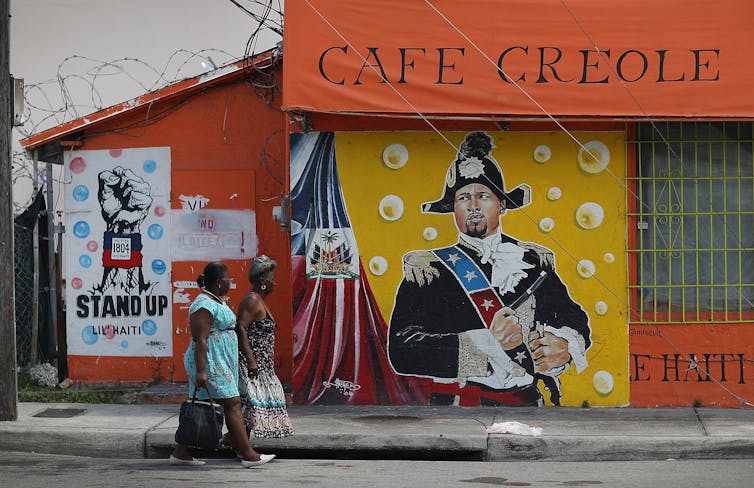
Miami’s Little Haiti has been an immigrant community for decades. Its streets are lined with small homes and colorful shops that cater to the neighborhood, a predominantly Afro-Caribbean population with a median household income well below Miami’s.

But Little Haiti’s character may be changing.

A $1 billion real estate development called the Magic City Innovation District is planned in the neighborhood, with luxury high-rise apartments, high-end shops and glass office towers.

Two women walk past Cafe Creole, with vibrant paintings on the side, including one wall reading 'Stand up lil Haiti' with a raised fist.

Little Haiti’s streets have been lined with murals and mom-and-pop shops for generations, but that’s changing. Joe Raedle/Getty Images


The developers emphasize their commitment to sustainability. But high-end real estate investments like this raise property values, pushing up property taxes and the cost of living for surrounding neighborhoods.

The potential effect on shops and homeowners and on the culture of the community has stoked controversy and protests. Nearby strip malls have been bought up for new development, leaving long-time businesses with fewer affordable options. Other big developments are now being planned.

Some media and urban scholars have labeled what’s happening here “climate gentrification.”

It’s the idea that investors and homebuyers are changing their behavior and moving from coastal areas into poorer, higher-elevation neighborhoods like Little Haiti, which sits on a ridge less than a mile from the bay, in anticipation of worsening climate change risks, such as sea-level rise. Miami is often held up as an example.

But are Miami’s investors and homebuyers really motivated by climate change?

A different kind of gentrification

The story goes that Miami homebuyers are abandoning the coasts – where high tides can already bring street flooding in some areas – and are looking for higher-elevation areas because they want to escape climate change.

That isn’t what we’re finding, though.

In Yale’s Climate Opinion Survey of Miami-Dade County in 2021, only half of Miami residents said they believe global warming will harm them personally – far lower than the 70% who said that in Delaware and the 90% in Canada, Western Europe and Japan. Another survey found 40% of Miami-Dade residents weren’t concerned about the impact climate change might have on the market.

In a new study, our team at the University of Miami found a more nuanced picture of what is actually pushing homeowners to higher ground.

For the most part, we found that the shift away from the coasts is fueled by costs. Flood risk plays a role through the rising cost of flood insurance, but much of the shift is plain old gentrification – developers looking for cheaper land and spinning it as a more sustainable choice to win over public officials and future residents.

Rather than bottom-up pressure built on residents’ alarm about sea-level rise, we found a continuation of the usual rational investment decisions.

Developers are driving the process

Present-day “climate gentrification” in Miami is largely determined and driven by capitalist investment opportunities – relatively lower prices and greater expected returns – which are the characteristics of the traditional gentrification process.

We found that neither homebuyers nor real estate agents are driving this process today in Miami. Rather, developers are using the concept of climate risk to market properties in more elevated areas and are working in tandem with policymakers to facilitate urban redevelopment.

Miami is very different from other global cities, in that its wealthy homebuyers and second-home buyers exhibit fewer concerns about rising sea levels and climate change. A large percentage of Miami homebuyers – about 13% in 2021 – don’t live in the U.S. and may evaluate risk differently, seeing Miami properties as safer investments than they have at home or as future second homes.

Miami’s gentrification also isn’t limited to higher-elevation neighborhoods. In coastal areas such as Miami Beach, taxes and housing and rental prices are rising, and poorer people are being pushed out of neighborhoods. Miami’s average rent is now over $2,800 a month, up 16% from October 2021 to October 2022. That’s about $800 higher than the U.S. average, and it rose at nearly twice the national rate over the past year.

Coastal homebuyers should be more concerned

Climate change is without question a risk for Miami. The insurance industry warns that sea-level rise and moderate flooding of up to 1 foot will affect 48% of total properties in oceanfront Miami-Dade County by 2050.

Homebuyers should be more concerned than they are.

We believe “climate gentrification” is a meaningful concept for exploring how the impacts and costs of climate change will shift housing and urban inequalities in the future. But so far, the idea that gentrification is fueled by climate change in Miami doesn’t match reality.


Richard Grant, Professor of Geography and Urban Studies, University of Miami and Han Li, Assistant Professor of Geography, University of Miami

This article is republished from The Conversation under a Creative Commons license. Read the original article.

Fox host won’t let Trump walk back his call to terminate Constitution: “The damage has been done”

Fox Business host Stuart Varney used his monologue on Tuesday to lash out at former President Donald Trump’s desire to terminate parts of the U.S. Constitution over his 2020 presidential election loss.

Over the weekend, Trump had called for a “termination” of constitutional rules.

“A Massive Fraud of this type and magnitude allows for the termination of all rules, regulations, and articles, even those found in the Constitution,” the former president wrote on Truth Social.

In a subsequent post, Trump tried to walk back his remarks, but Varney said that it was too late.

“He was talking about terminating parts of the Constitution,” the host noted. “That plays right into the Democrats’ hands. He’s trying to walk it back today. But the damage has been done.”

Varney suggested that the remarks could contribute to the defeat of Republican U.S. Senate candidate Herschel Walker in Georgia.

“If Walker wins, Trump will take all the credit guaranteed,” he pointed out. “If Walker loses, Trump will blame Walker for not inviting Trump into the state.”

Varney warned that the GOP, not the Constitution, faced termination because of Trump.

Watch the video below from Fox Business.

Warnock wins in Georgia — Democrats will have 51-seat Senate majority

Sen. Raphael Warnock, the Democrat first elected in a runoff election one day before the Jan. 6 attack on the U.S. Capitol, defeated Republican challenger Herschel Walker after a four-week runoff in Georgia. His victory gives Democrats a 51-49 majority in the Senate, which frees them from relying on Vice President Kamala Harris to cast tie-breaking votes and also empowers them to hold majorities on all Senate committees. Perhaps just as important, Walker’s defeat is another blow to the prestige of former President Donald Trump, who saw many Republican candidates he endorsed lose in the 2022 midterms.

With 97 percent of the expected vote counted in Georgia at 10:30 pm Eastern time, Warnock led Walker by just over 40,000 votes, a margin very similar to his advantage in the November general election. At that time, Warnock fell just short of the 50% threshold required by Georgia election law, which forced the runoff.

Warnock, an ordained minister who is the pastor at Atlanta’s Ebenezer Baptist Church, where Martin Luther King Jr. preached in the 1960s, first ran in a 2020 special election against appointed GOP Sen. Kelly Loeffler, narrowly defeating her in the Jan. 2021 runoff election. That election was to fill the two years remaining in the term of former Republican Sen. Johnny Isakson, who resigned for health reasons. Warnock’s victory, combined with Democratic Sen. Jon Ossoff’s win over Republican David Perdue, gave Democrats a 50-50 split and de facto control of the Senate in 2021.

Warnock’s election to a full six-year term will make it slightly easier to advance President Biden’s nominees for judicial and administrative posts and also solidifies Georgia as a battleground state in the next presidential election.

Warnock made several campaign stops on the eve of Election Day and delivered a sermon at Ebenezer Baptist Church, telling parishioners that “voting is a form of prayer,” Politico reported.

He repeatedly warned his supporters that the record-breaking turnout seen in Georgia’s early voting period was no guarantee of victory, and  asked them to vote “like it’s an emergency.”

Meanwhile, Walker also spent Monday making closing pitches to voters, but his scandal-plagued campaign failed to deliver a victory that might have reasserted Republican dominance in the state.

Walker, a former college and pro football star who was recruited into the race by Trump, made headlines throughout the campaign for reasons that likely did not help him. Two different women came forward to claiming he had pressured them into having abortions, a potential embarrassment given his opposition to Roe v. Wade and support for severe abortion restrictions.

Allegations of domestic violence and stalking also surfaced, raising damaging concerns about Walker’s character and his apparent treatment of a lengthy list of previous romantic partners. 

In a heated debate with Warnock, the former football star flashed an honorary sheriff’s badge to bolster his false claims of a past in law enforcement. Those controversies, as well as Walker’s evident struggles to communicate clear ideas on policy, failed to win over swing voters, who are crucial in closely contested Georgia elections.


Want a daily wrap-up of all the news and commentary Salon has to offer? Subscribe to our morning newsletter, Crash Course.


Georgia’s Senate race has also been the most expensive race of the midterm season, with more than $380 million spent, according to OpenSecrets. That money was mainly used to purchase TV ads, digital and online communications as well as in-person canvassing, USA Today reported. Super PACs spent nearly $16 million more on Warnock than Walker ahead of the runoff election, contributing more than $40 million on advertisements supporting Warnock or attacking Walker. 

Georgia also witnessed historic turnout during early voting, with more than 1.7 million voters casting their ballots ahead of Election Day, according to data from Georgia Secretary of State Brad Raffensperger’s office.

Warnock’s victory offers more evidence that Trump’s clout with Republican voters may be fading, as the midterm election cycle concludes and the 2024 presidential election begins to come into view. Trump has already announced his intention to run again, and President Biden is widely expected to seek a second term. In terms of actual governance, Warnock’s victory also reduces the leverage of Sens. Joe Manchin, D-W.Va., and Kyrsten Sinema, D-Ariz, the Democratic “moderates” who have repeatedly blocked elements of Biden’s agenda. 

Matt Lucas announces he will be “passing the baguette” to a new “Bake Off” host

Actor and comedian Matt Lucas has announced he will be “cheerfully passing the baguette on to someone else” as he steps away from his role as co-host of “The Great British Bake Off.” In a statement posted to Twitter, Lucas blamed the departure on scheduling conflicts with his new Sky series “Fantasy Football League.” 

“It’s become clear to me that I can’t present both ‘Fantasy Football League’ and ‘Bake Off’ alongside all my other projects,” he wrote

Lucas has served as co-host, alongside Noel Fielding and judges Paul Hollywood and Prue Leith, for three seasons and 51 episodes. He replaced former co-host Sandi Toksvig in the 11th season of “Bake Off,” which airs on Netflix as “The Great British Baking Show” in the United States. 

“I would like to give my warmest thanks and gratitude to everyone at Love Productions and Channel 4 and to Noelipops, Paül, Dame Prue, the crew and, of course, the wonderful bakers for welcoming me into the tent,” Lucas wrote. “I wish whoever takes over all the very best and I can’t wait to tune into the next series without already knowing who won!”

Reception to Lucas’ announcement has been mixed. 

The “Bake Off” team released a statement on Twitter thanking Lucas for his work. 

“We’ve loved having Matt Lucas brighten up our Tent for the last three years, especially when laughter and smiles were so much in need,” they wrote. “We appreciate everything he’s done for Bake Off, from working in covid bubbles to supporting the bakers. It’s been a pleasure.” 

However, for many viewers, Lucas — who has previously apologized for donning blackface, brownface and yellowface in his sketch comedy series “Little Britain” and “Come Fly With Me” — was always a controversial choice to bring onto a show that multiple outlets have lauded as “the most wholesome show on TV.” 


Want more great food writing and recipes? Subscribe to Salon Food’s newsletter, The Bite.


Perhaps unsurprisingly, Lucas’ time on “Bake Off” was punctuated by controversy. For instance, in Season 11’s “Japanese Week” episode, he referred to katsu curry as “cat poo curry.” Meanwhile, in the most recent season’s “Mexico Week,” Lucas and Fielding opened the episode wearing serapes and sombreros, shaking maracas and likening Mexico to an imaginary place like “Oz” or “Xanadu.” 

“I don’t think we should make Mexican jokes because people will get upset,” Fielding said in the show opener. 

Lucas responded: “What? Not even Juan?” 

Twitter users seem largely pleased about Lucas’ departure. As one user wrote, “Seeing the genuine joy about Matt Lucas leaving Bake Off everywhere I look . . . we really are a community.”

Since the announcement, conversation online has shifted towards who viewers would like to see as Lucas’ replacements. No formal announcement has been made by the show, but a current fan favorite seems to be “What We Do in the Shadows” actor Matt Berry. 

Why South Korea team captain Son Heung-min is wearing a mask at the World Cup

Although South Korea failed to advance to the quarterfinals following their loss against Brazil, the team emerged as a fan-favorite this World Cup. Sure, they gained attention for their skills on the field, one player’s idol-worthy face, their infectious charisma and . . . their teammate’s choice of facial accessory. 

The player in question is Tottenham Hotspur forward / South Korea’s captain Son Heung-min, who was spotted sporting a puffy all-black mask on the international pitch. Many may have mistaken Son’s mask — which covered the top half of his face, including his nose — as his attempt to cosplay Hannibal Lecter or Batman. Or could it be another Korean beauty product? But in actuality, the hi-tech covering was worn as a measure of protection. 

Here’s a closer look at Son’s getup along with the other World Cup players who followed suit and recently wore masks:

Son’s injury rehab

Prior to his showcase in Qatar, the 30-year-old star suffered a fracture around his left eye socket during Tottenham’s win against Marseille in the Champions League on Nov. 1. The injury, which took place just 19 days prior to the start of the World Cup, initially jeopardized Son’s return to the international arena. But after undergoing surgery and medical rehabilitation, Son recovered just in time to reprise his role as captain of South Korea’s national team.

Son first wore a protective mask in training to help shield the area around his injury. He then wore it during subsequent matches.

Following South Korea’s opening game at the World Cup against Uruguay, Son said his mask was “more comfortable than I thought. It’s made of good material,” per The Guardian. “It’s light, hard when worn on the face, and it’s a good material that can protect against impact. I was surprised that it was considerably lighter than I thought.”

“I’m just happy that with the mask, I can play,” Son also said, according to Reuters.

A common sight at the World Cup

In addition to Son, RB Leipzig centre-back and Croatian player Josko Gvardiol has been wearing a mask to protect himself from further damage after he broke his nose and injured his face and eyes while playing for his club.

Tunisia’s Ellyes Skhiri also wore a mask during his teams’ games against both Denmark and Australia. Back in October, the FC Köln midfielder broke his cheekbone. 

And lastly, Iran’s goalkeeper Alireza Beiranvand wore a mask — only during practice, though — after injuring his face during a match against England. Beiranvand sat out Iran’s match against Wales but played during his team’s final group stage match against the United States.

Jury finds Trump Organization guilty on all counts of tax fraud — and may help “cripple the company”

This is a breaking story… Please check back for possible updates…


A New York jury on Tuesday found two subsidiaries of Trump Organization, former President Donald Trump’s company, guilty on all counts of criminal tax fraud.

The New York Times reports the Manhattan jury convicted the Trump Organization of crimes including scheming to defraud, conspiracy, criminal tax fraud, and falsifying business records. The Trump Corporation and the Trump Payroll Corporation were also accused of paying executives’ personal expenses without reporting them as income, and for fraudulently classifying the executives as independent contractors instead of employees.

The verdict came less than a month after the twice-impeached former president—who was not a defendant in this case but faces various other legal issues—announced his bid for the 2024 Republican presidential nomination.

“Today’s guilty verdict against the Trump Organization shows that we will hold individuals and organizations accountable when they violate our laws to line their pockets,” Democratic New York Attorney General Letitia James said.

Renato Mariotti, a former federal prosecutor, tweeted that “this is a significant verdict—the Trump Organization is found guilty of serious felony fraud charges.”

“This will give even more leverage to New York Attorney General Tish James in her civil suit, which seeks extraordinary remedies that would cripple the company,” he added.

In defiance of federal drug law, mushroom dispensaries are popping up across North America

Not unlike fresh mushrooms after a gentle rain, specialized shops dedicated to federally outlawed psychedelic fungi are suddenly springing up all over North America. The sudden burst of retail mushroom shops selling an illegal drug heralds a cultural and political shift in Americans’ attitudes towards psychedelic mushrooms, which were banned in 1970 in the U.S. and in Canada in 1975. These shroom dispensaries cater to intrepid psychonauts, who wish to bravely explore the inner reaches of their psyche using mind-altering drugs, as well as to folks hoping to alleviate mental and physical suffering.

Mushroom shops operate in a legal gray area, not unlike cannabis dispensaries.

Functional fungi — that is, fungus with alleged health benefits — are increasingly the center of wellness trends. But some so-called “magic” mushrooms contain a drug called psilocybin, which is highly illegal in most places. That’s slowly changing, however, following laws passed in Oregon, Colorado and Washington, D.C., plus more than a dozen cities across the U.S. that have decriminalized the naturally-occurring psychedelic mushroom, and sometimes other natural psychedelics as well.

However, the federal government considers psilocin and psilocybin, the active components in many psychedelic mushrooms, as having high potential for abuse and no medical benefits; hence, their possession and sale is illegal on a federal level. That means such mushroom shops operate in a legal gray area, not unlike cannabis dispensaries — which similarly take advantage of the patchwork of cannabis legalization laws in states, despite marijuana remaining illegal on a federal level.

While definitions vary, generally “decriminalized” just means there are little to no legal consequences for possessing these mushrooms. That does not mean it is legal to sell them or set up a shop or dispensary with a menu of products like a cannabis boutique. Yet it is happening anyway in more and more places across North America.

Canada has the largest share of shroom dispensaries, which are illegal, but operate in a sort of gray area as attempts to shut them down have been met with protest or disinterest from local government. Currently, eight Canadians are suing the government through a legal process known as a Charter challenge, aiming to secure access to psilocybin and psilocybin therapy. A similar process is what brought medical marijuana to the country, which later evolved into a robust adult-use market. Notably, adult-use marijuana legalization in Canada hasn’t resulted in an increase in youth cannabis usage rates.

As the Charter challenge winds through the legal process, mushrooms dispensaries are operating out in the open. For example, a company called Shroomyz has two locations, one in Ottawa and the other in Toronto, both offering a wide selection of flavored edibles, tinctures or dried mushrooms. They even offer delivery, but customers must be over age 19, and first must visit the store in person and fill out a medical form requiring a photo ID.

In mid-November, Shroomyz was raided by the police, who arrested two men. But the city of Toronto later said they had no plans to shut down the store, and according to CBC, local police said there is no active investigation into the dispensary at this time.

The first store like this to open was The Mushroom Dispensary in Vancouver, B.C., that debuted in July 2019. It was founded by businessman and activist Dana Larsen, who also opened The Medicinal Cannabis Dispensary in 2007. Back then, medical marijuana wasn’t legal, but eventually Larsen’s act of civil disobedience led, in part, to the overturn of prohibition.

The Mushroom Dispensary offers numerous psilocybin mushroom products, including chocolates, capsules and dried fungus, not to mention liquid LSD bottles and DMT vape pens, both containing extremely powerful psychedelic drugs.

Hundreds of Portland, Oregon residents stood in line for hours in the cold, waiting to get into the newly opened Shroom House, which began cash-only sales on December 1st.

If you were to take any of these substances, it would trigger otherworldly feelings of time dilation, brighter colors and pleasantly distorted auditory feedback, visuals distortions like trails or tracers and geometric patterns that appear in objects. Inwardly, it can dissolve the boundaries between the self and the universe, an experience that, despite being called “ego death,” can be quite pleasant and even spiritual. For some people, these experiences can be uncomfortable or even traumatizing, especially with high doses, but this can often be managed with proper set and setting.

The movement to legalize certain classes of psychedelics stems in part from a growing body of scientific research that suggests psychedelics can be helpful for relieving anxiety, depression, PTSD and even certain types of physical pain, but researchers are still establishing how effective these drugs can be.

Regardless, many people aren’t going to wait for the Food and Drug Administration to approve these medicines. That’s why on Sunday, hundreds of Portland, Oregon residents stood in line for hours in the cold, waiting to get into the newly opened Shroom House, which began cash only sales on December 1st. It was raided by police just seven days later, according to KOIN 6, but in just a week, it clearly served a lot of customers.

Oregon approved Measure 109 in 2020, a ballot measure that authorizes the Oregon Health Authority to license and regulate psilocybin products and service centers, which are slated to open sometime next year. No licenses have been awarded yet. But Oregonians won’t be able to just buy a sack of mushrooms and go home. They must first meet with a licensed facilitator for a preparation session, then consume the product at the service center while they are monitored.

However, Measure 109 didn’t authorize retail sales to the general public, so what Shroom House was doing isn’t technically sanctioned. But local news stories of people waiting in line depict enthusiastic customers, eager to have access to psilocybin. The sudden attention may have contributed to the arrests of multiple people Thursday morning. Salon contacted the number on Shroom House’s Google listing, which has many 5 star reviews, but we have yet to hear back.


Want more health and science stories in your inbox? Subscribe to Salon’s weekly newsletter The Vulgar Scientist.


It’s not unheard of for mushroom dispensaries to be shut down with swarms of cops. In June 2019, after Oakland, California decriminalized naturally-occurring psychedelics, including psilocybin mushrooms, a religious organization called Zide Door began offering mushrooms and cannabis for sale, but only to members.

Zide Door calls its belief system Religious Evolution, which is sort of a rehabilitated take on the Stoned Ape Theory posited by famed psychonaut Terence McKenna. In short, the belief is that psilocybin mushrooms are responsible for the evolution of human consciousness and by taking these sacraments, you are reconnecting to God.

Yet apparently local authorities weren’t believers. In August 2020, Oakland police raided Zide Door, seizing about $200,000 in cannabis, psilocybin mushrooms and cash, according to the Washington Post. No arrests or charges were made, but none of the sacraments were returned, either. Now Zide Door is suing the city, alleging that their civil liberties were violated.

Even Florida has a new shroom dispensary, though it serves a different kind of psychedelic mushroom. Chillum, a mushroom and hemp dispensary in Ybor City near Tampa Bay, sells grow kits, spores and mycology cultures for Amanita muscaria, the fly agaric mushroom. Most people recognize it as the iconic red-and-white fungus from Super Mario and Alice in Wonderland, and it actually can trigger hallucinations that feel like shrinking or growing.

A. muscaria mushrooms don’t contain psilocybin, and they’re actually not illegal federally or in most states, with Louisiana being the sole exception. But there aren’t many businesses that are openly selling these psychedelic fungi, especially not with storefronts.

The main psychoactive chemical in these iconic shrooms is called muscimol and it’s very different from psilocybin, acting on GABAA receptors instead of serotonin. Nonetheless, it’s a pretty trippy experience and some folks consider fly agaric mushrooms to be just as magic.

Chillum is another example of how mushroom dispensaries are pushing legal boundaries. It’s not outside the realm of possibility that such defiant business will attract the attention of conservative leaders in Florida, who aren’t especially progressive on drug policy, even if it isn’t technically illegal.

But while the legal status of these shops are in limbo, overall, it’s a sign that times are changing faster than policymakers know how to respond. What’s even more compelling than these openings is the extreme demand for psychedelic products. Given the steep rise in mental health problems over the last three years, coupled with the stark lack of access to effective medical care, many people are searching for alternatives.

Psychedelic mushrooms appear to work for some as alternative therapies. Yet the lack of regulation could open people up to harms from panic attacks or contaminated products, just like certain aspects of the underground cannabis industry. More sanctioned, regulated retail operations selling psychedelics have a chance to change that.

Update Dec. 8, 2022 11:30am PST: This story has been updated to reflect the fact that Shroom House was raided by Portland Police on December 8.

Ancient viruses gave us a gene called “Arc” — and it may explain consciousness, scientists say

What does it mean to exist? The French Enlightenment philosopher René Descartes famously observed that every self-aware being is able to declare, figuratively if not literally, the Latin statement "Cogito ergo sum" — that is, "I think therefore I am." Descartes profoundly transformed the world of Western philosophy with this idea — namely, that being able to think is a prerequisite of being deemed "conscious," "alive," possessing of a soul, or however else you wish to put it. Yet Descartes' axiom fails to teach us something else that we all would like to know: Even though it helps us define what it means to be self-aware, it does not explain why some things are self-aware while others are not. Considering that the answer to this question could very well crack the secrets of the human soul itself (Descartes described it as the "mind-body problem"), the stakes are high for anyone who advances new theories.

"There is a real possibility that we're basically walking around as virus-controlled meat bags. We are aware of ourselves, but the only reason why we're aware of ourselves is to help the viruses that control us by making up part of our genome."

Ever since Descartes and the 17th century he inhabited, many philosophers and scientists have offered a number of conjectures. Many major organized religions argue that after one dies, there is an afterlife; panpsychists argue that all matter is inherently self-aware, with consciousness being analogous to a form of energy; and even the avowedly non-religious are often drawn to a belief in ghosts (such as "The Shining" director Stanley Kubrick), sometimes leading to morally dubious pseudoscience.

What if the explanation for human self-awareness isn't as grand as heaven, as terrifying as spirits or as unfathomably complex as the implications of panpsychism? What if our consciousness is derived from something as mundane as a virus leaving some of its residue inside our ancestors' cells — something that kept getting passed along, almost by accident?

That is the proposition offered by a viral gene known as Arc, which Dr. Jason D. Shepherd told Salon is the descendant of something known as a retrotransposon. Shepherd is an associate professor of neurobiology at the University of Utah School of Medicine, and wrote a paper in 2018 for the scientific journal Cell about the neuronal gene known as Arc. He described retrotransposons as being similar to viruses in that they jump in and out of DNA; they are known as "retro" because these are RNA sequences that are later converted to DNA, and transposons because they can be integrated into a cell's genome. Once that happens, they lead to the creation of what is colloquially known as "junk DNA," or genetic material in our genome for which there is no known purpose. Much of it comes from viruses that, after altering our genome so they could make more copies of themselves, left behind some of the genetic material they used in that process.

"Sometimes, these retrotransposons are able to jump into the germline (sperm or eggs) of an organism and then get propagated to their offspring," Shepherd wrote to Salon. "We think the Arc gene evolved from an ancient retrotransposon that inserted itself into the germline of an ancestor around 400 million years ago in the first land-based vertebrates."


Want more health and science stories in your inbox? Subscribe to Salon's weekly newsletter The Vulgar Scientist.


If that sounds ominous, like a burglar leaving behind their break-in tools after exiting your home, consider the unintended benefits. It is true that viruses are invaders who use our cells so they can reproduce, and that retrotransposons are genetic material from viruses that do basically the same thing. Yet your genome will sometimes retain that leftover viral DNA for its own purposes. In the case of Arc, those purposes may have wound up giving humans the cognitive abilities that distinguish us from other animals.

"Studies from my lab and others have shown that Arc is important for turning experiences into long-lasting changes in the brain," Shepherd pointed out. It all comes down to the synapses, or the junctions between nerve cells like the neurons in the brain. When you imagine an intelligent brain full of energy zapping, and representing human thoughts, what you envision are the interactions occurring between synapses.

"Studies from my lab and others have shown that Arc is important for turning experiences into long-lasting changes in the brain."

"Connections between neurons are strengthened or weakened during learning to form circuits that encode and store our memories," Shepherd wrote to Salon. "Arc seems to be critical for this process in mammals. What we are currently trying to understand is why Arc's viral-like biology is important. We know that Arc protein has retained some of the ancestral properties of the retrotransposon that allows it to form virus-like capsids that are released from neurons in membrane-bound vesicles. We think that these Arc capsids can then alter the strength of synapses on neighboring neurons that receive them."

While these Arc capsids are fascinating to anyone interested in the mechanics of human biology, their very existence has potentially massive metaphysical implications.

"There is a real possibility that we're basically walking around as virus-controlled meat bags," explained Dr. Travis Thomson, an assistant professor at the University of Massachusetts Medical School who specializes in junk DNA and indirectly endogenous retrovirus control. "We are aware of ourselves, but the only reason why we're aware of ourselves is to help the viruses that control us by making up part of our genome."

Thomson mentioned how a large volume of papers exists which show how mammals use Arc to strengthen or weaken connections between neurons, describing Arc as "a key regulator in synaptic plasticity. It has been shown that without plasticity in many model systems such as mice and flies, learning and memory are reduced. And without the ability to learn, it would be hard to imagine some sort of consciousness being possible." At the same time, Thomson cautioned against drawing hasty conclusions from this information. There is a correlation between Arc and traits that we associate with consciousness, but that alone does not prove the former causes the latter.

"I might be a bit of a Debbie Downer, but I think it's largely correlative right now," Thomson said when asking about any connection. "I don't feel anybody has got that perfect 'Gotcha' moment where we can change the plasticity state of a neuron and a mouse remembers something, or it doesn't remember something. We're not quite there. It's not proven, but sometimes circumstantial evidence is the best you're going to get, and there is a huge amount of circumstantial evidence" that Arc is crucial to the creation of thought.

And given that Arc acts like a virus in its most crucial aspect — it seems to exist with the "purpose" of creating more copies of itself, even as it is used by the very same cells it invades — one has to wonder, as Thomson put it, "who is holding the leash, who is being domesticated. I can't tell you that for sure, but I think it could be either way."

Even if our knowledge of Arc does not allow humans to answer the most significant spiritual questions, it may still have life-altering technological implications.

"There are a couple of surprising offshoots of our discovery that Arc evolved from an ancient virus-like element," Shepherd wrote to Salon. "One exciting idea is that we can harness these capsids that are normally made in the body or brain to deliver cargo like gene editing tools. Current gene therapy is limited by the use of modified viruses like AAVs or nano-lipid particles." 

"We think that there are actually many more genes that have retained similar virus-like biology," Shepherd continued. "Feng Zhang published a follow up paper to our work on this, which also highlights the potential use of these proteins for gene delivery."

Shepherd added that researchers "are also excited about the possibility that these viral-like properties of Arc are involved in neurodegenerative disorders. In particular, that Arc may be involved in the spread of pathology from one cell to another in the progression of the disease."

Kanye West says Jews should “forgive Hitler” in interview with Proud Boys founder Gavin McInnes

Kanye West followed up his blatantly antisemitic rant on Alex Jones’ program by urging Jewish people to “forgive Hitler.”

The rapper, who now goes by Ye, appeared on the right-wing platform Censored.TV with Proud Boys founder Gavin McInnes, who said off the top that he hoped to “talk him off the ledge” and prevent him from “becoming an antisemite or a Nazi,” but the rest of the program strongly suggested he was too late, reported Rolling Stone.

“Jews should work for Christians,” West told McInnes. “I’ll hire a Jewish person in a second if I knew they weren’t a spy and I could look through their phone and follow through their house and have a camera all in their living room.”

McInnes met with West, who again wore a black mask covering his entire head, and neo-Nazi Nick Fuentes, who recently joined the rapper for dinner with Donald Trump, and pointed out that Adolf Hitler had a historically bad reputation.

“We make our reputations, that was made by Jewish people,” West claimed. “But some of it’s incorrect. Also, the Holocaust is not the only holocaust, so for them to take that and claim — we have abortion right now. That’s eugenics, that’s genocide. That’s a holocaust that we’re dealing with right now, so because Jewish people control the majority of the media, along with banks, along with real estate, along with malls.”

McInnes argued that secular Jews were problematic “liberal elites,” just like Kamala Harris and Barack Obama, but defended Orthodox Hasidic Jews, and West said he “lumps them all together” and blamed them for pornography — which he compared to a “gas chamber.”

“They can control the narrative,” West said. “History is written by the winners.”

“Deep psychological need”: Reagan speechwriter explains why GOP is so obsessed with Hunter Biden

During the 2022 midterms, countless pundits predicted that if Republicans flipped the U.S. House of Representatives, investigating President Joe Biden’s son, Hunter Biden, would be high on their list of priorities. Republicans did flip the House, where they will have a small majority of around six seats in 2023. And sure enough, Rep. James Comer of Kentucky (the top Republican on the House Oversight Committee) is promising in-depth investigations of the president’s son.

Veteran columnist/author and Never Trump conservative Mona Charen examines MAGA Republicans’ obsession with Hunter Biden in an article published by The Bulwark on December 6. The 65-year-old Charen, who worked in the Reagan White House during the 1980s and was a speechwriter for First Lady Nancy Reagan, is not a Hunter Biden fan. But she is much more critical of former President Donald Trump and his many allies in the GOP, and she finds MAGA Republicans’ obsession with Hunter Biden laughable in light of the many lines the former president has crossed.

“Hunter Biden seems to be corrupt,” Charen writes. “He traded on his father’s name. He has abused drugs and engaged in other unsavory practices. He’s a mess. But there is nothing relevant to public policy or civic virtue here. President Biden is hardly the first president to have troubled family members. But Joe Biden didn’t hire Hunter at the White House, and if there is any evidence of the president using official influence on Hunter’s behalf, we haven’t seen it. The Department of Justice under President Trump opened an investigation into Hunter Biden. President Biden has left it alone. It’s ongoing.”

Trump’s Republican supporters, Charen argues, have “a deep psychological need for the Hunter Biden story,” which is a distraction from the many lines the former president has crossed.

“For seven years, the right has been explaining, excusing, avoiding, and eventually cheering the most morally depraved figure in American politics,” Charen emphasizes. “That takes a toll on the psyche. You can tell yourself that the other side is worse. Or you can tell yourself that the critics are unhinged, suffering from ‘Trump derangement syndrome,’ whereas you are a man of the world who knows nobody’s perfect. But then Trump will do what he always does — he’ll make a fool of you.”

Charen continues, “You denied that Trump purposely broke the law when he took highly classified documents to Mar-a-Lago and obstructed every effort to retrieve them. And then, what does Trump do? He admits taking them! You scoff at the critics who’ve compared Trump with Nazis. And then, what does he do? He has dinner with Nazis! And fails to condemn them even after the fact. You despised people who claimed Trump was a threat to the Constitution, and then, Trump explicitly calls for ‘terminating’ the Constitution in order to put himself back in the Oval Office.”

Republicans who are obsessed with Hunter Biden, Charen writes, have “provided succor and support” to a former president “who has encouraged political violence since his early rallies in 2015, has stoked hatred of minorities through lies, has used his office for personal gain in the most flagrant fashion, has surrounded himself with criminals and con men, has committed human rights violations against would-be immigrants by separating children from their parents, has pardoned war criminals, has cost the lives of tens of thousands of COVID patients by discounting the virus and peddling quack cures, has revived racism in public discourse, and attempted a violent coup d’état.”

“They know it,” Charen writes. “It gnaws at them. That’s why the Hunter Biden story is their heart’s desire. But here’s something else they need to meditate on: Even if everything they’re alleging about Joe Biden were true — even if he did pull strings to help his son and even profited unjustly thereby — it still wouldn’t amount to a fraction of what Trump did.”

“Rudy’s defense is that he was a bad lawyer”: Giuliani struggles with questions at D.C. Bar hearing

Former New York City Mayor Rudy Giuliani defended his role in challenging the 2020 presidential election after the D.C. Bar accused him of misusing his law license and called for it to be revoked.

The ethics case, brought by the D.C. Bar’s Office of Disciplinary Counsel, will determine whether Giuliani violated attorney ethics rules with the federal court by filing a  “frivolous” post-election lawsuit in Pennsylvania that falsely claimed the November 2020 general presidential election was wrought with fraud on behalf of then-President Donald Trump, Politico reported

Giuliani appeared as the first witness in his own attorney misconduct hearing in a trial scheduled for the next two weeks. The panel will issue a report with recommendations after hearing arguments and testimony.

Ultimately, the District of Columbia Court of Appeals will rule on whether to impose sanctions, which can range from a written reprimand to stripping Giuliani’s license to practice. A state court in New York suspended Giuliani’s license last year for spreading “false and misleading” statements on behalf of Trump about the 2020 election.

Phil Fox, the lead prosecuting attorney for D.C. Bar’s Office of Disciplinary Counsel, called Giuliani’s fraud allegations “unfounded” and said his lawsuit wasn’t based on facts or the law. 

“What this case is about is that Mr. Giuliani was responsible for filing a frivolous action, asking a federal court to deprive millions of the people in Pennsylvania of their right to vote,” said Fox, an attorney for the D.C. Bar’s Board on Professional Responsibility.

“There was no precedent for this. In addition to the fact that there was no precedent, there was no factual basis [for the suit],” Fox added.

By filing the lawsuit, Giuliani violated the Pennsylvania Rules of Professional Conduct and “engaged in conduct prejudicial to the administration of justice,” the ODC said. 


Want a daily wrap-up of all the news and commentary Salon has to offer? Subscribe to our morning newsletter, Crash Course.


Giuliani defended his actions, saying he had acted reasonably based on information he received from the Trump campaign and other parties claiming that Pennsylvania’s election processes were unconstitutional, Bloomberg reported

During his testimony, the ex-Trump lawyer also claimed he has been “persecuted” by federal investigations for the last four years.

“My role was to show how Pennsylvania involved the same set of eight or 10 suspicious actions — illegal actions, whatever you want to call them, irregular actions — that could not be the product of accident,” he said.

Giuliani also claimed he wrote only one or two paragraphs of the initial complaint that was filed and that local Pennsylvania attorney Ron Hicks did most of the work. 

The Pennsylvania lawsuit focused on two main issues, which included problems with independent observers being distanced from watching poll workers and Pennsylvania using mail-in ballots. 

Giuliani argued that  instead of observers being allowed to watch people counting votes, they “were being put in pens like they were cows.”

“The only thing we had at this stage of the litigation was that in Pittsburgh and Philadelphia, we had a number of ballots that were being counted without any inspection by an independent party,” Giuliani said. “You have to plead fraud with specificity with what you have, with what is available. But in discovery you get the additional information. This was specific enough for this stage of the pleading. That’s why it’s evidence, and not a conclusion.”

Legal experts were unimpressed with Giuliani’s argument.

“Rudy Giuliani’s defense in his bar discipline case is that he was a bad lawyer who was just sloppily throwing allegations out there … even though he was trying to help the President overturn the election,” tweeted former federal prosecutor Renato Mariotti. “He’s half right—he *is* a bad lawyer.  But he’s also a dishonest one.”

World Health Organization rebrands ‘monkeypox’ as mpox. Does it matter?

On November 28, the World Health Organization (WHO) announced its intention to phase out the name “monkeypox” to refer to the viral disease that caused an international global health emergency earlier this year. Instead, they will now use the name “mpox.” The agency, which acts as the public health arm of the United Nations, cited “racist and stigmatizing language” as the motivation for shifting away from the term. To avoid confusion over the next year, both names will be used simultaneously in the interim.

Many medical experts are praising the decision, which has been under consideration since at least June. But some argue that it’s an example of too little, too late and may reflect the WHO’s tendency to move slowly on addressing global public health threats, especially from the communications side.

In 2015, the WHO published guidelines on naming diseases with the aim to minimize negative impacts.

After all, the mpox outbreak has all but ended at this point. The WHO estimates just shy of 82,000 people contracted mpox this year, which resulted in 60 deaths. Approximately 30,000 of those cases and 17 deaths have been in the United States. While another outbreak isn’t out of the question, cases have dropped precipitously since their peak over the summer, and according to Politico, the Biden Administration has signaled that it will soon allow its public health emergency declaration for mpox to expire.

So why change the name now? It may seem trivial, but what we call viruses and diseases has broad implications. To begin with, monkeypox/mpox has never accurately described the origin or preferred host of the virus, which experts believe first arose in rodents, not primates. However, it was first noticed in monkeys used in lab experiments in 1958 and the name has stuck ever since.

Because the latest outbreak began in Africa, some have used the term “monkey” in an overtly racist manner. So the virus clearly needed a new name. But what took so long? And how did they settle on mpox?

“The name change is an important but insufficient measure at addressing the complex nature of the associated stigma and racial tropes.”

In 2015, the WHO published guidelines on naming diseases with the aim to minimize negative impacts. Their best practices include short, descriptive terms that convey the pathogen’s severity, seasonality and environment, among other qualities. It suggests avoiding geographic locations, people’s names, specific classes of animal and terms that incite panic like “fatal.” (The WHO did not respond to Salon’s request for comment on the matter; but we will update this article if we hear back.)

“The name change is an important but insufficient measure at addressing the complex nature of the associated stigma and racial tropes,” Dr. Kartik Cherabuddi, an associate professor of at the University of Florida Health, told Salon in an email. “Public health educational measures are required to stay scientifically accurate in the nature of spread of mpox and the risk factors associated with its spread while addressing the negative connotations. Otherwise, this disease and its management will become underground and without resources to help the population affected by it.”

There’s a long history of bumbling the names for infections. People still use the name “Spanish flu” to describe the 1918 influenza pandemic, which killed over 50 million people and likely was caused by the flu virus H1N1. However, most experts agree that the virus most likely originated in Kansas, not Spain. 


Want more health and science stories in your inbox? Subscribe to Salon’s weekly newsletter The Vulgar Scientist.


Yet, even a century later, “Spanish flu” is common parlance. Trevor Hoppe, an assistant professor of sociology at the University of North Carolina at Greensboro, wrote in 2018 in the American Journal of Public Health that this inaccuracy “reflects a tendency in public health history to associate new infectious diseases with foreign nationals and foreign countries. Intentional or not, an effect of this naming convention is to communicate a causal relationship between foreign populations and the spread of infectious disease, potentially promoting irrational fear and stigma.”

It took considerable time to name the virus that causes COVID as well. The WHO came up with COVID-19 as the name for the disease on February 11, 2020, but the virus itself was known as the clunky 2019-nCoV. That same day, however, the Coronavirus Study Group of the International Committee on Taxonomy of Viruses settled on SARS-CoV-2 in a preprint.

But the WHO initially resisted adopting SARS-CoV-2, with a spokesperson telling Science it could create “unintended consequences” for anyone who might confuse it with SARS-CoV-1, the virus that caused an outbreak in 2003. Instead, many people, including the former President Trump, adopted terms like “China virus” and “Wuhan flu,” which likely contributed to a rise in Asian hate crimes.

“‘Wuhan’ or ‘Chinese’ flu, like I heard it from some people, is deeply racist terminology and it contributed to some of the anti-Asian violence,” Dr. Juan Hincapie-Castillo, an assistant professor at the Department of Epidemiology at University of North Carolina at Chapel Hill, told Salon in an email. He described the WHO as being “too slow” with renaming mpox.

“In this case, hindsight is literally 2020 and they should have learned from the onset of COVID,” Hincapie-Castillo said. “I understand that public health agencies like the WHO might be understaffed, especially when dealing with an epidemic that arises in the middle of an ongoing pandemic. I wish though that we were less reactive and more proactive in foreseeing issues with naming and terminology. This is not our first or last rodeo. Maybe they should consider creating a standing advisory committee whose sole purpose is to discuss terminology and convene its international members in a timely manner — Zoom works very well across different time zones!”

Nonetheless, this name change is largely seen as welcome by medical experts. And while the recent mpox pandemic may be fizzling out, there’s no reason to believe it couldn’t surge again in the future. After all, monkeypox was largely ignored by Western nations until it became a problem for them. History could repeat itself.

“It’s not too late. It has not gone away and will return again,” Dr. Georges Benjamin, the executive director of the American Public Health Association, told Salon in an email. “It’s a small change and only time will tell if it makes a difference. Name change adoption is difficult to achieve, so we will see what it’s effect will be over time.”

“It would be good to adopt a more holistic nomenclature for naming diseases to avoid stigma,” Benjamin added. “This would speed up the process of getting to an acceptable name from the beginning.”

Marco Rubio’s longtime “enforcer” indicted over $50 million contract with Venezuelan government

Former Republican Congressman David Rivera has finally been indicted over a probe into his $50 million contract with Venezuela’s socialist government, a spokesperson in the U.S. Attorney’s Office in Miami said in a statement.

According to NBC Miami, the former lawmaker was officially arrested in connection to the ongoing federal criminal investigation while in the Atlanta, Georgia airport. The indictment was handed down by the grand jury last month, said spokesperson Marlene Rodriguez. He paid bail on Monday afternoon after being processed.

The pressure was mounting over Rivera after the contract was revealed at a time President Nicolas Maduro was trying to curry favor with former President Donald Trump in the early days of the administration.

“Rivera’s Interamerican Consulting was sued in 2020 by PDV USA — a Delaware-based affiliate of Venezuelan-owned Citgo — alleging the former congressman performed no work as part of the contract he signed in 2017 for three months of ‘strategic consulting’ meant to build bridges with key U.S. stakeholders,” said the Miami news outlet.

Rivera has said he’s innocent in the past and has his own lawsuit claiming PDV USA breached their contract and failed to pay him $30 million he was owed.

He’s already escaped “a host of state and federal criminal indictments, was finally charged in an alleged crime Rivera was a longtime friend of, enforcer for and co-homeowner with Marco Rubio, who was attacked over his pal in this 2016 ad by Donald Trump,” reporter Marc Caputo tweeted with the ad Trump ran.

Caputo noted that there have been four times that Rivera was able to dodge accountability.

Will Smith perfected blockbuster success, but his Oscar-worthiness is tougher – slap or no slap

The story of Will Smith cracking the code to becoming one of the world’s biggest movie stars is a staple of Hollywood lore, but in case you’ve never heard of it, here’s the short version.

Early in his career, he and his manager James Lassiter sat down and analyzed what the top 10 box office successes had in common. Once they boiled down the different variables, they landed on three traits that drew audiences to theaters: special effects, creatures and a love story.

Molding this equation to suit Smith meant presenting the figure people had embraced in the 1990s hit sitcom “The Fresh Prince of Bel-Air” and the 1995 buddy cop hit “Bad Boys” to create a box office hero that hadn’t been hyped since Eddie Murphy’s heyday.

Smith couldn’t easily crack the unspoken awards season code without messing up the Will Smith brand.

Between 1996’s “Independence Day” and 2008’s “Hancock,” Smith ruled summertime, and the Fourth of July holiday specifically. He still holds the record for the most consecutive $100 million-plus hits at the U.S. box office at eight in a row starting with “Men in Black” in 2002 and ending with “Hancock.” His other 2008 release, the critically panned “Seven Pounds,” broke that streak.

Some may see a metaphorical significance in “Seven Pounds” being a December release, perhaps surmising that winter isn’t the star’s season.

Emancipation BTSDirector Antoine Fuqua and Will Smith behind the scenes of “Emancipation” (Photo courtesy of Apple TV+)
But low temperatures didn’t defeat Smith. Neither did a perceived inability for audiences in the aughts to view the action movie headliner as a dramatic heavyweight. His Oscar-nominated performances in 2001’s “Ali” silenced that theory, even if it bombed, as did 2006’s “The Pursuit of Happyness,” which snagged him another performance nod.

Smith’s dilemma is that he couldn’t easily crack the awards season formula without messing up the Will Smith brand – an entirely separate strategy from the one that made him a massive star.

The latest version of Will Smith, a man who embraces personal transparency, evolution and growth, is a better fit for awards season. Rather, it should have been, if not for that fateful Oscar night back in March.

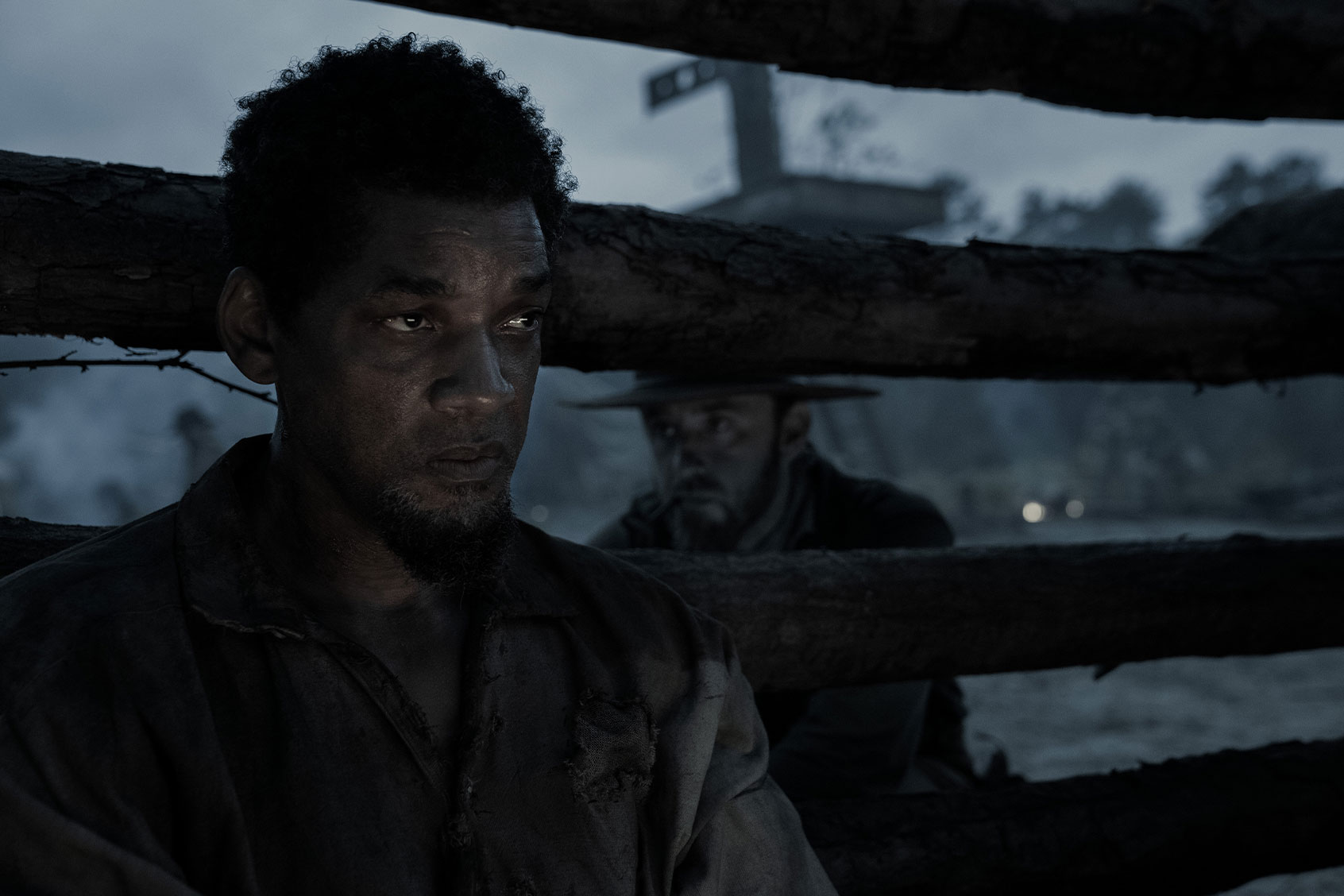
The rollout of “Emancipation,” the story of the man whose scarred back is one of the most lasting images associated with American chattel slavery, is its most serious test yet. To understand why, one must look at how his old blueprint lost its sure-shot effectiveness.

EmancipationWill Smith in “Emancipation” (Photo courtesy of Apple TV+)

Huge studio franchises took over the summer theatrical landscape and usurped his status as the king of the summertime box office. No matter; despite the filmgoing audience’s tastes evolving away from his type of action hero – aside from the “Bad Boys”-style cop model that still serves him – his star power remains intact.

That statement might be laughable to anyone who experienced his 2019 output, which includes both his visually stupefying turn as the genie in the live-action version of “Aladdin” and “Gemini Man.” Of the two, “Aladdin” is the one that made money – more than $1 billion globally. The other movie lost Paramount $111 million.

“Aladdin” isn’t a creative pinnacle for anyone involved, but it is a Disney title that, like Smith himself, is recognized around the world. To make a time jump back to 2008 for a moment, consider that one reason “Hancock” achieved such success is that it dropped at the outset of what would become the age of the Marvel Cinematic Universe. Smith could still wring mileage out of playing a lousy superhero in the same year “Iron Man” debuted.

From then on, the only piece of the superhero explosion he took part in was to play Deadshot the first “Suicide Squad” for DC – the (miserable) one that wasn’t directed by James Gunn.

Those still wondering what long-term impact the Oscars incident will have on his career might not have been following Smith’s constant molding of his image, whether via social media shares or through the sometimes painful confessionals with his wife Jada Pinkett Smith and their children on “Red Table Talk.” 

Will Smith and Janet Hubert at the Fresh Prince of Bel-Air ReunionWill Smith and Janet Hubert at the Fresh Prince of Bel-Air Reunion (Photograph by HBO Max / Saeed Adyani)

Maybe they missed “The Fresh Prince of Bel-Air” reunion where he sought and received absolution from Janet Hubert, the unceremoniously disappeared dark-skinned Aunt Viv whose career was ruined in part by Smith badmouthing her. (“They said it was you who banished me. Because you were Will,” Hubert told him. He acknowledged his terrible error and apologized, saying, “I was 21 years old. Everything was a threat to me.” The audience ate it up. )

Even a superstar’s bruised disposition can get the better of them.

This is all part of the Smith family’s meticulous exposure management, and it partly explains why Smith doesn’t have an extensive awards season track record. Between “Seven Pounds” and 2021’s “King Richard,” he only starred in two serious December movies: “Concussion,” released on Christmas Day 2015, and 2016’s ensemble-driven mess, “Collateral Beauty.”

That’s around the same time that Smith fine-tuned his skill as a marketer, which is how he described himself to a Cannes Lions audience that year.

“My career has been strictly being able to sell my products globally, and it’s now in the hand of fans,” he said, speaking about the new focus on social media and retraining his emphasis on artistry.

His choices didn’t always jibe with the zeitgeist; 2020 may have been the year of protests and debates about policing, but it also saw Smith’s return as a cop in “Bad Boys for Life,” the highest-grossing film in the franchise’s history.

Will Smith at the Fresh Prince of Bel-Air ReunionWill Smith at the Fresh Prince of Bel-Air Reunion (Photograph by HBO Max / Saeed Adyani)

That said, the success of “King Richard” is a flawless merger of the Will Smith brand with that of tennis legends Venus and Serena Williams, transitioning the actor from a bankable action lead into a devoted father figure.

He opened his emotional innards again via his 2021 memoir “Will,” in which he goes into tremendous detail about his relationship with his father. Its release landed around the same time as the awards season push for the movie, both to high acclaim. Winning that Oscar and future statues looked like a lock.

But as we all witnessed on that Academy Awards stage, a superstar’s bruised disposition can get the better of them in the most public of forums.


Want a daily wrap-up of all the news and commentary Salon has to offer? Subscribe to our morning newsletter, Crash Course.


What does that mean for the success of “Emancipation”? Less, probably, than it means to the way Smith desires us to view him. The actor’s appearance on “The Daily Show with Trevor Noah” is a masterstroke in image management, in which he asks the audience to empathize with him, and others, by reminding them that they have no idea what strangers are going through.

Smith expressed worry that “Emancipation” director Antoine Fuqua may be penalized for his star’s terrible judgment at last year’s Oscars. But the weak box office returns over its opening weekend is less connected to that, perhaps, than a collective exhaustion related to Hollywood slave narratives.

EmancipationWill Smith in “Emancipation” (Photo courtesy of Apple TV+)

Synchronous to the debates around heroic police characters in TV and movies that “Bad Boys” contributes to perpetuating are critiques concerning the commodification of Black pain. Smith knows this, which is why in a 2021 GQ story tied to the release of “King Richard,” he describes “Emancipation” as “a story about how Black love makes us invincible.”

A year and change (and a slap) later, whether audiences at large agree with that message remains to be seen. For their part, critics aren’t feeling the love. But Smith will more than likely continue to.

His next cold weather project is NatGeo Channel’s “Pole to Pole,” which is currently in production and has him filming in locations on each end of the Earth, gaining knowledge about life from other lands and their cultures along the way. Through such projects, he’ll likely rediscover that even if the Academy Awards show won’t have him, the world still will.

“Emancipation” is playing in theaters and streams on AppleTV+ on Friday, Dec. 9.

“No more kings”: Legal expert says court ruling “utterly demolished” Trump’s Mar-a-Lago defense

Former President Donald Trump found a sympathetic voice in the Mar-a-Lago/government documents case when federal Judge Aileen Cannon, a Trump appointee, granted his request for a special master. But many legal experts have been highly critical of Cannon’s ruling. One of them is University of Baltimore law professor Kimberly Wehle.

In an article published by the conservative website The Bulwark on December 5, Never Trumper Wehle applauds a three-judge panel for its rebuke of both Trump and Cannon.

“On Thursday, (December 1), the U.S. Court of Appeals for the Eleventh Circuit finally put to rest the special master nonsense that Donald Trump set in motion late August, when he persuaded U.S. District Judge Aileen Cannon to interfere with the FBI’s investigation of his illegal harboring of classified and other presidential records at his Mar-a-Lago residence in Florida,” Wehle explains. “Special Counsel Jack Smith can now proceed apace with the investigation. What’s remarkable about the decision is not the outcome —anyone with a passing legal education could see that Cannon’s ruling was indefensible. It’s how the panel of three judges utterly demolished Trump and Cannon both, in unforgiving language inspired by foundational principles of constitutional restraint.”

The U.S. Department of Justice (DOJ) has been investigating Trump in two separate cases: one having to do with government documents he was keeping at his Mar-a-Lago compound in Palm Beach, Florida, the other pertaining to the events of January 6, 2021. In both cases, U.S. Attorney General Merrick Garland has appointed Jack Smith as a special counsel to conduct the investigations.

Attorney Neal Katyal, a scathing Trump critic who served as acting U.S. solicitor general under President Barack Obama, doesn’t believe that appointing a special counsel was a wise decision on Garland’s part; Katyal believes it will slow down the investigations unnecessarily. But Garland obviously decided that bringing in someone from outside DOJ was necessary in order to counter MAGA claims that the Trump-related probes are partisan in nature. Garland has stressed that his motivation is the rule of law, not partisan politics.

“The court made a few things very clear: The FBI acted entirely by the book, which nobody disputes, including Trump,” Wehle writes. “Cannon had no constitutional — that is, ‘jurisdictional’ — authority to do what she did, unless a former president is somehow extra-special and above the laws that apply to everyone else. Cannon assumed Trump is. He’s not.”

The three-judge panel said of Trump’s defense, “All these arguments are a sideshow. The law is clear. We cannot write a rule that allows any subject of a search warrant to block government investigations after the execution of the warrant. Nor can we write a rule that allows only former presidents to do so.”

Wehle comments, “The vivid picture is not good for Trump, who is under criminal investigation for these misdeeds. And the decision effectively lets Special Counsel Smith loose on all 22,000 documents so the government can pursue the story to its logical conclusion, which could include in an indictment…. Sorry, Donald. No more kings.”

“I never said what I said”: Trump ripped for trying to deny his own call to “terminate” Constitution

After former President Donald Trump took to his Truth Social platform to proclaim that the U.S. should “terminate” the Constitution, he followed up on Monday with a new rant denying that he had ever said any such thing — even though he did, publicly, for all to see.

On CNN that afternoon, analyst Gloria Borger tore into him — and in to Republicans who could be demanding he be excluded from running for president, who are instead continuing to sit silent.

“Donald Trump wrote — and I’m just quoting him, this is his words, referring to the ‘massive fraud’, and I don’t know if that’s about Hunter Biden’s laptop and Twitter suppressing the story, or about the election fraud that didn’t happen, or whatever — ‘A massive fraud of this type and magnitude allows for the termination of all rules, regulations, and articles, even those found in the Constitution!'”

“And then he came out and said, I never said what I said, I never said what I wrote,” added Borger. “It’s getting absurd. It’s ridiculous at this point. And Larry Hogan, Republican governor of Maryland for now, who is going to probably challenge him for president, tweeted today, ‘I can’t believe this even has to be said, but the Constitution is not the problem.'”

The problem, though, continued Borger, is that only a small handful of Republicans are following Hogan’s lead on this.

“Ambassador John Bolton, former National Security Adviser, came out today and said, if nobody will challenge him and say this is un-American, I’m going to run for president myself if nobody is going to repudiate him,” said Borger. “So at some point, somebody in the Republican Party has to say, you shouldn’t be president of the United States.”

Watch below or at this link.

Antisemitism and white supremacy are evil: This is the moment to make that clear

Over the last few weeks, we have seen Donald Trump, the de facto leader of the Republican Party — and at least for now the frontrunner for the 2024 presidential nomination — come ever closer to a full embrace of the values of fascism, authoritarianism, white supremacy and antisemitism.

Just before Thanksgiving, Donald Trump hosted the infamous dinner at his Mar-a-Lago headquarters with Kanye West (aka Ye), the rapper who has become a public supporter of Hitler and Nazism, and Nick Fuentes, an avowed white supremacist, Holocaust denier and neo-Nazi. In response to the ensuing controversy, Trump reportedly told advisers that he would not condemn Fuentes out of reluctance to alienate some of his most enthusiastic supporters, meaning far-right extremists. During his conversation with Fuentes over dinner, Trump reportedly turned to West and said, “He gets me.” 

Trump is not “flirting” or “playing footsie” with such people, in the parlance of mainstream journalism. In reality, he is continuing a long pattern of such behavior. He described neo-Nazis and other white supremacists as “very fine people” after the Charlottesville riots of 2017, and has expressed both overt and coded support for the QAnon conspiracy cult, the Proud Boys, the Oath Keepers and similar groups.  

In his book “States of Exclusion,” historian Richard Frankel offers this context for the relationship between Donald Trump, American neofascism and Nazi Germany:

[A]lready the image of Donald Trump and Adolf Hitler have been linked in a public discussion…. And while such comparisons are often dismissed as hysterical exaggeration or hyper-partisan rhetoric, this historian of modern Germany once again sees enough commonalities with that dark period of history to sit down and describe the danger America currently faces.

Whatever concrete plans Donald Trump might or might not have for his presidency, it is clear to me that he has ideas about what America should look like, a kind of ideal national community.

For Trump, “making America great again” means making it a white, Christian, male-dominated society. With the authoritarian powers he desires, he could maintain the appearance of democracy, while in reality, only “real” Americans would enjoy certain rights.

The rest, having been pushed to the margins of society, would be subject to the whims of Trump’s autocratic regime. And those pushed beyond the boundary? They would no longer be of any concern to “real” Americans.

It’s a vision reminiscent of Hitler’s effort to create his ideal national community — a society in which only “real” Germans would enjoy the benefits of citizenship.

Last Friday, Joe Biden, endeavoring to take up his role as the nation’s conscience, posted this on Twitter:

I just want to make a few things clear:

The Holocaust happened.

Hitler was a demonic figure.

And instead of giving it a platform, our political leaders should be calling out and rejecting antisemitism wherever it hides.

Silence is complicity.

Biden, reflecting his deep and ingrained desire to serve as a healing and unifying force, did not specifically name West, Fuentes, Trump or conspiracist Alex Jones, who hosted West for a memorable interview on his internet show last Thursday.

Arguably the president should have done so. Purveyors of hatred should be called to account. That having been noted, Biden still did something critically important by highlighting the role of evil in the context of America’s democracy crisis and related struggles. For the most part, that type of moral engagement has been lacking among America’s political class and news media during the Age of Trump and beyond.

That near-pathological fear of using direct moral language is rooted in the misplaced commitment to “normal politics,” which prioritizes concepts such as compromise and moderation and also in the guiding assumption that moral language should be avoided in politics at risk of appearing unfair, biased or judgmental. The same elites who avoid a moral framework also remain beholden to the myths and fantasies of American exceptionalism and the credo that the “American people,” whoever they are, are fundamentally good.

Those failures have opened up the space for Trumpism, neofascism, white supremacy and antisemitism to flourish and prosper. In a 2019 interview with Salon, philosopher Susan Neiman reflected on these questions of evil in the Age of Trump:

Donald Trump meets every single criterion for using the word evil — and he keeps meeting it every day. Evil is a word that should be used with caution. I believe that many people, particularly a certain type of liberal centrist, were put off by the way in which George W. Bush was described as being evil. I also argue that Bush is evil and I explored this in my book “Moral Clarity.” Unfortunately, the description of “evil” has been so overused that many people just believe that it is a type of name-calling.

I disagree. When we relinquish the use of language like “evil” we are leaving the strongest linguistic weapons that we have in the hands of the people who are least equipped to use them. But I do understand the caution and anxiety about using that language. Given the way that Trump’s supporters and the broader right-wing movement in America works, I am unsure if describing Trump as being evil would actually bring any clarity to the conversation. That does not mean that accurate language for describing Trump and what he represents should be avoided.

The refusal or reluctance to discuss Trumpism, neofascism, racial authoritarianism and other such ideologies and beliefs in clear, direct moral language has also enabled those forces to mainstream their toxic policies and ideas. A central part of this strategy involves deploying and amplifying disingenuous claims about “free speech” as a way to exploit how the liberal democratic tradition privileges such values. 

In reality, fascists, white supremacists and antisemites are intellectually dishonest actors who are, of course, not actually committed to the liberal democratic tradition. They only seek to leverage its weak spots in order to destroy it. 


Want a daily wrap-up of all the news and commentary Salon has to offer? Subscribe to our morning newsletter, Crash Course.


Entirely too many liberals and progressives are overly willing to give such malign actors a platform or to engage them in “debate,” which only legitimates their toxic and dangerous ideas.

To this point, Republicans and “conservatives” with the assistance of the compliant news media, have successfully branded themselves as the guardians of “values” and “morality.” That was always an absurd claim, and today it is obscene. If pro-democracy Americans can successfully present Donald Trump’s movement and the neofascist right in clear moral terms, they can seize a crucial opportunity to shift public opinion and gain important traction in the battle to save the country’s democracy. The choice before us is clear enough: Avoiding the moral high ground, in an excess of delicacy or a desire for “dialogue,” is to invite disaster.

Patients suffering with hard-to-treat depression may get relief from magnetic brain stimulation

Not only is depression a debilitating disease, but it is also widespread. Approximately 20 million adult Americans experience at least one episode of depression per year.

Millions of them take medication to treat their depression. But for many, the medications don’t work: Either they have minimal or no effect, or the side effects are intolerable. These patients have what is called treatment-resistant depression.

One promising treatment for such patients is a type of brain stimulation therapy called transcranial magnetic stimulation.

This treatment is not new; it has been around since 1995. The U.S. Food and Drug Administration cleared transcranial magnetic stimulation in 2008 for adults with “non-psychotic treatment-resistant depression,” which is typically defined as a failure to respond to two or more antidepressant medications. More recently, in 2018, the FDA cleared it for some patients with obsessive-compulsive disorder and smoking cessation.

Insurance generally covers these treatments. Both the psychiatrist and the equipment operator must be certified. While the treatment has been available for years, the equipment to perform the procedure remains expensive enough that few private psychiatry practices can afford it. But with the growing recognition of the potential of transcranial magnetic stimulation, the price will likely eventually come down and access will be greatly expanded.

Does it work?

Transcranial magnetic stimulation is a noninvasive, pain-free procedure that has minimal to no side effects, and it often works. Research shows that 58% of once treatment-resistant patients experience a significant reduction in depression following four to six rounds of the therapy. More than 40 independent clinical trials — with more than 2,000 patients worldwide — have demonstrated that repetitive transcranial magnetic stimulation is an effective therapy for the treatment of resistant major depression.

As a professor and psychiatrist who has used transcranial magnetic stimulation to treat some of my patients, I have seen depression symptoms decrease even within the first two weeks of treatment. What’s more, the effects continue after the treatment has ended, typically for six months to a year. After that, the patient has the option of maintenance treatment.

Transcranial magnetic stimulation helps increase blood flow and dopamine levels in the brain.

About the procedure

For the patient, the procedure is easy and simple. One sits in a comfortable chair with a snug pillow that holds their head in place, puts on earplugs and can then relax, check their phone, watch TV or read a book.

A treatment coil, which looks like a figure 8, is placed on the patient’s head. A nearby stimulator sends an electrical current to the coil, which transforms the current into a magnetic field.

The field, which is highly concentrated, turns on and off rapidly while targeting a portion of the prefrontal cortex — the area of the brain responsible for mood regulation.

Researchers know that people suffering from depression have reduced blood flow and less activity in that part of the brain. Transcranial magnetic stimulation causes increases in both blood flow and in the levels of dopamine and glutamate — two neurotransmitters that are responsible for brain functions like concentration, memory and sleep. It’s the repeated stimulation of this area — the “depression circuit” of the brain — that brings the antidepressant effect.

It is not ‘electroshock’ or deep brain stimulation

Some people confuse transcranial magnetic stimulation with electroconvulsive therapy, a procedure used for patients with severe depression or catatonia. With electroshock therapy, the anesthetized patient receives a direct electrical current, which causes a seizure. Typically, people who undergo this procedure experience some memory loss after treatment.

Transcranial magnetic stimulation is very different. It doesn’t require anesthesia, and it doesn’t affect memory. The patient can resume daily activities right after each treatment. Dormant brain connections are reignited without causing a seizure.

It should also not be confused with deep brain stimulation, which is a surgical procedure used to treat obsessive-compulsive disorder, tremors, epilepsy and Parkinson’s disease.

Transcranial magnetic stimulation stimulates the ‘depression circuit’ in the brain.

Side effects and access

Transcranial magnetic stimulation patients undergo a total of 36 treatments, at 19 minutes each, for three to six weeks. Research has concluded that this is the best protocol for treatment. Some patients report that it feels like someone is tapping on their head. Others don’t feel anything.

Some very minor side effects may occur. The most common is facial twitching and scalp discomfort during treatment, sensations that go away after the session ends. Some patients report a mild headache or discomfort at the application site. Depending on how effective the therapy was, some patients return for follow-ups every few weeks or months. It can be used in addition to medications, or with no medication at all.

Not everyone with depression can undergo this type of brain stimulation therapy. Those with epilepsy or a history of head injury may not qualify. People with metallic fillings in their teeth are OK for treatment, but others with implanted, nonremovable metallic devices in or around the head are not. Those with pacemakers, defibrillators and vagus nerve stimulators may also not qualify, because the magnetic force of the treatment coil may dislodge these devices and cause severe pain or injury.

But for those who are able to use the therapy, the results can be remarkable. For me, it is amazing to see these patients smile again — and come out on the other side feeling hopeful.


Patricia Junquera, Associate Professor and Vice Chair of Clinical Services, Florida International University

This article is republished from The Conversation under a Creative Commons license. Read the original article.

Health rights for trans people vary widely, proving the need for global health equity

While transgender people might be more culturally recognized in the U.S. than ever, visibility is not the same as justice.

Transgender is an umbrella category that emerged in the U.S. in the 1990s to encompass diverse gender identities that don’t fully correspond with an individual’s assigned sex at birth. Although local communities worldwide have adopted this term, it can also erase and collapse other diverse gender identities people have used across time, location and culture.

People who are today called trans, nonbinary and intersex have existed for centuries throughout the world. The rights of trans people have not always been up for debate in mainstream society, and nonnormative sex and gender categories appear in ancient Buddhist texts, as well as Jewish rabbinic literature. Yet colonial conquests have violently stamped out sexual and gender diversity globally.

Trans people’s right to exist has been challenged throughout time and across the world in multiple ways. Worldwide, trans people face disparities across many areas, including access to health care, legal support and economic security. Governments, global organizations and the legacies of colonialism also enact high levels of violence and stigma against them.

At the same time, 95% of global health-related organizations do not recognize or mention the needs of gender-diverse people in their work, resulting in the “near-universal exclusion” of trans people from health practices and policies. There is also a lack of holistic trans-inclusive research around the world. For instance, searching for the word “transgender” on the website for the Institute for Health Metrics and Evaluation, the global health metrics giant of the Bill and Melinda Gates Foundation that collaborates with the World Health Organization to improve global health data, currently returns zero results.

As a sociologist, I study how health outcomes are affected by various social conditions, including global economic policies, institutions and cultural values. In particular, I analyzed how government-endorsed medical tourism, or health-related travel, has affected Thai transgender women. Broadly, I seek to understand how the body acts as what French philosopher Michel Foucault calls an “inscribed surface of events,” imprinted upon by an ever-changing social context that can afford or withhold resources, rights, recognition and power.

With their health and well-being shaped by the social context worldwide, the bodies of transgender people are no exception.

History of gender-affirming care

Medical institutions and authorities are a major pathway to health and how one lives in one’s body. They define, classify and pathologize a range of human conditions, from male pattern baldness to fatness.

The German physician Magnus Hirschfeld coined the now antiquated term “transvestite” in 1910 to define those who desired to express themselves in opposition to their sex assigned at birth. At his Institute for Sexual Science, Hirschfeld offered people hormone therapy and performed the first documented genital transformation surgery. Adolf Hitler deemed Hirschfeld “the most dangerous Jew in Germany,” and the Nazis burned his research center after he fled for his life.

Despite this violence toward trans medicine, endocrinology in the U.S. and Europe advanced in the 1930s with the use of synthetic testosterone and estrogen for medical transitioning. Estrogen was first purified in 1923 and used for hot flashes, bone loss prevention and other reproductive health issues. Testosterone was isolated and synthesized in 1935 and first used to treat hypogonadism in men as well as tumor growth in women.

Puberty blockers, or gonadotropin-releasing hormone agonists, were first approved by the U.S. FDA in 1993 for children undergoing puberty too early. For trans adolescents experiencing gender dysphoria, or distress from a mismatch between their gender identity and sex assigned at birth, these medications can be critically important for their well-being. Far from being experimental, the medications have strong evidence for their overall beneficial effects for trans youths.

There is debate about whether trans youths are able to determine whether they are ready for gender-affirming care.

Christine Jorgensen was the first American to undergo what was then called “sex change” surgery, in Denmark in 1952, making headline news. Doctors in other parts of the world also started to gain clinical expertise in vaginoplasty, sparking global networks of transgender health care. For instance, surgeons in Thailand developed their own techniques in the 1970s for Thai trans women.

Soon, trans people from other countries learned of Thai surgical techniques and began to travel to Thailand for care. With strong government support, Thailand has become a global hub for gender-affirming services. Subsequently, foreign travelers “crowded out” some Thai trans people from quality care as the market shifted to accommodate medical tourists.

For some health travelers, services are more affordable in Thailand than in their home country. Traveling for health services can also provide greater anonymity. For those in the U.K. seeking gender-affirming care, traveling abroad is an alternative to long wait times.

Medical tourism is more dire for those living in countries where trans people face criminalization, such as Brunei, Lebanon and Malawi, or where gender-affirming surgeries are religiously prohibited, such as Saudi Arabia.

What does global health equity mean?

Globally, trans people experience issues accessing culturally competent and equitable health care services, both generally and for gender-affirming services. Trans and gender-diverse people experience greater mental distress and everyday violence and discrimination than their cisgender peers.

A 2019 report of nearly 200 health organizations around the world found that 93% do not recognize trans people in their work on gender equality, and 92% do not mention trans health in their programmatic services. Decolonizing global health means including marginalized people in decisions and knowledge production around global health. It also includes and addresses the needs of trans and gender-diverse people worldwide.

Global trans health equity means providing resources to target the root causes of gender-based health disparities. This involves legal gender recognition, government support and anti-discrimination laws. While medical and public health support is necessary for trans women, who are disproportionately affected by HIV worldwide, global trans health equity also means addressing other areas that contribute to this disparity, such as poverty, economic exclusion and workplace discrimination.

For countries with universal health coverage, medical and public health researchers recommend that gender-affirming services be included as essential services. They are not cosmetic, but are necessary for those who want them.

Better alternatives for all

Amid everyday injustices, violence and vulnerabilities are countless forms of trans resilience and resistance, activism, collective care and knowledge sharing. There are even some “bubble[s] of utopia,” or clinics and health care settings where trans people can access services with reduced delay. These alternatives open the possibility for transgender bliss, or liberation from restrictive colonial gender constructs, and transgender joy, or improving one’s quality of life and forming meaningful connections by embracing a marginalized identity.

How can policies, institutions and society cultivate trans bliss and joy worldwide?

All human bodies are “sociocultural artifacts.” How they are expressed and lived in is determined by social contexts and shaped by available resources. Sex and gender are points in a vast “multi-dimensional space” of anatomy, hormones, chromosomes, environment and culture. Global health equity for trans people holds accountable the institutions and decision-makers responsible for the health and safety of all human beings. It is oriented toward the freedom to flourish in a world that celebrates sex and gender diversity as a natural fact of life.


Reya Farber, Assistant Professor of Sociology, William & Mary

This article is republished from The Conversation under a Creative Commons license. Read the original article.

“Appalling”: Legal experts call out Alito for “joking” about Black kids in KKK outfits at hearing

Supreme Court Justice Samuel Alito on Monday joked about Black children in Ku Klux Klan outfits during arguments in a case related to LGBTQ rights.

The court on Monday heard arguments in 303 Creative v. Elenis, a test case brought by Colorado web designer Lorie Smith and backed by religious rights groups. Smith, who opposes same-sex marriage, is seeking an exemption from a state law that bars discrimination in public accommodations based on sexual orientation.

As justices took turns asking hypothetical questions from both sides, Justice Ketanji Brown Jackson asked whether it would be permissible for a mall Santa to refuse to take photos with children who are not white. Alito, who authored the Dobbs decision overturning Roe v. Wade, jumped in with a hypothetical of his own.

“So if there’s a Black Santa at the other end of the mall and he doesn’t want to have his picture taken with a child who’s dressed up in a Ku Klux Klan outfit, that Black Santa has to do that?” Alito asked Colorado Solicitor General Eric Olson, who defended the state law.

“No, because Ku Klux Klan outfits are not protected characteristics under public accommodation laws,” Olson explained.

“And, presumably, that would be the same Ku Klux Klan outfit regardless of whether the child was Black or white or any other characteristic?” asked Justice Elena Kagan.

Alito interjected to say, “you do see a lot of Black children in Ku Klux Klan outfits, right? All the time. All the time.” 

Laughter in the room can be heard in audio of the hearing.

Legal experts called out Alito over the remark.

“This is really upsetting,” wrote Sherrilyn Ifill, the former head of the NAACP Legal Defense Fund. “The joke about Black kids in KuKluxKlan outfits? No Justice Alito, these ‘jokes’ are so inappropriate, no matter how many in the courtroom chuckle mindlessly.”

Former U.S. Attorney Joyce White Vance called the comments “appalling.”


Want a daily wrap-up of all the news and commentary Salon has to offer? Subscribe to our morning newsletter, Crash Course.


“I’m going to need Justice Alito to stop joking about seeing ‘Black children in Ku Klux Klan costumes.’ Seriously, what am I listening to?” tweeted New York University Law Prof. Melissa Murray.

“Justice Alito is resorting to KKK jokes.  Ha ha ha.  As if what’s at stake here is funny, and isn’t taking place in a context in which LGBTQ people feel like we have a target on our backs.  And, ahem – Klan jokes aren’t funny under any context,” added Columbia University Law Prof. Katherine Franke.

During another point in the hearing, Alito cited a brief filed by a Jewish group backing Smith to raise hypotheticals in which a Jewish photographer would be forced to betray their views.

“An unmarried Jewish person asks a Jewish photographer to take a photograph for his JDate dating profile,” Alito said. “It’s a dating service, I gather, for Jewish people.”

“It is,” chimed in Kagan, who is Jewish.

“All right. Maybe Justice Kagan will also be familiar with the next website I’m going to mention. Next, a Jewish person asks a Jewish photographer to take a photograph for his Ashleymadison.com dating profile,” Alito said, referring to a dating site that helps people have affairs and drawing laughs from the room.

“I’m not suggesting that — she knows a lot of things, I’m not suggesting that. OK — does he have to do it?” Alito added.

“It depends,” Olson replied. “What Colorado looks to is what services the photographer makes available to the public, and if the photographer makes that service available to others, taking pictures for use on websites, then probably yes, but it depends.”

The court’s conservative majority appeared sympathetic to Smith’s arguments though it is unclear how the court will rule.

“Hypothetical questions have value,” tweeted Sam Spital, the director of litigation at the NAACP Legal Defense Fund. “But the 303 Creative argument was a painful example of how the Supreme Court overuses them—to the point where things that matter, and which we all know are true, become contested mind games.”

COP27 flinched on phasing out ‘all fossil fuels’ — what’s next?

The latest UN climate change summit (COP27) concluded, once again, with a tussle over the place of fossil fuels in the global economy.

An agreement by the world’s governments to phase out all fossil fuels would have been a welcome progression from last year’s Glasgow climate pact. It called on countries to “[accelerate] efforts towards the phasedown of unabated coal power and phase-out of inefficient fossil fuel subsidies”, making it the first UN treaty to acknowledge the need to do something about the main source of greenhouse gas emissions.

But at COP27, widespread anxieties about the cost and availability of energy made many governments cautious about expressing a clear intention to phase out all fossil fuels in the resulting agreement. The COP27 text reiterated the COP26 decision but failed to broaden it to encompass oil and gas, despite a proposal by India to that end (a move that would have helped take the emphasis off coal, of which it is a major consumer).

Still, growing support for such an extension is evident. More than 80 countries (including the EU and US) supported India’s proposal. Many nations are building international agreements outside of the UN negotiation process. After the failure of COP27, the question is what should happen next in the fight against continued fossil fuel use.

There is no doubt that, to preserve a liveable climate, the extraction and burning of coal, oil and gas must be rapidly reduced and, depending on how optimistic you are about carbon capture technologies, phased out altogether.

Despite large planned increases in fossil fuel production, recent research (released just before COP27) found, for the first time, that global demand for each of the fossil fuels will peak or plateau in all scenarios within 15 years. This is partly due to attempts to reduce energy use and increase renewables in the wake of the gas shortage created by sanctions against Russia for its invasion of Ukraine.

As the dangers of extracting and burning fossil fuels have become increasingly apparent, many experts, campaigners, international organisations and, increasingly, governments have contested the moral legitimacy of these activities. In a recent journal article, we argued that the Glasgow agreement represented a breakthrough (albeit a modest one) in the emergence of international anti-fossil fuel norms.

An international norm is a morally appropriate standard of behaviour among states (for example, prevailing norms prohibit foreign aggression, piracy, or the testing and use of nuclear weapons). International conferences such as COP27 catalyse emerging norms by specifying them in formal declarations.

COP decisions are not binding and the language on fossil fuels at COP26 was watered down during negotiations. But the Glasgow text reflected a growing sense among governments that certain activities relating to fossil fuels (like generating electricity from coal without capturing the CO₂ and policies which make fossil fuels cheaper to extract and consume) are becoming illegitimate.

The lack of progress on fossil fuels reflects the upheavals in the energy sector as well as the constraints of the climate negotiations themselves, which operate by consensus. This often produces decisions that reflect the lowest common denominator among nearly 200 countries with diverse energy profiles and interests, and COP27 was no exception.

Large oil and gas producers are profiting handsomely from current market prices and have lobbied governments to permit them to explore and drill for yet more oil and gas. At COP27, there were more oil and gas industry lobbyists than the combined number of delegates from the ten countries most affected by climate change. Little wonder COP27 did not yield consensus on phasing down all fossil fuels.

Other international initiatives are not bound by such procedural constraints, and there was more progress on the sidelines of COP27. The Beyond Oil & Gas Alliance (Boga), an initiative launched around the time of COP26 by Denmark and Costa Rica that aims to phase out oil and gas production, attracted new members Chile, Fiji and the US state of Washington, with Portugal upgraded to “core member” status.

Emulating a deal between South Africa and several wealthy countries from a year earlier, a new just energy transition partnership was launched between Indonesia and Japan, Canada, the US, Denmark and others, to help Indonesia transition from coal to renewables.

What more can be done?

In the coming years, there will be growing civil society and diplomatic pressure for a phase-out of all fossil fuels in a COP decision. But independent initiatives among states, like Boga, must be nurtured in parallel, and the high-level pledges made in these initiatives must be implemented.

For instance, a group of nations pledged at COP26 to end public finance for fossil fuels by the end of 2022. While some countries are on track to meet this goal, others are not following through.

Countries should also develop an international agreement to restrict and phase out fossil fuels. Building on a global campaign for such an agreement, the small island nations of Tuvalu and Vanuatu have called for a fossil fuel non-proliferation treaty. We suggest two ways to advance these efforts which draw on our recent research.

First, Tuvalu and Vanuatu could encourage their Pacific Island counterparts to create a regional fossil free zone treaty that prohibits the extraction and transportation of fossil fuels throughout the territories and territorial waters of members.

Second, more must be done to name and shame governments, especially rich ones, who are expanding how much fossil fuel they extract and burn. This effort demands greater transparency around government activities. A new global registry of fossil fuels is helping to catalogue this information. But governments should also disclose all fossil fuel infrastructure that is being planned or considered on their territory, or with their support.

The COP27 outcome is a timely reminder that curbing the growth in fossil fuels will not come about through consensus-oriented negotiations among governments that include those corrupted by the fossil fuel industry. It will require social movements pressuring leaders to legislate a managed phase out of fossil fuels, while ensuring a just transition for affected workers and communities. And it will require pioneering governments to work together internationally to forge new alliances that accelerate this goal.


This article is republished from The Conversation under a Creative Commons license. Read the original article.