Spring Sale: Get 1 Year, Save 58%

“Saturday Night Live” alum Horatio Sanz sued, accused of grooming and groping teen

Horatio Sanz, a “Saturday Night Live” alum who appeared on the sketch comedy show from 1998 to 2006, is facing a lawsuit alleging that he groomed a young fan when she was 15 years old, groped her when she was 17, gave her alcohol, and repeatedly engaged in lewd sexual messaging with her over several years, about 20 years ago, according to Variety.

The plaintiff, called “Jane Doe,” says in her lawsuit filed in the New York state court, that she suffered intense shame and mental health struggles due to the experience, engaged in self-harm and self-medication, and at one point had to be hospitalized.

The lawsuit includes text messages Sanz allegedly sent the plaintiff as recently as 2019, calling himself a “wounded creep,” and adding, “If you want to metoo me you have every right . . . Just believe me I’m not like that anymore.” However, Sanz and his lawyer claim the suit is “categorically false” and accuse Doe of taking legal action solely for money. Another text that Sanz is accused of sending show him telling Doe he “felt terrible” for his actions, and saying he had been “very dumb.”

The plaintiff says her fan website for Sanz’s then-“SNL” co-star Jimmy Fallon caught Fallon’s attention in 1999, leading Fallon and Sanz to email her when she was 14. When she was 15, she says she attended an “SNL” taping, where Sanz allegedly kissed her and held her waist. 

Over the next few years, she was invited to “SNL” after-parties where she says she was served alcohol at 16, and later that year, began an ongoing text conversation with Sanz. Doe alleges that Sanz often texted her about “sexual experiences, sexual activities, sexual fantasies, masturbation and Sanz’s instruction of plaintiff in sexual acts.”

After Doe ran into Sanz in 2019, she says he admitted to masturbating while having instant messaging conversations with her in the 2000s and expressing remorse.

Sanz hasn’t been particularly active onscreen in recent years, most recently taing a voice acting role in the adult cartoon “Duncanville” earlier this year, and mostly making a string of cameos in recent years. The bombshell lawsuit against Sanz continues a disturbing trend of famous or powerful men being accused of abusive or grooming behaviors, or having relationships with underage girls years ago.

FDA approves additional vaccine doses for immunocompromised

The U.S. Food and Drug Administration (FDA) authorized third doses of Pfizer-BioNTech’s and Moderna’s two-dose coronavirus vaccines for some groups of people with weakened immune systems. Those qualified include people who have had solid organ transplants, certain cancers or other immunocompromised disorders.

“The country has entered yet another wave of the COVID-19 pandemic, and the FDA is especially cognizant that immunocompromised people are particularly at risk for severe disease,” said Acting FDA Commissioner Janet Woodcock, M.D., in a statement. “After a thorough review of the available data, the FDA determined that this small, vulnerable group may benefit from a third dose of the Pfizer-BioNTech or Moderna Vaccines.”

On Thursday, the FDA emphasized that this decision only applies only to this high-risk group, which is an estimated 3 percent of the U.S. adult population. The announcement comes at a time when the U.S. is seeing a rise of new COVID-19 cases as a result of the highly contagious delta variant. Immunocompromised people can have not as strong an immune response after receiving two doses of the vaccine.

“Today’s action allows doctors to boost immunity in certain immunocompromised individuals who need extra protection from COVID-19,” Woodcock said. “As we’ve previously stated, other individuals who are fully vaccinated are adequately protected and do not need an additional dose of COVID-19 vaccine at this time.”

For those who qualify, a third dose may be administered at least 28 days after the second dose. This also only applies to people who are 18 years of age or older. After the FDA authorization, ​​a key Centers for Disease Control and Prevention (CDC) panel, the Advisory Committee on Immunization Practices, unanimously voted on Friday to recommend booster shots of Pfizer’s or Moderna’s COVID-19 vaccines to some immunocompromised people, too.

With both agencies giving their approval, doses could start being administered immediately.

In a study published in the New England Journal of Medicine, researchers reported that two doses of an mRNA vaccine do not produce the same level of antibodies in transplant recipients as they do in less vulnerable individuals. However, the study found that a third mRNA shot “had substantially higher immunogenicity ” than the placebo group. A separate study published in the Journal of the American Medical Association concluded that recommended a third dose to transplant patients, too.

“While there was an increase in those with detectable antibodies — 54% overall — after the second shot, the number of transplant recipients in our second study whose antibody levels reached high enough levels to ward off a SARS-CoV-2 infection was still well below what’s typically seen in people with healthy immune systems,” said the study’s lead author Brian Boyarsky, M.D., a surgery resident at the Johns Hopkins University School of Medicine. “Based on our findings, we recommend that transplant recipients and other immunocompromised patients continue to practice strict COVID-19 safety precautions, even after vaccination.”

The public health agencies’ authorization comes after some cities across the U.S., like San Francisco, have already authorized giving additional vaccine boosters to citizens. Earlier this month, news broke that San Francisco General Hospital announced it would consider giving mRNA vaccines to people who received the Johnson and Johnson vaccine, which is not an mRNA vaccine. Those interested were advised to talk to their health providers first.


Want more health and science stories in your inbox? Subscribe to Salon’s weekly newsletter The Vulgar Scientist.


“FBoy Island” creator on that finale twist and ideas for the show’s future

On a show that’s known for its twists, not even the most diehard “FBoy Island”-er would’ve seen that last, particularly spectacular twist coming when HBO Max’s reality dating series ended its initial run with the final four episodes released Thursday. 

In the finale, Nakia, CJ and Sarah officially wrap up their quest to discern nice guys from fboys among 24 initial suitors, by choosing between two men for a relationship and possibly a cash prize. Host Nikki Glaser lays out the stakes: If they choose an avowed nice guy, the couple contiues the relationship and split $100,000. This is what happens when CJ chooses nice guy Jarred over her longtime frontrunner, Casey (who identifies as an fboy). It’s the smart route financially, although one could debate about whether it is emotionally.

If an fboy contestant is chosen, however, they hold all the power. They can either decide to be reformed and go the nice guy route – coupledom and split the money – or keep the winnings entirely for themselves and end their relationship. We see this play out both ways. Nakia unsurprisingly chooses fboy Jared, who confirms their real connection by reciprocating and splitting $100,000 with her. And also unsurprisingly, Sarah chooses Garrett, the self-proclaimed king of “FBoy Island” she’s had her eye on the whole season. Garrett reveals that yes, he will dump Sarah and take the money, as has been foretold by any audience member who ever streamed an episode of this show.

But wait! There’s one more twist.

Glaser announces that instead of the $100,000 depositing into Garrett’s bank account . . . it will go to the charity of Sarah’s choice. Take that, fboy! Oddly enough, Garrett doesn’t seemed fazed by this turn of events and cackles that he still won the show.

“We really spent a lot of time crafting our ending, because we wanted it to have a big twist at the end, and I feel very happy with what we did,” series creator Elan Gale told Salon. “We’re going to have to come up with something even better for Seasons 2, 3, 70. We’re going to have to figure it out as we go.”

Keeping up the “element of surprise”

Although HBO Max hasn’t officially announced whether or not the show has been renewed, it’s a no-brainer at this point. In its first weekend, the tropical dating show became HBO Max’s most-watched reality show debut, and unsurprisingly, it’s already casting for its next season. But in a show full of built-in shocks and twists for both contestants and leads, how can “FBoy Island” possibly keep the surprises going, and ensure future casts remain just as unprepared and on their toes as the cast of the first season? 

And of course, satisfying as it may have been to watch Garrett get played, one has to wonder how the show will keep up its surprises or incentivize future fboys, who would clearly choose the relationship in the end to be assured of some sort of financial gain (and then dump the woman after cashing in). We can’t imagine they’d choose their hard-earned-through-deception cash prize to go — god forbid — to charity.

Thankfully, Gale has some tricks up his sleeve, and he told Salon that the “element of surprise” and “giving people a chance to react as opposed to prepare” are crucial to the show, and will continue to be. He pointed to how the first season was set up to keep all the contestants guessing.

“You really try not to overthink it when you’re a contestant, and live in the moment, react to what’s in front of you,” he explained. “Even the women knew what they were doing and what their goals were, but they didn’t know about all the twists.”

The male suitors were also kept in the dark about certain aspects and had to work within limited parameters. “They knew they were going to get a chance to date three women, they knew they weren’t going to be able to tell the women if they were an fboy or a nice guy, and they were going to have to try to get to know them without acknowledging their label,” Gale said.

While finale twists of future seasons are TBD, the driving drama and intrigue of the show will continue to be a guessing game of their motives and identification. One of the first big twists during this first season was having the remaining suitors reveal their nice guy/fboy status . . . and contend with the fallout, if any.

“We wanted them to try to have some time before the big midseason reveal to build relationships. If you meet someone and they go, ‘Hi, I’m an fboy,’ they’ve got no chance,” Gale said. “So we wanted to give them a chance to get to know someone, because maybe there is a nice guy somewhere in there.”

New, inclusive futures for “FBoy Island”

One glance at the cast of “FBoy Island” immediately distinguishes it from present and even recent iterations of notoriously white-washed shows like “The Bachelor,” with its relative heteronormative cisgender diversity. As the show continues, Gale is prepared to build on this further, and create even more fun for the casts going forward.

“We’ll have to look back on this season and really investigate, see what worked and what didn’t, and how can we better streamline this, how do we get the participants to have more dynamic and interesting experiences,” Gale said. “Because at the end of the day, if the cast has that dynamic experience, the audience will too.”

He’s also open to getting more experimental with who’s cast and the format of the series. “I hope there’s every iteration of this show, from ‘FBoy Island,’ to ‘FGirl Island’ to ‘FPerson Hotel’!” Gale said.

“This show has been a dream to make — I still can’t believe anyone let us make it, a show named ‘FBoy Island’ still blows my mind,” he continued. “I’m just so grateful.”

In the meantime, we’re just going to wait for word of a reunion for a “Where are they now?” fix.

Meet the citizen scientists tinkering with their own immune systems in an attempt to avoid COVID

In a state in which less than half of the population is vaccinated, April Karli could only watch with disdain as ICU units in Austin, Texas, swelled with patients. COVID-19 cases had risen by 92 percent in a week  —  Karli’s anti-vaxxer brother was among them. Her oldest daughter, who was inoculated with a Johnson & Johnson vaccine in March, was due to start her sophomore year of college — in person — in a matter of weeks. Her brother’s illness, the new threat of breakthrough infections, and the efficacy of the J&J vaccine against the delta variant stoked Karli’s concern for her daughter’s safety. Fearful, Karli turned to Facebook for advice.

“Does anyone know if a state database will prevent someone who got J&J from self-boosting with Pfizer?” Karli wrote. “With delta and the high spread here in Texas, I’d like her to get her boosted before she goes back to her college campus.”

As Israel, Germany, and the UK approved COVID-19 booster shots for the elderly and those with underlying conditions, and now that San Francisco is permitting those with a J&J vaccine to get an mRNA vaccine as a booster, too, many Americans are contemplating whether they might also need a COVID-19 vaccine booster shot. For those living in communities with significant outbreaks, the fear is heightened. And some intrepid citizens, like Karli, are attempting to double-vaccinate themselves and their loved ones, often skirting state public health rules regarding vaccines to do so.

“We have the second-highest number of cases in the country, and people here still don’t believe COVID is real,” Miami resident German Gobel said. “I don’t see how I have much of a choice.”

Karli and Gobel have quite a bit in common in this regard: both live in delta variant hotspots; both were participants in the Moderna COVID-19 vaccine trials, and both are members of a Facebook group by and for members of this unique demographic. The majority of posts on “The Page” this month, the group whose official name has been redacted out of privacy and safety concerns, discuss one topic: “self-boosting”  — as it is known  — the idea of self-administering booster shots by seeking out secondary or in some cases tertiary vaccinations. And while some vaccine trial participants have been getting booster shots for months as part of official clinical trials, others seek them out clandestinely.

As most Americans were locked in their homes waiting for their first COVID-19 vaccine,  former Pfizer trial participant Tod Lewis of Austin, Texas, was invited to join Pfizer’s new COVID-19 booster trial in late March.

Lewis and others posted on The Page about their booster trial experiences; several in the group who were anxious to again be “human guinea pigs”  — as Lewis referred to himself  — called their trial site administrators. There were rumors that only the prior trial participants who were “compliant” and “easy to work with” were given the prerogative of being in the new study. While disgruntled trial site employees hung up on some callers,  Los Angeles resident and former Pfizer trial participant, Louise, who used a pseudonym due to legal concerns about self-boosting, got a spot in a Pfizer booster trial the first time she called.

Most weren’t as lucky as Louise. As 2021 trudged on, the bulk of members on The Page reluctantly accepted they wouldn’t be participants in any booster trials, and thus, wouldn’t get boosters soon — at least, not by going through any official channels. In late spring, as some gloated about their participation in the new booster vaccine trials, studies that claimed protein-based vaccines like J&J and AstraZeneca provided better protection against the novel coronavirus when boosted with an mRNA vaccine were posted on The Page. A 74-year-old Greenville, South Carolina resident, Nancy McFarlane, took notice.

“I knew AstraZeneca wasn’t as effective in people over 60 because of the studies coming out of Europe,” the former AstraZeneca trial participant, who was fully vaccinated in early January, said. “More people got vaccinated in South Carolina than I expected, but it’s still nowhere near where it should be. The governor made it illegal for municipalities and schools to pass mask mandates, and people didn’t wear them when it was mandated,” McFarlane said. “There’s no way I trust people to be honest and wear a mask if they’re unvaccinated.”

For these reasons, McFarlane said got an antibodies test in May. Members of The Page have long used COVID-19 antibody tests as a marker of whether their vaccines are still efficacious, often posting, and comparing their results, as Gobel explained.

“We’ve shared each other’s antibody results for months now,” Gobel said. “First to know if you’ve got the placebo, then to know the efficacy, then to know the half-life of the antibodies and how long they last.”

(April Karli’s Roche assay antibody test results, Aug. 3, 2021. Screenshot courtesy April Karli)

The preferred test among members of The Page is the Roche Anti-SARS-CoV-2 assay antibodies test, which can be purchased online from Labcorp. The antibody titer, or “score”  — an example of which is pictured above  —  refers to the total number of COVID-19 antibodies found in a person’s blood. A dataset referenced in an article authored by Dr. Tony Ho, an infectious disease expert at the University of Texas Health Science Center at San Antonio, Texas, suggested that 30 U/mL was the minimum antibody titer in which an immunocompromised person would have enough neutralizing antibodies to fight off a COVID-19 infection. But, Ho told Salon that the threshold is likely higher when considering the antibodies necessary to protect against the delta variant.

“Delta is a new phenomenon, and data gathering is ongoing as we speak,” Ho said. “Hopefully, we will get a sense of reasonable titer levels of protection against the delta variant soon.”

McFarlane said her test results, which reported an antibody titer of 48.4U/mL, were too modest for her to feel protected from COVID-19, especially if she was to be seeing her five and eight-year-old grandchildren. McFarlane self-boosted with Pfizer, and is currently in-between doses. After the two-week interval between doses concludes, her second dose of Pfizer will be her fourth COVID-19 vaccine in six months. Louise, who was fully inoculated in September, said her antibody test from July, which reported an antibody titer of 100U/mL — a noticeable decline from her antibody test results in February — left her no choice other than to call her trial site and inquire about joining the Pfizer booster-trial.

“I feel personally that everyone who’s concerned should be going out and getting that test,” Louise said. ” If you’re immunocompromised  — in any way  — you might not have the same level of antibodies you think you have,” she said.

Date of Louise’s Pfizer Phase 3 Vaccine Shots:

  • First Dose of Pfizer: Aug., 11, 2020
  • Second Dose of Pfizer: Sept., 1, 2020


Louise’s Roche Antibody Test Results

  • February: 450U/mL
  • May:127U/mL
  • July:100 U/ML

Studies asserting that AstraZeneca was ineffective against the beta and lambda variant influenced Justin Cherniak’s decision to self-boost, as he was planning a trip to Chile over summer and Europe in the fall. Though the 34-year-old Bay Area resident canceled both trips, Cherniak still wanted to be as protected as possible against these variants.


Want more health and science stories in your inbox? Subscribe to Salon’s weekly newsletter The Vulgar Scientist.


“Having various comorbidities, I was quite worried about catching COVID,” the prior AstraZeneca trial participant, said. “That, combined with assorted studies showing the mix of AstraZeneca and Pfizer was safe and effective, vindicated my decision,” Cherniak said.

Cherniak's Roche antibody test results

(Cherniak’s Roche antibody test results from December, 2020, May, 2021, and July, 2021. Screenshot courtesy of Justin Cherniak.)

Both Louise and Cherniak were regularly testing their antibody titer, but only Cherniak reported his results to The Page before and after self-boosting. In his post to The Page, Cherniak included his antibody titer ten days  — and six months  — after complete inoculation via his second dose of AstraZeneca. He also reported his antibody test results six weeks after he self-boosted with Pfizer. Cherniak’s self-administered mini-trial data detailed a significant decline of his antibody titer  — 128.2U/mL  — six months after his second dose of AstraZeneca. But, two months after self-boosting with Pfizer, his antibody titer was off the charts  — reporting an antibody titer of 2500+ U/mL — a test result Cherniak cited as to why he decided against getting a second dose of the Pfizer vaccine.

Cherniak’s data encouraged others like Gobel to get an antibody test and report their results before  —and after  — self-boosting. Although he is on a waitlist, hoping to join Moderna’s vaccine booster trial, Gobel has decided that he will instead get an antibody test if he’s not fortunate enough to be selected as a participant. And if his results report a titer of less than 400U/mL, he will self boost, most likely with two doses of Moderna  —  and he won’t be alone.

“There’s going to be four of us,” Gobel said. “We’re going to go in at the same time, take our test, compare results, and then make a decision. I’m pretty sure everyone’s going to get a booster,” he said.

Gobel and his colleagues plan to post their antibody test results  —before and after self-boosting  — on social media in an attempt to publicize the merits of boosters.

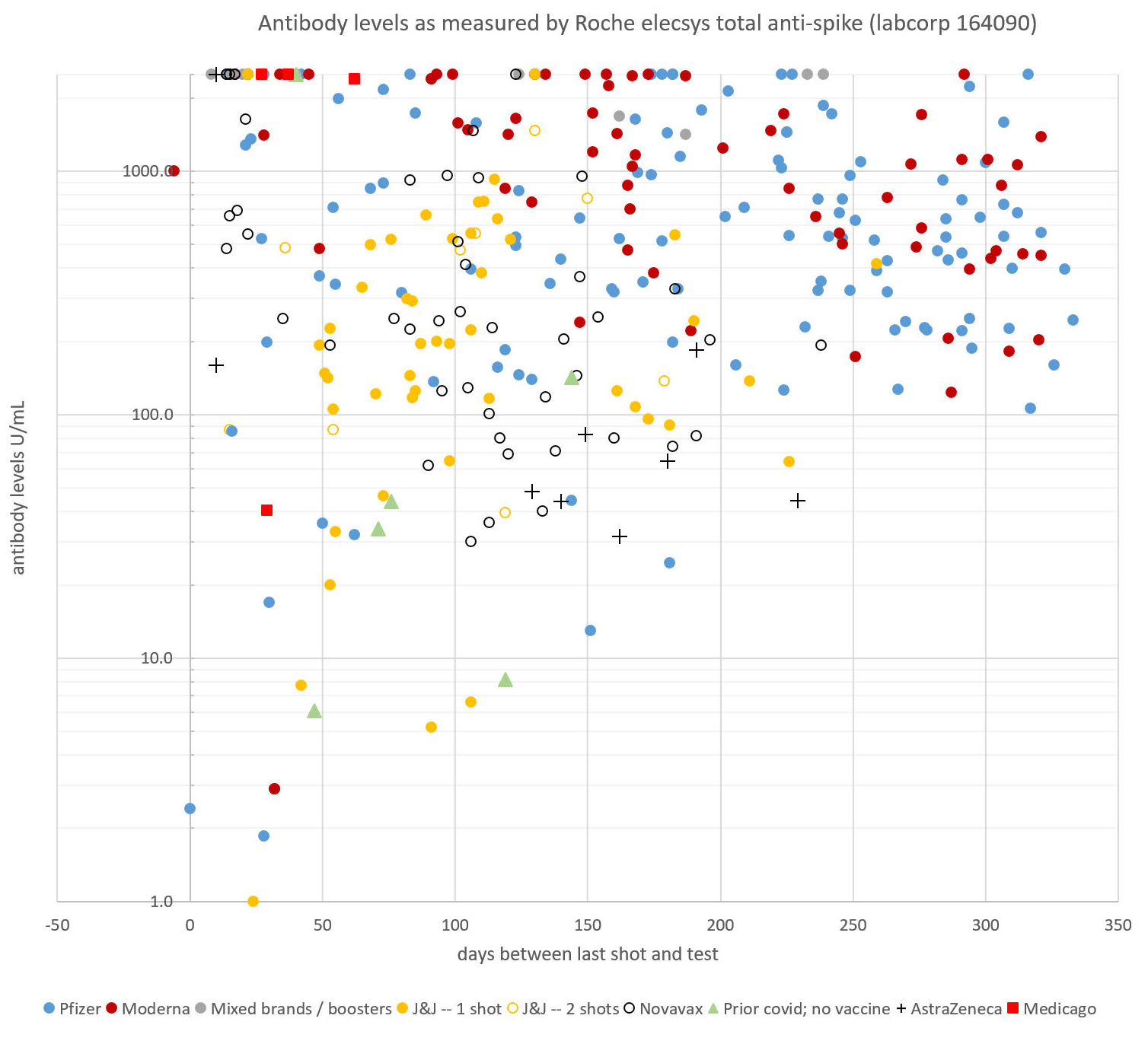
So many trial participants have posted their antibody test results to The Page that one member, who declined to be identified publicly, decided to keep track of the data. A retired professor with a Ph.D. in Cell Biology created and regularly updates a scatter plot correlating antibody levels with the number of days since trial participants received their second dose and, more recently, since boosters.

(Antibody data set collected and created by a pseudonymous member of a COVID-19 vaccine clinical trial Facebook group, who has a Ph.D in cell biology. The scatter plot comprises antibody tests for the Facebook group members.)

Pre/Post COVID-19 Booster Data reported by “The Page” members

First Vaccine:                 Antibody Titer (Before self-boosting)           Booster                 Antibody Titer (post-self boosting)


2 Doses of Pfizer                          1027U/mL                                         Pfizer                              2500+U/mL    


1 Dose J&J                                    394U/mL                                           Pfizer                              2500+U/mL


2 Doses of Novavax                      936U/mL                                          Pfizer                              2500+U/mL


2 Doses of Moderna                      20U/mL                                           Moderna                          2500+U/mL

The antibody test result data reported by members of The Page correlate with studies that suggest vaccine efficacy wanes over time — a prospect that unsettles vaccine trial participants, who were amongst the first to be vaccinated for COVID-19. But, medical professionals like Dr. Monica Gandhi, a Physician, and Professor at the University of California at San Francisco, say that antibody titer results from the Roche antibody test should not determine whether self-boosting is necessary.

“There are two arms of the immune system, B-cells and T-cells,” Gandhi said in an email to Salon. “B-cells produce antibodies, and T-cells protect you against severe infection. Measuring antibodies alone doesn’t provide a full understanding of your level of protection, and it is generally agreed upon that the neutralizing antibody titer matters more,” She wrote.

Although the Centers for Disease Control and Prevention (CDC) agrees with Dr. Gandhi, Dr. Ho does not.

“The Roche antibody test looks at antibodies specific to the receptor-binding domain for the spike protein,” Ho said. “You have a higher chance of capturing a reasonable estimate of neutralizing antibodies because of this.”

Several studies comparing the Roche antibody test to those only measuring neutralizing antibodies support Ho’s claim. But, neither Gandhi, Ho, the CDC, nor the Food and Drug Administration (FDA) recommends or condone seeking a COVID-19 booster shot —  unless a participant in one of the several booster trials.

According to Govind Persad, an expert in Health Law and Researcher at the University of Denver, self-boosting is also illegal. Since the three active vaccines received Emergency Use Authorization only, getting a booster is considered “unauthorized biologic.”

“The FDA in principle could take action against a distributor, like a doctor or a pharmacist, who administers a booster, but this is unlikely,” Persad said. “Lying to get a booster might be common-law or criminal fraud, but legal action is unlikely because the vaccine is free.”

Though technically illegal, there are few barriers when it comes to getting an additional COVID-19 vaccine, as Karli and Louise discovered.

“I was going to test my daughter’s antibodies first, but Austin started to surge with delta cases, and we had a good opportunity to get her a booster,” said Karli, who herself decided against a self-boost after receiving test results that reported a high antibody titer of 338U/mL last week. “We just went to a different pharmacy, and she got a dose of Pfizer with no trouble.”

Louise  — who was enrolled in a Pfizer vaccine booster trial  — lost her patience after the trial site called the night before she was due to get boosted, notifying her that the boosters had yet to arrive. Frustrated and panic-stricken, Louise walked into a RiteAid and got a dose of the Moderna vaccine — no questions asked.

“I guess I broke COVID vaccine law — but half of the country doesn’t want to go out and freaking get it,” Louise said. “My antibodies were so much lower than people who had gotten vaccinated more recently, and I really didn’t feel like it was fair,” she said. “Because I participated in this trial, I think that we should get boosted before everyone else.”

The FDA — ignoring last week’s recommendation from the World Health Organization that petitioned rich countries to not administer boosters until after the rest of the world had received at least one dose — authorized those who are immunocompromised to receive a third shot during a meeting today. The FDA’s statement said, “Others who are fully vaccinated are adequately protected and do not need an additional dose of COVID-19 vaccine at this time.”

“Frankly, I don’t feel there’s anything unethical because (the U.S) is literally wasting vaccines because people refuse to get vaccinated,” Gobel said. “Now the CDC keeps flip-flopping, and some of us are kind of tired of it,” he said. “There is data suggesting there are benefits to boosting, and there are humans on the other side of these trials.”

Colorado’s secretary of state says Republican county clerk is behind voting system passwords leak

Colorado Secretary of State Jena Griswold banned Mesa County from using its election equipment on Thursday after accusing a Republican county clerk of helping to leak voting system passwords to a far-right blog.

A video showing passwords used to access the county’s voting system that was secretly recorded during a security update in May was published last week on the “extreme conspiracy theorist” blog The Gateway Pundit, Griswold, a Democrat, said at a news conference on Thursday. Mesa County Clerk Tina Peters, who has spent most of the week at MyPillow founder Mike Lindell’s conspiracy theory-laced “Cyber Symposium” in South Dakota, “allowed” the security breach and “by all evidence at this point, assisted it,” said Griswold.

Peters, whose office now faces a criminal investigation by the county’s district attorney, falsely passed off an unauthorized person as a county employee during a security update of the country’s Dominion voting equipment, which has been the focus on many baseless Trumpworld conspiracy theories, the secretary of state told reporters.

“He is not an employee — you have to be an employee to attend these,” she said. “You also have to be background checked and the County Clerk’s office specifically misled my office saying that he did comply with the rules.”

Peters also ordered her staff to shut off the video surveillance system that monitored the voting machines one week before the breach, Griswold said.

“I think it is extremely concerning that an elected official from the state of Colorado is actively working to undermine confidence and spread misinformation about our award-winning voting system,” she said, announcing that the county will no longer use more than 40 pieces of voting equipment involved in the breach in its upcoming elections. But Griswold stressed that the passwords could only be used on physical equipment and it was unlikely that someone with the passwords could have meddled with the machines.

Peters, who survived a recall effort last year after an absentee ballot screw-ups and alleged personal “malfeasance,” argued during her keynote speech at Lindell’s event that the investigation from Griswold’s office was politically motivated and insisted that she was only looking to find potential problems on behalf of voters in the county.

“She has come into my office several times already in the last two years since I’ve been the elected official, because I am a Republican, I’m a conservative and she’s not. And she weaponizes her position to attack people that disagree with her,” she claimed, arguing that her constituents raised concerns that “something didn’t seem right in our county from years ago to the 2020 election.”

But Matt Crane, the executive director of the Colorado County Clerks Association, harshly criticized Peters while appearing alongside Griswold.

“It was a solo, intentional and selfish act that jeopardized the conduct of and the elections and Mesa County and affects the competence of voters throughout the state,” he told reporters. “We’ve heard people say that this is heroic. To be clear. There is nothing heroic or honorable about what happened in Mesa County.”

Griswold said that Peters has not yet responded to her order to turn over the county’s election equipment to the secretary of state’s office.

Griswold has repeatedly pushed back on Republican efforts in the state to act on former President Donald Trump’s election lies. She led a multi-state lawsuit against the USPS and Postmaster General Louis DeJoy last year for sending erroneous voting information to Colorado voters. Last month, she issued new rules barring third-party vendors from performing “sham audits” of the election, like the dubious so-called “audit” in Arizona’s Maricopa County.

The Arizona Cyber Ninjas-led fiasco has come under fire even from the state’s Republican supporters as it stretches into its fourth months amid expectations that its upcoming report will sow more election disinformation. Arizona Secretary of State Katie Hobbs, a Democrat who is now running for governor, warned the county that she will decertify election equipment turned over to Cyber Ninjas in the audit over security concerns. The Republican-led Maricopa County Board of Supervisors agreed to decertify the equipment, telling Hobbs that the panel “shares your concerns.”

Taxpayers will now have to pony up $2.8 million to replace hundreds of machines.

House Democrats have since launched a federal probe into the shady “audit” to “determine whether the privately funded audit conducted by your company in Arizona protects the right to vote or is instead an effort to promote baseless conspiracy theories, undermine confidence in America’s elections, and reverse the result of a free and fair election for partisan gain,” Oversight Committee Chairwoman Carolyn Maloney, D-N.Y., and Civil Rights Subcommittee Chief Jamie Raskin, D-Md., said in a letter to Cyber Ninjas.

The Justice Department last month issued new guidance warning states against “audits” similar to the one in Arizona, where officials sought to contact voters directly to determine how they voted.

“This sort of activity raises concerns regarding potential intimidation of voters,” the DOJ said, vowing to “act” if the audits are conducted with the  “purpose nor the effect of dissuading qualified citizens from participating in the electoral process.”

Biotechnology greed is prolonging the pandemic. It’s inexcusable

Did greed just save the day? That’s what British Prime Minister Boris Johnson claimed recently. “The reason we have the vaccine success,” he said in a private call to Conservative members of Parliament, “is because of capitalism, because of greed.

Despite later backpedaling, Johnson’s remark reflects a widely influential but wildly incoherent view of innovation: that greed — the unfettered pursuit of profit above all else — is a necessary driver of technological progress. Call it the need-greed theory.

Among the pandemic’s many lessons, however, is that greed can easily work against the common good. We rightly celebrate the near-miraculous development of effective vaccines, which have been widely deployed in rich nations. But the global picture reveals not even a semblance of justice: As of May, low-income nations received just 0.3 percent of the global vaccine supply. At this rate it would take 57 years for them to achieve full vaccination.

This disparity has been dubbed “vaccine apartheid,” and it’s exacerbated by greed. A year after the launch of the World Health Organization’s Covid-19 Technology Access Pool — a program aimed at encouraging the collaborative exchange of intellectual property, knowledge, and data — “not a single company has donated its technical knowhow,” wrote politicians from India, Kenya, and Bolivia in a June essay for The Guardian. As of that month, the U.N.-backed COVAX initiative, a vaccine sharing scheme established to provide developing countries equitable access, had delivered only about 90 million out of a promised 2 billion doses. Currently, pharmaceutical companies, lobbyists, and conservative lawmakers continue to oppose proposals for patent waivers that would allow local drug makers to manufacture the vaccines without legal jeopardy. They claim the waivers would slow down existing production, “foster the proliferation of counterfeit vaccines,” and, as North Carolina Republican Sen. Richard Burr said, “undermine the very innovation we are relying on to bring this pandemic to an end.”

All these views echo the idea that patents and high drug prices are necessary motivators for biomedical innovation. But examine that logic closely, and it quickly begins to fall apart.

A great deal of difficult, innovative work is done in industries and fields that lack patents. Has the lack of patent protections for recipes led to any dearth of innovation in restaurants? An irritating irony here is that economists who espouse the need-greed theory themselves innovate for comparative peanuts. For instance, in 2018, the median compensation for economists was about $104,000. The typical pharmaceutical CEO, meanwhile, earned a whopping $5.7 million in total compensation that year. (The hands-on innovators aren’t the need-greeders here; the median compensation for pharmaceutical employees — including benefits — was about $177,000 in 2018.) Even in Silicon Valley, writes ever-astute technology insider Tim O’Reilly, “the notion that entrepreneurs will stop innovating if they aren’t rewarded with billions is a pernicious fantasy.”

To be sure, it was not greed but rather a vast collaborative effort — funded largely with public dollars — that generated effective coronavirus vaccines. The technology behind mRNA vaccines such as those produced by Pfizer and Moderna took decades of work by University of Pennsylvania scientists you’ve likely never heard of. According to The New York Times, one of those scientists, Katalin Kariko, “never made more than $60,000 a year” while doing her innovative foundational research. The researchers at Oxford University who developed the technology behind AstraZeneca’s vaccine, which was mostly publicly funded, initially set out with the intention of “non-exclusive, royalty-free” licensing for their vaccine. Only after pressure to work with a multinational pharmaceutical company from the Bill and Melinda Gates Foundation, among others, did they renege and license the technology solely to AstraZeneca.

It was astonishing, then, when Pascal Soriot, AstraZeneca’s CEO, said that intellectual property, or IP, “is a fundamental part of our industry and if you don’t protect IP, then essentially there is no incentive for anybody to innovate.” The Oxford scientists whose work AstraZeneca licensed literally just innovated without the incentives Soriot claimed are essential. Why do journalists present need-greeder claims, such as Soriot’s, without holding the specific role of profit seeking to account?

It’s no secret that innovators (and people generally) often aren’t necessarily greed-driven. For instance, as Walter Isaacson notes in his book about superstar biochemist Jennifer Doudna’s work on Crispr gene manipulation technology, she was never motivated primarily by money. In fact, he reports that corporate maneuvering over her work made her “physically ill.” Countless cases like hers show that innovations in science and technology typically aren’t the result of genius lightning strikes but rather of field-wide efforts with multiple teams circling the same goal. If anyone withdraws for lack of greed-gratifying incentives, no problem: They’re welcome to write themselves out of history. Others will gladly grasp the glory. And we, the public, lose nothing.

Perhaps Soriot meant, more generally, that reduced revenues would cut AstraZeneca’s overall research and development (R&D) spending. But even that claim is detectably dubious. When drug makers claim that high prices are essential for innovation, they are “flat out lying” financial expert Yves Smith wrote in 2019. Smith cited data published with the Institute for New Economic Thinking showing that, between 2009 and 2018, 18 drug makers listed in the S&P 500 spent 14 percent more on stock buybacks and dividends than they did on R&D. These companies could easily ramp up investments in innovative drugs, the authors wrote, simply by reining in distributions to shareholders. (Don’t forget that share buybacks were effectively classified as illegal market manipulation until the Securities and Exchange Commission, under Reagan, relaxed the rules in 1982.)

Of the money that drug companies do invest in R&D, a significant amount for many goes not toward innovative research but to “finding ways to suppress generic and biosimilar competition while continuing to raise prices,” according to a recent report from the U.S. House Committee on Oversight and Reform. In these cases, executive and investor greed demonstrably impede innovation. A recent Congressional hearing dramatized this issue when Rep. Katie Porter, a California Democrat, grilled the CEO of AbbVie, a biopharmaceutical company which she said spent $2.45 billion on research and development, $4.71 billion a year on marketing and advertising, and $50 billion on shareholder payouts between 2013 and 2018. She characterized the idea that R&D justified astronomical prices as “the Big Pharma fairy tale.”

Even if greed makes sense for some for-profit ventures, it would be unwise for us to rely only on for-profit enterprise to harness innovation for social goals. There are many things that we must do whether they are profitable or not, and the horrific fiasco over vaccine patents has shown us that biotech executives and other members of the “thinkerati” are not above putting profits ahead of saving lives. As White House adviser Anthony Fauci noted to the Hill earlier this year, America has a “moral obligation” to “make sure that the rest of the world does not suffer and die” from something that we can help to prevent. Our government is failing in its duty to act in the public interest if it allows “your money or your life” to pass as an acceptable business model.

As an open letter signed by more than a hundred intellectual property scholars recently stated, IP rights (which includes patents) “are not, and have never been, absolute rights and are granted and recognized under the condition that they serve the public interest.” The scholars noted precedents like last year’s use of the Defense Production Act to increase production of medical supplies, and the U.S.’s commandeering of penicillin production during World War II. If Covid-19 vaccine makers refuse to make life-saving technology publicly available, governments should enact mandatory licensing or similar measures.

There are also compelling reasons to develop a standing, publicly operated rapid-response vaccine manufacturing capability. Pfizer’s CFO suggested that prices on vaccines will go up once we are out of the “pandemic-pricing environment,” noting that the company can charge nearly nine times more than they have been (“$150, $175 per dose,” the CFO said, versus the $19.50 Pfizer is charging the U.S. in one supply deal). Even if those who haven’t received a single dose of the vaccine never do, that could mean roughly a $30 billion bonanza from U.S. booster shots alone. Patient advocates estimate that it would cost just $4 billion for the U.S. to set up a public-private operation capable of manufacturing enough mRNA vaccines to immunize the whole planet, with each shot costing $2. This would be a great way for America to show global leadership, and would surely be way cheaper, both individually and collectively, than being annually “Pfizered.” Plus, the usefulness of such a facility would long outlast the current pandemic, with climate change making zoonotic spillover events more likely (not to mention the risks of weaponized viruses). Covid-19 was our “starter pandemic,” as Ed Yong usefully dubbed it.

If greed-driven companies fail to exercise their powers responsibly, they should face competition from the public sector. President Biden let the cat out of the bag when he said that “capitalism without competition isn’t capitalism; it’s exploitation.” While many people applauded his sentiment, stop and think about the implication: The president was, in essence, saying that we expect corporations to exploit us if given half a chance.

We pay a huge price in blood and treasure when we give the need-greeders free rein to lie to and exploit the public with impunity. We must be clear-eyed about exactly when greed can help our collective interests and when it hinders them. During a crisis as dire as a global pandemic, greed won’t save us.

UPDATE: A previous version of this piece suggested that the Gates Foundation pressured Oxford University to license its vaccine to AstraZeneca. The foundation clarified that it advised the university to work with a multinational pharmaceutical company, not specifically AstraZeneca.

* * *

Jag Bhalla is a writer and entrepreneur.

This article was originally published on Undark. Read the original article.

 It’s “Reinstatement Day” — but Trump has yet to be “reinstated” as president

Friday, August 13, 2021, according to far-right conspiracy theorist and MyPillow CEO Mike Lindell, was supposed to be “Reinstatement Day” — the day in which Donald Trump would be reinstated as president when evidence demonstrated that widespread voter fraud occurred in the 2020 election. But that evidence doesn’t exist, Lindell’s wacky conspiracy theories have been debunked by cybersecurity experts — and as of Friday morning, August 13, Joe Biden is still the democratically elected president of the United States and Kamala Harris is still vice president. Even if the non-existent evidence of election fraud appeared, there would still be no mechanism for returning Trump to power.

Nonetheless, Newsweek journalist Jenni Fink reports that one in ten U.S. voters believe that Trump will be returning to the White House and Biden will be ousted sometime before 2021 ends.

“Religious leaders and Trump’s supporters have thrown out a number of dates that the former president was expected to return to power,” Fink observes, “and the failure for the prediction to come true prompted some to double down, throwing out new expectations.”

Some far-right figures have even claimed that Trump has already retaken the office of the presidency, despite the obvious falsity of this assertion.

In early July, Lindell told far-right evangelical fundamentalist Brannon Howse, “The morning of August 13, it’ll be the talk of the world, going, ‘Hurry up! Let’s get this election pulled down, let’s right the right, let’s get these communists out.'”

Fink explains, “Lindell’s August 13 prediction wasn’t the first to fail and Biden was still inaugurated on January 20, the day that some believed the election would be overturned. Biden also remained in office after March 4, another day that was floated for Trump’s reinstatement.”

One of the far-right evangelical conspiracy theorists who has claimed that Trump will be “reinstated” this year is QAnon supporter Jeff Jansen, who said on June 8, “The Trump Administration is on its way in. The pedophilia Biden Administration, the fake administration, the Biden Administration is on its way out.”

The “pedophilia” part comes from QAnon’s comically absurd belief that the U.S. government has been hijacked by an international cabal of pedophiles, Satanists and cannibals. QAnon adherents also believe that R&B superstar Beyoncé isn’t really African-American, but rather, is an Italian-American named Ann Marie Lastrassi who is only pretending to be Black.

The day that Jansen predicted for Trump’s “reinstatement” was June 23.

Census data reveals the real reason why the GOP is ramping up its war on democracy

Donald Trump, who never met a fact or figure he didn’t want to distort, desperately wanted to prevent the Census Bureau from getting an accurate count of the people living in America. So his administration pursued “policies that suppress the count among hard-to-count communities — including immigrants, people of color, low-income individuals, and those in rural areas — and effectively disenfranchise them,” according to a 2020 report by Vox and the Center for Public Integrity. The Trump administration implemented strategies that were cooked up by the Federation for American Immigration Reform, a group that the Southern Poverty Law Center has designated a hate group, due to their advocacy for immigration policies aimed quite overtly at preserving white supremacy in the U.S

It’s hard to know for sure how successful the Trump administration was at undercounting the non-white population in the U.S. — it’s not like there’s another, stronger set of data to compare the census to. But we now know that Trump failed at concealing the fact that the United States is becoming more cosmopolitan and racially diverse.

Newly released data from the 2020 census shows that that the white population actually shrunk in absolute numbers for the first time in U.S. history. Meanwhile, Black, Latino, and Asian populations got bigger. The result is that white people are now only 58% of the population, down from nearly 70% when George W. Bush was elected in 2000. While not surprising, such a precipitous drop is shocking nonetheless. Additionally, people are leaving rural areas behind to pack into urban centers. 


Want more Amanda Marcotte on politics? Subscribe to her newsletter Standing Room Only.


Trump reacted to losing the 2020 election by attempting a coup that got to the point of inciting a violent insurrection on the U.S. Capitol. But despite having to run for their lives from Trump’s mob on January 6, Republican politicians in Congress like House Minority Leader Kevin McCarthy of California and former Vice President Mike Pence continue to kiss Trump’s ring. Even those who don’t hide their disgust for Trump very well, such as Senate Minority Leader Mitch McConnell, R-Ky., still do everything they can to cover for him and set him up to run in 2024. In the Beltway press, it is fashionable to ascribe this masochistic display of fealty to Trump to “fear.” Republicans, we’re told, are afraid of Trump, knowing that he’s still beloved by the GOP base and that he can turn the masses against them with the drop of, well, not a tweet, but maybe an angry rant on Fox News.

As pleasing as it is to imagine that they’re all just a bunch of sniveling stooges acting out of sheer cowardice, these census numbers are a reminder that Republicans have an even more sinister reason for backing Trump. They all share Trump’s belief that the best way to react to a racially diversifying America is to gut democracy so that a white conservative minority can lead, regardless of how much their population is shrinking. 

As Salon’s Igor Derysh detailed on Friday morning, by all rights, these demographic shifts should be benefitting Democrats electorally. Yet Republicans are set up rather nicely for big wins both on the state and federal level in 2022, despite the fact that more people vote for Democrats. As Derysh writes, “Republicans have aggressively (and sometimes illegally) gerrymandered congressional districts in previous cycles, and hold total control over the redistricting process in 20 states, representing 187 congressional districts.” Making it worse, 18 states have passed voter suppression laws this year alone. In some cases, the laws not only suppress votes at the ballot box but are empower Republican-controlled state legislatures to monkey with election boards and vote-counting systems after the fact to nullify elections that don’t come out the way they’d like. All of this is in an effort to preserve the power of a dwindling white conservative minority.

The Republican party, in the past, toyed with the idea of changing their political strategies and policy focus in order to attract more voters of color. But Trump’s win in 2016 and his enduring popularity with the base settled the question permanently in favor of the GOP being a white identity party. It made it clear that any effort to expand their voting base by dialing down the racism and reaching out to voters of color threatens a backlash from their existing voters. And so the GOP has embraced an anti-democracy strategy, fiddling with election laws to make it harder and harder for the liberal majority to vote. 

Of course, this assault on voting rights predates Trump. But Trump, by shamelessly attempting a coup and even inciting a violent insurrection, has really taken the GOP’s anti-democracy movement to the next level. And he barely bothered euphemizing his racist justifications for his belief that he is the “real” winner of the 2020 election. Recall how he kept singling out racially diverse cities like Detroit, Atlanta and Philadelphia in his attacks on the election, making it clear that he feels that the residents of these cities aren’t legitimate voters. 

Trump’s shamelessness is his biggest gift to the modern GOP.

A lot of Republican voters have quietly believed for a long time that they deserve to control the country, no matter how few of them there are, because they are the only “real” Americans. Trump opened the closet door and let that idea roam free. Now Fox News is blasting fascist propaganda on the regular, arguing that ending democracy is necessary so conservative whites can feel “free” (of the rest of us, apparently). It used to be only neo-Nazis who were claiming that it’s “white genocide” if conservatives whites have to share power with other people. Now you have Newt Gingrich on national TV insisting that merely living in a multiracial democracy is the equivalent of eliminating “traditional, classic Americans.”


Want more Amanda Marcotte on politics? Subscribe to her newsletter Standing Room Only.


Trump and his allies give ideological justification to the effort to the GOP effort to undermine democracy. And that ideological justification is shamelessly white supremacy. So no, the Republican brass doesn’t embrace him because they’re “afraid.” They embrace Trump because they see their power slipping away, and they view him, for better or worse, as the right man to lead this anti-democratic movement. 

Unfortunately, Trump and Republicans have good reason to think they’ll be able to capture permanent power despite their shrinking voting base. After all, all of these anti-democratic moves on the state and local level could be stopped now, if only the slim Democratic majority in the Senate would pass legislation barring partisan gerrymandering and voter suppression. While it wouldn’t be enough to create majoritarian democracy, it would certainly keep us from backsliding into an autocratic state. But instead, as we’ve chronicled ad infinitum here at Salon, such bills are being blocked by two daft Democratic members of the Senate, Joe Manchin of West Virginia and Kyrsten Sinema of Arizona, who refuse to support a repeal of the Senate filibuster abused by Republicans to block any voting rights legislation. 

It’s a deeply depressing thing. The trends captured by the census would, in any sane society, be cause for celebration. We are on the verge of having an urbane, racially diverse democracy where people of different backgrounds come together to create a dynamic society that inspires creativity and innovation. The majority of Americans believe in this vision, as the migration patterns show, and are building lives in areas where, however imperfectly, that’s how people are living.

The American dream is under real threat because a bitter white conservative minority feels entitled to rule over the majority. Unless something is done — and done soon — they may very well get their way on a permanent basis. 

“Failure of the hospital system”: Rachel Maddow sounds the alarm about COVID’s impact on Mississippi

On her Wednesday night MSNBC program Rachel Maddow said that “it’s not just bad news, it’s national news” that health officials in Mississippi are reporting the state hospital system is on the brink of failure.

With hospitals running out of room, pushing the University of Mississippi Medical Center to expand its bed capacity by repurposing its parking garage, officials, including Associate Vice Chancellor for Clinical Affairs Dr. Alan Jones, held a “pull the fire alarm” news conference Wednesday.

“If we continue the trajectory we’re on, within the next five to seven to ten days, I think we’re going to see failure of the hospital system in Mississippi,” said Jones said at the University of Mississippi Medical Center, the flagship hospital in the state.

“Hospitals are full from Memphis to Gulfport, Natchez to Meridian. Everything is full,” he continued.

Jones went on to express his fear of turning away not just Covid-19 patients, but also patients requiring time-sensitive medical attention, such as heart attacks and strokes. “That is our nightmare,” he finished.

Mississippi’s Gov. Tate Reeves, a Republican, has publicly downplayed the coronavirus crisis in his state.

“This is not what they are warning might happen. This is today,” said Maddow. “This is what’s happening right now.”

“The state of Mississippi is in trouble,” she finished.

How to make filling and flavorful dinners for $2.50 (or less!)

I’m always looking for a good deal. I buy my clothes from resale sites and my glassware at antique stores — and before the pandemic forced us to eat at home every night, I regularly opted to make dinner instead of dropping $40 at a restaurant. This penchant for thrift often led me towards recipes that slant on the cheap side, but I discovered that most budget-friendly recipes simply don’t suit my lifestyle: hefty casseroles and pastas to serve a large family (I live in a two-person household); cheaper cuts of meat swapped in for thicker chops to make a big, meaty entree (I rarely eat meat, and when I do, I don’t want it to take over my meal); and ingredients purchased in uber-large quantities (my apartment has minimal storage).

While these styles of recipe are indeed helpful to many, to find recipes I like and save money, I decided to take matters into my own hands in the form of a monthly recipe column called Nickel & Dine. Every one of these recipes makes at least four servings, and will run you about $10 in total — that’s just $2.50 per serving!

I’m not saying I don’t still splurge on a nice bottle of wine or fancy tinned fish when the urge strikes, but I am saying it’s not hard to make flavorful, nuanced meals you’d feel just as excited to make on a random Wednesday as you would when entertaining friends for the evening — and you don’t have to spend a significant chunk of your paycheck to do it.

* * *

Six dinners, for $10 or less 

A Pot of Beans and Greens

The meal I make over and over (and over): dry beans and aromatics cooked into a pot of soupy goodness. Wilt in whatever hardy greens are in the fridge, serve with bread.

Smashed Potatoes with Bacon and Eggs

Everyone loves a tiny, crispy, smashed potato, but why not give Russets the same treatment? Top the taters with spicy sour cream sauce, crumbled bacon, two bacon-fat fried eggs, and a side of tender greens. Breakfast for dinner just got way more fun.

Vegetarian French Onion Soup with Asparagus and Cheesy Croutons

Classic French onion soup is great, but this vegetarian version tastes just as rich, thanks to the biggest pile of caramelized onions you ever did see. If it’s asparagus season, use them; if not, any green thing (green beans, chopped broccoli rabe, frozen peas, snap peas, and edamame, to name a bunch) will do nicely here.

Toast Frittata

Frittata with a side of toast is great, but how about toast baked right inside it? The toast pieces are fried in a skillet with olive oil, then the beaten eggs go right into the same pan along with creamy feta, frozen peas, and sliced red onion. Eat it warm or cold, inside or out.

Grilled Tofu Cabbage Cups with Garlicky Yogurt

A totally gluten-free recipe, these cabbage cups are here to remind you that grilled tofu doesn’t have to be boring. Taking inspiration from lettuce and cabbage wraps all over the world, tuck smoky grilled tofu into cabbage leaves with a crunchy-juicy cucumber, tomato, and onion salad and a creamy Greek yogurt dressing.

Tuna Toasts with Spice-Dusted Tomatoes

If a tuna sandwich met tomato toast, you’d get this tuna toast. Shower slices of juicy tomato with ground cumin, crushed fennel seed, and a mild chile flake, then layer them over a quick tuna salad tossed with celery and pickles and piled on garlic-rubbed toast. The non-negotiable side dish? A big handful of potato chips.

“Throw a fake”: Rudy Giuliani reveals to FBI how he used Fox News to push lies about Hillary Clinton

Just ahead of the 2016 election, former Trump attorney Rudy Giuliani told the nation in a Fox News interview that the Trump campaign had a “big surprise” regarding the ginned-up Hillary Clinton email controversy. The former New York City mayor even went so far as to suggest that the FBI had been leaking info about the agency’s probe directly to Giuliani for Trump’s political gain.

But according to a newly released 2018 transcript of Giuliani’s interview with Justice Department investigators probing a potential leak, it all appears to have been a complete lie.

Giuliani explained to federal officials that it’s OK to “throw a fake” while campaigning. 

The revelation, first reported by The Washington Post, stems from a transcript obtained by the Project on Government Oversight of Giuliani’s 2018 interview with federal officials in Trump’s D.C. hotel. During the interview, FBI agents working on behalf of the Justice Department inspector general questioned the longtime attorney whose law license was recently suspended on whether agency officials had leaked him sensitive info about Clinton’s email fiasco back in 2016. 

In response, Giuliani’s legal counselor Marc Mukasey said that the threshold for truth-telling is much lower in campaigns than it is for typical legal affairs. 

“In the heat of a political campaign, on television, I’m not saying Rudy necessarily, but everybody embellishes everything,” Mukasey explained. “You’re under no obligation to tell the truth.”

Giuliani, a former federal prosecutor for New York City, even added: “You could throw a fake.”

“Fake news, right?” a federal official asked. 

“Right,” Mukasey replied.

Earlier this month, the Justice Department inspector general concluded that he could not find any evidence that FBI agents leaked info about the Clinton email investigation to Giuliani, putting to rest longstanding concerns that the agency had actively undermined her candidacy. 

But back in 2016, two days before then-FBI Director James B. Comey reopened a probe into Clinton’s email affair, Giuliani had gone on Fox News to tell viewers that he had “a surprise or two that you’re going to hear about in the next few days. I mean, I’m talking about some pretty big surprises.”

Many took this claim to be indicative of a clandestine back channel between the former New York Mayor and the FBI, even though Giuliani later walked his rhetoric back as the weeks dragged on.

In 2018, during his formal interview with the FBI, Giuliani struck a different tone, claiming that Comey’s probe was in fact “a shock” to him. He suggested that, at most, he may have heard control room gossip about the investigation.

The revelation is just the latest in Giuliani’s string of alleged and proven improprieties before, during, and after Trump’s presidency.  

Back in June, the former prosecutor’s law license was suspended by the state of New York over his promotion of Trump’s baseless allegations of fraud in the 2020 election. Giuliani is currently facing a federal investigation into his relationship with various Ukrainian officials leading up to the 2020 election. 

The former New York mayor is also said to be on the brink of bankruptcy amid a multibillion dollar defamation lawsuit leveled against him by voting technology company Dominion for pushing the erroneous notion that the firm tampered with its own vote-counting machines to sabotage Trump’s political prospects.

This grandma-approved tomato recipe has people in a tizzy

Stop what you’re doing and eat a tomato immediately. Unless, of course, you are already in the middle of eating a tomato, in which case well done; and while I have you, I hope, in between your tomato sandwiches and BLTs and no-cook sauces, you saved a few of those summer jewels to can for later. Tomatoes are at their peak right now, and you can squirrel away some of that late summer flavor for the dark days of winter with just a little time and know-how.

Canned tomatoes are certainly a staple in my home kitchen — everything from quick pastas to Sunday afternoon braises benefit from the juicy-sweet addition. Of course, most supermarket shelves are lined with multiple brands of whole-peeled, crushed, and fire-roasted canned tomatoes, but have you ever made your own? Considering that it’s tomato season literally right at this very moment, it’s high time you considered doing some canning. The Food52 community certainly has.

“Every year since he can remember, my father has canned fruits, vegetables, and jams,” writes Kelsey Banfield, a food blogger and community member. “He learned his techniques from his mother (my grandmother), who typed up her time-tested instructions for how to can tomatoes and other seasonal produce, and made an entire booklet for him when he moved out of the house.” Lucky for us, Banfield’s dad shared his mother’s recipe for canned tomatoes with her, and she shared it with Food52.

Recipe: Grandma’s Canned Tomatoes

How to make canned tomatoes 

Canning yourself certainly takes a bit more effort than a trip to the grocery store, but it’s well worth the journey. The ingredients list is small: just ripe tomatoes, Kosher salt, bottled lemon juice (skip fresh here to maintain the acidity level — this is paramount when it comes to making fresh produce into a shelf-stable product.) You’ll also need sterilized quart jars with lids and rims.

To start, quickly blanch tomatoes to make for easy peeling. You’ll use about three pounds of fresh tomatoes for each quart of canned; this recipe calls for enough to make four quarts of canned tomatoes, which is definitely the minimal amount we’d recommend making at once. After all, winter is coming, and with it, pale, watery tomatoes. Imagine how bummed you’d be to find you only preserved enough of summer’s finest for one or two jars — just take a canning day and make a bunch, for the sake of your future self.

Banfield orders tomatoes in bulk from a local farm; if you can’t do that, head to the nearest farmers market, like Food52 Software Engineer Jeremy Beker, who recommends asking for ‘seconds’ or ‘canning tomatoes’ which, as Beker says, “just means ones that aren’t quite as pretty.”

Cram peeled, cored tomatoes into the jars along with the salt and lemon juice. That’s it! Tightly seal the jars and prep them for a swim: Submerge the jars in a stockpot of boiling water for 45 minutes, then let them cool. Check the seal, label with the date, and they’ll be good to hang out until next summer’s tomatoes pop up. What a dang delight!

“Learning how to can tomatoes has been essential for my home cooking skills because I use them all winter long—they’re great for making sauces, soups and spreads,” writes Banfield in the recipe headnote. Just imagine how happy you (or someone you gift a jar to!) will be come December.

What to do with those canned tomatoes 


Mary Trump: Mitch McConnell is “the greatest traitor to this country since Robert E. Lee”

Mary Trump called her uncle the “weakest man” she’s ever known — and compared Senate Minority Leader Mitch McConnell, R-Ky., to Robert E. Lee.

The twice-impeached one-term president’s niece published a lengthy essay in The New Republic laying out her concerns that Donald Trump and his Republican allies were dead set on establishing a white supremacist minority rule over the U.S., and explained what was necessary to prevent that.

“Donald showed his party (and yes, it is his party) the limits of pretending to care about good governance or play by the rules,” Mary Trump wrote. “He also showed them the utility of not just stoking racism and hatred of the other — in the form of immigrants, Democrats, and even epidemiologists — but championing those who espoused them.”

She explained that her uncle excelled at destruction, and his Republican enablers exploited that skill to weaken the democratic institutions that McConnell had been chipping away at during his decades in the U.S. Senate.

“McConnell is the greatest traitor to this country since Robert E. Lee (with the difference that McConnell has been trying to take our country down from within),” Mary Trump wrote. “He has always been expert at using existing rules and procedures in ways they weren’t intended to be used, and yet — whether it was denying Merrick Garland a hearing, pushing through Amy Coney Barrett’s confirmation, or ending the filibuster as it applied to Supreme Court nominees but employing it to block legislation that would expand voting rights — his anti-democratic maneuvers have been performed within the bounds of the system.”

“The fact that he’s misusing the system outlined in the Constitution isn’t an exoneration of him, however; it’s a condemnation of the Constitution’s limitations,” she added. “The definition of treason in the Constitution is so narrow (levying war against the country or giving aid and comfort to the enemy) that a case could never be made against him. It would be difficult, however, to find anybody in modern times who has so undermined our democracy.”

It’s clear that democracy was already weak by the time her uncle showed up on the scene, Mary Trump argued.

“This destruction of norms by Donald and other Republicans in the executive and legislative branches has happened so quickly, and has been so thorough, that it’s clear the seeds of it must have been planted a long time ago,” she wrote. “It was possible for Donald, the weakest man I have ever known, to exploit the weaknesses in the system not because he introduced them, but because they were there for him to exploit in the first place.”

She pushed back on the notion that Donald Trump had corrupted the Republican Party.

“The Republicans haven’t lost their way,” Mary Trump wrote. “They have, instead, found it. And it has led them straight toward unabashed white supremacy and fascism.”

New census data should be a boost to Democrats — but GOP is likely to win anyway

The United States saw unprecedented growth in diversity over the past decade as the white population declined for the first time in history, new census data showed on Thursday. But despite population growth among nonwhite and urban voters, which have been key Democratic voting blocs, Republicans are still expected to hold a decisive edge in the congressional redistricting process.

The Census Bureau released data used by states to redraw congressional and legislative districts, showing that while the white non-Hispanic population declined by more than 8% amid the slowest national population growth the country has seen since the 1930s, the Hispanic, Black and Asian-American populations continued to grow. For the first time in U.S. history, the white population has fallen to below 60% of the total.

“These changes reveal that the U.S. population is much more multiracial, and more racially and ethnically diverse, than what we measured in the past,” Nicholas Jones, the director of race, ethnicity, research and outreach for the Census Bureau’s Population Division, said during a news conference. He cautioned, however, that some of the changes may be the result of improvements the bureau has made to the survey.

The population also continued to become more urbanized. A majority of counties in the U.S. (52%) saw population declines, particularly among rural counties with fewer than 10,000 people. The population growth over the past decade was “almost entirely” in metropolitan areas, said Marc Perry, senior demographer at the Census Bureau’s Population Division.

Metro areas grew by 8.7% while micro areas grew by just 0.8% and the population in rural areas declined by 2.8%. All 10 of the biggest cities in the United States, led by New York, Los Angeles and Chicago, saw population growth.

Perry highlighted the case of Texas, where the Hispanic population is now roughly equal to the number of non-Hispanic whites in the state, as a perfect example of the trend.

“Parts of the Houston, San Antonio, Austin, Dallas-Fort Worth, Midland and Odessa metro areas had population growth, whereas many of the state’s other counties had population declines,” he said.

The Asian-American population grew the fastest over the last 10 years, rising by 35%. The Hispanic population increased by 23% and the Black population grew by 5.6%. Nearly half of all children in the country are nonwhite. The number of people reporting two or more races or “other race” also significantly increased, suggesting that some of the trends may be the result of changes to how respondents self-identify.

It will take several weeks for states to sort through the data, which they will later use to draw new district maps. That process has frequently been described as politicians picking their own voters, rather than the other way around.

It would be reasonable to conclude that a more diverse population that is increasingly concentrated in urban centers would give Democrats an edge over Republicans, whose base of voters has grown increasingly white and rural in recent election cycles. In theory, that would still be the case even as red states like Texas and Florida are set to gain congressional seats, while blue states like New York and California will lose seats, given that the population increases in Texas and Florida are largely in those states’ large metropolitan areas.

But that’s not likely to be how it plays out in reality. Republicans have aggressively (and sometimes illegally) gerrymandered congressional districts in previous cycles, and hold total control over the redistricting process in 20 states, representing 187 congressional districts. Democrats have control of the process in 11 states, including just 84districts. Other states have split governments or independent redistricting commissions, which offer some protection against partisan gerrymanders.

Although the 2010 census showed similar trends to those seen in the new data, Republican gerrymanders allowed the party to hold decade-long majorities in many congressional delegations and state legislatures, even as Democrats began to consistently win larger shares of the vote. That has resulted in massive partisan gains for the GOP, according to a recent Associated Press analysis. Ohio Republicans have won 75% of the state’s congressional seats, for instance despite never winning more than 58% of the vote. “The Republican advantage in Michigan’s state House districts was so large after the GOP drew the maps that it could have played a role in determining control of the chamber in every election this past decade,” the AP reported.

This cycle could be even more perilous for Democrats. Republicans aggressively sought to counter their presidential and Senate losses in 2020 by rolling out hundreds of bills to restrict voting access, especially in states where voters of color drove record-high turnout last year. Some Republican-led state legislatures are already looking to “crack” cities, where Democrats have typically won seats, by dividing them into multiple districts that also include far-flung suburban or rural areas, in hopes of guaranteeing further victories. 

Democrats have seen some success in lawsuits over overtly partisan gerrymanders, the Supreme Court in 2019 delivered a critical blow to that process, effectively barring federal courts from ruling on partisan gerrymanders.

With Democrats holding just a five-seat majority in the House right now, it’s entirely possible Republicans could win control of the chamber in 2022 through gerrymandering alone. A recent study found that Republicans could gain up to 13 seats through gerrymandered districts in just four states: Florida, Texas, North Carolina and Georgia. That analysis did not include potential Democratic gains, such as in New York, where Democrats are likely to eliminate or flip a Republican seat for example. But opportunities for such Democratic pickups appear limited.

Instead, Democrats have increasingly pushed to implement independent redistricting commissions to create fair maps, or, as in the case of Oregon, have cut deals with Republicans, offering an equal number of congressional seats in exchange for an end to relentless GOP obstruction in the state legislature.

As a result, Democrats may have shot themselves in the foot: Republicans are ready and eager to redraw legislative maps aggressively, while their opponents seek to model good governance, perhaps at the expense of their own political fortunes. In fact, population trends showing migration flows from rural areas to urban centers, where Democrats typically predominate, could actually work against them in states like Michigan with independent redistricting panels, because Republican voters are more geographically dispersed.

“Even if you’re not trying to gerrymander on behalf of Republicans,” Matt Grossmann, director of the Institute for Public Policy and Social Research at Michigan State University, told the AP, “the fact that Democrats are concentrated in cities and in the inner-ring suburbs means that it is easier to accidentally gerrymander on behalf of Republicans.”

Why is the Biden administration still keeping migrant kids locked up? The saga of Title 42

“A lot of girls cry. They have thoughts of cutting themselves,” a 14-year old Guatemalan girl told a Reuters reporter in June. “I feel asphyxiated having so many people around me. There’s no one here I can talk to about my case, or when I’m feeling sad. I just talk to God and cry,” said another teenage girl from Honduras who was held in the Dallas convention center with 2,600 other kids.

It gets worse as you read more press reports written over the course of the summer. Kids in custody reported spoiled food, no clean clothes, sleeping on cots under glaring lights, drinking spoiled milk when there isn’t water. According to a New York Times report, detained youth at a military base in El Paso said they’d gone days without showering, while at another facility in Erie, Pennsylvania, lice were rampant. In June roughly 4,000 unaccompanied children were being held by the Department of Health and Human Services. That’s definitely a step up from the ICE detention of the Trump years, but still amounts to kids locked in facilities where press is not permitted.

No one denies that growing numbers of immigrants seeking asylum in the U.S. present a difficult political, social and humanitarian problem. The Biden administration realizes that, and has worked to alleviate the suffering. Still, there is no excuse for the incarceration of children. As Leecia Welch, a lawyer at the National Center for Youth Law, told the New York Times in June, “Thousands of traumatized children are lingering in massive detention sites on military bases or convention centers, many relegated to unsafe, unsanitary conditions.”

There is growing outrage about the continuing use of the federal regulation known as Title 42 as a deportation mechanism. It was extensively used to keep migrants and refugees from entering the country under the Trump administration. President Biden promised to end it, but is now apparently allowing it to remain in effect indefinitely. 

In a recent letter to the White House, more than 100 advocacy and human rights groups urged the president to rescind Title 42 expulsions, charging that the practice violates both U.S. refugee law and international treaties, and endangers people seeking protection at the U.S.-Mexico border  According to Border Report in Texas, the expulsions have no scientific basis, and may expose those being held to violence in Mexico.  

Title 42 is one of 50 titles within the U.S. Code of Federal Regulations established in 1944 to move quarantine authority to the public health sector. It has sometimes been used to control immigration, using public health as a rationale. 

Well before the COVID pandemic, Stephen Miller, Trump’s infamous immigration adviser suggested using the Code to close the border to asylum seekers, despite being told by lawyers that the administration lacked the legal authority to do so. Human Rights Watch has argued that “the expulsion policy is illegal and violates human rights,” and adds that “U.S. law gives asylum seekers the right to seek asylum upon arrival in the United States, even if seekers arrive without inspection or prior authorization. U.S. Customs and Border Protection (CBP) is legally required to conduct screenings to ensure they do not expel people who need protection.”

Yet since March 2020, CBP has carried out almost 643,000 expulsions using Title 42 without conducting the required screenings, thus creating a policy of illegal “turnbacks.” In November a federal district court blocked the use of Title 42 in the case of unaccompanied minors, but by the time the Biden administration promised to end it more than 13,000 kids had been expelled.

Here’s the rub. These kids aren’t entering the U.S. infected with COVID, for the most part — they contract the virus once they are held in detention, because of overcrowding and unhygienic conditions in HHS and CBP facilities. Some children have died in detention.

Along with children, pregnant women — some of them in labor — have been expelled, as have a number of LGBTQ people, who are at high risk of violence, according to Human Rights Watch. This has continued under Biden. HRW also states: 

The Convention against Torture and the International Covenant on Civil and Political Rights (ICCPR), to which the U.S. is a party, prohibit expulsions or returns in circumstances where people would face a substantial risk of torture or exposure to other ill-treatment. Also, under U.S. law and the 1967 Protocol Relating to the Status of Refugees, to which the U.S. is party, the United States may not return asylum seekers to face threats to their lives or freedom without affording them an opportunity to apply for asylum and conducting a full and fair examination of that claim.

By February of this year, CBP had carried out more than 520,000 expulsions, according to the American Immigration Council.

Let’s be clear: No one risks their lives or suffers the unimaginable hardships of migration without compelling reasons. Those may include crushing poverty, political violence, the threat of criminal extortion and murder, hopelessness and more. (If you want to know what the journey is really like, read “Disquiet” by Zulfu Livaneli, or “The Mediterranean Wall by Louis-Philippe Dalembert.)

The UN holds that children seeking should never be detained. And still they come by the hundreds of thousands. That’s why the ACLU is moving forward with a lawsuit that seeks to lift the public health order for migrant families and unaccompanied children. As Lee Gelernt, the ACLU’s lead lawyer, has said, “Time is up” for dealing with this human rights catastrophe.

“We can’t live forever”: Marjorie Taylor Greene shrugs off surge in COVID-19 hospitalizations

During an appearance on the pro-Trump Real America’s Voice network this Thursday, Georgia GOP Rep. Marjorie Taylor Greene said that she thinks “more research is needed” before the FDA approves the COVID-19 vaccines that are currently being distributed to Americans.

“Because here’s the problem . . . once the vaccines are approved by the FDA, we’re going to see the mandates for vaccines ramp up far more than they are right now,” Greene said. “And I fear they’ll become law in some cities and some states. Biden would love to make it the law of the land.”

“Again, I’m not anti-vax,” Greene claimed. “I’m completely for people being allowed to make choices — medical choices — for themselves and their families. And I don’t think the FDA should approve a vaccine that doesn’t seem to be that effective, especially with COVID-19 raging all over the country. At least that’s what the media tells us every single day.”

Greene went on to say that she’s talked to hospital officials and that while “waiting rooms” may be full of COVID-19 patients, “the waiting rooms are full of all kinds of things — not just COVID.”

“So while the news tries to tell us the hospitals are slam-packed with COVID, that’s just not the case,” she said. “Everybody needs to get back down to common sense and remember that, you know, we’re human. We can’t live forever. We’re going to catch all kinds of diseases and illnesses and other viruses, and we get hurt sometimes.”

You can watch the video below via Twitter:


The “media bias” no one talks about: Democracy vs. authoritarianism

The mainstream media has historically tried to balance left and right in its political coverage, and present what it views as a reasonable center.

That may sound good in theory. But the old politics no longer exists and the former labels, “left” versus “right,” are outdated. Today it’s democracy versus authoritarianism, voting rights versus white supremacy.

There’s no reasonable center between these positions, no justifiable compromise. Equating them is misleading and dangerous.

You hear the mainstream media say, for example, that certain “Republican and Democratic lawmakers are emerging as troublemakers within their parties.”

These reports equate Republican lawmakers who are actively promoting Trump’s big lie that the 2020 election was stolen with Democratic lawmakers who are fighting to extend health care and other programs to help people. 

But these are not equivalent. Trump’s big lie is a direct challenge to American democracy. Even if you disagree with providing Americans better access to health care, it won’t destroy our system of government. 

You also hear that both sides are gripped by equally dangerous extremism.

Labeling them “radical left” and “radical right” suggests that the responsible position is somehow between these so-called extremes. 

Can we get real? One side is trying to protect and preserve voting rights. The other side is trying to suppress votes under the guise of “election integrity.”  

But there isn’t and never was a problem of “election integrity.” The whole issue of “election integrity” in the 2020 election was manufactured by Donald Trump and his big lie about voter fraud, and was bought and propagated by the Republican Party. 

Today’s Republican Party is behind what historians regard as the biggest attack on voting rights since Jim Crow, but the media frames this as a right-versus-left battle that’s just politics as usual.

Equating the two sides is false and dangerous.

Or compare the coverage of Marjorie Taylor Greene and Lauren Boebert, on one hand, with the coverage of Alexandria Ocasio-Cortez and Ilhan Omar on the other.

You’d think they were all equally out of the mainstream, some on the extreme right, some on the extreme left. That’s bunk. Marjorie Taylor Greene and Lauren Boebert, in addition to spreading dangerous conspiracy theories, harassing colleagues and promoting bigotry, don’t actually legislate or do anything for their constituents. 

Alexandria Ocasio-Cortez and Ilhan Omar both organize to help everyday people, deliver for their constituents and have pushed legislation to provide universal school meals, expand affordable housing and combat the climate crisis.

Equating all these lawmakers suggests that the responsible position is halfway between hateful, delusional conspiracy theories on the one hand and efforts to fight white supremacy, save the planet and empower working people on the other. 

It’s similar to what the media did following Donald Trump’s infamous condemnation of “both sides” after the deadly violence sparked by neo-Nazis and white supremacists in Charlottesville, Virginia, in 2017. In the ensuing weeks, America’s six top mainstream newspapers used just as much space condemning anti-Nazi counter-protesters as they did actual neo-Nazis.

But research shows white supremacists pose a significantly graver threat than those trying to stop them. White supremacists are animated by racism, sexism, antisemitism and other forms of bigotry, violence and hate. 

Battling white supremacy is not the same as advocating it. Passing laws to prevent voter suppression is not the same as passing laws to suppress votes. Fighting for our democracy is not the same as seeking to destroy it. 

The media equating both sides, one “left” and one “right,” suggests there’s a moderate middle between hate and inclusion, between democracy and proto-fascism. 

This is misleading, dangerous and morally wrong. Don’t fall for it. 

Texas threatens to pull liquor licenses of restaurants asking customers to show proof of vaccination

Two restaurants have pulled back on their plans to require patrons to show proof of vaccination after the Texas Alcoholic Beverage Commission threatened to pull their liquor licenses.

The Austin American-Statesman reports that Austin-based restaurants Launderette and Fresa’s earlier this week announced plans to ask patrons to show they had received at least one dose of a COVID-19 vaccine before entering.

Shortly afterward, however, the Texas Alcoholic Beverage Commission called them and sent them a separate letter informing them that requiring proof of vaccination would likely violate a law passed by the Texas legislature earlier this year that barred vaccine passports in the state.

“Yesterday, we received a courtesy call from the TABC saying that we must immediately act in compliance with the law and that if we did not, a case would be opened and we would be at threat of losing our state licenses,” the owners of Launderette told the Austin American-Statesman.

Even though the restaurants are no longer requiring proof of vaccination, they are still insisting that customers come wearing masks as a precondition to being seated.

Texas Gov. Greg Abbott has come under fire in recent days for refusing to back down from his stance against mask and vaccination mandates even as he asked overrun Texas hospitals to stop performing elective surgeries until the current wave of COVID-19 hospitalizations ends.

As delta variant surges, vaccine-makers rethink their strategy

When America shut down in March 2020 due to the COVID-19 pandemic, there was a pervading sense that the situation was probably — or hopefully — temporary. After all, efforts were already underway to develop a vaccine. It was just a matter of time until normalcy would return.

But 17 months later, a return to “normal” is nowhere in sight. Frightening new mutant strains like the delta variant and the lambda variant have emerged, more infectious and possibly more dangerous than their antecedents. Early evidence indicates that, while existing vaccines stop patients from getting severely ill if infected, they do not prevent the infected from transmitting the disease. At the very least, it is theoretically possible that mutant variants could create problems for people who want their inoculations to be effective.

In other words, the vaccines weren’t enough. Humanity anxiously awaited development of the first COVID-19 vaccines throughout 2020; now that those vaccines aren’t enough to permanently halt COVID-19, it would appear that vaccine manufacturers are pivoting their strategy.

But as to what they have planned, pharmaceutical companies aren’t being entirely transparent — or perhaps they aren’t sure. 

“As SARS-CoV-2 continues to evolve, Pfizer and BioNTech are continuing our work to understand long term immunity, the need for booster shots, and any threat from circulating or new variants of concern to vaccine protection,” a Pfizer spokesperson told Salon by email. The company said that the existing body of research and evidence suggests that the circulating variants do not escape their COVID-19 vaccine, adding that they continue to perform clinical trials at various stages for a third dose of their currently two-dose BNT162b2 vaccine, with possibly hopeful results. That vaccine, widely known as the “Pfizer COVID-19 vaccine,” is effective in preventing COVID-19; two doses of it significantly strengthens the body’s ability to avoid severe disease and hospitalizations.

The company also communicated to Salon that, broadly speaking, they plan on keeping tabs on emerging variants and waning immunity so that they can prepare new products if necessary.

“It is, in part, why we chose a vaccine technology with the flexibility that allows us to both provide boosting doses if needed and to address potential changes in the virus,” Pfizer explained.

The biotechnology in question is known as an mRNA vaccine, and it describes the type of inoculation developed by both Pfizer and Moderna (which did not respond to Salon’s request for comment). Traditional vaccines work by introducing a weakened or dead pathogen (an organism that causes disease) into the body. The immune system becomes familiar with the pathogens by being exposed to them and, like a soldier participating in war games, learns how to fight a real enemy through training with a facsimile. More specifically, the immune system learns how to recognize antigens (a toxic or foreign substance on an antigen) and produce antibodies to destroy the pathogens associated with them.

mRNA vaccines follow this same principle, but with a twist: They use a synthetic version of RNA, one designed to compliment one of the DNA strands in a gene, and introduce it into the body so cells will produce antigens like those found in a given virus. This has the same effect as traditional vaccine platforms — it helps the body’s immune system recognize and fight the pathogen — but can be manufactured quickly and be altered easily as viruses mutate and variants emerge. Despite many advances in biotechnology, it is still complicated and painstaking to manufacture sterile, safe and effective vaccines, so any technology that can shave time off of that process is welcome.

This is why Pfizer identified its use of mRNA vaccines as something that would help them stay on top of future outbreaks.

That said, pharmaceutical giant Johnson & Johnson — which did not develop an mRNA vaccine for COVID-19 but instead has a single-shot traditional vaccine — is also optimistic.

“Evidence from our Phase 3 ENSEMBLE study demonstrates the efficacy of the J&J single-shot COVID-19 vaccine, including against viral variants that are highly prevalent,” Johnson & Johnson told Salon, adding that their results have been consistent across geographic and demographic lines.  They also explained that they are aware of emerging variants and monitor them “through our ongoing clinical efficacy trials to determine whether the immune response elicited by our COVID-19 vaccine is capable of having a neutralizing effect.”

One major challenge facing vaccine manufacturers is the fact that much of the American public is making their job more difficult. There are millions of anti-vaxxers in the United States, whose motives range from sincere skepticism toward the medical-industrial complex to political spite against Democrats. Biotechnological development alone is not capable of saving us from what has also become a cultural and political crisis.

As the Pfizer spokesperson told Salon, anti-vaxxers made it harder to extricate humanity from the pandemic.

“Every person without immunity provides the virus with an opportunity to spread and continue to mutate and further expose our communities,” the spokesperson said. “So, it’s important to vaccinate as many people as possible as quickly as possible. Following public health guidance to limit exposure to SARS-CoV-2, such as masking and social distancing, in combination with the continued rollout of immunizations may help us achieve herd immunity and reduce cases of COVID-19.”


Want more health and science stories in your inbox? Subscribe to Salon’s weekly newsletter The Vulgar Scientist.


Sarah E. Cobey, a microbiologist at the University of Chicago who specializes in the coevolution of pathogens and hosts’ adaptive immunity, emphasized that public health leaders need to get better at articulating the importance of vaccines to the public.

“I think public health leaders have done a poor job communicating the severe health risks from infection and the near inevitability of infection, including possibly severe infection, in people who do not vaccinate,” Cobey told Salon by email. She also described it as “sad” that companies were able to use top-notch technology and up-to-date knowledge to produce a vaccine with remarkable speed, but this was taken as evidence by many that the vaccines were untrustworthy.

“I wish basic science education were strong enough in the United States that the vaccines were not met with such distrust, and SARS-CoV-2 was not met with such romanticism about ‘natural’ pathogen exposures,” Cobey added. “It’s a horrible virus.”

In the long run, some suspect COVID-19 will be like the flu — a disease that ripples through the population and mutates yearly, periodically taking lives; but which can be relatively contained by booster shots which allow inoculations to keep up with mutant strains. Indeed, some states and cities already allow certain citizens to get boosters, although these are not new vaccines but rather additional doses of the existing ones. 

Either way, the most probable scenario is that boosters will be the anti-COVID wave of the future — that is, how we will cope with the physical toll of the pandemic.

“All of the current vaccines were developed with the original strain from China, the original parent strain that started the outbreak with the emergence of variants,” Dr. Jonathan Zenilman, an infectious disease specialist and professor at Johns Hopkins University School of Medicine who was involved in data and safety monitoring for one of the major vaccine projects, told Salon. “Can you develop boosters to do that? And the answer is absolutely yes. The RNA technologies especially are very flexible and agile.”

Psychologically, once we move past the phase of constant lockdowns and rising death counts, there will be persistent trauma as our culture attempts to cope with the terrible tragedies and drastic lifestyle changes that were forced on us after March 2020. Fixing those problems will prove to be another matter entirely, and just one more example of how the COVID-19 pandemic has transformed all of our lives.

“It is vindication for Britney”: Dad Jamie Spears begrudgingly steps down from conservatorship

Since Britney Spears’ bombshell testimony about her struggles with her conservatorship, which has governed her life since 2008, all eyes have been on her father and conservator, Jamie Spears. Following months of escalated backlash and pressure, Jamie agreed to step down from his daughter’s conservatorship on Thursday, Variety reports.

According to Variety, Jamie filed his response to Britney’s petition for his suspension from her conservatorship with the Los Angeles Superior Court, and in his response, announced that he would step down. Despite this decision, Jamie denies any wrongdoing. Instead, his attorney cites the “public battle with his daughter” as the reason for Jamie’s stepping down.

“There are, in fact, no actual grounds for suspending or removing Mr. Spears as the Conservator of the Estate under Probate Code section 2650. And it is highly debatable whether a change in conservator at this time would be in Ms. Spears’ best interests,” the court documents state. Jamie also contends that his transition out of his daughter’s conservatorship has been a long time in the making, and that he had been in talks with Britney’s previous lawyer, San Ingham, about the transition. 

Whatever Jamie’s reason for finally letting go, fans and followers of the massive #FreeBritney movement are relieved and overjoyed. Certainly, Spears’ newly appointed lawyer Mathew Rosengart is holding nothing back in his response to the news.

“We are pleased that Mr. Spears and his lawyer have today conceded in a filing that he must be removed. It is vindication for Britney,” Rosengart said in a statement published in Variety. But he isn’t exactly thanking Jamie, who’s spent the past months disparaging his own daughter. Rosengart continued, “We are disappointed, however, by their ongoing shameful and reprehensible attacks on Ms. Spears and others. 

“We look forward to continuing our vigorous investigation into the conduct of Mr. Spears, and others, over the past 13 years, while he reaped millions of dollars from his daughter’s estate, and I look forward to taking Mr. Spears’s sworn deposition in the near future. In the interim, rather than making false accusations and taking cheap shots at his own daughter, Mr. Spears should remain silent and step aside immediately.”

In Britney’s fiery June testimony at LA Superior Court, she spoke on the day-to-day horrors of life under the conservatorship, which she claimed had given her father almost full control over her life, career, medical decisions, and fortune. 

Conservatorships have traditionally been put in place to protect mentally infirm people who aren’t able to advocate for themselves, but Britney’s case has raised a number of ethical questions because of the lack of consent. Additionally, Britney alleges her conservatorship has required her to work intensely and with little autonomy for years, which she compared to “sex trafficking” in her testimony.

At one point, Britney says that after she expressed that she didn’t want to perform in an upcoming show, she was forced into a rehab program where she was given no privacy or even a door to her room. “They watched me change every day — naked – morning, noon and night,” she said. “My body – I had no privacy door for my room. I gave eight vials of blood a week.” 

Britney also claimed she was forced to take strong medications for no reason, and that she was forced to keep an IUD inserted against her will, denied the right to marry or have children with her boyfriend. 

On her father in particular, Britney testified that she believes he enjoys the power he has over her. “The control he had over someone as powerful as me — he loved the control to hurt his own daughter 100,000%,” she said. “He loved it.”

Jamie’s formal departure from Britney’s conservatorship is certainly a step in the right direction for the momentous #FreeBritney movement. But as her attorney put it, there remains work to be done to ensure Britney’s full control over her life and future, and to hold her father accountable if investigations find Britney’s allegations of abuse are true. 

13 celebratory chicken recipes for Rosh Hashanah

I grew up a Korean-American Presbyterian girl in New York’s lower Westchester county, in a town that was predominantly Irish and Italian-Catholic, but was also home to many Jewish-American families. I will always credit my best friend, Liz, who lived next door, for being my gateway into a lifelong exposure of Jewish culture: lighting candles on Hanukkah; accompanying her to temple where we’d chase each other (instead of her going to class); cracking up over Mel Brooks movies on our sleepovers; her trying to teach me to read Hebrew; and how my first teaching job out of college was at a Hassidic preschool in Stamford, Connecticut.

As Morah Caroline, I taught children how to make challah, led brachas before meals, and kept Kosher in my professional life (while downing non-kosher everythings at her nearby apartment after work). The memories of being an “honorary member” of a Jewish family remain truly some of my happiest, and still make for the best times as an adult, right down to having a hora at my Korean-Presbyterian-Taiwanese-Colombian-Catholic wedding!

Since Liz was an only child, I was present for nearly every holiday meal. Rosh Hashanah dinners, unlike Passover seders, were a time when there would be more joys involved for the parents than just watching us kids running around to find the afikomen (and for the record, she always won). I can recall the smells of onions from the brisketroast chicken that eventually made its way into matzah ball soup the next day, kugel, and topping the meal off with an apple-honey cake in hopes of a sweet new year. That was the part that has stuck with me — eating something with honey in hopes of a happy and sweet new year.

Another thing I came to associate with Rosh Hashanah dinner — or any special occasion dinner, really — was the sight, scent, and taste of a whole-roasted chicken on a bed of vegetables, the warm scent of herbs permeating Liz’s house all day long, sometimes trickling over to our windows next door. As my parents usually cooked chicken in pieces, it felt like a rite of passage when I finally roasted my very first whole chicken for family and friends. I have the tendency to marinate my favorite roast chicken recipes with sweet herbs and honey, because I, too, have now come to associate honey with new beginnings, be it a year or a season.

To an assuming onlooker, one could say that both our heritages are completely different, and the contrast between us obvious. However, I can honestly say that one doesn’t have to look that closely to see the similarities. Just as Liz would happily nosh on the rice, dried seaweed, and mandoo my parents prepared at my house, the feeling was mutual when I’d be at her house, having whatever goodness her mother had from Zabar’s. It doesn’t make us all-knowing of each other’s cultures by any means, but it gave us truly the best introduction to each others’ lives and a lifelong best friendship.

Though Rosh Hashanah dinners with her family are now in my past, since we’ve gotten older and we no longer live next door to one another, I still find myself craving and making celebratory recipes during this time of the year. How great a concept it is, to be able to have an extension of different family and traditions that get to become your own. Making a roast chicken with honey is just one way I’ll continue to pay proper homage to such times, and I’ll always thank Liz and her family for letting me be part of theirs.

* * *

Chicken recipes for Rosh Hashanah

1. Honey-Roasted Chicken with Garlic, Lavender, and Roasted Vegetables

Up the ante with this roast chicken recipe that balances sweet, earthy, and floral flavors in one fantastic bite. For an all-in-one dish for Rosh Hashanah, roast the chicken with an assortment of vegetables like potatoes, broccolicauliflower, and carrots.

2. Buttery Balsamic Chicken

If you love balsamic vinegar (and you know, if you eat chicken too), then you’re going to LOVE this recipe for balsamic chicken. The syrupy vinegar is used as both a marinade for the chicken and is mixed with softened butter for an ultra-rich glaze for serving.

3. Honey-Garlic Chicken

Honey is a staple ingredient for Rosh Hashanah because it symbolizes a sweet new year. So we really can’t think of a better recipe to celebrate the Jewish New Year with than this one, which calls for a glaze made with garlic, honey, ketchup, soy sauce, oregano, and apple cider vinegar.

4. Tahini-Rubbed Chicken with Chickpeas and Dates

This recipe for skillet-roasted chicken thighs comes together in under one hour. Create a marinade with tahini, honey, cumin, and sweet paprika and rub it both over and under the chicken skin.

5. Creamy Garlic Chicken

A speedy sear followed by a quick braise is the key to getting ultra-flavorful chicken thighs for a Rosh Hashanah dinner. Try using coconut cream in place of the heavy whipping cream for a dairy-free dish.

6. One-Skillet Paprika Chicken Thighs and Pepper Rice

There’s nothing worse than hosting a holiday dinner like Rosh Hashanah and being overloaded with dirty pots and pans at the end of the night. Eliminate some stress and a sink full of dishes, with this one-skillet chicken recipe. We like using bone-in, skin-on chicken thighs because they’re more forgiving than chicken breasts and get extra-crispy.

7. Judy Hesser’s Oven-Fried Chicken

Food52 co-founder Amanda Hesser’s mother developed this recipe for the crispiest-ever chicken thighs using a well-seasoned, flour-based breading.

8. Slow-Roasted Chicken with Extra-Crisp Skin

“This is a best-of-all-worlds roast chicken,” writes recipe developer Lindsay Maitland Hunt. That’s a bold statement, but she’s not wrong. Stuff a whole chicken with fresh herbs like rosemary and parsley, plus lemon wedges, and roast it in the oven until the skin is crispy and meat is thoroughly cooked.

9. Shaheen Peerbhai and Jennie Levitt’s Cold-Oven Roast Chicken

Lemon, rosemary, thyme, sage, and garlic meld together to enhance the flavors of a roast chicken in this recipe.

10. The Only Roast Chicken Recipe You’ll Ever Need

Our secret to this classic roast chicken recipe for Rosh Hashanah is using Lillet, a fortified French wine that’s more aromatic than a regular Sauvignon Blanc or Chardonnay. Add it to the bottom of a roasting pan along with a little water and butter for an easy-peasy pan sauce.

11. Lemoniest Roast Chicken

This extra-bright, extra-lemony chicken is worthy of a special occasion. And the prep work couldn’t be easier, so that you will have more time to spend celebrating with loved ones.

12. Grilled Spatchcock Chicken with Herby Green Sauce

The star power in this roast chicken dish for Rosh Hashanah comes in the form of an herby, zesty yogurt sauce made with cilantro, parsley, dill, chives, and scallions. It’s a fresh, fragrant compliment to quick-cooking lemon chicken.

13. Spatchcocked Chicken with Maple-Glazed Squash

Embrace the transition from summer to fall with maple-glazed delicata squash. The autumnal vegetable is served alongside a whole chicken that we’ve spatchcocked and roasted on a sheet tray. It offers easy clean-up for every home cook.

Sohla’s cheesy mochi cake is the world’s most perfect snack

Every month, in Off-Script With Sohla, pro chef and flavor whisperer Sohla El-Waylly will introduce you to a must-know cooking technique — and then teach you how to detour toward new adventures.

* * *

I like foods with a little chew. I’m endlessly entertained by springy tteokbokki in their spicy sauce. I love sucking up squishy tapioca pearls in boba tea through a fat straw. And every kind of mochi gets me excited, from the ice-cream-stuffed mochi bites at TJ’s to pink sakura mochi wrapped in a cherry blossom leaf. Lucky for me — and you! and all of us! — mochi cake is not only simple, but also incredibly adaptable. There’s no folding, no sifting, no tempering, no whipping. Once you learn the basic steps and ratio, you can dream up any kind of mochi cake. Lemme show you how.

But first, what is mochi cake?

Mochi cake, aka butter mochi, is a staple throughout the Hawaiian islands — everywhere from school cafeterias and sporting events to potlucks and local bakeries. Cut into snackable squares, it’s squidgy from glutinous rice flour and custardy from coconut milk (and, yeah, butter). According to Sonoko Sakai in “Japanese Home Cooking,” “Apparently the early Japanese immigrants in Hawaii did not have steamers to make rice cakes, so they baked their mochi in ovens instead, discovering along the way that adding butter gave the mochi a nice brown crust and richer flavor.” Butter mochi also has a lot in common with Filipino bibingka, a bouncy coconut-rice cake. Over 100,000 Filipino laborers immigrated to Hawaii in the early 1900s (“and about 65% stayed on the islands,” writes Alana Kysar in “Aloha Kitchen“).

Glutinous, aka sweet, rice flour is made from cooking, pounding, and drying a glutinous variety of short-grain rice. It is not interchangeable with rice flour. While both flours are made by removing the outer husk and milling the inner kernel of rice, they use two completely different types. Rice flour is made from the medium- or long-grain stuff, while sweet rice flour is made from glutinous, short-grain rice called mochigome. If you can’t eat gluten, don’t worry! Even though it’s called glutinous rice, it is completely devoid of gluten. Sweet rice flour is easily found in Asian grocery stores or online. The brand I prefer is Mochiko Rice Flour by Koda Farms.

This cake is actually a custard 

Mochi cake isn’t technically a cake, which might be the best thing about it. Cakes are fussy, requiring precise steps and measurements to bake up just right. Try to swap brown sugar for granulated sugar, and the delicate balance of the leavening will be thrown off. Add too many mix-ins and the whole thing might collapse.

Mochi cake, by contrast, is more of a custard — thickened with enough sweet rice flour to make it sturdy and sliceable. Some mochi cake recipes include baking powder to lighten the texture, but precise leavening isn’t required because the structure of the cake doesn’t depend on it. These cakes are so forgiving, you’re free to use any sweetener, fat, liquid, and mix-in. Swap some of the sweet rice flour for cocoa powder, matcha powder, toasted rolled oats, or buckwheat flour to change the flavor and texture. You’ve got room to groove with the ratios, adding more sweet rice flour if you like it extra dense and chewy (up to 1/2 cup), and more liquid (up to 1 cup) if you want pudding vibes.

Grease and flour flavor your plan 

Yes, you can simply grease your pan with butter or oil if all you’re looking for is a nonstick surface. But I prefer to use this opportunity to amp up the flavor and texture of my cake with an extra layer of awesome. After greasing the pan, just sprinkle on a light coating of a fine ingredient, which will stick to the butter and create a crazy-good crust. Going for a cheesy cake? Shower on finely grated cheese, like pecorino or Parmesan, which will brown and add another layer of cheesy punch. Want a merry berry situation? Dust that greased pan with some powdered freeze-dried berries. Cocoa, finely ground nuts, shredded coconut, and crunchy turbinado sugar all work great, too. My Upside-Down Peach Mochi Cake takes inspiration from flan, where I line the bottom and sides of the pan with molten caramel.

Play with the ratios 

Liquid

The base of your mochi cake batter requires a flavorful, rich liquid. It can be anything: Buttermilk if you want tang, heavy cream for pure decadence, a combo of fruit nectar and coconut milk for tropical feels, and even puréed veggies for a sweet-savory vibe. Your batter may look thinner than a cake batter made with wheat flour, but that’s OK — sweet rice flour sucks up a lot of liquid while baking.

Sugar

Sugar enhances the soft, chewy texture of mochi cake, so I never recommend omitting it entirely. You can reduce it, but adding less results in a drier cake that’s best eaten just after baking. Play around with the type of sweetener. Granulated is a great neutral option if you want other flavors to shine, which is why I use it in my Cheesy Corn Mochi Cake. Or melt sugar into caramel for malty bitterness, as I do in my Upside-Down Peach Mochi Cake. A liquid sweetener like maple or golden syrup will give you a crunchy, crackly top.

Fat

Double the fat for a rich cake with a tender squish, or even omit it entirely if you like it drier. Play around with different fats for various flavors, from brown butter for a hazelnut-studded cake to extra-virgin olive oil in a savory beet cake. In the winter, when I’m missing some sun, I like to go for an all-coconut extravaganza where I line my pan with coconut flakes, use coconut milk as my base, coconut sugar as my sweetener, and coconut oil as my fat.

Mix-Ins

My favorite part of this process, just like at everybody’s favorite ’90s frozen yogurt store, is choosing my mix-ins. Everything from ripe fruit to chopped-up candy bars work great in a mochi cake. Just make sure to add it at the end and stir well to incorporate evenly. Most of the time I like my mix-ins evenly sized, but if I’m feeling chaotic I’ve been known to throw half a banana in there. If you’re going savory, try adding some spices, like za’atar, smoked paprika, or everything seasoning. Fold in tender vegetables that don’t leach out too much water, like fresh beans, corn, or peas.

Make it your own 

I wholeheartedly believe there is a mochi cake for every mood. With these base instructions, you can create a recipe to your exact chewspecification™. It’s a multiple-choice test where all the options are right. So go forth and make your wildest fantasies come true! Some flavor inspo:

Chocolate-Hazelnut Mochi Cake

Liquid: whole milk and heavy cream 
Sweetener: honey 
Fat: brown butter 
Mix-ins: chopped dark chocolate, toasted salted hazelnuts, and vanilla extract 
Line the pan with: butter and finely ground raw hazelnuts 

Mochi Brownie

Liquid: whole milk and heavy cream 
Sweetener: light brown sugar and golden syrup 
Fat: salted butter 
Swap: 1/3 cup sweet rice flour for ⅓ cup cocoa powder 
Line the pan with: butter and cocoa 

Berries and Cream

Liquid: heavy cream and puréed strawberries 
Sweetener: granulated sugar 
Fat: unsalted butter 
Mix-ins: blueberries, halved strawberries, lemon zest, and vanilla extract 
Line the pan with: turbinado sugar and ground freeze-dried berries 

Two New Recipes!

This post contains products independently chosen (and loved) by Food52 editors and writers. As an Amazon Associate and Skimlinks affiliate, Food52 earns an affiliate commission on qualifying purchases of the products we link to.

“Gossip Girl” boss: “It’s class warfare with one dictator … I could write this show every 15 years”

Nine years after she said her last “XOXO,” “Gossip Girl” returned this summer to wreak havoc on a whole new generation of Upper East Siders in a fizzy, topical series reboot.

Joshua Safran was an executive producer on the original CW series, as well as being a writer and showrunner on shows like “Quantico” and” Smash.” And now he is the creator, the showrunner, a writer and executive producer on HBO Max’s continuation of “Gossip Girl.” He joined us recently for a “Salon Talks” about adapting the “Gossip Girl” universe for Gen Z, shooting a “post-COVID” series at the height of the pandemic and the essential drama of teendom.

Check out Safran’s interview on “Salon Talks” here or read a transcript below.

The following interview has been lightly edited for length and clarity.

A lot of us, when we first heard about this show, were thinking, “Gossip Girl,” didn’t that just end?” But it didn’t just end. You’ve done so many things in the interim. What made you want to come back to this world?

Initially I didn’t. When Josh Schwartz and Stephanie Savage came to me, they said, “We’ve tried to think about ways of redoing the show and we haven’t found a way in. If you find a way in, let’s do it. If you don’t, let’s all walk away.” I was in the middle of my writers’ room from my last show, “Soundtrack.” I was like, “I don’t have time to think about this.” But I grew up on the Upper East Side. I live in New York, and I have friends who are teachers in private schools in the city. I talked to them a bunch over the years and I had this idea in my head of writing something about teachers at these schools at some point.

As I left that meeting with Josh and Stephanie, I was like, “Wait, maybe, actually this is a chance to explore that.” Because “Gossip Girl” always was looking at power and privilege from these young entitled people in this world. I knew I wanted to look at the flip side of that a little bit. I couldn’t let it go. The idea really did keep me up at night. I kept writing down more thoughts about it. I kept going to Josh and Stephanie with these ideas, and they were like, “We really think there’s something there.” There’s no reason to do another show unless you’re going to excavate through it and find something new. And this was that thing.

That leads to the reveal very early on, that the thing that was the big central mystery of the first version of “Gossip Girl” does not exist. We see who Gossip Girl is and we see that process of becoming Gossip Girl. What was behind that choice? 

The idea of redoing the show would have made no sense to me if we were just going to do the same thing. The audience, when they watched the first show, knew sometimes we would play with telling you, “Hey, maybe we’ll reveal Gossip Girl now.” But they knew that we weren’t going to. As the show went on, they were like, “Oh, they’ll get to it at some point.”

The premise of the show from the top was just this anonymous person. Only as the show progressed did you think about it. Now you know it was Dan, and now some people feel like Dan didn’t make the most sense. You’d watch the show being like, “Who is it? Who is it? Maybe it’s that person. Maybe it’s that person.” It would take over the viewing. For me, it was like, let’s just be done with that from the top. That was one reason.

The other reason was the idea of seeing Dan do all those horrible things. The show never showed you that. They did not show him going on a date with Serena and then leaving to go to the bathroom to write something terrible about her to post on Gossip Girl. That’s what a psychopath does.

You never got to see that. We should show the pain and the trauma and the immorality and the amorality of being Gossip Girl. That’s an entire thing we never looked at. There’s so much there. We have 12 episodes this season and we’ve only begun to scratch the surface of what that is. I just couldn’t pass that up. That’s the reason to do the show in my mind.

There is so much that people loved about the original in this show. There are so many iconic callbacks to it, but it is also such a different world than 2007. The culture for Gen Z is so different. What did you want to explore? What were the big imperatives?

What’s really fascinating right now is there’s clearly a disparity between the critics and the audience. Just even watching my Twitter feed yesterday, the audience, which is primarily Gen Z and millennials, are feeling very seen by the show and feeling it reflects their world. I felt like my goal was to not try to make a show that played on the nostalgia of us, the original audience. People like to say it’s the millennials now. But the reality is the original audience was Gen X. The median age for the show when it was on The CW was 31, and now those people are in their mid-40s. The goal was, “Let’s not do that,” because in my mind, and in Josh and Stephanie’s minds, that audience was going to come watch the show anyway. They may not stay with the show, but they’d be like, “That was the show that I watched. I will check out the new one.”

The goal was, “Let’s look around at younger millennials and Gen Z and talk about their issues.” It’s like this conversation recently about “a woke Gossip Girl” and kids being aware of their privilege. Spend five minutes with somebody who is Gen Z. That is what they are talking about. They are actually talking about, “Hey, what you just did hurt me. Let’s investigate our feelings.” That is the world. The imperative was much like Cecily [von Ziegesar] did the first time around in doing her research, because she was older than private school age when she wrote those books. She had grown up in New York. She went back, she did her research and she looked at the world. I went back, I did my research and I looked at Gen Z. What are they thinking about? What are they talking about? What are the things they’re not talking about? How are they presenting themselves to social media versus how they are in real life?

I am of the age where I have a lot of friends who have Gen Z kids. It was spending time with those kids, talking to them, watching them speaking to the parents, hearing what they tell the parents. Because I’m a gay man with no kids, my friend’s kids, I’m in their social media accounts because I’m their friend uncle. I’m not their parent. I actually see what they’re really doing versus what they tell their parents. I also have that perspective.

The goal was just really truly to look at what’s happening there and then wrap it up in the DNA that exists already of the show, which is, “Everyone’s going to look amazing. They’re all going to stab each other in the back. They’re all going to end up at a party where everything’s going to blow up and they’re all going to actually try to change and grow while somebody is surveilling them.”

This is a generation whose parents have put them on social media from the time that they were little, that has been media stars themselves, that has been running their own social media from before they even understood it. I think this is the first show, Joshua, that explores the generation gap between millennials and Gen Z.

We didn’t set out to do that on purpose, except for the fact that the writers were millennials and Gen X. The thing I find so funny is how when you have kids, a lot of people register social media accounts now for their children because they’re afraid the names are going to be taken. That is a very new world. So we talked about in the writers’ room that Davis registered Julien’s Instagram, Julien’s Gmail, when she was born. She grew up in an expectation that she would have to present a false life to the world. That is how kids are being born these days. There’s a lot there to unpack, and I’m glad we have an hour every episode to do it because I don’t think we could have done it in 42 minutes.

Watching it, there are these simultaneous and seemingly dichotomous tracks of consumption, wealth, glamour, but also the recognition of privilege, the recognition of social issues. You see this generation of very privileged kids trying to figure out where they are in that in a way that is not simply, “I’m rich, but I’m guilty about it.” That’s so front and center in the show.

Totally. I think some people who want the show to be more like the old show don’t quite understand that the first show wasn’t intended to be a fantasy. I understand any broadcast show that has to make 22, 24, 25 episodes a year is going to have craziness in it. If you look at Season 1 of the original “Gossip Girl,” it’s actually more realistic than you would think. It’s not the twisty, crazy, plot turn-y version it becomes in later seasons when we simply were like, “We need to tell stories. We need to tell stories. What are we going to do?”

That first season is very much about being lost in a world that expects you to have everything. If you have everything, how can you be lost? That is what’s in there. That’s this show too. It’s just different generationally. To make the version of “Gossip Girl” that people remember most would have made characters you didn’t relate to. We tried very hard to look at Season 1 of the original and go, “You really felt for Blair. You felt for her problems. You felt how bad she felt that Serena had slept with her boyfriend. You felt for Serena.” You felt like the pain of real teenage problems, even in this world. We were just like, “Okay, what are the real teenage problems?” And one of those real problems is knowing now how much money you have.

One of the Jenners during the pandemic posted that she bought a $3 million car. Her fans said, “You shouldn’t boast about that,” and she said, “Oh, I’ll take the post down.” They were like, “Don’t take the post down because we know how much money you have. Just don’t boast about the price tag.” That was a very apocryphal story in the writers room, because the idea is that the world understands the money that people have now. It’s okay that you have that money provided you don’t flaunt it. It’s an odd nuance.

That’s where the show traffics in now. To have done a version of the show where the kids are just like, “Ooh, here’s my black card,” and, “Let me buy shoes for everybody; these shoes look great, ” would have rung so false. I as a viewer would have tuned out because there are shows that do that. That’s never what “Gossip Girl” did. “Gossip Girl” did, “I could buy the shoes. I have the black card, but you still slept with my boyfriend and I’m destroyed inside and I don’t know what I’m going to do. I don’t know who to talk to if I don’t have my best friend.” The reason why the show works for all the years and the reason why people still watch it is because the basis was truth. So the basis here is true, and that was our one goal.

This show is representing different kinds of teenagers. It’s really expansive in its exploration of race and of gender and of class in a way that we haven’t seen, while still taking place in this super glamorous Upper East Side world. That seems like that was also important.

Yes. We also talked a lot about where race and class intersect, and that Julien sort of walks through the world with a level of privilege that is different than Zoya, because Zoya is a black woman not from money and Julien is a biracial woman from money. We talked a lot in the writer’s room about sort of Beyoncé pre-“Lemonade” and Beyoncé post-“Lemonade,” and how Julien’s journey through Zoya is to actually come to understand how class covered over race for her in her life. That is something that we explore throughout the show. Those conversations are conversations that I don’t know other shows are having. It’s not the top layer of the show, because again, the show is “Gossip Girl,” and it’s about people screwing over people and somebody pointing it out and all of it going to hell, but it’s definitely something in the show. We talked about it repeatedly, because it’s true.

There aren’t a lot of shows – “Elite,” “Riverdale,” “Euphoria,” those shows actually aren’t about class at all. And “Gossip Girl’s” about class first and foremost. We had that conversation pretty much week one of this writer’s room. “What is this show most about? It is most about class.” Gossip Girl is a class disruptor from the first one to now. Whether it was Dan or Anonymous, doesn’t even matter. That’s what she was. She was a disruptor and she is like, “I am going to shake your golden cages until you fall out of them.” That is the goal of Gossip Girl. It’s class warfare with one dictator, and it’s been really fun to get back into that world. I could write this show every 15 years. As a country, we are starting to deal with these things, but it’s the very nascent stages. There’s just a lot there.

The show acknowledges the pandemic. That, I’m sure, was a very tricky thing to do, both logistically and as a showrunner creating this world within New York City at this moment.

Aged five years from it. But yes.

How did you introduce that into a storyline? 2020 was a difficult time to be young.  

All the scripts were written because we were supposed to go into production two weeks before the shutdown. The post COVID-ness of the show is a thing that happened very quickly. During the beginning of COVID, there was a lot of conversation about, “Should the show be actually pre-COVID?” This was the prevailing theory, not by me, but by other parties for a brief moment because no one knew how long COVID was going to go. If the show was going to come out and we were still under lockdown or if we had lived like this the rest of our lives, wouldn’t it be better to basically watch a show that was like before the fall of Rome but you know the fall is coming? That was a thought for awhile.

I was always pushing to set it post-COVID or not acknowledge COVID, which I think would have been a mistake. Other heads prevailed on that one. My big worry during the beginning of the pandemic — besides would everybody survive and the health of our country and the world — my work thought was, will people now want to see a show about glamorous people fighting over their positions in life and people they’re in love with and stabbing each other in the back during such a hard time? I had to really let go of that. That was very hard for me. I was in a panic state for a very long time. It was like, is this the right time to do the show? Should we even do the show? Should we pull the plug on the show? Should we wait? It was a whole thing.

Meanwhile, production-wise, it was, “Should we shoot the show in London?” London wasn’t under lockdown yet. They were actually doing better than us for a moment. We were like, “Okay, let’s go look at stages in London virtually and just decide. We’ll do it there. Will we shoot London for London? Will Constance have a sister school in London? Will it be London for New York?” There was so much going on the whole time. Ultimately it was like, “No, let’s set it post-COVID because if you’re a kid and you’re at home and you’re still stuck there, you’re going to want to dream about a future where this is happening.” Part of the fantasy buy-in of “Gossip Girl” is it’s a world you’re not a part of anyway and you’re seeing inside of it. So why don’t we set this post-COVID, which is a world none of us are a part of, and we’ll just hope we’ll be there?

Tragically and oddly, it’s the right show at the right time, watching these kids come out of COVID when we’re all coming out of COVID, the idea that it’s Hot Guy, Hot Girl, Hot Gay Summer for everybody right now in New York. That’s what the show is. I watched the show last night with 25 people who I don’t know. Three of the writers are in town from LA. They’re young writers in their 20s and they had their 20something friends over. It was very weird. I definitely felt like a babysitter. Watching them watch the show was interesting because it really does hit where they’re at right now. They’re all out in New York and they’re unmasked and they’re doing the things that they’re doing and the show feels like them.

I don’t know what the show would have felt like if COVID hadn’t happened. Would it have felt more like a retread of the original? Would it have felt like it was a shadow self? Or is it partially the fact that we all went through this global nightmare that took away a year of our youth, that took away our agency, that took away our lives, that took away people that we loved, and now that we’re coming out of it, all we want to do is party and forget our problems are still with us? Our problems actually aren’t just still with us, they were magnified by that pandemic, because it was a war whether we want to look at it that way or not. We are returning from war and none of us are the same.

That I feel adds to the show because these kids think everything’s going to be great. Everything’s going to be back to normal. It’s going to be like 2020 didn’t happen. Then here is Gossip Girl there to take them down.

Another thing I have to ask you about is the New Yorkness and the incredibly granular detail of this show and this world. Most people don’t live in Manhattan. Most people don’t know how incredibly detailed this is. Why is that so important?

Well, I’m from here, as you know. My cousin Liz is a filmmaker in her own right, she co-wrote and produced the movie “Obvious Child,” among many other things. She unearthed an email from 2007 — because she was at Dalton at that time — where I emailed her and I was like, “I’m working on this show. No one’s heard of it. Can you just ask your friends at Dalton what are some specific things?” Of course only like two people responded to the email.

The specificity started back then. We weren’t able to do as much because the CW is a broadcast network and there’s certain things you can’t say. For instance, we couldn’t show them drinking. There were rules about brands, because also what advertisers advertise on your network dictates what you can show the characters doing. All of us wanted more specificity. We just couldn’t do it because you couldn’t name check Apple if your deal was with Verizon.

But kids are branded. The world is branded. If you’re a New Yorker and somebody asks, “Where should we go for coffee?” I’m like, “Well, if you want a flat white, you’re going to go here. If you want an Americano, you’re going to go here. If you want the best cold brew, it’s here.” We all know these things here because we’re all researchers. I brought that into the show. Whether people know it or not doesn’t matter. What matters is the characters know it. Your characters should be as specific as possible. Some people who aren’t writers probably think this is crazy, but every time I write, I sit down and I write what all of my characters eat for breakfast, lunch, and dinner. I come up with playlists for them. I talk about the movies or the books. I have dossiers on them that tell me who they are.

Then I hand those to the writers and the writers add because they’ll have experiences that I don’t have. They’ll be like, “I think Julien would actually listen to this. I think Zoya is reading this.” Those documents continue throughout the course of our season. Then those documents get handed to some department heads. For instance, there’s a dossier of books these characters would read. And as more books come out, we add to them and props has them and props clears them. That’s very specific. Audrey reading Eve Babitz. Audrey reading “Silence” and “The Pilot,” Zoya reading “Slave Play.”

Those things are very important. It’s important not just to me that all the characters be specific, but it’s important to the actors. I mean, Whitney had not read “Slave Play” because Whitney lives in Canada and “Slave Play” was not on in Canada. Whitney came to the show and I was like, “You need to read ‘Slave Play.'” And she read “Slave Play” and it blew her mind and she is now friends with Jeremy O. Harris. And Jeremy plays himself in the show. Jeremy O. Harris is in the world of the show, so I got Jeremy.

That specificity only is going to make a show better. When you see a show that is not specific, in my mind, it’s very disposable. It kind of goes in one ear, out the other. I think about “Maisel” all the time. Whatever your feelings are about “Maisel,” the specificity of “Maisel” is why we love that world. You want to be in that succession. You want to be in those rooms with those people because every detail is correct, and I am obsessive and crazy down to the shoes. Eric Damon, our costume designer, is brilliant. So I tell every director, “You better get a wide shot that shows a full body on these clothes, because these clothes tell a story. They’re not just beautiful fashion plates.” Most often in TV you’re shooting this or you maybe shooting sort of what they call “cowboy,” which is waist up. I’m like, “No, they’re on the Met steps. Get far back. Show me all those shoes.” If Julien and Monet and Luna are walking down a hallway, full body. All of those details matter.

The new “Gossip Girl” streams on HBO Max.

“Enlightened by QAnon”: FBI says father blames conspiracy theories for death of two young children

A California surfing school owner has been arrested and charged with killing his two young children, the U.S. Attorney’s Office for the Central District of California said in a news release on Wednesday.

Matthew Taylor Coleman, 40, of Santa Barbara, took his 11-month-old daughter and 2-year-old son to a resort city in Rosarito, Mexico, about 40 miles away from the U.S.-Mexico border, and allegedly killed them with a spear gun because he believed they would become monsters, authorities said. Coleman is now facing a federal charge of the foreign murder of U.S. nationals.

In an interview with an FBI agent, Coleman reportedly said that he was “enlightened by QAnon and Illuminati conspiracy theories” and was receiving visions and signs revealing that his wife possessed “serpent DNA” and had passed it on to his children. According to a criminal complaint filed by federal authorities, he said he was “saving the world from monsters.” 

QAnon conspiracy theories, which started as a fringe movement among former President Trump’s supporters, have led many to have complete distortions of reality. For those who believe in the cult-like cabal, QAnon purports that American politics is dictated by elite pedophiles and Satan-worshippers, which Donald Trump and his inner circle opposed.

Coleman’s recent QAnon “enlightenment” follows other disturbing and tragic tales that reveal how the baseless conspiracy theory movement has fractured marriages, relationships, and families.

On Saturday, Coleman’s wife contacted the Santa Barbara Police to report that her husband had left their home with their two children in a Sprinter van, and she did not know where they had gone, according to the affidavit. The following day, she filed a missing persons report. Using “Find My iPhone,” Coleman’s wife was able to track the location of her family to a Rosarito resoirt on Sunday afternoon. The same phone application showed that Coleman’s phone was near the Port of Entry at the U.S.-Mexico border on Monday. The FBI dispatched authorities in San Diego to contact Coleman, who had attempted to enter the U.S. without his children. 

When the children were not found, FBI agents contacted law enforcement officials in Rosarito. The agents then learned that Mexican authorities had recovered two bodies in brush near a ranch that matched the description of Coleman’s children on Monday morning.

Coleman’s wife said she didn’t believe the children were in any danger, that she hadn’t had any problems with her husband, and “they did not have any sort of argument,” per the court affidavit. She is the co-owner of the Lovewater Surf School with her husband.