Spring Sale: Get 1 Year, Save 58%

Matt Gaetz accuses GOP’s Kelly Loeffler of bribing Trump with $50 million to push out her rival

On Thursday, The Daily Beast reported that Rep. Matt Gaetz (R-FL) is accusing Sen. Kelly Loeffler (R-GA) of offering President Donald Trump money for his re-election in return for helping her push opponent Rep. Doug Collins (R-GA) out of the race.

“This is what the Loeffler team went to the Trump team with,” said Gaetz at a campaign event for Collins. “They went and said, ‘Look, you guys gotta get Doug Collins out of this race’ . . . She said, ‘I have $50 million for this project, and I can either spend my $50 million getting new voters and helping the Trump campaign, or I can spend that $50 million taking out Doug Collins.'”

“While other sources confirmed that a message about Loeffler’s potentially diminished financial support was passed from her team to Trump’s, they described Loeffler’s reported ultimatum as more nuanced than Gaetz portrayed it,” reported Lachlan Markay. “According to one source familiar with the interactions, the Loeffler team’s offer had more to do with supporting other Senate candidates than with supporting the president, and was actually relayed to the president’s campaign by way of Senate Majority Leader Mitch McConnell, R-KY. ‘Basically it was to get McConnell and the Senate committee behind Loeffler and to not support Collins,’ the source said.”

The Senate special election in Georgia is being run as a jungle primary, with all Democrats and all Republicans running together on the same ballot and the top two advancing if no one gets over 50%. Recent polls have shown a tight race for the top two positions between Loeffler, Collins and the leading Democrat, Reverend Raphael Warnock.

Ted Cruz blocks resolution honoring Ginsburg after Tucker Carlson pushes conspiracy theory about her

The Republican conspiracy theory that Justice Ruth Bader Ginsburg did not actually have a dying wish to have the winner of the 2020 election choose her replacement on the U.S. Supreme Court was on display on the Senate floor on Tuesday.

“My most fervent wish is that I will not be replaced until a new president is installed,” Ginsburg dictated in a statement released by her granddaughter, Clara Spera.

But there’s a right-wing conspiracy theory that the quote is not accurate, thus giving Republicans freedom to ignore her wish.

On Monday afternoon, the conspiracy theory was pushed by President Donald Trump.

On Fox News Monday evening, the conspiracy theory was pushed by Tucker Carlson.

As Democrats forwarded a resolution honoring RBG, Sen. Ted Cruz (R-TX) blocked the effort, as was reported by Politico’s Burgess Everett:

Democrats alert inspector general that GOP’s Biden probe “directly implicated” Perry in corruption

The Republican report aimed at raising questions about the dealings of Democratic nominee Joe Biden and his son Hunter Biden in Ukraine appears to have accidentally implicated former Energy Secretary Rick Perry in an energy scheme in the foreign nation, according to the top Democrat on the Senate Finance Committee.

Republicans led by Sen. Ron Johnson, R-Wis., released their much-hyped report on Hunter Biden’s role at the Ukrainian energy firm Burisma on Wednesday. However, it found no evidence of actual wrongdoing and relied largely on debunked claims, old statements and narratives pushed as part of a Russian disinformation campaign.

But the report did find new evidence related to Perry’s actions in Ukraine while he served in President Donald Trump’s Cabinet.

Amos Hochstein, a member of the supervisory board at the state-owned Ukrainian energy firm Naftogaz, told lawmakers that Perry “inappropriately pressured the Ukrainian government” to place Texas oil executive Robert Bensh on the board of the company while officials at the Department of Energy pressured the government to sign a deal with a “private business entity connected to Mr. Bensh,” according to a letter Wyden sent to Department of Energy Inspector General Teri Donaldson.

Perry also pressured the Ukrainian government to place one of his longtime campaign supporters, Michael Bleyzer, on the board during a trip to Ukraine for President Volodymyr Zelensky’s inauguration in 2019, Wyden wrote. Bleyzer and his partner were later awarded a drilling contract in the country.

“Mr. Bleyzer’s contract that he was awarded was despite the fact that he was not the highest bidder in the process,” Hochstein told lawmakers. “Other . . . bids were higher, and therefore, Ukraine chose a bid that paid itself less.”

The heads of the state-owned Naftogaz conglomerate have since filed a lawsuit seeking to overturn the contract, arguing that the Ukrainian government acted “illegally and with bias” in agreeing to the deal, Wyden noted.

“Witness testimony in this investigation has directly implicated former Secretary Rick Perry in alleged wrongdoing, and the department more broadly, in a scheme to undermine anti-corruption efforts that were implemented by Ukraine in partnership with the international community,” Wyden wrote.

Politico reported last year that Perry — who along with then-Ambassador to the European Union Gordon Sondland and Ukraine envoy Kurt Volker were the “three amigos” who pushed a shadow foreign policy in Ukraine — played an active role in the Trump administration’s pressure on Zelensky, which ultimately led to the president’s impeachment.

ProPublica reported earlier this month that Perry repeatedly pushed deals that “were potentially worth billions of dollars to Perry’s friends and political donors” and could “stand to benefit” the secretary himself. Two of the deals, including one worth $20 billion, went to the Texas firm Energy Transfer. Perry served on the company’s board before and after his stint at the Energy Department and bought shares now worth about $800,000 three months after leaving his post, according to the report.

Ethics experts told the outlet that Perry’s efforts were violations of federal regulations. His actions also caught the attention of federal prosecutors, though he is reportedly not the target of any investigations.

The interview with Hochstein was part of the Senate Republicans’ investigation into whether Hunter Biden’s position at Burisma affected U.S. foreign policy. The report asserted that his position was “problematic and did interfere in the efficient execution of policy with respect to Ukraine.” However, it did not include any new evidence suggesting his role had affected the Obama administration’s policy. It also acknowledged that “the extent to which Hunter Biden’s role on Burisma’s board affected U.S. policy toward Ukraine is not clear.”

Wyden, the ranking Democrat on the Senate Finance Committee, said the probe pushed “Russian disinformation.” He further described it as a “an attempted political hit job facilitated by the State Department.”

A Finance Committee aide told Talking Points Memo that finding new evidence against the Trump administration “was certainly not Republicans’ goal.”

“While Republicans’ Ukraine investigation showed Vice President Biden did nothing wrong,” the aide said, “it succeeded in implicating former Secretary Perry in a corrupt scheme to pressure the Ukrainian government to change the board of Naftogaz.”

Sanders tells Fox that Trump doesn’t plan to exit: He doesn’t expect “any type of transfer of power”

Former White House Press Secretary Sarah Sanders said on Thursday that President Donald Trump is not planning for a peaceful transfer of power because he expects to win.

During a press conference on Wednesday, Trump refused to commit to a peaceful transfer of power if he loses in November.

“We’re going to have to see what happens. You know that I have been complaining very strongly about the ballots. And the ballots are a disaster,” he remarked. “Get rid of the ballots, and you’ll have a very peaceful — there won’t be a transfer, frankly. There’ll be a continuation.”

Sanders appeared on Fox News and was asked about the president’s comments.

“I think the president feels like many Americans — that it’s not going to matter, because he’s going to win on Election Day,” Sanders opined. “And he’ll be serving another four years, so I don’t think he expects to need to have any type of transfer of power.”

According to Sanders, many Americans “will question that final result” because of the increased use of mail-in ballots.

When the conversation turned to the upcoming debate, the former White House press secretary attacked the media.

“I think if Joe Biden doesn’t fall asleep on stage, the media will declare him the winner regardless of how well the president does,” Sanders insisted.

You can watch the clip below via YouTube

Fox News built an “alternative reality” to allow Trump to steal the election: political scientist

Fox News has laid the groundwork for President Donald Trump to steal the election — and get away with it, according to a political scientist.

Rachel Bitecofer, an election analyst and senior adviser to the Lincoln Project, told MSNBC’s “Morning Joe” that right-wing media had created an alternate reality that gave Trump’s allies permission to believe he was saving democracy by stealing the election.

“Here’s the thing you guys need to understand and America needs to understand,” Bitecofer said. “I’ve been talking about this for a while, you can see this if you watch any of the congressional testimonies. In Republican world, it is they that are defending the institutional purity. Bill Barr is American hero, OK?”

“There’s an information ecosystem that is different than what everybody else in America is digesting, and in it, Trump is, what he’s doing — and this is how all dictators rise, right? — he’s on a freedom crusade, and none of this information is getting through. They never will listen to the [Bob] Woodward tapes, they never read the Mueller report. They listen to Bill O’Reilly and Sean Hannity’s version of these documents and they have constructed an alternative reality that started in the Jim Jordan part of the party but goes through the rank and file now, and that is a key feature.”

No matter what actions Trump might take to corrupt the election, Fox News viewers believe he is, in fact, taking a defensive action against supposed Democratic corruption, Bitecofer said.

“They’re not looking and thinking about it and navigating it through the mentality that we are doing,” she said. “They think what they’re doing is saving America. They think that [Barack] Obama and the Russia investigation was the power grab. They think they’re resetting American institutions into purity by what they’re doing.”

You can watch the clip below via YouTube:

Mitch McConnell’s re-election campaign slapped with FEC flag over suspected accounting errors

Senate Majority Leader Mitch McConnell’s (R-KY) re-election campaign is facing scrutiny from the Federal Election Commission (FEC) and he is now being required to answer questions regarding suspected accounting errors.

The letter and a 60-page report, written by FEC campaign analyst Susan Worthington to McConnell’s Senate Committee, were sent to McConnell’s campaign treasurer, Larry J. Steinberg on Monday. The committee pointed out “Apparent Excessive, Prohibited, and Impermissible Contributions” regarding donations recorded in McConnell’s July quarterly report that suggests multiple contributions may have exceeded the legal limits.

Worthington also pointed out that there were contributions “received after the 2020 primary election that are designated for the 2020 primary.

“These contributions may only be accepted to the extent that the committee has net debts outstanding from the 2020 primary election,” Worthington wrote.

Worthington also pointed out that there were contributions “received after the 2020 primary election that are designated for the 2020 primary.

“These contributions may only be accepted to the extent that the committee has net debts outstanding from the 2020 primary election,” Worthington wrote.

The report also raised questions about “one or more contributions that appear to be from a limited liability corporation(s) (LLC).” The FEC is requesting that McConnell clarify the nature of the LLCs in question.

“Please amend your report to clarify if the LLCs in question are treated as partnerships,” Worthington wrote.

If the Republican lawmaker cannot offer clarity, his campaign will be required to return funds from those particular companies.

“If any apparently excessive contribution in question was incompletely or incorrectly disclosed, you must amend your original report with clarifying information,” Worthington wrote. “Please be reminded that all refunds, redesignations, and reattributions must be made within 60 days of receipt of the contribution. To date, one or more of the apparent excessive contributions have not been refunded, redesignated, or reattributed.”

The latest probe into McConnell’s campaign accounting reports comes just days after the Senate leader announced his intent to support President Donald Trump’s nominee to replace Supreme Court Justice Ruth Bader Ginsburg. McConnell and Trump’s announcements were met with opposition since the country is just 40 days away from the upcoming presidential election.

“Unthinkable”: Trump’s says “get rid of the ballots,” and “there won’t be a transfer of power”

President Donald Trump on Wednesday appeared to refuse to commit to a peaceful transfer of power, sparking concerns on both sides of the aisle.

Trump continued to push debunked conspiracy theories about voting by mail to sow doubt in the election during a news conference at the White House before suggesting that if we “get rid” of mail-in ballots there would not be a transfer of power.

“Well, we’re going to have to see what happens,” Trump told reporters. “You know that I’ve been complaining very strongly about the ballots, and the ballots are a disaster.

“We’ll want to have — get rid of the ballots, and you’ll have a very — we’ll have a very peaceful — there won’t be a transfer, frankly,” he added. “There’ll be a continuation.”

Trump has repeatedly refused to say that he would accept the results of the election, telling Fox News in June that he would “have to see” as he pushed a baseless charge that voting by mail would “rig the election.” Voting by mail has repeatedly been shown to be secure and has numerous safeguards to prevent voter fraud, which is virtually nonexistent.

Trump and first lady Melania Trump have voted by mail and even urged the president’s supporters to do so. At the same time, the president has attempted to sow doubt in the integrity of the vote as his campaign has pushed lawsuits over states’ expansions of voting by mail.

Trump said he is “counting” on federal courts to determine the winner of the election. He also suggested to reporters in the Oval Office earlier on Wednesday that he wanted to have his Supreme Court pick confirmed by the election for that exact reason.

“I think this will end up in the Supreme Court, and I think it’s very important that we have nine justices,” he said. “And I think the system’s going to go very quickly.”

Asked by reporters about Trump’s remark, Democratic presidential nominee Joe Biden replied, “What country are we in?”

“He says the most irrational things,” Biden said. “I don’t know what to say to that. It doesn’t surprise me.”

Rep. Adam Schiff, D-Calif., responded to the comments by calling Trump a “would-be dictator.”

“This is how democracy dies,” he tweeted. “A president so desperate to cling to power that he won’t commit to a peaceful transition of power. That he seeks to throw out millions of votes. And a Republican Party too craven to say a word.”

Republicans pushed back on Trump’s comments as well.

“There will be an orderly transition just as there has been every four years since 1792,” said Senate Majority Leader Mitch McConnell, R-Ky.

“There will be a smooth transition, and I believe President Trump will have a very good inaugural,” House Minority Leader Kevin McCarthy, R-Calif., told reporters.

“Fundamental to democracy is the peaceful transition of power; without that, there is Belarus,” tweeted Sen. Mitt Romney, R-Utah, who said he would support a Supreme Court confirmation ahead of the election. “Any suggestion that a president might not respect this Constitutional guarantee is both unthinkable and unacceptable.”

“Nothing defines our Constitutional Republic more than the peaceful transition of power. I’ve taken an oath to support and defend the Constitution, and I will uphold that oath,” Rep. Steve Stivers, R-Ohio, the former chairman of the National Republican Congressional Committee, said. “Regardless of how divided our country is right now, when elections are over and winners are declared, we must all commit ourselves to the Constitution and accept the results.”

Federal Election Commissioner Ellen Weintraub also took issue with Trump’s comments about ballots and courts.

“In case anyone is unclear on the concept, in the United States of America, we do not ‘get rid of’ ballots. We count them,” she said on Twitter. “Counting the ballots – *all* the ballots – is the way we determine who leads our country after our elections. The only way.”

Ruth Bader Ginsburg fought for equality — media must make clear Trump’s pick will do the opposite

The breathless horserace coverage about Ruth Bader Ginsburg’s seat on the Supreme Court risks normalizing as just another partisan squabble what is in fact an epic clash between two starkly different visions of America, only one of which can be accurately described by the phrase engraved above the court’s front entrance: “equal justice under law.”

Based on what we know about Trump’s top judicial appointees thus far, his choice to replace Ginsburg will be a radical extremist, not just by Democratic standards but by the standards of the general public, and even by the standards of jurists installed by previous Republican administrations.

As a group, Trump’s appointees to the courts represent not just a retrograde view of women’s rights, gay rights, and voting rights, they also vest power in corporations over workers and consumers, and in the presidency over Congress, while drastically limiting the government’s ability to establish new rights and regulations. Much like their champion, their views hearken back to a golden era of White Christian America that never really existed, and bear little relationship to reality. They are fundamentally out of step with the American people, and with the American story.

A lot has been written about Ginsburg’s legacy, and much of it has been wonderful, but the who’s-up-who’s-down coverage about her succession is pushing aside necessary context about what is at stake if she’s replaced by someone with essentially opposing views.

recent report from the progressive group People for the American Way, for instance, collected evidence of how extreme Trump judges are even compared to Reagan and Bush judges. PFAW, which also produces the must-read blog series Confirmed Judges Confirmed Fears, found that:

On issues including reproductive rights, voting rights, police violence, gun safety, consumer rights against corporations, and the environment, Trump judges have consistently sided with right-wing special interests over the American people — even measured against other Republican-appointed judges.

Some of the mainstream coverage is indicative of some of what’s at stake.

Ginsburg’s death “marks the latest existential threat to the Affordable Care Act. The Supreme Court is scheduled to hear the case the week after the general election in November,” Julie Rovner reported for NPR.

Samantha Schmidt and Sarah Pulliam Bailey wrote in the Washington Post that a conservative replacement for Ginsburg “could provide a major boost to religious rights while threatening years of advancements for the LGBTQ community, legal experts and activists say”:

Ginsburg not only played a critical role in voting in favor of LGBTQ rights but also voted to keep religious exemptions within narrow boundaries, said David B. Cruz, Newton Professor of Constitutional Law at the University of Southern California Gould School of Law. Her absence, and her replacement by a conservative justice, could help tip the scale toward curtailing LGBTQ rights.

Martha C. White wrote for NBC News that “consumer and worker advocates are already bracing for the worst.” She quoted Adam Winkler, a law professor at the University of California, Los Angeles, saying: “Trump’s judicial nominations have typically narrowed consumer protections, restricted the rights of employees and unions, while expanding the rights of corporations and curtailing business regulation.”

But even these stories aren’t grasping the enormity of the possible change. “They are talking about how far to the right the court has moved, but what I think is escaping people is that it’s not just in a few areas,” Brennan Center senior fellow Caroline Fredrickson told me in phone interview. “They may think, ‘Oh, abortion and gay rights’,” she said, “but they don’t understand all the doctrinal changes that have really made it extremely difficult to move forward on regulation in the future,” or how Trump appointees “envision the power of the presidency,” or how they tolerate gerrymandering, or “their completely unbalanced views on corporate and business law.”

The New York Times on Tuesday briefly hoisted back onto its home page a major review by Rebecca R. Ruiz, Robert Gebeloff, Steve Eder and Ben Protess from March that found that “the Trump class of appellate judges, much like the president himself, breaks significantly with the norms set by his Democratic and Republican predecessors, Barack Obama and George W. Bush.”

Not only are they whiter, younger, more ideological and more politically active, the Times found, they are also more activist — or as one law professor put it, “they’re reliable policy agents.”

But even that doesn’t properly grasp the issue. Coming closer was last May’s big Washington Post takeout on Leonard Leo, the executive vice president of the Federalist Society.and Trump judge whisperer, by Robert O’Harrow Jr. and Shawn Boburg.

While the Post story was mostly about how Leo is engineering an effort, fueled by $250 million in secret “dark money,” to achieve a radical right-wing social and economic agenda, it also provided a few amazing insights into the motives and thinking of Leo and his allies.

So for example, it’s not just that Federalist Society leadership is opposed to affirmative action — which, while still considered controversial, enjoys the support of a sizable majority of Americans — they actually oppose diversity itself! Consider:

In January 2003, Leo called White House officials, including [then-staffer Brett] Kavanaugh, to object to a plan by [George W.] Bush to weigh in on affirmative action. Bush was going to criticize the practice but praise racial diversity. Leo complained that praising diversity would “disgust any conservative who thinks that this is a matter of principle,” according to a previously unreported email by a White House official describing one of the calls.

One reason I believe reporters aren’t writing more about how radical Trump’s appointees are is that they think the public is considerably more conservative than it really is. (Washington Post reporter Christopher Ingraham posted a tweet on Tuesday reminding us of a survey that actually quantified how much congressional staffers do that.)

If you think a lot of the public opposes abortion rights or gay rights or campaign finance reform — or think the public is generally center-right in its social and political views — then maybe Trump adding a sixth reliably right-wing vote to the Supreme Court doesn’t seem like such a big deal.

But if you think those things, you’re wrong. Ruth Bader Ginsburg represented American values of fairness and equality. The person Donald Trump picks will not.

Election gift for Florida? Trump poised to approve drug imports from Canada

Over the objections of drugmakers, the Trump administration is expected within weeks to finalize its plan that would allow states to import some prescription medicines from Canada.

Six states — Colorado, Florida, Maine, New Hampshire, New Mexico and Vermont — have passed laws allowing them to seek federal approval to buy drugs from Canada to give their residents access to lower-cost medicines.

But industry observers say the drug importation proposal under review by the administration is squarely aimed at Florida — the most populous swing state in the November election. Trump’s support of the idea initially came at the urging of Florida Gov. Ron DeSantis, a close Republican ally.

The DeSantis administration is so confident Trump will move ahead with allowing drug importation that it put out a request June 30 for private companies to bid on a three-year, $30 million contract to run the program. It hopes to award the contract in December.

Industry experts say Florida is likely to be the first state to win federal approval for a drug importation plan — something that could occur before the November election.

“Approving Florida would feel like the politically astute thing to do,” said Mara Baer, a  health consultant who has worked with Colorado on its importation proposal.

Ben England, CEO of FDAImports, a consulting firm in Glen Burnie, Maryland, said the OMB typically has 60 days to review final rules, although he expects this one could be completed before Nov. 3 and predicted there’s a small chance it could get finalized and Florida’s request approved by then. “It’s an election year, so I do see the current administration trying to use this as a talking point to say ‘Look what we’ve accomplished,'” he said.

Florida also makes sense because of the large number of retirees, who face high costs for medicines despite Medicare drug coverage.

The DeSantis administration did not respond to requests for comment.

Trump boasted about his importation plan during an October speech in The Villages, a large retirement community about 60 miles northwest of Orlando. “We will soon allow the safe and legal importation of prescription drugs from other countries, including the country of Canada, where, believe it or not, they pay much less money for the exact same drug,” Trump said, with DeSantis in attendance. “Stand up, Ron. Boy, he wants this so badly.”

The Food and Drug Administration released a detailed proposal last December and sought comments. A final plan was delivered Sept. 10 to the Office of Management and Budget for review, signaling it could be unveiled within weeks.

The proposal would regulate how states set up their own programs for importing drugs from Canada.

Prices are cheaper because Canada limits how much drugmakers can charge for medicines. The United States lets free markets dictate drug prices.

The pharmaceutical industry signaled it will likely sue the Trump administration if it goes forward with its importation plans, saying the plan violates several federal laws and the U.S. Constitution.

But the most stinging rebuke of the Trump importation plan came from the Canadian government, which said the proposal would make it harder for Canadian citizens to get drugs, putting their health at risk.

“Canada will employ all necessary measures to safeguard access for Canadians to needed drugs,” the Canadian government wrote in a letter to the FDA about the draft proposal. “The Canadian drug market and manufacturing capacity are too small to meet the demand of both Canadian and American consumers for prescription drugs.”

Without buy-in from Canada, any plan to import medicines is unlikely to succeed, officials said.

Ena Backus, director of Health Care Reform in Vermont, who has worked on setting up an importation program there, said states will need help from Canada. “Our state importation program relies on a willing partner in Canada,” she said.

For decades, Americans have been buying drugs from Canada for personal use — either by driving over the border, ordering medication on the internet or using storefronts that connect them to foreign pharmacies. Though illegal, the FDA has generally permitted purchases for individual use.

About 4 million Americans import lower-cost medicines for personal use each year, and about 20 million say they or someone in their household have done so because the prices are much lower in other countries, according to surveys.

The practice has been popular in Florida. More than a dozen storefronts across the state help consumers connect to pharmacies in Canada and other countries. Several cities, state and school districts in Florida help employees get drugs from Canada.

The administration’s proposal builds on a 2000 law that opened the door to allowing drug importation from Canada. But that provision could take effect only if the Health and Human Services secretary certified importation as safe, something that Democratic and Republican administrations have refused to do.

The drug industry for years has said allowing drugs to be imported from Canada would disrupt the nation’s supply chain and make it easier for unsafe or counterfeit medications to enter the market.

Trump, who made lowering prescription drug prices a signature promise in his 2016 campaign, has been eager to fulfill his pledge. In July 2019, at Trump’s direction, HHS Secretary Alex Azar said the federal government was “open for business” on drug importation, a year after calling drug importation a “gimmick.”

The administration envisions a system in which a Canadian-licensed wholesaler buys directly from a manufacturer for drugs approved for sale in Canada and exports the drugs to a U.S. wholesaler/importer under contract to a state.

Florida’s legislation — approved in 2019 — would set up two importation programs. The first would focus on getting drugs for state programs such as Medicaid, the Department of Corrections and county health departments. State officials said they expect the programs would save the state about $150 million annually.

The second program would be geared to the broader state population.

In response to the draft rule, the states seeking to start a drug importation program suggested changes to the administration’s proposal.

“Should the final rule not address these areas of concern, Colorado will struggle to find appropriate partners and realize significant savings for consumers,” Kim Bimestefer, executive director of the Colorado Department of Health Care Policy & Financing, told the FDA in March.

Among the state’s concerns is that it would be limited to using only one Canadian wholesaler, and without competition the state fears prices might not be as low as officials hoped. Bimestefer also noted that under the draft rule, the federal government would approve the importation program for only two years and states need a longer time frame to get buy-in from wholesalers and other partners.

Colorado officials estimate importing drugs from Canada could cut prices by 54% for cancer drugs and 75% for cardiac medicines. The state also noted the diabetes drug Jardiance costs $400 a month in the United States and sells for $85 in Canada.

Several states worry some of the most expensive drugs — including injectable and biologic medicines — were exempt from the federal rule. Those drug classes are not allowed to be imported under the 2000 law.

However, in an executive order in July, Trump said he would allow insulin to be imported if Azar determined it is required for emergency medical care. An HHS spokesman would not say whether Azar has done that.

Jane Horvath, a health policy consultant in College Park, Maryland, said the administration faces several challenges getting an importation program up and running, including possible opposition from the pharmaceutical industry and limits on classes of drugs that can be sold over the border.

“Despite the barriers, the programs are still quite worthwhile to pursue,” she said.

Maine’s top health official said the administration should work with the Canadian government to address Canada’s concerns. HHS officials refused to say whether such discussions have started.

Officials in Vermont, where the program would also include consumers covered by private insurance, remain hopeful.

“Given that we want to reduce the burden of health care costs on residents in our state, then it is important to pursue this option if there is a clear pathway forward,” Backus said.

Kaiser Health News (KHN) is a national health policy news service. It is an editorially independent program of the Henry J. Kaiser Family Foundation which is not affiliated with Kaiser Permanente.

Election day is nearing, but there’s no end in sight to Trump’s attacks on science

President Trump appears to be on a tear to play down, put down, and take down science in the last weeks of his reelection campaign. After being caught on tape saying he purposely played down the true threat of COVID-19, he and his administration have put on encore performances with attacks on science across several cabinet agencies. All this while the nation is engulfed in a maelstrom of historic wildfires out West, record-setting Atlantic hurricanes, and of course the still-raging pandemic.

Last week, the nation listened to journalist Bob Woodward’s recordings of Trumpfrom the winter in which the president had detailed how contagious the coronavirus is and revealed how early he knew the truth. Politico reported days later that politically-appointed communications officials in the Department of Health and Human Services, led by former Trump campaign operative Michael Caputo, have been manipulating and withholding coronavirus reports generated by the Centers for Disease Control and Prevention since April. Caputo, who has no experience in public health, medicine, or science, led a team that accused CDC scientists of trying to “hurt the president” by criticizing the administration’s push to reopen schools. (Caputo took medical leave Wednesday after falsely ranting on social media that “deep state” government scientists are engaged in “sedition.”)

National Public Radio then reported over the weekend that the White House quietly hired a leading climate denier, David Legates of the University of Delaware, as a deputy assistant secretary at the National Oceanographic and Atmospheric Administration. Legates has a long history of links to research that plays down the effects of climate change, some of it reportedly funded in part by long-standing climate-denying entities, like Koch Industries, the American Petroleum Institute, and ExxonMobil.

That hiring itself was an encore of sorts, coming a year after Trump lied about Hurricane Dorian threatening Alabama — and then bullied NOAA’s Birmingham office to withdraw its forecast that the state was in the clear. The American public relies on NOAA for accurate short-term weather forecasts and long-term climate trends, not to act as a political arm of the president. The timing of the Legates hiring could not have been more ominous: Five major storms churned in the Atlantic, the latest noteworthy event in one of the most active storm years on record. (This time, one of them, Hurricane Sally, did hit Alabama, as well as Florida’s panhandle Wednesday, dumping 25 inches of rain on coastal cities.)

Trump himself engaged in climate denial during his trip Monday to California, where he finally broke his silence on the historic wildfires that began burning down whole towns, scorching millions of acres of forest, and turning skies orange in cities in the West weeks ago. When he disembarked from Air Force One in Sacramento to head to a briefing on the fires, he gave an initial, unsolicited assessment of the wildfires: “We have to do a lot about forest management.”

Asked by a reporter if climate change was also responsible, Trump did not say a word about the clear increase in hotter and drier days, months, and years, but focused solely on dried leaves and fallen trees that “explode.” Woodland debris certainly does contribute to fires, but the scientific consensus is that it’s not the only factor.

When the president was asked a second time if climate change plays a role in the unprecedented level of wildfires, he not only clung to forest management, he went on to once again “play down” the U.S.’s role in climate change. “We’re just a small speck,” he claimed, compared to China, India and Russia. Nevermind that with just 4 percent of the world’s population, we have produced 25 percent of all greenhouse gases since colonial times. While China has indeed passed us as the leader in current emissions, we remain the top per-capita producer of gases.

Trump offered all this before his actual briefing on the fires. When he sat down with California officials, one exchange seemed to illustrate the Trump administration’s approach on science:

California Secretary of Natural Resources Wade Crowfoot pleaded with the president to get past his forest management fixation. “We want to work with you to really recognize the changing climate and what it means to our forest,” Crowfoot told Trump. “If we ignore that science and sort of put our head in the sand and think it’s all about vegetation management, we’re not going to succeed together [in] protecting Californians.”

“It’ll start getting cooler,” Trump responded. “You just watch.”

“I wish science agreed with you,” Crowfoot said.

Trump responded: “Well, I don’t think science knows, actually.”

That was a fitting retort from a president who has spent much of his tenure suppressing science and muzzling scientists – apparently in defiance of the public’s will. There’s evidence that the American people overwhelmingly want public health experts and the science to guide the country’s coronavirus response. Similarly, two-thirds of respondents in a 2019 Pew Research poll said that the government is not doing enough to protect the climate or water and air quality. Two-thirds of those polled still felt that way in another Pew environmental surveyin June, with 80 percent of people saying there should be tougher restrictions on power plant emissions, 79 percent saying the U.S. should prioritize alternative energy sources, and 71 percent calling for more fuel-efficient cars.

Trump clearly believes none of this will be a factor in his reelection bid, as he doubles down on playing down. On Tuesday, Environmental Protection Agency Administrator Andrew Wheeler, a former coal lobbyist, reappointed Tony Cox as the chair of the agency’s Clean Air Scientific Advisory Committee. Cox is a former consultant to the oil and chemical industries and has pooh-poohed recent studiesconnecting fine particulate matter soot pollution to higher death rates higher COVID-19 death rates.

With leadership like that, it is perhaps no surprise that the EPA has refused to tighten rules on soot, despite estimates that it kills more than 100,000 people a year in the United States. Soot is a major issue of environmental injustice — white Americans disproportionately produce it, , while Black and Latino people disproportionately breathe it in.

From coronavirus to soot to un-natural disasters, the entire playbook of the Trump administration is to “play it down.” The partisan denial of science has become so extreme that the editors of Scientific American have endorsed Trump’s opponent in November’s election, breaking with a 175-year-old tradition of staying on the sidelines. “The evidence and the science show that Donald Trump has badly damaged the U.S. and its people,” the editors wrote, “because he rejects evidence and science.”

The question is: Will the American electorate end up asking for an encore performance of this full-throated rejection of scientific evidence? Or will the ghosts of the hundreds of thousands of people who are dying from this playbook rise up to spirit Trump out of the White House?

Why Trump is happy that Justice Ginsburg died

Is there a Trump win in the Supreme Court mess even if confirmation of a replacement for Justice Ruth Bader Ginsburg somehow is delayed?

There is a good argument that Donald Trump already got what he wants from the situation: No one is talking about COVID-19, 200,000 dead Americans on Trump’s watch, millions still jobless or racial discord.

They’re talking about whether Trump is going to pull off a nomination of a decades-long turn in national Supreme Court decision-making and state-sanctioned theft of the presidency in the November elections.

They are talking about him, Donald Trump, not the problems he has brought about in four years.

For a guy who measures victories in minutes won on television ratings, it sounds like Justice Ginsburg’s tragic death has delivered Trump a public relations bonanza.

Others may worry about whether it is appropriate for a last-minute nomination to the court, or about the odds that just three or four Republican senators might recognize something like fairness or even about changing the court just as this election delivers a host of sticky, partisan, mechanical voting problems to the ourt.

By this logic, Trump shouldn’t care. Of course, he’d undoubtedly like a third successful Supreme Court nomination to cap his four years before the election, but what he likely really wants is the attention on him as the kingmaker of the moment – free of any association with a contagious illness running out of control even as he leans on his own public health agencies to produce a string of positive, if scientifically incorrect, messages and crazy talk about the availability of 350 million coronavirus vaccines in the next 10 minutes.

Substance or politics?

You and I might want to talk about the real effects of a solidly conservative Supreme Court on issues that only start with abortion and immigration, but will extend to worker and consumer rights, fair enforcement of environmental rules and the nation’s health systems. If this anticipated new court majority can reinterpret the thinking behind Roe v. Wade, as predicted, why not rethink same-sex marriage, the role of religion in the schools and workplace or about eliminating Congress’ role in oversight of executive branch powers.

But for Trump, whose sole concern seems politics and re-election, this death is a happy moment of peace from virus and discord.

Indeed, the louder the voices of Americans demanding a say in the direction of the Supreme Court makeup, the better for Trump.

Why should Trump actually care whether the confirmation hearings and vote come before election day? His work is already about done: Trump just needs a name, and he’s got a fistful, regardless of background.

Why should Trump care about whether Senate Majority Leader Mitch McConnell has any trouble rounding up all the votes he needs at the tricky moment either before or after an election that may make McConnell the new Senate minority leader? Even if a confirmation vote should fail, Trump will be the guy who tried to deliver a generational change. He will look great to his base and won’t be disliked any harder by opponents.

In the meantime, importantly, he won’t be tagged with the multiple simultaneous contagions hitting our society. Trump just gained the political attention-grabbing moment he so craves.

The name, of course

There will be a lot of speculation until the name pops later this week at the White House.

Trump already played political card one by saying he will name a woman.  Hmmm, where have we heard that promise before? Oh yes, it was opponent Joe Biden, who named Sen. Kamala Harris as vice president, the same Senator Harris who is on the Judiciary Committee who will now be questioning the candidate in confirmation hearings.

Among the potential candidates is Barbara Lagoa, 52, a Cuban-American judge from Florida, the state that Trump needs to win.  She was named and confirmed in a rare bipartisan vote of 80-15 to the federal Court of Appeals 11th Circuit in 2019. Unlike some nominees from this administration, she has an extensive legal background and has been a judge in state and federal courts.

Her background and positions aside, for Trump, Lagoa’s potential nomination would be a sure sign that this moment is about politics as much as about the direction of the Court. Among other things, Lagoa could become the second Latino justice, following current liberal Justice Sonia Sotomayor, and a direct appeal to Latino voters.

Trump wants Florida, and he sees possibilities among Latino voters. Picking her would assure this is about politics.

It’s not the right way to look at a generational change in the Supreme Court, but it does seem the Trump way of making sure this is all about him and re-election – and not about thousands of avoidable American deaths from coronavirus.

Trump says he is “counting on the federal court system” to declare winner on election night

President Donald Trump said during a campaign rally over the weekend that he is “counting on the federal court system”—which he has packed with right-wing judges—to declare a winner of the presidential election on the night of November 3, a statement that one journalist described as an “outright pledge to use the courts to stop votes from being counted.”

“We’re counting on the federal court system to make it so that we can actually have an evening where we know who wins, OK,” Trump said during an event in  Fayetteville, North Carolina on Saturday. “Not where the votes are going to be counted a week later, two weeks later.”

Trump appeared to be referring to states that have extended absentee ballot deadlines to accommodate the unprecedented surge in mail-in voting driven by the coronavirus pandemic, which is expected to delay the announcement of an election winner. In the key battleground of Pennsylvania, for instance, the state Supreme Court ruled last week that mail-in ballots received by November 6 must be counted as long as they are postmarked by Election Day. More than 20 other states are similarly allowing mail-in ballots to arrive days after November 3 if postmarked on time.

Watch Trump’s remarks, which came just 24 hours after the Supreme Court announced the death of Justice Ruth Bader Ginsburg:

“Trump said he wants to use the federal courts to cheat in November by denying Americans’ lawfully-cast mail-in ballots,” Rep. Don Beyer (D-Va.) tweeted Sunday in response to the president’s comments, which came less than 45 days ahead of the November election.

“This is an open admission that Trump hopes to use the Supreme Court to steal the election,” added Beyer.

MSNBC‘s Garrett Haake noted that while declaring an Election Night winner is “not a thing courts do,” the “fact that the president is calling for it demands our attention.”

Trump’s comments further validated growing fears that the president could attempt to falsely declare himself the winner on Election Night, even with many mail-in ballots—which Trump has baselessly characterized as uniquely vulnerable to manipulation—left to be counted.

“It’s easy to imagine the president, a geyser of self-serving lies and conspiracies, prematurely declaring himself the victor, crying foul as his lead evaporates as additional votes are counted, and challenging any loss based on the mail-in ballots he’s already condemned as fraudulent,” Vanity Fair‘s Eric Lutz wrote earlier this month. “Such a scenario would be every bit as dangerous as one in which he tried to postpone the election.”

As Common Dreams reported last week, major corporate media outlets are facing pressure to craft and publicize a plan to combat any misinformation or premature victory declarations by the president or other candidates on Election Night.

The National Task Force on Election Crises, a coalition of election experts and academics, warned in a letter to news outlets last Wednesday that the “period of uncertainty” caused by the historic flood of mail-in ballots “will add further pressure to an already strained system and allow bad actors to attempt to undermine our democratic process.”

New York magazine’s Ed Kilgore has argued that any effort by the president to falsely declare victory on Election Night will depend on media outlets echoing and failing to adequately debunk his “bogus claims.”

“Challenging the lies at the very point of utterance,” Kilgore wrote earlier this month, “will be essential to stopping them from developing into a contested election and possibly a constitutional crisis.”

The GOP reshaped America to hold onto power — can the Dems do the same thing to save it?

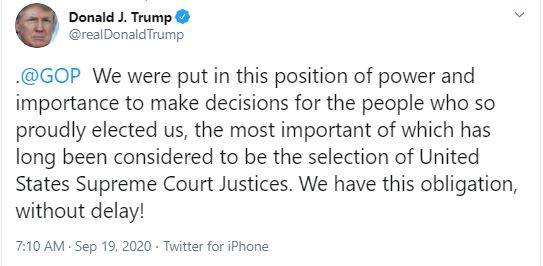
In the power grab to fill the Supreme Court seat announced the same evening as the death of Justice Ruth Bader Ginsburg, Mitch McConnell didn’t do anything new. The GOP has a long history of playing hardball power politics.

In the late 19th century, Republicans added four states (Nevada, Colorado, North Dakota, and South Dakota) purely to gain eight new Republican senators, a trick Democrats could duplicate today by bringing statehood to Washington, D.C., and Puerto Rico (and maybe even Guam).

And in 1877, Republicans installed their presidential candidate, Rutherford B. Hayes, into the White House after he had lost both the popular vote and the Electoral College vote to Democrat Samuel Tilden, a case Trump may have been referring to in a press conference on September 16, saying, “at a certain point, it goes to Congress.” (This is the 12th Amendment nightmare I wrote about in March and Greg Palast has recently pursued.)

Republicans have also reduced the size of the Supreme Court specifically to deny a Democratic president a nominee before. (And, of course, there’s the sordid tale of what they did to Merrick Garland.) Democrats can easily change the composition of the court with a simple majority if they control the House and Senate after the election and choose to end the slavery-era filibuster rule.

The closest any Democrat has ever come to this sort of thing was in 1937 when President Franklin D. Roosevelt threatened to “pack” the court as Republicans had done 71 years earlier. (The threat and widespread public opinion in its favor worked, forcing the court to change its position on the New Deal, so the issue never came to a vote in Congress.)

Pushing the boundaries even further, over the course of now-Chief Justice John Roberts’ career working for President Ronald Reagan, George H.W. Bush and George W. Bush, he proposed a nuclear option that Republican lawmakers could use to legislatively overturn Brown v. Board and Roe v. Wade whether the Supreme Court liked it or not. Roberts’ plan was never implemented, but it’s still a long-shot option.

McConnell knows the first lesson of power politics: when representing only a minority, you must ruthlessly grab every bit of power you can, every time you can.

Republicans in the U.S. Senate represent about 15 million fewer Americans than do Democrats. The last Republican president initially elected with a majority vote from the American people was George H.W. Bush, 32 years ago in 1988; George W. Bush lost by about a half-million votes, and Trump lost by almost 3 million. In the U.S. House in 2018, 9 million more Americans voted for a Democrat than a Republican, a margin (8.6 percent) far larger than their actual governing majority.

Nonetheless, Republicans tenaciously hang onto power and do whatever it takes to both hold and increase that power at every opportunity.

Democrats must learn from this history and consider all of these options if they win the White House and the Senate, and hold the House this November. Being elected with solid majorities will enhance their credibility when they seize and wield that power, so it’s doubly important now to strike when the opportunity arises.

Here’s a deeper dive into the background, largely drawn from my books The Hidden History of the Supreme Court and the Betrayal of America and The Hidden History of the War on Voting.

Packing the Court in 1801

Thomas Jefferson beat John Adams in the election of 1800, and so, during the lame-duck session of 1801, Adams’ Federalists (the conservative party at that time) passed the Judiciary Act of 1801 to cut the size of the Supreme Court from six members to five, purely to deny Jefferson an opportunity to make an appointment. (Jefferson’s Democratic-Republicans—today’s Democratic Party—increased the number of members of the court to seven in 1802.)

The law also created 16 new federal judgeships, which Adams sought to quickly fill before Jefferson took office in March; that created a mess that led to the Marbury v. Madison decision, which authorized the court to strike down laws passed by Congress.

Packing the Court in 1866/1869

In 1866, Republicans in the House and Senate passed a law to reduce the number of justices on the Supreme Court from 10 to 7 to deny Democratic President Andrew Johnson an opportunity to fill a seat opened up with the 1865 death of Associate Justice John Catron. Johnson was furious, but there was nothing he could do.

Three years later, with Johnson out of the White House and Republican President Ulysses Grant safely in charge, they passed the Judiciary Act of 1869 that raised the number of justices up to nine, where it has stood till today.

Packing the Court in 1937

During FDR’s presidency, four of the Supreme Court’s justices, Pierce Butler, James Clark McReynolds, George Sutherland, and Willis Van Devanter, were collectively known as the Four Horsemen. They were invariably joined by one of the other justices, particularly Justice Owen Roberts, to strike down New Deal legislation that attempted to address unemployment and poverty, no matter how popular it was.

For the preceding decades during the Lochner era, the court had struck down dozens of state laws protecting workers, including women and children.

In 1935, the Supreme Court ruled that both the Agricultural Adjustment Act and the National Industrial Recovery Act were unconstitutional, gutting Roosevelt’s New Deal legislation.

The Agricultural Adjustment Act had passed in 1933 with 76 percent of the House of Representatives voting for it. The bill passed the Senate, also with 76 percent of the Senate voting for it.

Historian William Leuchtenburg wrote for Smithsonian magazine that after the Agricultural Adjustment Act was struck down, “Many farmers were incensed. On the night following [Justice Owen] Roberts’ opinion, a passerby in Ames, Iowa, discovered life-size effigies of the six majority opinion justices hanged by the side of a road.”

The National Industrial Recovery Act had likewise passed with 71 percent of the House voting for it and 81 percent of senators voting for it.

When the Supreme Court used its power of judicial review to overturn these laws, it wasn’t viewed just as an assault on FDR’s New Deal. It was, in the opinion of many Americans (and FDR himself), an assault on the very basis of our democratic republic.

Then, shortly before Roosevelt was reelected in 1936, the court struck down a New York state law that established a minimum wage for women and children in Morehead v. New York ex rel. Tipaldo.

The pendulum of popular opinion swung hard against the court almost overnight. One Republican newspaper in New York declared its opposition to the ruling: “The law that would jail any laundryman for having an underfed horse should jail him for having an underfed girl employee.”

And as historian David B. Woolner, author of The Last 100 Days: FDR at War and at Peace, noted, “Over… 13 months, the court struck down more pieces of legislation than at any other time in U.S. history.”

In 1937, the National Labor Relations Act and the Social Security Act (both passed in 1935) were on their way to the court. Considering how the Four Horsemen had ruled during FDR’s first term, Roosevelt knew that he needed to do something or risk losing both pieces of legislation.

With the New Deal on the line, Roosevelt went on the attack. On February 5, 1937, just months after his landslide reelection, he announced his plan. He asked Congress for the authority to appoint one justice for each justice over 70 who would not retire.

In 1937, the average life expectancy for men in the United States was only 58 years old. The average age of the Supreme Court justices at the time was 71 years old, and six of the justices were age 70 or older. A book mocking the court, called The Nine Old Men, “was rapidly moving up the bestseller lists,” as Leuchtenburg wrote.

FDR directly called into question the “capacity of the judges themselves” to dispose of the growing number of cases facing federal courts. The United States’ population had increased nearly 70 percent between 1900 and 1936, and the number of cases facing federal court dockets had exploded. Citizens were waiting longer and longer to go in front of older and older judges.

Roosevelt’s plan would have immediately given him six appointments to the Supreme Court and up to 44 appointments for federal lower courts. Roosevelt argued that “[a] constant and systematic addition of younger blood will vitalize the courts.”

On March 9, 1937, Roosevelt told the nation that the court was ruling not just against himself and Congress, but against the will of the American people.

“The Courts,” Roosevelt told the nation, “have cast doubts on the ability of the elected Congress to protect us against catastrophe by meeting squarely our modern social and economic conditions.”

Roosevelt’s critics were aghast at his plans. They claimed he was trying the “pack the court” with justices who would simply be his yes men.

Reacting to his critics, Roosevelt cut to the heart of the matter:

“[I]f by that phrase the charge is made… that I will appoint Justices who will not undertake to override the judgment of the Congress on legislative policy, that I will appoint Justices who will act as Justices and not as legislators—if the appointment of such Justices can be called ‘packing the Courts,’ then I say that I and with me the vast majority of the American people favor doing just that thing—now.”

Congress never voted on the plan. It’s unclear whether it would have succeeded, or if a more moderate plan that would have given him only two or three justices might have passed more easily.

Instead, on March 29, 1937, a Washington state minimum wage law came before the Supreme Court in West Coast Hotel Co. v. Parrish. The law in question was nearly identical to the New York state law that had come before the court a year earlier when it had outlawed minimum wage laws as being unconstitutional.

But this time, Justice Owen Roberts abandoned the Four Horsemen to uphold Washington’s minimum wage in a 5-4 decision. In a further series of 5-4 decisions two weeks later, the court upheld the National Labor Relations Act as constitutional. The nation was astonished.

Labor Secretary Frances Perkins was close friends with Justice Roberts’ wife, Elizabeth. When the decisions came down, according to Kirstin Downey’s biography of Perkins“she rushed that afternoon to Roberts’ home” and “threw her arms around the man and hugged him.”

“Owen, I am so proud of you,” Perkins told the Supreme Court justice. “A man of your standing and intelligence who is not afraid to change his mind!”

Downey wrote of how Roberts was embarrassed by the affection but also very pleased. “Really, do you think so?” he replied to Perkins.

Less than two months later, the court declared that Social Security was constitutional.

The New Deal had been saved from execution on the Supreme Court’s bench. Social Security had been salvaged, and the National Labor Relations Act gave labor and unions a lifeline after generations of fighting to stay afloat.

Roberts’ about-face in West Coast Hotel case was referred to at the time as “the switch in time that saved nine,” rendering FDR’s proposal unnecessary.

Packing the Senate

In 1864, Abraham Lincoln was looking at the potential future composition of the U.S. Supreme Court after the war, concerned that Democrats might end up controlling the judicial body.

Back then, it took roughly 125,000 citizens in a territory to qualify it for statehood, and the Nevada Territory only had 40,000 residents, but almost all were GOP-aligned. So, ignoring the 125,000-person requirement (it was more a matter of policy than law), Lincoln proposed statehood for Nevada and Congress approved it, adding two new GOP senators.

After the Civil War, as Southern (and Democratic-controlled) states were reintegrating into the Union, Republican President Ulysses Grant was worried that Democrats might end up controlling the Senate, and so in 1876 Grant and Republicans in Congress added Colorado—with fewer than 40,000 residents—as a new state, gaining two more GOP senators.

Democrats were rising in power again when Democrat Grover Cleveland won the White House in 1884 and won the popular vote (but lost the Electoral College) in 1888. Popular-vote loser Republican President Benjamin Harrison, in 1889, successfully proposed the Dakota Territory—which then had 134,000 residents—be split into two territories, North Dakota (pop. 36,000) and South Dakota (pop. 98,000), and each of them become states with two senators each.

Thus, in 25 years, the GOP added eight senators, largely cementing their control of the Senate until the Great Depression; from Lincoln’s inauguration in 1861 until FDR’s inauguration in 1933, Democrats controlled the Senate for only 10 years.

Roberts’ Nuclear Option to Get Around the Supreme Court

The year 1981 was a big one for court-stripping—or, as it’s sometimes called, jurisdiction-stripping. No fewer than 30 pieces of legislationwere introduced into the U.S. House of Representatives by Republican congressmen that included court-stripping provisions. It was a huge topic of discussion and legal activity among Republicans.

And a young lawyer working in Ronald Reagan’s Justice Department, an up-and-comer named John Roberts, was hot on the trail.

Court-stripping is based on the idea that Congress has the power, under the Constitution, to pass laws that include provisions that specifically prevent (or strip the jurisdiction of) the Supreme Court (or any other federal court, if stipulated) from ruling on that particular law or issue’s constitutionality.

It’s based on Article III, Section 2, of the Constitution, which says, “[T]he [S]upreme Court shall have appellate Jurisdiction, both as to Law and Fact, with such Exceptions, and under such Regulations as the Congress shall make.”

In 1954, the Supreme Court ruled, in Brown v. Board, that states had to racially integrate their schools. Southern states promised “massive resistance” in defiance, and entire school districts were shut down; many Southern states opened private all-white “segregation academies” such as the one Mississippi Senator Cindy Hyde-Smith famously went to and sent her daughter to.

Brown provoked a mini-industry among right-wing white racists: Fred Koch’s beloved John Birch Society was putting up “Impeach Earl Warren” billboards across the nation and publishing articles and pamphlets tying civil rights activists to communism; hundreds of all-white private schools opened; and conservative scholars of the Supreme Court and the Constitution searched through old books and debates from the founding era to that day looking for rationales to overturn the decision.

Other than years of disruption to public education and a redoubled effort by conservatives to keep public schools funded with local property taxes (so that poor and/or Black schools would continue to turn out poorly educated students), not a great deal came of the opposition to Brown v. Board.

But defying the Court became a much bigger business in 1973, when the court in Roe v. Wade ruled that women have the right, at least in the first trimester of a pregnancy, to choose to have an abortion pretty much anywhere in the country, for any reason.

Reagan kicked off his 1980 presidential campaign with a speech about education and states’ rights to a predominantly white crowd near Philadelphia, Mississippi, where three civil rights activists had been murdered in 1964. Willing to say and do whatever it took to take the White House, Reagan was the perfect vessel for a white supremacy message opposing forced integration, welfare for Black people, and abortion for white women.

Reagan’s administration brought together a constellation of conservative white men to change the face of America. Ted Olson, who later argued Bush v. Gore before the U.S. Supreme Court, led the Justice Department’s Office of Legal Counsel. As an assistant attorney general, Olson worked with counselor to the attorney general Ken Starr (appointed to that job in 1981), who was later (1989-1993) George H.W. Bush’s solicitor general. Other new faces Reagan hired included Samuel Alito and John Roberts.

Starr tasked Roberts, a staunchly antiabortion Catholic, with reviewing the entire history of the U.S. Supreme Court for cases that suggested a legislative or administrative way to overturn Roe v. Wade and Brown v. Board.

Roberts wrote an extraordinary 27-page document that’s largely unknown, in the form of a memo on the letterhead of the Office of the Attorney General, to Ken Starr, signed by Roberts as special assistant to the attorney general. It is titled, “Proposals to Divest the Supreme Court of Appellate Jurisdiction: An Analysis in Light of Recent Developments.”

Roberts wrote that he had found “over twenty bills [pending in Congress] which would divest the Supreme Court (and, in most instances, lower federal courts as well) of jurisdiction to hear certain types of controversies, ranging from school prayer and desegregation cases to abortion cases.”

What Roberts and his researchers had discovered was substantial.

Court-stripping is based on the exceptions clause of Article III, Section 2, of the Constitution, which stipulates that the courts exist “with such Exceptions, and under such Regulations as the Congress shall make.”

Roberts noted in his memo that “[t]he exceptions clause by its terms contains no limit… This clear and unequivocal language is the strongest argument in favor of congressional power and the inevitable stumbling block for those would read the clause in a more restricted fashion.”

Roberts was looking at the nuclear option. If he could build a strong case for Congress passing a law against abortion or desegregation, and persuade Congress to use the exceptions clause to render the courts moot, then this could be the magic bullet to restore segregation and recriminalize abortion.

Roberts concluded with a 1968 comment from Sam Ervin of North Carolina, one of the Senate’s most outspoken opponents of racial integration and abortion.

He wrote, “As Senator Ervin noted during hearings on the exceptions clause, ‘I don’t believe that the Founding Fathers could have found any simpler words or plainer words in the English language to say what they said, which was that the appellate jurisdiction of the Supreme Court is dependent entirely upon the will of Congress.'”

Roberts agreed: “[W]e are not considering a constitutional clause that is by its nature indeterminate and incapable of precise or fixed meaning, such as the due process clause or the prohibition on unreasonable searches and seizures.”

This was clearly the original intent, Roberts argued, because “the exceptions clause ‘was not debated’ by the Committee of Detail which drafted it or the whole Convention.”

Citing Federalist, no. 81, Roberts wrote, “Hamilton noted that the clause would enable ‘the government to modify [appellate jurisdiction] in such a manner as will best answer the ends of public justice and security,’ and that appellate jurisdiction was ‘subject to any exceptions and regulations which may be thought advisable.'”

Section III of Roberts’ screed on court-stripping dives deep into Supreme Court decisions to find rulings explicitly saying that Congress can regulate the Supreme Court and block the court from ruling on particular issues.

Beginning with the 1869 decision Ex parte McCardle, Roberts wrote, “A unanimous Court upheld the power of Congress to divest the Supreme Court of jurisdiction. The Court clearly based its decision on Congress’ power under the exceptions clause. Chief Justice Chase began the opinion by recognizing that the appellate jurisdiction of the Court ‘is conferred “with such exceptions and under such regulations as Congress shall make.”‘”

Quoting Chase again, Roberts added his own emphasis: “We are not at liberty to inquire into the motives of the legislature. We can only examine into its power under the Constitution; and the power to make exceptions to the appellate jurisdiction of this Court is given by express words [underline Roberts’].”

He continued his historical exposé of court-stripping with another 1869 decision, Ex parte Yerger, and then United States v. Klein (1872), Wiscart v. Dauchy (1796), Durousseau v. United States (1810), Daniels v. Railroad (1865), and The Francis Wright (1881).

In The Francis Wright, Roberts found that Chief Justice Morrison R. Waite (whose court oversaw the infamous 1886 “corporate personhood” Santa Clara County v. Southern Pacific Railroad case) wrote for a unanimous court, quoting him as follows: “Not only may whole classes of cases be kept out of the jurisdiction altogether, but particular classes of questions may be subjected to re-examination and review, while others are not.”

Each case strengthened the idea that Congress could simply pass a law, without even needing a supermajority, that barred the Supreme Court from ruling on a set of issues—like Reagan’s hot-button issues of school desegregation and abortion.

Moving toward late-19th-century decisions, Roberts quoted the court in Colorado Central Consolidated Mining Co. v. Turck (1893): “[I]t has been held in an uninterrupted series of decisions that this Court exercises appellate jurisdiction only in accordance with the acts of Congress upon the subject.”

Roberts, in his own voice, added, “Again, it bears emphasis that the basis for this theory is the implicit exercise by Congress of its exceptions power when it makes a limited grant of jurisdiction.”

Still building his case, Roberts jumped into 20th-century rulings, starting with National Mutual Insurance Co. v. Tidewater Transfer Co. (1948). Writing for the majority, Justice Felix Frankfurter noted in the decision, “Congress need not give this Court any appellate power; it may withdraw appellate jurisdiction once conferred and it may do so even while a case is sub judice.”

About the 1944 Yakus v. United States case, Roberts wrote, “Justice Rutledge noted… that ‘Congress has plenary power to confer or withhold appellate jurisdiction.'”

Regarding Flast v. Cohen (1968), Roberts quoted from Justice William O. Douglas, who wrote, “[A]s respects our appellate jurisdiction, Congress may largely fashion it as Congress desires by reason of the express provisions of Section 2, Article III. See Ex parte McCardle.”

In Section IV of his memo, Roberts again covered the span from the framing of the Constitution to the time of his writing the memo, quoting another dozen or so cases that referenced, less directly, the power of Congress to exempt the Court from certain issues or decisions.

Roberts also noted that the original Judiciary Act of 1789 (which created the federal court system) also refers to Congress’ power of exception.

Time to Play Hardball

Both demographics and popular political opinion are moving against the Republican Party, and Republican politicians know it. Democrats should use this moment—if we can succeed in fighting back the GOP fascist tide—to use historical precedent to reconfigure our government so it represents the will of a majority of Americans.

No more Mx. Nice Guy.

Tim Wise on Trump, RBG and why we must fight to save multiracial democracy

Ruth Bader Ginsburg passed away last Friday. She was 87 years old. Ginsburg was only the second woman to serve on the U.S. Supreme Court. She was a trailblazing feminist who lived and fought for the principle that women should be equal to men in all areas of life — social, political and economic. For more than five decades, she proved herself to be a defender of the rights not just of women but of marginalized and disenfranchised people more generally.

Ginsburg was keenly aware of her status as a cultural icon, as made clear by the recent biopic “On the Basis of Sex” and the documentary “RBG.” In her status as Ruth Bader Ginsburg the human being, and RBG the icon, she was a role model for girls and women who are navigating an American society where sexism and misogyny remain all too powerful limitations on their life goals and life chances.

Ginsburg’s passing has left many liberals, progressives and other people of conscience in a pained state, shocked at another loss in what is already season of death and suffering from the coronavirus pandemic and a country under siege from within (and abroad) by Donald Trump and his neofascist authoritarian movement. In so many ways, the year 2020 specifically, and the Age of Trump more generally, feels like karmic punishment for the United States, a once great nation made into a pariah before the world because it has never atoned for its many sins. Trumpism is the afterbirth of those moral failures.

The loss of Ginsburg and the reality that Trump and Mitch McConnell will be able to add another Supreme Court justice to advance the cause of right-wing extremism and its war on human and civil rights should terrify all Americans who believe in the rule of law, the Constitution and democracy. Ultimately, Ginsburg’s death and its implications for women’s reproductive rights and freedoms is an extreme reminder of how the personal truly is the political.

Writing at The Cut, Irin Carmon reflects on this:

The feminist with a fundamentally optimistic vision, who believed that people, especially men, could be better, might be soon replaced by the rankest misogynist. The litigator and jurist who long subordinated her own immediate desires to the good and legitimacy of institutions, who had preached that slow change would stave off backlash, lived long enough to see Trump and the Federalist Society tear off the Court’s thin veneer of legitimacy anyway. In the 2013 voting-rights dissent that earned her the Notorious RBG nickname, Ginsburg offered an addendum to Martin Luther King’s suggestion that the arc of history eventually bent toward justice: “if there is a steadfast commitment to see the task through to completion.” She was thus committed. Still, today she leaves the work not only unfinished but at risk of being undone.

Also writing at The Cut, Rebecca Traister offers much-needed context for Ginsburg’s tenure on the Supreme Court and what comes next:

Ruth Bader Ginsburg matters, now as much as she ever has, but her survival alone couldn’t have saved us, any more than getting rid of Donald Trump will save us. We are facing something far larger: a desperate, life-or-death fight to rebuild, reimagine, reform (and in some cases raze) enormous apparatuses, including our criminal justice, electoral, health-care, and education systems, labor and capitalism, education, housing, the courts themselves, and, most urgently, the health of our planet. It will call on us to fight as fiercely and with as much determination as Ginsburg herself fought, through her life and career.

While of course not perfect on these questions, Ruth Bader Ginsburg understood how systems of oppression such as racism, sexism and classism are interlocking, and not discrete and separate things.

How will her passing impact America’s multiracial democracy? Why does white privilege and “racial innocence” leave many white liberals and progressives in a perpetual state of shock and surprise when confronted by the latest evil from Trump and his regime? 

In an effort to answer these questions I spoke with Tim Wise. He is one of the country’s and the world’s leading anti-racism authors and thinkers. Wise is the author of such bestselling books as “White Like Me,” “Dear White America” and “Under the Affluence.” His forthcoming book, to be published in December, is “Dispatches from the Race War.”

Toward the end of this conversation, Wise also warns the American people that to wallow in despair and hopelessness amid our current predicament is to betray all those who have struggled (and sometimes died), under far more challenging circumstances, while trying to make this country a more equal and just society.

You can also listen to my conversation with Tim Wise on my podcast “The Truth Report” or through the player embedded below.

This conversation has been edited for clarity and length.

There are still too many public voices, especially among journalists, who respond to the Trump regime’s latest offense with some version of, “How can he do such a thing! How can the Republicans support this!” Such reactions are naïve and, in many ways, pitiful. What role does white racial innocence play in such denial, shock and weakness before the Trump regime?

Working-class white folks and poor white folks at least know that American society is not fair. At least they know not to trust the political system in an uncritical way.

They at least don’t trust the political system. They may mistrust it for the wrong reasons — for example, because of QAnon and Fox News and other lies and nonsense.

But if you are middle class or above in this country the system has worked out for you in many ways. And if you are white, the country’s political and social system has largely benefited you.

There is a kind of privilege in the form of an obliviousness and lack of self-reflection that comes with that outcome: “Well, surely this system must work, because look, I’ve done OK. It’s more or less worked out OK for me.” This is one of the reasons not to immediately trust white liberals just because they may have the political sense to know that the American right wing is very dangerous. But those same white liberals are also invested in whiteness and white privilege. That white privilege blinds many white liberals to the dangers of whiteness and conservatism together.

Ultimately, whiteness allows many white people to claim innocence and the luxury to be naïve. Being a white liberal can also encourage a type of thinking where everything is somehow going to work out in the end.

From Ruth Bader Ginsburg’s passing to the pandemic and a season of death, how are you making sense of this onslaught of events?

This year has been quite a disaster for this country and the world. The idea that matters cannot get worse is obviously wrong. But the idea that matters in America are only now getting bad, or really awful, is also obviously wrong. The United States has been in a horrible state for many people for a very long time, in some cases centuries. I do hope that the death of Ruth Bader Ginsburg is a clarifying moment for white liberals.

Black and brown folks knew how absolutely wretched the Trump administration would be and is. Folks who are marginalized on the basis of race, class, sexuality and other identities know how bad Trumpism is and likely are not at all surprised by it.

But nice white liberals are people who only get upset and care when they are being directly impacted. It’s only when their rights and the things that they care deeply about are imperiled that they suddenly they become really upset.

Maybe with the passing of Ruth Bader Ginsburg, white liberals and especially moderate white women will now realize that it is not just brown women and children at the border who are being put in concentration camps and deported and otherwise abused by the Trump administration. “Now they are coming after us!”

Too often it does take white folks actually seeing themselves as the ones who are imperiled for them to actually become invested in a given issue. For poor women, and poor women of color in particular, reproductive freedom, reproductive justice and reproductive autonomy are all intertwined with other issues.

A whistleblower is reporting that nonwhite women in ICE imprisonment have apparently being sterilized through involuntary hysterectomies. Where is the broad outrage and mobilization among white liberals?

There is a massive disconnect. There is a mythology that has been built up around the notion that “sisterhood is global.” Such a sisterhood is pretty conditional, actually. Black women and brown women have always known that. There is an alliance among women on some things, but not on issues where the targets of oppression are disproportionately Black and brown. Let me be clear: That observation is not taking anything away from the white women who have been good allies.

But the facts undercut and expose any assumption that such alliances and being good allies to nonwhite people, especially women, is the norm.

The death of Ruth Bader Ginsburg will be an opportunity for the Trump regime and American right to further assault the reproductive rights and freedoms of women. But her death is also an opportunity for the right to advance its plutocratic anti-human agenda more generally. These issues are all connected. How can we better communicate that fact?

Yes, many people are going to miss that critical intersection which you have outlined. Even when we on the left talk about the courts, there is a tendency by some to focus on the damage that a Trump appointment to the Supreme Court would do to reproductive justice and autonomy.

But Trump’s pick for the court is not just going to harm women’s reproductive autonomy. It is going to be LGBTQ rights. It is going to be the civil rights of nonwhite people. It is not just going to be voting rights. If Republicans get to create that huge majority on the Supreme Court, they will enact a right-wing libertarian nightmare that will attack the things that any good liberal or progressive cares about.

There will not be a Green New Deal. There will not be universal health care. The court will invalidate it. With Ginsburg passing away, Trump and the right wing, through the Federalist Society and other such groups, are going to be able to stack the court and then overturn the policies that liberals care about. The Supreme Court is a class issue as well as a race issue and a gender issue.

The Trump regime and the right are a movement, a type of religious politics with a clear set of strategies and goals. By comparison Democrats, liberals and progressives in this country lack a coherent strategy and are easily distracted by the latest outrage of the day.

Many people on the so-called left in America have a hard time staying focused. They get distracted by every shiny object. Everything that Trump does and says becomes something to focus on and get distracted by. The Republican Party and the Trump movement are very focused and clear about what they want. The right-wing militias are very clear in their plans. The “boogaloo boys” are very clear. The far right, generally, is very clear about what they want. The goal of the right wing in America is to invalidate and then end democracy in this country. As a group they are committed to an authoritarian, pseudo-fascist project. Too many liberals and progressives and Democrats find it very difficult to believe that human beings can be that awful. That is a very precious and naïve way of thinking about the world and politics.

You have spoken a great deal about how white supremacy and white racism, working through white privilege, are a type of narcotic — an opiate for the white people and others addicted to it. What are some recent examples which you find particularly noteworthy?

There are so many. For example, do any of these right-wingers who are attacking critical race theory even know what it really is? No. Did the people criticizing The 1619 Project even know what it actually is? No. Did they read it? And if they did read it, do these critics consider the arguments and evidence in a serious way? Most certainly not.

So why are the Trump administration and his supporters and the Republican Party and Fox News and the other usual subjects so obsessed with The 1619 Project and critical race theory? Obviously, the real purpose is to distract the public from the fact that 200,000 people are dead from the coronavirus in this country.

Moreover, these people are dead because of the horrific mismanagement of the COVID crisis by the Trump administration. These attacks on critical race theory and The 1619 Project are also designed to distract the public from a ruined economy.

They are designed to distract the American people from the fact that everything Donald Trump touches is destroyed, turned into human waste. That is not just the economy, but the country as a whole. The right’s attacks on The 1619 Project and critical race theory are part of a culture-war strategy of racist distraction. So if Trump and his agents can tell white people, “Well, these awful leftist and Black Lives Matter protesters and antifa are trying to hurt you — and they’re doing it by indoctrinating your children to hate America,” it then becomes a culture-war issue.

Right-wing culture-war politics are a perfect opiate of white supremacy and racism. It is about numbing the pain of the white folks who buy into such narratives by giving them an enemy to focus on: “These are the people who are hurting you. They’re hurting your children. They’re trying to brainwash your children.” That also plays into the themes of childhood innocence that QAnon is so fixated on. On one level, these QAnon people are obsessed with sexual molestation. What Donald Trump and the right wing are really doing is claiming that critical race theory and The 1619 Project are forms of intellectual molestation.

And of course, the Trump administration and its allies are enemies of telling the truth in general, and specifically about the country’s origins and its connections to slavery and genocide.

What role does the opiate of whiteness play in Trump’s enduring support among white Americans, even when they are confronted with evidence of his likely criminal behavior?

If I am white and I live in a society which has told me for centuries that I have a social and a cultural status that is above anyone who is not “white,” then you can do damn near anything to me as long as I get to keep that label. Whiteness is a type of currency in America and around the world. White people who vote for Donald Trump are not voting against their interests — that is a narrative which those on the American left really like to believe in.

White Trumpists and other right-wing voters just define their interests differently than the way many liberals and progressives who are obsessed with “material interests” believe they should. Almost the whole history of America is a history of white working-class people not believing that class is more important than race.

Hopefully, in the 2020 presidential election, there will be just enough white folks who can get off the opiates of racism and whiteness to make the difference in the outcome for Joe Biden to win.

Clearly, there is something about whiteness that has led the majority of those of us so-called white people into believing that being labeled as “white” is the most important thing in the world for our existence.

How does Ruth Bader Ginsburg’s death impact America’s multiracial democracy?

It means that America’s multiracial democracy has been put into a temporary coma and suspended animation. Let us not forget, however, that the United States is still in the midst, quantitatively speaking, of the largest racial justice movement in the country’s history. There are now indications that there could be a critical mass of Americans who are ready to advance the cause of racial justice in this country in ways that they were not a year ago, never mind 10 years ago

Even with all the horrible things that have happened in such a short time this year, I will tell you that the outcome of this moment is not preordained. If the people in this country who have been ignoring the crises finally wake up and get out of bed and do the moral and good thing, then America’s multiracial democracy has a chance of surviving. The problem is that too many of us have been waiting around and not being engaged in the struggle, because they believed that the long march of progress was something guaranteed in America.

What advice do you have for those Americans who are in despair right now from Ginsburg’s passing?

Again, there are so many people who have experienced greater despair and risk in this country than all the horrible things that are happening under Donald Trump’s administration.

We have to stop the crying and the whining and the bellyaching and sentiments such as “Oh my God! Let’s go cower in the corner!” People need to organize. Black folks in this country never gave up. So who the hell are these people who are preaching and wallowing in defeatism and cynicism, to give up now? What is happening in the Age of Trump is just a different iteration of the business as usual that has been going on for hundreds of years in this country.

People need to take their place in the long chain of history and do what is required and necessary to make things better.

Do what James Baldwin said to do: Earn your death. Earn your death by confronting with fortitude and honesty the conundrums of life. Earn your death by the way you live. And that means people need to get off their behinds and do what is necessary to save the United States and the world and the planet from Donald Trump, the Republican Party and the broader right-wing movement.

Beyond Trump: Despite the setbacks of 2020, progressives now have a real path to power

At first blush, the 2020 Democratic primary campaign was a blow to progressives. Two leading candidates on the left — Sens. Elizabeth Warren and Bernie Sanders — both ran for president this year, along with a number of others who had worked to establish progressive credibility (including Sen. Kirsten Gillibrand, former HUD Secretary Julián Castro, Gov. Jay Inslee of Washington, Sen. Cory Booker and Sen. Kamala Harris, the eventual vice-presidential nominee), courting various policy positions such as Medicare for All and the Green New Deal. 

In the end, of course, the nominee was Joe Biden. But politics, as Max Weber put it, is the long boring of hard boards. There has been progress for the progressive movement throughout the 2018 and 2020 election cycles that has gone largely unnoticed and undiscussed. If you step back from the day-to-day media narrative — often influenced by shortsighted allocations of political capital — progressives are winning the war even as they lose ill-chosen battles.

Analyzing politics through the lens of decades, instead of the day-to-day news deluge, tells important stories about the progressive overhaul of the Democratic Party. The $25 unemployment insurance expansion of the 2009 recovery has become a $600 expansion. The modal swing-district Democrat is no longer a “Blue Dog” who opposes abortion, gun control and deficits, but now includes members of Congress like Katie Porter, Sean Casten, Lauren Underwood and Lucy McBath, who are leaders on corporate power, clean energy, health care and gun control, respectively (to name just four of an outstanding new class of House Democrats). The Democratic Party is not where progressives may wish, but it is not where it was at the beginning of Barack Obama’s presidency.

It has become possible to imagine a progressive Democratic Party. A new report from Way to Win and Data for Progress outlines what the future holds for progressives. Our optimism rests on three key realities. 

The first and most important development is the historically unprecedented liberalism of the millennial and zoomer generations, which are also the most diverse generations. While people often misremember the political trajectory of the bBoomer generation, Boomer whites were in fact quite conservative as youth (as contemporaneous reporting reminds us). Research by Data for Progress shows that millennials are historically liberal. If anything, since 2011, millennials have become more liberal, according to Voter Study Group panel data (which studies the same people over time). As the multiracial millennial cohort ages into higher rates of voting, they will transform progressive politics.

There is a lot of potential in a group of voters who are too often ignored by most campaigns and super PACs. These voters, referred to here as “high-potential voters,” have some experience and history with voting, having voted at least once in the period between 2012 and 2018, but do not do so reliably enough to top lists of likely voters. They’re consistent Democrats in every way, and lean more liberal and younger than average. On policy, they agree with the progressive left, but they can’t be relied upon to vote without the motivating efforts of a strong GOTV campaign. Unlike the much hyped non-college white swing voter, high-potential voters are amenable to strong progressive messaging. We see a huge opportunity in this group for progressive organizations to do important electoral work and find new voters for our candidates without needing to compromise on their stances and issues.

The second reality is the emergence of progressives as a durable bloc within the Democratic Party. In 2020, powerful Democrats who could be considered part of the “establishment” supported primary challenges to incumbents like Reps. Eliot Engel of New York and Dan Lipinski of Illinois, both of whom were defeated. At the state and local level, Democratic champions like Lina Hidalgo in Harris County, Texas, and Garlin Gilchrist in Michigan are reshaping what it means to hold and wield executive power through co-governance.

Progressives are not the only building block of the Democratic coalition, but when we align with other groups, we can win. Take Mondaire Jones, a Black progressive who won a New York primary and was backed by Victory Fund and the Congressional Progressive Caucus (CPC) as well as Warren Democrats. Or Candace Valenzuela, an Afro-Latina who won the Democratic primary for a West Texas seat with the support of the Congressional Hispanic Caucus’ BOLD PAC, the Congressional Black Caucus as well as the CPC. 

This trend played out in swing states across the country as well in state and local races important for governing power. In Georgia, Fani Willis is a progressive now poised to become Fulton County’s first woman DA. She unseated her former boss, a six-term incumbent, after running a powerful campaign that addressed issues of sexual harassment and corruption head-on. Akilah Bacy, a Black woman running on a progressive platform of equitable education and employment rights, won her runoff for the swing Texas House District 138. In Nevada, former Assemblyman Ozzie Fumo won a competitive primary and is the Democratic nominee for an important Supreme Court seat. He is one of the most steadfast and strongest allies on bail reform and abolishing the death penalty. Winning this seat in November would be a coup for progressives, and justice.

By working to elevate women, LGBTQ candidates and candidates of color who hold progressive values, progressives can grow their ranks across all the important levers of government, from Congress to statewide wins to state and local seats.

Finally, progressives have built a functioning infrastructure to contest intra-party contests. During his successful challenge to Engel, Jamaal Bowman raised $2.3 million, more than the $900,000 Rep. Ayanna Pressley in Massachusetts raised before the primary, which was more than the $300,000 that Rep. Alexandria Ocasio-Cortez raised before her 2018 primary. There is an emerging ecosystem of organizations working together to build more power within the Democratic Party — like Justice Democrats and Data for Progress, and values-aligned firms who ignore the DCCC blacklist, like Middle Seat and New Deal Strategies. Groups like Way to Win, Movement Voter Project and others have been investing in the state-based independent political infrastructure not only in order to recruit and train movement leaders for office, but to help them get elected in competitive primaries, as well.

How do progressives build on these victories? First, donors need to get involved where it counts: getting progressives across the finish line in primaries, as the Way to Win community and Way to Lead PAC have. They also need to have the back of those elected officials when they go out on a limb for the progressive movement, as Reps. Rashida Tlaib and Ilhan Omar have done. 

Second, progressives need to be strategic. Several times during this cycle and in the past, progressives have tried to contest races that were overly ambitious in terms of movement capacity. Unlike the center, we don’t have the resources to misallocate and we do face real constraints. Journalists can only cover so many races. Organizations can only engage in so many independent expenditure campaigns. These constraints need to be taken seriously. Losing is not a progressive value and the 2018 cycle created the perception that progressives were losers, even as a historically progressive House class entered Congress. While pundits focused on the abysmal win rate of Our Revolution, progressive groups like Way to Win got 90% of the congressional candidates they supported across the finish line — because they worked with local infrastructure ready to scale. 

Third, progressives need to take advantage of the soft support of sympathetic actors within the establishment. EMILY’s List endorsed a number of anti-incumbent primary challenges, and even waded into some open primaries to the benefit of progressives. These sorts of alliances will be necessary for any victories. In this cycle, Teresa Leger Fernandez, Georgette Gomez, Mondaire Jones, Ritchie Torres and others represent the fruits of progressives working with organizations traditionally seen as establishment. In several swing districts this fall, we see real possibilities for progressive victory with congressional candidates like Candace Valenzuela, Julie Oliver and Kara Eastman, and state legislative candidates like Ricky Hurtado in North Carolina, Akilah Bacey in Texas and Shondra Summers-Armstrong in Nevada.

Judge orders Eric Trump to appear for deposition before Election Day

Eric Trump cannot delay his deposition in an investigation by the New York attorney general until after the election, a judge ruled on Wednesday.

The president’s son had sought to put off his testimony until after Nov. 3. His lawyer cited Eric Trump’s “extreme travel schedule and related unavailability between now and the election” and said he wanted  “to avoid the use of his deposition attendance for political purposes.”

But New York State Supreme Court Justice Arthur Engoron did not buy it.

He found that Eric Trump must appear for a deposition by Oct. 7, 2020. The arguments for delay were “unpersuasive,” he said.

New York Attorney General Letitia James has sought Eric Trump’s testimony as part of an investigation into the Trump Organization’s finances. Eric Trump has been ostensibly running the organization alongside Donald Trump Jr. while their father is in the White House. James has accused the organization of slow-walking the probe

“Nothing will stop us from following the facts and the law, wherever they may lead. For months, the Trump Organization has made baseless claims in an effort to shield evidence from a lawful investigation into its financial dealings,” she said in a statement before the new ruling. “They have stalled, withheld documents, and instructed witnesses, including Eric Trump, to refuse to answer questions under oath.”

Under a previous attorney general, the state of New York forced the Trump family to dissolve the Trump Foundation after uncovering substantial misconduct in the charity’s finances.

“There’s no agreement on facts”: Alex Gibney’s look at Russian interference shows America’s weakness

Hacking our democracy was distressingly easy. Alex Gibney’s two-part documentary series “Agents of Chaos” on HBO leaves no room to argue otherwise. By the end of Gibney’s four-hour examination of how the Russians interfered with our elections, the filmmaker has explained the connections between Russia’s takeover in Ukraine and its own suppression of dissent to our own government’s tactics in 2020. The cyber assault on our voter databases and the Democratic National Committee’s servers is laid out with equal precision.

But the part of the story that really stands to rob a person of any shred of trust in our system’s resilience is the notion that a sizeable amount of Russia’s success in aiding Donald Trump’s election can be attributed to the efforts of social media trolls groping around in the dark, finding the weak spots in our society, and splitting them open with a maul . . . and that they were funded by Yevgeny Prigozhin, aka “Putin’s Chef” — a former fast food salesman who kept failing upward.

“Agents of Chaos” spells out how the relentless misinformation output from troll farms, hackers from Russian military intelligence, a susceptible media and collusion on the part of Trump’s 2016 campaign team created “a three-ring circus of election meddling.” In keeping with the spirit of that idea Gibney piles one piece of alarming evidence on top of another and sauces it with a pair of depressing truths, one being that a number of the people who compromised our democracy are little more than opportunistic simpletons.

The other, as expressed by cyber conflict researcher Camille François, is that the Russians didn’t insert some poison pill into our system. They simply exploited conflicts that were already there, and continue to exploit them to this very minute.

Gibney’s docuseries also includes a few eye-opening revelations about the extent to which we continue to be manipulated by Russian influence, which the recently released bipartisan report by the Senate Intelligence Committee confirms.

That “Agents of Chaos” feels like a partner piece to his recent documentary on Russian oligarch Mikhail Khodorkovsky “Citizen K,” isn’t accidental. Gibney began working on “Agents” after Fusion GPS co-founder Glenn Simpson approached him in early 2017, eager to provide someone a record of his findings because he feared for his life.

Simpson is still with us and appears in the film, one of a number of impossible-to-get subjects who agreed to sit down with Gibney: the list includes former CIA director John Brennan; former National Security Council Senior Director Celeste Wallander; former FBI Deputy Director Andrew McCabe; attorney Andrew Weissmann, who worked closely with Robert Mueller in the special counsel’s investigation of the 2016 election, and a number of Trump associates, including Felix Sater and Carter Page.

But it’s the interviewees providing Russia’s point of view who make the four-hour series a truly fascinating work, including Kremlin ally and RT editor-in-chief Margarita Simonyan, who views Trump’s election as evidence of democracy working as it should.

I spoke with Gibney on the morning that Trump’s Justice Department labeled Portland, Oregon, Seattle and New York City “anarchist jurisdictions,” and not long after The Atlantic released its own interview with Weissmann, in which he provides an answer to a question he refuses to give to Gibney in the film.

The following interview has been edited for length and clarity.

“Agents of Chaos” arrives at a time when the audience is getting doused with a fire hose of information. I’d even describe it more accurately as a waterfall. We’re receiving lots of important information, but much of it is drowning in distraction, which of course is what your documentary series addresses. So what was your guiding approach in terms of sorting through all of that, to construct a narrative that is concise and very clearly connects the dots for people?

It’s a good question. We had to wade through the chaos for a long time ourselves before we came out. You know, if you had a round with a narrative, it could try to make sense of it all. That was the motivation, in a way, because the problem with our 24/7 news cycle . . .  is that it’s hard to find a narrative. Even the Mueller report and its dry documenting of this episode didn’t really provide anybody with a narrative or a story. So our thinking was, we’ll try to do that.

We’ll try to understand it without turning it into a kind of cheap conspiracy theory where all the strands are too neatly tied up. We thought Part 1 would be about, what did Russia try to do? And Part 2 would be how did that reverberate here, which was the essential thinking about it.

Right. It was sobering to notice the parallels between the footage of the protests in the Ukraine and in Russia about a decade ago and what’s going on in America now. Let’s talk about the decision to open the film with that excerpt of your conversation with Margarita Simonyan. Why did you decide to open the film with her?

Actually we’re opening with the election result announcement in Russia. And I would say that was a contribution by Mikey Palmer, the current writer and editor. We were uncertain about it early on, but it seemed to make a certain amount of sense for a couple of reasons. One is, you know, we always see this story from our own seat, and we’re always looking over there at Russia, impenetrable Russia. And so it seemed interesting to actually start it in Moscow rather than Washington. That seemed fun.

And then [Simonyan], she’s practicing this kind of political jiu-jitsu where she was saying what a glorious moment it was, because it was finally proof that American democracy works because Trump was elected. I thought that seemed like a pretty provocative way to start a movie.

Especially since lately she’s been saying like, “Oh, we don’t know if [Russian opposition leader, Alexei Navalny] was poisoned. It could have been the Germans!”

Yeah. He was in my film “Citizen K,” Alexei Navalny.

Right. It must be challenging to be putting the final touches on this film, and look up every so often at the TV screen and see these developments rolling out in a story that’s very much in progress. How often were you kind of tempted to include additional details as they emerged? How close to the debut were you either tweaking the narrative, even small ways, or even changing it?

We were making changes in narration right on up to about three weeks ago. So it definitely wasn’t completely locked. And like I said, a number of people like Andrew Weissmann and [Andrew] McCabe didn’t come on until relatively late in the process. So we were always reckoning with it.

But I think we knew, we felt that when the Senate intelligence report came out and also Cohen’s book came out, those things for us were moments that pretty much aligned with what we discovered. And that’s pretty good because they hadn’t come out when we were forming those conclusions.

In the case of Michael Cohen, it was particularly important to have him double down on this idea that Trump for the longest time was really running and praising Putin because he wanted to do a Moscow Trump Tower deal. That’s how you have to see a lot of how the election plays out in 2016 and in the Senate report, you know. They doubled down on people like [Russian intelligence operative Konstantin] Kilimnik and others that we found were pretty important, particularly after we had talked to Andrew Weissmann.

Were you surprised at Andrew Weissmann’s stonewalling at the end? I guess I shouldn’t be shocked that, you asked him a very direct question about culpability, and he says that although he has an answer he’s not going to give it to you.

I asked him what he thought about how [Attorney General William Barr] characterized the Mueller report and whether he characterized it accurately. And he said, “I’m not gonna answer that.”

Right. Thank you for clarifying.

That was disappointing to me, but at the same time, I think he made it pretty clear that by not answering it, he was infuriated by the way that Barr had represented the Mueller report. I think to some extent though, the Mueller report – and I haven’t read The Atlantic piece yet – but I suspect that’s part of what Andrew is getting out of this book, that he knows the Mueller report also failed to some extent by not being a little bit more pointed in its narrative. It allowed itself to be misconstrued by Barr.

If I were in your situation, I would be both frustrated by seeing these people who are coming forward and being very candid with you but then holding back important answers only to deliver those answers later to serve their own ends.

Well, it happens over and over and over again . . . you control the narrative very often in book rollouts by making sure that you turn up on shows that give you a quick hit and then move on.

There’s the recent fracas of Bob Woodward saving Trump’s comments about COVID from February 7th until now, when he’s ready to promote his book, when that news could have been useful and might’ve saved lives back then. So, yeah, it’s become a kind of mark of the moment. There are a lot of people who we had, and there were other people who I would have liked to have interviewed who we came close to getting, but they wanted to save it for their book tour.

Over the years you’ve gotten a number of sources and interview subjects to go on record who might be characterized by other journalists or filmmakers as impossible or very difficult to get to go on record. How difficult was it for you to get your subjects to talk to you for this particular documentary series in comparison to others?

Hard. Hugely hard. We couldn’t get Cohen. We got Andrew McCabe very late in the game. But getting harder and harder because everybody’s chasing this, everybody wants to be in a position of controlling the narrative.  Everybody’s doing a book deal, everybody’s doing a movie deal. There’s a lot of stuff right now.

Yes, “Agents” is premiering in close proximity to many books coming out . . . but between it and all of the other documentaries and published content emerging right now, I wonder whether you think of the premiere’s timing. Is it a good time to be releasing this documentary series? Because a lot of people are pursuing stories about this administration.

So far, like I said, all the stuff that has come out seems to reinforce the arguments that we make or the narrative line that we take in “Agents of Chaos.” So I feel pretty good about that. Obviously any time you’re going to put something out late in the fall before an election, you know that there’s going to be a tremendous amount of noise all focused on the election. But in this particular case, the chaos is what it was all about.

We felt strongly that when it came to 2016, past was prologue for 2020. There are a lot of similarities between what happened then and what is happening right now. For that reason we were ready, willing and able to go into this moment, even though we knew it was going to be noisy, because we felt that it had a special resonance now that it wouldn’t have after the election.

While I was watching this I kept thinking about this great quote from Trevor Noah where he said, and I’m paraphrasing him very loosely here, that when he looks around he sees a lot of evidence of the power of the American story, this idea that this democracy that is truly an experiment has been proven to be fragile, but for some reason, people believe in its invulnerability. That there this idea of America that is so ingrained in our minds and hearts of its resilience.

Right now we’re going to this phase where this there’s an effort to rewrite and edit parts of history that are harrowing and uncomfortable for a lot of Americans to grapple with. So I wonder if, as you were going through the process of making “Agents of Chaos,” which elements of that American story might’ve stood out to you, or that you may have evolved over time.

Look, it’s this issue that everyone is talking about that’s becoming more of the norm, and that the enormous divisiveness in American society is becoming increasingly unbridgeable because there’s no agreement on facts. And even the rule of law, as Timothy Snyder points out on the film, is impossible to have if you can’t have facts, right?

And so if everybody is locked in their prisons of belief, or put in another way, everyone is locked in up in a kind of tribalism, the dangers going forward are really manifest. That’s what I think the Russians were able to exploit so well in 2016, and that’s what we’re suffering from today.

So the great sense of vitality and freedom and freedom of expression we’ve had for so long is being undermined by our own emotional undertow to want to surround ourselves with people who think and act exactly like we do, and believe what we want to believe. And that I think is the essential American problem at the moment.

At the very end of “Agents of Chaos” you pose a rhetorical question aloud: how strong is our democracy? And I wanted to see if you had your own answer to that.

I guess my answer is talk to me in eight weeks. I was a teenager in the ’60s and early ’70s when there were pretty big divisions and massive riots and protests all over the country and a lot of killings and assassinations. So to some extent I’ve been here before.

But what scares me about this moment is I’ve never seen our institutions so much at risk. You can say that our institutions are flawed and they are, but that’s because they’re human institutions . . . but they’re also institutions that allow us all to take part in this democratic experiment. And when they’re blown apart with a wrecking ball by the person in power, it’s a scary moment. And we’ll see whether or not the wreckage can be repaired.

“Agents of Chaos” airs in two parts on Wednesday, Sept. 23 and Thursday, Sept. 24 at 9 p.m. on HBO.

“Political hit job”: GOP’s Biden report littered with debunked claims and “Russian disinformation”

Senate Republicans on Wednesday released an interim report of their investigation into Democratic nominee Joe Biden and son Hunter Biden that largely recycles old claims to back up allegations which have already been debunked.

Sens. Ron Johnson, R-Wis., the chairman of the Senate Homeland Security and Governmental Affairs Committee, and Chuck Grassley, R-Iowa, the chairman of the Senate Finance Committee, released an interim report titled “Hunter Biden, Burisma and Corruption” less than six weeks ahead of the election.

Johnson previously teased that he had found evidence which would “certainly help Donald Trump win re-election.” But the report largely relies on witnesses who already testified on the matter in the House impeachment inquiry and presents little evidence to support allegations which have been refuted.

“Hunter Biden’s position on Burisma’s board was problematic and did interfere in the efficient execution of policy with respect to Ukraine,” the report said, though it provided no evidence of any policies which were affected.

The report went on to acknowledge as much, undermining its own conclusion by noting that “the extent to which Hunter Biden’s role on Burisma’s board affected U.S. policy toward Ukraine is not clear.”

Sen. Ron Wyden, D-Ore., the top Democrat on the Senate Finance Committee, said the report was the culmination of a “sham investigation.” He described the probe as “an attempted political hit job facilitated by the State Department and rooted in the disinformation pushed” by Russian operatives.

“Throughout this effort, I have been deeply disturbed by Senate Republicans’ willingness to disregard national security concerns and push Russian disinformation,” Wyden said. “The Senate must never again be abused in this way.”

The probe was launched after Trump was impeached by the House of Representatives for pressuring Ukrainian President Volodymyr Zelensky to investigate unsubstantiated allegations of wrongdoing by Hunter Biden while he worked for the energy firm Burisma, even though Ukrainian prosecutors said there was no evidence of any wrongdoing.

Trump has falsely claimed that Biden pressured Ukraine to fire a prosecutor who had investigated Burisma to protect his son, even though a coalition of western nations had pushed for the prosecutor’s removal over corruption allegations. Multiple State Department officials repeatedly refuted that claim during the impeachment inquiry.

Democrats expressed concerns during the investigation that Johnson’s probe relied on Russian misinformation aimed at hurting Biden. The GOP report devoted 10 of its 87 pages to countering allegations that their probe had fueled a Russian disinformation effort.

Democrats said the Republicans advanced a narrative pushed by sanctioned pro-Russia Ukrainian lawmaker Andrii Derkach, who provided information to the committee. The report claimed that Johnson and Grassley “did not receive” and were “unaware of” the information sent by the lawmaker, arguing that “it is impossible that Derkach’s efforts could have shaped the committees’ investigation in any way.”

But Politico noted that Johnson’s allegations “mirror those pushed by Derkach.” The Ukrainian lawmaker also met with Trump attorney Rudy GIuliani, who led the off-book investigation in Ukraine which ultimately led to Trump’s impeachment.

Johnson also had contact with former Ukrainian diplomat Andriy Telizhenko, who worked for Blue Star Strategies, a lobbying firm that represented Burisma, and advanced the debunked conspiracy theory that Ukraine interfered in the 2016 election to help Trump’s Democratic rival Hillary Clinton.

The report cited “confidential sources” nearly 100 times, whose identities remain unclear. Republicans also did not immediately release transcripts from witness interviews, instead only releasing selective quotes from the interviews.

Democrats slammed Republicans for withholding the transcripts. Sen. Gary Peters, D-Mich., the top Democrat on the Senate Homeland Security Committee, said releasing the report without simultaneously releasing the transcripts was a “direct violation” of rules that weakened “the committee’s ability to effectively carry out its responsibilities on behalf of the public in the future.”

The report largely relies on the testimony of top State Department official George Kent, who testified during the impeachment proceedings. Echoing his comments to the House last year, Kent told Republican investigators that Hunter Biden’s role on the company was “very awkward” for U.S. officials pushing anti-corruption policies in the country.

The report also cites a New Yorker article published last year, which details a discussion between Joe Biden and an aide about his son’s role at the company. However, the article did not include Biden’s side of the conversation.

The report said Kent and another official had raised concerns about a potential conflict of interest and Hunter Biden’s role at Burisma casting “a shadow” on U.S. policy in Ukraine. But it did not provide any evidence that it affected U.S. policy.

Johnson cast the release of the report as damaging to Joe Biden’s electoral chances.

“People need to take a look at this report very carefully and understand what the ramifications are for electing Joe Biden as president,” he said in a radio interview the day before the report’s release.

Johnson’s repeated insistence that the report would hurt the Democratic presidential candidate prompted criticism from within his own party.

“It is not the legitimate role of government, for Congress or for taxpayer expense, to be used in an effort to damage political opponents,” Sen. Mitt Romney, R-Utah, said last week, calling the investigation a “political exercise.”

Sen. Richard Burr, R-N.C., the former chairman of the Senate Intelligence Committee, also confronted Johnson over concerns that his probe would fuel Russia’s disinformation effort, according to Politico.

Biden campaign spokesman Andrew Bates told the outlet on Wednesday that Johnson had “wasted months” on the investigation while seeking to “subsidize a foreign attack against the sovereignty of our elections with taxpayer dollars — an attack founded on a long-disproven, hardcore rightwing conspiracy theory.”

In Senate hearing, Fauci raises alarm over long-term side effects of COVID-19

On Wednesday morning, leading infectious disease expert Dr. Anthony Fauci and other members of the White House coronavirus task force testified before a Senate subcommittee on the Trump administration’s coronavirus response. The hearing took place amid the grim news that 200,000 American lives have now been lost to the novel coronavirus and the country leads the world in total cases, with over 6.9 million infected.

Fauci, Dr. Robert Redfield, director of the U.S. Centers for Disease Control and Prevention and the assistant secretary for health at the U.S. Department of Health and Human Services, Adm. Brett Giroir, and Stephen Hahn, Commissioner Of Food And Drugs at the Food and Drug Administration (FDA), addressed concerns about vaccine development, upcoming flu season, and more at the hearing. Here are the major points discussed and takeaways from their testimony during the hearing. 

1. CDC guidance changes were misinterpreted, Redfield claims

There have been a handful of controversial guidance changes from the Centers for Disease and Control (CDC) over the last few weeks. For example, at the end of August, the CDC stopped recommending testing for asymptomatic people, a change that came as a surprise to health experts. CNN reported that the change came about as a result of pressure from the Trump administration. Last week, the CDC updated its guidance once again, stating that anyone exposed to an infected person for more than 15 minutes needs a test.

At the hearing, Sen. Patty Murray (D-WA) grilled Redfield, inquiring whether political interference threatened the federal response to the pandemic.

“So here is my question to you, if I want the best guidance on the latest science so I can protect myself and my family, can I trust CDC’s website to give me that information?” Murray asked.

Redfield responded by saying “yes,” and defended instances in which the agency modified its guidance.

“We’re committed to data and science and to give the American public the best public health recommendations we can based on that data and science, and be open, if necessary, if the data and science changes, to modify that guidance based on that new data . . . but we are committed to data and science and that will be the grounding of how we make these recommendations,” Redfield told the committee.

Redfield added that he believes the reversal was misinterpreted.

“It became progressively apparent that the guidelines were not interpreted in the manner in which we had intended them to be interpreted, and that’s what led me to realize that we had to put out a clarification to make it explicitly clear that we believe very much that asymptomatic transmission is an important part of the transmission cycle of this virus,” Redfield told the Senate Health, Education, Labor and Pensions Committee.

2. We need to monitor those who experience long-term side effects from COVID-19, Fauci says

Health experts are concerned about the long-term effects of COVID-19 among those who have been dubbed “long-haulers,” Fauci explained, referring to patients who struggle with side effects for weeks or months after the virus clears their body.

“A number of individuals, who virologically have recovered from infection, in fact, have persistence — measured in weeks to months — of symptomatology that does not appear to be due to persistence of the virus,” Fauci said.

As Salon has previously reported, the nature of COVID-19 as a cardiovascular disease means that it often affects one’s heart, even in those that have less pronounced symptoms. A COVID-19-positive football player at Indiana University was reported to be suffering from heart issues, along with a University of Houston defensive lineman who reported “heart complications related to COVID-19.”

At the Wednesday hearing, Fauci said “we need to be careful” about the potential long-term health effects.

“I think we need to be careful and just watch what happens because one of the possibilities that could develop, is that a) it could clear up, and they have no problem for the rest of their lives,” Fauci said. “The other thing is that they could wind up when you have inflammation, you could have scarring, that could lead to arrhythmias later on.”

“It’s something we really need to keep our eye out on,” Fauci said.

3. There are three vaccine candidates in phase three trials, Fauci says

And  “very soon there will be a fourth,” Fauci added.

“So as these trials go on, we predict that some time by the end of this year, let’s say November or December, we will know whether or not these are safe and effective and as you mentioned, Mr. Chairman, right now doses of this vaccine are being produced so that they’ll be ready to be distributed,” Fauci explained.

Fauci was referring to vaccines being created by Moderna, Pfizer/BioNTech and the AstraZeneca trials (although the AstraZeneca trial is currently on hold). On Wednesday Johnson & Johnson announced that its COVID-19 vaccine, which is a single dose unlike the candidates by Moderna and Pfizer/BioNTech, entered its phase 3 trial and will test up to 60,000 adult participants.

Once a vaccine is approved, healthcare providers and those who are most vulnerable will be prioritized, as Fauci has previously said.

“We’re not going to have all of the doses available, for example, by the end of December, they will be rolling in as the months go by,” Fauci said. “By the time you get to maybe the third or fourth month of 2021, then you’ll have doses for everyone.”

4. But there are many unknowns about the vaccine, Fauci says

But will the vaccine be a one and done, like the polio vaccine? Or will it be something taken seasonally, like the flu vaccine? These are answers we still don’t have, Fauci says, since we don’t know how effective the vaccines are at the moment.

“That’s one of the things that we will learn,” Fauci said. “Polio is a highly, highly effective vaccine that gives long lasting protection. . . what we do not know yet is how effective the COVID-19 vaccine will be, nor do we know the durability of the protection, or how long it will last. We will find out the answer to those questions through the clinical trials and the follow-up of the clinical trials.”

Fauci added that the length of immune protection may vary depending on the vaccine, too. Moreover, Fauci clarified that receiving a vaccine doesn’t give you COVID-19.

“That would be impossible,” Fauci said.

5. Fauci says flu shots are important this year

The United States is nearing flu season amid the coronavirus pandemic, and Fauci raised concerns about the two intersecting during this fall and winter. He urged Americans to get flu vaccines.

“What we don’t want is two conflated respiratory infections at the same time as we enter into the fall and the winter,” Fauci said. ” We want to get as many people vaccinated with the flu vaccine as possible.”

Fauci added that preventative measures for COVID-19 — things like mask wearing, washing hands and social distancing — are likely to have a positive effect on flu rates this year, too.

“If we do that as we get into the fall in the winter for the purpose of COVID-19, it is likely to have a positive impact on the infection rate of influenza,” Fauci said.

A COVID vaccine, every year, for the rest of your life? It’s starting to look that way

It’s a conundrum for vaccine researchers and producers alike: what’s the best strategy for vaccinating against a deadly virus if the immune system will forget how to protect itself against it a year later?

Recent research that suggests that novel coronavirus immunity doesn’t last very long have thrown a wrench in the global plans to develop and roll out a vaccine. The duration of protective immunity, which is how long a person is naturally protected from the coronavirus following an infection, is believed to be anywhere between four to twelve months at the moment, based on current research.

Since the coronavirus which causes COVID-19 is so new to science, it is still impossible to study long-term immunity using human data just yet. However, as Salon has previously reported, a conservative prediction suggests that a previously-infected person is immune to the coronavirus for at least three months. More recently, researchers published a study in the scientific journal Nature Medicine suggesting that people who contract the novel coronavirus and then become immune may stay that way for up to twelve months, based on studying four different seasonal coronaviruses. 

Neither of these are definitive, but whether immunity lasts three months, one year, or even slightly longer, the evidence points to the conclusion that immunity protection is temporary.

“I think right now the data really supports and is strongly pointing to, but not proving, to the possibility that protection is likely not to be lifelong,” Dr. Charles Chiu, a professor of infectious diseases at the University of California–San Francisco, told Salon.

Some viruses, such as measles, confer lifelong immunity on those who have either contracted them or been vaccinated against them. Not so with coronavirus. The science suggests that coronavirus contraction (and thus likely vaccination, too) provides what is known as “transient immunity.”  

The missing detail regarding how long one is immune leaves humanity with a lot of uncertainty around how we will adapt to life with the coronavirus, and what role the vaccine will play in our lives.

This may end up being a vaccine that’s not a one-time thing or even a two-time thing, it may end up being like, one time and a booster, or it may end up being what we call either a seasonal vaccine, or vaccine that needs to be administered every couple of years,” Chiu said. 

Chiu added that we already have precedents set for this type of virus, so it’s not unheard of for a vaccine to require patients to receive regular updates and boosters. For example, the influenza vaccine is given every year. Physicians recommend that people receive tetanus shots every 10 years after the initial tetanus series. For diphtheria, booster shots are recommended every 10 years, too.

Understanding how often humans will have to get the coronavirus vaccine raises “real questions,” Chiu said, about who gets the vaccine once it’s available. Part of that is because it may take years for enough vaccines to be produced to inoculate the majority of the population. If the vaccine only confers temporary immunity, that could mean that billions of doses would need to be produced every year, and the populace inoculated again and again, which would require an unparalleled industrial operation.

“We’re going to need to prioritize in terms of who gets the vaccine and target who gets vaccinated,” Chiu said. “We’d probably prioritize the more vulnerable members of our society, elderly persons with comorbidities, etcetera, and then health care workers who are at higher risk or essential workers who may be at higher risk, then we’d need to expand our capacity so we can then provide the vaccine to the rest of the population.”

Transient immunity could make it harder for the United States to achieve herd immunity, Chiu said.

“It really depends on how transient it is, and how rapidly we can really ramp up to be able to vaccinate a sufficient proportion of the population to develop herd immunity,” Chiu said, adding that vaccine hesitancy is another barrier if multiple doses are needed of the coronavirus vaccine. “We already have issues right now with adherence to the flu vaccine, and there’s no reason to think that it’s going to be different.”

Bunny Ellerin, the director of the healthcare and pharmaceutical management program at Columbia Business School, told Salon she believes that by 2021 the United States will have a couple of approved vaccines and more data on what immunity looks like. She added that while there’s a benefit to having multiple vaccines produced by different companies, that doesn’t necessarily reduce the resources needed to produce and distribute the vaccine en masse.

“Overall, having to produce this much of a vaccine — it’s still taking resources away from something else,” Ellerin said.

There are over 100 vaccine candidates in development around the world, and many are progressing at an unprecedented pace compared to normal vaccine development cycles.

As of September 22, according to the New York Times Coronavirus Vaccine Tracker, there are 40 different vaccine candidates worldwide that have already reached the clinical trial phase. Additionally, there are at least 92 preclinical vaccine trials happening on animals, which means the vaccine is being administered to animals like mice or monkeys to see if it produces an immune response. One promising vaccine, which is a collaboration between BioNTech and Pfizer, has published research that shows the mRNA-based vaccine produces antibodies against SARS-CoV-2 and T-cells that respond to the virus. This means that the mRNA, which is genetic material from the coronavirus, evokes an immune response.

Another promising vaccine, created by Moderna, is in the third and final phase of clinical trials and has emerged as a top contender. For the Moderna vaccine, published research shows in small trials after a second shot of the vaccine all the participants developed neutralizing antibodies. For the Pfizer vaccine, a strong activation of T cells was found which is believed to prevent people from getting reinfected. Both require two doses.

Notably, the presence of antibodies does not always mean that a neutralizing antibody response will occur (meaning that antibodies circulate in the body and prevent reinfection). However, a cellular-mediated immune response can prevent reinfection, which is a type of immune response that has nothing to do with antibodies. In other words, Chiu says, transient immunity does not necessarily mean that reinfection will occur, as cellular immunity could play a role, too. 

While there have been three cases of patients who had been previously afflicted by COVID-19 contracting the virus a second time, Chiu said that such cases would likely be more prevalent in the United States if not for some other mediating factor. He believes it is possible that cellular immunity plays a role in preventing reinfection.

Having a complete picture of duration of immunity will in turn affect how inoculations are recommended, who receives priority to receive the vaccine, and how containment measures are deployed to keep the coronavirus at bay.

Doctors have already warned policy makers to consider protective immunity when figuring out how to adapt to a world with COVID-19. Likewise, as antibody tests become more prevalent, a positive antibody test will no longer be considered a marker of immunity to the coronavirus.

Chiu said we are now facing a “race against time,” especially when you factor in that the coronavirus might mutate. He was hopeful that a combination of containment strategies, like wearing masks, social distancing and getting vaccinated, will eventually eradicate the coronavirus.

“The hope is that the vaccine, while it may not be 100 percent effective or durable, is enough so that then, if we have enough testing and containment measures in place, we can simply eradicate the virus,” Chiu said.

A breakthrough week on climate: With bold pledges, China and California take the lead

Setting aside the signing of the Paris agreement — a historic global accord from which the United States has now backed away — there may never have been as big a week for climate progress as this one.

First, the government of China presented itself as the global successor to the U.S. role abandoned by President Trump. In an address before the UN General Assembly, President Xi Jinping announced that China would accelerate its peak emissions date — that is, the point after which the nation’s carbon emissions will begin to decrease — and would commit to net-zero climate impact by 2060. By placing China solidly ahead of the U.S. in both of those categories — our government has pledged neither peak emissions nor net zero — Beijing has upped the global expectations game. 

Because China is by far the globe’s the current biggest emitter, and because its centrally managed economy has the capacity to make economic transitions far faster than Europe, the U.S. or India, China’s pledge — while leaving plenty of loopholes and remaining thin on implementation details — is an enormous step forward. Scientists have estimated that this decision, by itself, could cut global temperature increases by about  0.3 degrees.

This also signals that China views its existing commitments to renewable electricity and zero-emissions electrified vehicles as core economic drivers of global leadership. China’s decision will make fossil fuels far less attractive to investors, even in countries that may not themselves yet embrace climate leadership. (I can think of one right now.) If China is going to drive coal power out of its system, and replace gasoline and diesel fuel with electricity, global markets will follow — whatever Trump, Brazilian President Jair Bolsonaro and Saudi Arabia’s Prince Mohammed bin Salman might prefer. 

Then, barely 24 hours after Xi’s announcement at the UN, California Gov. Gavin Newsom, on the hood of a red Ford Mustang Mach-E — a new all-electric model — signed an executive order instructing the state’s Air Resources Board to use its authority to ban the sale of fossil-fuel-powered passenger vehicles by 2035, and that to ensure that by 2045 all cars and trucks on California highways have zero carbon emissions. Media coverage has mostly focused on the 2035 ban on sales of gasoline-powered cars, but the 2045 deadline is actually significantly more stringent and will bring down emissions even faster.

In his commentaries on California’s apocalyptic fire season, Newsom has made clear that he planned to respond to the clear signals that the climate crisis has reached a new state of emergency, one that requires political leaders to greatly accelerate decarbonization — which he has just done.

This will leave the president seething, no doubt, but there’s not much he can do about it in the waning days of his first term. California has 14 other states plus the District of Columbia teed up to follow its lead, and taken together they represent about half the U.S. vehicle market. At one stroke of a governor’s pen, America has suddenly rejoined the global clean energy and electrified transportation movement — only one day after China stepped into the limelight as its new leader.

Sherlock’s teen sister channels “Fleabag” for Netflix’s fourth-wall-breaking feminist romp

“Enola Holmes” is a breezy and charming twist on the usually darker detective genre inspired by Sir Arthur Conan Doyle’s Sherlock Holmes series. “Stranger Things” breakout Millie Bobby Brown, who also serves as a producer, stars as the incredibly capable teenage sister of the observant sleuth in Netflix’s feminist update that owes part of its zing to an unexpected source: “Fleabag.”

Inspired by the Emmy-winning Amazon series, writer Jack Thorne adapts author Nancy Springer’s YA novels by breaking the fourth wall to get inside Enola’s head. “Fleabag” director Harry Bradbeer is also on board to hone the effect. As Enola goes about her business, riding her bicycle or getting dressed, she whips her head around to impart insights. It’s an effective device that keeps the story in motion while also adding necessary exposition and peeks into her independent mindset.

Make no mistake: Millie Bobby Brown is no Phoebe Waller-Bridge, triple names aside. (But really, who is?) Nevertheless, the chatty role lets Brown show more personality and greater range than she ever did as Eleven on “Stranger Things.” Does the acting at times fall into emphatic blinking or mugging? Perhaps, but overall, her ability to carry a film in which she’s delivering reams of monologue, not to mention performing light stunt work, is commendable. It’s also refreshing to see a 16-year-old play a character her own age, which makes any natural awkwardness forgivable.

Enola is not your stereotypical young Victorian lady. Her mother Eudoria (a vivacious Helena Bonham Carter, perfectly cast) has raised her in harum-scarum fashion. Reading and writing is the sum of her more “ladylike” accomplishments, but Enola also plays chess, conducts laboratory experiments, practices archery, fences, and even knows jiu jitsu. It’s an upbringing unencumbered by corsets or society’s strict gender expectations.

When her mother goes missing, Enola sets upon her first mystery by hopping on a train to London, where she promptly runs into the film’s second mystery: the Viscount Tewksbury, Marquess of Basilwether (Louis Partridge). Although the young lord is a runaway, he soon finds that a man in a brown bowler hat (Burn Gorman) has been hired to kill him. Even though Enola deems Tewksbury a “useless boy,” she is drawn to helping the helpless and sets about trying to uncover why he’s a target.

Neither mystery is particularly engaging, but they allow Enola to have adventures and show off her unusual skills. Having escaped the supervision of her older brothers – the forbidding Mycroft (Sam Claflin) and famous Sherlock (Henry Cavill, of “The Witcher” fame) – Enola jumps from trains, wrestles in back alleys, and parades around England in a number of disguises. The entire escapade feels more like a Dan Brown-type puzzle quest (with the same unchallenging level of complexity) than a forensic mystery, with the scrapbook-style animations and Daniel Pemberton’s string-laden score keeping the pace dynamic and upbeat.

As smart as Enola is, what’s more impressive is how Brown has been able to pull off such a film. Not only has she found the perfect vehicle to advance her clever and progressive image, but she’s also drawn hefty talent around her. Besides the aforementioned heavyweights, the color-conscious cast also boasts Susan Wokoma (“Crazyhead,” “Chewing Gum”) as London contact Edith Grayson, Adeel Akhtar as the tenacious Inspector Lestrade and Fiona Shaw as the rather thirsty headmistress Miss Harrison.

While Netflix has been embroiled in controversy over and has lost subscribers for supporting its French-language film “Cuties” — which has been accused of sexualizing children, while the filmmaker declares the opposite — “Enola Holmes” falls comfortably within the streaming service’s more subversive and girl-forward offerings that have found crossover appeal. From Mindy Kaling’s teen sex romp “Never Have I Ever” to the “quiet revolution” of “The Baby-Sitters Club” to even the musical stylings of “Julie and the Phantoms,” Netflix’s YA offerings are empowering the next generation of young people.

In “Fleabag,” its star declares that “this is a love story,” and over the course of the season it becomes clear that the love isn’t for the Hot Priest or God, but for her sister and even herself. Likewise, “Enola Holmes” favors filial over romantic love, which aligns with its feminist rallying cry. Enola (which she points out is “alone” spelled backwards) is not just an independent thinker who declares a corset a symbol of oppression, but an independent person who need not rely on anyone — not a useless boy, not a genius brother, not even her brilliant mother. It’s an appealing message of freedom for any young adult and one that will likely lead to a franchise of self-sufficient follow-up adventures.

“Enola Holmes” is currently streaming on Netflix.

Trump’s vaccine czar refuses to give up stock in drug company involved in his government role

The former pharmaceutical executive tapped by President Donald Trump to lead the administration’s race to a COVID-19 vaccine is refusing to give up investments that stand to benefit from his work — at least during his lifetime.

The executive, Moncef Slaoui, is the top scientist on Operation Warp Speed, the administration’s effort to develop a coronavirus vaccine in record time. Federal law requires government officials to disclose their personal finances and divest any holdings relating to their work, but Slaoui said he wouldn’t take the job under those conditions. So the administration said it’s treating him as a contractor. Contractors aren’t bound by the same ethics rules but also aren’t supposed to wield as much authority as full employees.

Slaoui agreed to sell stock worth $12 million and resign from the board of Moderna, the developer of a leading potential vaccine. But Slaoui insisted on keeping his roughly $10 million stake in his former company, GlaxoSmithKline, another contender in the Operation Warp Speed vaccine race. “I won’t leave those shares because that’s my retirement,” he has said. GlaxoSmithKline, working with Sanofi, has started human trials for a coronavirus vaccine using similar technology to Sanofi’s flu shot. It is supported by up to $2.1 billion from the U.S. government.

As a concession, Slaoui committed to donating any increase in the value of his holdings to the National Institutes of Health.

But Democrats on the House Committee on the Coronavirus called the commitment “toothless.” According to newly released records from the committee, Slaoui’s contract with the government specifies that the donation “may occur on the last death of the employee and his or her spouse.” Slaoui is 61 and his wife, Kristen Belmonte, is 50.

“That means he’s going to live out his life with those profits,” said Craig Holman, a lobbyist with the advocacy group Public Citizen who has filed multiple ethics complaints about Slaoui’s service. “It’s so clearly an all-out evasion” of the law against conflicts of interest, Holman said.

In addition, the contract’s requirement is further complicated by measuring the increase in the stock’s value against a drug industry index, not the outright change in the stock itself. As it happens, since Slaoui joined Operation Warp Speed, both GlaxoSmithKline and the specified drug industry index have declined.

Slaoui declined to be interviewed through a spokeswoman. “I have a personal compass in ethics and people who know me personally know that,” Slaoui said in a July podcast interview with Michael Caputo, the Department of Health and Human Services spokesman who subsequently left the agency after an incendiary Facebook rant accusing government scientists of “sedition.”

“It’s been extremely painful for me that anybody would even think that I took this job to enrich myself or my former colleagues,” Slaoui said.

The White House declined to comment. An HHS spokeswoman said agency ethics officers determined that Slaoui complied with the department’s rules through his contractor status, divestiture and board resignations.

“The American people are fortunate to have him as a leader of President Trump’s effort to discover vaccines, therapeutics and diagnostics to defeat the coronavirus,” the spokeswoman, Natalie Baldassarre, said in an emailed statement. During his time at GlaxoSmithKline, Slaoui led the development of several new vaccines, including ones to prevent cervical cancer, malaria and shingles.

HHS previously said Slaoui “does not have any additional stock holdings in any other companies involved in vaccines, therapeutics and diagnostic products developed to combat COVID-19.” But in addition to Slaoui’s retained GlaxoSmithKline shares, the records obtained by the House Democrats revealed he has a holding in another biotechnology company, Lonza Group, that wasn’t previously disclosed. The company has a contract with Moderna to manufacture its coronavirus vaccine. Slaoui resigned from Lonza’s board before joining Operation Warp Speed but kept his shares. The records released by the House committee do not show how much the stake was worth.

“Documents recently obtained by the Select Subcommittee have heightened concerns that these advisors may have significant undisclosed financial conflicts of interest that, contrary to the administration’s public statements, have not been adequately addressed,” the committee’s chairman, Rep. James E. Clyburn, D-S.C., said in a Sept. 21 letter to Advanced Decision Vectors LLC, a consulting firm that received the contract for the government’s work with Slaoui and other Operation Warp Speed advisers. Clyburn said the committee will subpoena the company if it doesn’t voluntarily provide more documents.

ADV’s CEO, David Harris, didn’t respond to messages seeking comment.

Clyburn’s committee also released records that he said suggested conflicts of interest among three other Operation Warp Speed advisers: William Erhardt, Rachel Harrigan and Carlo de Notaristefani. According to the documents, HHS certified that the companies in which the advisers have investments “are not involved in vaccines, therapeutics and diagnostic products developed to combat pandemic COVID-19.” However, several of the holdings that the advisers listed are in companies working on vaccines, treatments and tests for the coronavirus.

According to the records, Erhardt and Harrigan own shares of Pfizer, the current coronavirus vaccine front-runner with a $2 billion preorder from the government. Erhardt also listed holdings in Thermo Fisher Scientific, a diagnostics manufacturer that has received millions from the federal government for coronavirus testing materials; PhaseBio Pharmaceuticals, which has two clinical trials of drugs that could treat COVID-19; and Incyte Pharmaceuticals, which is also studying a possible treatment. The third adviser, de Notaristefani, reported a financial interest in Teva Pharmaceuticals, a manufacturer of the generic drug hydroxychloroquine touted by Trump as a coronavirus treatment despite lacking scientific support.

“HHS appears to be permitting these advisors to keep these holdings, along with any profits, by certifying that ‘the Government has determined’ the companies ‘are not involved in vaccines, therapeutics and diagnostic products developed to combat pandemic COVID-19,'” Clyburn wrote in his letter. “These certifications appear to be inaccurate.”

Baldassarre declined to comment on the certifications or answer other specific questions for this article.

ProPublica’s board chairman, Paul Sagan, is a member of Moderna’s board and a company stockholder.

ProPublica is a nonprofit newsroom that investigates abuses of power. Sign up to receive our biggest stories as soon as they’re published.

Divisive Supreme Court fight upends must-win Senate race for Democrats in North Carolina

North Carolina is among the swing states that reporters will be keeping an especially close eye on between now and November 3. Polls have been showing a close presidential race in North Carolina, which is also where incumbent GOP Sen. Thom Tillis and his Democratic challenger, Cal Cunningham, are battling for a U.S. Senate seat. And North Carolina’s U.S. Senate race, according to Associated Press reporter Gary D. Robertson, has become even more intense following the death of U.S. Supreme Court Justice Ruth Bader Ginsburg on September 18.

President Donald Trump and Senate Majority Leader Mitch McConnell are pushing for a Supreme Court nominee to be confirmed as quickly as possible, and Democrats are furious with McConnell because of his blatant hypocrisy: in 2016, following the death of Justice Antonin Scalia, McConnell refused to even consider President Barack Obama’s centrist nominee, Judge Merrick Garland — arguing that it was unfair to fill Scalia’s seat during a presidential election year. Two Republican senators, Maine’s Susan Collins and Alaska’s Lisa Murkowski, have joined Democrats in saying that Ginsburg’s seat shouldn’t be filled before Election Day, but Tillis is siding with Trump and McConnell.

Tillis, Robertson explains, told “Trump rally participants in Fayetteville last weekend that he would vote to confirm any of the candidates on Trump’s list” and “dismissed the idea that his support for a Trump nominee’s confirmation so close to the election ran counter to him joining with other Republican senators in 2016 to refuse to vote on then-President Barack Obama’s nominee in an election year.”

Tillis is rationalizing his hypocrisy by saying that in 2016, Obama “was on his way out the door” when he nominated Garland. But Trump could also be “on his way out the door” if former Vice President Joe Biden defeats him in November. That remains to be seen. In the meantime, Cunningham is calling out Tillis’ hypocrisy, saying that “he trusted and wanted to hear from the American people in 2016. He doesn’t today.”

Robertson reports, “Preparations for the political fight over Ginsburg’s successor brought a new acuity to the differences between Cunningham and Tillis in the closely watched race. Democrats need to flip four seats to ensure chamber control. The North Carolina Senate race has attracted the most outside campaign spending of any federal race this year save for the presidential campaign, with $65 million targeting the two candidates already for the general election, the Center for Responsive Politics said.”

Along with Collins, Arizona’s Martha McSally and Colorado’s Cory Gardner, Tillis is among the incumbent GOP senators who is considered vulnerable in the 2020 election. Polls released in September have found Tillis trailing Cunningham by 5% (CNBC/Change Research and New York Times/Siena), 6% (Civitas/Harper and Emerson), 4% (Reuters/Ipsos and USA Today/Suffolk), 1% (CNN) or 7% (WRAL-TV/Survey USA).