Spring Sale: Get 1 Year, Save 58%

Fearing jail and facing defeat, Trump will not leave office quietly

The presidency of Donald John Trump is collapsing. Unwilling or unable to confront the deadly realities of the COVID-19 pandemic, which has claimed more than 138,000 American lives, the president’s job-approval ratings have plummeted. The ravages of the virus, in turn, have triggered a deep economic slump, pushing unemployment rates to levels not seen since the Great Depression of the 1930s. There is a growing perception that our 45th commander in chief, never known for his intellectual acuity or moral rectitude, is unfit to lead the nation in this moment of extreme crisis.

Even the Supreme Court, with two of his own appointees on the bench, has seemingly turned against him. On the last day of its just-completed 2019-2020 term, the court released a pair of landmark decisions on presidential power, rejecting Trump’s desperate attempt to quash subpoenas issued by Congress and Manhattan District Attorney Cyrus Vance for his tax returns and personal financial records. Writing for a 7-2 majority in both cases, Chief Justice John Roberts rebuffed Trump’s claims of sweeping presidential immunity and reaffirmed the bedrock principle that no one—including the president—is above the law.

According to many polls, if the election were held today, Trump would lose in a classic landslide. If the pundits are correct, the entire Republican Party could be dragged down with him.

Trump’s abiding corruption and incompetence have prompted urgent calls for his resignation by newspaper editorial boardscolumnists and activists like Ralph Nader. Even before his stunning setbacks in the Supreme Court, there was considerable and widespread speculation that rather than face humiliation in November, Trump will step down in the fashion of Richard Nixon, or announce à la Lyndon Johnson that he won’t seek reelection after all.

As the veteran commentator Robert Kuttner mused in a recent article in the American Prospect:

“If Trump senses a blowout defeat well beyond the usual Republican margin of theft, [he] may decide that it’s more dignified to retire undefeated. He can claim that the election was rigged, that he would have won, blah blah blah, and he can have the satisfaction of agitating his base as president-in-exile with no responsibility whatever for the consequences.”

Regrettably, I have to demur. Trump will never voluntarily stand aside. Trump will lie, cheat and steal to retain the presidency by any means necessary, and he’ll do so for one simple reason—once he is out of office, he could be prosecuted for a trove of federal and state felonies, and, if convicted, sent to prison.

If he loses the election, Trump could be targeted by a new Democratic attorney general determined to hold him accountable for a laundry list of possible federal offenses, including:

  • Obstruction of justice in connection with the investigation conducted by former special counsel Robert Mueller into suspected Russian interference in the 2016 election.
  • Obstruction of Congress, extortion and bribery in connection with his efforts to pressure Ukraine President Volodymyr Zelensky to dig up political dirt on Joe and Hunter Biden in exchange for the release of U.S. military aid previously approved by Congress.
  • Income tax and financial fraud for underreporting the revenue earned from his real-estate ventures, and misrepresenting the value of his assets, as alleged by the New York Times in a lengthy 2018 exposé.
  • Violation of campaign finance laws for conspiring with his former lawyer Michael Cohen to pay hush money to pornographic film star Stephanie Clifford, aka “Stormy Daniels,” and former Playboy model Karen McDougal in the run-up to the 2016 election. In 2018, Cohen pleaded guilty to the Daniels and McDougal payoffs. The complaint lodged against Cohen treated Trump as an unindicted co-conspirator, referring to him as “Individual 1” in keeping with Justice Department practices, and alleging that he directed Cohen to make the money transfers.

A particularly aggressive attorney general could also charge Trump with involuntary manslaughter for contributing to the staggering COVID-19 death toll. Former federal prosecutor Glenn Kirschner, now a legal analyst with NBC and MSNBC, made the case for involuntary manslaughter in an April interview with journalist Mehdi Hasan on the Intercept’s “Deconstructed” podcast.

“There are three things, what we call elements… that we have to prove in order to hold somebody accountable for involuntary manslaughter,” Kirschner explained. “One, that a person acted in a grossly negligent way or importantly for our purposes, failed to act and that failure was a product of gross negligence… Number two, their conduct was reasonably likely to involve serious bodily injury or death to another as a product of that grossly negligent act or failure to act. And three, that they thereby caused the death of another.” Kirschner argued that Trump’s record on COVID-19 satisfies all three elements for criminal liability.

At the state level, in the aftermath of his resounding loss in the Supreme Court, Trump faces a more immediate and practical threat of prosecution in New York, where District Attorney Vance has pledged to “follow the law and the facts, wherever they may lead.” Vance has resumed a grand jury probe to determine if the Daniels and McDougal payoffs, or any other aspect of Trump’s financial dealings, violated state fraud and tax laws. Federal District Court Judge Victor Marrero, who sits in Manhattan, has set an expedited briefing schedule to hear any remaining arguments from Trump’s attorneys to limit the scope of the financial-records subpoena that Vance originally issued to Trump’s accounting firm in August 2019.

Although it’s unlikely that Vance would seek an indictment before the election, if he did, Trump would not be shielded by the Justice Department’s longstanding policy against the prosecution of sitting presidents for federal crimes. The policy, which dates back to Nixon and Watergate, does not apply to the states. For purposes of charging criminal offenses, as the Supreme Court confirmed in 2019, the states and the federal government are considered separate sovereign entities.

After the election, if he loses at the polls, Trump would also lose his federal protections against prosecution once a new administration takes over in January 2021. In the interim, left with precious few options to avoid his day of legal reckoning, he could swallow his pride, abruptly change course and resign, hoping that Mike Pence, as his lame-duck successor, would rescue him with a preemptive pardon, much as Gerald Ford issued to Nixon.

But the federal pardon power does not extend to state prosecutions, and a dispensation of mercy from Pence would do nothing to relieve Trump of continuing jeopardy in New York.

Alternatively, Trump could choose to serve out the remainder of his term and pursue a strategy of delay to prolong any criminal investigations of his conduct until after the applicable statutes of limitations for his alleged crimes have expired. Under both federal and New York law, most felony prosecutions must commence within five years of the commission of an offense.

And then there is a final Trumpian option that no one should discount: In an ultimate act of destruction aimed at saving his own skin, Trump could simply refuse to leave the White House, claiming that the election results are fraudulent.

As Michael Cohen warned in his February 2019 testimony before Congress, “[G]iven my experience working for Mr. Trump, I fear that if he loses the election in 2020 that there will never be a peaceful transition of power.” Several mainstream observers have voiced similar concerns.

As ridiculous as it may seem to picture Trump clinging to the “Resolute Desk” in the Oval Office as federal marshals come to remove him, just remember how ridiculous his presidential campaign appeared when he descended the escalator at Trump Tower to announce his candidacy in June 2015.

In the Age of Trump, no depravities are beyond the realm of possibility. We need to be prepared for anything and everything.
The Trump administration is trying to control how coronavirus case numbers are reported

President Donald Trump has issued an order for hospitals throughout the United States to bypass the Centers for Disease Control and Prevention when relaying information about patients with COVID-19. Instead, as of Wednesday, the White House wants that information sent directly to a central database controlled by one of Trump’s cabinet members.

The Department of Health and Human Services will receive all daily reports about the patients being treated by each hospital, the number of available ventilators and beds and other vital data, according to The New York Times. The database will not be available to the public, a factor that could impact public health officials’ and researchers ability to make informed policy decisions about the pandemic. In light of Trump’s declining poll numbers as the pandemic has worsened — and the fact that it has put him at a historic disadvantage when it comes to being reelected — there are concerns that this decision could allow him to release data to the public in a way that is politically flattering regardless of the truth.

“Today, the CDC still has at least a week lag in reporting hospital data,” Michael Caputo, the assistant secretary for public affairs at the Department for Health and Human Services, told the Times. “America requires it in real time. The new, faster and complete data system is what our nation needs to defeat the coronavirus, and the CDC, an operating division of HHS, will certainly participate in this streamlined all-of-government response. They will simply no longer control it.”

Salon reached out to Caputo for comment and did not hear back, though Salon spoke with other experts who weighed in.

“As best I can tell, there wasn’t any meaningful representation from governmental public health” when this decision was made, Dr. Georges Benjamin, executive director of the American Public Health Association (APHA) and former secretary of health in Maryland, told Salon. “I checked in with those folks this morning [representatives from state and local health department organizations] and [that’s when] they got informed — as far as I can tell, we’re not part of the discussion,” Benjamin added. He noted that local health officers need that information first so they can make informed decisions for themselves and other local officials, like governors and mayors.

“I’m making informed decisions about resources, about contact tracing, about bed allocations. When I was at the state of Maryland, we regulated the hospitals,” Benjamin explained. “I needed that data first. And one of the things that we did locally was we validated some of the data to make sure that it is in double counted. That it’s correct. Not necessarily that each piece of data that goes in, but we have a process of quality assurance to make sure the data is right.” He pointed out that during the pandemic “this current data goes through the hospitals into basically a CDC system. And the CDC essentially does some of that same stuff. They validate data, they look at it, they understand it. They massage it a bit to see what it means. They’re the experts. Now, in the middle of a disaster, you’re basically building a new system.”

Jen Kates, the director of global health and H.I.V. policy with the nonpartisan Kaiser Family Foundation, expressed a similar concern to the Times.

“Historically, C.D.C. has been the place where public health data has been sent, and this raises questions about not just access for researchers but access for reporters, access for the public to try to better understand what is happening with the outbreak,” Kates explained. “How will the data be protected? Will there be transparency, will there be access, and what is the role of the C.D.C. in understanding the data?”

Benjamin and Kates are not the first people to express concern over the Trump administration’s behavior toward the CDC. Prior to the announcement about hospitals needing to bypass the agency’s database, a group of former agency directors wrote in The Washington Post that “it is extraordinary for guidelines to be undermined after their release. Through last week, and into Monday, the administration continued to cast public doubt on the agency’s recommendations and role in informing and guiding the nation’s pandemic response.”

They added, “On Sunday, Education Secretary Betsy DeVos characterized the CDC guidelines as an impediment to reopening schools quickly rather than what they are: the path to doing so safely. The only valid reason to change released guidelines is new information and new science — not politics.”

Gig workers for Shipt stage a walk-out in protest of opaque pay structure

On Wednesday, a group of workers for Shipt, a grocery and retail delivery app service owned by Target, staged a walk-out in response to a new algorithmic pay model that went into effect in 12 U.S. cities. As with many platform economy jobs, Shipt relies on an army of on-demand contractors with their own vehicles and smartphone; known as “shoppers” in company parlance, these workers are given shopping orders through the app, then walk through stores picking up goods and then driving them to customers. 

Yet Shipt shoppers boycotting the app tell Salon that the new pay structure is no longer transparent, and that it seems designed to cut their pay. Such opaque pay schemes are a common feature of tech platforms that rely on gig labor, as being obscure about the precise pay amount makes it harder for workers to assess if getting involved is a bad deal. Medium.com, a blogging and writing platform that pays writers who post their work, has a similarly arcane pay structure.

Shipt workers also are asking customers to boycott the app and show support, if they can.

“As a result of moving into this new pay scale our worst fears are being realized,” Willy Solis, a 41-year-old shopper based in Dallas, Texas, told Salon. “The pay structure on the previous pay scale was very transparent.”

Shipt is planning on eventually rolling out this pay structure to all of its cities over time. Indeed, unlike its competitor, Instacart, which has transitioned to a similar pay scale that evoked a similar response, Shipt shoppers originally were on a commission-based pay scale. Shoppers received a 7.5 percent commission on all orders plus $5; a percentage based on sales, plus dollar amount.

Shipt claims the new algorithm is better for shoppers, and that it aims to compensate them for their effort.

Molly Snyder, Shipt’s Chief Communications Officer told Salon the API used “understands traffic patterns, time of day, construction” and “the complexity of the order.” Indeed, these metrics in the past have been criticized by other companies that rely on gig workers, like Uber and Instacart.

“The goal in rolling out this evolved pay model is to ensure that they’re being compensated fairly for the effort, the tremendous effort that they put into shopping on behalf of shift,” Snyder told Salon.

But the workers who boycotted the app on July 15 didn’t agree. Solis said the company sent out a visual graphic explaining that they’re going to use “variables” to decide how to compensate shoppers. However, shoppers experienced glitches with the new algorithm, in addition to between 30 percent to 75 percent pay cuts on some orders.

“There’s no way for them to control or to be able to use a variable to know how many people are in the store, how much shop time it’s going to take us,” Solis said. “The shop time that they have calculated is always wrong.”

Solis said that this morning he heard from a shopper that the estimated shop time was an hour and ten minutes for a very quick shop, emphasizing that the miscalculations can go either way. Solis said shoppers have been expressing their concern about the new pay structure since February. Wednesday’s action is the third workers have taken action against the company. Solis said shoppers have been sending emails, making phone calls, and in some cities have even had in-person meetings with Shipt representatives to voice their concerns.

Joshua B., a 34 year-old in Scottsdale, Arizona, participated in the walk-out even though Scottsdale isn’t one of the affected markets —yet.

“it’s important to stand with t he other shoppers whose pay is getting cut, and I know for all of us who are still on v1 [pay version 1] it’s only a matter of time before we get our pay cut out from underneath us,” Joshua, who asked to keep his last name anonymous for fear of retaliation, told Salon.

Snyder told Salon that based on the earlier roll-out of the pay structure a “vast majority” of shoppers’ pay went up.

“Pay actually either stayed the same or in some cases went up a little bit, and in some cases they did go down but the vast majority was the same or up,” Snyder said.  “It is easy to look at one order where your pay went up dramatically or one word went down, that is really not kind of the way we would encourage people to think about it, this is an overall view of how people are paid.”

As reported by Gizmodo in February, Shipt shoppers in small metro areas like Kalamazoo, Michigan, where the new pay model was being tested, had a different experience with the algorithmic-based pay model. Shipt shoppers said they experienced in some cases pay cuts up to 50 percent, which churned out less than respectable wages. Gizmodo reported that Shipt shoppers attributed the corporatized change in culture to the departure of founder Bill Smith. Target bought the platform in late 2017 for $550 million.

Solis added that in the private Facebook group for Shipt shoppers, managed by Shipt, that the company has been censoring and deleting comments from workers “advocating for transparency” around the pay scale.

“There are terms of use, and if people violate those terms of use, we will either take down posts or we won’t approve posting them,” Snyder said.

In terms of how long the boycott will last, Solis said there’s a “strong momentum” to keep it going, but that workers need to eat and will have to soon get back to work.

Trump replaces campaign manager Brad Parscale with former Chris Christie adviser

President Donald Trump has replaced campaign manager Brad Parscale with former White House political director Bill Stepien, the New York Times first reported Wednesday.

Parscale will stay on as senior adviser for digital and data operations, according to campaign officials.

Reports first placed Parscale on the chopping block back in late April, when an irate Trump reportedly threatened to sue him in a profanity-riddled phone call after internal polls showed the president in a deep deficit to presumptive Democratic nominee Joe Biden.

Parscale immediately flew to Washington to reassure his boss, but over the next weeks, he failed to deliver as Trump continued to slip in polls. That was a point reportedly driven home by Karl Rove, who was called in to offer emergency advice at the request of Mitch McConnell.

After a disastrous series of events surrounding Trump’s June 20 “comeback rally” in Oklahama, which included thousands of fans of Korean pop music trolling Parscale by artificially inflating registration numbers, the self-proclaimed data guru’s fate was all but public.

His replacement, Stepien, advised Trump’s 2016 campaign and later served as White House political director. In 2019, Stepien helped convince Rep. Jeff Van Drew of New Jersey to switch party affiliations from Democrat to Republican during Trump’s impeachment proceedings.

This year, Van Drew hired Stepien out of the White House to be his campaign manager. Now, he has been poached back by Trump.

Prior to 2016, Stepien was the campaign manager for former Gov. Chris Christie, R-N.J. Christie fired Stepien in 2014 after the “Bridgegate” scandal, saying he had “lost confidence” in his judgment.

In 2016, Parscale upended campaign strategy by being among the first to apply digital marketing techniques widely used outside the political sphere, such as advanced micro-targeting of custom-tweaked ads on Facebook.

But Parscale had reportedly rankled Trump in other ways, among them cashing in on his position by contracting out tens of millions of dollars in campaign business to a variety of other companies which he owned.

Earlier this year, Parscale was reported to have been issuing secret payments to Kim Guilfoyle and Lara Trump, the romantic partners of the president’s two adult sons.

Parscale’s demotion comes as he was apparently attempting to capture that same 2016 lighting in a bigger, better bottle, constructing a massive but vaguely articulated digital data fundraising machine dubbed by some in the press as the “Death Star.”

The Death Star explodes at the end of the first “Star Wars” movie. The Empire then builds a second, larger version, which at the end of the “Return of the Jedi” also explodes.

What the hell is Peacock? Here’s a guide to the “free as a bird” streaming service

Disney+. Apple TV+. Quibi. HBO Max. And now . . . Peacock?!

Yep, in the ongoing Streaming Wars, a new challenger has appeared July 15 with the most colorful plumage of all. Whether this will give it a poultry leg up on the competition remains to be seen, but at least it boasts a name that is already part of the English language. 

Everyone can access Peacock, judging by its proud claim that “It’s free as a bird,” but there are caveats of course. Salon is here to break down the cost, which movies and TV shows are on it, and most importantly, how to watch. 

How much does Peacock cost?

Peacock (basic): Free. For real! Sign up now. But this is only for the basic tier, which gets you ads and about 13,000 hours of programming, but doesn’t get you the best stuff. With Hulu having left the free-tier zone, Peacock smartly follows that model and takes its place. 

Peacock Premium: $4.99/month – This tier gets you 20,000 hours of content, including the good stuff such as Originals, etc. More details in the “What can I watch on Peacock?” section below. Apparently, you still get ads.

Free Premium 
 – For certain Xfinity subscribers or Cox internet subscribers you don’t have to pay. In fact, you already have it and may even have gotten access to the early bird access last month. 
 – For Android and Android TV users, you can get a free trial until Oct. 15
 – Free for anyone with sign-up for a 7-day free trial.

Peacock Premium (Ad-Free): $9.99/month – But uh, you still get some ads according to this disclaimer: Due to streaming rights, a small amount of programming will still contain ads (Peacock channels, events and a few shows and movies)

Where can I watch it?

The Peacock app is available on Apple, Google, Chromecast, and Xbox devices, as well as Vizio and LG Smart TVs. Sony PlayStation 4 users will be able to watch also, but not until the week of July 20. Better late than never!

Roku and Amazon Fire TV users: Sorry, you’re out of luck. Just like with HBO Max, there’s no deal in place for the Peacock app (yet). Hope springs eternal or you can try watching on your computer or casting to your TV/projecting onto your wall.

What can I watch on Peacock?

If you recall that NBC’s logo is the rainbow-feathered peacock, you can see the inspiration for the streaming service’s name. This means that on the television side, you’ll be able to access many of NBC series along with those from the sister networks: USA, Syfy, Bravo, E!,CNBC, MSNBC, Telemundo, and more. 

You’ll also get Universal Studios-produced shows that aired on other networks, along with series available through licensing deals with A&E Networks and ViacomCBS. These deals that include shows from History Channel and more actually do well to feather the nest.

On the movies side, you can also get Universal films and their sister studios such as DreamWorks and Focus Films, but there are also titles from Paramount, Lionsgate, Warner Bros. and Blumhouse. 

What sort of access will each tier actually get you? Read on.

Parks and Recreation

FREE TIER PROGRAMMING

Current NBC TV shows: You can watch one week after broadcast airing, including shows like “This Is Us,” “Zoey’s Extraordinary Playlist,” “World of Dance,” and more. 

Library TV shows: “Parks & Recreation,” “30 Rock,” “Will & Grace,” “Parenthood,” “Friday Night Lights,” “Suits,” “Downton Abbey,” “Battlestar Galactica,” all the USA Blue-Sky shows, “Below Deck,” “Flipping Out,” “Storage Wars,” the OG “Unsolved Mysteries,” “Days of Our Lives,”  “Murder She Wrote,” “Columbo,” “Saved by the Bell,” “The Johnny Carson Show,” “Leave It to Beaver,” “Hell’s Kitchen,” lots of Spanish-language shows like “Betty en NY,” and so much more.

Library movies: “Jurassic Park” films, “The Matrix” franchise, “Do the Right Thing,” “Reservoir Dogs,” “American Psycho,” “Psycho,” “The Birds,” classic Universal horror flicks, “The Bourne” movies, “Billy Elliott,” “Gosford Park,” “Fear and Loathing in Las Vegas,” “The Sting,” “Fried Green Tomatoes,” “Charade,” a lot of Nicolas Cage flicks, and more.

Live sports: Four exclusive Premier League matches on day of launch, coverage of the U.S. Open Championship and Women’s Open Championships, and an NFL Wild Card Playoff Game. Whenever the Tokyo and Beijing Olympics happen, there will be select events available.

On-Demand sports replays: Triple Crown horse races, daily highlights from NBC Sports, and hundreds of hours of sports series, documentaries and films such as “Tiger Woods Chasing History,” “1968”, “I Am Ali”, “Dream Team”, “Being Evel”, “Feherty”, “Willie”, and various Peacock Originals (see below).

Originals: For all of you Psych-Os, you can watch the new movie “Psych 2: Lassie Come Home.”

And for those who are pining for the Olympics, you can watch “In Deep With Ryan Lochte,” and then there’s non-Olympics series “Lost Speedways,” in which Dale Earnhardt Jr. looks at great racing cathedrals of the past.

There’s also an amuse bouche of sorts. Select Premium-tier Originals such as “Brave New World” and “The Capture” are offering the first episodes of their series for free.

Other Channels: This requires more browsing, but just to give you an idea: On launch you can watch four live Premier League soccer games, NBC News NOW Live, highlight channels like “SNL Vault” and “Office Shorts,” a late-night talk show channels, genre channels like “80s Mixtape” and “True Crime,” and a “Today All Day” channel if you really want that sort of chatter all day long. 

Be aware that certain Premium-tier programs are teased among the free listings, but they’re indicated with a purple feather in the corner. And now on to . . . 

PEACOCK PREMIUM PROGRAMMING

Everything from the free tier, plus:

Current NBC TV shows: You can watch the day after broadcast airing, once new episodes start back up, but since pandemic production schedules have caused delays, who knows when that will be. Similarly, once late-night shows begin shooting in-studio, you’ll be able to watch earlier in the day before they air on broadcast.

Library TV shows: All the really popular shows like “Ray Donovan,” “Law & Order: SVU,” “House,” “The Affair,” “Everybody Loves Raymond,” “Yellowstone,” “American Ninja Warrior,” and more. Coming later are “Chicago Fire” and “Chicago Med,” most of the “Real Housewives” series and other big Bravo shows like “Top Chef,” “Charmed, “First 48,” “Roseanne,” “Bates Motel,” “Brooklyn Nine-Nine,” and more.

Library movies: “Shrek,” “Children of Men,” “Forgetting Sarah Marshall,” “Kicking and Screaming,” “Charlie Wilson’s War,” even more Hitchcock classics, “Ted,” “Evan Almighty,” and more. Movies that will be coming soon include “Trolls World Tour, “E.T.,” “The Purge,” the “Fast and the Furious” movies, “Brokeback Mountain,” “Lost in Translation,” “The Hurt Locker,” “The Graduate,” and more.

Live and on-demand sports: More then 175 exclusive Premier League matches for the 2020-2021 season; coverage of elite cycling events like the Tour De France beginning in late August, and La Vuelta beginning Oct. 20, and more than 100 hours of WWE content coming in August including series “WWE Untold” and “Steve Austin’s Broken Skull Sessions,” and compilations like “John Cena’s Best WrestleMania Matches.”

Originals available at launch:

“Brave New World” The latest adaptation of Aldous Huxley’s dystopian novel boasts many stars including Demi Moore, Alden Ehrenreich (aka boy Han Solo), Jessica Brown Findlay (Of “Downton Abbey” & “Black Mirror” fame), Harry Lloyd (“Game of Thrones”), Sen Mitsuji, and more. 

Salon’s Culture Critic Melanie McFarland liked it well enough, as long as you temper your expectations to Syfy-level dystopian chic. She described the aesthetic as “a cross between Burning Man and a mass orgy set in an Apple store.” 

“The Capture” This is a smart Peacock acquisition because it might actually be one of the best of the Original offerings. In this thriller, DI Rachel Carey (Holliday Grainger) investigates the case of an assault and kidnapping that captures the image of Lance Corporal Shaun Emery (Callum Turner) in the act on CCTV. But doubt sets in as the series spirals into a nail-biting journey into the world of deep fakes, facial recognition, and the state of surveillance.

“Intelligence” David Schwimmer plays an American agent who shakes up a small cyber crimes unit in the U.K. in this comedy written by and co-starring Nick Mohammad as a low-level employee.

For the kiddos, there’s also “Where’s Waldo?” “Curious George,” and “Cleopatra in Space,” which follows a teenage Cleopatra who somehow travels 30,000 years into the future and has to save the world.

Originals coming later: 

Among the reboots coming are “Battlestar Galactica,” “Punky Brewster” (more of a continuation with a grown-up Soleil Moon Frye), and a “Saved by the Bell” sequel series. 

Emmy Rossum also dons hot pink to play the real-life Los Angeles billboard celebrity “Angelyne,” and Seth Meyers staffer Amber Ruffin will get her own show. 

Verdict

The free service is well worth the effort to put the app on your TV, even with ads. If you’re a Roku or Amazon user, there may be less incentive to test it out unless you’re fine with watching on another device.

As for Premium, your budget or desire to watch “SVU” may vary, but for some sports content and new movies for the family, the cost isn’t prohibitive.

Media is covering this election all wrong — the real question is whether Trump can steal it

Donald Trump isn’t running anything remotely like a normal presidential campaign. He’s not appealing to a wide swath of the electorate. He’s not trying to win over the middle. He’s not even trying to expand his base. He’s just further instigating his core supporters with racist appeals, conspiracy theories, scare stories and culture-war rhetoric.  He’s narrowcasting to bubbles of ignorance and grievance and authoritarian submissiveness.

He doesn’t really have much choice. Any informed, non-blindered analysis of his leadership during the  pandemic leads inescapably to the conclusion that he is dangerously incompetent. His fury over the surging national protests against racism, inequality and police brutality has durably positioned him on the wrong side of history.

Those who continue to support him at this point are truly Trump dead-enders. There is no way they constitute anywhere near a majority of Americans.

Covering this campaign with the hoary campaign-reporting algorithms made for typical elections would be a terrible mistake. Those algorithms were constructed to cover elections in which there was a rational choice between two reasonably proportional and plausible candidates.

And even under those conditions, they failed miserably, overemphasizing who’s-up-who’s-down horse-race coverage, substituting balance for fairness and false equivalence for judgment, and obsessing over tactics rather than substance.

This time around there are really only two sets of questions worth asking, and reporters should be focusing on them with almost all their energy:

  1. Can Trump and his dead-enders steal the election? There is ample evidence that Republicans will make unprecedented efforts to suppress the Democratic vote. Could they succeed enough to win in enough states to take the Electoral College? Could Trump sow so much doubt about the voting and counting process — especially during the pandemic he has allowed to spread uncontrollably — that he and his supporters will be able to throw the country into chaos rather than accept defeat? If they effectively hold the nation hostage, will the rest of us give in? What can we do to prepare for this and take counter-measures?
  2. Who are these people? What are their motivations? How did they become that way? Is there any way to teach them tolerance? Is there any way to reach them with accurate information? Is some large minority of the country forever wearing blinders and antagonistic to pluralism?

Reporters should have been vigorously asking this second set of questions starting the day after Trump’s election in 2016. But considering that Trump had somehow managed to get nearly 63 million people to vote for him and was soon to be president, the nation’s political reporters chose to embark upon more immediate inquiries.

Now, however, it’s supremely relevant again — and perhaps more urgent than ever, given that these people are literally killing themselves and us right now, as well as potentially attempting to hijack our country for another four years.

Stealing the election

The possible theft of the 2020 presidential election gets almost no coverage in the elite media. But it gets a lot of attention from some very smart people who you all should be reading, if you aren’t already.

Start with Ari Berman (@AriBerman) who writes for Mother Jones, and Rick Hasen (@rickhasen), an election law professor at the University of California Irvine School of Law who hosts the essential Election Law Blog.

Also, Democratic election lawyer Marc Elias (@marceelias) and his Democracy Docket website, investigative journalist Greg Palast (@Greg_Palast), who just published a book titled “How Trump Stole 2020,” and others on this ever-growing Twitter list I’m curating.

There are so many powerful story lines, starting with the question of whether it will be safe for people to vote, especially in high-population areas where there are typically long lines for minority voters. There are many nightmare scenarios.

Meanwhile, Trump and the Republican Party are actively trying to limit voting by mail, even while reducing the number of polling places. They plan to deploy an army of poll-watchers in a transparent attempt to intimidate minority voters.

All that comes on top of a lengthy and continuing history of Republican support for onerous voter ID requirementsvoter roll purges and deceptive election practices.

Our biggest newsrooms should be devoting considerably more resources to voter suppression, poor election preparation, election security and other related issues. (“I don’t buy the argument that there are insufficient newsroom resources,” Washington Post media columnist Margaret Sullivan wrote in March.)

They should be hyper-aware of the critical subtext beneath everything that Trump and GOP leaders say and do, which is that their goal is to create the possibility of minority rule.

A critical recommendation from a recent ad hoc committee of election experts trying to assure a fair election in a time of crisis was for the media to “engage in a public information effort to provide voters with accurate information about the process by which election officials count votes and determine election winners.”

The subtext: Early results could show Trump doing better than he does in the final results, potentially leading his supporters to cry foul.

We’ve never held an election during a pandemic before. Anything could happen. Voters need to be informed, and the media needs to be prepared.

Trump’s racist re-election strategy is clear

The surprisingly good news about the political media today is that elite reporters are forcefully addressing the fundamentally racist nature of Trump’s pitch to voters this time around.

It helps that Trump isn’t giving them an alternative narrative. He is offering nothing new or conciliatory. He can’t even articulate a second-term agenda. It’s just confabulations and vitriol.

And it doesn’t stop.

Political reporters prefer to couch their conclusions within stories about electoral tactics, and they use euphemisms to avoid outright describing the president of the United States as a racist. But they’re calling it out pretty clearly.

So just in the last few weeks, you had Josh Dawsey writing in the Washington Post that despite mass protests and the pandemic, Trump “seems most intent on inflaming an already burning culture war, using his Twitter feed to focus on vandalism by protesters and the well-being of statues that have been targeted.”

You had Robert Costa and Philip Rucker writing in the Post that “Although amplifying racism and stoking culture wars have been mainstays of Trump’s public identity for decades, they have been particularly pronounced this summer as the president has reacted to the national reckoning over systemic discrimination by seeking to weaponize the anger and resentment of some white Americans for his own political gain.”

You had Maggie Haberman in the New York Times not making any excuses, but stating straight up: “Almost every day in the last two weeks, Mr. Trump has sought to stoke white fear and resentment, portraying himself as a protector of an old order that polls show much of America believes perpetuates entrenched racism and wants to move beyond.”

You had Jonathan Lemire of the Associated Press writing that Trump “is wielding America’s racial tensions as a reelection weapon, fiercely denouncing the racial justice movement on a near-daily basis with language stoking white resentment and aiming to drive his supporters to the polls.”

In the Los Angeles Times, you had Eli Stokols noting that “Trump in recent days has indulged in a string of blatant appeals to racism.”

At CNN, you had Manu Raju, Kevin Liptak, Ryan Nobles and Donald Judd declaring that Trump is “seizing on divisive culture wars and using race-baiting rhetoric as he seeks to fire up his base to give him a second term in office.”

You had Jonathan Allen at NBC writing about a “spate of racist rhetoric” that “represents a return to Trump’s favorite playbook of fear and bloviating.”

Some, like Allen, described desperation at work: “Rather than deepening his support, though, this time it appears to have a more modest goal — to reclaim a portion of his eroding political base as his poll numbers slide.”

And New York Times reporter Adam Nagourney concluded quite definitively that Trump’s “focus on his base at the expense of swing voters, who have historically been a key target for presidential campaigns, is almost certainly not enough to win him a second term in the White House, as even some Republicans concede.”

Sometimes, all this leads reporters to ask: Does he really want to win? So you had Maggie Haberman and Annie Karni writing in the New York Times that, according to anonymous sources, Trump’s “self-destructive behavior has been so out of step for an incumbent in an election year that many advisers wonder if he is truly interested in serving a second term.”

But that’s a silly question. Of course Trump doesn’t want to lose. He wants to win.

The smart questions to ask are: Is this appeal to racism working? And can he win even with only a minority of Americans behind him?

A smaller universe of potential voters

But wait, you say: Trump surprised everyone with the depth of his support last time — and not all of his supporters are racist or deluded. Who’s to say he can’t win re-election fairly?

The polls, however, are showing a distinct loss of support relative to his previous baseline. And there’s a good reason for that shift: reality, and Trump’s conduct, have stripped away a lot of outliers this time around.

Last time, Trump benefited from some good and bad excuses that simply aren’t operative in 2020.

Last time, Trump was the ultimate protest vote — a safe way of giving the finger to the system, because there was no way he was actually going to win. That is no longer a reasonable option. He’s the incumbent.

Last time, people suffering from economic anxiety or otherwise aggrieved by a political system unresponsive to their needs could legitimately have hoped that maybe Trump was a change agent for the better.  Anyone who says they still believe that is either delusional or dishonest.

Last time, when Trump spoke of “draining the swamp,” some people might legitimately have fallen for it. No more.

Even the plutocrats who are rightfully beholden to Trump for his huge tax cuts must now realize the whole national enterprise is in danger.

And a lot of people really hated Hillary Clinton — some because of her personal history, but a lot simply because she was a woman.

What makes these people tick?

Interviewing voters has taken on a a bit of a bad name after a seemingly endless series of big-media visits to heartland diners to hear Trump supporters talk about how, yes, amazingly enough, they still support Trump.

But we need to get a better understanding of why, and that requires talking to them.

Right now, pretty much the only Trump supporters that reporters regularly quote are those in a very small, terribly atypical subset: elected officials and political operatives who depend on him for their power and livelihood. They are not going to say anything revelatory or useful; their job is to lie with some degree of erudition. Indeed, their job is precisely to provide a polite cover story for the actual, visceral appeal Trump is making to his dead-enders.

Interviewing the dead-enders properly, however, requires skillsets not necessarily in abundance in the political press corps. The key is not to settle for a few soundbites about how much they (still) like the guy, or a few talking points they lifted from Fox News.

That means acting more like sociologists than typical political reporters. It means exploring not just voters’ political opinions, but their formative moments and their value systems. It means exploring certain dynamics that rarely get much attention from journalists: peer pressure, cultural tribalism, news consumption, residential segregation and educational standards, among others.

(See my October essay, “Political journalists are doing voter interviews all wrong,” which includes recommendations from a wonderful report from the Solutions Journalism Network called Complicating the Narratives, about how to understand what’s underneath someone’s political rage.)

None of this means ignoring all the other voters, of course. It still feels like anti-Trump voters are basically invisible to elite political reporters. They’re treated like background noise, rather than the voice of the majority.

So it was nice to see New York Times reporter Katie Glueck talk to suburban voters in swing states and report last week, without any hemming and hawing, that those interviews “revealed abhorrence for Mr. Trump’s growing efforts to fuel white resentment with inflammatory rhetoric on race and cultural heritage.”

Studies show: Trump voters are dangerous

Some studies have reached profoundly disturbing conclusions about Trump voters, which should inform the coverage.

Political science professor Philip Klinkner famously wrote a piece in Vox in 2017 headlined “The easiest way to guess if someone supports Trump? Ask if Obama is a Muslim.” He found that a high “racial resentment” score was more strongly correlated with Trump support than any other factor, other than simply “being a Republican.”

The Pew Research Center, using its “feeling thermometer” ratings, found “that attitudes about immigration, Islam and racial diversity are strongly associated” with how “warmly” Republican voters feel about Trump — much more so even than “opinions about whether the U.S. economic system is unfair and whether business profits are excessive.” Racists feel very warmly about him indeed.

The Democracy Fund’s Voter Study Group has consistently found that about a quarter of American voters like the idea of a political system with a strong leader who doesn’t have to bother with Congress and elections; fully 18 percent support military rule. Their latest survey found that “the highest levels of support for authoritarian leadership come from those who are disaffected, disengaged from politics, deeply distrustful of experts, culturally conservative, and have negative attitudes toward racial minorities.”

Fact-rejection is a threat to journalism

If there’s one particular strand of Trump support that journalists should be pulling out for closer attention, it’s what I call fact-rejection.

That’s because it’s a challenge to our values — and our existence.

While there have been a number of academic studies about the rise of misinformation and disinformation, there’s been shockingly little actual on-the-ground reporting.

Reporters — especially local reporters, who know their community — should fan out and talk to voters, asking them what they believe is true, and why. Where reporters encounter fact-rejection, they should (gently) explore: Who is susceptible and why? How deeply does it affect people? How is it transmitted? What role does Fox News play in it, compared to social media, compared to social grouping? How persistent is it? What effect does it have in real life? And is there any way for people to recover?

These are not the kinds of questions reporters generally ask. But how people get the news, and what they believe, is increasingly central to so much of what we write about, including, of course, this election.

This kind of reporting, it seems to me, would be a lot more personally satisfying to journalists — and a lot more valuable to readers and viewers — then just more-of-the-same election coverage, which would inevitably normalize what is a profoundly abnormal campaign.

In an upset to Big Pharma, the most promising coronavirus vaccine comes from the public sector

Hundreds of pharmaceutical companies have mobilized thousands of workers and millions of dollars to produce a coronavirus vaccine as fast as humanly possible, lured by the promise of tremendous revenues for a vaccine that much of the populace would get. Yet the most promising vaccine candidate — “months ahead” of the competition (as Bloomberg Businessweek’s headline blared) — comes from the public sector: specifically, the lab of researcher Sarah Gilbert of Oxford University in the United Kingdom. Gilbert is a professor of vaccinology at Oxford’s Jenner Institute, and has already administered the vaccine candidate to her adult children (as well as many other human subjects).

The early-stage human trial data on the new vaccine, known as AZD1222, is expected to be published in the medical journal The Lancet on Monday, according to a Wednesday report from Reuters. The vaccine candidate is already in large-scale Phase III trials, meaning mass inoculations of thousands in multiple countries, although researchers have yet to disclose whether the Phase I trials demonstrated that it will be both safe and trigger an immune response. (Many coronavirus vaccine candidates use parallel processing, meaning multiple phases of trials happen simultaneously to speed research.) 

Last month the World Health Organization’s chief scientist said that AZD1222 may be the most developed COVID-19 vaccine. Indeed, Gilbert and her Oxford cohort are months ahead of their “competitors” in the private sector; Bloomberg News quoted the chair of the British Vaccine Taskforce as saying, “It’s the most advanced vaccine anywhere.” The university has struck a deal with AstraZeneca Plc, a pharmaceutical company, to potentially produce 2 billion doses — on a not-for-profit basis. 

Oxford University’s promising results constitute the fantasy of the for-profit pharmaceutical industry, currently salivating over such a vaccine. Yet the fact that the current vaccine frontrunner stems from a public institution is a testament to the power of open-ended scientific research over that which is purely profit-driven.

Recently, American news outlets have been fixated on the vaccine efforts of Moderna, a pharmaceutical company with a promising candidate. Yet as a for-profit company, much of the news around Moderna’s vaccine is hard to separate from hype; the company’s stock value shot up in May after it revealed promising early results from its vaccine candidate. And the Trump administration has a suspect connection to the company: Moncef Slaoui, President Trump’s coronavirus “czar,” held more than 150,000 stock options in Moderna before selling them off in May and was a former member of the company’s board of directors. 

That raises the question: If AZD1222 winds up being the vaccine that stops COVID-19, will American politicians and media admit the extent to which a public institution played a major role in making that happen?

As Oxford University states on its website, “‘Translational medicine’ – taking discoveries from the laboratory right through to treatments for patients — is a significant focus of medical research at Oxford. This ‘bench to bedside’ approach is aided by fruitful links with NHS [National Health Service] organisations.”

This does not mean that private sector money has not played a role in helping develop AZD1222. Indeed, while Oxford’s Jenner Institute is mostly UK government-funded, Advent Srl, a subsidiary of Italian research organization IRBM, provided some funding to the coronavirus vaccine research project, as is common with research grants. Still, one of the great myths perpetuated by free market fundamentalists (and their libertarian coevals) is that public sector financing is an unequivocal ill, that it does little if anything to benefit society and a great deal to hurt it. If that theory were correct, then an academy which receives generous funding from a government would not have made this much progress in developing a vaccine.

“Whether an innovation will be a success is uncertain, and it can take longer than traditional banks or venture capitalists are willing to wait,” economist Mariana Mazzucato wrote in New Scientist in 2013. “In countries such as the US, China, Singapore and Denmark the state has provided the kind of patient and long-term finance new technologies need to get off the ground. Investments of this kind have often been driven by big missions, from putting a human on the moon, to solving climate change. This has required not only funding basic research – the typical ‘public good’ that most economists admit needs state help – but applied research and seed funding too.”

Mazzucato elaborated on these thoughts in a 2015 interview with Salon, pointing out that public sector money has helped support basic research, applied research and early stage, high risk company finance in areas like the green economy, biotechnology, nanotechnology and information technology. Mazzucato frequently notes how the iPhone is considered an icon of capitalism, while the technology comprising it was almost entirely publicly-funded.

“I often use the iPhone as an example of how governments shape markets, because what makes the iPhone ‘smart’ and not stupid is what you can do with it,” Mazzucato told Salon. “And yes, everything you can do with an iPhone was government-funded. From the Internet that allows you to surf the Web, to GPS that lets you use Google Maps, to touchscreen display and even the Siri voice activated system —all of these things were funded by Uncle Sam through the Defense Advanced Research Projects Agency (DARPA), NASA, the Navy, and even the CIA.” Philosophically speaking, perhaps it makes sense that institutions working in the public interest and funded by the public would be best-suited to do research that benefits the public — without being hindered by ulterior profit motives.

Peacock’s Syfy-quality “Brave New World” dystopia crosses Burning Man and an orgy in an Apple store

Managing one’s own expectations may be one of the most crucial sanity measures each of us can adopt right now.  Keep hope alive, certainly.  Just don’t make your entertainment aspirations many times larger than the rooms in which you’re quarantined. That sounds glum, I realize, but trust me – being awake is enough of a perturbance these days. Set the bar for your expectations low, and you’ll clear it nearly every time.

Case in point: “Brave New World,” the flagship original series launching with Peacock, is only as good as a person can rightly expect of a series that was supposed to debut on Syfy before flying over NBC Universal’s newly launched, sort of free streaming service. Asking it to live up to the legend of its source, that high school reading syllabus staple authored by Aldous Huxley, isn’t quite fair.

Neither is hammering on how poorly it may compare to the better rendered versions of technological dystopias seen in, say, Netflix’s “Black Mirror,” an anthology series often referred to as the bar-setter for all contemporary glimpses into humanity’s downfall. But even that benefits from shifting from one view to another hour by hour, and varies wildly quality.

This is not Netflix, or premium cable offering HBO. It is decidedly TV, and as long as a person dives into a show that largely looks like a cross between Burning Man and a mass orgy set in an Apple store, you just might enjoy the distraction.

For those in a pondering mood, that surface appeal is in itself worth pondering in this era when so many of us are turning entertainment as a form of temporary escapism. Here is a tale thoroughly marinated in the moral that our ability to feel genuine sorrow, envy and anger is more central to being human than having those feeling synthetically scrubbed from us. That variety, connection and striving for better is preferable to some forced, homogenous idea of happiness, even in a place where every day is Topless Tuesday.

“Brave New World” showrunner David Wiener maintains the plot outline of Huxley’s story while changing a few elements in order to accommodate the commercial television format and, equally as importantly, to keep Demi Moore involved for about as long as would be required to keep the average ogler interested.

Before she appears we’re welcomed to New London, part of the World State into which Huxley envisioned Europe would evolve around 520 years from where we are now, and wasn’t that optimistic of him to assume we’d last that long?

Anyway, in this place there is no famine or disease, no litter or pollution. No family, no privacy and no monogamy either. Everyone’s health is guaranteed by having them be genetically engineered and “born” in labs, and everyone’s happiness is set by assigning them a place in a societal caste system at birth that determines what their role will be.

The Alphas, personified by the likes of Bernard Marx (Harry Lloyd, brilliantly cast as a self-doubting bureaucrat) are the top dogs and administrators. Betas like the fetching Lenina Crowne (Jessica Brown Findlay) are members of the white-collar worker class by day and gratification objects after hours, required to attend an assortment of parties night after night and make themselves sexually available to any Alphas that want to hook up.

Gammas are servants, and Episilons are personality-free menial workers, the invisible help. Emotions are neutered via the regular administration of a drug known as soma, which keeps everyone in their place and guarantees a place for everyone.

Post-“great again” America, meanwhile, is  a place so environmentally degraded that the rest of the world appears to have left it for dead.  Within it is a place called the Savage Lands, kind of a Jurassic Park populated by carny-types such as John (Alden Ehrenreich) and his mother Linda (Moore) instead of dinosaurs.

The top level New London citizens who visit the Savage Lands view its denizens as cave men, which adds to John’s appeal when a turn of events brings him to New London, a place where he’s viewed as a curiosity at first, then a celebrity and, in a turn crucial to the series’ possible continuance, something of an insurrectionist.

Expanding the essence of Huxley’s future world over nine episodes places a heavier load on showrunner David Wiener, one he more or less shoulders as well as can be expected in a show that’s largely about the emptiness of a world sanitized of pain. Huxley’s original story is both inspired by and a revulsive reaction to the society-wide fascination with science and the technological advancement ramping up between the two World Wars.

Where Huxley envisioned a future sprung from the sort of innovations Henry Ford gave to the world, Wiener’s leap forward in time is from a springboard nailed in place by Steve Jobs or Elon Musk, presenting New London as a streamlined, minimalist wonderland . . . save for its maximalist and astronomically debauched sextravaganvas.

Indeed, the highest purpose of “Brave New World” is its offer of a full ocular immersion in the sterile, softcore porn gorgeousness in the New World while building the Savage Lands to resemble the world we’re living in now.

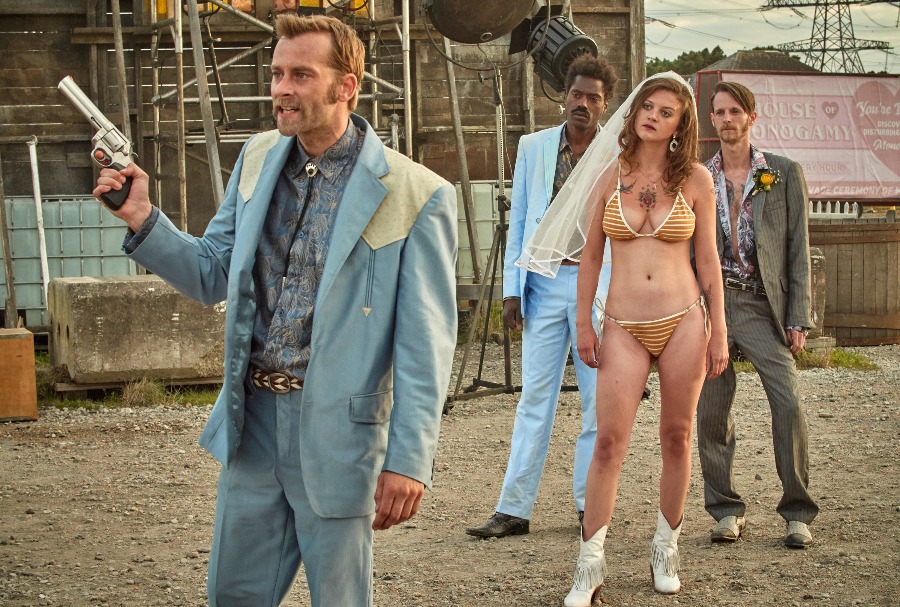
Bernard and Lenina’s tour of Savage Land spectacles such the House of Want and the House of Monogamy prove to be among the most darkly humorous and familiarly Syfy moments in the series. The rest of it is full of distracting barriers preventing a person from full emotional engagement, one of several ironies within this version of “Brave New World.”

Huxley’s story remains a staple of both Western literature classes and banned book lists because it invites us to consider the perils inherent to technology-enabled societies, where the less attractive traits that make us human are muted or erased. This version is so visually frontloaded that the story’s driving philosophies and the cast’s dramatic efforts never entirely overcome the dazzle.

Brown Findlay and Ehrenreich succeed in making aspects of their characters memorable, although of the two it’s Ehrenreich, best known as doing a perfectly adequate job of playing a young Han Solo in what may be the “Star Wars” universe’s most forgettable feature, whose performance makes the case that he deserves more TV work. Or maybe it’s just the fact that he wears his facial scruff mighty well. Who can say. 

But it is Joseph Morgan who makes the most indelible impression with his portrayal of CJack60, an Epsilon clone who for reasons that aren’t adequately explained starts to exhibit signs of individuality. He has few lines and limited screen time but in at least one moment draws from a well of emotional purity that beams through the din and hits you squarely in the gut.

“Brave New World” succeeds mostly as a rainbow-colored spectacle one can easily sit with despite the violence and empty sex appeal . . . or perhaps because of it. In the way of all things in the society it presents, it is a series well aware of its purpose as a confectionery gateway to synthetic emotion. As long as you’re not expecting much longstanding value beyond that, you’ll probably be happy with it.

The first episode of “Brave New World” is available on the free new Peacock streaming service. You can binge the full series if you subscribe to the Peacock Premium tier.

“Disturbing” memo reveals Trump’s USPS chief has slowed delivery amid calls to expand voting by mail

President Donald Trump’s newly confirmed U.S. postmaster general ordered the endangered public service Monday to make major cost-cutting changes, which could slow mail delivery.

Postmaster General Louis DeJoy, a top Trump donor who has given more than $2 million to the GOP, warned employees that the agency needed to make “difficult” decisions to stay afloat, according to a new report in The Washington Post.

“If the plants run late, they will keep the mail for the next day,” one guideline says, according to a document obtained by The Washington Post and verified by the American Postal Workers Union.

Carriers do not typically leave mail behind, often making multiple trips under heavy loads to get letters and packages to marked recipients as soon as possible.

Experts who reviewed the internal document, titled “New PMG’s [Postmaster General’s] expectations and plan,” said it presented “a stark reimagining of the USPS,” which could alienate customers. If the agency increases package delivery rates, which has the support of the administration, competing private companies could smell blood and throw new weight behind smothering the agency.

DeJoy, a North Carolina businessman, ascended to the head office in May after the resignation of Ron Stroman. Stroman, who had defended the integrity of voting by mail, was reportedly forced out amid coordinated Republican attempts to undermine public faith in the service.

“Stroman was specifically key on elections and vote by mail — this is not a good sign,” ProPublica’s Jessica Huseman tweeted in response to the resignation.

A USPS spokesperson told Salon in a statement that the service was “developing a business plan to ensure that we will be financially stable and able to continue to provide reliable, affordable, safe and secure delivery of mail, packages and other communications to all Americans as a vital part of the nation’s critical infrastructure.” 

That plan has not been finalized, but it will “certainly include new and creative ways for us to fulfill our mission,” the spokesperson added.

Vote-by-mail advocates say any new policy which slows deliveries might mean bad news for mail-in ballots, yielding delays in ballot requests and possible confusion surrounding the tabulations of votes. This represents an acute concern for upstart Democratic congressional candidates looking to pick off Republican seats.

“The people in power are trying to keep voter turnout low, and they’re hoping that fear keeps us from exercising our constitutional right to vote so they can stay in power. But they have another thing coming,” MJ Hegar, who on Wednesday was declared the winner of the Democratic Senate primary in Texas, told Salon.

“We are going to keep fighting to allow Texans to vote by mail and ensure Texans don’t have to choose between exercising their constitutional right to vote and public health,” she added.

James Mackler, aspiring Democratic candidate for Senate in Tennessee and a veteran of the War in Iraq, called the report in The Post “deeply disturbing” in an email to Salon. 

“This deeply disturbing report is another example of a willingness to abuse the powers of the executive branch for political gain,” Mackler said. “Our democracy works best when people vote, volunteer and make their voices heard. Efforts to suppress Americans’ right to vote – and do so safely by mail – fly in the face of what I fought to defend on the battlefield and in the courtroom.”

A West Virginia mail carrier last week pleaded guilty to election fraud and injury to the mail after admitting he had altered requests for mail-in ballots along his route, changing party affiliation from Democratic to Republican.

The USPS spokesperson dismissed these concerns, saying the agency’s “current financial condition is not going to impact our ability to deliver election and political mail this year.”

“I want to emphasize we will run our operations on time and on schedule, which will result in affordable, efficient and reliable service,” the spokesperson added.

The new guidance has also raised old fears about a decades-long Republican drive to privatize the postal service, which now finds itself strapped for cash in the middle of a once-in-a-century infrastructure emergency.

In an early coronavirus relief bill, lawmakers authorized an additional $10 billion for the USPS to fund emergency operations during the pandemic, but the loan has stalled amid a dispute with Treasury Secretary Steven Mnuchin over terms which would allow his department to take over some agency operations.

On July 1, Mnuchin announced a $700 million bailout of a trucking company and Pentagon contractor worth only $70 million, whose former CEO, Bill Zollars, was confirmed to the USPS board of governors the month prior. Salon reported that the Department of Justice has accused the company in federal court of crimes committed under Zollars’ tenure, including allegations of defrauding the Pentagon to the tune of millions of dollars.

Two months ago, the Democrat-controlled House passed another $25 billion emergency aid package to keep the beleaguered agency alive, but the Republican-led Senate has not yet taken up the measure. The decision would likely fall to Ron Johnson, R-Wisc., the chair of the Republican-led Senate Committee on Homeland Security and Governmental Affairs, which conducts oversight of the agency.

Johnson did not reply to a request for comment. However, his Democratic counterpart, ranking member Sen. Gary Peters of Michigan, issued a statement to Salon. 

“The Postal Service is a critical lifeline for our communities. Millions of Americans depend on the Postal Service to deliver prescription drugs and supplies to seniors, help small businesses stay connected with their customers, exercise the fundamental right to vote and ship the goods families need at home – no matter where they live,” Peters said.

“The Postal Service should not slow down mail or compromise service in any way, especially during this crisis,” he added. “I am concerned Postal Service leadership is prioritizing cost-cutting over customer service, and I am conducting oversight of their actions.”

A Peters aide told Salon that the USPS Board of Governors said the Postal Service could be insolvent in the coming months because of the pandemic, and the senator’s office was committed to securing bipartisan support.

Emphasizing Peters’ belief that “the independent Board of Governors and the Postal Regulatory Commission should be making the decisions about what’s best for their business models – not the administration,” the aide also implied a suspicion that the administration’s hand was at play.

Johnson has not outwardly expressed interest in reform. However, this April he and Sen. Tammy Baldwin, D-Wisc., put bi-partisan pressure on the USPS to resolve issues with delivery of mail ballots in their state’s primary.

A number of prominent Republicans, including Trump, have pushed baseless conspiracy theories about the security of voting by mail as part of a broader effort to inject doubt into the nationwide election system. An individual familiar with internal White House campaign discussions told Salon that Republican strategists had as recently as last week stressed concerns about brutal internal poll numbers to the president, who has routinely attacked the mail-in system he views as a threat.

However, many of those officials have availed themselves of that same system, including Vice President Mike Pence, Attorney General William Barr, Secretary of Education Betsy DeVos, Republican National Committee chairwoman Ronna Romney McDaniel, White House press secretary Kayleigh McEnany, counselor to the president Kellyanne Conway and the president himself.

Ivanka Trump broke federal rule by promoting Goya amid boycott, former White House ethics chief says

First daughter Ivanka Trump, a senior White House adviser, was accused of violating federal ethics rules by sharing a photo of herself holding a can of Goya beans along with the company’s tagline.

After CEO Robert Unanue said the country was “truly blessed” to “have a leader like President Trump” during a White House event last week, Goya has faced calls to boycott its products

Ivanka appeared to respond to the boycott by posting a photo of herself promoting canned black beans.

“If it’s Goya, it has to be good,” she wrote, adding the Spanish translation: “Si es Goya, tiene que ser bueno.”

Walter Shaub, who served as the White House ethics chief during former President Obama’s second term, as well as for Trump’s first six months in office, said “the Goya tweet was an ethics violation.”

The Office of Government Ethics guidelines say that “executive branch employees may not use their Government positions to suggest that the agency or any part of the executive branch endorses an organization (including a nonprofit organization), product, service or person.”

Though Ivanka notes that hers is a personal account in her bio, “it’s a bad idea to include your title in the bio because that’s a factor weighing in favor of finding a violation occurred,” Shaub wrote on Twitter. “If you use that social media account to tout a company’s product a few days after the company’s CEO publicly praised your father-president from the White House rose garden, that’s one more factor weighing against you — and a particularly strong one at that.”

Ivanka’s tweet came in an “obvious response to the backlash” and creates a “strong appearance that you’re endorsing a product in your official capacity,” he explained.

“For this reason, Ms. Trump’s Goya tweet is clearly a violation of the government’s misuse of position regulation,” he wrote. “Ms. Trump has had ethics training. She knows better. But she did it anyway because no one in this administration cares about government ethics.”

President Donald Trump followed up his daughter’s tweet with an endorsement of his own.

“[Goya Foods] is doing GREAT,” he wrote. “The Radical Left smear machine backfired, people are buying like crazy!”

Shaub tweeted that the president’s comment was “further proof that Ivanka’s tweet was done in her official capacity.”

“The administration is pushing Goya in exchange for the endorsement the company’s CEO gave Trump,” he said. “Whether or not expressly coordinated, Ivanka’s tweet is a part of that effort. It’s an ethics violation.”

And Ivanka’s tweet drew widespread criticism beyond Shaub.

Rep. Alexandria Ocasio-Cortez tweeted in Spanish, “If it’s Trump, it has to be corrupt.”

The White House defended Ivanka’s tweet, arguing that she was only expressing her “personal support” for the brand.

“Only the media and the cancel culture movement would criticize Ivanka for showing her personal support for a company that has been unfairly mocked, boycotted and ridiculed for supporting this administration — one that has consistently fought for and delivered for the Hispanic community,” White House spokeswoman Carolina Hurley said in a statement. “Ivanka is proud of this strong, Hispanic-owned business with deep roots in the U.S. and has every right to express her personal support.”

Shaub lamented that the Trump administration had done nothing in response to ethics violations, such as White House adviser Kellyanne Conway’s repeated violations of the Hatch Act, which bars federal employees from engaging in certain political activities like campaigning.

“In a lawless administration, it would take strength of character and a conscious choice to abide by ethics rules. Few would expect a nepotist, whose only qualification for White House employment is her family relationship to the president, to exhibit such character,” he added. “In this regard, Ms. Trump’s misconduct is not surprising. It’s disappointing that she has lived down to our low expectations for members of her family, but disappointment has been the one consistent theme of the Trump administration in matters of government ethics.”

Jeff Sessions’ downfall: The wages of loyalty to Donald Trump is public humiliation

Former senator and disgraced former Attorney General Jeff Sessions has finally come, at age 73, to what is almost certainly the end of the road for his villainous political career. On Tuesday night, the right-wing Republican who served as a U.S. senator from 1997 to 2017 lost in his comeback attempt, defeated in the Republican primary for his old seat by Tommy Tuberville, a man whose cartoonish name better suited his previous career as head football coach at Auburn. The runoff election between the two wasn’t even close, with the Riverboat Gambler (a silly and self-serious nickname for Tuberville, especially when “The Tubz” was right there for the taking) taking more than 60% of the vote. 

It’s tempting, since we’re talking about Alabama, to believe that the Tubz (I can’t help it) won on a wave of goodwill from the famously football-fanatical voters of that state. That fails to take into account that Tuberville may well be regarded as one of history’s greatest monsters in the parts of the state that Roll Tide.

No, the reason that Tuberville won is likely due to something far more sinister than inappropriate of confidence in the governing skills of college football coaches: Alabama Republicans are hyper-loyal to Donald Trump, and Trump told them to vote for Tuberville. 

“People in Alabama voted against Jeff Sessions because Donald Trump told them to,” Angi Stalnaker, an Alabamian Republican strategist, told the New York Times. “If it had been Donald Trump saying, ‘Go write in Mickey Mouse,’ 50 percent of them would have gone to write in Mickey Mouse.” 

But let us not shed tears for Sessions, for whom the phrase “hoisted by his own petard” may as well have been invented. In a world where so few evil people get any form of justice, we should allow ourselves the pleasure of laughing deeply, richly and at length at Sessions for this public humiliation. Sessions did this to himself. He, more than anyone else in power, invited Trump into our political system, and he knows exactly how Trump repays his loyalists: With a boot to the face and a laugh about what a simp you were to believe in him. 

Sessions, one of the most racist members of Congress (which is saying something!), spent all his political capital on Trump early on in the 2016 Republican primary, correctly perceiving the New York real estate huckster and TV host as a vehicle to make the rest of the nation’s politics as toxic and racism-inflected as politics in Alabama. Sessions was the first Republican senator to endorse Trump and campaigned fiercely for him, seeing Trump as the best possible avenue for white grievance politics and anti-immigrant bigotry even more central to the Republican Party than they already were. 

There is no wiggle room here: Sessions, who was literally named after two Confederate leaders, fell madly in love with Trump because of racism. It’s hard to imagine what else the two men have in common, but man, they both sure hate immigrants, black people and anyone else that David Duke wouldn’t invite to a birthday party. 

Not to re-litigate the 2017 battle that resulted in a thousand “nevertheless, she persisted” tattoos, but it is important to remember that’s exactly what Sen. Elizabeth Warren of Massachusetts was persisting over: Her belief that a blatant white supremacist shouldn’t be confirmed as attorney general, even if another blatant white supremacist, in this case the president, had nominated him. 

Warren was trying to read into the public record a letter that civil rights activist Coretta Scott King wrote in 1986 to protest Sessions’ nomination to a federal judgeship, on the grounds that he was a big ol’ racist. Senate Majority Leader Mitch McConnell stopped her, because it’s kind of hard to pretend your big ol’ racist Attorney General is not a big ol’ racist when he was too racist 31 years earlier to get confirmed to the federal bench.

King accused Sessions of using “the awesome powers of his office in a shabby attempt to intimidate and frighten elderly black voters,” by launching frivolous criminal investigations aimed at preventing Black people from voting, or punishing them for doing so.

More racist stuff about Sessions, much of it revealed in 1986, resurfaced when Trump nominated him as attorney general: He called the NAACP “un-American.” He said he was “okay” with the Ku Klux Klan “until I learned they smoked pot.” (The context here was that Sessions was investigating what looked quite like a Klan lynching of a Black man he acknowledged had done nothing but “go to the 7-Eleven.”) He said that the NAACP “hates white people” and is “a pinko organization.” 

He was also accused of calling a Black colleague “boy” and telling him, “You ought to be careful as to what you say to white folks.”

But like most love affairs gone wrong, after Sessions and Trump consummated their white supremacist passions, they began to realize that they disagreed on other critical issues where everyone needs to be on the same page for the relationship to continue.

In this case, the conflict point was over how best to cover up the shady dealings Trump’s campaign had with Russian intelligence figures who conspired to interfere with the 2016 election on Trump’s behalf. Trump felt that the cover-ups should be flagrant and shameless, and wanted Sessions to do whatever he could, right out in public, to shut down the investigation into potential criminal conspiracy. (He wanted Sessions to “un-recuse” himself from the Russia investigation and fire special counsel Robert Mueller, since Trump was too chicken to do that himself.) Sessions preferred a more subtle method, publicly backing away from the Russia question and claiming to have clean hands, even as the administration’s obstruction of justice successfully rendered the Mueller the investigation incomplete.

The irony is that Sessions’ instincts on how to use power to get away with crimes and corruption were proved correct. By observing legalistic norms and recusing himself, Sessions was able to put a stamp of legitimacy on the investigation, and lulled the public into believing it was less of a damning indictment of Trump than it actually was. It wasn’t until the next big crime involving a former Soviet nation, this time Ukraine, that Trump was impeached. 

But Trump, ever a black hole for personal validation, cares less about what’s actually best for him and far more for making his monkeys dance as hard as they can to prove they love him. The fact Sessions had self-interested reasons for playing his cards as he did — recusal allowed him to maintain an image of lawyerly respectability and professionalism — offended Trump greatly. He needs his underlings to sacrifice everything for him, including and especially any remaining dignity or reputational goodwill. Nothing but total self-immolation will be considered a good enough demonstration of your loyalty to Donald Trump. 

No matter how much butt-licking and self-effacement Sessions performed after the recusal, Trump never got over the fact that, for one brief moment, Sessions was willing to put pragmatic concerns and his own reputation over Trump’s yawning need to see people debase themselves before him. So he hounded Sessions out of the Justice Department — firing him shortly after the Democrats’ sweeping victory in the 2018 midterms — and has talked trash about him ever since. He enthusiastically endorsed Tuberville, not because he’s some huge Auburn fan or particularly cares about whatever differences exist between the two Alabama Republicans, but because he was fixated on letting Sessions know that there’s no such thing as walking away from Trump with your dignity intact. 

There should be a lesson for this in everyone who thinks it might be good for their career to work for Donald Trump. Anyone who would think that can’t be appealed to on moral grounds, as they don’t have any of those. But they need to understand that Trump expects — nay, demands — their total humiliation. He needs their destruction, craves it, and will not stop until he is satisfied. He is a predator who lives on consuming the professional careers of those he comes in contact with, a vampire whose life is sustained by sucking dry the reputations of the people around him. Trump’s ego demands that any contact with him will result in your total destruction, for that is the only way he can feel alive. The only people who survive contact are those, like Roger Stone or current Attorney General Bill Barr, who are themselves undead and therefore have no remaining soul or substance for Trump to feast upon. 

The fate of Jeff Sessions should be a warning to anyone who thinks there’s such thing as working with Trump and walking away with any part of you undemolished. It doesn’t work that way. He will drain you and leave a desiccated corpse where your reputation used to be. As puny a reputation as Sessions had before he made his deal with the devil, now he’s got nothing. 

Trump says it’s “terrible” to question why Black people are killed by police: “So are white people”

President Donald Trump continued to push racist rhetoric in response to ongoing protests over police brutality and systemic racism as he downplayed the shootings of Black people by authorities and defended the Confederate Flag in a Tuesday interview with CBS News.

CBS News correspondent Catherine Herridge pressed Trump on why Black Americans were “still dying at the hands of law enforcement in this country.”

“So are white people. So are white people. What a terrible question to ask. So are white people,” Trump responded. “More white people, by the way. More white people.”

While technically correct, Trump’s answer ignored the fact that white Americans make up 60% of the population, while Black people make up just over 13%. A 2018 study published by the American Public Health Association showed that Black men were 350% more likely to be killed by police than white men. Another study by Harvard researchers earlier this year similarly found that Black people were about 300% more likely to be killed by police than white people.

Trump, who has been accused of directly appealing to white supremacists in his defense of the Confederate flag, insisted in the interview that displaying the banner should be a matter of “freedom of speech.” In 2015, he supported the removal of the Confederate flag and said it should be “put in a museum.”

Harridge pressed Trump on whether he understood “why the flag is a painful symbol for many people because it’s a reminder of slavery.”

“Well, people love it, and I don’t view — I know people that like the Confederate flag, and they’re not thinking about slavery,” the president said before comparing supporters of the flag to the “Black Lives Matter” movement.

Trump previously called a Black Lives Matter mural painted in front of Trump Tower in New York a “symbol of hate.”

Atlanta Mayor Keisha Lance Bottoms, a Democrat under consideration for the vice presidential nomination, criticized Trump’s comments in an interview with CNN.

“To compare Black Lives Matter with the Confederate flag is simply despicable and out of touch,” she said, adding that the president “lacks empathy.”

Trump was not done criticizing the protesters, baselessly alleging in a separate interview that a St. Louis couple that threatened to shoot protesters in front of their $1 million mansion would have been assaulted.

“They were going to be beat up badly, and the house was going to be totally ransacked or burned down like they tried to burn down churches,” he told the far-right outlet Townhall.

St. Louis Circuit Attorney Kim Gardner, who is weighing charges against the couple, said in a statement that Trump and Missouri Gov. Mike Parson “came after me for doing my job” after she launched an investigation into the matter.

Parson on Tuesday told reporters that Trump had promised to intervene and “do everything he could within his powers” to protect the couple.

“He understands the situation in St. Louis and how out of control it is for a prosecutor to let violent criminals off and not do their job and try to attack law-abiding citizens,” Parson said. “The conversation I had with the president — said that he would do everything he could within his powers to help with this situation.”

“While they continue to play politics with the handling of this matter, spreading misinformation and distorting the truth, I refuse to do so,” Gardner said in response.

Trump also held a campaign rally in the Rose Garden under the guise of a formal news conference. The president used the speech to stoke more racial fears.

Trump cited an Obama-era housing rule intended to address racial segregation.

“You’re going to abolish the suburbs with this,” he declared.

“Trump contends that Biden would ‘abolish the suburbs’ and cites his wish to repeal an already dormant fair housing rule,” The Washington Post’s Cathleen Decker tweeted. “Those sorts of measures marked campaigns in the 1960s in retaliation for civil rights efforts.”

Trump’s wide-ranging array of racism Tuesday was widely condemned by civil rights groups and Democratic lawmakers.

“Trump’s racism is so absolute that he refuses to even acknowledge the epidemic of police violence against Black people in America,” the ACLU said in a statement. “His racist dog whistles keep getting louder.”

“Supporting Trump doesn’t mean you are a racist, but it does mean you are supporting a racist,” Sen. Brian Schatz, D-Hawaii said.

“It’s too easy to call Trump a racist, we’ve had years of his racist rhetoric and divisive policies,” Rep. Adriano Espaillat, D-N.Y. added. “Today’s dismissal of Black lives as a result of [police brutality] serves as further proof of his inhumanity, hate & racist beliefs.”

Trump-endorsed GOP congressman charged with three counts of felony voter fraud minutes before debate

Rep. Steve Watkins, R-Kansas, was charged with three counts of felony voter fraud and a misdemeanor after an investigation into his vote in a 2019 local election.

Watkins, a first-term congressman, was charged with voting without being qualified, interference with law enforcement by providing false information and unlawful advance voting. Shawnee County District Attorney Mike Kagay, a fellow Republican, announced the charges Tuesday about 30 minutes before a televised debate between Watkins and his primary challengers.

The congressman was also charged with a misdemeanor charge for failing to notify the DMV that he had changed his address. Watkins, who was endorsed by President Donald Trump and is an honorary co-chair of the Trump re-election campaign, denied the allegations.

Watkins, who won his 2018 race by just 0.8 percentage points in a district Trump carried by 19 points, faced the scrutiny of the Federal Election Commission scrutiny in an investigation into whether his father, Steve Watkins Sr., illegally funneled money into his campaign through his daughters, a contractor and the contractor’s wife.

Watkins denied that he was under an FEC investigation, and his father claimed that he “didn’t know that I wasn’t allowed to do it.” Watkins won the race by fewer than 3,000 votes “thanks to outside spending from a group largely run and funded by his father,” Politico reported.


The charges came after the Topeka Capital-Journal reported last year that Watkins had changed his address on his voter registration to that of a UPS store in Topeka in a different district than where he lived before voting in a city council race which was ultimately decided by just 13 votes. Watkins was living with his parents at the time but “used the UPS address to obscure that fact,” sources told the Kansas City Star.

If found guilty, Watkins would face up to 17 months in prison for the voting without being qualified charge and up to nine months in prison for each of the other two felony charges.

Watkins’ campaign said the media was notified of the charges before his attorneys.

“I haven’t done anything wrong,” Watkins said at Tuesday’s debate minutes after the news dropped, calling the timing of the charges “very suspicious” and “highly political.”

“I look forward to clearing my name,” he added. “I have done nothing wrong and look forward to setting the record straight.”

Primary challenger Jake LaTurner, the state treasurer, seized on the issue, arguing that “our current congressman with three felony charges and a misdemeanor charge is not the person” with the best chance to win the general election.

“Count us shocked that Steve Watkins has found someone else besides himself to blame for illegally voting and lying to a law enforcement officer,” his spokeswoman Kaya Zeyer told The Star.

Democrats also condemned him after the charges were announced.

“If you want to be trusted to write our laws, you should at least follow them,” Brooke Goren, a spokeswoman for the Democratic Congressional Campaign Committee, told the outlet. “Steve Watkins has proven that he can’t pass this basic test, and it’s clear why Kansans are ready for a change.”

Watkins said at the debate that he has cooperated with the investigation and immediately corrected his registration.

“As soon as I realized that I had put my mailing address instead of my physical address, we fixed it,” he said.

LaTurner responded by noting that Watkins’ ties to the district he represents are tenuous at best, blaming his own actions for the legal trouble.

“Listen, Steve Watkins needs to take responsibility for the decisions he’s made,” LaTurner told KSHB. “No one makes Steve buy a home in the Second Congressional District. No one makes Steve lie on government documents and sign his name under penalty of perjury, and certainly no one makes Steve lie to the police.”

Watkins previously came under fire ahead of the 2018 election after The Associated Press reported that he had falsely claimed that he led and grew a small business and exaggerated a heroic story about climbing Mt. Everest.

“We’re just talking two years,” a local Republican county chair told McClatchy after the report. “If we come to find out that stuff’s true and he’s really not what he says he is, we’ll replace him in two years, I guess.”

Trump’s unhinged Rose Garden campaign rally: His sideshow act is getting truly pathetic

President Trump is having a rally problem. This past weekend he was forced to cancel a highly-touted rally in Portsmouth, New Hampshire, supposedly because of “bad weather.” They don’t normally cancel Trump rallies even when people are waiting outside in below-freezing weather, so this was surprising. In fact, the weather was warm and sunny on the New England coast that day, so it’s pretty obvious that campaign officials were afraid they’d see a repeat of the Tulsa debacle.

But Trump simply cannot go very long without his rallies. They are like a drug for him. Remember, he held “victory rallies” even during the presidential transition, when any other president-elect without political experience might have been hunkered down to learn a little something about the job. The long period of no rallies during the first months of the pandemic made him so restless and nervous that he took over the task force briefings and sparred with the press just to get some airtime. He needs rallies like he needs Diet Coke and L’Oréal Light Reddish Blond hair color.

I’m sure he was upset that the media broadcast Joe Biden’s speech on climate and energy on Tuesday morning so the White House scheduled a Rose Garden “press conference,” which was actually an excuse for him to deliver one of his sprawling campaign speeches. It turns out that as much as Trump may love the look of a rally venue filled with screaming fans, what he really loves is the sound of his own voice. 

He started out a little bit low energy, but even without the ecstatic cult members shrieking “Lock her up!” and “Build that wall!” he managed to work himself up to deliver one of his patented incoherent rally performances as if the audience in front of him weren’t a bunch of masked-up, socially distanced reporters, who were undoubtedly confused as to why they had been summoned to the Rose Garden to act as props for Trump’s stump speech.

This is not normal. Even Fox News’ Bret Baier was compelled to point out, after it was over, “To be fair, if President Obama had given a speech like this in the White House, Republicans on Capitol Hill would have been up in arms.” Indeed, if Obama had done anything like that, Republican heads would have swiveled on their shoulders and their mouths would have erupted with green bile like Linda Blair in “The Exorcist.” After all, they had a full-blown hissy fit when Obama wore a tan suit to the White House briefing room one day.

The “Rose Garden strategy,” as it’s called when presidents opt not to campaign, is supposed to show the president so hard at work doing the people’s business that he can’t take the time to engage in silly political events. It is often employed when a president is running for re-election in the middle of a crisis, for obvious reasons. They generally don’t want the voters to think they are ignoring their duties when something serious is happening. (The obvious example was Jimmy Carter, faced with the Iran hostage crisis during the1980 campaign against Ronald Reagan. It didn’t help him.)

Sure, the Rose Garden strategy is also political, and designed to create or burnish an image, Regardless, it’s long been customary for the president to save the fiery campaign speeches for the road. They are supposed to present some dignity and decorum in the Rose Garden. Trump doesn’t know the meaning of those words and he is not trying to convince anyone that he’s hard at work on anything but TV-watching, tweeting and pouting.

This wasn’t the first Rose Garden appearance in which he’s turned the place into a political sideshow. Back when the White House first began hosting daily coronavirus task force briefings with the president in attendance, they were often unruly and overtly political. But they were at least real press briefings with serious questions from the media. Tuesday’s press conference was a bait and switch. After rambling for nearly an hour, the president took just three questions one of which had obviously been planted with OAN, his favorite propaganda outfit.

What did he actually say? That can be summed up in a few sentences. He ragged on China for a bit, just to justify having the “press conference” in the first place. Then he spent most of his time reading woodenly from a list of prepared attack lines against Joe Biden, which included inane comments like “Joe Biden’s entire career has been a gift to the Chinese Communist Party” and accusing Biden of saying that “the idea that China is our competition is really bizarre,” to which Trump ad-libbed, “He’s really bizarre.” That was before he claimed that Biden’s energy plan would result in windows being banned. No one can say what that was about.

And yes, Trump spent what felt like hours reciting the usual litany of his supposedly unprecedented achievements, which included this odd comment:

We have great agreements where when Biden and Obama used to bring killers out, they would say, “Don’t bring them back to our country, we don’t want them.” Well, we have to, we don’t want them. They wouldn’t take them. Now with us, they take them. Someday, I’ll tell you why. Someday, I’ll tell you why. 

I don’t think I want to know.

As for the issue that’s at the forefront of every American’s mind right now, Trump only offered the usual innumeracy, ignorance and lies:

If we didn’t do testing — instead of testing over 40 million people, if we did half the testing, we would have half the cases.  If we did another — you cut that in half, we would have, yet again, half of that.

Evidently nobody can teach him why that is so mind-bogglingly ridiculous and wrong, so he just keeps saying it.

Most galling of all, he took credit for saving millions of lives, dishonestly asserting again that the U.S. has the lowest mortality rate in the world. (It does not.) To him the loss of more than 136,000 Americans, with thousands more seriously ill, and families everywhere grieving, is nothing compared to the great pride we should have in our president for allegedly saving us from something worse.

Remember when Trump used to say we’d get tired of all the winning and we’d beg him to stop because we couldn’t take it and he’d insist that we had to keep winning whether we liked it or not? This, apparently, is what he was talking about.  

While COVID-19 spikes in the South, the Northeast seems under control — here’s what changed

Hospital Capacity Crosses Tipping Point in U.S. Coronavirus Hot Spots” — Wall Street Journal

This is a headline I hoped to not see again after the number of coronavirus infections had finally started to decline in the Northeast and Pacific Northwest. However, the pandemic has now shifted to the South and the West — with Arizona, Florida, California and Texas as hot spots.

At the same time, cases, hospitalizations and the percentage of positive tests in Northeastern states have declined. New York Gov. Andrew Cuomo recently declared, “We now have the lowest transmission rate in the United States of America.” In fact, there are now more daily hospitalizations in Arizona than in New York, Pennsylvania and the entire Northeast combined.

What explains the difference?

My physician colleagues and I have learned a lot since a mysterious respiratory virus first appeared in mainland China over six months ago. We can now rattle off stats about the coronavirus as if we were sports commentators. It spreads through droplets and aerosols. It binds to ACE-2 receptors in the lungs. It can last on certain surfaces up to 72 hours. It can cause loss of taste and smell.

We could go on and on if you pressed us, but the most important thing we have learned is how it spreads and how to slow it down. A critical piece of that — and a key difference between the Northeast today and many of the areas where coronavirus is spreading now — is people’s behavior.

Hard-hit states quickly learned value of masks

As a respiratory virus, SARS-CoV-2 is transmitted mainly through droplets that leave the mouth and nose as a person talks, sneezes, coughs or exhales. It thrives in environments where there are lots of people in enclosed spaces — especially if they are laughing, talking, singing or otherwise coming into close contact. It thrives physically in the same settings where we thrive socially.

This is why the early hard-hit areas were able to crush the curve by closing businesses and implementing stay-at-home orders. Without significant close human interaction, the coronavirus couldn’t spread.

While other states are now seeing hospitals fill with COVID-19 patients, most of the Northeast is maintaining control of community spread as its economies reopen. The difference reflects, at least in part, each state’s behavior expectations and the willingness of residents to keep up safety precautions like wearing masks, avoiding large crowds, maintaining social distance of at least six feet and staying isolated when they are ill or may have been exposed to the virus.

Rhode Island is an example. When the state began allowing businesses to reopen in early May, Gov. Gina Raimondo said success would depend on how people behaved — if they continued social distancing and wearing masks. Rhode Island is small, but it sits in the middle of the busy New York-Boston corridor. It was one of the first states to close businesses and schools, and one of the first to require people to wear face masks in public places. To locate the virus and stop its spread, it launched partnerships to make testing widely available and developed a contact tracing program with regular check-ins through a phone app. It also required travelers to self-quarantine for 14 days.

“We have to embrace new ways of living our lives,” Raimondo said in May.

Two months later, Rhode Island’s case numbers are down. The state still requires mask-wearing in public places, and, importantly, people do it. State inspectors found more than 90% of businesses were in compliance with mask-wearing rules over the July 4 holiday.

Northeastern states now lead the nation in mask-wearing and adherence to other best practices. An Axios/Ipsos poll showed that in states with high mask use, virus circulation is at lower levels compared to states with less mask use. Studies on the effects of how quickly coronavirus restrictions have been lifted around the world have found that slow, careful strategies have led to fewer illnesses and deaths during reopening.

In many parts of the Northeast, the months of illnesses, deaths and the struggle to turn the COVID-19 tide are still fresh in people’s minds. The progress isn’t uniform, however. New York City’s mayor has expressed concern about an uptick in positive cases among people in their 20s.

The problems of a political divide

Elsewhere in the country, the current surge in COVID-19 cases began to pick up after Memorial Day weekend, when people in several states that hadn’t seen the same toll from the pandemic let their guard down. Video and pictures showed parties, barbecues, crowded beaches and political rallies — all with very little social distancing or mask-wearing — giving more fuel for the coronavirus to spread.

Despite the overwhelming evidence for what we should be doing, following the advice of public health experts has also, sadly, become politicized. Depending on the news sources people listen to, they might hear warnings from health officials being taken seriously or being dismissed by pundits and politicians.

A recent national poll shows that Democrats report consistently wearing a mask 68% of the time, while Republicans reported doing the same only 34% of the time. The national conversation has devolved into a false dichotomy: Either you’re on the side of prioritizing safety or you’re on the side of personal freedom and opening the economy.

In reality, the two should be partners, as these preventative measures are the best tools we have to reach our common goals of reopening businesses and schools safely. It’s the same reason we stop at stoplights and go through metal detectors at the airport — we make a small sacrifice for the greater public good.

For the foreseeable future, Americans will have to collectively agree to live life a little differently. Until we can all agree on this, the coronavirus will continue to have the upper hand, and our health and wealth will suffer.

Taison Bell, Physician and Assistant Professor of Medicine, University of Virginia

This article is republished from The Conversation under a Creative Commons license. Read the original article.

10 reasons why defunding police should lead to defunding America’s war machine

Since George Floyd was murdered, we have seen an increasing convergence of the “war at home” against Black and brown people with the “wars abroad” that the U.S. has waged against people in other countries. Army and National Guard troops have been deployed in U.S. cities, as militarized police treat our cities as occupied war zones. In response to this “endless war” at home, the growing and thunderous cries for defunding the police have been echoed by calls for defunding the Pentagon’s wars. Instead of seeing these as two separate but related demands, we should see them as intimately linked, since the racialized police violence on our streets and the racialized violence the U.S. has long inflicted on people around the world are mirror reflections of each other.

We can learn more about the war at home by studying the wars abroad, and learn more about the wars abroad by studying the war at home. Here are some of those connections:

  1. The U.S. kills people of color at home and abroad. The United States was founded on the ideology of white supremacy, from the genocide against Native Americans to upholding the system of slavery. U.S. police kill about 1,000 people per year, disproportionately in the Black community and other communities of color. U.S. foreign policy is similarly based on the white superiority-derived concept of “American exceptionalism,” in tandem with European partners. The endless series of wars the U.S. military has fought abroad would not be possible without a view of the world that dehumanizes foreign peoples. “If you want to bomb or invade a foreign country filled with black- or brown-skinned people, as the United States military so often does, you have to first demonize those people, dehumanize them, suggest they’re backward people in need of saving or savage people in need of killing,” said journalist Mehdi Hasan. The U.S. military has been responsible for the deaths of millions of Black and brown people around the world, and the denial of their rights to national self-determination. The double standard that sanctifies the lives of U.S. troops and citizens, but disregards the people whose countries the Pentagon and its allies destroy is as hypocritical as the one that values white lives over Black and brown lives at home. 

  2. Just as the U.S. was created by taking over the lands of Indigenous peoples by force, so America as an empire uses war to expand access to markets and resources. Settler colonialism has been an “endless war” at home against Indigenous nations, who were colonized when their lands were still defined as foreign territories, to be annexed for their fertile land and natural resources. The Army forts stationed in Native nations back then were the equivalent of foreign military bases today, and the Native resisters were the original “insurgents” who were in the way of American conquest. The “Manifest Destiny” colonization of Native lands morphed into overseas imperial expansion, including the seizure of Hawaii, Puerto Rico and other colonies, and the counterinsurgency wars in the Philippines and Vietnam. In the 21st century, U.S.-led wars have destabilized the Middle East and Central Asia, while increasing control over the region’s fossil fuel resources. The Pentagon has used the template of the Indian Wars to frighten the American public with the specter of “lawless tribal regions” that need to be “tamed,” within countries such as Iraq, Afghanistan, Yemen and Somalia. Meanwhile, Wounded Knee in 1973 and Standing Rock in 2016 show how settler colonialism can become remilitarized back in the U.S. “homeland.” Stopping oil pipelines and toppling Columbus statues shows how Indigenous resistance can also be renewed in the heart of the empire. 

  3. The police and military are both internally plagued by racism. With the Black Lives Matter protests, many people have now learned about the origins of U.S. police in all-white slave patrols. It is no accident that hiring and promotion within police departments have historically favored whites, and officers of color around the country continue to sue their departments for discriminatory practices. The same is true in the military, where segregation was official policy until 1948. Today, people of color are pursued to fill the bottom ranks, but not the top positions. Military recruiters set up recruiting stations in communities of color, where government disinvestment in social services and education makes the military one of the few ways to not only get a job, but access to health care and a free college education. That’s why about 43 percent of the 1.3 million men and women on active duty are people of color, and Native Americans serve in the Armed Forces at five times the national average. But the upper echelons of the military remain almost exclusively a white-boys’ club (of the 41 senior commanders, only two are Black and only one is a woman). Under Trump, racism in the military is on the rise. A 2019 survey found that 53 percent of service members of color said they had seen examples of white nationalism or ideologically driven racism among their fellow troops, a number up significantly from the same poll in 2018. Far-right militias have attempted to both infiltrate the military and collude with police.

  4. The Pentagon’s troops and “surplus” weapons are being used on our streets. Just as the Pentagon often uses the language of “police actions” to describe its foreign interventions, police are being militarized within the U.S. When the Pentagon ended up in the 1990s with weapons of war it no longer needed, it created the “1033 Program” to distribute armored personnel carriers, submachine guns, and even grenade launchers to police departments. More than $7.4 billion in military equipment and goods have been transferred to more than 8,000 law enforcement agencies — turning the police into occupation forces and our cities into war zones. We saw this vividly in 2014 in the aftermath of the killing of Michael Brown, when police flush with military gear made the streets of Ferguson, Missouri, look like Iraq. More recently, we saw these militarized police forces deployed against the George Floyd rebellion, with military helicopters overhead, and the Minnesota governor comparing the deployment to an “overseas war.” Trump has deployed federal troops and wanted to send in more, much as active-duty troops were previously used against several workers’ strikes from the 1890s to the 1920s, the Bonus Army veterans’ protests of 1932, Black uprisings in Detroit in 1943 and 1967, in multiple cities in 1968 (after the assassination of Dr. Martin Luther King Jr.), and in Los Angeles in 1992 (after the acquittal of the police who had beaten Rodney King). Sending in soldiers trained for combat only makes a bad situation worse, and this can open the eyes of Americans to the shocking violence with which the U.S. military tries, but often fails, to quell dissent in occupied countries. Congress may now object to the transfer of military equipment to police, and Pentagon officials may object to using troops against U.S. citizens at home, but they rarely object when the targets are foreigners or even U.S. citizens who live abroad.

  5. U.S. interventions abroad, especially the “War on Terror,” erode our civil liberties at home. Techniques of surveillance that are tested on foreigners have long been imported to suppress dissent at home, ever since occupations in Latin America and the Philippines. In the wake of the 9/11 attacks, while the U.S. military was purchasing super-drones to kill U.S. enemies (and often innocent civilians) and collect intelligence on entire cities, U.S. police departments began buying smaller, but powerful, spy drones. Black Lives Matter protesters have recently seen these “eyes in the sky” spying on them. This is just one example of the surveillance society that the U.S. has become since 9/11. The so-called War on Terror has been a justification for the tremendous expansion of government powers at home — broad “data mining,” increased secrecy of federal agencies, “no fly” lists to prohibit people tens of thousands of people from traveling, and vast government spying on social, religious and political groups, from the Quakers to Greenpeace to the ACLU, including military spying on antiwar groups. The use of unaccountable mercenaries abroad also makes their use more likely at home, as when Blackwater private security contractors were flown from Baghdad to New Orleans in the wake of Hurricane Katrina in 2005, to be used against the devastated Black community. And in turn, if police and armed far-right militias and mercenaries can commit violence with impunity in the homeland, it normalizes and enables even greater violence elsewhere.

  6. The xenophobia and Islamophobia at the heart of the “War on Terror” has fed hatred of immigrants and Muslims at home. Just as wars abroad are justified by racism and religious bias, they also feed white and Christian supremacy at home, as could be seen in Japanese-American incarceration in the 1940s and anti-Muslim sentiment that rose in the 1980s. The 9/11 attacks precipitated hate crimes against Muslims and Sikhs, as well as a federally imposed travel ban that denies entrance to the U.S. for people from entire countries, separating families, depriving students of access to universities, and detaining immigrants in private prisons. Sen. Bernie Sanders, writing in Foreign Affairs, said, “When our elected leaders, pundits, and cable news personalities promote relentless fear-mongering about Muslim terrorists, they inevitably create a climate of fear and suspicion around Muslim American citizens — a climate in which demagogues like Trump can thrive.” He also decried the xenophobia resulting from turning our immigration debate into a debate about Americans’ personal security, pitting millions of U.S. citizens against undocumented and even documented immigrants. The militarization of the U.S.-Mexico border, using hyperbolic claims of infiltrating criminals and terrorists, has normalized the use of drones and checkpoints that bring the techniques of authoritarian control into the “homeland.” (Meanwhile, U.S. Customs and Border Protection personnel were also deployed to the borders of occupied Iraq.)

  7. Both the military and the police suck up enormous amounts of taxpayer dollars that should be used for building a just, sustainable and equitable society. Americans are already participating in supporting state violence, whether we realize it or not, by paying taxes to the police and military that carry it out in our names. Police budgets account for an astronomical percentage of cities’ discretionary funds compared to other crucial community programs, ranging from 20 to 45 percent of discretionary funding in major metropolitan areas. Per capita police spending in the city of Baltimore for 2020 is an astounding $904 (imagine what every resident could do with $904). Nationwide, the U.S. spends more than twice as much on “law and order” as it does on cash welfare programs. This trend has been widening since the 1980s, as we have taken funds out of poverty programs to put into fighting crime, the inevitable consequence of that neglect. The same pattern is true with the Pentagon budget. The 2020 military budget of $738 billion is larger than those of the next 10 countries combined. The Washington Post reported that if the U.S. spent the same proportion of its GDP on its military as most European countries do, it “could fund a universal child-care policy, extend health insurance to the approximately 30 million Americans who lack it, or provide substantial investments in repairing the nation’s infrastructure.” Closing the 800-plus overseas military bases alone would save $100 billion a year. Prioritizing the police and military means deprioritizing resources for community needs. Even President Dwight Eisenhower described military spending in 1953 as “a theft from those who hunger and are not fed.”

  8. Repressive techniques used abroad inevitably come home. Soldiers are trained to see most of the civilians they encounter abroad as a potential threat. When they return from Iraq or Afghanistan, they discover that one of the few employers that give priority to veterans are police departments and security companies. They also offer relatively high salaries, good benefits and union protections, which is why one in five police officers is a veteran. So, even soldiers who  come home with PTSD or drug and alcohol abuse, instead of being adequately cared for, are given weapons and put out on the streets. No wonder studies show that police with military experience, especially those who have deployed overseas, are significantly more likely to be involved in shooting incidents than those with no military service. The same relationship of repression at home and abroad is true of torture techniques, which were taught to militaries and police throughout Latin America during the Cold War. They were also used on Afghans at the U.S.-run Bagram Air Base prison, and on Iraqis at the Abu Ghraib prison, where one of the torturers had practiced similar techniques as a prison guard in Pennsylvania. The purpose of waterboarding, a torture technique stretching back to counterinsurgency wars in Native America and the Philippines, is to prevent a person from breathing, much like the police chokehold that killed Eric Garner or the knee to the neck that killed George Floyd. #ICantBreathe is not only a statement for change at home, but also a statement with global implications. 

  9. The War on Drugs has put more money into the police and military but has been devastating to people of color, at home and abroad. The so-called War on Drugs has devastated communities of color, particularly the Black community, leading to catastrophic levels of gun violence and mass incarceration. People of color are more likely to be stopped, searched, arrested, convicted and harshly sentenced for drug-related offenses. Nearly 80 percent of people in federal prison and almost 60 percent of people in state prison for drug offenses are Black or Latinx. The War on Drugs has also devastated communities overseas. Throughout South America, the Caribbean and Afghanistan in both drug production and trafficking areas, U.S.-supported wars have only empowered organized crime and drug cartels, leading to an upsurge of violence, corruption, impunity, erosion of rule of law and massive human rights violations. Central America is now home to some of the world’s most dangerous cities, leading to the mass migration to the U.S. that Donald Trump has weaponized for political purposes. Just as police responses at home do not solve social problems that stem from poverty and despair (and often create more harm than good), military deployments abroad do not resolve historical conflicts that usually have their roots in social and economic inequalities, and instead create a cycle of violence that worsens the crisis. 

  10. Lobbying machines solidify support for police and war industry funding. Law enforcement lobbies have long built support for police and prisons among state and federal politicians, using a fear of crime and a desire for the profits and jobs that are funneled to its backers. Among the strongest backers are police and prison guard unions, which instead of using the labor movement to defend the powerless against the powerful, defend their members against community complaints of brutality. The military-industrial complex similarly uses its lobbying muscle to keep politicians compliant with its wishes. Every year billions of dollars are funneled from U.S. taxpayers to hundreds of arms corporations, who then wage lobbying campaigns pushing for even more foreign military aid and weapons sales. They spend $125 million a year on lobbying, and another $25 million a year on donating to political campaigns. Manufacturing weapons has provided millions of workers with some of the nation’s highest industrial wages, and many of their unions (such as the Machinists) are part of the Pentagon lobby. These lobbies for military contractors have become more powerful and influential not only over the budget but also over the creation of U.S. foreign policy. The power of the military-industrial complex has become far more dangerous than even President Eisenhower himself feared when he warned the nation, in 1961, against its undue influence.

Both “defunding the police” and “defunding war,” while opposed by most elected Republicans and mainstream Democrats, are gaining public support. Mainstream politicians have long been afraid of being painted as “soft on crime” or as “soft on defense.” This self-perpetuating ideology reproduces the idea that the U.S. needs more police on the streets and more troops policing the world, or else chaos will reign. The mainstream media has kept politicians afraid to offer any kind of alternate, less militaristic vision. But the recent uprisings have turned “Defund the Police” from a fringe chant to a national conversation, and some cities are already reallocating millions of dollars from the police to community programs. 

Likewise, until recently, calling for cuts to U.S. military expenditure was a great taboo in Washington. Year after year, all but a few Democrats lined up with Republicans to vote for massive increases in military spending. But that is now beginning to change. Rep. Barbara Lee, D-Calif., introduced a historic, aspirational resolution proposing a massive $350 billion in cuts, which is more than 40 percent of the Pentagon budget. And Sen. Bernie Sanders, along with other progressives, introduced an amendment to the National Defense Authorization Act to cut the Pentagon budget by 10 percent. 

Just as we want to radically redefine the role of police in our local communities, so we must radically redefine the role of military personnel in the global community. As we chant “Black Lives Matter,” we should also remember the lives of people dying every day from U.S. bombs in Yemen and Afghanistan, U.S. sanctions in Venezuela and Iran, and U.S. weapons in Palestine and the Philippines. The killing of Black Americans rightly elicits masses of protesters, which can help open a window of awareness about the hundreds of thousands of non-American lives taken in U.S. military campaigns. As the platform of the Movement for Black Lives platform says: “Our movement must be tied to liberation movements around the world.” 

Those who are now questioning an increasingly militarized approach to law enforcement should also question a militarized approach to foreign relations. Much as unaccountable police in riot gear are a danger to our communities, so too an unaccountable military, armed to the teeth and functioning largely in secret, is a danger to the world. During his iconic anti-imperialist speech, “Beyond Vietnam,” Dr. King famously said: “I could never again raise my voice against the violence of the oppressed in the ghettos without having first spoken clearly to the greatest purveyor of violence in the world today: my own government.” 

The protests to “Defund the Police” have compelled Americans to see beyond police reform to a radical reconceiving of public safety. So too we need a radical reconceiving of our national security in the slogan “Defund War.” If we find indiscriminate state violence in our streets appalling, we should feel similarly about state violence abroad, and call for divesting from both police and the Pentagon, and reinvesting those taxpayer dollars to rebuild communities at home and abroad. 

Well, the good news is Trump hasn’t entirely lost his mind — or so he says

Donald Trump, 74, bragged last week during a Sean Hannity interview that he had “aced” a recent cognition test at Walter Reed Hospital.

Trump boasted that doctors witnessing the test “said that’s an unbelievable thing. Rarely does anybody do what you just did.” He then challenged Democrat Joe Biden, 77, to match him.

But haven’t we skipped over something here?

Doctors wanted Trump to take a cognition test? Is that a normal thing for presidents?

Trump said he asked to take the test after criticisms over his inability to walk down a ramp with ease at West Point, needing to hold a glass of water with both hands and multiple occasions of slurring and mispronouncing words.

That he asked for the test sounds in incredible. What was he going to do if it was not perfect? Step aside?

(Credit: The Montreal Cognitive Assessment)

There were no results of the test made public, and Trump has gone to the hospital at least twice in recent weeks with no explanation.

Frankly, we’re so used to the idea that doctors had tested Trump for basic mental acuity, disclosures didn’t even draw much notice. There was much more attention paid to his push to keep Confederate statues.

While none of us wants to render opinions about presidential mental health, we do want assurances that the guy in charge is at least in charge of his mental faculties. For sure, I’d like to know that Trump is mentally capable way before I need to know about his taxes.

Odd behavior

There have been any number of published reports, including the new book by his psychologist niece about the development of Uncle Donald. Dr. Mary L. Trump suggests Trump’s outward behavior reflects psychological disorders starting with extreme narcissism. Trump’s repeated oddball behaviors often leave professionals and the public agape.

Yale forensic psychiatrist Bandy X. Lee—a frequent DCReport contributor—in Psychology Today describes a “rigidity in extreme narcissists that is characteristic of pathology. Far from correcting his errors, he doubles down on them, blaming and bullying others to create a façade of success, when he has been failing all along.” It is a portrait of someone willing to do anything for immediate self-survival, without regard for the consequences for others.

In 2018, then-White House physician Ronny Jackson said that Trump had scored 30 out of 30 on the Montreal Cognitive Assessment, a test for screening of “mild cognitive dysfunction” as part of his normal health check-up. These are tests that ask for pretty simple stuff, including recognition of animals, time of day and the like. But they give indicators that all cylinders might not be working.

The question that Trump just breezed by in this interview is whether we have a president, a commander in chief with nuclear powers and a short personal fuse, whose mental status we need to keep checking.

In any event, what these tests do not show is whether Trump can take in new information; can marry protocol, tradition, alliances and moral concepts; whether he can weigh risks against costs; whether he can determine a path that makes sense for a complex organism like the United States of America.

What about Biden?

Meanwhile, Biden weirdly has said he has been tested “constantly” but avoided saying where or when or by whom—or whether he meant tested by life’s challenges. Biden, of course, who presents himself as the anti-Trump, has had a full history of gaffes and odd statements of his own, whether the result of talking too fast, dealing with a stutter or just for inattention.

Biden is not seen as overly narcissistic, just perhaps slower than he has been as the result of aging—at least in the competitive mind of Trump. Any gaffes Biden commits seem to have little connection with policies that defy understanding or that run afoul of the law. Any slowing is a judgment waiting to be seen, of course.

And I’d like Biden to name a vice presidential candidate who tests as sane.

Meghan McCain cancels cancel culture in “View” response to Tucker Carlson kerfuffle

Meghan McCain, who recently blamed Barack Obama for Donald Trump’s presidency, once again prompted a pile-on when she accused her fellow hosts on “The View” of engaging in “cancel culture.”

McCain has made clear on previous occasions her disdain for what she sees as an all-pervading culture of politically correct “cancellation,” and has more than once placed herself in the center of it. This time her line of argument led to a defense of Tucker Carlson, days after Fox News fired his head writer, Blake Neff, when it was discovered he had been posting racist and misogynist comments on the internet for years.

On the previous evening, Carlson had offered up a limp condemnation of Neff before turning to blast the “ghouls” who were “beating their chests in triumph” because the writer was fired for “horrific racist, misogynist and homophobic behavior,” as his own network described it in its statement.

McCain’s co-hosts, two of whom are black, passed the topic around, pointing out that Neff’s worldview would seem to overlap significantly with that of Carlson, who has expressed the view that “immigration is making the country dirtier,” called white supremacy a “hoax” and claimed that Black Lives Matter isn’t about black lives.

“He knows he is just as guilty as the writer,” said Joy Behar, guessing at the real motive behind Carlson’s uncannily timed “vacation.”

“What was most surprising to me was that he tried to change the narrative,” said Sunny Hostin. “What about accountability? What about responsibility? It’s his own doing.”

Whoopi Goldberg then turned to McCain. “I assume you’re not going to want to speak on this because you used to work for Fox, Meghan,” she asked.

“No I’m happy to speak on this, I was actually waiting for you to come to me,” McCain snipped, before lighting into “cancel culture.”

“I think about cancel culture a lot,” she said. “And I think every person who’s in mainstream media that has a platform, probably at one time or another thinks about it.”

“Every woman on this show, at one point or another, cancel culture has tried to remove one of us from this show, for one reason or another,” she said, adding, “And by some miracle we’re all still here, and I think the greatest miracle is still me somehow being here.”

For evidence of this last claim, McCain cited a New York Times op-ed entitled, “‘The View’ has a Meghan McCain problem.”

That article reads in part: “For some viewers, Ms. McCain is the privileged product of conservative nepotism, capitalism and the American military-industrial complex. That coalescence naturally renders her a villain to progressives, who envision her as the cathartic personification of a punching bag on social media. Conversely, each pile-on reinforces her self-written narrative of the long-suffering victim of censorship. This dynamic is a high-wire act that Ms. McCain takes pains to use to her advantage as often as possible.”

McCain interpreted this article as saying “it was basically dangerous to have a conservative woman with this kind of platform on this show.”

“So I am against cancel culture,” she concluded, before pivoting to Carlson.

“I think one of the reasons why I’m always a proponent of Tucker Carlson is because I believe in diversity of opinion. I believe in the reason why Fox News exists, because that kind of opinion doesn’t exist on any other network,” McCain said.

“I obviously don’t agree with what that writer said, and he should have been fired,” she quickly added, but then defended Carlson himself at length, likening his mid-2000s sparring matches with Paul Begala on CNN’s “Crossfire” to debates between their intellectual forebears William F. Buckley and Gore Vidal.

Ironically, the Times op-ed that McCain cited compares her performances on “The View” to “Crossfire,” specifically Jon Stewart’s famous appearance on the show in which he criticized Begala and Carlson to their faces.

“To do a debate would be great,” Stewart said on that occasion. “But that’s like saying pro wrestling is a show about athletic competition.”

It’s likely that McCain had the New York Times at the front of her mind. That morning, staff writer editor Bari Weiss, in a letter posted to her own website, informed Times publisher A.G. Sulzberger that she was resigning from the paper.

Weiss had caught flak from critics, including within her own institution, for what they perceived as routine, baseless complaints without much apparent purpose beyond trying to maintain an outrageous, contrarian brand.

McCain later tweeted about it, and Weiss retweeted that tweet.

Mean tweets and “fear of the digital thunderdome” figured prominently in Weiss’ letter, which also cited a litany of alleged incidents of bullying in Slack work channels and a work culture that she claimed smothered heterodox thought.

“If a person’s ideology is in keeping with the new orthodoxy, they and their work remain unscrutinized. Everyone else lives in fear of the digital thunderdome. Online venom is excused so long as it is directed at the proper targets,” she wrote.

McCain seemed to have tapped into the same vein of grievance that day, plugging her latest Twitter fight with Behar and commenting, “The View is the last place this happens in mainstream media.”

“It just makes me sad we’re at a moment in time where there’s just not a place for people to come together and have civil, and sometimes a little uncivil, debates,” she added.

“Debating is great,” Goldberg interjected, in an echo of Jon Stewart. “What you want to stay away from is you want to get rid of the racist aspect of it. And the racist aspect of it is thrown out there to keep you from making your points.”

“I don’t hold him accountable for his writer’s actions,” McCain insisted. “Your criticism of his writer has turned into a criticism of him.”

This begat several seconds of unintelligible dogpile until Goldberg took control.

“Tell me what you don’t like about my politics, leave my color out of it!” she fired back. Referring to Carlson, she said, “There’s plenty to show he’s one that has spoken the words almost directly as this boy has written them. I have a little problem with that.”

“Do you think Tucker should be canceled as well?” McCain asked.

“It’s not about cancellation, it’s about accountability!” Hostin said.

“It’s not about what his writer has done, Meghan, it’s about what he has done. I certainly think he should be held accountable for what he has said. He’s called white supremacy a hoax, he has said that Black Lives Matter is not about black lives, he’s talking about ‘dirty immigrants.’ He’s said all of these things!”

In response, McCain pointed out that Joy Ann Reid, a Black liberal who just landed an evening show on MSNBC, has still not been “held accountable” for bigoted statements she made in the past.

Goldberg clapped her hands. “We’re going to break,” she said.

How Arizona blew it: Experts say Gov. Doug Ducey did almost everything wrong

Even by the standards of the national pandemic spike, Arizona has a serious coronavirus problem.

On Monday morning the state’s health department reported 1,357 new coronavirus cases, including eight additional deaths. It now has more cases per capita than any other state besides New Jersey, whose outbreak peaked months ago. Moreover, the rate at which new cases have been reported has surpassed the rate at which testing has been increased, which means the existing data almost certainly does not reflect the true extent of the outbreak.

Further complicating matters, Gov. Doug Ducey, a Republican, only authorized local governments to implement mask requirements on June 17 — and public health officials say it will take several weeks for the impact of those requirements to be evident. Ducey has also been criticized for personally setting a bad example after a photograph was published showing  him at a social event practicing neither distancing nor mask-wearing. (Ducey’s office disputes the timeline involving when the photograph was taken.)

Arizona has also had a series of high-profile coronavirus cases. Last month a teacher in the state died after contracting the coronavirus while she was forced to share a classroom with two other teachers, both of whom also contracted the disease. On Monday a group of school board members and medical professionals signed an open letter to Ducey urging him to delay opening schools until at least October, citing concerns about the safety of both educators and students. (Officials in Phoenix, the state’s largest city, has made clear public schools will be online-only as the fall term begins.)

Ducey was also called out in an impassioned obituary written by Kristin Urquiza, whose father, Mark Anthony Urquiza, died from COVID-19 last month.

“Mark, like so many others, should not have died from COVID-19,” Urquiza wrote. “His death is due to the carelessness of the politicians who continue to jeopardize the health of brown bodies through a clear lack of leadership, refusal to acknowledge the severity of this crisis, and inability and unwillingness to give clear and decisive direction on how to minimize risk.”

So what exactly has gone wrong in Arizona — and what can be done to make it right?

“It is impossible to say whether [Ducey] is ignoring advice, is unaware of it, or doesn’t believe it,” Dr. Elizabeth Jacobs, a professor of epidemiology and biostatistics at the University of Arizona, told Salon by email. “There have been numerous editorials published that have strongly recommended intensive actions, such as a statewide mandate on masking and improved testing speeds. The latest actions by the governor aim to increase testing capacity by the end of August. With considerations such as reopening schools and universities under discussion, this will not be soon enough. It is distressing that we do not have adequate testing in the state even now.”

When asked about specific mistakes made by Arizona’s government, Jacobs pointed to overly ambitious economic reopening that was too rapid, the lack of a statewide mandate on masking and incompetent or inadequate testing, which she described as “the biggest concern I have personally right now.”

“We need rapid testing available to everyone, with testing sites equally distributed in all neighborhoods, regardless of socioeconomic status,” Jacobs explained. “We need tests that are sensitive and specific, with rapid turnaround. We need supports in place for those who may be most vulnerable to COVID-19, such as our Native American Nations and among our Latinx population. We also need to ensure that legislation to protect individuals from evictions is renewed during this emergent epidemic, and that we provide financial support for those who are being hit hardest by social distancing.” Jacobs also called for “sensible and reasonable recommendations” for school reopening and said that Arizonans need to know that authority figures “care about them and will be here to support them.”

A recent poll suggests that Jacobs’ views are held by a large number of her fellow Arizonans. A poll by the COVID-19 consortium found that Ducey has the lowest ranking among all American governors for his handling of the coronavirus crisis, and in fact is the only governor to rank below President Trump. (Ducey has a 32 percent approval rating compared to Trump’s 34 percent approval rating.)

As of Sunday Arizona has reported 2,245 deaths a total of 122,467 cases. In an open letter to Ducey, the mayors of Flagstaff, Phoenix, Tempe, Tolleson and Tucson said that “our economy will not recover until we are able to slow the spread and rebuild consumer confidence. The longer we wait to act, the longer and more severe the blow to our economy will be, the longer it will take to safely send our children back to school, and more lives will be needlessly lost.”

A recent article in Vox echoed some of these observations. As German Lopez wrote, Arizona’s coronavirus spike “is the result, experts say, of Arizona’s missteps at three crucial points in the pandemic. The state reacted too slowly to the coronavirus pandemic in March. As cases began to level off nationwide, officials moved too quickly to reopen in early and mid-May. As cases rose in the state in late May and then June, its leaders once again moved too slowly.”

As Will Humble, executive director of the Arizona Public Health Association, told Vox, the state reopened too aggressively. “It was a free-for-all by May 15,” Humble said, later adding that the state effectively “went from phase 0 to phase 3.”

Unfortunately the errors made by Arizona’s leaders are likely to have long-lasting consequences regardless of how the state tries to make up for things now.

“Even if I put in 100 percent face mask use and everybody complied with it in Arizona right now, there would still be weeks of pain,” Cyrus Shahpar, a director at the global health advocacy group Resolve to Save Lives, told Vox. “There are people out there spreading disease, and it takes time [to pick them up as cases], from exposure to symptom onset to testing to getting the testing results.”

Jeff Sessions goes down in flames: Former GOP senator losses comeback bid after Trump betrayal

Former Attorney General Jeff Sessions lost his primary race to be the Republican candidate for U.S. Senate in Alabama on Tuesday night in a landslide, according to Decision Desk HQ. Early returns showed him losing the shot to win back his old seat by more than 20 points to opponent Tommy Tuberville, who will face off against Democratic Sen. Doug Jones in November.

It wasn’t a surprising loss for Sessions, though it is a brutal one. He gave up his seat in the Senate to become President Donald Trump’s attorney general, and he lost his big chance to return because his one-time benefactor turned against him. Trump enthusiastically endorsed Tuberville while viciously and repeatedly denouncing Sessions.

There’s no reason to feel any sympathy for Sessions. He’s an unrepentant racist who loved Trump’s anti-immigrant bigotry so much that he was the first sitting senator to endorse him as a presidential candidate. He was one of the leading architects of the family separation policy that tore apart immigrant children from their parents, inflicted untold suffering, and created enduring trauma.

But his national humiliation should be a warning to the rest of us. Like it or not, Trump is in all likelihood to remain president until at least January of 2021. And his treatment of Sessions could presage his treatment of the country — especially if he loses re-election to former Vice President Joe Biden.

Sessions genuinely did love Trump. He loved Trump enough to endorse him early in the race when many still thought he was destined for defeat. Had Trump gone down in flames, Sessions would have been seen as an easy mark.

He took the risk, though, because Sessions really believed in Trump. He believed in the anti-immigrant message, the barely concealed racial animus. He wanted to help Trump enact that vision, to turn it into law.

Yet despite his commitment to Trump, he had his limits. When early in Trump’s presidency, the Russia investigation began to come into view, Sessions did nothing to stop it. Worse than that, in Trump’s eyes, he recused himself from the case as the ethics regulations dictated he must. He refused repeatedly to intervene in the investigation despite Trump’s pleas. Trump never forgave him for this, seeing it is a fundamental betrayal, even though Sessions was only following the law and his conscience on this matter — one of few saving graces in an otherwise loathsome career. Trump eventually fired him in what can only be described as an act of obstruction of justice and retaliation.

Sessions was thoroughly humiliated, and he only humiliated himself further when he ran for his old Senate seat. Despite Trump’s constant abuse, he pledged to serve the president’s will in the Senate. The Republican voters, it seemed, didn’t buy it. They took Trump’s word on what was good for Trump over Sessions’ protestations.

So for a second time, Trump has degraded and humiliated Sessions, a man who from all appearances genuinely loved him and wanted to serve his ends. And this time, it wasn’t about wresting control of a vexing investigation; it certainly wasn’t about policy differences. Sessions probably would have been a loyal ally in the Senate if he had the chance to be around for a second Trump term. Trump sabotaged Sessions because he felt Sessions was insufficiently loyal when he needed it. It was an act of vindictiveness and spite. It was also, intentionally or not, a warning to anyone else who isn’t loyal.

Which brings us back to the November election. Currently, Trump is strongly favored to lose. He may pull off a stunning upset and scrape by with an electoral college victory once again, but right now, it’s a longshot. Most likely, Biden will be the next American president.

So what happens if Trump loses? There’s been a lot of discussion about how Trump might try to contest the result or throw the election into doubt. Those are real possibilities that we need to be deeply concerned with.

But those efforts may fail, or the loss may be decisive enough that Trump doesn’t even try to deny it. What then? That’s when we might realize just how bad it is having a president who revels in spite and retaliation. A man with the power of the presidency, and all that that entails, will hold his office for another two and a half months after losing. He’ll feel betrayed by the American people, and he’ll no longer have much incentive to keep us in his good graces. We should be thinking hard about how he could be constrained in that time and what he might try to do to exact his revenge.

Deregulation’s deadly consequences: How Trump’s assault on government exacerbated the pandemic

President Donald Trump’s ongoing efforts to roll back regulations designed to protect the environment, workers, and public health likely played a significant role in the spread of Covid-19 in the United States.

That’s according to a new report released Tuesday by New York University School of Law’s Institute for Policy Integrity (IPI), a nonpartisan policy think tank.

The 45-page report titled “Weakening Our Defenses” (pdf) details how Trump’s far-reaching deregulatory push has exacerbated several major risk factors for contracting and spreading Covid-19, such as high levels of air pollution, hazardous working conditions, and lack of adequate health insurance.

“President Trump’s deregulatory agenda has affected all those factors, and, therefore, the disproportionate racial and economic justice impacts of deregulation are now most likely compounding in deadly ways in the wake of the Covid-19 pandemic,” the report says.

“Even before the pandemic,” the report continues, “those regulatory decisions collectively were already causing dire consequences for public health and safety, the environment, and economic conditions—but we now know that those regulatory decisions have likely also increased our collective susceptibility to Covid-19.”

The report cites the Trump administration’s rollback of restrictions on nearly 2,000 forms of hazardous air pollution in 2018, weakening of the Clean Power Plan, and gutting of vehicle fuel efficiency standards in 2020 as examples of environmental deregulatory actions that left the U.S. more vulnerable to Covid-19. The U.S. currently has the most confirmed coronavirus cases and deaths in the world.

“These rollbacks have put all of us—especially low-income communities, Black people, and people of color, and essential workers—at higher risk of contracting and dying from Covid-19,” said Gina McCarthy, former Environmental Protection Agency administrator and current president of the Natural Resources Defense Council.

The report also points to the Trump administration’s weakening of workplace safety standards at meatpacking plants, which have become major Covid-19 hotspots. According to the Centers for Disease Control and Prevention, more than 16,200 meat and poultry processing workers have contracted Covid-19 at 239 facilities in the U.S.

“In October 2019, the Trump administration’s Department of Agriculture finalized a rule to ‘modernize’ swine slaughter inspections,” IPI’s report says. “The new program, which pig processing plants may opt into, reduces the number of food safety inspectors in plants and removes caps on pig slaughter line speeds.”

By forcing workers to perform their jobs in close proximity to one another, the report notes, the prioritization of speed over safety forces “likely puts meat processing workers at greater risk for Covid-19.”

The Trump administration’s efforts to undermine the Affordable Care and limit Medicaid eligibility by approving state-level work requirements also may have contributed to the spread of Covid-19, according to the new report.

“Though some of these state requirements have since been invalidated by the courts, other state programs could yet be implemented, and even the temporary loss of coverage in some states could be significant—particularly during a pandemic,” the report says.

Dr. Kathleen Rest, executive director of the Union of Concerned Scientists, said in a statement that the Trump administration’s “failure to listen to and act on the best available science is irresponsible and dangerous.”

“From day one, the Trump administration has attempted to roll back not only existing public health protections, but the scientific basis on which all public health protections are based,” said Rest. “That’s short-sighted and foolish at the best of times, but they have continued to dismantle safeguards even as the country faces the threat of Covid-19, one of the biggest public health crises in our history.”

Top Trump advisor publishes op-ed against Dr. Anthony Fauci: He “has been wrong about everything”

On Tuesday, in an op-ed for USA TODAY, White House trade adviser Peter Navarro attacked the nation’s foremost infectious disease expert, Dr. Anthony Fauci, claiming that he “has been wrong about everything I have interacted with him on.”

“In late January, when I was making the case on behalf of the president to take down the flights from China, Fauci fought against the president’s courageous decision — which might well have saved hundreds of thousands of American lives,” wrote Navarro. “When I warned in late January in a memo of a possibly deadly pandemic, the director of the National Institute of Allergy and Infectious Diseases was telling the news media not to worry.”

In fact, experts broadly agree that one of the biggest sources of the initial coronavirus outbreak in the United States came from Europe.

Navarro went on to say that, “Fauci says a falling mortality rate doesn’t matter when it is the single most important statistic to help guide the pace of our economic reopening. The lower the mortality rate, the faster and more we can open.” Navarro overlooks that the total number of cases is rising dramatically.

Navarro’s attack comes just a day after White House Press Secretary Kayleigh McEnany denied anyone in the administration is going after Fauci.

Georgia’s Republican governor rejects coronavirus restrictions Atlanta mayor put in place amid surge

The office of Georgia Republican Gov. Brian Kemp released a statement Monday instructing Atlanta residents to ignore “confusing” new restrictions put in place over the weekend by Mayor Keisha Lance Bottoms amid record-high COVID-19 infections in the city and across the state.

Citing Kemp’s “reckless” reopening, Bottoms, who recently tested positive for COVID-19, had directed the city to return to Phase 1, or the most restrictive measures.

“Based upon the surge of COVID-19 cases and other data trends, pursuant to the recommendations of our Reopening Advisory Committee, Atlanta will return to Phase I of our reopening plan,” the mayor announced Friday.

“Georgia reopened in a reckless manner, and the people of our city and state are suffering the consequences,” she added.

Atlanta’s Phase 1 requires individuals to stay at home, except for essential trips, and to wear a face covering in public. It bars large gatherings and only allows restaurants and retail stores to serve customers curbside or to-go. All non-essential city facilities would close.

Bottom’s new directive, issued as Georgia set another state record of more than 4,400 new cases, was at odds with parts of an executive order Kemp signed June 11. Among other things, Kemp’s order allowed Georgia restaurants to fully open, lifted the ban on conventions and revoked stay-at-home requirements for residents 65 and older, with exceptions for those with certain underlying health conditions.

Kemp first posted his rebuttal Friday on Twitter, but commemorated it Monday in an official statement on the governor’s office website, calling Bottoms’ order “non-binding and legally unenforceable.”

“Mayor Bottoms’ action today is merely guidance — both non-binding and legally unenforceable,” the governor’s statement said. “As clearly stated in the governor’s executive order, no local action can be more or less restrictive, and that rule applies statewide.”

Kemp, for his part, began to reopen his state in late April before the Trump administration’s national guidelines expired.

“Once again, if the mayor actually wants to flatten the curve in Atlanta, she should start enforcing state restrictions, which she has failed to do,” Kemp’s statement said. “We ask citizens and businesses alike to comply with the terms of the governor’s order, which was crafted in conjunction with state public health officials. These common-sense measures will help protect the lives and livelihoods of all Georgians.”

But Bottoms shows no signs of backing down, and she counts mayors of Georgia’s other largest cities among her ranks.

Kemp himself faces a decision Wednesday on whether to extend the current restrictions first put in place June 11. He has so far encouraged face masks but refused to require one in public.

The Georgia Department of Public Health on Tuesday reported another 3,394 cases, 209 hospitalizations and 28 deaths. The positivity rate ticked up to 13.7%, well above the state’s 10% average to date. The pandemic has also put renewed strain on Georgia hospitals, which are running low on critical care beds.

Cases are soaring across the Atlanta metro region, with some areas reporting more than 200% increases over the last two-week period.

Kemp, who claimed to learn of asymptomatic transmission in early April despite government warnings since January, has come under fire for what some see as a lethally performative political approach to safely navigating the pandemic.

He was the first U.S. governor to announce he would lift economic restrictions, saying that he didn’t “give a damn about politics.” A few weeks later, with the Republican National Convention’s chances on the rocks in North Carolina, Kemp offered to host the event and lifted the prohibition on conventions in his next executive order.

In fact, Kemp’s early moves seemed so far ahead the curve that the White House task force reportedly enlisted Dr. Deborah Birx in an attempt to convince President Donald Trump to withdraw his initial support.

The president eventually reversed course and aired his disagreement with Kemp in public.

“I told the governor of Georgia, Brian Kemp, that I disagree strongly with his decision to open certain facilities which are in violation of the Phase 1 guidelines for the incredible people of Georgia,” Trump said at a White House briefing, adding that he would likely intervene in the event of “something totally egregious.”

As school closures continue, students could face long-term learning setbacks

Schools across the country, amid pressure from the Trump Administration to fully reopen schools this fall, are in the throes of making a decision that will likely have consequences lasting beyond the 2020-2021 school year.  

This week, the Los Angeles Unified School District (LAUSD) announced that students will not return to the classroom when the fall semester begins in August because of the surge in coronavirus cases. This decision came after United Teachers Los Angeles (UTLA), the union which represents LAUSD teachers, announced over the weekend that 83% of 18,000 members who took part in a poll voted against physically reopening schools to students.

The San Diego Unified School District also announced that the fall semester will begin virtually. It wasn’t that long ago, however, when San Diego officials had announced a “detailed plan,” developed in consultation with public health experts, to send kids back to school by the end of August. These decisions follow similar ones made in Nashville and Atlanta. Some major U.S. cities like Miami and New York City are still deciding whether or not students should physically return to the classroom this fall.

As my colleague Andrew O’hehir wrote, the decision to reopen schools is akin to “a ‘Deer Hunter’-style game of Russian roulette, played blindfolded under conditions of complete chaos.” Nobody knows what the best decision is – for students, for teachers, for other school employees, for guardians at home – and any decision made certainly comes with its own set of pitfalls. Moreover, like most of the fallout from this pandemic, the burden of each decision will be largely carried by working-class families and communities of color.

The health of the various parties is naturally one of the biggest concerns, but the existing inequalities schools districts face is also a factor that could have major consequences for the resources and quality of education for students.

“Districts with more resources are likely going to be able to avail themselves of higher quality instruction, and higher-income families are going to be much better positioned to support [remote] learning than less-resourced families who don’t have the privilege of staying at home,”  Janelle Scott, an education and African-American studies professor at the University of California, Berkeley, told EdWeek.org.

Indeed, education researchers, teachers, and academics are concerned that continued online learning could further widen existing academic achievement differences between students from households of differing incomes.

“Between high-income and low-income schools, as well as between rural and all others schools, there are big technology gaps, and where there are big technology gaps it means that less students are going to be getting access to remote learning,” Dr. Megan Kuhfeld, a senior research scientist at the Northwest Evaluation Association (NWEA), a not-for-profit organization that creates academic assessments for students pre-K-12,  told Salon. “If we have a group of students who are getting access and a group who aren’t, we just have to assume that that’s going to widen inequality.”

Access to technology is key to successful online learning, and not all families have easy access to laptops and the internet. An estimated 35% of low-income households with school-aged children don’t have high-speed internet, according to Pew Research Center data. For middle-class and affluent families, an estimated 6%of households with school-aged children don’t have high-speed internet.

In April, NWEA’s Collaborative for Student Growth Research Center released research suggesting that this disrupted school year could result in students returning to school next fall with “63-68% of the learning gains in reading relative to a typical school year and with 37-50% of the learning gains in math.”

“These preliminary forecasts parallel many education leaders’ fears: missing school for a prolonged period will likely have major impacts on student achievement,” the researchers wrote.  “While we are unable to account for students’ exposure to virtual instruction while schools are closed, our learning loss projections imply that educators and policymakers will need to prepare for many students to be substantially behind academically when they return.”

These lack of educational gains are more likely to be seen in children in early grades, and among those already facing inequities. Researchers at the Brookings Institution suggest that students might be substantially more behind in mathematics.

“Thus, teachers of different grade levels may wish to coordinate in order to determine where to start instruction,” the researchers wrote. “Educators will also need to find ways to assess students early, either formally or informally, to understand exactly where students are academically.”

Kuhfeld told Salon if the pandemic was over, and students were returning to the classroom as usual this fall, educators could have played catch-up.

“If the fall was going to reopen as normal, I would say I think teachers can meet their students where they are,” Kuhfeld  said. “I think if this continues throughout the fall and winter where some kids are receiving no instruction and other kids are kind of getting, maybe not quite as typical, but closer to typical instruction, I think these gaps can be pretty large and consequential.

“It’ll be hard to find ways just within a normal school year to catch up from that,” Kuhfeld continued, adding that improving access to technology and the internet should be a priority among school districts and for policymakers as they consider education budgets.

“If kids don’t have access to their teachers virtually then it’s gonna be really challenging for learning to happen,” Kuhfeld said.