Help keep Salon independent

The debate was a total debacle for Donald Trump

According to the New York Times/Siena poll released over the weekend, about 28% of people said they needed to learn more about Vice President Kamala Harris, while only 9% said the same about Donald Trump with the race pretty much tied within the margin of error. Consequently, the conventional wisdom going into last night's debate was that Harris had much more to lose — and gain — than Trump, who is thought to have a pretty solid 46% no matter what. Harris could conceivably go up or down pretty substantially. The debate was therefore seen as make or break for her while for him it would probably change nothing. Could she rise to the occasion?

Indeed she did.

That 28% of people who needed to learn more, learned that Harris is quick-witted, highly qualified, very confident and well prepared. Yes, she has a very winning smile and exudes a joyful radiance, but she also has a spine of steel which she demonstrated by walking right up to her opponent at the outset of the debate and then standing and staring him down for over an hour and a half as she dominated poor, spent Donald Trump. It was hardly a fair fight.

The problem wasn't the moderators, it was Trump's big mouth.

I would imagine that even that 9% who've apparently been in a coma for the past decade and needed more information about Trump came away knowing everything they needed to know about him. He's an angry, delusional man who obviously spends way too much time on Truth Social and watching Fox News. He may not have more than a concept of a plan on health care or know much of the Constitution but he's an expert on right-wing conspiracy theories which he seems to believe are absolutely true.

His favorite conspiracy theory is one which he has personally propagated: Immigrants are coming to kill us all in our beds which seems to be the only thing he was really interested in talking about. In his very first answer about the economy, he said:

You see what's happening with towns throughout the United States. You look at Springfield, Ohio. You look at Aurora in Colorado. They are taking over the towns. They're taking over buildings. They're going in violently. These are the people that she and Biden let into our country. And they're destroying our country. They're dangerous. They're at the highest level of criminality. And we have to get them out. We have to get them out fast. 

The next question was on tariffs and there was more of the same: criminal migrants pouring across the border and "she's destroyed the country with a policy that you'd say they have to hate our country."

A couple of questions later, after defending his crowd sizes, he let fly with this:

And look at what's happening to the towns all over the United States. And a lot of towns don't want to talk — not going to be Aurora or Springfield. A lot of towns don't want to talk about it because they're so embarrassed by it. In Springfield, they're eating the dogs. The people that came in. They're eating the cats. They're eating — they're eating the pets of the people that live there. And this is what's happening in our country. And it's a shame. 

Moderator David Muir fact-checked that one, saying that ABC checked with the city of Springfield and there were no reports of immigrants eating pets. Trump still insisted that he'd seen someone on TV say it had happened.

You read that right. Trump actually repeated a ridiculous internet conspiracy theory, advanced by his running mate JD Vance, that Haitian immigrants are eating pets of residents of Springfield, Ohio. The memes had been flying all over social media and on right-wing cable and apparently, like the most gullible QAnon believer, Trump took it seriously.

Some right-wing commentators like Erick Erickson were not amused. He blamed the people spreading the racist meme, not Trump, who apparently has no agency at all:

We need your help to stay independent

It may have been the weirdest thing he said all night but it was hardly the stupidest. Trump also regurgitated one of his favorite conspiracy theories saying that Democrats, specifically Gov. Tim Walz, believe in executing infants after they're born, and falsely claimed that in six states it's legal to do so. Moderator Linsey Davis set him straight on that — not that he'll ever stop saying it.

When asked whether he had any regrets about his behavior on January 6, he pushed another conspiracy theory about former House Speaker Nancy Pelosi being responsible, which is also nonsense. The speaker had no power to stop the insurrection that Trump incited and then sat in his office watching unfold on his big screen TV. He clearly has no regrets and went on to spew more conspiracies about Ashli Babbit, the young woman who was shot as she breached the doorway, threatening the members of Congress. Trump then started braying about immigrants invading the country again, saying they are killing many people "unlike J6."

And, of course, he once more proclaimed that he didn't lose the 2020 election, repeating the Big Lie at length. And yes, it led to immigration:

Our elections are bad. And a lot of these illegal immigrants coming in, they're trying to get them to vote. They can't even speak English. They don't even know what country they're in practically. And these people are trying to get them to vote. And that's why they're allowing them to come into our country.

Donald Trump's team had been bragging all week that he didn't need to prepare for debates the way the allegedly stupid Kamala Harris did. Former Congresswoman Tulsi Gabbard, who faced off against Harris in the Democratic presidential primary during the 2020 cycle, was giving him some pointers on how to beat her and he was having some policy chats with various advisers, but that was all he needed. Well, that didn't work out too well.


Want a daily wrap-up of all the news and commentary Salon has to offer? Subscribe to our morning newsletter, Crash Course.


That debate was a total debacle for Donald Trump and his surrogates knew it.

In fact, he had so little trust in their ability to spin his disastrous performance that he personally went into the spin room afterward to boldly lie to the news media and proclaim he actually won the debate, quoting silly Twitter polls as proof. If it had been anyone but Trump it might have even been a little bit sad.

The usual right-wing suspects are all angry at the moderators for fact-checking Trump which they did three times. But they could have spent hours doing that. CNN's Daniel Dale fact-checked the debate in real time and found that Trump had lied 33 times and Harris lied once. The moderators allowed Trump to jump in and speak at the end of Harris' answers resulting in him getting five more minutes than she did. He ended up speaking 39 times while she only spoke 23 times. The problem wasn't the moderators, it was Trump's big mouth.

Trump relentlessly hammered on migrants which will probably play well with his base, along with all the other lies and conspiracy theories, but to anyone else he sounded like a lunatic, surly, rude and out of his depth. His laziness and inability/unwillingness to learn anything new caught up with him last night. He lost this debate, as he would say, bigly.
“She whupped him”: Kamala Harris won the debate by turning a potential disaster into a laugh-in

Armchair quarterbacks typically weigh in the morning after a game’s been lost. Regarding the debate between Vice President Kamala Harris and former president and current felon Donald Trump, the advice deluge happened beforehand.

Headlines promising the secret sauce on how Harris could win or should comport herself were plentiful. “Time for Kamala Harris to face some real scrutiny,” intoned The Telegraph. Hillary Clinton, Julian Castro and Chris Christie shared their advice, based on experience.

Based on her performance in Tuesday’s ABC-sponsored debate, Harris didn’t need anybody’s two cents. She had to cogently make a case for her presidency while baiting traps Trump's ego couldn’t resist. But I doubt even her team could have predicted how fun it would be to watch.

Harris and Trump’s first and possibly only debate at the National Constitution Center in Philadelphia was billed as the vice president’s biggest – and, again, possibly only — shot to give undecided voters a clearer sense of who she is.

The most effective and, dare I say, presidential strengths she put on display were her confidence, her comic timing, her relative sanity and her media savvy. She took what could have been a terrifying, pointless exercise and pulled out 90-plus minutes of delicious TV.

ABC's David Muir and Linsey Davis served as moderators. Aside from the two journalists, the candidates and the production crew, the hall was empty — a sanity-preserving decision. The spectators that mattered most were watching from the (dis)comfort of their homes, where the dissimilarity between the two could not be plainer to see. Through the magic of the split screen, Harris smiled brightly, laughed or visibly held back her giggles when she wasn’t shaking her head at the extremeness of her opponent’s lies.

Trump glowered, rolled his eyes, and clenched his mug into a clownish grin whenever Harris succeeded in getting under his skin, the thrust of her debate strategy.

“In Springfield, they're eating the dogs, the people that came in. They're eating the cats! They're eating — they're eating the pets of the people that live there,” Trump madly spewed in a wild impersonation of Grandpa Simpson, boosting a racist lie about Haitian immigrants in the process. “This is what's happening in our country.”

Narrator’s voiceover: This is not what’s happening in our country. In reality, what we’ve been subjected to are Trump's increasingly unhinged bigoted, sexist posts on his social media platform Truth Social.

That’s one of the reasons I was dreading this debate. Past square-offs between him and President Joe Biden achieved little aside from traumatizing the audience.

Among the many ways the Kamala Harris-Tim Walz campaign has upended the horserace-as-usual nature of campaign spectacle, though, is by understanding our collective exhaustion with Trump's "America: The Disaster Movie" pitch. Comedy is a great remedy for that.

Harris knew the meme makers were ready and waiting, and fed them generously.

From the moment the candidates stepped onstage, she made a power move. Trump ambled straight to the podium, but Harris crossed in front of them, as if expecting to meet him in the middle, something he has never done. So she walked over to him and extended her hand in introduction. “Kamala Harris. Let's have a good debate.”

The gesture was the first to throw him off. “Nice to see you,” he responded, adding, “Have fun.”

Oh, she did. 

The debate’s rules forbade prewritten notes, although every presidential candidate works out scripted responses before these events. Harris’ were simply more original. Trump lamely attempted to channel Ronald Reagan with a “There you go again” shoved into one rebuttal, and co-opting Harris’ signature “I’m speaking,” altering it to “I’m talking now. If you don't mind, please,” adding, “Does that sound familiar?”

By that point, however, Harris had moved into his brain and drawn a relaxing bubble bath. Her shaky start didn’t make it seem like it would happen, as she offered a weaving economic pitch that didn’t quite answer Muir’s simple question. At least she offered a few numbers, along with a counterproposal.

“Donald Trump has no plan for you,” she said, looking straight into the camera.

That’s when the needling kicked into a higher gear. Harris namedropped the Wharton School, which Trump attended with his father’s help, as one of the places that graded his economic proposals poorly. She poked him over his inept response to COVID, and on cue, he started babbling about a former West Virginia governor wanting to “execute the baby,” mixing up a lie about former Virginia Governor Ralph Northam.

We need your help to stay independent

This was all the wind-up to the “Boop!” that sent Trump over the edge. “I'm going to actually do something really unusual and I'm going to invite you to attend one of Donald Trump's rallies because it's a really interesting thing to watch,” she said, going on to conclude, “What you will also notice is that people start leaving his rallies early out of exhaustion and boredom.”

That’s when the “eating the dogs” fantasia took flight, and Laughing Kamala began having a marvelous night.

“Ladies and gentlemen, I just want to say, after surviving the PTSD of the last presidential debate, how unbelievably refreshing it is to go back to the same old ‘nobody's gonna answer any [bleepin’] questions!’” Jon Stewart said in his live breakdown of the debate on Tuesday’s episode of “The Daily Show.”

He’s right. There’s a sort of relief in, as Stewart put it, returning to the cliches, the standards of American political theater: the quotable soundbites, the moments that say more than any well-positioned breakdown of domestic growth.

This is not to say that Harris’ vigorous preparation in the days leading up to her first in-person meeting with Trump was entirely for naught. Her diligence paid off in the way she outlined her positions, as well as one can lay out in two-minute soundbites, especially her stance on restoring reproductive rights and her rundown of her experience with international diplomacy, particularly related to Ukraine. 

The facial expressions that conservative pundits vociferously tsked-tsked in 2020 are, in 2024, virtues.

Trump, meanwhile, clung to his insistence that he won the election and was swiftly disarmed by Harris saying, “Donald Trump was fired by 81 million people . . . And clearly, he is having a very difficult time processing that.”

Harris used the phrase “I have a plan” five times. The line that came to define Trump’s meandering was, “I have concepts of a plan.”

The great part is that Harris took what many expected to be an event to watch through the gaps between our fingers — as we covered our eyes in terror — and comforted us by making the exercise into a comedy. Harris knew the meme makers were ready and waiting, and fed them generously.

Early in the debate, she rested her chin against her hand, an indication Black and brown folks recognize as something our elders do to signal they're barely tolerating you.

When recounting the time Trump invited the Taliban to Camp David, “a place of storied significance for us as Americans . . . where we invite and receive respected world leaders, this –” she paused, nodding theatrically as if to stop herself from using bad if accurate language, before landing, with force, on the term “former president …as president invited them to Camp David because he does not again appreciate the role and responsibility of the President of the United States to be commander in chief with a level of respect.” 

In other words, the facial expressions that conservative pundits vociferously tsked-tsked in 2020 are, in 2024, virtues. Seeds for virality. An even simpler choice made her look more human than Trump, which is that she looked at him and addressed him directly when she took her jabs. Trump could barely cut his eyes in her direction.

Muir and Davis did not fact-check most of the debate, save for the most farfetched and egregious of Trump’s lies. “There is no state in this country where it is legal to kill a baby after it's born,” Davis said after Trump ridiculously suggested that Democrats were fine with “execution after birth.”

As for the pet munching allegations, Muir said ABC News reached out to Springfield’s city manager, who said there have been “no credible reports of specific claims of pets being harmed, injured or abused by individuals within the immigrant community.”

To which Trump nuttily replied, “Well, I've seen people on television . . . The people on television say 'my dog was taken and used for food' . . .  But the people on television say their dog was eaten by the people that went there.”

Such a good time! Less so was the producers’ aggravating habit of turning on Trump’s mic pretty much whenever he asked so he could vomit baseless nonsense. Trump spent more than 43 minutes of the debate speaking to Harris’ 37 minutes and 41 seconds, according to the New York Times' tally. How much of that time difference is attributable to producers bending to his demands to get the last word?


Want a daily wrap-up of all the news and commentary Salon has to offer? Subscribe to our morning newsletter, Crash Course.


In her post-debate reaction, MSNBC’s Rachel Maddow repeated the wisdom many TV experts have shared about debates, which is that you can ascertain all you need to know with the sound off.

Maddow pointed to the split screen contrast between a light-on-her-feet Harris and a squinting, hunching Trump: “I never saw the whites of his eyes the entire debate — shouting, constantly interrupting himself, not just going down tangents, but being unable to finish a thought, seeming very frustrated, very angry, very negative and very tired,” she said.

Van Jones on CNN was more concise. “She whupped him,” he said.

Even Fox’s Brit Hume couldn't sugarcoat it. “Now look, make no mistake about it: Trump, had a bad night,” he admitted. “. . . My sense is that she came out of this in pretty good shape. How long this will last is anybody's guess, but for tonight, at least, this was pretty much her night.”  

For that, we can breathe a sigh of relief, if only to know that everyone who had something to say on what she should or couldn’t do has been silenced by witnessing what she did.

“People have wanted to see somebody put this bully in his place,” Jones said. “ . . . She got up there and she put him in his place. She baited him, and then she spanked him . . . and not only did she pass the commander in chief test, he failed it.” That, my friends, was must-see TV.


“The same old, tired playbook”: Harris baits an aging Trump into being his grumpiest, weirdest self

A few watchwords of Tuesday night's presidential debate in Philadelphia were "same," "old" and "tired." 

"I’m going to tell you on this debate tonight, you’re going to hear from the same old, tired playbook, a bunch of lies, grievances and name-calling," Vice President Kamala Harris said in the first few moments of the debate. It was a response to Donald Trump's first comments and she didn't portray him as scary, so much as sad. After he let loose with another round of lies about January 6, she said, "perhaps we do not have, in the candidate to my right, the temperament or the ability to not be confused about fact." 

Harris never said Trump, as a person, is too old to be president. She didn't need to. He was glowering through pink-rimmed eyes under his combover, every inch the mean man everyone avoids at the retirement home. She even avoided the viral word of the campaign: "Weird." But she didn't need to say it because Trump kept saying weird things like, "I have been a leader on fertilization.” Harris, meanwhile, kept her jabs like "exhausted" and "old" focused strictly on Trump's tactics and policies. 

The Harris campaign made their choice to focus on how Trump is old and weird. In this debate, Harris successfully zeroed in on that narrative, hitting it over and over.

But everyone can tell that it's not Trump's policies that need a nap; it's the cranky old man himself. 

It's an ironic twist. Trump spent months hammering President Joe Biden with the age issue, successfully driving down Biden's poll numbers until victory seemed impossible. With Harris as the nominee, however, Trump must live with the consequences of making age-related decline matter so much to voters. Trump's age is also tied to his backward ideas, authoritarian grasping, and ugly tactics, which Harris routinely dismisses as having worn out their welcome. During a pre-debate interview with radio host Rickey Smiley, Harris said of Trump, "He plays from this really old and tired playbook, right?"


Want more Amanda Marcotte on politics? Subscribe to her newsletter Standing Room Only.


Old, weird, and tired: Trump knew those were the words he had to contend with going into the debate. Yet he couldn't help but prove the charge. As practiced a liar as Trump is, he can't hide who he is and how much worse he's getting. He spent the debate vomiting out all the weirdest right-wing conspiracy theories as though he was a scowling human embodiment of an illiterate MAGA meme. He belched out a bizarre fantasy that doctors commit "execution after birth," which drew a fact check from moderator Linsey Davis. He yelled a lie about how immigrants are "eating the dogs" and "eating the cats," which triggered another fact check by moderator David Muir. He sounded very much like a chatbot programmed to speak only in far-right phrases, except worse, because it's shorting out. If that sounds like an exaggeration, it's not. He literally said, at one point, "she wants to do transgender operations on illegal aliens that are in prison."

Harris, who has always nailed those "Jim in 'The Office'"-style reactions, took full advantage. She spent much of the debate staring at Trump in disbelief, while he refused to even look in her direction. After one of his unhinged rants, she simply reacted with, "Talk about extreme," punctuated with a giggle. The choice was visible on the split screen: Harris, the normal, competent politician; Trump is Gramps wandering in the streets without his pants on because he won't take his medication. As Secretary of Transportation Pete Buttigieg said, "He’s really doubling down on the crazy uncle vibe this evening."

Certainly, the MAGA commentariat on Twitter understood that things were not going well for their man, including Erick Erickson lamenting that Trump "SAYS STUPID SH*T."

"People leave his rallies early, out of exhaustion and boredom," Harris said at one point. It worked on two levels. First, it caused Trump to freak out. Second, it created a rare moment of national unity, as everyone can empathize with the almost physical need to leave any space that Trump is filling with his manic, endless blather. That Harris stood there and endured with a smile was a feat of strength enough to impress anyone.

But Harris didn't just bait Trump into showing off how much age has degraded his already low levels of coherence. She also tied it to his anger and authoritarianism. When Trump puked out his bizarre lie about how "I read where she said she was not Black and now she says that she is Black," Harris sighed and replied, "Honestly, I think it's a tragedy that we have someone who wants to be president who has consistently, over the course of his career, attempted to use race to divide the American people." The message was sent: Vote for this man, and be exhausted of four more years of listening to this deranged nonsense.

Democrats and left-leaning political commentators have grown especially frustrated in recent weeks with the mainstream media for ignoring how Trump is falling apart. Trump used to talk out of both sides of his mouth, but he's gotten much worse now that he's 78 years old. As Dan Pfeiffer wrote in his newsletter, "While he was never a particularly cogent orator, Trump devolved into someone who spews nonstop nonsense; he frequently misspeaks, refers to people by the wrong name, and constantly loses his train of thought."

We need your help to stay independent

Beltway journalists have fallen into a bad habit of rewriting Trump's babbling monologues so that they sound like coherent political speeches. For instance, when Trump was recently asked about childcare policy, he let loose with, "I think when you talk about the kind of numbers that I’m talking about . . . child care is child care. You have to have it — in this country you have to have it," before going into a rant about tariffs. This was characterized by the New York Times as Trump saying "he would prioritize legislation on the issue but offered no specifics." This imposes a coherence that wasn't there and is also flatly untrue, as Trump never said it was a priority. 

Media critic Parker Molloy dubbed this practice "sane-washing," arguing that "it’s a form of misinformation" that presents news consumers "with a version of Trump that bears little resemblance to reality." Real-life Trump is not the normal politician presented in news coverage but is, as the Harris campaign memorably noted in July, "old and quite weird." Luckily, Molloy's coinage of "sane-washing" seems to be a wake-up call, especially after Lawrence O'Donnell of MSNBC picked it up.

On Monday, the New York Times seemed to hear the criticism. "As Debate Looms, Trump Is Now the One Facing Questions About Age and Capacity," read the headline of an article published on the front page. Instead of trying to make sense of Trump's word salads, Peter Baker wrote, "Trump’s rambling speeches, sometimes incoherent statements and extreme outbursts have raised questions about his own cognitive health." 

After last night's debate performance, hopefully, the questions about Trump's basic brain functionality will grow even louder. One of the biggest issues with Trump is every trait he has and everything he does is terrible, paralyzing efforts to narrow down criticisms into something digestible. The Harris campaign made their choice to focus on how Trump is old and weird. In this debate, Harris successfully zeroed in on that narrative, hitting it over and over. Now every garbled statement or odd behavior from Trump will reinforce her message. Luckily for her, Trump can no more stop acting weird than he can stop wearing orange makeup. 

Undebatable: What Harris and Trump left unsaid indicts us all

Kamala Harris won the debate

The banner headline across the top of the New York Times home page — “Harris Puts Trump on Defensive in Fierce Debate” — was accurate enough. But despite the good news for people understandably eager for Trump to be defeated, the Harris debate performance was a moral and political tragedy.

"An estimated 40,000 Palestinians are dead,” ABC News moderator Linsey Davis said. “Nearly 100 hostages remain. . . . President Biden has not been able to break through the stalemate. How would you do it?”

Vice President Harris replied with her standard wording on the war: “Israel has a right to defend itself. We would. And how it does so matters. Because it is also true far too many innocent Palestinians have been killed. Children, mothers. What we know is that this war must end. It must when, end immediately, and the way it will end is we need a ceasefire deal and we need the hostages out.”

“End immediately”? Anyone who isn’t in fantasyland knows that the only way to soon end the slaughter of Palestinian civilians would be for the U.S. government — the overwhelmingly biggest supplier of Israel’s armaments — to stop sending weapons to Israel. 

Meanwhile, a pivot to advocating for a cutoff of weapons to Israel would help Harris win the presidency. After the debate, the Institute for Middle East Understanding pointed out that the need to halt the weapons is not only moral and legal — it’s also smart politics. Polls are clear that most Americans want to stop arming Israel. In swing states, polling has found that a large number of voters say they’d be more likely to cast a ballot for Harris if she would support a halt.

What Kamala Harris and Donald Trump said about Israel and Gaza in their debate was predictable. Even more certain was what they absolutely would not say — with silences speaking loudest of all. “Great is truth, but still greater, from a practical point of view, is silence about truth,” Aldous Huxley wrote, describing “the greatest triumphs of propaganda.”

By coincidence, the debate happened on the same date as the publication of a new afterword about the Gaza war in the paperback edition of my book War Made Invisible. To fill in for the debate’s abysmal silences, here are a few quotes from the afterword about the ongoing carnage:

  • “After the atrocities that Hamas committed on Oct. 7, the U.S. government quickly stepped up military aid to Israel as it implemented atrocities on a much larger scale. In truth, as time went on, the entire Israeli war in Gaza amounted to one gigantic atrocity with uncountable aspects." As with the steady massacres with bombs and bullets in Gaza since early October, “the Israeli-U.S. alliance treated the increasing onset of starvation, dehydration, and fatal disease as a public-relations problem.
  • “In the war zone, eyewitness reporting and photojournalism were severely hindered if not thwarted by the Israeli military, which has a long record of killing journalists.”

We need your help to stay independent

  • “Although the credibility of Israel’s government tumbled as the Gaza war dragged on, the brawny arms of the Israel lobby — and the overall atmospheric pressure of media and politics — pushed legislators to approve new military aid. . . . Official pronouncements — and the policies they tried to justify — were deeply anchored in the unspoken premise that some lives really matter and some really don’t.”
  • The United States persisted in “violating not only the U.S. Conventional Arms Transfer Policy but also numerous other legal requirements including the Foreign Assistance Act, the Arms Export Control Act, the U.S. War Crimes Act, the Leahy Law, the Genocide Convention Implementation Act, and several treaties. For U.S. power politics, the inconvenient precepts in those measures were as insignificant and invisible as the Palestinian people being slaughtered.”
  • “What was sinister about proclaiming ‘Israel’s 9/11’ was what happened after America’s 9/11. Wearing the cloak of victim, the United States proceeded to use the horrible tragedy that occurred inside its borders as an open-ended reason to kill in the name of retaliation, self- protection, and, of course, the ‘war on terror.’ It was a playbook that the Israeli government adapted and implemented with vengeance.”
  • Israel’s war on 2.2 million people in Gaza has been “a supercharged escalation of what Israel had been doing for 75 years, treating human beings as suitable for removal and even destruction.” As Israel’s war on Gaza has persisted, “the explanations often echoed the post-9/11 rationales for the ‘war on terror’ from the U.S. government: authorizing future crimes against humanity as necessary in the light of certain prior events.”

That and so much more — left unsaid from the debate stage, dodged in U.S. mass media and evaded from the podiums of power in Washington — indict not only the Israeli government but also the U.S. government as an accomplice to mass murder that has escalated into genocide.

Silence is a blanket that smothers genuine democratic discourse and the outcries of moral voices. Making those voices inaudible is a key goal for the functioning of the warfare state.

Reflecting on sharing my personal connection to 9/11 with the world, a year later

My mom is a 9/11 survivor, a title that, like survivors of most any traumatic occurrence, has no resplendent quality. It’s a weighty badge, earned from a day marred by fear, death and an irrevocable connection to something huge and horrible.

And yet, it’s a title that I felt I’d inherited in part through her experience. For as long as I can remember, the events of that day have been present with me, soldered deeply into my psyche, though I wasn’t there to witness them firsthand. It was a confusing amalgam of emotions, largely compounded by my mom’s general reticence to discuss the topic outside of a personal account she self-published several years ago to process her yearslong PTSD. I struggled to know if I had the right to grieve something that happened to her, and not to me.

Not exactly a secret, my complicated thoughts and feelings about my deeply personal connection to New York’s darkest day had always registered internally as something furtive. When the opportunity to publish my story in The New York Times arose, I still struggled with how to feel. On the one hand, I was overwhelmingly excited to have a byline in one of my favorite publications, a long-held dream of mine. Still, I wondered if sharing my conflicted emotions about how I should — and whether I could grieve 9/11 — would register as insincere, or worse, offend those whose friends and family didn’t come home that day.

These sentiments were further muddled by what I feel has been a prevailing cultural attitude toward 9/11 and other devastating events as the years go by. It’s true that while time can’t heal wounds entirely, it can assuage the pain they inflict. It can also numb us to the reality of how horrific something was.

It’s true that while time can’t heal wounds entirely, it can assuage the pain they inflict.

I recall a recent conversation among friends in which someone cracked a “9/11 joke.” A few brief, halfhearted laughs gave way to stale air, where the jest hung heavily as the group took mental stock of my presence. I wasn’t offended, per se. But the sort of memeification of tragedy, in which it's haphazardly cast into a nebulous scion of the “dark humor” genre, feels an altogether ethical sticky terrain.

On another occasion, the parents of a close friend, who are from the Midwest, candidly admitted to me that while they had been shaken by the terrorist attacks on the World Trade Center, they couldn’t begin to empathize with how it affected those from the greater New York area. In short, it’s not that it wasn’t a big deal to them, it just didn’t land as acutely as it did for those of us who lived in and around Manhattan in the late summer of 2001.


Want a daily wrap-up of all the news and commentary Salon has to offer? Subscribe to our morning newsletter, Crash Course.


On the day my essay was published in The Times, around 7 a.m. several days before the 22nd anniversary of 9/11, the first thing I did was read the comments. There are 364 posted, and the comment section is now locked. The majority of them were vignettes, in which NYT readers from near and far recalled their own 9/11 story: where they were, what they were doing, an anecdote about their family member or friend who survived, just as my mom did. Some offered condolences to me, my mom, and my family. Others openly affirmed my right to grieve.

In the days that followed, other readers wrote me kind emails expressing their appreciation for the piece. Some were the children of 9/11 survivors like me, who claimed my story had validated their own in part, projecting a version of the deep-seated tension in their own lives. Some were sufferers of different forms of peripheral grief — the sibling of a terminally ill person, the child of a Holocaust survivor.

I can’t say I had an ostensible goal when I set out to write my 9/11 essay, other than holding the hearts and pain of all those impacted in high regard and doing justice to those whose lives were claimed that day. As I look back on the process of penning those jumbled thoughts into a coherent package, I can say it was undeniably cathartic for me. Ironically, though, this therapeutic sensation — rooted in an intimate family story — came largely from the story’s broader solidarity. So much of my story is about me and my mom — how I’m forever grateful that she came home to our family that day when so many other mothers didn’t, how speaking with her at length about the generational trauma of 9/11 helped us to come to terms with our grief individually and together. But it’s also a narrative of collective grief, an entity so expansive that trying to capture its meaning in one story and one day alone would be entirely futile.

Last summer, my mom, my dad and I attended the 9/11 Memorial & Museum together for the first time. Afterward, on the ferry ride home to New Jersey, I asked my mom if going to the museum had helped her to confront her grief.

“For a long time, I didn’t want to share my 9/11 experience because I was humbled by the experiences of others," she replied. "But after I wrote my memoir, so many people told me that they had seen themselves in a story that was distinctively mine. And that’s how I felt today — looking at images of women being carried by men in suits, seeing the fear on people’s faces, reliving it all. That was me. That was all of us."

After writing my essay and reading people’s reactions to it, I felt the same way. That shared sentiment reflected profoundly in the joint trauma my mother and I have around 9/11, made me only feel more strongly connected to others who also felt they didn’t have the license to mourn. It’s my sincere hope that when people encounter my story, it helps them gain a sense of clarity about their own grief, whatever it is.

I hope it helps them to never forget.

“Execute the baby:” Trump falsely claims Democrats support abortion after birth

During Tuesday's presidential debate, former President Donald Trump falsely claimed that Democrats support abortions "after birth," which he called a form of "execution."

When debate moderator and ABC News anchor Linsey Davis asked Trump about being "proud" of killing Roe v. Wade, the Supreme Court ruling that legalized abortion and was overturned by the more recent Dobbs decision, he responded by accusing the former governor of West Virginia of allowing babies to be born and then killed. (Trump later corrected himself to mean the former governor of Virginia.)

"He said the baby will be born and we will decide what to do with the baby," Trump said. "In other words, we'll execute the baby."

He then accused Vice President Kamala Harris's running mate, Minnesota Gov. Tim Walz, of saying "abortion in the ninth month is absolutely fine. He also says execution after birth, it's execution, no longer abortion, because the baby is born, is okay. And that's not okay with me."

"There is no state in this country where it is legal to kill a baby after it's born," Davis responded. As noted by PolitiFact, Davis is correct: "Abortion" after birth would technically be infanticide, which is illegal in all 50 states.

"The majority of Democrats support abortion access up to fetal viability, when the fetus is able to survive outside of the womb, typically around 24 weeks of pregnancy," Samantha Putterman wrote for PolitiFact. "For fetuses with very short life expectancies, doctors may induce labor and offer palliative care to make the newborn as comfortable as possible. Some families choose this option when facing diagnoses that limit their babies’ post-birth survival to just minutes or days after delivery, reproductive health experts said."

Trump's false statements are in line with his previous comments about "late-term abortions," which isn't a technical medical term. As Salon has previously reported, abortion bans are pushing people to terminate later in pregnancy, but less than 1% of abortions in the U.S. occur after 21 weeks of gestation — unlike what many anti-abortion advocates try to portray. The reasons pregnant people might seek abortion care after 21 weeks is generally due to severe medical complications — such as the fetus having a fatal anomaly — or maternal life endangerment.

Kamala Harris tells Donald Trump: Putin would “eat you for lunch”

Donald Trump stayed true to form as the presidential debate unfolded on Tuesday, leveling attacks at President Joe Biden despite the fact that he was debating Vice President and Democratic opponent, Kamala Harris. 

After the ex-president unleashed a series of personal, age-related attacks against Biden, ABC moderators David Muir and Linsey Davis turned to Harris for her response, which amounted to a swift reminder: “You’re not running against Joe Biden. You’re running against me.” Harris followed by arguing that Trump would likely "just give it up" if welcomed back to the world stage as a global leader, also criticizing his close ties with Russian president Vladimir Putin. 

"Our NATO allies are so thankful that you are no longer president and that we understand the importance of the greatest military alliance the world has ever known, which is NATO," the Veep said. "And what we have done to preserve the ability of [Ukrainian President] Zelenskyy and the Ukrainians to fight for their independence. Otherwise, Putin would be sitting in Kyiv with his eyes on the rest of Europe, starting with Poland."

Harris then encouraged Trump to "tell the 800,000 Polish-Americans right here in Pennsylvania" about his ostensible support of the Kremlin and its leader, a dictator who the VP also claimed, "would eat you for lunch."

"Putin would be sitting in Moscow and he wouldn't have lost 300,000 men and women but he would have been sitting in Moscow," Trump retorted, having had the mic handed back to him by Muir.

"Quiet, please," he continued when Harris tried to interject, in seeming reference to her well-known response to former VP Mike Pence's interruptions during a 2020 debate. "He would have been sitting in Moscow much happier than he is right now. But eventually, you know, he's got a thing that other people don't have. He's got nuclear weapons. They don't ever talk about that."

“Childless Cat Lady” Taylor Swift endorses Harris for president

Years of performing a three-hour-long stadium show have taught Taylor Swift how to make a dramatic entrance. 

The "Tortured Poets Department" singer finally walked into the political arena on Tuesday night, throwing in behind Vice President Kamala Harris immediately after the first presidential debate. 

"Recently I was made aware that AI of ‘me’ falsely endorsing Donald Trump’s presidential run was posted to his site. It really conjured up my fears around AI, and the dangers of spreading misinformation. It brought me to the conclusion that I need to be very transparent about my actual plans for this election as a voter. The simplest way to combat misinformation is with the truth," she shared.

I will be casting my vote for Kamala Harris and Tim Walz in the 2024 Presidential Election," Swift added. "I’m voting for @kamalaharris because she fights for the rights and causes I believe need a warrior to champion them. I think she is a steady-handed, gifted leader and I believe we can accomplish so much more in this country if we are led by calm and not chaos."

Swift added that she was "heartened and impressed" by Tim Walz, lauding the Minnesota governor's record on LGBTQ+ rights and abortion. Swift closed her message by signing off as a "childless cat lady," a dig at Trump VP pick JD Vance's truly weird history of comments about women.

https://www.instagram.com/p/C_wtAOKOW1z/


“It wasn’t done by me”: Trump blames Pelosi for Jan. 6

Donald Trump was given multiple chances to express regret for the way he handled January 6 during the first presidential debate. Instead, he took the opportunity to blame the entire would-be coup on Nancy Pelosi

All of the stormers of the U.S. Capitol in 2021 were Trump supporters who had come to Washington, D.C. to attend a rally centered around the false claim that the election was being stolen from the former president. Still, Trump laid the blame for their eventual riot squarely on the shoulders of the ex-Speaker of the House, saying he asked his supporters to act “peacefully and patriotically."

"I had nothing to do with that, other than they asked me to make a speech," Trump said. "It wasn't done by me, it was done by others."

Trump repeated the debunked claim that he offered thousands of troops ahead of Jan. 6 and was rejected by Pelosi. He went on to claim that Pelosi's daughter, Alexandra, has a tape where Pelosi admits that the Jan. 6 riots were her fault. 

“Her daughter has a tape of her saying she is fully responsible for what happened," Trump said. "It would have never happened if Nancy Pelosi and the mayor…did their jobs.”

There is no such clip in the documentary that Alexandra filmed around her mother.

“Everybody knows she’s a Marxist”: Trump attacks Kamala Harris’ intellectual upbringing

Vice President Kamala Harris and former President Donald Trump sparred during a heated discussion over economics and unemployment at the presidential debate on Tuesday night in Philadelphia, leading the former president to take a personal jab at his opponent's upbringing.

After accusing Harris of flipping positions to emulate certain Trump administration economic policies, the former president labeled her a "Marxist."

"Everything that she believed three years ago and four years ago is out the window," Trump alleged. "She's going to my philosophy now. In fact, I was going to send her a MAGA hat. She's gone to my philosophy, but if she ever got elected, she'd change it. And it will be the end of our country. She's a Marxist. Everybody knows she’s a Marxist." The ex-president then cited Harris' father's academic background, saying, "Her father's a Marxist professor in economics."

Stanford University's newspaper called Donald J. Harris — a Jamaican-born economics professor — a "Marxist scholar" in 1976, in an article that cast a wary eye at university administration and their seeming fear of moving students away from neoclassical economics.

The communist digs at the vice president are a specter haunting Trump's campaign, and they would pass the smell test about as quickly as a corpse. Trump has repeatedly referred to Harris as "Commie" and "Comrade Kamala" in spite of her record and policy positions. As you might expect, the allegations haven't stuck.

“I went to the Wharton School of Finance”: Harris getting Trump flustered makes for great TV

Vice President Kamala Harris flexed her knowledge on domestic economic policy while aiming at Donald Trump's education at their first debate on Tuesday evening. And it was hilarious.

Early on in the debate, moderator and ABC News anchor David Muir asked Harris and Trump whether the American economy was better off now versus four years ago.

The opponents snarled their teeth at each other, with Harris making a dig at Trump's alma mater, the University of Pennsylvania's Wharton School of Business. The former president and Republican nominee graduated from Wharton in 1968. The Washington Post reported that Trump's brother Fred Trump Jr. and his father Fred Trump Sr. helped Trump get into the prestigious business school. Harris went to undergraduate college at Howard University.

Harris started, "What I'm offering is an opportunity economy, and the best economists in the country — if not in the world — have reviewed our relative plans for the future of America. What Goldman Sachs has said is that Donald Trump would make the economy worse. Mine would strengthen the economy."

She looked mostly like this while saying it — eyes askance, either pre-or-post hand on chin — a vibe, nay, a mood that she carried throughout most of the debate.

At that point, she continued, "What the Wharton School said is Donald Trump's plan would actually explode the deficit. Sixteen Nobel Laureates described his economic plan as something that would increase inflation by the middle of next year and would invite a recession."

However, Trump responded, "I went to the Wharton School of Finance, and many of those professors — the top professors — think my plan is a brilliant plan. It's a great plan."

Katy Milkman, a Wharton professor, tweeted on X after the back-and-forth between the opponents, "Hi! @wharton Prof here. Show me the many colleagues who say Trump’s plan is any good? I count 0!"

And if that doesn't sound as wild as it was, factor in Trump rambling on about people eating cats, executing babies, "transgender operations on illegal aliens that are in prison" and no fracking in Pennsylvania.

A24 could never.

Trump shares anti-Haitian immigrant cat memes ahead of first presidential debate

Donald Trump is never too busy to take a dip in the most vile corners of the internet. 

The former president proved as much on Tuesday evening, taking time away from prep for the first presidential debate to join in on the racist, conservative meme that claims Haitian immigrants are eating ducks and pet cats.

That rumor started with the sturdiest of foundations — a pixelated Facebook screenshot about alleged goings-on in Springfield, Ohio. It was supercharged via a social media share from Turning Point USA's Charlie Kirk and was quickly picked up by Sen. Ted Cruz and Trump running mate JD Vance.

"Reports now show that people have had their pets abducted and eaten by people who shouldn't be in this country," Vance falsely claimed via X earlier this week.

Trump let thinking computers do his bigotry for him, sharing two bizarre, AI-generated images to Truth Social that referenced the growing right-wing meme. 

The first showed an orange tabby cat holding a rifle in a black-and-red MAGA hat. The second showed Trump flying on a private plane stuffed with ducks and cats.

Springfield has seen a wave of migrants since the pandemic, drawn to a local boom in manufacturing and warehouse jobs. Tensions between newcomers and long-term city residents were exacerbated when a mini-van driven by a recent immigrant to the area crashed into a school bus and killed an 11-year-old last year. While the friction in that town is very real, there's no truth to the claims being spread by the GOP.

“There have been no credible reports or specific claims of beings being harmed, injured or abused by individuals within the immigrant community,” Springfield Police shared with NBC News.


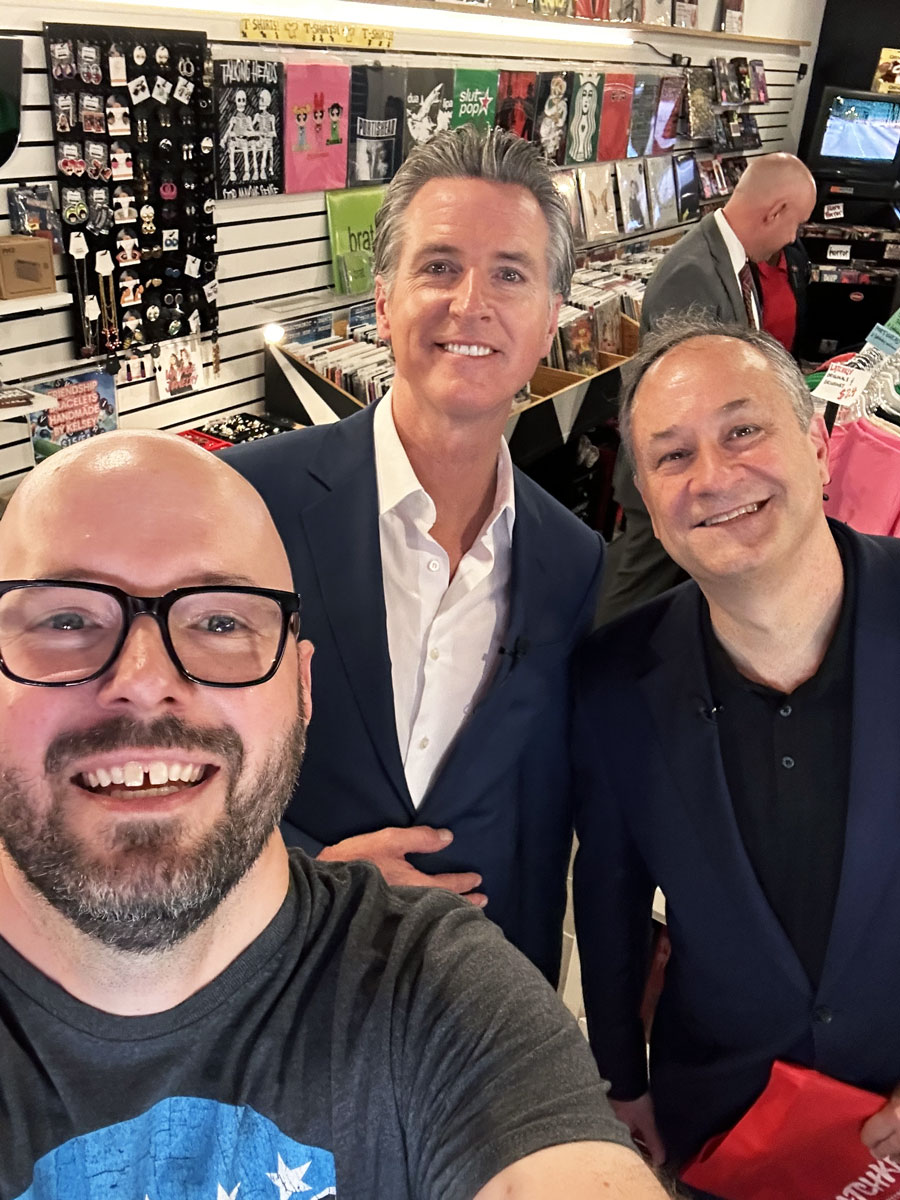
Exclusive: Doug Emhoff makes a pre-debate pitstop at my boyfriend’s Philadelphia record store

It was just a joke. A couple of weeks ago, I laughed with my boyfriend that he has a vested reason to hope for a Kamala Harris victory in November, noting that the vice president and her running mate, Gov. Tim Walz of Minnesota, are "both big vinyl heads." Harris likes to visit record stores around the country and Walz geeks out about turntables on social media. And my partner, Marc Faletti, owns a record store called Latchkey in Philadelphia. "Having the leaders of the free world talk up the joys of collecting records would be a boon to your business," I said to him, only half-kidding.

"Wouldn't it be wild," I added, "If the campaign had a stop at your store?"

"We had a great conversation about whether 'dad rock' or 'yacht rock' are insulting terms for the genre or not."

We live in a swing state in a city only a stone's throw from Harris campaign headquarters after all. Plus, his South Philly store would be a perfect stop for the joy-themed Harris-Walz campaign, since the atmosphere is chill and inviting, as opposed to the "High Fidelity" stereotype of the judgemental record store clerk. So of course I thought that he was pulling my leg Tuesday afternoon when he texted me that the Secret Service had arrived at his store to set up for the imminent arrival of Harris' husband, Doug Emhoff. But, as surprised as I was, it made perfect sense. Harris was in town for the evening's debate against Donald Trump. Emhoff had been hitting all the stops around the city to campaign for his wife. 

Marc Faletti taking a selfie with Gavin Newsom and Doug Emhoff at Latchkey RecordsMarc Faletti taking a selfie with Gavin Newsom and Doug Emhoff at Latchkey Records (Photo by Marc Faletti)
Marc had no prior knowledge of the surprise visit. (Salon has no affiliation with the campaign event.) 

"Ben, my clerk, noticed a Secret Service guy casing the joint," Marc told me after Emhoff and his companion, Gov. Gavin Newsom, D-Calif., visited. "It turns out that a customer who had come in previously and was asking for a bunch of help was actually part of the campaign. She was scouting us to see if we were the type of shop that would be a good fit." Secret Service, Marc noted, even found a parking spot right in front of the store, "which in South Philly, as you know, never happens." 

Once inside, Emhoff and Newsom "asked a couple of questions about the shop, but mostly they just wanted to talk about music," Marc told me. "Doug wanted to see all of our New Wave," and picked up "Brotherhood" by New Order and the eponymous first album by the Stone Roses. 

"So Gavin Newsom might have helped us rearrange the shop a little."

The governor of California and possible future First Gentleman noticed that Latchkey has a genre section cheekily named "Soft/Dad/Yacht Rock." It's where artists like Robert Palmer, Billy Joel, and Hall & Oates are stashed, for those seeking a soundtrack for grilling on a Sunday afternoon while sipping Yuengling. 

"We had a great conversation about whether 'dad rock' or 'yacht rock' are insulting terms for the genre or not," Marc said. "The consensus is that it's slightly mystifying to the Gen Xers, but they didn't seem too frustrated by it … They were just surprised how many artists they like were in that category," he added, noting that there was an engaging debate over whether Eric Clapton counts as so-called dad rock rather than the standard classic rock.

"So Gavin Newsom might have helped us rearrange the shop a little."

Emhoff asked Marc about some of the store's bestsellers. "Doug immediately gravitated towards Chappell Roan and a couple of his younger staff encouraged that as a very good choice. So he went for it." Newsom grabbed a Miles Davis record after going straight to the jazz section. 

We need your help to stay independent

The outing is part of the larger history of Harris and Walz publicly sharing their love of vinyl records. Harris herself regularly makes a point of going to local record stores and gushing to nearby cameras about her purchases, such as this bobblehead of George Clinton. 

And Walz has proudly shown off his enthusiasm for the controversially named "dad rock" while hyping Electric Fetus in Minneapolis. (Which was also a favorite haunt of Prince before he passed away.) 

"People who love vinyl tend to pay attention to the little things," Marc said after Emhoff and Newsom left with their records. "It's a really good sign when you have people who aren't just interested in the surface level of things, but they go deep on the things that they love." 

"I want people who listen to vinyl in the White House," he said. "We need leaders who have that emotional connection to things they care about."

Beyoncé’s CMA snub comes as no surprise, but it’s still upsetting

When Beyoncé's country album dropped earlier this year, she said, "This ain’t a country album. This is a ‘Beyoncé’ album."

The pop diva made the distinction clear — that even if "Cowboy Carter" could be confided to a genre, it would still be a Beyoncé album. However, Beyoncé's individuality and genre-hopping skills have not bent the ear of the Country Music Awards. Despite the musician having the biggest country album of the year, she has been completely shut out from nominations for the 58th CMA Awards.

During "Cowboy Carter's" run, Beyoncé became the first Black woman to hit the No. 1 spot on the Billboard Country charts. It spent 22 weeks on the Billboard Top 200 and featured traditional white country stars like Dolly Parton and Willie Nelson, who both gave her more respect than the CMAs have managed to muster. 

While "Cowboy Carter" smashed records and even catapulted Black country collaborators like Shaboozey, who has been nominated for best new artist and single of the year for the song "A Bar Song (Tipsey)," the CMAs still did not nominate the industry veteran and pop music shaper. 

Unfortunately, this rejection from the traditional country music industry is one Beyoncé is familiar with. When she released "Texas Hold 'Em" earlier this year, a country music station in Oklahoma shut down a request from a fan to play the song. Only after an outcry from Beyoncé's BeyHive did the station relent and agree to play the new country single. According to the New York Times, the song itself faired well but "was given only limited promotion on country radio stations, where the industry often signals its preferences and choices."

However, the biggest rejection Beyoncé faced in the country music space was in 2016 after the performance of "Daddy Lessons" with the Chicks from the genre-bending album "Lemonade." The performance was eventually scrubbed from all of the CMAs' social media accounts after it was met with a cold reaction from audience members and conservative America.

That experience left a lasting impression on the musician — so she created "Cowboy Carter." Before the release of the album, Beyoncé said in a statement that "Cowboy Carter" was “born out of an experience that I had years ago where I did not feel welcomed . . . and it was very clear that I wasn’t. But, because of that experience, I did a deeper dive into the history of country music and studied our rich musical archive.”

In her album opener, "American Requiem," Beyoncé sang about this experience of alienation from the country world. She sang, "Used to say I spoke, 'Too country'/And the rejection came, said 'I wasn't country 'nough.'" 

We need your help to stay independent

Outside of the CMAs, fans and music critics await the 2024 Grammy Awards nominations where Beyoncé holds the historic title for most winning artist. However, the artist has been shut out of winning album of the year four times, including for her albums "Lemonade" and "Renaissance."

The singer's husband and rapper, Jay-Z called out the Grammys this year for its snub of Beyoncé in 2023 saying, "I don't want to embarrass this young lady, but she has more Grammys than anyone and never won album of the year. So even by your own metrics, that doesn't work."

In the song "Sweet Honey Buckin," Beyoncé mentioned the snub, singing "A-O-T-Y, I ain’t win (Let’s go) / I ain’t stung by them / Take that s**t on the chin / Come back and f**k up the pen."

Balancing act: Pregnancy and bipolar disorder

For five years, Clare Dolman took lithium to manage her bipolar disorder. The medicine kept her happy and well with few side effects, and she described it as a wonder drug. But when she began to plan for a pregnancy, her psychiatrist advised her to go off the medication to protect the fetus. This was 1988, and it was the standard guidance at the time.

While Dolman experienced some stresses during the pregnancy, her mood remained stable. But soon after giving birth, she began to experience mild hallucinations.

“I thought, yes, there's something wrong here,” she recalled. “But I had the insight still to see that I was getting ill, and my husband knew I was getting ill because he had seen me really bad.” She went on to spend five weeks in the hospital.

Bipolar disorder involves extreme fluctuations in mood and is classified into different types according to symptoms and severity. For women with the condition, pregnancy can be a fraught endeavor as they balance the health of their growing fetus with their own mental state. Many, like Dolman, stop taking the medications that keep them well — which can lead to a recurrence of symptoms — and some avoid pregnancy altogether.

Dolman went on to do a doctorate on the experiences of women with bipolar in pregnancy and became a mental health advocate. In the decades since her pregnancy, the field of bipolar research and recommendations for treatment of pregnant and breastfeeding women have evolved, but experts say the information has not percolated through to all clinicians. (Some major medical groups have guidelines on psychiatric medication use during pregnancy while others, like the American Psychiatric Association, do not.)

And questions on safety remain. All medications pass the placenta, and many will reach the brain of the fetus, said Veerle Bergink, director of Mount Sinai’s Women’s Mental Health Center in New York. “Have we made progress? Yes,” Bergink said. But, she added, more still needs to be done to make the decision-making process easier for patients. 

“I think it's partly due to the stigma around mental health. And it's partly due to what we expect of parents and women in our society."

The ideal approach for a woman wanting to start a family, experts say, is that she consult with her psychiatrist before trying to conceive. But treatment may be more complicated if a woman does not realize she is pregnant right away, requiring her to make decisions quickly.

Several psychiatrists told Undark that it is dangerous for women to come off medicines abruptly because it puts their mental health at risk. But a lot of women choose to stop taking their medication, said Tania Gergel, an honorary senior research fellow at University College London’s department of psychiatry and director of research for the charity Bipolar U.K., because of what she described as a golden notion of natural childbirth — a desire to put the child’s needs first — and caution about medicines’ potential impact.

Providers can get pulled into this dynamic too, even though pregnancy is known to be a time of increased risk to mental health, said Nancy Byatt, a perinatal psychiatrist and a professor at UMass Chan Medical School. “I think it's partly due to the stigma around mental health. And it's partly due to what we expect of parents and women in our society where we think, ‘They're going to ignore their needs, and they're going to take care of their baby.’”


Bipolar disorderaffects between 2 and 3 percent of the U.S. adult population, including about 4 million women. While there are several types of the disorder — the most common being bipolar I disorder, characterized by manic episodes, and bipolar II, which involves hypomania and a greater tendency towards depression — most patients are prescribed mood stabilizers or antipsychotics. (In severe cases, patients may undergo electroconvulsive therapy.)

For years, little was known about how these drugs affected fetal development. Medicines are rarely tested on pregnant individuals because of worries about harming the fetus. But recent studies reviewing the outcomes of births in Scandinavian national registries have dispelled some concerns. One study of children born in Denmark between 2008 and 2017, for example, showed that, after adjusting for confounding factors, antipsychotics during the first trimester did not increase the risk of congenital malformations. And brain imaging has shown that school-age children exposed to lithium in utero had no statistically significant differences from those who were not.

Still, the data are far from conclusive, and many clinicians see this field as particularly complex. “We can only ever be tentative in this area,” David Baldwin, a professor of psychiatry from the University of Southampton, told a meeting of psychiatrists in Edinburgh this summer. “The evidence is changing over time.”

For example, the medication Dolman was taking, lithium, had been linked with heart defects in 1974, but subsequent analyses added nuance: High doses during the first trimester increase the risk of heart malformations, but a low dose does not, and after the first trimester lithium is relatively safe, said Bergink, the corresponding author on a review of lithium in 2018.

And the evidence for safety on other bipolar drugs can be mixed. Take lamotrigine, for instance: In the early 2000s, animal trials indicated that it could increase conditions like cleft palate, but later studies found no such link, reassuring clinicians. More recently, though, a meta-analysis pointed to potential risks to cognitive development in babies whose mothers took the drug in pregnancy. This is “something we should look at and be concerned about,” said Baldwin.

“We can only ever be tentative in this area.”

Other drugs long suspected to be dangerous have had their toxicity definitively proven, yet surveys show they are still occasionally prescribed to women even during pregnancy. One version of valproate, marketed as Divalproex, is the second most common mood stabilizer used after diagnosis in the U.S. Valproate is often preferred to lithium because it’s safer for kidneys. Studies have found that 11 percent of children exposed to the drug in utero can develop congenital disorders, and up to 40 percent develop cognitive and behavioral disorders — outcomes that have led the British Medicines and Healthcare products Regulatory Agency to advise physicians against prescribing the drug to all new patients under the age of 55, regardless of whether or not they’re likely to become pregnant.

But in the U.S., prescription of sodium valproate to women of childbearing age remains relatively common, according to Almut Winterstein, a pharmacoepidemiologist at the University of Florida, who also advises the Food and Drug Administration and has chaired its Drug Safety and Risk Management Advisory Committee. A study she published with colleagues in May 2024 found that between 2005 and 2020, almost 70,000 women in the U.S. were prescribed the drug, with the most common prescriptions being for mood disorders. About 1 percent of the women became pregnant. Drug labels do not have a visual warning that would clearly alert pregnant women not to take the drug. “Obviously, my stance is there needs to be something done about this,” Winterstein told Undark.

Part of the problem is that programs set up by the FDA to highlight the risks and restrict the use of medications do not apply retrospectively to older medicines like sodium valproate, said Winterstein, who is developing a tool to assist the agency’s decision-making.

Meanwhile, some other mood stabilizers may interact with oral contraceptives and make them less effective. For example, Winterstein’s research found that the risk of conception in women on carbamazepine, which can cause birth defects, rises by 40 percent compared with other drugs that do not affect levels of contraceptives in the body.

Patients on such drugs should use an implant or IUD for contraception, Winterstein said, while sodium valproate should be dispensed only to women who can show a negative pregnancy test. “There needs to be more education, and it needs to be more explicit,” she said, citing the risk of cognitive defects. “That is huge, in my opinion, because it has such an incredible profound impact on a mother's life forever, potentially.”


Devika Bhushan was working in public health when she decided to have a child three years ago. The pediatrician, who was 35 at the time, had been taking lithium and Seroquel since her first bipolar episode when she was 23, and had been with her partner for almost two decades. “It was very much a wanted pregnancy,” she said. Because she was stable, her psychiatrist advised her to continue taking her medication but decrease the dosages.

Bhushan’s pregnancy went smoothly, and her daughter is now 2 years old. Still, her experience wasn’t without its challenges: Bhushan said some medical practitioners seemed to view her with mistrust, even though she was a trained physician. And research suggests this may be a common experience: Dolman’s work has highlighted the stigma women encounter in their interactions with health care providers.

Now an advocate for equity in health care, Bhushan said that knowledge gaps persist, and that primary physicians may give women outdated advice. In the U.S., where the number of perinatal psychiatrists is limited, she said, “many people don't have any access to perinatal expertise.”

To Byatt, maternal mental health is not a gap but a crevasse. A 2023 report conducted by the Policy Center for Maternal Mental Health found that 70 percent of U.S. counties lacked enough qualified mental health providers and psychiatrists to care for pregnant people and new mothers.

Byatt has attempted to address this chasm through setting up the Lifeline for Moms program and the Massachusetts Child Psychiatry Access Program for Moms, which has been rolled out across 30 states and assists patients, psychiatrists, and obstetricians alike. But overall, access to perinatal psychiatric care can be painfully slow, and for those with public insurance can take several months, Byatt said.

Meanwhile, perinatal care is not required in psychiatric training, and some psychiatrists still decline to treat pregnant women entirely, Byatt said. Obstetricians can end up facing psychiatrically complex patients, with no idea what to do. And social stigma may lead women and their clinicians to downplay mental health concerns, even though mental health and substance-use disorders are the leading cause of maternal deaths in the U.S.

“I think people get really pulled into thinking about the risks to the baby of the medication. And they don't think, ‘Well, [what] if the mom dies from suicide, or you know, infanticide happens because of postpartum psychosis,” Byatt added. “Not treating is not risk free.”


The choice whether to stay on medication during pregnancy remains highly personal, and it’s “definitely the most difficult decision we ask patients to make — thinking about pregnancy whether to stay on, to stop, to switch” their medications, said Ian Jones, a professor of psychiatry and clinical neurosciences at Cardiff University.

Women should not assume that their medications are unsafe in pregnancy, said Shari Lusskin, a clinical professor of psychiatry, obstetrics, gynecology, and reproductive science at the Icahn School of Medicine at Mount Sinai. “It is better to prevent relapse than treat relapse,” she said.

Still, in forums and discussion threads, women speak of choosing not to have children, concerned about managing their mental health along with a baby’s well-being. But Paola Dazzan, a professor of the neurobiology of psychosis at the Institute of Psychiatry, Psychology and Neuroscience at King’s College London, said her service has supported many women with bipolar disorder through the perinatal period, sometimes over the course of several pregnancies.

“Having the disorder in itself is definitely not a reason to avoid considering a pregnancy.”

“Anybody who has bipolar disorder and is worried and thinking about having a baby, talk to someone with experience in perinatal mental health,” she said. “Having the disorder in itself is definitely not a reason to avoid considering a pregnancy.”

Gergel has developed an advanced choice document, allowing pregnant people to express their wishes ahead of a manic or depressive episode. The idea, she explained, is that “even if they became so severely unwell that they had lost the capacity to consent to treatment, that their voice could still be heard, that their voice was still part of the decision-making process.”

Alessandra Torresani, a 37-year-old actress who lives with bipolar and is an ambassador for the National Alliance on Mental Illness, took a similar approach: After talking with her psychiatrist, she decided to come off lamotrigine during her pregnancy, since she felt the research about the drug’s long-term impact was not sufficiently clear. Before becoming pregnant, she spent six months tapering her meds, and told her family that if she had a relapse, she was willing to start taking the medication again. As it happened, she did relapse in her second trimester for a few weeks, but the symptoms resolved quickly on their own. She advises women in this position to talk to their doctors and do what works for them.

“I felt I had a very safe space, a safe group around me to watch me and protect me and monitor me, where I could make that decision,” she said. “That decision is not for everyone.”

Dolman had a second child less than two years after her first, and stayed off lithium again during that pregnancy, although she went back on the drug as soon as he was born and chose not to breastfeed. She was determined she would not have another postnatal relapse.

That was 30 years ago, and Dolman is now a grandmother. But no breakthrough medication has emerged, she said. Nor do doctors fully understand how hormones interact with the disorder, which she thinks warrants urgent study.

Medication in the perinatal period is still, she said, “very much a balancing act.”

This article was originally published on Undark. Read the original article.

Republicans forced to get creative as pro-Trump get-out-the-vote effort falls short

While swing state Republican officials, former Republican National Committee leaders and strategists are ringing alarm bells over the party's lackluster get-out-the-vote effort, some pro-Trump organizers suggest that the GOP ground game is successfully targeting voters at the margins.

In the spring, the conservative activist group Turning Point USA announced a plan to spend more than $100 million on a marquee “Chase the Vote” program, aimed at getting low-propensity Republican-leaning voters who might not have voted in 2020 or 2022 out to the polls.

However, the lofty goals set by the organization are meeting a more modest reality. According to Federal Elections Commission disclosures, Turning Point PAC has only raised about $2 million this cycle, with the bulk of their funding coming from the conservative Right for American organization, real estate developer Stephen Wynn and the Claremont Institute’s Thomas Klingenstein. 

The Turning Point PAC has also only spent about $1.1 million, a far cry from the $108 million Turning Point Action promised earlier this year. While the greater Turning Point organization may be deploying other resources via a 501(c)(4) nonprofit, a member admitted to Semafor that the organization has not met their fundraising and spending goals.

A spokesperson for Turning Point Action told Salon after publication that the PAC "never aimed to raise $108 million" and is unrelated to the "Chase the Vote" effort. 

"Chase the Vote is run through The 501c4 called Turning Point Action, and we have been extremely successful raising funds there," the spokesperson said. "We have raised tens of millions of dollars, enough to blanket two entire states with hundreds of full-time ballot chasers in each Wisconsin and Arizona, and we are staffing two additional congressional districts in Michigan and Nevada, plus we have additional staff in multiple other key states including Georgia and Pennsylvania. Regardless of the final amount raised, Chase the Vote has been a massive success and is poised to have a very impactful October and November."

Federal Election Commission records do not show any financial disclosures from Turning Point Action since 2022.

Turning Point’s failure to meet its fundraising and spending goals highlights broader issues with the get-out-the-vote tactics being deployed by the RNC and GOP-friendly groups in 2024. 

The plan from Republicans revolved around the efforts by the RNC and former President Donald Trump’s campaign to deploy their combined resources under the banner of “Trump Force 47.” The plan included mirroring some successful tactics deployed by Democrats, like partnering with local issue-focused organizations, as well as a neighbor-to-neighbor get-out-the-vote scheme, where more enthusiastic Republican voters recruit their less enthusiastic friends to make a plan to vote early, by mail or on election day.

However, it doesn't look like the GOP's direct efforts are on par with the Democrats’ program this year. In Georgia, for instance, the RNC said in an email it had recruited some 10,000 volunteers to help with get-out-the-vote efforts. Democrats, meanwhile, report having recruited upwards of 35,000 volunteers. Nationally, the RNC says that it has recruited some 100,000 volunteers, about one-quarter of the 400,000 volunteers Democrats say they’ve recruited to support Vice President Kamala Harris’ campaign. 

It’s notable too that the RNC’s “Protect the Vote” program, part of their “Election Integrity Department,” has absorbed some portion of the enthusiasm of the party’s faithful this year, despite the fact that the department’s legal teams and poll watching programs are unlikely to get voters to the polls.

In private, some Republican strategists have expressed concern that the get-out-the-vote plan isn’t going as well as they’d hoped. The Guardian also reports that some within the party regard the current hiring spree by the GOP and some of the committees supporting it may come too late in the cycle to make the difference.

We need your help to stay independent

However, there are signs that the constellation of pro-Republicans outside groups angling to get low-propensity conservative voters to the polls this year are meeting with success on the margins and that this might be all that it takes to win.

Cliff Maloney, the founder of the conservative Citizens Alliance organization, said that he sees the perceived messiness as a sign that the GOP is taking voter turnout efforts more seriously this year and that some of the Republicans griping over the apparent messiness of the efforts this year are used to a party that was behind the Democrats in terms of its ground game.

“Under [RNC Chair Michael] Whatley and under [co-chair] Lara Trump I’ve been extremely impressed,” Maloney said. “I’m extremely positive on the GOP now under new leadership and you’re going to have a lot of people from the old leadership who are unhappy.”

According to Maloney, the overarching goal of his organization and other outside groups working on get-out-the-vote efforts is not to reach parity with Democrats in terms of mail-in balloting but just to improve on where they were in 2020.

In Pennsylvania, for instance, Republicans accounted for 25% of mail-in ballot requests. Maloney says that, according to his organization’s models, Trump could win the state even if they only increase that number to 27%. Their goal is to get it to 33%.

To accomplish this, his “PA Chase” program has recruited 120 full-time ballot chasers who wouldn’t be reported as members of the RNC or the Trump campaign’s staff. They’re also working to improve the proportion of ballots Republicans return. In 2020 in Pennsylvania, Democrats returned 88% of ballots requested while Republicans returned just 79% of the ballots they requested.


Want a daily wrap-up of all the news and commentary Salon has to offer? Subscribe to our morning newsletter, Crash Course.


Behind the scenes, Maloney also said that his group maintains an FEC-compliant data-sharing agreement with the RNC. PA Chase, for instance, uses this data to maintain an app that helps their ballot chasers organize their efforts and contact voters.

“I think that Democrats have worked through the messiness for a long time, this is just the first time Republicans have done it,” Maloney said.

One organizer with Turning Point also indicated in a phone call that they see their efforts in Pennsylvania as a success and that the pro-Republican efforts have doubled the number of mail-in ballot requests from 2022. This would still only put total Republican mail-in ballot requests in line with the 2020 presidential election. In 2022, about 303,000 Republicans requested a mail-in ballot in Pennsylvania. In 2020, Republicans requested about 785,000 mail-in ballots in the Keystone State.

The same organizer indicated that the group was getting creative in an attempt to reach low-propensity voters describing one plan to get a single voter to recruit 100 other voters to make a plan to vote. Turning Point also says it’s been going after Amish residents in Pennsylvania with a culturally conservative message and by telling people that the state’s governor, Josh Shapiro, is cracking down on the sale of raw milk.

Other conservative activists like Scott Pressler, who founded the Early Vote Action PAC, have also highlighted the raw milk angle in Pennsylvania. Pressler’s Early Vote Action committee has raised about $512,000 this year.

When asked about the ground operations of Republican-leaning groups, a spokesperson for the Harris campaign expressed confidence in the Democrats’ efforts, highlighting Harris’s “New Way Forward” barnstorming tour, where Harris and Minnesota Governor Tim Walz are set to visit every media market in every battleground state in the days after the debate.

The Harris campaign also pointed to a recent memo from campaign chair Jen O’Malley Dillion, in which she said that the campaign has opened some 312 offices and hired 2,000 staffers across the battleground states and indicated that the campaign is not taking anything for granted.

Neither a Turning Point USA nor a spokesperson for the RNC immediately replied to a request for comment.


Editor's note: The headline for this article previously stated that Turning Point PAC was 99% short of its spending goals. It has been updated to reflect Turning Point Action's claims about the overall get-out-the-vote effort.

Taylor Swift receives backlash for friendship with Brittany Mahomes after Trump support

Taylor Swift is facing the music from her fans because of her friendship with Brittany Mahomes, who is being accused of supporting Donald Trump after eagle-eyed social media sleuths spotted that she liked a message posted on Instagram by the former president in August. 

On Sunday, Swift and Mahomes were seen warmly hugging at the U.S. Open Men's Final, which only served to fuel the controversy, with a mass of fans taking to social media to comment on how Swift often remains silent when it comes to political views which, apparently, includes the views of people she's frequently photographed with.

"I don’t expect a billionaire to lead the revolution or anything, I’m just confused as to why one would make a movie about standing up for what’s right at any cost only to literally never stand for anything again,” one fan wrote in a post to X, sharing a photo of Swift with Mahomes.

Following Mahomes' engagement with Trump's online presence last month, he made it worse for Swift's buddy by thanking her for her support, writing a post to Truth Social on Sept. 4 reading, "I want to thank beautiful Brittany Mahomes for so strongly defending me, and the fact that MAGA is the greatest and most powerful Political Movement in the History of our now Failing Country. With Crime and Illegal Immigration totally out of control, INFLATION Ravaging all Americans, and a World that is laughing at the stupidity of our hapless 'leaders,' it is nice to see someone who loves our Country, and wants to save it from DOOM. What a great couple – See you both at the Super Bowl!"

Mahomes, wife of Chiefs quarterback Patrick Mahomes, has kept her politics vague — as has her husband — who said to Time Magazine in April, "I don’t want to pressure anyone to vote for a certain president. I want people to use their voice, whoever they believe in. I want them to do the research."

This has become an issue with fans as Swift positions herself as a Democrat and, seemingly, is not pro-Trump, accusing him of "stoking the fires of white supremacy and racism" in 2020.

Four years ago, the pop star openly endorsed the Joe Biden and Kamala Harris ticket, but this election cycle, Swift has not endorsed any candidate just yet, straying from her vocal support for Democrats during Super Tuesday earlier this year.

Waffle House CEO Walt Ehmer dies at age 58, remembered as a “tireless advocate for public safety”

Walt Ehmer, the president and CEO of Waffle House, has died at age 58, the Atlanta Police Foundation announced on Sunday. The board of directors for Waffle House said in a statement that Ehmer died after battling a “long illness.”

“He will be greatly missed by his entire Waffle House family,” read the statement, per TODAY.com. “We will share more details in the coming days, including highlights of Walt’s 30+ year career at Waffle House. For now, we know all of you join us in extending our deepest condolences to Walt’s family. Please keep them in your thoughts and prayers during this difficult time.”

Ehmer first joined Waffle House in 1992. He became president of the company in 2002 and later added the titles CEO and chairman to his name, according to information from Georgia Tech University, his alma mater.

According to Scott Stump writing for TODAY, "Ehmer also served on the boards of Aaron’s, the Children’s Healthcare of Atlanta Foundation and the Metro Atlanta Chamber of Commerce, according to Georgia Tech." Additionally, he was a member of the board of trustees at the Atlanta Police Foundation.

“Walt was a dedicated leader, tireless advocate for public safety, and an unwavering supporter of our mission to build a safer, stronger Atlanta,” the foundation said in a Facebook post made Sept. 8. “His passion for community service and steadfast commitment to improving the lives of others will leave a lasting impact on all who had the privilege of knowing him. Our thoughts and prayers are with his family, friends, and colleagues during this difficult time. He will be greatly missed.”

Atlanta mayor Andre Dickens issued a statement mourning Ehmer’s passing: “I am saddened to learn of the passing of Walt Ehmer, the CEO of Waffle House and a proud Georgia Tech alumnus. His leadership, dedication and warmth touched the lives of many, both within the Waffle House family and beyond. He leaves behind a remarkable legacy.”

Trump lost millions on his former DC hotel years after he sold it, Forbes reports

Despite selling his hotel in Washington, DC, for $375 million in 2022, former President Donald Trump ended up losing millions of dollars on the property years after he sold it, according to a report this week from Forbes. 

In 2012, the Trump Organization won a bid to restore an old D.C. post office and turn it into a luxury hotel. The bid meant Trump was also committing to pay loans of over $250,000 a month to the General Service Agency (GSA) for the next 60 years.

After a $200 million renovation, the 263-room hotel opened in 2016 and quickly became a social hub for Republican politicians, diplomats and foreign governments. By 2020, at least 75% of the officials in Trump’s administration had been seen at the hotel, Forbes reported.

“Everyone hangs out there. Being in the Trump hotel’s lobby is a way to get people to know you,” a former Trump campaign adviser told Time magazine. 

Despite its popularity among the party faithful and foreign governments seeking to curry favor with the former president, Trump International Hotel brought in well below its expected revenue and was particularly hard hit during the pandemic. 

After unsuccessfully trying to sell the hotel for over $500 million, Trump finally sold the hotel to CGI Merchant Group, a Miami-based company, for $375 million in 2022. The company also assumed the lease from the GSA and took a $28 million loan from Trump himself, as well as a $285 loan from the merchant bank BDT & MSD Partners, to finance its new investment. Trump pocketed $127 million from the sale.

Though the hotel's name and clientele changed under new ownership (it was renamed the Waldorf Astoria and has since hosted prominent Democratic groups), its profitability or lack thereof did not. Last summer, CGI Merchant Group missed a loan payment for the first time, leading to BDT & MSD initiating foreclosure proceedings. 

Trump consequently lost all of the $28 million he loaned to CGI Merchant Group.

BDT&MST eventually bought the hotel for $100 million. The group was the sole bidder for the property.

Indigenous groups design California’s newest marine sanctuary where offshore oil drilling is banned

President Biden's administration announced on Friday that it has selected more than 100 miles of boundaries to encompass a new protected marine sanctuary along the California coast. The so-called Chumash Heritage National Marine Sanctuary will be the first national marine sanctuary ever proposed by an Indigenous tribe.

“This is a huge moment for the Chumash People and all who have tirelessly supported our campaign over the years,” Violet Sage Walker, chairwoman of the tribal council, told Mercury News on Friday. It will be California’s first new national marine sanctuary in 32 years and will also ban offshore oil drilling in the area.

As decided by the National Oceanic and Atmospheric Administration (NOAA), the proposed Chumash Heritage National Marine Sanctuary will cover 116 miles of coastline from just south of Diablo Canyon Power Plant in San Luis Obispo County to the Gaviota Coast in Santa Barbara County. The proposed sanctuary will protect over 200 shipwrecks, along with a diverse ecosystem featuring wildlife such as sea otters, humpback whales, leatherback sea turtles and lush kelp forests. While on many previous occasions decisions about natural preservation were made by disconnected bureaucracies, the NOAA worked closely with Native American communities in designating these new boundaries.

"NOAA staff have held meetings with cooperating agencies for this action and considered their input on the draft [environmental impact statement]," the NOAA explained in Volume I of its impact statement. "NOAA has also held formal government-to-government consultation meetings with the Santa Ynez Band of the Chumash Indians and has held informational and coordination meetings with other interested non-federally recognized Chumash and Salinan Indigenous groups."

“Every single family has been touched by this”: “#Untruth” director Dan Partland diagnoses Trumpism

Dan Partland ended our recent conversation by referencing the paradox of tolerance: To maintain a tolerant society, it holds, tolerant citizens must retain the right to not tolerate intolerance.

“So how does that work?” he mused. “It's a puzzle. I definitely think it doesn't help to shut people out. I also think it doesn't help to not acknowledge the moral failing. It’s tough.”

Nevertheless, the director of "#Untruth: The Psychology of Trumpism" believes Trumpism only ends when people who stand against it figure out some way to grant those under its spell some grace and forgiveness. This, more than other maladies hanging over from whatever happens in November, might be one of the most arduous undertakings of a generation. 

Even now Donald Trump is promising retribution on his perceived enemies if he’s re-elected, assuring his followers assembled in Wisconsin on Saturday that getting undocumented immigrants out of Colorado “will be a bloody story.” 

Such frightening statements and the behavior accompanying them moved Partland to make “#Unfit: The Psychology of Donald Trump,” allowing progressives to trauma bond in August of 2020. “#Untruth” takes on the harder puzzle of explaining why his followers continue to be drawn to him despite his penchant for spewing dangerous xenophobic, sexist and bigoted rhetoric. People are clearly invested in getting some answers. A week after its release, it is the #1 ranked documentary on Apple TV.

As Election Day 2024 draws nearer, many have been moved to reference anew Adam Serwer’s 2018 essay in The Atlantic — the title of which matches its conclusion: “The cruelty is the point.”

“It is not just that the perpetrators of this cruelty enjoy it; it is that they enjoy it with one another,” Serwer wrote. “Their shared laughter at the suffering of others is an adhesive that binds them to one another, and to Trump.”

Through “#Untruth,” Partland endeavors to explain the reasons such malice has taken hold of America’s body politic through interviews with psychologists, historians and sociologists — along with politicians and other government figures who either witnessed its manufacture firsthand or were immersed in it. 

Former Trump White House aide Anthony Scaramucci recurs here, only now joined by former RNC chairman Michael Steele and former Republican congressman and Tea Party activist Joe Walsh.

Partland credits Walsh for being uncommonly clear in articulating the grievance driving the MAGA movement.  “That's a really essential thing to include,” the director says, “because every single family has been touched by this. Everyone is affected by it. And dismissing it as an anomaly isn't a very valuable stance. I think that we have to really engage and understand and have some compassion for these emotions and offer better solutions than what Trump is offering.”

In our conversation, we discussed why Partland believed “#Untruth” is a necessary follow-up to "#Unfit" and the value documentaries like this one may have in helping Americans to someday dismantle the apparatus that keeps Trumpism alive.

The following interview has been edited for length and clarity.

Let's go back to #Unfit for a moment. There was a lot of noise around its release in 2020, and justifiably so. Did you suspect you would be making . . . I don’t know, would you call #Untruth a sequel? Did you think that you would be making this afterward?

It is certainly kind of a sequel. And no, of course not. We could only see as far as the 2020 election, that Trump would either be reelected or he would be defeated, and if he were defeated, then that would be the end of that. We didn't give sufficient weight to the fact that even in the four-year period since, he really was able to remake American politics — really able to remake the Republican Party — in his own image, and in a way that has proved really enduring. There's really no analog to someone who has led the party to so many successive electoral defeats — from the 2018 midterms to the last presidential, to the next midterm and a myriad of special elections in between — continuing to enjoy so much power in that political party.

When did you decide that #Untruth was necessary?

I think it started to become clear pretty early on, you know? I mean, something was clear on January 6, [2021] that Trump was not going to go gently into that good night. He was going to hang around and he was going to continue to be an influence. I think there was a brief moment on January 7th, 8th, 9th, or whenever — until Kevin McCarthy went down to Mar-a-Lago — where it seemed like the Republican party might cast him off. But at the point that he was brought back into the fold, we started seeing that there was a larger picture.

You have to go back to the genesis of the first film, during the Trump era. We were all consuming so much news, and every day, there was just a tremendous amount that was happening. The coverage is bouncing around from one scandal to the next. But despite this voracious appetite for consuming news, I felt like I was not getting any more insight.

So right from the genesis of that project, the whole idea was to try to take a step back and see if there was another perspective that daily news coverage wasn't well equipped to share. And what became clear on #Unfit was that there was this whole other story that started from Trump's personal psychology.

"Part of the phenomenon of Trumpism is it's just so, so hard for people to break with their political alliances," Partland said.

When you're living in an autocratic society, the personality ticks of the leader end up reverberating outward. Here, every different facet of his personality was being inserted into policy and the mechanics of the government. And so you had to follow that.

But what we weren't seeing was that there's a larger trend going on, which is the psychology of authoritarianism in general. Why are people drawn to this man at this time? Because there have always been characters like Trump: would be strong men who present the world with easy answers that speak effectively to people's emotional concerns, without having a thoughtful analysis of how to solve the problem itself.  

. . . Now the issue isn't really Trump so much. What we really have to think about is what's going on in our culture, with American society, although it's happening all over the world. Why at this point in human history is the momentum of a pluralistic Western democracy lost? Why is democracy back on its heels? People around the world are preferring authoritarian figures to take over and make decisions for them that are, frankly, disenfranchising people.

#Untruth joins this sort of library of documentaries that break down Trumpism in very succinct, easy-to-digest ways. And yet I also feel as if the low-information voter, the kind of person you'd want to put this in front of, would not tune in to it. I ask this of a lot of documentary filmmakers: Who is this for?

People ask this question all the time, it's a really good one. I think that I've thought about it differently. On the way into #Unfit, I was very focused on a specific profile of voter, of the audience, which was people who were smart and politically engaged, who were maybe politically conservative, who really didn't like Trump because he wasn't really a conservative, but they liked Republican politics so much that they felt like they would vote for him anyway. That was the target in my mind and as a political activist. That was what fascinated me: I couldn't understand how you could see so much of this and still feel like, “Yeah, but I'm going to vote for that guy.”

So the goal of that film was to say to that particular voter, “Really? Do you see this? Really?” . . . I suspect these films speak to the very few people who are maybe teetering. The message can land with them. Their greater impact is about activating everyone else.

It's a question of making a powerful and succinct argument and reducing the chaos to something that's a little bit more actionable, a little easier to hold on to . . . the idea of these films is to reach some people on the margins, but more important is to give language and focus to how we talk about these things, and hope that reverberates out in other media and conversations, at family dinner tables and everywhere else.

Some of what the film distills is the fact that there are so many venues disseminating disinformation, whether the actors are Russian or others, and that all of it is tied to authoritarianism’s rise. But it can be difficult to talk about. I know this firsthand, from trying to explain the mechanics of Russia’s disinformation campaign based on what Alex Gibney had to say in “Agents of Chaos.” And I found myself saying to people, “I know this sounds crazy, but this is happening, this is real.”

So as a filmmaker, how do you take these concepts that seem almost fantastical if they weren't happening, and put them into a framework that makes sense of the truth behind the disinformation?

Well yes, they are hard things to talk about.

One of the things that a film like this really can do is it can put that concise argument down together, right beside the evidence. So the construction of the film really is to hear the ideas from the experts and then see the evidence. Hear the idea, see the evidence. And the evidence is plentiful.

We need your help to stay independent

We're in a media-dense universe. And you can illustrate these points. It's not difficult to do when you're, you know, when you're on the right theory.

There's a question you're not asking about what was really complicated in the film to do, and I'm not even sure the film was successful in doing it, but talking about the ways in which disinformation and authoritarianism go together, and conspiracism as an outgrowth of both of those. That was a complicated, multi-faceted point to make, that the miasma of disinformation and distrust of the government and a profit-driven news media that benefits from making us angry, isn't really held at all to account for its own truthfulness.

And that is the sort of dark cloud that's hanging over this political moment in human history: people have really lost their bearings about what is true, what is right and wrong.

The culture is complicated to understand, and so we're going to trust people who are brands. And Trump is a brand. There are other news brands, and we're going to trust whatever comes from those sources because it's too hard to figure this out on our own. That’s fine if those sources are good, but in general, we’re in a really polluted information space that is full of a lot of bad information.

And people are just tired. They're tired of having it be their responsibility to figure out what's true, and so they start to just go with an emotional connection to an idea, to think, “That must be the true one.”

Do you feel like a film like this could help to break the MAGA spell by helping people identify and understand the root causes that led to its rise?

I certainly hope so. But I think we should be realistic about how many people are truly reachable. But I think that is what these films can do, is they can put a lot of pieces together in a cogent and concentrated way that can be very impactful, and kind of connect some dots for people.

That can work for people who are just looking for insight into the phenomenon of Trumpism, but it can also work for people in its thrall if you can get them to really watch it on the level. But I think there's so much defensiveness there that’s very, very hard to break through. So I think we should be realistic.

Prior to the movie’s release you, along with the rest of of us, got the surprising news of the change at the top of the Democratic ticket, which shifted everything about this presidential race. What was that like for you as a filmmaker knowing this movie was going to be coming out?

"I suspect these films speak to the very few people who are maybe teetering. The message can land with them. Their greater impact is about activating everyone else," Partland said.

The film was fully delivered, mastered, and at the platforms before Joe Biden dropped out of the race, just to be clear. But we had always approached it that this was not going to advocate for any particular candidate and that it was going to be a broader message that would work pretty much no matter who ended up in the presidential race.

That included, by the way, when we started making #Untruth. What was clear was that Trumpism was still going to be active and an important factor in our politics. It wasn't clear that Trump was going to get the nomination.

At a certain point, we did say, “You know what? It is pretty clear that it's going to be Trump and Biden, and maybe we can use more clips that give that context to the film.” And then, even before the debate, we started to wonder if Biden was going to make it all the way. And we changed exactly just one line in the film.

Which line is that?

Well, the majority of the line is still there. There’s a part where Joe Walsh says, “You know, we're not going to get out of this thing tomorrow. We're not going to get out of this thing in 2024 and so until we're out of it, my message is simple: I'm voting for the one candidate who can stop Donald Trump from being reelected. The piece that we dropped was he said, “Until then, I'm on Team Biden.”  That was too partisan anyway. So the substance, the intention of what he's saying is the same either way.


Want a daily wrap-up of all the news and commentary Salon has to offer? Subscribe to our morning newsletter, Crash Course.


I think people might be . . . is the word fascinated? . . . to see this after a Democratic convention where Michael Steele and other prominent voices from establishment Republican circles came out and spoke on behalf of Kamala Harris.

There should have been more. Part of the phenomenon of Trumpism is it's just so, so hard for people to break with their political alliances. That's not even a Trumpist thing. It's part of the shape of American society that these teams are left and right, Democrat and Republican. Progressives, liberals and conservatives — whatever you want to call them — these teams have become so, so important to our identity. Liz Cheney just endorsed Kamala, Harris, but why didn't she speak at the convention?

I don't have the exact figure, but much of Trump's former cabinet and former top White House staff said they would not endorse him. Why weren't they speaking at the DNC and amplifying their message? Most of them wrote books. Some of them have given interviews. Some of them stayed surprisingly quiet. But I think that the way American politics is right now, it's so dangerous for a conservative to speak out against Trump. And that really is the fascistic flavor of this movement. The cruelty is the point: “We are going to make it so miserable for people to dissent.”

If there's an action item that anybody can take away after watching this movie, what would it be?

There are a couple of things, I would say. I think it's important to understand and take seriously the frustrations, the grievance, and the anxiety that has, in my opinion, led to Trump's rise. The world has always been a scary place, but we live in an age of uncommon anxiety: the financial instabilities, impending climate apocalypse, and for a period with Kim Jong Un, the threat of nuclear catastrophe.

Authoritarians are salve to that. It can feel very reassuring to choose a guy who feels like he understands all those things that frustrate us and has simple authoritative fixes to it. I think it's important to understand all that and not judge it.

That doesn't mean we should fall into a moral equivalency. There isn’t a “both sides” thing there. There's no question that the MAGA movement is fundamentally failing the moral test of a pluralistic democracy, and January 6 is the ultimate manifestation of that. They absolutely understood that they did not win the election, but they didn't care because they wanted to take power, even if it was not the choice, not the will of their countrymen. So I think we shouldn't beg off the responsibility to understand it. We have to find a way to do that without creating a false equivalency that everybody has a good point.

And I think we shouldn't give up on the people in our lives who have fallen into the thrall of this kind of thinking. I think we have to be persistent. It does the world no good to write them off or isolate them, but continue to meet them with compassion in the hopes of bringing them back in.

"#Untruth: The Psychology of Trumpism" is available to buy or rent from Apple TV and other on-demand platforms.

Trump accuser Jessica Leeds responds to his “bizarre” claim that she wasn’t “the chosen one”

Jessica Leeds, who has accused Donald Trump of sexually assaulting her on an airplane, said she was baffled by the former president's "bizarre" claim that he would not have "chosen" her to be his victim.

At a press conference on Friday, the former president, who has already been found liable for sexually assaulting writer E. Jean Carroll, denied ever assaulting Leeds, claiming that he wasn’t attractive enough.

“She would not have been the chosen one,” Trump told reporters.

Leeds, who held her own press conference on Monday in front of Trump Tower, said she “laughed out loud” when she heard Trump’s remarks, adding that his word choice was “really bizarre.” She also called the Republican nominee a "sexual predator" and warned of his danger to women.

"He assaulted me 50 years ago and he continues to attack me today," Leeds said. "It's a little spooky and a little difficult to process. He does seem to be kind of obsessed. But here I am."

Leeds first came forward with her accusation against Trump in 2016, one of the first women to do so during his first presidential campaign. According to Leeds, she was sitting beside Trump on a plane in 1979 when he reached over and began groping her.

“He was like an octopus. His hands were everywhere,” she told The New York Times in 2016. 

The 82-year-old gave further detail when she testified in Trump’s sexual abuse and defamation trial brought by Carroll last spring. "He was grabbing my breasts. It's like he had 40 zillion hands, and it was a tussling match between the two of us,” Leeds testified. The jury found Trump liable for defamation. 

Trump campaign spokesperson Steven Cheung told CNN that Leed’s “fable” was  “only meant to interfere in the election,” once again denying that Trump ever assaulted Leeds.

Leeds is still deciding whether to pursue legal action against Trump, she told CNN’s Anderson Cooper on Monday. She added that she wanted to remind voters of Trump’s “disrespect for women” ahead of November’s presidential election. 

“I was not the first, of course I was not the last. But there have been enough so that he doesn’t remember,” Leeds told Cooper.

How a 220-year old company was inspired to pivot in order to make “soy sauce for hippies”

In many instances, soy sauce (or tamari) is an afterthought. Oftentimes sitting in a nondescript bottle on tables at sushi bars and Japanese restaurants, or sometimes kept in your refrigerator for drizzling over rice or adding to a stir-fry, the ubiquitous condiment is one that can most definitely be considered an unsung hero of the culinary world.

For those whose livelihood is defined by soy, though, that couldn't be any further from the truth.

San-J, which is celebrating its 220th anniversary this weekend (yes, you read that number correctly), has been in the soy and tamari business since the early 1800s, based in Japan. In the 1970s, the company opened a U.S. office. 

President Takashi Sato, part of the founding family, is now at the helm, bridging the traditional Japanese origins of San-J with modern uses for the umami-laced ingredient (soy sauce caramel ice cream topping? Yes, please!) As he puts it, "As a child, soy sauce was so familiar to me that I didn't think it was anything special. But today, it’s my life."

Salon Food was able to speak with Sato about the foundations of the company, how it was inspired by Benihana, what differs soy and tamari, the brewing process, a conference called Kojicon and more

The following emailed interview has been lightly edited for clarity and length.

Can you talk a bit about the history of San-J? A 220-year anniversary is astonishing!

Since our inception in 1804, we have been manufacturing miso and tamari mainly in the Chubu region (central region of Japan). In 1978, we established a sales office in the United States due to the efforts of my father. Usually, it is the first-born son who takes over the family business. Since he was the second son, he joined Toyota to make a living on his own and was in charge of overseas sales. He often visited the U.S. on business and took American customers out to dinner – particularly to Benihana, whose founder Rocky Aoki was a high school classmate of his.

As you know, Benihana grills meat and shrimp on a griddle, using soy sauce as a seasoning. In the 70s, when soy sauce was not used for anything other than sushi, there were many Americans who were impressed by how delicious this other application was. Seeing this, my father thought “it’s fun to sell Toyota cars, but it would be even more exciting to sell soy sauce in the United States”. So he left Toyota and opened a soy sauce import and sales office in the U.S.

This is the beginning of our business. In that sense, Benihana is a benefactor. I was able to connect with Rocky Aoki's daughter, (actress and supermodel) Devon Aoki, and we exchanged DMs after I posted a story about my father and Rocky Aoki on my Instagram. I even got a video message from his son (DJ and electronic dance music record producer) Steve Aoki. They are celebrities, but very polite and nice, and I felt their love and respect for their father (Mr. Rocky Aoki) through our conversation.

At the time that we started importing and selling, Kikkoman already had the top share in the United States. How should we differentiate ourselves from them? That's when my father met the hippies. It was the 70s, so hippies were still very active. They practiced a way of living according to the laws of nature as much as possible.

Impressed by their way of thinking, my father began to make "soy sauce for hippies"  – an organic soy sauce with no additives. At that time, soy sauce without chemical preservatives was very rare, and my father was able to fill this gap in the market. The natural food industry has a strong hippie influence – for example, Whole Foods head office is in Austin TX which is a hippie town. Wild Oats, which was the second in the industry (and later acquired by Whole Foods), was in Boulder in Colorado, also a hippie town.

After that, sales volume increased steadily, so we built a factory in Virginia in 1987, where we are today.

I know that you're an 8th-generation soy sauce brewer, which is so incredible. Can you speak a bit to that? 

As a child, soy sauce was so familiar to me that I didn't think it was anything special. But today, it’s my life. It’s an honor to continue the legacy of my family and uphold authentic Japanese fermentation traditions while also exploring modern innovations and techniques.

How exactly do soy and tamari differ? 

The most significant difference is the raw materials. In general, typical soy sauce is made with 50% soybeans and 50% wheat, while most tamari is made from 100% soybeans. Since soybeans contain more protein than wheat (40% protein in soybeans and 10% in wheat), this soybean-only tamari contains a lot of protein-derived amino acids, resulting in a rich (or full-bodied) taste with a lot of umami.

In addition, the amount of water added is much smaller. Typical brewed soy sauce adds 1.3 times more water than solid ingredients (soybeans and wheat), but for SAN-J’s Organic Tamari, we add only 0.9 times more water than solid ingredients (soybeans) creating a very rich taste.

We only use high-quality soybeans and do not dilute them as much, which results in a premium Tamari that is superior to typical soy sauce.

It's said that San-J's artisanal fermentation dates back to 1804. How is it still the same? How has modern equipment changed the process?

The basic concept is the same. However, we continue to make changes every year to improve the process.

The size of our equipment, such as tanks and steaming kettles, has been increased so that large quantities can be made. It is manufactured in a cleaner environment and is designed to prevent bacteria from entering, which is not desirable for tamari brewing. It’s designed to have precise control over the temperature and humidity in order to achieve the best quality.

Moreover, we prioritize the safety of our employees, and continue to make changes that make the environment as safe as possible.

How is the manufacturing process for low-sodium soy different from traditional soy? 

The production is brewed in the traditional way as in the old days, but only the salt is removed at the end. Since the molecular weight of salt is very small, we use a special membrane that filters it through very small holes that allows only these molecules to pass through. If you remove the salt from the beginning, it will spoil during the fermentation period, so it must be done at the end.

Of course, gluten is a major component of soy sauce, but San-J has been producing wheat-free tamari for over 200 years. What initially caused brewers to want to start experimenting with wheat-free soy?

In fact, the order is opposite. The origin of Japanese soy sauce is miso that came from China, but this miso was made only from soybeans. When making this paste-like miso, the liquid that accumulated on the surface of the miso paste by adding too much water began to be sold as a liquid seasoning, which is the beginning of Japanese soy sauce. The word "tamari" itself is "liquid that has accumulated on the surface of miso".

Since it was born as a by-product of miso made from soybeans, the original ingredient was only soybeans. In the process of tamari being spread to various parts of Japan, wheat also came to be used. Therefore, tamari made with only soybeans was first distributed, and wheat was added later.

Why did wheat come to be used? There are several reasons: Wheat is cheaper; Wheat has a high sugar content, so fermentation occurs quickly, which shortens the production period; [And] wheat has a high sugar content, so alcoholic fermentation is also active, and the aroma becomes stronger. In the past, sushi restaurants were not equipped with refrigeration facilities when eating sushi, so there were many fish that were slightly rotten. Therefore, soy sauce with a strong aroma was preferred to mask the fishy odor.

San-J tamari spreadSan-J Tamari Splash (Photo courtesy of San-J)
I would love to hear an abridged history of soy/tamari, as well as what led to your family originally becoming involved in the practice? 

Originally, my family was a shipping wholesaler. They used many boats to run a logistics business in the rivers flowing through the Nobi Plain(濃尾平野).

However, one day, they were ordered by a lord in the region at the time to go ashore and make soy sauce. The lord was trying to revitalize the economy by making processed products using soybeans and selling the processed products outside the domain.

The Sato family was chosen for the following reason. Soy sauce and sake were often provided by local notables. Not only did they have a large amount of land to build a factory, but in the case of products with a long manufacturing period, cash was spent from the purchase of raw materials [to] manufacturing [to] sales to the collection of payment. Therefore, only families that not only had land, but also had sufficient funds, could do this business.

The logo of our founding company is a three-line overlapping flag, which represents the three rivers — Ibi River, Kiso River, and Nagara River — from when we were a shipping wholesaler, and we used to hang the flag on the top of the boat. Even after we came ashore as a soy sauce maker, we continued to use that mark as the logo.


Want more great food writing and recipes? Subscribe to Salon Food's newsletter, The Bite.


I know that San-J doesn't sell non-brewed soy. What does that mean? 

We do not make any non-brewed soy sauce. Our Tamari Soy Sauce is all brewed. Tamari is our signature product, made with 100% soy and no wheat. We also make Shoyu, which is also categorized as “koikuchi” soy sauce/typical soy sauce which is made with 50% soy and 50% wheat. Shoyu means “soy sauce” in Japanese but when people say “shoyu” in Japan, it typically refers to “koikuchi” soy sauce.

In addition, we produce a product called No Soy Tamari. This is made from peas instead of soybeans so that people with soy allergies can enjoy it. By utilizing our many years of fermentation technology and experience, we can make the same delicious soy sauce with various ingredients.

Can you explain a bit about Kojicon? 

Kojicon is an abbreviation for Koji Conference. Koji is the name of mold, a unique mold that exists only in Japan, and as a result, Japan fermentation is unique.

Fermentation using this Koji is attracting attention around the world. For example, Noma, a restaurant in Denmark, has been ranked first in the World Best 50 Restaurants for the past five years and has three Michelin stars. They became famous for using Koji in Danish cuisine.

The number of people in Europe and the United States who are interested in Koji is increasing, but there is still not enough information. Therefore, experts have come together to launch information sessions on fermentation using Koji – a.k.a. Kojicon. The original proponent was a man named Rich Shih, who wrote a book called "Koji Alchemy."

I have been invited to give lectures at Kojicon three times in the past. Although Koji itself is a fungus in Japan, there are very few Japanese people who talk about it at overseas conferences like this. Even here at Kojicon, the majority of people are non-Japanese. This is a good thing, but there is still a lot of knowledge about Koji in Japan to be shared, so I would like to contribute to the development of Koji culture overseas by actively sharing it stateside.

We need your help to stay independent

I'm obsessed with all things salty-sweet, so the idea of the soy sauce caramel ice cream topping is right up my alley. Tell me a bit about how that came to be?

Sweet and salty combinations are known to create layers of flavor which many people find delicious. During soy sauce fermentation, soy protein is broken down into amino acids, creating a balanced flavor with saltiness, sweetness, sourness, bitterness, and umami.  SAN-J Tamari has over 30% more umami than typical brewed soy sauce. Tamari gives the sauce not only saltiness, but richness and complexity. 

What differs traditional tamari from tamari splash? 

Tamari is a basic seasoning. Use our Tamari if you’d like to enjoy flavors of quality Tamari itself, or use it in cooking to enhance flavors of other ingredients.

Tamari Splash is a flavored-Tamari. We added distinct flavors to our signature Tamari to create a unique, tasty sauce.

Another difference is how you use the sauce. Tamari Splash is designed to be used in more casual ways without cooking involved. You can splash on these flavors like you do with ketchup or mustard onto the foods you already enjoy.

Watermelon Poke BowlWatermelon Poke Bowl (Photo courtesy of San-J)

What are your favorite soy-based recipes? 

It's very simple, but I love to eat steak with soy sauce and a little wasabi. Soy sauce goes well with a variety of meals other than Japanese food.

What is your favorite cooking memory involving soy or tamari?

As a brewer, I spend so much time with the production that cooking gets away from me. However, I love to hear stories from our staff. For example, a team member shared with me that they made “harumaki” a Japanese-styled fried spring roll, served with a tamari & mustard dipping sauce at a Thanksgiving dinner with her husband’s family. They loved it so much and it has become a holiday tradition since then.

How do you practice sustainability?

There are various approaches. Fermentation, which is the basis of soy sauce production, is a technology that controls spoilage. Therefore, this technology can be used to reuse things that would otherwise be thrown away.

Take the Pumpkin Challenge, for example. In this country, pumpkins are decorated on Halloween. When Halloween is over, they are thrown away. That's a shame. There are other ways to enjoy pumpkins – for example, if you decompose it with koji mold, it creates a delicious pumpkin amazake, a Japanese fermented sweet rice drink. After having fun on Halloween, I make an amazake using the pumpkin and drink it while thanking the pumpkin for decorating my house for a month. When I mentioned this on my Instagram, many people tried it and posted it.

We use unexpected ingredients and combine our technologies to create different kinds of soy sauces. I’ve experimented with grapes, seaweed, corn, black beans, and more. For example, the following is a Corn Soy Sauce and Black Bean Tamari developed in collaboration with the infamous Eleven Madison Park in New York.

“This machine sues fascists”: Jack and Meg White sue Donald Trump for use of White Stripes song

Jack and Meg White are not backing down from a legal fight with Donald Trump.

The formerly married duo, who recorded and toured together as The White Stripes, are suing Trump for using one of the band's most famous songs — "Seven Nation Army," off of "Elephant," their fourth studio album, released in 2003 — alleging in their claim that Trump's use of their music in a campaign video was a "flagrant misappropriation."

The copyright infringement lawsuit filed Monday in New York furthers that the Trump campaign did not contact the band for permission to use the song. The White Stripes are seeking "significant monetary damages." 

Trump's attorney said in an email that the defendant has not been served with the papers. The Trump campaign did not respond to requests to comment, The Guardian reported.

To address the lawsuit, Jack took to Instagram to show proof of their filing, with a caption reading, "This machine sues fascists."

https://www.instagram.com/p/C_tXSPEp678/

The White Stripes' beef with Trump began last month when Deputy Director of Communications Margo Martin posted a video on social media of the former president walking into his plane to the song “Seven Nation Army." White then took to Instagram and said, "Oh . . . Don't even think about using my music, you fascists. Lawsuit coming from my lawyers about this (to add to your 5 thousand others.)" And he meant it.

The White Stripes aren't the only musicians pursuing legal action against Trump for using their music this year. The growing list includes Beyoncé, Celine DionFoo Fighters, Isaac Hayes and counting.