Spring Offer: Get 1 Year, Save 58%

“House of the Dragon” shows the unfair burden placed on grieving women

When dragons go to war, everything burns. But who bears the emotional cost of the conflagration?

The second season of “House of the Dragon” presents us with a clear answer: In Westeros, a kingdom steeped in gender normativity, the female figures in Houses Green and Black are made to shoulder the weight of grief most acutely. 

Their burdens will be doubled.

This season, with a knife at her throat, Queen Helaena (Phia Saban) is forced to identify her son Jaehaerys' (Jude Rock) to an assassin who lops his head off as retribution for the death of the enemy family's high-ranking son, Lucerys (Elliot Grihault). Helaena has suffered a devastating loss and is left traumatized by the ordeal, and her mother the Dowager Queen Alicent (Olivia Cooke) laments the situation.

“The child is dead. His pain is ended. But what they’ve done to my girl –” Alicent blubbers, her typically stoic facade faltering. “And what if the hand that’s done it is not who must be blamed? The gods punish us. They punish me.”

That punishment hasn't ended, for her or for her daughter. In fact, their burdens will be doubled.

Seeking to splinter public support for the “pretender to the throne” by painting rival Rhaenyra (Emma D'Arcy) as a babeslayer, Alicent's father Otto (Rhys Ifans) – Hand of the King to her son and Jaehaerys’ father, Aegon (Tom Glynn-Carney) – presents an idea. They will hold a public funeral procession for Jaehaerys in which both Alicent and Helaena will ride alongside the body of the dead prince, so that their mourning is public for the people to see.

“Let no one say I do not grieve,” Otto says. “The realm must see the sorrow of the crown. A sorrow best expressed by its through its most gentle souls. I think you’ll all agree the king himself must be spared." 

Grief, as it’s portrayed in “House of the Dragon,” perpetuates antiquated ideas of men’s roles versus women’s in Westeros and exacerbates existing gender divides. Rhaenyra’s very existence as Viserys’ named female heir is perhaps the most obvious example of this division. The infighting that culminates in the Dance of the Dragons spawns from discontent over the mere thought of having a female leader. 

And repeatedly, we see these women called to serve in some public capacity even as they mourn losses. They are unfairly saddled with performance, with enduring not despite their grief but because of it. There is a double standard between the sexes in how emotions are acceptably displayed, fostered by a hierarchy of emotional labor in which women occupy the bottom rung. 

Tom Glynn Carney in "House of the Dragon" (HBO) (HBO)This implied system is why Otto parades Alicent and Helaena through the streets of King’s Landing, despite their deep discomfort with the theatrics of it all, and permits Aegon the Incompetent and Impetuous to wallow within the walls of the Red Keep. It’s a form of compassion born partly out of necessity, as underscoring Aegon’s instability would only exacerbate his perceived weakness. 

But it’s also the case that any man in this feudal society would never willingly choose to make a spectacle of his grief. Pervasive toxic masculinity is no nascent phenomenon. In “House of the Dragon,” the notion of what it means to be a man — to be a king — is in decidedly dire straits, its progressive progress stymied by a culture of misogyny in which men can only express themselves through rage. In this world, a crying king is an aberration, and an angry woman is delineated, not as strong, but as a “c**t.”

During the procession, the mother and daughter appear side by side wearing gossamer funeral veils, as thousands of wailing smallfolk swarm around them shouting condolences. The carriage ferrying Jaehaerys’ body snags in the mud, and his sutured head teeters unsteadily as soldiers attempt to dislodge the vessel. Helaena whimpers and winces, thrashing in anguish while Alicent tries to mollify her. “A curse, a curse on Rhaenyra the monstrous,” one wizened citizen cries. 

The entire spectacle is a grim domino effect of female grief, molded and perpetuated by men in power.  

Even Aegon’s immediate assumption that Rhaenyra is behind Jaehaerys’ killing is a reinforcement of the series’ emphasis on gender normativity. Though her grief over her own son Lucerys' death drove her to seek a balancing of the scales, it was in fact her husband Daemon Targaryen (Matt Smith) who commissioned the killing of the princeling.

Westerosi society requires its women to engage in performative outward displays of grief though their internal pain is undeniably real.

The emotional strangeness behind Aegon and Helaena’s relationship as both siblings and husband and wife complicates Jaehaerys’ murder even further. In the second episode’s behind-the-scenes snippets, Glynn-Carney claims that “Aegon feels completely alone. No one really understands or appreciates the pain he’s in. And I think we see why Aegon’s respect for Helaena grows, because she’s the only other person in this environment that really knows what this pain is.”

The actor is speaking of a brief moment in which the siblings cross on the castle stairs — Aegon, followed tightly by two Kingsguards, looks at his sister briefly with an expressionless gaze. She nods silently. 

Rather than serving as a moment of quiet empathy between two grieving parents, as Glynn-Carney suggests, this flaccid interaction is its antithesis, as the most watered-down way the royal pair can come together in the face of extreme tragedy. 

House of the DragonEmma D'Arcy as Rhaenyra Targaryen in "House of the Dragon" (HBO)Meanwhile, Rhaenyra is in a parallel position. When she says, “Having lost my own son, that I would inflict such a thing on Helaena of all people," these words uttered in incredulous self-defense show infinitely more care for the opposing queen than she receives from her own husband or grandsire. But perhaps it's not that much of a surprise. After all, Rhaenyra knows what it's like to mourn and yet still have the world expect strength from her.

This plays out when she goes to seek out her son's remains, but her husband Daemon is left behind and demanding action. He implores his cousin Rhaenys (Eve Best), to fly with him to King’s Landing to slay the dragon who killed Lucerys.

“Was this the queen’s command?” Rhaenys asks.

“The queen remains absent,” a clearly exasperated Daemon replies. “She has been gone for days. Too long. She is exposed.”

“She is grieving!” says Rhaenys, The Queen Who Never Was.

“The mother grieves as the queen shirks her duties!” Daemon argues. 

As with Otto Hightower, Daemon cannot see the scope of his wife’s grief. Rhaenys, who by this point has lost both of her children, explains to him why it's wise that Rhaenyra absented herself. “She has not acted on the vengeful impulse that others might have.”

In an oxymoronic setup, Westerosi society requires its women to engage in performative outward displays of grief though their internal pain is undeniably real. Maintaining an implied level of visibility that adheres to shrewd political agendas and webs of war often spun by men is part in parcel of the “Game of Thrones” universe’s deeply patriarchal society. When women hurt the most, they are called to emotional arms as a means of eliciting politicized empathy. Unfortunately, this weaponization of their sentiments does not allow for actual healing or reconciliation, but rather perpetuates the opposite.

Alluding to the history of Old Valyria, Rhaenyra at one point says, “I do not wish to rule over a kingdom of ash and bone.”

But in a world where emotions are moved like chess pieces, and recalling how Daenerys Stormborn (Emilia Clarke) laid waste to King’s Landing when she felt affronted one too many times in "Game of Thrones," the consequences of long-repressed female grief are sure to unspool catastrophically.


“Breakdancing is an American art form”: From its origins in 1980s New York to the Paris Olympics

Ask any b-boy or b-girl in the world that name the moment that changed everything, someone says in the Andscape documentary “Breakin’ on the One,” and they’ll cite the battle at Lincoln Center that took place on August 15, 1981.

The face-off between the Rock Steady Crew and the Dynamic Rockers took place in front of an institution considered to be one of America’s greatest bastions of high culture as part of its youth-directed Out-of-Doors Festival. The institution’s administrators included it as a means of appeal to younger kids, but for Rock Steady and Dynamic, the battle became their official introduction to the world – and breakdancing by extension.

Two years later Rock Steady members would appear in the 1983 hit movie “Flashdance,” and “Wild Style,” widely considered to be the first true hip-hop movie, followed by “Beat Street” in 1984.

By then, and for years afterward, it seemed like every kid in the country was throwing down deconstructed cardboard boxes to try to spin, pose and freeze, often poorly. Dancers popped and locked in soft drink commercials, and even Alphonso Ribeiro – yes, Carlton – got in on the action by attaching his name to an instructional manual called  “Breakin’ and Poppin.”

Breakin' on the OneBreakin' on the One (Andscape)More than four decades later, as breakdancing is set to make its debut at the 2024 Summer Olympics in Paris, directors Jamaal Parham and Bashan Aquart, who work together as JamsBash, take us back to its Bronx origins.
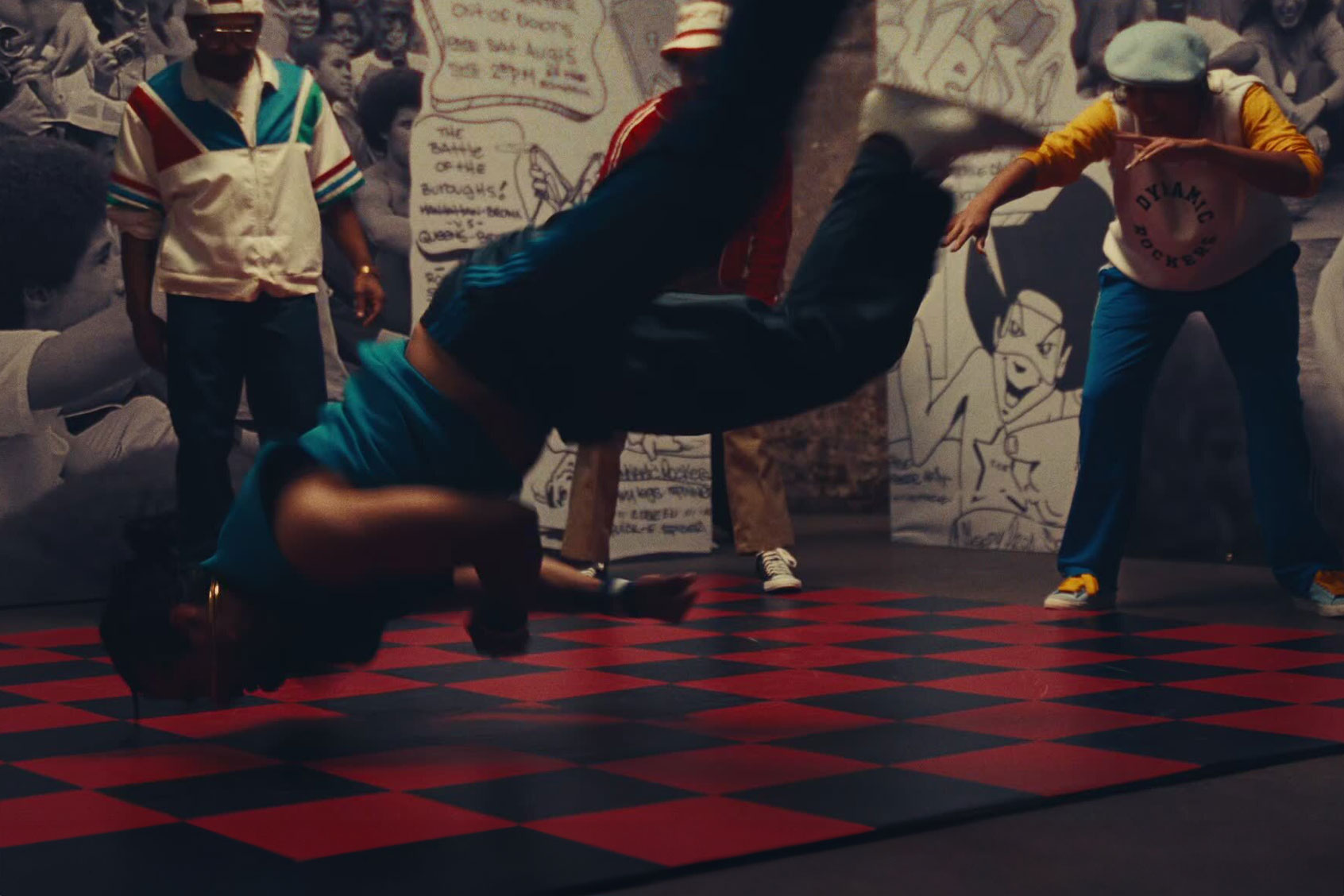
Clocking in at just shy of 45 minutes “Breakin’ on the One” is mainly through the insights of its originators – who were just middle school kids when they created a dance form that is now a worldwide sport. In our conversation, Parham and Aquart talk about their emphasis on the joy and innovation that is the root of hip-hop, and their desire to give due credit to the OGs of breakdancing and the summertime battle that sent breakdancing global.

The following interview has been edited for length and clarity.

There have been a lot of hip-hop documentaries over the years, although fewer on the art of breakdancing and the history of it. So let’s start with the basic question of, what did you want to bring to the conversation with “Breakin' on the One”?

Jamaal Parham: When ESPN Films and Andscape approached us about this project, and we started digging into the research, for us the thing that was really exciting was I don't think we realized that these were kids. Like actual kids that created a true culture, a moving art form out of nothing, you know what I mean? That was kind of the spark that allowed us to find a way into this world. It's something that you really don't hear about, I think.

"As the genre kind of starts its sort of second, or third or fifth expansion point, it's easy to let the founders – the sort of OGs, for lack of a better term — fall to the background."

To your point about other hip-hop documentaries, last year was the 50th anniversary of hip-hop, and there was all manner of content that was out. But it really never hit home that something this special that was created by the kids that look like us, you know what I mean?

Bashan Aquart: For sure. And I think one of the things we're both keen on is this idea of making sure this moment doesn't get lost. As the genre kind of starts its sort of second, or third or fifth expansion point, it's easy to let the founders – the sort of OGs, for lack of a better term — fall to the background. With every other aspect of entertainment, you can get a sense that you know who the founders were, who the originators were. But not for breakdancing, for the most part. And this became a really great kind of moment to highlight who these guys were, who these kids who are now men were. Then hearing them talk about it is illuminating in the way that when they go back to those moments, they’re still those kids.

I really want to talk a little bit more about the fact that, to your point, these were kids that created a culture.  When, I've seen other footage of hip-hop, and this goes back to that whole idea of like the adultification of Black children, that part is almost never mentioned.  I mean, I had always assumed I was watching high school kids. But these were middle schoolers!

Parham: Yeah. Yeah. And, it came out of a bonding of community. That's the other thing that's missed is that they were looking for alternatives to the street gangs at the time.

New York was a place that, as you see in the imagery, wasn't a great place to be at the time. The federal government had kind of abandoned the city . . . These kids came together as a means of survival. But I don't know that they knew that it was survival at the time. They were just looking for other kids who had joy like they did. You know what I mean?

To me, that's really special. A lot of the stuff that we do in our art is has this through line of joyfulness and finding the joy in the human experience. And you can just you can see it in the footage. Like, they're coming out of poverty and creating art, but to them it's like, “We're just having fun and dancing. I think Ken Swift [aka Ken James Gabbert of the Rock Steady Crew] says it at the end: It blows his mind that they were just trying to dance and impress a girl, but they ended up creating an art form that's now going to be in the Olympics.

We need your help to stay independent

Aquart: Yeah, it’s almost a matter-of-fact approach in terms of the world that they existed in, which is interesting for us to paint a picture of. But . . . it's so much more about them, going from place to place, picking up different battles in different boroughs and basically attempting to kind of build their own bragging rights. That's what was important to them. And the world around them mattered less because that’s what they came up in. And I think that that's where that kind of sense of joy for everybody else comes in is to say, “Oh, wow, these kids pushed through. And they actually invented something amazing."

Parham: It's almost like an adventure in that way. There's footage in the film of them running out of the subway as they go to Lincoln Center. And it feels like a “Goonies Never Say Die” kind of energy. It's got this just kind of youthful joy behind it that you just don't see anymore. You know what I mean? Everything’s so cynical.

Breakin' on the OneBreakin' on the One (Andscape)I think it was [documentarian] Mike Holman who said there are people who don't realize that this all started in New York. And that surprised me.

Parham: I wasn't totally surprised. I mean, I grew up in Los Angeles in the East Coast/West Coast gangsta rap era. So I had an understanding of it. But I can easily see how.  There's a sequence in the film where we show when corporate America gets its claws on breakdancing . . . It's this kind of whitewash, like, “We're just taking the part that we like about this, the easy part, the dance part.” But when you remove the culture . . . you don't understand that they come from something, you know what I mean? All these elements are building from a thing.

"To see what breakdancing has done in Asia and in Scandinavia and in Germany, and France, it’s beautiful," said Parham.

There's a portion of an interview that we weren't able to include, but we were talking to, I believe, Ken Swift about why they used the cardboard. There's always cardboard, no matter what the conditions are that they're dancing [in], right? But what he said was, “Nah, we used the cardboard because we were too poor to have a bunch of different outfits. So we only had one dance outfit, but we didn't want to mess it up on the ground." That detail is so culturally specific — like yeah, you're in the summertime dancing on hot asphalt, you don't want to tear your jeans. But I think when it shows up in commercials and movies and TV shows, and that kind of heart is removed from it, that that grit is removed from it, it starts to become separated . . . It's not this urban form of escape, you know?

Aquart: And I think probably the more surprising aspect of this piece was the Lincoln Center of it all, who we've done work with for in the past. When you think of cultural institutions in the city that feature ballet and feature what's considered high art, you don't necessarily connect urban art forms to those institutions. In fact, anytime we talk about the documentary and talk about Lincoln Center, people are like, “So yeah, what’d they have to do with it?” That part of it, I think, is more of a surprise than the kind of elements of hip-hop coming out of coming out of New York.


Want a daily wrap-up of all the news and commentary Salon has to offer? Subscribe to our morning newsletter, Crash Course.


The documentary ends by connecting the past to the present of the Olympics. And the debate over, is it dance or is it a sport? Where do you two land on that debate? Can’t it be both?

Parham: We didn't really go in there with an intention. We were more curious about how these guys felt. But I'll say that, I think two things can be true: this can be a dance; you can honor a culture. But you can also still put it on a stage and make it competitive. And maybe that's just me talking, because I'm very competitive in everything. But I think that there is a sense of like, gymnastics has a floor dance component that’s very clearly dance. Figure skating is athletic, but it's clearly based in dance. There’s is a way to make this stuff competitive.

But what I don't want to get lost is that these OGs, the guys who started it, they want to make sure that it's not co-opted and turned into something else, and mutated into a thing that forgets where it came from. You know, Spinner [aka Elio Perez of the Dynamic Rockers] says this in the film: He's like, “Street cred is always going to be more to us than the Olympics will.” And for them, I think that's really true. That's a badge of honor for them, and we need to, as globally as this thing goes, make sure that that doesn't get lost.

Breakin' on the OneBreakin' on the One (Andscape)Aquart: And throughout the piece, there are points where we talk about the economics of breakdancing and how it seems that anytime it's commodified, it had this steep incline and then steep decline. And I think what the doc attempts to do is to be something of a beacon to the people in organizations who are attempting to do that again, to do it correctly to do it with some sense of thoughtfulness and some consideration for the origin story of breakdancing. To not forget where it came from.

And I realize this might be contradicting what you guys just said, but I have to ask: Are you hoping that Team USA takes home the gold in that category?

Parham: Obviously, yeah. I mean, we're always going to root for Team USA. . . . Breakdancing is an American art form. A lot of our work is about telling American stories, and we'd love that. But what we also appreciate is the fact that this is a global thing. And like, USA is not maybe the favorites to win in this competition, and there's something beautiful in that, you know what I mean? To see what breakdancing has done in Asia and in Scandinavia and in Germany, and France, it’s beautiful. It's a true American art form that we've exported around the world. Yeah, yeah.

Aquart: And after getting a sense from the people in the documentary of the general feelings overall, there is definitely a beauty to that. But you can also see why it would be infuriating.

"Breakin' on the One" is now streaming on Hulu.

Rep. Clyburn weighs-in on Trump’s backhanded “Black jobs” comment

During Thursday night's shambling vs. rambling first televised presidential debate of 2024, which aired on CNN to 20-year record low debate viewership, Donald Trump spoke of undocumented immigrants "taking Black jobs," causing many to wonder . . . what exactly is a "Black job?"

Speaking to CNN's Dana Bash — a moderator for the debate, along with Jake Tapper — Rep. James Clyburn (D-S.C.) spent a portion of his appearance on "State of the Union" Sunday weighing-in on the backhanded nature of Trump's comment to Biden during the first of two scheduled debates, while propping up the current president in his continued fight against the former as many are calling for him to step out of the race for re-election.

"Joe Biden has been talking about this. He mentioned it the other night. Donald Trump is being Donald Trump," Clyburn said. "He has a very, very, very low opinion of people of color. Black, brown, whatever color. He has a low opinion of Black people. He's demonstrated that all of his life. And I would like to hear from some of his Black supporters why they will not have these discussions about what this man has done to Black women . . . and Black youth. And what he has done to his own businesses when it comes to Black people."

In 2019, Clyburn highlighted one of Trump's many racially fueled comments — specifically one in which he compared the House impeachment inquiry against him to a “lynching.”

"I really believe this man is prone to inflammatory statements, and that is one word no president ought to apply to himself. I've studied presidential history quite a bit, and I don't know if we've ever seen anything quite like this," he said in response. "I am not just a politician up here. I'm a Southern politician. I'm a product of the South. I know the history of that word. That is a word that we ought to be very, very careful about using.”


Kelly Jaggers on cooking for one, embracing leftovers and making the kitchen a more enjoyable place

Cookbook author Kelly Jaggers knows how tricky it can be to avoid the siren song of DoorDash and whip up fresh, hot meals nightly. She also knows how annoyingly inconvenient it can be to modify recipes built to serve four when you're only looking to cook for yourself. So, she's put together "The Ultimate Meal Planning for One Cookbook," which helps to arrange and strategize your kitchen plans, ensuring that the dish you make on Monday night will supply you with leftovers to repurpose on Tuesday.

With Jaggers's help, novice cooks — and experts, too — can rely on her advice and research have a sharp, pinpointed plan for the week (or perhaps even longer, especially if utilizing the freezer to its fullest).

Salon Food spoke with Jaggers about her other tips and tricks, what inspired her to cook and her favorite, go-to ingredients, dishes and methods to ensure that you can feed your family (or just yourself) healthful, flavorful meals without a frenzied rush on a particularly frantic Wednesday night. 

The Ultimate Meal Planning For One Cookbook by Kelly JaggerThe Ultimate Meal Planning For One Cookbook by Kelly Jagger (Photo courtesy of 123RF/Diana Johanna Velasquez, chelovector)
The following interview has been lightly edited for clarity and length.

Thank you, first and foremost, for working on and publishing this book. I think it's such an underrepresented niche in the cookbook world, so it's refreshing to see a book like this on the market. Why did you think it was an important book to work on?

I agree! Most recipes are developed to feed a crowd and while left-overs are nice occasionally, there are only so many left-overs one can reasonably enjoy in a week!

My first goal was to make recipes portioned for one and sometimes two servings so the solo cook can still have the fun and pleasure of cooking without making too much. My second goal was to develop tasty recipes with lots of variety in cuisines and flavors – including chapters for snacks and dessert.

My hope is that people who use this book will enjoy tasty meals, have fun in the kitchen, all while meeting their personal meal planning goals.  

I love the subtitle "low-waste and high-taste." How did you ensure that each recipe in the book fit that principle? 

Thank you. I really wanted the recipes in the book to live up to this subtitle!

It starts with planning and shopping in the most strategic way to avoid over-buying. When you are planning your weekly meal plan, it helps to think about how to use the same ingredients over multiple meals. For example, two chicken breasts purchased in a single pack may be used to make Chicken and Green Chili Stacked Enchiladas for dinner on Monday and Chicken Noodle Soup for Thursday lunch.

Other ideas include making a batch of Freeze-and-Bake Oatmeal Cookies that are designed to be frozen before baking. You can now plan for fresh, warm cookies over two to three weeks of meal plans and not have a whole batch of cookies baked and going stale on the counter.

The second chapter includes eight weeks of example meals plans with sample shopping lists to provide inspiration and be your guide to meal; planning and shopping in a way to reduce waste.


Want more great food writing and recipes? Subscribe to Salon Food's newsletter, The Bite.


What was the development process of the book like?

First, I sat down and considered the meals and courses I wanted to cover. I wanted this book to be comprehensive and have recipes that work all day long. Next, I wanted to organize the book so it made sense when you sit down to plan a week of meals. The chapters move from breakfast through to dessert, with main dish chapters organized by main ingredients such as Pasta, Meat Dishes and Vegetarian.

Finally, I wanted to include streamlined information on how to start meal planning, including tips for doing a kitchen inventory, what dry goods are handy to have on hand and what tools you will need for success.

What are some of the standout recipes in the book for you? 

I adore the Summer Vegetable Flatbread! It is made with an easy homemade flatbread base that is first toasted in a skillet to speed up cooking and add extra flavor. It is topped with creamy ricotta cheese, zucchini, red onion, cherry tomatoes, bell peppers and mozzarella cheese and baked until hot and bubbling.

When it comes to breakfast, I am a pancake lover, so I had to include a recipe for Fluffy Buttermilk Pancakes that are topped with Bourbon Maple Syrup. I am also a fan of comfort food and I can’t recommend the combination of the Braised Beef Short Rib paired with the Baked Macaroni and Cheese for One enough. It is wonderful when the weather is cooler and you want to warm up!

Are all of the recipes single-serving, or are some of them enough to also allow for leftovers and/or a second, repurposed meal? 

That is a great question. There are a variety of recipes in the book that are designed to make two servings and in the example meal plans included in the book, the extra portions are utilized for lunches or enjoyed on evenings when you want a home-cooked meal but do not feel like cooking.

I love to cook – it is my hobby and career  and even I do not want to cook every meal, so the meal plans I developed had to offer some flexibility for cook once, eat twice recipes and optional nights out with friends or family.

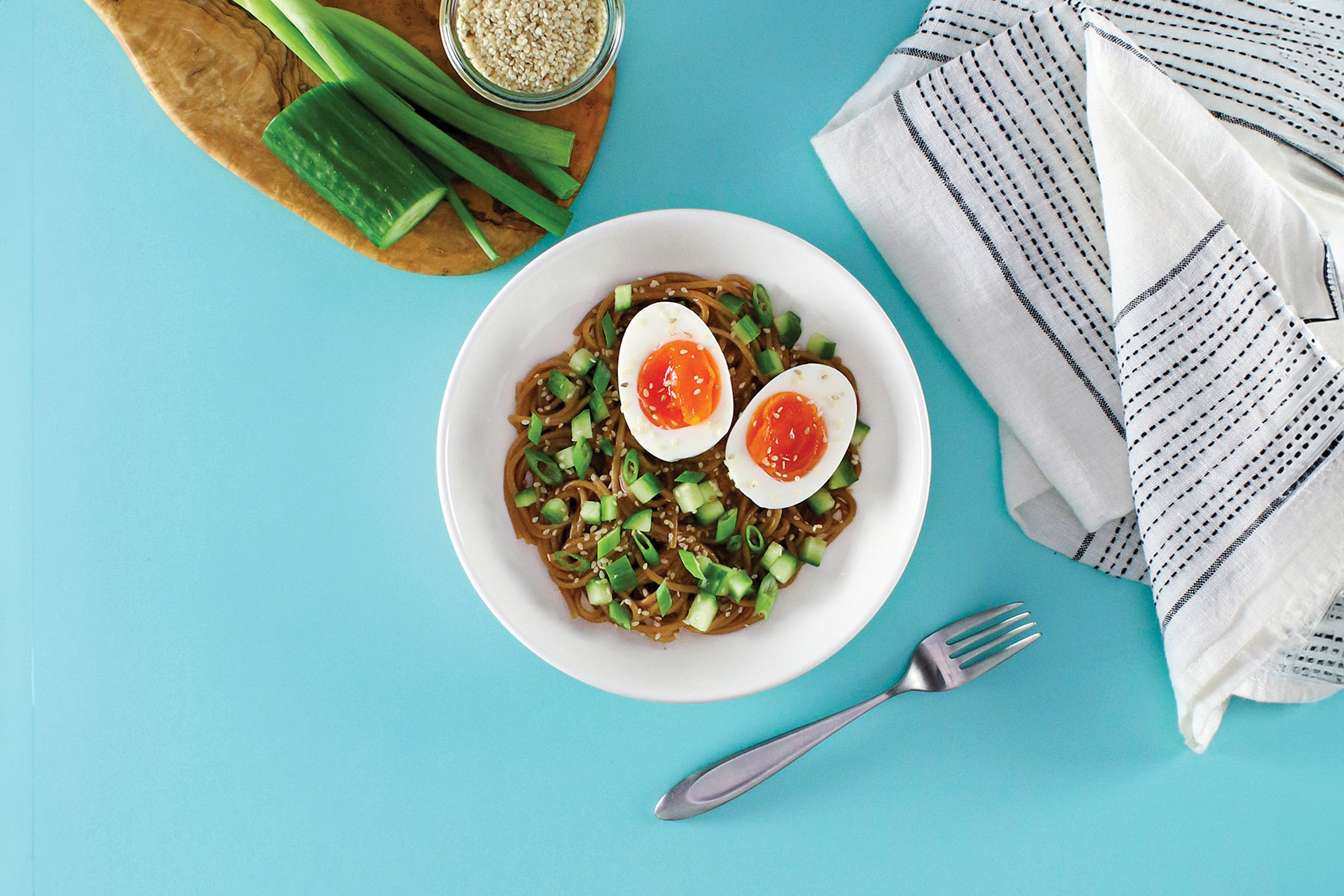
Sesame Garlic Soba NoodlesSesame Garlic Soba Noodles (Photo courtesy of 123RF/Diana Johanna Velasquez, chelovector)

What are some of the top ways for home cooks to cut down on food waste? 

Start with a meal plan that features foods you really love!

Sit down each week and come up with a plan and then shop your kitchen before heading to the store to avoid buying ingredients you already have. Remember, it needs to be sustainable for you. Plan for flexibility by being open to swapping meals from day to day and planning for meals out. It is about you and your lifestyle, not a plan that demands perfection.

A good tip for new meal planners is to start with just a few day a week. Maybe you only want to meal plan weeknight dinners. That is a great place to start, then you can add more meals – like lunches then breakfasts  as you get more comfortable.

For shopping, use the butcher counter to buy single portions of meat, seafood and fish for your meals when practical. You can also use the bulk section of your store to buy smaller amounts of things like dry fruit, nuts, specialty spices and grains. Be sure to use your freezer to preserve extra fresh items and keep a list of what you have so you can include them in future meal plans.

Also, the freezer is not just for meat and seafood! Use it to extend the freshness of dry goods flour, oats, chocolate and spices.

We need your help to stay independent

Are there any particular ingredients or types of dishes that you think lend themselves especially well to single-serve cooking?

I would hate to narrow it down too much because I firmly believe anything can be adapted for the solo home cook! However, if I had to say, my favorite ingredient from the pantry is dry pasta because it makes a great base for a quick meal. I also love having frozen shrimp on hand. They are a staple in my kitchen because they keep well frozen, can be thawed quickly for meals in a hurry and can be prepared in a variety of interesting ways.

I can’t live without tomato paste in a tube. It keeps well refrigerated and because it comes in a tube, you can easily squeeze out just what you need. It adds so much flavor to meat dishes, but can also be used for livening up pasta dishes, soups and stews. I would also be remiss if I did not mention freeze-dried herbs. I keep freeze dried dill, chives, oregano, cilantro and basil in my pantry at all times. They have the same flavor as fresh herbs, but I never have to worry about then wilting or spoiling before I get to use them.

Would you say the recipes in the book primarily feature a particular style, (i.e. Italian-American or Asian-American), or they're sort of a general hodgepodge of cultural influences? 

I definitely took inspiration from a variety of cultural influences! While there are plenty of hearty meat-and-potatoes style dishes, there are also dishes inspired by Asian cuisine, the Mediterranean and Latin flavors. I also touch on regional cuisine in the US such as Cajun, Tex-Mex and the Midwest comfort food. I also have plenty of options for people looking to eat a more plant-based diet.

What stands out for you as a formative moment that got you into cooking or food at large? 

My mother was a talented cook and a great teacher. She shared her recipes and knowledge with me, starting when I needed a step stool to see the top of the counter. She let me mix batters, scoop cookies and measure dry ingredients. She got me a kitchen playset and placed it in the kitchen, so when she was making a meal I could not help with, I could ‘cook’ along with her.

I had so much fun in the kitchen with her! That love of cooking carried through to my adult years and eventually inspired me to go to culinary school to refine my knowledge and develop skills I can share with others like my mom did with me!

Kelly JaggersKelly Jaggers (Photo by Tammy Nash)

How do you practice sustainability in your cooking and recipes? 

I buy just what I need when it is practical to do so and when I do buy in bulk, I prep and store what I will use later right away so it does not languish in my fridge. Making time to plan is also a priority. I think of it like part of my regular self-care routine. When I am planning, I focus on food I truly love, with ingredients I want to eat. That is a big key to success for me and a great way to stay on track.

I also make an effort to make some meals that include left-overs, so I have easy meals to heat-and-eat when I am tired and take-out menus are calling my name.

What would you say are your three most used ingredients? 

Freeze dried herbs, pasture raised eggs and hot sauce. I also use a fair bit of chocolate and I am a sucker for good quality Irish or French butter.

What is your favorite cooking memory?

This is a bittersweet memory, but one of my favorites. My great-aunt Ruby had failing health for a number of years that left her homebound and during the last year of her life she had a stroke that left her bedridden. I went to visit her after the stroke  a four-hour road trip  and asked her if I could make her something to eat. Her appetite had always been robust, but after the stroke, she did not want more than a nibble of anything offered.

She said maybe she might eat a scratch made buttermilk biscuit, one of the things I made that she loved.

I made her a big double batch, cut them out and baked her a few to enjoy right away. I then froze the rest of the biscuits unbaked so my cousin could bake them fresh for her after I went home. My cousin told me that my Aunt did not have much of an appetite after I left, but if she baked one of my biscuits, she would perk up and clear the plate.

I can’t make biscuits now without thinking of my sweet Aunt Ruby. It makes me feel connected to her now that she is gone.

What I wish I’d known about bisexuality and the truth about love

“My mom is a lesbian,” my then-third-grader announced one evening at dinner. We were sitting around the dining room table, and I hadn’t even dug into my salad. My father raised his eyebrows. It was an otherwise unremarkable night during a slow-to-warm spring. 

 “Well, not a lesbian per se,” I countered. I speared a piece of spinach. I didn’t know I was going to be making a speech about my sexuality over takeout. 

“Bisexual. I guess, pansexual? I know that sounds like a breakfast food. It’s like … being attracted to people of various genders. Also, it's not a secret, but I think each person should make their own announcements about this type of thing,” I said.

I had talked many times with my family about my identity (and on and on about accepting each other exactly as we are) so I was surprised by the lesbian label. But I could see how it could be confusing, especially to an elementary schooler. It could be tough for me, and I’ve been in this world for four decades — and as a relationship therapist, I’m used to difficult conversations.

But then again, it isn’t that surprising. In a straight world, I am not straight. But I appear that way. Back in 2010, I married a cisgender male when I could have married anyone — and remain joyfully, monogamously married to him.

Pansexuality, bisexuality — honestly, I don’t care what you call it. There is no perfect name for us, the original patrons of "love is love." Yet so many of my fellow bisexuals are closeted or struggle with visibility. As humans, we often do not know how to hold, and share, this complexity.

What is most misunderstood is that being queer is not just about who you are sleeping with. It is a culture, an identity, a way of seeing the world — without automatically accepting societal expectations for love or gender embodiment. There is beauty in this, a freedom.

In this shimmering universe, why choose boring when you can choose anything?

Back in high school, I came out to my parents for the first time, but not on purpose. My mother asked me about it one summer day as I helped her transplant the hostas underneath the deck. Earlier, a girl had left a message on our answering machine. I’d really like to see you again, she said breathlessly. It was clear this was more than a friendship.

When I looked up from the cool dirt, I saw that my mother’s eyes were wet. Her tears, prompted by the earnest belief that my life would be more difficult — hit me straight in the gut. (Well, not totally straight.) 

My sexuality — or people’s reactions to it — reinforced my fear that I was different, and not in a good way. I know from my years as a psychotherapist that the feeling of not-belonging is widespread. The specifics vary, but the theme is universal: Where do I fit in this world? Who are my people? Will I be accepted as I am?

In my case, I didn’t pursue long-term relationships with women. I didn’t realize it then, but I was afraid. Yet straight culture didn’t feel like home, either. I wasn’t comfortable at proms or rooftop bars. The rigid standards of beauty — coupled with the competition for men — struck me as narrow and boring. In this shimmering universe, why choose boring when you can choose anything?

When I came of age in Minnesota, the majority of my friends were queer and unable to get married legally. It became legal in 2013. The landmark equality was validating, but most my friends did not rush to get hitched — I went to one gorgeous gay wedding. We all danced the hora with our palms pressed together as if our souls were clasped in one another’s hands.

Despite my critique of patriarchy, I married Cedar, who happens to be a man. One who cried with empathy for a buck when his dad took him hunting. I fell in love with Cedar’s warmth and the questions he asked during our unharried conversations. 

I’m grateful I married him. My partner understands me, knows my flaws, and cherishes me anyway. I refer to my husband as the love of my life, and I mean it. But I still grapple sometimes with belonging, although less so these days.

Once I had children — one with significant disabilities, which sparked a move away from the city to be near more support — I felt farther away from my LGBTQ+ community. How much of it was me, self-conscious about my straight-appearing life? How much of it was timing? For years I was in the depths of caregiving for my daughter and had little community — regardless of anyone’s identity.

“And then you feel like you don’t belong anywhere.”

I live in the suburbs now, which I call the cuburbs — the country-suburbs, out at the edge of the county. My neighborhood's vibe is more Ward Cleaver than Harvey Milk. The older I get, the less this affects me. I believe what Brené Brown writes: “True belonging and self-worth are not goods; we don’t negotiate their value with the world. The truth about who we are lives in our hearts.” I found belonging bit by bit, in part by claiming my identity publicly when I wrote a memoir. It was liberating.

It helps to have friends who offer an embracing ethos, too. I first met Jeannie when I was 19; she was dating my dear friend. Over the subsequent decades, I realized I can be my full self with her. When it comes to sexuality or anything else, this is a spectacular way to feel. I’d like to help my friends feel this, too. I hope I do.

Last summer, Jeannie and I watched the waves lap up the shore of Lake Minnetonka, near where we both grew up. Jeannie works in palliative care, which means we can talk about anything, from death to brunch. She married a man, too — a tenderhearted guy who is her match in every way. 

We lounged on Adirondack chairs as the clouds shifted. It seemed as if it might storm terribly, or it might be just fine. We sat under the open sky and talked about what it is like to be bisexual. Jeannie turned to me and said, exhaling, “And then you feel like you don’t belong anywhere.” I saw a flash of light in the reflection of her green cat-like eyes.

I took my own breath in, then out. In that moment, I never felt like I belonged more. Talking with my friend of many years, hearing my experience — finally — reflected in hers made me want to say the things I have been afraid to say.

As I sat with Jeannie near the edge of the lake, the sisterhood I longed for was right there. I looked up again at the rain clouds, and it felt like even if we sat in a downpour together without jackets or umbrellas, we would be OK. We held a rare understanding, an identity, a long history as friends. We both knew the truth about love — that at its core is acceptance, and there is not one right way to do it. We shared a not-belonging belonging. 

I showed a draft of this essay to my mother, now in her mid-70s. I still want to please her (or at least avoid blindsiding her by recounting our past publicly). We sat down on my bed side-by-side; my heart thumped as I watched her read. When she looked at me with those same watery eyes, I thought of the hostas. Instead, she said something I had never considered before, “Maybe instead of belonging nowhere, you belong everywhere?” My mother — who always loved me deeply but did not always know the truth about love — had evolved. And so had I.

The fuzzy science on whether Fido is actually good for you

For more than a decade, in blog posts and scientific papers and public talks, the psychologist Hal Herzog has questioned whether owning pets makes people happier and healthier.

It is a lonely quest, convincing people that puppies and kittens may not actually be terrific for their physical and mental health. “When I talk to people about this,” Herzog recently said, “nobody believes me.” A prominent professor at a major public university once described him as “a super curmudgeon” who is, in effect, “trying to prove that apple pie causes cancer.”

As a teenager in New Jersey in the 1960s, Herzog kept dogs and cats, as well as an iguana, a duck, and a boa constrictor named Boa. Now a professor emeritus at Western Carolina University, he insists he’s not out to smear anyone’s furry friends. In a blog post questioning the so-called pet effect, in 2012, Herzog included a photo of his cat, Tilly. “She makes my life better,” he wrote. “Please Don’t Blame The Messenger!”

Plenty of people believe there’s something salubrious about caring for a pet, similar to eating veggies or exercising regularly. But, Herzog argues, the scientific evidence that pets can consistently make people healthier is, at best, inconclusive — and, at worst, has been used to mislead the American public.

Few, if any, experts say Herzog is exactly wrong — at least about the science. Over the past 30 or so years, researchers have published hundreds of studies exploring a link between pet ownership and a range of hypothesized benefits, including improved heart health, longer lifespans, and lower rates of anxiety and depression.

The results have been mixed. Studies often fail to find any robust link between pets and human well-being; some even find evidence of harms. In many cases, the studies simply can’t determine whether pets cause the observed effect or are simply correlated with it.

Where Herzog and some other experts have concerns is with the way those mixed results have been packaged and sold to the public. Tied up in that critique are pointed questions about the role of industry money on the development of a small field — a trend that happens across scientific endeavors, particularly those that don’t garner much attention from federal agencies, philanthropies, and other funding sources.

The scientific evidence that pets can consistently make people healthier is, at best, inconclusive — and, at worst, has been used to mislead the American public, Herzog argues.

The pet care industry has invested millions of dollars in human-animal interaction research, mostly since the late 2000s. Feel-good findings have been trumpeted by industry press releases and, in turn, dominated news coverage, with headlines like “How Dogs Help Us Lead Longer, Healthier Lives.”

At times, industry figures have even framed pet ownership as a kind of public health intervention. “Everybody should quit smoking. Everybody should go to the gym. Everybody should eat more fruits and vegetables. And everyone should own a pet,” said Steven Feldman, president of the industry-funded Human Animal Bond Research Institute, in a 2015 podcast interview.

The problem with that kind of argument, Herzog and other experts say, is that it gets out ahead of the evidence (and that not every person is equipped to care for a pet). “Most studies,” said Herzog, “do not show the pattern of results that the pet products industry claims."


It seems safe to say that most people don’t get a dog in order to marginally lower their odds of developing heart disease. Pet effect research falls into a strange family of science that measures the practical health outcomes of things people typically do for decidedly non-practical-health-related reasons, like get married or have children.

At the same time, there’s evidence — much of it anecdotal — that at least some people are cognizant of the potential health benefits when choosing to get a pet. And the idea makes intuitive sense to many people, who say their animals are good for their well-being. Concurrently, hospitals and nonprofits have rolled out programs that aim to use therapy dogs and support animals to improve people’s mental health.

James Serpell began studying the pet effect in the early 1980s, as a young animal behavior researcher. At the time, spending on pets was rising in the United States; people were beginning to treat pets more like family members. But there was little research on people’s relationships with their animals. “Why are we doing this?” Serpell wondered. “What’s it all about?”

In an influential 1991 paper comparing non-pet-owners with people who had recently adopted an animal, he supplied some of the first published data suggesting that new pet owners experienced a measurable reduction in minor health problems. New dog owners also pursued more physical activity, compared to people who had cats or no pets at all.

In the decades since, researchers have published dozens of studies comparing pet owners to non-pet-owners. The results are mixed — sometimes pointing toward health benefits, and sometimes not.

Some of that data may reflect the realities of human-animal relationships — which, like any other kind of relationship, can vary for all sorts of reasons. “It doesn't mean that my lived experience or anyone else's lived experience is wrong,” said Megan Mueller, a human-animal interaction expert at Tufts University. “What it means is that it's different for different people.”

For some people, she said, having a pet can bring stressors. The caretaking responsibilities may be too taxing; the pet may exacerbate family tensions or trigger allergies; the owner may be unable to afford pet food or veterinary care.

The results, some experts say, are also muddied by longstanding issues with research methods. The problem is that there are differences between the people who choose to own pets and the people who don’t.

“What happens is we try to compare people with pets, to people without pets, and then we say, ‘People with pets have X, Y, and Z differences.’ It actually is a really invalid way of approaching the research question,” said Kerri Rodriguez, who directs the Human-Animal Bond Lab at the University of Arizona. A study finding that cat owners are more likely to be depressed, for example, may be picking up on a real connection. But it could just be that people already experiencing depression are likelier to get cats.

Some of the data may reflect the realities of human-animal relationships — which, like any other kind of relationship, can vary for all sorts of reasons.

Today, Rodriguez mostly studies service animals, especially for veterans at risk for PTSD. In this context, it’s possible to conduct randomized trials — for example, randomly choosing who will get a support animal now, and who will go onto a waitlist to get a companion animal later. Some research on service dogs — including a recent controlled, but not randomized, trial that Rodriguez was involved with — has shown clear benefits.

How much those benefits apply to typical pet owners, experts say, is unclear. And it’s hampered by the inability to conduct those kinds of randomized trials. (“You can’t randomize people to pet ownership,” said Rodriguez.)

Rodriguez said she’s interested in studies that track the association between human-pet relationships and health metrics over time, checking in with people again and again and collecting larger amounts of data. One such study, for example, found a slower rate of executive decline among older pet owners.

Serpell, after his 1991 study, largely moved on to other research questions. “I basically concluded that this type of research was too difficult,” he said. “And even if you did it, the results you would get would always be questionable.”


Those doubts have not deterred interest in the field from the companies that lead the pet industry, which is today valued globally at more than $300 billion.

Almost from the start, the quest to understand the pet effect has been entangled with industry money. Serpell’s earliest work was funded by what is now known as the Waltham Petcare Science Institute, a division of Mars, Inc., which owns a portfolio of pet food and veterinary care brands in addition to its famous candy business. “There was no other source of funding, really,” recalled Serpell, who’s now an emeritus professor at the University of Pennsylvania. “Nobody else was willing to put money into this field.”

In 2008, Mars entered a partnership with the National Institutes of Health in order to spur more research into animal-human interactions. In the first year, the pet product provider ponied up $250,000, while the federal government supplied $1.75 million. (The NIH partnership ended in 2022, although Mars continues to underwrite research on pets and human health.)

Almost from the start, the quest to understand the pet effect has been entangled with industry money.

In 2010, a group of pet industry heavyweights launched the Human Animal Bond Research Institute, or HABRI. Key funders have included Petco, Purina, and Zoetis, a veterinary pharmaceuticals firm. “Pets and animals make the world a better place, and we’re going to use science to prove it,” said founding director Steven Feldman in a 2014 talk at a conference for pet bloggers.

The nonprofit has spent more than $3 million funding research on human-animal interactions. Companies also directly fund university research: One prominent research lab at the University of Arizona — separate from Rodriguez’s research group — includes a sponsor page on its website featuring the logos of Nestle Purina, Mars Pet Care, veterinary drugmaker Elanco, and other pet product companies.

"Funding from the pet industry has transformed the field, and without it, we would not have the science that we have,” said Mueller. (Like Serpell and Rodriguez, Mueller has received industry funding for some of her research.)

Did that funding shape the field’s findings? “I think it has largely been done in a really ethical way,” said Mueller. She and Rodriguez both said they had never felt pressure to produce a particular result. Waltham, when it entered the partnership with NIH, gave up the right to select who would get the funding. Industry-funded studies have found — and published — results suggesting little benefit from pets.

"I really think that field has done a good job of publishing a lot of findings that are maybe not what people would expect,” said Mueller.

Herzog said he has seen little evidence that industry money has changed the science. Mostly, he said, “they’ve funded pretty good studies.” But there are ways it can change the field. "It's always been a source of great ambivalence, I think, for everybody involved,” said Serpell. “You try and work around it, by getting whoever funds the work to stay off your back and let you do the work, and if they don’t like the results, that probably means the next time you apply to them for funding, you won’t get it.”

The funding can shape the questions that the field asks — or avoids. “Industry-funded studies tend to produce results that favor the sponsor’s interest,” said Marion Nestle, an emeritus professor at New York University who has spent decades studying corporate influence on science. Sponsors influence what gets studied, Nestle said, and they select for studies that they think will produce positive results. And, she said, research suggests sponsorship can shape the way results are interpreted — often without researchers being aware of the influence at all.

Controlling the focus of the research can also steer scientists away from certain topics entirely. “For obvious reason, these companies don't wish to draw attention to the darker side of the human-pet relationship,” said Serpell, referring to research areas such as dog bites.

In a recent Zoom interview, Feldman, the HABRI president, said funders “can tell us what kind of things they're hoping to see,” and the organization will try to accommodate those requests. “But then, once the process of funding a project begins, there's absolutely no influence there whatsoever.”

Research suggests that sponsorship can shape the way results are interpreted — often without researchers being aware of the influence at all.

HABRI embraces negative results, or those that don’t show a clear effect from pet ownership, and not just positive findings, Feldman said. But, he acknowledged, they may choose to emphasize positive results. “We try and be very true to the science, but if we take a slightly more optimistic view as to the body of work than researchers who take a different perspective, I think that helps generate a lot of positive behavior in the real world.”

Herzog, Feldman suggested, was making a name for himself with naysaying — in ways that, perhaps, sometimes defy common sense. A 2021 HABRI survey found that nearly 9 in 10 pet owners report that their pets benefit their mental health. “I kind of think pet owners might be on to something,” Feldman said.

Herzog agrees that having a pet can have real benefits. At the end of a recent conversation, he reflected on his cat, Tilly, who died in 2022. She used to watch TV with him in the evenings, and she would curl up on a rocking chair in his basement office while he worked. The benefits of their relationship, Herzog said, were real but perhaps hard to measure — among the intangible qualities that are difficult to capture on research surveys.

"If you'd asked me, ‘Did Tilly improve the quality of your life?’ I'd say absolutely,” he said. “My health? Nah.”

This article was originally published on Undark. Read the original article.

A house divided, perhaps fatally: What’s the pathway to a reunited America?

They're rioting in Africa. They're starving in Spain.
There's hurricanes in Florida and Texas needs rain.
The whole world is festering with unhappy souls.
The French hate the Germans. The Germans hate the Poles.
Italians hate Yugoslavs. South Africans hate the Dutch.
And I don't like anybody very much!

Unless you are so disturbingly young as to be irredeemably challenged culturally, perhaps you “remember” the foregoing words from the Kingston Trio’s 1959 hit song, “The Merry Minuet”? How quaint it is that these words so exquisitely capture the moment now before us in the United States, where nobody likes anybody very much.

This state of affairs is mirrored elsewhere abroad, of course, but our principal concern is with the good ol’ US of A, where division, fragmentation and polarization are unquestionably the order of the day. That isn’t hard to understand, nor is it entirely unexpected, in a society that is diverse by nature, pluralistic by design, rights-obsessed by choice and individualistic by habit. The idea of a great melting pot that assimilates and integrates the tired, poor, huddled, wretched masses Emma Lazarus described is a quaint artifact of a bygone past. Or is it? What about that globalization thing we say has suffocatingly overcome us all?

Why is this even important? Why, if at all, should it concern us? Because one’s ability to act strategically, at home or abroad, is in large measure about the effective exercise of power to get what you want, to get your way (even when you don’t know what you want), to bend others to your will. Power is a function of both the wherewithal — the “stuff” — at one’s disposal and the will to use such wherewithal. Will — collective willingness — is a reflection of national unity, and national unity is a function of social cohesion, the glue of trust that turns the differentiated many into the unified One: E pluribus unuma more perfect union.

Take any demographic feature you can think of: race, ethnicity, gender, age, sexual orientation, religion, socioeconomic class, geographic residence or origin, intelligence or level of educational attainment. Take any type or level of experience: veteran-nonveteran, private sector-public sector, parochial-sophisticated, provincial-cosmopolitan. Take any ideological orientation or political preference: liberal-conservative, Democrat-Republican, nativist-globalist, pacifist-militarist. All are potential sources of division, dissensus and disunity – far more powerful, experience has shown, than the things that can bring us together and unify us in common cause in the absence of a crisis or catastrophe.

Forget George W. Bush's "Axis of Evil." In the onetime words of Walt Kelly’s Pogo, “We have met the enemy, and he is us.”

Recall the George W. Bush administration invoking the term "Axis of Evil" to strike fear and loathing in the hearts of the American electorate in order to galvanize public support for the so-called global war on terrorism. The weakness of that branding device was the very word evil, for it connotes intentionality, thereby making it solely the proprietary domain of states acting in hostile opposition to one another. Today, we face what might better be called an “Axis of Harm,” to accentuate the real current threats to our physical, mental and emotional well-being, which  are essentially intentionless phenomena: pandemics, climate disasters and, most importantly, disintegrative forces from within, born of self-absorbed, self-serving anger and hostility, and producing alienation, ostracization and often violence. It is the last of these that actually is the foremost threat facing this country today. In the onetime words of Walt Kelly’s Pogo, “We have met the enemy, and he is us.”

In 1858, then-newly anointed Illinois Republican Senate candidate Abraham Lincoln famously said: “A house divided against itself cannot stand.” If you can’t agree, he was suggesting, if you can’t get along, if you can’t even tolerate one another internally, you’re headed for self-destruction and destined for oblivion, no matter how threatening or challenging outside forces may be. It is a psychosocial suicide pact. Curiously, though, Lincoln then went on to say: “I do not expect the Union to be dissolved — I do not expect the house to fall — but I do expect it will cease to be divided.” The issue then at hand was slavery — whether to preserve it or eliminate it. There were no two ways about it, there was no middle ground, no room for compromise. The issue at hand today is the very survival of the United States and its idealized democratic way of life: the "shining city on a hill," the "beacon of light," the indispensable nation. This time, the house could fall, unless we who inhabit it can figure out how to reinforce its beams and strengthen its foundation. As during the original Civil War, this is a zero-sum, win-lose situation. No ties or forfeitures allowed.

Two problems confront us today in dealing with this ominous threat from within. First, the American public doesn’t recognize such internal disintegrative forces as a serious, priority threat, especially since opinion pollsters typically are wedded to a more abbreviated, quotidian list of issues for public consideration. In a revealing but unusual 2022 poll by FiveThirtyEight and Ipsos, respondents ranked political extremism or polarization as one of the most important issues (third on a list of 20) facing the country, trailing only “inflation or increasing costs” and “crime or gun violence.” As the pollsters themselves noted at the time, “Americans typically have not ranked polarization or extremism as a top concern. Historically, concerns around the economy or fear of military conflict have loomed the largest in American minds.” If asked in open-ended fashion, with no specific enumeration of possibilities, to identify the most serious threats or most critical issues facing the country, survey respondents would almost certainly not mention polarization and extremism.

The disintegrationists are true believers, driven by grievance, disaffection, alienation, dispossession, powerlessness and persecution. What they believe is what they think they “know,” and anyone not similarly possessed of their knowledge is the Other, the “out-group” or enemy tribe.

Second, our political leaders don’t have a clue how to counter such forces. In fact, a sizable number of our political leaders are themselves among what I'll call the “disintegrationists,” so who could expect them to come up with measures that would contribute to their own irrelevance or defeat? No obvious solution presents itself, and in fact there may be no solution at all, leaving us to allow the situation to somehow run its own natural, evolutionary course over time. That represents a highly risky, irresponsible choice, a complete abdication of responsibility by those in power.

Absent any readily available solution, perhaps we have no immediate recourse other than to heighten our understanding of the disintegrative forces that demand both our attention and our continued attempts at prevention or amelioration. For starters, let’s acknowledge that these disintegrative forces are indeed human, even though they can’t be said to demonstrate the same degree of conscious intentionality we have come to expect from foreign adversaries with governing bodies. Three things of particular note seem to characterize the disintegrationists:

  • They are what we have come to recognize over time as true believers, driven by deeply held beliefs masquerading as facts. Though their particular beliefs may vary widely, in general they all reflect grievance, disaffection, alienation, dispossession, powerlessness and persecution. What they believe is what they think they “know,” and anyone not similarly possessed of their knowledge is the Other, the “out-group” or enemy tribe. They resonate to claims of fake news and alternative facts, and see misinformation and disinformation in support of their beliefs as perfectly normal, acceptable, justifiable and useful.
  • What they consider objective reality — like rigged elections, the militarization of the Justice Department, the “deep state,” legions of migrant murderers and rapists, political prisoners being persecuted for peacefully demonstrating on Capitol Hill — has been socially constructed, based on the convergence of independent interpretive judgments from multiple parties that have become institutionalized and thus accepted as objectively real. Constructionists call this intersubjectivity, which becomes the equivalent of objective reality. This kind of intersubjective “truth” can displace and disguise objective lies. Disintegrationists unquestioningly embrace dogmatic pronouncements, often unsupported by facts or evidence, from authority figures who mirror and reinforce their already established biases, prejudices and predispositions.
  • They are captive of groupthink, the unthinking preference for and capitulation to peer pressure, where the desire for group cohesion, solidarity and belongingness displaces the give-and-take of critical thought representative of rigorous inquiry and choice. “Where all think alike,” esteemed journalist Walter Lippmann once said, “no one thinks very much.” Groupthink, the outgrowth of an overweening desire for social acceptance above all else, is a powerful force that overrides the intellectual need for the dialectical pursuit of truth. It produces assumptive or assertive “truth” (quotation marks intended) that anyone who wants to join or remain in the in-group dare not question.

Having had this deposit-in-the-punchbowl state of affairs dumped in our laps, the question becomes, “What is to be done?” With regard to the disintegrationists themselves, there is little the rest of us can do other than to remain vigilant, allow the public authorities and related organizations to bring disturbers of the peace to justice, and vote.

The first and most important thing we need to do is to recognize the disintegrative forces that have arisen in our midst as a bona fide security threat, indeed as an existential threat to human security and national security. Only then will we take the threat as seriously as we should. Disintegrationists are who they are: unrepentant sheep capable of nothing more than following hateful demagoguery; incorrigible propagators of self-serving polarization; provincial intransigents immune to re-education, enlightenment or behavior change; political, social and cultural saboteurs bent on undermining democratic values, institutions and processes. The guiding principle in dealing with them is to counter dissidence (objectively bad) without stifling dissent (objectively good). The bottom line, quite honestly, is to write them off in terms of rehabilitation or redemption. Their minds can’t be changed. They can only be monitored, observed, exposed and held to account for their transgressions.


Want a daily wrap-up of all the news and commentary Salon has to offer? Subscribe to our morning newsletter, Crash Course.


What, then, about the rest of us — the civic-minded, humanistic, patriotic mainstream? The answer is simple and straightforward: We need to up our civic game significantly. The guiding principle here is to elevate ourselves from passive consent to active consensus. Even if we claim to be civic-minded in principle, in practice we must face the fact that many of us have shirked our civic duties for years, to the point of civic dysfunction. Harvard political scientist Robert Putnam alerted us almost 30 years ago us to the civic decline afflicting this country, citing such things as decreased voter turnout, attendance at public meetings, service on committees, work with political parties and growing distrust in government. While some may consider that claim to be pure conjecture, there is ample evidence that, thanks to indifference, complacency, laziness, inconvenience and substantive frustration with the political process and the quality of political leaders and candidates, we have become civically challenged or diminished in significant measure.

So there is perhaps both irony and symmetry in returning to one of Lincoln’s most lasting observations: “The ballot is stronger than the bullet.” Those are words of wisdom to impel us to action today, for votes are the bullets we need, the civic arsenal to defend ourselves from the fifth-column disintegrationists who threaten to destroy us from within. Fighting them on their nasty, hateful, divisive terms rather than our own would be self-defeating; it would be even more so to withdraw from the civic battlefield in frustration, disgust, resignation or intellectual and ethical fatigue. We can’t afford to avoid this fight.

There is one big reason why Joe Biden refuses to step aside

President Joe Biden is running against a man with 34 felony convictions, two impeachments and a historically bungled attempt to manage a pandemic. Even worse, former President Donald Trump is the only president to ever refuse to accept the results of an election if he lost, a petulant and politically perilous practice in which Trump has indulged since before he became president.

An observer might be forgiven for assuming that, as former Trump lawyer Alan Dershowitz told Salon in 2019, the American people would never stand for a president who behaves like Trump. Instead, prior to the first Trump-Biden debate, the current president trailed behind in poll after poll after poll. Even the most optimistic projections gave Biden at best a 50/50 shot of winning — and that was before a debate in which he mumbled, meandered and stared slacked-jawed and vacantly into space. As an 81-year-old man who is by far America's oldest president, Biden had an obligation to dispel concerns about his age. Instead he proved that he either genuinely is too old to be president or was inexcusably incompetent in his preparation.

Given the self-evident disaster that will ensue for democracy if Trump is reelected (as well as the planet, once you factor in Trump's denial of climate change), it still behooves Trump's opponents to do whatever it takes to make sure he loses in November. For that to occur, however, one of two things must happen: Either Biden needs to slay the pride in his soul that chooses self-glorification over patriotism, or Americans need to overcome the ageism that makes so many of them recoil at Biden's obvious advancing years. Neither appears likely to happen — and to understand what ails American politics today, it is useful to examine why.

The former problem — Biden's stubborn insistence on seeking another term despite his weaknesses as a candidate — is part of a troubling pattern. The contours of recent American history are being shaped by the egos that drive powerful leaders to refuse to retire when their time has come. Look at Supreme Court Justice Ruth Bader Ginsburg, Senate Minority Leader Mitch McConnell and Sen. Dianne Feinstein of California, to take a handful of the most conspicuous examples. Our courts are much more conservative, and women's reproductive rights are significantly more restricted, as a result of those politicians' unwillingness to relinquish power. While humans have always been a power-hungry species, the craving has become demonstrably more insatiable in recent years… especially when it comes to presidential politics.

"George Washington set an important precedent for the nation by retiring after two terms so that he wouldn't die in office like a king."

No incumbent president has refused to seek another term in more than half a century since Lyndon Johnson humbly stepped aside in 1968 after his poor showing in the primaries exposed his weaknesses as a candidate. Later Jimmy Carter sought a second term in 1980, despite clear indicators he would lose, and George H. W. Bush made the same choice in 1992. Prior to then, however, it was not uncommon for incumbents who were exhausted, unpopular or both to simply refrain from seeking another term. This list includes John Tyler in 1844, James Polk in 1848, James Buchanan in 1860, Andrew Johnson in 1868, Rutherford Hayes in 1880, Theodore Roosevelt in 1904, Calvin Coolidge in 1928, Harry Truman in 1952 and Johnson in 1968. All decided for various reasons to not seek another term despite being technically eligible candidates (i.e., they would not have broken the two-term precedent by running again, and the ones before Roosevelt would not have exceeded a total of eight years in office if they had won). Only three incumbents in American history have ever sought their party's renomination and been outright rebuffed: Millard Fillmore in 1852 and Franklin Pierce in 1856 (both elections shortly before the Civil War), and Chester Arthur in 1884 (who was almost renominated despite struggling with a fatal illness, Bright's disease). By contrast, eleven incumbent presidents have sought reelection and lost, more than one-third of them in the last half-century: John Adams in 1800, John Q. Adams in 1828, Martin Van Buren in 1840, Grover Cleveland in 1888, Benjamin Harrison in 1892, William Taft in 1912, Herbert Hoover in 1932, Gerald Ford in 1976, Carter in 1980, Bush in 1992 and Trump in 2020.

This pattern of presidential selfishness even extends to impeachments. Of the two presidents to be impeached in modern history (three if you count Richard Nixon, who would have been impeached had he not resigned first), only one (Nixon) resigned in order to spare America the ordeal of a prolonged trial. The next two presidents to be impeached, Bill Clinton and Trump, stayed in office regardless of the consequences for America. America even had a Supreme Court judge, Abe Fortas, resign because of a financial scandal rather than allow it to impugn the reputation of the court, a concern that does not seem to beset today's allegedly corrupt judges Clarence Thomas and Samuel Alito.

Why? What has changed since the 1970s?


Want a daily wrap-up of all the news and commentary Salon has to offer? Subscribe to our morning newsletter, Crash Course.


The answer is semi-psychological. While it is difficult for people who toil at miserable jobs to appreciate, individuals who sincerely enjoy their work do not want to quit for a simple reason: their specific employment is pleasurable to them. In an April article from Fortune, journalist Alicia Adamczyk profiled baby boomers who refuse to leave their jobs because they enjoy working and fear the sense of purposelessness and boredom that often accompanies retirement. A recent Pew poll found the number of Americans who choose to work past the age of 65 has quadrupled since the 1980s. While there is an important caveat to this research — it applies only to Baby Boomers even though some modern politicians (like Biden and McConnell) are actually older than Boomers — it nevertheless sheds light on one reason why Biden won't step aside from seeking a second term when so many of his predecessors did so. He likes the job of president and does not want to give it up.

"Yes, those in positions of power generally (but not always) want to stay in power," said Dr. S. Jay Olshansky, a sociologist at the University of Illinois at Chicago who specializes in demographics and gerontology. "President George Washington did not follow this apparent rule – he intentionally gave up power for the good of the country. The question about power does not just apply to political power – it can apply to any position, and it's more about being important, and needed, and valued, than it is about power. As such, this is a reason many people don't want to retire."

"Ageism is real. But today’s 70 is yesterday’s 50, thanks to modern medicine."

Olshansky added, "As long as they can do their job and do it well, and most important of all, they enjoy what they do, they don't want to give it up. Have you ever heard of PIPs? Previously Important People – these are folks that often regret retiring because they lose their personal value post retirement, which is often defined by one's job or position. Some enjoy being a PIP."

There is more to this than psychology, however. Just as Washington famously warned that a demagogue might refuse to relinquish power after losing an election (which did not happen until Trump lost to Biden in 2020), so too did the founding fathers in general worry about politicians choosing to act like royalty. They specifically worried that politicians would view their vocation as a long-term career and ultimately lose touch with the people they are meant to serve.

"George Washington set an important precedent for the nation by retiring after two terms so that he wouldn't die in office like a king," Dr. Jonathan W. White, a professor of American studies at Christopher Newport University, told Salon. "Other founding documents also capture a sense of hostility toward what we would today call career politicians. In the Virginia Declaration of Rights (1776), for example, George Mason wrote that political leaders should 'be reduced to a private station, [and] return into that body from which they were originally taken' so that they can feel 'the burthens of the people' and be 'restrained from oppression.' In other words, Founders like Mason worried that career politicians would lose touch with what it was like to be an ordinary citizen, so they wanted politicians to have to leave office at fixed times."

White added, "The Anti-Federalists feared that politicians would lose touch with the people."

It is not always a bad thing for politicians to stay in office past the point when their health would seem to make doing so advisable. Harold Holzer, the Jonathan F. Fanton Director of the Roosevelt House Public Policy Institute at Hunter College, brought up Franklin Roosevelt's unprecedented (and to this day solitary) fourth presidential campaign in 1944. In that year, Roosevelt sought an additional term even though he knew that he had high blood pressure and came from a long line of men who died early from strokes.

"As an example of people staying perhaps too long—but all for the good: FDR ran for a fourth White House term in 1944 when he knew, or should have known, he could never survive the entire term," Holzer said. "He picked a good vice president [Harry Truman]. And he believed only he could bring the war to a successful conclusion. I think he was right, even though he was a very old 62."

By contrast to non-elderly presidents struggling with serious health maladies — another famous example is Woodrow Wilson, who clung to power for the last year-and-a-half of his second term despite having suffered an incapacitating stroke — there are also political leaders who can serve but are wrongly disparaged due to ageism.

We need your help to stay independent

"Ageism is rearing its ugly head as news stories appear repeatedly with stereotypes of politicians acting in ways that the writers view as associated with decrepitude and decline," Olshansky said. "Most younger people have yet to experience the importance of wisdom that comes with the passage of time, and they may use stereotypes of older people to define everyone that reaches older ages. Many of the most valued members of our society are those that have developed the wisdom and experience that comes with the passage of time."

Olshansky also told Salon that, when he speaks to young students in their early 20s, they almost all say there is nothing desirable about growing older. These prejudices no doubt fuel the perception among many that Biden is simply too old for the job.

"The reason they give is that they associate growing older only with loss, decline, decay, and decrepitude," Olshansky said. "They can't see the many advantages of age because they haven't experienced it yet. If you ask older individuals if they would like to go back in time to their early years, most say they wouldn't mind occupying their younger bodies, but the thought of being insecure, with little life experience, emotional insecurities, an unsettled love life, no job, little or no money, etc. etc., is very unappealing. Older individuals should be thought of as one of society's most precious resources that should be nurtured and valued, not discarded. Younger people should aspire to get there healthy rather than fearing extended survival."

While Olshansky's observations are valid, they do not cancel out the practical concerns about Biden's candidacy. Even if Americans are being prejudiced rather than rational in deeming Biden too old to serve, a strong case can be made that one does not try to force millions to abandon their prejudices — however unfair — when the consequence of them failing to do so is the rise of fascism.

Scores of Democratic pundits are making the case that Biden should drop out. In my opinion, Joe Biden should do what Woodrow Wilson should have done in 1919: Resign. His vice president, Kamala Harris, will automatically become his heir apparent (thus sparing the Democrats a potentially volatile succession scramble). If Americans react to Thursday's debate by simply breaking down the logistics of replacing Biden, however, they will miss a much more important observation.

Long after the 2024 election is part of the history books, America will still face leaders who refuse to retire even when doing so is in the best interest of their nation. If we want to avoid more scenarios like the Trump-Biden debate, we must acknowledge the toxic aspects of our collective psyche that got us there in the first place.

The cynicism of the Supreme Court: Helping Trump kill the American experiment

Friday’s most significant Supreme Court decisions, Loper Bright Enterprises v. Raimondo and Relentless, Inc. v. Department of Commerce, fit within a guideline that explains the conservative majority’s recent spate of key decisions.. In a pair of opinions released on the penultimate day of the term, the majority made clear its intent to follow right-wing ideology — unless doing so would hinder their preferred candidate’s election, in which case ideology yields, at least temporarily.

If that sounds too crass a view of judges who took an oath to support and defend the Constitution, please join me in wishing it weren’t so. The harsh reality that reigns over the radical majority, however, is that they manipulate the law to accommodate the victory of a would-be dictator who suits them as president and nominator of their replacements. 

In Friday’s two biggest cases, the Court fulfilled the Federalist Society’s fever dreams by overruling a 40-year-old precedent that required judges to defer to the expertise of government agencies. The decisions fit the reactionary ideology of the six Republican-appointed justices — as elected officials in the GOP and conservative legal scholars have long targeted this crucial component of our nation’s federal regulatory scheme. It is now clear that they are dedicated to taking us backward.

Since the New Deal, agency expertise has provided consumer and social regulatory protections in business, environment, health and medicine that have protected us. Nearly a century later, those protections have been sacrificed on the altar of a right-wing movement that worships laissez faire capitalism. In case you don’t remember, unregulated markets got us into the Great Depression. 

But there’s a political qualification on the free-wheeling use of ideology. That election-year modulator helps explain several important end-of-term decisions that appear – at least on their surface –  not to be relentlessly conservative. In sum, the decision-making model looks like this:

  1. An outcome that fulfills the right-wing justices’ conservative views AND seems unlikely to damage the election result they desire – Trump in ‘24! – leaves the majority justices free to be as ideological as their hearts desire.
  2. But when an outcome that would fulfill their reactionary world-view bears too great a risk of harming their partisan choice in the election, ideology gives way to short-term political calculation . . . at least until the election is over. 

Consider how the above two rules make sense of the results in important recent cases. Friday’s decisions will have no effect on the election. The just-overturned doctrine of deference for government agencies is not a subject of household discussions, and the decisions’ effect of killing consumer and social protections will not be felt for months or more. Hence, rule no. 1 is operative; the Court has a free hand to destroy those protections in order to further empower the unregulated economy in which they believe.

Now let’s move to the two recent Second Amendment cases.

The explanatory rules above reconcile cases that seem to have gone in different directions. 

In U.S. v. Rahimi, decided on June 21, all justices but Clarence Thomas agreed to uphold the federal statute that banned people subject to domestic abuse restraining orders from possessing firearms. Had the case come out the other way, it would surely have stirred a firestorm among anti-abuse activists and women generally, motivating a mass of anti-Trump voters. One poll showed that an astonishing 74% of Americans polled agreed with that gun safety statute. Rule 2 applies.

Garland v. Cargill, decided a week earlier, came out the other way. In it, the 6-3 majority of Republican appointees struck down a Bureau of Alcohol, Tobacco and Firearms regulation banning “bump stocks,” a piece of equipment that allows a semi-automatic weapon to fire automatically like a machine gun. Congress banned machine guns in 1986. 

The ATF promulgated the regulation after the deadliest mass shooting in American history. In 2017, from the 32nd floor of Las Vegas’s Mandalay Bay hotel, Stephen Paddock used a rifle equipped with a bump stock to reign terror on young people at a music festival on the ground. In minutes, he killed 58 people and wounded more than 500.

But memories of 2017’s mass killings are short, and most people don’t know what a bump stock is. Regrettably, mass shootings are so commonplace that bump stocks won’t be on voters’ minds 

Hence, Cargill illustrates Rule 1 above – Ideology prevails when it determines a result that is unlikely to damage the election result the majority desire.

We need your help to stay independent

Now let’s look at the two abortion cases. We know from the Court’s 6-3 decision overruling Roe v. Wade how the right-wing justices are bent on destroying reproductive freedom. We also know how strong the backlash that followed was in the 2022 midterms and in elections since, with abortion rights winning every vote where they were on the ballot. 

And so, on June 13, in Food & Drug Administration v. Alliance for Hippocratic Medicine, the Supreme Court upheld FDA guidelines for distributing mifepristone, an over-the-counter abortion pill. This result accords with Rule  2 above – when adhering to the majority justices’ reactionary world-view carries too great a risk of harming their partisan choice in the election, ideology gives way to short term political calculation.

Note this, however: The court ruled on technical grounds, deciding that the plaintiff lacked standing because it failed to show it had suffered a concrete and particularized injury from the distribution of mifepristone. Thus, there was no decision on the merits of the case. After the election, some other plaintiff with standing could bring the same suit and prevail. Kicking the can down the road is a convenient game politicians play to avoid deciding a hard issue at a difficult time.

The second abortion decision was similar. On June 27, the Court dismissed, for the time being, a red state’s attempt to reinstate its law that would stop abortions needed to protect the health of the mother though her life might not be in danger. Polling shows that 80% of Americans believe that emergency abortions should be provided, contrary to such a state law. Again, with abortion, Rule. 2 applied: Validating the anti-abortion state law could affect the election, so the Court blocked the law for now.

As in the previous case, this was no real “victory” for reproductive freedom. The Court simply said it had decided prematurely to hear the case. Another such challenge will almost certainly come next term . . . unless Trump wins the election, in which case the federal challenge to state abortion bans will be dropped.

On Monday, we will get the Court’s long-delayed decision in Trump’s January 6-related immunity case. Sadly, like gun violence, such delays in Trump’s federal trials are already baked into the public’s expectations. Hence, the outcome will almost certainly fit neatly into Rule 1: A partisan result in some way favoring Trump will prevail – likely in the form of more delay –  because more delay will help more than hurt his election prospects.

At the turn of the 20th century, Finley Peter Dunne, the Chicago humorist and journalist, had his fictional alter ego, the Irish-American immigrant character, Melvin J. Dooley, deliver what became a most famous adage in cynical Supreme Court lore: “[T]h’ soopreme coort . . . follows th’ iliction returns.” With the 21st century’s radical Court majority, that axiom requires a modern-day modification: [T]h’ soopreme coort figgurs out how to iffect th’ iliction returns.

Expert: UK’s Tories committing “electoral suicide” — but the far right will be back

By the end of this coming week, the United Kingdom will almost certainly have a new prime minister, Keir Starmer of the Labour Party. That will also bring an early end, in all probability, to the political career of Rishi Sunak, the Conservative Party's current whiz-kid prime minister, who at 44 is just about young enough to be Joe Biden's grandson. But the contest between those two distinctly unimpressive party leaders is only a footnote to the real story. 

Britain's July 4 election — yes, it's just a coincidence! — will bring down the curtain on 14 chaotic years of Tory rule under five different prime ministers. One of them, right-wing zealot Liz Truss, famously could not outlast a head of lettuce and another, Boris Johnson (basically the Monty Python version of Donald Trump), won a historic victory in 2019, engineered Britain’s final departure from the European Union and was forced to resign in disgrace less than three years later.

Labour’s impending victory is likely to be historic as well, and to signal a major reordering of British politics, with enduring and perhaps global ripple effects. The Tories — a name that precedes the official creation of the Conservative Party by more than a century — could be reduced, at least temporarily, to electoral rubble. They are expected to lose more than 200 seats in the 650-seat House of Commons (maybe a lot more) and could end up with the lowest total in their long history. Many observers expect Labour to win an unassailable supermajority of 450 or more.

But as I discussed recently with Irish political scientist Brendan O’Leary, a professor at the University of Pennsylvania with particular expertise in British and Irish politics, the scale of Labour’s presumptive big win is deceptive in some ways, and should not be mistaken for a massive surge in enthusiasm. There’s no doubt that the British people are sick of the Tories after years of seemingly endless economic, social and political crisis — but Labour will probably win about the same percentage of the overall popular vote as it did under former left-wing leader Jeremy Corbyn in 2017, when it narrowly lost to the Tories under then-Prime Minister Theresa May. The British national mood is grim, and won't get a whole lot lighter no matter how this election turns out. As Sam Knight wrote last week in the New Yorker, Starmer’s Labour Party, rebranded as barely left of center and almost anti-ideological, is poised to “win a mandate that is enormous and fragile at the same time — an electoral sandcastle.”

This reflects the peculiar effects of Britain’s “first past the post” electoral system in a multiparty democracy, where in many parliamentary districts (known as constituencies) Tory and Labour candidates will face not just each other but a centrist Liberal Democrat, a right-winger from Nigel Farage’s anti-immigrant Reform UK and perhaps a Green candidate, a left-wing socialist and a quirky local independent of some kind. And that’s without considering the regional effects of the Scottish National Party, Plaid Cymru in Wales or the distinctive sectarian parties in Northern Ireland, which is still technically part of the U.K. but doesn’t behave like one.

For O’Leary, the long-term consequences of the 2024 election could include, on one hand, Britain’s eventual return to the EU and, on the other, a reborn far-right Tory party, perhaps led by Farage and infused with MAGA-style mania. It might also mean potential independence for Scotland and, somewhere down the line, a final resolution of the ever-contentious “Irish question,” presumably in the form of unification or federation between Northern Ireland and the independent Republic of Ireland, which broke free of the U.K. just over a century ago.

Since O’Leary and I are both citizens of the small nation just mentioned — and since his published works include "Making Sense of a United Ireland" and the multi-volume study "A Treatise on Northern Ireland" — we spent several minutes discussing the minutiae of the Irish question. But let's save that for another occasion, shall we? We'll focus here on the likely outcome of Britain’s Fourth of July election, and how it contrasts with the dreary, dreadful contest ever-so-slowly unfolding on this side of the Atlantic. 

O'Leary spoke to me by Zoom from his hotel near Belfast. This interview transcript has been edited for clarity and length.

I don't know how much of this is legitimate and how much is scaremongering or an attempt to drive turnout, but projections for this election are extraordinary. The Daily Telegraph, which is clearly a Tory newspaper, published a poll this week suggesting that Labour could win as many as 500 seats [in the 650-seat House of Commons]. That seems outlandish, in the sense that Im not aware of any British election, or any election in any parliamentary democracy, that has seen that kind of a dramatic turnaround, after the enormous victory the Tories won five years ago under Boris Johnson.

So the methodologies of the survey companies have improved, and they're now collecting a huge amount of data at constituency [i.e., district] level. So in principle, their predictions should be better than before. I'm a political scientist. I teach the bizarre nature of the winner-take-all electoral system, which is rarely fully seen in the United States because of the duopoly of two parties, even though Republicans are overrepresented, in terms of seats won in relationship to votes cast.

But in this particular election, given that Labour is likely to be solidly in the 44% range, and given that the rest of the electorate is split fairly evenly between Reform UK, the Conservatives and the Liberal Democrats in England, and then split with the SNP in Scotland and with Plaid Cymru [the Welsh nationalist party] in Wales, these kinds of extraordinary outcomes are actually, mathematically, very feasible.

"Activists and enthusiasts in the Tory ranks, many of them, would prefer to be led by Nigel Farage. They actively want to commit electoral suicide, and Labour is, quite sensibly, not interrupting their enemies while they're making mistakes."

So if Nigel Farage manages to land anywhere in the region of 14% or 15% of the vote, and most of that will be in England, that kneecaps the Tories, although they'll still be the largest opposition party because of their regional concentration. There are outside possibilities that the Liberal Democrats might win more seats than the Tories, but Reform would have to do extraordinarily well for that that to occur. So I don't think of these as mad predictions. The current suggestion is that the range of Tory seats is from 53 up to about 114 or 115. Now, if they have 115, that would be about 17% of the seats or so. They could still have the mid-20s in percentage of the vote, but the system is incredibly cruel to parties whose vote is spread evenly as opposed to highly concentrated, as Labour's is. Labour was able to survive as a major party even when its percentage was in the low 30s because of its strong concentrations of supporters. So do I think these surveys are accurate? Yes. 

Now, they could have perverse consequences if people take it as read that Labour is going to win, and win a supermajority. It's possible Labour voters won't turn out. Labour is deliberately waging a calm, peaceful, relaxed, don't-scare-the-horses campaign that could under-mobilize their vote. On the other hand, if the Tories are reduced to basically pleading with the electorate to back them to prevent Labour getting a supermajority, that means they've already conceded — and the activists and enthusiasts in their ranks, many of them, would prefer to be led by Nigel Farage. They actively want to commit electoral suicide, and Labour is, quite sensibly, not interrupting their enemies while they're making mistakes.

So with reservations about turnout, this looks as if it's going to be worse for the Tories than 1997, when Tony Blair led a huge Labour victory. What will be extraordinarily different, as you suggested in your question, is this will be a turnaround from 2019, when Boris Johnson led a famous victory, particularly targeted on Brexit-supporting working-class Labour areas. All of those are gone. Labour's recovered them, and it's doing its best not to offend them in any way. So that will be an amazing turnaround, and it will be a testament to just how awful the Tory prime ministers have been, since 2019 in particular, though arguably long before that.

You’ve touched on this briefly, but I was thinking about the future of the Tories, who have dominated the political scene in Britain for such a long time, other than the Tony Blair “New Labour” years [from 1997 to 2010]. Where do they go from here? What strikes me about the period of Tory government you’re talking about, from 2019 to now, is that Rishi Sunak and Boris Johnson almost seem to belong to different parties, in terms of ideology, political style and personality. So what happens to this historically successful party going forward, after this disaster?

It shouldn't be forgotten that although Sunak comes across as a standard neoliberal cut-out figure he did support Brexit, which no sane, intelligent economist with a knowledge of trade should have come to. So although Sunak may seem non-ideological, he's rather right-wing, both on the Brexit alignment and his targeting of immigrants. He's quite obviously appealing to the gray-haired vote: Let's bring back national service! Let's put a spine into the young! Let's make it worthwhile to work! There's a standard attack on welfare parasites, on immigrants. He's a polite and courteous man, generally, but he shouldn't be immediately coded as a standard “wet” Conservative. He isn't. He's rather right-wing by the standards of some of his predecessors. He wouldn't have become prime minister otherwise, because of the nature of the party after 2019. 

We need your help to stay independent

But you're right. There is a genuine tension between those neoliberals who would like to get back to reasonable trading relations with Europe and the populists who would like to snuff out immigration and who would be very happy to be led by Nigel Farage, crazy though that may seem. So if they do badly, that civil war inside the Tories is going to continue, and Farage is in this weird position of both presenting himself as the leader and sole owner of Reform UK and implying that, well, I'd be happy to be the leader of the Conservative Party, but it will have to be renamed and rebranded and so on. So that's a likely future. 

Up in Scotland, it'll be very interesting to see whether the new SNP leader can staunch the losses. It's remarkable for me, as a political scientist, that support for independence in Scotland has remained stable between 45% and 50% despite the travails of the SNP. So they shouldn't be written off, yet they may have a bad election. Labour is coming from having only one seat in Scotland, which used to be their safest redoubt. So any significant Labour performance will be rewarded with lots of seats in Scotland, and the Tories are going to be crushed. It's largely going to be an SNP-Labour contest, and the SNP may lose from being thinly spread out.

England is going to be a fight on the right between Reform and the Tories, with Labour doing historically well but perhaps not outstanding. In Wales, Labour has been in government for a long time. Plaid Cymru might attract a few votes because there have been leadership difficulties with Labour in Wales, but the Tories have no hope.

So I think we're talking, really, about just how bad the result will be for the Tories. And this is the most successful right-wing party in electoral democracies in the Western world. This party has been going under this name, in one form or another, since 1832, and has always been electorally competitive. Its secret has always been its ability to target the median voter, which Labour has frequently avoided doing, through cunning or ideological enthusiasm. The historic pattern has been, since the turn of the 20th century, that Labour and the Liberals have been split, and the Conservatives have frequently won. And that pattern may now change.

"This is the most successful right-wing party in electoral democracies in the Western world. The historic pattern has been that Labour and the Liberals have split, and the Conservatives have frequently won. That pattern may now change."

We might see a long period of Tory exclusion, depending, of course, on the performance of the Labour government. Underlying all this, as you can tell, is a remarkable level of volatility among the British electorate. This couldn't be talked about unless that was the case. Many of the ordinary citizens target Liz Truss in particular, who had, I think, a 50-day premiership. The head of lettuce lasted longer. [Laughter.] That period coincided, for many homeowners, with a sudden hike in the interest rates on their mortgages, which haven't gone down. So the Tories irreparably lost their reputation for economic competence under Truss, and since then Sunak has largely been devoted to staunching the bleeding.

Now, his activity on Northern Ireland, in some respects, has been commendable.

Yes. I wanted to ask you about that, of course.

He sought to make the previously-agreed arrangements work as planned. He dressed it up in the Union Jack, with as much conservative rhetoric as he could muster, thereby breaking the provisions of the Good Friday Agreement. But not one single sentence, not one single clause, not one single punctuation mark of the protocol was adjusted, so the fundamental legal consequences of the U.K.'s departure from the EU is that Great Britain and Northern Ireland have separate trading arrangements with the EU. [Note: This refers to the complicated agreement struck with the EU after Brexit to avoid a "hard border" between Northern Ireland and the Republic of Ireland, an EU nation.]

He wisely concluded that conducting a trade war with the EU was not the route to an electoral victory. So he avoided that. He avoided making things worse, and I think that's probably going to be the generous verdict on his premiership.

So on the 5th of July, Keir Starmer will more than likely become prime minister. Five years ago he was a member of Jeremy Corbyn’s shadow cabinet and a staunch supporter of what was widely viewed as a left-wing agenda. Since becoming leader, he has exiled Corbyn completely and reinvented himself as a non-ideological blank slate who’s prepared to manage an economic crisis. So what kind of Labour government will we see a month from now?  

I think their priority will be conveying economic stability. I think there will be some significant moves in the first budgets towards greater economic equality, with the rich paying a higher burden. I don't expect dramatic increases in public expenditure. They're resource-constrained. That's genuine, but if they can kick-start some kind of improved relationship with the EU, if trade begins to tick up, if they basically stop the U.K. from doing stupid things, there should be a partial recovery, a slow one, and they'll want to build on that in order to get a mandate. To do more exciting things in a second term, I think that's feasible.


Want a daily wrap-up of all the news and commentary Salon has to offer? Subscribe to our morning newsletter, Crash Course.


Now, what is not known is what happens on the international scene. If there's a Trump presidency, where does that leave NATO? If there is a further deterioration in the situation in Ukraine, what happens now? It's clear that Starmer will be a champion of NATO, and he may want to get closer to other European leaders, both as part of detente and as an early move towards what he must, inside himself, really want: a return to the EU, like the bulk of his parliamentary party. They don't want to put that before the electorate now. They don't want to scare the horses, but over time, they want to be in a position to say, look, it just makes sense to go back in. But there are lots of costs to going back in, and one of the first upfront costs is the abolition of sterling [the venerable British currency]. They have to go a long way before they can get there.

There’s a roughand-ready truism about the broad, general parallels between electoral politics in the U.K. and the U.S. Sometimes it’s obvious: The simultaneous rise of Reagan and Thatcher was no accident, and Bill Clinton and Tony Blair were both part of the same centrist, neoliberal “end of history” tendency. That parallel seems to have been broken down lately — of course Boris Johnson was compared to Trump, but he’s off the stage now. As I wrote recently, both Sunak and Starmer are a lot more like Joe Biden than like Trump.

"It's clear that Starmer will be a champion of NATO, and he may want to get closer to other European leaders, as an early move toward what he must, inside himself, really want: a return to the EU." 

So the way I think about that is that, at this stage, Nigel Farage is Trump, right? If the U.S. had reasonably fair electoral administration, and if there wasn't systematic gerrymandering everywhere, it's my view that the Democrats would have 55% of the seats and 55% of the electorate. The Republicans are a minority party who have successfully used institutional means to exaggerate their strength, and that's a big difference with the U.K., where the electoral arrangements, for all their flaws, are fair across the parties. There is no gerrymandering. Independent electoral commissions draw the boundaries and the parties accept them. There may be some negotiation at the margins, but the electoral constituencies are reasonable, the way in which elections are conducted is reasonable and the courts are genuinely depoliticized. That's a striking contrast with the U.S.

But you might argue that one of the reasons why the Tories are heading for a serious implosion is that their ideological fantasies have actually been tested. Many of the Trump fantasies have not been tested: enormous tariffs, blocking immigration, firing the Federal Reserve chairman, all those kinds of things. If they were tested, I think the implosion in U.S. economic performance would be such that Trump would have to be a dictator to survive in office.

Mass extinction is a choice. A new study shows how we can dramatically reverse it

Extinction is a natural byproduct of life and evolution, but an alarming number of species have entered the dustbin of history thanks to human activity — which is anything but natural.

In a 2023 study published in the journal Proceedings of the National Academy of Sciences, scientists learned humans caused so many extinctions over the last 500 years that if our species had never existed, it would have taken 18,000 years for that same number of genera to have naturally vanished. This finding reinforced a conclusion by a 2021 study in the journal Communications Earth & Environment, which reported that the average predicted extinction rate for freshwater animals and plants today is three orders of magnitude higher than it was 66 million years ago, when an asteroid is believed to have killed the dinosaurs during the Cretaceous–Paleogene extinction event.

"The solution will vary by country and even within countries."

Clearly we need to reverse this trend, but where do we even start? A new study in the journal Frontiers in Science gives a set of suggestions and reports that humanity could begin conserving many of the vanishing species at minimal cost and with using only roughly 164 megahectares (equal to 10,000 hectares or 38.6 square miles).

To learn this, the researchers used six layers of global biodiversity data to create an international map of protected conservation areas. They also engaged in a fractional land cover analysis, which involves using satellite images to locate potential habitats for rare and threatened species. In the process, the scientists created conservation imperatives to help countries and regions more effectively plan conservation at the local level. Through their own research, the scientists also identified 16,825 sites covering approximately 164 megahectares that would prevent all extinctions if adequately protected.

Even better, governments and private entities could easily join forces and conserve the suggested areas. The concept of conservation imperatives is not only achievable, in the long run, it is much cheaper than causing animals, plants and fungi to die en masse. It may not sound too severe when an animal goes extinct here or there, but all species are interconnected, so even the vanishing of less charismatic species like insects and plants (compared to megafauna like pandas and whales) can have huge impacts. These costs aren't just related to our health and wellbeing, but also tied to the economy.

"Multiple approaches will be required to meet long-term protection goals: providing rights and titles to Indigenous Peoples and Local Communities (IPLCs) conserving traditional lands, government designation of new protected areas on federal and state lands, and land purchase or long-term leasing of privately held lands," the study authors wrote.

Furthermore, restoring 30% of all degraded ecosystems by 2030 is one of many goals of the Kunming-Montreal Global Biodiversity Framework, an international agreement ratified by the United Nations in 2022. It has been called a "Paris Agreement for nature" and conservation imperatives can help achieve these goals. But an outstanding question remains: do we have the collective willpower to actually make this happen?

"It is in fact highly plausible to realize most, if not all, of the targets that we proposed provided there is political will," study co-author Carlos Peres, a professor of ecology at the University of East Anglia, told Salon. "We spend far more financial resources on environmentally perverse subsidies and distribution of wealth has never been more unequal, so I think we can leverage most of the resources required to set aside most of those conservation imperative sites as either conservation land purchases or leases." 

Fellow co-author Eric Dinerstein from the sustainability non-profit RESOLVE pointed out another financial advantage of the Conservation Imperatives idea: In many cases, it will not be necessary to outright purchase the lands in question.

"While we estimated the cost of land acquisition for the 16,825 sites, it will not be necessary or possible to acquire all these lands," Dinerstein said. "In a number of countries, it is not possible to purchase land as the parcels in question are under federal or state jurisdiction. In these cases, re-designation of the status of these lands to a more protected management regime, with little cost involved, can be an alternative to outright purchase. In other areas, these can be turned into community reserves. In about 17% of the sites, the land is the sovereign lands of IPLCs. Thus, in these situations, the best strategy is to empower and help finance IPLCs to protect these lands, where requested. So the solution will vary by country and even within countries."


Want more health and science stories in your inbox? Subscribe to Salon's weekly newsletter Lab Notes.


"We just need the political will of governments, support of the private sector, and empowerment of local communities to protect these wild rarities for future generations."

Despite these advantages, there are limitations to the current study. As the authors write, "the largest gap in our approach occurs where adding new parcels alone will not achieve the desired outcome of avoiding extinctions."

For instance, there are endangered species that continue to be vulnerable to unchecked poaching, as well as those in environments like the tropical archipelagos being wiped out by exotic invasive species. New technologies will need to better monitor endangered animal populations from potential poachers, and targeted eradication campaigns will need to be employed to prevent extinctions in areas confronting invasive species problems. Finally, there is the unpredictable variable of how the various industries which could lose profits from conservation will react to regulation efforts.

"We need to overlay the locations of these unprotected sites, the Conservation Imperatives, with where fossil fuel exploration or extraction is planned or underway, mining for energy metals and other extractive industries," Dinerstein said. "They have an important role to play in safeguarding these sites and the global community should put pressure on them to do so."

We need your help to stay independent

Peres noted that there are also shortcomings in the project's financial projections.

"One area which was not taken into account include the implementation and management costs of those sites let's say on a [five] to 10 year time," Peres said. "Horizon yet this is extremely important as we know that purchasing conservation land is only the first step in creating a new protected area in most tropical countries."

Despite these challenges, Dinerstein is optimistic that the plan is "affordable and achievable." The current paper is intended to get the conversation started about how to conserve the planet's most endangered species, and mitigate the impact of the ongoing mass extinction, in an economically and politically feasible fashion.

"We just need the political will of governments, support of the private sector, and empowerment of local communities to protect these wild rarities for future generations," Dinerstein said.

Alec Baldwin judge refuses to drop charges after evidence damaged

Alec Baldwin faced another setback in court on Friday, with a judge rejecting a motion to toss his case after the FBI destroyed a key piece of evidence: the firearm that mistakenly discharged on set.

Baldwin, who was involved in a 2021 accidental shooting on the set of his film “Rust” that killed cinematographer Halyna Hutchins, will face a July 9 trial in Santa Fe, New Mexico, Judge Mary Marlowe Sommer ruled.

His attorneys sought to have the case tossed after the gun, which Baldwin claims malfunctioned due to damage or a construction error, was mutilated during FBI testing, rendering it unexaminable for the case. They argued that since the evidence wasn’t properly, the defense couldn’t prove that the weapon had a defect.

“They [the FBI] knew it would be destroyed, and they did nothing to preserve the evidence for the defendant,” Baldwin’s attorney, Josh Bash, said, per the BBC. “It's outrageous and it requires dismissal.”

Weighing an interview in which Baldwin, charged with involuntary manslaughter, told OSHA investigators the gun had no mechanical failures, the Judge denied the dismissal.

Judge Sommer wrote in the Friday order that a jury would weigh “whether the defendant had a criminally negligent state of mind."

Baldwin, who was re-indicted in January after charges were dismissed in 2023, has faced significant public backlash for the incident, beyond legal trouble. In April, he was accosted in a Manhattan coffee shop by a woman who asked why he “kill[ed] that lady.”

Baldwin faces a civil lawsuit for Hutchins’ death, as well.

The film’s armorer, Hannah Gutierrez-Reed, was sentenced to 18 months in prison for her role in the death of Hutchins.

“The Bear” brings Syd and Carmy to a boiling point, but here’s why they can’t be endgame

Season 3 of “The Bear” begins by tossing fresh meat to SydCarmy loyalists – an aiguillette of hamachi with a blood orange reduction, if you want to get technical. The dish stars in Carmen Berzatto’s (Jeremy Allen White) memory of a tortured day working for Joel McHale’s cruel NYC chef at his five-star establishment. 

As Carmy plates a creation the chef mocks his every move before telling him he’s claiming credit for the dish. Memories of McHale’s demonic overseer materialize in triumphant moments to rob them of their joy.

But this recollection commemorates a small act of rebellion. While plating several orders to his abusive boss’ specifications, Carmy pauses, then makes the last one the way he originally envisioned it. He sprinkles a ruby-colored powder over a thinly sliced root vegetable and places it atop the heart-shaped centerpiece, pooling the scarlet reduction beside it before handing it off to server. The camera follows the waiter to the table to reveal the recipient to be Sydney Adamu (Ayo Edebiri).

At this point Syd and Carmy haven't met yet. But this passage joins a chain of moments to which the pair's 'shipping faithful point as evidence that the co-workers are endgame, a love affair hiding inside a platonic working relationship. Another pops late in Season 2, when the image of Syd walking into his life calms a panic attack illustrated by images his girlfriend Claire (Molly Gordon), his dead brother Mikey (Jon Bernthal) and his unstable extended family.  People Carmy's terrified of disappointing or, in his view, has let down already.

Or, later in that same episode, when he and Syd share a moment while sitting beneath a four-top, and he apologizes to Syd by saying she deserves his full focus.

How else are we supposed to interpret these moments besides as a sign Edebiri’s sous chef is . . . The One?

Depends on who you ask, who’s watching and crucially, what they think they’re seeing. 

“The Bear” evokes an uncommon level of infatuation not typical of most workplace series, probably because it doesn’t follow the standard pattern of such shows. For one, it is extensively psychologically and artistically focused, pulling on the connective tissue between those two forces and depicting them as a tug-of-war with Carmy’s psyche.

That part lurks behind the sharp writing and aesthetics. The story’s terrific, but have you taken notes about techniques shared by celebrity chefs Carmy happens to know?  What about the world-class eateries featured in each episode alongside beloved Chicagoland institutions, and places that qualify as both? 

People scrutinize each episode for Easter eggs in the form of book titles, including cookbooks, or the production’s precise needle-drops

There’s an indolent model in romantic comedies that posits love can fix anything, but not this.

Some viewers also search for signs of developments we want to see, producing the ever-widening rift between those who want Carmy and Syd to stay platonic and the SydCarmy masses yearning for the two to kiss already. The under-table scene is prime evidence, coming after many episodes of Carmy choosing to spend time with Claire over getting the restaurant in order for its opening. Urgent requests made by Sydney and others have gone unheeded, but it's more personal than that — Syd failed at launching her own catering venture, and sees The Bear as the one great she knows she can pull off.

But not without Carmy's help, and at crucial times, she feel abandoned. He acknowledges that as they assist each other in getting a wobbly table on even ground, he tells her he couldn't do the restaurant without her. "I wouldn't even want to do it without you," he says. "You know, you make me better at this . . . you love taking care of people."

The BearAyo Edibiri as Sydney and Jeremy Allen White as Carmy in "The Bear" (FX)This quiet exchange is romantic — in the way it shows the pair's kinship in the craft and joy of cooking, not sex. The satisfaction and pride that chefs take in nourishing others is a central theme of "The Bear," a concept that necessitates a kind of intimacy not often explored in TV. We're so used to two people being gentle to each other in tight spaces ending up in a lip-lock that watching Carmy, a man seeking redemption gently counseling his colleague through her self-doubt, and without touching her or gesturing toward it, begs for an erotic reading.
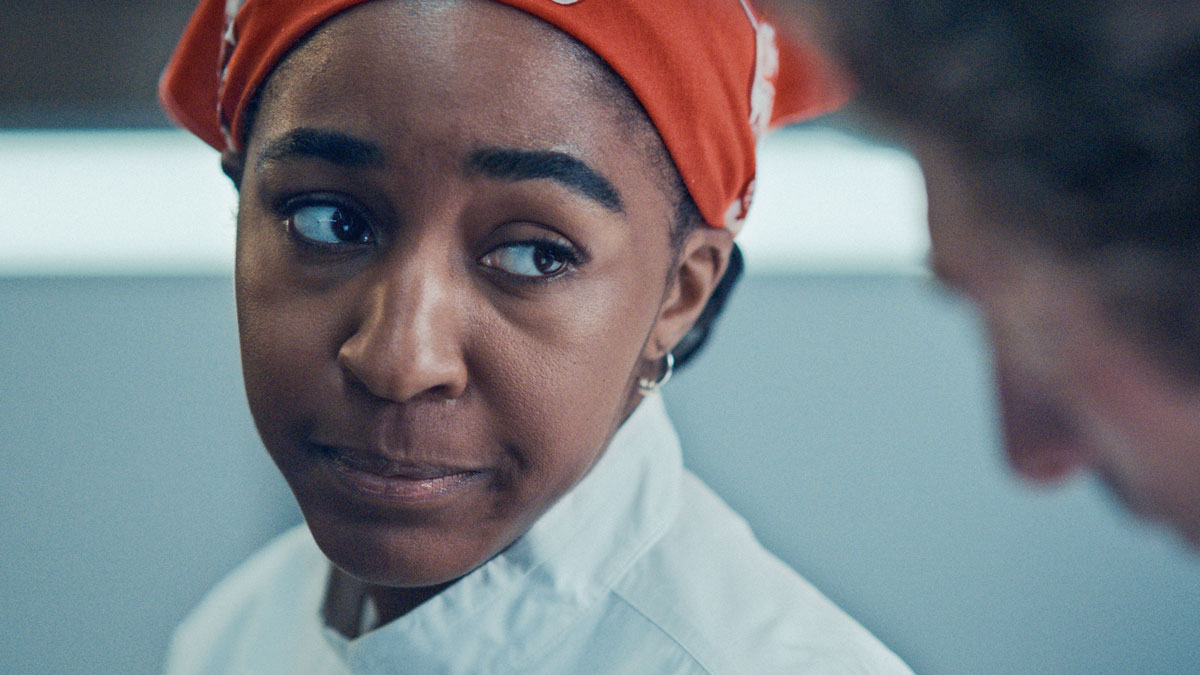
But this forgets that Carmy is someone damaged by learning that greatness is fired by cruelty, and who is desperate not to let down those he respects, and who on some level doesn't think he deserves the faith they have in him. 

I’ve established my preference that their relationship remains platonic. But if series creator Christopher Storer and his writers decide to make SydCarmy real and do so convincingly and thoughtfully, I wouldn’t protest.  But I do take some issue with a perspective shared in TeenVogue proposing that resistance to their possible romance “seems to be rooted in colorism and racism” which . . . is a view. And not entirely without merit. 

Writer Jendayi Omowale points out that TV and film have frequently side-stepped the nuances of race in their ever-evolving and frequently regressing efforts to portray interracial relationships — especially between Black women with darker complexions and white men. A counter-argument to this is that along with Black women spending years being relegated to play the sassy best friend, judges, police chiefs or the pillar of strength is the therapist trope, with several recent TV shows presenting Black women characters as wise guides dedicated to repairing broken souls. I do not want to see Sydney Adamu unofficially cast in this part, and it doesn't seem like she's up for it either.

SydCarmy is a product of social media, an arena where floating bigoted takes prompts engagement. A wound-up ‘shipping contingent guarantees a vocal opposition will materialize. That’s the way of such platforms. 

We need your help to stay independent

Of course, some of this desire to see the leads fall for each other is tied up in White’s sex symbol status, fed by the actor’s turn in the latest Calvin Klein boxer brief ads. With the world acknowledging his sex appeal, it follows that people would want Syd to find bliss with her heroic dirtbag of a creative collaborator. (White and Edebiri, along with Storer, have gone on record saying they’d rather keep things as they are between Syd and Carmy, for what that’s worth.) 

Thus, the pro-SydCarmy passion escalates as the writers further alloy the characters’ mutual respect and love for culinary artistry to the survival of their shared dream.

Mainly this shows up in Storer’s insistent tight focus on small details and tender corners of dialogue. Consider the show’s main director of photography Andrew Wehde’s predisposition to zoom in on actors' faces during moments of intense vulnerability. This mainly favors the leads – White, who sublimates Carmy’s deep-seated doubts, grief, and depression into a language of hard squints and tics, and Edebiri, who carries Syd’s delight and frustration around her eyes and brows even as her voice strains to remain even.

The BearAyo Edibiri as Sydney in "The Bear" (FX)That closeness imbues every frame and edit with manifold meanings, including its food porn stills. Beauty always plays its part here. But Syd’s hamachi plate tells a couple of stories, each open to interpretation. An overhead perspective shows it to be a bleeding heart, which could be a Valentine or, knowing the stress that went into its creation, a cry for help. 
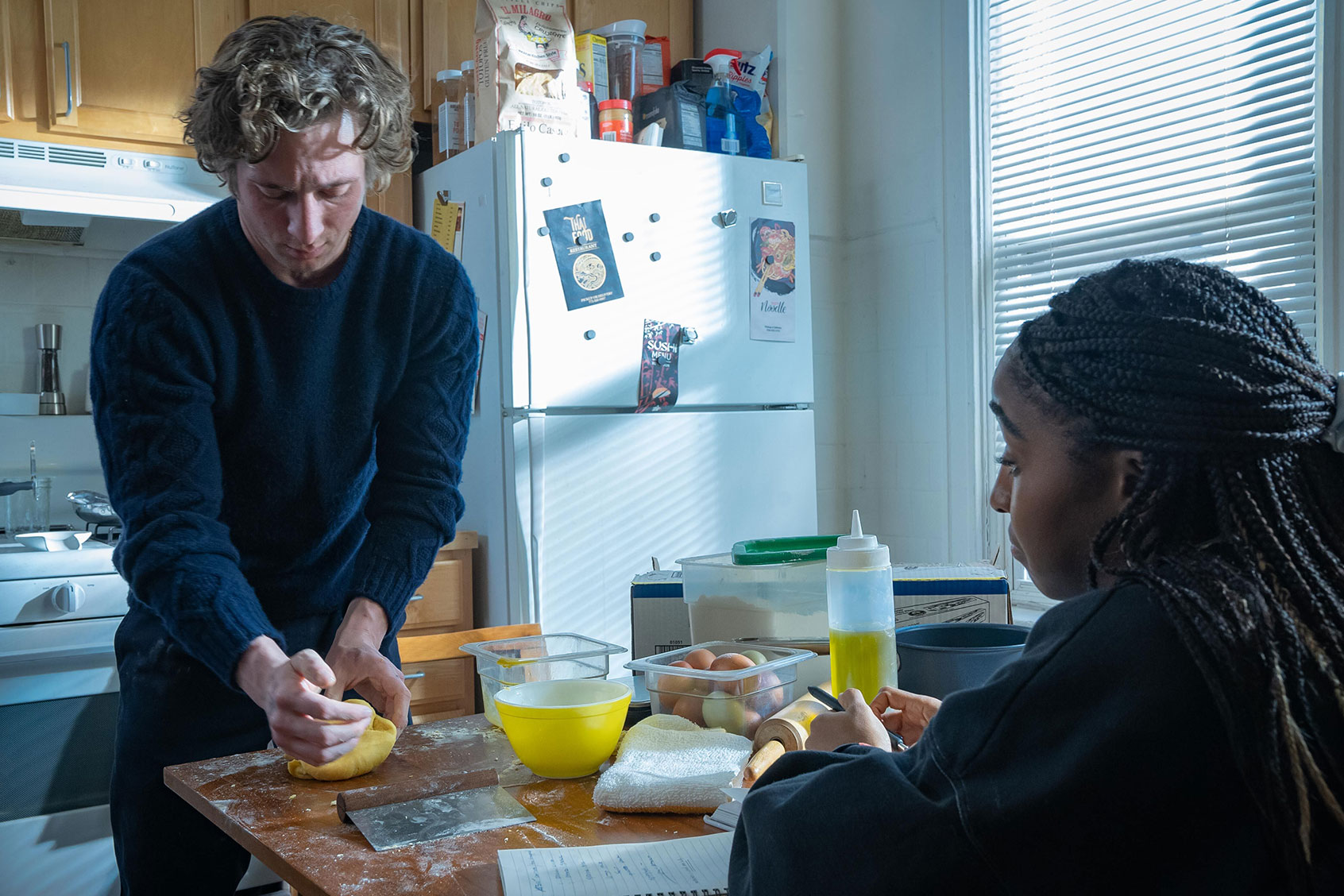
Look again. Most of the premiere is a view into Carmy’s interiority, but maybe that part of the movie is Syd’s. Either way, the memory belongs to both. Since Carmy doesn’t know who’s getting that plate, his going rogue could be a matter of self-satisfaction and nothing more. Sydney may know who Carmy is by then, so for her the plate is an inspiration. 

The satisfaction and pride that chefs take in nourishing others is a central theme of "The Bear," a concept that necessitates a kind of intimacy not often explored in TV.

But if we’re going to contemplate whether this accidental crossing is more evident of kismet, we’re also obligated to sit with where the season ends for Sydney.  The finale finds her doubled over the hallway outside her apartment, hyperventilating with a violence that threatens to turn her inside out. The episodes leading up to it show her frustration steadily climbing as Carmy’s anxious demands for perfection takes over, sidelining her creativity and disempowering her. She has wonderfully original ideas, and he shoots down nearly all of them.

So. Seizing on the meaning of Syd popping into Carmy’s consciousness in one of his darkest hours this season is inseparable from the rage blackout in the first season episode “Review” that leads her to quit, the first major test of their professional relationship.

We definitely can’t forget White’s monologue in the first season finale “Braciole” where in a moment of self-examination, he explains the sources of his drive to an Alcoholics Anonymous meeting: a determination to prove everyone who doubted him wrong, starting with his dead brother, and an incurable habit of viewing anyone of comparable talent as competition he needs to smoke.


Want great food writing and recipes? Subscribe to Salon Food's newsletter, The Bite.


With Mike gone, the one person who shares his level of fluency in and love for the art of cooking is Sydney. When everyone else flies off the handle, including him, she is a rock. 

The BearJeremy Allen White as Carmy and Ayo Edibiri as Sydney in "The Bear" (FX)But this makes her more of an instrument to him than a person. Syd’s creativity and ambition can help The Bear succeed, but knowing she’s at his level compels Carmy to work against her. He can help her push her recipes from great to excellent, but his preoccupation with his own suffering makes her question whether the psychic irritation is worth it.

There’s an indolent model in romantic comedies that posits love can fix anything, but not this. Storer and his writers know it, and by extension, so does Syd. That's why she delays in signing the partnership contract guaranteeing her a partnership stake in The Bear, although the terms seem straightforward. What is a contract if not a kind of marriage?

That's why, when a better career suitor comes calling, she’s torn between remaining loyal to Carmy and the crew and honoring her ambition. Hence, the heaving.

All those close-ups we scour for meaning are tiles in a broader mosaic telling the story of the bond between family and legacy. “The Bear” has established that Carmy and Syd share a love expressed in dedication and commitment, and stretched meals over multiple seasons by cracking, shattering, and repairing those foundations.

Therefore, let's really consider what it means to want these two to fire up a romance. Loving the fantasy of Carmy and the sensually charged “Yes, Chef” purring he inspires is not the same as understanding the reality of this character’s messiness. If Syd’s fans want the best for her, then by the end of this season they may conclude she’s better off not wanting anything more from Carmy than a Michelin star.

All episodes of "The Bear" are streaming on Hulu.

Once branded as “cheap eats,” Asian cuisine is finally getting the awards it deserves

Chef Christina Nguyen kickstarted her restaurant career in 2011 when she and her husband Birk Grudem opened Hola Arepa, a food truck serving platters of Venezuelan street food. Three years later, the pair opened its brick-and-mortar location in South Minneapolis and, in 2018, added Southeast Asian restaurant Hai Hai to their résumé.

Hai Hai marks Nguyen’s first foray into Asian cuisine. The daughter of immigrants who fled Saigon during the Vietnam War, Nguyen is a self-taught chef who grew up eating many of the dishes she now shares with local patrons. There are water fern cakes (Bánh bèo), steamed rice cakes topped with mung bean, shrimp floss and fried shallots that are served alongside nước chấm, a dipping sauce made with fish sauce. There’s Mì Quảng, a turmeric rice noodle soup embellished with chili jam, herbs, banana blossom, peanuts and sesame-shrimp crisps. And there’s Vietnamese crepe (Bánh xèo), a childhood favorite of Nguyen’s that features a crispy turmeric and coconut milk rice flour base stuffed with either pork belly & shrimp or Shiitake mushrooms & spring pea puree.

These are just a few of the many meals Nguyen ate at family celebrations, in Vietnamese Sunday school basements and during trips to the homeland. But at Hai Hai, Nguyen doesn’t serve only Vietnamese fare. Diners can also enjoy Thai, Malaysian, Singaporean and Laotian flavors. Nguyen describes Hai Hai as her “playground” where she invites Minnesotans to savor the lesser-known regional dishes of Southeast Asia along with the traditional dishes Nguyen adores.

Six years after opening her business, Nguyen was named “Best Chef: Midwest” at the 2024 James Beard Awards in Chicago. In her acceptance speech, Nguyen thanked her parents, who she said “taught me that anything is possible, to not be afraid.” She also thanked the James Beard Foundation for recognizing “the value of immigrant food.” 

“When we started our restaurants, the most that a Southeast Asian restaurant could ever hope for was ‘best cheap eats.’ And I feel like we've come a long way,” Nguyen said. “So this is an honor. Thank you.”

Indeed, Asian cuisine has come a long way. The history of such foods in America varies from one fare to another, but they are all rooted in immigrant communities who came to the States in hopes of finding prosperity. 

Compared to many Asian foods, Chinese has long been the most popular and well-known cuisine in America. Chinese food was first introduced to the States following the First Opium War, when many Chinese laborers left an economically depleted China in hopes of making a fortune amid the California gold rush. Rampant discrimination and limited labor opportunities prompted many immigrants to open Chinese-style restaurants, which became a newfound source of income and community. In 1882, a growing anti-Chinese sentiment plagued California, leading to the passage of the “Chinese Exclusion Act.” Although the law restricted immigration into the United States, it still allowed Chinese business owners to obtain “merchant status,” which enabled them to sponsor relatives who were immigrating from China. This ultimately led to more Chinese restaurants being established, particularly on the West Coast.

We need your help to stay independent

As explained by PA Food, a family-owned Asian food manufacturer, Chinese restaurants initially catered to the Chinese community. That’s because the “prevalent culinary style of the time was derivative of French/European fine cooking — heavy in body and using dairy products, very much the opposite of the Canton style served at the time.” Chinese cuisine grew in popularity during the 20th century and many traditional dishes were tweaked to cater to the American palette. For example, egg rolls, invented in 1930s New York, became an American rendition of the traditional spring roll. Same with General Tso’s Chicken, a sweeter variation of a Hunanese chicken dish. By the late 1960s, changing attitudes toward Chinese food along with the abolition of the Chinese Exclusion Act ushered in a new wave of Chinese immigration to the U.S. Additionally, the number of Chinese chefs nationwide increased and new regional styles of cooking were introduced.

In the same vein as Chinese food, Japanese food surged in popularity due to certain dishes being “Americanised.” But that wasn’t the case for Korean food, which was marketed solely to the Korean community. Korean food first made its way to the States in the 1970s following a wave of emigration from South Korea to the United States.   

“Food was used as a means of feeding the community with something that reminded them of home,” per PA Food. “From the 1970s to 2000s Korean food had fallen beneath the mainstream radar since it remained staunchly traditional and out of reach from what mainstream American food culture was comfortable with.” That changed in the late 1990s when American-Korean fusion — embraced by chefs like Roi Choi — became a highly sought-after cuisine.

In more recent years, Thai food has established itself in American food culture thanks to Thai restaurateurs who introduced new spices and cooking techniques. Same with Malaysian food.


Want more great food writing and recipes? Subscribe to Salon Food's newsletter, The Bite.


Despite the proliferation of Asian food establishments within the States, the cuisine itself has been excluded from mainstream culinary awards for years. The first James Beard Awards were presented on May 6, 1991, and featured not a single Asian restaurant or chef on the winners list. Two years later, Japanese-American celebrity chef Roy Yamaguchi took home the award for “Best Chef: Pacific Northwest” for his work at Roy’s. He was the only Asian chef to make it on the winner’s list that year.

The James Beard Foundation has received criticism for disproportionately honoring white male chefs in the past. Last fall, the foundation said it would make some big changes to its awards process in an effort to “increase gender, race, and ethnic representation in the governance and outcomes of the Awards,” according to a statement obtained by Food & Wine.

At this year’s awards ceremony, Nguyen was joined by several Asian chefs on the winners’ list, including chefs Masako Morishita of Perry's, Atsuko Fujimoto of Norimoto Bakery, Lord Maynard Llera of Kuya Lord and Hajime Sato of Sozai — just to name a few.

At Hai Hai, Nguyen said she wants diners to “feel happy, to feel connected and to feel good.”

“We try to make it so that it just feels like you're somewhere else, like you're transported,” she said. “I want people to be excited to dig into more of the different foods and cultures that our menu represents.”

CNN reports 20-year record low debate viewership

CNN reports indicate that just 47.9 million people tuned in to the first 2024 presidential debate.

The 2020 re-match saw a 35% dip in audience from the first clash between Joe Biden and Donald Trump, which drew 73.1 million viewers in September 2020.

The debate, hailed by many as catastrophic for the Biden campaign as his signs of age drew more attention than Trump’s constant factual errors, gave an embattled Trump an opportunity to demonstrate his relative spryness, leading many pundits to call for Biden to leave the ticket.

The Biden campaign took the poor performance in stride, pushing forward with the president’s planned appearance in North Carolina and rejecting demands and speculation on the candidates' position atop the ticket. 

CNN did note an uptick in digital engagement on its own digital channels, indicating that its live stream and social channels saw record data.

“Across CNN’s digital platforms, the debate was CNN’s biggest debate ever,” the network said.

The Thursday debate was the least-watched head-to-head between candidates in nearly 20 years, pulling just ahead of a 2004 debate.

Per the Commission on Presidential Debates, the second presidential debate between incumbent George W. Bush and John Kerry drew 46.7 million viewers, a few hundred thousand less than Thursday.

The two candidates, among the most unpopular in U.S. history, each did little to draw support to their campaigns during the debate, which featured untraditional rules aimed at dissipating interruptions.

In 2016, Trump and his opponent Hillary Clinton shattered records, with 84 million Americans tuning in for the circus featuring now-infamous interruptions from Trump.

Why Chappell Roan is your dream girl’s dream girl – and 2024’s breakout artist

In August 2023, Chappell Roan released a music video for her 1980s electro-pop throwback “HOT TO GO!” Set in Springfield, Missouri — she grew up in nearby Willard — the clip centers around a choreographed dance in which she spells out the song title with her arms. 

Clad in outfits such as a sparkly blue leotard and matching eyeshadow, Roan does the moves with drag queens and bored teens, and even (adorably) teaches her grandparents the dance. But in many scenes, she earnestly acts out “HOT TO GO!” by herself — at a gas station, at a mini-golf course, in front of a giant fork — as if she’s singlehandedly trying to manifest success. 

Mission accomplished. Earlier in the year, opening for Olivia Rodrigo set her up for some massive milestones. In recent weeks, Roan performed in front of staggeringly huge crowds at New York City’s Governors Ball Music Festival and Bonnaroo. At Kentuckiana Pride, throngs of people lined bridges overlooking the performing area to catch a glimpse of Roan — and, yes, do the “HOT TO GO!” dance, which is also wildly viral on TikTok. 

And these days, when you Google Chappell Roan, the search engine asks, “Do you mean ‘your favorite artist’s favorite artist’?” It’s a nod to some of her stage banter at Coachella — which in turn was inspired by an iconic saying popularized by drag queen Sasha Colby, “your favorite drag queen's favorite drag queen” — but also a testament to her increasing pop dominance. Roan is a queer icon from a deeply red state who manifested her way out of her hometown by being herself and believing that her songs were great even when nobody else did.

As we reach mid-year, Roan is unquestionably 2024’s breakout artist. From a quantitative standpoint, Billboard crunched numbers and noted that her weekly on-demand streams have increased more than 20-fold in six months, from 2.51 million for the week ending Jan. 4 to 68.36 million the week of June 20. Her 2023 album “The Rise and Fall of a Midwest Princess” currently resides in the Billboard album charts Top 10, while her latest single “Good Luck, Babe!” is in the Top 20 of the Hot 100.

Roan’s music possesses many touchstones — Kate Bush, Florence and the Machine, Lana Del Rey, Tori Amos . . . but feels contemporary and unique.

This ascent is as impressive as it is improbable. Roan released her first major label effort, the “School Nights” EP, in 2017 and toured as an opening act for Declan McKenna. (Footage from that tour includes her warbling the Cranberries’ “Dreams” as crowds rudely chatter over her.) She was subsequently dropped from her label in 2020 after releasing current hit “Pink Pony Club,” a yearning ballad about leaving small-town Tennessee and finding a home dancing at a California gay bar. Even after Roan found a new label home and released “The Rise and Fall of a Midwest Princess,” her fortunes didn’t turn around right away: The album initially failed to chart upon its September 2023 release. 

We need your help to stay independent

That “The Rise and Fall of a Midwest Princess” took a while to catch on is no slight on Roan’s music. In fact, the album is a sassy, campy breath of fresh air indebted to punkish new wave dance (“Femininomenon”), brash electroclash and house music (“Super Graphic Ultra Modern Girl”), synth-speckled melodrama (“My Kink is Karma”), and torchy ballads (the Lana Del Rey-esque “Picture You”). Roan’s music possesses many touchstones — Kate Bush, Florence and the Machine, Lana Del Rey, Tori Amos, the early-2010s empowerment pop movement — but feels contemporary and unique.

At times, Roan’s explosive rise recalls the meteoric ascent of Lady Gaga. Back in early 2010, Mother Monster booked a theater and small arena tour that ended up becoming a massive underplay because it coincided with “The Fame Monster” taking off. There are certainly musical parallels between the upbeat dance-pop and melodramatic piano ballads favored by both women, while Roan has also been covering Gaga’s “Bad Romance” live.

And both women embrace the use of personas in their art. Gaga was deeply inspired by the David Bowie’s shapeshifting identities, while Roan told Vanity Fair her Chappell Roan persona is the “drag-queen version of me because it's very larger-than-life. Kind of tacky, not afraid to say really lewd things.” Later, she added that this persona allows her to “be whatever I want” and “has really allowed me to explore parts of myself that I wouldn't have if I hadn't chosen this specific path.” 

Among other things, that includes her queerness. “It allows me to feel really safe exploring those aspects of myself,” she continues. “I’d never be able to do that if I took myself super seriously with pop. I think that the project has allowed me to be a part of the queer community in a deeper way because I'm not observing from the outside anymore. I feel like I'm in it. I am the queer community – it's allowed me to just feel queer, feel like a queer person and feel freedom in that.”

Her songs are rooted in self-discovery and yearning for community.

Indeed, “The Rise and Fall of a Midwest Princess” is an explicitly queer album about queer experiences. “It is the storyline of a girl who moved from a small conservative town to a city and had an awakening of this world she never knew existed,” Roan told Teen Vogue about the album’s theme. “Which includes queerness, which includes heartbreak, which includes falling in love, which includes the city and clubs, and it's the world of Chappell Roan.”

Lyrically, the album deals with the ignominy of a relationship where one person is being strung along (“Casual”) or revels in revenge fantasies (“My Kink is Karma”) or flirts with other women (the self-described “campy gay girl” song “Red Wine Supernova”). Fittingly, Roan’s lyrics are full of delicious details (watching “Mean Girls” and having a crush on Regina George in “Naked in Manhattan”) and pointed lines (“People say I'm jealous, but my kink is karma,” “I heard you like magic/I've got a wand and a rabbit”). 

At times her vocal delivery is stream-of-consciousness, leading to songs that feel like she’s an omniscient narrator. But her songs are rooted in self-discovery and yearning for community. For example, “Pink Pony Club” represents more than just a club; it signifies the idea of acceptance and finding a place where you belong. Throughout, Roan’s vocals are urgent and sincere, which strengthens the connection (and empathy) between her and her fans.

Fittingly, her concerts have become fashion extravaganzas, with crowds dressing up in elaborate costumes and Roan herself going all-out paying homage to Divine or the Statue of Liberty. But Roan is also dedicated to giving back: On her fall 2023 tour, she donated portions of proceeds to the nonprofit For The Gworls, which supports Black trans people, and she has drag queens open her shows.

The retro synth-pop gem “Good Luck, Babe!” is poised to be her biggest single yet. A brutally honest song directed toward a woman who’s not being honest with herself about her sexuality — instead of admitting she’s gay, she’s now in a loveless marriage — it’s an emotional ride. Roan’s vocal delivery is cutting and matter-of-fact but also devastated — a testament to her ability to bring nuance to pop music. It’s Chappell Roan’s world; we’re just lucky enough to live in it.

Hillary Clinton and top Democrats rally around Biden as media pushes drop out message

After Joe Biden’s mediocre debate performance drummed up immense support from the pundit class for him to drop out of the race, Hillary Clinton, Barack Obama, and other Democratic lawmakers rallied around the president.

Clinton, who lost to Donald Trump in 2016, framed the race as a choice between Trump’s ego and President Biden’s record.

“It's a choice between someone who cares about you—your rights, your prospects, your future—versus someone who's only in it for himself,” Clinton, who debated Biden during the 2008 Democratic primary, wrote in a post on X, formerly Twitter. 

“I'll be voting Biden,” the former Secretary of State declared, linking the Biden campaign’s website.

While the New York Times editorial board — the paper seemingly looking for any excuse to drag Biden through the mud — called for him to step off the presidential ticket, top Democrats disagree, including former President Barack Obama

“Bad debate nights happen. Trust me, I know,” the former president and Biden running mate said in an X post. “So much is at stake in November.”

Biden, who seemed to regroup on Friday after his low-energy performance, also garnered support from Senate Democrats, including Pennsylvania’s John Fetterman, who tweeted “f*** that,” in response to the Times editorial board. 

House minority leader Hakeem Jeffries told reporters “no” when asked if he thought Biden should step down.

Other Democratic leaders pointed out that Biden’s performance, while uninspiring, wasn’t campaign-ending.

“Well, the president didn’t have a good night, but neither did Donald Trump with lie after lie and his dark vision for America,” North Carolina Governor Roy Cooper told The Associated Press.

6 ways to stay safe at the beach this summer

Summer has officially arrived, and with it comes a renewed interest in frequenting places of sand and surf. Growing up along the Jersey Shore, I learned how to "do" the beach from an early age. I know its unspoken rules of etiquette, like avoiding parking oneself too close to fellow beachgoers and keeping music at a respectful volume. Once the spring season turns, my weekends become synonymous with scavenging for seashells and quietly evaluating swells for the most suitable time to bodysurf. 

But as much as beaches are places of tranquility and enjoyment, they bring with them the potential for danger, as with any environment governed by the forces of nature.

As we find ourselves flocking to the shorelines nearest us this summer, it's useful to keep a set of tips for safety in mind. Whether you're trekking across hot sand alone with a Tommy Bahama folding chair strapped to your back, or attending with friends and family, here are a few ways you can keep yourself and those around you safe at the beach during these dog days. 

01
Wear sunscreen
This may seem fairly obvious, but in an age of prevailing misinformation, a reminder about the importance of protection from sun exposure is pivotal. A CNN report published June 21 indicated that social media influencers on TikTok are peddling false and potentially harmful information about the sun and sunscreen. Ultraviolet (UV) radiation, a scientifically proven carcinogen, can lead to cancers such as melanoma, badly burn the skin and hasten the skin's aging process.
 
While concerns about chemical-riddled sun protectants are valid, there is a spectrum of products to choose from with varying sun protection factors (SPF). Speaking to CNN, David Andrews, a senior scientist for the Environmental Working Group, said, “Mineral-based sunscreens are not absorbed into the skin and are better for the environment. There are many good, safe choices on the market that don’t leave a white cast on the skin.”
02
Know how to spot a rip current, and how to swim out of one
A recent spate of drownings in Florida is a grim reminder of the ocean's immense power. Even when a lifeguard is present, being an observant and aware swimmer can sometimes mean the difference between a life or death scenario. Rip currents, powerful, fast-moving and narrow flows of sea water, are common culprits behind ocean fatalities. 
 
Certain precautions can be taken to avoid ending up in a rip current, such as knowing how to identify them. "The best description that we can give is that it's an area where you don't see a lot of breaking waves, and don't see the white foamy water of a crashing wave. You actually see a lack of waves,” National Weather Service Community Engagement Lead Douglas Hilderbrand told TIME Magazine. Rip currents, which function as a sort of river that helps to funnel underwater debris, may also appear darker in color than the surrounding water. 
 
If you find yourself caught in a rip current, it is imperative to remain calm and avoid swimming against it toward the shoreline, so as to not exhaust yourself. Other than signaling to a lifeguard that you are in distress, the best course of action is to either swim parallel to the shore, float outward until the current ends, or propel themselves by riding a nearby wave. 
03
Firmly plant that umbrella!
Runaway umbrellas on a blustery beach day are something of a commonplace phenomenon. But a beach umbrella taking flight isn't merely a chore to chase down — it can pose a risk of injury to yourself or those around you, becoming a dangerous projectile in a matter of seconds. 
 
To properly secure your umbrella, choose a non-sloping section of partially wet sand — its firmer texture will help with stability. Make sure to bury the umbrella's post deep enough that it wont come loose when the first big — and inevitable — gust of wind passes through. Opting for a corkscrew-shaped sand anchor can also help to keep things in place.  
04
Beware of digging large holes
In February, a child tragically died when a hole she was digging at a Fort Lauderdale, Fla., beach collapsed on her and her brother, burying him up to his chest and covering her entirely, causing her to suffocate. NPR reported that around three to five children die in the United States each year when a sand hole they are digging at the beach or elsewhere collapses on top of them. In cases of survival, victims often require resuscitation. 
 
This harrowing instance complicates a traditionally favorite beach activity for kids, but it's important for parents to remain vigilant about the potential hazards that accompany playing in the sand, ensuring that holes do not get too deep. 
05
Stay hydrated
As rising temperatures due to the effects of global warming bring hotter summers and sometimes deadly heat waves, keeping yourself hydrated is critical. In addition to keeping an ample supply of water on hand, consuming sports drinks can help replace electrolytes lost to sweat from physical activity or simply sitting in the sun. 
06
Keep your belongings safe
Going to the beach alone can be infinitely relaxing, but what should you do with your phone, car keys and other valuable while you take a dip in the water? First, don't overpack. Keep things simple, using a nondescript bag, so as to not invite wandering eyes. Plan to set up shop near other people, detracting potential thieves from being seen rummaging through your belongings. 
 
Bringing along a waterproof pouch or a portable safe can also be useful. Or, you can always opt for the old-fashioned method of placing your items in a Ziploc bag and burying them under your towel.


Grief is brutal, but there is value in it, experts say. So why do we try to “cure” it?

Cody Delistraty wanted to get good at grief. After his mother died of melanoma when he was in his early twenties, he found, as he writes in his new book “The Grief Cure: Looking for the End of Loss,” “There was no control to exert. No blueprint to follow.” So, feeling frustrated and exhausted, he did just what a mourner who’s also a journalist might do — he investigated.

After experiencing firsthand that the aftermath of loss does not progress neatly in five stages, Delistraty began exploring a variety of grief treatments, from approaches as traditional as ritual and community support and as futuristic as AI and memory deletion. His odyssey took him back to the history of our modern conceptions of grief, and coincided with a d new reassessment of the experience within the psychiatric community, with the addition of prolonged grief disorder to the DSM.

Though the loss of his mother and its aftermath “showed me how brutal pain is,” as Delistraty tells me during a recent video chat, it also showed him why grief can be something to “keep with us and to work through, as hard as it is.” Ultimately, it’s not something to be cure or reach the end of. But like a painful chronic condition, it can be managed. And Delistraty reminds, “It happens to everybody.”

This conversation has been edited and condensed for clarity.

You pose a variant of this question right at the start of the book, so let's get into it. Is grief a disorder?

No. Grief is not a disorder. I found the research interesting and I've had trouble exactly coming down on precisely where I think, but I have some broader takeaways. Prolonged grief disorder, as I write in the book, is something that came out of the DSM [Diagnostic and Statistical Manual of Mental Disorders] by the APA [American Psychiatric Association] two years ago. Clinicians who believe in it said that their reason was to differentiate it from normal grieving. They're characterizing it as lasting 12 months or more, although they say it's really more like six months.

Then it has to meet at least three of the symptoms happening every day for at least a month. That’s a sense of meaninglessness, marked sense of disbelief, identity disruption, numbness, that sort of thing, and it has to be outside your cultural contingencies. So if you're celebrating the Day of the Dead as a Mexican, you're not suffering from prolonged grief disorder. 

It's obviously had a ton of opponents. When I was on the phone with different researchers and talked to different people over Zoom, both sides were super passionate about it. I do think everyone is acting in good faith. People want the best for people who are grieving in these very intense, persistent, and as prolonged grief disorder people say, unchanging ways. What is tricky is diagnostic culture more broadly. Putting something like grief into a lens of medicine is always going to be tricky, and is always going to elicit pretty intense feedback and responses. 

"The average bereavement time off in the U.S. is five days."

I took the questionnaire to get confirmed possibly for prolonged grief disorder, but I wasn't myself confirmed. I never walked around with that label. I can see how that legitimacy would be valuable to someone, though. Just think of the fact that the average bereavement time off in the U.S. is five days. You tell your boss you’re grieving, and they say, “Sorry, deal with it.” 

If you say, “I have prolonged grief disorder,” are they going to respond differently? Are our family members going to respond differently? That is more of an indictment, though, of how we treat people who are grieving than it is of any one diagnosis. The conclusion I've come to is to be careful with how much we center grief within diagnostic culture, while still understanding that there are possibly valuable avenues within medicine to at least draw attention to this and give some credibility and legitimacy to it.

In the book where you introduce the invention of grief as we understand it in a modern sense. Tell me about what we have typically thought of grief in the modern era, and how maybe we're starting to change that. 

We have to look at it from an even broader scope. The French medievalist Philippe Ariès was giving lectures at Johns Hopkins that were somewhat controversial at the time, because he was painting with a broad brush of Western attitudes. Prior to the 18th century, his claim was that there was what he called “tamed death,” where there is a real sense of social acceptance of the normalcy of loss. And that was due in part to higher mortality rates, but it was also due to people coming together, being around the bedside, religious rituals being done. Then you fast forward to the early 20th Century. The First World War is where I put it, where you start to see how with mass death happening and with this top-down desire to privatize grief, it gets driven underground. 

One of the most interesting examples was President Woodrow Wilson. The war effort wasn't a popular one. His constituents weren't excited for the U.S. to enter the First World War. He kind of brokered a little deal with Dr. Anna Howard Shaw, prominent women's suffragist. He basically said, “What if instead of all of the women who you oversee marching in full black mourning to protest the war, we converted that to patriotism? What if instead, those women wore a nice band that has a star on it to memorialize if they have a dead spouse from the war?” And so you have this conversion of public grief into something that's quieted, something that's privatized.

Walter Benjamin in 1935 is writing about the covering up of grief and public spaces, how it's no longer the news of death. It's just the news. You have the British anthropologist Geoffrey Gorer, writing in 1965 off a study of about 1,600 British citizens. He says that people are weary of talking to their neighbor now about grief, weary of burdening them. He attributes that in part to happiness culture, which I thought was funny, because I thought of that as a more recent phenomenon. But even in the mid 20th Century, people are starting to think of grief as something that could be almost harmful to others. You get this vicious cycle, and you see it today, all the time. 

I saw it in my personal experience. You say, “I don't want to burden this person,” and then the person who should be there to help them says, “I don't want to open the wound by asking about it.” So you get this miscommunication when, for me, just saying, “Hey, I'm here for you. Want to have a coffee?” is one of the most valuable ways of dealing with and helping other people with grief. 

We've had this evolution from the 18th Century until the late 20th Century, and early 21st Century of public into private. But I'm optimistic because I've seen a hybrid form, starting with what Crystal Abidin, an ethnographer of internet culture, has called publicity grieving.

It sounds exploitative and not great at first. In 2013, there was a big brouhaha over funeral selfies, where people were taking photos of themselves in front of gravesites. In the most optimistic, charitable viewpoint, I see that as people trying to put their grief in the public space somehow and not knowing how to do that. We don't have the language for this anymore. We don’t want to be a burden. But what if we're able to show death in spaces that are more public? Funeral selfies? Not great. But I do think that grieving people on social media, the rise of things like the dinner party I wrote about, where you're not in the formalized therapist's office, but you're not in full public either, there's a move toward the public.

My great hope would be that, ultimately, grief is something that everyone is open to talking about. And we don't fall into that vicious cycle of thinking we're going to be a burden, it's a burden.


Want more health and science stories in your inbox? Subscribe to Salon's weekly newsletter Lab Notes.


As you say, there's the imperative to avoid grieving too much. 

I think it's being good at grief. In my sense, that was keeping it low being getting through it. People would even say, “You’re dealing with it so well,” which doesn't mean you're talking about it a lot. It means you have shut up and you're doing well at work, right?

At one point, you write about grief as a bodily experience, and how it could manifest as aggression. What were you feeling? And what was the feedback from people around you? 

I had this desperation to be good at it. I'd been an okay high school student, an okay athlete, these sorts of things. In college, my mom gets sick, and I'm like, I’ve got to be good. I was studying way harder than I'd ever studied. I was doing strength training regimens, going for really long runs, trying to push myself. I thought if I could be good enough at those things, it would somehow save my mom or somehow help her make her proud or provide some usefulness. 

Then when she died, it flipped from, be a good student, be a good athlete, to be a good griever. I think in the year of our Lord 2024, we have gotten better at men being able to have a higher EQ and be more expressive. But for me, the physicality of it and needing a catharsis, that most easily came through things like training for the Paris marathon or getting into strength training. The feedback I got was, “Wow, you're doing great with this. Your mom would be so proud of how fast you've moved on.” And so the physicality of it was fascinating. With laughter therapy, I found that to be a fun way of opening and liberating the diaphragm, as Carla Brown would say.

If I was breaking down a lot more, there might have been more questions asked or a fear that I wasn't doing as well.

When someone is sick, you’ve got something to do. In the immediate aftermath of death, even a sudden death, you’ve got something to do. And then there's nothing to do anymore. You just lost your job. The purposefulness of that relationship with that person is also something that is gone and is part of the grief. Did you experience that?

The received wisdom I had and was part of me being a good griever was going through the five stages of grief, which as you know, is so deeply misinterpreted. 

Swiss-American psychiatrist Elisabeth Kübler Ross came up with it as she was doing research on people coming to terms with their own death, not with people who are dealing with grief. There have been some interesting studies on grieving people. There's one from 2007 that found most grieving people do kind of move forward through these stages. It is a decent reflection of that.

But there's so much misinterpretation, and if I could go back, I would tell myself, that's not a blueprint, that's not a prescription. You don't get to acceptance, you don't get to a great place in grief by hitting these steps. I talked to one psychiatrist who said she had a client come to her and say, “I'm asking my husband to make me angry because I'm trying to get to the anger stage faster.” Oh, no, you've misunderstood entirely. I was in that space of thinking “closure,” thinking “five stages.” That was the work I was able to give myself. It was the part of being a good griever. Of course, I had to rethink all of those things to ever get anywhere in my grief. But early on, that was definitely the thinking. 

You went through so many different therapeutic interventions, things that I didn't know were available in the real world. What did it teach you about what other people are going through in this community of grief, and this community of seekers? 

It showed me how brutal pain is and how pain is just something that our first and understandably, evolutionary, feeling is, “Get it away, get it off, get it out of my head.” When I researched, some was for me, but also I thought things Chat GPT would be interesting to the reader.

I wanted to see what the technological recreation of my mom would be like. I was doing that in 2020, before all the media hit on it. I thought, this seems like a futuristic thing that a lot of people probably will try. A lot of it was trying to look at it as a mode through which we could, hopefully ethically, consider it before it's mainstreamed into something like optogenetics or memory deletion. I spoke to one ethicist in neuroscience who thought in 10 to 15 years this could be something that humans are dealing with. 

"Loss is brutal, grief is brutal, but there is some value in it."

I wanted to look at that kind of thing and say, there are parts of grief that are hell and the pain is seemingly unbearable. What does it mean if and when we get these possibilities with something like AI? I was working with GPT-3, now we're way above that. You can have way more complex conversations. I'm sure we will have some kind of video component or even more holographic, even more human component. What does it mean to really grapple with those questions now and to say, yes, loss is brutal, grief is brutal, but there is some value in it? And there is some reason to keep it with us and to work through, as hard as it is, rather than erasing it.

What do you think would help us in it as a collective? As you say one of the problems is we don't have communities now, we don't have the social structures. We have to seek out other people who are sharing this experience because grief is isolating. It's like you're the injured animal in the herd.

It's hugely isolating. The loneliness is a big part of it. That's part of the fear of engaging with someone about it. I found throughout researching this book and going on this quest, so much grief bubbling just under the surface of people. You give them just a touch of, “I'm working on a book about grief,” and you get so much. People that people crave that license, I think. 

We need your help to stay independent

You're talking specifically about grief where someone you care about has died. There other ways of grieving too. You can grieve a relationship, you can grieve for a thing that you wanted that you didn't get. You’ve experienced so many different ways of looking at it and dealing with it, processing it. What works? And what works for us, in caring for each other? 

Being present was really what I found. The book ends on me finally going home and being able to get over that roadblock of talking to my dad and my brother in an open way, talking to friends from back home. I had felt isolated, and also did a lot of self-isolating.

I was living in Paris for a few years. There were several nights where I wouldn't go out, or I would sit and listen to my mom's interviews on on my laptop that I did with her at the end of her life, and feeling like, I’m not normal. I shouldn't be burdening others. I shouldn't be within the mainstream social sphere. And having the wherewithal finally to be there with my family and have that presentism and searching for that community. 

I am sanguine about the rise in communities. I think more and more people are understanding this. There has been all sorts of understanding recently about how modern society is screwing us over. We need to start reconnecting and recreating communities in real life. All these things are part and parcel of how we'll get better at facing loss and helping others through it. And just understanding that it happens to everybody. It's not abnormal, and it shouldn’t be treated as such.

The New York Times wants Biden gone — but they seem OK with a convicted felon

A day after the first presidential debate, President Joe Biden energetically took the stage in Raleigh, N.C. to talk about his less-than-stellar performance in Atlanta on Thursday night.

“I know I’m not a young man. I don’t walk as easy as I used to. I don’t speak as smoothly as I used to. I don’t debate as well as I used to. But . . .I know how to tell the truth,” he said. His upbeat energy was a direct contrast to his laconic actions in a debate against Donald Trump the previous night.

Several Democrats and The New York Times called for Biden’s head. The editorial board at the Times penned an opinion piece with the headline, “To Serve His Country, President Biden Should Leave the Race.”

Hold on just one second, if we can. The Republican Party is circling the wagons defending convicted felon Donald Trump while the New York Times and a few Democrats are ready to burn Biden at the stake because of a poor performance in one debate.

Whoever prepped Biden for the debate should be fired. They overstuffed him with information he couldn’t get out of his mouth while Trump ignored the facts and shouted horrendous lies. All Biden had to do, in answering anything Trump said was respond, “My opponent is a convicted felon. I think it’s abhorrent that he's even here.” He never did that. Politically, Biden brought a stiletto and Trump brought a sawed-off shotgun. 

Did Joe Biden screw the pooch? Yep. But so did Donald Trump. 

Thursday night at CNN's studios, Biden was definitely a disappointment. He started off slowly. He stumbled, cleared his throat often, stared into space occasionally and seemed to need a glass of water. We were first told he was suffering from a cold. After the debate, he told reporters he had a sore throat. Who’d expect he’d do better? He has never faced the White House press corps in the briefing room – which is the best prep for a debate.

Donald Trump glared, looked grim, stared, and did nothing but lie. Mind you, he was energetic, illustrative and delusional. In other words, he’s everything we’ve come to expect out of Donald Trump. Reality and Trump are not ships that pass in the night, they’re not even on the same sea.  Whether it was Roe v. Wade, inflation, immigration, veteran affairs, the war in the Middle East, Ukraine, or Russia, Donald Trump lied. But he looked good, we were told, doing it. 

As one Republican explained to me about Trump, “He’s a consummate liar. What else would you expect from him?” As one Democrat explained to me about the president, “Biden took a week off to prep at Camp David and all he did was catch a cold.” Democrats were upset that when asked about Roe V. Wade, Biden fumbled his response. Republicans were happy Trump didn’t answer any questions and turned every question into an attack on Biden.

After about 45 minutes of indulging Trump, Biden finally and firmly called Trump a liar. “The only convicted felon here is the man I'm staring at right now, " he said before going on to mention Trump’s felony convictions for paying off an adult film actress he had sex with while his wife was pregnant, finally finishing with a flourish by saying Donald Trump “has the morals of an alley cat.”

Meanwhile, Trump said he did nothing wrong, Biden was the real criminal, and then he compared Palestinians to Nazis and white Supremacists marching in Charlottesville. The moderators never called him on that. The next day, Trump repeated his use of “Palestinian” as an insult on the campaign trail.

And for all that this debate was, ultimately it was a dumpster fire of biblical proportions because the moderators, Jake Tapper and Dana Bash acted as AI questioners and timekeepers rather than moderators. It was a complete abdication of journalistic responsibility.

In an email to his supporters the following day, Trump even thanked CNN for giving him the opportunity to mop the floor with Biden. 

We need your help to stay independent

When Trump said Biden didn’t have Vladimir Putin’s respect, Biden could have jumped in, but as a moderator, independent of the politics, why didn’t someone ask “Why the Hell would we want Putin’s respect?” 

Biden, a few minutes later, called Putin a war criminal, but Trump’s statement went unchallenged. It’s important as a moderator to point out some of the basics – independently of the debaters. 

It’s also important for a moderator to keep the debaters focused on answering the questions, instead of allowing them to use their time to insult their opponent. Bash at least attempted this at one crucial juncture – when she asked Trump the same question I asked him six weeks before the 2020 election – would he accept the results of the election. She tried valiantly to get an answer out of Trump as he took the opportunity to bash his opponent while avoiding the question. In the end, he gave the same answer he gave me – only if he believes the election was free and fair. We all know he would only believe that if he won. Yet the debate moved on. 

Biden scored his best hit on Trump when he discussed the former president’s 2020 election loss. “You’re such a whiner. No courts said your claims had any merit when you lost the first time. Not one. Yet you continue to provoke this lie. You can’t stand the loss. Something snapped in you when you lost last time.”

Of course, he missed a key point on immigration. All Biden had to do when Trump started shooting his mouth off about immigration was say, “hey, we had it solved, but you had your guys in Congress kill it so you could run on the issue.” End of story. 

Watching the debate was akin to watching “Two grumpy old men tell the kids to get off their lawn,” as a young Democrat explained to me Thursday after the debate. She lives in Arizona and said the debate did nothing to settle the question about who is a better candidate. “One is a convicted felon and a liar and the other stares off into space. I probably won’t even vote,” she told me. Others I spoke with after the debate echoed top Democrats and said Biden should step aside. 

“They talked more about their golf game than they talked about women’s healthcare,” one registered Democrat told me. “I hate Donald Trump,” a registered Republican explained. “He’s a convicted criminal, and a habitual liar, but Biden is barely there.”

California Governor Gavin Newsom defended Biden, as did Vice President Kamala Harris, though she admitted it wasn’t Biden’s best performance. Still, it can be said of Biden’s awful performance Thursday that he at least tried to answer questions. Trump never did. 

Trump never never enunciated a cogent policy and the moderators didn’t press him to do so. He never gave us a vetted fact. He lied and stoked the fire of fear and hatred. He called our country a third world nation and said the world was laughing at us.

One of the most egregious of Trump’s fictional representations occurred when he used the national stage to again try to rewrite history about the January 6 insurrection. He lied about the riotous event, disavowed any responsibility and then blamed Nancy Pelosi for what occurred.

I was there. I know first-hand what happened. Trump stirred up the crowd, Rudy Giuliani called for “trial by combat,” and then they sent the crowd to march on the Capitol. Every single person I interviewed as they marched said they were going to the Capitol because Donald Trump told them to go. It wasn’t peaceful. It wasn’t a protest. And Trump was silent for three hours while it occurred. Pelosi had nothing to do with it.

It was all Donald Trump. 

At the end of the day, despite all of the handwringing and spinning,  neither candidate could claim a knockout at the debate – although Trump and his minions continue to claim they did so. But facts exist independent of their conjured reality and nothing can be done about that. Did Joe Biden screw the pooch? Yep. But so did Donald Trump. 

For those voters in the battleground states, there were facts fumbled by Biden, and there was bullshit wielded by Trump.  “One of these two won’t be in the final round of Jeopardy,” a Biden operative told me. A Trump operative told me nearly the same thing. Both of them think their guy will be there.

They might both be right. But I don’t think so. 

At the end of the day, it was probably a wash – at least in the short run. Millions didn’t watch the debate and will get their news from both campaigns, who will cut up the debate and use their favorite statements in campaign advertising.

What remains to be seen is what happens at the conventions.

The Republicans are going to continue to defend a convicted felon.

The Democrats, who always seem to snatch defeat out of the jaws of victory have already proceeded to eat their own – or are trying to. I don’t see either party dumping their candidate because of what happened Thursday. But I could be wrong. If the Democrats panic enough, then, as Sam Donaldson told me late Thursday night, we could be witnessing “the political death of Joe Biden.”

Biden, after leaving the debates, stopped at a local Atlanta waffle house and when asked about his performance said it was hard to debate a consummate liar. Yeah. So, why did you Joe? There are some who say it was a politically fatal mistake – and they may be right. 

I do see a long, hot summer of lies, distortions, greed, hatred and fear on the horizon, whether Biden stays in the race or not. 

On the one hand, you have a grumpy old man saying we’re a Third World nation. On the other, you have a stuttering old man who says we’re the envy of the world. 

They can’t both be right.

And soon, one of them may be gone.

Senate Republicans set to seize on Supreme Court’s abortion opening

For 50 years, Americans counted on Roe v. Wade to protect not only the right to abortion, but the ability to receive lifesaving care for miscarriages and the chance to build families through fertility care. Roe was never perfect. For too many, it was a right in name only – a right that slipped increasingly out of reach as Republicans chipped away at abortion access in states across the country. Then, two years ago, anti-abortion Supreme Court justices handpicked by Donald Trump overturned Roe once and for all.

Today, forty percent of women of reproductive age live in a state with an abortion ban. Every day, there’s another story of the chaos and cruelty these bans have caused – like the story of Ryan Hamilton, a father in Texas who recounted the horror of finding his wife unconscious and bleeding on their bathroom floor because she had been denied care for a miscarriage. Just as heartbreaking is the knowledge that an entire generation of young people have lost the right to determine their own lives and futures. 

Donald Trump has bragged about being “proudly the person responsible” for ending Roe v. Wade. Make no mistake: He bears responsibility for flipping the balance of the Court, and for everything that has happened as a result. But Trump isn’t alone. Every mainstream Republican candidate running for a seat in the United States Senate would be a vote for a national abortion ban. And they won’t stop there. In the last month alone, Republican senators have blocked Democratic legislation to protect access to birth control and IVF. These positions are deeply unpopular and disqualifying to voters. So just like Donald Trump, their only hope of getting elected is to shamelessly lie and hide their records. We can’t let that happen. 

Just a few weeks ago, Florida Senator Rick Scott released a campaign ad saying, "You can count on this grandpa to always protect IVF." The only problem? The day before, he voted against the Right to IVF Act, which would have done just that. This fall, voters in Florida have the chance to vote to protect abortion rights – and elect Senator Scott’s opponent, Debbie Mucarsel-Powell, who believes decisions about pregnancy should be made by families and doctors, not politicians. 

We need your help to stay independent

And then there’s Texas Senator Ted Cruz, who introduced legislation for a national abortion ban. Texas women have died because of abortion bans in Senator Cruz’s home state. Now, he wants to end reproductive freedom for Californians, Michiganders, and New Yorkers. That’s why it’s so crucial to support Colin Allred, who has vowed he’ll never stop fighting to repair the damage abortion bans have caused. 

The list goes on and on: Republican candidates Dave McCormick in Pennsylvania, Tim Sheehy in Montana, Sam Brown in Nevada, and Bernie Moreno in Ohio all have one thing in common: They oppose abortion rights. During his unsuccessful 2022 run, McCormick backed an abortion ban with zero exceptions for rape or incest. Sheehy also supports a federal abortion ban. Brown said, “Abortion is not an issue of choice. It is an issue of life and I am proudly pro-life.” Moreno doesn’t believe in any exceptions for rape, incest, or the life of the mother. Each of their opponents – Senators Bob Casey, Jon Tester, Jacky Rosen, and Sherrod Brown – has a long track record of fighting to protect access to abortion.

In state after state – Kansas, Michigan, California, Ohio, Vermont, and Kentucky – when voters have had the chance to weigh in on this issue, they’ve sent a powerful message: Keep politicians out of our medical care. They used their power to either protect abortion access or defeat anti-abortion rights efforts and they won. Every single time.

This fall, voters will have the chance to do the same in states across the country. We have to take on those fights and win – and we can’t stop there. To protect and expand reproductive rights, we need to elect Joe Biden and Kamala Harris – and we need a Democratic U.S. Senate and U.S. House.

Millions of Americans are counting on us to suit up and head to the polls: Teenage sexual assault survivors in Louisiana, pregnant women enduring non-viable pregnancies in Alabama, and people in Mississippi who aren’t ready to be parents. Our votes will be the difference between repairing the damage caused by overturning Roe or allowing a national abortion ban to be signed into law by President Trump. The good news is, as voters have proven again and again, when we organize and vote together, there is no stopping us.

No, the L.A. synagogue protest wasn’t a “pogrom” — that’s a gross misuse of history

Leading Democratic elected officials, from Los Angeles Mayor Karen Bass to California Gov. Gavin Newsom to President Biden, have spoken out to condemn the pro-Palestinian activists who protested in front of the Adas Torah synagogue on the west side of Los Angeles last Sunday.

Jewish, Israeli and conservative leaders, including Amanda Berman, founder of the American Jewish group Zioness, Israeli special envoy Michal Cotler-Wunsh, Ellie Cohanim of the Independent Women’s Forum and numerous others have described the protest as a “pogrom,” a phrase echoed in a New York Post editorial on Tuesday.

Newsom said, “Such antisemitic hatred has no place in California,” adding, "There is no excuse for targeting a house of worship.”

Except that in this particular case, that's not an accurate description of what happened, and there was a legitimate reason for holding a protest outside a Jewish house of worship. While many news reports have barely mentioned this, the demonstrators were not outside that synagogue to protest Jews in general, the Jewish faith, Zionism or even Israel — they were there to protest the sale of land in illegally occupied Palestinian territory. 

The target of the protest was not Adas Torah itself but a group called My Home in Israel, which was holding a real estate marketing event at the synagogue. As Forbes reports, the group purchased a full-page ad in the June 21 issue of the Jewish Journal, a Los Angeles weekly newspaper, promoting the event at Adas Torah and another Southern California location with this pitch: "Come and meet representatives of housing projects in all the best Anglo neighborhoods in Israel.” 

According to the Los Angeles-area office of the Council on American-Islamic Relations, this marketing campaign is promoting “racially segregated settlements, where only Jewish people are allowed to live, on illegally-occupied Palestinian land.” 

One pro-Palestinian demonstrator held up a sign saying "Israeli Jew against land theft," while another displayed a sign with the slogan “Jews Against Genocide.” Social media posts announcing the protest stated “Our land is not for sale” and called on demonstrators to “Stand against settler expansion at Sunday’s real estate event.”

Under the terms of U.N. Security Council Resolution 446, which was passed in 1979 and reaffirmed in 2016, “the policy and practices of Israel in establishing settlements in the Palestinian and other Arab territories occupied since 1967 have no legal validity and constitute a serious obstruction to achieving a comprehensive, just and lasting peace in the Middle East.”

Under the current right-wing government of Prime Minister Benjamin Netanyahu, the rate of Israeli settlement building in the occupied West Bank has increased dramatically. A 2023 U.N. study found that almost 30,000 new housing units had been proposed in Palestinian territory within the first six months of that year. 

Those who have condemned the protests as targeting a Jewish “house of worship” are missing a crucial point. This marketing event took place on Sunday, which is not the Jewish day of worship.

Many Israeli organizations and individuals, including B'tselem, also known as the Israeli Information Center for Human Rights in the Occupied Territories, condemn both the occupation itself and Israel's settlement policy as illegal violations of Palestinians' human rights. The Israeli government and its allies reject the U.N.’s characterization of the Israeli occupation and settlement policy. 

One could fill volumes airing both sides of this debate, but whether one agrees with the U.N. or the Israeli government is not the point. Pro-Palestinian protesters had legitimate reasons to protest outside Adas Torah, and were not targeting Jewish individuals or the Jewish religion.

Furthermore, Biden, Newsom, Bass and others who have condemned the protests as targeting a Jewish “house of worship” are missing a crucial point. This marketing event occurred on a Sunday, which is not the Jewish day of worship. Shabbat runs from sunset on Friday to sunset on Saturday. This demonstration on a Sunday afternoon was not interfering with Jewish religious services.

Of course it's possible for protesters’ legitimate grievances to spill over at times into inaccurate, overblown offensive or outright antisemitic rhetoric, and even into violence. But those possibilities cut both ways: The regrettable violence at the Adas Torah protest involved clashes between protesters rather than antisemitic attacks. 


Want a daily wrap-up of all the news and commentary Salon has to offer? Subscribe to our morning newsletter, Crash Course.


Numerous media outlets have reported that one person was arrested at the protest, a demonstrator described as carrying a “spiked post.” But most reports have neglected to say that the person arrested was a pro-Israel demonstrator.

In a widely-circulated post, British journalist Nioh Berg claimed, “They're beating up Jewish women in LA in broad daylight now,” and others posted this photo of the “Jewish woman.” In fact, the pro-Israel counter-protester in question is a young man named Naftoli Sherman, who had a pro-Palestinian protester in a headlock and ended up bloodied. 

The reaction to this event from politicians, Jewish leaders and the media has followed an unfortunately familiar pattern: Pro-Palestinian protesters are libeled as antisemites, often on the basis of inaccurate or ambiguous evidence, and their worst moments are portrayed as indicative of the whole movement. In the process, Palestinians' legitimate grievances are dismissed. 

Both of my grandfathers escaped the antisemitic pogroms of early 20th-century Russia — massacres perpetrated by ultra-nationalist "Black Hundreds" thugs egged on by Tsar Nicholas II, known as "Bloody Nicholas." For American leaders today, Jewish and otherwise, to draw an analogy between last Sunday's legitimate protest and the murderous pogroms of that era demonstrates how unreasonable the American reaction to pro-Palestinian protests has become.

Dahmer victim’s mom slams Ariana Grande’s “sick” serial killer comments

Ariana Grande’s comments seemingly glamorizing serial killer Jeffrey Dahmer earned her scathing criticism from the family of one of Dahmer’s victims.

In a June 17 episode of the “Podcrushed” podcast, the “Yes, And?” singer outlined her passion for true crime stories.

Grande, who told podcast hosts Sophie Ansari, Penn Badgley, and Nava Kavelin that she was “infatuated with serial killers when I was younger,” went on to recount an encounter with a young fan. 

“It was in between me being Cat [referring to her role in the Nickelodeon TV show “Victorious”] and pop stuff, so it was like a younger group, and they were with parents, and someone said, ‘If you could have dinner with anyone living or dead, who would it be?’” the singer recalled. “I mean, Jeffrey Dahmer is pretty fascinating.” 

Dahmer, who killed at least 17 young men, mostly gay men of color, was examined by a 2022 Netflix documentary, which received its own slate of criticism for its depiction of Dahmer, and for the Dahmer idolization it spurred.

“I think I would have loved to have met him . . . I have questions,” the star went on to say.

Shirley Hughes, the mother of Dahmer victim Tony Hughes, blasted the singer for her comments.

“To me, it seems like she’s sick in her mind,” Hughes, whose son was brutally murdered in 1991, told TMZ. “It’s not fancy or funny to say you would have wanted to do dinner with him. It’s also not something you should say to young people, which she says she did.”

Per TMZ, Barbara Hughes, Tony’s sister, called for the "Wicked" lead to apologize for the remarks

“Schumer has become a Palestinian”: Trump spews more rhetoric at rally

Donald Trump pushed anti-Palestinian and antisemitic rhetoric at a campaign rally on Friday, doubling down on his attacks on critics of Israel.

Trump lobbed criticism at Senate Majority Leader Chuck Schumer, who has been an outspoken critic of Benjamin Netanyahu’s government, calling for an election to replace him, at a Chesapeake, Virginia campaign stop.

“Schumer has become a Palestinian. He’s Jewish but he’s become a Palestinian,” the former president said.

The comments, implying that the senator’s denouncement of Netanyahu’s government invalidated part of his Jewish identity, were also criticized for their use of “Palestinian” as a slur.

But the moment was far from the first time that Trump used the term as a slur against an opponent.

On the debate stage Thursday night, Trump called President Joe Biden a “Palestinian,” clarifying that he was a “bad Palestinian.”

The former president also said Israel should “finish the job,” as the country’s military campaign kills more than 150 Gazans a day and pushes over a million people into famine.

Trump, who moved the U.S. Embassy in Israel from Tel Aviv to the disputed city of Jerusalem, previously pushed antisemitic rhetoric, saying that any Jewish Democrat or Jewish critic of the Israeli government “hates their religion.”

Trump previously blasted campus protests criticizing the killing of tens of thousands of Palestinians, vowing to deport demonstrators.

During the rally, Trump also took time to thank the moderators of the debate, who took no time to fact-check the candidate during the 90-minute rally.

“They treated me very fairly. Very professional, both of them. Jake and Dana, they treated me very fairly,” Trump said. “I think it was great.” 

Trump, who claimed a “big victory” over Biden in the debate, also delivered some verbal slips, botching the word “landslide” before giving up, and doubled down on some of his biggest lies of the previous night, including taking credit for Biden’s insulin price reduction plan.