Spring Offer: Get 1 Year, Save 58%

“Pride, hope, and light”: Biden speaks at opening of Stonewall visitor center

On the 55th anniversary of the Stonewall riots, President Joe Biden dedicated the Stonewall National Monument Visitor Center as the first LGBTQ+ history visitor center in National Parks history.

“Happy Pride!” the president said, with more passion than he mustered the previous night at a presidential debate.

“It’s your love for each other and your vision for our country that brought this center to life,” the president told visitors. “To this day, Stonewall remains a symbol of the legacy of leadership to the LGBTQ+ community — especially trans women of color.”

Biden took a moment to address the upcoming race, one which he framed as a referendum on queer rights.

“We’re in the battle for the soul of America,” Biden said. “When I look around at the pride, hope, and light that all of you have, I know that we’re gonna win.”

The event, attended by Jill Biden, Elton John, New York Gov. Kathy Hochul, and other LGBTQ+ activists, celebrated the opening of a brand-new visitors center at the Stonewall National Monument, the first landmark commemorated by the Federal government to recognize LGBTQ+ history.

“When people think of the National Park Service, they don’t usually think ‘queer and urban,’” Diana Rodriguez, leader of the park’s creation, said. “So we’re a very different type of visitor center.”


Want a daily wrap-up of all the news and commentary Salon has to offer? Subscribe to our morning newsletter, Crash Course.


The site sits adjacent to the Stonewall Inn, where in June of 1969, riots broke out in response to a police raid on the gay bar, marking the start of the gay liberation movement in the United States. 

President Biden was one of the earliest outspoken voices at high levels of government to support gay marriage and spent the first three years of his term championing transgender and gay rights, expanding Title IX protections, targeting workplace discrimination, and pardoning LGBTQ+ service members convicted under homophobic laws.

While his opponent, Donald Trump, has been outspoken in his opposition to transgender communities, after appointing Supreme Court justices who critics say have their eyes on gay marriage protections, Biden’s campaign says he will continue to fight for queer communities.

The president’s remarks came hours after the first presidential debate of 2024, one that notably avoided questions grilling former President Trump on his dismal record on LGBTQ+ issues.

“Joe will never stop fighting for this community,” First Lady Biden said. “Joe and I are proud to stand beside you today and every day.”

President Biden’s record on LGBTQ+ issues also includes passing the Respect for Marriage Act, which required the government to recognize same-sex marriages.

36 Senators and 169 House Representatives, all Republicans, voted against the Respect for Marriage Act.

While celebration was the main tune of the event, musician Elton John didn’t shy away from warning Stonewall visitors that the gains won since the riots were fragile.

“Over 540 anti-LGBTQ+ bills were introduced in state legislatures across America this year. Disgraceful,” Elton John said. 

Steve Bannon to report to prison on Monday

Steve Bannon is finally headed to prison for refusing to answer for his role on January 6th.

After a busy day of gutting executive authority, criminalizing homelessness, and protecting January 6th rioters, the Supreme Court denied a last-ditch effort from Steve Bannon to avoid a prison sentence, setting him up for a July 1 report to jail.

Bannon was charged with contempt of Congress after denying to answer a subpoena from the January 6th select committee, and sentenced nearly two years ago to a four-month stint before a deluge of appeals set his sentence back.

In the one-page order, Supreme Court Chief Justice John Roberts denied Bannon’s plea for release pending another round of appeals, exhausting his options ahead of the sentence. The Muslim ban architect must report to a Danbury, Connecticut federal prison on Monday.

The podcaster and former Trump advisor has gone to great lengths to avoid accountability, enlisting House Speaker Mike Johnson in his crusade to overturn his sentence. The speaker, who was prepared to file an amicus brief in support of Bannon, previously blasted the January 6th committee’s contempt order as “tainted.”

Bannon, whose previous legal troubles stemming from a fraudulent border wall fundraising scheme were squashed by a presidential pardon from Donald Trump, has been assigned an inmate number by the federal Bureau of Prisons. He is slated for release a week ahead of the November election.

“You get knocked down, you get back up”: Biden quashes drop-out chatter at rally

Joe Biden quashed rumors that he would leave the race after his lackluster performance at the first presidential debate left many Democrats dazed.

In a much more galvanizing speech than the previous night, the president affirmed to voters that his raspy speech and, at times, confused answers weren’t an indication of his performance as president.

“I know I’m not a young man,” Biden told supporters at a stump in Raleigh, North Carolina on Friday. “I don't walk as easy as I used to, I don't speak as smoothly as I used to, I don't debate as well as I used to. But I know what I do know: I know how to tell the truth.”

Rumors and calls for Biden’s exit from the ticket swirled amongst Democrats on Thursday night as the president bungled questions on inflation and the economy at large early in the contest, critics noting his soft-spokenness and frail demeanor.

Biden’s performance was contrasted by the relative vigor of his opponent, who bucked questions and pivoted attention to immigration and other core attack avenues, spewing unchallenged lies along the way.

“When you get knocked down, you get back up,” the 81-year-old said. “Folks, I give you my word as a Biden: I would not be running again if I didn't believe, with all my heart and soul, I could do this job — because, quite frankly, the stakes are too high."

Biden’s running mate, Vice President Kamala Harris, stayed on message when asked about his performance.

“I’m not going to spend all night with you talking about the last 90 minutes when I’ve been watching the last three and half years of performance,” the Vice President told CNN’s Anderson Cooper.

The campaign, committed to the message that Biden’s disappointing debate performance shouldn’t distract, confirmed to The Hill last night that the president had no intention to exit the race.

Despite Biden’s late-night debate on Thursday (and an even later-night stop at an Atlanta Waffle House,) his jam-packed Friday includes visits to New York City and the North Carolina campaign event.

New Jersey decides not to automatically renew some Trump liquor licenses, schedules July hearing

Some of Donald Trump’s New Jersey liquor licenses were put in jeopardy after the state’s Divison of Alcohol Beverage Control decided not to renew licenses at two of the former president's golf clubs following his conviction on 34 felony charges last month, Forbes reported Friday.

Earlier this month, the New Jersey attorney’s general’s office said it was investigating Trump's eligibility to hold liquor licenses at three of his golf courses in the state, NBC News reported. Two of the clubs, Bedminster and Colt Neck, were denied renewals but granted temporary permission to continue serving alcohol until a hearing on the matter is scheduled July, 19, Forbes reported.

Under state law, liquor licenses are denied to any person "who has been convicted of a crime involving moral turpitude." The state's Alcohol Beverage Control handbook states that "moral turpitude" refers to "a serious crime from the viewpoint of society in general and usually contains elements of dishonesty, fraud or depravity." 

Trump was convicted in May of 34 felony counts for falsifying business records to cover up hush payments to adult film star Stormy Daniels. He is due to be sentenced July 11.

“Risky proposition”: Experts say replacing Biden would cause “major rifts” within Democratic Party

Democrats are reeling in the aftermath of President Joe Biden's debate against former President Donald Trump Thursday, igniting panic among his allies — and sparking conversations about whether he should ultimately remain in the race.

His appearance at the first 2024 presidential debate Thursday night, which was moderated by CNN's Jake Tapper and Dana Bash, was billed by his campaign as an opportunity to show American voters that, contrary to concerns about his mental acuity and old age, he's capable of leading the nation in a second term.

His performance, however, left viewers and political pundits alike with much to be desired — if not an overwhelming sense of dread — as he debated the presumptive GOP nominee with a hoarse voice, slow cadence and seeming inability to counter many of his counterpart's misrepresentations. Despite some improvement as the debate dragged on, Biden delivered answers that ran the gamut from over-rehearsed to, at times, unintelligible. 

"The optics were not good," J. Wesley Leckrone, a professor of political science and department chair at Widener University, told Salon. "Biden has made a career of portraying himself as a fighter. There wasn’t much fight last night.

"I think even a casual observer could see that his demeanor was substantially different than it was when he debated Trump in 2020," he continued.

Over the course of the night, a stand-out line from Trump, whose haphazard answers often dodged the question or included a litany of lies and exaggerations, appeared to become representative of the president's showing among viewers: “I really don’t know what he said at the end of that sentence, and I don’t think he did, either.”

Just minutes into Thursday's debate, Democrats vaulted into private discussions about Biden's expected performance and peppered in concerns about whether he could even continue his campaign, Axios reports. White House officials also quickly sought to place blame over how Biden's inner circle had aided the president in his debate prep.

"He was over-prepared and relying on minutiae when all that mattered was vigor and energy," one member of Biden's circle told the outlet. "They prepared him for the wrong debate. He was over-prepared when what he needed was rest. It's confounding."

Notably, the debate — the biggest night to date for Biden's campaign — was the president's idea, with his team proposing its timing, handling the logistics and setting the ground rules. For his part, the Biden campaign also said midway through the debate that the president was battling a cold.

But even with the disclaimer, the 90-minute event would go on to spotlight the party's greatest fears about the potential for Biden's age to stymie his candidacy.

We need your help to stay independent

His allies and campaign have since been scrambling to do damage control and restore confidence in the presumptive nominee for their party ahead of the Democratic National Convention in August, but among Democratic consultants another option has entered the fray as a more appealing solution: replacing Biden on the ticket altogether. 

Michael Thorning, the director of structural democracy at the Bipartisan Policy Center, said that while doing so is "possible," it would be "quite unusual for the party to change candidates in the middle of the election season."

"Each party has some mechanisms in place for if a candidate cannot get a majority of votes to receive the nomination or if a candidate drops out of the contest for whatever reason," he told Salon.

"The mechanisms, of course, exist as contingencies. They're not meant to be availed in most circumstances," Thorning added. "The parties are really in a position now where they do want these primary contest conventions and caucuses as much as possible to reflect the will of the voters when the convention comes."

Leckrone said that, should Biden end up out of the running in some form or fashion, the best case scenario would be, instead, for him to withdraw from the race voluntarily, release his pledged delegates and place his support behind another candidate.

Calls for Biden to withdraw have already started to roll in, and more Democrats — especially elected officials — may go public with their concerns in the wake of the debate, Axios noted. Some congressional Democrats expressed concern to the outlet late Thursday that Biden remaining on the ticket could tank their own bids in November.

Such an outcome actually taking shape, however, seems about as unlikely as it is recommended, Leckrone said. In order to deny Biden the nomination, "roughly half" of his pledged delegates would have to switch their support to another candidate on the first ballot — a move that Leckrone posited is a "real long-shot at this point in time." 


Want a daily wrap-up of all the news and commentary Salon has to offer? Subscribe to our morning newsletter, Crash Course.


If Democrats try to push Biden out, they risk creating "at least two major rifts that could prove very difficult to smooth over before the November election," he explained. The first would threaten to further divide the president's supporters from the progressive wing of the Democratic Party, who are already less committed to him. A second rift lies in the lack of a clear frontrunner who could take Biden's place, Leckrone said, noting that while the incumbent vice president would be the "natural person" to fill that role, "there is no consensus building around" nominating Vice President Kamala Harris.

"This would lead to a free-for-all to get the nomination, most likely creating rifts between the various factions of the party," he said, adding that a Biden ouster would also mean "a new nominee would have to quickly define themselves and their priorities," which would offer the opposition "the ability to define and negatively attack an unvetted candidate."

"That is a very risky proposition given the short time between the nomination and the general election," Leckrone said.

The Democrats should instead "stick with Biden" unless he chooses to withdraw from the presidential race on his own, getting the president out into the public in an "attempt to show that he has the stamina to remain president," he argued, emphasizing that "giving speeches to supportive crowds is much easier than debating. Damage control seems to be the best option."

As of Friday afternoon, that seems to be the option the Biden campaign took. During a rally in North Carolina, Biden appeared to be in better shape and spirits, coughing just a few times as he clarified his second term agenda and defended himself against the criticism that followed the debate.

"I know I’m not a young man. I don’t walk as easy as I used to," he told the crowd, according to NBC News. "I don’t speak as smoothly as I used to. I don’t debate as well as I used to, but I know what I do know — I know how to tell the truth!"

Thorning said that, while Biden is receiving "an unusual outpouring of concern," even in the context of all the criticism of other candidates and presidents typically receive for their debate performances, it hardly means he's completely lost the support of his party.

"I think for the people who pay such close attention to politics and the kinds of people who are watching debates, there is a tendency to assume that there is a direct connection between what happens in the debate and people's voting decisions and ultimately the outcome in November. I don't think it's that clear that there is that strong connection," he said.

"Trump has the momentum right now. However, we’ve seen the course of campaigns change from the middle of the summer to election day in the past," Leckrone noted, adding: "I think the Democrats need to retrench, show support for Biden as the party’s standard bearer, and make the election about Trump."

“Stunningly worse than I expected”: “View” hosts want Biden to “step aside” after disastrous debate

"The View" hosts have strong words for President Joe Biden after his lackluster performance at the first presidential debate with Donald Trump.

At the start of the show, co-host Sara Haines said, “It was really hard to watch and it pains me to say this today, but I think President Biden needs to step down and be replaced. If we want to defeat Donald Trump in November then I absolutely think that."

However, Haines said she would still vote for Biden if he was up against Trump in November because "the alternative is too scary for me." 

Co-host Alyssa Farah Griffin agreed with Haines, stating she was “genuinely shocked” by Biden’s performance. She described it “stunningly worse than I expected.” She also emphasized that Trump's performance was disturbing and “lied his way through it” but Biden's cognitive health concerns outweigh Trump's lies. "I feel duped!" Griffin said about the White House's press stating that Biden was well prepared for the debate.

While co-host Sunny Hostin noted that the debate was a loss for Biden, she was the only panelist who said Biden should "maybe" step down. However, she pointed out, "I think it's really ironic that the party that should be pressuring their candidate is the Republican party. Their nominee is a convicted felon.

“Why are we as Democrats — those of us who are Democrats — calling for our nominee to change?” she asked.

“Because he’s losing!” Griffin responded.

In response, host Ava Navarro said, “Until Joe Biden tells me he’s giving up, I’m not giving up on Joe Biden. To me, the binary choice remains the same."

“Revival 69” shows how John Lennon and Yoko Ono’s Plastic Ono band saved a transformative festival

Ron Chapman’s "Revival 69: The Concert That Rocked the World" memorializes one of rock ‘n’ roll’s strangest, albeit highly consequential festivals. Two years after Monterey and smackdab in the middle of the Woodstock triumph and Altamont debacle, respectively, Toronto’s Rock ’n’ Roll Revival featured a hodgepodge of old and new acts, ranging from Chuck Berry, Little Richard and Jerry Lee Lewis to the Doors, Chicago and Alice Cooper. Even more significantly, the festival featured John Lennon and Yoko Ono’s Plastic Ono Band debut scant days before he would privately announce the Beatles’ disbandment.

Originally filmed by famed documentarian D.A. Pennebaker, the footage at the heart of "Revival 69" offers a spectacular window into the look and feel of the festival, which was held in Toronto’s Varsity Stadium that September before a capacity crowd of more than 20,000 patrons. To his great credit, Chapman brings the event vividly to life, tracing the story of John Brower, a fledgling concert promoter, who pulled off the Toronto festival against incredible odds. 

In addition to a bevy of previously unseen footage, "Revival 69" is chockful of interviews from the likes of Cooper, the Doors’ Robby Krieger, Chicago’s Danny Seraphine and the Plastic Ono Band’s Klaus Voormann and Alan White. In its finest moments, Chapman’s documentary portrays rock ‘n’ roll on the precipice of a vital crossroads, a world in which the genre’s pioneers were giving way to a new age of superstardom and innovation. 

In many ways, Lennon’s story exists at the heart of that transformative moment. Having led the Beatles on an unparalleled campaign across the 1960s, he was eager to begin establishing his identity outside of the Fabs. By the time that Brower secured John and Yoko’s participation in the event, he had overcome a series of obstacles, including a potentially deadly entanglement with a biker gang and flagging ticket sales. 

The announcement of the Plastic Ono Band’s appearance at the top of the bill escalated the festival’s profile in the nick of time, although for Lennon it proved to be a breakneck experience. Hastily assembling a band that included Voormann on bass and White on drums, Lennon rounded out the Plastic Ono Band’s personnel with Eric Clapton on lead guitar. Having never performed together before, the group rehearsed midflight in the galley of their Boeing 707 — without the benefit of amplification, no less.

For Brower, as Chapman’s exquisite documentary reveals, the “Hail Mary pass” of inviting Lennon to participate in the festival made all of the difference. As for Lennon, the Plastic Ono Band’s Toronto debut afforded him with the confidence to announce that he was leaving the Beatles soon after he returned to London. Yes, the Beatles were over, but a new era was already in its infancy.

“Narrow ruling”: Legal scholar says Supreme Court Jan. 6 decision won’t save Trump

The Supreme Court's Fischer v. United States ruling narrowing federal prosecution of certain obstruction charges could still allow the Justice Department to pursue those charges against Jan. 6 rioters — and Donald Trump, according to a legal expert.

The lawsuit centers on the case of Joseph Fischer, who was charged for his conduct in the Jan. 6, 2021 breach of the U.S. Capitol. 

Prosecutors hit Fischer with numerous charges, including violations of the Sarbanes-Oxley Act — which imposes criminal liability for anyone who tries to alter, destroy or conceal records concerning official proceedings.

Trump has been charged with the same offense in his federal election interference case, as have other individuals.

Under the court's ruling, prosecutors could still bring the charges against Fischer as well as Trump— if they prove the conduct involved "attempts to impair the availability or integrity of evidence," UNC School of Law professor Carissa Byrne Hessick told Salon.

"It's certainly possible," Hessick said. "The question is what sort of theory does the government advance that fits the new language, and then what evidence can they provide? 

Specifically, the law targets anyone who corruptly "alters, destroys, mutilates or conceals a record, document, or other object, or attempts to do so, with the intent to impair the object's integrity or availability for use in an official proceeding."

Prosecutors charged Fischer with specifically violating the section of the law that extends that prohibition to anyone who "otherwise obstructs, influences or impedes any official proceeding, or attempts to do so." Violations of the law carry up to a 20-year maximum sentence behind bars. 

Fischer tried to dismiss the obstruction charge and argued that the Sarbanes-Oxley Act only criminalizes "attempts to impair the availability or integrity of evidence."

The government argued that the "otherwise" clause "'capture[s] all forms of obstructive conduct" beyond the impairment of evidence.

The Supreme Court agreed with Fischer, and said the government's approach would "give prosecutors broad discretion to seek a 20-year maximum sentence for acts Congress saw fit to punish with far shorter sentences."

In a concurring opinion, Justice Ketanji Brown Jackson focused on Congress' intent and said that she thinks it's possible federal prosecutors could still convict Jan. 6 defendants on the charges. 

"She makes the point that the case has to go back down to lower courts, that this is correctly instructing juries and that sort of thing," Hessick said.

Jackson said it's "highly unlikely that Congress intended" to establish a "first-of-its-kind general federal obstruction crime" that would do away with the need for any other obstruction laws.

We need your help to stay independent

Still, Justice Jackson pointed out that Fischer was charged with violating Congress' certification of the Electoral College vote.

"That official proceeding plainly used certain records, documents, or objects—including, among others, those relating to the electoral votes themselves," Jackson wrote in her concurrence. "And it might well be that Fischer’s conduct, as alleged here, involved the impairment (or the attempted impairment) of the availability or integrity of things used during the January 6 proceeding in ways other than those specified" in the federal law.

She concluded: "If so, then Fischer’s prosecution under §1512(c)(2) can, and should, proceed. That issue remains available for the lower courts to determine on remand."

And DOJ data suggests the court's ruling could be limited: an analysis by JustSecurity found the obstruction charge "materially affects at most only 5.9% of all Jan. 6th cases. Hessick said it's the latest example of the Supreme Court issuing narrow interpretations of federal criminal laws — a trend she said predates the Trump appointees.

"This is a political case and people are going to draw political conclusions from it," she told Salon. "I actually think the case fits rather easily into a broader trend of the Supreme Court being hostile to very broadly and unclearly written criminal laws over the past 15, 10 years."

Prosecutors say Fischer and others violated the law by forcing their way into the U.S. Capitol, breaking windows and assaulting police — all as part of a breach that delayed the certification of the vote. Fischer was also charged with six counts alleging he forcibly assaulted a federal officer, entered and remained in a restricted building, and engaged in disorderly and disruptive conduct in the Capitol — with those counts carrying penalties from six months’ to 8 years behind bars. 


Want a daily wrap-up of all the news and commentary Salon has to offer? Subscribe to our morning newsletter, Crash Course.


The justices in their 6-3 majority opinion, authored by Chief Justice John Roberts, focused on what the law meant by its use of "otherwise."

The section of the Sarbanes-Oxley Act at issue dates back to the Enron scandal, when prosecutors couldn't go after outside auditor Arthur Anderson for having "systemically destroyed potentially incriminating documents,'" the opinion said. 

That's because the federal law did not impose liability on the person who destroys records. At the time, Section 1512 of the federal code imposed criminal liability on anyone who "knowingly uses intimidation or physical force, threatens or corruptly persuades another person" to shred documents, or take other steps. 

"As a result, prosecutors had to prove that higher-ups at Enron and Arthur Anderson persuaded someone else to shred documents rather than the more obvious theory that someone who shreds documents is liable for doing so," reads the ruling.

The governor and the plaintiff agreed that Congress passed the Sarbanes-Oxley Act to close that loophole. 

Roberts' opinion said it would be "peculiar" for Congress to have closed that loophole by creating a broad "catchall" that would extend beyond scenarios like document shredding. 

"The better conclusion," reads the ruling, is that the law was "designed by Congress to capture other forms of evidence and other means of impairing its integrity or availability beyond those Congress specified."

The ruling also said that the government's broad reading of the law would "criminalize a broad swatch of prosaic conduct, exposing activists and lobbyists to decades in prison." 

Iowa Supreme Court upholds near-total abortion ban, returning women’s rights to the “Civil War era”

The Iowa Supreme Court ruled Friday to uphold a law banning abortion after no more than six weeks of pregnancy, NPR reported.

The law, which replaces a 20-week ban, prohibits abortions after early cardiac activity is detected in an embryo, with exceptions carved out for rape (reported within 45 days), incest (reported within 140 days), fetal abnormalities and critical threats to the mother's health.

The ruling lifts a temporary block on the law, which was passed by the state legislature in July 2023 and signed by Republican Gov. Kim Reynolds. 

“We conclude that the fetal heartbeat statute is rationally related to the state’s legitimate interest in protecting unborn life," the court said.

The 4-3 ruling rejected Planned Parenthood’s argument that the law violates citizens's fundamental rights under the state constitution, the BBC reported. The law effectively eliminates the right to choose as most people do not know they are pregnant within the first few weeks.

Chief Justice Susan Christensen dissented, writing: "The majority’s rigid approach relies heavily on the male-dominated history and traditions of the 1800s, all the while ignoring how far women’s rights have come since the Civil War era."

Iowa is now one of 18 states with either a six-week or total abortion ban following the 2022 Dobbs decision, NPR noted.

“Power grab”: Supreme Court guts agency power, posing “devastating” environmental risks

The Supreme Court voted along party lines in a historic decision on Friday, ruling against the government in a pair of cases — Loper Bright Enterprises v. Raimondo and Relentless, Inc. v. Department of Commerce. The conservative judges sided against the liberals, setting a precedent gutting the power of regulatory agencies to protect the environment and consumers.

"This is a gift to Harlan Crow and Leonard Leo and all of these people who are paying for the justices to go on private jets and to sail on yachts to Bali."

According to one expert, the 6-3 decision proves that something "sinister is afoot."

"Something very sinister is afoot here," United for Democracy's senior adviser Meagan Hatcher-Mays said. United for Democracy is an activist organization that specifically focuses on studying Supreme Court cases. "Look, this is a gift to the Koch network. This is a gift to Harlan Crow and Leonard Leo and all of these people who are paying for the justices to go on private jets and to sail on yachts to Bali. These same people who are paying Clarence Thomas's relatives' school tuition, these are the same people who want Chevron deference to be overturned. This decision today is a gift to those benefactors."

Hatcher-Mays added that the "open question" is "whether or not the gifts induced the decision."

Gautham Rao, a professor of legal history at American University, told Salon that the case has "historic implications" as an attack "on what we call the administrative state." That is, the federal agencies staffed by scientists, lawyers and other trained experts to implement complex national policy.

"Things like scientific matters pertaining to clean air and clean water, as one example, or complicated matters pertaining to labor relations between employer and employee," Rao said, adding that in the 20th Century judges have traditionally interpreted the Administrative Procedures Act as granting federal agencies authority here because they are staffed with experts. That interpretation was rendered official in 1984 with the so-called Chevron decision (Chevron U.S.A. v. Natural Resources Defense Council), in which the Supreme Court decided that lower courts should defer to expert federal agencies on how to interpret the law, provided their reading was reasonable. By establishing so-called "Chevron deference," the court made it possible for Congress to rely on federal expertise when implementing a wide range of policy measures.

By overturning Chevron deference, the Supreme Court has therefore made it possible for conservative judges in lower courts to reverse expert policies with which they disagree for ideological reasons.

"Let's just say, for example, a court majority doesn't believe in climate change, they can essentially take down all manner of regulation on environmental matters, as an example," Rao said. He also noted that the court, rather than relying on historical precedent to reach its decision in these cases, instead created a false counter-narrative — something that he believes is also a troubling precedent.

"The Supreme Court's now very specious reliance on its version of history, and rendering the founders of the United States into versions of what they want but in reality not what the founders actually were," Rao said. "This is now a continuation with the Dobbs decision and others, where the court has looked to history and essentially created its own history that it finds very convenient to use as justification for undoing major governmental policies and traditions over the 20th Century."


Want more health and science stories in your inbox? Subscribe to Salon's weekly newsletter Lab Notes.


"This is a power grab by the court for the rightwing powerbrokers and corporate interests to which they are beholden."

There were experts who disagreed with Rao and Hatcher-Mays. One of them is Charles Schexnaildre, who is of counsel at the law firm Baker, Donelson, Bearman, Caldwell & Berkowitz, PC.

"The decision issued by the Court today is a good one," Schexnaildre said. "It properly places statutory interpretive authority back under the judicial branch instead of pushing the courts to yield to the executive branches’ own interpretation of the law. The [Administrative Procedures Act] is clear that this interpretive authority belongs within the judicial branch of government, and this decision affirms that."

Schexnaildre also pointed out that the new decision will not alter existing policies established due to the Chevron deference precedent.

"The Supreme Court does make clear in this decision that it will not be applied retroactively, meaning prior judicial decisions which relied upon Chevron deference to find a specific agency action to be lawful shall still be afforded stare decisis by the court," Schexnaildre said.  "This of course does not mean that new challenges won’t be brought in relation to regulatory issues raised in the past under the APA upon which Court’s applied Chevron deference, but it does significantly limit the judicial branches ability to reconsider prior decisions."

In contrast to Schexnaildre's comparatively more reassuring interpretation, Rao characterized the new decision as part of a larger "power grab."

"We tend to think of government in terms of the high school version of 'separation of powers,'" Rao said. "I think what we are seeing here with this Supreme Court majority in particular is a real power grab to try to reconstitute the order of the three branches of government that are supposed to be co-equal. Now the court is asserting itself as being the paramount power of these three. The court has now a trend of intervening in areas where it just wants to intervene."

Devon Ombres, the senior director for Courts and Legal Policy at the Center for American Progress, also described the new decision as a "power grab."

"This is a power grab by the court for the rightwing powerbrokers and corporate interests to which they are beholden," Ombres said. "Public agencies are going to be kneecapped in how they act to protect people from abuses imposed by the powerful in every aspect of their lives."

We need your help to stay independent

When asked if the case sets any new precedents, Ombres said that "the only precedent this case sets is a continuation of the rightwing justices’ willingness to overturn stare decisis when it fits their agenda. And it makes judges, most likely those in the Northern District of Texas, the chief arbiters of administrative law rather than experts at public agencies that Congress wants making decisions that impact millions of Americans."

Ombres is not alone in warning that overturning Chevron deference will have an effect on millions of people. According to Hatcher-Mays, everyone who is concerned about politics will eventually be impacted by the overturning of the Chevron precedent.

"This is one of those sneaky Supreme Court cases that a lot of people might not have noticed, but it's going to have a devastating impact on the environment, on workers' rights, you name it," Hatcher-Mays said. "Whatever motivates people to pay attention to politics is under attack because of this ruling."

“Stay awake or be arrested”: Sotomayor slams Supreme Court for criminalizing homelessness

In a 6-3 decision, the Supreme Court's right-wing majority on Friday ruled that cities can enforce laws against sleeping on sidewalks and other public property even when homeless people have nowhere else to go, the Los Angeles Times reported.

The conservative justices disagreed with a lower court's ruling that such prohibitions violate the 8th Amendment, which prohibits "excessive" fines as well as "cruel and unusual punishments."

“Homelessness is complex,” Justice Neil M. Gorsuch wrote for the majority . “Its causes are many. So may be the public policy responses required to address it."

The three liberal judges harshly disagreed, arguing that the court has effectively made it illegal to be extremely poor.

“Sleep is a biological necessity, not a crime,” Justice Sonia Sotomayor wrote in her dissent. “For some people, sleeping outside is their only option. For people with no access to shelter, that punishes them for being homeless. That is unconscionable and unconstitutional. Punishing people for their status is ‘cruel and unusual’ under the 8th Amendment.”

Sotomayor noted that, on any given night, hundreds of thousands of people across the country sleep on the street because they do not have anywhere else to go.

"It is possible to acknowledge and balance the issues facing local governments, the humanity and dignity of homeless people, and our constitutional principles," she wrote. "Instead, the majority focuses almost exclusively on the needs of local governments and leaves the most vulnerable in our society with an impossible choice: Either stay awake or be arrested."

When police shootings don’t kill: The data that gets left behind

Julie Ward is no stranger to the realities of gun violence. She worked for almost 15 years as a nurse in hospitals and emergency rooms from Arizona to Oregon and Washington. In that time, she said, she probably treated dozens of people harmed by gun violence, including teenagers, adults, and first responders.

Those experiences led Ward to pursue a doctorate in health policy with a focus on gun violence prevention in the fall of 2019. But while working as a research assistant at Johns Hopkins Bloomberg School of Public Health, Ward was surprised to learn that there is no federal reporting requirement for police-involved shootings or use of lethal force.

“I couldn't believe that coming from a health care background, where we have tons of mandated documentation,” said the public health researcher, who is now an assistant professor of medicine, health, and society at Vanderbilt University. “I know there are a lot of things that police need to document too, but it didn’t seem right that a major piece of government wouldn’t have such a basic reporting check.”

While efforts to document both gun-related homicides and fatal police shootings have gained ground in recent years, leading to more academic research, less is known about the cases in which people survive shootings by police officers. Victims may endure serious injuries, multiple surgeries, and long-lasting physical and mental complications.

Now, intriguing new research seeks to quantify the extent of those injuries. One recent paper, led by Ward, suggests that police shoot and injure about 800 people each year in the United States. Black and male victims were among those disproportionately injured. Other research has looked into the context of those nonfatal shootings and found they are more likely to happen in communities with high rates of violent crime, poverty, food insecurity, and mental health crises.

"It didn’t seem right that a major piece of government wouldn’t have such a basic reporting check.”

Still, the lack of high-quality, official federal data on police shootings remains a pressing concern, researchers say, and challenges efforts to hold police departments accountable. To add insult to these injuries: Some data show that many of the people injured by officers are not charged with crimes, raising the question of whether those shootings were in self-defense or the result of excessive force.

Police shootings may receive the most attention, but many civilians are injured and killed by other means too, such as George Floyd, who was killed in 2020 by a Minneapolis police officer who kneeled on his neck. Alfreda Holloway-Beth, an epidemiologist at the University of Illinois Chicago, says it is important to study these injuries, too. “People are also dying from being manhandled, and choked out, and under duress in other ways,” said Holloway-Beth, whose research investigates injuries at the hands of police officers.

Firearm-related injuries and deaths, she said, are “literally the tip of the iceberg.”


At least 50 million Americans come into contact with law enforcement each year through traffic accidents, stops, arrests, and house calls, according to data collected by the Law Enforcement Epidemiology Project at the University of Illinois Chicago School of Public Health. That means about one out of every seven Americans interact with police each year.

It’s a very significant number of people, said Holloway-Beth, who directs the initiative, which seeks to analyze and share surveillance data on civilian injuries and deaths, as well as advocate for policy changes around police use of force.

Of those 50 million civilian encounters with law enforcement each year, about one million “experience police threat of or use of force during these interactions,” according to the project, and an estimated 250,000 are injured. Those injuries can be serious — the researchers estimate that at least 75,000 people are hospitalized each year because of police force — and have long-term effects, said Holloway-Beth.

To add insult to these injuries: Some data show that many of the people injured by officers are not charged with crimes.

Gunshot wounds, for example, may require multiple surgeries, can impact mobility and the central nervous system, and may involve long and expensive rehabilitation. People may also lose income as a result of their injuries, and can suffer psychological effects such as PTSD, anxiety, or complications with cognition and memory.

The Law Enforcement Epidemiology Project evolved from Holloway-Beth’s graduate school research on occupational injuries at UIC, when she had to comb through pages and pages of worker compensation data. She kept encountering a billing code that hospitals and insurance companies use to invoice and pay claims. The code was called “Legal intervention” and referred to injuries related to interactions with law enforcement. Curious to see who else had written about it, Holloway-Beth dug into the literature, but could find only one other research paper that focused on this data. She thought the topic deserved more attention, and it became the subject of her dissertation.

Today, Holloway-Beth collaborates with injury epidemiologist Lee Friedman on the project. The researchers analyze national data on deaths and injuries related to police encounters, as well as statistics specific to Illinois and Chicago. They list the sources — which include data from hospital records, death records, and media reports, among others — so that others can replicate their research for other locations, said Holloway-Beth, who is also the director of epidemiology at the Cook County Department of Health.

The initiative’s latest report, which has not been peer-reviewed, analyzes deaths and injuries related to law enforcement in Illinois between 2016 and 2022. In that time, they found that up to 140 people were killed and nearly 5,200 people were injured during contact with law enforcement — whether through shootings, manhandling, blows, or “unspecified means,” among others. Many of the victims were male and African American. The most common injuries were to the head and upper torso. And about 13 percent of those injured experienced a traumatic brain injury, with potential long-term effects, according to the report.

Injuries after encounters with law enforcement “leave people feeling jarred, and marginalized, and feeling like a piece of crap,” said Friedman. Not to mention, researchers can’t track physical injuries that aren’t treated at a hospital. “We can't see all those that self-manage their wounds or go to urgent care or free clinics.”


Public awareness and academic research on fatal police encounters has grown considerably since 2014. That’s when a series of high-profile cases — Eric Garner in New York City, Michael Brown near St. Louis, Tamir Rice in Cleveland — attracted widespread outrage and spurred the Black Lives Matter protest movement.

The public outrage revived in 2020, when millions of people protested police violence nationwide after Minneapolis police officers killed the unarmed George Floyd.

At the time, Julie Ward was a research assistant at the Johns Hopkins Center for Gun Violence Solutions and wanted to determine the number of police shootings — a considerable challenge due to the lack of comprehensive federal and state data.

Part of that gap is because there is no federal law that mandates police departments to report how many civilians were killed or injured by their officers. The few governmental databases around lethal force that exist rely on voluntary reporting, which can lead to gaps in tracking. According to the FBI, fewer than 8,300 law enforcement agencies — representing 63 percent of sworn officers — reported their 2021 data to the bureau’s National Use-of-Force Data Collection, for example. In 2019, the year the database was launched, the reported data represented only 41 percent of officers.

At least 34 states require police departments to report crime statistics, but “most of the laws are vague about whether police shootings must be included,” according to a 2022 report in The Washington Post.

California, Illinois, New Jersey, and Wisconsin are among a number of states that have enacted laws that require independent investigations after civilian deaths due to deadly force. Meanwhile, a 2021 paper published in the Lancet estimated that the Centers for Disease Control’s National Vital Statistics System — which is said to provide “the most complete data on births and deaths in the United States" — undercounted the number of deaths due to fatal police encounters by about 17,000 cases over four decades.

It is even more difficult to track how many civilians are injured and survive police shootings specifically, says Ward. But new datasets suggest about 1,000 people are killed and around 800 are shot and injured by police officers each year, according to an analysis led by Ward. The researchers believe this is the first national, multi-year data analysis of non-fatal police shootings.

Ward’s team analyzed data on all shootings by police and law enforcement officers between January 1, 2015, and December 31, 2020. The datasets were sourced at the Gun Violence Archive which collects data from more than 7,500 government, law enforcement, commercial, and media sources.

The team identified about 10,300 cases of police-involved shootings during that six-year period, some of which involved multiple victims, said Ward. In those years, almost 5,900 people were killed and about 4,740 were injured. In more than half of the injurious shooting incidents, victims were armed with a firearm. About ten percent had no weapons at all.

The researchers believe this is the first national, multi-year data analysis of non-fatal police shootings.

Once again, the lack of high-quality data complicated the data collection, said Ward. Almost one-third of the cases did not include the race of the victims.

“We flagged cases that had a photo but no explicit description,” said Ward. “We looked into what kind of difference it would make if we had two coders do a social assessment of race.” This gave them more to work with.

Altogether, they found that Black and Latino individuals were disproportionately shot and injured by officers.

Juveniles were more likely to survive police shootings than adults, the researchers noted. About three percent of the shootings involved juveniles, said Ward, and again, the lack of official data leaves many questions unanswered, such as why they were stopped and if they were armed.

It appeared that more juveniles were unarmed prior to injury, said Ward, adding that non-fatal injuries among juveniles “can have lasting life consequences, too, for potentially many decades to come.”

Meanwhile, almost one-quarter of those injured or killed by police officers were experiencing mental health or behavioral health crises, according to Ward’s data. This follows trends reported in another recent study, which found about one in three victims in all fatal police shootings were believed to have experienced mental or behavioral health crises.

Police departments — and their legislative or civilian oversight — should consider more tailored responses to resolving encounters with people experiencing mental and health issues, said Ward.

Police officers should be thought of as responders of last resort, “who we call when we don’t have someone else to more directly call to respond to the needs that we’re experiencing,” said Ward. “There is a potential cost that comes with an armed response to the problem that we’re dealing with.”

Ajenai Clemmons, a public policy professor at the University of Denver who focuses on police-community relations, said that Ward and her colleagues completed a careful analysis. Focusing their study on 2015 to 2020, in particular, provided high-quality data since “this timeframe saw massive efforts to generate, collect, and digitize data for police shootings,” said Clemmons, who was not involved in Ward’s research.

Clemmons says there could be an undercount for both fatalities and non-fatalities. One reason, she said, is “because the authors excluded accidental shootings from their data,” she said.

An analysis reported by VICE News — conducted from 2010 to 2016 — estimates for every person killed by an officer, two people were shot and survived. The analysis pulled data from a different dataset than the one referenced in Ward’s study. “They obtained their data from the nation's 50 largest police departments,” said Clemmons, who added that the VICE News report and additional datasets are among the reasons that she would agree with the authors that their estimates of the impact of nonfatal shootings are conservative.


Ward’s paper did not estimate the rate of police shootings across all arrests. But another recent paper offers new data around the frequency of police shootings and their relationship with poverty and other socioeconomic factors.

The study was funded by the Center for Justice Research at Texas Southern University — a historically Black university in Houston — and published earlier this year.

The researchers collected data from the one hundred largest cities in the United States for 2021 and 2022 and found that police shootings happened about 15 times every 10,000 arrests. Violent crime, food insecurity, and living in communities with higher rates of mental health challenges are among the major factors associated with police shootings, according to their statistical model.

Police shootings tend to happen in under-resourced communities that have higher rates of violent crimes, said Howard Henderson, a criminologist based at Texas Southern University and lead author of the paper.

“What you find is that a lot of times what we ascribe to ‘race,’ is in fact, a byproduct of the fact that African Americans have a greater likelihood of being poor,” said Henderson. “Our proximity to wealth and income is a problem that we oftentimes see actualized in the criminal justice system.”

Food insecurity also can lead to criminal behavior, said Henderson and the co-authors, such as theft and property crime, as well as aggression and violent behavior. And the prices of food, gasoline, and housing have increased in recent years, Henderson added.

Experts noted an additional concern: A lack of follow-up or criminal charges after police shoot and injure civilians.

National numbers are difficult to locate but there are data for some cities and states. The Detroit Free Press, for example, published a first of its kind investigation in April, which found: “More than a third of people shot nonfatally by Detroit police in a recent seven-year period either were not charged with a crime or not convicted of the conduct officers said prompted them to open fire.”

The numbers in Illinois were even starker: Only about one quarter of the patients injured in police shootings were discharged to courts, suggesting there were no charges in 75 percent of the cases, according to the recent white paper by the University of Illinois Chicago Law Enforcement Epidemiology Project.

“Why are the police using force on the individual and then not pressing charges?” asked Friedman, who co-authored the report. “You see the opposite with fatal injuries,” he added, noting that in about 90 percent of the fatal shootings, the person is allegedly armed or threatened the police.

The lack of criminal charges following many police shootings — at least in Illinois — suggests the possibility of excessive force.

“We don’t track these shootings at the federal level, or the use of officers’ weapons in general."

The new data on non-fatal injuries and police shootings “gets us closer to the true national snapshot” of the total impact of these cases, said Julie Ward, but the paper has its limitations. One of the leading challenges is the lack of comprehensive federal and state data around police shootings. The researchers are hopeful that these types of studies will help inform new policies.

“We don’t track these shootings at the federal level, or the use of officers’ weapons in general. This is an important and unique responsibility that we have given to officers, as the face of our government, to use deadly force when they deem it necessary,” said Ward. “But we don't track how often that decision is made or the consequences of it nationally.”

This article was originally published on Undark. Read the original article.

Lemur calls have a rhythm that may explain how humans evolved singing and music, study finds

Making music is strictly a human trait, at least with the complexity of jazz musicians and classical pianists. But of course some animals make their own songs, including frogs, birds and cicadas. Some primates also make a sort of musical calls and studying this can teach us a lot about why humans evolved singing and music-making capabilities in the first place.

Take the indri or babakoto. It's a white and black primate with green eyes, better known as the Madagascar lemur, which communicates with its peers with distinct sounds like singing and rhythmic vocalizations. A new study in the journal Annals of the New York Academy of Sciences reveals there is more to indris' calls than pretty sounds; the intelligent primates actually possess "isochrony" in their communication, meaning there is an equal amount of time between their sounds and notes thereby creating a consistent beat.

This revelation sheds light into the origins of humans' own communication skills. Because humans share the ability to communicate with isochrony, the results indicate that at least aspects of humanity's musical capacity existed early in our primate history. Alarm calls, which animals use to warn their peers of predators, predated songs and therefore isochrony may have developed from alarm calls before other rhythmic patterns emerged.

"The findings highlight the evolutionary roots of musical rhythm, demonstrating that the foundational elements of human music can be traced back to early primate communication systems," study co-author Dr. Daria Valente, Department of Life Sciences and Systems Biology, University of Turin, said in a statement.

At the same time, indris are distinct in certain ways they use isochrony.

"Isochrony is the backbone of most indri vocalizations, unlike human speech, where it is rare," the authors write. "In indri, isochrony underlies both songs and hierarchy-less call sequences and might be ancestral to both."

Dollar Tree “knowingly” sold lead-contaminated applesauce months after recall, the FDA says

Dollar Tree reportedly failed to remove various brands of lead-contaminated applesauce months after they were recalled, the Food and Drug Administration (FDA) wrote in a warning letter issued to Dollar Tree Inc. on June 11.

Back in November, the FDA issued warnings concerning the recall of several applesauce and cinnamon apple puree products, including WanaBana apple cinnamon fruit puree pouches, Schnucks-brand cinnamon-flavored applesauce pouches and variety pack, and Weis-brand cinnamon applesauce pouches. The products were sold nationally at select grocery stores and “Amazon, Dollar Tree, Family Dollar/Dollar Tree combination stores, and other online outlets,” the FDA specified. The agency added that at the time, WanaBana Apple Cinnamon Puree was still “on the shelves at several Dollar Tree stores in multiple states.” Now, months after the initial recall, public health officials nationwide said they’ve continued to see the recalled fruit puree pouches on Dollar Tree store shelves.

“On October 29, 2023, Wanabana USA initiated a voluntary recall of all WanaBana Apple Cinnamon Fruit Puree pouches. As a consignee of the recalled products, Dollar Tree Inc. (Dollar Tree or you) was notified in writing, on October 29, 2023, of Wanabana USA’s voluntary recall of Apple Cinnamon Fruit Puree pouches,” FDA wrote in its letter to Dollar Tree Inc. “Subsequent recall audit checks of your Dollar Tree and Family Dollar/Dollar Tree combination stores (collectively referred to as your “Dollar Tree stores”) revealed that you continued to offer the recalled WanaBana Apple Cinnamon Fruit Puree pouches on store shelves well after the recall was initiated, despite FDA’s numerous attempts to bring this serious issue to your attention.”

The FDA continued, saying it initiated a Recall Audit Check (RAC) at Dollar Tree stores to determine whether they received the recall notification and followed the necessary instructions. “Based on FDA’s review of the RAC data from state and local partners, the agency determined that, through December 19, 2023, the recall was ineffective at the retail level due to Dollar Tree’s failure to adequately remove recalled product from Dollar Tree store shelves,” per the letter. The FDA also listed a complete timeline of calls and emails between the agency and Dollar Tree Inc. Although the firm claimed they pulled the recalled product from store shelves and destroyed it, the FDA continued to receive reports of the product being available at Dollar Tree stores.

“Despite numerous attempts to bring this serious issue to your attention, your firm continued to offer adulterated Apple Cinnamon Fruit Puree pouches on store shelves, leaving children at risk of exposure to these adulterated products,” the FDA wrote.

Prior testing of a sample of recalled WanaBana cinnamon apple puree pouch collected from Dollar Tree contained a lead concentration of 2.18 parts per million (ppm). That is more than 200 times greater than the action level of 0.01 ppm proposed in the FDA’s draft guidance for fruit purees and similar products.

In response to the FDA’s letter, Dollar Tree said in an email to the Associated Press that the company is operating under new management and is taking steps to improve its process “for quickly and effectively executing product recalls.”


Want more great food writing and recipes? Subscribe to Salon Food's newsletter, The Bite.


Dollar Tree’s failure to remove recalled products from store shelves underscores a longstanding pattern of discount stores failing to protect consumer health. The annual report titled “Who's Minding the Store? A Report Card on Retailer Actions to Eliminate Toxic Chemicals” evaluates and ranks 50 of the largest retailers in North America based on their usage of harmful chemicals and plastics in their products. In 2021, the California-based 99 Cents Only Stores received a failing grade for the third year in a row, while Dollar Tree and Dollar General improved their below-average rankings. As of recently, 99 Cents Only Stores once again received a failing grade of “F.” Dollar Tree earned a “C+” grade while Dollar General received a “C-.”

As explained by Yvette Cabrera for Grist.org, many dollar stores are predominantly located in low-income areas and communities of color where residents “are disproportionately exposed to chemical hazards because of their proximity to hazardous industrial facilities that produce toxic chemicals.” Such chemicals are also used to make household products, which are then sold back to these same communities by dollar stores.

In 2015, the Campaign for Healthier Solutions — a group of over 100 health, community and environmental justice organizations nationwide — found over 81% of dollar store products (like household items, school supplies, toys and accesories) contained at least one hazardous chemical above levels of concern. The chemicals include phthalates, polyvinyl chloride plastic (PVC or vinyl), and lead which can cause cancer, birth defects and other serious health and developmental issues.

Avoid that cringe that is Nicole Kidman’s “A Family Affair,” which wastes the efforts of Joey King

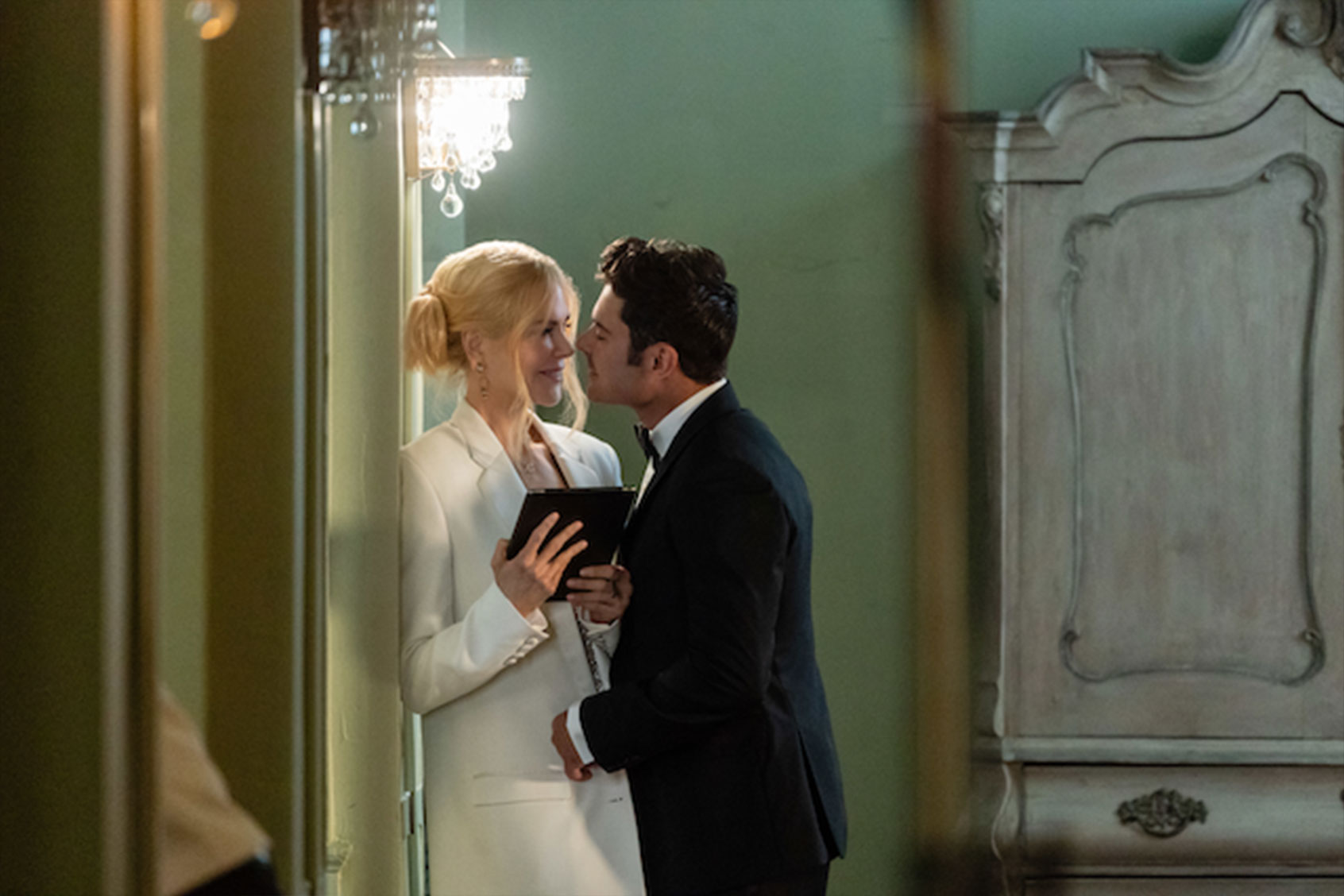
The frothy rom-com, “A Family Affair,” is another addition in the growing genre of older woman/younger male celebrity romance movies. (See also: “The Idea of You.”) Alas, director Richard LaGravenese’s film, written by Carrie Solomon, tries to be awkwardly amusing with its plot — about a mother dating her daughter’s movie star boss — but the cringe viewers will feel is every painful contrivance.  

There is little chemistry between Kidman and Efron.

Zara Ford (Joey King of “The Kissing Booth” movies) is the long-suffering personal assistant to egotistical action star Chris Cole (Zac Efron). After one too many humiliations, Zara quits while Chris is doing miniband crunches. The scene gives King’s character some self-respect and Efron the opportunity to display his muscles along with his aptitude for physical humor as Chris struggles to chase after Zara.  

After a heated exchange, Chris wants to apologize — in part because he needs Zara to help him; he is about to begin shooting the next installment of his “Icarus Rush” action franchise. A running joke describes the film as “Die Hard” meets “Miracle on 34th Street,” meets “Speed,” but the gag is not funny even once.

Arriving at Zara’s home, however, Chris instead encounters Zara’s mom, Brooke Harwood (Nicole Kidman), an award-winning writer, who is cleaning in a Blondie tour shirt and shorts as the band’s song, “Dreaming,” plays on her turntable. Changing into something more — for lack of a better word — matronly, she and Chris start day drinking tequila, which leads to some kissing, and them ending up in bed together. 

And, of course!, Zara comes home and catches Brooke and Chris in flagrante delicto. This leads to her suffering a physical accident and getting treated by a pediatrician in the film’s most excruciating scene. Children and Zara’s doctor are all starstruck by Chris, and Zara has to beg for attention. One half expects her to receive a lollipop to soothe her. While catching her mom “banging boots” with her boss is a lot for Zara to take in, viewers may need to pause “A Family Affair” not to absorb the shock of this highly telegraphed moment, but to recover from suspending their disbelief. 

Questions abound: Why is 24-year-old Zara seeing a pediatrician? Does she not have a proper doctor? (Apparently not.) Has Brooke never met Chris, seen any of his movies, or heard how difficult he has been as a boss in the two years Zara has been working for him? (Apparently not.) Has Chris made several “Icarus Rush” films and never heard about the legend of Icarus? (Apparently not, but thankfully, Brooke is a writer and has two copies of a mythology book to educate him.) And why is Brooke cleaning? Her Architectural Digest home is practically spotless. 

But back to the mediocre “A Family Affair.” 

Recall, Zara is aghast at this situation between Brooke and Chris, but she agrees to go back to work for Chris because he is promoting her to Associate Producer on his new film. In return, Zara asks Chris and Brooke not to date. They agree, but Brooke sneaks out to see Chris who enchants her with a dinner in a private restaurant and takes her on a tour through a soundstage. Brooke, in response, acts like a moony 16-year-old, not a woman who is 16 years Chris’ senior. Brooke also lies to Zara, hoping to keep her movie star romance with her boss on the down low.

A Family AffairA Family Affair (Netflix)One of the things romance movies do — and the best ones do very well — is capture the magic between the couple and let viewers fall in love with the characters as they fall in love with each other. (See “Roman Holliday.”) But there is little chemistry between Kidman and Efron, even as they participate in the hackneyed lovers-at-the-beach montage LaGravenese includes here.

Another momentary pause for reflection: Does anyone really think Chris and Brooke are going to spend their time at the beach playing backgammon and doing jigsaw puzzles together? Moreover, is anyone who saw “The Paperboy” not going to flash on her immortal line, “If anyone is going to piss on him it’s going to be me!,” while watching Kidman and Efron play lovers? 

Meanwhile, Zara is frustrated not only by her mother’s relationship with her boss, but that his “Die Hard” meets “Miracle on 34th Street,” meets “Speed,” script needs a rewrite. What irks Zara is that Chris asks Brooke for edits rather than Zara’s sassy friend Stella (Sherry Cola, underused). Zara’s exasperation expands exponentially when her grandmother Leila (Kathy Bates) — who is Brooke’s literary editor as well as her mother-in-law (because why not?) — invites Chris for Christmas at her cabin. He turns on his charm offensive, prompting another inappropriate moment featuring Leila confiding to Brooke that she wants to see Chris naked. 

Even the fantasy of a movie star romance is not particularly fantastic.

“A Family Affair” is often uncomfortable, but it gets worse, becoming more and more strained when Zara sees a jewelry box that causes her to jump to a conclusion that is both incorrect and damaging. Zara also becomes incensed when Brooke compares Chris to Zara’s late father. Even a comedic scene where Zara tells Chris what she really thinks of him under the guise of translating a French director’s (Sara Baskin) notes on his film set is forced and unfunny. 

There could have been some real heart in the central love triangle that balances Zara’s work and family loyalties, but every plot point feels artificial. The film panders to the lowest common denominator, milking gags out of sitcomic situations such as Chris explaining that he has not gone to the supermarket for 10 years because he’s too famous. Cue supermarket scene.

The film is watchable because King exudes pluckiness and remains endearing even when she is being told how insufferable she is. As Chris, Efron tries to generate laughs, singing along (badly) to Cher’s “Believe” in the car, or bantering with Zara, but his performance is too broad to be effective. Chris complains about how difficult it is to be him, and how he has no real friends, but he is a complete jerk, and Efron doubles down on that rather than make Chris a sweet, sensitive guy who can steal Brooke’s heart. As Brooke, Kidman has a better rapport with King than Efron. Her mother/daughter scenes provide the best moments in the film, though that is damning with faint praise. And Kathy Bates provides the film’s wisest observation when she says, “No great tryst started with someone being rational.”


Want a daily wrap-up of all the news and commentary Salon has to offer? Subscribe to our morning newsletter, Crash Course.


Most viewers watching “A Family Affair” are not worried about realism, but even the fantasy of a movie star romance is not particularly fantastic. This film is lazy and uninspired. The Lifetime channel delivers these kinds of romantic movies with more charisma and heart.  

“A Family Affair” wants to be comfort food, but it feels like stale leftovers. 

“A Family Affair” drops on Netflix June 28.

Swiftie dads show the power of positive masculinity

It was still early in the day when the men with glitter in their copper beards started appearing on the streets. They had rhinestone cowboy hats on their heads. And they wore t-shirts that read “It’s me. Hi. I’m the dad. It’s me,” and “Spending a lot of money at the moment.” My family and I were in Cardiff for Taylor Swift’s Eras tour, and the Celtic dads were out in force and ready for it. We’d just come to see Taylor. We left with a newfound appreciation of the power of positive masculinity.

I had long been aware of the existence of Swiftie dads — I live with one, after all — but had regarded them as more of the “singing along to ‘Shake It Off’ in the car” variety than the boa-clad men I witnessed strolling up and down the high street that bright June Tuesday. Yet there they were, enthusiastically bonding not just with their families but with each other, sharing a brotherhood in friendship bracelet-laden arms. And we experienced it firsthand when we bumped into an old friend of my spouse, his wife and young daughters in tow, wearing a shirt that read, “Dad (Taylor’s Version).”

Our modern epidemic of loneliness is significantly more dire in men, who today have roughly only half as many friends as they did a generation ago. That isolation can have a significant impact on their mental and physical health and lifespan. They also spend about half as much time with their children as mothers do — and, according to one Pew Research Center poll, the majority of them say that it’s not enough. But as Prince William himself could tell you — Taylor might be able to help you out there on a couple of fronts.

It’s not about spending money or going to concerts, although that stuff can be fun. Instead, it’s about the emotional power of fandom, within families and between friends — even if that fandom happens to skew bejeweled.

"The t-shirt is to signal to other dads, 'Hey bro, I see you.'"

Ben Valenta, coauthor (with David Sikorjak) of 2022’s  "Fans Have More Friends," has some advice for the haters. He tells me that “We dismiss Taylor Swift or our daughters’ interest in Taylor Swift as girly or a waste of time to our detriment. It’s an opportunity to connect and deepen our engagement with each other.” And when I describe the scene last week in Cardiff to him, he says, “What you were seeing is fandom in action. There are various layers of interaction happening. The dad is there with his daughters; that's the primary purpose. But the reason to wear the t-shirt is to signal to other dads, ‘Hey bro, I see you,’ and create opportunity for additional social interaction.” 

And also, to enjoy some really good music. Joseph Romm, a Senior Research Fellow at the Penn Center for Science, Sustainability and the Media (PCSSM) — and a man who has some solid suggestions for Taylor about what she can do about climate change — acknowledges that he first got into Taylor thanks to now teenaged daughter. But they’re going to see the tour in Toronto because they both appreciate her artistry, and the conversations her songs spark. 

“The first real introduction I had to Taylor in a big way was ‘Shake It Off,’” he recalls. “My daughter was seven. I've always been interested in the best storytellers, so there was a lot of bonding over music and storytelling. We saw the [“Eras Tour”] movie together, and we have endless debates about exactly what the songs mean, because, Taylor, as you know, likes to be cryptic. We have fun getting into arguments about ‘But Daddy I Love Him.’ Is the final chorus really about Travis?” he asks, adding, “I have very firm beliefs on that song.”

"There's a reason why your daughter is connecting with Taylor, and it's worth figuring out why."

For Romm, Swift provides a unique window into the experience of girlhood. “Taylor obviously has connected with these girls,” he says. “What she is saying clearly is resonating with girls like my daughter. That is important to understand.” He also authentically appreciates Swift’s work. “I always tell people to go to watch her NPR Tiny Desk concert, and you will see her musicianship,” he says. “You will see how she thinks about her music. And you'll get some very beautiful songs. I would say to dads, there's a reason why your daughter is connecting with Taylor, and it's worth figuring out why.”

Steve Knopper, an editor at large at Billboard, shares the sentiment. He’s been following Swift since his now 22-year-old daughter Rose was a 9-year-old fan. “When she was that age,” he recalls, “I was like, OK, my daughter is the center of the pop music universe. I'm just going to pay really close attention to what she listens to. I didn’t like all of it. But when she hit Taylor Swift — and she went through a massive Taylor Swift phase — I was like, I'm going to listen here with her. And we just listened to everything.” 

The two also saw Swift on her 2011 and 2013 tours. “I loved hanging out with Rose and experiencing that with her,” he says. “Connecting with Rose on a deeper level through music was incredibly rewarding. I remember talking about it with my ex-wife, ‘I think that Rose is lucky to have such a worthy pop star of her generation.’ Not every generation gets one of those.” He continues, “When I see stuff on social media where people around my age — men and women, but mostly men — are just determined to say she is lesser, I don't really understand that. She's not. She obviously isn't. She's great.”

A decade later, their tastes have diverged, but Knopper and his daughter’s foundation of bonding over music remains solid. “We're respectful of each other,” he says. “And it’s funny because we communicate about music in a way that's really easy. It's natural to us.” 

That’s the kind of future that tech executive Kevin Brown — the friend we ran into in Wales — hopes for. “I read once that if you want to have a good relationship with your kids, do the things that they're interested in,” he says, “and be a part of that.” He tells me, “I could have reverted to the classic, ‘I’m a dad, I'm not getting involved. This is for my wife and daughters.’ Or I could just go with it and have a blast. So I was like, great, where are the tattoos? Let's get them on. And I'm still actually trying to wash them off.”

Looking back on the trip, Brown says, “I felt incredibly lucky to be in a place in time where I could be fully present with my kids and participate. My daughters are six and nine; they'll soon be seven and 10. It was one of those moments where hopefully for them, but certainly for my wife and me, was going to be a lifetime memory.”

And when Eras ends, Ben Valenta hopes that dads continue to expand their opportunities for creating more of those special experiences. “One of the things we’ve focused on in our work in the last six months or so has been where fandom starts,” he says. “Fandom starts typically in the family. As we were going around the country spending time with families, it was very clear how gendered sports fandom was at the family level. Everyone sort of assumes that’s what the boys do.”

Now, though, he notes, “With the Swift phenomenon, you see dads thirsting for ways to connect with their daughters. I think if more people recognized that sports could be the same thing, they could utilize it in the same way. I’m all for connecting via Taylor Swift; I think that’s really positive. But I would suggest that Taylor Swift might have another tour, she might have two more tours. But the New York Yankees? They’re coming back next year and the year after that, forever. That’s the beauty of sports. If we can create that connection, we can have it forever, and it can be the tie that bonds forever.”

Those ties we form and keep forming with our kids — mine are university students, and the Taylor experience has been lifelong — happen when we meet them where they are, when we care more about what they care about than any limited gender norms. Real men can rock a boa just as well as a baseball cap. It's all a lot more enjoyable that way. And Dad might just discover some really cool stuff while making memories.

“When Rose was getting into Taylor Swift,” says Knopper, “I was trying to understand my daughter and her friends and bond with her. She’s listening to and exposing me to songs like ’15’ and ‘You Belong with Me.’ Suddenly, I'm getting these broadcasts, in the form of Taylor Swift, straight from the hearts of girls. It was a delightful phase with Rose. It lasted, I don't know, four or five years. I enjoyed every second of it. I’m sad it's over. And,” he says, “I still love Taylor Swift.”


“Suckers” and “losers”: DNC to remind Trump rally-goers of ex-president’s contempt for veterans

Former President Donald Trump wrapped up Thursday’s debate in Atlanta, Georgia, and heads to Chesapeake, Virginia on Friday. When he gets there, he will be greeted not just by supporters in red MAGA hats: The Democratic National Committee plans circle Trump’s rally armed with a mobile billboard displaying his disrespect toward the country's veterans. 

"Donald Trump thinks Americans who died in war are 'losers' and 'suckers,'" DNC spokesperson Tracy King told Salon. With the mobile billboard, "voters will remember the disrespect and pain he inflicted on service members and their families as he callously mocked them while serving as commander in chief — not only through his words but through his disastrous and costly policies."

The presumptive GOP nominee has called U.S. soldiers and veterans “losers” and “suckers” in the past, a point that President Joe Biden brought up several times during Thursday’s night debate. Trump's quote was first reported by The Atlantic, which said Trump made the comments while in France, when sources said he decided against visiting a cemetery for U.S. soldiers because the rain that day would mess up his hair.

"Why should I go to that cemetery? It's filled with losers," he said, later referring to the more than 18,000 Marines buried at Belleau Wood as "suckers."

Former Trump Chief of Staff John Kelly, a retired Marine Corps general, confirmed last year that the former president made the remarks, saying the presumptive Republican nominee is someone who "has no idea what America stands for and has no idea what America is all about."

“This cannot be real life!”: Stewart says both candidates need “magic drugs” after disastrous debate

Jon Stewart held nothing back as he tore into President Joe Biden and former President Donald Trump's performances at the first presidential debate of the 2024 election season during a live episode of "The Daily Show."

“We just watched what you watched," the comedian said in apparent shock. The show highlighted that both candidates had a low bar to meet as many pundits questioned whether Trump could "pretend to be normal for 90 minutes?” and if Biden could “stay alert, stay engaged and stay awake.”

Still, both candidates failed to clear that bar, Stewart said.

Stewart played a clip of Biden murmuring through an incoherent talking point about "beating" Medicare, quipping, “I need to call a real estate agent in New Zealand.”

“OK, a high-pressure situation.” Stewart said giving Biden the benefit of the doubt. “A lot of times you can confuse saving Medicare with … beating it. I’m sure it’s not something that repeated throughout the debate, causing Democrats across the country to either jump out of windows or vomit silently into the nearest recycling bin. Anybody can f**k up talking.”

But a montage of Biden with many blank facial expressions led Stewart to say, “But a lot of people have resting 25th Amendment face.”

Moreover, to Stewart, Trump “does not appear to have passed the a**hole test.” The show played many clips of Trump's shining moments, calling Biden's term "the worst presidency in the history of our country." Trump even denied sleeping with Stormy Daniels, "I did not sleep with a pornstar."

In response, Stewart said: “Just so we’re all clear, everything that Donald Trump said in that clip is a lie. Blatant and full. And we were tight on time, putting this whole s**t together – there’s plenty more. It really makes you wonder, what if RFK Jr. doing tonight?”

After analyzing both candidates' sleepy and factually inaccurate answers, Stewart said: "The one thing we did prove tonight is that the MAGA conspiracy theory about Biden's upcoming performance was nonsense."

The show played a clip of Trump prior to the debate at a rally telling his audience that "A little before debate time, he gets a shot in the a**." Other clips of Fox News pundits perpetuating that Biden was on drugs during the debate was also showed.

“Let me just say after watching tonight’s debate, both of these men should be using performance-enhancing drugs," Stewart said.

We need your help to stay independent

"As much of it as they can get. If performance-enhancing drugs will improve their lucidity, their ability to solve problems, and in one of the candidates’ cases, improve their truthfulness, morality and malignant narcissism, then suppository away," Stewart continued, "They should take whatever magical drugs can kick their brains into gear, because this ain’t Olympic swimming."

He concluded: "And by the way, if those drugs don’t exist, if there aren’t actually performance-enhancing drugs for these candidates, I could sure f***ing use some recreational ones right now. Because this cannot be real life. It just can’t.”

"The Daily Show" airs Monday through Thursday at 11 p.m. on Comedy Central and streams on Paramount+

“Unforgivable”: CNN debate moderators blasted for “not fact-checking Trump’s firehose of lies”

The presidential debate Thursday night was filled with false accusations and outright lies, but what made the 90-minute contest go off the rails and turn into the unchecked ramblings of two senior citizens was that CNN decided not to bother fact checking any of the claims.

As The Hill noted, moderators Jake Tapper and Dana Bash simply sat and watched the performance, allowing President Joe Biden and former President Donald Trump to dive in and out of rabbit holes of their own making. Only after the candidates completed their entire answer would the moderators interject or course correct. Other than that, it seemed like their job was limited to maintaining the allotted speaking time, allowing Trump in particular to spin a web of lies.

There was live fact checking, even at CNN, it just didn't make it on air, with reporter Daniel Dale left to do it on social media instead, Mediaite reported. Later in the night, Dale joined CNN anchor Erin Burnett for a post-debate analysis where he noted that Biden’s nine falsehoods paled in comparison to Trump’s “staggering number of false” statements, with the former president making a total of 30 false or misleading claims.

CNN’s political director had warned earlier in the week that its moderators would allow lies to go unchecked.

“The venue of a presidential debate between these candidates is not the ideal venue for a live fact-checking exercise,” David Chalian told The Washington Post.

But CNN has received considerable flack for its handling of the debate.

“CNN’s decision to abrogate its journalistic responsibilities by not fact-checking Trump’s firehose of lies is unforgivable,” former MSNBC host Keith Olbermann posted on X.

“I wish the CNN moderators did more fact-checking, letting the audience know when things are said that are flatly false. Not sure how it helps for a platform to transmit falsehoods disguised as facts,” Nicholas Kristof, a New York Times columnist, added on X.

Despite the criticism, CNN stood by its moderators' performance.

“We are very proud of Jake and Dana. Our job was to make sure candidates were heard so voters can make informed decisions and we are pleased we were able to do that,” CNN said in a statement to The Hill.

“Very aggressive panic”: Democrats having “conversations” about replacing Biden after brutal debate

Well, that was fine. That was fine, right?

At Thursday’s debate with a convicted felon who’s been found liable for sexual assault, President Joe Biden needed to come off as an elder statesman invigorated by the challenge of defending democracy, at home and abroad.

He did not.

Instead, the 81-year-old came out raspy and at times incoherent — battling what his team said, halfway through the ordeal, was a cold — and not at all like the man whose State of the Union address, just three months ago, was so strong it led Republicans to claim he was on some form of MRNA brain juice available only to liberals of a certain age. His performance grew stronger as the night went on, but the plain fact is: Biden seemed really old.

As the BBC put it: “The president came into the debate with a low bar to clear, and he stumbled. He was flat. He was rambling. He was unclear.”

Democrats can comfort themselves by noting that Donald Trump was himself frequently incoherent and always deranged; he refused to condemn the Jan. 6 attack on the U.S. Capitol, claimed liberal doctors are killing newborn babies and — finally forced to answer a question, specifically on climate change — babbled on about the good old days of 2017-2021, when “we had H20” and our environmental “numbers” were the “best ever.” He also used every opportunity to attack asylum seekers and other immigrants as dangerous and less-than-human thugs, despite the fact they are, as a group, less prone to criminality than either Trump, his campaign staff or his radical right supporters.

But liberals are different: Whereas a Republican pundit will tell you Trump’s climate nonsense was in fact the smartest thing they ever heard, Democrats, in general, responded to their guy’s subpar performance with full-on public displays of their neuroses.

“My phone really never stopped buzzing throughout and the universal reaction was somewhere approaching panic,” MSNBC anchor Joy Reid said Thursday night. “The people who were texting with me were very concerned about President Biden seeming extremely feeble, extremely weak.”

Reid shared that some of the conversation concerned how to replace the president at the Democratic National Convention in August. “Someone actually sent me the rules,” she said.

We need your help to stay independent

The debate was also a train wreck for CNN, whose anchors, Jake Tapper and Dana Bash, allowed Trump to spout deranged falsehoods — like claiming infants are routinely murdered in blue state hospitals — without comment and only rarely even got him to tangentially address the actual question they had asked. But the network’s John King wasn’t wrong when he noted the sour mood among Democrats, not concerning the hosts of the debate but their own candidate.

“This was a game-changing debate in the sense that, right now as we speak, there is a deep, a wide, and a very aggressive panic in the Democratic Party,” King said. “It involves party strategists, it involves elected officials, it involves fundraisers. And they’re having conversations about the president’s performance, which they think was dismal … and they’re having conversations about what they should do about it.”

"Some of those conversations,” King added, “include 'Should we go to the White House and ask the president step aside?'”

David Axelrod, a former adviser to President Barack Obama, said there was a “sense of shock, actually,” at Biden’s unsteady performance at the start of the debate. “I think you’re going to hear discussions — that I don’t know will lead to anything — but there are going to be discussions about whether he should continue.”


Want a daily wrap-up of all the news and commentary Salon has to offer? Subscribe to our morning newsletter, Crash Course.


The Biden campaign flatly rejects such talk. No incumbent has ever been replaced as their party’s nominee this late in the game and the only time it happened before was when President Lyndon Johnson himself chose to step aside rather than stand for reelection. And Johnson’s decision came with enough time for voters to at least weigh in on a successor (the insiders' pick at the convention, Vice President Hubert Humphrey, went on to lose to Richard Nixon in an electoral landslide).

This time, Democrat voters have already weighed in and Biden is the presumptive nominee. Vice President Kamala Harris would be the natural replacement, but even so: no one voted for her. It would be Democratic delegates in Chicago deciding the nominee and whether it should be Biden, Harris or someone else willing and able to carry the party across the finish line (names tossed about include Michigan Gov. Gretchen Whitmer and California Gov. Gavin Newsom, who each have electoral weaknesses of their own).

It remains extremely unlikely that Biden steps aside after what his camp will say was a bad performance amid sound fundamentals: a growing economy with low unemployment and an opponent who has already shown himself unfit for office.

But Democrats and others concerned about democracy extending through 2025 will continue to fret about whether Biden has enough in the tank to bury the MAGA movement.

“Trump is so terrible that this might heal itself,” former Sen. Claire McCaskill, D-Mo., said Thursday. “But based on what I’m hearing from a lot of people … there is more than hand-wringing tonight. I do feel like people are confronting a crisis.”

CNN’s debate was no fair fight

There's no sugarcoating it: The best you can say about that debate last night is that it was a missed opportunity for Joe Biden to put to rest the questions about his age and focus on Donald Trump's extremist agenda and his criminality. The worst you can say is that he gave a disastrous performance that should lead to his resignation and an open convention in August to choose a successor. There are plenty of Democrats pushing for that right now and it's always possible they'll succeed in getting Biden to drop out and turn the Chicago gathering into a disaster not seen since 1968. Maybe that's the kind of spectacle that will finally bring the Democratic Party down to the level of the Trump Show. Maybe that's what the American people really want. 

If there was ever a time to keep calm and carry on it's now. 

I don't know what was wrong with Joe Biden. It's hard to imagine that they ever would have asked for a debate if this was the way he is normally. We've seen him recently holding press conferences and giving speeches and he seemed to be fine. They said he had a cold so maybe he really was on drugs — Nyquil or Mucinex or something that made him seem so shaky and frail. Whatever it was, it was a terrible debate for him and if he does stay in the race (which is almost certain in my opinion) the campaign is going to have a lot of work to do to dig out of the hole that was dug last night. The media smells blood and they are circling like a bunch of starved piranhas. If this goes as these things often do, the public may have a very different take than the insiders today. Still, the media narrative could change public consensus over the course of the next few days. 

With all of that being said, it must be noted, however, that as much as Biden blew the debate and missed his opportunity to dispel the concerns about his age, Donald Trump blew it too. He may have appeared more vigorous but he couldn't control himself and behaved once again like the undisciplined, lying, vulgarian who half the country already hates. If Biden was on Nyquil, Trump must have guzzled a case of diet Coke before he came on stage. He spewed a torrent of lies, was rude and insulting and delivered what was probably the most memorable line in any presidential debate in history:

That's the least of his various crimes and sexual misbehavior but it's the one he felt compelled to deny. 

For some odd reason, moderator Jake Tapper told Trump in the beginning that he didn't need to answer the questions and that he could use the time however he wanted. Trump ran with that, essentially giving a rally speech whenever he had the floor and was unresponsive to the vast majority of the questions. He made faces and insulted Biden to his face, at one point calling him a criminal and a Manchurian candidate. If anyone had said 10 years ago that this would happen at a presidential debate they would have been laughed out of the room. 

After the debate when most of the country had turned off cable news or gone to bed, CNN aired its fact check. And it's a doozy:

It sure would have been good if even some of that epic litany of lies could have been checked while people were still watching. The decision to have the moderators sit like a couple of potted plants woodenly asking questions about child care while Trump responded with irrelevant lies was inexplicable. Why did they even bother to ask questions at all? They could have just run the timer and let the candidates talk for two minutes each about anything they wanted. It probably would have been more enlightening. 

According to former CNN media reporter Brian Stelter, CNN is very happy with how it went. He wrote, "A CNN exec in the control room texts me: "We are very proud of Jake and Dana. Our job was to make sure candidates were heard so voters can make informed decisions and we are pleased we were able to do that." Actually, CNN inadvertently became one of the greatest disseminators of disinformation in American political history. Millions of people heard Donald Trump's lies and since they were met with silence from the journalists on the stage upon whom people depend to tell them the facts, many of them probably came away believing he must have been telling the truth. 

We need your help to stay independent

Even had Joe Biden been at the top of his game, he would not have been able to parry all those lies and he shouldn't have been put in the role of being Donald Trump's fact checker. His choice was to either ignore the lies and let them stand so he could use his time to make his own case or spend the entire debate correcting the record. It was not a fair fight.

It will take a few days for the results of the debate to shake out. Biden's poor performance may tank his poll numbers or it's possible that the whole thing didn't change any minds at all. According to CNN's instant poll of debate viewers in Michigan, it was pretty much a wash with half saying Biden won and half saying it was Trump. And a Univision focus group of Hispanic voters said that Biden won. So who knows? 

In the last election cycle, we saw Pennsylvania senate candidate John Fetterman, who had recently suffered a stroke, have a debate at which he was clearly having trouble communicating. He was written off by all the pundits and the assumption was that the Democratic Senate majority was lost. He ended up winning. Not that this will necessarily go the same way but I bring it up only to illustrate that these things do happen. A lot depends on who else is on the ballot.

It's obvious that Biden's terrible performance has caused panic among Democrats and liberal pundits and analysts. The calls for him to withdraw are loud and meaningful and it's going to be a very rough period in this campaign whatever happens. For me, this isn't really a question. As long as Donald Trump is on the ballot, I will vote for the Democratic nominee. If it's Biden or someone else, the calculation remains the same. Nothing is worse than another Trump administration and I suspect that at the end of the day Democratic voters will agree with that. So it's still a matter of those undecided voters in swing states, just like it was on Thursday morning.

Biden has been a successful president in my book and I have every expectation that his administration will continue on that path in a second term. But if he becomes convinced that this debate has ruined his chances and he decides to drop out, I just hope that the party can resist the temptation to devolve into a bloodletting free-for-all that empowers Trump even more. If there was ever a time to keep calm and carry on it's now. 

CNN’s first televised presidential debate of 2024 was not a good look for America

Remember cocky Joe Biden? The one who goaded Donald Trump into debating him last month in a video posted to social media, crowing that former president Donald Trump lost two debates to him in 2020?

“Now he's acting like he wants to debate me again!” an energetic and fully awake version of the President of the United States said. “Well, make my day, pal. I'll even do it twice.”

“Let's pick the dates, Donald,” Biden said in closing, throwing in, “I hear you're free on Wednesdays,” as a rimshot reference to the hush-money trial filling his dance card at that time.

More than a month later — the morning after the first of those debates hosted and produced CNN — it’s worth recalling that Biden asked for this.

If you’re going to pick a fight, you should know your opponent’s strengths and weaknesses, and prepare accordingly. Reports from Biden’s campaign hinted he was prepping to confront Trump on policy, his track record, and his propensity to lie —Trump’s weak spots.

Based on Biden's performance, his coaches insufficiently considered the former president and current felon’s understanding of optics. Trump is notoriously vain, always aware of the camera, and understands that what the audience sees is more convincing than the substance of what he says.

That meant that the presidential debate held Thursday at CNN's Techwood campus studio was effectively over the moment the two candidates walked on stage.

While Biden’s campaign shared reports of his vigorous debate preparation at Camp David, once the cameras were live Trump demonstrated he better understood the assignment. The 81-year-old Biden was tasked to prove he's still mentally sharp and capable of fulfilling the presidency's obligations for another four years.

The 78-year-old Trump simply had to refrain from looking like the same lumbering lunatic who stalked Hillary Clinton around a town hall stage in 2016 and shouted down Biden at every turn in 2020.

That Trump would not be deterred by dead mics, knowing his followers would lip-read what insults he’s spewed and post them to Truth Social on his behalf. Social media would determine who won this debate regardless, and if it had gone as planned both camps would have declared victory.

This time Biden’s supporters can’t say that.

Trump entered after Biden, slightly hunched and looking sour, but striding confidently to his podium. Rather, that’s how he looked after Biden shuffled forth from the wings smiling weakly and waving at . . .  nobody, I guess, since CNN stipulated there would be no audience.

In addition to forgoing live spectators, likely having learned from its 2023 Trump town hall debacle, producers turned off each candidate’s microphones by default when moderators Dana Bash or Jake Tapper did not designate them to speak.

Once the cameras were live Trump demonstrated he better understood the assignment.

This move was widely viewed as an effort to curb Trump’s tactic of shouting down his opponents which, in previous debates, materialized in pointless spectacles like the first Biden-Trump face-off four years ago, which Tapper characterized as “a hot mess inside a dumpster fire inside a train wreck.”

This time the disaster was entirely contained within Biden’s performance in Thursday’s 90-minute showdown and, we’re guessing, the Democratic National Committee’s headquarters.

From the moment the president opened his mouth, he sounded hoarse and phlegmy. He struggled to speak at an audible volume, tripped over his words, and froze up, blinking rapidly as his thought process derailed during an early answer. This Biden came to the debate highly scripted and inflexible, so when a page or two dropped from memory we were left with him landing meekly on gaffes like, “We finally beat Medicare.”

Trump, as expected, lied with vigorous enthusiasm, which Tapper and Bash let pass unfettered since CNN opted against fact-checking Trump in real-time. Both campaigns agreed to this format; Tapper and Bash, accordingly, were the equivalent of wallpaper. The network's decision has been criticized as journalistically irresponsible, but it's worth remembering that in the past, trying to filter Trump's geyser of bull in real-time hung up debate moderators to the point of serving no one. 

Few expected this match to be of any service either, since most voters have already decided they’re voting for Trump or, let’s be real, against him. What may have surprised people was Trump’s uncharacteristic discipline during Biden's time on the mic, and Biden’s lack of same in his resting face while he was silent.

We need your help to stay independent

Trump didn’t talk out of turn, at first. In the main he held his composure as Biden weakly attacked his record and neglected to forcefully refute his fearmongering as he replayed his greatest hits catalog of lies about late-term abortions, migrant invasions, our failing nation, and whether he knocked boots with Stormy Daniels or insulted veterans. He kept his eyes level with the camera and more or less glowered straight ahead, which might be interpreted as commanding.

In contrast, during his muted interludes Biden couldn't keep his mouth closed. His eyes were frequently downcast or looking in a direction other than toward Trump. Midway through the debate, his camp told news outlets that he had a cold. (I guess nobody told them pharmacists still keep the speedy decongestants under the counter; you just have to ask and show some I.D. Trump already sowed the lie that Biden is on stimulants of some kind, so why not indulge for a legitimate purpose?)

Even with that being the case, the grins and jokes that made 2020 Biden look like the affable humane alternative to an unhinged dictator were entirely absent. That may have hurt the president's image as much as his freeze-ups and tip-of-the-tongue struggles.

This is not to be mistaken as an assessment that Trump seemed more “presidential” or less incoherent than social media edits and late-night talk show clips have made him seem lately. He's still a loose cannon who rambles about shark attacks and electrocution. Sure enough, as soon as he perceived Biden as being on the ropes, Trump became emboldened and wilder in his responses, albeit within the confines CNN set for him.

But Trump’s smartest tactic was his simplest: He finished his sentences. Yes — the bar really was that low. Those sentences were often the stuff of a paranoiac fugue but without slurring or made-up nouns. There were odd moments when he bragged “we had great H2O” and meme-able barks about “them” taking “Black jobs,” but this is what he says on days ending with the letter Y.

It is a dark day when I find myself agreeing with Fox News’ Sean Hannity, but here we are.

He still failed to answer most of the questions Tapper and Bash put to him, to a degree that they kept returning to their original queries about, say, the opioid crisis after the former president careened into a tirade about Biden allowing a migrant invasion at the southern border. After he warmed up, Biden became more aggressive, calling Trump a liar and in his final word, called him a “whiner” for refusing to accept the 2020 election’s results.

Again, and this cannot be stressed enough, none of what either man said mattered. It’s what their image conveys with the sound off. If you watch this derangement on mute, you might have thought Trump had pulled his “Apprentice” disguise out of mothballs while Biden impersonated decrepit King Viserys from Season 1 of “House of the Dragon.”

“From the minute he spoke at the opening of the debate, he sounded awful. He started with speedy talk. He looked terrible. Maybe the worst part of all of this is [that] he was staring out like an empty vessel, or vacant. This is after a full week of prep: mumbling, bumbling, stumbling, dazed, confused, struggling, brain fart twice during the debate. It was a disaster.”

It is a dark day when I find myself agreeing with Fox News’ Sean Hannity, but here we are. Comity achieved, if briefly.

Vanity Fair contributor and CNN’s former chief media correspondent Brian Stelter summed the situation up more succinctly: “Biden is better on the facts,” he posted on X, “but Trump is much better at the fight.”

“You want to know what Donald Trump showed up?” former DNC chairperson Donna Brazile told ABC’s David Muir. “The one that I get to see every weekend at a rally. Because I've watched Donald Trump. I've listened to Donald Trump. He didn't have to make it up because these are the things he’s been saying. And it's been good enough for … maybe 50% of the American people.”


Want a daily wrap-up of all the news and commentary Salon has to offer? Subscribe to our morning newsletter, Crash Course.


That was one of the kinder debate assessments. Not even MSNBC could cook up an optimistic take; the collective expressions on the post-debate panel’s faces could have been free advertising for Metamucil.

In mid-May it was easy for Biden to feel blustery, what with his TikTok account humming and the presumptive Republican nominee tangled up in a hush-money trial through which he reportedly dozed.

If that hadn’t puffed Biden's confidence enough, Trump being found guilty by a Manhattan jury on 34 state felony charges must have been quite a boost. Cut to a month later, and Biden's decision to fight rambling with shambling in this debate rerun reaffirms that our two-party gerontocracy has left us with poor choices that come down to who looks more alive.

Not long after the debate ended, cable news cameras caught Biden with his wife Jill at a watch party promising to fight for his cheering supporters. He punctuated his words with pointed jabs of his forefinger and smiled brightly. Then he and Jill danced for the crowd. Where was that guy two hours ago? wondered MSNBC host Rachel Maddow. “That Joe Biden would have killed in the debate.”

He showed up too late to make a difference, as Maddow and her colleagues discussed afterward. “Of course, as we’ve been saying, the only question that matters is how did it affect, if at all, voters who tuned in and are –” and here, Maddow paused to heave an exhausted sigh that speaks for a nation, before resuming “ — still trying to make a decision.”

They'll have a new chance to evaluate at the . . . sigh . . . second debate to be produced by ABC News in September.


“Hot Ones”: Lupita Nyong’o says she’s a Swiftie while attempting to conquer the Spicy Wings of Death

Lupita Nyong'o appeared on this week’s episode of “Hot Ones” to discuss everything from her fear of cats to the one Taylor Swift song that helped her overcome a particularly rough time in her life. 

The acclaimed Scream Queen, who is starring in the prequel horror film “A Quiet Place: Day One,” sat down with host Sean Evans to answer some of his most burning questions while taking on a lineup of extra spicy chicken wings. The first five wings were anything but frightful for Nyong'o, although the actor did reveal which movie gave her the spooks.  

“You know, the film that scared me most — it’s not even a horror film — but it’s ‘A Beautiful Mind,’” Nyong'o told Evans. “Oh yeah. I watched that and I thought I was schizophrenic for at least two weeks. … ‘Cause I really believed that he was a spy at the beginning of that movie. And so, when we learned that he was actually just sick in the mind, I felt like I was definitely, probably like him. ‘Cause he was very convincing.”

As for what else gives Nyong'o the heebie-jeebies are cats. The “Us” star had to film “Day One” alongside a cat, which was pretty terrifying for her: “I was very afraid of cats before I took this film and it was one of the things that was holding me back from saying yes.” 

Elsewhere in her chicken-filled interview, Nyong'o recounted the time she reached out to Taylor Swift to ask the pop superstar for permission to use the song “Shake It Off” in one of her movies. When the producers of the 2019 comedy-horror film “Little Monsters” told Nyong’o they weren’t able to get the rights to Swift’s hit tune, Nyong’o decided to take matters into her own hands.

“I decided, OK, I'm going to go, I'm going to make a pitch. I'm going to let Taylor know what this song means to me,” she said.

“When I was working in London on ‘Star Wars,’ I was going through a lot of self-doubt because it was the second thing I had done,” Nyong’o continued. “I was getting a little depressed. My best friend came to London and Taylor had just released ‘Shake It Off,’ and he played it for me to get me into better spirits.”

“We just jumped on my bed and we just danced and danced, and it lifted my spirits."

In “Little Monsters,” Nyong’o stars as Miss Audrey Caroline, a kindergarten teacher who must protect her students from a sudden zombie outbreak. Nyong’o’s character sings “Shake It Off” — which plays a key role in the movie — to the children to keep them calm during moments of crisis.

“Shake It Off” was cleared to be in the movie after Nyong’o told Swift the story about how the song “lifted me from an almost depression.”


Want more great food writing and recipes? Subscribe to Salon Food's newsletter, The Bite.


“I haven't actually seen her since to thank her for it,” she admitted.

By the end of her interview, Nyong’o couldn’t contain her tears as she struggled to eat a chicken wing slathered in Da Bomb hot sauce.

“If I’m ever playing a bats**t crazy person, I’m going to have to take that with me,” the actor said of the killer sauce. “That’s going to be on my rider.”

“It is delay”: Idaho abortion decision suggests a stealth Supreme Court push to aid Trump’s campaign

"Today’s decision is not a victory for pregnant patients in Idaho," Supreme Court Justice Ketanji Brown Jackson declared on Thursday. "It is delay."

In her dissent on Moyle v. the United States, Brown Jackson highlighted the only takeaway journalists and voters should get from this case about whether Idaho can force emergency room doctors to turn away pregnant patients in crisis. During oral arguments in April, it became clear that the conservative justices do not care if women experiencing a failing pregnancy are denied care, which could result in permanent injuries or even death. Justice Samuel Alito even took time to gripe that the federal law requiring emergency rooms to provide stabilizing care did not use the phrase "unborn child." He got annoyed when Justice Sonia Sotomayor mentioned the actual living people being airlifted out of Idaho so doctors in nearby states could help. Physicians for Human Rights documented some of the conditions women who are denied this treatment can experience: "stroke, seizure, liver damage, kidney failure, bleeding, complications," as well as "septic shock," which can lead to the loss of the uterus or even death. 

Making pregnant patients pay the price has always been the point for conservatives.

Sentencing women to organ failure or even death for the "crime" of having a pregnancy go wrong will be politically unpopular for Republicans, however, and this is a presential election year. So, as a massive campaign contribution to Donald Trump, the GOP majority on the Supreme Court decided they won't be deciding on this until some point in the future, oh-so-coincidentally after the election. Instead, the justices punted the case back to the lower courts, to fiddle with it more. Next time, the conservative majority will likely feel the political environment is more conducive for a "just die already, ladies" opinion. 

In her dissent, Jackson doesn't say the word "election," but she does telegraph her withering contempt for the procedural bad faith employed by the Republican justices. "And for as long as we refuse to declare what the law requires, pregnant patients in Idaho, Texas, and elsewhere will be paying the price," she writes. 


Want more Amanda Marcotte on politics? Subscribe to her newsletter Standing Room Only.


Making pregnant patients pay the price has always been the point for conservatives. Pregnant women are a favorite scapegoat for Christian right anger over social change. As more women get education and jobs outside of the home, conservative Christians have turned ever more devoted to forced childbirth. As childless women closed the pay gap with men, the pressure to make motherhood mandatory rose. As more women delay marriage — or avoid it altogether — Republican views around abortion became more sadistic. Abortion bans in places like Idaho are so draconian that, even when there's no chance a pregnancy will result in a living child, patients are still denied abortion. 

That the six Republican justices on the Supreme Court are hopelessly in the tank for Trump has been well-established, and not just because three of them were appointed by the fraud himself. As many legal experts have pointed out regarding another controversial case, there was no need for the Supreme Court to entertain Trump's ludicrous claim to be "immune" from federal prosecution for his attempted coup. Instead, the court took up the case and has delayed ruling on it for so long that there's little to no chance of a trial before the election. 

The same logic appears to be in play in this emergency room case. As Jackson notes in her dissent, there hasn't been "any change in today’s cases that might eliminate or undermine the need for this Court’s review." She points out that this case or one just like it will be back on their docket fairly soon. Punting makes no sense from a legal or material view. Unless, of course, the material interest is in making sure Trump wins the election. 

By playing these games, the Republican justices no doubt hoped to score friendly headlines that made it seem they and the larger GOP aren't so bad. They did score a few, such as the NPR headline, "Supreme Court allows Idaho to offer emergency medical abortions." Luckily, most outlets appeared to understand that such a headline is misleading. The New York Times, ABC News, NBC News, and the Washington Post attached "for now" to their headlines. Even cursory readers may understand that, if Trump gets elected, laws forcing women to bleed out in hospital parking lots will go into full effect. 

There's a good chance this could backfire on the court and Trump's campaign. Trump wants nothing more than for the abortion issue to go away, especially as there's no doubt that President Joe Biden's campaign plans to run non-stop ads featuring Trump bragging about how he's the one who got Roe v. Wade overturned. If voters understand that Republicans are just getting started with the abortion bans, this will remain a live issue.

On the question of emergency care for women experiencing a failing pregnancy, the choice is a stark one: If Trump is in the White House, the federal government will tell states to ban doctors from intervening in these emergencies. If Biden is president, the federal government will continue to insist that it's illegal to force pregnant women to bleed to death rather than have a doctor help her. 

Some readers are no doubt confused as to why it's so important for Republicans to stand by laws to deny medical interventions for pregnancies that are already failing. The simple answer was memorably offered by Atlantic writer Adam Serwer in 2018: "The cruelty is the point." For people who want to lash out at women, forcing a stranger into kidney failure scratches that sadistic urge. 

But there's a slightly less abstract concern in the mix, as well: women who use pills to evade abortion bans. Abortion pills are easy to transport and there's significant evidence that women in red states are using pills to abort at home, away from the prying eyes of law enforcement. In the vast majority of cases, this can be done safely. In a small percentage of cases, the abortion is incomplete and a doctor at the hospital needs to finish it. There is no way, from a medical standpoint, to tell the difference between a woman who is experiencing a natural miscarriage or one induced by a pill. To punish women who have side effects from abortion pills, Republicans would condemn all women experiencing pregnancy failure, even when that pregnancy was wanted. 

We need your help to stay independent

In addition, there's a widespread notion in anti-abortion circles that a "good" woman would rather die than have an abortion. Anti-choice websites regularly push sentimental stories that turn women into martyrs for refusing life-saving medical care. Readers are expected to swoon over a woman who died alongside her fetus, even though that choice invariably leaves her husband a widower and her children motherless. The movement doesn't want women to have the choice to live. The far-right idealizes the 19th century, after all. That was an era of sky-high maternal mortality rates. 

Perhaps Republicans are hoping the complexity of this case creates a messaging problem for pro-choice forces. But the message is simple: "If Trump wins, hospitals will have to turn pregnant patients away." This will be reinforced by the still ongoing march of horror stories of women who got catastrophic diagnoses from their ob-gyn and were forced to travel out of state for a medically necessary abortion. Or worse, women who are forced to give birth to a dead baby. In Texas, the abortion ban has already led to a 13% increase in infant deaths. Most of that is due to women continuing pregnancies that doctors would have aborted, if it were legal.

In the first presidential debate in 2020, Biden declared abortion is on the ballot. Trump, lying as usual, denied this and claimed there was no way to know how the justices he appointed to the court would rule on abortion rights. This time, all plausible deniability is gone. The Supreme Court can play all the games they want, but they can't dance away from reality. Abortion bans are devastating for women's health care across the country. If Trump gets elected, it will get even worse. It's as simple as that.