Spring Sale: Get 1 Year, Save 58%

Of honeybees and polar bears: Saving beloved species isn’t enough — but it’s a good start

If you ask children or college students to draw pictures to illustrate climate change, chances are that polar bears will make an appearance.

Since activists started fighting to protect the climate in the 1970s, certain animal species have become the poster children for various conservation movements. From images of polar bears drifting alone on melting sea ice to complex songs from whales taking over the radio airwaves to internet memes of sloths roaming their disappearing habitats, certain species rise to prominence in human perception, inspiring us to make changes and fight for their preservation. 

Yet in the past 12 years, at least 467 species have gone extinct, with most of these creatures — including a type of rodent called the melomy and a Hawaiian tree snail called Achatinella apexfulva — quietly disappearing and utterly unknown to the vast majority of humans. In part as a result of watching species after species go extinct, climate change burnout, in which people are overwhelmed by the severity of the climate crisis, and climate doomerism, in which people see climate change as irreversible and destruction as inevitable, are both increasing.

But in fact, history shows that humans do have the power to save animals on the brink of extinction. Such successes might be the most tangible representation of conservation that we have. Still, whether we rally behind a given animal species is largely based on whether we recognize parts of ourselves in them. 

When we see "polar bears on melting glaciers, we have an empathetic response," said Susan Clayton, a conservation psychologist at the College of Wooster. “It’s one way to take this big, amorphous concept," meaning climate change, "and make it more understandable.”

Whether we rally behind an animal is largely based on whether we recognize parts of ourselves in them.

In conservation, the term "flagship species" is used to refer to animals that represent something bigger, like an entire ecosystem. For example, the polar bear represents the Arctic, sea turtles serve as ambassadors to the sea, the bald eagle is iconic to North America and the giant panda symbolizes conservation efforts in China. 

Very often, these animals are larger mammals that live on land and share characteristics with humans. People are more likely to take action to protect a species if it is physically large and if they are flagship species.

Singling in on particular species can also help make climate change seem more personal. Studies show, for example, that people are more likely to help a single person than they are to take action to support a statistically large but abstract number of victims. 

“We are animals too, and as mammals with a certain biology, we are drawn to certain other species that have shared biological traits,” said Diogo Verissimo, a research fellow at the Environmental Change Institute. “It could also be, as is the case with the honeybee, that we seem to share their social structure in certain ways.”


Want more health and science stories in your inbox? Subscribe to Salon's weekly newsletter Lab Notes.


Honeybees — which are once again making headlines after commercial beekeepers reported record colony losses this year — are another species humans tend to rally behind for various reasons. For one thing, they are undeniably fuzzy and widely considered appealing. Bees have been anthropomorphized on screen, in films like “Bee Movie,” and on cereal boxes. As nearly everyone knows, honeybees also live in complex intelligent societies and work tirelessly to complete their tasks — something many humans can identify with. They are also, not incidentally, highly useful to human society, producing honey and beeswax — both of which are used in a wide range of products — while also pollinating the plants that feed us.

“We are more likely to pay attention to something if we think it’s useful to us,” as Clayton told Salon in a phone interview. “We have a sense that bees are important to our economy and provide us with useful services.”

Much of the movement to "save the bees" in the U.S. has been focused on a single species: Apis mellifera, the European honeybee. As its suggests, this species was not originally native to North America. It was introduced to the U.S. via colonization, where it is now out-competing many native pollinator species and also spreading disease to other insects. Honeybees are essentially domesticated insects, and in fact are far less endangered than many of the species they are now pushing out.

Nonetheless, activism on behalf of the honeybees may benefit other pollinators in some ways. For example, honeybee activism is partially responsible for some U.S. states and the European Union outlawing neonicotinoids, a highly toxic pesticide. (In one study in which 55 trees in Oregon were sprayed with neonicotinoids, it was estimated that up to 107,470 bees were killed.)

Raising awareness about a species in peril is most effective if the messaging is delivered with an actionable item, such as urging legislators to outlaw a specific pesticide. Studies show that making people feel guilty about climate change can motivate change, while others have suggested that shame, fear and anger can motivate behavioral change as well. But such emotions can easily fuel hopelessness if people are constantly made aware of new and overwhelming threats that they feel powerless to address. 

“Fear-type campaigns that appeal to things like guilt have been used frequently,” said Laura Thomas-Walters, deputy director of experimental research at the Yale University program on Climate Change Communication. “But they can also lead to disengagement. It can make people want to deny the problem or not look at the campaign, or question whether the messenger is trustworthy at all.”

As our climate heats up, primarily because humans continue to burn fossil fuels, that increases the frequency and severity of natural disasters like wildfires and hurricanes. Excessive heat alone now kills thousands of people each summer. We can expect hundreds more species to die off within the next decade if we do not take significant action to reduce emissions and enact further environmental protection.  

Polar BearPolar bear, Harbour Islands, Nunavut, Canada (Getty Images/Paul Souders)Yet the majority of U.S. adults rank climate change lower on their list of priorities compared to other threats like the state of the economy or health care costs. Our global society is juggling the looming threat of another pandemic, wars in Ukraine and Gaza, and political turmoil. Many people report experiencing climate burnout — perhaps after years of trying to reduce their carbon footprint without seeing larger-scale changes from people in power.

Although oil and gas production continued to increase during Joe Biden's administration, the former president did make significant progress toward protecting the climate, including signing the largest federal climate change investment in U.S. history with the Inflation Reduction Act. But in just three months, the Trump administration has already rolled back more than 125 environmental protections and fired hundreds of employees at the Environmental Protection Agency.

“We’re seeing an increase in climate doomerism, where people think climate change is real but there is nothing we can do about it, so what’s the point,” Thomas-Walters told Salon in a video call. “If you are already in the climate-doom mindset, then one more ad about the polar bears or bees dying is just going to reinforce your existing beliefs and make you feel even more hopeless.”

Millions of people all over the world have felt the impacts of climate change in the form of natural disasters, rising sea levels and heat waves that impact their health or food sources. Those who have experienced climate disasters report forms of PTSD that may be triggered by similar events.

Globally, an increasing number of people recognize climate change as a threat, said Tobias Brosch, a psychologist at the University of Geneva who studies studying how emotion affects behaviors related to sustainability. But in the U.S., a significant proportion of the public continues to believe that climate change is not real, a phenomenon closely linked to political partisanship. 

Denying climate change could be understood as a psychological maneuver to process an irreconcilable threat, Brosch said. Ultimately, climate change poses an existential threat to humans, invoking one of two responses: fight or flight. Choosing to fight would require someone to change their lifestyle and make potentially challenging sacrifices, so it may be psychologically advantageous, in the short term, to "flee" by choosing climate denialism, Brosch said.

Climate change “is a statistical thing that requires a fair amount of complexity, which leaves the human mind lots of avenues to escape from it,” Brosch told Salon in a video call. “If you have leaders saying it is not an issue, it is also easy to jump on that train.”

It is unquestionably painful to face the truth about the global climate crisis, and emotionally logical to avoid the let-down of investing in a cause without seeing significant or meaningful change. Caring about the species we share the planet with, cute or otherwise, has been shown to be a major driver of conservation. It’s a tangible connection that implies goals we can work toward together. 

We need your help to stay independent

That remains true if the animal in question is a reptile or parasite with few visible shared characteristics with humans — we can still recognize it as a living being sharing our planetary space, and that can move us to take action.

“These emotional reactions that people feel in the context of climate change are among the most important predictors of wanting to take climate action,” Brosch said. “Emotions work as a sort of relevance indicator. They show us that something is important to us.”

It's clearly true that individual changes to preserve the environment can only go so far without significant changes implemented by government and private industry. But humans have already saved dozens of species through conservation efforts. Those almost always begin with bringing awareness to a species, as has apparently happened with polar bears and honeybees.  

“It’s also a form of denialism to say it’s all up to the politicians and industry to do something,” Brosch said. “As citizens, we do have a lot of potential impact. It’s just important that it's not just one person, but that there's some kind of collective action.”

My 8-year-old wants a debit card

Imagine being in your early 20s, barely figuring out your own budget and suddenly becoming the legal guardian of an 8-year-old. That was me three months ago.

Overnight, my routine of instant oatmeal dinners and dodging overdraft fees turned into grocery lists, school pickups and conversations I never expected to have so soon. But the most jarring part hasn't been parenting itself — it's been watching how digitally wired my niece's relationship with money already is.

She talks about debit cards. She knows designer brands she's never worn. She mimics YouTubers recommending products she's never touched but now wants. This isn't just childlike curiosity — it's consumer behavior. And it's not random, either — it's generational.

My niece is part of Generation Alpha — born between 2013 and the mid-2020s — and while they're still kids, their exposure to digital marketing is anything but child's play. According to a 2024 Pew Research Center study, nearly half of young people say they're online "almost constantly," with exposure to digital content becoming increasingly pervasive.

Coming from a cash-only, immigrant household where every dollar had a destination, the digital economy my niece is growing up in feels like another universe. At her age, I was learning how to count coins and save for a toy with literal dollar bills. She's learning how to buy Roblox skins and earn cashback through apps. And while none of that is inherently wrong, it does mean she's learning how to spend before she understands how to save.

We need your help to stay independent

Even the platforms that market to kids are evolving. A 2024 California Western Law Review study documents the explosive growth of child-targeted influencer marketing, highlighting the urgent need for protective regulations as the industry reaches record valuations. These campaigns don't feel like commercials. They feel like recommendations from people they trust: vloggers, gamers and lifestyle creators whose faces fill their screens after school.

I want to teach her financial literacy, but the world is teaching her digital consumerism faster.

And I'll admit: Sometimes I feel like I'm the one playing catch-up. I didn't grow up with Apple Pay or "buy now, pay later." I didn't learn about interest rates until my first emergency credit card had already hit its limit. Now I'm trying to explain budgeting to a child whose understanding of money is already embedded in touchscreens and marketing algorithms.

It's not just overwhelming — it's emotional.

Financial literacy isn't just a class — it's a relationship we form with money. And for Gen Alpha, that relationship is being shaped in apps and marketplaces before they've even opened their first savings account

There's pressure, especially for young guardians like me to "keep up." I see other parents loading prepaid cards onto kids' phones or gifting Venmo balances like allowance. It feels modern, flexible. But I worry we're missing something: the foundational stuff. Learning to delay gratification. Understanding that having doesn't mean spending. That money is emotional before it's practical.

Financial literacy isn't just a class — it's a relationship we form with money. And for Gen Alpha, that relationship is being shaped in apps and marketplaces before they've even opened their first savings account.

Ironically, my niece and I have found some common ground on the financial anxiety front. She's not alone in feeling tempted by ads; I'm not alone in feeling unsure of how to guide her. According to Pew Research's latest financial literacy data, adults ages 18 to 49 are significantly more likely to learn about personal finances from the internet (50%) compared to traditional sources, highlighting a generational shift in how we acquire financial knowledge.

So lately, we've started learning together. I sit with her while we watch money explainer videos meant for kids. We downloaded a chore app that pays out in pretend currency before linking to real dollars. It's imperfect, but it's something.

Because if she's going to grow up in a world of digital money, I'd rather be part of the conversation than be left behind by it.

“Saturday Night Live” and “White Lotus” stars squash beef with a bouquet

Sarah Sherman's impersonation of Aimee Lou Wood on a recent episode of "Saturday Night Live" was gone in a flash, but that didn't lessen the sting for the star of "The White Lotus."

Sherman appeared in a riff on the show's finale called "The White Potus" that doubled as a piss-take of Donald Trump and his family. The makeup department at "SNL" outfitted Sherman with comically large and misaligned teeth in an unsubtle dig at the British actress.

In a series of Instagram stories, Wood said "the SNL thing" was "mean and unfunny." She took umbrage at Sherman's dialogue in the sketch (a shopworn razz about British people being unfamiliar with fluoride).

"I am not thin-skinned. I actually love being taken the piss out of when it’s clever and in good spirits," she said. "But the joke was about fluoride. I have big, gap teeth, not bad teeth."

Wood added she felt that she was targeted by the sketch. 

"I understand that’s what SNL is," she shared. "But the rest of the skit was punching up and I/Chelsea was the only one punched down."

After the dust-up, Sherman apparently felt the need to make amends. The comedian sent a bouquet of roses and carnations to Wood, which she shared to Instagram.

"Thank you for the beautiful flowers," she wrote, tagging Sherman.

“Open the door and let him out”: Senator questions El Salvador VP on Abrego Garcia detention

Sen. Chris Van Hollen flew to El Salvador this week to demand the release of Kilmar Abrego Garcia.

The Democratic senator from Maryland requested a meeting or a phone call with Abrego Garcia — who is being held at the country's Centro de Confinamiento del Terrorismo (CECOT) along with other recent deportees — and was denied. Instead, he spoke with the country's vice president and demanded the Maryland man's release.

"I asked the vice president whether or not El Salvador has any evidence that he is part of the MS-13 or has committed a crime," Van Hollen told reporters after the meeting. "If Abrego Garcia has not committed any crimes and the U.S. Courts have found that he was illegally taken from the United States, and the government of El Salvador has no evidence that he was part of MS-13, why is El Salvador continuing to hold him in CECOT?”

The Supreme Court ordered the Trump administration to "facilitate" Abrego Garcia's return to the United States last week. The administration, along with Salvadoran President Nayib Bukele, have thrown up their hands and claimed returning Abrego Garcia to the United States is impossible.

Salvadoran Vice President Félix Ulloa offered a slightly more honest reasoning for why Abrego Garcia is still in El Salvador's custody.

"His answer was that the Trump administration is paying El Salvador to keep him at CECOT," Van Hollen shared. "I’m simply asking him to open the door of CECOT and let this innocent man walk out."

Van Hollen said the Trump administration is "clearly in violation" of court orders and that he saw "no evidence" of officials complying with the highest court's demands.

Watch his remarks below:

“Deliberately flouted a court order”: Boasberg gets ball rolling on holding Trump admin in contempt

U.S. District Court Judge James Boasberg began the process of finding President Donald Trump's administration in criminal contempt on Wednesday over its rushed deportation flights to El Salvador.

Boasberg had ordered Trump admin officials to halt deportation flights of Venezuelan nationals to El Salvador's CECOT prison. The Trump administration ignored his order, openly mocking the judge on social media with footage of deportees at the prison. In his ruling, Boasberg found "probable cause" to begin proceedings on criminal contempt charges.

"They deliberately flouted this Court's…order," Boasberg wrote, noting that Trump admin representatives offered "no convincing reason" for their conduct in weeks of hearings. 

The Supreme Court overturned Boasberg's temporary restraining order earlier this month, saying that would-be deportees brought the case against the current administration in the wrong venue — that is, D.C. federal court — and should instead file habeas corpus claims in the jurisdiction in which they are detained. The Court did so even though the plaintiffs were not questioning their detention — the animating force behind habeas petitions — and were instead objecting to their looming deportation. 

Boasberg wrote that failure to comply with his order at the time was still unconstitutional.

“The Constitution does not tolerate willful disobedience of judicial orders — especially by officials of a coordinate branch who have sworn an oath to uphold it,” he wrote. "Even a legally defective order must be complied with."

Boasberg gave the administration time to either prove it complied with his orders or offer names of specific officials responsible for their non-compliance. Those officials could be subject to fines or imprisonment.

White House Communications Director Steven Cheung said that the administration plans to appeal Boasberg's ruling.

"We plan to seek immediate appellate relief," he shared on social media. "The President is 100% committed to ensuring that terrorists and criminal illegal migrants are no longer a threat to Americans and their communities across the country."

Cookie sandwich or cornbread? A dessert that thrives in the in-between

Where does sweet stop and savory begin?

Somewhere in that murky middle ground — where salt meets sugar, where fat meets fruit — that’s where the best desserts live. Not the delicate meringues or the aggressively frosted cupcakes of childhood birthday parties, but the muscular, memory-laced ones. The kind that taste like something more than dessert. Like something lived in.

Maybe that’s a personal thing. I didn’t grow up in a big-dessert household. Sure, there were treats: my mom’s chocolate chip cookies on Friday nights, Chips Ahoy stashed in the pantry, those era-defining SnackWell’s packets in their austere green boxes. But the heavy-hitters — the truly decadent stuff — were rare and ceremonial.

Costco’s double-layer chocolate cake, as glossy and dark as patent leather church shoes (or in Novembers, their pumpkin pie so wide it comes with its own corrugated cardboard undercarriage). A slice of Cheesecake Factory’s Reese’s Peanut Butter Chocolate Cake Cheesecake — a name with the heft of the dessert itself. These were desserts that required an occasion. Birthdays. Holidays. A family member’s retirement. Something worthy of whipped topping.

I think that’s exactly why foods in that liminal space between sweet and savory have always felt like home to me — they were the closest thing I had to dessert on an ordinary day. A biscuit split open and slathered with strawberry preserves. A dinner roll the size of a closed fist, its warmth melting a knob of cinnamon butter into something almost scandalous. The cheddar-bacon corn cakes from a neighborhood brunch spot I found years later, always served with a pour of maple syrup that turned breakfast into something more indulgent.

But the apex, the gold standard, was always cornbread.

We need your help to stay independent

Cornbread with honey butter. Cornbread with jam. Cornbread in any configuration that managed to hit sweet, salty, rich and warm all at once.

Even the humblest meals — like Crock Pot pinto beans ladled into chipped bowls after the Sunday night church services of my childhood — felt a little more indulgent when there was cornbread on the table. It was the upgrade. The thing that made dinner feel just a little more like a treat.

That’s where the idea for these cookies came from.

There’s a long tradition,  especially in Asia, of desserts that borrow from the savory — leaning into umami, coaxing sweetness out of ingredients more often found in soups than sweets. Take mitarashi dango, for instance: chewy rice dumplings glazed in a lacquer of sweet soy sauce, both smoky and bright. Or the parfaits served at Kamebishi Co., one of Japan’s oldest soy sauce brewers, where soy sauce gelato melts into something creamy and briny, like a tide pool made decadent. Even pastry maestro Tsujiguchi Hironobu has ventured into this terrain, folding a heavy, two-year-aged soy sauce into custard cream for his Nanaotorii Roll Cake — an interplay of salt and sugar that feels at once earthy and ethereal.

The savory-sweet overlap has found itself in home kitchens, too: in the rich, toasty edge that miso lends a chocolate chip cookie; in the glossy snap of soy sauce-infused caramels; and, of course, in the cult status of Alison Roman’s salted shortbreads — the viral cookie that launched a thousand riffs, all singing with that same salty counterpoint.

But if you’ve already graduated to desserts that play with salt and umami, here’s a little technical secret: another way to bring in the savory element is through texture. Take cornmeal: an ingredient most often associated with warm-weather classics like battered fish or cornbread. In a cookie, it does more than just add a grainy crunch. It brings an earthy heft that you can’t get from flour alone, like the bite of a cornmeal-crusted pie or the dense texture of a polenta cake.

I decided to lean into that. Instead of chasing smoothness, I embraced the coarser texture of cornmeal, letting it resist cohesion. The batter isn’t elegant. It smells faintly of vanilla, honey and corn — like a memory of an open field just after a storm. It resists cohesion. The cornmeal holds its ground, forming tiny, fragrant clumps when it meets melted butter and egg. It’s grainy on the tongue, like crushed gravel. Like my grandfather’s driveway in summer.

I sandwiched the cookies around a honey buttercream — thick, unapologetically rich — and a smear of blackberry jam that cuts through the fat with brightness (optional, but truly lovely). There’s no subtlety here. It’s loud. It’s messy. It’s good.

And each bite is a little portal.

One takes me back to a Pimento Cheese Social at the Stitzel-Weller Distillery in Kentucky, one of my first Derby assignments. The air was swampy with heat. I drank bourbon over ice and bummed a cigar off a man in a seersucker suit. Another bite lands me on a patio in South Carolina, asking for a second ramekin of honey butter to go alongside a hot basket of cornbread-like hushpuppies like I have no shame. Another still takes me to my grandmother’s kitchen — apple-themed, always — with a half-used jar of Smucker’s blackberry jam wedged between the Miracle Whip and the fat-free Italian dressing.

These cookies are mine—not just because I made them, but because they’re built from the little food memories I’ve carried with me. Part treat, part terrain. The sweet spot, after all, isn’t about neatness or perfection. It’s the blurry middle ground where sweet and savory shake hands, where the unexpected happens and where the best things are often a little messy. 

Cornbread-inspired Cookie Sandwiches with Honey Buttercream
Yields
12 servings
Prep Time
40 minutes, plus at least 1 hour of cooling and chilling
Cook Time
25 minutes

Ingredients

For the cookies:

  • ¾ cup (1 ½ sticks) unsalted butter
     
  • ⅓ cup granulated sugar
     
  • ⅓ cup light brown sugar
     
  • ¼ cup honey
     
  • 1 large egg
     
  • 2 teaspoons vanilla extract
     
  • 1 cup all-purpose flour
     
  • 1 cup finely ground cornmeal
     
  • ½ teaspoon baking soda
     
  • ½ teaspoon kosher salt
     

For the honey buttercream:

  • ½ cup (1 stick) unsalted butter, room temperature
     
  • 1 ¼ cups powdered sugar
     
  • 2 tablespoons honey
     
  • ½ teaspoon vanilla extract
     
  • Pinch of salt
     
  • 1–2 teaspoons heavy cream or milk, as needed
     

Optional:

  • ⅓ cup blackberry jam (seedless or seeded—your call)


Directions

  1. Brown the butter. In a small saucepan over medium heat, melt the butter and continue cooking, stirring often, until it foams and begins to brown — about 5–7 minutes. It should smell nutty and toasted. Remove from heat and let cool slightly (about 10 minutes).

  2. Make the cookie dough. In a large bowl, whisk together the browned butter, granulated sugar, brown sugar, and honey. Add the egg and vanilla, and whisk until smooth and glossy. In a separate bowl, whisk together the flour, cornmeal, baking soda and salt. Stir the dry ingredients into the wet until just combined. The dough will look rustic and a bit shaggy — that’s okay. 

  3. Chill the dough. Cover and refrigerate the dough for 1 hour (or up to overnight) to help the cookies hold their shape.

  4. Bake the cookies. Preheat your oven to 350°F (175°C). Line two baking sheets with parchment paper. Scoop the dough into tablespoon-sized balls and roll lightly in your hands to smooth. Place on the sheets about 2 inches apart. Bake for 10–12 minutes, until the edges are golden and the centers are just set. Let cool on the pan for 5 minutes, then transfer to a wire rack to cool completely.

  5. Make the buttercream. In a medium bowl, beat the softened butter until creamy. Add powdered sugar, honey, vanilla, and salt and beat until fluffy and pale. If needed, add a teaspoon or two of cream or milk to loosen it to a spreadable consistency.

  6. Assemble the sandwiches. Spread (or pipe) a thick layer of honey buttercream onto the flat side of one cookie. Add a small swipe of blackberry jam, if using, then top with a second cookie and press gently to sandwich.

  7. Store & serve. These are best served at room temperature, where the buttercream is soft and lush. Store in an airtight container for up to 3 days. If making ahead, store unfilled cookies at room temp and fill just before serving.

The evergreen appeal of Sherlock Holmes helps us make sense of a perilously illogical world

Every modern TV mystery’s DNA traces back to Sherlock Holmes. Understanding that is central to explaining why he always finds a way back into popular culture directly or otherwise, whether by name or inspiration.

“Sherlock & Daughter” draws on both by pairing its name-brand protagonist, played by David Thewlis, with a young American woman, Amelia Rojas (Blu Hunt). A murder hits him where he lives, and lengths of mysterious red thread appear in his path, a nod to Sir Arthur Conan Doyle’s 1887 novel “A Study in Scarlet.” These deadly puzzles have already reeled in Holmes when the very American Amelia infiltrates 221B Baker Street, claiming to be his daughter.

The traits that speak to Holmes’ timeless survivability in popular culture are his devotion to logic and his independence.

Holmes’ ardent followers know he has zero interest in women – save for The Woman, i.e. Irene Adler – but the serialized nature of Doyle’s mysteries makes it an easy launch for spinoffs. Other writers have assigned Holmes plenty of non-canonical family and offspring, emboldened by knowing the extent to which he is a mystery. The Netflix adaptation of “Enola Holmes” assigned him a kid sister uninterested in behaving as a lady of society should and, to sweeten the fantasy, cast the muscular Henry Cavill as Holmes.

In “Sherlock & Daughter,” Thewlis’ cranky, clipped performance spells out why so few venture to peel back the tweedy front he places between himself and everyone else. Only an insistent young woman with her own formidable mental and physical mettle would be bold enough to try.

Taking another turn with the Guinness World Record holder for the most portrayed literary human being in film and TV, then, is . . .  nope. I refuse to invoke the phrase that's been famously misattributed to Holmes. (Here's a clue: the expression starts with the letter "E.")

However, the fact that his private investigator has been portrayed more than 254 times in movies and TV speaks to the endless malleability of a literary character that’s more than a century old. (That tally is low, by the way, established in 2012 when Guinness set that bar.) However, the traits that speak to Holmes’ timeless survivability in popular culture are his devotion to logic and his independence.

Holmes is the ur-citizen detective, but he’s also a gentleman’s version of an anti-establishment figure – content to help Scotland Yard when it and his interests align, but otherwise uninterested in serving the status quo. This independent streak is quintessentially American, we like to tell ourselves, and it can expand to malignant extremes.

Dividing Holmes from the average doubting conspiracy theorist is his reliance on empirical data. By pushing aside the distractions to zero in on what matters – like the frays on an aristocrat’s sleeve, or the faintest scent lingering on crime scene objects – he weaves a story that explains at least part of a crime and the reasons people commit them.

In calmer eras, such as when “Sherlock” and “Elementary” shared space on prime-time schedules, that skill was secondary to the charisma of the actors playing the detective – Benedict Cumberbatch in “Sherlock” and Jonny Lee Miller in “Elementary.” Their distinct approaches, along with Robert Downey Jr.’s version for the big screen, made the notoriously stodgy Holmes sexy.

Nowadays, Thewlis’ return to something approximating our old-fashioned picture of Holmes reminds us of sensibility’s valiance in a world given to absurdity and madness. He may be the latest out of many to play the role, but the same devotion to straightening odd knots keeps him ever-relevant.

Blu Hunt as Amelia in "Sherlock & Daughter" (Jim Hession/Starlings Entertainment)

The CW is under new ownership but still set on capturing the tween and 20-something audience that has long been its meat and mead – not a simple task in an entertainment environment friendlier to franchises than original concepts. “Sherlock & Daughter” hits the sweet spot between originality and familiarity with a plot that’s as devoted to unraveling the mystery of Amelia as it is to weaving a new entanglement for Holmes.

His proposed paternity would be ridiculous if Amelia’s mother, Lucia (Savonna Spracklin), hadn’t come to London as part of a Wild West touring troupe and fascinated Holmes with her genius. (Falling for an American isn’t unheard of for Holmes; Irene Adler was a New Jersey girl.)

These days, society’s most dangerous villains don’t bother with cloaking themselves despite what the conspiracy-minded choose to believe.

In a flashback, Lucia explains to Amelia that her forbears were Spanish and Apache, making the young woman’s English heritage a challenge to the status quo. “Part of everyone, all of nothing,” Lucia tells her.

Through Amelia, series creator and executive producer Brendan Foley has an opportunity to address and perhaps challenge the colonialist outlook imbued in Holmes by his author. Since this is TV, the heralded investigator doesn’t show these flaws, preferring for a class and race-conscious Lady Violet (Fiona Glascott) to call attention to the difference between their station and that of Holmes’ American guest.

But this is the most overt reminder that Sherlock Holmes has long been construed via a single lens, that of his partner Dr. John Watson — who, Holmes explains, is away on a long holiday. Between Amelia seeming utterly convinced about her paternity and demonstrating she has a logician’s sharp sensibility, he agrees to tag her in.

We need your help to stay independent

If Holmes’ constant appeal is an easily solvable case, then countenancing the possibility that there may be much more to his life than what Doyle shared isn’t impossible either. The author himself permitted an American actor who cabled to him in 1899 to ask his permission to take a creative liberty with his signature hero. ''You may marry or murder or do what you like with him,” Doyle reportedly told the man.

Screenwriters and showrunners have seized that permission ever since.

Morris Chestnut as Dr. John Watson in "Watson" (Sergei Bachlakov/CBS)

CBS’ crime-time detectives and Dick Wolf’s crusaders are constructed from the bones of Doyle’s eternally durable creation, but so are medical mysteries. “House,” after all, was Holmesian to its marrow. If “Watson” draws comparisons to that long-retired drama, that’s because the Fox show’s creator, David Shore, intended Gregory House to channel Sherlock Holmes.

CBS’ addition to the oeuvre casts Morris Chestnut as a modern version of John Watson investigating rare medical conditions, most with a ticking clock counting down to death. This Watson’s career is a tribute to Holmes (voiced by Matt Berry), who left his dear friend the funds to open his clinic in the wake of the detective’s apparent death in the Reichenbach Fall incident.

The detective’s preference for operating solo and keeping people at arm’s length is a constant. That behavior speaks to us in any decade, but especially in times of cultural regression.

Since Watson is a sucker for enigmas, he surrounds himself with a team of young experts, each of whom is defined by one of their own. A recent episode revealed the most mysterious and ambitious of them to have offed her abusive father.

Like his friend, Watson has secrets of his own. A brain injury sustained in a near-death tumble during the events leading to Holmes' death is manifesting — a condition he’s self-medicating with the help of Holmes’ old ally Shinwell Johnson (Ritchie Coster), who is not the only person to tag along with Watson on his return to the United States. Now that his archrival is dead, Holmes’ nemesis Moriarty (Randall Park) has resurfaced and is dedicated to torturing the detective’s closest confidante.


Want a daily wrap-up of all the news and commentary Salon has to offer? Subscribe to our morning newsletter, Crash Course.


Moriarty figures heavily in the opening episodes of “Sherlock & Daughter” too, although Dougray Scott lends a malevolent scruff to him that Park’s interpretation tidies up. Introducing his villain at the start of each series is another modern shift; Conan Doyle saved him for what he believed would be the end of his journey with Holmes.

These days, society’s most dangerous villains don’t bother with cloaking themselves despite what the conspiracy-minded choose to believe. Our equivalents of Doyle’s supervillain dominate headlines and dance in the spotlight to the applause of adoring fans filling stadiums. Moriarty is simply playing to type.

Holmes may have (or once had) a partner in Watson, but it’s the latter’s dedication to the former that defines their relationship, especially in TV adaptations. Regardless of the era or in whose skin the character shows up, the detective’s preference for operating solo and keeping people at arm’s length is a constant. That behavior speaks to us in any decade, but especially in times of cultural regression.

The other side of the detective’s profile has him strolling between the starched propriety of upper-class society and the sooty underbelly, doing rich men’s dirty work. Holmes’ willingness to stare into the murk and discern the truth makes him an uncommon hero and an effective instrument of justice, rare and necessary qualities in a society corrupted by fear. Dauntless, rational visionaries are always in short supply, especially now. Doubling the dose of Holmesian exploits on TV won’t correct that reality. But the times and our sentiments toward each other always change, whereas the essence of what makes Sherlock Holmes who he is doesn’t. That reliability is always welcome.

"Sherlock & Daughter" premieres at 9 p.m. Wednesday, April 16 on The CW. New episodes of "Watson" air at 9 p.m. Sundays on CBS.

Lady Gaga’s Coachella spectacle makes a case for beauty in an ugly world

While chronicling the production of the then-largest issue of “Vogue” ever printed for his 2009 film “The September Issue,” documentarian R.J. Cutler captured the late, great André Leon Talley begging for sartorial reprieve. It was fashion week in New York, and the clothes hitting the runways were drab — plainly tailored and neutral, a far cry from Talley’s preference for eye-catching spectacle. “It’s a famine of beauty,” Talley complained to designer Vera Wang. “A famine of beauty, honey. My eyes are starving for beauty!”

My eyes have felt similarly as of late, wearied and underlined by dark circles after all their hours spent desperately seeking something exquisite. It does not just seem like the world lacks beauty; we can track the active campaign to remove it from our daily lives. Nature is being destroyed, violence rages around the globe and a handful of celebrities just expended innumerable carbon emissions during a two-second space flight for little more than a glorified press opportunity. We’re being inundated with mass amounts of ugliness, and the purveyors of this unsightly deluge want to bury us so deeply that we’ll forget how pleasant the world can be.

In a time when everything is only getting uglier, a striking vision like Gaga’s is critical in proving that beauty is not lost; it’s just harder to find, and her Coachella masterpiece makes our world all the more beautiful just by existing.

Funnily enough, all one had to do to sate this famine was look toward the desert. In the arid, scorching heat of California, an oasis appeared. Except this was no mirage, no pool of crystal blue water with a hammock hanging between two palm trees. It was an opera house, and it was really there, with its baroque moldings and balconies sprawling out atop the Empire Polo Club stage at this year’s Coachella festival. The Parisian-style structure was home to Lady Gaga’s sumptuous headlining stage show, “The Art of Personal Chaos.” For two jaw-dropping hours, Gaga performed a masterclass in modeling pop music into high art, one that surpassed even her most famous live performances and ostentatious world tours.

But the show was not just a career-defining marvel for Gaga; it was a luminescent beacon of hope for the rest of us, shot into the sky among all of the twinkling desert stars and transmitted throughout the globe on a completely free YouTube livestream for anyone to watch. “The Art of Personal Chaos” is Gaga’s answer to the loud, vicious barrage of garbage we’ve been flooded with. Her Coachella set stared down repugnance and pushed against it, radiating so brightly it consumed the darkness, if only for a night. With its live instrumentation, intricate costuming, hundreds of dancers and massive set pieces, the show stands in handcrafted defiance. It demonstrates how impactful original, human-made art can be among the torrent of algorithms, recycled intellectual property and AI-generated rubbish. In a time when everything is only getting uglier and more monotonous, a striking vision like Gaga’s is critical in proving that beauty is not lost; it’s just harder to find, and her Coachella masterpiece makes our world all the more beautiful just by existing.

Lady Gaga performs during the 2025 Coachella Valley Music and Arts Festival on April 11, 2025, in Indio, California. (Kevin Mazur/Getty Images for Coachella)The first time Gaga played Coachella in 2017, things were a little different. She was slotted in as a headliner at the last minute after Beyoncé pulled out due to her second pregnancy. Gaga had just two weeks to craft a show worthy of top billing, all while in the middle of her “Joanne” era and getting ready to begin production on her first film, “A Star is Born.” The world was different, too. Donald Trump had only been president for four months and a global pandemic was downright inconceivable, an idea reserved for paranoia thrillers. Ultimately, Gaga put on a great show, but the performance didn’t feel entirely Gaga. There were costume changes and choreographed dance numbers, even an intro where a moving tentacle flailed halfway out of her mouth. Yet, the first “Gagachella” — as fans have dubbed these performances — was unmistakably rushed, far from the astonishing show she’s always prided herself on giving.
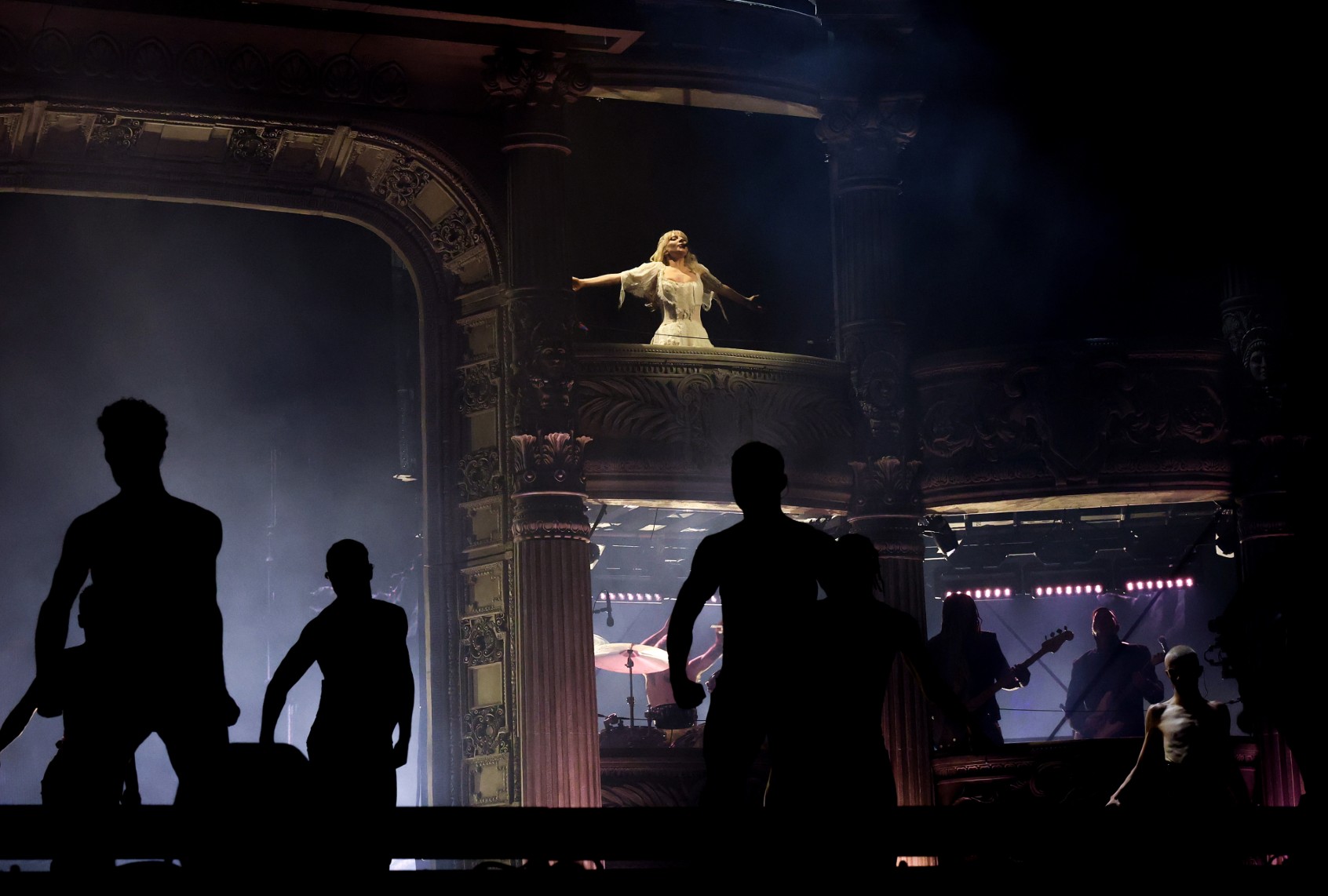
Gaga knew expectations for her return would be high. “I’ve had a vision I’ve never been able to fully realize at Coachella for reasons beyond our control,” she wrote in the post announcing her return to the festival. “I have been wanting to go back and to do it right, and I am.” Kudos to Gaga for keeping her cards close to her chest with the understatement of the century. “The Art of Personal Chaos” is not just doing Coachella “right”; it’s a formal exercise in pushing the boundaries of what a stage show can and should be, and the paradigm of how great art reflects the artist as much as it does culture and society.


Want a daily wrap-up of all the news and commentary Salon has to offer? Subscribe to our morning newsletter, Crash Course.


To put on a show in this warring world, Gaga calls on the dueling personalities at the core of her new album, “Mayhem,” where she walks the translucent line between her artistry and personhood, and all of the strange chaos conjured by their overlap. She covers her introspection in sticky synths and nasty grooves, and by the end of the record, arrives at a place of contentment, understanding how to be both Lady and Gaga, even if she knows those parts of her will always be at odds. 

Like the visuals for the album’s first two singles, “Disease” and “Abracadabra,” the video manifesto that opens her five-act Coachella show brings these dual characters to life. Two Gagas tower over the audience. On the left stands the Mistress of Mayhem, clad entirely in red, speaking with resolution. On the right is an angelic Lady Gaga, dressed in white and reciting the same proclamation in a softer tone. Both entities battle throughout the show, trying to outrun the other or snare her in a deadly trap. To even call it live theater feels crude, even a little dismissive. This is not mere theater, this is an opera: Even if the meaning escapes you in the moment, or its language sounds strange to your ears, its stars convey the intensity and emotion at every turn.

While Gaga herself has a pivotal hand in translating that passion, a show of this magnitude isn’t possible without a small army of collaborators. A series of opening credits tribute the show’s creative director and choreographer, Parris Goebel, as well as its lighting designers, costume designers and camera directors. (With Gaga getting the “directed by” credit, naturally.) But these names don’t just read like a thank-you; they read as a total conviction of spirit. Gaga and her team are so confident that viewers will be blown away that they’ve generously given them the resources to pursue that inspiration after the performance concludes. That’s a prescient thought, given the only intelligible question one can muster once they see Gaga’s 25-foot dress for the opening act is, “How?”

Lady Gaga performs during the 2025 Coachella Valley Music and Arts Festival on April 11, 2025, in Indio, California. (Kevin Mazur/Getty Images for Coachella)That dress — which took three weeks of work to build and includes a mechanical lift, steel cage and wooden frame draped in over 270 meters of red curtain fabric — is a marvel of architectural craftsmanship. It’s impressive enough as it stands, but when the skirt opens to reveal a team of dancers inside of it as Gaga transitions from “Bloody Mary” to “Abracadabra,” it seems almost unworldly. Gaga has called “Mayhem” a series of gothic dreams, and in “The Art of Personal Chaos,” she immerses her audience in these fantasies. Like a dream, everything is augmented and intense. Watching it play out is like reading a Brothers Grimm fairytale with all of the pages slightly out of order; a disorienting, riveting way of making the show feel as romantic as it does evil.
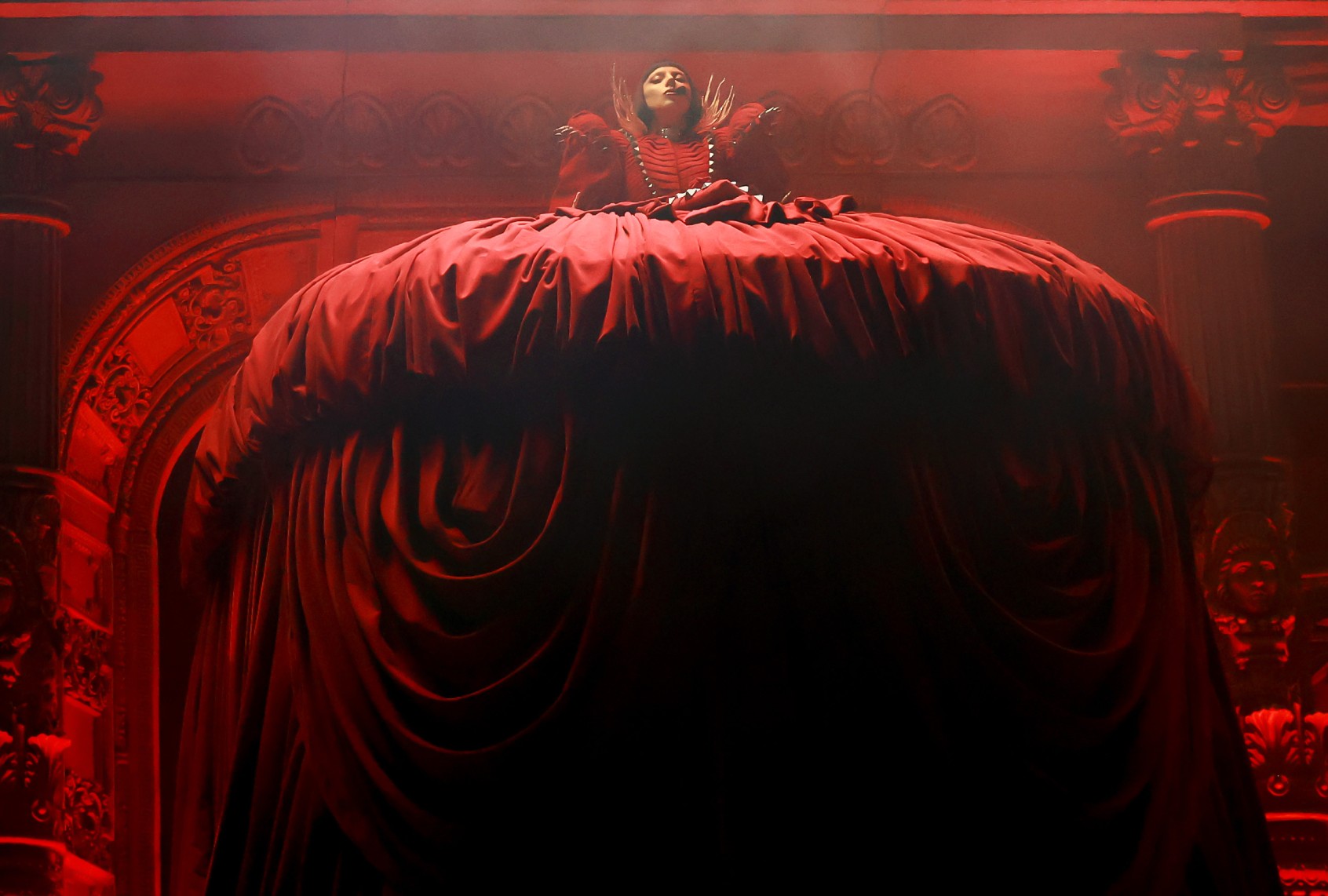
Before long, Gaga’s version of her wicked queen sniffs out her prey. After performing most of the first act as the raven-haired Mistress, Gaga ascends to a dance floor lit up like a chess board, competing against her opponent in a lethal, choreographed game. It’s immediately evident that Gaga is in the middle of performing her live opus, a show that may very well come to be recognized as her greatest. But when this colossal chess game ends with the Mistress of Mayhem maiming her adversary, “The Art of Personal Chaos” transitions into something even more extraordinary. What follows exceeds even Gaga’s high standards, entering the echelon of all-time great performance art pieces. But it is not just great; it is glorious, like something that fell from the pop heavens after months upon years of drought.

A swath of dancers carry the Mistress’ victim to an ornate, contained graveyard and bury her in the sand while others freestyle onstage in another live interlude, giving Gaga just enough time for an outfit change. When the lights come back up, Gaga is now the woman in white, lying in the sand, half-dead among piles of discarded human remains. She remains recumbent for an entire number, singing to a skeleton, before the bones around her reveal themselves as dancers in masks, convulsing to the humongous bassline synths of “Disease.” Like the song’s music video, the live number ends with the Mistress reappearing and the two locking into an elaborately choreographed stranglehold. 

We need your help to stay independent

At its end, Gaga is revived once more for “Paparazzi,” the song that has boasted some of her most unforgettable live performance commentaries — but none quite like this. With help from her dancers, Gaga dons the metallic Mugler armor and crutches featured in the track’s 2009 video for the first time in 16 years. Stuck halfway out of the massive graveyard set piece, Gaga performs the song with more yearning than ever before, her agile voice rising and falling as it cascades across the desperation in her lyrics. In a breathtaking turn, she rises from the opera house’s sandy crypt and slowly moves across the set on crutches, revealing the extent of her billowing, white cape behind her, swelling in the wind of a fan at the end of the stage. When the cameras pan out, they reveal the full scope of this scene. A divine Gaga strapped into couture crutches and lit by soft blue gels and a single spotlight, with her yards-long white cape rising into the air and fanning against the opera house’s florid details. She’s a woman forging forward, undaunted in her relentless pursuit of something wonderful.

When she reaches the fan, Gaga stops momentarily, letting her props fall to the ground. She stands in front of the machine and raises her arms, allowing the romanticism of the image she’s created to linger. For as many times as I’ve seen it, each time feels like the first. Gaga is a through-and-through maximalist, someone who’s always doing just a little too much. That’s why we love her, but that’s also why it makes this performance so singular. For all its dreamy elegance, it’s deceptively simple. Looking at it feels like being stopped in your tracks by a painting in a museum, unable to do anything but admire it for reasons not entirely known to you. It is, and I don’t say this lightly, one of the most beautiful things I’ve ever seen — craft operating on such a high, grand level in a time when it seems like anything that breaks through to the mainstream has had its beauty defaced and defiled. This is art so discerning and resplendent that it makes its spectator feel grateful just to witness it, a reminder that being alive is a cherished gift.

With this show, Gaga has sought not just to infuse beauty into the universe but to remind viewers of how much more gratifying it is to see art made by hand, thought through to the last detail.

These images in Gaga’s show exist in stark opposition to our contemporary era. Now, everything is designed to be ephemeral and disposable, tossed away to make room for the next thing. Technology is eating itself alive, and the “art” that so much of the public chooses to consume is half-baked or, worse, generated by ChatGPT. Over the last month, impressionable users have succumbed to the wiles of insipid computer programs and plastered the (frankly nauseating) results all over social media. ChatGPT studied and lifted the art styles of Pixar and the great director Hayao Miyazaki, allowing users to plug a photo of themselves into the program to transform it into a poor, bastardized regurgitation of something truly beautiful. 

But I don’t think most people are being willfully submissive to tech, only that they seek beauty in the wrong places. Social media has created digital silos that have swallowed users whole, demanding that they display their individualism in a way that attracts followers or risk being shunned and alone in electronic hell. When people ask ChatGPT to make them into Studio Ghibli characters or a toy doll with all of their quirky characteristics included as accessories — as was the trend over Gagachella weekend — they are frantically searching for a personal connection to art. People want to see themselves modeled in the images they proliferate because social media has taught them to use individualism as a currency to buy more attention. But by jumping on the bandwagon and feeding the machine, the resulting image loses its novelty; there is no beauty or introspection, certainly no personality. No one made a ChatGPT image with their hands or thought about the most interesting way to present it. And as soon as another fad has replaced the trend, the cycle will repeat.

Lady Gaga performs during the 2025 Coachella Valley Music and Arts Festival on April 11, 2025, in Indio, California. (Kevin Mazur/Getty Images for Coachella)But watching Gaga’s “Paparazzi” performance, and the entirety of “The Art of Personal Chaos,” I see someone who has set out to make something completely honest in a world where so many lie to themselves every day just to cope with how quickly the world’s shine has dulled. With this show, she has sought not just to infuse beauty into the universe but to remind viewers of how much more gratifying it is to see art made by hand, thought through to the last detail. The distinctly human touch in this show pierces the soul in a way nothing made solely by algorithmic ones and zeroes ever could. As Gaga tells the audience after “Paparazzi,” warmly lit on a balcony: “I wanted to make a romantic gesture. This year, in these times of mayhem, I decided to make you an opera house in the desert.”

Here, Gaga relays her intentions. The entire show is about duality, yes. But it’s also about art and imagination and how powerful they can be in tempering the waters after we’ve spent so long drowning in the roiling seas of uninspired uniformity. Her intentions with this Coachella show are clear and noble. The set proves that having standards and integrity, even in the face of your oppressors and the ugliness they broadcast, will create something beautiful enough to combat even the most despicable reality. Anything so magnificent is worth fighting for. And though it can never be recreated in exactly the same way, even for Coachella’s upcoming second weekend, it will live on forever. Despite the Mistress of Mayhem’s attempts to snuff it out from the world, beauty finds a way back, reborn even more exceptional because it has survived.

“Our partners are the face of our brand”: Starbucks is updating its dress code for baristas

Starbucks has announced changes to its employee dress code as part of its ongoing efforts to “create a warm, welcoming environment” across its brick-and-mortar stores nationwide, the brand said in an April 14 press release.

“As we continue working to create a warm, welcoming environment that invites customers in, showcases our great coffee, and provides a comfortable place to sit and stay, our green apron partners have played a big role in bringing it all to life — from writing on cups to free refills and the coffeehouse experience,” the chain said.

Starting May 12, Starbucks will require its baristas to wear solid black tops and long-sleeved crewneck, collared or button-up shirts along with any shade of khaki, black or blue denim bottoms. The “more defined color palette” hopes to allow Starbucks’ “iconic green apron to shine and create a sense of familiarity for our customers,” the brand specified.

In addition to the updated dress code, Starbucks is making a new line of company branded T-shirts. Baristas will receive two tees at no additional cost, per the brand.

“By updating our dress code, we can deliver a more consistent coffeehouse experience that will also bring simpler and clearer guidance to our partners, which means they can focus on what matters most, crafting great beverages and fostering connections with customers,” Starbucks said.

The latest initiative comes after Starbucks restored its free refill policy, brought back its condiment bar, re-introduced its coffee cup doodles and reversed its “open-door policy,” meaning customers can no longer use store restrooms and seating areas without making a purchase. These changes are part of CEO Brian Niccol’s push to bring the coffee chain back to its “community coffeehouse roots.”

A new NASA mission will make it a lot easier to predict space weather

We're in solar storm season. That's because 2025 is the peak of the sun's 11-year cycle of activity. Electrically charged particles fly from our neighborhood star into Earth's magnetosphere, where a powerful magnetic field surrounds our planet. From there, many things can happen – auroras, and even electrical shorts in satellites or power lines.

How does that powerful solar energy get transmitted to Earth? A new NASA satellite series called the Electrojet Zeeman Imaging Explorer (EZIE) aims to fill in the gap. EZIE's three toaster-sized CubeSat satellites will spend at least 18 months circling our planet and watching how "space weather" operates near our planet — and how it can impact our infrastructure.

"Satellites, power lines, that kind of thing can be affected" by solar storms, said principal investigator Sam Yee, a space scientist at the Johns Hopkins University Applied Physics Laboratory in Maryland. That's because the current of energy from the solar wind flowing through our atmosphere creates plasma through ionizations and heat through resistance, he added. "We call it a space weather event when the current gets stronger abruptly."

Mighty currents have caused disruptions before. In 1989, solar storms shorted power for six million people in Quebec. Further back, an immense 1859 storm known as the Carrington Event set afire recording tape at telegraph stations. Scientists have warned that if another Carrington happens, we would be even more vulnerable today given how much of our lives depend on the electrical grid.

"If we put a multiple spacecraft flying over that region at the same time, we can see that structure, [and] how a structure changes with time."

EZIE will zero in on Earth's auroral electrojets — which are electrical currents flowing close to the magnetic poles of our planet. At the edge of space, which is roughly 65 miles or 100 km above our planet, these electrojets carry currents of up to a million amps of electricity. 

"You often see this on the night side of the earth — a big burst of activity," said Ian Mann, a University of Alberta physicist not involved with the mission. This activity results in "big dancing displays of the Northern Lights and large electrical currents, and that can happen very quickly. And if it happens quickly, that means that the magnetic fields change quickly."

The magnetic fields can be measured through the Zeeman effect of radiative emissions of atoms and molecules. These emission lines can split into several components in the presence of a magnetic field, caused by the interaction between the internal magnetic moments of the emitting atoms and molecules with the external magnetic field. We can see these splits in the spectrum of light emitted by these atoms and molecules.

EZIE's Three Satellites. (NASA/Johns Hopkins APL/Steve Gribben)
EZIE aims to use its trio of satellites to remotely quantify the Zeeman effects of the molecular oxygen emission line. It will measure magnetic fields induced by the presence of the electrical current in the upper atmosphere in different locations, especially during space weather events. In other words, EZIE will generate a "current map" – a map of the structure of the current – in the field of view of the satellites, Yee said. More importantly: "If we put a multiple spacecraft flying over that region at the same time, we can see that structure, [and] how a structure changes with time."

While we can infer the currents from the ground, the distance away from the Earth where the currents flow means that mapping their detailed structure that way is challenging. The University of Alberta, for example, manages and operates the CARISMA magnetometer network. The acronym stands for Canadian Array for Realtime Investigations of Magnetic Activity, part of a multi-university project called Space Environment Canada, funded by the Canadian Space Agency, with additional support from the Canada Foundation for Innovation.


Want more health and science stories in your inbox? Subscribe to Salon's weekly newsletter Lab Notes.


The vast CARISMA magnetometer array runs thousands of miles from Canada's north to close to the border of the United States, and from east to west, spanning a large region of western Canada. Despite this coverage of sensors measuring the magnetic field, "diagnosing the detailed fine structure is a nightmare," Mann said, since the magnetic effects from smaller scale structures can magnetically cancel on the ground.  

Such features can then fall below the resolution of the network, meaning they will smear out in the data. And from above, "you only typically have an occasional satellite that flies through it." Mann said the ideal would be "to have a huge network of satellites all flying at the same time, and by mapping their magnetic fields locally such a constellation of satellites could tell you something about what's actually happening" as the space storms develop. 

Besides EZIE, he said the community has been fortunate to get some information from the AMPERE experiments aboard the Iridium satellite network. The resolution of AMPERE (Active Magnetosphere and Planetary Electrodynamics Response Experiment) is much lower, however. 

We need your help to stay independent

"The resolution in space and time is still determined by the pass-through time of the spacecraft," Mann said. "The satellites in the AMPERE constellation are about 10 minutes apart along their orbits, and a lot can happen in 10 minutes." 

During EZIE overflights of the electrojets, the three EZIE satellites will assess the spatial and temporal development of the magnetic fields — which are the signatures of the electrojets. EZIE data will therefore help scientists to better understand how space storms develop, and how sothey can adversely impact technological infrastructure on the ground and in space.       

Solar storms create beautiful displays when they generate auroras, but the stakes are more serious when they affect power grids or satellites. EZIE aims to help us better understand the flow of currents, to protect our infrastructure. That way, we can both enjoy the beautiful northern lights – and rest easy knowing the lights will still be on when we go back inside.

Why not tyranny? JD Vance says he’s fine with the “inevitable errors” of abandoning due process

It can be hard, living in a free society. In places where the rule of law prevails, and where all people — citizens, criminals, immigrants — are believed to be endowed with certain inalienable rights, guilt or innocence is determined by an independent judiciary and a jury of one’s peers. Even when the facts of the matter are hardly contested, liberty and justice require that the accused be judged not by the mob, or any one person, but through an oft-lengthy process wherein they are entitled to challenge the evidence against them.

Have you ever been certain of something, only to be later proven wrong? That happens to governments, even when they are composed of people doing their best to ascertain the truth; due process serves to protect everyone from an earnest mistake, but it also has safeguards against the possibility that the state may one day be run by those who are not acting in good faith at all.

That process isn’t perfect, and actually existing criminal justice systems tend to fall short of the ideal: sometimes the guilty get off, and sometimes the innocent are condemned. But it beats the alternative: tyranny.

In a tyrannical system, the accused’s guilt is determined by their being accused in the first place. If the government says someone is a terrorist, then they are dealt with accordingly. There is no appeal and indeed there is no formal process at all beyond the pronouncement: terrorist; guilty.

That is the system that the Trump administration would like everyone in America to live under — one where the word of a 78-year-old man and his underlings is enough to justify sending anyone to a foreign prison for the rest of their life.

To date, that goal has been largely implicit. Hundreds of men have been sent to a notorious detention facility in El Salvador where, according to the administration, they will spend the rest of their lives. All have been tarred as terrorists and gang members, but the vast majority have never been convicted of so much as shoplifting — in the United States or elsewhere. Among them is a barber from Venezuela, a gay man who was labeled a member of the gang Tren de Aragua based on the say-so of one former, discredited police officer who lost his gig in law enforcement after reportedly crashing his car, while intoxicated, into a family's home. Another is a 19-year-old who entered the country legally and had a permit to work but was reportedly grabbed by ICE agents during an operation that was targeting someone else.

The most prominent case has been that of Kilmar Abrego Garcia, a Maryland man who a Department of Justice lawyer admitted was wrongly expelled from the country as a court had earlier issued him a protection from deportation order (that DOJ lawyer has since been fired for his honesty). The Trump administration has offered a series of post-facto excuses for why this father and union apprentice should be denied the opportunity to ever see his family again, centering on the claim that he was a member of MS-13; as with the barber, that too is an allegation that relies on the testimony of an unreliable cop — one who later pleaded guilty to giving confidential police information to a sex worker, according to The New Republic.

No real court would have sentenced Abrego Garcia to life in prison over such flimsy evidence (White House press secretary Karoline Leavitt, apparently improvising, on Tuesday added another claimed offense, one that has never even been asserted in a legal filing: human trafficking. The lack of real evidence of any guilt, much less the kind that would argue for depriving him of liberty forever, is why he was never presented before a court — and it is why, presumably, President Donald Trump is defying a Supreme Court order to facilitate his return to the country, which would risk allowing him to speak freely about his ordeal and the conditions inside a prison that no one detained within has ever left, alive.

But one need not piece together from its actions what the Trump administration really thinks of due process and the rule of law. On Tuesday night, Vice President JD Vance made explicit that the intent is to defy legal principles that date back to antiquity, scolding those who insist on respecting the rights of the “many” undocumented immigrants who have “committed violent crimes, or facilitated fentanyl and sex trafficking.”

“To say the administration must observe ‘due process’ is to beg the question: what process is due is a function of our resources, the public interest, the status of the accused, the proposed punishment, and so many other factors,” Vance wrote on social media. “To put it in concrete terms, imposing the death penalty on an American citizen requires more legal process than deporting an illegal alien to their country of origin.”

We need your help to stay independent

Ignoring that the hundreds of people sent to El Salvador had never stepped foot in that country before, Vance rattled off his main point: That it’s too hard to provide “illegal aliens” with anything resembling due process, which itself, you know, “produces errors.” Because trial by jury is cumbersome, and justice still not guaranteed, why bother with any process at all?

“What I am OK with is the reality that any human system will produce errors. Further, I accept the actual tradeoff: between not enforcing the law and enforcing the law. And I choose the latter despite the inevitable errors,” Vance wrote.

Put plainly: The vice president of the United States is arguing for the embrace of abject tyranny, where perceived membership in a category — “illegal alien” — is sufficient for unilaterally sentencing someone to life imprisonment with no recourse. While framed as applying to the foreign-born, deprived of the rights endowed by their creator, there is no need to argue that this poses the threat of a slippery slope: a government that has already expelled legal immigrants is obviously capable of falsely labeling a U.S. citizen a member of this enemy class, and indeed its top officials are arguing that such “inevitable errors” are a small price to pay for cleansing “the blood of the country.”

It is hard to live in a free society and a free society is even harder to maintain; it is more difficult, still, to get it back once it is gone. History will judge where America stood about 90 days into the second Trump presidency, but this much is certain: The moment that one group is exempted from the rule of law, no one is safe from the capricious malice of a petty tyrant — and if no one resists such an assault on civilization, then freedom is lost.

Trump’s shock and awe strategy: Chaos secures more power

Donald Trump continues to smash the conventional wisdom, norms, institutions, rule of law and U.S. democracy. He only returned to office three months ago, so he is just getting started. Moreover, Trump appears to greatly enjoy the chaos of his second term in office. He has no plans to leave office and has already hinted at his desire to seek a third term, in violation of the Constitution.

The so-called conventional wisdom, which consists of those taken-for-granted ideas, comfortable understandings of how things are supposed to work, and common sense that does not yield to new evidence, is no match for the shock and awe campaign of Trump and his MAGA movement and their allies. Their application of the German concept of “Gleichschaltung” (which means synchronization or bringing into line) to force universal compliance and remake society in the vision of Trumpism and American authoritarianism has proven too strong for the Democrats, civil society and the larger Resistance to stop. Ultimately, Donald Trump’s chaos and disorientation are the point; it is both the strategy and the goal. The chaos enables Trump and his allies and other enemies of democracy and a humane society to get and keep more corrupt power, a power without limits and unbounded in its ambitions and harm.

Trump declared “Liberation Day” as he debuted a historic global tariff regime, like it was a game show with him as the host. The spectacle caused the American stock market to lose trillions of dollars over the course of several days. Experts warned that these unprecedented tariffs — which included close trading partners such as Canada and Mexico — could cause a severe recession if not a depression. Several days later, Trump changed his mind and ordered a temporary pause on the largest tariffs, except for China — which has now retaliated against the United States with a 125 percent tariff.

As Donald Trump and his forces continue to quickly and easily smash the conventional wisdom and rubbleize American democracy and society, the mainstream political class, news media and other elites are experiencing a type of epistemic collapse.

Trump is escalating his campaign to crush dissent by targeting universities, colleges, law firms, media outlets, and other parts of civil society for investigations and punitive financial measures because they are deemed to be disloyal and engaging in un-American activities as defined by the administration.

The Trump administration, in open defiance of the Supreme Court, is refusing to return Abrego Garcia to the United States. Garcia is married to an American citizen, with whom he has one child. He also possesses a “green card” work permit, which legally allows him to be in the country. Garcia has been living in the United States for more than ten years. This is a constitutional crisis. Garcia was caught up in an ICE operation targeting Venezuelan gang members and then de facto disappeared and sent to the infamous Centro de Confinamiento del Terrorismo (CECOT) in El Salvador. Per the Trump administration’s own admission, he was wrongly “deported” from the country. Abrego Garcia is not the only person who has been held in legal limbo by the Trump administration as part of its crackdown on “illegal immigrants” and foreign “troublemakers.”  

At Slate, Mark Joseph Stern explains this is worse than Kafkaesque horror:

This sneering resistance to the judiciary’s intervention was both entirely predictable and profoundly ominous. From the start, the U.S. government’s behavior in this case has been a conscience-shocking breach of both laws and norms that once stood as a firewall to safeguard all of our civil liberties. And it is now spiraling out of control. In a matter of days, Justice Department lawyers and administration officials have burned through basic legal duties in defense of a hideously unlawful scheme that seeks to permanently render innocent people to a black site. They have torched their credibility by violating the most fundamental obligations of candor to a court — not hesitantly, but proudly so, with undisguised disdain toward judges attempting to salvage whatever remains of the rule of law.

Calling this a constitutional crisis undersells the catastrophic implications of the emergency. This administration is rapidly constructing a legal framework that would allow it to abruptly disappear anyone, including natural-born U.S. citizens, to a foreign prison forever, for any reason it chooses, or no reason at all. Indeed, Trump teased this possibility on Monday, floating the deportation of “homegrown criminals” to El Salvador next. The stakes of the battle over Abrego Garcia’s fate could not be more evident: If the government succeeds in thwarting judicial repudiation of his deportation, it will mark the end of constitutional freedoms as we know them.

In a post on social media, political scientist Norm Ornstein also sounded the alarm about what Abrego Garcia represents: “Defying the Supreme Court, planning to spirit American citizens to El Salvador and saying that the courts have no role since it is a foreign country and the president has all foreign policy powers. We have entered the realm of full-blown fascism.”

In a very important, yet under-reported story, Donald Trump has ordered the United States military to take control of public lands on the U.S.-Mexico border, where it will have de facto police powers. This is an apparent violation of the intent and meaning, if not letter of the law, of the Posse Comitatus Act, which forbids, except under very narrow circumstances, the use of the military for domestic law enforcement.

In a series of posts on social media, Elizabeth Goiten, who is senior director of the Liberty and National Security Program at the Brennan Center for Justice at NYU Law, warns about the escalating probability of the US military being turned against the American people in a “national emergency”:

What’s this new executive order directing the Department of Defense to take over huge amounts of public land on the border? Simple: it’s yet another abuse of emergency powers—this one seemingly designed to make an illegal end-run around the Posse Comitatus Act.

It would make this thread far too long to list all of Trump’s abuses of emergency powers thus far. But the country is still reeling from the latest one: emergency tariffs imposed on every country in the world, including islands inhabited primarily by penguins.

And then there’s the abuse of the Alien Enemies Act—a law that applies only during an armed attack by a foreign nation or government—to stealthily deport 137 Venezuelans, 75% of whom have no criminal record whatsoever, to an El Salvador prison that’s a living hell.

But let’s talk about this newest one. Trump wants to step up the use of federal troops at the border, who are currently providing logistical support to DHS. But using them to arrest or detain migrants would be illegal under the Posse Comitatus Act.

The Posse Comitatus Act (PCA) prohibits federal troops from enforcing domestic law unless there’s a statute that allows it. It’s a critical check on presidential power, for an obvious reason: an army turned inward can quickly become an instrument of tyranny.

One way around the PCA is the Insurrection Act, which allows the president to deploy troops to quell civil unrest or enforce the law in a crisis. Trump has indicated that he might invoke the Insurrection Act. But in the meantime, he appears to be trying a different approach….

It is high time Congress and the courts put an end to all of these power grabs. Immigration laws can and should be enforced through lawful means, without abusing emergency powers, misappropriating wartime authorities, or trying to skirt the Posse Comitatus Act.

There are many reasons why the American mainstream news media and other establishment voices in the political class and the elites are being outmatched by Donald Trump in almost every encounter. Primarily, they are adhering to obsolete norms and expectations about how a representative democracy, a two-party system and a tripartite government that is supposed to have a balance of powers should offer strong protections against extremists and others who would destroy the institutions and democracy itself from within, an obsession with consensus, American Exceptionalism as an inoculation from authoritarianism and fascism, a belief in the wisdom of crowds and how the American people supposedly almost always do the right thing in the end, the supreme nature of the rule of law, the strength of civil society, free and fair elections as a type of civil religion in America, and elected leaders and parties who are responsive to public opinion because they are afraid of being voted out of office and power. The role of hubris among the elites and other opinion leaders is also central to their ongoing failings in the Age of Trump: as a class such institutions and people imagine their legitimacy and authority as something enduring if not permanent instead of as contingent and vulnerable in the age of global authoritarian populism.

As Jeet Heer reflects upon in a new essay at The Nation, “Once Trump is defeated, America will need a reckoning with this elite failure. After all, if the ruling class can’t even defend the basic norms of liberal democracy, why should they be allowed to rule at all?” The mainstream American political and cultural elites shudder at the fact that Donald Trump is a world-historical figure. The American democratic experiment will be bifurcated as “BT” (before Trump) and “AT” (after Trump).

As Donald Trump and his forces continue to quickly and easily smash the conventional wisdom and rubbleize American democracy and society, the mainstream political class, news media and other elites are experiencing a type of epistemic collapse where the world and their assumptions and theories about it are twisted and nullified.

However, it would be an error to describe the Age of Trump and the rise of American authoritarianism under Trump’s second administration as a paradigm shift where fundamental understandings of reality are changed and replaced by a new model. For example, the rejection of the heliocentric model of the solar system with one that accurately places the sun at its center.

Donald Trump and his MAGA movement and the larger authoritarian right-wing campaign against multiracial pluralistic democracy is not new or novel. They are following an old dictators’ and autocrats’ playbook that has been updated and modified from lessons learned in Orbán’s Hungary and Putin’s Russia to fit the specific weaknesses, vulnerabilities and culture of the United States. Moreover, to assert that Trumpism and the larger American authoritarian (and now fascist) movement is unique and/or unprecedented in America is to ignore, for example, America’s own history of White on Black chattel slavery, the Black Codes, and the Jim and Jane Crow racial authoritarian apartheid regime across the South and other parts of the country that was not defeated until the triumphs of the civil rights movement in the 1960s and beyond.

We need your help to stay independent

What sociologist Joe Feagin describes as the white racial frame has blinded many, if not most, white Americans (and too many black and brown Americans as well) to the ugliness of America’s long history of authoritarianism both domestically and in support of it abroad. In his seminal 1935 essay “The Propaganda of History,” W.E.B Du Bois intervenes against a history that lacks context and is divorced from the full truth and facts in service to the political agenda of those who are writing and interpreting it in the present:

War and especially civil strife leave terrible wounds. It is the duty of humanity to heal them. It was therefore soon conceived as neither wise nor patriotic to speak of all the causes of strife and the terrible results to which national differences in the United States had led. And so, first of all, we minimized the slavery controversy which convulsed the nation from the Missouri Compromise down to the Civil War. On top of that, we passed by Reconstruction with a phrase of regret or disgust.

But are these reasons of courtesy and philanthropy sufficient for denying Truth? If history is going to be scientific, if the record of human action is going to be set down with the accuracy and faithfulness of detail which will allow its use as a measuring rod and guidepost for the future of nations, there must be set some standards of ethics in research and interpretation.

If, on the other hand, we are going to use history for our pleasure and amusement, for inflating our national ego, and giving us a false but pleasurable sense of accomplishment, then we must give up the idea of history as a science or as an art using the results of science, and admit frankly that we are using a version of historic fact in order to influence and educate the new generation along the way we wish.

It is propaganda like this that has led men in the past to insist that history is “lies agreed upon”; and to point out the danger in such misinformation. It is indeed extremely doubtful if any permanent benefit comes to the world through such action. Nations reel and stagger on their way; they make hideous mistakes; they commit frightful wrongs; they do great and beautiful things. And shall we not best guide humanity by telling the truth about all this, so far as the truth is ascertainable

The Trump administration’s literal Whitewashing of the realities of the color line in American history (and the present) is Du Bois’ warning about propaganda as history necromanced in the 21st century.  


Want a daily wrap-up of all the news and commentary Salon has to offer? Subscribe to our morning newsletter, Crash Course.


As I continue to chronicle the Age of Trump and this exhausting and stupefyingly rapid collapse of American democracy and civil society, I envision the American media as an institution, the Democratic Party, old-school Republicans and other elite defenders of “the system” and “normalcy” like the proverbial monks who are blindfolded and feeling an elephant in an attempt to make sense of what it is. Each monk feels a different part of the elephant and comes to the wrong conclusion. With Donald Trump’s return to power, this great White Republican elephant is covered in broken glass, razor wire and spikes. The people who are feeling the elephant keep getting injured. The far easier solution is for them to take off their blindfolds and see the full scale of the monstrosity for what it is.

In his new essay at the LA Progressive, Henry Giroux writes that "We are not standing at the edge of fascism — we are living through its rehearsal, its staging ground, its opening act."

The question is no longer whether we see it, but whether we have the will to stop it before the final curtain falls. Resistance offers no guarantees. But without it — if it falters, if it remains timid or fragmented — what dies is not only democracy as we know it, but the very possibility of imagining it anew.

[…]

The true danger lies not only in what the state enacts, but in what the public comes to accept as normal, even necessary. What is at stake is more than a culture of silence or the routine cruelty of a politics of disappearance — it is the slow, methodical construction of a fascist subject. This is a subjectivity shaped by fear, seduced by obedience, and ultimately stripped of the capacity to recognize — or reject — the very forces that dominate it. It is not merely that people surrender to authoritarianism, but that they are fashioned by it, habituated to its violence, until resistance feels futile and complicity feels natural.

Sometimes the horror is exactly as it appears. Beware the professional smart people and the other elites who maintain the boundaries of the approved public discourse and “the mainstream” and “the conventional wisdom.” They are trying to convince themselves (and the American public) that there must be some other explanation. In the end, inertia and clinging to the comfortable disproved conventional wisdom won’t save American democracy or the American people. Believe the authoritarian and the autocrat. He means what he says both literally and figuratively.

Harvard fights back against Trump: Institutional resistance finally rises up — and sets a new model

The news has been a steady, depressing drumbeat of complicity tales lately. Every day, it seems another prominent law firm, Ivy League university or mainstream media outlet bends the knee to Donald Trump, trading compliance with the fascist agenda for the hope of getting the mad king off their back. ABC News capitulated early, paying off Trump with a settlement for using the word "rape" to describe his attack of E. Jean Carroll, even though the judge in the civil trial ruled that "Mr. Trump 'raped' her as many people commonly understand the word 'rape.'" Multiple big law firms have bribed Trump with agreements to offer millions in pro bono support for the administration's authoritarian agenda. The bowing and scraping from some corporate bigwigs is so pathetic that it sometimes gets comical. 

NYMAG: A Warner Bros. rep “recently reached out to the Trump orbit seeking advice about how the company might advantageously interact with the White House.. The reported message was .. Don Jr. might like a hunting and fishing show on the Discovery Channel ..” @nymag.com nymag.com/intelligence…

[image or embed]

— Carl Quintanilla (@carlquintanilla.bsky.social) April 14, 2025 at 1:49 PM

Most alarming, however, may be the appeasement politics of university administrations — most notably at Columbia, where officials agreed to a series of draconian anti-student policies after Trump threatened $400 million in federal funding. Using the blatantly disingenuous pretext of "fighting anti-semitism," the school caved to Trump's demands to silence campus protests with threats of student discipline and even arrest. The choice of Trump over the safety of their own students sparked public outrage, but it felt futile, as though such cowardice would be the standard for all elite schools in a second Trump term. 

On Monday, however, the ground shifted when Harvard University went in another direction.

"The University will not surrender its independence or relinquish its constitutional rights," Harvard President Alan Garber declared in a public letter. Garber subtly scoffed at the notion that the "reforms" demanded by Trump have jack-all to do with "fighting anti-semitism," making clear that Trump's defunding threats are about silencing progressive thought, forcing the school to hire MAGA hacks as professors and making life so hellish for students it would permanently tarnish the school's brand. Garber also noted that the White House wants to “'audit' the viewpoints of our student body" and ban students who have political views Trump doesn't like. 


Want more Amanda Marcotte on politics? Subscribe to her newsletter Standing Room Only.


Harvard's endowment is large enough to weather the loss of federal funding. Nonetheless, this is an important move that can help stiffen the spines at other schools. Already, the leadership at Stanford University has piped up in support, with a similar vow to tell Trump to shove his authoritarian demands. At Yale, 876 faculty members signed a letter supporting Harvard's actions. Several other Ivy League universities joined with a group of state schools to file a lawsuit against Trump's funding cuts on Monday. After Harvard's public stand, even Columbia’s interim president issued a statement saying the school no longer consents to some of the Trump administration's “overly prescriptive" demands.

“Harvard has set an example for other higher-ed institutions," former President Barack Obama said in response. “Let’s hope other institutions follow suit.”

Cynical readers need not worry that I'm asking them to hand out medals for courage to university administrators. It's more likely that the Harvard leadership has come to realize what Columbia should have known all along: Complicity will not save you. As Rose Horowitch at the Atlantic wrote Monday, "Columbia still has not gotten the $400 million back. On the contrary, the Trump administration seems to have taken the capitulation as permission to make more demands." Columbia administrators thought they were buying peace. Instead, the White House is pushing to create federal oversight of Columbia so that a MAGA loyalist can have granular authority over the school's daily operations. 

Columbia administrators thought they were buying peace. Instead, the White House is pushing to create federal oversight of Columbia so that a MAGA loyalist can have granular authority over the school's daily operations. 

This should have been obvious to anyone who had dealt with a schoolyard bully. If you give him your lunch money the first time, guess what? He will now be waiting for you every day. The only way to break the cycle is to refuse to cooperate; the sooner the better. Trump is even less sophisticated than your typical sixth-grade bully. As a lifelong grifter, he can't help but keep returning to the site of a successful shakedown, and will drain a victim dry, as long as they keep complying.

Harvard seems to understand that saying no to Trump did not "cost" them two billion dollars. As Columbia is learning the hard way, he was always going to find an excuse to withhold the money. Might as well not give up your dignity along with it. Compliance, however, amounted to consenting to what Stanford professor Adrian Daub calls "a controlled demolition, with each demand a charge to knock out another pillar of academic freedom." He notes that the demands were so outlandish that submitting "would have been ruinously expensive and completely impractical." In the end, they are probably saving money, along with their reputation. 

I suspect a major reason that so many powerful companies, schools and other institutions have been playing along with Trump is that their leaders have convinced themselves his time in power is short-lived. Legally, he cannot run for office again. Physically, he's 78 years old. His cognitive function, which was always terrible, is visibly declining. The hope is that all Trump's talk about a "third term" is bluster and that he doesn't have the energy, legal strategy or GOP support to mount another attempted coup

However, the past couple of weeks should disabuse anyone of the hope that they can wait for old age or the law to stop Trump. On Monday, Trump and his staff made it abundantly clear that they intend to reject the Supreme Court's ruling that they cannot illegally imprison innocent people in a concentration camp in El Salvador. Trump even started floating the idea of rounding up American citizens, as well. That's scary on its face, but also should be understood as Trump laying the groundwork for staying in office illegally. Whatever strategy he chooses in 2028 — running illegally, stealing an election or simply declaring himself president-for-life — his goal is to have rendered the Supreme Court utterly impotent before then. 

Betting on the vicissitudes of age is unwise, as well. Trump has always been painfully dumb — remember him suggesting that bleach injections could cure COVID-19? — but it hasn't hurt him one bit with half the country that still believes white maleness counts for more than intelligence. Even dramatic cognitive decline is unlikely to change that. We see this already in the reaction to Trump's tariffs. Trump doesn't understand how tariffs work, doesn't have a coherent idea of why he's imposing them outside of pickle-brained hostility towards other countries, and changes his mind about them by the minute. None of this madness has caused his staff or the right-wing media to hesitate for a moment to keep spinning, claiming faith that Trump's moronic groping is a secret genius plan to make everyone super-rich. Even if Trump were drooling on his shirt, roaming around in diapers and yelling at reporters about how he is terrorized by imaginary chickens, the official MAGA line would remain the same: "Only people with 'Trump derangement syndrome' believe there is something wrong with the president's perfect, mighty brain." 

No, as much of a bummer as it may be to face it, the only reasonable option left is to fight back. Trump and his allies will take the fascism thing as far as they can, as quickly as they can. Capitulation just means being the first fed into the meat grinder. Resistance may not guarantee victory or safety, but it at least gives the country a fighting chance. Plus, the more that institutions, companies and even ordinary citizens fight back, the more it will slow Trump down. Every obstacle put in front of him makes it that much more likely that he will run out of time or finally exhaust his support. It will take way longer than any of us hope, but better than lying down and just letting the worst happen. 

“Disappear without recourse”: Trump’s defiance of a court order means “any American” could be next

President Donald Trump’s administration maintains that those that it improperly sent to a prison in El Salvador are themselves responsible for seeking legal relief that could potentially return them to the United States, a position that legal experts say is destined for argument before the Supreme Court.

In the case of Kilmar Abrego Garcia, a Maryland resident whom the Trump administration sent to a Salvadoran prison based on an “administrative error,” the White House has argued that it can't make its partners in El Salvador return the man it sent them.

The argument came in response to a unanimous Supreme Court opinion last week, which required the administration to “facilitate” Abrego Garcia’s return. The Trump administration responded in a filing saying that to “facilitate” his return means simply to “remove any domestic obstacles that would otherwise impede the alien’s ability to return here.”

Attorney General Pam Bondi expanded on the administration’s position in a statement, saying that to facilitate Abgrego Garcia’s return would be to provide a plane, but that it’s “up to El Salvador if they want to return him. That’s not up to us.”

In a statement Monday, the president of El Salvador and Trump ally, Nayib Bukele, said that it was also beyond his power to return Abgrego Garcia to the United States. “I don’t have the power to return him to the United States," he claimed.

The position of the administration, taken in the context of Bukele’s statement, suggests that the administration expects Abgrego Garcia to “find his way back to the U.S. border on his own,” according to Barbara McQuade, a former U.S. attorney for the Eastern District of Michigan. She added that she thinks the Trump administration is in violation of a court order for refusing to bring him back.

“They are taking a highly questionable interpretation of the word 'facilitate' to mean that they need only open the door if Mr. Abrego Garcia is able to get out of a terrorist prison,” McQuade said. “If they can do this, they can cause any American citizen to disappear without recourse. At some point, the court will need to hold an official in contempt for violating its order.”

Jeffrey Abramson, professor emeritus of government and law at the University of Texas, agreed that the administration “seems prepared to defy a federal court order and provoke a constitutional crisis.”

“In an unsigned unanimous order, the Supreme Court upheld the order insofar as it directed the Trump administration to 'facilitate' the man’s return, though the Court asked the judge to clarify what exactly it meant to 'effectuate' the man’s return,” Abramson told Salon. “But instead of cooperating, the Trump administration has dug in, refused to do anything, and walked back its earlier concession that the deportation was unlawful.”

Abramson said, though, that it’s “not clear what Judge Xinis can do to compel the Trump administration to comply with the order to facilitate. She may hold Trump administration officials in contempt of court, but how to give teeth to such a contempt citation is not clear.”

We need your help to stay independent

Looming over the administration’s refusal to bring Abrego Garcia back to the U.S. is Trump’s apparent intent to send American citizens to the El Salvadoran prison next.

“We always have to obey the laws, but we also have homegrown criminals that push people into subways, that hit elderly ladies on the back of the head with a baseball bat when they’re not looking, that are absolute monsters,” Trump told reporters Monday. “I’d like to include them.”

Bennett Gershman, a law professor at Pace University, told Salon that the question of what protections an American citizen might enjoy, that a noncitizen like Abgrego Garcia was denied, is probably a question of enforcement. He sees this issue going to the Supreme Court, noting that it will also be a question of whether the Trump administration decides to respect whatever order is issued.

“For example, if Trump decides to deport a citizen to the El Salvador prison, as he has suggested he could do and would do under his broad foreign affairs power, and even though the citizen is protected by the Constitution from cruel and unusual punishment under the Eighth Amendment," Gersham said, "how is that right enforced?”

Retiring in Trump’s economy? Don’t touch your savings

To the millions of Americans who have recently retired, or who hope to retire soon, President Trump’s trade war and the ensuing global market panic has wrought a tremendous amount of anxiety over the future of their life’s savings. Since Trump announced his sweeping global tariffs on April 2, U.S. stock markets have nosedived, with the S&P down 4.2% and the Dow Jones down 3.2%. More than 60% of America’s top CEOs think we’re headed into a recession in the next six months. And on Thursday, the Yale Budget Lab predicted we'll spend an extra $4,700 this year on everyday goods and services because of the tariffs.

What, if anything, should we be doing with our retirement savings? Given the moment’s unique challenges for both our wallets and our overall well-being, I enlisted the help of experts in the personal finance and mental health spaces — specialists with expertise in both money management and the underlying behavioral and psychological factors that drive our financial decisions. 

Last fall, I wrote about economics researchers at Yale University attempting to measure the relationship between capitalism and declining mental health, and how financial stress can reinforce a poor mental state that increases the odds of that person making a rushed or ill-advised decision related to their job, spending, savings or investments. And right now, millions of Americans are facing monumental financial uncertainty, heightening the odds that some of them get stuck in the cycle. “Psychological research has shown us that panic amplifies helplessness and sabotages rational thought,” Michael Valdez, an expert in neurology and addictive behaviors, told Salon. “It is critical to recognize the real anxiety many retirees suffer from during these times.”

Thankfully, there are a few things that retirees, or those nearing retirement, can do to ensure they’re well-equipped to weather an economic downturn and to keep themselves mentally well-equipped to handle whatever fresh fiscal hell is next. 

Get a financial adviser

This was by far the most recommended step that experts offered. While the perception may be that financial advisers are most helpful during your prime working years, they can also be immensely helpful in helping you figure out what spending that nest egg looks like in retirement. “Many retirees who have been conditioned to save during their working lifetimes are reluctant to spend money in retirement,” Robert R. Johnson, a finance professor at Creighton University and former president of the American College of Financial Services, told Salon. “A financial adviser can help guide that process.”

We need your help to stay independent

Think of a financial adviser as your dedicated strategist to help you conquer whatever roadblocks stand between you and your financial goals. A financial adviser specializing in retirement planning can determine whether you’re on track to meet your financial needs for the long haul, make sure your savings and investment accounts are being appropriately managed and help you pay off any debt as effectively as possible. Note that a financial adviser is different from an investment adviser, which is someone who specifically advises people on how to best invest their money.

Typically, it costs around $150 an hour to meet with a financial adviser, though there are free and cheaper ways to access their insights. One way is through your bank or credit union, which likely offers free financial tools for customers. For low-income individuals, The Foundation for Financial Planning offers pro bono financial planning services. NerdWallet, a personal finance website, also recommends reaching out to the Financial Planning Association and the Financial Counseling Association of America for other affordable financial tools. 

Avoid big changes to your investment strategy

For the vast majority of individuals, it’s best not to make any significant adjustments to your investments, experts told Salon. “Investors nearing retirement age should try to stay the course and make incremental adjustments,” said Adem Selita, co-founder of The Debt Relief Company.

“If you change your entire investment strategy and reallocate your entire portfolio, odds are you might regret that decision quite a bit,” Selita said. Instead, retirees and those nearing retirement age should “stay the course, and liquidate little by little, and always maximize tax savings as you begin the retirement process,” Selita said.  (A financial adviser can help max out your tax savings.) 

"If you change your entire investment strategy and reallocate your entire portfolio, odds are you might regret that decision quite a bit"

For more experienced investors, Selita said it makes sense on paper to want to reorient their investments toward things like semiconductors, smartphones and other tech products, in light of Trump’s removal of China’s 125% tariff on those goods. “Prudent investors might consider leaning more into technology — however, this could all change with the drop of a dime, and nobody really knows how things will actually play out,” he said.

To reduce anxiety, seek clarity 

Any kind of retirement or financial savings account —  401(k), 403(b), IRAs, 457(b) or a pension plan, to name just a few — comes with a portfolio manager who is tasked with making decisions about how any of those plans’ retirement funds are being invested at any given time. If it’d be helpful to understand how your investments are performing from an expert’s perspective, you can reach out to your portfolio manager to talk through how your money’s being invested, or to discuss how heavily you’re invested in the stock market (as opposed to other investments, like bonds, commodities, real estate or money market funds, among others).

Consider an Investment Policy Statement 

Your portfolio manager can also help you develop an Investment Policy Statement. In essence, it’s a document that guides the investment plan, clearly stating your return objectives and risk tolerance over a certain relevant time horizon. If you don’t have an IPS at this point, don’t worry about developing one right now; experts advise against creating one while any long-term impacts of Trump’s tariffs play out. 

“Developing an IPS in a volatile market, or during major stories, is problematic,” Johnson said. “The whole point of an IPS is to guide you through changing market conditions.” The only time an IPS should be changed, he said, is if your circumstances changed after a divorce or some other major life event.   

And if you have an IPS, don’t touch it, Johnson said. “It should not be changed as a result of market fluctuations.” 

Find small ways to claim control 

Having a garage sale isn’t going to stave off economic doom. But when people exert control of their financial well-being in small but noticeable ways, overall anxiety — which often comes from feeling a lack of controll — can be greatly reduced. “Revising spending habits can have a large, positive impact on the perception of control,” Valdez said.

"Financial security cannot be defined solely by the figures; it is about striking a balance between being prepared and having peace of mind"

To that end, brainstorm scrappy ways to generate cash. Think about any subscriptions or recurring expenses you could pause or cancel, reconsider upcoming trips and shop around for cheaper providers of insurance, cell phones, internet, electricity or other utilities. If it makes sense, open a high-yield savings account. Start using a 30-day rule that forces you to wait a full month before making any purchases over, say, $50, or whatever number works for you. That old typewriter gathering dust in the garage? See if it’s worth any money at a vintage store. 

Even if these fixes only generate a small bit of cash, they'll provide a psychological boost to have a little more money on hand than you did before. Most importantly, it’ll keep you in a healthier headspace to make wise financial choices under challenging circumstances. 

Take care of your mental health

It’s hardly a harbinger of rosy times to come when a financial columnist starts recommending mindfulness strategies. But mental health experts stressed the importance of retirees protecting their mental well-being — a concept that might strike some older Americans as self-indulgent or woo-woo, having been raised by the stoic Silent Generation. But think about it like this: You want to be in the most clear-eyed, grounded headspace possible when taking any action around your finances, right? Just as you’d want your body to be in the best possible form before running a marathon, it’s simply in your money’s interest to invest in your mind’s health. 

Taking care of your mental health looks different from person to person; for the more extroverted, it might be important to make sure you’re spending plenty of time with friends and family, or replacing those expensive Saturday dinners with cheap tickets to a minor league baseball game or a Sunday matinee. Others might benefit more from spending time in nature, taking a few minutes to write down how they’re feeling at the end of the day or even carving out 30 minutes to walk around the neighborhood and take a break from the Netflix fugue. 

Other mindfulness practices experts recommended include meditation, restricting your exposure to the news and simply prioritizing whatever gives you the most energy. These things “can sustain perspective, even during turbulence,” Valdez said. “Keep in mind that financial security cannot be defined solely by the figures; it is about striking a balance between being prepared and having peace of mind.”

“Father of the year”: White House mocks man wrongfully deported to El Salvador

Speaking to reporters on Tuesday, White House spokesperson Karoline Leavitt mocked the man that President Donald Trump's administration wrongfully deported to El Salvador. 

Leavitt called Kilmar Abrego Garcia "an MS-13…illegal alien criminal who was hiding in Maryland." She called the media outrage over his deportation "despicable." 

"Based on the sensationalism of many of the people in this room, you would think we deported a candidate for father of the year," she said.

Abrego Garcia was deported to a Salvadoran prison on March 15, in a move the Trump administration admitted was an "error" in court filings. The Supreme Court ordered the government to "facilitate" Abrego Garcia's return in a ruling earlier this week, a demand the administration has seemingly ignored.

Trump and El Salvadoran President Nayib Bukele threw their hands up over the idea of bringing Abrego Garcia back to the United States during a White House visit on Monday. 

"How can I return him to the United States? Like if I smuggle him into the United States?" Bukele said. "Of course I'm not going to do it. The question is preposterous."

In a brief filed on Tuesday, Abrego Garcia's lawyers argued that the Trump administration is making no effort to return their client to the United States.

"The Government contends that the term ‘facilitate’ is limited to ‘remov[ing] any domestic obstacles that would otherwise impede the alien’s ability to return here.’ Not so. The Supreme Court ordered the Government ‘to ‘facilitate’ Abrego Garcia’s release from custody in El Salvador and to ensure that his case is handled as it would have been had he not been improperly sent to El Salvador,'" they wrote. "The Government should at least be required to request the release of Abrego Garcia. To date, the Government has not done so."

While many Trump officials have played at following along with the law, border czar Tom Homan openly wondered what the point of putting on a dog-and-pony show for the Supreme Court would be.

"If somehow he comes back and that happens, he's gonna be detained and removed again," he shared during a stop by Fox News on Tuesday. "What's the sense of bringing someone back who's simply going to face deportation again?"

“Getting worse”: Majority of Americans think economy is in decline under Trump

There's no doubt that President Donald Trump's chaotic tariff regime rocked Wall Street. But a new poll shows that the bad vibes extend well outside the stock exchange, as Trumpian uncertainty hangs over Main Street.

A CBS/YouGov poll shared earlier this week found that a majority of Americans believe the economy is backsliding in the early days of Trump 2.0. 53% of respondents told pollsters that they believe the economy is getting worse under Donald Trump and a majority of Americans expected the economy to slow or enter a recession in the next year.

56% of respondents said they disapproved of Trump's handling of the economy, up from 49% in March. Nearly 60% of those polled said they opposed new tariffs on U.S. imports. 65% of Americans said they expect the tariffs to make things worse in the short term and 42% expected the duties to have a negative impact in the long term. Compare that to just 8% of respondents who said tariffs would improve the economy immediately and 34% who thought they would have a positive effect given time.

CNN data analyst Harry Enten called the results "the worst set of polling data that Donald Trump has had in his entire second term as president."

"The majority of Americans think that the economy is getting worse," Enten said. "It’s an 11-point jump from November to now, and of course Donald Trump won the 2024 election because he promised to fix the economy."

The polling data also showed that the consensus around who to blame for a lackluster economy had shifted, with most respondents blaming the current president for the first time this term.

Why the Blake Lively and Justin Baldoni feud keeps escalating — and how they can resolve it

If Blake Lively thought for a moment that donuts would help her gain a much-needed tactical victory, she sorely miscalculated. Deep in the throes of her ongoing war with her "It Ends With Us" costar and director Justin Baldoni, Lively recently stopped by a friend's Connecticut bake shop to do some "baking with genius food friends" and hand out treats to customers. Online detractors swiftly accused her of pulling a "PR stunt" to seem more relatable, and trolls flooded the shop's Yelp page, complaining that the haircare entrepreneur had failed to tie back her very long locks in the kitchen. Clearly, this is a battle that has escalated way beyond baked goods at this point. But this doesn't have to become an endless quagmire. I have a degree in conflict resolution, and I know what I'd advise.

First, let's briefly yet exhaustedly recap. The trouble began last summer during the decidedly chilly press blitz for the much-anticipated Colleen Hoover adaptation of her best-selling novel. At the time, a torrent of fan antipathy and hit pieces was mainly directed at Lively—in particular, for her seemingly tone-deaf approach to a story about domestic violence. 

You don't have to be likable to be wronged, and harm doesn't always flow evenly or in one direction.

Later, however, a New York Times investigation revealed an orchestrated smear strategy spearheaded by Baldoni's publicist Melissa Nathan. In December, Lively filed suit against Baldoni and his team — alleging, among other complaints, sexual harassment and a campaign to destroy her reputation — seeking punitive damages at “an amount to be determined at trial.” Baldoni, not to be outdone, then unleashed his own wave of lawsuits: a $250 million libel suit against the New York Times and a $400 million suit against Lively's husband, Ryan Reynolds and their team.

There have since been many more ancillary accusations and lawsuits between other players; there have been gag orders, leaked videos and voice memos, motions to dismiss, and a whole lot of fiery statements on all sides, but you get the gist. I'm going to stay out of speculating on what went down or the precise culpability of each party; I'll just note that you don't have to be likable to be wronged, and harm doesn't always flow evenly or in one direction.

It Ends With UsBlake Lively and Justin Baldoni star in "It Ends With Us" (Sony Pictures Entertainment/Nicole Rivelli). There are numerous approaches to conflict resolution, but it always needs to begin with getting clear on what the parties involved actually want. There are their identified positions, which, as in this case, tend to run toward the "I'm right, you're wrong, now pay me" variety. But then underneath are the interests. Interests are the "Why?" of it all, the heart of what the parties truly hope to get in the outcome. And when you begin to dig in there, the lawsuits and the money often become largely symbolic. 

We need your help to stay independent

During a recent Zoom conversation with Robert Bordone, founder of the Cambridge Negotiation Institute, and behavioral neurologist Joel Salinas, MD, co-author of "Conflict Resilience: Negotiating Disagreement Without Giving Up or Giving In," Bordone talked to me about the role of the three E's in conflict: "ego, emotions and escalation." With Blake and Baldoni, "All of these seem to be very powerfully in play for all the parties involved," he said, noting, "Research has shown that when people are made to be embarrassed in public, their interests tend to shift. They move toward wanting retribution." And punishment is not the same as justice. 

What can happen when that shift happens, as Salinas explained, are the lawsuits, which carry "a pretense of credibility, which can also raise emotions even more," and, he said, "then make it so much more of an existential threat on either side."

Justin Baldoni and Blake Lively are seen on the set of 'It Ends with Us' on January 12, 2024 in Jersey City, New Jersey. (Jose Perez/Bauer-Griffin/GC Images)When you have two actors and their no doubt well-compensated teams of lawyers and publicists in what sure looks like an arms race to out-embarrass each other, the only real winners are going to be the lawyers and publicists. And the longer a conflict like this drags on, the more difficult it becomes to get out of it. A sunk-cost fallacy rears its head, with the parties increasingly feeling they've gone too far to change course. For one side to pivot to a different tack can be interpreted as a gesture of capitulation.

The only real winners are going to be the lawyers and publicists.

We are left now with two parties who seem bent on nothing short of mutually assured professional destruction, and if that's their goal, Baldoni and Lively are doing great. In one corner, there's Baldoni, who has become radioactive now in Hollywood, thanks not just to the alarming revelations about his behavior on the set of his film but also his subsequent scorched earth moves, from the early publicity campaign to his website of "evidence" to those big bucks lawsuits. 

Then there's Lively. Independent of the legal intricacies here, a story involving a successful woman coming forward with allegations of being harassed and then smeared by her director/costar would seem a no-brainer in the court of public opinion. And it's true that with the support of her A-list husband and her powerful industry friends, Lively now has an upper hand in the optics. But this is far from a slam dunk. Aside from the damage wrought by Baldoni and his team, Lively — as the donut incident shows — now has a big image problem and a cloud of drama attached to her name.

"If I just had a minute with them," Bordone told me, "the most important thing that I would try to model for them is listening." He'd encourage "getting them to think more long term in a way that invites them to pause, and creating some space for them to be more mindful about what's most important to them." 


Want a daily wrap-up of all the news and commentary Salon has to offer? Subscribe to our morning newsletter, Crash Course.


The not-lost-on-anyone irony here is that this all started with a movie about abuse. To have both parties centering themselves so firmly in this dispute doesn't achieve what either seems to want — to look like the good guy here, the one who is telling the truth. And the way to look good if you're a Hollywood actor is probably not by demanding huge sums of money but by taking concrete steps to de-escalate. That means, however uncomfortable it may seem, shifting the public focus elsewhere — think of Martha Stewart famously focusing on her salad amid insider trading allegations. No matter how baited by the other side or the press one may be, what if either party just laid low about it all for a while? We live in a wildly reactive culture. Not reacting can be an incredible power move.

To have both parties centering themselves so firmly in this dispute doesn't achieve what either seems to want — to look like the good guy here.

Another de-escalation tactic — one that always feels like a massive longshot to even broach — is direct and detailed accountability. If, for one example, Baldoni were to communicate to Lively some contrition for his part in this dispute, it could blunt a great deal of the ongoing fallout. I'm not talking about a letter from a lawyer or a post on Instagram, I mean a real, person-to-person gesture. Owning up to one's mistakes is one of the hardest and scariest actions one can make in a dispute. It's also frequently one of the most effective. It allows the other side to examine their own behavior and open up a less hostile dialogue.

The other more important and effective tactic here is to put money where mouths are and make the story about something bigger than the individuals involved. "You could mediate something with a resolution that might involve donations to advocacy groups, or advance a set of interests about the way women are treated in the entertainment industry," said Bordone. Or just make the settlement sum irrelevant. Gwyneth Paltrow and Taylor Swift — two women just as polarizing as Lively — both masterfully made their points by winning lawsuits with awarded damages of just one dollar.

Of the two combatants in this fight, Lively now has the better opportunity to play a more effective game and win. She just needs to take a cue from her friend Swift and act in the interests of her reputation. It's her move. And this either ends with someone doing something different, or this doesn't end at all.

A cockroach walks into a tonic bar: Erewhon location reopens after health scare

After a brief closure due to a "vermin infestation," the California upscale grocery store Erewhon store in Santa Monica has been reopened. According to Chelsea Hylton with CBS News, the store closed on April 8 due to a "major violation" from the county Environmental Health Facility Closure List. "This was an isolated occurrence, and we take it very seriously," an Erewhon spokesperson told the publication. "Our team responded swiftly to ensure that every safety protocol was adhered to."

As reported by Mimi Dwyer with Curbed, the specific violation related to a "cockroach in the tonic bar." 

Erewhon is known for its upscale, often gourmet, offerings and associated hefty price tags — like a $19 strawberry. The grocer has also become a hot spot for celebrity sightings, which the chain has embraced by partnering with celebrities on items, like Hailey Bieber's special smoothie  (which was notably panned by Chappel Roan) last fall. 

This carrot cake has grown up. Serve it to your loved ones this spring

Carrot cake doesn’t usually ask for much. It’s a humble, nostalgic dessert—spiced and sweet, cozy under a thick blanket of cream cheese frosting. It shows up at Easter or maybe at a spring potluck, often slightly too sweet and overloaded with nuts or raisins. But what if it didn’t have to be that way?

What if carrot cake could grow up?

I wanted a version that leaned deeper into warmth and richness, less about sugary comfort and more about quiet complexity. A cake that lingered, if you will. A cake with backbone.

It started with a memory: my aunt’s spice cake, which she used to ship in the mail to my dad. Wrapped tightly in plastic and tape, it smelled like warming spices and thick icing before it was even opened. It was lush and warming without being sharp, rich without feeling too heavy. It came rushing back to me one day when I tried a slice of zucchini bread from Gregory’s Coffee — astonishingly dense, dark and full of spice. The texture was nearly fudge-like and the flavor was layered, vegetal and savory-sweet in all the right ways. I wanted carrot cake to feel like that.

So I started tinkering.

I swapped cream cheese for mascarpone in the frosting, which has less tang and more creamy depth. I browned the butter, amped up the warming spices and added just a touch of maple. I also cut back on the grated carrot, which can sometimes make a cake feel a bit soggy, and drained what I did use.

To intensify the flavor, I stirred in some carrot purée alongside it. And because I’m not a fan of chewy chunks in otherwise smooth things — nuts in brownies, raisins in meatloaf, fennel seeds in sausage — I left all the mix-ins out of the batter and used them instead as garnish. Plumped golden raisins, toasted coconut, and a few chopped nuts go over the top, where they can shine without interrupting the crumb.

The real trick, though, might be in the balance of savory and sweet. I grind a handful of walnuts, pecans or pistachios into the dry ingredients, which adds richness and structure without overwhelming the cake. Brown sugar gives it a molasses depth and I hold back on the white sugar so things never veer into cloying. There’s salt, of course, and neutral oil and buttermilk — a trio I won’t bake a cake without.

A drizzle of salted carrot caramel over the top seals the deal. It’s one last hit of carrot, but richer, toastier, and unexpected in the best way.

We need your help to stay independent

I’ve pulled inspiration from bakers I trust. Alison Roman, who recommends serving carrot cake cold from the fridge, which gives it a custardy, dense texture. She’s absolutely right. Yossy Arefi, who adds lemon for brightness—it emboldens the earthiness of the carrots. Sohla El-Waylly, who brings cardamom into the spice mix, a move I’ve fully adopted. Claire Saffitz, who leans on neutral oil and buttermilk for perfect crumb. Even Stella Parks, who makes sweetened carrot peels into delicate “carrot roses.” I didn’t do that here — this cake already has plenty going on — but I love the idea of using the whole vegetable, tops and all.

This version of carrot cake is darker, denser, a little moodier. Still celebratory, still springy, still very much a carrot cake — but one with a bit more je ne sais quoi.

Serve it cold. Don’t skip the caramel. And don’t be surprised when it becomes the cake people start asking for again.

Spiced carrot cake with mascarpone frosting, salted carrot caramel and salty-sweet crumble
Yields
8 servings
Prep Time
30 minutes (plus assembly)
Cook Time
45 minutes

Ingredients

For cake:

Cooking spray

1 1/4 cup all-purpose flour

1/2 cup walnuts, pecans or pistachios, ground

1 teaspoon baking soda

1 teaspoon baking powder

2 teaspoons kosher salt

2 teaspoons cinnamon

1 teaspoon cardamom

1 teaspoon nutmeg

1 teaspoon clove

1 stick unsalted butter, browned

2 eggs

3/4 cup brown sugar, light or dark, doesn't matter)

1/4 cup granulated sugar

2 tablespoons pure maple syrup

3/4 cup buttermilk

1/2 cup neutral oil (I like grapeseed)

2 teaspoons pure vanilla extract

1 lemon, zested and juiced

2 to 3 carrots, pureed

5 carrots, peeled, grated and drained (squeeze the grated carrots out in a paper towel over the sink)


For frosting:

10 ounces mascarpone

3 tablespoons coconut cream

1 tablespoon heavy cream

1 teaspoon pure vanila extract

1 lemon, juiced

1 teaspoon cardamom

Kosher salt

1/4 cup granulated sugar


For caramel: 

1 cup sugar 

1/4 cup carrot juice

Carrot peels

Flaky salt


For crumble:

1/3 cup shredded, sweetened coconut

1/4 cup roughly chopped nuts (pecans, pistachio and/or walnuts)

1/3 cup golden raisins, plumped in carrot juice and drained

Kosher salt


Directions

  1. Preheat oven to 375 degrees.
  2. Line a half-sheet pan with parchment paper or a Silpat pad. Spray with Pam or cooking spray. Conversely, you can use two 6-inch cake tins.
  3. In a medium bowl, stir together flour, ground nuts, baking soda and powder, seasonings and salt. 
  4. In a large bowl, mix together brown butter, eggs, sugars, maple syrup, buttermilk, oil, vanilla, lemon juice and carrot puree. Stir until homogenous.
  5. Add grated carrots and dry ingredients to wet ingredients, alternating, in multiple increments, until just combined. Don't overmix.
  6. Pour into prepared pan and bake for 25 to 30 minutes or until a tester comes out dry. Let cool completely.
  7. For frosting, whip mascarpone, coconut cream, heavy cream, vanilla and lemon juice. Add cardamom, salt and sugar, whip again, until fluffy and light.
  8. For caramel, combine sugar, carrot juice and carrot peels in a large saucepan and cook over medium-low heat, stirring often, until the sugar has melted and caramelized. Remove form heat, let cool entirely, remove peels and season with salt. 
  9. For crumble, stir together coconut, chopped nuts and drained, whole raisins. Season with salt. 
  10. To assemble, using an offset spatula or the back of a spoon, spread frosting atop cake evenly. Drizzle evenly with a zig-zag of caramel and finish with the crumble, evenly dispersed. Finish with some additional flaky salt, if desired. 
  11. Serve cold.

Cook's Notes

  • I'm slightly allergic to pineapple, so I steer clear here, but feel free to toss some chopped chunks or even a splash of pineapple juice to your batter or even your icing. 
  • Similarly, in the same way some carrot cakes call for pineapple, I think certain fruits elevate the earthy, almost grassy nature of the carrot. Lean on peach, plum or apricot, if you'd like — possibly in the form of jam, preserves or juice — which will diversify and deepen the flavor overall.
  • If you're anxious about working with hot sugar, feel free to buy already-made sore-bought caramel, but just stir in some carrot juice and a generous sprinkle of flaky salt to both loosen and flavor the caramel. You only want a light drizzle over the top or the whole shebang becomes far too sweet. Also, be sure to finish in this order: once the cake is cooled, spread with cardamom-mascarpone icing, then drizzle with caramel, then top with the nut-raisin-coconut crumble. 
  • Also, be careful with the carrot shredding. It's so incredibly easy to nick your finger on the box grater. If you'd rather, you might be able to find a shredded or grated carrot at the grocery store, probably near the pre-packaged cole slaw? That might be preferable to the finely shredded fingertips, but you do you! 
  • This might seem like a bizarre directive, but I promise it's legitimate: You should feel free to buy and use baby food in your cooking. I read this in a Chinese-American cookbook over the holidays and it sort of blew me away. It's cheap as heck, readily available almost anywhere you shop, practically every fruit or vegetable flavor is imaginable and the purees are pure produce. Not trying to peel, grate or puree your own carrots? Buy carrot baby food! Go ahead — take the shortcut! It's pure carrot and works perfectly. You can also, separately, opt for carrot juice, but that's better for the icing or the caramel than for the cake itself, which might then end up too wet. Your pick, though!

The woman behind your favorite songs finally gets her spotlight

Who gets to be called a genius? 

Allee Willis, the subject of the documentary "The World According to Allee Willis," newly released to Hulu, qualifies half a dozen times over, without exaggeration — but few would have known it until now.

With decades of incredible work under her belt, though her name remained largely unrecognized, Willis co-wrote “I’ll Be There For You,” the song that opened 10 seasons of "Friends." Willis co-wrote “Neutron Dance” by the Pointer Sisters — and as a result of the latter, was declared to be the world’s most dangerous woman by the Russian newspaper Pravda — although her friends are all 100% certain Willis herself made sure that information made it into U.S. news coverage, all of which we see within the first few minutes of the documentary about her life. Willis also co-wrote both “September” — the fifth most successful song in the history of the music business — and “Boogie Wonderland” by Earth Wind and Fire, both of which still rule the dance floor at weddings and bar mitzvahs.

“She’s d**n near written half my memories,” Questlove declared when Willis was a guest on his podcast.

Willis co-wrote the music and lyrics for "The Color Purple" on Broadway. She designed sets for MTV and for videos by Blondie and the Cars. She was a visual artist who painted and created kinetic sculptures. She invented the Metaverse under the name “Willisville” in 1995, and was convincing enough to get Mark Cuban to invest in her idea when the rest of the world was still dialing in on 9600 baud modems. 

Allee Willis’ name and her seemingly endless talents have been known to people in or adjacent to the music business for decades, but she never received the kind of attention and accolades that this level of accomplishment should have provided. "The World According to Allee Willis" is here not just to attempt to rectify this information vacuum, but also as a manifestation of Willis’ own wishes: minutes into the film’s opening, Willis is on screen stating, “I’ve always known that my final art piece would be someone putting together the trail I’ve left behind.” 

Allee Willis’ name and her seemingly endless talents have been known to people in or adjacent to the music business for decades, but she never received the kind of attention and accolades that this level of accomplishment should have provided.

Director Alexis Spraic — who had a mutual friend in Paul Reubens, aka Pee-wee Herman, one of Willis’ closest friends — got the nod to take on this project following Willis’ sudden and unexpected death from cardiac arrest in 2019 at age 73. Spraic assembled the film from Willis’ vast archive combined with contemporary interviews with her retinue of loyal (and very famous in some cases) friends. The film is energetic and frenetic, moving forward at a pace that matches its subject’s intense energy. There’s a lot of ground to cover in 97 minutes. 

Willis began filming her life in 1978 and kept absolutely everything. The film shows her going through file cabinets in dusty closets where she retrieves coffee-stained drafts of songs she’d written in her 20s, boxes and boxes of tapes in various formats, containers of shoes and clothes and random leftover lipstick blots on sheets of paper.

“I look at that and think, ‘Well, she was saving that for something,' because I end up seeing these in other places,” her archivist explains. 

Allee Willis at Old Trapper’s Lodge in 1986 (Courtesy of Magnolia Pictures/Bonnie Schiffman)Born in Detroit at the height of that city’s power and influence, Willis moved to New York City and got a job at a record label. First, she was a secretary, then she became a junior copywriter, working on liner notes and snappy ad copy. But she knew that she wanted to write songs. So she went out and bought a piano (the film shows us the actual classified ad for said piano) and a reel-to-reel tape recorder, and finally, she submitted a stack of songs to her boss and didn’t tell him who wrote them. That led to a recording contract and her first album, 1974’s "Childstar."
“It actually got great reviews, but it had zero sales,” Willis says in the film. But the exercise confirmed to her that she wanted to write songs, so she moved to LA and got to work. 

“If I’m going to starve to death, I’m doing it in the sun," she said of her relocation.


Want a daily wrap-up of all the news and commentary Salon has to offer? Subscribe to our morning newsletter, Crash Course.


If you’re at all acquainted with Willis’ work in one area, the film is probably how you’ll learn about everything else that you knew about but didn’t realize was her, or discover that amongst her many other talents (for example), she also designed furniture.

She began to paint — and became an accomplished artist, with gallery shows and exhibitions — because she was disillusioned by the music business, which she felt didn’t take her seriously because she was initially primarily a lyricist, even though she clearly had talent and had written multiple hit songs. 

Willis explains in the documentary that her answer to that problem was to not just teach herself production, but to build her own home studio so that when she was out shopping songs, she’d be presenting a completely written, performed and produced recording so that there could be no question that she wasn’t “just a girl songwriter.” And the film repeatedly tells these kinds of stories because Willis was always moving, always working on her next project. 

She was disillusioned by the music business, which she felt didn’t take her seriously.

Part of Willis’ legacy is an incredible 1937 Streamline Moderne house in the San Fernando Valley in California that she bought with the royalties from “Boogie Wonderland.” She painted it pink, turned the backyard into a sculpture garden, and it became not just her home but a headquarters for infamous parties, footage from which is included in the documentary, because, again, Willis kept everything. The house — which is still preserved exactly as Willis left it — was also filled with a vast, intensely curated collection of trinkets and curios that she’d accumulated over the years, creating an experience that felt — at least to close friends and romantic partners — a little like living in either a fantasyland or a junkyard. Her long-term partner, Prudence Fenton, explains in the film that she was allotted “this much” drawer space and two coat hangers when she moved in. Fenton’s solution was to have her own place nearby. 

But "The World According to Allee Willis" isn’t just a puff piece celebrating Willis’ achievements. Willis' childhood, where she lost her mother at age 15 and found herself relegated to second-class status after her father quickly remarried, is the origin of much of her drive and tenacity. Her father wanted a more conventionally feminine daughter, while Willis was happier as a tomboy. She delighted in the music coming out of her hometown of Detroit, especially (but not only) Motown. In the film, she talks about how she’d sit on the lawn in front of Motown Records, listening for any magic escaping out from Studio A. When she graduated college, her father wrote her a note that read: “Stay away from Black culture.” Willis kept the letter, framed it, and displayed it in the basement of her house.

“Even then, she cataloged that, she knew this is a significant direction in my life right now. I’m being told not to be me, relates friend Michael Patrick King.

Allee Willis and Paul Reubens at the Grammy Awards (Courtesy of the Estate of Allee Willis and Magnolia Pictures)Allee Willis’ unconventional sense of personal style is probably the thing she’s best known for, besides her hit songs. In family footage from the '50s, we see a cute girl with a bobbed haircut and dressing the same way as everybody else until she graduated. Willis says, “Before that, I was like, ‘What would a college girl wear?’ I was not expressive at all. And then someone took me to a thrift shop, and my life changed.”

Another element the film doesn’t shy away from discussing is Willis’ struggle with gender norms and societal expectations around them. Willis’ partner of the last 28 years of her life, Fenton, is an executive producer and appears in the film at length, talking about their life together, and specifically how Willis was not open about her relationships or her sexuality. Her friend, director Stan Zimmerman, offers, “We would just hear rumors but she wasn’t really open, and people were not open then. Coming out was a big deal. Allee was still a songwriter [who] had to sell herself and get in there and sell her songs. So perception of how people felt about you was important back then.” It’s an honest reckoning and also a heartbreaking one that someone who appeared to be 1000% herself in everything she did was also still dealing with her personal challenges and struggles. 

Whether you’re learning about Allee Willis for the first time or coming to this film believing you already know about her, you’ll still come away wanting to know more about this artist, her vivid and utterly fascinating life and all of her myriad art projects, including herself. "The World According to Allee Willis" is a worthy element of that legacy. 

John Roberts created this monster. What is he going to do about him?

The only word the Supreme Court left out of its order last week to return a wrongfully deported Salvadoran migrant from the prison where he is being held in El Salvador was “please.” To briefly recap, Kilmar Abrego Garcia, the Salvadoran migrant, is married to a U.S. citizen and has one child. He has been living in this country for more than ten years and since 2019 has had a “green card” work permit. He was granted temporary protected status based on his claim that if he were returned to his home country, he would be in danger of persecution from Salvadoran gangs. He has never been arrested. 

Agents for the Immigration and Customs Enforcement (ICE) picked him up in Maryland on March 12, shipped him to an immigration holding facility in Texas, from which he was later deported on a flight along with some 200 alleged Venezuelan gang members. His wife recognized him in a photo of the deportees taken in the Salvadoran prison, the Center for Terrorism Confinement (CECOT). She got a lawyer and filed a lawsuit in Maryland seeking to have him returned from his confinement in El Salvador.

The judge in the case, Paula Xinis, held several hearings, during which the government admitted that Garcia, in the words of the Supreme Court order, “acknowledges that Abrego Garcia was subject to a withholding order forbidding his removal to El Salvador, and that the removal to El Salvador was therefore illegal. The United States represents that the removal to El Salvador was the result of an ‘administrative error.’” Judge Xinis eventually issued an order directing the U.S. government to “facilitate and effectuate the return of [Abrego Garcia] to the United States by no later than 11:59 PM on Monday, April 7.” Since that date, the Trump Department of Justice has stalled repeatedly.

If Trump’s defiance of two court orders amounts to a constitutional crisis, it is one of the chief justice’s making. 

Last Thursday, the Supreme Court upheld Judge Xinis’s order and issued an order of its own, echoing her language that the government should “facilitate” Garcia’s return. The Trump DOJ has reported that Garcia is “alive and secure” at the prison in El Salvador, yet cannot be returned because “He is detained pursuant to the sovereign, domestic authority of El Salvador." In other words, once Trump’s immigration and justice authorities deposited Garcia on the soil of El Salvador, they felt justified in washing their hands of him, despite their admission that his deportation was “illegal.”

Trump appeared Monday in the Oval Office with the president of El Salvador, Nayib Bukele, who, when questioned by reporters, refused to return Garcia, saying flatly, “Of course I’m not going to do it.” Although he could put a diplomatic end to the entire matter by asking Bukele to return the illegally deported U.S. resident, Trump sat there and allowed the president of a tiny Central American country to run the Oval Office appearance as if he were in charge.

While the Garcia affair is being called a “constitutional crisis” and a “clash” between the executive and judicial branches of government, what’s happening here is outright defiance of the law by the President of the United States.  

In yet another act of defiance, the White House on Monday barred a reporter and photographer from the Associated Press from the Oval Office despite an order last week by District Judge Trevor N. McFadden, a Trump appointee, that the administration could not discriminate against the AP in its issuance of press credentials or access because Trump disagrees with the editorial point of view of the news organization.

If Trump’s defiance of two court orders amounts to a constitutional crisis, it is one of the chief justice’s making.  The courts are essentially telling Donald Trump that they are ordering him, “do not break this law,” and Trump is telling the courts, “I can break any law I want because John Roberts told me I can.”

The reference is to the Supreme Court decision last year granting Donald Trump, and any future president, immunity from prosecution for any official acts taken while in office. Refusing to return an illegally deported person to U.S. jurisdiction is, according to Trump, an official presidential act, so given your immunity decision, Justice Roberts, what are you going to do about it?

Not much, according to the court’s order of last week, which Roberts softened by instructing the lower court judge that the “effectuation” of her court order should be carried out “with due regard for the deference owed to the Executive Branch in the conduct of foreign affairs.”

We need your help to stay independent

It seems not to have dawned on Roberts that if the United States is conducting its foreign affairs in an illegal manner by, for example, committing war crimes in furtherance of U.S. policy aims, it is the business of the courts, and especially the Supreme Court, to uphold the laws by finding such conduct illegal and ordering the Department of State and/or the Department of Defense to cease and desist and correct its errors under court instruction.

The Constitution does not have a clause which states specifically, “either we have laws and follow them, or we don’t.” The closest the Constitution comes is in Article II, Section 3, where it is mandated that “the president shall take Care that the Laws be faithfully executed.” This clause is violated each day when Donald Trump awakens and opens his eyes. He committed the offense of insider trading last week, when two hours before he relaxed his onerous tariffs, he posted on Truth Social that it was “a good time to buy!” signaling to his friends that stocks would be recovering from the dive they took when he imposed the tariffs in the first place. 

Trump is running a lawless presidency right out in the open and announcing that fact practically every day because he has been given permission by the Supreme Court to ignore not only norms and traditions observed by previous presidents, but the law itself.

Today, a law-abiding migrant is the victim of Trump’s blatantly illegal behavior. The most frightening thing about the first three months of Trump’s second term is not knowing where we stand. Unless and until John Roberts decides to step up and draw some lines, there are no limits on Donald Trump. Even if that happens, it remains to be seen whether Trump will deign to adhere to judicially imposed limits. He is already in violation of two district court orders and one order by the Supreme Court itself. 

We are learning a grim lesson: Democracies don’t necessarily die in darkness but in the sunlight of outright defiance of the law by a president charged with its enforcement.

A key CDC vaccine committee will soon meet. We must get it right

This week, the CDC’s government-chartered advisory body is meeting to consider a new round of immunization recommendations for adults and children.

This meeting of the Advisory Committee on Immunization Practices, or ACIP, has been a long time coming. Six weeks ago, the Trump Administration indefinitely postponed the first ACIP meeting scheduled for this year.

Six weeks may not seem long, but such delays become significant, for example, when doctors and pharmacies need to stock vaccines in advance of the fall and winter respiratory season. The CDC depends on timely ACIP recommendations to set its U.S. adult and childhood immunization schedules, which clinicians need for their patients. In addition, Medicare, Medicaid, and private insurance companies base their coverage policies on ACIP recommendations.

Delays can also be dangerous for people’s health. Older adults and people living with high-risk conditions account for the majority of deaths and hospitalizations from respiratory illnesses such as RSV, flu and COVID-19, and stand to benefit the most from effective vaccination.

But for all the progress vaccines have made in protecting the public, ACIP guidance must be precise. At this meeting, ACIP will consider lowering the risk-based age recommendation for RSV vaccines to adults ages 50 and older. RSV causes 42,000 hospitalizations a year in adults ages 50 to 64 in the U.S., as well as increased mortality rates. Additionally, over 13 million U.S. adults ages 50 to 59 have at least one diagnosed medical condition that increases their risk for severe complications of RSV. Lowering the risk-based recommended vaccination age would provide earlier and more widespread protection, reducing overall disease burden and associated health care costs.

"If ACIP does not vote on this VFC resolution, there will be no guarantee of free flu vaccines offered to children who need them this fall."

We at the Alliance for Aging Research appreciate the ACIP’s continued commitment to COVID-19 vaccine evaluation, particularly considering recent effectiveness data indicating vaccine protection comparable to flu vaccines among high-risk groups. We hope to see an announcement by the FDA to convene its Vaccines and Related Biological Products Advisory Committee (VRBPAC) any day now to meet and coordinate closely with ACIP to avoid delays in production and availability of COVID-19 vaccines for the fall and winter respiratory season. 

However, we’re concerned that two important ACIP votes on flu vaccines were removed from the original meeting agenda. One vote would have set flu vaccine recommendations for the 2025-2026 U.S. flu season following the FDA’s March review.


Want more health and science stories in your inbox? Subscribe to Salon's weekly newsletter Lab Notes.


The second omitted vote was on a resolution to include flu vaccines in the Vaccines for Children Program. The CDC's Vaccines for Children (VFC) Program provides vaccines at no cost to eligible children and adolescents, ensuring they don't miss out on crucial immunizations due to financial barriers. If ACIP does not vote on this VFC resolution, there will be no guarantee of free flu vaccines offered to children who need them this fall.

The decisions to remove or delay ACIP votes on flu vaccines are not inconsequential. A 5% increase in vaccination coverage can reduce symptomatic influenza cases across all age groups, especially in preschool children and adults ages 65 and older. This is significant because coverage in these groups is already near the Healthy People 2030 goal of 70%. Increased vaccination coverage can lead to millions fewer influenza cases and tens of thousands fewer hospitalizations in a moderate severity season.

Perhaps these votes will be rescheduled for the June ACIP meeting. We hope to hear more this week.

We need your help to stay independent

The resurgence of measles serves as a cautionary tale for allowing bureaucratic maneuvering to undermine the integrity of vaccine policy and public health. According to the CDC, since January 1, 2025, three measles deaths have been reported — one in an unvaccinated adult in New Mexico and two in unvaccinated school-age children in Texas. Measles can be severe — of the more than 710 measles cases confirmed in 2025 so far, 12% have been hospitalized.

We urge the committee to continue to prioritize measles vaccination, particularly given its potential severity in older adults. Measles is the most contagious infectious disease in the United States, and complications can be especially dangerous in older populations, causing serious conditions such as pneumonia and encephalitis, and even death. Prior to the introduction of the measles vaccine in 1963, the virus killed about 500 Americans and disabled about 1,000 every year. 

Despite hype regarding conflicts of interest, ACIP has strict safeguards and disclosure rules to prevent undue influence on vaccine policy. Members are prohibited from having financial relationships with vaccine manufacturers, and those with prior research involvement must step back from any related votes.

Since ACIP was formed more than six decades ago, its work has helped save millions of lives. We must let ACIP do its job to protect public health.

Countdown to April 20: Americans brace for Trump’s big decision

Commentators usually benchmark the first 100 days as a time to assess the initial accomplishments of a new presidential administration. But it may be that ten days earlier, April 20, will mark a more important day on the calendar for the Trump administration.

On that date, the president will receive a report from the secretary of defense and the secretary of homeland security “about the conditions at the southern border of the United States and any recommendations regarding additional actions that may be necessary to obtain complete operational control of the southern border, including whether to invoke the Insurrection Act of 1807.” That act gives the president broad authority to use the military on American soil. As the Brennan Center explains, “The statute…is the primary exception to the Posse Comitatus Act, under which federal military forces are generally barred from participating in civilian law enforcement activities.”

The president can do so “when requested by a state's legislature, or governor, if the legislature cannot be convened, to address an insurrection against that state …to address an insurrection, in any state, which makes it impracticable to enforce the law, or to address an insurrection, domestic violence, unlawful combination or conspiracy, in any state, which results in the deprivation of constitutionally secured rights, and where the state is unable, fails, or refuses to protect, said rights.”

Given the breadth of the authority the Insurrection Act grants presidents, it is unsurprising that President Trump has long thought about using it. In 2022, then-former President Donald Trump stated, “The next President should use every power at his disposal to restore order — and, if necessary, that includes sending in the National Guard or the troops” to conduct law enforcement activities on U.S. soil. 

In November 2023, he complained that during his first term, he was prevented, as the AP notes, “from using the military to quell violence in primarily Democratic cities and states.” Referring to the problem of violence in New York City and Chicago, President Trump said, “’The next time, I’m not waiting.’”

A year later, President Trump focused his thinking about the Insurrection Act on “the enemy from within.” As he put it, “We have some very bad people. We have some sick people, radical left lunatics. And I think they’re the big — and it should be very easily handled by, if necessary, by National Guard, or if really necessary, by the military, because they can’t let that happen.”

Americans who object to the invocation of the Insurrection Act will be in something of a bind. If they take to the streets to protest, that may give the administration a pretext to expand its use further.

That’s why it was unsurprising that on January 20, the first day of his second term, he put the Insurrection Act on the table, this time as a tool to deal with the problem of illegal immigration. The plan seems already well worked out. 

As Deputy Chief of Staff Stephen Miller has described it, “[I]n terms of personnel, you go to the red state governors and you say, give us your National Guard. We will deputize them as immigration enforcement officers….The Alabama National Guard is going to arrest illegal aliens in Alabama and the Virginia National Guard in Virginia.”

Make no mistake, the Insurrection Act grants the president broad authority. In 1827, the Supreme Court made that clear.

“The authority,” the Court said, “to decide whether the exigencies contemplated in the Constitution of the United States and the Act of Congress… in which the President has authority to call forth the militia, ‘to execute the laws of the union, suppress insurrections, and repel invasions’ have arisen is exclusively vested in the President, and his decision is conclusive upon all other persons.”

“The power itself, “ it continued, “is to be exercised upon sudden emergencies, upon great occasions of state, and under circumstances which may be vital to the existence of the Union. A prompt and unhesitating obedience to orders is indispensable to the complete attainment of the object.”

We need your help to stay independent

The president alone gets to decide what constitutes an “insurrection,” “rebellion,” or “domestic violence.”  And once troops are deployed, it will not be easy to get them off the streets in any place that the president thinks is threatened by “radical left lunatics.”

That’s why April 20 will be so consequential. 

If Americans take to the streets to protest the president’s invocation of the Insurrection Act, the president might use those protests as an excuse to extend the deployment of troops.  The prospect of using the military against Americans is a nightmare and would mark a further descent into authoritarianism.

The people who wrote our Constitution knew that nightmare well. In 1768, regulars from the British Army were sent to an increasingly disorderly Massachusetts colony. Two years later, they opened fire on a group of colonists who were taunting them by throwing rocks and snowballs. That event was later dubbed the Boston Massacre. 

As the Center for American Progress notes, “Article I, Section 8 and Article II, Section 2 (of the Constitution) split military authority between the president and Congress to prevent either branch from using the armed forces to carry out their policy agenda, as the British did in Boston….”

After the Constitution’s ratification, Congress passed the Insurrection Act to define the president’s power in emergencies. From its enactment to today, it has been used 30 times. President Ulysses Grant alone accounts for six of them. He called out the military to deal with outbreaks of violence during the post-Civil War Reconstruction period.

In the 20th century, Presidents Kennedy and Johnson each used it three times, most often to protect the civil rights of Black Americans against “rebellious” segregationists. The Insurrection Act was last used more than three decades ago, when President George HW Bush sent troops to Los Angeles to deal with riots in the wake of the Rodney King police beating.

In all his musings about the Insurrection Act, protecting civil rights has not seemed high on President Trump’s agenda. Instead, as his Executive Order put it, the object would be to “complete operational control of the southern border.”

But once invoked for that purpose, the act could be used to involve the military in rounding up illegal immigrants across the country. 


Want a daily wrap-up of all the news and commentary Salon has to offer? Subscribe to our morning newsletter, Crash Course.


As we contemplate what might happen on April 20, Americans who object to the invocation of the Insurrection Act will be in something of a bind. If they take to the streets to protest, that may give the administration a pretext to expand its use further. 

The activist Daniel Hunter is right to observe that “Trump’s desire to criminalize protests against him is obvious… Trump would relish the opportunity to use the Insurrection Act more broadly against opponents.”

Another source of resistance could come from within the military itself. And finally, there are the courts.

Despite the breadth of its 1827 decision, in subsequent cases, the Supreme Court has pointed out that the nature of the power granted to chief executives in emergency situations “necessarily implies that there is a permitted range of honest judgment as to the measures to be taken in meeting force with force…. Such measures, conceived in good faith, in the face of the emergency, and directly related to the quelling of the disorder or the prevention of its continuance, fall within the discretion of the executive…” Note the emphasis on “honest judgment” and “good faith.”

Americans can demand no less, even from President Trump. If they don’t get it, they should ask the courts to get it for them.