Spring Offer: Get 1 Year, Save 58%

Mark Pocan launches inquiry into secretive Christian group linked to Uganda’s “Kill the Gays” law

Rep. Mark Pocan, (D-WI), chair of the Congressional Equality Caucus, demanded answers Tuesday night from the secretive Christian group that paid for a member of Congress to travel to Uganda and urge defiance of international pressure against that nation’s anti-LGBTQ+ death penalty.

Pocan’s letter effectively asks the Fellowship Foundation, also known as The Family, to reveal the nature and extent of its operations around the world, including but not limited to its spinoffs of the National Prayer Breakfast, which The Family started in the U.S. in 1953.

Pocan also asks about continuing ties with the new National Prayer Breakfast, which is being held Thursday.

The letter is addressed to Katherine Crane, who heads The Family’s board. It was Crane who signed off on The Family’s payment to fly Rep. Tim Walberg (R-MI) to the Ugandan National Prayer Breakfast in October. That’s when he told attendees, including Uganda’s president, to “stand firm” against the Biden administration, the UN, the World Bank, and the World Health Organization.

All have condemned the 2023 Anti-Homosexuality Act, and U.S. sanctions threaten to undermine support for Pres. Yoweri Museveni, who Walberg praised in his remarks, along with MP David Bahati, the prayer breakfast leader there who pushed the bill for 15 years. Walberg has denied supporting the law, but has not denied telling Uganda to stick with it and has not called for its repeal.

Walberg’s remarks were first noted by the Take Care Tim blog shortly after the Oct. 8 prayer breakfast in Uganda. Last month, I reported The Family’s involvement, and that Walberg justified the trip in his Ethics Committee filing by citing his role as co-chair of last year’s National Prayer Breakfast in the U.S.

I also reported that other speakers, some of whom Walberg also praised, used explicitly anti-LGBTQ+ and theocratic language.

LGBTQ+ advocacy organizations and even members of Congress then began condemning Walberg’s remarks.

In his letter, Pocan says he has the “strongest concerns about the Fellowship Foundation’s potential involvement in legislation abroad that imposes the death penalty and further criminalizes LGBTQI+ people.”

Pocan also raises questions about ongoing entanglements between The Family, which continues to convene thousands of allies and friends every year on the first Thursday of February — and the spun-off National Prayer Breakfast, which moved to Capitol Hill under the auspices of the new NPB Foundation last year.

The two events take place simultaneously and last year the NPB was simulcast to The Family’s NPB Gathering. Pres. Joe Biden even addressed The Family and their guests remotely, apparently unaware he was greeting a number of guests involved in African anti-LGBTQ+ legislation.

“Questions,” Pocan writes, “have continued to be raised about the Fellowship Foundation’s continued involvement with the National Prayer Breakfast.”

Pocan’s letter is cc’ed to the chair of the new NPB Foundation board, former Sen. Heidi Heitkamp (D-ND). On Tuesday morning I had emailed her board about a separate story — not yet published — that raises some of the same issues.

Heitkamp responded before Pocan’s letter, telling me, she has “not had any affiliation with the International Foundation” (The Family’s d/b/a). She said the new NPB Foundation’s only purpose “is to facilitate an intimate gathering of Members of Congress and the President to pray for the President and the Country.”

Citing her own support for LGBTQ+ rights, Heitkamp noted that “Some of the Board members do not share my views.” She said, however, that the politics of individual board members “play no role” in the board’s decisions.

Heitkamp did not address how it is that Family insiders remain so closely connected to the ostensibly new event. Longtime Family insider Rep. Tracey Mann (R-KS), for instance, addressed last year’s NPB and is honorary co-chair for Thursday’s NPB.

Mann’s co-chair, Rep. Frank Mrvan (D-IN), was the sole co-sponsor of Mann’s bill in November to move the NPB into the symbolic heart of the U.S. legislature, the Capitol rotunda.

And Heitkamp did not address the possibility of Family insiders using the ostensibly separate new NPB for The Family’s ends or their own. As I reported last year, Rep. Paul Gosar (R-AZ) violated the new event’s rules to bring Kari Lake, who then used the event to boost her political profile and hint at divine retribution against Biden.

In the past, individual members of Congress have responded to Family controversies — such as the activities of Russian operatives Maria Butina and Alexander Torshin — by swearing off the event.

Many returned after last year’s revamp. But an internal NPB Foundation board email sent to its then-chair — and apparently accidentally cc’ed to me — revealed The Family’s active interest in remaining involved.

That email, from former Rep. Zach Wamp (R-TN), a longtime Family insider and breakfast leader, pressured the board’s then-chair, former Sen. Mark Pryor (D-AR), that speaking to me would lead to “more slander [and] … more division.”

Wamp also said Family insiders were complaining about “the new group.” Public remarks by Sen. Chris Coons (D-DE) regarding Democratic concerns, Wamp wrote, led Fellowship members to say that “the new group is just throwing us under the bus.”

Although Pocan’s letter doesn’t carry any legal threat or the force of law, it is the most serious official challenge posed to date against The Family or the 71-year-old National Prayer Breakfast. In it, Pocan gives Crane a deadline of Feb. 28 to respond to six questions.

Among them, Pocan asks what communications Family employees and associates have had with Museveni or other Ugandan officials regarding the Anti-Homosexuality Act. Pocan also asks where The Family stands on the new law, and whether the group will publicly condemn any bills criminalizing LGBTQI+ people.

Pocan also asks for hard numbers regarding The Family’s financial support for “organizations and individuals in Uganda.” As author Jeff Sharlet wrote in the bill’s early days, The Family has a record of sending money to its allies, some of which appear to have included traditional charitable efforts to provide relief to one of the poorest nations in the world.

But some of the money from The Family and its wealthy backers has also gone to religious and even borderline theocratic organizations closely tied to the Christian political networks behind the bill. The Family’s point man in Uganda might not have liked the so-called “Kill the Gays” bill, but that didn’t stop him from spending years supporting the rise of its proponents and nurturing a generation of young men to be Christian leaders.

Pocan also asks The Family to disclose all the other countries where the group provides financial support, including but not limited to prayer breakfasts. (Although tax law requires some disclosure by non-profits in this area, organizations have broad latitude to supply only vague and sweeping generalities.)

In addition to the Ugandan network explored by Sharlet, my own reporting has revealed new details about The Family’s anti-LGBTQ+ alliances in Ukraine, as well as the remarkable destruction of a widely popular and effective UN anti-corruption task force — after the task force set its sights on Guatemala’s evangelical, anti-LGBTQ+ president, who had had the foresight to tap The Family’s point man there as his ambassador to the U.S.

Finally, Pocan asks The Family to disclose its ties to the new NPB. “Does the Fellowship Foundation still see itself as a separate entity from the National Prayer Breakfast Foundation?” Pocan writes. “Are members of the National Prayer Breakfast board or their close family members affiliated with the Fellowship Foundation?”

Historically, The Family has successfully veiled its involvement in the breakfast, cloaking it in as much government adornment as possible. Longtime Family insider Rep. Robert Aderholt (R-AL), whose wife sits on the NPB Foundation board, used the Great Seal of the United States on breakfast invitations even after secret guidance from the Senate Ethics Committee not to.

And even last year, guests at the The Family’s new NPB Gathering — several miles from where Biden was speaking — boosted their status at home by conflating the two events. As I reported last week, only some of them were caught by local media claiming they were officially invited by the U.S. government.

Pocan’s letter was revealed in a press release by the Congressional Equality Caucus Tuesday night. Both the NPB at the Capitol Visitor Center and the NPB Gathering at the Washington Hilton are set to take place Thursday morning.

“Devastating”: Restricting abortion drug access would inflict unnecessary suffering for miscarriages

This week, the U.S. Supreme Court set a date for one of the highest stakes cases on abortion care this year: accessibility to mifepristone, commonly referred to as “the abortion pill." The Court will start oral arguments for the case U.S. Food and Drug Administration v. Alliance for Hippocratic Medicine on March 26, 2024.

A ruling in favor of Alliance for Hippocratic Medicine, an organization of anti-abortion activists backed by the Christian right-wing lobbying group Alliance Defending Freedom, who brought the case forward, could result in eliminating access to mifepristone by telehealth and by mail, and shortening the timeframe that it could be used for in a pregnancy from 10 weeks to seven weeks. 

The Food and Drug Administration (FDA) approved mifepristone for the medical termination of pregnancy over two decades ago and the drug has a well-established safety profile. But a lawsuit filed in November 2022 alleged that the longstanding approval should be revoked because it was allegedly based on incomplete data. Alliance for Hippocratic Medicine claimed that the FDA failed to protect women when it approved the drug. Hundreds and thousands of researchers and the nations’ leading physicians in numerous amicus briefs have responded by emphasizing there is “ample scientific evidence” to support widespread use and availability of mifepristone. 

What many people seemingly forget to mention is that mifepristone is not only used for medication abortions, but it’s also commonly used for early miscarriage management. If the Supreme Court upholds the ruling made by the Fifth Circuit Court of Appeals from last August, patients who need mifepristone in states where abortions are legal will be impacted, experts say.

"This case has serious implications for people in every state in the country."

“Patients who need Mifepristone to complete a miscarriage will suffer,” Julia Kaye, ACLU’s senior staff attorney with the Reproductive Freedom Project, told Salon. “This case has serious implications for people in every state in the country, because even in places where abortion is banned, patients are still relying on this safe and effective medication to help them treat a miscarriage.”

When a person learns they are having a miscarriage, they can proceed with three medical options. First, they can see if the fetus passes on its own. This is called “expectant management,” and it’s a process that can take up to seven weeks. Second, they can have a surgical procedure performed. Or third, they can take medications — mifepristone in combination with another medication called misoprostol — to complete the process and induce the miscarriage faster. 

“Mifepristone is an essential tool for people experiencing a miscarriage,” Kaye emphasized. “For people who are desperate for that miserable process to end and not want to have to go through a procedure to empty their uterus.”


Want more health and science stories in your inbox? Subscribe to Salon's weekly newsletter Lab Notes.


Miscarriages are very common, and an estimated 80 percent of them happen in the first trimester of pregnancy — within the first 12 weeks. A viable pregnancy usually isn’t confirmed until between six to eight weeks of pregnancy. It’s estimated that 70 percent of miscarriages happen when an embryo has the wrong number of chromosomes.

"Mifepristone is an essential tool for people experiencing a miscarriage."

Dr. Michael Belmonte, an ob-gyn and complex family planning subspecialist who’s currently a Darney-Landy Fellow at the American Congress of Obstetricians and Gynecologists (ACOG), told Salon taking mifepristone and misoprostol is a good option for someone who wants to pass the pregnancy at home, too. For example, if someone goes to see their healthcare provider to confirm their pregnancy, but finds out there is no beating cardiac tissue, it’s possible that a missed miscarriage occurred and that the fetus hasn’t developed. It’s a nonviable pregnancy, but has not been physically miscarried. 

“Mifepristone and misoprostol is considered the gold standard management,” Belmonte said. “Data shows that you have a higher effectiveness and completion of emptying the uterus and then also this tends to occur in a faster amount of time.”

Minimizing the time of the miscarriage can keep cramping and bleeding from lingering, Belmonte added. In other words, it can shorten an otherwise painful process. It also is more beneficial to use both medications because it's more effective in emptying out the uterus, which lowers the likelihood of a pregnant woman still having to follow-up with a procedure

In 2018, researchers published a study in the New England Journal of Medicine that found using both mifepristone and misoprostol in a two-step process was more effective for managing an early miscarriage than only taking misoprostol. As I’ve previously reported for Salon, restricting access to mifepristone could leave the U.S. to be more dependent on misoprostol for miscarriage management and abortion care. Notably, it’s important to empty the uterus as soon as possible, because retained fetal tissue after a miscarriage can, in rare cases, lead to sepsis.

Then, there’s the impact of restricting providers from eliminating telehealth prescriptions of miscarriage management.

“For some patients, particularly low income patients, people of color and those in rural areas, losing a telehealth option would mean losing access to this essential medication altogether.”

“The beauty of these medications is that it allows someone to really have more control over the miscarriage process and to be able to do this in the privacy and comfort of their own home,” Belmonte said. “And so, really, by not allowing this to be prescribed over telehealth, you're limiting this option to those who can easily access in clinic care, which may push someone to either expectant management." Belmonte said this only makes the process more unpredictable, long and drawn out.

It’s been estimated that over 2.2 million women in the U.S. of childbearing age live in maternity care deserts. Going to a clinic to get mifepristone to complete their miscarriage isn’t an easy option for everyone. “For some patients, particularly low income patients, people of color and those in rural areas, losing a telehealth option would mean losing access to this essential medication altogether,” Kaye said.

We need your help to stay independent

Dr. Amelia Huntsberger, an obstetrician-gynecologist in Oregon, told Salon via email that forcing doctors to offer less effective regimens to patients suffering an early pregnancy loss “seems cruel.”  She added that the most common complications of miscarriage include hemorrhaging and infection. While the risk of these complications is low, if they occur, failure to get proper treatment as soon as possible “can result in serious harm and injury.” Restricting access to mifepristone will be forcing American mothers to “accept substandard care for miscarriage management,” she said. 

Kaye said it’s “devastating” to think about how much more people experiencing a miscarriage will suffer if the Supreme Court allows an unprecedented decision “based on junk science” to take effect. Kaye worries if this ruling takes effect, it will set a disconcerting precedent for science in general.

“I​​f the Court sides with the anti-abortion extremists who brought this case, it will send a message that any idealogue who opposes a medication can use discredited experts and shoddy research to throw out the FDA’s evidence-based decisions,” she said. “That is very scary.”

Former prosecutors: “Screw up” by Judge Cannon could lay groundwork for Jack Smith appeal

U.S. District Judge Aileen Cannon's next move in Donald Trump's federal classified documents case could determine whether the government will have to seek an appeal, former federal prosecutors argued following the Trump-appointee's meeting with special counsel Jack Smith Wednesday to discuss which classified materials will be excluded from the trial.

Ex-U.S. Attorney Joyce Vance explained that given that the case is about illegal retention of classified materials and not the "nature of the classified information," the proceedings pertaining to their presence in the trial under Section Four of the Classified Information and Procedures Act should have been "straightforward" as they are routine for a case like this.  

Cannon's schedule for the CIPA Section Four proceedings, for which she scheduled hearings for mid-February, has been unnecessarily drawn out, Vance argued Sunday, noting that Cannon could have held them earlier without delay. Following Wednesday's meeting, Cannon should "follow that simple path forward" for these types of proceedings, Vance added during a Wednesday MSNBC appearance. 

"Where we will see fireworks is if she does not," the MSNBC legal analyst argued. "If she tries to let the Trump lawyers, for instance, look at this, then there will undoubtedly be an appeal. And of course, the real ball game is what gets put into trial in a courtroom, ultimately."

Former Mueller prosecutor Andrew Weissman agreed that if Cannon "screws this up, to be blunt, this is the kind of issue that I would imagine the government would take an appeal so that they could have the 11th Circuit hear it."  

Weissmann went on to detail the circumstances that would prompt the government to appeal, including if Cannon drastically delays the proceedings or if she rejects Smith's requests for redactions or non-classified summaries to protect the sensitive intelligence.

"Nuclear secrets" or "military plans" the documents could contain are "the kind of data that of course the government would be saying 'I do not want that to be revealed," Weissmann told MSNBC.

“Further evidence of fraud”: Legal analyst says court monitor’s revelation may doom Trump’s company

A revelation by a court-appointed monitor in former President Donald Trump’s New York fraud case could play a role in deciding the fate of his businesses.

Barbara Jones, a former federal judge appointed by Judge Arthur Engoron to monitor the Trump Organization’s finances amid the proceedings, last week reported that the company “indicated that it has determined” that a $48 million loan Trump reported on his financial disclosures for multiple years “never existed.”

“If the loan never existed, that means that Trump — while under a court-appointed monitorship — was lying to the federal government and misleading the monitor,” MSNBC legal analyst Lisa Rubin explained, adding that the “consequences could be significant.”

New York Attorney General Letitia James, who brought the lawsuit, is seeking $370 million in penalties against the Trump Organization and an order effectively barring Trump and his co-defendants from doing business in New York.

“In requesting said relief, the attorney general’s office argued that the defendants not only have ‘a demonstrated history of creating and using false financial documents,’ but also that their conduct is likely to recur without such measures,” Rubin wrote. “Why? Because, the AG’s office argues, Trump and the others’ unlawful financial conduct persisted throughout the attorney general’s investigation and even after the monitor’s appointment. That Jones has uncovered what could be even further evidence of fraud, as recently as last year, could be the cherry on top of the sundae that Engoron serves Trump.”

“She is a loser”: Experts say Trump replacing lawyer because she “doesn’t know what she’s doing”

A former White House attorney for Donald Trump said Wednesday he's "not surprised" the former president is looking for new representation for his appeal of the defamation trial verdict, calling out Trump lawyer Alina Habba's management of the case. Trump announced late Tuesday that he was seeking new counsel for his appeal of the $83.3 million verdict in the defamation lawsuit brought by writer E. Jean Carroll. Habba, who served as Trump's lead attorney and frequently clashed with the presiding judge throughout the trial, handled the case "in the mafia way," Ty Cobb told CNN Wednesday, according to HuffPost.

“She’s done his bidding. She's articulated his political narrative of victimization and unfairness in the judicial system and made some outlandish claims, including the conflict claims,” Cobb continued. "And she lost, so she's a loser. I’m not surprised that Trump is looking for appellate representation.”

CNN legal analyst Elie Honig echoed Cobb's lack of surprise, explaining in a separate appearance Wednesday that when a lawyer and client receive a verdict like the jury awarded, they do often seek different counsel for the appeal. 

"Here is my assessment of Alina Habba's performance as a lawyer," Honig said in a clip flagged by RawStory. "The good news is she is clearly passionate and believes in her client, and she is fairly effective at communicating one simple message. The downside is she doesn't know what she's doing in the courtroom." Honig went on to argue that Habba "can't even do things that you learn in evidence class" like move exhibits into evidence and uphold the rules of hearsay, citing the court transcript. 

"The other thing is — and look, maybe this is an impossible task — she had zero client control," Honig said, adding: "Allowing her client to be muttering audibly in front of the jury, to walk out during the other side's closing argument, that is just inexcusable, and I think that's reflected in the huge verdict that they got hit with."

“Finding Your Roots”: Bob Odenkirk learns he’s related to royalty, including King Charles III

Saul Goodman has been known to spin some wild tales, but even he would be hard-pressed to claim he has royal blood. And yet, that's just what acclaimed actor Bob Odenkirk discovered in his family tree.

On Tuesday's episode of the PBS' "Finding Your Roots," the "Breaking Bad" and "Better Call Saul" actor discovered that his lineage traced back to high-profile connections in France and Germany. 

The show revealed that Odenkirk's fourth great-grandfather on his mother's side even fought in the Napoleonic wars in the early 1800s. However, the most intriguing part of Odenkirk's familial history was his fifth great-grandfather on his father's side of the family, who was known as Friedrich Carl Steinholz. It turns out that the family's deep dark secret was that Steinholz was the illegitimate son of a duke –  born out of wedlock and fathered by Friedrich Carl or Duke of Plön.

"I am descended from the Duke of Plön!" Odenkirk said to host Henry Louis Gates Jr.

The pair laughed, and Gates said, "Your sixth-great grandfather was a duke!"

"Oh man, that's great!"

The Duke of Plön was a member of the European aristocracy, owning land and castles in Europe. However, the duke fathered four children out of wedlock with Odenkirk's ancestor, Maria Catharina Bien while he was married, confirming that Odenkirk's sixth great-grandmother was the duke's mistress.

"That time of history — royals and things — it's just so distant to an American," Odenkirk said of the reveal.

"Finding Your Roots" also discovered a promise of marriage between the couple, who were 20 years apart in age. The promise stated that if his current wife died, the duke would marry Bien. But shortly afterward, the duke passed away before that promise could be fulfilled.

Nonetheless, the duke's title linked Odenkirk to the other royal families in Europe like the British royal family. Royal families commonly intermarried to maintain political alliances, which helps explain how Odenkirk is distantly related to . . . King Charles III.

"That is wild!" Odenkirk said.

Gates asked the actor how it made him feel, and Odenkirk said, "Like a part of history that I didn't think I was any part of."

He went on to say, "I'm an American — not a monarchist. I don't believe in that. I feel like it's a little twisted." He continued, "I understand why society built itself around monarchs and leaders . . . but I think that we’ve gotten to a better place with democracy, and we should keep going down that road.”

But when Gates revealed that King Charles and Odenkirk are 11th cousins, Odenkirk laughed and said, "Maybe I'll change my mind on that."

"You be trashing your family and how they make a living! You oughta be ashamed of yourself! You ain't been a royal more than five minutes," Gates joked with Odenkirk.

Ultimately, Odenkirk isn't the only celebrity to be distantly related to European royalty, stars like siblings Maggie and Jake Gyllenhaal, Brad Pitt and Tom Hanks are all distantly related to the British royal family.

“Finding Your Roots” airs Tuesdays at 8 p.m. ET on PBS.


MAGA is right (sort of)

Ecclesia semper reformada.

One of the saddest stories I covered years ago in Texas reminds me of politics today. The local constabulary put down a man’s dog with the needle – a popular means of amusement among many in the Lone Star State and it is not limited to putting down lesser mammals. They turned off this particular dog because it had killed another in a dog fight. The sad part was the killer was on a leash, but the dog that attacked the owner and his leashed dog was not.  

In defense of his owner, the leashed dog dispatched the attacking canine in less than 30 seconds – enough for a TikTok video, had TikTok been around in the 80s. 

But because the leashed dog dispatched another, whatever the reason apparently, or perhaps because the guy hired someone like Alina Habba for his attorney, the dog went down.

Republicans will see themselves as the victim or the hero of that story  – you decide. However, let the facts show that only one party is still on a leash and has yet to soil the Constitution. Opinions also vary on which party this is – and that depends on whether or not you adhere to facts. 

So, I’m just going to come out and say it: Donald Trump’s supporters are right. Donnie Darko has changed the face of U.S. politics.

But, not the way MAGA thinks.

For years we ignored the threat staring us in our faces. Things were reasonably good in the U.S. post World War II. Then came the dark times after the Kennedy assassination. Thank God for the Beatles and great music, or many of us may not have made it through the 60s and 70s.  In an infamous commercial that helped defeat Barry Goldwater, Lyndon Johnson’s 1964 campaign showed us a little girl picking daisies before the detonation of a nuclear bomb. “We must all live together or we must die,” Johnson said.

He beat Goldwater, who infamously said he didn’t want “welfare” he wanted freedom. And, “My aim is not to pass laws, but to repeal them. It is not to inaugurate new programs, but to cancel old ones.” While many see those sentiments as the root cause of the vitriol present today in the GOP,  Goldwater was also the guy who gave us advanced notice of the problems we now face. He fought the far-right Christians in his own party. “Mark my word, if and when these preachers get control of the party, and they're sure trying to do so, it's going to be a terrible damn problem. Frankly, these people frighten me. Politics and governing demand compromise. But these Christians believe they are acting in the name of God, so they can't and won't compromise. I know, I've tried to deal with them.”

We didn’t listen. 

We got Nixon. His liquid bowel movement stained the fabric of our nation forever. But people defended him even as he was hounded from office. 

We still didn’t listen.

We got Ronald Reagan. He destroyed unions and sold us “trickle down” economics – which his own vice president labeled “voodoo” economics. Reagan’s plan, backed by big business, gave us banks too big to fail, a small number of extremely rich people running our media, politics, entertainment, sports, religion and everything else in this country. After Reagan, congressional politics became a zero-sum game and popular music began to suck. 

We became exactly what George Carlin said we were: The rich pay none of the taxes and enjoy all of the benefits. The middle class pays all of the taxes and gets none of the benefits. And the poor are there to scare the middle class.

Still, we did nothing. 

We ignored it. As long as we could pay for braces, get our kids to school and be soccer moms, we were fine. We didn’t notice, at first, that our families had to go from one income source to two – and soon those two had to have side hustles and the kids were pitching in. We ignored it all. We worked harder, got less and stayed quietly asleep.

MAGA felt the pressure and listened to the GOP and Donald Trump, who blamed everyone else but those who were responsible for the mess. And it was Trump who was responsible for waking us all up. The barnyard animals crow and embrace Trump like a cock-eyed rooster on meth. The rest of us, slumbering in our cocoons, have woken up to turn off the alarm clock screaming, “what the hell is going on here?”

We need your help to stay independent

Here’s what’s going on here in a nutshell: A man allegedly chopped his 68-year-old father’s head off, put it in a cooking pot and went on a YouTube rant (since taken down) against Biden, the U.S. and screaming for a second revolution while claiming he’s the messiah. 

Trump’s minions in Congress “have gone on a tear,” according to Biden officials and have threatened to impeach everyone from FBI Director Chris Wray to the president himself because they don’t like them. No other reason needed.

Meanwhile, Trump’s braindead sycophants, led by DNA-challenged Rep. Marjorie Taylor-Greene, continue to blame the Democrats for problems the GOP created. That’s right, we’re talking about the U.S. southern border. 

Trump doesn’t want a border deal. Newt Gingrich, once thought to be in a coma, was revived and stapled to the floor so he could appear on Fox News recently and declare the GOP had a  “winning hand” in the immigration game. Not only does he consider politics a game, but all that matters is winning

Had the Supreme Court sided with Texas, that would be the actual end of the United States.

MAGA, of course, continues screaming that Biden has given up on the border. The fact is, he is in a no win situation when moronic governors like South Dakota’s Kristi Noem ride around in a grass  boat on the border calling it a “war zone.” Having been to several war zones, it’s not only inaccurate, insulting and demeaning; it’s insane. The GOP screams about a “Banana Republic” while peeling the fruit. 

Trump has lived his life believing that if you can’t always get what you want, then you aren’t trying hard enough. Anyone who wants to criticize Donald Trump must at least acknowledge his indefatigable energy in the face of the adversity of hard facts, legal problems, family squabbles, children, idiotic lawyers and four different criminal investigations in four jurisdictions that have so far yielded 91 felony charges.

You also have to admire the loyalty and the ability of his supporters to deflect any argument containing logic and facts that would impugn the imaginary character of their juvenile, demented, greedy captor. That is the type of loyalty you want from a friend or a relative in a bar fight. However, you have to be careful, some of those loyalists have the tendency to start a brawl at a baby shower (gender reveal parties are for commies).

Trump’s greatest success is conning millions of otherwise decent people into believing the rancid fiction manufactured between his makeup-stained ears is, in fact, reality.  Trump manufactured the crisis on the border, telling his faithful to ignore any plans to work together for a bi-partisan solution before he gets re-elected – so he can take the credit. Though Mitch McConnell is among those annoyed by this tactic, he shouldn’t complain. That’s the same strategy McConnell employed to make sure Trump could stack the Supreme Court. Delay now and gamble on a better deal – benefitting your self-interests – later. 


Want a daily wrap-up of all the news and commentary Salon has to offer? Subscribe to our morning newsletter, Crash Course.


That’s also why Donald Trump wants the economy to fail this year. He doesn’t want to be remembered as the next “Herbert Hoover.” He doesn’t mind if millions suffer, he just doesn’t want to be blamed for the suffering.

President Joe Biden recently responded by saying Trump is already the next Hoover and then he called Trump a “Loser”.  Some of us laughed. Those close to Trump said the insult hit home and ketchup bottles suffered. Biden, as it turns out, has more than “when they go low we go high” in his quiver of arrows, and isn’t above a little street fighting.

That kind of passionate outburst from the President is good for the Democrats who continue struggling and, according to the latest horse race analysis, are polling behind Donald Trump. How pitiful is that? The Democrats can barely crawl over the low bar left by the Republicans as millions of us fight over descending degrees of depravity. 

While the border is a disingenuous problem for the Republicans, they’re certainly trying to sell it and pushing the nation to the brink of Civil War to protect Trump’s smug, flaccid ass. They have to. Trump owns the MAGA party – and no one stands against him anymore – at least not if they’re a registered Republican and they hold public office. What you see is what you get there – bitter, angry racists who are trying to convince people their peculiar brand of lunacy is actually patriotism. Please deposit all that you can in their pocket. Thank you.

How does reality counter such seditious stupidity? President Biden issued a statement Friday evening that encouraged Congress to act. “If you’re serious about the border crisis, pass a bipartisan bill and I will sign it,” the President said.

The MAGA minions took to social media to howl, while the pundits took to the airwaves to do the same. “That’s caving into the Democrats,” one said. “It’s all b.s. Do it their way or don’t do it at all. That’s what the Commie Democrats are saying.”

By Monday afternoon Biden was back on the high road. He’d done all he could, he told reporters as he headed to Marine 1 to begin his travel to a campaign stop. The Republicans were floored.

They were counting on Biden to overreact so they could step closer to the edge. Trump said it amounted to Biden blinking – like Kennedy forced Kruschev during the Cuban missile crisis. Actually, Biden might just be looking a little farther down the road than the Republicans. Looks like the ball’s in their court.

Speaking on background Friday afternoon, a Biden official said, “Generally speaking, misinformation and disinformation is a problem across the board. It’s a worldwide issue. Trying to get accurate information and countering it is the challenge that we face.”

You think? 

Here’s one thing to consider: Only by a 5-4 majority did the Supreme Court defend the Constitution this week against Texas and other Republican-dominated states that believe their rights supersede the rights of the federal government in defending the U.S. border. That should have passed 9-0. Had the Supreme Court sided with Texas, that would be the actual end of the United States. We’d be a loose assortment of 50 different states and they only thing we’d have in common is how much we all enjoy watching the Dallas Cowboys implode.

Me? I still don’t think Trump will even be on the ballot in November. 20 years from now, those of us left who even remember Trump will still be wondering how such a moron ever gained a foothold – unless we cease investing in education all together.

Then, intelligent people will be an endangered species and President Comacho will be riding on a Harley while worried about toilet water.

Legal experts “worried” DC appeal delay could mean Trump “losing that battle but winning the war”

Legal observers are getting restless awaiting a D.C. Circuit Court of Appeals ruling on former President Donald Trump’s immunity claim in the D.C. election subversion case.

Proceedings in the case have been paused indefinitely for more than 50 days after Trump appealed U.S. District Judge Tanya Chutkan’s ruling rejecting his claim that presidential immunity protects him from prosecution for actions while in office.

A three-judge D.C. Circuit panel heard the appeal three weeks ago but has yet to issue a ruling. Any ruling is expected to be appealed to the Supreme Court.

Even if Trump’s immunity claim is rejected, “the protracted delays help the former president, whose strategy across his various trials has been to drag them out for as long as possible,” Politico’s Kyle Cheney and Josh Gerstein wrote. “Lengthy delays in his federal criminal cases create the possibility that, if he wins the presidency this November, Trump could avoid the charges altogether by having the Justice Department end the prosecutions or perhaps even by pardoning himself.”

Chutkan scheduled the trial for March 4 but suggested that the case is likely to be delayed in a recent order barring special counsel Jack Smith from filing substantive motions in the case until the appeal is resolved. If the D.C. Circuit and then the Supreme Court take additional weeks or months to deliver a final ruling, it could push Trump’s trial to the summer or fall, Politico reported, noting that at that point Trump and his allies would “exert intense pressure” to postpone the trial until after the election.

“The timing of a decision by the panel will indeed be a critical determinant of whether the case can go forward expeditiously,” Daniel Richman, a Columbia University law professor, told Politico.

Richman said Trump’s immunity claim is “outlandish” and is likely to be rejected but “quite a few stars would have to align before the trial can proceed.”

The delay has alarmed some legal experts.

Former federal prosecutor Andrew Weissmann, who served on special counsel Bob Mueller’s team, wrote that he and his podcast co-host Mary McCord, a Georgetown law professor and former DOJ official, are “worried” that the D.C. immunity appeal “could result in Trump losing that battle but winning the war, by avoiding a trial before the election.”

MSNBC legal analyst Lisa Rubin suggested that there may be some disagreement among the three appellate judges about what to do with the case.

“My guess is these three judges have a general agreement between them that Donald Trump should not be immune from prosecution in the federal election interference case,” Rubin said Wednesday. “How they get there, on the other hand, is a different matter. And in the ideal world, all three of them would like to be in total agreement. They'd like to issue what's called a per curiam agreement, where all three of them get to sign on, but of course, there are many different paths to getting there."

We need your help to stay independent

Judge Karen Henderson, a George H.W. Bush appointee, expressed opposition to taking up the case on an expedited basis and suggested the case could be sent back to the trial court for more analysis of whether Trump’s actions could be considered official acts.

"One judge suggested during an argument that what really matters to her is the allegations against Trump are ones that affect his duties, or that affect him in the campaign capacity, and suggested almost that you really had to parse the indictment," Rubin explained. "That would be the worst of all worlds, because that can mean sending the case back to Judge Chutkan to determine which aspects of the indictment are worthy of immunity and which are not. And that could even further elongate case beyond the appellate process.

"So I think that's behind the scenes, the two judges would like to get there, in an easier way more akin to Judge Chutkan, are really putting some pressure on Judge Henderson to try to get on board and see if they could do something unanimously," she added.


Want a daily wrap-up of all the news and commentary Salon has to offer? Subscribe to our morning newsletter, Crash Course.


CNN legal analyst Elliott Williams, a former federal prosecutor, predicted that the judges are likely trying to reach a “unanimous decision.”

"Based on the oral argument they all seem to be in an agreement," Williams said. "They'll probably try to get a 3-0 opinion and that's bulletproof once that goes to the Supreme Court,” he added.

“Striking back hard”: Climate change protesters on how fossil fuel companies try to squash dissent

What does Dr. Kush Naker, a 33-year-old doctor of infectious diseases from London, share in common with 61 protesters currently facing racketeering charges in Georgia for protesting a planned 85-acre police training facility through an Atlanta forest?

Both were upheld by climate activists as an example of "egregious" ways in which the law has come down especially hard on those protesting humanity's self-destructive over-reliance on fossil fuels. In May 2023, Naker was arrested at the coronation of King Charles III for simply wearing a shirt for Just Stop Oil, a British environmental activist group that wants the United Kingdom to eliminate new fossil fuel licensing and production.

On the other side of the Atlantic, a group known as "Stop Cop City" is being targeted by prosecutors who describe the activists as "militant anarchists." The protestors goal is to halt the Atlanta Public Safety Training Center, nicknamed Cop City, which is a proposed police and firefighter training facility to be constructed in an Atlanta urban forest. Its opponents cite both social justice and environmental reasons for why this construction should be halted.

"Young people deserve leaders that treat clean air, drinkable water, and a livable future as non-negotiable."

These are not isolated examples. Whether it's climate activist Greta Thunberg being prosecuted in the United Kingdom for allegedly breaching the Public Order Act or opponents of the Mountain Valley Pipeline being sued by the company in ways seemingly geared toward silencing their protests, those who speak out against the fossil fuel status quo tend to face massive legal consequences.

Burning fossil fuels is the primary catalyst of climate change, a development that currently risks plunging the planet into a future of apocalyptic weather conditions. So it might seem unreasonable to punish the people aiming to bring attention to problem as existential as nuclear war or a deadly pandemic. Yet as some activists explained to Salon, this is not a bug in our current legal system — it's a feature.

"If any of us are to survive the climate crisis, things need to change," Alex De Koning, a 25-year-old Just Stop Oil spokesperson and climate scientist told Salon in an email. "However, fossil fuel companies and those in power who thrived out of the broken system that has got us into this mess refuse to [change.] They are fighting to keep themselves on top and using their considerable wealth and influence to repress any who take them on."

De Koning cited recent reports that a think tank funded by ExxonMobil, one of the world's largest fossil fuel companies, helped write laws that made it more difficult to protest climate change in the United Kingdom. "Why would the government and the fossil fuel industry go to such lengths if they did not fear the power of ordinary people finally fighting back?"

Folabi Olagbaju, the democracy campaign director at Greenpeace USA, pointed out that special interest groups who want to discredit climate science are working in a politically friendly environment. "Climate activism is a threat to the fossil fuel status quo, so it makes sense that corporate polluters and their allies in government are striking back hard," he said.

Ever since the 2000s, it has become increasingly mainstream for Republican politicians and their conservative followers to manufacture doubt about the scientific consensus on global heating. During the most recent Republican administration, President Trump slashed environmental regulations, and right-wing media outlets regularly parrot fossil fuel industry talking points as ideological articles of faith.

"Casting protesters as terrorists — and entire movements as criminal organizations — is both inaccurate and ruinous to our democracy," Olagbaju observed, adding that governments and corporations have been able to do these things with impunity "for a very long time. Now, with the global trend toward right-wing authoritarianism, it can even score them political points."

It is in this context that the gas and oil lobbies have pushed for anti-protest laws and aggressive policing all over the world. "All of these factors create the conditions to criminalize protest, a trend that will continue until we the people collectively stop it," Olagbaju said. "Protest and free speech are two of the best tools we have to fight for climate action – we need to protect these rights if we’re going to successfully champion a green and just future." 

While Olagbaju noted that Greenpeace USA has avoided some of the more harrowing experiences endured by frontline protesters, they have faced a different kind of silencing tactic — "baseless" litigation.


Want more health and science stories in your inbox? Subscribe to Salon's weekly newsletter Lab Notes.


"Casting protesters as terrorists — and entire movements as criminal organizations — is both inaccurate and ruinous to our democracy."

"Energy Transfer – the company that built the Dakota Access Pipeline at Standing Rock – is suing us for $300 million for allegedly orchestrating the entire Indigenous resistance movement at Standing Rock," Olagbaju said. "They are trying to destroy a 50-year old environmental organization and to scare the entire movement into sitting down and shutting up. But we will not be silenced — we will continue to fight for everyone’s right to speak truth to power."

Michael Greenberg, founder of the environmental protest group Climate Defiance, argued that the climate change reform movement is "facing steep charges because the industry sees that fossil fuels are losing. The industry is pulling out progressively more desperate measures to try to stop the movement."

Other climate change activists elaborated on exactly what "the movement" means to them. One of them was Stevie O'Hanlon, communications director of a climate change activist group called Sunrise Movement that recently made headlines for protesting a Republican presidential campaign rally for Florida Gov. Ron DeSantis. Although O'Hanlon praised President Biden for his recent policy to delay decision on approving a controversial liquefied natural gas (LNG) export terminal, the Sunrise Movement leader also argued that this is not enough — that, indeed, young people have a right to demand more from their political leaders.

"Young people deserve leaders that treat clean air, drinkable water, and a livable future as non-negotiable," O'Hanlon said. "Young people need to continue pressuring candidates to deliver for all of us. Biden isn’t doing enough. Delaying LNG build out is the right move, but it alone won’t win him the election. He must declare a climate emergency, end the fossil fuel era, and stop funding genocide."

As for Just Stop Oil's De Koning, the activist asserted that the only way to end their movement "is if there is no new oil and gas in the U.K. Even the main opposition party — Labour — will not commit to revoking the oil and gas licenses that our Prime Minister is shamelessly trying to push through while he is still in power. The time for playing politics is over. Almost every major radical policy shift throughout history has instead come from mass civil resistance, so why would we wait for an election?"

We need your help to stay independent

Olagbaju brought up the upcoming 2024 American presidential election, which experts predict will pit Biden — who, for all of his perceived shortcomings among environmentalists, is at least not a climate change denier — against Trump, who actively denies climate change science.

"This election may be the most critical in history for our ability to avoid climate catastrophe," Olagbaju argued to Salon. "Climate justice activists are letting candidates know that the people who protest are also an organized voting block united with progressive pro-democracy movements. It’s not just climate justice activists, according to the Yale Climate Maps 2023, 66% of adults in the US think that 'developing a clean energy plan should be a priority for the president and Congress.'"

Olagbaju added, "It is critical in this election to call out Big Oil for attacking the fundamentals of our Democracy, and to engage our grassroots allies across issues to recognize how they are fueling fascism."

Right-wing violence hasn’t disappeared, it’s just gone local

If it wasn't for the head of his murdered father's body, a video posted on YouTube by Justin Mohn Tuesday night would be indistinguishable from much of what passes for "content" in the world of far-right social media. In the video titled "Call to Arms for American Patriots," the 33-year-old resident of suburban Pennsylvania raved about "the traitorous Biden regime" and claimed a "fifth column army of illegal immigrants infiltrates our border" and that "far left, woke mobs rampage our once prosperous cities." He repeatedly called on viewers to attack federal employees and accused his deceased father, whose head he put on display, of being a "traitor" for working for the federal government. The only thing missing from the rant was accusations that the NFL was fixing the Super Bowl for Taylor Swift and President Joe Biden, but likely only because Mohn's alleged crime was committed before that conspiracy theory had fully flowered online. 

Mohn has been arrested and charged with murdering his father and abusing the corpse. Police say he killed his father and decapitated him with a machete, putting the head in a cooking pot to show on camera. It appeared Mohn was reading from a script as he encouraged violence against government officials, police added. YouTube removed his 14-minute-long video, but not before it was viewed 5,000 times.

It's easy to recite the typical deflections from right-wing media and influencers in the wake of yet another far-right crime: They're not to blame. This is about mental health. And look over here while we spread even more conspiracy theories calling the killer a psyop and a deep state plant. 

No doubt Mohn is a deeply disturbed person, as evidenced by his repeated attempts to sue the federal government, claiming he cannot get a job due to discrimination against "an overeducated white man." (Mohn has a bachelor’s degree in agribusiness management from Penn State University.) But it's missing the point, albeit deliberately so, to say that mental health factors mean the political motivations behind violence don't matter. On the contrary, our nation's mental health crisis is one reason that the relentless drumbeat of right-wing conspiracy theories and insinuations of violence are so dangerous. The people who spread hateful and violent rhetoric, starting with Donald Trump, know full well that unstable people are listening and will take this rhetoric as an excuse to act. In many cases, the loudmouths are counting on it. 

After all, that's exactly what Trump and his lackeys did on January 6. Many, if not most, of the people who showed up that day had some kind of personal or mental health problems. Trump knows full well that a lot of his biggest fans are unwell or in crisis, which makes them vulnerable to conspiracy theories and false promises that MAGA (or QAnon) will give them community and purpose. That's also likely why Trump saw the Capitol rioters as especially disposable, as well.

Trump knows full well that a lot of his biggest fans are unwell or in crisis, which makes them vulnerable to conspiracy theories and false promises that MAGA (or QAnon) will give them community and purpose.

Soon after Timothy McVeigh bombed a federal building in Oklahoma City in 1995, then-President Bill Clinton blamed "promoters of paranoia" who "spread hate" and "leave the impression that, by their very words, violence is acceptable." He didn't mention radio host Rush Limbaugh by name, but Clinton didn't have to. Limbaugh immediately feigned outrage, claiming there was "absolutely no connection between these nuts and mainstream conservatism," aligning himself with the latter. 

Limbaugh's defensiveness was understandable because, as he likely knew deep down, he was indeed partially to blame. McVeigh was a devoted fan of Limbaugh's, listening daily as the right-wing shock jock railed daily against the alleged evils of the federal government. Whatever the organic sources of McVeigh's violent desires, there is no doubt that his targets and methods were shaped by his voracious consumption of right-wing propaganda, especially Limbaugh's program. 

We need your help to stay independent

Trump barely puts any effort into denying that his desire is to take adrift and angry people and persuade them, from a safe distance, to commit violence against his perceived enemies. His Truth Social website would be better named "Stochastic Terrorism," because inspiring political violence is a main purpose of it. Trump likes this method of compelling violence because he can do it from afar and pretend it was "just jokes" when his supporters commit the crimes he all but openly begs of them.

But there's typically a trade-off involved. In exchange for plausible deniability, Trump and his lieutenants relinquish control over the outcome. They hint that they would like violence, but it's up to the little guys who are going to do the violence to decide what it will look like. And often, they're lashing out in a chaotic manner close to home, instead of in strategic ways to advance the MAGA agenda. 

Consequences work to curtail domestic terrorism.

In response to his various court cases, Trump has been flagrant in his wish casting online that his followers would pull another January 6, but in order to disrupt the judicial system instead the electoral vote-counting. It hasn't happened — yet anyway — and mainly because Trump followers have been scared away from more organized violence by the over 1,000 arrests of Capitol rioters in the years since. For instance, as Tess Owen at Vice reported Monday, an attempt by MAGA activists to organize a "convoy" to fight refugees seeking political asylum on the U.S.-Mexican border has fizzled out. "The convoy’s promoters promised over 700,000 participants," she wrote, but only a few dozen showed up. 

The would-be militiamen are psyching themselves out with conspiracy theories about how the convoy is a "psyop" created by the FBI to entrap them. In truth, they just don't want to get arrested for trying to murder families of desperate migrants crossing the border and are using conspiracy theories to justify their own cold feet. This is a good thing, as it shows consequences work to curtail domestic terrorism. But the levels of violent rhetoric haven't abated at all, and in fact, have become completely unhinged as MAGA types online, including sitting members of Congress, openly fantasize about civil war. 


Want more Amanda Marcotte on politics? Subscribe to her newsletter Standing Room Only.


All that hate and anger is going to go somewhere, and often the target is close to home.

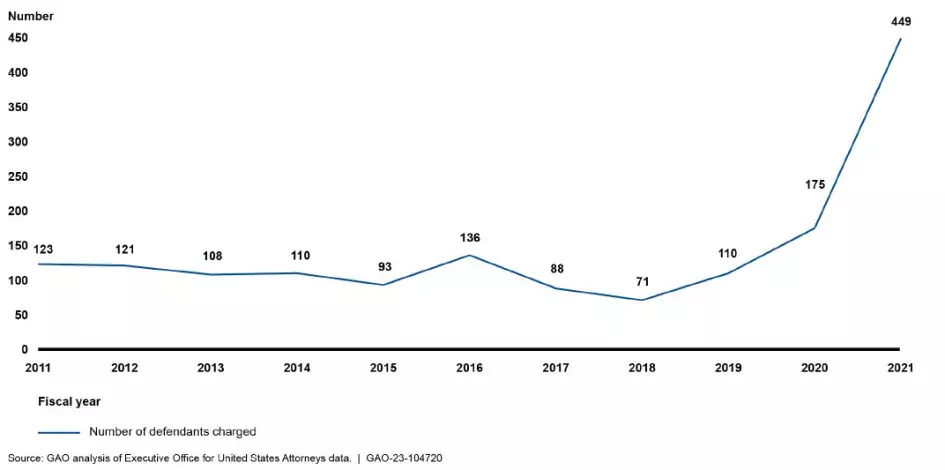
Sen. Ted Cruz may claim he's kidding when he posts memes celebrating violence against federal officials, but as this murder shows, plenty of people on his side take it very seriously when their leaders hint that federal employees deserve death. And while this murder was an outlier in shock value, it fits a much larger national pattern of rising levels of domestic threats and terrorism, the vast majority of it coming from the right. As the Government Accountability Office reported in May, "The number of FBI domestic terrorism investigations has more than doubled since 2020, and the number of open FBI investigations specifically has more than quadrupled from 1,981 in FY 2013 to 9,049 in FY 2021." They included a graph:

A small fraction of these incidents are left-wing, but by and large, it's a right-wing phenomenon, with over two-thirds of domestic terrorism motivated by racial bigotry or anti-government sentiment. This comports with other research showing a rise in hate crimes and other violence tied to right-wing anger fueled by MAGA propaganda like election officials across the country being driven out of their jobs by right-wing threats. 

On Monday, the FBI released a report showing reported hate crimes in schools nearly doubled between 2018 and 2022, likely propelled by groups like Moms for Liberty making public schools the battlegrounds for right-wing lies about race, gender, and sexual identity. There hasn't been a rigorous study yet, but it's also clear that schools have seen a dramatic increase in threats, as well, often having to evacuate after bomb threats. In Oklahoma, Republicans signaled approval for school violence by hiring Chaya Raichik as a board member to the state's library council. Raichik is behind the infamous "Libs of TikTok" account that offers up a steady feed of photos and names of ordinary people, often educators. The result is invariably that those people and their employers get targeted with violent threats. 

Often these stories only get reported on locally, which obscures the extent of the problem in the national press. Mohn's alleged crime is grisly enough to be getting national attention, but that also means it will likely be treated as an oddity, instead of what it is: part of a larger pattern of growing right-wing violence. It's just violence that has become disorganized and diffuse, unlike a targeted (if still chaotic) strike like the Capitol insurrection. That doesn't make it less dangerous, however. It's often way more deadly, as the people acting out are close to home and have more resources — and weapons — at their disposal. We saw this in the 2022 mass shootings inspired by MAGA rhetoric at a Buffalo supermarket and a Colorado gay club. And we see it again, as a man allegedly acted out his anti-government fervor in the most intimate way possible, on a family member while shielded by the walls of their home. 

Trump’s enduring success is fueled by disdain for Democrats

While reading a recent Thomas Edsall essay in the New York Times, three famous quotes kept repeating in my mind:

“We have met the enemy and he is us.”

“Democracy is the worst form of government – except for all the others that have been tried.”

“The problem of the twentieth century is the problem of the color line.”

As Edsall compelling shows, Trumpism and the larger neofascist and MAGA movement are not animated by “working class” rage and resentment. The mainstream news media can make an infinite number of trips to the diners, churches, bowling alleys, gun shows, and flea markets of Trumplandia and it will not change that fact. The MAGA movement is driven primarily by white racism and white identity politics. The ultimate goal is protecting and expanding white privilege and white power for white people.

Moreover, as shown by public opinion and other research, a large percentage if not outright majority of these White Americans support ending democracy and replacing it with some form of authoritarianism — if white people are no longer the most powerful group in the country. Thus, the language of “freedom” and “democracy” as used by many on the American right-wing in the post-civil rights era (and before), and especially the Age of Trump, really means “white democracy” and “white freedom” where elections are legitimate and to be respected only if they win.

Edsall begins his new essay, “We Are Normalizing Trump. Again”, by showing how the aspiring dictator has been embraced and normalized by huge swaths of the American public, even after Jan. 6:

Over the past nine years, Donald Trump has been variously described as narcissisticmendaciousauthoritarianunbalancedignorantincompetentegotistic and racist — as someone who demonizes minorities and fans ethnic hostility. These assessments are a major reason roughly half of American voters, according to polls, say they will not vote for him.

But even as Trump has steadily escalated his defiance of behavioral norms, a substantial share of the American electorate remains willing to cast a ballot for him. Approximately half of the electorate views Trump as a legitimate 2024 presidential contender, repeatedly demonstrating in surveys that they plan to vote for him in a matchup with President Biden.

In other words, these voters have normalized perhaps the least normal president in American history.

Edsall then focuses on race and America's color line:

Racial issues and those involving immigration are crucial to Trump’s continued level of support. “While many of the positions that Trump is taking (and the rhetoric that he is using) on these issues may appear extreme to objective observers,” Zoltan Hajnal, a political scientist at the University of California-San Diego, wrote by email, “public opinion data suggest that much of America believes in much of what Trump is selling on race and immigration.”

Many whites, Hajnal continued, hold deeply negative stereotypes about people of color and we know that many feel deeply threatened by a “changing America.” Ultimately, Americans who are anxious about racial change are likely to be attracted rather than concerned about Trump’s authoritarian threat. Deep down, they may believe that Trump and the Republican Party will protect them.

If Trump wins in November, Hajnal argued, It will be because he is able to assemble a slightly more diverse coalition that is mostly comprised of MAGA supporters but that also includes some never Trumpers who see no clear alternative, a number of fiscal and social conservatives who like specific aspects of the Republican agenda, and others who pay relatively little attention to politics and may not know or fully support the MAGA movement.

“Race and immigration,” Hajnal added, “are core issues that are not only undermining Biden’s candidacy but are also threatening the success of the Democratic Party.”

It would be difficult to overestimate the role of racial animosity in the evolution of the two parties since the mid-1960s, a development that most recently found expression in Trump’s domination of the Republican Party.

When Edsall asked Gary Jacobson, a highly respected political scientist, if Trump could win the 2024 election, he replied “yes”:

He’s running neck and neck with Biden in the horse race polls and has very strong support among about two-thirds of ordinary Republicans. His “normalization” is reflected as well as a consequence of the majority of Republican politicians who endorse him despite all; examples are nearly all his rivals for the nomination and pols like McConnell who may despise him but nonetheless say they will vote for him if he is nominated.

Edsall also spoke with Marc Hetherington, who is the co-author (with Jonathan Weiler) of the prescient book Authoritarianism and Polarization in American Politics about the role of right-wing political tribalism and antipathy towards the Democrats in calculating Trump’s chances of victory in November: 

“A staggering percentage of Republicans,” Hetherington wrote in an email responding to my inquiries, “will support Trump even when they disagree with him on the most central of issues.” In the case of Covid mitigation, “huge swaths of Republicans disagreed with him on how he was handling an issue that killed over 200,000 people by the time of the 2020 election,” Hetherington wrote. “Republicans did not follow him on policy in lock step, but they did vote for him in lock step.”

In fact, Hetherington continued, “Trump in 2020 lost the same percentage of Republicans as Ronald Reagan did in 1984 — 6 percent. Our analysis suggests that Republicans so deeply dislike the Democratic Party now that they’ll still support candidates with whom they deeply disagree on even the most important political matters.”

We need your help to stay independent

Edsall also spoke to political scientists and other experts who disagreed to varying degrees about the enduring power of Trumpism and if it has been normalized enough to create a winning long-term right-wing electoral coalition. In all, these arguments and evidence were far less compelling than those in support of Trumpism as a political-cultural force built upon decades and centuries of white racism and white supremacy in their various forms. Ultimately, today’s Republican Party cannot win on policy. This is even more true as the country’s demographics shift to become younger and more non-white.

The Republican Party's response to their relative unpopularity among the American people has not been to evolve in order to broaden its base of support. Instead, their strategy has been to scare enough white people in combination with rigging the political system through gerrymandering, voter nullification, voter suppression, using the courts, campaign finance laws and “dark money," and now with Jan. 6 direct threats and acts of violence and intimidation to get and keep power.

In response to the successes of the civil rights movement and long Black Freedom Struggle, the “conservative” movement deployed what became known as the Southern Strategy of shifting (mostly) from overt and naked white supremacist and racist appeals to more coded “dog whistles” as a way of winning elections and white voters. Trumpism and the MAGA movement are the Southern Strategy on crack and meth. A majority or Trump MAGA people (and Republicans as a whole) believe in the white supremacist “Great Replacement” conspiracy theory that the Democrats and Jewish people are somehow replacing white people i.e. “real Americans” with non-whites. This is a very old, fantastical, and pernicious lie.

Donald Trump has been channeling Nazi leader Adolf Hitler and his threats about non-white “vermin” and other human “poison” in “the blood” of the United States. Public opinion polls show that a majority of Republicans and Trump MAGA people agree with these claims – which in essence means they agree with Hitler and his book Mein Kampf.

Likewise, a majority of Trump’s MAGA people and other Republicans and right-leaning independents believe that white people as a group are the “real victims” of racism in America. There is no substantive evidence in support of such a belief; it is a lie and a fantasy.


Want a daily wrap-up of all the news and commentary Salon has to offer? Subscribe to our morning newsletter, Crash Course.


Social scientists have repeatedly shown that racism and white racial resentment are heavily correlated with party identification where white people who are more racist and racially resentful are much more likely to be Republicans. By comparison, white people who are less racist are much more likely to be Democrats.

These debates and discussions about Trumpism and the color line reflect the larger question(s) of is America a fundamentally racist country? or is America a country where racism is coincidental to its history and character? or is America a country that was once racist but has largely corrected those errors and is now more or less “colorblind”?

My resolution to these questions is to lean into the evidence: American society continues to be structured around racism and white supremacy as shown by how those people deemed to be white have greater life chances, life opportunities, privileges, and other unearned advantages as compared to those people deemed to be non-white. These are societal outcomes that are far greater than the sum of any given person’s individual choices, be they “good” or “bad.” The story is both that simple and that complex.

During a recent speech at Emanuel African Methodist Episcopal Church in Charleston, the site where a white supremacist terrorist murdered nine black people in 2015, President Joe Biden said that white supremacy is “a poison, throughout our history, that’s ripped this nation apart. This has no place in America. Not today, tomorrow or ever.”

On Election Day in November, the American people are going to decide if they want to live in a real albeit flawed multiracial pluralistic democracy or if the country will collapse into a 21st-century version of Jim and Jane Crow Apartheid. In that way, the 2024 Election is truly existential and a reckoning for our national character and the type of country and people we are and will be in the future.

J. Smith-Cameron knows why you loved Gerri and Roman on “Succession”: “It was kind of sexy”

J. Smith-Cameron misses "Succession" too. "It's hard to get through your head that it's not continuing," the Emmy- and Tony-nominated actor admits, "but that's showbiz, as they say."

Now, after wrapping up four memorable seasons as the steely Gerri Kellman on the HBO hit, she's taking on an entirely different role in Peacock's new animated comedy "In the Know." As the much-maligned producer and “boomer witch” on a fictional public radio interview show, the theater-trained star gets to show off her acting skills using just her voice. "In the Know," which was co-created by Mike Judge of "King of the Hill," also pokes fun at both liberals and conservatives in a way that Judge does best. In our “Salon Talks” interview, Smith-Cameron, who is outspoken about her distaste for Trump, shared her frustrations with those on her own side, like how "we're sort of unable to fully rally behind our candidate ever." 

During our discussion, Smith-Cameron also revealed the genesis of her iconic chemistry with her "Succession" co-star Kieran Culkin, the origin of the infamous phrase "slime puppy," and why she thinks their dynamic resonated so well with viewers. "It was kind of sexy," she said, "but in an unusual, unexpected way that sneaks up on people." She also talks about what attaining high-profile success later in her career has meant. "It's a win for middle-aged and older women everywhere," she said. "It has been proof that it's not over until it's over."

You can watch our full “Salon Talks” here or read a transcript of our conversation below.

This interview has been lightly edited for length and clarity.

This show is a workplace comedy with puppets. You play a very different character from Gerri. Tell me about Barb.

Barb is the producer of “In the Know.” It's an NPR type show, and Barb is sort of the straight man in a way, although she's funny too in her own right. She's slightly Midwestern and very earnest and gets the short end of the stick around the office a lot, unfairly, because she's really the den mother and she's kind to everyone and she keeps the thing going along. 

This show pokes fun in a way that I only something Mike Judge affiliated could do by appealing to people on the left and on the right. It raises questions about those of us who consider ourselves progressive and interrogates our own hypocrisies and blind spots. You are outspoken about where you stand politically. Do you feel that the show is a reflection of the frustrations some of us on our side of the aisle feel with ourselves?

I definitely feel that way. It's kind of too bad that we're unable to fully rally behind our candidate ever. We're always nitpicking and virtue signaling a bit. It's too bad because the other side sort of plays dirty. I don't think we should play dirty, but I wish that we would toughen up and play offensive a little more, not just defensive.

You've done a lot of stage work. When people talk about you, they talk about your physicality. This is a very different skill set for you. What drew you to something that's so outside the box?

I've always thought it was interesting. Voice acting fascinates me. When I was a young actress, I had one job where I was hired to dub an actress's voice for a commercial. There was nothing wrong with her voice; they just wanted to make the character a little kookier without re-shooting the whole thing. I spent the whole day in the studio with cans on my ears and listening to her voice and just talking along with it and in between takes, I would hear it played back and I'd be like, "Wow, I really sound different than her." 

"I don't think [Democrats] should play dirty, but I wish that we would toughen up and play offensive a little more, not just defensive."

Then they let me see a rough cut at the end of the day of my voice with her face and actions, and it was like a third person. She seemed to move faster than she did before. She seemed to make funnier faces. She seemed to be a little more peculiar because my voice is a little more peculiar than hers, and yet I wouldn't have recognized my voice.

It's this invisible but powerful part of performing, and I've been fascinated to explore it. Also the same woman who dubs me in French for “Succession” dubbed me in French for “Rectify,” and I'm fascinated by that. There's whole voice actor industry in France where they take that very, very seriously. I think there are really good trained actors for that. 

We need your help to stay independent

This is also an interesting production because very often in voice work, the actors are in separate rooms. They record separately, but this was a really collaborative process.

That's true. They had us come and come to LA and we ran around the table some and we talked about it some, and then we got in the booth together, all of us, so we could play off each other. They even made note of our facial expressions and the way we would gesticulate, and they worked that into it a bit, so I would say it was unusually collaborative. Then we did a lot of more specific ADR post-production stuff on our own in the booth. Me, from New York, and everyone from where they were.

Speaking of collaborative performances, I have to ask you about “Succession.” You're coming off this award season where it has done very well, but it's also been a with this cast because it's been almost a year since you wrapped shooting. What has it been like having this somewhat bittersweet experience, because you're not going to see each other again in that professional way?

I know. It's so sad.

You seem very snuggly with Kieran Culkin.

Well, Kieran and I go way back, and then we just had to do such peculiar things on the show that we had to be tight or else. But he just loves to tease and give everyone a hard time. He's into insult humor, so he's his own thing. But Sarah Snook and Matthew Macfadyen and really all of them, Brian [Cox], Alan Ruck, I just got so close with all of them. We all did. Zoe Winters who played Kerry, she and I are now writing partners. We're trying to write something together. We became very close.

"I guess I was just inspired by Kieran."

But it is bittersweet because it felt to us all that the show was just hitting its prime in a way. I can objectively see why Jesse [Armstrong] and the writers decided to end it where they did because of the family story, the succession story—after all, it's called “Succession”—needed to wind up, but the rest of it was just reaching a fever pitch. The whole election thing, and the corrupt big business stuff is just as relevant as ever, if not more. And so, I mean, it's sort of disappointing or hard to get through your head that it's not continuing, but that's show biz, as they say.

But you get to leave the room with everybody wanting more, I guess.

Including ourselves.

This was not a role that was written for a woman. This was not a role that was going to be this pivotal character. And then very early on, you became "indispensable." Tell me  about how that happens. There must have been something in the chemistry, not just with Kieran, but with the whole environment, with the writers and with the cast.

It was a very collaborative way that they worked. For one thing, at the end of every scene, they would give us what Mark Mylod called a “freebie,” which would be kind of do whatever you want, even if it meant saying something different. Then sometimes we would improv even when it wasn't the freebie and they would incorporate it. And also, I just think with that character, somehow I just got this idea for her. In my mind, it came off the text, but I mean, it was written for a guy, so I'm not sure what was intentional. 

What I got from it was this very driven woman who is extremely capable, but sort of a nervous wreck. It was very specific, and there were opportunities for her to be funny, and I saw her in glasses and I just saw her. And they welcomed that. They wanted actors to supply a lot of the character. You can see it with Nick Braun or Kieran, how they almost are written in their own cadence or Connor with Alan Ruck. It's sort of informed by the way their personalities are as well.

When you talk about those freebies or that improv, you came up with “slime puppy.”

I mean, we'd run out of dialogue, but they kept the camera rolling, so I had to come up with worse and worse things to call him.

I would never in a thousand years come up with slime puppy.

I don't know where it came from. I guess I was just inspired by Kieran.

Was it the first time you'd ever used that phrase in your life or to do you throw that one out a lot?

Certainly not.

Were you surprised with the reaction? That pairing, people have gone out of their minds for. What do you think it is about that sick twisted dynamic between these two twisted people that just people are fascinated with?

I don't know. It feels funny to say this myself, but I think somehow there's something kind of specifically sexy about it. We have a rapport, Kieran and I, and it's so unexpected. Our ages are different, and you see the age difference, but with the sexes reversed quite a lot, so it was kind of refreshing and to have something so unexpected. For my character, she was at the beginning so nonplussed every time he would flirt with me, I'd be like, "What? What are you talking about?" That just riled him up more. That seemed to be what turned him on was me being kind of mean with him. That doesn't answer your question, except I think it was kind of sexy, but in an unusual, unexpected way that sneaks up on people, maybe.

You have been working… I almost don't want to say it, for 40 years.

That means I started when I was about eight.

Obviously, you were a baby.

You've had a great deal of acclaim. You've had a great deal of steady work. And yet you have this breakthrough that takes your profile to a different level. Not to in any way diminish anything else that's come before, but you now are at a much wider level  of recognition in your sixties. Again, not that you're in your sixties, but if you were in your sixties.

If I were.

What does it mean to have this come to you at this stage of life?

Well, it's fantastic. It's fantastic, and I feel it's a win for middle-aged and older women everywhere. I was perfectly content with my career the way it was. I felt like I did really meaningful things in the theater, film, and TV all the time, and I loved it. I wasn't someone who expected fame or fortune, so I wasn't looking for it. But it's been great. It has been proof that it's not over until it's over.

It's not over, but we are living in a very changing world. I saw you on X recently talking about AI. It's concerning. 

So concerning.

As someone whose face could be manipulated, whose voice could be taken away from her, what are you looking at and thinking about as you're going forward in your career as a creative person?

This was one of the big points of the strike. It's very hard to resolve. Molly Shannon and I were talking about it, that it almost seems like something the government's going to have to come in and regulate. It wasn't clear at the beginning of the internet all the pitfalls with that and privacy, and then, how there had to be steps taken, measures taken to protect people. I'm hoping that that becomes the case here because I don't even think we can glimpse the ramifications. 

"I feel it's a win for middle-aged and older women everywhere."

Some of it's obvious. There was already an article in the paper about a manipulated AI version of Joe Biden being used erroneously in a campaign ad, so it's very scary. I saw a thing also in the Times, I think, where they showed you faces and you had to guess which ones were AI and I didn't get any of them right.

It's really scary and I don't think we even know how big it's going to be, but I'm just hoping that it'll become clear to all parties somehow that it's got to be regulated somehow. I don't know how that is. I don't think we know the size of it yet.

I want to ask you one more thing, because you are such a busy lady. You're also going to be in a film version of John Green's “Turtles All the Way Down,” one of my favorite YA books of all time. Tell me about that, and some of the other things we can look forward to seeing or at least hearing you in.

Yes, I did that movie and that was delightful. That's a story about a young woman who has OCD and she's just crippled by it. She's this beautiful, sweet young girl and she can't have a relationship 'cause she's got so many issues with it. She discovers a scientist on the internet who fascinates her about what she says about it. I play that character. She goes to listen to her on a campus and they have a meaningful scene that sort of helps her a bit.

It's very poignant and it's very relatable, I think, whether you have that issue or your own thing because everybody's got something. John Green was on set and he is lovely, and I loved the whole cast and director and everybody. It was a good experience. We shot in Cincinnati, which is cool. I had never spent any time there.

And we're going to get you back on the stage.

Yes, I am going to do a play in London next year it looks like, but they can't quite announce that yet. We don't have the particulars.

Remote warfare and expendable people: Forever War means never having to say you’re sorry

In war, people die for absurd reasons or often no reason at all. They die due to accidents of birth, the misfortune of being born in the wrong place — Cambodia or GazaAfghanistan or Ukraine — at the wrong time. They die due to happenstance, choosing to shelter indoors when they should have taken cover outside or because they ventured out into a hell-storm of destruction when they should have stayed put. They die in the most gruesome ways — shot in the street, obliterated by artillery, eviscerated by air strikes. Their bodies are torn apart, burned, or vaporized by weapons designed to destroy people. Their deaths are chalked up to misfortune, mistake, or military necessity.

Since September 2001, the United States has been fighting its “war on terror” — what’s now referred to as this country’s “Forever Wars.” It’s been involved in Somalia almost that entire time. U.S. Special Operations forces were first dispatched there in 2002, followed over the years by more “security assistance,” troops, contractors, helicopters, and drones. American airstrikes in Somalia, which began under President George W. Bush in 2007, have continued under Presidents Barack Obama, Donald Trump, and Joe Biden as part of a conflict that has smoldered and flared for more than two decades. In that time, the U.S. has launched 282 attacks, including 31 declared strikes under Biden. The U.S. admits it has killed five civilians in its attacks. The UK-based air strike monitoring group Airwars says the number is as much as 3,100% higher.

On April 1, 2018, Luul Dahir Mohamed, a 22-year-old woman, and her 4-year-old daughter Mariam Shilow Muse were added to that civilian death toll when they were killed in a U.S. drone strike in El Buur, Somalia.

Luul and Mariam were civilians. They died due to a whirlwind of misfortune — a confluence of bad luck and bad policies, none of it their fault, all of it beyond their control. They died, in part, because the United States is fighting the Somali terror group al-Shabaab even though Congress has never declared such a war and the 2001 Authorization for the Use of Military Force on which the justification for the conflict rests predates the group’s existence. They died because Somalia has limited options when it comes to rural public transport and they caught a ride with the wrong people. They died because the United States claims that its brand of drone warfare is predicated on precision strikes with little collateral damage despite independent evidence clearly demonstrating otherwise.

In this case, members of the American strike cell that conducted the attack got almost everything wrong. They bickered about even basic information like how many people were in the pickup truck they attacked. They mistook a woman for a man and they never saw the young girl at all. They didn’t know what they were looking at, but they nonetheless launched a Hellfire missile that hit the truck as it motored down a dirt road.

Even after all of that, Luul and Mariam might have survived. Following the strike, the Americans — watching live footage from the drone hovering over the scene — saw someone bolt from the vehicle and begin running for her life. At that moment, they could have paused and reevaluated the situation. They could have taken one more hard look and, in the process, let a mother and child live. Instead, they launched a second missile. 

What Luul’s brother, Qasim Dahir Mohamed — the first person on the scene — found was horrific. Luul’s left leg was mutilated, and the top of her head was gone. She died clutching Mariam whose tiny body looked, he said, “like a sieve.”

In 2019, the U.S. military admitted that it had killed a civilian woman and child in that April 1, 2018, drone strike. But when, while reporting for The Intercept, I met Luul’s relatives last year in Somalia’s capital, Mogadishu, they were still waiting for the Pentagon to contact them about an apology and compensation. I had obtained a copy of the internal U.S. military investigation which the family had never seen. It did acknowledge the deaths of a woman and child but concluded that their identities might never be known.

Expendable People

The Pentagon’s inquiry found that the Americans who carried out the strike were both inexperienced and confused. Despite that, the investigation by the very unit that conducted the attack determined that standard operating procedures and the rules of engagement were followed. No one was judged negligent, much less criminally liable, nor would anyone be held accountable for the deaths. The message was clear: Luul and Mariam were expendable people.

“In over five years of trying to get justice, no one has ever responded to us,” another of Luul’s brothers, Abubakar Dahir Mohamed, wrote in a December 2023 op-ed for the award-winning African newspaper The Continent. He continued:

“When I found out later that the U.S. admitted that they killed civilians in the attack, I contacted them again, telling them that the victims were my family members. I am not sure if they even read my complaint.

“In June 2020, [U.S. Africa Command] added a civilian casualties reporting page to their website for the first time. I was very happy to see this. I thought there was finally a way to make a complaint that would be listened to. I submitted a description of what happened and waited. No one got back to me. Two years later, in desperation, I submitted a complaint again. Nobody responded. I now know that the U.S. military has admitted not only to killing Luul and Mariam, but doing so even after they survived the first strike. It killed them as Luul fled the car they targeted — running for her life, carrying Mariam in her arms. The U.S. has said this in its reports, and individual officers have spoken to journalists. But it has never said this to us. No one has contacted us at all.”

Late last month, a coalition of 24 human rights organizations called on Secretary of Defense Lloyd Austin to make amends to Luul and Mariam’s family. The 14 Somali groups and 10 international non-governmental organizations devoted to the protection of civilians urged Austin to take action to provide the family with an explanation, an apology, and compensation.

“The undersigned Somali and international human rights and protection of civilians organizations write to request that you take immediate steps to address the requests of families whose loved ones were killed or injured by U.S. airstrikes in Somalia,” reads the letter. “New reporting illustrates how, in multiple cases of civilian harm in Somalia confirmed by the U.S. government, civilian victims, survivors, and their families have yet to receive answers, acknowledgment, and amends despite their sustained efforts to reach authorities over several years.”

Days later, the Pentagon unveiled its long-awaited “Instruction on Civilian Harm Mitigation and Response,” which clarified “the Department’s enduring policies, responsibilities, and procedures for mitigating and responding to civilian harm” and laid out “further steps to protect civilians and to respond appropriately when civilian harm occurs.”  Under the DoD-I or “dody,” as it is known at the Pentagon, the military is directed to take steps including:

(1) Acknowledging harm suffered by civilians and the U.S. military’s role in causing or otherwise contributing to that harm.

(2) Expressing condolences to civilians affected by military operations.

(3) Helping to address the harm suffered by civilians.

Under the DoD-I, the military is instructed to “acknowledge civilian harm resulting from U.S. military operations and respond to individuals and communities affected by U.S. military operations… This includes expressing condolences and helping to address the direct impacts experienced…” 

The mandate seems clear. The implementation is another story entirely.

Phoning It In

Since the letter from the humanitarian organizations was sent to Austin, the defense secretary has been both everywhere — and nowhere to be found. In December, he traveled to Al Udeid Air Base in Qatar to thank American military personnel for their “selflessness and service.”  He met with the king and crown prince of Bahrain to discuss their “enduring defense partnership” with the United States. On December 20th, he paid a visit to the USS Gerald R. Ford carrier strike group in the Mediterranean Sea to thank the sailors for their “patriotism and professionalism.”

A couple days later, Austin underwent surgery without informing his deputy Kathleen Hicks, much less his boss, President Biden. On January 1st, Austin was rushed back to the hospital, in “intense pain,” but that information, too, was withheld from the White House until January 4th, and from Congress and the American public for an additional day.    

Austin reportedly worked from his hospital room, monitoring American and British air attacks on Houthi rebel targets in Yemen — more than 150 munitions fired from the sea and air on January 11th, alone — and conducting meetings by phone with military officials and the National Security Council. He was released from the hospital four days later and began working from home. “Secretary of Defense Lloyd J. Austin III spoke by phone today with Ukrainian Minister of Defense Rustem Umerov to discuss the latest on the situation on the ground,” Pentagon spokesman Major General Pat Ryder announced on January 16th. Two days later, he had a call with Israeli Minister of Defense Yoav Gallant. And on the 19th, he talked shop with Swedish defense minister Pål Jonson.

Austin has had plenty of time for phone calls, travel, and elective surgery. He’s been around the world and is now hunkered down at home. But what he hasn’t done, since the letter from those 24 humanitarian groups was sent to the Pentagon more than a month ago, is make any apparent effort to contact Luul and Mariam’s family.

“Since the strike, our family has been broken apart. It has been more than five years since it happened, but we have not been able to move on,” wrote Abubakar in December. It’s been a common story. In Yemen, where the U.S. has recently ramped up air strikes, victims of past U.S. attacks wait — just like Luul and Mariam’s family — for acknowledgment and apology. 

Between 2013 and 2020, for example, the U.S. carried out seven separate attacks in Yemen — six drone strikes and one raid — that killed 36 members of the intermarried Al Ameri and Al Taisy families. A quarter of them were children between the ages of three months and 14 years old. The survivors have been waiting for years for an explanation as to why it happened while living in fear. In 2018, Adel Al Manthari, a civil servant in the Yemeni government, and four of his cousins — all civilians — were traveling by truck when a U.S. Hellfire missile slammed into their vehicle. Three of the men were killed instantly. Another died days later in a local hospital. Al Manthari was gravely wounded. Complications resulting from his injuries nearly took his life in 2022. He beseeched the U.S. government to dip into the millions of dollars Congress annually allocates to compensate victims of U.S. attacks. They ignored his pleas.  His limbs and life were eventually saved by the kindness of strangers via a crowdsourced GoFundMe campaign.

The U.S. has a long history of killing civilians in air strikes, failing to investigate the deaths, and ignoring pleas for apology and compensation. It’s a century-old tradition that Austin continues to maintain, making time to issue orders for new strikes but not to issue apologies for past errant attacks. Through it all, Luul and Mariam’s family can do nothing but wait, hoping that the U.S. secretary of defense will eventually respond to the open letter and finally — almost six years late — offer amends.

“My sister was killed, and she won’t be back again — but doesn’t she have the right to get justice, and for her family to at least be compensated for the loss of her life?” Abubakar wrote in his op-ed. He and his relatives find themselves endlessly grappling with their loss as the Pentagon puts out press releases filled with high-minded and (as yet) hollow, rhetoric about “improving the Department’s approach to mitigating and responding to civilian harm,” while promising to make amends under the DoD-I.

It isn’t the only War on Terror pledge to be broken. President Joe Biden entered the White House promising to end the “forever wars.” “I stand here today for the first time in 20 years with the United States not at war,” Biden announced in 2021. “We’ve turned the page.” It wasn’t remotely true.

Instead, the Forever Wars grind on from the Middle East to the African Sahel. And despite assertions to the contrary, America’s conflict in Somalia grinds on, too, without apology — from Biden for the broken campaign promise and from the Pentagon for Luul Dahir Mohamed and Mariam Shilow Muse’s deaths.

“The U.S. claims that it works to promote democracy, social justice, the rule of law, and the protection of rights around the world,” Abubakar wrote. “As we struggle to get them to notice our suffering, we hope the U.S. will remember what they claim to stand for.”

Trump adds to the mystery of those red spots on his hand — “Maybe it’s AI”

A photo taken of Donald Trump waving goodbye after leaving Trump Tower to appear in federal court two weeks ago is still the topic of conversation. In the photo, there appears to be open wounds on his right hand, resulting in speculation as to their cause — with gonorrhea, syphilis or a particularly energetic game of golf thrown out as possibilities. And while we're no closer to a concrete answer, the former president himself has introduced yet another theory.

Exiting a meeting with the Teamsters union in Washington, D.C. on Wednesday, Trump fielded a question from Fox News correspondent Mark Meredith regarding his hand and, at first, seemed to not know what he was talking about but, after clarification, he inspected both of them himself, offered them out to be seen by others, and then joked (maybe) that what we'd seen in the photo was produced by artificial intelligence. 

Watch that moment here:

As Mediaite points out in their coverage of the exchange, James Carville helped make #SyphilisDon a thing after weighing-in on the photo after it was taken, saying, “I’ve asked a number of MDS what medical condition manifests itself through hand sores, and the answer is immediate and unanimous: Secondary syphilis. All right. I think there’s a good chance this man has the clap, and I’m not being particularly secretive about it.”


Danny Masterson transferred to Charles Manson’s former prison for 30-year sentence

Danny Masterson, the former star of "That '70s Show," has been transferred to the same maximum-security prison in California that housed Charles Manson from 1989 until his death in 2017 — years short of the length of time the convicted rapist is expected to be held there himself.

Corcoran State Prison, which opened just one year before it brought in Manson, has an approximate population of 3,445 inmates, many of whom are serial rapists and murderers. In past years, the facility has also been home to Rodney Alcala — the "dating game killer," and Sirhan Sirhan — convicted assassin of United States Senator Robert F. Kennedy.

According to California state prison records, Masterson is not eligible for parole until July 2042. Last week, his request for bail was denied by a Los Angeles Superior Court judge based on the reasoning that he has "every incentive to flee" if released from prison, compounded by his ongoing divorce proceedings from actress Bijou Phillips, writing that the “defendant has no wife to go home to,” per reporting by Entertainment Weekly

Elmo asked people online if they were OK, and the responses were unexpectedly dark

The internet is a space where people share their unfiltered thoughts and emotions which is probably why when Elmo tweeted a mental health check-in with people online the dog-pile responses were brutally honest and a glimpse into people's existential dread.

On Monday, the X account for the iconic red "Sesame Street" puppet tweeted: "Elmo is just checking in! How is everybody doing?" 

The tweet, which was viewed 181 million times, garnered thousands of swift and troubling replies with the same shared sentiment: Nobody is OK Elmo. Elmo's open-ended question was met with endless dread from people as the first month of the new year comes to a close. People shared they had been laid off, depressed, anxious for the 2024 election or were just having a tough Monday, serving as an insight into the collective mental health of Americans.

One person said, “Elmo each day the abyss we stare into grows a unique horror. One that was previously unfathomable in nature. Our inevitable doom which once accelerated in years, or months, now accelerates in hours, even minutes. However I did have a good grapefruit earlier, thank you for asking.”

Another wrote, "I did not have us all trauma dumping on Elmo on my bingo card."

The vice president of Sesame Workshop, Samantha Maltin, told the New York Times, “I don’t think anyone anticipated how deeply this particular question would resonate. But we’re so thrilled that we did ask.”

After the flood of replies to the tweet, the Elmo account posted, "Wow! Elmo is glad he asked! Elmo learned that it is important to ask a friend how they are doing. Elmo will check in again soon, friends! Elmo loves you." 

Trump reportedly said he’s “more popular” than Taylor Swift, worrying about her endorsing Biden

Donald Trump has waged a one-sided popularity contest with Taylor Swift as the 2024 election cycle heats up.

The former president's allies have called a "holy war" against the pop star because of her liberal political views and previous endorsement of President Joe Biden in 2020. While Swift hasn't endorsed the president for reelection yet, Trump's camp is expecting the singer to make her stance soon, and he's ready to fan the flame of America's culture wars when she does, Rolling Stone reported.  

However, behind the scenes, the possibility that Swift and Biden could team up against him seemingly has shaken Trump. He's claiming that he is "more popular" than Swift, saying that he has more committed fans than she does. Also, the former president is telling people that he doesn't think that Swift's endorsement will elevate Biden's chances at reelection. 

“Joe Biden might be counting on Taylor Swift to save him, but voters are looking at these sky-high inflation rates and saying, ‘We Are Never Ever Getting Back Together,’” Trump campaign adviser Jason Miller said to Rolling Stone.

This isn't the first time Trump has publicly come after Swift. During the 2018 midterm election, Trump said, “I like Taylor’s music about 25 percent less now,” after she denounced Tennessase Sen. Marsha Blackburn and instead endorsed two Democrats. Swift had also blasted Trump in 2020, claiming that he would "blatantly cheat and put millions of Americans’ lives at risk" following the Trump administration efforts to hinder mail-in voting during the election.


Cleanse and restore your body with these winter herbs

“In winter, one should eat more bitter and cold foods to stay in harmony with the inward movement of the season.” — Master Herbalist, Lǐ Shízhēn (1518-1593)

Herb Your Way to Healthy

During my time as a cook, I had to show up to work no matter what. When the restaurant needed me, I had to be there — there was no concept of sick days. Since winter is usually the busiest season for a restaurant (and also when we’re most likely to get sick), I had to learn how to invigorate my immune system and build a stronger body.

If I was to stay competitive and cook for some of the best chefs in New York, staying healthy took priority above all else. Even for non-chef civilians, the holidays are a time of family, celebration and lots of food. Consuming excess amounts of food, especially rich, fatty foods, can stress the gallbladder and liver. Cleansing is crucial for allowing the body to absorb food. Apple cider vinegar and lemon juice with water every morning is one quick way to cleanse and stimulate the gallbladder, aiding digestion and liver function.

But for those who want to take their cleansing a step further, herbs are especially helpful with balancing stress hormones so our bodies can focus on digestion and detoxification. Many of them can be easily incorporated into our typical recipes and routines. Before I get into the specific herbs, here’s an overview of herbal traditions.

Eastern & Western Philosophies

As an herbalist, I believe it is important to consider all herbology traditions in forming your own beliefs and practices. I’ve noticed that Eastern and Western medicine study identical phenomena — both have their strengths but are in need of some refinement. Perhaps they could borrow lessons from one another. That's why I rely on a combination of European herbalism, traditional Chinese medicine, Ayurvedic medicine and American eclectic medicine.

Matter of Perspective: Food or Drug?

“Let food be thy medicine and medicine be thy food.” — Father of Greek Medicine, Hippocrates (c. 460 – c. 370 BC)

If, like Hippocrates, we consider food and drugs as serving the same function, we can incorporate concepts of medicine into our eating habits. For example, one concept that I borrowed from Chinese medicine is eating according to the seasons — when it’s cold outside, it is best to eat “cooling foods” such as borage. When it is warm, it’s best to eat “warming” foods like fennel.

This may seem counter-intuitive, but when food is ingested, its temperature adjusts the temperature of the body. The weather, however, always remains external. By cooling the body with herbs and down-regulating our internal core temperature, we can diminish the temperature differential between us and our environment, decreasing effort needed to heat our bodies and preserving precious energy for harsh conditions.

During winter months, Qi (the vital energy that forms part of our material body) is said to reside at a deep level within the body. This is why, traditionally, winter is seen as a time of rejuvenation and rest. Nourishing energy reserves is especially important at this time.

Herbs That Nourish

Anise Hyssop

I was first introduced to anise hyssop while working for a neurologist chef from Spain. Anise hyssop is part of the mint family and a perennial native to North America. In herbal medicine, a shock or trauma causes a “Shen disturbance,” causing the Shen or “spirit” to flee the physical body. The Shen is seen as residing in the heart and, following shock or trauma, it must be restored to its appropriate place in the heart in order for healing to occur .

The earth-spirit medicine of anise hyssop does exactly this, and its flower essence also brings back sweetness. The leaves and flowers are edible and may be baked in breads or added to salads. This herb smells like anise — notes of lemon, pine, sage, black pepper and camphor abound. Anise hyssop is the secret ingredient for many chefs when creating savory recipes that require a touch of sweetness or dessert dishes that benefit from sophisticated aromas.

Bee Balm

While studying at Arbor Vitae School of Traditional Medicine in New York, I discovered this delicious herb deep in a Northeastern American forest. Many Native Americans consider bee balm a medicinal plant. It has been used to cure colds, frequently made as a tea. Bee balm is a part of American history; it was a popular tea substitute for the imported variety amongst the mid-Atlantic patriots in the wake of the Boston Tea Party. That period was probably the height of bee balm’s popularity.

My favorite way to prepare bee balm is as pesto. Its spicy aromatic oils echo marjoram, oregano, thyme and mint. The leaves are potent — the flowers in particular pack a Winter Herbs for Kitchen Survival.docx punch. Bee balm is a great addition to any existing pesto recipe as it blends well wit h basil. Try as a gremolata with parsley or anywhere strong pungent herbs are needed.

Borage

Just about every high-end restaurant I’ve worked in has used this once-famous herb. This herb can be used to sedate and calm a deeply worn-out nervous system. Rebuilder of the adrenals, borage is a deep-acting nervine suited to times of exhaustion and low spirits.

Borage is a great addition to any diet — it's a good source of thiamin, folate and Vitamin B6, and a very good source of Vitamin A, Vitamin C, riboflavin and trace minerals. The leaves of borage have a fresh cucumber-like taste. Cook the leaves as a vegetable to avoid the prickly hairs. Baby borage is smoother and easy to eat as a raw salad green. Borage flowers taste like the leaves but can be much sweeter, with notes of fresh oyster.

Fennel

While learning French cuisine at one of Jean-Georges’ restaurants, I learned to appreciate fennel’s versatility and the number of possible cooking applications. Fennel was highly valued in the ancient world by the Roman s, Greeks, Egyptians, Chinese and Indians. In Ayurveda, fennel is considered neutral to slightly warming energetically, balancing to all three of the constitutional body types (Vata, Pitta and Kapha). Fennel has been utilized to relieve gas and enhance digestion.

Fennel is also said to be nourishing to the brain and eyes, calming to the spirit and stimulating to the libido. Due to fennel's gentle nature, it is used to support digestion in infants and children and can be given to nursing mothers. The baby bulbs are especially tender when grilled, braised or even raw in a salad. Use fronds as the finishing touch to any dish to add a hint of sweetness. Harvest the flowers when pollen begins to develop.

Stinging Nettles

Working on a rooftop farm in Brooklyn expo sed me to nettles. The stingers buried themselves into my skin like mini hypodermic needles — and I enjoyed it. Want gorgeous hair and strong nails? Drink nettle soup. There are so many curative properties of stinging nettles. Though we try to work around the stingers to avoid the rashes they produce, nettles can be handled safely and have many anti-inflammatory benefits. To get the full effects of nettles, brew the whole plant “low and slow” like a stock. Nettles work great in stews and braises — cook them just like you would with kale or mustard leaves.

Tulsi

Tulsi is widely regarded as a preeminent herb in Ayurveda. Classified as a rasayana, tulsi is in an elite class of adaptogenic herbs that are prized for their ability to fundamentally restore harmony in the mind, body and spirit. 

Tulsi’s greatest benefit is the restorative effect it has on the nervous system. It’s a powerful corticosteroid modulator with the ability to reduce circulating stress hormones in the body — ideal for our hyper-stimulated digital age. Brew fresh tulsi leaves in boiling water to make a powerful tea. Sipping on strong tulsi tea can pack a narcotic-like punch — chronic stress patterns are interrupted as warm feelings of peace and serenity envelop the body. I have also added fresh tulsi juice to my morning smoothies. The Krishna variety is especially powerful.

Yarrow

Herbalist Matthew Wood calls yarrow the “master of the blood” and the “master of fever.” Yarrow regulates the fluids in the body, cooling or heating as needed by moving blood toward, or away, from the skin’s surface. Consuming a warm cup of tea made with yarrow leaves will open the pores of the skin and release heat. Or, drink as cold tea to stimulate digestion and the kidneys, relieving fluid retention.

Yarrow is a relatively new herb to chefs, and is full of potential. It has a sweet, slight licorice scent. Sinuses flood with a perfume similar to cardamom. Being a soft herb similar to tarragon, high heat will destroy its flavor. Since yarrow is sweet, it has many applications in desserts; sorbet, ice cream and fruit go well with yarrow. 

“Devastating”: Experts sound the alarm over court ruling that poses “direct threat to democracy”

A federal appeals court refused to rehear a case that would bar private groups from suing under a key section of the Voting Rights Act, which safeguards against racial discrimination in elections.

A group of Arkansas plaintiffs, who are being represented by civil rights groups, challenged a redistricting plan for the Arkansas State House of Representatives that undermines the voting power of Black voters. This case has the potential to evolve into the next legal battle at the U.S. Supreme Court.

The 8th U.S. Circuit Court of Appeals denied the request for the case to go before the full 8th U.S. Circuit Court of Appeals after a three-judge panel ruled last year that only the U.S. attorney general can enforce Section 2 of the Voting Rights Act.

The panel determined that federal law does not allow private groups and individuals, who have historically filed the majority of lawsuits under Section 2 of the Voting Rights Act for decades, to bring legal actions because the law does not explicitly mention them. Only the head of the Justice Department has the authority to initiate such lawsuits.

The 8th Circuit’s decision is “inconsistent” with the text of the Voting Rights Act, and it is “inconsistent with decades of historical practice and precedent,” James Sample, a Hofstra University constitutional law professor, told Salon. The “undermining” of Section 2 exposes the “con-game” of the Supreme Court’s 2013 decision in Shelby County v. Holder, in which the Court “falsely rationalized the undermining” of Section 5 pre-clearance by relying on the promise of the “often-inadequate backup” of after-the-fact Section 2 litigation. 

The American Civil Liberties Union filed the lawsuit on behalf of the Arkansas State Conference NAACP and the Arkansas Public Policy Panel challenging a new voting map that took effect in December 2021. The plaintiffs said in their complaint that the newly drawn Arkansas House of Representatives district map diluted the strength of Black voters.

The 8th Circuit’s decision to not rehear the panel decision is a “direct threat to democracy,” Leslie Proll, senior director of the voting rights program at The Leadership Conference on Civil and Human Rights, said in a statement.

“The court is jeopardizing our freedom to vote by denying the very people harmed by racial discrimination the ability to enforce Section 2 of the Voting Rights Act, ignoring almost six decades of precedent and practice,” Proll said.

The groups are now “exploring next legal steps,” according to the ACLU.

We need your help to stay independent

The Arkansas case holds national importance concerning the Voting Rights Act, which was enacted in 1965 to combat racial discrimination in elections.

“Groups have filed lawsuits under Section 2 for decades and for decades courts have recognized that private right of action,” Mitchell Brown, a senior attorney at the Southern Coalition for Social Justice, told Salon. “Taking away the public’s ability to challenge discriminatory maps and voter suppression laws puts the foundation of our democracy at risk.” 

A ruling that there is no private right of action under the VRA is “very significant,” Brown said. If the Department of Justice is not sympathetic to a voting rights issue, they have the choice to not enforce Section 2 of the VRA and that would be “devastating” to the many communities who are facing voter suppression now. 

“This decision also underscores the need for substantive federal voting rights legislation that would strengthen the Voting Rights Act, to stop these undemocratic attacks on our right to vote,” he added.

Many civil rights groups are community-based and strive to embody a “community-lawyering model,” but with the inability to bring cases under the VRA, civil rights groups and communities will be forced to rely on the Department of Justice to bring those cases — and DOJ is not located in the communities we serve, Brown explained. 


Want a daily wrap-up of all the news and commentary Salon has to offer? Subscribe to our morning newsletter, Crash Course.


“We’ll still be able to bring constitutional claims, but those are harder to prove in many respects because they require evidence of intent, whereas the VRA specifically refers to ‘results’ and the effect of voting statutes,” he said. 

On top of this, if individuals are unable to bring claims under the VRA, then they will have to depend on DOJ, and they may not be as sympathetic to what’s happening on the ground as community groups are, Brown said. 

“This decision is a significant break with prior cases and it now makes it much harder to enforce voting rights, especially going into the 2024 election where many states are making it more difficult to vote,” David Schultz, professor of political science at Hamline University, told Salon. 

“This decision, along with others by the US Supreme Court weakening the VRA are going to undermine voting rights protections for people of color.”

With only the government having the ability to initiate challenges under the VRA, certain issues may not be pursued due to constraints like limited time, resources and knowledge, he added. In instances where the Justice Department and president do not support the VRA and refuse to enforce it, individuals have limited alternatives or ways to bypass their lack of support.

“Despite right-wing ideological tropes that judges should merely be umpires, conservatives on the federal judiciary, led by the Roberts’ Court majority, has aggressively re-written the Voting Rights Act to the point of rendering it unrecognizable,” Sample said. “And why?  For no reason other than they don’t like it and never did.”

Polarizing olive oil-infused Starbucks drinks go nationwide

Coffee is, inherently, one of the most customizable beverages. Some people add strange things to gussy up their brew, from butter to any mixture of saccharine syrups. Starbucks, however, opted for a unique addition which is now going nationwide.

Oleato, which previously was offered in Italy before being tested in certain US cities last year, has now made its way to all Starbucks in the US, with two special drinks: "an oat milk latte infused with the extra virgin olive oil; and a new toffeenut iced shaken espresso with golden foam, which is vanilla sweet cream infused with extra virgin olive oil into a cold foam," per Jordan Valinsky at CNN. The drinks came to be after former Starbucks CEO Howard Schultz who met with an olive oil producer who encouraged him to consume a tablespoon per day.

Now, while olive oil can have a fruity or almost nut-like flavor, the oil's essence might act strangely in a coffee drink, no matter if it's hot or iced — which can be seen from multiple reports of people who say that the drinks "send them straight to the bathroom," as Valinsky writes. It remains to be seen how the Oleato line will fare with Starbucks diehards.

Authoritarianism scholars warn Trump’s control of the Republican Party is bad for democracy

As former President Donald Trump edges closer to clinching the Republican presidential nomination in 2024, our political science research has shown that a second Trump presidency is likely to damage American democracy even more than his first term did. The reason has less to do with Trump and his ambitions than with how power dynamics have shifted within the Republican Party.

In our forthcoming book, “The Origins of Elected Strongmen: How Personalist Parties Destroy Democracy from Within,” we explain the dangers that arise when leaders come to power backed by political parties that exist primarily to promote the leader’s personal agenda, as opposed to advancing particular policies.

In general, typical political parties select new leaders at regular intervals, which gives elites in the party another chance to win a nomination in the future if the party is popular. And typical parties tend to select leaders who rise up the ranks of the party, having worked with other party elites along the way.

But so-called personalist parties, as political scientists like us call them, are a threat to democracy because they lack the incentives and ability to resist their leader’s efforts to amass more power.

From 1990 to 2020, in countries all over the world, elected leaders backed by personalist parties have gone on to undermine democracy from within. There are three reasons personalist parties are harmful to democracy, all of which have clear parallels to experiences with Trump and the Republican Party.

1. Loyalty to the person, not the party

Personalist party elites are loyal to the leader. A classic indicator of party personalization is the ouster of politically experienced people in the party elite, who are often highly qualified and more independent of the leader – and their replacement with less experienced people who are personally loyal to the leader. These people are more likely to view their political success as being intertwined with that of the leader rather than the party. They therefore are more likely to support the leader’s agenda, no matter how harmful it may be for democracy.

In Turkey, for example, Recep Tayyip Erdogan’s Justice and Development Party, known in Turkish as the AKP, initially included elites who were established politicians, such as Ali Babacan, Abdullah Gul and Bulent Arinc. As time passed, however, Erdogan weeded out these veterans and replaced them with more loyal supporters. This paved the way for Erdogan to consolidate control, including – among other things – shifting power in 2018 from the parliament to the presidency and expanding his powers considerably.

2. Official endorsement of leader’s actions

In personalist parties, elites endorse the leader’s actions, cueing voters to do the same. Ordinary citizens who support personalist parties often go along with leaders’ efforts to dismantle democracy, even if they care about democracy, because they are highly receptive to signals provided by the party elite. When the party higher-ups endorse – rather than condemn – the leader’s undemocratic inclinations, supporters get the message that nothing is wrong, and they fall in line.

In Brazil, for example, then-President Jair Bolsonaro generated doubts among supporters that the 2022 presidential elections would be fair, suggesting that electoral officials might manipulate the results in his opponent’s favor. The political elite, including members of Brazil’s Congress, amplified these claims.

These elite cues signaled to Bolsonaro supporters that his actions were compatible with a healthy democracy, ultimately setting the stage for them to resort to violence when Bolsonaro lost the election in a contest that independent observers considered free and fair.

3. Polarizing society with controversy

Leaders of personalist parties polarize the societies they govern.

While many kinds of leaders demonize their political opponents, we have found that personalist party leaders’ anti-democratic behaviors – such as attempting to overturn an election they’ve lost – split society into polarized factions: those who support them and everyone else.

When opponents of the leader raise concerns that the leader’s actions are harmful to democracy, as the Democrats regularly have since Trump won office in 2016, supporters dig in their heels in defiance, incredulous that there is cause for concern. Affective polarization, where citizens increasingly dislike their opponents, deepens. With the opponents vilified, the leader has the political support to take actions to keep the other side out of power, even if those actions undermine democracy in the process.

Take Venezuela, historically one of the most stable democracies in Latin America. Former President Hugo Chavez’s power grabs splintered Venezuelan society, dividing citizens over what the rules of the game should be and who should have access to power. As the chasm between his backers and the opposition grew, so did the abuses of power his supporters were willing to accept to ensure his continued rule. Chavez’s actions, which faced no resistance from those in his party, polarized society, ultimately pushing the country toward dictatorship.

The GOP is a personalist party

The present Republican Party closely fits the personalist mold.

Conventionally, a party leader rises through the party ranks. But Trump didn’t do that, and before seeking the presidency, he didn’t have strong, collegial relationships with key Republican figures in government. Rather, he switched party allegiance several times and before becoming president had never held any elected office.

Since 2016, Trump has increasingly sidelined the traditional party establishment to remake the party into an instrument to further his own personal, political and financial interests. As an indicator of this, the party elite have grown fearful of diverging from his agenda, so much so that the 2020 GOP platform essentially amounted to “whatever Trump wants.” Today, the main qualification for a Republican candidate or appointee appears to be loyalty to Trump himself, not fealty to longstanding GOP principles. Traditional parties, including the pre-Trump Republican Party, offer voters a bundle of policy positions hashed out among multiple elite factions of the party.

Trump’s supersized control over the Republican Party has transformed other leading party figures into sycophants, always seeking Trump’s favor. Even Florida Gov. Ron DeSantis, after experiencing ridicule and abuse from Trump, endorsed the former president’s bid to return to the White House.

No resistance to a Trump power grab

The personalist nature of the Republican Party means that if Trump were to win office again, he is unlikely to face pushback from the party on any issue. All signs indicate that Trump, if reelected, is likely to pursue an authoritarian power grab by, for example, purging professional bureaucrats, expanding the Supreme Court or using the Insurrection Act to deploy the military against protesters. Party members may even support him in that power grab.

Most elected leaders are ambitious and, like Trump, seek to gain and hold onto power for as long as they can. Indeed, very few elected leaders resign voluntarily. The octogenarians who fill Congress attest to many politicians’ unwillingness to relinquish the power they have.

We have found that what matters for democracy is not so much the ambitions of power-hungry leaders, but rather whether those in their support group will tame them.

As our research shows, the most danger comes when personalist ruling parties hold legislative majorities and the presidency, meaning opposition parties in the legislature can’t stop the ruling party from dominating. In those circumstances, there is little that stands in the way of a grab for power. For instance, if Republicans won a slim Senate majority, they might abolish the filibuster. That would limit Democrats’ ability to hold up legislation they opposed.

Elected leaders backed by personalist parties are therefore often successful in dismantling institutional checks on their power, whether from the legislature or the courts. Leaders of personalist parties have attempted to curb judicial constraints in countries as different as El Salvador, Hungary and Israel, with the ruling parties doing little to stop their efforts.

Long-standing and wealthy democracies, like the U.S., are remarkably resilient to the challenges that confront them. But ruling party personalism helps elected leaders undercut these protective guardrails. Because the Republican Party has taken a personalist turn under Trump’s spell, democracy in the U.S. would suffer should Trump win a second term.


Erica Frantz, Associate Professor of Political Science, Michigan State University; Andrea Kendall-Taylor, Distinguished Practitioner in Grand Strategy, Jackson School of Public Affairs, Yale University, and Joseph Wright, Professor of Political Science, Penn State

This article is republished from The Conversation under a Creative Commons license. Read the original article.

“Yelling at the judge”: Carroll lawyers say Alina Habba “acted more like a lawyer” with Trump absent

In a Monday appearance on MSNBC's "The Rachel Maddow Show," Shawn Crowley and Roberta Kaplan, the lawyers for longtime columnist E. Jean Carroll's defamation trial against former President Donald Trump, spoke candidly about defense attorney Alina Habba's behavior in court.

Maddow kicked things off by playing a clip of Habba responding to a reporter's questions, in which she alleged that she was not "having any second thoughts about representing President Trump. It is the proudest thing I could ever do."

Maddow then followed by asking Carroll's legal team, "How is President Trump's lawyering? Is he well represented in court?"

"I'm going let Crowley get to that," Kaplan said. "But I will say that what you heard just now in that tape of Alina Habba leaving the court and kind of yelling at the reporters, that's what we heard every single day, multiple times during this trial, but yelling at the judge. And it was unbelievably nerve-wrecking each time it happened, and it happened multiple times every day."

"Yeah. Thanks for handing that one over to me," Crowley chimed in. "I think that she had a hard job, and you could definitely see a difference between her sort of style when he was in the courtroom and when he was not there. She was much more disciplined and frankly acted more like a lawyer when he wasn't there. When he was, you could hear him telling her when to object and muttering things, and loudly being frustrated with her. And I think she felt like she had to say things to the judge and to us and sort of put on a performance, like you just saw, in front of the TV cameras."

“Feud: Capote vs. The Swans” makes us miss Ryan Murphy’s facility for writing difficult women

We love watching a fabulously tart-tongued and terrible woman cut her adversaries to the quick, don’t we? You know the type I’m talking about – the cruel and elegant vixens, the glittery fire-breathers, the flawlessly manicured soul-devourers.  There’s a word for such ladies, but it isn't used in high society . . . outside of a kennel.

That, and the occasional tribute such as this. The word we’re looking for is b***hes. Real women either claim the term or despise it depending on who wields it and why.

Movie and TV audiences swallow the word more easily because the best of ‘em are a kick to watch – b***hes always get the best lines. A fast draw and devastating cleverness made us root for Valentina on “The White Lotus” and Cersei on “Game of Thrones,” along with Joan (“Mad Men”) and all the “Desperate Housewives” that came before her. Reach back further and your memory may be scratched by Alexis and Dominique’s wickedness on “Dynasty” and Amanda, the woman made Mondays a b***h on “Melrose Place.”

Isn’t it interesting how the most marketable b***hes in entertainment tend to be created or curated by men?

But the b***h queen might be Joan Crawford, who delivered that paraphrased line about kennel talk in 1939 as part of her comeback in “The Women.” Whether her reputation as a terror was legitimately earned or a costume worn well depends on who’s describing her.

Ryan Murphy shared his thoughts on the matter in 2017's “Feud: Bette and Joan.” His examination of Bette Davis’ rivalry with Crawford was equally sympathetic and venomous — and a good time all told, with each giving as good as she got.

Women like these are the lifeblood of Murphy’s oeuvre, especially his “American Horror Story” franchise. He’s excellent at writing them with hilariously insightful fury that's often written off as camp. That's not entirely the case; camp is diverting but cheap, whereas in work like "Feud" Murphy aims to be purposefully arch. His b***hes are not to be toyed with, but we come to see their very human aches and wounds. If they lash out at others, it is because so many sought to destroy them. Hence channeling Murphy’s brand of b***hery is an honor reserved for his main muses, typically Sarah Paulson and Jessica Lange, Murphy's Crawford against Susan Sarandon’s Davis.

Lange also shows up in “Feud: Capote Vs. The Swans,” but it’s Murphy’s name and reputation that’ll lure his faithful through the front door. But he’s merely the executive producer for this second installment in his "Feud" anthology series, leaving its eight episodes in the too-reverent hands of “Brothers & Sisters” creator Jon Robin Baitz.

Among those who recognize Truman Capote as the author of “In Cold Blood” are fewer for whom the name Barbara "Babe" Paley means anything, to say nothing of the other New York socialites in her flock. In playing Capote Tom Hollander sustains a constant level of pathetic deflation barely hidden by his disdainful behavior toward people who for reasons that are never persuasively explained, still care about him.

Feud: Capote vs. The SwansFeud: Capote vs. The Swans (FX)Alongside Naomi Watt’s Babe Paley, Hollander’s Capote convinces us of what a wreck of a human he is by the mid-‘70s despite floating along in the wake of his “swans,” an exclusive group of well-heeled Manhattanites who believe themselves to be the center of the universe.  

Babe has all the money and influence she could want as the wife of CBS chairman Bill Paley (Treat Williams, in his final role), wearing that mantle more gracefully than, say, her sometime-friend Lee Radziwill (Calista Flockhart), Jackie Kennedy’s sister, or their fellow ladies of leisure C.Z. Guest (Chloë Sevigny) and Slim Keith (Diane Lane). And Capote reminds each woman of this when the men in their life cheat on them – especially Bill.

Whenever their hearts are broken, Capote tells whatever ear is sympathetic to his high-pitched and ornate exaggerations that he’s the one who dusts them off and keeps them going, offering assistance with a downer or two or whatever else he’s on.

Hollander’s Capote is an unbearable drunk who uses people, including his friends, whom he tosses under the bus in a gossipy excerpt from his unfinished book “Answered Prayers” titled "La Cote Basque, 1965." After the piece runs in Esquire the women ice him out, making Capote persona non grata in New York high society.

This happens in the first episode, and the remaining seven show Capote struggling to get back in without ever justifying why he sold them out, and why they wanted him around in the first place.

We need your help to stay independent

This is the essence of what “Feud” is supposed to be, mind you. “Bette and Joan” never found a way past its namesakes' rivalry, which Murphy and his writers explained by weaving the tension between these women and their common despair. That first installment was a group effort, to be clear, but Murphy's fingerprints are more distinctly visible throughout. (He directed three of its episodes, shares a writing credit on the pilot and wrote the fifth and best chapter solo.) The scripts’ inspired exchanges and comebacks were obviously inspired by parts written for these women by the likes of Joseph L. Mankiewicz, who guided Davis in “All About Eve.”   

Speaking of which, isn’t it interesting how the most marketable b***hes in entertainment tend to be created or curated by men, including most of the modern examples I previously mentioned? Alas, those characters are frequently two-dimensional, which is “Capote Vs. The Swans” undoing.

Those examples of b***hery are mostly fictional ones too. Yet, they are archetypes from which Baitz could have borrowed in this adaptation of Laurence Leamer’s 2021 non-fiction bestseller “Capote’s Women: A True Story of Love, Betrayal, and a Swan Song for an Era” without dishonoring his subjects. 

But Baitz extensively invests in writing to one layer of these women’s interiority without convincing us that there's more to them than their vindictiveness, prejudice or selfishness. Murphy at least succeeds in developing other facets in his characters, even in projects that don’t entirely work.

“Bette and Joan” may have been simpler to portray in that respect because their legends preceded them, whereas only Capote’s voice and creative causticness are amply known in this story. That should be more than enough, to be clear. Men can be brilliant high-riding b***hes too; look at Roman Roy.  

Feud: Capote vs. The SwansTom Hollander as Truman Capote in Feud: Capote vs. The Swans (FX)

That fact somehow missed Baitz, leaving the audience to wonder what’s to be gained by spending hours with any of these glamorous layabouts. Capote, especially, is written as a man with a knack for driving everyone away except for the ghost of his departed mother, played by Lange as if she were raised from the “Murder House” season of “AHS.”

Nevertheless, Gus Van Sant’s luxuriant directing ensures that “Capote Vs. The Swans” is aesthetically solid, especially in interludes such as the black and white third episode’s retreat to 1966 for a fictionalized project by the Maysles brothers – an invented scenario in which Capote plays each swan’s vanity against the others leading up to his storied Black and White Ball.

Another fabrication simultaneously worth savoring and lamenting is Chris Chalk's appearance as James Baldwin, who swoops in during the fifth episode to pull his dear fellow gay writer out of his funk. These scenes mean well and are employed to make a point about the soft-soled bigotry insinuated throughout the upper class. But they also make one wish this wan treatment had kept Baldwin’s name out of its mouth.

Chalk is enthralling as Baldwin, especially in a scene-chewing monologue near the close of his visit in which he indignantly lambastes Capote’s self-pity amid his incredible fortune. Both men are literary stars at this point, but while Capote was invited to make film and TV appearances, Baldwin followed the way of many Black artists and intellectuals in 20th century who became fed up with American racism and exiled himself to Paris. To picture Baldwin as caring enough about Capote’s sadness over losing access to his exclusionary patrons to drop what he’s doing and devote a “buck up, buttercup” day on the town with Capote beggars belief. 

One hint “Capote Vs. The Swans” doesn’t quite glide is that it’s being promoted as "the original Real Housewives,” which is a disservice to both Bravo socialite-wrangler Andy Cohen and this cast. Bravo’s housewives may be as shallow as Capote’s, but Cohen is a master at casting problematic people into addictive spectacles. Conversely, Baitz and that cast stuff so much effort into their characters as to make them stiff objects instead of granting them the flexibility to be wickedly real.

Feud: Capote vs. The SwansFeud: Capote vs. The Swans (FX)Along with Watts, “Capote Vs. The Swans” features Demi Moore as Ann Woodward, a walking cautionary tale as one of Capote’s early tragedies, and Molly Ringwald as Joanne Carson, who stuck by Capote in his dying days, heaven knows why. Moore’s performance makes more of a mark than Ringwald’s, which tends to be the fate of cheerful enablers in such stories.

But then it’s difficult to fathom any sorrow stirring for a group of people who both invite such misery on themselves and ask for little sympathy in return, which describes most of Capote’s women – and it is with them that we spent an inordinate amount of time. This is the story’s main obstacle. Not only are these swans relatively obscure beyond certain worlds to start with, but this “Feud” gives us few reasons to want to know them. But that’s the other side of b***hes, isn’t it? Unless they're unquestionably entertaining, the best course is to steer clear.

"Feud: Capote Vs. The Swans premieres at 10 p.m. Wednesday, Jan. 31 on FX and FXX and streams the next day on Hulu.

Don’t be intimidated: For a veritable five star home-cooked meal, make scallops

In full transparency, I am so in love with this species of marine bivalve mollusks — but it didn't start out that way.

Back in the day when I was in high school, if you were a cool kid with a car or access to a car, then you’d take your girlfriend on a date to the Red Lobster out in the county, which was about a 25-minute ride outside of the part of the inner city where most of us so-called cool kids lived. 

This is hilarious looking back because all of the best seafood restaurants were actually located three to five minutes away from our neighborhoods — meaning that we passed up on Obrycki's (where Oprah used to get her crab cakes), Phillips (an Inner Harbor staple) and Moe’s (home of the best crab meat-stuffed chicken breasts ever created, in my humble opinion.)

We drove in the opposite direction just to say we ventured to the county to feast on corporate seafood and those delicious cheddar biscuits. Red Lobster used to be so popular there was a line out front, and we'd gladly wait for our turn to be seated. 

I never knew a person who ate scallops, though. My family and most of my friends were always blue crab meat or jumbo shrimp kinds of people. I mean, we went to Red Lobster and never even thought about ordering the lobster. 

But once I was on a date with an upperclassman (two years older to be exact — I was an eager 10th grader and she was headed off to college) and I had the responsibility of looking more sophisticated. A young waiter came to our table and explained the specials and after recommending the scallops, I gave it a go. She had the lobster; go figure. Our plates came out rather quickly and looked corporately delicious. We dug in. 

A few minutes later, others in the restaurant watched her laughing hysterically at how my face frowned up after chewing the hard, tough pieces of meat. Scallops were the worst kind of seafood anyone had ever created, I thought — they looked and tasted like stale marshmallows dipped in fish oil. I vowed to never eat them again. 


Want more great food writing and recipes? Subscribe to Salon Food's newsletter, The Bite.


It would be about a decade before I realized I was totally wrong. I was at a fancy restaurant in Washington, D.C. — you know, one of those places where the chef sends you out something special to welcome you right before you put in your drink order. It was a single scallop soaking in a tiny bowl of seafood bisque. I hesitated at first, remembering my only interaction with scallops, but then bit into a small piece of heaven. It left me forever changed. Scallops were not disgusting — only the people who overcook them are. 

When medium, they are fluffy and juicy. Fully cooked, they are rubbery golf balls — and that is the difference. 

It took me about two or three times to figure out how to make them perfectly, so pay attention to the directions. If you don't pop them out fast enough, then you will fail like I did initially and wind up going back to the store for more.

But if you get it right, then you will be able to save some money by cooking a dish that can run you a pretty penny in your favorite seafood restaurant. 

We need your help to stay independent

Five-star scallops
Yields
4 servings
Prep Time
2 minutes
Cook Time
5 minutes

Ingredients

12 fresh sea scallops

½ teaspoon of red pepper

¾  teaspoon garlic powder

2 teaspoons of black pepper

4 tablespoons of salt-free butter


Directions

  1. Create your spice blend in a small bowl by mixing the red pepper, garlic powder and black pepper until well-blended.

  2. Use your spice blend to season the scallops on both sides.

  3. In a small pot, melt 2 tablespoons of the salt-free butter.

  4. Heat your cast-iron pan until hot. Melt the other 2 tablespoons of the salt-free butter.

  5. This is the most important part. Cook your scallops for two minutes on one side, and then about 1 1/2 to 2 minutes on the other side and remove them for the perfect temperature. Use the rest of the butter to baste.