Spring Sale: Get 1 Year, Save 58%

Try these 6 tips for the perfect chicken noodle soup

Chicken noodle soup has an elevated position in the food pantheon  and for good reason. It’s at once comforting, warming and satisfying. It has nursed many an under-the-weather person from their ills (coupled with a sleeve of Saltines, lots of tissues and obviously some flat ginger ale). It’s also terrific on its own culinary volition, too, though: a perfect lunch, a simple bowl of the elixir can always provide sustenance. 

Wen you’re making it at home, though, chicken soup can feel a bit finicky. There are a lot of moving parts and decisions to be made — from which kind of broth or stock you choose to picking the perfect noodle. Have no fear, though. I’m here with six quick tips to upgrade your chicken soup game (in addition to ensuring there’s lots of lemon, of course): 

01
Stock and broth
Of course, making your own stock to act as the soup broth is always ideal, but that simply isn’t always on the table. Generally, though, the richer and more gelatinous, the better. For some, water is the best and purest liquid option for a soup, but I typically find that using only water often calls for a seemingly outrageous amount of salt, about which many home cooks feel wary. Boxed stock isn’t great, but if that’s the only option, definitely opt for low-sodium and then spruce the soup up yourself.
 
Otherwise, I always like a Better Than Bouillon moment; the chicken base is great, but the roasted turkey variation is an underdog that i can definitely get behind (simply mix one teaspoon of BTB base with 8 ounces water for a stock approximation).
02
Chicken
I love big, hearty chunks of chicken, ideally breast meat. I’m not a fan of using rotisserie chicken in soup; I like roasting whole chicken breasts lathered up with oil and salt, cooling them down and then cubing and adding to the soup or even just letting the chicken poach in the broth/stock itself before cubing it up in sizable pieces.
 
Some like to combine the “stock” and “chicken” components and just cook off one big ol’ chicken in some water with vegetables, herbs and aromatics and call it a day. That’s fine, too, but be sure to skim off any impurities.
 
Also, be careful to remove fat, skin, bones and cartilage well before adding back to pot. I don’t know if there’s anything that I dislike more in chicken noodle soup than an errant chicken bone, so also be very sure to spoon through your soup to ensure there are none hanging around.
03
Vegetables
I love soft, tender, large pieces of celery and carrot. Some recipes call for leafy greens like kale or chard, others suggest beans, while yet others require vegetables like fennel, parsnip, rutabaga and the like — but I’m a fan of the classic combination of celery and carrot. Also, I’ve seen some recipes lately that all for barely cooked vegetables, which is… unappealing for me. I like them tender.
 
When it comes to garlic, I prefer whole, peeled cloves that can be easily removed before serving rather than minced or sliced pieces interspersed throughout he broth. 


Want more great food writing and recipes? Subscribe to Salon Food’s newsletter, The Bite.


04
Noodles
I always opt for an actual, long noodle over anything like a farfalle, ditalini or orrecchiette. I like the classic, nostalgic essence of that long noodle, a la the classic Campbell’s commercial snowman-child. Other tend to want a noodle that doesn’t announce “I’m here!” in a way that takes away from the chicken and vegetables, so in that case, aim for orzo, pastina or any other tiny noodle for a toothsome bite that doesn’t distract from the “main character”
 
When it comes to cooking, I crave an al dente noodle: bloated, water-logged, gummy noodles turn me off right away, but it also can’t be immensely crunchy or under-done.
 
As far as both cooking and storing, always cook and store your noodles and your soup separately or else the noodles will soak up all of your broth in the fridge, resulting in soggy noodles and a strange dearth of broth.
05
Herbaceousness
I adore fresh herbs, especially in conjunction with the aforementioned lemon, which help to take the soup to a whole new level entirely. My mix usually includes dill or parsley, but I wouldn’t throw any herbs out of my soup. The inclusion of fresh herbs spruces up, brightens and elevates the dish. Generally, though, I am not a fan of something like dried oregano, so be sparing in that case. You don’t want to overdo it; a heaping amount of herbs can veer into overwhelming or even a grass-like territory, which doesn’t really appeal to anyone (aside from, like, grass-fed cows).
06
Extras
As per usual, I love tossing in a Parmigiano Reggiano rind into my soup and fishing it out just before serving. The savory salinity and umami it adds is unmatchable! It’s obviously fully optional, but I assure you that it’ll impress anyone who eats the soup, causing them to remark “Hm, what’s that beguiling flavor I’m detecting?” Or some approximation of that sentiment, perhaps?
 
I will forever maintain that one of the single best aromas I’ve ever smelled in my life was the day we made “parm. stock” in culinary school; it’s forever seared into my personal fragrance lexicon as an outrageously terrific scent and I cannot recommend making a version of it enough. 

Long COVID: A range of diets are said to help manage symptoms – here’s what the evidence tells us

Most people who contract COVID recover within a few weeks. But for some people, symptoms can develop later, or persist for a long time after the initial infection. A recent review of the evidence on long COVID suggests the condition affects at least 65 million people around the world, occurring after at least 10% of COVID infections, and affecting all age groups.

Common long COVID symptoms include fatigue, shortness of breath, and difficulties with memory and concentration (“brain fog”). Symptoms can worsen with physical or mental exertion. We’re still learning about long COVID, and treatment options are very limited.

Recently, some people, for example on social media, have been talking about a variety of diets as ways to manage long COVID symptoms. But what are these diets, and what does the evidence say?

The anti-inflammatory diet

The process by which the immune system protects us from harmful pathogens is called inflammation. But too much inflammation can be a bad thing. Scientists believe that many of the symptoms associated with long COVID arise from chronic inflammation.

We know that some foods can promote inflammation, while studies have shown that components of certain foods may have anti-inflammatory effects.

So an anti-inflammatory diet involves avoiding foods that elicit inflammation, such as fried foods, refined carbohydrates, sugar, red and processed meats, and lard.

Instead it focuses on foods that reduce inflammation, such as tomatoes, olive oil, green leafy vegetables, nuts, fatty fish and fruits such as strawberries and blueberries. These foods are high in antioxidants and compounds which help protect against inflammation.

If you’re looking for a diet that closely follows the tenets of anti-inflammatory eating, consider the Mediterranean diet. Following a Mediterranean diet means eating lots of fruit, vegetables, nuts, whole grains, fish and healthy oils. This diet is rich in vitamins, minerals and dietary fiber, and has an anti-inflammatory effect in the gut.

Researchers have suggested the Mediterranean diet may have benefits in reducing the severity of a COVID infection in the short term, as well as in addressing longer-term symptoms.

The low histamine diet

Histamine is a compound released by cells, often in response to an injury or an allergic reaction. If we have hay fever or are stung by a bee, we might take an antihistamine.

Histamine can lead to inflammation and can be a problem when we can’t break it down properly, and levels get too high. Symptoms when this happens can include headaches, diarrhea, wheezing and fatigue.

Many of these symptoms are similar to those reported with long COVID. Some scientists have proposed that the increased inflammatory responses seen with long COVID could be caused by increased histamine release by dysfunctional immune cells, which we’ve seen before with other conditions.

A low histamine diet involves restricting the intake of food and drinks considered high in histamine for several weeks, before gradually reintroducing them to test tolerance. These include alcohol, fermented foods, dairy products, shellfish, processed meats and aged cheese, as well as wheat germ and a range of fruit and vegetables.

However, there appears to be lack of consensus on which foods are truly high in histamine. And as the foods are wide ranging, this can be a tricky diet to implement without potentially causing nutritional deficiencies.

Although some people have reported an improvement in their symptoms by following a low histamine diet, there have been no studies published in this area. Given the lack of evidence and the associated challenges, elimination of dietary histamine is not currently recommended for long COVID.

The plant-based diet

Plant-based eating refers to diets where the majority of energy is derived from plant foods, such as vegan and vegetarian diets. Plant-based diets are beneficial to markers of inflammation and may favorably alter immune function.

More specifically, a well-balanced plant-based diet is high in fiber, antioxidants, good fatty acids and a range of vitamins and minerals, which positively affect several types of cells implicated in immune function and may exhibit direct antiviral properties.

For example, compounds called polyphenols found in fruits and vegetables may improve the functionality and activity of natural killer cells, an immune cell that patrols the body recognizing abnormal cells.

Though some long COVID sufferers have touted the benefits of a plant-based diet, its usefulness to alleviate long COVID symptoms has not yet been examined in clinical trials.

Nevertheless, evidence from studies done before the pandemic suggests a plant-based diet may benefit some conditions that can also affect people with long COVID – including fatigue, headaches, anxiety, depression and muscle pain.

Take-home message

Some diets, such as a low histamine diet, are not currently backed up by enough data when it comes to the management of long COVID.

But a varied Mediterranean diet or well managed plant-based diet can provide certain nutrients which have positive effects on immune function and may protect against chronic inflammation. That said, more research is still needed as to how these diets may affect long COVID.

If you’re considering changing your diet to manage long COVID symptoms, it’s best to consult your GP first to ensure you can do so safely.

Samuel J. White, Senior Lecturer in Genetic Immunology, Nottingham Trent University and Philippe B. Wilson, Professor of One Health, Nottingham Trent University

This article is republished from The Conversation under a Creative Commons license. Read the original article.

This article is part of Quarter Life, a series about issues affecting those of us in our twenties and thirties. From the challenges of beginning a career and taking care of our mental health, to the excitement of starting a family, adopting a pet or just making friends as an adult. The articles in this series explore the questions and bring answers as we navigate this turbulent period of life.

You may be interested in:

What’s it like being a young person with long COVID? You might feel like a failure (but you’re not)

Binge-eating disorder is more common than many realise, yet it’s rarely discussed – here’s what you need to know

Smartwatches could help detect and track COVID – here’s what the research shows

Oh, the humanity! Stop using AI to pitch stories

My first experience with AI started innocently enough: a social media message from a stranger. The stranger had been messaging an AI chatbot programmed to respond like a therapist, and the chatbot had recommended several of my books. But the person couldn’t find them in any bookstore. The titles were not, in fact, books I or anyone had written, yet the descriptions provided by the AI sounded very similar to my already-published books by different names. I told the stranger as much and we had a brief and pleasant interaction. Afterward, someone I related the story to asked me, “Are you sure he wasn’t a robot?”

Honestly, I can’t be sure. None of us can be, not anymore. Except when we obviously, terribly can. On Monday, Clarkesworld, a long-running science fiction magazine, took the unprecedented step of closing submissions to writers. Because the more than 50 submissions editor and publisher Neil Clarke had received that single day before noon? They weren’t by writers. They were by AI.

Clarke wrote in a blog post, “In 15 days, we’ve more than doubled the total [submissions] for all of January,” later sharing a graph showing over 500 submissions for the first few weeks of February alone that were, as he described it, “Plagiarism and bot-written.”

AI-generated stories and pitches are not a fun social experiment. They’re malicious spam that wastes time and they couldn’t come at a worst time in the currently precarious world of literature and writing. 

Clarkesworld is a prestigious online science fiction and fantasy magazine that has been publishing monthly for nearly 20 years. It’s known for its fast turnaround times when it comes to submissions of work by writers hoping to be published. Writer Meg Elison said in a reel on Instagram, “It has the distinction of being constantly open to submissions, unusual in this world . . . they have a reputation of responding in about 48 hours,” an unbelievably fast response time given that most magazines take months or longer. (A writer friend once sent a birthday card to his short story when it had been under consideration at The Georgia Review for a year.)

The sudden influx of AI stories “gummed up the process,” said Elison, an alarming uptick that was notable not only for its abruptness but for the quality of the stories. Which were terrible. 

Anyone who thinks you can get rich quick through being a writer has never been a writer.

Clarke said he wasn’t going to publicly note all the differences between human-written and AI stories, not wanting to give tips to improve that algorithm, but mentioned “some very obvious patterns, and I have no intention of helping those people become less likely to be caught.” The AI submissions consisted of plagiarized, stitched-together bits of previously published short stories, some of which had been published in Clarkesworld itself. 

Buzzfeed News wrote, the “explosion of generative AI — tools and services that can generate any kind of text or image with a simple prompt — has birthed an online ecosystem of hustlers,” citing a recent Reuters story about how Amazon’s self-publishing arm has been inundated with AI-generated “books.” Why? Because some people who use online apps like ChatGPT and Midjourney want to make fast and easy money.

Clarke told Buzzfeed News, “These are not people that were trying to legitimately submit fiction to us. These are the people who are trying to make money on the side hustle.”

Anyone who thinks you can get rich quick through being a writer has never been a writer, especially a fiction writer. The New York Times reported that the average pay for full-time writers was $20,300 in 2017. Clarkesworld pays 12 cents a word for stories, which is higher than many literary magazines, some of which pay nothing at all.

When it comes to books, the typical book advance for a first-time author is about $10,000. You have to earn that back in book sales before you receive a cent of royalties. But Publishers Weekly reported, “In 2004, 950,000 titles out of the 1.2 million tracked by Nielsen Bookscan sold fewer than 99 copies. Another 200,000 sold fewer than 1,000 copies . . . The average book in America sells about 500 copies.” 

These were books written by people, who put serious time and effort into creating something hopefully new, not simply entering some key words into ChatGPT, which is not that great at “writing.” Clarke said, “There’s a difference in rhythm, and there are some serious tells, like a bunch of submissions with the same title generated by an AI program.” 

It does the opposite of what AI is “supposed” to do: it makes more work, not less, for humans.

That’s AI right now. What about AI in the near future? Like a science fiction story, the technology is advancing faster than we can figure out what to do with it or how to manage it. Witness the Bing chatbot who professed its many so-called feelings, including love for the reporter interviewing it, in a viral New York Times story. Clarke worries, “AI is going to be writing at such a level that you won’t be able to detect it against a normal human.”

Like AI art, writing generated by AI both plagiarizes and takes away from real, living artists and their craft, training and livelihood. It’s a sad amalgamation of creativity. It also does the opposite of what AI is “supposed” to do: it makes more work, not less, for humans. When I proposed this story, my editor forwarded me one of the recent AI pitches she had received at Salon. The awkward, halting sentences, inexplicably joined together, reminded me of first year English Composition, catching a student in obvious, cut-and-paste plagiarism. 

The reason for the email was also unclear. There was no call to action, no request for acceptance or money even. If it was a story pitch, it was a sad shadow of one. What’s the purpose of this, other than an experiment that makes many people’s lives harder?


Want a daily wrap-up of all the news and commentary Salon has to offer? Subscribe to our morning newsletter, Crash Course.


The infusion of AI comes at a precarious time for the writing world. On Valentine’s Day, Catapult announced it was shuttering its popular literary magazine and would no longer offer writing classes. Its founder, Elizabeth Koch, wants to focus on something called Perception Box, which is as nebulous as it sounds. Other literary magazines to recently end include Astra and beloved and well-respected poetry journal and chapbook publisher Glass Poetry Press

It’s a hard time to be a writer or a lover of words. It’s a hard time to be an artist — to be a person. It isn’t a hard time to be AI.

In an era in which women’s rights are under siege, the PUMP Act is a rare victory

In 2022, a Florida woman sued Walmart after being terminated alleging she was “harassed” for pumping breast milk at work.

According to the Miami Herald, the woman claimed that when she tried to take breaks to pump breast milk, management made her wait until one hour to unlock the room designated for lactation. At times, she was allegedly interrupted when she finally made it into the room, and even was forced to share the space with male coworkers when she pumped.

“Jokes made about breasts, managers walking in on women while they’re undressing, and then making inappropriate comments — I’ve definitely seen that.” 

Months later, the retail giant faced another lawsuit which accused it of providing an Iowa woman with “an unsanitary storage closet to express her breast milk.”

“It is inexcusable and unlawful that qualified women are still facing these kinds of discrimin­atory barriers to career advancement in the workplace,” Gregory Gochanour, regional attorney for the Equal Employment Opportunity Commission’s (EEOC) Chicago District Office, said at the time. “Federal law clearly prohibits employers from making discrim­inatory promotion decisions based on sex stereotypes and requires employers to provide equal working conditions for their employees regardless of race.”

The past few years brought to the forefront the issue of sexual harassment in the workplace; but one subset of this larger #MeToo-related discussion is the discrimination working mothers face postpartum while pumping breast milk. At the end of 2022, a bill entitled Providing Urgent Maternal Protections for Nursing Mothers Act — casually referred to as the PUMP Act — passed Congress as part of the omnibus spending package expanding rights and protections to lactating people.

Salon spoke with Daphne Delvaux, Employment Attorney and Founder of The Mamattorney, a platform educating women on their rights at work, about how the PUMP Act will help lactating women in the workplace and what changes it made to existing protections. “Essentially, what the PUMP Act did was it elevate conservative states with progressive states in terms of workplace rights of pumping,” Delvaux said.

This interview has been edited and condensed for clarity.

In 2010, the Break Time for Nursing Mothers law passed requiring employers to provide reasonable break time for breastfeeding employees and a non-bathroom space to pump during work. Yet one in four women who could be covered by the Break Time law weren’t. Can you explain why that was?

It excluded salaried workers. There was a distinction between exempt and nonexempt, and specifically only the workers subjected to the FLSA [Fair Labor Standards Act] which are generally considered hourly workers, were eligible for pumping breaks. So anyone that was on salary that was exempt, which is a ton of workers who were not eligible for pumping breaks. They also excluded certain industries.

“A lot of the confusion I see is [around] what’s reasonable time off for pumping. A lot of employers assume that this can be done within 10 to 15 minutes.”

So there were a lot of exemptions to the bill, and anytime you have a bill with exemptions, it causes confusion. Both for the employers and the employees… and the result of confusion within the law is that first employees will often assume they have no rights. They will hear from friends or colleagues that there are no rights for pumping and they will kind of take that at face value, right?

But the person they’re talking to may be in a totally different job situation and have different conditions. So when the lactating mother is not asking for her rights because she assumes she has none, what often happens is that she ends up resigning her job. It also causes confusion for employers, because they have to kind of parse out who’s eligible who’s not eligible. And then they have to provide breaks to some but not all, causing kind of internal turmoil and frustration.

Enter The PUMP Act, which the Biden administration signed into on Dec. 29, 2022. What are the important changes that were made to this legislation?

“Pump time was traditionally unpaid time. With the PUMP Act, it has to be considered paid time if the woman is working.”

So it expanded eligibility to salaried and exempt workers. And the second thing that changed is that it extended the time from from one to two years postpartum. Before pumping rights were only protected for one year postpartum and now that’s been extended to two years. Recently, guidelines came out from the American Academy of Pediatrics providing guidance that generally two years of breastfeeding is recommended. But then when women only have one year of pumping rights, it just was very frustrating to receive that information. Because it’s not actually possible to put that in practice when you don’t have the ability to pump at work. You’re not going to be able to breastfeed for two years because the supply will just not be able to expand such long breaks from expression and expressing breast milk.

Right.

Another important piece — and I think this may actually be one of the most important pieces that I see in my work — is that pump time was traditionally unpaid time. With the PUMP Act, it has to be considered paid time if the woman is working. Now, that means that if the mother can work while pumping, the work has to be considered paid time. Now this is only going to apply, unfortunately, mainly to more professional jobs: office workers, women who can actually sit at the desk in their own office. I’m a little concerned that this is going to disproportionately impact lower paid industries, such as grocery workers, teachers, and nurses.

Does this law provide any protections for accommodating women in regards to the expectations they’re held to at their jobs while lactating?

So California has a law that says breastfeeding mothers have a right to reasonable accommodations, that lactation is considered a birth-related health condition. And what that means is that employers do actually have an obligation to see if they can make that job easier for the lactating employee.

Within federal law, you need an actual health condition such as mastitis, such as depression, something that is an actual legal disability, because then you would assert your rights under the ADA [Americans with Disabilities Act]. Sometimes, when you’re weaning, that can actually trigger postpartum depression or anxiety, and then that could entitle a woman to request certain accommodations such as time off rights, or a change to the job and modification to the job, temporary telework, or more flexibility. When it rises to the level of illegal disability, that’s when you can actually ask for changes to your job.

In California, what role exists in and of itself just by virtue of being a lactating mother… I would like to see that extended into a federal law. I think that’s gonna really make it easier for women to keep doing their jobs, because it’s really unfair if you’re there nine to five, and you’re missing a ton of time, but you need to get all of your work done. At the very least, there needs to be some flexibility on time. 

Sadly, flight attendants were excluded from this bill, right?

Flight attendants, airlines and railroad. And that’s because of the lobbying done in the Midwest.

The political history of the bill was that there was a lot of resistance from a few Republican senators, specifically to protect these sorts of industries, which were very present in their home state. So that’s one of the caveats. That’s one of the things that we had to compromise on. And sometimes [that’s] the only way to get these bills passed [and] it is frustrating, but it’s just the reality of what this is.


Want more health and science stories in your inbox? Subscribe to Salon’s weekly newsletter The Vulgar Scientist.


Do you think there’s a lack of education in workplaces on lactation?

A lot of the confusion I see is [around] what’s reasonable time off for pumping. And, you know, a lot of employers assume that this can be done within 10 to 15 minutes. There needs to be some education on lactation because what I see is that women have to educate their employers on what it actually means in terms of demand and supply, that it’s not something that can wait, it’s not something you can do at any time — milk doesn’t just come out — and if you don’t do it, it will hurt. You can actually be subjected to medical infections. And if you don’t do it, you lose your supply. There’s a ton of education that I don’t really see in the workplace and that burden is put on the lactating woman. Right now, it’s all on women. They have to ask for the time off. Put it on their calendar. Explain to coworkers why they can’t join a Zoom call.

A lot of people think the PUMP Act is just about providing a place to pump and protected break time, but it also intersects with sexual harassment in the workplace.

Yeah, jokes made about breasts, managers walking in on women while they’re undressing, and then making inappropriate comments, I’ve definitely seen that. If you’re undressing at work, it’s uncomfortable for women to do that. And then because the co-workers or managers know that that’s happening, there are going to be comments made about that. I’m definitely seeing some cross-section there with sexual harassment.

How can employees hold employers accountable for the PUMP Act?

When a company is in violation, you can go to a lawyer like me and we enforce your rights. You’re entitled to damages. It’s going to get interesting for companies because there’s a severe penalty for not respecting these rules, it’s not something to mess around with.

Environmental plan for England asks farmers to “restore nature”

The UK government’s environment improvement plan pledges to restore 500,000 hectares (1.2 million acres) of wildlife-rich habitat, create or expand 25 national parks, invest in the recovery of hedgehogs and red squirrels, tackle rising sewage pollution and improve access to green spaces in England over the next five years.

Since 69% of land in England is farmed, much of the plan’s success in improving nature will hinge on its reform of the country’s agricultural sector. Farming is implicated in the extinction risk of 86% of threatened species globally, and accounts for roughly one-third of all greenhouse gas emissions driving climate change, not to mention soil erosion and river pollution.

The government has described the plan as an “ambitious road map” to a cleaner, greener country. Some of the targets certainly are ambitious. For example, the plan aims to bring 40% of farmland soils into sustainable management by 2028.

This would be a monumental shift in how soil is cared for in England. Intensive agriculture has slashed the amount of carbon soils store by 60% and put 6 million hectares across England and Wales at risk of erosion or compaction, costing an estimated £1.2 billion a year.

But the plan doesn’t actually explain how sustainable management will be expanded. The only action proposed is to create a “baseline map” of soil health in England by 2028.

The plan also aims for 65% to 80% of landowners and farmers to adopt nature-friendly farming by 2030. “Nature-friendly farming” is not defined, nor is it based on any internationally recognized principles, making it impossible to assess the government’s progress.

The plan only aims for this to be adopted on 10% to 15% of farmers’ land too, which would amount to a mere 6%–12% of England’s farmland overall. Research shows that protecting small pockets of land won’t benefit biodiversity if the majority of farming in the surrounding landscape is ecologically destructive.

All carrots, no sticks

The main instrument the government has chosen to shake up agriculture is the Sustainable Farming Incentive (SFI) scheme. SFIs are payments to farmers based on actions which benefit the environment. For example, a farmer could receive up to £40 a hectare for their efforts to improve soils on arable fields.

An integrated strategy for converting farmland to more sustainable management would mean increasing the diversity of crops grown, helping healthy soils regenerate and eliminating pesticides, all at the same time. Instead, SFI payments reward farmers for making standalone changes.

This might mean putting out seeds for birds in winter or leaving a grassy strip on an unused section of land to provide habitat for insects, though it could also mean significantly cutting down on pesticides. This system offers flexibility for landowners, but research shows that farmers are more likely to choose environmental improvements which don’t require significant changes to how they farm.

This is the fatal flaw in the government’s flagship farming reform. Farmers can continue doing things which harm soils and wildlife on the (majority) productive parts of their land while receiving benefits for sprinkling pro-environment measures around the edges.

Wildflower margins which are planted around pesticide-soaked crops under the pretense of supporting pollinators offer a common example. Not only is the continued use of pesticide on the crop harmful in itself, the wildflowers actually accumulate the chemical residue, sometimes in higher concentrations than in the crops themselves. This renders the wildflower pollen harmful, rather than beneficial, to bees, butterflies and other bugs.

The environment improvement plan heavily relies on voluntary participation in lieu of regulation, not only through SFIs but quality assurance schemes such as Red Tractor. For example, fertilizers and slurries (semi-liquid manures) emit ammonia, a greenhouse gas which is bad for human health. Rather than regulate this, the plan favors an “industry led” approach with Red Tractor certifications.

Red Tractor is yet another voluntary scheme, and has been criticized as ineffectual for encouraging improvements to the environment and animal welfare on farms. The plan has only suggested that it will consider regulating dairy and intensive beef farms in the same way that it regulates intensive poultry and pig farms.

Even if regulations were to be expanded, environmental regulators visit farms so rarely and superficially that it might not make a difference. On average, it is estimated that English farms can expect an environmental inspection once every 263 years. Despite being regulated, intensive poultry and pig operations are a major cause of river pollution.

Beyond England’s borders

In post-Brexit policy discussions, some landowners and consumers worried that payments for environmental improvements would outweigh income from food production, meaning less homegrown fare. Government discourse has since emphasized that farmers will receive support to deliver on environmental outcomes “alongside” food production. Nothing in the plan ensures this.

Other countries have a food policy which guides farmers to grow produce necessary for healthy diets and determines how much should be imported or exported. Responsibility for food in England is divided between 16 different departments, with no overarching framework or body.

SFIs and the new plan do very little to stem the environmental consequences of food produced beyond England’s borders. The aggregate ammonia emissions from crops and livestock imported into England are significantly higher than those stemming from domestic production.

And despite its favorable growing conditions, the majority of fruit and vegetables eaten in England are imported, contributing to water scarcity and pollution in other countries. Preserving the environment at home while polluting and degrading environments abroad is nonsensical, as all ecosystems are interconnected. But it is also shameful to shift the environmental burden of English diets onto other people.

If the government and citizens are serious about improving the environment, then policies must require that ecological principles are integrated into food production. At present, voluntary measures and weak regulation are all that is offered.


Elise Wach, Research Advisor, Institute of Development Studies

This article is republished from The Conversation under a Creative Commons license. Read the original article.


Don’t have time to read about climate change as much as you’d like?

Get a weekly roundup in your inbox instead. Every Wednesday, The Conversation’s environment editor writes Imagine, a short email that goes a little deeper into just one climate issue. Join the 10,000+ readers who’ve subscribed so far.

Children of war: The battle for young minds in an age of endless war

During a Veterans Day celebration in my small Maryland community, a teacher clicked through a slideshow of smiling men and women in military uniforms. “Girls and boys, can anyone tell me what courage is?” she asked the crowd, mostly children from local elementary schools, including my two young kids.

A boy raised his hand. “Not being scared?” he asked.

The teacher seized on his response: “Yes!” she exclaimed. “Not being scared.” She proceeded to discuss this country’s armed forces, highlighting how brave U.S. troops are because they fight to defend our way of life. Service members and veterans in the crowd were encouraged to stand. My own children beamed, knowing that their father is just such a military officer. The veterans and troops present did indeed stand, but most of them stared at the ground. As a counselor who works with children, including those from local military families, I marveled that the teacher was asking the young audience to dismiss one of the most vulnerable emotions there is — fear — in the service of armed violence.

No mention was made of what war can do to those fighting it, not to speak of civilians caught in the crossfire, and how much money has left our country’s shores thanks to armed conflict. That’s especially true, given the scores of U.S.-led military operations still playing out globally as the Pentagon arms and trains local troops, runs intelligence operations and conducts military exercises.

That week, my children and others in schools across the county spent hours in their classrooms celebrating Veterans Day through a range of activities meant to honor our armed forces. My kindergartener typically made a paper crown, with six colorful peaks for the six branches of service, that framed her little face. Kids in older grades wrote letters to soldiers thanking them for their service.

I have no doubt that if such schoolchildren were ever shown photos in class of what war actually does to kids their age, including of dead and wounded elementary school students and their parents and grandparents in Afghanistan and Iraq, there would be an uproar. And there would be another, of course, if they were told that “their” troops were more likely to be attacked (as in sexually assaulted) by one of their compatriots than by any imaginable enemy. I live in Montgomery County, Maryland, one of the most progressive and highly educated counties in the country and even here, war, American-style, is painted as a sanitized event full of muscular young people, their emotions under control (until, of course, they aren’t).

Even here, few parents and teachers dare talk to young children about the atrocities committed by our military in our wars from Vietnam to Afghanistan.

Our culture of violence

I suspect that we don’t talk about war anymore or consider its still-reverberating consequences exactly because it still remains only half-visible everywhere in our all-American world. Nonetheless, armed violence over the more than two decades since the start of the disastrous post-9/11 “war on terror” has percolated, however indirectly, into what seems like just about every aspect of this country’s being — from violent video games to still-spiking mass shootings to local police forces armed with weapons of war (thanks to the Pentagon!) as if they were being sent on raids to kill Osama bin Laden.

As a society, it seems to me that we’ve come to view violence rather than other ways of solving problems (including critical thinking and honest conversation) as the new normal, however little we may admit to that reality. Have any of our leaders, for instance, seriously explored alternative responses to Russia’s invasion of Ukraine — other, that is, than sending endless billions of dollars in arms to that country? Had we exhibited foresight — Russian designs on Ukraine were known for years — our government could have been working on a green-energy plan to help starve President Vladimir Putin from his post as war-criminal-in-chief long ago.

And mind you, there’s no need to look thousands of miles away to find people openly sanctioning fighting as a form of governance. After all, a significant number of Americans thought it was perfectly acceptable to use a violent coup to dispute the outcome of the last presidential election.


Want a daily wrap-up of all the news and commentary Salon has to offer? Subscribe to our morning newsletter, Crash Course.


As anyone involved in school affairs has noticed by now, you don’t have to look far to notice an urge to do violence. It’s now remarkably common for school board members and educators to face threats from crazed parents when they try to deal with topics as basic and fundamental to our humanity as gender identities falling outside of cisgender “boy” or “girl,” or non-heterosexual relationships.

Just recently, I even found myself normalizing violence in my own fashion. As a friend’s transgender teen described a recent LGBTQ+ pride march in his community, that’s what immediately came to mind and so I asked, “Were there any angry protesters?” I was, of course, imagining armed militia members and the like, who have indeed appeared at similar marches around the country in recent years.

The kid looked at me with confusion. “You mean bigots?” he asked. I nodded and apologized. When did I start thinking of peaceful self-expression as an automatic provocation to violence? I suspect that violence has become so commonplace in our culture that such assumptions are now second nature for many of us.

The underbelly of relentless war

Most of the time though, I do notice that reality because I’m part of a culture that helps normalize it. I’m a military spouse of 10 years and counting and I’ve enlisted my creativity, time and money in figuring out how to move every two or three years with my young family as the Pentagon shuttles us from duty station to duty station. And I do, of course, benefit from the financial stability offered by a salary paid by a Department of Defense whose congressional monies go through the roof year after year.

Shortly before I met my husband in 2011, along with a group of social scientists at Brown University’s Watson Institute for International Studies, I co-founded the Costs of War Project. A multidisciplinary think tank, it now consists of more than 35 scholars, medical doctors, activists, and journalists who continue to document the never-ending costs of the U.S. decision to respond to the September 11, 2001, attacks by invading Afghanistan and then Iraq, while launching a global “war on terror” that spread across South Asia, the Greater Middle East, and Africa, and has yet to end.

While working on that project, I was struck by seldom-noticed ways that the war on terror continued to reverberate here at home. In that not-so-obvious category, for instance, were the things that simply didn’t get done here because of the time, energy and taxpayer dollars (an estimated $8 trillion by the end of 2022) that have been swallowed up by our foreign wars. There were the roads and schools that didn’t get repaired or built, the teachers who didn’t get hired and, most notably, (when I think about schools) the humanities classes that might have been but weren’t funded.

If schoolchildren were shown photos of what war actually does to kids their age, including of dead and wounded elementary school students and their parents and grandparents in Afghanistan and Iraq, there would be an uproar.

Today, when culture wars focused on our education system hit the headlines, it’s striking how little we talk about the ways war has altered what we teach our kids. As a start (and don’t be shocked!), in the years immediately after 9/11, the Department of Defense (DOD) became the third largest source of funding for research at American universities. The DOD and other military-related agencies like the Department of Homeland Security established laboratories and research centers at staggering numbers of (mostly state) universities to fund research into weapons and armor, military strategy, bioterrorism prevention, and intelligence-gathering.

And such military funding of university research only continues today, often — if you’ll excuse my using the word — trumping funding for human service-related fields. For example, the Pentagon invested $130.1 billion in university research centers in 2022. Compare that with the $353 million in funding from the Agency for Healthcare Research and Quality for university-based research into developing more equitable and affordable healthcare and you’ll know what we as a nation value most. Only $100 million went into university research aimed at improving educational outcomes. In other words, you don’t have to dig too deeply to grasp just where our national priorities lie.

Forced military coursework for poor teens

Still, I was unprepared when I recently read in the New York Times that the Pentagon, in collaboration with public high schools around the country, had started to force thousands of young teens in poor and minority communities into Junior Reserve Officer Training Corps (JROTC) classes without their consent. Those students are required to wear uniforms and obey orders from teachers. In one case, an instructor manhandled a “recruit.” Others have been yelled at, and some who didn’t want to be in JROTC were intimidated or simply barred from dropping the course.

Forced enlistment of poor children in the military is only possible thanks to the lack of resources that kids from wealthier communities like my own take for granted.

As the Times reporters discovered, textbooks in these courses focus on ways in which government and military actions have benefited Americans from the dominant culture at the expense of people of color. For example, according to that report, one Marine Corps JROTC textbook discusses the Trail of Tears of the 1830s — the forced relocation of Native American populations from their lands in the southeastern U.S. all the way across the Mississippi to present-day Oklahoma — without even bothering to mention the thousands of who died along the way.

Of course, such forced enlistment of children in the military is only possible thanks to the lack of resources kids from wealthier communities like my own take for granted. Several schools profiled in the Times enrolled students in JROTC because they couldn’t hire enough teachers. One Oklahoma high school, for instance, reported that all freshmen were enrolled in JROTC courses because it didn’t have enough physical-education teachers. It’s a bitter example of how war has come full circle in this country, as students lacking PE teachers are channeled into the same war-making machine that helped cause such deficits in the first place.

To be sure, a couple of teachers I’ve spoken to who live in heavily military communities view the idea of such mandatory service as an opportunity to build leadership skills, discipline, and good study habits in young people who may otherwise lack structure in their lives. But it says something about our moment that kids can’t enroll in programs reminiscent of President Franklin D. Roosevelt’s Civilian Conservation Corps as an alternate pathway to public service and ideally (if taxpayers were willing), higher education. To echo the late physician-activist Paul Farmer in his moving profile of a family of Haitian refugees helped to gain their footing here through military enlistment, war eerily creates opportunities for poor and vulnerable families, even if the final prospects may be grim indeed.

The hidden costs

The costs of funneling kids into military careers are profound. International human rights law defines the minimum age for recruiting children into armed conflict as 18 and the International Criminal Court goes further, designating the recruitment of kids aged 14 or younger a war crime. At such an age, the connections between the parts of the brain that feel and think have yet to fully develop, making it more likely that they’ll act on fear, excitement or some other overpowering emotion rather than rationally facing such decisions. (Though if kids learn to acknowledge those very emotions, that can at least help them somewhat in controlling their impulsive reactions.) In turn, trauma, which people who enter the military are more likely to experience than civilians, further stunts the ability to think critically.

Teenagers are also still forming a sense of identity vis-à-vis their peers and adult figures who (ideally) reflect their strengths and preferences back to them via praise, constructive criticism, and encouragement. A militarized curriculum runs counter to such an expansive view of human development. 

On that note, I’m proud to say that my local school district is indeed trying to develop children’s worldviews in other ways. Recently, for example, our district introduced a modest collection of books to school classrooms and libraries with characters who are nonbinary, queer, transgender, gay, or lesbian. In a similar fashion, it’s collaborating with a local Jewish cultural organization to help students deal with both anti-Semitism and racism.

I’m sure you won’t be surprised to learn that even my community has witnessed some resistance, however mild, to the LGBTQ+ awareness project. A couple of parents raised their hands at information meetings, asking about the new readings with questions like, “If I had a friend who wanted to opt her kids out of this, could she?” As you may suspect, when it comes to subject matter about inclusion and openness to difference rather than militarism, heterosexuality and conformity, the answer is still always: yes.

“Was it something I said?”: “Dilbert” creator Scott Adams reacts to cancellation post-racist rant

Scott Adams, creator of the long-running comic strip “Dilbert,” made a series of racist comments during a recent episode of his podcast, “Real Coffee with Scott Adams,” resulting in his overnight cancellation.

The comments in question, which he has made no earnest apology for, centered on Black people and his referring to them as a “hate group.” 

In the latest episode of his podcast, posted on Friday, Adams sounds off on the decision being made by newspapers across the country to pull his strip from their papers asking, “Was it something I said?”

“There’s never been a better time to be alive,” Adams says in the intro. “. . . Has anybody noticed anything in the news about me lately?”

Boasting about the fact that his name has been trending on Twitter, saying, “Oh no, my enemies are sending me lots of energy. Oh no, what will I do with all of that attention?” He then goes on to directly address newcomers to his show who may only be interested in hearing him talk about being “in trouble,” smirking that he’s gonna make them wait till the end to get what they came for.


Want a daily wrap-up of all the news and commentary Salon has to offer? Subscribe to our morning newsletter, Crash Course.


After the bulk of the hour-long episode, spent putting a racist/MAGA angle on talking points from the news, Adams gets into it.

“Here’s what’s interesting about this situation. Anyone who knows my actual opinion . . . doesn’t wanna give it more attention. So it’s gonna be sort of a dicey situation if they cancel me. You don’t wanna give me more attention. That’s not gonna work for whatever you’re trying to achieve.”

Saying he woke up the first morning of his cancellation in a good mood, Adams ends the episode saying that being provocative drives energy to the point. 

Watch below:

“He did not suffer fools”: Honoring Richard Belzer, the stand-up conspiracy theorist

Few people care about the truth and pursue it as doggedly as Richard Belzer, who died recently at 78 years old. Belzer spent most of his career honing a hard-boiled persona, edged with caustic skepticism and a wry smile, that defined everything he did: his routine as a stand-up comedian, his two-decade run playing Detective John Munch, and his work as an author of conspiracy theory books. Beneath his wise-guy cynicism, however, Belzer harbored hope that the world could become a better place, especially for the most vulnerable among us.

"He did not suffer fools quietly."

"He hated bullies and he looked out for the little guy," Warren Leight, former showrunner for "Law & Order: Special Victims Unit," told Salon. "He did not suffer fools quietly."

Belzer's anti-authoritarian streak developed early and ran deep. His mother abused him. He got thrown out of every school he went to. The military released him after less than a year of service. "I was discharged under honorable conditions for being too funny to carry a gun," he told one interviewer.

Before he got discharged, Belzer worked as a radio intercept operator. His job, which required a top secret clearance, was to monitor and decipher codes transmitted by enemies during the Cold War. The simple fact that there were forces at work to keep the truth from people, and that those with the right skills and knowledge could detect and decode that truth, stayed with him for the rest of his life.

Having flunked out of college and stumbled through a number of dead-end jobs, Belzer decided to give comedy a try. Between the war in Vietnam and the Watergate scandal, the time was ripe for cynical material. George Carlin and Robert Klein, both at the height of their popularity, had done away with stale Borscht Belt mother-in-law gags in favor of smart, edgy comedy, and Belzer was inspired. 

"In the '60s, for the first time, Americans were suspecting the government of lying and were disagreeing with institutions on issues like birth control," Belzer wrote in "How to be a Stand-Up Comic." "So comedians made fun of things that had been strictly taboo until then."

Richard BelzerAmerican actor and comedian Richard Belzer performing his stand up comedy routine at Caroline's Comedy Club on May 4, 1988 in New York City, New York. (Catherine McGann/Getty Images)In the early days of the comedy club boom, Belzer paid his dues, performing sets at The Improv and Catch a Rising Star, where he eventually became the master of ceremonies. His act included observational jokes, impersonations and plenty of references to his Jewish background, but the lion's share of his stage time went to smart political comedy.

"Our current president is from Hollywood," Belzer joked about Ronald Reagan in the early 1980s. "He's an actor. He's not really the president, he plays the president. He's the guest host of the country for four years."

Working at a frenetic pace on stage, Belzer could go from highbrow social commentary to gutter humor in the blink of an eye. "According to the Jewish religion, when you have a bar mitzvah, you become a man," he once joked on an HBO special. "Now, when you are a kid in the street and they say, 'Are you a man, yet?' it means, 'Did you get laid, yet?' So, I figure what a great religion. You turn 13, you get laid."

Belzer's character — a cynical, wise-cracking, conspiracy theorist — bore a strong resemblance to his comedic stage persona.

At Catch a Rising Star, Belzer never knew how much time he would have to fill between comedians when he was working as MC, so he mastered crowd work, talking to audience members and ad-libbing bits based on their feedback. The practice helped him develop lightning-fast comedic reflexes. Hecklers never stood a chance against him. Once, when an audience member shouted sarcastically "Nice jacket," Belzer responded immediately and without any mercy, "I got it on sale at your mother's vagina."

In 1993, Belzer's career took a left turn when he was cast as Det. John Munch in the gritty cop series "Homicide: Life on the Street," a show with nonfiction roots that tried to expose the ugly reality of Baltimore police work. Belzer's character — a cynical, wise-cracking, conspiracy theorist — bore a strong resemblance to his comedic stage persona. In episode after episode, Belzer achieved the feat of acting without seeming to be acting, showing up in front of the camera as his full, authentic self.

Homicide Life on the Street castAmerican actors Richard Belzer, Melissa Leo, Reed Diamond and Clark Johnson on set of television series Homicide: Life on the Street. (Evan Hurd/Sygma/Sygma via Getty Images)"On screen he didn't shout for attention," said Leight. "He just drew you to him."
He described himself as a conspiracy theorist, a term he believed was created by the CIA "to discourage people from seeking the truth."

Thanks to Belzer's portrayal, Det. Munch became such an iconic character that after seven seasons on "Homicide," he joined the fictional NYPD on "Law & Order: SVU" for a decade and a half. Astonishingly, that was only the beginning of what became an epic series of appearances for Munch. Belzer took his truth-seeking, case-closing character across an unprecedented number of series, networks and television franchises, appearing on "The Wire," "The X-Files," "30 Rock," and "Arrested Development," among several other shows. Munch is one of the longest-running characters in television history.

Belzer's increasing fame gave him a platform, and he used that platform to address the body politic, writing or co-writing five books on subjects he held close to his heart, from extraterrestrial cover-ups to mysterious airplane disappearances. He described himself as a conspiracy theorist, a term he believed was created by the CIA "to discourage people from seeking the truth," as he wrote in his book "Corporate Conspiracies."

Belzer felt that so much of the world's suffering derived from our collective refusal to acknowledge the corruption all around us. He earnestly wanted to end that suffering, and to that end, he was committed to solving cases both on screen and off. He investigated the assassinations of President Kennedy, Bobby Kennedy, Fred Hampton, and Martin Luther King, Jr., as well as the death of Marilyn Monroe. He studied the evidence for the existence of UFOs, and he looked for hidden health dangers associated with industrial chemicals.

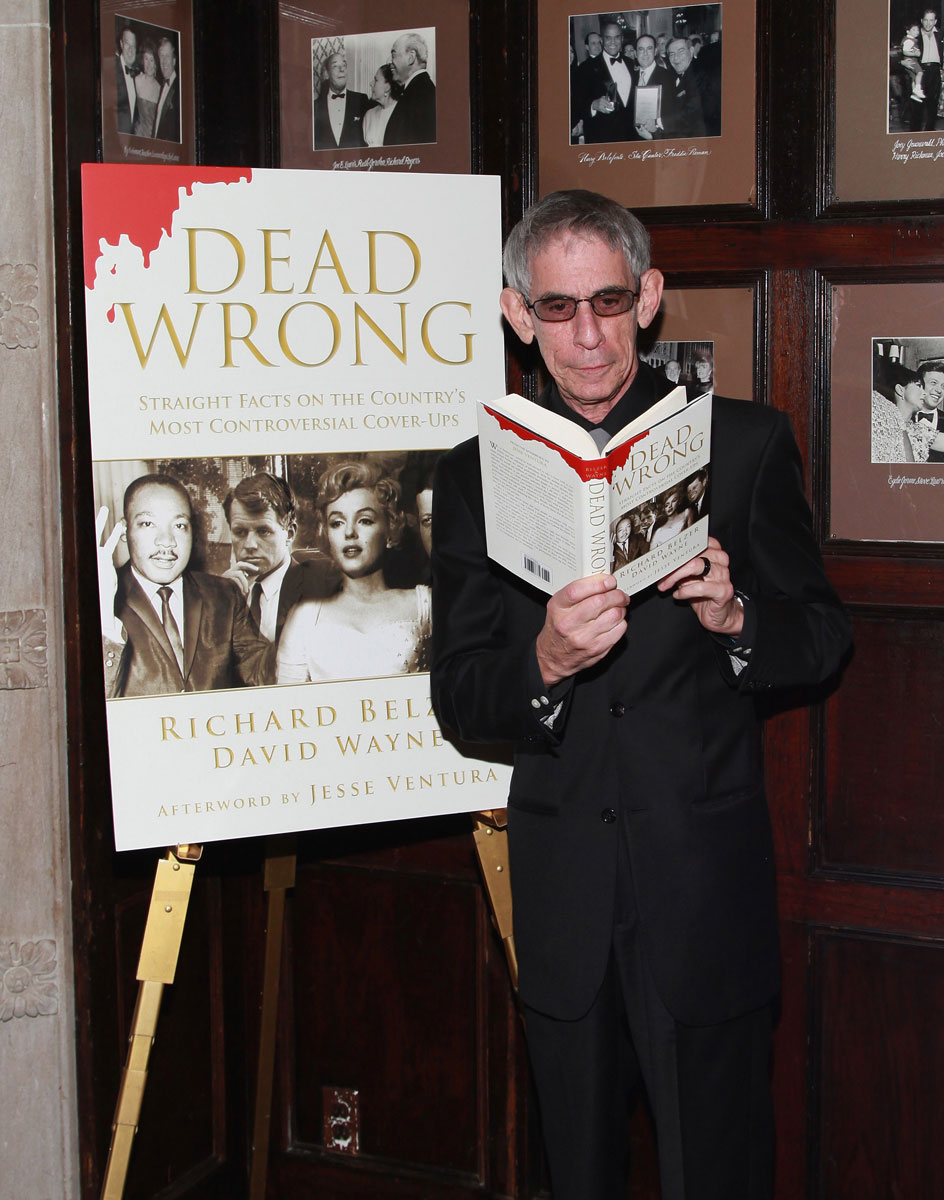
Actor, comedian and author Richard Belzer poses with a copy of the book 'Dead Wrong: Straight Facts On The Country's Most Controversial Cover-Ups'Actor, comedian and author Richard Belzer poses with a copy of the book 'Dead Wrong: Straight Facts On The Country's Most Controversial Cover-Ups' by Richard Belzer and David Wayne during his Friars Club Book Warming at the New York Friars Club on October 5, 2012 in New York City. (Taylor Hill/FilmMagic/Getty Images)"I read six newspapers every day," Belzer wrote in "UFOs, JFK, and Elvis." "I am still hoping that one day one of them might give me something other than all the news the CIA thinks is fit to print. Fat chance."

With his final breath, Belzer defied death's ultimate authority.

As obsessed as he was with chasing the truth though, there was much more to Belzer, who Leight described as "warm and generous."

"His conspiracy theories were occasionally the subject of a dressing room or on-set riff," Leight said. "But what sticks in my mind was his arm around my shoulder, being called 'kiddo,' being told I was welcome."


Want a daily wrap-up of all the news and commentary Salon has to offer? Subscribe to our morning newsletter, Crash Course.


According to Belzer's longtime friend, writer Bill Scheft, the comedian, actor and author's last words were "F**k you, motherf**ker." How fitting that with his final breath, Belzer defied death's ultimate authority. How appropriate, too, that in doing so he gave voice to a sentiment that could easily have been lifted straight from his nightclub act or delivered by Det. Munch to some entitled perp in handcuffs.

"We're not powerless," Belzer wrote in "Corporate Conspiracies." "We have many democratic vehicles at our disposal. Let's use them. Let's take back control of this Republic — take it out of the hands of the megacorporations who now can literally buy their influence from the politicians — and put it back into the hands of We, The People where it belongs."

George Harrison’s songwriting evolution: The Quiet Beatle’s considerable impact on the group’s sound

This weekend marks George Harrison’s 80th birthday, a milestone that he would never glimpse. In the spirit of remembrance, I much prefer to dwell on the outcomes that he did manage to realize. And chief among those, of course, were his musical attainments, which, in many ways, remain unparalleled.

During my recent interview with Harrison’s first wife Pattie Boyd, we discussed her memories of George, especially his “slow burn” as a songwriter toiling in the shadows of John Lennon and Paul McCartney. We also made time to reflect on the couple’s March 1964 “meet-cute” on a railway car during the film shoot for “A Hard Day’s Night,” the Beatles‘ first feature film.

For Pattie, meeting George was a revelation. An aspiring model, she accepted a walk-on part in “A Hard Day’s Night,” which placed her in George’s orbit for a day-long shoot on their mobile film set. “He was so delicious,” she recalled. “He was so good-looking and had the most beautiful, velvety brown eyes.”

As their train ambled back to London, George struck up the nerve to ask her out. But it was a no-go. Pattie told him that she had a boyfriend, and George’s face just “dropped. He was so unhappy. And I thought, ‘Oh, God, maybe he doesn’t know anyone?’ So I said, ‘You come join us!’ But that wasn’t what George had in mind, so that was it.”

And it might have remained that way if it weren’t for the film’s director, Richard Lester, who called Pattie and the other walk-ons back for a press shoot at Twickenham Film Studios. Only this time, Pattie was ready. “By this time, I had told my boyfriend that perhaps we shouldn’t be seeing each other anymore. So when I saw George again, he asked, ‘How’s your boyfriend?’ I said, ‘Well, I don’t have a boyfriend anymore.’ So that was it. That was the start.”

The couple’s first date would be chaperoned by Beatles manager Brian Epstein. “I was actually 19, and George was 20,” said Pattie, “so Brian organized everything for us.”

They met that evening at Brian’s private club, where he choreographed the evening. “He knew the menu, he knew which wines to choose,” Pattie recalled, “because he was quite sophisticated. And we were very young and had only been to little bistros. So Brian was there to sort of educate us, I suppose you could say.”

During the early years of her budding relationship and later marriage to George, Pattie enjoyed a birds-eye view of the Quiet Beatle’s progress as a composer.

“George’s songwriting got better and better,” she remarked. “He was so super-talented, but there was frustration because he enjoyed being in the studio with John and Paul, who were, you know, the ultimate songwriting team. It left little space for George, and it became a bit frustrating for him. But on the other hand, he was building up a wonderful catalog of his own music.”


Love the Beatles? Listen to Ken’s podcast “Everything Fab Four.”


But even during those early days, when the Lennon-McCartney juggernaut was transforming the Beatles into household names, George managed to exert a considerable impact on the group’s sound. In one song after another, he contrived a series of guitar embellishments that elevated the Beatles’ music at every turn.

Take such tunes as “Please Please Me,” “She Loves You,” “I Want to Hold Your Hand,” and “It Won’t Be Long.” In each and every instance, George created a series of guitar licks that drove Lennon-McCartney compositions into the stratosphere.

In one song after another, he contrived a series of guitar embellishments that elevated the Beatles’ music at every turn.

“In the end,” said Pattie, “it didn’t matter who wrote the song.” George invariably “worked hard and contributed as much energy and creativity as possible.”

By the time of their disbandment, George had succeeded in not only placing his work on a par with the greatest Lennon-McCartney compositions; he had even managed to eclipse the quality of their output. Latter Beatles-era songs such as Harrison’s “Here Comes the Sun,” “Something,” and “While My Guitar Gently Weeps,” among others, routinely rank among the upper echelon of the Beatles’ achievements.

In such instances, George succeeded in placing his wares among the greatest songs in pop-music history. As Pattie pointed out — with a fondness and well-earned sense of pride — even half a century later, “we still can’t get enough of those songs. They’re extraordinary, and they have stood the test of time.”

Watch for a full interview with Pattie Boyd coming soon to the Everything Fab Four podcast.

Are the feds sacrificing endangered salmon to help potato farmers?

This story was reported and produced in collaboration with High Country News. 

Last fall, following a 20-year campaign led by tribal organizers, the federal government ordered the removal of four dams on the Klamath River, which flows from Oregon to California. For almost a century, these dams have prevented the river’s salmon from swimming upstream to spawn.

The dams will be gone by next year, but now the salmon, including endangered coho, are facing a renewed threat from farther upstream. The U.S. Bureau of Reclamation, which controls another set of dams on the Klamath, announced last week that it will cut flows on the river to historic lows, drying out the river and likely killing salmon farther downstream. 

“The bureau’s proposal will kill salmon, and there’s no question about it,” said Amy Cordalis, general counsel for and citizen of the Yurok Tribe. “These are some of the lowest flows the Klamath River has ever seen.” Cordalis said that the last time the river faced such low flows was 2002, when the Klamath saw the largest fish kill in U.S. history. That eliminated a generation of salmon, leading to economic devastation for the West Coast fishing industry.

Instead of letting the water flow downstream, Reclamation plans to hold it back in Upper Klamath Lake, which feeds the river. The U.S. Fish and Wildlife Service sets minimum water levels to keep endangered c’waam and koptu, or suckerfish, alive, and Reclamation said it will hold back water so it can meet those minimum levels. 

In the past few years, as drought in Oregon and California lowered water levels on the Klamath, Reclamation struggled to manage the competing needs of the salmon and the suckers: If the suckers get the water, the salmon die, and if the salmon get the water, the suckers die. Reclamation’s management of the river pits salmon and the Yurok and Karuk tribes that protect them in the lower Klamath basin against suckerfish and the Klamath Tribes that protect them in the upper basin.

Not only will the flow cuts endanger the salmon in the lower basin, they may not save the suckers either.

“I think it’s too little, too late,” said Clayton Dumont, the chairman of the Klamath Tribes, whose territory extends across the upper Klamath Basin. “C’waam and koptu need a certain amount of water over them to escape predation, and we don’t believe that the bureau’s cut is sufficient.” In other words, even as Reclamation dries out the salmon’s habitat, they may also fail to protect the suckers’ habitat, barring strong rain for the remainder of the winter. Dumont said this could be the fourth year in a row that lake levels fall too low for the suckerfish to survive.

But salmon and suckerfish aren’t the only ones using the basin’s water. Some tribal leaders say Reclamation manufactured the salmon-suckerfish dilemma to obscure where the water is really going: crops, which use hundreds of thousands of acre-feet of Klamath River water annually.

“This has more to do with potatoes than it does fish,” said Karuk Tribal Council Member Troy Hockaday. “What the bureau is not saying is that the water savings will make it more likely that irrigation deliveries will be available to water users.”

The basin has more than 200,000 acres of irrigated farmland, between 10,000 and 14,000 of which are dedicated to potatoes, an Indigenous food originally engineered from a toxic wild root by Andean horticulturists. Roughly three quarters of the basin’s potato yield go to companies like Frito Lay for potato chips, and In-N-Out Burger for fries, according to the Klamath Water Users Association.

Tribes say the scale of the Klamath Basin’s agricultural project is unsustainable. “We just cannot support a 220,000-acre irrigation project anymore, and we have to find a way to downsize that project,” said Craig Tucker, natural resources policy consultant for the Karuk Tribe. “I don’t think we should kick people off their farms and destroy their livelihood. There should be a just, fair way to buy out willing sellers, compensate people at fair market value. But we cannot farm in the 21st century like we did in the 20th, because the weather is just not the same.”

Cordalis said that part of the reason for the salmon-and-suckerfish dilemma is that Reclamation released more water for agriculture last year than was necessary.

“What that did was it drove down the lake really, really far, and so we are essentially starting with an empty bathtub,” she said. “And so, then what [the bureau is] doing is saying, ‘oh, no, we don’t have enough for species…and so now we have to decide, which fish are we going to kill?’ And they’ve decided it’s the coho this year.”

“The Klamath Basin is facing the real potential for a fourth consecutive year of extraordinarily dry conditions,” said a Reclamation spokesperson. “Reclamation’s proactive measures to adaptively manage Klamath River flows are designed to create springtime conditions that mitigate risks to species and the environment, while we also work with agricultural communities.”

Diverting water from the basin and leaving tribes to scramble on behalf of the fish they’re duty-bound to protect continues the old colonial strategy of divisiveness, the Yurok Tribe’s Vice Chairman Frankie Meyers said. 

“We should instead be focused on meaningful restoration of the wetlands that accommodated the needs of sucker and salmon for millennia that were sacrificed on the altar of Manifest Destiny,” he said.

Irrigators in the Klamath Basin don’t necessarily disagree. Moss Driscoll, director of water policy at the Klamath Water Users Association, said basin-wide solutions could include restoring other wetlands and reservoirs in the area, such as Tule Lake, that supplement agricultural water needs. This could free up Klamath water for endangered fish. “The farming community is working on opportunities to manage water in new and creative ways that can restore the function of the landscape, in a manner that supports wildlife, fish, the environment and farming alike,” Driscoll said. 

The Fish and Wildlife Service is weighing a large restoration project on Upper Klamath Lake that would convert 18,000 acres of ranchland back into natural wetlands, expanding the safe habitat for c’waam and koptu.

As the removal of the river’s four non-irrigating dams looms, the focus is on long-term solutions for whole watershed health. To that end, the Fish and Wildlife Service, in collaboration with other stakeholders including the National Oceanic and Atmospheric Administration, the Pacific States Marine Fisheries Commission, and the Klamath River Renewal Corporation (which is in charge of dam removal), have outlined a strategy to identify and address the “root causes” of watershed degradation.

But to tribes, the root cause of this fish-and-chips disaster is clear. “We’re just not gonna have fish in the future if we don’t reduce irrigation demand,” said Tucker. “We’re going to have to change the way we eat, and we’re gonna have to change agriculture a little bit.”


This article originally appeared in Grist at https://grist.org/indigenous/are-the-feds-sacrificing-endangered-salmon-to-help-potato-farmers/.

Grist is a nonprofit, independent media organization dedicated to telling stories of climate solutions and a just future. Learn more at Grist.org

“Model for bad democracy”: Voting rights wins may be reversed after GOP flips North Carolina court

The North Carolina Supreme Court agreed to rehear two major voting rights cases, including one that previously blocked a restrictive photo ID to vote law and another that involved the constitutionality of political maps drawn by GOP lawmakers last year.

The decisions came earlier this month after Republican lawmakers asked the high court to reconsider its previous rulings and the court’s majority shifted from blue to red with Republicans flipping control of the court, having a 5-2 advantage.

Now, the court will reconsider two recent rulings that were both losses for Republicans, who enacted the ID law and drew the districts to give their candidates a significant advantage in elections. 

“Not only does today’s display of raw partisanship call into question the impartiality of the courts, but it erodes the notion that the judicial branch has the institutional capacity to be a principled check on legislation that violates constitutional and human rights” wrote Democratic Justice Anita Earls in her dissent in the redistricting case.

The court will rehear the cases in March, but the unusual decision to do so has created significant concern for voting rights experts, who worry that moving forward, any political majority in power can change the law on a whim and not respect precedent.

“Just because a court changes composition, the law should not change,” said Mitchell Brown, a senior attorney at the Southern Coalition for Social Justice. “The rule of law should stand. If the rule of law is able to flip flop back and forth, and precedent is not respected, then we as people won’t know how to follow the law.”

Brown is representing Common Cause in Moore v. Harper, in which the Supreme Court will decide whether the North Carolina Supreme Court has the power to strike down the legislature’s gerrymandered congressional map for violating the North Carolina Constitution. 

In urging the Supreme Court to reinstate the gerrymandered congressional map, the North Carolina legislators are relying on the “independent state legislature” theory through which they want to eliminate the system of checks and balances governing federal elections and appropriate full power themselves. 

The theory asserts that under the U.S. Constitution, state legislatures have full authority to set the rules when it comes to making state laws that apply to federal elections, and that state constitutions and state courts have no power or authority over them. 

If the Supreme Court affirms the theory in deciding the Moore case, state legislatures will effectively be freed to gerrymander electoral maps and pass restrictive voting laws with little to no supervision by state courts or other entities.

Last year, the court ruled 4-3 to strike down all three sets of maps for being partisan gerrymanders that violated the state constitution. 

Voters contested the map in state court, contending that the map violated the state constitution’s “free elections clause,” among other provisions, according to the Brennan Center

The North Carolina Supreme Court described it as an “egregious and intentional partisan gerrymanders, designed to enhance Republican performance, and thereby give a greater voice to those voters than to any others.”

Following the order, a trial court adopted fairer remedial maps before the 2022 midterms. 

Last year, before the new justices took their seats, the court reviewed maps drawn by Republican lawmakers for use in legislative elections in 2022, and concluded that the state Senate map was unconstitutional and needed to be redrawn. The court allowed the state House map to be continued to be used, The News and Observer reported

This is the first time in 30 years that the court has decided to rehear two cases, said Bob Phillips, executive director of Common Cause North Carolina.

“I do think that North Carolina, unfortunately, is often looked upon as a model for bad democracy and can be the playbook for other states,” Phillips said. “And we’re almost like the laboratory for some of this, that we think is extremely harmful.”


Want a daily wrap-up of all the news and commentary Salon has to offer? Subscribe to our morning newsletter, Crash Course.


The court also ruled that the 2018 voter ID law passed by the Republican-controlled legislature was unconstitutional because it had deliberately been written to harm Black voters more than white voters. 

In January, Republicans in the North Carolina Legislature asked the court to rehear both cases and correct errors in the court’s previous rulings.

“The positive changes in the maps that we fought for could be rolled back and the legislature could have the opportunity to redraw the state legislative and state House districts in a way that is heavily partisan gerrymandered, which by proxy will harm Black voters and then tie that with the voter ID law at the same time, it could really diminish the ability of Black voters to vote in the state of North Carolina,” Brown said. 

He added that he is also concerned with the impact this could have on future redistricting cycles. Whatever party is in power will have the ability to draw maps that benefit them to the “detriment of actual voters”.

Common Cause has asked the court to dismiss the request from Republicans for the case to be reheard, but the court has dismissed their filing, saying it “grossly violates appellate rules.”

Now, Brown is worried that the same voter suppression and redistricting efforts taking place in North Carolina can also spread to other states. 

In Florida for example, a constitutional amendment bans partisan gerrymandering. The amendment says that districts “may not be drawn to favor or disfavor an incumbent or political party.”

However, if the court agrees with the North Carolina legislature saying it is the only body that is able to make rules around federal elections and federal redistricting, that Florida amendment may be in jeopardy of being nullified, Brown pointed out. 

“What’s happening in North Carolina can serve as a model for other states, but I think other states have also served as a model for North Carolina,” he added.

But even deeper than that are voter suppression laws that some states have introduced, Brown pointed out.

“There are people who want to suppress the right to vote, and they are copying each other,” Brown added. “And they’re copying each other throughout the country and following the lead of Florida, Alabama, Mississippi and many times, North Carolina.”

Partisan gerrymandering and voter ID laws have the potential to disrupt core democratic processes across the country. 

“Voter suppression and gerrymandering have been rooted in harming voters of color,” Phillips said. “That’s the fact in North Carolina and I would imagine everywhere else across the country. So it is very concerning when there is this case that could open the door for what is going to be a voter ID enabling legislation that will come back up.”

In many state legislatures, lawmakers have introduced or enacted laws that restrict access to the vote. 

“Legislation is categorized as restrictive if it makes it harder for eligible Americans to register, stay on the rolls, and/or vote as compared to existing state law,” the Brennan Center points out

“There’s no continuity in the law and that’s hard,” Brown said. “It’s hard to make sure our conduct accords with what the law is. There’s a lot of conversation about partisan gerrymandering, in terms of Moore v. Harper, but there’s a bigger issue about how this affects Black voters. The party is many times a proxy for the race,”

He added that legislators have said they’re not discriminating against Black voters, but instead, discriminating against the Democrats. However, that in turn harms Black voters.

“We need to pay attention to that and stop partisan gerrymandering,” Brown said. “We need to make sure that there is some equality and equity in the back-end process.”

These efforts are also negatively impacting voter participation, especially among younger voters, Phillips said. He pointed to the drop in voter participation in the last midterm election and said it was lower than what North Carolina has seen in the four years before. 

“I do think that these high-profile ‘dramas’, [or] attacks on our democracy that are playing out in North Carolina is horrible for voter participation,” Phillips said. “And that is ultimately undoing what we have here in terms of a healthy, robust democracy.”

Today is the “National Day of Hate”: How did we get here?

Cities across the country are on alert today following police warnings of an uptick in “domestic violent extremist messaging” from emboldened neo-Nazi and white supremacist groups who are organizing a “National Day of Hate.”

Hate groups have been instructed to drop banners, place stickers and flyers, and spread racist and antisemitic graffiti in cities across North America during the last Saturday of Black History Month. The very public displays of hate are being encouraged just as incidents targeting Jewish Americans for harassment and violence have escalated. According to the Jewish media outlet Forward, “A man charged with shooting two Jewish men as they left morning services in an Orthodox area of Los Angeles on consecutive days last week attached a photo of a Goyim Defense League flyer in an email to classmates about two months before the attack.” Members of that same group, the Goyim Defense League, were recently spotted harassing attendants of the Chabad of South Orlando.

The neo-Nazi groups’ plans come at the end of a monthlong campaign of racist and anti-Black media coverage by the right-wing’s main media outlet, Fox News. As watchdog group Media Matters charted, the network — which was also recently revealed to have knowingly lied to viewers in the lead-up to a Confederate-flag-waving mob attacking the Capitol on January 6 —has published or aired a new story that advances anti-Black narratives every day during Black History Month. 

“Although Fox has aired a few Black history month segments,” Media Matters noted, “more airtime was spent pushing racist rhetoric…Fox figures have spread anti-Black narratives, accusing President Joe Biden’s administration of anti-white racism; fear-mongering about critical race theory being taught in K-12 schools as a part of a so-called “woke” liberal agenda; and undermining the existence of and harm done by systemic racism.”

The stories almost always follow the same formula: If a person of color decries an act of racism, a member of the Fox commentariat or guest labels that person of color a racist.

On Friday, Fox gave the Missouri Attorney General air-time to accuse a Black St. Louis prosecutor of “injecting race” into a dispute after the prosecutor suggested the attorney general’s push to have her removed from office may be racially motivated. On Thursday, Fox’s Brian Kilmeade gave North Korean defector and racism denialist Yeonmi Park free reign to talk about how getting mugged by a Black woman in Chicago was “crazier than North Korea.” On Wednesday, Texas Republican Rep. Lance Gooden took to Fox to suggest California Democratic Rep. Judy Chu — the US’ first Chinese American Congresswoman — is a Chinese spy “playing the race card.”

Here are 7 other things that can get you called a racist by the network:

01
Keep Nazis out of the US military
 

 Feb. 5: According to Mark Levin, who hosts a weekly Fox News program, “anti-white racism” is what a sweeping range of Americans participate in when they call for reform against injustice. On his show “Life, Liberty & Levin” — which has all the thrill of a basement-filmed public access TV spot but sadly none of the glamour —Levin opened the floor to his guest, the Hoover Institution’s Victor Davis Hanson, who lamented the number of ways white men have suffered now that Disney, American Airlines, and Stanford University have diversity and inclusion initiatives. Hanson’s plaintive comments extended to the Pentagon’s recent attempts to increase recruitment and diversity in the military — specifically by clamping down on previously documented hotbeds of racist behavior, and “hunting out supposed white rage and white supremacy in the ranks.”

02
Student loan forgiveness
 Feb. 5: On that same broadcast, Levin didn’t let President Joe Biden off the hook for what he believes is racist action. Noting that Black students hold a disproportionate amount of educational debt, Levin suggested this made Biden’s student loan forgiveness plan “racist.”


03
Study the history of the U.S.
Feb. 14 — What list of damning moments in anti-Black Fox News narratives would be complete without a mention of Tucker Carlson? In an appearance with Carlson, the fallen-from-grace comedian and producer of right-wing non-sequiturs Roseanne Barr offered viewers a perfect example of how anti-Black racism and antisemitism are often bundled together by extremists in modern rhetoric when she claimed that critical race theory is “nothing but Nazism” and “antisemitism.”
 
Barr went on to fantasize that critical race theory “is based on Jews being white and all the trouble caused by white people. They mean Jews, and I know they do.” Barr absurdly insisted “white racism” means “Jewish control” and that it’s a narrative pushed to “divide the population.” 
04
Mentioning past acts of racism
Feb. 10: Fox’ Lisa Kennedy Montgomery — the white former MTV VJ who stumbled from alt-music to alt-right — makes the list for her appearance on Fox’s “Outnumbered” where she called Secretary of Transportation Pete Buttigieg “a cracker who only wants to racially divide the country further.


What, you might ask, prompted this remark from the paling former personality? Buttigieg noted that the creation of the U.S. interstate highways system disproportionately displaced Black residents during its construction, and even cleaved in half Black neighborhoods.

 
Fox’s Julie Banderas then jumped in to accuse Democrats of “politicizing … and using once again another woke agenda to basically punish those who don’t believe the same rhetoric that they are spewing.”
05
Fighting discrimination
Feb. 9: It’s almost unfair to include Fox’ Laura Ingraham in this list. Her contributions to anti-Black news media bias over the years are so substantial that they should more rightfully be recorded in their own section — like Pete Rose’s batting average. But worth noting here is a moment on Ingraham’s prime-time TV show, where she criticized the University of South Florida for sharing resources with students about racial diversity and inclusion support, including anti-racism resources and counseling services. 
 
This was simply too much for Ingraham, who offered the floor to her guest to right-wing activist Chris Rufo, who claimed the school was engaged in “cult programming” and aimed to “make [kids] left-wing activists.” 
06
Crediting Black people for building the U.S.
Feb. 7: It wasn’t enough for Fox’ Jesse Watters to joke about getting a check for slavery reparations because he’s “1% Black.” The co-host of “The Five” took a moment to pause his tirade about the dangers of Black cartoon characters in Disney movies to hand-waive the forced labor of enslaved Black people who built early U.S. infrastructure. Watters, instead, lauded those who “financed” that infrastructure: white enslavers.
 
“When you say, ‘Who build something?’ Well, who designed it, who was the architect, who financed it? Labor’s just a part of it. So, if we’re going to have a conversation about reparations — which I’m open to it since I’m 1% Black — I might get a check. You have to talk about it accurately,” Watters told viewers
07
Calling out racism (but only if you’re a person of color)

Feb. 20: Calling out racism isn’t racist. In fact, when a group composed exclusively of people of color are discussing racist remarks made by another person of color, that’s about the least amount of racism you can get in a soundbite. And yet, the Fox News commentariat repeatedly demonstrates that those moments are where it thinks white opinions are most necessary. When Daily Beast contributor Wajahat Ali was asked whether sharing an ethnic heritage with Nikki Haley compels him to support her, Ali replied with a devastating roast of Haley’s politics.


“To quote Zora Neale Hurston, ‘Not all skinfolk are kinfolk.’ Nikki Haley instead is the Dinesh D’Souza of Candace Owens. She’s the alpha Karen of brown skin. And for white supremacists and racists, she’s the perfect Manchurian candidate. And instead of applauding her, I am just disgusted by people like Nikki Haley who know better — whose parents were the beneficiaries, as Asha said, of the 1965 immigration and nationality act — which passed thanks to those original BLM protesters and the Civil Rights Act,” Ali said.


Ali’s made the comments during an appearance with MSNBC Mehdi Hasan and fellow guest Asha Rangappa of the Yale Jackson School of Global Affairs. 


Fox’ Lisa Kennedy Montgomery called the comments “disgusting” and “overt racism.”  


Fox News’ habit of policing black and brown people’s intra-group racism conversations isn’t new. In April of 2021, it used the same bit to accuse Black Twitter users of racism when many criticized South Carolina’s Republican Sen. Tim Scott. The network’s latest use of this tactic comes after Haley, in her Feb. 15 campaign kickoff speech, falsely accused President Joe Biden and Vice President Kamala Harris of calling America racist. 


“Every day we’re told America is flawed, rotten, and full of hate. Joe and Kamala even say America is racist. Nothing could be further from the truth.”


Biden and Harris have, in prior remarks, discussed the impact of — and the need to uproot — long-embedded systemic racism still left within US institutions even after post-Jim Crow reforms.

Yes, prunes belong in chocolate cake

Why do some foods seem to become trendy overnight, embraced by big box retailers and wellness influencers alike? You go most of your life having no strong feelings one way or the other about kale, then you suddenly can’t go out to a restaurant without seeing a massaged salad on the menu.

You watch with whiplash as avocados go from a normal piece of produce, to famous enough to get their own emoji, to a disparaging shorthand for all that’s supposedly wrong with an entire generation. Meanwhile, other delicious, versatile and nutritionally powerful foods languish in the culinary basement of perpetual uncoolness.

Prunes are old people food. They’re boring. They’re nature’s laxative. In other words, yuck.

Prunes, however, deserve so much more.

Over the past few years, in an attempt at an image makeover, prunes have sometimes been renamed “dried plums.” But the notion of a granny sipping on prune juice to keep her regular holds fast in the collective imagination.

That’s why I was recently surprised to read an article on CNBC in which registered dietitian nutritionist Lauren Manaker revealed that her “most underrated” energy-boosting food was the humble prune. Yes, prunes are high in fiber. (Calm down — so are kale, cauliflower and and avocados.) They contain iron, potassium and vitamins C and K. And, as Manaker notes, they’re also “a good source of energy in the form of natural sugars.”

When I need convincing about a particular food, I usually find that throwing a little chocolate in the mix helps make the case. I was in London earlier this month, where a spectacular dessert at Ottolenghi reminded me of just that. While Ottolenghi’s prune-infused sticky chocolate loaf takes its cues from the classic British sticky toffee pudding, my own chocolate prune cake, inspired by a simple Food.com recipe, is a more pared-down affair.


Hungry for more great food writing and recipes? Subscribe to Salon Food’s newsletter, The Bite.


Cake recipes with dried fruit usually involve soaking it in boiling water or alcohol. To further deepen the chocolate flavor here, I instead put my prunes in hot coffee, which helps bolster the chocolate essence of the cake. (If you’re not a coffee person, substitute water, tea or rum.) I’ve also doubled the amount of cocoa and added dark chocolate chips — so rest assured, this is a decisively chocolatel-y dessert.

I know prunes are a tough sell. Despite never eating a prune in his life, my spouse refused to touch a slice of this decadent dessert. He was quite spooked by the dried fruit’s geriatric reputation. My daughter and I, however, gleefully pounced on the cake, without a moment’s regard for the fact that there might actually be something vaguely healthy in it.

But I swear this recipe is amazing. A one-bowl dessert that takes minutes to prepare, it’s rich, moist and deeply complex. It’s the chocolate cake for when you want something more than regular old chocolate cake, which makes it the most persuasive case I can think of to convince you that prunes, of all things, are pretty cool.

* * *

Inspired by Food.com and Ottolenghi

Decadent Secret Ingredient Chocolate Cake
Yields
 8-12 servings
Prep Time
 10 minutes 
Cook Time
 45 minutes

Ingredients

  • 1 cup prunes, pitted and chopped
  • 1 teaspoon baking soda
  • 1 cup hot brewed coffee (or 1 cup boiling water and 1 1/2 teaspoons instant espresso)
  • 1/2 cup semisweet chocolate chips
  • 1 cup butter, softened
  • 1 cup white sugar
  • 2 large eggs
  • 1 3/4 cups all-purpose flour
  • 4 teaspoons unsweetened cocoa


Directions

  1. Preheat the oven to 350 degrees. Generously grease a bundt pan.
  2. Sprinkle the baking soda on the prunes. Pour the coffee over the mixture to plump and soften them.
  3. While the prunes are cooling, beat the butter and sugar in a large bowl or stand mixer.
  4. Add the eggs, then the drained prunes and chocolate chips.
  5. Slowly add the flour and cocoa. Mix until well blended.
  6. Pour the mixture into the pan and bake for 45 to 55 minutes, until the cake springs back lightly when you press it.
  7. Remove from the oven and let cool before removing from the pan. Dust with powdered sugar or a drizzle of chocolate ganache.

Cook’s Notes

I know not everyone has or wants a bundt pan. For a layered cake, you can instead divide the batter into two cake pans and bake for about 30 minutes. I’d sandwich it with lightly sweetened whipped cream.

Salon Food writes about stuff we think you’ll like. While our editorial team independently selected these products, Salon has affiliate partnerships, so making a purchase through our links may earn us a commission.

Tennessee lobbyists oppose new lifesaving exceptions in abortion ban

In Tennessee, Republican lawmakers are considering whether patients should be forced to continue dangerous pregnancies, even while miscarrying, under the state’s abortion ban — and how close to risking death such patients need to be before a doctor can legally intervene.

At a legislative hearing last week, a lobbyist who played a dominant role in crafting the state’s abortion legislation made his preference clear: A pregnant patient should be in the process of an urgent emergency, such as bleeding out, before they can receive abortion care.

Some pregnancy complications “work themselves out,” Will Brewer, who represents the local affiliate of the anti-abortion organization National Right to Life, told a majority-male panel of lawmakers Feb. 14. When faced with a patient’s high-risk condition, doctors should be required to “pause and wait this out and see how it goes.”

Top Republicans like Gov. Bill Lee have defended the state’s abortion law, one of the strictest in the country, as providing “maximum protection possible for both mother and child.” But currently, the ban has no explicit exceptions, not even for the pregnant patient’s health.

It only includes an “affirmative defense” for emergencies, a rare legal mechanism that means the burden is on the doctor to prove abortion care was necessary because the patient risked death or irreversible impairment to a major bodily function.

The penalties for getting it wrong are three to 10 years in prison and up to $15,000 in fines. Doctors could expect to lose their medical license just for being charged. Concern over how the unprecedented law will be interpreted by prosecutors and the courts has already resulted in patients with high-risk conditions having to rush across state lines for care.

Some Republicans are proposing a modest change. An amendment to the law introduced in the House Population Health Subcommittee last week would remove the affirmative defense and clarify that it is not a crime to terminate a pregnancy to prevent an emergency that threatens the pregnant patient’s life or health, among other provisions.

“No one wants to tell their spouse, child or loved one that their life is not important in a medical emergency as you watch them die when they could have been saved,” said Republican Rep. Esther Helton-Haynes, a nurse and the bill’s sponsor.

But the word “prevent” is a sticking point for the anti-abortion groups who wrote the law.

“That would mean that the emergency hasn’t even occurred yet,” Brewer told the committee. He made a distinction between immediate, urgent emergencies — “A patient comes into the ER bleeding out” — and what he calls “quasi-elective” abortions.

Brewer, who has no medical experience, defined those as “abortions that aren’t necessary to be done in the moment but are still performed in an effort to prevent a future medical emergency.” He called for an “objective” standard.

When reached for comment, Brewer said his statements as summarized by ProPublica had been mischaracterized but did not provide additional details. “Ending the life of the baby should not be used as treatment for non-life-threatening conditions or to prevent some unknown possibility in the future,” he said. He did not respond to follow-up questions seeking clarification.

The American College of Obstetricians and Gynecologists said laws that try to limit or define medical exceptions are dangerous because they interfere with a doctor’s ability to assess fast-moving health indicators in unpredictable situations and don’t account for people’s different thresholds for risk.

Kim Fortner, a maternal-fetal medicine specialist practicing in Tennessee for more than 20 years, testified to the committee and pushed back on Brewer’s characterizations. She described a patient she saw recently whose water broke too early — the fetus still had a heartbeat, but there was virtually no chance it would survive and a very high risk the patient would get an infection.

But because of the law, the woman was sent home without the option of abortion care. She came back with emergency bleeding and sepsis, a life-threatening infection.

“It is not always so clear, and things don’t always just work themselves out,” Fortner said. “It is a significant, in my mind, misuse of resources, if she did not need to have six units of blood that could have gone to the trauma victim or the gunshot wound. Blood is a limited resource. Just because she can wait and come back in and she still lives to talk about it today — one, that won’t always happen, and two, it also is a significant misuse of an ICU bed. It is a preventable occurrence.”

Andy Farmer, a Republican state representative, agreed with her.

“These things need to be addressed early on,” he said, adding that he didn’t want doctors to feel they needed to consult a lawyer before offering care that could stop a condition from progressing into an emergency.

Brewer, however, said he believed giving doctors that kind of power would be too subjective. “Once one doctor is let off the hook in a criminal trial, it would be open season for other doctors who wanted to perform bad faith terminations,” he said.

Brewer’s position appears to be out of step with public opinion on abortion, even in a deeply red state. A recent poll found about 75% of Tennesseans support abortion exceptions, including for pregnancies caused by rape and incest.

Yet his organization exerts outsize influence on Republican state politics. Tennessee Right to Life issues an annual scorecard rating lawmakers on their fealty to “pro-life” positions and plows money into primary campaigns to unseat candidates viewed as insufficiently loyal. Already, they retracted the endorsement of one Republican lawmaker who publicly advocated for clear medical exceptions.

Signs of frustration emerged over the course of the hearing as lawmakers grilled Brewer on how his preferred positions may harm pregnant patients and accused him of trying to intimidate legislators.

“You’ve made a statement that you are fine with the current trigger law as it is, and nothing more needs to be done,” said Republican state Rep. Sabi Kumar, a retired surgeon, referring to the state’s abortion ban. “Did you believe that?”

Brewer responded: “That is our most preferential position, although we would accept an objective standard.”

Kumar said he was surprised Brewer did not appear to be taking into account other changes the bill addresses that are not in the current law, such as exceptions for cases of fatal fetal anomalies, where a baby is not expected to survive, and ectopic pregnancies, which implant outside the uterine cavity, are non-viable and can lead to rupture and death.

“Those things need to be corrected,” he said. “In the face of that, it is difficult for you to say that that is your preferential thing.”

Kumar also asked Brewer to consider the plight of doctors. Physicians carry malpractice insurance, but Kumar noted it doesn’t cover costs associated with criminal charges, which can be financially ruinous. Kumar didn’t think they should be threatened with prison time for acting to avoid an emergency.

“I would have liked to see you, as a friend, be as concerned about a physician who was under that degree of emotional stress and pressure, trying to save the life of a baby and worried about being prosecuted,” he said. “I would have liked you to be gushing with sympathy for that.”

He and others pointed out that the bill’s changes would not affect the vast majority of pregnancies, where abortion would continue to be outlawed. The bill explicitly states abortions are prohibited for mental health reasons, such as a patient threatening suicide, and it has no provisions allowing abortion for pregnancies due to rape or incest.

But Brewer suggested that lawmakers who vote in support of the bill might stand to lose the endorsement of Tennessee Right to Life.

“I would not consider this a pro-life law,” Brewer said. “And in discussions with our [political action committee], they have informed me that they would score this negatively for those members that wish to vote for it.”

Brewer’s invocation of the anti-abortion group’s scorecard provoked a strong response. As the hearing wrapped up, Tennessee’s House speaker, Cameron Sexton, appeared in the chamber.

“Something happened that I’ve never experienced in my time down here, which was somebody on a committee testifying tried to intimidate our members by telling them they’re gonna score them a vote,” he said. “You can have those conversations in your room, you can have those conversations in email. But to do it in the committee — to try to intimidate this committee to go a certain direction — is uncalled for.”

The rare public rebuke of an anti-abortion activist by a top Republican lawmaker may be a sign of growing GOP support for the modest amendments to the law. However, the bill’s path is not guaranteed. It will need to pass in three more committees before reaching final votes in the state’s House and Senate.

Republican state Rep. Bryan Terry‘s reaction provided a preview of potential challenges ahead. He was the only member of the committee to vote against the amendment, and he leads the House Health Subcommittee, where the bill is headed next week.

In an email to ProPublica, Terry said that he does want to see changes to the law, but that the word “prevent” would need to be removed or redefined in the measure before he could consider voting for it.

“There are a multitude of medical emergencies that can occur during a pregnancy, but they usually never materialize,” Terry, who is an anesthesiologist, said. “A concern with the current amendment language is that an abortion could be performed in an instance when it wasn’t ‘medically necessary treatment.'”

ProPublica followed up to ask if he would consider conditions such as premature rupture of membranes, preeclampsia, cancer or heart conditions “medically necessary” reasons for abortions. He did not respond.

Three days after the hearing, Tennessee Right to Life sent a “legislative alert” obtained by ProPublica to its members, calling on them to oppose the bill at the next hearing.

The email described changes in the bill as “loopholes” making the current law “unenforceable.”

“Tragically, some pro-life legislators are currently supporting this bill,” the email read. Below, it listed the nine lawmakers who voted in favor of it.

How “Physical: 100” should level up in light of its anticlimactic finale

“Physical: 100” Netflix’s No. 1 non-English speaking show last week and a Top 10 fixture for the past few weeks – has ended its nine-episode run with a finale that was . . . anticlimactic. 

The highly anticipated ending for the South Korean fitness survival competition faltered early on as expected winner Yun Sung-bin – a gold medal-winning Olympian, no less! – lost in the semifinal. Noooooooooooo! As viewers at home regrouped, they at least had other fan favorites left in the final five: ice climber/mountain rescuer Kim Min-cheol, who had won over viewers with his functional fitness, and buff car dealer Jo Jin-hyeong, who had a small part in the  K-drama “Welcome to Waikiki 2.” Except they also fell in quick succession as the final elimination rounds began.

With all the favorites now gone, the show was left with three contestants viewers didn’t know much about: luger Park Jin-yong, cyclist Jung Hae-min,and snowboarder/CrossFitter Woo Jin-young. Who were fans supposed to root for at this point?

Yes, they’re all amazing athletes and worthy of their place, but a key allure of any reality series is becoming invested in the contestants, and the show frankly shorted these three on screentime. It’s baffling why the producers didn’t give the finalists the star treatment prior to the last episode if for nothing else than to build anticipation. They deserved it and, well, so did we. I mean, dancer and “Single’s Inferno” alum Cha Hyun-seung – who was ousted in the penultimate episode – swigging his beer as he watched was a whole mood, as if he, too, was contemplating what the heck was going on.

And then there were the final challenges, which were on the laborious side – watching men run back and forth and ring a bell is just as exciting as that sounds, even if it is exhausting – and which made the 87-minute closer seem twice as long.

Finally, the grand champion was determined by a game called Infinite Rope Pull, where the players had to unravel a coil of heavy rope. Never mind that a more apropos title would’ve been the Finite Rope Pull since there was an end to it that Woo Jin-young reached before cyclist Jung Hae-min could to win the ultimate prize of ₩300,000,000 (about $232,000). After they both congratulated each other for being the last competitors standing, Woo was given the honor (?!) of smashing Jung’s plaster torso sculpture – a scenario that was oddly cruel in this generally feel-good show.

Though there hasn’t been an official announcement for a “Physical: 100” second season, the ominous voiceover before the closing credits hinted at it: “Various physiques exist in this world. Our search for the perfect physique will continue.” Netflix would be daft not to grab on to this money generator, and if/when they do, here are a few suggestions that could improve the overall experience for both the athletes and the viewers.

01
Referees need to be consistent (and watchful)
Woo Jin-yong and Jo Jin-hyeong in “Physical: 100” (Netflix)

The referees are there for a reason, but the “Physical: 100” officials weren’t consistent with their rulings. For instance, in the game where teams of two had to laboriously flip over each other’s tiles by hand, Jung stepped on his tiles, thereby preventing his opponents from flipping his. Clever? Maybe. Fair? Nah. But the refs didn’t utter a peep.


Compare this to the one-on-one gladiator deathmatch, which was a combo of mud wrestling and tackle football, with the winner being the last athlete holding on to the ball. In one face-off, prison guard Park Jung-ho used his height advantage to place the ball on the second-level balcony, just out of freestyle wrestler Nam Koung-jin’s reach. But the ref called a penalty and gave the ball to Nam, citing that the ball was out of bounds. So. What? Park didn’t hide the ball in the commissary. It was literally within reach . . . for him. Had Yang Hak-seon – who was South Korea’s first Olympic gold medalist in gymnastics – been competing, I know he could’ve shimmied up somehow to grab that ball, despite being one of the shortest competitors there. 
 

The question of fairness is questionable anyhow, because while the show’s conceit revolves around the kumbaya notion of any of the 100 competitors being able to grab that prize money, the reality is that the challenges were often designed to benefit the buffer male athletes.

02
Use weight classes or weights proportional to size
Tarzan and Shim Eu-ddeum in “Physical: 100” (Netflix)
“Physical: 100” is capable of designing challenges that are fair for a range of abled body types. For example, in the first challenge, all the contestants hung using only their arms from a scaffold high above a pool of water. Inevitably it was the bodybuilders and muscle-heavy players who dropped first. Bulging biceps didn’t matter as much as determination and overall core strength here.


Similarly, a revival quest giving ousted players a chance to reenter the contest challenged them to keep plaster torsos that were exactly 40% of their body weight aloft using a rope and pulley. Failure meant their torsos plummeted to the ground and shattered (forcing them to permanently leave the competition). One winner here was Shim Eu-ddeum, a female exercise YouTuber, whose slight build belied her power, determination and focus. In both of these challenges, the contestants were tested with weight (literally their own) proportional to their size. 
 

Which leads to my next suggestion. In sanctioned sporting tournaments, it’s the norm to break up groups by weight class so that a 100-pound athlete isn’t pitted against a 200-pound behemoth. “Physical: 100” should keep that in mind when trying to craft truly fair challenges that involve size and strength. On the show, sometimes contestants were able to choose their opponents in head-to-head matchups. While most attempted to pair up with someone their own size, then you’d have MMA fighter Park Hyung-geun, who selected female bodybuilding Kim Chun-ri, because he theorized that it will be easier to beat a buff woman than a man his size. And he was right. He dominated his gladiator challenge while humiliating his opponent.


We can go on and on about challenges that should’ve divided efforts by weight class: the team challenge to shift a 1.5 ton ship; the Atlas punishment in which contestants shouldered an approximately 110-pound boulder; the five-way tug-of-war with vastly varying body sizes. When faced with opponents larger themselves or shifting objects that were proportionally heavier for the women than the men, guess what? The women were left at a disadvantage.


03
Equalize the playing field by testing different skills
Jang Eun-sil in “Physical: 100” (Netflix)

South Korea is a homogenous country with foreigners accounting for 2.3% of its population, but at least 4% of the cast was comprised of foreigners: two white men, a Black man and a female actress from Singapore. (I’m not including MMA god Choo Sung-hoon, who was raised in Japan but is ethnically Korean.) I have no issue with this, because with the exception of bland baseball player Dustin Nippert, they were a fun inclusion. But – with South Korea’s population split almost equally between men and women, why were only 23% of the competitors female? Honestly? It felt like the show wanted the final matchups to be brutal thrillers between the men and they only included women so they wouldn’t get accused of being sexist.
 
Listen, I get that there is a size difference (see my previous suggestion). But Jang Eun-sil, a member of the South Korean national women’s wrestling team, was one of the show’s most popular contestants because she continued to defy expectations until sexism conspired against her in the challenge that required the most muscle. Why not equalize the playing field by getting rid of some of the cavemen strength-based challenges and replace them with skill-based sports? Archery could be one way to go.
 
The South Korean national archery team has won gold medals at every Olympics since 1984. Anyone who has watched the zombie K-drama “All of Us Are Dead” knows exactly how important archers are when it comes to saving humanity. One of the “Physical: 100” contestants who lost early in the competition was the nimble Jeon Young, whose zombie choreography work on “Train to Busan” (as well as “Kingdom” and “Hellbound”) presented the undead not as lumbering creatures that even the slowest of us could escape from, but as wickedly fast and terrifyingly twisty beings. Imagine one of the muscle-bound weightlifters trying to hit him with a suction-cupped arrow. I guarantee you they couldn’t!
 
And before you laugh and say, “No, that’s not real sports!” let me remind you that the five-man tug of war wasn’t much different in theory from an episode of the Korean variety show “Running Man” that aired three months before “Physical: 100” made its debut. And the “Running Man” players – which included BTS vocalist Jin – did it on a soaped-up floor which made their challenge more difficult, if you ask me. The thesis of “Physical: 100” (and yes, I’m laughing, too) is picking the most fit physique in all of South Korea. And the fittest body isn’t necessarily the one with the biggest bulging muscles.
04
Show the competition’s authenticity, not just feel-good narratives
“Physical: 100” (Netflix)

There’s been so much social media chatter about how refreshing it is to see good sportsmanship played out on this series. And I suppose it is refreshing, if you believe what they’re saying. I do, but I don’t, meaning that Koreans generally are polite to each other, especially when they’re in a public forum. But would the public perception be different if they subtitled all the profanities throughout the series? Because there’s a lot of them. There is a liberal use of F-bombs throughout each episode, and I do think that including that foul language lends authenticity by revealing the stress these competitors are under. Besides, who hasn’t cursed under pressure?


As long as we’re showing the ugly side of competition, let’s turn to injuries. One contestant said that ambulances picked up players every half hour. I’m only being partially facetious when I say there’s some consolation that no one was seriously maimed on “Physical: 100” – outside of fractured ribs, torn ligaments, damaged ankles and a temporarily paralyzed arm – because the show was clearly set up to give off a similar vibe as the fictional “Squid Game,” where the only one leaving the arena with any money was the last person who didn’t die.


Throughout this very strenuous series, I couldn’t stop thinking about Taiwanese Canadian actor and model Godfrey Gao. In 2019, the physically fit celebrity collapsed while filming the Chinese reality show Chase, where contestants competed in physical challenges. Gao, 35, died from cardiac arrest a few hours later. Also, early reports about the filming of “Squid Game: The Challenge” – Netflix’s reality series based on “Squid Game” – indicate that the players were misled about what the requirements of being on the show were. They had to compete outside in freezing weather for seven hours, instead of the promised two. While this is far better than the rumored on-set injuries, it would be better to be upfront about what conditions and challenges contestants will face.


On “Physical: 100,” showing when and how a contestant is injured would go a long way for transparency – not only to build viewer trust, but also to demonstrate just how tough the competition is. If these athletes are putting their bodies on the line, let’s see that because our respect for their fortitude will only grow. Also, we as viewers will understand and respect how grueling these challenges are (and maybe not try them at home or unsupervised). And maybe if the show is upfront about injuries, they’ll be held more accountable to making the games safer.


So let them curse! Let us see when they get hurt! Put the “real” in reality as much as you can, so we can see these contestants as flesh and blood people, not muscled machines.


Want a daily wrap-up of all the news and commentary Salon has to offer? Subscribe to our morning newsletter, Crash Course.


05
Take more care with the editing and whose story is told
“Physical: 100” (Netflix)

Stop with the multiple replays from different angles that add absolutely nothing to anything. This is something Korean variety programs do all the time. Maybe it’s to add drama. Maybe it’s to pad the show with filler. But it grows old fast. 


“Physical: 100” would also benefit from more consistent editing. The concept of the show is that once you lose, you break your own plaster bust and leave the arena, because you are a LOSER! Fine. But during the gladiator challenge we often saw that same person (who supposedly just lost and left) still in the arena cheering, as if they hadn’t been handed a defeat. This is a reminder that editing is an art form that plays a vital part of the narrative.


Personally, I thought it was a nice touch to have the players cheer on the others – but from the eliminated sidelines, not as contestants who haven’t yet competed. It was wild seeing reality series veteran Cha Hyun-seung (“Singles Inferno”) tend to his broken ribs while drinking a beer as he watched the final competitors.


And finally, I loved the up close and personal segments on wrestler Jang Eun-sil, skeleton Olympic gold medalist Yun Sung-bin, and MMA legend Choo Sung-hoon . . . none of whom were the final two competitors. We got to know these players partly because they were already famous before the show and partly because “Physical: 100” decided to feature their stories more thoroughly. With Netflix producing this series, it was obviously aimed at an international market. And let’s be honest – only a fraction of the viewing audience knew who any of these contestants were before we were told who they were via the storytelling.


That’s why it’s so frustrating that the series showcased the same players over and over even though production had ample time to highlight some of the other athletes. Taekwondo teenager, I wanted to know more about you! Cheerleader, I don’t know when you left the show, but it was probably early on. And it would have been so nice to get a sense of who CrossFit athlete Woo Jin-young and cyclist Jung Hae-min were prior to their being pitted against each other so that we could root for them to reach the finale. 


As long as we’re getting to know them, why not spend a little more time with deeper storytelling – not just about the glory or winning, but what happens if they lose? The agony of defeat, as they used to say on ABC’s “Wide World of Sports.” How will the prison guard’s loss impact his alpha status at work? Will the fitness influencers gain or lose followers after their cuts? Did runner-up Jung receive a consolation prize? Actually, did any of the contestants besides Woo receive any kind of compensation for appearing on the hit show or did they participate for the exposure (cough, cough) of being on a Netflix series? 


Sure, this show is about physicality, but for us to really care, appeal to our emotions too. And that comes with great, multidimensional storytelling – of both the star champions and the underdogs who were gone too soon.

“Losing his grip”: Trump brags about ratings for Ohio trip even though “it wasn’t covered on TV”

Former President Donald Trump took to Truth Social on Thursday to share an internal “viewership report,” which told him that despite receiving no major network coverage for his visit to East Palestine, Ohio, “your numbers this Wednesday were off the charts.”

CNN, MSNBC, and Fox News all ignored Trump’s live remarks from the site of the major train derailment, while Newsmax and OAN, more conservative networks that are not available on all providers, aired his speech and had analysis after. 

The report Trump shared online claimed that “outlets like Fox News are woefully derelict” in their lack of reporting on his trip. He visited the small town to garner attention on the ongoing clean-up following the release of toxic chemicals due to the train derailment. He delivered his speech from a fire station and spent the majority of his remarks rebuking President Joe Biden for ignoring a “red state.”

Trump, who is known to be obsessed with his media coverage, touted his would-be ratings despite no clear source or method for the claim that 178,052,414 people saw the coverage through social and traditional media. 

“The visit meant a lot for the people of East Palestine and the surrounding communities,” said the report, which addresses Trump specifically. “The trip gave them hope and raised the awareness needed to combat the incompetence of the Biden Administration. As you will see a sharp spike in the positive sentiments as well.”

“Specifically, when the announcement was made last week there was a bump of coverage reaching about 2 million on social channels and 10 million on other channels,” the report states, citing no sources for its data.

MSNBC host Joe Scarborough and his team on Friday’s “Morning Joe” mocked the former president’s “bizarre” post about ratings.

“Trump continues to treat the disaster like a TV show with more statements that are all about him,” said co-host Mika Brzezinski

“He talked about his ratings. He said ‘the TV ratings for the coverage while I was here, this place where these people are suffering were massive,'” Scarborough said. “Well, of course, it wasn’t covered on TV, so I don’t know what imaginary world he’s living in this week, but just bizarre, more bizarre, bizarre statements from this guy.”


Want a daily wrap-up of all the news and commentary Salon has to offer? Subscribe to our morning newsletter, Crash Course.


“More bizarre and also at the scene and the site of such a tragedy to immediately go to the ratings and Trump water and handing out the hats at the McDonald’s and all of that,” co-anchor Willie Geist responded, referring to Trump handing out his own branded water at the station. 

“He’s losing his grip a little bit when he says that just because it wasn’t taken live, there were no ratings, as if that mattered to this,” Geist continued. “But since he brought it up, there were no ratings for his appearance in East Palestine, Ohio.

“So the guy goes there and he’s handing out bottles of water and talking about Trump Water. Trump water. Trump water. He’s handing out campaign hats again for a community he absolutely devastated, Scarborough noted. “He uses it as a branding exercise? I mean, again, that’s the bizarreness of Donald Trump. And then he decides to lie about ratings. ‘Oh I went there and my ratings were high. They were they were massive.'”

“There were no ratings,” Scarborough concluded. “Nobody covered it.”

A simple-yet-brilliant hack for better boxed brownies

We know that adding coffee to anything chocolate will heighten and intensify those rich and, well, chocolatey flavors. A small amount of brewed coffee or espresso (or the powdered instant stuff) will make chocolate cakes, cookies, frostings, and other treats taste more like themselves, without contributing an overtly ‘coffee-ish’ flavor. It’s a baking trick we’ve relied on for years, which is why we were shocked to realize we’d missed a genius—and simple—opportunity to combine these magical ingredients: the humble boxed brownie mix.

As with so many of today’s food trends, this one has been gaining traction on TikTok. All it requires is that, when making brownies from a mix, you replace the water with brewed coffee or espresso. It doesn’t get easier than that—and, rather than sending it down the drain, the trick is a great way to repurpose any leftovers from your morning cup o’ Joe.

Many others on the app have posted about this trick over the past year, so it’s not exactly new (maybe you’ve already tried it yourself?), but its popularity appears to be on the rise. America’s Test Kitchen also backs up the method, noting that it will result in “better, more [chocolatey] brownies.”

Just keep in mind that, due to caffeine’s structure and high boiling point, it won’t “cook out” like alcohol does. So, if you add coffee to your baked goods, they will be caffeinated. In most cases, the amount of coffee will be small enough that the caffeine content in a single brownie will be negligible, but it’s something to consider if you’re especially concerned about caffeine intake. Of course, you could always swap out regular coffee for decaf—your brownies won’t know the difference.


From “Morning Show” to “Hello Tomorrow!” Billy Crudup reveals what his antiheroes are really selling

“Sometimes giving folks a new dream to dream can make all the difference,” says actor and producer Billy Crudup as his character Jack in the new Apple TV+ show, “Hello Tomorrow!” The 10-episode dramedy is set in a retro-futuristic world full of robots doing human tasks and centers around Jack and his company of traveling salespeople hawking lunar timeshares in a 1950s era where humans long for a better tomorrow and are willing to suspend their disbelief to find it. 

It’s clear Crudup’s character Jack is conflicted about the work he does, but somewhat impossibly, really believes in what he’s actually selling — optimism. “The hope that he is providing to people will at least be enough to get them through the day,” Crudup told me on “Salon Talks.”

While Crudup was developing the role, he was reminded of his dad, who was a salesman peddling anything people would buy. Also a descendant of Congressman Josiah Crudup of North Carolina, Crudup admits that sales is in his blood. “That’s what we do as actors: sell a story,” he said. “Just the act of watching a story is a part of the human feature. It takes us out of our lives for a second. It allows us to empathize, brings us joy, distracts us, whatever it is. I can’t help but believe that that is something I inherited.”

Watch Billy Crudup’s “Salon Talks” episode here or read our conversation below to hear more about the making of “Hello, Tomorrow!,” Crudup’s acting process and his moral assessment of his Cory Ellison character on “The Morning Show.”

The following interview has been lightly edited for clarity and length. 

We’re glad you decided to come back and visit us again. I know you don’t love interviews, but they’re the obligation that comes with the job, right? 

I like them more and more.

Why is that?

Well, because the things that I was worried about early in my career, you don’t worry about so much when you get older. It becomes a really nice experience to get to try to communicate with people about a piece of material that you love. So I’m in a much better place with the interviews these days.

Last time we spoke, we talked about what motivates you for a role and why you would take it. You said that you had to have a psychological or an emotional connection to the character’s journey. What was your tie to Jack’s story in particular?

You have to have some kind of in to them. For me, the way that I experience it when I’m reading it is, if I pause and start to daydream and imagine the way the person’s moving in the world, then I know that I’ve got some kind of intuitive in to the character. And this guy, Jack, reminded me so much of my father and my father’s sense of optimism that I thought I understood a primary feature of the character that gave me that way in. 

“This optimism that you’re selling, this hope that you’re selling, will never really be completed with these products.”

It turns out I employed a lot of the behavior of my dad to try to bring Jack to life. There were a lot of aspects of it that came very naturally to me because what Amit [Balla] and Lucas [Jansen] wrote was so universally true of certainly one kind of American experience, and that is this generation that came just after World War II, that the sense was we’d conquered evil. And in the process of doing so, we had become ingenious in creating things. Technology had developed at exponential rate. And one of the ways that we could improve people’s lives are things in their household that make day-to-day chores of living easier. And so these door-to-door salesmen started to become a feature of the American landscape. 

There’s a great documentary called “Salesman” that takes place in the ’60s. It shows the decline of that industry because at the heart of it, there’s really no way to achieve upward mobility being a salesman. There is the death of a salesman in that sense, that this optimism that you’re selling, this hope that you’re selling, will never really be completed with these products. And consequently, you keep hawking products, but it’s not like anything is going to catch on in a big way because everybody is really looking for just the next small thing that they can afford.

I think a lot of the sales people became disillusioned with this version of the American Dream and became tragic figures that were a symbol of what happens to a society that’s only clutching on to things.

Materialism can be the death of us all, indeed. There’s a line that your character Jack says, “Giving folks a new dream can make all the difference.” This line, along with the sort of sad sales pitch that Jack gives about visiting the moon, to a confused but moved audience, including your co-star, Hank Azaria, gives just one pause about Jack’s real feelings and intentions. How is Jack more than just a smarmy sales guy?

Because he believes it. He believes because he feels it himself. That sense of, “Geez, what am I really doing with my life? Why is today so uncomfortable that I have to keep thinking about tomorrow? What is it that I’ve done in my life that I can’t keep track of now, that is sort of catching up to me in my mind and I’m just trying to run from it?”

People who haven’t really attended to their lives because they’re so busy dreaming for tomorrow is one of the key features of Jack’s life. And the way that he goes about his day is trying to sell that to people. So he spends all day really interested in people, trying to understand their problems. That keeps him feeling like he can be an optimistic, positive force for the future. He’s never really concerned with things that go wrong or things that other people might feel like were disingenuous or something because he knows that that hope that he is providing to people will at least be enough to get them through the day.

We all do that in a lot of ways. Going to church is like that, having faith. I go on Sunday to church, put something in the tithe, and I get a beautiful story about the way it is to live and hope for the future. It gets you through the week. I think Jack thinks of things like that. He’s a preacher for capitalism, and he believes that is enough to get through a life every day, dreaming of tomorrow.

Well, you do have to be a believer, whether it’s in the Kool-Aid or something else.

He’s a believer. That’s what it is. He is an absolute believer, which is the thing that keeps him from getting caught up on the things that he does that we as a viewer find questionable at times. Hopefully that conviction is the thing that keeps drawing you in to such a complicated character.

Absolutely. And he is complicated. You do a beautiful job with that nuance because you can really see those moments where –

– it breaks through, yeah. That’s all in the writing. I mean, Amit and Lucas, they choreographed it beautifully. Because it’s also filled with such chaos and hijinks and hilarity, and there’s a kind of mystery surrounding it, and there’s family drama. They’ve woven together this incredible tapestry of Americana. The design itself is enough to, I think, draw a kind of romantic interest into it. And they’ve planned it on top of this incredible story with really phenomenal characters. A classic American fable.

I feel like you might have a little nostalgia for that 1950s design aesthetic. The show is really beautifully designed. Do you have that?

“That’s what we do as actors: sell a story.”

When you’re around it, you can’t help but be in love with it. When you look at these cars and the way that they were designed and the interest that went into trying to create a vehicle that alluded to a better future. I mean, that’s really what was in the design. These wings on the side and the kind of tail lamps that were on it, they’re not functional at all. They’re aspirational. And you can’t help when you’re around them to feel that same kind of optimism.

Then of course, the robot that serves you beer, the beer bot, you’re going to get a beer from the robot’s belly, which is super convenient, but it might have a little bit of motor oil in it. It’s just a hair, a touch, just enough to give you a buzz. But the things in this retro future world work in the same way that things work in our retro future world, which is pretty good.

Yeah, just don’t be flammable, I guess, is the message. No open flame.

Exactly.

You have sales and politics in your family history. You’ve spoken a lot about your dad as a salesman of many things and you’re also a descendant of a congressman from North Carolina. Actors are of course selling characters, so do you think sales is in your blood?

Unfortunately, I do. I think you hit the nail on the head. That’s what we do as actors: sell a story. One of the ways that you do it is you figure out what does the audience want? What does your audience for “Hello Tomorrow!” want? You try to sell them the story that Amit and Lucas have created.

We are the go-between, in the same way that my dad didn’t invent the products, that he was there at the doorstep trying to sell it, letting them know why it’s interesting. That’s the same thing that I’m doing with Jack. I’m giving them insight into Amit and Lucas’s world because just the act of watching a story is a part of the human feature. It takes us out of our lives for a second. It allows us to empathize, brings us joy, distracts us, whatever it is. I can’t help but believe that that is something I inherited.

In one of your concurrent roles, you’ve played Cory Ellison since 2019 in “The Morning Show.” As a former local news reporter, I can say that your portrayal feels so right and yet so wrong. 

“You can have drama that’s not so cut and dry. It’s not just heroes and villains.”

That’s awful. I’m sorry that you had to be exposed to a kind of Cory Ellison, for sure. 

There’s something about Cory still worth rooting for too, I think. Do you think he is a hero or a villain?

I always love the antihero, and that’s the character that I was thinking about earlier. Seeing so many Paul Newman movies growing up, this American antihero, he spent a lifetime pursuing this character. To me, there’s something richly humane in that. You can have drama that’s not so cut and dry. It’s not just heroes and villains. It’s people who are occasionally able to rise above their limits and fail at times, and still keep trying. That’s kind of all life is, right? You have a moment of success where you feel like a better version of yourself than you ever could have, and then you’re the flawed human that you are. And then you have to get up the next day too.

There is something really beautiful about that story and about that kind of character. Cory, to me, falls in that tradition. He is somebody who has been on the winning side for a very long time in his life, and finally has to meet some of the challenges of failure. People don’t always respond in the most heroic ways in times like that.

Absolutely. And you can even draw a parallel between Jack and Cory.

I think so. I think they’re a part of the same salesman kind of figure that is a feature of American society. They represent that hope and optimism in a creative future for which they’re responsible. That’s the other thing about these kinds of characters. Jack wants to be the one to save the world. Jack wants to be the one. And why that is, in his brain, I’m not entirely sure.

I know in my dad, it was because his dad told him he wasn’t good enough, because he thought that’s the way to make him strong. My grandfather fought in World War II, and I think he thought the most loving thing I can do is toughen up my son by telling him he’s not good enough. That created a feature in my dad that he was never going to be good enough. So he had to basically win the lottery to come home one day and be like, “Hey, I did OK, Dad.” I see that a lot in people. That story never gets old. It’s woven into the fabric of this country.

Is it hard to play characters that have something to prove? 

Yeah, for sure. My dad died in 2005, and underneath all that optimism and that hope is a real reluctance to live in the present moment. I think the reason there’s a reluctance is because it’s incredibly uncomfortable. There’s a kind of heartache at the bottom of it, a little bit of despair, because what if it doesn’t work? Can I tolerate just being a human being? Can I tolerate just going to work and coming home without this dream, without this vision of a better future? Will today be enough?

Well, there is that thesis, that road less traveled thesis, that life is hard and accepting that analogously is once you get there, which so many people are unable to do, you can move on.

I’ll never forget the moment somebody was like, “Hey, you should pick up ‘The Road Less Traveled,’ it’s a really helpful book.” And I pick it up and the first line is, “Life is suffering.” I was like, what the heck?

It’s a little Buddhist. The solution, it’s a little Buddhist.

I know. Well, now in my 50s, trust me, I am a believer.

Did you get through more than page one? I have trouble past page five.

Oh, I read it all. I read it all and took notes on a road trip, actually. I mean, it’s right on the nose. Right on the nose. Me and my buddy were driving across the country, I’m reading “The Road Less Traveled.”

After making “Hello Tomorrow!” how do you feel about America and everything that we’re selling here?

I’m like Jack in terms of I’m an optimist. I think the arc of human history bends towards justice. The upswing in the next evolution of our society may be out of the reach for our generation, and may be just for our kids to do and our grandchildren to do, and we may not get to see it. But my firm belief is you keep aspirationally reaching for a more equitable society and a society that enriches the most people and creates the most gratitude and love and all of those things, that just the effort of reaching for it makes for a better day.

“Hello Tomorrow!” is now streaming on Apple TV+.


How Cape Town’s “Day Zero” crisis helped mobilize water conservation efforts

Major cities across the world are being increasingly plagued by severe water shortages. From Bangalore, India to São Paulo, Brazil and even Beijing, China, cities are at risk of drought in the near future.

This has been true in South Africa too. Between 2016 and 2018 Cape Town experienced the real possibility of “Day Zero,” the day when the taps would run dry.

For some, this was the first time they’d had to think about not having water. Importantly, it also provided insight into water access inequality, which remains shockingly stark two-and-a-half decades after apartheid. Wealthy residents sank private boreholes and neglected to curb water use – despite high water tariffs. These actions were emblematic of the practices which led to the drought in the first place.

The Day Zero crisis changed things for Cape Town. Its impact, and the connections between money and access to water, is illustrated by the Philippi Horticultural Area, just on the outskirts of Cape Town.

In particular, the activities of the PHA Campaign, an activist group operating in the area, show how it’s possible to bolster environmental justice work.

My PhD research focused on the activist group’s work around unequal water use in Cape Town. The research found that Day Zero was a turning point for how water issues were seen and used by groups such as the PHA Campaign.

Water scarcity is likely to affect cities and towns across the world in the coming years. The role of justice-oriented activist groups will become increasingly important in managing these crises.

Philippi and horticulture

The Philippi Horticultural Area has been farmed commercially since the 1850s. This area, just 20km outside central Cape Town on the Cape Flats, has been whittled down from over 3,000 hectares in the mid-1960s to under 2,000 hectares today.

Most of the land is still owned by the descendants of the German immigrants brought into the Cape to make the area an agricultural hub. Like their forebears, they use agricultural methods which focus on production, rather than protecting natural resources for future generations. Pesticides and synthetic fertilizers, which destroy entire ecosystems, are relied upon to increase yield.

There are groups, however, that are focused on farming “with nature”. This agroecological approach involves protecting the soil, water resources and broader ecosystem. An example is companion planting to manage unwanted pests.

The PHA Campaign is one such group. It was formed in 2011 to oppose a large, mixed-use development proposed for the Philippi Horticultural Area. The chairperson, Nazeer Sonday, has been farming in the area since the Groups Areas Act was repealed in 1991. The act barred people of color from living and working in particular areas. Once that law was repealed he was able to farm in Philippi.

A range of organizations and individuals make up the broader PHA Campaign. Their aim is to protect the Philippi Horticultural Area and its natural resources.

I spent three years conducting ethnographic research in the area. I interviewed a range of people and tracked the daily work of the PHA Campaign. This gave me insight into the dynamics of various communities, as well as the differences between the agricultural models being used.

My research showed that groups like the PHA Campaign have known for a long time about the lack of satisfactory protection of Cape Town’s water resources. They have also been acutely aware of how agriculture in the Philippi Horticultural Area has contributed to the (over)use and contamination of water resources.

My research illustrated how Day Zero was important in focusing attention and action on how water – and natural resources more generally – are used in Cape Town, especially in the context of climate change. During this time, the PHA Campaign was able to pair its criticism of industrial agriculture with the need to save water. By hosting public education events on water systems, the campaign aimed to educate the broader public and highlight the importance of agroecological agriculture.

One of the PHA Campaign’s most significant victories was a court case it won against developers in February 2020. Following an application by the PHA Campaign, the Western Cape High Court stopped a development in the PHA because of unanswered questions about its impact on water provision and recharge of the Cape Flats Aquifer. This 420km2 underground water source has played an essential role in the PHA being an agricultural hub, and since Day Zero, to augment the City’s water supply.

The case hinged on the factor of climate change. It shows how the courts might manage cases such as these in future as the tension between development and natural resource protection becomes more pronounced.

Learning from Day Zero

The 2016-2018 drought in Cape Town led to significant limitations on water use. Individuals were only allowed up to 50 liters a day. Around late 2018, restrictions on water use and favorable rainfall pulled Cape Town away from the brink of Day Zero.

By the end of 2018 the city began easing water restrictions. The issue of unequal water access and use has since largely receded from media and public attention. Some Cape Town residents – and the city’s authorities – characterized the crisis as a temporary problem which had been overcome.

Yet research shows that Day Zero was a possibility due to insufficient rainfall combined with ineffective water governance.

Attempting to isolate something like a drought to a short time period is not a helpful way to understand and deal with what the climate crisis brings.

Cape Town’s residents can breathe a sigh of relief that the drought has abated (for now). But the hard-won critical engagements around unequal water access must not move out of view.

The work done by the PHA Campaign, before, during and after the drought remains important for the food security of Cape Town, and for its water resources. The recognition and support of such groups should not be limited to times of crisis; concerns of socio-ecological justice cannot wait for the next drought or ecological crisis.

Matthew Wingfield, Postdoctoral fellow, Stellenbosch University

This article is republished from The Conversation under a Creative Commons license. Read the original article.

“Unforgivable insult”: George Santos wants to make AR-15 the “National Gun of America”

Rep. George Santos, R-N.Y., is backing a bill to make the AR-15 rifle — a gun that has been used in some of the deadliest mass shootings in the country — the “National Gun of the United States.”

Santos this week joined primary sponsor Rep. Barry Moore, R-Ala., in backing the bill, as did gun store owner Rep. Andrew Clyde, R- Ga., and Rep. Lauren Boebert, R-Colo., who ran a gun-themed restaurant called “Shooters Grill.”

Moore announced the bill this week claiming, “any government that would take away one right would take away them all,” AL.com first reported. 

New York Gov. Kathy Hochul, a Democrat, rebuked Santos, and called his support of the bill “outrageous and appalling.”

“This bill, which attempts to glorify the weapons that have been part of such horrific tragedies, adds unforgivable insult to injury for those families,” Hochul said in a statement to Gothamist.

Santos, who has experienced several media blunders recently after lying about his background, appears to be moving to the far right of the Republican Party. He has aligned himself with several gun rights supporters who have opposed background checks despite the fact that the majority of Americans, and gun owners at large, are in favor of them. Earlier this month he was spotted wearing a pin depicting the weapon while in Congress. 

The proposed legislation states the “AR-15 style rifle chambered in a .223 Remington round or a 5.56x45mm NATO round [would be] the National Gun of the United States.” No other details were made available.

Some of the most devastating mass shootings of the past decade have been carried out using AR-15-style rifles. Gunmen at Sandy Hook Elementary School in Connecticut, Pulse nightclub in Orlando, Marjory Stoneman Douglas High School in Florida, Tree of Life synagogue in Pittsburgh, Robb Elementary School in Uvalde, Texas, and Tops Friendly Markets in Buffalo all carried out their massacres with similar rifles. 

“I think that is disgusting, that a New York state congressman who’s done nothing else of consequence would put his name on a bill to make the AR-15, a weapon of mass destruction that’s slaughtered people’s lives from my hometown of Buffalo last May all the way to the Parkland shooting,” Hochul added in an interview with CBS2.

Data shows that an AR-15-style rifle was used to kill at least 226 people in mass shootings since 2012.

“It is shocking at every level,” Hochul told the outlet. “We are calling on him to remove his name from that heinous bill and to encourage other members of Congress who are walking around sporting emblems of a gun on their lapels to stop spitting in the faces of the victims of these crimes.”


Want a daily wrap-up of all the news and commentary Salon has to offer? Subscribe to our morning newsletter, Crash Course.


Linda Beigel Schulman, whose son was killed in the Parkland school shooting, keeps an image of her son’s last moments caught on school cameras that day on display in her Long Island office. 

She shared the image with CBS2, saying: “You need to not turn away, it needs to be upsetting and you need to understand what’s going on so we can stop it.”

Her son, Scott Beigel, was a teacher at Marjory Stoneman Douglas High School in 2018, and one of 17 people killed in the mass shooting.

“That AR-15 that they want to make a national gun murdered my son,” she said. “This is the last second before the AR-15 was fired, and Scott was still standing in the doorway trying to close his classroom door.”

When Schulman found out Santos was supporting the bill, she thought it was a joke.

“The man is literally a psychopath,” she told the outlet. “We need gun safety. We don’t need to put a prize on something that kills people.”

“It’s not just the people who were murdered that are the victims; it’s the families, it’s the friends of the families, it’s the people who support the families,” she continued. “We all need to shout a little louder and make sure that we kill this bill so that that AR-15 doesn’t continue to kill our loved ones.”

After several requests from WABC reporter Chantee Lans, Santos finally explained on Thursday why he is backing the controversial bill.

He told the outlet that his support for the legislation “shouldn’t come as a surprise to anybody,” because he ran on a gun rights platform.

“I’ve always been very clear I’m very pro-Second Amendment,” he said. “At the same time, I’m very conscious about a mental-health crisis that we have in this country and also an accountability crisis that we have in this country. It’s a resolution, it’s more about recognition.

“It’s a made-in-America gun,” he continued, defending his sponsorship of the bill. “We have national everything, but why not have a national gun?” he asked.

His comments come just days after the white supremacist convicted of killing 10 people at a Buffalo supermarket with the semiautomatic rifle was sentenced to life in prison without parole.

Santos has signed several seemingly random pieces of legislation since getting sworn in in January, including a bill encouraging colleges to ban TikTok, and one requiring that the U.S. Treasury mint coins commemorating service dogs.

The bill is highly unlikely to pass considering Democrats have control of the Senate and White House.

Legal experts: Fox faces “real jeopardy” after court filing lays out “smoking-gun” evidence

Legal experts say that Fox News is in serious trouble after Dominion Voting Systems’ legal filing exposed how the conservative news channel’s executives and hosts privately disparaged election fraud claims from former President Donald Trump while promoting the content on air. 

Dominion’s filing showed Fox chairman Rupert Murdoch describing Trump’s claims as “really crazy stuff,” and stars Tucker Carlson, Sean Hannity, and Laura Ingraham mocking the lies from the former president’s camp.

The experts say that they are waiting for Fox News’ formal legal response to the brief but told CNN that they believe it is a massive threat to the channel. 

“It’s a major blow,” Pentagon Papers attorney Floyd Abrams told the outlet. He explained that the “recent revelations certainly put Fox in a more precarious situation,” and that they’ll have a hard time defending themselves on First Amendment grounds.

Rebecca Tushnet, a professor of First Amendment law at Harvard, told the outlet that Dominion has a “very strong” filing that “clearly lays out the difference between what Fox was saying publicly and what top people at Fox were privately admitting.”

Tushnet added that she has never seen a pre-trial phase of a defamation lawsuit produce as much damning evidence as Dominion’s. 

“I don’t recall anything comparable to this,” Tushnet told CNN. “Donald Trump seems to be very good at generating unprecedented situations.”

David Korzenik, an attorney who has represented a number of media organizations, told the outlet that the network is in hot water. He explained that while the law allows for ratings-seeking behavior and bias from media outlets, it does not allow them to publish material they know to be false. 

He says the filing “certainly puts Fox in the actual malice crosshairs and puts them in real jeopardy.”


Want a daily wrap-up of all the news and commentary Salon has to offer? Subscribe to our morning newsletter, Crash Course.


RonNell Andersen Jones, a professor and media law scholar at the University of Utah, characterized the evidence as “pretty voluminous” and also told the outlet that she has never seen evidence like it in a defamation case as big as this one.

“This is a pretty staggering brief. Dominion’s filing here is unique not just as to the volume of the evidence but also as to the directness of the evidence and the timeline of the evidence,” she said.

“This ‘out of the horse’s mouth’ evidence of knowing falsity is not something we often see,” Jones explained. “When coupled with the compelling storyline that Dominion is telling about motivation — the evidence that at least some key players in the organization were actively looking to advance some election denialism in order to win back viewers who had departed — it makes for a strong actual malice storyline.”

Fox News said in a statement that Dominion is trying to generate “noise and confusion,” and that their outlet is protected by the landmark Supreme Court ruling in New York Times v. Sullivan.

“Dominion has mischaracterized the record, cherry-picked quotes stripped of key context, and spilled considerable ink on facts that are irrelevant under black-letter principles of defamation law,” the network said. “Their motion for summary judgment takes an extreme and unsupported view of defamation law and rests on an accounting of the facts that has no basis in the record.”

However, the attorneys who spoke to CNN say Dominion has already built a powerful case against the media giant.

“The dream for a plaintiff’s attorney is what Dominion claims to have here,” Jones said, “smoking-gun internal statements both acknowledging the lie and deciding to forge ahead with perpetuating it.”

South Carolina GOP bill would subject those obtaining abortions to death penalty

Republican lawmakers in the South Carolina state legislature have introduced a bill that would equate an abortion of a fetus or an embryo to the murder of a living, already-born person, allowing the state, if passed into law, to convict and possibly execute a person if they obtain abortion services.

House Bill 3549 would amend a proposed bill, entitled the South Carolina Prenatal Equal Protection Act of 2023, to define fetuses and embryos at any stage of development after conception as legal persons. Any instance of an abortion would be considered an assault and/or homicide under the bill’s provisions.

As such, the bill would subject people convicted of having an abortion to the same penalties of an assault or murder under state law — which includes the death penalty, if sought by state prosecutors in such instances.

It’s unclear as of right now how likely the bill is to pass. However, it is presently being co-sponsored by several members of the Republican caucus — 19 members of the state House of Representatives in total (equal to more than 15 percent of the total number in that chamber and more than 21 percent of the total House Republican membership).

Critics of the bill say that its language can potentially punish pregnant people for more than just abortion — any person who has a miscarriage, for example, could be found liable for murder under its provisions too.

“You can be charged with murder…. The end of the pregnancy establishes a crime,” said Vicki Ringer, director of public affairs at Planned Parenthood South Atlantic South Carolina, in a series of tweets explaining the bill’s provisions. “You have to prove innocence.”

Abortion is currently legal in South Carolina due to a state Supreme Court ruling earlier this year that found its statutes regulating abortion access, passed in the wake of the federal Supreme Court upending abortion rights protections last summer, to be in violation of the state constitution. Republicans, upset with that ruling, have pushed the Prenatal Equal Protection Act as a means to reinstate a six-week ban on abortion.

One amendment to the bill would allow abortions to occur if a person’s life were at risk due to a pregnancy. However, the language of the bill makes it so that delays for that type of care will likely come about, at a time when a person, in many cases, needs abortion services in a fast and timely fashion. A person, under the provisions of the amendment, would have to seek out “all reasonable alternatives” first before being legally able to terminate their fatal pregnancy, placing the onus on them and their doctors to first prove, beyond a reasonable doubt, that such services were necessary.

“Incredible negligence”: More classified docs found at Trump’s Mar-a-Lago — months after FBI search

Months after the Justice Department combed through former President Donald Trump’s private estate in Mar-a-Lago, another box containing a handful of classified records mysteriously turned up, despite several rounds of searches of the property by federal agents and aides, people familiar with the matter told The Guardian and CNN on Friday. 

Special Counsel Jack Smith’s investigators have spent the past few weeks interviewing a Trump aide who copied classified materials from the box in question, using her phone to transfer them to a laptop. The aide gave a voluntary interview, and prosecutors then subpoenaed the password to the laptop, which she provided, one of the sources told CNN. 

The classified documents in the box were found in December, after the Department of Justice instructed Trump’s legal team to conduct yet another search at the Florida resort. 

According to people familiar with the search efforts, there was a confusing chain of events that led to the box’s discovery. Its contents were uploaded to the cloud, then emailed to a Trump employee, then moved to a secondary offsite location, and finally sent back to a Mar-a-Lago bridal suite that is now Trump’s office. The room it ended up in had been searched by the FBI just weeks earlier. 

Trump’s lawyers turned over the box and a laptop containing its scanned contents to the special counsel, but prosecutors are asking why it wasn’t handed over to the Justice Department weeks earlier, and whether Trump had any knowledge of its movements, sources told CNN. 

Smith is now zeroing in on the box as a part of his investigation into the mishandling of classified documents at Mar-a-Lago, people familiar with the line of questioning from federal prosecutors told the outlet. 

They say the haphazard handling of documents that ended up online and on computers, as well as in several different physical locations, could further implicate Trump in the case. 

One person who is familiar with the box’s movements and the investigation into it told CNN that federal investigators are suspecting a “shell game with classified documents.” They also said Trump’s daily instructions to staff, and even his movements, are an important part of prosecutors’ questioning.

In an interview with CNN earlier this month, Trump attorney Tim Parlatore said that the aide did not see the classified markings on the documents. 

“After we did the search in December and found within this box of thousands that there were a couple of pages that had a little marking at the bottom, which we turned over, after that, we found out that she had scanned the box so that it would be digitized,” Parlatore said. 

“She had no idea that there was any classification markings on anything,” he added. “And as soon as we found out about that, we called up the DOJ to let them know and immediately provided them access to it.”

In the fall of 2021, a longtime Trump staffer at the White House and Mar-a-Lago sent the box to a lower-level Trump aide employed by the former president since he left office. The staffer requested that copies of presidential schedules in the box be scanned. 

The aide then took the box to the Mar-a-Lago “tennis cottage,” where she worked. There was no scanning machine available for her to use, so she used an Adobe application on her phone to turn the documents into scanned files, and uploaded them onto a Trump-owned laptop, people familiar with the matter told CNN. 

She scanned thousands of pages of documents over several days, but the sources say she didn’t notice there were classified documents among the records. After the whole box was scanned in November 2021, it was then moved to an office in downtown Palm Beach, Florida that is funded by the General Services Administration, the people told the outlet.


Want a daily wrap-up of all the news and commentary Salon has to offer? Subscribe to our morning newsletter, Crash Course.


The box stayed there despite Trump’s team giving 15 boxes worth of classified documents and other federal records to the National Archives in January 2022. The Justice Department subpoenaed the return of all classified documents to the DOJ in May 2022, and Trump’s team later handed over additional documents to federal investigators who came to Mar-a-Lago to tour the space and reclaim more records in June. 

Mar-a-Lago was searched once again by the FBI in August while Trump was at his golf club in New Jersey. They found more than a hundred marked classified records in certain rooms at the club, including the bridal suite where boxes were kept. 

The box was kept at the Palm Beach office at that time, but after Trump returned to Mar-a-Lago with his aide last fall, it was brought to the bridal suite, people close to the matter said. 

After requests from the Justice Department in November, Trump’s legal team hired two people to search four more locations for classified documents. These included: Bedminster, New Jersey, Trump Tower in New York, a storage unit in Florida and the Palm Beach office where the box was stored for a year.

In those searches, two more classified documents were discovered in the storage unit, which Trump’s team handed over to prosecutors. They then asserted in writing that they had searched all of the former president’s properties and sent all classified documents to prosecutors, hoping it would put an end to their concerns. 

Trump’s lawyers said that the FBI had already searched Mar-a-Lago in August, but the Justice Department ordered them to do an additional search of the property themselves, or Trump would be found in contempt. It was during that December search that the box was finally discovered, people familiar with the search efforts told CNN. 

“When the team found the box, it was initially believed that the FBI had simply missed it during the search warrant. But upon further investigation, the legal team discovered that an aide had moved it as part of her job function,” one source told the outlet.

The box, at that time, had already been moved into a closet within the suite where Trump campaign memorabilia was kept, the sources said. His lawyers then handed over the box to the Justice Department. 

In the past few weeks, prosecutors have gained grand jury testimony from the two people hired by Trump’s team to search his properties last fall, and are now pursuing further answers from the former president’s lawyers. 

Noah Bookbinder, a former federal corruption prosecutor and president of Citizens for Responsibility and Ethics in Washington, called out Trump’s handling of the documents on Friday. 

“There has been a consistent pattern of both incredible negligence and intentional misconduct with Donald Trump’s presidential records and classified documents at Mar-a-Lago,” he wrote. “This latest chapter fits the pattern.”

REI will ban “forever chemicals” from clothes and cookware in 2024

After more than a year of pressure from environmental groups, the major outdoor retailer REI announced on Tuesday that it will ban hazardous “forever chemicals” from its clothing and cookware by fall 2024.

REI’s new product standards will require its suppliers to eliminate all per- and polyfluoroalkyl substances, or PFAS, from the pots, pans, apparel, shoes, bags, packs, and similar gear sold by the retail chain. Suppliers of heavy-duty apparel like professional-grade raincoats will have until 2026 to make those products PFAS-free.

Mike Schade, a program director for the nonprofit Toxic-Free Future, told Grist the decision would “drive yet another nail in the coffin for PFAS.”

PFAS are a class of over 9,000 human-made chemicals whose nonstick and water-repellent properties have made them useful in an array of consumer products, from outdoor clothing to pans to firefighting foam. These substances don’t break down naturally in the environment — hence the name “forever chemicals” — and have been detected in the bloodstream of 97 percent of Americans and hundreds of wild animal species worldwide. While regulators are still looking into the full health implications of PFAS, the chemicals have already been linked to serious human health problems including cancer and liver damage.

Over the past several years, retailers and manufacturers around the world — including, most recently, the Fortune 500 company 3M — have pledged to stop producing PFAS and phase them out of the products they sell. But other companies, like REI, have been perceived as slow to respond. Since September 2021, REI has been the target of a national campaign urging it to set a concrete timeline for eliminating forever chemicals, not only from its private-label products but from other brands’ clothing that it sells in its stores. 

Schade said not doing so was inconsistent with REI’s branding as an environmental champion. “PFAS leaves behind a toxic trail of pollution,” he told Grist. He cited widespread drinking water contamination from PFAS production facilities across the United States, as well as problems further downstream, when PFAS shear off waterproof clothing. PFAS can also muck up indoor air quality in homes and stores, wafting into the air from treated products like clothing.

Prior to this week’s total ban, REI stated that it aimed to “expand” the use of PFAS alternatives and that it didn’t use two of the most common forever chemicals — called PFOA and PFOS. It was, however, using newer, so-called “short-chain” PFAS where “viable alternatives” did not yet exist. (Some of REI’s competitors, including Jack Wolfskin and Fjallraven, say they’ve already completed the transition to these alternative technologies, which could include options like polyurethane, a kind of plastic material, or brand-name chemical treatments like Empel that market themselves as environmentally friendly.) Critics were quick to point out that these short-chain versions are not necessarily any safer than longer-chain forms of PFAS. And a recent independent test of REI apparel found both short- and (the allegedly banned) long-chain forms of PFAS. 

Meanwhile, REI and other clothing companies are being driven to act by legal pressure — particularly in New York, where a recently enacted law bans PFAS from most apparel by the end of this year. The law is expected to create a national standard, since companies are unlikely to create separate, PFAS-free product lines just for the Empire State. California also has a ban on PFAS in most apparel, but its law doesn’t go into effect until 2025.

Schade applauded REI for its new PFAS elimination timeline, but he urged the retailer to avoid “regrettable substitutions” by taking steps to ensure that any replacement chemicals used to waterproof its products are also safe for consumers.


This article originally appeared in Grist at https://grist.org/accountability/rei-will-ban-forever-chemicals-from-clothes-and-cookware-in-2024/.

Grist is a nonprofit, independent media organization dedicated to telling stories of climate solutions and a just future. Learn more at Grist.org