Spring Sale: Get 1 Year, Save 58%

The slow art of nurturing food (and myself)

It was while peeling a knotty hunk of ginger in a soupy kitchen that I first began to appreciate the fine art of slowing down. A few weeks prior, I’d found myself sobbing in an airport bathroom next to the B Terminal Chili’s after a Christmas trip home crystallized an uncomfortable truth: you can love someone but not necessarily like them. It’s especially cruel when you realize it extends to mothers and daughters. And when the frays in a fundamental relationship begin showing like that, you start taking stock of the rest of your life, too.

Don’t get me wrong. My life was, and is, a good one. I mean, I write about food for a living from a sun-dappled apartment in a city I love. But that falling out — what was said, what had been simmering between us for years — destabilized me. I’d always known I was an anxious kid, but that day in the airport bathroom, something shifted. I started having panic attacks. Real ones. The kind that punch you in the gut and convince you, with absolute certainty, that you’re dying.

Without much recourse (half-assed mirror affirmations and yoga flows only get you so far), I started therapy again. This time in earnest, I told myself. Though really, I was more than eager to breeze through the hard stuff, “win” a few sessions by making my therapist crack a smile at my mental binder of self-critical jokes and then graduate onto the next thing.

That is, until Tony, a warm, but no-nonsense psychiatrist who spent his free time perfecting bolognese and had no real patience for my jokes, asked me a seemingly simple question: “When was the last time you slowed down? Like really slowed down.” I told him I’d think about it and for the next week, I did, realizing I actually spent most of my life rushing.

Some rushing made sense — deadlines, the Red Line train barrelling toward the platform — but other times, it was just habit. Some days, rushing felt like a glitch in my brain’s autopilot, a way to fast-forward through the boring parts. Didn’t feel like being at the grocery store? Fine. I’ll be in and out in 10 minutes (then kick myself when I get home and, inevitably, forget something important for the week like coffee or butter or pasta — you know, the things that make life worth living).

That weekend, I noticed myself impatiently tugging at Otto’s leash on his morning walk despite the fact that it was the first nice Saturday we’d had in weeks and we had nowhere else to be. Once I caught myself, I felt a quick sting of shame, like I’d wasted something fleeting. I began to feel that way a lot. I was striving for more, for better, for faster. But at what cost?

“I realized I’ve lived most of my life like the anti-Max Fischer,” I told Tony in our next session. “Instead of just clinging to one ‘Rushmore,’ I’ve been obsessed with finding the one.”

We need your help to stay independent

Tony nodded, then leaned forward, his hands clasped, eyes intent on me, as though preparing to drop a bomb of life-altering truth.

“I’ve never seen the movie.”

I blinked and we sat in silence for a moment.

“But I can appreciate what you’re saying,” he continued, before handing me a printout of an article titled “Slowing Down as the World Speeds Up.” “You know, research shows that slowing down—just little things, like how you walk, how you get dressed, how you take a shower—can really impact how you feel. It’s like giving your whole body a deep breath.”

“Where do you want to start?” he asked.

Even on tough days, I tend to think with my stomach. “Soup, I think.”


Soup rewards patience but doesn’t demand constant attention, making it perfect for someone like me just getting comfortable with the idea of slowing down. Sure, you could throw some vegetables, meat, salt, and water into a pot, crank up the heat, and technically call it soup — but not the kind anyone actually wants to eat.

I started to relish the quiet alchemy of heat and time, watching them transform simple ingredients into something deeper, richer. Take tomato soup, for example. A basic version is always good. But when you caramelize tomato paste, roast fresh cherry tomatoes and onion, and let it all simmer for hours on a snow day before adding a final finish of cream? That’s transcendent.

I started stretching my soup-making skills, making everything from a comforting chicken and rice soup that required at least a few perfectly-peeled hunks of ginger; to a baked potato with bacon and a secret splash of spicy dill pickle juice; to stew-y chili with slow-roasted beef tips. Each batch felt like a small victory. Luxuriating in the undemanding comfort of soup made space for a new challenge. I wanted something to baby, something a little more hands-on — and since nothing goes better with soup than crusty bread, sourdough seemed like the natural next step. The pairing feels inevitable, but making bread yourself is a different kind of commitment. Soup is a one-day project; sourdough demands ongoing care. It requires a different rhythm as well. Where soup rewards patience in a passive way, sourdough requires you to show up repeatedly.

"Soup rewards patience but doesn’t demand constant attention, making it perfect for someone like me just getting comfortable with the idea of slowing down."

I think this is part of what had put me off sourdough in the past. It wasn’t the effort itself that intimidated me, but the fear of showing up again and again only to watch it fail—a common refrain among us honor students turned anxious adults, I suppose. (There’s that one line from the Nico song, the big needle-drop moment in another Wes Anderson film, “The Royal Tenenbaums”: “Don’t remind me of my failures, I have not forgotten them.” When I heard that for the first time, I felt seen in a way I couldn’t ignore.) So, while everyone else spent the early days of the pandemic enamored with their Mason jars of creamy, bubbling starter, I was busy with other hobbies (doomscrolling, cheese mongering, etc.).

But eventually, after steeping in the patience of soup-making, I found myself ready for something with a bit more commitment. A challenge, really. And that’s when sourdough called to me. I gathered my ingredients, Bryan Ford’s “New World Sourdough,” and a glass jar of my own. I dutifully combined the flour and water — Chicago tap, boiled and cooled at the recommendation of r/Sourdough to neutralize any lingering chlorine — and put my jar, loosely covered with a linen towel, in the back corner of my kitchen where, hopefully, it would be coaxed to maturity by ambient radiator heat.

As I turned off the lights that first night, I thought of my grandfather. His West Virginia home bordered a cattle farm, the backyard and back pasture separated by a fence of loosely coiled barbed wire. When I was about seven years old, I sat by that fence, counting the cows in the distance. “What are their names?” I asked, to which he dryly responded that you don’t typically name something that won’t be around long.

I didn’t name my starter.


The next morning, I awoke to bubbles.

Heartened by the fact that my starter hadn’t become putrid wallpaper paste overnight, I began keeping a journal to monitor its progress. This isn’t uncommon in the world of sourdough. Since it’s a finicky enough art, there are a variety of both digital spreadsheets and physical log books—some slim enough to fit in an apron pocket, others hardbound to keep in better shape amid the flour-and-water hazards of a kitchen—meant to help bakers keep track of feedings with more precision.

I kept mine simple. I found a small knockoff Moleskine in my desk and after tearing out a few pages of bland meeting notes from last year (mostly doodles), I sketched out a few columns: Feeding Date/Time, Feeding Details, and Starter’s Mood.

Now, I’ve personally kept mood journals in the past, once at the recommendation of a therapist, and once or twice after I’ve been blindsided by a tearful breakdown about something relatively inconsequential—breaking a dish, missing my train—only to realize it likely coincided with predictable hormonal fluctuations underscored by days of mounting personal stress. However, I have not historically been great about keeping up with them. On a few mornings subsequent to my decision to pay more attention to my feelings, I’d jot down a line or two. Woke up a little mournful about the fact that Otto will die someday, despite the fact that he still plays like a puppy.

These quickly became less detailed with time. Slept okay, feel rested.

I don’t think this came from a place of not wanting to “do the work,” one of my favorite phrases from modern therapy parlance. Maybe it's because keeping track of my own emotions has always felt like an exercise in self-indulgence. And if there's one thing I was trained to avoid as a female writer in male-dominated MFA workshops, it's the cardinal sin of memoir: excessive navel-gazing. Put another way, a few years ago, I saw a tweet about how “nothing is more silly than the urgency of restaurant work.”

"People tell you life is better when you stop and smell the roses, and I’m beginning to believe them. But for now, stopping and smelling the freshly-peeled ginger works just fine."

Oh, table 6 needs a lobster right now?” the tweet continued. “Grow up.”

The punchline made me absolutely cackle. Quickly, “Table 6 needs a lobster? Grow up” became my internal response to anything where the situation seemed more outsized than reality, including my emotions. Oh, you’re sad your dog is going to die someday? There are people who are dying, Ashlie. Grow up.

That worked until it didn’t.

Maybe this is why my starter journal stuck. It wasn’t about me. At least, not exactly. But in a way, it was. It taught me that small changes are still changes, that subtle shifts become clearer when you pay attention. And like emotions, fermentation isn’t static. As I tracked my starter’s mood (really a mix of texture, activity, and odor), I began to notice just how much nuance lived within the word “sour”—a vinegary yeastiness on day three, a nutty, ripe cheesiness by day five, before finally settling into something mellow and yogurt-like by day seven.

Eventually, I started noticing little changes in myself, too. My life feels slower, more present, less about rushing and more about savoring. My sourdough bread is still a work in progress, but I’m proud of the steps I’ve taken, and yes, I’ve started a journal for it, too. People tell you life is better when you stop and smell the roses, and I’m beginning to believe them. But for now, stopping and smelling the freshly-peeled ginger works just fine.

As spring approaches, I’m looking forward to starting a small kitchen garden with herbs and edible flowers, ready to nurture something new. A little like my sourdough — an endeavor that blooms slowly, one patient step at a time.

“You are the government”: CNN host calls out Noem’s anti-government fear-mongering

Secretary of Homeland Security Kristi Noem tried to skate by on bog-standard conservative talking points during a stop by CNN on Sunday, but host Dana Bash wasn't willing to let them go. 

During a discussion of the Elon Musk-led Department of Government Efficiency, Noem tried to defend the agency's unprecedented access to sensitive data.

“I remember a time when Republicans were very careful and worried about the government, particularly unelected people, having access to personal data,” Bash said.

"Well, we can't trust the government anymore," Noem quipped. 

Bash saw an opening and stuck the Trump appointee with a quick jab. 

"You are the government," she said.

Ignoring Bash's remark, Noem barreled on about the work that Musk was doing with DOGE. She continued to worry about government spending and overreach. She saw no contradiction when the conversation turned to the potential for people accused of shoplifting to be sent to Guantanamo Bay.

"The Laken Riley Act requires you at the DHS to detain individuals who have been charged with but not convicted of nonviolent crimes like theft or shoplifting," Bash said. "So could those people end up at Guantanamo?"

"I don't know what the president will decide as far as utilizing it," Noem replied. "I don't think the president's going to tie his hands on what he needs to do to make sure that America is safe."

“A corrupt judge protecting corruption”: Musk calls for judge who blocked DOGE to be impeached

Elon Musk is not taking the setbacks doled out to the Department of Government Efficiency in stride. 

The Donald Trump appointee took to the social media platform he owns to bash U.S. District Court Judge Paul Engelmayer, calling for the judge who restricted DOGE's access to Treasury Department files to be impeached.

Musk shared a post by formerly famous blackboard enthusiast Glenn Beck that incorrectly claimed Engelmayer's recent restraining order blocked Treasury Secretary Scott Bessent from accessing the agency's files.

"A corrupt judge protecting corruption," Musk added. "He needs to be impeached NOW!"

Musk's DOGE was barred from Treasury data after several states sued the Trump administration over the agency's access. In between sharing posts decrying "woke" video game journalism, Musk floated the idea of an annual culling of the federal judiciary. 

"I’d like to propose that the worst 1% of appointed judges, as determined by elected bodies, be fired every year," he wrote. "This will weed out the most corrupt and least competent."

Musk's brief reign at the newly created agency has been hectic. In just the last week, a team within the U.S. Treasury called the cost-cutting agency's access to crucial payment programs "the single greatest insider threat risk the Bureau of the Fiscal Service has ever faced." One DOGE staffer, who was allowed to keep read-only access to Treasury data after another judge issued a restraining order, was eventually ousted from their role after the Wall Street Journal uncovered a eugenics-advocating social media account they ran. Vice President J.D. Vance advocated for the staffer to be rehired and Musk ran a social media poll asking whether or not they should be brought back into the fold. 


Correspondence school with cartoonist Howard Cruse: How I met my late mother through their letters

We talked for an hour before he managed to shock me. 

“You know, Glenny, I had sex with your mother once.”

I roared a happy laugh into the phone. “Oh, Howie, that’s great!” I said. “How was it?”

He met my happy laugh with a sly one and said just enough for me to imagine the scene: Atlanta apartment, twin bed, 1971. Newly single, 28-year-old Nancy Horn Nailen had left the kids with her parents in Birmingham, Alabama, driven to Atlanta for the weekend, and needed a place to crash. Her good friend Howard Cruse invited her to stay with him, and even offered to sleep on the couch so she could have the bed and be more comfortable. 

Don’t be silly, she said. We’ll share. 

There’s the short con. 

I can see and hear it.

If you’re a straight, single mother of three sons under the age of 10, your romantic prospects are dubious at best. But if you just want to get it on with a guy, who could be a better mark than your gay best friend, if he’s game?

When I picked up the phone to call Cruse — always Howie to me — the most important thing I knew was that he had known my mother. He was low-key famous in pop culture and a legend in my head. 

Any onus for long-term love was absent — Howie preferred men and so did Nancy. Neither wanted a relationship or the barnacles of feeling that come with commitments. They had each lived with the consequences of unexpected pregnancy, so both insisted on preventative measures. After nestling and nuzzling through a long, sweaty night, they got it on just before dawn, he told me. 

“Nancy sent me to the store to get condoms,” Howie said. “Neither one of us wanted another child. We just wanted to enjoy each other.”

I could have been a stuck-rubber baby, I tell myself. I could have been the sequel. 

Of course, this is nonsense. But it’s the kind of nonsense I always engage in when I learn anything about my mother’s love life. I thought, Oh, Howard Cruse could have been my father. But that’s not the way it works. My father is my father and I wouldn’t want to trade him, even for Howie. But I love knowing about the liaison. And since my mother is made up anyway, I can imagine her with whomever I please. 

Here’s what I mean: 

I was 8 years old when my mother died in a car wreck; she was 41. Most of what I know about her has come to me secondhand — a mix of myth and nonfiction delivered by several survivors, including my father (her second ex-husband), my three older brothers (all sons of the first ex-), as well as family, friends and former lovers, one of whom was cartoonist Howard Cruse. Maybe you’ve heard of him: the founding editor of Gay Comix and a mentor to Alison Bechdel. From 1983 to 1989 his seminal comic strip “Wendel” ran in The Advocate, recording in real-time ordinary gay American life of the 1980s, including the ravages of the AIDS epidemic. His graphic novel, “Stuck Rubber Baby,” was published in 1995; playwright Tony Kushner wrote the introduction. But 13 years later when I picked up the phone to call Cruse — always Howie to me — the most important thing I knew was that he had known my mother. He was low-key famous in pop culture and a legend in my head. 

I bestowed legendary status on anyone who knew my mother because I was starved for information. And if you knew her before she was a mother, there was no higher rank. Howie had. Their friendship dated back to the mid-1960s, when both were students at Birmingham-Southern College. He knew her as a teenage co-ed and a young dropout wife, then a divorcée and a mother to boys. Their romp came before her second marriage (to my future father) and her first attempt at mothering a girl (me). 

In 2008, I was the editor of an alternative newsweekly in Birmingham, Howie’s hometown and my own. When a press release informed me Howie had scheduled a brief homecoming, I feigned a news hook: If I could interview him by phone, I would write a feature about "Stuck Rubber Baby." (First Second published a 25th-anniversary edition in 2020.) I had never read it but knew it was set in a fictionalized Civil Rights-era Birmingham. I knew every review described it as “semi-autobiographical,” chronicling the radical, racial and sexual awakening of a closeted, queer Southern white boy, who played it straight just long enough to get his college girlfriend pregnant. I knew all this, but on the day of our interview, I didn’t even own a copy of the book. That turned out not to matter. I was about to get an earful on the book’s background and a postage-paid primer on my own writing life. 

The call was almost over when Howie said, “You know, I have all these letters that Nancy and I wrote each other in the 1970s. I have all the letters she sent me, of course, but I have mine too. I kept the second-sheet carbons.” 

I gasped. Somehow this shook me more than knowing they’d hooked up.

“Maybe you’d like to read them?” Howie asked.

“Of course,” I said. “Please.”

“I’ll send them and you keep the originals. But please promise that you’ll make copies and send the copies back to me.”

It was important, he explained, to keep the correspondence complete.

The letters were all I had to go on. Those pages were my only bequest.

Because I was so young when my mother died, only a few memories of her are my own. But I can recall the ecstatic joy of going to the mailbox with my mother — or on her orders — because there was almost always a letter from someone. Howie’s were special because they often included drawings, but he was not her only correspondent. She wrote to her mother, her brother, her classmates, cousins and friends. She exchanged postcards with former sisters-in-law and her first husband’s second wife. (“My wife-in-law” was how she described that person.)

My mother was an adult convert to Catholicism and frequently wrote to priests. Those letters began “Dear Father,” whereas missives to her own father started with “Dear Daddy.” She wrote to three Popes that I know of — Paul VI and both John Pauls. No Pontiff ever wrote back, but the Archbishop of Galilee did — and often. Those envelopes were onion-skin thin and usually blue. “Par avion” was the first foreign phrase I ever learned. My mother told me the words were French for “a bird brought this.”

Many times she’d read aloud to us the letters she received. She’d read them at the breakfast table, in the living room in front of the fireplace, or instead of standard-issue bedtime stories.

She never wrote to me.

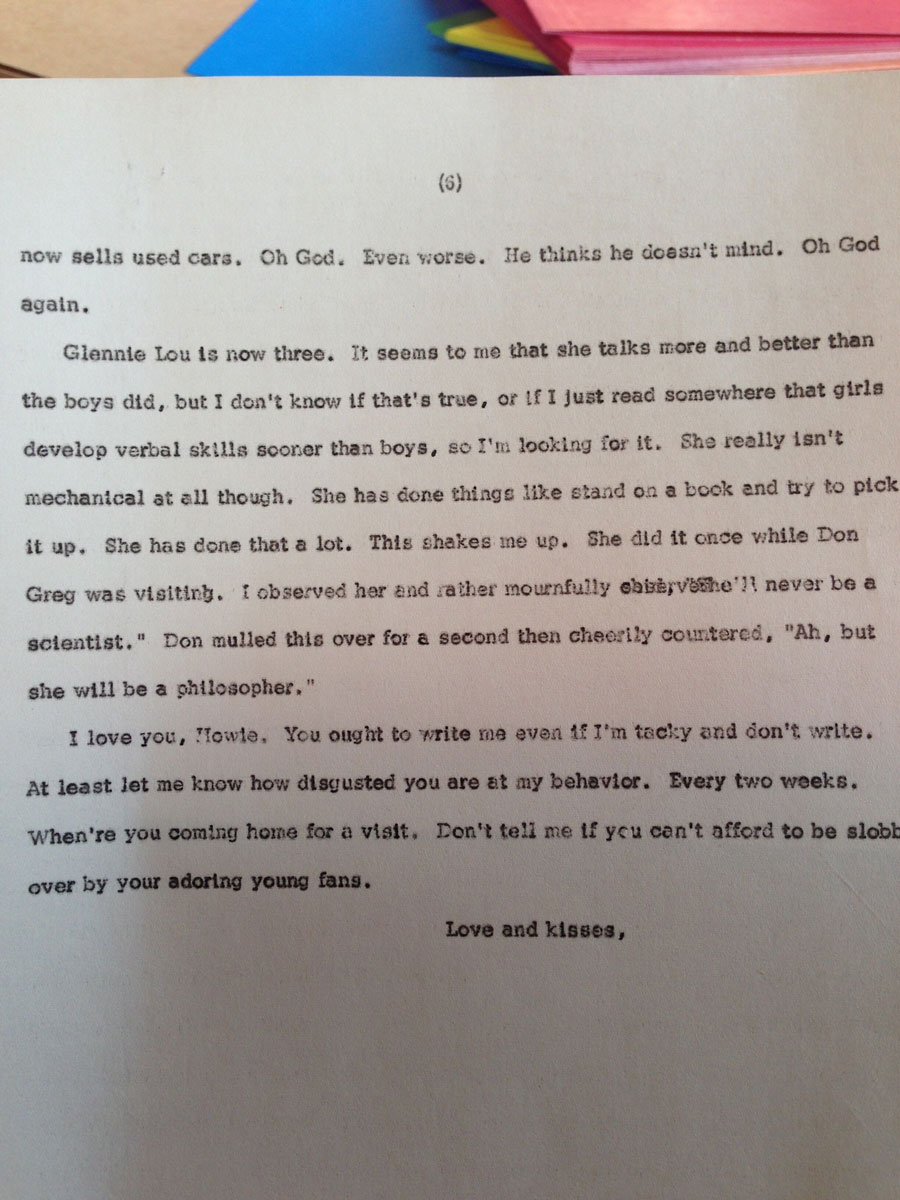
But she did write about me. In 1979. To Howie:

Letter shared between author's mom and Howard Cruse.Letter shared between author's mom and Howard Cruse. (Photo courtesy of author)

Glennie Lou is now three. It seems to me that she talks more and better than the boys did, but I don't know if that's true, or if I just read somewhere that girls develop verbal skills sooner than boys, so I'm looking for it. She really isn't mechanical at all though. She has done things like stand on a book and try to pick it up. She has done that a lot. This shakes me up. She did it once while Don Gregg was visiting. I observed her and rather mournfully said, "She'll never be a scientist.’"Don mulled this over for a second then cheerily countered, "Ah, but she will be a philosopher."

In the next paragraph, she pleads with him to keep showing up in the mailbox. 

I love you, Howie. You ought to write me even if I’m tacky and I don’t write. At least let me know how disgusted you are at my behavior. Every two weeks. 

* * *

I asked myself what my mother’s correspondence represented to me. She was an English teacher and an aspiring novelist, but above all else a correspondent: She wrote hundreds of letters to dozens of people and, like Howie, kept copies of them all. (Turns out second-sheet carbon paper was the sent folder of the 1970s.) Thanks to my father, I had always had access to my mother’s papers, which included all of her letters. But neither my father, nor any of my three older brothers, nor I had ever read them — or at least had never read them all. The anguish of her absence was too great. Before I got that fat, flat package from Howie, I could only ever manage one or two at a time. And they weren’t even in order. While Howie’s correspondence was labeled and filed, what we had was hoarding as a grief strategy: letters stuffed in boxes and boxes stuffed in dresser drawers. For me to even open an envelope meant a trip to my stepmother’s house, where the precious cache was moldering in a mildewed basement.

Then here came Howie with an un-disordered archive. I didn’t have to go get it — it arrived in my mailbox. The thick packet contained an exchange of more than 20 letters, but for me it had a wonderful weightlessness. I imagined the mail carrier had been forced to hold onto it like a balloon, that “PRIORITY MAIL” in this case probably meant “so magical and important that before I delivered it, the Postmaster General had to personally devise a method to keep it from floating away.”

Envelope of correspondence from 1979-1982 between author's mother and Howard Cruse.Envelope of correspondence from 1979-1982 between author's mother and Howard Cruse. (Photo courtesy of author)

After I read a few Howie letters, I decided I was ready for the rest of her letters — to everybody. I thought of the phrase READY TO READ! and I couldn’t help laughing. When my mother taught me to read, this was surely not what she had in mind. But once I got started I couldn’t stop. I grew obsessed with completion. I felt I couldn’t figure out anything unless I read everything. The letters were all I had to go on. Those pages were my only bequest.


Want a daily wrap-up of all the news and commentary Salon has to offer? Subscribe to our morning newsletter, Crash Course.


So I retrieved reams and reams of paper from the basement and I ordered a fireproof, waterproof safe. I bought and donned white cotton gloves like the pros wore in the library archives department. I opened envelopes she had closed with wax seals. I turned piles into stacks and labeled new file folders and made a few spreadsheets. I put the letters in chronological order and arranged them by recipient. All the new information galvanized me. The more I read, the more confused I felt — and the more thrilled, too. I thought I would find answers with a capital-A, although I hadn’t even come up with questions.

Dated files of correspondence between the author's mom and Howard Cruse.Dated files of the author's mother's correspondence. (Photo courtesy of author)

* * *

I got drunk at a party and cornered a historian to ask for his guidance on research.

He said, “Well, you know that not everything in those letters is true.”

I said, “What?”

He said it again, and again I said, “What?”

We looked at each other for a long time. And I laughed and groaned and said, “Of course it’s all true.”

“Maybe,” he said. “Or maybe none of it is.” 

* * *

I spent the next several years writing to Howie about my mother and about writing. I called our correspondence “the doubling.” I was writing to Howie about her. And Howie was writing to me about her. And as we parsed how she wrote to him and about me, we were writing to each other about writing. 

June 17, 2014
1:46 PM

Glenny Brock
to Howard

What always astonishes me about your letters is their length My God, their length! I try not to worry overly about What Kind of Writer I Am, but I do seem to have trouble with length. Is this concision or compression? I'm not sure. In any case, it troubles me, but only a little bit.

glb

June 17, 2014
1:48 PM

Howard Cruse
to Glenny

Yeah. Well, past versions of me had the spare time necessary for writing long letters. Those days, sadly, seem to be gone. Sigh.

Howard

But included in my mother’s files I found an eight-page single-spaced letter that Howie had written to someone else — a document he had not included in the original packet he sent me. It was clearly a copy of a copy, meaning he must have sent my mother a copy of his copy. I wrote to ask him why, and he explained: “I made two carbon copies while writing it because I wanted to communicate the same things to Nancy without having to compose all the same notions a second time from scratch.”

This made absolute sense — it was the 1974 version of copy and paste. I’ve done the same a hundred times, cribbing from emails to compose essays, from text messages to finish poems.

* * *

“Pen pals” is such a corny term for a pair of people exchanging letters. These two were having intercourse, in the old-fashioned sense of the word — the give-and-get idea swap described by the medieval Latin intercursus: “communication to and fro.” The word implied exchange and intervention. Intercourse was a merchant’s word — used exclusively in trade until the 16th century. Then, for 200 years, it meant “mental or spiritual exchange.” Before the bawd overlay, the definition was “social communication between individuals; frequent and habitual contact in conversation and action.” Intercourse also meant “communion between man and that which is spiritual or unseen.”

Discourse was different: That word eventually meant conversation, but its Latin ancestor was discursus, “the action of running off in different directions.” Ultimately it meant “application of the mind to something,” which sounds like a solo act.

Their intercourse was discourse with a sly eye toward posterity. I was that posterity, on the page and off. 

* * *

“Pen pals” is such a corny term for a pair of people exchanging letters. These two were having intercourse, in the old-fashioned sense of the word.

At some point, Howie and I were discussing a novel written by a mutual acquaintance. Howie made an offhand remark in which he described the book as a failure. I didn’t bring it up again for four or five years, and then when I did, he didn’t even remember the conversation.

“If I said the novel ‘ultimately failed,’ I was probably being overly harsh,” Howie wrote in an email. “What I probably meant was that, while [the writer] was able to step back emotionally from the real life events to an admirable degree, he didn't achieve quite enough distance to put himself in the reader's place when he wrote it. This prevented him from recognizing when certain of the protagonist's behaviors needed further exploration…

“But I don't think that means the novel necessarily ‘failed.’ Just that, in my view, it could still be improved a bit with further exercises of craft and additional emotional distance.”

* * *

I had been thinking a lot about “emotional distance,” although I wasn’t calling it that yet. But Howie used the phrase and I read it like a map key. My mother was an absence rather than a presence; she was not a parent but rather a writer whose work I could study. Reading became a way to conjure her and draw her close —she was a character in her own story, but also in mine. Her future was history. Mine and hers too. Howie called the whole endeavor my “Getting-To-Know-Nancy Project.” And so it was. In those pages, I could read her like a book. 

What was the goal, though? Resurrection? Burial? 

When it came to letters she exchanged with anybody else, I didn’t know what I was missing. But I thought Howie’s cache could provide all the answers because I perceived it as complete. He was like a well that would never run dry. He was a slot machine set to win every time. Every time I hit refresh, the picture would get clearer, revealing some new detail. I started to think of Howie as a bizarro executor of her will. 

I had inherited his friendship. I had inherited his letters. And through him, I had inherited her letters, which actually felt like inheriting her. Her living voice — her wit and insecurities, her vanities and fibs, the whole of her mind as she herself came to know it. To read these letters was as good as reading her mind. 

The Howie correspondence unlocked something else that I had been previously unwilling to face — that getting to know her would mean having to grieve her, even if we only met on the page.  

* * *

Here’s an excerpt from a letter. I don’t know who the recipient was, or where the first two pages are. It’s only clear that it was written after Dec. 1976, because she is pondering how best to mother me.

My parents raised me to think a girl could do anything a boy could. When I learned the hard way that society as a whole did not share this opinion, it was a nasty awakening. Should I let Glennie dream her dreams? Or should I warn her early on as I was not warned? I keep thinking that if I had been prepared to meet prejudice, it wouldn’t have been such a big shock. On the other hand, if I warn her what it is like to be a woman in a man’s world, she might not dream at all. What to do?

What to do indeed? 

* * *

Obituaries almost always mention survivors, but they never mention the paper trail that the dead leave behind. My mother did not have a decent obituary — not one that did her justice — because her death was sudden. Instead, there was a death notice, just two column inches, with a list of our names behind the baffling phrase “survived by.” As if we survived her, but she didn’t survive us. The word choice is weird, right? It almost implies the dead can’t survive the living. But it’s not like we best the dead just by continuing to breathe.

My mother was an absence rather than a presence; she was not a parent but rather a writer whose work I could study.

Then again, the notion that any piece of writing, obituary or otherwise, can do someone justice is probably absurd. But I think about the phrase “body copy” — a printer’s term for the heart of the text, the main part of the text, everything that isn’t a headline or subhead or caption. When you learn to write letters, you’re told that the body is everything between the salutation and the closing. 

Her letters survive. I discovered her body in all those paragraphs on second-sheet carbon paper.

* * *

Howie died in 2019. In addition to his husband, brother, daughter, grandchildren and friends, he was survived by his letters, comics and drawings. In a letter to my mother written in 1974, this was his take on mortality: 

As to the Afterlife, I don’t particularly believe in the reincarnation of a soul/entities from human body to human body… or from human body to tomato or cockroach. I wouldn’t be that surprised (or disturbed), however, to find out that I’m wrong. 

* * *

Strange, but I’ve never considered writing a letter to my mother. Not once. To do so would seem like a silly put-on — like a weird grief pantomime. But I still write to Howie sometimes, even though he’s dead. This morning, for instance.

Dear Howie, 

I dreamt of you last night. We were sitting in some kind of storage facility and were supposed to be sorting packages, but instead were arguing about narrative clarity. 

I kept saying, “I’m thinking, I’m thinking!”

You said, “But you’re not. Not really.”

I said, “What? What do you mean?”

You said, “What about a willingness to discard directly autobiographical moments in favor of invented ones?”

I had a clever comeback, but it vanished as soon as I woke up. Can you remember it? 

Either way, if this letter reaches you, please let Nancy know that some of her messages got through.

After the big loss, what’s next? An open letter to the Democratic Party

We lost. But all is not lost. We can win in the next two critical national elections. How? What is next? We must improve our connection to and our communications with the middle class and blue-collar voters. We need to articulate, advocate and fight for new policies and change in government to protect the American Dream for all citizens. We must address the rapidly rising inequality in wealth, in our economy and in capitalism. We need to show average Americans that government is not rigged against them and only accessible mostly to wealthy donors. We need to restore trust in democracy by proving that efficient government programs can directly help them. We must be aggressive and tenacious once again, in the tradition of historic and inspirational leaders like Sen. Robert F. Kennedy and Dr. Martin Luther King Jr., by advocating for radical change in housing, education, health and labor rights. 

We lost the presidential race and the Senate and failed to win back the House last year because we have been consistently losing white, Black, Hispanic and Asian middle-class voters over the past 25 years. This is an open wound which is bleeding profusely and if not addressed, could be the death of the patient. The loss in 2024 was not simply about Joe Biden's late departure from the Democratic field. We had an opportunity during  the primary campaign (when we ignored Rep. Dean Phillips' warnings) to voice our concerns about Biden’s age or to remind him that we voted for him in 2020 to defeat Donald Trump and serve one term.

Moreover, the blame does not rest on Kamala Harris and her valiant effort over 90 days to replace the incumbent. Democrats lost in 2024 because we have become the party of the status quo and could not overcome Trump, the agent of chaos and destruction. Defending the overall status quo at a time when the American Dream is slipping away for so many working Americans is politically tone-deaf and dangerously out of touch. Defending the status quo on rental rates and home prices, especially if you want the votes of middle-class people or voters under 40, is insane. Maintaining the status quo in education today too often translates to your educational future being determined by your zip code, not your GPA. Getting into private colleges, and being able to afford them, is increasingly reserved for millionaires and legacy kids. The status quo In health care means our seniors may need to win the lottery to afford heart medicine and blood pressure pills. 

Defending the overall status quo at a time when the American Dream is slipping away for so many working Americans is politically tone-deaf and dangerously out of touch.

Democrats need to find ways to reduce bureaucracy, increase opportunities for home ownership and build affordable middle-class housing. We need to pioneer and announce new programs that grab the attention and support of angry and frustrated voters. If California finds ways to quickly rebuild housing in Los Angeles after this winter’s devastating fires, we need to replicate this nationwide. Voters ultimately picked their presidential candidate in 2024 based on two choices: 1) Keep things the same. 2) Blow things up. Harris was too often identified with the first position, even claiming that Trump wanted to go too far with his promises to “tear down the Department of Education.” Trump, of course, advocated the second position. There should have been a third choice: Big Change! We did not convey a message of fresh and viable economic change for working people. Nor did we stake out bold ideas for young voters, who increasingly voted Republican.

Blue-collar voters in the heartland states (don’t call it the Rust Belt) have seen their jobs disappear due to trade, technology and globalization. You hear repeatedly from workers who once had good jobs in a steel plant or highly-paid jobs assembling cars that their lives are now virtually over. They recall being 35 years old and making great money but now, perhaps, they must work as Uber drivers, and make half their previous salary. They will tell you their children have “no future” in getting good jobs or achieving the American Dream. This is a wrenching gut-punch to the soul. Democrats need to be the working-class voice of frustration and their hammer for change. 

We need your help to stay independent

Democrats did not lose the election in 2024 because we defended transgender choices or believe in climate change. We are morally right on both issues. We lost because we too often appear to lead our national agenda with these issues even as most Americans desperately want to hear about what we will do to curb rising housing prices, reduce escalating egg prices, keep gas prices low and fix out-of-control college costs. Food, energy, housing and education are core voting issues, especially when you experience them as reducing your choices and chewing up your family budget. This past week, Waffle House added a surcharge of 50 cents per egg, resulting in the average meal for two increasing to $27. Voters want to hear what we will do to protect their current job and create new ones. They want lower prescription drug costs and less Medicare bureaucracy. Please make a real difference in my daily life, they tell us. It’s almost like a desperate prayer. 

We Democrats lost in 2024 because too many voters had the impression that we cared more about telling them to buy an expensive electric car than helping them repair their 10-year-old pickup. In October, I knocked on a door in Pittsburgh where a voter informed me that “Democrats want to ban my fracking job, tell me what kind of car to buy and rename my local school.” He went on to say, “I don’t have the luxury to care about all that other stuff when I don’t have a decent job and I can’t afford the future for my family.” Democratic presidents like Franklin Roosevelt, John F. Kennedy and Lyndon Johnson once had their pictures proudly displayed on the walls in these homes. These people used to be reliable Democratic voters. We need to loudly and proudly make the dignity of work, and the character it builds, the clarion call of our party. 

Democrats lost in 2024 because too many voters had the impression that we cared more about telling them to buy an expensive electric car than helping them repair their 10-year-old pickup.

In 2024, Democrats too often made the mistake of failing to respond to Republican attacks, particularly on the transgender issue. Harris was portrayed in a TV clip supporting generous resources for prisoners to access gender-affirming operations and drugs. I saw no timely or effective response from the Harris campaign in swing states. It appeared to many voters, falsely, as if this was the primary issue and singular focus of the Democratic candidate. Absent a compelling and succinct economic message, cultural issues took center stage. Democrats must boldly lead on the economic message and rebuild the American Dream. That must be our first, second and third issue. We can make policies impacting civil rights and extreme weather important issues in our national platform. Lesson learned: We must expect vicious attacks on these cultural stands and must proactively have the playbook ready to respond aggressively and powerfully. 

Democrats need to have inclusive and respectful discussions on these cultural issues, because there are richly diverse opinions within our party and across the country. Rep. Seth Moulton, D-Mass., said he believed his daughters should not have to compete against transgender athletes on the soccer field, and was unfairly vilified and ostracized by fellow Democrats. Democrats should be open to meaningful discussions on these issues and should listen to one another on all sides of these policies. We often criticize the MAGA wing of the Republican Party for dictating policy, and insisting that it’s “their way or the highway.” We should be a party that welcomes diversity and discussion and builds a big tent across America. Immigration should also be an issue where we can combine concerns about national security, human rights and new technologies to protect the border from drug cartels. 


Want a daily wrap-up of all the news and commentary Salon has to offer? Subscribe to our morning newsletter, Crash Course.


Democrats have been losing blue-collar and middle-class voters because we often don’t actively go to them, listen to their concerns and respectfully take in their opinions and criticism. Some say we lecture them, the way a professor does in a first-year freshman philosophy course. When a young senator from Illinois ran for president in 2008, he purposefully targeted independent and swing voters in suburban and rural areas. For example, he personally campaigned in my home state, visiting suburban Indianapolis and swing regions like LaPorte County in northwest Indiana, meeting with union members who were increasingly independent voters. Barack Obama played basketball with farm kids. He let pissed-off and laid-off workers blow off steam at him. He visited Indiana dozens of times. He pursued the strategy of "losing by less," understanding that he would almost certainly lose most of these targeted counties and rural areas, but might shift them from 70-30 losses to 60-40 losses. He showed up, he listened and he proposed specific economic reforms to answer voters’ questions about jobs, schools and health care. What happened? He actually won Indiana in 2008, the first Democrat to do so since the 1964 Johnson landslide. Democrats must return to this proven template to aggressively pursue the middle-class vote and be willing to "lose by less." We must be more competitive in more states, counties and small towns, even those we perceive as deep red. 

Democrats should carve out distinct and important differences with Donald Trump’s Republican Party. Democrats are not in favor of pardons for violent convicted criminals who viciously assaulted our police officers on Jan. 6, 2021. Democrats are for safe and secure borders, but not for ripping up the 14th Amendment to the Constitution, which protects the citizenship of everyone born in the USA. Democrats should support common-sense guardrails on technology to protect our children from predators and dangerous, addictive social media algorithms. Democrats should support AI efforts in biotechnology and antibiotics for better science, but must not allow Big Tech to create "people robots" that can eliminate tens of thousands of blue-collar and white-collar jobs. We want to “make in the USA” and insist on fair trade agreements with other countries, with real access to their markets to sell American products. Democrats don’t support wealthy oligarchs who buy elections and purchase access to government. Democrats need to draw clear, concrete lines voters can understand, so they can draw their own conclusions and make rational decisions. We must hold the Trump administration accountable. We must clearly announce and repeat our differences with them, and do vigorous battle for the hearts and minds of middle-class voters. 

Barack Obama visited Indiana dozens of times in 2008, pursuing the strategy of "losing by less" — and became the first Democrat to win the state since 1964.

Statistically, the Democrats did not suffer a devastating defeat last November. It was fairly close. A handful of House seats changing hands in 2026 will deliver a Democratic majority and a Democratic speaker. Recruiting the right candidates in the Senate to match the politics of each state, and to defeat Republican incumbents while avoiding divisive primaries, will help narrow the current gap. The number of talented and qualified potential Democratic presidential candidates for 2028 — Gov. Gretchen Whitmer, Gov. Wes Moore, Secretary Pete Buttigieg, Secretary Gina Raimondo, Gov. Josh Shapiro, Gov. Andy Beshear, Gov. JB Pritzker, Gov. Gavin Newsom, Sen. Cory Booker, Sen. Amy Klobuchar and others — bodes well for our chances of winning  the White House.

But although the future looks bright on many fronts, only 51% of Democrats believe their party is headed in the right direction, according to a Morning Consult poll published on Feb. 4. (That’s down from 65% in January 2024, while 84% of Republicans believe their party is trending the right way.) Rebuilding our economic message is the key to winning. The American Dream remains achievable, but the ladder required to climb up and grab it requires modernizing and repairing. The rungs on that ladder have always been education, jobs, housing and health care. Let’s learn from this past election, fix the mistakes we have made through the past several cycles, and propose a positive economic agenda for reaching the American Dream. 

Donald Trump’s chaos strategy: Why Americans continue to fall for his game of distraction

President Trump and his MAGA Republicans and their forces are smashing American democracy, the Constitution, the rule of law, the institutions and norms. Trump has enacted over 50 executive orders since Jan. 20, the most in a president's first 100 days in more than 40 years. Some of the most egregious ones are blatantly unconstitutional and violate current law. It has only been three weeks since Trump returned to power; these are the good times compared to what will come next.

At the root of Trumpism and American fascism’s quick ascendance, and the pitiful resistance to it, is a profound failure of imagination. 

Be very wary of any political observer or other public voice — or anyone else — who suggests that Trump and his MAGA movement are losing, in disarray, ineffective or somehow confused or weak. Such people are seeing what they want to see and not what is actually happening. Donald Trump and his MAGA movement’s strategy is chaos. Moreover, that chaos is in service to their shock and awe strategy to end America’s pluralistic democracy and to replace it with a form of autocracy if not outright fascism modeled on Viktor Orbán’s Hungary or Vladimir Putin’s Russia with Trump as de facto leader for life. As Harold Meyerson observes in The American Prospect, “As to the wider world, if we ever sought to be that beacon on the hill, we’re now the bully on the hill. America, Trumpified.”

America’s center is rapidly collapsing, and it has not been very difficult for Trump and the MAGA movement and the other fascists and authoritarians to break it. During these last three weeks, I have been repeating aloud, on the bus, during my walks, and at random times throughout the day, William Butler Yeats’ poem “The Second Coming,” particularly his warning that “the centre cannot hold":

Turning and turning in the widening gyre   

The falcon cannot hear the falconer;

Things fall apart; the centre cannot hold;

Mere anarchy is loosed upon the world,

The blood-dimmed tide is loosed, and everywhere   

The ceremony of innocence is drowned;

The best lack all conviction, while the worst   

Are full of passionate intensity.

Surely some revelation is at hand;

Surely the Second Coming is at hand….

At the root of Trumpism and American fascism’s quick ascendance, and the pitiful resistance to it, is a profound failure of imagination. The phrase “failure of imagination” can trace its popular use in the United States to the Apollo 1 disaster and testimony by astronaut Col. Frank Borman. As depicted in the 1998 TV miniseries “From the Earth to the Moon”, Borman told Congress that:

A failure of imagination. We’ve always known there was the possibility of fire in a spacecraft. But the fear was that it would happen in space, when you’re 180 miles from terra firma and the nearest fire station. That was the worry. No one ever imagined it could happen on the ground. If anyone had thought of it, the test would’ve been classified as hazardous. But it wasn’t. We just didn’t think of it. Now whose fault is that? Well, it’s North American’s [the capsule manufacturer] fault. It’s NASA’s fault. It’s the fault of every person who ever worked on Apollo. It’s my fault. I didn’t think the test was hazardous. No one did. I wish to God we had.

The failure of imagination that allowed Donald Trump and the MAGA movement to ascend to power is of a different type. It was wholly predictable. Trump and his agents were direct, vocal, and public in their plans to make him the country’s first elected dictator on “day one” and to launch a revolutionary project to return the country to the Gilded Age, if not before, and the types of destruction it would necessitate as the rights and freedoms of entire groups of Americans are taken away, the social safety net is further gutted, and the plutocrats and kleptocrats and White Christian Nationalists and other White racial authoritarians are given free rein over American life.

In many ways, the failure of imagination by the country’s “responsible” political leaders, the mainstream news media and the American public that empowered Trump and MAGA’s ascendance is willful and negligent. For years, these so-called responsible voices repeatedly proclaimed that Donald Trump was done for after his first term in office after a coup attempt on Jan. 6, twice impeached, multiple criminal and civil trials, a botched COVID response and an economy left in tatters. That did not happen.

These same “responsible” and “mainstream” voices also declared that there was no way that the Republican Party would nominate Trump to be its candidate in 2024, he is damaged goods with too much baggage, and the “adults in the room” would step in and rise to the occasion. Again, this did not happen. Donald Trump and his MAGA movement, almost quite literally, own today’s Republican Party and “conservative” and larger right-wing movement.

Throughout the Trumpocene, these “reasonable” and “mainstream” voices were confident that “the walls were closing in” and heroes would rise, like in an old Hollywood movie, to vanquish the bad guy and save the day. First, it was Special Counsel Robert Mueller. Then the hero was Attorney General Merrick Garland. Then it was Special Counsel Jack Smith. The state prosecutors and attorney generals would supposedly be a heroic firewall and last line of defense against Donald Trump and his perfidy. The walls never did close in. Trump would become more popular following his prosecutions and trial(s) than before. Trump now wears “felon” as a badge of honor and courage, one that his MAGA followers and other Americans who are disgusted with the system flock to.

We need your help to stay independent

These “mainstream” and “reasonable” voices — especially the mainstream liberals and progressives — were mostly exuberant that Kamala Harris replaced Joe Biden in the 2024 election. To them, Harris was a historic and compelling leader. She would be the first Black woman to be President of the United States. She is a committed public servant, magnetic, charismatic, compelling, and would attract young voters and college-educated white women who want to defend their reproductive rights and freedoms. The vibes! The brat energy! Beyonce and Taylor Swift and other celebrities are on Kamala Harris’ side! How can Donald Trump with his Village People "YMCA" dance, podcasts, the "manosphere" and professional wrestling and MMA fighters stop Kamala Harris and the Democrats? Impossible!

These “mainstream” and “reasonable” voices concluded that Donald Trump’s Madison Square Garden and how it channeled the infamous American Nazi rally of 1939 was a “disaster” and would lead to his defeat. I warned, however, that Trump’s MSG rally was actually a genius strategic and tactical move that made his MAGA people feel seen, as he was so bold as to launch a version of a military raid behind enemy lines in a solidly blue state and the Democratic Party stronghold of New York City.

Donald Trump and the MAGA Republicans went on to easily defeat Harris and take control of all three branches of government. The fabled blue wall was easily pierced and then shattered. The Democratic Party’s base did not show up to vote. A majority of white women, again, supported Trump. Trump’s coalition grew and now includes a large number of Hispanics and Latinos — even as he threatened mass deportations against their community. Trump expanded his base of support in New York — as I warned and predicted — among a range of groups, including Hispanics and Latinos. A new poll from Quinnipiac University shows that the Democratic Party’s favorable rating is 31 percent. 57 percent of the people polled have an unfavorable view of the Democratic Party. By comparison, the Republican Party has a 43 percent favorability rating and 45 percent unfavorable.

For more than eight years, the mainstream news media and political class and other “reasonable” and “responsible” political voices and leaders could have adapted to the rise of Trumpism, American neofascism and the authoritarian populist moment. Instead, they continued with a habitual failure of imagination and the American people — and their democracy and society and future and freedom — are being made to suffer and are greatly imperiled.

This did not have to happen. In an essay in the Atlantic in May of 2024, Tom Nichols diagnosed and warned about the dangers of a failure of imagination and Donald Trump’s return to power:

Nostalgia and presentism are part of politics. But a second problem is even more worrisome: Americans simply cannot imagine how badly Trump’s first term might have turned out, and how ghastly his second term is likely to be. Our minds are not equipped to embrace how fast democracy could disintegrate. We can better imagine alien invasions than we can an authoritarian America. The Atlantic tried to lay out what this future would look like, but perhaps even words can’t capture the magnitude of the threat.

When I was in high school and taking driver’s education, our teachers would show us horrible films, with names like Death on the Highway, that included gory footage of actual car wrecks. The goal was to scare us into being responsible drivers by showing us the reality of being mangled or burned to death in a crash. The idea made sense: Most people have never seen a car wreck, and expanding our imaginations by showing us the actual carnage did, I suspect, scare some of us into holding that steering wheel at the steady 10-and-2 position….We just don’t have a similar conceptualization for the end of democracy in America….

Trump’s most alarmist opponents are wrong to insist that he would march into Washington in January 2025 like Hitler entering Paris. The process will be slower and more bureaucratic, starting with the seizure of the Justice Department and the Defense Department, two keys to controlling the nation. If Trump returns to office, he will not shoot democracy on Fifth Avenue. He and the people around him will paralyze it, limb by limb. The American public needs to get better at imagining what that would look like.

In a 2016 interview with On the Media, Masha Gessen offered this direct warning about the extreme danger(s) of Donald Trump and the MAGA movement:

We need to start imagining what happens if he becomes president. Now, the American system doesn't actually give the chief executive a lot of power. There is an intricate system of checks and balances that will force him to mobilize things through rhetoric. And that basically means, I think, that we have to start imagining witch hunts, we have to start imagining kind of wars at home. We have to start imagining what kind of groups he is going to start blaming for all his problems and all our problems, whether real or imaginary.” Gessen would be proven correct in ways far worse than perhaps even they imagined at time….My advice to the news consumer is – imagine the worst.


Want a daily wrap-up of all the news and commentary Salon has to offer? Subscribe to our morning newsletter, Crash Course.


In a recent conversation with me here at Salon, Norm Orstein issued this ominous warning: “This is part of the biggest problem. We have lost our guardrails against autocracy. The press is pathetic. The Republicans running Congress are pathetic. The Supreme Court is in Trump's pocket. Civil society, starting with the business community, is worthless. Be afraid. Be very afraid.”

At the Bulwark, Jonathan Last says this about America’s failure of imagination and the worsening national emergency that is Trump’s return to power and his shock and awe campaign against American democracy and society:

And here’s the point I want you to remember: When I say today, on January 27, that Trump’s gangster government is going to end badly—maybe even very badly—it sounds crazy and hysterical.

But if I described the state of affairs as they exist on January 27 to you twelve weeks ago, you also would have thought that I was crazy and hysterical. You would have said, “I guess that’s possible, but you’re talking about something close to a worst-case scenario.”

Yes, Putinism would definitely be a worst-case scenario.

But we are living the worst-case scenario right now. Maybe in the future something will slide us down the scale to one of the lower-variant scenarios. That would be nice. I hope it happens. But right now we are on track to a dark place.

Ultimately, Trumpism and American fascism and authoritarianism are a symptom and not the cause of much deeper and profound problems in American society and life. There were some voices, most notably Black and brown people and others who are not enamored with or blinded by America’s various myths of its own exceptionalism and greatness and the permanence of its “democracy”, that saw the danger clearly because they were not blinded by Whiteness and its many small and big lies that in total created the failure of imagination that led to Trump and MAGA’s triumphant return to power.

Donald Trump’s autocracy is not a hypothetical or possibility far off in the future. It is here and now and very real. America’s crisis and failure of imagination has been subsumed by a horrible reality — one that is not going away anytime soon.

Trump’s imperialist acid flashback: Is his Club Gaza dream for real?

You can’t out-think Donald Trump. You can’t think your way around him or through him and get to the other side — there’s no there there. In fact, thinking about Donald Trump is generally a bad idea, like thinking too much about Cthulhu or the Candyman, and should be avoided whenever possible. Didn’t old Fred Nietzsche say something about gazing too long into the abyss?

There is no way to make sense of Trump’s neo-imperialist acid-flashback proposal that the U.S. should take “a long-term ownership position” in Gaza, expel the people who live there and redevelop all that needlessly squandered beachfront real estate as a nightmarish hybrid of Dubai, Las Vegas and Monte Carlo. Trying to puzzle out what he “really” meant, as opposed to what he actually said, will get you nowhere. 

World leaders and political commentators and elected officials face a genuine quandary here: This individual has once again become the actual president of the actual United States, and his words and deeds manifestly have real-world consequences. No one can entirely resist being trolled or seduced or buffaloed or bamboozled by Trump; those are not just his principal talents but the motivating forces of his existence. At best, we can strive for a few moments of Zen-like calm: Remain still as a stone, and allow the Trumpness to flow over you, one foul current in the stream of human consciousness. Name the powerful emotions you feel and set them aside, because unleashing your anger, outrage, disgust and so forth — as, again, with Cthulhu — only nourishes him.

Far too many words have already been expended on treating Trump’s so-called Gaza plan as something that might actually be attempted, and explaining the many reasons why it isn’t a good idea and wouldn’t work. Isn’t it overly gullible, a bit too Charlie Brown, to plunge into earnest discussion of military blowback and outlandish expense and crimes against humanity? 

Trump himself has already backpedaled on this obscene fantasy while claiming not to, in his own inimitable style. More recently he has insisted that everyone "loves" the idea (which everyone hates) and suggested that Gaza will be "turned over" to the U.S. by Israel at some future date — presumably after the Israelis have finished the job of flattening the place and removing its entire population — but that the U.S. will spend no money there and send no troops. The art of the deal! 


Want a daily wrap-up of all the news and commentary Salon has to offer? Subscribe to our morning newsletter, Crash Course.


On the other hand, it seems overly cynical to leap into decoder-ring mode and offer exegetical pronouncements about the brilliant and/or delusional strategy beneath this real estate wet dream. There’s been a lot of that too: It’s a negotiating ploy aimed at Arab leaders, Bibi Netanyahu or both: Get on board my nonexistent peace plan, or the s**t’s really gonna hit the fan! It’s a long-term Trump Organization business plan! It’s designed to make us say, hey, let’s just give this lunatic Greenland and the Panama Canal; maybe that'll shut him up! It’s vaporware, likely authorized by White House chief of staff Susie Wiles to distract the media thumbsuckers and foreign-policy eggheads while Elon Musk loots the federal treasury!

I mean, all those interpretations seem plausible and most of them are at least a little bit true — but a better way to put it is that they’re all true in different iterations of the Trump multiverse. I said this was an acid flashback! Those approaches all fail to capture or comprehend the quantum nature of Trumpian discourse; he’s like Schrödinger’s cat, stuffed with Burger King and Ozempic. He’s alive and dead, serious and joking, monumentally stupid and a stable genius, all at the same time. 

Most responses to the Gaza-Lago scheme fail to comprehend the quantum nature of Trumpian discourse; he's like Schrödinger's cat, stuffed with Burger King and Ozempic. He’s alive and dead, serious and joking, stupid and a stable genius, all at the same time. 

Trump means everything he says when he says it, sort of: He’s a salesman first and foremost, and temporarily believing your own lies is an important career skill. He’d be delighted if his vision of a Middle East Riviera purged of poor brown people and piled up with craptastic Trump Towers could come to fruition. He’s also willing to refine the idea downward, all the way to zero if necessary, or to deny he ever said it in the first place. 

But the half-baked, semi-apologetic refinements offered by underlings like press secretary Karoline Leavitt or Secretary of State Marco Rubio — maybe Trump didn’t mean that all Palestinians would have to leave forever, or that the U.S. would literally occupy Gaza — are not his style. He’s about the bleach-injecting thought experiment, the hurricane-nuking brain-fart, the future-slicing blue-sky initiative aimed at reshaping the world and creating peace in our time. If those seem like incompatible states of matter, you haven’t been keeping up. 

This is where the deep thinkers of the "anti-anti-Trump" left — my own unfortunate coinage, I believe — run themselves aground trying to enlist our Great Leader as an anti-imperialist ally. Ryan Grim, a reporter whose work I respect in other contexts, expended considerable effort last week on the hypothesis that Elon Musk’s demolition of the federal government might not be a bad thing, given that the “deep state” budget conceals many unsavory policies and practices.

Like the entire anti-anti-Trump enterprise, this relies way too heavily on the stopped-clock premise, and also on the misguided belief that Trump’s supposed opposition to overseas military adventures or empire-building reflects some kind of consistent principle or internal logic. It’s yet another failure to reckon with quantum Trumpness: Trump isn’t "for" or "against" anything, in the normal sense of those words. He has taken Emerson’s nostrum about consistency being "the hobgoblin of little minds" to its acid-flashback extreme: no consistency and no mind to speak of, but one hell of a hobgoblin.

Our president simultaneously inhabits a ruthless Darwinian realm of hard-headed dealmaking and power struggle — which is as close as he comes to understanding the contemporary world — and an early 20th-century coloring book of manifest destiny and boundless American greatness, which Teddy Roosevelt would have found unbearably simplistic. (I’m skipping over the paranoid late-'80s New York City in Trump’s brain, which is always a factor but less directly relevant here.)

Trump would be delighted to conduct foreign wars if they were guaranteed to result in glorious victory and universal acclamation, with homoerotic parades of weeping, muscular white men staged in his honor on a regular basis. He disliked the Iraq war, in retrospect, for failing to live up to those onanistic fantasies. Instead, it was ugly, expensive and embarrassing, and came to represent — for Trump and many other people, in fairness — a disturbingly nonspecific loss of national greatness. 

Trump would be delighted to conduct foreign wars if they were guaranteed to result in glorious victory and universal acclamation, with homoerotic parades of weeping, muscular white men staged in his honor on a regular basis.

For this anxiety-ridden couch commander, there’s no contradiction between refusing to be drawn into military interventions in incomprehensible s**thole countries where scary Black and brown people wave Kalashnikovs around, and miraculously absorbing Greenland, Panama and Canada into a Viagra-infused American empire. It’s worth noting that Trump repeatedly promised to end the Ukraine war within days of taking office, and all discourse on the issue has subsequently evaporated, probably because his own advisers and supporters are divided on that one, and no fantasy solution presents itself.

Within Trump’s paranoid, narcissistic and information-resistant perceptual universe, in fact, the Gaza scheme must have seemed perfect: It purported to solve an intractable geopolitical problem, and imagined a literal monument to his greatness rising from the rubble of endless war. Those who stood in the way, at first glance, were insignificant: malleable clients (Netanyahu), powerless victims (the Palestinians), irritating scolds (Europe and the U.N.).

He may or may not have been surprised to learn that many people still pretend to believe in international law — which he and most other Republicans view as a virtue-signaling sham — and that the Arab world seems oddly reluctant to surrender the notional locus of a notional Palestinian state to an imaginary trillion-dollar American real estate venture. Trump is contemptuous of such pieties, as a recent New York Times analysis put it:

Mr. Trump views foreign policy as a real estate deal maker. He has never cared about international law, never lectured autocratic leaders about human rights as other U.S. presidents have done. Instead, for decades, he has viewed the world as a collection of countries that are ripping America off. He is preoccupied by the question of how to gain leverage over other nations, whether they are allies or adversaries. And he searches for ways to use American power to dominate other countries and to extract whatever he can.

In the harsh light of day, we may be forced to admit that amid all Trump's whining, he’s got about half a point: There will be no Palestinian state anytime in the foreseeable future, Israel has established itself as the region’s hegemonic power since the Oct. 7 attack, and the inexorable tides of global capital are likely to determine most policy outcomes. It doesn’t follow, of course, that Trump can will Club Gaza into being through sheer force of personality, literally declare war on the E.U. by invading Greenland, or mesmerize Canadians into surrendering their national autonomy

Those ideas may disappear down the Trumpian memory hole along with so many others, but as multiple reports have assured us, he was "deadly serious" about them when he proposed them. Where I land in the Trump acid trip, unfortunately, is to take the experience as it comes, and to view it as exceptionally dangerous. Donald Trump means what he says and says what he means, from one moment to the next; he is a fearful, elderly megalomaniac eager to reshape the world in his own image, however and whenever he can. 

Migrants are on the front lines of the bird flu crisis but deportation fears are causing chaos

Over the past two decades, scientists have paid close attention to the spread of bird flu, a disease caused by the H5N1 virus that has high pandemic potential. Last spring, when the virus made the jump from wild birds to dairy cows, those fears of a new health crisis like COVID-19 were amplified. Though President Biden arguably didn’t do enough to stop the spread of H5N1 — which has infected at least 67 people — now President Trump is in charge of the problem, which is already causing trouble.

It’s not just the potential of anti-vaccine conspiracy theorist Robert F. Kennedy Jr. soon to helm the health departments responsible for monitoring disease outbreaks or Trump's recent pause on federal health communications, it’s also the president’s immigration policy that is making matters worse. Public health and immigration may not seem like issues that are interconnected, but like many things, neither exists in a vacuum. To understand why, we must first talk about dairy cow density.

A dairy farm detour

Luís Jimenez, an experienced dairy worker in New York state, works in a large dairy farm where about 1,400 cows are cared for by some twenty workers. The cows are kept indoors, in airy barns of about 250 cows packed together with just enough room to lie down. Jimenez and his co-workers are available on a 24-hour schedule to keep their charges healthy and well despite such a density of cattle.

“They depend on [us] to feed them, to move them from place to place, and to check them to be sure they are not sick,” Jimenez told Salon in Spanish in a telephone interview, translated by the author. “So in my opinion the cows depend very much on our presence on the farm because we are the ones who maintain their health, who keep them clean, who clean the stables. We ensure the cleanliness of the water they drink … the boss’ business depends on the cows and on their production.”

Indeed, producing more milk for less money is key to that business. Historically, the number of dairy farms in the U.S. has been in decline over the past fifty years. However, between the 2017 and 2022 censuses, that decline accelerated dramatically. Researchers at the University of Illinois at Urbana-Champaign have attributed this to financial stress in the sector, and note that economies of scale, mostly relating to the non-feed cost per quart of milk produced, make it hard to escape this stress. A drop in milk prices in 2018, for example, narrowed the gap between a farmer’s potential profit and the costs involved in earning it.

Unless, that is, a herd is extremely large. Over the 2017 to 2022 period, there were fewer farms selling milk at all herd sizes, except for farms with herds of 2,500 cows or more, which increased. The result? There were 39% fewer farms selling milk in the US in 2022 than five years before. Large farms — those with herds of 1,000 cows or more, often over 5,000, and even 10,000 or more — dominated the sector by 2022 as never before. By that year, they accounted for 66% of all milk sales — up from 57% in 2017.

A lot of dairy workers may be at risk of deportation now as the Trump administration escalates raids in immigrant communities.

The result has been a ramping up of the long-term trend favoring consolidation of smaller dairy farms into giant, corporate-owned enterprises: the rise of Big Agriculture, a trend seen to varying degrees in other areas of agriculture as a few owners gobble up farms of all kinds. As the U.S. Department of Agriculture explains in their 2020 Economic Research Service report on consolidation in dairy farming, “the number of licensed U.S. dairy herds fell by more than half between 2002 and 2019 … even as milk production continued to grow”.

With bigger, fewer farms has come a trend towards hired rather than owner-provided labor. A New York Times Magazine last year, in an article on the impact on milk prices of immigration crackdowns, put it starkly: “Undocumented labor quietly props up the entire American economy — but nowhere more dramatically than on dairy farms.”

As journalist Marcela Valdes describes in the story, declining prices for milk while everything else gets more expensive means smaller dairies are forced to cut costs wherever they can in hopes of edging out of the ‘high risk’ operating profit margin so many of them are in (a situation described in ESR’s 2024 report on the state of America’s farms and ranches). Cutting labor costs is the most significant way to do that, and undocumented workers are least able to demand better pay — or to insist on safety measures to protect themselves from infection, or to report infractions in rules intended to keep animals and workers healthy.

Jimenez, who is a co-founder and the current president of Alianza Agrícola — a worker-founded, worker-led organized group of undocumented migrant dairy farmworkers working across five counties in Western New York — believes that about 90% of his fellow workers are immigrants, mostly from Latin American countries. Cornell University research dating back to 2018 suggests that over 50% of New York workers lack proper immigration documents. This doesn’t stop them from being excellent, skillful workers, and workers who will do dangerous, hard work for which farmers have trouble finding enough hands.


Want more health and science stories in your inbox? Subscribe to Salon's weekly newsletter Lab Notes.


In other words, a lot of dairy workers may be at risk of deportation now as the Trump administration escalates raids in immigrant communities. These are the people who do the hard work of keeping cows healthy, and containing infection when they are not.

“It’s sad and frustrating that we are critical in the farm, vital to the industry, and the owners do nothing to protect workers in this situation we’re in with respect to immigration,” Jimenez said.

What does this have to do with bird flu?

The timing for this crackdown could actually worsen the bird flu situation, with undocumented workers at these massive, tightly cow-packed facilities living in fear of Immigration and Customs Enforcement (ICE.) Whether this is mostly manufactured fear, or due to new, actual mass raids, given that the people in closest, most attentive contact with the cows are in danger of being involuntarily moved or changing location to avoid deportation, we risk failing to catch infection in cows, failing to report infection in humans, and potentially greater risk of viral transmission due to either workforce movement or lack of workers available to implement emergency measures to prevent or contain an outbreak.. Salon contacted ICE by email but did not receive a response.

At a briefing for reporters, Dr. Maurice Pitesky of the University of California, Davis, pointed out that undocumented workers are also unlikely to receive regular influenza vaccines, increasing their likelihood of harboring co-infections of human influenza and H5N1 or other types of highly pathogenic avian influenza. This is exactly the sort of scenario that makes viral evolution more likely, hastening the day when H5N1 achieves the very few mutations required for it to transmit easily from human-to-human. Jimenez says Alianza Agrícola has organized health clinics for farmworkers, most recently last month, where they can get their blood pressure checked and receive COVID and flu vaccines. Without this form of organizing and workers’ courage to be open about it, education on the value of vaccines and access to them would both be unlikely to occur at their employers’ behest.

It’s already made the leap

Consolidation in the dairy sector is far more intense than that general trend in agriculture as a whole. There are many implications of this, not least the dramatic social change that results as small family farms gradually throw in the towel. A more surprising implication, though, is the dramatic risk the accelerating dairy consolidation trend in recent years poses to human as well as animal health. That’s because H5N1 continues to spread from its avian origin into other species, most recently mammals, including humans.

"The bosses don’t offer this kind of information … there are very few farms that are informing their workers [about H5N1]."

The Centers for Disease Control (CDC) describes the current situation is an “ongoing multi-state outbreak” in dairy cows (959 confirmed cattle infections across 16 states, according to latest USDA data), while there are “sporadic outbreaks” in both commercial and backyard poultry flocks and “sporadic infections” in mammals. There have been many deaths of cats infected through raw milk or food containing it, numerous human cases, and a small handful of deaths among humans, including some with no obvious connection to wild birds, poultry or dairy cows.

The first U.S. case of bird flu in a pig was identified in October. This is worrisome because like cows, pigs are in close proximity to humans, they’re also confined to the close quarters that facilitate disease spread, and they’re particularly susceptible to influenza, offering plenty of opportunity for different flu viruses to swap genes — all of which makes them a likely vector for a highly dangerous strain or one capable of human-to-human transmission.

At this point, there are so many potential sources of bird to human or mammal to human transmission, the H5N1 genie is out of the bottle. On Wednesday last week, in fact, the USDA announced that D1.1, a subtype or clade of H5N1 previously only ever found in wild birds and poultry, had turned up in Nevada dairy cows. Not only wild birds and poultry — the Louisiana patient who died in the first week of January was one of very few humans known to have been infected by D1.1, from a backyard flock. (This strain may well be more dangerous to humans than the B3.13 genotype found in other U.S. dairy cows to date — the teenage girl in Canada who only survived her brush with bird flu from an unknown source thanks to weeks of intensive medical intervention was also infected with this type.) So now there are at least two versions in cattle, along with the other strains circulating in other animals, waiting to make the leap to new species.

All in all, we are currently only a few small mutations away from a serious pandemic. Even a single mutation to H5N1’s surface protein would be enough, as a NIH-funded study found in December, to more easily transmit between humans.

When humans are ill with infectious disease, the prevailing wisdom (if not common practice these days) is to quarantine them. Or at least to put a little healthy distance between the sick person and everyone else. Which is why it’s notable that trends in agriculture do the opposite for cows and poultry.

The density of cows and viral evolution

Fewer and larger farms, but greater milk production. There are two ways to achieve this: get each cow to produce more milk, or pack more cows onto each farm. As it turns out, large farms are working on both.

“Improvements in milk yields reflect steady improvements in dairy cow genetics, feed formulations, and on-farm practices,” write the authors of the USDA report. Due to the communications freeze imposed on National Institutes of Health staff, Salon was unable to speak with the authors of papers like this one in Nature, which describes the mammal-to-mammal spread of H5N1, its emergence in U.S. dairy cows and then in barn cats, its spread from cow to cow via milking equipment, and the expansion of what was once a single outbreak to new farms as infected cows, or infected equipment, were transported across state lines. The latter is one of several hypotheses (in fact, all of them may be correct) of how bird flu has spread. Transmission to humans might first have involved dairy workers infected by their cattle.

“We don’t understand why yet, but the information we have as workers and as part of the organization, we get it from other institutions and other organizations that bring this information to keep workers informed,” Jimenez explained. “The bosses don’t offer this kind of information … there are very few farms that are informing their workers [about H5N1].”

And workers who become sick, lacking health care and perhaps afraid to seek it, may not receive timely or any treatment, nor are bosses likely to learn that H5N1 is spreading through their workforce given that veteran workers like Jimenez nevertheless have no social security, disability or retirement benefits if they become unable to work. Like Jimenez, who on the day he spoke with Salon had finally sought an X-ray for pain from a work injury to his finger that he’d ignored for days, many workers avoid treatment for issues that only seem minor at first.

During the early days of the COVID pandemic, Alianza Agrícola organized to provide some of the information and support workers weren’t getting from their bosses. H5N1 doesn’t seem to have hit New York’s herds yet (though seven cases were recently detected in poultry), but Jimenez says he’s going to have to resort to the same mutual aid strategies if and when it does.

Until then, close monitoring of the virus is necessary. Not until April 29th did the USDA begin to require testing of cattle before they are allowed to cross state lines. By that point, the horse had left the barn, so to speak.

Speaking of barns, the consolidation of dairy farming into massive operations where cows are confined to tight spaces and feedlots rather than grazing makes transmission from one sick cow to an entire herd far easier than it would have been on smaller farms: “Cows are less likely to graze in pastures and are more likely to be confined within large barns and lots,” write the authors of the ERS report.

H5N1 surveillance

Monitoring for bird flu in humans is the province of the CDC, which so far has not reported person to person spread. However, they noted last week, in the process of recommending rapid subtyping of influenza A positive specimens from hospitalized patients to quickly detect human cases of bird flu (which is the bird version of influenza A), that there were 66 identified human cases in the U.S. last year. But the CDC has been embattled in recent days, with a freeze on external communications imposed on all federal health agencies Jan. 21. It was supposed to be lifted by Feb.1, but there’s been no word from the Department of Health and Human Services on the current status of communications.

Like the CDC, the USDA provides periodic briefings about bird flu. Or at least they did — funding for various programs is already being frozen in chaotic fashion and it’s not clear what might be next. That said, they did announce the D1.1 finding last week. But NIH-funded research on critical mutations to the H5N1 genome is also at risk.

We need your help to stay independent

It’s worth noting that, as described by Science last month, the USDA’s ERS was gutted by Trump during his first term in office. Jim MacDonald, an economist at ERS who among other things has tracked the consolidation in the livestock industry, told Science that, “without ERS, USDA would be left with relying on commodity trade groups and advocacy groups to make stuff up,” he asserted. “The information would be lower quality, and it would be packed with lies.”

MacDonald retired in 2019 when faced with a forced move that decimated the experienced workforce. Although the agency was rebuilt, Jeffrey Mervis describes in Science’s report, there’s less expertise and reportedly less willingness to explore controversial issues and share politically unpalatable findings, such as one study ERS presented back in 2018 that found the wealthiest farmers benefited most from Trump’s 2017 tax cuts.

This could translate into reluctance to carry out studies relating to the risk of H5N1 in relation to the labor force, safety measures, ventilation, density or other factors unpopular with the current administration.

And if farm owners fail to defend their migrant workforce by advocating against deportations and for regularization of status, they will lose the people quickest to notice when a cow takes ill. Indeed, the welfare of humans at risk of a true bird flu pandemic may depend on the people who care for the welfare of animals, with little recognition and fewer rights.

“I believe the reality is that if we don’t raise our voices and don’t tell anyone [about undocumented workers and the value of our work], no one knows that we exist because they’ve always kept us quiet,” Jimenez told Salon.

With a pandemic that could put COVID to shame brewing in tightly packed herds across the country, silence could prove fatal.

Don’t get scammed after a disaster

Richard Kipling loved his sweet 1926 Spanish-style house in the Altadena area of Los Angeles. “We entertained in that home. We had our children come to visit us in that home. It was home, capital H-O-M-E,” he said.

Kipling and his wife, Alison Sowden, were out of town Jan. 8 when they heard about the Eaton fire and texted their neighbor that morning. By noon, their house had burned to the ground.

To make the sting of losing photos and journals even worse, when Sowden and Kipling called FEMA to receive their initial $770 cash payment for incidentals two days later, they were told someone had already applied for help under their address. They were transferred to the fraud department, where they waited on hold for more than an hour before giving up. They later received their payment and assume the record has been corrected.

Scammers are like cockroaches: You might be able to get rid of some of them, but they’re always out there, lurking in the dark, waiting for the next opportunity.   

Disaster scams of all sorts 

There are only 4,500 species of cockroaches, but an infinite number of scams.

“We know for sure that there are scammers impersonating FEMA officers and impersonating the Red Cross,” said Steph Carroll, directing attorney for Consumer Rights and Economic Justice for Public Counsel, a nonprofit public-interest law firm in Los Angeles.

We need your help to stay independent

Together, the Palisades and Eaton fires destroyed more than 16,0000 and damaged about 2,000 homes, schools and businesses, leaving residents to compete for services and resources.

One of the first calls displaced people make is to their insurance company — but as in Kipling’s case, someone else may have gotten there first by mining their information, possibly from a data breach, third-party blacklist or by using phishing tactics, said Loretta Worters of the Insurance Information Institute.

The charity scam

Scams can also target those who want to help their neighbors in need. Fr. Marcos Gonzalez of St. Andrew Church in Pasadena says that after the fire, an email soliciting donations went out under Gonzalez’s name — but from an IP address in the United Kingdom.

“Every single priest I know has the same problem because our names, telephone numbers and emails are all very public, and so people can just go on any parish website,” he said.

The church is offering grants for fire victims, but because so many fraudsters try to get a piece of that action, Gonzalez says they only honor in-person requests with ID and a full application.

Generous shoppers might also want to participate in charity offers from companies offering to support relief efforts through sales. Some things that seem questionable might actually be a cause for good.

Life Unplugged, a charity-driven apparel company based in Mount Pleasant, Michigan, created “California Love,” a special line of shirts that supports the Salvation Army’s wildfire recovery work with $40,000+ in donations. Owner Dylan Banagis says they frequently get questions about the veracity of the mission, but giving is part of the company’s DNA. He advised wary consumers to check out customer reviews, social media and items sold by a company. A poor webpage design or scant internet presence are red flags.

And if you’re truly in doubt about where your purchase profits go, you can always donate directly to the organizations you like.

The contractor scam

When the threat of mass deportations collides with a demand to replace and repair nearly thousands of structures all at once, people might be anxious to begin rebuilding — but often, buyers are separated from their cash once they pay the contractor. California law states that contractors can only charge $1,000 or 10% of the project cost for a down payment, whichever is less, but panicked homeowners may skip over that to get going faster.

"If a contractor is unlicensed, there is more risk because they likely haven’t paid for proper insurance"

Atlanta attorney Ted Spaulding advises folks to make sure the contractor they hire is licensed and insured with workers’ comp and general liability — and verify it. “Even licensed contractors can cause problems. If a contractor is unlicensed, there is more risk because they likely haven’t paid for proper insurance and therefore the homeowner could be on the hook if someone gets injured on your property,” he said.

If you've been affected by a disaster

It’s confusing if your insurance company or FEMA is contacting you to get the ball rolling on recovery — it could be legitimate, or maybe not. Rigorous checking in the form of visiting their official websites, searching for the person’s name and number online and checking with a representative you’ve previously worked with are all ways to vet for the truth.

Worters, of the Insurance Information Institute, suggests contacting the National Insurance Crime Bureau if you feel you’ve been taken by an insurance scam.  

You may also feel hounded by lawyers who want to set up a lawsuit on your behalf. “You should be dealing with your insurance company, but nobody right now could need a lawyer,” Carroll from Public Counsel said.

Research the attorney, ask people you know for referrals and check the websites of the state bar and the National Association of Consumer Advocates. Don’t sign anything right away without thoroughly understanding the contract. If you feel pressured, walk away.

Kipling and Sowden attended a “public meeting” for fire victims, but it was actually a pitch by law firms to join a class-action suit in which the firm would take 25% of the awards — a discount from their usual 35%. They walked out.

“It comes back to caveat emptor,” Kipling said. “It's a situation most people have never been through before, and hopefully we'll never have to confront again. But it's really pretty dangerous out there.”

‘‘Nobody Elected Elon Musk Act’’: Dems float legislation to make Musk liable for DOGE’s actions

Reps. Melanie Stansbury, D-N.M., and Jamie Raskin, D-Md., are proposing a bill to stop billionaire Elon Musk’s efforts to dismantle the federal government in its tracks.

The ‘‘Nobody Elected Elon Musk Act’’ is the latest push from Democratic lawmakers to rein in DOGE, the Trump administration cost-cutting scheme that has set its sights on USAID and the Treasury Department.

Musk’s front-seat role within the administration – parodied by a Time Magazine cover that the president seemed less than impressed with – has attracted major condemnation from elected officials and some setbacks from federal courts. Stansbury and Raskin’s bill would make the world’s richest man personally liable for his department’s dismantling of federal services.

Outside of Congress, federal workers, blue states and student groups have all filed lawsuits seeking to block the unelected billionaire’s goons from accessing the nation’s most sensitive data. A federal judge restrained the department’s unvetted lackeys from accessing payment systems on Saturday morning, emphasizing security and privacy risks.

On a Friday call, Stansbury estimated that Musk’s illegal activities would trigger “millions of dollars in damages.” She said the act proposal would make sure “the American taxpayers are not left on the hook for that liability… [and instead] the liability squarely falls on Elon Musk and those responsible for it.”

The bill is one of many from Hill Democrats aimed at firing back at the billionaire. Rep. Mark Pocan, D-Wisc., proposed a bill to axe Musk’s lucrative federal contracts at SpaceX earlier this week, while Speaker Emerita Nancy Pelosi filed legislation to protect taxpayer data from Musk’s reach.

“Stay the f**k out of trans kids’ business”: Hayes pushes back against Maher’s anti-trans rhetoric

MSNBC’s Chris Hayes has one simple message for comedian Bill Maher: mind your business. 

Hayes was a guest on Maher's “Real Time" on Friday. While many of Maher's guests are willing to let the host bloviate, Hayes pushed back against Maher's continued insistence that Democrats fighting for trans rights alienated voters.

The reality check from Hayes came after Maher suggested the Democratic Party needed to “reroute themselves,” arguing the party’s message itself was its problem. The MSNBC host poured cold water on the notion that basic freedoms for transgender kids was somehow radical.

“It is a majority message, which is like if some father and mother have health care for their kid lined up who is trans, just stay the f**k out of their business,” Hayes said. “Let them make that decision. That’s their decision to make.”

The anti-woke jokester – whose regular election post-mortems have repeatedly alleged the Democrats the 2024 presidential election by focusing on identity politics – tried to corner Hayes with a GOP talking point.

“I mean, but the argument is whether the child should make the decision,” Maher interjected.

“The child is never making the decision. The parents are always making the decision. Parents consent to medical care,” Hayes rebutted, blowing past Maher’s incorrect claim that California law allows gender-affirming surgeries for minors without parental consent. “We’ve been hearing from parents right now those kids’ medical care has been interrupted.”

The anchor echoed the “mind your business” sentiment in response to Maher’s suggestion that families seeking gender-affirming care were “disfiguring a child.”

“I think they should mind their own business,” Hayes said.

Watch the pair spar below:

Pink pony up: Chappell Roan fires back at exec who laughed off call for artist healthcare

Grammy Award winner Chappell Roan fired back at a recent op-ed that trivialized her onstage plea for artists' healthcare, asking the music executive who wrote it to (pink) pony up.

Former Atlantic Records exec Jeff Rabhan ridiculed Roan’s callout at the Grammys in an op-ed for The Hollywood Reporter earlier this week. Rabhan argued labels had no obligation to provide more than the contracts outlined saying the “Hot To Go” singer was “broadcasting naïveté and taking aim at the very machine that got her there.”

Rabhan implored Roan to “put [her] money where [her] mouth is,” a dare that the Midwest Princess happily took up. Roan responded on her Instagram Story on Friday, asking Rabhan to go band for band (for charity).

“Wanna match me $25k to donate to struggling dropped artists?… Let’s talk,” Roan wrote. “Will keep everyone updated with the much-awaited [Jeff Rabhan] response. I will show receipts of the donations.”

Roan was working at a donut shop before her debut album rocketed up the charts.  After winning Best New Artist at the Grammys earlier this month, Roan used her speech to advocate for better protections for up-and-coming musicians.

“Record labels need to treat their artists as valuable employees with a livable wage and health insurance and protection,” she said.

Rabhan responded to Roan's callout in a post to X accusing the “Femininomenon” singer of faux-activism and refusing to put up his own cash.

“Who thought it was a good idea to publicly challenge an educator to a 25k "one-upping" contest? Really?” Rabhan wrote. “Sitting atop your platform punching me and challenging me is about as productive as running on a treadmill expecting to get somewhere.”

The humble origins of the Super Bowl halftime show: It wasn’t always an elaborate spectacle

Every year, in that dismal stretch between winter and spring, we gather around our televisions—snacks in tow—to watch the Super Bowl. For some, it's all about the game, while for others, it's solely about the halftime show.

This year’s halftime show will feature Los Angeles rapper Kendrick Lamar — fresh off his five-time Grammy-winning streak for "Not Like Us" — who will be joined by SZA, a frequent collaborator, for a performance in New Orleans that's already backed by plenty of buzz. Although the central purpose of Sunday's game is to see who will come out on top in the highly anticipated rematch between the Philadelphia Eagles and the Kansas City Chiefs, it isn’t the only reason many will endure the hours-long broadcast, but that wasn't always the case. 

Before celebrated artists like Lamar and SZA commanded the Super Bowl stage before millions, the halftime show was a much smaller production—primarily featuring marching bands with no accompanying singers. Since the first Super Bowl in 1967, the show has evolved with the times, eventually becoming the grand, Jay-Z-led Roc Nation production that audiences eagerly anticipate each year.

In an interview with Salon, Joanna Love, an Associate Professor of Music at the University of Richmond and an expert on Super Bowl broadcasts, discussed how the commercialization of contemporary pop music has shaped the halftime show. According to Love, familiarity is key for the NFL and its advisers, as the show is designed to appeal to white middle-class viewers. This emphasis on mass appeal explains why controversies such as Janet Jackson’s infamous 2004 wardrobe malfunction involving Justin Timberlake and Beyoncé’s politically charged "Formation" performance in 2016, sparked such swift backlash.

Read Salon's interview with Love below to learn which artists ultimately transformed the way audiences experience the halftime show.

The following transcript has been edited for length and clarity. 

How did the Super Bowl transition from marching band performers to some of the biggest artists in the world? When did that change happen? And why?

It happened slowly over many years. Even in the very first Super Bowl—though we don't have much footage of it—we do have recordings of marching bands creating a spectacle on the field. Bands have long been associated with the military, and by extension, with American sports. So, incorporating them into the Super Bowl halftime show and pre-game events was a natural progression.

Over time, contemporary popular music became increasingly commercialized. In the 1970s, specials like Super Night at the Super Bowl began featuring contemporary stars. Figures like Joe Namath hosted these programs, performing in quirky skits alongside musicians like Henry Mancini.

By the 1980s, advertising had become intertwined with entertainment. The famous 1984 Apple commercial was a major moment, drawing advertisers' attention to the Super Bowl. That same year, the convergence of advertising and the music industry became even clearer—Michael Jackson starred in Pepsi commercials featuring a reworked version of "Billie Jean." While these ads weren’t aired during the Super Bowl, they reflected a growing synergy between pop music and corporate sponsorship. Since advertising pays for television broadcasts, integrating popular music into commercials became a logical next step.

"The Super Bowl halftime show has always been shaped by a complex web of media, corporate sponsorships and broadcast networks. Since television rights rotate among different networks, each has influenced the show’s evolution in unique ways."

By the early '90s, major artists like Ray Charles were starring in high-profile Super Bowl ads, such as his Diet Pepsi campaign. Meanwhile, halftime performances still featured acts like jazz musician Al Hirt and other classical or traditional artists. But by the late '80s, pop stars like Diana Ross, New Kids on the Block, and Neil Diamond started appearing, gradually shifting the halftime show’s focus.

In 1992, Gloria Estefan headlined a halftime show that also featured Olympic ice skaters, but it struggled in the ratings, losing viewers to "In Living Color." This prompted the NFL to rethink its approach. Realizing they needed a corporate sponsor, they partnered with Frito-Lay and brought in Michael Jackson as the headliner. Jackson, known for his extravagant stage presence, revolutionized the halftime show’s spectacle. However, the shift wasn’t immediate—after his performance, some halftime productions still featured Disney-style shows that didn’t resonate as well.

In the early 2000s, the NFL experimented with jam-packed lineups, bringing together acts like Aerosmith and Britney Spears. It took time to refine the concept of a single headliner, but by the 21st century, that format became standard. The moment when Jay-Z’s Roc Nation took over truly solidified the modern halftime show’s structure. However, the groundwork had been laid earlier, particularly by MTV, which produced several halftime shows, including Janet Jackson’s infamous 2004 performance. After that controversy, MTV was no longer involved in production.

The Super Bowl halftime show has always been shaped by a complex web of media, corporate sponsorships and broadcast networks. Since television rights rotate among different networks, each has influenced the show’s evolution in unique ways.

Does the city where the Super Bowl is held ultimately inspire the halftime show?

It can be like Michael Jackson's performance at the LA Rose Bowl—the heart of the music industry and not far from where he lived. That was a clear connection. Similarly, when Shakira and J.Lo performed in Miami, the location made sense given the city's strong Latin American influence and diverse immigrant population. That show resonated with the audience there.

It doesn’t always align that way. In some cases, the choice of National Anthem performer reflects the location more than the halftime show lineup. For example, Katy Perry’s performance took place in Arizona, where there wasn’t an obvious connection. Ultimately, it just depends.

Why do we sit around every year to watch this game and performance even if we don't like football?

Nielsen ratings reflect these trends clearly. They track who tunes in for the game, the commercials, and the halftime show. Streaming data enhances this tracking as well.

There’s typically a significant uptick in viewership during the halftime show, followed by a sharp drop-off in the third quarter. However, this decline depends on how close the game is. Even prime advertising spots are usually placed within the first two quarters for maximum impact.

Why was New Kids on The Block the first major artist to perform at the Super Bowl?

The best way to frame this is that the artists chosen by the NFL, the network, and the sponsors are always aimed at appealing to the broadest possible audience. In the 20th century, that typically meant catering to the white middle class. While this has evolved over time, the goal remains to select performers who can appeal across age groups without being controversial.

New Kids on the Block, for example, worked because they attracted young kids and teens, who in turn encouraged their parents to tune in. In the 1980s, while many households had multiple television sets, TV-watching was still a family activity—especially on Sundays—which influenced these programming choices.

"The artists chosen by the NFL, the network, and the sponsors are always aimed at appealing to the broadest possible audience."

It’s unclear whether other artists declined first or if the timing simply worked out, but when someone like Diana Ross was chosen, it made sense. She delivered a spectacular show, and she already had an established following. Berry Gordy had built Motown to appeal to white middle-class audiences, ensuring Ross’s performance would be a safe, mainstream choice.

Ultimately, whenever we analyze these decisions, we have to consider the role of advertising and sponsorship—because, at the end of the day, the audience itself is what’s being sold.

When did the halftime show really explode and become a full-fledged production? 

Michael Jackson’s performance was a turning point, but there’s a reason for that. Even before his show, there’s something fascinating to note—those early halftime shows in the late ’60s were produced by the same creators behind Disneyland parades and their large-scale spectacles. The idea of the halftime show as an entertaining spectacle has always been there. However, what entertains a live audience in the stadium differs from what works on national television, and the technology needed to bridge that gap had to evolve.

The shift to a corporate-sponsored halftime show allowed for bigger productions, a single headliner, and a move away from strictly family-friendly acts to a different kind of spectacle. But despite this shift, television still had its limitations. Jackson made excellent use of the tools available at the time. Today, cameras can do much more—moving across preset lines, integrating CGI, and even incorporating advanced effects like the drones used in Lady Gaga’s performance. The evolution of technology has completely transformed what’s possible.

"The idea of the halftime show as an entertaining spectacle has always been there. However, what entertains a live audience in the stadium differs from what works on national television, and the technology needed to bridge that gap had to evolve."

Jackson’s show, however, took place in an awkward setting under challenging conditions. The Rose Bowl is a flat, open stadium, and because the performance happened during the day, there was no dramatic lighting or spotlighting. The stage had to be assembled in the middle of the field, with just a few cameras capturing the action as best they could.

Still, Jackson maximized what was available. He incorporated what are known as "card tricks," a technique used in previous halftime shows, where audience members hold colored cards and flip them to create large-scale images. His performance also featured an illusion in which a stunt double appeared on different scoreboards before vanishing, only for Jackson to "reappear" on another scoreboard and then finally emerge from the stage. Instead of relying on camera effects like his music videos did, he created spectacle through theatrical elements—fans, dry ice, and filling the field with people—making the most of the technology of his time.

Is the music itself as significant as the spectacle and awe of these larger-than-life performances?

It all comes down to the audience—if they don’t recognize or connect with the music, it may simply not be made for them, and that’s okay. But if a song holds no meaning for the viewer, they’re unlikely to enjoy the performance. A show can be the biggest, flashiest spectacle ever, but if people aren’t singing along, it becomes a problem.

That’s why no artist debuts new music during a halftime show. Beyoncé came close when she released "Formation" the day before performing it, but that was a deliberate choice. Familiarity is crucial—audiences want to hear songs they know, but presented in a fresh, exciting way. So, while the spectacle is important, the music will always matter.

In 2004, Justin Timberlake’s accidental exposure of Janet Jackson’s chest during the Super Bowl halftime show led to major changes in television censorship. How did this incident impact broadcast regulations, and what were its lasting effects on the industry?

It led to the implementation of broadcast delays, typically ranging from five to eight seconds, allowing networks to cut the feed if necessary. Radio has similar delays, usually just a few seconds, to censor profanity or other inappropriate content.

In addition to broadcast delays, artist contracts became more stringent. The NFL and its producers now require advance approval of the performance before it is created. It’s also worth noting a clear shift in headliner selection following the 2004 incident. In the years that followed, the halftime show featured predominantly white male rock artists—except for Prince. It wasn’t until 2012, eight years later, that another female headliner, Madonna, was given the stage.

So, no women for the halftime show for a couple of years?

I don’t know if that was an official rule, but those implicit biases were certainly at play. The transition from one MTV star to another seemed deliberate. The thinking was, "Well, Madonna is 53—what could she possibly do?" But that’s not how it actually played out.

There is real, tangible censorship in place, but implicit bias also plays a significant role in shaping these decisions.

Someone who's experienced similar backlash is Beyoncé during her 2016 performance. How did that change the temperature of the halftime show and the audience watching it?

Historically, she performed with Destiny’s Child in a well-received set. Their songs, a mix of pop and R&B, leaned into the softer hip-hop sounds of the early 2000s. Even if the lyrics carried a sexy or double-entendre element, they were widely accepted because the music felt familiar.

Later, she returned as a guest performer with Coldplay. This was pre-COVID and during the Black Lives Matter movement, but before the George Floyd protests. The day before the Super Bowl, she released the video for "Formation," which explicitly depicted the post-Hurricane Katrina reality. As a Southern artist, Beyoncé felt deeply connected to these themes, using powerful imagery to make an artistic statement.

The video featured scenes of rising floodwaters and police cars, setting the stage for her halftime performance. On the field, she paid homage to Michael Jackson with a military-style bandolier, but also evoked Black Power symbolism through berets, afros, and raised-fist salutes. "Formation" itself didn’t fit neatly into pop or R&B—it incorporated trap, bounce, and rap elements. Even Beyoncé’s singing was mostly limited to the hook, making it less immediately recognizable, even to fans. This unfamiliarity, combined with the song’s political undertones, made parts of the audience uncomfortable, fueling the backlash.

We need your help to stay independent

How has Jay-Z’s partnership between ROC Nation and the NFL, which brought artists like Rihanna, Eminem, and The Weeknd to the halftime show, impacted its evolution—both positively and negatively?

As long as the eyes are on the screen, that’s what matters. It's also important to note that halftime show artists don’t get paid—they’re compensated through exposure and promotion. The NFL’s decision to bring in Jay-Z post-Kaepernick was a deliberate move to highlight Black talent, particularly as a way to bridge the gap with the Black community. Artists like Rihanna would not have performed during the years following Kaepernick's protest, but Jay-Z was able to bring in performers who trusted him. This partnership has been successful in convincing artists who might not have otherwise participated.

That said, the 2020 show with Jennifer Lopez and Shakira generated 1,300 FCC complaints. While their music was aimed at a broad audience, the performance was still seen as too much for some viewers—likely because they are both women and Latina. By bringing such diverse talent to the field, Jay-Z helps to reshape the NFL's image. Financially, it’s clear that more viewers translates into more revenue for the league.

Could his partnership be at stake now that he’s been named alongside Sean “Diddy” Combs in sexual assault lawsuits?

I can understand how that’s a problem. All of this is unfolding in real-time, and it depends on where the values and money align. We always hope the right things are done, but that doesn’t always happen. The real test—if it hasn’t already occurred—will be how convictions and outcomes unfold and whether values and profit align.

This year we have Kendrick Lamar and SZA as our performers. What should we expect to see from these West Coast stars? 

Lamar performed with Dr. Dre on stage a few years ago, so we have an idea of what to expect. He’s skilled at creating compelling video concepts, and I imagine he’ll bring those elements, along with his unique aesthetics and ideologies, to the field. The question is whether these will be easily understood by mainstream audiences. We’ll have to wait and see, but I think it will be an interesting show.

DOGE’s access to Treasury data blocked by federal judge

A federal judge has ordered Elon Musk’s employees at the Department of Government Efficiency to stop accessing sensitive personal information inside the Treasury Department after nearly 20 states pleaded with the courts to shut down the unprecedented access seized by DOGE.

Southern District of New York Judge Paul Engelmayer ruled early Saturday morning that a restraining order was necessary given “the risk that the new policy presents of the disclosure of sensitive and confidential information and the heightened risk that the systems in question will be more vulnerable than before to hacking.”

The temporary restraining order blocks Musk’s fresh-faced lackeys from accessing the payment systems responsible for disbursing federal paychecks, Social Security and Medicare benefits, and tax refunds.

The order comes in response to a suit announced on Thursday. In a statement, attorneys general representing the states argued Musk’s team had “unlawful, unprecedented, and unacceptable” levels of access to sensitive data.

“The President does not have the power to give away our private information to anyone he chooses, and he cannot cut federal payments approved by Congress,” the statement read.

The order temporarily blocks the Trump administration from “granting [access] to political appointees, special government employees, and any government employee detailed from an agency outside the Treasury Department.” Engelmayer further stipulated that bureaucrats with continued access must still pass proper background checks and hold security clearances.

A Super Bowl secret weapon: Mary Sue Milliken’s spicy pimento cheese

Back in the 1990s, chefs Mary Sue Milliken and Susan Feniger took over Food Network with “Too Hot Tamales,” launching them into celebrity chef status before that was even a thing.

Their culinary journey began in 1981 with the opening of City Cafe, followed by Border Grill in 1985 — now their most recognizable venture. Over the years, they’ve released cookbooks, launched independent projects and appeared on various shows, including “Tamales World Tour” and “Top Chef Masters.” 

Their contributions to the industry have earned them both a Lifetime Achievement Award from the California Restaurant Association and the Julia Child Award in 2018. Known for infusing Mexican-American flavors into their food, restaurants and cookbooks, the Too Hot Tamales are trusted voices in tailgating cuisine — ideal guides for Super Bowl food and party prep. And with a Border Grill outpost at Mandalay Bay, they’re no strangers to throwing a great party.

But how often do they actually tailgate? Feniger admits, “The only time I ever tailgated was when I was on ‘Top Chef Masters,’ and guess what? I won—with tacos on the BBQ!”

Milliken, on the other hand, has a different take: “Stadium food has gotten so much better, so you don’t have to tailgate as much anymore.” It’s a fair point—modern stadium dining is a far cry from the offerings of even a decade ago.

Feniger agrees. “I love going to Dodger Stadium, and to be honest, for me, it’s all about the Dodger Dog! Fully loaded,” she says. “Besides that, I love our BBQ Mexicana stands inside Mandalay Bay, Allegiant Stadium, T-Mobile Arena and Las Vegas Ballpark for incredible smoked brisket burritos and bowls. We also have Pacha Mamas for seared skewers and fresh ceviches. It’s sort of unbelievable what you can now get at various stadiums.”


Want more great food writing and recipes? Subscribe to Salon Food's newsletter, The Bite.


Still, if you are tailgating, Milliken has a pro tip: Bring her spicy pimento cheese. “I make a killer spicy pimento cheese, and bringing it to any tailgate party will jazz up any burger or hot dog—and make you look like a pro.”

Trying to impress at this year’s Super Bowl party? Here’s Milliken’s recipe in all its glory.

Stay tuned next week for more from Feniger and Milliken.

We need your help to stay independent

Chef Mary Sue Milliken's "Killer" Pimento Cheese
Yields
12 to 15 servings
Prep Time
05 minutes

Ingredients

Base mixture:

1 pound sharp cheddar, coarsely grated

5 ounces (by weight) roasted red peppers, skins, seeds and stems removed, diced ¼” (~1 large red bell pepper)

1 cup Hellman’s or Best Foods mayonnaise


Seasonings to add: 

1 teaspoon tabasco

1 1/2 teaspoons freshly squeezed lemon juice

½ teaspoon ground black pepper

Pinch cayenne pepper

Sea salt, to taste

Directions

  1. Mix the base ingredients and then add the below seasonings a little at a time, tasting as you go to make sure you love it!
  2. Chill – can be mixed 1 day or 2 in advance.

Pentagon pushes out CNN, Washington Post, The Hill in further favoring of pro-Trump media

The Pentagon has pushed out several more liberal-leaning outlets from its on-site media offices. 

In an announcement shared late Friday night, the Department of Defense revealed that CNN, the Washington Post and The Hill would be removed from their long-time home in the Pentagon's "Correspondents Corridor." The outlets will be replaced by Newsmax, the Washington Examiner and The Free Press, respectively. Military news outlet The War Zone will also be removed from the Pentagon in favor of the Daily Caller. 

The ouster of the original cable news channel in favor of the far-right Newsmax is part of a second wave of media shakeups at the Pentagon. The "media rotation program" was announced earlier this month in a statement-cum-eviction notice for the New York Times, NPR and NBC News. Those outlets will be replaced by the New York Post, Breitbart News and One America News Network when they vacate the office later this month. All of the booted outlets will still have press credentials to cover the Department of Defense. 

CNN shared a defiant statement about their removal from the offices.

“CNN’s mission to report on the Department of Defense, US military and Trump Administration will continue regardless of office arrangements. We will not be deflected from our duty to hold all three fairly and fully to account,” the network wrote.

What can US foreign aid accomplish? Let Fred Burkle explain how much

One of Donald Trump's first vengeful acts in his second term as president was to withdraw the U.S. from the World Health Organization. As we’ve all heard over the last week or so, the first government agency he and Elon Musk have sought to destroy is the U.S. Agency for International Development, better known as USAID. Both organizations are crucial for sustaining global public health. They save millions of lives every year, and doing significant work to prevent further collapse into global chaos. 

Strongmen like Vladimir Putin and Xi Jinping praised the destruction of USAID, as did the leaders of Iran’s theocracy, motivated primarily by USAID’s work to promote democracy. In fact, democracy and public health are intimately related, as I’ve written before, and autocrats with severe personality disorders are particularly damaging to public health and human rights, as described in a 2019 paper by Dr. Frederick Burkle, who has worked with both WHO and USAID, at high levels and on the ground.

Somewhat like the late Jimmy Carter, Fred Burkle offers an inspiring contrast to so-called leaders like Trump or Musk, and an example of America can and should represent in the world. This country tells itself a lot of fibs about how good and great it is — but there are people who don’t just believe them, but devote their lives to making them come true. Burkle’s memoir, "Water on the Moon," which as its subtitle observes chronicles his career of service from the Vietnam War to the present, shows what that looks like in action. It offers us hope for building a future beyond Donald Trump’s presidency, along with a gritty factual account of what organizations like WHO, USAID and their partners actually do, as opposed to Trump and Musk’s right-wing fantasies. 

When I interviewed Burkle back in 2019, he told me that bullies never really grow up, which is why authoritarian leaders around the world have more in common with one another than the people they lead. But the rest of us can and do change — often dramatically so, and “Water on the Moon” tells a story of personal transformation and global public service. 

That 2019 story referenced two articles Burkle authored on the destructive nature of autocratic leaders with character disorders — yes, like Trump, but also like Idi Amin, Slobodan Milosevic, Kim Jong-un and Moammar Gadhafi. Those leaders took advantage of flaws in the post-World War II global order, and now Trump, Putin and others are trying to undermine that order entirely. 

Burkle provides a highly detailed view of what’s at stake in that global contest, and what’s required to fight for it. His title refers to a Vietnamese folk belief that souls go to the moon when they die, but still need water — and that the dark portions of the moon’s surface are vast lakes and seas. It also signals at the importance of cross-cultural respect — the exact opposite of what disordered leaders like Trump have in mind for our global future.  

Fred Burkle offers an inspiring contrast to so-called leaders like Donald Trump and Elon Musk, and an example of America can and should represent in the world.

In sharp contrast to Trump’s outrageous playground threats to seize territory illegally, reminding the world of the dark side of American power, Burkle exemplifies its humanitarian idealism put into practice. “Long before reaching my teens Drs. Tom Dooley and Albert Schweitzer ignited my vision of practicing humanitarian medicine,” he explains. 

Eventually, Burkle played a leading role in developing the multidisciplinary field of disaster medicine, combining emergency medicine and disaster management in response to the changing nature of the world. Over the course of his career Burkle wore many hats — he served in the U.S. military and held high-level posts with USAID, the WHO and the International Red Cross, all international organizations that demand constant collaboration.

In the book’s foreword, a colleague writes that Burkle is "little known by the public but revered by three generations of military medical officers and experts in humanitarian assistance medicine," and that Burkle had "not only witnessed some of the most pivotal moments in modern American history — he played a central role."  

Drafted straight out of his medical residency in 1968, Burkle was part of the team at Delta Med, the most-bombed medical facility during the U.S. war in Vietnam, which also had a 100-bed children’s hospital. At the end of the war, he oversaw Operation Babylift, rescuing 333 orphan infants just before the fall of Saigon. In the 1991 Gulf War, Burkle was senior medical officer at the largest U.S. field medical facility since World War II. More than a decade later, after the U.S. invasion of Iraq, he served briefly as that nation’s interim health minister, surviving an assassination attempt before being fired by Defense Secretary Donald Rumsfeld. 

We need your help to stay independent

But his military career is only part of the story. More fundamentally, “Water on the Moon” tells the story of how of how a young boy discovered his dream of caring for people in distant lands, and battled a series of increasingly complex obstacles throughout his life in realizing that dream and passing it along. 

Although Burkle doesn’t say this explicitly, his childhood involved struggles with disability — he had asthma, dyslexia, a speech impediment and other issues — and it’s clear that laid a deep foundation of empathy for others who might be similarly misunderstood or neglected. That also gave him a special ability to deal with difficult situations, which he has spent the rest of his life addressing. 

Burkle was born in 1940, and absorbed the patriotic idealism of his surroundings and that era. He grew up playing soldiers and shooting toy guns, while his parents "taped maps to the wall so we could follow the far-off campaigns in Europe and the Pacific." He even invented his own world, focused on illustrations in books and magazines, inspired in part by those maps. 

His father judged him harshly for this fantasy realm, and a Yale psychologist didn’t help. Burkle’s response “was to double down on fantasies about escaping from my home and small town to the countries whose names I had memorized. My daydreams went beyond running away, however, because I wanted to help people in need in those far away mystical lands.” That came after reading a 1949 Time magazine article about Albert Schweitzer, the legendary physician, humanitarian and theologian of that era.

In a Honolulu restaurant in the mid-1990s, Burkle met "an attractive ebullient Asian woman" who had been "valedictorian of her college class and now graduate student. She had been one of the infants I rescued" 20 years earlier.

He got the chance in somewhat backward fashion: He was drafted straight out of a residency at Yale and shipped to Delta Med, a medical facility in South Vietnam close to the combat zone. A bomb blast nearby left Burkle with a traumatic brain injury, a condition that was poorly understood at the time. He discusses its impact on his life later in the book, but passes quickly over it in the main narrative. 

At Delta Med he treated both U.S. Marine casualties and Vietnamese civilians, he writes, “an average of 50 to 70 Marines and almost 300 civilians every day. With triage being constant, we had make life-and-death decisions on the spot and get creative with solutions.” 

On Burkle’s second day in Vietnam, he was called to see a woman who was having difficulty giving birth. When he got there, everything was fine, except that her baby, he discovered, was one of two wriggling black mounds covered by swarms of black flies, which were "devouring the remnants of the placental membranes." Most Westerners would be instinctively revolted, and Burkle was initially shocked before coming to appreciate "the centuries-old symbiotic relationship between these villagers and the black flies, a tradition upheld in their birth customs.” 

On that day, he writes, "I realized the trajectory of my medical career had changed. I became much more aware of the Vietnamese character that surrounded me…. This cultural sensitivity would set me on a path of enhanced understanding for the rest of my career. I recognized that this kind of insight into another society’s traditions such as this rural Vietnamese way of life was a gift." It’s one of many vignettes throughout the book that ground abstract lessons in particular details.

Burkle made headlines with Operation Babylift, overseeing a team of 13 doctors, 13 nurses and 26 flight attendants, many with nursing experience, as they airlifted hundreds of infants, many of them very sick. There was a hair-raising landing, a side intrigue involving bribery, even a bomb scare. It sounds like a movie, and had a Hollywood ending, 20 years later. Bickle recounts that in a Honolulu restaurant in the mid-1990s, he “met an attractive ebullient Asian woman. The valedictorian of her college class and now graduate student. She had been one of the infants I had rescued.”

After leaving the military, Burkle became a medical polymath, qualified in five different specialties he felt would be necessary: emergency medicine, pediatrics, adolescent medicine, public health and psychiatry. After serving in the first Gulf War as a Navy Reserve officer, Burkle pivoted immediately to working with a Red Cross team sent to evaluate the Kurdish refugee crisis, and even to negotiate with Iraqi dictator Saddam Hussein. That was seen at the time as a high point of cooperation between the humanitarian aid community and the U.S. military, even though Saddam eventually undercut the negotiations by cutting a private deal with one Kurdish faction. 


Want a daily wrap-up of all the news and commentary Salon has to offer? Subscribe to our morning newsletter, Crash Course.


But the promise of more effective civilian-military coordination was soon dashed. The very next year, during the Somalia crisis of 1992, Burkle writes, “everything learned and gained from the Kurdish crisis had been forgotten.” Late that year, the U.S. dispatched 1,800 Marines to Somalia to assist with famine relief under a U.N. mandate. Burkle was sent there by the Pentagon in early 1993, and discovered an "appalling lack of coordination” between "Washington decision-makers” and U.S. officials on the ground in Africa. Two large NGOs were planning to leave Somalia altogether, due to worsening security and a climate of lawless violence. 

Perhaps the biggest problem was Somalia's most powerful warlord at that time, Mohamed Farrah Aidid, who would meet daily with a U.N. envoy and commit to various agreements, only to say “the direct opposite” in a radio broadcast hours later. With his psychiatric background, Burkle perceived Aidid as a “sociopathic narcissist” similar to Saddam, who would never be swayed by the normal tactics of diplomatic negotiation. 

Burkle later wrote two articles about the dangers of leaders with such character disorders, an issue that also recurs in an appendix to this memoir. As he told me in 2019, he believes our current president is very much cut from the same cloth. Failing to deal with such leaders comes with a high cost. In October 1993, Aidid's forces shot down two Black Hawk helicopters, killing 18 American soldiers and causing hundreds of Somali casualties — the scenario depicted in the book and film “Black Hawk Down.” That led not just to Bill Clinton pulling U.S. forces out of Somalia, but refusing to intervene in the Rwanda genocide the following year. 

Arguably, the similar cascading failures that followed the U.S. invasion of Iraq in 2003 were many orders of magnitude worse. Burkle was at USAID by then, and understood that far more death was likely to follow in Iraq after the official combat was over. He set out to “restore the public health industry infrastructure in Iraq,” something the U.S. had ample resources to accomplish. 

When Burkle raised security concerns with a U.S. general, he was told, "We’ll be out of Iraq in three weeks." It would be eight years until the bulk of U.S. troops were withdrawn.

But well before the invasion, George W. Bush had ordered humanitarian aid shifted from the State Department, where it had always previously been, to the Defense Department under Rumsfeld. After that power grab — behind the back of then-Secretary of State Colin Powell — Rumsfeld replaced everyone on Burkle’s team with military personnel, leaving him little more than a figurehead.

When Burkle raised concerns about his own security with a U.S. general — following a death threat issued by Shiite cleric Muqtada al-Sadr — he was told not to worry: His “only security problem” would involve “Iraqi citizens kissing you and giving you gifts.” Rumsfeld had assured the general, he told Burkle, “We’ll be out of Iraq in three weeks.” It would be eight years until the bulk of U.S. troops were withdrawn. 

For all the importance of these emergencies and others, Burkle regards the creation of the Center of Excellence for Disaster Management and Humanitarian Assistance at the University of Hawaii as his most important accomplishment. But that was also "the most trying, painful period" of his life, he writes, and "ended in failure, great disappointment and regret." 

Funding for the program came from the Department of Defense, and once the money was allocated, local commanding officers felt free to do anything they wished with the funds. Burkle was able to work effectively with the first two commanders, but the third immediately announced that the center would be shut down. That was clearly a huge personal and professional setback, but Burkle responded by finding more and different ways to advance his field and share his wisdom.

Throughout his life, Burkle has encountered difficult or seemingly impossible situations, and has worked his way around most of them. If he has failed, he’s looked for another problem to solve, since there is never a shortage. That’s the most enduring lesson his example provides, and it’s a lesson we’re going to need, facing all the threats from dangerous bullies over the next four years.

How a once-fringe theory of presidential power is upending American government

“I have an Article II, where I have the right to do whatever I want as president,” President Donald Trump stated during his first term. Less than one month into his second administration, he is vigorously testing that bizarre assertion and rapidly making it our new reality.

The Trump campaign promised to upend our system of government, and by issuing directives aligned with those promises, the new Trump administration is pushing along multiple fronts to do just that. These actions set up cases that could provide the conservative-dominated Supreme Court an opportunity to codify what was once a fringe theory of presidential power.

Moves along one front would make it easier to fire executive branch officials and, by demanding fealty from subordinates, consolidate presidential control over the executive branch. 

As a candidate in 2024, Trump pledged to reissue his “Schedule F” executive order: “I will immediately re-issue my 2020 Executive Order restoring the President's authority to remove rogue bureaucrats.” Upon taking office again, the president followed through, issuing an order to make it easier to reclassify and potentially dismiss any federal civil servant if their role has a “policy-determining, policy-making, or policy-advocating character.”

We need your help to stay independent

Other actions underscore the point and test the boundaries of existing law. For example, the Office of Personnel Management sent a “Fork in the Road” email to federal employees designed to incentivize mass resignations. Employees at the Department of Justice who had worked on Special Counsel Jack Smith’s investigations were fired, despite their career status and protections from at-will removal. The president also fired several inspectors general, declining to provide the congressionally mandated 30-day notice and detailed reasons for their dismissal.

Such rapid-fire actions are already setting up court cases that will determine how much control the president can exercise over the civil service and whether any kind of restrictions on the president’s removal power are constitutional.

Along a second front, President Trump has targeted independent regulatory commissions, agencies that have not traditionally been considered part of the executive branch.

As a candidate, Trump pledged to “bring the independent regulatory agencies, such as the [Federal Communications Commission] and the [Federal Trade Commission], back under presidential authority, as the Constitution demands.” President Trump has now fired a member of the National Labor Relations Board, despite explicit legal protections against at-will removal by the president. Moves like that set up a test of whether Congress can insulate agencies from direct presidential control. The implications are far ranging, touching agencies as vital to national economic stability as the Federal Reserve.

A third front targets control over federal spending and challenges Congress’ constitutional authority over appropriations. 

As a candidate, Trump pledged to “do everything I can to challenge the Impoundment Control Act in court, and if necessary, get Congress to overturn it. . . .  I will then use the president’s long-recognized Impoundment Power to squeeze the bloated federal bureaucracy for massive savings.” Along these lines, the Trump administration’s Office of Management and Budget, whose newly-confirmed director is a proponent of a formerly fringe doctrine that claims the president has the power to control federal spending absolutely, directed the executive branch to “temporarily pause all activities related to obligation or disbursement of all Federal financial assistance.” The memorandum claimed that “Career and political appointees in the Executive Branch have a duty to align Federal spending and action with the will of the American people as expressed through Presidential priorities.” That memo was quickly rescinded amid widespread confusion, lawsuits, and court orders

But that effort was likely an opening salvo in what the administration hopes will be a broad test of whether the Court would allow the president to impound congressionally-appropriated funds. A document circulating at OMB describes a strategy “to restore impoundment authority” through court challenges to existing practice, “focusing on its violation of the separation of powers” and “seek[ing] legal precedent to affirm the President’s Article II powers under the Take Care Clause and Executive Vesting Clause.” Similarly, Elon Musk, whose “Department of Government Efficiency” is aggressively targeting agencies like the U.S. Agency for International Development and even the Treasury Department’s payment system, has expressed confidence that the Supreme Court would find the Impoundment Control Act of 1974 “unconstitutional.”

A common thread connects these three fronts. Each draws on a stringent and extreme reading of what the Constitution’s separation of powers demands and what the president is empowered to do.

We need your help to stay independent

Cultivated by the conservative legal movement and now widely shared within it, this “theory of the unitary executive” deploys the “Vesting Clause” of Article II of the Constitution to declare that “all of the executive power” belongs to the president alone. The theme animated the Heritage Foundation’s blueprint for action, “Project 2025.” That plan is now being used to destroy the integrity of the administrative state and to redirect at the president’s will the vast powers now concentrated in the executive branch.

It is not at all certain that the Court will affirm the president’s actions. But the Trump administration has good reason to make the bet. The Court’s recent decisions in cases like Seila Law v. Consumer Financial Protection Bureau (2020) and Trump v. United States (2024) have aggressively advanced the unitary project. The Republican-appointed justices who would be the key votes on deciding such cases all came up through the conservative legal movement. Many served in past Republican presidential administrations, in which the unitary executive theory was treated as “gospel.”

No doubt the conservative legal movement believes that in advancing the unitary executive theory it is espousing the true meaning of the Constitution. In fact, it boasts that it has rediscovered the original meaning. But we should be under no illusions that adopting such decisions would restore Americans’ faith in the Constitution.

Instead, judicial approval for the president’s actions would fatally undercut the Constitution’s power-sharing design. It would turn the Constitution into a warrant for one group of participants to impose its will unilaterally on the rest. The long-running effort to give the cover of law to unbridled presidentialism stands today on the brink of victory.

John A. Dearborn (Vanderbilt), Desmond King (Oxford), and Stephen Skowronek (Yale) are the authors of “Phantoms of a Beleaguered Republic: The Deep State and the Unitary Executive,” published by Oxford University Press.

The odds of an asteroid hitting Earth in 2032 just went slightly up

The chances that a space rock could hit Earth in less than a decade just went up slightly, according to NASA scientists. The asteroid 2024 YR4, which is expected to pass Earth in 2032, was recently calculated to have a 1-out-of-43 chance of striking our planet. By contrast, last week 2024 YR4 had only a 1-out-of-83 chance of striking our planet.

Before you panic, however, note that 2024 YR4 only measures at a three on the Torino Scale. According to this scale, established by astronomers to help them assess the dangers posed by various near Earth objects, rocks that rank at a three merit concern for astronomers but not the general public. The risk level for this particular space rock has been updated to account for new calculations, but there is still a 97.7% chance that 2024 YR4 misses Earth entirely.

"At this point humanity should not be alarmed about this,” Via Macarena Garcia Marin, a James Webb Space Telescope (JSWT) Project Scientist at the Space Telescope Science Institute, told Salon. “In such cases it is typical for the odds of an impact to be higher when these objects are discovered, and drop as we learn more about them. The important aspect is to collect more data to really understand the situation. For instance, JWST now has a director’s discretionary time program to evaluate its size."

Even if it does hit Earth, experts cautioned that it’s unlikely to cause much damage on a large-scale. Asked if we should be alarmed, Ethan Siegel, a theoretical astrophysicist, told Salon “Absolutely not.”

"Any object that's going to miss us is going to be deemed a 'potential threat' until we measure it well enough."

"It's likely less energetic than even the modest Chelyabinsk impactor from earlier this century," Siegel said, observing that we still haven’t adequately measured 2024 YR4’s potential collision course (hence why its chance of hitting us rose), so scientists must treat any potential unwanted trespassers with the utmost caution. Siegel referenced the Chelyabinsk meteor, which entered Earth's atmosphere over Russia's Chelyabinsk Oblast in 2013. That object was approximately 60 ft (18 m) in diameter, large enough that upon entry it briefly shone brighter than the Sun at a range of up to 60 mi (100 km) away. It injured over 1,600 people, mostly from broken glass.

"Any object that's going to miss us is going to be deemed a 'potential threat' until we measure it well enough to know its trajectory more certainly, and the small size and short period of observations that we have for this object is why we say it has a ~2% chance of impacting us," Siegel said. "With better data, we'll know whether it's going to strike us or simply pass us by, completely harmlessly."


Want more health and science stories in your inbox? Subscribe to Salon's weekly newsletter Lab Notes.


In the improbable event that 2024 YR4 does seem poised to hit Earth, scientists have plenty of plans — some echoing blockbusters like “Deep Impact” — for addressing that crisis. Indeed, in 2022 NASA successfully demonstrated a “Deep Impact”-inspired vehicle known as the Double Asteroid Redirection Test (DART) could collide with a near Earth object.

"We might even have to consider the severe measures of sending up a nuclear weapon to the surface of this asteroid in order to deflect it further," astronomer writer Dr. David Whitehouse told Sky News. Other scientists have suggested possible deflection tactics like lasers, kinetic impactors and so-called “gravity tractors.”

2024 YR4 is currently moving farther away from Earth, which means astronomers will need larger telescopes to continue monitoring it. Despite this difficulty, 2024 YR4 should remain easily visible until April, although it is not expected to return to Earth’s vicinity again until 2028. They are hoping that in the meantime, its motions will alter their calculations in such a way that makes them deem it even less likely to collide with Earth. The rock will remain on NASA’s risk list until at least 2028.

We need your help to stay independent

“Ongoing observations from ground-based telescopes involved with the International Asteroid Warning Network will continue while the asteroid is still visible through April, after which it will be too faint to observe until around June 2028,” NASA said in a statement.

As navigation engineer at the Jet Propulsion Laboratory and Center for Near-Earth Object Studies Davide Farnocchia told CNN, “The longer we track an asteroid, the more precise the prediction. As we collect additional data, the uncertainty in the position of 2024 YR4 in 2032 will decrease. Given that the impact probability is only 1%, it is 99% likely that the Earth will eventually fall outside the swath of possible positions and that the probability would fall to zero.”

Can’t pay your taxes? Here’s what to do

It’s the least wonderful time of the year: tax season. Filing taxes and managing the onslaught of paperwork can be stressful. But if you owe Uncle Sam and can’t pay up, that stress compounds.

What are you supposed to do next? While it’s tempting to avoid your tax bill altogether, that will make your situation much worse. 

If you’re facing an unexpected tax bill, it can be an unpleasant surprise. But there are common culprits for this. It could be due to not withholding enough taxes from your wages. For self-employed individuals, it could be from skipping out on estimated quarterly taxes. 

What happens if you don’t pay?

The IRS will follow up with you if you fail to pay your tax liability. Despite advancements in technology, the IRS is still very old-school. 

"If you don't make a payment on those taxes within 30 days, you're going to get a letter from the IRS. It says, 'Hi, you owe X number of dollars. You haven't paid them yet.' But it will come in a letter. I want to emphasize the IRS is never going to reach out to you by phone," said Rob Burnette, CEO, investment advisor representative and professional tax preparer at Outlook Financial Center.

We need your help to stay independent

This is important to note in order to avoid potential tax scams by phone, text or email. You can report tax scams through the Federal Trade Commission or by emailing phishing@irs.gov with "IRS phone scam" in your subject line. 

Consequences of not paying

If you’re unable to file your tax return by the April 15 deadline, you can request a six-month extension by submitting Form 4868. This gives you until October 15. The most important thing to be aware of is that this extends the amount of time you have to file your tax return. It does not extend the payment deadline. 

"When you don't pay your taxes on time, the IRS charges you penalties and interest. So the penalty is called the 'failure to pay' penalty and it's equal to half a percent a month for every month that your taxes go unpaid," said Logan Allec, CPA and owner of Choice Tax Relief.

The penalty maxes out at 25%. If you fail to file your tax return on time there’s a separate failure to file penalty. Note that first-time offenders may get penalty relief under an administrative waiver if certain conditions are met. 

If you don’t pay your tax bill, it can balloon quickly. "The interest is charged not only on the balance due but also on those penalties. The interest is also charged on itself. So it's compounded daily," Allec said. The IRS evaluates interest rates quarterly. For the first quarter of 2025, taxes owed have a 7% interest rate. 

Eventually, the IRS can take action to try and recover the outstanding tax debt. Through an IRS levy, you could face wage garnishment, have funds taken from your bank account or have your property seized. 

"The IRS can also file a notice of federal tax lien against you if you don't pay your taxes. What that is is basically just a notice in public record, typically with the county reporter just putting the world on notice that you owe the IRS," said Allec. 

Your lingering tax debt can haunt you for a while and won’t go away easily. The IRS typically has 10 years to collect your outstanding balance from you. 

What options are available?

If you owe the IRS and can’t pay your taxes, you have a number of options. Some are more reasonable than others. 

"A common option these days — most recently — is to bury your head in the sand and pray that Donald Trump will abolish the income tax," said Allec. 

This Hail Mary may not get you far, but the IRS has various options to help you manage your tax debt. 

Short-term payment plan

If your total tax debt, including penalties and interest, is below $100,000 you may qualify for a short-term payment plan with the IRS. There’s no cost to sign up for a short-term payment plan, which gives you up to 180 days or six months to pay your tax debt. However, your balance will still accrue interest and potential penalties. You can apply online for a short-term payment plan.

Installment agreement

The IRS also offers a long-term payment plan which is referred to as an installment agreement. If your total tax liability, plus penalties and interest is $50,000 or less you may qualify for this option. This extends the repayment term up to 72 months of six years. 

Having such a long runway of time to pay all your taxes, penalties and interest comes at a cost. Installment agreements have two different setup fees. You’ll pay a $22 setup fee if you agree to make monthly payments through automatic withdrawals. If you pay each month without direct debit, the setup fee is $69. 

Low-income taxpayers may qualify to get these fees waived or reduced. Be aware that if your balance exceeds $25,000 you’re required to pay through automatic withdrawals. You typically can apply for an installment agreement online or Form 9465.

Apply for an undue hardship extension

If you’re experiencing financial hardship, you can use Form 1127, which is the Application for Extension of Time for Payment of Tax Due to Undue Hardship. To qualify, you must fill out the form and explain how paying your taxes would cause financial hardship. You also must provide information about your assets, liabilities, income and expenses. 

Note that some natural disasters such as the Los Angeles wildfires have prompted the IRS to offer tax deadline extensions

Offer in compromise 

If the amount you owe is causing a significant strain on your finances, an offer in compromise could be an option. Through an offer in compromise, you may be able to reduce your tax debt by settling with the IRS for a lower amount than you currently owe. But first, you need to be current with all of your tax filings. 

"You first have to have all your tax returns in and filed before you can do an offer in compromise or submit an offer in compromise. So they basically won't even look at it if you haven't," said Frank Remund, CFP, EA, wealth manager at Savvy Advisors.

It’s not just about being up to date with your current tax filings, but you must stay current with future ones as well. 

While it can sound great in theory to pay less than you owe, it’s difficult to qualify for an offer in compromise

"You do have to remain in compliance in terms of filing on time and paying in time for the next five years after offer acceptance," said Allec. 

While it can sound great in theory to pay less than you owe, it’s difficult to qualify for an offer in compromise. The IRS reviews your income, assets, expenses and overall ability to pay the tax debt. If you’re able to pay your tax debt with an installment agreement, it’s unlikely you’d qualify for an OIC. 

You can use Form 656-B, Offer in Compromise Booklet for instructions on how to apply for an offer in compromise. You’re responsible for paying a $205 application fee and an initial payment. If you meet low-income certification guidelines, these requirements may be waived. 

To see if you stand a chance at getting approved for an OIC, you can use the IRS’ Offer In Compromise Pre-Qualifier tool

Currently not collectible 

If you’re living paycheck to paycheck and have absolutely nothing to pay the IRS, you may be able to pause the collection process — but not the interest and penalties that keep piling up. 

"You may be able to convince the IRS that you qualify for something called CNC or Currently Not Collectible status,” said Allec. “When you're in this status, the IRS can't collect from you and you don't have to pay them anything while you're in that status."

Your tax debt doesn’t magically disappear, though. You’re still on the hook, but with Currently Not Collectible status the IRS agrees that now is not the time to try and collect the money. To qualify for the pause, you’ll need to provide a Collection Information Statement and information about your financial situation. 

"However, the IRS does reserve the right to kick you out of that status if they think your financial situation has improved. For example, if next year you file a tax return showing you're making a lot more money they may kick you out of that status. So it doesn't have the finality of the offer in compromise," said Allec. 

What to know about tax relief agencies 

If you’re feeling overwhelmed with tax debt, you might be tempted to use a tax relief agency. These agencies can advocate for you and work on your behalf to help figure out a plan. So if your brain shuts off even thinking about solving this issue, it’s an option. But some agencies may be more legitimate than others. 

Tax relief agencies can advocate for you and work on your behalf to help figure out a plan, but some are more legitimate than others

"So there's a spectrum of legitimacy when it comes to tax relief companies. There are companies where they're very transparent about who's working their cases. These companies are generally owned by a licensed professional, a tax attorney, a CPA, an IRS enrolled agent," said Allec.

If a company is making promises about what they can do or are being unclear on how they work or get paid, it's a red flag. 

"If on the sales pitch, they're kind of promising or implying that they can get that [tax relief] for you without asking anything about your financial situation, you should just hang up the phone and talk to another company," said Allec. 

Using a tax relief company could help save you time by working with an expert who knows what they’re doing. If the stakes are high and you owe a substantial amount, it may make sense. 

But you can also use the Taxpayer Advocate Service at no cost if you need additional support and can’t resolve things by yourself with the IRS. 

If you do opt to work with a company, look at the Better Business Bureau and Trustpilot for ratings and reviews. You can also search the company’s name and "lawsuits" to see what comes up.

What to consider next 

Dealing with tax debt and the IRS is nobody’s cup of tea. If you can’t pay what you owe now, work on filing your return and take advantage of one of the options above to get on track with a payment plan. 

To avoid this situation in the future, understand how life events can lead to unexpected tax consequences. For example, getting married, divorced and having children. "Those events have tax consequences that you may not think about," said Remund.

Update your W-4 to ensure you’re withholding the right amount. Self-employed individuals and business owners can save a minimum of 30% for taxes. You can also work with a trusted accountant who can help you navigate your taxes and be there to support you if there are any issues. 

A psychedelic plant from Africa holds promise for addiction and trauma — but it’s not for everyone

Most mornings, Sean, a Marine Corps and Air Force veteran who served three times in Iraq and twice in Afghanistan, would wake up with an overwhelming feeling of dread. After losing his son to suicide in 2017, he knew he had to process his grief. But all of those feelings had been mounting for so long, he wasn’t sure how. And the longer time went on, the more impossible it seemed to climb that emotional mountain and find peace on the other side. 

“The way we handled things in the military was, you put things in your pack, you deal with them, and you keep pressing forward,” Sean, who is only using his first name for privacy reasons, told Salon. “That’s kind of what I did when my son passed away, and it kept building up and building up. … I was trying to figure out how I would process it, but I just got lost.”

In the next few years, distance grew in his relationship with his daughter and conflicts in his marriage led to a divorce. Then in 2021, in a chance encounter in a grocery store, he became connected with a nonprofit called Veterans Exploring Treatment Solutions (VETS) that presented him with an opportunity to try a psychoactive substance called ibogaine at a clinic in Mexico. 

“It was really touching on some nerves on things I was struggling with, the suicidal ideation, stress and a potential traumatic brain injury,” Sean said. “It would end up being the worst thing and the best thing I have ever done in my life.”

"It would end up being the worst thing and the best thing I have ever done in my life."

Ibogaine, an alkaloid extracted from the iboga root native to Central Africa, is illegal in the U.S., but not in Mexico and the Caribbean. Clinics and retreat centers there offer the drug for sessions that typically cost thousands of dollars. Researchers at Ohio State University are collecting survey data from any of the estimated 10- to 20,000 people who are thought to have already taken ibogaine, but due to regulatory restrictions and a lack of funding, research at this point in the U.S. is mostly limited to leveraging data from existing international clinics.

“We are collecting data on people who have sought ibogaine treatment all around the world so we can start to collect a very robust database of any risks, any benefits and what's going on in that space,” said Dr. Stacey Armstrong, associate director of the Center for Psychedelic Drug Research and Education at OSU. “That way we have something to provide when we go forward, maybe with an [Food and Drug Administration] submission for a clinical trial in the United States.”

The therapeutic potential of ibogaine

Ibogaine seems to work like a rapid-acting antidepressant that improves cognition and promotes neuroplasticity. What distinguishes it from other psychedelics like psilocybin or LSD is that it also acts on a protein in the brain that helps neurons survive and regenerate called the glial-derived neurotrophic factor, or GDNF. This regulates the neurotransmitter dopamine, which could explain why it has been reported to reduce cravings and help people with substance use disorders, said Dr. Deborah Mash, a lead ibogaine researcher who has been studying it since the 1990s.

“If this molecule could help reset the neurotransmitter signaling pathway for dopamine, this would be a major significant pharmaceutical advantage,” Mash told Salon in a phone interview. “We could actually have a molecule to finally treat the underlying disorder that puts patients at risk for addiction and keeps them locked in to an intractable cycle of disease.”


Want more health and science stories in your inbox? Subscribe to Salon's weekly newsletter Lab Notes.


In small studies, ibogaine has been shown to improve symptoms of traumatic brain injury, substance use disorders, and post-traumatic stress disorder (PTSD). Last year, Stanford University published a study in Nature Medicine of 30 veterans with TBI in which Sean participated. It found 88% of participants had reduced PTSD symptoms, 87% had fewer depressive symptoms, and 81% had alleviated anxiety symptoms in addition to improved TBI measures.

Tom Feegel, co-founder of Beond Ibogaine, a retreat center in Cancun, Mexico, said about half of people who attend treatments there are seeking help for substance use, 40% come to treat depression, anxiety, TBI or PTSD, and the remainder come for emotional and spiritual development purposes.

Indeed, the drug has a long history of use. Indigenous people from the Bwiti religion in Gabon have been using iboga shrubs for thousands of years for coming-of-age ceremonies and healing rituals. 

“Ibogaine is an autobiographical, deeply introspective experience about you and it’s a very long journey compared to other psychedelics that lasts 8 to 12 hours,” Feegel told Salon in a video call. “You’re basically in a dream-like state, observing the most meaningful memories of your life, which tends to change our perspective on our past.”

The path forward in research

In 1993, the FDA approved a clinical trial to test ibogaine’s safety and how it was metabolized in the body. However, the National Institutes of Drug Abuse decided not to fund it, citing safety concerns.

High doses of ibogaine can carry a risk of cardiac arrhythmia and other heart-related side effects. Between 1990 and 2020, 33 deaths have been associated with ibogaine use, most commonly in spaces where cardiac monitoring did not occur, doses were too high, or people ingesting it were on other prescription or non-prescription drugs that were contraindicated, according to a 2021 editorial co-authored by Mash in Drug Metabolism & Toxicology.

“For most of the reports, there was no toxicology done, and some people predict they had other drugs on board, which means you’d have a risk for drug-drug interactions. Or some people had a potassium imbalance, a magnesium deficiency, or their electrolytes were off,” Mash said. “You have to have the labs, you have to have the cardiogram, and you have to have a qualified clinician look at your labs and your cardiogram to make sure you are a candidate for this.”

Some have said the decision to not prioritize ibogaine is rooted in stigma that pervades psychedelic research, and there has been relatively little interest from the pharmaceutical industry over the years to invest in research studying its effectiveness.

Yet in the context of the co-occurring mental health and overdose crises, in which more than 130 and 200 people die by suicide and overdoses each day, many argue that more efforts should be made to understand this substance’s therapeutic potential. 

The criminalization of drugs often does not stop people from taking these substances, but makes them instead seek out less safe ways to use them. As larger clinical trials continue to be pursued in the U.S., many continue to try ibogaine in other countries, where it’s largely up to the individual to make sure there is medical supervision and safety protocols in place.

Patients at Beond meet with staff virtually before enrolling in treatment to share their complete health histories and make sure they do not have any contraindicated conditions. They also talk with medical staff who ensure they are not on any contraindicated medications. Upon arrival, they undergo EKG and lab testing to make sure all vitals are stable before taking ibogaine and are constantly monitored during the process, said Dr. Eduardo Ramirez, an emergency medicine physician and Beond’s medical director. 

“You’re hooked up to a blood pressure cuff and a pulse oximeter, and we put on electrodes on your chest so we can see your cardiac rhythm and vital signs in real time,” Ramirez told Salon in a video call.

In a study Mash published in 2018 with 191 people who were given ibogaine to treat opioid and cocaine use, no adverse events were reported with the proper dosing and monitoring in place. At one month follow-up post-ibogaine treatment, drug cravings and depressive symptoms were significantly lower for participants in this study.

“More recent research with ibogaine has suggested that there have been no significant adverse effects with healthy individuals who use ibogaine with no other substances,” Armstrong told Salon in a phone interview. 

We need your help to stay independent

Researchers are also investigating the use of noribogaine, the principal psychoactive metabolite of ibogaine, which has been shown to carry its anti-addictive effects and could also be taken in a pill or a patch daily, without the need for extensive monitoring, Mash said.

“People could go to work and not need to take off and go to a psychedelic retreat or go to a hospital to be under a full medical monitor,” Mash said. “Noribogaine will help people who are recently detoxified from drugs or alcohol to transition to sobriety.”

In the past few years, there has been a renewed interest in ibogaine treatments. Congressional lawmakers have advocated for more research on it, and the pharmaceutical company ATAI Life Sciences is researching it as a therapy for opioid use disorder.

Various researchers are trying to make ibogaine-similar molecules without some of the side effects, and NIDA has even returned to funding some animal studies to test ibogaine analogs. Thus far though, these types of molecules have only been tested in rodents.

A transformational experience

When taking ibogaine, people often report transformational experiences that curb substance use when other attempts have not and lead to recovery that persists years after ibogaine is ingested. Those who have tried it also often report transcendental experiences where they understood the connectivity of all things, experience visions, or encounter God. 

But it’s a challenging experience, too. People report nausea and vomiting or impaired psychomotor coordination. In Sean’s case, he felt his fingers and toes curling inward, as if he were collapsing into himself. Then came the purging. 

“I do believe that was part of the healing process,” Sean said. “That it was actually getting something out.”

Sean experienced a TBI when an explosive device fell off a truck in Iraq and hit his head. During his time there, 48 Marines in his unit died and another 120 were sent home with injuries. Through his experience with ibogaine, he was able to start to process all of the loss he experienced during his time in service, along with starting the process of grieving his son.

"At its core, there was a spiritual, emotional change, which I think is more permanent and more lasting than just the physical," Sean said. "You understand a little bit more about what love is and how love presents itself and how love is connected to everything.”

Ibogaine didn’t give him all of the answers, but it gave him a clarity of mind that, in the integration process afterward, allowed him to make decisions that helped him move toward healing. That clarity also helped with his TBI, which before had made accessing parts of his memory tough. 

Sean started exercising and eating better, and his relationship with his daughter improved. He still struggles with feeling down sometimes, but he doesn’t feel depressed. He feels anxiety, but it didn’t threaten to consume him like it did in the mornings before trying ibogaine. And today, he finds himself with a general openness to life that wasn't present before and is willing to try practices like meditation that help him maintain the benefits of his experience. 

“It doesn’t make everything carnations and roses and you come back and start seeing rainbows and unicorns everywhere,” Sean said. “Life still happens … But I guess the biggest thing I found coming out is that I wanted to become a better person.”

“The best is yet to come”: Trump appoints himself head of Kennedy Center

President Donald Trump has given himself another title: chairman of the John F. Kennedy Center for the Performing Arts.

In a post to Truth Social on Friday, Trump said that he's ousted several members of the D.C. arts venue's board. Trump said he'd kick off a "golden age in arts and culture" from his perch atop the nation's premier cultural center.

"At my direction, we are going to make the Kennedy Center in Washington D.C., GREAT AGAIN. I have decided to immediately terminate multiple individuals from the Board of Trustees, including the Chairman, who do not share our Vision for a Golden Age in Arts and Culture. We will soon announce a new Board, with an amazing Chairman, DONALD J. TRUMP!" he wrote.

Trump was sparse on details, refusing to share which members of the board had been relieved and which programming was no longer up to snuff. The only events he cited directly in his post were drag performances hosted by the Kennedy Center last year.

"Just last year, the Kennedy Center featured Drag Shows specifically targeting our youth — THIS WILL STOP," he said. "The Kennedy Center is an American Jewel, and must reflect the brightest STARS on its stage from all across our Nation. For the Kennedy Center, THE BEST IS YET TO COME!"

Baltimore Orioles owner David Rubenstein was the chairman of the board, prior to Trump's mini-coup. Trump's moves at the Kennedy Center have overwhelmed the cultural center's website and the site directs visitors into a waiting room as of 8:30 p.m. ET. Rubenstein is still listed as chairman, as of this writing.

“It’s a real thing”: Trudeau doesn’t think Trump’s bluffing about annexing Canada

Though he's previously painted Donald Trump's comments on annexing Canada as a distraction, outgoing Prime Minister Justin Trudeau shared a much more dire warning behind closed doors this week. 

While speaking to a group of business leaders on Friday, Trudeau said that Trump is not bluffing about his plans to turn Canada into "the 51st state."

“I suggest that not only does the Trump administration know how many critical minerals we have but that may be even why they keep talking about absorbing us and making us the 51st state,” he shared. “They’re very aware of our resources, of what we have, and they very much want to be able to benefit from those. But Mr. Trump has it in mind that one of the easiest ways of doing that is absorbing our country. And it is a real thing.”

Trudeau's comments came after the media had been ushered out of the room. They were heard by gathered journalists because the prime minister did not realize he was still speaking into a hot mic. The comment saying Trump's threat to annex the Great North being a "real thing" was the last thing overheard by reporters before his mic was cut.

In prior interviews, Trudeau had brushed off Trump's statements as a negotiation tactic.

“President Trump, who is a very skillful negotiator, is getting people to be somewhat distracted by that, by that conversation, to take away from the conversation around 25% tariffs on oil and gas and electricity and steel and aluminum and lumber and concrete,” Trudeau told CNN.

Trump has floated annexing Canada multiple times in the last year, including it in an expansionist plan that also includes wresting control of Greenland and the Panama Canal.

Trump paused his planned 25% tariffs on Canadian imports for 30 days earlier this month, but the uncertainty around looming tariffs — and duties that were implemented on Chinese goods — have shaken the market. The president shared on Friday that he would seek "reciprocal" tariffs on as-yet-unnamed countries in the coming week. 

“The greatest threat we’ve ever faced”: US Treasury division classifies DOGE staff as extreme danger

An intelligence team within the U.S. Treasury Department said Elon Musk's slash-and-burn Department of Government Efficiency represents "the single greatest insider threat risk" they have ever faced, in an email sent to staffers this week.

That email, in which the agency's threat intelligence team recommends suspending all access to members of DOGE, was obtained by Wired. News of the team's feelings on the seemingly widespread incursions into sensitive data by Elon Musk's youth brigade came after DOGE had its access to Bureau of the Fiscal Service records significantly curtailed by a federal judge.

"There is ongoing litigation, congressional legislation, and widespread protests relating to DOGE’s access to Treasury and the Bureau of the Fiscal Service,” the email reads, per the tech-focused outlet. "If DOGE members have any access to payment systems, we recommend suspending that access immediately and conducting a comprehensive review of all actions they may have taken on these systems."

Noting reports of DOGE staff locking out civil servants after gaining access to sensitive data, the email goes on to say that members of DOGE should be monitored as a threat to the Bureau of the Fiscal Service.

"There is reporting at other federal agencies indicating that DOGE members have performed unauthorized changes and locked civil servants out of the sensitive systems they gained access to,” the email reportedly says. “We further recommend that DOGE members be placed under insider threat monitoring and alerting after their access to payment systems is revoked. Continued access to any payment systems by DOGE members, even ‘read-only,’ likely poses the single greatest insider threat risk the Bureau of the Fiscal Service has ever faced.”

Two members of DOGE were granted read-only access to Treasury files by the aforementioned judge's order. One of those two, 25-year-old Marko Elez, resigned from their position within the agency after the Wall Street Journal uncovered a deleted social media account where Elez shared racist posts. Prior to his resignation, Elez had access to payment systems that handled over $4.7 trillion in federal payments in the last fiscal year.