Spring Sale: Get 1 Year, Save 58%

Misogyny and “male supremacism”: Central driving force in the rise of the far right

Over the course of roughly a year in 2020 and 2021, a number of events occurred that on the surface might appear unconnected. A “men’s rights” attorney, who was somewhat famous for filing quixotic lawsuits against  women’s studies programs, bars that host “ladies nights” and the Selective Service (for declining to register women for the draft), showed up at the door of a federal judge who had presided over one of his cases, shooting her husband and son (the latter fatally). 

Several months after that, a group of self-styled right-wing militiamen in Michigan plotted to kidnap Gov. Gretchen Whitmer. Around the same time, Donald Trump notoriously told the far-right Proud Boys, when asked about them during a campaign debate, to “stand back and stand by.” 

Then, in the first months of 2021, an unprecedented number of state bills restricting abortion access and trans people’s rights were introduced across the country. All of this took place amid a steadily-growing tally of mass killing events related to the “incel” movement, in which men who feel aggrieved by sexual rejection nurture collective rage against women. 

RELATED: Adoption means abortion just isn’t necessary, SCOTUS claims: That’s even worse than it sounds

This flurry of facts is tabulated in the first pages of a new scholarly book, “Male Supremacism in the United States: From Patriarchal Traditionalism to Misogynist Incels and the Alt-Right,” released this month as part of a Routledge series on fascism and the far right. The book, a collection of essays and studies from 14 academics and researchers, was edited by Emily Carian, Alex DiBranco and Chelsea Ebin. All three are among the cofounders of the Institute for Research on Male Supremacism, a first-of-its-kind center launched in 2019 to address a gap in scholarship on how organized misogyny serves as a vital cornerstone of right-wing activism. 

To date, most research conducted on gender and right-wing ideologies has focused on a few areas: white women as key players in advancing white supremacy, for example, or how groups like the incels and the “manosphere” have served as “gateway drugs” to the alt-right and white nationalist movements, which are seen as more serious threats than misogyny alone. 

With chapters on the incels, the Proud Boys, the new wave of anti-abortion activism and the ways male supremacist ideology plays out in discussions of economic policy, demography and pop culture, IRMS’s book aims “to help correct the failure to take misogyny as seriously as racism, xenophobia, and antisemitism.”

Running through many of these topics is the broader narrative that there exists a “crisis in masculinity” or a “war on men” — yet another argument once relegated to the extreme right-wing fringes that is increasingly becoming conventional wisdom for “mainstream” conservatives. Along with those claims of impending man-pocalypse — Tucker Carlson recently warned of the coming “End of Men” — comes a potent rallying call for the far right, which deserves to be understood on its own terms. 

Two editors of the volume, Alex DiBranco and Chelsea Ebin, spoke with Salon this May. 

We’re talking two days after a leaked Supreme Court opinion, which suggests that Roe v. Wade will be overturned soon. How does that development relate to the work in this book? 

Ebin: The urgency of attending to male supremacism has really been driven home in the past few days. Many of us working at the intersection of male supremacism and other forms of supremacism anticipated that the Court would reverse Roe. But anticipating it and actually reading the draft opinion are two very different things. One of the things the book is helpful in doing is understanding male supremacism as intersectional with other forms of supremacism. We need to build a broad-based coalition that recognizes that reproductive justice demands racial justice, economic justice and justice for LGBTQ folks and opposition to not just male supremacism, but male supremacism as it reproduces other forms of supremacist ideology. 

One of this book’s goals is to reframe the neglect that reproductive justice often receives. This has nothing to do with moral values. These decisions are trying to create a white male Christian supremacist state.

DiBranco: Frequently issues like reproductive rights are referred to as part of “traditional values” or the “culture wars,” and not named as supremacist ideology. One of the goals of this volume is reframing the neglect that reproductive and gender justice often receive, recognizing that this has nothing to do with moral values, but is another form of supremacist ideology. Really recognizing that these decisions are attempting to bring us back to a white male Christian supremacist state. 

Tell me about the origins of this book. For those unfamiliar with the term, what do you mean by “male supremacism”?

DiBranco: After Trump’s election, we saw a move towards taking misogyny somewhat more seriously. But even when people began to write about misogyny and the alt-right, for instance, it was often framed as a gateway — white supremacy and white supremacist violence was the serious threat, and this was just a pathway to it. It is in many ways a gateway; because our society is very accepting of misogyny, it’s an easy recruitment mechanism. But it’s also an end in and of itself, as an ideology and a motivator of violence. 


Want a daily wrap-up of all the news and commentary Salon has to offer? Subscribe to our morning newsletter, Crash Course.


We decided there was a need to talk about male supremacism in the language that has been used for white supremacist and Christian supremacist studies. We launched IRMS in 2019 and immediately saw a lot of interest, with media and scholarship starting to recognize how it fits into this broader supremacist structure. This book continues in that vein. We hope it will be a resource that can lead to further understanding of what male supremacism is and how it works with white supremacy and Christian supremacy to motivate not only fringe groups but the core of what our society is built on. 

There are a lot of different movements or ideologies covered under this umbrella. What connects them? 

DiBranco: In the same way that white supremacy manifests in different ways, there are many expressions of male supremacism. When I started this work in 2017, I would use Donald Trump and Mike Pence as an example. Trump appealed to a lot of the secular misogynist groups that have grown up in the last decade. He was overtly objectifying, hateful towards women and had histories of sexual harassment and assault. Then Pence represented the Christian right, “I can’t sit alone with a woman” brand of sexism. But they’re all looking to destroy the rights of women and trans and non-binary people in similar ways. Trump was perfectly happy to do the work of the anti-abortion movement. Betsy DeVos catered to men’s rights groups in totally redoing Title IX protections on college campuses.

Donald Trump appealed to secular misogynist groups: He was objectifying and hateful. Mike Pence represented the Christian right, “I can’t be alone with a woman” brand of sexism.

Ebin: We conceive of male supremacism as an ideology but also something that’s embedded within our culture, our political systems, our economic system. Each essay in the volume speaks to the way in which this ideology, the various belief systems, inform other aspects of our experiences.

I think the first thing most people hearing the term male supremacism would think of is incel-related violence. They might also think about some of the sillier things we’ve seen recently, like Tucker Carlson’s bizarre new documentary on masculinity, or even how incels themselves, as deadly as they have been as a movement, have sometimes been treated as a punchline. 

Ebin: One thing we see is how caricatured forms of male supremacism can serve as a political strategy to obscure how male supremacist ideology operates within the mainstream as well — as if the problem is only misogynistic incels and not the ways male supremacism also informs anti-trans legislation and the anti-reproductive justice movement and white supremacist movements. Tucker Carlson is both representative of the way in which male supremacism operates on a spectrum, and he’s also engaged in a quite cunning activity of creating bait for people within the mainstream: They can continue to espouse male supremacist beliefs but point to a foil and say, “But I’m not that. I don’t tan my testicles. I just believe that men are more deserving of good employment opportunities than women.”

DiBranco: When I first started presenting research on misogynist incels, before the term became widely known, I always struggled to define it in a way that wouldn’t make the audience laugh, because I would say these are cisgender heterosexual men who believe that they are entitled to sex with women and that not having it is an injustice. 

I’ve encountered this working on things like Christian theocracy too. The more absurd it sounds like to regular liberals, the less likely they are to believe those people really want to do these terrible things. That misogynist incels really do think it is justifiable to commit mass violence, and they want legislation providing them with women’s bodies. There really are Christian Reconstructionists who think that you should stone women for committing adultery and men for being gay. It can be so difficult to get people to take that seriously. 

Going back to the idea of male supremacism as merely a gateway to the far right makes me think about when the term “alt lite” was popular for a while to describe people who weren’t explicitly white nationalist. Most of those people, for example, were part of men’s rights movements or thought rape should be legal, but we still don’t take these movements seriously. 

Can you talk about the idea of a “men’s crisis,” and how that gets expressed through ideas of male victimization and female privilege?

Ebin: Something happens with the deployment of an ideology of victimhood that allows movements to position themselves as always being defensive and reacting to aggression coming from the opposing side. We see this in the idea of a crisis for men: If we position men as victims, then there necessarily is a responsible party, a perpetrator. And using that victim/perpetrator framework allows men to then claim that what they’re seeking is not to subjugate or dominate, but only to defend themselves. 

This is the same strategy used by white supremacist groups, by opponents of CRT, by “parents’ rights” groups. They always present themselves as defenders of something rather than as aggressors. It’s fundamentally a false narrative and a strategy to distract from the fact that they’re seeking domination. 

DiBranco: An example that people in the U.S. might recognize is how the Christian right has used the language of persecution, even though we remain a majority Christian country. Instead of admitting that what they want is Christian theocracy, they portray themselves as the ones being attacked.

Similarly, a lot of anti-CRT organizing is based on this idea that white people are being victimized today. The legislation proposed in red states suggests that it’s white people who are being judged by the color of their skin and being made to feel bad, that they are the true victims. 

Any time a supremacist structure is shaken, a group that has been enjoying the benefits of being dominant is threatened, and then you see this sense that they perceive or portray themselves as being the true victims. 

How do women fit into these movements? 

DiBranco: Supremacist groups want women at the forefront of their movements because putting a woman’s face on misogyny makes it more palatable. Phyllis Schlafly both operated within patriarchy and defended it from that position. There are lots of examples in the anti-abortion movement of promoting young women who speak out against abortion. So-called “equity feminists” like the Independent Women’s Forum have been major women’s voices speaking against Title IX protections and denying that domestic and sexual violence against women are large problems in the U.S. Strategically, for male supremacist groups, having women at the forefront is beneficial. 

Supremacist groups often want women at the forefront of their movements, because putting a woman’s face on misogyny makes it more palatable.

But increasingly, some right-wing groups are becoming more overt in their misogyny. Rather than using white women in a white male supremacist project, groups like the Proud Boys, which are trying to bring men of color into their coalitions, are more likely to exclude women and be explicit about their misogyny. There is a different tactic going on there where they are looking at men of color as more likely allies in their project. 

Also, women are such a small minority of these male supremacist movements. While we have a chapter on Schlafly and we talk about the role of women in misogynist movements, by and large these are movements of and for cisgender men.

Ebin: I think it’s also helpful to understand how some women may see male supremacism as an ideology that supports other beliefs they have or that can confer other privileges they seek to maintain or acquire. When we look at women at the forefront of some of these movements or as spokespeople, they’re not just tools of the men in these movements. They often have their own political interests and values they’re seeking to promote, and male supremacism can be a vehicle for achieving those.  

Right-wing use of the term “red pill” largely originated within the men’s rights movement, but these days the term is so ubiquitous it’s hard to find a right-wing movement that hasn’t used it. What does that say about male supremacism’s relationship to the broader right?

DiBranco: There’s definitely lots of movement between men’s rights and white nationalist activism. When you look at the profiles of people at Charlottesville [i.e., the 2017 Unite the Right rally], people from these different groups worked together. So the ability for that language to move from the men’s rights activists into the broader white nationalist movement makes a lot of sense. 

I think the popularity of that concept right now is also related to how core conspiracist thinking is to our present-day misogynist, racist, antisemitic supremacist movements in general. Anti-feminist conspiracism is a really significant part of the beliefs of contemporary misogynist groups. In a lot of ways, that looks like the conspiracy theories we’ve traditionally seen around Jewish people — feminists have become the ones now seen as the elites pulling the strings behind the scenes, to the detriment of men. 

If we look globally, in the 2011 shootings in Norway, there was a lot of focus on the perpetrator being driven by xenophobia and Islamophobia, which is absolutely accurate. But he also saw feminists as responsible for immigration and for feminizing white European men. They were the core of where this conspiracy theory was rooted in his mind. 

Given all the different touchpoints between male supremacism and the Christian right, white supremacists, the anti-abortion movement, is this building towards a sort of unified ideology on the right? 

DiBranco: It’s always important to look at both the intersections and the divergences. We certainly know Christian, white, cisgendered, heterosexual supremacy is a core element of what the right is focused on in the U.S. But one of the reasons we talk about male supremacism as an ideology in its own right, and not just as a pathway to white supremacism, is that they all have their other versions of it. In his chapter, Matthew Lyons refers to a sort of quasi-feminism in neo-Nazi organizations, where they encouraged women to operate as warriors to protect the Aryan race. Meadhbh Park’s chapter on Gavin McInnes and the Proud Boys discusses their decision to appeal to men of color and exclude women from their organizing. There’s also QAnon, which is maybe filling that gap since white women are disproportionately involved in it compared to other current right-wing groups, and it also attracts some liberal white women through things like the anti-vaccine movement. 

It’s important to look at all the systems of supremacism and see where they feed into each other, but also to remember that the right is not monolithic. It has its own divergences, its own infighting, and part of our strategy in organizing against supremacism includes considering the different components within it. 

What should we be paying attention to and watching for within this world? 

Ebin: Honestly, it’s very hard to answer that question right after the Alito leak, because it feels like things are really bleak. The future for the rights of people who can experience pregnancy is looking pretty dim, as are our other privacy rights. But as Alex said, we should be watching for the points of convergence between different supremacist movements. We’ve been talking about male supremacism on the right, but we also see it on the left. We need to be attentive to the ways that male supremacism can be a tool for producing coalitions and unlikely bedfellows. 

We should be attentive to where these movements diverge. As a counter-strategy, that’s probably the best thing we can do: break up alliances between anti-vax suburban women and male supremacist vigilante groups.

We should also be attentive to where these movements diverge from one another, and where that creates opportunities for interrupting the formation of those coalitions. As a counter-strategy, that’s probably the best thing we can be doing: trying to break up alliances between white suburban women who are anti-vax and concerned about green cleaning products and QAnon conspiracies and male supremacist vigilante groups. 

DiBranco: It’s also valuable to think about what we want to work towards in gender justice, so that we’re not only being reactive. And to pay attention to where supremacists have for many decades put their attention and where we have fallen behind. Abstinence-only education, for instance, is something that’s been federally funded only since the 1990s. But now you have a generation of young people educated on stereotypes about men and women, biological essentialism, very anti-consent language and victim blaming. A lot of the women who supported Trump saw him as what they had been told to expect from men. 

The right has really long-term playbooks in taking over school boards, in focusing on education, in influencing the next generation. We need a lot more investment in those areas, in research and think tanks at the state level, in organizing structures. We can’t wait until the school board has come under assault by QAnon or Proud Boys supporters, but should work to promote social justice priorities from the beginning. 

Ebin: All the strategies Alex laid out are strategies the right has employed for so long. One of our major missteps is in viewing the right as only following the actions of progressives. When we look at the right’s strategies over the last 45 years, it was not just reactionary. Oftentimes it was enacting new ways of organizing, of affecting down-ballot races and targeting the courts in a much more systematic way than progressives or liberals identified at the time. We need to stop operating under the misperception that the right takes its cues from the left and instead recognize that it has an agenda, and we need to focus on articulating an agenda for the left as well.

Read more from Kathryn Joyce on the rise of the far right:
Jesus, endless war and the irresistible rise of American fascism

The Democratic Party — which had 50 years to write Roe v. Wade into law with Jimmy Carter, Bill Clinton and Barack Obama in full control of the White House and Congress at the inception of their presidencies — is banking its electoral strategy around the expected Supreme Court decision to lift the judicial prohibition on the ability of states to enact laws restricting or banning abortions. 

I doubt it will work.

The Democratic Party’s hypocrisy and duplicity is the fertilizer for Christian fascism. Its exclusive focus on the culture wars and identity politics at the expense of economic, political and social justice fueled a right-wing backlash and stoked the bigotry, racism and sexism it sought to curtail. Its opting for image over substance, including its repeated failure to secure the right to abortion, left the Democrats distrusted and reviled. 

The Biden administration invited Amazon Labor Union president Christian Smalls and union workers from Starbucks and other organizations to the White House at the same time it re-awarded a $10 billion contract to the union-busting Amazon and the National Security Agency (NSA) for cloud computing. The NSA contract is one of 26 federal cloud computing contracts Amazon has with the U.S. Army and Air Force, the Department of Health and Human Services, the Department of Homeland Security, the Department of the Interior, and the Census Bureau. Withholding the federal contracts until Amazon permitted free and open union organizing would be a powerful stand on behalf of workers, still waiting for the $15 minimum wage Joe Biden promised as a candidate. But behind the walls of the Democratic Party’s Potemkin village stands the billionaire class. Democrats have failed to address the structural injustices that turned America into an oligarchic state, where the obscenely rich squabble like children in a sandbox over multibillion-dollar toys. The longer this game of political theater continues, the worse things will get.  

RELATED: Democracy vs. fascism: What do those words mean — and do they describe this moment?

The Christian fascists have coalesced in cult-like fashion around Donald Trump. They are bankrolled by the most retrograde forces of capitalism. The capitalists permit the stupidities of the Christian fascists and their self-destructive social and cultural wars. In exchange, the billionaire class gets corporate monopolies, union-busting, privatized state and municipal services, including public education, revoked government regulations, especially environmental regulation, and are free to engage in a virtual tax boycott.

The war industry loves the Christian fascists who turn every conflict from Iraq to Ukraine into a holy crusade to crush the latest iteration of Satan. The Christian fascists believe military power, and the “manly” virtues that come with it, are blessed by God, Jesus and the Virgin Mary. No military budget is too big. No war waged by America is evil.

The Democrats’ hypocrisy and stupidity are the fertilizer for Christian fascism, which is bankrolled by the most retrograde forces of capitalism in exchange for the destruction of the welfare state.

These Christian fascists make up perhaps 30% of the electorate, roughly equivalent to the percentage of Americans who believe abortion is murder. They are organized, committed to a vision, however perverse, and awash in money. John Roberts, Samuel Alito, Amy Coney Barrett, Clarence Thomas, Neil Gorsuch and Brett Kavanaugh, mediocre jurists and Federalist Society ideologues who carry the banner of Christian fascism, control the Supreme Court.

Establishment Republicans and Democrats, like George Armstrong Custer on Last Stand Hill, have circled the wagons around the Democratic Party in a desperate bid to prevent Trump, or a Trump mini-me, from returning to the White House. They and their allies in Silicon Valley are using algorithms and overt de-platforming to censor critics from the left and the right, foolishly turning figures like Trump, Alex Jones and Marjorie Taylor Greene into martyrs. This is not a battle over democracy, but the spoils of power waged by billionaires against billionaires. No one intends to dismantle the corporate state.

The ruling class in both parties told lies about NAFTA, trade deals, “reforming” welfare, abolishing financial regulations, austerity, the Iraq war and neoliberalism that did far more damage to the American public than any lie told by Trump. The reptilian slime oozes out of every pore of these politicians, from Nancy Pelosi and Chuck Schumer to Biden, who backed the 1976 Hyde Amendment banning federal funding of abortions and in 1982 voted to support a constitutional amendment that would allow states to overturn Roe v. Wade. Their hypocrisy is not lost on the public, even with their armies of consultants, pollsters, courtiers in the press, public relations teams and advertising agencies.


Want a daily wrap-up of all the news and commentary Salon has to offer? Subscribe to our morning newsletter, Crash Course.


Marjorie Taylor Greene is clueless and unhinged. She claims Hillary Clinton was involved in a child mutilation and a pedophilia ring and several high-profile school shootings were staged. But weaponized, like Trump, she is a political cruise missile aimed straight at the heart of the discredited centers of traditional power.

Hate is the fuel of American politics. No one votes for who they want. They vote against those they hate. Black and brown marginal communities have suffered worse assaults than the white working class, but they have been defanged politically with militarized police that function as internal armies of occupation. The erosion of due process, the world’s largest prison system and the stripping away of all rights, often including voting rights because of felony convictions, as well as a loss of access to most social services and jobs, have reduced many Black and brown people to subsistence level on the lowest rung of America’s caste system. They are also the primary targets of Republican-sponsored voter suppression and redistricting.

The glue holding this Christianized fascism together is not prayer, although we will get a lot of that, but war. War is the raison d’être of all systems of totalitarianism. War justifies a constant search for internal enemies. It is used to revoke basic civil liberties and impose censorship. War demonizes those in the Middle East, Russia or China who are blamed for the economic and social debacles that inevitably get worse. War diverts the rage engendered by a dysfunctional state towards immigrants, people of color, feminists, liberals, artists, anyone who does not identify as a heterosexual, the press, antifa, Jews, Muslims, Russians or Asians. Take your pick. It is a bigot’s smorgasbord. Every item on the menu is fair game.

I spent two years with the Christian right reporting and researching my book “American Fascists: The Christian Right and the War on America.” These Christian fascists have never hidden their agenda or their desire to create a “Christian” nation, any more than Adolf Hitler hid his demented vision for Germany in “Mein Kampf.” They prey, like all fascists, on the despair of their followers. They paint gruesome portraits of the end times. when the longed-for obliteration of nonbelievers presages the glorious return of Jesus Christ. The battle at Armageddon, they believe, will be launched from the Antichrist’s worldwide headquarters in Babylon once the Jews again have control of Israel. The closer we get to Armageddon, the giddier they become.

These people believe this stuff, as they believe in QAnon or the election fraud that supposedly put Biden in office. They are convinced that a demonic, secular-humanist ideology propagated by the media, the United Nations, elite universities, the ACLU, the NAACP, NOW, Planned Parenthood and the Trilateral Commission, along with the U.S. State Department and major foundations, is seeking to destroy them.

The Christian fascists do not fear nuclear war. They welcome it. The marriage of the forever-war industry with the Christian fascists who yearn for apocalypse is terrifying.

Violence is embraced as a cleansing agent, a key component of any fascist movement. The Christian fascists do not fear nuclear war. They welcome it. The insane provocations of Russia by the Biden administration, including the decision to provide $33 billion in assistance to Ukraine, target 10 Russian generals for assassination and pass on to Ukraine the intelligence to sink the Moskva, the guided missile cruiser that was the flagship of the Russian Black Sea fleet, supercharges the ideology of the Christian right. The marriage of the war industry, determined to make war forever, with the Christian fascists yearning for the apocalypse is terrifying. Biden is sleepwalking us into a war with Russia and perhaps with China. The Christian fascists will accelerate the bloodlust.

The political deformities we have spawned are not unique. They are the product of a society and government that no longer functions on behalf of the citizenry, one that has been seized by a tiny cabal, in our case corporate, to serve its exclusive interests. The airy promises politicians make, including the announcement by candidate Barack Obama that the first thing he would do in office was sign the Freedom of Choice Act, which during his eight years as president he never got around to doing, are worthless. The scheduled vote next week in the Senate on a bill asserting that abortions are legal in the United States, which is expected to be blocked by the Republicans’ use of the filibuster, a Senate procedural rule that requires 60 votes to advance most legislation in the 100-member chamber, is another empty gesture.

We saw the consequences of this dysfunction in Weimar Germany and Yugoslavia, a conflict I covered for the New York Times. Political stagnation and economic misery breeds rage, despair and cynicism. It gives rise to demagogues, charlatans and con artists. Hatred drives political discourse. Violence is the primary form of communication. Vengeance is the highest good. War is the chief occupation of the state. It is the vulnerable and weak who pay.

Read more from Chris Hedges on war, peace and the global crisis of democracy:

No country for insurrectionists: Will the Republican traitors finally face the music?

Rep. Jamie Raskin, D-Md., a member of the House select committee investigating the Jan. 6 attack, recently tweeted: “We now have evidence to support the story of the worst presidential political offense against the Union in American history.”

OK, good. Bring it. Please.

In terms of holding onto power, this may still be a country for old men, but it should be no country for insurrectionists. The committee plans to present its case to the American people at last, with at least eight public hearings, starting on June 9.

More than 800 citizens (many also full-time denizens of the Confederacy and QAnon) have been arrested for their actions that day at the Capitol, and about 250 have pleaded guilty so far. The FBI has video and photos of other suspects, many of which are so clear one wonders how it can be that they have not yet been identified. But there are other suspects — far more culpable for what occurred that day — and we can see them walking in and out of Congress every day.

RELATED: Do the Democrats know how to fight? Jan. 6 committee signals it’s still scared of Trump

The highly placed “public servants” who instigated the insurrection — the Insurrection Elite, as it were — have been allowed to slide so far, and keep on defending the deadly attack or obfuscating what happened. Republican leaders first claimed that it might be a “false flag” operation, in which members of some imaginary anti-fascist group dressed down as Trump supporters; then a GOP congressman from Georgia suggested that the attack wasn’t really so bad, but more like “a normal tourist visit.” After that, some gleefully claimed that the whole thing was Nancy Pelosi’s or President Biden’s fault.

Those who actually instigated the insurrection have been allowed to slide so far, and keep on defending the attack or lying about it.

The most popular guy on Fox News has quipped that the day when the president of the United States and members of his cult nearly succeeded in a violent subversion of the peaceful transition of power “barely rates as a footnote” in history.

Was someone talking about the “elite” and their privilege? Here, their confidence about getting away with anything and everything is so great that they blithely change the narrative of things we all saw with our own eyes.

Nearly a year and a half after 140 Capitol and Metropolitan police were injured, some grievously, by the stun guns, chemical sprays, clubs, batons, poles, sharpened shafts and other makeshift weaponry brought by Trump followers — who engaged in a kind of hand-to-hand combat likened by police to “a medieval battle” — the public is learning how planned out the day really was, and how duplicitous and shameless the Republican leadership is.


Want a daily wrap-up of all the news and commentary Salon has to offer? Subscribe to our morning newsletter, Crash Course.


The Jan. 6 committee has done an exhaustive study of the events of the day and the planning that led up to it. In a lengthy, rambling speech to his crowd of supporters on the Ellipse that day, Trump insisted they must “stop the steal,” claimed he had won by a landslide, said that many Republicans were weak, and told the crowd they should march to the Capitol and “fight like hell” or else they would not have a country anymore. Of course he skipped the march himself and repaired to the White House to gleefully watch on television as they rampaged at the Capitol. During the siege, Republican members of Congress, including Kevin McCarthy, along with Fox News personalities and his own family members were calling and texting Trump, begging him to call things off. (We don’t know who Trump spoke with for most of that day because there is a gap of more than seven hours in the official White House phone logs.)

Beyond that clear example of hiding or destroying evidence, indulge me in a list of the things that most stand out:

  • Trump had been setting up his Big Lie for months before the election, saying at rallies that if he lost it could only be because of voter fraud. He did the same thing before the election in 2016, and even when he squeaked out an Electoral College victory then (losing the popular vote to Hillary Clinton by nearly 3 million), he complained, with no evidence, about “voter fraud.”
  • After the 2020 election, Trump told Georgia Secretary of State Brad Raffensperger to “find” him 11,780 votes, and then started suggesting various things he had heard “that may or may not be true” about ballots being destroyed in various ways. (It’s worth listening to that again, if only to be reminded how pathetic it was and how much pressure he put on Raffensperger.)
  • Trump’s personal lawyer Rudy Giuliani repeatedly cut a ludicrous figure — even without that press conference at Four Seasons Total Landscaping in Philadelphia — as he endlessly claimed he had evidence of voter fraud but declined to offer any of it in court, where there happen to be rules against making things up.
  • Nothing came of any of the recounts in any of the disputed states — including the “audit” performed by the so-called Cyber Ninjas, hired by the Republican-led state Senate in Arizona to audit the votes in Maricopa County. That audit actually found more votes for Biden but kept the Republican base roiled up about voter fraud for months on end, which was the entire point. Then the company went belly-up rather than turn over their records to officials.
  • The only instances of voter fraud uncovered in the past year or so were by Republicans, including Trump’s former chief of staff Mark Meadows, who lives and votes in Virginia but also registered to vote in North Carolina, at a remote rural trailer he has probably never visited.
  • Speaking of Meadows, the 2,319 text messages he turned over to the Jan. 6 committee were so revealing, historian Heather Cox Richardson wondered what could possibly be in the 1,000-some other messages he has fought to withhold. 
  • Former national security adviser Michael Flynn, lawyer John Eastman, Giuliani, and many others were concocting a strategy to keep Trump in office and working the phones in their “war room” on Jan. 5 at the Willard Hotel. Longtime Trump confidant Roger Stone was also there, “protected” by a group of Oath Keepers.
  • Ginni Thomas, wife of Supreme Court Justice Clarence Thomas, raised money for, and attended, the “Stop the Steal” rally. She also sent numerous emails to Meadows begging him to do whatever was necessary to keep Trump in office. (Here’s a quick and illuminating history by Greg Olear of that Washington power couple.)
  • MyPillow CEO Mike Lindell, an endless font of conspiracy theory, was allowed access to the Trump White House. In a mildly sensible age, that fact alone would be damning enough to keep Trump from holding any position of responsibility in the future.  
  • As we now know, both Mitch McConnell, at the time Senate majority leader, and Kevin McCarthy, House minority leader, recognized what Trump had done and said so in the moment. To his credit, McConnell did so in public (later, characteristically, retreating into serving himself and his party), while McCarthy privately said he would tell Trump to resign — and then did not. And then lied about it.
  • Marjorie Taylor Greene can’t remember a gosh-darned thing. If the republic survives, perhaps that will be a sing-song phrase that school children will learn. In any case, someone with that level of memory loss would appear unfit for public office. 

Why are Josh Hawley, Marjorie Taylor Greene and their fellow conspirators still allowed anywhere near the Capitol? It boggles the mind.

Sen. Josh Hawley, R-Mo., that anti-elitist champion of the common man (and graduate of Stanford and Yale Law School) not only betrayed his country but betrayed the high emotions of his fellow conspirators on Jan. 6, when he couldn’t help himself from raising his fist in solidarity with the roiling mob. That he and multiple GOP members of Congress who appear to have engaged in planning to stop the certification of electoral votes are still allowed anywhere near the Capitol boggles the mind.

Near the end of Joel and Ethan Coen’s 2007 Academy Award­–winning film “No Country for Old Men,” adapted from the novel by Cormac McCarthy, two older lawmen are ruminating about how the culture — and criminals — have changed. Speaking of the relentless killer-for-hire Anton Chigurh (Javier Bardem), El Paso sheriff Roscoe Giddens (Rodger Boyce), shakes his head and says to Sheriff Ed Tom Bell (Tommy Lee Jones): “Strolls right back into a crime scene. Who would do such a thing? How do you defend against it?”

It appears to many of us that quite a few insurrectionists walked right back into the scene of the crime, the U.S Capitol, or “the People’s House,” as they like to call it — as if they had some special claim on it and could do whatever they like with it — and have been lying and stonewalling about their roles ever since. One hundred and forty-seven Republicans voted against certifying the electoral votes, even after the riot by Trump’s supporters, after chaos had come to the Capitol and people had died. Why persist at that point? Well, because some of them were in on the plan and still thought it might succeed. Some were apparently asking for presidential pardons in real time.

The People’s House is not theirs to destroy. And the people who live in my house want any traitor to this country out of office and banned from even running for dogcatcher. The third section of the 14th Amendment may have been written with members of the Confederacy in mind, to disqualify them from holding office, but who doesn’t see that we have a new Confederacy standing tall and defiant in front of us? It wasn’t for nothing that the rest of us had to suffer seeing the Confederate flag carried into the Capitol.

Thinking of another scene from the film, it could be that I’m just an old man who doesn’t know what’s coming. But I think I see it clearly — and the mainstream press is finally seeing it, too. And it won’t be the United States of America anymore — my country, and presumably yours — if the small but relentless gang of white nationalists and religious right zealots that Trumpism let loose prevails in the end.

Read more on the long aftermath of Jan. 6, 2021:

Donald Trump can’t get his supporters to like Dr. Oz

Former President Donald Trump recently attempted to convince his skeptical supporters that Dr. Mehmet Oz is a viable candidate for the U.S. Senate. According to HuffPost, the former president attended a rally on Friday, May 6 in support of Oz where the crowd of Trump supporters responded with boos of disapproval.

In response to the disapproval, Oz attempted to sway the crowd with a remark targeting President Joe Biden. “I love you guys, Pennsylvania!” he declared. “I love that you’re out here in the rain in Westmoreland, and I know why you’re excited: Because the only thing that Joe Biden has built back better is the Republican Party. Do I have it right?”

The audience, which was filled with die-hard Trump fans who only attended to hear the former president speak, reacted with lackluster applause. Speaking to HuffPost, rallygoers shared their reactions to Oz and many admitted they were on the fence about him.


Want a daily wrap-up of all the news and commentary Salon has to offer? Subscribe to our morning newsletter, Crash Course.


“I think he’s Hollywood,” said Timothy Lohr, a truck driver in Westmoreland County, Penn. “That’s just my opinion. I don’t like Hollywood.”

Dave Popola, a coal mining machinist, also expressed apprehension about Oz. “In his past, he spent a lot of time with the left,” said Popola. “He was hanging around with the Obamas way too much, and Obama tanked the coal industry the first time.”

RELATED: Trump fans angered by his endorsement of Dr. Oz

At one point during the rally, Trump attempted to discredit Oz’s opponent, Dave McCormick, a hedge fund manager whose allies have relatively deep pockets.

“So I don’t know David well and he may be a nice guy, but he’s not MAGA, he’s not MAGA,” Trump said as he referred to his own campaign slogan, “Make America Great Again.” “I do know that he was with a company that managed money for communist China, and he is absolutely the candidate of special interests and globalists and the Washington establishment.”

Trump continued, “As your senator, Oz will fight to end illegal immigration, end sanctuary cities, and put dangerous criminals behind bars. That’s what he wants to do. He’s going to stop the Democrats, socialists, and communists, and confront China like no senator in the history of our state.”

He also added, “I’ve known him a long time. He’s on that screen,” Trump said. “He’s in the bedrooms of all those women, telling them good and bad. And they love him.”

Newly-elected Ohio senator J.D. Vance also joined Oz and Trump on Friday. “It’s not about Dr. Oz,” Vance said. “It’s not about anything other than you and Donald Trump.”

RELATED: Dr. Oz and wife thought they’d hung up — got caught raging against “f**king girl reporter”

He added that a faction of top Republicans is “trying to make it so that Trump-endorsed candidates get defeated because when they do, the fake news media back there will say, ‘Well, Donald Trump’s endorsement doesn’t matter.'”

The true crime of Hulu’s Jessica Biel-Melanie Lynskey murder series “Candy” is its wasted potential

Notwithstanding its many faults, Hulu’s “Candy” assuredly understands the terror of the repressed housewife – that which she feels, and that which she instills in others. Michael Uppendahl set that tone in the first episode’s direction with a close-up on the face of Jessica Biel’s Candy Montgomery as she’s rehearsing a story to tell her Vacation Bible School kids.

Warmly giggling at some spots, she weaves a fable about a beautiful young tree that does everything right. Then she frowns when a woodcutter enters the picture and, despite the tree’s protests, cuts it down. The supposedly happy denouement is that the tree’s timber ends up being used to make Jesus’ cross.

And the moral of this story? “Next time you’re sad because you didn’t get what you want, you just wait!” she chirps, “Because God has something even better for you.”

RELATED: Mother’s Day is gaslighting

Candy Montgomery landed 41 blows on Betty Gore’s mutilated body, all while the woman’s infant daughter was crying in a nearby room.

To know Candy Montgomery’s case is to recognize the layers of obvious metaphor and subtler ones in this morality play. In 1980, Montgomery attacked her friend Betty Gore (Melanie Lynskey) with an ax in what she claimed was an act of self-defense, which it very well might have been.

The part of the crime that still baffles people to this day, other than the outcome of the trial, is the detail that Montgomery landed 41 blows on Gore’s mutilated body, all while the woman’s infant daughter was crying in a nearby room.

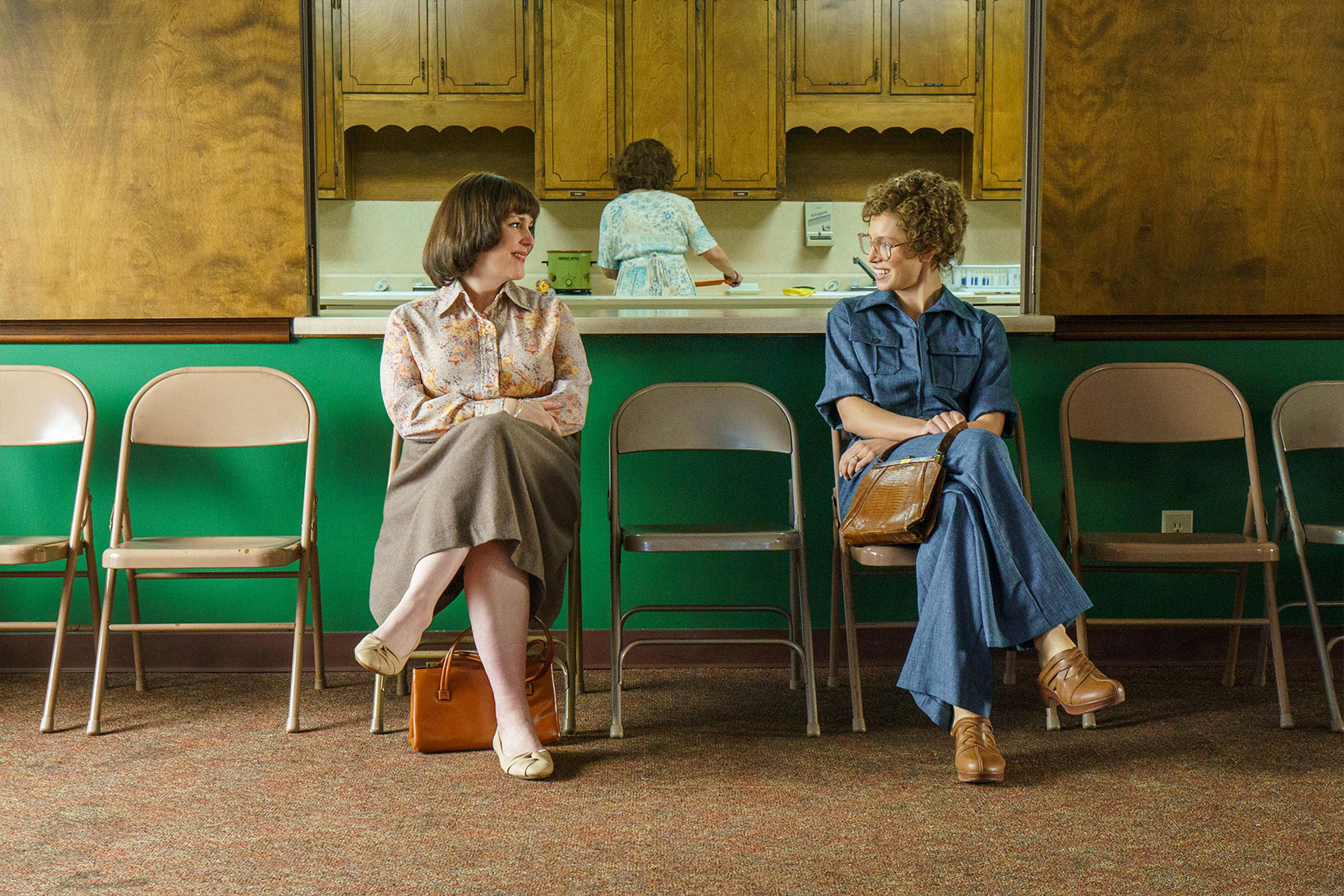
The ferocity of the act goes against Candy’s image as a pillar of the church, a devoted mother, and a faithful wife in her small Texas community. She may not wear the classic apron and heels of the desperate housewife, but Biel’s title character and Lynskey’s walking sacrifice embody the victim-virago dichotomy that’s contorted generations of women.

But as series co-creator Robin Veith telegraphs through Candy’s Bible-inspired fiction, her self-portrait as a flawless Madonna is as fraudulent as her fable. Nevertheless, she insistently smiles through the ludicrous notion that it is better for a tree to die and be fashioned into a torture device than it is for it to be left alone to live and grow.

“Candy” rarely differentiates itself from the slew of similarly themed dramas vying for our attention, which will soon include another version of this case starring Elizabeth Olsen and Lily Rabe coming to HBO Max later this year.

But as an examination of how society interlinks a woman’s value to her desirability and willingness to conform to society’s limited expectations for her, it attains many moments of pang-inducing lucidity. That sting could be as attributable to the moment we’re living through as to Biel’s and Lynskey’s performances, with each making us feel their characters’ misery in singular ways.

CandyMelanie Lynskey as Betty Gore and Jessica Biel as Candy Montgomery in “Candy” (Tina Rowden/Hulu)Mainly their pain is related to their marriages. Both Candy and Betty are married to good men, but they’re also boring and lacking in any ambition to be better. Candy’s spouse Pat (Timothy Simons) is a wonderful father, but takes her for granted; when she asks him if he doesn’t want to hang out with other men he lovingly informs her that she and the kids are the only friends he needs.

Biel’s title character and Lynskey’s walking sacrifice embody the victim-virago dichotomy that’s contorted generations of women.

Lynskey plays Betty as a woman idling in a state stuck between meekness and fury, which translates to her husband Allan (Pablo Schreiber) as neediness. On the day she dies, shown in the first episode, she begs him not to go on the latest of his business trips.  

But while she sits deflated in a post-partum funk at home, Candy bustles about with purpose, her tight cheer covering the less charitable side of her personality.

When “Candy” hits its stride in the second and third episodes, it is because Biel and Lynskey make us feel something for these women and the lack of choices they have in life aside from the roles of wife and mother.

Biel is especially animated when Candy bulldozes through rooms with a blazing smile and sing-song voice, trying to exercise power where she has none and sweetly bullying those she can with false kindness, including Betty.

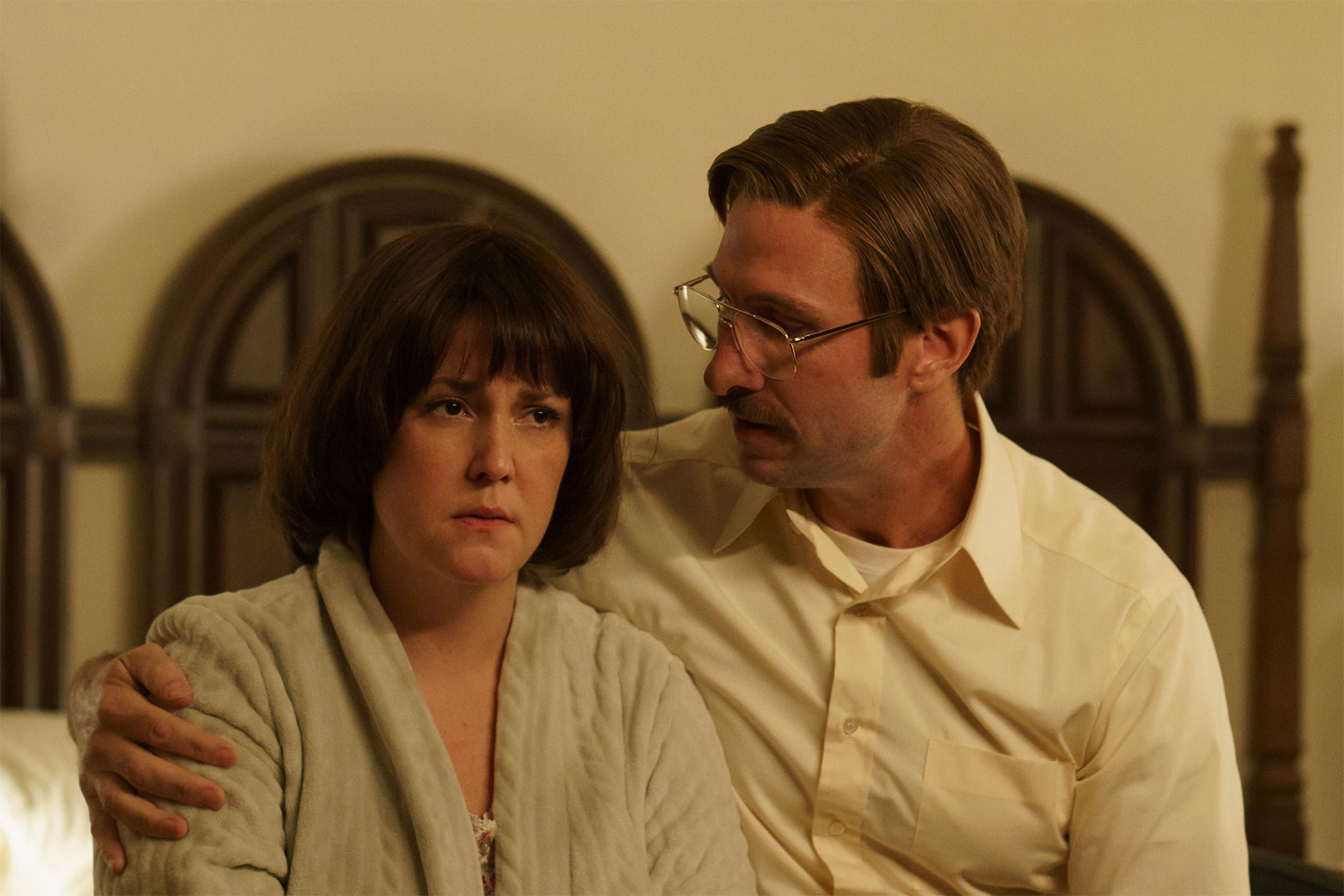
Lynskey’s outstanding-as-usual take on Betty is that of a conquered soul trying to creep from one end of a dim day to the other, her unfashionable clothing and hideous bangs conspiring to sentence her to permanent invisibility.

CandyMelanie Lynskey as Betty in “Candy” (Tina Rowden/Hulu)Candy has an equally awful wardrobe topped by a skull-squeezing perm and giant glasses, all of which Biel physicalizes by sharply pleating every aspect of her portrayal.

Candy is a doer and a planner, at times comically so, although the harvest gold filter coloring the visuals flushes away one’s will to laugh. Still, there’s something tragically funny about a woman who plans a life-altering transgression by building a business-like presentation around it. And she enacts that wrongdoing with an equal measure of precision and heartlessness, talking about it later as if it were a dreamy sequence in one of the cheap romance novels she escapes into.

Aficionados of TV and cinematic history will find a few details worth appreciating in “Candy,” including its thematic nods to so-called “women’s films.”

These are the sequences through which “Candy” realizes its potential as a critique of Christian patriarchal hypocrisy, especially in the ways such close-knit communities batter and betray each other with unrealistic and demanding expectations. That goes for the ways Candy and the other women in the church turn on each other, but also for the men in their lives, none of whom have much to do outside of work and be married.

Once the police work takes over in the fourth episode, introducing a couple of cameos designed to trend on social media without adding much meat, even that appraisal loses its bite along with the story’s focus.  

Granted, you’ll see many of its sinkholes before that happens, mainly by way of Schreiber and Simons, two indistinct roles that leave these otherwise capable actors without much range to play with.

CandyMelanie Lynskey as Betty and Pablo Schreiber as Allan in “Candy” (Tina Rowden/Hulu)Arguably their pointlessness may be the point; at Betty’s funeral, her father tells a grieving Allan, “She was so beautiful, loving, smart, college-educated, so full of life! She had her pick. And she chose you.” Even if that was the intent, there is a way to write such characters without wasting their space in the story. But that didn’t happen here.


Want a daily wrap-up of all the news and commentary Salon has to offer? Subscribe to our morning newsletter, Crash Course.


Aficionados of TV and cinematic history will find a few details worth appreciating in “Candy,” including its thematic nods to so-called “women’s films,” melodramas studios used to dismiss but, in a real way, inform the true crime genre. That’s a clever stylistic nod on the part of Veith, a “Mad Men” alumnus who co-created the series with Nick Antosca. Hulu leans into the retro style they’ve created, augmented by Ariel Marx’s spare score, by releasing its five parts nightly this week, in the style of old-school network primetime miniseries.

But just as those lost the audience with time, “Candy” stops sticking with us by its end, closing on a resolution that dissolves into nothing. Fortunately this case will be re-opened in a few months, but its squandered potential is still frustrating.

The five-part series “Candy” streams a new episode each night, from Monday, May 9-Friday, May 13. Watch a trailer for it below, via YouTube.

More stories like this:

8 surprising facts about Bob Odenkirk

After news spread of his cardiac event on the set of “Better Call Saul” in the summer of 2021, a lot of people realized just how much they appreciate the talents of Bob Odenkirk. Best known as the conniving and ethically malleable lawyer Saul Goodman on “Saul” and its predecessor, “Breaking Bad,” the 59-year-old actor (who has fully recovered from his heart scare) has enjoyed a decades-long career as a versatile writer and performer.

Before “Saul” brings down the curtain on its sixth and final season beginning April 18, check out some things you might not know about Odenkirk, including his familial relationship with “The Simpsons and his onetime total ignorance of “Breaking Bad.”

1. Bob Odenkirk has a brother named Bill who wrote for “The Simpsons.”

Born in 1962 and raised in Naperville, Illinois, just outside of Chicago, Odenkirk was one of seven siblings. Most of the Odenkirk clan pursued conventional vocations, but Bob and brother Bill were the exceptions. Both were interested in comedy, and often put on sketches in the basement. Bob landed at Chicago’s Second City; Bill eventually landed a job as a writer on “The Simpsons.” In 2019, Bob guest starred on the legendary animated series as a lawyer for “Fat Tony.”

2. Odenkirk did not have the time of his life on “Saturday Night Live.”

After making his rounds on the improv and stage comedy circuit, Odenkirk landed at every young comedy writer’s mecca — the offices of “Saturday Night Live.” During his stint on the show from 1987 to 1991, Odenkirk has said he didn’t particularly enjoy himself owing to the fact he was a “stuck-up young man” who would sometimes criticize sketch ideas in front of “SNL” head Lorne Michaels. His attitude was such that longtime “SNL” veteran Al Franken once threw a football at Odenkirk’s head.

There were also, Odenkirk said, sketches that he was vehemently against, like Chris Farley’s famous 1990 Chippendales audition opposite Patrick Swayze. Odenkirk felt the sketch was too condescending toward Farley’s heavyset build. (“F**k that sketch,” Odenkirk said.)

Despite his reservations, Odenkirk still won an Emmy for his “SNL” efforts and believes it was a big step forward in his career. “I learned a lot about comedy writing and I made some great friends for life at that show,” he told Entertainment Weekly in 2021, “but I still wish I’d just handled it better. But don’t you always wish that about your young self?”

3. “Mr. Show” was funny enough that they had to take laughs out.

After “SNL,” Odenkirk teamed up with David Cross for “Mr. Show With Bob and David,” an HBO sketch comedy series that ran for four seasons from 1995 to 1998 and featured such classic sketches as “The Story of Everest,” which is better seen than explained. Shown live in front of an audience, the series went over so well that the laughter from the crowd frequently had to be toned down for television broadcast.

4. He was up for the role of Michael Scott in “The Office.”

Following “Mr. Show,” Odenkirk had an opportunity to make a foray into a comparatively mainstream network sitcom: Odenkirk was up for the role of Michael Scott on the NBC sitcom “The Office,” and very nearly got it. According to “The Office” producer Ben Silverman, it came down to Odenkirk and Steve Carell. But Odenkirk, Silverman said, had an edge to his performance that may have made Scott less likable. Odenkirk later appeared on the final season of the show as a kind of Scott replica in Philadelphia.

5. He had never seen a minute of “Breaking Bad” when he was cast in it.

“Breaking Bad” creator Vince Gilligan was a huge fan of “Mr. Show” and sought out Odenkirk for the role of slimy lawyer Saul Goodman for the show’s second season. “On ‘Mr. Show,’ Bob was always the guy wearing the suit, yet he was crack-up funny,” Gilligan told WIRED in 2013. “Saul Goodman struck us as a guy who could flow very easily through a corporate world and, under the surface, didn’t really belong there.”

But “Breaking Bad” was not yet in the cultural zeitgeist — that would come when it entered rotation on Netflix — and so Odenkirk was totally unaware of the series. He had not only not seen it, but had never even heard of it. When a friend became excited that he was being considered for a role, he grabbed the opportunity, watching the show while on the plane to the set in Albuquerque, New Mexico. “I didn’t even watch a whole episode, but I didn’t need to, I got it,” Odenkirk told The New York Times in 2022. He would go on to play the character for a total of 10 seasons.

6. Odenkirk received special Cinnabon training for “Better Call Saul.”

After “Breaking Bad” concluded in 2013, AMC retained Gilligan, producer Peter Gould, and Odenkirk for “Better Call Saul,” a spin-off focused on how the Goodman character became morally bankrupt. In flash-forwards, we see Goodman toiling away in deliberate obscurity at a Cinnabon in Omaha. (It was a nod to a line in “Breaking Bad” in which Goodman fretted that his poor decisions would land him there.)

The show and the food franchise partnered to feature the eatery on the series: Odenkirk actually received training from Cinnabon on how to properly prepare their cinnamon buns. “Bob went through significant training as any bakery employee would, although he had private lessons,” Jill Thomas, former vice president of global marketing for Cinnabon, told The Wrap in 2017. “He has shared that it’s a great source of pride that he knows how to make a ‘real, authentic Cinnabon.'”

7. Odenkirk shared a house with his castmates on “Better Call Saul.”

Odenkirk’s home and family are in California. When making “Better Call Saul” in Albuquerque, however, he opted to share a home with castmates Rhea Seehorn (who plays Kim Wexler) and Patrick Fabian (Howard Hamlin). He told The New York Times the arrangement was to offset some of the loneliness of shooting on location. (For “Breaking Bad,” Odenkirk lived in a condo owned by that show’s star, Bryan Cranston).  

8. Odenkirk will be staying at AMC for the foreseeable future.

With “Better Call Saul” wrapping up on AMC in 2022, Odenkirk will be sticking with the network. He’s set to star in “Straight Man,” an adaptation of a novel by Richard Russo about the chair of an underfunded university in Pennsylvania. The actor also plans on re-teaming with “Mr. Show” co-creator David Cross for “Guru Nation,” a mockumentary-style series on cult leaders for Paramount+.

Shaming someone for their privilege is unlikely to change their politics, psychologists say

In the past decade or so, liberals and progressives have evolved a new language to talk about social inequality. This new rhetoric — which is, notably, rejected by many on the left — differs from the rhetoric that defined President Lyndon Johnson’s “Great Society” liberal social welfare policies in the 1960s, which were characterized by an emphasis on universal social programs and equality of access. Rather, the new rhetoric of many contemporary liberals involves a fixation on privilege, generally framed within the lens of race, class, or gender.

Politically speaking, the “privilege” framework for understanding (and rectifying) social ills has its pros and cons. Clearly, privilege is undeniably real and self-evident: there is no other explanation for why those of different gender and racial categories would have different experiences of discrimination (say, women being statistically more likely to be harassed), and different life outcomes (say, the racial wage gap).

Yet the way in which privilege is discussed in popular discourse — and often, used to imply someone does not deserve their station in life — abuts deep-rooted myths in American culture regarding being self-made, or regarding the relationship of hard work to success.

This is probably somewhat self-evident to even an armchair psychologist; no one who struggled in their youth and worked tremendously hard to attain their career wants to be told they don’t deserve it. Perhaps, then, it is understandable that science overwhelmingly indicates that individuals will not acknowledge their privileges simply because you shame them. The truth of this belies a core tactic at the heart of much liberal political discourse regarding privilege-shaming — a type of discourse that is particularly acute online.

Instead, the act of shaming quite often causes the subject to double-down on the belief that they are not privileged at all.

RELATED: How shame become cultural currency

This might seem counterintuitive; after all, if a person is shown sound reasons why they happen to benefit from being part of a certain group, why would they not be sensitive to shaming if and when they try to deny those unfair advantages?

Yet as it turns out, many people do not accept the premise that they have privileges at all. As such, attempts to shame them fail because they do not buy into the underlying assumptions that could make shaming effective.

“Shaming personalizes political life; it assails individuals for injustices that are historically, socially and politically organized.”

“‘Shaming,’ as I understand it, is a tactic used to elicit a negative emotional state in a target for the perceived violation of a social norm,” David Weitzner, Ph.D., a writer, consultant, and professor of management at York University, told Salon by email. (Weitzner has written about shaming for Psychology Today.) “For shaming to be effective, however, the target needs to accept the validity of the social norm they are accused of violating.”

As one hypothetical example, Weitzner discussed someone who is called out for using a word that they know to be a slur, and who already acknowledges that using a slur is “undesirable behavior.” In that scenario, shaming can be effective because the shamed party already agrees that the hypothetical behavior in question deserves social sanction. From there, the task simply becomes one of convincing them that they are guilty of that behavior. Yet not everyone agrees that they hold privilege, or even that holding it would even necessarily be something worthy of shame.

“Is holding ‘privilege’ undesirable behavior?” Weitzner asked. “Some people intuitively think so, but that idea does not resonate with me. ‘Privilege’ in a social justice context has been defined as ‘Unearned social power accorded by the formal and informal institutions of society to ALL members of a dominant group.’ Even by this definition, holding privilege is not necessarily, in and of itself, problematic behavior. Conferring privilege might be problematic. Exploiting privilege almost certainly is problematic. But there is room to believe that reasonable people may view holding privilege as morally neutral.”

As a result, Weitzner explained, “a primary argument against shaming people about their privilege is that it is counterproductive behavior since there isn’t universal buy-in to the idea that holding privilege violates a worthwhile norm.”

Another flaw in privilege-shaming is that it misunderstands the dynamics which cause systems of oppression to exist.

“Shame-driven politics are what produce right-wing, reactionary, anti-democratic, authoritarian, violent, militaristic, and theocratic orientations, such as in fascism, Nazism, and the pro-slavery American South.”

“Shaming personalizes political life; it assails individuals for injustices that are historically, socially and politically organized,” political theorist Wendy Brown, who teaches social science at the Institute for Advanced Study, told Salon by email. Brown identified four sources of this tendency in modern America, including “the neoliberal recasting of every social product and distribution as a personal asset or deficit”; the use of identity “as a badge naming one’s place in hierarchies of privilege and oppression”; “a broadly felt powerlessness to transform or even touch the major powers organizing us today, hence the move to whither what is close at hand”; and, finally, “social media.”


Want more health and science stories in your inbox? Subscribe to Salon’s weekly newsletter The Vulgar Scientist.


Dr. Bandy X. Lee, the president of the World Mental Health Coalition, pointed out to Salon by email that shaming can also be “dangerous” because it drives people to far-right political ideologies.

“Shame-driven politics are what produce right-wing, reactionary, anti-democratic, authoritarian, violent, militaristic, and theocratic orientations, such as in fascism, Nazism, and the pro-slavery American South,” Lee told Salon by email. “Moral, ethical, legal, and political ideologies are subordinated to the impulses of white supremacy, male domination, and the maximization of power and wealth differentials. The goal is to divide society into superior and inferior, and to place oneself at the top. Those overwhelmed with feelings of shame, inadequacy, and worthlessness believe they must violate and dominate others in this manner to feel even a modicum of pride about themselves.”

Lee added that people who subscribe to those ideologies “would rather kill you and kill themselves, metaphorically or literally” than to admit that they feel personal shame. In their minds, admitting to their own personal feelings of shame “is the most shameful of all—and therefore adding to this shame can provoke further violence.”

“It feels bad to recognize one’s role in perpetuating and benefitting from harmful systems, and empathy can be a helpful tool for encouraging learning and open-mindedness, as opposed to defensiveness or withdrawal.”

Eliana Peck — a doctoral candidate in the philosophy department at the Graduate Center, City University of New York, who has written about the psychology of white shame — told Salon in writing that if the goal is to convince someone to consider their privileged position in the world, empathy is more effective than shaming.

“We should generally be empathetic when discussing privilege with others,” Peck explained. “It feels bad to recognize one’s role in perpetuating and benefitting from harmful systems, and empathy can be a helpful tool for encouraging learning and open-mindedness, as opposed to defensiveness or withdrawal.”

Peck was careful to point out that asking for empathy has potential drawbacks.

“[P]articularly when discussing privilege with those who are more marginalized than ourselves, we should be careful not to demand or expect too much empathy; doing so can be a harmful way of asking that more marginalized people direct their energies towards caring for us, absolving our guilt, or forgiving us for our privilege, none of which ought to be our focus,” Peck told Salon.

Dr. Matt Blanchard, a clinical psychologist at New York University, opened up to Salon about his experiences teaching young people, observing that it is critical to be constructive as well as critical. After all, young people today have inherited a world where they largely feel powerless. People can be more open-minded to hearing about injustices from which they have benefited if, more broadly, those are framed as part of a crusade for building a just society — and one in which they can play a part.

“They tell me about shame for not being skinny or being too square or being foreign or a virgin, or for having ADHD or autism or for watching porn, for doing drugs or not doing drugs, for talking too loud or being too shy.”

“That guidance is often not there – and the fault lies with political failure of adults,” Blanchard explained. “A Congress entirely captured by large-dollar donors has prevented meaningful reforms that could equalize opportunity in this increasingly wealth-dominated society. A media concentrated in corporate hands is allergic to serious discussions of class, while the right-wing fringe stokes racial division as a distraction from class inequities.”

Blanchard pointed out that America as a country has valid reason to be ashamed of the injustices from its 400-year plus history. There is nothing incongruous about simultaneously acknowledging these facts, and also seeing how young people today feel shame independent of American history.

“[W]orking as a psychotherapist with college students from all backgrounds, I can’t help but notice there’s already quite a lot of shame in their lives,” Blanchard explained. “They tell me about shame for not being skinny or being too square or being foreign or a virgin, or for having ADHD or autism or for watching porn, for doing drugs or not doing drugs, for talking too loud or being too shy — the list of shame points is endless for the young.” That is why he advocates an approach to understanding privilege “that provides young people with tools to not only recognize their advantages but also imagine their role in building a just society. Otherwise we leave them with a problem they can’t easily solve, at which point they tend to disengage.”

Of course, as Blanchard noted, “we are hampered by a political system that seems to offer few clear routes for progress.”

It is here — when dealing with institutions and structures that perpetuate inequalities — that shaming can be effective. As Brown wrote to Salon, the dynamics that make shaming ineffective in interpersonal contexts do not automatically carry over when criticizing organizations.

“Shame as a political tactic should be reserved for the big collective entities — war-mongering or colonial states (Russia, Israel), super-exploitative industries or corporations (Big Oil, Big Pharma), the billionaire class, etc,” Brown explained. “This purely rhetorical tactic — collective entities do not feel shame — can be effective.”

The difference, at the end of the day, may be best summed up as hating the sin but not the sinner. If the goal is to bring about change, one must start by understanding that individuals are actors in larger systems.

“Shaming the ‘privileged’ is especially misbegotten,” Brown told Salon. “First, the important question about privilege, or power, is whether and how you use it for social transformation, and whether you are sufficiently conscious and conscientious about it to use it responsibly. Secondly, the move to turn social powers into individual holdings, and to fixate on those as wrongs, personalizes and de-politicizes social powers.  It treats individuals rather than social arrangements as the object of transformation.”

Brown concluded, “That’s nuts.”

Read more Salon articles on the politics of shame:

Former RNC official warns “crazypants” MAGA devotees are taking over state elections

In a new episode of “Not My Party,” former Republican Party official and Jeb Bush staffer Tim Miller highlighted the “crazypants candidates” who are running for secretary of state and other election-management positions around the country with the express goal of proving former President Donald Trump’s “Big Lie” — or worse, rigging election systems in the name of it.

“Lest you think this is all coming from a few random kooks, there are Republican candidates in Colorado, and throughout the country, who are running to be in charge of their states’ elections on the explicit platform of overturning results if their preferred candidate doesn’t win,” said Miller.

“The most extreme member of that coalition is Griswold’s opponent in Colorado, Tina Peters … Here we got into just how bonkers Tina is. In order to prove Trump’s crazy election fraud theory, a top election official in Western Colorado allegedly had her team take screenshots that purported to prove the voting machines could be hacked, and then leaked those screenshots to the guy who we think is behind QAnon.”

Peters is currently under indictment for breaching election security equipment, and MyPillow CEO Mike Lindell has claimed he is donating hundreds of thousands of dollars to her defense — which could be against state law.

But this isn’t a one-off — many other Republicans are running for election offices on similar platforms, like Michigan’s Kristina Karamo, who has spoken at a QAnon conference, and Arizona’s Mark Finchem, who ironically does not presently live where he is registered to vote.

“Now here’s the second scary possibility: If a Republican wave happens this November, and I expect that it will, it will usher in a slew of election officials who might not be as Q-pilled as Tina Peters, but who won’t be shy in their efforts to try to rig the game for Trump next time,” warned Miller.

Watch the episode below:

Meghan McCain’s latest book “Bad Republican: A Memoir” is a massive flop

Meghan McCain’s familial ties and past experience as a controversial television personality weren’t enough to help boost the sales of her recent memoir.

The former “The View” co-host released the hardcover edition of her book “Bad Republican: A Memoir” on April 26 after publishing it as an audiobook on Audible last autumn. But per the Washington Examiner, the book has so far been a dud, in its opening week selling only . . . 244 total copies. As of Saturday, the book managed to sell a measly average of about 22 copies per day, according to Uproxx.

RELATED: Meghan McCain is still milking “The View” plus more revealing moments from her late-night interview

The book’s Amazon listing explains that McCain’s latest release tells a personal story “of growing up the daughter of an American icon who shaped her life and details the heartbreaking final moments spent by his side.” There are chapters on McCain’s dating life in New York and snippets of her love story with now-husband Ben Domenech. We also learn more about her “views on cancel culture and internet trolls as well as life backstage as the sole Republican at America’s most-watched daytime talk show — and why she decided to leave.”

McCain formally left “The View” on July 1 of last year, later telling Variety that the show’s environment was “unhinged and disorganized and rowdy.” “For me personally, it felt extremely isolating because of my political ideology. I was the only conservative on the show,” she said. “The third year, they ended up hiring a producer for me who was also conservative.”

She added that an on-air squabble with co-host Joy Behar also led to her eventual departure. “I didn’t know I was going to leave until my second day back from maternity leave when Joy told me that ‘Nobody missed me — zero.’ That was the day I decided,” she stated.


Want a daily wrap-up of all the news and commentary Salon has to offer? Subscribe to our morning newsletter, Crash Course.


In September 2021, McCain became an opinion columnist for the British tabloid Daily Mail where she writes about everything from American politics to pop culture.

More stories you might like:

Watching her mother’s dementia motivated Noga Arikha to study when the “self” ceases to exist

We are who we tell ourselves we are. We are who we are at exactly this moment in time, and we are also every memory that has brought us to this point. And as philosopher and historian Noga Arikha explains in her new book “The Ceiling Outside: The Science and Experience of the Disrupted Mind,” our very awareness — of ourselves and of the world — is fluctuating, even at the best of times. We feel as much as we think. It’s a mutable thing, this sense of self, and we are not always our own best historians.

Arikha, who previously wrote “Passions and Tempers: A History of the Humors,” picked a poignant time to investigate the complexities of experience, identity, and the concept of interoception — our physical and emotional senses of self-awareness. While Arikha was studying the mysterious conditions of a group of patients in a Paris hospital’s neuropsychiatry unit, her mother, the poet Anne Atik, was meanwhile navigating through her own experience of dementia. What unfolded was a quest that became deeply personal, a firsthand account of how, as Arikha says, “we take our memory for granted, until an aspect of it breaks down.”


Want more health and science stories in your inbox? Subscribe to Salon’s weekly newsletter The Vulgar Scientist.


What could Arikha learn from a patient like Vanessa, who’d lost a decade of memories but “perhaps gained something else” in the process; or Claire, who “suffered from a real ailment… but had no identifiable pathology”? And what could she learn from her mother, even as the two of them slipped further and further away from each other?

Salon spoke to Arikha, who was getting over a breakthrough bout of COVID, via Zoom recently about dementia, memory, science, philosophy, and the tricky magic act of watching ourselves exist in the world. 

This conversation has been edited and condensed for clarity.

Here in the US, we think of diagnoses like they are with a COVID test, like a line is going to appear and it’s a yes or no. It’s given us this unrealistic sense of certainty. As you say, that is not the case at all.

We have been living with COVID for the past two and a half years, and having it inside you gives you a different perspective. This test, it becomes this aesthetic thing on Instagram or on Twitter, like, “Look at this.” There’s this beautiful double line of the certainty of diagnosis, but the uncertainty of prognosis. It just sums up the whole thing.

RELATED: “Dementia brings up everything”: Two new books offer emotional (and practical) advice for caregivers

This book wound up being so much about your mom. Tell me how she came into this story for you. You could have chosen not to include her.

It’s true. I actually had real doubts, but friends who read what I’d been writing told me, “We want more about your mother.” I had mentioned her discreetly in passing. It’s not something you just do, especially when she’s in such a state. I really wondered ethically, was it going to be okay to do this? I even asked this of a doctor friend, an ethicist who thought it was really difficult a decision to make. But then it became obvious, because it felt completely dishonest not to, given that this was such a deep, important experience that she was undergoing and that I was undergoing. There was no way I could just hide. I had to do it. Writing about this is a universalizing experience. It’s not actually about pointing to one self, it’s using the self to point outside to others.  

The book came in a few layers. The first layer was just telling the stories of the patients. Then I was getting into the research on interreception and the science of the embodied sense of self, which is developing so fast it’s really hard to keep up. I used that science to try to understand what the patients were going through, to be that bridge between the experimental and clinical, between the theoretical model and the individual patient.

The third thing was, “Well, I have to talk about her.” At that point I was reading Emmanuel Carrère’s book “Yoga” and that book helped me. A friend of mine, a wonderful actress named Irene Jacob, wrote a beautiful memoir about being pregnant while her physicist father who worked on Big Bang theories was dying, and putting together pregnancy, past, and a future cosmography about herself. It was completely about transcending yourself. Those books helped me figure out how to do this and to go beyond my initial reluctance. Then lastly, very importantly, my mother couldn’t write anymore. The mother-daughter thing, am I allowed to write her words for her? But then, what else can I do?

What dementia does that is so cruel, but also so illuminating, is it makes us question who the self is. When you went into this book, what was the question that you most wanted to answer?

It’s about a book about how the self studies itself and how it loses itself. It is about asking this question, what is the self? That’s number one. Number two, it’s very much giving to the public access to some of amazing scientific research that is usually completely confined within these academic boundaries. Most people, and actually a lot of mainstream science, are still stuck with this cognitive model that the mind is the brain. 

There’s a huge movement called the 4E Movement — the enacted, embedded, extended, embodied mind. We’re all these things. We are all interconnected. These are big movements in philosophy and psychology, neuroscience, even in social science. But they’re academic. So how do you actually bring this into the world? And there’s a difference between the science, the generalizable theories, and the living individual and pathology. There are as many pathologies as there are people. No two people experience pathologies in the same way.

How do you do medicine, given that you need a general model to devise treatments of any kind? The question “What is the self?” is a universal question, but then you have to talk about what the individual self is. Going into the clinic was a way of really trying to do something a bit new in this realm. It was trying to get closer to what we all are, since we all potential patients, and just try to listen. Try to listen to what this very, very fragile, porous border between pathology and normalcy is, to try to see where pathology starts. It’s difficult to figure that out.

Most of us have experiences of unease that can turn into disease in some cases. Who determines, what determines what the disease is? This 4E theory derives out of the tradition of phenomenology. It’s this idea that when you’re studying the mind, you’re really missing out on the first person experience in everything.

So much of the idea of the self is tied to memory. Who am I without my memories? How do I change when my memories change? That not just applicable in the space of dementia, it’s not just applicable in the space of people who have had traumatic brain injuries. We are all wrestling with this idea of identity and memory. What have you learned about memory?

The distinction between various kinds of self. There’s a quite a bit of autobiographical memory, and the core self, which are separate things. In the case of my mum, the memory loss was mainly a fast destruction of her autographical memory, so she forgot about most of her life.

But discursively, conversationally, verbally, at some semantic level, she remained my mum. She remained who she was. She was coming up with these extraordinary sayings which I collected. Many of them are hilarious. Everybody remembers my mum as a woman with an extraordinary sense of humor. She was also a poet, and so she was able to come up with these amazing sayings, things that were very, very lucid. God knows where they come from, the whole thing is rather mysterious.

It was very extreme to have this experience of semantic clarity. She had no loss of words really, but they made no sense. The conversation was like Dadaism, it really was. It was like an experience of surrealism. In a sense, some of it was rather entertaining if you were able to just look at it that way. She was able still to recognize us, and she died before it got much worse. In a sense she didn’t lose her connections with the people who mattered, and that’s a kind of blessing.

Right now, at least in the US, there are so many television shows all coming out at the same time that are about “Who would I be if I went in a different timeline? Who would I be if my story started at a different point?” I think it’s because we’re so fascinated with exploring these ideas of “nature versus nurture.”

Which is not a versus. This is the illusion that continues, which is terribly misleading. There is no versus. It’s part of our nature to be cultural. We are determined by naturally given entities, such as genomes and such things which are completely, constantly interacting with the environment. This is what one of the elements of those 4E ideas. We’re constantly interacting with the environment and each other, so there is no such thing as versus. That’s a very, very dangerous position.

We like to think “nature versus nurture,” which also means “free will versus destiny.” Certainly here in the US, we like to feel like we are the masters of our destiny. We are very into the idea of self-creation.

This goes back to what we start off with the DSM. The nominalism and the need to name is another aspect of the need to control and to draw borders. Siri Hustvedt, who’s a great interlocutor and great inspiration for me, is very good at understanding and showing where this idea of borders is very wrong and actually quite destructive in many ways.

I am partly American, but I’m a deeply European person as well. I look at each country from the outside, like I’m from everywhere. I’m living in Tuscany now, which is the epitome of the merging of a human culture and natural culture, of the both together. The landscape is the most harmonious outcome of humans acting upon wild nature, and that’s something doesn’t exist in America. In America, you have either the lawn or the total wilderness. There is not that mingling. That’s a border that has been created by a certain culture of control. 

To go back to the sense of self, there’s no reason to make a border, like nature, nurture. We need to first get rid of those a priori borders precisely in order then to be able to understand things better.

In the case of our mothers and their dementia, there are many kinds of dementias. Certain in all of them and in illnesses affecting the brain, some issues with memory are going to happen. This is because the sense of memory and the sense of self are very profoundly intertwined, but I’m not sure how. How you would account for this in terms other than there’s certainly biological events happening? With my mother, there was something known as cognitive reserve. That high level of education, also on the fact that she was an intellectual all her life, meant that she was able to preserve that verbal fluency, probably. There’s something like a cultural background of herself remained. 

You talk about the somatic interpretation of things. What we embody is not just the brain, but memory, understanding, history, learning, experiences, that affect the body. What has that changed in your understanding of identity after writing this?

The first word that I come up with, sadly, is loss. Learning how to live with loss. Dementias are a different kind of loss because the person that has a dementia doesn’t know that they have it, so they don’t know how much they are losing. Anosognosia is very, very much central to Alzheimer’s. My mother had really no sense that she had lost all that, at least no conscious sense. I learned about loss before COVID hit, and then there was so much loss in the world.

It’s a sad reckoning, but that is the only reckoning that allows us actually to live with a kind of serenity, and that some losses can address for good losses. In a sense, reckoning is learning about loss. It’s a positive thing. Another positive thing is seeing how extraordinarily complex and unique every single person is and how very rich every single life is. How ultimately unknowable it is.

More of our favorite conversations on the mind-body connection: 

“Doctor Who” fans “ecstatic” over “Sex Education” star Ncuti Gatwa cast as the new Doctor

Jodie Whittaker’s Doctor will be bidding farewell to the TARDIS soon, but a new Doctor is getting ready to take on the role of Time Lord.

On Sunday, the BBC announced that actor Ncuti Gatwa will play the star character on “Doctor Who,” making him both the 14th Doctor and the first Black actor in the lead role in the show’s history. Gatwa will follow in the footsteps of Whittaker, who became the first woman to officially play the role on television.

“There aren’t quite the words to describe how I’m feeling. A mix of deeply honoured, beyond excited and of course a little bit scared,” the 29-year-old actor said in a statement released by the BBC. “This role and show means so much to so many around the world, including myself, and each one of my incredibly talented predecessors has handled that unique responsibility and privilege with the utmost care.”

RELATED: Former “Doctor Who” companion wants the next Doctor to be non-binary

Although Gatwa will be the lead, he isn’t the first Black actor to play a version of the Doctor, however. During Whittaker’s tenure, the series introduced the Fugitive Doctor (Jo Martin), who is supposedly a previous incarnation of the Doctor but erased from the First Doctor’s memory. 

Gatwa’s recent casting elicited positive reactions from “Doctor Who” fans, supporters and celebrities alike.

“I am overflowing with happiness. Ncuti makes all of our days brighter on set with his boundless enthusiasm and radiant energy. This could not happen to a better human being PERIOD,” tweeted “Shang-Chi” star Simu Liu, who is filming “Barbie” with Gatwa. “THE DOCTOR IS IN!!!!!!!!”

“Honestly, I’m ecstatic that we are in a time where we have two marvellously talented black actors playing the Doctor across mediums,” wrote another user. “Ncuti Gatwa and Jo Martin – Fourteen and Fugitive supremacy. Sometimes, you just feel seen. And that’s amazing.”

One user also noted that Gatwa was just 12 years old when “Doctor Who” was relaunched in 2005, which makes his upcoming role all the more exciting.

“Never seen Doctor Who a day in my life and maybe that’s about to change!” tweeted author Benjamin Dean. On a similar note, British author and journalist Bolu Babalola wrote, “We don’t even be watching Doctor Who like that. But now I am ready to watch the nerd phone box show.”


Want a daily wrap-up of all the news and commentary Salon has to offer? Subscribe to our morning newsletter, Crash Course.


Gatwa, who was born in Rwanda and raised in Scotland, is best known for playing the outgoing and lovable Eric Effiong on Netflix’s hit series “Sex Education.” In addition to his upcoming role, the actor will also star alongside Margot Robbie in Greta Gerwig’s “Barbie” rom-com film.  

The new season of “Doctor Who,” will return in 2023, will also see the return of showrunner Russel T. Davies, who helped revive the program for the modern era before leaving his role in 2009.

“The future is here and it’s Ncuti! Sometimes talent walks through the door and it’s so bright and bold and brilliant, I just stand back in awe and thank my lucky stars,” Davies said in a statement. “Ncuti dazzled us, seized hold of the Doctor and owned those TARDIS keys in seconds. It’s an honour to work with him, and a hoot, I can’t wait to get started.”

More stories you might like:

Leading GOP candidate for Pennsylvania governor opposes health exceptions for abortion

All four GOP candidates in the Pennsylvania gubernatorial race have said they would ban abortion in the Keystone State, with two claiming that they’d make no exceptions for rape, incest, or medical emergencies that risk the life of a pregnant person. 

In a questionnaire made by the Pro-Life Coalition of Pennsylvania, candidates Bill McSwain, Lou Barletta reportedly indicated that they support a total ban on abortion, except in the case of rape, incest, and medical emergencies, according to Oregon Public Broadcasting. However, candidates Doug Mastriano and Dave White vowed to make no such exceptions. 

On Saturday, White, a devout Catholic, told the Associated Press that his parents taught him the “blessing of every child that comes into this world.” And during a debate weeks ago, Mastriano, the Pennsylvania state senator leading the primary, called abortion his “​​No. 1 issue,” saying that he would prohibit the procedure at any point after conception. 

RELATED: Republicans aren’t even bothering to lie about it anymore. They are now coming for birth control

At least eleven states – including Alabama, Arkansas and Texas – have passed abortion bans that make no exceptions for rape, incest, but do allow for medical emergencies, according to The Guardian. For decades, as The Atlantic reported, such exceptions were regularly tucked in anti-abortion legislation, which the vast majority of Americans support. However, the recent Republican crackdown on abortion rights has been much more ambitious, with some calling for a nationwide ban on abortion. 

Last week, Politico reported that the Supreme Court is currently on track to overturn Roe v. Wade, the landmark 1973 ruling enshrining America’s constitutional right to abortion. According to a leaked draft majority opinion, the court has already informally voted to reverse the decision.


Want a daily wrap-up of all the news and commentary Salon has to offer? Subscribe to our morning newsletter, Crash Course.


RELATED: So what happens now, after the downfall of Roe? Not anything good

At present, abortion is legal in Pennsylvania for up to 24 weeks into pregnancy. Pennsylvania Gov. Tom Wolf has already torpedoed three GOP-led abortion restrictions and has promised to veto any similar legislation in the future. 

“A decision by the Supreme Court on Roe v. Wade will not have an immediate impact on Pennsylvania or its current laws,” he said in a statement last week. “Should this opinion become final, abortion access in Pennsylvania will remain legal and safe as long as I am governor. I will continue to veto any legislation that threatens access to abortion and women’s health care. 

According to Axios, Pennsylvania’s GOP caucus is backing a constitutional amendment that would challenge the notion that abortion is enshrined by the state’s constitution. That amendment, which might be on the ballot as early as May 2023, would be immune from Wolf’s veto power. 

RELATED: White House condemns protests at homes of Supreme Court justices after Republicans cry harassment

Correction: A previous version of this story incorrectly claimed that 11 states have already enacted abortion bans without medical exceptions.  

Susan Collins’ challenge: Call for the impeachment of Brett Kavanaugh

Republican Sen. Susan Collins of Maine, a self-styled moderate who postures as a defender of reproductive rights, has said repeatedly in recent years that she would not support a Supreme Court nominee who demonstrates “hostility” to Roe v. Wade.

But late Monday, “Politico” reported that right-wing Justices Neil Gorsuch and Brett Kavanaugh — Trump picks who Collins voted to confirm — supported a 67-page draft opinion authored by Justice Samuel Alito that, if finalized, would spell the end of Roe v. Wade and imperil abortion rights across the United States.

While abortion rights advocates, citing the judges’ records, vocally warned at the time of their confirmation hearings that both Gorsuch and Kavanaugh posed an existential threat to Roe, Collins brushed such warnings aside when it came time to usher them through the Senate, pointing to their private assurances to her that they would not vote to overturn the 1973 decision.

In a statement issued Tuesday morning, Collins finally conceded that, perhaps, Gorsuch and Kavanaugh were not being fully honest with her in their closed-door conversations about Roe.

“If this leaked draft opinion is the final decision and this reporting is accurate, it would be completely inconsistent with what Justice Gorsuch and Justice Kavanaugh said in their hearings and in our meetings in my office,” Collins said. “Obviously, we won’t know each justice’s decision and reasoning until the Supreme Court officially announces its opinion in this case.”

Asked if she believes she was misled by the judges, Collins told CNN, “My statement speaks for itself.”

Marie Follayttar, executive director of Mainers for Responsible Leadership — a group that has long targeted Collins over her right-wing voting record — told “Common Dreams” that it “looks like it’s time for her to call for impeachment” of Gorsuch and Kavanaugh.

“If Senator Collins believes that both Justice Gorsuch and Justice Kavanaugh lied to her and to the public during the confirmation processes, we demand that she lead the charge calling for their immediate impeachment,” Follayttar added. “We cannot let public trust in our judicial system — the final check and balance of our democracy — become eroded.”

Indivisible, a national progressive advocacy group, quipped in response to Collins’ statement, “If only there had been some warning signs about Kavanaugh’s dishonesty.”

After “Politico” published its story on Alito’s far-reaching draft opinion — which the Supreme Court confirmed as authentic on Tuesday while stressing that it’s not final — a video compilation resurfaced of Collins declaring on multiple occasions in 2018 her belief that Kavanaugh would not vote to overturn Roe:

“The Daily Beast’s” Eleanor Clift argued in a column Tuesday that “the one person most responsible for the looming loss of abortion rights—aside from the president who appointed three anti-Roe justices — is Maine Republican Sen. Susan Collins, who in October of 2018 became the 50th and deciding vote in the Senate for Brett Kavanaugh.”

“He would not have been confirmed if it weren’t for Collins, who wanted women to believe as she did that he would keep his word to her,” Clift wrote. “Maybe his fingers were crossed because whatever he said to Collins, it was a lie. Kavanaugh’s confirmation on a bare 50 to 48 vote was the beginning of the end for Roe v. Wade, and everybody knew it except maybe Collins.”

“Susan Collins told the women of America that they could trust her to protect their reproductive freedom,” Clift added. “She let us down.”

White House condemns protests at homes of Supreme Court justices after Republicans cry harassment

Conservatives are having a meltdown over pro-choice demonstrators who descended on outside the homes of various Supreme Court justices this past weekend in protest of the court’s impending rescission of Roe v. Wade, the landmark 1973 case establishing America’s constitutional right to abortion. 

About 100 protesters on Saturday evening appeared outside the homes of conservative Supreme Court Justices Brett Kavanaugh and John Roberts, hoisting pro-choice signs and chanting various slogans to express outrage over the court’s direction on abortion. 

“The whole world is watching!” the group chanted, according to a video posted online. “My body, my choice.”

The protests come just days after a bombshell report by Politico, which published a leaked draft majority opinion indicating that the court already voted to overturn Roe back in February. 

This weekend, hordes of online conservatives decried the demonstrations, arguing that the public is endangering the justices, whose jurisprudence, they say, must remain insulated from what they see as a left-wing public pressure campaign. 

RELATED: So what happens now, after the downfall of Roe? Not anything good

Congressman Jim Banks lashed out at President Joe Biden for what he described as “harassment and intimidation of SCOTUS Justices in their own homes.”

“The whole point of the judiciary is that its holdings must be grounded in law and immune from public pressure,” tweeted former Donald Trump aide Steven Miller. “Demonstrating outside an official’s home is always wrong, but doing so for the purpose of physically intimidating and menacing a judge threatens our entire legal system.”

Conservative political commentator Liz Wheeler called the left “evil” over the demonstrations, tarring the protesters as “mobs of angry leftists.”  


Want a daily wrap-up of all the news and commentary Salon has to offer? Subscribe to our morning newsletter, Crash Course.


“Imagine how scared [Brett Kavanaugh’s] young daughters must be,” she raged. “THAT is why the left is doing this – to scare Kavanaugh into fearing for his family so badly he caves to the rabid pro-abortion left. The left is evil.”

RELATED: Will pro-choice protesters attack Catholic churches? The right seems to think so

Stephen L. Miller, a contributing editor at the conservative magazine The Spectator, accused the media of hypocrisy. “Going to be fun comparing the media coverage and tone of screaming protestors outside SCOTUS justices homes to mothers at school board meetings,” Miller wrote

One Fox News host called for Biden’s impeachment over the protests. 

Newsmax columnist James Hirsen, meanwhile, went so far as to claim that the demonstrations were a “violation of federal law.” 

According to 18 U.S.C. 1507, anyone “with the intent of influencing any judge … in or near a building or residence occupied or used by such judge … shall be fined under this title or imprisoned not more than one year, or both.” However, it’s not apparent that the protesters were intent on changing the court’s mind, given that Roberts has already confirmed the authenticity of the draft decision overturning Roe and subsequent reporting shows the conservatives unlikely to switch their votes. Furthemore, the First Amendment protects the right to peaceful assembly.  

On Monday, the White House and a number of Democrats also came forward to express concern over the demonstrations, echoing the dubious right-wing framing of protesters being violent and threatening.

On Monday, White House Press Secretary Jenn Paski said that President Biden “strongly believes in the Constitutional right to protest. But that should never include violence, threats, or vandalism. Judges perform an incredibly important function in our society, and they must be able to do their jobs without concern for their personal safety.”

RELATED: Republicans aren’t even bothering to lie about it anymore. They are now coming for birth control

“This is wrong, stupid, potentially dangerous, and politically counterproductive,” echoed Democratic commentator Paul Begala. 

Thus far, there have been no reports of violence or vandalism in connection with the recent pro-choice demonstrations.

I’m out of oyster sauce! What can I substitute instead?

Oyster sauce can easily be forgotten about behind its more popular pantry neighbors like soy sauceteriyaki sauce, hoisin sauce, or your favorite homemade stir-fry sauce. But this savory sauce, which is often labeled as “oyster flavored sauce,” is one of our favorite ways to bring salty, umami-packed flavor to vegetable stir-friesshrimp fried rice, and more. So what should you use if you run out of oyster sauce? And what is oyster sauce, anyway?

What is oyster sauce?

Oyster sauce originated in the southern part of China in the early 20th century and has since become a beloved ingredient, particularly in Cantonese cooking. It’s typically drizzled over vegetables like Chinese broccoli once cooked. Nowadays, the most popular brand of oyster sauce found in many grocery stores is Lee Kum Kee, which makes its sauce with water, sugar, oyster extractives (oyster, water, salt), modified cornstarch, monosodium glutamate, wheat flour, and caramel color. It doesn’t just taste salty, nor does it taste entirely fishy. It’s a complex sauce, not to mention one that has a rich, thick consistency that resembles ketchup. Other brands of oyster sauce will have a similar flavor but may flow more easily from the bottle like maple syrup.

Best oyster sauce substitutes

Teriyaki sauce

Sweet, sometimes smoky teriyaki sauce can double as a substitute for oyster sauce, particularly when used as a glaze. Traditional teriyaki sauce is made with a combination of soy sauce, mirin, sake, sugar, cornstarch, and water. You can certainly make your own by cooking everything in a small pot on the stove until it’s thickened, but there are many delicious bottled versions available that are more convenient.

Hoisin sauce

This sweet-meets-nutty-meets-slightly-spicy sauce is a popular condiment in Cantonese Cuisine, much like oyster sauce, making it a great 1:1 substitute.

Fish sauce

Unlike teriyaki or hoisin sauce, fish sauce has a liquid-like consistency that more closely resembles soy sauce or vinegar. It’s made by coating small fish (like anchovies) in salt and letting them marinate until the fish naturally begin to break down, releasing a briny liquid that is then bottled and labeled as fish sauce. This Vietnamese pantry staple can be drizzled directly over sautéed or roasted vegetables, or you can add it to a dipping sauce with dark brown sugar, chile sauce, and lime juice for a makeshift alternative to oyster sauce.

Soy sauce

You know and love soy sauce for dipping or using as the base for a stir-fry recipe. On its own, the consistency of soy sauce (at least the kind typically found at American grocery stores) and oyster sauce are not alike at all. Oyster sauce is viscous and soy sauce is basically water. To make up that difference, add one tablespoon of cornstarch to a one-half cup of soy sauce in order to thicken it.

Tamari

Tamari is essentially gluten-free soy sauce (it’s made from fermented soybeans and nothing else!), so the same rules above apply here. It tends to be a little thicker and less salty than regular soy sauce, though the difference is minimal so you’ll still need a thickener like cornstarch or arrowroot powder.

Mushroom broth

For a totally vegetarian (bonus: vegan!) substitute for oyster sauce, use mushroom broth. Mushrooms naturally have a ton of that irresistible umami flavor, so you won’t eat it just because you’re not using oyster sauce. Like soy sauce and tamari, you will still need a thickening agent to achieve the same consistency as oyster sauce because the broth tends to be quite watery.

It looks more and more like the Supreme Court leak came from the right

Republicans have blamed the left for leaking a draft opinion that would overturn Roe v. Wade, but a New Yorker columnist says the evidence points toward an abortion opponent on the right.

Jonathan Chait appeared Friday on MSNBC’s “Morning Joe” to discuss his latest column, which theorizes that someone who wants the 5-4 decision banning abortion to stand, based on another leak a few days prior to Politico’s bombshell report on Justice Samuel Alito’s draft opinion.

“I want to be clear that I have no idea who leaked this and it definitely could have come from the left,” Chait said, “but I wrote this because so much of the commentary from the right simply assumed that the leaks that come from the left and ignored the fact that we have a smaller leak three days before from the Wall Street Journal that had the same effect they’re decrying, which is to put public pressure on the justices to rule in a certain way. That is the reason why they say this leak is so dangerous, because it subjects the justices to this kind of lobbying and that is exactly why the Wall Street Journal was leaked this early version, and they really had the inside scoop on the breakdown inside of the court.”

An editorial published April 26 showed that Chief Justice John Roberts was trying to persuade one of the court’s conservatives to join him in a more moderate ruling on a Mississippi case, Dobbs v. Jackson Women’s Health Organization, in stepping back from overturning the landmark abortion ruling — and Chait notes how closely the Journal called it.

“If [Roberts] pulls another Justice to his side, he could write the plurality opinion that controls in a 6-3 decision,” the editorial said. “If he can’t, then Justice Thomas would assign the opinion and the vote could be 5-4. Our guess is that Justice Alito would then get the assignment.”

That’s exactly what did happen, based on the draft opinion that Roberts confirmed was legitimate, and Chait said the editorial points to the likelihood that someone on the right leaked the opinion to keep another justice from joining Roberts in moderating the ruling.

“If a bank employee stole a small amount of money from the safe and then, a few days later, there was a huge robbery from the same safe, who would be your first suspect?” he wrote.

Watch video below or at this link.

“Rotten, entitled, spoiled”: Meghan McCain utterly embarrassed on Twitter by father’s former aide

The late Republican Sen. John McCain, a Republican, was frequently “embarrassed and appalled” by the conduct of his daughter, Meghan, a right-wing pundit, according to an eleven-part, tell-all Twitter thread published by John McCain’s former presidential campaign manager, Steve Schmidt. 

In the thread, released on Saturday, Schmidt claimed that he was the first person that Meghan McCain, now a conservative commentator and TV personality, “heard the word NO from.”

“I told her she was unimportant and that the Presidential election wasn’t about her,” Schmidt said, recalling a campaign event for which McCain showed up too late. 

“I left her on the tarmac when she didn’t make the plane because as I explained to her, the 5000 people who were waiting to see her father speak and took the time to do it deserved to have him show up on time,” Schmidt added. “That was the way John McCain saw it. He was appalled by @MeghanMcCain conduct on the campaign. Appalled and embarrassed. The tantrums were beyond anything I have ever witnessed from any human being.”

Schmidt described McCain’s antics as “the most rotten, entitled, spoiled, cruel, mean and bullying behavior I have ever witnessed.”

RELATED: Revisiting Meghan McCain’s legacy on “The View” shows the reality of across-the-aisle “friendships

The thread came as part of an ongoing online beef between Schmidt and the former “The View” star, which came to head this weekend when it was reported that McCain had only sold 244 copies of her new book “Bad Republican: A Memoir” since its release in April.   

“I can explain this,” Schmidt said in response to the report. “When I kicked @MeghanMcCain off of the 2008 McCain plane, because of her outrageous behavior, I talked to her mom and explained what was happening and why. Cindy [McCain] got weepy and said ‘I just want to say I raised two good sons’ I said ‘everyone knows you did.'”


Want a daily wrap-up of all the news and commentary Salon has to offer? Subscribe to our morning newsletter, Crash Course.


Schmidt also accused McCain of tarnishing her family name “for a shallow and purposeless celebrity where she trades on a famous name like a fourth generation wannabe clipping coupons while pretending to be an heir.”

It isn’t the first time that Meghan McCain’s conduct has come under fire.

During her tenure as a host at ABC’s “The View,” the conservative commentator was notorious for her inflammatory on-air clashes with her liberal co-hosts. In one exchange, after Meghan McCain returned to the show from maternity leave, her then-co-host Joy Behar told her point blank: “I did not miss you.”

RELATED: “I did not miss you!”: Meghan McCain returns to rocky reception on “The View” after maternity leave

After leaving The View last July, Meghan McCain claimed that she had been bullied off of the show due to her conservative views, calling the network a “toxic work environment.”

“It was as if I had become an avatar for everything they hated about the president,” she wrote in her book, excerpted by Vanity Fair. “It felt like the cohosts and staff only knew one Republican – me – and took out all their anger on me, even though I didn’t even vote for Trump.”

Shortly after departing from “The View,” McCain became a columnist at The Daily Mail.

How to get rid of gnats, once and for all

Gnats are the bane of my existence. They invade my home at least once a year it’s because I left an overripe banana at the bottom of the fruit bowl, didn’t clean out the garbage disposal well enough, or even just brought home a new plant that had them hiding in the soil. Then I’m forced to spend the next few weeks trying to banish them from every nook and cranny of my home.

In the grand scheme of things, gnats are harmless — common fruit flies and fungus gnats don’t bite (though some varieties do), but they always seem to be hovering in your face or flying around your food. If you’re sick of seeing these little bugs all around your home, here are some tried-and-true methods to get rid of them, as well as ways you can prevent them from coming back.

What are gnats?

There are a few types of small flies and gnats commonly found in homes, and each one is attracted to different things. If you figure out which kind are plaguing your home, you’ll be able to get rid of them more efficiently.

First, there are fruit flies, which are attracted to overripe or rotting fruits and vegetables, so they’re usually hovering around fruit bowls. They also like smelly trash bins and garbage disposals, and open bottles of alcohol. These little brown bugs are more common in the summer, but you might see them during the cold months, too.

Next up are fungus gnats, which I have personally battled many times as a houseplant lover. These obnoxious little flies lay their eggs in wet soil, and they’re commonly found in nurseries, meaning you can easily bring them home without knowing. These gnats are black and tinged with silver, and you’ll typically see them hanging out on the soil of your plants or around the rim of planters. If you give your plant a little shake, they’ll start flying out from around the plant.

Finally, there are drain flies, and as their name suggests, these bugs live in drains, sewers, and septic tanks — anywhere you might find stagnant water, as that’s where they lay their eggs. They have larger wings than the other two types of gnats, and their bodies are furry, similar to a moth.

How to prevent gnats

It’s not too hard to get rid of gnats, but the tricky part is keeping them from coming back — all it takes is one overripe apple for them to make themselves at home again. In general, the cleaner you keep your home, the less likely you are to have gnats. This means storing food in sealed containers and getting rid of overripe produce. You’ll also want to invest in a tightly covered trash can, and clean out your sink, drains, and garbage disposal regularly.

For fungus gnats in particular, letting your plants dry out in between waterings can help to prevent the bugs from laying eggs. Some people also recommend sprinkling a layer of diatomaceous earth on top of soil to kill them.

If you’re really serious about making your home a no-gnat zone, you may also want to seal cracks and crevices around your doors and windows, repair any ripped window screens, and patch any cracks in your home’s foundations.

5 ways to get rid of gnats

If you have a gnat infestation and don’t have the time or luxury of prevention, there are several ways you can eliminate these flying nuisances — many of which involve simple pantry ingredients. Of course, you’ll also want to figure out what attracted them in the first place and get rid of their source of food to stop them from reproducing.

1. The classic apple cider vinegar trap

Apple cider vinegar’s sweet smell is appealing to gnats, so you can use it to make an easy trap — a literal thirst trap, if you will. Pour a few tablespoons of apple cider vinegar into a bowl or jar, then stir in a few drops of dish soap. The bugs will be attracted to the sweet smell, and the sticky soap will prevent them from being able to fly away. Some people also like to mix in a little sugar, as well, to really amp up the sweetness.

2. Lure them with ripe produce

If you’re dealing with fruit flies, you can use their favorite snack against them. Place a piece of overripe produce, like an apple slice or mashed banana, in a bowl and cover it with a plastic wrap. Poke a few small holes in the plastic, and once the flies crawl inside, they won’t be able to get back out.

3. Put empty wine bottles to good use

The next time you finish a bottle of red wine, leave it on the counter with dregs in the bottom to help trap gnats. They’ll crawl inside because they’re attracted to the smell and won’t be able to get back out. Some people also like to mix in a few drops of dish soap, but I’ve found the alcohol works pretty well on its own.

4. Flush drains with bleach

If fruit or drain flies are hanging out in your pipes, you can use a diluted bleach solution to kill them and any eggs. Mix 1/2 cup bleach with a gallon of water, then carefully pour it down the drain. Flush with plenty of hot water, and repeat as necessary.

5. When in doubt, use sticky traps

When I have a particularly bad fungus gnat infestation around my plants, I turn to sticky traps to capture the dozens of bugs flying around. Gnats will get stuck to the yellow sticker — just be prepared to be grossed out by how many you catch.

Republicans aren’t even bothering to lie about it anymore. They are now coming for birth control

As much as the National Republican Senatorial Committee would like Republicans to stay away from the abortion issue except to insist they are compassionate and caring about life, it isn’t really working. That line is hardly a natural fit for a party that had a collective hysterical tantrum against Barack Obama’s Affordable Health Care Act and proposes taxing the poor anyway. They are the “Fuck Your Feelings” party, after all, not the empathy and mercy crowd.

There is little hope of eliding the consequences of their decades-long crusade to send women back to back-alley butchers. Nonetheless, they are haplessly trying to pretend that they are truly committed to helping all the people who will be forced to give birth against their will once the right to abortion is overturned. It’s not credible:

According to the National Women’s Law Center, Mississippi has the highest poverty rate for women in the nation, one of the highest uninsurance rates for women in the nation and ranks last in the country for women’s and children’s health outcomes. If they revere life so much, why have they been punishing the poor women and children in their state who chose not to get abortions for the past 50 years?

And as much as they insist that they aren’t coming for contraception — they’re coming for contraception.

Mississippi’s Gov. Tate Reeves wasn’t the only Republican governor to make this disingenuous claim. So-called moderate Asa Hutchinson of Arkansas also said he thinks they should increase services for women who are in “difficult circumstances” with their pregnancies.

RELATED: Mitch McConnell warns of federal abortion ban

Hutchinson signed that bill willingly and he’s not the only one. In fact, as Stephanie Kirchgaessner of the Guardian reported last week, since 2019, when Republican House leader Rep. Kevin McCarthy, R-Calif., said that removing exemptions for rape and incest simply went too far, “at least 11 US states – including Alabama, Oklahoma, Missouri, Arkansas and Texas – have passed legislation that bans abortion without any such exceptions.” The idea has taken off like wildfire:

Where Republicans once believed that absolute bans were unpalatable and “toxic” with voters, the party’s legislators have now adopted the language once promoted by the most extreme anti-abortion activists in the country who say any such exceptions are “prejudice against children conceived in rape and incest”.

According to the Guardian, this rapid change in attitude is attributed to the work of an anti-abortion group called Students for Life of America (SFLA), another astroturf production sponsored by big money GOP donors and co-chaired by Leonard Leo, the far right Federalist Society leader who shepherded Donald Trump’s three arch-conservative, anti-abortion justices on to the Supreme Court. They seem to be very serious about their work and very good at getting it done.

And as much as they insist that they aren’t coming for contraception — they’re coming for contraception.


Want a daily wrap-up of all the news and commentary Salon has to offer? Subscribe to our morning newsletter, Crash Course.


SFLA’s executive director, Kristan Hawkins, has said that in her ideal world the pill and IUDs would be “illegal.” She’s certainly not the only conservative with those views although according to the official talking points they are supposed to lie about it and insist they have no intention of banning contraception.

Here’s Mississippi’s Reeves again, clearly uncomfortable with the topic:

Others are not so reticent:

Here’s a somewhat chilling video with a very calm and almost robotic Idaho State Rep. Brent Crane, a Republican, discussing state interference in women’s most intimate decisions and bodily functions as if he’s talking about a bond issue for the local water district. He blandly admits that his caucus would certainly consider banning Plan B and IUDs. The good news is that he says the caucus isn’t currently talking about prosecuting women for crossing state lines to obtain abortions or trying women who get abortions for murder — yet. 

These aren’t hypothetical ideas anymore. 

And for those suggesting that any talk of criminalizing miscarriage is just more left wing hysteria, they would do well to inform themselves of the incidents that have already happened around the country. Mother Jones reported a horrific story about one Oklahoma woman who was convicted of manslaughter for having a miscarriage. In fact, there have been more than 70 cases of women being prosecuted for pregnancy related “crimes” in the state since 2007. If various “personhood” laws recognizing equal rights of the fetus are passed, you can expect to see more of this.

They are talking about this stuff and more all over the country.

RELATED: In Georgia, Republicans running for governor are racing to the extreme on abortion

Governors and statehouses are already passing draconian laws, testing novel new legal theories and pushing the boundaries of what was acceptable even two years ago. Yet Republicans have been all over social media and cable news over the last week insisting that Democrats are being overwrought in their reaction, that they aren’t going to see much change in the status quo and everyone just needs to calm down. But as you can see, the status quo is changing very, very quickly.

Even before the leak we knew that anti-abortion activists and members of congress were working together on a nationwide ban on abortion. How that would work legally is anyone’s guess, but let’s just say these anti-abortion crusaders aren’t going to rest on their laurels. Minority Leader Mitch McConnell, R-Ky., told USA Today that it’s possible a national ban will be proposed but he insisted that there will be no carve out of the filibuster “on any subject.” (That’s a joke — he carved out the filibuster to put three ultra-orthodox wingnuts on the Supreme Court so his word isn’t exactly gold on that subject. If McConnell thinks it will shore up his power he will do it without blinking an eye.) For right now he’s having it both ways. As usual.

Senate Majority Leader Schumer, D-N.Y., will be putting up a show vote this week on the Women’s Health Protection Act which would codify Roe v Wade. It has been passed by the House but was shot down in the Senate last February, 46-48 with six senators not voting. It is unlikely to pass this time and is subject to the filibuster anyway. Democratic Sens. Kyrsten Sinema and Joe Manchin have already said they would not vote to lift the filibuster to pass it, so that’s that. 


Want a daily wrap-up of all the news and commentary Salon has to offer? Subscribe to our morning newsletter, Crash Course.


Schumer says this will illustrate for the American people where the Republicans stand. The thing is, everyone already knows where these Republicans stand on Roe. They haven’t been keeping that a secret. But do we know where they stand on the prosecution of women for their pregnancy losses? On banning Plan B and IUDs? On exemptions for rape and incest? On spending the kind of money it would take to ensure that poor women and their children have the support some of them are promising? Where are the Republicans on religious exemptions such as those claimed by some Jewish organizations who say that banning abortion violates their first amendment rights? How about proposals such as the one by GOP Pennsylvania candidate for Governor Doug Mastriano, who would not only deny exemptions for rape and incest but also the health of the woman. Are they for that?

If you want show votes to really expose what the right is proposing, then make these members of Congress vote on the specifics of what’s at stake. If nothing else it will divide the Republicans, many of whom, even in the Senate, are anti-abortion fanatics who will vote for some of these things and it will tie the others up in knots.

These aren’t hypothetical ideas anymore. 

They are actually happening all over the country and as soon as Roe is overturned they will expand at a record pace. The problem is, the country doesn’t know about it. The Democrats need to tell them and one way to do that is to have a big debate on all these fiendish proposals and phony promises in the House and Senate.  

Dear Donald Trump: No, America is definitely not OK. It’s your fault — and ours too

Donald Trump and his minions send me emails every day. I feel like they’re stalking me. I know many other Americans feel the same way.

Some of these emails ask for money “to save America” from the “socialist Democrats” and “woke mobs” who want to impose “critical race theory” on the American people. There may be another designated enemy on any given day. According to these emails only Donald Trump — with the help of my money — can save the country.

Donald Trump and his minions also send emails asking me how much I love him, or seeking confirmation that he was (and according to him, still is) the greatest president of all time. Those emails are actually pathetic, the stuff of a malignant narcissist, an empty and insecure person desperately seeking the approval of others.

Other emails promise prizes and special opportunities — just for me! — if I send Trump and his people money. Some of these emails promise “double-entry,” which sounds disturbingly like the title of an X-rated movie that would have played in Times Square in the 1970s, when a much younger Donald Trump was out carousing in New York’s hottest nightclubs.

Trump and his minions have even sent emails offering a sneak preview of some special private movie — presumably not entitled “Double Entry” — if I just give them money. I don’t want to see that movie.

RELATED: You laughed at Trump for screwing up J.D. Vance’s name. Did that save Roe v. Wade?

When you ignore these emails, the tone changes. The disembodied voice of Trump gets angry, and emails start arriving that read like collection notices for unpaid bills. Trump and his people want to know why the money is late and insist that matters are “urgent!”

One day last week, I felt unusually annoyed by Trump’s emails. (Which I signed up for, after all. I genuinely have no one else to blame.) I took that as a signal that I should go for a long walk and enjoy the “nice” weather. In Chicago, where I live, that means a few hours when it’s not cloudy and cold. 

Twenty or so minutes into my walk here in downtown Chicago, I saw a man who lives outside. He was dancing, spinning around on the sidewalk outside an upscale department store, doing his own version of a pirouette. His shirt, jacket and shoes looked relatively new, but his pants were tattered. He was balancing himself on one leg and I abruptly realized that he was relieving himself without soiling his pants or legs. On a busy street during the middle of the day, I was witnessing a grotesque and carnivalesque spectacle like something Mikhail Bakhtin would have written about in “Rabelais and His World.” As the man spun around, he roared in joyous laughter. Who was he laughing at? Himself? The rest of the world? Everyone?

What was most obscene to me was not the fact that a man was using a public sidewalk as a toilet but the way so many people simply walked around him. He was not exactly quite invisible to them, but did not quite exist as something real to them either. They hurried past him, self-medicating by staring at their phones, insulated from the world.

We truly are a sick society, I told myself, to have become so numb and self-obsessed and atomized as to ignore one another while still occupying the same space. What type of society is this?

Several blocks later I saw a man sitting on the corner. He was camped out at his usual spot, with a sign asking for money for food and shelter. I see him all the time; he is a human landmark of the neighborhood. I assume he is around 40, but you can’t really tell: His face is so weathered that he could be much older or much younger than that. The man is just tired.

One of his hands is as large as a frying pan, and that arm is swollen to similar proportions all the way to his shoulder. I have tried to help him, as have other people. He refuses all assistance. Some months ago I saw a middle-aged black woman, who was walking by with her young son, sit down next to the man. The son stood next to his mother, eye level with the man. She told him that she was a nurse and wanted to get him help. The man politely declined. The woman’s son was trying not to cry. She stayed with the man for some time, speaking with him. She rubbed the man’s good shoulder in an act of human compassion and reassurance and then gave him money and said goodbye. 

It was all such good parenting: Children watch everything that their parents and other caregivers do.

On a different occasion, I called 911 and asked them to come take the man to a hospital. I said I didn’t think he was in his right mind and was likely to die on the street. The ambulance arrived quickly, but the paramedics left again within five minutes. They told me he had refused help and did not pose a danger to anyone; you can’t force a person to accept help if they don’t want it. 

It was my turn to guffaw. Each in their own way, the spinning man relieving himself on the sidewalk and the man with the skillet hand who refuses all help are powerful metaphors for the condition of America during this worsening democracy crisis. I walked home to read more emails from Donald Trump and his minions demanding money from me.

Trump and his operatives wrote to say they were “concerned about me.” That was when I began talking to the computer, alone and cold sober in the middle of the day.

One email actually asked whether I was OK. Trump and his operatives were “concerned about me.” I then heard myself, alone and stone-cold sober in the middle of the day, talking aloud in response to a fundraising email from “Donald Trump” (since the real Donald Trump certainly did not send it and probably never saw it). 

“No, we are not fucking OK,” I said out loud.

The American people are not OK. None of us. Those Americans who actually care about democracy and a humane society, and who truly love this country in a mature way and want it to be better — they are especially not OK.

There are so many things wrong in American society and the world right now that it’s too much to list. Writing about it, I suppose, will be healthier and more productive than talking back to the computer screen.


Want a daily wrap-up of all the news and commentary Salon has to offer? Subscribe to our morning newsletter, Crash Course.


As revealed by the draft majority opinion recently obtained by Politico, the Supreme Court is likely to reverse the Roe v. Wade decision within the next few weeks. This ruling will take away a woman’s inherent right to reproductive freedom and bodily autonomy in the United States. The effects on the lives of millions of American women will be profound and permanent. 

The American Taliban and the other Republican-fascists have become so depraved and cruel in their pursuit of a right-wing “Handmaid’s Tale” fantasy that in many states, women and girls who are victims of rape and incest will not be allowed to terminate their pregnancies — and rapists may even have “parental rights” and other legal claims on the victims and their children. In Louisiana, the Republicans are attempting to pass a law that could imprison women for homicide if they have an abortion.

The ultimate goal of the Republican-fascists and the larger “conservative” movement is to create a 21st century apartheid theocracy. Reversing Roe v. Wade is but one more step in that direction. I warned about this in a previous Salon essay: 

Fascism thrives on oppressing others. The power to hurt or subjugate other people — what social psychologists describe as “social dominance behavior” — is a principal reason why certain people are attracted to fascism and other anti-human and antisocial political movements and beliefs.

In the Republican-fascist-conservative-authoritarian imaginary, women are deemed to be a type of chattel and the property of men. The yearning for “tradition,” a return to a “golden age” and the “traditional family” translates in a quotidian way into women (along with LGBTQ people, nonwhites and other marginalized groups) “knowing their place.”

In this cosmology, women’s bodies are viewed as walking wombs and human pleasure robots. The basic premise of a humane and truly democratic and pluralistic society — that women should be equal to men in all political, social and economic realms of life and society — is anathema to the fascist project, and to many “conservatives” and “traditionalists” more broadly.

Women’s reproductive rights and freedoms are not an abstraction to be debated by policy wonks, jurists and legislators. These questions illustrate how political power can shape our lives in intimate and fundamental ways. The Republican-fascists and their propagandists and followers want us to ignore the horror and pain they will inflict on real women in overturning Roe v. Wade.

A recent report in the Independent communicates the horrible things seen by medical practitioners in the years before Roe v. Wade:

Carole Joffe still remembers the despair in the doctors’ voices and faces when they talked about the women.

The women — or often, girls — were patients, all rushed to emergency rooms in different parts of the country, some claiming to be miscarrying, others concocting back stories — but many severely, sometimes fatally, injured by illegal or self-administered abortion attempts in the years before the 1973 Roe v Wade decision.

The horrific experiences of women pre-Roe have returned to the fore after the revelation this week that the Supreme Court is considering striking down the decision that had protected Americans’ right to seek terminations for nearly 50 years — and raised the question of whether women and girls are set to return to the dark days of secret, dangerous and often fatal procedures.

One doctor saw a woman who’d inserted a catheter into her cervix, poured gasoline into it and “literally cooked the lining of her uterus.” Another treated a woman brought into the ER for a “strangulated hernia,” which turned out to be “a loop of bowel hanging out of her vagina wrapped in newspaper,” the doctor told Prof Joffe, who was researching her 1995 book “Doctors of Conscience: The Struggle to Provide Abortion Before and After Roe v Wade.”

The illegal abortionist had perforated the woman’s uterus “and pulled out the bowel with his aborting instruments and he thought it was fetal bowel. She had literally over thirty inches of bowel hanging out of her vagina,” the rescuing doctor told Prof Joffe; against all odds, the patient lived.

Such stories and images do not move the Republican-fascists and the American Taliban. Many of them believe women who seek abortions are immoral, and deserve punishment for their “sins.” In all likelihood of course, the leaders of the Republican-fascist movement and the American Taliban will make sure that their wives, mistresses and daughters can quietly receive abortions on demand.

We are not OK.

Last week, we learned that at least a million Americans have died from the coronavirus pandemic, and that estimate is likely an undercount. Many more millions will experience diminished health decades into the future from “long COVID” and other lasting effects. The pandemic has also meant economic ruin for millions of Americans, and countless families have been shattered emotionally by its destruction.

Donald Trump and his regime were willfully negligent, if not criminal, in their response to the pandemic. As we already know, Trump and his cabal will not face significant punishments for their crimes. In the U.S. and around the world, the plutocrat class has enriched themselves even more through the human misery and desperation caused by the pandemic.

In a series of powerful articles for the Atlantic, Ed Yong has been chronicling the coronavirus pandemic and its tales of human loss and reckoning. In March, he wrote this:

Many aspects of the pandemic work against a social reckoning. The threat — a virus — is invisible, and the damage it inflicts is hidden from public view. With no lapping floodwaters or smoking buildings, the tragedy becomes contestable to a degree that a natural disaster or terrorist attack cannot be.

And though 3 percent of Americans have lost a close family member to COVID, that means 97 percent have not. The two years that were shaved off of the average life span undid two decades of progress in health, but in 2000, “it didn’t feel like we were living under a horrible mortality regime,” Andrew Noymer, a demographer at UC Irvine, told me. “It felt normal.”

To grapple with the aftermath of a disaster, there must first be an aftermath. But the coronavirus pandemic is still ongoing, and “feels so big that we can’t put our arms around it anymore,” Peek told me. Thinking about it is like staring into the sun, and after two years, it is no wonder people are looking away. As tragedy becomes routine, excess deaths feel less excessive. Levels of suffering that once felt like thunderclaps now resemble a metronome’s clicks — the background noise against which everyday life plays.

In an essay for Esquire in March 2021, Jeff Sharlet reflected on this lack of closure, reflecting on what then seemed like an unimaginable number of deaths — about 1.7 million around the world, a number we have now left far behind:  

Two days after the New York Times ran the names of the dead in May, a photograph made the rounds of social media indignation, a herd of mostly white Missourians milling in a shallow pool, their sun-reddened torsos sweat-slick as they gathered with drinks at built-in bars.

I stared, stunned by the sorrow of it. Not the lack of care but the heartbreak. That pool full of light beer and denial seemed to me another kind of grief: a refusal to reckon with loss. Loss is never nothing. Not the loss of a parent or a child, not the loss of a living, not the loss of pleasures, small and profound — haircuts, parties, bars, the hookups that might have followed. How trivial! How devastating. Friendship and sex are no small affairs. Nor is the sense of our selves we sometimes dismiss as vanity. The sense of ourselves this plague has worn away.

My seven-year-old has lately been obsessed with natural disasters, and the word tsunami fascinates him. I explained that it’s not actually the singular wave towering in his imagination but a series, the wavelengths of which are long. “Like a tide,” I told him.

We are standing in the tide. A few weeks ago, when the U.S. death toll passed 250,000, I began looking beyond the obituaries. I began writing to the left behind. Mostly those who had lost somebody but also those who had lost something. A job, a relationship, a big break, a last chance, a final goodbye. It’s too soon to explain all the whys of our losses. We still need to name the what, and the what is vast.

In his Atlantic essay this April, Yong explored the loneliness and isolation experienced by people who lost loved ones to the pandemic. What do closure and healing look like in a country with such a short collective memory, where national forgetting (for White America especially) is part of the cultural DNA?

Some of the people I interviewed felt relieved when Biden presided over a lighting ceremony in February 2021, when the COVID death toll was just half what it currently is. But Kristin Urquiza told me that such gestures are “insignificant in comparison to the massive amount of death and suffering that we’ve had.” The nonprofit that she co-founded, Marked by COVID, is pushing the U.S. toward actions more fitting in scale. It wants the first Monday of March to be marked as a national COVID Memorial Day, and for permanent memorials to be erected around the country. “Putting my grief into a physical thing would take off some of the emotional heaviness,” Keyerra Snype told me. And having a solid, lasting memorial would go some way to assuring grievers that their loss is real, and that their loved ones mattered. Urquiza said that she’s striving for the country not just to remember her dad but to remember everything that cost him his life. “We can’t just put this in a memory hole, or we’ll forget,” she said. “I don’t want anyone to ever feel what I’ve had to feel.”

No, America is not OK, in so many ways.

Donald Trump and the Republican fascists are escalating their assaults on American democracy; extreme wealth and income inequality continues to grow; there is a global climate disaster; we face mass shootings, police thuggery and a culture of cruelty; gangster capitalists continue to reign largely unchallenged; loneliness, social atomization and a loss of meaningful interconnectedness are a type of public health emergency.

If we choose to pay attention, the symptoms of an American society that is experiencing deep pain and loss, and on the verge of a collective breakdown, are all around us. We can see this in ways both quotidian and small as well as large and obvious — but we must first choose to see it and while doing so look deeply and with feeling and brave vulnerability. Ultimately, to truly feel the pain of the world takes courage.

Several days ago, I was walking down the street on a sunny spring day. The air was filled with ecstatic birdsong. The birds were so happy. My lollygagging felt highly therapeutic, for a moment. Then I encountered two teenage girls, blocking the entire sidewalk. They, like many teenagers, were loud, stuck in the self-importance and narcissism of that (usually) indulgent time between being a child and an adult, wanting attention while pretending not to.

One said to the other, matter-of-factly, that the birds were being “too damn loud — I hate all that noise.” Her friend agreed: “Damn birds need to shut up. I hate them.” 

That moment of pettiness and meanness, and that inability to appreciate something so simple and beautiful hurt my soul. What had they experienced in their lives, to make them so harsh and hard and unfeeling?

There are larger acts as well. Two weeks ago on Earth Day, a climate scientist named Wynn Bruce burned himself alive outside the U.S. Supreme Court building. His friend, Kritee Kanko, a climate scientist and a Zen priest, explained Bruce’s motivations on Twitter, writing: “This act is not suicide. This is a deeply fearless act of compassion to bring attention to climate crisis.”

Again, we are not OK.

Donald Trump and his minions constantly say they “love” America. Is that meant to be sarcastic? Because their actions suggest the opposite.

You cannot hear another person’s tone of voice in an email. But it is tone of voice, modulation and context which communicate the full intent and meaning of words. When Donald Trump and his minions repeatedly say that they “love” America and “care” about the country and its people, their actions suggest that their true meaning is the opposite. In reality, the Trump-fascists and the larger “conservative” movement are profoundly sadistic. Their power comes from inflicting pain on the American people — including their own followers and believers.   

The mainstream news media, the hope-peddlers, naïve optimists and professional centrists, the Democratic Party establishment types, the horserace journalists and others invested in “the system” and “democratic institutions” who remain addicted to the fiction of “normalcy” — all of them consistently refuse to clearly communicate this fact to the American people.

If the American people want to save their democracy from the fascist nightmare that is gaining momentum — the end of Roe v. Wade is just an early stop towards that hellish destination — they first need to stare into the darkness and take its full measure, and then act with more strength and determination than most imagine themselves capable of.

We Americans are not OK. Healing cannot even begin until we embrace that reality and come up with a plan to address it. Are we capable of such maturity, insight and commitment? The future of American democracy depends on the answer. 

Read more on our 45th president and his ongoing struggle against reality:

So what happens now, after the downfall of Roe? Not anything good

That’s the question many of us are now asking this morning, in the wake of Justice Samuel Alito’s draft opinion overturning Roe v. Wade in a case styled Dobbs v. Jackson Women’s Health Organization.

The reproductive rights movement has been diligently planning for this, and those folks are organizers par excellence. They will raise all the money, drive all the miles, smuggle all the pills, and do whatever needs to be done. I can’t answer the “what now?” question when it comes to what reproductive justice orgs are going to do — and if I could, I wouldn’t do it here.

I can, however, explore a little bit of “what now?” when it comes to the federal courts. For more than 50 years, the Supreme Court has been a party to the neoliberal détente, struck between a developing corporatocracy and the working classes in the 20th century. From the perspective of the ruling class, the terms of that détente are, in essence:

  1. We’ll give you your individual liberties, so long as
  2. you let us make gobs of money however we damn well please; and
  3. we won’t drop you out of helicopters and/or you won’t guillotine us.

Under this tacit agreement, we can wear jackets that say “fuck,” but unions are brought to heel; we can marry people of a different race or the same sex, but winning a lawsuit against your employer is going to be practically impossible; we can consume all the crush porn we want, but corporations are people and cash is their free speech, and so on. Not a great way to do society, but I suppose it could be worse.

RELATED: Adoption means abortion just isn’t necessary, SCOTUS claims: That’s even worse than it sounds

This configuration of the Supreme Court is unflinchingly willing to blow up that bargain. This is laid bare by the Dobbs opinion, but the Court has been sending a not-so-subtle message to red-state legislatures for a while now. The message is: Do your worst. We won’t stop you.

In the long run, maybe this is good, because it prods us to stop seeing American institutions as sacred and holy, and start seeing them as the blasphemous things they are. The courts have long been terrible on all sorts of run-of-the-mill civil rights issues, but you wouldn’t know that unless you had a close-up look at them, and anyway there are these big SCOTUS wins, so they can’t be all bad. Now we can observe the reality, which is: Yes, they are all bad.


Want a daily wrap-up of all the news and commentary Salon has to offer? Subscribe to our morning newsletter, Crash Course.


In the short run, of course, the Supreme Court’s collective urination on the neoliberal pact will be devastating. There’s the obvious issue of: What if they come for our other rights? That’s a scary thought, sure. But a far more terrifying experiment is to ask: If they decide to roll back all the progress of the 20th century to make way for the ill-conceived, warlord-run, Old Testament Libertopia that the far right wants, what options do we have to prevent it?

This is where my imagination comes up short. I’m an American lawyer, trained in an American law school. I, like all lawyers, am necessarily an “establishment” type. The primary way I know of to go about making things better is by squeezing the institutional lemons that some old slaveowners put in place centuries ago, and hoping for something potable to dribble out.

If the Supreme Court decides to roll back all the progress of the 20th century to make way for the Old Testament Libertopia of the far right, what options do we have to prevent it?

This romantic view of the role of change-making lawyers is no longer tenable, I’m afraid. We are entering an era in which we must accept that the courts are barriers to — not conduits for — justice, liberation, peace, wellness and all the other stuff we might want as humans with finite life spans. And so long as those barriers persist, the reforms we so desperately need in this country will be impossible.

Think of the best case scenario for the Roe problem: Congress is reluctantly roused from its state of suspended animation and decides to pass legislation codifying the federal right to an abortion. Within a month, SCOTUS strikes down the law. Now what?

Or suppose President Biden decides to “pack the court” with new justices who reverse Dobbsthus reversing the reversal of Roe. Even assuming that this could happen (which is a sparkly-eyed, cotton-candy fantasy), there is no way that red states would accept the legitimacy of any decision by a 13-plus-member Supreme Court. They’ll go right on prosecuting women and doctors, creating a situation that is impossibly weird at best, heinously violent at worst.

You can apply this logic to just about any scenario you can come up with. Say the backlash from Dobbs leads to the election of “radical” Democrats nationwide, and Congress decides to pass Medicare for All (again, a gratingly naive daydream). A wave of the Supreme Court’s wand and ZAP — unconstitutional. Free college? Paid parental leave? A Green New Deal? Not in my lifetime.

So the answer to “what happens now?” is not one that I see any pleasant answers to. We are going to be in a protracted battle to determine how far backward in time we go, how much ground we give, how many of our hard-fought liberties we are willing to sacrifice. Moving forward won’t be possible within our existing framework. And the demolition of that framework, even if sorely needed, will come at a frightfully high cost.

Read more on abortion rights and the fate of Roe v. Wade:

Ted Cruz insists he’s not a moron

United States Senator Ted Cruz (R-Texas) got into an argument with reporters on Capitol Hill on Friday over who was behind Monday’s leak of a draft Supreme Court opinion reversing the landmark Roe versus Wade and Planned Parenthood of Southeastern Pennsylvania versus Casey decisions, which codified the constitutional right to have an abortion.

Cruz first shared his theory in a Tuesday morning Fox Business appearance, postulating to host Jim Varney that “some left-wing presumably law clerk wanted to put political pressure on the five Justices” who were named in the document’s majority. “They wanted to put heat and they wanted to invoke politics to try to get them to change their vote. And by the way,” Cruz continued, “if that left-wing law clerk succeeds, it would be the most grotesque politicization of the Supreme Court in the history of our nation.”

Despite admitting that there is no evidence to support his suspicion, Cruz doubled down on his allegation throughout the week. But on Friday, when confronted by media correspondents from outlets other than Fox News who dared to ask questions, Cruz got mean.

“Senator, why do you think you know this was a liberal clerk who leaked this? Do you have information that suggests that?” an off-camera reporter asked Cruz.

He was unable to offer anything of substance.

“Because I’m not a moron. Because I live on planet earth,” Cruz snapped, adding, “because this is obviously an attempt from someone who is unhappy about the direction the Court is going, to put political pressure on the Justices to change their outcome. That is the only reason this gets leaked, and you know that. Come on, you’re a reporter in Washington DC.”

The gentleman then proposed an alternative possibility – that a conservative inside the Court leaked the opinion because “they supported the original [Roe] decision and wants to lock them [the Justices] back in. That’s a completely reasonable scenario, isn’t it?” he posited.

Cruz did not take kindly to having his unsubstantiated conjecture challenged.

“You know what, I, I, I, find that ludicrous. But if it’s the case, maybe you’ll win a Pulitzer for that,” he sniveled.

The reporter pressed Cruz further.

“Well you’re saying you have no evidence,” he said, spurring an abrupt interruption by Cruz.

“I think it’s obvious what’s going on here. And, and, and, we’ve all seen leaks often enough in this town, just not at the Supreme Court. This has never happened in any case ever, and it is truly horrifying,” the Senator said.

That is false. The original 1973 Roe ruling was leaked ahead of time.

Cruz then said as he has in previous interviews that he hopes that the person responsible for Monday’s dump is held criminally accountable and quickly arrested by the Federal Bureau of Investigation.

“I’ve heard reports that the FBI is going to investigate this,” Cruz said. That too is untrue, regardless of what Cruz said that he “heard.”

Chief Justice John Roberts did order an internal probe, however, the specifics on how it will be conducted and by whom have not been fully established. And there is no proof that any federal laws were broken.

Nevertheless, Cruz – who opposes the bipartisan congressional panel investigating the January 6th, 2021 Capitol insurrection (which he supported) – maintained that the leaker should be locked up and forgotten.

“Whoever did this leak should be prosecuted and should go to jail for a very long time,” Cruz stated. “This has shaken the independence and the ability of the judiciary to function.”

Watch below via The Hill:

Mitch McConnell warns of federal abortion ban

Senate Minority Leader Mitch McConnell has signaled that the GOP could pursue a federal ban on abortion if the right-wing Supreme Court overturns Roe v. Wade and Republicans regain control of Congress in the fast-approaching midterm elections.

“If the leaked opinion became the final opinion, legislative bodies—not only at the state level but at the federal level—certainly could legislate in that area,” McConnell (R-Ky.) told USA Today in an interview late last week, days after the publication of Justice Samuel Alito’s draft ruling in a Mississippi abortion-ban case sparked nationwide outrage.

“If this were the final decision, that was the point that it should be resolved one way or another in the legislative process,” McConnell said of a federal abortion ban, which polling suggests would be broadly unpopular with the U.S. electorate. “So yeah, it’s possible.”

While the Republican leader claimed he would not be willing to weaken the legislative filibuster to push through a federal abortion ban, the GOP’s 2017 decision to nuke the filibuster for Supreme Court nominees paved the way for the confirmation of Justices Neil Gorsuch, Brett Kavanaugh, and Amy Coney Barrett—each of whom is reportedly preparing to vote with Alito to end Roe.

“No one should be surprised at what the leak of Alito’s opinion taking away abortion rights revealed. There is a plan, and this is just one part of it,” Sen. Sheldon Whitehouse (D-R.I.) said Saturday. “This is why Mitch McConnell refused to let the Senate consider Judge Merrick Garland.”

“This is why they eliminated the filibuster for Gorsuch,” Whitehouse added. “This is why they pressured the FBI to tank the Kavanaugh investigation. This is why they broke the ‘Garland rule’ to stuff Barrett on the court mid-election. This is why $580 million was spent to capture the court. This is why the Federalist Society was the turnstile for Supreme Court nominees.”

The Supreme Court is expected to hand down its final ruling in the case, which is centered on a sweeping abortion ban in Mississippi, in late June or early July.

McConnell’s remarks to USA Today came as Senate Democrats geared up for a possible Wednesday vote on the Women’s Health Protection Act, legislation that would codify into federal law the right to abortion care free from medically unnecessary restrictions.

The bill is certain to fail if Sen. Joe Manchin (D-W.Va.) remains opposed to the measure and Democrats refuse to eliminate or reform the legislative filibuster.

The last time Republicans held the Senate, they tried and failed to pass Trump-backed legislation that would have banned abortion at the federal level after 20 weeks of pregnancy. Manchin joined most Senate Republicans in supporting the 2018 proposal, which garnered 51 votes—not enough to overcome the 60-vote filibuster.

The Washington Post reported last week that “leading anti-abortion groups and their allies in Congress have been meeting behind the scenes to plan a national strategy that would kick in if the Supreme Court rolls back abortion rights this summer, including a push for a strict nationwide ban on the procedure if Republicans retake power in Washington.”

“A group of Republican senators has discussed at multiple meetings the possibility of banning abortion at around six weeks, said Sen. James Lankford (Okla.), who was in attendance and said he would support the legislation,” the Post noted. “Sen. Joni Ernst (R-Iowa) will introduce the legislation in the Senate, according to an antiabortion advocate with knowledge of the discussions.”

Though such a bill would go nowhere as long as Democrats control the presidency, it would lay the groundwork for a sweeping ban as the GOP seeks to win back the White House in 2024.

With abortion rights under grave threat, people took to the streets in major U.S. cities on Saturday to voice opposition to Alito’s draft opinion and GOP efforts to roll back reproductive freedoms at the national level and in states across the country. The Guttmacher Institute estimates that 26 U.S. states are “certain or likely to move quickly to ban abortion” if the Supreme Court overturns Roe.

On Saturday evening, abortion rights advocates held protests outside the homes of Chief Justice John Roberts and Kavanaugh:

Demonstrators are also expected to rally in support of reproductive rights at the U.S. Supreme Court on Sunday.

“Mother’s Day is for us and what we deserve to take care of our families, including the right to have an abortion,” tweeted Shaunna Thomas, the co-founder of UltraViolet. “See you there.”

10 TV shows with big dad energy

While everyone probably knows a good “dad joke” or two, it can be a little harder to define a “dad show” on television. Hypothetically, any father can enjoy any type of program. But there are some TV series that have just the right blend of action, gadgets, and middle-aged protagonists to really excel at capturing your dad’s attention. Shows like “Yellowstone” are probably already appointment TV for your dad — and one he’s regularly encouraging you to watch, too.

If this relatively new TV sub-genre is to your tastes, check out 10 of the best “dad shows” currently streaming on Netflix, Amazon Prime, Disney+, and more.

1. “Longmire” (2012-2017)

This easygoing contemporary Western, based on the Craig Johnson series of novels, stars Robert Taylor as recently-widowed Sheriff Walt Longmire, who keeps the peace in Absaroka County, Wyoming. While Taylor plays a convincing American lawman, he’s actually Australian.

Watch it: Netflix

2. “Rust Valley Restorers” (2018-Present)

This Canada-based reality series sees car restoration expert Mike Hall and his crew attempt to salvage some very brown and decrepit vehicles into (nearly) new condition. One 1968 Firebird purchased for $2000 was restored and later resold for $68,000.

Watch it: Netflix

3. “Reacher” (2022-Present)

After the hotly-contested casting of Tom Cruise as author Lee Child’s pulp hero in a 2012 feature film, the far burlier Alan Ritchson has received a much warmer welcome. Ex-military cop Jack Reacher drifts from town to town, finding himself caught up in mysteries requiring his keen observational skills — and ham-sized fists.

Finding the right Reacher was a casting process that took six to seven months, with Ritchson being passed over for the part in the initial round before getting another chance.

Watch it: Amazon Prime

4. “Bosch” (2014-2021)

Titus Welliver stars as the titular Los Angeles homicide detective, who navigates an amoral universe both in and out of the police department. Based on the Michael Connelly novels, “Bosch” passes over foot chases in favor of dogged investigative work. A spin-off series, “Bosch: Legacy,” will be on IMDb TV beginning May 6.

Watch it: Amazon Prime

5. “Yellowstone” (2018-Present)

Kevin Costner stars in this wildly popular drama from Taylor Sheridan (Sicario, Hell or High Water) about ranch owner John Dutton, who finds trouble in and out of his family’s tumultuous business interests. Sheridan insisted that Paramount market the show at rodeos, horse shows, and other places where it might find some of its audience. The studio balked at first, but it clearly had some effect: The show has often outranked “The Walking Dead” to become the most-watched series on cable.

Watch it: PeacockParamount+

6. “The Rookie” (2018-Present)

Nathan Fillion (“Firefly“) stars as a man looking to start over as a rookie cop with the Los Angeles Police Department despite being far, far older than his peers. The series is based on a real 40-year-old who moved to Los Angeles to become a cop.

Watch it: Hulu

7. “The World According to Jeff Goldblum” (2019-2021)

Beloved film star Jeff Goldblum stars in this docuseries featuring the irreverent actor diving into a variety of subjects, from denim to coffee to RVs. The show was pitched to Goldblum after he guest-hosted National Geographic’s “Explorer.”

Watch it: Disney+

8. “Banshee” (2013-2016)

“The Boys” star Antony Starr headlines this gritty, pulpy crime series about an ex-con who impersonates the incoming new sheriff of Banshee, Pennsylvania, and promptly runs afoul of local criminals including an Amish psychopath. Series creator Jonathan Tropper has said that Cinemax originally wanted a fifth season, but that he opted to end it after four rather than risk the premise going stale.

Watch it: HBO Max

9. “Barry” (2018-Present)

Bill Hader stars in this expertly crafted dramedy about a hitman who finds his work unrewarding — so he decides to become an actor instead. In fact, it’s his job as a killer-for-hire that originally leads him into the L.A. theater scene, while the underworld figures from his past pressure him to continue doing what he does best: murder people. The standout second season episode “ronny/lily,” in which poor Barry has to contend with a vengeful Taekwondo pre-teen, is a standout.

Watch it: HBO Max

10. “The Repair Shop” (2017-Present)

This quaint British reality series has furniture restorer Jay Blades and company take in treasured family heirlooms and see to their restoration. Originally on BBC Two, the show proved popular enough to “graduate” to BBC One, where new episodes have been seen by as many as 6.7 million people — or one-tenth the population of the United Kingdom.

Watch it: Discovery+ via Amazon Prime