Spring Sale: Get 1 Year, Save 58%

Susan Collins helped cripple the USPS: Now Maine farmers are getting dead baby chicks in the mail

Maine farmers have blamed recent changes at the U.S. Postal Service after receiving thousands of dead baby chicks due to shipping delays. The state’s postal workers blamed the slowdown on a bill championed by Sen. Susan Collins, R-Maine, that “weakened the Postal Service” — and faces a tough re-election battle this fall.

At least 4,800 chicks shipped to Maine farmers through the USPS have arrived dead in recent weeks, the Portland Press Herald reported.

“It’s one more of the consequences of this disorganization, this sort of chaos they’ve created at the post office and nobody thought through when they were thinking of slowing down the mail,” Rep. Chellie Pingree, D-Maine, told the newspaper. “This is a system that’s always worked before and it’s worked very well until these changes started being made.”

Operational changes made by recently installed Postmaster General Louis DeJoy, a top donor to President Trump and the Republican Party, have been blamed for a mail slowdown that has impacted shipments of medication, government aid and other vital services. DeJoy has said the cash-strapped agency implemented the changes as cost-cutting measures.

“Shortly after or right at the same time that [DeJoy] came on board … the company line was that it was a cost-saving measure,” Kimberly Karol, president of the Iowa Postal Workers Union, told Salon. “But the reality is that it impacts service standards and, whether intentionally or not, this changes the time frames that our customers receive the mail.”

Postal workers say the agency would not be in a financial hole if not for the Postal Accountability and Enhancement Act (PAEA), a bill co-sponsored by Collins back in 2005. The bill required the agency to pre-fund retirement health benefits 75 years in advance, something not required of any other federal entity.

Collins said on the Senate floor in 2006 that it was “not a perfect bill” but “I am convinced it will put the U.S. Postal Service on a sound financial footing for years to come.”

Instead, the agency’s financial troubles have largely been the result of the mandate in the law, which passed with bipartisan support in 2006 during a lame-duck session before Democrats took over the Senate.

“That kind of put us in a hole on paper and made it look like we were losing money,” Mark Seitz, president of the National Association Letter Carriers, Local 92 union, told the Maine Beacon.

The USPS has racked up more than $160 billion in debt, about $119 billion of which resulted from the mandate to prepay retiree benefits.

“That bill had a few good things in it, but it had a spoiler with this pre-funding mandate,” John Curtis, a retired mail carrier, told the Beacon. Collins, he continued, “helped set the stage for the current attacks on the postal service. … She weakened the postal service to the point where people like our president can point to it and say, ‘There’s a crisis here.'”

President Donald Trump’s Task Force on the U.S. Postal Service, which was headed by Treasury Secretary Steven Mnuchin, called to keep the policy in place in 2018 so that financial burden would not be “shifted to the taxpayers,” which fueled conservatives’ calls to privatize the agency.

“Collins has never publicly spoken out in favor of privatization. She’s very cautious about that,” Curtis told the Beacon. “But if you look at her actions, they all trend in that direction.”

Postal Service reform has been a key focus for Collins for nearly two decades. The Maine senator introduced a bill to create a postal reform commission in 2002 that later recommended “that the private sector become more involved in the delivery of the nation’s mail.”

After taking over as the chair of the Senate Committee on Governmental Affairs, which oversees the USPS, Collins held numerous hearings on the committee’s recommendations, which also included a suggestion to create a “reserve account” to pay for future retiree health benefits. The hearings culminated with the introduction of the PAEA, which was co-sponsored by Sen. Tom Carper, D-Del. 

Along with requiring the USPS to pre-fund retiree benefits, the bill also barred the agency from raising rates beyond inflation rates, effectively prohibiting the agency from being able to cover the growing hole in its operational expenses. This was a boost to private competitors like FedEx and UPS, who were able to keep their rates low while contracting out the “last mile” of deliveries to the USPS, especially in remote areas where deliveries are not profitable.

While the USPS has not posted a profit since the bill passed, FedEx saw its revenue double between 2006 and 2018 and UPS has seen its revenue increase by tens of billions.

Collins’ work on postal reform appears to have been a financial boon for her as well. Collins has received more than $200,000 from PACs representing USPS’ private competitors and contractors, and tens of thousands more from those companies’ executives and employees. FedEx has been one of Collins’ biggest backers and even held a birthday fundraiser for her a few years after the passage of the PAEA in 2010. Collins’ annual financial reports also show that her husband owned stock in UPS and FedEx during periods between 2012 and 2014.

Collins, who is one of the most vulnerable Republicans facing re-election this year, issued a tepid statement in reaction to current concerns over the mail slowdown‘s apparent effects on deliveries of medication and government aid — and possibly mail-in ballots.

“If people cannot depend on the Postal Service for prompt delivery of mail or packages, it will only further hurt the Postal Service’s financial situation,” Collins said.

She also sent a letter to DeJoy expressing concerns over the slowdown and calling on the agency to “take steps to immediately remedy the factors that are causing delays in essential deliveries.”

Collins’ campaign did not respond to questions from Salon.

Collins introduced a bill in July that would provide $25 billion for the Postal Service, with a condition that would require the agency to provide a long-term financial plan to lawmakers. House Democrats approved $25 billion with no strings attached in a coronavirus relief bill in May, but Senate Republicans have so far balked at providing any additional funding to the USPS in their relief proposal.

Trump, who is trailing badly in the polls and spinning false conspiracy theories about mail ballots, has vowed to block funding for the USPS, saying he believes that without it “you can’t have universal mail-in voting,” although his top aides have tried to walk those comments back in recent days.

Karol told Salon that the agency’s “immediate need is to get the COVID relief funding” but the longterm goal is to “stop some of these very destructive policies” by demanding that Congress rework the requirements of the PAEA.

“For many, many years … we have been trying to have Congress address that,” Karol said, adding that she hopes the public distress over USPS service changes will compel lawmakers to correct “the problems that legislation created.”

“Ultimately,” she said, “that law is responsible for how we got to where we’re at now.”
Initial weekly US jobless claims climb above the 1 million mark — again

Despite President Donald Trump’s boasts about the America’s economy, a new report from the Bureau of Labor Statistics reveals that initial unemployment claims rose to more than 1.1 million last week — suggesting the economy is still far from healthy. 

“In the week ending August 15, the advance figure for seasonally adjusted initial claims was 1,106,000, an increase of 135,000 from the previous week’s revised level,” the Bureau of Labor Statistics wrote in a report on Thursday. This constitutes an increase of 135,000 from the rate on the previous week, which was revised upward in the recent report. Without being adjusted seasonally, the number of people who filed regular first-time claims for unemployment benefits in the week ending August 15 was 891,510. In a similar vein, claims for the Pandemic Unemployment Assistance program rose to 542,797.

This means that, overall, there were 1.4 million unadjusted first time claims last week.

The agency also noted that the advance seasonally adjusted insured unemployment rate had dropped by 0.4 percent from the previous week, now hitting 10.2 percent. The number of continued jobless claims — a statistic that includes people who have filed regular claims for at least two consecutive weeks — is currently at 14.8 million, enough to confirm that America is still experiencing an economic crisis but also the lowest level since the first week in April, near the start of the pandemic in the United States.

Andrew Stettner, senior fellow at The Century Foundation, told CNN that “it’s clear that what is keeping people unemployed is not overly generous benefits, but a lack of job openings.” Similarly Justin Wolfers, an economics professor at the University of Michigan, tweeted that “we are now at 22 weeks in a row in which more people have filed for unemployment benefits than during the single worst week of the Great Recession.”

Despite rising unemployment and economic indicators that supplemental uninsurance benefits were providing the economy with a lifelife, Trump reduced the federal weekly supplement to existing unemployment benefits from $600 a week to $300 (which goes up to $400 if you include the amount that states have to kick in) and passed an eviction protection order that, experts say, did not protect Americans from eviction at all. The president continues to praise his economy, tweeting on Tuesday that “my Administration and I built the greatest economy in history, of any country, turned it off, saved millions of lives, and now am building an even greater economy than it was before. Jobs are flowing, NASDAQ is already at a record high, the rest to follow. Sit back & watch!”

Speaking to Salon in July — at a time when the economy seemed to be rebounding — American University macroeconomist Dr. Gabriel Mathy said that long-term unemployment could become a serious problem if the pandemic-induced recession drags on.

“For those that have permanently lost their jobs, if the recession drags on then they face the prospect of long-term unemployment, which will make it harder for these workers to find work again with a large hole in their CVs,” Mathy explained by email. Although he said that this would not happen as much if the economy rebounded, he added that “there is the prospect for a recurrence of a new downturn (‘double-dip recession’) and then unemployment could rise again and job openings would dry up, and those permanent job losses could drag on.”

Mathy also pointed out, “In terms of government programs that can help them, continuing the spending programs of the CARES Act will help ensure buoyant economic conditions and more job openings available.”

Netflix apologizes for inappropriate “Cuties” poster amid outrage over sexualizing children

Netflix has issued a statement apologizing for the marketing around its upcoming original film “Cuties,” directed by French filmmaker Maïmouna Doucouré. The movie world premiered at the 2020 Sundance Film Festival, where it won the World Cinema Dramatic Directing Award and earned Doucouré a spot on IndieWire’s annual list of rising women directors to know. Netflix received backlash over the film after it debuted a poster for the film August 18 that many believed sexualized children.

“We’re deeply sorry for the inappropriate artwork that we used for Mignonnes/Cuties,” a Netflix spokesperson said. “It was not OK, nor was it representative of this French film which won an award at Sundance. We’ve now updated the pictures and description.”

Read more from IndieWire: Male film critics still outnumber female, all critics of color remain “dramatically unrepresented”

“Cuties” stars newcomer Fathia Youssouf as Amy, an 11-year-old girl who befriends a group of dancers at her school and begins growing into her burgeoning femininity. Amy’s coming of age experience with her new friends upsets her mother as it is in direct confrontation with the family’s Senegalese Muslim traditions.

Netflix’s poster for “Cuties” featured the young girls that appear in the film striking suggestive dance poses such as twerking while dressed in tight and revealing group outfits. Netflix’s marketing led to a Change.org petition urging the streaming giant to remove the title from its upcoming slate. The petition for Netflix to cancel “Cuties” has earned over 35,000 signatures and counting.

Read more from IndieWire: Every IndieWire TV review from 2020, ranked by grade from best to worst

“This movie is disgusting as it sexualizes an 11 year old for the viewing pleasure of pedophiles and also negatively influences our children,” the petition reads. “There is no need for this kind of content in that age group, especially when sex trafficking and pedophilia are so rampant! There is no excuse, this is dangerous content.”

The inappropriate marketing for “Cuties” stands in contrast to the film itself, which has been largely praised by film critics for handling Amy’s coming-of-age experience with sensitivity. Doucouré uses her “Cuties” storyline to openly criticize the ways in which society puts pressure on young girls to be overtly sexual.

Read more from IndieWire: You can watch every “30 for 30” sports documentary on ESPN+

As IndieWire’s Kate Erbland noted in her “Cuties” review out of Sundance, “The girls are preparing to enter a dance contest, and an appearance by their great rivals (the Sweety-Swaggs) lays out what’s to come: The Swaggs are older, more developed, more sexualized, and their moves reflect that. The Cuties certainly don’t understand that even the elder Swaggs are at the mercy of a hyper-sexualized culture and its demands, and that there’s something deeply wrong with a teenager taking her top off in the middle of dance video.”

“Cuties” is set to begin streaming September 9 on Netflix.


“#Unfit: The Psychology of Donald Trump” uses science to explain an unhinged president — watch

The last four years of President Donald Trump‘s tenure has been defined by endless lies, a revolving door of senior White House staffers, name-calling, and all-around hostility, making for a chaotic state of affairs before even diving into his policy record. As such, the inner workings of the president’s mind has sparked troubled curiosity from both sides of the aisle. Speaking during the opening night of the Democratic National Convention this week, former first lady Michelle Obama cited the “chaos, division, and a total and utter lack of empathy” under Trump as among the chief reasons why he’s unfit to serve.

Read more from IndieWire: Male film critics still outnumber female, all critics of color remain “dramatically unrepresented”

Now, an upcoming documentary seeks to make sense of it all. Below, check out an exclusive clip from “#Unfit: The Psychology of Donald Trump.” With interviews from doctors and mental health professionals, the film offers an analysis of the behavior, psyche, condition, and stability of Trump, as well as his impact on society.

With this, the filmmakers conclude that Trump is a malignant narcissist, a psychological condition that combines narcissistic personality disorder, paranoia, sadism, and anti-social behavior. In the clip, retired Harvard Medical School psychiatry professor Dr. Lance Dodes, discusses anti-social personality disorder.

Read more from IndieWire: Every IndieWire TV review from 2020, ranked by grade from best to worst

“If you don’t have normal empathy, you’re going to mistreat people, because they don’t matter — there’s an absence of loyalty,” Dodes said. “If you have a person without empathy, what you find is that loyalty disappears as soon as the other person crosses them, as soon as somebody says ‘I’m not with you anymore’ or ‘I disagree.'”

Director Dan Partland and his producers wrote on the film’s website that their documentary does not advocate on policy issues. “We interview mental health professionals, who discuss the disorders, why they feel the danger is now exacerbated, and why they believe that for them to NOT warn the public at this juncture would be an abdication of professional responsibility,” the site reads.

Read more from IndieWire: You can watch every “30 for 30” sports documentary on ESPN+

The film’s release comes after Mary L. Trump, the president’s niece and a psychologist, released the book “Too Much and Never Enough: How My Family Created the World’s Most Dangerous Man” last month.

Partland’s credits include work as a producer on the long-running A&E series “Intervention,” for which he won a shared Emmy in 2009. He also won a shared Emmy in 2001 for producing the Fox/PBS series “American High.” He more recently worked on the Emmy-nominated CNN decade retrospective “The Sixties.”

“#Unfit” will get a limited theatrical and virtual cinema release on August 28 before heading to on-demand platforms September 1. Check out a clip from the film, only on IndieWire, below.

Uber and Lyft win in California, for now — but their drivers aren’t giving up the fight

Hours after Lyft announced that the company would be suspending operations in the state of California at midnight tonight, a judge issued a stay granting them more time. This action has now temporarily stopped last week’s preliminary injunction that mandated Uber and Lyft must classify their drivers as employees rather than contractors within 10 days. In other words, both Uber and Lyft will continue to operate as usual in California after a week of threats to suspend operations — threats whose sole aim was to keep the companies from having to give their workers benefits, labor protections, or guaranteed hourly wages in the manner befitting employees. 

While Uber never made an official announcement on Thursday that it would stop operating, the company was expected to make an announcement before midnight after Uber CEO Dara Khosrowshahi made numerous threats. Uber also sent out a notification on Wednesday evening that rideshare services were on the verge of ending in California temporarily. Both Uber and Lyft have confirmed to Salon in separate statements that the two companies will continue business as usual in California.

“We are glad that the Court of Appeals recognized the important questions raised in this case, and that access to these critical services won’t be cut off while we continue to advocate for drivers’ ability to work with the freedom they want,” Harry Hartfield, a press officer at Uber, confirmed to Salon.

As part of the stay, the judge gave Uber and Lyft’s chief executives until September 4, according to the case information, to submit a sworn statement including a plan to reclassify their drivers if their ballot measure, which proposes to exclude both companies from Assembly Bill 5, fails.

[Read more: UberEats workers believe the company is systematically underpaying them — and they have the receipts to prove it.]

While the stay is in Lyft and Uber’s favor, the battle — with the companies on one side, and city officials and labor leaders demanding that Uber and Lyft follow the law on the other — is far from over.

 “While we won’t have to suspend operations tonight, we do need to continue fighting for independence plus benefits for drivers,” Julie Wood, a spokesperson for Lyft, told Salon in a statement. “That’s the solution on the ballot in November, and it’s the solution drivers want because it preserves their ability to earn and to use the platform as they do now — whenever they want — while also getting historic new benefits.”

Indeed, Uber and Lyft are fighting for a “third way” to provide drivers with more benefits without having to legally classify them as full-time drivers. Yet many of their drivers were disappointed in the two companies’ threats, as drivers have been organizing to be classified as full-time drivers for years — an effort that was realized in Assembly Bill 5 when it was approved by the California State Senate 29-11 on a party-line vote and which was supposed to have taken effect on January 1 of this year.

Edan Alva, who lives in Alameda County, started driving for Lyft in 2014. He started as a part-time driver, but tried to drive full-time for the app when he lost his primary job.

“I quickly discovered that it’s impossible — that when you need to actually exist on this income and pay things like health insurance for myself and my teenage son, and just put food on the table, and pay rent and all the other costs in the Bay Area, it’s impossible to exist on a Lyft income,” Alva told Salon.

When the pandemic hit, Alva, who is an organizer with Gig Workers Rising, tried to keep driving but decided there was “no point.” Like many drivers, he experienced a decline in ridership, and was spending a lot more time and money disinfecting his car in between rides. He then filed for unemployment and has been doing temporary jobs, including working as a surveyor for the 2020 census.

Since Uber and Lyft have never classified their drivers as full-time employees, the companies have never paid an unemployment insurance tax for each of their workers. This means that the state’s unemployment fund, that the companies have never contributed to, are paying for their own workers’ unemployment benefits. According to an analysis by the University of California–Berkeley Labor Center, Uber and Lyft collectively would have paid $413 million into the California Unemployment Insurance fund from 2014 to 2019 if their drivers were classified as employees.

When asked about his feelings on Uber and Lyft no longer suspending their operations in California, Alva said he was “glad” that drivers wouldn’t be out of work overnight. He added that he was frustrated because the mandate wasn’t news for Uber or Lyft; they had plenty of time to put a plan together to classify their drivers.

“I can’t ignore the fact that this is not the starting point; it’s not like Lyft and Uber were suddenly told you have to shift into employment employee mode,” Alva said. “They’ve been avoiding the law for years, long before AB5.”

Saori Okawa has been driving for Uber for one year, and has done 3,700 rides in San Francisco. Before Uber, she drove part-time for Lyft. Okawa likened Uber’s threats to suspend operations in California to “a big giant baby.”

“I used to nanny for this rich family with a spoiled baby who used to cry whenever he didn’t get the things he wanted, and I thought, ‘Uber is like that,'” Okawa said. “They were being so childish.”

Okawa added that the companies had an unfair response to the preliminary injunction.

“Employers should be protecting their workers and helping us, instead they’re going the other way” Okawa said. “I think it’s very dirty.”

Drivers will continue organizing and encouraging voters to vote “no” on Proposition 22 this fall. As Salon previously reported, Uber and Lyft funded the ballot measure Proposition 22, which will appear on the November ballot in California and will exempt the companies from Assembly Bill 5. The astroturf campaign has been said to cost the rideshare giants $110 million.

Facebook is a global threat to public health, Avaaz report says

An in-depth report says Facebook has been a boon to those who spread misinformation about health, with billions of people being exposed to pseudoscience within the last year — a development that raises further questions about whether Facebook is using its vast power responsibly.

According to a report published by the nonprofit activist group Avaaz, “global health misinformation spreading networks spanning at least five countries generated an estimated 3.8 billion views on Facebook in the last year,” with the report’s study concluding in May 2020. In April 2020, when the coronavirus pandemic was reaching a peak worldwide, websites peddling medical misinformation managed to garner 460 million views. The top 10 websites spreading health misinformation received almost four times as many views as the websites of 10 reputable health institutions, including the Centers for Disease Control and Prevention (CDC) and the World Health Organization (WHO). Because Facebook only reveals the number of interactions for certain types of posts rather than the number of views, Avaaz multiplied the number of reactions that specific posts received to estimate their views.

Despite the proliferation of pseudoscientific sources on their platform, Facebook only affixed a warning label to 16 percent of the posts included in Avaaz’s analysis. After identifying a “some of the most high profile serial health misinformers,” including Realfarmcy and GreenMedInfo, Avaaz argued that Facebook should offer independently fact-checked corrections to content with inaccurate information and changing the algorithm to downgrade misinformation in users’ News Feed.

“We share Avaaz’s goal of limiting misinformation, but their findings don’t reflect the steps we’ve taken to keep it from spreading on our services,” Facebook spokesman Andy Stone said in a statement. “Thanks to our global network of fact-checkers, from April to June, we applied warning labels to 98 million pieces of covid-19 misinformation and removed 7 million pieces of content that could lead to imminent harm. We’ve directed over 2 billion people to resources from health authorities and when someone tries to share a link about covid-19, we show them a pop-up to connect them with credible health information.”

Salon reached out to Facebook for comment and has not received a reply.

This is not the first time that Facebook has been accused of being lax or irresponsible in curating its content — or of having a bias towards promoting fringe conspiracy theories. In 2018, Facebook brought on lobbyist and former Arizona Republican Sen. Jon Kyl to advise them on fighting supposed anti-conservative bias on their platform, even though the data had proved that this did not exist. That same year the company admitted that its platform had been used to help perpetrate genocide in Myanmar, and earlier this month filed an opposition to an application by The Gambia to obtain information from the company that would help it hold Myanmar accountable at international court.

In 2019 Facebook was fined after its falsified video data undermined a number of legitimate news outlets, and CEO Mark Zuckerberg was widely criticized for deciding not to remove political ads that spread blatant misinformation. This year Facebook again faced public rebuke after the Tech Transparency Project released a report on how Facebook-owned Instagram appeared to filter anti-Trump content while promoting anti-Biden posts. Facebook attributed the discrepancy to a “bug.”

It was also revealed earlier this month that, according to internal reports from employees, right-wing pages on Facebook are given preferential treatment over left-wing pages. Facebook was accused of firing a senior engineer who compiled evidence of the bias and brought it to the company’s attention, although Facebook says the employee was terminated “because they broke the company’s rules.”

On Wednesday Facebook claimed it was purging misinformation by banning roughly 900 pages and groups and roughly 1,500 ads tied to QAnon, a pro-Trump conspiracy theory without factual basis which holds that the president is fighting an elite cabal of pedophiles and Satanists who secretly run the world.

“Carter was so humane”: “Desert One” filmmaker on examining the Iran hostage crisis 40 years later

Oscar-winning director Barbara Kopple’s gripping documentary, “Desert One,” provides a new look at the 1980 rescue mission to free the Iran Hostages. The film briskly recounts the history of U.S.-Iran relations, beginning with Imam Khomeini taking power in February 1979. The Shah of Iran left the country, eventually arriving in New York for medical treatment. Later that year, Iranian students, angered by the United States’ refusal to return the Shah to Iran, occupied the U.S. embassy in Tehran, and took 52 Americans hostage.

While President Jimmy Carter emphasized a diplomatic approach with a focus on “peace and human rights” so as to avoid American deaths, Iran was unwilling to negotiate. Meanwhile, a classified, volunteer military operation was formed to plan a rescue attempt. 

Kopple deftly chronicles the noble but risky effort, deemed “the most audacious, difficult, complicated rescue mission ever attempted,” by a co-pilot in “Desert One.” Animation shows what happened on the ground at Desert One, where a series of unexpected events occurred. Using interviews with President Carter and Vice President Walter Mondale along with the hostages, military personnel, and their wives and children — Kopple unpacks what transpired and why, as well as the impact the special ops mission had.

Kopple spoke with Salon about her new film and her thoughts on the event 40 years later. 

Do you think Carter acted appropriately in his decisions as the crisis unfolded? 

I feel that it’s always good to take a humanitarian point of view and be diplomatic as long as you possibly can. It certainly didn’t work in this circumstance because Khomeini had it out for Carter, because of the Shah. All of the American presidents befriended the Shah, including Carter. Carter was giving [the Shah] a safe place to be when he was sick, and that provoked a lot of tension and made Khomeini not want to deal with Carter at all. To me, Carter was so humane and so incredible and such a good man. One of the great things that happened was that many of the men on the mission and those held hostage saw the film, some of them said, “We didn’t respect Carter then, but after seeing the film, now we do. We understand.” That made me feel really good that he could be portrayed in such a good way. That people could get him and understand him.  

How did you secure the interview with Carter?

Carter was not an easy interview to get. It took me three months, and they said that I had to call the Carter Center and speak to a man named Phillip Wise. He never called me back. I’d leave messages on his answering machine and I decided to have a relationship with his answering machine. I called every three to five days and told him what I was filming and how important Carter was. He then he called and said, “We decided we’re going to let you film. Can you come on February 14 and we’ll give you 20 minutes.” I was ecstatic and said, “I’ll take it!” I found the best chocolates for President Carter and a necklace for the First Lady, with a red heart and crystals, that I got when I was filming in South Sudan. It was so incredible to interview him on this because he doesn’t talk that much about this particular situation. 

What are your thoughts on how the mission unfolded?

I’m not a military person. There were so many moving parts to this mission, so I don’t know. 

I see the film as a thriller, so hopefully, many people don’t know this history and will sit on the edge of their chair and not know if they will make it or not.

How did you process all of the information — the interviews, the news footage, the politics, and the humanity — to tell this story the way you did? You even include a fantastic clip from Iranian TV showing how to use an automatic weapon!

The interesting part is our animator [Zartosht Soltani] — we used animation because the mission was secret — was Iranian. His family left Iran, and he grew up in America. He would spin tales to us of what it was like to live there during that time and he really understand the history and topography. We had a wonderful team, Eric Forman who did the archival research and Dave Cassidy, they made sure that we were putting in was exactly as it should be. They just researched and researched so the helicopters looked like they were supposed to and the C-130s looked like they would.

We got footage nobody had ever seen or heard before, like the satellite audio of Vice President Mondale and President Carter would be talking directly to the Generals to find out what was happening, so it made us feel you were experiencing it with them. We didn’t want to leave a stone unturned. We wanted to make this into a film where the people on the mission looked at this and said [that] it was pretty close. “You did a good job.” And they did.

One of the people on the mission, Taco, said, “I can’t believe it! How did you do this?” We put our hearts and souls into it. I really got to know and like the Delta Force guys who were on the mission and the hostages. I thought they were incredible. The mission guys were willing to risk their lives to save their fellow Americans.

I kind of like the idea of these military men recounting their war stories. Capt. Wade Ishimoto is terrific when he describes shooting an oil tanker in the desert after the landing in Iran. Can you talk about the Delta Force officers you interviewed and their take on the mission?

Some of them really didn’t want to talk that much about it. It’s the one thing I think in their lives that has always been with them and it’s always been powerful. Ken Bancroft weeps as he talks about what he experienced as well as many of the others. Each one was so ingrained in the kinds of work they did — whether they were running back into the fire to save someone, or what their job was on the mission. They got very sentimental about each other and what they did. They remember it as the biggest moment in their lives.

Likewise, the hostages’ accounts are very moving, from recounting being handcuffed and even threatened at gunpoint, to John Limbert’s efforts to play up and appeal to the Iranian’s cultural sensitivities. Kevin Hermening’s mother, Barbara Timm meets her son and later speaks critically of the U.S. was really powerful. What can you say about the difficulties of these men revisiting this painful chapter in their lives? 

As far as the hostages are concerned, they felt the people on the mission are the heroes because they were the ones who went in and really struggled. The hostages were taken against their will. They just remained hostages. Kevin, he was the youngest person there. He just turned 20. He’d never been out of the country before. Here, on one of his first missions, going to Iran and being a marine who guarded everything, and he’s this young innocent midwestern kid. He had no sense of what the bigger world was like.

His mother came to visit him [during captivity], and the way he expresses it is so incredible. They took his handcuffs and his blindfold off, and they brought him to a room. He heard some rustling near the door, and in walks mom. He wanted to know everything that was going on back in the States, but they had microphones. [Mother and son] were together for 20 minutes. Kevin was a great storyteller. I loved hearing the way he expressed himself.

Mike Metrinko was also very spirited. He doesn’t take guff from anybody. One of the Iranians said something derogatory in Farsi, and Mike understood and called him, “The son of an Iranian whore,” so the guy drags him and kicks him and bloodies him. Each one had their own individual, incredible story. John Limbert married an Iranian woman, and his dream is to go back there, and when he was released, and asked about how he felt about the experience, he said the Iranian people are really good people, they have a lot of culture and art. He hopes to bring his children to the place of their roots and their history. I thought that was very profound. 

You not only give voice to the Iranians — interviewing Faizeh Moslehi, a female student who talks about having a sense of equality, to Mahmoud Abedini, an adult who was a preteen on a bus that the Special Ops forces encountered — but you also filmed with an Iranian crew and used an Iranian animator. Can you describe how the Iranians processed this event decades later?

I want to talk about the Iranian young boy, Mahmoud. The [Delta Force] thought when the C-130s and helicopters landed that this was a really safe place in the desert where they can arrange everything and there’s this bus that’s coming into their frame and it has this entire family on it going on vacation. The story of what happened is told through the eyes of an 11-year-old. He’s not 11 anymore, but he almost spoke as if he was still 11 and seeing it through those eyes. He didn’t know if would get out of there, but the reason he wanted to get out of there and be safe was so he could go to school and tell all his friends about this adventure that he had. That was so human — any 11-year-old would want to brag about what he witnessed. To me, that was key.

The other Iranians we interviewed were still very diehard about their anti-Shah feelings. What they did do was put together a place in Tabas, and they celebrate April 24-25 all the time as a celebration as how they “won” from the Americans who were not so tough. On the very same day at Arlington and at Hulburt Military Base, the Americans have a ceremony where they remember what the mission was like. 

You hint at the Iran-Contra scandal that President Reagan traded arms for hostages, but overall, this is an inspiring, not cynical film, and it does have some resonance today. Why tell this story now?

It’s the 40th anniversary this year. It’s so hard to say because we have a president who has tried to do whatever he could to instigate some kind of war or power struggle with Iran today. I think that when the election comes, whenever the election happens, it would be an incredible thing for Americans to really look at the Iranian history, and for Iranians to look at the American history, and see if there is some way of coming together, and if there can be some hope because right now, it’s very tense.

“Desert One” is available in select theaters and virtual cinemas beginning Friday, Aug. 21 and digitally/on demand on Sept. 4.

Netflix’s “High Score” creators set out to reveal the diverse, unsung heroes in video game history

In “High Score” a new documentary series from Netflix, viewers take a deep dive into the golden age of video games, spanning the creation of legends from “Space Invaders” to the controversial “Doom.” That period of time was full of novelty and innovation, for programmers and players alike. 

There was a lot of money to be won and careers to be either made or broken. Along the way, series creators France Costrel and Melissa Wood also investigated lesser-known members of the industry whose contributions changed how we play today

“Video games are often not seen as a form of art because we don’t realize the craft that goes into making them,” Wood told Salon. “Not just developers and creators, but there’s also music composers, artists, marketers. It was a really great opportunity to show all these different fields and make sure we had diversity.”

Among some of those stories are how Ray Best created  – and then lost – “Gayblade,” the first role playing video game featuring LGBTQ characters; how Gordon Bellamy found acceptance in video games and went on to add the first Black characters into “Madden”; and how Shaun Bloom channeled his inner ’80s teenager (and mullet) to became the ultimate Nintendo Games Counselor.

Costrel and Wood spoke with Salon about the creation of the series (narrated by Mario himself, Charles Martinet), how they chose which games to highlight, and some of the unknown stories they uncovered. 

There’s this quote at the beginning of the series about how video games transformed televisions from something where you were a passive viewer into an active participant. Through this series, we’re kind of reversing roles again. What made you decide to bring video games to the small screen through “High Score”?

France Costrel: I’m so glad you picked up on that quote, because I actually find it very interesting as well. In a nutshell, Melissa and I both love producing television and we’ve done it for a few years and worked together on other projects. 

But I think of video games as this unique ability to create a connection between the game and the gamer, so this is why we interviewed game designers . . . to create that connection. It all started while I was working on a short documentary series called “8 Bit Legacy.” We produced a few episodes about some early video games and the people behind them. It did pretty well. We got nominated for an Emmy, and then I realized, “You know what? There is no shortage of amazing tales when it comes to the people behind the games,” so we put together a deck and went to pitch, and got super excited and lucky that Netflix was on board. 

Then I had the pleasure of working with Melissa before on a series called “Dark Net” on Showtime, which also had a lot to do with screens. I knew that Melissa was super creative and an amazing leader and manager, so she would be perfect for this project, to bring it to life with me. From there, we created a team of animators, editors, and producers. 

Speaking of animation, the main title sequence is so fun and you take that same animation style throughout the series to illustrate events. What was the brief on that, what did you tell the designers to get to the point that it looked like a combination of graphics but also incorporated elements of anime?

Melissa Wood: It was something we spent time on in the beginning, working with one of our art directors and what we wanted to do, obviously, is pay tribute to the games that we were profiling. But we also didn’t want to make them so gimmicky that we lost the humanity of the stories that we were telling. So that is where the anime elements kind of helped out. We didn’t want anything that was too cartoonish or too derivative of the 8-bit games, because we felt like the stories that were being told — through our original footage or through the animations — were the real stories of real people. That was the core of every story we were trying to tell. 


That makes sense, and I feel like the graphics also sort of contribute to the show’s overall sense of humor, which is something that I loved. Some of the funniest parts were the show’s reenactments. Whose idea was it to have [Nintendo Game Counselor] Shaun Bloom wear an ’80s mullet again? Was he game?

Costrel: Melissa! She got that wig and put it on Shaun, and when I saw the footage for the first time, I just couldn’t believe it. I was laughing so hard. I’m so glad you picked up on the humor because we wanted this show to be fun and encapsulate both the period and the people behind the games. But yeah, Melissa did the Shaun Bloom portion. It is quite something, and I think he’s good. Shaun, to be fair, should consider an acting career. 

Wood: I mean, he was really on board, as were so many of our characters. You know, game creators are creative people themselves. They love games and were so willing to jump in and participate and have fun with us. I have to say, the Shaun Bloom shoot, I don’t remember laughing that hard on a shoot ever. 

So it was just fun to make, and he was amazing to work with. But I think for all the stories, we really tried to amplify the sort of personalities of the people we were working with and having fun. 

Costrel: To your point, Melissa, it was important for us to find a way to illustrate and bring to life, visually, the creative process of all these creators. You know, when we would speak to them in the early development phase, we would always discuss things like, “Alright, what kinds of things can we film together?” and “What is linked to the game?” 

In some cases it was like, “So, you actually were inspired by a bathouse to create a street fighter? Can we find a traditional Japanese bathhouse?” And I think, exactly like Melissa said, they were so excited to do it themselves because they’re creators and they understand the need to make it visual, fun and engaging. 

There are also elements of the series that are really touching, like looking at the thread of putting Black characters into the “Madden” games. And Gordon Bellamy has this quote, “For marginalized people, you spend a lot of time justifying your existence in spaces.” What does this say about the power of video games and inclusivity?

Costrel: I grew up in France, and I didn’t play the same toys, listen to the same music, read the same books as my American friends. So there was something that was quite unifying in that we all played the same games. And I think video games have their unique appeal, it doesn’t matter like your age, your gender, your religion, your econom[ic] background. 

There is a thing where, you’re just behind a screen, joining the experience, having fun and becoming a character. So, I think Gordon Bellamy had a beautiful way of saying it and encapsulating it. 

Well, and I think that ties into a misconception that “High Score” subtly addresses, the idea that only certain people or certain demographics are “gamers.” But that’s just not true. How important was it for you all as filmmakers to create a narrative that reflected some of the diversity of video games’ history?

Wood: That was definitely one of our goals. We’ve certainly done our research, watched a lot of other video game documentaries, read a lot of books — and on the surface, you might think that a lot of the major figures in video game history were white men. 

But when we dug a little further, we found stories of people like Jerry Lawson, who made incredible contributions to the history of video games. I mean, just imagine how different playing video games would be if cartridges had never been invented.  

He had an enormous impact, but his story was buried. And so we thought it was really important to tell his story, because we had the platform to do it, because he did change history.

A larger goal of our series was also to look at video games from different perspectives. A lot of video game documentaries and books that have been written really focus on the programmers, but there are people who are creating the sound for these games, or whose images that are turned into representations. These people have enormous impacts on the history of video games. 

Video games are often not seen as a form of art because we don’t realize the craft that goes into making them; not just developers and creators, but there’s also music composers, artists, marketers. It was a really great opportunity to show all these different fields and make sure we had diversity. 

You also present some diversity in the games discussed in “High Score,” like “GayBlade,” an LGBTQ RPG released in the early ’90s, so it was a little before my time . . .

Wood: That was a deep dive. None of us have heard of this game before we started doing research, and then we came across this woman from Berlin.

Costrel: From the Computerspielemuseum Berlin. 

Wood: Right, and she was compiling this collection of games with LGBTQ games that had been made over the decades. A lot of them had sort of been lost through history, but we found the story through her search for this game. And we thought that the search was an interesting, active way of storytelling, but we also felt like it, to an earlier point, video games are art and art often reflects the historical context in which it was made. 

So, “Gayblade” really reflected the sentiments of the gay and lesbian community in America in the late ’80s and early ’90s and what they were struggling with. We felt like it’s not a game that makes people heroes, but the story behind the creation of it is something people could connect to. 

And I was unclear, a copy was actually found of the game because of the RPG community kind of pursuing the hunt for it? 

Wood: They did find a copy of the game!

Great! Okay, so you ended the series on the creation of “Doom,” and of course there have been many more games and game systems since then. Why did you decide that was a good stopping point? 

Costrel: It was hard to find the perfect ending point for the series because we really could have made it 40 hours and just looked at the history of so many great games. So, we kind of adopted everything from the perspectives of the viewers hearing our choices because we feel like a game comes to life when it’s being played. 

And in “Doom,” you are suddenly asked as a player to adopt the perspective of the game. And on top of that, there is this bust of the community aspects of gaming, where you have this multiplayer aspect and can play with others. 

We open with early games such as “Pac-Man,” and close with the first time a player is asked to become the mascot. We kind of like that we end up with the players being asked to adopt that first-person perspective and entering that new dimension. I also think that after that, games are more familiar. So that would be like a new type of genre and games we would cover, so we really wanted to look at the early days and the golden age of them. 

Are you hoping to continue this series to dig into things like Playstation, Xbox, eSports, “Pokemon Go”?

Wood: My gosh, if I could do this series for the next ten years of my life, I’d be so happy. I mean, it’s a really fun topic. The participants are amazing. We’ve had an amazing team working on this. It’s just so fun to work on. So we would do it again in a heartbeat. There are also just endless stories, so we would have a lot of material for content. 

“High Score” is now streaming on Netflix. 

Programmers say Uber Eats is systematically underpaying their workers

Uber Eats workers may have overheard the internet buzz about a new browser plug-in, cheekily called “Uber Cheats.” The reason for the pun, as the browser extension’s author makes clear, is that he claims the food delivery platform underpays its employees. And he has the receipts to prove it. 

“I had this one delivery that was an hour-and-a-half long and I got paid $16 and I thought, ‘There is no way that’s right,'” Armin Samii, an unemployed computer scientist who has been working Uber Eats on the side, told Salon. “I looked into it and found out that Uber paid me for a one mile delivery instead of a four mile delivery. Of course it’s all made worse because I’m on a bike and they don’t account for that, but that’s a separate issue. I called them and said, ‘Look, it’s one mile instead of four.’ And they replied, ‘You need to go to email support.'”

Samii then had a prolonged email exchange with Uber Eats, in which the company denied that there was any bug on their end and gave various pieces of troubleshooting advice to the frustrated delivery person. Eventually, Samii decided to cut to the chase.

“I said, ‘Look, this is a simple issue. You’ve underpaid me. It says right here, you paid me for one mile and I traveled four,'” Samii told Salon. “Eventually I got on the phone, I got their consent to record the call, got them to admit that there is a bug and they paid me a fair difference. It [was] only $4, but they admitted the bug in the end.”

After this experience, Samii began to wonder how widespread the problem was. Hence, to rectify the situation, he created a Google Chrome extension that he claims allows users to determine whether the company has underpaid them for their work.

“Now I’m seeing tons of people saying, ‘Hey, look at all of these cases where Uber underpaid me. They miscalculated the payment of distance traveled,'” Samii told Salon. “So far my data shows like 25, 30% of trips were underpaid by about 2.5 miles on average. So this is pretty widespread and pretty egregious. And I don’t think Uber has any plans to fix it.”

Salon reached out to Uber for comment regarding the accusation that it underpays employees.

“Just as people ordering food can see how much they will pay in advance, delivery partners will now see how much they’ll make on a delivery pre-tip, alongside other details before they decide to accept it,” an Uber spokesperson told Salon. An Uber spokesperson also told Salon that it changed its pricing starting in 2019 to show an upfront fare to delivery people that they can accept or reject, intended to give delivery people the best expectations of their earnings at the outset of each trip.

In addition to the alleged underpayment, Samii told Salon that he has concerns about whether Uber Eats is sufficiently transparent about how employees get paid. “If you have to wait at a restaurant for 15 minutes, there’s no way of knowing, ‘Should I wait it out or should I cancel the order and not get paid?'” He also claimed that Uber Eats is not considerate of bike couriers, from sending them on inconvenient routes (such as having to cross highways and bridges) to paying people who deliver by bicycle using the same standards that are applied for cars.

An Uber spokesperson told Salon that they work to ensure that the price for each trip accurately reflects the distance, effort and time required of their delivery personnel. A spokesperson also told Salon that if orders take longer than expected and the courier is forced to wait, their final receipt will show that they earned more than the upfront price they had accepted.

Salon also spoke with Christopher Kusek, the founder of a security company, former CTO and engineer architect. After studying the situation, he said that he struggled to come up with an innocuous explanation for what he says are discrepancies between what Uber Eats owes its employees based on its own pay structures, and what it actually winds up paying them.

“It’d be one thing if they weren’t correlating this based upon distance, but when they’re logging inside of their software to say, ‘we’re paying you for this distance,’ and the reality is that the distance between those two points was actually significantly greater,” Kusek told Salon. “I feel like that goes away less from what I believe, and more to the actual truth of the matter of the data that they’re actually using and reflecting.”

He said his experience has caused him to wonder about whether there is a much larger problem, one that would be problematic in normal circumstances but is significantly more troubling if it’s occurring during a pandemic.

“If it happened for me on a very small scale where I did maybe 50 drives, and… a large portion of those were impacted,” it could result in a fairly large loss of wages owed, Kusek said. “I think at the larger scale of all of the other drivers out there, especially in pandemic-type situations — that’s a substantial problem. You take the next 10 drivers, you take a hundred drivers, [at] that scale. . . . that’s a lot of money, and that’s a big impact.”

The issue may be somewhat innate to Uber’s business model, which, like many gig economy companies, relies on intentionally obfuscating wages and pay structures in order to entice workers to work for them. Earlier this month, a judge in California ruled that the company — as well as their ridesharing competitor, Lyft — must classify their workers as employees, which it had previously not done in order to avoid paying them better or provide them with labor protections and benefits. Contract workers from both companies have protested in front of CEOs’ homes to raise awareness of Uber and Lyft’s joint scheme to refuse to classify their workers as employees, despite a California law last year requiring them to do so.

Lyft announced that it would suspend rideshare operations in California on Thursday morning in response to a court order requiring them to make all of their drivers into employees, though in a conversation with Salon in the afternoon they walked back that announcement. 

New book reveals “shadow chief of staff” Sean Hannity actually thinks Trump is “batsh*t crazy”

Fox News host Sean Hannity has repeatedly expressed alarm to confidants about what he hears in private conversations with President Donald Trump, an excerpt from a new book by CNN chief media correspondent Brian Stelter reveals.

“If you were hearing what I’m hearing, you’d be vaping, too,” Hannity allegedly told a friend, according to Stelter’s forthcoming “Hoax: Donald Trump, Fox News, and the Dangerous Distortion of Truth.”

Another Hannity associate told Stelter the Fox News host had confided that the president was “batshit crazy” in moments of candor.

Though Hannity is by all appearances still a network juggernaut, Stelter writes about him in the past tense, voiced as if it were common knowledge that the Fox News was no longer with the conservative channel.

“Sean Hannity was the most powerful person at Fox in the Trump age,” Stelter writes. “When people asked who was in charge of the channel, he said, ‘Me.’ And most people at the channel agreed with him.”

Stelter thinks of Hannity as “a living connection to Fox News’ past.” He is the only prime-time host who has survived all 25 years of the network.

“But he definitely wasn’t one to dwell on the past,” Stelter writes. “Every day was a new war.”

Hannity, allegedly known to some at the White House as Trump’s “shadow chief of staff,” played his part “masterfully” during the Trump era — but it took a toll, according to Stelter.

“Hannity counseled Trump at all hours of the day,” the book says. “One of his confidants said the president treated Hannity like Melania, a wife in a sexless marriage.”

“Arguably, he treated Hannity better than Melania,” it continues. “Hannity’s producers marveled at his influence and access. ‘It’s a powerful thing to be someone’s consigliere,’ one producer said. ‘I hear Trump talk at rallies, and I hear Sean,’ a family friend commented.”

“Hannity would tell you, off-off-off the record, that Trump is a batshit crazy person,” Stelter says, quoting an associate of the Fox News host. Another confirmed: “Hannity has said to me more than once, ‘He’s crazy.'”

Stelter does not take pity on the host, who reportedly nets $43 million a year. But he notes that Trump’s incessant bluster and demands for attention, advice and support — “I barely get a word in,” Hannity reportedly told another friend — have apparently taxed Hannity significantly for his choice to stand indefatigably by the president.

Early on in the Trump age, Hannity gained weight and vaped incessantly, which some members of his inner circle blamed on Trump-related stress. “If you were hearing what I’m hearing, you’d be vaping too,” Hannity told a colleague. He was sensitive to trolls’ comments about the extra weight, especially from his chest up; that’s all viewers saw of him most nights, when he was live from his palace. He doubled up on his workouts and slimmed back down.

Hannity swore that no one knew the truth about his relationship with Trump. He lashed out at people, like yours truly, who reported on it. And he certainly didn’t disclose his role in Trumpworld the way a media ethicist would recommend. But once in a while the curtain slipped and his own colleagues pointed out the extraordinary position he held. As the coronavirus crisis deepened in March, Geraldo Rivera said to Hannity on the air, “I want you to tell the president, when you talk to him tonight, that Geraldo says ‘Mr. President, for the good of the nation, stop shaking hands.'” 

Stelter shows Hannity’s human side, citing colleagues who described him as “a big-hearted family guy.”

“He paid bonuses to his staff out of his own deep pockets. He ordered meals and care packages to the homes of colleagues who lost loved ones. He even offered to hire a private investigator when an acquaintance died in a mysterious crash,” Stelter writes.

He adds, “A member of Sean’s production crew, a Democrat, told me, ‘I want to fucking hate him so bad. But he’s so nice to me.'”

Though Stelter says he believed this claim, it was difficult to square with Hannity’s coarse, and at times arguably cruel primetime personality.

It was also hard to square with the Hannity he knows personally. For context, Stelter describes running into Hannity at a Dec. 2019 holiday party at the Lambs Club, an upscale Manhattan restaurant:

Hannity greeted me by putting both his hands on my shoulders and exclaiming: ‘Humpty!’ His nickname for me was Humpty Dumpty. I asked if he ever felt bad about the name-calling. ‘No,’ he said. He took his hands off my shoulders and moved toward the bar.

Who needs TV and movies? Audio dramas are booming when our minds need them most

In the first episode of “Dirty Diana” — a fiction podcast produced by the Los Angeles studio QCODE — the voice of a young woman named Jada recalls a week in New York where she was so sick that she lay inside and spent hours watching neighbors “just waiting for something exciting to happen.” 

The show follows Diana, voiced by Demi Moore, who runs a website for women to divulge their sexual fantasies; in Jada’s case, she’s not in lockdown but her erotic confessions instantly recall the feeling of quarantine. And there was something intimate about sitting alone, blindly listening to a woman’s voice reveal her deepest desires.

“Dirty Diana,” released on July 13 and recorded in quarantine, isn’t QCODE’s first successful foray into audio drama. The horror show “Borrasca” came out in May and is still — along with “Dirty Diana” — one of the most listened to shows on Apple Podcasts, which has over 30,000 shows in its fiction library. 

But QCODE isn’t the only player in the field, one that investors have been eyeing more and more. Last year, Luminary, the “Netflix” of podcast streaming services, received a $100 million investment. Spotify also purchased podcast production company Gimlet Media for over $200 million. This month, the serialized fiction platform Radish raised over $60 million in funding.

It’s clear that podcasting was gaining traction before the pandemic. But while non-fiction podcasts took a brief dip at the start of quarantine due to lost commute times primed for listening, downloads for fiction podcasts increased by 19%.

Audio drama is popular (again) in a pandemic world

The U.S. has been making audio dramas since the early 1900s that aired on radio, a major form of entertainment before the advent of TV. In the last 10 or 15 years, there’s been a series of revivals ushered in by different “breakout” shows, said Neil Verma, a professor of sound studies at Northwestern University.

There was the zombie apocalypse thriller “We’re Alive” in 2009, the quirky “Welcome to Nightvale” in 2012, the reported true crime “Serial” in 2014, and “Homecoming” in 2016, which follows a sinister rehabilitation program for soldiers. With each new breakout, Verma explained, it felt like the medium was born anew.

This is likely due to what he calls “the paradox of audio drama,” where producers see it as simultaneously old and yet brand new and untapped. “Neither one of them is totally true,” he said, “But the fact that you believe in this paradox means that you’re caught in a certain kind of trap.” 

So while the medium isn’t new, the pandemic is. “What the pandemic really did was focus [the industry] in terms of infrastructure . . . its remote recording facilities and production capacity,” said audio drama researcher Richard Books at England’s Coventry University. 

In other words, the novel coronavirus didn’t put a stopper in production.

Similar to QCODE, Luminary recorded “The College Tapes,” a follow-up to the popular “The Bright Sessions,” during quarantine. This summer, Audible announced a slew of new shows like Jesse Eisenberg’s three-part play “When You Finish Saving the World.” Just last month, novelist Neil Gaiman’s “The Sandman” became an audio drama starring James McAvoy and is now the No. 1  bestseller on the New York Times’ audio fiction list. 

Some writers have even gleaned inspiration from the upheaval wrought by the coronavirus. This month, Canadian author Andre Alexis released the audio diary-style play, “Metamorphosis: a Viral Trilogy,” tracking the fallout of a familiar, albeit fictional, global pandemic.

Indie producers are leading the way

Unlike the U.K., where production is mainly centralized by the BBC (now BBC Sounds), audio storytelling in the U.S. has largely been led by indie producers. 

Audio Drama Hub on Facebook — a page for indies formed in the wake of the 2014 podcast boom — has over 3,000 members. One member, Adam Raymonda who helps make the fantasy show “Windfall,” said that at one point he felt like he knew most indie producers’ names, but that’s no longer the case. 

What appeals to so many is that audio production has a lower barrier to entry. You can record from home — as long as you have a microphone and a relatively quiet space. And budgets don’t always limit an audio plot’s scope. Raymonda, who also works as a composer, designed the show so that when the cast takes to the sewers in the first episode you’re instantly transported with sounds of splashing water and audio mixing that makes some actors’ voices feel more distant, seeming to echo in your eardrums. 

Production is cheaper than on a film or a traditional episode of TV, ranging from $50,000 to $200,000 according to the 2018 audio drama production guide “Bombs Always Beep.” In February, Multitude Productions (an indie studio based in Brooklyn) revealed their new audio sitcom “Next Stop” along with their budget of $75,000. 

The company’s founder and CEO Amanda McLoughlin — who made her first nonfiction podcast at home with a microphone resting atop a stack of books  — hoped that by sharing the budget numbers, Multitude could help establish a baseline for companies making audio fiction. They also released a comprehensive (and free) guide to making fiction podcasts.

The rebirth of the theatre radio play

The current revival is also emerging in the world of theatre. For those who have lost vital production seasons amid the ongoing pandemic, audio is a lifeline.

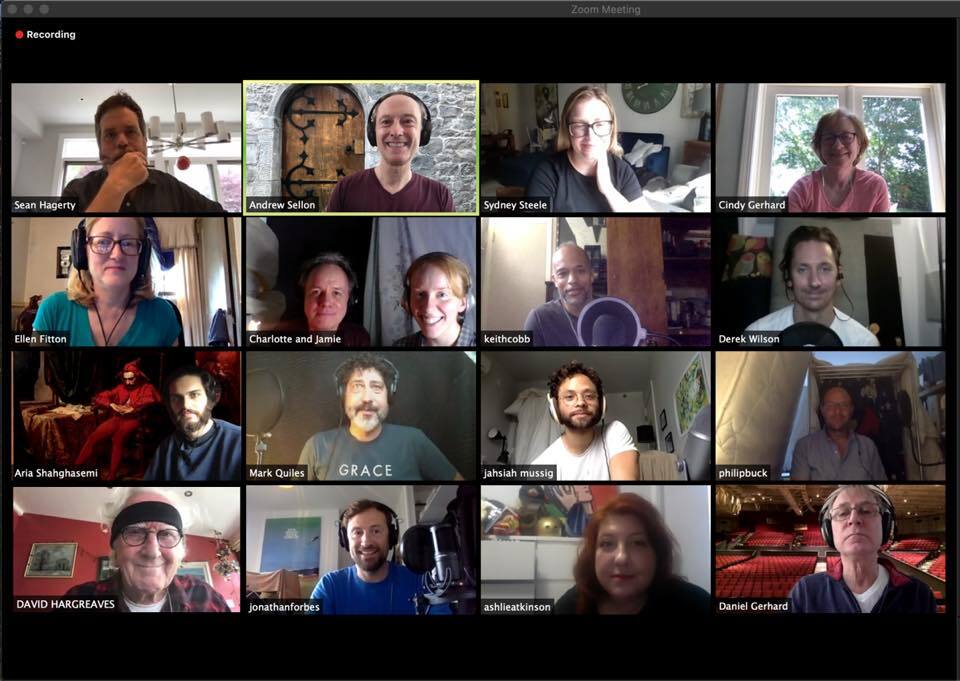
Like many theatre companies across the country, Shakespeare @ knew in April that they’d likely lose their summer season. By May, they knew they’d lose fall as well. So they decided to turn “Richard II” into a radio play. The company assembled a sound design team and began to record on Zoom in June — with actors dialing in from New York, Los Angeles, and London. 

Director Sean Hagerty said that a radio play can’t replace the communal aspect of theatre. “I think there’s something in us that wants to congregate, that wants shared experience.” 

But he was intent on using sound to transport his listening playgoers.

“I don’t want to just hear the horse hooves,” Hagerty recalled telling the sound team. “I want to hear the horse hooves and I want to hear the leather straps and I want to hear the horse’s breath.” 

So far, “Richard II” has proved a success. One older patron with dual-sensory impairment felt so moved that she wrote to the company thanking them for bringing theatre back to her. Now, the team is working on their next radio installment for a fall release.

Why listen?

Audio dramas can engage listeners in a number of ways; some may find it hard to focus while listening. A 2013 study found that between reading aloud silently and listening, listening was the most likely form of engagement to allow our minds to “wander.”

“The fact is that very few of us can sit down for an hour and do nothing else,” said McLoughlin. Even I had to pace my apartment, wash dishes, or put away laundry.

This multitasking while listening isn’t necessarily a bad thing. Verma argues that our culture has a “fetish” for focus and that it’s okay to let our minds go. The best radio dramas “don’t suppose that you’re a good listener or a bad listener,” he said. “They teach you how to listen to them as a unique audio artifact.” McLoughlin agrees: “I don’t think there’s a right way to listen to my podcast or any podcast.”

Conversely, audio dramas can also ask more of their listeners. Like words on a page, sounds prompt your mind to imagine and create your own images. “Film and TV, as powerful and moving as they are, can be quite passive,” said Hagerty. “Whereas with radio there’s an engagement there that has to happen for it to work.”

And that engagement can feel personal or “intimate.” I felt that sitting in my room listening to Jada share her secrets in “Dirty Diana”; her voice was close and immediate, I could hear her words quivering with the excitement of her confession, my mind constructing an image of her eager face. It’s not just the content that creates that feeling. 

“So imagine every photograph you ever saw was a close up,” Verma told me, “It’s like that. It’s like every single photograph in the world was a close up.” Adding: “[It’s] flush up against our ears.” And it’s only become more so as we continue to listen in isolation — in lockdown or elsewhere — with headphones in. 

How an influx in audio drama consumption will affect attention spans culture-wide over time is hard to predict. McLoughlin noted that stories can offer comfort, distraction, and a kind of nostalgia. Maybe what works with audio drama is that it provides narrative structure while also giving our eyes a break from the screens that have come to dominate our now-virtual lives, granting the weary Zoom-er the opportunity to slow down and listen; to let the mind “wander.”

Chad Wolf and Ken Cuccinelli serving at Homeland Security in violation of federal law: GAO report

The word “acting” has been used extensively during Donald Trump’s presidency, as Trump has often found it easier to appoint his friends temporarily than have them permanently confirmed by the U.S. Senate. One such official is Chad F. Wolf, acting secretary of the U.S. Department of Homeland Security. And a report released by the Government Accountability Office, according to New York Times reporter Michael D. Shear, alleges that Wolf and his deputy in DHS, Ken Cuccinelli, are serving in violation of the Federal Vacancies Reform Act of 1998.

Shear notes that the Federal Vacancies Reform Act “specifies orders of succession when senior officials resign,” adding that the GAO “said the improper appointments began after Kirstjen Nielsen was forced out of office as the department’s secretary in April 2019.”

According to the GAO’s report, “Because the incorrect official assumed the title of acting secretary at that time, subsequent amendments to the order of succession made by that official were invalid.” The GAO believes that Wolf and Cuccinelli “are serving under an invalid order of succession,” according to the Federal Vacancies Reform Act.

The GAO aren’t the only ones who believe that Cuccinelli’s appointment violates the Federal Vacancies Reform Act. In March, U.S. District Court Judge Randolph D. Moss ruled that “Cuccinelli’s appointment fails to comply with the FVRA and that policies he put in place should be nullified.”

Shear, notes, however, that GAO “does not have the ability to enforce its findings on the Trump Administration, which has repeatedly defended its appointments of Mr. Wolf and Mr. Cuccinelli. In a statement, the watchdog said that it was referring the issue to the Department of Homeland Security’s inspector general and to Congress, which could try to force their removals.”

On August 14, University of Texas at Austin law professor Steve Vladeck tweeted:

Sen. Chuck Schumer of New York shares Moss and the GAO’s concerns. The Senate minority leader has called for Wolf and Cuccinelli to step down and stressed that any policy decisions they have made at DHS should be nullified.

In an official statement, Schumer discussed the GAO’s report and said, “President Trump’s efforts to install political sycophants to implement his extreme policies in an end run around the law and Senate have finally caught up with him. The determination by an independent congressional watchdog today invalidates actions Mr. Cuccinelli and Mr. Wolf have taken, and both should immediately step down from their illegal roles.”

What Senate Intel report says about Trump and Roger Stone’s 39 phone calls during the 2016 election

On August 18, the Senate Intelligence Committee released its bipartisan report on Russian interference in the 2016 presidential election. One of the things addressed in the report is Donald Trump’s phone conversations with veteran GOP operative Roger Stone during the election — and according to an August 19 article by New York Times reporter Julian E. Barnes, the Senate Intelligence report sheds even more light on those interactions than the Mueller report and Stone’s criminal trial.

Barnes notes that according to court records, Stone and Trump had 39 phone conversations from March-November 2016 — one of which Barnes describes as “an intriguing phone call, on October 6, 2016, to Mr. Trump.”

“According to the Senate report,” Barnes explains, “Mr. Stone received a call that afternoon from a number belonging to an aide to Mr. Trump, who regularly used others’ phones to make calls. The topic of the conversation was not known, Senate investigators wrote, but they noted that Mr. Stone was focused on a potential WikiLeaks release.”

The Senate Intelligence Committee’s report concludes, “It appears quite likely that Stone and Trump spoke about WikiLeaks.”

In October 2016, WikiLeaks published hacked Democratic e-mails that had been stolen by Russians.

Barnes points out that in its report, the Senate Intelligence Committee “laid out a range of evidence that Mr. Stone was focused on WikiLeaks. He and Mr. Trump had spoken a few days earlier, on September 29, also on the aide’s phone. Another campaign aide, Rick Gates, witnessed it and told investigators that the two men discussed WikiLeaks. After that call, Mr. Trump told Mr. Gates that ‘more releases of damaging information would be coming.'”

The Times reporter also notes that Stone “said the Senate conclusion that he had discussed WikiLeaks with the president was based solely on testimony by Mr. Gates and Mr. Trump’s former lawyer Michael D. Cohen. Mr. Stone called their testimony tainted by agreements with prosecutors to answer their questions.”

Stone has insisted that he did not know that people connected to the Russian government were behind the stolen Democratic e-mails that WikiLeaks published in October 2016 — and that he never discussed WikiLeaks with Trump. Barnes, notes, however, “The Senate report made clear that WikiLeaks, at least, ‘very likely’ knew the e-mails were coming from Russian intelligence, and that Mr. Stone knew about the most critical WikiLeaks release before it happened.”

Stone is among the many Trump associates who has faced criminal charges: he was convicted of charges ranging from witness tampering to lying to Congress and sentenced to 40 months in federal prison by Judge Amy Berman Jackson, a Barack Obama appointee. But Trump commuted Stone’s sentence in July, saving him from the prison sentence he was about to begin.

Barnes notes that the Senate Intelligence Committee “rejected Mr. Trump’s statement to prosecutors investigating Russia’s interference that he did not recall conversations with his long-time friend, Roger J. Stone Jr., about the e-mails, which were later released by WikiLeaks.”

In the Mueller report, former special counsel Robert Mueller concluded that the 2016 Trump campaign’s interactions with Russians — however questionable — did not rise to the level of a full-fledged criminal conspiracy. And Barnes points out that the Senate Intelligence report does not accuse Trump of lying. But Barnes also points out that the report “laid out extensive contacts between Trump advisers and Russians” and “detailed even more of the president’s conversations with Mr. Stone than were previously known, renewing questions about whether Mr. Trump was truthful with investigators for the special counsel, Robert S. Mueller III, or misled them.”

Workers told “nothing” will change despite Louis DeJoy’s vow to stop removing machines: union leader

Postmaster General Louis DeJoy’s vow to suspend operational changes at the U.S. Postal Service (USPS) is not expected to affect the ongoing mail slowdown, according to lawmakers and union leaders.

Postal workers were told one day after the announcement that “nothing” would change, Kimberly Karol, the president of the Iowa Postal Workers Union, told Salon.

DeJoy has “no intention” of returning mail sorting machines or rolling back other operational changes at the USPS in spite of his pause on further changes ahead of Election Day, Speaker of the House Nancy Pelosi, D-Calif., said Wednesday.

DeJoy, a top donor to President Donald Trump and the Republican Party, is set to appear before Congress to testify about changes under his leadership which have slowed mail deliveries across the country. Mail sorting machines were inexplicably removed from post offices in numerous states, and the agency also began removing mail collection boxes before DeJoy announced this week that further changes would be suspended through November “to avoid even the appearance of any impact on election mail.” But DeJoy’s “misleading” announcement was “not a solution,” Pelosi said in a statement after meeting with the postmaster general.

“The postmaster general’s alleged pause is wholly insufficient and does not reverse damage already wreaked,” she said. “The postmaster general frankly admitted that he had no intention of replacing the sorting machines, blue mailboxes and other key mail infrastructure that have been removed and that plans for adequate overtime, which is critical for the timely delivery of mail, are not in the works.”

Pelosi said the changes which have already been implemented “directly jeopardize the election and disproportionately threaten to disenfranchise voters in communities of color.” She also expressed concern that “the slowdown of the delivery of medicines to veterans is not being sufficiently addressed.”

The USPS planned to remove roughly 15% of all mail-sorting machines, or about 502 in total, before DeJoy’s announcement, according to Vice News. Despite the pause, 95% of mail-sorting machines slated for removal were already scheduled to be removed by August, according to CNN.

“The machines are important, because they are workhorse for processing letter mail . . . That’s a lot of mail,” Karol said. “Without these machines, we’re not able to get that mail sorted efficiently and reliably.”

It remains unclear how many machines have been removed at this point. About 40% of mail-sorting machines, or 23 in total, have been removed in the Seattle area. At least a dozen machines have been removed in Massachusetts, according to postal workers. There have also been reports of machines being removed in Maine, Michigan and Oregon.

Karol said DeJoy’s announcement “did not” change anything.

“Locally, the announcement came on Tuesday,” she said. “And on Wednesday — at the beginning of the day, the employees were told that we were not going to be seeing a change. That we’re going to continue the pilot program — and nothing was going to change in our office. We’d already been impacted by that — the changes that were put in place.”

The pause was prompted by public pressure, Karol said. One day later, “we were told that they were going to cancel the pilot program,” and “there is some indication that they might be putting machinery back into the building.”

However, the machines in Iowa were “in some cases left out in the open, where the weather is going to impact the ability of the machine to be able to continue to operate,” Karol continued. “So it’s my understanding that they don’t intend to replace these machines.”

“It’s possible,” she added, “but we don’t have any indication that that’s going to be operational again.”

USPS spokesman David Partenheimer did not respond to Salon’s questions about how many such machines have been removed. Partenheimer referred Salon to DeJoy’s statement announcing the pre-election pause, adding that the postmaster general would have more to say on the issue in his appearances before Congress.

DeJoy said in the aforementioned statement that some of the changes “predate my arrival” at the USPS. He vowed that the agency was “ready today to handle whatever volume of election mail it receives this fall.”

Attorneys general from 20 states filed a federal lawsuit against DeJoy over changes at the USPS this week ahead of his announcement. About 100 Democratic lawmakers have called for DeJoy to be removed, writing to the USPS Board of Governors that he “has already done considerable damage to the institution, and we believe his conflicts of interest are insurmountable.”

Pennsylvania Attorney General Josh Shapiro, a Democrat, told The New York Times that the changes have caused delays for people awaiting medication, and the state found evidence of mail being left in boxes and trucks due to reductions in overtime. He said the state’s lawsuit against DeJoy would move forward until the postmaster general agreed to roll back all changes which have caused delays.

“I want to see evidence and binding agreements that roll back the illegal changes they’ve already made and concrete commitments to not make any other changes going forward that don’t go through the regulatory process,” he said.

Karol said her union has been vocal about the issue, because the moves “appeared to be a change in service standards without going through the regulatory process for making changes to delivery standards.”

“There are rules that we have to follow in order to change delivery standards,” she said. “Anything that might affect the public has to be presented to the public, and this was not happening.”

Karol point to the inexperience of DeJoy, who took over the agency despite no experience at the USPS.

“It was not well thought-out, and probably if Mr. DeJoy had some experience in the Postal Service, this may have been done better — differently,” she said. “But the end goal was exactly what happened.”

The only reason that DeJoy made his announcement — and the only way to press the agency to go further — is through increased public pressure, Karol said. She acknowledged “how grateful we are” for the American public’s support and pushback.

“It’s really because of the public” that the changes have been paused, she said. “It’s wonderful to see Democracy in action in this way.”

Democrats wage legal offensive to kick Green Party candidates off ballot in high-profile Texas races

State and national Democrats are waging a legal offensive to kick Green Party candidates off the ballot in some of Texas’ highest-profile races this fall — and they are seeing success.

On Wednesday, both a Travis County district judge and a state appeals court blocked the Green Party nominees for U.S. Senate and the 21st Congressional District from appearing on the ballot. The Austin-based 3rd Court of Appeals additionally forced the Green Party nominee for railroad commissioner off the ballot.

Earlier this week, it surfaced that a Green Party contender for chief justice of the Texas Supreme Court had withdrawn after the Democratic nominee questioned his eligibility.

The Democrats are largely targeting Green Party candidates because they have not paid filing fees — a new requirement for third parties under a law passed by the Legislature last year. The filing fees were already required of Democratic and Republican candidates. Multiple lawsuits that remain pending are challenging the new law, and the Green Party of Texas has been upfront that most of its candidates are not paying the fees while they await a resolution to the litigation.

The Green Party argues that the filing fees, which go up to $5,000 for a U.S. Senate race, are an unconstitutional burden. It has also pointed out that the fees normally go toward primaries, something neither the Green nor Libertarian parties conducts because both nominate their candidates at conventions. Only two of the Green Party’s eight nominees for November have submitted the fees, according to the secretary of state.

Responding to Wednesday’s rulings, the Texas Green Party said the legal challenges were suspiciously timed, coming after the Monday deadline for write-in candidates to file with the state and days before a series of deadlines finalizing the November ballot.

“The timing of these actions is an obvious attempt to remove voter choices from the ballot and lessen the work Democrats have to do to earn votes,” the party said in a statement. “It is disappointing to have the legal system weaponized to suppress voters in this way.”

The major deadline looming over the process is Aug. 28, when the secretary of state has to certify to counties the names of party nominees to appear on the November ballot. The Green Party confirmed its nominees at its state convention in April.

The party focuses on issues such as climate change and social justice, regularly leading to complaints that it siphons votes away from Democrats.

The rulings Wednesday came in response to lawsuits in two courts that involved some of the same candidates. The Democratic Senatorial Campaign Committee, the Democratic Congressional Campaign Committee and the Democratic nominee for U.S. Senate, MJ Hegar, sued in Travis County district court to disqualify the Green Party nominees for U.S. Senate, David Collins, and for the 21st District, Tom Wakely. Meanwhile, Hegar joined the Democratic nominees for the 21st District, Wendy Davis, and for railroad commissioner, Chrysta Castañeda, to seek an ineligibility ruling for their three respective Green Party candidates before the 3rd Court of Appeals.

In the appeals court’s opinion, Justice Thomas Baker ordered the Green Party of Texas to declare its three candidates ineligible and do all it could to make sure they do not appear on the ballot. Baker said the court would not accept motions for rehearing, citing the “time-sensitive nature of this matter.” It was party-line vote from a three-judge panel, with the one Republican in the group, Chief Justice Jeff Rose, dissenting.

In the Travis County district court decision, Judge Jan Soifer said her order is in effect for the next two weeks. However, she scheduled a hearing for Aug. 26 — two days before the state’s ballot certification deadline — where she could reevaluate the decision.

Wakely is probably the best known of the three Green Party candidates whom the courts ruled against Wednesday. He was the Democratic nominee for the 21st District in 2016, when he lost by 21 percentage points to then-U.S. Rep. Lamar Smith, R-San Antonio. He also unsuccessfully ran in the 2018 Democratic primary for governor.

Wakely said Wednesday he thought the parties should be focused on “discussing ideas, debating policy,” rather than working to take options away from voters.

“I’m dismayed that while the Democrats are complaining about [how] the Republicans and Donald Trump are trying to suppress the vote, they’re doing exactly the same,” Wakely said.

The 21st District is now held by Rep. Chip Roy, R-Austin, and he is on the DCCC’s seven-seat target list this cycle in Texas. His Democratic opponent, Davis, is the former state senator from Fort Worth and 2014 Democratic nominee for governor.

Not paying filing fees is not the only way a third-party candidate could be knocked out of contention, though. In the state Supreme Court race, Green Party candidate Charles Waterbury abandoned his bid last week after Democratic nominee Amy Clark Meachum asked the court to declare him ineligible because he voted in this year’s Democratic primary, according to the Austin American-Statesman. State law says such candidates cannot represent one party in the general election if they voted in another party’s primary earlier in the same election cycle.

Third parties could have a sizable impact in Texas this fall, when ascendant Democrats are anticipating numerous close races up and down the ballot.

There were already a number of examples last cycle where third-party candidates drew a not-insignificant amount of votes. In the 23rd Congressional District, a perennial battleground, Libertarian nominee Ruben Corvalan took 4,425 votes, while U.S. Rep. Will Hurd, R-Helotes, defeated Democratic challenger Gina Ortiz Jones by just 926 votes.

In the 21st District last cycle, the Libertarian candidate, Lee Santos, garnered 7,542 votes. That was not far off from Roy’s margin of victory over Democratic opponent Joseph Kopser: 9,233 votes.

Disclosure: The Texas secretary of state has been a financial supporter of The Texas Tribune, a nonprofit, nonpartisan news organization that is funded in part by donations from members, foundations and corporate sponsors. Financial supporters play no role in the Tribune’s journalism. Find a complete list of them here.

The Texas Tribune is a nonprofit, nonpartisan media organization that informs Texans — and engages with them — about public policy, politics, government and statewide issues.

Russian investor in Kentucky mill is “proxy for the Kremlin”: Senate Intelligence Committee report

Rusal, a Russian aluminum company, has invested heavily in a mill that the North American company Braidy Industries has planned for Eastern Kentucky — and according to a Senate Intelligence report on Russian interference in the 2016 presidential election, Rusal is a “proxy for the Kremlin.”

In 2019,  journalist Morgan Watkins reports in the Louisville Courier Journal, Rusal agreed to invest $200 million in Braidy’s mill. And the bipartisan Senate Intelligence report, released on August 18, describes Russian oligarch and Rusal co-owner Oleg Deripaska’s ties to the Kremlin.

According to the report, “Deripaska’s companies, including Rusal, are proxies for the Kremlin, including for Russian government influence efforts, economic measures and diplomatic relations.”

Watkins notes that according to a Securities and Exchange Commission report that Braidy filed in June, Rusal had provided $75 million for the mill as of December 31, 2019 but had discontinued contributions until Braidy could secure another $300 million in funding.

The U.S. government has imposed sanctions on Rusal, but Kentucky’s two Republican senators — Sen. Rand Paul and Senate Majority Leader Mitch McConnell — have voted against keeping the sanctions in place. Watkins notes that on August 19, the Kentucky Democratic Party “questioned McConnell’s decision to support lifting the sanctions on Rusal in light of the Senate Intelligence Committee report’s identification of Rusal as a proxy for the Kremlin.”

Kayleigh McEnany defends Trump’s praise of QAnon on Fox News: “Good hardworking people”

White House Press Secretary Kayleigh McEnany faced a grilling from Fox News on Thursday about President Donald Trump’s praise of a group of potentially violent conspiracy theorists.

Fox News host Sandra Smith asked McEnany about Trump’s claim that QAnon are “people who love our country” that “like me very much.”

Smith explained that a recent Wall Street Journal investigation found QAnon to be “a right-wing group that thinks President Trump is under assault by Satan worshipers.”

“Is the president supporting this conspiracy theory?” Smith asked the press secretary.

“No, what the president is doing is working for the American people,” McEnany insisted. “The media talks a lot about this so-called QAnon. I’ve never heard the president mention it. I talk to him, oftentimes ten times a day. Not once have I heard him mention this group. The media talks about it. But this president if focused on a pandemic that he’s navigating a historic response for.”

The Fox News anchor reminded McEnany that Trump spoke to the media about QAnon just one day earlier.

“His words were that he has heard about them,” Smith said. “And that they are people that love our country. It was puzzling to many people.”

“He’s talking about his supporters,” McEnany replied. “He believes his supporters are good hardworking people that love this country. He’s not in the business of a ‘basket of deplorable’ politics.”

“Does he want the support of that group?” Smith interrupted.

McEnany stuttered before answering: “He has not at all looked into who QAnon is!”

Smith responded by quoting an FBI report which called QAnon “possible conspiracy-theory driven domestic extremists.”

“The president did comment on it,” she explained, “saying that these are people that love our country. So, if there’s any further response from the White House, let us know.”

“There’s a lot of children in this country that have died in the streets of Democrat cities,” McEnany said, changing the subject. “We’re focused on capturing criminals. We’re focused on navigating the pandemic. We’re focused on the economy, not some group.”

You can watch the video below via YouTube:

“It doesn’t look good”: Fox News Judge Andrew Napolitano breaks down the case against Steve Bannon

Fox News judicial analyst Andrew Napolitano said on Thursday that former Trump campaign adviser Steve Bannon could spend up to 20 years in jail if the government’s case against him holds up.

Following Bannon’s arrest, Napolitano spoke about the allegations that Bannon defrauded donors through a charity that raised $25 million to build a border wall.

“This entity — We Build the Wall — promised its donors that not a penny — quote — not a penny would go into their pockets,” Napolitano explained. “So rather than putting the money directly into their pockets, they funneled it to third-party charities and those charities paid the money, according to the indictment, to Steve Bannon and to the others.”

The United States Attorney’s Office for the Southern District of New York announced Thursday that Bannon and other members of the “We Build the Wall” crowdfunding campaign were each charged with one count of conspiracy to commit wire fraud and one count of conspiracy to commit money laundering.

“They are facing 20 years each,” he continued, “for the money that they paid themselves in defiance of their promise not to do so.”

Napolitano predicted that Bannon will defend himself by claiming he deserved to get paid because other charities pay their officials.

“Their use of the third-party charities to actually pay them — so as to hide the payments from the donors and presumably from the government — is an effort to cover your trail,” the analyst noted. “Because they knew they had misled the donors.”

“It doesn’t look good for him right now,” Napolitano added.

You can watch the video below via YouTube

Sarah Palin: “I would not have prostituted myself” like Kamala Harris for “better press”

Former Republican vice presidential candidate Sarah Palin suggested that Democratic vice presidential nominee Kamala Harris “prostituted” herself for “better press” coverage as Harris spoke at the Democratic National Convention on Wednesday.

Palin told Fox News host Tucker Carlson that she was “nauseated and just laughing” at the speeches and coverage of the convention, arguing that the media treats Democrats differently than Republicans.

“Remember, these Democrat candidates — they are treated as delicate pieces of china, whereas someone like me, and other kind of hardcore common constitutional conservatives, we’re more like the bull in the china shop,” she said. 

“Looking back, is there anything you could have done to get the kind of coverage that Kamala Harris is getting now?” Carlson asked. “Like, you care about equality deep within your soul. That you’re a rockstar. A celebrity. You’re the Dalai Lama reincarnated. Could you have done anything to get that kind of coverage?”

“I would not have prostituted myself in terms of changing any of my positions in order to garner better press,” Palin replied. “I would’ve gotten a lot better coverage had I compromised my convictions — had I decided that I was going to go with the flow in order to get that . . . liberal coverage that would have been so much better.”

Alternet’s Cody Fenwick refuted Carlson’s and Palin’s characterizations, noting that she received glowing reviews from the media after her 2008 Republican Convention speech, with outlets describing her as a “conservative rock star” and praising her “speech of a lifetime.”

Media Matters’ Parker Molloy took issue with Palin’s principled stance, noting that she was “most recently seen as a contestant on The Masked Singer, where she sang ‘Baby Got Back’ wearing a bear costume.”

Palin went on to criticize former Republican strategists Steve Schmidt and Nicolle Wallace, who ran the McCain-Palin campaign in 2008 before becoming fierce critics of President Donald Trump on MSNBC.

The former vice presidential candidate alleged that “there was a lot of sabotage going on” inside the campaign — “especially at the end of the game there.” She described herself as a “victim” of the McCain strategists.

“Wolves in sheep’s clothing,” Palin called the pair. “So, you know, those of us who were kind of victims of what they are capable of — it’s kind of vindication for us. Because it’s like, ‘See? Told you so! They were never on our team to start with.'”

Schmidt, one of the “Never Trump” conservatives behind the Lincoln Project, hit back at Palin on Twitter.

“It has been 12 years since @NicolleDWallace and I had to deal with her paranoia, pathological lying, profound ignorance, brittleness and insanity. We had to deal with her for 70 days. It has been amazing to watch her soar and prove all her critics wrong,” he sarcastically quipped.

“Over the last 12 years. Once she was able to rid herself of the treachery and disloyalty of her staff she soared like an Eagle…. Not,” he added.

Trump loses another attempt to block Manhattan district attorney from obtaining his tax returns

President Donald Trump has lost another case against Manhattan District Attorney Cy Vance, who is seeking the president’s financial documents as part of a grand jury case looking into possible bank and tax fraud.

Trump had fought the subpoenas in court but the judge threw out his complaint Thursday morning, meaning that the case can move forward and that Trump must turn over the financial documents requested.

Last month, the U.S. Supreme Court ruled that Trump is not immune from criminal prosecution and that he must comply with subpoenas. Vance had sought records from the accounting firm that Trump uses as well as Deutsche Bank, which has loaned Trump millions over the years.

Former acting Solicitor General Neal Katyal noted that he always assumed that this case would move quickly through the courts.

Axios uploaded the full court ruling documents, which you can read here.

Former Trump strategist Steve Bannon arrested on charges of defrauding border wall donors

Federal law enforcement officials on Thursday arrested former White House chief strategist Steve Bannon and three associates, charging them with defrauding hundreds of thousands of donors to their “We Build the Wall” fundraising campaign.

Bannon was reportedly arrested by agents with the U.S. Postal Service while aboard a boat off the coast of Westbrook, Conn. He is due to appear later Thursday before a federal judge in the Southern District of New York.

The former Trump campaign CEO and associates Andrew Badolato, Brian Kolfage and Timothy Shea were indicted on wire fraud and money laundering charges in connection with the online crowdfunding effort, which raised more than $25 million in total.

“As alleged, the defendants defrauded hundreds of thousands of donors, capitalizing on their interest in funding a border wall to raise millions of dollars, under the false pretense that all of that money would be spent on construction,” acting U.S. Attorney Audrey Strauss said in a news release.

The group repeatedly assured donors that Kolfage — a triple-amputee military veteran who was the founder and public face of the campaign — would not make a penny, according to the indictment. Meanwhile, they allegedly contrived to funnel him hundreds of thousands of dollars, which Kolfage used to fund a “lavish lifestyle.” The men then worked to conceal the transfers, prosecutors claimed. 

Bannon pulled in more than $1 million from the scheme through an unnamed non-profit — “and at least some of it was used to cover hundreds of thousands of dollars in [his] personal expenses,” the indictment alleges. (Last July, Bannon launched “Citizens of the American Republic,” a nonprofit he described as “dedicated to fighting for American workers and sovereignty.”)

Among Kolfage’s alleged purchases were a golf cart and a 2019 Jupiter Marine boat named the “Warfighter.”

The group started “We Build the Wall” as a GoFundMe campaign in late 2018, pitching it to prospective donors as a way to privately make Trump’s border wall a reality in the face of opposition from Democrats in Congress. Donald Trump Jr. spoke last summer at a three-day fundraising event for the group, whose online operations had come under media scrutiny prior to Thursday’s legal action.

According to the campaign’s website, the group “will focus on building portions of a U.S. Southern Border wall and manage the support operations required for, and the processes associated with, the design, engineering, construction and maintenance of the wall.” The group promised to “return every penny” if it did not meet its fundraising goal. 

When the group learned last October that the campaign might be under federal investigation, the four indicted co-conspirators turned to communicating over encrypted messaging apps, according to the indictment. 

Each of the four defendants faces one count of conspiracy to commit wire fraud and one count of conspiracy to commit money laundering, both of which carry sentences of up to 20 years in prison.

“The defendants allegedly engaged in fraud when they misrepresented the true use of donated funds. As alleged, not only did they lie to donors, they schemed to hide their misappropriation of funds by creating sham invoices and accounts to launder donations and cover up their crimes, showing no regard for the law or the truth,” the U.S. Postal Service Inspector-in-Charge Philip R. Bartlett said. “This case should serve as a warning to other fraudsters that no one is above the law — not even a disabled war veteran or a millionaire political strategist.”

The day before Kolfage was arrested, he tweeted that he had taken down his “We Build the Wall” GoFundMe page — “the largest @gofundme campaign ever” — in response to the platform deleting his “Black Lives Matter is a hate group” fundraising page, which he launched earlier this week. He vowed to “not give them another penny” beyond the $27 million already raised.

Last year, leaders of the Republican-led Senate Intelligence Committee named Bannon in a criminal referral to the Department of Justice over suspicions that he might have lied to the panel, according to multiple reports. Don Jr. and the the president’s son-in-law Jared Kushner were also referred to the department. 

According to a letter sent to Justice Department, the committee believed that Bannon and Erik Prince, a Blackwater security contractor and brother of Betsy DeVos, might have lied about Prince’s backchannel meeting with a Russian oligarch.

Bannon is the seventh Trump 2016 campaign aide to be indicted, and along with Paul Manafort, the second 2016 campaign head to be charged with money laundering.

In a book published last year by journalist Michael Wolff, Bannon allegedly described Trump’s business empire as a “criminal enterprise” and speculated that the president was lying about being a billionaire.

Kamala Harris’ big night: Democrats foreground “women’s issues” as urgent, universal concerns

The official theme of the third night of the Democratic National Convention, the night that Sen. Kamala Harris of California accepted the nomination as Joe Biden’s running mate, was “A More Perfect Union.” It soon became clear, however, that the real theme of the evening was Ladies Night.

This convention has been geared towards women from the get-go — not only are women the majority of Democrats, they are the majority of voters, period — with female faces and issues that rate highly with female voters foregrounded. But Wednesday night went well beyond that. 

The night was stuffed full of the lady luminaries of the Democratic Party: The first female Speaker of the House, Nancy Pelosi. The should-have-been-first female President, Hillary Clinton. The first woman to murder a billionaire live on television, Sen. Elizabeth Warren of Massachusetts. And of course Harris herself, the first Black woman and first Asian-American on a presidential ticket, and, as Democrats and sane people everywhere fervently hope, the first woman to occupy the role of vice president. 

We even got a cheesy video about woman rebels, from the suffragettes to the Women’s March participants, which perhaps was to be expected in the same week that the 19th Amendment turns 100 years old. 

It’s tempting to sneer and make accusations of pandering because, truth be told, most things that are marketed to women tend to be wrapped in maximum condescension. Paint it in pink, put some glitter on it, make it “sassy” and the ladies will eat it up, right? 

But the truth is that the night was nothing like that. Instead, women were addressed not as pink-bedazzled materialistic morons, but smart people with a vested interest in important issues, including many that aren’t traditionally coded as female. The issues that were highlighted on Wednesday — immigration, climate change, gun control, violence against women, child care — were clearly chosen not based on sexist assumptions, but actual research into the issues that women actually care about.

It set up the perfect tone for Harris, who will — if American democracy has any hope of survival — will be the first woman on a winning presidential ticket. (As Hillary Clinton reminded the audience, however, it’s possible to “win 3 million more votes and still lose.”) After all, the only way women — and especially women of color — will ever achieve full equality is to be taken seriously as full people on their own terms, without either erasing their gender or racial identities or being reduced to them.

When Harris took the podium, speaking to banks of video monitors in a nearly empty convention center in Wilmington, Delaware, she illustrated exactly how women’s gender can inflect their perspective without reducing them to nothing but that. 

“I’ve fought for children, and survivors of sexual assault. I’ve fought against transnational gangs. I took on the biggest banks, and helped take down one of the biggest for-profit colleges,” Harris said, describing her time as California’s attorney general.

“I know a predator when I see one,” she added. 

So-called “women’s issues” are often bracketed off from other issues, as if they were boutique concerns that have no larger social relevance. But as feminists have long argued, and as Harris’s “predator” line made clear, the same ugly forces that drive the oppression of women also reverberate throughout our society. The man who preys on women, as Donald Trump has bragged about doing, is the same man whose sadism and lack of empathy will lead him to destroy the environment, terrorize immigrants, wreck the economy and let a pandemic run rampant. 

That mentality is why so much of the woman-centric programming on the DNC’s next-to-last night was focused on subjects not traditionally understood as “women’s issues,” such as gun control and climate change. But, as politics in the post-“grab ’em by the pussy” era has shown, the same toxic masculinity that does so much direct damage to women also damages our economy, our public safety and, in the age of coronavirus, our ability to not to have virus spewed all over us by some jerk who thinks a mask makes him look like a girl. The remedy for this is to stop treating women like a narrow special interest group and to understand that “women’s issues” are better understood simply as people’s issues. 

That point was emphatically made by Elizabeth Warren, who spoke from an empty classroom about the critical issue of affordable child care. 

“We build infrastructure like roads, bridges and communications systems so that people can work. That infrastructure helps us all because it keeps our economy going,” she argued. “It’s time to recognize that child care is part of the basic infrastructure of this nation — it’s infrastructure for families.”

Obviously, Clinton’s 2016 campaign went a long way towards educating the public that “women’s issues” aren’t a side issue, but touch on every part of our lives. It’s good to see that realization has only strengthened in the years since. And it was refreshing to see women treated not as a special interest group to be pandered to, but as what women actually are: A majority force both among Democratic voters and society as a whole, who are therefore entitled to set the political agenda without being treated as trespassers. 

The other good news from the night is that Democrats are taking Donald Trump’s attempts to steal the election seriously — especially his campaign to destroy the Postal Service — and have regularly reminded voters, throughout this event, to take measures to keep that from happening. And they’re not pulling punches when describing the very real threat to this basic right to vote. 

Why don’t they want us to vote? Why is there so much effort to silence our voices?” Harris said in a brief statement early in the evening, an unusual move that emphasized the critical nature of this “vote early” message. 

“We need numbers so overwhelming Trump can’t sneak or steal his way to victory,” Hillary Clinton said in her speech. 

“Do not let them take away your power. Don’t let them take away your democracy. Make a plan right now for how you’re going to get involved and vote,” former President Barack Obama said in his moving and powerful address. 

It wasn’t just good message discipline. It was evidence that Democrats are responding rapidly to the emerging story of Trump’s efforts to steal the election. In 2016, there was considerable hesitance from Democrats about being forthright with voters about Russian efforts, aided by the Trump campaign, to interfere with the election. Somewhat understandably, they didn’t want to sound like hysterics or conspiracy theorists, even though the collusion was clearly happening.

This time around, Democrats seem to realize that they can’t give into the pressure to downplay Trump’s obvious efforts to corrupt the entire electoral process. As we all know now, the man has no morals, no shame and no sense of decency. As Michelle Obama would say, it is what it is. Democrats finally appear ready to deal with that problem head on, instead of simply hoping it goes away. 

Why COVID deniers and climate skeptics paint scientists as alarmist

In an interview with Fox News last month, President Donald Trump called Anthony Fauci, the country’s top infectious disease expert, an “alarmist,” using a pejorative straight from the playbook of those who deny the science behind climate change. Fauci rejected the characterization, describing himself as a “realist.”

For anyone paying attention to arguments about climate change over recent decades, Trump’s comment sounded awfully familiar: Scientists are “alarmists,” everything’s a “hoax,” and “hysteria” abounds. Michael Mann, a climatologist at Penn State University, wrote an op-ed for Newsweek this week drawing parallels between his experience and Fauci’s during COVID-19. Science deniers have lobbied attacks on the two public figures, he explained, sending death threats, calling them names, and questioning their expertise.

So what do terms like “alarmist” and “hysteria” really mean, where did they come from, and how can people respond to such accusations?

The strategies used to dismiss the threats of climate change and coronavirus follow a similar pattern, and they’re employed by many of the same people. It starts with denying the problem exists, as Naomi Oreskes, a professor of history at Harvard who studies disinformation, has explained. Then, people trying to obstruct action deny the severity of the predicament, say it’s too hard or too expensive to fix, and complain that their freedom is under threat. Denying the science requires dismissing what scientists are saying, and the easiest way to do that is by questioning their motives, impartiality, and rationality.

“If we don’t trust scientists or medical experts because we see them as alarmist or hysterical or as contributing overreaction, then we don’t trust the info they’re giving us,” said Emma Frances Bloomfield, an assistant professor of communication at the University of Nevada, Las Vegas.

Back in the day, “alarmism” was seen as a virtue. The term traces back to the 1790s, around the time that Edmund Burke, the famous philosopher, sounded the alarm against the French Revolution. “We must continue to be vigorous alarmists,” he wrote.

That “sounding the alarm” connotation faded long ago. Now it suggests a person who exaggerates and sensationalizes potential dangers, sowing needless panic. It’s a pejorative that doesn’t fit most scientists. Research has shown that they’re fairly conservative when it comes to the climate crisis. A 2012 study found that their projections have actually underestimated the effects of our overheating planet, like the potential disintegration of the West Antarctic ice sheet. The authors of that study, including Oreskes, wrote that “scientists are biased not toward alarmism but rather the reverse: toward cautious estimates.” They called this tendency “erring on the side of least drama,” and suggested that the tendency to downplay future changes comes from a pressure to appear objective.

The commonly held notion of what a scientist should be was articulated by Robert K. Merton, an American sociologist who outlined the “ideal” expectations for scientists in the 1940s. Merton called for scientists to be unbiased, rational, and to stay clear of conflicts of interest.

Words like “overreacting” emphasize emotion, detracting from scientific credibility. “Being emotional is something that we try to keep away from science,” Bloomfield said. “When you think about scientists really caring about something, it violates those expectations we have that scientists are balanced and they only look at facts.”

Take “hysteria,” which comes from the Greek word for uterus. (Plato and Hippocrates thought the womb lurched up and down in the body, causing erratic behavior, emotional outbursts, and insanity among womankind.) The term has a dark and complicated history, but suffice it to say that it made an appearance in 17th-century witch trials, and much later on, during some pretty frustrating visits to the doctor.

“It’s feminizing science as a way to discredit it,” Bloomfield said. Another word to keep an eye out for is “shrill,” an adjective describing a high-pitched, piercing voice that became a way to stigmatize women (think Hillary Clinton) and sometimes scientists, too.

To counter these attacks, Bloomfield said that one effective strategy is to follow Fauci’s example: Reject the characterization and substitute your own word, like “realist” instead of “alarmist.”

Another strategy is to ask questions that challenge assumptions. Bloomfield suggests asking something like, “How many people would have to die for you to be alarmed?” With 164,000 deaths and climbing, more Americans have died from COVID-19 than were killed in World War I. The question forces people to think for themselves and draw their own conclusions.

Vladimir Putin’s prize pupil is almost ready: Trump’s final exam in authoritarian rule

Donald Trump has been called Vladimir Putin’s puppet, but he is more than that. He is Putin’s willing and eager apprentice.

As Election Day approaches, Trump is rapidly escalating his assaults on American democracy, freedom, the rule of law and the country’s political and social institutions, as well as the American people themselves. In all, Donald Trump is following through on every lesson from the authoritarian’s playbook with speed and enthusiasm.

The evidence for a teacher-student mentoring relationship between Vladimir Putin and Donald Trump is overwhelming. As senior Democratic adviser Simon Rosenberg told me recently in a Salon interview: 

I believe that 20 years from now [Mick] Mulvaney and [Mark] Meadows and the other chiefs of staff and senior Trump officials are going to acknowledge that they believe that Putin was Trump’s coach. He has checked every play in the authoritarian playbook — and done it very fast. Donald Trump is not very smart. He is likely being coached by Putin and other authoritarians. They are giving him ideas and pushing him in certain directions. We know that Trump has spoken to Putin seven times in the last few months, in a time when he has ratcheted up his attacks on democracy and started the beginnings of a domestic crackdown here in the United States.

Moreover, teaching takes place in many ways. Children imitate their parents and other role models. It is a rare occasion when a parent explicitly says to a child “I am going to teach you today.” In that sense, Vladimir Putin is the father and Donald Trump is his fawning, admiring child.

Trump has repeatedly said that he may not respect the outcome of the 2020 presidential election if he loses. Like Putin, China’s Xi Jinping, Turkey’s Recep Tayyip Erdogan and other authoritarians, Trump is eager to change his country’s laws in order to stay in office indefinitely. His interference with the U.S Postal Service in order to sabotage mail-in voting is part of the same strategy.

Acting on Trump’s commands, Attorney General William Barr and acting Homeland Security Secretary Chad Wolf have created a de facto secret police force to be used against the regime’s “enemies” — meaning the majority of Americans who do not support Donald Trump.

Trump is reportedly marshaling a force of 50,000 “poll watchers” he hopes to use to harass and intimidate Democratic voters on Election Day. He is using Fox News, the One America News Network, the Sinclair Broadcast Group and (soon) the once-revered Voice of America as his personal mouthpieces and propaganda machines.

In many ways, these final weeks before Election Day are a type of final exam in authoritarianism for Donald Trump and his movement.  

Donald Trump’s daily coronavirus “press conferences” are primarily an opportunity for him to receive the narcissistic fuel that he has been deprived of from his canceled rallies. But they serve another and more important function, as an integral part of a propaganda campaign against truth and empirical reality. To that end, the Trump regime has even inserted right-wing operatives into the White House audience. The Intercept describes this subterfuge:

In an apparent effort to make his daily news conferences even more like campaign events than they already are, the White House press office has been packing the briefing room with supporters of President Donald Trump from far-right media outlets who can be relied on to toss him softball questions and initiate attacks on his political rivals.

Although the importance of this spectacle was largely lost in the breathless churn of the 24/7 news cycle, Trump’s “press conference” at his Bedminster, New Jersey, golf club two weeks ago displayed what he has learned in his earnest study of authoritarian stagecraft, manipulation, and messaging.

During his remarks, Trump claimed that his executive actions had somehow “extended” unemployment benefits for the tens of millions of Americans who are unemployed because of the pandemic. In reality, Donald Trump does not have that power, and his executive order actually reduced the amount of money available to struggling Americans from $600 to $300 a week — and only for a few weeks until the funds run out. By claiming to have presidential powers he does not in fact possess, Trump is again challenging the boundaries of the law — before fully breaking them later.

By making an official appearance in Bedminster, Trump elevated his personal property to the level of the White House. Both symbolically and literally, Donald Trump presents his own personal interests as identical to the American people’s.

Fascism consists of political thuggery and corruption. In Bedminster, Trump also ordered the temporary suspension of the payroll tax, and suggested ending it entirely — which would fulfill a right-wing goal of imperiling the solvency of Social Security and Medicare. Trump then promised that if he is re-elected he will make the payroll tax cut permanent, an obvious attempt to bribe the voters. 

At the same event, Donald Trump used the White House press corps as stooges, to be jeered and mocked by the members of his golf club, who stood in the back of the room clapping for the president and deriding reporters as bearers of “fake news.”

In sum, Trump’s Bedminster performance was surreal, an act of authoritarian stagecraft in which the president depicted himself as benign and almighty, while accusing the Democrats of “stealing” the election from him through “rigged” voting — and while his court of sycophants loudly heaped praise upon him like a laugh track for a bad sitcom. 

It was a highly Putin-like spectacle.

In his books “Nothing Is True and Everything Is Possible” and “This Is Not Propaganda,” journalist and media scholar Peter Pomerantsev details how Putin and his agents have used digital technology and other forms of media to craft an authoritarian politics and society in which “the truth is unknowable.”

In “Nothing Is True and Everything Is Possible,” Pomerantsev writes: “The brilliance of this new type of authoritarianism is that instead of simply oppressing opposition, as had been the case with twentieth-century strains, it climbs inside all ideologies and movements, exploiting and rendering them absurd.”

In this fourth and perhaps final year of Trump’s presidency, the regime’s use of Vladimir Putin’s playbook is escalating. In a 2017 essay for Vanity Fair, Mark Mariani warned about this:

Putin has been in power, on and off, for close to two decades. But the Trump team is catching on fast.

The first technique that the Trump administration appears to be appropriating from Moscow is a kind of chaos theory. By clogging the news with mini-scandals, bald-faced lies, and provocative tweets, the White House sends journalists and media outlets into a haphazard frenzy. President Trump’s lies alone have become their own beat, forcing publications to devote precious resources to invalidating the many outrageous claims he makes daily, sometimes within a single interview. White House press secretary Sean Spicer’s early press conferences suggest that he too will serve as media antagonist, baiting reporters with arrogant fallacies and extending the Trump regime’s brand of bullying truth and democratic values into wary submission…. The press is constantly scrambling to respond to a never-ending river of slime, and the system is gradually overwhelmed. Over time, this chaos creates what Pomerantsev describes as a “fog of unknowability.”

What should the American news media do, in its role as supposed guardian of democracy, to counter Donald Trump’s Putin-esque attacks on the truth and the country’s social and political institutions? How can they bring clarity and truth to this “fog of unknowability”?

  • Assume everything that Donald Trump and his spokespeople say is a lie until proven otherwise. The Trump administration deserves no presumption of honesty or an assumption that its behavior is well-intentioned.
  • Journalists and reporters must not allow themselves to be used as human props by the Trump regime at his press conferences and other events. If that occurs, they should turn their backs in protest or simply walk out.
  • The Trump regime’s assaults on the rule of law, the Constitution, civil and human rights, and human decency are not errors or mistakes. The human devastation caused is not accidental or incidental, but willful and intentional and part of a much larger pattern of authoritarian behavior. Accept and acknowledge that.
  • Report on the Trump regime and its followers and allies in the same way one as one would if the United States were a foreign country. Doing so will help to get around the blinders of American exceptionalism.
  • Stop avoiding the objective truth. It is objectively true Trump and his regime are authoritarian. It is objectively true that Trump and Stephen Miller are white supremacists. “Both-sides-ism” and “fairness” are acts of surrender to fascism and authoritarianism. Journalists and opinion leaders who use such framing when discussing a fascist regime are complicit.
  • When Trump or his spokespeople lie, they should be directly confronted with the facts and follow-up questions.
  • There are role models to follow. Last week, HuffPost White House correspondent S.V. Dáte asked Donald Trump, “Mr. President, after three and a half years do you regret at all, all the lying you’ve done to the American people?” Dáte will likely be barred from the White House, perhaps forever, but he provided an example of the principle that a reporter has a sacred responsibility to the truth.

Since 2015, the mainstream American news media has mostly betrayed its best principles by helping to normalize Donald Trump and his movement. With about 10 weeks left until Election Day, the media can now try to salvage some of its reputation by telling the objective truth about the dangerous reality of Trumpism and how the 2020 election is a matter of life and death for American democracy — and the American people in the era of the pandemic.

The self-inflicted harm of the mainstream media’s early surrender to Trumpism, and of its foolish hopes that he would become “presidential” and would “rise to the office,” cannot be easily repaired.

But these final weeks before Election Day offer an opportunity for America’s Fourth Estate to engage in critical self-reflection and then recommit to being guardians of democracy. Either that or it can capitulate further to Trump’s authoritarian presidency and take on the role of curators and commentators to a failed pseudo-democracy.