Spring Sale: Get 1 Year, Save 58%

“Disgraceful”: Experts warn “wrongheaded” SCOTUS Virginia voter purge ruling is an “ominous” sign

The Supreme Court's conservative majority, overriding the objections of the court's liberal members, allowed Virginia on Wednesday to continue its removal of over 1,600 voters from the rolls.

The state's Republican administration under Gov. Glenn Youngkin has said they are weeding out non-citizens who are not legally allowed to vote, but the U.S. Department of Justice and civil rights groups allege that the purge is also sweeping away actual U.S. citizens.

In a pair of lawsuits, the DOJ and civil rights groups accused Virginia of violating National Voter Registration Act, which prohibits states from "systematically" removing voters from the rolls 90 days or less before an election. A federal district judge ordered Virginia to restore the purged voters to the rolls last week, only for his directive to be reversed in turn by the Supreme Court, which did not explain its decision.

Not only does the decision appear to contradict federal law, but constitutes what former U.S. Attorney Joyce Vance called a "disgraceful departure" from the federal courts' own jurisdictional principle to do no harm to the election process. The so-called Purcell principle, which takes its name from a Supreme Court election case in 2006, holds that courts should not change or approve of changes to election rules just prior to an election because it could confuse voters and disrupt election administration.

Nicholas Stephanopoulos, a professor at Harvard Law School, wrote on X that even if the district judge's ruling to force Virginia to reverse the purge was what constituted the last-minute change, Purcell "shouldn't immunize the state's illegal action."

Legal experts warned that while the ruling from above would only affect a handful of voters, it could portend even more interference by the Supreme Court on a larger scale. "It is exceedingly unlikely that this ruling will affect the outcome of any federal races in Virginia. That said, it’s a rather ominous harbinger of the Court’s willingness not only to intervene in at least some election cases, but to do so without explaining its reasons why," Steve Vladeck, a Georgetown Law professor and CNN contributor, wrote in an X post.

"This is a bad sign. It suggests an unchastened Supreme Court poised to help Trump suppress lawful votes on the flimsiest basis," added Harvard legal scholar Laurence Tribe. "I still think the Roberts Six won’t succeed, but it won’t be for want of trying."

That the ruling only affects around 1,600 voters is beside the point when it is a "wrongheaded decision in light of clear federal law," concurred Marc E. Elias, a lawyer and founder of Democracy Docket.

“Martha” presents a side of Martha Stewart we haven’t seen before: hers, in her voice

Martha Stewart is not big on sharing her feelings. To the millions who greedily gobbled up scuttlebutt about her legendary meanness over the years, this is far from a news flash. And it might have proven an obstacle for some documentary filmmakers.

That knowledge explains why R.J. Cutler opens “Martha” by asking Stewart what she most dislikes. “That’s a hard question to answer,” Stewart says in her signature monotone, the voice she uses when she’s not selling you something. Her long list includes waste, inefficiency, avoidance and impatience—the knowns (“I dislike not paying attention to details”), on-brand unknowns (“I dislike aprons and housedresses”), and some opinions about color the filmmaker leaves unexplained. 

They hang out in the silence that follows, along with the shot lingering on Stewart’s face taking in her reaction to space that isn’t being filled with conversation or a question. Stewart lets that be for a beat, then smirks in a way best described as not unpleasant. “OK,” she says curtly. “Next.”

Eventually, we get why Cutler provokes her this way. Stewart spent most of her life building a façade of impenetrability and invulnerability, controlling and crafting an image of calm, assured expertise. Emotions are messy. 

Martha Stewart, the brand and the person, is graceful and ordered, like the gardens that give her life purpose. Her dislikes are weeds that matter less, if at all, than what she prizes. She treats the question as compulsory but perhaps inessential. Soon enough we understand its role in deciphering the woman sitting before us, centered in an opulent room with a lush bouquet of stargazer lilies behind her. 

Throughout “Martha,” Stewart colors her words with effervescent agreeability, only to betray flashes of discomfort when the silence stretches beyond a second or two that are much more telling. What registers on her face as she lists each disliked item is a baseline, a Rosetta Stone. That exchange readies us to look closely at what she doesn’t say or refuses to put into words, the details that make “Martha” genuinely affecting and honest. 

Throughout “Martha,” Stewart colors her words with effervescent agreeability, only to betray flashes of discomfort when the silence stretches beyond a second or two.

“Some people revel in this self-pity, et cetera, et cetera. I just don’t,” Stewart says when she arrives at the chapter of her story requiring her to describe her marriage’s failure during her publicity tour to launch her book “Weddings.” 

"I handed over letters that were very personal,” she said. “So guess what? Take it out of the letters.”

Yes, Martha wrote down her life’s recipe and opened those journals and papers to Cutler and us. This is all part of Stewart’s guidance in how she’s presented. Cybill Shepherd may have portrayed her woes in a pair of made-for-TV movies, but the actual dialogue of Stewart's heartbreak is incomparable. 

“I have to go San Francisco and talk about ‘Weddings’ and my wonderful life,” reads a line from one of Stewart’s letters to her increasingly distant husband. “I hope you are enjoying your freedom. And I hope my plane crashes.”

MarthaMartha (Courtesy of Netflix)

Taking in “Martha” is as soothing as thumbing through the glossy pages of Living, with its parade of touched-up artfully arranged photographs interspersed with archival footage and illustrations serving as tasteful alternatives to reenactments. This realizes what Joan Didion describes in her 2000 New Yorker essay about the “unusual bonding” and “proprietary intimacy” Stewart creates with us — her people, her consumers, her devourers.  

“Martha” features a galaxy of voices we haven’t heard before, including brothers and a sister who offer insight into the hardships of their homelife when they were children. Cutler isn’t one for overt psychoanalysis, but the choice to sprout the narrative in Edward Kostyra’s iron-fisted influence as opposed to featuring Stewart’s mother, a beloved recurring guest on her syndicated daytime show, is eye-opening. Father was demanding – “mean, mean,” is all Stewart offers. 

Her gardening fixation comes from him making his children plant food so the family could eat. The juxtaposition of scenes of her surveying her estate’s grounds and telling her landscaping staff what she wants to be done against the echo of her brother Eric Scott’s voice saying “To this day, I despise gardening” is withering. 

Among the background figures in her purported one-woman show, however, he casts the longest shadow – a fascinating bit of embroidery on what is essentially the story of America’s relationship with womanhood. We love second chances, constant innovators, and people who would rather be rich than liked. 

That last one, though, hints at the darker side of our love affairs with celebrities, especially women, in the way we celebrate loudly when the highest flyers tumble from the sky. Stewart may be worth $400 million now, but her conviction on charges related to an insider trading scandal lost her more than an estimated billion dollars.

We need your help to stay independent

She’s since been exonerated in the court of public opinion, but Stewart hasn’t forgiven the men who used her conviction to further their political careers, including James Comey. (“Those prosecutors should have been put in a Cuisinart and turned on high,” she snaps.)

But if this is the most exposed Stewart allows herself to be, then we must also accept that the only current interview footage about Stewart features her and only her. Martha Stewart doesn't do warts, but Cutler edits a wry irony into the artful coverage she dabs on her blemishes, like her refusal to count her marital infidelity as equivalent to that of her husband. We may laugh at Stewart's brazen hypocrisy because, as we should know by now, Stewart defines the world as she sees it. 

Stewart’s influence has been celebrated and scrutinized since she rose to national prominence on the strength of her first bestseller, “Entertaining.” Her climb from lifestyle author to homemaking empress, along with her fall and brief imprisonment, spawned endless special reports, gossip columns, parodies, and unauthorized biographies both serious and salacious. 

Stewart defines the world as she sees it.

CNN’s four-part series “The Many Lives of Martha Stewart,” which aired in January, is probably the most comprehensive and evenhanded dissection of Stewart’s life and career to date that doesn’t include her voice. Students of all things Stewart may find it illuminating to watch or rewatch it in tandem with taking in “Martha," since Cutler finds what the most extensively researched and sourced always miss: her humanity. 

Stewart makes no bones about her perfectionism or her lack of warmth, which she freely surmises is the reason her closest relationships suffered. The illusion of building her empire brick-by-brick on her own is core to the Martha Stewart mystique and legend and a prime annoyance among many of those who worked with her, and whose contributions went uncredited. 

Off-screen voices from Stewart's inner circle include Snoop, (naturally); Martha Stewart Living’s Founding editor-in-chief Isolde Motley; Andy Monness, who worked with Stewart in her pre-catering days on Wall Street and other close friends. Several are kind and blisteringly honest about who she is. One offers, “She got such wrong ideas about success.” Another describes her with an expletive that rhymes with “itch.”

They contextualize her personality but don’t speak for her even when she can’t or won’t weigh in on the most compelling reveals Cutler shows us, which is a palpable loneliness and pain.  

In describing her romantic relationships, Stewart admits, “It doesn’t interest me so much to know, ‘Oh Charles, how do you feel this second?' I don’t care, actually,” she says. “I do care about, ‘Charles, what are you doing? What are you thinking about?’ So I sort of gravitate towards people who are doing things all the time.”


Want great food writing and recipes? Subscribe to Salon Food's newsletter, The Bite.


“Martha” sheds a bleaker light on Martha’s frayed relationship with her daughter Alexis, which was so widely known at one point that Stewart put her in a “Mystery Science Theater 3000"-style spinoff called “Whatever, Martha” to snark about her mother’s unrelenting pursuit of perfection and ambition.  

We have been privy to a heavier sorrow in their story that reveals much about what women of Stewart’s era were expected to do and what her refusal to be limited to those restrictions cost her. 

“What is more important, a marriage or a career?” she asks. You tell me, her inquisitor throws back at her, and she concludes somewhat hollowly, “I don’t know.”

Whenever “Martha” captures these moments of introspection we see its eponymous figure exposed for what she is – ambitious and demanding, forward-thinking and innovative, brusque and task-obsessed. Easily discomfited when danced into corners from which the only escape is introspection. Built to charge ahead, not look back or inward. 

Stewart frequently describes herself as a teacher. Through “Martha” Cutler becomes an instructor of sorts as well, tracing the crisp angles, lines, and blurred edges she designed into her life. Whether those are necessary ingredients in the bittersweet romance an ambitious woman cultivates with herself is debatable. Layered on top of everything else we’ve read and watched, it’s the piece that at last helps us understand Stewart in her fullness.

"Martha" is currently streaming on Netflix. "The Many Lives of Martha Stewart" is available to stream on Max.

“Hate”: Martha Stewart trashes Netflix’s new “Martha” documentary

Earlier this summer, Netflix began teasing that it had landed a documentary about Martha Stewart which promised to offer a wholly unique look at the domestic mogul who is known for her carefully curated image. Directed by R.J. Cutler, a documentarian whose past subjects include Elton John, Billie Eilish and Anna Wintour, “Martha” was the result of  “hundreds of hours of intimate interviews with Stewart and those from her inner circle, along with Stewart’s private archives of diaries, letters, and never-seen-before footage,” according to the streamer

However, as the year progressed and the film began making the festival circuit, it seemed the documentary didn’t live up to Stewart’s initial expectations. In September, after the film debuted, Stewart reportedly called the project “lazy” and “not the story that makes me, me” at the 2024 Retail Influencer CERO Forum. 

She didn’t expand much beyond that, other than to say the film focused too heavily on her trial which was rather boring relative to the rest of her life. However, now that “Martha” has finally debuted on Netflix, Stewart is getting more candid about her feelings surrounding the documentary. 

During a half-hour conversation with the New York Times’ Brooks Barnes — which he described as “30 almost uninterrupted minutes of sharp critique” — Stewart detailed what, in her mind, were the film’s numerous shortcomings, starting with how Cutler used the ample archival material with which she had provided him.  “R.J. had total access, and he really used very little,” Stewart told Barnes. “It was just shocking.”

Some of Stewart’s complaints were more superficial, like how she disliked the camera angles Cutler chose for shooting her, or that she wanted the film to feature music that was more representative of her personal tastes — less “lousy classical score” and more Dr. Dre, Snoop or Fredwreck. 

But the heart of her dissatisfaction was about how the film portrayed her. In her mind, Cutler didn’t do enough to contextualize what a groundbreaking product “Martha Stewart” magazine was.

We need your help to stay independent

“We had avant-garde photography,” Stewart said. “Nobody ever showed puff pastry the way I showed it. Or the glossaries of the apples and the chrysanthemums. And we prided ourselves so much on all of that modernism. And he didn’t get any of that.”

She also disliked the final scenes of the film which seemed to paint her as feeble, especially as she shows no sign of slowing down at the age of 83. 

“Those last scenes with me looking like a lonely old lady walking hunched over in the garden? Boy, I told him to get rid of those,” Stewart told Barnes, explaining that she was limping a bit following a surgery on her Achilles tendon. 

“And he refused,” Stewart continued. “I hate those last scenes. Hate them.”

For his part, Cutler has been reserved in his responses to Stewart’s searing critique of the film. 

“I am really proud of this film, and I admire Martha’s courage in entrusting me to make it,” he told the New York Times. “I’m not surprised that it’s hard for her to see aspects of it.”

“Martha” is now available to stream on Netflix.

The world is “miles short” of its target to limit climate change, UN reports

For the world to achieve net-zero carbon emissions by 2050, the 200 countries who signed the Paris climate agreement must hit a target of 43% reduction by 2030. Yet according to a recent report by the United Nations agency tasked with tackling global warming, the planet is currently on track to just hit a measly 2.6% reduction in carbon emissions.

The agency in question, UN Climate Change, analyzed the carbon cutting plans as submitted by the almost 200 countries involved in the 2015 accord. If they do not significantly accelerate their carbon reduction plans, it will be impossible to keep the planet’s total warming below 1.5º C hotter than pre-industrial levels.

“The report’s findings are stark but not surprising,” Simon Stiell, executive secretary of UN Climate Change, told the BBC. “Current national climate plans fall miles short of what’s needed to stop global heating from crippling every economy, and wrecking billions of lives and livelihoods across every country.”

Some scientists have already written off the possibility of keeping global warming under that pre-industrial threshold. The authors of an August study in the journal Nature Climate Change determined that 1.6º C above pre-industrial levels is the best humanity can realistically achieve at this point.

"Accelerated energy demand transformation can reduce costs for staying below 2º C but have only a limited impact on further increasing the likelihood of limiting warming to 1.6° C," the authors wrote, referring to an eventual transition to carbon neutral energy technologies.

"A year above 1.5C is unprecedented in human history," Dr. Ken Caldeira, an atmospheric scientist at the Carnegie Institution for Science's Department of Global Ecology, told Salon at the time. "Nevertheless,  it is important to remember that each carbon dioxide emission causes another increment of global warming and so each emission avoided is an increment of global warming avoided."

Trump and Mike Johnson’s “little secret” panics Democrats

An unscripted moment between Donald Trump and House Speaker Mike Johnson, R-La., at the former president's Madison Square Garden rally on Sunday sparked unease among Democrats.

“We gotta get the congressmen elected and we gotta get the senators elected, because we can take the Senate pretty easily, and I think with our little secret we’re going to do really well with the House, right? Our little secret is having a big impact,” Trump said, turning to Johnson.

“He and I have a secret. We’ll tell you what it is when the race is over,” the former president added with a chuckle. 

Four years ago, Johnson aided Trump in his attempt to overturn the results of the 2020 election. The exchange between the two men left Democrats wondering if the same could happen in 2025 should Vice President Kamala Harris win next week’s election, The New York Times reported

Rep. Dan Goldman, D-NY., told CNN that Trump’s sole motivation for hosting a rally in New York was to ensure Republicans had a majority in Congress when it comes time to certify election results.

“On January 6, the certification of the Electoral College will happen again, and as we know from 2021, whoever is in control of the House of Congress will have a lot of say on what happens on January 6,” Goldman said.

“I suspect Donald Trump’s 'little secret' plan with Mike Johnson is a backup plan for when he loses and he tries to go to the House of Representatives to throw out the electoral college,” he added. 

We need your help to stay independent

In a statement to The New York Times on Monday, Johnson seemed to confirm there was in fact a little secret between himself and the former president as he refused to share details on what the cryptic exchange really meant.

“By definition, a secret is not to be shared — and I don’t intend to share this one,” the Louisiana Congressman told The Times. 

But at a small rally to support GOP congressional candidate Ryan Mackenzie later that day, Johnson told the crowd the “little secret” was just a “get-out-the-vote" effort, not a “diabolical” plan to overturn the election, The Hill reported.

“It’s nothing scandalous, but we’re having a ball with this. The media, their heads are exploding. ‘What is the secret?’” Johnson said, “It’s thing we have about — it’s a get-out-the-vote. It’s one of our tactics on get-out-the-vote," Johnson said, later adding that Trump advised him not to "beat down" the theories circling among Democrat. 

“Go wild”: RFK Jr. claims Trump promised him “control” of CDC and federal health care agencies

Robert F. Kennedy Jr., the erstwhile presidential candidate and anti-vaccine conspiracy theorist now backing Donald Trump, said the former president offered him "control" of the Centers for Disease Control and Prevention (CDC) and other agencies if he returns to the White House.

Kennedy, whose views on COVID-19 earned him rebuke from his own family members, made the claim during a livestream to supporters that was obtained by CNN.

“The key that I think I’m ― you know, that President Trump has promised me is ― is control of the public health agencies, which are HHS and its sub-agencies, CDC, FDA, NIH and a few others, and then also the USDA, which is ― which, you know, is key to making America healthy. Because we’ve got to get off of seed oils, and we’ve got to get off of pesticide intensive agriculture,” he reportedly said.

Trump seemed to confirm the claim at his rally in Madison Square Garden on Sunday, telling supporters that he would let Kennedy "go wild on medicines." While no formal policy sheet has laid out how exactly he would "go wild," Kennedy's past statements could provide a hint.

During the height of the COVID pandemic, he pushed the conspiracy theory that the disease was "ethnically targeted" to infect Caucasians and Black people while “people who are most immune are Ashkenazi Jews and Chinese.” He also compared the CDC's health mandates to prevent the spread of COVID-19 to the policies of Nazi Germany, and falsely claimed that he had evidence showing the COVID-19 vaccine “is the deadliest vaccine ever made.”

“Master stroke”: Kamala Harris campaign says her Ellipse crowd size crushed Trump’s Jan. 6 rally

Vice President Kamala Harris delivered her closing argument to voters from the Ellipse on Tuesday, standing in the very spot former President Donald Trump rallied a group of his supporters before they stormed the U.S. Capitol on Jan. 6, 2021. With the White House as her backdrop, Harris reiterated her central argument that Trump is a threat to democracy.

Exactly one week before the polls close, over 75,000 people gathered in Washington, D.C. to hear the vice president speak, according to the Harris campaign — about 22,000 more than the 53,000 supporters who gathered there for Trump's infamous Jan. 6 speech, according to the House Jan. 6 committee.

“Look, we know who Donald Trump is,” Harris told the crowd. “He is the person who stood at this very spot nearly four years ago and sent an armed mob to the United States capitol to overturn the will of the people in a free and fair election.”

She doubled down on casting Trump as a selfish tyrant who would take down anybody who gets in his way, calling the former president “unstable, obsessed with revenge and out for unchecked power.”

Harris argued that a second Trump term will only lead to more division.

“Donald Trump has spent a decade trying to keep the American people divided and afraid of each other, that is who he is. But America, I am here tonight to say: that is not who we are,” Harris said as the crowd erupted in cheers.

Harris’ speech comes just days after Trump’s inflammatory rally at Madison Square Garden on Sunday, where he and his MAGA allies spewed hateful and racist remarks that has marked Trump rallies since he first entered the political sphere in 2015 and only grown in extremity this campaign cycle. The 78-year-old Republican nominee described his potential election as a "liberation day" from an "immigrant invasion," repeating once again his promise to enact a mass deportation of immigrants should he serve a second term.

We need your help to stay independent

The event appeared extreme even for MAGA. Right-wing comedian Tony Hinchcliffe called Puerto Rico an “island of garbage,” sparking outrage among Puerto Rican voters across the country and pushback among even fellow Republicans. Rudy Giuliani implied that Palestinian children are taught to kill people at the age of two. And businessman Grant Cardone described Harris as a sex worker, claiming her “pimp handlers will destroy our country.” 

In her speech on Tuesday, Harris seized the opportunity to tell Americans for a final time that unlike her Republican counterpart, she stands for unity. 

That unity seemed to be felt among the crowd, most of which donned American flags and “USA” signs, not the Harris-Walz campaign attire typical of past rallies. In many ways Tuesday night — the location, the messaging and the patriotic energy of the crowd — was an attempt to reclaim the place where American democracy was severely threatened three years ago.

Former Rep. Denver Riggleman, R-Va., who served as an investigators for the House Jan. 6 committee, told Raw Story that Harris’ closing event was a “master stroke.” Riggleman left the  Republican Party after Jan. 6 and endorsed Harris in this election.


Want a daily wrap-up of all the news and commentary Salon has to offer? Subscribe to our morning newsletter, Crash Course.


“The Madison Square Garden rally gave her the opportunity to provide a positive vision for America, where he tried to destroy America,” Riggleman said. “Madison Square Garden was the biggest October surprise self-own in political history.”

He added that the GOP is running on “nativism and bad behavior” and that Harris’ choice to speak from the Ellipse and focus on Democracy was one that will appeal to center-right voters.

“The most important thing for the United States of America is our democratic institutions. Especially for former Republicans, independents, people that are center-right or center-left — this is still, I think, the main focus of this election. It's not to have a repeat of Jan. 6,” Riggleman said.

Throughout the speech, Harris also shared her policy stances on reproductive rights, healthcare and the economy. She promised to work peacefully with GOP members and others who disagree with her stances to build a better future for Americans, contrasting her cooperation with Trump who has repeatedly promised to retaliate against his political enemies. 

“Unlike Donald Trump, I don’t believe people who disagree with me are the enemy. He wants to put them in jail. I’ll give them a seat at my table,” Harris said.

With just a week to go until Nov. 5, polls show Harris and Trump are still neck and neck nationwide and in battleground states like Pennsylvania, Michigan, Arizona, Wisconsin and North Carolina. 

After trashing Dems, Trump claims Biden’s “garbage” remark is like Hillary’s “deplorable” comment

"Garbage" is giving both presidential campaigns a headache. Former President Donald Trump since Sunday has faced backlash over a prominent supporter joking that Puerto Rico was a "floating island of garbage." But President Joe Biden, attempting to criticize Trump for cultivating this kind of rhetoric among his supporters in a call with Latino allies on Tuesday, may have made a stumble of his own.

“Just the other day, a speaker at his rally called Puerto Rico a ‘floating island of garbage,’” Biden said in the video recording, referring to comedian Tony Hinchcliffe’s comment at the Trump rally in Madison Square Garden. Then, attempting to suggest that Puerto Ricans are "good, decent, honorable people," he appeared to blunder into the controversial comments: "The only garbage I see floating out there is his supporters. His — his — his demonization of Latinos is unconscionable, and it’s un-American."

The White House sent out its own version of the line in a transcript, adding an apostrophe to “supporters’ ” — a plural possessive that indicates the president was condemning their "demonization of Latinos" rather than the supporters themselves. Later, they sent an updated transcript that changed it again to "supporter's" — a singular possessive that would mean Hinchcliffe's comment. White House officials told news outlets that they had talked to Biden, who confirmed to them he was indeed referring to Hinchcliffe's words, not to Trump supporters as a whole.

Biden, seeking to cool the furor, issued a clarification in an X post shortly afterwards. "Earlier today I referred to the hateful rhetoric about Puerto Rico spewed by Trump's supporter at his Madison Square Garden rally as garbage—which is the only word I can think of to describe it," he wrote. "His demonization of Latinos is unconscionable. That's all I meant to say. The comments at that rally don't reflect who we are as a nation."

Vice President Kamala Harris gave her own response Wednesday morning, telling reporters that she wouId "be a president for all Americans, whether you vote for me or not."

"I strongly disagree with any criticism of people based on who they vote for," she said, while noting that Biden had since clarified what he meant.

Trump, who has refused to disavow Hinchcliffe's comments about Puerto Rico (only claiming he didn't know the comedian), maintains his own extensive record of inflammatory, false and dangerous statements, including those calling Democrats “communists,” “fascists” and “far-left lunatics,” and threats to turn the military against his opponents.

After Biden's gaffe, the Trump campaign was eager to turn the tables on Democrats for once. The news broke at a Trump rally in Allentown, Pennsylvania, with Sen. Marco Rubio, R-Florida, announcing it to a crowd of booing and jeering supporters.

"He's talking about the Border Patrol, he's talking about nurses, he's talking about teachers, he's talking about everyday Americans who love their country and want to dream big again and support you, Mr. President," he said.

Trump, taking the stage afterwards, compared Biden's comments to those of 2016 Democratic presidential nominee Hillary Clinton, who once said with much less spontaneity than Biden that half of Trump's supporters could fit into "a basket of deplorables." While she later said that the other half were people "who feel the government has let them down, the economy has let them down, nobody cares about them, nobody worries about what happens to their lives and their future, and they're just desperate for change," the damage was done, and she later admitted that her poor choice of words played a role in Trump's victory.

"She said deplorable, and that didn't work out," Trump said. "Garbage, I think, is worse, right? But he doesn't know, you have to please forgive him. Please forgive him, for he not knoweth what he said."

We need your help to stay independent

Sen. JD Vance, R-Ohio, who has called Harris supporters comparing Trump's Madison Square Garden Rally to a 1939 gathering of Nazi supporters there "dipsh**s," wrote in an X post: "This is disgusting. Kamala Harris and her boss Joe Biden are attacking half of the country. There's no excuse for this. I hope Americans reject it."

Democratic officials also cringed, with Gov. Josh Shapiro, D-Penn., saying on CNN that he "would never insult the good people of Pennsylvania or any Americans even if they chose to support a candidate that I didn’t support" while also noting that when similar or worse comments are made by his own allies, Trump has an "inability to simply say comments like that are wrong, to simply stand up for his fellow Americans."

Former GOP congressman and MSNBC host Joe Scarborough defended Biden on his own show, arguing that Biden's apparent comments do not truly reflect the man who ran in 2020 as a unifier and recently put on a Trump supporter's hat in a moment of levity. Nor, he said, do they reflect what he actually meant to say about Hinchcliffe and "people who support that kind of talk."

He also seemed to agree in substance with Shapiro, pointing out that Trump's allies have consistently brushed off or ignored all the "shocking things" the former president said, while "trying to make a firestorm" out of Biden's remarks. They're also trying to raise some money off of it — hours after Biden's call, the Trump campaign passed around a fundraising email with the subject line: "You are not garbage! I love you! You are the best our nation has to offer."

Donald Trump’s troubling outreach efforts: Post-election staffing plans signal a dark takeover

In front of an enormous crowd of 75,000 people last night, Kamala Harris gave what was billed as her "closing argument" on the Ellipse, the site of Donald Trump's infamous insurrection incitement speech on January 6. There were no insult comics or crude talk radio hosts or ancient wrestling stars ripping off their shirts. It was just the vice president, standing before that massive crowd laying out the stakes in the election and offering her vision for the future.

Much of her speech was familiar to those who have followed the campaign closely. Her indictment of Donald Trump was crisp and direct and her list of policy objectives was meticulous and thorough. But she was also obviously making a pitch to any swing voters who are still on the fence. "I will always listen to you even if you don't vote for me," she vowed to her detractors:

I will always tell you the truth, even if it is difficult to hear. I will work every day to build consensus and reach compromise to get things done.

Harris said, unlike Trump who considers them an enemy, she will offer her critics a seat at her table. She pledged to be a president for all Americans and always put country before party or self.

That kind of rhetoric always sets off alarms in a liberal Democrat like me, having suffered through way too many years of Blue Dog Democrats and centrist sellouts who couldn't get over losing all those Reagan Democrats back in the 1980s and always ended up empowering the GOP. But I think this is different. This is about the Harris Republicans and just as those Reagan Democrats defected 40 years ago because they felt their party had abandoned them, the Harris Republicans are in the same position today.

We don't know exactly what Harris means by giving them a place at her table beyond promising a Cabinet position to a Republican, but I've seen little evidence that she's prepared to offer up corporate tax cuts or waffle on abortion or gay rights any more than Reagan adjusted his agenda in the slightest. She's treating them respectfully and thanking them for joining the cause which is the right thing to do. We can anticipate that the people invited to sit at the table will be within the boundaries of what we used to call mainstream American politics.

I think it's fair to say that it's just a little bit more alarming than if Kamala Harris makes Adam Kinsinger the VA Secretary or invites Liz Cheney to give her opinion on Ukraine, these are people who should not be let within a hundred miles of the White House.

Unfortunately, the same cannot be said for Donald Trump. Over the last few days we've learned some new information about who he's inviting to his table and it's more than a little bit disturbing.

For instance, on Sunday "60 Minutes" interviewed the man Trump has said he plans to make his border czar, former acting director of Immigration and Customs Enforcement in Trump's first term (and author of Project 2025's immigration agenda), Tom Homan. He has made it plain that he is champing at the bit to oversee Trump's massive deportation plan, revealing that wholesale deportations are the goal.

That's right, they plan to deport the American children of undocumented workers. If they don't like it, they can stay, of course — without their parents. Sorry kids, you picked the wrong family.

The New York Times recently reported that trusted Trump advisors like Boris Epshteyn are pushing the former president to bypass official FBI background checks as he looks to staff a second administration. Conveniently, Steve Bannon was just released from federal prison Tuesday after serving four months for contempt of Congress in relation to Jan. 6.

Another person Trump has given a seat at his table is Robert F. Kennedy Jr, the man who offered himself up to the highest bidder. At his Madison Square Garden hatefest over the weekend, Trump told the rabid crowd that while he wasn't going to go along with Kennedy's environmental agenda, “I’m going to let him go wild on health, I’m going to let him go wild on the food, I’m going to let him go wild on medicines."

We need your help to stay independent

Kennedy has subsequently explained that what Trump meant by that was that he would get "control" of all the health agencies:

This is a man who, even aside from the worm in his brain and his propensity for collecting roadkill, is one of the biggest conspiracy theorists in the country. To even suggest that he could be put in charge of public health or the USDA is beyond crazy. Whether Trump would actually do such a thing is unknown. He often makes promises he doesn't keep. But the mere fact that he believes that telling his followers that he will do it is something they want to hear is disconcerting. Remember there will be no guardrails. If Trump wants to let Bobby go wild, his henchmen will find a way to circumvent any impediments.

And then there's the Big Kahuna, Elon Musk, the man to whom he's outsourced much of his campaign and who he has promised to name to head a new “Department of Government Efficiency." At the big hatefest on Sunday, Trump's transition chief Howard Lutkin asked Musk how much he thought could be cut from the budget of $6.5 trillion and he said about $2 trillion.

According to the Washington Post and everyone else with any knowledge of the budgeting process, "slashing the budget that steeply would require decimating an array of government services, including food, health care and housing aid — and it could erode funding for programs that lawmakers in both parties say they want to protect, from defense to Social Security."

The thing is that Musk understands exactly what that would mean even if Trump's starry-eyed cult following is clueless. The billionaires will be fine. The rest of us not so much. Here is an X user reacting to Musk's plans online and Musks' response:


Want a daily wrap-up of all the news and commentary Salon has to offer? Subscribe to our morning newsletter, Crash Course.


MSNBC reported on an X town hall he held on Monday:

When asked about “tackling the nation’s debt,” he mentioned changing the tax code, and then went on to say there would be some financial difficulty imposed on some Americans. “Most importantly, we have to reduce spending to live within our means,” he said, adding that these efforts will “involve some temporary hardship, but it will ensure long-term prosperity.”

Later on, Musk said that he would “balance the budget immediately,” adding: “Obviously, a lot of people who are taking advantage of government are going to be upset about that. I’ll probably need a lot of security, but it’s got to be done. And if it’s not done, we’ll just go bankrupt,” he said, adding that these efforts will “involve some temporary hardship, but it will ensure long-term prosperity.”

You have to love that America is going to be so great that he's assuming there will be massive violence in the streets. Luckily he can afford a lot of security so that's good.

The total 2024 discretionary federal budget including military spending which excludes interest payments, Medicare, Social Security and other mandatory programs was $1.6 trillion in 2024, according to the Congressional Budget Office. You do the math. Clearly Musk has not.

Again, will any of this come to pass? Who knows? But if there's one person Trump owes big time it's Musk and he's already thoroughly entrenched in the national security apparatus as a major defense contractor. Trump might very well want to give Musk free rein too and, if so, who's going to stop him? Don Jr.?

Those are just a few of the big marquee names that Trump is promising to give a seat at his table. I think it's fair to say that it's just a little bit more alarming than if Kamala Harris makes Adam Kinsinger the VA Secretary or invites Liz Cheney to give her opinion on Ukraine. These are people who should not be let within a hundred miles of the White House. Harris' bipartisan outreach to the small group of Republican apostates is downright quaint by comparison.

A Texas woman died after the hospital said it would be a “crime” to intervene in her miscarriage

ProPublica is a Pulitzer Prize-winning investigative newsroom. Sign up for The Big Story newsletter to receive stories like this one in your inbox.

Series: Life of the Mother:How Abortion Bans Lead to Preventable Deaths

More in this series


Reporting Highlights

  • She Died After a Miscarriage: Doctors said it was “inevitable” that Josseli Barnica would miscarry. Yet they waited 40 hours for the fetal heartbeat to stop. She died of an infection three days later.
  • Two Texas Women Died: Barnica is one of at least two Texas women who died after doctors delayed treating miscarriages, ProPublica found.
  • Death Was “Preventable”: More than a dozen doctors who reviewed the case at ProPublica’s request said Barnica’s death was “preventable.” They called it “horrific,” “astounding” and “egregious.”

These highlights were written by the reporters and editors who worked on this story.

Josseli Barnica grieved the news as she lay in a Houston hospital bed on Sept. 3, 2021: The sibling she’d dreamt of giving her daughter would not survive this pregnancy.

The fetus was on the verge of coming out, its head pressed against her dilated cervix; she was 17 weeks pregnant and a miscarriage was “in progress,” doctors noted in hospital records. At that point, they should have offered to speed up the delivery or empty her uterus to stave off a deadly infection, more than a dozen medical experts told ProPublica.

But when Barnica’s husband rushed to her side from his job on a construction site, she relayed what she said the medical team had told her: “They had to wait until there was no heartbeat,” he told ProPublica in Spanish. “It would be a crime to give her an abortion.”

For 40 hours, the anguished 28-year-old mother prayed for doctors to help her get home to her daughter; all the while, her uterus remained exposed to bacteria.

Three days after she delivered, Barnica died of an infection.

Barnica is one of at least two Texas women who ProPublica found lost their lives after doctors delayed treating miscarriages, which fall into a gray area under the state’s strict abortion laws that prohibit doctors from ending the heartbeat of a fetus.

Neither had wanted an abortion, but that didn’t matter. Though proponents insist that the laws protect both the life of the fetus and the person carrying it, in practice, doctors have hesitated to provide care under threat of prosecution, prison time and professional ruin.

ProPublica is telling these women’s stories this week, starting with Barnica’s. Her death was “preventable,” according to more than a dozen medical experts who reviewed a summary of her hospital and autopsy records at ProPublica’s request; they called her case “horrific,” “astounding” and “egregious.”

The doctors involved in Barnica’s care at HCA Houston Healthcare Northwest did not respond to multiple requests for comment on her case. In a statement, HCA Healthcare said “our responsibility is to be in compliance with applicable state and federal laws and regulations” and said that physicians exercise their independent judgment. The company did not respond to a detailed list of questions about Barnica’s care.

Like all states, Texas has a committee of maternal health experts who review such deaths to recommend ways to prevent them, but the committee’s reports on individual cases are not public and members said they have not finished examining cases from 2021, the year Barnica died.

ProPublica is working to fill gaps in knowledge about the consequences of abortion bans. Reporters scoured death data, flagging Barnica’s case for its concerning cause of death: “sepsis” involving “products of conception.” We tracked down her family, obtained autopsy and hospital records and enlisted a range of experts to review a summary of her care that ProPublica created in consultation with two doctors.

Among those experts were more than a dozen OB-GYNs and maternal-fetal medicine specialists from across the country, including researchers at prestigious institutions, doctors who regularly handle miscarriages and experts who have served on state maternal mortality review committees or held posts at national professional medical organizations.

After reviewing the four-page summary, which included the timeline of care noted in hospital records, all agreed that requiring Barnica to wait to deliver until after there was no detectable fetal heartbeat violated professional medical standards because it could allow time for an aggressive infection to take hold. They said there was a good chance she would have survived if she was offered an intervention earlier.

“If this was Massachusetts or Ohio, she would have had that delivery within a couple hours,” said Dr. Susan Mann, a national patient safety expert in obstetric care who teaches at Harvard University.

Many noted a striking similarity to the case of Savita Halappavanar, a 31-year-old woman who died of septic shock in 2012 after providers in Ireland refused to empty her uterus while she was miscarrying at 17 weeks. When she begged for care, a midwife told her, “This is a Catholic country.” The resulting investigation and public outcry galvanized the country to change its strict ban on abortion.

But in the wake of deaths related to abortion access in the United States, leaders who support restricting the right have not called for any reforms.

Last month, ProPublica told the stories of two Georgia women, Amber Thurman and Candi Miller, whose deaths were deemed “preventable” by the state’s maternal mortality review committee after they were unable to access legal abortions and timely medical care amid an abortion ban.

Georgia Gov. Brian Kemp called the reporting “fear mongering.” Former President Donald Trump has not weighed in — except to joke that his Fox News town hall on women’s issues would get “better ratings” than a press call where Thurman’s family spoke about their pain.

Leaders in Texas, which has the nation’s oldest abortion ban, have witnessed the consequences of such restrictions longer than those in any other state.

In lawsuits, court petitions and news stories, dozens of women have said they faced dangers when they were denied abortions starting in 2021. One suffered sepsis like Barnica, but survived after three days in intensive care. She lost part of her fallopian tube. Lawmakers have made small concessions to clarify two exceptions for medical emergencies, but even in those cases, doctors risk up to 99 years in prison and fines of $100,000; they can argue in court that their actions were not a crime, much like defendants can claim self-defense after being charged with murder.

Amid the deluge of evidence of the harm, including research suggesting Texas’ legislation has increased infant and maternal deaths, some of the ban’s most prominent supporters have muted their public enthusiasm for it. U.S. Sen. Ted Cruz, who once championed the fall of Roe v. Wade and said, “Pregnancy is not a life-threatening illness,” is now avoiding the topic amid a battle to keep his seat. And Gov. Greg Abbott, who said early last year that “we promised we would protect the life of every child with a heartbeat, and we did,” has not made similar statements since.

Both declined to comment to ProPublica, as did state Attorney General Ken Paxton, whose commitment to the ban remains steadfast as he fights for access to the out-of-state medical records of women who travel for abortions. Earlier this month, as the nation grappled with the first reported, preventable deaths related to abortion access, Paxton celebrated a decision by the U.S. Supreme Court that allowed Texas to ignore federal guidance requiring doctors to provide abortions that are needed to stabilize emergency patients.

“This is a major victory,” Paxton said.

“They Had to Wait Until There Was No Heartbeat”

To Barnica, an immigrant from Honduras, the American dream seemed within reach in her corner of Houston, a neighborhood filled with restaurants selling El Salvadoran pupusas and bakeries specializing in Mexican conchas. She found work installing drywall, saved money to support her mother back home and met her husband in 2019 at a community soccer game.

A year later, they welcomed a big-eyed baby girl whose every milestone they celebrated. “God bless my family,” Barnica wrote on social media, alongside a photo of the trio in matching red-and-black plaid. “Our first Christmas with our Princess. I love them.”

Barnica longed for a large family and was thrilled when she conceived again in 2021.

Trouble struck in the second trimester.

On Sept. 2, 2021, at 17 weeks and four days pregnant, she went to the hospital with cramps, according to her records. The next day, when the bleeding worsened, she returned. Within two hours of her arrival on Sept. 3, an ultrasound confirmed “bulging membranes in the vagina with the fetal head in the open cervix,” dilated at 8.9 cm, and that she had low amniotic fluid. The miscarriage was “in progress,” the radiologist wrote.

When Barnica’s husband arrived, she told him doctors couldn’t intervene until there was no heartbeat.

The next day, Dr. Shirley Lima, an OB on duty, diagnosed an “inevitable” miscarriage.

In Barnica’s chart, she noted that the fetal heartbeat was detected and wrote that she was providing Barnica with pain medication and “emotional support.”

In a state that hadn’t banned abortion, Barnica could have immediately been offered the options that major medical organizations, including international ones, say is the standard of evidence-based care: speeding up labor with medication or a dilation and evacuation procedure to empty the uterus.

“We know that the sooner you intervene in these situations, the better outcomes are,” said Dr. Steven Porter, an OB-GYN in Cleveland.

But Texas’ new abortion ban had just gone into effect. It required physicians to confirm the absence of a fetal heartbeat before intervening unless there was a “medical emergency,” which the law did not define. It required doctors to make written notes on the patient’s condition and the reason abortion was necessary.

The law did not account for the possibility of a future emergency, one that could develop in hours or days without intervention, doctors told ProPublica.

Barnica was technically still stable. But lying in the hospital with her cervix open wider than a baseball left her uterus exposed to bacteria and placed her at high risk of developing sepsis, experts told ProPublica. Infections can move fast and be hard to control once they take hold.

The scenario felt all too familiar for Dr. Leilah Zahedi-Spung, a maternal-fetal medicine specialist who used to work in Tennessee and reviewed a summary of Barnica’s records at ProPublica’s request.

Abortion bans put doctors in an impossible position, she said, forcing them to decide whether to risk malpractice or a felony charge. After her state enacted one of the strictest bans in the country, she also waited to offer interventions in cases like Barnica’s until the fetal heartbeat stopped or patients showed signs of infection, praying every time that nothing would go wrong. It’s why she ultimately moved to Colorado.

The doctors treating Barnica “absolutely didn’t do the right thing,” she said. But she understood why they would have felt “totally stuck,” especially if they worked at a hospital that hadn’t promised to defend them.

Even three years after Barnica’s death, HCA Healthcare, the hospital chain that treated Barnica, will not disclose whether it has a policy on how to treat miscarriages.

Some HCA shareholders have asked the company to prepare a report on the risks to the company related to the bans in states that restrict abortion, so patients would understand what services they could expect and doctors would know under what circumstances they would be protected. But the board of directors opposed the proposal, partly because it would create an “unnecessary expense and burdens with limited benefits to our stockholders.” The proposal was supported by 8% of shareholders who voted.

The company’s decision to abstain has repercussions far beyond Texas; the nation’s largest for-profit hospital chain has said it delivers more babies than any other health care provider in America, and 70% of its hospitals are in states where abortion is restricted.

As the hours passed in the Houston hospital, Barnica couldn’t find relief. On the phone with her aunt Rosa Elda Calix Barnica, she complained that doctors kept performing ultrasounds to check the fetal heartbeat but were not helping her end the miscarriage.

Around 4 a.m. on Sept. 5, 40 hours after Barnica had arrived, doctors could no longer detect any heart activity. Soon after, Lima delivered Barnica’s fetus, giving her medication to help speed up the labor.

Dr. Joel Ross, the OB-GYN who oversaw her care, discharged her after about eight more hours.

The bleeding continued, but when Barnica called the hospital, she was told that was expected. Her aunt grew alarmed two days later when the bleeding grew heavier.

Go back, she told her niece.

On the evening of Sept. 7, Barnica’s husband rushed her to the hospital as soon as he got off from work. But COVID-19 protocols meant only one visitor could be in the room with her, and they didn’t have a babysitter for their 1-year-old daughter.

So he left and tried to get some sleep.

“I fully expected her to come home,” he said.

But she never did. Her family planned two funerals, one in Houston and another in Honduras.

Nine days after her death, Barnica’s husband was processing his shock, learning how to be a single dad and struggling to raise funds to bury his wife and the son he had hoped to raise.

Meanwhile, Lima was pulling up Barnica’s medical chart to make an addition to her records.

The notes she added made one point abundantly clear: “When I was called for delivery,” she wrote, “the fetus no longer had detectable heart tones.”

“They Should Vote With Their Feet”

Texas has been on the forefront of fighting abortion access.

At the time of Barnica’s miscarriage in 2021, the Supreme Court had not yet overturned the constitutional right to terminate a pregnancy. But Texas lawmakers, intent on being the first to enact a ban with teeth, had already passed a harsh civil law using a novel legal strategy that circumvented Roe v. Wade: It prohibited doctors from performing an abortion after six weeks by giving members of the public incentives to sue doctors for $10,000 judgments. The bounty also applied to anyone who “aided and abetted” an abortion.

A year later, after the Dobbs v. Jackson ruling was handed down, an even stricter criminal law went into effect, threatening doctors with up to 99 years in prison and $100,000 in fines.

Soon after the ruling, the Biden administration issued federal guidance reminding doctors in hospital emergency rooms they have a duty to treat pregnant patients who need to be stabilized, including by providing abortions for miscarriages.

Texas Attorney General Ken Paxton fought against that, arguing that following the guidance would force doctors to “commit crimes” under state law and make every hospital a “walk-in abortion clinic.” When a Dallas woman asked a court for approval to end her pregnancy because her fetus was not viable and she faced health risks if she carried it to term, Paxton fought to keep her pregnant. He argued her doctor hadn’t proved it was an emergency and threatened to prosecute anyone who helped her. “Nothing can restore the unborn child’s life that will be lost as a result,” he wrote to the court.

No doctor in Texas, or the 20 other states that criminalize abortion, has been prosecuted for violating a state ban. But the possibility looms over their every decision, dozens of doctors in those states told ProPublica, forcing them to consider their own legal risks as they navigate their patient’s health emergencies. The lack of clarity has resulted in many patients being denied care.

In 2023, Texas lawmakers made a small concession to the outcry over the uncertainty the ban was creating in hospitals. They created a new exception for ectopic pregnancies, a potentially fatal condition where the embryo attaches outside the uterine cavity, and for cases where a patient’s membranes rupture prematurely before viability, which introduces a high risk of infection. Doctors can still face prosecution, but are allowed to make the case to a judge or jury that their actions were protected, not unlike self-defense arguments after homicides. Barnica’s condition would not have clearly fit this exception.

This year, after being directed to do so by the state Supreme Court, the Texas Medical Board released new guidance telling doctors that an emergency didn’t need to be “imminent” in order to intervene and advising them to provide extra documentation regarding risks.

But in a recent interview, the board’s president, Dr. Sherif Zaafran, acknowledged that these efforts only go so far and the group has no power over criminal law: “There’s nothing we can do to stop a prosecutor from filing charges against the physicians.”

Asked what he would tell Texas patients who are miscarrying and unable to get treatment, he said they should get a second opinion: “They should vote with their feet and go and seek guidance from somebody else.”

An immigrant from El Salvador who works 12-hour shifts, Barnica’s husband doesn’t follow American politics or the news. He had no inkling of the contentious national debate over how abortion bans are affecting maternal health care when ProPublica contacted him.

Now he is raising a 4-year-old daughter with the help of Barnica’s younger brother; every weekend, they take her to see her grandmother, who knows how to braid her hair in pigtails.

All around their home, he keeps photos of Barnica so that the little girl grows up knowing how much her mother loved her. He sees flashes of his wife when his daughter dances. She radiates the same delight.

When asked about Barnica, he can’t get out many words; his leg is restless, his eyes fixed on the floor. Barnica’s family calls him a model father.

He says he’s just doing his best.

Mariam Elba and Doris Burke contributed research. Lizzie Presser contributed reporting.

“Obsessed with revenge”: In dual rallies, Trump celebrated fascism, but Kamala exposed its true face

In the days since Donald Trump's hate-filled rally at Madison Square Garden on Sunday, what's striking is the pettiness of the stakes MAGA defenders have laid out. In the final days of a dead-heat contest for the most powerful office in the world, Republicans argued we must elect a textbook fascist to protect the sacrosanct right of a white man to be rude without being criticized for it. 

Most of the racist diatribes at Trump's New York City rally were not jokes. But the comments getting the most media attention — especially calling Puerto Ricans "garbage" — were offered up in a joke-like cadence by podcast host Tony Hinchcliffe. This has allowed MAGA to pretend we're having a national debate about tastefulness, rather than fascism. Hinchcliffe said liberals have "no sense of humor." Trump's running mate, Sen. JD Vance of Ohio, said others should "stop getting so offended."

Trump, however, dispensed with the fiction that we are debating the subjective quality of humor. At a Tuesday press conference, he simply reified the true MAGA belief at stake: that Trump and his allies get to say what they want, and everyone else must shut up about it. This mostly came in the form of griping that Michelle Obama was allowed to criticize him: "Obama, his wife was very nasty to me. That was not nice."

Vance did not ask Trump to "stop getting so offended." 

Even during the rally, Tucker Carlson's 9-minute speech centered around the outrage of experiencing criticism. "You're not going to bully me into silence anymore," Carlson whined, adding that being able to speak without blowback is what makes him a "free man and not a slave." As a pitch for fascism, "make the liberals fake-smile at me" is exquisitely childish. But it's not even a promise that Trump can fulfill. Even if he's re-elected, Trump can strip abortion rights and he can deport millions, but he can't make others giggle at stupid, bigoted "jokes." 


Want more Amanda Marcotte on politics? Subscribe to her newsletter Standing Room Only.


One would hope that it's self-evident that "revenge on liberals for not liking me" is both a pathetic and short-sighted justification for voting for a wannabe dictator with a criminal rap sheet the size of a Russian novel. But with the polls so tight, that's apparently not the case. So Harris made her closing argument Tuesday night from an evocative location that underscored the actual stakes of the election: The Ellipse in Washington D.C. where Trump incited the January 6 insurrection.

The campaign released an ad this week that argued that Trump's fixation on fascistic power would result in ordinary people paying the price, "with lower income and higher prices."

MAGA spite might right now manifest mainly as racist trolling or bottomless bellyaching, she warned, but there's real danger in putting a man "consumed with grievance" into the White House. "He is the person who stood at this very spot nearly four years ago and sent an armed mob to the United States Capitol to overturn the will of the people in a free and fair election," she began. She noted that Trump has threatened "to use the United States military against American citizens who simply disagree with him" and "put them in jail." For those who might scoff that Trump actually means these things, the location spoke for itself. It was less than four years ago that Trump stood at that same spot and sent a murderous mob after members of Congress and his vice president as punishment for not stealing an election for him.

In contrast, Harris offered a vision of peace and comity, saying, "I pledge to seek common ground and common sense solutions to make your lives better. I am not looking to score political points. I am looking to make progress."

One of the perverse effects of MAGA's endless self-pity over being criticized for "jokes" is that it ends up making the stakes of the election seem smaller. It's easy to be lulled into this notion that all the fascists want is some hair-stroking assurances, however false, that the rest of us do think they're manly and funny and great in bed. Why can't we just soothe their fragile egos with sweet little lies, if that's what it takes to calm them down? 

But, as Harris's speech should remind us, the crybaby antics and self-victimization are just a cover for what Trump and his acolytes want, which is far more serious than insincere flattery. As investigative journalists like Kathryn Joyce for Salon have documented, the Capitol riot was rooted in Christian nationalism and other far-right ideologies that explicitly preach a belief in strict social hierarchies that put white men in authority over everyone else. Even being the crybabies they are, MAGA doesn't break windows and attack cops because some people mocked them on Twitter. Their real goal — the one they hide under all the bad faith complaints about "wokeness" and "cancel culture" — is a level of dominance over others that is incompatible with basic American values like human rights, democracy, and equality. 

Prior to the speech, Harris drew rebukes from some Democratic allies who worry that all this democracy talk is a distraction from what voters tell pollsters is their top issue: the economy. Democratic researcher Stanley Greenberg tweeted last week, "Harris needs to finish positive on how she will battle for the middle class and help with the cost of living." The fear is that talk of democracy and freedom is too esoteric and that the last-minute voters will only be moved by pocketbook issues. Others point out that previous elections reveal that voters do care about these loftier issues. Abortion rights have shifted the playing field dramatically. It's also true that election deniers underperform compared to Republicans who admit Trump lost in 2020. Taken together, it suggests voters can be moved more than the polls suggest by concerns about rising fascism. 

The Harris campaign has been trying to split the difference. The campaign released an ad this week that argued that Trump's fixation on fascistic power would result in ordinary people paying the price, "with lower income and higher prices."

She struck this note again in her speech Tuesday, arguing that Trump is too "obsessed with revenge" to care about ordinary working people. In contrast, she presented herself as a public servant who will "listen to experts" and "people who disagree with me." 

"Unlike Donald Trump, I don’t believe people who disagree with me are the enemy," she said. It's hard to argue, and not just because she was standing on a spot where Trump tried to use violence to suppress the vote of the majority in 2020. Anyone who saw clips from Sunday night's rally could see one white man after another railing against having to live in a world where others are allowed to disagree with them. It culminated in Trump declaring anyone who rejects him an "enemy within." 

We need your help to stay independent

Similarly, the events of January 6 — when people are reminded of them — are a visceral reminder that fascism isn't just a vague political term. It's a system where social hierarchies are enforced through violence, often deadly violence. The MAGA whining about not being able to be crass without criticism is ridiculous on its face. It becomes more so when reminded that their response is to inflict real pain and even death on those they believe are beneath them, whether it's Capitol police officers protecting the right to vote or women experiencing a failed pregnancy. 

"Donald Trump has spent a decade trying to keep the American people divided and afraid of each other. That’s who he is," Harris said Tuesday night. "But America, I am here tonight to say: that’s not who we are."

In a week, Americans will turn out to the polls to see which vision prevails: Trump's dystopian nightmare or Harris's optimism. Harris's ideal is a society where people who disagree can come together to discuss their differences, rather than stomp out those who might challenge your opinions. Most people probably like that idea, but for MAGA, it's apparently the apocalypse. 

Why Donald Trump is obsessed with Kamala Harris’ IQ

Donald Trump is continuing to dig way down into his nasty bucket of racism and hate, grab the mess in his hands, and then smear it all over himself. And the 2024 election remains an effective tie. It appears there is little if anything that Trump can do to lose support. Trump’s MAGA followers and tens of millions of other Americans are enthralled by his disgusting behavior. The Harris campaign and its surrogates are learning that calling Trump and his MAGA agents and other followers names such as “weird” will not stop them. They welcome the contempt; it empowers them.

In a new essay at The Atlantic, Tom Nichols gets to the heart of the strategy:

And this, in brief, is the problem for Kamala Harris in this election. She and others have likely hoped that, at some point, Trump will reveal himself as such an obvious, existential threat that even many Republican voters will walk away from him. (She delivered a short statement today emphasizing Kelly’s comments.) For millions of the GOP faithful, however, Trump’s daily attempts to breach new frontiers of hideousness are not offensive but reassuring. They want Trump to be awful — precisely because the people they view as their political foes will be so appalled if he wins. If Trump’s campaign was focused on handing out tax breaks and lowering gas prices, he’d be losing, because for his base, none of that yawn-inducing policy stuff is transgressive enough to be exciting. (Just ask Nikki Haley and Ron DeSantis, who each in their own way tried to run as a Trump alternative.)

Some Trump voters may believe his lies. But plenty more want Trump to be terrifying and stomach-turning so that reelecting him will be a fully realized act of social revenge. Harris cannot propose any policy, offer any benefit, or adopt any position that competes with that feeling.

At a series of rallies on Tuesday, Trump told his followers that Kamala Harris is “lazy,” has a “low IQ” and appears to be on drugs or abusing some other substance(s). These are all lies. Harris is the vice president of the United States. She is also the Democratic Party’s presidential nominee. She is a former district attorney and attorney general. There is no reasonable way to conclude that Kamala Harris is a lazy person. By comparison, Donald Trump has been shown falling asleep at campaign events. Trump also appears to be manifesting symptoms that suggest that he is experiencing a crisis with his thinking, emotion and speech. Trump’s spokespeople have cut short his interviews while they were in progress and have canceled other engagements because the felon corrupt ex-president is “exhausted.”

To suggest that a Black person is lazy is a very old white racist stereotype that has its origins in white on Black chattel slavery and the American apartheid system that deemed Black people as incapable of full citizenship, “natural” slaves, childlike and members of a subordinate and inferior group that was unfit for freedom. As historians and other experts have repeatedly demonstrated, the white racist lie that Black people constitute a naturally lazy “race” is evidence of the absurdity of the race system and white supremacy given that Black human property were literally worked to death by their white owners.

Trump is truly the country’s first White president – and it appears increasingly likely that he will be back in the White House in January 2025.

Trump’s slur against Harris is part of a much larger pattern of racism, white supremacy and misogyny (specifically misogynoir) against Harris (and against Black and brown people more broadly).

Trump has attacked Harris’ fitness for office by saying that she is “retarded,” mentally ill and cognitively impaired and “stupid.” In reality, Harris is highly intelligent and mentally and emotionally healthy. After Harris was a guest on "The View," Trump attacked the hosts, calling them “degenerates” and “dumb women.”

Trump hates anyone who disagrees with him otherwise dares to challenge him. Trump, a man who a court of law has deemed guilty of sexual assault, has an especially deep contempt and hostility towards Black and brown women who dare to do such a thing.

Trump has attacked the Black prosecutors, Judge Chutkan and other members of law enforcement who are attempting to hold him responsible for his public crime spree as stupid, lazy, incompetent and thugs who “hate” white people.  

Trump’s own nephew alleges that he uses racial slurs against Black people in private. Other Trump insiders have reported that he uses misogynistic language when talking about Harris, calling her a “bitch.”

Trump and his surrogates such as JD Vance are continuing to tell the racist lie that the Black Haitian community in Springfield, Ohio, are “invaders” who are stealing and eating white people’s cats and dogs.

Donald Trump has contempt for America’s military service people. This contempt is also filtered through his racism and misogyny. The Atlantic is reporting that Donald Trump offered to pay for the funeral of a soldier, Vanessa Guillén, who was murdered by a fellow soldier at Fort Hood in Texas. When Trump received the bill, he reportedly said, “It doesn’t cost 60,000 bucks to bury a f***ing Mexican!. … Don’t pay it!” In the end, Trump did not pay for the funeral expenses.

Donald Trump and his surrogates' and propagandists' racist, white supremacist, sexist, misogynistic and other vile attacks on Kamala Harris — and by implication her voters and other supporters — are not “dog whistles,” “coded,” racially “inflammatory,” “provocative,” “polarizing,” "extreme," or “controversial” as many in the white-dominated mainstream news media, in its collective moral cowardice and desperate attempts to normalize Trump and Trumpism have suggested. These are air raid sirens, screams and howls.

We need your help to stay independent

His history of racism includes his refusal to rent apartments to nonwhites, his birtherism against Barack Obama, private meetings with antisemites and avowed white supremacists, creation of a concentration camp system for nonwhite migrants as part of his regime’s family separation policy, suggestion that the Nazis, white supremacists and assorted racist thugs who rampaged in Charlottesville in 2017 are “very fine people” and racially disparate impact of his public policies on Black and brown communities. Trump reportedly admires Adolf Hitler, is obsessed with eugenics and breeding human beings like they are horses, and is threatening to purify the blood of the nation by purging it of “the enemy within” i.e. “racial undesirables” and the so-called Left.

At a rally on Thursday in Tempe, Arizona, Trump used eliminationist and genocidal language, describing the United States as the "garbage can of the world" where non-white immigrants are the waste:

"People coming out of the Congo. Not just South America. They're coming from 181 countries as of yesterday….We're a dumping ground. We're like a garbage can for the world. That's what's happened. That what's happened to — we're like a garbage can."

At his Madison Square Garden rally on Sunday, which in many ways was just an update of the infamous 1939 rally held there by the American Bund in support of Adolf Hitler and the Nazis, Trump and the other speakers continued their racist and sexist attacks on Kamala Harris. They said she was stupid and basically a "DEI" or "affirmative action" or "quota" hire, "the enemy within" to be vanquished. One of the speakers at Trump's MSG MAGA American Bund rally was so bold as to slander Harris' reputation and dignity by basically saying that she is a prostitute. Another speaker at Trump's MSG hate rally accused Harris of being the "antiChrist".

Spewing out a tsunami of racist and sexist lies, stereotypes and other invectives, Tucker Carlson, who is white, attacked Kamala Harris' agency and personhood, telling the tens of thousands of MAGA supporters at the MSG rally that "It’s going to be pretty hard to look at us and say ‘You know what? Kamala Harris, she got 85 million votes because she’s so impressive as the first Samoan-Malaysian, low-I.Q., former California prosecutor ever to be elected president. It was just a groundswell of popular support and anyone who thinks otherwise is just a freak or a criminal…No, she’s not impressive."

There are many other examples of Trump’s racism, antisemitism and white supremacy. Donald Trump has conclusively proven that he is a racist and a white supremacist. Such a conclusion is not an extraordinary one that requires extraordinary evidence; it is self-evident and obvious to any thinking and reasonable human being.

In the 12 days until Election Day, Donald Trump is only going to wallow and roll around even more in his ugly bucket and latrine of racism, white supremacy, misogyny and other hatreds. His MAGA followers and other voters and supporters will be worked up into a froth as their Great Leader and aspiring dictator breaks every norm of civility and human decency he can in order to take power. Trump has few if any limits on his behavior. I would not be surprised and am actually preparing for the moment when Donald Trump publicly uses the ugliest word in the English language, one that is six letters and begins with an “n” and ends with an “r,” as he rages at Kamala Harris. And even if Trump does not directly say such a foul word, he will dance around and with it, play with it, winking at his MAGA people the whole time as they laugh and nod along with him.      

Donald Trump is one of the most accomplished and prominent racists and white supremacists in modern American history. Trump is truly the country’s first White president – and it appears increasingly likely that he will be back in the White House in January 2025.

UN report accuses Israel of willfully destroying Gaza’s health care infrastructure

Six days after the Hamas-led massacre in southern Israel on Oct. 7, 2023, Israel ordered the evacuation of 22 hospitals in northern Gaza. In fact, 1.1 million people were ordered to evacuate the entire north of the enclave within 24 hours. But the evacuation of critically ill patients from nearly two dozen hospitals — a total of around 2,000 people, including newborn babies in incubators, patients on hemodialysis and life support — was not possible, certainly not quickly. The World Health Organization (WHO) condemned the order, calling it a “death sentence” for the sick and injured. Health care workers made the difficult choice to stay with their patients, even as their families were forcibly displaced to the south.

On October 17, 2023, there was a massive explosion in the parking area outside one of these hospitals — Al-Ahli Arab Hospital (also known as the Baptist Hospital, although it’s now run by the Anglican Diocese of Jerusalem). Having been displaced from their homes as Israel launched its offensive, thousands of residents were sheltering in and around the hospital, in addition to patients, families and staff.

According to the Gaza Ministry of Health, 471 people were killed directly in the explosion and many others wounded, some critically. Speaking as a representative of the ministry, Dr. Ashraf Al-Qadra condemned the incident as an expansion of Israeli attacks on Gaza to target the hospital system, though hospitals had already been hit by Israeli strikes. However, Israel denied responsibility. 

A month of analysis and debate followed, with governments including the United States; publications such as the Wall Street Journal and Agence France-Presse; and non-governmental organizations like Human Rights Watch launching their own investigations. “A year ago, after massive blast at #AlAhli Hospital, just questioning if Israeli forces might be responsible was to invite vilification. Today? So many hospitals, clinics, health professionals and patients have been targeted/killed in Gaza and Lebanon, it is impossible to keep track,” Alex Neve, international human rights lawyer and former Amnesty International Canada Secretary General, wrote last week during the sieges of the last three functioning hospitals in Gaza’s north. Yet the widely reported conclusion accepted by most media that fall was that misfired rockets set off by a Palestinian armed group were to blame. Israel didn’t do it. The world moved on.

That was many months ago, and many hospitals ago. Now, a report released this month by an independent commission of the United Nations describes Israel’s repeated and deliberate assault on health care infrastructure in Gaza. It specifically finds that:

Israel has implemented a concerted policy to destroy the health-care system of Gaza. Israeli security forces have deliberately killed, wounded, arrested, detained, mistreated and tortured medical personnel and targeted medical vehicles, constituting the war crimes of wilful killing and mistreatment and the crime against humanity of extermination.

The report will be presented to the U.N. General Assembly today. It’s more timely than ever. Just over a year after the Baptist Hospital explosion, multiple hospitals have come under direct attack by Israeli forces in recent weeks. Israeli forces withdrew on Monday from the last functioning hospital in north Gaza, Kamal Adwan Hospital, after days of direct strikes on the facility with shells and machine gun fire, hitting every hospital department and killing young patients after striking oxygen stations and the hospital generator.

Shortly after that, IDF soldiers stormed the hospital and arrested 44 male medical staff and some male patients. The hospital director's son was killed during the initial invasion of the facility two weeks before, when staff refused to leave their patients upon orders to evacuate. The director himself was arrested and later released.

The week before, the Indonesian hospital was similarly surrounded, shelled and directly attacked with artillery. Al-Awda, the third remaining hospital in this part of Gaza (there were previously 10), was also subject to strikes. Health care facilities in the center and south of Gaza continue to face similar attacks, which over the past year have involved strikes, sieges, forcible evacuations, and storming of hospitals across the Gaza Strip.

"It’s crazy to me that we’ve gotten so almost desensitized to it, or that no one’s really calling it out anymore."

“I get updates from our teams or from people who are scouring the news just to figure out, ‘which hospital is on the list today?’” Dr. Amber Alayyan, an American pediatrician and the deputy cell manager for the Middle East Region at Doctors Without Borders, told Salon in a video call from Paris. She described a message from someone she works with: “it was like, all three of the hospitals in the north like ‘boom, boom, boom,’ one after another are under attack.”

It can no longer be denied, Alayyan said, that Israel is deliberately targeting hospitals, although Israeli authorities deny this. “Now it’s just sort of like … it’s just getting done, and it’s crazy to me that we’ve gotten so almost desensitized to it, or that no one’s really calling it out anymore,” she said.

Journalists in the north of Gaza reported last week that men detained both within hospitals and in the surrounding neighborhood were separated from women and made to march south. Drone footage from the weekend showed long lines of men and boys standing or walking in single file. As of this writing, their fate is unknown — however, by the following day the Israeli army itself released similar footage of the same scenes.

“It’s hard to describe, like a little part of my soul dies every time there’s a hospital that’s hit," Alayyan told Salon. “I cannot imagine this place, that is one of the safest places where you should be able to go, being a place that’s targeted.”

Alayyan said that despite repeated attacks targeting hospitals and hospital compounds, Palestinians in Gaza continue to flock to hospitals and the areas around them. Many thousands of people live in and around the grounds of the dwindling number of still-functioning hospitals across the territory, whether because they have family members who are patients or because they have themselves just been released from hospital and have nowhere else to go.
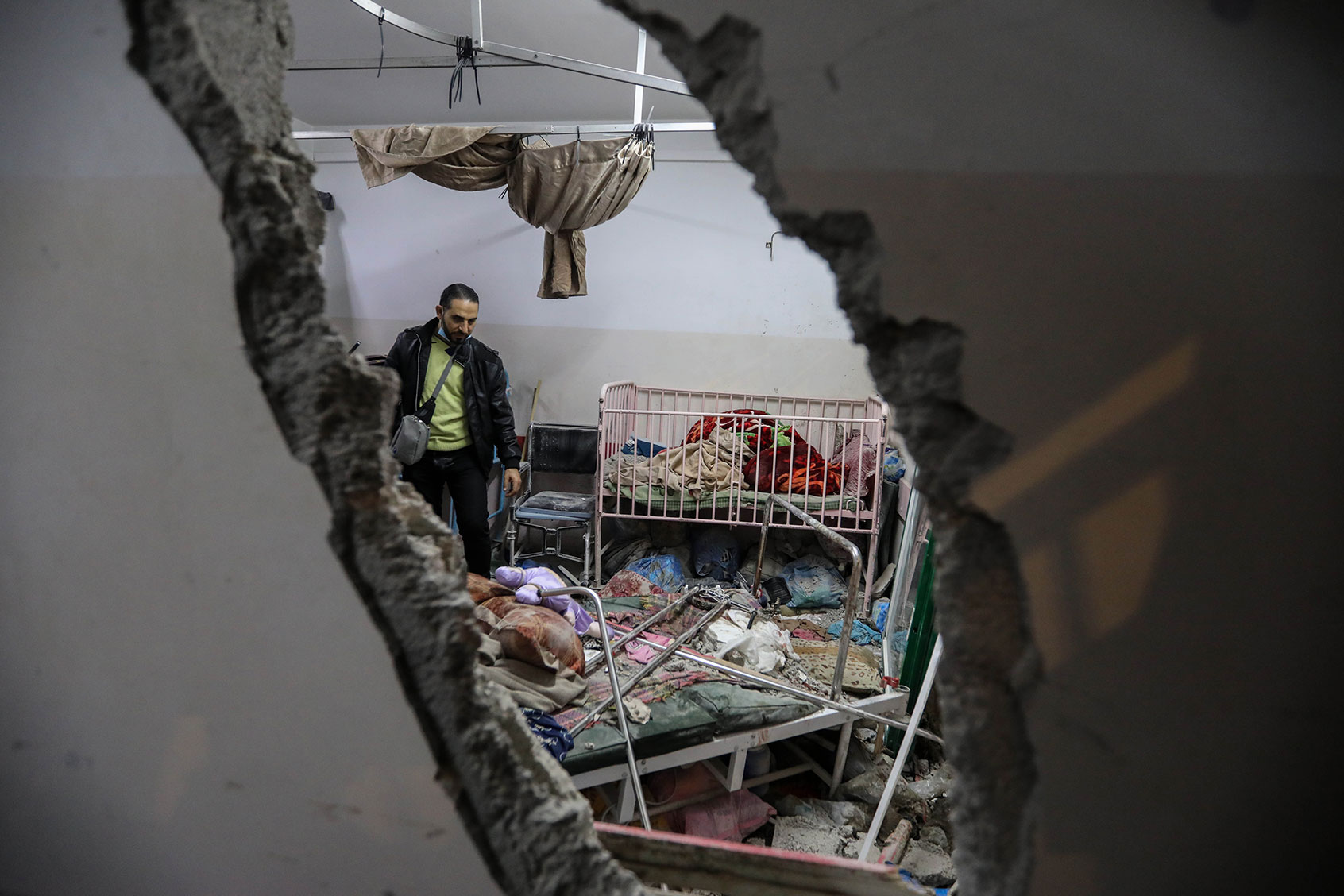
Damaged Nasser Hospital In Khan Yunis GazaPeople inspect the damage caused by an artillery shell that hit the maternity hospital inside the Nasser Medical Complex, on December 17, 2023 in Khan Yunis, Gaza. (Ahmad Hasaballah/Getty Images)“In Gaza, I think people are sort of holding on for dear life to these hospitals,” Alayyan said, speculating that they persist in the idea that a hospital should be a safe place despite everything. “The people still go there, and the staff still rebuild them.”

The scale of the damage

Chris Sidoti is one of the three members of the COI, established by a resolution of the U.N.’s Human Rights Council in 2021 in response to “grave” concerns about human rights in the occupied territory. A lawyer, consultant and expert in human rights law, institutions and mechanisms, Sidoti previously served as a Member of the U.N. Independent International Fact Finding Mission on Myanmar.

“We do not find any fact without corroboration,” Sidoti told Salon, speaking from Australia in a video interview. “We interview victims and witnesses. We have done that both in person for medical evacuees from Gaza and members of their family who are accompanying them. We’ve been able to interview them in person, face-to-face. We also conduct interviews online, through telephone and internet, just like this, on Zoom.”

Sidoti confirmed that, based on the commission’s review of available evidence, the cause of that explosion in the courtyard of Al-Ahli Arab hospital almost exactly a year ago remains unclear. In other words, the commonly accepted conclusion that Hamas or other Palestinian forces were responsible cannot be taken as established fact — but neither can later analyses, also reviewed by the commission, such as this one concluding that only Israeli forces could be responsible.

"We do not find any fact without corroboration."

The commission looked at events that took place from the Oct. 7 Hamas attack up to July 30, 2024, investigating allegations about the conduct of all parties involved. It finds that the state of Israel has repeatedly and deliberately targeted hospitals, carrying out 498 attacks on health facilities between Oct. 7 of 2023 and July 30 of this year. During that time, 500 medical personnel were killed, according to the Gaza health ministry.

A total of 747 people — patients, health care staff and families, including forcibly displaced people who took refuge in hospitals — were killed directly in those nearly 500 attacks on hospitals and clinics. According to the WHO, attacks analyzed between Oct. 7, 2023, and Feb. 12, 2024, involved military force (78% of all attacks), obstruction of access to health care facilities (35%) and militarized search and detention operations (9%.)

This is the third such investigation and report, and the second since Oct. 7, 2023. The commission’s mandate is to investigate and report annually to U.N. officials and the General Assembly on all alleged violations or abuses of international humanitarian and human rights law in the Occupied Territory, including East Jerusalem, and in Israel. A later resolution further requested the commission to “investigate all underlying root causes of recurrent tensions, instability and protraction of conflict, including systematic discrimination and repression based on national, ethnic, racial or religious identity.”

For its most recent report, the COI investigated the actions of both Israeli military forces and Palestinian armed groups, including Hamas, since the Oct. 7 attacks. Formal requests for information were made to the State of Israel, the State of Palestine, and Gaza’s Ministry of Health. As with previous reports, Israel did not respond.


Want more health and science stories in your inbox? Subscribe to Salon's weekly newsletter Lab Notes.


The Times of Israel reported in January that Israeli medical professionals were instructed by Israel’s Health Ministry not to cooperate with the U.N. commission, after it sent letters and emails to doctors and hospital staff who had treated Oct. 7 victims and returned hostages, as part of its investigation of international and gender-based crimes for a previous report, which was submitted to the Human Rights Council on June 12, and for the current one, which is being presented to the U.N. General Assembly this week.

The report is meant to summarize the commission’s investigation of “attacks carried out since 7 October 2023 on medical facilities and personnel, as well as the treatment of detainees in the custody of Israel and the treatment of hostages held by Palestinian armed groups.”

Salon contacted the Israel Defense Forces for comment and was referred to a response posted on X (formerly Twitter): “This report shamelessly portrays Israel’s operations in terror-infested health facilities in Gaza as a matter of policy against Gaza’s health system, while entirely dismissing overwhelming evidence that medical facilities in Gaza have been systematically used by Hamas and the Palestinian Islamic Jihad for terrorist activities.” 

Examining the evidence

Staff working on the report include a military expert, as well as experts on the use and admissibility of digital evidence. They use facial recognition and visual media authentication to determine the validity of the enormous volume of open source content that has been collected and preserved according to internationally-recognized standards.

"A little part of my soul dies every time there’s a hospital that’s hit."

“We’ve got an extraordinarily well-developed digital forensic capacity," Sidoti explained to Salon. “We’ve received and stored literally tens of thousands of items of digital evidence, which we do not accept without verification. We are able to access metadata. We can very easily dismiss some videos that … were taken in a different place at a different time. We’ve got the capacity to identify both geographical location and time.”

The report is not a legal proceeding, Sidoti explained, and commissioners did not seek to prove allegations “beyond reasonable doubt,” as in a court of law. Rather, their standard of proof was “reasonable grounds,” and where they couldn’t directly substantiate allegations themselves, they looked for reasonable grounds to believe they were true.  

“Our approach is total skepticism to anything we see on social media or any statement made by any authorities or by any allegations that are firsthand, until we investigate and corroborate,” Sidoti said. “And it’s only after investigation and corroboration that we make an assessment on whether there are reasonable grounds to come to a conclusion, and if there are, then we report on that.”

The commission’s findings will be used to inform the current case against Israel before the International Court of Justice for alleged acts of genocide in Gaza, as well as in future war crimes trials and other legal proceedings.

Conditions on the ground

Israeli security forces carried out air strikes against hospitals, causing considerable damage to buildings and surroundings, as well as multiple casualties; surrounded and besieged hospital premises; prevented the entry of goods and medical equipment and exit/entry of civilians; issued evacuation orders but prevented safe evacuations; and raided hospitals, arresting hospital staff and patients. Israeli security forces also obstructed access by humanitarian agencies.

In a text message interview conducted with Salon over several days over the past two weeks, Dr. S., a physician who worked at a hospital in north Gaza, described shortages of workers, food, medicine and equipment, and far too many patients. (Salon has agreed to protect this person’s identity.)

“We are also facing critical shortages of basic medical supplies such as gauze, iodine, alcohol swabs, and chlorhexidine for wound care. These essentials are crucial for preventing infection and promoting healing, but we are forced to ration what little we have,” Dr. S. said. At the start of the interview, he still worked, without pay, in the emergency department, but stopped after he and his family were displaced. 

“In our current situation, we are often faced with a critical need for stronger pain management options, especially when treating severe cases such as third-degree burns and traumatic amputations.” Dr. S. said, noting that medical staff lack proper antibiotics, which has contributed to the spread of antimicrobial resistance in Gaza and beyond, which can make some drugs fail to cure infections. “We are frequently resorting to broad-spectrum antibiotics like amoxicillin or ciprofloxacin, which are not suitable for all infections. This practice is contributing to increased bacterial resistance, a highly dangerous trend in a setting where infections are rampant and resources are already stretched thin.”

Dr. S. became trapped in Gaza by accident. He had returned from 10 years studying medicine abroad for a family visit only days before the Oct. 7 attacks — and then quickly lost 72 members of his extended family to Israeli air strikes. “It turned into a nightmare, I lost most of my family,” S. said. “They were simple, innocent people who just wanted a calm and loving life.”

"I have staff members who have watched their children die in front of them [after] their homes have fallen on them while they were sleeping because they were bombed."

S. watched as his former workplace was surrounded by Israeli forces, forcibly evacuated and shut down. Within a few days he heard that an emergency room doctor he worked with over many long nights had been shot by a drone inside Kamal Adwan hospital, and that the head of surgery at the Indonesian Hospital had been arrested at an Israeli checkpoint. “I hope I can make it through,” S. told Salon.

Well before October of 2023, many international medical volunteers have joined Palestinian doctors in trying to bolster the struggling health care system of Gaza.

Glia, an international NGO that began by creating low-cost medical devices and evolved to provide medical relief as part of its mission of “equal care for all,” is one of many organizations that contribute volunteer health care workers from the U.S., the U.K., and elsewhere. Its work is coordinated with the WHO, which itself coordinates with the U.N. and Israel.

“The Israelis are sending a very clear message that nowhere is safe,” Dorotea Gucciardo, who coordinates Glia’s medical missions to Gaza, told Salon days after strikes on the courtyard of Al-Aqsa Martyrs Hospital set fire to patients in tents. “They’ve made it very clear that hospitals, which are supposed to be protected areas, are not safe, and so by bombing them, they’re creating the conditions of making it impossible for people to live in safety and in dignity. And I think that ties directly to that U.N. report.”

Gucciardo notes that all of her local staff members have been displaced from their homes. “Every single one of them is affected — deeply, deeply affected by what’s happening,” she said. “One of my staff members very early in the war, the home next to hers was bombed, she had shrapnel all through her back. She’s had family members killed. She literally picked up the decapitated head of her uncle after his home was bombed.”

Another Glia staff member was at the market in Nuseirat refugee camp when drones began to shoot people on the ground, as part of an Israeli military operation that ultimately rescued four Israeli hostages, at the cost of at least 274 Palestinian lives.

“I have staff members who have watched their children die in front of them [after] their homes have fallen on them while they were sleeping because they were bombed,” Gucciardo went on. “Those are just the extreme stories. On a daily level, on a molecular level, they’re all struggling to find food, to find water, to find resources that will help their children feel safe.”

Before May 7, Glia was able to send seven to 10 international volunteers into Gaza every two weeks, bearing essential medical supplies, which cannot reach the territory by any other authorized means. Delegates have come from the U.S., Canada, the U.K., Ireland, Namibia and other countries. But on May 7, Israel took over the Rafah crossing previously controlled by Egypt, which for years has been the only exit point for Palestinians wishing to leave Gaza. Since the war began, Rafah has also become the only point of entry for medical delegations and humanitarian supplies. But since May 7, Glia has only been able to send about three delegates per month, and the amount of supplies they can bring in with them has been sharply reduced.

As of this October, Gucciardo said, Glia and six other aid organizations were banned entirely from sending medical delegations into Gaza.

“Each of these organizations has been operating in Gaza since at least January, providing medical personnel and supplies to assist various hospitals within the Gaza Strip. So it’s a real blow to upholding any kind of care for Palestinian patients,” Gucciardo added. 

The affected organizations hope that advocacy will result in regaining their delegation privileges. But time is not on anybody’s side. On Monday, Israel’s parliament passed a bill to ban the United Nations Relief and Works Agency for Palestine Refugees, or UNRWA, from operating in Gaza, which would reduce humanitarian aid even more drastically if it goes into effect.

Medicine under attack

The Commission investigated attacks on four hospitals in different areas of the Gaza Strip: the Nasr Medical Complex … and Shifa’, Awdah and Turkish-Palestinian Friendship … hospitals. Those include two major medical facilities and also hospitals that offer such specialized medical care as obstetrics, paediatrics and oncology. The Commission found that Israeli security forces attacked these facilities in a similar manner, suggesting the existence of operational plans and procedures for attacking health-care facilities.

“The Israelis talk about precise target bombing, but the extent of destruction of these hospitals indicate that in fact it was saturation, almost carpet bombing,” Sidoti told Salon. “The nature of the arguments that we used — the lack of proportionality relative to the alleged military use of the hospital. It all added up to an operation methodology that was common to them all and therefore can’t be considered to be coincidental.” 

In November of 2023, in response to an open letter (translated here) by close to a hundred Israeli doctors calling for the bombing of any and all Gaza hospitals, a group of doctors in Gaza responded, stating that doctors calling for the bombing of hospitals are “fully responsible for anything that might, God forbid, happen to the hospitals. Therefore, we demand and call on all of those that have to do with medicine and health — the World Health Organization and human rights organizations — to hold accountable those who are calling for destroying the hospitals and those inside them, destroying the hospitals and those working inside them and the wounded patients.”

According to the Ministry of Health in Gaza, 500 medical staff were killed between 7 October and 23 June. The Palestine Red Crescent Society reported that 19 of its staff or volunteers had been killed since 7 October, and that many others had been detained and attacked. Medical personnel stated that they believed they had been intentionally targeted.

In addition to targeted attacks on hospitals, clinics and ambulances, medical staff have been subject to mass arrests and detention along with patients. The COI notes that hundreds of medical personnel had been arrested and detained.

The COI’s findings are supported more recently by other organizations including Healthcare Workers Watch, which has documented the deaths or detentions of 105 senior physicians. In a report released this month, HWW describes systematic killing, detention and torture of health care workers including pharmacists, medical students, dentists and nurses, among others, and the killing of two of the last three pathologists in Gaza, as well as other specialists such as senior plastic surgeons.

In August, Human Rights Watch reported that doctors, nurses and paramedics released from Israeli detention described being personally subject to “humiliation, beatings, forced stress positions, prolonged cuffing and blindfolding, and denial of medical care. They also reported torture, including rape and sexual abuse by Israeli forces, denial of medical care, and poor detention conditions for the general detainee population.”

Detainees interviewed by HRW reported being pushed to confess to being part of Hamas with threats of indefinite detention, rape or the murder of their families in Gaza.

We need your help to stay independent

In recent weeks, numerous detentions of medical staff and patients, especially men, have been reported, with detainees allegedly taken to unknown locations. This has sometimes occurred after medical staff refused to follow orders to evacuate, leaving vulnerable patients or those unable to evacuate behind.

The COI writes in its report that “Israeli security forces have deliberately killed, wounded, arrested, detained, mistreated and tortured medical personnel” and notes that the use of sexual and gender-based violence has increased in intensity and prevalence along with the intensity of hostilities. They point to forced public stripping and nudity of men and boys, sexual humiliation of both genders, male detainees being subjected to attacks on their sexual and reproductive organs, and rape.

In February, U.N. experts condemned the use of sexual violence against women and girls in detention, and in August described substantiated reports by men and women of “detainees in cage-like enclosures, tied to beds blindfolded and in diapers, stripped naked, deprived of adequate healthcare, food, water and sleep, electrocutions including on their genitals, blackmail and cigarette burns. In addition, victims spoke of loud music played until their ears bled, attacks by dogs, waterboarding, suspension from ceilings and severe sexual and gender-based violence.” It is not known how many health care workers were among informants in these cases, but the HWW report documents first-hand accounts of similar methods of torture.

Israeli authorities have repeatedly alleged that hospitals are fronts for Hamas fighters and that health care workers may themselves be militants, including the claim, according to the U.N. report, that over 85% of major medical facilities in Gaza were used for terror operations by Hamas. The commission notes that Israel “did not provide evidence to substantiate that claim.” In Gaza, Hamas is the governing body, responsible for provision of social services and administration of public works. Hamas as a whole is identified as a terrorist organization by several countries, including the United States. The Gaza health ministry operates under the jurisdiction of Hamas, but not under its military wing.

An assault on the right to reproduce

The Commission finds that the deliberate destruction of sexual and reproductive health-care facilities constitutes reproductive violence and has had a particularly harmful effect on pregnant, post-partum and lactating women, who remain at high risk of injury and death. Targeting such infrastructure is a violation of women and girls’ reproductive rights and the rights to life, health, human dignity and non-discrimination. In addition, it has caused immediate physical and mental harm and suffering to women and girls and will have irreversible long-term effects on the mental health and the physical reproductive and fertility prospects of the Palestinian people as a group.

Gucciardo visited Gaza in March, bringing in diapers, sanitary supplies for women, other medical supplies and food when she crossed over from Egypt. Her staff had reported that a near-total lack of infant formula, with many new mothers so malnourished they could not produce breast milk, was resulting in babies starving to death. Gucciardo’s midwife staff helped women give birth in unsanitized rooms, due to lack of disinfectant.

“They didn’t even have basic supplies, like the scissors you would use to cut an umbilical cord. They were using a razor blade, you know?” Gucciardo said. “They would use a string from a face mask to tie off the umbilical cord.” 

Palestinian women and infants displaced Rafah GazaPalestinian women and infants displaced from northern Gaza receive medical care at a clinic in Rafah, in the southern Gaza Strip, on February 29, 2024, amid ongoing battles between Israel and the Palestinian Hamas movement. (AFP via Getty Images)At Emirati Hospital in Rafah, the NICU director reported a spike in babies needing treatment — in part because the majority of Gaza’s population had been forcibly displaced into Rafah — but lacked sufficient resources to do so. Shortly before her arrival, he had three newborn infants who required ventilators, but only two devices.

“He had to make the decision which two babies to treat and which baby would die,” Gucciardo recalled. “He said that out of everything that he had seen up until that moment, all of the horrors that he had witnessed, that was the thing that made him cry the most, that killed him inside. And that has been repeated consistently. It’s not just in the NICU, but in every space, in every room in every hospital, these decisions about on who to use the resources that we have.”

Gucciardo later visited Nasser Hospital, the largest in the south of Gaza, with a local physician. Together they walked through the ruined building that remained after IDF troops pulled out on Feb. 22 following a month-long siege and forced evacuation. Gucciardo shared photos with Salon showing that every building in the complex was at least partly destroyed, with equipment smashed, wires cut, shelling pockmarks on walls or entire areas reduced to rubble, and graffiti scrawled on the walls still standing. At the time she visited, three mass graves had been discovered on hospital grounds.

“We went into the neonatal intensive care unit as well. Every single incubator was broken. Every single screen was smashed,” Gucciardo said.

Correspondence published in the Lancet this month details effects of the destruction of sexual and reproductive health infrastructure cited in the U.N. report, such as a surge in preventable deaths of mothers in childbirth and newborn babies, miscarriages, stillbirths and a massive increase in rates of premature labor.

“This reproductive violence,” the authors write, “is not just a consequence of the military assault — it is a deliberate outcome of policies that restrict access to health care.”

"He had to make the decision which two babies to treat and which baby would die."

This explosive allegation of "reproductive violence" encompasses many things, such as the alleged targeting of maternity hospitals and fertility clinics and the alleged injuries inflicted on the genitals of male detainees. It also results from the drastic tightening since Oct. 7 of a blockade already in its second decade, restricting access to menstrual supplies, anesthetics, nutritious or adequate food, prenatal care, and sanitation, now including items as basic as soap.

“Without access to proper nutrition or health care, [women] are forced to carry pregnancies through conditions unfathomable to the human conscience,” the Lancet report states.

The evidence that Israel’s destruction of Gaza’s health care infrastructure is no accident is stark, and highly compelling to many outside observers. Will the commission report make a difference?

“That is a tragic question,” Sidoti told Salon. He sees no “realistic possibility” of a resolution that comes from any of the current leadership on any side. “This is the responsibility of states, and my expectation is that our reports will mainly have an impact at that level. It will affect the willingness or even the determination of other states to act to resolve this. It will also assist in international accountability, in having those that are responsible for the slaughter brought before international tribunals.”

That’s a process that’s already getting started. On Oct. 11, the Belgium-based Hind Rajab Foundation submitted the largest-ever complaint to the ICC, accusing 1,000 individually-named Israeli soldiers of participation in systemic attacks against civilians, constituting war crimes, crimes against humanity, and acts of genocide. The complaint is backed up by 8,000 pieces of evidence. 

The HRF has also started to file war crimes complaints against individual Israeli soldiers who are dual citizens. One soldier who is also an Ecuadorian citizen has been accused of war crimes relating to his participation in the assault on Al-Shifa hospital, and various complaints have been lodged against a Dutch-Israeli soldier accused of blockading access to food, water and medical supplies and directing attacks against medical personnel. In February, the Washington Post reported that there were 23,380 American citizens fighting with the IDF.

As Sidoti pointed out to Salon, and wrote in more detail elsewhere, the U.N. and member states bear responsibility for the current situation in Israel, the West Bank and Gaza, all of which was formerly the British Mandate Territory of Palestine. In 1947, the General Assembly decided via resolution 181(II) that this should be divided into “independent Arab and Jewish states.” The legitimacy of both states thus rests, in Sidoti’s view, on that resolution, which Israel’s rejection of Palestinian statehood violates.

“This dispute, unlike almost any other in the world, has been internationalized from the very beginning,” Sidoti said, “and there is therefore a continuing international responsibility for the resolution of the dispute.” But the parties involved, he added, “are not free to negotiate a resolution that would be contrary to international law.”

The real question, it would appear, isn’t whether Israel is targeting health care in Gaza. It’s why these extensive violations of international law have been allowed to continue, and why calls by health care workers for meaningful international support — including from American medical colleagues — are going unanswered after a year of suffering for Palestinians in Gaza.

The Timothée Chalamet look-alike competition morphed New York City into an absurdist circus

“I get catcalled, ‘Timmy! Timmy! Timmy!’ I respond to it. I call to it. This is fate.”

That’s what 18-year-old Dempsey Bobbitt tells us as we’re power walking alongside a hoard of hormonal Timothée Chalamet fans to Mercer Playground, where a look-alike competition for the actor is underway. Bobbitt is one of several curly-haired, high-cheekboned Chalamet wannabees hoping to be crowned Chalamet’s doppelgänger and take home a $50 cash prize. He’s pretty serious about winning, considering that he’s dressed as Willy Wonka, who Chalamet plays in the 2023 eponymous film “Wonka.” Bobbitt also traveled to the Big Apple from Pennsylvania (“I go to school in Pennsylvania,” he says).   

Following the initial brouhaha of Halloween weekend (dubbed “Halloweekend”), New York City is bustling Sunday afternoon as crowds of Gen-Z spectators trek to Washington Square Park to attend the event. The contest, organized by 23-year-old YouTuber Anthony “Gilbert” Po (a.k.a. AnthPo), went viral across social media in September after fliers for the event were seen scattered across Lower Manhattan. An online invite, made on Partiful, boasted nearly 3,000 RSVPs.

Timothée Chalamet look-alike contestA Timothée Chalamet look-alike is presented at the competition (Photo by Joy Saha)Underneath the Washington Square Arch, the crowd is multiplying by the minute and the crispness of the October air tempers the surrounding adrenaline. It’s fitting that a park known for its man-on-the-street ambush-type interviews and random impromptu performances is a breeding ground for this disheveled competition. 
Hand in hand, we parcel through the countless thousands congested under the archway. Sprinkled through the crowd like “Where’s Waldo” are the Chalamet look-alikes, reporters clambering to grab interviews and eventgoers enraptured with the allure of the Timmy variants. Unbeknownst to us though, the real Chalamet, incognito in a mask and baseball hat, slithers through the crowd like an undetected chosen one, or like his character, Lisan al Gaib in “Dune.”

“Hey man, what’s up?” he says to one of the awestruck look-alikes.

Timothée Chalamet look-alike contestFans hold up signs in hopes of catching the attention of a Timothée Chalamet look-alike (Photo by Joy Saha)Excitement soon turns into panic when a line of New York City Police Department squad cars — their sirens blaring and lights flashing — arrive behind the arch. NYPD officers and the city’s Parks Enforcement Patrol break into the crowd, arresting four individuals (including a Chalamet look-alike) and telling people to leave the park for gathering without a permit. 

“You are unlawfully assembled. You have to leave!” a patrol officer says before slapping Po with a $500 fine.

That doesn’t stop Po from staging his competition. In an act of defiance — armed with a microphone, a towering trophy and a comically large handwritten check — Po leads the crowd a few blocks downtown to Mercer Playground.

The swarms of people walking the streets of New York invite several passersby and onlookers to join out of sheer curiosity. The playground itself is quite small, but people make do by sitting on the ground and standing on the sides of the barricades.  

Po explains the rules for the contest. Each Chalamet wannabee will come to the front and introduce themselves. Audience members will then gauge their resemblance to the real Chalamet with enthusiastic cheers or loud “boos.”

Some Chalamets are dressed simply, instead relying on their sharp jawlines, floppy brown hair and good looks to secure them a spot in the finals. A few Chalamets go the extra mile to dress up as the A-list actor’s most famed characters.

Timothée Chalamet look-alike contestSpectators at the Timothée Chalamet look-alike contest (Photo by Joy Saha)“This is the real deal. This is straight from the factory,” Bobbitt quips about his chocolatier getup. The college student’s mousey brown hair, wide eyes and grin are somewhat similar to Chalamet's, but not an exact match. His top hat and maroon coat, however, resemble Chalamet’s version of Wonka.

Though Bobbitt, “can’t go one day without people asking me to [be Chalamet],” it’s not like he’s a large fan of the Academy Award nominee. “I’m OK with [Chalamet],” he tells us.

When we ask him if he’s seen any of Chalamet’s movies, he says, “No. I can name them.”

“I know the peach scene in ‘Call Me By Your Name.’ I wish I didn’t.”

Like all the other Chalamets scattered through the crowd, Bobbitt is having a great time. “I think I got the golden ticket,” he says.

Timothée Chalamet look-alike contestThe best Timothée Chalamet look-alike wins a $50 cash prize (Photo by Joy Saha)We hound down another Wonka look-alike. This time, Miles Mitchell, 21, shares the secret behind his eerily on-point costume. With a red paisley-printed scarf around his neck, Mitchell even has a briefcase full of chocolate in hand to share. He pieced together the outfit himself: “I went to Goodwill. Although the jacket came from Amazon, everything else was from Goodwill.”

Mitchell admits that Chalamet’s “Wonka” isn’t his favorite film in the “Charlie and the Chocolate Factory” franchise, but still enjoyed it. He says he much prefers “Dune” and “Dune Two.”  

The native New Yorker says his friends pushed him to sign up because he is also from the city like the Hell’s Kitchen-born Chalamet: “I think he’s cool. We have some things in common a little bit.”


Want a daily wrap-up of all the news and commentary Salon has to offer? Subscribe to our morning newsletter, Crash Course.


Mitchell is up against a pretty convincing Paul Atreides, 22-year-old Zander Dueve. He howls “Dune Two’s” “Lisan al-Gaib” chant every chance he gets and it’s hilarious. The competition between these two Timmys is neck and neck. The crowd roars for the two like they’re the real Chalamet.

But the competition hits a lull when they want to sell off their handful of Chalamet look-alikes to the adoring women-dominated audience. Po calls up several women to participate in a makeshift dating show. Only 40 minutes into the competition and now it is beginning to feel like a lucid dream. It’s a haze that features four women shilling themselves out for a hot date with a Chalamet. It’s a lot like the ‘00s comedy, “Win A Date With Tad Hamilton!” except nobody is self-aware about the weird vibes. 

One of the Chalamets, the Australian-born Callum Foote, a Columbia graduate student, lives for female attention. He eventually chooses Sommer Mae Campbell, a 23-year-old actor and movie theatre employee from New Jersey, as his best, makeshift match. She’s holding a “Hiii Timothees” sign in her hands and handing out business cards like it’s a networking event. There’s a sense of awkwardness and frazzled energy surrounding the crowd. Maybe it’s cause matchmaking the Chalamets with fans feels forced like a stan Twitter, parasocial delusion. 

But thankfully, the excruciating dating show concludes just as abruptly as it begins. Nearly 50 minutes after vacating Washington Square Park, the four police arrests and the real Chalamet showing up to the party, the look-alike is crowned.

Timothée Chalamet look-alike contestMiles Mitchell, 21, wins the Timothée Chalamet look-alike contest (Photo by Joy Saha)Excitement builds again because finally, someone will take home the erected $250 gold statute. Po urges the crowd to pick their crowned prince, and the crowd rumbles with enthusiasm for Mitchell and Dueve. Dueve shares he would take his girlfriend out on a date with his winnings. On the other hand, Mitchell, in character, says, “I would buy more chocolate to give to everyone!”

It comes to no surprise when Mitchell wins the competition. His Chalamet adjacent looks and chocolate costume is just enough to put him over the threshold. The audience even cheers, “Wonka! Wonka! Wonka!” when he wins.

Sure, the Chalamet look-alike competition was ridiculous. And it probably was an absolute nuisance for nearby residents who had to hear the high-pitched screams and horny cries of thirsty Chalamet fans. But at its core, the event was a testament to how unserious Gen-Z (often hailed as the most unserious and chronically online generation) can truly be. Chalamet — who was previously declared a “Cinnamon Roll Man” and the internet's favorite “white boy of the month” — is the epitome of Gen Z cool and continues to be the generation’s favorite heartthrob. So having a competition solely dedicated to him, in which thousands of ogling fans and hopeful look-alikes traveled both near and far to attend, is incredibly Gen-Z coded.

“Our generation is soooo funny I love us,” commented one TikTok user under a video posted by Nicolas "Nico" Heller (a.k.a. “New York Nico”) that recapped the competition. “This is so unserious I love it,” said user commented.

Throughout the event, we couldn’t help but feel a sense of camaraderie amongst the crowd, even as we fought for our lives to keep up with the Chalamet look-alikes and avoid being trampled by crazed spectators. We saw people making new friends, hyping each other up to approach one of the Chalamets and forget about the struggles of modern-day dating, even if it was just for a few hours.

That’s the beauty of a Chalamet look-alike competition.


Dunkin’s holiday menu will include new sweet treats and the return of Free Donut Wednesdays

Celebrate! Dunkin’ has officially announced its new holiday menu, which will be available nationwide this coming Friday, Nov. 1.

This year’s lineup features five festive beverages, including three bestsellers that are back by popular demand. Dunkin’s Cookie Butter Cold Brew returns for its third year after selling out in previous years, the company said in a recent press release. The famed beverage is topped with cookie butter cold foam and a sprinkle of cookie butter crumbles, making it the perfect treat to enjoy during the holidays. The iconic seasonal duo of the Peppermint Mocha Signature Latte and Toasted White Chocolate Signature Latte are also making their grand comeback.

New additions to the menu include Dunkin’s Holiday Cookie Signature Latte, which “boasts rich espresso blended with whole milk and notes of buttery cookie and toasted almond.” It’s topped with whipped cream, caramel and cookie butter crumble. The drink is available hot or iced. There’s also the White Hazelnut Bark Coffee, which offers “notes of both white chocolate and toasted hazelnut blended with cream and Dunkin’ Original Blend iced or hot coffee.”

Dunkin’ is also introducing its first-ever Almond Croissant, an all-butter croissant filled with sweet almond paste and adorned with slivered almonds. Additionally, the brand is debuting its Hash Brown Brisket Scramble Bowl, which draws inspiration from Dunkin’s Loaded Hash Browns. The bowl “features crisp hash browns with a blend of tender shredded brisket, scrambled eggs, smoked cheddar cheese, poblano peppers, caramelized onions, and seasonings, all topped with a drizzle of cheddar queso.”

Alongside the new menu, Dunkin’ is bringing back its beloved Free Donut Wednesdays offer starting Nov. 6. Dunkin’ Rewards members can get a free classic donut with any beverage purchase each Wednesday, starting Nov. 6 through Dec. 25.

From “Freaks and Geeks” to fallout: Inside the bitter end of James Franco and Seth Rogen’s bromance

It’s always bittersweet when friendships end, but the 25-year bond between actors James Franco and Seth Rogen seems to have ended on a note more bitter than sweet.

A once popular duo in stoner comedies like "Pineapple Express," "This Is The End," and "The Interview," Rogen and Franco’s friendship was a staple in Hollywood for some time, tracing all the way back to one of their first projects together, "Freaks and Geeks."

In recent years, Franco has only had a smattering of credits following his 2018 #MeToo reckoning, when former acting students accused him of sexual misconduct and exploitative behavior. The Academy Award nominee later settled a lawsuit with two of the women in 2021. Since then, he's kept a relatively low profile, appearing in only a few projects, none of which featured his former friend and frequent co-star. 

In a recent candid interview with Variety, Franco opened up about his falling out with Rogen . . . keeping it vague on one very important detail when it came to theorizing why they no longer speak.

So what happened to the longstanding, two-decade friendship between Rogen and Franco? Salon explains the fallout:

A comedy duo is born in Seth Rogen and James Franco 

The two comedy actors first met on the set of the 1999 teen classic "Freaks and Geeks," when Rogen was 17 and Franco was 22. They wouldn’t work closely together again until the release of "Pineapple Express" in 2008, although Franco did have a cameo in the 2007 Judd Apatow comedy "Knocked Up," which starred Rogen.

Reflecting on their early years, Rogen said in 2008, "We didn't have a falling out or anything; he just became very successful after 'Freaks and Geeks,' and I just sat on my couch and researched this movie for two years."

The two would go on to co-star in numerous films, including "This Is The End," "Sausage Party," "The Interview" and "The Disaster Artist." Rogen also worked with Franco’s brother, Dave, in "Neighbors." Among Franco’s roles, his portrayals of Tommy Wiseau in "The Disaster Artist" and Aron Ralston in "127 Hours" received the most critical acclaim.

At the 2017 SXSW festival, Rogen remarked, "I generally have a movie with a Franco here almost every single year."

Franco gets hit with five accusations of sexual misconduct and a lawsuit follows

However good it started out, the relationship between Rogen and Franco had a noticeable cooling-off period. After the pair were nominated for Golden Globes for their work directing and producing "The Disaster Artist," the allegations against Franco hit the news.

Five women came forward in a Los Angeles Times investigation and stated that Franco abused his power as their teacher at his film school. They alleged that he manipulated them into performing sex acts, including allegedly removing safety guards while filming an oral sex scene. The actor would go on to settle a sexual misconduct lawsuit for $2.2 million in 2021.

From the jump, Rogen remained somewhat neutral when it came to his comments on the allegations against his friend, saying in an interview with Vulture in 2018, "The truth is that my perspective on this is the least relevant perspective. I’m friends with these people and I’m a dude. All that combined makes me the last person who should be talking about this." He did, however, say at the time that the allegations did not change his willingness to work with Franco in the future. 


Want a daily wrap-up of all the news and commentary Salon has to offer? Subscribe to our morning newsletter, Crash Course.


Several years later, in an interview with the Sunday Times, Rogen revealed that the allegations against Franco changed their relationship. When asked if he thought of himself as an enabler of Franco's alleged abuse, Rogen said, “What I can say is that I despise abuse and harassment and I would never cover or conceal the actions of someone doing it, or knowingly put someone in a situation where they were around someone like that."

Mentioning the previously linked Vulture interview, he furthered, "I also look back to that interview in 2018 where I comment that I would keep working with James, and the truth is that I have not and I do not plan to right now.”

Without coming right out and saying it, Rogen hinted that the relationship was on its way towards being a past tense thing, saying, "I can say it, um, you know, it has changed many things in our relationship and our dynamic.”

When asked if the transition without Franco was hurtful, Rogen said at that time, “Yeah. But not as painful and difficult as it is for a lot of other people involved. I have no pity for myself in this situation.”

After Rogen's interview, Franco said on "The Jess Cagle Show," "I love Seth Rogen. I worked with him for 20 years. We didn't have one fight for 20 years. Not one fight."

He continued, "He was my absolute closest work friend, collaborator. And we just gelled and what he said is true, we aren't working together right now and we don't have any plans to work together. Of course it was hurtful, in context, but I get it."

We need your help to stay independent

Franco opens up about his life post-lawsuit and his friendship with Rogen

In an interview released last week, Franco revealed how challenging the last several years have been for him. Despite the public cancellation, he said, "I’m so grateful to be working. I did go through a lawsuit, and during that lawsuit, I wasn’t working." He continued, "Up until, let’s say the past eight years [before the hiatus] I had a good career. But it was very hard for me to enjoy it."

The actor did not see his expulsion from Hollywood as a negative. He shared, "I mean, it is what it is. I’ve honestly moved past it. It was dealt with, and I got to change. So that’s it, it’s over. I mean, I’ve worked in the U.S. too. So I’m just trying to move on."

Overall, Franco expresses being thankful for his fall from grace, saying, “Being told you’re bad is painful. But ultimately, that’s kind of what I needed to just stop going the way I was going.”

In his sobriety, Franco said he has realigned his life. But he is no longer in touch with Rogen.

"No. I haven’t talked to Seth. I love Seth, we had 20 great years together, but I guess it’s over. And not for lack of trying. I’ve told him how much he’s meant to me."

Understanding Pennsylvania’s undecideds — the voters that could decide the 2024 election

If you’re like many of my friends, I know what you’re thinking: OMG, how is it even possible that half the country is going to vote for that guy? And there’s a slightly less common corollary to that: I mean, really, who are these people who say that they’re undecided? Who doesn’t know enough to know which way they’re going to vote?

Well, it turns out that I’ve met a fair number of those undecided voters in person, going door to door canvassing in eastern Pennsylvania, where, it’s fair to say, the 2024 election may be decided. They’re real people, with perfectly real everyday concerns. They have families living in pleasant suburbs in and around Easton, Bethlehem, and Allentown, their neatly tended lawns a mix of grass, crabgrass, and dandelions, and older model SUVs, minivans, and pickup trucks in their driveways. And I’d dare you to knock on one of their doors and, when someone answers, say, “So, who the hell are you?”

I get it: they’re easy to demonize, especially if you’re a liberal or leftist news junkie living on the Upper West Side of New York or in Takoma Park, Maryland, or Cambridge, Massachusetts; you read the New York Times, the Washington Post, the Boston Globe, or Politico; and your Monday nights are built around watching Rachel Maddow and Jon Stewart. I’m not surprised if, like Anne Enright, the novelist from University College Dublin, writing for “On the Election” in the New York Review of Books, you vent your pent-up frustration over undecideds who are “lonely and sometimes pathetically grandiose.” It upsets Enright to be “watching twelve billion election dollars chase down a few thousand anxious minds in Pennsylvania.” Can’t they just make up those minds of theirs?

To my mind, the forehead-slapping awe at those undecided in this presidential election took its purest form in a commentary by comedian and satirist Lewis Black on a recent episode of The Daily Show:

“We still have no idea who the f**k is gonna win! And that’s all thanks to one very special group of morons… Oh yes, undecided voters: the same people you see at the ice cream shop asking for 12 mini spoon samples. It’s a $3 cone, a**hole! How is anyone still undecided in this election? … This election still comes down to winning over a few dozen Pennsylvanians with carbon monoxide poisoning. Now, don’t get me wrong. Maybe these undecided voters aren’t stupid. Maybe they have a good reason for being idiots.”

But one Sunday afternoon, while crisscrossing several blocks in a neighborhood of Bethlehem, Pennsylvania, knocking on perhaps 40 front doors over several hours, I had the opportunity to talk to a number of those very undecideds. Out of the 40 homes curated from lists of Democrats and Democratic-leaning independents — those who had, in fact, voted in recent elections — about half of them were home and came to the door. And of those 20, maybe half a dozen told me that they hadn’t yet decided who they were going to vote for or if they planned to vote at all.

As a start, it turns out, a number of them haven’t really been following the news. According to research by the campaigns, many of them work two jobs. They don’t get the Times or the Post. Many, in fact, don’t even get the local paper. They know who’s running, but while they seemingly know a fair amount about Donald Trump, they know a lot less about Kamala Harris. They didn’t watch the two conventions on TV or even get around to watching the presidential debate between Harris and Trump. And, by the way, that puts them among the majority of Americans: an estimated 67 million people watched that event on September 10th, while 158 million people voted in 2020 and an additional 81 million eligible voters who didn’t cast a ballot back then missed it or skipped it.

My sense, from the voters I talked to — totally unscientific, yes, but backed up by some polling and research — is that voters who say they’re undecided have largely tuned out politics in these years. Maybe that’s because they’ve long come to believe that all politicians are corrupt or feckless; or maybe it’s because they’ve been around long enough to have concluded that “things never change” and that their own lives are only marginally affected by whoever’s in office; maybe it’s because with kids, a job (or two), caring for older parents or relatives with special needs, and struggling to make ends meet, they just don’t have space in their lives for “the news”; or maybe they just didn’t care to share their thoughts with a stranger at their door. Whatever the reasoning, not a single undecided voter I spoke to rejected the message I was carrying or pushed back hard against the idea that maybe Harris deserves a genuine look.

And they’re still up for grabs. The lead story in the October 22nd New York Times was headlined: “Battle is Fierce for Sliver of Pie: Undecided Votes.” Its subhead: “Election Could Hinge on People Who Aren’t ‘Super Political.’”

Harris Chipping Away at Undecideds?

So, how many are there? With the polls showing a razor-thin difference between Harris and Trump among those who have indeed made up their minds, it’s hard to pin down exactly how many people may still be undecided. By some measure, since early summer, things may have been moving toward the Democrats when evaluating undecided voters. According to a PBS News/NPR/Marist poll and analysis, before President Biden quit the race the number of undecideds was just 3%. But when he quit, that number jumped to 9%, reflecting the fact that Harris was an unknown quantity to many Americans. According to PBS, that number shrank after the September debate, as potential voters, women in particular, learned more about Harris, especially over the abortion rights issue. The New York Times reported that the Trump campaign has found that the number of undecideds has fallen from around 10% in August to perhaps 5% today.

And according to Newsweek, citing an Emerson College survey of undecided voters, in recent weeks those voters have been breaking Harris’s way by an almost 2-1 margin. “Emerson College polling, conducted between October 14 and 16,” that magazine reported, “shows that among undecided voters who chose who they would vote for in the past week or month, 60 percent opted for the Democratic vice president, while 36 percent opted for Republican former President Donald Trump.”

It’s impossible, of course, to determine precisely how many voters are actually undecided. Some surveys put the number at about 13%, others at just 3% or so. A Times/Siena survey found that, in the “swing states” alone, the undecideds are 3.7%, or 1.2 million potential voters. Whatever their numbers, in an election in which polls have consistently recorded essentially a swing-state dead heat between Harris and Trump, even that tiny number might be enough to tilt the final result. However, undecided voters could also simply decide to sit out the election (as many analysts suggest they might do) or, if their votes split evenly, have no effect at all on the final tally.

In addition to partisan voters, and those enthusiastic about one candidate or the other, there are those characterized as “swing voters,” “low-information voters,” or simply infrequent voters. All of those categories can reasonably be imagined as “persuadable,” though the cost-benefit ratio involved in efforts to reach them and get them to the polls could be prohibitive. A pair of professors and election specialists, Jeffrey Sonnenfeld and Stephen Henriques, writing for Timeargue that so-called swing voters — “who do lean towards one candidate but are open to voting for the alternative” — will be critical on November 5th. And surprisingly enough, swing voters (including undecideds) may add up to as much as 15% of the current electorate, according to a Times/Siena poll that the two authors cite.

Unfortunately, Harris may not be helping herself, given how she’s running her campaign. At its start, she benefited enormously from a skyrocketing burst of enthusiasm triggered by President Biden’s decision to drop out. His age, seeming infirmity, and catastrophically bad debate performance against Trump cast a pall of depression over many Democratic organizations and activists, and it seemed Trump then had a path toward a clear victory. But Harris’s emergence, her emphasis on “joy” and optimism (and Tim Walz’s effective use of the term “weird” to describe the GOP ticket) touched off a swell of — yes! — optimism. According to Forbes, when Biden was the Democratic candidate, just 30% of Democrats claimed to be enthusiastic about voting in November versus 59% of Trump supporters. By early September, however, 68% of Harris supporters expressed enthusiasm against just 60% of Trump backers.

Since then, however, some have argued that her campaign has been lackluster, her speeches too carefully scripted and vetted, too cautious and repetitive, dampening some of the enthusiasm that erupted over the summer. As Robert Kuttner wrote in “Harris and the Enthusiasm Gap” for The American Prospect, “Interviews and focus groups keep quoting undecided or Trump-leaning voters as saying that they don’t really know what Harris stands for. Could that be because her own message is blurred?”

Still, Harris has maintained a slight but consistent lead over Trump in national polls ever since the Democratic convention and has lately scheduled a burst of interviews on 60 MinutesFox News, “The View,” Stephen Colbert’s late show, the popular women’s podcast “Call Her Daddy,” Univision, and a CNN town hall.

The Turnout Imperative

By all accounts, the Democratic ground game — canvassing, phone banking, text banking, postcard writing, local candidate rallies, tables at local events, and more — has been far superior to the GOP’s. Even when taking into account efforts like Elon Musk’s supposed army of paid volunteers, Harris’s on-the-ground efforts are three times the size of Trump’s, according to the Washington Post: “She boasts more staff, more volunteers, a larger surrogate operation, more digital advertising, a more sophisticated smartphone-based organizing program and extra money for extraneous bells and whistles typically reserved for corporate product launches and professional sports championships.”

In eastern Pennsylvania, as I saw, local and out-of-state unions are going all-out in canvassing, voter registration, and GOTV drives. When I visited Democratic headquarters in Easton, Pennsylvania, in early October, its large meeting hall was filled with what looked like a hundred union volunteers in matching T-shirts from Local 1199 SEIU (Service Employees International Union), who had traveled to Easton from Newark, New Jersey.

That area, part of Northampton County, just north of the Democratic stronghold of Philadelphia, is a mostly working-class region of 320,000 people, increasingly diverse and still bearing the mark of a fading heavy manufacturing base. (Billy Joel’s 1982 anthem, “Allentown” — like Bruce Springsteen’s “Born in the USA” — is an ode to what Allentown once was and what it was becoming: “Well, we’re living here in Allentown/And they’re closing all the factories down/Out in Bethlehem they’re killing time/Filling out forms, standing in line.”) For the Harris campaign, it’s a vital area.

In a feature story on the 2024 campaigns in Northampton County, the Washington Post noted that the county has voted for the winner in almost every election for a century:

“The battle over voters in Northampton County reflects some of the biggest themes and tensions running through the presidential contest all across America less than three weeks from Election Day. Strategists view Pennsylvania as perhaps the most important swing state on the map this year and believe its 19 electoral college votes could be the tipping point. Northampton is an unusual cross-section of the country — one of 26 ‘pivot’ counties nationwide that backed Barack Obama in 2008 and 2012, Trump in 2016 and Joe Biden in 2020.”

If you’re not from one of the swing states, much of the presidential campaign has undoubtedly gone largely unnoticed, since electioneering and campaign ads are targeted and often particularly designed for the states, cities, and communities that are most in play. If you live in a place like Allentown or Bethlehem, on the other hand, you’ve been inundated. “I’m a Pennsylvania native and have been through many election cycles in a state that is no stranger to high-profile competitive campaigns, but I haven’t seen anything like what is playing out here this fall,” Christopher Borick, a political science professor at Muhlenberg College in Allentown, told the Times. “I share a laugh with my mailman when he drops off our mail because of the size of the pile of mailers he brings each day, and I’m getting used to evenings and weekends full of knocks on my door.”

The Harris campaign, especially, has gone high tech and there are a host of phone apps and websites that have emerged in recent election cycles to apply technology to local campaigning. Many of them, like Reach, allow canvassers and campaigners to chat with each other, keep track of voter conversations and results from door-knocking and phone banking, while updating information as it’s collected, and maintaining a file on which voters are interested, say, in volunteering or making a donation.

When canvassing myself in Bethlehem, I used Minivan, another popular phone app from NGP, which describes itself as “the leading technology provider to Democratic and progressive political campaigns and organizations, nonprofits, municipalities and other groups.” Through it, activists can “access an integrated platform of the best fundraising, compliance, field, organizing, digital and social networking products.” Even for the uninitiated (like me) Minivan is simple to use. After visiting a voter on a neighborhood walking tour, it’s easy to report whether that voter is home or away, record notes on your conversation, and enter other data that’s instantly synced into the system for follow-up.

Reach, Minivan, and other systems (including the progressive donation site ActBlue) can be accessed through Mobilize.us, which claims to have connected 5.5 million volunteers to local political actions nationwide. (That, too, for a novice like me, was blessedly easy to use.) Saying that it provides “the most powerful tools for organizing,” Mobilize.us can link any volunteer with “single-shift events,” recurring events, virtual events (like Zoom programs), in-person events (like rallies, speeches, and debates), and phone call campaigns to legislative offices.

In Pennsylvania, as in many parts of the country, voting is already underway. It’s far too early to make sense of what’s known so far, but it’s at least encouraging for Harris partisans that, of the more than one million mail-in ballots already returned, 62% came from Democrats and just 29% from Republicans. Even in Northampton County, hardly a Democratic Party bulwark, mail-in ballots are running about two to one in favor of the Democrats. And canvassers like me, the phalanx from 1199 SEIU, made sure that every voter we spoke to knew how to cast their votes early or by mail.

At this point, of course, it’s just fingers crossed and keep ringing those doorbells until November 5th, since the one thing none of us can afford is a Project 2025 version of a Trump presidency.

What are you really eating? 1 in 5 seafood products in our study were mislabelled

If you eat seafood, you could be unknowingly consuming an endangered species without realizing it due to fish mislabelling. Mislabelling is a worldwide issue, and it occurs when the species of fish you think you're buying is not the one you actually receive.

Tracing fish from capture to table is logistically complex, as fish products often pass through multiple countries. Along the way, products can be misidentified as another species or intentionally renamed to make more profit.  

For instance, a cheap fish like tilapia may be given the name of a more expensive fish, like red snapper, or an endangered species might be passed off as a better-faring alternative.

Seafood mislabelling not only threatens vulnerable marine populations, but makes it harder for people to make informed, ethical choices about the food they eat.

Searching for mislabelling in Calgary

To investigate this issue in Canada, our recent research paper examined mislabelling and ambiguous market names in invertebrate and finfish products — fish with fins, like cod, salmon and tuna — in Calgary between 2014 and 2020. This was the first study of its kind in Canada to compare shellfish to finfish.

University students sampled 347 finfish product and 109 shellfish — including shrimp, octopus and oysters — from Calgary restaurants and grocery stores. These samples were then genetically tested using a species-specific marker called a DNA barcode.

In Canada, the Canadian Food Inspection Agency maintains a Fish List that provides the acceptable common names for the labelling of fish in Canada.

A seafood product was considered mislabelled if it was sold using a name not found on the Fish List for the DNA-identified species. For instance, there is only one species that can be sold under the name salmon: Atlantic salmon. If sockeye salmon was sold as salmon without any other qualifier, it was considered mislabelled.


1 in 5 seafood products were mislabelled

We discovered that mislabelling is running rampant in Calgary, and that certain product names are more likely to hide species of conservation concern. The result: one in five finfish, and one in five shellfish, were not as advertised. These results fell within the predicted global rates of seafood mislabelling.

It was not difficult for students to stumble upon examples of mislabelling. Notable findings include:

  • 100 per cent of snapper and red snapper products were mislabelled. They were either tilapia (79 per cent) or a species of rockfish or snapper that cannot be sold under those names (21 per cent).
  • Nine salmon products were determined to be rainbow trout, which are cheaper.
  • Three Pacific cod were determined to be Atlantic cod, which are listed as vulnerable by the International Union for Conservation of Nature.
  • Two eel products were determined to be the critically endangered European eel.
  • Cuttlefish, squid and octopus were often mislabelled as one another.

Some products, however, fared better than others. All Atlantic salmon, basa, halibut, mackerel, sockeye salmon and Pacific white shrimp were as advertised.

Mislabelling hurts

Calgary's mislabelled seafoods has far-reaching and well-documented implications for public health, conservation and the economy.

For instance, one student purchased "white tuna" at an all-you-can-eat sushi buffet that turned out to be escolar. Escolar is sometimes called the "laxative of the sea" for the effects its fatty acids can have on digestion. People have landed in the hospital because of this fish.

Several examples of mislabelling involved substituting an expensive product for a cheaper species: tilapia for snapper, rainbow trout for Atlantic salmon. While companies in places like Miami and Mississippi have faced fines for such fraudulent practices, the global nature of fisheries makes legal action difficult.

European eel are critically endangered, yet students found this species twice in the Calgary market. There is a global black market for European eel and a Canadian company was fined in 2021 for illegally importing them.

Although red snapper is faring poorly in the wild, replacing it with tilapia is not helping snapper conservation. Instead it provides an illusion of snapper abundance.

The situation is even murkier when it comes to invertebrates like shrimp, squid and octopus. Unfortunately, so little is known about their conservation status that we couldn't assess their risks.


What you can do

If you eat seafood, there is a chance you could be misled as a consumer and end up eating threatened species. You can reduce these possibilities by doing the following:

  1. Purchase whole, head-on finfish whenever possible, as they are harder to mislabel.

  2. Purchase seafood products that are certified sustainable, as these have been shown to have lower rates of mislabelling.

  3. Purchase products that clearly name the exact species being purchased.

  4. Write to your MPs in support for laws seeking to trace fish from boat to table — Canada has improved its regulations, but it can do better.

This will require that you brush up on your fish identification skills, but it's a small price to pay for protecting our fish, saving on groceries and limiting unexpected and urgent trips to the restroom.

Ambiguous names hide protected species

To help vendors, the Fish List permits the use of ambiguous names, meaning the same name can be applied to multiple species. Snapper could refer to 96 different species, tuna to 14, cod to two. This helps vendors when related species are difficult to tell apart and is expected to reduce mislabelling.

We noticed that seafood products with ambiguous names were just as likely to be mislabelled as those with precise names. We wondered: which is worse for conservation, mislabelling or ambiguous names? After all, tuna could legally include yellowfin tuna (least concern) or southern bluefin tuna (endangered).

A statistical test found that ambiguous names were more important than mislabelling in hiding threatened species. This is a good thing, because it suggests there is a way consumers can help.

Just as you wouldn't go to a restaurant and order a "mammal sandwich," why settle for "fish and chips?" If we as consumers can vote with our wallets by buying Pacific cod instead of cod, or yellowfin tuna instead of tuna, we can be more confident that we aren't eating the ocean's equivalent of the giant panda.


Matthew R. J. Morris, Associate Professor of Biology, Ambrose University


This article is republished from The Conversation under a Creative Commons license. Read the original article.

Subway accused of “grossly misleading” customers with meat portions in sandwich ads, lawsuit claims

Subway has been accused of “grossly misleading” customers with its sandwich advertisements, which promise significantly more meat than actually given.

According to a proposed class action lawsuit filed in Brooklyn on Monday, Subway ads for its Steak & Cheese sandwiches contain at least three times more meat than what customers receive in stores, Reuters reported.

Lead plaintiff Anna Tollison said she spent $7.61 for a Subway Steak & Cheese Sandwich that contained a measly amount of beef. Tollison alleged that Subway’s ads for its Steak & Cheese Sandwich promise at least 200% more meat than what she and other customers get in stores. Several photos included in the complaint showed that in reality, the fast food chain’s sandwiches are mostly bread with small amounts of meat.

The lawsuit has accused Subway of violating New York’s consumer protection laws. It is seeking an unspecified amount of damages for New Yorkers who purchased Steak and Cheese sandwiches from the chain within the last three years.

Tollison’s lawyer Anthony Russo told Reuters in an interview that the Subway case represents “an egregious example of the type of advertising we’re trying to stop.”

Similar lawsuits have been filed against McDonald’s, Wendy’s and Taco Bell in the same court by the plaintiff’s law firm. They were all dismissed last year. 

Subway previously faced a lawsuit alleging its “footlong” sandwiches were too short. It was dismissed in 2017.

Steve Bannon released from prison — just weeks before criminal fraud trial over Build The Wall scam

Right-wing podcast host and former Donald Trump aide Steve Bannon was released from prison on Tuesday after serving a four-month sentence for refusing to cooperate with a House investigation into the Jan. 6, 2021 attack on the U.S. Capitol. 

Bannon, who was found guilty in July 2022 for Contempt of Congress, wasted no time getting back to his podcast, “War Room,” after he returned from Federal Correctional Institution in Danbury, Connecticut. 

He released a new episode Tuesday morning, slamming the Democratic agenda and falsely claiming that former House Speaker Nancy Pelosi, D-Calif., sent him to prison to “to tamp down the power of this show and to break me.”

With just a week until the election, Bannon told his audience he has never felt stronger.

“Four months in federal prison didn’t break me. It empowered me. I’m more energized and more focused than I’ve been in my entire life,” he said on the show. 

When Bannon was sentenced to prison on July 1 after multiple unsuccessful attempts to delay his prison stint, the 70-year-old remained steadfast that he did nothing wrong and said he was proud to be a “political prisoner.” 

But Bannon’s freedom may be short-lived, as he is set to begin another trial on Dec. 9 in New York, this time for criminal fraud charges in his attempt to raise money for a privately built wall on the U.S.-Mexico border.

He was charged in September 2022 for scamming donors into giving more than $15 million to support a venture called “We Build the Wall.” Bannon has not pleaded guilty to the charges.

McDonald’s announces the return of Quarter Pounder burgers after ruling out E. coli in beef

McDonald's is bringing back its Quarter Pounders to all restaurants this week amid an ongoing E. coli outbreak traced to ingredients in the fast food chain’s famed burger. The outbreak has sickened at least 75 people across 13 states, the Centers for Disease Control and Prevention (CDC) reported Friday. One person has died. 

During a media briefing on Sunday, McDonald's confirmed that the beef used in its Quarter Pounder patties is not the source of contamination in the ongoing outbreak. Testing conducted by the Colorado Department of Agriculture found that samples of the beef tested negative for E. coli, USA Today reported.

“The issue appears to be contained to a particular ingredient and geography, and we remain very confident that any contaminated product related to this outbreak has been removed from our supply chain and is out of all McDonald’s restaurants,” Cesar Piña, McDonald's Chief Supply Chain Officer, North America, said in the statement.

McDonald's Quarter Pounders will be served without slivered onions, which were supplied by California-based producer Taylor Farms. Last Thursday, Taylor Farms issued a recall for whole and diced onions over possible E. coli contamination, food service distributor US Foods announced. A Food and Drug Administration (FDA) investigation is currently underway at Taylor Farms’ Colorado Springs facility.

Nine hundred McDonald's restaurants across 12 states were receiving onions from Taylor Farms. McDonald’s has stopped using onions from Taylor Farms’ Colorado facility indefinitely, the company said per NPR.

Quarter Pounders without onions will return to Colorado, Kansas, Utah and Wyoming, where the burgers were removed from all McDonald’s restaurants. The menu item will also return to restaurants in parts of Idaho, Iowa, Missouri, Montana, Nebraska, Nevada, New Mexico and Oklahoma.

McDonald's has “instructed its beef suppliers to produce a fresh supply of Quarter Pounder beef for restaurants,” USA Today reported.

As of Oct. 25, 22 individuals have been hospitalized — including two people who developed severe kidney complications — after consuming Quarter Pounder hamburgers that contained slivered onions from Taylor Farms. The CDC previously reported 49 illnesses across 10 states. That number quickly went up to 75 illnesses across 13 states.

The illnesses were reported between Sept. 27 and Oct. 11. Colorado currently has the most cases at 27, followed by Montana with 13 and Nebraska with 11. The remaining states reported five illnesses or fewer.


Want more great food writing and recipes? Subscribe to Salon Food's newsletter, The Bite.


The CDC said the number of total cases linked to the ongoing outbreak is probably much higher than reported. This is because some consumers may not show immediate symptoms or require medical attention after falling sick. The number of states affected by the outbreak is also expected to grow. 

Last week, McDonald’s said it will temporarily remove the Quarter Pounder from restaurants in the affected states. 

“We are working in close partnership with our suppliers to replenish supply for the Quarter Pounder in the coming weeks,” Piña said in a Tuesday statement, per NPR. “In the meantime, all other menu items, including other beef products (including the Cheeseburger, Hamburger, Big Mac, McDouble and the Double Cheeseburger) are unaffected and available.”

Three lawsuits have been filed against McDonald’s in relation to the E. coli outbreak. The first lawsuit was filed just one day after the CDC issued a food safety alert concerning the Quarter Pounder. 

More lawsuits are expected to be filed soon.

George W. Bush’s daughter announces surprising endorsement of Kamala Harris

Barbara Bush, the daughter of former Republican President George W. Bush, endorsed Vice President Kamala Harris on Tuesday in a statement to People Magazine.

The former first daughter has previously remained neutral in politics, but chose to speak out in support of reproductive rights just a week before this year's incredibly close election. 

"It was inspiring to join friends and meet voters with the Harris-Walz campaign in Pennsylvania this weekend," Bush told People. "I’m hopeful they'll move our country forward and protect women’s rights."

The magazine published a photo of Bush posing with Harris-Walz supporters. 

Former President Bush, who served in the Oval Office from 2001-2009, said last month he and his wife Laura would not endorse a political candidate in the 2024 election.

Bush's former Vice President Dick Cheney and his daughter former Rep. Liz Cheney have been surprisingly vocal supporters of Harris, leading a group of old-school Republicans who are warning of Republican nominee Donald Trump’s threat to democracy. 

“When Donald Trump says that his political opponents are the enemy within and when he contemplates deploying force against them, the response that we all have should not be to be so afraid we don’t act,” the younger Cheney said while campaigning alongside Harris last week. 

She was among the first to praise Bush for her decision to endorse Harris.

“Thank you, Barbara Bush, for standing for truth, decency, and freedom,” Cheney wrote in a post on X.

In “Grotesquerie,” Micaela Diamond’s outrageous performance makes us question everything

Micaela Diamond’s first exposure to Ryan Murphy was through “Glee,” Fox’s unlikely musical hit. She was 10 when it debuted, and as a burgeoning Broadway performer, she says, “It couldn't have been more my show.” Years later, Diamond is a Tony Award nominee and a known talent in New York theater.

But she’s a fresh face to most TV viewers and one that “Grotesquerie” transformed into a puzzle. As Sister Megan, Diamond personifies the wide-eyed and chaste young devotee until she explains to Det. Lois Tryon (Niecy Nash-Betts) that she’s also a journalist specializing in grisly serial murders.

Her gore obsession is only where it starts. Megan evolves from an odd obsessive into a secret sinner when her crush on Father Charlie (Nicholas Alexander Chavez) grows into a sexual tryst that kicks off with her kinkily spitting on his self-inflicted wounds. One mortal sin leads to another, and before you know it, she’s charging Lois in her kitchen with a knife in her hand, howling, "Blasphemy!"

Only then comes the twist, revealing that reality is not what we were led to believe.

Some likened “Grotesquerie” to “American Horror Story” after its two-episode launch, taken in and aback by its carnage, including the suggestion of a repugnant act, along with its nun redux. (In the broader Murphyverse, Diamond's novice follows in the footsteps of Jessica Lange's mother superior in the "Asylum" season of "AHS," no small task.) 

Those sticking with it and stomaching through, however, came to see Murphy and his collaborators Jon Robin Baitz and Joe Baken were pushing a more ambitious vision, manifesting our fears and sorrows in a series where the performances command our attention more than the gory tableaus.

Diamond’s surprising presence plays a significant role in that: Never was there a time when Sister Megan didn’t make us question everything about her. But this was something of a misdirect since Megan was never really herself. In our conversation with Diamond, we discussed how she created one of the weirdest characters of this fall’s TV season.

This interview has been lightly edited for length and clarity.

I think I speak for everybody who's watched “Grotesquerie” in saying that I would never have guessed it would end up where it is now. And by the way, I wrote about it after the first four episodes aired, and I was reluctant to do so because I sensed that something was not quite fully cooked as it began.

Good sensing on your part.

So take me through the process: How did you come to join this production?

I sent a self-tape like all the other girls. I had never met Ryan, he had never seen me in a Broadway show, and I ended up getting called to LA for a screen test. It was me and him in the room, and we just kind of started collaborating on who this girl might be. We felt really inspired by [Manson Family member] Squeaky Fromme and the idea of women in cults. And I went home and started watching documentary after documentary. Then I got the call and felt excited to dive into this world of who she might be.

"Sister Megan, as a journalist, is obsessed and destructively invested in this question of good versus evil, the only story humans have from their first breath to their last."

You know, we've seen so many nuns in the Ryan Murphy universe and in huge franchises like “The Conjuring” and in  “Doubt” and the Magdalene Laundries stories. There's so many ways in. I just wanted to find mine, and kind of find some of the humor in it, in the kind of commitment to her job that she holds simultaneously as a journalist, which is kind of bizarre. I just tried to live up to the writing, which I think is so beautiful by Robbie and Ryan and Joe.

I was also going to add that you have an extensive Broadway resume, and a lot of people who know theater are familiar with different Broadway nuns.

It's true. I've never had my hand at “Sister Act,” but I've sung that song a few times. . .Behind the scenes one day in the desert when we were shooting Episode 4, I was gleefully singing "Sound of Music" into the sand pits of Hell. Felt very on-brand for me.

If you were to read what the script was, read about all the gory stagings, read about your character being a nun and having a thing for serial killers — giggling over what Ed Gein has done  it would have given me some pause. How did you receive all that?

You know, it's a crazy feeling to read a stage direction like, “She runs down the hallway groping herself in a religious reverie.” There's part of me that disassociates as an actor, because you're like, “If I think about that too much, I'm gonna get scared,” Then there's part of me that's excited, because on the day, I don't know what that will look like.

. . .So I just had a ball trying to surprise myself in those moments where she speaks in tongues, or she has an exorcism, or she watches Father Charlie whip himself — like, there are these moments I really had no idea how they were going to play, and just had to trust myself and my scene partners and my directors to kind of guide me through some of those moments. It is a scary feeling, but also like a little gift to an actor. There’s a chance to take a risk, to do something that you haven't seen on television before, which is kind of fun for me.

We need your help to stay independent

And from the viewer’s perspective, there's a whole lot of dismembered body parts, gore, viscera. . . and there's a lot of vomit, there's –

Bed sores.

Bed sores. What I'm trying to say is it takes a lot of bravery and a lot of faith in the creator and the creation to be able to sign on to a series that could potentially be a turn-off.  I don't know if that ever factored into it for you.

Well, you know, it's kind of a story worth telling. Sister Megan, as a journalist, is obsessed and destructively invested in this question of good versus evil, the only story humans have from their first breath to their last. I think that she knows that the grotesque will bring people to faith because that is what happens with humans.

My best friend just lost her brother. We found an immense amount of spirituality that I didn't think I would ever have. When atheists are on planes that are having turbulence, they start to pray. We all end up searching for answers when we're in dark places. And I think the show does push that boundary of like, how far can you go? How gross can it be, until, you know, you end up in a pew? Is that manipulative? I think these are all questions. I don't really have answers to any of them, but I do think it's interesting to think about, especially in these last few episodes.

Something I've really thought about is, we're all searching for these answers. My generation seems to go to therapy, and there have been other generations to go to synagogue or church. But it really is just this question of how do we deal with all of the shame in our reality? What do we do with it all?

And I think that a part of our reality is the grotesque is — you know, vomit and that sores and really scary dreams.

Speaking of that, let's talk about that scene in the kitchen where it all turns. Can you break it down?

The blasphemy scene? That kitchen scene, we shot over two days. We had stunt doubles who were phenomenal. And it really was a choreographed dance once the blasphemy moment occurred.

But before that, I just remember we had a long morning of playing in that kitchen. It's so funny, the thing that I remember being most scared of was that I hadn't ever opened a champagne bottle, and it's how that scene starts. I remember just starting the morning being like, “I don't even know how to open a champagne bottle. How am I going to speak in tongues by the time lunch is over? But I did. I figured out how to open the bottle, and I figured out my version of having an exorcism.

I've heard other actors talk about this, but there's a part of you that, like, just has to embarrass yourself. And I think that day I was like, “Just humiliate yourself. It's OK. Everyone will still love you. And if you fail, you fail.” And there are moments I'm sure, I mean, I haven't seen them, but I'm sure that didn't work, you know? And so I just kind of threw things to the wall.

I had so much fun doing that, and I was petrified to watch it. I was so scared. But it's so fun to see it all come together with music, with your stunt doubles — it's just amazing.

How much of that was scripted, and how much was improvised?

None of the eating was scripted, the thyme and stuff. There was no circling in the script. That was kind of something we decided in the moment, because of a camera setup really, which is what it comes down to. But yeah, I mean, a lot isn't [scripted]. Like the scene when I spit, which everyone seems to have found to be insane, that wasn't scripted.

That wasn't scripted?

No, you just kind of try things. And I remember at that moment, Ryan, right before we did that take, was like, “50% more sensual and weird,” and I was like, “OK,” and like, spit.  And then it made the cut.  


Want a daily wrap-up of all the news and commentary Salon has to offer? Subscribe to our morning newsletter, Crash Course.


The Megan that we see in the last three episodes is very, very different. How did you develop that side of her?

Good question. I remember we did the first scene with Cop Megan, um, where I'm kind of like hovering over that mess of a case. And I just remember being like, “This woman is tired.” Sister Megan is perky, obsessed with her job. She's viciously dedicated to helping Lois. Cop Megan, Reality Detective Megan, is exhausted by the system. Her mentor is in a coma. She has no idea how to rise to the occasion, even though she's pretending that she does, and she's been left with this case that is a mess. And I think that's really where I started with those circumstances.

"It really is just this question of, how do we deal with all of the shame in our reality? What do we do with it all?"

Physically, she's heavier than Sister Megan, and trying to process all of this information about Lois’ dreams. I like watching these episodes to kind of psychoanalyze it all and why she manifested us in the way she did, because it kind of questions if it's worth hurting people in our life to understand ourselves better or further science.

These are big questions, but I think that the dynamic between her and Lois is really complicated. Mentorship is complicated in any space, but especially in a field where I personally think it's a flawed system. So you're having a white woman and a Black woman have these conversations about how to approach the work, and that mentorship is nuanced and can be gaslighting and confusing. . . I mean, how many people have mentors that end up being complicated figures in their lives?

This is a series where people can look at its surface and get one type of value, but it also has intense sociopolitical commentary, especially by the end. Once “Grotesquerie” is complete, what do you envision the takeaway will be?

Hmm… I'll just say this. I just watched the two episodes that came out, and after watching them, I think it's really interesting to think about the question of how we hurt other people in our lives to understand ourselves.

On a kind of grand scale, shrooms level, if you will, I have done surrealist art in the past. I did Sondheim's final play ["Here We Are"] which was based on a Luis Buñuel film, that kind of questions the hierarchy of realities. Why do we think that our dream state is so far off from our reality? That is, I think, a great question. I think our dreams can tell us a lot, and I kind of wonder why we hold so much more importance to whatever this reality is.

The last thing I'll say is just that part of what drew me into this script, initially — because I only had Episode 1 — was watching these two women who, at another time in their lives, would never glance at each other or give each other the time of day. And yet, in this moment of their lives, for some reason, they need something from the other. And how as humans, we can be open to those moments of world interference and be open to when they come for the sake of a friendship. . . I don't know. Yeah, those three, I'll leave you with.

The finale of "Grotesquerie" airs 10 p.m. Wednesday on FX and streams the next day on Hulu.  

“Did you just say I should die?”: MAGA pundit kicked off CNN for “unacceptable” attack

Right-wing commentator Ryan Girdusky was ejected from a CNN panel on Monday after he suggested a co-panelist was part of the Lebanese extremist group Hezbollah.

On CNN's NewsNight, journalist Mehdi Hasan, who is Muslim, was comparing former President Donald Trump's anti-immigration rhetoric to Hitler's Nazi rallies before he was interrupted by Girdusky, who is the former head of a pro-JD Vance Super PAC.

"You've been called an antisemite more than anyone at this table," Girdusky said, cutting off Hasan.

"By you," Hasan replied.

"By me? I never called you an antisemite," Girdusky shot back.

"I'm a supporter of the Palestinians, so I'm used to it," Hasan said.

"Well, I hope your beeper doesn’t go off," Girduski said, referring to an Israeli operation in September that planted explosives in the pagers of targeted Hezbollah members, killing at least 40 people and injuring more than 3,000.

"Did you just say I should die?" Hassan said in disbelief, before turning to CNN host Abby Phillip to ask if her guest suggested he should "be killed on live TV."

Girdusky scrambled to justify his comment, claiming he thought Hassan was a supporter of Hamas. He eventually threw out a half-hearted apology to Hasan before the show abruptly went to break. Upon returning, Philip announced Girdusky had been kicked off the panel.

"First, I want to apologize to Mehdi Hasan for what was said at this table. It was completely unacceptable," Philip said. "When we get this discussion started, you'll see that Ryan is not at the table. There is a line that was crossed there, and it's not acceptable to me. It's not acceptable to us on this network."

"And I want to apologize to the viewers at home because we want to be able to hear each other. We want to be able to talk to each other. And we plan to do that in this next segment," Philip added.

Despite being encouraged to stay, Hasan chose to leave the panel upon its resumption. CNN later banned Girdusky from appearing in the future.

We need your help to stay independent

"There is zero room for racism or bigotry at CNN or on our air," CNN said in a statement shared by Philip on X.

"We aim to foster thoughtful conversations and debate including between people who profoundly disagree with each other in order to explore important issues and promote mutual understanding. But we will not allow guests to be demeaned or for the line of civility to be crossed. Ryan Girdusky will not be welcomed back at our network," the statement reads.

In a tweet following the show, Girdusky attempted to brush off the comments as a joke and claimed that his removal from the show was representative of CNN's values.

"You can stay on CNN if you falsely call every Republican a Nazi and have taken money from Qatar-funded media," the MAGA commentator wrote. "Apparently you can't go on CNN if you make a joke. I'm glad America gets to see what CNN stands for."