Spring Sale: Get 1 Year, Save 58%

Judge orders Army to release records around Trump’s Arlington visit

A federal judge has ordered the Department of Defense to release their records related to a controversial visit to Arlington National Cemetery made by former President Donald Trump earlier this year. 

In a ruling shared on Tuesday, U.S. District Judge Paul Friedman ordered the Department of Defense to turn over documents about the visit to watchdog group American Oversight no later than Friday.

The group filed a Freedom of Information Act request for any reports related to Trump's stop by the cemetery in August. During that visit for a wreath-laying ceremony, Trump seemingly attempted to stage a campaign photo-op, which is prohibited under federal law. The Army shared in a statement at the time that an employee attempted to stop Trump and his associates from filming and taking photographs and was "pushed aside."

“Participants in the August 26th ceremony and the subsequent Section 60 visit were made aware of federal laws, Army regulations and DoD policies, which clearly prohibit political activities on cemetery grounds," the Army revealed.

In their filing, American Oversight said they wanted records about "inappropriate political activity in a location where it is prohibited by law.”

American Oversight Executive Director Chioma Chukwu told The Hill they were "pleased the court agreed on the need to expedite our request."

"With the election just two weeks away, the American people have a clear and compelling interest in knowing how the government responded to an alleged incident involving a major presidential candidate who has a history of politicizing the military," Chukwu said.

Wicked drama: Elvira vs. Ariana Grande – The feud that haunted Halloween

Age-old beef between Elvira (Cassandra Peterson) and Ariana Grande has been given new life, causing the second "Wicked"-adjacent controversy in weeks. 

At a recent event, Peterson detailed an incident that took place seven years ago with someone whose name "rhymes with Pariana Mande," which ended up being a shady encounter that planted a seed for a deep-rooted grudge that is now yielding poisoned fruit, just in time for Halloween. 

A clip of Peterson describing her less-than-pleasant exchange with Grande so many years ago has amassed millions of views on TikTok, resulting in an after-the-fact apology from the actor and pop star, in which she blamed her rudeness on an anxiety attack.

What exactly happened between Peterson and Grande? Salon explains it all below.

What went down between Elvira and Ariana Grande?

This slow-simmering beef came to light at a Knott's Scary Farm event that Peterson made an appearance at over the weekend of Oct. 19. In the now-viral clip shared to TikTok by an Elvira fan account, the self-proclaimed Queen of Halloween describes her run-in with Grande at an event that took place nearly a decade ago, saying, "I'll tell you briefly . . . she came and she brought 20 guests, so she wanted 20, 21 tickets . . . We're like, 'Okay,' and we give her the tickets. She comes backstage and she asks if I could take pictures with all of her friends and relatives she brought. I take a picture with every single one of them. I sign autographs for every single one of them. Then I say to her, 'Can we take a photo together?' She goes, 'Nah, I don't really do that.' "

Hearing this, a person on the panel with Peterson said, "She's playing the wrong witch!"  

The sharing of this incident has led to Elvira's fans railing against Grande, with one person clocking into the mess with a comment to the video stating, "I don't think Ariana understands that when her and Elvira are in a room, Elvira is the celebrity, not her."

How did Ariana Grande respond?

Before Grande could address the incident, Peterson posted a news headline and corresponding article with the attached video of her answer at the panel event to her 1.5 million followers on Instagram.

"Story time! Context is everything!" the caption read, doubling down with a hashtag of Grande's name.

https://www.instagram.com/p/DBXa6CpyLee/?img_index=1

Shortly after this was posted, Grande took to the comments to explain her point of view and apologize for the interaction.

"I’m so disheartened to see this. I actually don’t even remember getting the chance to meet you because I had an anxiety attack and to my memory, left before the rest of my family," she wrote.

We need your help to stay independent

The "Wicked" star described her state of mind during the interaction, writing, "This was around 7 years ago and at the time I was really not great with being in public crowds or loud places . .  but if I’m misremembering this moment, I sincerely apologize for offending you so."

Seven years ago, Grande's Manchester, England concert was bombed which resulted in the death of 22 people. In an interview with Elle a year after the terrorist attack, she revealed that the tragedy led to her developing PTSD symptoms such as "wild dizzy spells" and "this feeling like I couldn't breathe."

Further into her apology to Peterson, Grande wrote, "Thank you for being so nice to my mom, she told me how lovely you were. She might have different feelings about that now but I’ll talk to her… clearly, we all have our days! Sending love always. You’ll always be our Queen of Halloween!"

“Not cognizant”: Kilmeade suggests Trump might not have known “Hitler’s generals” were Nazis

In what was likely meant as a defense of Donald Trump, Fox News host Brian Kilmeade asked his audience to believe that the former president might not have known Adolf Hitler's generals were Nazis. 

On a Wednesday episode of Fox & Friends, Kilmeade ran interference on a recent interview with former Trump Chief of Staff John Kelly. In that talk with The Atlantic, Kelly doubled down on an anecdote in which then-president Trump wished he had "the kind of generals that Hitler had."  

Kilmeade couldn't believe that Trump possibly know that Hitler's top brass were also Nazis. 

"I can absolutely see him go, 'It'd be great to have German generals that actually do what we ask them to do,' maybe not fully being cognizant of the third rail of German generals who were Nazis or whatever," Kilmeade said.

For what it's worth, Kelly told the Atlantic he gave Trump every opportunity to back away from his ask. He said he ran through the history of German authority figures, with Trump reiterating that he meant he wanted generals with the loyalty of the upper echelons of the military of Nazi Germany. 

"I said, ‘Do you mean the Kaiser’s generals? Surely you can’t mean Hitler’s generals?" Kelly said. "And he said, ‘Yeah, yeah, Hitler’s generals.’ I explained to him that Rommel had to commit suicide after taking part in a plot against Hitler.”

Kelly isn't alone in speaking out against his old boss. Former Chairman of the Joint Chiefs of Staff Gen. Mark Milley called the current Republican nominee for president "fascist to the core" and “the most dangerous person to this country" in Bob Woodward's new book "War."

“A threat to our democracy and to the world”: Veterans echo concern over “fascist” Trump presidency

Retired members of the U.S. military echoed retired Marine Gen. John Kelly’s warnings about former President Donald Trump in a press conference on Wednesday, saying that the Republican candidate will “rule like a dictator” if he wins in a second term.

“The people who worked most closely with Trump are telling you that he means it when he promises to rule as a dictator on day one and to terminate the Constitution,” retired U.S. Army Reserve Col. Kevin Carroll said in the press conference, which was organized by the campaign of Vice President Kamala Harris.

Carroll previously served in the Trump administration as an adviser to Kelly, who he called a “dedicated, measured public servant.” 

Kelly served as Trump’s chief of staff, working closely with the former president from 2017-2019. In an interview with The New York Times published Tuesday, Kelly called his former boss a "fascist" and said he had no understanding of the Constitution. Kelly decided to speak out after Trump recently suggested using the military to go after his political opponents.

Kelly added that Trump “would govern like a dictator if allowed,” mentioning previous instances where the Republican nominee openly admired Adolf Hitler. 

Carroll echoed Kelly’s concerns and warned that the risk to democracy will be great should Trump take office a second time. 

“Let's be clear, the dangers of a second Trump term don't lie solely in his rhetoric, but in his actions,” Carroll said before noting the former president's attempt to overturn the results of the 2020 election and his desire to weaponize the military against American citizens. "The only reason Trump was stopped last time was because people like Gen. Kelly stood in the breach and acted as a check to Trump's worst impulses. A second time around, those guardrails won't exist."

Retired U.S. Army General Steven Anderson also spoke out against Trump in the press conference. He said it's his duty to protect democracy as a former member of a respected non-partisan institution.

“Trump is a threat to our democracy and to the world,” Anderson said. “We're hoping that our message will resonate with Americans far and wide that continue to respect the military.”

Though he identifies as a Republican, Anderson stated that he would support Harris and urged others, including Kelly, to do the same. 

“We think she has the temperament, the intelligence and the background, the experience with 150 world leaders, I can go on and on,” he said. She will make a great president of the United States. And I'm frankly disappointed that John Kelly won't come up and actually say that.”

On the same day as Kelly’s interview was published in The Times, The Atlantic dropped a bombshell report that includes anecdotes of Trump getting frustrated with the military’s lack of blind obedience during his time as president.

“I need the kind of generals Hitler had,” he said to one of his staff members. “People who were totally loyal to him, that follow orders,” the former President added.

A Trump spokesperson denied that these comments were true. 

Following the release of the two articles, Harris shared a warning from the White House on Wednesday afternoon, calling Trump “unhinged and unstable.” Like Carroll, the Democratic nominee warned that Trump’s staff will not protect the country from his destructive impulses.

"Those who once tried to stop him from pursuing his worst impulses and no longer be there to rein him in. So the bottom line is this, we know what Donald Trump wants, he wants unchecked power," Harris said. “The question in 13 days will be what do the American people want."

“Insane”: Trump weighs judge who threw out classified docs case for attorney general

Donald Trump's campaign is considering the judge who threw out his classified documents case for attorney general in a possible second term, according to a new report from ABC News

The outlet reviewed a document titled "Transition Planning: Legal Principals" that listed U.S. District Judge Aileen Cannon second behind former SEC Chairman Jay Clayton for the position. Per ABC, the document was put together by Trump's team with help from his close legal adviser Boris Epshteyn.

Cannon was appointed to her role in the Southern District of Florida by Trump in 2020. She threw out Special Counsel Jack Smith's classified documents case against Trump in July, saying that Smith's appointment to his role overseeing the cases against Trump was unconstitutional.

Smith appealed that decision to a higher court that has overturned two earlier Cannon decisions in the classified documents case. In his appeal, the special counsel noted a precedent stretching all the way back to U.S. v. Nixon that allowed the Department of Justice to appoint special prosecutors to investigate presidents. Smith wrote that “every court to consider the question” has come down on the side of allowing the attorney general to bypass the standard appointment process in such cases.

In response to a post on X calling the potential appointment an obvious case of quid pro quo, MSNBC legal analyst Jill Wine-Banks called the move by Trump's team "insane."

Trump, after canceling interviews and refusing a second debate, calls Harris “lazy” and “low IQ”

Former President Donald Trump called Vice President Kamala Harris “lazy” and questioned her intelligence at a campaign event in Miami on Tuesday, perpetuating a long-used racist trope against Black people.

“I was going to hit her really hard on the trail today, but now I don’t have to, because she’s off,” Trump said to a crowd of majority Latino voters. He then said the vice president was “lazy as hell” for not holding a campaign event, despite her spending the day in Washington taking meetings and recording media interviews. Tuesday was Harris’ first day off from a public event after 14 consecutive days of media interviews and campaign rallies across multiple states. 

Trump then called the Democratic nominee “slow” and claimed she had a “low IQ." At a rally in Greensboro, North Carolina, later in the day, he questioned whether Harris, who is Black and of South Asian descent, struggled with substance abuse.

Laziness has long been a racist stereotype used to describe Black people and suggest ineptitude. “Laziness, as well as characteristics of submissiveness, backwardness, lewdness, treachery, and dishonesty, historically became stereotypes assigned to African Americans,” the National Museum of African American History and Culture explains

Throughout his campaign, Trump has repeatedly attacked Harris’ qualifications as a presidential candidate, suggesting that she was chosen as the Democratic nominee only because of her race and gender

“She’s running because they want to be politically correct,” Trump said on Tuesday.

Though the 78-year-old has a long history of racist and bigoted remarks, Trump spokesperson Steven Cheung said in a statement that the Republican nominee’s comments have nothing to do with race. “It’s simply because she has no respect for the American people and takes voters for granted,” he claimed.

Democrats’ “wasted votes” and “cheap seats”: Where you live impacts how much your vote counts

Most of the attention paid to political geography this year has focused on the presidential race and the shrinking number of swing states that will decide the race. The impact of America’s geography and its effects on how Americans are represented, however, runs much deeper, impacting the balance of power in Congress and state legislatures.

The two top presidential candidates have spent the bulk of their time in seven states — Pennsylvania, Michigan, Wisconsin, North Carolina, Georgia, Arizona and Nevada — because other states are so skewed toward Democrats or Republicans that they are relatively uncompetitive.

This election marks a historic low point in the number of competitive states in a presidential election. In 2020, eight states were decided by fewer than five points, down from 11 in 2016. In 2004, there were also 11 competitive states, and in 1992, there were 17 states where the winner was decided by fewer than five points.

David Hopkins, a political scientist at Boston College, told Salon that the “continued shrinking of the electoral battleground” in 2024 is one of the biggest stories he’s following in how geography affects Americans’ representation.

“The fact that we have an election that is so close nationally but we have only seven states that are in play is a historic low point,” Hopkins said. 

Hopkins explained that the shirking of the electoral battleground comes down to the shifting coalitions that make up the Democratic and Republican parties and how, in recent history, the driver behind electoral trends has mainly been shifting party identifications and voting patterns among white Americans. 

According to the American National Election Studies Cumulative File, Democrats have gone from having a net 11-point advantage over Republicans in terms of party affiliation among white voters in 1980 to a net 16-point deficit among white voters in 2020. Over the same period, net party affiliation among nonwhite voters has swung back and forth in some elections but has not significantly trended in either direction.

In Hopkins’ assessment, the most obvious way this has distorted representation in the United States is in the Senate, where Republicans have come to enjoy an advantage due to the “the fact that all the square states in the middle of the country get an equal number of senators” and white, non-college-educated voters decide elections in these states. In the presidential races, this has meant that states that were once competitive as recently as 2008, like Montana, Missouri and Indiana, have become uncompetitive. 

“What’s kept the Democrats in the game is that the candidates that Republicans have picked have been so weak that they’ve blown a lot of the winnable races,” Hopkins said. “That’s been the equalizer for Democrats.”

Democrats are casting “wasted votes” in both the districts where they win by big margins and where they lose by big margins.

The flip side of this trend is that parts of the country that are ethnically diverse or have a higher proportion of more educated voters have been shifting towards Democrats. The problem for Democrats, however, is that cities are historically underrepresented in government at both the national level and the state level.

Jonathan Rodden, the author of “Why Cities Lose,” notes that in both state legislatures and the House of Representatives, Democrats tend to win a smaller proportion of seats compared to the total statewide or nationwide vote share they received while the opposite has been true for Republicans in recent decades.

The problem for Democrats is twofold. First, their supporters are concentrated in cities, where they tend to win by big margins, sometimes by 50 or 60 points. The other is that some of their voters are located in uncompetitive rural Republican-leaning districts. From Rodden’s perspective, this means that Democrats are casting “wasted votes” in both the districts where they win by big margins and where they lose by big margins.

From an electoral perspective, having a large concentration of support in a relatively small area, as Democrats have in cities, is an inefficient distribution of votes. Take the 2022 U.S. House results in Georgia for example. Democrats received 48% of the popular House vote to Republicans’ 51%. However, they only won five of the state’s 14 congressional seats. The Alabama 2022 House results are even more drastic, with Democrats winning 48% of the popular vote there but just one of the state’s seven congressional seats.

We need your help to stay independent

The issue is compounded because the same inefficient geographic distribution of votes makes it more difficult for Democrats to win control of state legislatures, the body that draws both the state legislative and congressional districts in most states. This means that Republicans, in turn, can keep drawing districts that ensure that many Democratic votes are wasted.

North Carolina provides a good example of this phenomenon. In statewide elections, Democrats are competitive and they have won the governorship in every election since 2016. At the same time, Democrats have not controlled either chamber of the state legislature since 2010.

Jonathan Cervas, a political scientist and expert on redistricting, told Salon that this isn’t the only dynamic that creates distortion in the House of Representatives. Democrats also dominate in seats known as “cheap seats” — seats that could be theoretically won with a smaller number of votes than most.

This is because all congressional seats represent a similar number of people — 761,000 on average. The number of voters in districts, however, varies. This is because both citizens and noncitizens are counted in the census and this data is then used to apportion seats. The urban areas where immigrants tend to be concentrated are also the seats where Democrats tend to win by large margins, meaning their electoral power is often concentrated in districts that could theoretically be won with fewer votes than the average district.

“When you start adding that up nationally, there’s a big distortion,” Cervas said. “We know that there’s a distortion but we don’t know what the number is.”

Cervas said that Democrats also face another geographic issue in House elections and other races run in drawn districts. Even in parts of the country where Democrats have controlled redistricting, it can be difficult to actually draw districts to maximize the efficiency of urban voters.


Want a daily wrap-up of all the news and commentary Salon has to offer? Subscribe to our morning newsletter, Crash Course.


Although New York now uses an independent redistricting commission, there is an upper limit to how much Democrats would be able to gerrymander seats in their favor even if they were in control of the process. This limit comes from the state’s geography. Because so many voters are packed into a small area on the coast with geographic bottlenecks connecting New York City to the rest of the state, it’s difficult to draw districts that maximize the efficiency of urban voters and meet the requirements for congressional districts.

Cervas noted that, while these effects have recently negatively affected Democrats’ electoral fortunes, the impact that the distortion has on partisan politics has shifted throughout history and alongside coalitional shifts in the parties. Gains made by Republicans among Latino and Hispanic Americans, for example, have failed to gain the party a proportional number of House seats because many of the populations they’ve made gains among are located in cities, where Democrats currently dominate.

In terms of what to watch in 2024, James Gimpel, a political scientist at the University of Maryland, told Salon that he is watching to see whether the concerted effort Democrats have made to appeal to rural and exurban voters this cycle will be able to stem the bleeding in those areas.

“It seems like there’s some kind of credibility issue that the progressive wing of the Democratic Party has with reaching these rural voters,” Gimpel said. “We’ll see whether a Minnesota governor and a former prosecutor from San Francisco can make the sale.”

In his view, the rural drift away from Democrats over the past 40 years stems from a failure to deliver on economic promises over that period. In Gimpel’s assessment, voters in rural areas have seen one administration follow another with little impact on their economic conditions. So, Gimpel said, they’ve begun to prioritize cultural issues where they take a more "traditionalist" view over economic issues in voting, even though lower-income rural Americans and urban progressives might be natural allies on economic issues.

“They miss the boom periods, their communities are probably in slow decline due to population loss,” Gimpel said. “The bottom line is that nothing really changes in terms of economic status.”

Bruce Campbell talks “Hysteria!” and the changes in filmmaking since “The Evil Dead”

"Believe it or not, I am more pigeonholed by fans than within my own industry." Bruce Campbell has taken time out of his visit to New York Comic-Con to speak with me about "Hysteria!," presumably the main reason he's there. Then again, Campbell is one of those guys who can never attend such events without people greeting him with an Ash Williams signature line from their favorite "Evil Dead" movie.

"Hail to the King, baby" has to be a popular one, although I don't confirm that — one senses he's asked such questions a lot. Although Campbell will always be recognized as his demon-hunting hero, he has an impressively varied filmography.

"I've done a French film," he said, referring to his role in a 1998 comedy called "The Ice Rink." "I've done a spy show for seven years" — that would be "Burn Notice," the top action treat of USA Network's Blue Skies era. Then he mentions Autolycus, the King of Thieves from "Xena: Warrior Princess." He does not mention his starring role in the much-adored '90s cult hit, "The Adventures of Brisco County, Jr." or his recurring role on "Ellen," or his cameos in several Coen Brothers films. That's fine since the titles he offers are sufficient to make his point. "I've run the gamut," Campbell said, "but fans identify you with what they watch."
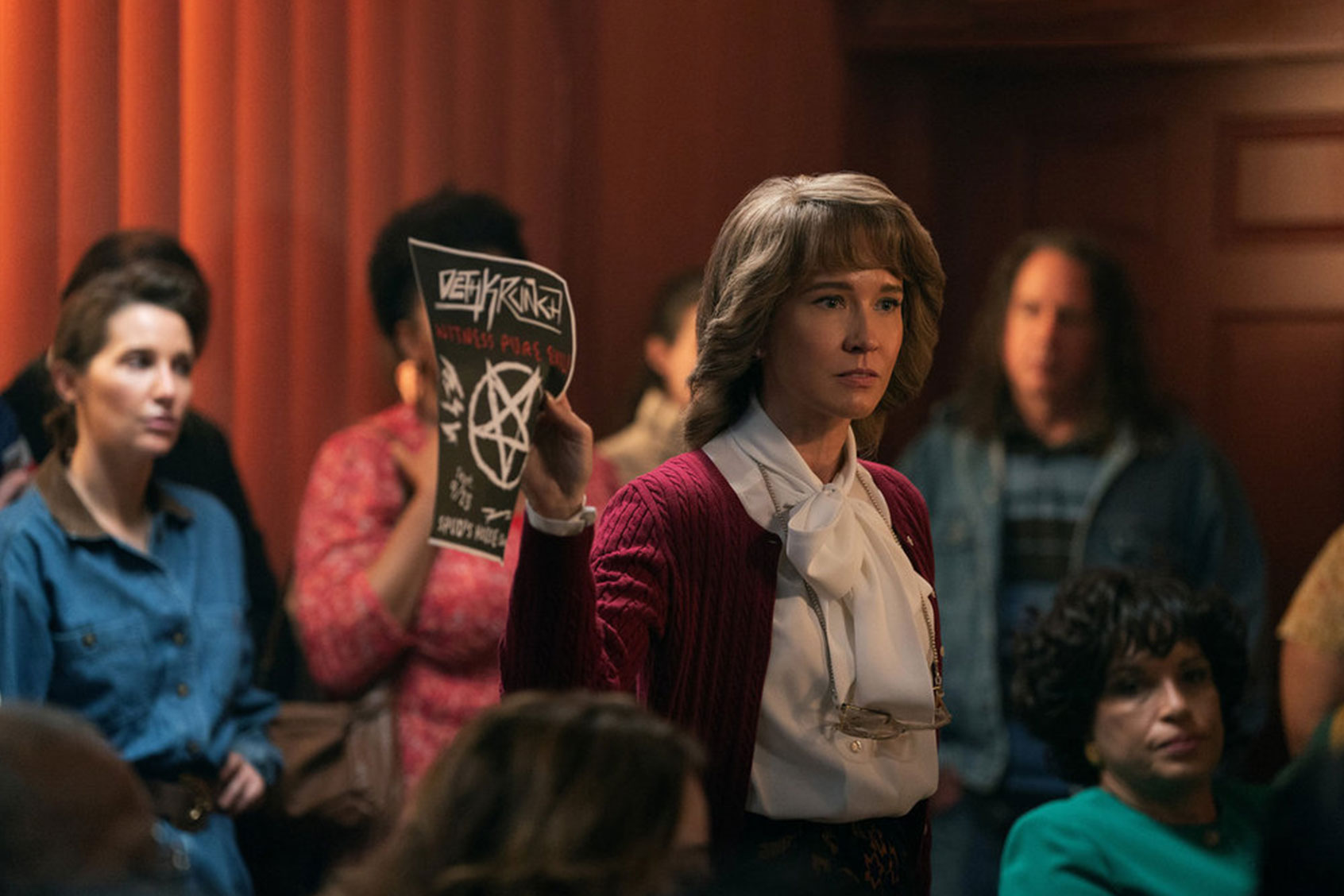
HysteriaAnna Camp as Tracy Whitehead in "Hysteria" (Daniel Delgado/PEACOCK)Since "Hysteria!" takes place during the Satanic Panic of the mid-to-late '80s, that's not necessarily a bad thing. One might think of it as a hero's return to the story that made Campbell a Gen X icon  — the possession tale. "Hysteria!" presents him as a sensible small-town lawman. As Chief Dandridge, Campbell plays it straight as the top cop in the fictional Michigan hamlet of Happy Hollow. Everything's groovy until a series of bizarre occurrences, ranging from an inexplicable and highly contagious rash to what looks like a full-blown possession case, coincide with a local garage band rebranding themselves as Satanic rockers.

Most of the local teens embrace their classmates' theatrics as an act of rebellion. But a couple of concerned mothers (played by Julie Bowen and Anna Camp) fear the band's music has opened a gateway to Hell. The truth is more ambiguous, because when is it not?

This being spooky season, I took the opportunity to revisit Campbell's first best-seller, 2001's "If Chins Could Kill: Confessions of a B-Movie Actor" which is simultaneously a career biography and a how-to manual for making the "Evil Dead" films, movies that went on to influence horror directors over many decades, including Peter Jackson

So lest that remark about his fans' limited view of him be read as anything other than happy acceptance, Campbell assured me, "It's always good. Look, I'm from Detroit. They used to introduce job rotation to keep the workers on the line interested . . . And I like the rotation — a little, writing, a little acting, a little producing." 

An apt set-up for our wide-ranging conversation, which traveled between the then and now of horror filmmaking, a surprising bit of KISS dish, sage advice for aspiring filmmakers and a proposal for the most successful holiday entertainment assembly line on TV.

This interview has been edited for length and clarity.

Recognizing that you've been in many things over the years, including “Burn Notice,” I wonder if there were any elements in the making of “Hysteria!” that you recognized from the back-in-the-day “Evil Dead” horror era.

Compared to the old days? Yeah, there's a lot of similarities. When you make horror stuff, you shoot at night a lot, which is always a drag. And you're always going to get fog. The way they make fog, they just do that differently now…Now it's non-toxic. In our day it was oil-based, and you had just two idiots running around with these foggers in the woods, crisscrossing each other, trying to pay attention to the movement of the breezes of the night, as that would change sometimes. … But some things don't change when you do scary stuff, like darkness and smoke.

Is there anything that you miss about the old way versus the way it’s done now? Because a lot of the effects are digitally rendered too.

Well, some stuff is still tricky to do digitally. They haven't quite figured out digital blood yet. It looks too opaque and it moves strangely. But I long for small, efficient crews. I always have. I made a movie in June with a teeny, tiny crew of friends and family, and, man, there's nothing like it because you move faster than anybody . . .  It is funny how you can make a movie with fewer people.

I think a lot of people are doing that now by using their phones.

I just did a panel at the Ashland Independent Film Festival on the status of indie filmmaking. And the answer is, "Pull your phone out of your pocket and make a movie. What the hell are you waiting for?" You don't need a Sony camera. Get your smartphone out there and use existing light. It looks fine. Every new phone that comes out makes you closer to being Steven Spielberg. I was half tempted with the movie I did a few months ago to really just go, “You know what? Forget it. Let's just use phones. Let's be done with this baloney.”

Bringing this back to “Hysteria!”: Besides the filmmaking aspect, what was it about this story that drew you in?

I like the time period. The ‘80s were weird! I'm from Michigan, you know, so it wasn't a big stretch there, rural Michigan. So I know the mentality. I know those cops. You know, it's all pretty slow, and nothing happens in those towns ever. You have bored farm kids racing from stoplight to stoplight in town, and that's pretty much the end of the story. So it's a good setting, I thought, to put a pandemic. You don't put it in New York City, where they have crises happening on a daily basis. Put in a small town where nothing happens and the police are not really tested.

. . . But what I found most interesting was the writing. I've been a part of lousy scripts over the years, and as an actor, you learn what a lousy script is. So I like the approach that they took as far as the characters. This is a 100% character-based show. Sure, it's horror, it's a little weirdness, and the demonic aspects are pretty cool and creepy. But it's about families dealing with this. And my character, he's not one-dimensional. He’s a small-town cop in the way you think they should be. So I liked all of those dynamics.

Around the same time as the actual Satanic Panic was when you, Sam Raimi and Rob Tapert made “The Evil Dead,” and you were in the process of getting your film career launched. Do you recall whether that movie got swept up in it?

“Evil Dead” got banned. I was just reminded of that yesterday at a panel. It was labeled in the UK as a "video nasty" and was banned from distribution because it was considered just . . . nasty.

I love how the English system works. It just cracked me up. So, “Evil Dead II” [which came out in 1987] was a really crazy movie. The only thing the English censors cut is when Ash is unconscious on the floor, and a redneck guy comes up, and he blames Ash for some bad stuff . . . and boom, he kicks Ash in the face. But Ash was unconscious. So [Campbell adopts a British accent] – “No! You can't kick a man while he's down. That's just not proper.”

"Evil Dead" got banned. I was just reminded of that yesterday at a panel. It was labeled in the UK as a "video nasty"

Out of the whole movie, that's the only thing they cared about. I'm like, “Wow, you can't predict these people. This is ridiculous.”  So we won the case, and there was such publicity about these video nasties.  . . . Germany just unbanned it a few years ago, which is stunning to me. [In 2017, an uncut edition of “Evil Dead” was finally released in Germany.]  I joked the other day, “Have you seen German porn?”  

Anyway, to each country its own. But yeah, we felt a little tinge of it. We had to fight our way to make our way — our unrated way, by the way — to the public. Interesting takeaway, what's the movie now that's like No. 1? “Terrifier 3.” Two of the “Evil Dead” movies have been unrated. But back in the day, if you had an unrated movie, there were newspapers and TV stations that would not advertise your movie if it didn't have a rating.

So I feel independent films should be allowed to be free of any of that system. I'm not in favor, though, of luring somebody into a movie they didn't suspect, like “Evil Dead.” It was unrated, but we put, “The producers strongly recommend no one under 18 see this film” to let people know what you're getting into. Make what you want as a filmmaker but be truthful in your advertising.

We need your help to stay independent

And “Evil Dead” is highly influential on horror and culture. One of the things my husband remembers from high school was that a friend's book was taken away by their science teacher. The book was “The Necronomicon.” [I was later informed it was "The History of the Necronomicon" by H.P. Lovecraft.]

I'd take that away too! That’s a bad book.

That segues back to “Hysteria!” though. When we look back at the Satanic Panic, like “Stranger Things” did, it’s presented as almost quaint and nostalgic. But I wonder if you think part of the “Hysteria!” storyline relates to anything directly in the present.

Of course! Disinformation is nothing new, you know? When I started to read about Satanic Panic, and the investigation into all of these accusations, whether it's child molestation, sacrifices, cult worship, or devil worship, there were an incredibly few cases that actually amounted to anything. What they found was society went about its normal business. You still got creepers doing creepy stuff, but there was nothing happening, is the bottom line. So it really shows you the absolute danger of the loss of truth. And if that's not a current issue, I don't know what is.

I wonder if the reason Satanic Panic became such a huge deal is that the label sounded catchy.

Very catchy, yeah. But, you know, there were some bands, I'm sort of learning the names people had for them: AC/ DC: Antichrist, Devil's Child. KISS: Knights in Satan’s Service. I'm like, “Okay, guys, fine. You're fooling around, having fun, but you put a freaking target on the backs of these groups, because people go, “Oh, my God, wait, wait, you're Satan worshipers!” I mean, that's disturbing to anybody of faith.

Kills me, though, that Gene Simmons said we couldn't use a KISS song in our show because KISS had determined it was not good for kids. That, to me, is so awesome. And Gene Simmons is such a square himself. Guy drinks Coca-Cola. That's it! You know, big rocker.

HysteriaEmjay Anthony as Dylan, Kezii Curtis as Spud and Chiara Aurelia as Jordy in "Hysteria" (Daniel Delgado/PEACOCK)Wait a minute. Gene Simmons said that the show, “Hysteria!”, was not good for kids?

Well, I don't know what all went down, but one of the producers was saying they wanted to use a KISS song for one of the scenes. And KISS said no, they didn't feel it was appropriate.

Oh, wow, that's…

That's rich.

I love the fact that you namecheck some hard rock bands in the show in that scene where you're having this discussion with the band’s leader, Dylan (Emjay Anthony), saying, “Yeah, I remember these bands. But I don't understand what you’re doing.” Do you feel like this show is using that era of music as a way of connecting to people who, say, listened to Ozzy, in a way that's beyond nostalgia? We were just talking about the message of “Hysteria!” —

Too deep! You're starting to get too deep.

It's kind of my job to get deep, Bruce.

Now Matthew Kane, the creator of the show, may go, “You know Melanie, that's the most astute thing I've ever heard in my life.” Me, I wish I knew. I mean, Matthew's definitely trying to be contemporary with this whole thing: Satanic Panic, people getting rashes and things. This show pushes a lot of buttons, but it's also funny. Oddly I think families could watch the show together. I think of a classic suburban family: My dad might enjoy cracking a beer watching this on a Friday night on USA, watch a little wrestling, and then watch “Hysteria!” I mean, it's not a stretch.

I love the fact that you have this whole Satanic Panic subplot, the horror element, where there's possession, and also some sort of “48 Hours Mystery” about cult Christian deprogramming.

Oh, there's a lot to unpack on this show. That's what I love. And there are a lot of fun characters to interact with as a cop. Some characters will not crack because it would not be good for them. It's funny for these good little Christian women to just be lying their faces off the entire time.

You’ve been in many series and movies, and you're in “Hysteria!” now, but a lot of people consider you to be a luminary in the horror world. What is your take on the type of horror that's catching on right now?

I'm just glad we're past torture porn, because that was the thing where you take some innocent backpacker and, you know, you put a body part in a vise and you poke it with a stick for half an hour. Where's the drama, where's the suspense, where's the mood? That's just being twisted. So I'm glad we're past that.

I've done horror comedy, which we call “splatstick,” but those don't always go together. You know, a lot of people like to say, “Hey, ‘Hysteria!’ is a horror comedy” but it's not a har-har comedy. There's stuff in there that I think you'll be amused by just because of either how people talked in the ‘80s or because of the technology that they had. The boxy cars are pretty funny.


Want a daily wrap-up of all the news and commentary Salon has to offer? Subscribe to our morning newsletter, Crash Course.


So I'm going to just break down three different storylines really quickly. You have the teenage storyline with the band. You have what's going on with Anna Camp’s religious mother, and her wanting to impress her will on the community —

She’s great, by the way. She's so watchable, and she's my favorite character to interact with because she's the one that'll never break. She'll lie right to your face with a smile. And it infuriates me, not only as an actor, but also as a character. I hope the writers do more stuff with her.

And then we have the possession storyline with Julie Bowen. Which did you connect with the most?

Also, my character’s got a granddaughter who's involved in all this, right? Who was being one of the perpetrators, the freaking granddaughter of the chief of police.

… It's just nice to have scenes that have motivation behind them, that really have a strong lead, a strong voice. So, you know, fingers crossed to everybody. I think fans will dig it, though, because, hey, we're as high quality as everybody else now. You can't do crappy TV on streaming. You know, one of my first TV roles was “Knots Landing.” And let me tell you, that's crappy TV right there.

Have you gone back and watched it?

I've seen clips of scenes that I have with Michele Lee. The dialogue was so stilted that it reminded me of a Kmart industrial film that I did to train people how to use the Commodore 64. The dialogue that these ad guys think was natural was pretty much how this dialog was in "Knots Landing." So I went, "Okay, I'll just pretend I'm in a Commodore 64 training film, and my dialogue will sound pretty much that fake."

I was mortified, mortified at how bad television was. Now, everyone's trying to get into TV. TV was where you started your career and where you ended your career. I mean, if you're an older actor, you went to “Love Boat,” you went to “Hotel,” you went to “The Colbys.” They had lots of places for old actors to go. I don't know where they go now — Hallmark, that's where they go.

You know, Hallmark is starting up their Christmas movie season. Is that something you'd ever do?

I've done two Hallmark movies.

Oh, forgive me. I should have known.

I have a classic called “One December Night.” It pushes all the buttons. They need a horror division at Hallmark, though. I think they could do a really sweet little horror film.

How would that go? It's Hallmark.

You can have all the problems in the beginning. You just have to solve them at the end. So the demon would have to be vanquished by the end, no question. There'd be no hand poking out of the grave at the end to scare you. No eyes opening at the very end. You just have to defeat the demon, and everyone says goodbye, and then we have cider and we trim the tree.

Do you think Hallmark would even have a demon in one of its movies?

If they were smart, they would. You want to expand your demographic. Come on, Hallmark, get busy. You'd be surprised at the type of people who watch Hallmark. My most jaded filmmaking friend, I was hesitant to tell him that I was doing a Hallmark movie, and he said, “Do you know what? Hallmark plays by the rules. They set up a problem, they confront it, and they resolve it. Most filmmakers don't even know how to do that.”

That's pretty amazing.

So congratulations, Hallmark. You play by the rules.

All episodes of "Hysteria!" are streaming on Peacock. Episodes also air weekly at 10:30 p.m. Thursdays on USA Network.

“Recipes function like arguments:” How philosophy informs Chef Jeremy Chan’s Michelin-starred menu

In May 2023, while reviewing an episode of “Top Chef: World All Stars,” I was introduced to a chef I hadn’t encountered before: guest judge Jeremy Chan.

In the review, I wrote: "Chef Jeremy Chan is a highlight of this episode; his measured demeanor, calming voice, and knowledgeable approach are unique and refreshing."

Chan embodies the phrase “calm, cool, and collected.” An accomplished chef, he is the co-founder and head chef of Ikoyi, a two-Michelin-starred restaurant in London, which he launched in 2017 with his childhood friend Iré Hassan-Odukale. Chan is also the author of a cookbook by the same name. 

As explained on the Ikoyi website, the restaurant's ethos centers on “its own spice-based cuisine around British micro-seasonality: vegetables slowly grown for flavor, sustainable line-caught fish, and aged native beef . . . The foundation for our menu is a vast collection of spices with a focus on sub-Saharan West Africa, which we have sourced with utmost care since opening."

Chan’s own style is cerebral and meticulous, with a philosophical and holistic approach to food, dining, and gastronomy as a whole — which is derived, at least in part, from the chef's educational background. Prior to cooking professionally, Chan studied philosophy and the theory of languages at Princeton University, and through his culinary career has identified points where academia and food intersect, including through a collaboration with the Umami Information Center in Tokyo. 

Salon recently had the opportunity to connect with Chan for a candid discussion about the standout dishes at his restaurant, the influences that shaped his career and menus, earning Michelin stars, and his succinct advice on sustainability and reducing food waste.

The following interview has been lightly edited for clarity and length. 

Chef Jeremy ChanChef Jeremy Chan (Danny J Peace)

How would you say your cultural influences, your identity and the places in which you've resided and worked over the years have influenced your cooking? 

The cooking at Ikoyi is very intuitive, emotional, artistic and personal.  It's done very much on feeling and the kind of technique and logic of cooking applied to feeling and intuition. It's not put through the lens of memory and culture as much. I think those things are part of it, but they are inflected naturally. My entire life and experiences shape my cooking, but this influence is more subconscious. I cook with a sense of intuition, passion and style and that's the foundation of the restaurant we've created.

Everything that we do now is very Ikoyi. There is a certain pattern and style that we live in. We’ve created our own creative world with its own rules and structures where we develop our dishes. In terms of culture and life, this influences all of our intuitions. It would take too long to list every place, memory, thought and idea I draw from, but I incorporate all of them.


Want more great food writing and recipes? Subscribe to Salon Food's newsletter, The Bite.


Would you say your collegiate background plays into your cooking ethos? 

My approach to planning a restaurant and creating recipes is similar to structuring a thesis or an essay. I think recipes function like arguments and I like this skill. My university experience involved a lot of constructing arguments and developing a thesis, which has helped me in the kitchen. I find that having a clear perspective and using language effectively to convey it is very similar to the process of cooking. So, this approach is extremely helpful in building a restaurant. 

What sort of link do you think there is between philosophy and culinary arts? 

The link between philosophy and culinary arts centers on whether cooking requires a philosophical standpoint. There may be a connection if someone has studied philosophy or holds a philosophical viewpoint.  However, I don’t believe the two have an immediate or inherent connection. Personally, I wouldn't say that I consciously make a connection. While someone’s thought process might affect how they think about food, as a general idea, I don’t see a strong connection between philosophy and food.

Ikoyi cherry cola sorbet, licorice-scented babaghanoush, vanilla shiitake cream and caramelized cherry juiceIkoyi cherry cola sorbet, licorice-scented baba ghanoush, vanilla shiitake cream and caramelized cherry juice (Justin DeSouza)

Ikoyi highlights seasonal produce along with bold, forward flavors. Is there a particular dish that you think represents the Ikoyi ethos best? 

One of the snacks we do is a smoked beef snack with seasonal fish and a poppy seed tart with salted citrus and chilli. There is seasonal vegetables, seasonal fish, seasonal meat and two different types of aging, fish and meat, with citrus-y, bitter, salty, umami, spicy and sour flavors. It has everything I love about food in one bite. And it's bold because it combines all of these very strong flavors in one bite. 

Ikoyi has garnered some amazing recognition and accolades — what do you think Ikoyi's future might look like? 

I have no idea. I'm still trying to figure that out. I really am trying to figure that out every day. 

Ikoyi Turbot & Egusi MisoIkoyi Turbot & Egusi Miso (Justin DeSouza)

I'd love to hear about your experience judging on "Top Chef" last year? 

It was a unique insight into the operation of American television series. The contestants were of a high level and the location we visited was amazing. It was my first time doing TV in an English-language show, as I have only judged in Italian before. This made me feel less comfortable and less natural. When judging in Italian, I felt I could conceal some aspects of my identity, as it’s not my native language.

However, speaking in English exposed my thoughts more directly, making me feel a bit vulnerable while judging the US "Top Chef." If I were to do it again, I would be more confident in providing my feedback.

Was there a particular moment you recall that sort of signified or crystallized your departure or transition from academia and legitimately pursuing cooking and the restaurant industry? 

I just had a realization: I was excited by the adventure of trying something new and had a lot of self-belief. During that time, I read countless books and was truly passionate. I felt confident I could achieve anything—I was determined to become a great chef. I just knew it would happen. However, once I started my journey, that confidence changed because I quickly realized how challenging it actually was.

Do you have a number-one favorite ingredient to work with? 

I really enjoy shellfish, especially scallops, lobster and langoustine. The shellfish from the UK is stunning.  I know that’s a generic answer, but I am genuinely inspired by the quality of shellfish available here, which I think is among the best in the world. This is one of the reasons I love living in the UK.

Is there a standout menu item for you? Or one that particularly resonates with customers? 

The caramelized sweetbreads are probably one of the best that guests will ever taste in their lives. There are definitely a few dishes we serve in the restaurant that are the best versions of those specific items anywhere in the world, such as the beef, scallops, sweetbreads and lobster.  Also, some of the vegetables we prepare are exceptional. At Ikoyi, we have an impressive array of individual ingredients that have a strong identity, texture and character.  

What stands out for you as a formative moment that got you into cooking or food at large? 

I wrote about this in my book, an experience of eating hot pot with my old college friend and his family. The meal was incredibly spicy and I was amazed at how it affected my body. It felt almost paralyzing. I remember eating so quickly and feverishly, overwhelmed by the heat and numbness, that I had to step outside and nearly passed out.

I truly love that style of food — it's the kind of cuisine that transforms your physical state. This experience inspired my appreciation for spices; I believe they can change your physicality. Spices create strong, distinct sensations in your mouth, eliciting intense and vivid feelings.

What is your favorite cooking memory? 

In 2021 or 2022, I had the opportunity to cook dinner in a hotel at the top of the Swiss Alps. I vividly remember making walnut ice cream in the middle of the night, as I had an event the following day and I had the whole kitchen to myself. The kitchen was beautiful and modern, with large windows that offered stunning views of the Alps. I could see the little town below at night and I was surrounded by high-speed winds and swirling snow.

What’s your biggest tip for cutting down on food waste? 

Just eat it all.

How do you practice sustainability in your cooking and in your restaurants? 

Just cook and eat all the edible parts of the food. That's it. Simple cooking. Everything is edible. 

Ikoyi dining roomIkoyi dining room (Irina Boersma)

The Ikoyi cookbook is stunning. Would you be able to pinpoint your favorite recipe in it? 

I love a dish with morels, calf brains and cassava terrine. It's a really unique creation. I actually wrote that recipe seven years ago and it feels very much like an Ikoyi dish while also being very London. I was inspired by St. John and its nose-to-tail cooking philosophy. Combining morels with Nigerian spices, cassava and calf brains allowed me to create something comforting yet distinctly British. 

What was the development process of the cookbook like? 

I spent a total of about eight days working on a book. Initially, I sat in a room for three and a half months to write a plan and then the book itself. After that, the photography took eight days: five days in the restaurant and three days dedicated to visiting farms. Overall, the writing and photography process was relatively quick, but the production and editing took a bit longer. 

We need your help to stay independent

Could you tell me a bit about the Manresa pop-up you recently partook in? 

The Manresa pop-up was a great opportunity for us to explore California’s produce and create a pop-up restaurant in an iconic location. David Kinch is very cool. I read his book many years ago and never imagined I would be working in his kitchen for a month. It was a great experience.

This pop-up allowed my team and me to step away from our usual environment, discover new ingredients and taste different types of fish, meats, vegetables and fruits, comparing them to what we have at home. It was also an opportunity to collaborate with different people, gain inspiration and think about how we can take the essence of Ikoyi and adapt it to other parts of the world while still connecting with people in a meaningful way. 

How validating was it when you first learned of Ikoyi's being awarded Michelin stars?

It was great— a blessing because we got busier. It was good for the restaurant, the team, the guests and all our producers and suppliers.

Ikoyi: A Journey Through Bold Heat with RecipesIkoyi: A Journey Through Bold Heat with Recipes (Courtesy of Phaidon)

The cookbook sub-heading is "A journey through bold heat." Would you say that represents your outlook on cooking at large, from the restaurant to cooking at home?

Yes, I would. My cooking at home, for my family, is very much about flavor and taste, comforting, nurturing and delicious flavors.

There's a quote in the cookbook that I wanted to ask about. "In a kitchen, there is nowhere to hide: raw ability and attitude eventually triumph"

It's very much my philosophy. In the kitchen, you have to put yourself out there. The kitchen is about output. It's not really a place where you can go and contemplate and sit in the corner and produce great work. You have to do things and you have to do them quickly. What I'm trying to say is you have to have a good attitude. You have to channel your strengths and abilities constantly and positively to the team's greater good. It's very difficult to hide in the kitchen if you're not involved and connected to what you're doing mentally and emotionally.

Wild animals can experience trauma and adversity too

Psychologists know that childhood trauma, or the experience of harmful or adverse events, can have lasting repercussions on the health and well-being of people well into adulthood. But while the consequences of early adversity have been well researched in humans, people aren’t the only ones who can experience adversity.

If you have a rescue dog, you probably have witnessed how the abuse or neglect it may have experienced earlier in life now influence its behavior – these pets tend to be more skittish or reactive. Wild animals also experience adversity. Although their negative experiences are easy to dismiss as part of life in the wild, they still have lifelong repercussions – just like traumatic events in people and pets.

As behavioral ecologists, we are interested in how adverse experiences early in life can affect animals’ behavior, including the kinds of decisions they make and the way they interact with the world around them. In other words, we want to see how these experience affect the way they behave and survive in the wild.

Many studies in humans and other animals have shown the importance of early life experiences in shaping how individuals develop. But researchers know less about how multiple, different instances of adversity or stressors can accumulate within the body and what their overall impact is on an animal’s well-being.

Wild populations face many kinds of stressors. They compete for food, risk getting eaten by a predator, suffer illness and must contend with extreme weather conditions. And as if life in the wild wasn’t hard enough, humans are now adding additional stressors such as chemical, light and sound pollution, as well as habitat destruction.

Given the widespread loss of biodiversity, understanding how animals react to and are harmed by these stressors can help conservation groups better protect them. But accounting for such a diversity of stressors is no easy feat. To address this need and demonstrate the cumulative impact of multiple stressors, our research team decided to develop an index for wild animals based on psychological research on human childhood trauma.

A cumulative adversity index

Developmental psychologists began to develop what psychologists now call the adverse childhood experiences score, which describes the amount of adversity a person experienced as a child. Briefly, this index adds up all the adverse events – including forms of neglect, abuse or other household dysfunction – an individual experienced during childhood into a single cumulative score.

This score can then be used to predict later-life health risks such as chronic health conditions, mental illness or even economic status. This approach has revolutionized many human health intervention programs by identifying at-risk children and adults, which allows for more targeted interventions and preventive efforts.

So, what about wild animals? Can we use a similar type of score or index to predict negative survival outcomes and identify at-risk individuals and populations?

These are the questions we were interested in answering in our latest research paper. We developed a framework on how to create a cumulative adversity index – similar to the adverse childhood experiences score, but for populations of wild animals. We then used this index to gain insights about the survival and longevity of yellow-bellied marmots. In other words, we wanted to see whether we could use this index to estimate how long a marmot would live.

A marmot case study

Yellow-bellied marmots are a large ground squirrel closely related to groundhogs. Our research group has been studying these marmots in Colorado at the Rocky Mountain Biological Laboratory since 1962.

Yellow-bellied marmots are an excellent study system because they are diurnal, or active during the day, and they have an address. They live in burrows scattered across a small, defined geographical area called a colony. The size of the colony and the number of individuals that reside within varies greatly from year to year, but they are normally composed of matrilines, which means related females tend to remain within the natal colony, while male relatives move away to find a new colony.

Yellow-bellied marmots hibernate for most of the year, but they become active between April and September. During this active period, we observe each colony daily and regularly trap each individual in the population – that’s over 200 unique individuals just in 2023. We then mark their backs with a distinct symbol and give them uniquely numbered ear tags so they can be later identified.

Although they can live up to 15 years, we have detailed information about the life experiences of individual marmots spanning almost 30 generations. They were the perfect test population for our cumulative adversity index.

Among the sources of adversity, we included ecological measures such as a late spring, a summer drought and high predator presence. We also included parental measures such as having an underweight or stressed mother, being born or weaned late, and losing their mother. The model also included demographic measures such as being born in a large litter or having many male siblings.

Importantly, we looked only at females, since they are the ones who tend to stay home. Therefore, some of the adversities listed are only applicable to females. For example, females born in litters with many males become masculinized, likely from the high testosterone levels in the mother’s uterus. The females behave more like males, but this also reduces their life span and reproductive output. Therefore, having many male siblings is harmful to females, but maybe not to males.

A yellow-bellied marmot shown on a trail camera in Montana.

So, does our index, or the number of adverse events a marmot experienced early on, explain differences in marmot survival? We found that, yes, it does.

Experiencing even just one adversity event before age 2 nearly halved an adult marmot’s odds of survival, regardless of the type of adversity they experienced. This is the first record of lasting negative consequences from losing a mother in this species.

So what?

Our study isn’t the only one of its kind. A few other studies have used an index similar to the human adverse childhood experiences score with wild primates and hyenas, with largely similar results. We are interested in broadening this framework so that other researchers can adopt it for the species they study.

A better understanding of how animals can or cannot cope with multiple sources of adversity can inform wildlife conservation and management practices. For example, an index like ours could help identify at-risk populations that require a more immediate conservation action.

Instead of tackling the one stressor that seems to have the greatest effect on a species, this approach could help managers consider how best to reduce the total number of stressors a species experiences.

For example, changing weather patterns driven by global heating trends may create new stressors that a wildlife manager can’t address. But it might be possible to reduce how many times these animals have to interact with people during key times of the year by closing trails, or providing extra food to replace the food they lose from harsh weather.

While this index is still in early development, it could one day help researchers ask new questions about how animals adapt to stress in the wild.The Conversation

Xochitl Ortiz Ross, Ph.D. Candidate in Ecology & Evolutionary Biology, University of California, Los Angeles

This article is republished from The Conversation under a Creative Commons license. Read the original article.

Rudy Giuliani ordered to turn over apartment and luxury goods to Georgia election workers he defamed

Donald Trump’s former attorney, Rudy Giuliani, must hand over his Manhattan penthouse and luxury possessions to two Georgia election workers who won a $150 million defamation case against him, a federal judge ordered Tuesday. 

Along with his apartment, U.S. district Judge Lewis Liman said Giuliani has seven days to turn over more than two dozen luxury watches, his 1980 Mercedes, a diamond ring and various sports memorabilia. The new owners will be Ruby Freeman and Shaye Moss, who both counted ballots in Georgia during the 2020 election. Giuliani spread lies and conspiracies about them, falsely claiming they were rigging the vote against former President Donald Trump, which resulted in harassment and death threats.

Of the 26 watches Giuliani has to turn over, requested to keep one that belonged to his grandfather because it has sentimental value. Liman denied that request.

“The Court also does not doubt that certain of the items may have sentimental value to Defendant,” Liman wrote. “But that does not entitle Defendant to continued enjoyment of the assets to the detriment of the Plaintiffs to whom he owes approximately $150 million. It is, after all, the underlying policy of these New York statutes that ‘no man should be permitted to live at the same time in luxury and in debt.’”

Giuliani’s Manhattan apartment is worth an estimated $5 million and his Mercedes is worth an estimated $25,000; the sports memorabilia and jewelry is worth about $30,000 combined, according to court documents filed earlier this year.

The two women will also be entitled to about $2 million in legal fees still owed to Giuliani by the Trump campaign. 

“Today’s ruling, I think, is an example of how the justice system, even though it may take some time and even though it may take resolve and the courage of people like Ruby Freeman and Shaye Moss, will hold powerful people to account for these kinds of wrongs,” Freeman and Moss’ attorney told CNN

Liman has yet to decide whether Giuliani will have to turn over his condo in Palm Beach, Florida.

John Kelly says Trump praised Hitler, is the “definition of fascist” and would like to be dictator

John Kelly, the Marine general who served as Donald Trump's White House Chief of Staff from 2017 to 2019, has frequently criticized the former president's leadership and character. But in a set of interviews with The New York Times published Tuesday, he went a step further, describing his former boss as a "fascist" and saying he decided to speak out after the Republican candidate suggested that he would use the military to crack down on his political opponents.

According to Kelly, it isn't the first time Trump has expressed a desire to set the military loose on his rivals. Trump repeatedly suggested doing so since his first year in office, he told the Times, chafing at the constant reminders of why he could not use the military against U.S. citizens.

In response to a question about whether he thought Trump was a "fascist," Kelly first read aloud a definition of the term he found online. “Well, looking at the definition of fascism: It’s a far-right authoritarian, ultranationalist political ideology and movement characterized by a dictatorial leader, centralized autocracy, militarism, forcible suppression of opposition, belief in a natural social hierarchy,” he said.

Kelly said Trump fit that definition, adding that the former president thought "those kinds of things" would "would work better in terms of running America."

"Certainly the former president is in the far-right area, he’s certainly an authoritarian, admires people who are dictators — he has said that. So he certainly falls into the general definition of fascist, for sure," he said. Later in the interview, he recalled that Trump occasionally praised Hitler, the former president reportedly saying the German dictator "did some good things."

Kelly was secretary of Homeland Security under Trump in the first half of 2017 before transitioning to White House chief of staff. He played a key role in carrying out the former president's agenda, including the separation of children from their families at the southern border. But he grew increasingly frustrated at Trump's conduct and lack of respect for the Constitution, he said. For much of his tenure, Kelly found himself explaining concepts like the rule of law to Trump, who valued personal loyalty above all else.

We need your help to stay independent

“He and I talked about it — it was a new concept for him, I guess is the best way to put it, and I don’t think it’s one he ever totally accepted," Kelly said. Personal loyalty “is virtually everything to him," he continued, and Trump was disappointed to learn that what he referred to as "my generals" would not offer him unconditional support. Many of those generals who served during the Trump administration have since condemned their former commander in chief, including former chairman of the Joint Chiefs of Staff Mark Milley, who has said Trump is "fascist to the core."

Asked about Trump's view of the presidency, Kelly responded that the Republican preferred "the dictator approach to government." Trump “never accepted the fact that he wasn’t the most powerful man in the world — and by power, I mean an ability to do anything he wanted, anytime he wanted,” Kelly said.

After two tumultuous years marred by criticism of either enabling a man like Trump or not aiding him enough, Kelly resigned and used his newfound freedom to criticize his former boss, especially over his "dishonesty" and outspoken praise for authoritarian leaders. In 2023, Kelly confirmed reports that Trump looked down on disabled veterans and referred to Americans wounded, captured or killed in action as "losers and suckers." 

“The time in Paris was not the only time that he ever said it,” Kelly said, referring to reports that Trump complained about having to visit a cemetery where Americans killed during World War I were buried. “Whenever John McCain’s name came up, he’d go through this rant about him being a loser, and all those people were suckers, and why do you people think that people getting killed are heroes? And he’d go through this rant.”

Despite his long list of grievances and concerns about Trump, Kelly stressed that as a former military officer he would not endorse either major-party candidate for president. But if the race was an empathy contest, it's clear who Kelly would pick.

Asked whether Trump had the ability to sympathize with others, Kelly had a simple answer: "No."

“It doesn’t cost $60,000 to bury a f**ing Mexican”: Trump was outraged at cost of soldier’s funeral

Former President Donald Trump called the late U.S. Army soldier Vanessa Guillen a “f***ing Mexican” after he discovered the cost of her funeral that he offered to pay for, The Atlantic reported on Tuesday. 

A Houston native and the daughter of Mexican immigrants, the 20-year-old Guillen was murdered in 2020 by a fellow soldier while on base in Fort Hood, Texas, a notoriously difficult location for women in the army. Her murder sparked outrage across the country and was a catalyst for a national investigation into sexual harassment and abuse against women in the U.S. Army.  

After Guillen’s death, Trump invited her family to the White House and offered to personally pay for her funeral.

“I saw what happened to your daughter Vanessa, who was a spectacular person, and respected and loved by everybody, including in the military,” Trump said to Guillen’s, according to notes from The Atlantic.  “If I can help you out with the funeral, I’ll help — I’ll help you with that."

"I’ll help you out. Financially, I’ll help you,” he added.

It was a seemingly generous offer from Trump at odds with his reported comments on deceased members of the military. In 2018, he referred to soldiers buried in the Aisne-Marne American Cemetery as “losers” and “suckers,” according to his former chief of staff, retired Marine Gen. Mark Kelly. Earlier this year, he visited Arlington National Cemetery for a campaign photo-op, despite filming not being allowed at the cemetery, with members of his staff shoving a woman who tried to enforce cemetery regulations.

Trump was outraged when a bill for Guillen's funeral was submitted to the White House, The Atlantic reported.

“What did it cost?” Trump asked his staff. When they informed him the total cost was $60,000, he was livid.

“It doesn’t cost 60,000 bucks to bury a f—ing Mexican! Don’t pay it!” Trump told his then-chief of staff, Mark Meadows. The Guillen family attorney told The Atlantic they were never reimbursed for the funeral.

The Atlantic’s report also noted Trump saying he needs “the kind of generals Hitler had” after he grew frustrated with the U.S. military’s lack of blind obedience. A Trump spokesperson called the story "an outrageous lie two weeks before the election."

Learning to trust Trump’s generals: There’s a reason why his military men now call him a fascist

Before Donald Trump was considered nothing more than a circus sideshow, some of us noted during the 2015 GOP presidential primaries that his rhetoric and agenda bore all the hallmarks of the "f" word: fascism. Historian Rick Perlstein wrestled with it as early as September of that year. I wrote about it just a couple of months later. At the time, Trump was extolling the virtues of torture, talking about a massive surveillance program to be used against American Muslims and promising to send Syrian refugees, including children, back to their war-torn country. He hadn't yet declared his intention to ban all Muslims from coming to the U.S. but it was easy to see the writing on the wall. It was also very easy to see that fascism was on the menu in the United States of America if Trump won the election

He may not have been fully able to accomplish his true desires in his first term since he was so unfamiliar with even the rudimentary levers of power, but he's no longer afraid to go for it.

That was nine years ago and a zillions of words have since been written about Trump's dishonesty, corruption, unfitness and authoritarian philosophy. We've learned over the years, through many reports, memoirs and tell-all books that Trump tried to govern in a dictatorial fashion at every turn but was either too mentally undisciplined to follow through or was held back by people around him who kept him from acting on his worst impulses.

Trump's 2024 run includes a ratcheting up the fascist rhetoric to previously unseen heights. The former president repeatedly says that immigrants are "poisoning the blood" and calls his political opponents "vermin" and "enemies within" who must be purged.

Lately, he's even suggested that he would call out the military against "the enemy from within.:

Yet Trump has very little respect for the military either. The Atlantic's Jeffrey Goldberg chronicled Trump's odd antipathy toward the military during his first term, the details of which were further confirmed by Susan Glasser of the New Yorker and Peter Baker of the New York Times in their book "The Divider: Trump in the White House," as well as the New York Times' Michael Schmidt's book "Donald Trump v. The United States: Inside the Struggle to Stop a President." They all relied on former US Army general and Trump chief of staff John Kelly as a primary source for such anecdotes as Trump's contemptuous references to service members as "suckers and losers" and his frequent demands to use the military unconstitutionally.

Goldberg published a story in The Atlantic on Tuesday with some new revelations about Trump's disdain for the military, quoting from witnesses and contemporaneous notes about an episode in which Trump exploded over the cost of a funeral for a service member which he'd promised to help pay for:

"It doesn’t cost 60,000 bucks to bury a f**king Mexican!” He turned to his chief of staff, Mark Meadows, and issued an order: “Don’t pay it!” Later that day, he was still agitated. “Can you believe it?” he said, according to a witness. “Fucking people, trying to rip me off."

The lawyer for the family suggested to the Atlantic that Trump never paid but members of the family defended him after the story was published. His loyal henchman Meadows naturally denies that he ever said those things. Nobody can say that it doesn't sound like something he would say.

Goldberg also recapitulates the stories about Trump's fascination with Adolf Hitler as told to him and the other authors by John Kelly. Trump had said to Kelly at one point, “Why can’t you be like the German generals?" and Kelly explained that those German generals had tried to assassinate Hitler three times and almost succeeded. Trump didn't believe him, insisting that they were totally loyal. Kelly went on the record about that conversation this week:

This week, I asked Kelly about their exchange. He told me that when Trump raised the subject of “German generals,” Kelly responded by asking, “‘Do you mean Bismarck’s generals?’” He went on: “I mean, I knew he didn’t know who Bismarck was, or about the Franco-Prussian War. I said, ‘Do you mean the kaiser’s generals? Surely you can’t mean Hitler’s generals? And he said, ‘Yeah, yeah, Hitler’s generals.’ I explained to him that Rommel had to commit suicide after taking part in a plot against Hitler.” Kelly told me Trump was not acquainted with Rommel.

Trump also asked at one point who the "good guys" were in World War I. Apparently, he missed that semester in military school.

We need your help to stay independent

Michael Schmidt also got Kelly on the record for the Times on Tuesday and published voice recordings of Kelly's comments. Schmidt asked him if he thinks Trump is a fascist:

“Well, looking at the definition of fascism: It’s a far-right authoritarian, ultranationalist political ideology and movement characterized by a dictatorial leader, centralized autocracy, militarism, forcible suppression of opposition, belief in a natural social hierarchy,” he said.

Mr. Kelly said that definition accurately described Mr. Trump.

“So certainly, in my experience, those are the kinds of things that he thinks would work better in terms of running America,” Mr. Kelly said. He added: “Certainly the former president is in the far-right area, he’s certainly an authoritarian, admires people who are dictators — he has said that. So he certainly falls into the general definition of fascist, for sure.”

“He certainly prefers the dictator approach to government,” Mr. Kelly said. Mr. Trump “never accepted the fact that he wasn’t the most powerful man in the world — and by power, I mean an ability to do anything he wanted, anytime he wanted,” Mr. Kelly said.

Kelly isn't the only former general saying this. Just a week or so ago, Bob Woodward reported in his new book "War" that the former chairman of the Joint Chiefs of Staff, Gen. Mark Milley, described Donald Trump as "fascist to the core" calling him “the most dangerous person to this country." Woodward told The Bulwark podcast that former Defense Secretary Jim Mattis agreed with this assessment.


Want a daily wrap-up of all the news and commentary Salon has to offer? Subscribe to our morning newsletter, Crash Course.


It's good that these former high-ranking military leaders are saying all this. But they really need to go on "60 Minutes" or cut an ad so that people who aren't reading the Atlantic and the New York Times (or Salon, for that matter) will know about it. There's no reason for them not to do it at this point. If they fear retribution from Trump, I'm afraid that ship sailed. You can bet they are already on his list. If they simply don't want to be in the line of fire, it's a sad comment on the military ethos for which they claim to be speaking.

Donald Trump is a fascist. He's an ignorant fascist, but there's really no requirement for education to be one. It's driven by an authoritarian, nationalist, racist instinct and that he has in spades. He may not have been fully able to accomplish his true desires in his first term since he was so unfamiliar with even the rudimentary levers of power but he's no longer afraid to go for it. Here's Trump on the campaign trail just yesterday:

“As president, you have tremendous — it’s called extreme power. You have extreme power. You can, just by the fact, you say, ‘Close the border,’ and the border’s closed. That’s it. Very, very simple. You don’t need all of this nonsense that they talk about.”

If he wins there will be no John Kellys or Mark Milleys to stand in the way. He'll only be served by accomplices who agree with him. 

“She can write whatever she wants”: Martha Stewart dishes on the end of a friendship with Ina Garten

Martha Stewart has revealed that she’s read “parts” of Ina Garten’s recent memoir, “Be Ready When the Luck Happens.”

Stewart commented on her falling out with Garten during Sunday’s episode of “Watch What Happens Live With Andy Cohen.” The culinary superstar and lifestyle guru served as a bartender throughout the night to celebrate Snoop Dogg’s 53rd birthday. The rapper appeared on Cohen’s show as a guest alongside Seth Meyers.  

“You read the parts about yourself?” Cohen asked while speaking with Stewart. “What was your take?”

“She can write whatever she wants,” Stewart simply responded.

Snoop Dogg then jumped into the conversation, asking Cohen, “I didn’t read the book, what does it say?” Cohen responded, “Ina said that they fell out because she moved to Connecticut.”

Stewart asserted that Garten’s claim was “not true.” She added that Garten stopped talking to her “after I went to jail.” Snoop Dog immediately came to his longtime friend’s defense, calling Garten’s side of the story “weak” and saying that’s when he “stepped in” as Stewart’s “real” friend.

“Martha don’t fall out with people,” Snoop Dogg asserted. Cohen gleefully proclaimed that “when one friend goes out the door, another friend comes in the door.”

Last month, Stewart made headlines after she shot back at Garten, saying their friendship never ended on friendly terms. “When I was sent off to Alderson Prison, she stopped talking to me,” Stewart told The New Yorker in a profile on Garten. “I found that extremely distressing and extremely unfriendly.”

In March 2004, Stewart was found guilty of conspiracy, obstruction and two counts of lying to federal investigators in connection with an insider trading scheme. She was sentenced in July 2004 to five months in prison, along with five months of home confinement and two years of supervised probation.

According to Garten, she and Stewart amicably parted ways after Stewart purchased a property in Bedford, New York. The former friends first met in the 1990s while living in the Hamptons. In the first issue of Stewart’s now-defunct magazine, “Martha Stewart Living,” Stewart featured a writeup of Garten, who was a local business owner at the time. Stewart would later help Garten secure her first book deal. In fact, Garten’s career and household name as “Barefoot Contessa” is often credited to her association with Stewart.


Want more great food writing and recipes? Subscribe to Salon Food's newsletter, The Bite.


In a 2017 appearance on the “How to Be Amazing with Michael Ian Black” podcast, Garten called Stewart a “trailblazer” and spoke about their budding friendship.

“My desk was right in front of the cheese case and we just ended up in a conversation,” Garten said. “We ended up actually doing benefits together where it was at her house and I was the caterer and we became friends after that.”

Per her New Yorker profile, Garten “firmly denied” Stewart’s recent claim. Stewart’s longtime publicist, Susan Magrino, later clarified that Stewart was “not bitter at all and there’s no feud.”

Watch the clip below, via YouTube:

A travel writer’s guide to eating your way through Lisbon and the Algarve Coast

I’ve been to eight European countries and Portugal stands out as the country with the best food overall (although Croatia is certainly a close second). The food was next-level good, whether we ate dishes showcasing local ingredients, fusion cuisine that brought together Japanese and Portuguese flavors, or traditionally-prepared pastel de nata — custard tarts — and salt cod. 

If you’re flying into Lisbon, you’ll find the airport is relatively small. It was built before the surge of tourists flooded the country, which can cause some havoc when flying in, but fewer problems when flying out.

When planning your Portugal itinerary, consider Lisbon your hub, but don’t stay just in the city. With incredible sightseeing, wineries, beaches and parks close by, it would be a shame not to venture out.

Spend a few days in the city, then head to nearby areas like Sintra or Porto, both just a short train ride away. If you have more time, consider going farther to the Algarve coast, where the views are breathtaking and the pace is much slower than Lisbon. This region truly blew me away and it’s only a few hours from Lisbon — definitely a spot for your travel bucket list.

We need your help to stay independent

Where to stay in Lisbon:

1908 Hotel – The 1908 hotel was truly the boutique hotel of my dreams. Keeping the stunning architecture of the original building, the interior has been completely renovated and modernized, with some beautiful touches of the original building remaining. The rooms are spacious, without the classic European-style bathroom, which was a definite perk. 

And while the hotel is lovely, it’s the staff that really take it to the next level. They always greet you with joy and warmth, happy to answer any questions and give suggestions on anything Lisbon-related. 

The hotel restaurant Infame also offers a lobby bar with small bites and drinks. The salmon ceviche was easily the best I’ve had anywhere in the world, and the duck croquettes were the perfect filling snack before heading out to enjoy the afternoon.

Squish factor: While large enough, the shower doesn’t have anywhere you can lift your leg for a shower. Additionally, while this isn’t size related, the doorstop on the floor is nearly invisible, especially at night. Be careful or you’ll wind up in a lot of pain.

Bairro Alto Hotel – This five-star boutique hotel is nothing like your favorite luxury chain — it’s far too unique to fit into a cookie-cutter mold. Everywhere you turn, there are thoughtful touches, curated art and the familiar Lisbon pastel and terrazzo colorways. The customer service is top-notch, elevating this hotel to the next level.

Bairro Alto Hotel, a member of the Leading Hotels of the World, promises an unparalleled experience—and it certainly delivers. The rooms are on the smaller side, as you’d expect from a beautifully restored building in Europe, but they’re just the right size to serve as a home base during your travels.

The hotel’s location is ideal for those who like to step outside and explore. There’s plenty to see and do nearby.

Whether you’re staying at the hotel or not, a visit to BAHR restaurant is a must. The views of the city, the water, and the bridge alone make it worth the trip. Whether you grab a cocktail and admire the view or indulge in a full dinner, you won’t be disappointed.

Tivoli Avenida Liberdade – This hotel exudes luxury from the moment you step out of your taxi. The ornate turquoise and gold lobby, excellent customer service and plush accommodations with city views make it perfect for any special occasion. The rooftop Sky Bar is a must-visit during your stay, with views and craft cocktails that are the ideal start or end to any night out.

Every vacation needs a bit of self-care, and for me, that means a trip to the spa. From the moment you walk into the on-site Anantara Spa, you’ll feel at peace and relaxed.

The massage was a 10/10. After changing, the service began with a foot wash and exfoliation, followed by the treatment on a pre-warmed massage table. The room temperature can be adjusted by request — I run hot, so I asked them to turn off the heat. I would have skipped the mini facial, which was more of a cleanser and moisturizer application than a full treatment. After the massage, we were escorted to the relaxation room and enjoyed a glass of champagne before heading back into the world.

I can’t stress enough the impressive level of customer service at Tivoli Avenida Liberdade. Everyone — from the front desk to the spa to the restaurant — goes out of their way to ensure you have the best experience.

Squish factor: As expected, the robe didn’t fit me at all. My size-12 sister found the robe quite small, too, so I’d bring my own. Additionally, the provided booties and plastic underwear didn’t fit as well. As the service started with a foot wash, I simply wore my dress, which I removed when laying down on the table. I left my underwear on during the massage.

Where to eat in Lisbon:

Boubou's – From the outside, Boubou's doesn't look like much, but don't let that fool you. In addition to a small dining room, the restaurant features a spacious hidden garden. You'll be surrounded by massive banana trees in a relaxed, casual environment. The menu features local Portuguese ingredients, changing week by week, depending on what is the freshest. My sister and I went with the tasting menu, which featured international flavors and uplifted vegetarian options. You absolutely must order the creamy sweet potato in a coconut tiger milk with kaffir lime ceviche. It was simply sublime, though the rabbit croquette was the best bite of the night. 

Sweet Potato Ceviche at Boubou's (Soreh Milchtein)

Squish factor: While the food and the environment were top-notch, the seating left me miserable. It consisted mostly of armchairs, so I chose the bench, which somehow was even worse than being squished in the armchair. 

OfícioLunch at Oficio was so good during my first visit I just had to go back for dinner when I visited a year later — so make sure it’s on your itinerary. Walking into the restaurant feels like an experience. Bright and airy, you’ll want to take a deep breath to drink it all in before being seated. As you are seated, you’re presented with a menu that looks like someone is still in the process of developing it, with scribbled writing and arrows. 

And what a menu it is! From mushrooms topped with chicken caramel (which was super unique and delicious!) to veal and marrow tartar, it will have you salivating before you even order. 

Oficio serves contemporary Portuguese food made with local ingredients, with a dash of Mexican flavors thrown in for good measure. Now I’m a sucker for a fabulous fish dish, especially if the fish is raw. The fresh croaker wrapped in a lettuce leaf deserves an award. It’s simply perfection. Don’t skip the oysters, the stuffed spider crab, or the roasted leeks. 

Squish factor: The chairs have arms, but some bench seating is available. However, I was able to comfortably sit in the armchair for lunch. 

Fish taco at Oficio (Soreh Milchreis)

Sala de Corte – Have you ever been to a steakhouse and felt like it was too old school or stuffy? Well, then you’ll love Sala de Corte, the slightly squished, very relaxed, steakhouse in Lisbon. The first thing you’ll see walking into the restaurant is a dry-aging fridge full of all the steak you can imagine. The lighting is dim, and the hum of conversation and laughter is prominent. The menu is relatively simple. 

We ordered beef tartar, and while it was amazing I wouldn’t order it since the first bite from the chef is also beef tartar. Definitely splurge on the steak, the star of the show as it should be. Once you order, the raw steak will be brought to your table for approval in all of its glory. The porterhouse was cooked to the perfect medium-rare, with one of the best crusts I’ve ever enjoyed. Simply perfect. And dessert was nothing to sneeze at either. A deconstructed hazelnut dessert with a melody of different textures finished with a salted caramel ice cream. 

Squish factor: When making the reservation, ask for a table with bench seating, as the chairs all have armrests.

Brilhante Restaurant Brilhante has the air of a French brasserie with the service of a Portuguese restaurant, making it a superb choice in my book. Specializing in the centuries-old tenderloin recipe "Bife à Marrare," which they claim to have perfected, Brilhante's menu is short and sweet, but offers a little of everything you might want.

Steakhouse classics like tartare and carpaccio, along with seafood options such as raw oysters, sea bass crudo and scallops, are all available as appetizers.Be sure to try the veal croquette, served with a three-mustard tasting accompaniment, for a perfectly balanced bite. A hazelnut soufflé makes for a delicious finale to a meal you’ll savor.

Cavalariça Lisboa – Dim and romantic, Cavalariça Lisboa exudes a charming, laid-back vibe that’s far from stuffy. Once home to a shop that sold electric motors, the restaurant now features a massive white unicorn hanging on the wall, adding a touch of fun to the space. Start your meal with olive oil (or aged butter) and chewy focaccia before diving into the shared plates—or leave the meal to the pros by opting for the tasting menu. Be sure to try the tender, flavorful Alentejo pork and pineapple skewer with cilantro, which delivers a huge flavor punch. For dessert, the chocolate and banana dish brings nostalgic memories of banana bread, with an upscale twist.

What to do in Lisbon: 

Private Setúbal Region Wine Tasting Experience – Flying into Europe always presents a small dilemma: to sleep or not to sleep. Most flights arrive early in the morning European time, so if you didn’t manage to get some rest on the plane, you’re probably exhausted.

My personal trick to avoid jet lag is to do everything possible to stay up until a reasonable bedtime. That’s how I ended up on a wine-tasting tour in Portugal's Setúbal region just hours after landing.

The tour takes you to three different wineries, each unique in its own way, where you’ll sample 10 wines, cheeses and local flavors. Along the way, your guide will share insights about the region, what makes it special and Portuguese winemaking.

Since this is a private tour, there’s room for customization. For example, we chose to visit a tile factory and skip one of the wine tastings, making for a truly magical day in the countryside.

A photo of the author and her sister at one of the lookout points (Chaya Milchtein)


Private Food Tour – There’s something special about taking a food tour in a new city and getting to know its cuisine one bite at a time. While traditional food tours are often in large groups, this tour is private, just for you and your group, and fully customizable.

From samples of Portuguese olive oil and grilled meats to the iconic Pastel de Nata, you’ll leave the tour both full and knowledgeable about Portuguese cuisine and dining culture. And don’t forget the chocolate cake—we went back for another before leaving Lisbon; it was that good.

Car Tour of Lisbon – I’ve taken private tours before, but this private car tour from Viator took private tours to a new level. We were picked up from our hotel by a sharply dressed driver in a luxury, air-conditioned sedan before game-planning the tour. 

While the itinerary was laid out when we booked, the beauty of a private tour is that you can change it up. We stopped at Pastéis de Belém, two different lookout points to take in the glory of Lisbon from up high, and learned so much about the city. Our driver-tour guide joined us at most stops, and it was fabulous!

On the Algarve Coast

Martinhal Sagres Algarve —If you’re visiting the Algarve with children, consider the luxury, family-focused, five-star Martinhal resort. Dedicated to helping families vacation without compromising either parents’ or children’s experiences, every element of the resort is carefully curated for family enjoyment. There are countless activities, each designed to cater to different age groups.

The views from our room were breathtaking. Martinhal offers a variety of accommodations to suit any family, from single hotel-style rooms to luxury villas with multiple bedrooms. The staff were gracious and clearly passionate about the resort, ensuring that families have an incredible vacation.

With five pools, a kids' "beach" and a sports center featuring tennis courts, that’s just the beginning. Climbing walls, football, tennis, swimming lessons, bike rentals and age-divided kids' clubs allow your children to enjoy a luxury vacation right alongside you.

My wife and I also enjoyed facials at the on-site spa, which caters to adults, tweens, and teens. Offering couples' services, body treatments, massages, manicures, pedicures, facials and waxing, there’s something for everyone.

The resort also arranges a variety of excursions for guests. We took an off-roading jeep tour and went whale watching. We saw the coast, enjoyed local ice cream and connected with other travelers. Both were great ways to enjoy the coast and soak in every moment of our holiday.

Squish factor: The off-road Jeep tour didn’t have a seatbelt extender, so I had to sit in the front seat to fit comfortably. While wearing a seatbelt didn’t seem to be required, given the nature of off-roading, it was a bit nerve-wracking. Whale watching worked out well, given they allowed us to sit on a bench seat behind the captain, but the tour typically requires visitors to perch on a seat that would have been impossible to fit on.

Vila Vita Parc— For a truly magical day on the water, consider booking a yacht trip at the coastal resort Vila Vita Parc. There’s something special about being on the water anywhere in the world, but cruising along the coast of Portugal and exploring its caves is simply unforgettable. This experience defines luxury (and is priced accordingly), featuring a private captain and crew. If you’re celebrating something special, it might be worth the splurge.

For a lovely meal before or after your cruise, Praia Dourada offers a beachside setting with a fresh menu of sushi and freshly squeezed juices. Giardino, an Italian restaurant, is ideal for dinner, boasting friendly staff and spectacular food.

Girl Scouts USA hikes up its membership prices in an attempt to save its programs and services

The Girl Scouts of the USA will increase its membership prices by 160% over the next two years, CNN reported. Dues will remain at $25 for 2025 and then rise to $45 for the 2026 membership year. They will increase to $65 in 2027. The recent hikes were approved Saturday by the organization’s National Council Session after delegates rejected an initial proposal to increase dues to $85 a year.

“This investment provides the opportunity to implement initiatives that will have a lasting impact on our Girl Scout councils, volunteers, and the girls and families we serve,” Girl Scouts said on its website. “We are committed to providing financial assistance to all who need it.”

The higher membership fees will help the organization “make programs easier to deliver for volunteers and make technology easier to use… more turnkey trainings, recruitment tools and programs, and create new experiences, including opportunities to explore new places,” Bonnie Barczykowski, Girl Scouts of the USA CEO, said in a previous video addressed to members. Girl Scouts said keeping its current $25 membership dues would require “dramatic cuts in services, passing technology costs on to councils, decreasing marketing investments, and delaying enhancements of the systems used daily to serve girls and councils.”

Girl Scouts’ major source of revenue is its membership dues, which generated about $38 million last year. The recent hikes also come a year after the organization increased the prices of its most popular cookies by approximately 20%. 

“Each of our 111 Girl Scout councils sets local Girl Scout Cookie prices based on several factors,” a spokesperson for Girl Scouts told CBS MoneyWatch in an email last September. “In some instances, councils are faced with the tough decision to raise the prices, though prices have remained steady in many areas for a number of years.”

Over 600 types of frozen waffle products recalled over listeria risk

This week, Treehouse Foods Inc. announced on the company "is voluntarily recalling certain frozen waffle products … due to the potential to be contaminated with Listeria monocytogenes."

While the company said "there have been no confirmed reports of illness linked to the recalled products to date," the waffle products that may have been contaminated are sold at major retailers throughout the U.S. and Canada.

According to Aimee Picchi with CBS News, stores selling the products include chains from Aldi's and H-E-B to Publix, Target, Walmart and more. The products are also sold under various brand names, including Gather & Good, Kodiak Cakes, Great Value, plus many others. In total, more than 600 varieties of frozen waffles are impacted by the recall. 

 All consumers who may have the product on hand should "dispose of them or return the recalled product to the place of purchase for credit."

CDC links E. coli outbreak to McDonald’s Quarter Pounders, one dead

The Centers for Disease Control and Prevention (CDC) issued a food safety alert on Tuesday which said an E. coli outbreak linked to McDonald’s burgers has led to one death and ten hospitalizations. “Most people in this outbreak are reporting eating the Quarter Pounder hamburger at McDonald’s before becoming sick,” the alert read. 

 It is not yet known which specific food ingredient is contaminated.

“McDonald’s is collaborating with investigation partners to determine what food ingredient in Quarter Pounders is making people sick,” the CDC continued. “McDonald’s stopped using fresh slivered onions and quarter pound beef patties in several states while the investigation is ongoing to identify the ingredient causing illness.” 

The agency said a total of 49 have been reported thus far between 10 states, with most of the illnesses concentrated in Nebraska and Colorado. Customers began reporting symptoms on Sept. 27. The CDC recommends calling your healthcare provider if you ate a McDonald’s Quarter Pounder hamburger and have severe E. coli symptoms, including diarrhea and high fever, so much vomiting that you cannot keep liquids down and signs of dehydration. 

According to CNBC, McDonald’s shares dropped about 7% in after-hours trading Tuesday.

MAGA bashes “single issue” abortion voters — but Florida shows these women are the smartest citizens

Owen Shroyer, a conspiracy theorist and Infowars host who was convicted on trespassing charges for his presence at the U.S. Capitol on Jan. 6, 2021, knows his audience wants badly to believe women are stupid, especially if they are cute girls who read books. Last Sunday, Shroyer posted a video titled "College Women Admit They Only Vote For Kamala Because Of Abortion," featuring interviews with young women on campus who believe in basic human rights. 

Shroyer's goal is not subtle. He's pandering to MAGA men who want to feel better about themselves with a fairy tale about how the cute girls who won't date them are a bunch of bimbos. To underscore this narrative, Shroyer floats irrelevant questions about "the economy." Perhaps if he spent more time studying and less time bashing students, he would know that this is what logicians call a false dichotomy. Voting pro-choice is also voting for a better economy. Vice President Kamala Harris has a solid economic plan to reduce costs and grow the job market. Donald Trump, whose economic plan is to gut Social Security and slap a 20% sales tax on all imported goods, would likely send inflation into the stratosphere. 

It feels a little silly arguing this point with people who plan to vote for a man who proposed treating COVID with bleach injections. They are in no position to judge anyone's intelligence. Sadly, however, this misogynist propaganda can be effective beyond soothing the fragile egos of MAGA men. All too many people are ready to buy the sexist narrative that, because college girls giggle nervously when put on the spot, what they're saying isn't worth listening to. But recent events show that these young voters understand the stakes of this election far better than any of their detractors. So-called "single issue" abortion voters are the smartest voters. They get that the battle over reproductive rights stands in for the whole constellation of matters that will determine whether the U.S. remains free and prosperous, or whether it devolves into an authoritarian hellhole. 


Want more Amanda Marcotte on politics? Subscribe to her newsletter Standing Room Only.


Gov. Ron DeSantis of Florida is proving how anti-abortion views open the door to authoritarianism and even fascism. Shortly after the far-right Supreme Court ended abortion rights, the Republican-controlled Florida legislature passed a near-total ban on abortion. In response, pro-choice activists successfully petitioned to get a ballot measure into November's election, which would allow Florida residents to enshrine abortion rights in the state constitution. 

Since they also believe women should always be under the control of a father or husband, this is their method to advocate for the repeal the 19th Amendment while not coming right out and saying it.

DeSantis pulled out all the stops to prevent voters from using their democratic rights to restore their human rights. He sent state police to harass people who signed the ballot petition. He's using taxpayer money to fund an anti-amendment campaign, which the ACLU argues is illegal. He fed disinformation to anti-abortion activists to be used in a lawsuit trying to block the amendment.  Now, chilling information is coming out showing that DeSantis attempted a likely illegal censorship campaign to prevent pro-choice advertisements from being aired. 

DeSantis' administration has sent threatening letters to television stations, threatening criminal prosecution if they ran an ad featuring a woman explaining she needed an abortion to avoid dying of cancer. Here is the ad DeSantis is so scared of voters seeing:

Court documents reveal that DeSantis ordered Florida's attorneys to prosecute TV stations that aired this ad. The state's general counsel, John Wilson, resigned rather than abuse the law to strip Floridians of their First Amendment rights. A federal judge has now issued a restraining order against the state of Florida, barring it from threatening to prosecute TV stations for running pro-choice ads. 

Shroyer and his MAGA compatriots want to reduce the abortion issue to a matter of "stupid" women who, to quote the GOP gubernatorial candidate in North Carolina, aren't "responsible enough to keep your skirt down." But MAGA men are the ones not exercising intelligent judgment, and not just because they would not like it very much if women took the advice to quit having sex. Pro-choice voters are the ones smart enough to understand the bigger picture. Leaders like DeSantis don't trust women with the fundamental right of self-determination. It's not a leap from there to believe that women — and anyone who believes in women's rights — cannot be allowed the right to vote, speak or otherwise exercise civic duties. "Might makes right" may start in controlling other people's uteruses, but swiftly leads to trying to control their minds. 

Even a staunch conservative like former Republican congresswoman Liz Cheney can see the direct link between abortion bans and other fascistic crackdowns. Cheney has broken with her party over Trump's attempts to overthrow democracy and appeared at a campaign event in Michigan with Harris on Monday. "There are many of us around the country who have been pro-life," Cheney told the audience, but have started to shift after seeing "what's going on in our states since the Dobbs decision." 

We need your help to stay independent

Cheney singled out Texas Attorney General Ken Paxton for "suing to get access to women's medical records." Specifically, Paxton is suing the Biden administration over a federal rule blocking states from subpoenaing women's medical records. This is not a matter of silly girls who supposedly have "too much" sex, but a serious effort to seize control of the most intimate parts of people's lives. Already, Paxton's legal allies in Texas have been using the abortion ban to harass women who divorce their husbands. Armed with medical records, the Texas government will be able to unleash all manner of hell on women for perceived transgressions against the "moral" order, such as having premarital sex or ending unhappy relationships. 

It's not just Twitter trolls who assert that only bubbleheads take abortion rights seriously Last month, a video leaked of the Republican candidate for U.S. Senate in Ohio, Bernie Moreno, lambasting women as "crazy" for choosing their own voting priorities. He especially sneered at women over 50 who care about reproductive rights, saying, "I don't think that's an issue for you."

But, as with the college girls, the post-menopausal women who value abortion rights know exactly why this matters. The contempt for women's intelligence Moreno shows is hardly limited to believing women can't be smart enough to choose when to give birth. Woven into these attacks on "single issue" female voters is an unsubtle loathing of women's suffrage. The implication isn't hard to suss out: if women use our enfranchisement to vote for our rights, then we're somehow "abusing" our right to vote. 

Sometimes the anti-suffrage dog-whistle turns into a blowhorn. In Christian nationalist circles, the concept of "household voting" has become popular, in which only one adult — the alleged "head of household" — is permitted to vote. Since they also believe women should always be under the control of a father or husband, this is their method to advocate for the repeal the 19th Amendment while not coming right out and saying it. A speaker who advocates for this was featured at Trump's Republican National Convention in 2020. Trump's running mate, Sen. JD Vance of Ohio, has rolled out his own version of "household voting," in which parents would have more votes than non-parents. This sounds gender-neutral, but functionally fathers would control most of these votes. It's the same idea: Give men extra votes, so they can cancel out women's votes. 

The irony in all this is that the true single-issue voters are not pro-choice women. For such voters, abortion rights are rightly seen as the foundation of any system where all other rights and freedoms are protected. The true single-issue voters are the misogynists Shroyer is pandering to with his video. These are men who are so angry and threatened by women's equality that they would tear down our democracy rather than share power fairly with half the human race. The only shallow voters are the men who are so bitter that they would shred human rights to stick it to the ladies who swipe left on them. Abortion rights are incredibly important. What's short-sighted is being a single-issue voter seeking vengeance against cat ladies

CORRECTION: This article has been edited since its original publication to revise the reference to Owen Shroyer’s involvement in the events at the U.S. Capitol on Jan. 6, 2021. The article could have been read as mischaracterizing the charges on which Shroyer was convicted. Salon regrets any possible inaccuracy.


Florida abortion amendment could backfire on Ron DeSantis

Caroline, a woman in Tampa, Florida, was diagnosed with brain cancer when she was 20 weeks pregnant with her second child. Her first thought was would she ever be able to see her daughter again? “The doctors knew that if I did not end my pregnancy, I would lose my baby, I would lose my life, and my daughter would lose her mom," she says.

Caroline’s story is featured in an ad sponsored by Floridians Protecting Freedom's campaign to galvanize voters in Florida to vote “yes” on Amendment 4, Florida’s abortion initiative. If passed, the initiative would amend the Florida state constitution to prohibit government interference with the right to abortion before viability. When the Supreme Court overturned Roe v. Wade with the Dobbs decision, it allowed states to make their own laws regarding abortion.

Currently, Florida’s post-Dobbs abortion law makes it a felony to perform or actively participate in an abortion six weeks after gestation. Technically, the ban has exceptions for rape, incest and human trafficking up to 15 weeks, and to save a woman’s life or prevent “substantial and irreversible” impairment. However, as experts have pointed out to Salon — and previous reports have shown —  these exceptions are difficult to access. Likewise, women in Florida are still being denied care despite these so-called exceptions. The ad featuring the anecdote is part of Floridians Protecting Freedom's campaign strategy to connect with voters regardless of their political affiliation and elevate the issue of abortion as a nonpartisan one by sharing the personal stories of women like Caroline. 

“I fundamentally believe that the way that we win these conversations with independents and Republicans is by depoliticizing them,” Lauren Brenzel, campaign director of Yes on 4, said at a press conference recently. “We often talk about the fact that we're not running a bipartisan campaign, we're running a nonpartisan campaign because Democrats, independents and Republicans all don't want to see women in the state of Florida be harmed by these abortion bans.”

"Democrats, independents and Republicans all don't want to see women in the state of Florida be harmed by these abortion bans."

However, the ad has also been specifically targeted by Florida Gov. Ron DeSantis' administration. Specifically, the Florida Department of Health (DOH) sent cease-and-desist letters to local TV stations that aired the ad, alleging it could invoke a “sanitary nuisance” law. Floridians Protecting Freedom filed a lawsuit accusing the state of using public resources and government authority to advance the state’s preferred agenda. Recently, a federal judge ordered DeSantis' administration to stop threatening to prosecute local TV stations, calling the threats "unconstitutional coercion.” The threats are part of an oppositional strategy that has ramped up in recent weeks, as reported by NBC News.

According to the University of North Florida’s Public Opinion Research Lab, 70 percent of Florida voters said they would vote “yes” on Amendment 4. Notably, ballot initiatives in Florida need 60 percent of voters to pass. 

“This is the highest threshold any campaign in the country needs to reach, and we are very confident here at The Fairness Project, that the campaign in Florida is doing all the right things to meet that high threshold and is on the path to victory,” Kelly Hall, The Fairness Project’s executive director, said in a press conference. “Florida has some of the most compelling stories from providers and patients up on the air right now in terms of ads and throughout their earned media and other communication, and they're just giving us a master class and how to elevate those stories that are so powerful in having voters see them.”


Want more health and science stories in your inbox? Subscribe to Salon's weekly newsletter Lab Notes.


Is it possible that abortion is a nonpartisan issue in Florida, and that the DeSantis administration’s attempts to intimidate voters will backfire on him? 

“I don't know if his intimidation tactics will backfire,” Keisha Mulfort, the senior communications strategist at the American Civil Liberties Union of Florida told Salon in a phone interview. “But I do want to make it clear that these intimidation tactics are unprecedented.”

Mulfort said the state of Florida hasn’t seen “election interference to this scale.” 

“We’ve never seen anything like this before,” Mulfort emphasized, saying that the legal consequences are unclear, but that women will continue to suffer because of Florida’s abortion law. “It is the women who may have to suffer through these pregnancies, who will continue to bleed out in public bathrooms, or the women like Deborah Dorbert, who have to give birth to their children who they know won't make it.” 

Mulfort was referring to a second television ad where a woman, Dorbert, shares her story about being denied an abortion in 2022, despite the fetus having a fatal anomaly. The doctor denied her request to terminate the pregnancy, citing the state’s then 15-week gestation limit on abortions — which was in effect before the six-week law went into effect in May 2024. She gave birth to her son in March 2023, who died shortly after birth. 

We need your help to stay independent


When asked about the ads and the federal judge’s order to the DeSantis administration to stop threatening to prosecute local TV stations, Jae Williams, the communications director of the Florida Department of Health, told Salon via email the ads are “unequivocally false and detrimental to public health in Florida.”

“The media continues to ignore the truth that Florida’s heartbeat protection law always protects the life of a mother and includes exceptions for victims of rape, incest and human trafficking,” Williams said via email.

In a follow-up phone interview with Salon, Brenzel said the comments from the Department of Health are "false" and show "how much we can't trust the government in the state of Florida to be involved in these private medical decisions."

"The reality is, these so-called exceptions are incredibly limiting," Brenzel told Salon. "Pregnancy is complicated, and they're not doctors, so they can't even begin to know how to make those exceptions workable."

Doctors, she said, should be the ones to determine how to give their patients the best care.

Regardless, abortion is a “winning issue,” Brenzel, campaign director of Yes on 4, said. Indeed, a study published in the Proceedings of the National Academy of Sciences earlier this year suggested that the issue of abortion could be more influential in the 2024 election than other issues like the economy. 

“The amendment may bring out voters who are particularly concerned about the abortion issues,” Diana Mutz, Samuel A. Stouffer Professor of Political Science and Communication and Director of the Institute for the Study of Citizens and Politics, told Salon. “And it has the potential to change people if they normally vote Republican, to vote Democrat, both of those things are possible.”

Spousal financial abuse can be a slippery slope

When they lived together, Stephanie and her husband maintained separate bank accounts, splitting everything 50/50. In 2001 they married, continuing their financial arrangement. Then came the kids, starting in 2008. “That's when things started to change,” said Stephanie, granted a pseudonym by Salon to discuss her situation due to safety concerns.

The couple realized Stephanie’s paycheck wouldn’t go any further than the cost of daycare, so she quit her job; her husband made close to six figures. According to Stephanie, he asked: “How are you still going to bring income to pay your share of the bills?”

“I should have been more appalled and horrified than I was,” she said. But as a first-time parent she felt she had to “earn” being home with her child, so she scrambled for income while being the primary caretaker for the kids. "While I was at home with our first daughter, I was looking for change. I was digging in the bottom of my purses because I still had to go to the grocery store and buy the groceries.”

Stephanie spent her available time trying to get her Etsy business going but crashed. She said her husband started giving her an allowance, but “I had to remind him to do it. So our relationship started turning very parent-child.” When she asked for a joint account, like other couples she knew, he said no.

It took the support of a therapist and her friends at her kids' preschool to name what was happening to her: financial abuse. 

It can happen anywhere, at any household income level. Some states have laws to protect spouses, but most incidents are handled as civil matters and penalties are few and far between.

One of the key similarities among victims is that when children join the family, it becomes extremely difficult to leave and start over.

Identifying the abuse

Spousal financial abuse is sometimes tricky to identify because it takes many forms and can often be rationalized by both the offending partner and the victim. Almost always, emotional and domestic labor isn’t considered work by the abuser, so, as in Stephanie’s case, it appears she’s not a full partner on paper.

“Financial abuse exists on a continuum,” says Zawn Villines, a feminist writer and the force behind the popular Liberating Motherhood Substack. “The most extreme forms include using money to limit what a person can eat, where they can go and whom they can see. An abuser might not give a partner enough money to meet their basic needs.”

We need your help to stay independent

Other signs include:

  • Forcing the abused partner to live more frugally.
  • Forcing the abused partner to pay for all child's expenses, especially daycare.
  • Withholding financial information and access to accounts from a partner. (It is illegal to open an account or credit card with someone’s name on it and disallow them access.)
  • Blocking a partner from working.
  • Closely monitoring all spending and demanding regular accounting.

“One of the most common forms of financial abuse is using the threat of impoverishment to keep a woman in a relationship. So a man will use the courts to litigate a divorce to death. Or he'll seek 50/50 custody so he can pay less child support, even though he's never been a 50/50 parent,” Villines said.

"Victims of financial abuse collectively lose a total of 8 million days of paid work per year."

Kate Anthony, a divorce coach and author of "The D Word," said debt belongs to both partners, no matter who spent the money. “Any marital debt that is incurred while married is considered marital debt,” Anthony said.

Abuse can be different for everyone

Financial abuse is a widespread problem that hits women at every household income level, and the toll is devastating. “Victims of financial abuse collectively lose a total of 8 million days of paid work per year. 59% of people's credit is negatively impacted by their abuser, and 70% of domestic violence victims are forbidden to work by their abusers,” Anthony said. 

Economic abuse also appears in most domestic violence cases, which spiked during the pandemic. But not all financial abuse is accompanied by physical violence, so it can be harder to get help.

Salon spoke with two other women who were granted pseudonyms to discuss their situations.

Janine, a professor, was the breadwinner in her family—voluntarily—as her former husband went to grad school and spent a decade writing a screenplay. One year, she said they survived on just $11,000 in Los Angeles. She said her husband refused to get a job because he “wouldn’t have time to write. He wouldn't talk about money or pay a bill, she said, so all of their finances hinged on her, no matter how much she asked him to participate. 

Patricia made her mark in fashion with a design business. “It ended up being profitable for a while, but the money ended up going right back into the company,” she said. Her success lasted 18 months, which is when the trouble with her husband began —even when she made the front page of a major metropolitan daily newspaper. “Every single week of those one and a half years, he would tell me, ‘Shut it down. This takes up too much of your time. We don't need that money.'” She said he accused her of trying to make money only so she could leave him.

He wore her down and the business closed. But her husband, she said, hounded her about “overspending” and wanted to know where every penny went. One of Patricia’s lowest moments was when she drove her child with special needs to an out-of-state facility and ran out of gas after an auto-pay bill for $300 had drained her bank account. She said her husband refused to help, so she used social media to ask friends to Venmo her gas money. 

As they work out their divorce terms, Patricia is waitressing and staying at the family home, which she can't afford on her own. Because she put less down on it, she fears her husband will likely end up taking the house and she’ll be unable to afford rent, let alone buy another home.

Women are often victims

Though there are exceptions, in a heterosexual marriage the abuser is nearly always a man. Eighty-five percent of domestic violence victims are women, according to Bureau of Justice Statistics.

When children enter the picture, the dynamic can change dramatically. “It takes a long time to wrap your head around the fact that this isn't normal, and it's not okay,” Anthony said. The dissolution of the “happily ever after” fantasy and the realization that the person who says they love you is hurting you can be the toughest part.

“People often wonder why women stay in abusive relationships,” Villines said. “Financial abuse is perhaps the most significant factor, because women are not typically willing to impoverish their children to protect themselves. Instead, women often stay until the abuser begins attacking the children, at which point it can be very difficult to leave.”

"Financially abusive men will do anything to regain control."

Villines said leaving is the beginning of a long, arduous process. “Financially abusive men will do anything to regain control, including using the legal system as a tool of abuse, making false reports to child protective services, filing frivolous lawsuits and escalating to violence. Any form of abuse, including financial abuse, is a significant risk factor for violence, including extreme violence and homicide.”

While there are many ways to prepare to leave an abusive marriage, Anthony suggests first asking for access to any shared accounts and checking to see if there are resources that can be hidden in tax returns. (And if you’ve signed it, the IRS will provide a copy for you.)

But safety is most important. “If you're going to anger them, if you're going to put yourself in any danger, then you should be working with a domestic violence victim’s advocate,” Anthony said.

The National Domestic Violence Hotline can help begin the journey, and after any initial danger is clear, look at FreeFrom.org and AllstateFoundation.org for information specifically for abuse survivors to build or rebuild their financial independence.

If you can afford the time, a long-term strategy for escape makes sense. “My advice to people is not to move too quickly," Anthony said. "Having a clear strategy and guidance along the way is going to be really important.”

How the election could affect toxic chemical regulation

On a chilly morning in early December 2017, attorney Anthony Spaniola awakened at his cabin on Van Etten Lake in Oscoda, Michigan, to the sight of billowy white froth bobbing along the shore. He recalled his wife peering out the window and remarking, “Hey, it snowed last night.”

“And I said, ‘I don’t think that’s snow,” said Spaniola. “It was contaminated PFAS foam.”

Thanks to their stain-, water-, and grease-resistant properties, per- and polyfluoroalkyl substances, or PFAS, have been a mainstay of commercial and consumer products for decades. Sometimes referred to as “forever chemicals” because most don’t break down naturally, PFAS (pronounced PEE-fass) accumulate in the environment and have been linked to harmful health effects, including increased cholesterol, lowered immunity, liver damage, diabetes, kidney and testicular cancer, and lower birth weight.

The foam on the Spaniolas’ beloved lake contains high levels of PFAS, remnants of the chemicals once used in firefighter training at nearby Wurtsmith Air Force Base, shuttered since 1993.

In the past decade, activists like Spaniola have successfully pushed for tighter restrictions on PFAS, culminating in regulations that set the first national limits on the chemicals in drinking water and require polluters pay for cleanup. Now, advocates are lobbying federal regulators to do more to limit PFAS at the source, including by banning the chemicals in certain products and helping municipalities pay for technology to filter them out of waste and drinking water.

What the upcoming presidential election, though, could mean for those policies remains unclear. The executive branch wields broad power over PFAS regulation, but neither Vice President Kamala Harris or former President Donald Trump have made PFAS contamination part of the platforms published on their campaign websites. Still, the U.S. Environmental Protection Agency’s track record during their respective administrations yields important clues about how the outcome of the presidential election could shape policy.

In advance of the upcoming presidential election, some former officials at the EPA are raising the alarm that a second Trump administration could undo progress in reducing PFAS production and cleaning up contaminated areas such as Oscoda.

“The biggest concern I would have is a rollback,” said Jennifer Orme-Zavaleta, who was an environmental scientist and administrator at the EPA for four decades. Political appointees could overrule scientists to pull back and redo regulations they didn’t like, she said. “You could end up going backwards in environmental protection.”

Orme-Zavaleta and others point to Project 2025, an initiative spearheaded by the Heritage Foundation, a conservative think tank, and featuring input from many former members of the Trump administration, which calls for efforts to “revisit” and “revise” key PFAS policies finalized during the Biden administration.

Advocates are lobbying federal regulators to do more to limit PFAS at the source, including by banning the chemicals in certain products.

In interviews, two former Trump EPA officials said that concerns about a second Trump administration were overblown — and that critics were ignoring the significant regulatory steps on PFAS taken during the Trump years. “We were moving forward in this direction on all fronts,” said Andrew Wheeler, who served as EPA administrator during the last three years of Trump’s term. Biden administration officials, he said, “haven’t opened up a new area that we weren’t already moving forward on.”

What’s clear is that the scope of the problem is staggering. A 2023 government study estimated that at least 45 percent of country’s tap water contains one or more PFAS — with far-reaching consequences for Americans’ health.

Spaniola, who today co-chairs the Great Lakes PFAS Action Network, has advocated for the cleanup of his lake and the about 300 other contaminated sites in Michigan. PFAS, he said, “shouldn’t be a partisan issue.” But Spaniola has concerns that if Trump is elected in November, the EPA could roll back regulations that, he said, are crucial for stopping ongoing contamination and cleaning up the damage.

Regardless of the election outcome, said Spaniola, “we're not going to stop fighting and trying to forge ahead.”


Trump’s political appointees arrived at the EPA in 2017 vowing to slim down the number of environmental regulations. They soon found themselves in conflict with many of their staff scientists.

“I was really surprised, number one, at the attempts to not only undermine policy direction, but also attempts to demoralize, demean, and discredit political appointees who are responsible for implementing the vision set out by President Trump,” said Mandy Gunasekara, who spent three years as a Trump appointee at the EPA, including a stint as Wheeler’s chief of staff.

By all accounts, it was a contentious environment. “The first seven months of the Trump administration at EPA, I realized that it was going to be catastrophic,” said Betsy Southerland, an environmental scientist and former EPA official who retired after 33 years at the agency in August 2017.

“We had assumed,” she continued, “that he would just focus on killing the climate change work at EPA, and instead he went after everything.”

At least 45 percent of country’s tap water contains one or more PFAS, according to a 2023 government study.

Political appointees ushered in a “back to basics” agenda that, according to Gunasekara, focused on the agency’s core mission of protecting public health and the environment, while also listening to the concerns of industry. All told, the Trump administration rolled back more than 100 environmental regulations, according to a 2021 analysis by The New York Times.

Many frustrated career staffers retired or resigned. But despite the deregulatory focus and staff loss, the agency moved forward on PFAS — if not as quickly as some had hoped.

In February 2019, the EPA issued a formal plan for combatting PFAS. “We brought everybody together and they put forward the PFAS action plan that, quite frankly, the Biden administration is still following today,” said Wheeler.

Former EPA staffer Orme-Zavaleta credits Wheeler and his team for the cross-agency initiative that, she said, was led by career staffers with the support of political appointees. It “was a long overdue model that was then applied in looking at other issues like lead,” she said.

The problem is that those plans didn’t lead to tangible actions, said Orme-Zavaleta. In the absence of federal regulation, state governments responding to worried constituents jumped out ahead, resulting in a mishmash of standards for factors such as PFAS limits in drinking water, said Orme-Zavaleta. “They didn't have that umbrella guidance from the federal perspective,” she said. “And I think that's where EPA could have played a better role.”

Wheeler defended his record, noting that the EPA got the ball rolling on key PFAS initiatives such as regulations to cap levels in drinking water in the final days of the Trump administration.

The EPA’s rulemaking is necessarily methodical, said Wheeler, and the process can take years. The PFAS rulemaking under his tenure, he added, “was actually much faster than the agency has ever worked historically.”


Some of the first actions on PFAS of the Biden administration’s EPA were to undo Trump-era policies.

Shortly after Biden took office, the agency replaced a last-minute Trump-era assessment of the risk of a type of PFAS with a stricter standard. The more permissive assessment set a higher range of values for what is considered a safe amount of the chemical, which would have allowed companies cleaning up PFAS contamination to leave behind more of it in the environment, according to a 2023 report by the EPA’s Office of Inspector General. While that could be cheaper for the company, the report noted, it would also be less protective of human health.

In April of this year, the agency announced two major rules: setting a legally enforceable cap for PFAS in drinking water and designating two widely used PFAS as hazardous substances subject to legislation, known as Superfund, which requires polluters to pay for the costs of cleanup.

Wheeler pointed out that both initiatives began under his watch. With the Superfund rule, “I would love to have been there to get that through the finish line,” he said. But, he added, a lot of work went into getting the initiative as far as they did.

There has been considerable pushback on those regulations, particularly on the limit for PFAS in drinking water. The expensive removal technology required to meet that standard could be a huge economic burden to water utilities, especially in small municipalities. And not all scientists are convinced that the low limit offers clear health benefits.

Chemical companies and water utilities have filed lawsuits to challenge the ruling.

Gunasekara, who lives in rural Mississippi, wrote the section of the Project 2025 report calling for revision to the PFAS rules. In an interview with Undark, she criticized the regulation as rushed and too extreme. Many rural water associations are already behind the curve meeting infrastructure standards and lack the resources to comply, she said. “Everyone wants protections,” she said. “But if you set a standard that is unattainable from a stakeholder implementation perspective, you're not going to see the tangible progress that everyone really wants.”


On the ground, some environmental advocates like Anthony Spaniola say they have seen more progress on PFAS under Biden than under Trump. “We saw, first, a real change in the willingness of the regulators to actually listen to us, to meet with us, to listen to our concerns,” said Spaniola. What’s come of that attentiveness is concrete action, he said, pointing to the drinking water and Superfund regulations, as well as guidance from the Department of Defense on halting ongoing contamination from groundwater around affected military bases.

Philosophically, the two administrations differed in their view of the role of the federal government in regulating PFAS, said attorney Geoff Gisler, program director with the Southern Environmental Law Center, a nonprofit environmental organization that seeks to reduce PFAS contamination by suing cities and industrial facilities to stop them from releasing the chemicals into the environment.

The Biden administration focused more on controlling the source of PFAS contamination, he said — by making rules that put responsibility for eliminating PFAS further upstream, with the companies that make and use the chemicals.

Some environmental advocates like Anthony Spaniola say they have seen more progress on PFAS under Biden than under Trump.

On the other hand, said Gisler, under Trump, “the economic and political expediency took precedence over the science a lot of ways.”

“There were still a lot of good people at EPA during the Trump administration that were trying to do good things,” said Gisler. “But the overall direction of the administration was to minimize the responsibility placed on polluters and to let them really have their way.”

So far, the candidates have said little about their plans for the EPA or PFAS regulation.

When asked about PFAS regulation in a recent interview on Wisconsin Public Radio, Harris pointed to her record as California Attorney General in enforcing rules to reduce PFAS and hold polluters accountable. “This is long-standing work,” she said, “and, frankly, a deep-seated and long-standing commitment that I have to addressing these issues, including during the time I’ve been vice president.” 

Her running mate, Minnesota Gov. Tim Walz, signed one of the nation’s toughest PFAS laws in 2023, banning nonessential uses of PFAS in nearly all consumer products over the next eight years. (That kind of policy, experts say, would take much longer to implement at the federal level.)

As Trump implemented recommendations from the Heritage Foundation in his administration, some environmental analysts have looked to Project 2025 for answers about what a second term would bring. Those involved in the project include dozens of people who, like Gunasekara, served in his administration, although the candidate has disavowed any connection to the conservative playbook. Project 2025 “is a reflection of where the conservative movement is,” said Gunasekara. “Focusing on reducing the size, scope, and superfluous elements of the federal government. It has nothing to do with what President Trump may or may not do.”

Not everyone buys that. Based on her experience, Southerland, the former EPA official said, “every single thing that’s in there about EPA, I think, will absolutely be done if there is a second Trump administration.”

In her Project 2025 chapter on the EPA, Gunasekara recommends revising polices for addressing PFAS contamination in groundwater and revisiting the Superfund hazardous substance designation. She also calls for revisiting aspects of the Toxic Substances Control Act, which could affect proposed and finalized rules from the Biden era that would subject new PFAS and new uses for existing PFAS to stricter scrutiny.

Southerland, who today along with other former EPA staff advocates for progressive environmental policy for the Environmental Protection Network, fears that changes to those policies would erode years’ worth of efforts to protect the public from PFAS. The groundwater policy is so important, for example, because it governs people who draw their water from wells, she said. And the hazardous substance designation requires that companies report use of PFAS and polluters pay for the costs of clean up. Without it, Southerland said, companies could argue with the government about the toxicity of PFAS, delaying clean up for years.

Those policies should be looked at with broader stakeholder input and more diversity of scientific thought, said Gunasekara: “Yes, that takes time, but in the scheme of regulatory implementation and compliance, it would be a blip along the way.”

Ultimately, if Trump wins in November, some of the PFAS standards may change, said Gunasekara, “but it’s not going to stop tangible progress.”

Wheeler agreed: “I fundamentally believe that Republicans and Democrats agree on over 80 percent of these issues.”


Whether or not that’s the case, many advocates are more optimistic about PFAS control under a Harris presidency — even as they feel ready to work with a second Trump administration.

Regardless of the outcome of the presidential race, many environmental activists and former EPA scientists want the next administration to commit to providing financial help to water utilities to pay for the PFAS filtering technology. And they want regulators to do more to hold the industry responsible for stopping the nonessential use of PFAS and removing the chemicals from the environment.

“I fundamentally believe that Republicans and Democrats agree on over 80 percent of these issues.”

“We're going to have increased drinking water bills and wastewater bills, and we're going to continue being exposed to these pollutants by buying these products. So we’re getting a double whammy,” said Emily Remmel, senior director of regulatory affairs at the National Association of Clean Water Agencies, a trade group representing public wastewater and stormwater utilities. “It shouldn't fall on you and I and the rest of the public to clean up this stuff and get it out of our products.”

PFAS cleanup, Spaniola suggested, has broad political appeal. Sticky white foam regularly piles up like shaving cream the shores of Van Etten Lake. “On the ground, people know and understand and feel the impacts of what’s going on,” he said. Knowing that the formerly pristine waters are so contaminated that you can’t eat many types of fish from there hurts tourism, a major source of the economy in the Great Lakes Region, he added, and “there’s nobody that supports that kind of thing.”

This article was originally published on Undark. Read the original article.

Russian operatives responsible for bogus Walz accusations, US officials say

Russia is responsible for online smears that circulated last week against Minnesota Gov. Tim Walz, U.S. intelligence officials said Tuesday. 

“Based on newly available intelligence, the intelligence community assesses that Russian influence actors created and amplified content alleging inappropriate activity committed by the Democratic vice-presidential candidate earlier in his career,” an official with Office of the Director of National Intelligence told reporters at a press briefing.

Last week, videos and other content spread online accusing Walz of various misconduct when he was a high school teacher and football coach. One video claimed to feature a man, identified as Matthew Metro, who asserted that he was abused by Walz as a student. It widely circulated on X but it was entirely fabricated.  

The Washington Post interviewed the real Matthew Metro, who said the man in the video is not him. Metro did attend the high school where Walz was a teacher, but was not one of his students. Other posts with allegations against Walz were shared on various platforms, but they too were quickly debunked

Intelligence officials told reporters the false content against Walz used various tactics associated with previous misinformation campaigns by Russia. 

"This video is consistent with the pattern of Russian influence actors seeking to undermine the Democratic presidential ticket by fabricating allegations against them," the official said. "One of their tactics they use is these staged direct-to-camera videos and trying to make them go viral."

Earlier this year, Russia staged a video of a woman who claimed to be part of a hit-and-run accident involving Vice President Kamala Harris in 2011, which was circulated by a fake website posing as a local San Francisco Television Station. In September, the Department of Justice indicted two Russian nationals for paying conservative influencers millions of dollars to post videos supporting Trump and various right-wing causes.

The Harris-Walz campaign told CNN that it condemns any interference from foreign governments in the upcoming election.

“Vladimir Putin wants Donald Trump to win because he knows Trump will roll over and give him anything he wants. We condemn in the strongest terms any effort by foreign actors to interfere in U.S. elections,” spokesperson Morgan Finkelstein said.