Help keep Salon independent

Judge tosses out George Santos’ Cameo lawsuit against Jimmy Kimmel

George Santos and Jimmy Kimmel's beef has been legally put to rest.

A judge has thrown out Santos' legal case against Kimmel, who accused the late-night host of copyright infringement because he aired Santos' Cameo videos on his show, "Jimmy Kimmel Live" without his consent. On Monday, a judge ruled that "the videos were used for political commentary and criticism," and was therefore allowed under fair use, Entertainment Weekly reported.

In the ruling, the judge stated: "A reasonable observer would understand that 'Jimmy Kimmel Live' showed the videos to comment on the willingness of Santos — a public figure who had recently been expelled from Congress for allegedly fraudulent activity including enriching himself through a fraudulent contribution scheme — to say absurd things for money."

The comedian and host received the videos from Santos on Cameo by creating fake profiles on the platform to create requests. Cameo is a platform where people pay for personal videos recorded by celebrities. Santos used the platform after he was expelled from the House of Representatives after an ethics scandal in which he grifted campaign donors and lied to Congress, using funds for personal use. The disgraced politician has pled guilty to wire fraud and identity theft in the fraud case against him.

During an episode of "Jimmy Kimmel Live," Kimmel aired videos in the segment "Will Santos Say It?" The bit included Kimmel's team requesting Santos to congratulate someone for cloning their dog, a schnauzer named Adolf and another for winning a beef-eating contest.

Santos' attorney told Entertainment Weekly on Tuesday, "We've already filed our notice of appeal."

Fox News slams Harris for eating Doritos. Did they forget Trump’s Diet Coke button?

In a world where political leaders are scrutinized for every decision they make, it’s not surprising that even their choice of snack can become fodder for partisan attacks. During a recent appearance on Fox News, Elisabeth Hasselbeck, former co-host of “The View” and “Fox & Friends,” criticized Vice President Kamala Harris for indulging in a bag of Doritos after Donald Trump was elected as president in 2016. 

Harris shared this small detail as part of a campaign email sent last week, which recounted how she felt that night.

“It was election night for me as well,” Harris wrote. “It was incredibly bittersweet. When I took the stage for my acceptance speech — to represent California in the Senate — I tore up my notes. I just said, ‘We will fight.’ Then I went home and I sat on the couch with a family-sized bag of nacho Doritos.”

Harris continued: “I did not share one chip with anybody. Not even Doug. I just watched the TV with utter shock and dismay. Two things are true eight years later: I still love Doritos and we still have not stopped fighting.”

This story incensed Hasselbeck, who asserted the seemingly innocuous snack choice was emblematic of Harris’ emotional instability, rendering her unfit to lead the country. “You just talked about Kamala Harris supposedly eating a bag of Doritos, so emotionally charged after hearing this,” Hasselbeck said to host Sean Hannity. “That’s the commander-in-chief, potentially, that’s the emotional response of the leader of the free world is to binge-eat a bag of Doritos? Are you kidding me?

“Can you imagine Putin, how he deals with things? Chugging down a bag of Sour Patch Kids because he’s depressed about something not going his way? Or back in the day, Soleimani — what is he binging on Funyuns?”

It’s a telling critique — not of Harris’ leadership, but of the glaring double standard that exists in how women in politics are judged compared to their male counterparts, especially within the conservative media ecosystem. Let’s not forget Trump infamously installed a Diet Coke button in the Oval Office, and reportedly consumed a dozen cans per day. According to broadcast journalist Tom Newton Dunn, it was a literal bright red button that “Trump pressed [and] a butler swiftly brought in a Diet Coke on a silver platter.” 

We need your help to stay independent

It became something of a running joke during Trump’s presidency (and amid his subsequent legal troubles) that he would drink Diet Coke as a means to procrastinate on making difficult decisions. For instance, last January, former Trump White House photographer Shealah Craighead told the House Select Committee Trump repeatedly stalled filming a video announcing he was conceding the election by asking for more soda

"His agitation of stopping and starting the conversation was based on asking for Diet Cokes several times, or stopping to take a sip and then starting again, immediately stopping and taking another sip and then starting again, reading some of the scroll, and then asking for a new Coca-Cola, or needing a towel to wipe his head or something," she explained.

Relatedly, Trump’s fondness for fast food, from Big Macs to KFC, was well-documented. In 2019, Trump hosted the national collegiate football champions, the Clemson Tigers, at the White House and made headlines for the “feast” served to the players. Salon’s Chauncey DeVega described it like this

Magnanimous and proud, smiling and generous, Trump presented a smorgasbord. The offerings? Hundreds of hamburgers and other food items from McDonald's, Wendy's, Burger King and Domino's Pizza. The food was served lukewarm if not cold. Trump posed while a painting of Abraham Lincoln looked down upon him with an expression of evident disgust could not be more plain.

Yet often within conservative media, these indulgences were cast as relatable, or even endearing quirks of a leader who understood the “common man.” 

Meanwhile, Harris is painted as unfit for the highest office because she ate a bag of chips on one of the most consequential nights of her political career. This critique goes beyond simple snack shaming; it’s rooted in a long history of holding women, particularly women of color, to an impossible standard. A man’s fast food habits are interpreted as down-to-earth, while a woman’s snack choice is seen as a sign of weakness or emotional instability.

The misogyny underlying this double standard is as clear as it is insidious. When Trump indulged his cravings, it was a sign of his relatability. When Harris does the same, it’s framed as a character flaw. This criticism reflects the broader societal expectation that women, especially those in power, must be perpetually composed, devoid of human vulnerabilities like stress or anxiety — or even joy (which is apparent in how conservatives intensely criticize Harris’ laughter, referring to it as a “cackle,” a term teeming with misogynistic undertones). 

Moreover, the comparison Hasselbeck made between Harris and Vladimir Putin — implying that a “real” leader would never resort to comfort food — is absurd on its face. It’s a reductive argument that not only dismisses the very real emotions and pressures of political life but also enforces toxic standards of stoicism that have no place in a modern democracy. Plus, have we forgotten about Ronald Reagan and his well-documented adoration of jelly beans

It’s time to call out these double standards for what they are: attempts to undermine women in power by focusing on trivialities rather than their actual policies or leadership capabilities. If a bag of Doritos is enough to disqualify a woman from the presidency, then we have to ask ourselves why a Diet Coke button in the Oval Office was ever treated as anything less than ridiculous.

“The FBI was getting out of hand”: Ed Helms on big history fails – and the longevity of “The Office”

If you recognize Ed Helms' face — and let's be honest, nearly everyone does — it's most likely from the many seasons he spent playing paper salesman and a cappella superfan Andy Bernard on "The Office," without any serious doubt the most beloved sitcom of the post-"Seinfeld" TV era. It's also plausible that at some point you've inhaled Helms' presence in the somewhat raunchier "Hangover" movies, a smash-hit trilogy exactly coterminous with the latter years of "The Office." Both, in different ways, feel like products of a different time.

Well before that, longtime viewers of "The Daily Show" knew Helms as a regular contributor from 2002 to 2006, whose dry, affable and more than slightly nerdy persona (it's a word Helms embraces, people) often seemed to take the edge of his pointed political satire. In the years since he and fellow "Daily Show" alum Steve Carell closed down "The Office," Helms has appeared in numerous films and TV series without quite landing on a long-term project, and also become a regular on the bluegrass circuit playing banjo, guitar and piano with his band the Lonesome Trio. (He literally co-authors a bluegrass blog, and if that's not embracing nerdhood, then nothing is.) 

Helms visited Salon's New York studio recently to talk about — well, none of the above, actually, but a project that definitely fits his overall résumé in a bunch of different ways. His podcast "SNAFU," now in its second season, is broadly focused on what he calls "history's greatest screw-ups," and while he disavows any overtly partisan political intentions, let's just say a certain orientation is visible. The people who screwed up, in this season's narrative, were the FBI agents of the 1960s and '70s, who conducted massive spying operations on American citizens, mostly but not entirely in the civil rights movement and the anti-Vietnam War movement.

This enormous surveillance operation was first dragged before the public eye thanks to a remarkable Robin Hood escapade run by a group of young activists, who staged a break-in at a small FBI office in the outer suburbs of Philadelphia in 1971, stole a bunch of incriminating files and leaked them to the press — and most implausibly of all, never got caught. What they did would be literally impossible now, but they set an example echoed in more recent years by intelligence whistleblowers like Edward Snowden, Chelsea Manning and Reality Winner, among others. Helms' highly entertaining podcast focuses on the most remarkable and absurd aspects of this story but also, in its own way, offers a heartfelt tribute to these unknown heroes of democracy, coming at a moment when its peril is obvious.

This transcript has been edited for clarity and length.

This season of your podcast “SNAFU” focuses on issues like the FBI and government surveillance and a relatively little-known, but very important event that happened in 1971. What's the source of your interest in that material?

I've been a big fan of podcasts for a long time, and I just was sort of like, "Do I fit into this space somewhere? Is there something I could be doing?" And then I started talking to our buddies at FilmNation, like, "Oh, let's do something together. Well, what is it?" And then the conversation just kind of went to like, "Well, what are my personal interests and hobbies and so on?" And so we just dug into, well, I've always just been a little bit of a closet history nerd.

But there's great history podcasts out there already. What's our take? And then we just landed on, well, what about history's greatest screw-ups? These are sort of the car crashes of history that you can't turn away from, and they're fascinating. There are lessons baked into them, or lessons that we may or may not have learned. A lot of times these epic stories are long forgotten, even though it's hard to believe. So that's sort of how we got started. We did Season 1, which was the story of Able Archer 83 and a NATO military exercise that almost caused a nuclear holocaust. Just a little end of the world for everybody, no big deal. That one was incredibly fun, lots of dark humor in that, and I think also lots of lessons in that that we're still trying to learn. 

So then it became, well, what's Season 2? Well, it just so happened that my aunt who lives here in New York City, in about 2014, I think, sent my whole family a book for Christmas. She said, "This is a book. My friend wrote it. It's a little dense, but enjoy." And so we all got this huge book, it's called “The Burglary,” and it's written by Betty Medsger, who was a Washington Post reporter, went on to become the dean of journalism at Berkeley, I believe. Really just a storied career, a remarkable woman. And she happens to also be good buddies with my aunt here in New York City. And so when her book came out, my aunt was like, "Check out this cool book." I don't think anyone in my family read it except me. And I got into it because it is dense. It is a very —

Does that speak more about you or about your family? I guess a little of both.

It's more about books you get for Christmas, right? Does anybody read those, really?

"What these activists did was to unravel a terrible snafu within the FBI at the time, which was J. Edgar Hoover's very pernicious activity."

Who knows? But I got into it, and it just is this incredible story of these citizens in 1971 who were feeling harassed or feeling like the FBI was getting out of hand and starting to maybe harass citizens, particularly activists in both the civil rights and the anti-Vietnam War movement.

But this story just was so riveting, and it stuck with me. So that was 10 years ago. Cut to now, we are doing this podcast, and Season 2 comes up, and I'm just thinking, "How do we work this incredible story about these citizen activists that broke into the FBI, stole a bunch of documents, and began leaking them to a reporter at the Washington Post?" That's Betty Medsger, and that's why she wound up writing the book about it. Our premise is, history's greatest screw-ups, this was actually an act of heroism on the part of these activists, so how does that fit? Can we somehow make this fit our premise? And then we kind of landed on, well, what these activists did is kind of unravel a terrible snafu within the FBI at the time, which was J. Edgar Hoover's very pernicious activity. So that's our framing device, the FBI was sort of in the midst of this epic cultural snafu within itself that was affecting so many Americans, and these activists kind of swooped in.

It's like the band of Robin Hood people broke into this basically podunk office of the FBI, right? Media, Pennsylvania. Where is that even?

Yeah, it's a suburb of Philadelphia. And you're right, it was also a time when there were lots of branch offices of the FBI. But every office of the FBI had every file of the FBI.

That's a snafu, possibly.

Right? And they also, some of these smaller offices, like this one in Media, just didn't have a lot of security. What a lot of people I think also forget is that Philadelphia was a hotbed of activism in both the civil rights and the antiwar movement. We got a number of the actual burglars in the podcast, so they talk about the decision to, first they wanted to rob, maybe break into the Philadelphia FBI office, which is of course an impenetrable citadel. So they quickly ruled that out and then realized, "Oh, there's this little office in Media, right outside Philadelphia," which is where they all lived. They all lived kind of around there. And so that's what they did, and they uncovered a lot of crazy stuff.

They uncovered the operation that was known inside the FBI as COINTELPRO, which was spying on a whole range of, broadly speaking, left-wing or liberal or, as they would have said, radical causes across the political spectrum. And virtually none of this was known, right? Until they did this. 

Yeah, and even COINTELPRO was not immediately exposed by the break in, but that became the work of another intrepid reporter, Carl Stern of NBC, who really dug into COINTELPRO. It's mentioned in the documents that they found, but they didn't quite know what they had in that. It was Carl Stern who looked at that and thought, "Let's really dig into this." And then of course, that led to the Frank Church hearings in Congress. And it's the reason why we have any oversight over these intelligence operations, the CIA, the FBI, the NSA, all of them. The only reason that we have any congressional oversight of those institutions is because of these burglars and everything that happened afterwards.

There's a long tradition of people in comedy talking about politics. Lenny Bruce, Dick Gregory and George Carlin are legends of the form, but you're of a different generation. You’ve worked with Colbert, Jon Stewart, John Oliver, Trevor Noah.

I sort of cut my teeth at "The Daily Show," very much more in the political sphere, but I've always just been a sort of news and culture junkie, and this podcast has become my outlet for that, and that's why it's so fun. And it's also funny. We really are very deliberate in the writing and in the execution to give it sort of a cheeky, fun tone. That said, especially this season, there's also a lot of very poignant content, and we talked to some people that have really went through a lot in their lives and their families through this whole episode. And so it's a really fun ride. I think we're now two seasons in, we've really dialed in tone, and we're starting to work on Season 3.


Want a daily wrap-up of all the news and commentary Salon has to offer? Subscribe to our morning newsletter, Crash Course.


Oh, fantastic. You want to give us a hint?

Not yet. But Season 3 is about something that everyone thinks they know a little about already, and I certainly did, but then we kind of get into this very, very curious side angle on it, and I'm just thrilled. It's been incredibly fun to work on, so we'll talk about that when that one comes out.

The Media break-in was more than 50 years ago at this point. How many of the people are still with us and able to participate and talk about this? I know Betty Medsger participated, but who else was involved?

So Betty Medsger is the reporter. She was a young reporter at the Washington Post when she first started receiving these mysterious envelopes with FBI files in them. She tells her own story of opening these envelopes and just being like, "What do I do with this?" Which is amazing. And then there are a number, only a few are still with us, but they were incredibly gracious and spoke with us in the podcast, and told some very personal and at times harrowing personal stories about the heist itself, which is riveting. But then of course, there's all this aftermath for them individually that you don't really think about [when] doing something like that. One of the most incredible parts about what they did is that none of them were professional criminals, but they perpetrated this highly professional break-in and robbery. Then they did something that's arguably more professional than most burglars, which is they kept their secret for decades, decades and decades until the FBI dropped the investigation. It wasn't until then that they started to come forward, and Medsger didn't even know who they were until they told her. A couple of them had been friends with her for a long time and kept the secret from her. So what does keeping a secret like that do to your soul? Well, we get into that in the podcast. It turns out it's pretty fraught.

How does this story make you think about the situation we are in now? We've had drips of revelations with cases from the last decade or so, Edward Snowden, Reality Winner, Chelsea Manning, a CIA whistleblower like John Kiriakou, and then it fades for a while. Right now we're in the middle of this very dramatic presidential campaign, and that issue of how much privacy we gave away after 9/11, which I know is something you address, is not on the table.

We could go on for hours here. I sort of love this part of it because this feels like an isolated story in a moment in history, but it could not be more prescient now. And really always, it's kind of this ongoing question: what's the balance between our civil liberties and the need for some level of surveillance for law enforcement and for public safety? Where's the right line? How much do you trust these investigative institutions? In one of our bonus episodes this season I spoke to Loch Johnson, who was Sen. Frank Church's special assistant during the Church committee hearings, and since then, he's become a scholar devoted entirely to these questions. That was a really fun, fascinating conversation. He talks a lot about what you just mentioned, which is the sort of sine curve of public interest in surveillance. In [the 1970s], a lot of the activist community was starting to feel like, "Hey, is the FBI actually harassing us? We're seeing these weird guys at our rallies. They're listening to our phone calls." Martin Luther King was getting these poison pen letters trying to get him to kill himself. What the hell is going on? 

Then this break-in happens, there's this huge exposé and it blows up. The Frank Church hearings happened, and Congress says, "Whoa, FBI, you guys were way out of line. It's time to rein it in a little bit. Here's some fresh regulations. We're going to have a regular oversight." J. Edgar Hoover had decades of just total freedom to do whatever the hell he wanted, and of course, he abused the hell out of that by blackmailing everybody and surveilling everybody. So that was a moment of heightened interest and a heightened response from Congress. 

Things kind of petered out, and then all of a sudden the Cold War is ramping up, and we're scared again, and the CIA needs a little more leverage and a little more power, maybe a little more freedom of movement. And so Reagan starts to loosen up some of those regulations. Then they start to actually vilify the regulations, and Frank Church becomes persona non grata, and all of a sudden it's like, "Wait, what? Didn't we learn something?" So then there's a little bit of a backlash to that, and things kind of even out maybe a little bit more. 

"A lot of the time we're just scared of these apparitions that we've created and these narratives that we've foisted upon other people."

Then of course, as you mentioned, 9/11 happens and the Patriot Act, and all of a sudden we've just given up a lot more of our civil liberties, a lot more of our freedom. And you're right. What I also kind of love about this is, because I'm fascinated by partisanship and division, is that this really does feel like something that most people agree on: we shouldn't be spied on relentlessly by our government. I just think it's always an important conversation, and as Loch Johnson points out, it is always fluctuating.

That's a good way to put it. Personally, I had a hard time taking Robert Mueller seriously as the guy who was going to investigate Donald Trump. I knew too much about that guy's past. He was director of the FBI right after 9/11. We still only know a little bit about what happened to Muslim people and communities in this country who got rolled up into conspiracies that maybe were not real. I didn't feel like I could turn my back on that guy, honestly.

Well, you probably know a lot more about Mueller than I do, but I do think you're speaking to something that's incredibly important and that we don't think about enough: what was the motivation for a lot of that anti-Muslim sentiment or some of those investigations that probably, in some cases, were well-meaning on the parts of some FBI people, if you give them the benefit of the doubt.

And some of them were entrapment, I would say.

Sure, and some of them were just outright awful or racist or mean-spirited. But what are the stories that if someone's engaging in that kind of activity, those kinds of investigations, where's that coming from in them? What are they projecting onto, in that case, the Muslim community, and assuming about them? What narratives are they sort of rolling with? And how accurate are those narratives that are sort of justifying this behavior? You look back at J. Edgar Hoover, how he felt about the Civil Rights Movement or the Anti-Vietnam Movement.

Or the labor movement or a bunch of other things.

It was insane. It was so irrational, and we all do this I think. We're not actually mad at or scared of real people or real things a lot of the time, sometimes yes, but a lot of the time we're just scared of these apparitions that we've created and these narratives that we've foisted upon other people. That is certainly the case when you look back at J. Edgar Hoover and look at all of his paranoia and rage. Does anybody actually resemble what he thought they were? And vice versa, I think conservatives do it to liberals, liberals do it to conservatives.

It certainly can cut both ways.

It's just such an object lesson in checking our assumptions about each other and realizing and humanizing the other people we disagree with, because we can't just cling to these narratives that Fox News is telling us or CNN is telling us. I don't know, I'm starting to veer into tropes and babbling.

I'm in possession of a document personally signed by J. Edgar Hoover authorizing electronic surveillance on my mother's apartment in Baltimore in 1950. She was a labor union activist, in her 20s at the time. She and her then-husband were members of the Communist Party, which was not uncommon for people involved in the labor movement, but the specific reason given for surveilling their apartment, in this document signed by Hoover, was that they lived in a white neighborhood, and Black people had been seen going in and out of their apartment. What other thing could be happening there other than seditious, anti-American behavior?

Good God. It's heartbreaking. That's wild. So you have the original authorization of surveillance of your mother? How old was she at the time?

Something like 27.

Be honest: Was she seditious? [Laughter.]

In an extremely idealistic vein, probably so. OK so “SNAFU”, Season 2. It's called “MEDBURG,” right? What the heck is that?

OK, that is a very creative portmanteau of [the Pennsylvania borough] “Media” and “burglary.”

"That workspace [for 'The Office'] was so comfortable, not just Dunder Mifflin as a fictional workspace, but the actual set."

Was that the FBI's, like, code phrase or whatever?

That was the case name that the FBI came up with to investigate the Media burglary, “MEDBURG.” Available every single place you can get podcasts from.

One last question, and I must do this: We've had many of your former castmates from “The Office” over the years visit this space. And the wonderful fact is that that show, which went off the air more than a decade ago now, continues to generate enthusiasm among younger viewers who weren't old enough to watch it when it was on TV and have never worked in an office.

Or weren't even born when it was on TV.

So why do you think that is?

I think it's just my magnetism, right?

That's definitely where I was heading.

Is there any other reasonable explanation? People ask this a lot, and it's forced me to think about it a lot. I think that that workspace was so comfortable, not just Dunder Mifflin as a fictional workspace, but the actual set in Van Nuys, California, where all of us showed up to every day was an incredibly rare, beautiful working environment where you had a lot of creative people.

Any film or TV set is this amazing mash-up of expertise in lots of different trades. You have set builders and set decorators and hair, makeup, all kinds of things. Then you also have the writers and the directors, gaffers, actors. So it's this kind of beautiful symphony of trade expertise and creative expertise. I've been a part of so many things and sometimes, it's very rare, the music of that symphony is just gorgeous, and it was gorgeous for all of us there, really. 

Every day you felt part of something special. There was genuine warmth on that set and love between all of the cast. We still have a text chain that has carried on for 15 years. I think that warmth and the pride that everyone took in making a great show, it just came through, and I really do think it's the warmth that has grabbed later generations. Because we're in a fraught time, we're in a fraught moment, and young kids are coming up in a time where their parents are anxious about what's going on. But here's this little calm place where there's a lot of conflict, but it's really funny conflict. It's mostly pretty harmless conflict. And it's the same every time. It's the same place. These characters are predictable, and there are really poignant stories mixed in with the comedy. That's the best I can do to make sense of it.

How “It Ends With Us” gets domestic violence wrong

It is fitting that the off-screen drama surrounding Blake Lively and the cast of "It Ends with Us" has eclipsed the actual drama depicted in the movie. Lively and cast have been under fire for not addressing domestic violence in the lighthearted public relations campaign surrounding their movie. That's on top of a rumored feud with director and co-star Justin Baldoni, who reportedly even hired a crisis PR team to help with some of the backlash. For a movie about domestic violence – which Colleen Hoover, the author of the book on which it’s based, wrote about her parents’ own abusive relationship – "It Ends with Us" and its cast have tried really hard to not actually talk about domestic violence. Well, at least, not realistically. As a lawyer who represents survivors of domestic violence and their children, I’d like to use the timing of the movie’s release – on the eve of the 30th anniversary of the enactment of the Violence Against Women Act (VAWA) – as an opportunity to tell a more accurate story about intimate partner violence.

 The movie perpetuates the stereotype that abusers are just people who cannot control their anger.

Nearly 24 people per minute are physically abused by an intimate partner in the United States. That’s more than 12 million people a year. And, to its credit, "It Ends with Us" attempts to capture the nuance behind millions of stories by constructing a plausible narrative about why Lively’s character Lily is attracted to and stays with her abuser, Ryle (Baldoni). He’s a brooding, successful and single neurosurgeon. They have great chemistry and when their relationship is good, it’s really good. But the movie does a disservice to the inevitable (and maligned) question – “Why do women stay?” The two-hour run time could have been used more economically to parse out the complicated devil in the details.

In one of the opening scenes, for example, Lily witnesses Ryle kick a chair. From there, the movie perpetuates the stereotype that abusers are just people who cannot control their anger – who have bouts of “seeing red” in between episodes of being “normal.” But abusers are not out of control – in fact, they’re the most in control. Domestic violence is a pattern of premeditated behavior used as a tool to control an intimate partner – it is not just physical, it is not random, and it is not a snap action or anger management issue. Approximately 75-99% of survivors of physical violence have also experienced economic abuse – like restricting access to bank accounts, being given a limited “allowance” – and emotional abuse through insults, humiliation and fearmongering. 

Nor does the script shed light on any underlying motivations that Ryle may have for keeping Lily down. In most abusive relationships, the episodes of violence, while horrific, are just the tip of the iceberg. Abusers usually employ tactics of social and economic isolation, which undermine the victim’s ability to extricate herself from what is happening. The movie hints at this at times – when Ryle gaslights Lily after the first hit – but it grossly simplifies things. Most victims are trapped and don’t have access to an immediate support system or exit strategy as Lily has through Ryle’s sister, her knight in shining armor Atlas and her mother’s home. This is the abuser’s playbook. The fact that there’s even a second love interest in Atlas is what one would expect if they prompted ChatGPT to write a formulaic novel or movie plot. It’s not real life. In real life, abuse is all-consuming and life-threatening. There’s no immediate escape hatch – and it certainly doesn’t come in the shape of Brandon Sklenar. 

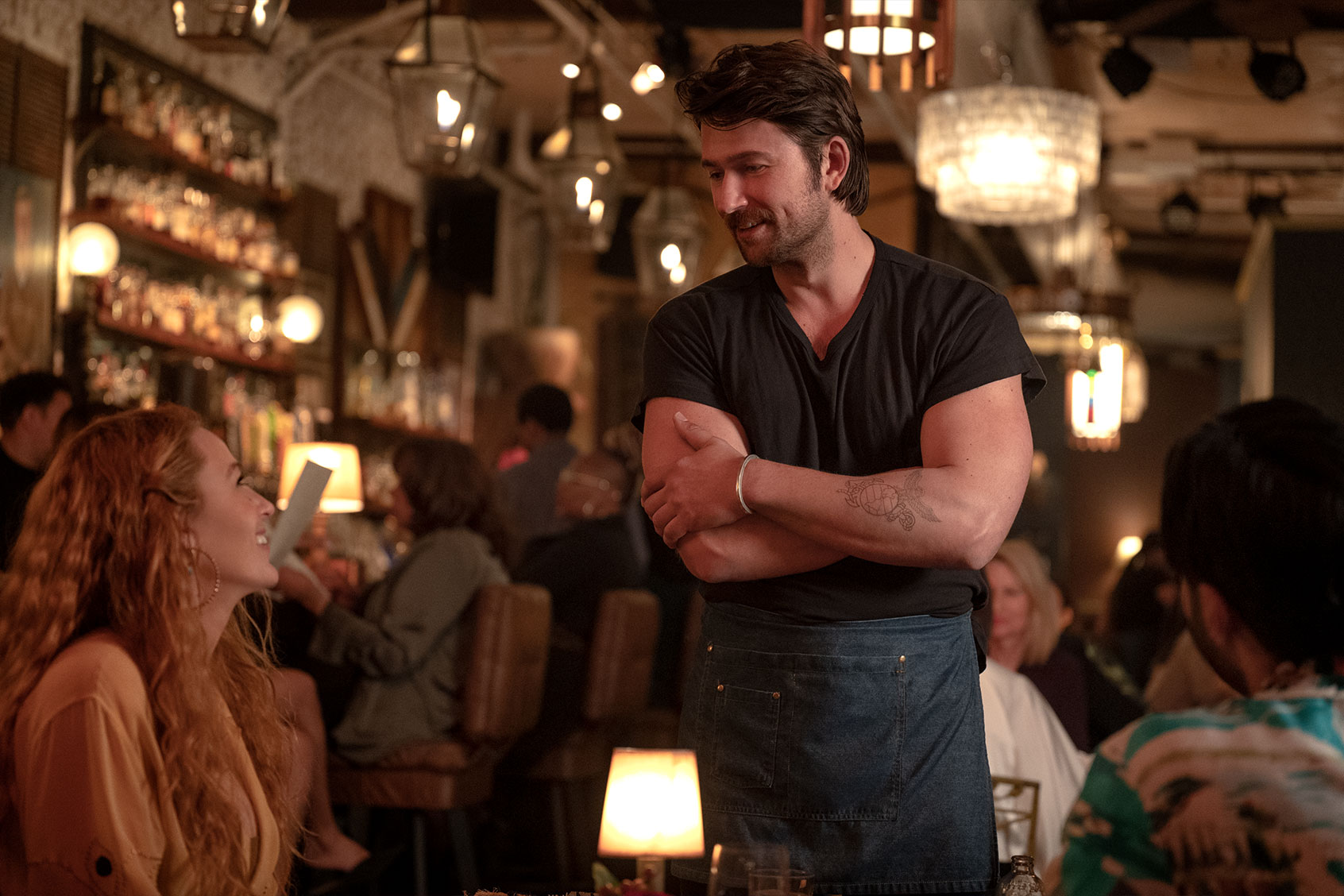
It Ends With UsBlake Lively and Brandon Sklenar in "It Ends With Us" (Courtesy of Sony Pictures Entertainment/Jojo Whilden)

By failing to depict these truths, the movie belies other nuances. Many abusers experience violence as children. As the saying goes, “hurt people hurt people.” We should be able to say this without also giving abusers a pass. But the movie does just that. At the end, we find out that as a young child, Ryle accidentally killed his sibling. I appreciate the attempt to make abusers human, but the science of why people become abusers doesn't back up the causation alluded to in the movie. Why would accidentally killing one's sibling make someone an abuser? The more likely scenario is that an abuser would be replicating the violence they saw between their own parents or that they were abused themselves.

For real survivors, the first attempt at leaving is almost never successful.

The movie also conveniently skirts the complicated issue of what would likely happen once Lily gives birth. As an attorney for victims, I have rarely (if ever) been involved with a case where the abuser doesn’t use children as a way of keeping his victim down.  And it would probably surprise moviegoers that judges almost always award alleged abusers some form of shared physical parenting time. The process of judicial determination can also drag on for months, if not years, during which time the victim continues to feel unstable and in constant fear of losing her children. Without or without children, it is completely unrealistic that this abusive relationship would end abruptly with Ryle walking away peacefully to lick his wounds. For real survivors, the first attempt at leaving is almost never successful. And in my experience, there is no scenario where a victim is able to divorce an abusive husband with a pregnancy looming. 

The dreamy cinematography, quirky characters and cast’s deflecting and inappropriate talking points during the press tour gave me the illusion that I had watched a rom-com, not a drama. The heroine’s name being Lily Bloom – oh, and she just so happens to run a gothic flower shop! – made it really difficult to take the movie seriously. And the casting didn’t help. What is hilarious, beloved Jenny Slate doing here? And comedian Hasan Minhaj? These choices undermined my expectation that this movie would treat a sensitive subject with the reverence it deserves, and ultimately, it made me feel that the abuse storyline was an afterthought.

Capturing the truth of domestic violence is a mammoth task – and perhaps those involved with "It Ends with Us" expected accolades for even attempting it. But they owe a responsibility to the millions that live with fear every day – to tell their stories faithfully – and an even bigger responsibility to the young women who will one day experience intimate partner violence to not romanticize it. Here’s hoping that the rumored sequel is just that – a rumor.      

If you are experiencing domestic violence, call the National Domestic Violence Hotline at 1-800-799-7233, or go to thehotline.org.    

Jennifer Lopez files for divorce from Ben Affleck after two years

Jennifer Lopez filed for divorce from Ben Affleck, following a two-year marriage that was the accumulation of a long off-and-on romance.

On Tuesday, Lopez filed the petition to end the couple's marriage in Los Angeles. The court filing was first reported by TMZ and confirmed by multiple sources to People Magazine.

In the court filing, the musician and actress listed that April 26 was the couple's date of separation. Lopez also filed for the divorce herself without using a lawyer, which means she is technically representing herself, People stated. There is no confirmation if the couple had a prenuptial agreement, as the singer did not mention one in the court filing. Sources told TMZ the couple did not have one.

While the couple was married in a private ceremony in Las Vegas on July 17, 2022, Aug. 20 is the date that marked the second anniversary of their wedding ceremony held in Affleck's home in Georgia. 

More than 20 years ago, Lopez and Affleck met while filming their romantic crime comedy "Gigli." The A-list celebrity couple became known by the name Bennifer and became engaged shortly afterward. However, the media frenzy surrounding their relationship postponed their wedding and ultimately caused the end of the relationship, The New York Times reported.

Despite their rekindled romance in 2021 after years apart, the couple allegedly were not living together in their Los Angeles home together. But as their relationship came under scrutiny again during the release of Lopez's visual album “This Is Me … Now: A Love Story” and a documentary of the same name, Lopez abruptly canceled her 2024 tour. Live Nation said in a statement, “Jennifer is taking time off to be with her children, family and close friends.”

Lopez and Affleck have not responded to requests for comment.


Here’s how much cropland could be freed up if Americans ate half as much meat

A new report finds that the United States could more efficiently produce food if half the country's protein supply came from plant-based or alternative proteins rather than meat or dairy. 

The analysis demonstrates how a shift toward a plant-based diet provides ample benefits for the environment and the climate. In its latest report, the Good Food Institute, or GFI — a nonprofit think tank that supports the growth of alternative proteins — calculates that if Americans replaced 50 percent of their animal protein consumption with plant-based options, then 47.3 million fewer acres of cropland would be needed to grow the same amount of protein.

That land, which altogether makes up an area roughly the size of South Dakota, represents tremendous opportunities for carbon sequestration and biodiversity, according to GFI. The organization argues that if those acres weren't used to grow crops, they could instead be transformed into carbon sinks or used to restore threatened ecosystems. That would deliver climate benefits on top of the reduction of animal agriculture's more direct emissions sources: manure and cow burps.

The U.S. currently devotes a tremendous amount of land to agriculture: Over 60 percent of land in the contiguous U.S. is used for agriculture, and 21 percent of that is cropland. A majority of the nation's cropland — 78 percent — is used to raise crops that are primarily used to feed animals. 

The shift toward increased alternative protein production detailed in the GFI report would not require growing more plants. Instead, the U.S. could meet its current protein demand by growing fewer crops overall, and ensuring that more of the commodity crops we already produce — such as soy, grain, corn, barley, oats, and sorghum — are grown for human consumption.

"I think a lot of people, when they hear about plant-based diets, they're like, 'That's going to take so much soy,'" said Priera Panescu Scott, GFI's lead plant-based scientist, whose background is in material and agricultural science. But Panescu Scott, who co-authored the report, points out that soy is mostly grown to feed livestock, not humans. Worldwide, a majority of soy is used for animal feed, while only 7 percent winds up becoming tofu, tempeh, soy milk, or other foods. 

Stephen Wood, an associate research scientist and lecturer at the Yale School of the Environment who was not involved in the report, called the findings "straightforward and expected." 

"The fact that you're going from feeding animals that then people eat to just feeding people is always going to be more efficient and therefore is always going to require less land," said Wood.

However, to calculate the carbon sink and biodiversity opportunities associated with shifting cropland use in the U.S., the authors of the GFI report significantly limited the scope of their analysis. Rather than looking at all animal protein consumption in the U.S., the report homes in on cropland used to support the livestock raised and consumed in the U.S. Seafood is notably absent from the report, as is protein imported from abroad. Wood points out that these parameters don't reflect how agricultural inputs can transcend or move across borders. "It's a little artificial to draw a border around the United States," said Wood, who is also a senior scientist for agriculture and food systems at The Nature Conservancy, an environmental nonprofit. 

To illustrate this, Wood pointed out that if the U.S. planted fewer acres of soybeans, but demand for meat remained high, then another country could simply step in and replace the U.S. as a soybean producer. That increase in production could contribute to environmental problems elsewhere, like deforestation in Argentina's Chaco region. To successfully shift land use globally, there would need to be a commensurate shift in the demand for plant-based protein — which may be hard to achieve.

The narrow focus of the report was deliberate, said Panescu Scott. "We really wanted to present the opportunities for land efficiency in the U.S.," she said, adding, "in this case, we spent a lot of time really looking at historical and current datasets of maps, to understand where the actual opportunities would lie."

The result is that the report identifies the greatest opportunities for land use transformation in the Midwest and the South. That's in part because the Midwest is an agricultural hub with plenty of cropland, and also because of the forests that exist in the South, which are excellent carbon sinks but have also experienced significant deforestation due to industry. Letting that land "get back to that native forest land as much as possible is going to help immensely with both carbon sequestration and biodiversity opportunities," said Panescu Scott. 

Of course, a major shift in the country's agricultural production could also have adverse economic impacts on farmers who have made a livelihood out of growing, say, soy. Panescu Scott mentioned that public and private funding is needed to study those potential changes and explore new market opportunities or alternative income streams for farmers. One solution the report details is compensating landowners for habitat restoration undertaken on their property. Wood added that the entire agricultural value chain must be considered to comprehend the extent of any potential adverse economic impacts.

Even without changing demand for meat or the quantity of soybeans grown, Wood noted, farmers can already adopt practices to take better care of local ecosystems. On the report's note about restoring critical habitats, Wood said, "You can also do that in cropland. There's a big push toward what they call edge-of-field practices" — for example, nourishing wetlands on the outskirts of cropland as a way of managing water use and runoff. "There are in-between systems."

This article originally appeared in Grist at https://grist.org/food-and-agriculture/heres-how-much-cropland-could-be-freed-up-if-americans-ate-half-as-much-meat/.

Grist is a nonprofit, independent media organization dedicated to telling stories of climate solutions and a just future. Learn more at Grist.org

"This story was originally published by Grist. Sign up for Grist's weekly newsletter here."

“Pretty sad”: Trump complains about “Democrats’ little party” after getting mocked by Obamas

Donald Trump, appearing on "The Hugh Hewitt Show" on Wednesday, called Democrats "out of control" as the party prepares to enter its third convention night of torching the former president. Barack and Michelle Obama capped off Tuesday's proceedings with fiery indictments that Trump said was a distraction from issues like crime and the border.

Hewitt, a conservative radio talk show host, asked Trump about the level of "rhetoric" against him in light of an assassination attempt against the former president in July. "Do you think the rhetoric directed at you and the lawfare contributes to the climate that created that sort of an attack?” he asked.

Trump, who has engaged in provocative language of his own, answered that it could. "You know, I was mentioned at the Democrats’ little party that they have going on in Chicago, and it’s pretty sad,” he said. "I was mentioned, I think, almost 200 times. And they mentioned the economy about five times. They mentioned the border maybe none. They mentioned crime almost none. So I mean, they’re out of control. These people are out of control. And they’re ruining our nation. Our nation is going to hell."

Democrats have accused him of cherry-picking facts and made the case that it's Trump who is weak on the economy, which is recovering from a collapse that happened during his last, COVID-afflicted year in office, the border, which bipartisan legislation tried to fix before Trump torpedoed it, and crime, which has occurred at roughly similar levels during the first three years of Trump's presidency (while spiking during the pandemic) compared to now. Trump has countered that the recovery is not fast enough and that Vice President Kamala Harris and other Democratic politicians are undermining law enforcement.

The former president also repeated his accusation that Democrats cheated by launching an "coup" against President Joe Biden and replacing him with Harris, who Trump is struggling against in national and swing state polls.

“They’ve taken the presidency away from this guy. They’ve actually taken the presidency away. This was a coup. This was the first coup of an American president, or probably of any high official. But this was incredible. I watched them, and I watched his angry speech,” he griped.

Pro-Palestinian protesters interrupt Nancy Pelosi’s interview with Stephen Colbert

Former House Speaker Nancy Pelosi, D-Calif., appeared on "The Late Show With Stephen Colbert" on Tuesday to talk about the Democratic National Convention, where thousands of pro-Palestine protesters have rallied to call for an end to U.S. support for Israel and its ongoing invasion of Gaza. A handful of them also found their way into the late-night host's studio, interrupting Pelosi twice over the course of the interview.

Pelosi was just starting to discuss the rumors of her role in President Joe Biden's decision to step aside from the 2024 Democratic ticket when protesters began shouting from the audience. “Hold on, young lady, I can hear you,” Colbert said during the live broadcast. He then told viewers watching from home that “there’s a protest going on right now. We’re actually at a commercial break, but the subject is on Israel and Palestine.”

Turning back to the protesters, Colbert asked them to take a seat, assuring them that "when we come back [from commercial break], I will ask the next question I had on that subject, if you will listen, ok?”

Once the commercial break ended, Colbert asked Pelosi: "People are protesting, even within the Democratic Party, there is dissension over what is the proper use of American power, especially protected power overseas, firm and soft power. If the goal is the peaceful and prosperous future for both Israelis and Palestinians, what role does the United States play?”

Pelosi defended Biden as playing his role "very well" and maintained that freeing the Israeli hostages held by Hamas and ending Israel's destructive assault on Gaza were both of the utmost importance. "We just got word earlier today that Israel had agreed to the ceasefire agreement. We’re hoping that Hamas will too. But it takes me to the point of saying to you: War has no role in a civilized society," she said.

The protesters, perhaps unhappy at her generous characterization of the latest ceasefire proposal that critics say has been undermined by additional Israeli demands, continued to heckle Pelosi, who raised her voice in response. “We have to learn more about trust and peace, and learning about each other, rather than to have conflict resolved by war," she continued. Colbert, seeking to convey the protesters' words to Pelosi, then told her “they’re saying that the United States should not have any role in supplying Israel arms to kill the people of Gaza."

Pelosi maintained that Israel "has a right to defend itself," while also stressing the need for a two-state solution with "a secure Jewish democratic state in the region" and "the Palestinians having their own secure country there as well" as the best possibility for long-term peace.

Though Colbert told the protesters one more time not to interrupt his guests, "insiders" told Variety that the protesters “left on their own accord, and the matter was handled peacefully.”

“That is really going to stick in Donald Trump’s craw”: Democratic convention ratings outpace RNC

The first night of the Democratic National Convention drew in an average of 20 million viewers across 13 networks, exceeding the 18.1 million who watched the Republican convention's first night last month, according to Nielsen. The Milwaukee Journal Sentinel reports that this year's DNC numbers also passes the 2020 edition's first night, which drew 19.75 million viewers even as COVID-19 forced people to remain at home and cable TV had far more subscribers. But this year's convention watchers also fell short of the 25.95 million who tuned in in 2016.

This news is unlikely to please former President Donald Trump, who has been pressing allies for their foresight on whether Vice President Kamala Harris' nomination speech will draw more viewers than his own. While viewership fluctuated for the RNC across different nights (14.8 million in the second day, 18 million on the third and 25.4 million on the fourth), the DNC will likely see similar variations that will peak during Harris' final appearance.

"For a man who thinks ratings are more important than anything, that is really going to stick in Donald Trump's craw," said former Fox News Sunday anchor Chris Wallace to a laughing CNN panel.

The RNC's first-night lineup included several of Trump's former running mate prospects, including Sen. Tim Scott, R-S.C., and Rep. Byron Donalds, R-Florida, as well as Teamsters union president Sean O'Brien. The DNC's first night featured speeches by more household-familiar names like Rep. Alexandria Ocasio-Cortez, D-N.Y., former 2016 nominee Hillary Clinton and President Joe Biden, who delivered an emotional farewell after fifty years in national politics.

“Actual billionaire” J.B Pritzker: “Trump is rich in only one thing — stupidity”

Illinois Gov. J.B. Pritzker said former President Donald Trump is rich only in "stupidity" during his speech at the Democratic National Convention on Tuesday night.

Pritzker, who is the richest American politician in office and has a net worth of $3.5 billion according to Forbes, questioned Trump’s economic competency.  

“Donald Trump thinks we should trust him on the economy because he claims to be very rich,” Prtizker said. “Take it from an actual billionaire, Trump is rich in only one thing: stupidity.”

Throughout his speech he referenced policy wins in Illinois — like the grocery tax, clean energy, fixing roads — and Trump’s reaction to them, drawing a clear line between the former president and working-class Americans.

“We eliminated the grocery tax. Donald hasn’t been in a grocery store since his first bankruptcy,” he told the crowd. 

Pritzker praised Democratic nominee Kamala Harris and her running mate Tim Walz for “lifting people up rather than pushing them down,” and said they will “grow small businesses and cut taxes for everyday people.”

He concluded his speech with a contrast between Trump and Harris.

“We have a choice, America. Between the man who left our country a total mess and the woman who has spent four years cleaning it up,” he said. “And I think it’s time we stop expecting women to clean up messes without the authority and the title to match the job.”

Trump’s team uses Beyoncé’s “Freedom” song adopted by Harris’ campaign

It seems Donald Trump's campaign team has taken a page out of Vice President Kamala Harris' book, after one of the former president's aides posted a video of him on social media that used Beyoncé's 2016 song, "Freedom." 

Trump campaign spokesperson Steven Cheung on Tuesday posted a clip on X/Twitter of Trump exiting an aircraft after it landed in Michigan. "Touchdown in Michigan!! @realDonaldTrump," Cheung wrote. "Freedom" could be heard playing in the background. The clip has since been removed.

The choice is noteworthy given that Harris' campaign has adopted the song in recent weeks, even releasing a freedom-related ad at the Democratic National Convention on Monday that featured the track. Last month, CNN reported that Beyoncé had given the Veep permission to use "Freedom" for her campaign efforts. 

The Hill reported that Cheung responded "Freedom, freedom!" when asked for comment on the video. 

This instance marks at least the second time that Trump has seemingly used an artist's music without obtaining their consent. Earlier this month, singer Celine Dion called out Trump on social media after his team used her hit song, "My Heart Will Go On," at his rallies without her permission. "In no way is this use authorized, and Celine Dion does not endorse this or any similar use.…And really, THAT song?"" Dion's team said in a statement.

“Basement dwellers”: Ex-press secretary says “behind closed doors, Trump mocks his supporters”

Donald Trump’s former White House secretary declared her support for Vice President Kamala Harris on Tuesday night, slamming the Republican nominee in her speech at the Democratic National Convention.

Stephanie Grisham, who resigned after the Jan. 6 attack on the U.S. Capitol, said she was a “true believer” and that the Trump family became her family. But she saw a side not everyone sees.

“I saw him when the cameras were off,” Grisham said. “Behind closed doors, Trump mocks his supporters. He calls them basement-dwellers.”

She admitted that while Trump was in office, she never held a typical White House briefing because she never wanted to “stand on the podium and lie.” 

“Now here I am behind a podium advocating for a Democrat and that’s because I love my country more than my party,” she said.

Grisham recalled several troubling stories, including a time when Trump was visiting dying patients in the ICU and he was upset that “cameras weren’t on him.”

After the Jan. 6 insurrection, Grisham asked Trump’s wife Melania whether she could tweet that there was “no place for lawlessness or violence.” The former first lady responded “No,” via text message. Grisham revealed the entire text exchange to the crowd at the DNC. 

Grisham is one of many Republicans against Trump who spoke at the DNC. Kyle Sweetser, a Republican voter from Alabama said he voted for Trump three times before he realized Trump’s policies were negatively affecting his life as a “blue-collar” worker. 

Conservative commentator Richard Logis, who describes himself as “ex-MAGA activist” also spoke at the DNC via video broadcast, telling voters they “don’t need to agree with everything you hear tonight to do what is right.”

Throughout her speech, Grisham emphasized that Trump can’t be trusted and that he has “no empathy, no morals and no fidelity to the truth.” 

“He used to tell me, ‘It doesn’t matter what you say, Stephanie, say it enough and people will believe you,'" Grisham recounted.

“Kamala Harris tells the truth, she respects the American people, and she has my vote,” Grisham told the crowd in Chicago.

“He’s afraid of losing to Kamala”: Obama mocks Trump’s “weird obsession” with size

Barack Obama, returning home to his political birthplace in Chicago for the Democratic National Convention, delivered an animated and forceful case for Vice President Kamala Harris as a worthy carrier of his political legacy and a proven leader who will help move the country "past some of the tired old debates that keep stifling progress.” Just two months ago, he might have been expecting to champion President Joe Biden for a second term in office; instead, he found himself declaring that "the torch had been passed" from "an outstanding president who defended democracy at a moment of great danger."

"Now it’s up to all of us to fight for the America we believe in," Obama said. "And make no mistake: It will be a fight.”

Obama, drawing from the the Harris campaign's economic messaging, argued that Harris doesn't just have plans for the future, but also an accomplished record to draw from. As California attorney general, he said, Harris "fought big banks and for-profit colleges“ and "helped take on the drug companies to cap the cost of insulin, lower the cost of health care and give families with kids a tax cut.” As president, he continued, she would be a leader who "actually cares about the millions of people all across this country who wake up every single day to do the essential, often thankless work: to care for our sick, to clean our streets, to deliver our packages."

Framing the work of supporting everyday Americans as a matter of "freedom," Obama pitched his party's idea of freedom as including "the freedom to breathe clean air and drink clean water and send your kids to school without worrying if they’ll come home." He also acknowledged that former President Donald Trump and the Republican Party believed in their own sort of freedom: the freedom in which "the powerful can do pretty much what they please, whether it’s fire workers trying to organize a union or put poison in our rivers or avoid paying taxes like everybody else has to do."

Obama rebuked the former president as a man of "bluster and bumbling and chaos" who cares only for himself. "It has been a constant stream of gripes and grievances that’s actually been getting worse now that he’s afraid of losing to Kamala. There’s the childish nicknames, the crazy conspiracy theories, this weird obsession with crowd sizes," he said, moving his hands closer together with a mockingly sheepish expression, as if to suggest that Trump might be concerned about the size of a far more personal attribute.

As a former president, Obama was guaranteed a prime-time speech at the convention, but he is also perhaps one of the Democratic Party's most potent messengers in its modern history. His oratory first electrified the Democratic convention in 2004, when he was a state lawmaker running for the U.S. Senate, and helped carry him to the presidency in 2008 after a mere four years in federal office. In that campaign, Obama leaned on a handful of leitmotifs to underscore his meaning: yes we can, change we need, the audacity of hope.

We need your help to stay independent

Halfway through the speech, the crowd he was speaking to dusted off one of those old phrases. As Obama described Harris as a president who would stand up for working-class Americans, convention attendees began to chant "yes she can," prompting the former president to crack a smile and repeat the phrase with them. Later, he touted the Affordable Care Act, which he signed into law in 2010, as an achievement that provided "millions of people access to affordable coverage" and said that Harris would continue to build on the existing protections.

"I’d noticed, by the way, that since it’s become popular, they don’t call it Obamacare no more," he added.

Former first lady Michelle Obama, a powerful speaker in her own right, also leaned into 2008 themes with pronouncements that "hope is making a comeback" in a speech that preceded her husband's on Tuesday night.

But for all his enduring popularity in the Democratic Party and his two convincing presidential election victories, the former president has not always succeeded in transferring his sheen to the people he's endorsed. Democrats suffered historic midterm losses in 2010 and 2014, and his energetic support for Hillary Clinton in 2016 was not enough to win her the presidency. Obama, wary of repeating a loss from what seemed to be pole position, acknowledged the hard road ahead.

“For all the incredible energy we’ve been able to generate over the last few weeks, this will still be a tight race in a closely divided country,” he said. “A country where too many Americans are still struggling and don’t believe government can help.”

“He struggled”: Author who repeatedly interviewed Trump recalls his “memory lapses”

Since President Joe Biden dropped out of the 2024 presidential race, the public's attention has shifted to the glaring age gap between former President Donald Trump and Vice President Kamala Harris.

Trump's flailing attacks on Harris and often incoherent speeches have raised questions about his ability to serve another term. Ramin Setoodeh, a journalist who interviewed Trump six times in 2021 for his book "Apprentice in Wonderland," told Salon that he noticed lapses in the 78-year-old's memory even three years ago.

This interview has been edited for length and clarity.

Salon: Do you think Trump sometimes says outrageous things to get a reaction from people or because maybe his age is catching up to him?

Setoodeh: I would say I think it's both. 

I think that Donald Trump is a man who is in his 70s and has issues with his memory and has issues remembering the chronology of events and remembering people and their names. But also he is someone who became who he became through the prism of reality TV, and so in reality TV, you're often rewarded for saying outrageous things, and you're rewarded by ratings. 

And what drives Trump, and has always driven Trump as a politician, is this idea of ratings. That's why he's so infatuated by crowd size. But because of the 14 seasons that he starred on "The Apprentice," Donald Trump is someone who gravitates towards the outrageous, the absurd, and saying, you know, things that traditional politicians wouldn't say, just to get people's attention and to capture the news cycle and to get more headlines.

In past interviews, you talked a little bit about your personal experience with his “foggy memory.” Could you give me one example?

Sure. So when I went to interview Donald Trump, my first interview was shortly after he left the White House in May of 2021. And then when I returned back to Trump Tower later that summer, because he invited me to go back to have a second interview, he didn't recall meeting with me or our first interview, and he told me that was “a long time ago.”

He struggled with the chronology of events, particularly some of the events that happened in the White House. At one point, he told me he had to go deal with “the Afghanistan.” And it was confusing because he didn't have access to the foreign policy briefings. 

So there were moments where it felt like he had these memory lapses or spatial lapses. And in fact, I even noticed that the other night, when he was talking to Elon Musk and he mentioned Joe Biden. For a second, it sounded like he thought he was running against Joe Biden, and then he mentioned Kamala Harris's name. So, you know, I think clearly he has his foggy memory and his short-term memory isn't great. 

Since you brought up the Elon Musk interview, people have been saying that Trump sounded like he was slurring his words a little bit, maybe like he had a lisp. Trump and Elon are blaming it on technical difficulties. But did you maybe notice that? 

I spent time with him, I didn't hear a lisp. I actually did believe the explanation that the file, I guess, was compressed in Twitter space. So as a result of that, it sounded like he didn't sound like the way he talks. 

But what was interesting about that interview is that it showed really how hard it is to get Donald Trump to stay on topic, or to have one train of thought. He jumps from one subject to the next, the next, the next. I don't think Elon Musk necessarily did a very good job of interviewing him, but it is really hard to keep Trump on any script at any time, and that was something that goes back to him being on "The Apprentice." 

He really needed to be edited down when he was on the show, and they would shoot him for hours and hours and then edit him down. And I think the problem with him as a politician, as president, is that there's no editors to edit him down, to make what he says coherent.

True. Jon Stewart on his podcast was doing a commentary on the Elon-Trump interview and said that Trump is the "new Biden." While Biden was still in the race, Trump avoided scrutiny in terms of his mental health, his age obviously wasn't as big of a topic compared to Biden's. What are your thoughts on that?

I think that that really oversimplifies some things.

You can make that argument, that in terms of age or the dynamics of the race, Trump now is someone that's struggling in the polls or not leading in the polls, as he once was. But I think that to say that Trump is the new Biden, misses the bigger point, which is that Biden ran a very successful administration for four years in this country. When Trump was president, you know, a million people died of COVID, we were scared to leave our homes, it was a very dark time in America. There was a lot of divisiveness. So I think to equate the two of them doesn't, to me, make editorial sense, but I understand it's like a funny punchline. 

We need your help to stay independent

Definitely. On those lines, do you feel like Trump got a free pass while Biden was still on the ticket and seemed to be struggling more with his age? Or why do you think suddenly the focus has moved to Trump's age? 

I think that the media has struggled for the last eight years to actually cover Trump. 

One of the arguments in my book is that without the context of who Donald Trump is and where he came from and his experience and his years in show business, it's hard to look at Donald Trump. You have to look at Donald Trump through the lens of all of that.

So I think a lot of political reporters and media reporters are covering Trump and they're still covering him as a traditional political candidate, and that is absolutely the wrong way to look at him. He is not someone who adheres to facts, to the truth, to any linear form of thought. 

He learned on Mark Burnett's reality show that it's all about creating a spectacle and getting viewers engaged and getting people talking and drumming up drama. And so I think the media struggled to catch up to Trump. And Trump was always heading the narrative, and it was his script that everyone was following.

I think with this latest twist, not to continue the reality TV metaphor, but it kind of works with this latest twist of Biden stepping aside and Kamala Harris becoming the nominee, this was one of those reality TV twists or one of those twists that caught Trump off guard. So his campaign is now, for really the first time in a long time, in his three presidential campaigns, they're playing catch up.


Want a daily wrap-up of all the news and commentary Salon has to offer? Subscribe to our morning newsletter, Crash Course.


Trump’s campaign is struggling to keep him on message. Three weeks into Kamala being on the ticket, it seems like he's kind of losing his footing a little bit. 

I think on this day, yes, it does seem like the Trump campaign is losing its footing. On some days, he creates a diversion that seems completely out of left field, doesn't make any sense. And then other days, he creates another diversion that the media falls for, and then everyone plays into his narrative, and then he sort of has the upper hand. 

So this idea that he can't stay on message, sure, that's an idea that we've heard about for eight years, but that's not anything new. Having spent six times interviewing Donald Trump, there's no shape or form in which he can't stay on this on message. He's like an actor who just prefers to say the lines he feels like saying. He's not someone who has a strategic line of thought. He's not someone who can keep something to himself or wait till the right moment to say something. So that's always been a characteristic of Donald Trump all the way back in the days when he started on "The Apprentice."

But I think that there needs to be significant caution right now, because it does seem like the media and the way in which this race is being framed is that Kamala Harris is now leading, and it doesn't seem like the Trump campaign will be able to catch up. I would really caution everyone with that narrative, because we saw 2016 when it seemed like everyone had already decided that Hillary Clinton was the next president of states, that didn't come to pass. There's still 80 some-odd days to go before people vote on Election Day. I think there's a lot that can change. 

One of Donald Trump's talents and skills, if you want to call that, is creating diversions and confusion and being able to go up against an opponent, taking some of their greatest strength and making them into weaknesses. He hasn't been successful yet with the Kamala campaign, but I don't think his election is over yet. 

The DNC’s one clear goal: Run up the gender gap

I've told the story before, but it bears repeating in the context of the 2024 Democratic National Convention. I attended the Democrats' convention in 2008 and it was a pretty ecstatic atmosphere. The party was set to nominate the first Black candidate for president and his very close primary competitor, Hillary Clinton, was the first woman to make a serious run for it. There had been plenty of bad blood during the primary and there were still some raw feelings that needed to be dealt with before the full celebration could begin. It was up to Clinton to heal the breach and it wasn't going to be easy.

On the night Clinton was to give her big endorsement speech, I stood next to a group of young Black women who were clearly skeptical of her and were big fans of Barack Obama. They were not expecting much. But her speech was exceptional and by the end of it the women I was watching were cheering along with Clinton's supporters whom she had thanked profusely but also pointedly asked, "were you in it for me or were you in it for the country?" She wound it up by exhorting everyone to put their efforts into electing Barack Obama:

This is the story of America. Of women and men who defy the odds and never give up. How do we give this country back to them? By following the example of a brave New Yorker, a woman who risked her life to shepherd slaves along the Underground Railroad.

And on that path to freedom, Harriett Tubman had one piece of advice. If you hear the dogs, keep going. If you see the torches in the woods, keep going.If they're shouting after you, keep going. Don't ever stop. Keep going. If you want a taste of freedom, keep going. Even in the darkest of moments, ordinary Americans have found the faith to keep going.

At the time she gave that speech, it was unclear if she would ever run for office again and her address has been forgotten over the years, replaced by that other convention speech when she accepted the nomination and then her stunned concession speech when Donald Trump won the Electoral College vote in 2016. But I recalled Clinton's 2008 performance on Monday night when she evoked those words again.

"I wish my mother and Kamala’s mother could see us. They would say, 'Keep going,' surely," Clinton told the crowd at Chicago's United Center. 

But Clinton is no longer running herself. She's passed the baton to Kamala Harris, the Democratic nominee who may be the one to finally break through what Clinton calls the "highest, hardest glass ceiling." She, like Joe Biden, has done her part and is leaving it to the next generation to carry on the task.

It was good to see her received with such respect and admiration by the delegates at this convention. I was a bit surprised to be honest. But she deserved it having absorbed so much misogyny and inexplicable resentment for decades on behalf of women everywhere, even often from members of her own party. When the crowd started chanting "lock him up" when Clinton mentioned Trump's felony convictions, then smiled beatifically as the audience roared — she had earned that. 

Kamala Harris is a seasoned politician but she isn't saddled with the baggage that Hillary Clinton carried with her from the years of being dragged by the right wing. Nonetheless, Trump is pulling the same nonsense with her, calling her "weak" and "low IQ" and suggesting that she's ill-equipped to deal with foreign leaders because she doesn't have the "strength" to stand up to them. Coming from the man who practically gave Vladimir Putin a full-body massage on international TV, that's pretty rich, but it doesn't stop him from doing it. So far, it doesn't seem to have stuck and perhaps that's because many people can see his sexism more clearly now that it's obvious he flings it at any woman who dares to oppose him.

It was interesting that the convention scheduled another strong woman politician just before Clinton's speech, Alexandria Ocasio-Cortez, D-NY, who similarly brought the house down with a rousing speech extolling the virtues of working people. She pointed out that Republicans are always taunting her to go back to being a bartender as she was six years ago, and she said she'd be happy to because "there's nothing wrong with working for a living." Her speech, compared to Bernie Sanders' on the second night, speaking to the same issues in a completely different (and fresher) voice, indicates that the populist torch has been successfully passed, too. She is formidable and the reception she received from the crowd shows that her message is now part of the mainstream of the Democratic coalition.

We need your help to stay independent

There were a number of other talented women featured on night one, such as the feisty Texas Congresswoman Jasmine Crockett (“Kamala Harris has a resume; he has a rap sheet”) who seemed to be channeling an earlier Texas political superstar, Gov. Ann Richards, who was also known for her twinkling eyes and rapier wit. Richards' legacy is safe with Crockett. Michigan, meanwhile, gives us an up-and-coming political star in the dynamic Mallory McMorrow, the state senator who went viral with a stirring speech about abortion rights last year. She was tasked with explaining Project 2025, which she did with appropriate disdain and humor.

And then there's Kamala Harris herself who suddenly radiates confidence and gravitas even as her wide smile and casual body language reveal a person comfortable in her own skin. And she seems to be loving it, which is possibly the most appealing thing about her.

One of the networks interviewed some women delegates who were quite emotional over Hillary Clinton's appearance, feeling bittersweet at seeing her in that spot when by all rights she should have been coming to the end of her second term and passing the torch to her successor. But after the crushing defeat of 2016, they had done what Hillary did after 2008 — they just kept going. And now they are thrilled at the prospect of a Kamala Harris presidency.

The Democratic Party is a party full of extremely talented, smart, ambitious women at every level and it's no longer a novelty. What just a few years ago seemed like a treacherous attempt to make a great leap forward finally feels like normal. The party and the country are going to be much better off for it. 

“Who’s gonna tell him?”: Michelle Obama tells Trump presidency might be “one of those Black jobs”

Former first lady Michelle Obama had the crowd erupting in cheers during her speech at the Democratic National Convention on Tuesday night as she skewered former President Donald Trump.

Obama during the speech referenced Trump’s comment from the Presidential debate in June, when he said immigrants are taking “Black jobs.”

“I want to know, who’s gonna tell him that the job he’s currently seeking might just be one of those Black jobs?” Obama said, sending the crowd into a frenzy. 

Obama recounted how Trump, who pushed racist birther claims for years, “did everything in his power” to make Americans feel threatened by her and her husband, Barack Obama, while they were in the White House. 

“See, his limited, narrow view of the world made him feel threatened by the existence of two hard-working, highly educated successful people who happen to be Black,” she said.

Throughout her speech, Obama slammed Trump’s demeanor and policy stances, saying he spreads “ugly, misogynistic, racist lies as a substitute for real ideas.” The former first lady then contrasted Trump’s rise to politics with the Democratic nominee’s Kamala Harris, whom she praised for her “laughter and light.”

“Kamala has shown her allegiance to this nation, not by spewing anger and bitterness, but by living a life of service and always pushing the doors of opportunity open to others,” she said. “She understands that most of us will never be afforded the grace of failing forward. We will never benefit from the affirmative action of generational wealth.”

“Kamala Harris is more than ready for this moment,” Obama told the crowd in Chicago.

GOP called out for “pro-labor” rebrand: They “want working class people to sit down and shut up”

At the Democratic National Convention on Monday night, United Auto Workers (UAW) president Shawn Fain sported a shirt that read “Trump is a Scab,” making it clear that his union stood with Democratic nominee Kamala Harris and her running mate Tim Walz.

"For us in the labor movement it's real simple: Kamala Harris is one of us," Fain said in his speech. 

His support isn’t surprising. Historically, most labor unions have supported Democrats. But this election season, Republicans has made a deliberate effort to appeal to the working class.

Teamsters boss Sean O'Brien, the head of America's largest union, became the first-ever union president to speak at the Republican National Convention last month.

“President Trump had the backbone to open the doors to this Republican convention, and that’s unprecedented. No other nominee in the race would have invited the Teamsters into this arena,” said O’Brien.

O’Brien’s appearance at the event was a shock to many, but it’s part of a larger campaign by Trump’s Republican Party to rebrand itself as pro-labor and move away from the Reagan-era economics of big business expansion that have marked the GOP for decades.

The rebrand was boosted by Trump's selection of JD Vance as his running-mate. The Ohio native has positioned himself as a champion for the working class who will help dismantle “the regime,” a term he and his peers use to describe liberal elites in the government, business and higher education.

Vance has become the face of a group of young Republicans known as the New Right, who believe current democratic systems have failed the United States and must be dismantled. Instead, Vance supports economic populism and the industrialization of America’s industries, which he says would bring more jobs back to low and middle-class Americans. 

But despite the pro-labor image they’re pushing, Vance and Trump are anything but.

Last week, allegations surfaced that workers at a start-up funded by Vance faced “nightmarish conditions.” AppHarvest was a start-up designed to use new technology to grow vegetables at an industrial scale and deemed “the future of farming” in Appalachia.

But reporting from CNN revealed employees, many of whom were migrant workers, were subject to grueling working conditions inside greenhouses. Even after he launched his political career, Vance remained an investor in the company. AppHarvest went bankrupt last year. 

We need your help to stay independent

The Ohio native also opposed the PRO Act, which would increase collective bargaining rights for millions of workers. Though he does support some unions, his support is dependent on the political stance of the union’s leadership. He has explicitly said there are “good unions” like police unions and “bad unions” like the Starbucks Workers United.

“I think it’s dumb to hand over a lot of power to a union leadership that is aggressively anti-Republican,” Vance told Politico.

Trump’s record too is staunchly anti-labor. Just last week, the UAW announced the union is filing federal charges against Trump for arguing that striking workers should be fired in a discussion with X CEO Elon Musk. 

“Donald Trump will always side against workers standing up for themselves, and he will always side with billionaires like Elon Musk, who is contributing $45 million a month to a Super PAC to get him elected,” Fain said in a statement

“Both Trump and Musk want working class people to sit down and shut up, and they laugh about it openly. It’s disgusting, illegal, and totally predictable from these two clowns,” he added. 

Throughout his term as president, Trump restricted union rights to organize, weakened worker protections, refused to raise the federal minimum wage and appointed members to the National Labor Relations Board (NLRB) who have fought against unions. 

In 2018, the Supreme Court also issued a devastating blow to public sector unions, making it easier for government employees to not pay union dues if their workplace is unionized.

Things could get worse if he’s elected in November. Project 2025’s plan for the Department Labor would make overtime pay for workers more complicated to navigate, recommends Congress consider abolishing all public sector unions and even recommends the teenagers be allowed to work in “dangerous jobs.” 

“Some young adults show an interest in inherently dangerous jobs. Current rules forbid many young people from working in such jobs,” Project 2025’s labor document reads. “This results in worker shortages in dangerous fields and often discourages otherwise interested young workers from trying the more dangerous job.”

“Help us help you”: Uncommitted delegates plead for Kamala Harris’ “commitment to stop the bombs”

CHICAGO — As Asma Mohammed walked the halls of the United Center on the opening night of the Democratic National Convention Monday, she said she felt an immense pressure to properly represent her community in Minnesota.

The "uncommitted" delegate for the North Star State said she wanted to ensure she continued to negotiate in "good faith" with Vice President Kamala Harris' nascent campaign and remind other attendees that, as the violence in Gaza continues into its eleventh month, a majority of Democrats support a permanent ceasefire in the region and many want the United States to place an arms embargo on Israel. 

"If we want to be the party that saves lives, then we need to do that now," Mohammed told Salon, wearing a bright red Palestinian keffiyeh scarf and a similarly colored "Not Another Bomb" pin. 

"I saw someone today that was wearing a 'Screw your thoughts and prayers' pin. And that's really how I'm feeling in this moment," she said, adding: "We're feeling that in this moment. I've talked to so many other delegates who feel the same way but were like, 'Yeah, I feel like we can't do anything,' But we can. We as delegates have power to put pressure on the current nominee for president and say this is what we need in the platform."

Mohammed is one of the 30-some "uncommitted" delegates to the DNC representing the hundreds of thousands of voters who chose the option on their Democratic primary ballots in protest of President Joe Biden's unconditional support of Israel's retaliatory bombardment of Gaza. Their white stoles and scarves, some of which read "Democrats for Palestinian rights" on the ends, crisscrossed with the distinct black or red Palestinian design dotted the halls of the arena Monday night, serving as a visual reminder of the tension over the war that's created a rift through the Democratic Party. 

Still, uncommitted delegates and pro-Palestinian attendees at the Democratic National Convention remain cautiously optimistic about the vice president's ability to turn the tide in their favor and meet their demands compared to her former running mate. While Harris' more sympathetic outreach efforts have made them feel hopeful that she's at least listening, they say her words fall flat in lieu of concrete action.

Without clearly articulating a different policy on Israel — which they hope includes a permanent immediate ceasefire and an arms embargo on the Middle Eastern nation — that they can bring back to their voters, their communities' votes are effectively hers to lose, "uncommitted" delegates and DNC attendees said.

"That's what we're hearing from people," Georgia State Rep. Ruwa Romman, a Democrat who is Palestinian-American, told Salon. "We would not be spending this much time and energy and effort begging people to listen to us if we didn't hear from actual voters, this is what they're asking for. We would not be doing any of this. If all it took was for us to get in line and go, 'Yeah, like, let's endorse Harris tomorrow,' we would absolutely do it."

Since the latest outbreak of violence in Gaza began, Democrats have hemorrhaged support from its leftwing flank over the Biden administration's unconditional military support of Israel. Muslim and Arab-American voters, who comprise a critical part of the party's base, especially in battleground states like Michigan, Pennsylvania, Arizona and Wisconsin, have led the charge in the election protest while calling for an immediate, permanent ceasefire in the region among other demands. 

The "uncommitted" movement, an initially Michigan-focused effort that ballooned into a national campaign, encouraged distraught voters seeking to apply pressure on the Biden administration to press Israel for a permanent ceasefire and arms embargo to check "no preference" or "uncommitted" on their ballots when voting in their state's Democratic primary.

Uncommitted voters in Michigan had an unexpected showing in the state's February Democratic primary, casting nearly 102,000 votesfive times more than the minimum movement leaders told Salon at the time they wanted to see — which accounted for 13 percent of the vote. By the close of the presidential primary circuit in June, the movement had amassed over 700,000 "uncommitted," "uninstructed" or "no preference" votes and, with the number of write-in and blank-ballot protests in states without those options, the number likely pushes three-quarters of a million, The Nation writes

Romman said that the Uncommitted Movement is specifically focused on making the Democratic Party better and "addressing this very serious weakness" around its policy on Israel going into November. 

"The reality is that even for those of us who are political people, we know what the options are for November," she said. "But [because of] the emotion around this and intensity around this, we cannot go back to people empty-handed and still ask them to vote."

Harris' campaign has attempted to toe the line between appealing to and assuaging the concerns of both pro-Israel and pro-Palestinian voters. While Harris has advocated publicly for an immediate ceasefire, her national security adviser vehemently denied the suggestion that she would consider an arms embargo on Israel. 

We need your help to stay independent

Since Harris took to the campaign trail just last month, demonstrators have sought to apply pressure during her appearances as they did while the president was still in the running, though on a much smaller scale.

At a campaign rally in Michigan last month, Harris delivered a sharp response to pro-Palestinian protesters chanting in the crowd, telling them that if they want "Donald Trump to win, then say that. Otherwise, I'm speaking."

Her response, Mohammed said, could have been "much more intentional" and worked to better clarify her position. Instead, Mohammed argued, the vice president "missed that opportunity in a swing state where Muslim, Arab and voters of color are saying, 'We don't know to feel.'"

"I think that missed opportunity could cost us the election," Mohammed said. "And that terrifies me."

While Romman agreed that the Democratic nominee's reaction to protesters was Harris and her campaign's "first misstep," she said how quickly Harris "corrected" and responded more empathetically at her subsequent rally in Arizona, however, demonstrated "she was open to feedback." 

That move, coupled with Harris' voiced sympathy with Palestinians in Gaza, increased engagement with Uncommitted leaders and outreach to Arab, Muslim and Palestinian communities represents a "very marked shift" from her former running mate's approach, according to Abbas Alawieh, an uncommitted Michigan delegate and a leader of the national movement. 

"It was very clear that she made the decision to engage rather than continue the policy of effectively boycotting our communities, so I'm feeling like there's opportunity in that to push for policy change," Alawieh told Salon.  

According to Reuters, the Democratic Party released a draft platform in mid-July that called for "an immediate and lasting ceasefire" in the war and the release of the remaining hostages taken by militant group Hamas during the deadly Oct. 7 attack, which Israel says killed around 1,200 people. But the platform, which the DNC officially approved Monday, makes no mention of the now more than 40,000 Palestinians, most of whom are civilians, the Gaza health authorities say have been killed by Israel's counteroffensive, and does not reference halting weapons sales to the country. 

Convention planners have allotted speaking slots to progressive Minnesota Attorney General Keith Ellison, one of the most prominent Muslims in national politics, and approved a first-of-its-kind panel discussion on Palestinian human rights organized by Uncommitted Movement leaders held Monday afternoon. 

Last week, Harris' campaign manager, Julie Chavez-Rodriguez, also held a spate of meetings to hear the concerns of Arab Americans and some uncommitted delegates, according to The New York Times. She also flew out to Detroit to meet privately with Abbas Alawieh and Arab American and Jewish leaders. 

But as the Harris campaign conducted its outreach last week, the U.S. approved another $20 billion in arms sales to Israel just last Tuesday. Monthslong negotiations mediated by the U.S., Egypt and other nations seeking to broker an agreement between Hamas and the Israeli war cabinet based on a plan Biden put forward in May have so far failed. 

"Certainly, it feels like something fundamentally is broken. It's so clear that what this administration is doing is not only deeply offensive and immoral, but also deeply illegal," Alawieh said, expressing disbelief that the violence in Gaza is still happening. "The Biden administration is sending more and more weapons that are being used to kill civilians, and that's against international law, and that's against U.S. law, and that's to say nothing of all of the international inquiries around apartheid and around genocide."


Want a daily wrap-up of all the news and commentary Salon has to offer? Subscribe to our morning newsletter, Crash Course.


In the face of rising stakes, the Democratic Party and Harris' delicate dances around the nation's role in the war in Gaza and responses to appease opposing yet key factions of its base are insufficient, Alawieh, Romman and Mohammed said.  

"In this case in particular, we need accountability," Alawieh said. "We don't need private expressions of sympathy or even public expressions of sympathy. The time for that is long past due."

"As [Uncommitted National Movement founder Layla Elabed] has said, unfortunately, words are not going to feed a starving child, and they're not going to protect somebody under the bombs," Romman added. "The whole point of all of this is to get a commitment to stop the bombs." 

Efforts to apply pressure on Harris and the Biden administration and advocate on behalf of "uncommitted" voters also continued at the DNC with varied results. A protest of 3,500 people demanding a ceasefire took place Monday afternoon in Chicago as the DNC got underway just streets over, while a small protest in the arena as Biden spoke Monday night was quickly snuffed out.

At the top of each morning, the Uncommitted Movement has held daily press conferences platforming pro-Palestinian voices at a location nearby the arena alongside afternoon vigils inside the United Center. Uncommitted delegates have also been urging Harris' pledged delegates to sign a petition pushing the Harris campaign to add an arms embargo to its platform, according to Mother Jones

"It feels like we have an opportunity to push Vice President Harris. Given that there's been a change at the top of the ticket, we can use this as an opportunity to push her to adopt a new approach that isn't hellbent on killing Palestinian children," Alawieh said. "She hasn't articulated a new approach yet, but we're hopeful that if we apply enough pressure, that she'll see that not only is it the right thing to do morally, but also it matters to a lot of voters in key swing states like Michigan, voters who — 740,000 plus of us — voted uncommitted because we want a change in Gaza policy."

Though recent polling indicated voters under 40 had mixed feelings toward the U.S. sending military aid to Israel — and Harris' entrance into the race has reinvigorated the electorate around the Democratic Party in ways Biden's campaign did not — uncommitted delegates say voters in their districts remain steadfast in their convictions. Mohammed said voters she represents have told her they intend to skip the election or vote third-party should Harris fail to meet their demands. 

"It presents an urgent need to get a policy that is more humane because if we're going to re-energize and reengage voters in Michigan for whom this is a top policy issue, we have a very short run," Alawieh said. "What we're offering vice president Harris is like, 'Help us help you.' Help us have a message that we can go to voters who voted uncommitted and deliver a proactive 'here is what Vice President Harris' plan would be.' 

If Harris doesn't deliver an arms embargo, Alawieh said he and other delegates would continue to warn their communities of the "horrific" truth of former President Donald Trump's "destructive policies." But a scenario in which the vice president fails to meet their demands would be less effective at persuading uncommitted voters to go to the polls or cast a vote in her favor, he suggested. 

"We feel like it would strengthen our hand with the communities with whom we've built trust, communities for whom Gaza is a top policy issue, to be able to go to those communities and deliver a proactively pro-Kamala message," he said. "But we need to be empowered to do that." 

Astronomers have warned against colonial practices in the space industry

The past decade has seen a rapid expansion of the commercial space industry. Rival nations are competing for prime military and economic positions beyond the Earth. Public and private entities are clamoring to mine the Moon, and a growing halo of space junk is polluting low Earth orbit.

In a 2023 white paper, a group of concerned astronomers warned against repeating Earthly “colonial practices” in outer space. But what’s wrong with colonizing space if there’s nothing there to begin with?

I am a philosopher of science and religion who has been writing about the space industry for several years. As government agencies and private companies turn their eyes toward the stars, I’ve noticed many of the factors that drove European Christian imperialism between the 15th and 19th centuries reappearing in high-speed, high-tech forms.

Some of these colonial practices might include the enclosure of land, the exploitation of environmental resources and the destruction of landscapes – in the name of ideals such as destiny, civilization and the salvation of humanity.

Many space industry leaders, such as Mars Society President Robert Zubrin, argue that although European-style colonialism may have had unsavory consequences on Earth, it is the only way to proceed in outer space. In fact, he warns, any attempt to slow down or regulate the space industry will make the Martian frontier inaccessible to humanity, leaving us stuck on an increasingly dull and decadent Earth.

Zubrin has argued against concerns about colonialism in space. Unlike the Earth, outer space is empty, he claims. Why should anyone care about the rights of rocks and a few hypothetical microbes? But as it turns out, not everyone agrees that outer space is empty. And as the concerned astronomers have argued, abandoning the colonial playbook would benefit industry insiders and outsiders alike.

Is space really empty?

People of Bawaka Country in northern Australia have told the space industry that their ancestors guide human life from their home in the galaxy, and that this relationship is increasingly threatened by large orbiting satellite networks.

Similarly, Inuit elders say their ancestors live on celestial bodies. Navajo leadership has asked NASA not to land human remains on the Moon. Kanaka elders have insisted that no more telescopes be built on Mauna Kea, which Native Hawaiians consider to be ancestral and sacred.

These Indigenous positions stand in stark contrast with many in the industry’s insistence that space is empty and inanimate.

Inuit elders say their ancestors live on celestial bodies. Navajo leadership has asked NASA not to land human remains on the Moon.

The key to reconciling these vastly different positions is to seek agreement – not on beliefs or worldviews, but rather on behavior. Secular space enthusiasts do not need to agree that outer space is populated, animate or sacred in order to treat it with the care and respect Indigenous communities are requesting from the industry.

Treating outer space with care might involve preserving noteworthy natural formations, limiting mining, cutting back on satellite permits and launches and figuring out a way to clean up garbage in orbit.

Environmental concerns

The emerging field of space ecology examines the relationships between human artifacts and natural environments in the context of Earth’s orbit, on the Moon and on other planets. As this discipline seeks to demonstrate, orbits and planetary bodies are delicately balanced systems.

Without consistent regulation, commercial space activity could render orbits unusable and throw off the Moon’s vacuum-like atmosphere.

In fact, the light bouncing off careening space junk – defunct satellites, pieces of spacecraft, cellphones, nuts, bolts, shards of metal and glass – can prevent astronomers from seeing, photographing and navigating by means of the stars.

The Moon, Mars and asteroids help scientists understand how planets and the solar system formed, what conditions are necessary for life and what planets might look like in the future. If the space industry blasts, mines and – following a suggestion from SpaceX CEO Elon Musk – nukes planetary bodies, scientists could lose access to this knowledge.

The commercial space industry has already done significant environmental damage on and around Earth.

SpaceX’s constant rocket tests and launches have decimated the wetlands of Boca Chica, Texas. A SpaceX Starship explosion in April 2023 damaged an estimated 385 acres of land, waterways, turtles and birds – not to mention cars, houses and human lungs.

The industry’s rocketing number of private and public launches deposit kerosene, carbon and sulfur into the upper atmosphere, where these substances remain longer than they do in the stratosphere.

Research has shown that the accumulation of these substances could escalate climate change exponentially. By one estimate, rocket emissions heat the atmosphere 500 times as quickly as aviation emissions.

Even if Musk never makes it to Mars, SpaceX and a throng of competitors are creating satellite traffic in low Earth orbit that can threaten astronauts’ lives and risks making these orbits unusable.

Environmental sustainability isn’t just a concern on Earth, as Lucianne Walkowicz explains in a TED Talk.

Human consequences

Many space industry leaders celebrate space as the new New World or the final frontier. But the early modern economies in sugar, tobacco and gold generated empire-building profit for Europe and the early U.S. by means of enslavement and indentured servitude.

Space industry leaders will have to consider what labor arrangements will look like as they send workers to staff their hotels, build their bunkers and facilitate asteroid mining. After all, space workers will rely on their employers not only for a paycheck and health care, but also for food, water, air and transportation back to Earth.

In 1967, a slew of nations including the U.S., U.K. and USSR, signed the Outer Space Treaty. This treaty declared, among other things, that no nation can own a planetary body or part of one.

Negotiated and signed in the wake of two world wars, the Outer Space Treaty was a product of conflict in Europe in the 20th century. If colonialism on Earth culminated in these two wars, the nations that signed the Outer Space Treaty were effectively saying, “Let’s not battle each other for territory and resources again. Let’s do outer space differently.”

At this point, the Outer Space Treaty has become outdated and all but unenforceable. But any future legislation would do well to retain the anticolonial spirit of the original treaty.

From a policy perspective, then, it doesn’t matter whether space is actually inhabited or whether rocks have rights. Preventing colonialism in outer space doesn’t require the space industry to agree on these metaphysical questions.

Instead, it will require participants across and beyond the industry to agree on a shared set of standards for caring about planets and their orbits – whether their motivations are scientific, environmental, humanistic or religious.The Conversation

Mary-Jane Rubenstein, Dean of Social Sciences, Professor of Religion and Science and Technology Studies, Wesleyan University

This article is republished from The Conversation under a Creative Commons license. Read the original article.

JD Vance’s complaints about “fake polls” eviscerated by massive explosion of energy at DNC

CHICAGO — Organizers kicked off the Democratic National Convention by immediately demonstrating that they know how to throw a party better than Republicans. Democrats scheduled their elderly leader who rambles on too long for the first night, not the last. President Joe Biden's Monday night speech started slow and only got more boring, but the crowd cheered him gamely, chanting, "Thank you, Joe!" Part of that was real gratitude for the surprisingly effective job he's done in his four years in office. But the cheers reflected the attendees' joy at knowing this whole thing is done with. It's time to move forward with a candidate who embodies their hopes for the future. 

This is not a crowd that feels triggered. The mood is giddy. There's a scent of hope in the air.

In contrast, Donald Trump's capstone speech at the Republican National Convention was disastrous. Biden may have been long-winded and boring, but Trump was all those things while also sounding objectively weird. His speech ping-ponged between self-pity and incoherence, delivered in that odd sing-song quiet voice he uses when his aides tell him to act "serious." The crowd, always eager to flatter the cult leader's ego, cheered, but it felt forced and exhausted. The Democratic National Convention, so far, has maintained the organic energy of a champagne bottle being uncorked —and that momentum appears to be causing the Trump campaign to short-circuit.  

"Consistently what you’ve seen in 2016 and 2020, is that the media uses fake polls to drive down Republican turnout and to create dissension and conflict within Republican voters," Trump's running mate, Sen. JD Vance of Ohio, said on Fox News Sunday. Shannon Bream of Fox News asked him about polls showing Vice President Kamala Harris edging up or even leading in various swing states, to which Vance rushed to show once again that there are no limits for him when it comes to embracing his boss's delusions or depravities.

“The Trump campaign is in a very, very good spot," he insisted. 


Want more Amanda Marcotte on politics? Subscribe to her newsletter Standing Room Only.


Vance is not a dumb man, so we can guess he's lying rather than delusional. The FiveThirtyEight aggregator has Harris with a small lead of 2.9 points nationally, after correctly predicting the outcome of 2020 and even slightly underrating the Democratic turnout in 2022. But, having been on the ground at both the Republican National Convention (RNC) and Democratic National Convention (DNC), I can say he's off in the vibes department, as well. While people at the RNC  — which was before Biden dropped out of the race — were confident about the election, they seemed oddly muted for people who think they're about to sail into victory. In contrast, the DNC's enthusiasm was off the charts from the beginning. 

As Andrew O'Hehir wrote about the RNC last month, the convention was "a startlingly quiet, polite, low-energy event." We did witness the audience get hyped up for Hulk Hogan, but even that has caveats: It was the last night, so more people bothered to show up. Hogan is a professional wrestler, an expert at riling up crowds over nonsense. (Though the actual message of his speech was terrifying and fascistic.) And frankly, after four days of listlessly wandering around hoping something interesting might happen, the attendees seemed eager to feel something. But Trump destroyed Hogan's hard work with his whining, droning, weird speech. 

On Tuesday night, Harris made the contrast crystal clear by holding a rally at the Fiserv Forum, where the RNC was held. It speaks volumes about the enthusiasm gap that it's not even surprising that the turnout and volume at this Harris rally outdid what Trump got at his own convention last month. 

The difference was dramatic enough that Harris and her running mate, Gov. Tim Walz of Minnesota, appeared at the DNC by remote video from Milwaukee. It created the visual effect of more than doubling what Trump was able to turn, despite covering his ear with a comically oversized bandage and everything. 

Polls cannot meaningfully measure enthusiasm, but there are other signs that Trump is losing steam. As Heather "Digby" Parton wrote Monday at Salon, she's seeing "far fewer Trump signs out in the rural areas" than in years past. And, of course, Trump himself doesn't seem to be doing too well. In his public appearances, he keeps ranting about the change in Democratic nominees, calling it a "coup" and an "overthrow" — the usual psychological projection from a man who really did attempt a coup to overthrow Biden's presidency. For some reason, his attempt to "counterprogram" the first night of the DNC was a lackluster speech in front of a small group of people and some manufacturing equipment. It appears the 150 folks who showed up were struggling to stay awake as Trump talked and talked about nothing anyone cares about. 

To be sure, Biden's speech went on too long, but people were happy over what it symbolized: He is moving on now.

"America, I gave my best to you," the president said, making it clear that he, too, sees this as the farewell address the audience believed it to be. Now the process of remembering him fondly begins. 

Trump's entire appeal to his base was that he knows how to "trigger the liberals." But if the liberals aren't triggered anymore, what good is he to them?

Trump, meanwhile, will only be remembered fondly by the most deplorable people. But he refuses to go away, even though his schtick is growing ever more tiresome. He's struggling to recapture the shock value that once came so easily to him because he is saddled with severe personality disorders that allow him to say the vile things decent human beings are incapable of. He's even tried leveling sexually explicit smears at her, but it was greeted by liberals and the press with a shrug. Trump being the worst isn't titillating anymore. He is, to quote a statement from the Harris campaign, "old and quite weird." 

Trump's entire appeal to his base was that he knows how to "trigger the liberals." But if the liberals aren't triggered anymore, what good is he to them? It is finally, after nine years of this trolling, reaching the point of that famous Onion article from 2001: "Marilyn Manson Now Going Door-To-Door Trying To Shock People." This is a big shift, even from the last election. In 2020, MAGA types could still get a sadistic glee out of liberals, by refusing to follow public health guidelines and spreading the coronavirus. Biden won because people were exhausted and fearful, approaching their ballots with grim determination. But the whole election cycle was dominated by this trigger-the-liberals mentality, from the videos of right-wingers refusing to wear masks in public to, of course, the terrifying violence of January 6. 

We need your help to stay independent

With Harris as the nominee, however, you can feel Democratic voters unclenching. This is not a crowd that feels "triggered." The mood is giddy. There's a scent of hope in the air. There's plenty of criticism of Trump, but it's no longer coming from a place of cornered animals trying to survive. The tone towards that babbling old fascist is one of contempt. Instead of flinching, Democrats are laughing in Trump's face. No wonder he's even more obsessed with crowd sizes and ratings than usual. He used to be the one offering entertainment value, even if it was only to his base that just wanted to inflict pain on their perceived enemies. Now it's Harris who is captivating, this time to a nation that wants to feel something other than despair. 

Of course, Trump can still win. His base is grumpy and bitter, but they are numerous. A vote cast out of spite still counts as much as a vote cast out of hope. The Harris campaign has a lot of work ahead, turning that enthusiasm into actual ballots. No one should be complacent. As Harris herself keeps emphasizing, she's the underdog in this race, especially when the Electoral College counts more heavily the votes from rural and suburban areas, where the MAGA anger still dominates

But there's also no doubt that there is nothing "fake" about the energy Harris is generating. The DNC is practically vibrating with it. Even as they stand in interminable security lines to enter, the attendees have a buoyant air about them. It's a striking contrast with the get-it-over-with flavor of the RNC. People want to look forward to the future again. For the first time in a long time, it feels like that's possible. 

“It’s blanket opportunism”: “Rural America” author on “switch between” the “two different JD Vances”

As demonstrated this week at Chicago's United Center, modern American politics is an exercise in branding. Republicans have created a brand based on exclusive claims to so-called patriotic, small government and pro-life traditional values. With Donald Trump, this exercise in branding has become even more extreme — but does not hold up to critical inquiry.

The Republican Party’s claims of supreme “patriotism” fall apart quite easily as they cannot be reconciled with support for Donald Trump and a neofascist movement that attempted a coup on Jan 6, and channels the language and policies of Adolf Hitler and the Nazis. In the Age of Trump, today’s MAGAfied Republicans and “conservatives” and the larger right-wing also idolize political strongmen and autocrats such as Vladimir Putin and Viktor Orban and want to remake American society in their image.

Today’s Republican Party does not believe in small government. In fact, they are authoritarians who want to take away the hard-fought civil and human rights of the American people.

Likewise, they claim to be “pro-life” but do not support treating gun violence as a public health problem, one that is responsible for the unnecessary deaths and injuries of many tens of thousands of people a year in the United States (in 2023 the total number of deaths and injuries from gun violence was estimated at 70,000). Moreover, the larger “conservative” movement is attempting to further gut an already weak social safety net. This is a form of structural violence that has and will lead to the deaths, shortened lives and general immiseration of many millions of Americans.

They also do not believe in real free markets, but instead support a rigged system that subsidizes and protects the very richest Americans, corporations, and financiers at the literal expense of everyday Americans.

Republican presidential nominee Donald Trump has chosen Senator JD Vance to be his running mate. Vance plays a powerful symbolic role in MAGA World. To that point, Vance has created a narrative of his life where he pulled himself up by his bootstraps from a poor community in Appalachia, joined the military, attended Yale Law School, became a successful entrepreneur and then a senator and now vice-presidential candidate. Vance documented some version of his life journey in the bestselling book “Hillbilly Elegy” (which then became a hit movie on Netflix).

Of course, like the Republican and MAGA brand of which it is now a part of, Vance’s life story also does not hold up well under close scrutiny. In all, Vance’s story of the Horatio Alger myth made real in Appalachia is actually one where he received much help and assistance along the way. Like most millionaires and billionaires, Vance’s success is less a function of hard work as it is luck, privilege, timing, assistance from others—and raw ambition and opportunism.

Nicholas Jacobs is an Assistant Professor of Government at Colby College. He is co-author of the 2023 book “The Rural Voter: The Politics of Place and the Disuniting of America.” In this conversation, Jacobs complicates the mainstream media narrative that the rise of the MAGA movement and Trumpism and its authoritarian fake populism are primarily rooted in anger and rage at the system from (white) rural and other “forgotten” Americans. He argues that contrary to the dominant media narrative, Appalachia and other parts of rural and “left behind” America are not solid and unbreakable bastions for the right but instead are politically and ideologically diverse and open to a message of economic populism from Democrats and progressives.

At the end of this conversation, Nichols maps out the role that JD Vance plays in the MAGA and Trumpist fake populist “working class” brand and how Democratic presidential candidate Kamala Harris could potentially counter it with her choice of Tim Walz as her vice-presidential running mate, given his roots outside of traditional elite circles in blue state America.

This is the second of a two-part interview

One of the dominant narratives—which does not hold up well to the empirical evidence in the aggregate— is that Trumpism and the MAGA movement are a “revolt” by the “left behind” (white) working class in rural red state and rustbelt red state America against the liberals and the elites for primarily economic and “cultural” reasons. 

Depending on how you cut the data, there is clearly empirical evidence to show that as you make more income the more likely you are to vote for Donald Trump. Trump support is also directly connected to holding stereotypical (resentful) views towards racial minorities (i.e., they don’t work hard enough). Those beliefs and variables are also directly connected with a person being more likely to vote Republican. That data is clear.

What I’ve always been interested in is how those patterns may vary, depending on who and where they are being studied. That’s to say, does place matter? My interest deepened in the aftermath of Trump’s election precisely because this story about rural and exurban deprivation/deindustrialization (the left behind) took hold as an explanation for his rise. Cue JD Vance making the rounds every Sunday for months. And I agree, it was not only unsatisfactory but wrong by many empirical accounts.

"A recent poll by the Rural Democracy Initiative shows that support for 'economic populism' transcends a whole host of demographics in rural communities, including racial lines."

Consider this: Millions of Trump voters, the majority of his coalition, live outside of rural communities! The vast majority of Trump’s primary “base” that anointed him the Republican standard-bearer in the primaries was metropolitan/urban. So how does that story make sense?  

I don’t pretend to be an expert in how those individuals make sense of Trump. And I’m certainly aware that urban areas house a large share of those burdened by technological and economic upheaval from the past 30 years. I’ve just spent my time trying to make sense of rural voters. And there, I think the empirical story just laid out does start to bend and the idea of working class “revolt” does capture a considerable amount of change in rural politics. It isn’t right to attribute Trump’s rise solely to these motivations; it’s been going on for forty years. But it isn’t right to deny those motivations either just because they aren’t true, on average, nationwide. 

To be clear, that isn’t to suggest that there is no white racism or resentment in rural America. It is absolutely a part of rural politics as it is American politics. That’s been a longstanding predictor of right-wing voting for generations. Did Trump change that dynamic though? I am unsure. What has changed is the growing sense that a rural way of life is not valued and that the economic struggles it faces are the result of neglectful government policies. 

What of the history of progressive organizing and multiracial and multiethnic alliances in “rural America”, especially in Appalachia? How does that complicate the narrative of polarization and division in America? 

A lot of progressive rural organizers see this as an opportunity. Some recognize the immediate electoral problem with the current Republican ticket—but few issues play as well among the rural electorate as attacks on corporate greed and monopolization. A recent poll by the Rural Democracy Initiative shows that support for “economic populism” transcends a whole host of demographics in rural communities, including racial lines. The ideological and political foundations, it seems, for a genuinely progressive restructuring of the American economy, along the lines of Bernie Sanders (who represents the most rural state in the country and actually wins rural-majority counties consistently) are potentially there. 

We need your help to stay independent

Some cold water: historically, the racial divide has been the single greatest obstacle to the creation of a nationwide rural movement. That is as true today as it was in the 1890s and the 1970s, particularly in the South. And that’s the tragic narrative. You have individuals living in rural communities who want the same thing and see the same problem. Larger forces pull them apart, but that divide is neither inevitable nor irreversible.  

What do we know about the much-discussed "deaths of despair” and their impact on rural America and its relationship to support for Donald Trump and the MAGA movement?

When we talk about “deaths of despair,” most often we are referring to rates of mortality caused from drug overdoses, alcohol-related diseases, and suicide. When we couple that to general feelings of hopelessness or pessimism, multiple studies have shown that these trends are pronounced among whites who lack a college degree, including those who live in rural America where the trends are more concentrated. Shannon Monnat and David Brown showed in an important paper that in 2016 counties with higher than average rates of health and economic distress – correlates of desperation metrics – were more likely to vote for Trump, even in rural America.

I think this research is incredibly important. It shows that the larger conditions driving deaths of despair are persistent and deeply embedded in certain communities. Economic decline, loss of jobs, and diminishing social cohesion continue to plague many communities, including rural ones. The COVID pandemic only intensified these challenges, with increased isolation and economic hardship exacerbating the feelings of hopelessness.

At the same time, I’m reminded of a deeply moving conversation I had with the activist and musician Rhymefest (Che Smith) this past April in Chicago. Che pointed out – rightly, I really believe – that desperation is not a rural phenomenon. When a young person living in the South Side of Chicago joins a gang, they know what is likely to become of them. “Fratricide” – Che’s term – is an act of desperation. You’ve given up on yourself. You’ve given up on your community. The first time you shoot up or the first time you take a shot at a rival gang – that’s despair. The kids aren’t alright. Measure it one way, it’s about whites living in rural areas. Measure it another, it’s another story. I don’t want the concept to distract us from the profound sense of hopelessness that is taking hold everywhere.

Donald Trump recently chose JD Vance as his VP candidate. What is Vance an example of?  

An ambitious person.  

The Age of Trump is a story. Trump is a symbol more than a man. What is the work being done in the American political and cultural narrative by the likes of Vance and of course his book and then movie “Hillbilly Elegy”? 

I see two different JD Vances. I’m certainly not the first to point this out. But I think we are playing right into the strategy of his selection every time we don’t point it out.

First, there is the Vance of Appalachia. He resonates with a place and a particular place that has outsized influence on the way we think about rural America (according to the Appalachian Regional Commission, just 2.5 million Appalachians live in rural counties – or less than 4 percent of all of rural America). That’s important. I believe it is a big deal. It does what the GOP has been good at doing for decades and it is right-wing identity politics taken straight from the pages of left-wing identity politics. Look at this person; hear the story he tells you; he is one of you. That was Sarah Palin, it was the rhetoric of the farmer that imbued Reagan’s conservatism since 1964. The cover image of "Hillbilly Elegy" plays into that side of things as does Vance’s rhetoric against the corporate elite. That not only plays into the feeling of being left behind, it gives it brilliant color with a captivating story. And no wonder Trump picked him–Vance’s strategy mirrors Trump. Yes, I’m a Silicon Valley venture capitalist, Yale graduate. I can tell you the system is rigged because I was a part of it! 


Want a daily wrap-up of all the news and commentary Salon has to offer? Subscribe to our morning newsletter, Crash Course.


Then there is the Vance that is on the pages of "Hillbilly Elegy" and the prescriptions he has for the country – particularly those stuck in the left-behind places. I’m not saying this because I disagree with it (so many things are said in that book that you are bound to find something sympathetic). But I read the book as promoting a very pull-yourself-up-by-the-bootstraps mentality as the solution for young people living in deindustrialized areas. Now yes, it's problematic that this denies all sorts of barriers to structural opportunities. I also find it remarkable that it denies the central personal attribute that makes Vance different from the people he is speaking to and about: he left. He relished leaving. He found personal and professional success in leaving. It is not that he had the opportunity to leave, but that he wanted to. If anything I’ve said about rootedness, a sense of place, or identity has an ounce of truth, Vance’s story and celebration of his rise out of dysfunction rejects that as a core value. 

So, not only is it bad policy that denies the persistence of structural disadvantages, it denies one of the distinguishing values of rural life and rural living: a deep sense of obligation to place and home. The switch between the two is remarkable and deserves to be called out. Its blanket opportunism. But I would keep my focus on the first Vance – the Vance we are seeing now. He’s singing a captivating tune. 

How does JD Vance fit into the story of white rural rage and white “working class” angst that is being told by Trump and other right-wing fake populists?

As intelligent as I am sure Vance is – he obviously has strong political sensibilities—he was selected for the one thing he can’t change: where he’s from. No other potential VP pick would be celebrated with chants of “Mamaw” on the convention floor. That’s not to say that where you come from doesn’t matter, but it is deeply ironic given the right’s insistence on merit, excellence, and intelligence.   

And yet, I am pretty convinced that Vance’s selection won’t matter one bit for rural communities. And I am still waiting to evaluate how the Harris campaign has responded. Yes, I think it matters that the Democrats choose a VP who can counter Vance’s rural roots with some of their own. At least among someprobably those clamoring for his selection—Walz’s pick has already helped correct the impression that Democrats only care about inclusion along narrowly defined lines—lines that have inadvertently created feelings of exclusion and resentment among those who feel their ways of life and their anxieties are overlooked. But will your average rural voter notice or care? I think it depends on whether Walz is going to be a genuine advocate in an increasingly closed-off policy-making establishment, or whether hell just be window dressing. Will he validate the widespread anxiety felt among millions, acknowledge that government policy encourages and rewards an exploitative and consolidating rural economy, or speak honestly about how many in his own party have ridiculed the places he proudly calls home? In our deeply divided politics, can anyone thread the needle between exploiting or denying a politics of victimhood?

Walz’s own electoral history in the most rural parts of his state and former congressional district suggests that his appeal in rural communities has limited reach. Why is that? Some might argue this is because rural people will never vote for a Democrat, even if they look and dress the part. But that isn’t so. Amy Klobuchar and Tammy Baldwin outperform Walz in rural Minnesota and Wisconsin by double-digits. Their rural appeal is not as shallow as a camo hat and corn dog. People pick up on that. 

So yes, it is a big deal that two men with deep connections to small-town America are vying to be Vice President. But when I listen to Walz’s speech at the DNC in Chicago, I am going to look past the folksy one-liners he’ll come up with. I want to know how he is going to talk about the rural economy. I think it is only right for there to be some credit-claiming for the Biden-Harris administration. The amount of money pouring into communities of all types is astounding. Inflation is down, nationwide, and wages, on average, are starting to catch up. But I also hope that this celebration will be balanced against the fact that, in some places on the electoral map, people still haven’t recovered from the COVID-19 fallout. Hell, rural communities, on average, still have fewer jobs relative to what they had prior to the 2008 recession! There is a way you can speak to these issues and stories without playing into grievance politics and without pretending that you fully understand it simply because you grew up there.

It’s challenging, particularly given the identity politics that Vance is ready to exploit. But it would be a tragic mistake to neglect real issues for symbolic imagery. Pragmatically, we’ve seen that one blue-collar voter lost in Western PA does not equal two gained in the suburbs. But deeper than that, I’d love to see a real attempt at reconciliation, by working to win back voters in rural communities. You can do that through cheap tricks, or you can see that, despite the importance of place and the deep meaning rural people have in particular, their concerns, anxieties, and hopes are not indecipherable. It's not rage, but a fervent hope to be uniquely recognized and included in shaping the future of this country.

Mobile abortion clinics are an “ingenious” solution to the post-Dobbs landscape

As the Democratic National Convention takes place in Chicago, delegates and attendees don't only have the opportunity to participate in ceremonial political traditions  — but they can also get a free vasectomy or medication abortion. That’s because Planned Parenthood’s mobile abortion clinic has been parked blocks away from the event, making headlines and causing some mixed reactions. Representative Majorie Taylor Greene, (R-Ga.), wrote on X that the clinic is “hard to even comprehend” and “truly heartbreaking.”

But despite being viewed by some as a political statement, or even controversial by some, mobile abortion clinics have played a key role in the post-Dobbs landscape: they’ve helped to reduce travel times for women who have to travel out of state to access abortion care. 

“Health care has changed so much in the last couple of years, certainly starting with COVID and now exacerbated by the abortion access crisis,” Dr. Colleen McNicholas, the chief medical officer at Planned Parenthood of the St. Louis Region and Southwest Missouri in St. Louis, told Salon in a phone interview. “I think providers need to be thoughtful about how we are pivoting and how we are making our services more accessible.”

In October 2022, Planned Parenthood announced it was launching its first mobile abortion clinic to increase access at red-state borders. The goal was to reduce the hundreds of miles that people may have to travel in light of restrictive abortion laws. At the mobile clinic, which was set up inside an RV, Planned Parenthood clinicians offered consultations and dispensed medication abortion pills. It includes a tiny waiting area, a laboratory, and a couple of exam rooms. 

McNicholas said while the mobile clinic that’s at the DNC this week has been parked at the border of Southern Illinois, where it has seen patients from over 28 states over the last two years. 

“Illinois has certainly become a haven state for so many across the country,” McNicholas said. “Illinois is surrounded by states on nearly every border that has either severely restricted or eliminated abortion access.”

"Providers need to be thoughtful about how we are pivoting and how we are making our services more accessible.”"

According to May 2024 data from Guttmacher Insitute, the number of patients traveling to obtain abortion care has doubled over the last few years. In 2020, it was estimated that one in 10 patients traveled for abortion care; in the first half of 2023, it was one in five. Guttmacher attributes this surge in travel to post-Dobbs abortion bans, reporting the most dramatic increases in out-of-state patients occurred in Colorado, Illinois, Kansas and New Mexico.

In April, data analysis from the Center for American Progress (CAP) found that people driving the longest distances to get an abortion were more likely to come from congressional districts with Republican representatives or have lower incomes.

Mobile Abortion Clinic interiorMobile Abortion Clinic interior (Photo courtesy of Planned Parenthood Great Rivers) “For women who have to drive a full working day, round-trip, to get to a clinic, they're more likely to [have] low income,” Sara Estep, associate director of the Women's Initiative at CAP, told Salon at the time. “And therefore, they're also losing a whole day's wages since most low-income women do not have paid sick leave.”

On top of having to lose wages at work, they’re potentially paying for gas, hotels and dealing with long lines to get abortion care. For those who are mothers already, they are struggling to arrange childcare. 


Want more health and science stories in your inbox? Subscribe to Salon's weekly newsletter Lab Notes.


Guttmacher Institute also reports that more people are getting care in different ways, like ordering medication abortion online and managing their abortions at home. While brick-and-mortar abortion clinics still account for 80 percent of clinician-provided abortions, the number of brick-and-mortar clinics in the U.S. declined by 5 percent between 2020 and March 2024. 

Dr. Josie Urbina, an OB-GYN and complex family planning specialist at the University of California-San Francisco, told Salon that mobile abortion clinics have become a “necessity” in meeting peoples’ reproductive needs post-Dobbs. In part because they can meet people where they are and serve patients in rural and underserved areas. It also adds a layer of confidentiality. 

Mobile Abortion Clinic interiorMobile Abortion Clinic interior (Photo courtesy of Planned Parenthood Great Rivers)

“I'm sure because the anti-abortion movement knows where every abortion clinic is within the U.S., being mobile allows people some confidentiality and that safety that they seek when getting abortion care,” Urbina said. “They don't necessarily have an established address, so they can pick up and move according to the local climate.”

And it’s not just mobile abortion clinics that are gaining popularity. Prenatal maternity care clinics are becoming part of a solution to maternity care deserts in the United States.

“I think this idea of mobile abortion clinics, is so refreshing and innovative, it's an ingenious idea,” Urbina said. “And this type of access should be free to everybody, without barriers.”

In Chicago, McNicholas said the mobile clinic saw 10 patients the first day, and had 15 appointments the next day.

We need your help to stay independent

“We have heard stories from patients yesterday, for example, of men who have been looking for and trying to get vasectomy care for years, but because of insurance status or the cost of the care, they've just been unable to access it,” McNicholas said. “It really is a good demonstration that when you have a state that has health care policies that are grounded in science, and allows providers to be flexible and nimble and meet patients where they are, that we can really do some things to help close health care gaps.”

But when it comes to abortion care, while mobile care clinics have been key in this post-Dobbs crisis, McNicholas said the hope is that access can be restored nationwide. 

“We need to continue to normalize abortion as part of everyday health care, so that when a patient needs it, they can go to the closest of their healthcare providers to be able to access care,” McNicholas said.

Democrats gone wild: What was unleashed with “Lock him up” — and where will it lead?

CHICAGO — That noise you heard emanating from the United Center on Monday night wasn’t just the exuberant chant of “Lock him up!” that erupted during Hillary Clinton’s speech to the Democratic National Convention — no, technically speaking Clinton did not lead that chant, though she clearly enjoyed it — nor was it the faintly cringe, carefully orchestrated “We love Joe” chant that preceded President Biden’s speech. It wasn’t even the tiny outbreak of discord toward the back of the Florida delegation, a few dozen feet behind my seat, where a few activists unrolled a protest sign in Palestinian flag colors before being vigorously tackled.

No, it was the sound of the Democratic Party’s collective id — a genie squelched and suppressed for so long its very existence seemed apocryphal — escaping from the underground cavern where it’s been trapped for ever so many years. This building, which hosted numerous championship games for the Michael Jordan-led Chicago Bulls, was literally packed to the rafters and bursting with explosive energy on Monday evening, something that never once occurred during the Republican convention a few weeks ago, 80 miles north in Milwaukee. 

Whether or not “Lock him up!” was entirely spontaneous, it felt entirely genuine: To be specific, it felt like a genuine desire for payback, a longing for revenge for the many large and small injuries inflicted on liberal vanity, the liberal conscience and cherished liberal certainties by the Trump movement over the last eight or nine years. Michelle Obama’s quasi-legendary “When they go low, we go high” speech from 2016 has been consigned to the oblivion of things that sounded like a good idea at the time. Whatever one thinks about the existential morality of either approach, what’s suddenly tangible at this convention is not just a desire to win, but a longing to crush the opposition into dust. That won’t quite happen, of course, but that brand of GOP-branded hunger is something new for Democrats.

To be clear, there are important lingering questions about exactly who and what the Democratic Party is, and whether its leaders and voters share anything close to a coherent agenda. Those remain unanswered and perhaps unanswerable, but in practical terms they’re also irrelevant to this moment and to the 2024 election, whose polarity has been so dramatically reversed by Biden’s withdrawal from the race and the perhaps not entirely accidental ascent of Vice President Kamala Harris. 

If elections are truly won on vibes, Democrats are in a good place after one night in Chicago. Whether that addresses the party's long-term issues is a different question.

If elections are won on vibes, as we say these days, and if the Democrats’ only proximate task is to defeat Donald Trump conclusively enough that his minions on the Supreme Court and around the country can’t game the results, then they’re in a good place after day one of the Chicago convention. If we want to talk about policy or ideology, on the other hand, then I have no real idea what they stand for and neither do you. A political coalition that largely consists, these days, of affluent white folks and poor or working-class Black and Hispanic folks seems bound to come unraveled sooner or later. But “later” can clearly be postponed for a while, given that they’re united in opposition to an imaginary throwback racist republic presided over by JD “Crush With Eyeliner” Vance. (Who did not, to be clear, have sex with a sofa, a couch, an ottoman, a chaise-longue or any similarly denoted item of furniture.)

It’s certainly possible to imagine another script-flipping event before we reach the first week of November, and Republicans will struggle mightily to make that happen. I will leave it to Democratic apparatchiks to offer advice about the risks of overconfidence and the value of vigilance, dedication and hard work — although exactly what “work” is difficult to say, given that only around 20 percent of American voters will cast ballots that actually matter in the presidential election. But to coin a phrase, at the moment it seems that Donald Trump has fallen and he can’t get up. 

We need your help to stay independent

MAGA world is visibly struggling to adapt to Harris’ emergence as the Democratic nominee, and for the first time in his so-called political career, Trump’s ghoulish brand of insult comedy is failing him. This seems puzzling on its face since Biden’s impending bailout had been the subject of chatter for months and may have been the best-advertised “black swan” event in history. 

It felt like a genuine desire for payback, a longing for revenge for the many large and small injuries inflicted on liberal vanity, the liberal conscience and cherished liberal certainties by the Trump movement over the last eight or nine years.

Trump’s campaign claims, of course, that it was prepared for Harris as a possible opponent, but there was no way to prepare for what actually happened, up to and including the near-boiling-point energy on the first night of this convention. Many observers (myself included) thought Biden’s departure might lead to a protracted leadership struggle or a “coronation” that sparked considerable resentment. Instead, all Democratic factions — many of which, in a political vacuum, would not have viewed Harris as their first choice — united literally overnight around a candidate seen as the last, best option for consigning Trumpism to the historical dustbin, and who then turned out to possess (to this point) unanticipated political aptitude.


Want a daily wrap-up of all the news and commentary Salon has to offer? Subscribe to our morning newsletter, Crash Course.


To get back to vibes and dime-store psychology — excellent tools for comprehending American political behavior — elections in our ludicrous binary system are often decided less by which party wants to win than by which one is not-so-secretly determined to lose. Eight years ago, Democrats told themselves that by being the nice, normal, sane people they couldn’t possibly lose to Donald Trump and demonstrated an almost magical ability to make that outcome possible. 

Heading into 2024, those Republicans still capable of introspection no doubt understood that their party was in a strange place and their candidate was damaged goods — unhinged, unmanageable and widely unpopular. GOP leaders visibly yearned for a more vigorous replacement, but oh well: They were pretty sure they’d win by default, since Democrats were demoralized, divided and married to their own visibly impaired candidate. Unless, that is, something big were to happen.

Climate change is making it too hot for bumblebees to adapt, threatening their existence

Despite being essential to sustaining agriculture and the health of ecosystems, bee populations are rapidly collapsing because of human activity. First, a class of pesticides known as neonicotinoids was definitively linked to this dangerous decline. Now, as revealed in a recent study in the journal Ecology Letters, climate change is another human-caused environmental factor hurting bees.

To learn this, the authors analyzed a long-term dataset of North American bumblebee species as their populations rose and fell in correlation with the community temperature index (CTI), a measure of the balance of warm-and cool-adapted species in a community.

"We document a substantial shift in the functional composition of bumblebee communities that is tied to a long-term increase of summer temperatures in North America," the authors write. While many species are able to track human-caused alterations in the climate, "cold-adapted species appear to lack the adaptive capacity to cope with rapidly climbing temperatures and are being lost from bumblebee communities across the continent."

Further research needs to be conducted to learn about how climate change impacts bumblebee populations on the community level, yet their research finds that the insects' loss "is having a significant, negative impact on many important pollinating insect species with unknown consequences for ecosystems, both natural and agricultural."

“This is one of the first papers to show really substantial shifts in community composition in bumblebees due to climate, but also in insects more broadly,” co-author Jeremy Hemberger, a postdoctoral researcher at the University of Wisconsin, Madison, told Davis Enterprises. “We're also able to partition the effect we found to being driven by a loss of cold-adapted species, and a rapid rise in warm-adapted species across North America, but alarmingly we see that, above 50° parallel north, even warm-adapted species are declining.”