Spring Offer: Get 1 Year, Save 58%

Gypsy Rose Blanchard and husband Ryan Scott Anderson are calling it quits

In a post made to her private Facebook account on Thursday, Gypsy Rose Blanchard announced that she's separating from her husband, Ryan Scott Anderson, after a brief marriage that began in July 2022 while she was still incarcerated at Missouri’s Chillicothe Correctional Center for the second-degree murder of her mother, “DeeDee” Blanchard.

Earlier this month, Blanchard made the decision to delete her public social media accounts at the advisement of her parole officer, expressing regret over diving into the mediasphere so soon after her early release from prison, and builds off of that sentiment in her separation announcement — obtained by PEOPLE — writing, "People have been asking what is going on in my life. Unfortunately my husband and I are going through a separation and I moved in with my parents home down the bayou. I have the support of my family and friends to help guide me through this. I am learning to listen to my heart. Right now I need time to let myself find… who I am."  

Just days after her release, Blanchard said in interviews that she was excited about married life and looked forward to having children with Anderson one day, but was nervous about living with a man as she'd never done so before. Speaking to PEOPLE, she highlighted the importance of conflict resolution with her new husband, saying, “I’m a very ‘in the moment’ type of person, so I want to make sure if we have an argument, I want to clear it up in the moment. He is … the opposite, where he has to sit on things and think about it, and then come back a couple hours later and resolve it.”

The news of their split is especially shocking following pregnancy rumors that circulated last month when Anderson posted a photo to Instagram with his hand on Blanchard's belly along with the caption "Me and my little family cuddling together." Around this same time, photos began to circulate online of the couple at a medical facility in Lake Charles, LA.


“We are in times that require us to listen”: Tessa Thompson’s lessons from playing a helpline worker

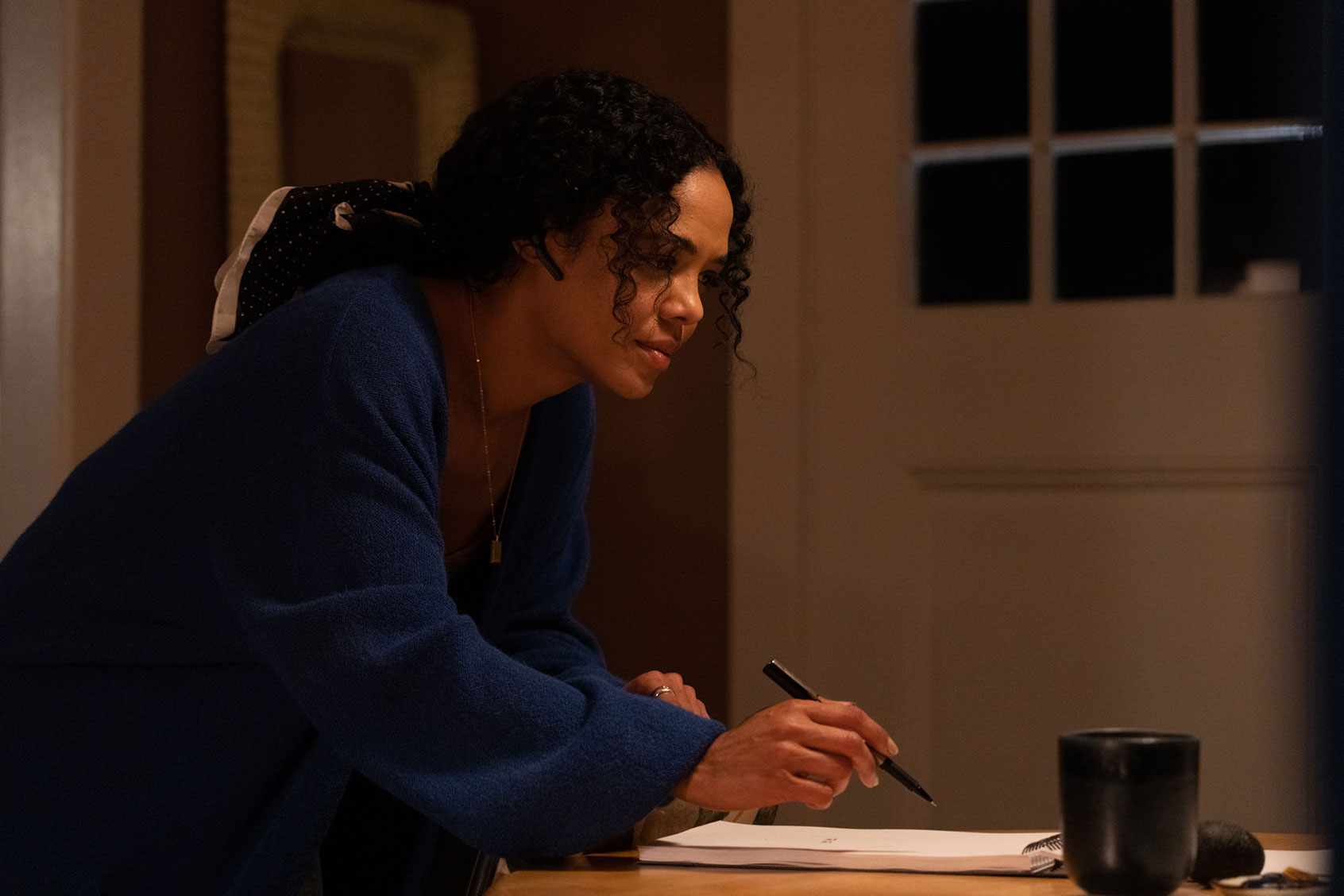
Tessa Thompson gives a lovely, thoughtful and empathetic performance as Beth, the title character in “The Listener,” director Steve Buscemi’s eloquent film about callers to an all-night helpline called Softline. Thompson is alone on screen the entire time as Beth takes calls from a dozen people including a formerly incarcerated man adjusting to life on the outside, a mother with a special-needs child, or a homeless teen. Watching her respond to other people’s mental health issues, feelings of depression, thoughts of self-harm and loneliness is compelling. Despite its heavy subject matter, “The Listener” is remarkably life-affirming. As Beth listens attentively, she often draws what she imagines the person she is talking to looks like. (The callers are voiced by actors ranging from Logan Marshall-Green and Margaret Cho to Alia Shawkat and Bobby Soto). 

The film, which was shot over six days in one location, is talky, but it never feels artificial. This is because Buscemi’s nimble direction gives Beth (and viewers) breathers between some of the calls, but also because of Thompson’s performance. Thompson, who is a producer on the film, pitches her voice perfectly as she responds to what she is told or gets callers talking about their feelings. But she also masterfully recalibrates her own emotions during and after each conversation. As Beth listens, her expressions shift naturally from interest to concern — both good and bad — depending on the situation. Thompson’s face and body language are especially revealing during an extended sequence where Beth talks with Laura (Rebecca Hall), a sociology professor contemplating suicide. As Laura gets Beth talking, and the listener explains why she provides this service, the film becomes quietly powerful. 

As in her best performances — “Passing,” “Sylvie’s Love” and “Little Woods” — Thompson delivers a mix of warmth and steeliness here. The actress spoke with Salon about her new film and her thoughts on the issues it raises regarding mental health.   

Actors are often commended for their listening. And much of your screen time in this film involves you listening. They say you can’t learn anything while you are talking. Can you talk about listening and what makes you a good listener? 

I really like not having much to say, if I’m honest. The most fascinating bit in performance is listening, and what keeps it active and interesting to an audience is being able, without words, to get a sense of feeling, of thought, of wheels turning. I am struck by actors I admire at what they can do with an economy of words to express emotion. There was such a unique challenge in this. And generally, we are in times that require us to listen to folks, particularly folks who might have a different point of view. I have never been in a time that feels so divisive and there is so much dissension between folks so the ability to come together and listen with an open mind and heart, that is something that is in short supply but really necessary.  I liked that the film explores that.

What can you say about working with the disembodied voice actors and developing the rapport you did with each of them?  

We shot the film in six or seven days and entirely in sequence. It was almost like learning a play. I had all the calls memorized. We stuck to the script. When actors were in LA, they would read [their lines] off screen. By and large, we played each scene with the actor and that was important to Steve [Buscemi]. We could have had a script supervisor and have the voices come in after. But Steve wanted to foster this honest and organic connection between myself and the callers, because what these Softline workers are fantastic at is having an instant rapport with the people that call. He wanted to be sure to have that.

Your performance is very expressive — from the cadence of your voice, to what your eyes and body language reveal. Can you talk about finding the character? What I admire is how Beth recalibrates after each call. 

Preparing for the part, I had some conversations and did some reading on the internet about people who worked in Softlines, and what brought them to the work and what they experienced. But the most insightful thing was to call a Softline. There was one woman I spoke to early in my investigation; I was struck by her tone of voice. There was something about it that was sweet, but not saccharine, understanding but discerning, nonjudgmental. There was something about the quality of her voice that stuck with me. I tried to capture that spirit with Beth. There was something that felt at once very human. She was careful to express the similarities that she felt about the things I was expressing, but there was also something nonhuman to her, that she was too good to be true. In my preparation for Beth, I was pitching my voice in a similar space as hers. In addition, there was something special to me about embodying the kind of person that gives other people a tremendous amount of grace. It taught me how I might like to recalibrate and move through the world just giving people more grace.

What observations do you have about how people come to this type of work and the burnout they experience? Beth suggests she needs a break.

This woman I spoke about struck me and stuck with me. She came to the work by first being an avid caller to Softlines herself. She was going through a really tough time, and similar to Beth, she had a really tough time relating to other people. I think the Surgeon General recently said loneliness in this country is a pandemic unto itself. A lot of folks already felt isolated. But there is a kind of person who has a tough time connecting with people. She had called Softlines a lot and found when she was on the other side of this breakdown, as she described it, and was healthier, she found it helpful to listen to people, and that kept her sane. It is similar to friends of mine who have gone through recovery. They have found sponsoring other folks helps them stay sober and stay clean. 

I began this investigation by calling and wanting to ask prodding questions and pluck from them why they found themselves there. The thing I found so striking was how adept so many folks I spoke to were so good at pulling out of me things that I didn’t know I was calling to say. Instead of it being this investigatory, anthropological, academic actor taking notes, it ended up being a conversation between two humans.  That was the thing I learned the most — the quality of the questions and the patience with silence. Particularly with strangers, we have a really hard time navigating silence. There is something about the feeling of silence that communicates patience that for me on the other end, drew things out of me that I was surprised I needed or wanted to say.

That’s inspiring because I have no patience.

I say this as a deeply, deeply impatient person! One of the gifts of being an actor is that roles sometimes come to you when you need them. Beth challenged me to be more patient with others, with self. My dog is in the movie, and when I first got him – Coltrane, he was a rescue – he came with a heap of problems. One of the big, huge lessons was absolute patience. Making this film and having the interactions with folks who do this real tremendous work really taught me about the work I need to do to be a more patient human with others. 

I joke that I want the microwave to cook faster!

You are not wrong. Living in the modern world, everything is about how we make things more efficient. What is lost sometimes is real connection, not just with others but with oneself. 

I do like slow cinema though . . .

I am really patient with a story. I love a slow burn! When things are too propulsive, I get whiplash. I have such patience as an audience member, but in real life, I’m like, “Can we speed this up?!”

The ListenerTessa Thompson in "The Listener" (Vertical Entertainment)

Beth draws and uses a stress ball as she listens. She is lonely. We learn more about her backstory by the film’s end, but what qualities did you ascribe to her character? 

What I thought that was interesting about Beth is that she loves to draw. She is mild-mannered. She has a sweet dog and lives in a nice house and is seemingly caring. You learn later that she has had some issues. I thought it was interesting about presenting a character you might not assume those things about. I think we make all sorts of assumptions in connection with strangers — who they are, who they might be. Something about this film is that we should be more curious and open about strangers. 

In terms of her character, I thought she, like many people I know, or hear about, is that it is honest to go through trauma and self-medicate and for that to spiral. Someone may not have access to get the support for mental health and that might spiral out of control. Someone who is fundamentally good might make bad decisions for a period of time. That is the story for so many people who don’t get second chances. Beth is like that; she has gone through a time that wasn’t so great and came out on the other side and given a second chance. 

The film is timely as more people are talking more about mental health issues, depression, and loneliness. What observations do you have about the callers she gets and how she handles them? She does reveal more about herself that perhaps she should in one call. 

When I was speaking to the folks who do this work, there is a fine line. You want to make a connection. When I was talking to them, there was an effort to reflect back a similar feeling or experience by the person on the other line. That has to do with this idea that whenever we go through tough times, it can be easy to self-isolate and assume you are the only person who has felt that way or you are the only person feeling that way. The whole point of a Softline is to have a voice on the other end of the line telling you, “You are not alone.”

Beth needs to take a break — and this is a flaw in our system in social work, medicine, caregiving where people all experience burnout. My sister is a retired nurse, and the reason she is retired is because she was so deeply exhausted and needed to take time for herself. We see that so often. The system is not set up for them to have the resources they need to be healthy and happy and can do their work in a way that feels peaceful and safe. Beth needs to step away because her fuse is shorter, and her ability to take calls on and have more of a boundary is faltering. She is realizing that for all the connection she feels with her callers, she doesn’t have that in the real world. We experience that more than ever now. We have so many ways to connect with people digitally, and it can make us feel plugged in, but ultimately, I think it can make us feel really alone and isolated. So striking that balance is a really tricky thing. 

What I loved so much about the film, is that so often in life the change we experience and the things we do that are heroic are so small. They are easy to miss. Change is so incremental. It is a huge act of bravery to pick up the phone and ask someone to hang out. In films, there is a big hero’s journey, and it is epic, and there is huge change. But In life, it isn’t often that way. I like that kind of quiet heroic turn for a character. It feels really honest.

You are a producer on this film as well as a few other recent projects. Are you moving into doing more producing?  

I am! I launched my production company Viva Maude in the middle of COVID. Then we had to survive the actors’ and writers’ strikes. It has been such a joy to launch during these wacky and turbulent times in the industry. What we want to do is offer stories that really give us points of view we have not seen and protagonists that do not typically get the star treatment. That has been a passion of mine for a long time. I have produced things I am in, but Viva Maude gives me a banner that allows me to produce things where I am not in center of the frame. 

“The Listener” is being released in theaters and on VOD on March 29.


“Nearly adopted”: Clarence Thomas took in future law clerk following racist firestorm

We now know a little bit more about how Supreme Court Justice Clarence Thomas came to hire a law clerk with a known public history of racist statements

According to the New York Times, beyond being one of the newest law clerks on the highest court in the land, Cyrstal Clayton is also a "nearly adopted" member of Clarence and Ginni Thomas' family:

They listed her on their family page in an annual printed clerk directory as their “nearly adopted daughter,” and prominently featured her in photos in the Thomases’ annual Christmas letters. During the “girls trip” to New York, Ms. Clanton joined the group at Broadway shows and in singing karaoke.

Thomas wrote in a 2021 letter, “and asked that she be allowed to live with us” after Clayton was removed from her leadership position with the far-right youth group Turning Points USA. She was forced out in 2017 after the New Yorker's Jane Mayer reported on overtly racist texts Clayton sent to her co-workers. 

 "I hate Black people … I hate blacks. End of story," the group's national field director wrote.  

After being ousted from the group led by Charlie Kirk, Clanton “was understandably distraught and depressed” and “felt overwhelmed and was ready to give up,” Thomas wrote in a letter on her behalf. “It was excruciating to watch her suffer so deeply, not knowing how to erase the smear or show that her life was not over.”

So she was invited to work for Ginni Thomas as a project manager at her political firm, Liberty Consulting, and "she lived with us for almost a year,” the justice wrote.


Behind the Baltimore bridge collapse is a familiar story of a corporation cutting corners

On March 26, the day after the commemoration of the 113th anniversary of the Triangle factory fire that killed 146 mostly female immigrant garment workers in lower Manhattan — a crew of a half-dozen immigrant men in a non-union paving crew fell 185 feet to their deaths from Baltimore’s Francis Scott Key bridge after it was rammed by the Dali, a rudderless massive cargo ship that was trying to leave the port without a tug escort.

Police were able to close the bridge to traffic just before the catastrophic collision took place after the powerless and adrift Singaporean-flagged Dali got out a mayday call at 1:30 a.m. on Tuesday.

The alert, however, did not come fast enough to save members of the road crew who were doing dangerous construction work on the vital span while Baltimore slept. Like so many immigrants before them, the half-dozen workers’ sudden and violent death highlighted the precarity of their lives in a nation that both relies on — and reviles them.  

Fifty-six of the 4,700 containers aboard the Dali contained hazardous materials, a top Coast Guard official told reporters at a White House briefing Wednesday. Officials said there is currently “no risk to the public.”

The non-union highway crew from Maryland-based Brawner Builders were immigrants who hailed from Guatemala, Honduras, El Salvador, and Mexico. The corporate media is describing the catastrophic event as a kind of freak accident. Immigrant rights and labor union activists, however, see it as the logical consequence of a brutal global trade regime that cuts corners to maximize profits — one that puts workers and the public at risk, while enabling officials and regulators to cheer from the sidelines.

On Wednesday, Maryland State Police recovered the bodies of Alejandro Hernandez Fuentes and Dorlian Ronial Castillo Cabrera inside a pick-up truck submerged 50 feet beneath the Patapsco River. The Patapsco flows directly underneath the 1.6 mile Francis Scott Key span, built a half-century ago. With four workers still unaccounted for, officials shifted from rescue and recovery mode — to a salvage operation essential to opening the Port of Baltimore for business. 

In the immediate aftermath, one worker was miraculously rescued uninjured from the water, while another worker was pulled from the frigid waters severely injured. Work-Bites reached out to Brawner Building for a comment but has not gotten a response. Jeffrey Pritzker, the company’s vice president, told CBS News the company is “doing everything possible to support the families and to counsel the families and to be with the families.”

A GoFundMe campaign has been set up by the Latino Racial Justice Circle, the news outlet reported.

How Labor Views the Disaster

Donna Edwards, president of the Maryland State & DC AFL-CIO, which represents 340,000 union members, tells Work-Bites the state confederation is deeply concerned about the fate of the Brawner Building non-union crew. 

“This is very dangerous work — there was an SOS. Did they even know what was happening?” Edwards asks. “They shut down the bridge so that some people did not get on who would have died in the collapse. What warning did the workers get? It’s opened all of our eyes to how quickly this can happen. In a manner of seconds that whole bridge came down.”

Patrick Moran is the president of AFSCME Council 3, which represents over 40,000 public sector workers in Maryland. He says the tragedy has prompted “a lot of unanswered questions” about maritime and construction sector occupational safety.

“Very little of the state work [like the bridge paving] that’s contracted out is union — it’s been a problem for the last decade or more,” Moran tells Work-Bites. “We all know that union jobs are statistically safer jobs. We know that union jobs are more economically secure jobs, and we know that on union jobs the workers are trained more proficiently. But when it comes to the [Maryland] Department of Transportation or General Services, they just look for the bottom line — and that’s it. Worker safety is just not in their matrix.”

We need your help to stay independent

George Escobar is the chief of programs with Casa, a national non-profit that advocates for immigrant rights and has 155,000 members in 46 states. Two of the Brawner paving crew were members. 

“This really underlines the overall story of our immigrant community that doesn’t get told often,” Escobar told MSNBC. “Yet again, we are the immigrant workforce being in the forefront of really helping this country to run and operate properly, while at the same time being disproportionately impacted by the failed investments in struggling infrastructure, healthcare and housing. Just the other month in Baltimore, we had another tragedy where three immigrants lost their lives in a fire inside a building that was in very poor condition.”

Kevin Brown, N.J. Area Director at SEIU Local 32BJ, says that when a disaster like the Baltimore bridge collapse happens — union representation means accountability for the workers and their surviving family members.

“Collective bargaining and immigrant rights go hand-in-hand,” Brown says. “Workers need to be able to work and immigrant workers need to receive fair wages with benefits.”

32BJ SEIU is the largest building service workers union in the nation and has been very successful organizing in immigrant communities across 11 states and Washington D.C. 

The Dali, built in 2014, is a 1,000-foot floating behemoth that can hold 10,000 shipping containers and is operated by just a 22-member crew. The ship had been inspected last year in Chile when a broken pressure gauge was replaced. According to the U.S. Coast Guard, it passed an inspection in September. Reuters reported the ship was involved in an accident back in 2016 when it was trying to leave Antwerp and its hull was sufficiently damaged to “impair its seaworthiness.” 

Roland “Rex” Rexha is the secretary-treasurer of the Marine Engineers’ Beneficial Association. Established in 1875, it’s the oldest maritime trade union in the U.S., representing licensed deck and engine officers. Rexha tells Work-Bites the Dali disaster highlights the downside of not having ships escorted by tug boats until they are out on the open sea away from critical infrastructure — as well as the risks created by building larger and larger vessels while using automation as justification for reducing crew size, and the wide variance between U.S. maritime safety standards and the rest of the world. 

“As for having tug assistance when they are going under a bridge, these are changes of policy where we defer to what the mandatory policies are of the individual port; what they deem is the safest way to operate,” Rexha says. “I think in all ports there’s going to be a revisiting of how we operate and what’s the safest way to move vessels out into safe water. When you are talking about a large cruise ship or a cargo ship like this one, if they are out of the harbor and they lose power they are not going to hit anything, they are in the middle of the ocean. But as they are operating in local waters that’s where you have to be really diligent.”


Want a daily wrap-up of all the news and commentary Salon has to offer? Subscribe to our morning newsletter, Crash Course.


Glenn Corbett is an associate professor of fire science and public management at John Jay College of Criminal Justice. 

“In the overall scheme of things,” he says, “it would have been a bargain to have tug boats escort that ship as opposed to having to spend billions to replace this bridge, avoid the loss of life and the major hit to that region’s economy.”

Cost-Cutting Automation Strikes Again

What’s been happening around the world as cargo ships have gotten bigger and technology advanced, Rexha points out, is they have all gone to minimum crewing.

“So, that where in the past you had ten officers per department, you have half that,” he says. “At that point, everything becomes more difficult when there is an issue, which is most likely going to happen when you are trying to maneuver the ship. That’s the most dangerous part of any transit for any ship. That’s when there’s the potential hazard — that’s where there’s the potential for a real tragedy.”

It is possible, however, to regain control of a ship that’s lost power through switching to manual control. But to do that, according to Rexha, you need sufficient crew strength.

“But you can’t do that with just two people, especially if you are running around to try and get the lights back on,” he adds. “If you look at the issues of East Palestine, the issues of Boeing, and now this maritime disaster — our transportation system is under attack and its corporate greed every step of the way that led to these issues. People are [now] opening their eyes and asking, do I feel safe driving over a bridge knowing there’s a vessel going underneath it. Do I feel safe with a train coming into the city carrying all these chemicals? Do I feel safe on a plane while there’s a company cutting corners on how they build these things?”

In the aftermath of the Dali disaster, it isn’t just labor raising red flags about the pre-existing conditions of America’s corporate-dominated maritime sector where ports actually compete with each other for business.

“This bridge was built in the 1970s, and the vessels now are much larger with much heavier capacities, so I think we need to revisit that and we expect that the investigation will help us to know how to rebuild this bridge in the most effective way going forward with the replacement bridge,” Senator Ben Cardin (D-MD) told MSNBC. “Let’s build a bridge that provides maximum safety.”

Cardin also told the news outlet that the families of the lost workers needed to be compensated for their loss, and that there also needs to be compensation for the workers and the businesses that will feel the brunt of the indefinite port closure. “Those responsible have to be held accountable,” he said.

According to Corbett, the meticulous review that’s being done of the disaster by both the National Transportation Safety Board and U.S. Coast Guard will take months, if not years to conclude. He reasons that with the glaring vulnerabilities this disaster has exposed — the nation now requires the creation of a Disaster Review Board, which “within 90 days can come up with a basic report…so that the stuff that’s become apparent can inform the additional research that’s needed, or the rules and laws that have to be changed.”

My grandmother was right all along: You can’t beat fresh strawberries and rhubarb in the springtime

Frannie, my maternal-grandmother and true Southern belle that she was, made rhubarb famous in my family, not only because of how much she loved Strawberry-Rhubarb Pie but because of the way she said it. It became part of my sister’s and my act when we impersonated her as children. With one hand over our hearts and one hand held up as if to stop traffic, we would say the line in unison, “Oh, hon-ney, Frann-ney doesn’t want a thing. I stopped in Merr-reh Est-ah for cau-feh and a piece of straw-berr-eh roo-bahb pie.”  

You see, she drove from Mexico Beach, FL to see us in Mobile, AL, and Mary Ester, FL was along her route, about halfway between us. Mary Ester was also where one of her favorite pitstops was — a quaint, out-of-the-way cafe with wonderful coffee and homemade sweets. In the spring, Frannie’s favorite was their homemade Strawberry-Rhubarb, and she all but sang about it once she arrived for her visit. 

Something about the way Frannie swooned over that pie made me think rhubarb had to be a delicacy, probably something exotic and hard to come by. Strawberries were already a favorite of mine by this time, but I had never seen or tasted rhubarb. My young brain reasoned that if rhubarb was good enough to be in the mix with strawberries, it must be supernaturally delicious.

I suppose I was both right and wrong. Turns out, people are fairly divided on rhubarb. Although beloved by some, it is reviled by many. In fact, just this week while at my local farmers market, I encountered a particularly talkative man who made a point to passionately tell me that the worst thing he had ever eaten in his life was a rhubarb pie. I believe has was triggered by the vibrant fuchsia-pink stalks sticking out of my grocery sack and made a beeline straight for me.

He apparently felt compelled to do whatever he could to dissuade me from bringing my rhubarb home and ultimately suggested I throw each and every piece over the fence, back into the farm from where it had come. He doubted even the field mice would be interested in it. Then reasoned something might possibly be hungry enough to give it a whirl, but only if the creature in question had never tasted it before. All of that plus more delivered rapid-fire in no more than a minute. Strong words from someone I had never met and would more than likely never lay eyes on again. 

Needless to say, I brought my gorgeous rhubarb home and made this wonderful crumb topped cobbler that my husband and I devoured like animals before it was even properly cooled.


Want more great food writing and recipes? Subscribe to Salon Food's newsletter, The Bite.


Rhubarb prefers to grow in cooler temperatures; therefore, we have a very short growing season where I live. Only during the early spring do we get fresh rhubarb because cool spring weather is fleeting along the Gulf Coast. The fact that it is available for only a few weeks makes it even more desirable in my opinion, as does its beautiful pink color. I make our rhubarb days last a little longer by saving some to simmer down with sugar and water for the prettiest simple syrup you have ever seen. It gives new life to a Strawberry-Mint Mojito, but it is equally good to prop up a vodka or gin and soda.  

I admit my love for the outrageously tart, ruby-colored, celery look-a-like rhubarb tracks back to my grandmother, Frannie, but I also wholeheartedly appreciate it. Cooked down, it adds interest to sweet fruit desserts, and it could not be better paired than with strawberries this time of year. The two make such a knockout team.

From pies, crumbles and cobblers, strawberry-rhubarb is my pick for the season when temperatures are still cool enough to serve a warm dessert. This is one of my favorites, made even better with a scoop of vanilla ice cream on top. 

We need your help to stay independent

Spring Strawberries & Rhubarb
Yields
08 servings
Prep Time
20 minutes
Cook Time
35 minutes

Ingredients

1 cup sugar, divided

3 tablespoons cornstarch or arrowroot (or 6 tablespoons tapioca starch)

2 cups chopped fresh rhubarb

2 1/2 cups quartered fresh strawberries

1 cup rolled oats

1/2 cup flour

1 teaspoon cinnamon

Pinch of salt

8 tablespoons butter or coconut oil (or combo of the two), softened

Optional: maple syrup


Directions

  1. Preheat oven to 350F. Oil or butter a 9” square baking dish.

  2. In a bowl combine 1/2 cup sugar and starch of choice. 

  3. Add rhubarb and strawberries and toss well. Pour into prepared dish.

  4. Place in oven about 10 minutes while you make the crumb topping.

  5. Make crumb topping: Using the same bowl if desired, combine rolled oats, 1/4 cup of sugar, a pinch or two of salt, cinnamon, and flour.*You will either add in the last 1/4 cup of sugar OR use about the same amount of maple syrup for additional flavor. 

  6. Using your fingers or a fork, incorporate the butter and/or coconut oil to make a crumb-like mixture.

  7. Taste for sweetness and adjust if desired.

  8. Sprinkle over prepared fruit, and bake 30-35 minutes.

  9. It will thicken as it cools, so according to your preference, allow time before serving. 

  10. Serve with vanilla ice cream or sweetened fresh whipped cream . . . or alone.


Cook's Notes

Substitution for Rhubarb: Thawed, previously frozen cranberries work great as a substitute for rhubarb. They are just as tart and just as beautifully colored.

Make this a pie: Make or purchase a pie crust and pre-bake it 15 minutes at 350. You may choose to make an egg wash (mix in a teaspoon of sugar to wash) and brush onto the bottom and up the sides of crust to help prevent the dreaded soggy bottom that can occur with fruit pies. Once taken out of the oven, it will thicken as it cools, so factor in plenty of cooling time before serving.

Crumb Topping: We love this topping sprinkled over just about anything—fruit, yogurt, ice cream. If you would like to make some just to have on hand, here is how to do it: Mix it up and spread it out on a baking sheet. Bake 15-20 minutes at 350F. You can omit the oats and use all flour if desired.

Louis Gossett Jr., first Black man to win best supporting actor Oscar, dies at 87

Oscar-winning actor Louis Gossett Jr., who broke barriers in Hollywood when he became the first Black man to win the Academy Award for best supporting actor, has died at age 87. Gossett's cousin, Neal L. Gossett, first reported to the Associated Press that the actor had died in Santa, Monica, Calif. The AP reported that no cause of death has been revealed yet.

In a statement obtained by PEOPLE Friday, Gossett's family said, "It is with our heartfelt regret to confirm our beloved father passed away this morning. We would like to thank everyone for their condolences at this time. Please respect the family's privacy during this difficult time." 

Born in Brooklyn, New York, Gossett attended New York University on a basketball and drama scholarship, even doing a stint in rookie training with the New York Knicks for a time. In 1959, he was lauded for his performance in the Broadway production of "A Raisin in the Sun" (alongside Sidney Poitier), which he would also star in the 1961 film version of, marking his first foray into Hollywood.

Gossett saw small-screen success in 1977 with the acclaimed miniseries "Roots," based on Alex Haley's novel that offered a stark depiction of slavery. The actor would go on to earn an Emmy for outstanding lead actor in a single appearance in a drama or comedy series for portraying Fiddler. Gossett's history-making moment came in 1983, when he won an Oscar for his portrayal of drill instructor Gunnery Sergeant Emil Foley in "An Officer and a Gentleman" (1982.) Writing about the win in his 2010 memoir "An Actor and a Gentleman," Gossett said, “More than anything, it was a huge affirmation of my position as a Black actor."

Throughout the 1980s and '90s, Gossett would continue to star in a number of movies and television shows, including "Enemy Mine," "Iron Eagle," "Sadat," "The Principal," "A Good Man in Africa" and "Jaws 3-D." Also in the 1990s, the actor assisted in the foundation of the Eracism Foundation, an organization whose central mission is to "contribute to the creation of a society where racism does not exist." 

“I had to really learn the importance of what it takes to survive in this town, and I had to act as if I was second class,” Gossett said of experiencing racism within the industry, per CNN.  “I had to ingest the onus of being an African American person in America.”

Gossett revealed in 2010 that he had been diagnosed with prostate cancer. As CNN noted, he chose to make his illness public “to set an example for the large number of African American men who are victims of this disease because of the comparatively low emphasis in our community on preventive examinations and early treatment.

“I want to influence them to seek, as I have, the fine medical care and early detection now available,” Gossett said at the time.

Remembering my friend, Joe Lieberman

I remember exactly when Joe Lieberman became my friend — after he scolded me for not heeding the commands of my Jewish mother.

In 2017, I was working on a series of articles for Salon about "centrism," a once-dominant but rapidly fading force in American political life. That May I had interviewed two of the most prominent remaining centrists, both of whom had to some degree become outcasts from their own political parties. One was Lieberman, a longtime Democratic senator from Connecticut known for his political independence. The other was his good friend Christine Todd Whitman, the former Republican governor of New Jersey. Whitman asked me to extend her greetings to Lieberman, and of course I did so. But I forgot to mention my own mother, a big fan of Lieberman ever since he became Al Gore's running mate during the 2000 presidential election, who had also told me she was eager to express her admiration. 

I tried to make up for this a couple of months later, as I sat down for another interview with Lieberman. During the customary initial chitchat, I told him that my mother had wanted me to say hello to him, but I'd prioritized Whitman instead.

Lieberman gasped in feigned horror. "Oh no, Matt, you shouldn't have done that," he said. "Your mother must always be your first priority. Always!"

I understand the reasons why many liberals and progressives grew to dislike Joe Lieberman, who died on Wednesday at age 82. He won his final Senate campaign in 2006 as a third-party candidate after losing the Democratic nomination, largely over his support for the Iraq war. He supported John McCain over Barack Obama in the 2008 presidential election, and was reportedly McCain's first choice as running mate. During the Obama administration, Lieberman was blamed — unfairly or otherwise — for the failure to include a "public option" in the Affordable Care Act. There are other areas of disagreement, no doubt.

But I'm here to pay tribute to Lieberman not as a controversial political figure or as the first Jewish American to appear on a major-party presidential ticket — although that was surely the accomplishment for which he'll be most remembered — but as a warm, caring, profoundly decent man driven by deep religious conviction and a belief in bipartisanship. More than that, I will remember him as my friend, and will always feel grateful for that conversation, among many others.

"Oh no, Matt, you shouldn't have done that," Lieberman scolded. "Your mother must always be your first priority. Always!"

Bipartisanship, for Lieberman, wasn't purely instrumental. It reflected his faith that individuals with a diverse range of philosophies should be able to set aside their differences in the name of solving society's biggest problems. As he once explained to me, being a centrist "doesn't necessarily mean that you are in the policy center all the time, or the ideological center. It means, I think more broadly, that you're willing to compromise, to come to the center, and meet with people of opposite points of view so that you can get something done."

Many politicians say they believe in dialogue and compromise, of course. Joe Lieberman lived it. He understood that we had political differences, both on specific issues and in terms of overall philosophy. He was one of the most conservative figures in the national Democratic Party and, as noted above, frequently made common cause with Republicans. I would describe myself as a democratic socialist.

None of that was a bug in our burgeoning friendship; it was a feature. He liked to tell stories about his friendships with people across the political spectrum: He shared cocktails and conversation with legendary conservative columnist William F. Buckley Jr.; he watched the 2006 mockumentary "Borat" with McCain and Lindsey Graham, two of his best friends in the Senate. That also worked in the opposite direction. He once shared with me how deeply touched he had felt when Lady Gaga dedicated a performance of her song "Speechless" to him, in tribute to his instrumental role in repealing the U.S. military's "Don't Ask, Don't Tell" policy. That moment delighted his more liberal friends, he said.

We need your help to stay independent

I never asked him about this directly, but I believe that Lieberman connected easily with individuals who held many different points of view partially because of his innate self-confidence. He knew he was intelligent, and believed he had reflected deeply on issues and reached the right conclusions. But he never felt threatened by others who disagreed. Instead, he reacted with curiosity and humility, approaching each human interaction as a potential learning experience.

That didn't mean you were going to change his mind, as I discovered on several occasions. But it meant that his mind, and his heart, were sincerely open to you.

When our distant ancestors in Jewish central Europe coined the word "mensch," they had people like Joe Lieberman in mind.

We often talked about our shared Jewish heritage, and the important role it played in our lives. Lieberman was refreshingly frank in discussing his own privilege, admitting that he had experienced very little overt antisemitism. After Gore chose him as vice-presidential running mate in 2000, he recalled, he was relieved by the total absence of bigotry in the general public's response. But he also understood that prejudices run deep in human society, and that Jews are always vulnerable to the resurgence of hate. I believe that, for him, moderate or centrist politics presented a moral and logical antidote to that historical problem, encouraging empathy and moving dialogue away from the ideological extremes where antisemitism and other forms of hate are likely to thrive.

"Throughout history, whenever extremists begin to gain power, they inevitably come for the Jews," I emailed Lieberman less than a month ago. "Antisemitism is a barometer in that way."

"Yes," he replied over his iPhone. "Sadly yes."

I once wrote an article for Salon about how Lieberman's vice-presidential nomination in 2000 changed my life, many years before I would meet him: 

It is hard to capture in words what this meant to a Jewish kid who had nearly been murdered as a so-called "Christ-killer" three years earlier. On some level, it felt as if America's vice president wasn't just elevating Lieberman, but sending a message to Jews like me that he was watching our back. As a child, I had associated Jewishness with feeling rejected; Gore helped me see that, for millions of Americans, it was something to be embraced. By accepting Gore's offer, Lieberman showed that it also wasn't something to be afraid of displaying to the world.

I'm sorry that I never got the a chance to talk with Lieberman about Senate Majority Leader Chuck Schumer's recent speech calling on Israelis to remove Benjamin Netanyahu from power amid the chaos and carnage of the Gaza war. Lieberman had criticized Schumer (while calling him a "friend"), arguing that it was inappropriate for Americans to interfere in the domestic politics of a democratic ally. I can sympathize with that principle, but I wish I'd asked him how he really felt about Netanyahu's prosecution of the war, which has alienated so many people around the world, including Jews. 


Want a daily wrap-up of all the news and commentary Salon has to offer? Subscribe to our morning newsletter, Crash Course.


To be clear, I didn't disagree with Lieberman's broader concerns about rising antisemitism. We shared the view that college campuses have become breeding grounds for Jew-hatred, with many students using opposition to Israel or support for a Palestinian state as an excuse for expressing vile opinions. But that concern also fit into Lieberman's larger open-mindedness. Last year, I shared with him an article I wrote about my great-uncle, a Jewish World War II veteran who helped liberate a Nazi concentration camp, and also a lifelong liberal who believed that "people can criticize Israel in good faith without being antisemitic" and that it was important for people like him to speak out against "the Israeli government's mistreatment of Palestinians." Lieberman may or may not have disagreed with that premise; I'll never know. He told me at the time that the article was "a poignant and powerful story and is very well-written."

As I process my grief about my friend's passing, I understand full well — as he also understood — that he will always be, at best, a controversial figure for progressives. That has nothing to do with the man I got to know. I marvel at his kindness, at the fundamental decency that drove him to pursue a friendship with an awkward, autistic reporter with sometimes divergent political views. The Yiddish term "mensch" occurs to me. When our distant ancestors in Jewish central Europe coined that word, they had people like Joe Lieberman in mind. 

Lieberman once told me that John F. Kennedy's election as the first Roman Catholic president, coupled with Abraham Ribicoff's 1954 election as the first (and only) Jewish governor of Connecticut, "gave me confidence that doors had opened for me." He then added, "I'm gratified that you had that same reaction, albeit at a different time in a different way, to my 2000 campaign."

I'm sure he wished he could have met Kennedy, whom he fervently campaigned for as a teenager in 1960 and viewed as his political hero. In that one sense, I was luckier than Joe Lieberman: I got to meet my hero. I even became his friend.

“NOVA: A.I. Revolution” urges us consider the benefits—and the drawbacks—of artificial intelligence

Forty-six years ago, PBS' "NOVA" series debuted its first documentary about artificial intelligence. "The Mind Machines" featured many of the field's foremost voices, including Arthur C. Clarke, the man who dreamed up "2001: A Space Odyssey" and its cold, calculating HAL 9000, one of the 20th century's defining AI nightmares.

"I think that what we’re doing now is, in a sense, training our own successors," Clarke warned at the outset.

"NOVA: A.I. Revolution," which premiered this week, doesn't include that observation from Clarke. Instead, it quotes what he said next: "We've seen the first crude beginnings of artificial intelligence. It doesn't really exist yet at any level because our most complex computers are still morons — high-speed morons — but still morons. Nevertheless, we have the possibility of machines that can outpace their creators and therefore become more intelligent than us."

Excluding Clarke’s opener doesn't fundamentally change the meaning of the whole statement, but knowing what's been omitted clarifies the intent of "A.I. Revolution" and its producer and host Miles O'Brien.

That first statement speaks to our prevailing fears concerning AI, which aren't entirely unfounded. Placing guardrails around film and TV studios' usage of AI was a central fight in last year's dual strikes by the Writers Guild of America and SAG-AFTRA. (Salon's unionized employees are represented by the WGA East.)

Other industries' workers — journalism included — are rightly wary about its incursion into their fields, as well.

"We have the possibility of machines that can outpace their creators and therefore become more intelligent than us."

While O'Brien and the experts featured in "A.I. Revolution" acknowledge that those fears aren't unfounded, they also would like us to take a breath and consider the profoundly beneficial aspects of artificial intelligence.

"A.I. Revolution," therefore, is an entry-level course on the subject, explaining how artificial intelligence works and featuring how it's been used to innovate pharmaceutical research, assist in earlier cancer diagnoses and hasten developments in robotics — topics that haven't been explored with much nuance.

"What really bothers me is that in the rest of the media, they'll put on a credible technologist — somebody who is part of the technology community and understands things — and they'll pick the person who sincerely believes that we're facing an 'existential threat,'" O’Brien said in a February conversation that took place at the Television Critics Association's winter press tour in Pasadena, Calif.

"Then nobody will actually interrogate that," he continued. "They will just feed off of hearing that hysterical thing. They'll say, 'Well, that guy must know what he's talking about because he's a scientist.' In fact, it's pretty easy to start asking some follow-up questions that reveal just how speculative something like that is."

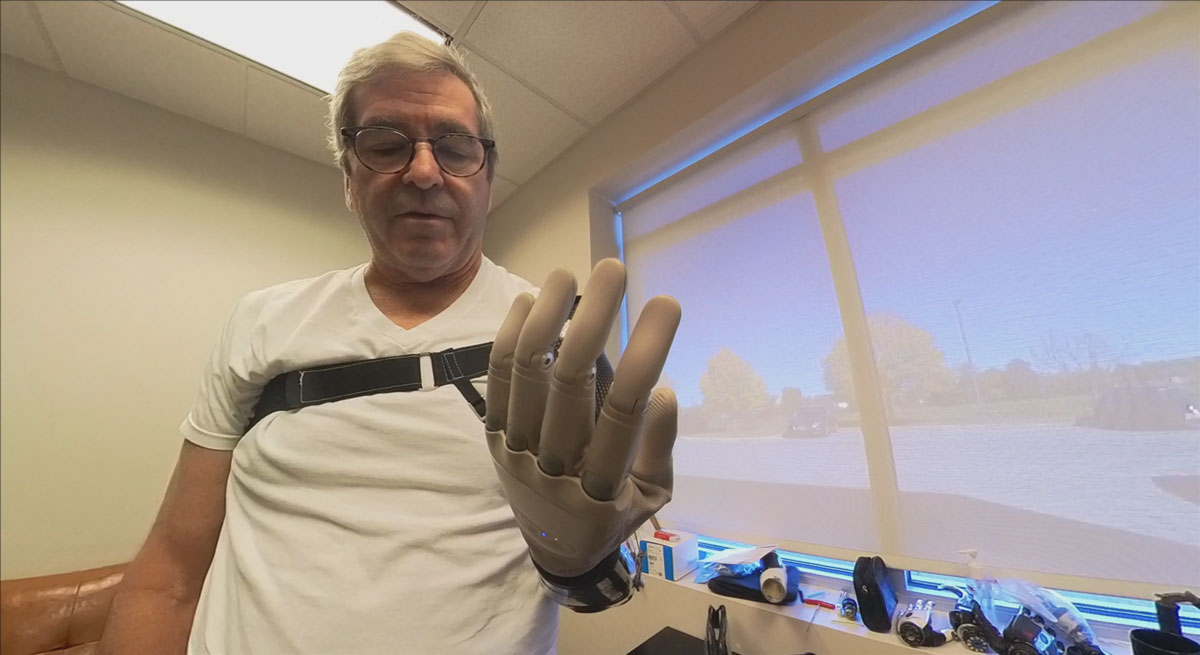
NOVA: A.I. RevolutionMiles O'Brien being fitted with prosthetic hand (Photo courtesy of WGBH)O’Brien didn't specifically drop OpenAI CEO Sam Altman's name into this dish, but Altman's warning to a Senate subcommittee in May 2023 to regulate the usage of artificial intelligence was widely covered. Not long afterward, he signed a letter along with many other top AI researchers warning that "mitigating the risk of extinction from AI should be a global priority alongside other societal-scale risks, such as pandemics and nuclear war."

"It's just irresponsible to throw that out there and enjoy the fact that you're getting people all revved up and get their intention," O’Brien said in February.

It seems Silicon Valley agrees with O’Brien: "Sam Altman's act may be wearing thin" is the headline of a Business Insider story published on Tuesday.

We need your help to stay independent

But the "NOVA" host has a very personal reason for clarifying the record on AI. O'Brien used to be CNN's top science correspondent before the cable channel laid off the entire unit in 2008. Afterward, he appeared as an analyst on CNN, while mainly working for PBS.

In 2014, while on an assignment in the Philippines, a heavy equipment case fell on his left forearm, requiring an amputation above the elbow. Ten years later, this "NOVA" episode depicts his journey to live with a new AI-driven prosthetic — one of many medical and scientific engineering developments ameliorated by computational work.

Woven through his experience of adapting to his new prosthetic are examples of how AI has been quietly accelerating medical diagnostic research and treatment innovations for years now.

NOVA: A.I. RevolutionTesting prosthetic hand at CoApt (Photo courtesy of WGBH)Despite AI's steady development over the last half century, it remains a relatively new concept to most of us.

Much of what we know is based on movies and consumer interactions. Company websites use conversational AI-driven chatbots to interact with customers seeking answers to common questions. Employing automated tools to streamline research or clean up our grammar is part of our daily workflow.

Then there are the non-essential uses, such as generating elaborate artwork inspired by random search terms.

There's also the tantalizingly close promise of entirely autonomous self-driving vehicles. In "A.I. Revolution," O'Brien rides in an experimental car with Dr. Alexander Amini, an MIT postdoctoral researcher. The auto navigates an environment without being reliant on an established map program due to experimental technology inspired by a tiny organism.

NOVA: A.I. RevolutionMiles O'Brien with Alexander Amini inside an autonomous vehicle (Photo courtesy of WGBH)Attached to these same tools and conveniences are the very real fear that such technology can be misused to create deepfakes with drastic consequences, replace human workers or — the most popular anxiety of all — the "Terminator" SkyNet scenario in which self-aware technology turns on us. "A.I. Revolution" responsibly acknowledges these concerns and separates dark fantasy from reality in the second half of the episode.

One truth O'Brien shows is that he has nothing to fear related to his arm becoming self-aware and doing him harm. His initial field tests are frustrating.

Amini, who joined O'Brien at PBS's press event along with Dr. Petrina Kamya, the head of AI platforms at Insilico Medicine, acknowledges that "in reality, everyone agrees that there are very big negatives. It's only upon how we deal with those negatives going forward that there seems to be some division."


Want more health and science stories in your inbox? Subscribe to Salon's weekly newsletter Lab Notes.


He and Kamya worry that a fear-based approach to AI regulation will slow down the life-saving progress being made in a variety of research fields.

"Humans have problems today that we don't know how to solve," Amini offered as part of our conversation. "That's the reality of the situation: We have severe problems in the world — cancer, climate change models, all different types of issues — that are fundamentally lacking solutions."

"We are moving in the right direction, largely due to technology over the past 50 years that has advanced our progress in these domains," he continued, "and AI will accelerate those advances even further."

"Humans have problems today that we don't know how to solve."

So why don't we know more about this side of artificial intelligence? Simply put, as Kamya said, it's very technical, and "the people who are very familiar with the technical aspects of AI, they'll use terms they all understand that aren't necessarily easy to digest them and speak about in layman's terms."

This episode is one way she and the other "A.I. Revolution" participants hope to make what they do more accessible. "We need more coverage like this," O’Brien insisted. "People should understand the good, the bad and the ugly — not just the ugly part."

"NOVA: A.I. Revolution" is available on YouTube and streaming at pbs.org or via the PBS app.

“Hot Ones”: Ice Spice says it took her three years to hone her voice and identity as a rapper

Ice Spice, the Grammy-nominated artist best known for her Billboard hits “Princess Diana” and “Munch,” discussed the upcoming release of her debut album “Y2K” while taking on the wings of death during this week's episode of “Hot Ones.”

The 24-year-old rapper, dubbed “rap's new princess,” made an appearance on the popular YouTube talk show to answer host Sean Evans’ most burning questions. The pair chit-chatted over a platter of ten increasingly spicy chicken wings, first starting with the Hot Ones – Buffalo Hot Sauce which measures about 1,800 Scoville units. 

This season’s complete hot sauce lineup is as follows: Sam Sa'House – Smokey's Jalapeño Hot Sauce (6,000 SHU), Funky's Hot Sauce Factory – Stellar Fuzz (19,000 SHU), Hot Ones – Los Calientes Verde Hot Sauce (34,000 SHU), Good Heat – Queso SIN Queso (52,000 SHU), Cantina Royal – Morita Bourbon Maple Reaper (73,000 SHU), La Pimenterie – The Forbidden Fruit (124,000 SHU), Da' Bomb – Beyond Insanity (135,600 SHU), Chile Monoloco – MataSanos Hot Sauce (680,000 SHU) and Hot Ones – The Last Dab: Xperience (2,693,000).

Staying true to her name, Ice Spice confidently told Evans that she enjoys a little heat in her food. “I actually love spicy food, so yeah,” she said in the episode’s opening.

In anticipation of Ice Spice’s album release, Evans asked the superstar what her creative process has been like. Unlike many artists who typically have to pick and choose what songs ultimately make the final cut, Ice Spice said she was able to keep everything she wanted in her recent project.

“Everything makes the cut…each song that I work on, I really try to make it good enough to put out basically…that hasn’t always been the case, but for this album process that was the case,” she said.

As for how she writes her tunes, Ice Spice explained that she begins with the hook and then writes the verses. However, there is one track on her album in which she left out a hook and went straight to the verse. “I’m excited to hear what the fans think about that one,” she said.

Evans also asked the rapper about her signature tagline “stop playing with 'em, Riot,” which pays homage to RIOTUSA, her longtime record producer and friend: “I would be trying to freestyle and send little voice notes rapping and stuff to my friends. He [RIOTUSA] was gassing me the most out of all my friends. So, I was like maybe we can just work on something…’cause I’mma go where I feel wanted…my other friends [were] being bougie and didn’t want to send me beats. But he was like, one of the only ones who wanted to.”


Want more great food writing and recipes? Subscribe to Salon Food's newsletter, The Bite.


Ice Spice’s music first went viral in 2022 when her song “Name of Love” gained traction on SoundCloud. She’s since released a string of major hits, including “Bikini Bottom" and “In Ha Mood,” and collaborated with several big-name stars like Taylor Swift and Nicki Minaj. Despite her wins and accolades, Ice Spice said it took her years to find her voice as a rapper. 

“I had to just really be more comfortable in the studio,” she said. “Before, I didn’t really have an identity when it came to recording and I would try to sound like other people or what I thought a hit record sounded like until I really just got more comfortable and just started experimenting and really being myself. It took like three years to find my voice I feel like.”

Watch the full "Hot Ones" episode below, courtesy of YouTube:


“Very troubling”: Federal judge makes “extraordinary” move to reveal the truth about Trump’s threats

In what legal experts are calling an "extraordinary" move, a sitting federal judge spoke out against Donald Trump's dayslong attack on the child of a judge overseeing one of his criminal trials. 

"I think it’s important that as judges, we speak out, and say things, and reference to things that conceivably are going to impact on the process. Because if we don’t have a viable court system, that’s able to function efficiently, then we have tyranny,” federal Judge Reggie Walton said to CNN's Kaitlan Collins in a rare interview Thursday. 

Trump has lashed out at the daughter of Judge Juan Merchan, who is presiding over Trump's criminal trial relating to hush money payments and election interference. The former president took to his Truth Social account to attack the judge's daughter.

“Judge Juan Merchan is totally compromised, and should be removed from this TRUMP Non-Case immediately,” Trump wrote on Thursday. His daughter, the former president said, is “a Rabid Trump Hater” who works for Democrats. The day before, he falsely cited social media posts that were not hers to claim she and her father are out to get him.

As former federal prosecutor Joyce Vance notes, an earlier gag order imposed by the judge on Trump ahead of the start of the April trial does not include mentions of the judge or his family.

And, as Vance notes, it is indeed "extraordinary" for a sitting federal judge like Walton to speak out in this manner. 

“But nonetheless, it is very troubling, because I think it is an attack, on the rule of law, when judges are threatened, and particularly when their family is threatened,” Walton, who was first appointed to the federal bench by then-President George W. Bush, said. “And it’s something that’s wrong, and should not happen.”

The judge said that he and his family have seen an increase in violent threats since Trump's rise. 

“Yes, I’ve had more threats than what used to be the case. Yes, I have received a greater number of threats, as a result of that incident, and the fact that cases arising out of that incident have appeared before me,” Walton said. “I mean, it was rare. I’ve been a judge for over 40 years. And this is a new phenomenon. I’m not saying that it didn’t happen before. But it was very rare that I would you ever receive any type of a threat, regardless of what type of cases I was handling. And unfortunately, that is no longer the case.”

“I know the Marshals Service has seen a significant increase, in the number of threats against judges. And I think obviously, that’s very — very concerning,” he added.

Watch the full interview below, via CNN:

“Late bloomer”: Why it matters that Rebel Wilson is sharing she lost her virginity at 35

Rebel Wilson is opening up about sex — or rather the fact that she didn't have it until she was 35.

The 44-year-old actress told People Magazine she wanted to share her personal experience as a "positive message" to other young people. Wilson said she wanted to reassure young people that "not everybody has to lose their virginity as a teenager." 

She continued, "People can wait till they're ready or wait till they're a bit more mature. And I think that could be a positive message. You obviously don't have to wait until you're in your thirties like me, but you shouldn't feel pressure as a young person."

Even though Wilson is now engaged and has a child, she called herself a "late bloomer" and sexually "fluid." But mostly, she stressed that "if I had been born 20 years later, I probably would've explored my sexuality more. I just knew I was attracted to men, and that was the normal thing."

Wilson's transparency about her sexuality opened the door to highlight how women's sexuality is highly policed by the media — either fully having to embrace it or run away from it.

From a very young age, female celebrities like Natalie Portman and Britney Spears were sexualized by the public. Portman, who snagged her first film role at 12 for "Léon the Professional," has spoken at length that she was instantly painted as a “Lolita figure" by the media at a young age. She said it “took away from my own sexuality."

Portman shared on an episode of the podcast "The Armchair Expert with Dax Shepard" that the constant scrutiny of her sexuality “made me afraid. It made me feel like the way I can be safe is to be like, 'I’m conservative, and I’m serious, and you should respect me, and I’m smart and don’t look at me that way.'"

She continued that when you are exploring your sexuality as a young person "you do have your own desire, and you do want to explore things, and you do want to be open, but you don’t feel safe, necessarily, when there’s, like, older men that are interested and you’re like, 'No, no no no no no.'"

As a result of the hypersexualization, Portman also said that she had to build a fortress and projected an image of a "prude" to protect herself. 

Like Portman, pop star Spears faced parallel experiences as she rose through the industry as a child. The Hulu documentary "Framing Britney Spears," highlighted that in the late '90s and early '00s Spears' appeal was her "virginal but sexy" aesthetic. She was also compared to Lolita, representing a youthful girliness, while also being a sexual person. A 1999 Rolling Stone cover of Spears — which depicted her lying on a silk-covered bed, with the unsettling heading "Inside the Heart, Mind and Bedroom of a Teen Dream" —only served to play into this. Spears herself has said that “I don't see myself as a sex symbol or this goddess-attractive-beautiful person at all."

In 2013, the star said that there was "a lot of sex goes into what I do. But sometimes I would like to bring it back to the old days when there was like one outfit through the whole video, and you’re dancing the whole video, and there’s like not that much sex stuff going on."

In Wilson's case, while she didn't feel the pressure from the media in the same ways child stars Portman and Spears did — she still struggled with her sexuality and felt pressure from society. This pressure led the actress to lie about her experiences or avoid the questions altogether to stop the actress from looking "like the biggest loser."

She shared that the expectations of a heterosexual world made it difficult to define her identity or even explore her desires. Wilson said she didn't have the tools to explore her sexuality. But when she finally connected with her partner, who is a woman, she questioned, "What if that was part of my personality that I was repressing and not exploring? Maybe I should have 10 years earlier, I don't know. My journey is what it is."

My challenge as a Christian psychologist: Help evangelicals see Trump for who he really is

In 2015, I was a Republican. However, I became increasingly alarmed by the political rise of Donald Trump and the evangelical support he garnered. It was clear to me at the time that Trump was intellectually, psychologically, and morally unfit for office and that it was delusional for anyone, especially evangelicals, to think otherwise.

My alarm only grew as increasing numbers of evangelicals threw their support behind Trump with his selection of Mike Pence, a devout Christian, as his running mate. It was at that time I began to write opinion pieces criticizing Trump and challenging evangelicals to stop buying into his self-glorifying lies. With very few exceptions, my op-eds fell on deaf ears.

Fast forward to today, and the unfitness of Trump to occupy the Oval Office is only worsening as is the delusional view many evangelicals have of him. MAGA evangelicals, like lambs led to the slaughter, continue to believe the things that come out of Trump’s mouth, something deeply concerning given that he is widely seen as a pathological liar.

Within the body of Christ, there appears to be little willingness to reason anymore, and unbridled emotions seem to be running the show.

Evangelical support of Trump in 2024 falls into the category of “Fool me once, shame on you.  Fool me twice, shame on me.” Shame on Trump for conning evangelicals into supporting him in 2016. Shame on evangelicals for being conned back into supporting him in 2024 given his catastrophically bad presidency and noticeable unfitness for office. There are none so blind as those who will not see, and Trump-supporting evangelicals are among the most blind Christians to ever engage in politics.

Before going any further, I want to define delusional as I’m using it in this piece. A person being delusional is “characterized by or holding false beliefs or judgments about external reality that are held despite incontrovertible evidence to the contrary.” It is my contention that many MAGA evangelicals are delusional in that they continue to see Trump in an extremely positive light even though who he is would suggest seeing him in an extremely negative one. 

Along these lines, Trump-supporting evangelicals appear to be especially good at cherry-picking verses from the Bible to justify their support of Trump, but they seem to have a strong aversion to dealing with sections of Scripture that clearly warn against doing so. I believe there are two primary biblical passages that argue against supporting Trump for president. In focusing on these passages, I have two questions I would like evangelicals who support Trump to answer.

How do you support someone for president who unrepentantly practices the things God hates?

One of the most important passages in the Bible for understanding Trump, one that MAGA evangelicals often ignore, is Proverbs 6:16-19.  It says, “There are six things the Lord hates, seven that are detestable to him:  haughty eyes, a lying tongue, hands that shed innocent blood, a heart that devises wicked schemes, feet that are quick to rush into evil, a false witness who pours out lies, and a person who stirs up conflict in the community.”  From my perspective, this is a word-for-word description of how Trump operates.

Trump has haughty eyes in that he proudly believes he never does anything wrong. Trump once said he had never asked God for forgiveness because he hadn’t done anything bad enough to warrant it. Trump has a lying tongue. During his presidency alone, he told over 30,000 lies, and the frequency of his lying appears to have only increased since he left office.  Trump’s gross mishandling of the COVID crisis qualifies as the shedding of innocent blood. Tens of thousands of people died from COVID who didn’t have to, all because Trump didn’t want the numbers to make him look bad. Trump is quick to rush into evil (affairs, tax evasion, sexual assault, defaming others, scam schools and charities, inciting an insurrection). Trump bears false witness against others in that he frequently attacks people’s character, especially the character of those he feels the most threatened by, in an effort to distract from how little he possesses. Finally, Trump stirs up conflict wherever he goes, disunifying our country every step of the way.

Evangelicals, how do you support someone like this for president? 

How do you support someone for president who God tells you to ignore?

A second passage for understanding Trump that many of his evangelical supporters refuse to acknowledge is 2 Timothy 3:1-5.  It is, from my perspective as a psychologist, a description of a malignant narcissist: “There will be terrible times in the last days. People will become lovers of themselves, lovers of money, boastful, proud, abusive, disobedient to their parents, ungrateful, unholy, without love, unforgiving, slanderous, without self-control, brutal, not lovers of the good, treacherous, rash, conceited, lovers of pleasure rather than lovers of God—having a form of godliness but denying its power. Have nothing to do with such people (italics mine).” Again, I would argue that this is a word-for-word description of Trump.

We need your help to stay independent

Trump exhibits malignant narcissism in that everything is about his needs being met and how great he is.  Trump is a lover of money in that he has lived his adult life greedily pursuing wealth and behaving as if he can never have enough.  He is beyond boastful, talking ad nauseum about how he knows more than all the experts in their respective fields.  Trump is abusive, especially when it comes to the verbal and emotional abuse he has inflicted on those around him.  He is unforgiving and has already warned us that if he is elected president for a second time, he is going to go on a revenge tour against his enemies the likes of which our country has never seen.  Trump lacks self-control in many areas of life including food, sex, golf, and controlling his tongue. He clearly isn’t a “lover of the good.”  To the contrary, he seems to have a strong penchant for loving evil and evil dictators in what guides his actions. Finally, Trump portrays himself as a godly man when there is no substance behind it.  Trump recently said he was proud to be a Christian, something no humble Christian would say, and he has been out hawking Bibles lately while portraying himself as someone who loves the Word of God.  Both of these reflect Trump trying to appear to be someone he's not—a God-fearing, Bible-loving man who models his life on the life of Jesus Christ.

Evangelicals, how do you support someone like this for president?

No matter what the cost, Christians must stand up for truth

It is not inherently delusional to hold conservative or liberal values.  Both sides of the political aisle have core values that are admirable and worth fighting for.  What turns holding these values problematic is when a person takes them to radical extremes and weaponizes them for personal gain and glory while not caring how much damage he or she causes the country in the process.  Trump is such a person, and, consequently, I believe it is both foolish and delusional to support him holding the highest office in the land.


Want a daily wrap-up of all the news and commentary Salon has to offer? Subscribe to our morning newsletter, Crash Course.


I have great admiration for Nathaniel Manderson’s recent opinion piece, “My calling as a Christian minister:  Stand up against evangelical hypocrisy.”  I admire any Christian who is willing to risk being attacked and vilified when he or she feels other Christians are in error and need to be called out for it.  It was his article that led to writing this one.  

I identify with many of the things Manderson said about the price one pays for speaking out against Trump and the hypocrisy of evangelicals who support him. Personally, it has been painful for me to lose friendships and some degree of professional respect over my criticisms of Trump.  But, as is the case with Pastor Manderson, I’m far better off not having certain people as friends or the regard of certain professional colleagues if they are unwilling to respectfully and rationally engage in truth-based debate about whether or not Trump is fit to lead this country.

Within the body of Christ, there appears to be little willingness to reason anymore, and unbridled emotions seem to be running the show.  We are deeply divided as to whether or not supporting Trump is wise or foolish, biblical or unbiblical.  But this is part and parcel of how Trump operates—sow discord and division among groups of people, even Christian groups he claims to be a part of, and ride that division all the way to the White House for his glory and not for the glory of God.

I think our country is strong enough to withstand another Trump presidency.  But, to be honest, I don’t want to find out.  It’s a risk we can’t afford to take.  I respectfully ask Christians who support Trump to reconsider.  The stakes are incredibly high in every election but are especially high in this one. If you’re conservative like me, please consider voting for someone else in November.  Please vote for someone who, though imperfect like all of us, genuinely cares about truth, doing good, the sanctity of human life, compassion for the downtrodden, and unifying our country, not someone like Trump who gives the appearance of doing so for self-serving gain.

To Mars and back: Will NASA’s ambitious endeavor be worth it?

It Was fall in the Utah desert, and NASA scientist Lindsay Hays was watching the sky. A fat flying saucer soon touched down — a capsule containing bits of an asteroid, which NASA had collected and then shot back home. The capsule’s parachute deployed, slowing its descent toward Earth.

While Hays, deputy program scientist for NASA’s astrobiology program, watched it land, she thought of a different mission — her mission, called Mars Sample Return, or MSR, set to launch later this decade. MSR is an audacious plan to collect samples of material from the red planet and send them on a one-way trip to Earth.

“This is going to be us at some point in the future,” Hays recalled thinking.

MSR, on which Hays is lead scientist, represents humans’ first attempt to bring material back from another planet. It will also be the first round-trip mission to another planet, and the first rendezvous between spacecraft in orbit around another planet. Scientists hope the project will help them learn about Mars’s past, and how the solar system — and so, obliquely, humans — formed. Analysis could also reveal whether that dead-looking dust-storm of a world was once home to living beings.

“This is not just another planetary science mission,” said Victoria Hamilton, a scientist at the Southwest Research Institute, a nonprofit science and technology research and development group, and the chair of the Mars Exploration Program Analysis Group, which provides external scientific analysis that NASA uses to plan its research priorities.

MSR, though, is also hugely expensive, mired in revision and bureaucracy, and, in some experts’ opinions, lacking adequate scientific value. As the planned 2028 launch date approaches, those tensions are becoming more pressing. Budget uncertainties and possible cuts have put the project in limbo as politicians and scientists alike are questioning how MSR's cost — currently estimated at $8 billion to $11 billion — and scientific benefit balance, and what it might mean for other NASA missions. “They're competing for funding,” said Linda Billings, who has been a communication consultant for NASA’s Planetary Defense Coordination Office and its astrobiology program. “They're competing for attention.”

MSR is attention-grabbing, impressive, and has already been appropriated about $1.7 billion for development. It’s also, if it succeeds, a political boon for NASA and the U.S. And so, the program, despite doubts and a current stall, continues, at least for the moment.


MSR has a whiff of the modern, but NASA has been planning versions of the project for decades. “A science community never gives up on a good idea,” said Hays. It’s coming to fruition now in part because the strategy and technology have advanced enough to make it more feasible and because key figures in the planetary science community are ready to pull the trigger.

Each decade, the National Academies of Sciences convenes a representative committee of scientists who work in the field. After soliciting comment from planetary scientists as a whole, they chart out research priorities for the coming 10 years, then write up their analysis in a document called the decadal survey, which charts out the goals and projects deemed most important. The document isn’t gospel, but it does guide funding with a very strong hand. And it is, Hamilton said, “where the buck stops for the scientific community.”

Hamilton was in the field for the previous decadal survey, which put MSR at the top of the to-do list. In 2022, the same was true — for a second decade in a row — with the newest report stating that MSR was “the highest scientific priority of NASA’s robotic exploration efforts,” and should be completed “as soon as is practicably possible.” The document noted, though, that the mission’s cost shouldn’t disrupt the rest of the field.

“This is not just another planetary science mission.”

MSR may not yet be completed, but it’s in fact already in progress: Its work began with the Perseverance rover, which has been wheeling around Mars since 2021.

Since it landed, Perseverance has been gathering and storing material to eventually send back to Earth. "We've been wanting these samples for decades,” said Amy Williams, a geochemist and astrobiologist at the University of Florida, who works on Perseverance, which is caching samples for MSR.

The details, though, are still in flux, as NASA is now rethinking its plans in response to concerns over cost and feasibility. But as the plans stand so far, a rocket will launch from Earth in 2028 or 2030 — when the orbits of Earth and Mars put the planets relatively close together — carrying a robotic lander and a small rocket. Either Perseverance, if it’s still mobile, or two backup helicopters, if it’s not, will shuttle the samples to the rocket, which will launch to Mars orbit. Another spacecraft will then snag the samples and send them to Earth, where they’ll fall to the same Utah desert where Hays watched the saucer drop last year.

Those samples will help scientists understand how Mars formed and evolved, which may give insight into both processes on Earth. And because Mars used to be more like Earth, before it became a scene out of “Mad Max: Fury Road,” studying the red planet’s past, then, might tell scientists something about Earth’s future. “Is this a normal planetary evolution?” asked Williams. “It’s not just about Mars, it really does tie very strongly back to the evolution of Earth,” she continued.

MSR will also search for traces of long-gone life. That possibility is up Williams’s alley; thinking about life elsewhere is what first propelled her cosmic interests. As a kid, she saw a meteor shower while laying out in the back of a pickup truck with her family. “I had this distinct moment where I thought, ‘I wonder if there’s another someone out there looking out into their sky, wondering if they’re alone, too,’” she recalled. Now, “a lot of my work is understanding how life might be preserved on other worlds and how we might be able to detect it,” she said.


Such lofty ambitions come at a steep price — and one that keeps mounting. In April 2023, NASA announced it was convening an independent review board in part to help wrangle MSR’s budget. And in September 2023, its board — which had 16 members, including Hamilton — issued its report.

The authors estimated that the mission may ultimately cost between $8 billion and $11 billion, a far cry from a 2020 independent review that estimated it closer to $4 billion. A new report from the Office of the Inspector General largely concurs with the independent review board's findings, stating that NASA should have more realistic estimates for MSR's cost and timeline, and that it should revisit the mission's specifics. 

Given that inflation, the Senate last year proposed slashing the mission’s 2024 budget to $300 million, and possibly canceling it or cutting its scope. (The budget request was for $949 million, a figure the House approved.) The final budget, approved this month gives NASA the option to spend as little as the Senate-suggested $300 million and as much as $949 million on the mission. A report that accompanied the budget noted that NASA must submit its own report on the future of MSR to Congress, after its response to the independent review is complete.

“We’ve been wanting these samples for decades.”

At stake aren’t only taxpayer dollars, but also NASA’s other projects. “Mars Sample Return as it’s conceived is coming at a cost, so to speak — not just inherently, but in terms of what other things we’re sacrificing for it,” said Pascal Lee, a planetary scientist at the SETI Institute, a nonprofit research organization dedicated to understanding life in the universe. “We’re not just paying $10 billion for it. We’re paying even more by not doing other things.”

One such casualty: an international project called Ice Mapper, which aimed to chart out water ice on Mars. NASA withdrew its participation in 2023, citing MSR’s ballooning costs. Another: In 2023, NASA delayed the Near-Earth Object Surveyor telescope — which seeks potentially hazardous asteroids — by two years. And last year, NASA also declared a pause on the Geospace Dynamics Constellation, a mission to study Earth’s atmosphere and the effect of energy from the Sun and nearby space environment on it.

“Unfortunately, sometimes we have budget constraints, and it means that we cannot do everything that we want to do,” said Nicky Fox, associate administrator of NASA’s science mission directorate, during a town hall meeting discussing the agency’s budget. “Some hard decisions have to be made.”

NASA has also delayed the launch of Dragonfly, a plan to send a life-seeking rotored lander to Saturn’s moon Titan — arguably a more habitable spot because of its similarities to Earth — due to budget pressures. "NASA's Science Mission Directorate looks at the budget as a whole and it is never a one-to-one correspondence where funding one mission directly leads to defunding another one,” NASA public information officer Dewayne Washington wrote in a statement to Undark. “Whenever possible: funding challenges are mitigated within their program lines, so a planetary mission’s budget is not likely to affect one from heliophysics, for example. When we have budget constraints, we seek to ensure a balanced portfolio — aligned with allocated resources and considering decadal survey recommendations. Prioritization is given to: confirmed NASA missions; preserving research funding levels; and minimizing impacts to international partnerships.”

In these contestations, Hamilton, the head of the Mars Exploration Program Analysis group, returns to the decadal survey: It’s a fairly democratic process, and it repeatedly put MSR on top. Still, she emphasizes the survey’s budgetary caveat. “We don't want to see everything else grind to a halt while this is happening,” she said.

Hays, the lead scientist on MSR, said that NASA is prioritizing the project because it gets at multiple research priorities from the decadal survey, like understanding the origins of the solar system, life and habitability, and how planets function. “You get a lot more out of it than one mission that's targeted to do one thing,” she said.

The independent committee echoed support for MSR, and its importance to the scientific community. When they published their report last fall, the authors concluded the mission should continue, though they also noted that MSR has a “near zero probability” of launching in 2028 as intended. If the agency wants to launch by 2030, the next window, it can expect to spend more than $1 billion per year between 2025 and 2027.

NASA is currently putting together a response to the review, expected in March. The space agency did not make the MSR’s director, the response team’s leader, or the mission’s new chief engineer available for an interview.


Concerns about MSR value, though, aren’t just about money. Some scientists — including a NASA-funded researcher who studies Mars — question the mission’s scientific value. Lee, the SETI Institute scientist, has spent more than 20 summers running the NASA-supported Haughton Mars project, and said the current plan for MSR isn’t ideal: “In fact, I'll just say squarely, I'm against it.”

It isn’t that Lee is against MSR’s goals. The life-hunting aspects of MSR are, in his mind, the most important component. “It's obvious that the question of alien life is the one that would be the most exciting and have the most at stake,” Lee said. According to public agency comments and insights from Hays, NASA agrees with Lee that MSR could be a stepping stone for sending humans to Mars, and that the institution could use MSR to mitigate future money-spending and risk for that endeavor.

The difference, though, is that Lee thinks that, to accomplish those things and justify the costs, MSR should be fundamentally different: The technology could be a more direct testbed for human exploration, using tools more similar to those human astronauts would. And to have a better chance of finding evidence of alien life, says Lee, MSR’s samples would come from deeper or volcanic caves, for instance, where genetic material would be preserved and beings could even still be alive — which would require a distinct approach, including different technology.

“If you’re going to put that kind of money behind it, you really want to optimize what you’re going to get out of it. And to me, we are suboptimal in terms of the science — in fact, weak in terms of the science,” he continued. “For $10 billion, I would want to get more out of it.”

In her time with the Mars analysis group, Hamilton has heard related criticism. “You will find folks who think the scientific objectives are, you know, not bad, but they're concerned about the fact that you're only doing sample return from one place on the planet,” she said.

MSR’s samples will all come from the same region. The review board agreed with the need to prioritize variety, even if all the material comes from a constrained area.

Hamilton has also come across another reason some Mars researchers don’t favor the mission: “There are some people who simply aren’t in support of it because it does not benefit their science, to be quite frank,” she said. But Billings, the NASA consultant, questions whether the mission will benefit members of the general public, who are footing the bill. “If you're not a Mars scientist, who cares?” she said.

Polling, it turns out, back her up. According to a 2023 Pew study, the public believes NASA’s top priorities should be monitoring asteroids and other objects that might hit Earth, and studying the climate — things that aid life on Earth. Several missions NASA is delaying in favor of MSR do, in fact, deal with such terrestrial concerns.

If Billings oversaw NASA’s budget, she said she would focus on science that’s important not just to scientists but to the broader world: “There should be tangible public benefit.”


But MSR’s public benefit may be more political than scientific. The mission is, in the view of the independent review board, an international PR opportunity for NASA, demonstrating “technological expertise and willingness to complete what it sets out to accomplish, no matter how difficult” — a goal the independent review board pulled out as important. “By abandoning return of Mars samples to other nations, the US abandons the preeminent role that JFK ascribed to the scientific exploration of space,” they wrote in their report, calling back to the Apollo era.

Comparing MSR to Apollo is particularly potent at this moment. The dynamics are parallel: China is also planning a sample-return mission, called Tianwen-3. Such competition from an adversary was fuel for NASA during the Cold War, when the agency went up against the Soviets in space. “That was really the reason why we sent people to the Moon,” said Lee. “It wasn’t even about science at all.”

And while science will surely come out of MSR, this mission may owe its continued existence more to political power and international competition — things that tend to resonate with Congress. That is, after all, what appropriators are generally more concerned with, compared to the ages of alien rocks.

“For $10 billion, I would want to get more out of it.”

Today, while NASA retools the mission and fashions a response to the independent review, work on MSR has largely been paused. According to a February press release from the Jet Propulsion Laboratory, NASA instructed the lab to plan as if MSR had only the Senate-suggested budget of $300 million while waiting for Congress to agree on a final appropriation number .As a result, the lab announced in the same February press release, it would be cutting around 8 percent of its workforce — more than 500 people — after laying off 100 contractors the previous month. The final 2024 budget told the agency not to lay off any more MSR personnel.

Meanwhile, the cached material sits in tubes on Mars. If they come down to Earth, and what they will bring, though, remain up in the air.

This article was originally published on Undark. Read the original article.

Lara Trump’s Big Lie hiring: Republicans stick with loser strategy that failed them in 2020 and 2022

As with many news items in the Donald Trump era, we must file this under "shocking, not surprising": People who are being interviewed by the newly Trump-controlled Republican National Committee (RNC) report that they're being asked if they "believe" President Joe Biden stole the 2020 election. This is after Trump installed his daughter-in-law, Lara Trump, as a co-chair of the RNC and she vowed to use the committee's funds to pay Trump's legal bills. (She's now denying that is the plan, even though documentation shows that the fundraising agreement between Trump and the RNC does, in fact, prioritize paying Trump's legal bills over funding the party.) Under Lara Trump's leadership, there has already been a staff purge, no doubt, as these reports show, to re-staff the RNC with people who are willing to back Trump's lies about the 2020 election. 

Grim stuff, watching the already-radicalized GOP lose any remaining shreds of pro-democratic sentiment and hardening into what can only be seen as a fascist party. There is a silver lining, however. There's good reason to believe Trump's strategy of going all-in on election denial will backfire. Under Trump's leadership, Republicans made conspiracy theories about voter fraud the centerpiece of their campaigns in 2020 and 2022. In both, they lost major elections they could have won. There's little reason to think voters will be more fond of the madness going into 2024. 

While it's not clear what continuing the Big Lie will buy Trump and his acolytes, what is likely is that, if they keep it up, they'll face another heap of very expensive legal trouble.

The 2022 midterms are especially robust in data, because it was after Trump turned election denial into a litmus test to get his endorsement. A Trump endorsement is valuable in a competitive Republican primary, but in a general election, the Big Lie hurts a candidate. Research published in spring of 2023 shows that Republicans who backed the Big Lie fell anywhere from 2.3 to 3.7 percentage points behind the performance of Republicans who admitted Biden won in 2020. That may not seem like a lot, but it was a game-changer in swing states where elections often come down to fractions of a percentage point. It certainly helped Democrats keep the Senate because Trump endorsees lost in close races in Georgia, Arizona, Pennsylvania and Nevada. 


Want more Amanda Marcotte on politics? Subscribe to her newsletter Standing Room Only.


So far, 2024 is shaping up the same way: The Big Lie candidates do well in the primaries, only to come across as embarrassing kooks on the general election campaign trail. Bernie Moreno of Ohio is running against LGBTQ rights, but was exposed for having a profile on Adult Friend Finder looking for "Men for 1-on-1 sex." (He's blamed an intern for it, which maybe someone out there believes.) Kari Lake is running for in Arizona for Senate, having lost in 2022 for governor on the grounds of out-of-control battiness. The GOP candidate for governor in North Carolina, Mark Robinson, has a humiliating past soundbite drop practically every week now, including the latest where he calls Beyoncé a "skank.

It's not just the problem of what is euphemistically called "candidate quality," either. As the Washington Post reports, the RNC still faces resistance from Republican voters to voting by mail. Trump stigmatized mail-in ballots as a Democrat thing in 2020, as part of his years-long effort to build up the idea that the election was "fraudulent" before the first ballot was even cast. That's a problem, of course, because people who plan to vote by mail are more likely to get it done. Waiting until Election Day raises the chance of being too busy to vote or getting discouraged by long lines. Giving Democrats this huge get-out-the-vote advantage is not a great campaign strategy. 

Of course, as in 2020, it may just be that Trump is more focused on stealing the election than on winning fairly. That fits in with his lifelong habit of preferring shady and corrupt dealings over clean-nosed business, even when the latter is more lucrative. (If Trump had simply invested the money given to him by his father in a mutual fund, he would have been far richer than he got through his decades of fraud methodology.) Trump rarely leaves Mar-a-Lago, while Biden is hitting the campaign trail hard. Not a difference that suggests Trump is focused on winning over voters. Instead, as in 2020, the resources are being directed towards setting up false claims of "stolen" election, likely meant to justify another coup attempt. 

The good news is that, as Ed Kilgore argued for New York magazine, "while Trump remains entirely capable of trying to steal the presidency, his options have narrowed." He doesn't have the power of the White House to exploit, or a vice president he can pressure to refuse to certify the election. His efforts to sue his way to victory in 2020 didn't work, and are even less legally plausible this time. Perhaps most importantly, if he does somehow do what he failed to pull off on January 6 — keep Congress from certifying the election — that won't get him much. Last time, he was the incumbent and the plan was to use the derailed election to seize power permanently. This time, however, it's Biden who controls the White House. He will definitely not budge just because Trump is whining a lot. 

While it's not clear what continuing the Big Lie will buy Trump and his acolytes, what is likely is that, if they keep it up, they'll face another heap of very expensive legal trouble. As Aaron Blake at the Washington Post wrote Wednesday, the civil liabilities flowing from the election lies stoked by Trump keep piling up, at least for his allies. Lake just lost a major defamation lawsuit filed by an election worker that she falsely accused of stealing the election from her in 2022. "Lost" may be too dignified a word, really. Her lawyers declined to defend her lies, knowing full well there's no use in wasting time and money in bothering. 

As Blake writes: 

Throw in the $787.5 million Fox News agreed to pay a voting machine company over bogus theories that it aired bolstering Trump’s stolen-election claims and the $148 million judgment against Giuliani, and the combined bill is north of $1 billion — and potentially growing, thanks to Lake’s capitulation and other lawsuits.

The Trump political movement has long had a truth problem. That has now manifested itself as a very expensive defamation problem.

In theory, they could just make vague claims about the election being "stolen," and the MAGA masses will dutifully repeat the lie without a shred of evidence to back it up. In practice, however, Trump and his minions know that's not good propaganda. It's more emotionally satisfying for them to have real-life people to demonize. The temptation to falsely accuse real people of leading the imaginary conspiracy will be hard to resist. It would be better if they didn't victimize people (or voting machine companies). But as the pressures of fundraising and getting the base riled up mount, it's quite likely the Big Liars will start defaming actual people and companies again.

Whether or not Trump mounts his own self-imposed obstacles to win in 2024, one thing we can likely expect is another round of defamation lawsuits in 2025. And if they push it to the level of committing crimes, as happened in 2020, there may be even more indictments and arrests coming soon. 

Trump’s megalomania is a trap for the GOP

It has long been a truism in modern America that “politics stops at the water’s edge.” Of course, like most truisms and folk wisdom, that is not entirely true in practice. During the Cold War (and in earlier eras as well), there have been serious and deep divides and fissures between the right and the left about how the country should approach power, politics, and influence abroad. In one of the most notable examples, there were partisan divides about the Vietnam War. Democrats and Republicans often disagreed about how to approach foreign policy in Latin and South America. The Iran-Contra scandal and support for the Nicaraguan anti-Communist guerrillas are infamous examples.

Politics most certainly did not stop at the oceans, when in the context of the Cold War, the America right targeted Americans in the Red Scare, Lavender Scare, and through the Cointel Program. Deemed to be “the enemy” because they were supposedly “Communists” or agents of the Soviet Union, in reality, most of the Americans targeted in these right-wing wing witch hunts were only “guilty” of exercising their fundamental Constitutional rights and/or being members of marginalized groups or otherwise disagreeing with mainstream American politics and the elite consensus.

"To what extent was Republican opposition to communism simply a matter of political opportunism as opposed to genuine ideological fervor?"

These policy disagreements are colored by how the America right and “conservatives” have long admired authoritarians, autocrats, tyrants, and despots abroad. In the Age of Trump and ascendant American fascism this admiration is gross, obvious, and unrepentant. Trump, a man who has promised to be a dictator on “day one” of his presidency, publicly fawns over and admires the likes of Vladimir Putin, Kim Jong Un, and Viktor Orbán. Today’s Republican Party has basically allied itself with the global anti-democracy movement.

Jacob Heilbrunn is the editor of the National Interest and a nonresident senior fellow at the Atlantic Council. He is the author of the new book "America Last: The Right’s Century-Long Romance with Foreign Dictators." His previous books include "They Knew They Were Right: The Rise of the Neocons."  

In this wide-ranging conversation, Heilbrunn offers some historical context for how the Republican Party and the conservative movement in the Age of Trump decided to get in bed with Vladimir Putin and the global antidemocracy movement. Heilbrunn explains how Trump and the Republican Party’s support of Putin in his war of aggression against Ukraine reflects broader trends in how the American right has long-supported authoritarians and other enemies of democracy. In total, the Age of Trump is the culmination of deep antidemocratic fervor that has long animated the American right.

This is the second part of a two-part conversation, edited for length and clarity. Read the first section here.

How did we arrive at a place where a former and perhaps future president and one of the country’s two main institutional political parties openly praises and admires autocrats and authoritarians, basically political thugs, like Vladimir Putin? 

The groundwork was set over the past several decades by Patrick J. Buchanan, who started calling for a return to America First in 1990 after the end of the Cold War. He struck a responsive chord but didn’t have the political chops to translate his fervor into a mass movement. Buchanan denounced the Clinton administration for halting Serbia’s genocidal war against Bosnia in 1995 and deemed Bosnia a “fictitious country.” He also denounced NATO expansion. Buchanan went on to hail Putin as a Russian paleoconservative and argued that the West had encircled Russia. Others agreed. In 2017, Christopher Caldwell declared in Hillsdale College’s Imprimis magazine that Putin was “the preeminent statesman of our time.” Trump, who breathes contempt for American democracy, has schooled the GOP itself to view Putin as a decisive leader worthy of respect and admiration. He might well invite Putin to the White House for a state dinner in a second term.

The issue is not confined to Trump. Florida Governor Ron DeSantis actually met with top Hungarian officials, including former president Katalin Novak, to suss out ways to transport Hungary’s model to Florida. Exhibit A is his assault on the New College of Florida. Orbán drove out the Central European University from Budapest. DeSantis simply eviscerated New College, including terminating its gender studies program. For its part, the Heritage Foundation is working hand-in-glove with the Hungarian government. It even met with Hungarian officials to help stymie any congressional aid to Ukraine.

The Republican Party and American right present itself as the real defenders of freedom at home and abroad. The facts and reality are of course much different.  

A second Trump presidency would probably see Richard Grenell as Secretary of State. My guess is that he would openly and actively support the Freedom Party in Austria and the Alternative for Germany in the Federal Republic. Trump’s aim would be to create an illiberal international. In a sense, the democracies of Western Europe would become sitting ducks. Trump would invert our longstanding support for democracy and ally himself with Orbán and Putin against our old allies. It would be the beginning, not the end, of American carnage. Trashing the international order would gut the dollar as a reserve currency, rattle the stock market and return us to the instability of the 1930s.

We need to talk about institutions and networks of power and resources. In terms of the American right’s relationship historically and in the present to authoritarians and other anti-democratic actors abroad, what are some examples?

Spain became a beehive of activity for American conservatives who founded an organization called the American Union for Nationalist Spain that raised funds for Franco and promoted propaganda in America. The Nazi propagandist George Sylvester Viereck, who agitated on behalf of Kaiser Wilhelm during World War I, had a publishing house called Flanders Hall that disseminated numerous isolationist works. He also set up a front organization called the Islands for War Debts Committee that distributed Nazi propaganda to hundreds of thousands of Americans by relying on the congressional franking system. Today, the Heritage Foundation and the Conservative Partnership Institute are promoting the Hungarian rhapsody, as it were. A new generation of Trump loyalists is supposed to be incubated. The Trump movement is being institutionalized in Washington with the rise of other organizations like the American First Policy Institute or America First Legal.

What do we know about the Danube Institute in Hungary? What are its connections to today’s American “conservative” movement, and “thought leaders” and others who are committed to undermining pluralistic democracy, both here in the United States and globally?

The Danube Institute is the epicenter of conservative efforts to reach out to influential journalists, think tank fellows and politicians in America and Great Britain. It’s headed by John O’Sullivan, who was a speechwriter for Margaret Thatcher and editor of the National Review. It offers a reminder that the barriers to entry for foreign governments intent on maximizing their influence are low in America. Balazs Orban, a political director for Viktor Orbán (no relation), heavily promotes the Danube Institute and frequently travels to America to meet with various conservative organizations in New York and Washington. Rod Dreher, a visiting fellow, has become the institute’s golden boy, writing regularly for the Hungarian Conservative magazine. Recently, he wrote a piece for the American Conservative sardonically titled “An American’s Letter from the Hungarian Gulag.” Another American who has risen high in the Hungarian firmament is Gladden Pappin, president of the Hungarian Institute of International Affairs. It all sounds like something out of an Evelyn Waugh novel—unless they actually can exercise real power and influence during a second Trump presidency.

We need your help to stay independent

During the 1980s and 1990s, my mentors and others who I respected were heavily involved in the anti-Apartheid movement. How can we trace support by Reagan and the Republicans for that white supremacist regime to the continuing admiration of such “ethnonationalism” if not outright racist and white supremacist policies that are being advanced by Putin, Orbán, and others?

I trace it all the way back to Lothrop Stoddard and the 1920s. How conscious they are of this intellectual thread is an open question. But the latest generation has definitely glommed onto and revived some of the most deplorable, if I may use that word, beliefs from the past. They were confined to the margins in Europe after World War II. But nolens volens they have reemerged as the right depicts itself as the one movement ready and prepared to defend the ethnic composition of the nation-state, whether in Russia or America. It is shocking that the Volkish thinking that historians such as George Mosse or Fritz Stern described and analyzed has been creeping back into respectability. The politics of cultural despair that Stern described has proved hardier than most historians would have expected. But once again, it offers a reminder that Trump is simply packaging old wine in new bottles.

I am a child of the 1980s and the end of the Cold War. Growing up in the era and then with Clinton and Bush and the “end of history” and America hegemony and the fantasy of a unipolar world, the common sense conventional wisdom was that politics stopped at the ocean. The Republicans and Democrats may disagree domestically, and also on the details and specifics of foreign policy, but there was a larger overlap of interests and consensus about American power, alliances, and who our friends and enemies were. Looking back, how true or not was that narrative?

The notion that politics stops at the water’s edge is wholly exaggerated. A few examples: Nixon connived to ensure that the Vietnam War did not come to an end before he was elected in 1968. The disputes over Central America in the 1980s were so virulent that the Reagan administration concocted a secret foreign policy in the form of Iran-Contra to perform an end-run around Congress. The dispute over aid to Ukraine is in some ways reminiscent of the spats over Central America, though the Biden administration appears to have refrained from the impulse, as far as we know, to embark upon a clandestine effort to aid Ukraine. A consensus over foreign policy probably came closest to existing in the 1950s until the disputes over the Vietnam War. But even then, the right claimed that New Deal liberal traitors were subverting the fight against communism and that Dwight D. Eisenhower was too timorous to embark upon a real rollback strategy against communism.

In another time, not too long, ago the American response to Russia’s war against Ukraine would be relatively simple. How did we arrive at a state where the Republicans and the larger right are de facto siding with Putin against Ukraine?

To some extent, the two sides have flipped. As I mentioned, the Democrats became gun-shy about intervention after Vietnam during the 1970s and 1980s. The Republicans bashed them for being weak on national security. Now the reverse is occurring. The GOP is moving full tilt toward isolationism, coupled with the veneration for foreign dictators (which adds an element that didn’t really exist for the Democrats). It does raise a question: To what extent was Republican opposition to communism simply a matter of political opportunism as opposed to genuine ideological fervor?

How did the end of the Cold War create a larger space for the American right-wing to now publicly embrace dictators and other authoritarians? Moreover, to take them as role models and guides for how America should be governed and organized?

It didn’t happen overnight, but freedom from the anti-communist liturgy, coupled with the disastrous second Iraq War, meant that conservatives went back to the future. They jettisoned the neocon credo in exchange for older doctrines. All along Patrick J. Buchanan and others had argued that the neocons were usurpers who did not represent the true Republican faith. Now the (largely Jewish) neocons have been expelled and the GOP is embracing doctrines that the former viewed as heretical—high tariffs and isolationism. How long the GOP will continue to support Israel is also an open question.

You have been sounding the alarm about Trump and his authoritarian – dictator threats and promises. What has the reaction to your truth-telling been like from “conservatives”? 

So far, apart from the Never Trumpers, the reaction has been quiescence. Make of that what you will!

What will American leadership look like in a world where Trumpism or some other variant of authoritarian populism and neofascism has taken control of the Republican Party and “conservative movement”? In the worst-case scenario, what about American leadership look like under Dictator Trump and his successors? 

American leadership would head directly in the opposite direction from the past decades. Trump would seek to shutter organizations such as the National Endowment for Democracy. He would sever aid to Ukraine. He would announce that he regards NATO’s article V as null and void rather than seeking to withdraw formally from the organization.

On the home front, Stephen Miller is already broadcasting plans to establish what would appear to be concentration camps on the southern border to house migrants. My advice: go read Philip Roth’s "The Plot Against America" to see what the atmosphere would resemble under a Trump autocracy. Like Kim Jong Eun, he wants people to sit up straight when he speaks. It can happen here.

What gives you the most fear in this moment and looking forward? What if anything gives you hope?

The most disturbing thing remains Trump’s enablers—the incense-burners, the bootlickers, the pursuivants who can ensure that his tyrannical ambitions are realized. That Senate minority leader Mitch McConnell truckled to Trump by endorsing him is further testament to the hollow men that are leading the GOP. At the same time, I remain convinced that Trump’s megalomania — his growing radicalism, his frequent threats, his general odiousness — represents a path to electoral calamity in 2024 for the GOP.

Inside the world of unregulated sperm banks, where people meet on Facebook to have babies

In February, many in vitro fertilization clinics in the state of Alabama paused some of their services after the state’s supreme court said that frozen embryos were “extrauterine children.” It was the first time the state gave personhood rights to an embryo outside of a female’s uterus.

For many in the middle of this physically and emotionally difficult process that is IVF, the move was devastating and crushing. The fact that one man’s ruling could affect so many people’s decisions on trying to conceive has been perceived by medical experts as a massive violation of peoples' right to bodily autonomy. Some are concerned Iowa could follow in Alabama's footsteps, after House Republicans in the state recently introduced a similar bill.

But even before these states made such moves, IVF and other forms of infertility treatment weren't always accessible to many people. The American Society for Reproductive Medicine released an ethics committee report in 2021 that highlighted "In the United States, as in many other countries, economic, racial, ethnic, geographic and other disparities affect both access to fertility treatments and treatment outcomes."

Perhaps it’s the fact that the process of conceiving and having a child in America is so intricately tied to politics and ideology explains why more people are taking matters into their own hands by turning to the world of private sperm donors in Facebook groups. 

First reported by journalist Nellie Bowles in The New York Times, there’s an entire ecosystem where intended parents are joining Facebook groups like Sperm Donation USA to find private sperm donors. In an industry where privacy is usually valued, and motivations are driven by profit, this so-called sperm world defies systemic and financial barriers. Instead of having to go to a sperm bank and browse through a catalog of anonymous donors, women are able to meet potential donors in person and sometimes form intimate relationships. Men frequently don’t charge the costs of a sperm bank, making the process more accessible to those who can’t afford the traditional sperm-bank route.

But like any other unregulated, underground market, there can be a dark side to it. In the feature-length documentary "Spermworld" (which premieres Friday, March 29 at 9pm ET on FX and hits Hulu the next day) follows intimate encounters between donors and recipients by honestly, and unbiasedly, narrowing in on participants’ intentions.

What motivates people to swap genetic material and try to conceive in such an unconventional, and sometimes risky, way? Salon spoke with director Lance Oppenheim and executive producer Kathleen Lingo to learn more. 

This interview has been lightly edited and condensed for clarity. 

How did this investigation go from an article to this documentary?

Lance: Kathleen introduced me to Nellie Bowles, who is amazing. When she told me about this universe where people were meeting outside of sperm banks to have children, and were meeting on Facebook, I was amazed immediately. But also I really loved how Nellie was going about this story, which was kind of more essayistic.

"It’s this kind of feeling that everyone in the group wants to be seen as valuable and generous and worthy of replication."

The questions that I think both of us were thinking about are why are people doing this? Why are men giving away their sperm, oftentimes for free, on these Facebook groups? And why would hopeful parents choose to go about having a child this way? That was the starting point. After I talked with Nellie, I went to Kathleen and said, "I think there's a movie in this world."

The entire time I was watching the documentary, I was asking myself: ‘How did they get people in the film to be so open?’ Trying to conceive is usually such a private affair, let alone meeting donors via a Facebook group. 

Lance: I ask the same question to myself all the time, and not just with this film, but for movies and documentaries in general. What motivates one to be a part of it? And I think on a probably pretty fundamental level, it's this desire to be seen. And I think the same reasons that maybe drew people to the Facebook groups in the first place, where they're advertising themselves. The men are kind of posting pictures of themselves, talking about how they used to be chess champions in middle school. It’s this kind of feeling that everyone in the group wants to be seen as valuable and generous and worthy of replication.

SpermworldSpermworld (Courtesy of FX Networks)

There were plenty of people when they were doing our initial casting exercises that wanted to remain private. But I think the folks that we met, they felt like they didn't really have an outlet to express themselves. I think in a lot of ways, in some cases, the discomfort of meeting a stranger for the first time and not knowing what their intentions are, but knowing that there's sort of a third party that's present for a lot of those encounters, I think took the edge off for some.

But for others, as you see in the movie, it didn’t. The process to make these movies takes us years to do. That’s because the people in the film, we need to wait until things are really happening in their lives, but also we really need to get to know each other. They need to know me and trust me as much as I need to know them and trust them. The kind of amalgamation, that feeling, I think leads to the kind of portrait that we're able to make here which is very intimate — uncomfortably intimate at times — and stylized. 

Definitely uncomfortably intimate at times. I want to talk more about the intention driving the donors to this universe. It seems like many people do this for free. There’s an altruistic component to it for some donors. It might even be an “addiction,” as it is alluded to with Ari, who is a "super donor." But is there a financial component to this too? If so, why didn’t you focus on that in the documentary?

Kathleen: The only donor who gets paid is Tyree. And he doesn't always get paid. He’s also a mechanic, and his wife has a job, so they don't support themselves doing this. And then Steve, this didn't end up being shown in the movie, but he does travel quite a bit and the recipients will cover his travel expenses. But ultimately, in all the people we talked to, it never seemed like their primary motivation was money. I think it's a much more complicated psychological drive with a full spectrum of intentions — some not as pure as others about why they do this.


Want more health and science stories in your inbox? Subscribe to Salon's weekly newsletter Lab Notes.


Lance: I think that's mainly one of the reasons I was interested in making a film about this whole world. It's I think, partially altruistic, but I think it's also something like Kathleen's suggesting, it’s a lot more psychologically complicated. And I think that makes for a very rich film to dive into. In some ways, it’s about everyone's sort of desire to love or to be loved or to matter. I think it's ultimately this much bigger desire for each person to be bigger than themselves, to be bigger than life in a way. I think the same desire is really, in some cases, shared by the recipients in the film. In Rachel's case, it is literally risking her life to create life. 

Kathleen: One of the things I find so fascinating about this story is the women taking a thing that’s always been mediated through culture, through law, through society — which is who can impregnate them — and taking matters into their own hands. On one side that's very freeing and empowering, but on the other side, when you decide to go outside the system, there are no rules. You don’t know who you’re meeting with. You don't know what they're going to want in exchange. It can be a dark experience in one sense, but then a great experience in another because you do get to have a baby.

"This is very much a story of disruption. What happens when you don't follow the rules?"

I think the film was trying to show there is a full range to this world. If you go to a sperm bank, there are legal forms to fill out. You will have a full explanation of how these donors have been screened. If you decide to go on Facebook, you're taking matters into your own hands. As you see in the film, you don’t really know who these people are and you don’t have the legal and institutional safeguards that a sperm bank would have. To me, this is very much a story of disruption. What happens when you don't follow the rules? And what you get, I think, what you see in the film is a very complicated picture.

Was it important to you to show that this can be empowering, when I think many people would be focused on the dark side of it? 

Lance: The movie kind of starts off in this very transactional place, but as it goes on, even when you try to maintain this faux sense of professionalism that goes into it, in every interaction, humanity finds its way. We didn't want to subscribe to the binaries — is this a bad thing or is a good thing. The fact that it exists, and the fact that it is a very complicated world and there's all kinds of experiences, we wanted to try and make something that captured that kaleidoscope, that every moment, a moment that could start off really tender could end in a really uneasy place and vice versa.

Without this market being regulated, it seems like there are opportunities for people to be taken advantage of, which was kind of hinted at at one point in the documentary. Can you tell me about the decision not to focus on that in the documentary? 

Kathleen: As you see in the film, there is chatter about things like that happening. And we looked into various things. Ultimately, I think the point of the film is to see how risky this truly is, but only focusing on that particular angle of it wouldn’t be accurate either. 

We need your help to stay independent

Lance: Ultimately, what the movie ends up becoming about is something much bigger than the Facebook groups or sperm donation or even the quest to have a family. It's something that to me, is about longing, to feel worthy of something, to feel like you matter in the world. 

Can you share any updates on where some of the people in the documentary are now? 

Lance: Rachel is doing much better than where she was when we finished making the film. She’s doing better, but of course, mortality hangs on her shoulder for every moment in her life. She's no longer pursuing having a child just because she wants to get her health and her affairs in order. Ari’s mother recently passed, which I think has kind of brought a lot of things into perspective for Ari. I think Tyree and Atasha are still very much in the process of adopting Italy.

Kristen Stewart says being in a Marvel movie sounds like a nightmare

Kristen Stewart has played the wife of a vampire, an actual vampire and a princess, but one role she's unlikely to take on anytime soon is that of a superhero. At least not in a Marvel movie.

During a recent appearance on the “Not Skinny but Not Fat” podcast, the "Love Lies Bleeding" and "Twilight" actor told host Amanda Hirsch that unless a director like Greta Gerwig was behind the production, “the system would have to change” in order for her to dip into the MCU.

"It sounds like a f**king nightmare, actually,” Stewart said, explaining that she likes to do big movies, just not those kinds of movies. “You would have to put so much money and so much trust into one person … and it doesn’t happen. And so therefore what ends up happening is this algorithmic, weird experience where you can’t feel personal at all about it. So likely not. But maybe the world changes, that’s what I’m saying."

Having said this, Stewart adds her name to a growing list of actors who have spoken out similarly. In recent years, "The Bear" star Jeremy Allen White, Jennifer Aniston, Jon Hamm and Christian Bale have dragged Marvel for what Bale refers to as being "monotony," after experiencing it firsthand starring in "Thor: Love and Thunder."


Republican official claiming 2020 election was “stolen” voted illegally nine times

Brian Pritchard, the first vice chairman of the Georgia Republican Party, faces a $5,000 fine on top of investigative costs after it was discovered that he voted illegally in nine elections between the years 2008 and 2010.  

A conservative talk show host and owner of fetchyournews.com, a conservative political news site, Pritchard has voiced his opinion in recent years that the 2020 election was "stolen," criticizing the “corrupt media” and Georgia election officials during a 2022 episode of his talk show, saying, “I do not believe 81 million people voted for this guy,” referring to Biden. But according to a judge's ruling this week, he's the one out there casting fraudulent votes.

While living in Pennsylvania in 1996, Pritchard was sentenced to three years’ probation for felony check forgery charges. But, per The New Republic, the Pennsylvania criminal court extended his probation until 2011 for allegedly failing to pay $38,000 in restitution, making him ineligible to vote as Georgia is one of 15 states that bars people from doing so until they have completed their sentence, including probation. 

Denying any wrongdoing, Pritchard testified in court that he was under the assumption that his felony sentence had ended in 1999, saying, “Do you think the first time I voted, I said, ‘Oh, I got away with it. Let’s do it eight more times?'"

In a lengthy post to X (formerly Twitter) on Thursday, Georgia Republican Rep. Marjorie Taylor Greene called for Pritchard's resignation over all this, writing:

The First Vice Chairman of the Georgia Republican Party, Brian Pritchard, voted ILLEGALLY nine times while serving out his probation for FELONY check forgery. 

Brian Pritchard must resign immediately.

The Republican Party is the party of election integrity.

And after the 2020 election, which was stolen in Georgia through rampant voter fraud, our state party should be the leading voice on securing our elections.

At a time when the Georgia Republican Party is successfully building its effort to protect our state from a total Democrat takeover, it is unacceptable for our party to have a man in leadership who has repeatedly committed voter fraud himself. 

Brian Pritchard must resign immediately or be removed from office.


“The View” slams RFK Jr. for potentially taking votes away from Biden

During a segment of "The View" on Thursday, co-host Joy Behar ripped into Robert F. Kennedy Jr., questioning how he's able to rationalize moving forward with his presidential campaign, knowing his chances of winning are slim and that there's great potential to muck up the works for Biden.

Pointing out that the polls are too close for him to be making such a risky move that could ultimately make things easier for Trump in November, Behar said, "Someone has to ask him why are you doing this? Why do you want to destroy the election and hand it to Trump if possible? He’s a Kennedy. His forefathers are rolling over in their graves. His own family is telling him — we already have one clown in the race. Do we need two of them?"

On Monday, Kennedy's own sister, Rory Kennedy, echoed this during an appearance on MSNBC, saying, "This election is gonna come down to a handful of votes and a handful of states, and every vote matters. I'm deeply concerned that Bobby's election will siphon votes away from Biden and will lead to Trump's election."

Watch the segment from "The View" here:

Eating some chocolate really might be good for you – here’s what the research says

Although it always makes me scoff slightly to see Easter eggs making their first appearance in supermarkets at the end of December, there are few people who aren't delighted to receive a bit of chocolate every year.

It makes sense that too much chocolate would be bad for you because of the high fat and sugar content in most products. But what should we make of common claims that eating some chocolate is actually good for you?

Happily, there is a fair amount of evidence that shows, in the right circumstances, chocolate may be both beneficial for your heart and good for your mental state.

In fact, chocolate – or more specifically cacao, the raw, unrefined bean – is a medicinal wonder. It contains many different active compounds which can evoke pharmacological effects within the body, like medicines or drugs.

Compounds that lead to neurological effects in the brain have to be able to cross the blood-brain barrier, the protective shield which prevents harmful substances – like toxins and bacteria – entering the delicate nervous tissue.

One of these is the compound theobromine, which is also found in tea and contributes towards its bitter taste. Tea and chocolate also contain caffeine, which theobromine is related to as part of the purine family of chemicals.

These chemicals, among others, contribute to chocolate's addictive nature. They have the ability to cross the blood-brain barrier, where they can influence the nervous system. They are therefore known as psychoactive chemicals.

What effects can chocolate have on mood? Well, a systematic review looked at a group of studies which examined the feelings and emotions associated with consuming chocolate. Most demonstrated improvements in mood, anxiety, energy and states of arousal.

Some noted the feeling of guilt, which is perhaps something we've all felt after one too many Dairy Milks.


Health benefits of cocoa

There are other organs, aside from the brain, that might benefit from the medicinal effects of cocoa. For centuries, chocolate has been used as a medicine to treat a long list of diseases including anaemia, tuberculosis, gout and even low libido.

These might be spurious claims but there is evidence to suggest that eating cacao has a positive effect on the cardiovascular system. First, it can prevent endothelial dysfunction. This is the process through which arteries harden and get laden down with fatty plaques, which can in turn lead to heart attacks and strokes.

Eating dark chocolate may also reduce blood pressure, which is another risk factor for developing arterial disease, and prevent formation of clots which block up blood vessels.

Some studies have suggested that dark chocolate might be useful in adjusting ratios of high-density lipoprotein cholesterol, which can help protect the heart.

Others have examined insulin resistance, the phenomenon associated with Type 2 diabetes and weight gain. They suggest that the polyphenols – chemical compounds present in plants – found in foodstuffs like chocolate may also lead to improved control of blood sugars.


Chocolate toxicity

As much as chocolate might be considered a medicine for some, it can be a poison for others.

It's well documented that the ingestion of caffeine and theobromine is highly toxic for domestic animals. Dogs are particularly affected because of their often voracious appetites and generally unfussy natures.

The culprit is often dark chocolate, which can provoke symptoms of agitation, rigid muscles and even seizures. In certain cases, if ingested in high enough quantities, it can lead to comas and abnormal, even fatal heart rhythms.

Some of the compounds found in chocolate have also been found to have potentially negative effects in humans. Chocolate is a source of oxalate which, along with calcium, is one of the main components of kidney stones.

Some clinical groups have advised against consuming oxalate rich foods, such as spinach and rhubarb – and chocolate, for those who suffer from recurrent kidney stones.

So, what should all this mean for our chocolate consumption habits? Science points in the direction of chocolate that has as high a cocoa solid content as possible, and the minimum of extras. The potentially harmful effects of chocolate are more related to fat and sugar, and may counteract any possible benefits.

A daily dose of 20g-30g of plain or dark chocolate with cocoa solids above 70% – rather than milk chocolate, which contains fewer solids and white chocolate, which contains none – could lead to a greater health benefit, as well as a greater high.

But whatever chocolate you go for, please don't share it with the dog.

Dan Baumgardt, Senior Lecturer, School of Physiology, Pharmacology and Neuroscience, University of Bristol

This article is republished from The Conversation under a Creative Commons license. Read the original article.

Beyoncé and Dolly Parton join forces in “Jolene” cover for new country album “Cowboy Carter”

Beyoncé's new country album pays homage to country music queen, Dolly Parton.

On Wednesday, the pop star released the tracklist to her new country album, "Cowboy Carter" and a cover of Parton's 1973 hit song "Jolene" was on the list, according to Rolling Stone

The cover has long been rumored after Parton was asked about it. She told Knox News "I think she's recorded ‘Jolene’ and I think it's probably gonna be on her country album, which I'm very excited about that." 

Following the release of the tracklist, Parton posted on social media on Wednesday evening, "Listen to my original 'Jolene' while you wait for @Beyonce’s COWBOY CARTER – Dolly P."

The country project, set to be released on Friday, March 29, from Beyoncé has already broken records, with the pop singer becoming the first Black woman to hit No. 1 on the Billboard Country charts. In February, Parton congratulated Beyoncé on the big win saying, "Congratulations on your Billboard Hot Country number one single. Can’t wait to hear the full album!”

Alongside, a legend like Parton, the album will feature country music great Willie Nelson. Reportedly, new-age country artist Tanner Adell, rapper pivoting into folk, Post Malone, and even Parton's goddaughter, Miley Cyrus — who has also covered "Jolene" — will all be a part of the project.

“He’s worried”: Expert says Trump attacks on judge’s daughter show he’s “running a bit scared”

Just weeks ahead of his Manhattan criminal trial, former President Donald Trump attacked the presiding judge's daughter a second time this week on Wednesday, falsely claiming she used an image of him behind bars as a profile picture on social media.

That image "makes it completely impossible for me to get a fair trial,” Trump wrote on Truth Social before bemoaning the gag order Judge Juan Merchan imposed on him Tuesday and claiming it violated his First Amendment right to free speech. 

But one problem, among others, is that Trump's claim about Merchan's daughter isn't correct, according to the New York State Court system.

While the handle did previously belong to the judge's daughter, Loren Merchan, she deleted it around a year ago, a court spokesman told The New York Times. An unknown user now owns the account, and its profile picture changed to a childhood portrait of Vice President Kamala Harris in the wake of Trump's Tuesday assail of the judge.

“The X, formerly Twitter, account being attributed to Judge Merchan’s daughter no longer belongs to her,” Al Baker, the New York Office of Court Administration spokesman, told the Times. “It is not linked to her email address, nor has she posted under that screen name since she deleted the account. Rather, it represents the reconstitution, last April, and manipulation of an account she long ago abandoned.”

Even then, Loren Merchan posting such an image on social media would not make it "impossible" for Trump to have a fair trial as he claimed, Catherine Ross, a Constitutional law professor at George Washington University, told Salon.

"The family members of judges are not deprived of their own First Amendment rights simply because of their status as family members. Much more would need to be shown to tie her views to his," she explained, citing the "much more extreme example" of Supreme Court Justice Clarence Thomas sitting on cases "involving his wife."

The former president's latest social media griping came a day after Judge Merchan granted the district attorney's request for a gag order on Trump, prohibiting him from going after witnesses, prosecutors, jurors and court staff. The order, however, does not cover the judge and his family, and the former president took full advantage of that by assailing Judge Merchan in another post demanding he remove himself from the case. 

While Trump's promotion of online hoaxes is far from new, his choice to levy the apparently false claims about the judge's daughter weeks before trial marks an escalation on his part, the Times notes.

That choice is neither "wise" nor a "good move," Loyola Law School professor Laurie Levenson told Salon, because antagonizing the judge is "just a recipe for sort of getting in the worst position possible during the trial."

"To me it shows that he's worried," she said. "What he's trying to do is cushion himself if he does get convicted by saying, 'I never had a fair shot because [of] the judge and the judge's daughter,' so it does make him look like he's running a bit scared."

"You don't have to attack a judge if you're confident in your case," she added.

Trump and his legal team's standing with the judge has already been riddled with contention. His attempt at delaying the trial's start date over the Justice Department's evidence dump this month earned the former president a sharp rebuke from Merchan during Monday's hearing in the case, which centers on what prosecutors say was Trump's attempt to cover up a 2006 affair with an adult film actress during after his 2016 presidential campaign.

Even with his allegations about Loren Merchan debunked, Trump's other claims about the gag order and attacks of the judge are just "noise" and "not legally relevant," David Schultz, a professor of political science and legal studies at Hamline University, told Salon, adding he suspects Trump is pushing the claims as a "fundraising strategy" to appeal to donors.

We need your help to stay independent

The law requires judges to balance "First Amendment interests" with the "security and the integrity" of the court proceedings when considering a gag order, Levenson explained, emphasizing that ones intended to protect "the integrity of jurors and witnesses" don't violate First Amendment rights "because you want those people to be free to testify openly and truthfully." Gag orders, then, are only to be implemented in the face of a "compelling reason" and are "narrowly constructed."

"Donald Trump is a walking, talking compelling reason," Levenson said, noting that his social media posts only support the argument for a gag order and any continued attempts to attack the judge or his family contribute to a record that judges across Trump's other criminal cases could cite in imposing orders of their own.

Despite his feelings over its imposition, the gag order in his Manhattan trial is "actually protecting Donald Trump" from himself, Schultz added.

"If Trump were to go out and attack the witnesses — comment upon them — he would run the risk of witness tampering, or perhaps other charges," he said.

How Judge Merchan may react to Trump's social media attacks of him and his daughter is unclear. Ross expects and "hopes" Judge Merchan will impose another gag order that would include him and his family members as well as a warning that "the next violation" will precipitate additional conditions "on release for a set period" pending the end of the trial, "up to and including confinement." 


Want a daily wrap-up of all the news and commentary Salon has to offer? Subscribe to our morning newsletter, Crash Course.


Levenson and Schultz, however, don't expect such action from the court at this point. If the court "thinks Trump is 'misbehaving'" in a way that doesn't have an impact on how to manage the proceedings, Judge Merchan will "move forward," Levenson said, noting that the judge won't cut Trump any breaks, especially as he decides on other matters in the case. 

The court may "expand its gag order" if it sees a real safety concern come from the posts given how the former president's social media posts have previously driven "people from the fringes to say and do things" on his behalf, she added.

But Judge Merchan, Schultz speculated, could also allow Trump to continue attacking him or his daughter, who served as an executive at digital marketing agency Authentic Campaigns, which works with Democratic candidates, because it "takes away another one of Trump's grounds for appeal" on a claim that the judge was showing bias against him and preventing from fully exercising his First Amendment rights.

"I think he's going to let him, at this point, say whatever he wants about him and his daughter," Schultz said, noting Judge Merchan may caution Trump's attorneys if his comments escalate. "I think he's going to potentially let Trump hang himself," he added. 

Orange is the new black hole: “Milestone” discovery of Milky Way vortex reveals freaky spirals

If you've never seen a gigantic electric-orange donut made of neatly ordered spiraling magnetic fields, spinning around the edges of a supermassive black hole in the Milky Way galaxy, this is your lucky click of the day. The mega-monster black hole, called Sagittarius A* (Sgr A*), is just 26,700 light-years away — and its astonishing mass is about 4.3 million times greater than our Sun. In a milestone discovery that promises to rock the entire astronomical study of black holes, scientists just served up the first images ever seen of a mesmerizing portal right at the heart of our home galaxy. 

There are two things even freakier than seeing vibrating magnetic fields of plasma-light around our galaxy's black hole. First, we've known about Sgr A*'s parabolic space-donut since 2022, but had no idea it was literally just vibing (magnetically speaking). And second, Sgr A* isn't even the fattest hole we've seen. In fact, the reason Sgr A*'s magnetic spiral-field is shaking up the astrophysics world is because it looks just like the one scientists found around an even bigger black hole in 2021 about 55 million light-years away, called M87.   

While the credit for capturing these priceless images most often goes to just one or two research teams, the astonishingly powerful Event Horizon Telescope (EHT) is so technologically sophisticated that it actually has to be operated by several teams around the world. And this scientific power tool is more than just a big lens on a big camera — the tsunami of data it captures for scientists is so massive that it demands the creation of unique software, tools and frameworks just to become functional. On top of all this, those frameworks have to snap a clear picture amid astronomical chaos, as the plasma-frenzied Sgr A* refuses to sit still. 

“Sgr A* is like a frenetic toddler,” Dr. Avery Broderick explained in an emailed university statement.

Broderick is a professor in the physics and astronomy department at Canada's University of Waterloo and an associate faculty at the Perimeter Institute. He and other Canadian EHT collaborators created the data-to-space-donut framework for the EHT, a hypercomplex process called THEMIS. They're the reason you see an actual picture at the top of this webpage, rather than just an incomprehensible scramble of space data and binary code.

“The polarized light we see from Sgr A* is striking," he said. "Not only is it highly polarized, at three times more polarization than the black hole at the centre of the M87 galaxy, but it’s also highly organized. This new image limits the density of the plasma orbiting Sgr A* and reveals the magnetic fields that govern its fate.” 

Let me give you an idea of how much data we're talking about: As the Harvard Gazette noted during the discovery of the M87 field in 2021, "the impressive resolution obtained with the EHT is equivalent to that needed to image a credit card on the surface of the moon."

Yeah. Whoa. 

“We’re seeing for the first time the invisible structure that shepherds the material within the black hole’s disk," said Broderick, and which "drives plasma to the event horizon, helping it to grow.”  

“It is exciting that we were able to make a polarized image of Sgr A* at all. The first image took months of extensive analysis to understand its dynamical nature and unveil its average structure," said astrophysicist Paul Tiede in a Wednesday release from Harvard University. 

"Making a polarized image adds on the challenge of the dynamics of the magnetic fields around the black hole. Our models often predicted highly turbulent magnetic fields, making it extremely difficult to construct a polarized image. Fortunately, our black hole is much calmer, making the first image possible,” said Tiede. 

How is all this polarization even possible? In a bite-sized Twitter animation, the Event Horizon Telescope team explains that all the random hot-gas plasma rocking around in space is actually emitting raw, unpolarized light waves — akin to how our sun throws down a full spectrum of different light waves, some we can see and some we can't, like UV light. Just like we can filter out some types of sunlight with the polarized coating on our sunglasses, the magnetic field around Sag A* becomes a polarizing filter for all that raw plasma light.

When the black hole sucks all that light-producing plasma toward its cosmically horrific maw, the magnetic field around the black hole whips the unpolarized plasma-light chaos into a tight and orderly rhythm, polarizing it. But black holes also bend gravity, and thus magnetic fields — and when magnetic fields get bent, so does the polarization of that light, letting us catch an eye-full. 

It's a bird! It's a plane! It's a …hidden plasma jet? 

“What we’re seeing now is that there are strong, twisted and organized magnetic fields near the black hole at the center of the Milky Way galaxy,” said Sara Issaoun.

Like Tiede, Issaon is an astrophysicist with the Smithsonian Astrophysical Observatory. Issaon is the co-lead of the EHT project on Sgr A* and a NASA Einstein Fellow.

“Along with Sgr A* having a strikingly similar polarization structure to that seen in the much larger and more powerful M87* black hole, we’ve learned that strong and ordered magnetic fields are critical to how black holes interact with the gas and matter around them," she said. 

OK, so there's a spiraling magnetic donut around our black hole. Now what? 

Glad you asked. Now that we've got hard-won images of two different black holes — and can see that both have similar spiraling magnetic fields — we can begin to figure out whether they've got more in common. Specifically, astronomers are aiming to discover whether Sgr A* has the same sort of propulsive plasma jets we can see in M87.

If it does, then we may be able to understand something critical about the entire astronomical study of black holes across the board — how these light-devouring space monsters are actually fueled and sustained. And knowing that much, would open the door to a tidal wave of knowledge about how the universe works.

Sgr A*'s 15 minutes of fame is far from over. The EHT already has a planned expansion in the works for the next decade that will enable high-fidelity movies of Sgr A*. Not only might the Sgr A* starlet's movie debut reveal the hypothesized hidden plasma jet — the tech could also allow astronomers to observe other black holes, and spot these kinds of polarizing features and jets elsewhere. In the meantime, the EHT will be poking its lens further and further into space, with a global team probing a universe of data to solve the mystery of the swirling monster at the heart of our galaxy. 

We need your help to stay independent

Why it’s not surprising that Martin Scorsese is making a religious series with Fox Nation

Oscar-winning director Martin Scorsese is set to direct, host, and produce a new religious docudrama series after signing a deal with Fox Nation, the streaming service headed by Fox News Media.

Slated to begin airing in November and run through May in a two-part release, “Martin Scorsese: The Saints,” will feature dramatized episodes that delve into the lives of eight saints, including Joan of Arc, Francis of Assisi, John the Baptist, Thomas Becket, Mary Magdalene, Moses the Black, Sebastian, and Maximillian Kolbe.

Since its premiere in 2018, Fox Nation has served as a companion service to its conservative parent network, seeking to “become a kind of Netflix” for right-leaning viewers, per the New York Times. Now, the “Killers of the Flower Moon” director becomes the latest addition to an already star-studded lineup of shows, including “Yellowstone” (Kevin Costner), “Liberty or Death: Boston Tea Party” (Rob Lowe), and “History of the World in Six Glasses” (Dan Aykroyd.

Scorsese’s decision to align himself with Fox — long known for endorsing right-wing political figures, frequently championing problematic ideologies, and even becoming embroiled in peddling false claims related to the 2020 presidential election — may come as a surprise to some. 

However, given that the media syndicate is conservative, a political affiliation that often coincides with staunch religiosity, the impending premiere of Scorsese’s “The Saints” makes quite a bit of sense. Scorsese is Catholic, a religious identity that factored heavily into some of his past works of film. The “Taxi Driver” director, in a statement about his latest venture, said, “I’ve lived with the stories of the saints for most of my life, thinking about their words and actions, imagining the worlds they inhabited, the choices they faced, the examples they set.

“These are stories of eight very different men and women, each of them living through vastly different periods of history and struggling to follow the way of love revealed to them and to us by Jesus’ words in the gospels.”

In 1988, Scorsese made “The Last Temptation of Christ,” an epic drama starring Willem Dafoe as Jesus of Nazareth and based on the 1955 book of the same name. Like its literary predecessor, the film would go on to have quite a controversial legacy — it was denounced as heretical at the time it debuted for its depiction of Jesus in deep spiritual conflict regarding his relationship with God. 

Years later, Scorsese would embark on another project with religious influence, adapting Shūsaku Endō’s 1966 novel for his film, “Silence” (2016.) The movie stars Andrew Garfield and Adam Driver as two Portuguese Jesuit missionaries secretly sent to isolationist, 17th-century Japan — where Christians were being persecuted — in search of their missing mentor, Father Ferreira (Liam Neeson).

Speaking about the film in 2016 to a Jesuit publication, Scorsese affirmed that his "way has been, and is, Catholicism. After many years of thinking about other things, dabbling here and there, I am most comfortable as a Catholic."

"I believe in the tenets of Catholicism,” he added. “I'm not a doctor of the church. I'm not a theologian who could argue the Trinity. I'm certainly not interested in the politics of the institution," the director said. "But the idea of the Resurrection, the idea of the Incarnation, the powerful message of compassion and love — that's the key. The sacraments, if you are allowed to take them, to experience them, help you stay close to God."

While it’s unclear at this time how much of a role Fox’s political associations had in the newly forged partnership, it’s safe to say that “The Saints”'s November 2024 debut — a time when American politics will be in fervent full swing — should nonetheless play out interestingly.