Spring Offer: Get 1 Year, Save 58%

Experts: Jack Smith’s “dramatic new proof” so “overwhelming” reluctant witnesses may decide to flip

Former President Donald Trump refused to help stop the violent attack on the U.S. Capitol and instead watched TV from the White House, according to previously undisclosed details that special counsel Jack Smith's team uncovered as part of its Jan. 6 probe, ABC News reported

A significant portion of the information in the report comes from interviews with Dan Scavino, Trump's former deputy chief of staff and current senior adviser to his reelection campaign. Scavino, who refused to cooperate with the House select committee's probe on Jan. 6, citing executive privilege, had his claims rejected by a judge last year and was informed he had to comply with a grand jury subpoena. Essential parts of his testimony were disclosed to ABC News.

Other White House advisers and top lawyers also spoke with Smith’s team, providing new details about Trump’s statements and demeanor on Jan. 6, 2021, the news outlet reported. 

The report describes a president “shockingly derelict” in immediately intervening to stop the “most serious invasion” of the Capitol by domestic terrorists in the nation’s history, Bennett Gershman, a former New York prosecutor and law professor at Pace University, told Salon. 

Scavino informed Smith's investigators that as the violence intensified on Jan. 6, Trump showed little interest in taking further action to curb it, sources told ABC News. 

“Trump was ‘very angry’ that day – not angry at what his supporters were doing to a pillar of American democracy, but steaming that the election was allegedly stolen from him and his supporters, who were ‘angry on his behalf,’” ABC News reported. “Scavino described it all as ‘very unsettling,’” sources told the outlet.

The ex-president would occasionally sit silently at the head of the table, arms folded, and gaze fixed on the TV, Scavino said, according to sources.

While speaking with Smith's team, Scavino recalled telling Trump in a phone call the night of Jan. 6: "This is all your legacy here, and there's smoke coming out of the Capitol," sources told ABC News. Scavino said he hoped Trump would ultimately help lead a peaceful transfer of power.

Former Trump aide Nick Luna also shared that when the ex-president was told about Vice President Mike Pence’s need to be moved to a secure location, Trump responded by saying "So what?" Luna perceived this as an “unexpected willingness” on Trump's part to expose a longtime loyalist to potential harm.

“Indeed, Trump’s angry response to Scavino’s comment to him that there’s smoke coming out of the Capitol in effect was, ‘Let it Burn,’” Gershman said. “And his nonchalant indifference to Vice President Pence’s safety and welfare offers chilling proof that Trump’s conscious purpose, namely, his intent, was first to incite an insurrection and then by his inaction to demonstrate his intent that the insurrection effectively stop Congress from doing its constitutional duty to certify the election results.”

This proof would be “powerful circumstantial” evidence of Trump’s criminal intent underlying all the federal charges, he added.

We need your help to stay independent

Temidayo Aganga-Williams, white-collar partner at Selendy Gay Elsberg and former senior investigative counsel for the House Select Committee to Investigate the January 6th Attack, agreed that Trump’s refusal to intervene could be used by Smith to show his criminal intent on the day of the attack because Trump agreed with the violence and hoped that it would succeed in preventing the transfer of power.  

“Trump’s decision not to act undercuts any argument that he was acting in good faith – even if he legitimately believed he won the election (which he did not), his decision to let violence go unimpeded helps show that he endorsed criminal obstruction of the Congressional proceeding and that the rioters’ actions were consistent with Trump’s goals,” he added.

In the extensive indictment against Trump, Smith accuses the former president of attempting to unlawfully cling to power by  "spread[ing] lies" about the 2020 election and pressuring Pence to obstruct Congress from certifying the results on Jan. 6. Trump has pleaded not guilty to all charges.


Want a daily wrap-up of all the news and commentary Salon has to offer? Subscribe to our morning newsletter, Crash Course.


The report indicates several instances when Trump’s inner circle tried to intervene and convince the ex-president to call off his supporters from rioting on January 6. But instead of releasing a statement that would put an end to the violence, Trump instead posted a message on his Twitter account further fueling it. 

Pence "didn't have the courage to do what should have been done," he tweeted. The message shocked his closest aides, with some even telling him that a public attack on Pence was "not what we need," sources told ABC News. 

“It seems that as Smith’s prosecution team keeps building its case with dramatic new proof, the case appears to be so gaining momentum and appears to be so overwhelming that reluctant or scared witnesses might decide to cooperate and avoid getting themselves entangled in the case as defendants,” Aganga-Williams said.

The legal consequences establish “overwhelmingly Trump’s evil intent to undermine constitutional democracy,” Gershman said. Through his lack of action in failing to prevent the riot and going against his aides' pleas for intervention, Trump “demonstrated a criminal intent" to collaborate with the insurrectionists to protect his own political survival at the "expense of the constitution and democracy.” 

Trump announced in effect, “Let the constitution and democracy burn down,” Gershman said.

Can you really be allergic to alcohol?

Some people get allergy-like symptoms when drinking alcohol, but can you really be allergic to alcohol?

Alcohol allergies are rare, with documented cases primarily involving a rash. However, what often perplexes people are the symptoms that mimic allergies, such as wheezing, headaches and skin flushing.

These reactions, more often than not, are attributed to alcohol exacerbating underlying conditions like asthma, urticaria (hives) and rhinitis. The reason is that alcohol dilates blood vessels, which then sets the stage for a symphony of bodily responses.

The term "alcohol intolerance" becomes key in deciphering these reactions. Unlike allergies, which involve the immune system, intolerances arise when the body lacks the necessary enzymes to digest and eliminate alcohol. The consequence? Unusual symptoms that may leave one questioning whether the drink in hand is a source of enjoyment or distress.


Not just the alcohol

As we peer into the bottom of our glasses, it becomes clear that the source of these reactions is not just the alcohol but the complex composition of the drink.

Red wine often takes centre stage as a provocateur of reactions, followed by whisky, beer and other wines. The usual suspects, however, are not the alcohol molecules but the enigmatic chemicals known as congeners.

Congeners, responsible for the body, aroma and flavour of a drink, play a subtle yet significant role in the orchestration of reactions. But can these congeners induce true allergic reactions? To answer this, we delve into the substances within alcoholic beverages that might induce bodily responses.

Histamine, a familiar name to allergy sufferers, emerges as a prominent figure in this narrative. Present in abundance, particularly in red wines, histamine can be the instigator of headaches, flushing, nasal symptoms, gut disturbances or even asthma. Those intolerant to histamine may grapple with these symptoms because their body is unable to break down and eliminate this compound.

While yeast allergies are not unheard of, studies cast a reassuring light on the low levels of yeast allergens in alcoholic drinks. True allergic reactions stemming from yeasts are a rare occurrence, dampening the suspicion that this microscopic organism is the chief cause.

Sulphur dioxide, commonly found in home-brewed beers and wines, especially in the form of sodium metabisulphite, is another potential culprit. About one in ten asthmatics may find themselves wheezing in response to sulphites, with rashes and anaphylactic reactions being the exception rather than the rule.

Sulphites are one of 14 allergens that must be listed in bold in all prepared foods and restaurants.

In the realm of additives, substances like tartrazine and sodium benzoate emerge as potential instigators of urticaria and asthma. As we sift through the components that constitute our favorite drinks, the awareness of these additives becomes pivotal for those navigating sensitivities.

The very essence of alcoholic beverages lies in the plants from which they derive – be it grapes, apples, juniper berries, coconuts, oranges, hops or malt. While these plant-derived allergens can theoretically trigger true allergic reactions, most are destroyed during processing.

An exception, albeit a rare one, is the potential trouble posed by fungal spores (mold) from the corks of wine bottles. Sensitivity to this fungus is uncommon, but for those at risk, a visible mold-laden cork could expose them to an unwarranted dose of allergen.


Discover the culprit

For those grappling with these enigmatic reactions, avoidance is often the best course of action.

Keeping meticulous records of the drink type, accompanying consumables, and physical activities during the episode can assist in identifying triggers. If all alcoholic drinks seem to induce reactions, it might signal an exaggerated response to alcohol or an exacerbation of an underlying condition.

As we raise our glasses to the complexity of alcohol-related reactions, a journey through the nuances of congeners, histamines, yeasts, sulphites, additives and plant-derived allergens unfolds. In the spirit of scientific exploration, the quest for a comprehensive understanding of these reactions continues, promising insights that may one day unveil the mysteries behind the intricate dance between our bodies and the libations we savor.

Samuel J. White, Senior Lecturer in Genetic Immunology, Nottingham Trent University and Philippe B. Wilson, Professor of One Health, Nottingham Trent University

This article is republished from The Conversation under a Creative Commons license. Read the original article.

Jonathan Majors said he was “shocked and afraid” hearing his guilty verdict

On Monday, Jonathan Majors opened up in his first interview on "Good Morning America" a month after being on trial and convicted for the assault of his ex-partner Grace Jabbari.

After hearing the verdict, the now-fired Marvel actor said he was "shocked and afraid." In the sit-down interview, he told ABC News, "I'm standing there, and the verdict comes down. I say, 'How is that possible based off the evidence, based off the prosecution's evidence, let alone our evidence? How is that possible?'"

Majors was found guilty of misdemeanor third-degree assault and one count of second-degree harassment. He said he plans to appeal his guilty verdict. But in the meantime, Majors awaits sentencing on the charges on Feb. 6. 

Majors, who declined to testify during the trial, said that picking up Jabbari and forcing her into a taxi was "one of the biggest mistakes of my life." He continued to deny ever harming Jabbari, saying he did not know how she received the injuries on her arm.

Not only does he deny assaulting Jabbari, but Majors said he believes race played a role in his arrest and conviction. He said that if you reverse the video of Majors and Jabbari's altercation, "a Black man chasing a young white girl down the street, screaming and crying, that man is gonna be shot and killed in the streets of New York City."

In response to Majors' interview, Jabbari's attorney said Majors "continues to take no accountability for his actions." However, Majors is steadfast in his innocence, saying he will someday return to acting: "But it's God's plan and God's timing."

“Already attempted it once”: Trump condemned for dodging Illinois pledge not to overthrow government

Former President Donald Trump opted out of inking a loyalty oath instituted by the state of Illinois in which candidates pledge against advocating for overthrowing the government, according to a WBEZ/Chicago Sun-Times report published over the weekend. "The pledge, a vestige of the McCarthy Red Scare era, is not mandatory, but has been signed by candidates for decades, including by Trump in 2020 and 2016," the report noted, adding that President Joe Biden and Trump's Republican primary rivals have signed the pledge this year.

Biden's campaign sharply condemned Trump's move. “For the entirety of our nation’s history, presidents have put their hand on the Bible and sworn to protect and uphold the Constitution of the United States – and Donald Trump can’t bring himself to sign a piece of paper saying he won’t attempt a coup to overthrow our government,” spokesperson Michael Tyler said in a statement on Saturday. “We know he’s deadly serious, because three years ago today he tried and failed to do exactly that. This is the same man who thinks American troops who died protecting the ideals outlined in the Constitution are suckers and losers – yet calls the convicted felons who violently assaulted and killed police officers on January 6th ‘hostages’. He can’t fathom putting anything – our country, our principles, or the wellbeing and safety of the American people – above his own quest for retribution and power."

Trump's campaign spokesperson Steven Cheung responded by asserting that Trump would "once again take the oath of office on January 20th, 2025, and will swear ‘to faithfully execute the office of president of the United States, and will to the best of my ability, preserve, protect and defend the Constitution of the United States.'"

Illinois Governor J.B. Pritzker tweeted in response to Trump's lack of signature on the anniversary of the deadly Jan. 6 Capitol insurrection, writing, "Pledging not to overthrow our democracy is a hard thing to do when you’ve already attempted it once."

Judge overseeing Trump’s D.C. prosecution hit with “swatting” call

The judge overseeing former president Donald Trump's Washington D.C. election subversion case was subject to a "swatting" call over the weekend. The Messenger reported that the call was placed to Chutkan's home on Saturday night, shortly after 10pm. Police in the area were notified that "multiple people were shot," but quickly determined that the bogus report was "unfounded," per reports on X/Twitter. 

Rep. Marjorie Taylor Greene, R-Ga., and Rep. Brandon Williams R-N.Y., also faced similar "swatting" calls at their personal residences last month. Last week, Georgia Secretary of State Brad Raffensperger called on lawmakers to address the uptick in the phony calls by passing an anti-swatting bill that would enforce harsher penalties for reporting nonexistent threats. “It is deeply troubling to see a rise in swatting and other physical threats. We expect heightened tensions as we head into a major presidential election,” Raffensperger said in a news release. “We expect American citizens to engage in the democratic process — not resort to cowardly acts of intimidation,” he continued. “We’re committed to upholding our democratic principles and fighting for an environment in which citizens can freely and safely participate.”

Legal scholar: Trump filing to toss Fulton case “so meritless it borders on comical”

Donald Trump is once again attempting to claim presidential immunity to avoid prosecution. The former president is seeking to have the criminal charges brought against him by Fulton Country District Attorney Fani Willis in the Georgia election conspiracy case tossed, per a new Monday filing. “The indictment in this case charges President Trump for acts that lie at the heart of his official responsibilities as President. The indictment is barred by presidential immunity and should be dismissed with prejudice,” the motion reads. The filing serves as another iteration of the argument repeatedly pushed by Trump and his legal team, which is that he was acting as president when he reportedly subverted the 2020 election and is therefore protected. It claims that the acts Willis lays out in her indictment “lie squarely within the ‘outer perimeter’ of the President's official duties, adding that “Organizing slates of electors in furtherance of that effort to have Congress exercise its responsibilities falls within the President’s official duties as well."

Georgia State University law professor Anthony Michael Kreis rejected the argument. "Trump was acting as a candidate and not as president. Despite using the trappings of his office to browbeat officials, nothing that Trump has been indicted for in Georgia constituted an official presidential act. Engaging in racketeering activity is not shielded by Article II," he wrote on X/Twitter. "The president of the United States does not have any constitutional prerogative to engineer an electoral outcome."

Trump in another filing on Monday argued that he can't be prosecuted because he was already impeached and acquitted by Congress over his role on Jan. 6. Kreis argued that Trump's argument is "so meritless it borders on the comical." Impeachment "is a political question. What constitutes an impeachable offense is essentially a political matter. So, too, is the judgment. And the Constitution's text reinforces the idea that a conviction is not a criminal conviction. So, too, it follow an acquittal," Kreis explained. Since Trump was never indicted in federal court over the Georgia meddling, the Fulton case cannot constitute double jeopardy, he wrote. "To be clear, even Jack Smith's case could not preempt the Fulton County case if someone were to read them as functionally identical prosecutions," he added.

We’ve got orcas all wrong and it’s killing them

In November, killer whales again made headlines after sinking their fourth boat in the Strait of Gibraltar in two years. Dramaticized YouTube videos were quick to anthropomorphize the killer whales (Orcinus orca) involved in the encounters, saying the behavior was a form of vengeance for keeping the animals in captivity. Others took to social media to link the anti-capitalist movement and the orcas interacting with yachts and other luxury boats: “Eat the rich,” read one widely circulated meme depicting the orcas. 

Although one study hypothesized the behavior could have been sparked by one orca’s negative encounter with a boat, most scientists familiar with killer whales suspect these highly intelligent, social and curious animals are simply engaging in a new form of play. More than 350 encounters between boats and orcas have been tallied since 2020 off the coast of the Iberian Peninsula. The recent incidents involve killer whales nudging the boat’s rudder, sometimes until it falls off, almost like unlocking a puzzle, said Luke Rendell, a marine mammal researcher at the University of St. Andrews. It also appears to be a behavior that is taught from one orca to the next. 

“It may well be that they started interacting with these things and then realized that if you hit them around enough, they give you a toy,” Rendell told Salon in a video call. “I would explain it as an expression of their natural curiosity, which has led to them developing not a new food source, but a source of toys and games.”

Technically the largest member of the dolphin family, not actually whales, killer whales are also categorized as "toothed whales." It gets a little confusing. Regardless, they are fierce apex predators at the top of the food chain with hunting tactics to match. They can drown whale calves in front of their mothers. Some types of orcas notoriously “play with their food,” with many videos documenting them tossing seals back and forth along a shoreline. Yet while they are certainly a formidable animal if you are on their menu, there have been no documented cases of a killer whale attacking or killing a human being in the wild. Humans once even cooperated with orcas to hunt whales centuries ago.

 One 1937 killer whale encounter was described as “a tale of murder and marine slaughter,” even though the orcas were only hunting seals and no humans were harmed.

Still, the threat is real to many sailors whose livelihood depends on their ships. There are some things sailors can do to reduce the damage done to their boats during these encounters, but some have resorted to shooting fireworks or other projectiles at this particular group of orcas, which are considered endangered. Some estimates suggest as few as about 50 of them survive in the region.

The violent reaction traces back to the earliest documented interactions between humans and killer whales, in which sailors who saw killer whales as threats — not only to themselves but to the fish they made their living off of — and shot them, said Jason Colby, a historian, and author of “Orca: How We Came to Know and Love the Ocean’s Greatest Predator.” This behavior became so prevalent that by the time people started capturing orcas in the 1970s to put them on display in places like SeaWorld, close to one-quarter of those captured had been shot, according to David Kirby in his book "Death at SeaWorld."


Want more health and science stories in your inbox? Subscribe to Salon's weekly newsletter Lab Notes.


Killer whales began to be seen as threatening to humans, even though, ironically, humans would show themselves to be the bigger threat to killer whales across the next century, contaminating oceans with chemicals that made it difficult for some species to reproduce and killing off their food sources. One 1937 killer whale encounter documented in The San Francisco Examiner was described as “a tale of murder and marine slaughter,” even though the orcas were only hunting seals and no humans were harmed. 

“These interactions with boats [today] are making people step back and return to some of the fears or claims that are quite old and have been disregarded for a long time,” Colby told Salon in a phone interview. “Even though we don’t know why animals are doing things, human beings make stories out of them to try and find meaning.”

"The fact that they’ve never attacked a human in the wild is really telling."

Once killer whales began to be taken into captivity, they never attacked their captors — even when humans killed family members in front of them, said Deborah Giles, the research director of the nonprofit Wild Orca and a research scientist at the University of Washington. 

“Especially given what we know about the development of their brains and the fact that they are incredibly intelligent, socially bonded animals, the fact that they’ve never attacked a human in the wild is really telling,” Giles told Salon in a phone interview.

Tilikum, the orca who was the main subject of the film “Blackfish,” did famously kill his trainer, Dawn Brancheau. Other than Brancheau, orcas in captivity have been involved in three other deaths. But as was depicted in the film, Tilikum arrived at SeaWorld friendly and eager to learn, and the harsh conditions of living in captivity seemed to wear him down over time. At the time of Brancheau’s death, Tilikum had been in captivity for 27 years. 

Ultimately, the film illuminated the conditions of captivity for these giant and intelligent sea creatures, leading to SeaWorld promising to end its orca breeding program in 2016. Although there are still more than 50 orcas in captivity, killer whale performances will eventually be phased out. 

If there is any silver lining to the captivity industry, it’s that it allowed humans to interact with and witness these creatures’ intelligence and grace up-close. The danger of these interactions in the Atlantic is that it will erase the connection humans have to these animals and that we will revert to seeing them as a threat, despite no evidence that the orcas are trying to harm humans.

“People shooting at the whales is exactly the opposite of what should be happening,” Giles said. “We really need to be recognizing that when we're in the water, we're in their yard, their kitchens and their living rooms. We’re in their habitat.”

Killer whales, also known as orcas (or their Latin name, Orcinus orca, which translates to “of the kingdom of the dead”) have been the target of human anthropomorphization since humans bestowed upon them this demonic name. Yet even the most ruthless behaviors are often misunderstood by humans. Videos of killer whales “playing with their food” can actually be mothers teaching their young to hunt, and inexperienced calves more often let prey slip through their grasp. It can also be a form of practice to sharpen their hunting skills, like a cat might do with a mouse.

We need your help to stay independent

Even play, like what some scientists believe is the motivation behind the killer whales’ interactions with boats in the Atlantic, has evolutionary advantages. And killer whales do plenty of it beyond their interactions with humans. They also play tag with seaweed, Rendell says, and, in a still unexplained cultural phenomenon in the ‘80s, a few pods once took to carrying dead salmon on their heads.

In 1977, orcas were implicated in the sinking of the Guia 3 ship, but there is no documented evidence of a series of encounters like what’s been going on since 2020, said Erich Hoyt, a research fellow with Whale and Dolphin Conservation and author of “Orca: The Whale Called Killer.” Orcas are cultural animals and these encounters with ships are likely another “fad” spreading among this population of orcas in the region, similar to the seaweed tag or salmon hats.

“They are certainly not predatory attacks, as they never show any interest in going after humans,” Hoyt told Salon in an email. “After they’ve played with the rudder, smashed it or broken it off, etc., the orcas leave the area.”

To fear and antagonize these animals makes sense from an evolutionary standpoint. As humans, we tend to see ourselves as top predators. But when coming face to face with a species that dwarfs us and possesses some of the traits of intelligence and consciousness that we once thought were unique to our own, like sharing culture or going through menopause, we rightfully feel vulnerable and small.

As humans’ habitat continues to expand across all corners of the globe, these interactions will inevitably become more common with not just orcas, but many other species. How we react to them is up to us: Do we revert to the violent defensives we relied on in the past? Or do we find some better way to coexist?

“These are the times where human beings are reminded of their physical frailty and that, when you strip away their tools, they're not actually the top dog,” Colby said. “It's pretty powerful and kind of metaphorical that you see these orcas going after rudders and sort of disabling the technology that human beings use to control marine space.”

“Joe has opened a giant Pandora’s box”: Trump issues veiled threat to Biden on Truth Social

Former President Donald Trump indicated on Monday that he will be attending a hearing at the federal appeals court in Washington, D.C. this week on his claim that presidential immunity protects him from prosecution. Trump has pushed the argument that he is protected from charges that he plotted to subvert the 2020 presidential election. U.S. District Court Judge Tanya Chutkan, the judge overseeing the ex-president's D.C. case, rejected his immunity claim, writing that the presidency “does not confer a lifelong ‘get-out-of-jail-free’ pass.” As noted by Axios, however, Chutkan has agreed to pause proceedings while he attempts to appeal the decision. 

Trump shared the news of his upcoming appeals court appearance on his Truth Social platform shortly after midnight on Monday. "I will be attending the Federal Appeals Court Arguments on Presidential Immunity in Washington, D.C., on Tuesday," he wrote. "Of course I was entitled, as President of the United States and Commander in Chief, to Immunity. I wasn’t campaigning, the Election was long over. I was looking for voter fraud, and finding it, which is my obligation to do, and otherwise running running our Country. If I don’t get Immunity, then Crooked Joe Biden doesn’t get Immunity, and with the Border Invasion and Afghanistan Surrender, alone, not to mention the Millions of dollars that went into his 'pockets' with money from foreign countries, Joe would be ripe for Indictment. By weaponizing the DOJ against his Political Opponent, ME, Joe has opened a giant Pandora’s Box."

"As President, I was protecting our Country, and doing a great job of doing so, just look around at the complete mess that Crooked Joe Biden has caused," Trump continued venting in a follow-up post. "The least I am entitled to is Presidential Immunity on Fake Biden Indictments!"

“Trust fund babies” Ivanka Trump and Jared Kushner mocked over speech about overcoming “challenges”

Ivanka Trump got an earful on social media after sharing a video of her husband Jared Kushner's remarks about perseverance with podcaster Lex Fridman in October 2023. 

“I just think it’s just something where, if you want to accomplish something, you know, a lot of people, I hear, complain about what other people do or why it’s hard, or why it’s impossible,” Kushner said in the video. “And again, I say this as somebody who has been so blessed with so many things in life, but when I’ve had challenges or things I’ve wanted to achieve, I just focus and say, ‘What can I do?’” he added. “I’ll read everything I can get my hands on. If I fail at one thing, if the door closes, I’ll try the window. If the window closes, I’ll try the chimney. If the chimney closes, I’ll try to dig a tunnel. It’s just, if you want to accomplish something, you just have to go at it.”

In sharing the post online, Ivanka gushed over her husband, observing that she had received "a remarkable number of gracious compliments” regarding Kushner's comments. “I personally love this clip as it reveals the determined optimist who firmly believes that there’s always a solution if you’re willing to try enough paths. I love this about Jared … and it’s a good reminder as we start the new year!” she continued.

Though Kushner alluded to his wealthy background in the clip, online critics were quick to expound on that key point. 

"Pulled out the silver spoon to say that," actor and comedian Diedrich Bader wrote on Threads.

"Most trust fund babies are optimistic," one X user quipped. "It’s built into the free money."

Another X user quote tweeted Ivanka's post, writing, "Her husband, Jared, who was born into a family worth billions, explains to us how his tenacity led to his success. I learned that if I never give up on my dreams and work really hard, I can also be born into a wealthy family."

Rachel Vindman, co-host of podcast "The Suburban Women Problem," wrote on Threads, "Like when I didn’t have the grades or test scores or intellect to get into Harvard, my dad donated $2.5M and it was done. Come on, losers, FIGURE IT OUT."

We need your help to stay independent

As ProPublica noted in 2016, Kushner was admitted to Harvard University after his father, New Jersey real estate developer Charles Kushner, pledged $2.5 million to the university. Daniel Golden, the author of the article as well as the 2006 book, "The Price of Admission," shared candid excerpts of conversations he had with administrators at Jared Kushner's high school:

"'There was no way anybody in the administrative office of the school thought he would on the merits get into Harvard,'” a former official at The Frisch School in Paramus, New Jersey, told me. “'His GPA did not warrant it, his SAT scores did not warrant it. We thought for sure, there was no way this was going to happen. Then, lo and behold, Jared was accepted. It was a little bit disappointing because there were at the time other kids we thought should really get in on the merits, and they did not.'”

Ivanka and Kushner, who both served as advisors to former president Donald Trump, did not accept paychecks during Trump's tenure in the White House, as noted by HuffPost. However, Washington D.C. nonprofit watchdog organization, Citizens for Responsibility and Ethics in Washington (CREW), found that the conservative couple raked in up to $640 million in outside income while they were working under Trump. 


Want a daily wrap-up of all the news and commentary Salon has to offer? Subscribe to our morning newsletter, Crash Course.


Kushner also reportedly received a $2 billion investment from Saudi Arabia for his private equity firm, Affinity Partners, which included an expected $25 million in annual management fees, from Saudi Arabia's sovereign wealth fund six months after his father-in-law left the White House.

During his time working for Trump's administration, Kushner managed Middle East policy, which resulted in him cultivating a relationship with Saudi Arabia's Crown Prince Mohammed bin Salman. Kushner also spearheaded efforts to create the Abraham Accords, which established Israel's diplomatic relations initially with Bahrain and the United Arab Emirates, and later with Morocco and Sudan.

Affinity Partners went ahead with the investment deal despite a Saudi Public Investment Fund review panel citing concerns about the "inexperience of the Affinity Fund management" and a due diligence review that deemed the transaction "unsatisfactory in all aspects" among other considerations, per The New York Times. Ultimately, however, the Crown Prince and acting chair of the fund dismissed and overruled the panel's objections.

“Piece of s**t”: Meghan McCain torches “election-denying huckster” Trump for mocking dad’s injuries

Meghan McCain hit back at former President Donald Trump for making fun of her late father, Sen. John McCain's, R-Ariz, injuries from serving in the military during an Iowa rally over the weekend. “My dad was an American hero. An icon. A patriot that will be remembered throughout history. I cannot buy a bagel without someone approaching me about how much they loved and miss him,” she began in a post to X, formerly Twitter, Saturday. “Trump is a piece of s**t, election denying, huckster whose own wife won’t campaign with him.”

Earlier that day, the former president mentioned the late senator while talking about efforts during his administration to repeal the Affordable Care Act, also known as Obamacare, according to HuffPost. Calling the act itself "a catastrophe," Trump blamed Sen. John McCain for the Republican failure to pass a measure in 2017, which McCain voted against, that would've repealed parts of the ACA. Trump claimed that "without John McCain, we would’ve had it done." He later made a thumbs-down motion to imitate McCain's vote. “John McCain, for some reason, couldn’t get his arm up that day, remember? He goes … like that. That was the end of that," Trump said.

McCain, then a lieutenant commander in the Navy, was tortured during the five-and-a-half years he spent in a North Vietnamese prison after his Skyhawk dive bomber was shot down in 1967. He sustained injuries from the torture, the crash and “inadequate medical treatment,” leaving him unable to lift his arms above his shoulders, ABC News pointed out. Trump has previously attacked McCain both before and after his 2018 death, once proclaiming while campaigning in 2015 that McCain was not "a war hero," before saying he likes people "who weren't captured."

The Jan. 6 election is coming — and it’s time for America to choose a path

Groundhog Day isn't until next month. But if you were watching cable news over the past few days you certainly got a feeling of déjà vu watching all the footage of the Jan. 6, 2021, insurrection again and being reminded of the violence and horror of that day. It is still as shocking as it was three years ago. And yet: We are evidently about to embark on a replay of the election that brought us to that awful moment and it feels as if nothing has changed in our politics at all.

Three years ago at this time we were reeling from the effects of a global pandemic that was still taking lives by the tens of thousands and stunned by what had transpired after the election. There was talk of invoking the 25th Amendment against Donald Trump to get him out of office before Inauguration Day, and Congress was considering impeaching him for the second time, mostly to prevent him from ever running again. Even staunch Trump supporters like then-House Minority Leader Kevin McCarthy and Sen. Lindsey Graham stood up to denounce him. There was a strong sense, in other words, that the camel's back had finally snapped.

We should all have known better. Even after the traumatic events of that momentous day, 147 House Republicans came back into the chamber that night, and voted to overturn the election results. As for impeachment, Senate Majority Leader Mitch McConnell reportedly told his aides, “The Democrats are going to take care of the son of a b**ch for us. If this isn't impeachable, I don't know what is." But in the end Senate Republicans couldn't muster the 10 more votes they needed to reach the two-thirds threshold necessary for conviction. 

So here we are. Unless something highly unexpected happens, we will face a rematch between Donald Trump and Joe Biden in November. Current polling shows that it is very close, so if Trump doesn't win, I think we can probably expect more disruption and violence just as we saw three years ago. It feels like the entire political system has been frozen in that moment and we're right back where we started.

It feels as if our entire political system has been frozen in place since Jan. 6 — essentially, we're right back where we started.

In the 2020 race we had one of the weirdest presidential campaigns ever, with the pandemic causing massive disruptions. There was social distancing on the rational Democratic side, and major super-spreader events from the Trump campaign. We also saw the most bizarre political conventions ever mounted, with Republicans flouting all norms from public health advisories to stage their event at the White House and major government monuments, as if it were a royal jubilee, while Democrats held theirs outdoors in a parking lot.

We won't exactly be going back to normal this time. Trump's assault on democracy has never been resolved, so we shall have the presumptive Republican presidential nominee facing 91 criminal indictments and a range of other legal problems stemming from his post-election behavior in 2020. Half the campaign may take place inside courtrooms — and outside them as well. And once again, as in the fateful election 24 years ago, a conservative majority on the Supreme Court may end up being the deciding factor.

We need your help to stay independent

This past weekend we saw the outlines of how the campaign will likely unfold, and the contrast could not be clearer. On Friday, President Biden gave what many observers called one of the best speeches of his career, appearing at Valley Forge, Pennsylvania, to mark the Jan. 6 anniversary and lay out the stakes in the election. “Today we’re here to answer the most important of questions," he said. "Is democracy still America’s sacred cause? It’s what the 2024 election is all about.”

He made clear that he was at Valley Forge to evoke George Washington's decision to leave office after two terms and peacefully hand over the reins of power, establishing one of the bedrocks of American democracy, which Donald Trump upended when he couldn't bear to admit that he'd lost in 2020. Biden contrasted that kind of statesmanship with Trump, saying, “He still doesn’t understand a basic truth, and that is you can’t love your country only when you win.” He exhorted America's voters to cling to reality and ensure that Trump doesn't get the chance to do it again:

When the attack on Jan. 6 happened, there was no doubt about the truth. As time has gone on, politics, fear, money — all have intervened. And now these MAGA voices who know the truth about Trump on Jan. 6 have abandoned the truth and abandoned democracy. They made their choice. Now the rest of us — Democrats, independents, mainstream Republicans — we have to make our choice.

Trump was in Iowa all weekend, counting down to the caucus there in less than two weeks. He made many incoherent and daft statements and told offensive lies about Biden stuttering through his Valley Forge speech. (He also took a shot at the late Senator John McCain's disability, suffered when he was tortured as a prisoner of war.) In other words he was his usual childish, bullying self, which is of course what his followers love most about him.


Want a daily wrap-up of all the news and commentary Salon has to offer? Subscribe to our morning newsletter, Crash Course.


He also talked about Jan. 6 and the 2020 election at each stop.

Trump repeated the false claimed that the FBI had "led the charge" that day and repeatedly asserted that those who stormed the Capitol behaved "peacefully and patriotically," virtually demanding that people believe him rather than their own eyes. And indeed many people do. The latest Washington Post poll found that  only 18% of respondents said the Jan. 6 insurrectionists were “mostly violent" and 72% of Republicans think that “too much is being made" of the Capitol riot.

So the battle lines have been drawn. On the anniversary of Jan. 6, the presumptive presidential nominees both spoke. Joe Biden told the truth, reminding the country of what really happened. He asked that Americans recognize the threat that a second Trump presidency presents to all of us. Trump continued to lie, even more brazenly than usual, once again insisting that he actually won the 2020 election and exhorting his followers to "finish the job."

Those words hold true for the rest of us as well. It's time to end this standoff once and for all.

California’s “singing” fish have a surprising relationship to mammals, study finds

What did one California singing fish say to the other? We’re not entirely sure either, but if anyone might be able to translate, it would be the researchers at Cornell University. In a new study of the species — better known as midshipman fish because their spots look like little sailor uniforms — scientists found the aquatic crooners are using the same part of their brains as mammals use when talking to one another. 

Whether on the prowl for mates or fending of competitors, male midshipman fish (Porichthys notatus) become quite the chatterboxes. The species are known to grunt, growl and even hum — the latter of which might even sound like a foghorn or a single note played on a French horn, according to Cornell University professor and study senior author Andrew Bass. And when it comes to piping up or figuring out what patterns to sing, it’s the midbrain section of the fish’s brains which plays a central role. Just like in humans. 

Interestingly, it wasn’t the fish that initially drew Bass into the water for research, but the birds. He was inspired by the seminal studies of bird vocalizations in the 1990s, in particular one on the midbrains of finches.

“Honestly, it was my reading of that work when I was a graduate student that got me excited about the possibility,” he told Salon. “I thought, ‘we all know that fish have a similar part of the brain. Maybe something could happen there.’”

So far, midbrain activity has been under-explored when it comes to how it enables different species of animals — humans included — to communicate vocally, whether through fishy hums or human sentences. But the study, published earlier this month in the journal Nature Communications, explores how these midbrain-sparked vocal patterns among the fish could help us understand vocal control and expression among humans and other vertebrates.

“It’s only been in the past few years, where the midbrain has gotten more attention from neuroscientists studying social communication,” Bass said in an earlier statement. “It is a major node connected to your cortex, basal ganglia, amygdala and hypothalamus. In this way it acts as a gateway for these sources of executive functions to reach other brain regions more directly activating muscles that underlie behavioral actions.”

Analyzing the aquatically loquacious may also give us clues about whether midbrain injuries in humans may be linked to a person being mute or uncommunicative, according to Bass. 

“The midbrain is an amazing part of the brain because it points to how essential it is – if you are a vertebrate – to have the ability to produce sound communication signals. Period,” Bass said.


Want more health and science stories in your inbox? Subscribe to Salon's weekly newsletter Lab Notes.


Bass’ dive into the neuroscience of acoustic communication couldn’t come at a better time. The topic of vocalizations across species — especially as it might reveal the origin of human speech — has been sorely understudied. While this places a burden of work on future research, it also means it is an exciting time for the field. 

In November, scientists at the University of Zurich joined an international team of researchers to produce a landmark study on acoustic communication among 53 different species, including turtles and other amphibians. 

"New research is needed to better understand the usage of these sounds by these animals, together with their social behavior and cognitive functions," lead researcher Gabriel Jorgewich-Cohen pointed out to Salon in November 2022. 

"Studies focused on vocal behavior during the transition from water (fish) to land (tetrapods) can also help to clarify if this behavior appeared 400 [million years before the present], like we suggest, or if this is actually a much older behavior that we may share with some lineages of bony fish."

We need your help to stay independent

One of the reasons fish brains can be so helpful in understanding humans’ is that they’re generally just easier for scientists to dig into. If you think of the shape of a typical human brain — a bit like a helmet — our midbrains sit down deep in the meat of it, at the top of the brainstem. But fish brains are more like Al Gore’s internet — a tube. That means scientists can get much easier access to the different key parts for study.  

"There's no one part of your brain that really controls your behavior. It's really many different regions that have to be coordinated together in different manners"

When studying the midbrain activity of midshipman fish, Bass’ research team found that the male fish’s noises during foraging, nest-guarding duty and courtship each had their own distinct patterns that were observable in the fish’s activated periaqueductal gray (PAG) neurons. 

The flurry of electrical activity in the fish’s PAG neurons then triggers a brain response that makes the fish’s sound-related muscles start moving and more signal patterning starts happening in the midbrain. 

These signals “have frequency and amplitude components, and the fish string together sounds in different ways,” Bass said. “Maybe those sounds mean aggression or serve as a mating function – like you’re trying to attract a mate to a nest, which male midshipman do with their hum.”

Researchers also noted that PAG lesions, in particular, case mutism in humans — indicating the essential role the area plays in vocal communication. 

“Like mammals, the vocally active PAG region (of some fish’s brains) receives neuromodulator inputs. Inactivation of this region with lidocaine or dopamine effectively silences forebrain-evoked vocal output. Together, these studies suggest a critical role for a midbrain PAG region in vocal motor control between mammalian and non-mammalian vertebrate clades,” researchers said in the study. 

To model the acoustic patterns, though, researchers looked across the vocalizations of more than just fish and humans. Estrildid finch songs, Japanese quail calls, squirrel monkey caws and even the ultrasonic vocalizations of house mice were used for comparison in the study. Remarkably, despite the animals’ widely diverse types of vocal organs, researchers still found shared patterns of vocal-acoustic features. 

“Our findings now show that fish and mammals share functionally comparable periaqueductal gray nodes that can influence the acoustic structure of social context-specific vocal signals,” Bass said in his statement.

In explaining the significance of his work to our future understanding of the human brain, Bass compared the activity across the three main regions of our brains to the sweeping music of an orchestra. 

From our more instinctual and emotional limbic system in our forebrains, the music of our motivation moves into the midbrain where systems and patterns begin to light up, until the activity moves into our hindbrains and our muscles kick into action. Our goal with humans, he said, is to learn how that music is conducted across the brain’s systems. 

“There's no one part of your brain that really controls your behavior. It's really many different regions that have to be coordinated together in different manners,” he said. “We study the fish’s in part because their behaviors are simpler. And thereby we believe that we can really get at the fundamental characteristics that allow their brains to perform successful behaviors.”

It’s not just that the fish’s brains are tube-like and easier to fit an electrode or two into than our clunky helmet-shaped head meat. It’s not just that midshipman fish are easier to capture than actual sailors. It’s that the blood-and-electricity basics of human thought and behavior are still so profoundly complex and mysterious, that we need a foundational scientific understanding of how simpler brain systems work if we’re going to take advantage of technological progress in the neurosciences of tomorrow. 

“We can only hope the work that we’ve done will help others who study more complex brains found in mammals, for example, including primates and humans. The day is going to come — because of improvements in technology, microscopy and optical techniques — when we’re going to be able to see what these parts of the brain are doing in our own brains, when we’re doing different things,” Bass said. “I feel like the work we’re doing really helps set the foundation for that future kind of work. In the big picture, that’s what I believe.”
 

“Disgusting”: Elise Stefanik hammed for humiliating “audition” for Trump’s MAGA VP

Rep. Elise Stefanik, R-N.Y., is facing widespread criticism after she referred to convicted Jan. 6 Capitol rioters as “hostages” and declined to commit to certifying the results of the next election.

Stefanik, the chair of the House Republican Conference, echoed former President Donald Trump during an appearance on “Meet the Press’ when asked if she still believed the Capitol attack was “tragic” as she stated in a speech following the riot.

“I have concerns about the treatment of January 6 hostages,” Stefanik said. “We have a rule in Congress of oversight over our treatments of prisoners. And I believe that we’re seeing the weaponization of the federal government against not just President Trump, but we’re seeing it against conservatives.”

Stefanik during the interview also defended voting against certifying the 2020 election results in Pennsylvania, claiming there were “unconstitutional acts circumventing the state legislature and unilaterally changing election law.”

Host Kristen Welker asked Stefanik if she would commit to certifying this year’s presidential results if Trump loses.

“We will see if this is a legal and valid election,” Stefanik said. “What we’re seeing so far is that Democrats are so desperate they’re trying to remove President Trump from the ballot. That is the suppression of the American people. And the Supreme Court is taking that case up in February. That should be a nine to zero to allow President Trump to appear on the ballot because that’s the American people's decision to make this November.”

Former Rep. Liz Cheney, R-Wyo., who served as the vice-chair of the House Jan. 6 committee, said Stefanik’s comments echoing Trump’s rhetoric were “outrageous” and “disgusting” and showed that “you can’t count on these elected Republicans to defend the Constitution.”

"If you go and you look at what individuals have been convicted for who are incarcerated, you'll find, you know, extensively these are people who were involved in violence against police officers in the assault on the Capitol," Cheney told CBS News. "And it is really it's disgraceful for Donald Trump to be saying what he's saying. And then for those who are attempting to enable him or attempting to further their own political careers to repeat it. It's a disgrace."

We need your help to stay independent

MSNBC host Alex Witt questioned if Stefanik’s appearance was an audition to be Trump’s running mate.

"Stefanik hit almost all of the MAGA talking points," she said. "Couple questions here: I'm curious, might they be coordinating? Do you think she reaches out and says, 'What kind of verbiage should I use?' Is she auditioning to be Trump's vice president? Can you see her appeal for Trump?"

Former Rep. Dave Jolly, R-Fla., replied that “there is no one in America running harder for Trump’s vice presidential slot than Elise Stefanik.”

"You recognize even how she increases the pace of her words when she was asked to prove her loyalty to Donald Trump,” he said, calling her evolution into a MAGA Republican “disappointing” and “humiliating.”

"I think we should prepare as a country, that if Donald Trump does indeed lose to Joe Biden — the presidential nominee himself — Donald Trump will not accept a defeat. Elise Stefanik and others may not either,” Jolly added.


Want a daily wrap-up of all the news and commentary Salon has to offer? Subscribe to our morning newsletter, Crash Course.


Capitol Police Sgt. Aquilino Gonell during an appearance on MSNBC called Stefanik’s comments “insane” and a “betrayal” of the sacrifices of officers who served on Jan. 6.

"If they really think that those people are hostages, or were political prisoners, then what are we, the police officers?" he asked. "Who are we to them? This is coming from the party of 'law and order' in quotation marks. I cannot believe those policies anymore because they do not believe that."

Former Trump press secretary Stephanie Grisham in an appearance on CNN questioned what Republicans would say if the script was “flipped.”

“What if Biden encouraged people — which I am not saying he should do — I want to be very clear — what if Biden encouraged people to go to Mar-a-Lago or to Republican congressional offices and they broke windows and broke into Mar-a-Lago and took things and stole things and had people scared for their lives?" she asked. "I wonder if the former president would be calling those people, you know, hostages after they were convicted in a court of law, as they should be if that were something that happened?"

Despite several satisfying and historic wins, the Golden Globes is still a sinking ship

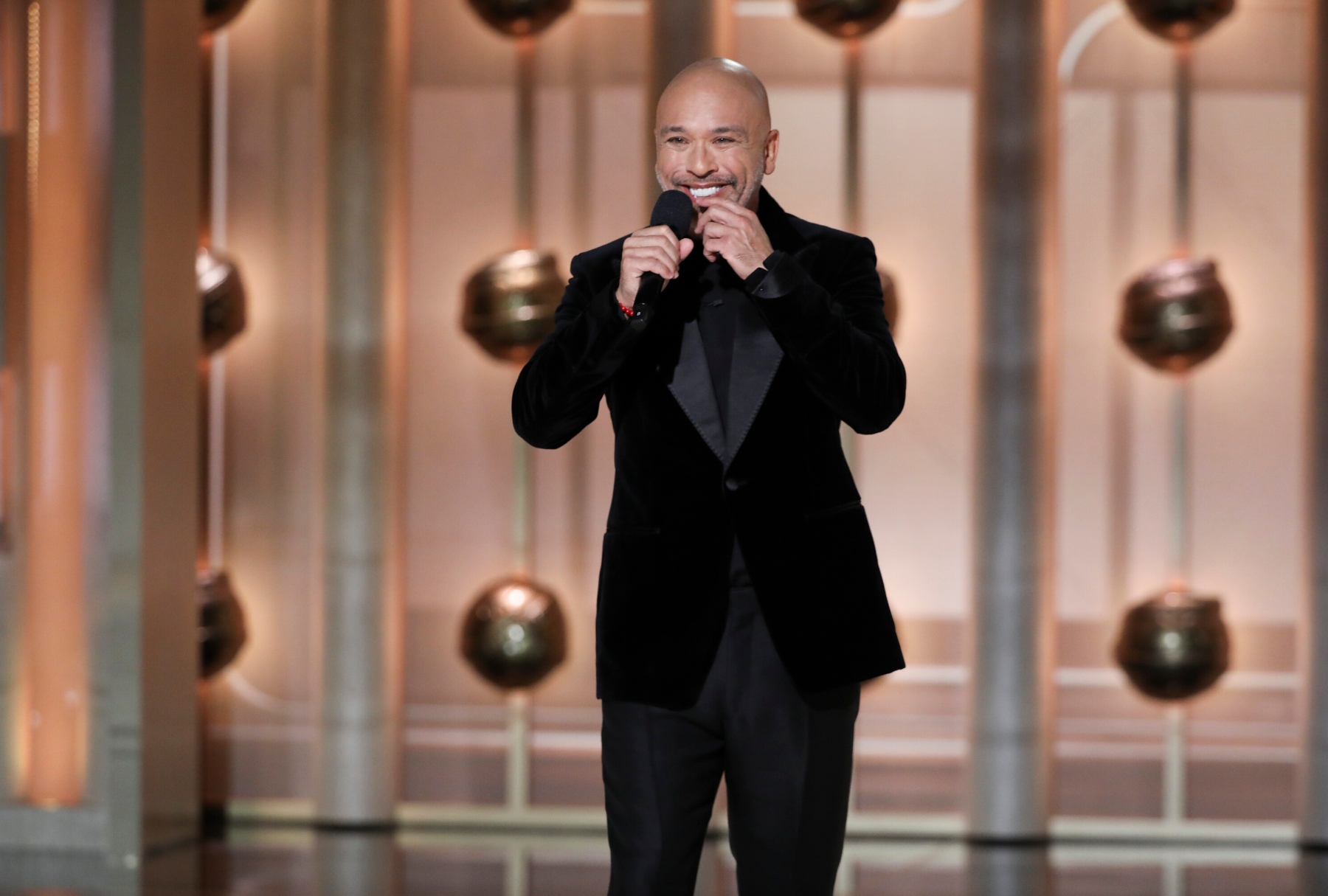
In case you didn’t watch the 81st Golden Globe Awards, which was the right call, you may be wondering why its host Jo Koy isn't featured in the photograph above these words.

If you did watch Sunday’s CBS telecast, you already know the answer. Koy bombed spectacularly. 

Hey, it happens. But it's the why of it that's especially damning. Previous Globes hosting fails have been chalked up to the ringmaster being moody and evil, a la Ricky Gervais, or occasionally funny but overwhelmingly caustic — still talking about Ricky Gervais – or bland but acceptable. Like Jimmy Fallon, who the Hollywood Foreign Press Association hired in 2017 to cleanse the foul aftertaste Gervais’ 2016 performance left behind. Tina Fey and Amy Poehler struck a perfect balance between edge and affection, making them a favorite duo, although Andy Samberg and Sandra Oh, the first Asian performer to host the Globes, earned positive marks.

Koy accepted the job on short notice after many more famous comedians declined to take the gig. Perhaps those sending their regrets or "hell nos" viewed the Globes gig as pointless, like sowing seeds on salted Earth, after Jerrod Carmichael walked onstage last year and read the HFPA for filth for hiring him because he’s Black.

A year later, the HFPA as we once knew it is no more, transformed into a for-profit enterprise owned by private equity firm Eldridge Industries. This telecast is the first to be produced by Dick Clark Productions and Eldridgea major investor in A24, the independent film company that produced the Globe-winning limited series “Beef.”

Dick Clark Productions is owned by Penske Media Corporation, which also owns every major Hollywood trade publication, but any ethical misgivings one might have had about this isn’t even in the back seat – it’s languishing at a rest stop many miles back. Regardless, this is only worth bringing up to say many, many journalists have written about the lack of necessity of awards show hosts in years where a worthy one can’t be found.

Koy reminded us of that as alleged joke after absent punchline failed to land. The room didn’t turn on him, which would have been delightful, so much as it joined all of us watching at home in wishing he’d go away.  

“I got the gig 10 days ago! You want a perfect monologue? Yo, shut up. You’re kidding me, right?” he said as the groans rolled forth. “Slow down. I wrote some of these, and they’re the ones you’re laughing at.”

What, like this one about two best movie Globe contenders? “‘Oppenheimer’ is based on the 721-page Pulitzer Prize-winning book about the Manhattan Project,” Koy said, “and ‘Barbie’ is about a plastic doll with big boobies.”

Beavis. Beavis. He said boobies, Beavis.

The room didn’t turn on Jo Koy so much as it joined all of us watching at home in wishing he’d go away.  

A joke’s provenance doesn’t matter when the deliverer can’t sell it, and a better comedian would have refused to say these words and instead gone rogue. Koy has years of experience, and yet made dumb cracks about “Saltburn” star Barry Keoghan’s genitalia being as big as Bradley Cooper’s prosthetic nose in “Maestro” and took a lifeless swipe at Robert De Niro – as a fanboy, he assured us.

“Robert De Niro, your last performance is your greatest performance — how’d you get her pregnant at 80?”

Jo Koy hosts the Golden Globes on Jan. 7, 2024 (Sonja Flemming/CBS )But his least strategic move may have been to involve Time magazine's Person of the Year. Citing the Globes’ lead-in, an NFL doubleheader, he said, “The big difference between the Golden Globes and the NFL? At the Golden Globes, we have fewer camera shots of Taylor Swift."

Thanks to this, the shot that will live in infamy is now a meme of Swift downing her cocktail while shooting daggers from her eyes.

If it were judged purely by the caliber of the winners, the 81st Golden Globes acquitted itself splendidly if predictably. A few of the early winners thanked the journalists of the HFPA, including Robert Downey, Jr., who snagged a deserved best supporting actor in a drama award for his work in “Oppenheimer.” That seemed like a jab at the old HFPA, except when one considers that the new for-profit body’s voting membership consists of 300 journalists from countries around the globe.

An October HFPA press release cited by Reuters further describes the body’s demographic breakdown as 47% female, and 60% racially and ethnically diverse. That is not the primary reason that, for example, Lily Gladstone won for her performance in “Killers of the Flower Moon,” making her the first Indigenous person to win a best actress in a drama Golden Globe. Gladstone’s performance is transcendent and deserves all the accolades it is receiving.

We need your help to stay independent

The same is true of “Beef” co-stars Ali Wong and Steven Yeun, who made history as the first Asian Americans to take home Golden Globe awards for best actress and actor in the limited series/TV movie category. On the same night Hayao Miyazaki, a living legend, took home his first-ever Golden Globe for “The Boy and the Heron.”

These are solid wins along with the expected ones for “Oppenheimer,” its star Cillian Murphy, and director Christopher Nolan, along with the wins for “Poor Things” and its star Emma Stone in the movie comedy categories.

Better, although essentially weightless in the awards realm, were the wins for “The Bear” in the best TV comedy category (although it is decidedly not a comedy) along with its stars Jeremy Allen White and Ayo Edebiri.

Succession” and its stars Sarah Snook, Matthew Macfadyen and Kieran Culkin scored Globes, and will likely have Emmys to pair with them next week. But out of all the winners, Edebiri scored with the audience by thanking her cast, agents and managers, but also “assistants! The people who answer my emails. Y’all are real ones. Thank you for answering my crazy, crazy emails.”

Then again, there were the nonsensical presentations of new awards for best cinematic and box office achievement, which went to “Barbie” after voters passed over its stars and director, and the inaugural award for best stand-up comic, a bid to appease Netflix and HBO.

"Stand-up comedy is a brutal business,” said Jim Gaffigan, a genuinely funny comedian who was not nominated, and had to hand this hollow victory to, yes, Ricky Gervais. Why can’t the HFPA quit this man?

It’s difficult to care about an awards body bent on drowning itself.

Other presenters were better at carrying forth the old spirit of the Globes, like Kristen Wiig and Will Ferrell engaging in a kooky, nonsensical dance to odd music that kept interrupting them. Their interlude reminded us of past telecasts that relied on the stars’ charisma and natural comedic timing, although a bit performed by “Spider-Man: Across the Spiderverse” stars Shameik Moore, Daniel Kaluuya and Hailee Steinfeld before announcing the best motion picture screenplay winner was fairly inspired.

“To demonstrate the importance of writers and writing, we asked that this segment be written not by writers, but by studio executives,” said Kaluuya, before turning to Moore with a stilted, “What is up, Shameik?”

“Not much, Daniel. How are you, Hailee?”

“I am relatable,” responded Steinfeld. “I am enjoying the Golden Globs. [sic]”  

I strain to imagine viewers who suffered through the full show would make that claim.


Want a daily wrap-up of all the news and commentary Salon has to offer? Subscribe to our morning newsletter, Crash Course.


It’s difficult to care about an awards body bent on drowning itself regardless of the contortions in which it engages to win back the public’s trust.

Between the declining ratings, the lingering stench of scandal, and expanding debates about its relevance, the Globes have been on life support for several years. CBS stepped in to air the 2024 telecast after NBC declined to do so, but reportedly as a trial run.  

Considering that the 2023 broadcast set a new record low by drawing an audience of around 6.3 million, the producers did not have a high bar to clear.

On the off chance that some viewers were inclined to forgive and forget, all they had to do was catch a glimpse of Kevin Costner at a table in the Beverly Hilton’s International Ballroom looking like he was caught in a hostage video. He wasn’t much more spirited as a co-presenter with America Ferrera who, bless her, stretched her enthusiasm to places that would challenge Weird Barbie’s flexibility to compensate for his lifelessness.

Nevertheless, it’s tough to fault his bad mood. CBS could have chosen to air work he’s already completed, sparing him and the rest of us the inconvenience of having to witness an award show cast with actors in no mood to celebrate.

On Sundays, CBS attracts a comparable if slightly smaller average audience than the one that showed up for last year’s Globes by airing past seasons of “Yellowstone” in primetime. In no universe could one imagine any of that show’s fans sticking around through Koy’s monologue with the hope that the remaining two hours and 50-something minutes would improve.

Those of us that did witnessed victories worth celebrating, accompanied by the sinking feeling that these history-making moments arrived just in time to beat the lights turning off for the last time on what used to be a must-see live awards event.

Kellyanne Conway is selling the GOP a dream that’s destined to backfire

The 2024 campaign season is officially kicking off this month, and despite polls showing low enthusiasm for President Joe Biden, Republicans know full well they are facing major headwinds this election year. It's not just that their likely presidential nominee, Donald Trump, is probably the most loathed person in the country. There's also the abortion issue. Ever since the Dobbs decision of 2022, when the Supreme Court ended the federal right to abortion, there's been a sustained backlash from the strong majority of Americans who do not want religious prudes in their bedrooms, dictating their most personal decisions. 

Being quiet about the goal of banning birth control does not mean abandoning those plans.

There can be no doubt that the impetus behind the abortion bans that were swiftly passed in many red states is unvarnished misogyny. That much has been evident in the drip-drip of stories of women denied abortions, even when the fetus has no chance of survival outside of the womb. It exposes the "pro-life" label for the lie it always was. The only purpose of an abortion ban is and always will be to punish women. For being sexual. For having ambitions. Even, in some cases, for simply refusing to die. After all, a corpse is the right's ideal woman: silent and without a will of her own. 

Of course, most people are grossed out by Republican misogyny so the result is that it's hurting the GOP at the polls. Enter Republican strategist Kellyanne Conway, who is desperately trying to regain some relevance after her stint as one of the more cringe-worthy talking heads of the Trump White House. Her brilliant plan to nullify the abortion issue in 2024? To "talk" about contraception. Conway has been meeting with Republican candidates, Politico reports, to argue they should "promote contraception or risk defeat in 2024." 


Want more Amanda Marcotte on politics? Subscribe to her newsletter Standing Room Only.


What would it mean for Republicans to "promote" contraception, however? One thing it certainly can't mean is taking any action to make it easier for women to access birth control. On the contrary, the favorite way of Republicans to "promote" birth control is to do everything they can to make it harder to get.

Last year, for example, congressional Democrats brought up a bill to enshrine the right to contraception into law. This was necessary, because the Dobbs decision rejected a woman's right to privacy, which is the same right that the Supreme Court invoked when establishing the right to access birth control. In fact, in his concurring opinion on Dobbs, Justice Clarence Thomas openly invited red states to ban birth control so that the court could end that right as well. But in a party-line vote in the House of Representatives, Republicans rejected this bill to protect the right to birth control. Sen. Joni Ernst, R-Iowa, blocked the bill in the Senate.

For decades, Republicans have worked to undermine access to birth control. During Barack Obama's presidency, Republicans waged an all-out war on a provision in the Affordable Care Act that required insurance plans to cover birth control, running ads and messaging campaigns about how women who use contraception are "hoeing themselves out." Republicans also repeatedly threatened to shut down the government to defund Planned Parenthood, the largest birth control clinic in the country. They are still at it, in fact: The provisional GOP spending bill in the House would terminate the federal program that funds birth control

This is the same GOP, after all, that elected Rep. Mike Johnson, R-La., to be speaker of the House. Much of Johnson's career has been geared towards taking away contraception access. Johnson has routinely used the word "abortifacient" to describe contraception methods that work by preventing ovulation. As Jessica Valenti at Abortion, Every Day has detailed, this is part of a long-term plan: First, redefine female-controlled birth control as "abortion." Then, use existing abortion bans to outlaw the pill, IUDs and other popular forms of pregnancy prevention. 

The goal was always to go through the back door, by redefining birth control as "abortion."

Johnson glibly defends his view as "pro-life," but in the context of his larger career, it's obvious he's just anti-sex. He hyped how he made his daughter swear her virginity to him in a creepy ceremony modeled on a wedding. He's bragged about how he roped his son into installing "Covenant Eyes" on their phones, so they can police each other to see if they're looking at porn. He's complained that it's "sexual anarchy" if LGBTQ people are allowed to marry. There is nothing "pro-life" about any of this. It's just the same twisted sexual obsession that drives the entire anti-abortion movement. 

But of course, Conway has no real interest in turning Republicans away from their war on contraception. She just wants them to pretend to reporters and voters that they are fine with birth control, and hope no one follows up by checking the record. That this is all about talk is evident in a well-reported article by Riley Rogerson at the Daily Beast, which illustrates how much Republicans are hoping they can B.S. their way through this issue. 

"Republicans should not make stupid political decisions and suggest that people's contraception rights should be taken away," Sen. J.D. Vance, R-Ohio, told Rogerson. "But maybe Kellyanne has a point that if you’re more vocal about it, you get some more people on board."


Want more Amanda Marcotte on politics? Subscribe to her newsletter Standing Room Only.


Note that Vance's entire focus is on talk, not action. Being quiet about the goal of banning birth control does not mean abandoning those plans. On the contrary, the goal was always to go through the back door, by redefining birth control as "abortion." The hope is Republicans can ban birth control without passing a separate bill. Being "vocal" about contraception is also vague. Trolling pro-choicers on Twitter by telling them to "use a condom" no doubt sounds fun to Republicans, but of course, that's a very different thing than writing policy so that using a condom is possible. 

True, some Republicans have loudly backed bills to make the birth control pill over-the-counter (which the FDA is already doing). But that just underscores their larger refusal to accept that birth control is a right or that it's real health care. Making the pill over-the-counter while shutting down birth control clinics and stopping insurance coverage of birth control would only make the pill a luxury for well-off people who can pay the full cost out of pocket. Nor would it do much to prevent red states from reclassifying birth control as "abortion." This plan only underscores how much rich Republicans want to preserve access for themselves while taking it away from everyone else. 

Even on the talking front, though, Conway is kidding herself if she thinks Republican politicians can keep their misogynist views from leaking out when confronted with this issue. She is a good example herself. On Fox News recently, Conway said that abortion is an "every morning" occurrence for Democrats. 

Yes, it's hyperbole. She is no doubt aware this is physically impossible. But this comment burbled up out of Conway's kneejerk urge to paint her political opponents as perverts. If she can't help herself, there's no hope for the rest of Republican politicians. Republican hostility to reproductive rights is rooted in a bone-deep rejection of female independence. That urge to start yelling about how girls these days are a bunch of sluts is hard for most of them to tamp down on a good day. If they're trying to pretend they support contraception, there's no doubt many candidates will phrase it in such a way that the "shut your legs" impulse comes roaring out

Donald Trump is possessed by a fascist mania

During the holiday season, Donald Trump and his agents did not stop or otherwise rest in their campaign to make him America’s first dictator. In that way, Trump and his forces are possessed by a type of fascist mania, a compulsive drive for victory and domination. This helps to explain why they are such master propagandists. Trump is tied with or leading President Joe Biden in many early polls.

The last few weeks of relentless attacks and raging by Trump included this Christmas Day post on Truth Social where the ex-president proclaimed:

Merry Christmas to all, including Crooked Joe Biden’s ONLY HOPE, Deranged Jack Smith…

Included also are World Leaders, both good and bad, but none of which are as evil and ‘sick’ as the THUGS we have inside our Country who, with their Open Borders, INFLATION, Afghanistan Surrender, Green New Scam, High Taxes, No Energy Independence, Woke Military, Russia/Ukraine, Israel/Iran, All Electric Car Lunacy, and so much more, are looking to destroy our once great USA. MAY THEY ROT IN HELL.

AGAIN, MERRY CHRISTMAS!

Trump is transparent and direct in his threats and promises to be America’s first dictator on “day one” of his “presidency” when he takes power in 2025. The day after Christmas Trump would reiterate those intentions, sharing a graphic on his Truth Social platform that showed how voters associate words such as “dictatorship” and “revenge” with him.  

When the autocrat, would-be dictator speaks, you must believe him.

In response to Trump‘s “scandalous” behavior and “new low” during the Christmas holiday and new year, the mainstream news media performed their tired routine of being “shocked” and “disgusted” at the obvious and predictable. Instead, the focus should have been on Trump’s increasing fascist and totalitarian escalations.

In a series of legal challenges and other moves, Trump and his attorneys have argued that he is a king or other type of divine ruler who is above the law and therefore immune from accountability for his obvious crimes including the Jan. 6 coup attempt and the larger plot to end American democracy. Such claims and arguments have been widely condemned and mocked as being alien to the Constitution and the country’s legal and political tradition and culture.

We need your help to stay independent

To that point, U.S. District Judge Chutkan wrote the following in her response to Trump’s petition to dismiss the charges against him for the crimes of Jan. 6 on grounds of presidential immunity and the Constitution:

The court cannot conclude that our constitution cloaks former presidents with absolute immunity for any federal crimes they committed while in office. Nothing in the constitution’s text or allocation of government powers requires exempting former presidents….Defendant’s four-year service as commander in chief did not bestow on him the divine right of kings to evade the criminal accountability that governs his fellow citizens.

Donald Trump’s claims to immunity have also been pushed back against for being an obvious bad faith attempt to delay his trials until after the 2024 election, where if Trump wins, he could then pardon himself for his crimes and then weaponize the Department of Justice to retaliate against his and the MAGA movement’s so-called enemies.

However, that Trump and his agents and followers would even assert such “rights” — and depending on the mood of a given Trump-nominated Supreme Court justice or right-wing judge could potentially find a sympathetic ear for such absurd arguments — embodies just how far down the road to full-on fascism and dictatorship the country has already traveled.

There was another dimension to Trump’s claims to be a dictator king that went largely unremarked upon by the mainstream news media and commentariat. During a speech in New Hampshire several weeks ago, Trump made the following announcement.

I am also going to indemnify our police officers. This is a big thing, and it’s a brand new thing, and I think it’s so important. I’m going to indemnify, through the federal government, all police officers and law enforcement officials throughout the United States from being destroyed by the radical left for taking strong actions against crime.

In essence, Trump has promised the police will be placed even more above and outside the law when they engage in thuggery and more generally violate the civil and human rights of the American people. This is a naked attempt by Trump to ensure that the country's police and law enforcement are loyal to him personally. 

Trump has indeed said similar things before (for example: empowering police to shoot and kill shoplifters). However, repetition makes such fascist and authoritarian threats and promises no less dangerous. For the news media  and other political observers to look away with a shrug of the shoulders or dismiss it as “not news” is to normalize neofascism and the condition of malignant normality that is fueling it.


Want a daily wrap-up of all the news and commentary Salon has to offer? Subscribe to our morning newsletter, Crash Course.


In a healthy democracy and society, the law protects the rights of all people equally. Moreover, the law is supposed to function as a type of social leveler that ensures that the less powerful have some protection(s) from the powerful.

By comparison, in an authoritarian society, the law is a tool for the powerful to abuse the less powerful and to assert their will and interests over others in a way that is corrupt, unaccountable, and unchecked. In many ways, this is survival of the fittest and a type of state of nature that is anathema to democracy, human flourishing, and progress. Trump and the Republican fascists and the larger white right are committed to this second project.

For all of their talk about “law and order," Trump and the other Republican fascists and “conservatives” actually view the law as primarily being a weapon they can use against their “enemies," the other, and those people they deem to be less than and not “real Americans." And for all of his claims about “backing the blue” and “Blue Lives Matter," Trump has promised to pardon the Jan. 6 MAGA rioters (a group he describes as “heroes” and “patriots” and "political prisoners") and endorses putting the Capitol police who defended American democracy on that horrible day in prison.

On this, Thom Hartmann warns in a recent essay:

As fascist followers act out their violent threats against their leaders’ perceived enemies, they get an inner sense of strength and the feeling that they’ve joined a community: that diminishes their own fear for a short while.

The more an “other” — political enemies; racial, religious, and gender minorities; women — are blamed for the ills of the nation, the more vigilante-style violence against them is justified and the more violent the future becomes.

When the state pushes back against that violence, as America did after January 6th, the calls for increased violence become even louder. Trump is practically shouting “kill them!” with a bullhorn and even our court system is afraid to stop him by throwing him into jail as they would have any other common criminal who encouraged such violence against judges, juries, witnesses, court officials, and their families.

Soon, nobody in or out of the government is willing to stand up to the fascists; it’s too dangerous and too exhausting. Being the object of regular threats of violence or death is not something anybody would volunteer for unless they saw the stakes as being very, very important.

This is what Trump and the GOP he’s captured are working toward: the silencing of dissent and accountability, replacing them with fear and a guilty complicity. Just take a look at the state of social media today, particularly Xitter and Facebook, which have dialed back on their content moderation and thus loosed the fascists on anybody who dares criticize Trump or the GOP.

In an excellent new essay at The New Republic, Brynn Tannehill makes this intervention about how close America is to being taken over by Trump and the Republican fascist Party's MAGA dictatorship and the horrors that would bring:

As bad as this is, I haven’t even gotten to the really depressing part. Most people assume that if fascism came to America, we would recognize it as individuals and refuse to go along with it. In reality, very few people are directly affected by living in an authoritarian country; life is mostly “boring and tolerable” for the majority. “Yes,” most people would say, “but if asked to do things I know were wrong, I would refuse to comply. Because I’m an American, and I know better.”

Except, we’re already testing this every day in red states, and failing miserably….

Ultimately, when the power of the state comes to bear on people, including Americans, the vast majority will not do the right thing. Most (sane) people admire Martin Niemöller, but when confronted with the reality of how fascism corrupts ordinary men, almost no one emulates his willingness to do the right thing by defying the state. When Trump takes power and turns the full might of the government against anyone who might resist, the guardrails of individual conscience will evaporate faster than a snow flurry in hell.

Trump and his agents have also repeatedly threatened to deploy the military to occupy black and brown communities in “blue states” and invoke martial law to fight “crime," i.e. crush any form of resistance or dissent. And as I warned in an earlier essay here at Salon, Trump is already empowering his MAGA followers to act as his violent enforcers when he takes back the presidency. In total, Trump and his agents are attempting to create a type of internal security force that will enforce the regime’s will and power over the American people. Such plans are almost literally from the dictator’s playbook.

Instead of feigning shock and surprise at Trump’s repeated foul and vile behavior, the American news media should instead be focusing on his and the Republican fascists and MAGA movement’s escalating threats to democracy, the rule of law, and civil society — and then educating and mobilizing the public about how to stop them.

Once again, when the autocrat, would-be dictator speaks, you must believe him. Trump and his MAGA people are declaring loud and clear exactly what they are going to do if he wins the 2024 election and becomes dictator for life.

Taraji P. Henson says cast of “The Color Purple” had to drive themselves to set

In recent months, actress Taraji P. Henson has been vocal about her disappointment with the ways in which Hollywood treats women — especially women of color — as less important and less valuable than men who take on equal or lesser roles, many of whom have less experience. 

During various press appearances linked to her role in the second film adaptation of Alice Walker's "The Color Purple," Henson has been brought to tears describing how hard she's fought to get to the point she's at in her career, saying she still finds herself fighting to be paid adequately and treated with the respect she feels she's earned. In a recent interview with The New York Times, she reveals yet another example of mistreatment, saying that producers of "The Color Purple" wanted the cast to drive themselves to set each day in rental cars, which she fought against by claiming that doing so would be a insurance liability.

“They gave us rental cars, and I was like, ‘I can’t drive myself to set in Atlanta.’ This is insurance liability, it’s dangerous. Now they robbing people,” Henson said during the interview. “What do I look like, taking myself to work by myself in a rental car? So I was like, ‘Can I get a driver or security to take me?’ I’m not asking for the moon. They’re like, ‘Well, if we do it for you, we got to do it for everybody.'”

“Well, do it for everybody," she pushed back. "It’s stuff like that, stuff I shouldn’t have to fight for. I was on the set of Empire fighting for trailers that wasn’t infested with bugs.”

Police looking into alleged physical altercation between Lauren Boebert and her ex-husband

On Saturday night into the early hours of Sunday morning, a string of curious messages began to pop up on X (formerly Twitter) regarding a physical altercation between Lauren Boebert and her ex-husband, Jayson Boebert, at the Miner’s Claim restaurant in Colorado. 

The news of the rumored scuffle first broke via posts from an anti-Boebert super PAC called “American Muckrakers,” and further circulated when the account @theliamnissan wrote, "I have a feeling Lauren Boebert is gonna trend today after witnesses in a Colorado restaurant tonight saw the congresswoman punch her estranged husband Jayson in the nose," which has now seemingly been confirmed, with area police looking into the matter and Mr. Boebert weighing in to say that, yup, it happened.

According to The Daily Beast, A Boebert aide said that Jayson called the police to the Miner’s Claim restaurant in Silt, claiming that he was a “victim of domestic violence,” adding that, as of now, no arrests have been made and that Lauren "denies any allegation of domestic violence on her part." 

“This is a sad situation for all that keeps escalating and another reason I’m moving," Lauren said in a statement to the outlet. "I didn’t punch Jayson in the face and no one was arrested. I will be consulting with my lawyer about the false claims he made against me and evaluate all of my legal options.”


Is decaf “the new sober”?

I can't handle my drug of choice the way I used to anymore. I used to think it gave me energy and made me fun. Now, even a little too much makes my mind race and my palms sweat.

Caffeine, I thought we had an understanding.

Even for those of us who don't make resolutions, the start of a new year feels like a sensible time to assess where we want to make positive changes in our lives. This year, I find that I have plenty of company in no longer identifying as a "but first, coffee" person.

A 2021 Ipsos poll found that Americans are drinking less coffee than before the pandemic, especially with regard to the amount of cups per day they consume. The poll also found a steep generational divide, with Boomers most likely to drink coffee more than once a week and Gen Z the least likely. Similarly, consumer sales of packaged coffee have been declining since 2019. It's no wonder that "Today" declared going decaf "the new sober" earlier this month.

While part of it is the steadily rising cost of coffee, a lot of it has to do with shifting tastes and values. Last year, market research company Mintel reported that "39% of coffee drinkers want to reduce their caffeine consumption." The word "reduce" is key here: I'm as likely to go completely caffeine free as I am to become a teetotaler or a vegan, but I likewise recognize that I feel a whole lot better when I indulge a whole lot less.

For starters, there's the headache factor. Feeling like I have a short window of time in the morning to drink coffee before an epic, throbbing headache kicks in is just ridiculous — especially when I'm traveling and trying to adjust to different time zones.

"Caffeine is a huge issue for people with migraines," Jon Katz, founder of the migraine-friendly food brand Amia, says. "Caffeine is known as a vasoconstrictor, which means it constricts blood vessels in the brain. The interesting thing is that migraines happen when blood vessels dilate, so the caffeine actually helps alleviate an active attack, but then it causes rebound when the caffeine wears off."

According to Katz, reducing his caffeine intake has "helped tremendously" in reducing his migraine frequency.

"My reduction in caffeine has helped tremendously in reducing my migraine frequency," Jon Katz says. 

As the anxiety prone and sleep starved among us probably already know, there are loads of other reasons to keep caffeine consumption in check.

"While it it provide a temporary boost in alertness and cognitive function," says Paul Daidone, Medical Director at True Self Recovery, "excessive caffeine consumption can have negative effects on your health, including insomnia, nervousness, restlessness, stomach upset, rapid heartbeat and muscle tremors."

Daidone notes that the U.S. Food and Drug Administration "suggests a maximum intake of 400 milligrams of caffeine per day for most adults. This is roughly the amount in four cups of brewed coffee. However, individual tolerance to caffeine can vary, and some people may experience side effects at lower amounts."

I get palpitations just thinking about drinking four entire cups of joe, but of course, coffee isn't the only source of caffeine. Switching to herbal tea or decaf in the morning if you're still chugging Coke or Snapple in the afternoon won't do much to break the dependence. Not all teas are created equal, either.

"A lot of people make resolutions to cut out coffee, to eliminate caffeine from their diets, yet they’re replacing coffee with matcha, which also has caffeine," Nancy Mitchell, a registered nurse and a contributing writer at Assisted Living, says. "Green teas are one of the sneakiest sources of caffeine because most people don’t suspect that herbal brews would contain any of that."

"People make resolutions to eliminate caffeine from their diets, yet they’re replacing coffee with matcha, which also has caffeine," Nancy Mitchell says.

Then there's my greatest love of all: chocolate.

"The source of caffeine that tends to sneak up on people the most is chocolate," Catherine Rall, a registered dietitian with the women's wellness company Happy V, says. "We all know about caffeine in things like coffee and cola, and most people who are strongly affected by caffeine know better than to drink caffeinated beverages in the afternoon or evening. But the evening is also when we tend to have desserts or little indulgences at the end of a hard day, and for many of us, that indulgence is chocolate."

A 1-ounce portion of dark chocolate can have up to 23 milligrams of caffeine. That isn't a huge amount, but it's enough to feel the effects or exceed one's daily comfort level.

Even though it's pretty easy to spot where caffeine is lurking (unlike salt and sugar, which can be sneakier), and even though most of us prefer fewer headaches and better sleep, kicking dependency can be tough.

For me, even a slight uptick in my caffeine consumption (a "bottomless cup" breakfast out, an afternoon iced tea) can lead to a miserable cycle of headaches and jitters — and feeling like I need more caffeine to stave them off.

Paul Daidone recommends tapering down by starting small.

"Instead of going cold turkey," he says, "consider reducing your caffeine intake gradually. This might mean brewing a half-caff blend (half regular, half decaf coffee) or reducing your daily intake by one drink each week until you reach your goal."

We need your help to stay independent

"Dehydration can worsen withdrawal symptoms," he also notes. "Be sure to drink plenty of water throughout the day. And get enough sleep: Adequate sleep can help your body adjust to the decrease in caffeine and reduce feelings of fatigue."

I know that a big part of my love affair with coffee has always been tied to the ritual and the rhythm of it. We consume things not only for the taste but also the experience. Most days now, a cup of decaf (which has about 2 milligrams of caffeine) in the morning is enough to make me feel like I'm still enjoying something I love.

It helps that decaf has come a long way from the foul instant decaf my grandmother used to sip when I was growing up. As barista Laura Honey wrote in Homes & Gardens last year, "newer, gentler methods" of decaffeinating coffee while retaining "the oils, antioxidants, and fiber that you would drink from a regular cup of coffee" means that there are plenty of decent options that evoke the flavor of the hard stuff without the stimulants.

For my fellow morning caffeine drinkers who don't do decaf, moving over to herbal tea or the southern standby chicory can a reasonably painless switch. If the caffeine source is cola — and more than half of Americans are drinking soda every day — a shift to flavored seltzer can offer a similar kick.

I still enjoy an espresso on a weekend now and then, and I love chocolate, though I'm frugal if I consume it in the evening. Getting off the over-caffeinated hamster wheel has helped me exponentially in managing three of the biggest banes of my existence — headaches, sleep deprivation and anxiety — but the key to feeling happier and more alert in the morning still comes down to what I pour in my mug.

“All Creatures Great and Small” reminds us that lambing and living continues even in times of war

Funny how some shows manage to meet us exactly where we are, regardless of when their stories are set. Season 4 of PBS Masterpiece's "All Creatures Great and Small” opens in 1940, and at Easter, reminding Northern Hemisphere dwellers in 2024 that warmer days are ahead. Darrowby’s villagers are enjoying each other’s company when they’re beset by a small menace, a local boy determined to make mischief.

Its writers never pretend that the Dales folk have lives free of difficulties, positing instead that the way to overcome hard times is to pull together, which isn’t always easy.

James Herriot (Nicholas Ralph) knows small creatures misbehave when they’re hurt but puts himself in harm's way nevertheless – not for the boy, initially, but for his pet. Herriot and his boss Siegfried Farnon (Samuel West) have a knack for diagnosing illnesses in animals and healing the humans who care for them in the process.

All Creatures Great and Small” thrives on gentle tension, not tragedy, so it won’t ruin anyone’s enjoyment to say that it all works out. James figures out what's hurting the boy and helps him become a better person. Loneliness is what ails him, exacerbated by rejection. Being useful to and valued by others cures him. His road to betterment includes visits with dogs, a lamb and other adorable fauna. Life goes on, and peacetime in Yorkshire Dales continues apace.

But this is intentionally illusory, a kind way to ease viewers into grimmer realities. World War II has transformed all of Britain, and although the Dales are as serene as ever none can remain untouched by the conflict on the European continent.

Skeldale House’s close-knit family of choice is missing Siegfried’s brother Tristan who went off to war in Season 3, and James and Helen (Rachel Joy Shenton) struggle to find time for themselves now that the expanding practice has one fewer set of hands and many more small animal patients.

The usual problems, only with fewer creature comforts due to rationing. Even the resourceful and talented Mrs. Hall (Anna Madeley) can only do so much to make poor ingredient substitutions taste the way things do in times of plenty.

All Creatures Great and SmallAll Creatures Great and Small (Playground Entertainment/Masterpiece PBS)“If it wasn’t for the ration box and the victory gardens, you’d have no idea there’s a war on,” cracks the Drovers Arms’ barmaid Maggie (Mollie Winnard) as she pours out a pint for her friends. But that's not quite the case. The episode after finds James and Helen helping her father during lambing season as cuteness abounds, when their romantic break is interrupted for a moment by soldiers jogging down the road, rifles in hand. 

More than a mere pandemic comfort, “All Creatures Great and Small” first debuted days after the January 6, 2021 insurrection, soothing our tensions with visions of broad emerald fields and simpler times that were never quite so. Its writers never pretend that the Dales folk have lives free of difficulties, positing instead that the way to overcome hard times is to pull together, which isn’t always easy. James gets his block knocked off trying to help someone Siegfried warns him is beyond help.

“All Creatures Great and Small” remains a solace as it reminds us that even in places greatly removed from battlefronts it was impossible to check out entirely.

Then again, that’s always Siegfried’s initial diagnosis before coming around to a more humane if not necessarily convenient alternative. But there is no circumventing the inevitabilities imposed by the war, no matter how far away Darrowby is from London and the front. Life goes on as usual with everyone knowing the demand the fight requires could change everything in broad ways and very intimate ones.

We need your help to stay independent

“All Creatures Great and Small” remains a solace as it reminds us that even in places greatly removed from battlefronts it was impossible to check out entirely. Many people seem to be doing that in 2024 as two major wars rage on, each with the potential to drastically reshape global politics and each hitting us at home.

It has never been easier for the average American to treat deadly conflicts like background noise. Unless a person has a direct stake in these conflicts or makes a conscious effort to stay up-to-date on their developments, distractions abound.

Many of our neighbors don’t have such luxury – they’re contending with Islamophobic and antisemitic threats and agonizing over their relatives' and loved ones’ safety. Our part of the world strolls onward, and many people gripe over the rising energy costs without connecting that spiking expense to the war in Ukraine.


Want a daily wrap-up of all the news and commentary Salon has to offer? Subscribe to our morning newsletter, Crash Course.


Tallying the lives lost and other horrors people in war zones are experiencing every day would be crippling. All this, and we’ve entered a year expected to determine whether our democracy will remain intact.

Facing all these things makes the respite these seven new episodes offer feel all the more necessary and responsibly presented, offering relaxing weekly breaks that gently remind us that generations before us made it through extraordinarily anxious times while prioritizing life above all.

“If this war has taught us anything, it’s to grab onto the things you love and try to cherish every moment,” says Helen. That could be the hand of a loved one or the paw of a treasured pet – the Herriots and the rest of Skeldale House see no less value in either, or any life, a sentiment worth holding close in any uncertain time.

Season 4 of "All Creatures Great and Small" premieres at 9 p.m. Sunday on PBS member stations. Check your local listings.

New details revealed about Trump’s disinterest in helping to stop the Jan. 6 riot

Three years after the Jan. 6 riot, new information is still being discovered about Donald Trump's state of mind on the day in question, primarily trickling in from sources who were in close proximity to the former president as his supporters stormed the Capitol building.

The results of a probe conducted by Special counsel Jack Smith's team contains intel from Trump's former deputy chief of staff, Dan Scavino — who is now a paid senior adviser to Trump's reelection campaign — whom sources state told Smith's investigators that "as the violence began to escalate that day, Trump 'was just not interested' in doing more to stop it, according to first reporting by ABC News

The outlet's coverage of the probe additionally highlights that "Sources also said former Trump aide Nick Luna told federal investigators that when Trump was informed that then-Vice President Mike Pence had to be rushed to a secure location, Trump responded, 'So what?' — which sources said Luna saw as an unexpected willingness by Trump to let potential harm come to a longtime loyalist."


Why a supplement that tints skin blue is all the rage among alternative health circles

The HBO docuseries "Love Has Won: The Cult of Mother God" begins with a jarring image. The corpse of the cult leader, Amy Carlson, laying in a bed, wrapped in blankets and string lights. She is noticeably gaunt and her face is a very blue color. When Carlson died in 2021 at the age of 45, a coroner’s report deemed her cause of death to be “alcohol abuse, anorexia and chronic colloidal silver ingestion.”

While discoloration of the face is a natural part of the death process, Carlson’s face started to turn blue long before. That’s because she was ingesting large amounts of colloidal silver, which are small particles of the metal silver in a liquid solution. The particles are small enough that they don’t sink and can be delivered in a tincture-like form.

The docuseries makes it clear that colloidal silver was a big part of not only Carlson’s health regimen, partly guided by the so-called Galactics, which included the late Robin Williams, but it was also an alternative health remedy that the cult widely promoted to its followers. They even sold bottles of their own colloidal silver online, which they touted as a “cure-all” substance and one of the “most healing” medicines on the planet that can boost the body’s immune system.

Thanks to the docuseries, colloidal silver has materialized in popular culture once again, but it’s not the first time. During the COVID-19 pandemic, Alex Jones promoted colloidal silver as a treatment for the coronavirus. Gwyneth Paltrow once told Dr. Oz that colloidal silver “really keeps viruses away.” Before Paltrow, libertarians gravitated toward colloidal silver in the early aughts in part thanks to a man named Stan Jones, who also turned blue from ingesting too much colloidal silver. Jones latched onto it at the turn of the millenium after attending a so-called “preparedness expo" for the impending Y2K crisis, which thankfully never materialized, for fear that antibiotics would be in short supply

Most medical experts advise against ingesting silver — especially in large amounts. That’s because too much of it can build up in a person’s body and lead to argyria, which is the condition that Carlson and Stan Jones both had that turned them a blue. While argyria alone isn’t a serious health condition, it doesn’t go away when a person stops ingesting silver. Plus, too much silver can be fatal. 

"There’s really no evidence at all that taking colloidal silver has any health benefits."

“If you take a very large amount or injected IV, those types of things, then that can cause organ failure and you can get very, very sick,” Rob Hendrickson, the medical director of the Oregon Poison Center at Oregon Health & Science University, told Salon. When people experience argyria, Hendrickson said, is the result of silver building up in the skin. This is why it can look more blue when exposed to sunlight. “It all really comes down to silver being impregnated in the layers of your skin, and then eventually it gets sort of activated by sunlight to turn into a blue color.”

Historically, silver has been known to help the healing process for venous leg ulcers and heal wounds. Hendrickson said there are some catheters used today that are coated with silver to decrease the risk of infection. Notably, these are topical uses — not internal. “While putting silver on a specific bacteria or on a wound can decrease infections, there’s really no evidence at all that taking colloidal silver has any health benefits,” Hendrickson said. “Certainly not decreasing infection rates.”


Want more health and science stories in your inbox? Subscribe to Salon's weekly newsletter Lab Notes.


Yet tinctures continue to be sold (sometimes for more than $100 per vial) and promoted on social media platforms like TikTok. What is it about ingesting silver that keeps hooking both alternative-health seekers? Hendrickson said he thinks there is a certain fascination with metals, or the idea that an element like silver could be a cure-all.

Derek Beres, co-host of the Conspirituality Podcast, told Salon he agreed that there is a preoccupation with precious metals, and it goes a bit deeper than that. Specifically, the jump in logic from how silver can be a topical treatment to an internal one speaks to “the idea that the inner world and the external world are one-to-one matched.” It’s the same logic behind “manifesting” or “becoming your thoughts.”

“If I put silver on a wound and it heals it well, then it must do the same thing to my organs,” Beres explained. “This is a real lack of scientific literacy, of course, but this is why I think this is so popular.”

"The countercultural left and the far right both converge on their distrust of corporations and institutional expertise."

Some might be surprised that colloidal silver has been embraced by both the far left and far right. The Love Has Won cult attracted more New Age types, while on the far-right so-called “preppers” and “survivalists” have colloidal silver in their survival kits. Beres said it shouldn’t come as a surprise because there are many supplements these two groups have in common.

“That crossover has existed for a long time,” he said. “And I do think it's that anti-establishment sentiment that exists between those groups.” 

Dr. Stephanie Alice Baker at City, University of London, who wrote the book Wellness Culture, agreed that the anti-establishment sentiment is what brings the two groups together in the health world. 

“The countercultural left and the far right both converge on their distrust of corporations and institutional expertise,” she said. “Whereas qualified experts are often seen as commercially and politically compromised, these groups privilege renegades, figures such as Andrew Wakefield, and ‘native expertise’ intuited and experienced through the body."

Beres said that there is also the sentiment of declinism that both groups have in common, which is the belief that a society or institution is on the decline. It sparks a certain kind of romanticized nostalgia that the past was better, especially in terms of healing. 

We need your help to stay independent

“The idea that we need to take cues from the past and get back to that place,” he said. “Nevermind that supplements are all made in laboratories and that sometimes they're using pharmaceutical-grade ingredients.”

While it’s true that there are many life-saving medical treatments and vaccines available, and people aren’t faced with as many life-threatening diseases and illnesses as they were in the past, the structure of America’s healthcare system enables such pseudoscience to persist. As my Salon colleague Mary Elizabeth Williams once wrote: "It's not hard to see why opening up your chakras sounds more appealing than some once a day pill that's constantly being peddled on Hulu." For this reason, Beres said he has empathy for those who seek out remedies like colloidal silver. 

“It’s so frustrating to live within a system where profits trump actual medical care unless you're at a certain threshold financially with which most of us are not,” he said. “People are just frustrated with healthcare and with politics in general, so they're going to look to other sources to try to take care of themselves.” 

Restricting obese women from IVF is discriminatory

In the U.S., nearly 100,000 babies were born through assisted reproductive technology, such as in vitro fertilization, in 2021, and as people postpone parenthood to older ages, such technologies are growing in demand.

IVF has the potential to realize the dreams of many would-be parents, but thousands of women of reproductive age in the U.S. may face barriers to accessing treatment — sometimes, even before setting foot in a fertility clinic.

These women all have something in common: They have a body mass index that categorizes them as obese or severely obese. BMI is calculated via a formula that takes height and weight into account, with BMIs between 18.5 and 25 considered to be a “healthy weight.” Most clinics in the U.S. exclude women with a high BMI from accessing IVF because of concerns that the procedure may be too medically risky, and that IVF treatment will be less effective in higher weight individuals. The cut-offs are not consistent across clinics but broadly can be between 35 and 45. And such guidelines are not unique to the U.S.: Around the world, BMI restrictions limit women’s access to IVF treatment.

Despite the widespread exclusion, critics have argued that these restrictions are not medically or ethically justified.

First, we must acknowledge that IVF can be challenging for everyone, and less than half of embryo transfers result in a live birth — a success rate that lowers dramatically with age. Yes, IVF success is lower for higher weight women, but it doesn’t have a substantially different success rate. Analysis of a quarter million IVF cycles in North America found that live birth rates in women categorized as normal weight (BMI between 18.5 and 25) were 31.4 percent, compared with live birth rates of 26.3 percent for women classified with class 2 obesity (BMI between 35 and 40).

Furthermore, although research has shown a slightly higher risk of minor complications during IVF egg-retrieval, serious complications were uncommon in women with a high BMI, according to one 2019 study.

Whether elevated risks justify outright denial of treatment is a pertinent question. Philosophers and ethicists have urged us to think about it another way: Pregnancy is a stressful, risky, and taxing bodily process for women of all weights. There is always the possibility that things could go wrong, and denying the opportunity for pregnancy based on an imprecise proxy for health is simply unfair because it systematically removes the reproductive choices of an entire group of people.

Denying the opportunity for pregnancy based on an imprecise proxy for health is simply unfair because it systematically removes the reproductive choices of an entire group of people.

A multitude of social, structural, and medical factors demonstrate that BMI limits are discriminatory. In a 2022 article, obstetrician-gynecologist Breonna Slocum and colleagues discuss how women from racially and socially marginalized communities are more likely to meet the criteria for obesity and by default be excluded from IVF. BMI is now being criticized as an inappropriate measure for people of color as it was developed using data primarily collected from previous generations of non-Hispanic White populations.

BMI restrictions also do not often consider the impact of health conditions affecting weight such as polycystic ovary syndrome, or PCOS. Women with PCOS are likely to struggle with both fertility and losing weight. And we should question why systems regulate women’s bodies so much without much thought for the male partner or sperm donor. When researching IVF clinic policies, I noticed a striking absence of restrictions regarding male characteristics such as weight, age, and lifestyle, even though IVF outcomes are negatively influenced by sperm DNA damage.

In reality, women try desperately to lose weight in order to qualify for treatment. And if women can improve their health through weight loss, shouldn’t they at least try? Weight loss before fertility treatment may not be helpful or even possible for most women. Most IVF clinics also have age limits, and egg reserves that get depleted over time mean weight loss could simply take too long to be worth it.

A recent review of clinical controlled trials found that weight loss achieved through structured dieting and exercise programs prior to IVF did not appear to improve live birth rates. The authors conclude that it is difficult to even assess these interventions as many people regain weight quickly. This “yo-yo dieting” stresses the cardiometabolic system and can increase the risk for diabetes, leading to worse health in the long term.

Quick-fix weight-loss medications also need to be carefully investigated before being offered as an option to women. Richard Legro, a professor of obstetrics and gynecology at Penn State College of Medicine, led a randomized trial on lifestyle interventions before IVF. In an interview, he told me that new weight-loss drugs such as retatrutide have potential to help women lose weight, but these medications can be more expensive than fertility treatment itself, and companies are cautious about potential risks to the developing fetus.

Why, despite the lack of medical evidence, do BMI limits on IVF persist, and why are clinics so reluctant to allow women in larger bodies to access IVF?

Health care decision-making is as much a messy social practice as it is a cold cost-benefit analysis. Research on health care rationing has found that emotional intuition can influence whether a patient receives treatment or not. Practitioner and policymaker decision-making can be based on irrational judgments as much as objective evidence because we all hold underlying morals, values, and feelings about what is right.

There is also tension between those who view obesity as a medical problem and others who understand “fatness” to be a socially constructed identity. While there is a dominant narrative in medicine that obesity is a lifestyle disease, critics argue that our ideas of health are shaped not only by medical evidence but also by our cultural preference for thinness.

Weight loss before fertility treatment may not be helpful or even possible for most women.

Western societies tend to hold the view that obesity is an unhealthy personal choice and a moral failing. As a result, negative attitudes and beliefs about body size can affect health care decision-making.

Experimental studies on weight prejudice have found that powerful negative feelings for people in larger bodies can affect their treatment in everyday life, and research has shown that weight bias persists in medical settings. These so-called moral emotions may shape how we interpret the evidence in front of us. We need to question whether it is fair to make people jump through hoops of social approval just to access the same fertility care as everyone else.

Policies do not explicitly acknowledge the cultural discourses shaping our views. And as BMI restrictions differ by geographical area and clinic — even within the same country — there is a blurry, subjective line between those deemed too outside the norm and those who are just acceptably thin enough to receive treatment.

The women seeking fertility care who fall victim to these arbitrary boundaries are being silenced by systems that do not consider a patient’s autonomy, their ability to lose weight healthily, or their personal risk profile. This needs to change. In 2021, the American Society for Reproductive Medicine Practice Committee recommended that a process of shared decision-making should guide larger patients’ access to IVF treatment. Currently, clinics give too much weight to shaky evidence and snap one-sided judgments.


Becca Muir is a Ph.D. candidate at Queen Mary University of London researching fertility care access. She has written for outlets such as New Scientist, The Guardian, Prospect magazine, and elsewhere. 

This article was originally published on Undark. Read the original article.

Trump the Confederate

Republicans are still losing their minds about the ruling by the Colorado Supreme Court and the 34-page ruling from Maine’s secretary of state that former president Donald Trump’s name cannot appear on those states’ primary ballots because he engaged in insurrection against the United States.

One of the arguments being made against this by Republicans is that the section of the 14th Amendment that speaks about public servants who have broken their oath of office should apply only to the era in which it was adopted.

No American should ever forget that for the first time in our history, a Confederate flag was carried through the U.S. Capitol by a member of Trump’s mob.

Even if you aren’t a so-called originalist or textualist (or, let’s just make a fun new term up: wordualist) in your reading of the Constitution, which all the conservative judges on the Supreme Court more or less are, there’s nothing to the argument that this applies only to the traitorous men, former officers of the United States, who served the Confederacy. It may have been ratified, in the summer of 1868, to account for such actions by public servants, but it was adopted to protect the country and the individual states from such behavior in the future. 

Section III of the 14th Amendment says precisely nada about the Confederacy:

No person shall be a Senator or Representative in Congress, or elector of President and Vice President, or hold any office, civil or military, under the United States, or under any state, who, having previously taken an oath, as a member of Congress, or as an officer of the United States, or as a member of any state legislature, or as an executive or judicial officer of any state, to support the Constitution of the United States, shall have engaged in insurrection or rebellion against the same, or given aid or comfort to the enemies thereof. But Congress may by a vote of two-thirds of each House, remove such disability.

No matter how you read it or what your political affiliations may be (or what you say to pollsters), you know that Trump at the very least gave aid and comfort to the mob he had called to Washington, DC. You also know he refused for hours to call them off as they broke through police lines, engaged in vicious hand-to-hand combat with officers of the law, and rampaged in the Capitol. 

When Trump finally called off the mob (only when he saw his insurrection had failed), he spoke of his love for them and how “special” they were (even though he reportedly was embarrassed by how low-class and “trashy” they looked as he otherwise thoroughly enjoyed watching the mayhem on television). In sending them home, he made sure to repeat his Big Lie about the election results which, to Trump and his mob, justified the whole thing.

All reasonable people in what is left of our dis-United States and abroad know that Trump, and others at his rally, incited that mob. It was his last-ditch attempt at overturning the 2020 election after each of his other schemes had failed — bringing no evidence of fraud in the scores of lost lawsuits; leaning like a mob boss on state officials of swing states, such as Michigan and Georgia (where he demanded those 11,780 votes be “found”); goading the vice president to not be “a pussy” and then putting his life in real jeopardy to stop the count; creating a bunch of fake electors with phony documents from battleground states. 

He reportedly was well aware that many he had called to Washington, DC (“Be there, will be wild!”) were armed with guns and makeshift weapons and insisted that metal detectors be turned off so they could gather close to hear what he had to say about a “stolen” election and going to the Capitol to “fight like hell.” 

What did he say about switching off the detectors? “They’re not here to hurt me.” 

He’s still praising members of his ragtag insurrectionist army, many of whom are rightly in jail. He calls domestic terrorists “patriots” and says he will pardon them if he becomes president again.

Aid and comfort.

As others have noted, Section 3 of the 14th Amendment is not a penalty but a disqualification. If you have proved yourself to be a danger to the continuation of the country or a state in our union, you can no longer appear on any ballot for any governmental position.

So, all of this is as clear as, say, the facts that — oh, I don’t know; let’s pick some random ones. Like how Trump lost the popular vote to Hillary Clinton by nearly 3 million votes in 2016; how he lost badly to Joe Biden, by more than 7 million votes (and the Electoral College 306-232) in 2020 and didn’t actually “win most of America”; how the attendance at his “American Carnage” inauguration was slight to most observers and reported accurately; and that big boys and girls stay for the inauguration of their successor and don’t fly away, with top-secret documents, in a huff.   

We need your help to stay independent

But just for the argument’s sake, given that some on the Supreme Court may want to consider it as an “out” for Trump, let’s compare what the ex-president and his many Lackeys of Bad Faith have done, and continue to do in terms of injuring the federal government and many state governments, with the actions taken by the leaders of the Confederacy. 

Trumpists may not have officially seceded from the nation to set up their own government with a new capital, but they’ve worked a relentless inside job on our government and sense of national unity, destroying norms of conduct, speaking of political opponents as enemies (and worse, most recently, vermin), calling the free press “the enemy of the people” and insisting on what they like to call “alternative facts” to confuse voters. They and their media cynically push a narrative of victimhood to gin up MAGA.

These people long ago left the rest of the nation. Trump never tried to be president of all the people, just for his “fans.” I suppose historians can point to T-shirts saying “I’d Rather Be A Russian Than A Democrat” or unmasked faces during a deadly pandemic or, say, those fake elector documents as the de facto proclamation of secession.

The leaders of the Confederacy wrote God into their new constitution and proclaimed a new “Christian nation.” With the creeping help of dominionist evangelical leaders pushing “spiritual warfare,” Trump raised his cult army and prodded them to act violently. On Jan. 6, 2021, he sent that already riled-up mob to the Capitol with these dire words: 

“We fight like hell. And if you don’t fight like hell, you’re not going to have a country anymore.” 

It was like he was sending a group out to do a task on “The Apprentice,” except this exercise in teamwork served for him solely, and he knew his minions were armed and ready to explode. And the task was a coup against the government of the United States of America.

Trump regularly sends forth similar lines of incitement, usually typed in all caps on his failed social media platform cynically named for the truth. (As a holly-jolly Christmas message — Christmas being such a crucial holiday to Republicans that they have insisted there’s been some kind of war against it for decades —  he wished that our current president and others should “ROT IN HELL.”) 


Want a daily wrap-up of all the news and commentary Salon has to offer? Subscribe to our morning newsletter, Crash Course.


Compared with the ongoing slow-motion coup of Trump and his many enablers, what the leaders of the Confederacy did looks rather forthright and almost gentlemanly (if such a term can be used to describe men whose mansions and foppish lifestyles were utterly dependent on the brutality of owning, working, whipping and trading human beings).

As historian Jill Lepore notes in an essay in The New Yorker, Jefferson Davis gave a farewell speech to his fellow senators in 1861 before he became president of the Confederacy. They were traitors to their country, but they were clear about their intentions, although they also cynically used religious belief and relied on other alternative facts to propagandize their cause.

The Civil War began with the attack on Fort Sumter on April 12, 1861, six days after South Carolina seceded. Trump’s War on America — the concept of the United States as a melting pot of immigrants — can be traced to his racist commentary on the 9/11 attacks and his later racist questioning of the legitimacy of a sitting president. As a politician, he moved on to a systematic degrading of political norms. He then quickly escalated his degraded rhetoric to various calls for violence — from encouraging the beating of protestors at his rallies to calling for attacks on state capitals, the latter that resulted in the attempted takeover of the Michigan Capitol building and the plot to kidnap and execute the governor.

To take the argument a bit further, what was the Confederacy but a distinctly anti-democratic enterprise, one that attempted to enshrine a white patriarchy forever? Sounds completely familiar, except that the current leader of those trying to destroy the country and enshrine minority rule forever has different models of dictators to learn from — such as Adolf Hitler, Vladimir Putin, and Victor Orban. One should not forget that the Nazis sent lawyers to this country to learn from our white supremacist Jim Crow laws. You would not be unjustified to imagine the Confederate battle flag morphing into the swastika.

Trump is a hero to many in the South and many Western states because, cossetted New York rich-boy though he may be, Republican voters see him as a rough-and-ready fellow rebel. Of course, he decried the removal of the many statues of traitors that were erected in the old South by The United Daughters of the Confederacy in the first decades of the 20th century as a public relations sop to the “Lost Cause” myth. Returning to the presidency and finishing the hit job he started on the foundations of democracy is his cause. He has proved himself willing to do or say anything to not lose in this effort.

The motto of the Confederacy was Deo Vindice, Latin for “God will protect, defend or avenge.” Sound familiar? 

So is it democratic to remove Trump’s name from the ballot? As others have noted, yes, it is. Courts make decisions all the time, based on the Constitution, that voters have no say in. And the call to “leave it to the voters” means nothing to Trump, given that he disputed the 2016 election results, before and after, and continues his Big Lie about the 2020 election.

As Sabrina Haake, a federal trial attorney with deep expertise in 1st and 14th Amendment cases, writes in Salon:

Orchestration of violence at the U.S. capital on Jan. 6 was, at its core, Trump’s effort to disenfranchise the more than 81 million Americans who voted for Joe Biden, just as secessionists attempted to disenfranchise Lincoln supporters. 

The truth is, Jan. 6 was not even the culmination of Trump’s insurrection against our government. He’s still at it, riling up his crowds with the Big Lie and engaging in agitprop against American leaders, critical governmental institutions, individual judges, poll workers, journalists — anyone who dares speak out against him. (His latest proof of the 2020 election being rigged is a 32-page unsigned document that makes unfounded claims that “reference” a bunch of other unfounded claims, sort of like a Russian nesting doll.) Speaking of Russia, as I’ve said before, if he isn’t working directly for Putin, he might as well be. And there is a long list of Trump’s fellow insurrectionists who also should never be allowed to run for any public office again.

So, to the Supreme Court, let me point this out: As much as Trump likes to performatively grope the American flag, he might as well have been wrapped in the Confederate flag on Jan. 6, 2021, and singing Dixie as his violent mob departed from his scene of a thousand crimes and many grievous injuries, some fatal. The 14th Amendment disqualification applies here no matter how you look at it.

No American should ever forget that for the first time in our history, a Confederate flag was carried through the U.S. Capitol by a member of Trump’s mob. (And, yes, the war we still seem to be fighting was about slavery, not states’ rights or “freedoms,” whatever that’s supposed to mean in the context of slavery.) And so, as Peniel E. Joseph writes in The Atlantic, the work of Reconstruction must go on.

Even if the FedSoc-sponsored conservatives on the Supreme Court were to twist themselves in knots to somehow read the disqualification rule in historical context, they’d have to come to the same conclusion (whether or not they rule that way): Trump stands, smirkingly, not only with Russia’s Putin but with the Redemptionist Lost Cause Confederates.