Spring Sale: Get 1 Year, Save 58%

“I like to be right alongside with my characters”: Charlotte Rampling on her career, acting “flow”

“Juniper,” out April 4 on demand, gives the incomparable Charlotte Rampling another plum part at Ruth, an ornery, alcoholic grandmother currently using a wheelchair with an injured leg. Her son, Robert (Marton Csokas) has a difficult relationship with her, so he leaves Ruth in the care of her troubled teenage grandson, Sam (George Ferrier), along with a nurse, Sarah (Edith Poor). Sam, who is not pleased by this development, is contemplating suicide as he is dealing with a suspension from school as well as the loss of his mother. Of course, grandson and grandmother bond as they get to know each other and find they are more alike than not.

“There are different ways of playing characters. If you have a particular way of being with yourself in your own character … that’s the best way because there is kind of authenticity and distance.”

Although it does feature a death-obsessed teenager and an older woman who embraces life, and encourages Sam to find some happiness, thankfully, writer/director Matthew J. Saville’s chamber drama is no “Harold and Maude

“Juniper” refers to the gin Ruth drinks in massive amounts, and Rampling plays this feisty grandma with equal parts stubbornness and insouciance. She can get Sam to do something just by giving him a withering look. And she is not against throwing her glass at the teen’s head when he waters down her pitcher of gin. 

Rampling excels at playing formidable characters like Ruth such as her Oscar-nominated performance in “45 Years” to her dazzling turn in François Ozon’s “Swimming Pool.” She recently spoke with Salon about making “Juniper” and playing unfiltered characters. 

Ruth is a hard drinker who imbibes bottles of gin. What do you like to drink?

I like to drink red wine. Good, French red wine. That’s the reason I’ve ended up living in France!

There’s good wine now all over the world. Used to be very exclusively French, but it’s not that anymore. 

You often play formidable characters who size up others with a withering, intimidating glance. Ruth certainly sizes up characters, from Sam, to a priest who visits, to even her grandson’s friends. As an actress, you certainly are observant about people. What details inform you about someone’s character?

It’s an instinctive thing. I came into acting — I was picked up off the street as they say, which may not be appropriate to say nowadays, but it was in the ’60s. Someone said, “Come and do a part in a film,” when I was 17, and it all went on from there. I never did proper [acting] school. I thought, I am just going to learn it my way, which was observing how people are and how I feel people are. There are different ways of playing characters. If you have a particular way of being with yourself in your own character — and that suits the character — that’s the best way because there is kind of authenticity and distance. It’s casual, there’s a flow. You are nearly three-quarters of the way there already.

Ruth looks at Sam and asks him to turn around, and sizes him up. Ruth presents herself in a specific way, not as a victim but as someone who has power, even though she is confined to a chair.

The reason I was attracted to this role was all those things. When Matthew came over from New Zealand with his producer to talk about it, I said that I thought this character had great potential. But she was too old for me. She wasn’t a war reporter, but she was a feisty woman. I said, “I don’t know how to be 80.” I’m in my 70s. I wanted Ruth to be in her 70s, because I wanted to be close to Ruth. I am not into characterizations of people. I like to be right alongside with my characters. I needed her to be my age, then I could play with her, and it would be authentic, and it would be OK. Not: would an older woman be doing these things?

There is a sense of legacy with Ruth, who was a war photographer and whose images reveal her life. What roles do you think define you? I flash on “Georgy Girl” and “Night Porter,” of course, but also your Ozon films, “Swimming Pool,” “Under the Sand,” as well as “The Verdict” and “Max My Love.” What do you want to be known for? That is something Ruth considers as well. Does she care what people think of her?

No, not really. I put a lot of myself into nearly all the characters I play. I never thought of being an actor. I felt into it in the early 1960s and I seem to have a talent for it. I am getting away with it, wasn’t I? I would choose characters that had the kind of spirit I did and take risks. I don’t take risks in real life, but in cinema I could! [Laughs] I never thought of myself as an actor in the sense of wanting to play different parts, like Shakespeare or have these wonderful texts. I thought, I’ll wait to see what happens, and see what comes up, and the things that came to me were enough to make it interesting for me. 

JuniperJuniper (Greenwich Entertainment)

Ruth is unfiltered in her language and certainly not shy about matters of sex — she hopes to have one more love affair — or other topics. You often play characters who are no-nonsense. What is the appeal of these parts, and how do you find something unique about them?

You have to have a heart somewhere. I look for the heart in characters, even when I play baddy-baddy girls, but there is always sort of a heart there somewhere, as there often is with people who are a bit outrageous and break frontiers down. There are reasons they go that far, and they are hiding a sensitive side, which is very appealing in cinema and storytelling — to have somebody come through and doesn’t stay entrenched in one aspect of their personality that you can transcend – I think you always needed in characters. I like that in a way. Not in a soppy or sentimental way. Matthew [Saville, the director of “Juniper”] is not a sentimental man. The story could have been sentimental.  

Ruth has a difficulty with her son, but she wants to connect with her grandson. Why is she motivated in this way?

She connects with her grandson because he has her kind of spirit. She sees he has the hereditary spirit in him. With her son, she knows she’s guilty for not having taken care of him or given him anything that perhaps a mother can do. She abandoned him. There’s guilt there, and when there is a guilt there, there is not much you can do about it. 

Ruth is, like Sam, quite stubborn. Do you share that quality? What are its advantages? 

For her stubbornness is a test. She meets her grandson. She knows she has no relationship with her son, but she’s coming to be with people who are supposed to be the closest to you. You go back to something familiar. She finds herself in New Zealand because that’s where she can go. With the son, it’s much more difficult because his resentment of her is much more entrenched and wounded. The grandson doesn’t give a s**t; his mom’s died and that’s all he cares about. She has not much challenge there, but it brings them both together to bring the father in and make things feel OK. Resentment is a strong feeling, and it makes you feel strong — I’m never going to give in or forgive — but there is a time it just needs to break down, and it does. 

There is a scene in the film where Ruth uses a gun to shoot a target. Do you have experience with firearms? 

No, I don’t, but you learn quickly on films how to use these things. [Laughs] I’ve used a pistol, but I haven’t used a big [rifle] like in “Juniper.” They put it in your arms, so you have to do it, and you have to be clever in films to do things or say you know how to do things. But I would not have ever said I knew how to shoot a gun.

I would be very afraid of you with a gun. I think of your femme fatale in “Farewell, My Lovely.” What about seeing sunrises vs. sunsets, which Ruth admires? 

Both are magnificent. Best times of day are when it comes up or goes down. There is an extraordinary, very poetic melancholy about a sun going down. When the sun comes up there is a hope for a new day or world then you get into the ordinary stuff. But they are privately powerful moments, you feel you can be just one with the world.


Want a daily wrap-up of all the news and commentary Salon has to offer? Subscribe to our morning newsletter, Crash Course.


Ruth passes down wisdom to Sam, who slowly discovers a piece of her backstory and their family history. Can you talk about the importance of family history and giving your children advice, or your legacy.

I don’t think kids want to know, you know? I think they want to find all that out for themselves. They make up own history and stories, except if they are interested and ask. My kids don’t ask me much about anything. Some really do want to know, but others don’t. I’m not talkative, except in interviews, about what I am doing. I made a record and it’s going out on different platforms, and my granddaughter said, “Hey, Go Go,” — they call me “Go Go” in the family, not Granny — “How come you made a record, and you didn’t even tell me?” I said, “That’s what I do. Nobody asked. So, I don’t tell anybody. That’s the way it goes. It’s amusing for you to find out what I’m doing in your own way.” [Laughs]

I like the caginess! I assume you’ll be cagey if I we discuss another of your projects. Is there anything you can report about the upcoming sequel to “Dune“?

I’m not allowed to talk about it. We’ve done it last year. It’s coming out in October. My character is in it. You never know in these big productions when you are going to be politely asked to leave, but the Reverend Mother Mohiam is still in there.

“Juniper” is available on Amazon and AppleTV starting April 4.

The indictment just dropped: Here are the criminal charges against Donald Trump

Donald Trump was formally charged in Manhattan on Tuesday with 34 felony counts of falsification of business records in connection with 2016 hush-money payments to porn star Stormy Daniels, as well as other alleged attempts to suppress news stories about potential scandals. Trump is now the first former president to be charged with a crime. He pleaded not guilty in court, uttering the plea himself in a loud voice, according to multiple news outlets.

(Before the indictment against Trump was unsealed, several news outlets reported that it would include conspiracy charges. In fact, all 34 counts relate to falsification of business records. This article has been updated to reflect that.)

Trump was indicted by a grand jury on March 30 for his role in the payments, which were made by his former personal lawyer and “fixer” Michael Cohen. Cohen later testified that Trump had reimbursed him for the payment to keep Daniels quiet about her alleged affair with Trump.

Trump pleaded not guilty on Tuesday to 34 charges of falsification of business records in the first degree. Prosecutors sought a gag order against the former president, but the judge denied their request.

“The people of the state of New York allege that Donald J. Trump repeatedly and fraudulently falsified New York business records to conceal crimes that hid damaging information from the voting public during the 2016 presidential election,” District Attorney Alvin Bragg said in a statement. “Manhattan is home to the country’s most significant business market. We cannot allow New York businesses to manipulate their records to cover up criminal conduct. As the Statement of Facts describes, the trail of money and lies exposes a pattern that, the People allege, violates one of New York’s basic and fundamental business laws. As this office has done time and time again, we today uphold our solemn responsibility to ensure that everyone stands equal before the law.” 

It’s not just the payment to Daniels. The indictment also cited payments by AMI, the parent company of the National Enquirer, to former Playboy model Karen McDougal and a doorman at Trump Tower, who claimed to have information about a child Trump allegedly fathered out of wedlock.

From Bragg’s press release:

In one instance, American Media Inc. (“AMI”), paid $30,000 to a former Trump Tower doorman, who claimed to have a story about a child TRUMP had out of wedlock.

In a second instance, AMI paid $150,000 to a woman who alleged she had a sexual relationship with TRUMP. When TRUMP explicitly directed a lawyer who then worked for the Trump Organization as TRUMP’s Special Counsel (“Special Counsel”) to reimburse AMI in cash, the Special Counsel indicated to TRUMP that the payment should be made via a shell company and not by cash. AMI ultimately declined to accept reimbursement after consulting their counsel. AMI, which later admitted its conduct was unlawful in an agreement with federal prosecutors, made false entries in its business records concerning the true purpose of the $150,000 payment.

In a third instance – 12 days before the presidential general election – the Special Counsel wired $130,000 to an attorney for an adult film actress. The Special Counsel, who has since pleaded guilty and served time in prison for making the illegal campaign contribution, made the payment through a shell corporation funded through a bank in Manhattan.

The district attorney’s office said Trump reimbursed Cohen through a series of monthly checks, “first from the Donald J. Trump Revocable Trust – created in New York to hold the Trump Organization’s assets during TRUMP’s presidency – and later from TRUMP’s bank account. In total, 11 checks were issued for a phony purpose.”

Nine of those checks were signed by Trump, according to the release.

“Each check was processed by the Trump Organization and illegally disguised as a payment for legal services rendered pursuant to a non-existent retainer agreement,” it continued. “In total, 34 false entries were made in New York business records to conceal the initial covert $130,000 payment. Further, participants in the scheme took steps that mischaracterized, for tax purposes, the true nature of the reimbursements.”

Trump was arraigned in Manhattan on Tuesday, capping off a five-year investigation by the Manhattan district attorney’s office into the payment. The former president has repeatedly denied any wrongdoing, and his attorney has argued that the payment at the end of the 2016 campaign had nothing to do with his campaign. Attorney Joe Tacopina has tried to frame Trump as a “victim” of an “extortion attempt” by Daniels.

Cohen pleaded guilty to federal campaign finance charges related to the payment, but Trump was never charged by federal prosecutors. Court filings from Cohen’s case show that Trump Organization executives authorized funds to him totaling $420,000, which covered the Daniels payment, tax liabilities and a bonus reward, according to CNN. Trump has denied any knowledge of the payment, which itself is not illegal.

Prosecutors instead charged Trump with falsification of business records, which can be charged as a misdemeanor but can be bumped up to a Class E felony, the lowest level of felonies under state law, if it was done to conceal another underlying crime.


Want a daily wrap-up of all the news and commentary Salon has to offer? Subscribe to our morning newsletter, Crash Course.


Presiding over the case is New York Supreme Court Judge Juan Merchan, who Trump proclaimed “HATES” him in a fiery Truth Social post last week.

“The Judge ‘assigned’ to my Witch Hunt Case, a ‘Case’ that has NEVER BEEN CHARGED BEFORE, HATES ME,” Trump wrote. ” “His name is Juan Manuel Marchan [sic], was hand picked by Bragg & the Prosecutors, & is the same person who ‘railroaded’ my 75 year old former CFO, Allen Weisselberg, to take a ‘plea’ deal (Plead GUILTY, even if you are not, 90 DAYS, fight us in Court, 10 years (life!) in jail. He strong armed Allen, which a judge is not allowed to do, & treated my companies, which didn’t ‘plead,’ VICIOUSLY.” 

Tacopina rejected the argument in a recent ABC News interview.

“Do I think the judge is biased?” he said. “Of course not. How could I subscribe to that when I’ve had no interactions with the judge that would lead me to believe he’s biased?”

Trump continued to lash out at Merchan ahead of his arraignment on Tuesday, alleging that the judge was biased because his daughter once worked for Vice President Kamala Harris’ 2020 presidential campaign. The former president also demanded the case be moved from Manhattan to more conservative Staten Island.

“VERY UNFAIR VENUE, WITH SOME AREAS THAT VOTED 1% REPUBLICAN. THIS CASE SHOULD BE MOVED TO NEARBY STATEN ISLAND,” Trump wrote. “WOULD BE A VERY FAIR AND SECURE LOCATION FOR THE TRIAL.”

Trump’s attacks on Merchan and Bragg could lead to the judge imposing a gag order on the former president, legal experts say

“If he violates the order,” former U.S. Attorney Barb McQuade told Salon, “he could be jailed for contempt.”

Read the full indictment below:

Donald J. Trump Indictment by Igor Derysh on Scribd

Experts are skeptical that Utah’s social media “curfew” law will help children’s mental health

Amid an ongoing mental health crisis among youth, Utah became the first state to enact laws that will strictly limit how and when children are allowed to use social media.

Together, the two laws — collectively known as the Social Media Regulation Act — will prohibit those under the age of 18 from using social media between the hours of 10:30 PM and 6:30 AM; require an age verification for anyone in the state using social media, and parental consent for those under the age of 18; and give minors the right to sue big tech companies for specific harms caused by social media. Both of Utah’s laws will take effect on March 1, 2024.

The link between youth mental health and social media use has been researched at length. Earlier last month, some school districts across the country, including in California, filed lawsuits against social media companies like YouTube, Snapchat, and TikTok, claiming that the companies designed their products to target youth at the expense of their mental health.

“This bill is an overly protectionist stance insisting on governmental control over a complex crisis.”

“There is hard science behind the claim that social media is fueling a mental health epidemic in school-age children,” said Nancy Magee, superintendent for the Board of Education in San Mateo, California. “Every day, schools are dealing with the fallout, which includes distracted students, increased absences, more children diagnosed with ADHD, cyberbullying that carries into the classroom, and even physical damage to our San Mateo schools.” Magee listed a TikTok vandalism challenge as one example.

Public health experts are concerned, too. In February, the United States Surgeon General warned that 13-year-olds should not be on social media. According to research published by the American Psychological Association, teens who cut social media use down by 50 percent for a few weeks saw improvement in how they felt about both their weight and appearance.

But will prohibitive laws like Utah’s stop the mental health crisis? Some experts say yes — but many worry that a law like Utah’s could do more harm than good.

“This bill is an overly protectionist stance insisting on governmental control over a complex crisis in an attempt to somehow ‘fix’ the alarming problem of rising depression and anxiety rates in our youth,” Linda Charmaraman, a senior research scientist at the Wellesley Centers for Women and director of the Youth, Media & Wellbeing Research Lab, told Salon. “Studies have shown mixed results associating social media use with mental health outcomes — in cases where there is a statistical association, social media use often explains very little of why there are mental health difficulties.”

As Charmaraman said, research is not entirely clear on the connection between mental health and social media use among young people. In 2020, researchers at the University of Texas found that not getting enough validation on social media caused a measurable increase in depression and anxiety. As researchers of the study said at the time, much of the research on youth mental health and social media use had indicated a correlation, but not necessarily a causation. Yet a study published in 2019 concluded that the amount of time spent on social media was not directly increasing anxiety or depression in teenagers.

“We spent eight years trying to really understand the relationship between time spent on social media and depression for developing teenagers,” lead researcher Sarah Coyne said in a press release at the time. “If they increased their social media time, would it make them more depressed? Also, if they decreased their social media time, were they less depressed? The answer is no. We found that time spent on social media was not what was impacting anxiety or depression.”


Want more health and science stories in your inbox? Subscribe to Salon’s weekly newsletter The Vulgar Scientist.


There is likely more to the youth mental health crisis than social media use. But it seems to certainly play a role, and researchers know that children and teens are spending a lot of their time on social media. In 2018, a Pew Research Center survey of nearly 750 13- to 17-year-olds found that 45 percent are online almost constantly, and 97 percent use a social media platform — and that was before the pandemic.

“Basically, scientific studies have demonstrated that there is not one common culprit that leads to mental health challenges, but people often want to find something tangible to blame — it takes a village of parents, educators, peers, and practitioners, as well as policymakers and app designers to keep youth socially and emotionally thriving in their digital worlds,”  Charmaraman said. She noted that a law such as Utah’s could, in certain circumstances, “even be detrimental to a young person’s mental health due to the inability to connect with others” and feel a sense of belonging.

Charmaraman said that social media can be a “life-saving sanctuary” for teens who do not have a strong source of social support in real life, or are part of “stigmatized populations” — like LGBTQ.

Psychologist Dr. Carla Manly, author of “Joy From Fear” and who works with minors, said while Utah’s laws are “heavy-handed,” they could constitute a proactive approach that could yield positive results in youth mental health.

“Given the severity of the youth mental health crisis, we can look at any substantive information garnered by Utah’s approach to create policies that protect our youth from the negative consequences of social media and support their overall mental health,” Manly said. “Given that the brains of children and teens are highly susceptible to negative influences, it’s no surprise that mental health is on the decline in our youth.”

Psychologist Dr. Don Grant, National Advisor of Healthy Device Management at Newport Healthcare, told Salon he commends Utah for passing such laws.

“Even if just to accelerate the conversation surrounding possible risks of use,” Grant said. “If nothing else, he [Governor Cox] has certainly forced the issue to be tested and seriously explored for best possible solutions, or even guardrails and stopgaps in favor of child online safety, health, and protection.”

“There is increasingly strong evidence [that] social media is absolutely a leading contributing factor to the inarguable increase in mental health struggles among youth.”

While an “abstinence” approach isn’t the answer, Grant said, he endorses parents and caregivers to be the “guardians” of their child’s social media use.

“Although there are some who still don’t seem convinced, there is increasingly strong evidence and agreement among most experts that social media is absolutely a leading contributing factor to the extremely concerning, inarguable increase in mental health struggles among youth,” Grant said. “I don’t believe that any adult who has themselves engaged with social media for any significant amount of time could honestly doubt that, as adults themselves have reported experiencing dysregulation in response to their own social media engagement.”

While the Utah law is the first in the nation to be so prohibitive of social media, it might not be the last. Other states are considering similar laws, including Arkansas, which is considering requiring an age verification to use social media platforms. In Connecticut, lawmakers have proposed a bill that would require parental consent.

“There are also several proposals and bills focused on social media currently under discussion by the U.S. Congress with more currently in development by politicians,” Grant said. “Very importantly, it is worth noting that although our current Congress has certainly demonstrated partisan division on almost every issue, the phenomenon of their united agreement ‘crossing the aisle’ on the need for improvement of online safety for our kids suggests how critical this issue is.”

Eating disorders among teens have more than doubled during the COVID-19 pandemic

The COVID-19 pandemic has been associated with worsening mental health among teens, including increasing numbers of patients with eating disorders. In fact, research indicates that the number of teens with eating disorders at least doubled during the pandemic.

This is particularly concerning given that eating disorders are among the most deadly of all mental health diagnoses and teens with eating disorders are at higher risk for suicide than the general population.

While experts don’t know exactly why eating disorders develop, studies show that body dissatisfaction and desire for weight loss are key contributors. This can make conversations around weight and healthy behaviors particularly tricky with teens and young adults.

As an adolescent medicine doctor specializing in eating disorders, I have seen firsthand the increases in patients with eating disorders as well as the detrimental effects of eating disorder stereotypes. I regularly work with families to help teens develop positive relationships with body image, eating and exercise.

Understanding the signs of a possible eating disorder is important, as studies suggest that timely diagnosis and treatment leads to better long-term outcomes and to better chances of full recovery.


Excessive dieting and withdrawal from friends are two signs of disordered eating.

Eating disorders defined

Eating disorders, which often start in adolescence, include anorexia nervosa, bulimia nervosa, binge eating disorder, other specified feeding and eating disorders and avoidant restrictive food intake disorder. Each eating disorder has specific criteria that must be met in order to receive a diagnosis, which is made by a professional with eating disorder expertise.

Research suggests that up to 10% of people will develop an eating disorder in their lifetime. Medical complications from eating disorders, such as low heart rate and electrolyte abnormalities, can be dangerous and result in hospitalization and malnutrition can affect growth and development. Many of the patients I see in clinic show signs of paused puberty and stalled growth, which can influence bone health, adult height and other aspects of health if not addressed quickly.

Teens are also at risk for disordered eating behaviors such as intentional vomiting, caloric restriction, binge eating, overexercise, the use of weight loss supplements and misuse of laxatives.

A recent study estimated that 1 in 5 teens may struggle with disordered eating behaviors. While these behaviors alone may not qualify as an eating disorder, they may predict the development of eating disorders later on.

Treatment methods for eating disorders are varied and depend on multiple factors, including a patient’s medical stability, family preference and needs, local resources and insurance coverage.

Treatment can include a team consisting of a medical provider, nutritionist and therapist or might involve the use of a specialized eating disorder program. Referral to one of these treatment methods may come from a pediatrician or a specialized eating disorder provider.


Unpacking misconceptions and stereotypes

Traditional ideas and stereotypes about eating disorders have left many people with the impression that it is mainly thin, white, affluent females who develop eating disorders. However, research demonstrates that anyone can develop these conditions, regardless of age, race, body size, gender identity, sexual orientation or socioeconomic status.

Unfortunately, stereotypes and assumptions about eating disorders have contributed to health disparities in screening, diagnosis and treatment. Studies have documented negative eating disorder treatment experiences among transgender and gender-diverse individuals, Black and Indigenous people and those with larger body size. Some contributors to these negative experiences include lack of diversity and training among treatment providers, treatment plans without cultural or economic nutritional considerations and differential treatment when a patient is not visibly underweight, among others.

Contrary to popular assumptions, studies show teen boys are at risk for eating disorders as well. These often go undetected and can be disguised as a desire to become more muscular. However, eating disorders are just as dangerous for boys as they are for girls.

Parents and loved ones can play a role in helping to dispel these stereotypes by advocating for their child at the pediatrician’s office if concern arises and by recognizing red flags for eating disorders and disordered eating behaviors.


Warning signs

Given how common disordered eating and eating disorders are among teens, it is important to understand some possible signs of these worrisome behaviors and what to do about them.

Problematic behaviors can include eating alone or in secret and a hyperfocus on “healthy” foods and distress when those foods aren’t readily available. Other warning signs include significantly decreased portion sizes, skipped meals, fights at mealtime, using the bathroom immediately after eating and weight loss.

Because these behaviors often feel secretive and shameful, it may feel difficult to bring them up with teens. Taking a warm but direct approach when the teen is calm can be helpful, while letting them know you have noticed the behavior and are there to support them without judgment or blame. I always make sure to let my patients know that my job is to be on their team, rather than to just tell them what to do.

Teens may not immediately open up about their own concerns, but if behaviors like this are present, don’t hesitate to have them seen at their pediatrician’s office. Following up with patients who have shown signs of having an eating disorder and promptly referring them to a specialist who can further evaluate the patient are crucial for getting teens the help they may need. Resources for families can be helpful to navigate the fear and uncertainty that can come along with the diagnosis of an eating disorder.


Many misconceptions exist about eating disorders, including that they are about vanity or that people should just be able to stop.

Focus on health, not size

Research shows that poor body image and body dissatisfaction can put teens at risk for disordered eating behaviors and eating disorders.

Parents play an important role in the development of teens’ self-esteem and research demonstrates that negative comments from parents about weight, body size and eating are associated with eating disorder-type thoughts in teens. Therefore, when talking to teens, it can be beneficial to take a weight-neutral approach, which focuses more on overall health rather than weight or size. I unfortunately have had many patients with eating disorders who were scolded or teased about their weight by family members; this can be really harmful in the long run.

One helpful strategy is to incorporate lots of variety into a teen’s diet. If doable, trying new foods as a family can encourage your teen to try something they haven’t before. Try to avoid terms such as “junk” or “guilt” when discussing foods. Teaching teens to appreciate lots of different kinds of foods in their diet allows them to develop a healthy, knowledgeable relationship with food. If you’re feeling stuck, you may want to ask your pediatrician about seeing a dietitian.

It’s important to remember that teens need a lot of nutrition to support growth and development, often more  than adults do and regular eating helps avoid extreme hunger that can lead to overeating. Letting teens listen to their bodies and learn their own hunger and fullness cues will help them eat in a healthy way and create healthy long-term habits.

In my experience, teens are more likely to exercise consistently when they find an activity that they enjoy. Exercise doesn’t need to mean lifting weights at the gym; teens can move their bodies by taking a walk in nature, moving to music in their rooms or playing a pickup game of basketball or soccer with a friend or sibling.

Focusing on the positive things exercise can do for the body such as improvements in mood and energy can help avoid making movement feel compulsive or forced. When teens are able to find movement that they enjoy, it can help them to appreciate their body for all it is able to do.

Sydney Hartman-Munick, Assistant Professor of Pediatrics, UMass Chan Medical School

This article is republished from The Conversation under a Creative Commons license. Read the original article.

Marjorie Taylor Greene flees her own Trump indictment rally after being drowned out by hecklers

Rep. Marjorie Taylor Greene, R-Ga., headlined a Trump indictment rally in Manhattan on Tuesday but she didn’t stay very long after her brief speech was drowned out by hecklers.

Pro- and anti-Trump protesters congregated in Manhattan hours before former President Donald Trump’s arraignment. Greene headlined the pro-Trump rally, which was organized by the New York Young Republican Club, per The New York Times.

Projecting through a megaphone, Greene, a longtime Trump ally, was barely audible in a sea of protestors and media.

“We are here to peacefully protest against the persecution of an innocent man. Not just any innocent man, this is the former president of the United States of America,” Greene said to the crowd.

“We’re the party that wants to protect the lives of the unborn, we’re the party of male and female, two genders only,” Greene continued. “We’re the party of secure borders. We’re the party that will bring peace to the world like President Trump did, not World War III, like Joe Biden is doing.”

“This is election interference,” she added. “DA Alvin Bragg, he is a tool for the Democrats, he’s trying to hijack the 2024 election. This should never happen in America … They will come after you tomorrow.”

Trump and his supporters have leveled harsh criticism at Bragg, the Manhattan district attorney spearheading the investigation into Trump’s role in the $130,000 hush money payment to adult film star Stormy Daniels in 2016. 

Politico reported that Greene was only present for about ten minutes, before being whisked away by NYPD. 


Want a daily wrap-up of all the news and commentary Salon has to offer? Subscribe to our morning newsletter, Crash Course.


Also briefly present was Rep. George Santos, R-NY, the notorious liar facing numerous investigations himself. 

“I wanted to support the president because this is unprecedented, and this is a bad day for democracy,” Santos told reporters. “This starts a precedent of what’s to stop the next prosecutor in two years to do the same thing to Joe Biden and moving on every four years.” 

“This cheapens the judicial system, not good for America,” he added.

Santos, likewise, did not stay long.

Following her brief presence at the rally, Greene compared Trump to Jesus and Nelson Mandela during a backseat interview with RSBN’s Brian Glenn, who she is dating.

“President Trump is joining some of the most incredible people in history being arrested today. Nelson Mandela was arrested, served time in prison. Jesus! Jesus was arrested and murdered by the Roman government,” she said. “There have been many people throughout history that have been arrested and persecuted by radical, corrupt governments. And it’s beginning today in New York City. And I just can’t believe it’s happening. But I’ll always support him. He’s done nothing wrong. He’s done everything right.”

Rep. Jamaal Bowman, D-N.Y., also appeared at the dueling protests to call out Greene.

“Go back to your district. What are you doing here? You’re here for politics, you’re here because you want to be VP,” he shouted. “You’re here for your own nonsense.”

“Very unfair”: Trump demands to move case to pro-GOP Staten Island over unpopularity in Manhattan

Former President Donald Trump spent his final hours before his expected Tuesday arraignment lashing out on Truth Social and trying to solicit funds from supporters.

Trump, who reportedly rejected an offer for a quiet arraignment over Zoom and demanded a spectacle outside the Manhattan courthouse on Tuesday, complained on Truth Social that Manhattan is a “VERY UNFAIR VENUE” because almost no one there voted for him.

“VERY UNFAIR VENUE, WITH SOME AREAS THAT VOTED 1% REPUBLICAN. THIS CASE SHOULD BE MOVED TO NEARBY STATEN ISLAND – WOULD BE A VERY FAIR AND SECURE LOCATION FOR THE TRIAL,” Trump wrote.

Trump received more than 60% of the vote in Staten Island in 2020 while losing Manhattan 85-15.

Trump also targeted New York Supreme Court Judge Juan Merchan, citing right-wing reports that his daughter worked for then-candidate Kamala Harris’ campaign in 2019 before she dropped out.

“THE HIGHLY PARTISAN JUDGE & HIS FAMILY ARE WELL KNOWN TRUMP HATERS,” Trump claimed. “HE WAS AN UNFAIR DISASTER ON A PREVIOUS TRUMP RELATED CASE, WOULDN’T RECUSE, GAVE HORRIBLE JURY INSTRUCTIONS, & IMPOSSIBLE TO DEAL WITH DURING THE WITCH HUNT TRIAL. HIS DAUGHTER WORKED FOR “KAMALA” & NOW THE BIDEN-HARRIS CAMPAIGN. KANGAROO COURT!!!”

Trump’s campaign also sought to cash in on the former president’s arraignment, sending a fundraising email with the subject “My last email before my arrest.”


Want a daily wrap-up of all the news and commentary Salon has to offer? Subscribe to our morning newsletter, Crash Course.


Late last week, Trump went on another Truth Social rampage accusing Merchan of hating him.

“The Judge ‘assigned’ to my Witch Hunt Case, a ‘Case’ that has NEVER BEEN CHARGED BEFORE, HATES ME,” Trump wrote. “His name is Juan Manuel Marchan, was hand picked by Bragg & the Prosecutors, & is the same person who ‘railroaded’ my 75 year old former CFO, Allen Weisselberg, to take a ‘plea’ deal (Plead GUILTY, even if you are not, 90 DAYS, fight us in Court, 10 years (life!) in jail. He strong armed Allen, which a judge is not allowed to do, & treated my companies, which didn’t ‘plead,’ VICIOUSLY.”

Trump’s own lawyer, Joe Tacopina, rejected the former president’s claim in an interview with ABC News on Sunday.

“Do I think the judge is biased?” Tacopina said. “Of course not.”

In “Succession,” Kerry reveals weakness by having a dream

The Roy family made their money in media, but we haven’t seen too much of it on HBO’s “Succession.” The adult kids watch the news on TVs, which are often running in the background. The first episode of the new fourth season circled around a buzzy digital media startup called The Hundred that Shiv (Sarah Snook), Kendall (Jeremy Armstrong) and Roman (Kieran Culkin) wanted to launch.

Precision isn’t Kerry’s strong suit. She’ll just fling poison arrows and hope something stings. 

But in the second episode, titled “Rehearsal,” we get quite a lot of hard — or at least, hard to watch — news as Kerry Castellabate (Zoe Winters), aspiring anchor for ATN, the global broadcast news network owned by Logan’s (Brian Cox) conglomerate, takes center stage.

Kerry has been a tough-as-nails character. She knows what she wants, and she says what she thinks, even (or especially) if it hurts other people’s feelings. Kerry is the perfect assistant/girlfriend for fiery Logan because she’s nearly as fearsome as his character. Logan’s bluster doesn’t scare Kerry; instead, she smiles toothily at him, a lion looking at another, larger lion. But that’s about to change. Because Kerry has a dream — and the one thing you can’t do in the “Succession” universe is dream a little dream. It makes you too human.

In an interview with Theater Mania, Winters, a longtime stage actor, described her “Succession” character as “a bit of a scary ghost lurking in the corners.” She certainly seemed to come out of nowhere. Kerry had a very minor role starting in the second season of the show; she was a background player, one of many staff who kept the expensive gears of the Roy machine grinding. By the third season, she was described as an executive assistant at Waystar RoyCo, but appeared devoted to Logan and working solely for him. In the opening of Season 4, she moved into girlfriend duties. She organized his birthday party and dealt with the kids, who joked bitterly about her sleeping with their dad.

SuccessionZoe Winters and Brian Cox in “Succession” (Macall B. Polay/HBO)What’s her endgame? Maybe stardom. How Lady Macbeth of her. Kerry is ruthless as a character. She’s fine with making scenes in public, such as insulting Greg’s date while in the middle of a party. In general, she’s fine with insulting Greg (Nicholas Braun) anywhere, anytime — even if her criticism isn’t exactly accurate. (Greg hasn’t really “already grabbed every other woman in Manhattan,” as she snaps.) Precision isn’t Kerry’s strong suit; she just flings poison arrows and hopes something stings.
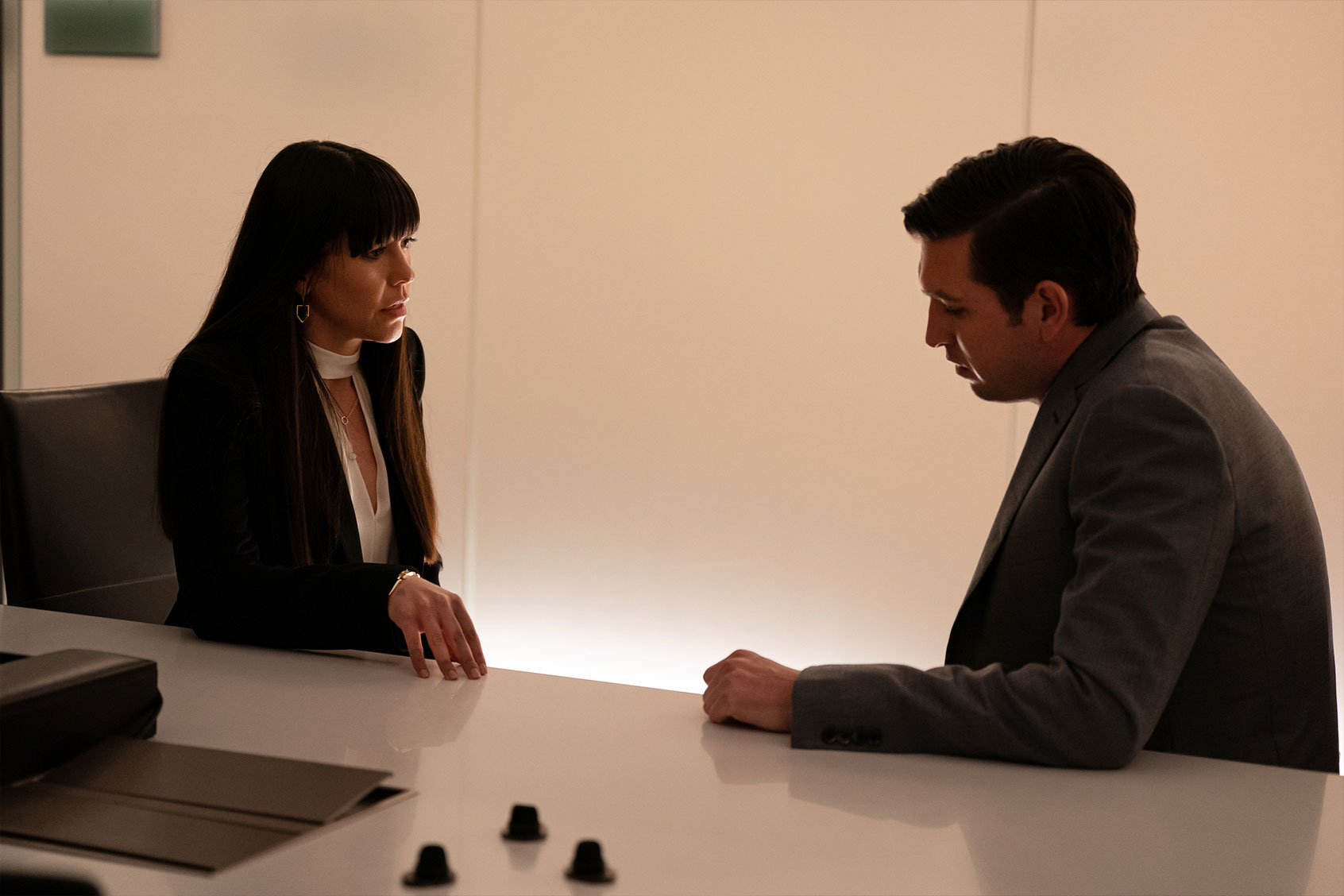
Logan doesn’t like failure; he also doesn’t like attempts.

Episode 2 reveals a softer side of Kerry, one in which she’s vulnerable and fallible. Kerry wants to be a news anchor on ATN, and being the boss’s girl, she gets what she wants. She gets the audition, anyway. A tape of Kerry reading the news becomes the main gag of the episode. She’s not the most professional of assistants, not potential stepmom material and lags behind the Roys when it comes to insults. But Kerry is bad at news.

Real bad. She stumbles over names and words, attempting to call the Carolinas “the California.” She clasps her hands and swivels in her rolling chair. Greg (always sent to deliver bad news) tells Kerry an imaginary focus group has decided her arms are a problem. Her arms are awkward. They just hang.

Kerry smiles hugely when delivering news of a child abduction and impending deadly storms. As Winters told Variety, “We see her wrestling to present her idea of charm, or what she thinks charm looks like, and she fails. She’s in this bubble-gum pink dress trying to act as though she has charm, and I think it just comes off as really uncomfortable.”

SuccessionZoe Winters and Nicholas Braun in “Succession” (Macall B. Polay/HBO)Winters said she based her performance in part on Laura Ingraham and Tomi Lahren, telling Variety that she studied “a lot of Laura Ingraham when the camera cuts, mistreating people, getting different information in her ear than she is from the prompter. Tomi Lahren has this very loud, heightened, fast way of presenting. I just took little bits and pieces from conservative political commentators. I didn’t want her to be good. I wanted her to be trying.”

Early in the show, Shiv attempted to be a political strategist and media pundit. Conor (Alan Ruck) has continued to try to run for office, much to the laughter of everyone around him but especially his family. Roman tries to find love in all the wrong places. Willa (Justine Lupe, of “The Marvelous Mrs. Maisel“) plays at this whole being a playwright thing. And Kendall tries sobriety.


Want a daily wrap-up of all the news and commentary Salon has to offer? Subscribe to our morning newsletter, Crash Course.


Patriarch Logan may have one thing in common with Yoda, of all characters. For both of them, “there is no try.” In “Succession,” when you admit you have a dream — when you want something you may have to work at — that’s when you set yourself up for mockery. You acknowledge you’re human and have human desires like the desire to better yourself, to strive. Logan doesn’t like failure; he also doesn’t like attempts. You shouldn’t have to try so hard.

Kerry’s rise was sudden, and in the way of tragedy, her fall may be just as abrupt. She replaced Marcia (Hiam Abbass), Logan’s former third wife, speedily ascending from assistant to mistress (after Logan cheated with Holly Hunter’s Rhea in between). Where’s Marcia now? According to Kerry, “She’s in Milan, shopping. Forever.” By revealing the human weakness of want, her unrealistic dream of being an anchor, Kerry may soon be sent on a similar trip.

“Not ever backing down”: Florida Democratic leaders arrested while protesting abortion ban

Two Florida Democratic leaders were among the protesters arrested late Monday during a demonstration against a proposed six-week abortion ban, which the Republican-controlled state Senate passed hours earlier.

Florida Democratic Party Chair Nikki Fried and Senate Minority Leader Lauren Book were handcuffed and detained along with roughly a dozen other protesters who gathered and sat down in a park near Tallahassee City Hall.

The Tallahassee Democrat reported that Fried, Book, and the other demonstrators “were taken away by police while sitting in a circle and singing ‘Lean on Me’ inside a barricaded area of a park that was closed at sunset.”

“They were warned by police that if they didn’t leave the area, they would be subject to arrest,” the newspaper continued. “As a large contingent of police approached, protesters yelled ‘shame, shame’ as everyone was cuffed and walked to the parking garage beneath City Hall and loaded into a Tallahassee Police Department van.”

The advocacy group Ruth’s List Florida condemned the arrests of peaceful demonstrators as “the latest disgraceful assault on our civil liberties.”

“It’s not enough for FL Republicans to take away our bodily autonomy, now they’re trampling on our rights of free speech and assembly,” the group wrote on Twitter. “DeSantis wants to make Florida into an autocracy, and his Republican allies are handing it to him on a silver platter. We stand in solidarity with our Democratic leaders for being at the forefront of this fight, and taking action that is well within our rights.”

The abortion ban legislation passed the Florida Senate on Monday by a vote of 26-13, with the chamber’s Democrats and two Republicans voting no. The bill, backed by Florida Gov. Ron DeSantis, now heads to the Florida House, which is also controlled by Republicans.

“The women of this state will not forget the names of the 26 cowards who refused to stand up to Ron DeSantis,” Fried said following the Senate vote. “You all will go down with him, not a threat, a promise.”

Hours after her arrest, Fried wrote on Twitter: “I’m out. And not ever backing down.”

Abortion is currently banned in Florida after 15 weeks of pregnancy. As the Associated Press reported, the new ban “would only take effect if the state’s current 15-week ban is upheld in an ongoing legal challenge that is before the state Supreme Court.”

Florida is one of dozens of Republican-dominated states that have implemented draconian abortion bans since the U.S. Supreme Court struck down Roe v. Wade last year.

“Many states have passed near-total bans on abortion with very limited exceptions or banned the procedure early in pregnancy,” the Guttmacher Institute noted in a recent report. “Courts have blocked some of these bans from taking effect, ushering in a chaotic legal landscape that is disruptive for providers trying to offer care and patients trying to obtain it.”

Kara Gross, ACLU of Florida’s legislative director and senior policy counsel, called the Florida Senate’s Monday vote “a disgrace” and warned the proposed six-week abortion ban would “unfairly and disproportionately impact people who live in rural communities, people with low incomes, people with disabilities, and people of color.”

“Hundreds of thousands of pregnant people will be forced to travel out of state to seek the care they need,” Gross continued. “Many people will not even know they are pregnant by six weeks, and for those who do, it is unlikely they will be able to schedule the legally required two in-person doctor’s appointments before six weeks of pregnancy.”

“This bill is an extreme governmental overreach that’s being orchestrated across the country,” Gross added. “We all should have the freedom to make decisions about our bodies, lives, and futures without interference from politicians.”

Experts: Report that Trump may have shown secret docs to donors ties him “directly to the scheme”

Legal experts said new revelations about obstruction evidence collected by special counsel Jack Smith’s team could land former President Donald Trump in deep legal trouble.

Smith’s team has obtained evidence that Trump personally rummaged through boxes of secret government documents he took home to Mar-a-Lago and has been “asking witnesses if Trump showed classified documents, including maps, to political donors,” The Washington Post reported on Sunday.

Former acting Solicitor General Neal Katyal told MSNBC that the evidence could be “devastating” for Trump’s defense.

“It ties Trump directly to the scheme,” he said. “If it holds up and, of course, we don’t know — and Trump is entitled to the presumption of innocence and all that, but if that’s what [special counsel] Jack Smith is looking at and looks like what he got, that’s going to be very devastating.”

Former senior FBI counterintelligence official Peter Strzok highlighted the focus on donors.

“If you’re trying to figure out the ‘why,’ what’s your theory of the case, why on Earth did he want to do it, if he’s using this to convert it for fundraising and showing it to people who absolutely have no business seeing it and he’s hiding it at the same time,” he said. “That really starts to flesh out the story about, one, why this occurred and, two, how integral Trump was to this entire enterprise.”

Trump claimed that he had the “right” to take home documents in a recent Fox News interview with Sean Hannity, who repeatedly tried to help the former president without success.

“I’ve known you for decades,” Hannity said. “I can’t imagine you ever saying, ‘Bring me some of the boxes that we brought back from the White House. I’d like to look at them.’ Did you ever do that?”

“I would have the right to do that,” Trump responded. “There’s nothing wrong with it.”


Want a daily wrap-up of all the news and commentary Salon has to offer? Subscribe to our morning newsletter, Crash Course.


“But I know you,” Hannity said. “I don’t think you would do it.”

“I don’t have a lot of time, but I would have the right to do that,” Trump retorted. “I would do that.”

“Remember this,” Trump added. “This is the Presidential Records Act. I have the right to take stuff.”

MSNBC host Joe Scarborough mocked Trump’s “confession” video on Tuesday.

“Sean was trying to help Trump time and again,” Scarborough said, but Trump “goes on and proves the federal government’s case.”

“I’m goin’ down too”: Country music’s women stars get political at the CMT Awards

On Sunday, country music’s hottest stars were celebrated at the annual CMT (Country Music Television) Music Awards. Highlights from the night included a heartfelt duet, one singer’s surprise cameo and another singer’s emotional return to the stage. There was also plenty of talk about politics, courtesy of the industry’s highly acclaimed women stars.    

First up was country singer-songwriter Kelsea Ballerini, who opened the show with a moving tribute to the victims of last week’s shooting at Nashville’s Covenant School in Tennessee. 

“On March 27, 2023, three 9-year-olds — Evelyn Dieckhaus, William Kinney, and Hallie Scruggs — along with Dr. Katherine Koonce, Cynthia Peak, and Mike Hill, walked into the Covenant School and didn’t walk out,” Ballerini, who co-hosted this year’s show with Kane Brown, tearfully said. “The community of sorrow over this and the 130 mass shootings in the U.S. this year alone stretches from coast to coast.”

Ballerini then shared her own personal experience with campus gun violence, saying she witnessed a classmate die in a shooting at her high school in Knoxville, Tennessee.

“I wanted to personally stand up here and share this moment, because on Aug. 21, 2008, I watched Ryan McDonald, my 15-year-old classmate at Central High School, lose his life to a gun in our cafeteria,” she continued. “Tonight’s broadcast is dedicated to the ever-growing list of family’s friends, survivors, witnesses, and responders whose lives continue to forever be changed by gun violence. I pray deeply that the closeness and the community that we feel through the next few hours of music can soon turn into action — like, real action — that moves us forward together to create change for the safety of our kids and our loved ones.”

Later in the broadcast, Ballerini took center stage to perform her 2022 single “If You Go Down (I’m Goin’ Down Too)” alongside “RuPaul’s Drag Race” alums Manila Luzon, Kennedy Davenport, Jan Sport, and Olivia Lux. After the show, she tweeted a message of support, writing “if you go down, i’m going down too [pride flag] // thank you to these iconic queens and @manilaluzon @kennedyddoftx @janjanjan @TheOliviaLux and @CMT for celebrating love, self expression, and performance.”

It seemed fitting for Ballerini, a Tennessee native, to call out the tumultuous political climate of her home state at an awards show that has traditionally taken place in Nashville — this year’s festivities were held at Moody Center in Austin, Texas. Tennessee has faced criticism for a string of controversial legislation, including pro-gun and anti-LGBTQ+ laws.

In July of 2021, Gov. Bill Lee enacted a law that allowed the permitless carry of handguns, both concealed and unconcealed, for anyone over the age of 21. Under the provisions, law enforcement officials and military members between ages 18 and 20 are allowed to carry their handguns without a permit. Anyone over the age of 18 can purchase rifles and shotguns and carry them without a permit. However, they can’t do the same with firearms “if it is not concealed on or about the person and must be unloaded” and the owner is not allowed to carry its ammunition on their person or in their “immediate vicinity,” the law specifies

Then, in March, Tennessee enacted its first-in-the-nation law that criminalizes “adult cabaret performances” in public or in the presence of children and bans them from happening within 1,000 feet of schools, public parks, or places of worship. Supporters of the law asserted that it “gives confidence to parents that they can take their kids to a public or private show and will not be blindsided by a sexualized performance.” But many opposers, including the Memphis-based LGBTQ+ theater company Friends of George’s, Inc., noted that the law demonizes drag performers (even though the word “drag” is not written in the law) and violates the First Amendment

On Friday, a federal judge temporarily blocked the Tennessee law after Friends of George’s, Inc. filed a lawsuit against it. Judge Thomas Parker cited constitutional protections of freedom of speech in issuing a temporary restraining order, according to NBC News.

Ballerini’s recent statements also underscore an ongoing trend of women in country taking a stance against the conservative politics that are often celebrated in the biz. As Kate Mossman of the New Statesman wrote, “The genre is transforming, the think-pieces said: there are liberal, outspoken young females in Nashville for the first time (as though the Dixie Chicks never happened).” 


Want a daily wrap-up of all the news and commentary Salon has to offer? Subscribe to our morning newsletter, Crash Course.


Take for example Grammy-winning country star Kacey Musgraves, whom Mossman dubbed a “liberal misfit.” She’s best known for her progressive lyrics about LGBTQ+ acceptance, sexuality and individuality, which is distinct from the conservative nature of much of mainstream country music. Of course, there’s also Dolly Parton. There’s Mickey Guyton. And, there’s Shania Twain, who took home the Equal Play Award at Sunday’s CMT Awards.

In her acceptance speech, Twain called for more equity and diversity in the country music industry, saying, “When I wrote the phrase ‘Man, I feel like a woman’ I honestly had no idea at the time it would become an undercurrent of a decades-long career. It’s amazing how one statement can empower so many.”

She continued, “I believe in an all-inclusive country music. We’re family. This is a genre of music with a rich history that raised and nurtured my own songwriting and performance and recording career from childhood. Currently, the industry standard does a real disservice to this.”

“I will continue to do my best as a trailblazer. Together, let’s ensure all our fellow artists get equal play regardless of gender, age or race.”

“Fascists!”: Tennessee GOP moves to expel Dems over gun control protest they called “insurrection”

Tennessee House Republicans on Monday initiated the process of expelling three Democratic lawmakers who joined protesters in demanding stricter gun laws following the Nashville mass shooting that left three young children and three adults dead.

Days after last week’s shooting, thousands of demonstrators flooded the Tennessee state Capitol to decry GOP lawmakers’ inaction in the face of deadly gun violence. Inside the House chamber, Democratic Reps. Justin Jones, Gloria Johnson, and Justin Pearson took to the podium with a bullhorn and led demonstrators in chants supporting gun control legislation.

As The Tennessean reported, Tennessee House Republicans cast the trio’s actions as an “insurrection” and, at the end of Monday’s session, “introduced three expulsion resolutions” claiming that the three Democrats “did knowingly and intentionally bring disorder and dishonor to the House of Representatives through their individual and collective actions.”

A vote on the resolutions is expected on Thursday. “Democrats will have little power to block expulsions,” The Tennessean noted.

The Tennessee Black Caucus of State Legislators said in a statement that “this political retribution is unconstitutional and, in this moment, morally bankrupt.”

“The people who elected us are calling for meaningful action to end gun violence and the people have a right to be heard through their duly elected representatives,” the statement added.

While the House moved to schedule the vote, demonstrators inside the chamber chanted “Fascists!”—leading Republican House Speaker Cameron Sexton to order the galleries cleared and call on state troopers to remove protesters.

“Media forced out at as well,” tweeted Jones, who—along with Johnson—has already been stripped of his committee assignments. Jones said a Republican lawmaker shoved him and grabbed his phone as he was recording a video of demonstrations inside the chamber on Monday.

“This is a sad day for Tennessee,” he wrote.

The GOP-controlled Legislature’s expulsion efforts came after thousands of Nashville students walked out of their classrooms earlier Monday to demand action on gun violence, which is now the leading cause of death for children in the United States—a country with more guns than people.

Far from backing gun control legislation, Tennessee Republicans have sought to make firearms even more readily accessible in recent years. The New York Times reported last week that Tennessee lawmakers “have passed a series of measures that have weakened regulations, eliminating some permit requirements and allowing most residents to carry loaded guns in public, open or concealed, without a permit, training, or special background checks.”

Facing expulsion, the Democratic trio in Tennessee has continued to voice solidarity with those rallying for change in the streets and at the state Capitol.

Pearson, one of Tennessee’s youngest lawmakers, told a local media outlet that “the thousands of children and adults who marched outside of the People’s House are not insurrectionists.”

“My walk, my colleagues’ walk to the House floor was in a peaceful and civil manner, and it was not an insurrection,” Pearson said, pushing back on the state GOP’s characterization of the protests.

Jones, who like Pearson took office earlier this year, vowed Monday that “we’ll not be intimidated.”

“THE PEOPLE are demanding we act to stop kids from being murdered in school,” Jones wrote on Twitter.

“It’s kind of a Jesus Christ thing”: Trump rejected plan for quiet arraignment — demanded spectacle

Former President Donald Trump rejected proposals for a quiet arraignment and demanded a public spectacle when he arrives at the Manhattan courthouse on Tuesday, according to Rolling Stone.

A law enforcement official told the outlet that Trump was offered the opportunity to be arraigned over Zoom but shot down the proposal.

“He wanted a perp walk; he wanted daylight hours,” the source said. “He wants to get out of the vehicle and walk up the stairs. This is a nightmare for Secret Service, but they can only strongly suggest — not order — that Trump enter through the secure tunnels. Trump wants to greet the crowd. This should be a surprise to no one — especially not his detail.”

“It’s kind of a Jesus Christ thing. He is saying, ‘I’m absorbing all this pain from all around from everywhere so you don’t have to,'” the source told the outlet.

Always one for the optics, Trump’s insistence on a public-facing booking does not come as a surprise. A New York Times report last month indicated that Trump has described the idea of a perp walk as “fun” and “welcomes the idea of being paraded by the authorities before a throng of reporters and news cameras.” 

“He has even mused openly about whether he should smile for the assembled media,” the report added.

A source closely linked to Trump’s legal team has stated that Trump wants to foment a spectacle worthy of invigorating MAGA supporters, denying the Secret Service’s wishes to conduct the proceedings outside of court business hours.

A Secret Service spokesperson confirmed to Rolling Stone that officials have “been meeting with NYPD and state court officers for the last couple of weeks regarding safety and security concerns for the courthouse, areas around the courthouse, and the appearance of the former president.”

Trump is expected to plead not guilty regarding his role in hush money payments to adult film star Stormy Daniels in 2016.


Want a daily wrap-up of all the news and commentary Salon has to offer? Subscribe to our morning newsletter, Crash Course.


The arraignment is currently scheduled for 2:30 pm EST; however, a law enforcement official shared with Rolling Stone that the ex-president is due to arrive at the courthouse at 11:30 am. His legal team pushed for cameras to be kept out of the courtroom to stave off a media circus. The judge overseeing the case on Monday ruled that he would allow still cameras in the courtroom but no video.

Rolling Stone reported that snipers will be situated on rooftops, while NYPD stands at the ready outside, in riot gear, in anticipation of protests.

“It will be a shitshow,” according to the law enforcement official.

Last month, ahead of his indictment, Trump stoked unrest when he encouraged his followers to protest his expected arrest in a Truth Social Tirade.

“IT’S TIME!!!” he wrote. “WE ARE A NATION IN STEEP DECLINE, BEING LED INTO WORLD WAR III BY A CROOKED POLITICIAN WHO DOESN’T EVEN KNOW HE’S ALIVE, BUT WHO IS SURROUNDED BY EVIL & SINISTER PEOPLE WHO, BASED ON THEIR ACTIONS ON DEFUNDING THE POLICE, DESTROYING OUR MILITARY, OPEN BORDERS, NO VOTER I.D., INFLATION, RAISING TAXES, & MUCH MORE, CAN ONLY HATE OUR NOW FAILING USA. WE JUST CAN’T ALLOW THIS ANYMORE. THEY’RE  KILLING OUR NATION AS WE SIT BACK & WATCH. WE MUST SAVE AMERICA! PROTEST, PROTEST, PROTEST!!!”

Dominion lawsuit is only the beginning: We must demolish the Fox News propaganda machine

Sometimes legal cases provide windows into the most important political, economic, and cultural issues of our time. Dominion Voting Systems’ billion-dollar defamation suit against Fox is one such case.

On Friday, the Delaware judge who is hearing the case gave the green light for the suit to move forward, rejecting Fox’s summary judgment motion seeking to toss it out. That marked a turning point in what is already an historic case.

“The evidence [makes it] CRYSTAL clear that none of the statements relating to Dominion about the 2020 election are true,” Superior Court Judge Eric Davis wrote in his opinion. To establish Fox’s liability under the landmark 1964 Supreme Court case of New York Times v. Sullivan, Dominion must convince a jury that those statements were false, and also that Fox either knew they were false or was reckless in avoiding the truth.

Let’s step back and look at what this litigation tells us about the economic system in which our democracy operates. We are seeing what can happen when the corporate profit motive is unmodulated, particularly in a powerful industry: It can corrupt our democracy. But there are tools to protect it.

Our capitalist system produces wealth like none other in history. The profit motive brings enormous benefits as a generator of creativity and innovation, but it also leads to excesses of the kind being revealed in the remarkable case that Dominion has brought. 

In one sense, Fox News has simply done what other business enterprises do: A corporation’s priority is to grow its profits and stock value to benefit its shareholders. News organizations do that by expanding their audience to create demand for advertising, the source of their revenue. The bigger the audience, the more advertisers will pay and the greater the earnings.

The Dominion case illustrates how our economic system works: When the corporate profit motive is unmodulated, it can corrupt our democracy.

In the ultra-competitive media business, pleasing the viewers is a life and death proposition. In the news media business, that can mean reporting and expressing opinions in ways that confirm the audience’s view of the world. Fox has always catered to viewers on the right.

Of course, one must also acknowledge that outlets like MSNBC, with a more progressive audience, offer viewpoints more toward the left. But neither MSNBC nor CNN has ever been sued for defamation in any case with sufficient merit to survive judicial scrutiny, as Dominion’s against Fox evidently does. 

In Dominion’s evidence to date, we see how powerfully the business motives of Fox led to the broadcast of lies that delighted their audience so the network could maintain and build its profits even at the expense of truth.

For example, evidence has shown that Fox News CEO Suzanne Scott said that fact-checking was “bad for business.” In the same vein, Fox editor Bryan Boughton reportedly called and castigated White House correspondent Kristen Fisher after she fact-checked a pro-Trump press conference by Rudy Giuliani and Sidney Powell. He told her that she “needed to do a better job of ‘respecting our audience.'”

If that weren’t enough, top-rated Fox News host Tucker Carlson apparently solicited fellow host Sean Hannity to get news reporter Jacqui Heinrich “fired,” after she fact checked a Trump tweet. “It needs to stop immediately, like tonight. It’s measurably hurting the company,” Carlson texted Hannity. “The stock price is down.”


Want a daily wrap-up of all the news and commentary Salon has to offer? Subscribe to our morning newsletter, Crash Course.


All of which was aptly summarized by Fox News’ Washington managing editor Bill Sammon in a message to political editor Chris Stirewalt: “It’s remarkable how weak ratings make good journalists do bad things.”

In other words, truth be damned — just give the people what they want. As a result, Fox hosts constantly reinforced Trump’s Big Lie that the 2020 presidential election had been stolen.

And so a vicious cycle kicked in: Squelch the facts that turn off the audience and elevate the lies that reinforce their belief in a political conspiracy. No matter that the effect is to undermine the legitimacy of elections and the U.S. government. It’s little wonder that some Fox News hosts openly admire Russian President Vladimir Putin.

Indeed, the testimony from Fox witnesses so far raises a question: Just how different is the network, its private ownership aside, from the Russian government’s RT or Pravda of the Soviet era, or from the daily propaganda broadcast by Joseph Goebbels? Hannah Arendt wrote in her 1951 classic “The Origins of Totalitarianism” that the constant lies on which authoritarianism depends are aimed at destroying the public’s will to resist, and do so by eroding “the sense by which we take our bearings in the real world.”

Propaganda, Arendt wrote, operates on the belief that once people are made to substitute fantasy for truth, “instead of deserting the leaders who had lied to them, they would protest that they had known all along that the statement was a lie and would admire the leaders for their superior tactical cleverness.”

In this, Fox News and Trump built a treacherous and destructive alliance.

While Russia’s RT operates in a different economic system from Fox, the latter finds itself in the same place, with political lies as its mainstay. In a capitalist system, the antidote to such media betrayal of democracy is to protect the public through thoughtful, vigorous regulation.

Of course, the First Amendment imposes serious limitations upon the government’s authority to regulate news organizations. For decades, however, America had the FCC’s “fairness doctrine.” The Reagan administration ended it in 1987, notwithstanding a Supreme Court ruling that had upheld its constitutionality two decades earlier. The doctrine required networks to allow time for opposing views to be expressed.

In other words, it did not permit one-sided political opinion to air unchallenged, including outright lies of the kind Dominion has exposed at Fox. This case underscores how important restoring some version of the fairness doctrine, and extending it to cable outlets, would be. This should be the first step in a regulatory program adapted to and appropriate for the 21st-century ecosystem..

The larger point, however, is this: The Dominion case illustrates the dangerous corruption of Fox News, but this lawsuit alone is not nearly enough to protect us from propaganda masquerading as news. The American people need to demand more. We need a carefully regulated media to ensure that our democracy is fair and balanced. 

Trump flips out at DA on Truth Social after felony charges leak: He should “INDICT HIMSELF”

Former President Donald Trump called for Manhattan District Attorney Alvin Bragg to resign or “indict himself” after the charges against him leaked on Monday.

Trump will be charged with 34 felony counts of falsification of business records, a source briefed on the arraignment plans told Yahoo News reporter Michael Isikoff. None of the charges are misdemeanors.

Trump will be placed under arrest and be informed of the charges against him when he enters the Manhattan courthouse on Tuesday, the source told Isikoff. A New York City police arrest report summarizing the charges will then be entered into the court system before Trump is led into a courtroom and formally arraigned.

Trump will not be put in handcuffs and will not be placed in a jail cell, the source said. He is also not expected to be subjected to a mug shot after the DA’s office, which has been in contact with Secret Service and court officials, determined there was no reason for a mug shot.

All of the charges against Trump are Class E felonies, the lowest level of felonies in New York state, according to the report. While falsification of business records can be charged as a misdemeanor, it can be bumped up to a felony if it was intended to conceal another crime.

The felony carries up to four years in prison but “no one gets jail time for that as a first offender,” a New York law enforcement official told Yahoo News.

The evidence that escalated the charges remains sealed and will not be released until the indictment is unsealed when Trump is arraigned. It is believed to be linked to the 2016 hush-money payment to porn star Stormy Daniels.


Want a daily wrap-up of all the news and commentary Salon has to offer? Subscribe to our morning newsletter, Crash Course.


A Trump spokesman told the outlet that the former president’s lawyers have not seen or been briefed on the details of the indictment. Trump took to Truth Social to lash out over the report.

“Wow! District Attorney Bragg just illegally LEAKED the various points, and complete information, on the pathetic Indictment against me,” Trump claimed without any evidence that Bragg had anything to do with the leak. “I know the reporter and so, unfortunately, does he. This means that he MUST BE IMMEDIATELY INDICTED. Now, if he wants to really clean up his reputation, he will do the honorable thing and, as District Attorney, INDICT HIMSELF. He will go down in Judicial history, and his Trump Hating wife will be, I am sure, very proud of him!”

“D.A. BRAGG JUST ILLEGALLY LEAKED THE 33 points of Indictment,” Trump wrote in a subsequent post. “There are no changes or surprises from those he leaked days ago directly out of the Grand Jury. No Crime by Trump. What a MESS. Bragg should resign, NOW!”

Trump, who has repeatedly attacked the wives of prosecutors investigating him, also hit out at special counsel Jack Smith after the Washington Post reported on Monday that his team has obtained evidence of obstruction by the former president in the Mar-a-Lago documents case.

“Speaking of LEAKS, Special “Prosecutor” Jack Smith (What did his name used to be?) leaked massive amounts of information to The Washington ComPost. This is illegal, and I assume this Radical Left Lunatic, much to the chagrin of his Trump Hating wife and family, will be PROSECUTED?” Trump wrote, claiming that “Biden is guilty of Obstruction, I am not!”

Biden administration releases road map to scale up nuclear, hydrogen, and energy storage

Last week, the Department of Energy, or DOE, released a road map for scaling up three emerging technologies that could make or break the U.S. energy transition. According to the agency, advanced nuclear, clean hydrogen, and long-duration energy storage are crucial for reaching net-zero emissions. The problem is, self-sustaining markets for these technologies don’t exist yet. 

The department’s new “Pathways to Commercial Liftoff” reports identify key challenges and potential solutions for getting these industries off the ground. They provide, for the first time, concrete numbers on how much additional energy capacity is needed from each of the three new technologies to reach U.S. climate goals. They also spell out how much money private and government actors will need to invest in research and development, and what challenges stand in the way of commercializing these sectors. 

The Biden administration aims to halve emissions by 2030 and hit net-zero emissions by 2050. These fast-approaching deadlines mean that the next few years are critical for redrawing the energy landscape. 

“It’s an all-hands-on-deck situation, but it’s also an all-technologies-on-deck situation,” said DOE chief commercialization officer Vanessa Chan in a webinar last week introducing the new reports. “We want to ensure that we’re looking at all technologies that can help toward the president’s ambitious climate goals.” 

The “liftoff” reports mark one of the first concrete steps the Biden administration has taken to map out how the government will spend billions in recent clean energy funding. As a result of laws including the 2021 bipartisan infrastructure law, the 2022 Inflation Reduction Act, and the CHIPS and Science Act, which provides energy investments and boosts U.S. semiconductor manufacturing, the DOE now holds tens of billions in climate investments to spend over the next decade.

This huge pot of money means that the agency can help “buy down risk” for companies and private investors that remain hesitant to wade into new energy territory, according to Chan. The new reports highlight the federal government’s plans to help jump-start three new industries.

“Advanced nuclear” is a catch-all term for new nuclear reactor models that improve on the safety and efficiency of traditional reactor designs. Advanced nuclear could help provide stable, reliable electricity to complement renewables like solar and wind, which fluctuate throughout the day. But the nuclear industry is at a “stalemate,” according to the department. Recent nuclear projects have tended to go over budget and run into delays, leaving both project developers and utilities wary about investing in new reactors. 

The DOE says the U.S. will need an additional 200 gigawatts of advanced nuclear power to reach its climate goals, enough to power about 160 million homes. Getting there will require $35 billion to $40 billion in private and public investments by 2030, and about $700 billion total by 2050. Crucially, the report says that at least five to 10 new reactors need to be in development across the country by 2025 for the U.S. to hit its goals. 

Like nuclear, long-duration energy storage aims to provide a stable source of power. The technology includes batteries and other grid-connected systems that can store energy from renewables and then dispatch it for 10 hours or longer when the wind isn’t blowing and the sun isn’t shining. About 225 to 460 gigawatts of long-duration energy storage could come online by 2050, the DOE report says — but first, capital costs need to go down by half. And reaching market viability will require $330 billion in investments by 2050. 

Clean hydrogen, a fuel produced using renewable energy, has the potential to replace traditional fossil fuels in industries that can’t easily run directly on clean electricity. Today, hydrogen is almost exclusively produced from fossil fuels, and is primarily used for oil refining and chemical fertilizers. But if clean hydrogen can get to commercial scale, the DOE estimates that hydrogen alone could reduce U.S. carbon emissions by 10 percent by 2050 by replacing fossil fuels in aviation, shipping, and industries that currently use hydrogen as a feedstock, like ammonia and methanol production. 

Sasan Saadat, a senior research and policy analyst at Earthjustice, stressed the importance of first displacing today’s use of fossil fuel-derived hydrogen before turning to novel sectors like road transportation and aviation. “It would be foolish to invest in creating new demand before we finish cleaning up hydrogen’s existing footprint,” he told Grist. 

He lauded the “liftoff” reports for highlighting this near-term goal. But as the agency moves forward with public investments, Saadat said officials will need to provide clear guidance on which end uses to prioritize. Otherwise, “We may end up with a situation where we use a bunch of scarce green hydrogen to do things that electricity could have done more easily.”

Some industry experts have also raised concerns about the lack of options for safely transporting and storing hydrogen fuel. The DOE has already earmarked $8 billion toward funding up to 10 regional “hydrogen hubs,” in the hopes of creating a network of infrastructure to address transportation concerns. In all, the public and private sectors would need to commit $85 billion to $215 billion to hydrogen through 2030 to align with U.S. climate goals. 

DOE officials emphasized that the reports — developed after dozens of conversations with companies, investors, and technical experts — are not prescriptive. As “living, breathing documents,” the reports will be regularly updated according to the most up-to-date information and ongoing consultation with relevant industries.

“The introduction of any new energy technology at scale is not a linear path,” said David Crane, director of the Energy Department’s Office of Clean Energy Demonstrations. “It’s a winding road with speed bumps all along the way.” 


This article originally appeared in Grist at https://grist.org/technology/biden-administration-releases-roadmap-to-scale-up-nuclear-hydrogen-and-energy-storage/.

Grist is a nonprofit, independent media organization dedicated to telling stories of climate solutions and a just future. Learn more at Grist.org

Women started the anti-Trump resistance — and it’s women who are the first to hold him accountable

After a violent insurrection, two impeachments, countless other scandals, and the time he suggested bleach injections to treat COVID-19, it’s hard to forget sometimes that the first Donald Trump crime that galvanized his opposition was sexual assault.

Shortly before the 2016 election, a recording was released of Trump on a hot mic before a 2005 “Access Hollywood” taping, bragging that he likes to force himself on women. “Grab ’em by the pussy,” he infamously recommended. “When you’re a star, they let you do it. You can do anything.”

Over two dozen women swiftly came forward to confirm that this is Trump’s M.O. So his 2016 election was a shock to millions of Americans; an ugly reminder that this is still a society that mostly looks the other way when men assault and abuse women. In turn, the first protest against Trump — likely the largest protest in American history! — was the Women’s March on January 21, 2017. The rage continued to grow, exploding after the Harvey Weinstein revelations, into a mass outpouring of fury over sexual abuse called the #MeToo movement

Years later, we’re facing an ugly, misogynist backlash, but still, there’s much good that came from all this feminist energy.

The knowledge of how widespread sexual abuse is cannot be shoved back into the closet. Reckonings are fewer and further apart, but still, institutions like the Southern Baptist Convention continue to be rocked by #MeToo revelations. And now, in April of 2023 — nearly six years after the Women’s March and the #MeToo explosion — the man who started it all, Donald Trump, is finally facing legal repercussions for the way he has treated women his whole life. 


Want more Amanda Marcotte on politics? Subscribe to her newsletter Standing Room Only.


On Tuesday, Trump is expected to be arraigned, at long last, over business fraud charges that are believed to stem from illegal payment schemes to hush a porn actress named Stormy Daniels. The press all too often uses the word “affair” to describe Trump’s alleged relationship with Daniels, but that framing is misleading. It implies a level of affection and desire between two consenting adults that, by Daniels’s own telling of the story, simply wasn’t there. While Daniels has insisted “This is not a #MeToo” situation and that she is “not a victim,” the details of her story line up with the many other stories — and with Trump’s own words — illustrating how Trump pressures, bullies, and forces women to have sexual interactions with him. 

The press all too often uses the word “affair” to describe Trump’s alleged relationship with Stormy Daniels, but that framing is misleading.

“I realized exactly what I’d gotten myself into. And I was like, ‘Ugh, here we go'” is how Daniels described her one sexual encounter with Trump, during a 2018 interview with Anderson Cooper. She went on to say that she felt like she “had it coming for making a bad decision for going to someone’s room alone and I just heard the voice in my head, ‘well, you put yourself in a bad situation and bad things happen, so you deserve this.'”She also told Cooper that part of the reason she let things get to the point was that Trump had been dangling out the hope she could be a contestant on “The Apprentice.”

Regardless of how she feels about the sexual encounter itself, Daniels has been quite clear that she’s been victimized by Trump since. She told Cooper about a strange man who approached her in a parking lot, while she was with her infant child, and threateningly said, “Leave Trump alone. Forget the story.” 

If these indictments go to trial, there’s a strong chance that Daniels will be called to testify. But she isn’t the only Trump victim who is likely to face down her abuser in a court of law. Later this month, journalist E. Jean Carroll, who claims Trump raped her in the 90s, will finally get her day in court, as well. 

Due to the statute of limitations, Carroll couldn’t press criminal charges against Trump. But, because he has a big mouth and a big ego, he created an opportunity for her to sue him for defamation after she publicly told her story of him allegedly attacking her in a Bergdorf Goodman dressing room in Manhattan. Trump responded in his usual way, by accusing Carroll of lying and adding a bunch of insults about her looks to the mix. He also unsubtly threatened her, saying “people have to be careful, because they are playing with very dangerous territory.” 

Trump’s predatory behavior towards women is at the center of both these cases, a fact that should not be ignored or forgotten. 

The laws about defamation have high bars, but it is also indisputable that Trump lied in his many diatribes about Carroll. He claimed to have “absolutely no idea who she is.” Yet there’s a picture of them together. He claimed “she’s not my type,” but the photo shows that Carroll, at the time, looked very much like his then-wife Ivana Trump. During a deposition in October 2022, lawyers asked Trump to identify a photo of Carroll and he said, “That’s Marla, yeah. That’s my wife,” mistaking Carroll for his second wife, Marla Maples. 

Republicans have been encouraging this notion that these cases are small potatoes compared to supposedly bigger investigations centered around Trump’s efforts to steal the 2020 election and his absconding with classified documents that belong to the federal government. Sadly, the male-dominated press is buying into this notion, with far too many pundits playing off these two cases as minor matters. But Trump’s abuse of women is not a minor matter. The actual laws being invoked — business fraud and defamation — don’t directly address sexual abuse. But Trump’s predatory behavior towards women is at the center of both these cases, a fact that should not be ignored or forgotten. 

As the protesters in the Women’s March understood, how men treat women tells you a great deal about their character. When Trump entered the White House, one sure thing we all knew about him was that he didn’t believe a woman had a right to say “no” to him. Over the next four years, he proved that this entitled attitude was not limited to sex or women. Trump doesn’t think anyone has a right to say “no” to him. Not the president of Ukraine. Not various public officials he leaned on to break the law. And, ultimately, not the American people.

When voters told Trump they preferred President Joe Biden to him, he treated voters like he does a woman who declines his sexual attention. He tried to force himself on the country anyway.

Women told us from the beginning who Trump is. It’s poetic justice that they get to be first in line to start holding him accountable. 

What indicting Donald Trump can — and can’t — achieve

Last Thursday, Donald Trump, the twice impeached president and coup leader, a man who has engaged in a decades-long crime spree, was indicted in Manhattan for alleged crimes connected to hush money payments and other offenses during his 2016 presidential campaign. Of his many historic “distinctions,” Trump is now the first former president to ever be indicted in criminal court. Later today, Trump will arrive at a courthouse in Manhattan where he will be arraigned and then released pending a future trial.

I was half asleep and somewhat medicated when Trump’s indictment was announced on the television news. When I heard the voices on the television talking about “Trump” and “New York” and “indictment,” I opened my eyes, allowed myself a small smile, and went soundly back to sleep on the couch.

Why didn’t I rush to my computer to write a too-fast immediate response to the “breaking news” as so many of the other people with a public platform and voice did? Well, late Wednesday night I did something quite careless and stupid. I was working on a project at home and let my mind wander for a second. In that briefest of moments, I cut myself with a very sharp knife. I heard myself say aloud, “You big dummy! You are going to the hospital. That is lots of blood. And yes, that is a bone. And no, you most certainly cannot use crazy glue to fix it.”

For the next four hours, I sat in the emergency room with my hand wrapped in gauze and bleeding inside a plastic ziplock bag. I watched all of the other people piled inside the emergency room. They sat on chairs. Others were laying on the ground. Some were slumped over in wheelchairs. There were a few people who found a way to sleep while standing up against a wall. There were dozens of homeless people in the emergency room as well. It was cold outside, and the hospital was a type of temporary safe harbor. I counted at least three people who were visibly covered in their own filth. One man was laid out on the ground, rolling around in his own waste. Was he high? Drunk? Exhausted? Mentally ill? All or none of these things? I do not know. The nurses and security guards knew that poor soul by name. They were frustrated with him because he was “noncompliant.” The police were called and they carried the poor man outside and dumped him on the sidewalk. A team of janitors swooped in. They quickly cleaned up the carpet and floor while not uttering a grumble or any other audible sound of disgust. They didn’t even make an obvious gesture of frustration or annoyance. The three janitors were stoic and dutiful. When those men finally get home, they will take off all their clothes and put them all in a garbage bag outside the front door. I watched my father do that same thing many times.

There were other people in the emergency room too, most of them like the woman who would be my “neighbor” in the examination room. She used the emergency room as her regular physician. I counted ten problems in need of care. The doctors would give her prescriptions for eight different medicines.

Too many Americans want a miracle cure for Trumpism.

“Do you have a regular physician?” the doctor asked her. “No.” 

“How long have you had these symptoms?” She replied: “More than a month.”

“When was the last time you had a physical?”

“Years.”

“What do you do for a living?” She said, “I am outside most of the time, I deliver food.”

My “neighbor” carried an insulated cube-shaped bag with her to the emergency room. She clung to it. She told the doctor that she was going right back to work after she leaves the emergency room and fills the prescriptions. The company she works for pays her less than the minimum wage, which translates into a few dollars an hour.

In its own perverse way, the emergency room is a radically “democratic” space. Of course, here in America wealth and income determine both access to and the quality of healthcare. Race even more so. How gender and sexuality and citizenship status and all the other markers that deem some more privileged and advantaged in American society, and others less so, most certainly matter in terms of health care. Public health and other experts have shown that, by many measures, black women (regardless of income and wealth) suffer the most from America’s health inequities.

America’s healthcare system is most certainly not “the best in the world”. In reality, it is very sick and broken. All of the people in the emergency room need help; acute need is a type of immediate social leveler.

There is a strange intimacy that comes with sickness and emergency rooms as well, where people are pretending to ignore each another while simultaneously being keenly aware of each other. After waiting for several hours, I was tempted to use the tiny amount of social capital I had accrued over these years to cut ahead in line. I ultimately decided not to. I am a Black working-class person who does not possess the arrogance and class entitlement and racial privilege to do such a thing unnecessarily for reasons of mere convenience.

As I sat in the emergency room I tried to stay calm. I meditated. I made up stories about the people around me based on the shoes they were wearing (or not). My mind wandered back to Donald Trump. Would he be indicted? What happens next? What if he wins back the White House? Do the American people realize how much trouble they are already in? Do they have any idea of how much more trouble and pain awaits them?

“This indictment will not succeed in repairing our democracy. But not indicting him would make it that much harder to ever repair our democracy.”

Then I thought to myself, “You are in the hospital emergency room bleeding into a ziplock bag, waiting to get a bunch of stitches, trying to not get COVID, and you can’t get that man out of your head. You are not well.”

I rebutted my own inner dialogue.

“We are not well. None of us are anymore. It is better and more healthy to acknowledge that reality than to pretend otherwise. Any reasonably honest and observant person who has lived in America can tell you that this country is sick and has gone somewhat mad. Hell, almost every week there are Americans who sacrifice children to the Gun God Moloch in the name of ‘freedom’ and ‘rights’. Rabbi Abraham Joshua Heschel told us that ‘In any free society where terrible wrongs exist, some are guilty – all are responsible’. He is, of course, correct.”


Want a daily wrap-up of all the news and commentary Salon has to offer? Subscribe to our morning newsletter, Crash Course.


Several years ago, one of Donald Trump’s biographers warned me that spending so much time thinking about Trump (or even worse being in his company) is not healthy; Trump has a dark energy about him that can get inside of your head if you are not careful. Trump’s biographer, too, was correct.

Trump and his neofascist movement are our national malady. We, the Americans, need serious help and healing.

Yet because of, and not despite, all the harm Trump and his neofascist movement and their allies have caused to the country, its democracy, its people, and future, there are many tens of millions of Americans who want him back in the White House. In total, this is all much more than a severe political malady. It is a type of moral and ethical sickness.

Here is an even more frightening reality about Trump, neofascism, and our other national maladies: there are tens of millions of Americans who want to be sick. Or alternatively, they have lost the ability to discern what is healthy from what is unhealthy and see Trumpism as a cure instead of poison. And among both groups, a type of collective sociopathy and sadism has taken hold in the form of the many Americans who don’t care how sick they are as long as they can make other people sicker than them. In his very personal and intimate book Our Malady, historian Timothy Snyder explains:

Everyone is drawn into a politics of pain that leads to mass death. Opposing health care because you suspect it helps the underserving is like pushing someone off a cliff and then jumping yourself, thinking that your fall with be cushioned by the corpse of the person you murdered. It is like playing a round of Russian roulette in which you load one bullet in the cylinder of your revolver and two in the other fellow’s. But how about not jumping off cliffs; how about not playing Russian roulette? How about we live and let live, and all live longer and better?

At its core, Trump and our nation’s many maladies are a painful reminder of the inherent connection between the health of a democracy and the health of its members. On this, Snyder also writes:

America is supposed to be about freedom, but illness and fear render us less free. To be free is to become ourselves, to move through the world following our values and desires. Each of us has a right to pursue happiness and to leave a trace. Freedom is impossible when we are too ill to conceive of happiness and too weak to pursue it. It is unattainable when we lack the knowledge we need to make meaningful choice, especially about health.

Whatever the verdict is in the Stormy Daniels case, Donald Trump will, in almost all likelihood, not go to jail. There is one system of justice rich white men; there is another one for everybody else.

Nonetheless, the historic indictment and trial of Trump is an important step towards some type of national healing. Moreover, District Attorney Bragg’s case against Trump may be part of a larger coordination game where other indictments will quickly follow now that the supposed taboo against indicting a former president has been broken.

I remain deeply concerned that too many Americans want a miracle cure for Trumpism and American neofascism. To that end, they have convinced themselves that putting Donald Trump on trial for his many obvious crimes, and then convicting him, will heal the nation. Such an outcome will do no such thing by itself.

In a recent essay, journalist and author Steven Beschloss echoes my concerns:

1.        Donald Trump was a known criminal long before nearly 63 million Americans voted for him to control the levers of power. As much as he is responsible for his criminal exploitation of that power, we must understand and fix the sickness in the body politic that enabled him to take office.

2.        This indictment will not succeed in repairing our democracy. But not indicting him would make it that much harder to ever repair our democracy.

A permanent cure for America’s many national maladies will require much hard work. The malady is far greater than one man. As I have warned before, Trumpism and American neofascism are a sickness that is down in the bones, and which has had years to spread to the brain and other major organs. The maladies are spiritual as well.

Do the American people want to be well, or do they want to be sick? And do they even know the difference anymore?

I ended up in the emergency room because of a stupid mistake that I will do my best to never repeat. My hand and fingers hurt as I write this because of that same stupid mistake. Tens of millions of Americans are waiting to put Trump back in the White House. That is no stupid mistake. It’s an act of self-inflicted harm — and wholly preventable.

“The stakes could not be higher”: MAGA Republicans could win control of Wisconsin Supreme Court

Progressives in Wisconsin and across the United States are warning that Tuesday’s upcoming state Supreme Court election will have implications for working families nationwide, as a liberal judge who has been outspoken about her support for abortion rights and labor unions faces a right-wing former justice funded by dark money.

Milwaukee County Circuit Court Judge Janet Protasiewicz is running against former state Supreme Court Justice Dan Kelly. The contest, which will decide whether the high court leans left or right, has become the most expensive judicial race in U.S. history, with the candidates, political parties, and outside groups pouring $30 million into the election.

Wisconsin Watch at the Wisconsin Center for Investigative Journalism reported last week that Protasiewicz has raised nearly $12 million more than her opponent as the judge issues warnings that a victory for Kelly would mean the court would almost certainly uphold an 1849 law that went into effect after the U.S. Supreme Court overturned Roe v. Wade last year, making abortion illegal in almost all cases including pregnancies that result from rape or incest.


Want a daily wrap-up of all the news and commentary Salon has to offer? Subscribe to our morning newsletter, Crash Course.


“I can tell you that if my opponent is elected,” Protasiewicz told supporters recently, “that 1849 abortion ban will stay on the books.”

While Kelly has claimed during the campaign that he is nonpartisan, political commentator Brian Tyler Cohen explained in a video produced with pro-worker media outlet More Perfect Union that the former state Supreme Court justice has made his political leanings perfectly clear in previous public statements and rulings.

“For candidates who have a lot to hide, never talking about your politics is actually extremely convenient,” Cohen said of Kelly, who before launching his supposedly nonpartisan campaign ruled that people in Madison, Wisconsin should be permitted to carry concealed weapons on public transit and that a fossil fuel company should not be required to protect the public from water it polluted.

Kelly’s funders include Richard and Elizabeth Uihlein, “a pair of billionaires who are laser focused on transforming their home state of Wisconsin,” Cohen said. The Uihleins have previously donated to anti-democracy causes like “the dismantling of unions” through the passage of Act 10, which eliminated collective bargaining for most public employees and contributed to a dramatic decline in union membership in the state.

Kelly’s backers had spent about $2 million more than Protasiewicz’s supporters on ads as of March 27, according to Wisconsin Watch.

“If they succeed,” saidMore Perfect Union on Monday, “MAGA Republicans will control the state’s highest court—a disaster for working people.”

The Wisconsin AFL-CIO and the International Brotherhood of Electrical Workers (IBEW) are working “to reach every union member in the state and as many other voters as possible” ahead of the election, according to IBEW Local 494 political director Ryan Neibauer, by canvassing door-to-door, visiting job sites, and phonebanking.

“We’re letting people know that labor is supporting Judge Janet, and we think that can pull her across the finish line with a win,” Neibauer said in a statement late last month. “There are so many things on the table and so many things we can do with a pro-worker majority.”

Anti-union justices have had a 4-3 majority prior to the election, but with right-wing Justice Patience Roggensack retiring, “a Protasiewicz win levels the playing field and gives working families and their allies a fighting chance,” said IBEW.

As progressive Wisconsin columnist John Nichols wrote in The Capital Times on Sunday, electing Protasiewicz to secure a liberal majority on the high court would give the state its first chance to address a “radically gerrymandered” district map drawn by Republican lawmakers in 2011, which allowed the party to hold both legislative chambers for more than a decade even as Democrats have won 14 of the last 17 statewide elections.

“This pattern will not change unless a majority of justices agree to revisit the issue,” wrote Nichols. “That certainly won’t happen if conservatives retain their current 4-3 majority following the April 4 election… If the seat flips and liberals take charge of the court, however, Wisconsin’s legislative and congressional maps could be challenged on a variety of grounds, and perhaps redrawn.”

“The stakes could not be higher,” Nichols added. “And the contrast between the candidates could not be clearer.”

Cohen noted that Tuesday’s election could also decide whether former President Donald Trump will be able to successfully challenge the 2024 election results, as he attempted to in 2020, if he continues his campaign for president.

“Just look how close he came to doing it in Wisconsin in 2020,” Cohen said. “The state Supreme Court narrowly sided with empirical reality in a 4-3 ruling, and it’s not a huge mystery how Kelly might rule if he were presented with a similar case. That’s bad news for all of us.”

MAGA tinpot legislators: Their one-party rule will be ruinous for the earth

The demise of Silicon Valley Bank last month triggered plenty of angst among solar energy developers. Before it collapsed, SVB claimed it had “financed or helped finance 62 percent of community solar projects in America,” according to Washington Post business reporter Evan Halper. At first, it wasn’t clear who might fill that gap. MAGA politicians took great delight in the disruption of what they tediously referred to as the “woke” economy. Senator Josh Hawley, R-Mo., typically tweeted this non sequitur: “So these SVB guys spend all their time funding woke garbage — ‘climate change solutions’ — rather than actual banking.” Meanwhile, Stephen Miller, the vampirish mastermind of Donald Trump’s 2017 Muslim travel ban, asked all too rhetorically how much time and money that bank had spent on what he called equity, diversity, and climate “scams.”

Why has the right become so obsessed with climate-friendly banking? Here’s a clue to answering that question: just as MAGA-world was celebrating such an interruption in renewable-energy financing, red-state lawmakers were taking legal aim at private companies and local leaders considered insufficiently deferential to the fossil-fuel industry. In state after state, such politicians are now attempting to dictate the makeup of the American energy supply — sometimes putting a thumb on the scale, at other times stomping on it.

Dictating Climate Disruption

Despite the collapse of SVB, the solar industry appears in no danger of imploding. Plenty of other lenders are stepping in to compensate for the loss. But any banks riding to the rescue, or others that openly support non-fossil-fuel energy, had better brace themselves. Republican state politicians, wielding a lot more than mean tweets, are intent on waging all-out war against private companies that don’t cater to the oil, gas, and coal industries. 

No surprise there. The right has long opposed any government action to curb climate change. Now, financial institutions and other private companies that, in their decision-making, consider not just profits but the environment, society, and governance (what’s now coming to be known as the “ESG” principles) risk finding themselves under ever heavier fire. The term ESG has been around for almost two decades, but the far-right assault on companies that adopt its precepts goes back only about three years.

This spring — a season in which old men’s thoughts turn to “woke-ism” and lots of state legislatures are in session — the crackdown on all things climate is only accelerating. MAGA legislators and treasurers are putting in place laws and regulations meant to prohibit state entities like pension funds from even considering climate issues when choosing where to make investments. Many are also planning to bar state agencies from doing business of any sort with private companies that refuse to deal with oil-, gas-, and coal-related enterprises.

When it comes to climate, it’s increasingly clear: the red-blue “national divorce” envisioned by Representative Marjorie Taylor Greene, R-Ga., is already underway. In 15 of the 19 states that emit the most carbon per dollar of production (and, not coincidentally, are among the top oil, gas, and coal producers), Republicans have total control of both the statehouse and the governor’s mansion. Not surprisingly, it’s in those sooty states that legislative crackdowns on climate-conscious policies are proliferating. In contrast, at least 15 of the lowest-emitting states have passed, or at least considered, bills that aim to prohibit the investment of state funds in the fossil-fuel business.

In a March 11th post, the Harvard Law School Forum on Corporate Governance reported on recent anti-climate activity in states across America. Idaho and North Dakota now have laws that prohibit officials from taking climate into account when investing state funds. Legislators in Iowa and Oklahoma have similar bills in the works, while state treasurers and attorneys general in Arizona, Florida, Indiana, Kentucky, and Mississippi have issued policy statements or directives aimed at punishing any company that considers climate change while making investment or production decisions.

Even more popular have been bills aimed at punishing private companies that “boycott” or “discriminate” against what are considered “ESG-disfavored industries,” particularly those involved in fossil-fuel or firearm production. Kentucky, New Hampshire, North Dakota, Oklahoma, Tennessee, West Virginia, and Wyoming currently have such laws on the books. And just since 2023 began, lawmakers in at least nine states have introduced “boycott bills” that, according to the Harvard group, tend to be even “broader or more prescriptive than initiatives currently in force.”

Newly passed anti-environmental laws have been put into action right away. For instance, Riley Moore, West Virginia’s treasurer, took the drastic step of announcing that his state would no longer enter into contracts with Goldman Sachs, JPMorgan, Wells Fargo, and certain other major banks, because those companies have stopped dealing with the coal industry. When, on the heels of West Virginia’s ban, the Kentucky legislature passed its own boycott bill, Moore issued a press release congratulating his next-door neighbor, saying: “Kentucky joins our growing coalition of states that have taken concrete steps to push back against the woke capitalists who are trying to destroy our energy industries.”

Nor does it stop with banks. The Texas legislature is, for instance, gunning for insurance companies that refuse coverage to oil and gas companies. Republican state Senator Bryan Hughes assured the Dallas Morning News that “we’re pushing back hard” on any insurers that might consider withdrawing coverage from polluting industries. “If they’re gonna mess with money that belongs to Texas retirees and undermine the very Texas economy,” he added indignantly, “we’re gonna teach them some manners.”

Who Writes These Extreme Laws?

That so many states have been passing such legislation is anything but a fluke. Like other retrograde measures enacted in GOP-controlled states, those bills are based on “model legislation” drafted for legislators by an outfit called the American Legislative Exchange Council (ALEC). One of that group’s model bills, the Eliminate Economic Boycotts Act, is sweeping, if convoluted, in its language. It prohibits state governments from investing in or dealing with any private company that “penalizes” or “inflicts economic harm on” another company because it’s involved in fossil-fuel extraction, logging, mining, or agriculture.

When the ability of businesses (as well as governmental agencies) to pursue climate-mitigation policies is restricted, our individual and collective right to nonviolently protest against climate-busting fuels becomes that much more important. Alas, that avenue to climate protection is also being barricaded. Since 2020, such street demonstrations have increasingly been met with right-wing and police violence, while protest directed specifically at fossil fuels is being outlawed outright.  Last year, at Mother Jones magazine, Nina Lakhani reported, for instance, that ALEC was behind legislation in 24 states that criminalized grassroots protests against fossil-fuel infrastructure. By now, anti-protest legislation, most often zeroing in on climate activists and Indigenous Peoples’ communities, has been introduced in a staggering 45 states.

Support for oil, gas, and coal is also being orchestrated by an association of state treasurers located, of course, in this country’s most carbon-heavy regions. The State Financial Officers Foundation, with headquarters in Shawnee, Kansas, is, you won’t be surprised to learn, marshaling red-state financial officers and attorneys general to do regulatory battle against climate “wokeism.” Since 2021, it’s been urging state officials, according to New York Times climate desk reporter David Gelles, “to use their power to promote oil and gas interests and to stymie Mr. Biden’s climate agenda.”

That foundation, in turn, received financial support in 2021 not only from rabidly anti-climate groups like the Heartland Institute and the American Petroleum Institute, but also from some top financial services corporations, including Mastercard, Visa, Fidelity, and JPMorgan Chase. This raised CNBC’s eyebrows since those companies also “promote their own sustainability investment models” like ESG. Indeed, it’s widely expected that JPMorgan and some of the other big lenders that have been writing checks to those oily state financial officers will also be filling the solar-financing gap left by the demise of Silicon Valley Bank — diversifying their portfolios, so to speak.

Force-Feeding Fossil Fuelization, Community by Community

What about those states that find themselves on the other side of the national climate divorce, the ones rewarding ESG policies? Clearly, steering public funds away from the fossil-fuel industry is a much-needed approach in our world (and, by the way, the federal government could take another step in that direction right now by eliminating the $10 billion to $50 billion in tax subsidies it still grants the industry annually). Of course, to achieve a rapid phase-out of fossil fuels, far more would be needed. Market-based measures alone won’t bring about the precipitous decline in greenhouse-gas emissions that, in terms of extreme weather, the planet is screaming for ever more desperately. For that, urgent, direct action would be needed to suppress the extraction and use of coal, oil, and natural gas.   

It goes without saying that coordinated nationwide action of that sort would be unimaginable in the American political universe of 2023. Even governors and legislatures determined to reduce carbon emissions can only achieve so much, given that their states exist in a national climate-policy vacuum and often share borders with ones in which increasingly authoritarian state legislatures are violating the local autonomy of communities and municipalities by force-feeding them fossil fuels.

For instance, Tennessee passed a law last year forbidding local governments from taxing or regulating any of the state’s energy infrastructure — with one qualification. The measure does not prohibit “a local action that affects facilities for the transmission, distribution, collection, conversion, and use of solar energy.” In the Volunteer State, you see, solar power is fair game for regulation and taxation, while fossil-fuel power is not.

As of last year, almost 20 states, all of them with legislatures under full Republican control, had laws on the books that forbid local governments from banning fossil-fuel gas connections in newly built homes. Even more intrusive is a Florida law that blocks local governments “from restricting fuel sources distributed and used by electric and gas utilities, power generators, pipeline operators, and propane dealers.”

As they snatch away the right of local communities to prevent not just pollution but the destruction of our world, such states are following a path that Texas blazed eight years ago. In 2015, local officials across the Lone Star State moved to ban the hazardous toxic-drilling method known as hydraulic fracturing, or “fracking.” In response, state legislators passed and Governor Greg Abbott signed a bill that forbids municipalities from regulating oil and gas operations.

Tom Giovanetti, president of a right-wing Dallas think tank, penned a commentary supporting such suppression of local governance. Apparently unaware that he was coming up with some pretty good satire, he wrote,

“It’s absolutely true that the closer political power is to the people, the more responsive political power tends to be. But that can be a two-edged sword. Local governments are at least as capable as the feds of passing laws and ordinances that violate the presumption of liberty in the Constitution… Tyranny isn’t OK just because it is approved by a majority of your fellow townsfolk.”

Tyranny indeed! And don’t forget the “tyranny” of a world growing ever hotter and more extreme by the year. 

They Keep Us Off Balance, in Fear

When MAGA legislators force their taxpayers to support the coal, oil, and natural gas industries, while undercutting the efforts of local governments to free their communities from fossil fuels, they’re not just empowering their fossil-fuelized campaign donors. Their anti-climate laws and regulations are also part of a broader effort to impose ever tighter right-wing political discipline on society. To that end, the authors of such laws — directly out of the authoritarian playbook — are intentionally vague about what constitutes “boycotting” or “discrimination.”

They don’t spell out, for example, what a fund manager can or cannot consider in deciding which companies to invest in. That kind of vagueness is woven into all sorts of anti-democratic bills and laws that have been bubbling up in state governments lately. It’s intended to keep those of us who care about this planet’s future and that of our children and grandchildren off balance, fearful, and less likely to do what’s needed to keep our world safe, sane, and functioning reasonably well.

Like a doctor who might delay aborting an ectopic pregnancy until it’s too late because his state’s anti-abortion law doesn’t specify how “near death” the mother must be before he can do so without going to prison, like the teacher who might censor her own lessons because she can’t be sure certain historical information won’t lead a student to feel ashamed of being white and falsely report her for teaching “critical race theory,” like the journalist who might shrink from covering a story about a MAGA politician for fear of being wrongly sued for defamation, it’s easy to imagine investment advisors who handle state pension funds or contractors who sell to state governments fearing not also doing business with oil and gas companies so they won’t be accused of “discrimination” or “boycotting” and lose their contracts.   

It turns out that we don’t even have to imagine that last scenario; it’s already happening. As Gelles of the Times recently reported,

“There are some indications that the conservative pushback [against climate-friendly investing] is gaining traction. Vanguard, one of the world’s largest investment firms, recently withdrew from the Net Zero Asset Managers initiative, an effort intended to get institutional money managers engaged in the fight against climate change.”

This is bad news. At the very moment when the world’s most knowledgeable scientists are warning that an all-too-literal hell lies in store for us, tinpot legislators in MAGA states are preparing to enforce the dominance of a deeply fossil-fuelized version of capitalism. If so, the repercussions won’t stay confined within any state’s borders. All 50 states will be affected. That means, in turn, that communities are going to have to fight ever harder for the right of all of us to a livable future. Meanwhile, purple- and blue-state legislatures need to pass tougher laws that can help undermine the fossil-fuel industry. And the rest of us will have to focus big time on how best to flush coal, oil, and natural gas out of the economy for good before it’s too late.

Two Republicans kicked off county election board in North Carolina for failing to certify results

ProPublica is a Pulitzer Prize-winning investigative newsroom. Sign up for The Big Story newsletter to receive stories like this one in your inbox.

The courtroom was packed when the North Carolina State Board of Elections convened on Tuesday to consider removing two members of the Surry County Board of Elections from their posts. At the Surry County GOP convention not long before, one board member, Tim DeHaan, had appealed for people to attend the meeting at the county courthouse. And now, dozens of supporters, one with “We the People” tattooed on his forearm and another with cowboy boots stamped with American flags, whispered tensely among themselves.

DeHaan and Jerry Forestieri were facing the state elections board because, at a November meeting to certify the county’s 2022 general election results, they had presented a co-signed letter declaring “I don’t view election law per NCSBE as legitimate or Constitutional.” Then Forestieri refused to certify the election, while DeHaan only agreed to certify it on a technicality.

This month, both Forestieri and DeHaan refused to certify a redo of a November 2022 municipal election. The new contest had been called after a poll worker allegedly made a mistake in telling voters that one of the four candidates had died, which could have swung a race decided by eight votes. (The results of the second race were the same as the first.)

Both elections were ultimately certified by the board’s three Democrats. But DeHaan’s and Forestieri’s refusals to certify, along with similar actions by conservative county election officials in Arizona, Nevada, New Mexico and Pennsylvania, exposed a weakness in the nation’s electoral system. If local officials failed to certify, the disruption could cascade and cast into dispute state and federal election outcomes, potentially allowing partisan actors to inappropriately influence them, according to election law experts. A ProPublica review of 10 such cases found that most officials have not faced formal consequences for their refusal to certify. DeHaan’s and Forestieri’s hearing was to be the first completed disciplinary process for such officials nationwide after the 2022 election.

At the trial-like state elections board meeting, Bob Hall, the former executive director of the watchdog group Democracy North Carolina whose complaint had launched the disciplinary process, argued that DeHaan and Forestieri could not be trusted to supervise elections because of their refusal to follow the law. Forestieri and DeHaan told the board that they could not be certain of the identities of voters or the validity of their ballots because they disagreed with a federal judge striking down a voter ID law for discriminating against minorities. Forestieri defended their actions as a “free speech issue.”

The lone Republican board member present, Stacy Eggers, made two motions to remove the men from office, and each motion passed unanimously, 4-0. “We cannot substitute our own opinions,” Eggers said, for “what the law actually is.”

As the motions passed, one woman exclaimed in the quiet courtroom: “The law is perverted! The law is perverted!”

Afterward, in the hall outside the courtroom, DeHaan and Forestieri were sought out by local supporters and election deniers who’d traveled to the hearing from outside the county. Talk swirled of appealing the decision in court, though Forestieri said a final decision about an appeal would be made at a later date.

“We took a stand for lawful, credible elections appropriate for the owners of this republic, we the people,” said Forestieri at the courthouse. “I cannot apologize for that.” Forestieri later wrote to ProPublica that he disagreed with his removal from office, and that the “NCSBE proved itself unwilling to recognize clear law in General Statutes” by striking down his and DeHaan’s arguments.

DeHaan declined to comment and did not respond to written questions.

Michella Huff, the elections director for Surry County, had watched the proceedings stoically. It was a year to the day since Huff had blocked the chairman of the county Republican Party from illegally accessing her voting machines to further a conspiracy theory, after which he launched a pressure campaign that included attempts to reduce her pay and raucous protests featuring nationally prominent election deniers, as ProPublica has previously reported. (The county chairman told ProPublica that he did not seek to cut her pay, though text messages and emails obtained via public records requests showed otherwise.)

As a result of the year’s travails, Angie Harrison, Huff’s deputy director, has said she will retire in June. “Here in Surry County and across the entire nation, people want to put more scrutiny on the election process, which is a good thing to help voters understand the law — our philosophy is to educate,” she said. But “we take it personally when people start attacking the job that we have been so proud to deliver accurately and without bias.”

In early 2022, a national survey from the Brennan Center for Justice found that a fifth of local elections officials reported they were unlikely to stay in their jobs for the 2024 election. “We’re in the middle of an exodus of election workers,” said Larry Norden, the senior director of the Brennan Center’s Elections and Government Program. An Arizona election official, whose county supervisors refused to certify November 2022 results until ordered to do so by a court, also recently left to “protect her health and safety” after working conditions became “intolerable,” as her lawyer wrote in a letter to the county.

Huff, however, is staying in her post. Last fall, after the state’s attorney general, Josh Stein, read ProPublica’s story about Huff, his office gave her an award for her “incredible commitment to democracy” as “she refused to buckle to those who lie about stolen elections,” Stein wrote in a statement. A year ago, she had felt overwhelmed by the new and unprecedented challenges inundating election officials, but now she felt more capable to confront them. “Not saying that it’s going to be easy” in 2024, she said, “but I’m a little more prepared now for the what-ifs.”

The election deniers departed the courthouse boisterously, talking about going out for lunch. Huff got in a van with another election worker and was driven past cornfields to her office. The November 2022 election was finally done, four and a half months late, and now it was time to get ready for the next one.

“Retaliation at its worst”: Starbucks fires worker who sparked national union movement

Just days after former CEO Howard Schultz appeared before a Senate committee to face questioning over the company’s brazen union-busting campaign, Starbucks fired a worker credited with sparking the organizing drive that has resulted in nearly 300 unionized shops across the United States.

Alexis Rizzo worked as a shift supervisor at Starbucks’ Genesee St. location in Buffalo, one of the first two U.S. stores to win a union election in late 2021.

“Lexi Rizzo was a seven-year shift supervisor at Starbucks who ignited the Starbucks Workers United movement that took the country by storm,” reads a GoFundMe page started by Starbucks Workers United organizer Casey Moore.

The page characterized Rizzo’s firing as “retaliation at its worst” and asked for support to help “Lexi pay her bills as we fight for justice and her job back.”

Rizzo is one of dozens of union organizers that Starbucks has fired since late 2021, according to the National Labor Relations Board (NLRB), which has accused the company of hundreds of labor law violations. Just last month, an NLRB judge ordered Starbucks to reinstate seven Buffalo-area workers who were illegally fired.

Rizzo told CNBC on Saturday that she is “absolutely heartbroken” by the termination, saying: “It wasn’t just a job for me. It was like my family. It was like losing everything. I’ve been there since I was 17 years old. It’s like my entire support system, and I think that they knew that.”

According to CNBC, Rizzo “said her store managers fired her after she finished working her shift Friday. She said they told her it was because she had been late on four occasions—two of which were instances where she had been one minute late. Rizzo suspects she was let go as a result of Wednesday’s Senate hearing.”

“I don’t think it’s a coincidence that two days after Howard Schultz had his ego bruised the way that he did that he started lashing out at Buffalo,” Rizzo told the outlet, noting that two other workers were also fired on Friday.

The Wednesday hearing was led by Sen. Bernie Sanders, I-Vt., who used his time to grill Schultz about his role in Starbucks’ aggressive and ongoing efforts to crush union organizing at the company, which has been accused of withholding raises and tips from union workers, unlawfully denying new benefits to organized shops, and illegally obstructing contract negotiations.

Schultz, who denied any wrongdoing in testimony that Starbucks workers said was full of lies, stepped down as CEO last month but remains on the company’s board.

In a Twitter post late Saturday, Sanders wrote that “instead of negotiating a first union contract as required by law, Starbucks has chosen to double down on its illegal union busting by firing Alexis Rizzo, a union leader in Buffalo who worked for Starbucks for seven years.”

“That is beyond unacceptable,” the senator added. “Ms. Rizzo must be reinstated.”

NASA names 4 astronauts tapped to crew first Moon mission since 1972

More than half a century has passed since December 1972, when Apollo 17 astronauts landed on the Moon. That mission was the last crewed mission to the Moon and the last time that humans orbited the Moon. 

Glover stated that “we need to celebrate this moment in human history” as “the next step in the journey that will get humanity to Mars.”

At least, that will be the case until November 2024, when NASA plans to launch the first human mission to the Moon since Apollo 17. Known as Artemis II, the mission will be akin to the early Apollo efforts like Apollo 7 and Apollo 8 in which astronauts circled around the Moon, but did not land on it. On Monday, NASA announced for the first time the identities of the astronauts who will make history in 2024. The roster includes several historic firsts.

Navy aviator Victor Glover, who was chosen by NASA to pilot Artemis II and who has successfully performed four spacewalks, is the first African American to ever go to a lunar mission. Glover will be joined by engineer Christina Koch, a fellow NASA spacewalk veteran who participated in the longest continuous spaceflight by a woman. Another precedent is being broken by Jeremy Hansen, a Royal Canadian Air Force colonel who will be the first Canadian to participate in a lunar mission. Finally, they will be joined by the mission commander, former U.S. Navy fighter pilot Reid Weisman.

The crew of NASA's Artemis II missionThe crew of NASA’s Artemis II mission (left to right): NASA astronauts Christina Hammock Koch, Reid Wiseman (seated), Victor Glover, and Canadian Space Agency astronaut Jeremy Hansen. (NASA)NASA held a press conference announcing the quartet that would crew Artemis II. While Glover, Koch, Hansen and Weisman were the stars of the show, NASA Administrator Bill Nelson emphasized to the gathered journalists that a team of thousands of astronomers, engineers and other scientific experts played crucial roles in turning the mission into a reality.

“The Artemis II crew represents thousands of people working tirelessly to bring us to the stars,” Nelson told the crowd on Monday. “This is humanity’s crew.”


Want more health and science stories in your inbox? Subscribe to Salon’s weekly newsletter The Vulgar Scientist.


If there is one major detail that distinguishes this lunar mission from its 20th century predecessors, it can be summed up by a single statement from Glover. In answer to one reporter’s question, Glover stated that “we need to celebrate this moment in human history” as “the next step in the journey that will get humanity to Mars” — and not, as was the case with the previous lunar missions, as an expedition that solely prioritized learning more about the Moon itself. NASA ultimately hopes to send human beings to Mars, and it is widely believed among scientists that establishing a stable presence on the Moon is the critical first step toward that happening.

The Artemis II mission will set a precedent for sending humans beyond low-Earth orbit for the first time in a half-century

Though Artemis is not Mars-bound, the Artemis II mission will set a precedent for sending humans beyond low-Earth orbit for the first time in a half-century — which is important given that, in the past fifty years, few crewed rockets that can go beyond low-Earth orbit have been developed. More broadly, the Artemis program is geared toward creating a sustainable human presence both in orbit around and on the surface of the Moon. To that end, NASA plans to build a space station known as Gateway as a stop between Earth and the lunar surface. NASA also hopes to establish a long-term human presence near the lunar South Pole, which is believed to be more potentially hospitable to life.

The Artemis II mission itself will only involve the four astronauts being strapped into the Orion spacecraft and orbiting around the Moon. The entire mission is expected to last for 10 days and conclude with a splashdown landing in the Pacific Ocean.

While advocates of manned space exploration are celebrating the new NASA budget and its objectives, not everyone is happy. Last week NASA, announced that it was cutting the budget for one of its unmanned Venus-based missions down to the bone. Noam Izenberg, a planetary scientist at Johns Hopkins University Applied Physics Laboratory and Chair of NASA’s Venus Exploration Analysis Group (VEXAG), told Salon by email at the time that he finds the decision to delay to be “extremely disappointing” and “far from optimum,” but added that “there are compelling reasons (for science, workforce, and budget) to move it back up to a late 2029 launch,” as NASA stated was necessary for financial and logistical reasons.

“This p*ssy grabbed back”: Stormy Daniels dunks on Trump after indictment

Stormy Daniels reacted Friday to the criminal indictment of former U.S. President Donald Trump with a play on his infamous taped remarks seemingly confessing to sexually assaulting women.

“This pussy grabbed back,” Daniels—the porn star paid $130,000 by Trump fixer Michael Cohen in return for silence about an alleged 2006 sexual encounter with the future president—told The Times of London in a paywalled article.

One month before the 2016 presidential election, a 2005 recording of Trump telling “Access Hollywood” host Billy Bush that “when you’re a star,” women let you “do anything” to them,” including “grab ’em by the pussy” surfaced.

More than two dozen women and a 13-year-old girl have accused Trump—a 2024 Republican presidential candidate—of sexual misconduct, including assault.

“Trump is no longer untouchable,” Daniels continued in the interview. “A person in power is not exempt from the law. And no matter what your job is, or what your bank account says, you’re held accountable for the things you’ve said and done, and justice is served.”

Daniels called Trump’s indictment—which reportedly involves over 30 as-of-yet unspecified counts stemming from the $130,000 payment—a “vindication.”

“But it’s bittersweet,” she added. “He’s done so much worse that he should have been taken down [for] before. I am fully aware of the insanity of it being a porn star. But it’s also poetic.”

Trump is both the first president to be impeached twice and the first ex-president to face criminal charges.

Daniels said she learned about the indictment while she was out riding her horse, whose name is Redemption.

“There’s something really ironic and hilarious that I got the news about the indictment while I was sitting on a horse named Redemption,” she said, adding that she used some of the $130,000 hush money payment to buy a horse trailer.

Daniels said the indictment will “divide people” and questioned whether Trump would ultimately be held accountable, noting that he has “already gotten away with inciting a riot.”

“Whatever the outcome is, it’s going to cause violence, and there’s going to be injuries and death,” Daniels warned. “There’s the potential for a lot of good to come from this. But either way, a lot of bad is going to come from it, too.”

However, Daniels says she’s undaunted by the prospect of facing Trump in court.

“I’ve seen him naked,” she explained. “There’s no way he could be scarier with his clothes on.”

“We must break up Big Ag,” Sanders says after largest US egg producer posts 718% profit increase

Sen. Bernie Sanders, I-Vt., this weekend renewed his call to break up agricultural monopolies after the nation’s largest egg producer reported that its quarterly profits soared more than 700%.

Cal-Maine Foods, which controls about 20% of the U.S. egg market, announced last week that its revenue for the quarter ending Feb. 25 rose 109% to $997.5 million, while profit for the same period skyrocketed 718% to $323.2 million.

In a statement, Cal-Maine president and CEO Sherman Miller attributed the company’s soaring profits to “the ongoing epidemic of highly pathogenic avian influenza, which has significantly reduced the nation’s egg-laying capacity.”

According to the United States Department of Agriculture, “U.S. egg inventories were 29% lower in the final week of December 2022 than at the beginning of the year,” while “more than 43 million egg-laying hens were lost to the disease itself or to depopulation since the outbreak began in February 2022.”

Sanders, who took on agricultural monopolies while campaigning for president in 2016 and 2020, questioned Cal-Maine’s narrative in a tweet arguing that “we must break up Big Ag and enact a windfall profits tax.”

Sanders wasn’t the only congressional critic of Cal-Maine’s latest profits.

“While working families paid record prices for eggs, Cal-Maine raked over 700% more in profits — without reporting a single case of avian flu,” Sen. Elizabeth Warren, D-Mass., tweeted on Thursday. “We need to crack down on corporate price gouging to provide Americans with relief at the grocery store.”

Rep. Katie Porter, D-Calif., who is running for U.S. Senate, wrote on Twitter last week that “corporate greed is driving inflation.”

“We need more competition to drive down prices,” she added. “In the meantime, I’m demanding answers from Cal-Maine directly.”

In February, Warren and Porter wrote letters to the heads of the five biggest U.S. egg producers expressing their concern over the “massive spike” in prices and “the extent to which egg producers may be using fears about avian flu and supply shocks as a cover to pad their own profits at the expense of American families.”

The advocacy group Farm Action earlier this year implored the Federal Trade Commission to investigate “apparent price gouging, price coordination, and other unfair or deceptive acts or practices by dominant producers of eggs such as Cal-Maine Foods.”