Spring Sale: Get 1 Year, Save 58%

Is telework really fostering laziness? Here’s why the opposite may be true

Chloé Jo Davis is the development director at the non-profit legal think tank and litigation fund The Lawfare Project as well as the mother of three children and more than five rescued pets. She gets all this done thanks to being able to work remotely and she told Salon her life is flourishing. Telework allows her to work for a cause she believes in — fighting antisemitism — while maintaining a vibrant personal life.

“Working at home has allowed women like me to have a thriving career that can easily coexist with my mission to be a full-time mom,” Davis said. “The school hours are simple, and there's no time wasted with commuting or making myself office ready. Sweatpants are fine, and I'm blasting off with my cuppa and emails earlier than I ever would [otherwise]. I'm not getting whatever virus is going around on a packed train, and my lunch hour is spent walking my dogs. By the time my kids get home, I take a 10-minute break to get them settled into whatever they have to do (homework, snacks, hand washing) and then I'm back at my desk.”

Despite such tangible benefits, remote work is under fire, including by two of the most powerful men in the world. President Donald Trump and his top adviser, billionaire Elon Musk, have repeatedly vowed to force as many public sector employees as possible to work in person, an ethos they hope to spread to the private sector. They argue those who work from home are lazy, and dismiss concerns that marginalized groups like disabled people may need to work from home.

“President Trump believes that federal hiring and promotion decisions should be based on merit and who will do the job best for American taxpayers, and that it cannot be based on DEI-related factors that favor some Americans over others and that are not connected with the job itself,” a White House spokesperson told Salon. “There are undoubtedly many quality federal employees with disabilities. The purpose of this order is that they should be hired and promoted based on that quality work — not based on the fact that they’re disabled.”

According to experts, these kinds of arguments ignore the data about the number of people who telework, why people work remotely in the first place and how telework often boosts productivity.

Even though more than three out of five federal employees work in person, Republicans like Sen. Joni Ernst of Iowa incorrectly claimed that only six percent do so regularly. Indeed, a 2022 survey by the Congressional Budget Office found 22 percent of federal workers teleworking, compared to 25 percent in the private sector. As late as August 2023, one out of five workers do their jobs remotely.

"Home working led to a 13% performance increase, of which 9% was from working more minutes per shift ."

Martin O’Malley, who until recently served as Social Security Commissioner, witnessed that literal ignorance firsthand last month when the House Oversight Committee grilled him for allowing his employees to work remotely. Two days before leaving office, O’Malley signed an agreement with workers’ unions allowing a minimum amount of telework for 42,000 Social Security employees (98 percent of their staff). O’Malley has long championed improving staff morale at the agency, but congressional Republicans like Reps. Virginia Foxx of Virginia, Glenn Grothman of Wisconsin and Pat Fallon of Texas claimed that by doing so he encouraged laziness. Reps. Fallon, Foxx and Grothman did not respond to Salon’s request for comment.

O’Malley said that in spite of efforts to paint people who work remotely as lazy, working from home actually boosts productivity and keeps workers happy. For political reasons “they were just there to drive forward their false narrative, which is that federal employees are all lazy, that they don't show up for work,” O’Malley explained.

“That's their narrative: Equate telework, any telework, with ‘not showing up for work.’” O’Malley told Salon. “And if you are giving an answer that is a truthful answer, as I frequently did in that hearing, they would always try to cut me off when I made the truthful assertions before I could complete the sentence.”

According to Stanford University economist Nicholas A. Bloom, this opposition to remote working is partially rooted in a specific form of prejudice: ableism.


Want more health and science stories in your inbox? Subscribe to Salon's weekly newsletter Lab Notes.


“Employees with a disability face much higher costs for commuting,” Bloom said. “For example, one person who was paralyzed from the neck downwards after an accident told me it took him three hours to commute in the morning as his carer had to come in and bathe and dress him, and then his dad drove him to work. So he needed to wake at 5:30am to do this, while if he [worked from home], it was a 20 minute process.”

Bloom added, “It is also easier to work at home as you can more easily control your working environment including desk, chair, lighting, access to a bathroom, etc.”

While a 2021 study in the journal Social Psychological and Personality Science showed remote workers can sometimes be less engaged, this has less to do with the practice of remote working itself and is rather “because workers are not all the same and we have to consider different dimensions of personality,” Margaça said.

Research bears this out over and over again. For example, a 2021 study in the journal Social Psychology and Personality Science found that people who are naturally extroverted and conscientious report reduced productivity when they cannot work in person, but this is not true for more introverted, laid back workers. That survey was taken during the COVID-19 pandemic; by contrast, a 2013 study in the journal Industrial Relations (conducted seven years before the pandemic) found call center employees were more productive when able to work from home.

“Home working led to a 13% performance increase, of which 9% was from working more minutes per shift (fewer breaks and sick days) and 4% from more calls per minute (attributed to a quieter and more convenient working environment),” the authors reported.

More recently, a 2021 Uppsala University study comparing Chinese and Finnish workers during COVID-19 found that Chinese workers believed they were more productive in the office, while Finnish workers felt they were more productive at home. On both occasions, evidence found workers were more productive when it came to areas of their job that depended on being satisfied with their employment, but that work/family conflicts caused occasional drops in productivity.

"From a psychological perspective (which is our area of expertise), this attitude is clearly the desire for control."

Antonin Bergeaud, an associate professor in the Economic Department of HEC Paris who studied remote working both before and after the pandemic, listed a number of benefits to employers in encouraging remote working: The companies spend less on real estate, can hire a more diverse spectrum of employees and have workers who are more productive (because they spend less time commuting) and are happier. Although there are downsides, such as lack of direct interactions with coworkers and bad meeting management, Bergeaud concluded that there is “a positive overall effect using microdata on French firms and this was measured before the pandemics.”

Bloom added that, while workers may initially benefit from being in an office so they more easily collaborate, “once you get about three days a week, diminishing returns set in, and you lose some benefits of [working from home] which is generally quieter (so good for deep work) and saves about 1.5 hours a day for the typical person.” Although fully remote work may somewhat cut productivity, it can more than offset that by cutting “costs by 30% to 50% because of no office costs and lower salaries, so it can be hugely attractive to employers.”

The main challenge, Bloom and others argue, is the stigma associated with remote work, which isn’t helped by people like Trump and Musk. Psychologist and behavior studies expert Dr. Clara Margaça, who teaches at Portugal’s Lusofona University, says that people who oppose remote work for a mix of reasons that include not only ableism, but a need they feel to control their employees.

“From a psychological perspective (which is our area of expertise), this attitude is clearly the desire for control,” Margaça said. “Some leaders believe in the traditional in-office model where supervision ensures productivity and accountability.”

“These traditional/ideological perspectives tend to view remote work as a sign of laziness or lack of discipline, rather than an evolution in workforce management,” Margaça said.

While controlling their employees may seem ideal to these employers, it is unhealthy for their organization in precisely the ways in which remote working can be a boon. Sean O'Meara, the founder and managing director of content at design agency Essential Content and co-author of “Remote Workplace Culture” with organizational psychologist Professor Sir Cary Cooper, offered a specific example to illustrate the benefits of remote working.

“As someone who works remotely with a remote, globally distributed team, I've been able to integrate healthy habits into my workday in a way that would be impossible working from an office,” O’Meara said. For example, he now walks more often.

“When I worked in an office, I'd take a 30 minute stroll during my lunch hour most days, typically along a busy road with lots of car pollution,” O’Meara said. “Now, I walk approximately 17,000 steps every work day in the countryside near my home by doing walking meetings.” When he returns to work after brisk exercise, he finds that his mind is more clear.

“The secondary benefit is that I find I am far better able to focus and add value while walking because I am not at risk of being distracted by Slack, email or other notifications,” O’Meara said. “I am a far better active listener while walking. Nobody needs to take notes because we use an AI meeting transcriber which emails out a summary and transcript, with action points.”

Peter Shankman, the founder and CEO of Source of Sources (SOS), an online service for journalists to gather feedback from the public, echoed O’Meara’s perspective: He prefers remote working, both for himself and for his employees.

“I can tell you that as someone who has ADHD, if I ever had to go back into an office, my productivity would drop 95%,” Shankman said. “Being able to work from my apartment, an airport, an airplane, hell, the Boreal Forest, is one of the reasons I'm as successful as I am.”

Like O’Meara, Shankman points out the advantage of being able to regularly exercise, but he mentioned more as well. As Shankman pointed out, remote working allows him to control his environment, avoid unnecessary social interactions and work when his brain is most productive instead of according to someone else’s schedule. Contrary to the notion that people who work from home will get distracted, Shankman observed that he finds it easier to juggle many balls when he is not in an office.

“I’m less overwhelmed by multitasking,” Shankman said. “In an office, I’m constantly bombarded with interruptions — emails, Slack messages, people stopping by my desk. At home, I can structure my workday to minimize context switching and focus deeply on one task at a time.”

We need your help to stay independent

Dr. Nattha Wannissorn, who teaches molecular genetics at the University of Toronto and consults for the natural health and wellness industry, was able to further break the personal health benefits in working from home by drawing from her unique experiences.

“Working from home makes me healthier and more productive for so many reasons,” Wannissorn said. “As a former cancer researcher who's very into health, avoiding hormone disruptors and carcinogens is important to me. I cannot control these in an office setting, but when I work from home, I don't need to wear makeup or be exposed to various scented products, furniture off-gassing, or copy machine fumes. Also, not commuting can reduce my exposure to pollution.”

For his part, O’Malley is worried about the future of the agency he used to lead, one on which millions more people will need to rely if the new administration’s policies create mass poverty. It is cruelly ironic that an administration implementing work policies that disadvantage disabled people is in part doing so by criticizing the employees at Social Security, an agency that exists to help the economically underprivileged. O’Malley said he goes back and forth about whether the deeper agenda behind many of these policies is to destroy these safety nets for the American people.

“They could very well break Social Security,” O’Malley said. “I think I said that to them in the hearing. They could very well break it.”

If they do, many of the workers who currently depend on doing their jobs remotely may lack any financial safety net in the near future. For now, though, they embrace their ability to work remotely.

As Davis told Salon, “Remote work is really, truly a blessing for women like me — to be able to have a robust career and get it all done is a gift.”

Inflation soars in January, hampering plans for rate cuts

Inflation in the United States suddenly rose in January, in a turn of events one Federal Reserve Bank president called "sobering."

That's the latest news from the Bureau of Labor Statistics, who shared their Consumer Price Index report on Wednesday. The latest update showed that inflation rose to 3 percent in January — a leap of 0.5% and the fastest monthly increase since August 2023 — after many common household goods soared in price. This came as an unpleasant surprise to economists, who were expecting an unremarkable January report.

Grocery prices were up by 0.5% compared to December, with a nationwide outbreak of bird flu being the likely culprit. The average price of a dozen Grade A eggs reached a new record high last month as farmers have been forced to liquidate their flocks.

Gasoline prices also rose by 1.8 percent, alongside other increases such as airline fares, hotel rates, used vehicles and automobile insurance rates.

Austan Goolsbee, president of the Federal Reserve Bank of Chicago, told the New York Times that the report is no reason to panic, but might push the Fed to change course if January is the start of a trend.

“There’s no question, if we got multiple months like this, then the job is clearly not done,” he said.

All of this complicates matters for the Fed, as rising inflation would traditionally keep the central bank from cutting interest rates. However, President Donald Trump has pushed to slash interest in his second term.

“Interest Rates should be lowered, something which would go hand in hand with upcoming Tariffs!!!” Trump posted on Truth Social on Wednesday. “Let's Rock and Roll, America!!” 

John Williams, president of the Federal Reserve Bank of New York, said in a speech on Tuesday that he still expected the U.S. to progress toward a 2 percent inflation goal — though he added that it “will take time before we can achieve that target on a sustained basis.”

“This is crushing me”: Egg prices hit record high in January

Egg prices in U.S. grocery stores reached a record high last month, as ongoing bird flu outbreaks limit supply. 

The average cost of a dozen Grade A eggs reached $4.95 in January, according to the Bureau of Labor Statistics. That mark beat a previous record of $4.82 from January 2022 and is more than double the average price of a carton in August 2023.

The pinch isn't just being felt by retail shoppers. Restaurants around the United States are having to raise the price of egg-related dishes to make up for the increased cost. Always open diner chain Waffle House has added a 50-cent surcharge to egg-based items. Local restaurants that can't benefit from scale are hurting deeply. The New York Times shared the story of an Ohio diner where the price of a week’s supply of eggs jumped by hundreds of dollars, forcing a price hike.

"I said I wasn’t going to do it, but this is crushing me,” Karen Huebner of Walton Hills' Hot Grillz Diner told the outlet. "My loyal customers would rather pay 50 cents more an egg right now than to see these doors close because I can’t pay my rent."

Prices are estimated to get worse this year, according to the U.S. Department of Agriculture. Grocery stores have responded to dwindling supply and rising prices by implementing limits on the amount of eggs that customers can buy. Analysts who spoke to the Times say two things need to happen for egg prices to stabilize: the bird flu petering out and a decline in hoarding.

“Consumers have largely adapted to higher grocery costs, so even at $5 per dozen, demand remains strong,” Expana's Karyn Rispoli told the outlet. “And with eggs making national headlines daily, there may also be an element of panic buying, further fueling demand.”

Democrats have pounced on the price surge and scarcity of eggs as an extremely visible indicator of the Trump administration's incompetence. 

"Most things are still more expensive than they were a year ago and some are much higher," the Democratic National Committee wrote in a news release. "Consumers have been experiencing sticker shock when buying eggs, coffee or other grocery staples."

“Stop this ridiculous war”: Trump teases end of Ukraine conflict after calls with Putin, Zelenskyy

After calls with both countries' leaders on Wednesday, President Donald Trump seems hopeful that the war between Ukraine and Russia could be nearing its end.

Trump shared his take on phone calls with Russian President Vladimir Putin and Ukrainian President Volodymyr Zelenskyy in a series of posts to Truth Social. Trump called his first call with Putin since assuming the presidency "highly productive" and announced plans to send Vice President J.D. Vance and Secretary of State Marco Rubio to mediate negotiations between the two countries in Munich.

"We each talked about the strengths of our respective Nations, and the great benefit that we will someday have in working together. But first, as we both agreed, we want to stop the millions of deaths taking place in the War with Russia/Ukraine," Trump shared. "We agreed to work together, very closely, including visiting each other’s Nations. We have also agreed to have our respective teams start negotiations immediately."

Trump said he felt "strongly" that the negotiations would be successful and added that the nearly three-year-long conflict "would not have happened" had Trump won the presidential election in 2020.

Trump painted a subsequent conversation with Zelenskyy in an equally cheery light. 

"He, like President Putin, wants to make PEACE," Trump shared. "I am hopeful that the results of that meeting will be positive. It is time to stop this ridiculous War, where there has been massive, and totally unnecessary, DEATH and DESTRUCTION."

Trump laid the groundwork for these meetings well before assuming office, making calls to Zelenskyy while he was still just the president-elect. The president campaigned on ending the war between Russia and Ukraine, threatening to end aid for the latter nation.

“We risk losing a hold on reality”: Johansson asks lawmakers to limit AI after fake anti-Ye ad

Scarlett Johansson is urging the United States and other countries to take action against artificial intelligence after an AI-generated likeness of the actress appeared in a faked ad opposing recent antisemitic remarks by Ye. 

The rapper previously known as Kanye West purchased airtime during the Super Bowl to promote his Yeezy clothing brand. At the time that the ad ran, the website featured only one item: a white t-shirt with a swastika emblazoned on it. The AI clip featuring Johansson appeared to be in response to West's stunt and featured faked-up representations of the actress and other Jewish celebs wearing a white tee featuring a middle finger and a Star of David over the name "Kanye."

"It has been brought to my attention by family members and friends, that an A.I.-generated video featuring my likeness, in response to an antisemitic view, has been circulating online and gaining traction," Johansson shared in a statement to People. "I am a Jewish woman who has no tolerance for antisemitism or hate speech of any kind. But I also firmly believe that the potential for hate speech multiplied by A.I. is a far greater threat than any one person who takes accountability for it. We must call out the misuse of A.I., no matter its messaging, or we risk losing a hold on reality."

Johansson publicly feuded with OpenAI last year, after the ChatGPT maker released a voice assistant that sounded spookily similar to Johansson's heard-but-not-seen companion Samantha in the 2013 sci-fi film "Her." The actress said she was "shocked" to hear an approximation of her voice from the tool, as she had been approached by the company and declined an offer to work with them. OpenAI claimed they never intended to use Johansson's voice but still pulled the option to use that particular vocal filter on ChatGPT. 

In her statement on Wednesday, Johansson said she's already been a "very public victim of A.I." and worried that lawmakers weren't preparing for a future in which people's likenesses and artwork could be so easily co-opted.

"There is a 1000-foot wave coming regarding A.I. that several progressive countries, not including the United States, have responded to in a responsible manner," she wrote. "It is terrifying that the U.S. government is paralyzed when it comes to passing legislation that protects all of its citizens against the imminent dangers of A.I."

Johannson went on to ask that the U.S. make "limiting A.I. use a top priority."

"It is a bipartisan issue that enormously affects the immediate future of humanity at large," she wrote.

Unions sue to keep Musk’s “unqualified flunkies” out of Americans’ personal data

Federal employee unions have sued the United States Office of Personal Management, its acting director, Charles Ezell, and billionaire Elon Musk’s Department of Government Efficiency over alleged illegally accessing the personal information of tens of millions of Americans.

In a suit filed Feb. 11, the American Federation of Government Employees, the Association of Administrative Law Judges and the International Federation of Professional and Technical Engineers accuse the OPM of recklessly enabling and DOGE operatives' access to the personal records of “tens of millions of American public servants, job applicants, their family members, and other third parties.”

We need your help to stay independent

“The Office of Personnel Management maintains highly sensitive, personal information on anyone who has ever worked for or sought employment with the federal government," Everett Kelley, national president of the AFGE, said in a statement.
“Elon Musk and his unqualified flunkies have no business accessing this personal data, and we are calling on the courts to put a stop to this illegal and dangerous activity."

According to the suit: “Those records include: identifying information like name, birthdate, home address and phone number, and social security number; demographic information like race/ethnicity, national origin, and disability; education and training information; employment information like work experience, union activities, salaries, performance, and demotions; personal health records and information regarding life insurance and health benefits; financial information like death-benefit designations and savings programs; classified-information nondisclosure agreements; and information concerning family members and other third parties referenced in background checks and health records.”

The suit comes as courts are increasingly stepping in and blocking some of DOGE’s access to federal systems. Last week, a federal judge blocked Musk’s DOGE underlings from accessing the Treasury Department’s payment system, citing a risk of “irreparable harm.”

“Real Housewives of New York” is darker now than the show’s ever been. Can it survive?

It was not a good season for Bravo’s “The Real Housewives of New York City.” But then again, the show hasn’t had a good season since before the pandemic — virtually an eternity ago by both real-life and “Housewives” standards. The series was once the franchise’s most consistently entertaining entry, unconcerned with manufacturing explosive drama to keep viewers hooked and instead relying on its cast’s outrageous personalities to do the heavy lifting. 

It was difficult to watch the show stumble week after week, but far worse to watch what it became in its final episodes. 

For years, core “RHONY” Housewives like Luann de Lesseps, Bethenny Frankel, Sonja Morgan, Ramona Singer and Carole Radziwill, along with a few string players rotating between seasons, kept the show running like a well-oiled machine. They were bawdy broads who could fight and make up like sisters, a group of women who were successful not just because of their desire to be on reality TV, but because of the innate hustle instilled in them by their home city. Finagle your way into New York’s elite and you’ll meet a dozen older women exactly like them: rich and powerful, but aware that the keys to the gilded gates could be snatched from their hands at any moment. Watching them was like dining with the ladies who lunch and being immediately let in on all the loosely kept secrets of New York society, traded like currency to keep climbing a ladder that never ends. But this wasn’t solely a show about status; it was also about what women must do to hold onto their status as they age. The series chronicled its cast as they settled into middle age and later life, contending with divorce, death and drooping. It was a character study unlike anything else Bravo has done to date, and it was brilliant.

Well, until it wasn’t. When Frankel departed the show shortly before Season 12 was scheduled to begin filming, “RHONY” lost its stabilizing force. Frankel was known as the show’s Greek chorus, a voice of reason who could cut through the bullsh*t to get to the heart of the matter. Without her, the rest of the cast floundered, lost without Frankel’s proprietary tell-it-like-it-is recipe that kept “New York” feeling fresh while other franchise cities struggled to maintain the same consistency. Things got darker and drunker, and when the show tried to diversify the historically all-white cast with the show’s first Black Housewife, Eboni K. Williams, in Season 13, the show spun out in ways those familiar with the core cast were likely not surprised by . . . but still.  

After Season 13 concluded, Bravo announced that there would be no reunion — a first in the franchise’s history — and that they’d be rebooting “RHONY” with an all-new cast. It was a shocking decision that divided viewers, but at the end of the day, there was no reason not to be optimistic. The following two retooled seasons, however, repeatedly dashed those hopes, culminating in a finale so dark that it has left viewers, and longtime fans like myself, wondering if the show can survive.

Season 14 of “Real Housewives of New York” premiered in July 2023, boasting a sea of fresh faces. These new Housewives skewed younger and were markedly more diverse than the original iteration’s cast ever was. The crew included Jessel Taank, Brynn Whitfield, Sai De Silva, Ubah Hassan, Erin Lichy and perhaps the most notable new Housewife, former head of J.Crew, Jenna Lyons, with Racquel Chevremont joining the following season. This was the new “New York”; not just as far as the series was concerned, but in terms of the figures who wheel and deal within the city itself. These women reflected modern ideas of power in New York society, challenging the status quo that was upheld by the previous cast. All that remained to be seen was if that dynamic translated into genuine entertainment. 

While Season 14 had its fair share of bright spots, it was encumbered by fan expectations and production growing pains. By the time Season 15 rolled around last fall, distance from the reboot had only made viewers more skeptical. As it turns out, the apprehension was well-founded: This season was the worst “RHONY” has ever been. Its drama was manufactured — often while the cameras were rolling — and its emotional beats lacked authenticity, feeling like they had been plopped into the show to give it some resonant thrust. It was difficult to watch the show stumble week after week, but far worse to watch what it became in its final episodes. 


Want a daily wrap-up of all the news and commentary Salon has to offer? Subscribe to our morning newsletter, Crash Course.


Season 15 opened with a montage of the cast preparing to film the show’s opening credits and their individual taglines. The shoot happened just five days after the season wrapped in June 2024, following a cast trip to Puerto Rico that was, according to soundbites from the cast, shocking and irreparable. Given how paltry most of the drama was in the previous season, it seemed like whatever happened on the trip was being blown out of proportion to convince viewers to stay tuned throughout the season, a frequently used move in the “Housewives” playbook. But as someone who holds classic “RHONY” in their heart as their favorite and most frequently rewatched series in the franchise, I remained curious about what could possibly have caused this rift between the cast. I’ve seen the ladies of “New York” find out their fiancé is cheating on them in real time and grieve the sudden loss of a partner due to a tragic overdose. Surely, whatever happened in Season 15 would be a picnic in comparison.

But nothing could prepare viewers for how grim things became in the finale. A few hours before the final episode of Season 15 aired on Jan. 21, Chris Schretzenmayer, a manager of unscripted productions at Bravo’s parent company NBCUniversal, hyped the finale on X. “Tonight’s ‘RHONY’ is must-watch, jaw-dropping television,” Schretzenmayer said. “It will leave you speechless in ways you didn’t think reality TV could.” While that’s a correct statement, given how things played out, it fails to reflect the sheer severity of what happened in the episode, and just how quickly its events revealed what’s wrong with the current “Housewives” model.

The Real Housewives of New York CityBrynn Whitfield, Andy Cohen and Ubah Hassan in the Reunion episode of "The Real Housewives of New York City" (Clifton Prescod/Bravo)At the top of the episode, Whitfield and Hassan were still in the middle of a fight that began at dinner the night before. Whitfield poked Hassan about something trivial, and Hassan poked right back, ultimately suggesting that Whitfield “slept with someone to get [on the show].” Things spiraled from there, and the cast became progressively more inebriated and irate as the night went on. Eventually, Hassan went to another room, leaving Whitfield, Lyons, Taank, and Chevremont together to decompress. Whitfield began to cry, saying that Hassan’s digs were low because she’s in support groups for sexual assault. “I don’t suck d**k [to get a job], I’m in support groups trying to deal with s**t that happened to me,” Whitfield said. “And Ubah knows this. Before BravoCon, I called Ubah and I was like, ‘You know, I was f**cking raped.’ … Ubah knows this s**t.”
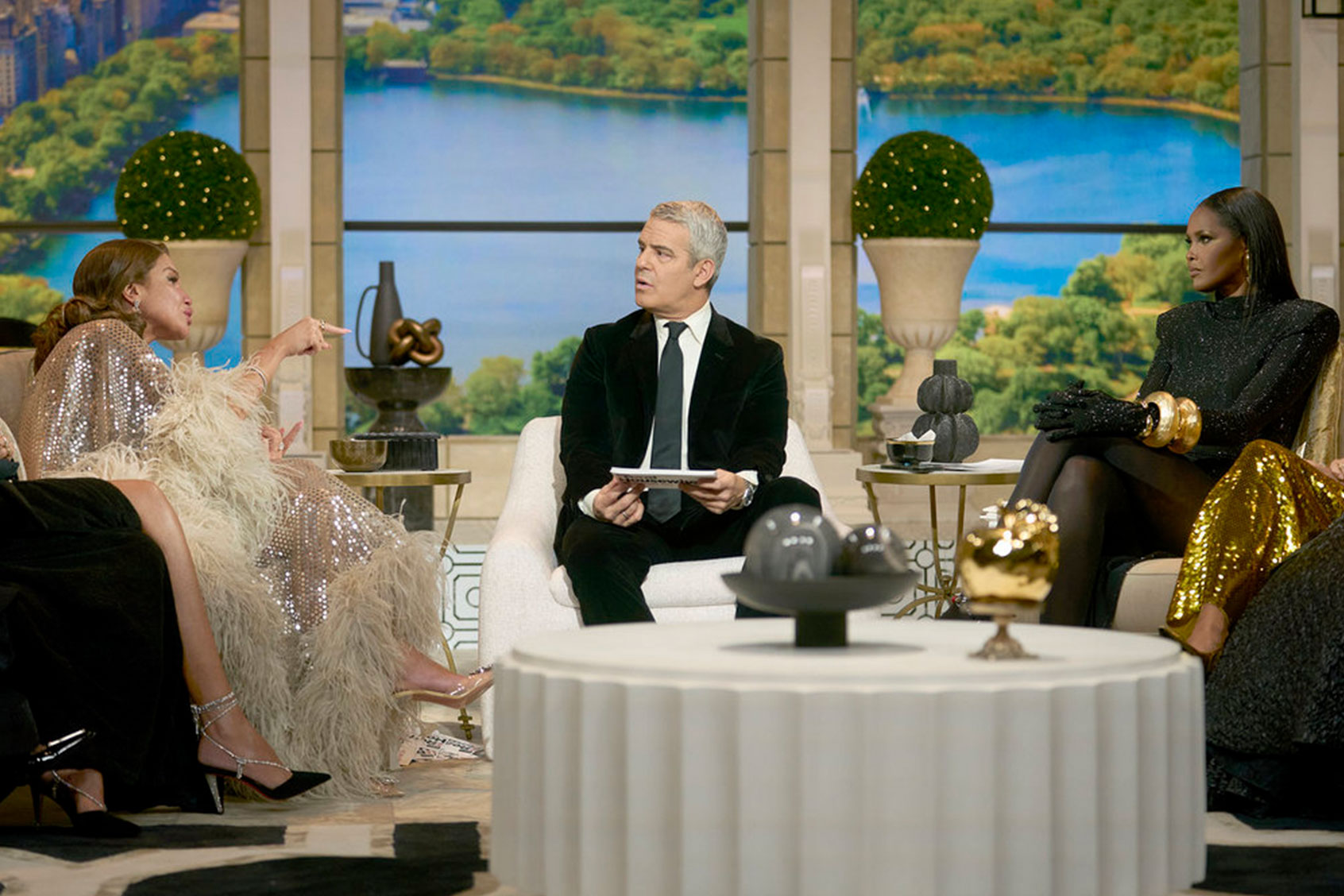
The revelation took the whole cast by surprise, not only because Whitfield confessed something so tragic, but because Hassan was seemingly weaponizing Whitfield’s sexual assault as fodder in a petty fight. The two women tried to hash it out shortly after, but Hassan refused to directly apologize, and Whitfield never mentioned the assault in their one-on-one conversation. The flames ultimately fizzled and the cast began to get ready to go to sleep. But after the cameras went down, Taank went to Hassan’s room to tell her that the group had learned of Whitfield’s assault, and asked Hassan why she’d accuse Whitfield of using sex to get a job when she knew about the attack.

“I didn’t get much further than that, because you could just see on Ubah’s face that she was completely blindsided,” Taank said in a confessional. De Silva added that soon after, she found Hassan “in a ball in the corner, shaking and sobbing.” A single production camera and cameras placed throughout the house caught Hassan breaking down in the aftermath, weeping and vomiting, swearing that she did not know about Whitfield’s attack. Then, as Lichy recounts in a confessional, Whitfield pulled them all aside to retell the story, saying that she had called Hassan in a low moment and recounted several different traumas affecting her at the time. “That’s when Brynn says, ‘Come to think of it, maybe [Ubah] didn’t clock [the mention of the assault],” Lichy recalled.

From that moment, it was a house divided. None of the cast doubted that Whitfield was assaulted, but none of them believed that Hassan knew of the assault when she made the lewd comments about Whitfield using sex to get on the show. The problem was that Whitfield initially asserted that Hassan had full knowledge of the attack, and that if she hadn’t retracted that statement, it could ruin Hassan’s character not just among the group of friends, but among millions of viewers as well. 

I’m just as invested in the Bravoverse theatrics as anyone else, but the sound of fans banging their fists on the table to demand more scandals has drowned out their better judgment.

The events left a bitter taste in the mouths of Whitfield’s fellow cast members and audiences watching from home. Some attributed it to a larger plan of attack, accusing Whitfield of colorism toward Hassan earlier in the episode. Whitfield, who is biracial, claimed that Hassan’s comments about how she got the job on the show besmirched her merits, something that Black women often have to deal with in the workforce. But while on the cast trip, Whitfield poked fun at Hassan’s modeling career, noting that Hassan, a Somalian-American model, has done commercial work for brands like Dressbarn and Talbots. Wrap Whitfield’s hypocrisy into a package with her scattered claims that Hassan knew of her assault — as well as cameras catching Whitfield’s attempt to get friend-of Rebecca Minkoff to generate drama in an earlier episode — and things don’t look all that great for Whitfield’s place on the show, especially after @shedcasting created an Instagram post announcing that they were looking for newbies. 

The Real Housewives of New York CityBrynn Whitfield, Andy Cohen and Ubah Hassan in the Reunion episode of "The Real Housewives of New York City" (Clifton Prescod/Bravo )But is Whitfield the sole source of the problems here? I’d argue that, while it would be justified, yanking her from the cast would not solve the show’s systemic issues. “Real Housewives” has become such a massively popular reality television institution that viewers now demand equally colossal drama to match. They revel in the arrests, the drunken messes, the physical assaults and the dissolving marriages. I spotted no fewer than 10 tees with Housewife mugshots printed on them at BravoCon. For God’s sake, “Real Housewives of Potomac” viewers were turning dashcam footage of Karen Huger’s DUI arrest into meme fodder over the Christmas holiday. Does the fact that she could’ve killed herself or someone else not make fans think twice about turning drunk driving into a joke? Maybe we’re too far past that point to look back.

Believe me, I’m just as invested in the Bravoverse theatrics as anyone else, but the sound of fans banging their fists on the table to demand more scandals has drowned out their better judgment. Occasionally, some good can come out of this; the just-finished fifth season of “Real Housewives of Salt Lake City” included a moving intervention between mother and son that could legitimately save lives. But the “Housewives” franchise has become so steeped in these significant moments that viewers’ pleasure centers are rotting. The original version of “RHONY” was so wonderful because a lot of the drama was pure fluff with the occasional oh-my-god moment; the cast once spent an entire season in comical arguments about getting someone’s hair wet before a prosthetic leg flew across a restaurant in the finale. That’s shocking! 

When fans want “Housewives” to be outrageous all the time, can we really be surprised that trickles up to the cast themselves? Whitfield’s maneuvering this season was heinous, no doubt. But in those Dressbarn digs and leveraging her assault against a friend who was there at her lowest moment, I can clearly see a reality TV star who is trying to give viewers what they want. Of course, Whitfield would want to play her part in catering to fans’ absurd standards of entertainment. The first season of the “RHONY” reboot was touch-and-go, so successfully dialing up the spectacle of it all could mean that Whitfield gets to keep her job. It’s just that, in this instance, that scheme backfired. Being a Housewife is a life-changing opportunity, but it’s also a life-ruining one. We’ve seen so many Housewives crash out in their quest to become iconic, and Whitfield is just the latest casualty of her own ego. There will no doubt be more women who try to play the game and have it blow up in their faces, and the only way to put a stop to it is to allow “Housewives” to pivot away from insanity and back to mere absurdity. The world is wicked enough as it is, we could stand to settle for drunk and dramatic over downright evil.

Richard Blais on “Next Level Chef,” Italian inspiration and the joy of messy eating

Back in 2008, Richard Blais competed on the fourth season of “Top Chef,” set in Chicago. That season, Blais stood out for his passion for molecular gastronomy, a technique he showcased throughout the competition. He was a dominant force, ultimately finishing as one of two runners-up, bested by Chef Stephanie Izard. A few years later, he returned for the first “Top Chef: All-Stars” — and this time, he won, defeating Chef Mike Isabella for the title.

Since then, Blais has become a familiar face in the “Top Chef” universe, appearing on countless episodes and spin-offs, including “Top Chef Duels,” as a competitor, guest judge and mentor. He has released multiple cookbooks, one of which earned a James Beard Award nomination, and opened several acclaimed restaurants. He’s also a regular on Food Network — like many “Top Chef” alumni — and has had a recurring guest judge role on “MasterChef” and its spin-offs.

He is, unquestionably, one of the biggest success stories to come out of “Top Chef,” which is now approaching its 22nd season.

His latest endeavors include two new restaurants in Arizona — La Zozzona and Tiki Taka — as well as a judging role on “Next Level Chef” alongside Gordon Ramsay and fellow “Top Chef” alum Nyesha Arrington. The show, named for its multi-tiered kitchen setup, takes a markedly different approach from “Top Chef,” but Blais and Arrington draw from their competition experience to guide and mentor contestants.

Salon recently spoke with Blais about “Top Chef,” “Next Level Chef,” his new restaurants, his favorite ingredients and his ongoing journey in the culinary world.

Chef Richard Blais at La ZozzonaChef Richard Blais at La Zozzona

The following interview has been lightly edited for clarity and length. 

Hello! I’d love to hear all about La Zozzona; It sounds amazing. I read that it has been dubbed "A Richard Blais Itali-zona Kitchen." Can you explain that?
I've always wanted to do an Italian inspired restaurant that features both pastas and large plates. La Zozzona is a love letter to that cuisine, which also incorporates local Arizona ingredients and flavors.

Why "Messy Delicious"? What does that mean to you?
"Messy Delicious" is meant to emulate the playful and innovative nature of this menu. We hope that our guests will embrace this spirit through their dining experience.

I love how whimsical the website and menu design is. How integral is that to your vision of La Zozzona?
The menu and website design is part of a playful energy that we hope our guests will feel throughout their experience. It was important to me that these design elements felt cohesive and aligned with our vision for this concept.

How do you differentiate between your restaurants? Is it too tricky to pick a "favorite?"
I look at my restaurants as “albums” that are each unique to themselves and always inspired by deep-seated moments of inspiration, travel or creative desires. Each one is a favorite for a different reason and showcases a different inspiration from my life. I hope that guests who have enjoyed my other concepts are excited to try La Zozzona as well!

What do you love about Italian and Italian-American cuisine?
I cook and eat a lot of Italian food and have always been drawn to the cuisine and culture. I’m excited about La Zozzona as it is my first time creating a menu with these flavors and ingredients.  

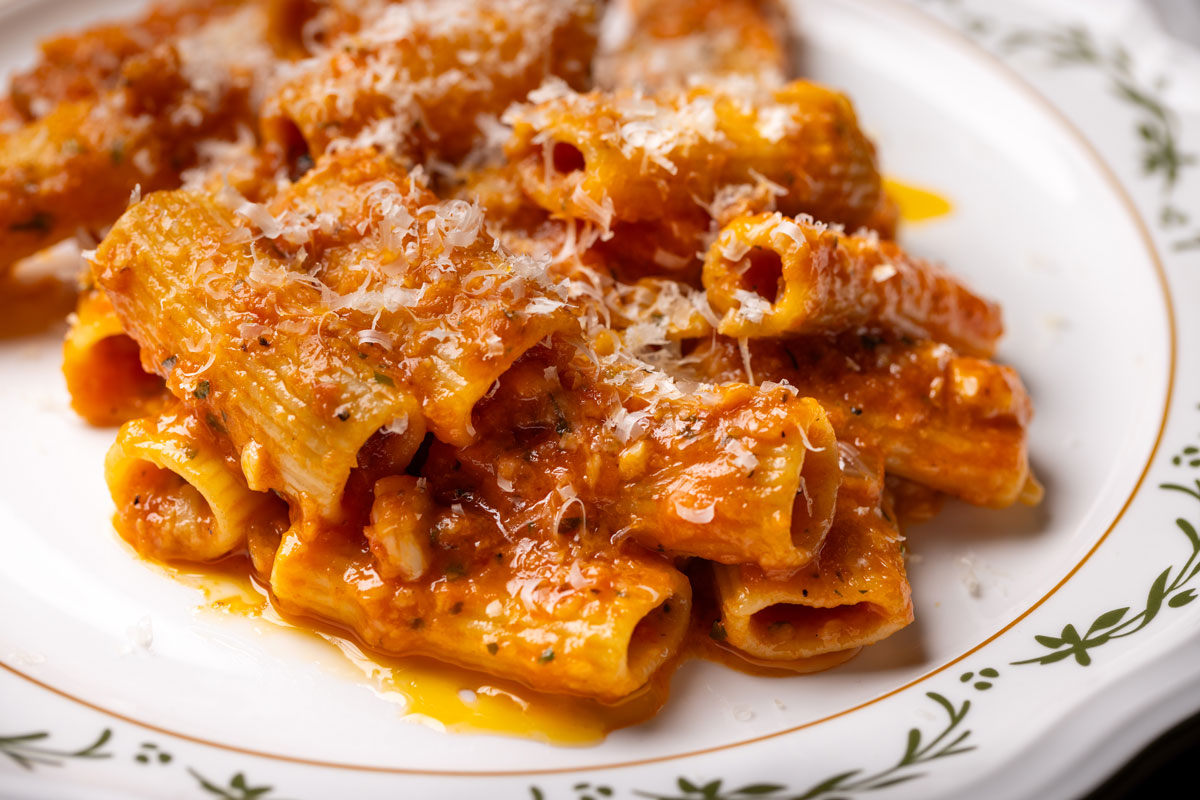
Rigatoni "alla Zozzona"Rigatoni "alla Zozzona" (the namesake dish) (Jakob Layman)

Do you think there's a standout dish at any of your restaurants, either personally or one that especially resonates with customers?
The Rigatoni Alla Zozzona at La Zozzona is definitely a standout and the namesake dish of the restaurant! Zozzona directly translates to ‘messy girl,’ as she gets sauce everywhere while eating pasta. This dish is a fun inspiration of familial eating and also showcases the beautiful pasta program we created.


Want more great food writing and recipes? Subscribe to Salon Food's newsletter, The Bite.


You have some terrific cookbooks. Any plans for more in the near future?
Plant forward is our most recent book. We are always looking to continue expressing ourselves literarily.

For those unaware of your journey since winning Top Chef All Stars, can you break it down for them?
It’s been a fun journey! I’ve opened several restaurants and also am a co-host on FOX’s Next Level Chef. 

Do you have a number one favorite ingredient to work with?
Clearly I enjoy pasta and steaks!!!

What was the biggest lesson or takeaways you gleaned from competing in — and winning  Top Chef?
Just to do what you love to do and things will work out.

Is there a particular dish from your Top Chef tenure that you are still especially proud of? I was such a fan of so many of your inventive, delicious-sounding dishes. What did the Top Chef “incubator” teach you? I spoke with Buddha just after his win last year and he referenced how it can be so great to singularly focus on cooking — not bills, not customers, not the daily minutiae of running or working in restaurants, etcetera.
No dish, but certainly culinary “improv” comes to mind. It’s a great exercise for restaurant chefs.

How was the transition from competitor to judge, especially now with Next Level Chef?
It gives you a very nice perch and angle to deliver commentary because you have seen things from the competitors' vantage point. I love talking about competitive cooking and being the “Tony Romo” of culinary competitions!

What stands out for you as a formative moment that got you into cooking or food at large?
Ever since I worked at McDonalds, I’ve always been attracted to the team work needed to operate a restaurant.

What would you say are your three most used ingredients?
Salt, vinegar and fresh herbs

What is your favorite cooking memory?
Eating baked clams with my parents as a young child.

We need your help to stay independent

What’s your biggest tip for cutting down on food waste?
Use it all! Make your own soups and stocks and sauces and utilize all leftovers or trim. It’s actually a very fun game to play!

How do you practice sustainability in your cooking and in your restaurants?
As mentioned above, finding the flavor and bits and pieces that get overlooked sometimes. Fresh herb stems are great when minced finely. Every piece of vegetable scrap or trim from protein can make an excellent sauce. Literally grind everything and you will find plenty of use of everything. Purchase from vendors and farmers and fisher people that have the same ethos as you do!

Tiki Taka interiorTiki Taka interior

How is Tiki Taka, your other restaurant at Grand Hyatt Scottsdale Resort, similar and different to La Zozzona? 

Tiki Taka is more casual than La Zozzona and its menu celebrates the small plates and flavors of Japanese and Spanish cultures. Both concepts celebrate the flavors and ingredients of the Southwest.

What has it been like expanding more restaurants at Grand Hyatt Scottsdale Resort?

Collaborating on all of the food & beverage concepts with Grand Hyatt Scottsdale Resort has been an extremely rewarding experience.

You can watch Blais on "Next Level Chef," which fourth season is premiering this Thursday, February 13, on Fox. 

America’s next spy chief: Senate confirms Tulsi Gabbard as Director of National Intelligence

The Senate voted 52-48 Wednesday to confirm former Rep. Tulsi Gabbard as Director of National Intelligence, with all Democrats — and Sen. Mitch McConnell, R-Ky. — opposing the nomination.

As chief of the national intelligence community, Gabbard will set policy and direct the intelligence-gathering activities of all 18 U.S. intelligence agencies, including the CIA.

Gabbard, who was a Democrat until 2022 but critical of her party long before that, endorsed Donald Trump in the 2024 election. She previously served in the Army Reserve but has no formal intelligence experience. More than that, Democrats have attacked Gabbard for her apparent sympathy for autocrats like Vladimir Putin and Bashar al-Assad, embrace of various conspiracy theories used to justify their actions, and skepticism towards aiding Ukraine as it struggles to fend off a Russian invasion.

Ward Elcock, former director of Canada's national intelligence agency, CSIS, told CBC News that Gabbard's lack of experience and qualifications is deeply concerning.

"This is neither a particularly complex or particularly thoughtful person," he said. "Nothing I've read about her suggests she has the background or the experience or the knowledge to take up the positions that she's being appointed to by the Trump administration."

Perhaps her most famous turn in the spotlight before 2024 was her trip to Syria, where she met Assad even as he waged a destructive war against his own people. She also previously supported Edward Snowden, who leaked information on U.S. espionage and surveillance campaigns around the world and who lawmakers from both parties asked her to condemn at her confirmation hearing; she refused.

Against arguments by Senate Foreign Relations Committee members that Snowden had endangered U.S. personnel and interests, Gabbard insisted that the programs that Snowden exposed were “egregious, illegal and unconstitutional.”

Such positions, her critics said, made her an unfit and potentially dangerous choice to lead U.S. intelligence agencies, and one who could not be trusted by U.S. allies to share vital information with. Indeed, diplomats from several of those countries are already discussing countermeasures that can safeguard their own intelligence communities from potential exposure to their adversaries while not alienating their strongest ally.

While Gabbard has spoken about her opposition to U.S. interventionism and intrusive surveillance, her record on matters of war and peace is inconsistent. During President Barack Obama's second term, she criticized the former president for his alleged weakness in declining to say that the U.S. was at war not just with ISIS, but with "radical Islam" in general. And when Russia began a bombing campaign in Syria that killed thousands of civilians in and around Aleppo, Gabbard praised the effort.

Anywhere between 5,000 to 20,000 civilians were killed by U.S. and Russian operations against ISIS from 2014 to 2019, according to Airwars, an independent monitoring organization.

When she endorsed Sen. Bernie Sanders, I-Vt., in 2016, Gabbard described herself as a “dove” when it came to “counterproductive wars of regime change” but a “hawk” in the global “war against terrorists," though anti-war critics argue that U.S. policymakers hardly make a difference between the two.

While she has previously equivocated between occasionally criticizing Israel and announcing her vigorous support for the Jewish state, delivering the keynote address in 2015 at a Christians United for Israel conference, she has now decisively swung towards the latter position. During the protests against Israel's invasion of Gaza, which human rights organizations have described as genocide, she called the protesters puppets of a "radical Islamist organization."

Still, one senior former intelligence official told Politico that allies like Israel would continue to have "serious qualms" about Gabbard.

FX’s renewal of “English Teacher” sends a dangerous message

There are quite a few ways to describe what we’re living through right now: a coup, a fascist takeover, a nightmare. But one way to see it is as a series of gleeful violations of consent, courtesy of some of the worst people in the world.  

Did any of us consent to having the current regime allegedly rummaging around in the databases belonging to the Treasury Department — you know, the people we pay our taxes to? I doubt it. Without the permission of Congress or much of the populace, whole departments and divisions of the government are being shut down. The autonomy of all kinds of people, especially trans folks, is being targeted in ever more cruel ways daily. 

But this intentionally induced fear and suffering are features, not bugs. Like all abusers, the current DC administration glories in doing what it wants, how it wants, other human beings be damned. It is, unfortunately, the heyday of the harmful sociopath and the abusive clinical narcissist. Not that some didn’t have power before, but right now, in many centers of authority and influence, they are the only people that matter. I did not foresee a government or business community in which having engaged in violence or having assault allegations on one’s resume would be regarded as a plus, not a minus, but here we are. 

Just for the record, I do not believe this is right. I do not accept this. 

And I reject the idea that the reporting many have done in the past decade – on Hollywood misconduct, abuse, assault, monstrous behavior and the enabling of same – simply does not matter, despite all indications otherwise. 

On Friday, FX announced that it had renewed the show “English Teacher” for a second season. In December, the man who created the show and stars in it, Brian Jordan Alvarez, was the subject of an exhaustive Vulture story that contained allegations of assault, misconduct, boundary crossing and deeply unprofessional behavior. 

English TeacherBrian Jordan Alvarez in "English Teacher" (FX)As critic and professor Myles McNutt pointed out, FX’s press release announcing the renewal quoted nine critics’ praise of the show — positive words that were written many months before the story about Alvarez came out. McNutt’s analysis of this bizarre and poorly handled situation is worth reading, especially this part: “Put simply, it is a press release from an alternate dimension where the Vulture story was never published. I know of at least one critic whose review is quoted in the release who would absolutely not co-sign this decision, and I have to imagine that others feel the same way.”

So that happened. A network that has long depended on members of the media to spread the word about its programs used critics’ words to tout a project and a person that many of those writers would not have, at this moment, even remotely endorsed. But hey, what’s the point of respecting the unusual nature of the situation or asking permission? It’s the “do whatever you want” era.  


Want a daily wrap-up of all the news and commentary Salon has to offer? Subscribe to our morning newsletter, Crash Course.


Before I get to the most serious allegation (among many disturbing allegations) in the story on Alvarez, I’d like to address a question I’ve gotten a lot, especially after the 2023 release of my book “Burn It Down,” which examined how Hollywood has long enabled all manner of awful behavior. Usually, the questions go something like this: “But this person’s behavior or actions took place years ago — why does it matter now? Maybe they’ve changed?”

My book contains a whole chapter about how I hope people can evolve, and the rigorous ways in which they can demonstrate they’ve changed, and how communities can keep themselves safe from people who say they’ve changed, but potentially haven’t. So I forcefully reject the idea that myself and other journalists on this beat don’t take nuance, complexity and the passage of time into account. E. Alex Jung’s piece on Alvarez is commendable for many reasons, but in particular for its commitment to examining the histories of the people involved with clarity and thoughtfulness.  

The thing is, most people can’t help but tell on themselves. 

This is a dynamic that has happened to me many, many times in my long reporting career: I reach out to someone accused of heinous, damaging or even criminal behavior — events that may have happened months or years ago. And in the present day, that person’s responses tell me everything I need to know about whether they’re still a toxic leader or an abusive person. 

The way these people frame, explain or ignore their patterns of behavior – all those excuses are offered up right now, not months or years ago. Many times I’ve thought, “This person has had multiple opportunities to make amends and become better, and, based on their current responses and actions, it very much looks like they’ve turned down every one of those chances.” 

Most people can’t help but tell on themselves.

There are many upsetting things in the Vulture story, but one moment on the set of the indie series “The Gay and Wondrous Life of Caleb Gallo” is the worst. The script called for Caleb (Brian Jordan Alvarez) to perform oral sex on Billy (Jon Ebeling) under a blanket. Per Vulture, Ebeling said that “when Alvarez went under the covers, he pulled down Ebeling’s underwear and began sucking his penis. ‘I am assuming nobody on set knows what’s going on under the comforter, and I’m just frozen,’ [Ebeling] says. ‘I didn’t know what to do. I’m on set with my director, who is assaulting me. It was a horrible feeling.’” Ebeling texted another co-star, Stephanie Koenig, “We were shooting and Brian took a huge godd**n liberty. I’m so f**king upset. I feel like I was raped. Literally, I was raped.”

This was on set. They were at work — on a project Alvarez created. This was during a sexual scene, which is among the times that artists should feel most protected, heard and cared for — but as we’ve frequently seen, that is often very much not the case. 

When confronted with Vulture’s questions about this, Alvarez’s response, through his reps, was really something. His lawyer told Vulture that “Ebeling’s reaction was overblown and that he was ‘pretending to be upset,’ writing, ‘This was the performative Kabuki theater of a self-described manipulator, who was distorting the situation to ingratiate himself to [Koenig].’ He does not dispute the act but argues that because their previous sexual encounters were consensual, Alvarez assumed the same would be the case here.”

He does not dispute the act. Read that again. He does not dispute the act. 

It’s just my two cents, but it sure looks to me like Alvarez, in that situation, decided unilaterally that consent existed. Find me one expert on consent or sexual violence who would agree that, in any situation, personal or professional, one person gets to decide, on their own, that consent is present. According to the story, Alvarez and Eberling had engaged in sexual activity before. In what world would that mean he consented to what Alvarez allegedly did while cameras rolled? 

For those who may still be unclear on this: Past sexual activity is meaningless when it comes to consent. Consent must exist at the start of and throughout every sexual situation, every time. One person does not get to decide they have consent and consequently do whatever they want. This is not up for debate. If you think it is, get help. 

According to Alvarez’s reps, all of his sexual interactions with Ebeling were consensual, and later in the piece, those reps added that, regarding that “Caleb Gallo” scene, Ebeling “‘consented verbally’ to doing it ‘for real’ beforehand.” (And that leads me to have a lot of questions about the fact that Alvarez’s reps described two very different scenarios: He didn’t need to ask for consent because he assumed he had it, and he did know he needed to ask for consent and got it.) For his part, Ebeling strongly denied that he ever gave consent to the alleged assault that occurred. “Produce the evidence,” he told Vulture. “No way in hell would I have ever consented to that.”

One person does not get to decide they have consent and consequently do whatever they want. This is not up for debate.

The broligarchs bending the knee to the current administration continue to do their level best to destroy the media, but there are still people in the press that, I’m sure, have questions about all this. These are some of the queries I hope come up in future coverage of this show and the decision to renew it.

How does FX allow its creative personnel to define consent? Are those with power allowed to define it however they want? If those with power have broad leeway regarding consent and conduct, how does that make people who work at FX or on FX projects safe? Why would anyone filming a future sex scene on "English Teacher" feel protected? 

What does FX plan to do if something unprofessional, harassing or dangerous happens on any of their productions after Alvarez was rewarded with a renewal of his show? What is the plan to deal with the moral consequences and the legal liabilities of any potential situation where a worker was harmed by someone who decided that the network’s actions constitute a behavioral free pass? And what about the network’s backing of Alvarez will encourage those who encounter unacceptable behavior to come forward? 

And finally, FX has, on multiple fronts, held itself out as something special, something better, in the industry. Yet the message this sends to viewers, to the creative community and to survivors is that nothing matters. Credible allegations of serious misconduct and assault don’t matter. How is that special? How is that not exactly what the industry has usually done for the last century — sweep the inconvenient and the abused under a very toxic rug? 

Legally, ethically, morally and from a PR standpoint, this is a tin-eared, baffling, short-sighted and abhorrent decision. Why is this guy, and this show, worth it? 

A more broad question for the industry at large to ponder: How is Alvarez’s response to these allegations any different from that of Neil Gaiman, who responded to multiple allegations of assault and abuse by saying “I don’t accept there was any abuse.” This a very common technique, and it’s quite forcefully back in fashion: Survivors and the reporters who tell their stories are just liars. The powerful get to determine what happened, and the rest of the world doesn’t have a voice. It’s true that most of Gaiman’s TV and film projects have been canceled. But given the current climate, I wonder if it’s only a matter of time before Gaiman’s I.P. proves to be too strong a lure for the industry to resist — and, as in so many other cases, everything will just go back to a pre-MeToo version of “normal.”  

The Daily Beast spoke to Ebeling, who said he was “heartbroken and devastated” about the renewal, and he added that “I’m in fear for the people who have to work with Brian and continue to work with Brian.” 

This a very common technique, and it’s quite forcefully back in fashion: Survivors and the reporters who tell their stories are just liars.

Ebeling noted that there had been several “off the record” accusers in the Vulture story, “one of whom claimed he had to take out a ‘no contact’ order against Alvarez, and another who alleged Alvarez ‘groped his groin’ when they were students at USC—and [Ebeling] claims to have heard from more individuals still.” Even before the FX renewal, Ebeling spoke of a chilling effect: “There’s a huge fear of people not being believed.”

Yeah, that tracks. Why, in this dismal climate, would people risk so much by coming forward? Why would anyone fight for the idea that consent should always be honored, that industry workers deserve respect at all times, and that perpetrators of harm should face meaningful, ongoing consequences for their actions?

But there are, and always have been, courageous people in this industry. Jon Ebeling is one of them, and I’m more sorry than I can say that he’s had to go through a decade of nightmares thanks to his former friends and collaborators. Who have just been very publicly rewarded by the system. 

I’d have thought that the network that went through a massive crisis regarding the depiction of rape on “Rescue Me,” that shoveled millions at Charlie Sheen to make a deeply misogynist sitcom, that made Louis CK extremely famous, would perhaps not want to send this particular message to every survivor, not just in the industry, but in the world. I was wrong. I was very wrong. 

“I honestly had more faith in FX before this,” Ebeling said Friday. “The way they handled this is just, I think, unforgivable.”

Dunkin’ items among 60 FGF Brands products recalled for Listeria risk

A new recall has been issued for products from FGF Brands, a pastry wholesaler, due to a potential contamination with Listeria monocytogenes. According to USA Today's Sama Shafiq, the recall affects 60 products, which were sold and distributed by the company.

The recall, classified as a Class II by the FDA, includes all products produced on or before Dec. 13, 2024. Millions of cases of these products are being recalled, resulting in significant food waste.

Among the affected items are various baked goods, some of which are sold at Dunkin'. These include cinnamon sticks, filled and flavored donuts, French crullers and fritters.

The FDA defines a Class II recall as one where exposure to the product may cause temporary or medically reversible adverse health consequences, or where the likelihood of serious health effects is remote.

Neither the FDA nor FGF Brands has provided information regarding refunds or returns. If you have any of the affected products, it is recommended that you dispose of them immediately.

Stores like Trader Joe’s and Costco now implementing limits on egg purchases

Ongoing supply chain issues tied to the bird flu outbreak are prompting major grocery chains and restaurants to impose restrictions on egg purchases. Trader Joe's in Merrick, New York, is one of the latest to limit customers to one dozen eggs per person. Signs at the store urge shoppers to be patient, acknowledging the supply issues while promising a resolution soon.

Similar measures are being enacted across the country. Costco has warned customers on its website that egg shortages, caused by the highly pathogenic avian influenza, may lead to product cuts or delays. Other grocery chains, including Sprouts and Kroger, have also reported limits on egg sales at some locations.

The egg shortage is not only affecting retailers. Waffle House has begun charging a surcharge on all egg dishes as it grapples with the shortage. The price of eggs has already risen 14% from November to December, and analysts predict an additional 20% increase this year, according to the U.S. Department of Agriculture.

With the rising cost of eggs and the continued challenges in supply, the ripple effects are felt across the food industry. Consumers are scrambling to adjust to the new normal, with price hikes and limited availability becoming increasingly common.

Elon Musk and his DOGE operatives are now in charge of hiring at most federal agencies

With Elon Musk standing beside him in the Oval Office, President Donald Trump signed an executive order Tuesday afternoon that puts each federal agency under the watchful eye of a DOGE "team lead," setting broad parameters for Musk's so-called "Department of Government Efficiency" to commence a "critical transformation of the Federal bureaucracy."

The order requires agencies to develop a plan in consultation with the DOGE team leads to "reduce the size of the Federal Government’s workforce through efficiency improvements and attrition," with requirements to hire no more than one employee for every four employees that depart; only functions related to law enforcement, immigration enforcement and public safety are exempt from the rule.

The DOGE team leads are also given approval powers over hiring and firing decisions at their respective agencies, with only the agency heads having the authority to override them.

Within 30 days, agencies are to submit their reports to the Office of Management and Budget (OMB), which is headed by Project 2025 architect Russell Vought. According to the order, the reports must "discuss whether the agency or any of its subcomponents should be eliminated or consolidated."

Even before Trump issued the order, Musk and his team has been taking the axe to various government agencies he apparently considers wasteful, including the Consumer Financial Protection Bureau, which protects consumers from exploitative lenders and business practices; the Federal Emergency Management Agency, which coordinates the federal response to natural disasters; and the Department of Education, whose mandate includes prohibiting discrimination in public schools and colleges.

Other departments, such as the Pentagon, which accounts for 13% of the federal budget, remained largely untouched.

While the executive order formalizes a parallel overlay of the federal government in the form of Musk's DOGE, it still does not clearly define its legal status. Trump has long said that it would be an advisory committee placed outside the federal government and thus be exempt from the congressional approval process, but its new powers extend far beyond offering recommendations.


Kanye West’s online storefront shut down after peddling swastika shirts

Rapper Kanye West has landed at the center of a series of fresh controversies that began when he paraded his nearly nude wife, Bianca Censori, down the Grammys red carpet earlier in February and the latest backlash involves a run of swastika T-shirts listed for sale on his online storefront — which Shopify swiftly pulled the plug on.

As of Tuesday, users attempting to access yeezy.com were met with an all-white screen and the words, "Something went wrong. What happened? This store is unavailable" after a darkening of the site which the e-commerce platform explained in the following statement:

"All merchants are responsible for following the rules of our platform. This merchant did not engage in authentic commerce practices and violated our terms, so we removed them from Shopify."

According to Forbes, "It’s unclear if any of the swastika shirts being sold on the website were shipped to customers in the two days they were available for purchase," but screenshots of the offensive merchandise have spread across social media.

Prior to West's storefront being taken down, he created a bizarre ad that ran the weekend of the Super Bowl in which he showed off a new set of what appeared to be overly large, overly white pointed teeth in an effort to promote his swastika shirts.

According to Variety, the ad "shocked the station execs who ran it and media buyers who approved the spot" when West "immediately flipped the website after the ad aired, replacing its previous content with just one item: A swastika T-shirt for sale, at $20 each." 

Per the outlet's reporting, the ad ran on three Fox-owned stations, including KTTV Los Angeles, and may have been seen in a few more local markets.

“It isn’t an accident that we’re here now”: How the Supreme Court encouraged Trump to defy the law

With President Donald Trump’s administration appearing to act in open defiance of court orders, even as the Justice Department insists the administration is trying to comply in good faith, and Vice President JD Vance railing against the authority of the judiciary, legal experts note that courts could still impose dramatic civil penalties on those who carry out Trump's orders, a measure courts are yet to impose. 

At the same time, historians note that the Trump administration, in asserting broad executive powers unchecked by Congress or the courts, is reviving legal battles that were considered settled hundreds of years ago.

On Monday, Judge John McConnell Jr., presiding over a federal court in Rhode Island, wrote that the Trump administration was violating the “plain language” of a previous court order prohibiting “all categorical pauses or freezes” in federal spending.

The freeze has affected a wide range of programs, like early childhood education programs funded by Head Start grants, tribal governments, schools in low-income districts and rural hospitals. A senior official at the Federal Emergency Management Agency also directed subordinates to freeze a vast assortment of grants on Monday, even after the ruling in Rhode Island.

Meanwhile, over the weekend Vance suggested that the administration might spurn the judicial system, claiming in a social media post that judges "aren't allowed to control the executive's legitimate power.”

“If a judge tried to tell a general how to conduct a military operation, that would be illegal,” Vance wrote. “If a judge tried to command the attorney general in how to use her discretion as a prosecutor, that's also illegal.”

Trump himself told reporters Tuesday that "I always abide by the courts" despite protests from his allies, like billionaire Elon Musk, who earlier said that McConnell, the Rhode Island judge, ought to be impeached.

Michael McConnell, a former judge on the Tenth Circuit Court of Appeals and the director of Stanford’s Constitutional Law Center, expressed skepticism that the Trump administration would openly defy a court order, despite some of its rhetoric. He spoke with Salon on Monday, before the Rhode Island court clarified that the administration was not in compliance with their previous order. 

McConnell noted that the General Accountability Office and the Comptroller General, which are technically part of the legislative branch, are theoretically responsible for ensuring the president is in compliance with appropriations statutes. But, “in the end, we rely on the courts, which is why it would be such an extreme step if the president just didn’t follow a court opinion.”

David Super, a legal historian at Georgetown University, told Salon that in terms of “the issue of overt defiance, it really hasn't happened squarely. ”

Super explained that even infamous examples often brought up when discussing the issue aren’t as clear cut as what Trump is doing right now. For instance, in the instance of Worcester v. Georgia, which concerned whether the state of Georgia had the authority to regulate the affairs of its citizens and the Cherokee Nation, President Andrew Jackson is often said to have defied the Supreme Court. Vance himself cited an apocryphal quote attributed to Jackson while appearing on a podcast in 2021, saying that "when the courts stop you, stand before the country like Andrew Jackson did and say: ‘The chief justice has made his ruling. Now let him enforce it.'" 

Politico recently asked Vance if he still believed Trump should simply ignore the judicial branch. He replied: "Yup."

However, Super notes, the United States wasn’t a party to the case, “so there was never any order directed at Jackson or another federal authority. That’s an example of a president expressing disdain for a president but not refusing to comply with it.”

Another oft-cited case of a president defying a court is in the case of United States ex rel. Murphy v. Porter, which concerned President Abraham Lincoln's suspension of habeas corpus. Lincoln had intervened in an attempt to serve a writ of habeas corpus. While the circuit court that ruled on the issue protested this intervention, they never actually ordered Lincoln to do something else. 

“That was not an opinion of the Supreme Court," Super said, noting that "back then Supreme Court justices sat on other courts when the Supreme Court wasn't in session.” 

“Lincoln," he continued, "was clearly unsympathetic but never defied even that order, let alone an order of the Supreme Court. It never ordered President Lincoln to do anything else.” 

In terms of mechanisms of accountability, Super said that there are some measures the courts can take that they haven't yet, with the main one being holding administration officials in civil contempt.

“If they jail people for criminal contempt, Trump can pardon them and they can get out. But courts can also charge people with civil contempt, which is not a penalty — it's a coercion,” Super said. “The Supreme Court has held that the pardon power does not apply to civil contempt.”

Essentially, courts have broad discretion to proscribe coercion in order to make people, including executive officials, comply with a court order; this can take the form of fines or jail time for the person who refuses to comply. While judges have traditionally given employees of the executive branch more leeway in their timeline for compliance, Super said that “the court is capable of imposing a fine capable of coercing anyone’s compliance,” even a billionaire.

“Go broke or go to jail,” Super said. “They could do that to Mr. Musk or Mr. Vought.”

We need your help to stay independent

Holly Brewer, a legal historian at the University of Maryland, told Salon that “what Trump is doing is moving back to a role for the legislature where the legislature is merely advisory.”

Brewer said that, in this way, Trump is revisiting battles that were settled in the 17th century during the English Civil War and the Glorious Revolution.

“The thing that strikes me the most is that if funds are appropriated by Congress and approved to be used for particular purposes, this is the law of the land — and if the president is somehow deciding by executive order that he gets to change these fund,s this is an issue that was at the core of the constitutional crises of the 17th century,” Brewer said.

In Brewer’s assessment, the Supreme Court unleashed Trump with its presidential immunity ruling in 2024, which effectively isolates him from suffering consequences for potentially illegal acts, at least if they can be construed as official acts of the president.

“It isn’t an accident that we’re here now. It’s because of some of what the Supreme Court has done,” Brewer said. “I don’t think even the Supreme Court fully understood the consequences of the immunity decisions.”

Lawrence Rosenthal, chair of the Center for Right-Wing Studies at the University of California, agreed with Brewer in identifying the immunity decision as key legal groundwork for the current moment.

“I think the larger question is immunity or impunity: the sense that the executive can do what he wishes without fear of running afoul of the law. Another way of putting that is 'being above the law,'” Rosenthal said.

Rosenthal noted that under both German and Italian Fascism, ruling parties passed acts aimed at insulating themselves from accountability. In Germany, this was called the Enabling Act; in Italy, it was the Acerbo Law.

Rosenthal noted that both the German and Italian systems were parliamentary democracies, however, and that in the United States, it was the Supreme Court that granted this type of protection. “The name of it was 'presidential immunity,' which was discovered last year by the Supreme Court."

“Donald Trump has been given a kind of legal carte blanche, so if there are sanctions or orders and he does not follow them he is, in the words of the immunity decision, acting in his capacity as president, and he does not have criminal liability,” Rosenthal said.  

The only silver lining of the current legal battle, in Rosenthal's view, is that “Americans have had the most serious conversation in my lifetime about the nature of fascism.”

MAGA’s push for a constitutional showdown sparks unexpected resistance

In response to the flurry of cases brought against the Trump administration for its radical attempts to slash and burn all aspects of the federal government without constitutional authority, we're seeing some arguments from Republicans that lead to the conclusion that there is at least some consideration being given to simply ignoring the court's orders. Some have evoked the likely apocryphal statement attributed to President Andrew Jackson in which he was said to have declared, "[Chief Justice] John Marshall has made his decision; now let him enforce it" — which raises the question if Trump is planning to abide by court rulings he doesn't agree with.

The New York Times described the famous quote as "potent" because it perfectly illustrates perhaps the most important "norm" in our system of government, the acknowledgment and acceptance of the idea set forth by the Marshall Court in the landmark 1803 case Marbury v. Madison that "it is emphatically the province and duty of the judicial department to say what the law is. Those who apply the rule to particular cases must, of necessity, expound and interpret the rule." Jackson asked the frankly logical question of how such a thing could be practically enforced by the co-equal judicial branch against the executive if it has no coercive power of its own. Obviously, it depends upon the agreed-upon norm by all three branches of government as well as the states that the federal judiciary is the ultimate interpreter of the U.S. Constitution.

This is about whether the executive branch has the authority to usurp the power of Congress to appropriate and spend money, create or end agencies and fire people with civil service protections without cause.

Therefore, this concept that the judiciary is the final arbiter has always been built on a somewhat shaky premise that really comes down to "somebody's got to be the one to decide," and I assume the idea is that the court was considered to be the most insulated from crude political concerns so it was the most likely to make a dispassionate decision. We know that's a very dicey assumption but continue to hope that they will, at least, have an eye on the bigger picture when it comes to momentous constitutional crises. We may be about to find out if that's true.

This concept has been contested, particularly by the states, even as recently as the 1950s and 1960s. Presidents Abraham Lincoln and Franklin Delano Roosevelt both questioned the idea of "judicial supremacy" and took actions that arguably ignored judicial rulings by continuing to pursue them through the courts and attempting to change them through legislation during grave national crises. But there was never an outright dare to the Supreme Court to force them to acquiesce.

The vice president is the most high-profile official to advance the notion that the president isn't required to adhere to judicial orders. Over the weekend, in response to the various judicial actions requiring the Trump administration to pause much of its program to destroy the federal government, he tweeted that "judges aren't allowed to control the executive's legitimate power":

As the Times noted, this issue was addressed by Chief Justice John Roberts in his year-end report:

“Every administration suffers defeats in the court system — sometimes in cases with major ramifications for executive or legislative power or other consequential topics,” he wrote. “Nevertheless, for the past several decades, the decisions of the courts, popular or not, have been followed, and the nation has avoided the standoffs that plagued the 1950s and 1960s.”

“Within the past few years, however,” the chief justice went on, “elected officials from across the political spectrum have raised the specter of open disregard for federal court rulings. These dangerous suggestions, however sporadic, must be soundly rejected.”

He added, "The role of the judicial branch is to say what the law is," but “judicial independence is undermined unless the other branches are firm in their responsibility to enforce the court’s decrees.”

Good luck with that. Any thought that this Congress will act to restrain Trump or have the court's back is a fantasy. The GOP majority has turned over its constitutional prerogatives to Trump and Musk and is slinking away like a pack of beaten dogs. Constitutional lawyer and Speaker of the House Mike Johnson pretty much turned over his gavel to Elon Musk and his teenage Dogeboys:

We need your help to stay independent

Or take the comment from Thom Tillis, the allegedly moderate GOP senator from North Carolina, saying that what Trump is doing “runs afoul of the Constitution in the strictest sense" but “nobody should bellyache about that.”

Even a community note on Elon Musk's platform, X, noted that the courts decide what the law is in response to an ignorant comment from Trump's personal lawyer and counselor Alina Habba:

But an interesting thing happened on Tuesday afternoon that made me think there's a possibility that all isn't as it seems with this strategy. Trump held one of his executive order pageants in the Oval Office and he was joined by a bizarrely attired Elon Musk and his little toddler son, X. He asked Musk to take some questions, which he did, as his son crawled all over him and Trump looked on, visibly annoyed. It was very strange.

We know that Trump often degrades and insults judges who rule in ways he doesn't like. (Musk has suggested that they need to be impeached.) So when Trump was asked if he planned to comply with court orders I assumed that he would rant and rave about crooked judges and rigged cases as he usually does. But he didn't.


Want a daily wrap-up of all the news and commentary Salon has to offer? Subscribe to our morning newsletter, Crash Course.


This is what he said:

“I always abide by the courts and then I’ll have to appeal it. But then what he’s done is he’s slowed down momentum. And it gives crooked people more time to cover up the books. The answer is I always abide by the courts, always abide by them. And we’ll appeal. But appeals take a long time.”

He went on to say that he didn't think any court would tell him that they aren't allowed to audit the agencies and look for fraud. But nobody's saying the president doesn't have the right to do that. This is about whether the executive branch has the authority to usurp the power of Congress to appropriate and spend money, create or end agencies and fire people with civil service protections without cause (among other things.) It's about whether they are required to follow the law and procedures that govern how the executive branch operates under the Constitution.

The answer was very unlike him and it occurred to me after watching him look on as Musk was bizarrely attempting to justify his radical actions that Trump isn't really on board with all this. Does he want the courts to slow everything down? Is he hoping that the Supreme Court will rule against this Musk and Project 2025 dumpster fire?

I wonder. He ran against the "deep state" to wreak revenge on the Justice Department and the intelligence community for pursuing his criminal behavior. But I never got the idea that he was hellbent on destroying the federal government. He doesn't care about deficits, that's for sure, repeatedly assuring the voters that tariffs and "growth" were going to eliminate them. This isn't really his agenda.

Watching the look on his face as Musk held court, I couldn't help but think that Trump is now rueing the day that he hooked up with him. He doesn't really understand what he's doing and he doesn't know how to stop him. Maybe his pals on the Supreme Court will do him yet another solid and stop Musk for him.

House cats with bird flu could pose a risk to public health

More than 80 domestic cats, among many other types of mammals, have been confirmed to have had bird flu since 2022 — generally barn cats that lived on dairy farms, as well as feral cats and pets that spend time outdoors and likely caught it by hunting diseased rodents or wild birds.

Now, a small but growing number of house cats have gotten sick from H5N1, the bird flu strain driving the current U.S. outbreak, after eating raw food or drinking unpasteurized milk. Some of those cats died.

The strain of bird flu currently circulating has not adapted to efficiently spread among people. And there have been no known cases of cat-to-human transmission during the current outbreak of H5N1.

Still, there’s always been the risk that cats, which are arguably only semi-domesticated, could bring home a disease from a midnight prowl.

“Companion animals, and especially cats, are 100% a public health risk in terms of the risk of zoonotic transmission to people,” said virologist Angela Rasmussen, who studies disease progression in emerging viruses at the University of Saskatchewan’s Vaccine and Infectious Disease Organization.

This is because we snuggle with and sleep in bed with our cats. When we’re not looking, cats drink from our water glasses and walk on kitchen counters. So, cat owners should be aware of the ongoing spread of bird flu. “By reducing the risk to your cats, you reduce the risk to yourself,” Rasmussen said.

Rasmussen doesn’t think pet owners should be afraid their cats will give them bird flu but said taking precautions is good for pets, and for public health.

Signs of bird flu in cats include runny nose and discharge around the eyes, explained Michael Q. Bailey, president-elect of the American Veterinary Medical Association.

H5N1 also causes neurological problems like dizziness and seizures, which are symptoms of rabies, too. Rabies is almost always fatal, and it poses a threat to human health, so any animal suspected of having the viral disease must be euthanized. Bailey encourages people to ensure pets are up-to-date on their vaccinations.

Veterinarian Jane Sykes, who specializes in infectious diseases in cats and dogs at the University of California-Davis School of Veterinary Medicine, said people should not assume it’s bird flu if their cat is sick — even if their animal spends time outdoors or eats a raw diet. Upper-respiratory illnesses are common in cats, while H5N1 is “still pretty rare.”

Sykes gives her indoor cat, Freckles, regular kibble exclusively. She told NPR and KFF Health News she has no concerns about Freckles getting H5N1 because the heating process of making dry or canned pet food kills viruses.

More Cases in Cats, More Risk to Humans

Some people feed their pets raw meat or unpasteurized milk because they think it’s a more nutritious or natural diet. The American Veterinary Medical Association’s website discourages this due to foodborne pathogens like salmonella and listeria, and now the highly pathogenic H5N1.

By keeping pets healthy, veterinarians play an essential role in protecting humans from zoonotic diseases. The American Veterinary Medical Association says the risk of H5N1 spilling over from a pet to a person is “considered extremely low, but not zero.”

State and local public health agencies, including those in Los Angeles County and Washington state, have issued similar warnings against raw food diets for pets.

Concerns for human health are partly why the FDA announced last month it is now requiring cat and dog food companies to update their safety plans to protect against bird flu.

This came after the Oregon Department of Agriculture discovered a cat that was “strictly an indoor cat” had contracted H5N1 and died after consuming a frozen turkey product made by the raw pet food brand Northwest Naturals. It stated that “tests confirmed a genetic match between the virus in the raw and frozen pet food and the infected cat.”

Northwest Naturals voluntarily recalled that batch of its frozen turkey-based product. The company told KFF Health News and NPR that the recall involved “a small product run” and that it has concerns about the accuracy of the Oregon Agriculture Department’s testing.

Los Angeles County’s public health department said five cats from two households tested positive for bird flu after drinking unpasteurized raw milk from the Raw Farm dairy in California’s Central Valley.

Raw Farm voluntarily recalled its milk and cream after retail products tested positive for H5N1, but it denies any food safety issues, calling the concern “a political issue.”

Veterinarians also warn pet owners not to allow cats unsupervised time outside as there’s the risk of them getting H5N1 by interacting with other animals that might carry the disease.

“This is a very scary virus, given that it can infect so many different host species,” said Bruce Kornreich, director of Cornell University’s Feline Health Center.

At least one instance of a cat infecting a person with bird flu occurred in 2016. As NPR reported, a veterinarian in New York City caught the virus after having close contact with infected cats. The vet experienced mild symptoms and quickly recovered.

In that case, the strain of bird flu was H7N2, not the H5N1 that is now circulating in the U.S.

H7N2 is a very different type of virus, Sykes explained. But she said it shows that cat-to-human transmission of avian influenza is theoretically possible.

There isn’t a lot of research on transmission of bird flu from companion animals like cats or dogs to humans, though Rasmussen agreed it’s definitely a concern: The more infections you have in animals, “the more your luck is potentially going to run out.”

Most people who have caught H5N1 are agricultural workers who had direct contact with infected poultry or cattle. Of at least 67 confirmed human cases of H5N1 in the U.S., there’s been one fatality in an immunocompromised person who had contact with birds.

In general, zoonotic disease researchers want more H5N1 surveillance in companion animals of all types. Even if the human death toll of H5N1 remains relatively low, it remains a public health risk.

Chances for Mutation

Part of the concern with this H5N1 outbreak is that bird flu viruses change. Just a few mutations could make this strain adept at spreading between people. And the more people who catch H5N1, the more likely it would adapt to be more efficient, said Suresh Kuchipudi, a virologist at the University of Pittsburgh School of Public Health, where he researches zoonotic diseases. Kuchipudi has studied H5N1 in cats.

Another concern is something called reassortment. If an animal or person is infected with two viruses at once, the viruses can trade genetic material, creating something new. This is common in influenza, so virologists are on the lookout for a case in which the bird flu reassorts to make a virus that’s far more contagious, and potentially more virulent.

Virologist Rasmussen is way more worried about this happening in pigs. Human respiratory physiology is more like that of swines than felines. So far, the current outbreak of H5N1 has not reached commercial hog operations. Rasmussen hopes it stays that way.

Kuchipudi said that reassortments are relatively rare events, but the outcome is completely unpredictable. Sometimes the results are benign, though it was likely a reassortment that involved an avian virus that led to the 1918 flu pandemic, which killed an estimated 50 million people. In the century since, virologists have established a global surveillance network to monitor influenza viruses. Scientists say continued investment in this network is key to preparing for and hopefully preventing another pandemic.

Winter is “reassortment season” because of all the influenza viruses circulating, Rasmussen said. A reassortment in cats could technically be possible since these pets occasionally get seasonal flu, but it’s highly unlikely. Rather, Rasmussen said, it’s more likely that a cat would pass H5N1 to a human who already has seasonal flu, and then a reassortment happens in the sick person. While the risk isn’t zero, Rasmussen doubts this will happen. It would depend on how ill the human was, and how much virus they’re exposed to from their cat.

“Unless the cat is really shedding a ton of virus, and you’re kind of making out with the cat, I think it would be hard,” she said.

Rasmussen and Kuchipudi caution there isn’t enough research to know for sure how much virus cats shed, or even how they shed the virus.

The Centers for Disease Control and Prevention was poised to release a new study about H5N1 in cats, but that was delayed when the Trump administration paused the Morbidity and Mortality Weekly Report. That investigation, revealed through emails obtained by KFF Health News in a public records request, found that house cats likely got bird flu from dairy workers.

Scientists and public health agencies should question previously held assumptions about bird flu, Kuchipudi urged. He noted that 20 years ago nobody would have predicted that bird flu would infect dairy cattle the way it is now.

Dogs Seem To Fare Better

The FDA says other domesticated animals, including dogs, can get bird flu infections. There are no confirmed cases of H5N1 among dogs in the U.S., though in other countries they have died from the virus.

There’s some disagreement and an overall lack of research on whether cat biology makes them more susceptible to H5N1 than other mammals, including humans, pigs, or dogs.

But cat behaviors, such as their love of dairy and predation of wild birds, put them at higher risk, Kuchipudi said. Also, living in groups might play a role as there are more feral cat colonies in the U.S. than packs of stray dogs.

There’s very little people can do about the H5N1 circulating in wild birds. As Rasmussen explained, “It’s flying around in the skies. It’s migrating north and south with the seasons.”

But she said there’s a lot people can do to keep the virus out of their homes.

That includes limiting a pet’s exposure to H5N1 by not feeding them raw food or unpasteurized milk, and trying to keep them from interacting with animals like rodents and wild birds that could be infected with the virus.

This article is from a partnership that includes NPR and KFF Health News.

KFF Health News is a national newsroom that produces in-depth journalism about health issues and is one of the core operating programs at KFF—an independent source of health policy research, polling, and journalism. Learn more about KFF.

Subscribe to KFF Health News' free Morning Briefing.

This article first appeared on KFF Health News and is republished here under a Creative Commons license.

“Let the scams roll”: Elon Musk exploits culture wars to turn MAGA against consumer protections

Most Americans have not heard much about the Consumer Financial Protection Bureau, but make no mistake: They benefit daily from the existence of this federal agency. It was founded during Barack Obama's presidency, and it's been quietly blocking banks and other financial institutions from engaging in the shady and often fraudulent practices that led to the 2008 financial crash. The CFPB has restored $21 billion to consumers exploited by banks, lenders and payment apps. It's dry and boring work, but it has protected our economy and kept money in the pockets of ordinary working people. 

Warren is a champion of the CFPB, no doubt, but the decisions that so anger Silicon Valley's right-wing elite were made by Rohit Chopra, who ran the agency during the Biden administration.

So of course Elon Musk and Donald Trump hate it. And it's not just them, either. The Project 2025 ghouls, tech billionaires and the more depraved offices on Wall Street all vibrate with rage at the CFPB, which is an obstacle for rich people who want to steal money from everyday Americans. Musk and his Project 2025 henchman, namely Russ Vought of the Office of Management and Budget (OMB), are launching a plan to illegally shutter the federal agency. Only Congress has the authority to do that, so Vought has declared this is a "post-constitutional" era in which Republicans are no longer bound by law. Still, even in the fascism-friendly circles of the MAGA base, taking away an agency whose main job is to keep banks from stealing from you is a hard sell.

Musk and his allies have a clever way to sell the pro-scam agenda to the MAGA base: Tell them that the CFPB has girl cooties. 

I wish I could say it's deeper than that, but it's not. While the CFPB was technically created by a 2010 bill written by two men, Sen. Barney Frank, D-Mass., and Sen. Chris Dodd, D-Conn, it's the brainchild of Sen. Elizabeth Warren, D-Mass. She came up with the idea while still a law professor at Harvard. Because it's so strongly associated with a woman, the tech billionaire class has leaned hard into portraying the agency's anti-fraud work as if it's your mom telling you to clean your room. Unfortunately, this bet has paid off, as the MAGA base would rather let robber barons drain their entire bank accounts rather than accept that a woman might know what she's talking about. 


Want more Amanda Marcotte on politics? Subscribe to her newsletter Standing Room Only.


The ham-fisted misogyny deployed to demonize the CFPB was recently illustrated by Meta CEO Mark Zuckerberg's cringeworthy interview on Joe Rogan's podcast in January. A mere 20 minutes into a three-hour interview, Zuckerberg started complaining about the CFPB's investigation of Meta. Even as he unconvincingly claimed he doesn't "even know what [CFPB] stands for," he made sure listeners knew "it's the financial organization that Elizabeth Warren had set up." Rogan responded with explosive contempt. "Oh great," he sneered, and boy, did Zuckerberg light up. Rogan's reaction confirmed that, as far as his audience was concerned, all they needed to know is the CFPB has girl cooties and now they will, as Zuckerberg hoped, also hate it. 

Zuckerberg pretending to be ignorant about why his company was being investigated is a dead giveaway that this is all manipulation. As the Washington Post reported in October, court filings showed that CFPB officials were concerned Meta "improperly used financial data obtained from third parties in its highly lucrative advertising business." Meta had already paid billions to both the U.S. and European regulators for Facebook's violations of privacy laws, so it's not a surprise that CFPB regulators didn't trust them with people's private financial data.

But this isn't just about Facebook. There are growing concerns over the tech industry's attempts to enter the financial sector in ways that evade existing banking laws that protect customers. Musk has long yearned to stick his snout into that world, saying he wants to convert X into a payment app, like Venmo, and even suggesting he could control the "entire financial world" of users. Late last month, the company announced they are creating the "X Money" app, which is a digital wallet. So it's with great self-interest that Musk now goes after the CFPB, the organization that would prevent him from overcharging or otherwise defrauding people who sign up for this service. 

As economist Paul Krugman wrote, "CFPB was created to protect Americans from financial predation, and has done a very good job of doing so. But now we have government of, by and for financial predators." And those people want to get rid of everyone who will stop them from ransacking the wallets of the little guys. 

As pickled as his brain is, Musk knows better than to complain that the government is making it too hard for billionaires like him to rip off the little guy. So instead, he's leaning hard into the "girl cooties" argument of CFPB, tweeting invective at Warren and calling her "Senator Karen," in case the sexist implications weren't blunt enough. His fanboys get the message, using sexist slurs against her and screeching that she's stupid and controlled by men. There's no attempt to address her actual arguments. It's just man-children sniveling incessantly that a woman has political power. 

Musk's buddy, tech billionaire Marc Andreessen, has also joined in the sexist blitz. In November, he went on Rogan's podcast — where else? — to launch into an extended tantrum about how women are harshing the tech bro vibe. He demonized Bluesky, a social media app that is gaining users who are sick of Twitter's dysfunction, as "Bluecry," because you know, liberals are all girls and girls are crybabies. He complained, "On the left, what people believe is that women are only always and ever victims," which is truly rich coming from tech billionaires who do nothing but whine all the time. And, of course, he attacked the CFPB as " Elizabeth Warren’s personal agency that she gets to control."

This is a lie, of course. Warren is a champion of the CFPB, no doubt, but the decisions that so anger the Silicon Valley right-wing elite were made by Rohit Chopra, who ran the agency during the Biden administration. Chopra is even more aggressive than Warren in his concerns about the dangers of letting the tech industry encroach on the financial sector. But he's a man, so there's a chance that Musk fanboys might accidentally catch themselves listening to what he's saying and realize that the CFPB is there to protect them against financial grifters. By making Warren their punching bag, however, the tech bros can convince their followers to effectively yell, "Shut up, Mom!" and never hear a word of her argument. 

We need your help to stay independent

It's a shame they're so blinded by sexism because Warren's response to all this has been a model of common sense and compassion for the financial worries of regular people. On Rachel Maddow's show Monday, Warren explained that the CFPB "is the cop on the beat for the cheaters" and that they return money to people who have been scammed. The only point in shutting it, she said, is to "let the scams roll on." She took to X Monday to warn people that, if Musk succeeds, "CEOs on Wall Street will once again be free to cheat you out of your savings."

There is no better illustration of how Republicans use culture war grievance to trick their supporters into voting against their own self-interest. Most working people are, in the abstract, correctly suspicious of billionaires and worried about falling victim to financial fraud. Most people would say it's a good use of government power to restore money to those it was stolen from. So MAGA leaders don't want to talk about what the CFPB does because even their most die-hard followers would probably support the agency if they knew the truth. Instead, people like Musk, Rogan, and Zuckerberg set up a misogynist distraction. They understand that the MAGA base is blinded by their immature gender anxieties and loathing of smart women. They're so trapped by bigotry, that they don't even pause to ask what it is that this agency they're told to hate even does. 

The path of best resistance: “Faith-rooted messaging would help build broader political support”

While on the campaign trail, Donald Trump promised to be a dictator on “day one.” Trump has been president for only three weeks and he has followed through on that threat and promise with a zeal and enthusiasm that has shocked those Americans who thought he was kidding or being hyperbolic. These attacks through dozens of executive orders and edicts — many unconstitutional and illegal — were publicly previewed and detailed months ago by Project 2025 and Agenda 47. None of what has transpired during these last few weeks of Trump’s so-called shock and awe return to power should be a surprise. 

I do wonder if Trump and his MAGA agents and the other right-wing enemies of democracy are surprised at how smoothly their return to power has gone given the quick collapse of the so-called resistance, including the Democrats who appear to have no idea how to be an effective opposition party. In the most recent example of the opposition serving as de facto collaborators with Trumpism and the MAGA movement, Senate Minority Leader Chuck Schumer announced that he is prepared to work with Republicans in Congress to prevent a government shutdown in March.

They will reap what they sowed — and that harvest was and will even be more poisonous as the weeks and months grind on.

Unfortunately, Trump’s disregard for the rule of law and the country’s democratic institutions and norms — behavior legitimated and encouraged by the right-wing extremist justices on the Supreme Court who declared Trump a de facto king or emperor — is one of the reasons that his MAGA followers and other Americans support him. Public opinion polls show that Trump is popular among his supporters because he is willing to break the law “to get things done for people like them” and to shake up the system. Trump, like other autocrats and demagogues, knows that he must always appear to be doing something, a man of action and destiny, to keep and expand his base of support.

A new poll from CBS News shows that this strategy is working:

With most describing him as "tough," "energetic," "focused" and "effective" — and as doing what he'd promised during his campaign — President Trump has started his term with net positive marks from Americans overall.

Many say he's doing more than they expected — and of those who say this, most like what they see. Very few think he's doing less.

His partisans and his voters, in particular, say he's got the right amount of focus on matters like ending diversity, equity and inclusion programs and deporting those who are in the country illegally. 

His deportation policy finds majority approval overall — just as most voters said they wanted during the campaign — and that extends to sending troops to the border, too.

To what ends is President Trump’s dynamo-like energy being directed? Terminating multiracial pluralistic democracy, returning the country to the Gilded Age (an era when rich White men like him ruled over the country’s “democracy” and larger society), destroying the social safety net and any remnants of a humane society, and most importantly enriching himself and those in his orbit and class at the literal expense of the American people. This is an immoral political and social project; America’s democracy crisis is much more than “just” a political crisis, it is a profound moral collapse and indictment of the country’s hollow civic life and a public that lacks civic virtue. Cheap gas, cheap eggs, and the allure of the spectacle and attention economy are deemed more important than protecting democracy, the rule of law and human and civil rights.

The democracy crisis and rise of American neofascist and authoritarianism is also an indictment of a broken political system and the elites who defended a status quo that was failing huge swaths of the public, as seen with growing income and wealth inequality, stagnant wages, globalization and an American Dream that has become increasingly out of reach. The resentment and shock of the elites at the authoritarian populist impulse in the United States and around the world is quite real because members of that class live in their own closed episteme and reality.

In a must-read new essay, “The Logic of Destruction,” leading historian Timothy Snyder continues to sound the alarm, undaunted, about the moral and political disaster that is the long Age of Trump and his return to power:

What is a country? The way its people govern themselves. America exists because its people elect those who make and execute laws. The assumption of a democracy is that individuals have dignity and rights that they realize and protect by acting together.

The people who now dominate the executive branch of the government deny all of this, and are acting, quite deliberately, to destroy the nation. For them, only a few people, the very wealthy with a certain worldview, have rights, and the first among these is to dominate.

For them, there is no such thing as an America, or Americans, or democracy, or citizens, and they act accordingly. Now that the oligarchs and their clients are inside the federal government, they are moving, illegally and unconstitutionally, to take over its institutions….

All of this work was preparatory to the coup that is going on now. The federal government has immense capacity and control over trillions of dollars. That power was a cocreation of the American people. It belongs to them. The oligarchs around Trump are working now to take it for themselves.

Theirs is a logic of destruction. It is very hard to create a large, legitimate, functioning government. The oligarchs have no plan to govern. They will take what they can, and disable the rest. The destruction is the point. They don’t want to control the existing order. They want disorder in which their relative power will grow….

In general, the economic collapse they plan is more like a reverse flood from the Book of Genesis, in which the righteous will all be submerged while the very worst ride Satan’s ark. The self-chosen few will ride out the forty days and forty nights. When the waters subside, they will be alone to dominate.

This is the outcome and world, a new order, that tens of millions of Americans chose when they elected Donald Trump for a second time. They will reap what they sowed — and that harvest was and will even be more poisonous as the weeks and months grind on. As I have warned in previous essays here at Salon, these are the good times compared to what comes next.  

"We must be clear with our constituencies and the public that the Trump administration is seeking to make severe cuts to effective programs that provide a lifeline to struggling families and help lift them out of poverty so they can extend the 2017 tax cuts that disproportionately benefit corporations and the super-wealthy."

In an attempt to gain some clarity on Trump’s return to power and the connections between the country’s democracy crisis and moral crisis and civic collapse, I recently spoke with Rev. Adam Russell Taylor. He is president of Sojourners and author of “A More Perfect Union: A New Vision for Building the Beloved Community.” Taylor previously led the Faith Initiative at the World Bank Group and served as the vice president in charge of Advocacy at World Vision U.S. and the senior political director at Sojourners. He has also served as the executive director of Global Justice, an organization that educates and mobilizes students around global human rights and economic justice. Taylor is ordained in the American Baptist Church and the Progressive National Baptist Convention and serves in ministry at the Alfred Street Baptist Church in Alexandria, Va.

This is the second part of a two-part conversation

What does it mean for a political leader to exercise moral leadership?

We need a lot more courage and fortitude right now. Courage from all members of Congress, particularly Republican members, to defend the Constitution and speak out against the abuse of power by President Trump, despite the risks. We need more courage from corporate leaders to not surrender to the pressure to roll back commitments to DEI programs, which, despite being disparaged, misrepresented and misconstrued, are really a commitment to advance fairness and justice in the workplace. While Trump demands absolute loyalty and threatens to primary or punish those who defy them, every member of Congress needs to determine whether they will uphold their oath to protect the Constitution and the independent power of Congress to pass laws and control the purse. They must also consult their conscience about pushing back against the scapegoating and demonizing of immigrants, transgender people and many other vulnerable communities.

The Trump administration’s attempt to cut off federal grants, loans and other resources is both contrary to the Constitution and the rule of law and also injurious to the most vulnerable Americans. For the sick, disabled, the elderly and other vulnerable Americans, Trump’s cutting off funds and the larger budget cuts to seemingly give more money to the very richest Americans and corporations is a literal matter of dignity, life, and yes, even death. A government’s budget is a statement of moral priorities and values.

The Trump Administration’s attempt to freeze Federal grants and loans was reckless and an example of policy malpractice. Every new administration has the prerogative to review and even audit government programs for waste and fraud. However, freezing funding across the board is something altogether different. Sojourners is an active leader and founder of a broad Christian coalition called the Circle of Protection, which is working to defend and build bipartisan support for protecting and even expanding key Federal programs that support and protect low-income people and struggling families. These include Medicaid, WIC, food stamps and the Child Tax Credit.

We need your help to stay independent

We’ve been advocating for a long time that these and other programs are fundamentally pro-family and pro-human dignity, which is faith-rooted messaging that would help build broader political support and make them more compelling. We must be clear with our constituencies and the public that the Trump Administration is seeking to make severe cuts to effective programs that provide a lifeline to struggling families and help lift them out of poverty so they can extend the 2017 tax cuts that disproportionately benefit corporations and the super-wealthy.

Why do so many white Christians support Trump and the MAGA movement, given how that political project and vision for American society and the world is contrary to their supposed “Christian” values? Jesus Christ, be it the mythological or "historic" figure, was not a gangster capitalist, a political sadist, or a demagogue.

Sadly, many Christians who subscribe to the tenets of Christian nationalism believe that they need a strongman such as President Trump to defend their narrow version of Christianity and impose this distorted faith on the rest of the country, which would threaten religious freedom and weaken our democracy. It is frustrating that Christian values have become so hijacked by the right to focus only on an overly narrow set of issues, such as abortion and anti-LGBTQ rights and is often so highly associated with racism, xenophobia and patriarchy. Christians need to re-embrace the radical teaching and call of Jesus to serve as “good news to the poor” and to “set the captives free” (Luke 4) and to care for the immigrant, homeless, imprisoned, etc. (those he referred to as the Least of these in Matthew 25). The media can often reinforce the perception that the right speaks for all Christians when in reality, there are far more Christians who reject the right’s narrow and often toxic definition of the faith. Now is the time for a revival and re-assertion of Christians committed to justice and peace because of their faith, not in spite of our faith.

Trump’s plan to end America’s multiracial pluralistic democracy and replace it with a form of autocracy and a White Christian nationalist plutocracy is literally torn from the pages of Project 2025.

Put simply, Project 2025 is a policy blueprint that would push our nation down a road toward autocracy and Christian nationalism. The agenda is so politically toxic that Trump attempted to distance himself from the project during the campaign. However, its agenda is very aligned with the current administration’s priorities. In summary, the plan promises to eliminate the Department of Education, undermine Diversity, Equity and Inclusion work throughout the government and roll back progress around women’s and LGBTQ+ rights. The plan also calls for measures such as banning non-citizens from living in federally assisted housing, even if they live with a citizen; creating a new “border and immigration agency”; resurrecting Trump’s border wall; and deputizing the military to deport millions of people who are already in the country illegally. The plan seems more rooted in nativism, xenophobia and ethno- and Christian nationalism than in the core values and priorities of Jesus. We need to help the public better understand why this agenda is so dangerous and serves as the operating manual for the new Administration so that we can more effectively resist it and ultimately defeat this extreme political agenda. 

What does it mean to stand in solidarity with the communities and individuals targeted by Trump, the MAGA movement and the larger right-wing?

Standing in solidarity with communities and individuals being targeted by President Trump and the MAGA movement involves giving time and money to organizations that are working to block the administration’s most egregious and often illegal actions in the courts and to efforts to organize nonviolent and strategic resistance to these harmful policies (such as Democracy Forward, Sojourners, Public Citizen, and so many others). For many churches, it can mean providing sanctuary for immigrants who are unjustly facing deportation. It can mean reaching out to friends, family, or neighbors who are LGBTQ and offering your love, asking how you can best support them. While this is a time in which we can better regulate our media intake, it means refusing to tune out and remain well-informed and engaged. 

Continuing with that theme, what does it mean to be a member of the resistance in this moment of rapidly worsening crisis? To be a person of conscience during this crisis?

In this moment, we can find resilience and hope both by leaning into our faith traditions and remembering that we stand on the backs of those who came before us (an African proverb). In Christian terms, we are surrounded by a great cloud of witnesses that we can draw strength and resilience from (Hebrews). We can’t let the real threats and harms that are being perpetrated by this new administration steal our daily sources of joy. We must find even more ways to care for ourselves and for each other, even as we tap into the courage that will be needed to both resist many of the most harmful and anti-democratic actions of the administration, and cast a vision for what effective and responsible government looks like that advances the common good and enables everyone to thrive. We must also resist the temptation to villainize those who currently support the president and where possible and safe to do so, instead seek to listen more deeply to their concerns and build relationships across our major divides. 

"The media can often reinforce the perception that the right speaks for all Christians when in reality, there are far more Christians who reject the right’s narrow and often toxic definition of the faith."

In the short term, it’s imperative to pressure Congress to protect its Constitutional powers of controlling the purse and passing laws and block some of Trump’s most unqualified and extreme nominees for key roles. The court injunctions that blocked the freeze on federal grants and the firing of USAID employees are a hopeful sign that the courts can still serve as an important, though far from perfect, guardrail. Now, we need to shift public opinion through local organizing, mutual aid and exposing Trump’s reckless and damaging abuse of power.

I find hope in the fact that successful social movements (including the Civil Rights movement) always start with a deeply committed minority. As Dr. King famously preached, “the saving of our world from pending doom will come not through the complacent adjustment of a conforming majority, but through the creative maladjusted minority." It is time to serve as that creatively maladjusted, transformed minority.  

If you were granted a 15-minute in-person conversation with Donald Trump, what would you say to him?

I’ve been reflecting a lot on the words of the prophet Isaiah, “Woe to those who call evil good and good evil, who put darkness for light and light for darkness, who put bitter for sweet and sweet for bitter.” I would ask how helping to feed our world’s most hungry people or saving millions of lives through vaccination programs can be viewed as evil. In the same spirit as Bishop Budde’s pastoral and prophetic sermon at the National Cathedral, I would make a moral plea that the administration shows mercy and compassion for our nation’s and our world’s most vulnerable people. I would try to appeal to Trump’s stated desire to make peacemaking a cornerstone of his legacy and make the case that there can’t be real or sustainable peace in the Middle East and elsewhere around the world if there isn’t a concomitant commitment to justice and human dignity. 

Navigating retirement: Generations redefine the future of work and leisure

Retirement behaviors have evolved significantly across generations, shaped by varying economic conditions and personal values. The traditional concept of retirement is transforming, with many seeking flexibility and personal fulfillment over the once-standard notion of ceasing work entirely.  

This flexibility remains a privilege out of reach for many Americans, as rising costs of living and stagnant wages leave many households focusing on immediate financial survival rather than long-term planning.

For those who are able to adopt a retirement strategy, driving factors such as the rise of the gig economy and fluctuating job security influence how different generations approach retirement planning. 

Return of the baby boomers

Many baby boomers are re-entering the workforce, primarily due to financial pressures and rising living costs, with 69% citing financial necessity as a key reason. This trend of "unretirement" provides economic stability and fulfills a need for social engagement and purpose. For example, experienced workers often take part-time or flexible roles, allowing them to balance work and leisure while addressing financial concerns.

A significant portion of boomers (about 45%) report their savings are behind schedule and they lack personalized retirement plans. While projections indicate their future retirement incomes will increase, income inequality poses a challenge, potentially impacting boomers’ ability to maintain pre-retirement living standards. Additionally, the financial strain is evident as approximately 57% of young adults live with their parents, highlighting both generations' economic pressures. According to Leon Turkin, CEO of Turkin Mortgage, "Many watched their retirement savings take a hit in economic downturns such as the Great Recession or the COVID-19 pandemic, which has caused them to rethink full retirement."

We need your help to stay independent

Gen X takes strategic breaks

Gen X has adopted a pragmatic approach to retirement planning, focusing on self-reliance and early savings due to economic shifts and the decline of pensions. In the wake of the COVID-19 pandemic, 54% of Gen-Xers express concerns about retirement security. Many have increasingly turned to retirement accounts like 401(k)s, with participation rates rising due to automatic enrollment features in response to employers terminating pension funds and forcing burden onto employees.  Thérèse Caruso, Global Chief Strategist of The Human Project at Zeno Group believes, "All employees will have more control of their work arrangements and decision-making processes in 2030. The desire to take time for oneself has grown tremendously since the pandemic. Even throughout prolonged financial insecurity during the inflationary years of 2022-2023 and between 2019 and 2022, the proportion of engaged employees under 40 dropped while those actively disengaged increased."

"The desire to take time for oneself has grown tremendously since the pandemic."

This practicality extends beyond financial planning to career sustainability. According to Gallup's 2023 State of the Global Workplace report, 44% of employees experienced significant stress during their previous workday, with burnout becoming a major factor in career planning. This crisis presents itself for Gen X as they navigate what researchers call the "sandwich squeeze," juggling peak career demands while caring for aging parents and growing children.

The American Psychological Association's 2023 Work in America Survey found that 38% of workers report feeling burned out, with higher rates among those with caregiving responsibilities. Jay Zigmont, a certified financial planner and founder of Childfree Wealth, agrees. "In nearly every couple I work with, one person is miserable in their job and needs a change. They stay for the salary, but it affects their physical and mental health. They have often needed a change for years, but it can be hard to give up stability and a high income for something you enjoy." The adaptability of Gen X is evident as they navigate these challenges, often adjusting their work and savings strategies to maintain economic stability. 

Millennials reject traditional path

Millennials are fundamentally reimagining retirement by rejecting the traditional model of working continuously for decades before taking a hard stop. Having witnessed their parents' generation struggle with burnout and work-life balance, they are crafting a different approach. Instead of viewing retirement as a distant reward after years of grinding, millennials incorporate sabbaticals throughout their careers. According to Steven Sarrel, partner at Raines & Fischer, LLP, "The FIRE (Financial Independence, Retire Early) movement has gained among millennials to get financial freedom through aggressive saving and investing to retire as soon as they can."

This shift is more than just a different way of working. It’s a different way of thinking about the relationship between work and life. Career breaks, sabbaticals and flexible arrangements are strategic investments in long-term sustainability, not career interruptions. This generation approaches the concept of work with a clear-eyed understanding that preventing burnout is key to maintaining stamina for a longer, more dynamic career.

Career breaks, sabbaticals and flexible arrangements are strategic investments in long-term sustainability, not career interruptions

The path to retirement has not been easy. Millennials face considerable economic headwinds, from student debt to rising living costs. Yet rather than abandoning retirement planning altogether, they are adapting. Many are leveraging technology and the gig economy to create multiple income streams, building flexibility into their careers while focusing on long-term financial goals. They prove that preparing for the future does not mean sacrificing the present. 

Gen Z is "micro-retiring"

Gen Z is leading the micro-retirement trend, emphasizing mental health and work-life balance. This generation prioritizes personalized retirement plans, with many focusing on early savings and investments. Social media amplifies their desire for memorable experiences, encouraging flexible work arrangements that allow for periodic breaks instead of deferring leisure until traditional retirement. 

The rise of remote work has created possibilities unimaginable a generation ago. Professionals of all ages craft hybrid lifestyles that blend work and leisure, income and passion projects, career growth and personal fulfillment. According to Ross Loehr, certified financial planner at The Sovereign Investor, "Gen Z values financial independence, with many aiming to retire earlier than previous generations by leveraging digital tools to build their diverse income streams. They are also more wary of debt, so they are more likely to go down the entrepreneurship route rather than burden themselves with university debt."

Despite their financial challenges, many Gen Zers are committed to early investments in retirement plans, showcasing their dedication to long-term savings. Many express concerns about job security and the traditional retirement model, leading them to opt for careers that align with their values and offer flexibility.

Evolving perspectives across generations

The traditional notion of retirement, i.e., a clean break from work to leisure, gives way to something far more nuanced and personal. Each generation is writing its rules: Baby boomers are discovering second acts through unretirement, while Gen X is building strategic breaks into their peak earning years. Millennials and Gen Zers are pioneering micro-retirement phases throughout their careers. These work patterns aren’t temporary glitches but rather a fundamental reimagining of life's third act.

As the boundaries between work and retirement continue to blur, we are moving toward a future where the question is not when you will retire but how you will design your path to fulfillment.

In a health care system bent on their erasure, intersex people continue fighting for recognition

Annalise, a 52-year-old web developer in Southern California, lived the better half of her adult life with a host of medical symptoms that no one could explain: constant low-level pain when using the bathroom, recurring stomachaches that would flare up about once a month, and, at one point, major agonizing swelling in her lower abdomen.

Annalise identifies as a transgender woman. But one day in 2016 when getting a CT scan to look for kidney stones that doctors thought could explain the stomach pain, she learned that she actually had a uterus, which doctors told her had probably been causing most of her symptoms. 

“At first I was kind of shocked because I didn’t know intersex was a thing,” Annalise, who is using her first name only for privacy reasons, told Salon in a phone interview. “I’ve thought forever — even without knowing that it was a real thing — that this was the way that I was, but I also pretty much thought I was just crazy for thinking that because it’s not like anyone was talking about it.”

Intersex is an umbrella term that includes people who are born with variations in sexual anatomy, chromosomal patterns, and/or reproductive organs and hormonal patterns that do not fit into traditional binary notions of male and female bodies. Estimated to number about 1.7% of the population, intersex people have always existed, one of the many natural threads in the tapestry of human experience. In some Indigenous cultures, people who embody both male and female spirits have been identifying as “two-spirit” for thousands of years. In Pakistan and Bangladesh, some people identify as Hijra, which means they have both male and female traits.

"Most doctors don’t know anything about intersex."

Yet the medical establishment in nearly all parts of the world has historically seen any variations in sex characteristics as something that needs to be “fixed,” and many intersex people have undergone unnecessary and nonconsensual surgeries at birth as a result that can lead to lifelong pain and side effects. Afterward, many do not receive the care they need to treat these symptoms stemming from nonconsensual operations.

In one 2023 qualitative study of intersex adults, nearly 50% reported not seeking emergency health care and 65% reported delaying preventative health care because they had prior traumatic experiences with doctors. 

“Most doctors don’t know anything about intersex, and they don’t know these are all of the various conditions and this is how you diagnose them,” Annalise said. “Only the specialists know that, but you never go to a specialist unless you know what to ask for … And the doctors who don’t know aren’t going to send you there.”

Additionally, many are not told about these surgeries if they were performed, or report being misled to think the surgeries were necessary because they had a risk for cancer. Many intersex people are left to piece together the fact that they are intersex themselves. 


Want more health and science stories in your inbox? Subscribe to Salon's weekly newsletter Lab Notes.


Morgana Hoornweg, an ambassador at the NNID foundation in the Netherlands, an organization for sex diversity, also didn’t find out they were intersex until 2018, when they were 56 years old. 

“I couldn’t have a relationship because I was always afraid,” Hoornweg told Salon in a phone interview. “I never met anyone with the same condition, and it just wasn’t talked about.”

Although it is typically considered inappropriate for reporters to ask the transgender and intersex communities for details about their surgeries, many in the intersex community feel that at this point it is still necessary to share their experiences to highlight the injustices they have faced.

Years after the discovery of her uterus, Annalise learned she was born with a mix of both XX and XY chromosomes. She learned she had been operated on at birth, and that her parents had not been informed of this decision either, she said. 

“I guess the doctors just made decisions on their own of what they were going to do with me when they saw that I was intersex,” Annalise said. “I don't know what my anatomy exactly looked like before the surgery, but it was something that was mixed enough that they decided they had to operate.”

The United Nations has condemned nonconsensual intersex surgeries for more than a decade, as they have been shown to lead to long-term physical problems with fertility, pain, incontinence and the loss of sexual sensation, along with severe psychological consequences. Yet only six countries in the world have fully prohibited these surgeries: Germany, Greece, Iceland, Malta, Portugal and Spain.

We need your help to stay independent

In the U.S., Lurie Children’s Hospital in Chicago, Boston Children’s Hospital, and the New York City Health and Hospitals system are the only hospitals that formally have protective policies in place against these surgeries, said Erika Lorshbough, the executive director of interACT, Advocates for Intersex Youth.

“There are no state laws regulating the practice,” Lorshbough told Salon in a phone interview. “The policy reversals or the adoption of protective policies at Lurie and Boston Children’s were spurred on by local activism.”

Under the Biden administration, the Department of Health and Human Services (HHS) released a first-of-its-kind report highlighting the health inequities faced by the intersex community in what was hailed as a major step forward in recognizing the community’s rights.

But many are concerned that some of this progress could be reversed under the Trump administration, which made it one of its first priorities to attack the trans, nonbinary, and intersex communities by saying the U.S. government will only recognize two sexes. Although many of the executive orders set forth could face legal challenges and may not roll out as intended, his language is still sending a clear message to the community.

“We were moving in the direction of trying to address those health inequities, and if they’re just going to say that they don’t even exist, then you’re just going to perpetuate that,” said Dr. Arlene Baratz, a retired radiologist and advocate for intersex youth. 

The U.S. government is no longer issuing identification documents with an “X” identifier, which could impact some intersex individuals, Lorshbough said.

“This can be tricky for people in the intersex community, and particularly young people who were subjected to surgeries to conform their bodies to one sex type or another,” Lorshbough said. ”Because a lot of the time those young people will either have a pubertal development that doesn’t match the sex they were assigned or on their gender journey they will find that their gender identity doesn’t match the sex they were assigned — or both.”

In addition to the executive order declaring two sexes, Trump has also issued executive orders that restrict people with gender dysphoria from serving in the military and restrict access to gender-affirming care for people under 19. These policies avoid directly naming the intersex community, but are obviously targeted to restrict the rights of gender and sexual minorities and can have a chilling effect.

In some cases, hospitals have already elected to stop gender-affirming care before they were officially ordered to. Although hormonal therapy is not considered gender-affirming care for intersex people because it can be issued without consent, these bans have been shown to make pediatric endocrinologists and other specialists that work with intersex patients leave the states in which they practice due to the threat of facing litigation for providing hormone therapies.

“There was really no federal acknowledgement of the existence of intersex people prior to the Biden administration, so it wasn’t something the first Trump administration had to tangle with,” Lorshbough said. “Now, they’re coming at intersex rights obliquely, through their attacks on the rights of transgender people and particularly transgender youth.”

Trump's actions taken to restrict diversity, equity and inclusion (DEI) initiatives can also impact the intersex community. Transgender, intersex and nonbinary communities are vastly understudied, and the Trump administration's order to stop federal research funding and DEI initiatives could make it harder for researchers to conduct studies about these communities. As of this writing, an error page shows up when trying to access the National Institute of Health’s Sexual & Gender Minority Research Office

“I think this could be really an issue if they’re doing a line-item veto of research funding and there is a big pot of money for sexual and gender minorities,” Baratz told Salon in a phone interview . “If you’re going to go through and say there is not going to be any more of this type of research, that is going to be very hurtful.”

Twenty-six states have passed bans on gender-affirming care for transgender youth despite its clear benefits. The majority of bills banning gender-affirming care have intersex exemptions, which may allow doctors to perform surgeries or treat them with hormones in order to assign them the male or female sex.

“While the narrative is really about trans people not being able to access care they do want, the same laws operate to continue to require intersex people to get care they don’t consent to,” said Elana Redfield, federal policy director of the UCLA School of Law Williams Institute.

Annalise, in Southern California, still has not been able to find a specialist within her insurance network who can help her treat some of the symptoms that the nonconsensual surgery left her with. Her primary care provider advocates for her and does the best they can to connect her to treatment, but she has largely been left to her own devices to investigate some of her symptoms to try and find answers.

The swelling that occurred in her lower abdomen, she says, was likely an ectopic pregnancy, in which a fertilized egg implants and grows outside of the uterus. This was before she had discovered she had a uterus, and a month's worth of tests didn't turn up any answers. Eventually, tissue expelled itself from her body in an agonizing process, she said.

“At the time, nobody could figure out what it was,” she said. “It was just like nobody knew, or they didn’t want to tell me.”

The Biden administration’s first-of-its kind report on health disparities of the intersex community recommended survey questions that can be implemented to better understand the needs of the community. It also advocated for the intersex community to be included in nondiscriminatory practices in hospitals, address insurance coverage and medical record challenges that prevent intersex people from getting the care they need, and develop a federal research agenda for the intersex community.

It’s unclear how or if these needs will be addressed by the Trump administration, but the advocacy within the intersex community has shown no signs of slowing despite the changing tides of political leadership.

“Now, I think it's so much more important to share my experience,” Annalise said. “I know if other people had been talking about it while I was growing up, I would know more about it. I would have been able to get my answers much sooner.”

Elon Musk-led group offers $97.4 billion to control OpenAI: report

A group of investors led by Elon Musk made a $97.4 billion bid to buy the nonprofit that controls OpenAI, marking the next step in a years-long battle between Musk and OpenAI CEO Sam Altman.

The unsolicited offer was put forward on Monday, the Wall Street Journal reported, by Musk’s attorney Marc Toberoff. In it, Musk proposed converting OpenAI to a for-profit company and potentially merging it with his own artificial intelligence company.

The bid was turned down by Altman, who wrote on X, “no thank you but we will buy twitter for $9.74 billion if you want” — using both X’s former name and a counteroffer number that mocked Musk’s bid by moving the decimal one point to the left.

Musk and Altman co-founded OpenAI as a nonprofit in 2015. After Musk left in 2019, Altman became CEO and created a for-profit subsidiary within the company. The subsidiary allowed OpenAI to raise money from Microsoft and other investors, but Musk has filed many legal complaints accusing OpenAI of betraying its original nonprofit mission.

Altman is in the process of turning the OpenAI subsidiary into a traditional for-profit company. But in order to separate OpenAI from the nonprofit, Altman has to compensate the nonprofit — for example, with a one-time payment or a minority stake, The New York Times explained.

The nonprofit’s assets have not been given a value yet, and Musk’s bid complicates matters by assigning a number value to it. Now that the nonprofit has a multibillion-dollar valuation, Altman and OpenAI will likely have to spend more to gain independence from it.

“If Sam Altman and the present OpenAI Inc. board of directors are intent on becoming a fully for-profit corporation, it is vital that the charity be fairly compensated for what its leadership is taking away from it: control over the most transformative technology of our time,” Toberoff said in a statement on Musk’s bid.

Altman spoke about the bid on Tuesday in an interview with Bloomberg Television at the Paris AI Action Summit. 

“Elon tries all sorts of things for a long time. This is the latest — you know, this week’s episode,” Altman said. “I think he’s probably just trying to slow us down.”

“Chaos”: Trump’s tariffs are rocking the auto industry, Ford CEO says

President Trump's newest round of tariffs is already upending the automotive industry, according to the CEO of Ford Motor Company. 

Trump signed an executive order on Monday that puts a 25% tariff on all foreign steel and aluminum imports. It came a week after he enacted a 10% tariff on Chinese goods and postponed 25% tariffs on imports from Canada and Mexico until at least March 1. 

Ford CEO Jim Farley said Tuesday that the tariffs, whether enacted or threatened, would be “devastating” for automakers, according to Bloomberg, and a “windfall” for Asian and European competitors who wouldn’t have to contend with the increased cost of production.

“President Trump has talked a lot about making our U.S. auto industry stronger, bringing more production here,” Farley said at a Wolfe Research automotive conference in New York. But, he added, “so far, what we’re seeing is a lot of cost, a lot of chaos.”

CNN reported the steel and aluminum tariffs are largely aimed at China. “This is a big deal — making America rich again,” Trump said in announcing the tariffs, per CNN.

Farley asked the Trump administration last week to take a “comprehensive” look at all countries, according to CNBC. Farley noted that Toyota Motor and Hyundai Motor import hundreds of thousands of vehicles from Japan and South Korea every year that face practically no tariffs compared to the ones Trump has threatened on Canada and Mexico. 

A report from the Brookings Institution found that a 25% tariff would lead to more than 177,000 job losses in America, with exports of motor vehicles falling by 25% to Canada and 23% to Mexico.

General Motors believes it can mitigate up to 50% of potential North American tariffs, CNBC reported.

CEO Mary Barra said Tuesday that the Detroit automaker has contingency plans if tariffs are levied on auto parts and vehicles coming from Canada and Mexico. If the tariffs are prolonged, the company could shift production or parts or vehicles, its leaders said.

GOP judge Jefferson Griffin appeals North Carolina court decision that upheld his November loss

Jefferson Griffin, the Republican judge who lost his bid for North Carolina's Supreme Court, is appealing a recent court decision that upheld his 2024 defeat as his legal team continues its effort to get some 65,000 ballots tossed out.

On Friday, Wake County Superior Court ruled in favor of the state Board of Elections and state Supreme Court Judge Allison Riggs, the Democratic incumbent who won the election by 734 votes, a result confirmed by multiple recounts. The board had previously denied Griffin's protests of the election results. Griffin responded to the denial of his protests by filing this case against the board.  

“The court concludes as a matter of law that the board’s decision was not in violation of constitutional provisions, was not in excess of statutory authority or jurisdiction of the agency, was made upon lawful procedure, and was not affected by other error of law,” Judge William Pittman said in his ruling.

On Monday, Griffin appealed the case to the state Court of Appeals. Griffin himself is a judge on that court, along with two others, Valerie Zachary and Tom Murry, who donated to Griffin's campaign. Cases are heard by a three-judge panel selected from the court's 15 members. Griffin's appeal did not level any new arguments. 

After he filed the appeal, Democrats demanded that Griffin and those who supported the campaign recuse themselves.

“To protect North Carolina voters, it is now critical that Judge Griffin recuse himself from hearing his own case. Judges Valerie Zachary and Tom Murry, whose campaign committees donated to Griffin, should recuse themselves too,” Democratic National Committee chair Ken Martin said in a statement.

On Tuesday, Griffin announced that he would indeed do so, telling NC Newslline: "I won’t participate in any matters related to my case at the COA.” Griffin did not respond to a request for comment from Salon.

North Carolina's judicial ethics code states that "a judge should disqualify himself/herself in a proceeding in which the judge’s impartiality may reasonably be questioned," including in instances where a "judge has a personal bias or prejudice concerning a party."

Zachary and Murry have not yet recused themselves. Neither immediately responded to a request for comment.

We need your help to stay independent

In the case, Griffin is arguing that his loss should be overturned because voters were permitted to cast ballots when their registrations lacked either a driver’s license or the last four digits of their Social Security number, which in some cases were missing due to errors by the state. Critics have argued that any such complaint should have been filed prior to the election.

Griffin’s legal team is not contesting in-person ballots from voters with the same registration issues, but instead focusing on votes by mail, which lean Democratic. In court, Griffin’s legal team has failed to demonstrate that any voter who cast a ballot would have actually been ineligible to vote.

While the state Board of Elections and Riggs won at trial, litigation in the case is expected to drag on with an appeal to the state Supreme Court likely. Riggs and the state board of election also attempted to bring the case into federal court, arguing that tossing the voters of tens of thousands of voters would be a federal issue.

The Fourth Circuit weighed in on the matter, ruling that the case should be litigated in state court first and that if there are any outstanding federal legal issues afterward, those issues can be resolved in federal court.