Spring Sale: Get 1 Year, Save 58%

Subway is ditching pre-sliced meat in a play to boost sales

When you’re getting a sandwich for lunch, do you like to see the meats or cheeses sliced directly in front of you? Do you prefer the speed associated with pre-sliced? Do you not care either way — you’re just trying to eat? This the question that Subway has wrestled with and it seems as though they’ve decided that custom-sliced is the way of the future.

As Salon’s Ashlie D. Stevens wrote back in August of last year, “The addition of the meat slicers was first announced last week at the company’s franchise convention in Las Vegas.” 

Jordan Valinsky writes in CNN that “Subway says it had a record-setting year for sales in 2022, bolstered by a major menu revamp and store renovations” and their hope is that switching to a custom-sliced meat approach will help increase these figures even more.

“We were one of the few, if only, sub shop that didn’t slice in restaurant. Not only does it give the guest a better perception of seeing the nice, fluffy meat, but we save a lot of money since we were paying a lot of money to have it sliced upstream,” Subway CEO John Chidsey told CNN.

The change will impact all of its stores and will roll out this year.

As Stevens wrote last year, “up until now, deli meats are sliced at a central facility, wrapped and then sent to individual restaurants.” Competitors like Jersey Mike’s (my personal favorite quick-service, fast-casual sandwich chain) slice their sandwich ingredients in-house. 

So what has led to this change? Dennis Lee at The Takeout states “when deli meat is sliced on site, it retains more moisture than the pre-slice stuff, since less of the meat’s surface area is exposed to air.” There’s also the allure of feeling like one’s meal is really being “made to order,” rather than simply watching pre-sliced meats be haphazardly piled on bread like you would with supermarket-purchased cold cuts at home.


Want more great food writing and recipes? Subscribe to Salon Food’s newsletter, The Bite.


There could be some speed bumps to Subway’s new strategy, however. I can speak to the fact that working with deli slicers is not an especially enjoyable (or always entirely safe) experience. Of course, it’s also much more work for the food service worker, so one hopes that the increase of labor will be accurately reflected in their paycheck.

In addition, Lee also writes about the issue of sanitation and cleanliness at large, especially since deli and cured meats can often be especially prone to food borne illnesses and the machines aren’t the easiest to clean. The entire notion of “fast casual” implies a certain swiftness, but individually slicing meats can be time-consuming and dangerous for many food service workers, effectively neutralizing the “fast” part of “fast causal.” This Reddit thread in the /Subway community is already ablaze with concerns about (and jabs at) the new approach. 

Of course, company profits don’t always tell the whole “story,” but it’ll be interesting to see how this change may affect the chain in the coming years — for better or for worse.

Florida GOP moves to let Ron DeSantis take over Disney World special tax district over LGBTQ support

Republicans in Florida’s House of Representatives introduced legislation Monday that would rename the special tax district set up for Walt Disney World and allow Gov. Ron DeSantis to choose the people in charge, The Tampa Bay Times reported

Under House Bill 9B, released Monday, Disney’s Reedy Creek Improvement District will become the Central Florida Tourism Oversight District and, unlike before when Walt Disney Co. picked the board of supervisors, its five members will be chosen by DeSantis and approved by the GOP-led state Senate. The bill is sponsored by Orlando Rep. Fred Hawkins.

The special-tax district near Orlando allowed Disney to self-govern the land that houses its Walt Disney World Resort for more than 50 years, The Wall Street Journal reported

DeSantis pushed for last year’s law dissolving Reedy Creek on June 1, 2023, in retaliation for Disney’s opposition to his “Don’t Say Gay” law. But the legislation had a critical flaw: It did not say how the state would handle Disney’s nearly $1 billion in bond debt, which would fall on the residents of Orange and Osceola counties if Disney’s ability to tax itself was removed from law, according to the Tampa Bay Times. 

Reedy Creek, in a statement to bondholders last year, said the state couldn’t dissolve it without paying off its debt, or it would violate a 1967 state law.

The state created Reedy Creek and essentially gave Disney control over issues such as land use, fire protection and sewer services that are typically handled by local governments. Landowners have elected the Board of Supervisors in the district.

The legislation would also strip some powers from the board, such as the ability to build an airport or a nuclear power plant.

The new bill, which is expected to pass this week during a special legislative session, would stipulate that Reedy Creek “continues in full force and effect under its new name” and different rules. 

The 189-page bill bars anyone who has worked for Disney or other theme park operators within the past three years, and their relatives, from serving on the board.


Want a daily wrap-up of all the news and commentary Salon has to offer? Subscribe to our morning newsletter, Crash Course.


Walt Disney World Resort’s president, Jeff Vahle, said in a statement to the Tampa Bay Times that the company was monitoring the legislation, “which is complex given the long history of the Reedy Creek Improvement District.”

“Disney works under a number of different models and jurisdictions around the world, and regardless of the outcome, we remain committed to providing the highest quality experience for the millions of guests who visit each year,” Vahle said.

DeSantis in the past has attacked Disney as a “woke” corporation and warned in a campaign fundraising email that “If Disney wants to pick a fight, they chose the wrong guy.”

LGBTQ+ workers and employee allies at The Walt Disney Company staged a walkout in protest of Florida’s “don’t say gay” bill last year.

With Republicans having control of both chambers of the state legislature, the bill is likely to be considered quickly before being approved.

Neo-Nazi charges show “white power movement” is ramping up racist attacks on infrastructure: expert

Professor, historian and author Kathleen Belew, one of the United States’ top experts on white supremacist and white nationalist terrorism, has often stressed that violent, racially motivated attacks shouldn’t be viewed as isolated incidents, but as part of a broader movement. And when Belew made a Monday night, February 6 appearance on MSNBC’s “The Rachel Maddow Show,” she explained how a Maryland woman’s alleged role in a plot to attack five energy substations in the Baltimore area fits into the overall “white power” game plan.

Earlier in the day, law enforcement officials had announced the arrest of Maryland resident Sarah Beth Clendaniel, who, they allege, conspired with fellow white supremacist Brandon Russell in that plot. Clendaniel and Russell, according to officials, hoped to completely disable energy infrastructure in Baltimore and deprive the city of electricity for an extended period of time.

During her conversation with Maddow, Belew emphasized that this was not an isolated incident. White supremacists, white nationalists and neo-Nazis, according to the professor, are targeting energy infrastructure in general — not just in Baltimore, Maryland.

Belew, author of the 2019 book, “Bring the War Home: The White Power Movement and Paramilitary America,” told Maddow, “The electrical part may be new, but infrastructure attacks by this movement are not new. This is a strategy that was pioneered by a group called The Order in 1983…. Infrastructure attacks are one kind of violence among several others that are all laid out in a strategy in common in order to bring about what the movement seeks, which is the overthrow of the United States and the creation of a white ethno-state — mass violence against communities of color and even genocide against non-white peoples.”

According to Belew — who teaches at Northwestern University in the Chicago suburbs — attacks on energy infrastructure and the January 6, 2021 insurrection are both part of the “white power” game plan.

Belew told Maddow, “Infrastructure attacks sit next to a show of forced violence like the January 6 attack on the Capitol and mass casualty violence like the Oklahoma City bombing. All of these exist together within one broad ideology in the white power movement.”

Watch the full video at this link.

“I’m not going to sit there and listen to him lie”: Pro-Trump Republican boycotts Biden SOTU speech

Representative Mary Miller, R-Ill., has made it public she will be boycotting President Biden’s State of the Union address due to what she says are “lies” and an ineffectiveness to maintain border security as well as opposition to his energy policy, including the cancellation of the Keystone pipeline.

“I’m not going to sit there and listen to him lie and watch the media and other members of Congress applaud him for his lies,” Miller said in an interview with Breitbart.

Miller cited her own statistics about the issue at the Mexico border.

“By the time his presidency is over we could have 12 to 14 million terrorists, fentanyl dealers, child traffickers and an entire welfare state entering our country,” Miller said. “He has also lied about our energy prices.”

Miller also touted U.S. foreign policy under former President Donald Trump.

“He was always aggressive with our enemies and it allowed for peace in the world.”

Miller’s comments ignored the well over dozen major international military conflicts that occurred across the world during Trump’s presidency.

According to Miller, she has donated her ticket to a retired military colonel who had to retire because he would not get the vaccine.

Why two states remain holdouts on distracted driving laws

Max Herrick pulled over on the interstate near Harrisonville, Missouri, on a spring night in 2020 to offer antifreeze to a woman whose car had overheated.

He had lost a grandson to an overdose just hours before, but aiding stranded motorists was second nature to the 73-year-old retired school custodian, who remembered thousands of students’ names and regularly brought food pantry donations to a retirement community. “He always was there to help people,” said his son Bobby Herrick, who was in the car with him that night.

Just moments later, a truck driver trying to text his wife a picture of the hand sanitizer he had purchased swerved onto the shoulder and plowed into the vehicles, according to court and crash records. While the truck driver was not injured and the woman and Bobby Herrick recovered from their injuries, Max Herrick became one of at least 382 people who died in Missouri crashes involving a distracted driver from 2017 through 2021, according to the Missouri Coalition for Roadway Safety.

Despite such tragedies, Missouri is one of two states — the other is Montana — that do not prohibit all drivers from text messaging while operating vehicles. (Missouri has such a law for people 21 and under.)

Before this year, Missouri state lawmakers from both parties had proposed more than 80 bills since 2010 with varying levels of restrictions on cellphone use and driving. Similar legislation has been proposed in Montana, too. In both states, such bills have faltered, largely because Republican opponents say they don’t think the laws work and are just another infringement on people’s civil liberties.

Nevertheless, Missouri Republicans and Democrats introduced at least seven bills this session concerning hand-held phone use while driving — and road safety advocates think such legislation has a better chance of passing this year. Montana, meanwhile, has a bill seeking to block localities’ distracted driving laws.

“I’m from the party that wants to minimize the amount of laws — and I agree — but you got to be smart about it,” said Jeff Porter, a Republican and former Missouri state representative who proposed legislation three times to limit hand-held cellphone use. “There are actually laws that are needed to try to provide awareness and save unnecessary deaths.”

Supporters of hands-free driving laws concede that distracted driving restrictions are not a panacea for all traffic fatalities. And even if Missouri passes additional restrictions on cellphone use, small nuances in wording could influence whether such a law is effective.

Nationwide, about 3,000 people typically die in distracted driving crashes each year, according to National Highway Traffic Safety Administration data, though researchers suggest that’s an undercount. While hands-free options are now standard for new vehicles, the number of distracted driving deaths has stayed relatively steady. They represented at least 1 in 12 traffic fatalities in 2020.

Distracted driving laws reduce fatalities — if, like the ones established in 24 states, they ban all hand-held cellphone use rather than banning only a specific activity such as texting, according to the Governors Highway Safety Association and a study published in 2021 in the journal Epidemiology. Banning texting alone does not make a difference, those researchers found.

Oregon and Washington saw significant reductions in the rates of monthly rear-end crashes when they broadened their laws to prohibit “holding” a cellphone as compared with states that banned only texting, according to a study from the Insurance Institute for Highway Safety. Those two states also prohibited holding a phone when stopped temporarily — say, at a red light.

“If you tell a driver that they are breaking the law just by holding the phone in their hand, a police officer who is trying to enforce that law doesn’t have to decide whether or not the driver is texting,” said Ian Reagan, a senior research scientist at the Insurance Institute.

By contrast, California broadened its texting bans to prohibit “holding and using” a phone but did not specify whether that ban applied to a driver stopped temporarily. It did not see a significant reduction in rear-end crashes, which the researchers said are a more telling metric than the often-underreported crashes attributed to distracted driving.

Whatever the cause, traffic fatalities have soared since the pandemic began. Among the 10 states with the highest rates of deaths from fatal motor vehicle crashes in 2020, according to the Insurance Institute, only one, Tennessee, had a ban on hand-held phone use for all drivers at the time. Among the 10 states with the lowest rates of such fatalities, all but Utah had a hand-held ban for all drivers.

Montana ranked fifth-highest, and Missouri came in at No. 12.

Adrienne Siddens lost her husband, Randall, who was working at a Columbia, Missouri, triathlon in 2019, because a woman using her cellphone to video chat was driving 18 mph over the speed limit and not paying attention to cars stopped at a red light. The driver swerved and entered a lane that was closed for the race, according to court records.

The woman hit two pedestrians, including Randall, who flew more than 127 feet. He spent most of the next six months on life support before dying.

“I now have to raise our three beautiful babies alone,” Adrienne Siddens, who was pregnant with their third child when the crash occurred, testified in a March 2022 hearing on Porter’s bill. “With your help, passing this legislation and enforcing a hands-free policy, so many other families will not have to experience this grief.”

Republicans referred the legislation to the state House’s Downsizing State Government Committee. The bill died.

State Rep. Tony Lovasco, a Republican who served on the committee, told KHN he’s concerned that either law enforcement could use a ban to stop people randomly or they would have difficulty enforcing it.

“I’m very hesitant to adopt a prohibition on a particular kind of distraction, as opposed to simply enforcing the traffic laws and making sure that people aren’t weaving in and out of lanes,” said Lovasco.

In Montana, Republicans such as state Sen. Jeremy Trebas not only don’t support a statewide ban, but they also want to overrule Missoula and the 14 other Montana cities, towns, and tribal governments that have enacted bans on hand-held cellphone use while driving.

“These laws are going to make the roads more dangerous because people are just going to hide it and put the phone lower in their car instead of keeping their phone up and their eyes up,” said Trebas, who drafted legislation this year that would prevent local governments from enacting such ordinances. Trebas described his evidence to support that assertion as “mostly anecdotal.”

John MacDonald, a former lobbyist for Missoula, opposed a similar bill by Trebas that failed in 2017. MacDonald ascribed resistance to a statewide ban to the same forces that made Montana the last state to establish a numerical speed limit; its limit was “reasonable and prudent” until 1999.

“It’s something ingrained in Montana that our vehicle is sort of an extension of our home, and the government should not be dictating to us how we can behave in that vehicle,” said MacDonald.

A law like Trebas’ proposal already exists in Missouri: Even if a Missouri municipality establishes a ban on texting and driving, as the St. Louis suburb Kirkwood did in 2014, it’s not enforceable because the state says its law supersedes local ordinances.

Angela Nelson, AAA Missouri’s vice president of public affairs and government relations, said her group’s past education on the perils of distracted driving has helped position new statewide proposals to pass this year. The group, part of a coalition that aims to curb distracted driving accidents, endorsed legislation from two Republicans that restricts holding an electronic communication device, as well as using one, while driving. Other Republican legislators introduced a measure to just expand the texting ban to all drivers, regardless of age. AAA has not taken a position on that one.

Lovasco, though, said it was too early to predict whether any will pass.

Siddens, who has advocated for such bills since she lost her husband, remains optimistic that Missouri lawmakers will pass a tougher law after hearing about the tragedies for so many years. “At some point, they will do something about it,” she said. “They will have to.”


KHN (Kaiser Health News) is a national newsroom that produces in-depth journalism about health issues. Together with Policy Analysis and Polling, KHN is one of the three major operating programs at KFF (Kaiser Family Foundation). KFF is an endowed nonprofit organization providing information on health issues to the nation.

Subscribe to KHN’s free Morning Briefing.

A technicality could keep RSV shots from kids in need

After more than five decades of trying, the drug industry is on the verge of providing effective immunizations against the respiratory syncytial virus, which has put an estimated 90,000 U.S. infants and small children in the hospital since the start of October.

But only one of the shots is designed to be given to babies, and a glitch in congressional language may make it difficult to allow children from low-income families to get it as readily as the well-insured.

Since 1994, routine vaccination has been a childhood entitlement under the Vaccines for Children program, through which the federal government buys millions of vaccines and provides them free through pediatricians and clinics to children who are uninsured, underinsured, or on Medicaid — more than half of all American kids.

The 1993 law creating the program didn’t specifically include antibody shots, which were used only as rare emergency therapy at the time the bill was written.

But the first medication of its kind likely to be available to babies, called nirsevimab (it was approved in Europe in December, and FDA approval is expected this summer), is not a vaccine but rather a monoclonal antibody that neutralizes RSV in the bloodstream.

The Centers for Disease Control and Prevention’s Advisory Committee on Immunization Practices is certain to recommend giving the antibody to infants, said Dr. Kelly Moore, president of the advocacy group Immunize.org. The CDC is currently assessing whether nirsevimab would be eligible for the Vaccines for Children program, agency spokesperson Kristen Nordlund told KHN.

Failing to do so would “consign thousands upon thousands of infants to hospitalization and serious illness for semantic reasons despite existence of an immunization that functionally performs just like a seasonal vaccine,” Moore said.

Officials from Sanofi, which is producing the nirsevimab injection along with AstraZeneca, declined to state a price but said the range would be similar to that of a pediatric vaccine course. The CDC pays about $650 for the most expensive routine vaccine, the four shots against pneumococcal infection. In other words, FDA approval would make nirsevimab a blockbuster drug worth billions annually if it’s given to a large share of the 3.7 million or so children born in the U.S. each year.

Pfizer and GSK are making traditional vaccines against RSV and expect FDA approval later this year. Pfizer’s shot initially would be given to pregnant women — to shield their babies from the disease — while GSK’s would be given to the elderly.

Vaccines designed for infants are in the pipeline, but some experts are still nervous about them. A 1966 RSV vaccine trial failed spectacularly, killing two toddlers, and immunologists aren’t totally in agreement over the cause, said Dr. Barney Graham, the retired National Institutes of Health scientist whose studies of the episode contributed to successful covid-19 and RSV vaccines.

After two years of covid lockdowns and masking slowed its transmission, RSV exploded across the United States this year, swamping pediatric intensive care units.

Sanofi and AstraZeneca hope to have nirsevimab approved by the FDA, recommended by the CDC, and deployed nationwide by fall to prevent future RSV epidemics.

Their product is designed to be provided before a baby’s first winter RSV season. In clinical trials, the antibodies provided up to five months of protection. Most children wouldn’t need a second dose because the virus is not a mortal danger to healthy kids over a year old, said Jon Heinrichs, a senior member of Sanofi’s vaccines division.

If the antibody treatment is not accepted for the Vaccines for Children program, that will limit access to the shot for the uninsured and those on Medicaid, the majority of whom represent racial or ethnic minorities, Moore said. The drugmakers would have to negotiate with each state’s Medicaid program to get it on their formularies.

Excluding the shot from Vaccines for Children “would only worsen existing health disparities,” said Dr. Sean O’Leary, a professor of pediatrics at the University of Colorado and chair of the infectious diseases committee of the American Academy of Pediatrics.

RSV affects babies of all social classes but tends to hit poor, crowded households hardest, said Graham. “Family history of asthma or allergy makes it worse,” he said, and premature babies are also at higher risk.

While 2% to 3% of U.S. infants are hospitalized with RSV each year, only a few hundred don’t survive. But as many as 10,000 people 65 and older perish because of an infection every year, and a little-discussed legal change will make RSV and other vaccines more available to this group.

A section of the 2022 Inflation Reduction Act that went into effect Jan. 1 ends out-of-pocket payments for all vaccines by Medicare patients — including RSV vaccines, if they are licensed for this group.

Before, “if you hadn’t met your deductible, it could be very expensive,” said Dr. Leonard Friedland, vice president for scientific affairs and public health in GSK’s vaccines division, which also makes shingles and combination tetanus-diphtheria-whooping cough boosters covered by the new law. “It’s a tremendously important advance.”

Of course, high levels of vaccine hesitancy are likely to blunt uptake of the shots regardless of who pays, said Jennifer Reich, a University of Colorado sociologist who studies vaccination attitudes.

New types of shots, like the Sanofi-AstraZeneca antibodies, often alarm parents, and Pfizer’s shot for pregnant women is likely to push fear buttons as well, she said.

Public health officials “don’t seem very savvy about how to get ahead” of claims that vaccines undermine fertility or otherwise harm people, said Reich.

On the other hand, this winter’s RSV epidemic will be persuasive to many parents, said Heidi Larson, leader of the Vaccine Confidence Project and a professor of anthropology at the London School of Hygiene and Tropical Medicine.

“It’s a scary thing to have your kid hospitalized with RSV,” she said.

While unfortunate, “the high number of children who died or were admitted to the ICU in the past season with RSV — in some ways that’s helpful,” said Dr. Laura Riley, chair of obstetrics and gynecology at Weill Cornell Medicine in New York City.

Specialists in her field haven’t really started talking about how to communicate with women about the vaccine, said Riley, who chairs the immunization group at the American College of Obstetricians and Gynecologists.

“Everyone’s been waiting to see if it gets approved,” she said. “The education has to start soon, but it’s hard to roll out education before you roll out the shot.”


KHN (Kaiser Health News) is a national newsroom that produces in-depth journalism about health issues. Together with Policy Analysis and Polling, KHN is one of the three major operating programs at KFF (Kaiser Family Foundation). KFF is an endowed nonprofit organization providing information on health issues to the nation.

Subscribe to KHN’s free Morning Briefing.

Judge: Abortion may still be protected by different constitutional amendment despite SCOTUS ruling

A federal judge on Monday suggested that abortion may still be protected under the Constitution despite the Supreme Court overturning Roe v. Wade.

U.S. District Judge Colleen Kollar-Kotelly, who is overseeing a criminal case against 10 anti-abortion activists, said in an order that the Supreme Court’s Dobbs v. Jackson Women’s Health Organization ruling only found that the 14th Amendment did not provide a right to abortion but did not rule out that it may be covered under other constitutional protections, Politico first reported.

“[I]t is entirely possible that the Court might have held in Dobbs that some other provision of the Constitution provided a right to access reproductive services had that issue been raised,” the order said. “However, it was not raised.”

Kollar-Kotelly, a Clinton appointee, wrote that the 13th Amendment, which sought to ban slavery and involuntary servitude, “has received substantial attention among scholars and, briefly, in one federal Court of Appeals decision” on whether it could apply to abortion.

The judge cited a 1990 paper by Northwestern University Law Professor Andy Koppelman, which argued that when “women are compelled to carry and bear children, they are subjected to ‘involuntary servitude’ in violation” of that amendment.

The judge also cited a 1995 appellate court ruling related to a Utah abortion law, in which the panel of judges did not express a view on the “merits of the involuntary servitude argument” but concluded that “it is not frivolous.”

The order came as Kollar-Kotelly oversees a case in which 10 anti-abortion activists were charged with conspiring to block access to a D.C. abortion clinic. The judge asked the defendants to address “whether the scope of Dobbs is in fact confined to the Fourteenth Amendment” and “whether, if so, any other provision of the Constitution could confer a right to abortion as an original matter … such that Dobbs may or may not be the final pronouncement on the issue, leaving an open question.”

The attorneys for one of the defendants, Lauren Handy, argued that the Dobbs decision made the conspiracy charge against them moot.

“There is no longer a federal constitutional interest to protect, and Congress lacks jurisdiction,” Handy’s attorneys wrote. “The Dobbs court did not indicate that there is no longer a constitutional right to abortion; the court has made clear there never was.”

Kollar-Kotelly indicated that the argument was overly broad since Dobbs is related to the 14th Amendment, but acknowledged that the justices may have concluded that nothing in the Constitution protects abortion.

“The Constitution does not confer a right to abortion,” Justice Samuel Alito wrote in the majority decision.

But Kollar-Kotelly suggested that the statement may just be a “heuristic” and that the legal effect may be more narrow.

“The ‘issue’ before the Court in Dobbs was not whether any provision of the Constitution provided a right to abortion. Rather, the question before the Court in Dobbs was whether the Fourteenth Amendment to the Constitution provided such a right,” she wrote. “That is why neither the majority nor the dissent in Dobbs analyzed anything but the Fourteenth Amendment. In fact, on the Court’s initial review, not a single amicus brief mentioned anything but the Fourteenth Amendment and the unratified Equal Rights Amendment.”

Kollar-Kotelly added that the federal law cited in the indictment against the activists does not only regulate access to abortion but other reproductive health services as well.


Want a daily wrap-up of all the news and commentary Salon has to offer? Subscribe to our morning newsletter, Crash Course.


Legal experts expressed skepticism about the judge’s argument.

“This isn’t a terrible theory in the abstract but it is also dead upon arrival at the Supreme Court. Performative jurisprudence in the making,” tweeted Anthony Michael Kreis, a professor at the Georgia State University College of Law.

“There is some room for lower-court judges to decline to extend Supreme Court precedent to new contexts, but judges cannot take the Supreme Court’s silence as a ground to subvert Supreme Court precedent,” Josh Blackman, a Constitutional law professor at the South Texas College of Law Houston, wrote in Reason.

“This is solid trolling and more judges should treat this Supreme Court with the contempt that it deserves,” tweeted Ian Millhiser, who covers the Supreme Court for Vox, “but obviously this lawsuit is going nowhere for as long as the GOP controls the Supreme Court.”

Phony constitutional “originalism” is likely to kill women after Second Amendment decision

A federal appeals court put many women’s lives in danger last week by declaring unconstitutional a federal law that makes it a crime for those under a restraining order in a domestic violence case to possess a firearm. Three conservative judges, two of whom had been appointed by Donald Trump, did this for the absurd reason that such regulations did not exist in 1791 when the Second Amendment was adopted.

The decision, relying heavily upon the Supreme Court’s June 2022 decision in New York State Rifle & Pistol Association v. Bruen, reversed a Texas jury’s conviction of Zackey Rahimi, who admitted owning a firearm that police found in a search of his home and also admitted that a local Texas court had issued an order barring him from “harassing, stalking, or threatening” his ex-girlfriend after an alleged assault.

Rahimi is a dangerous individual. In a 13-month period, he was involved in five shootings, including firing at a police vehicle and at the drivers of two cars with whom he’d been involved in an accident before fleeing the scene.

Especially in these circumstances, a court invalidating the explicit congressional protection extended to domestic abuse victims defies common sense. The Educational Fund to Stop Gun Violence reports that a “woman is five times more likely to be murdered when her abuser has access to a gun.” Judicial decisions ignoring such realities tell us that some judges care more about ideology than protecting women’s lives.

The majority opinion by Justice Clarence Thomas after the 6-3 decision in Bruen is a key source of the blindness here. That opinion involves the most expansive reading of the Second Amendment in American history.

Eighty-five years of precedent had previously established that government can interfere with all fundamental constitutional rights, and can even discriminate based on race, if it can show a compelling interest and demonstrate that there is no other way to achieve its goal. But according to the Supreme Court, it cannot touch the Second Amendment.

Under Bruen, the sole gun safety regulations permitted are those that were allowed in 1791 when the Second Amendment was ratified, or perhaps in 1868 when the 14th Amendment was adopted. “Only if a firearm regulation is consistent with this Nation’s historical tradition,” Thomas wrote, “may a court conclude that the individual’s conduct falls outside the Second Amendment’s ‘unqualified command.'”


Want a daily wrap-up of all the news and commentary Salon has to offer? Subscribe to our morning newsletter, Crash Course.


The Fifth Circuit energetically ran with that baton. Despite the “salutary policy goals” of gun safety laws, the court wrote that Bruen weds courts to the past when it comes to interpreting the Second Amendment. There is, the opinion states, no “historical tradition of firearm regulation” related to domestic abuse or restraining orders.

It is impossible to miss here the gender bias of an “originalism” purely focused on the legal, social and cultural realities of post-colonial America. Women, especially married women, had almost no legal rights at the time. A married woman could not own property or enter into contracts. No protection from domestic violence exist under the law.

The signs of such revanchism abound in Fifth Circuit Judge Cory Wilson’s opinion. It deploys naked sophistry to reject the government’s historical argument that even in an earlier America, the law denied any right to weaponry by individuals deemed “dangerous” — which at the time mainly meant enslaved people and Native Americans.

That’s a completely different matter from people under restraining orders, Judge Wilson proclaims. Restraining orders are aimed at individuals on a case-by-case basis, he writes, while the 19th-century laws were directed at whole classifications of people with the purported goal of preserving “political and social order.”

While the earlier laws in question were undoubtedly motivated by racism, this distinction makes no sense. The federal statute at issue in the Rahimi case also regulates a class of people — those under restraining orders in domestic violence cases. As former U.S. Attorney Joyce Vance has noted, in 2021, the last year for which statistics are available, 7,454 offenders were convicted under the statute invalidated by the Fifth Circuit. And the fact that the law applies only to individuals where there is particularized concern for physical danger to others only strengthens its justification.

From 1791 to 2008, not a single gun regulation was struck down by the Supreme Court. Now the court has embraced the radical view that all such regulations are unconstitutional, unless they existed before the Second Amendment.

In other words, the Court of Appeals seems to be saying that enslaved Black people and Native Americans were indeed dangerous to (white) society, and therefore that laws restricting their possession of guns provide no historical basis for removing the sacred right to bear arms from individuals — nearly all of them men — who are adjudged to be abusers of intimate partners.

In this case, it’s especially difficult to take seriously the high-minded excuse that judges are not enacting “policy.” Three right-wing judges have transparently substituted their pro-gun-rights views for a law that was adopted by Congress and has widespread public support.

From the time the Second Amendment was adopted until 2008, not one federal, state or local gun regulation was struck down by the Supreme Court. In the handful of cases regarding the Second Amendment, the court consistently found that it means what it says: It conveys the right to have guns for militia service. Now the court has moved radically to protect an unrestricted vision of gun rights and to limit firearms regulations to those that existed when the Second Amendment was adopted.

The Fifth Circuit’s decision in Rahimi shows the absurdity of that approach. The failure of the framers to recognize the problem of domestic violence or the related danger of allowing abusers access to guns should not be permitted to prevent public protection from gun violence today. Women will needlessly die because of the Fifth Circuit’s misguided decision.

Cleaning up “forever chemicals” is costly and messy — just ask this Wisconsin town

It’s late October in the northeast corner of Wisconsin. Trees have started to change colors and a colder wind whips across Lake Michigan. Gas station marquees welcome back fall hunters on their annual pilgrimage. 

Tucked away at a technical college, citizens of the rural town of Peshtigo, population 4,006, try to get comfortable in plastic chairs, ready to hear from state officials, once again, about ways they may one day safely drink their home’s well water.

Cindy Boyle, the town’s board chair, is there with her husband, Chuck, one row up from the back. Cindy recently took to the political arena after years of cooking and cleaning with just bottled water. 

Across the room, Jeff Budish, an avid angler and outdoorsman, waits to speak. He’s footed thousands of dollars buying his own bottled water and water filters; he also just wants to be able to fish safely. A few rows up from him sits Doug Oitzinger, a founding member of a local clean water advocacy group, taking diligent notes.

If a clear solution was sought by those in attendance at the state’s most recent in-person Peshtigo PFAS meeting, residents walked away empty handed. Officials told residents that plans to provide new groundwater wells are coming from the company responsible for the pollution, but not everyone gets a well. 

Wisconsin Department of Natural Resources, or DNR, employees spoke at length about new data from water testing, but, without clear guidance from both the state and the federal government, and the mounting costs of providing alternative drinking water, officials’ hands are tied. Boyle, the town supervisor, said the DNR was doing everything in their limited power to help, but the company responsible is “uncooperative.”

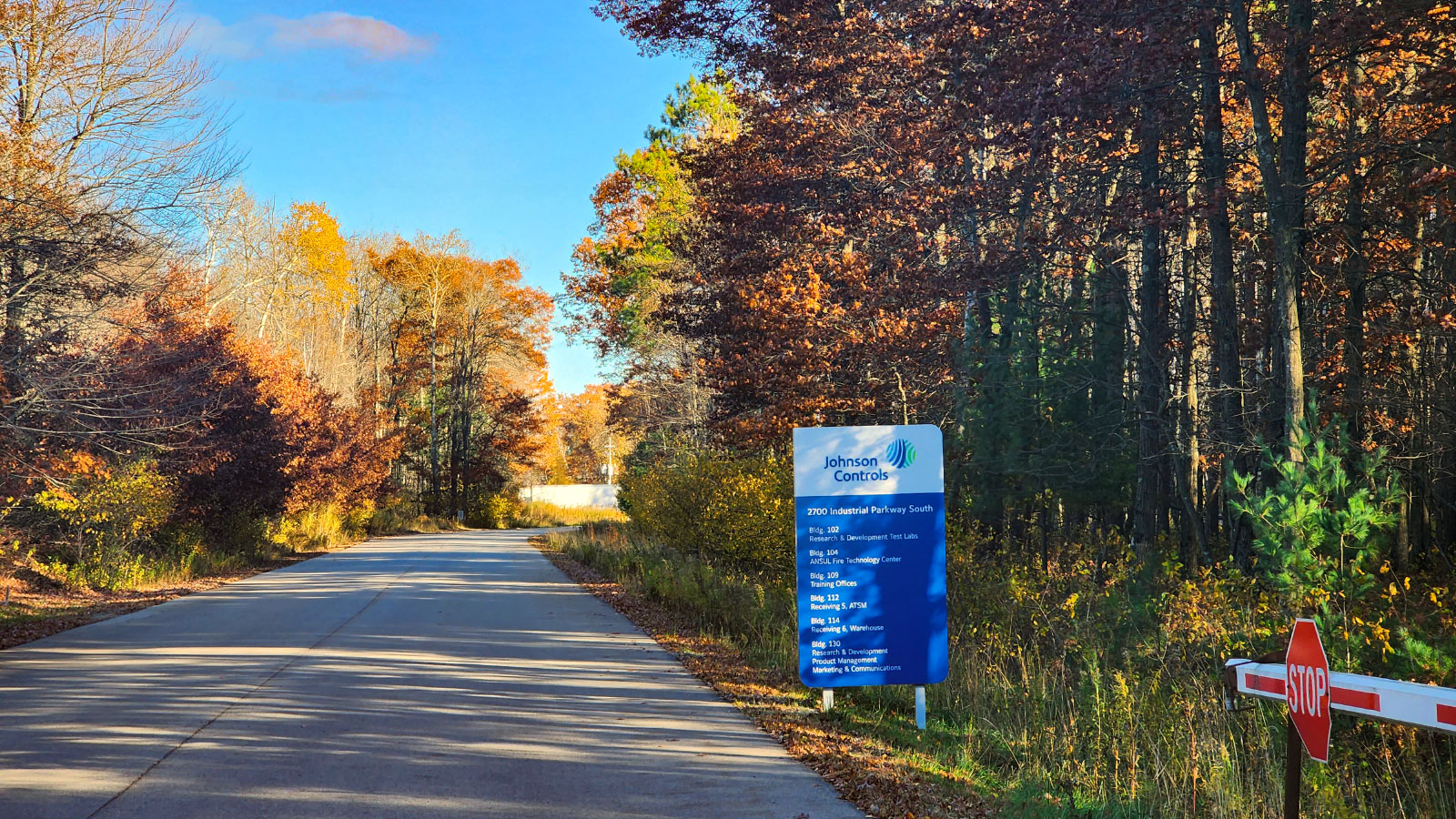
Road with autumnal trees on either side and a sign for Johnson Controls' facility
The entrance of Johnson Control’s Ansul Fire Technology Center can be seen in Marinette, Wisconsin, just outside of the town of Peshtigo. Previously known as Ansul, the company produced firefighting foam for decades in the region. Grist / John McCracken

Residents in Peshtigo are exposed to dangerously high levels of a group of toxins known as per- and polyfluoroalkyl substances, or PFAS, in their groundwater, the source of their drinking water. PFAS are called “forever chemicals” because they are hard to break down in the environment. They’re also linked to high blood pressure in middle-aged women and stunted developmental growth in children, as well as kidney and testicular cancers.

Peshtigo’s PFAS problems stem from a local manufacturing facility that produces firefighting foam — a source of the chemicals so toxic that the Department of Defense recently banned their use. Over decades, a plume of PFAS spread through the community’s vast groundwater networks. Now, residents in this rural part of Wisconsin are forced to use bottled water to cook, clean, and drink until officials find ways to lower the chemicals’ concentrations.

The chemicals can be found everywhere: outdoor clothing, cosmetics, beef, rain, and even your blood. Cities from California to North Carolina have wrestled with contamination, with nearly every state having some form of pollution from these toxins and many now banning PFAS in all products sold within their borders.

At the start of this year alone, communities in Washington State, Massachusetts, and along the Mississippi River have reported elevated PFAS levels in groundwater and drinking water. The chemicals will take forever to break down in their environment, and if the rural town of Peshtigo is any indicator, the cleanup process will be just as long and arduous. Without enforceable standards from the federal level, states are scrambling to set their own standards and clean up procedures, a process that is often mired in politics.

“There was always a looming comment of ‘There’s something in the water.'”

–Craig Koller, who grew up in Peshtigo, Wisconsin

Peshtigo residents are torn over their options for getting clean water, which include the possibility of being absorbed into a nearby city and its public utilities, digging new wells at the expense of the company responsible, or building a brand new water utility system for Peshtigo itself. Hundreds of households are living on bottled water and water filtration systems. The town, state, and individuals have sued the company responsible. 

Budish told Grist what he wants is simple: “What I’m looking for is clean water.”

But when PFAS are found in thousands of products, used in a variety of industries, and are now polluting every city in the country, determining who is responsible for the contamination and how it will be cleaned up gets messy.

In 2017, the state learned that Tyco, a subsidiary of global chemical conglomerate Johnson Controls International and one of the largest employers in the region, had been discharging PFAS into local streams and ditches in the region. According to state records, Tyco knew about these elevated levels at least four years earlier and failed to warn residents.

“This community has not been treated fairly,” Boyle told Grist.

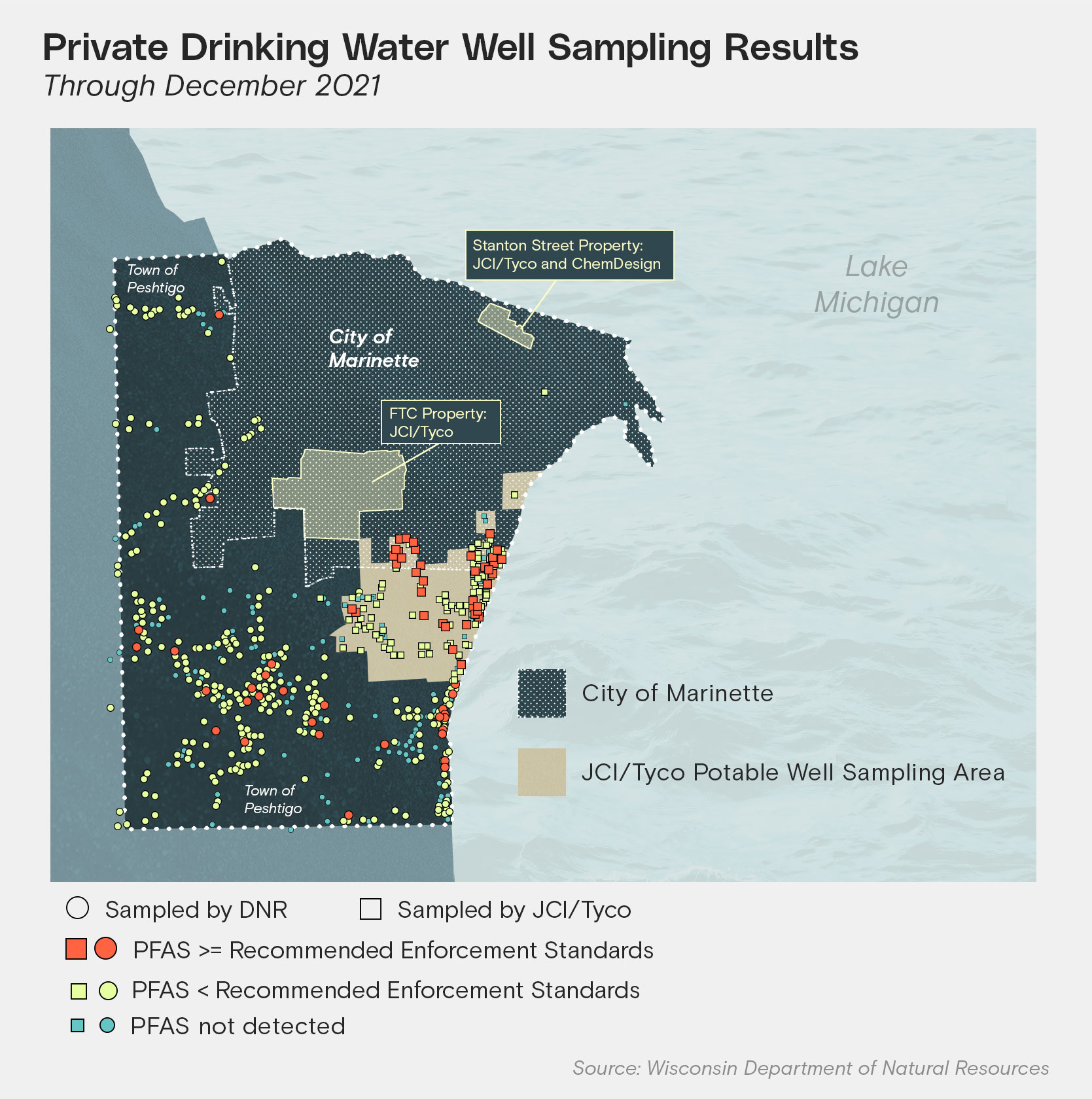
The pollution stems from Tyco’s operations at a fire testing center that operated from the 1960s to 2017. This facility is located on the southern edge of the city of Marinette, roughly a mile from the town of Peshtigo. 

Map showing PFAs levels in private drinking water wells in the city of Marinette and town of Peshtigo in Wisconsin
Grist

First responders and military personnel would light planes, automobiles, and other heavy-duty equipment on fire at a location near the area high school, and then test the fire-suppressant foam Tyco sold. Afterward, gallons of foam would be washed away off the pavement into nearby streams where it would seep into the surrounding groundwater, eventually making its way into Peshtigo drinking wells. 

Tyco also has found elevated levels of the chemicals in groundwater near a Johnson Controls chemical production plant, known locally as the Stanton Street plant, in the city of Marinette on the Lake Michigan shore. With PFAS present, Marinette residents are cautioned against recreation and fishing in local waterways, but their drinking water is safer than their neighbors as Marinette draws its municipal water from Lake Michigan. 

Founded in 1915 as Ansul Corporation, the company had been making fire suppression technology in the area since 1934. It eventually merged with the publicly traded Johnson Controls International in 2016.

Tyco still tests the firefighting foam at its facility in the region, but these tests are now done indoors, company officials told Grist, and all foam and water used are captured and disposed of properly. Johnson Controls International has been working on bringing a PFAS-free foam to market, but the product is not available yet. 

But these new testing procedures don’t erase decades of PFAS pollution into area streams. Town of Peshtigo residents living near the testing facility have cited ongoing health problems, such as stomach cancers and developmental delays in children, that they believe to be linked to years of drinking PFAS-contaminated water. Craig Koller, who grew up drinking Peshtigo well water, was diagnosed with two forms of testicular cancer right after he graduated high school. 

He said he’s seen classmates with the same cancer, and friends’ parents with stomach cancers and immunity disorders, all of which are linked to prolonged exposure to the chemicals.

“There was always a looming comment of ‘There’s something in the water’,'” Koller told Grist. 

Since his initial diagnosis, he estimates he’s had hundreds of thousands of dollars’ worth of invasive treatments and surgeries, and is spending at least $1,200 a year on his weekly, post-surgical testosterone treatment. Koller, who now lives in the suburbs of Milwaukee, said the response from Tyco has been disingenuous and help at the local, state, and federal level has been disjointed. 

“Normally FEMA [or the Federal Emergency Management Agency] would come in if a flood wiped out an entire community,” Koller said. “But this response is not conducive to helping people move on with their lives.”

The area has been severely impacted by PFAS contamination, with levels of the chemicals found reaching astronomical numbers over the state standards.

Concentrated, PFAS-filled foam, which looks like a pillowy, toxic cloud, has been found throughout the region’s waterways. DNR testing has found levels of the chemicals as high as 750,000 parts per trillion, or ppt, for the foam that sits on top of surface water. 

Some of the area’s creeks have reported levels as high as 3,800 ppt. Groundwater wells closest to the facility have reported concentrations of roughly 2,100 ppt, or 30 times the state’s drinking water standards. Nearly 10 miles away from the fire testing facility, wells have tested positive for chemical levels over five times the state regulations.

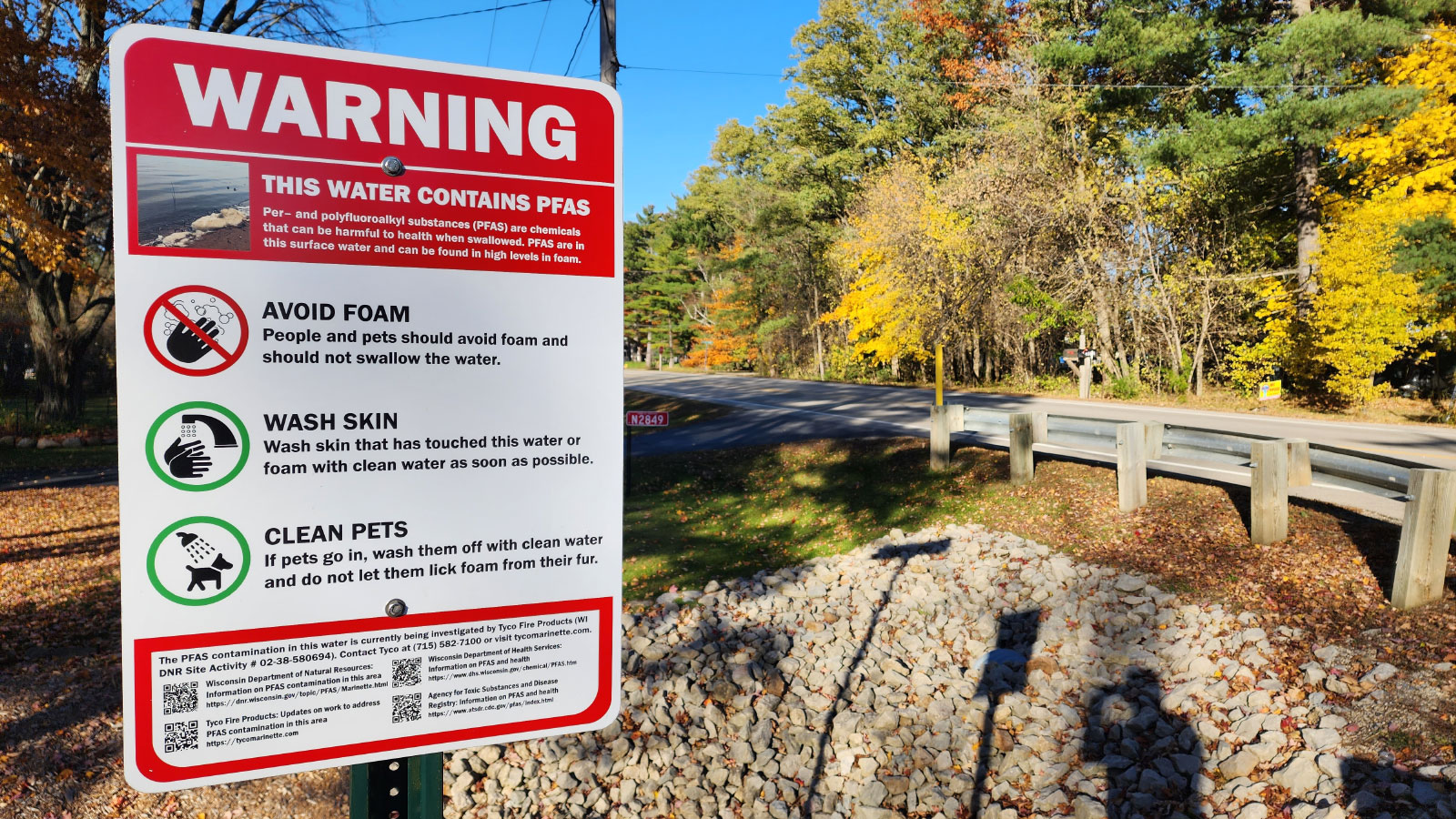
Sign warning of PFAS in water with autumnal trees and a road in the background
A sign in Peshtigo warns of the dangers of touching and consuming the area’s water. The area’s creeks and groundwater have tested for PFAS upwards of 3,800 parts per trillion, or ppt, of the various chemicals. This level is over 54 times the state’s drinking water standard. Grist / John McCracken

Wisconsin recently established a drinking water standard of 70 ppt, which affects municipal water utilities. But this doesn’t change much for Peshtigo, or the other nearly third of the state that relies on groundwater for drinking. Groundwater standards are being reviewed again this year after political football struck them down last year. 

The state created a grant program for replacing contaminated private wells last year, including those impacted by PFAS, and Wisconsin Governor Tony Evers, a Democrat, recently announced a 2023 budget proposal that would invest $100 million in PFAS cleanup across the state. This budget, however, has to make it through the state’s Republican majority. 

At the federal level, the Environmental Protection Agency, or EPA, has found that basically no consumption of these chemicals is safe. The agency is in the midst of a review of its practices and regulations of drinking water standards for the chemicals. Currently, there is no national standard for PFAS in drinking water.

Peshtigo residents have urged federal officials to declare the fire testing facility and the Stanton Street plant as a Superfund site, which would allow the EPA to clean up the site on Tyco’s dime. The agency said it is still reviewing the petition, which noted that the sites are a threat to human health and the environment after half a century of firefighting foam testing went unregulated. The EPA told Grist that it expects to respond to the petition by March of this year.

To Liz Hitchcock, director of federal policy for Toxic-Free Future, a national consumer safety nonprofit that studies and advocates for PFAS cleanup in various industries, the federal government isn’t moving quickly enough. Most federal responses, she noted, have been prompted by a bubbling up of state-level action.

“This is not a problem that’s happening in isolation,” Hitchcock told Grist. “It’s happening all over the country because PFAS chemicals have been in use for years without adequate regulation.”

Because of the ubiquitous use of these chemicals, the federal response has varied by different agencies, from the military to the Food and Drug Administration. 

“There are so many uses of PFAS,” Hitchcock said. “It’s not just an issue of cleaning it up, but preventing the problem in the first place.”

Johnson Controls acknowledges its role in the contamination and has pledged to fix the problem for the area’s most impacted residents.

Katie McGinty is Johnson Controls International’s Chief Sustainability Officer and a former environmental advisor to the Clinton administration.

“Tyco takes full responsibility for the impact of the water of these 169 neighbors from our historic activities,” she said.

This 169 number, however, is controversial. 

According to McGinty, Tyco currently provides water filtration systems and bottled water for those homes because they fall within what is known as the “potable well sampling area,” or PWSA: a sliver of the town that both the company and the Wisconsin Department of Natural Resources, or DNR, agree that Tyco polluted. The company has also constructed a $25 million Groundwater Extraction & Treatment System to remove the chemicals from the groundwater surrounding the fire testing facility. Outside of that, the two can’t agree on much. 

Since the public announcement of the contamination, the DNR has conducted tests to study the spread of the contamination throughout the area’s groundwater systems. Forever chemicals have been found at elevated levels outside of the area Tyco takes responsibility for, a region known as the “expanded site area.”

Tyco is required to complete a site investigation to define the degree and extent of contamination related to its discharges of PFAS. In a statement, the DNR said results from Tyco’s completed site investigation, which the agency monitors, will be used to determine the company’s responsibility. Results are expected to be released this spring.

McGinty denies the company’s responsibility for these additional properties, arguing that the widespread prevalence of PFAS from various industries and consumer behaviors could have also played a role in contaminating groundwater in these expanded sites. 

“We hope that the DNR will take action to determine and stop the sources of PFAS in that area, but Tyco is not the source,” McGinty said. 

Last year, the Wisconsin Department of Justice filed an environmental enforcement lawsuit against the company for alleged failure to adhere to the state’s hazardous spill laws. 

“It’s not just an issue of cleaning it up, but preventing the problem in the first place.”

– Liz Hitchcock, director of federal policy, Toxic-Free Future

As the back and forth of enforcement and corporate finger-pointing unfurls in legal battles and slow testing, residents that live outside the agreed-upon contamination area are on their own.

Budish, the angler from the Peshtigo town meeting, has lived at his property for 30 years, just off a state highway tucked behind rows of thick pine trees that stretch for miles, where neighbors get around using four-wheelers.

He lives outside of Tyco’s recognized area, but his drinking water is contaminated. He’s paid for private testing on his property and found high PFAS levels in his private well water, nearly 10 miles from the fire facility and even farther from the other plant, prompting him and his wife to buy their own bottled water for cooking and consumption for the past five years. 

Speaking at the October meeting, he said he wonders if the ponds, creeks, and ditches surrounding his property on the outskirts of Peshtigo are also contaminated, but so far, he’s only been able to afford to test his groundwater drinking well. 

He told Grist he estimates that he’s spent at least $100 a month on bottled water for the past five years. He has also purchased a water filtration system, which can range between $1,000 and $3,000.

Budish, wearing a camo hat and a blue sweater noting his love of fishing, lives in a state and region plagued by “don’t eat” advisories for both fish and deer, due to PFAS contamination. 

“Why should I have to take everything out of my own pocket?” he asked.

Tyco is standing firm that its operations have not had anything to do with the contamination that residents like Budish face. The chemical signature of the PFAS found in the potable well sample area, the region it takes responsibility for, is vastly different from the ones found in the DNR’s expanded area, McGinty told Grist. 

“If anybody in that expanded area is using dental floss, they’re putting some PFAS down their drain every day,” McGinty said. “If they’re doing some laundry, they’re putting PFAS down their drain. If they’re washing their frying pan, they’re putting some PFAS down their drain.”

Independent researchers from the University of Wisconsin, however, released research in January that tied Tyco’s chemical signature, or “PFAS fingerprint,” to a growing plume of chemicals in Green Bay, a freshwater bay of Lake Michigan located two miles from Stanton Street. Tyco said it has plans to review the study. 

For the contamination it does claim responsibility for, Tyco will pay for new deep wells and water quality monitoring for residents. The wells will be drilled 500 feet into the ground and draw water from the deep aquifer in the area; Tyco will cover all expenses for 20 years. In addition, the company is paying out a $17.5 million class-action lawsuit, but only to those inside of the agreed-upon contaminated area.

Wisconsin environmental officials have been skeptical of Tyco’s deep well plans and have urged the company to not advertise new wells as a final, long-term solution. In a statement provided to Grist, the DNR said it agrees with the company’s design criteria for the deep wells, but concern for other contaminants, such as radium, strontium, and high iron, exist in the region.

As other states take aim at PFAS polluters, Governor Evers and state Attorney General Josh Kaul joined more than a dozen other states in suing large companies for their role in the contamination. The two Wisconsin officials filed a lawsuit last July against Tyco, 3M, DuPont, and other PFAS polluters in the state, alleging they should have known that the ordinary and intended use of their products would lead to dangerous impacts on public health and the environment across Wisconsin. 

As company officials, regulators, and residents continue to fight over who is responsible for this growing crisis, costs are mounting. Since Tyco only claims responsibility for a sliver of the plume, the state is tasked with providing bottled water for residents outside the PWSA while the chemical company and the DNR hash out responsibilities in court. State testing and bottled water funds, however, are running out.

Christine Sieger, director of the agency’s remediation program, said just over half a million dollars has been spent by the DNR to provide bottled water to residents in the state, with the majority of those funds going to Peshtigo and French Island, Wisconsin, a community with newly discovered PFAS contamination. She told Grist that the agency has not been provided new or additional money from the legislature to supply bottled water to residents with PFAS-contaminated drinking water. 

At the beginning of 2022, the DNR had tested over 400 wells in the extended area. Over 300 had PFAS detected in them. But funding ran out to conduct any more.

Melissa Agard, a Democratic Wisconsin state senator and lead author of a comprehensive bill to address PFAS and other pollutants, said the lack of appropriate funding for the DNR is part of a larger problem in the state — her colleagues across the aisle.

“The biggest roadblock we have is the majority party,” Agard, who represents the capital city Madison, a community also polluted with PFAS, and surrounding cities, told Grist. 

Currently, Wisconsin has a Republican majority in both houses of the state legislature. Agard said she has attempted to introduce the bill multiple times in past years, but it has not seen the light of day through public hearing sessions, a process set by the majority party. 

Republican members of the state’s finance committee have expressed interest in using the state’s historic surplus funding to address the problem, while a newly appointed DNR secretary has called for increased oversight and funding from the state legislature.

Agard said a lack of funding for bottled water is concerning, but bottled water is not a long-term solution. 

“We are not taking a comprehensive, holistic approach to address PFAS contamination in the state of Wisconsin right now,” Agard said. 

The Peshtigo town board is investigating the idea of creating a water utility district and paying for the utility by way of a lawsuit lodged by the rural town against the company last year. This costly infrastructure project recently secured $1.6 million of federal funds as part of a variety of PFAS remediation funds earmarked by Wisconsin Democratic Senator Tammy Baldwin.

Still, not everyone in the town wants the increased taxes that potentially come with a public water supply, again highlighting the fractured nature of the area’s response to this national problem. 

Jennifer Friday, a Peshtigo resident who lives in the PWSA, is pursuing yet another approach.

She doesn’t want the water utility district and has been involved with efforts to annex select households into Marinette, their bigger neighbor to the north. If this process moves forward, these residents would become citizens of Marinette and receive the city’s municipal water. Friday, who is now running against Boyle for the town chairperson seat, said she estimates 90 residents are interested in this process, but the group still needs a vote before Marinette’s city council. 

If these residents annex themselves into the neighboring city, they would forgo their private wells for water from Lake Michigan’s Green Bay. As more and more communities around the Midwest are experiencing problems with their groundwater, be it contamination, aging infrastructure, or drying aquifers, Lake Michigan water is an increasingly hot commodity. 

But that doesn’t mean it’s safe. While Green Bay has had low levels of the chemicals present in its waters in the past, concerns now linger after the University of Wisconsin study was released. 

Tyco said it would provide neighbors in Peshtigo with the legal support they need to meet the requirements of the annexation process as well as offer to pay for the new costs associated with annexation, which include 20 years of increased property taxes and water bills for the annexed property. The annexation process has to be resident-driven and the city of Marinette must receive a petition from interested parties and vote on the annexation.

“I’m not pushing annexation,” Friday said. “I’m pushing resident choice.”

Andrea Maxwell, a Peshtigo resident for 10 years who has been provided water by Tyco for the last several, chose the deep well route instead, with the new system installed in early December. Her home is right in the center of the plume. While her well has not tested positive for PFAS, her neighbors’ have.

According to the company, more than 40 deep-well agreements have been signed; contractors are waiting for the ground to thaw to begin construction in the spring. Tyco will pay for the well maintenance, filters, water salt, testing, and other associated costs, including fixing any future PFAS contaminations. 

“That’s a pretty good deal, we feel like,” Maxwell said, “rather than us sitting around worrying if we could maybe be contaminated in five years.”

Standing on Kayla Furton’s lawn in Peshtigo, you can see Green Bay. Around the corner, there’s a ditch with chemical hazard signs warning not to touch or consume the water in it. 

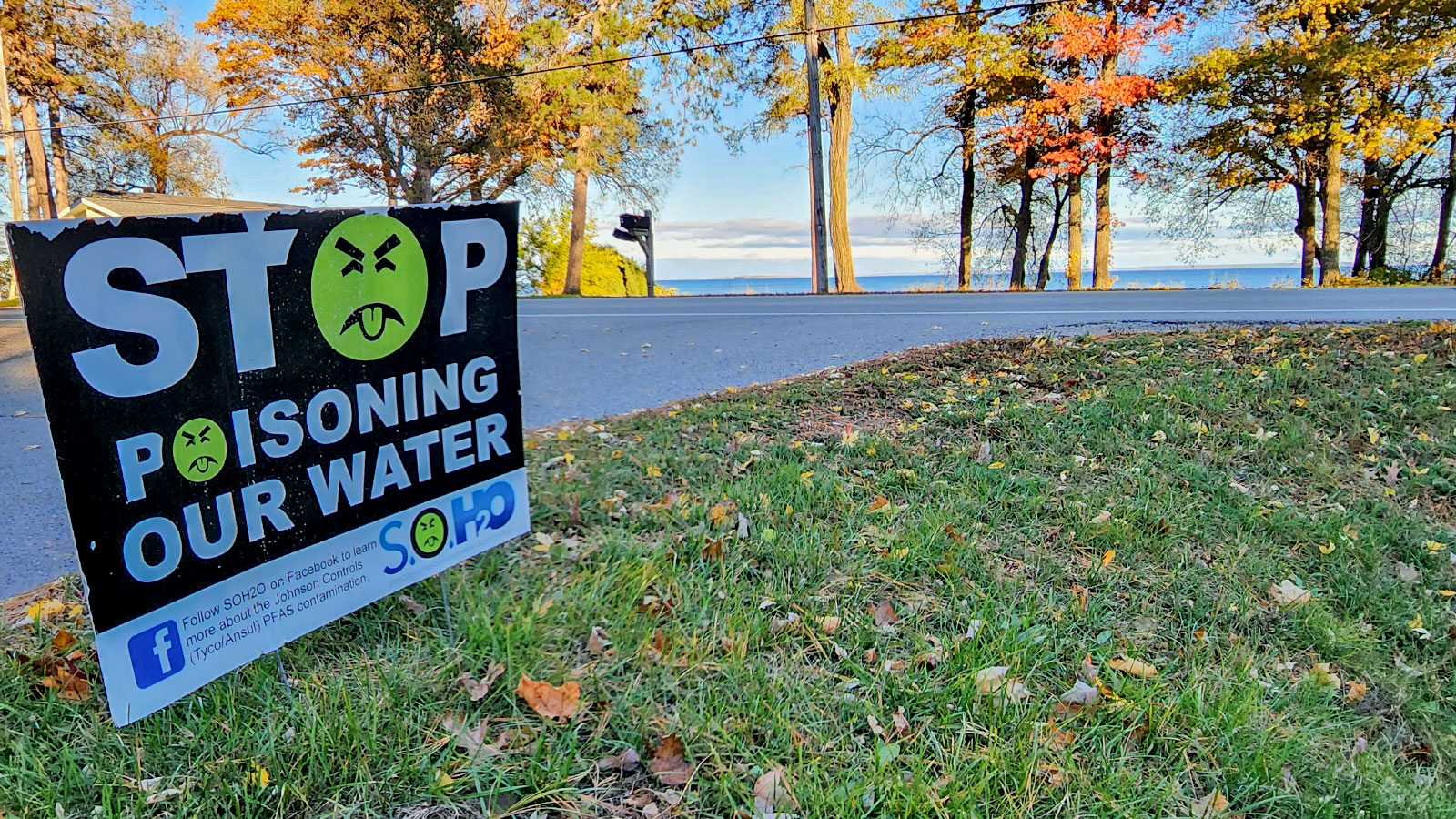
Low angle view of a sign reading
On Kayla Furton’s lawn, a sign is displayed advocating for clean water in the town of Peshtigo, Wisconsin,. Furton’s home is within the potable well sample area, a designated zone created by the DNR where Tyco claims responsibility for PFAS pollution. Grist / John McCracken

Two houses down, no obvious geographical barriers exist, but her neighbors are outside of the zone Tyco claims responsibility for and have to fend for themselves to get clean water, much like Budish. 

“It’s just an arbitrary line,” Furton, a town supervisor, told Grist.

To her, the fragmented, neighbor-versus-neighbor response has been hard on the community. She does qualify for a free well, but in doing so, she waives her liability rights. She also doesn’t see new deep wells for a small group of people as a permanent answer for the thousands of residents in the region. 

“I do think people are tired,” she said. “I know I am. I know my kids are sick of hearing about PFAS.”

When asked if she has considered moving out of the area, Furton, who recently filed a lawsuit against Tyco, said she gets that question a lot, and it can be loaded. She believes her home is more than just a property; it’s where she grew up and where her children have planted roots. 

“Yes, we could,” Furton said. “We could, but there’s no guarantee there’s not PFAS contamination somewhere else.”

How the Supreme Court could finally force Big Oil to face trial

It’s been eight years since the world learned that “Exxon Knew.” The oil giant had grasped the dangers of burning fossil fuels since 1977, investigations showed, despite its long-standing public stance that the science was “uncertain” and persistent efforts to block legislation that would control carbon pollution. The revelations launched a wave of lawsuits that aimed to put fossil fuel companies on trial for deceiving the public about climate change.

In 2017, cities and counties in California started the trend by suing dozens of oil, gas, and coal companies using state “tort” laws meant to protect people from deceptive advertising. Attorneys general in other states filed similar suits of their own, beginning with Rhode Island in 2018. It spurred speculation that Big Oil might face a reckoning for misleading the public about the dangers of climate change, much as Big Tobacco did in the 1990s after decades spent denying that smoking could cause cancer. 

In the ensuing years, not a single one of these consumer-protection cases — now numbering nearly two dozen — made it to trial. They have bounced around between federal and state courts, with oil companies maneuvering to delay any action. “It says something about what the industry thinks is the power of these cases, that it has kept these up in procedural battles for over five years now,” said Karen Sokol, a law professor at Loyola University in New Orleans.

The procedural battles might soon end when the Supreme Court reviews Suncor v. Boulder County later this year, a case that promises to be a turning point for climate litigation. The court will either hear the case (the oil industry’s choice) or send it back to state courts where state and local governments say it belongs. The decision could remove the dam that’s been standing in the way of the lawsuits that states, cities, and counties have brought against fossil fuel giants. Cases that have been languishing for half a decade could finally be heard, with the chance that oil companies would be called to face trials for violating state laws that guard the public against false advertising.

“The fossil fuel companies are afraid of state courts,” said Denise Antolini, a law professor at the University of Hawaii. “They are petrified of state courts who are closer to the problem, closer to the issues, and absolutely terrified of going in front of juries of real people.”

The Colorado case began in 2018, when the city and county of Boulder, along with San Miguel County in the southwest corner of the state, sued Suncor Energy and ExxonMobil, seeking millions of dollars to update their infrastructure to withstand climate change. They argued that the oil companies violated the state’s consumer protection laws by producing and selling fossil fuels in Colorado despite understanding that using their products would lead to more dangerous heat waves, wildfires, droughts, and floods, like the ones the state is seeing today.

Oil companies have argued that the lawsuit isn’t really about deceptive marketing, but the bigger question of climate change, and issues of that scale should be handled by federal courts — which just happen to be considered more friendly to big corporations. Their claim is that if cases like Colorado’s proceeded in state court, it would interfere with federal laws around greenhouse gas emissions. And if the Colorado lawsuit lands in federal court, “it would be on the grounds that the claims are something different from the claims that the plaintiff had made,” Sokol said. “And so this is basically a defendant’s dream, right?” The oil companies would likely argue that the case should be thrown out in federal court, too, saying such big questions should be left to Congress.

Judges have repeatedly rejected oil companies’ line of reasoning, including those appointed by the Trump administration. In October, the Supreme Court turned to the Biden administration for guidance, asking the U.S. Solicitor General to weigh in with a legal opinion on where the case belongs. That’s a good indication that the court is very interested in the case — a petition is 46 times more likely to be granted after the court asks for the solicitor general’s advice, research has shown.

The coming months may finally provide some clarification on whether the strategy driving dozens of climate lawsuits could actually work — or whether it’s time to pursue a new approach.

There are two ways that the Supreme Court could push these lawsuits forward, with similar outcomes. It could decide not to hear the case, or it could agree to hear it and side with Boulder. In either scenario, the consumer-protection cases would proceed in state courts, and “we’ll start to actually see some litigation,” Sokol said.

The cases would move onto “discovery,” a pre-trial step in which both sides gather evidence from documents and witnesses. “The civil discovery system and the subpoena authority of civil courts is quite powerful,” Sokol said. “We would fill in even more than we already know — and we already know a lot.” 

The furthest along of any of these accountability lawsuits is one filed in Hawaii in 2020, with the city and county of Honolulu seeking damages from companies including ExxonMobil, Chevron, and Sunoco. A Hawaii judge has ordered for the discovery process to begin, despite an ongoing appeal by the industry. “What I expect to see in the next year would be discovery battles, with additional motions, as the case slowly marches forward,” Antolini said. The suit is progressing faster than others because Hawaii’s judges have prioritized moving it forward, she said. 

Once these lawsuits proceed to trial, juries would be presented with a decades-long trail of evidence that documents how fossil fuel giants deceived the public about climate change. New evidence has recently emerged that could help plaintiffs make a stronger case. 

For example, a recent study from Harvard researchers analyzed 40-year-old climate models created by ExxonMobil scientists, finding that their projections ended up predicting actual temperature changes with startling accuracy. They conveyed the severity of the situation to corporate officials — who proceeded to cast doubt on the credibility of climate science, deriding models and emphasizing how “uncertainty” made them virtually useless. “If this were to get to a jury, that’s the sort of evidence that’s important,” Sokol said.

What’s more, the science of being able to attribute specific droughts, floods, and heat waves to climate change is getting better every year. Studies showing how fossil fuel emissions have contributed to these disasters “will be really important” to building the plaintiffs’ case in these lawsuits, said Korey Silverman-Roati, a fellow at Columbia Law School.

In the other scenarios, the Supreme Court could side with oil companies and decide to hear Suncor v. Boulder County and then rule in their favor. States would have to rethink their whole approach.

“Given the current inclinations of the United States’ Supreme Court, it’s nerve-wracking to see them take up this case,” said Antolini, who supports the state lawsuits. “What the U.S. Supreme Court decides will have an impact on all of these cases.” Attorneys general in several states suing oil companies did not respond to or declined Grist’s request to comment.

The cases would, in theory, proceed. But it’s unclear how suits filed over state laws designed to protect against corporate deception would play out in federal courts. “I’m uncertain what all the city, county, and state officials would do in those circumstances, because if it’s on the grounds that ‘Hey, this is actually a federal claim’ — that’s not the claim that they filed, and the claim that they and their staff have spent so much time developing,” Sokol said. “I don’t think it necessarily means that they will lose, but they’ll be at a significant disadvantage.”

Federal courts can decide state law claims in some cases, although judges don’t necessarily like to do it, Antolini said. “It would be ridiculous to see these state law cases end up, across the country, in federal court. It would be really absurd.”

Some other routes to legal action have already been tried and abandoned, such as New York state’s lawsuit that accused ExxonMobil of misleading shareholders about climate change. In 2019, a judge ruled that the New York state attorney general had failed to provide enough evidence that Exxon broke the law. Since then, Exxon has used the ruling to support the idea that the lawsuits against them are misguided. But the judge who ruled in Exxon’s favor made clear at the time that the suit was “a securities fraud case, not a climate change case.”

And there’s at least one completely new approach that doesn’t depend on the Supreme Court’s ruling. 

A first-of-its-kind lawsuit filed by 16 towns in Puerto Rico in November accuses Chevron, ExxonMobil, Shell, and other fossil fuel companies of colluding to conceal how their products contribute to climate change. Their argument is that this collusion violated antitrust laws and the Racketeer Influenced and Corrupt Organizations Act, or RICO — a federal law passed in 1970 to take down the Mafia.

Racketeering cases relying on RICO have not only taken down mobsters like John Gotti and the Gambino crime family, but have also been successful against the Hell’s Angels biker gang, the Key West police department in Florida, as well as opioid manufacturers and tobacco companies. The Puerto Rico lawsuit seeks to make companies pay billions of dollars for the extensive damages that towns suffered during hurricanes Maria and Irma in 2017.

Because the lawsuit was filed in federal court, it won’t be pulled into the jurisdictional tug-of-war that has made other climate cases drag on for years.

“They’ve made it easy to prove,” said Melissa Sims, an attorney at Milberg, the Tennessee-based law firm representing the Puerto Rican cities, “because unlike all the other racketeering cases that have been on file, none of them included a written battle plan with a detailed division of labor on how they were going to accomplish their deception.”

Eek, a balloon! How China easily got Republicans to beclown themselves

It’s a truth that should be self-evident: If you are emasculated by a balloon, you weren’t so tough to begin with. Last week, a balloon that U.S. officials believe to be a Chinese surveillance device was spotted floating over Montana, likely to take pictures of military assets. In the grown-up world where President Joe Biden and Democrats live, this was a situation that called for a thoughtful, careful response. While displeased with the predicament, adults recognized that freaking out was not the answer. Instead, they waited until the balloon wasn’t a direct threat to people and property underneath and shot it down over the ocean. 

Meanwhile, Republicans — many in elected office who could be doing something useful with their time — saw the Chinese balloon as an opportunity for cringeworthy tough guy cosplay. Ohio Sen. J.D. Vance was just one of many, many Republicans who spent the Days of the Chinese Balloon ping-ponging between performative hysterics and childish games of dress-up where they pretended they were somehow going to shoot the balloon down.


Want more Amanda Marcotte on politics? Subscribe to her newsletter Standing Room Only.


Truly, it’s an insult to call this “cosplay.” People who dress up like Thor at a comic book convention don’t actually imagine someone mistakes them for a godlike superhero. But Republicans genuinely seem to think waving a gun around impotently at the sky while in a panic over a balloon somehow shows they are tough guys and Biden is not. 

In truth, the whole debacle really just illustrated the opposite: Republicans are the epitome of overcompensation.

The gun-waving does not hide, but rather highlights how they are small, fearful, and painfully insecure —especially, it seems, when it comes to masculinity. The GOP is a political party singularly devoted to trying to shore up the fragile egos of a bunch of dudes who suspect everyone knows they aren’t as manly as they claim to be. 

Leading the pack, of course, was the small-fingered phony tough guy himself, Donald Trump.

“The Chinese would never have floated the Blimp (‘Balloon’) over the United States if I were President!!!” he screeched on his fake Twitter site, Truth Social. 

Republicans genuinely seem to think waving a gun around impotently at the sky while in a panic over a balloon somehow shows they are tough guys.

Presumably, we’re meant to believe his elaborate combover and spray tan would have created a manliness force field that repelled all floating objects. But, of course, it’s a lie, as Jonathan Karl of ABC News reminded Sen. Marco “Once Pretended To Like Rap” Rubio, R-Fla., when he echoed Trump’s lie on-air. In reality, U.S. officials claim the Chinese sent three balloons into U.S. airspace during Trump’s presidency, none of which were shot down.

Trump reacted to this reminder like he always does, like a 5-year-old denying he’s the one who drew kitty cat pictures on the wall on crayon, taking to Truth Social again to rave.

“China had too much respect for ‘TRUMP’ for this to have happened, and it NEVER did.”


Want more Amanda Marcotte on politics? Subscribe to her newsletter Standing Room Only.


That Republican voters mistake this man for John Wayne really showcases how it’s a party built around the childish insecurities of people who really should be old enough to know better but who continue to confuse belligerence for grit. 

The GOP is obviously a party of cowards who are constantly jumping at shadows. It’s become exhausting to watch even an hour of Fox News and the long, long lists of all the things they expect their audiences to live in fear of, from “antifa” and Black Lives Matter to kids reading books with gay characters to big cities to transgender people to women who say rude things about anti-choice judges to “wokeness” to refugees seeking political asylum. They’ve complained when candy cartoons changed their shoe preferenceMr. Potato Head became just “Potato Head,” women joined the Ghostbusterspeople dyed their hair pink or purple and popular songs referenced female sexual arousal

Of course, as fun as it is to laugh at these fools, there’s a very real dark side to the politics of overcompensation. Quislings who want to pretend they’re tough often do so in the most despicable way possible: Finding someone smaller to beat up on.

The first rule of MAGA: Never, ever pick on someone your own size. 

As Melissa Ryan writes in the CtrlAltRightDelete newsletter, what really defines the MAGA base is that they “crave an authoritarian government that will punish their enemies” and “beat down vulnerable populations.” So it’s no surprise that they follow Trump, who bragged on tape about how he uses his status as a rich celebrity to sexually assault women, most of whom probably weigh less than half what he does. Or that they idolize Florida Gov. Ron DeSantis, who picks his targets mainly based on how powerless they are, which is why he’s so focused on snatching books out of the hands of schoolchildren. Or that their new hero, Rep. George Santos, is a con man accused of stealing from old women and defrauding a disabled veteran. Or that they make excuses for the violence of David DePape, who is accused of trying to murder the elderly husband of then-Speaker of the House Nancy Pelosi. 

Perhaps the most pitch-perfect illustration of what MAGA is all about came during Trump’s presidency when he hid in a bunker in the White House while police tear-gassed peaceful protesters outside. Unlike those protesters, Trump has no physical courage of his own. He is such a weenie that he couldn’t even stand to walk outside where he’d be heckled by the crowd of unarmed, peaceful protesters. But he feigned strength by sending someone else to enact violence for him — on a group of people who couldn’t defend themselves, naturally. The first rule of MAGA: Never, ever pick on someone your own size. 

This Chinese balloon nonsense is just the silliest iteration of this mentality. Shooting it down prematurely only meant risking civilian lives. Of course, the same sociopathic Republicans who discourage COVID-19 vaccinations don’t care how many people they get killed for their political theatrics. In grown-up land, however, you don’t go crushing innocent people to death in an impotent display of anger towards a helium-fueled spy machine that likely gathered less data than TikTok does by the minute. But Republicans don’t care about the hard-nosed choices actual adults make. All they care about is masculinity make-believe, no matter what the cost. 

Florida is officially a laboratory for fascism in the U.S.

Ron DeSantis is not a “mini-Trump” or some other diminutive. He is much more dangerous. Donald Trump has no “ideology” beyond megalomania and a deep desire to be an American god king. By comparison, DeSantis is far more intelligent and devious; he is an ideological fascist and racial authoritarian.

In a recent essay at Raw Story, Thom Hartmann summarized the danger to American democracy and society embodied by DeSantis:

Historians and political observers have been predicting that America would get our very own Mussolini ever since the days of Barry Goldwater. And there’s been no shortage of candidates: bribe-taking Nixon; Central American fascist-loving Reagan; Gitmo torturing and war-lying Bush; and, of course, Trump.

But with Ron DeSantis, we may finally be facing an all-American politician who has Mussolini’s guile, ruthlessness, and willingness to see people die to advance his political career, all while being smart and educated enough to avoid the easily satirized buffoonishness of Trump.

DeSantis and other Republican fascists have proclaimed Florida to be a bastion of “freedom” and “liberty.” In reality, Florida is now a laboratory for fascism. As part of his authoritarian project, DeSantis is enforcing thought crime laws that forbid the teaching of AP African-American studies in high school and other courses and programs across Florida’s school system (including at the college and university level) that examine questions of power, race and systemic inequality. DeSantis and his agents recently declared that the AP African-American studies course was inappropriate and will not be taught in Florida’s schools because it has “no educational value” and is “indoctrinating” (white) young people. DeSantis and his regime’s thought crime attacks on African-American studies are Orwell’s “1984” meets “Birth of a Nation.”

Racism and white supremacy are a choice.

The purpose of DeSantis’ thought crime laws is to intimidate and terrorize all teachers, educators, librarians, and others who are committed to education, critical thinking, and the truth in Florida (and beyond). In DeSantis’ Florida — and soon to be across “red state” America if he and the other fascist Republicans get their way — there will be censors who review books and other material for thought crimes and other “dangerous” ideas that are contrary to the interests of conservatives. These censors and party officials and their designated agents will also rewrite history – and reality itself – to fit the demands of the regime. The public will no longer be able to discern truth from lies and fantasies from facts and fiction. The subversion and destruction of reality, facts, and the truth are a precondition for, and one of the primary ways that fascist and other authoritarian regimes obtain and keep power.

DeSantis’ goal is to make America into a new Jim Crow Christofascist plutocracy. Donald Trump and Trumpism were just intermediate stops on that evil journey.

This is the power of censorship: people quickly learn to police their own behavior and that of their family, friends, neighbors, and yes, strangers. The public’s intellectual, creative, ethical, and moral lives quickly become impoverished. The result is the ideal fascist authoritarian subject: a compliant person who does not resist.

Here is a partial list of the dozens of scholars, authors, and other public thinkers whose work has now been declared “illegal” and a “thought crime” by DeSantis and his agents and subsequently marked for removal from the AP African-American Studies course:

Kimberlé Crenshaw

Angela Davis

bell hooks

Ta-Nehisi Coates

Keeanga-Yamahtta Taylor

Nell Irvin Painter

Manning Marable

Cathy Cohen

Henry Louis Gates, Jr.

James Cone

Nikki Giovanni

Barbara Fields

These are not just names on a banned books list. These are real human beings who are committed to helping the public and their students be engaged and responsible members of a larger community and to develop critical thinking skills that they can use to challenge and interrogate Power with the goal of making a better, more just, and truly democratic society. 

DeSantis and his regime’s thought crime attacks on African-American studies are Orwell’s “1984” meets “Birth of a Nation.”

I personally have interviewed, been in dialogue with, enjoyed the company of, had meals with, or otherwise interacted with a good many of these “banned” authors and scholars. I and many others have greatly benefitted from their scholarship, wisdom, time, and concern.

Why are DeSantis and his agents (in Florida and across the country) targeting African-American studies and other such programs?

There are many reasons.

The Black Freedom Struggle is one of the most successful pro-democracy resistance movements in American (and world) history. DeSantis and the other Republican-fascists and their forces do not want these lessons to be known, learned, or otherwise disseminated. DeSantis is working to create a type of “regime of knowledge” where Black, brown and other marginalized people’s triumphs and experiences are outright erased and/or grossly distorted as a way of literally removing their personhood and existence. History has repeatedly shown that “thought crimes,” banned books and other forms of intellectual violence are precursors to and do the work of interpersonal and intergroup violence on a large scale by the State, and those empowered to act in its name, against those deemed to be “the enemy.”

In all, Power intersects with and is an extension of knowledge production. And knowledge is not “neutral.” Philosopher Michel Foucault explained as much. “There is no power relation without the correlative constitution of a field of knowledge, nor any knowledge that does not presuppose and constitute at the same time power relations.” Foucault also explained that “Truth is linked in a circular relation with systems of power which produce and sustain it.”

DeSantis attended Yale for his undergraduate degree. In all likelihood, he encountered the work of Foucault during his studies there. Now DeSantis is putting Foucault’s powerful insights to work in ways contrary to their original intent.


Want a daily wrap-up of all the news and commentary Salon has to offer? Subscribe to our morning newsletter, Crash Course.


In a recent interview at The New Yorker, contributing writer Keeanga-Yamahtta Taylor spoke with historian Robin D.G. Kelley about DeSantis’ thought crimes regime and the targeting of African-American studies. Both Professor Taylor’s and Professor Kelley’s work was purged from the Advanced Placement African-American studies course. Kelley’s comments merit being quoted at length:

There’s two levels. One is that it’s about Ron DeSantis possibly running for President. I think that’s the most important thing, because, no matter what we think about DeSantis and his policies, we know he went to Yale University, and majored in history and political science with a 3.7 G.P.A., which means that he was at one of the premier institutions for history. That’s why I get frustrated when people say he needs to take a class. He took the class. He knows better. He knows that the culture wars actually win votes. He’s trying to get the Trump constituency.

So I think this is about Ron DeSantis wanting to run for President. But I also think that the focus on Florida occludes a bigger story. As you know, this goes back to the Trump years—well before Trump, but let’s just talk about the Trump years—the attack on the 1619 Project, Chris Rufo’s strategy of turning critical race theory into an epithet by denying it any meaning whatsoever. And creating a buzzword. That’s actually a strategy that has nothing to do with the field of African American studies; it has everything to do with vilifying a field—attacking the whole concept of racial justice and equity. So, to me, if DeSantis never banned the class, we would still be in this situation. And although it is true that a number of states did accept the pilot program for the A.P. class, some of those same states have passed, or are about to pass, laws that are banning or limiting what they’re calling critical race theory. So there is a general assault on knowledge, but specifically knowledge that interrogates issues of race, sex, gender, and even class.

It’s an ongoing struggle to roll back anything that’s perceived as diminishing white power. They want to convince white working people—the same white working people who have very little access to good health care and housing, whose lives are actually really precarious, as they move from union jobs to part-time, concierge labor to make ends meet—that somehow, if they can get control of the narrative inside classrooms, their lives would be better. Racism actually damages all of our prospects and futures.

I don’t think it’s an accident that the people who are targeted are you, Angela Davis, myself, bell hooks. To say that we’re not radical would be a lie. What does radical actually mean? What it means, what Black studies is about, is trying to understand how the system works and recognizing that the way the system works now benefits a few at the expense of the many. It’s easy to allow someone to come in, in the name of Black studies, and say, “We’re going to talk about ancient Africa, and the great achievements of the Kush of ancient Egypt.” That’s not a threat—not as much as the idea of critical race theory saying that, no matter what policies and procedures and legislation are implemented, the structure of racism, embedded in a capitalist system, embedded in a system of patriarchy, continues to create wealth for some and make the rest of our lives precarious. Precarious in terms of money, precarious in terms of police violence, precarious in terms of environmental catastrophe, precarious in many, many ways. And I think people could agree with me that that’s why we do this scholarship: because we’re trying to figure out a way to make a better future. You know, that’s the whole point. And if that’s subversive, then say it, but it’s definitely not indoctrination, because indoctrination is a state that bans books…..

[T]he subject of African American studies, even before it was called that, has been not just the condition of Black people but the condition of the country. And not just narrating that oppression and understanding it, and not just trying to think about ways to move beyond it—to transcend it, to come up with strategies to try to live—but also understanding what’s wrong with this country, with the system.

We’re not just interrogating our lives, we’re interrogating knowledge production itself. 

Dangerous thinking is a good thing and those with power want to socialize us into learned helplessness so that we will not see (and achieve) the radical possibilities of a true social democracy.

Years ago, when I was in high school and then college, I was lucky enough to have very generous teachers who took me on trips to conferences and other events at leading universities and institutions such as the Schomburg Center for Research in Black Culture. In fact, I was very lucky to have attended several conferences where Yosef Ben-Jochannan (“Dr. Ben”), who was one of the founders of African Studies, was the featured speaker. Those years that saw the Million Man March(es), debates about the merits of multiculturalism, diversity and “affirmative action” at America’s colleges and universities, boiling ethnic, racial and class tensions in Los Angeles and New York’s Crown Heights and Howard Beach neighborhoods (among others), the golden age of Hip Hop Music and Culture, and so many other political and cultural formations and events. It would be an understatement to say that those years were quite an exhilarating time to be a young black politically engaged person in America.

In so many ways, I am very much a product of that time period.

I learned that I have no taste for racial chauvinism; such beliefs are the mind killer. I also came to the conclusion that American and Western society is profoundly sick with white supremacy and racism. Those forces will likely bring the ultimate destruction of American society and its so-called democracy.

A more humane and good society are possible if we want it badly enough on both sides of the color line. Racism and white supremacy are a choice. America is structured around such forces and too many white Americans and others are deeply invested in such an arrangement of things — even if it causes them great harm. DeSantis and the larger white right are using thought crimes and other tools of censorship and intimidation as weapons to limit how we conceptualize freedom, democracy, justice, and the boundaries of the possible. DeSantis and those of his ilk wouldn’t be trying to ban books and authors (and by implication whole groups of people) if they were not deeply afraid of them – and the possibilities of achieving a more democratic and free and humane society. 

How living on Mars would warp the human body

In July 1969, as the Apollo 11 astronauts prepared to trek to the moon, the Nixon Administration prepped some worst-case-scenario remarks in case this risky mission became deadly — a distinct possibility. Nixon’s prepared statement, which was not widely publicized until 1999, was grim. It thanked the astronauts for their brave sacrifice, preceded by a clergyman who would’ve adopted the same procedure as a burial at sea: commending their souls to “the deepest of the deep,” and concluding with the Lord’s Prayer.

Thankfully, the mission was a success, but some future president may need to prepare a similar draft speech if humans are ever to travel to Mars, the fourth planet in our solar system. Such an assignment would be even more dangerous, and much, much further away, though the stakes may still make such a journey worth it in the end.

But many questions remain about how to make this trip or how to mitigate certain risks, especially when it comes to how the human body would respond to life on Mars. Changes in gravity, sunlight and intense exposure to radiation are a few of the many lethal elements awaiting any Mars-journeying astronauts. Because this challenge has never been attempted before, there are still a lot of unknown variables.

We do know that trips to the Moon and long periods in space, such as what the crew on the International Space Station experiences, have caused profound alterations to astronaut bodies. Microgravity can trigger muscle atrophy and loss of bone density. Pressure differences between the brain and eye when in space can cause visual impairments, like Spaceflight-Associated Neuro-ocular Syndrome. Away from the Earth’s electromagnetic field, ionizing radiation is everywhere, which can not only cause cancer, but also bleeding gums, one’s hair falling out, brain damage and reduced immunity. And while astronauts on the International Space Station are shielded from the sun’s radiation at least half the time (when the Earth is blocking it), astronauts headed to Mars would have no metaphorical lead apron during the seven-month journey to the red planet.

A review of the carcinogenic effects of space published last October in the journal Neoplasia noted many “unsolved mysteries” surrounding our understanding of space radiation and tumor growth, yet the pace of human space exploration is rising rapidly. “Due to difficulties in simulating the effects of space radiation, the lack of accurate data, and individual differences between astronauts such as age, sex and genetic background, there is great uncertainty in space radiation risk prediction,” the authors note.

Our bodies evolved over millions of years in tandem with Earth’s gravitational pull. Separating ourselves can cause intense effects on our physiology.

NASA, the European Space Agency, Japan Aerospace Exploration Agency and other space agencies are actively working on the problem, starting with the Artemis series of missions. Among other goals, this space program endeavors to put a space station around the moon, which is seen as a sort of testing ground for exploring other planets.

Dr. Kevin Fong, an anesthesiologist based in London, has worked with NASA’s Human Adaptation and Countermeasures Office at Johnson Space Center in Houston, studying long duration human space exploration and the effects on the body. He believes space exploration and bodily health are deeply linked.


Want more health and science stories in your inbox? Subscribe to Salon’s weekly newsletter The Vulgar Scientist.


“The same exploration that takes us out across the world in the 20th century, and then out across the stars, is the same exploration that takes us inward to explore the human body. It’s just different parts, different disciplines,” Fong told Salon, emphasizing that human survival could depend on outer space exploration. “It’s obvious that if you want to explore, you must survive. But it’s also true that if you want to survive, you must explore.”

“Your bones waste, your muscles waste, your heart deconditions to a certain degree … And then some really weird stuff happens.”

In his 2014 book, “Extreme Medicine: How Exploration Transformed Medicine in the Twentieth Century,” Fong goes into great detail on what life on Mars would do to the human body. It really comes down to two aspects: the journey there and then the stay on Mars. He says the term “spaceflight” is sort of a misnomer. Like in the movie “Toy Story,” traveling between planets isn’t exactly flying: it’s falling with style.

Weightlessness may sound fun, but our bodies evolved over millions of years in tandem with Earth’s gravitational pull. Separating ourselves can cause intense effects on our physiology or how the body organizes its many systems, from digestion to cognition.

“When you’re moving between two celestial objects, you’re falling between them,” Fong explains. “It leaves your physiology to make adaptations, which can later cause you problems. Your bones waste, your muscles waste, your heart deconditions to a certain degree. And then you have problems with balance and coordination. And then some really weird stuff happens with your hematopoietic system, [essentially] your blood-forming organs, your immunity. And all of that is in one way or another seems to be connected to the experience of weightlessness up there.”

Most astronauts are only subject to weightlessness for a few weeks, but a one-way journey to Mars would last seven to nine months. Either way, double that travel time if you want to actually come back. And there are a lot of unknowns of what may happen to a human floating in the void out there. “We don’t have a great understanding of what the radiation field is like between Earth and Mars,” Fong says. “You’d think we would, but it’s not that well-known.”

Landing on Mars would be a much safer place than the vacuum of space, but with around one-third the gravity of Earth, any Red Planet colonists would still experience weird effects on their bodies from the reduced gravity.

“We don’t know what a third of the [gravity] will do for us, we don’t know if it’ll provide any protection or if you can make use of that to give yourself enough gravitational loading to protect your skeleton and your muscles over time,” Fong says. “We don’t know, but we suspect that you’re going to need some sort of countermeasures.”

Mars doesn’t have much of an atmosphere, an electromagnetic field or an ozone layer, three things which make life a lot more comfortable on Earth.

That means we’ll need to bring lots of medications and drugs to Mars, to anticipate every scenario, because we won’t be able to jog down to Walgreens if someone needs heart medications or a sleep aid. Unfortunately, we also don’t know much about how these meds might fare in space travel or if they’ll act differently in our bodies under the unique conditions of Mars.

Likewise, the psychological effects could be staggering for the first humans in history to completely lose sight of the Earth. This could have unforeseen mental health consequences.

“The suite of threats that presents to you on Mars are unique and poorly understood,” Fong says, noting that a day on Mars is about 37 minutes longer than an Earth day. “It’s dark out there. It messes with your circadian rhythms because the day is slightly longer. It’s just enough out of sync that it really messes you up. And you’re very isolated. Psychologically, there’s some not insignificant problems.”

Mars doesn’t have much of an atmosphere, magnetic field or an ozone layer, three things which make life a lot more comfortable on Earth. This means there’s still plenty of cancer-causing radiation on Mars (though slightly less than in space). And if you stepped outside sans spacesuit, the extreme cold would freeze you to death while the low atmospheric pressure would cause your blood to boil inside your veins. Life on Mars would be a life spent entirely indoors, unless you count being trapped inside a restrictive spacesuit as “outdoors.”

“All of these journeys away from the Earth make you appreciate what you have here on Earth in the first place,” Fong quipped.

Given all this, it may seem like going to Mars would be absolutely miserable, coupled with many unpleasant ways to die. But he left off with a gentle reminder that all humans are technically astronauts on spaceship Earth. You don’t need to leave the planet to venture into the unknown, though hopefully someone will make it to Mars someday.

“At base level, we’re all explorers, in one way or another,” Fong says. “It doesn’t have to just be the physical projection of yourself into this austere environment. Stephen Hawking was one of the greatest explorers of all time and most of his life he never left his wheelchair. That’s the exploration I’m in love with, rather than this slightly Victorian view where you have to be made of certain stuff to project yourself out there. You can do that from your library. And that exploration is just as valuable, just as valid and just as worthwhile.”

Expert: Police traffic stops can alienate communities and lead to violent deaths like Tyre Nichols’

The killing of Tyre Nichols has raised questions about the use and risks of a routine part of U.S. policing: the traffic stop.

Nichols died in the hospital on Jan. 10, 2022, from injuries sustained in a beating by five officers three days earlier. The violence occurred after the 29-year-old Black man was pulled over while driving in Memphis, Tennessee. The officers, all of whom are also Black, have since been fired and face charges of second-degree murder.

While not all traffic stops result in violent encounters – indeed studies suggest that relatively few do – the case of Nichols highlights that such encounters can become sites of police violence. And this isn’t an isolated incident. Before Nichols came Patrick Lyoya, Philando Castile and Sandra Bland, to name just a few high-profile cases. All were killed by police in incidents that began with a traffic stop.

We have analyzed a data set of more than 20 million traffic stops as part of research into the effectiveness of this routine part of police life. What we have found is that, even by its own standards, the return on this high-contact form of policing is slim – it rarely leads to criminal charges or convictions. Moreover, the negative consequences are far-reaching. Law enforcement traffic stops are prone to racial bias and cause harm to communities and individuals disproportionate to any benefit that they bring, our research suggests.

‘Broken taillight’ theory?

Traffic stops represent the most common nonvoluntary interaction between citizens and police officers in the U.S. Every year, around 20 million stops are recorded.

Some of these stops are for legitimate public safety reasons – drunken drivers, for example, are an obvious risk to other road users. But police officers have huge discretion when it comes to conducting traffic stops for a whole slew of driving infractions, from a broken taillight to speeding. They can also, in most states, initiate a traffic stop as the pretext to investigating other crimes. This right was confirmed by the Supreme Court in 1996 in Whren vs. United States. The ruling stated that it is not unconstitutional for officers to use any traffic violation, no matter how minor, as a reason to search the vehicle for other suspected crimes – for example, the possession of illegal drugs – if they have reasonable cause.

These pretextual stops, stopping cars for minor infractions as an opportunity to look for evidence of drug-related or violent crime, can be thought of as the roadside equivalent to “stop and frisk” – the practice of allowing officers to search someone on the streets if they have “reasonable” suspicion of criminal activity.

Both form part of what is called the “broken windows” theory of policing. This idea, which rose to prominence in the 1990s, holds that minor instances of disorder in a neighborhood create an environment that will eventually lead to more serious instances of crime, and that by focusing on smaller infractions police can root out more serious offenses.

The SCORPION unit that pulled over Nichols exemplifies the type of high-contact, proactive, and aggressive policing that often characterizes broken windows tactics. The officers who killed Nichols gave him more than 70 orders in just a few minutes.

Broken windows policing has long been debunked by many criminologists who find that it fails to achieve its objectives, at the detriment of communities. Our research suggests that traffic stops yield few results when it comes to serious crimes. Analysis of 9.5 million traffic stops in North Carolina between 2013 and 2019 shows that just 1.2% led to felony charges. The felony conviction rate resulting from pulling over a driver was 0.23%.

Driving while Black

While the effectiveness of traffic stops as a tool to apprehend serious criminals appears tenuous at best, what is clear is that pulling over drivers has the potential for negative, sometimes violent, outcomesespecially for Black drivers.

It can also affect entire communities. Ferguson, Missouri, is just one well-known example of how widespread racially biased traffic stops can erode trust in the police.

In places like Ferguson, evidence has shown that intensely policing minor traffic infractions, while legally permissible, can drown communities in fines, fees and administrative burdens. And Ferguson isn’t alone. Funds from penalty fines are used to help fund police and local governments across the U.S. A 2019 study found that in 600 jurisdictions across the U.S. fines made up more than 10% of funds. In almost half of those governments, money from ticketing accounted for more than 20% of funding.

This financial burden falls disproportionately on Black drivers. A 2021 New York Times analysis of 4,000 traffic citations handed out in Newburgh Heights, Ohio, a small town just south of Cleveland, found that 76% of license and insurance violations and 63% of speeding tickets were handed to Black drivers. Black residents made up just 22% of the town’s population.

Racial bias has long accompanied traffic stops. In the largest study of its kind, Stanford researchers in 2020 analyzed 100  million traffic stops and concluded that “persistent racial bias” existed. The study found that during daylight hours Black drivers are more likely to be pulled over than their white counterparts. But at nighttime, when the “veil of darkness” makes it harder for officers to racially identify drivers, white drivers are stopped more often than Black drivers.

This concurs with our own findings on traffic stop data from North Carolina: Black men are far more likely to be searched by cops than their white counterparts – at a rate of just under two to one – despite being less likely to be found with any illegal substances.

Traffic stops can also be a precursor to violent and deadly encounters, such as in the case of Nichols’ killing. The New York Times in 2021 found that over a five-year period, police officers in the U.S. killed more than 400 drivers or passengers not brandishing a gun or knife and not being pursued over a violent crime. Black Americans were disproportionately represented among those killed by officers, the newspaper found.

Taking a new route

Using the traffic code to raise funds for jurisdictions or as a pretext to investigate serious crime produces only dubious public safety benefits and comes at a heavy costs, research indicates.

It has prompted some policymakers to look at other options, such as scaling back the types of infractions that can provide a basis for a traffic stop. In 2020, Virginia became the first state to ban officers from conducting traffic stops for low-level violations, such as a broken taillight or illegal tinted windows. A year earlier, the Oregon Supreme Court ruled that it is impermissible for police officers to use a routine traffic stop as a springboard for broader criminal investigations by asking if they can search a vehicle without reasonable suspicion of criminal activity.

Such moves will limit the number of interactions police have with motorists. They could also save lives.


Derek Epp, Assistant professor in the Department of Government, The University of Texas at Austin and Megan Dias, PhD Candidate, The University of Texas at Austin

This article is republished from The Conversation under a Creative Commons license. Read the original article.

“Banana republic level”: Murder, justice, and Jersey politics

Just days after the gruesome Feb. 1 murder of 30-year-old Sayreville Council Member Eunice K. Dwumfour, a Republican,  Gov. Phil Murphy tried his hand as a crime reporter using his public radio call-in show to speculate on the case.

He told listeners to his WNYC-WBGO-WHHY Feb. 2 show that he had conducted an informal canvas of a “whole bunch of electeds-folks in the know-who have been around for a long time” and that none of them could recall “a sitting elected official of the state being shot and killed.”

Murphy continued. “Unfortunately, there is very little that is known now. I have spoken obviously to our team—the Attorney General. Our folks are all over this as you can imagine as are Middlesex and Sayreville law enforcement authorities and prosecutor. Again, I almost hesitate to say this, because I don’t know this, but there is no evidence that it was accidental. It feels very specific…I spoke to the GOP chair in both Sayreville and Middlesex County as well as the Commissioner Director in Middlesex County. It does not appear to be related to her position as an elected Councilwoman in Sayreville. Please God, it doesn’t.”

When it comes to a murder case, and you are the state’s ultimate law enforcement official you don’t want to have the phrase “I don’t know this…” pop up anywhere near your speculation that the murder “does not appear to be related” to Dwumfour’s nascent political career. The Governor should have heeded that initial impulse to “hesitate” on speculating on the motive of this gruesome crime particularly in a state like ours that has a notoriously, almost banana republic level, track record for investigating anything that loops in our politics.

There were things that do need to make it into our initial conversation about the fatal shooting of Dwumfour, a woman of color, who had a daughter and was recently married.  According to a Guardian report last year “Black women and girls are four times more likely to die by violence than white or Hispanic women” and that the “national homicide rate for Black women and girls in 2020 was eight homicides per 100,000 people. That’s the highest rate among American women and represents a risk of violent death that is four times higher than white or Latina women.”

THE SHERIDAN FIASCO

You can’t get a sense of just how inappropriate Murphy’s Agatha Christie riff was about this tragic case unless you have followed the ins and outs of the ongoing scandal that was, and is, the botched criminal probe surrounding the 2014 mysterious death of Joyce and John Sheridan, an influential Republican attorney, lobbyist, healthcare executive and NJ Transportation Commissioner.

The New Jersey power couple’s bodies were discovered by firefighters responding to a fire that had been set at their Meadow Run Drive home in the Skillman section of Montgomery. Both suffered multiple stab wounds and after a prolonged investigation, the Somerset Prosecutor determined in March 2015, that John Sheridan had stabbed his wife of 47 years, then stabbed himself, while also starting a fire to conceal the whole bloody mess.

The surviving Sheridan children, led by Mark Sheridan, an accomplished attorney himself, mounted a well-funded and vigorous defense of their dead father, whose decades of public service had been widely recognized by partisans from both political parties. The family offered a $250,000 reward in the case. As part of the family’s due diligence, they enlisted the expertise of the world-famous forensic pathologist Michael Baden whose 2016 analysis found it was an intruder who committed the crime.

While the autopsy prosecutors relied on concluded there was nothing amiss with the appearance of   John Sheridan’s teeth, Baden discovered the had a chipped front tooth indicative of having been punched. In addition, Baden concluded that the knife that killed the 74-year-old lawyer was not found at the scene of the murder.

In May 2016, Jeffrey Scozzafava,  a detective with the Somerset County Prosecutor’s Office, filed a whistleblower case asserting Sheridan crime-scene evidence  “was improperly collected, improperly preserved and subsequently destroyed.” The lawsuit alleged that Scozzafava was subject to retaliation after flagging concerns over the Sheridan investigation and thar he was demoted from the Forensics Unit to the Fugitive Unit for “lodging complaints regarding deficient and improper evidence collection and casework” by his co-workers and his supervisor. (WNYC reported Scozzafava settled his case for $175,000).

In 2017, after Baden’s findings and the Sheridan family campaign that  enlisted Governors Tom Kean, Jim Florio and Christie Todd Whitman, New Jersey’s Medical Examiner officially changed John Sheridan’s cause of death from “suicide” to “undetermined.”.

Last year, in a true-crime podcast produced by WNYC’s Nancy Solomon entitled Dead End: A NJ Political Murder Mysteryabout the Sheridan case multiple investigative lapses by local law enforcement and the county prosecutor were flagged and grabbed national attention.

“Detectives in Somerset County in New Jersey made several crucial mistakes in their investigation into the deaths of John and Joyce Sheridan, a prominent couple with close ties to four New Jersey governors,” Solomon wrote. “Based on interviews and an examination of physical evidence at the crime and autopsy documents, an investigative podcast from WNYC Studios found those mistakes led the detectives to erroneously declare the crime a murder-suicide.”

“The thing about the Sheridan deaths, was that it raised all kinds of questions about the state of law enforcement — from local police to the prosecutor’s office, to the attorney general’s office, and the medical examiner’s office — and how they operate in New Jersey. And it showed a failing at every level,” Barbara Boyer, a former Inquirer reporter told WNYC on its podcast.

Fundamentals like interviewing all the neighbors just were not completed, according to Boyer, who told WNYC “there were all kinds of leads to pursue that went in different directions.”

Last May, New Jersey’s acting Attorney General Matthew Platkin announced a new probe into the Sheridan case.

PARALLEL UNIVERSE?

“Theories about the cold case resurfaced in January, when one of the couple’s sons, Mark Sheridan, pointed out that the circumstances surrounding his parents’ deaths were ‘eerily similar’ to those of a separate federal investigation into the murder of a Jersey City political operative,” reported the New York Times.

“The operative, Michael Galdieri, was stabbed and his second-floor apartment was set on fire four months before the Sheridans’ deaths. Sean Caddle, a well-connected political consultant, has confessed to hiring two men, George Bratsenis and Bomani Africa, to kill Mr. Galdieri, a onetime friend and colleague. Prosecutors have not disclosed a motive, but all three have pleaded guilty in federal court and await sentencing.”

The newspaper, reported that a “knife similar to one Mr. Sheridan described as being missing from his parents’ house was later discovered in a truck driven by Mr. Bratsenis, according to court documents.”

Last month NJ.com reported that  “a year after admitting to his role in the grisly contract killing of a former associate, political consultant Sean Caddle sits at home these days facing eviction from his rented Sussex County condo, awaiting sentencing while under 24-hour electronic monitoring and strict travel restrictions.”

The newspaper obtained Caddle’s response to the landlord of the Hamburg, Sussex County residence who is seeking the political operator’s eviction for not paying rent since October. Over the arc of his career, Caddle has worked as a political consultant for some of New Jersey’s most powerful elected officials. He was released under house arrest.

“As a cooperating witness for the U.S. Attorney’s Office on an ankle monitor, there was some confusion about my ability to work and the possibility of relocation. Both of these fell through,” Caddle wrote in response to the civil complaint. “I received a letter from my attorney in December stating that I would not be able to work, per the U.S. Attorney’s direction.”

Last November, Antonio Teixeira, the former chief of staff to New Jersey Senate President Nicholas Scutari (D-Union), plead guilty to federal charges “he conspired with Caddle, and Caddle’s political consulting firms, to defraud various campaigns, political action committees, and 501(c)(4) organizations of $107,800. Teixeira then failed to report this illicit income on tax forms that he filed with the IRS during those same years,” according to the federal prosecutors.

“Caddle was hired by a former New Jersey state senator to create the PACs and 501(c)(4)s so that they could raise and spend money to advocate on a variety of issues, including supporting particular candidates in local races around New Jersey,” according to the DOJ press release. “Teixeira served as the senator’s chief of staff and wielded influence over the consultants that the campaigns and organizations hired and the budgets that each of these organizations would receive.”

There’s still a lot of anxiety in political circles about just what Caddle is telling federal prosecutors. There’s a reason that most of the time when the corrupt players in Trenton get nervous, it’s over a federal criminal probe because over the generations those are the ones that are likely to produce actual indictments and convictions like what we saw in the notorious 2009 Bid Rig corruption probe that produced the arrest of dozens of elected officials and political operatives.

But even there, when it comes to policing New Jersey’s most powerful politicians, federal prosecutors can come up really short as in the Bridgegate case, where the two criminal convictions they did manage to get were overturned, and the role of others involved, including law enforcement employees of the Port Authority of New York & New Jersey, remained sealed in court files.

NOBODY DID IT

As it turned out, the weakest link in protecting the George Washington Bridge from being commandeered was the bi-state agency’s own police department. The partisan revenge plot that the Department of Justice has said crossed the line into criminality, was executed by the Port Authority Police Department that served as the boots on the ground and moved the traffic cones that closed the lanes.

As a consequence of the actions taken by the Port Authority Police Department, allegedly at the behest of the political operatives who were initially charged, public safety was put at risk because the lane closures actually impeded the ability of local first responders to do their jobs for those four days in September of 2013, including the actual anniversary of 9/11, a time of supposed heightened counterterrorism vigilance.

Yet, senior police officers were aware of the plan to alter traffic before it happened, and when rank and file officers raised concerns about the problems it was causing at the time, they were told to keep it to themselves. In September 2014 the Bergen Record reported that during the lane closures in 2013, when Port Authority police officers used their radios to communicate that the altered traffic pattern was creating “hazardous conditions” on local Fort Lee roads, their Port Authority supervisors told them to “shut up.”

In the Bridgegate court papers filed in May 2015, when U.S. Attorney Paul Fishman announced that David Wildstein [whose conviction has subsequently been vacated] was going to plead guilty for his role in the alleged conspiracy, the government referred in its pleadings to unnamed and unindicted co-conspirators. The list of the unindicted co-conspirators was subsequently disclosed to defense counsel in the case but has remained off-limits to the media and the public.

At the time several media organizations went to court to have the names released, saying that it was in the public’s interest to know who else was involved with the Bridgegate affair, which in all probability may have included active civil servants. In May Judge Susan Wigenton, the federal judge presiding over the case, ruled the list should be publicly released.

Fishman appealed that ruling, as did an individual whose name was on the list but is only known as John Doe. The lawyer for Doe claimed the client, one of the unindicted co-conspirators, would suffer irredeemable reputation damage if the list were released.

“Way too high for public health”: California regulators let industrial polluters exceed EPA limits

The air quality regulator for much of Southern California is risking public health by allowing emissions of ethylene oxide, a highly toxic gas associated with lymphoid and breast cancer, at levels far above the federal cancer risk guidelines for the chemical, warn environmental health experts.

The South Coast Air Quality Management District (AQMD) says that it is bound by law to use health values adopted by the state more than 35 years ago to guide acceptable ethylene oxide emissions at three medical device sterilization facilities in its region. But other experts, including a former AQMD board member, argue that the agency already has the authority it needs to use a far stricter health guideline adopted by the federal EPA in 2016.

The levels of ethylene oxide being released from facilities in VernonCarson and Ontario that sterilize medical equipment are “way too high for public health,” said Jane Williams, executive director of California Communities Against Toxics, an environmental advocacy group. She said it is “rubbish that South Coast [AQMD] says that they cannot use the more protective emission limits at these sterilizers.”

Earlier this year as part of an air monitoring program, the AQMD found that the three facilities were emitting far larger amounts than previously known of the highly toxic colorless and odorless gas, which is used to sterilize medical products. Homes and schools are within blocks of the Carson and Vernon sites. The AQMD set up air monitors around the three plants and required the facility operators to begin the process of installing better pollution control devices. If emission levels rise above certain trigger thresholds at one of the facilities, the plant operators are required to cut emissions by specific amounts within specific timeframes.

Using values calculated by the Office of Environmental Health Hazards Assessment (OEHHA) in 1987, the AQMD has also set health guidelines at these facilities for both off-site workers and nearby residents. Though the latest available data shows that ethylene oxide emissions from all three facilities remain around these guidelines, these levels are significantly higher than what the EPA considers safe, according to its 2016 cancer risk assessment.

“Short of a change in legislation,” the agency is mandated to use OEHHA’s ethylene oxide health guidelines, said AQMD Executive Officer Wayne Nastri, who has a degree in biochemistry, in an interview. In a follow-up email to clarify which laws bind the AQMD’s hands in this matter, agency spokesperson Nahal Mogharabi highlighted two sections of the California Health and Safety Code. Though one of these appears to give the agency the latitude to use more stringent health criteria than OEHHA’s, “We would need substantial evidence to demonstrate that a non-OEHHA value is justified as part of that rulemaking,” Mogharabi wrote.

When asked why the EPA’s own health guidelines are not considered “substantial evidence,” Mogharabi wrote that OEHHA is currently in the process of revising its health value for ethylene oxide, and that “South Coast AQMD will defer to OEHHA’s expertise and conclusions as they are the experts in the state to establish health values for toxic air contaminants.”

Joe Lyou, an AQMD board member between 2007 and 2019, strongly disagrees with the agency’s position. “If your primary responsibility as a government agency is to protect public health, your default position should be that you have the authority and are willing to [do] what is necessary to fulfill your mission,” he wrote in an email, highlighting language in another section of the state Health and Safety Code that says while “undisputed scientific evidence may not be available to determine the exact nature and extent of risk from toxic air contaminants, it is necessary to take action to protect public health.”

*   *   *

Ethylene oxide is used to sterilize some 50% of medical devices like heart valves and defibrillators in the country, including more than 100 million devices annually in Southern California alone. According to industry, the medical sterilizer system in the state has little room for disruption. In a September letter to the AQMD, the Advanced Medical Technology Association, the largest association of medical technology providers in the nation, warned that “with little to no excess available sterilizing capacity, any impact to the system will likely result in severe disruptions to the medical devices supply chain.” At the same time, ethylene oxide is an extremely potent carcinogen.

Long-term exposure to this highly toxic chemical is associated with breast, blood and stomach cancer, reproductive harm and lung disease. Short-term exposure can result in headaches, nausea and rashes. Nor does it take a huge amount of EtO to cause harm. “We know very, very tiny amounts of it can have adverse impacts,” said Jill Johnston, associate professor of population and public health sciences at the USC Keck School of Medicine.

The EPA’s Integrated Risk Information System (IRIS) measures the human toxicity of different chemicals using the latest available scientific data. Agencies then use this work to help create regulations governing how chemicals are used by industry.

The EPA sets an upper limit of acceptable lifetime cancer risk exposure of about 100-in-1 million. This means that over a 70-year period, if 1 million people are exposed to a certain quantity of a toxic chemical daily, 100 people can be expected to develop cancer. The EPA cancer risk value for ethylene oxide is approximately 10 parts per trillion (ppt) for a lifetime cancer risk of 100 in a million.

The Sterigenics facility in Vernon has been ordered to enact emission reduction protocols if releases of ethylene oxide exceed 17.5 parts per billion (ppb) — a number significantly weaker than the IRIS cancer risk value. That’s because a number in the parts per billion range is some 1000 times larger than a similar number in the parts per trillion.

Using OEHHA’s health values, the SCAQMD has also set health guidelines for ethylene oxide exposures over a 30-year period of a 100 in a million risk of 0.26 parts per billion for people who live near that facility, and a 100 in a million cancer risk of 3.18 ppb for off-site workers over 25 years.

Asked if the AQMD is bound by law to use OEHHA’s health values only, OEHHA spokesperson Amy Gilson pointed to a section of the state Health and Safety Code that appears to give the air district broad discretion to choose the strictest available health standards. “However, we are not aware of an air district deviating from OEHHA’s health values,” Gilson added.

According to Gilson, OEHHA is in an expedited process to reevaluate its ethylene oxide health value, meaning an effort that can take two to four years or more to complete is expected to be finalized over the next 12-18 months.

Current AQMD Governing Board chair Ben Benoit declined to answer questions about AQMD’s legal authority in this matter, but wrote in a statement that the agency’s investigation into ethylene oxide “is a high priority for the Governing Board and we will continue to stay on top of the issue and engage with staff to ensure we are doing everything within our authority to protect the health of the communities we serve.”

Health experts point out that the most protective health standards are particularly important in the communities surrounding the Vernon and Carson plants, which are already among the most heavily polluted in California.

“This plant is a clear and present danger,” said Felipe Aguirre, who lives about half a mile from the Vernon plant, pointing to the cumulative burden on people’s bodies from multiple sources of heavy pollution in the area, which includes the former Exide lead battery recycling facility. Pregnant women and infants are among those most vulnerable to the worst health effects from ethylene oxide exposure.

The AQMD should do a “much better job at reducing health risks in these high impact communities,” said Tracey Woodruff, director of the University of California, San Francisco Environmental Research and Translation for Health (EaRTH) Center. One such step could be to shut down the plants until ethylene oxide emissions can be drastically curtailed, she added.

“The Sterigenics facilities in Vernon and Ontario operate safely and in compliance with both South Coast Air Quality Management District (SCAQMD) and Federal regulations,” wrote a company spokesperson in a statement, addressing questions about possibly ceasing operations. “Sterigenics continues to further enhance emissions controls at both facilities beyond already safe levels in cooperation with SCAQMD.”

Though temporarily shut down for business, the Parter-owned Carson plant still emits ethylene oxide as operators test new pollution control equipment. The amounts have been below OEHHA health guidelines but above the IRIS risk level. The owners did not respond to multiple email requests for comment.

While the AQMD is in the process of amending its rule regulating ethylene oxide use in its jurisdiction, Woodruff and many other environmental health experts are calling for medical sterilizers to phase out the use of ethylene oxide in favor of alternatives — what can be an expensive process for plant operators. An international organization on industrial standardization recently released a set of requirements for using hydrogen peroxide to sterilize medical devices.

“There’s alternatives that can be considered because we know ethylene oxide is so toxic,” said USC’s Johnston. “As a long-term solution and for the protection of community health, it’s always more effective to use chemicals that are safer for people.”

Report: Burning gas in oil fields cost tribes $22 million

In 2019, oil and gas companies operating on tribal and federal lands lost $63 million in revenue from venting, flaring, and leaking infrastructure. That loss, according to a report from the Environmental Defense Fund and Taxpayers for Common Sense, shows that Indigenous nations lost the most potential royalty revenue: approximately $21.8 million. Researchers say that total loss across all lands represents enough natural gas to power 2.2 million households for a year — almost every home in New Mexico, North Dakota, Utah, and Wyoming combined. However, those numbers are likely much higher: researchers did not include emissions from Alaska, Michigan, Nebraska, Illinois, or Indiana.

Gas is wasted when it is released directly into the atmosphere through venting, or burned at the site of extraction by flaring, or when it leaks from aging or ill-fitting infrastructure. As a potent greenhouse gas with warming power 80-times that of carbon dioxide, methane is often released with additional air pollutants. Those emissions contribute heavily to climate change and poor healthcare outcomes for local communities. 

Synapse Energy Economics, the consulting firm that conducted the analysis, found that 54 percent of the gas lost in 2019 was due to flaring, 46 percent to leaks, and less than 1 percent to venting. Researchers found that on federal lands, a majority of natural gas is lost to leaks while on tribal land, most loss is attributed to flaring. Overall, roughly $275 million worth of gas is lost through flaring.

Wasted methane shortchanges the royalties that tribal, state and federal governments collect for oil and gas production that often fund priorities like education, infrastructure and public services. According to the report, while tribal governments lost the most potential revenue, states lost $20.5 million and the federal government lost $21.3 million. Additional research showed that flaring rates on Mandan, Hidatsa, and Arikara Nation lands atop the oil-rich Bakken formation were extremely high compared to public and tribal lands outside of North Dakota. Lost royalties from the MHA Nation totaled an estimated $19 million. 

“We can’t continue to allow half a billion dollars’ worth of taxpayer-owned resources to go to waste every year,” Jon Goldstein, a senior director at the Environmental Defense Fund, said in a press release. “The Biden administration has a clear opportunity to step up with strong rules that stop waste and pollution from practices like routine flaring to protect the public interest. These resources should benefit priorities like education and infrastructure, not be released into the atmosphere to undermine our climate and health.”

The report comes in the wake of two proposed rulings from the EPA and the Bureau of Land Management aimed at reducing methane waste. Both proposals were issued last November and the EPA is accepting public comment on their proposal until February 13.

Goldstein said that the two proposed rulings target methane emissions from different lenses. The EPA ruling operates with a “pollution-oriented focus,” while the BLM ruling, which would target only federal and tribal lands, has a “waste-oriented focus.” Together, the two strategies offer complementary solutions to reduce emissions, but Goldstein says that a crucial, missing provision is to limit how much gas can be flared in the first place. 

“There should be guardrails that narrowly define conditions flares are allowed in,” Goldstein said. “[Otherwise], it just becomes the cost of doing business. Oil and gas companies just write a check and continue to flare and waste.”

More than 75% of global insect species not adequately protected

More than 75 percent of the world’s insect species are insufficiently protected when it comes to conservation areas around the globe, according to a recent new study. 

From our favorites like bees and butterflies, to the lesser appreciated organisms such as wasps and mosquitoes, insects are facing threats such as climate change, and a myriad of other ills such as habitat loss and pesticide use. 

Protected areas, also known as conservation areas, are clearly defined geographic spaces that are legally recognized and managed to achieve the long term conservation of nature. 

The study was published last week in the journal One Earth, and argues that protected areas can support vulnerable insect populations, but only if their geographic ranges are specifically targeted. 

A number of studies have shown that protected areas that target specific vertebrate — non-insect — populations are generally successful at safeguarding them from the impacts of human action, or inaction. Fewer studies, however, have been conducted on insect populations, which are generally not as prioritized in the world’s protected areas. 

The problem, according to the researchers of the study, is that when they measured the geographic distribution of insect populations using global biodiversity data and maps of protected areas, they found that 76 percent of insect species were inadequately covered, and more than 1,800 species not covered at all. 

More than 89,000 insect species were assessed in the study. The most underrepresented species, the researchers found, include critically endangered ones like the dinosaur ant of southern Australia, the crimson Hawaiian damselfly, and the harnessed tiger moth found in eastern North America. 

“A lot of insect data come from protected areas, so we thought that the proportion of species covered by protected areas would be higher,” Shawan Chowdhury, a conservation biologist at the German Center for Integrative Biodiversity Research and the lead author of the study, told Cell Press. 

The study also found notable disparities in the proportions of insect species covered by protected areas across different regions of the world. Insects fared better in the Amazonian region, Africa, Western Australia, and Eastern and Central Europe, while achieving less protected area coverage in North America and South and Southeast Asia. 

There are more than 200,000 protected areas around the globe, including marine protected areas. A few notable protected areas are dedicated almost exclusively to supporting unique insect populations. Mexico’s famed Monarch butterfly reserve, for example, provides a winter habitat for hundreds of millions of migrating butterflies. 

While often perceived as pests, creepy, or just a downright nuisance, insects play a critical role in the biosphere. They pollinate the majority of the world’s flowers — 80 percent, as well as cycle nutrients within ecosystems (think dung beetles). While some species are undoubtedly pests, others help control their populations. 

Insects are also a critical protein food source in a number of countries and cultures, serving as more than just a delicacy. Human health and food security is intrinsically tied to the health of insect populations. A number of mammal and bird species that humans eat depend on insects as a significant source of food. With this symbiotic relationship severed, human health would undoubtedly suffer.  

Scientists have classified more than one million species of insects, with several million more likely unrecorded. But their populations are plummeting throughout the world. Global agricultural practices are a major culprit, with monoculture farming (corn and soybeans in particular), pesticides, herbicides, and fertilizers, all playing a devastating role. That’s in addition to habitat destruction, deforestation, urbanization, pollution, and other activities attributed to human action.   

Even insect populations well covered in protected areas have faced steady declines over the last few decades that have alarmed scientists. In Germany, insect abundance within the country’s protected areas had fallen by more than 75 percent over the course of just 27 years, according to a 2017 study. Even within a relatively pristine tropical rainforest in Puerto Rico, researchers in 2018 found that between 1976 and 2012, the biomass of its insect species had fallen between 10- and 60-fold. “Many insect species are declining within protected areas because of threats such as rapid environmental change, loss of corridors, and roads inside protected areas,” said Chowdhury. 

Global warming as a result of climate change has also undoubtedly played a large role in insect decline — aside from intensive industrial agriculture and habitat destruction, regardless of whether or not they are covered by protected areas.

Chowdhury’s research team nonetheless stresses the importance of continuing to identify sites of importance to increase protections for the world’s insects. The researchers suggested that, since most insects are herbivores and connected to plants, a strategy of increasing the number of protected areas in global biodiversity hotspots with more than 50 percent endemic plant species would likely also protect a larger proportion of insect species.

How Harry Styles’ Grammys speech made Beyoncé’s Album of the Year loss worse

The Grammys, like all awards shows, giveth up to a point.

On Sunday night, at the 65th annual Grammy Awards, Beyoncé made history as the awards’ most decorated artist ever. Her 32nd Grammy Award secured her historic place, breaking a record held most recently by composer Georg Solti with 31 Grammys. During Sunday’s ceremony, Beyoncé took home trophies for Best Dance/Electronic Music Album for “Renaissance,” Best R&B Song for “Cuff It,” Best Traditional R&B Performance for “Plastic Off The Sofa” and Best Dance/Electronic Recording for “Break My Soul.”

It was the category where she did not triumph that has left fans and music critics outraged. Once again, Beyoncé did not win for Album of the Year, a category she has never won, despite her numerous critically acclaimed albums, which have also been some of the bestselling albums of the years of their releases. This year, the trophy for Album of the Year went to Harry Styles for “Harry’s House.”

Fans called out Beyoncé’s name and said she should have won.

Styles’ third studio album, and his third to reach No. 1, “had the largest first week of 2022 for any album” in the United States, NME reported. It was also criticially lauded. Rolling Stone called it “at once elegant and more refined but also warmer and more intimate” while Pitchfork said in their review, the album was “deftly executed, with a surplus of style.” Both reviews also commented on the “low stakes” feel of the album, as have other critics.

But for Styles’ album to win over Beyoncé’s lauded seventh studio album “Renaissance,” her first solo release since “Lemonade” in 2016, was a major upset, the biggest of the night, which caused some audience members to verbally protest when Styles took the stage to receive the award. Fans called out Beyoncé’s name and said she should have won. Styles’ acceptance speech didn’t help matters; instead, he made it much worse.

Styles’ speech

After winning the award, Styles’ first word into the microphone (after spending some time hugging and speaking with a fan brought on stage) was “sh**.” He then repeated it, “Well, sh**.” He talked of being inspired by the other musicians nominated for Album of the Year in 2023, a category which included Adele, Bad Bunny and Brandi Carlile, along with Beyoncé and others. He added, “There is no such thing as best in music.” But his parting words, said before relinquishing the mic to collaborators, were the most damning. “This doesn’t happen to people like me very often, and this is so, so nice,” Styles said. 

Immediately, social media erupted in protest. “‘[T]his doesn’t happen to people like me often’ who, white british men?” one Twitter user wrote. Ashley K. Smalls posted, “Saying ‘this doesn’t happen to people like me very often’ when a Black woman hasn’t won that award since 1999 is crazy lol.” Some fans objected that Styles is a queer performer, and as such, marginalized, but Styles has never spoken publicly about his sexuality, with some historically accusing the singer/actor of capitalizing on queer culture.

Billboard tried to excuse the comment by writing, “He likely intended ‘people like me’ to mean former boy band or teen-pop stars, in which case, he certainly wasn’t wrong.” But when it comes to white men, Grammys do happen to people like Styles quite often. 

Grammy history

White men — encompassing, as Yahoo! News writes, “bands and duos fronted by white men”— have won in the category of Album of the Year 32 times, almost half of all the years in the history of the Grammys. Counting Styles, it’s now 33. Henry Mancini was the first white man to win the category back in 1959. He was followed the next year by Frank Sinatra, then Bob Newhart. Sinatra, Paul Simon and Taylor Swift have each won Album of the Year three times, as has Stevie Wonder.

Those are the only three Black women to ever receive an Album of the Year Grammy.

Wonder was the first Black artist to win the category in 1974. Only 10 Black artists have won since. In 2022, Jon Batiste won, the first Black musician to do so since 2008. Black female artists have not won in the category since Lauryn Hill won for “The Miseducation of Lauryn Hill” in 1999. Whitney Houston won for “The Bodyguard” soundtrack in 1994 and Natalie Cole became the first Black woman to win the category for “Unforgettable . . . with Love” in 1992. Those are the only three Black women to ever receive an Album of the Year Grammy.

BeyonceBeyonce at the 65th Annual GRAMMY Awards held at Crypto.com Arena on February 5, 2023 in Los Angeles, California. (Christopher Polk/Variety via Getty Images)Insider wrote in 2021, after Billie Eilish won over Megan Thee Stallion, “The Grammys only seem keen to reward Black artists in major categories when they’re singing about activism or racial trauma: H.E.R. won song of the year for ‘I Can’t Breathe,’ a direct reaction to George Floyd’s murder; the only rap song that has ever won record of the year was Childish Gambino’s painfully topical ‘This Is America.'”

Snubbing Beyoncé

TIME described “The Recording Academy’s repeated awarding of other artists over Beyoncé” as an ongoing part of this pattern of exclusion, ignoring the work of Black artists, particularly Black women, in the most prestigious categories like Album of the Year. TIME writes the Academy “has come under fire in recent years for issues relating to gender and diversity. The institution’s leaders have vowed to make changes on the diversity and inclusion front, including by expanding the membership of its 12,000-plus body of voting members in an effort to diversify its ranks.”  


Want a daily wrap-up of all the news and commentary Salon has to offer? Subscribe to our morning newsletter, Crash Course.


But days before this year’s award ceremony, Variety published a tell-all piece where five Grammy voters spoke to the publication anonymously about their voting. They talked openly about why voters like them haven’t supported Beyoncé for Album of the Year. “With Beyoncé,” one voter said, “the fact that every time she does something new, it’s a big event and everyone’s supposed to quake in their shoes — it’s a little too portentous.” As writer Nadirah said on Twitter, “People just don’t like seeing Black women win ‘too much.'”

Beyoncé has been up for Album of the Year four times, losing each year to a white artist: Taylor Swift, Adele, Beck and now Styles. Also losing Album of the Year in 2023 for the fourth time as a lead artist? Kendrick Lamar, for “Mr. Morale & the Big Steppers.”


Sam Smith’s “full-on Satan worship” Grammys number puts conservatives in an anti-vax Satanic panic

Conservatives are clutching their pearls in horror over Sam Smith and Kim Petras’ cheeky  performance at the Grammys.

During Sunday night’s ceremony, the pair took center stage to perform their hit song “Unholy,” which also won the award for Best Pop Duo/Group Performance. The hell-themed showcase featured several red-robed dancers, cages, whips and Smith sporting a top hat adorned with red devil horns.

Naturally, conservative critics took offense at this apparent love letter to the Prince of Darkness and took to Twitter to slam the performance. The comments ranged from interpreting the number as an actual Satanic ritual to – what else? – an attempt to advance the vaccine agenda.

“If as a Christian, you think we are reaching when we talk about the dominance and normalization of Satan worship in pop music, you need discernment,” wrote Christian life coach Solomon Buchi. “Sam Smith’s performance at the Grammy’s last night was satanic, gory. No, it’s not art; it’s symbolic of who they serve.”

Similarly, Human Events editor Ben Kew tweeted, “I know we on the right probably use the word satanic too often but this performance from Sam Smith is literally a tribute to Satan.”

Newsman’s Benny Johnson also wrote, “The Grammys have gone full-on Satan worship right on prime time TV,” before sharing video of said Satan worship to his Twitter flock.

The hellish performance would’ve been enough to incite criticism, but then it was followed by an ad for Grammys sponsor Pfizer, which naturally set off the anti-vax right, which has perpetuated the misinformation that the COVID vaccine is the “Mark of the Beast” – you know, the new one after RFID microchips.

Marjorie Taylor Greene tweeted, “The Grammy’s featured Sam Smith’s demonic performance and was sponsored by Pfizer. And the Satanic Church now has an abortion clinic in NM that requires its patients to perform a satanic ritual before services. American Christians need to get to work.”

In the same vein, Charlie Kirk, the founder and president of the right-wing conservative nonprofit organization Turning Point USA, wrote, “The Devil. Brought to you by Pfizer . . .” And Sen. Ted Cruz added that “Pfizer is taking the whole truth in advertising thing pretty literally . . .” before calling the performance “evil.”

Conservative influencer Robby Starbuck also wrote, “Sam Smith’s satanic performance at the Grammy’s ended with a Pfizer commercial. You can’t get it more on the nose than that. Pfizer and Hollywood deserve each other.”


Want a daily wrap-up of all the news and commentary Salon has to offer? Subscribe to our morning newsletter, Crash Course.


In an interview with Variety, Petras explained the inspiration behind her Grammy performance with Smith:

“I think a lot of people, honestly, have labeled what I stand for and what Sam stands for as religiously not cool, and I personally grew up wondering about religion and wanting to be a part of it but slowly realizing it didn’t want me to be a part of it,” she said. “So it’s a take on not being able to choose religion. And not being able to live the way that people might want you to live, because as a trans person I’m already not wanted in religion. So we were doing a take on that, and I was hellkeeper Kim.”

Petras is also the first transgender woman to win a Grammy award for Best Pop Duo/Group Performance.

Reba McEntire’s new restaurant takes the charcuterie board to a whole new level

Outside of county music, Reba McEntire has found success on stage and screen in starring roles in “Annie Get Your Gun” and the sitcom that bears her name. Now, the singer and actor is adding a new title to her resume: restaurateur.

The Grammy Award winner recently opened Reba’s Place in the city of Atoka in her home state of Oklahoma. While not her first foray into the food world (remember those Colonel Sanders ads?), this is McEntire’s first restaurant. Housed in a former Masonic Temple, Reba’s Place “showcases a restored antique bar that is more than 100 years old,” according to the venue’s official website. It goes without saying that the three-story establishment would have felt incomplete without its own live music venue.

Anna Lazarus Caplan and Alex Apatoff reported for People that Reba’s Place features a special family heirloom in the third-floor library: books from the personal archives of McEntire’s mom, who passed away during the pandemic. According to Choctaw Nation, the collection is calledJac’s Library,” a nod to her name Jacqueline. Reba’s Place is also home to a “large collection of costumes, gold and platinum album awards, photographs” and more objects and memorabilia from McEntire’s storied career.

McEntire told Garden & Gun that “Atoka is a very small town, but it’s right there on the highway between Tulsa and Dallas. I was raised 12 miles north, on a working cattle ranch in Chockie.”

After her mom passed in March 2020, McEntire spent an extended amount of time in Oklahoma as the pandemic spread. “I stayed in Oklahoma to help settle up the estate and clean up mom and daddy’s house,” McEntire said to People. “I got myself reacquainted with everyone in the state and the love that I have for the state of Oklahoma.”

Shortly thereafter, she was approached about a potential restaurant. The rest, as they say, is history.

For the menu, McEntire collaborated with chef Kurtess Mortensen, even contributing her own smashed potato recipe to the line-up, complete with caramelized onions and garlic.

“You got to have great iced tea. Great bread,” McEntire recalled telling Mortensen. “I want chicken fried steak. Chicken fried chicken. I want beans and cornbread.”

But one particularly interesting item on the menu is the charcuterie board, which takes an uber-popular appetizer option, modernizes it and roots it in Southern comfort food traditions. The Reba’s Place menu describes the item as featuring “shaved country ham, spicy sausage, pimento cheese, beer cheese, boiled peanut hummus, homemade pickles, crackers and crusty bread.”


Want more great food writing and recipes? Subscribe to Salon Food’s newsletter, The Bite.


This appetizer doesn’t skimp on Southern classics, but it’s the boiled peanut hummus that truly piques my interest, as it swaps the customary chickpeas for a Southern staple.

Currently starring in “Big Sky” with her real-life boyfriend, as well as the Lifetime movie “The Hammer,” McEntire has plans to tour and release a book later this year, according to People.

If you’re anywhere near Atoka any time soon, stop by Reba’s Place. We’d love to hear about your experience, this unique charcuterie board and anything else you think is noteworthy. Of course, we already know the music will be great.

Climate denial campaign goes retro with new textbook

After decades of intense public debate and misinformation campaigns, nearly three-quarters of Americans now accept that climate change is happening; not only that, more than half understand it is caused by human activity. This shift has forced fossil fuel companies — and the organizations they fund — to alter their tactics to avoid regulation. Where they once denied climate science outright, companies now engage in “discourses of delay,” publicly accepting the science but working to stall climate policy by redirecting blame, pushing non-transformative solutions, and emphasizing the downsides of taking action.

But the Heartland Institute, the infamous, free-market think tank that has operated at the center of climate misinformation for decades, is still hanging onto the old ways as it pushes on with its attempt to discredit established climate science.

This week, the organization sent copies of its book “Climate at a Glance” to 8,000 middle and high school teachers across the country, in order to provide them, it says, with “the data to show the earth is not experiencing a climate crisis.” 

H. Sterling Burnett, who directs Climate and Environmental Policy for the Heartland Institute and edited “Climate at a Glance,” said he hoped the book would reach educators who are teaching climate change, “not to replace the material they have, but to supplement it.”

But science education advocates aren’t too worried about the impact of the materials.

“This is not Heartland’s first rodeo,” said Glenn Branch, deputy director of the non-profit National Center for Science Education, which promotes and defends accurate science education. “In previous campaigns, the bulk of teachers and students who received the materials threw them out or put them in the recycling bin.”

The institute’s last big mailout was in 2017 when it sent out 350,000 copies of its “Why Scientists Disagree About Global Warming.” According to Branch, while only a few picked up the information and taught from it, a number of educators used the materials in their classrooms to teach about propaganda techniques. Branch also thinks the fact that this year’s campaign is so scaled back from the 2017 mailout means even Heartland itself recognizes this as a failing strategy.

The new 80-page document, presented in the style of a slick and authoritative textbook, covers 30 climate topics often discussed in science classes. Many of the sections acknowledge modest planetary warming, but assert that it is either good for species and ecosystems, or doesn’t really have the impacts on extreme weather events that climate scientists say it does.

“They typically give a straightforward observation or statistic that’s not in dispute and add some commentary that’s wildly exaggerated or a completely false interpretation,” said Branch. A section on crop production, for example, notes how a longer growing season improves yields; it does not acknowledge the net-negative impact of a hotter, drier climate and extreme precipitation on agriculture  in the long term. A page on sea-level rise says “levels have been rising at a fairly steady pace since at least the mid-1800s,”  but the rate has actually more than doubled in the 2000s when compared to most of the 20th century.

“It’s a misleading interpretation of scientific facts and questionable inferences drawn from cherry picked data from unreliable sources,” said Robert Brulle, a visiting professor of sociology at Brown University who has researched the public relations strategies of the fossil fuel industry. “It almost seems quaint that they’re still running with this. It’s like ‘The 1990s called. They want their scientific misinformation back.'” 

Burnett defends the institute’s new booklet. “People say ‘oh, you don’t have the proper context’,” he said, “but that’s their opinion on what the proper context should be.”

Founded in Chicago in 1984, the Heartland Institute received hundreds of thousands of dollars from fossil fuel companies and industrial billionaires the Koch brothers until association with outright science denial started to become more of a liability for the industry. The last of the big oil companies mostly gave up on funding extreme climate denial groups like Heartland around 2007, said Brulle. Any direct links that might still exist would be hard to find; climate misinformation has historically been funded and spread through a network of front groups, and Heartland no longer discloses its major supporters. While its revenue has declined over the years, it still receives millions from conservative foundations and philanthropies. 

“What Heartland is hoping for is to catch those who haven’t been equipped to understand climate science well enough to realize the highly misleading nature of the materials,” said Branch. A survey from 2015 found that about 57 percent of high school and middle school science educators have not formally studied climate change. As states increasingly add climate change to their science standards, Branch hopes to see more states follow in the path of Washington, California, Maine, and New Jersey in appropriating funds for teacher professional development on the issue, which would equip them with the tools to identify misinformation.

Even if teachers today are unlikely to fall for Heartland’s claims, the organization’s messaging could still help the fossil fuel industry in a roundabout way. In social science there’s a theory called the radical flank effect, explained Brulle, where a position that is perceived as extreme can be made to look more moderate by a position that is even more extreme.  

“If Exxon Mobil is saying ‘climate change is probably real and it can cause harm, but we can adapt,’ without Heartland, they’re the extremists,” said Brulle. “But if Heartland is out there saying ‘climate change is going to be good for us,’ it makes the major oil companies look moderate and reasonable.”

Six foods that climate change is going to ruin

We don’t live in an agrarian society anymore, at least not here in the United States. Because few of us live in proximity to farmers, most Americans rarely consider the factors that go into producing the staple crops we consume every day — things like corn, wheat and rice. 

But though industrial agriculture has honed these crops into mass-produced, undifferentiated grains, they are grown on a planet whose climactic conditions are increasingly unpredictable. Indeed, as climate change intensifies, food scarcity is guaranteed to become more prevalent — even for basic staple crops like these. 

Besides supply chain breakdowns, heat waves and rising sea levels, scientists cannot fully anticipate how the Earth’s ever-rising temperature will impact every aspect of the environment. Agriculture is a science of balances — just the right kinds of minerals in the soil, the ideal amount of sunshine and precipitation — and global warming throws so many new variables into the mix that the most predictable thing about it is its unpredictability.

“What is needed is a radical transformation of food systems, localizing them as much as possible, and supporting crop diversification through agroecology and other progressive approaches.”

“The full impact of climate change on the global food system is complex,” Marie Cosquer, Advocacy Analyst on Food Systems and Climate Crisis for Action Against Hunger, wrote to Salon. Even though the impact of climate change will not be uniform across all agricultural sectors, the problem is still serious enough that everyone who produces food should be concerned. “What is needed is a radical transformation of food systems, localizing them as much as possible, and supporting crop diversification through agroecology and other progressive approaches,” Cosquer says.

Unless that happens very soon, there are some ways in which we can definitely expect climate change to alter what we eat. Here are some of the everyday crops that will be affected by those alterations — and which, in turn, will shift what you can eat.

01
Coffee arabica
Roasted Coffee Arabica BeansRoasted Coffee Arabica Beans (Dasril Roszandi/Anadolu Agency/Getty Images)Image_placeholder

If you rely on a cheap cup of joe to get you through the day, hold on to your mug.


“Coffee arabica is known to be specifically vulnerable to climate change impacts,” Dr. Roman Grüter, Life Sciences faculty at the Zurich University of Applied Sciences, told Salon by email. “Future suitability is going to be decreased due to sensitivity to high temperatures. Many crops are going to be negatively affected by extreme events (linked to climate change), such as long periods of drought, heat waves, strong rains etc.”


This kind of climate chaos won’t fully eradicate coffee, but it will undoubtedly make it more expensive, which may affect your ability to drink it as much. Indeed, botanists already fear that wild coffee may go extinct without conservation efforts.

02
Maize/Corn
CornCorn (Getty Images/Edwin Tuyay/EyeEm)Image_placeholder

In a 2021 paper in the scientific journal Nature Food, researchers created simulations based on the assumption of that farm managers would not alter their practices to accommodate climate change. The simulation was done this way “deliberately,” in order to “to isolate the climate signal in order to understand processes and trends,” Dr. Jonas Jägermeyr from Columbia University Climate School and NASA Goddard Institute for Space Studies wrote to Salon.
 
Their projections were sobering: “Maize/corn is affected more negatively than wheat, because corn cannot benefit from higher atmospheric CO2 concentrations in the same way wheat can.”
 
Because the US has an incredibly corn-dependent agricultural food system, this could have all kinds of repercussions. Corn is grown for biofuels; used as sweetener in sodas, ketchup and all kinds of food products vis-a-vis high fructose corn syrup; or consumed on its own in recipes or on the cob.

Want more health and science stories in your inbox? Subscribe to Salon’s weekly newsletter The Vulgar Scientist.


03
Wheat
WheatWheat (Getty Images/AIMEN SAKHRI/500px)Image_placeholder
Wheat and maize are both staples, but they have very different fates in the era of man-made climate change. The reason has to do with how they photosynthesize.
 
There are multiple chemical pathways via which plants turn the sun’s energy into their own energy; two of these pathways are known as C3 crops and C4 crops. Most plants use C3 photosynthesis, meaning that the first compound they produce has three carbon atoms. Those plants which use C4 photosynthesis, however, produce compounds with four carbon atoms.
 
The two types of crops react differently to an atmosphere with more carbon dioxide in it, as our world is rapidly becoming.
 
“Wheat and other C3 crops (as opposed to C4 crops such as maize) benefit from CO2 in the atmosphere much more and in higher latitudes high-emission climate change scenarios can lead to crop yield increases in the models,” Jägermeyr wrote to Salon. He added that their models, though thorough, cannot anticipate factors that could diminish wheat crops but were not “represented in an appropriate way” such as pests, diseases, droughts and floods.
04
Rice
RiceRice (Getty Images/Chadchai Ra-ngubpai)Image_placeholder

Rice has the dubious distinction of both contributing to global warming — an estimated 12% of global methane emissions come from rice production — while simultaneously being a major victim of climate change. As temperatures rise, droughts become more frequent, floods worsen and typhoons become increasingly severe, rice crops are expected to take a major hit.


That said, as with all of these crops, there is some regional variation. For instance, South Sudan might become a hub of rice production; the country  has suffered from floods due to increasing temperatures, and Cosquer says her organization “stepped in and taught farmers to grow a new crop — rice — which flourishes in water. Now, men and women alike now own their own rice farms and sell this crop in their communities.”


The future of rice could mean more of it is grown in South Sudan, and less in other regions known for rice production today.

05
Almonds
AlmondsAlmonds (Getty Images/BURCU ATALAY TANKUT)Image_placeholder

During the summer of 2021, a historic drought struck the western United States so hard that an almond shortage ensued. California, after all, produces roughly 80% of the world’s almonds, and the drought was so severe that farmers began uprooting hundreds of acres of their crops so they could salvage what they could.
 
Because almonds demand extensive irrigation all year long, they are particularly vulnerable to climate change because their crops will increasingly demand more water even as the water supply plateaus or drops.
06
Citrus Fruits
Lemon FruitLemon Fruit (Getty Images/Brzozowska)Image_placeholder
If you love the sweet, tangy flavor of oranges, lemons and limes, there is bad news. Citrus crops of all kinds are expected to take a hit from climate change. In the words of Jägermeyr: “Crops show largest losses in lower altitudes in topical and subtropical systems that are already warmer and thus closer to specific temperature limits of certain crops.”
 
While this does not mean that crops in colder regions will not suffer, they are generally not as sensitive to major temperature fluctuations.
 
“In higher latitudes, say breadbaskets along the Canadian border, Northern Europe, Russia and northern China, moderate warming has less severe effects and in some cases can even lead to potential yield gains,” Jägermeyr says.

Bitter cacao nibs and bleeding hands: My 10-day chocolate-making nightmare

While scrolling through Instagram one day, I received a targeted ad for a tropical fruit box. I’d recently been seeing TikToks of various influencers trying different tropical fruits, and I’d been a longtime follower of Kirsten Titus, an influencer who regularly cuts fruit on TikTok from outside her home in Hawaii. Needless to say, I was influenced, and I ordered a four-month tropical fruit subscription almost immediately.

When the box arrived, I was excited to see what I got. I wanted to try all the new fruits and was hoping for my favorite — the passion fruit. But what I didn’t expect was a cacao pod. My friend came over for a fruit night, and after cutting into the dragon fruit, persimmon, guava, and more, we decided to tackle the cacao. I cut into it easily and pulled out a slimy white bean. I knew the seeds alone were edible, so I popped one into my mouth, my face changing shape as the slightly sour, gooey outside dissolved. I bit into the bitter cacao underneath and made another face at the strong, unpleasant flavor.

I certainly wasn’t going to eat anymore, but I also didn’t want the seeds to go to waste. So there was only one logical next step: learn to make chocolate.

“How hard could it be?” I thought.

To my dismay, it was much, much harder than I could have imagined. I scrolled through recipe after recipe, and all of the instructions seemed like something I couldn’t scrape together from my tiny Brooklyn apartment. Most recipes required wrapping the seeds in banana leaves and letting them ferment in the sun for days. Unfortunately, like most people in a city, I don’t have a backyard or a place to let the seeds ferment in the sun. Eventually, though, I found a recipe that included an alternate means of fermentation: using a dehydrator. Luckily, I already owned a dehydrator from another food project upon which I had recently embarked. 

To ferment cacao beans with a dehydrator, simply lay the beans out across the tray, and set the dehydrator to 104 degrees fahrenheit. Most recipes recommend five to 10 days of fermentation, during which time the beige-colored beans are supposed to turn a pink or reddish brown. I left my beans on the tray for the full 10 days, mainly because they never really changed color. Instead, they dried up and hardened, looking more like pistachios than cacao. Already, things weren’t going perfectly, but I hadn’t technically done anything wrong, so I just continued on.

The next step of the chocolate making process involves roasting the beans, which helps to separate the outer husk, or shell, from the inner bean, also known as the cacao nibs. So I laid the beans out on a tray and stuck them in the oven at 250 degrees for about 15 minutes. If you’re more experienced at chocolate-making, you can experiment with the time and temperature, depending on what type of chocolate roast you want (light, medium, or dark), but I decided to keep it simple, stick to one temperature, and pull the beans out after the allotted time. Soon enough, my kitchen started to smell vaguely like chocolate, and I thought, “Okay, I’m doing something right.”

“It had been 10 days, and all I had to show for it were bitter chocolate nibs and bleeding hands.”

Once the 15 minutes were up, it was time to remove the shells. For chocolate sold commercially, this step is usually completed by machine, but at home, my hands would have to do the job. Supposedly, roasting makes it easier to peel the shells off, and it’s not that the shells were necessarily difficult to get off, but they weren’t easy, either. After fermenting and roasting, the cacao shells had sharp, jagged edges, and I had to use my fingernails to peel them off the nibs, and before I knew it, my hands were covered in little cuts, and tiny pieces of cacao were stuck under my nails, mixed in with bits of blood. I was starting to think maybe this whole chocolate thing wasn’t worth the effort. After all, it had been 10 days, and all I had to show for it were bitter chocolate nibs and bleeding hands. But I had come this far, so I wasn’t giving up just yet.

I then broke the nibs up even more, just by crushing them with my hands. They were already pretty brittle, so this step was easy. The next step of the chocolate process is typically done with a chocolate grinder, but who even owns a chocolate grinder? Instead, I had to substitute the chocolate grinder with a high-speed blender I borrowed from a friend. 

However, if I were to just blend the beans together as they were, then I would have ended up with only a powder. In commercial chocolate production, they have the machinery to separate the cacao butter from the solids. However, for the average person at home, that’s not always possible, and instead, the nibs need to be blended with cacao butter, which I simply bought at a grocery store for more than the price of a bar of chocolate.

Now, exactly how much cacao butter you’ll need is anybody’s guess. I ended up pouring all of the cacao nibs into the blender, slowly adding cacao butter as needed. When the powder looked slightly wet, I transferred it to the microwave for 30 seconds, which is supposed to help extract the cacao butter from the nibs. Then, I put it back in the blender and continued blending, slowly adding more cacao butter until the powder began to turn into more of a paste, and I continued adding cacao butter until there was no powder left. 

Then, it’s time to add powdered sugar, and because I wanted milk chocolate, condensed milk as well. This also involved some guesswork. Essentially, the amount of sugar and milk you use depends on your own personal preference. I personally love sweet, sweet milk chocolate, so I added a lot of sugar and milk, taking a little taste with each addition. 

From there, it was time to manually grind the chocolate using a mortar and pestle. And of course, tasting and adding more sugar and milk as needed. Eventually, my weak, skinny arms were sore from grinding for what felt like hours, but was probably only 15 to 20 minutes, trying to make the chocolate as smooth as possible, knowing it would never be as smooth as store-bought chocolate. And after adding what felt like an exorbitant amount of sugar and milk and still feeling like the chocolate was neither sweet nor milky enough, I just gave up and moved onto the next step. This wouldn’t be perfect, I accepted. I should have realized that back when my hands were bleeding.

At this point, some people might choose to temper the chocolate, which is a complicated process of strategically raising and lowering the temperature of the chocolate to form a crystal structure that is shiny, snaps easily, and holds its shape at room temperature. But my arms were tired, and I had dried blood under my fingernails, unable to fathom continuing on to another complicated task, so I simply skipped that step and molded the chocolate using an ice cube tray. I poured the chocolate from the mortar and pestle into the tray and allowed it to set at room temperature. From there, I collapsed onto my couch, vowing never to make chocolate again.

And a couple hours later, my homemade chocolate was ready to taste! All I can say is, I definitely made chocolate. But it didn’t taste as good as any of the fancy chocolates you can get at the grocery store, and the consistency wasn’t as smooth, and in the end, I spent more money on ingredients (powdered sugar, condensed milk, cacao butter, and the cacao pod itself) than I would have on a chocolate bar. So will I be doing it again? Absolutely not. But if anyone else wants to give it a try, the recipe is below.


DIY Chocolate
Prep Time
5-10 days
Cook Time
20 minutes

Ingredients

1 cacao pod

Cacao butter

Powdered sugar

Condensed milk


Directions

  1. Extract the cacao beans. Cut open your cacao pod and pull out and separate the beans.
  2. Ferment the cacao beans. Using a dehydrator, place the beans evenly across the trays. Set the dehydrator to 104 degrees fahrenheit, and allow the beans to ferment for 5-10 days. They allegedly should change to a pink/reddish brown color, although mine did not.
  3. Roast the beans. Remove the beans from the dehydrator after 5-10 days, and place them evenly on a tray, putting them in the oven at 250 degrees, for 15-20 minutes.
  4. Remove the shells. Remove the beans from the oven, letting them cool. Then peel the shells off of the beans with your hands, removing the cacao nibs. Then, crush the cacao nibs using either your hands or a rolling pin.
  5. Blend the beans. If you don’t have a chocolate grinder, place the crushed up beans in a blender. Blend the beans at high speed, adding small pieces of cacao butter until the beans look slightly wet.
  6. Microwave the powder. Remove the powder from the blender, and place in the microwave for 20-30 seconds.
  7. Continue blending and adding ingredients. Place the powder back in the blender, and continue blending. If the powder is not turning into a paste, continue adding cacao butter until you have a chocolate paste. Then, add powdered sugar and condensed milk to taste. Keep blending, and taste the chocolate every five minutes or so, determining whether you want more sugar and/or milk.
  8. Remove the chocolate paste from the blender, and manually grind in a mortar and pestle until smooth. Add more powdered sugar and/or condensed milk if needed, depending on how you want the chocolate to taste.
  9. Now, you can either temper the chocolate or skip ahead to the molding process. To mold the chocolate, place the chocolate in a mold of your choice, tapping it against your counter or table to help remove air bubbles. Allow the chocolate to set at room temperature. Store in the fridge.