Spring Sale: Get 1 Year, Save 58%

“Third spaces” take another hit as Starbucks does away with open door policy

After years of many people using Starbucks as a place to hang, to work or to use the bathroom — a typical "third place"  the coffee giant has decided to change its rules.

Its "open door policy" is now being altered, ostensibly to "deter homeless people and non-paying customers who have come to use Starbucks solely for shelter and bathroom access," as per Jordan Valinsky and Nathaniel Meyersohn with CNN. You must now be a paying customer to use the space.

The new rules, which were announced earlier this week, aim to "boost sagging sales and improve worker relations," according to Valsinky and Meyersohn. A Starbucks spokesperson said that the new changes are "a practical step that helps us prioritize our paying customers who want to sit and enjoy our cafes or need to use the restroom during their visit . . . By setting clear expectations for behavior and use of our spaces, we can create a better environment for everyone.”

In addition, there are rule changes on "panhandling, discrimination, consuming outside alcohol and vaping." The new code of conduct also adds "no misuse or disruption of our spaces, no discrimination or harassment, [and] no violence or abusive/threatening language"

Furthermore, the store is looking to reduce to-go orders by encouraging more in-store consumption; all customers who want to sit and stay in the cafe will be able to get free refills of either hot or iced coffee in Starbucks ceramic mugs or reusable glasses, CNN reports — which was once a privilege held only for Starbucks loyalty members. 

CORRECTION: A previous version of this story stated that all customers will be offered a singular refill, not plural.

Costco announces recall of its Kirkland cold and flu medication

If you've recently stocked up on cold and flu medicine, you may want to double check what brand you've purchased  especially if you're a Costco shopper.

As per Yi-Jin Yu with ABC News, "Costco recently notified consumers that packs of its Kirkland Signature Severe Cold & Flu Plus Congestion caplets have been recalled.”

According to this notice from LNK International, the manufacturer behind the medication, the cause for concern was "due to a potential foreign material contamination." The affected product was sold between October 30 and November 30, 2024, and the particular lot code is P140082. According to the release from LNK, "Do not use any remaining product marked with the above lot code; return the item to your local Costco for a full refund."

As per Yu, the medicine was sold at Costco stores throughout the Midwest and Southeast states. Of course, this issue is coming at a particularly inopportune time, as we are in the throes of cold and flu season currently. 

Whoopi Goldberg says she “stands behind” Carrie Underwood’s decision to perform at the inauguration

Whoopi Goldberg is standing up for Carrie Underwood after the country star found herself in the line of fire after agreeing to perform at President-elect Donald Trump's inauguration.

On Tuesday's episode of "The View," Goldberg clarified that this is a break in the norm for Underwood, who typically has an apolitical record, staying out of political discourse and declining to endorse political candidates.

But Goldberg defended Underwood's decision to sing for Trump, saying, “People do what they do for whatever reasons. I stand behind her.”

Goldberg pushed against other co-hosts like Joy Behar and Sunny Hostin, who emphasized Underwood's decision reinforces the "normalizing" of Trump.

“If I believe I have the right to make up my mind to go perform someplace, I believe they have the same right,” Goldberg said. “I have to support. It doesn’t mean I’m particularly interested in watching [the inauguration] — I won’t be watching. But that’s me.”

Goldberg's comments come just a day after Underwood shared on Monday that she would take the stage at Trump's inauguration. In the statement, she said she accepted Trump's invitation because she loves our country: "I am humbled to answer the call at a time when we must all come together in the spirit of unity and looking to the future."

Underwood is expected to sing “America the Beautiful” before Trump is sworn into office for the second time. The Village People, who will perform their hit “Y.M.C.A.,” are also a part of inauguration festivities.

SEC sues Elon Musk over Twitter disclosure

The U.S. Securities and Exchange Commission sued billionaire Elon Musk on Tuesday, saying he missed a 2022 deadline to disclose his large stock position in Twitter and was able to underpay for additional shares as a result. 

Musk, who bought Twitter in October 2022 and renamed it X, had started amassing shares earlier that year. His ownership amounted to more than 5% by March, requiring him to file a disclosure report. The SEC says the report was 11 days late, allowing Musk to "underpay by at least $150 million” for shares purchased before he disclosed his stake.

Musk’s lawyer, Alex Spiro, said the lawsuit “is an admission by the SEC that they cannot bring an actual case” since Musk has “done nothing wrong," The Associated Press reports. He called the lawsuit a “sham."

“As the SEC retreats and leaves office — the SEC’s multi-year campaign of harassment against Mr. Musk culminated in the filing of a single-count ticky tack complaint against Mr. Musk under Section 13(d) for an alleged administrative failure to file a single form — an offense that, even if proven, carries a nominal penalty,” Spiro added.

Musk and the SEC have gone to court two other times, The New York Times reports. One of those involved his social media musings about taking Tesla private. Another was an attempt by the SEC to compel Musk to testify as part of an investigation into his purchase of Twitter.

The latest legal tangle could be unraveled when President-elect Donald Trump takes office. SEC chair Gary Gensler, a Biden appointee, is stepping down Monday. Trump has tapped Paul Atkins, a former SEC commissioner under President George W. Bush, to lead the agency. 

“Shocking criminal scheme”: Raskin says Jack Smith’s report shows Trump is an authoritarian threat

Rep. Jamie Raskin, D-Md., the House Judiciary Committee ranking member who took a leading role in the House investigation over Donald Trump's attempts to overturn the 2020 election, said in a statement Wednesday that the released part of special counsel Jack Smith's final report sets forth "irrefutable evidence" that the president-elect led a "shocking criminal scheme to overturn the legitimate 2020 election results and retain power."

“Trump’s offenses are compounded by his refusal to accept accountability and his unrelenting efforts to block the truth from coming out about his conduct — including by threatening and harassing the prosecutors and witnesses involved in DOJ’s investigation and subsequent litigation, and attempting to block the release of this very report at the eleventh hour," Raskin said.

The Justice Department released the 137-page Volume 1 of Smith's final report early Tuesday morning. According to the report, criminal investigators interviewed more than 250 people and obtained testimony from more than 55 grand jury witnesses, uncovering evidence that many legal experts and Smith himself said would have sealed Trump's conviction had he been brought to trial.

Instead, a series of delays and then Trump's election victory forced the Justice Department to drop the case. While Smith's report will not change that fact, Trump's lawyers tried every means of stopping its release for fear that it would damage their boss.

Raskin led impeachment proceedings against Trump after the Jan. 6 insurrection and sat on the special House committee formed to investigate the attack, which also fell under Smith's purview. In his statement, Raskin highlighted "key findings" of the report, including that Trump and his associates were deeply involved not just in the insurrection but a months-long plot to pressure officials to nullify election results and send false certifications from bad-faith electors; that Trump was aware that his claims of Democratic Party-led voter fraud were false; and that Trump used executive privilege and witness intimidation to "block the truth about his illegal conduct, posing unique challenges for special counsel Smith’s investigation."

Raskin also reproached House Republicans for helping Trump escape justice and engaging in "sinister revisionism" to "obscure or vaporize the plain reality described in the special counsel’s report."

Con-gregation, be seated: “Scam Goddess” is a better podcast than it manifests on TV

We're all in peril of falling prey to con artists, thanks to multiple data breaches and an uptick in identity theft. For the rare few who somehow haven’t been subjected to some level of compromise, the simple act of picking up the phone for a number you don’t recognize could change that.

This distrust affects physical interactions too. Few of us accept a stranger’s outstretched hand without questioning if there’s a shock buzzer hidden in their palm. Assuming everybody has an angle is safer than trusting in the rube’s axiom that people are fundamentally good.

“Scam Goddess” host Laci Mosley isn’t in the business of alleviating these fears. In her view, we’ve all either done or participated in crimes at some point — whether we meant to or not. 

That dine-and-dash you were peer pressured into back in the day? Fraud and robbery. That charity whose leaders are pulling in healthy six-figure annual salaries might be a con. Heck, your tax dollars are being used to fund all kinds of immorality

Mosley has perfected the fine art of marveling at hustles without exalting the hustlers.

Mosley suggests making peace with fraud’s integration into the American experience. Her podcast episodes open with a choir singing, “Scams, cons, robberies and fraud” — not in a way that pleads for help but invites us to get with the program. Her listeners — the “con-gregation,” she calls them — reach out to brag about scams they’ve pulled off, warn others about hoaxes that are circulating, or low-key invite her to pass judgment on the sharks they’ve let into their aquariums. 

Since 2019, Mosley has perfected the fine art of marveling at hustles without exalting the hustlers. She has no qualms with hailing the audacity of famous swindlers with her celebrity guests while constantly acknowledging their extensive wrongdoing. Bringing that approach to TV requires a slight tone adjustment that sometimes struggles to find the right balance between humor and honoring the palpable pain of the deceived and defrauded. 

Simply put, it’s easy to sit with a fellow comic, celebrity, or deft conversationalist and read about a scam, pausing to riff about a fraudster’s boldest lies and robberies. Facing the unintended co-stars of those crime tales is another matter. 

Mosley’s telegenic appeal certainly isn’t in question. An Upright Citizens Brigade veteran, she stood out on the underappreciated comedy “Florida Girls,” a gem on the now-departed Pop TV’s line-up, and was featured in Season 2 of "A Black Lady Sketch Show."

The TV version of “Scam Goddess” makes the most of her easy ability to mix glamour and goofiness, which she wields to place sympathetic subjects at ease and catch the guilty off guard. She’s also clear that she never wants to make light of the injustice visited upon the people of Dixon, IL. 

Any new addition to true crime asks us to consider the need it's trying to fulfill.

And yet, when confronted anew and on location with the story of Rita Crundwell, she admits a shred of conflicted emotions. Mosley previously delved into this case with fellow comic Adam Conover in a 2023 podcast episode titled “The Govt. Horse Hustler.” 

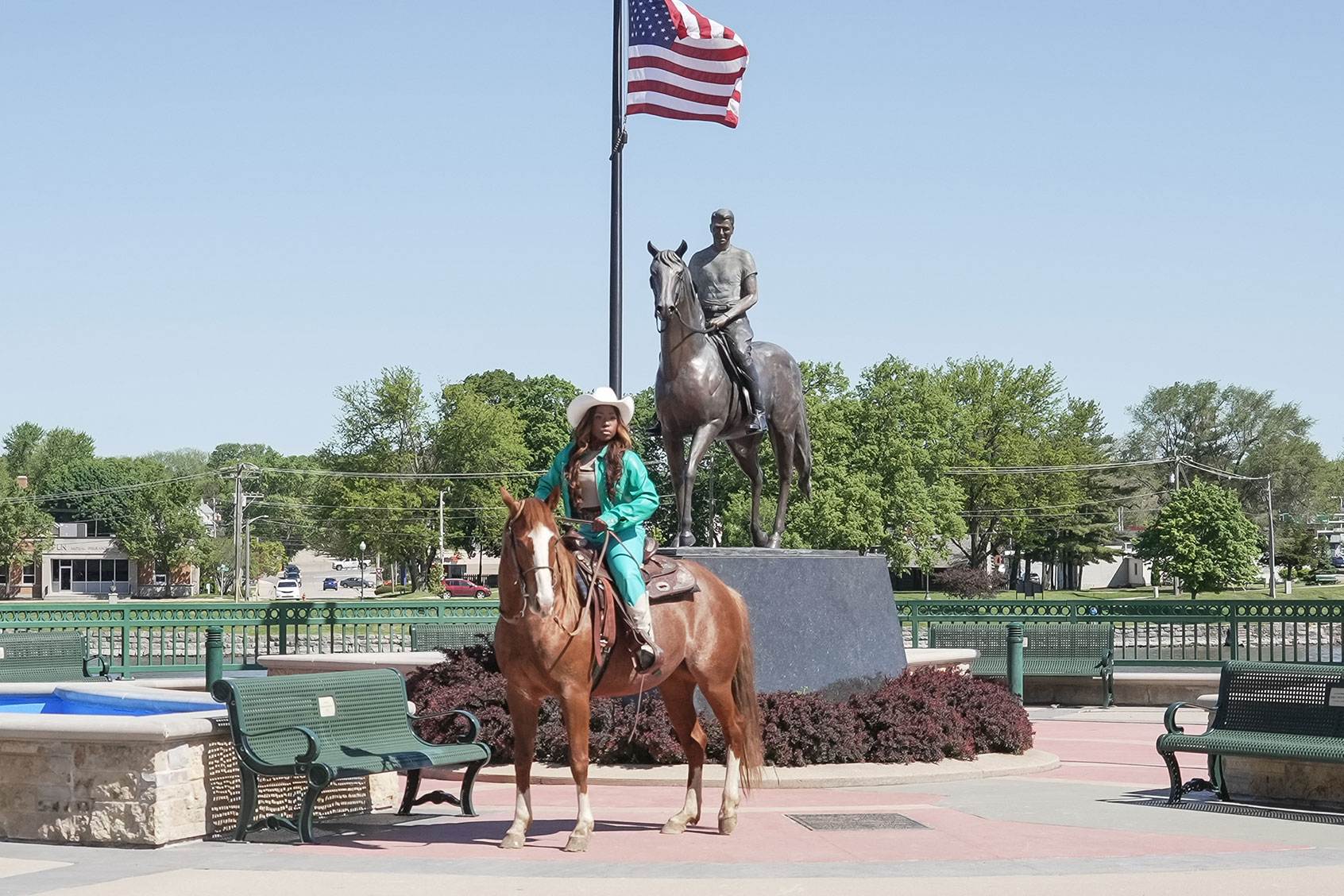
But when she recorded it, she wasn’t on location in the very conservative, Ronald Reagan-worshipping burg Crundwell drained of $53.7 million in what may be one of the largest municipal fraud cases in U.S. history. So while Mosley earns plenty of grins by showing up at the local watering hole in full rhinestone-spangled Western regalia, the same outfit Crundwell wore to her horse shows, she also senses a chill fall over the crowd at the mention of their homegrown thief's name. 

Scam GoddessLaci Mosley in "Scam Goddess" (Disney)

While the town that yielded that whopping amount only consists of 16,000 people, everyone there has at least heard of Crundwell. Those who knew her personally explain her steady accumulation of trust and power in the simplest terms: She came from a solid farming family. She worked for its city hall since high school. She was one of their own, why wouldn’t they trust her?

“This is a doozy because I don’t how to feel,” Mosley claims once the extent of Crundwell’s brazen hijacking has been laid out. “On the one hand, icon! On the other hand, villain.”

In case it isn't clear, she's joking. Mosley states in no uncertain terms that she isn't making light of the misery Dixon's scammed visited the town. When children are caught up in a fraud’s net, she's downright severe. That's is what happened when Kyle Sandler set up shop in Opelika, AL., claiming to be an ex-Google founding employee with a gazillion dollars and setting up an incubator company in the town that he milked dry. (For this episode, Mosley pays tribute to Steve Jobs and Elizabeth Holmes by wearing a black turtleneck.)

One of the residents he used to score corporate investment was a middle schooler who ideated a first-aid vending machine. Once the jig was up and Sandler ran, the kid’s dream went up in smoke too. 

We need your help to stay independent

Any new addition to true crime asks us to consider the need it's trying to fulfill. When Mosley launched her podcast, it was a leavening contrast to the murder and violence dominating most of the genre. Her and her guests' creatively hilarious reactions to each fraudster's peak outrageousness are brilliant enough to make the most familiar stories feel fresh again.

Mosley maintains her magnetism, but her rapid-fire humor is her greatest asset, and that’s noticeably muzzled.

One recently resurfaced podcast installment covers “Big Eyes” artist Margaret Keane and her fame-claiming husband, Walter. You probably saw or at least heard of the 2015 movie starring Amy Adams, but it seems entirely new to Mosley. Even if it isn't, listening to her and “Queer Eye” stylist maven Jonathan van Ness cackle over the looniest twists is the equivalent of a sugar bump. 

But all the energy those performers add is lost in the translation from audio to visual, leaving Mosley to shoulder all of the good-nature by herself as she leads viewers through bitter stories other shows dissect with sufficient gravitas. Crundwell’s crime has already fueled several TV and movie deep dives, including an episode of CNBC’s eternally circulating “American Greed.”

Sandler showed up in HBO’s “Generation Hustle.” He’s also the only scammer in the episodes made available for review who agrees to sit down with Mosley, explaining it’s his chance to “control the narrative.” You won’t find it hard to believe that he doesn’t, or that his polished interrogator takes glee in pulling him apart with a smile on her face.


Want a daily wrap-up of all the news and commentary Salon has to offer? Subscribe to our morning newsletter, Crash Course.


Even so, the pop-heavy graphics, quirky sound editing and integrated gags make the TV edition of “Scam Goddess” feel weightless, too light to last. Mosley maintains her magnetism, but her rapid-fire humor is her greatest asset, and that’s noticeably muzzled. 

Then again, a common thread in these episodes is that each community impacted by these large-scale scams has managed to recover in some way. Some got their money back. Others didn’t but found a way to repair the wounds opened by the grifters and thrive in different ways. Each con artist also did or is doing jail time – except for Crundwell, who had her sentence commuted by President Joe Biden in December 2024, winning him no new fans in Dixon.

The government has always bilked the people it’s supposed to serve, no matter which party is in power. Subsidies that already flowed into the tech sector and the coffers of the super-rich will swell to impossible limits. Returning a convicted fraudster to the White House only cements the dirty truth that some people will get away with anything they can because we let them get away with anything. 

Maybe the great service Mosley provides by bringing “Scam Goddess” to TV days before a tech bro robber baron officially ascends to the highest levels of power is to absolve us of any shame or guilt we might experience at knowing our pockets are being picked. Instead, the best survival option is the one she suggests in her podcast’s sign-off: Stay schemin’.

"Scam Goddess" premieres at 10 p.m. Wednesday, Jan. 15 on Freeform and streams the next day on Hulu.

Starbucks Workers United claims coffeehouse is requiring LA-area baristas to work amid wildfires

Starbucks Workers United — the labor union representing over 11,000 workers at 500 Starbucks stores nationwide — has criticized the coffeehouse chain for requiring Los Angeles-area baristas to come to work amid the recent wildfires throughout the county.

Starbucks workers in LA are being forced to work in areas impacted by the recent wildfires – even where the air quality is unsafe,” the union posted on X. “Management told partners that stores must open because ‘the community depends on us,’ ignoring that some workers had to evacuate their own homes.”

An accompanying video clip showed the raging wildfires engulfing nearby buildings. An unnamed voice in the background can be heard saying, “He said, ‘No, we’re staying open. Sorry, you can just serve everything, like, well-done.’”

Starbucks denied the accusation, telling The New York Post, “We are deeply proud of our partners [employees]. They continue to serve first responders and communities across LA where it is safe to do so.”

“Partner safety is our priority, and we work closely with local authorities on decisions about store closures,” the company spokesperson added. “If a store is in an evacuation zone, we close it immediately. We do not reopen until authorities say it is safe.”

The spokesperson clarified that Starbucks is “temporarily offering catastrophe pay for any missed shifts” for workers who have been displaced from their homes, even if their store locations are open.

The recent claims from the union come after a Starbucks location on Sunset Boulevard was destroyed by the wildfires.

“Working in unsafe conditions is unacceptable. Profits should NEVER be prioritized over safety,” Starbucks Workers United wrote.

Bondi backs Kash Patel to head the FBI but insists she won’t have her own “enemies list” at DOJ

During her confirmation hearing Wednesday, President-elect Donald Trump’s nominee for attorney general was grilled by Sen. Sheldon Whitehouse, D-R.I., about whether she would use the Department of Justice to prosecute Trump’s enemies.

Whitehouse asked Pam Bondi, Florida's former attorney general, whether she supported Trump’s nominee to lead the FBI, Kash Patel, who has assembled what he calls a list of “Members of the Executive Branch Deep State" that should be prosecuted.

When asked whether Bondi supported Patel and his plans to go after what he characterizes as a “cabal of unelected tyrants,” Bondi said that she does support his nomination but that "here will never be an enemies list within the Department of Justice.”

Whitehouse also asked whether Bondi would support using the Justice Department to go after journalists who are critical of Trump. Bondi said that the Justice Department would only go after someone who “commits a crime.”

“I believe in the freedom of speech — only if anyone commits a crime. It’s pretty basic, senator, with anything, with any victim, and this is this goes back to my entire career, for 18 years as a prosecutor and then eight years as Florida’s attorney general. You find the facts of the case, you apply the law in good faith, and you treat everyone fairly,” Bondi said.

“It would not be appropriate for a prosecutor to start with a name and look for a crime,” Whitehouse responded, adding that it’s a prosecutor's role to start with a crime and look for a name. Bondi responded by claiming that she thinks Trump was only prosecuted because of who he is, rather than for the various crimes he has been convicted of and alleged to have committed.

“I’m not willing to turn my back on the truth”: Neil Gaiman denies sexual assault allegations

Author Neil Gaiman issued a statement in response to the allegations of sexual assault and abuse by multiple women reported in a recent bombshell New York Magazine exposé.

In a post to the author's website on Tuesday, Gaiman wrote, "I have never engaged in non-consensual sexual activity with anyone."

Gaiman's denial follows an extensive report by Lila Shapiro that includes the testimonies of eight women accusing Gaiman of sexual abuse and assault — some of whom already shared their alleged experiences with Gaiman on the podcast, "Master: The Allegations Against Neil Gaiman" last year.

"There are moments I half-recognise and moments I don’t, descriptions of things that happened sitting beside things that emphatically did not happen," Gaiman commented after the exposé on him was widely circulated online. 

“I went back to read the messages I exchanged with the women around and following the occasions that have subsequently been reported as being abusive," he wrote. "These messages read now as they did when I received them – of two people enjoying entirely consensual sexual relationships and wanting to see one another again.”

Gaiman wrote that during these encounters with women, he was "emotionally unavailable while being sexually available, self-focused and not as thoughtful as I could or should have been.”

He continued, emphasizing his denial, “I’m not willing to turn my back on the truth, and I can’t accept being described as someone I am not, and cannot and will not admit to doing things I didn’t do.”

In Shapiro's lengthy and detailed story, numerous accusers painted Gaiman as a predator to be feared. His alleged relationships with these women typically started as innocent interactions with his fans and employees. One of the accusers, Gaiman's former nanny, Scarlett Pavlovich, filed sexual assault claims against Gaiman in 2023, however, a police spokesperson said the “matter has been closed.”

Gaiman denied the allegations in the story through his legal team, branding them “false, not to mention, deplorable.”

“I saw many things”: Pam Bondi says she can now “accept” the 2020 results but won’t say Trump lost

President-elect Donald Trump’s nominee for attorney general, Pam Bondi, at a Senate hearing Wednesday refused to say whether President Joe Biden won the 2020 presidential election.

During a series of questions from Senator Dick Durbin, D-Ill., on whether Bondi would stand up to Trump if asked to do something illegal, Durbin asked whether she acknowledged that Trump lost the 2020 presidential election

“To my knowledge, Donald Trump has never acknowledged the legal results of the 2020 election," Durbin said. "Are you prepared to say today, under oath, without reservation, that Donald Trump lost the presidential contest to Joe Biden in 2020?”

Bondi, in her response, said: “All I can tell you, as a prosecutor, is from my first-hand experience, and I accept the results. I accept, of course, that Joe Biden is president of the United States. But what I can tell you is what I saw first-hand when I went to Pennsylvania as an advocate for the campaign.”

“I was an advocate for the campaign, and I was on the ground in Pennsylvania, and I saw many things there. But do I accept the results? Of course, I do. Do I agree with what happened? I saw so much,” Bondi said.

In 2020, Bondi supported Trump's efforts to overturn the election, embracing false claims of voter fraud and asserting that "we won Pennsylvania," a state Trump in fact lost by 80,000 votes.

Durbin responded to Bondi's deflection by saying that he thought his question “deserved a yes or no.”

“I think the length of your answer is an indication that you weren’t prepared to answer yes,” Durbin said.

In a follow-up question, Durbin asked Bondi whether she would advise Trump to pardon January 6 rioters convicted of assaulting police officers.

“If asked to look at those cases, I will look at each case and advise on a case-by-case basis,” Bondi said.

South Korea’s right-wing president arrested over attempt to impose military rule

Recently suspended South Korean President Yoon Suk Yeol was arrested early Wednesday by the country's Corruption Investigation Office for High-ranking Officials, ending a political standoff triggered by Yoon's short-lived decision to impose martial law last month.

Yoon, with the support of Defense Minister Kim Yong-hyun, issued a decree late on Dec. 3 that suspended the National Assembly, banned all political activities, placed media and newspaper organizations under military control, and prohibited strikes and other activities that "incite social chaos." Armed troops were also sent to raid the headquarters of the National Election Commission, which Yoon claimed was involved in "election fraud."

Justifying the decision, Yoon had accused liberal dissidents ("anti-state forces") and the National Assembly ("a monster") of collaborating with "North Korean communists" to destroy the country.

The attempt to stamp out political opposition and put South Korea under military rule for the first time in 45 years lasted for six hours, with Yoon's efforts ultimately doomed by public outrage and a defiant National Assembly, which voted unanimously to overturn his declaration as civilians and staffers fought off soldiers trying to stop them.

Despite Yoon issuing a groveling apology on television, in which he admitted to acting out of desperation and promised not to impose martial law again, the assembly impeached him and Prime Minister Han Duck-soo on Dec. 14, albeit without the support of Yoon's People Power party. The Ministry of Justice also barred him from leaving the country while state officials opened an investigation into whether the declaration of martial law amounted to an insurrection.

Yoon vowed to "fight to the end," ignoring subpoenas from investigators and fortifying the presidential compound with rings of guards, barbed wire and buses.

If Yoon had been successful in his apparent coup attempt, South Koreans may have found themselves in a situation akin to the pre-1980s era, when the country languished under a succession of unstable military dictatorships. Instead, Yoon has earned the ignominious distinction of being the first sitting South Korean president to be detained in a criminal investigation.

We need your help to stay independent

When investigators and about 100 police officers arrived on Jan. 3 to serve a special court warrant for questioning, Yoon, surrounded by his 200-strong security detail, refused to surrender. On Wednesday, the investigators returned with 1,000 police officers armed with scaling ladders, warning Yoon's guards that if they resisted they would be arrested for obstructing justice. Yoon then submitted, but insisted in a pre-recorded video message that the investigation was "illegal" and that he was only cooperating to avoid bloodshed.

Most of Yoon's party has joined their leader in opposing both his detention and impeachment, with the suspended president's supporters holding rallies and spreading conspiracy theories in recent weeks.

Investigators have 48 hours to interrogate Yoon under the warrant they have now, but can request a separate warrant to extend the detention time by 20 days. Since the courts have already permitted the arrests of officials and military commanders who helped impose martial law, it is likely that they will accede to Yoon's continued detention as well, during which time prosecutors will be required to bring a formal indictment.

Separately, the Constitutional Court is deliberating on the National Assembly's vote to impeach Yoon. If the court upholds the impeachment, as it did with former President Park Geun-hye in 2017, Yoon will be permanently removed from office and a new election held within 60 days.

Making American oligarchy great again

When President-elect Trump held a press availability after speaking to Republican governors last week he rattled off several big names who'd made the pilgrimage to Mar-a-Lago to kiss the ring of the new Don. He actually sounded rather surprised by it, saying, "they all came. Jeff Bezos came, Bill Gates came, Mark Zuckerberg came, many of them came numerous times, the bankers have all come, everybody's coming. I haven't had anyone say anything bad about me. I'm not used to it."

Trump believes they come because they are dazzled by the power and strength of his massive electoral victory (like nobody's ever seen before!) but none of them are as dumb or as deluded as he is so that's obviously not the case. I'm going to guess they're dazzled by the richest man in the world's proximity to him and they want a piece of that action. Elon Musk has opened the door to a new style of oligarchy: American style.

This is the new American oligarchy — extremely wealthy men cozying up to the new president, a convicted criminal and adjudicated sexual abuser, a man who attempted to illegally overturn an election, who bungled a major national crisis and remains the most ignorant person to ever sit in the Oval Office.

The history of Russia after the fall of communism is instructive here. Under the first president of Russia, Boris Yeltsin, in the 1990s, a group of snake oil salesmen and scam artists swooped in to take advantage of the opening that "shock therapy" provided and gobbled up valuable state-owned properties and resources at fire sale prices. They made themselves into billionaires overnight. They were thoroughly corrupt and basically robbed the Russian people blind.

When Vladimir Putin eventually replaced the discredited Yeltsin, he called them all to the Kremlin and laid down the law, demanding that they pledge fealty to him personally and do what they were told. If they complied they would be allowed to keep their ill-gotten fortunes as long as they made sure that tribute was paid to him. Some did not and were thrown into a Siberian prison, forced into exile, or died in suspicious circumstances. The rest complied and Putin is reputed to actually be the richest man in the world, although his fortune is not publicly traceable.

Obviously, Donald Trump is no Vladimir Putin. He doesn't have that kind of authority in the American system (at least not yet) or the savvy to use it as efficiently as Putin. But he thinks he's doing the same thing. In truth he's more of a Yeltsin, gladly accepting the attention and flattery of the oligarchs as they attempt to steer the government in their favor.

He has no idea what they're really after. For example, at his press conference last week at Mar-a-Lago he was asked if he thought Meta's Mark Zuckerberg had changed the company's policies to favor Trump because of his threats and replied, "probably." I really doubt that's the reason. Yes, Trump indeed threatened Zuckerberg with life in prison for “plotting” against him during the 2020 election by “steering” Facebook. Now, apparently all is forgiven as Zuckerberg has decided to follow Trump's Rasputin, Elon Musk, and allow right-wing propaganda to flourish on Facebook and Instagram to please the Dear Leader. It's a small price to pay for such close proximity to power. And after all, Zuckerberg has long considered himself the spitting image of Roman Emperor Augustus Caesar so it's only right.

Jeff Bezos similarly has tasked Amazon with making a 40 million dollar documentary about Melania Trump as a token of his appreciation as well as a million dollar donation to the inauguration slush fund. In fact, all the oligarchs are ponying up big bucks for that event. It's unknown what Bill Gates got out of his visitation but one assumes that he too has seen the advantage of getting up close and personal with this elderly narcissist who is so easily swayed by flattery and attention.

And then there's Musk himself, who appears to be even more narcissistic than Trump and has apparently convinced himself that he has somehow been anointed as a man who will rule the world through Donald Trump. He's not only created a grandiose outside group that basically answers to no one (well, there's Donald Trump, but he's clueless about what they're up to) but now he's meddling in other countries' politics as well. (His recent foray into the UK has not been well received by the locals.)

The latest rumor is that he's been approached to buy the most popular social media company in the world, Tik Tok. Between him and Zuckerberg, Trump-friendly oligarchs would then dominate that media sphere for their own and Donald Trump's benefit. The potential for reality-shaping propaganda will explode exponentially.

We need your help to stay independent

Meanwhile, the bankers, the CEOs and the Big Money Boys on Wall Street are also on board. The Financial Times reports that they are thrilled with Trump's election. Corporations all over the country are ostentatiously canceling their DEI programs and any form of LGBTQ celebrations and Pride promotions. Apparently, they are all very excited to go back to just hiring the white males so they no longer have to worry about MAGA boycotts and death threats.

One Wall Street fellow told the Times, “Most of us don’t have to kiss a— because, like Trump, we love America and capitalism." A top banker said, “I feel liberated! We can say ‘re—-rd’ and ‘p—sy’ without the fear of getting canceled… it’s a new dawn.” (Interesting that he didn't let them use his name, however.)

This is the new American oligarchy — extremely wealthy men cozying up to the new president, a convicted criminal and adjudicated sexual abuser, a man who attempted to illegally overturn an election, who bungled a major national crisis and remains the most ignorant person to ever sit in the Oval Office. They know exactly what they can get from him. He's much more Yeltsin than Putin.

The full picture will be clear on Inauguration Day with this tableau:

Elon Musk, Jeff Bezos and Mark Zuckerberg will attend President-elect Donald Trump’s inauguration Monday, according to an official involved with planning the event. They will have a prominent spot at the ceremony, seated together on the platform with other notable guests, including Trump’s Cabinet nominees and elected officials.

Oh, and Speaker of House Mike Johnson has overturned centuries of protocol and will order the flags that are flying at half mast for the death for former president Jimmy Carter to be raised on Inauguration Day so that none of those dignitaries will have to be reminded of what the presidency used to be before the oligarchs took over.  

Walgreens CEO: Stopping shoplifting is a “hand-to-hand combat battle”

Walgreens is struggling to deter shoplifting at its stores, according to CEO Tim Wentworth, who described it as "a hand-to-hand combat battle still, unfortunately."

Wentworth spoke to analysts during a first-quarter earnings call on Friday, Business Insider reported. He said the Illinois-based retailer is taking "creative" steps to address the issue. 

"When you lock things up, for example, you don't sell as many of them," BI reported. "We've kind of proven that pretty conclusively."

Walgreens executives have previously mentioned that missing inventory has hurt profits. 

Other retailers are testing ways to prevent shoplifting, BI reported. At Walmart, employees can use an app to unlock items on shelves. Walmart and T.J. Maxx are trying body cameras for some employees.

Walgreens is in a multi-year effort to revive its retail business. It announced in October it would close 1,200 stores across the U.S. over the next three years to try to recover from financial struggles that include billions of dollars in losses. 

Walgreens has 8,500 stores in the U.S. and has struggled with operational costs as well as falling reimbursement rates for prescription drugs and increased competition from competitors like Amazon, Walmart and Target. Other drug store chains, including CVS and Rite Aid, have closed hundreds of stores in recent years for some of the same reasons. 

The company is testing new systems to lure and keep customers, like a digital check-in for prescription pick-up, Wentworth said. 

Walgreens stock closed up over 27% after it announced better-than-expected results for the period that ended in November. Wentworth credited the company's "disciplined execution." 

“We can’t just give in”: Women of color are still processing Harris’ loss while preparing for Trump

Vice President Kamala Harris' presidential campaign came and went almost like a fever dream. In just 100 days, she clinched the Democratic nomination, found a favorable running mate in Minnesota Gov. Tim Walz, released an ambitious economic plan to address Americans' concerns and — most importantly, it seemed — reinvigorated a Democratic base that President Joe Biden's candidacy had left disaffected.    

But her whirlwind of a presidential bid wasn't enough. President-elect Donald Trump won the electoral college as well as the popular vote. Harris conceded the election shortly thereafter, telling supporters gathered at her alma mater Howard University in Washington, D.C., that she remained dedicated to the fight for the United States and its democracy. She retreated from the spotlight almost as quickly as she had come into it, returning to confirm her opponent's victory.

Meredith Turner, a Cuyahoga County councilperson and Ohio delegate at the Democratic National Convention, remembers Harris' campaign fondly, applauding how she pulled off her White House bid and made history as the first woman of color — specifically of South Asian and Afro-Caribbean descent — to be nominated as a presidential candidate. 

"She Black-womaned — she did what we do," Turner, who is Black, told Salon in a phone interview. "She ran an exquisitely inclusive, diverse campaign. Our platform was solid. It was one of inclusion, and it was forward thinking."

Turner said that she still revisits her pictures and videos of moments from the DNC in August, those memories helping to keep her motivated in the wake of Trump's win. While she said she intends to continue working across the political aisle in Ohio to deliver returns for its citizens, she has also decided to take a step back from collective organizing.

"I don't see the benefit of that right now," she said. "I think we need to get in these schools, we need to start talking to the next generation of voters. As a policymaker — we need results for the American people. I'm moving away from the activist and becoming more of the advocate."

As the nation inches toward Trump's inauguration on Jan. 20, Democrats are reflecting on and re-evaluating how to win back voters in the wake of an electoral loss that data suggests was ultimately a referendum on their effectiveness as a party. While the majority of white Americans voted for Trump in 2024 as they did in 2020, a decreased share of voters of color in each demographic except Black voters chose the Democratic presidential nominee, according to exit polls.

Still, women of color remained crucial supporters and organizers in the voter mobilization effort for Harris and the Democratic Party this election cycle, in part because of what Harris' candidacy would come to represent. 

"For women of color — who are often behind the scenes and not considered a strong runner, or not allowed to step up into the light — that was a moment of pride," said Patricia Campos-Medina, a former U.S. Senate candidate for New Jersey and a longtime labor organizer. 

Harris' candidacy will inspire other women across the country to take on the mantle and run for leadership positions, argued Campos-Medina, also the president of Latina Civic, a nonpartisan political action committee seeking to boost Latina candidates.

"That's what she did," she said. "She was able to show us a way to say, 'Yes, I can.' That transforms the heart and your instincts about how you can do things."

Over the summer, Campos-Medina was among the 7,500 Latinas who convened two "Latinas for Harris" fundraising Zoom meetings, which came amid a spate of organizing calls hosted to boost Harris' candidacy and rally supporters around her.

The Win With Black Women advocacy organization led the charge with an initial call that counted 44,000 Black women among its participants and raised $1.6 million in just one night in July. Organizers went on to host calls targeting other demographics, including Black men, South Asian women and white women, each amassing thousands of participants and leading the Harris campaign to raise $200 million in its first week. 

Together, those efforts, organized in large part by women, helped push Harris toward record fundraising numbers while energizing key factions of the Democratic base ahead of her official nomination in late August. That electricity, however, didn't carry over into the election itself.

Harris lost the popular vote to Trump by a mere 1.5%, which amounted to just under 2.3 million votes out of more than 152 million cast. But a recent analysis of Associated Press VoteCast data by political strategist and former AFL-CIO political director Michael Podhorzer noted that Harris failed to mobilize the critical mass of anti-Trump voters that catapulted Biden to his electoral victory in 2020. 

About 19 million people who voted for Biden in the 2020 election did not turn out for Harris in 2024, Podhorzer estimated, noting that Trump won the same share of the eligible voter population as he did four years ago. Fifteen million fewer votes were cast "against" Trump this election cycle than in 2020, which "suggests a lot of missing 'anti-MAGA but not pro-Democrat' voters," Podhorzer writes.  

Edison Research exit polling data showed that, among those who did vote, the state of democracy and the economy were the two most important issues motivating their presidential choices. A majority of polled voters said the economy was "not so good" or "poor," with 70% of those voters choosing Trump. Of the 32% of voters who said the economy was the most important issue influencing their choice, 81% cast a ballot for Trump. 

In many ways, then, this election was more about punishing the incumbent party over inflation and the hole in their wallets than it was about choosing Trump and standing behind his policies, said Andra Gillespie, a political scientist who researches voter participation at Emory University in Georgia.  

"Donald Trump did a better job getting low-propensity Republican-leaning voters out to vote. In contrast, low-propensity Democratic voters did not show up in this election," Gillespie told Salon in a phone interview. 

"I think it was consequential that Donald Trump consistently was perceived as the stronger candidate on economic issues," Gillespie added. "And I think, here in this election, perception matters more than reality."

Edison exit poll data showed Asian-American voters, though they overall voted for Harris at 55%, increased their support for Trump this election cycle by 6% compared to 2020. While Latino voters also selected Harris by 51% — down 14% from their support for Biden in 2020 — Trump increased his share of Latino men's support by 18% compared to four years earlier, with Latina women increasing their support by 9%. 

Though initially thought to have swayed toward Trump, Black men's voting patterns remained largely the same between the election cycles, with final exit polling data showing that Harris received only 2% fewer votes from the demographic than Biden did in 2020: roughly 79%. Black women also showed up for the Democratic candidate at typically high rates, supporting Harris at 92%.

Gillespie said gender gaps in voting patterns within racial demographics are normal and that, outside of Black voters, other communities of color have broader variation in their partisan leanings. That fact, however, didn't change how Black women — the most loyal cohort of the Democratic coalition — felt about the breakdown. 

In the days following the election, Black women on social media took note of the racial and gender differences in votes for Harris, voicing frustration at other demographics for what they described as not pulling their weights at the polls. As a result of Harris' loss, a wave of Black women, who felt betrayed by what appeared to be an increase in other demographics voting for Trump, would go on to declare that they would no longer be going out of their way in their organizing.

"The frustration that we've heard in the immediate aftermath of the election evinces a real weariness and a wariness that could impact their strategic decisions," Gillespie said, referring to Black women's willingness to engage in activism and coalition work with non-Black people.

Turner, the former delegate, counts herself among those wary Black women voters and organizers.

"We're sick and tired of being workhorses for people," she said. "I mean, we literally gave civil rights to everybody. It's our blood, it's our time that we've been putting in to make sure that there is equity and diversity and inclusion for everyone."

Though Turner said she's still processing Harris and the Democratic Party's losses in November — and increasingly scared about what Trump's incoming term could mean for the future of America — she said harnessing the energy leftover from the Harris campaign has made her more determined to define and strengthen her advocacy.

Instead of participating in protests and marches against Trump and right-wing policies, she will focus her efforts on speaking with legislators and attending local council and school board meetings, she said.

"There are people who are homeless, there are people who live in food deserts, who can't access healthy food. There are people who can't afford their homes, [who are] losing their homes," she said. "We can't give up. We can't just give in because they're counting on us to come up with solutions"

"We may have lost the race, but we are not defeated," she added, echoing a theme of Harris' concession speech.

“You will have to change how you see women”: Why Trump fears Hegseth accusers

Pete Hegseth and his fellow Republicans can't decide if the abuse allegations against him are real or "fake news."

At the very top of the Fox News host's hearing to be Donald Trump's defense secretary, both Hegseth and his GOP defenders spun out two competing narratives: The stories about him aren't true, but if the evidence makes the stories undeniable, it doesn't matter, because he's a changed man. Armed Services Committee chair Sen. Roger Wicker, R-Miss., kicked off the have-it-both-ways strategy in his introductory remarks to Hegseth's confirmation hearing Tuesday by acknowledging that "Mr. Hegseth has admitted to falling short" while insisting "the accusations leveled at Mr. Hegseth have come from anonymous sources."

Hegseth himself picked up the ball with a conspiracy theory that he was the victim of a "coordinated smear campaign orchestrated in the media," adding, "Our leftwing media in America today sadly doesn't care about the truth." Throughout the hearing, he kept harping on the word "anonymous," implying that the press made up the stories. 

But, of course, the accusations against Hegseth aren't anonymous, and they certainly aren't fabricated by journalists. The woman who called the police in 2017, accusing Hegseth of rape, did so under her real name. The police have confirmed that the report is real. Her name has been redacted by the press, as is customary for sensitive crimes, but she was certainly not anonymous. The whistleblower report filed in 2015, which detailed alcohol abuse and sexual harassment, wasn't anonymous, either. As Jane Mayer of the New Yorker writes, it was compiled by several former members of Concerned Veterans for America, which he had been president of, and sent to senior management. It resulted in Hegseth being pressured to resign. 


Want more Amanda Marcotte on politics? Subscribe to her newsletter Standing Room Only.


As Sen. Tim Kaine, D-Va. said, "We have seen records with names attached to all of these, including the name of your own mother." He was referring to a 2018 email sent to Hegseth from his mother, where she called him an "abuser of women" and denounced the way he cheated on and treated his first two wives. She has since tried to walk it back, but without actually denying any of the details, which have been corroborated by multiple other sources by reporters. 

Hegseth's parrot-like repetition of the word "anonymous" shows he and Trump believe that, as long as more details don't come to light, they can simply deny the piles of journalistically obtained evidence. Helping them are the FBI agents tasked with the "background check" that is unworthy of the name. As the New York Times documented Tuesday morning, the supposed report "omitted key details on major allegations against him, in part because it did not include interviews with critical witnesses." Women especially were ignored, with neither the rape accuser nor Hegseth's ex-wives receiving interviews. Hegseth's second wife reportedly "made multiple attempts to contact the bureau for a more substantive discussion — but her calls were not returned last week."

To give a sense of how serious this omission is, standard FBI background checks don't only include family and friends, but neighbors and casual acquaintances. I once had to sit through a 15-minute FBI interview because my upstairs neighbor in New York City — someone I had only spoken to in passing — was being considered for a bureaucratic federal job. The FBI didn't suddenly become incompetent, however. As the Times reports, "presidential transition teams are traditionally able to set the parameters for background checks into cabinet picks, and potentially dictate which witnesses are interviewed and what questions are asked." It was Trump's team who almost certainly blocked the interviews. It suggests they know what would turn up would look bad, so they would rather not know. 

Hegseth also has a fallback position, in case this cover-up doesn't work. He's a changed man, he argued, "saved by the grace of God, by Jesus and Jenny," his third wife. As Sen. Kaine reminded viewers during his question period, this is the same woman who gave birth to Hegseth's daughter while he was still married to his second wife. Two months after that baby was born, the rape allegations were filed against Hegseth. Hegseth denies it was rape, even though he settled out of court with the accuser, but has admitted sex happened, likely because a rape kit produced physical evidence that foreclosed a total denial. 

It can't both be true that the accusations are false and also that Hegseth repents of his behavior, as multiple journalists have pointed out.

PETE HEGSETH ATTORNEY TIM PARLATORE: He didn't do any of these things that he's been accused of. PAMELA BROWN: But he's also admitted he's a changed man from several years ago. How does that square? If you're saying he didn't do any of it, but he's a changed man.

[image or embed]

— Aaron Rupar (@atrupar.com) December 27, 2024 at 11:58 AM

But it's not hard for Republicans to reconcile these contradictions for one simple reason: both are lies. It's not true that Hegseth is the victim of a coordinated smear campaign. It's also not true that he or his supporters see his past behavior as worth an apology, much less redemption. As Trump explained repeatedly throughout the civil trial, where a jury found him liable for the sexual assault of journalist E. Jean Carroll, he believes it "fortunately" was true that men had a right to sexually abuse women "for a million years." In the MAGA view, this right to abuse has been unduly stolen by the "woke mob." If men have to lie about abusing women, well, that's just self-defense against "political correctness." 

These internal contradictions of Hegseth's narrative emerged repeatedly on the related topic of whether women should have equal opportunities in the military. As Sen. Elizabeth Warren, D-Mass., bluntly stated during her questioning, Hegseth's longstanding view is that "women are inferior soldiers and should not be in combat." The record on this front is robust. For over a decade, Hegseth has publicly railed about the evils of having women receive equal pay and rewards for combat service, saying in the weeks before his nomination, "I'm straight up just saying we should not have women in combat roles."


Want a daily wrap-up of all the news and commentary Salon has to offer? Subscribe to our morning newsletter, Crash Course.


During the hearing, however, he was doing a tapdance, pretending he was merely talking about having "standards" and claiming that women should not be denied equal opportunity if they meet them. But that's how things are right now. Physical or other performance standards for military jobs were not changed to accommodate more women. The only "standard" that was changed was whether you had to have "male" on your documentation. He previously claimed, falsely, that "women cannot physically meet the same standards as men." Job placement statistics show plenty of women meet those standards. He also ascribed female inferiority to brains as well as brawn, writing, "Dads push us to take risks. Moms put the training wheels on our bikes. We need moms. But not in the military, especially in combat units."

Hegseth repeatedly winked at his real views during Monday's hearing, saying he believes in a "warrior ethos." That phrase is weird enough to be a red flag on its own but taken with this history, it's not subtle. He's openly stated women are too soft-headed to be combat soldiers. "Warrior ethos" is code for "boys only." 

Hegseth belongs to a radically right-wing church that teaches women were created to be men's submissive helpmeets, and certainly not to have jobs, especially military jobs, outside of the home. As Sen. Kirsten Gillibrand, D-N.Y., said in her blistering questioning of Hegseth, "You will have to change how you see women to do this job well." His regressive, misogynist views come into direct conflict with the daily reality of military service, where large numbers of women serve — and the military cannot function without them. But Trump and his supporters no more want Hegseth to change his views than they wish him to repent of all the alleged abuse and sexual misconduct. As with those allegations, it's seen as fair play for Hegseth to lie and misrepresent his real views on women, as revenge on the "woke mob" for making it politically incorrect to say sexist things out loud in the first place. 

It's exhausting and is meant to be. If Hegseth squeaks through, it will be for the same reason Trump keeps slipping the noose: He's so comprehensively terrible in every way, that it's hard to focus on one topline reason to disqualify him. (This is the patented Steve Bannon "flood the zone" strategy of overwhelming your opponents with awfulness until they become helpless to resist.) Hegseth's misogyny was a big deal during Tuesday's hearing, but it was far from the only issue raised. There was also his well-documented drinking problem, his mismanagement of two veteran non-profits, his defense of war crimes and disdain for the Geneva Convention, and his general lack of qualifications to lead the Defense Department. Weirdly, the more reasons to vote no stack up, the easier it is for Republicans to get to "yes." His misogyny is vile, but in the midst of all the other noise, easy enough for Senate Republicans to ignore. 

“Rigging the system”: Pam Bondi consistently sided with corporations that gave money to Republicans

With President-elect Donald Trump's pick to head the Department of Justice set to appear before the Senate for her confirmation hearings this week, Pam Bondi's career as the attorney general of Florida is drawing renewed scrutiny over the friendly positions her office took on businesses that donated to Republican organizations.

Bondi’s career as Florida attorney general, while defended by Republicans, was marred by repeatedly dropping lawsuits against companies that donated to the Republican State Leadership Committee and the Republican Attorneys General Association, two organizations that supported Bondi. 

The RSLC works to “recruit, train, and elect” Republican officials for state-level offices and RAGA does the same, though it is specifically focused on supporting Republican attorney generals around the country. Between 2002 and 2014, RAGA operated as a branch of the RSLC and, from its founding in 1999, the organization solicited donations from corporations and lobbyists, which it would use to help support Republican politicians. The group has, however, drawn scrutiny for the apparent relationship between the industries and businesses that donate to it and the actions then taken by Republican attorneys general, including Bondi.

In 2014, for example, Bondi’s office dropped a lawsuit against the travel booking website Expedia over an alleged scheme to withhold taxes in Florida. The decision to drop the lawsuit came after Expedia donated more than $190,000 to the RSLC and RAGA between 2011 and 2014. While Bondi denied that the company’s “access” had any “bearing” on the decision to drop the suit, it is part of a pattern of behavior.

"My office aggressively protects Floridians from unfair and deceptive business practices, and absolutely no access to me or or my staff is going to have any bearing on my efforts to protect Floridians," Bondi told the New York Times at the time.

In 2014, The New York Times reported that the for-profit education company Bridgepoint Education, which was the subject of scrutiny from the Senate Committee on Health, Education, Labor and Pensions and multiple investigations from the Department of Justice, had hired lobbyists to convince Bondi and other state attorneys general to not bring charges against them. 

Bridgepoint, like Expedia, made considerable donations to both the RSLC and the RAGA.

While Bondi and other Republican attorneys general elected not to sue the company, other states found success in court. In 2022, a lawsuit brought by California resulted in Ashford University and Zovio, Inc., which was formerly Bridgepoint Education, being ordered to pay more than $22 million in penalties. Zovio, Inc. was found to have misled students about the cost of an education at places like Ashford University as well as the career outcomes they could expect from their programs. 

In a statement from the Florida attorney general's office on the Bridgepoint Education issue, Bondi's office said that it had a meeting with the company in 2013, where it "laid out all of the substantial changes they had undertaken at
their schools to address the issues that had been prevalent in the other for-profit matters we had investigated and settled," and again denied that access to Bondi or her staff had influenced her decisions as attorney general.

The lobbyists hired to work on Bridgepoint Education's behalf were from Dickstein Shapiro, according to the Times report, a firm that had itself paid some $150,000 to both the RSLC and RAGA between 2011 and 2014. The same lobbying firm was contracted by Accretive Health, a hospital debt collection firm, in 2012. Accretive Health had been under investigation in Minnesota for its debt collection practices, an investigation which led to the company being forced to cease all operations in the state and pay $2.5 million in fines in 2012. 

According to the Minnesota Attorney General’s office, Accretive Health employees and hospital staff were pressured to collect money from patients, with strategies including attempting to make patients believe that they wouldn’t be treated if they didn’t pay beforehand. Dickstein Shapiro was contracted, per the 2014 Times report, to ensure that other state attorneys general didn’t follow Minnesota's example.

In a statement responding to Accretive Health's lobbying, Bondi's office said that lobbying played no role in the office's decision-making, saying that "this office conducted its own due diligence by, among other things, contacting the Minnesota Attorney General's Office when Minnesota's allegations came to light" and that the "unfair debt collection practices alleged in the Minnesota complaint appeared to be largely Minnesota-specific."

Beyond dropping or refusing to bring suits, Bondi’s office has also taken industry-friendly positions on issues related to the firearms industry. In 2014, Bondi co-authored an amicus brief in NRA v. Bureau of Alcohol, Tobacco, Firearms, and Explosives, in support of the National Rifle Association when it was suing to lower the age required to buy firearms from 21 years old to 18. In another case, Shew. Melloy, Bondi co-authored a brief arguing that Connecticut’s ban on semi-automatic weapons was unconstitutional. In 2013 and 2014, the NRA donated more than $130,000 to RSLC and RAGA.

We need your help to stay independent

Bondi also used her post as attorney general to take "business-friendly" positions. For instance, in 2014 Bondi, alongside 20 other attorneys general, filed an amicus brief on behalf of the American Farm Bureau Federation, which had filed a lawsuit aimed at preventing the EPA cleanup of the Chesapeake Bay. In the brief, the attorney generals sought to question the EPA’s authority to set “the maximum amount of pollution a body of water can receive and still meet state water quality standards.”

In 2013, Bondi’s office filed a similar brief in a case concerning the Clean Air Act and, in 2014, Bondi co-filed a brief in a challenge against the EPA’s authority for permitting under the Clean Water Act. The group that brought the case, the National Mining Association, had donated some $75,000 to the RSLC and the RAGA between 2012 and 2014.

All told, the RSLC and the RAGA took over $1.26 million from the fossil fuel industry and 2013 and 2014, according to an analysis by Accountable.US. Tony Carrk, the group's executive director, told Salon that in her time as Florida's top prosecutor, “Pam Bondi frequently played favorites with big corporate donors and political insiders at the expense of everyday consumers, patients and the public good.”

“Nothing indicates Bondi would change her office-peddling modus operandi as America’s top justice official," Carrk added, "which would be part and parcel with President-elect Trump’s agenda of further rigging the system in favor of wealthy corporate interests."

Perhaps the most infamous example of Bondi making favorable decisions for those who support her political aspirations came in 2013, when the Donald J. Trump Foundation donated $25,000 to And Justice for All, an organization that was helping engineer Bondi’s re-election. This donation came around the same time that the Florida attorney general’s office, which Bondi helmed, was considering joining an investigation into Trump University. 

According to an Associated Press report from 2016, Bondi “personally solicited" the contribution from Trump before eventually deciding against joining the investigation. Trump later held a $3,000-a-person fundraiser for Bondi at his Mar-a-Lago estate and both he and his daughter, Ivanka Trump, gave $500 to Bondi’s campaign in 2013. The next year Trump and Ivanka donated some $125,000 to the Republican Party of Florida, which was the Bondi campaign’s single largest donor.

Bondi, in a statement to NBC2 News at the time, said that "no one in my office ever opened an investigation on Trump University nor was there a basis for doing so."

A Trump spokesperson not immediately respond to a request for comment. Bondi has consistently denied allegations of impropriety during her time as attorney general, including in reference to the donation from Trump and his family.

But in Carrk’s opinion, the issue of Trump and Bondi’s relationship with respect to the Trump University investigation, or lack thereof, suggests that “Pam Bondi was targeted with a bribe in the form of major political donations.”

“Consistent with her own pattern of selling out her office to wealthy corporate special interests, Bondi did exactly what Donald Trump expected of her by not fighting on behalf of Floridians scammed by the future president. Bondi makes no apologies for her history of cronyism and favoritism toward powerful insiders at the expense of everyday families, and the American people can expect more of the same should she be confirmed as U.S. Attorney General,” Carrk said.


“Small acts of resistance”: Retooling “what protecting democracy looks like” in a second Trump term

Next Monday, Donald Trump will become president of the United States for a second time. He has promised and threatened to be a dictator on "day one."

None of this was fated or preordained. An alternate version of this reality and timeline could easily exist if two million Americans made a different choice on Election Day. This is especially true if Kamala Harris received the same number of votes as President Joe Biden had in 2020 (Biden received approximately 81 million votes in that election. Harris received only 74 million votes in the 2024 election).

Trump will return to power on Dr. Martin Luther King Jr. Remembrance Day. This is a horrible coincidence of dates; Trump and King are two men whose lives and missions are antithetical. In his Letter from a Birmingham Jail, King emphasized how we are “caught in an inescapable network of mutuality, tied in a single garment of destiny. Whatever affects one directly affects all indirectly.” Trump rejects such principles and values of social democracy and human dignity and rights. Trump’s life philosophy is based on selfishness, self-interest and corrupt power.

"We’ve seen this movie before and this is the sequel nobody asked for."

Although there are many different individual reasons for Trump's support and his MAGA movement, public opinion and other research point to a unifying theme: people are angry, discontent and upset at a political and economic system and larger society that they (correctly) feel no longer works for people like them. So they chose a candidate who represents “change” and “shaking the system up” — even if that change is destructive and “shaking up the system” means tearing it down to build an artifice to Donald Trump and all the horribleness that he embodies. For such a radical change to take hold across American society and life will require the creation of compliant authoritarian subjects who have been trained and conditioned into accepting (and yearning for) Trumpism and the new order of things.

In a new essay at the LA Progressive, Henry Giroux notes that “What we are witnessing today is the rise of a reengineered 'totalitarian subject,' forged in the wreckage of institutions that once upheld the common good, basic rights and civil liberties, replaced by machinery designed to sustain authoritarian rule":

This subject is governed by fear, surrendering their agency to the grip of cult-like devotion and the iron hand of strongman figures. It is a subject ensnared in a culture of ignorance, enveloped by the fog of anti-intellectualism, and animated by a disdain for difference and the Other. They are imprisoned in what Zadie Smith calls the dreams of a language of autoimprisonment and the blinding poison of consent. Their worldview is reductive, confined to rigid binaries of good and evil, where complexity is obliterated in favor of simplicity.”

[…]

This is a subject that values emotion over reason, exalts a toxic machismo that glorifies violence, and harbors a seething contempt for women, LGBTQ+ individuals, immigrants, Black people, and anyone who does not conform to the narrow, exclusionary ideal of white Christian nationalism. Their identity is an unsettling fusion of economic, religious, and educational fundamentalisms, designed to crush critical thought and enforce conformity.

The totalitarian subject thrives in a milieu of manufactured crises and engineered divisions, where cruelty becomes virtue and the lust for domination is mistaken for strength. This is not merely a political condition but a moral disintegration—a retreat from shared humanity into the sterile, unyielding embrace of authoritarianism. Under the GOP, the creation of the totalitarian subject — shaped by regressive values, stunted agency, and a warped sense of morality — intersects with a broader assault on the very meaning of citizenship.

What does resistance, opposition and trying to defend and renew America’s democratic life look like in this crisis era and beyond? What of the relationship between emotions and politics, “the personal and the political” in the long Age of Trump and MAGA America? Where do we go from here?

In an attempt to gain some perspective as we navigate Trump’s return to power and the rise of MAGA America, I recently spoke with Virginia Kase Solomón, president and CEO of Common Cause, a nonpartisan government watchdog organization driving systemic change and holding power accountable through grassroots advocacy and legislative action. Since 1970, Common Cause has championed government accountability, ethics and the removal of big money from our nation’s political system. Today, the organization represents over 1.5 million members and 23 state offices. 

This is the first part of a two-part conversation.

How are you feeling as you reflect on the last year, the election and Trump’s imminent return to power? 

This is a tough moment, no doubt about it. However, I’m a person of faith, so I always believe that good will triumph in the end. However, we must do the work. When David fought Goliath, he was just armed with a slingshot and a few stones. He didn’t run and hide. This is the moment for us to come together and fight for what we know is right and just. The work of building a democracy as diverse as the United States of America requires all of us getting involved and paying attention. There are so many people who will be impacted negatively who may not be able to show up and so it’s on us to show up for them and ourselves. But Common Cause is here to remind everyone that we can create the future we dream of together. 

I often think about other tough periods in our history. I’ve had the honor of working with and being in community with some of the greatest civil rights leaders of our time. When I think about what they went through under even worse circumstances, I can’t possibly imagine giving up. Now, I will say that I plan to rest when I need to, but giving up just isn’t an option. I also find it more important now than ever to be in community with others so that we can support each other in these uncertain times. 

In the civil society space in which you and your organization work, how would you describe the collective mood and energy?

This is a heavy moment for all of us because we know what Trump and the Republicans and the larger MAGA movement and “conservatives” are going to try to do to our communities — to women, poor people, immigrants and other communities of color. We’ve seen this movie before and this is the sequel nobody asked for. We know what we are up against, but again, history has shown that when we come together, when we unite across backgrounds and languages and political parties, we can achieve the multi-racial democracy we deserve and achieve small wins that get us closer to that ultimate goal. 

What are your thoughts about Trump being inaugurated as president for a second time and several weeks after the fourth anniversary of the Jan. 6 coup attempt?

Like most Americans, I was relieved to see the election certified peacefully. The impacts of the Jan. 6 insurrection are still felt far and wide, and it’s important to tell the truth about exactly what happened that day. There have already been a lot of attempts to rewrite our history, but we absolutely cannot normalize or minimize what we all saw happen with our own eyes.

We need your help to stay independent

Ahead of the inauguration and the new administration, I’ve found myself both concerned and feeling defiant toward any attempt to do harm to our democracy and the people who will be most harmed by his policies. President-elect Trump has already indicated his goals to run our country and government no different than how he runs his businesses. He’s pledged to restore the Muslim travel ban, launch mass deportations across the country, and pardon Jan. 6 rioters, among other things. Recent Cabinet appointments have also shown the president-elect’s preference for elevating billionaires, corporate oligarchs, and others based on their personal loyalty to him. 

Many Americans are disengaged from politics following Trump’s victory in the 2024 election. This is especially true of Democrats and other pro-democracy Americans. Public opinion and other data show a widespread amount of malaise and disengagement and exhaustion not just from politics, but more generally.

Common Cause represents 1.5 million members across the country. These are locally engaged, politically active people who care immensely about this country’s future and the security of our democratic institutions.

While many people are preparing to re-engage in the political process with the new administration, many others are exhausted. Voter fatigue is real, and for millions — especially young people and people of color, namely Black women and Latinas — this last election was physically and emotionally exhausting. 

To these people, who are discouraged after the 2024 election, I’d tell them to take time for themselves to recover and recuperate. Once they’re ready, this country needs them to get involved, stay involved and bring other people into the political process. Voting is powerful but not the only way to create change. Taking care of your community, volunteering your time to ensure friends and family know their rights, standing up to hate speech, calling your local representatives and advocating on issues — this activism will be needed more than ever. This is what protecting democracy looks like.

The Age of Trump is not something sudden. It is the result of many decades and very deep institutional and systemic failures across American society and government. As I have repeatedly warned, the Age of Trump is far from over. It is a story with many more chapters. Where are we in that story as you see it?

Absolutely. There is so much complexity to where we are and how we got here. We are in the late stages of capitalism and our economy and our foundation as a nation were never created with the intent of having an equal society. It was always set up to have a wealthy, powerful elite group of individuals in charge. To preserve that social order, those same individuals who have benefited from this system are feeling the effects of change and they are afraid of what they see coming in the future. As a result, they are working to maintain power and control. You need look no further than the issue of money in politics. 

The 15th anniversary of Citizens United is coming up, the landmark court case that opened the floodgates for unprecedented levels of spending in elections. What has happened is our democracy has been turned over to those wealthy few who have the biggest wallets and can write the largest checks. So, companies and special interests can drown out the voices of everyday people — teachers, nurses, firefighters. And what happens is our elected leaders stop listening to us, the people. Instead, special interests — Big Oil, Big Pharma, Big Tech, you name it — have the ear of the president, members of Congress and even our local city councilmembers and mayors. It’s a system built on pay-to-play and it becomes a game of who can write the biggest check and the winner — that is the person or interest who is most important when it comes time to vote on legislation. It’s a system that has helped build a democracy that can be built around one person or ideology, as long as you fund their campaign, you can have your way. We saw that with Elon Musk in this past election, but the truth is this has been happening all along.

I think those in the media need to learn how to hold the new administration accountable without unintentionally spreading disinformation or hate speech. During Trump’s first term, the media covered every single inflammatory and misleading statement he made over his four years. In many ways, people became either immune or accustomed to it. 


Want a daily wrap-up of all the news and commentary Salon has to offer? Subscribe to our morning newsletter, Crash Course.


In the end, all that did was empower him further and create an environment where mainstream media journalists were accused of being biased against the President. All it did was make him stronger among his MAGA base. 

Over the next four years, journalists need to avoid this mistake. They must figure out how to report on the actions of the President-elect without amplifying his most egregious and outlandish claims. Essentially, we cannot treat his actions and statements as entertainment or clickbait. 

What does it mean to be a member of the “Resistance” against Donald Trump and the MAGA movement and American neofascism and authoritarian populism?

This is a very different moment we are in today than we were during Trump’s first time in the White House. The Resistance is not any one group. It’s an ideology that people buy into — a shared belief that fairness, equity and justice actually matter. It’s the idea that every person in this country deserves the same opportunities to have a good life, decent wages, a good education and live free from fear and oppression. It’s a belief that civil rights and human rights actually matter. The resistance is everyone who believes in those things and is doing their part in ways small and large to realize that belief. 

We know that the next four years are all about unfinished business and retribution. I hope that we have learned from the first Trump Administration that we can’t just be on defense. That’s not a strategy. Instead of letting Trump and MAGA extremists lead the conversation day in and day out, we need to go on offense. We have to decide what our non-negotiables are and start talking about what’s not being said — the enormous amounts of money companies are giving to Trump, money that is public and others that’s given in secret. We have to be able to connect the dots for the American people and ask why certain decisions are being made.

As compared to what recently happened in South Korea, the American resistance to Trump and his MAGA forces' threats and promises of autocratic rule modeled on Hungary or perhaps even Russia and a dictatorship on “day one,” is almost non-existent.. The mainstream corporate news media is already engaging in what historian Timothy Snyder describes as "anticipatory obedience." The Democrats are defeated and weak and resigned to finding ways to “cooperate” with the Trump administration, when possible, to advance their “shared goals” for “working people.” Predictably, big corporations and other moneyed interests are showing fealty to Trump.

It’s very concerning to see the way the media, in particular, is cowering from their role as defenders of the truth. From what we’re seeing at The Washington Post with how ownership and other senior leadership are influencing news and other reporting and coverage. More broadly, too many reporters are going soft on basic questioning and challenging Trump and the Republicans. It’s disheartening. It’s important that the media be able to provide context and multiple views on a story or issue rather than just parrot what Trump or any other leaders are saying.

We need more courageous leadership across the board. I look at people like Liz Cheney, who I disagree with on pretty much every policy issue, but I respect how she showed up for our country when it came to Jan. 6. That is courageous leadership. Look at the late President Carter. He risked winning a second term to do what he believed was morally right for our country, not only during his administration but in the decades to follow. We need more people who are willing to do what is right rather than what is politically convenient or financially beneficial to them. This is not an “if you can’t beat ‘em, join ‘em moment.” There is far too much at stake.

It is terrifying for most people to put themselves, their lives, and, in some cases, their bodies and freedom on the line. It’s understandable. That said, protest and mass mobilization are just one way to push for change. In fact, I would argue that it is often the small acts of resistance and defiance that move us towards change and help ignite and inspire others to act. 

Why wildfire “season” may no longer be a thing

The month of January isn’t typically when to expect wildfires in California. Historically, wildfire season occurs between June and September, when the hills and brush scattered around the state are dry and more susceptible to going up in uncontrollable flames. The dryness of these conditions usually depends on how much rainfall the state receives during previous winters, among other factors. But the wildfires ablaze in Los Angeles right now, whose total destruction remains to be seen, show all bets are off when it comes to what defines wildfire season. 

At the time of writing this, officials were responding to at least four fires in the Los Angeles region — the Auto, Eaton, Hurst and Palisades fires, which have spread to a combined 38,000 acres and counting. The death toll is at least 24 people.

“We now have a year-round fire season,” FEMA administrator Deanne Criswell said on ABC News. California Gov. Gavin Newsom also recently made a similar comment. “This time of year traditionally has not been fire season but now, we disabuse any notion that there is a season, it’s year-round in the state of California,” he said on social media.

And it’s not just California experiencing out-of-season wildfires. In early July 2021, the Oregon Bootleg wildfire was considered seasonally abnormal, taking place slightly earlier than a traditional wildfire season. Canada has also seen its share of year-round wildfires. Researchers from the World Resources Institute calculated in 2023 that forest fires are burning nearly twice as much tree coverage as they were 20 years ago. In other words, they are getting worse around the world and there are more of them happening. 

Craig Clements, a professor and director of the Wildfire Interdisciplinary Research Center at San José State University, told Salon he agrees fire season is “year-round” now, but it’s a little more complicated and depends on the year. 

"We now have a year-round fire season."

“It’s not every year that we have winter wildfires, but Southern California is a little more susceptible to more winter fires than Northern California,” Clements said, adding that this January event has likely occurred because Southern California has seen very little rainfall in the past year. “LA received 4% of its rainfall, and so that right there puts that whole LA Basin in a drought.” 

As a result, the fuel moisture levels are lower than they should be and primed conditions for the wildfires to ignite. All of this was made worse by the Santa Ana winds — which are normal for January, though usually less severe. “If this had happened during a regular winter without the lack of rain, we wouldn't be talking,” Clements said. “The fuel moistures would have been too high, and the fire wouldn't have carried.”

According to a study published last week in the journal Nature Reviews Earth and Environment, “accelerating hydroclimate whiplash” is partly to blame for the Los Angeles wildfires and could be contributing to an increasingly more common year-round wildfire season. For example, after years of drought, dozens of atmospheric rivers flooded California between 2022 and 2023. But 2024 brought a record hot and dry summer in the state. The explosive plant growth that occurred as a result of the rain became the perfect fuel for the flames. And other places will be just as susceptible to these dynamics as our planet continues to overheat — in fact, 2024 was the hottest year in recorded human history while marking a major failure for international climate goals.


Want more health and science stories in your inbox? Subscribe to Salon's weekly newsletter Lab Notes.


“The evidence shows that hydroclimate whiplash has already increased due to global warming, and further warming will bring about even larger increases,” said author Daniel Swain, a climate scientist with UCLA and UC Agriculture and Natural Resources, of the new research in a statement. “This whiplash sequence in California has increased fire risk twofold: first, by greatly increasing the growth of flammable grass and brush in the months leading up to fire season, and then by drying it out to exceptionally high levels with the extreme dryness and warmth that followed.”

Swain said the Santa Ana wind event isn’t necessarily climate-change-related. “But climate change is increasing the overlap between extremely dry vegetation conditions later in the season and the occurrence of these wind events,” Swain said. “This, ultimately, is the key climate change connection to Southern California wildfires.”

Christine Shields, a climate scientist at the National Center for Atmospheric Research, told Salon when it comes to thinking about year-round wildfire seasons, it’s important to remember that the impact of drought on natural lands, forests and plants is measured “in multi-years and decades.” Even if there is normal rainfall one year, that doesn’t mean winter wildfires can be ruled out.

We need your help to stay independent

“We need to be prepared for year-round wildfire risk,” Shields said. “Even if we have a relatively normal water year.”

One of the dominant signals of climate change, Shields added, is fewer cold spells, more heat waves, and prolonged periods of warm weather. This will result in a drier climate. Australia, where it is currently summer, has had to contend with this problem head on, as the country leased firefighting planes to battle the fires in California. Some have argued this could make the country less prepared to defend themselves at home now that their fire "season" overlaps with the northern hemisphere. To be better prepared, Clements said, communities need to focus on building “resilience.”

“Defensible space mandates in the communities, maybe not rebuilding where major fires have occurred, or rebuilding in a different way,” he said. “Another thing that can be done is implementing by default a public safety power shut off.”

 Clements emphasized that wildfires aren’t always directly a cause of climate change, but also micro-weather events. 

“Lots of big fires burned lots of acres, not only because of climate change but also day-to-day weather events,” he said. “What climate change does is it puts its fingerprints on a lot of fires, it helps cause more drought, and those are increasing the fuel loads.”

Los Angeles fires: Rise in homelessness, bankruptcies, rents predicted

Los Angeles County was already one of the nation's most expensive areas to live before wildfires began raging on Jan. 7. 

Now the fires, three of which had not been contained as of Monday, are likely to further strain a tight housing market, at least in the short term, according to analysts and advocates. 

More than 12,000 homes have burned in the past week, a small percentage of the county's 3.7 million homes. But an increase in the lack of affordable housing and insurance is expected, along with more competition for available units and wrangling between developers and local governments that regulate building.

“Not only are thousands of people suddenly without a home, many of them are high-income, which means they will be able to outbid most L.A. residents for rental housing,” Sonja Trauss, executive director of housing advocacy group YIMBY Law, told Salon. “In the short term, we will see increases in crowding, rents, homelessness and displacement.”

Impact on inequality, costs

In areas like Altadena, north of Pasadena, there are concerns about the impact of the fires on racial inequality. Black homeowners make up 81.5% of the market there, nearly double the national rate, according to The Associated Press.

“We’re seeing a number of families who are probably going to have to move out of the area because rebuilding in Altadena will be too expensive for them,” Rev. George Van Alstine of Altadena Baptist Church told The Associated Press. Black parishioners make up half of his congregation, he said.

We need your help to stay independent

Communities that have seen homeownership rates rise may struggle amid more competition for available housing and rising mortgage rates. Overall, the financial impact of the massive wildfires, already estimated to be among the costliest disasters in U.S. history, could have far-reaching implications on the market.

“We will see a significant fallout and impact on not only developers, but individuals, insurance companies, banks, local businesses and even the state of California,” said Renzo Renzi, principal at 364 Capital LLC, a Florida-based firm specializing in bankruptcy restructuring. “The local businesses that rely upon the local community will be especially impacted because there are no people there to support them. I expect that a number of these businesses, especially in the most devastated areas, will resort to bankruptcy and/or liquidation.”

People who can't afford to rebuild or who lacked adequate fire insurance "may need to sell their assets to fund their basic human needs  like food, shelter, health [needs],” Renzi said. “A lot of these people may not be able to fund their outstanding debts, and I believe that individual bankruptcies will escalate in the affected areas.”

The city’s response

Los Angeles Mayor Karen Bass, who was on a trip to Ghana when the wildfires broke out, is now under intense pressure to deliver on her previous pledges to address the city's affordable housing issues.

On Monday, her office issued an executive order seeking to quickly clear debris and jumpstart the rebuilding process by expediting permit reviews and temporary certificates of occupancy for 1,400 units. 

But some say the scale of the disaster requires another look at the city's lengthy permitting process, which they say should have been a priority before the fires.

And while many hope the crisis will be short-lived, there is less optimism for a quick recovery.

“There were more than 12,000 structures that were destroyed,” Renzi said.
“How long will it take to rebuild? These communities will be impacted for years, possibly decades.”

Trump: Tariffs to be collected by “External Revenue Service”

President-elect Donald Trump on Tuesday said he will create an “External Revenue Service" to collect tariffs. His announcement, made in a post on Truth Social, lacked details but appeared to reinforce his pledge to enact sweeping tariffs on imports from other countries.

U.S. Customs and Border Protection, in the Department of Homeland Security, is currently responsible for collecting tariffs. But Trump's post took aim at the Internal Revenue Service, which he has previously portrayed as hostile to taxpayers. 

“For far too long, we have relied on taxing our Great People using the Internal Revenue Service (IRS)," Trump posted.

“Through soft and pathetically weak Trade agreements, the American Economy has delivered growth and prosperity to the World, while taxing ourselves,” Trump wrote.

“It is time for that to change. I am today announcing that I will create the EXTERNAL REVENUE SERVICE to collect our Tariffs, Duties, and all Revenue that come from Foreign sources,” he wrote.

“We will begin charging those that make money off of us with Trade, and they will start paying, FINALLY, their fair share," he wrote.

Trump pledged during his campaign to boost U.S. manufacturing by putting tariffs of 10% to 20% on all foreign imports, 25% on products from Mexico and Canada and up to 60% on imports from China. 

While he often frames tariffs as an expense for foreign countries, importers pay them and pass the costs to U.S. consumers, according to economists who have warned they could cause a spike in prices and inflation.

Trump has said he "can't guarantee" the tariffs won't raise prices for Americans, who cited the economy as their top issue in the Nov. 5 election. 

“The truth would disqualify you”: Senate Dems grill Pete Hegseth over allegations and qualifications

Pete Hegseth, a former Fox News host and Donald Trump’s pick to lead the Department of Defense, was excoriated by Democratic senators over his ability to lead the Pentagon and allegations of sexual assault during a Tuesday confirmation hearing.

Hegseth, one of Trump’s most contentious Cabinet picks, appeared rattled by questions on military protocol and foreign policy, and had few answers over past controversies.

In one exchange, Sen. Tammy Duckworth, D-Ill., asked the National Guard vet “how many members are in ASEAN?” referring to the alliance of Southeast Asian nations.

“I couldn’t tell you the exact amount of nations in that, but can tell you we have allies in South Korea, in Japan, and in AUKUS with Australia,” Hegseth responded. Duckworth noted that none of those nations were ASEAN members.

Hegseth, who last year said women shouldn’t serve in combat roles, demonstrated gaps in his understanding of hiring practices for female enlistees, too.

Sen. Kirsten Gillibrand, D-N.Y., expressed concern over Hegseth’s “terrible” quotes on women in combat roles, asking him why he “denigrated active-duty service members” but claimed he supported all Americans serving in combat roles in a pre-hearing questionnaire.

Hegseth responded by arguing that “standards have been changed” in military hiring practices to ensure more women could serve.

“Commanders meet quotas to have a certain number of female infantry officers,” Hegseth suggested before Gillibrand tore into the claim. 

“Commanders do not have to have a quota for women in the infantry. That does not exist,” Gillibrand said. “There are not quotas.”

We need your help to stay independent

Beyond misunderstandings of military function, senators grilled Hegseth on allegations of sexual assault that have bogged down his confirmation process. In 2017, a police report was filed on Hegseth’s alleged assault of a woman in California, conduct his mother cited in an email to her son claiming he “abused” women.

In one exchange, Mark Kelly, D-Ariz., asked about allegations, which Hegseth called "anonymous smears" in response.

Kelly noted that Hegseth offered up conflicting defenses for the assault allegations and Hegseth’s reported history of alcohol abuse, the former of which the FBI did not fully scrutinize in its background check.

“Which is it — have you overcome personal issues, or are you the target of a smear campaign? It can't be both. It's clear to me that you're not being honest,” Kelly said. “You know the truth would disqualify you from getting the job.”

MAGA billionaires: Bezos, Musk and Zuckerberg rewarded with prime seats at Trump’s inauguration

Big business will have the best seat in the house at President-elect Donald Trump’s coronation ceremony.

The world’s three richest men — Jeff Bezos, Elon Musk and Mark Zuckerberg — will have prominent seats on the platform at Trump’s inauguration, according to an NBC News report. The platform typically seats former presidents and vice presidents as well as their families, along with members of Congress, governors and Supreme Court justices. 

Bezos, Musk and Zuckerberg collectively control three of the nation’s four largest social media platforms, one of its newspapers of record and the world’s largest web hosting provider. With a combined $862 billion in net worth, per Forbes estimates, they hold over 3% of the nation’s annual GDP.

The three men stand to benefit handsomely from a second Trump administration, which has promised lower corporate taxes and deregulation. Musk, a vocal backer of Trump’s campaign since July, chipped in more than $250 million to his 2024 bid and has been tapped to lead a government austerity initiative.

Bezos’ Amazon and Zuckerberg’s Meta both slashed DEI initiatives, a frequent target of right-wing fury, in the weeks since Trump’s victory and donated $1 million each to the inaugural fund.

The Meta CEO then went a step further, removing fact-checking and content moderation policies from his platform that the president-elect and his allies had previously criticized.

A report from the Bezos-owned Washington Post last year said Bezos’ companies had or would soon compete for more than $11 billion in federal contracts, while Musk’s SpaceX raked in nearly $20 billion in federal dollars, per USASpending.gov.

“You can’t silence people”: “Diddy: The Making of a Bad Boy” producer unravels allegations

There has always been an allure to the public persona that surrounds Sean "Diddy" Combs. 

Since the bombshell allegations leveled against him by ex-partner Cassie Ventura and a slew of other accusers, audiences all over the world have been tuned into the rapidly escalating legal case against Combs. The subsequent raid on his home and eventual arrest for sexual trafficking and racketeering have left a trail of discourse and theories surrounding Combs and his alleged long-standing abusive and violent behavior.

Some of these glaring, open-ended questions are answered in Peacock's new documentary, "Diddy: The Making of a Bad Boy." The documentary, produced by Ari Mark, takes audiences back to Combs' humble origins in Harlem and The Bronx, highlighting that Combs wasn't always a powerful, allegedly violent music executive — but doesn't cower from portraying Combs' illuminating and steadfast characteristics: his ambition and determination to make it big in the music industry, no matter the cost. 

In an interview with Mark, the executive producer discusses the public's perception of Combs and how people thought they knew who Combs was because of his cultural significance. But "Diddy: The Making of a Bad Boy" "peel[s] back some of these layers" to show a myriad of conflicting sides to Combs that audiences experience through his former friends, employees and peers.

Read Salon's interview with "Diddy: The Making of a Bad Boy's" executive producer, Ari Mark down below:

The following transcript has been lightly edited for length and clarity.

You produce a lot of documentary work. What about this project drew you in or was different from your previous work?

I try to avoid projects that tell the same story over and over again, or rehash things just for the sake of it. For example, we did something about the Zodiac Killer, and when I was telling people I was working on that they were like, "Oh, it's gonna be the same old thing. We all know the story. Here we go again." But I wouldn't have done that. It was really very much about something completely unexpected.

In this case, once it became clear that Peacock really wanted to do something that was really about the formation of Diddy and the origin story and evolution all the way through, they felt like there was an opportunity there to certainly re-familiarize everyone with some of the things that they're seeing. It also [could] zoom out from the expected and traditional and go, "OK, where did this all come from? Are there people who are or were close enough to him that could shine a light on what's behind the mug shot? Who is this guy and who really is he?" I think we achieved that. So for me, we have an opportunity here to be victim forward and give some of these victims a platform for speaking out, which is always worthwhile. But then on top of that, also give it a psychological lens that I think audiences are going to be really curious about. 

What about Sean "Diddy" Combs' life story was the hook — what was important to portray in this documentary?

His upbringing was really key in making folks understand that this evolution doesn't happen overnight. As a society, we have come to share these cultural moments about this pop culture icon, and it's something that we can all understand and remember together. I think being able to use those moments and then unpack them a bit more, for what truth lays behind them, is something pretty important to do and people will be drawn to not because it's like, "Oh my god, I can't believe that he did these terrible things." That's not the draw. The draw is [that] I know this guy. I buy his music. I see him at home. I see him on TV. Especially if you work in the world of entertainment — We all know him. We all know him in quotes. To be able to remove the quotes and go, "OK, you don't know him. You actually know nothing." Let's peel back some of these layers.

This is an intimate look at Diddy’s childhood from the perspective of his own friends, employees and peers — what was the process like getting these people on board?

It's pretty hard. I'm not going to pretend that that's because of me. The reason why I think folks participated in this project is because, number one, we had a couple of other really great executive producers, including Stephanie Frederic, who had some relationships with this community and some of these participants. There was a little bit of trust there, but more than that, you have a network partner that is willing to not only move quickly, but also move decisively, and be willing to say, 'We want to make the smart version of this story, and we want to make something that has some substance.' But it also makes my job a lot easier. I can have the honest conversation with [sources] and be like, "Look, you're going to be approached by a gazillion outlets, you already have. Here's what's going to be different about this and here's why this is probably the place for you to share your truth."


Want a daily wrap-up of all the news and commentary Salon has to offer? Subscribe to our morning newsletter, Crash Course.


Everyone has their opinions on Combs and the allegations against him. How did this documentary weed out all the public noise and focus on the person at the center of this chaos?

The first thing is doing it — that helps. But the other piece of it is, we all know what the documentary about Sean Combs is probably going to be. Once the trial's over and once this whole thing's adjudicated, there will be a bigger picture, analysis of the behavior, because we can only know so much at this point because those many cases aren't adjudicated. As a result, we don't have the discovery to be able to have those documents. We can't FOIA anything.

Legally speaking, what we're really left with is voices. An ensemble of voices that could say, "I was with him at this part in his evolution. I was there at this point. The other one was there at that point." So you can connect those dots and make something whole and ultimately something almost a little more. I really do think it's more interesting at this stage because you really feel the fear and the tentativeness of the participants in a way that I don't think you'll feel later. That's really important for audiences to see. Often with these types of projects where people are coming forward, it is about being silenced and it is about being able to be unsilenced. I don't know that that opportunity is going to exist in six months. I feel like, not only is that an opportunity, but it actually really matters, and it gives me a reason to want to do this and be involved.

The documentary does that by focusing on very specific events in Diddy's life and one of them is the City College Nine tragedy that made Diddy into a household name. How was he able to bounce back from a tragedy and continue to level up in the industry with seemingly no accountability?

I'm glad you brought up that story because it always felt like a part of the documentary that I was like, "Oh, are people going to really understand why this matters?" As sad as that is to say, because there were many victims of tragedy, but in the grand scheme of things, it tends to get overlooked. It's one of my favorite parts of the documentary because how messed up is it that a tragedy like that helps make somebody and helps raise their profile?

I don't want to get all sociological about it but it definitely speaks to where we are as a society and where we were. The fact of the matter is that sometimes making a lot of noise is the only thing that really matters, regardless if it's good noise or bad noise. In this case, the bad noise helped him and it also demonstrated that he can get away with stuff. That was the other piece that felt really informative to me — the folks who spoke on camera about losing their loved ones. You really understand the stakes there. To him, it was promoting a concert and to everybody else, it was the big tragedy of their lives.

Another important figure in this story is Al B. Sure, Kim Porter's ex. He shared that his son, Quincy Brown was never formally adopted by Diddy and that he was instructed to stay away from him. He recalled Porter saying, "Don't get involved, you will get killed.” How did you get Al to share this sensitive information?

I just leveled with him. I said, "Hey, this is what we want to do. We are not looking for you to reveal some giant bombshell. We're not looking for you to tell us this secret, or that secret. We're not looking for you either to rehash what you've said on social media. We're looking for you to have a platform, if you feel like in this emotional journey, this is the time to be able to not necessarily tell your whole story, but to at least start telling your story and start the process."

[Al] and a lot of the other participants — but him in particular — understand we didn't have a very strong agenda, which sometimes isn't necessarily a good thing from a directorial standpoint. But in this case, really approaching it as, "Hey, we're learning here, and I'm not an insider into that community by any means. I'm just trying to get a better understanding of all the noise out there. How do you respond to that noise? Where's your head at?"

We're never gonna be able to untangle the very complex Kim Porter relationship and the relationship with his son. That's for him to deal with. But as far as understanding that he was really intertwined with Diddy on a professional level at Uptown Records and it's not a great track record for those guys. I think that him making that clear to audiences and giving him his moment to make people understand that he really was a big part of the creation of Diddy and the other ones are people who were mostly deceased. That, in itself, is an important piece to share.

There are multiple different sources in this documentary, you have the Bad Boy employee and people alleging assault. How do you as an executive producer protect critical sources like this from intimidation or threats?

The key is letting the alleged victim participants take the lead. So sometimes you'll get people where terrible, terrible things will happen to them, and they're like, "I want to go on camera. I want everyone to see my face. And this is what I want to say." Usually, those are cases where a lot of time passed. In the Zodiac case, for example, these people were children, and now they're coming forward talking about what happened to them in that documentary. 

In this one, it's also fresh. So I don't even think it's necessarily a question of legality at all. It's really much more about being a human being. Even if this is public record, this person doesn't need to be recognized on the street. This person does not need that and people don't realize that's a real thing. We get people chasing after us, and we're just producers. Imagine what these folks have to go through. Once somebody has the courage to go on there and use the platform to say what they want to say, just knowing the blowback, knowing what it means for them, emotionally and personally reliving it — the mental health component. If we can minimize that in any way, we will.

From a legal standpoint, you have these accusers coming forward about Diddy. What was the experience like dealing with his legal team, especially since they repeatedly denied all the claims in the documentary?

It's a pleasure. I love dealing with legal teams. We requested an interview. He declined through legal and then we have a very large paragraph of legal language that explains what they're after, but we're super careful. Just because somebody is being accused of something, doesn't mean we have a right to unnecessarily drag people through the mud without the proper legal to tape around it. These things are always tricky, but we really do work really hard to make sure that we're being fair. It would have been nice, certainly, to be able to interview the guy. That would be freaking amazing. Nothing [would have made me] happier, but we weren't surprised that he declined.

There were whispers about Diddy’s afterparties and his Bad Boy employee confirmed some of these alleged rumors. Why were these rumors ignored or brushed aside in the industry?

It's so much bigger than that. It's really in any industry, really powerful people you know can control the narrative for a very long time. That's what he's been able to do. Now that narrative is starting to unweave itself. Some of it will be messier than other parts of it. Some of it will be just black and white facts and some of it will be opinion and some of it will be alleged this and alleged that.

But at the end of the day, powerful people are able to silence the less powerful. We see this time and time again in entertainment and every industry. But you see a lot of it in entertainment, particularly because there are so many people who want so badly to be part of the entertainment world. Powerful people tend to kind of prey on that vulnerability.

So many of the people formerly around Combs struggle to come to terms with the many different sides of the former hip-hop mogul. In your perspective, what was it like watching these people have to reconcile with these conflicting parts of him?

It was fascinating. You just touched again on something that nobody else seems to really pick up on. It is a real feeling of working through things in the interviews. There's a lot of that and we really wanted to make sure that you felt that because, again, it matters. It allows audiences to lean into it and go, "I wonder what it was like for that person being part of that world. I wonder what it must be like for them now, looking back." You feel like you relate in a weird way because nobody can predict the future and nobody can fix the past.

Not to get all heady about it but you get the sense that there's folks sitting there going, "I don't know how I feel about this." That's because it's not clean-cut. That's what makes the most interesting stories and that's what makes the most interesting characters, and certainly what makes most interesting interviews. In this case, I hope, and I imagine what will be clean-cut is that this was a man, who from a young age, this sort of stage was set for him to want to prove himself, to gain power, or regain his power by whatever means necessary, regardless of what shakes out in the lawsuits and in the cases, I don't think that's deniable. We all know that this was somebody who had achieved a lot by way of power. We know what power can do to people.

What do you hope people will understand about Diddy's persona after watching this documentary?

I hope that the focus remains on the victims who came forward. I want people to look at their eyes, look at their gestures, hear their voices, and realize that no matter who you are, no matter how much power you have, we're all humans. You can't silence people. It'll never work and it's wrong.

"Diddy: The Making of a Bad Boy" is available to stream on Peacock.

“He had no defense”: Legal experts say Jack Smith’s report shows Trump would have been convicted

With special counsel Jack Smith’s final report on 2020 election subversion now public, legal experts say that the case against President-elect Donald Trump was strong enough that it likely would have resulted in a conviction and that he was only saved from a federal conviction by delays in the legal process.

In his report, Smith wrote that, but “for Mr. Trump's election and imminent return to the Presidency, the Office assessed that the admissible evidence was sufficient to obtain and sustain a conviction at trial.” 

Ty Cobb, a former White House attorney during the Trump administration, agrees. “Yes, he would have been convicted," Cobb told Salon. "He had no defenses.”

“He wouldn’t have had any witnesses to contest any of the evidence most of which is heavily documented, on tape or public information. There were no facts he could have credibly countered,” Cobb said. “Everything alleged in the indictment was easily provable. And as the report makes clear virtually every assertion by the government had layers of corroboration. A conviction was certain.”

Barbara McQuade, a former U.S. attorney for the Eastern District of Michigan, also thinks that Smith brought a strong case, while cautioning that a conviction was not guaranteed.

“As laid out by Jack Smith in his report, the evidence here seems very strong, but, of course, a defendant would have an opportunity to cross-examine every witness and present his own defense,” McQuade said. “With a defendant as powerful as Donald Trump, that is no small thing.”

Unfortunately, a trial was never to be, Smith thwarted by "the Supreme Court decision on immunity as well as its delay in reaching it," McQuade noted. “Now we will never know. However, this report is important to document what happened. History will note that the evidence against Trump, prosecutors’ efforts to hold a former president accountable, and the Supreme Court’s intervention."

But not all agree that the Supreme Court’s timeline in deciding the immunity case, which entailed months of treading water as the justices waited to issue a decision, was the decisive factor in preventing the case from going to trial.

Cobb pointed to former House Speaker, Rep. Nancy Pelosi, D-Calif., and her refusing “to share interview memos and transcripts of depositions of witnesses with the DOJ until after the hearings, which were delayed for months by Pelosi to get a pre-election show trial before the 2022 midterms."

The Justice Department “lost up to 8 months because of Pelosi and the committee as they couldn’t proceed without that information without harming the potential credibility of the witnesses at a trial,” according to Cobb.

We need your help to stay independent

Michael Morely, a law professor at Florida State University, said one of the more interesting aspects of Smith's report is what alleged crimes he declined to pursue. "For me, one of the most interesting things about the report was the explanation for why the special counsel chose not to support certain charges," he told Salon.

That's a reference to a section of the report where Smith notes that he declined to bring certain charges, such as those under the Insurrection Act, a Civil War-era statute that bars those who incite insurrection against the United States from holding federal office. Smith noted that he and his office was "aware of the litigation risk that would be presented by employing this long-dormant statute."

Morely said that this showed a level of caution in Smith's handling of the case.  "You want to apply clear, well settled, generally accepted, right line rules," he noted, noting that any conviction would also have faced an appeal.

“In any sort of appeal the government would have to run the table for a conviction to be upheld,” Morely said. “President Trump would only have to point to one misapplication or one problem in order to get the conviction overturned.”

Bennett Gershman, a law professor at Pace University, told Salon that, while one should generally be cautious of speculating about how jurors might decide a case, "a federal jury would have before it overwhelming evidence of Trump’s attempt to stage an American coup d’etat and would very likely, I would say almost certainly, convict him."

"Examining the evidence as detailed in Smith’s final report," Gershman continued, "a jury would hear highly credible testimony from dozens of numerous state officials in swing states — all  Republican officials with no motive to lie against Trump —  describing Trump’s threats, intimidation, and bluster to ignore the popular vote and submit fraudulent slates of electors for him; threats to force Justice Department officials to open sham investigations of electoral fraud; threats and pressure on Mike Pence to overturn the election results; incitement of a mob to attack the capitol to prevent Congress from declaring Biden the winner; and targeting witnesses with threats and intimidation not to testify."

Trump, Gershman said, was ultimately spared by voters' decision to return him to the White House.

"Historians will look with astonishment at this extraordinary moment in American history where the rule of law broke down, and a would-be dictator and con man was able to save himself from prison by convincing enough people that he was their savior," he said.