Spring Sale: Get 1 Year, Save 58%

The press is giving Donald Trump the George W. Bush treatment

President-elect Trump held his first press conference since the election this week and seemed surprised that he is suddenly so popular with all the wealthy business titans who are making the pilgrimage to Mar-a-Lago like they're the wise men and he's the new baby Jesus:

He's not wrong. In his first term it was clear that political and business establishment leaders wanted nothing to do with him. The media elites who are now elbowing each other out of the way to sit next to him and his major domo Elon Musk at the Mar-a-Lago dining table were openly hostile.

A lot of this love coming from the moneyed elite is easy to understand. After all, Trump promised to eliminate regulation and give them all tax cuts, so what's not to like?

But it's more than that. They all seem to be downright giddy at the prospect of getting up close and personal with the once and future president. It's a far cry from the way they reacted during Trump's first term, particularly among the media moguls.

Take just one example: Amazon's Jeff Bezos, owner of the Washington Post, who said back in 2016 that Trump's declared refusal to accept the election results unless he won "erodes our democracy around the edges." He added, "one of the things that makes this country as amazing as it is, we are allowed to criticize and scrutinize our elected leaders,… to try and chill the media and threaten retribution and retaliation, which is what he's done in a number of cases, it just isn't appropriate." The Post famously adopted the first slogan it had ever had in its 140-year history, "Democracy Dies in Darkness", as a declaration of its mission to aggressively cover the Trump presidency.

Now Bezos is slouching toward Mar-a-Lago currying favor with Trump, who has, if anything, gotten much worse than he was eight years ago. Just this week he filed a frivolous lawsuit against the Des Moines Register and its pollster because they published a pre-election poll that showed Trump losing the election when he ended up winning. It's ridiculous on its face but after ABC News settled a Trump defamation claim earlier this week (after Debra OConnell, who oversees ABC News, paid a visit to Mar-a-Lago to meet with Trump, according to Puck News) everyone understands this as an intimidation tactic.

But I'm not sure intimidation tells the whole story either. I also think the wealthy Masters of the Universe see Elon acting as the shadow president, even hosting events and schmoozing foreign leaders, and they want in on the action. The fact that the Big Billionaire is sitting at the table makes these lesser billionaires want to be there too. In a way, they're clamoring to be "influencers," the hippest of all modern professions.

Nonetheless, it is profoundly disturbing to see the media bend the knee for any politician, much less Donald Trump. So I will remind everyone that we've actually been here before and pretty recently. It was a different situation and the motives weren't the same but in some ways their behavior was even worse.

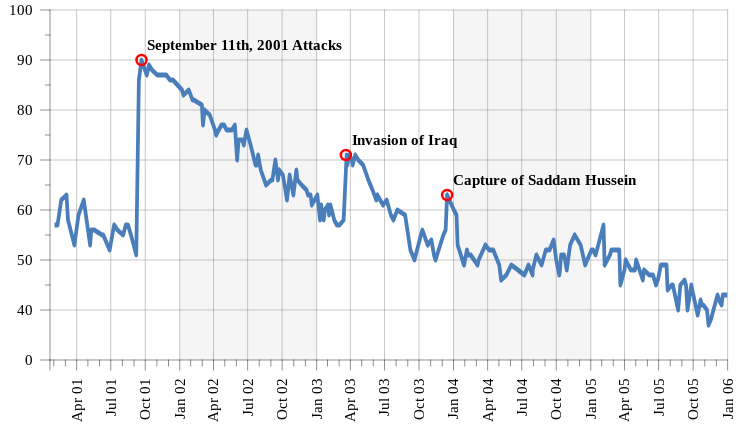
George W. Bush came into office in 2000 through a ruling by the Supreme Court in an election dispute in the state controlled by his brother. Two of the justices on the court were appointed by his father. He lost the popular vote. Yet the Republicans and many in the media famously told anyone who didn't like it to "get over it," and that was that. Bush and the Republicans claimed a mandate and immediately enacted massive tax cuts as usual. There were some slight stirrings among the press and Democrats in Congress were gathering some spirit to rein him when 9/11 happened and the demands for unity overwhelmed any sense of opposition. Bush had a 90% approval rating at one point and as you can see by the graph below it stayed very high for a long time.

We need your help to stay independent

The media completely capitulated to him for more than two years. The propaganda spread by the Bush administration was slick and professional but it was deadly. In their quest to fulfill their long-held dream of toppling Iraq leader Saddam Hussein and remake the Middle East as a democratic paradise (at the end of a gun), they lied repeatedly and the news media helped them do it. One of the lowest points in New York Times history was when they allowed a Bush sycophant named Judith Miller to publish front page stories about Iraq's alleged weapons of mass destruction which later turned out to be non-existent.

But it wasn't just lies about the war. The media turned themselves into gushing super fans of George W. Bush. They exalted his brilliance when he stood on the rubble of the World Trade Center with a bullhorn and declared to the assembled workers "I hear you! The whole world hears you, and the people who knocked these buildings down will hear all of us soon!" Soon after, he threw out the first pitch in the third game of the World Series at Yankee Stadium and the media swooned over his perfect delivery.

When it became clear that the U.S. was going to war with Iraq, it all took an even darker turn. Dissent was quashed all across society, professors were fired from their jobs for writing allegedly anti-American essays, up-and-coming journalists were banished for expressing skepticism about the Iraq invasion and long-time talk show hosts were fired for hosting guests who spoke out against the war. The repression was very real.

And the adoration for the president continued apace. Do you remember the excitement over this silly stunt?


Want a daily wrap-up of all the news and commentary Salon has to offer? Subscribe to our morning newsletter, Crash Course.


They made it appear that he had landed the plane himself but of course he didn't. The sign on the carrier that day said "Mission Accomplished" but he didn't do that either. The press was completely beside themselves, however, admiring his manly visage and it took a very long time for the country to begin to see him differently.

Bush predictably won re-election in 2004 and once again claimed he had a mandate although it wasn't any great victory. But his second term was anything but the huge success everyone assumed it would be. They overreached. The government surveillance of Americans, the DOJ attempting to rig the election systemtrying to privatize social securitythe financial crisis and the bungling of the response to Hurricane Katrina among other things all combined to take Bush's approval rating down to the high 20s by the time he left office.

I'm not saying it will happen that way this time. Trump and his coterie of billionaires are very ambitious and the right has managed to pollute many of the institutions that existed back then to rein in an authoritarian president. But keep in mind that Trump has even less of a mandate than Bush did and he and his henchmen are less competent. When the global pandemic gave him the chance to become a hero as Bush was after 9/11 he blew it and I wouldn't assume that he will do any better this time.

I only bring this up to remind everyone that it was only 23 years ago that the media offered themselves as supplicants to a president with a foul agenda just as they are doing today. I acknowledge that the media environment is different now with social media and new disinformation streams that didn't exist then. But eventually, reality always bites. It will again. 

What “Universal Basic Guys” gets wrong about basic income – and why it matters

As an artist who brings complex stories to life through theater, I understand the power of storytelling to shape how we see the world — and what we believe is possible. Narratives can inspire hope, spark change or, as in the case of Fox’s new animated series "Universal Basic Guys" (now streaming on Hulu) reduce transformative ideas to shallow stereotypes.

Basic income ripples through communities – an impact completely missing from Fox's cartoonish portrayal.

Some 64% of Americans live paycheck to paycheck – and the majority of families are one unexpected expense away from crisis. Yet in its portrayal of universal basic income, "Universal Basic Guys" turns a lifeline into a punchline. The show follows brothers Mark and Hank Hoagies (voiced by series creators Adam and Craig Malamut), who were "not well-off" even at their factory jobs, and now receive a monthly stipend comparable to those wages after losing their jobs to automation. Yet remarkably, universal basic income isn't mentioned once in the dialogue of the opening episode. The only explanation of the policy comes from a blink-and-you-miss-it description in the opening theme song: “I used to work in a hot dog factory until the robots came along. And now there is no job for me but I get $3,000 a month thanks to basic income. Now we’re Universal Basic Guys. It’s still not much, but we’re still going to try.” 

The show squanders its premise by defaulting to the oldest stereotype in the book – that people would rather coast on government support than achieve stability through meaningful work. It goes on to reduce the brothers to caricatures making one bad decision after another – from blowing their guaranteed income on everything from a luxury cruise to an elite country club to an exotic pet. And when they do attempt professional growth, it's played for cheap laughs. Take their foray into advertising through entry-level internships: Mark gets fired for drinking on the job while Hank rejects a promotion because weekend work might interfere with watching the NFL draft. Instead of these tired sitcom storylines, imagine showing how basic income could help former factory workers navigate career transitions, finding humor in their authentic struggles with professional growth. 

The show’s depiction of basic income couldn’t be further from the truth. Rather than participants luxuriating in newfound free time, a Stockton, California pilot found that full-time employment actually rose among those receiving guaranteed income, while their financial, physical and emotional health also improved. There’s little room for frivolous spending, either: in Minnesota’s Guaranteed Income for Artists pilot program, people allocate their funds primarily to essentials, with 35.94% directed toward critical retail purchases, followed by food (30.26%) and housing (10%). Many basic income programs are also designed specifically to support individuals working low-wage jobs or cobbling together income from gig work — and they’re part of a growing movement. With over 100 pilot programs across the United States, these initiatives are showing how financial stability enables people to invest in their futures.

To better understand the reality of basic income, the showrunners would be well-served to speak with an actual recipient of UBI – like Torri Hanna, a fiber artist in the Minnesota program. Her monthly $500 stipend helped stabilize her yarn store and improve her housing situation with her daughter. She now creates art for downtown storefronts with the senior center, showing how basic income ripples through communities – an impact completely missing from Fox's cartoonish portrayal.

The stakes of such misrepresentation extend far beyond bad television. As artist and organizer Ricardo Levins Morales explains, "The soil is more important than the seeds," – a profound insight into cultural change. Just as plants struggle to grow in toxic environments, transformative ideas like basic income can't flourish in a culture poisoned by narratives that people can't be trusted with economic freedom. Television has proven it can cultivate better ground for change. "Good Times" brought public housing realities to millions in the 1970s, addressing safety nets with nuance. "Superstore" used workplace comedy to illuminate low-wage workers' struggles. Even Fox's own animated shows excel at social commentary – "The Simpsons" roasts political hypocrisy while "Bob's Burgers" exposes the struggles of running a small business. "Universal Basic Guys" doesn’t need to be a dry economics lecture, but entertainment can be both funny and nourishing to our shared cultural landscape.

Universal Basic GuysUniversal Basic Guys (Fox)The show fails to tell the deeper story of how guaranteed income enables human potential. Imagine episodes where one brother finally confronts long-ignored student loan debt, where the brothers use their basic income for home improvements so their elderly mom can move in, or their well-meaning but chaotic attempts at community volunteering reveal that civic engagement is harder than it looks. These stories could mirror how real basic income recipients use stable income to tackle debt, create multi-generational housing solutions, and give back to their neighborhoods. This rich tapestry of real-world experiences offers far more compelling storylines than anything season one has shown us.
"Universal Basic Guys" doesn’t need to be a dry economics lecture, but entertainment can be both funny and nourishing.

What if "Universal Basic Guys" told a better story — that basic income unlocks purpose in two men labeled as slackers, trapped by systemic barriers and dead-end jobs? Instead of burying the concept in a throwaway theme song, the show could weave honest dialogue about this new social contract throughout its episodes, replacing silence with understanding. Their transformation could challenge assumptions about human potential and growth, especially now, as some states move to ban guaranteed income programs. Shows like this shape public perception and policy, making it vital to highlight how basic income fosters the economic freedom everyone needs to thrive.

To reach its potential, Universal Basic Guys must evolve beyond parody into a narrative that reflects the real power of guaranteed income. With a second season already greenlit, it has a real opportunity to pivot and tell a story of struggle, resilience and growth, honoring the dignity and potential of those often overlooked. By portraying how basic income helps people rebuild their lives, the show could drive social change, proving that economic freedom is key to unlocking human potential.

The stakes are high. Media influences policies and how we see each other. A nuanced, compassionate take on basic income could pave the way for a future where economic security is a right — not a punchline. 

Survey: We like our job security, but not our salaries

Feeling good about your level of job security but not your salary? If so, you are in the majority of U.S. workers, according to a new Pew Research Center survey

Amid low unemployment nationwide, 69% of workers said they have a great deal or a fair amount of job security, and relatively few said they plan on looking for another job in the coming months.

But only half of workers say they are extremely or very satisfied with their job overall. And only 30% report a high level of satisfaction with their pay — down from 34% last year. 

The top reason? Workers' wages haven't kept up with the rising cost of living, according to the survey.

The survey, conducted Oct. 7 to 13 among 5,273 employed adults, asked how workers see various aspects of their jobs, including how they assess the importance of certain skills and their opportunities for further training.

Seventy percent of workers said they have the education and training needed to get ahead in their jobs, while 30% said they need more. 

More than a third of respondents said they’re not too satisfied — or not at all satisfied — with their opportunities for growth. But most (63%) said they’re unlikely to look for a new job anytime soon.

Younger and lower-income workers are among the least satisfied with their jobs. Among workers ages 65 and older, two-thirds say they are highly satisfied with their job. Just 43% of workers ages 18 to 29 say the same. 

The majority of workers are now much more likely than in 2022 to say it would be difficult to get the kind of job they'd want if they were to look for a new one. Fifty-two percent of workers say this would be difficult, compared with 37% in 2022. 


TikTok, Gen Z’s financial adviser, can be “risky to rely on,” experts say

On a given day, Andrea Fernandez will go through her TikTok feed, which usually consists of cute animal videos and fashion flips sprinkled with a bit of MoneyTok — videos that share financial tips and information. Fernandez veers more toward female-focused content: a pair of women giving advice on financial literacy and general investing basics to young women, for example.

"Financial literacy has been a man-centric world, and I've been learning from [these women] what to do with your money when you're in your 20s," said Fernandez, 25, a graduate student in advertising at the University of Texas at Austin. "That's how I learned that I needed a 401(k)." 

Fernandez's parents were not born in the U.S., and she felt they couldn't help her navigate certain aspects of the financial system. So she relies on TikTok to learn everything from investing to how to make the most of a high-yield savings account. 

To no one's surprise, a recent report from dcdx, a Gen Z research and strategy firm, finds that Gen Zers spend a significant amount of time on their phones: 112 complete days and a daily average of seven hours and 22 minutes. TikTok remains the leading app used by Gen Zers, followed by Instagram and Messages. 

According to a survey from the stock research platform WallStreetZen, 76% of Gen Zers pore through YouTube and TikTok for financial tips and tricks. Additionally, the hashtag #Fintok has more than 4.7 billion views on TikTok. 

We need your help to stay independent

Younger consumers are scrolling for ideas on budgeting, passive income streams and investing in the stock market. Trends such as underconsumption core, loud budgeting, soft saving and the dupe economy are helping Gen Z embrace their frugal, minimalist side and be vocal and proud of their judicious spending habits. 

There's a lot that could be fueling the trend. For one, more adults are turning to TikTok for their regular news. From 2020 to 2024, this percentage has grown fourfold, from 3% to 17%. When it comes to young adults, per Pew, 40% of those ages 18 to 29 lean on TikTok for news. 

"On the positive side, people are actually learning about finances," said Karen North, a University of Southern California communications professor specializing in digital social media and psychology. "It can take people who aren't interested in finances, and they can curate an experience that will entice them into learning more about finance." 

A sea of misinformation 

But while FinTok and MoneyTok content has exploded in recent years, there are scads of videos giving inaccurate or misleading financial advice. 

According to data from Edelman Research, more than a quarter (26%) of social media users –and 42% in their 30s – said they've fallen for financial misinformation on social media. Two in 10 (19%) have fallen for this type of content several times. 

"Users are confusing the size of the audience or following with the amount of expertise that the person has"

More alarming, according to an analysis by the cryptocurrency trading platform Paxful, among "influencer investor" videos, more than half 52% of finfluencer (financial influencer) accounts had at least one misleading video. These accounts have 9.46 million followers combined. 

"Users are confusing the size of the audience or following with the amount of expertise that the person has," North said. "So they think that somebody is an expert because the person has a lot of followers, when in fact, one's level of expertise is not correlated with their following." 

"TikTok can be a fun place for Gen Z to start learning about money, but it's risky to rely on it for real financial advice," said Anna Sergunina, a certified financial planner and president and CEO of the Los Gatos, Calif.-based Main Street Financial Planning. "The quick, trendy content often lacks depth, and creators might not have the expertise needed for solid guidance." 

Separating the good from the bad  

How does one separate the good from the bad in the sea of financial information? 

"There's a lot of incorrect information passed off as education or even advice and can have unexpected consequences if acted upon," said Chris Mankoff, a certified financial planner at the Plano, Texas-based firm JTL Wealth Partners.  "Anyone can act like an expert or have a "loophole" to personal finance, especially when it comes to taxes, to gain followers, and it's simply not true." 

Generally speaking, here's what's considered misleading or flawed advice:

Infinite money glitches. These are money hacks that will supposedly net you money forever. For example, the recent Chase Bank ATM money glitch said you could deposit a fake check and withdraw a significant portion of the funds right away. 

Too good to be true money-making ventures. These tout folks who have done amazing things, like make millions from real estate in a short period or get out of debt overnight. There are no shortcuts to growing your money, building credit or getting out of debt. 

Specific real estate or investing tips. These are recommendations on specific stocks to invest in or real estate strategies. These major money moves involve risk, fees and money upfront. Plus, what you invest in depends largely on your unique set of circumstances. 

Recommendations for loans for those with bad credit. Influencers are actively promoting specific loan products. This type of content pushes products with high interest rates and fees without regard for one's specific situation.

"It's not really a good way to decide exactly what to do with your money"

Here's what is typically considered good or safe advice on TikTok: 

Budgeting tips. Ideas on budgeting methods such as envelope stuffing and how to save when you're broke are simple and rooted in reality. Plus, these financial wellness tactics require discipline and planning.  

Frugal hacks and deal alerts. While this type of content could spur impulse buys, it can help younger folks clog in on deep discounts and major sales.

Promotion of frugality trends and money conversations. One trend is loud budgeting — being vocal about why you're saving money. Another is going minimalist by way of underconsumption core, and thoughts on the "dupe economy" — affordable alternatives and knock-offs of popular brands. These trends help people embrace frugality and normalize conversations about money that can help others be more well-informed and transparent about their situations. 

How-to-use money apps. These are generally simple instructional videos on how to use popular and emerging budgeting apps and fintech tools. 

Side hustle ideas. These are lists or round-ups of realistic side hustle ideas, but the key word here is "realistic." Reels like these can inspire you to earn extra cash on the side. 

Instead of turning to TikTok as an "end all, be all" of news,  Gen Z should use the platform as a jumping-off point, Sergunina said. "They can turn to reliable sources like books, podcasts, personal finance courses or working with certified financial planners to really build their financial knowledge." 

Fernandez has developed a discerning eye on what's legit or not legit advice on TikTok. She'll only watch FinTok reels on the topics on which she already has a little bit of knowledge. For example, when setting up a 401(k), Fernandez asked her friends if they felt it was legit. Further, she had previously talked to a certified financial counselor at her university. "I won't do anything without having already thought of it a little bit," she said.

Plus, Fernandez will look through a finfluencer's entire channel to see how trustworthy they are. "I'll ask questions like, 'Are they on other platforms? What types of people like their videos?'" she said. "What other videos do they have? Do they have a mission statement? A website?" Fernandez will also look them up to see where they went to college and what degrees they hold.  

Striking a balance 

While there is quite a bit of misleading information on TikTok, there is also a good amount of helpful content. The key is taking the time to figure out what is solid information and what is iffy. 

"The great gift of TikTok on the financial side is exposing people to all of the opportunities and risks out there in the world of finance," North said. "But it's not really a good way to decide exactly what to do with your money." 

"That's because each piece of advice is as good as the person providing the advice," North added. "You have to be careful that the information you're following, seeking and consuming is valid and strategically useful or strategically valuable for you." 

Don’t be fooled, Biden’s mass clemency may be another half-measure

Last Thursday, the White House announced that President Biden was “granting clemency to nearly 1,500 Americans – the most ever in a single day.” The beneficiaries of Biden’s act include people “who were placed on home confinement during the COVID-19 pandemic” and “39 individuals who were convicted of non-violent crimes.” Most of those people had committed drug-related offenses. 

As the Christian Science Monitor notes, Biden’s action “comes on the heels of two other presidential pardon matters that have grabbed headlines of late: a Politico report last week that President Biden was considering preemptive pardons for those who might be targets of the incoming Trump administration and a pardon for his son Hunter, convicted earlier this year of federal gun and tax charges.”

Biden’s mass clemency is a refreshing turn for a president who, until recently, used his clemency power more sparingly than his recent predecessors.  Hunter Biden was only the 26th person who Biden pardoned in four years.

In contrast, as CBS News reports, during his first term, President Trump “granted 237 acts of clemency (143 pardons and 94 commutations).”  President Obama “issued 212 pardons and 1,715 commutations while in office, including for 568 people who were serving life sentences.”

Obama also launched the Clemency Initiative, which allowed federal prisoners to apply for leniency, especially those serving for nonviolent drug offenses. Biden has done little to ease the logjam of more than 8000 petitions for clemency that have been pending throughout his presidency.

Still, as the White House took pains to remind us, Joe Biden is “the first President ever to issue categorical pardons to individuals convicted of simple use and possession of marijuana, and to former LGBTQI+ service members convicted of private conduct because of their sexual orientation.”

And while what he did should not be dismissed or downplayed, it may be less significant than first meets the eye. That is because Biden went after the low-hanging fruit of the federal prison system.

He granted clemency to people who had already been released from prison under a COVID-inspired compassionate release program. All had been serving their sentences at home “for at least one year.” 

Those who benefited from what Biden did are non-violent offenders who have proven they can live beyond prison walls. As the White House put it, they “have successfully reintegrated into their families and communities…” and shown their commitment to rehabilitation by securing employment and advancing their education. The 39 individuals receiving pardons today…have turned their lives around… Many of them have used their experiences in the criminal justice system to inspire and encourage others.”

It seems to be simple justice to spare them from returning to prison under the Trump Administration. That is why there is not much risk of political blowback in granting clemency to the kind of non-violent offenders that Biden targetedlast week.. 

Frankly, whatever comes next, it is good to see Biden exercising his clemency muscles more vigorously with barely a month left in his term. But there are hard tests yet to come, including whether he will grant clemency preemptively to prospective targets of Trump’s second-term vengeance and the forty people on federal death row.

For most presidents, granting clemency is seldom an easy call. Doing so is often controversial and politically risky, even if it is done at the end of  theirs term.

That is why presidents like Biden tend to limit pardons and commutations to people who “deserve” mercy or have been or might be the victims of injustice. That is why the Biden White House bent over backward to assure the American public that  the president’s mass clemency would “advance equal justice under law and remedy harms caused by practices of the past.”

It also explains why, when Biden pardoned his son, he insisted that Hunter was “being selectively, and unfairly, prosecuted” and “was treated differently.” The president even seemed  to lend credence, wittingly or not, to Donald Trump’s frequent charges about the politicization of justice under the Biden Administration.

Speaking about his son’s prosecution, the president claimed that “raw politics has infected this process, and it led to a miscarriage of justice.” 

We need your help to stay independent

Biden was pushed into this awkward position because the language of justice has become the only acceptable language to justify a pardon

It wasn’t always this way. In fact, in 1833, in the first case about the pardon power decided by the United States Supreme Court, Chief Justice John Marshall wrote, “A pardon is an act of grace, proceeding from the power entrusted with the execution of the laws, which exempts the individual on whom it is bestowed from the punishment the law inflicts for a crime he has committed.” 

It is, Marshall observed, “the private though official act of the executive magistrate, delivered to the individual for whose benefit it is intended and not communicated officially to the court.” The grace about which Marshall wrote is, he conceded, beyond the reach of legal compulsion or regulation. It is left to the president’s unfettered discretion, and its wise use depends on the judgment and propriety of those who wield it. 

In the words of the English legal theorist William Blackstone, clemency is “a court of equity in [the president’s] own breast.” Because of this quality, Marshall worried that if it were misused, the pardon power might “prove fatal to the great principles of justice.” 

To illustrate this danger, he explained, "A pardon may be conditional, and the condition may be more objectionable than the punishment inflicted by the judgment. The pardon may possibly apply to a different person or a different crime. It may be absolute or conditional. It may (even) be controverted by the prosecutor…”

Unlike justice, grace or mercy of the kind Biden showed in his mass clemency is precisely what cannot be deserved. Grace, as one commentary explains, “is getting what we don't deserve, and mercy is not getting what we do deserve.” 

Another commentary reflects a similar understanding. Mercy, it says, “is the act of withholding deserved punishment, while grace is the act of endowing unmerited favor.”

In this understanding, mercy always involves refusing to give someone what they deserve. And that courageous refusal is lost when presidents like Biden conflate the two.

Let me be clear. It takes plenty of courage to rectify miscarriages of justice or to do justice at all. But it takes even more courage to be merciful to people who do not deserve it.

That is because mercy cannot be adequately explained. And courts have long recognized this ineffable quality of mercy. As one explained over a century ago: “An executive may grant a pardon, for good reasons or bad, or for any reason at all, and his act is final and irrevocable.”

So where does that leave Biden? It remains to be seen if he will do more than what he did in his record-breaking mass clemency. The question is whether, in his remaining time in office, Biden will use clemency where the risk seems greater. Will he offer grace and mercy to people who have committed violent crimes?   

I hope that what he did with his mass clemency will not end up being another kind of Biden half-measure. There is more work to be done with the clemency power. 

As the White House recognized in its statement accompanying Thursday’s clemency, “(T)he United States is a nation of second chances.” Taking that seriously  would require the president  to “look in every corner of the federal prison system, including its death row, and try to tame its undue harshness and cruelty.” 

The question that remains is this: Does Biden have the will and the courage to do so?

Going no-contact with MAGA parents: Crucial self-care or the “unraveling of America”?

"People are saying if you have a conservative family member, don't invite them to Thanksgiving or Christmas. Like, stay away from them," TikToker Brooker Tee Jones complained. "If that is happening, the devil is definitely winning." 

After the November election, a rowdy debate erupted in online spaces over whether it's acceptable to cut off family and friends because of how they voted. Supporters of Kamala Harris expressed a range of views, from a reluctance to burn bridges to a "screw 'em all" mentality. "It's okay to shame someone for doing something shameful," feminist writer Jessica Valenti argued on Instagram. Shunning those who voted for Donald Trump, she added, was "a reasonable response by those of us who are disgusted, anxious, and afraid."

Some on the "Hysteria" podcast agreed with Valenti. But guest Megan Gailey said, "If you think you can bring them over, bring them over." Errin Haines agreed: "We cannot give up on our friends, our family. I think there was too much of that, frankly, after 2016." But that's a liberal podcast, so of course the panelists also offered reassurances that it's OK to disown family members if their Trump vote is "a symptom of larger issues."

On the Trump-voter side of the debate, the sentiment has been nearly unanimous: It's an outrage if "woke" friends and family stop speaking to them. The only real disagreement among that cohort is whether this trend is literally the devil's work, or merely liberal "intolerance." One TikTok video that went viral featured a woman crying about being cut off and saying, "I'm completely heartbroken about my family taking it how they are. I never did this to them when Biden won." Conservatives have coined the phrase "vote-shaming," which seems to equate political and ideological conflict with personal choices regarding diet or sexuality. 

Estrangement has always been part of being human, but in recent months, we've seen a deluge of press coverage of the phenomenon. Most stories ignore the question of politics or mention it only in passing, instead blaming the seeming rise in family estrangement on social media, therapy culture and shifting cultural norms that prioritize individual happiness over familial duty. Yet an undercurrent of political tension rumbles right under the surface, a suspicion that this is tied to the increasing partisan polarization driven by the MAGA movement.

Perhaps America's most famous estrangement story is the one involving Trump super-donor Elon Musk and his daughter Vivian Wilson, who has publicly denounced her father for refusing to accept her trans identity. Former Republican congressman Adam Kinzinger, who served on the House Jan. 6 committee, has repeatedly spoken out about members of his family disowning him over his opposition to Trump, who has threatened to throw Kinzinger in prison. 

"On the day after the election, I had several calls from clients that they need to have an appointment as soon as possible," Dr. Farnoosh Nouri, a clinical assistant therapist at Southern Methodist University in Dallas, told Salon. She reports that colleagues across the state are reporting the same. "One colleague had 33 calls the day after the election, new clients who wanted to come in."

Before 2016, Nouri said, she had not witnessed this kind of political stress on families. After Trump's first win, she saw a spike in college students "struggling with going back home for Thanksgiving holidays, for Christmas holidays." Now the fear and stress are ramping up again. Across social media, the stories are mounting, both from liberals who wonder whether it's time to go no-contact with MAGA parents and from Trump voters who complain about "childish" offspring who no longer speak to them. Nouri's experiences are backed by new statistics from the Public Religion Research Institute, which found that "Democratic voters (23%) are nearly five times as likely as Republican voters (5%) to say they will be spending less time with certain family members because of their political views."

Interesting finding from @prripoll.bsky.social. www.prri.org/research/ana…

[image or embed]

— Amanda Marcotte (@amandamarcotte.bsky.social) December 13, 2024 at 2:12 PM

Salon posted a request on Reddit to interview adult children who factored politics into their decision to go no-contact with parents. The response was overwhelming. Contrary to the stereotypes that adult children who make this decision are being callous, impulsive or foolish, the respondents — many of whom said they were in therapy — spoke eloquently about what was often described as a long and emotional decision-making process. 

"I literally thought being a Democrat was a sin"

“I don't know anybody who's gone no-contact with their family just because of politics.”

In saying that, a woman Salon will call Ellie echoed a sentiment that came up in nearly every interview with children who have cut off right-wing parents: It's not fair to reduce the dispute to mere political differences. (All adult children and parents interviewed in this article are identified by pseudonyms to protect their privacy.)

Ellie's parents, she said, were "extremely, extremely religious" and "very physically violent." This is not uncommon in fundamentalist Christian households, where the biblical proverb about "sparing the rod" is regularly wielded to justify corporal punishment. 

The problem, Ellie said, is that in many cases it's not possible "to separate what people believe in politically with their values as a whole." She argued that "Donald Trump and his administration and all these Republicans have been justifying abuse forever," which she compared to the ways her family used religion to rationalize abuse. 

"Donald Trump and all these Republicans have been justifying abuse forever," Ellie said, comparing it to the ways her family used religion to rationalize abuse. 

"Children who choose to estrange themselves aren't making a little decision on a whim," explained Joshua Stein, a researcher who tracks online trends, especially those that intersect with psychology and bioethics. Stein has been collecting data on the online discourse about estrangement and says that many children who were raised according to the fundamentalist teachings of James Dobson and Michael Pearl "are now adults and are estranged from their parents." For many such adult children, he says, "It's not the fact that the person is MAGA. It's the fact that you do not feel that it is safe to be around them."

Maureen was also raised by parents she describes as devotees of Dobson, a famous proponent of spanking children. "I literally thought being a Democrat was a sin," she said, laughing. "I was very encouraged to get married young, to an older man," she said, but found herself becoming more liberal over the years and eventually left him. Trump's election further strained her relationship with her parents. "I was raised with all the shame, like having sex before marriage was bad," but "then my family was just completely willing to embrace Donald Trump."

"All the things that they told me Christianity stood for? No longer matters," Maureen said. Like many of the adult children who spoke with Salon, she went full no-contact with her parents during the COVID pandemic. 


Want more Amanda Marcotte on politics? Subscribe to her newsletter Standing Room Only.


Paul described living "two lives" with his conservative Roman Catholic parents. In the outside world, he said, "I was very liberal," but at home, "I had to keep that to myself." He describes feeling mounting frustration with "this weird allegiance to Trump" that started during Justice Brett Kavanaugh's confirmation hearings and escalated during the pandemic. That anxiety was interwoven with his efforts to build a personal life outside his household. "Anytime I got close to a woman," he said, his parents "would sabotage the relationship." When Paul started seeing a woman who was both Jewish and Spanish, his mother "had some wonderful expletives about her," he said sarcastically. 

Paul's parents "dragged me to church every Sunday," he said. He often saw an older man at Mass "who looked like a shell of himself," and worried, "That's going to be me when I'm 60." He felt that Trump's political rise made the situation worse by creating "this environment where you're either with us or you're not with us." He moved out of his family home, but has concealed his new address from his parents so they can't show up at his house uninvited.

Other estranged kids didn't necessarily grow up in religious households, but told similar stories: Trump's election had exacerbated existing family tensions, often to the breaking point. "My father has always been conservative Republican, but was never vocal about politics and was a reasonable man," explained Penny, who spoke with Salon through a chat app. "His new wife, on the other hand, was very divisive and made 'owning the libs' her purpose in life."

"I was spending hours of my day, every day, just thinking about this argument we were having," Robert said. He said he felt ill whenever he received emails from his parents.

Penny says she kept politics out of conversation in person but, as is common in many of these cases, social media got involved. Her dad's wife "didn't like my fact-check on a mutual relative's Facebook page on a racist, anti-liberal post," she said, and un-friended Penny on Facebook while continuing to send her "anti-liberal, anti-BLM, racist memes via Messenger." Penny messaged her father's wife and asked her "to stop sending me these racist things," which provoked a crisis: Her stepmother then announced "that she didn't want me in her life anymore (um, OK) and that she would speak to my dad about it." Penny added, parenthetically, "Because apparently I was 5, not 47." That resulted in a big fight with her father, in which she says he blamed her for all the tension and bad feelings. She hasn't spoken to him since 2020. 

"Our once-reasonable father has been brainwashed by her and made into a MAGA," she lamented. 

Robert felt he had a good relationship with his parents, but after the Supreme Court overturned the constitutional right to abortion in 2022, his father celebrated with a Facebook post about how aborted pregnancies "could have all been doctors or lawyers or electricians." Robert has two teenage kids and wants "to protect the options that are open to them." When he confronted his father about the post, it blew up into an argument that kept escalating. Robert realized his father has "a very strong personality" and "would raise his voice and possibly physically dominate the situation" when challenged on his beliefs. 

"I was spending hours of my day, every day, just thinking about this argument we were having," Robert said, adding that he felt ill whenever he received emails from his parents. "It was pushing me into depression and honestly to the point where I was having suicidal thoughts," he said. He cut off contact, which he saw as an act of self-preservation. "I still hold out the hope that something will change," he added, but currently has little hope "they are ready to actually listen."

"She is racist," Christine said of her mother. That was especially painful on a personal level, she added, because Christine is biracial: Her mother is white and her biological father was Black, and the family history was awkward. There are "a lot of clashes around race," she said. "I am the result of her getting caught sleeping with a Black man." 

While the estrangement from her mother was "a long time coming," Christine said, things came to a head during the pandemic when her mother began to make cruel comments about her ex-husband's new wife, who is an immigrant. "My mom was starting up on her racism again," Christine said, and "I called her out on it" for the first time, although her mother had "said several things in the past that were even racist towards me." 

Christine said the issue wasn't just political differences with her mother, but her mother's tendency to denigrate "any identity that deviated from hers." She concluded, "If this is the type of toxic relationship you wouldn't tolerate from a romantic partner," then she also shouldn't endure it from a parent. 

Blaming "woke ideology"

"I was not invited to my daughter's wedding," Darlene told Salon. "That's how sick these people are, because how do you do that to a mom?"

Quite a few parents who have become estranged from their children expressed interest in speaking with Salon, but most declined after learning they would be asked questions about their political views. Darlene was the exception. Like the adult children interviewed, she also saw a connection between politics and her personal situation. 

"There's a mindset, there's an entitlement" in younger people, she said, which she believes has led to the government being "out of money." She added, "I don't have beaucoup bucks to just throw it out so that somebody else can make the decision as to how it gets spent, when it's not on the same values that I have."

Darlene's daughter is a practicing nurse and aspiring country singer. Darlene says she gave her daughter money to start her band and record an album, but believed that "I was to have no say in how we went about promoting" the music and managing the band. Things turned out differently, in her view: "I just was to give the money and she was at will to do whatever she wanted with it." Darlene also blamed her son-in-law, whose family is "more left" and "very controlling," she believes. (Her daughter did not respond to a request for comment.)

"There's a mindset, there's an entitlement" in younger people, Darlene said, which she believes has led to the government being "out of money."

She felt that her daughter's unwillingness to speak with her was indicative of a larger social problem: "What's happening to this country if you can't sit down and have a civil conversation?” She felt that Americans are not "discussing what's actually happening to this country" or "trying to find solutions," but "keep raising taxes" instead. Similarly, she said her daughter would not "sit down with me and discuss what was happening with the money," but implied that "I was just to be quiet" when it came to her daughter's music career. 

Darlene said she has worked with Dr. Joshua Coleman, a psychologist who has made a name for himself counseling parents whose children have cut off contact. His book, "Rules of Estrangement: Why Adult Children Cut Ties and How to Heal the Conflict," is controversial. Adult children in estrangement forums argue that Coleman is overly aggressive in his efforts at family reconciliation and too quick to blame "the younger generation's dysfunction," as one redditor put it.

In an interview with Salon, Coleman argued that estrangement is on the rise and partly results from "Instagram influencers having opinions about who's toxic" and low "rates of social trust." On the other hand, he has also been criticized by some estranged parents, because his book asks them to reflect on the role their actions may have played and to consider making amends. 

Coleman told Salon that political differences are a "common pathway" to estrangement. He has many clients who voted for Trump and have an "adult child who hates that idea." That dynamic, he added, "can either fuel underlying tensions in the parent-child relationship or it can create a rift that can later leads to an estrangement." 

Coleman is no defender of Trump, whom he calls "an incredible amplifier of these kinds of hostilities." Trump's "contempt, his anger, his tribalistic orientation" creates "enormous social permission for people to say and behave in ways toward other people, family included, that they might not otherwise." Coleman said that he wished political opinions were less important, but would advise parents to listen to their children's views with "empathy" and without getting "defensive." He added that "a deeper dive" into whether "other issues could be underlying the conflict" is often important.


Want a daily wrap-up of all the news and commentary Salon has to offer? Subscribe to our morning newsletter, Crash Course.


Joshua Stein, the researcher of online content, wasn't surprised that Salon struggled to get parents to talk openly about family estrangement. When he first started researching forums for estranged parents, most of them were public-facing. But once members realized that outsiders were reading their discussions, the groups shifted to private forums, often behind a paywall. Most of the rhetoric in these groups, he said, allows parents "to absolve themselves" and "blame it all on the kid." The parents often ascribe estrangement to "a social contagion or a mass psychosis."

Stein sees a link between the culture of these forums and the larger MAGA movement. The pro-Trump "community has insulated itself from criticism by treating any outside information as illegitimate," he said, and many parent forums do the same, "perpetuating the posture that the kids are unreasonable" and the parents "did nothing wrong."

For online influencer Diane Cohn, the underlying problem is "woke ideology." She blames college campuses where "ideological indoctrination" shifts young people "away from traditional family values, the bedrock of civilization."

While such parent groups are nearly all private, the people who run these communities often market themselves aggressively and in public. Last year, Diane Cohn launched the forum Estranged Parents (membership is $28 a month) with a video titled "My Daughter Stopped Talking to Me [SO I LET HER GO]," featuring dramatic music and images of Cohn clicking away at her computer keyboard. She declined to answer questions from Salon, but her videos center on political disagreements with her daughter, which suggests she believes that will draw in potential customers. 

In another video, "What's Behind the Estrangement Epidemic?", Cohn — whose avatar features her face within a red strike-through circle — lays out her theory: The underlying problem is "woke ideology." She blames "schools and universities where ideological indoctrination of young minds, in many cases, delivers dogmatic thinking disguised as critical thinking," a "declining work ethic" and "alternative lifestyles" that shift young people "away from traditional family values, the bedrock of civilization."

In an environment where the "government steps in to pick up the slack," Cohn says, young people feel "free to delete family from their lives." Salon obtained a copy of a video posted by Cohn (which she later removed) that is more explicit. She complains about college campuses "where they confirm that your gender is anything you want it to be," and suggests that "meritocracy" has been replaced by "skin color as a primary indicator of who's in and who's out." Wider social acceptance of estrangement, she concludes, will lead to "America's collapse."

Unsurprisingly, Cohn markets her community almost exclusively to conservatives. Stein pointed out that longstanding right-wing media organizations have produced lots of content aimed at estranged parents in recent years. Focus on the Family, founded by Dobson, has extensive materials for Christian conservative parents angry that their children have walked away from them and rejected their faith. Dennis Prager of PragerU has posted videos with titles like "You Better Have a Really Good Reason for Not Talking to Your Parent," "Your Parents Don't Deserve This" and "When Adult Children Don’t Speak to Their Parents." Conservative organizations like the American Enterprise Institute and the Institute for Family Studies routinely denounce children who go no-contact. Even New York Times columnist David Brooks weighed in, declaring that estrangement contributes to "the psychological unraveling of America."

Sheri McGregor, a "certified life coach" and author of multiple books about estrangement, has one of the few websites where comments from estranged parents aren't behind a wall. One popular post titled "The beat goes on: Politics dividing families" offers a glimpse of what goes on at more private forums. "Suddenly I was a horrible human being because my political views did not line up with her 'progressive' views and I was called a racist, a bigot, homophobic, transphobic, you name it," complained one poster, who said one son "dialed it down" after she threatened to throw him out.

One poster wrote, "What is wrong with this generation?! They feel so empowered so entitled now!" adding that her son "got 'covid' supposedly last year" but cut her off after she sent him anti-vaccine articles.

Another post suggested disinheriting children, and deploying "your thoughts about the estrangement in the will as a last word." This poster added, "It is very sad where we are in this country because respect is disappearing and has to be enforced at an early age." Another attributed her daughter's queer identity to being "brainwashed by her environment," comparing her situation to "Hitler youth." Another person wrote, "What is wrong with this generation?! They feel so empowered so entitled now!" adding that her son "got 'covid' supposedly last year" but cut her off after she sent him anti-vaccine articles. 

Jolie Robertson, a YouTuber who has created videos defending kids who go no-contact, said she attributes these reactions to "the expectation of dishonest harmony in families." She added that "politics and morals are pretty intertwined at this point, and a difference of morality" has always been a factor in "loss of community."

Authoritarianism starts at home

Most estranged children and their defenders use intuitive arguments to defend their belief that the personal and political are intertwined. Social science, however, backs them up. One of the best predictors of authoritarian political beliefs — and likely Trump support — is how a person answers questions about the most desirable traits in children:

  • independence vs. respect for their elders
  • curiosity vs. good manners
  • self-reliance vs. obedience
  • being considerate vs. being well-behaved

People who prefer obedience over curiosity, independence or consideration tend to have authoritarian personalities. As political scientist Matthew MacWilliams found, authoritarians are more likely to be strong Trump supporters. This linkage makes sense, MacWilliams told Salon, because authoritarianism is all about in-group versus out-group thinking. In that worldview, children are expected to "conform to in-group norms, be obedient, be orderly, be disciplined." 

MacWilliams added that it's not surprising to see politics become intertwined with personality issues in family estrangement cases. He characterized authoritarianism as a "worldview, a predisposition" more than an ideology, adding that "values and worldview drive politics," not the other way around. Authoritarian values, he said, are the "poison root" from which far-right politics and regressive attitudes on child-rearing both flow. 

In her new book "Wild Faith: How the Christian Right Is Taking Over America," journalist Talia Lavin devotes the second half to exploring the widely-read marriage and parenting manuals of Christian nationalist subculture. These books or websites explicitly argue for hierarchical relationships, with women and children chastened to live their lives in unquestioning submission to patriarchal authority. As Lavin lays out in painful detail, this worldview is frequently enforced through violence, at least on children. The parenting manuals treat physical discipline not merely as an aspect of parenting, but as a parent's main tool. 


Want more Amanda Marcotte on politics? Subscribe to her newsletter Standing Room Only.


"They see violence and authoritarianism as normal, in both the private and public spheres," Lavin told Salon. "When you're raised seeing violent authoritarianism in the family sphere and come to accept and embrace it in adulthood, you're the model authoritarian subject: someone for whom violence and authority are intertwined, who accepts and expects brutalization of the most helpless."

Whether they faced physical abuse or not, the estranged children who spoke with Salon mostly spoke of a long process of unlearning the worldview in which they had been raised. For Maureen, having daughters made her "a million times more pro-choice." For Ellie, disability caused by medical neglect as a child was part of her journey, especially as "my dad told me a couple of years ago that maybe I wouldn't be so sick if I believed in Jesus."

"When you're raised seeing violent authoritarianism in the family sphere," said Talia Lavin, "you're the model authoritarian subject: someone who accepts and expects brutalization of the most helpless."

Many children cited strong relationships outside their families as bridges away from the more authoritarian worldview. Paul has multiple degrees and says the people he has met at work and in his personal life have deepened his appreciation for diversity. Christine spoke of her stepfather, who divorced her mother long ago, as an anchor of tolerance, acceptance and more liberal values. 

Writing for Politico in 2020, MacWilliams noted that "approximately 18 percent of Americans are highly disposed to authoritarianism," according to his survey data. "A further 23 percent or so are just one step below them on the authoritarian scale." He told Salon that the way these attitudes manifest depends on whether and how such authoritarian values are "activated." Donald Trump serves as a powerful catalyst, unleashing such individuals' preferences for "authority, obedience and uniformity over freedom, independence and diversity."

This model of "activated" authoritarianism may help explain the apparent escalation of politics-related estrangement. As Coleman said, Trump's political rise offered "permission" for people to unleash authoritarian tendencies, including in their personal lives and family interactions, with the unique stress factors of the pandemic adding to the tensions. 

Trump's message, MacWilliams said, was, "If you don't agree with him, you're an enemy of the state. He's made it seem that the differences are dangerous," and in that context some Trump voters will apply that hostility to their closest family members.  

"The relationship between two people is like a dance"

Mainstream media coverage of the estrangement phenomenon tends to minimize or ignore the role played by authoritarian attitudes and values, instead leaning into such trending topics as social media, "therapy culture" and liberal intolerance. A New Yorker article by Anna Russell, published last August, followed "Amy," a woman who went no-contact with her evangelical parents and recounted alarming details about how they had treated her over the years. Her parents contacted the administration at her university, for example, to express "displeasure about Amy’s transformation" toward more liberal views. They skipped her wedding, refusing to be vaccinated against COVID-19. They've told Amy she is going to hell. Still, in a familiar effort at journalistic balance, Russell cited Reddit forums as a primary factor, writing that "posters are not exactly unbiased" and tend to "advocate a slash-and-burn approach to complex relationships."

"What is lost when we render our families optional?" Russell worried, in the rhetorical equivalent of leading the witness. "As a new parent myself," she continued, "I felt scared at the idea that I might somehow screw up, and my child would reject me." This article angered many posters at r/EstrangedAdultChild, where some said that Russell's article "discounts emotional abuse" and that she seemed to agree "with the idea that children should allow themselves to be disrespected for their parents' emotional comfort." 

A New York Times article published in July, headlined "Is Cutting Off Your Family Good Therapy?" leaves the reader with little doubt that the paper's mental health reporter believes the answer is no.

A similarly-themed New York Times article published in July, headlined "Is Cutting Off Your Family Good Therapy?" leaves the reader with little doubt that Ellen Barry, the paper's mental health reporter, believes the answer is no. Barry writes that "promotion of estrangement as a therapeutic step is clearly on the rise, thanks mainly to social media," adding, "Whether or not mental health clinicians should encourage this practice is hotly debated." The Economist, The Atlantic, NPR and the Guardian have all published articles hitting similar notes, drawing the ire of estranged adult children on Reddit.

Nouri, the therapist at SMU, expressed skepticism that her profession is pushing clients to go no-contact. "Our job is to bring people together, not to create division," she said. The goal of therapy is to help clients foster "the connections that we need in order to be healthier."

Nouri added that she rejects the basic premise of the media debate over whether it's acceptable to go no-contact, and would rather focus on how to support individual people in their specific situations. "I tell my clients the relationship between two people is like a dance," she said, "and if one person is not willing to take the steps in this dance, it's not going to happen." Many family relationships can be mended, she believes, but if one person feels "powerless" and unable to speak without being "put down," then "creating distance is an act of self-care."

Maureen didn't agree that estrangement is a "trend" brought on by social media, although she agreed that online forums can make it easier to walk away. But she sees the issue less in terms of social contagion, arguing that it's simply that "more conversation leads to more acceptance." 

"I don't feel like social media made me do it," she said. Instead, she felt the forum offered support for her decision. 

Stein also rejects narratives that blame social media or therapists. "Parents in these relationships tend not to think that the children are making a well-informed choice," he said, noting they will blame partners, social media, friends or media brainwashing, rather than accept that a child is "deliberately and intentionally choosing" to separate themselves. Even Coleman, who has described family estrangement is "a social contagion that happens through Instagram and TikTok and Reddit," spoke in more measured language to Salon, saying he tells clients their child "wouldn't be doing it unless they felt like it was good for them."

"I tell my clients the relationship between two people is like a dance," said therapist Farnoosh Nouri, "and if one person is not willing to take the steps in this dance, it's not going to happen."

All this raises the question of whether the media discourse around parental estrangement qualifies as a "moral panic," a phenomenon described by its leading theorist, Stanley Cohen, as occurring when "a condition, episode, person or group of persons emerges to become defined as a threat to societal values and interests." Sometimes the underlying episodes or trends that spark the panic are real and sometimes they're not — as was the case with the ritual child abuse panic of the 1980s, for instance — but in either case, the threat is wildly exaggerated. Cohen's original example was the 1960s moral panic in the U.K. over "mods" and "rockers," when the emergence of rival youth subcultures was treated as the downfall of British civilization. 

Media coverage of parental estrangement has gotten entangled with other buzzy topics like "cancel culture" or articles scolding young women who are unwilling to date Trump voters. A Washington Post editorial lamented that "someone will need to compromise" in that standoff, although it wasn't exactly clear why. In the "Hysteria" episode about whether it was acceptable to banish Trump voters, the one panelist who strongly supported such actions, Erin Gloria Ryan, complained that Democrats "have been feminized in this way, where we are expected to just be tolerant and forgive over and over again," with no reciprocation from the right.

Stanford professor Adrian Daub, author of "The Cancel Culture Panic," has pointed out that moral panics are typically about preserving social hierarchies: If a Starbucks barista gets fired for expressing a left-wing opinion, no one calls it "cancel culture," but if a right-wing pundit is heckled by undergraduates during a campus speech, our constitutional freedoms are under threat. In an earlier interview with Salon, Daub argued that accusations of "cancel culture" are typically aimed at younger or lower-status people, specifically so higher-status folks don't have "to reflect on their own practices." It's "cancel culture" when Elon Musk or JK Rowling is criticized for transphobic rhetoric, but not when billionaires or Republican politicians focus public anger on ordinary people who don't conform to gender norms

The outrage at no-contact adult children appears to follow the same model. In his videos denouncing this trend, Dennis Prager says, "The Bible never commands us to love our parents, but it does command us to honor them." Cohn, the parent influencer, says that her daughter "didn’t want for anything, materially," and mentions an occasion when she prevented her daughter from choking, seemingly as evidence that she has earned a continuing relationship.

It's "cancel culture" when Elon Musk or JK Rowling is criticized for transphobic rhetoric, but not when billionaires or Republican politicians focus public anger on ordinary people who don't conform to gender norms

Similar logic is echoed throughout anti-estrangement articles, such as the New York Times noting that "estranged children are likely to lose access to financial and emotional resources." No equivalence is drawn the parent side, even though it's also true that a parent who refuses to make peace with an adult child runs the emotional risk of losing that relationship permanently. Once again, the implicit assumption is that the lower-status person has a duty to maintain or restore harmony. 

It is clearly true, as Coleman has argued, that the growth of individualistic values and greater economic freedom have created a context in which adult children can cut off contact with their parents, something that was often impossible for earlier generations. It doesn't follow, however, that such people have given up on "connectedness and interdependency and mutual reliance," as Coleman told NPR.

Most adult children who spoke with Salon did not seem lonely or disconnected from life. Most cited strong relationships with friends, other family members and romantic partners as giving them the strength to separate from parents they felt were harmful. Many spoke warmly of Reddit, which provided connections to other people in similar situations. On the estranged-parent forums, the term "found family" is sometimes uttered with evident contempt. Many of the adult children say they have simply found community. 

NASA detects more dark comets, providing more clues to how planets form

There’s a lot of stuff in space that we know is there but we can’t see very well or at all. Some of this stuff is known as mysterious dark matter, others are things like dark comets, which as their name suggests, are far more difficult to see from Earth than something like Tsuchinshan-Atlas. Dark comets range in size from a few feet to several hundred yards, are often composed of rare minerals and tend to spin so fast they are hard to detect.

Despite these obstacles, however, scientists publishing in the journal Proceedings of the National Academy of Sciences say they have discovered more dark comets in our solar system than previously thought. In fact, thanks to their research, the number has now doubled.

Though not technically a dark comet, the 2017 interstellar asteroid 'Oumuamua moved in a manner so similar to a dark comet that astronomers used it to guide their current research. The first actual dark comet was reported less than two years ago, followed shortly thereafter by the discovery of six more. The new paper adds an additional seven dark comets to the list, including bigger ones that inhabit the outer solar system and littler ones that remain in the inner solar system.

“The study demonstrates that there are more dark comets in the Solar System than we knew of before,” Darryl Seligman, lead author of the study and an astrophysics postdoctoral fellow at Michigan State University, told Salon. “Moreover, these new results show that there appears to be two different types of dark comets within the solar system. More data and analysis will be required to quantify the differences between these two nominal ‘families’ of dark comets.”

To do this, Seligman and the team of researchers working with him plan on using data from operating facilities around the world, particularly the Rubin Observatory Legacy Survey of Space and Time (LSST), which was funded by the National Science Foundation.

“Dark comets are a new potential source for having delivered the materials to Earth that were necessary for the development of life,” Seligman said. “The more we can learn about them, the better we can understand their role in our planet’s origin.”

Does zinc actually prevent and shorten colds? Here’s why we still don’t know

In wintertime, it can feel as if everyone is sick. From passengers coughing and sneezing on the bus to kids in daycare surrounded by multiple illnesses, the so-called common cold is a virus easily introduced to the body this time of year.

True to its nickname, it’s estimated that a human being will have more common colds than any other virus in their lifetime. While adults catch on average between three to four colds a year, kids can come down with four or more every year. Between fatigue, runny nose, body aches, scratchy throat, and the occasional fever, it’s only normal for people to try to outsmart one of the 200 viruses that can cause a cold.

A typical go-to remedy is the mineral zinc, via the form of lozenges or supplements. We need zinc in our diets in order to grow and sustain our health. The mineral contributes to the growth of cells and DNA, heals damaged cells, and can support a healthy immune system. But to do this, a person only needs zinc in small amounts.

For example, it’s recommended that adult males have an intake of 11 milligrams a day; women, should have eight. Yet, for over 40 years, zinc has become a popular supplement to take as a preventative measure to strengthen a person’s immune system or even cut down the time a cold can last. Some people might even take zinc supplements to try and prevent colds altogether. But much like the rest of the supplement world in the United States, zinc is highly unregulated. Plus, is there any scientific evidence to suggest that it will help with preventing and easing colds?

“There is no concrete evidence that shows that zinc is helpful for the treatment of colds,” Dr. Barbara Bawer, primary care physician at The Ohio State University Wexner Medical Center, told Salon. “There are unfortunately not enough studies or good studies out there; of those that exist, some show it is helpful and others show it is not.”

"There is no concrete evidence that shows that zinc is helpful for the treatment of colds."

Indeed, a recent Cochrane review published in May 2024, of 34 published studies on both adults and children, found that taking zinc may help reduce the duration of common cold symptoms by about two days. Cochrane reviews are incredibly rigorous and considered the highest standard in medical science. However, the publication's systematic review found that the evidence for zinc was “not conclusive.” 

“When zinc is used for cold treatment, there may be a reduction in the mean duration of the cold in days although it is uncertain whether there is a reduction in the risk of having an ongoing cold at the end of follow‐up,” the researchers wrote.

The review also states that potential benefits “must be balanced against side effects.” Common side effects of zinc reported in the trials the studies reviewed included issues with bowel movements, nausea and an unpleasant taste. There have even been reports of zinc-induced anosmia syndrome, meaning a loss of smell, from zinc nasal sprays.

Since the 1980s, zinc products have been marketed as treatments for the common cold. That’s when a published study, which compared people with a cold taking zinc lozenges to those not taking zinc lozenges, found that the mineral shortened the time people felt sick from their colds by up to seven days. But since then there have been dozens of other studies trying to suss out the benefits of taking zinc to help a cold.


Want more health and science stories in your inbox? Subscribe to Salon's weekly newsletter Lab Notes.


“Even those studies that show improvement only show that there might be a decrease in the number of days you have symptoms but does not resolve the severity of symptoms,” Bawer said.  “We do not, as primary care physicians, routinely recommend zinc given the poor evidence out there.”

William Schaffner, a professor of infectious disease at Vanderbilt University Medical Center, told Salon before the 1980s, zinc was seen as a “folk medicine.” He said there is some truth that it can help possibly shorten the duration of a cold, but it is a “modest effect.”

“And obviously, you will have to take zinc for a long period of time,” Schaffner said. “Most people are not so keen on that, because it can leave a metallic taste in your mouth.”

On the topic of side effects, Bawer added there are concerns about zinc causing some antibiotics or water pills to be “less effective” when taken together. “If taken in too high doses can also lead to a decrease in immune function, copper deficiency, and change your iron functioning,” Bawer added. 

Then there’s the issue that people might not know what’s actually in their zinc supplements. Indeed, the U.S. Food and Drug Administration considers zinc supplements to be dietary supplements, there is no way for the quality to be ensured or for consumers to know what else the supplements contain.

“Unfortunately, zinc is not highly regulated just like most supplements,” Bawer said. “The FDA does not regulate the effectiveness or safety of supplements or even labeling of the supplement.”

We need your help to stay independent

When it comes to dietary supplements, the FDA only requires "reasonable assurance" that dietary supplements do not pose "a significant or unreasonable risk of illness or injury." Several studies have shown as many as 70% of supplement labels do not correspond to what is inside.

Still, some people may turn to zinc for cold prevention. In that case, Bawer says the typical dosing is up to 40mg per day which can be divided into two or three doses over the day. 

But more importantly, there are other ways to prevent colds, Schaffner emphasized. 

“The most important thing you can do is try to avoid people who are coughing and sneezing, which is easy to say, but difficult to do in the respiratory virus season,” Schaffner said. Of course, wearing a mask could help with that, especially if you're the one sick, so as to prevent others from getting infected. Masks aren't just useful for preventing COVID-19. “The other thing is to do good hand hygiene.” 

In other words, cold prevention might have more to do with your behavior and less to do with what you put inside your body, perhaps as simple as washing your hands.

Disney decides against transgender arc in Pixar’s “Win or Lose” series

In 2021, there were rumblings online that Pixar was looking to cast actresses 12 to 17 who were “enthusiastic, outgoing, funny and energetic” and able to "authentically portray a 14-year-old transgender girl” named Jess for an upcoming animated project. 

A casting call sheet seeming to confirm this was shared by sites catered towards fans of animation like comicbook.com, which noted, "Though it’s unclear which role the character of “Jess” could be being written for, it’s certainly possible that this part could be for the "Win or Lose" series," and it would seem that the site was correct about that, although the character will now no longer be trans, with Disney having made the decision to cut the storyline over concern for parents.

On Tuesday, The Hollywood Reporter ran an exclusive on the edit made to Pixar’s first-ever original long-form animated series that centers on a co-ed middle school softball team in the week leading up to their championship game, which debuts on Disney+ in February, detailing that the character Jess will remain in the show, but absent any references to gender identity.

A Disney spokesperson addressed the edit in a statement, writing, “When it comes to animated content for a younger audience, we recognize that many parents would prefer to discuss certain subjects with their children on their own terms and timeline.”

Although Disney has featured LGBTQ+ content like Marvel Television’s "Agatha All Along" and Disney Animation’s "Strange World," which featured an openly gay lead character, the Walt Disney Corporation has made significant political donations to Republicans who voted for the "Don't Say Gay" legislation in the past year.

Keith Olbermann: MSNBC, fire “Morning Joe” hosts Joe Scarborough and Mika Brzezinski

Keith Olbermann is taking shots at his former MSNBC colleagues, "Morning Joe" hosts Joe Scarborough and Mika Brzezinski.

In an opinion piece for Variety, the former top liberal anchor on the channel shared his thoughts about Scarborough and Brzezinski's recent polarizing moves. After Donald Trump's re-election in November, Scarborough and Brzezinski visited the president-elect at his Mar-a-Lago estate in Florida, which received pushback resulting in "Morning Joe's" reportedly plummeting ratings. But the hosts also received criticism from people in the media including Olbermann, who used to lead the show "Countdown with Keith Olbermann."

Olbermann questioned, "What does MSNBC do now?" in his piece. He listed that things have changed including Trump retaking the White House, Comcast intending to spin off the network, and Scarborough and Brzezinski's welcoming of Trump.

He advised the channel, "Stay the course. The audience is exhausted and needs a break. It’ll be back — and Resistier than ever. Suffer the ratings trough."

But he emphasized, "I mean, obviously you have to fire Mr. and Mrs. Scared-Bro. However: Continue their banal but largely benign political coffee klatch show without them and their insistence we all join their MSNVichy. Nobody will remember they were ever there."

To Olbermann, MSNBC needs to learn from Scarborough and Brzezinski's mistakes. He argued that "the next money is coming from more fervent opposition to MAGA, not less." 

He concluded that MSNBC, "may now be the last line of defense for the free press and thus the future of representative government in this country. The bullies don’t stop hitting you because you’re nice to them. They stop hitting you when you knock them out cold."

Your ultimate 2024 gift guide for people who love to cook and entertain

For those who find joy in cooking, entertaining and gathering loved ones around the table, the right tools and treasures can elevate both the everyday and the extraordinary. This curated gift guide offers a range of ideas for culinary enthusiasts — from stocking stuffers that delight to showstopping centerpieces for the table. Whether you’re shopping for a budding home chef, a seasoned entertainer or the friend who swears by their air fryer, these picks balance function and flair to inspire delicious moments all year long.

From ingenious herb savers and handcrafted carbon steel roasters to powerful appliances and artisanal dinnerware, every item has been chosen with care to bring both beauty and practicality to the kitchen and beyond. So, whether your giftee loves to grill, bake or host unforgettable soirées, there’s something here to surprise and delight. Let the feasting begin!

Stocking stuffers  

What the heck is a stocking stuffer? Well, it can be pretty much anything (or a few anythings) as long as it fits into a stocking and will be loved by the recipient. For an out-of-the-box stocking stuffer for foodies, cooks and entertainers alike, consider the Prepara Herb Savors. Anyone who cooks with fresh herbs has experienced the frustration of herbs that die much sooner than they should, and the herb savor fixes that, extending the life of the herbs by a lot! 

Any while we’re on the subject of flavor, level up your loved one’s spice game with Flatiron Pepper Co.’s chili flake blends. Instead of the boring red pepper flakes, you’ll find bottles of curated chili mixes with various spice levels, perfect to pair with a variety of meals. 

On the sweet side, Valerie Confections offers one hell of a caramel gift box. It includes two caramel flavors, dark chocolate almond fleur de sel and milk chocolate black sesame and toasted rice caramel. Love Preferred Coffee smells amazing and directly benefits Colombian farmers through dividends and tips. It will be a little snug in the stocking, but a good fit for a fabulous cup of coffee all winter long. 

Small kitchen items

HORL2 Rolling Knife Sharpener 

Knives are important in any kitchen, but no matter how much you spend, they'll eventually need to be sharpened — and I don’t know about you, but I can never seem to get them to the sharpener in time for whatever big event I’m cooking for. That all changes with the HORL 2 rolling knife sharpener. It’s simple to operate, fairly foolproof and compact. Get the HORL 2 for anyone who wants to take their cooking to the next level. 

Don’t trust the gift recipient with a knife sharpener? This mail-in service will send them temporary knives while they sharpen theirs.

TempSpike Pro

I’m convinced that many home cooks struggle with big pieces of meat like turkey and prime rib simply because they don’t use a thermometer. Change that for someone on your list by gifting them a TempSpike Pro, which includes two waterproof and heat-resistant probes (up to 1050°F). The probes are wireless and can run for 36 hours without needing a charge, so you can put them into a turkey and get constant updates on its temperature without opening and reopening the oven. 

We need your help to stay independent

Tabletop

Noon and Moon Lollypop Glasses

Nothing quite levels up a beautiful tablescape like colorful hand-blown wine glasses. Noon and Moon Lollypop glasses are unique, come in two colors that compliment each other well, and are available in pairs as well as six and 12-count sets. And if these aren’t quite what you’re looking for, be sure to browse the rest of their selection of glassware, including stunning vases and colorful drinking glasses. 

Smithey Carbon Steel Oval Roaster

Smithey’s Carbon Steel Oval Roaster is a stove-to-oven-to-table centerpiece. It’s hand-hammered by a blacksmith, resulting in a beautiful finish and an heirloom-quality roaster. Carbon steel is much lighter than cast iron, yet it heats up and retains heat just as well. It’s just easier to cook on. Home cooks and professional chefs alike would appreciate the quality and showmanship of this roaster

Teak Latitude Board

There’s one big downside to a fabulous charcuterie board. It can sit for hours while people graze, which can be a real safety hazard. The Teak Latitude Board is designed to fix all that and become your go-to charcuterie board. You see, inside that beautiful wood is a slot specially designed for a flat icepack. The slots on the side open so you can swap the ice pack (just $9!) when the first one isn’t keeping things chilled the way it should be. Also available is a handy thermal carrying case, which makes taking your creation on the road easy. 

Villeroy & Boch Artesano Dinnerware Set

White dinnerware is timeless, and this Villeroy & Boch porcelain service for six is a great starter set for any entertainer. It includes appetizer and dinner plates, soup bowls, coffee cups and saucers. The classic white color allows for a versatile table setup, regardless of season or holiday. 

Appliances

Mini Chest Freezer from Newair

Every true entertainer would appreciate a chest freezer, especially a compact one that could fit anywhere, even a small garage. Newair’s mini deep freezer doesn’t skimp on the details. Loading it up with lots of stuff? No problem! Just hit the deep freeze mode button and viola, the freezer will make sure everything gets to temperature quickly. There’s a wire basket to hold all the smaller items and a light that turns on as soon as you open the freezer so you can see inside. This size is perfect for a backup freezer!

Breville the Super Q™ Pro

Breville’s Super Q Pro blender is a beast of an appliance. Not only is it professional grade, it also comes with two 68-fluid ounce glass jugs — and it’s wicked quiet. This blender can make almost anything, from soups to sauces, cocktails and frozen beverages. The ice crush preset can turn ice into snow, ready for a snow cone treat, while the stir function is great for emulsified sauces like Caesar dressing. And there’s a clean mode, too, so you don’t have to fuss with the blender to get it perfectly clean. For any serious cook or professional chef needing a home blender update, the Super Q Pro is the blender to get them.

Fritaire Air Fryer

What’s the number one thing air fryer fans complain about? Well, I can’t tell you for certain, but I’d venture to guess that cleaning is high on the list. That is, until the Fritaire air fryer, with its glass chamber and self-cleaning function. The air fryer comes with a rotisserie, tumbling basket and air stand, so the gifter can use it to its full potential. 

Weber Searwood Pellet Grill

If your friend or loved one enjoys grilling, level up their game with a Weber Searwood pellet grill. It’s not just a pellet smoker, thanks to the direct flame cooking and top temperature of 600°F. You can sear and grill your food, not just smoke it (or sear after you smoke). The pellet system, temperature control and probes make smoking a pleasure for anyone, no matter their technical abilities. Note the shelves, griddle, rotisserie and more probes — one is included — are available separately. 

Now, for grilling-loving apartment dwellers, consider Luma’s electric steak grill. It heats to 1450°F, allowing you to expertly grill a fabulously crusted steak without ever leaving the comfort of your heated apartment. 

DEEBOT T30S COMBO COMPLETE All-in-one Robotic Vacuum Cleaner

Robotic vacuums are all the rage, but what about when you need to vacuum the couch or car? The DEEBOT T30s combo is an all-in-one robotic vacuum system. You’ll get the robot that vacuums and mops, as well as a handheld vacuum with a number of attachments, to make every vacuuming task effortless. 

The robotic vacuum itself has a number of useful features, like zero tangle technology to prevent hair from tangling up and stopping the vacuum, and adaptive edge mapping that allows the vacuum to get up to 1mm from walls and extends the mopping plates for full floor coverage. 

There’s nothing quite like the messy house left after entertaining lots of friends and family, but with this system, at least your favorite entertainer won’t have to mop the floor.

Miele CM5 Silence Countertop Coffee System

For coffee connoisseurs ready to level up their standard cup of morning coffee, the Miele CM5 coffee system makes coffee that tastes amazing without much fussing. The machine is much quieter than most models on the market and fully automated, from grinding the beans to steaming milk and even self-cleaning (although you’ll still need to do some of that). It’s a gift they’ll use on a daily basis. 

Nama J2 Cold Press Juicer

Level up your favorite person’s juicing game with the Nama J2 cold press juicer. Unlike many juicers, you can load up your J2 and walk away while it does its thing. Nama also makes some attachments to expand what you can do with the juicer. There’s a citrus attachment for all the citrus juices you can conjure up and a sorbet attachment to turn frozen fruit into creamy goodness (although it might be a little more of a hassle than it’s worth unless you're a sorbet connoisseur). Want to make nut milk? The J2 has you covered in that department, too.

Food lovers' delights

Honolulu Fish Co. Ichiban Home Sushi Kit

Sushi is pretty simple to make at home as long as you have high-quality fish. Honolulu Fish Co. offers an Ichiban home sushi kit that has everything you need to create a hell of a feast.

Farm-raised salmon, ahi tuna, and kanpachi-greater amberjack — which is often grouped under the term yellowtail, though yellowtail refers to a category of fish rather than a specific species — along with rice, seaweed, ginger, soy sauce and rice vinegar.

My wife and I enjoyed a generous salmon and tuna hand roll dinner, made kampachi crudo for friends, and saved some tuna for a later date, all from one box.

Four Sixes Ranch Prime Bundle

Four Sixes Ranch sells excellent beef, and the prime bundle includes the best of the best. Two ribeyes, two striploins and two tenderloin steaks that will make any entertainer smile. The steaks are aged for 21 days and arrive frozen and individually vacuum-sealed so they can be pulled out of the freezer and quickly defrosted whenever the urge strikes.  

Caviar Dream The Luxe Life Gift Set

Kendra Anderson is on a mission to make caviar accessible to everyone by keeping prices low and educating consumers about all things caviar. 

Caviar Dream’s Lux Life Gift Set would make any foodie or entertainer’s holiday just that much better. It includes 2 ounces of classic and imperial osetra, potato crisps, blini, 8 ounces of crème frâiche and a mother-of-pearl spoon. 

All you need is some eggs, shallots and perhaps some chives for a hell of a holiday spread.

Gneiss Spice Magnetic Jars and Organic Spices Gift Set

Good food starts with great spices, something Gneiss Spice knows all about. Not only do they offer high-quality, fresh, organic spices, but their magnetic hexagon jars are beautiful to display. 

All the spices can stick to a magnetic fridge or a custom magnetic board for an organized and extremely useful spice setup. Gneiss Spice is nearly zero waste, with the only plastic item in the entire shop being the stickers for spice names on each jar. They have countless gift sets that any home cook would love!

Entertaining

Ledge Halo Firepit

Firepits are even better when it’s cold outside, and the Ledge Halo Firepit will keep you and all your friends on your patio. The center compartment makes hiding a propane tank easy, and the sliding lid allows you to open and close the tank before and after each entertaining session. 

You can fill the base with water to deter theft, as it will be much too heavy to go anywhere. Thanks to a Wind-Sense™ flameout sensor, the gas will automatically halt if the flame blows out. The Halo Firepit is available in four colors and can be left outside year-round. It’s the ultimate tool in an entertainer's toolbelt.

Clif Family Just Add Cheese Set

Heading to a holiday dinner and want to bring something that doesn’t require any cooking? You’re going to want the Clif Family Just Add Cheese Set. The gift box is a beautiful way to bring all the fixings for a fabulous cheese board. It includes chipotle and cayenne, as well as black sesame, biscuits; two different kinds of nuts; meyer lemon marmalade and red pepper jam. Top it off with hot or hibiscus honey. Just bring a few different textured cheeses and you’re in business. 

ButcherBox Brisket Bonanza 

Whether the gift recipient loves to smoke or entertain, the ButcherBox Brisket Bonanza will certainly put a smile on their face. The box has two frozen, vacuum-sealed 7-lb grain finished briskets, perfect for slow cooking, smoking, and impressing all their friends. 

For a little more variety, the Scotch & Sear Box, in collaboration with Bruichladdich, has a mix of seafood, steak, and your choice of Bruichladdich, The Classic Laddie or Port Charlotte 10. There are also scallops, lobster tails, ribeyes, bacon and more.

Dandelion Chocolate Nutcracker Bonbon Collection

Dandelion Chocolate Bonbons are truly an entertainer's treat, perfect for a crowd after a dinner feast. The Nutcracker Bonbon Collection features chocolates inspired by the San Francisco Ballet's rendition of Tchaikovsky’s holiday ballet. There are seven chocolate flavors, each inspired by a dance with a guide to tasting and listening to a collection of curated music snippets. My favorite bonbon was the chocolate filled with coffee caramel and saffron-infused date jelly — but there wasn't a single bonbon that didn't surprise and delight. Truly magnificent chocolate. 

We need your help to stay independent

Cookware and bakeware

Made In 9-piece Enameled Cast Iron Set

Enameled cast iron is a nice step up for any home cook looking to take cooking more seriously. Whether you gift the full Made In 9-piece set, complete with three differently sized Dutch ovens, a skillet, and a saucepan, or a smaller 5-piece set with one Dutch oven, these will last a lifetime and then some when properly used. The set is oven-safe up to 580°F, nonstick without needing to be seasoned, and comes with a lifestyle warranty. Being stove to table and available in a few different colors is just a bonus.

360 Cookware 360 Essential Bakeware Set

Somehow, bakeware was just not something I prioritized in my own kitchen, but the 360 Essential Bakeware Set changed all of that. Made from stainless steel 5-ply surgical-grade construction, it’s a solid, beautiful set with natural non-stick properties. The five-piece set includes a pie pan, a 9 x 13-inch roasting pan, a cookie sheet, and two round cake pans. If your favorite baker can use an upgrade, this is the set they’ll want.

Viking PerformanceTi 12-piece Cookware Set

Viking’s PreformanceTi 12-piece Cookware set makes for a fantastic cookware upgrade gift. It features a titanium interior and aluminum core for a naturally non-stick finish after seasoning and high-quality performance for years to come. Any home cook would appreciate the upgrade.

Spirits and fine drinks

Spirits as gifts are a tradition that’s likely as old as time. Consider these showstopping splurges and memorable —but more budget-conscious choices — as gifts this holiday season, especially for the entertainers who have everything and the traveler who enjoys trying liquors from around the world. You just can't go wrong with a nice bottle or two (and there are non-alcoholic options as well!).

Great Value

Naginata sake is one of the best sakes outside of Japan, made right here in the United States — and at a budget-friendly $61 pricepoint, no less. Made from Yamadanishiki rice grown in Arkansas and brewed in 1800 bottle batches in Forest Grove, Oregon, Naginata Sake comes in a beautiful giftable bottle ready for the holidays. 

VOON The Holiday Box wine includes four bottles in a giftable box: 2022 Sta. Rita Hills Chardonnay, 2022 Sta. Rita Hills ‘NADA Pinot Noir, 2023 Sta. Rita Hills Grenache and a limited 2020 Napa (Oak Knoll) Cabernet Sauvignon, at an excellent price point. The bottles themselves have beautiful artist labels, so you could buy the set and gift each individually. The LGBT-owned winery makes California wine in small batches with little intervention for a high wine that’s ready to enjoy.

Two whiskey-drinking cousins teamed up to create Lodestar Whiskey when they found that even ordering an old-fashioned would elicit a reaction. A blend of straight high rye bourbon and American single malt whiskey, Lodestar has won awards and makes a great gift. 

Cocktail Collection’s premade Crown Royal Whisky Sour Cocktail with Black Cherry, Ketel One Espresso Martini Cocktail, or Bulleit Old Fashioned Cocktail makes entertaining a crowd without mixing up beverages easy. A gift set of the full collection is also available. 

Cakebread Celler’s 2023 Vin De Porche Rosé Anderson Valley is a lovely bottle of wine that would make any Rose lover a happy camper this holiday season. The wine is produced by a family-owned winery with vineyards across California. 

Non-alcoholic

Non-alcoholic wine, liquor and more are better than ever and truly a gift worth giving. For those starting from scratch and wanting the social experience of blending drinks and sipping on deliciousness, the Zero Proof Non-Alcoholic Bar Cart Bundle has it all. Gin, tequila, whiskey, run, bitters, wine, cocktail syrups, and even Cheeky’s lemon and line juice (check out Cheeky’s full lineup of cocktail mixers, they’re fabulous, too). 

California’s three Michelin star Single Thread Restaurant offers a highly regarded non-alcoholic pairing to their meals. Kally, a non-alcoholic wine company, teamed up to create two stand-out wines using ingredients from Single Threads Farms for two beverages that would complement even the fanciest holiday meal. The collaboration duo is available for a limited time and includes a bottle of Plum Shiso and Pear Verbena.

Abstinence Spirits makes complex spirits from a variety of botanicals native to South Africa's Cape Floral Kingdom, where the company is based. The Cape Floral Kingdom is home to over 9,000 plant species, 70% of which aren’t found anywhere else on earth. For someone who enjoys sophisticated, complex, and really interesting non-alcoholic drinks, a bottle or gift set from Abstinence Spirits would certainly impress. 

Fresh Victor mixers are perfect to combine with alcohol or non-alcoholic spirits for easy but flavorful holiday and year-round cocktails. Pick up any bottle and a jug of Fresh Victor and mix up a quick pitcher cocktail for that holiday dinner you’re attending. 

The WillaKenzie 96-Point Duo includes two pinot noirs from the 2018 harvest that a red wine connoisseur will certainly enjoy. It’s a hands-off thanks to the included gift box and free shipping.

Komos Extra Añejo Tequila is the first tequila to receive a 100-point rating from The Tasting Room Magazine. It’s complex and unique thanks to three years of aging in French oak white wine barrels and American bourbon barrels. The bottle itself is a showstopper worthy of display in any home collection. 

Louis Latour Meursault Premier Cru "Château de Blagny" 2022 is a nice bottle of white Burgundy that pairs well with seafood. Critics have highly rated previous vintages.

Reserva de la Familia Extra Añejo tequila is another great tequila option, complete with a beautiful gift box by Mexican sculptor, goldsmith, and leatherer Ana Pellicer. The price point is a bit more budget-friendly while still being a high-quality splurge in a giftable box.

Luigi Mangione indicted on first-degree murder charge, facing life in prison for CEO shooting

A Manhattan grand jury indicted 26-year-old Luigi Mangione on Tuesday, slamming him with 11 counts, including first-degree murder, for the killing of UnitedHealthcare CEO Brian Thompson. If convicted, Mangione faces a sentence of life in prison without the possibility of parole, according to Manhattan District Attorney Alvin Bragg's office. 

During a press conference, Bragg spoke of the case, saying, “This was a frightening, well-planned, targeted murder that was intended to cause shock and attention and intimidation . . . This was a killing that was intended to evoke terror and we’ve seen that reaction. This was not an ordinary killing. Not to suggest that any killing is ordinary, but this was extraordinary.”

According to CNN, "a charge of murder in the first degree is rare because it requires special elements related to the crime to be charged." 

“The unsealing of today’s indictment brings us one step closer to securing justice for Brian Thompson and his family and affirming the primacy of the rule of law in the city of New York,” said NYPD Commissioner Jessica Tisch.

In addition to murder in the first degree, the New York State Supreme Court indictment also charges Mangione with two counts of second-degree murder, one of which is charged as a killing in the act of terrorism; two counts of second-degree criminal possession of a weapon; four counts of third-degree criminal possession of a weapon; one count of fourth-degree criminal possession of a weapon; and one count of second-degree criminal possession of a forged instrument, according to a statement from Bragg.

A hearing is scheduled for Thursday where the issue of Mangione's extradition to New York will be further addressed. 

Starbucks to “hit the pause button” on price increases in the new year, CEO says

Starbucks has already implemented some major changes this year, including eliminating the surcharge for non-dairy milk, introducing “customization guardrails” to empower baristas and elevating its in-store experience. Despite these major plans, the coffeehouse chain is leaving one thing untouched: Menu prices. 

In a Dec. 5 interview with ABC News chief business correspondent Rebecca Jarvis, Starbucks CEO Brian Niccol said the chain will not increase its food and drink prices.

“The approach we've taken right now is we're going to hit the pause button on any pricing for this fiscal year,” Niccol said. “I still think there's an opportunity for us to simplify the pricing architecture right now — I don't love the fact that in our app right now, while you're doing this customization, it doesn't inform you what has happened to the price, so I want to get more transparent with the pricing.”

Additionally, Niccol told Jarvis that Starbucks is planning to roll out a “very orderly mobile order business with its own dedicated pickup area.” 

“You're going to have an experience where when you walk in and you interact with the barista . . . it's going to be really quick for that brewed cup of coffee,” he said. “My hope is we can get you a brewed cup of coffee in less than 30 seconds.”

Niccol said the chain is also improving its in-store ordering by serving espresso drinks in less than four minutes and offering fewer — but better quality — menu items.   

“We've got a lot of offerings that there's just one or two of these ordered a day,” he said. “The way I talk about it is, we're going to do fewer things, but we're going to do fewer things better.”

Federal rule bans junk fees hidden in hotel, event ticket prices

Junk fees hidden in the price of hotels and tickets for live events would be banned under a final rule approved by the Federal Trade Commission on Tuesday.

The rule requires certain companies to display the full price of a service or product upfront instead of notifying the buyer of the extra fees at the end of the checkout process. 

It will be enforced for short-term lodging services, such as hotels and resorts, and live-event ticket sellers, such as for concerts or sporting events. A statement from the FTC singled out “resort,” “convenience” and “service” fees that can make purchases unaffordable or force people look for cheaper alternatives.

“People deserve to know up-front what they’re being asked to pay — without worrying that they’ll later be saddled with mysterious fees that they haven’t budgeted for and can’t avoid,” FTC Chair Lina M. Khan said in a statement.

The new regulation reflects a broader crackdown by the Biden administration on “junk fees."  Other rules include limiting credit card late fees and capping overdraft fees.

Lobbying groups for airlines, banks and other industries are challenging the rules, according to The Washington Post. Banks sued the Consumer Financial Protection Bureau over enacting a cap on overdraft fees, according to ABC News.

“Dirty Dancing,” “The Social Network” and many more inducted into the National Film Registry

Movies like "The Social Network," "Texas Chainsaw Massacre," "Dirty Dancing,” and others are the latest pieces of cinema to be preserved by the National Film Registry.

Every year, the Library of Congress highlights 25 films at least 10 years old to recognize as “culturally, historically or aesthetically” significant. In 2024, more than 6,700 titles were submitted by the public for consideration. But only a select few were hand-picked. Some of the other film titles added to the National Film Registry are “Star Trek II: Wrath of Khan,” “My Own Private Idaho,” “Spy Kids,” “No Country for Old Men” and “Beverly Hills Cop.”

The registry now only has a total of 900 movies compared to the 2 million other films in the Library’s collection. Variety said the other films are preserved with their copyright holders or for other film archives.

In a statement about this year's picks, the Librarian of Congress, Carla Hayden said, “Films reflect our nation’s history and culture and must be preserved in our national library for generations to come. This is a collective effort in the film community to preserve our cinematic heritage.”

Turner Classic Movie will host a TV special on Dec. 18 to showcase the selection of films inducted into the registry this year. Hayden will be a guest at the special alongside film historian Jacqueline Stewart, chair of the National Film Preservation Board, to talk about the films.

Suspected Gilgo Beach killer, Rex Heuermann, charged with additional murder

Rex Heuermann, charged with the killing of six women in a now infamous crime case referred to as "the Gilgo Beach killings," appeared in court on Tuesday to respond to a seventh charge linking him to the death of an additional woman, according to an indictment filed in Suffolk County Supreme Court.

Maintaining his innocence, Heuermann told the judge overseeing his appearance, "Your honor, I'm not guilty of any of these charges."

Initially arrested in July 2023 and charged with murder in the killings of four women — Melissa Barthelemy, Megan Waterman, Amber Costello and Maureen Brainard-Barnes — Heuermann was hit with two additional second-degree murder charges the following year for the deaths of Jessica Taylor and Sandra Costilla, pleading not guilty to all of them. 

Now linked to the death of Mack, whose partial remains were found in November 2000 on eastern Long Island in New York and traced back to the suspect via human hair found on Mack’s left wrist — which led prosecutors to the DNA profiles of Heuermann’s wife and daughter, Asa Ellerup and Victoria Heuermann, according to CNN — Heuermann’s attorney, Michael Brown, says his client was "surprised" by the latest charge and is “adamant that he did not do these crimes.”

“The Mack family is emblematic of the other families in this case, who have steadfast stood by their loved ones and zealously guarded their memories,” Suffolk County District Attorney Raymond Tierney said in a news conference after the court appearance.

Watch the "Salon Talks" episode with Deborah Norville below to hear the Emmy Award-winning journalist talk more about the case:

Fartcoin rides memecoin surge following Trump’s win

Let’s get it out of the way: Haha, Fartcoin! Coin with “fart” in the name!

Now, on to the reality: Memecoins — meme-based cryptocurrencies — are surging in market value after President-elect Donald Trump’s reelection and his pledge to make the U.S. the "crypto capital of the planet."  Crypto enthusiasts are anticipating a boost to the industry under a second Trump term, a sentiment that’s already been reflected by a record Bitcoin valuation earlier this month. 

That may be why — despite memecoins being completely worthless — people are investing in them more than ever. Fartcoin, launched in late October, peaked at a valuation of $836 million on Monday, according to NBC News. It's surpassed Dogecoin, a memecoin with a dog mascot that surged in value after Trump created a nongovernmental advisory group nicknamed DOGE.

Memecoin investors include bitcoin millionaires and people grasping at the chance to hit it big.

“All these kids are like, ‘All the good stocks are way too expensive. And houses? I can’t afford them,’” Omid Malekan, who teaches crypto at the Columbia Business School, told CNBC. “So ‘I’ll gamble on something that can ‘10x’ my money, and if I lose it all, who cares? I was screwed anyway.’”

It’s a big gamble that memecoins can make you a millionaire overnight. You’d be betting on the chance that someone will be willing to pay more than you did for an inherently worthless investment, because they think someone will pay more than they did, and so forth. 

Toe Bautista, a research analyst for crypto trading firm GSR, described memecoins as the riskiest kind of gambling.

“Because they’re worthless, you’re betting on the ‘greater fool,’” Bautista told NBC News.

Already, there are people who have lost money on memecoins that gained huge valuations rapidly after launch and tanked immediately after, benefiting a small number of investors while everyone else loses. The HAWK coin, launched by Talk Tuah podcast host Haliey Welch, was one of those. 

Despite its unreliability, the crypto rush is likely just starting. Trump’s crypto venture, World Liberty Financial, has been buying millions of dollars worth of niche coins, Bloomberg reported on Friday — hinting at a far more crypto-friendly administration to come.

“There are lots of events in 2025 that can help drive bitcoin and crypto prices up further,” Gracy Chen, CEO of crypto group Bitget, told NBC News.

“It was a fearless ending”: “What We Do in the Shadows” vamps reflect on laying the show to rest

 “What We Do in the Shadows” was never intended to be the perfect pandemic comedy. In the way of all TV legends, it simply happened to peak at the right time, hitting its creative stride in a sophomore season that coincided with the start of the COVID-19 pandemic. With many of us retreating to our crypts and sanctums, Nandor the Relentless (Kayvan Novak), Laszlo (Matt Berry), his "lady wife" Nadja (Natasia Demetriou) and Colin Robinson (Mark Proksch) really got us. 

Think about it – they spent most of their time inside their Staten Island mansion, only leaving when the streets and stores were emptier at night. Even doing that was risky.

The only household member who could (besides Colin Robinson, a day-walker) is Nandor’s familiar Guillermo de la Cruz (Harvey Guillén), who assumed bodyguard duties when he discovered Van Helsing's lineage in his bloodline. Together they pulled off successful coups, took over the Eastern branch of the Supreme Vampire Council, and even welcomed new roommates. The Guide (Kristen Schaal) was a frequent guest in the third and fourth seasons, before becoming a regular in Season 5, while Cravensworth's Monster (Andy Assaf) came to life in the sixth. Otherwise, none experienced meaningful emotional growth. 

Now, without any warning to Guillermo, their six-season mockumentary has shut down. Fans of the show had plenty of notice, though, even if in the middle of “The Finale” Demetriou's Nadja breaks the fourth wall to seemingly address everyone watching at home. “How are you guys doing with this whole thing ending? Do you need to talk to someone? Because I’m here.”

It’s a lot of pressure, concocting a flawless ending. Showrunner Paul Simms and his collaborators on the last episode, Sam Johnson and Sarah Naftalis, nod in that direction by interrupting what looks like another idiotic venture – the Monster is horny, so Laszlo decides to make him a companion — with our vampires knocking off with zero fanfare. Since Nadja enjoys pretending to care, she “hypnotizes” the audience into thinking they’ve achieved the perfect finale by recreating what most people agree to be the perfect movie ending, albeit a version starring our vamps.

What We Do In The ShadowsWhat We Do In The Shadows (FX)But the true comfort is dual. One is in knowing that all this has happened before, a hint toward fans cycling back to the start of it all for a never-ending rewatch. The second confirms that the most genuine bond in this show is between Guillermo and Nandor, even though Nandor made a pass at The Guide in an earlier episode. "Shadows" may be over, but Nandor and Guillermo's crime-fighting adventures continue, though very far underground.
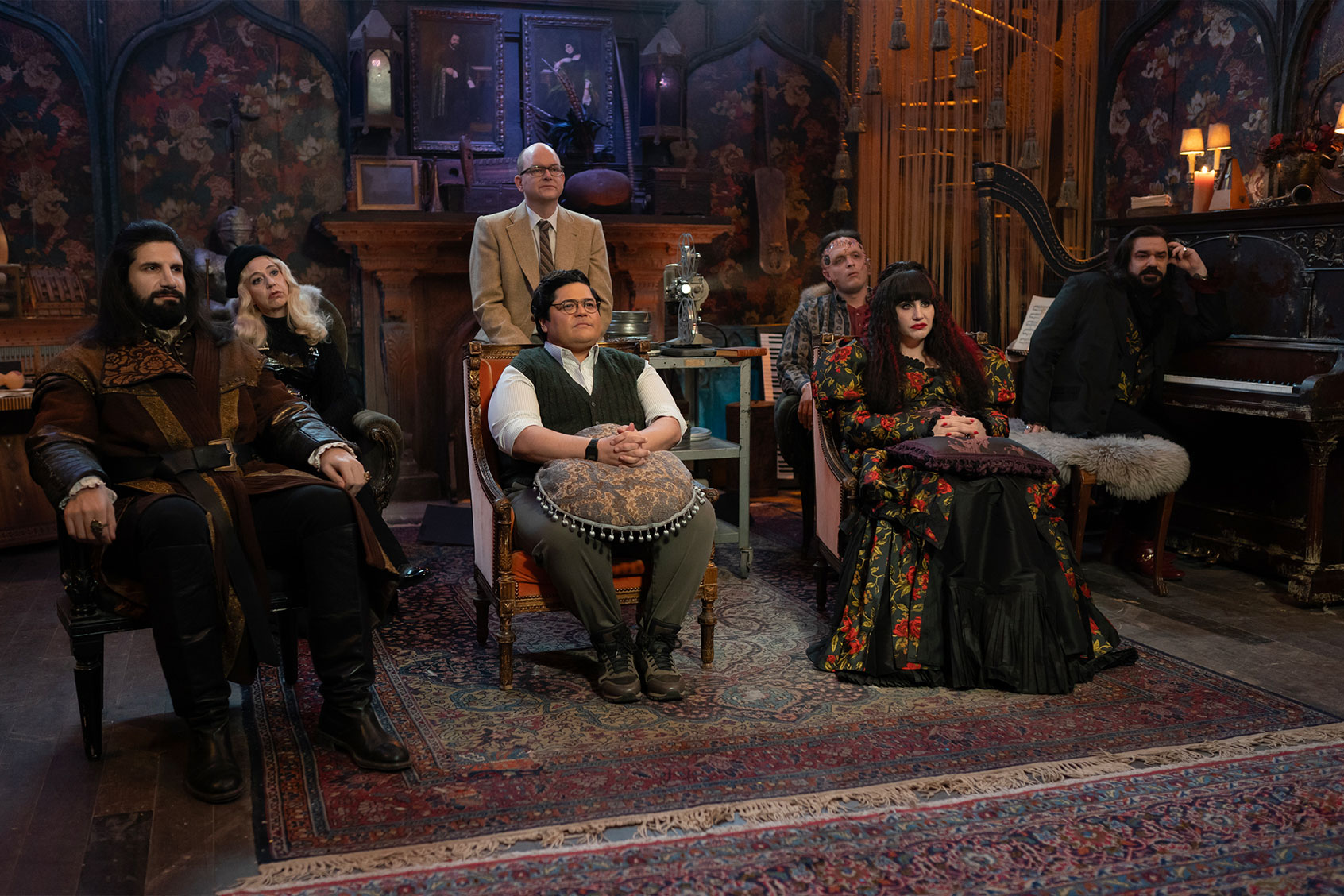
To mark the ending of what’s been a beautiful six-season relationship, we checked in with Novak and Schaal to get their sense of how the story landed and what its long run portends for TV comedy more broadly.

The following interview transcript has been edited for length and clarity.

“What We Do in the Shadows arrived at a time that was very uncertain for the world, and now it's leaving at a time that's very uncertain for the world. And I wonder what it’s like to be departing at this point, from your perspective?

Kristen Schaal: It is sad. . . . And I think I was saying that I feel like I'll never be on a show as surreal and quick and weird as this one. It's just such a unique show, and I'm hoping that somebody else will write more shows like this, like you know that go into a mythological, supernatural world, but it's still sort of accessible and funny as hell. That's my dream. But I think the world's gonna be OK. I think we're gonna get through this.

What about you, Kayvan?

Kayvan Novak: I gotta say, man, this whole experience gets an A+ from me. It's been a beautiful journey, and I met some beautiful people, and . . . I felt like I've raised my game and learned a lot. And, you know, meeting the fans — the way you express how fond you are of the show. That’s really what it boils down to — the audience getting a kick out of it. I'm just a small piece of the puzzle, so I'm just lucky that all the other pieces of the puzzle fit so beautifully together.

What We Do In The ShadowsWhat We Do In The Shadows (FX)

To Kristen's point, there aren't that many series like this. By that, I mean that there are all these ongoing debates right now about what is a comedy, and this so clearly is. That’s something I wanted to talk to you about Kristen, is the fact that you are co-starring in this and you're also in “Bob's Burgers." When we think about comedy now, especially on broadcast TV, a lot of it is animated comedy. What do you think “Shadows” shows us about the potential for the role of classic, live-action comedy on TV?

"That’s really what it boils down to — the audience getting a kick out of it."

Schaal: Well, that it can be embraced by a big audience, and that people will really love it and they need it. Yeah, it's such a good point. Like people love “Bob's Burgers” and “The Simpsons” and “Family Guy” — all those shows. There's something about just comedy that feels so good to people, and I think it's really healing. It's so important. I think it kind of gets disrespected. I’ve said that over and over again: I think people take for granted what a necessary part it is of the human experience. So yeah, being on “What We Do in the Shadows,” where comedy is king, the joke comes first, is something people might be scared to do. But in the end, it also found the heart that everybody craves . . . but in a way that was, sadly, really unique. Because there are not a lot of very funny live-action comedies out there. I do like “English Teacher” a lot.

Me too.

Schaal: In any case, I forgot what your question was, but I hope I answered it.

You did. I think what I'm going to miss is the fact that this is probably the closest a live-action comedy can get to what is classically said about animated comedy, which is you can do things in animation that you can't do with live-action. Kayvan, as someone who's been part of the cast since the beginning, what has been your favorite aspect of that unreality that you’ll maybe miss the most?

Novak: I think it's a sum of all its parts. . . . It’s such a collection of senses and flavors and textures that just to single one thing out, I don't know that I could. Wearing fangs, going up on a wire, being able to fly. Being some kind of superhero, almost, but an incredibly selfish one. Yeah, it's just an experience like no other. I'm pretty sure I'm not gonna have an experience like it again, but that's OK because it’s so great that I got to experience it for so long anyway.

We need your help to stay independent

Schaal: And I also want to just give some props to FX for taking a chance on a “Shadows” TV show. I mean, [executive producer Taika Waititi], and [creator Jemaine Clement] had created something that was already a bit of an underground classic, but . . . nobody's weird idea about vampires living together is getting any money these days. And to give it time, too, to grow and to get an audience is so important. There are a lot of shows that, if it doesn't get an audience within two episodes, they can them. So this show was just so lucky to be protected.

I also like to think about how, like, Jemaine with “Flight of the Conchords” and this show, it's like, these aren’t people who are thinking about, “What's going to make money? What's been working? What can we copy?” Like, these are guys living in New Zealand, kind of far away from everybody being like, “What makes us laugh?” And it's these shows, that touch everybody's imaginations, and are taking us away in a fun escape — I just want more of these kinds of shows, and I hope that they happen.

What We Do In The ShadowsWhat We Do In The Shadows (FX)I think audiences do too. If you look at the success of things that people are looking on streaming, a lot of them are shows that ran for a long time, which is great news for the prospect of this show's afterlife.

And then part of it too, and this is going to segue into the next part is looking at these relationships over time, of course, Kayvan, one of them was Nandor and Guillermo, but I'm wondering, if you how you two thought about the outcome of Nandor announcing he had a crush on The Guide, and her saying, “Oh, no.” Was that ever something that you two had hoped would become solidified or are you in agreement that the evaluation that The Guide made was correct?

"There's something about just comedy that feels so good to people, and I think it's really healing."

Schaal: I think in the end, her evaluation is correct. I think she's too tired for that BS. But I was excited to have any scenes with Kayvan because he's such a lovely scene partner. I wanted more Kayvan at work, so that was good. And just to circle back to the finale, I think it's rare that a show gets told that they're going to end. So to be able to hone an ending was also like another gift. Of course, we would have loved to have gone on for 25 more seasons, but I'm usually on a show that gets canceled, and we didn't think we would, and then we don't get to have a good closure. It's going to be good for the box set.

Novak: Yeah, I agree with all that. I didn't think that Nandor was ever gonna get anywhere with The Guide. I mean, come on she knows him too well. You know, she’s met the guy and she knows exactly what he's up to. He's just taking his chances because he's run out of ideas. So, you know, she's the last potential partner at the house party who just has no interest in him whatsoever. It was never gonna happen.


Want a daily wrap-up of all the news and commentary Salon has to offer? Subscribe to our morning newsletter, Crash Course.


I can't let you go without referring to  . . . the movie reference [to "The Usual Suspects"] that was in the finale. Do you both agree that's one of the most perfect outcomes or perfect finales to a film?

Schaal: I agree! I loved it. I think it is, I was saying to the last, the last beat, where they go down into the tunnel. I think is such a gift for the fans to know that you're saying, “These stories are not over.” And if they want to pick up and write the adventures of Guillermo and Nandor in a comic book or a movie or fan fiction online, they should. I hope they do.

There was a “Buffy the Vampire Slayer: Season Eight,” in comic book form. So who knows?

Novak: I thought they picked the right movie to parody because that ending . . . is so iconic. It needed to be something that is kind of burned into people's consciousness, really, unless you haven't watched it, and then you wonder what the hell is going on. But you know, you've got to take chances.

It was a fearless ending. And now we are seasonless and jobless, but also, fearless.

All seasons of "What We Do in the Shadows" are currently streaming on Hulu.


Memory problems? Here’s why poor sleep may be the cause — and how to fix it

Researchers have long wished to understand the connection between sleep and memory, especially how the brain encodes long-term memories during slow-wave sleep (while discarding others), or the deep sleep that occurs during the initial hours of one’s rest. Recent research sheds fascinating new light on the issue, but to understand how this works, scientists had to literally take brain samples from living people. The results could help us develop technologies that could one day improve our ability to form deep, long memories.

The 45 patients who donated their brains to science had to undergo neurosurgery for preexisting conditions (33 for drug-resistant epilepsy and 12 for brain tumors) and gave prior written consent. Franz Xaver Mittermaier, the first author of a study in the journal Nature Communications that examined those brain samples, told Salon that the patients’ participation was crucial to the scientists’ success. 

“The reason why we were able to address these questions for the first time at a mechanistic level, is because we received very rare alive brain tissue samples from patients who underwent surgery for drug-resistant epilepsy or brain tumors,” Mittermaier said, adding that they strictly adhered to ethical requirements and are “deeply thankful” to the patients for making their sacrifice.

Prior to this research, scientists already understood that each night, memories transfer from short-term storage in the hippocampus to long-term storage in the neocortex during slow-wave sleep. Thanks to electroencephalography, researchers can even link slow-wave sleep to a process of synchronous changes in electrical voltages in thousands of neurons, known as up and down states.

"It is not just the duration of deep sleep stages but also an intact structure of our sleep."

“We, for the first time, show that these up and down states affect how human brain cells communicate with each other,” Mittermaier said. In addition to learning more about the strength of the connections between neurons, or synapses, they also broke down the cellular mechanisms behind how synapses perform these basic functions. “The results that our experiments generated are crucial because they deepen our understanding of how the brain achieves long-term memory storage and form the basis that will allow us to understand what goes wrong in disorders where memory is impaired.”

He also stressed the indispensable contributions of the patients. By giving tissues that would otherwise have been discarded — 38 samples from the temporal cortex, five from the frontal cortex and two from the parietal association cortices — they provided the doctors with an invaluable tool. The professionals had to work quickly too, as they had less than thirty minutes to deliver the tissues from the operating room to the laboratory.

“After neurosurgical resection, tissue samples were immediately submerged in a sterile bottle containing ice-cold, carbogen-gassed (95/5% O2/CO2) sucrose-containing artificial cerebrospinal fluid,” the study authors write. “The bottle was sealed gas-tight and placed in a styrofoam box with ice for transport to the laboratory.”


Want more health and science stories in your inbox? Subscribe to Salon's weekly newsletter Lab Notes.


That was the only way to study the brain tissue samples while they were technically still alive. One major drawback to the study is a lack of control subjects. But all of the patients had legitimate reasons for wanting a part of their brain removed: they were sick. “While disease effects cannot be ruled out entirely, neurosurgical resections ultimately represent the only opportunity to investigate human synapses,” the authors explain in their paper.

If you want to improve your own sleep health, you don’t need an Apple Watch or other tech to monitor your sleep, according to Mittermaier. While smartwatches can help optimize one’s sleep hygiene and are therefore “probably useful,” he argues there are much simpler ways to improve one’s sleep health.

Neurons in the neocortexNeurons in the neocortex: Slow-wave sleep strengthens the connections between them, supporting memory formation. (Charité / Sabine Grosser)“Having a regular sleep time, planning for seven to eight hours of sleep, and trying to get rid of any source of sensory interference that disturbs your sleep will already be very effective,” Mittermaier said. There is no straightforward answer to the correct amount of deep sleep — including phrases known as NREM stage 3 sleep and slow-wave sleep — because the quality as well as quantity of sleep is important.
“It is not just the duration of deep sleep stages but also an intact structure of our sleep,” Mittermaier said. “A ballpark number would be that 10% to 25% of the entire seven to eight hours of sleep should be in NREM sleep 3. During childhood and adolescence, it should be more (20 to 40%).”

We need your help to stay independent

Mittermaier hopes that ordinary people will realize, as a result of their study, that sleep is important to their overall health. Even though we live in a culture that values hustling over rest, sleep is not merely a period of inactivity. The body undergoes complex processes of self-repair that are crucial to a person’s optimal performance in all areas of their life.

“Sleep is a fascinating phenomenon,” Mittermaier said. “It is highly conserved across species  — believe it or not, but even fruit flies sleep.”

Humans spend between one-quarter and one-third of their lives asleep, and they suffer serious health problems when it is interrupted, disturbed or otherwise lacking.

“Depriving humans of sleep leads to all sorts of problems and can cause serious harm,” Mittermaier said. “To me, it felt like a great privilege being put in a position where I get to study this fascinating topic.”

Democrats reject AOC bid for oversight position, choose 74-year-old with cancer instead

Democrats, voting Tuesday on who should serve as their top member on the House Oversight and Accountability Committee, overwhelmingly backed Rep. Gerry Connolly, D-Va., a 74-year-old with cancer, dealing a blow to the party's progressive wing and hopes that a younger generation would take over such leadership positions.

By a margin of 131 to 84, House Democrats voted for Connolly over the 35-year-old Rep. Alexandria Ocasio-Cortez, D-N.Y., whose bid for the top oversight job was reportedly opposed by former House Speaker Nancy Pelosi, 84, who underwent hip-replacement surgery over the weekend.

The caucus-wide vote came a day after Connelly, who announced last month that he's battling esophagus cancer, also won the backing of House Democrats' Steering and Policy Committee, which is chaired by House Minority Leader Hakeem Jeffries, by a vote of 34 to 27, according to lawmakers who spoke to Axios. The committee's support was nonbinding but seen as influencing the broader caucus.

The oversight position is likely to be highly visible in the years to come as Democrats seek to investigate alleged corruption and other wrongdoing by the incoming Trump administration.

Speaking before the vote to Politico, one House Democrat explained what appears to have been the prevailing wisdom: “While AOC is young, talented and incredibly inspiring to the progressive base, there’s been much conversation about whether it’s wise to promote the GOP’s favorite foil to lead a high-profile committee sure to provide the very content Republicans will use during the midterms to effectively define Dems as woke, Trump-hating leftists.”

Rep. Emanuel Cleaver, D-Mo., 80, voted for Connelly but told Axios that someday soon Democrats may be willing to hand off power to the likes of Ocasio-Cortez.

"Our caucus is moving ever so gingerly toward bringing more and more young leadership in," he said ahead of Tuesday's vote, adding: "it's just a matter of time."

Gen X parents worry more about financially supporting their kids

The so-called “Bank of Mom and Dad” is a bit concerned they won't see a return on their investment.

More than half, or 53%, of Gen X parents are worried their children may need financial support into adulthood, according to a U.S. Bank survey. That's compared to 37% of parents across all generations who worry about the same issue.

It’s not because Gen X parents think their children make bad money decisions. The survey said 79% of parents think their children are capable of successfully managing their finances, as reported by CNBC.

Rather, Gen X parents tend to worry because they have lived through four of the five largest stock market crashes, seen the cost of living steadily rise and faced a tough job market, CNBC reported.

In response, they’re upping their financial support. A Savings.com survey found that Gen X parents were providing up to $1,515 a month on average to their children, compared to $1,384 across all parents.

Marguerita Cheng, CEO of Blue Ocean Global Wealth and a mother herself, cautioned Gen X parents to not help their children out so much that they deplete their own savings. She also advised that families have open conversations about finances and let go of the stigma surrounding money decisions.

While there is heightened concern among Gen X parents, Thiegs emphasized they aren’t “paralyzed” with worry. Instead, they just seem wary — but determined.

“It’s not just all doom and gloom for Gen X,” Thiegs told CNBC. “There’s also this understanding that we’ll be able to figure it out.”

The magnificent history of the maligned and misunderstood fruitcake

Nothing says Christmas quite like a fruitcake – or, at the very least, a fruitcake joke.

A quip attributed to former "Tonight Show" host Johnny Carson has it that "There is only one fruitcake in the entire world, and people keep sending it to each other."

It's certainly earned its reputation for longevity.

Two friends from New York have been exchanging the same fruitcake since the late 1950s. Even older is the fruitcake left behind in Antarctica by the explorer Robert Falcon Scott in 1910. But the honor for the oldest known existing fruitcake goes to one that was baked in 1878 when Rutherford B. Hayes was president of the United States.

What's amazing about these old fruitcakes is that people have tasted them and lived, meaning they are still edible after all these years. The trifecta of sugar, low moisture ingredients and some high-proof spirits make fruitcakes some of the longest-lasting foods in the world.

The original energy bar

Fruitcake is an ancient goody, with the oldest versions a sort of energy bar made by the Romans to sustain their soldiers in battle. The Roman fruitcake was a mash of barley, honey, wine and dried fruit, often pomegranate seeds.

What you might recognize as a modern-style fruitcake – a moist, leavened dessert studded with fruits and nuts – was probably first baked in the early Middle Ages in Europe. Cinnamon, cloves and nutmeg were symbols of culinary sophistication, and these sweet spices started appearing alongside fruit in many savory dishes – especially breads, but also main courses.

Before long, most cuisines had some sort of fruited breads or cakes that were early versions of the modern fruitcake.  

Fruitcakes are different in Europe than they are in America. European fruitcakes are more like the medieval fruited bread than the versions made in Great Britain and the United States. The two most common styles of fruitcake in Europe are the stollen and panettone.

British and American versions are much more cakelike. For over-the-top extravagance, honors have to go to a British version that crowns a rich fruitcake with a layer of marzipan icing.

Sweetening the pot

Fruitcakes came to America with the European colonists, and the rising tide of emigration from Britain to New England closely mirrored an influx of cheap sugar from the Caribbean.  

Sugar was the key to preserving fruit for use across the seasons. One of the favorite methods of preserving fruit was to "candy" it. Candied fruit – sometimes known as crystallized fruit – is fruit that's been cut into small pieces, boiled in sugar syrup, tossed in granulated sugar and allowed to dry.

Thanks to this technique, colonists were able to keep fruit from the summer harvest to use in their Christmas confections, and fruitcakes became one of the most popular seasonal desserts.  

A dessert with staying power

Fruitcakes were also popular due to their legendary shelf life, which, in an era before mechanical refrigeration, was extremely desirable.

Fruitcake aficionados will tell you that the best fruit cakes are matured – or "seasoned" in fruitcake lingo – for at least three months before they are cut.  Seasoning not only improves the flavor of the fruitcake, but it makes it easier to slice.  

Seasoning a fruitcake involves brushing your fruitcake periodically with your preferred distilled spirit before wrapping it tightly and letting it sit in a cool, dark place for up to two months. The traditional spirit of choice is brandy, but rum is also popular. In the American South, where fruitcake is extremely popular, bourbon is preferred. A well-seasoned fruitcake will get several spirit baths over the maturation period.  

Credit for the fruitcake's popularity in America should at least partially go to the U.S. Post Office.

The institution of Rural Free Delivery in 1896 and the addition of the Parcel Post service in 1913 caused an explosion of mail-order foods in America. Overnight, once rare delicacies were a mere mail-order envelope away for people anywhere who could afford them.

Given fruitcake's long shelf life and dense texture, it was a natural for a mail-order food business. America's two most famous fruitcake companies, Claxton's of Claxton, Georgia, and Collin Street of Corsicana, Texas, got their start in this heyday of mail-order food. By the early 1900s, U.S. mailrooms were full of the now ubiquitous fruitcake tins.  

[Over 140,000 readers rely on The Conversation's newsletters to understand the world. Sign up today.]

As late as the 1950s, fruitcakes were a widely esteemed part of the American holiday tradition. A 1953 Los Angeles Times article called fruitcake a "holiday must," and in 1958, the Christian Science Monitor asked, "What Could Be a Better Gift Than Fruitcake?" But by 1989, a survey by Mastercard found that fruitcake was the least favorite gift of 75% of those polled.

Haters and disrespect aside, fruitcake is still a robust American tradition: The website Serious Eats reports that over 2 million fruitcakes are still sold each year.

This article was updated to correct the home state of the two friends who have been exchanging fruitcakes.


Jeffrey Miller, Associate Professor of Hospitality Management, Colorado State University


This article is republished from The Conversation under a Creative Commons license. Read the original article.

“A perfect storm of mistrust”: Drone paranoia fueled by conspiracy theories and a lack of answers

Mysterious sightings of alleged drones over New Jersey, New York and other eastern states have sparked outcry from officials and residents even as the federal government has attempted to reassure the public and emphasize that it has no evidence that there is any threat to public safety. But the lack of definitive information about the phenomena, coupled with the lack of public trust in institutions and the viral spread of claims on social media, has created a furor.

In a joint statement released Monday, the Department of Homeland Security, the Federal Bureau of Investigation, the Federal Aviation Administration and Department of Defense said that after closely examining the technical data and citizen tips, officials had concluded that "the sightings to date include a combination of lawful commercial drones, hobbyist drones, and law enforcement drones, as well as manned fixed-wing aircraft, helicopters, and stars mistakenly reported as drones."

"We have not identified anything anomalous and do not assess the activity to date to present a national security or public safety risk over the civilian airspace in New Jersey or other states in the northeast," the statement reads. Officials added that they are supporting state and local authorities with advanced detection technology and trained visual observers. 

Such "carefully worded" statements from government officials are unlikely to assuage concerns from Americans, Thomas Warrick, a former DHS deputy assistant secretary for counterterrorism policy, told Salon in an interview. The last decade of political turmoil, fueled in part by conspiracy theories and coming after revelations about secret government aircraft like the U-2 spy plane, have combined to create "a perfect storm of mistrust and suspicion," he said.

"The odds are, five years from now, someone will write a retrospective of, 'Wasn't that silly? We were all worried about this,'" said Warrick, now a nonresident senior fellow at the Atlantic Council and director of the Future of DHS Project at the Scowcroft Center for Strategy and Security. "But right now, the anxiety that people are expressing is real. All the governments in question need to be both more active and more forthcoming to try to address these problems." 

Residents of New Jersey, including former elected officials, first reported seeing clusters of lights, believed to be drones, hovering over their properties and other populated areas around the state about a month ago, according to CBS News. Those largely nighttime, possible sightings have since expanded to at least a half dozen other states, including New York, Maryland, Connecticut, Massachusetts and Pennsylvania. Last week, drone activity briefly closed runways at the Stewart International Airport in New York and shut down the air operations of the Wright-Patterson Air Force Base in Ohio for nearly four hours. 

The number of reported sightings has also exploded, with an FBI official telling reporters over the weekend that the bureau has received 5,000 tips since the first sighting in New Jersey on Nov. 18, though fewer than 100 have spawned leads "deemed worthy of further investigative activity."

White House national security spokesperson John Kirby told reporters Monday that the Biden administration has not identified "anything anomalous or any national security or public safety risks over the civilian airspace in New Jersey or other states in the Northeast,” according to CNN. Kirby echoed the agency assessments of the sightings and said none of the 100 tips appear nefarious. 

“I can’t rule out the fact that we might find some sort of illegal or criminal activity, some nefarious activity, [but] all I can do is tell you that right now we see none of that,” Kirby said.

Homeland Security Secretary Alejandro Mayorkas said in a Sunday appearance on ABC News "This Week" that the federal government is "deploying additional resources, personnel" and technology to assist New Jersey state police in investigating the drone, or unmanned aircraft systems, sightings. He confirmed that some of the reported sightings are drones while noting that some are "manned aircraft that are commonly mistaken for drones." 

"It is our job to be vigilant," he said. "If there is any reason for concern, if we identify any foreign involvement or criminal activity we will communicate with the American public accordingly. Right now we are not aware of any."

A Defense Department spokesperson has confirmed that drones had been spotted over two military installations, Picatinny Arsenal and Naval Weapons Station Earle, in New Jersey. That official added, however, that such sightings are not a new issue for the agency. 

The department spokesperson told reporters they have been unable to determine who is responsible for flying the drones but reiterated that they have no indication that a foreign adversary is involved.

"To date, we have no intelligence or observations that would indicate that they were aligned with a foreign actor or that they had malicious intent," the spokesperson said. "But … we don't know. We have not been able to locate or identify the operators or the points of origin." The spokesperson also called the activity "irresponsible" and said that the department is "just as frustrated" by it.

Pentagon Press Secretary Maj. Gen. Pat Ryder reiterated Monday that drones flying near or over U.S. military installations would not unsual and that the vast majority "pose no physical threat to our forces or impact our operations." Concerning activity, he said, occurs far less frequently, and if the department determines that such activity is malign, commanders take appropriate action to "mitigate and counter these unmanned systems." 

"To be clear," Ryder said, "we'll continue to do everything possible to investigate reports of concerning activity. But given how many drones are lawfully in our skies every day, we need to be careful to avoid assuming malintent or malicious behavior."

On Monday, an FBI spokesperson told Salon that the bureau had no additional comment or information to provide at this time. The DHS declined to comment, and a spokesperson for the DOD referred Salon to transcripts of a Saturday press call with federal officials and Ryder's Monday press briefing. The White House National Security Council did not respond to a request for comment.

We need your help to stay independent

Javed Ali, a former DHS and FBI official now teaching national security law at the University of Michigan, said that — reading between the lines in their early statements — federal authorities "really can't explain the phenomena either."

Government officials "never have perfect information," he told Salon, and often have to wrestle with how and when to come forward to the public with more information. Striking that balance is difficult, he said, "because the minute you say something, facts could change. Then you'd be accused of lying to the public or you're not being truthful, and that's never really the case."

Contrary to the conspiracy theories currently en vogue, the least likely explanation for the drone sightings is aliens; second to that is that they come from some "hostile foreign power," Warrick said, noting that the federal agencies monitor hostile foreign actors "very carefully" and don't allow them to "get away with" such activity for "very long."

The more likely explanations for most of the sightings, he said, are airplanes, helicopters and other aircraft that "aren't nefarious and that are well known." From there, officials are still confident that the remaining truly unidentified cases, which are down to an "irreducible minimum," do not constitute threats to the public.

Warrick said government agencies need to do more to outline their plan for addressing the public's concerns.

"They also, by the way, ought to be more constructive in telling the public what they can do," Warrick added. "One of the things that we in the counterterrorism world learned is it's not enough to tell people there is or is not a threat. You also need to tell people, 'Here's how you can help.' Most people will be constructive."

Over the last week, officials have ramped up demands for the Biden administration to share more information about the possible drone activity. In a letter to President Biden posted to social media last week, New Jersey Gov. Phil Murphy urged the government to direct more resources toward demystifying the increased alleged drone activity, while New York Gov. Kathy Hochul urged Congress to pass legislation strengthening the federal government's ability to regulate the use of drones.

Adding fuel to the fire has been the number of current and former public officials who have claimed to have seen drones.

Ex-Maryland Gov. Larry Hogan claimed over the weekend that he "personally witnessed (and videoed) what appeared to be dozens of large drones in the sky above my residence in Davidsonville, Maryland (25 miles from our nation's capital). I observed the activity for approximately 45 minutes," starting around 9:45 p.m. ET Thursday night. He also called the federal response to the possible drone activity "entirely unacceptable."

Social media users, however, were quick to note that some of the lights Hogan recorded appeared to be stars in the Orion constellation. 

Pennsylvania state Sen. Doug Mastriano, a Republican, on Monday posted a screenshot that claimed a drone — shown strapped to a flatbed trailer — had crashed into a beach and was being hauled to an undisclosed location for further investigation. Social media users quickly identified the object in the screenshot as a replica or prop TIE fighter spaceship from the Star Wars franchise.

Nonetheless, Mastriano used the image to stoke fear.

"It is inconceivable that the federal government has no answers nor has taken any action to get to the bottom of the unidentified drones," Mastriano wrote, lamenting the "fecklessness" of the Biden administration.

Other public figures who have shared false information have later issued corrections.

Sen. Andy Kim, D-N.J., for example, last week posted a video of what he and local law enforcement suspected was drone activity above a New Jersey park. In a lengthy social media thread, however, he later clarified that "with the help of civilian pilots and others able to do deeper analysis," he and others had "concluded that most of the possible drone sightings that were pointed out to me were almost certainly planes."

"I share this because this is the kind of analysis we need but are not getting from the federal government to explain this situation," Kim wrote Saturday. "FAA experts have much more experience/resources to identify aircraft. Instead I'm left to draw on civilian support and public apps."

Robert Pape, a University of Chicago professor of political science who specializes in national security affairs and political violence, told Salon in a phone interview that the bigger issue the government is facing amid the purported drone sightings is in eroding public trust. 

"In the absence of good information, there will be many people [who'll] simply fill in the blanks with bad information, and there's no real way to stop that," Pape said, calling on the federal government to deploy advanced satellite technology, not often used in these scenarios, to track and monitor the possible drones in an effort to assuage concerns.

Pape also warned of the positive correlation between conspiracy thinking driven by deep distrust of American institutions and support for political violence.

Nearly a month of possible drone sightings and hardly any answers, he argued, is "causing this pattern of the erosion of public trust in this issue of national security."

"That void is almost surely being filled with conspiracy theories, and that is not good for our security," he said. "That's why I say this is really worth the government's time to clear up."

“Top Chef” alum Shota Nakajima wants you to swap your salt for soy sauce

James Beard "Rising Star Chef of the Year" semifinalist and "Top Chef: Portland" finalist — and fan-favorite — Chef Shota Nakajima was a breath of fresh air on the show, adding a punch of levity and brightness on a season that sometimes felt a bit heavy with the stress and pressure of the competition.

His sharp, unique dishes, deft culinary skills, imaginative dishes and on-camera charisma made him a formidable competitor and after appearing in every episode of that season. He's since returned to the show repeatedly (and he's obviously on the "All Stars 3" shortlist for many, many fans.) 

Born in Japan and raised in Seattle, Nakajima attended culinary school in Osaka, Japan before moving back to Washington state and working his way up through many different kitchens. After appearing on a few different food competition shows, he competed on Top Chef in 2020, the same year he opened Taku in Seattle.  

Nakajima recently spoke with Salon about his go-to soy sauce brand, his "Top Chef" experience, unique uses for soy, a particularly memorable cooking experience and much more.

Shota NakajimaShota Nakajima (Photo by Austin Quach)

The following interview has been lightly edited for clarity and length. 

Hello! For those unaware of your journey since competing on "Top Chef," can you break it down for them?        

I met a lot of amazing people during my time on "Top Chef," and the work I did on that show definitely opened the doors for me to explore more TV opportunities. Since 2021, I have loved competing and judging on a number of Food Network shows like "Tournament of Champions," "Guy’s Grocery Games," "Bobby’s Triple Threat" and more. I opened a second restaurant in Seattle. I’ve traveled and cooked all around the country meeting so many awesome people.

I’ve lent my time to raise money for many different causes including World Central Kitchen, the devastating Maui fire, Seattle’s International District, and more. And I’ve spent as much time as I can foraging for mushrooms with my dog Dodger and making sure I stop, breathe, and take all this in. I try to make every single day count and stay positive about any hurdles that come my way. 

Do you have a number one favorite ingredient to work with?

Without a doubt, Kikkoman Soy Sauce.

If yet another "All Stars" were to be planned or another opportunity to compete on the show arose, would you be open to round 2?

For sure! I love working with the "Top Chef" team, and Kristin is killing it as host!

What was the biggest lesson or takeaway you gleaned from competing in "Top Chef?"

The biggest lesson I learned from "Top Chef" is the importance of trusting my instincts while staying adaptable. Cooking on that level, with so much pressure and so many unknowns, taught me to stay grounded in my identity as a chef, especially when I was challenged to step out of my comfort zone.

What has your experience been like on other food competition tv shows since "Top Chef?" How do they differ? How are they similar?

Since "Top Chef," my experiences on other food competition shows have been equally challenging but in different ways. Each show has its own vibe and pacing. For instance, on "Tournaments of Champions", it’s more of a head-to-head battle, which pushes you to think on your feet and deliver something spectacular in a short timeframe. 

"Top Chef" feels more like a marathon where you need endurance, creativity, and strategy over time. What they all share, though, is the incredible camaraderie between chefs. Ultimately, the best part is being surrounded by other ambitious dreamers — it’s a unique kind of energy and a great reminder of why I love what I do.

It was great seeing you for a moment in the Fish Boil episode this past season. How was that for you?

Being part of the Fish Boil episode was such a blast! It was fun to step back into the "Top Chef " world in a more relaxed capacity and watch the other chefs navigate such a unique challenge. But honestly, I couldn’t help myself — I wanted to jump in!

I thought I’d enjoy just relaxing and observing, but nope, the adrenaline kicked in, and I found myself itching to be part of the action. That’s the magic of being around all of that passion— it pulls you right back into the excitement and reminds you why you love it all in the first place.

Is there a particular dish from your "Top Chef" tenure that you are still especially proud of? I was such a fan of so many of your inventive, delicious-sounding dishes.

The Tillamook cheese competition was really rewarding to win. I don’t often cook with cheese and making it five ways and then winning the challenge was an exciting and proud moment. I worked hard for that one!

What did the "Top Chef incubator” teach you? I spoke with Buddha just after his win last year and he referenced how it can be so great to singularly focus on cooking — not bills, not customers, not the daily minutiae of running or working in restaurants, etc.

The "Top Chef incubator” taught me how transformative it can be to focus solely on the craft of cooking. Being free from the constant pressures of bills, customers, and the daily grind of running a restaurant unlocks a different kind of creativity. It’s almost meditative to have that singular focus, where you’re thinking only about the dish in front of you and how to push yourself as a chef.

That environment reminded me why I fell in love with cooking in the first place, and it gave me the space to refine my style and dig deeper into the stories I want to tell through my food. It’s a rare opportunity, and I’m so grateful for it.

What are your favorite uses for soy sauce?

1. When slow braising, I love to use Kikkoman Soy Sauce as it levels-up the tender meat and the flavor of the charred soy sauce is umami at its best.

2. Don’t knock it until you try it, but soy sauce and eggs are truly an unbeatable breakfast combo.

3. I also love charring sautéed vegetables on high heat with soy sauce, using that nice, charred aroma to flavor them. This is also a super easy technique for home cooks looking to level up their weeknight meals.

Have you used soy sauce in sweet, pastry or dessert contexts?

I really love making an affogato with a dash of soy sauce. There’s a sweetness and bitterness to the soy sauce, plus umami, and it cuts really nicely through the creaminess of the ice cream. The soy sauce also adds a nice richness to the coffee.

For sweet recipes, try swapping a pinch of salt with a drizzle of soy sauce for added depth, rich umami deliciousness, a hint of saltiness and added caramel notes. And I promise it won’t taste like soy sauce.


Want more great food writing and recipes? Subscribe to Salon Food's newsletter, The Bite.


What are some general tips for working with soy sauce?

1. One of the easiest ways to unleash the power of umami in dishes is to swap out table salt with soy sauce. Since Kikkoman Soy Sauce slowly ferments for months, the traditional brewing process develops umami – the extra boost of savory, mouthwatering flavor known as the “fifth taste” — something salt can’t deliver alone. When seasoning food during cooking, I’d encourage home cooks to try a splash of soy sauce instead of reaching for salt.

2. When cooking with soy sauce, try reserving a bit of the fresh soy sauce and add it in incremental amounts as the dish cooks. This will help layer the umami flavors and provide depth to any dish you’re working with.

3. In terms of storing your soy sauce, keep in mind that soy sauce oxidizes, so once it’s open and left out in the warmth, it’s a completely different product – fresh soy sauce has a clean soybean flavor with umami, and as it oxidizes, it evolves into a darker, thicker product.

What stands out for you as a formative moment that got you into cooking or food at large?

A formative moment for me was when I stopped going to school and started working in restaurants. The first time my mom visited the restaurant where I was working, I saw her look happy and proud. In that moment, I realized this could be my path — it gave me a sense of purpose and confidence that I could do this for the rest of my life.

What would you say are your three most used ingredients?

1. Whatever cuisine I go into, the dish turns a little Japanese, and I always finish everything off with Kikkoman Soy Sauce. It’s my way of cooking.

2. Rice is also a go-to and one of my favorite ingredients.

3. Bonito flakes, which are made from dried bonito fish that is grated into flakes. They’re great finishings for dashi and sauces or crumbled into salads, and are very versatile.

We need your help to stay independent

 What is your favorite cooking memory? 

One of my favorite memories of cooking was when my chef took us to a river, and we fished for ayu. We built a makeshift grill out of rocks and enjoyed freshly grilled ayu alongside peaches that had been chilled to ice-cold perfection in the river water. It was simple, yet incredibly delicious — a beautiful reminder of how nature and food can come together to create unforgettable experiences.

Are there any unique uses or methods for soy sauce that you’re especially fond of?

One of my favorite ways to use soy sauce is for charring. When you’re grilling fish over charcoal, dump your soy sauce right over the charcoal and then put a lid on it so that the fish captures that nice aroma.

For those who find soy to be very salty, is there a way to tamp that down in cooking?

Substituting half the amount of table salt in a recipe with the equivalent amount of soy sauce can reduce sodium while enhancing the flavor of the overall dish.

If you find that your dishes are too salty for your preferences, try seasonings and sauces that contain less sodium. Kikkoman has many low-sodium varieties of their classic products including Less Sodium Soy Sauce and 50% Less Sodium Gluten-Free Tamari Soy Sauce.

Are you a fan of any of the recent soy sauce-involved trends or viral recipes?

As a loyal fan of both rice vinegar and soy sauce, the viral cucumber salad definitely caught my attention.

I love the Taku menu. Can you talk a bit about the restaurant, its appeal, its ethos?

I opened Taku to create a little bit of Osaka in Seattle. I loved my time working in Osaka as a young chef and grabbing late night eats and drinks at one of the food stalls in the Shinsekai district. Taku is fun, it’s laid back, the drinks are cold and the fried chicken is fresh and hot.

The food was inspired by my mom’s cooking from my childhood – karaage, rice balls, miso soup, creamy mac salad, fried rice – the comfort foods we would eat daily and the food I liked to eat after a long shift at the restaurant. I added things like French fries with furikake, a lineup of my favorite dipping sauces, potato mochi, ramen specials and more to have a little fun with different flavors.

What's next for you, ideally?

I’ve got some fun things in the works that I’m excited to share soon! People can catch me at South Beach Food & Wine in February with more events to come!