Spring Sale: Get 1 Year, Save 58%

The alpha male era is on its way out

A month ago, the extremely online couldn’t get enough of pondering the hypothetical match-up between 100 men and one gorilla. Although most who semi-soberly engaged with this thought experiment recognized it to be farce — Lord, we hope they did – others treated the fantasy wrestling match seriously. News outlets consulted with conservationists and primatologists, who provided their scientific assessments of the odds. (In summary, gorillas are powerful but not aggressive. They’re also endangered, you fools. Please donate to conservation efforts.)

Influencers weighed in. On X, YouTuber Jimmy Donaldson, better known as MrBeast, jokingly solicited 100 volunteers to “test this,” to which Elon Musk replied with a “Sure, what’s the worst that could happen?” The official White House account rode the virality to post a meme casting Donald Trump as some version of a mighty King Kong who deported “142,000+ illegal alien criminals.”

Only John Mulaney treated the argument with the flippancy that it merits. Four weeks ago, the “Everybody’s Live with John Mulaney” host pitched a match-up between himself, a 6’1”, 42-year-old comedian, and three teenagers.
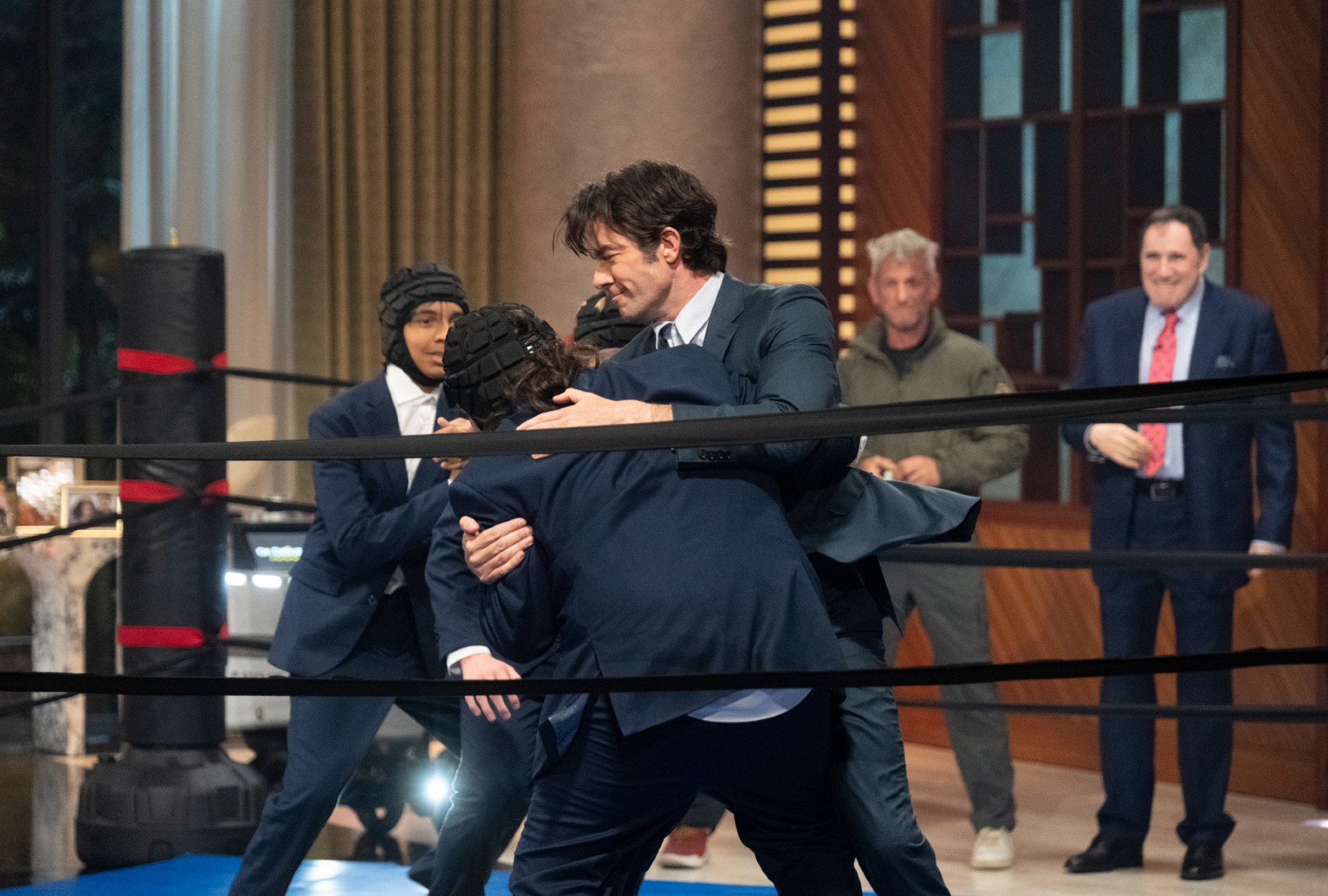
John Mulaney, Sean Penn and Richard Kind on “Everybody’s Live with John Mulaney” (Adam Rose/Netflix)

Last week’s season finale closed with the highly anticipated (to use that term loosely) match-up. “All you at home, all you’ve done is talk, talk, talk,” Mulaney says. “It’s time to end the smack talk, end the conjecture and settle this — man to boy.”

As one might have predicted, the trio of 14-year-old supposedly truant adolescents quickly overwhelmed the comic. But had Mulaney placed himself in the gorilla’s corner or the teenagers? According to the World Wildlife Fund, the average silverback gorilla weighs around 30 stone or 420 pounds; the kids weighed in at a combined 477 pounds. Jake Paul, who pretended to face off with a gorilla in an idiotic Instagram post, should take note.

Inserting reality into this conceit was never the point, in the same way that the true opponents in this hypothetical contest are certain types of men battling their insecurities. Either way, its popularity reminds us that the right-wing-generated masculinity crisis is in full flower. Welcome to the Manly Man Show. Please note that we are joining a broadcast already in progress.

Sunday, June 1, marks the premiere of “Duck Dynasty: The Revival,” centering Duck Commander CEO Willie Robertson as the patriarch in a “guided reality” series about his family’s hunting gear empire. The revival follows Willie’s quest to find the next generation’s company leader – which is to say, the next him.

The ongoing joke is that Willie’s wife Korie is the one who knows what’s happening day to day while he’s largely clueless.

The “Duck Dynasty” revival is part of a fresh wave of mainstream conservative-skewing TV series. Take the success of Tim Allen’s midseason return in ABC’s “Shifting Gears.” The sitcom follows a signature of Allen’s, casting him as a grumpy widower who welcomes his estranged daughter (Kat Dennings) and her kids back into his life.

Like “Duck Dynasty: The Revival,” “Shifting Gears” peddles middle-of-the-road humor while reflecting right-leaning cultural sensibilities about men and women. The show has found its audience, ending its first season as ABC’s top-rated half-hour comedy, averaging 11.1 million viewers, according to Nielsen’s first full-season ranking of broadcast networks based on 35-day multiplatform viewing, shared by TVLine.

(Bryan Tarnowski)

Compared to most conservative-skewing programming, “Duck Dynasty: The Revival” is gentle, even taking into account the hints at waterfowl murder. On the other end of the spectrum crouches The Liver King, the subject of a recently debuted episode of Netflix’s “Untold” sports documentary series.

Said King, whose real name is Brian Johnson, is a massively muscled fitness influencer who built a nine-figure supplement company by promoting what he describes as an “ancestral lifestyle” revolving around ingesting raw offal.

Johnson’s social media posts show him lifting massive weights, pulling trucks and consuming everything from uncooked liver to testicles with his sons. He struts around shirtless and shoeless; his wife and homeschooled sons, Stryker and Rad, pad about barefooted as well. One of the boys expresses mild envy about other people’s footwear before his father makes them sprint into a field to cut open a bull, pull out its organs and gnaw on them.

The masculinity crisis seizing our land saw surprising numbers of Gen Z men break conservative to vote Trump back to office and, before that, a push for testes tanning. But it has been impacting entertainment in ways that have become less subtle in recent years.

“Untold” hooks into the same current of Netflix’s algorithm that is buoyed in part by live wrestling and shows featuring right-wing podcasters and comics such as Andrew Schulz, Tony Hinchcliffe and Shane Gillis. Gillis will soon return in a second season of his comedy “Tires.”

But it’s also part of Netflix’s “rise and fall” true crime genre, cautioning against believing in figures like Johnson, who hooks young men by flogging a version of caveman masculinity that associates virility with dominance. Especially intriguing was Johnson’s superhuman physique, which he assured his followers was the result of a raw and primarily organ-based diet.

In 2022, a cache of leaked emails revealed that, cue the gasps and shock, an $11,000-per-month anabolic steroid habit is the secret substance pumping up his hulking frame.

The masculinity crisis seizing our land saw surprising numbers of Gen Z men break conservative to vote Trump back to office and, before that, a push for testes tanning. But it has been impacting entertainment in ways that have become less subtle in recent years, especially on Instagram, YouTube and TikTok.

Christian Nationalism’s online surge neatly dovetails with an increased demand for Christian entertainment. The most prominent example of this is the unexpected mainstream breakthrough of “Sound of Freedom” in 2023. Prime Video draws a share of that audience with “House of David,” the archetypical story of the little guy rising to defeat a giant. Season 5 of “The Chosen” is also set to debut on Prime in June. These align patriarchal themes with a return to those mythical “traditional values” from which Americans are constantly straying.

We need your help to stay independent

You may remember “The Man Show,” the late ‘90s and early aughts Comedy Central frat humor slop trough that introduced wider audiences to Jimmy Kimmel and Adam Carolla. The hosts reveled in boorish, retrograde sexism, supposedly intending to communicate that misogyny itself was an outdated joke.

Of course, in the same way chauvinists didn’t get that the 1982 book “Real Men Don’t Eat Quiche: A Guidebook to All That Is Truly Masculine” is satire, many of them found the show’s humor reinforcing. Including Carolla.

Shades of “Man Show” masculinity are all around us, especially in places where we shouldn’t expect it to show up, except in this darkest, dumbest of timelines. Fox personality Jesse Watters lambasted Joe Biden for pretty much everything he did while he was president. But in 2023, he went after the guy for, of all things, using a straw. “Now, if you’ve seen me on ‘The Five’ or on primetime, you know I recommend that all men refrain from using straws,” Watters said. “It’s unbecoming . . . the way a man’s lip purses. The size of the straw is too dainty.” Sure. It’s a girth issue.

Watters has long claimed that he is not to be taken seriously. He said as much in March when he announced his “rules for men.” They include not crossing one’s legs, not eating soup in public – sorry to all those NFL spokesmen for Campbell’s Chunky, I guess – and the straw ban. “It’s very effeminate,” Watters insisted.

Shades of “Man Show” masculinity are all around us, especially in forums that we shouldn’t expect it to show up, except in this darkest, dumbest of timelines.

Cut to Thursday, May 22, when Rep. Tim Burchett, R-Tenn., proudly told a Fox reporter, “I don’t drink out of a straw, brother. That’s what the women in my house do.”

Pop culture’s current masculinity obsession dates back to Trump’s first time in the Oval Office, only back then the push was coded as catering to working-class audiences. The monstrous ratings for 2018’s “Roseanne” revival validated that direction, and once its title character was revealed to be a Trump voter, the show was MAGA-official.

Then, its star Roseanne Barr celebrated with a racist victory lap on social media, and the revival’s reign was over as soon as it began. But that same year brought us “Yellowstone,” Taylor Sheridan’s neo-Western about a Montana rancher who pits himself and his family against outside interests with designs on his empire and his land.

The Sheridan-verse expanded from there with spinoffs and new visions, including “Landman,” starring Billy Bob Thornton as Tommy Norris, an oil company executive doing battle with an assortment of lawyers, mobsters, politicians, any type you could fit into the classic, “What do you call 100 [fill in the blank] at the bottom of the ocean?” joke. (Punchline: “A good start.”)

Sheridan’s dramas present patriarchal power as protective – a sea change from the Platinum Era prestige themes of power as corruptive. Real men fight for what’s theirs, including their flock.

The original “Duck Dynasty” was a family-friendly hit that stood astride the Obama administration and the age of Trump, starting in 2012 and ending in 2017. With its success, the Robertsons proved there was a marketplace for overtly Christian unscripted content. The show provided A&E with manly counterprogramming in an age dominated by the girlie “Keeping Up with the Kardashians” and Bravo’s “Housewives” empire. At the height of the show’s popularity, “Duck Dynasty” drew an season average of around nine million viewers.


Want a daily wrap-up of all the news and commentary Salon has to offer? Subscribe to our morning newsletter, Crash Course.


One of the most telling stories from its heyday, however, involved a 2013 controversy resulting from elder patriarch Phil Robertson making homophobic and racist statements in a GQ profile. A&E suspended him from the show, only to bring him back in response to the audience’s outcry.

Part of pop culture’s hyper-masculinity resurgence involves renormalizing epithets and abolishing considerate language. In the new age of manliness, sensitivity is feminizing.

Reporting what Phil Robertson said and did in life may be viewed as speaking ill of the deceased; he died on Sunday, May 24, at the age of 79. (His family announced his Alzheimer’s disease diagnosis in 2024, although his cause of death was not revealed.)

Still, these radar blips bear consideration. Twelve years ago, if only for a moment, the network acknowledged the insensitivity of Phil Robertson’s views. One wonders whether the network would bother with such theater if a similar scenario were to occur now. Part of pop culture’s hyper-masculinity resurgence involves renormalizing epithets and abolishing considerate language. In the new age of manliness, sensitivity is feminizing.

Other signs we were headed into this rough country were apparent for some time, if we knew where to look. Culture and theology writer Paul Anleitner spells this out in an insightful X thread he posted shortly after Trump’s re-election in November, citing some obvious examples like the rise of “anti-woke” comedians, and what he calls the “Star Wars” wars, along with the resurgence of . . . Creed? Yes. He’s serious.

Top Gun: MaverickJennifer Connelly plays Penny Benjamin and Tom Cruise plays Capt. Pete “Maverick” Mitchell in “Top Gun: Maverick” (Paramount Pictures / Skydance / Jerry Bruckheimer Films)

Another blaring siren, Anleitner says, was the explosive popularity of “Top Gun: Maverick” two summers after George Floyd’s murder. He explains that Tom Cruise’s Maverick represents the “more traditional American values of meritocracy over aristocracy amid what was supposed to be a cultural revolution intended to set up a new inverted aristocracy.”

Earlier in 2022, Prime Video released the first season of “Reacher,” which became a sleeper hit. And the success of “Top Gun: Maverick” redux carved out a marker for last year’s “Road House” starring Jake Gyllenhaal and mixed martial arts champion Conor McGregor.

McGregor, by the way, has been accused of numerous physical assaults, along with facing sexual assault allegations. He also has a lovely documentary about him streaming on Netflix. In related news,  “Road House 2” is officially a go.

The state of the world is such that “Duck Dynasty” producer Rob Worsoff is pitching another reality show tentatively titled “The American” that would show immigrants competing for U.S. citizenship in a series of challenges. This is not a joke – The Hollywood Reporter received confirmation from the Department of Homeland Security that the show’s proposal was under review.

What would some of those challenges be? Worsoff envisions them engaging in “stereotypically American [read: manly] activities like collecting gold from a mine in San Francisco or assembling a Model T in Detroit,” THR reports.

Elsewhere, Roseanne Barr is pitching a sitcom about an Alabama farmer “saving the United States from drug gangs and China,” according to its description in Variety.

All this is enough to make progressives wonder if they are the surrounded and endangered species. Maybe. For now, we should also remember that our collective appetite for partisan entertainment is limited. And there are reasons to hope this fever is breaking.

Musk still holds sway as an influencer, but the larger public and MAGA were souring on him before the New York Times’ Friday report alleging that he is ingesting enough illegal substances to compromise his health and judgment.

The Liver King has nothing on Musk, but at the end of “Untold,” as he sniffs a melon, talks to strawberries and extols the virtues of pooping in his garden, it’s hard not to think that this once mighty caveman’s appeal has been diminished. It’s also difficult to tell whether his fans still buy into it.

A surer indicator is to observe what’s popular in the current marketplace. The biggest box office surprise of 2025 is the runaway success of “Sinners,” an original concept featuring a primarily Black cast that’s still generating impressive ticket sales a month and a half after its release. Cruise’s “Mission: Impossible – The Final Reckoning,” meanwhile, is being outperformed by Disney’s “Lilo & Stitch.”

Allen’s show may top ABC’s sitcom lineup in the ratings, but its most-watched series, “High Potential” and “Will Trent,” play toward a female-skewing audience and attract millions more viewers in that previously cited 35-day multiplatform Nielsen assessment. At the moment, the most popular TV series on Netflix is “Sirens,” starring Julianne Moore, Meghann Fahy and Milly Alcock.

You may also notice that “Duck Dynasty: The Revival” is less about promoting Willie Robertson than lifting his children: Sadie, who heads her own podcasting and Christian lifestyle brand, and John Luke, who’s minding his small batch coffee label.

In the revival’s premiere, neither they nor most of the next generation seem interested in the old way of promoting the Duck Commander brand. Willie, jovial as he is, may be out of step with the direction the family business is taking. That path looks decidedly female-forward and welcoming to all. Except, perhaps, the local mallards.

“Duck Dynasty: The Revival” premieres at 9 p.m. Sunday, June 1 on A&E. “The Liver King” and “Everybody’s Live with John Mulaney” are streaming on Netflix.

Does Donald Trump want to carve up the world — or keep it all for himself?

Foreign policy experts have struggled to make sense of the second Trump administration's incoherent and contradictory approach to world affairs — which in itself ought to serve as a clue. First of all, it suggests that the Trump team is operating without a recognizable or familiar playbook, driven partly by the Great Leader’s famous whims and fancies and partly by competing streams of ideology. Secondly, it illustrates that the generations of think-tankers churned out by the graduate programs of elite Anglo-American institutions are completely at sea in this bizarre historical moment, whether in foreign policy or any other supposed discipline of governance.

We’ve already worked through the theory that Donald Trump is reviving the expansionist foreign policy of Gilded Age America and William McKinley, who isn’t just a deeply inappropriate presidential role model for the 2020s but also an inexplicably strange one. (What schoolbook or outdated world map or old-school history teacher of Trump’s 1950s childhood is responsible for his McKinley love affair?) That seems partly true, or at least serves to explain Trump’s self-destructive fascination with tariffs, along with his obsessive interest in retaking the Panama Canal, purchasing or seizing Greenland and, um, “annexing” Canada (or something like that). 

We have to assume that someone or other, quite likely Stephen Miller — whose title is deputy chief of staff, but by some accounts is making all the policy decisions normally associated with, you know, being president — has gently informed Trump that the Panama and Greenland things would be major international incidents that might derail his otherwise glorious reign, while the Canada thing simply isn’t happening at all. So these topics have gradually receded toward the back burner, along with his genuinely horrifying brainstorm about turning Gaza into a beach resort, without disappearing entirely. 

It’s important to recognize that in world affairs, as in the pettiest of personal concerns, none of Trump’s idées fixes ever completely go away. He forced Canadian Prime Minister Mark Carney to sit through a jovial, not-quite-joking discussion of the Great White North as the 51st state. (Which, I’m sorry, not to be that guy, but that isn’t even right. Canada has 10 provinces and three federal territories; aren’t we talking about the 51st through 60th states, plus or minus?) 

He still wants someone to prove that a deceased Venezuelan president, Italian satellites and the deep-state libs of the FBI stole the 2020 election. (I may not up on the latest theories; my apologies.) He, or more plausibly some eager-to-please groveling toady, actually wants school children to study the so-called evidence of that enormous history-shaping crime, which may involve the contents of Hunter Biden’s laptop. I guarantee he’s still mad about the Sharpie-hurricane incident.

Trump was over the moon about meeting Kim Jong-un during his first term, and still thinks that went well. He transparently believes he'd have gotten along smashingly with Hitler and Stalin.

So let’s not pretend that McKinleyist neo-imperialism is gone forever, but for a while there it seemed superseded by an overtly ideological program of right-wing global conquest, which to this point has gone remarkably poorly. This feels more like Elon Musk and JD Vance’s collective genius at work than Trump’s. Sure, he’s flattered by obvious right-wing analogues and imitators like Viktor Orbán in Hungary and Javier Milei in Argentina, but he thinks of his relationships with other leaders almost entirely in individual and transactional terms. 

Ideology, for Trump, is nothing more than the sales pitch, or the decoration on top of the cake; it’s not the “deal,” by which he means a bunch of pomp and circumstance, ending with someone else’s obsequious surrender and shameless flattery. He was over the moon about meeting Kim Jong-un during his first term, and no doubt still thinks that went well. He transparently believes he’d have gotten along smashingly with Hitler and Stalin, and it’s a shame he wasn’t around to help defuse World War II and the Cold War.

Of course Trump would have happily taken credit for supporting the far-right AfD in Germany or the right-wing parties and candidates in Canada, Australia and Romania — if any of them had won. (To be fair, the pseudo-Trumper candidate in Poland was just elected president.) For the most part, exported Trumpism has encountered high electoral tariffs across the liberal-democratic zone, delivering an unexpected and arguably unmerited booster shot to mainstream “centrist” parties — with the solitary and instructive exception (as I recently observed) of Britain, where the political climate has gone from pretty bad to a whole lot worse.

Electoral democracy isn’t really Trump’s bag anyway, given the unacceptably high risk of losing. (I recognize the potentially terrifying subtext of that sentence.) He leaves that stuff to the nerds, which brings us to his recent tour through plutocratic oil states of the Middle East and his well-attested preference for leaders who don’t need to worry about that nonsense. In Saudi Arabia, now run by the youthful modernizer (and journalist-dismemberer) Mohammad bin Salman, Trump delivered a speech proclaiming that under his aegis the U.S. was no longer interested in looking "into the souls of foreign leaders" and dispensing justice based on their perceived morality. 

That Teleprompter-ready rhetoric doesn’t remotely resemble anything our president would say in a more natural context, but never mind. The point was taken: We’re done pretending to care about human rights and democracy and all that airy-fairy woke stuff from the Declaration of Independence and the French Revolution! We’re here to do some blatantly underhanded business deals and take an outdated gas-guzzling 747 off your hands. 

With this, we saw the launch of a new theory-balloon within the foreign-policy establishment: Trump is bringing back “spheres of influence” as a guiding principle in world affairs, and those who bend the knee to America — or to him, which is the same thing — get to run their own s**thole countries however they like. 

As with the McKinley business, my verdict is: Sure, sort of. It’s certainly conceivable that Trump has encountered some nostalgic-heroic retelling of the “Great Game” of the 19th century, when the British and French empires sought to carve up the underdeveloped nations between them, and then Germany, Belgium, Italy, Russia and Austria-Hungary got into the act. (McKinley’s clumsy territorial grabs can be understood as America joining the poker game a few sessions late.) He clearly would neither know nor care that, considered as a whole, that diabolical contest probably produced the greatest set of crimes in human history, or that the migrant “crisis” now afflicting every major Western-style democracy amounts to its long-tail karmic blowback. 


Want a daily wrap-up of all the news and commentary Salon has to offer? Subscribe to our morning newsletter, Crash Course.


Trump has a distinct fondness for exotic and fanciful narratives, and God knows the colonial-imperial period offered plenty of those. No doubt he’d find a hypothetical Second Great Game thrilling, on the level of pure fantasy: He may imagine Vladimir Putin, Xi Jinping and himself meeting over brandy and cigars at (let’s say) the Schönbrunn Palace and congratulating each other for being great men of history who get to make great-man decisions about who owns what. Except that Trump doesn’t take brandy or cigars — which ruins the whole fantasy, honestly — and Putin and Xi know better, at this point, than to take Trump seriously.

Trump would neither know nor care that, considered as a whole, the "Great Game" of the 19th century probably produced the greatest set of crimes in human history, or that the migrant crisis amounts to its long-tail karmic blowback.

There are a number of potentially fatal problems with this dusted-off 19th-century throwback, as studiously laid out by Sarang Shidore of the Quincy Institute in a lengthy essay for Foreign Policy. I would summarize them this way: LOL this is Trump we’re talking about; never in a million years. Yet it's also true that the “spheres of influence” model has a perverse appeal that goes well beyond aspiring dictators into various quarters on the left: It recognizes that we live in a multipolar world, and strikes many international observers as less hypocritical than the “rules-based order” so piously advocated by former Secretary of State Tony Blinken, which was just old-school U.S. hegemony dressed up in contemporary drag.

Although the Biden administration “occasionally gave a rhetorical nod to multipolarity,” Shidore writes, 

its policies on the ground were to maintain U.S. domination globally and in all dimensions of power: military, economic, and institutional. The new administration’s clearer acknowledgement of multipolarity is a promising beginning to reforming U.S. foreign policy.

In the first weeks of Trump’s second term, you could see the vague outlines of a “spheres of influence” policy shaping up: He’d let Russia keep as much Ukrainian territory as it could conquer, and was manifestly unbothered by the prospect of China invading Taiwan. And all he wanted in return was Canada: Win-win-win! 

One can almost imagine a more clear-headed and ruthless version of Trump who sticks with that kind of hardcore realpolitik and gets away with it. I said “almost.” But I think it's important to observe that Trump’s iron grip on the Republican Party is a function of his irrationality, his limitless egotism and his mercurial whims, and that those same qualities make him utterly ineffectual as a world leader.

His efforts to extort some kind of “peace deal” from Putin — something Trump repeatedly claimed he could accomplish in 24 hours — have descended to online pouting and whining. ("Vladimir, STOP!" is not exactly Great Game material.) His exhausting trade war with China has accomplished nothing, except to convince Xi’s unappetizing but highly rational regime that negotiating with this dude is a waste of time. For the moment, Trump has been shoved halfway back into the arms of Republican chickenhawks, the enfeebled tools of the military-industrial complex who no doubt suspected this would happen all along. I honestly can't tell you whether that's better or worse: Pick your poison. 

Thing is, if you want to carve up the world into competing zones controlled by “great powers,” you need other great powers who want to carve it up with you, and you need a world full of smaller countries who are willing to go along or too weak to resist. Those things do not exist in 2025, and thank Christ for small mercies. Oh, and by the way: You also need to be a great power. I suppose the U.S. still technically qualifies, but not for much longer. 

Minneapolis isn’t sorry about George Floyd

I wish it was different. 

I wish that, five years after former Minneapolis Police officer Derick Chauvin murdered George Floyd on Memorial Day in 2020, the city could point to many, many things that have changed as a result of the outcry. 

I wish, five years after a global uprising and protest that started here, that Minneapolis was a different city, with better policing, better public safety, and in a better place on the city’s long-standing racial inequality.

I wish we could say that Minneapolis was sorry about George Floyd’s murder and that we worked quickly—and then consistently continued to work—to address the systemic problems of policing and race, of neighborhood gaps in development and opportunities, of media narratives that whitewash many of those problems. I wish we could say the city rose to the moment, changed things, and became a leading example of how to address police violence for the rest of the country.  

But Minneapolis hasn’t changed, and Minneapolis isn’t sorry.     

Is the city different five years later? Absolutely. But not when it comes to the liberal underpinnings that defined, and in many ways still do define, Minnesota as “The Jim Crow of the North.” And certainly not enough to prove that anything has changed.    

In different ways, residents of Minneapolis put in work after the civil unrest. There was a very brief time, immediately after the protests and violent police response, when vibrant murals decorated the boards covering destroyed buildings, neighbors connected for new attempts at mutual aid networks, and flowers and tributes filled the now historic site at Chicago & 38th. Even the most cynical people in Minneapolis tried to look at the potential future for the city where George Floyd was murdered, and everyone from state and national politics, to news media, to hometown corporations jumped to make new pledges to do better for Black and other marginalized residents.  

But like many rebellions in fiction and reality, the empire swiftly struck back at attempts for change, and much of the city fell in line. People working towards change quickly saw that white fragility’s fury and retribution are as systemic as they are individualistic. 

Minneapolis leadership and their backers immediately did their own work to support the police department, while many officers coordinated en masse to retire with claims of PTSD—or “medical” as they sometimes code to it.An astounding 144 MPD officers were given settlements totaling over $22.2 million, even officers with previous records of misconduct. These same leaders used different parts of city bureaucracy, like the Minneapolis Charter Commission, to entangle the process of police reform, and they also used large sums of money to fund a local Political Action Committee that spread disinformation about the reform. “Defund the Police,” they argued, somehow meant the metro would descend into lawlessness overnight. It’s no wonder that national conservative groups have continued to amplify and expand the fear-mongering message, and it’s no wonder that, years after the civil unrest, many still claim that Minneapolis defunded the police, despite the MPD budget for 2025 being double that of 2014.   

By the time the next city election took place in 2021, the political push not only meant that the police department didn’t change, but the mayor in office didn’t change, and Minneapolis voted to pass a city amendment that the city council who called for reforms would have less authority, too. Four years later, the same PAC still remains a big driver of local politics and elections.   

Even more, the revelations of the MPD’s years of egregious behavior, inarguably revealed in a federal Department of Justice report and a state Department of Human Rights report which lead to two separate consent decrees to try and force sweeping changes (that is until President Trump rescinded the federal decree this week, leaving the state decree), have proven to hold enough importance to be anything but occasional talking points for local politics through the past few years. Case in point: City Council candidate Soren Stevenson was shot in the face by a non-lethal round when police escalated violence during the protests; Stevenson lost an eye as a result, and the officer who shot him was never disciplined and is still on the force.   

Many of the corporations that made swift commitments for new hires and funding for BIPOC causes used the opportunity to simply reallocate some existing funding for arts and culture organizations and events. These same businesses are now using their DEI rollbacks to eliminate most of their corporate giving entirely. Many people have pointed out the fact that Target commissioned murals featuring power fists on their Lake Street location, which was looted during the riots, that starkly contrast with the company’s public rollback of its DEI initiatives.   

We need your help to stay independent

 The regional news media, themselves targets of some uprising protests, made some long-overdue diversity hires and briefly wondered aloud if they should take everything that the police force says as unquestionable facts—reporters did, after all, originally take the MPD’s report that Floyd’s death was simply a “medical incident” and moved on from the story until the video began to spread across social media—have since been a staunch ally in the routing of meaningful reform, with skewed both-sides coverage and commentary. Their ramp-up of stories and angles for the anniversary of Floyd’s murder highlights the sensational nature of their current coverage and the lack of change in day-to-day reporting.       

The former police chief just last week made the rounds of local news to push his new book, unironically entitled “Securing Justice for the Murder of George Floyd,” with little pushback. The current police chief now routinely receives similar coverage without pushback, even going so far as to say, without rebuke in a recent press event, that police are the ones who are “starting to heal, it’s been a long five years.”  

My kids were really little when the ash from the burned-down Minneapolis Police Third Precinct floated into our yard down the street. They’ve now doubled in age, but while they’ve changed over and over, year after year, the city around them hasn’t. 

I wish we could point to a reformed police force, but the only significant changes in Minneapolis policing are that the number of employed officers is at a record low, that more and more people (not just BIPOC residents) are sharing stories of officers with chips on their shoulders, and that the city is still returning to earlier lower levels of crime.   

I wish we could point to a new robust corner of Minnehaha and Lake Street where the condemned Third Precinct still blights the corner, but we can’t. Barricades still remain, even though a new wrap was just put up on the chain link fence.

I wish we could point to George Floyd Square as both a place of commemoration of what happened and the history, but also as a place to show the city’s change in direction. But we can’t. Community members are the only ones who have been stewarding the historic site of George Floyd Square, a grassroots site that regularly receives visitors from all over the country who make the pilgrimage to see another ground zero in the push for—and against—modern civil rights.

It’s one thing to say sorry. It’s another thing to be sorry and move forward with changes. And Minneapolis has done neither. 

It’s time to make friends with your viruses

For years, we've known that not all bacteria are enemies — some are actually good for us, and belong inside us. That understanding sparked a boom in probiotics science and a multibillion dollar probiotics industry. But viruses? They still get a bad rap, despite quietly occupying our insides —and sometimes even helping us.  

Not that scientists even agree on whether viruses are alive or not. There's so much we don't know, including just what they are doing in our bodies. What we do know, though, is that viruses are not, in fact, all out to get us. Not only are they not uniformly bad news for our health, but many viruses actually live with us in a symbiotic and evolutionary relationship. Viruses exist in healthy people, and some are even actively beneficial for human health. Not to mention that about 8% of our very own genome consists of ancient viral genes. So basically, viruses are in us, and are us. Although we have known a lot about a small number of heavily-studied "bad" viruses for decades, the vast diversity of these weird little guys that co-exist in humans is mostly unmapped, just waiting to be discovered and understood. 

“It’s quite clear that humans are exposed to all kinds of viruses throughout our lives. And I think we’re only starting to figure out why they’re there, what they’re doing, and what impact they have on our health,” Ken Cadwell, associate director at the University of Pennsylvania Perrelman School of Medicine’s Center for Molecular Studies in Digestive and Liver Diseases, told Salon in a video interview.  Cadwell studies how the human (and mouse, his usual model organism) immune system has adapted to the various microbes we encounter through our lifetimes. 

In 2014, Cadwell and two colleagues made the amazing discovery of a virus – specifically, a norovirus, that pathogen notorious for sweeping nursing homes and daycares, causing terrible upset at both ends – that can actually restore the healthy condition of the intestines, just as “good” bacteria do, for example if you take a probiotic supplement to restore your microbiome after wiping it out with bacteria-killing antibiotics. That bit of good news about a virus you’d normally not want to touch with a sterilized ten-foot pole was an early finding in Cadwell's quest to understand what turns out to be a huge diversity of viruses living in, with, and on us.

"I think we’re only starting to figure out why they’re there, what they’re doing, and what impact they have on our health."

Perhaps it's time for viruses to take their turn in the limelight. The NIH's Human Virome Program aims to fill the great gap in our knowledge about viruses that "call us home". The main focus is on beneficial viruses that are persistent in the human body, not on those that cause disease (noroviruses, like Cadwell studied, wouldn't be part of this, the Program FAQ says, because they are transient). Among 16 institutions that received funding through this program is VAST (Viromes Across Space and Time), a major longitudinal Weill Cornell Medicine/Stanford project to learn what a healthy human virome looks like. This project, among others underway, ought to tell us more than most of us have ever wanted to know about those weird little things. But it's knowledge that could improve our health, even save our lives one day.

The undiscovered diversity of viruses

You, me, and everyone else has, it's thought, about as many viral particles living in or on each of us as there are bits on a computer hard disk in 2024 — ten trillion, or roughly a third of the total amount of cells in our bodies.  The total number of viral particles on the planet, though, is insane: a bit less than the mass of the Sun in kilograms, or 10 followed by 31 zeroes, an incomprehensible number that makes viruses the most abundant biological stuff on Earth. Perhaps 320,000 different types of viruses infect mammals. The statistical study that came up with that estimate based its analysis on the dozens of different viruses from 9 virus families all found in a single Indian Flying Fox, Pteropus giganteus. And indeed, most emerging infectious diseases in humans are zoonotic — meaning they come to us from another animal — and most of them are viruses. So if this estimate is even remotely accurate, we're looking at hundreds of thousands of potential new viruses as we increasingly mingle with animals via large-scale agriculture and the destruction, fragmentation, and human colonization of animal habitats.


Want more health and science stories in your inbox? Subscribe to Salon's weekly newsletter Lab Notes.


"Viruses understandably evoke a bad connotation because we know all the harm associated with viruses," Cadwell said. We have very good reason to surveil infections — H5N1 bird flu, for example — in our mammal and other animal friends in hopes of heading off a disastrous adaptation enabling human-to-human transmission of a virus that spreads easily and kills or maims many of those it infects.

On the other hand, as we've seen, not all viruses are out to get us. It's possible that some of them are only out to get some of us, some of the time. Others are totally benign, just hanging out inside or on-side us without doing any harm. Still others are on our team, taking down bacterial invaders before they can infect us or otherwise do us dirty.

That 8% of our genome that is made up of ancient virus DNA includes both "goodies" and "baddies" (although they are fully part of our genomes, not just living inside us, they are considered part of the virome for the purpose of the NIH's Human Virome Program, along with viruses that infect humans and viruses that reside in us but infect bacteria). The 30 distinct families of endogenous retroviruses, as that ancient viral DNA is called, in humans each represents a distinct process of colonization. An ordinary retrovirus became part of our ancestors, while going extinct in the outside world, over thousands to 3 million years of evolution, and most became part of our ancestors' genome sometime before we diverged from chimpanzees. Some are nicknamed jumping genes because they literally jump around, copying and pasting themselves into different parts of our genome just as if they were still viral invaders. Some bad things they might do: some evidence suggests they could be responsible for symptoms of motor neuron disease like ALS in patients with HIV and others, and perhaps in other neurodegenerative disease (there are various ways this could occur and it's not yet clear exactly what their role might be). Ancient viral genes might also play a role in helping regular viruses get a hold in us, and in the development of some cancers and autoimmune diseases.

But then there's the good stuff. Our endogenous retroviruses sometimes play important positive roles for our health: one gene with ancient viral origins, for example, codes for a protein involved in the development of the human placenta, another may protect a developing fetus from its mother's immune response. Others may be important for keeping human stem cells "pluripotent", or able to become any one of many different types of human cell. And these viral genes may protect us against other viral infections in some cases, or provide antiviral resistance, immunizing rare individuals against HIV for example.

As for the real viruses? Cadwell's 2014 finding about norovirus isn't the only evidence that suggests viruses that infect us aren't always our enemies, either. Anelloviruses, a group of viruses that are found in 90% of healthy humans, might (it's not clear yet) play a role in suppressing tumor formation. In other cases, a virus could protect you from a different pathogen. Take plague, for example, which I think we can all agree we'd rather avoid. Studies in mice suggest that unnoticed infection with run-of-the-mill viruses like cytomegaloviruses or herpes viruses can protect against infection with the bacteria Yersinia pestis, which causes bubonic plague (and, as a bonus maybe, against Listeria bacteria). Different viruses can cure diabetes in mice; reduce the risk of a really nasty virus, Ebola, proving fatal in humans; or prevent HIV progressing to AIDS. And phage viruses, which are viruses that infect bacteria, rather than humans, can protect us by directly attacking bacterial villains.

"People have made observations in either direction [good or bad for us] with various diseases," Cadwell said. "A more causative role [in preventing or fighting disease] is supported by animal models… we lack a bit of information on what's happening in humans. But it makes sense to me that having viruses around, what we can say with a fair amount of accuracy is because viruses require the host cell to make more copies of itself, there's no way it's silent. It's interacting with us, and there's got to be immune consequences to that. And whether that's good or bad I think is going to be highly dependent on the context and the individual." 

Studying potentially symbiotic or mutually beneficial viruses the way we now avidly study bacteria for their possible helpful effects for human health — and for human bank accounts, in the case of those hawking often under-evidenced and under-regulated microbiome supplements — requires a bit of a mindset shift, though.

"These viruses that infect our cells, they have primarily have been studied from the lens of having bad effects on our health, but there's more and more correlations that are demonstrating that that's not necessarily the outcome," said Cadwell.

Not that it's an easy sell, nor a quick leap to finding "wellness viruses" on the shelves at Whole Foods.

"Probably the low-hanging fruit here are the oncolytic viruses," Cadwell suggested. These are viruses that invade and destroy cancer cells — using their awesome power for good rather than evil, you might say. In fact, he explained, some viruses do this really well. So for over a decade, scientists have been working to understand how they do it, and then to engineer viruses for this therapeutic purpose. In fact, in 2015 the FDA approved the first and only cancer-killing virus, a herpes virus used for treatment of a kind of late-stage skin cancer, where there are few conventional options. The virus was engineered to be less likely to infect healthy cells, and also, sneakily, to cause the cancer cells it infects to produce a protein that strengthens the immune system to help destroy them.

And people have been exploring the potential of certain viruses as delivery vehicles for a long time.

"The kind of holy grail for gene therapy is you've got to put the genetic material you want in the cell you want it to be in. So you need a delivery system … These viruses through evolution have figured out a way to get their genetic material inside a cell… we can swap in and out parts of people's genome, like let's say you're missing a proper copy of hemoglobin, we could put in the correct copy into your cell by putting it into the virus and have your cell infect the virus. That's the promise of gene targeting," Cadwell said.

Other applications include using viruses to deliver bone marrow cells for transplants, production of particular cell types, and more. Technology in the past didn't allow precision and raised the risk of the virus integrating into parts of the genome you don't want it to go to, but it has progressed to the point where you may soon be able to target a specific cell in a person with whatever you want to repair or add, delivered by the virus.

In the past, researchers focused on curing the diseases viruses cause, but in future, they may pay equal attention to how viruses, carefully engineered and deployed, could make us well.

A new trend for the wellness industry juggernaut

So is it time to add viruses to one's microbiome-feeding regimen of probiotics and prebiotics, synbiotics (which combine the two), digestive enzymes, postbiotics (compounds produced by bacteria) and perhaps even the odd bit of actual food?

Cadwell advises caution. "On the one hand there's a safety-driven concern, that if you're doing something like a fecal microbiome transplant, what else are you bringing over.. that's why it's very dangerous for people to do DIY type things with a blender, right? …You want to really know what else is there, you don't know if it's good or bad, and just because it's good for somebody else it could be dangerous for you if you're a recipient when you have an underlying condition." 

Still, in principle we may well be not far from the day when we see certain viruses as valuable sidekicks — even ones we might want to supplement with: "If the thought is that infectious entities like bacteria can tune your immune system or other aspects of your physiology in ways that you want it to to prevent or treat a disease, you could certainly say the same thing about other infectious agents like viruses," Cadwell said. The proof of principle of this has been done in mouse models, by him and others.

"The question," he said, "is who's willing to try out these things in humans?"

While it might be tempting to answer: RFK Jr — and to imagine that this is why he's hard at work reducing Americans' access to vaccines against dangerous viruses, promoting spread of H5N1 bird flu, and shutting down research into antiviral mRNA vaccines that might save us from that same bird flu, among other viruses — the science does not remotely support the idea that adding opportunities to get infected with viruses is good for our health. On the contrary. With enough research, though, perhaps one day we will actually know how to use these often vicious, sometimes beneficial partners to our advantage. 

"It's relatively new, this concept of the virome, and I think we're at a stage where we're going to start generating a lot of information," Cadwell said.

Ah, but about that

Like virtually all science and health related work in the United States, this blossoming field is at risk of being nipped in the bud by cuts to federal funding, shifting funding priorities, and outright prohibitions. In particular, virologists point to Donald Trump's May 5th executive order banning gain-of-function research as a potential disaster that is worded in such as way that it could well be applied to an extremely wide range of research activities. Angela Rasmussen, an American virologist who teaches at the University of Saskatchewan, says that while the Department of Health and Human Services, especially NIH director Jay Bhattacharya, minimizes the impact of the order — as if it will affect only the teensy-teensiest bit of nefarious research — the EO in fact uses a vastly expanded definition of gain-of-function research. Rasmussen says the previous version was also unclear about how it would be interpreted: the new EO is far worse in this respect. The fact is that Dr. Evil and his fellow fictional evil and/or mad scientists are far from the only biologists who make regular use of gain-of-function research, or whose work may be seriously affected by the EO, among other administration acts.

"One of the parameters that is forbidden is to put an antibiotic resistance marker into a pathogen. That basically describes all molecular cloning, because we use antibiotic resistance markers to select for the clones that we develop, and we select for them by putting them into E. coli," explained Rasmussen in a phone interview with Salon. In a subtle dig at the Trump administration's multiple cuts to the Food and Drug Administration, including to food safety assurance programs and quality control testing of certain leafy greens, Rasmussen explained that lab strains of E.coli are not like the kind you're going to get from eating contaminated lettuce. They're not that pathogenic. Still, technically they do count as pathogens just because they could cause urinary tract infections or harm people with compromised immune systems, like so many things. 

"So the question then becomes, how is this going to be regulated? Does it refer to all pathogens?" Rasmussen asked. "And there's language in the executive order that says it does apply to even pathogens that aren't very pathogenic. And you know, there's many other things in that executive order that are not sufficiently described, and they could be interpreted very broadly, and that would have the effect of shutting down quite a lot of research."

Cadwell agrees. "I think the issue is the language is so vague that we don't know …Gain-of-function, depending on who you ask, could be anything that manipulates the virus," he explained. "Most things we do to a virus makes it weaker or not work as well, or maybe you're trying to engineer it for therapeutics, and I'd hate to see somebody throw cold water on that." Far from improving the fitness of a virus (gaining fitness being a very different thing from gaining function), most gain-of-function work is, Cadwell said, more like trying to make a virus green so it's easier to observe — things like that.

Another example Rasmussen offers is from a different part of the EO where it is stated that "you're not allowed to disrupt a beneficial [immune] response. You could make the argument," Rasmussen said, "that that type of ban would prevent a lot of different kinds of vaccine research, some of which are currently critical to actually doing pre-clinical studies on vaccines and developing new vaccines."

"You need it for testing vaccines. You would need it to understand the basics of how this pathogen causes disease."

Rasmussen said that her PhD work, which involved adapting human cold virus to infect mouse cells so that it could be studied in mice, might have been banned under another article of the EO, which prohibits altering the host range of an agent or toxin. "The way that this is written, it basically would prevent development of all rodent models," except perhaps those that exclusively use a wild-type virus or toxin. "Certainly for viruses, it's very, very common to make pathogenesis models that you would need for testing drugs. You need it for testing vaccines. You would need it to understand the basics of how this pathogen causes disease."

Rasmussen, for example, has studied Ebola using mouse-adapted Ebola virus, which is a necessary adaptation in order to study the disease in mice in a way that's comparable to humans. The particular virus she used in this case was made 20 years ago, she said — by the US Army. 

So far, she said, "the pharmaceutical industry's attitude has kind of been like, wait and see." But there are at least two different aspects of the industry that this could affect. "One is pharmaceutical development, because they do talk about the need to develop independent oversight that would apply to both federally funded labs initially, but also to any other life sciences labs that would potentially be doing this kind of work, whether they're funded by the federal government or not."

As with other aspects of implementation, there's no clarity about how this will work. "The other issue that will affect industry is the risks that they talk about about nucleic acid synthesis screening." This, Rasmussen said, is the government's apparent belief that you can just call up a company that sells vital research equipment, and order a dangerous virus. "Just like, order up some smallpox," she says, as an example (in fact, you cannot and never could call up a nucleic acid synthesis company and order smallpox, and most major companies already screen orders. For example, you cannot order up a batch of the influenza virus that killed millions of people in 1918). 

"So they want these sequence providers to screen orders to make sure that people aren't trying to order select agents or trying to order dangerous pathogens that they could potentially do under-the-radar gain of function research with or carry out some other type of nefarious attack with it." Since the necessary screening is already in place, Rasmussen asks what is likely to change. "What would be the compliance mechanism, who's going to [enforce it]… what are the consequences going to be?"

We need your help to stay independent

The executive order is written, Rasmussen says, on the (unproven) premise that the Biden administration allowed dangerous gain-of-function research with insufficient oversight and also approved federal life science research funding in countries with limited oversight or expectation of biosafety enforcement.

"And this executive order is 'necessary to prevent future lab leak pandemics', which of course, don't happen," Rasmussen said, making air quotes. "So how are they going to prevent future lab leak pandemics by cutting the federal research budget?" she asked rhetorically, going on to say that "this is going to provide both a presidential order as well as supposedly scientific justification for making a lot of those cuts to pathogen research in particular… so really, I think this executive order is meant to further justify and validate changes that are being made to pathogen research and vaccine research." She also worries about selective enforcement of the vague terms of the order to target some researchers or research projects for political or other reasons.

Rasmussen noted that many grants are now simply in limbo, with researchers whose funding applications have advanced to the point where a decision should be made, but then never seem to move on to the advisory council that makes that final call. Or they go to the council, but a notice of award never comes, or perhaps it's in process: nobody knows. Multiyear grants for projects already in motion — which includes purchase of equipment and hiring of staff — are in limbo, with their current year of funding not forthcoming, but no clarity about whether funding has been cut or merely delayed and for how long, or whether it's been cut permanently. From what Rasmussen hears from faculty members at Columbia, where she did her PhD, every single Medical Center grant has been cut, with no NIH grants preserved at the university at all. Salon reached out to two leads on the VAST project to ask if it's been affected by cuts or other changes. One did not respond; scheduling difficulties meant that Salon had not received a response to written questions posed to the other scientist, Stanford Medicine geneticist Michael Snyder, by press time.

"A lot of these termination orders and work orders are illegal. It's illegal to just cancel a grant for no reason and not provide an appeals process. I mean, it's federal money. There is a peer review process for awarding these grants. And I don't know that anybody knows [what will happen] because this is so unprecedented." The uncertainty, unemployment, and fear of de-funding among her scientist colleagues are taking an immense emotional toll, Rasmussen said.

Meanwhile, Cadwell remains hopeful that despite the short-term obstacles, the future simply has to be bright for work that will bring the mysteries of this viral microbiome to light for the benefit of humanity.

"I'm not sure what the future of [projects to fund virome research] will be, with the realignment of the NIH…but I think the community of scientists, both within and outside the field, are really excited about [studying the virome], and I'd be surprised if we can't keep up the momentum into the future," he said.

FOMO economy: Social media is driving Gen Z into debt

The phrase “keeping up with the Joneses” first appeared in 1850 in The New Yorker, describing how the neighbors of Elizabeth Schermerhorn Jones, a wealthy New York socialite, were so intimidated by her summer home in the Hudson Valley that many were prompted to renovate their own properties to, as the magazine put it, keep up with the Joneses. 

Since then, the idiom has found a home in the competitive arena of middle-class America. For years, “keeping up with the Joneses” has conjured up images of a typically white, straight American family — husband, wife, two kids, a dog — standing on their front lawn, waving to their neighbors, the husband smiling as he clocks the neighbor’s new car and the wife wondering if the neighbors’ kids are dressed better than their own. It’s a nod to the pressure that comes when your home, family and a few key material possessions are treated as vital parts of your public presentation

But for those who grew up on smartphones, social media has dramatically expanded what’s expected from their public presentation. Today’s young adults feel pressure to document every element of their life, big and small — breakfast, lunch, dinner, side hustles, weekend plans, vacations, friends, partners — in order to present a digital amalgamation of a fully-formed person, checking off the same material and experiential boxes of people not only on their street or in their neighborhood, but all around the world. 

New research shows that keeping with the digital Joneses, and making purchases based on pressures from social media, is driving a significant portion of young Americans into debt. 

“Minds on Money,” a new survey from Ally Financial of more than 1,000 U.S. adults, found that 40% of Gen Zers regularly take on debt for impulsive purchases of items or experiences they saw on social media. But social media isn’t just driving the purchase — it’s a key part of what comes next, with just as many Gen Zers saying that these purchases are made, in part, to be shared on social media. 

“That blew my mind,” Ally Bank’s Jack Howard told Salon. She’s the bank’s head of money wellness, a new division focused on behavioral financial education and the intersection of psychology and money. Howard spent years developing it at the bank before its 2023 launch. 

We need your help to stay independent

“I'm not judging, she said. “I don't want to create shame for anybody. I'm just providing perspective. But what we're seeing is that (Gen Z) may create debt .. with the sole purpose of posting on social media.” 

Just as many Gen Zers who say they buy stuff for social media wind up regretting the purchases, the report found. And while cynicism is tempting, and it’s easy to construct an argument against Gen Z and millennials’ failure to simply buckle down and save, it’s worth considering the pressure felt by those expected to document, especially but not exclusively, the most interesting part of their lives.

Benjamin Fields, a 27-year-old Ph.D. candidate who splits his time between Berkley, California and Tulsa, Oklahoma, said he feels this pressure "particularly strongly.” His Ph.D. program is paid for by a mix of grants and teaching requirements. Fields worked full-time as a high school teacher for the first two years of the program, but he’s not working right now; he’ll soon complete his program’s field work overseas.

“I see everyone on social media working a job, traveling, and getting new cars (or) houses,” Fields said in a message.  “It really makes me spend recklessly sometimes to try to keep up, and feel like I am not wasting my life in school without a salary.” 

Juliette Haas, a 23-year-old wellness influencer living in New York and working in public relations, told me that, given her profession, “you'd think I'd be immune to social media manipulation.” Instead, she said, “I'm with the rest of my generation, adding peptide masks to my cart at midnight.”

"I see everyone on social media working a job, traveling, and getting new cars (or) houses. It really makes me spend recklessly sometimes to try to keep up, and feel like I am not wasting my life in school without a salary"

In her PR role, Haas helps develop the messaging that companies employ to drive consumer spending. “And yet, I still fall victim to the TikTok ads that are probably targeting data I helped some other brand collect,” she said. “It's like being a poker dealer who keeps losing money at the same table. I know the algorithm is feeding me content designed to make me feel like something’s missing, but apparently knowing how the sausage is made doesn't stop you from eating it.”

If social media is a young American’s new house-with-a-picket-fence, then it’s hard to overstate just how much more expansive a person’s public presentation is expected to be. Because anything can be documented, young people are pressured to document an ideal version of, literally, every aspect of their life — their occupation, relationship status and social lives, of course, but also, how frequently are they getting brunch? Taking a workout class? Wandering into a bookstore? And surely they’re going to Coachella, right? 

“We're the first generation raised in a FOMO economy,” Haas added.  

On social media, these digital picket fences are hardly fixed, always evolving, and define in explicitly clear terms how young consumers feel they should be living. In terms of big-ticket pop cultural purchases, last summer’s white picket fence might’ve been a ticket to Charli XCX’s "Brat" tour; this year, it appears to be Beyoncé’s "Cowboy Carter" show. Depending on your audience (you might call this “community”), the digital version of a perfectly mowed lawn might be a staple wardrobe item, like Coach’s oversized “it” bag, or the best knockoff version you can find. Or at least one European vacation in the next year, because everybody you know is posting idyllic carousels of their week in Santorini. 

"We're buying this stuff, and then we're missing out on the ability to actually be present. And it's creating so much anxiety with our younger generation"

But this pressure isn’t just pushing young people to participate in as many big, expensive cultural events as possible. Rather, on any given night, you might agree to grab a drink with an acquaintance, because it’s better than doing nothing, and your phone is full of evidence that, right now, so many people are doing something. That drink yields a photo of your hand next to your cocktail, the photo goes into that month’s carousel and voila — you’re living a full, engaged life. Whether you’re experiencing it is a different question. 

What surprised Howard the most, she said, wasn’t that younger consumers are taking on significant debt or that they’re spending money on nonessential purchases like clothing or dining out. It’s the fact that so many young people are going into debt for concert tickets or photogenic vacations that, if they’re focused on documenting on social media, won’t offer the same mental health boost as they would unplugged.

“Experiences, and spending money on experiences, increases your well-being. We're missing out on that,” Howard said. “We're buying this stuff, and then we're missing out on the ability to actually be present. And it's creating so much anxiety with our younger generation.”

PBS challenges executive overreach

PBS filed a lawsuit this week challenging a Trump-era executive order that stripped the public broadcaster of key federal funding, calling the move “unconstitutional, retaliatory and a direct threat to public media’s independence.”

The order, signed early this month, is meant to cut money from public media that Trump believes is "radical, woke propoganda disguised as 'news.'" This isn’t the first time they tried this. In the last days of the first Trump era, they tried to cut funding for PBS and NPR. But this time, this cut is from the start of the term. This time, the U.S. Department of Education canceled a $78 million grant to the system for educational programming that makes shows like “Sesame Street” and “Reading Rainbow.”

PBS now argues the long-term effects have been deeply damaging particularly to rural and underserved communities that rely heavily on public broadcasting. The lawsuit specifically singles out rural Minnesota’s PBS station, KAWE, known locally as Lakeland PBS. This station is situated in the north-central region of the state, between reservations, lakes and farms, hours away from the Canadian border or larger cities like Duluth or Grand Forks.

A Tampa PBS intern spoke with Salon on how this is affecting her station. "It’s saddening to hear about all the threats to their jobs," said college senior Nicole Droeger Stephens. "The local community relies on networks that will provide education, entertainment, and news that bigger networks won’t cover. Public television and radio provide access to all communities no matter the size, demographics or incomes."

That station immediately started their campaign to remind its viewers and online visitors just how important their station is and how to fight back. In this case, Lakeland PBS is the only source of local news in the area.

The lawsuit, filed in federal court, alleges the defunding was in response to PBS’s editorial choices and coverage that drew criticism from Trump and his allies. Legal experts suggest the case may test the boundaries of executive power over independent media.

Local stations have also kicked off their own campaign of pushing back to the Executive Order. Even larger markets, like Tampa’s WEDU, posted heartfelt pleas and information on how its viewers can help keep public broadcasting on the air.

The White House has made no statement on this development.

This suit continues the debate over the future of public media. Advocates argue that PBS remains one of the last truly non-commercial, trusted media institutions in the U.S. and one that now finds itself fighting to stay independent in an increasingly politicized media landscape.

James Blunt: It’s not a love song, actually

When James Blunt released “You’re Beautiful” in 2005, it quickly climbed the charts around the world, hailed as a bittersweet love song perfect for weddings, first dances, and sappy rom-com montages. Twenty years later, the British singer is reminding fans that the track was never meant to be romantic. In fact, it’s about something entirely different.

“Whoever thought a song about being high as a kite, stalking someone else’s girlfriend would resonate quite so much?” Blunt said this week in a video posted to X (formerly Twitter). “Thank you. You guys are beautiful.”

Blunt has long maintained that the lyrics were never meant to be sentimental. The opening lines describe a brief, possibly delusional encounter on the subway: “She smiled at me on the subway / She was with another man.” It’s not a relationship. It’s a fleeting obsession told from the point of view of someone clearly not doing great.

“It’s always been portrayed as romantic,” he told the Guardian in 2020. “But it’s actually a bit creepy. It’s about a guy (me) who’s high and stalking someone else’s girlfriend on the subway.

In 2014, Blunt admitted he grew to resent the song’s ubiquity. “It was force-fed down people’s throats,” he told Hello! magazine. “It became annoying.”

The backlash to the hit was swift and intense, making Blunt a punchline.

Over the years, Blunt has leaned into the joke, building a reputation as one of music’s most self-aware and funniest personalities on social media. He’s repeatedly poked fun at himself and his fans, even getting into a bizarre online spat with Piers Morgan over coffin shapes during the pandemic.

Now, two decades after “You’re Beautiful” took over radios and wedding playlists everywhere, Blunt is celebrating its strange legacy with gratitude, a sense of humor and a reminder that, no, it’s not a love song.

And yet, the song helped him buy the house he lives in today. As he puts it: “Thank you. You’re beautiful.”

How “Survivor” and “America’s Got Talent” sell the lie that is the American Dream

Anyone would be nervous to open an “America’s Got Talent” audition episode. Eric Booker sure seemed to be on Tuesday's landmark 20th season premiere. The former New York City subway conductor smiled timidly, shifting his weight from one foot to the other as he explained to lead judge Simon Cowell that retirement gave him more time to work on his talent.

“Well, Eric, you’ve got two, three minutes, as we always say, to change your life,” Cowell said, signaling Booker’s audition to commence. Alas, his talent is not worth quitting his day job. In quick succession, he downed large jars of pickle juice, hot dog water, creamed corn and hot sauce. Cowell deemed this acid reflux extravaganza to be “small.”

But Booker, like every other “America’s Got Talent” contestant, referred to his chug ability as his dream. That word came up many times during the show’s first audition rounds as dancers, singers, magicians, acrobats and a contortionist took the stage.

“What's the big dream, seriously?” Cowell asks the leader of a breakdance crew, who answers that he wants to perform on the biggest stages.

To Light Wire, an “immersive art creative content company” from Brazil, the “dream” involves blending computer graphics technology with a choreographed live performance. Zak Mirz, a magician, tells the judges that having his moment onstage is the dream. “I was walking out of the hotel room today, and I was thinking to myself, ‘Wow, since I was like seven or eight, I’ve wanted to do this,’” he says. “And now it's just so incredible to see y'all.”

Simon Cowell, Sofia Vergara, Mel B, Zak Mirz and Howie Mandel on "America's Got Talent" (Trae Patton/NBC)No consideration of reality TV is complete without acknowledging the impact of “Survivor,” which hits its 25th anniversary milestone today; its first episode aired May 31, 2000 on CBS. “Survivor” was not the first reality series, but it ushered in a version of the genre that we can accurately describe as world-changing. “Survivor” begat “The Apprentice,” sharing an executive producer in Mark Burnett. And “The Apprentice,” as we know, begat a president whose qualifications and business acumen were outrageously oversold on that show.

To Eunji Kim, an assistant professor of political science at Columbia University, neither of those shows has as potent an impact on our culture as the variety made-for-TV dream weaving that “America’s Got Talent” trades in. “Survivor” does sell us a type of American story, Kim said in our recent Zoom conversation. But entertainment entwined with tales of upward mobility and determination, she said, holds the power to distort our view of who deserves wealth and success.

“What we choose to watch matters a lot for our perceptions — more than we think,” Kim told me in a recent conversation over Zoom. “I think a lot of people have a hard time believing that the frivolous, ‘whatever’ content they're watching is potentially affecting their fundamental beliefs about American politics.”

In Kim’s recently released book “The American Mirage: How Reality TV Upholds the Myth of Meritocracy,” she presents extensive research finding correlations between one’s tendency to believe in the bootstraps version of the American Dream and exposure to shows like “AGT,” “American Idol” and “Shark Tank.”

Kim defines these shows as “rags-to-riches” narratives, contests that equate a person’s capabilities and success with hard work and determination – what she describes as the American Dream, for the purpose of her research. They also have broad appeal across age and gender demographics.

“A lot of people have a hard time believing that the frivolous, ‘whatever’ content they're watching is potentially affecting their fundamental beliefs about American politics.”

Her conclusions may give a casual reality competition viewer pause. Between crunching ratings numbers and analyzing her own data drawn from surveys and field research, she found that shows like “AGT” may “amplify the belief that wealth is a reward of diligence, foster a tolerance for income inequality and kindle resistance to higher taxes among the affluent.”

“I wanted to raise awareness that when you're watching your favorite TV show on Friday night on your couch with a beer, you're entertaining yourself. You're not thinking about politics, per se,” she said, “but images that you're being exposed to fundamentally affect the way you think about our society, and we have to be a little bit more mindful of that.”

Mitch Guerra and Kamilla Karthigesu on "Survivor" (CBS). Reality TV is a young form of entertainment compared to film and pulp literature, each of which shows correlating phenomena in history. Kim cites the rise of superhero comics in post-World War II America when consumers sought out escapism. In the early 20th century’s Gilded Age, the best-selling books weren’t the ones we consider classics, but Horatio Alger’s inspirational pulp. The shows fitting Kim’s “rags-to-riches” model align with this cultural tendency.

While the first season of “Survivor” was a runaway hit, “American Idol” earned much higher ratings from its second season onward. Some credit for its audience expansion between the first and second seasons is due to scheduling; its inaugural contest took place in the summertime. Once Fox moved “Idol” to midseason, it became a juggernaut.

But some part of its cultural explosion had to do with mood. “Survivor” bowed for the first time before 9/11 and established itself as a Darwinian experiment with the motto “Outwit, Outplay, Outlast.” “American Idol” found its success in playing to its viewership’s aspirational desires, the American Dream catalyst that Kim finds essential in explaining our political attitudes.

We need your help to stay independent

“America’s Got Talent” contestants are competing for a $1 million cash prize, but as Cowell implies, competitors are urged to dream much bigger than that. Season 2 winner Terry Fator set the bar for what’s possible by scoring a five-year residency at the Mirage in Las Vegas worth a reported $100 million.

Eighteen seasons later, contestant narratives are central to the formula. Viewers need them because we’ll be seeing some of these acts compete many times over the summer. And the more we see the performers in action, the more we’ll get to know about them. A cursory Internet search reveals that Mirz is the child of immigrants from Iran and Pakistan. He has a great story.

The leader of the breakdancing crew Team Recycled explains that they support themselves by holding other jobs. “It's really hard to only live off of dancing,” he says. Their act is stunning. Their hungry determination helps their case.

Even so, doesn’t “Survivor” model another pervasive, broadly embraced version of the American dream as well?  “Survivor is such a tricky TV show,” Kim admitted, explaining that the game doesn’t necessarily emphasize hard work. “But I do think that they promote a certain way of thinking that is very system-justifying. You're surviving, you're competing with others, and based on your innate skills, you can get ahead.”

I ran this past Andy Dehnart, whose site Reality Blurred is the oldest outlet dedicated to covering the genre seriously. Dehnart is a “Survivor” specialist (and, full disclosure, a good friend) known for covering the show from an episodic perspective as well as reporting on production and industry-related developments. He also spoke with Kim and appreciates her concise focus.

“We're far away from [Kim’s version of] rags-to-riches here,” he told me. “But it is rags-to-riches in the sense that every single ‘Survivor’ player is on the exact same place on the playing field on Day 1, and one of them will have $1 million on Day 26 or 39, depending on the season.”

“At the same time,” he continued, “that playing field that we think is the same and even on day one is, of course, not.”

Kyle Fraser on "Survivor" (CBS)Dehnart cited a 2023 study titled “Surviving Racism and Sexism: What Votes in the Television Program Survivor Reveal About Discrimination” that found that over the first 40 seasons of “Survivor” people of color, and especially Black women, were more likely to be voted off immediately.
In 2020, CBS established a policy that its unscripted programs would feature casts with at least 50% Black, Indigenous and other non-white contestants, which came into play during the 2021-2022 season. The 41st winner of “Survivor,” Erika Casupanan, is the first Filipino and Southeast Asian to win the game. She’s also Canadian.

Only two Black women, Maryanne Oketch and Vecepia Towery, have ever won “Survivor.” On May 21, Kyle Fraser expanded the ranks of Black winners when he clinched the Sole Survivor title and the million-dollar prize. Part of his strategy was to refrain from revealing that he’s a highly paid lawyer, so as not to create the perception that he didn’t need the money.

“As our actual economic realities become much more insecure and income inequality is rising, I think that sense of heightened economic insecurity probably prompts people to seek more of this uplifting content."

Such maneuvering plays to Kim’s argument, in a psychological sense. Fraser exercised his talents to play the game well. Surely, some viewers see the wisdom in withholding that information and others resent Fraser’s deception. But does that choice make him less deserving of his winnings?

In “Survivor,” Dehnart reminded me, the main goal is for finalists to persuade a jury of their peers that they played the game the best. Hence, the beauty of the first season’s snake and rat speech and a subsequent vote awarding the top prize to Richard Hatch, one of the greatest villains in reality TV history.


Want a daily wrap-up of all the news and commentary Salon has to offer? Subscribe to our morning newsletter, Crash Course.


A person can understand, then, why shows fitting Kim’s “rags-to-riches” model are better at speaking to a more common and false view of America as a meritocracy. One of her findings was that people experiencing high economic insecurity are much more drawn to these shows. “American Idol” peaked in popularity during the 2008 financial crisis, she reminded me.

“As our actual economic realities become much more insecure and income inequality is rising, I think that sense of heightened economic insecurity probably prompts people to seek more of this uplifting content,” Kim said.

Is that a terrible thing? Of course not. As is the case with any show, enjoying “America’s Got Talent,” “Survivor,” or any reality series doesn’t make their fans morally bankrupt. In fact, Kim also found some evidence of their positive impact. In “American Mirage,” she cites empirical evidence suggesting a strong correlation between local “Shark Tank” viewership and queries at Small Business Administration centers.  

Dehnart also cites “Shark Tank” separately, and unprompted, as an example of a false sales pitch promising the American Dream’s attainability. "'All you have to do is, you know, work hard and now you'll make millions on ‘Shark Tank.’ That’s a lie that they sell, because it's something that we as Americans like to believe, that we are individually capable of succeeding, and nothing can stop us.”

Kim agrees. “As a society, as a collective . . . it might have a conservative influence in our policy attitudes and how we think about who's deserving of help,” she said. “All ‘rags-to-riches’ TV shows prompt us to think that, well, if anyone can get ahead by working hard, then why bother helping the poor? Or, why should we increase tax rates on Elon Musk?  He earned it. He's smart. He worked hard. He can do whatever he wants. So it has tricky normative implications, in my view.”

Enjoy the escapist refreshment, is what she's saying. But don't follow Booker's act — consume responsibly.

"America's Got Talent" airs at 8 p.m. Tuesdays and Wednesdays on NBC. "Survivor" returns to Wednesdays on CBS in the fall. 

Broadway calls out Patti LuPone

With the Tony Awards just days away, Broadway is back in the national spotlight. But not for the reasons it hoped.

A new controversy erupted this week following The New Yorker’s May profile of Patti LuPone, in which the legendary performer delivered blistering commentary on everything from Donald Trump to the wallpaper in her dressing room. But it was her remarks about fellow theater veterans Audra McDonald and Kecia Lewis that sparked outrage across the industry.

On May 30, over 500 Broadway artists and professionals signed an open letter calling for a formal reprimand of LuPone, citing her “scathing” and “demeaning” language. The letter specifically condemns what it describes as racialized and gendered targeting of McDonald and Lewis, both acclaimed Black women artists.

“No artist, producer, director, or leader — regardless of legacy or celebrity — should be allowed to weaponize their platform to belittle, threaten or devalue others without consequence. Period,” the letter states.

Addressed to the American Theatre Wing and the Broadway League, the letter demands that participation in high-profile events including the Tonys be contingent upon professional conduct. It proposes that individuals who use their platform to “publicly demean, harass or disparage” others must first complete comprehensive anti-bias or restorative justice programs before returning to public stages.

The authors stress this is not about “punishment,” but about fostering a safer, more equitable Broadway. “A stronger, healthier, more equitable Broadway is possible — one where all artists are treated with dignity, safety and respect.”

The letter also references past accountability reckonings in the industry, including those involving Scott Rudin and Walter Bobbie, as well as other public workspaces like the NFL and the Oscars.

Kecia Lewis recently won a Tony for her role in Hell’s Kitchen, while McDonald — one of the most decorated performers in Tony history — is currently starring to rave reviews in Gypsy, a role LuPone famously played in the 2006 revival. The tension between these theater titans has left many wondering: Is this just diva drama or something deeper?

LuPone has yet to respond publicly.

Salon has reached out to several other industry sources for comment, including Actors Equity.

Fruit salads don’t have to be sweet

The first time I tried a watermelon and feta salad, I was gobsmacked. The porous, sweet bite of melon, the crumbly salinity of feta, the flaky salt crystals, the mint, the balsamic—it was revelatory.

Chef Ariane Duarte, a “Top Chef” season five alum and accomplished New Jersey restaurateur, had a recipe for her winning watermelon-and-feta salad in one of the early “Top” Chef cookbooks. I remember making it excessively one summer.

For some, though, “fruit salad” still conjures images of syrup-slicked fruit orbs — maybe even veering into ambrosia territory.

But why? Why can’t a fruit salad be sturdy, savory, even a little edgy?

I want juicy nectarines and ripe peaches. Buttery hazelnuts and salty peanuts. Creamy burrata and nutty gouda. Taut apricots and briny olives. Tart cherries that pop when bitten, rich fontina, crunchy cashews. The cheese alone can shape the whole experience: the richness of brie, the bite of gorgonzola, the grassiness of goat.

Give me tart vinegars and grassy, unctuous oils — infused with almonds, pistachios and lots of fresh, bright herbs. Give me citrus galore: preserved lemon, blood orange, clementine. Maybe even a pinch of spice.

And above all, salt. The flakier, the better.

Now that is a fruit salad.

We need your help to stay independent

It’s time to retire the idea that fruit salad is just a sticky-sweet breakfast afterthought. Fruit deserves our respect—it can be layered, bracing, nuanced.

That interplay of sweet, salty, sharp, and soft is what makes a savory fruit salad sing. Take the classic Italian combo of melon and cured meat: ripe slices paired with braseola or prosciutto. I don’t eat meat anymore, but I still remember the thrill of that contrast—especially when the melon was ice-cold and the meat just sun-warmed.

Alison Roman’s “Dining In” offers a bounty of fruit-forward salads, no frilly greens in sight: persimmons and pears with blue cheese and spicy pecans; apple and endive with parsley and salted almonds; burrata with tangerines and shallots; and my favorite (of course): fennel and grapefruit with honey and mint.

I love all stone fruit, but peaches undo me. So when I found the “Peach” edition of the Short Stack mini-cookbook series, written by Beth Lipton, I was delighted to discover two recipes that treat peaches like tomatoes: one, a pasta salad with cubed peaches in place of cherry tomatoes; the other, a caprese with peach slices subbed for beefsteaks. I made both on loop for months.

Abra Berens’s “Pulp” is another favorite fruit tome. She outlines six (!) methods for preparing nearly every fruit: raw, roasted, poached, stewed, baked, preserved. Her salads run the gamut—apple with pecorino, lentils and radicchio; blueberry with oat groats, chicories and buttermilk; raw cabbage with ground cherries, cilantro, pepitas and lime.

It’s a good rule in general: add a slick of oil and a hit of salt, and almost anything tilts savory. Try it—you’ll see what I mean.

And if raw fruit’s not your thing? That’s fine, too. Stew some cherries, spoon them over goat cheese, and top with toasted, buttered walnuts. Outside the “salad” box? Maybe. But too good to nitpick.

So here’s your assignment: take stock of whatever fruit you’ve got on hand. Then build the most fabulous, flavor-packed fruit salad you can dream up.

Go forth. Your (savory) summer fruit salad era awaits.

Loretta Swit, M*A*S*H Star, dies at 87

Loretta Swit, beloved for her groundbreaking role as Major Margaret “Hot Lips” Houlihan on M*A*S*H, died on May 30, 2025. She was 87.

Swit’s portrayal of Major Houlihan helped transform the character from a punchline to a powerful presence — one of the first truly complex female figures in primetime comedy. Over the show's 11-season run, Swit was nominated for an Emmy every season, winning twice, in 1980 and 1982.

Her passing drew heartfelt tributes from fans and longtime co-stars Alan Alda, Mike Farrell and Jamie Farr, as well as from PETA, where she was a passionate advocate for animal rights.

Jamie Farr said in a statement released to USA Today: “I dearly loved Loretta! As close as family can get . . . I can’t begin to express how much she will be missed.”

According to PETA’s website, Swit “worked with many animal charities and had her own called ‘SwitHeart Animal Alliance.’ This charity works to bring back dogs from Afghanistan to reunite them with their human companions and matches veterans with homeless animals.” They also ask that those who can would adopt a new friend from a shelter in her memory.

Behind the scenes, Swit was a vocal advocate for gender equity, pushing for deeper storylines for women both in the writers’ room and onscreen. Standing up to a male-dominated industry can be lonely. In one memorable scene, which you can watch below, Major Houlihan finally expresses her loneliness and need for someone on her side, but Swit is clearly speaking from her own heart.

@classicmash ☕️ #ClassicMASH #MASH #mash4077 #war #majormargarethoulihan #margarethoulihan #hotlips #lorettaswit #coffee ♬ original sound – Classic MASH

Though set during the Korean War, M*A*S*H spoke to a generation grappling with Vietnam, Watergate, and shifting social norms. The show’s mix of humor and heartbreak helped audiences process the real costs of war and still does. It continues to air in reruns, especially around Memorial Day and Veterans Day, reminding viewers that behind every uniform is a human story.

Swit’s legacy lives on in those stories and in the countless lives she touched, both on and off screen.

Malai’s inventive Gulab Jamun Ice Cream will soon be your favorite summertime dessert

Our gulab jamun ice cream cakes have become a defining product for Malai: saffron syrup–soaked cardamom cakes sandwiching our rose with Cinnamon roasted Almonds Ice Cream . I wanted to provide the same qualities in an easier, non-cake- building version for this book.

Enter, Gulab Jamun Ice Cream.

Here, we are blending the syrupy doughnuts (store-bought!) directly into the spiced ice cream base, so you still get that milk-powdery, fried-flavor goodness and spiciness the dessert is known for.

Gulab Jamun Ice Cream
Yields
1 1/2 quarts
Prep Time
10 minutes
Cook Time
30 minutes, plus chilling and churning time

Ingredients

¼ teaspoon packed saffron threads

1 tablespoon boiling water

1 tablespoon cornstarch

2 cups heavy cream

1¾ cups whole milk

⅔ cup granulated cane sugar

¼ cup light corn syrup

½ teaspoon ground cardamom

½ teaspoon salt 

10 store-bought gulab jamun balls (see Pooja's tip)

1 teaspoon rose water


Directions

  1. To bloom the saffron, crush the saffron threads with your fingers and drop them into a small heatproof bowl. Add the boiling water and let sit to develop the flavor, at least 5 minutes or up to 20 minutes.
  2. In a small bowl, mix the cornstarch with 2 tablespoons of the cream to make a slurry. Set aside.
  3. In a saucepan, combine the remaining cream, the milk, sugar, corn syrup, bloomed saffron, cardamom, and salt and bring to a boil over medium heat, whisking constantly to dissolve the sugar. Add the cornstarch slurry and 6 of the gulab jamun balls and return to a boil, stirring continuously. Do not worry about the balls breaking up; the mixture will be blended. Boil, stirring continuously, for 3 minutes, then remove from the heat. Let cool slightly, then stir in the rose water.
  4. Let the mixture cool to the touch, then transfer to a blender and blend until smooth, about 1 minute. Let cool to room temperature, add the rose water, then transfer to a container, cover tightly, and refrigerate for at least 4 hours or up to overnight. remove the chilled base from the refrigerator and stir to recombine.
  5. Transfer the base to your ice cream maker and churn according to the manufacturer’s instructions. While the ice cream is churning, chop the remaining 4 gulab jamun balls into 1-inch pieces. Once the mixture has frozen to a soft consistency, using a rubber spatula, fold in the gulab jamun pieces. Serve the soft ice cream right away, or place in the freezer to freeze completely.

Cook's Notes

Pooja's tip: Gulab jamun is sold in cans; find it online and in Indian grocery stores.

From Malai: Frozen Desserts Inspired by South Asian Flavors by Pooja Bavishi. Copyright © 2025 by Pooja Bavishi. Reprinted courtesy of Weldon Owen, an imprint of Insight Edition.

How Democrats can pull off a win under a GOP trifecta: Dismantle the “legal” drug cartel

Just before President Trump pushed her out at the behest of his corporate donors, former Federal Trade Commission chairwoman Lina Khan released a damning report about the most rapacious and anti-competitive actors in the entire healthcare system: pharmacy benefit managers.

These middlemen in the drug supply chain don't discover new medicines. They don't manufacture them. They don't even physically dispense most prescriptions. Yet they rake in tens of billions of dollars each year by driving up costs for everyone else — especially patients battling cancer, HIV, heart disease, and autoimmune conditions.

In their report, FTC investigators documented how the PBM industry — which is dominated by just three firms, CVS Caremark, Express Scripts, and OptumRx, that collectively oversee roughly 80% of all prescriptions dispensed nationwide — imposed eye-popping markups on generic drugs used to treat deadly diseases. The PBMs' affiliated pharmacies charged hundreds — even thousands — of percent more than they paid to acquire drugs like the cancer treatment Gleevec and multiple sclerosis medication Ampyra.

This isn't just a case of corporations being greedy. It's the result of a rigged market structure.

In theory, pharmacy benefit managers could play a valuable role by negotiating with drug manufacturers for lower prices. Since they haggle on behalf of health plans that collectively enroll hundreds of millions of Americans, these PBMs have considerable leverage, and should theoretically drive a hard bargain and win enormous discounts. And in fact, they do.

The problem is that those savings rarely flow to patients at the pharmacy.

Instead, PBMs have made the supply chain so convoluted that almost nobody on the outside — whether the patient filling the prescription, the pharmacist dispensing it, the doctor writing it, or even the employer sponsoring the health plan — can easily tell how much a drug will cost after discounts, rebates, and various fees and clawbacks are applied.

This opacity isn't an accident. It's by design. The lack of transparency enables PBMs to overcharge patients and health plans.

Congressional investigations have revealed numerous instances in which PBMs steered patients towards more expensive drugs — which come with bigger discounts and rebates for the PBM — "even when there are lower-cost and equally safe and effective competing options" available. Some of the largest PBMs have even created offshore shell corporations to help pocket negotiated rebates — instead of passing them off to patients.

Patients don't even realize when they're being ripped off.

PBMs almost never disclose the total discounts they negotiate on specific drugs. So patients' cost-sharing obligations are calculated based on a drug's unnegotiated, inflated "list price," rather than its true discounted price. As a result, patients spend billions more out-of-pocket than they otherwise would if the discounts were publicized.

We need your help to stay independent

These inflated costs are a key reason that 21% of American adults have skipped filling a prescription in the past year due to affordability concerns, while 12% have skipped doses or cut pills in half.

The FTC also found clear patterns of self-dealing, where PBMs steered the most profitable prescriptions to their own affiliated pharmacies while boxing out independent community pharmacies. Thousands of independent pharmacies have closed in recent years, leaving entire counties without a single brick-and-mortar store where patients can fill a prescription.

Finally, PBMs use their consolidated power to keep drugs off of health plan formularies — unless manufacturers pay exorbitant fees.

This is a policy failure. But it's also a political opportunity.

Congress has previously considered two bipartisan bills that would rein in PBMs' worst abuses. If reintroduced and passed, one bill would eliminate the perverse incentive for PBMs to favor expensive drugs by delinking PBMs' compensation from list prices. Another would require that negotiated discounts be passed directly to patients at the pharmacy. And just last month, FTC Chair Andrew Ferguson reignited an FTC lawsuit against pharmacy benefit managers (PBMs) that accuses them of anticompetitive behavior.

Democrats have a chance to lead — and win — on this issue. Taking on PBMs doesn't just lower drug costs. It shows voters that we're willing to fight the entrenched interests hurting their families and their finances. It shows that we're the party that puts patients ahead of profiteers.

We don't need to wait for the next election. We just need the political will to act.

Does extraterrestrial life smell like the sea?

Dimethyl sulfide, also known as DMS, sounds like it could be a chemical compound you’d try to avoid on an ingredient label or the poisonous ingredient in a murder mystery. But some scientists view this simple compound as a biosignature — a key indicator of life. So there was great excitement when DMS was discovered on a “sub-Neptune planet” far from our solar system – 124 light years away, or about 17 trillion miles, in the constellation Leo.

“We want to be a bit careful in claiming any evidence of life at this stage,” cautioned lead author Nikku Madhusudhan, of Cambridge University, about the findings he published last month in The Astrophysical Journal Letters, a publication of the American Astronomical Society, with other researchers from two American space institutes and two British physics and astronomy departments.

“We have to look at a lot more molecules, and we have, and we couldn’t come up with a much better explanation,” Madhusudhan told Salon in a video interview. He admits he can’t be 100% certain that dimethyl sulfide, or (CH3)2S, exists on the planet called K2-18 b. But it looks very likely, as last month’s research built on a paper published in 2023 that also found suggestions of DMS on the same planet but relied on different evidence.

It means life — at least on our planet 

But why would a random compound detected on a planet so far beyond our reach be a strong indicator of life? Well, let’s consider the story of DMS on Earth, a story of the strange and poetic ways life appears and reappears in different guises — and with different scents.

Dimethyl sulfide is the largest natural source of atmospheric sulfur on Earth, which means that it gets into the atmosphere and cycles around. But it starts its journey in the ocean. You’re absolutely familiar with DMS, even if you’ve never heard of it before. It’s the source of the smell of the sea, that sort of fishy, sort of eggy aroma that evokes deeply nostalgic reactions in, well, almost everyone.

Interesting pushback came from Christophe Laudamiel, a master perfumer at Generation by Osmo. “I have personally never used that ingredient for the smell of the sea,” he told Salon by email. “It would be rather used for ‘hot’ smells and for ripe to overripe smells.” He compared the odor of DMS to “fish that stayed too long in the sun,” adding, quite understandably, that “we usually avoid” such associations “when we recreate the smell of the sea in perfumery.”

Rather than relying on those fish-rotting-in-sun odors to get ocean-smelling perfume, suggested Generation by Osmo founder and CEO Alex Wiltschow (also by email), “We combine aquatic notes with mineral wet stone notes, salty notes and clean air notes,” along with, perhaps, “a touch of seaweed absolute as well or mossy top notes.”

Similarly environment-evoking are the substances geosmin and petrichor. Petrichor is the pleasant, earthy aroma of rain falling on dry soil, sometimes described more simply as the smell of rain. That word has almost become trendy. In fact its use appears to have skyrocketed in the past quarter-century, though it was coined in the journal Nature in 1964. Like geosmin, the substance that gives earth its characteristic “earthy” odor, petrichor remains close to the ground. Dimethyl sulfide, however, gets around.

The sulfur and carbon cycles

The DMS that cycles around our world is produced, for the most part, by marine organisms, most notably the microscopic plants known as phytoplankton that live in the nutrient-rich upper layer of the ocean. These tiny organism exist in abundance, which is why DMS is responsible for most of that smell we associate with the seaside.

From the surface layer of the Earth’s oceans, DMS, which is a volatile chemical, escapes into the air, joining the atmospheric cycling of sulfur. As one researcher describes this process, once in the atmosphere DMS “has other major effects, being the ‘seed’ that sets off cloud formation over the oceans. Indeed, the production of this molecule is on such a scale that it has major effects on the world’s climate, thanks to its effect on the cloud cover over the oceans.”

That quotation is nearly 20 years old, but scientists still don’t know exactly to what extent DMS is responsible for seeding clouds, just that it’s a significant factor. The tiny aerosol particles formed when DMS molecules are zapped by sunlight and other molecules in the atmosphere, which become the “seeds” for clouds, also exert meaningful effects on our climate by reflecting sunlight back into space.

In 2007, scientists at the University of East Anglia discovered that a single gene could produce dimethyl sulfide from dimethylsulfoniopropionate, or DMSP, the food that phytoplankton eat. As described in a paper in Science, you can take that gene, which has the catchy name dddD, from bacteria that live in the sea, or find it in other species of bacteria that hang out with plants instead but also produce DMS. Once you’ve found a bacterium with the dddD gene, you can clone it and stick it into an E.coli bacterium, which will then happily produce dimethyl sulfide. The aforementioned predecessor chemical DMSP is found, by the billions of tons, all over the world’s oceans, seas and seashores. Marine plants and phytoplankton use it to protect themselves from the saltiness of seawater, literally as a buffer against stress. When these tiny plants die, some of their DMSP becomes available, as food for other bacteria. Terrestrial plants may also have symbiotic bacteria living in their root systems, which produce dimethyl sulfide from the DMSP released when their hosts die.

A master perfumer compares the odor of DMS to “fish that stayed too long in the sun,” adding that “we usually avoid” such associations “when we recreate the smell of the sea in perfumery.”

This process — one kind of organism dies, offering sustenance to others — is how this cycle begins, at least on Earth. (If you can actually say that a cycle has a beginning or an end.) As one of the East Anglia scientists, Andrew Johnston, wrote in a 2007 project funding proposal, describing the role of DMS in seeding clouds, its importance has been known since 1971, “with some 30 million tons of it being liberated into the air, worldwide, every year.”

Aquatic bird species such as sea petrels and shearwaters are attracted to the ripe-fish aroma, while Johnston later discovered that the Atlantic herring has strains of bacteria in its gut microbiome called Pseudomonas and Psychrobacter, which digest DMSP and break it down into, yes, dimethyl sulfide. How did those bacteria get inside a fish? Herring eat small plants known as mesozooplankton, which themselves eat the much smaller phytoplankton. This familiar ecological pattern — bigger creatures eating smaller creature — has internalized the production of this evocative and volatile gas.


Want more health and science stories in your inbox? Subscribe to Salon’s weekly newsletter Lab Notes.


Thanks to the food chain, it seems, the creation dimethyl sulfide can take place not just in the surface layer of the ocean, but inside herring guts as well. Herrings are vertebrates, in the greater evolutionary scheme not all that different from us. Does this mean that humans also have the potential to create sulfurous stinks from our own insides? Well, there’s no evidence at this point that our microbiomes contain DMS-producing bacteria. But that’s ok. As you may be aware, our species can produce our own glorious forms of stink.

Dimethyl sulfide is an essential element in the characteristic odors of blood, serum, tissues, urine and breath in people (and rats). Not to mention the distinctive smell of feces and flatus, i.e., farts.

Why farts smell like farts, and some plants smell like death

Let’s mention here that dimethyl sulfide is emitted during wildfires, and so contributes to a scent that has grown chillingly familiar in many parts of North America in recent years. It’s also largely responsible for the smell of the delicately-named dead horse arum, a relative of the so-called corpse flower, or titan arum.

Other flowers with unappetizing odors use different chemicals as their top notes, all with the purpose of attracting pollinators drawn to the aroma of their preferred type of rotting meat. Here for example is Wikipedia’s almost lyrical rundown of the various sources of the corpse flower’s scent: “Analyses of chemicals released by the spadix show the stench includes dimethyl trisulfide (like limburger cheese), dimethyl disulfide (garlic), trimethylamine (rotting fish), isovaleric acid (sweaty socks), benzyl alcohol (sweet floral scent), phenol (like Chloraseptic), and indole (like feces).” Scientists comparing the molecules involved in producing the stench of dead horse arum with those produced by a rotting corpse found that dimethyl sulfide was associated with the middle stage of decomposition in actual corpses (to be clear, this involved dead mice, not dead horses or human cadavers).

All this odoriferous research has convinced some scientists that DMS is intimately associated with life, making it an ideal biosignature if found hundreds of light years away on some lonely planet.

Critics of Madhusudhan’s findings point out, however, that dimethyl sulfide can exist without demonstrating life at all. For one thing, you can make it in a lab.

As the perfumer Laudamiel told Salon, DMS is “often used in perfumery, but not for its low-tide, rotten egg facet.” The human nose can detect one part per million of DMS, as an unpleasant, cabbage-like smell used, for example, to add a warning signal to the poisonous gas carbon monoxide, which is otherwise odorless natural gas. DMS also results from kraft pulping, producing a ghastly, retch-inducing smell you’ll have noticed if you’ve ever driven by a paper processing plant. It’s produced naturally as bacteria do their work on dimethyl sulfoxide waste in sewers.

When it’s not saving us from asphyxiation or carrying out useful industrial processes, dimethyl sulfide also lends its “low-tide, rotten egg facet” as a nearly subconscious flavor in food and drinks, measured in a few parts per million. In brewing certain lagers, though, breweries may want that slightly funky flavor, and add enough DMS to cross the flavor threshold as a hint of the ocean (or of distant rotten eggs, or cabbage).

The natural production of DMS is also medically useful. It turns out that as a kind of bacteria turns from existing peacefully in our mouths to causing colon cancer in our nether regions, it produces dimethyl sulfide. Worsening osteoporosis in older women may lead to exhaling DMS, as can the positive effects of a medication cocktail for children with cystic fibrosis.

“Just because you find something in a comet doesn’t mean that it can’t be a biosignature on a planetary atmosphere, because those are two very different environments.

But how is it that the compound that gives us the glorious smell of the sea — and just perhaps, our first evidence of life on a distant planet — also provides the generally disagreeable fragrance of flatus, feces and flowers that smell like rotting meat?

“It works just like salt in a cake,” explained Laudamiel. “In combination with other molecules, at low, unrecognizable dosages, it brings out the flavors of other facets.” Unpleasant-sounding flavor notes such as “the overripe ‘vomity’ note found naturally in papaya … the ‘feet’ note found in Parmigiano or the ‘sweaty’ note found naturally in dark chocolate” produce magical effects in combination with others and in just the right amount. Remove those notes, he concluded, and your papaya, cheese or chocolate will “taste much less yummy.” Indeed, DMS, provided by nature at just the right dosage, is a component in the much coveted scent of truffles.

The search for smelly life in space

Turning away from our planet with its stinky-feet cheese, vomity papayas and sweaty chocolate, and turning to the stars, DMS is used as an additive in rocket fuel, added to ethylene oxide to prevent exhaust nozzles getting dirty and stop carbon building up on firing-chamber surfaces.

But no existing or planned spacecraft can get us anywhere near the next possible known source of dimethyl sulfide on K2-18 b, the planet where Madhusudhan and colleagues have found, thanks to the James Webb Space Telescope, what they think could well be this signature of life.

Astronomers these days are really interested in sub-Neptune planets, meaning those with diameters larger than Earth but smaller than Neptune. It’s an exotic niche that doesn’t exist in our solar system, and could offer new possibilities for finding life. They’re particularly interested in a newly-defined type of planet that could exist within that range: Hycean worlds, which would possess water-rich interiors, planet-spanning oceans and atmospheres rich in hydrogen gas. The Madhusudhan team’s detection of methane and carbon dioxide gases on K2-18 b supports his argument that the planet might have surface water, as does the fact that they did not find ammonia, which is soluble in water — if that’s detected in the atmosphere, there probably isn’t an ocean.

We need your help to stay independent

But while DMS is a biosignature here on Earth, other scientists point out that it could be cooked up by some other process elsewhere, just as it can be produced in a laboratory for industrial purposes. Some scientists have suggested other possible explanations for the signals found by Madhusudhan’s team, including statistical noise. Two findings within the past year bolster these criticisms. One, described last October, is the presence of dimethyl sulfide in a comet named 67P/Churyumov-Gerasimenko, which no one would argue suggests biological activity.

Madhusudhan says that does nothing to disprove his hypothesis; comets are known to be little laboratories that can cook up all sorts of unlikely things. “The same comet also has molecular oxygen in it, right?” he countered. “It also has methane and other molecules, including amino acids.” Finding something in a comet, he said, “doesn’t mean that it can’t be a biosignature in a planetary atmosphere, because those are two very different environments.”

Another finding that may cast doubt on the idea that DMS equates to the presence of life is the discovery of dimethyl sulfide, which here on Earth makes the sea smell like the sea, drifting around in deep space between the stars. Reporting on the open science platform Arxiv in February, an international group of astronomers said they found DMS during an ultra-deep molecular line survey, which uses fancy telescopes to look at a spectrum of wavelengths in one particular stretch of outer space and then catalog its chemical composition and physical properties, such as temperature and density. In this case, they pointed their telescopes toward a Galactic Center molecular cloud named G+0.693-0.027.

And there they found dimethyl sulfide, just vibing in the void.

This market is making investing in bonds more attractive than ever

Bonds are essentially loans where investors lend money to a corporation, government or organization. In exchange, the borrower typically agrees to pay the investor a fixed interest rate over a set period of time.

When stock markets tank, investors tend to move their money into bonds since these investments are less risky and can help soften the blow to their portfolios. This is why historically, when equities lose value, bonds would hold their value or even rise in value. 

In early April, though, that didn’t happen. Following President Trump’s announcement of sweeping tariffs, stocks and bonds sold off simultaneously. Although markets recovered somewhat after Trump’s 90-day pause on the tariffs, the recent fluctuations have left investors wondering if bonds still deserve a spot in their portfolios. 

Should you invest in bonds?

Despite the bumpy start to the year, financial experts remain pretty optimistic about bonds. 

“This might be one of the most compelling times since 2007 to invest in bonds,” said Pawan Jain, a certified financial planner and associate professor of finance, insurance and real estate at Virginia Commonwealth University. "After years of rising interest rates, yields are finally attractive across many bond types, and with the Federal Reserve expected to pause or begin cutting rates, investors could benefit from both steady income and potential price gains."

David Johnston, managing partner of Amwell Ridge Wealth Management and a certified financial planner, said the overall outlook for yields is attractive. “Even if bond prices bounce around in the coming weeks, yields are still looking pretty solid compared to the last 20 years,” he said. That means there are some good chances to earn income across the bond market. “Plus, starting yields are now so much higher than even just a few years ago, and starting yields are usually the best indicator of future performance.” 

We need your help to stay independent

Before diving into the risks of investing in bonds, it's helpful to understand how bond prices and yields are connected. In short, bond prices and yields move in opposite directions. Generally, if you already own a bond, you want yields to fall because bond prices rise when yields drop, making your bond more valuable. But if you’re looking to buy a bond, you want yields to be high, so you lock in a better income stream at a lower price.

That said, bonds aren’t completely risk-free. Usually, the higher the yield a bond offers, the more risk you’re taking on. On the other hand, lower yields typically mean the bond is a safer investment.

Best types of bonds to invest in 

If you’re thinking about adding bonds to your portfolio this year, experts say to consider the following:

Municipal bonds. These bonds are issued by state or local governments to fund public projects like roads or water systems. Marc Lichtenfeld, chief income strategist at The Oxford Club, believes that municipal bonds are solid options for higher earners or people living in high-tax states. 

Municipal bonds are federally tax-free. And in some cases, they’re also free from state and local taxes. That means you may never owe income taxes on the payments you receive from the bond's issuer. "Some municipal bonds are yielding about the same as Treasuries, but because of their tax-exempt status, their tax-equivalent yield can be over 7%," said Lichtenfeld. "You’d have to earn more than 7% on a taxable bond just to match that."

Short-duration corporate bonds. These bonds are another investment worth looking into. According to Johnston, these shorter maturities help protect against interest rate swings while still offering attractive yields.

With so much uncertainty around the U.S. tariffs, interest rates and broader geopolitical tensions, having flexibility is important. Short-term bonds make it simpler to adjust your portfolio if things change. 

U.S. Treasuries. If you're looking for safety, experts say U.S. Treasuries are still one of the best options. They offer strong liquidity and minimal credit risk, even though they briefly dipped alongside stocks during the latest sell-off.

What to consider before putting your money in bonds 

Make sure you’re aware of a couple of things before adding bonds to your portfolio. 

Don’t try to time the market. "Things are so unpredictable right now," said Lichtenfeld. "It's impossible to have any idea where things are headed. Buy bonds to protect your principal and generate income, not to guess where interest rates are going next."

While many expect the Fed to pause or even cut rates, there’s always a chance rates could move unexpectedly, especially with global trade tensions heating up. 

Keep bond maturities short. If you’re thinking about buying bonds now, Lichtenfeld suggests keeping your bond maturities shorter, around five years or less. "I wouldn’t want to own long-term bonds at this point," Lichtenfeld said. He explained that shorter maturities offer more flexibility if interest rates change and can help protect against larger price drops.

Build a bond ladder for stability. If you want to reduce portfolio risk and earn a steady income, you may want to build a bond ladder. The idea is you buy a series of bonds that mature in consecutive calendar years, so you have bonds regularly coming due and the ability to reinvest at new rates over time. 

Suppose you have $50,000 to invest in bonds. You could buy five different bonds, each with a face value of $10,000, and each would have a different maturity, ranging from one to five years or more. This is a good way to spread out risk, especially in an unpredictable environment.

I ate this chicken dish cold and it changed my summers forever

In a sun-drenched dining room in Brooklyn, I once ate at a stellar wine bar called Coast and Valley (unfortunately now shuttered). This experience was one that singularly shaped a newfound adoration for all things chilled.

The dish that caused this awakening consisted of poached chicken with cucumber, charred avocado and a ginger-buttermilk sauce, with tiny drops of verdant olive oil dotting the plate.

It was, to say the least, stunning: the dish was shaped in a geometric pattern, with pristinely poached chicken, masterfully handled vegetables and a milky, creamy sauce with that familiar zing of ginger. It provided such (literally) cool, refreshing flavors, textures and consistencies. 

I ate it voraciously and have since fantasized over how I might replicate it at home, especially during the summertime — but I've yet to come close. However, my grasp and knowledge of chilled foods has since grown, so I have Coast and Valley to thank for that.

Exploring chilled foods

There's a thoughtfulness and a subtle sophistication to a chilled dish: it’s curated, it’s careful, it’s precise. You need to make sure you have the necessary time ready — especially when it comes to a dish with a component that is at first cooked, before being chilled and served. When someone serves you a chilled dish, you know intentionality went into it. Chilled foods also encompass a certain timelessness.

One of my favorite recent bites is a very, very cold lobster salad that I ate mere feet from the ocean down the Jersey shore — there was a touch of chives and a bit of lemon, but the dish was lobster personified, with nothing to gild the lily but the crustacean itself. And it was perfectly prepared.

Oftentimes — especially during a scorching hot day — these cold dishes are beyond refreshing and welcome. 

We need your help to stay independent

The intentionality of chilled dishes

When it comes to soup, think of beet-centric borscht, ice-cold gazpacho with lump crab meat on top, fruit or yogurt-based soups. As far as salads go, there’s toothsome grain salads, decadent pasta salads and bright panzanellas. Lastly, you can’t beat a chilled sandwich, with dense, chewy bread that provides more resistance than a room temperature sandwich, often with crunchy lettuce and mayonnaise-laced fillings. 

Furthermore, there's also dishes that must be served cold — like, icy cold: ceviche, poke, crudo, raw oysters, clams on the half-shell and the like. Massara, an Italian restaurant in New York City, even serves a cold pasta: a chilled spaghetti with red prawn and briny, decadent sea urchin.

The (un)intentional delight of chilled dishes

Some adore chilled foods that were once decisively un-chilled, however. Think of how people love cold fried chicken, leftover Thanksgiving turkey on a sandwich, cold pizza or a slice of meatloaf, straight out of the refrigerator, sandwiched between slices of bread. Some also swear by cold meats like cold roast beef, chilled or cured salmon and marinated or pickled raw vegetables. 

The key to chilled foods

One enormous consideration is temperature, of course. If someone is anticipating a chilled dish, make sure that that is met. 

There's a special balance to chilled food. Make sure you respect it.

A chef's insight

Katianna Hong, a standout on this season of "Top Chef" and a chef based in Los Angeles, is a proponent of chilled dishes. During the competition, she won a cold food challenge when she made a dish of chilled chicken with licorice-forward soba, cucumber and daikon. It was an absolute hit with the judges (and — if I'm any indication — viewers, too).

I recently connected with Hong, who told me that “It’s important that dishes served cold still have a punch to them and are aggressively seasoned. When I think cold, I often think of refreshing and mild, but I like to pleasantly surprise guests with a refreshing dish that also packs a flavor punch."

Hong also notes that beyond temperature, it's also important to consider texture. Hong adds, “A chewy element such as noodles, combined with a crisp and crunchy element such as salted cucumbers or pickles enhances the savory cold broth." 

A seasonal call to action

Seasonality-wise, there's never been a better time than now to appreciate all that they have to offer. So why not experiment with them even more this summer?

It's not only delicious — it'll help keep the house cold and you’ll avoid having to turn the oven on, too. Maybe you'll even be able to give your air conditioning a quick break? It’s a real win-win.

“Well, we’re all going to die”: Joni Ernst dismisses concern over GOP Medicaid cuts

At a tense town hall in Butler County, Iowa, on Friday, Sen. Joni Ernst, R-Iowa, faced backlash from constituents while defending the “Big Beautiful Bill,” a Trump-backed spending proposal that recently passed the House.

In one exchange, an attendee challenged the senator over what they characterized as the devastating impact of proposed GOP cuts to Medicaid and SNAP benefits.

While Ernst claimed that those who would lose Medicaid under the legislation are those who were already not eligible under the “original definition” of the program, an audience member could be heard shouting, “People are going to die.”

“Well, we’re all going to die,” Ernst responded, drawing boos and gasps from the crowd.

Ernst appeared unmoved by the reaction, responding: “What you don’t want to do is listen to me when I say that we are going to focus on those that are most vulnerable.” 

One Democratic House aide called it “Legit one of the worst politician quotes I’ve ever seen."

An Ernst spokesperson later defended the senator. “While Democrats fearmonger against strengthening the integrity of Medicaid, Senator Ernst is focused on improving the lives of all Iowans,” they said in a statement.  

The Congressional Budget Office has estimated that the House-passed Republican spending bill could leave more than 7 million people uninsured. 

The town hall contained other contentious moments, including one attendee who likened the Trump administration’s behavior to a “Nazi blitzkrieg.”

This is not the first time that elected Republican officials have had negative experiences at town halls with angry constituents. In March, the chair of the National Republican Campaign Committee told House members to avoid holding in-person town hall events following backlash largely related to the efforts of Elon Musk’s DOGE to cut spending.   

Watch the full exchange here: 

https://youtu.be/8Bl85BWPZ8E?si=kWznTDVnQ3NOI5N

You don’t have to give up Harry Potter to quit J.K. Rowling

I genuinely feel for younger people, who will never have the pleasure of experiencing the unproblematic version of Rowling and her novels. For millennials and Gen Z kids like mine, there was once a golden era when you could just daydream all day about getting your invitation to Hogwarts without any associations with a full-time transphobe. Now, there's a new Harry Potter series coming to HBO, Rowling is busy tainting her legacy by gloating on social media about anti-trans legislation, and we have to decide what kind of relationship with the author's work is tenable for us. I don't believe we have to entirely give up Harry Potter to quit Rowling (nor do I suspect for many of us that's even possible) — but it is complicated. I have a degree in conflict resolution, and I know that when a person whose work you admire does things you really don't, it can — and should — create a moral conflict. But with some established negotiation tools, we can arrive at our own individual, ethical-ish criteria for engaging with controversial figures and their art.

Transformative mediation has been gaining traction in recent years, thanks to its more holistic, nuanced approach to conflict — and its understanding of the emotion that's so often baked into it. It diverges from traditional, arbitration-inspired models where there are ultimately winners and losers, right and wrong, focusing instead on reflection and empathy to create empowering outcomes. You can see the hallmarks of it in the reconciliation aspects of post-Good Friday Agreement Northern Ireland relations, or in how Sarah Sherman sensitively handled Aimee Lou Wood's criticism of her unflattering recent "White Lotus" sketch to resolve the problem. 

LONDON, ENGLAND – JULY 30: J. K. Rowling attends the press preview of "Harry Potter & The Cursed Child" at Palace Theatre on July 30, 2016 in London, England. (Photo by Rob Stothard/Getty Images)
So-called "cancel culture" usually just means "not rewarding bad behavior."

A fluid and nonjudgmental approach, especially in a dilemma involving so-called "cancel culture" (which, by the way, usually just means "not rewarding bad behavior"), helps us reconcile our own often inconsistent approach to our art and entertainment. It also allows space to recognize that other fans have different interests and positions and are going to make other choices. It's easy, for example, for me to detach from Rowling's wizarding world now that my kids are grown; it's a different story for someone whose middle school years were shaped by those novels, or parents whose children are still deep in their Gryffindor eras.

We need your help to stay independent

As with other creative artists who have, over time, revealed themselves on a spectrum ranging from dubious politics to weird wellness practices to outright criminality, the negotiables will vary according to the severity of the person's actions and the depth of our own relationship to the work.

There's no one right formula here. A transformative process would invite you to consider how meaningful Harry Potter is to you, where his creator’s behavior stands relative to your values, and what compromises you can realistically stick with. Because at some point, you may really miss those books. Or someone in your life will ask if you want to watch the new show with them, or suggest one of the books as a birthday present for their kid. 

Rowling is an instructive example of the complexity of fan conflict and engagement, because her work doesn't stand alone. If you are appalled by her harmful anti-trans statements and actions, do you disengage from the film franchise as well, which is also the work of its directors and of the cast members who have spoken out against her? Do you choose not to support her book sales, but keep the editions you have, or buy secondhand copies that would support a local bookseller? Will you watch the new HBO series? Will you cancel your subscription? And if you decide everything to do with her is off limits now in your life, what policies will you implement when your children do want to read those books and watch those movies? 

Michael GambonMichael Gambon attends the grand opening of Harry Potter: The Exhibition at the Discovery Times Square Exposition Center on April 4, 2011 in New York City. (Taylor Hill/FilmMagic/Getty Images)
A blanket "separate the art from the artist (and her lucrative brand)" policy is always an intellectually lazy argument.

J.K. Rowling isn't Harry Potter. But a blanket "separate the art from the artist (and her lucrative brand)" policy is always an intellectually lazy argument. It wrongly implies that art exists independent of the person who creates it — and that it can be separated from the person who loves it. Given new information, we have a responsibility to reassess the work we care about. But that can run a gamut, because the things we care about make up our identity, too. Maybe you were never an R. Kelly fan anyway, so your relationship with "Ignition" isn't corrupted by his crimes. But maybe you have cherished your Alice Munro novels, and the accusations of abuse from her daughter give you new unease when you look at your bookshelf.

This all inevitably gets even trickier, because a major aspect of the quandary we face with difficult artists is financial. And the greater their fortunes, the more culpable we all are. J.K. Rowling is worth hundreds of millions of dollars, and every action that puts more money in her gargantuan bank account — money that she, in her own words, "definitely" funnels to anti-trans groups in the UK — is at least a partial endorsement of her behavior. Chris Brown still tours because people still buy tickets to his shows, and those sales help pay his bail money. Tangled up among the philosophical questions of how to regard certain artists will always be the considerably challenging one of ethical consumption. That's why it's easier to give the long dead a wider berth — I'm not paying for antisemite Richard Wagner's lavish lifestyle if I go see a production of "Parsifal."

I can think that Pablo Picasso and John Lennon were abusive men and be moved by Guernica and "Abbey Road," and respect that others approach their work differently. Terrible people can make great, meaningful stuff. We can't pretend otherwise, and we can't throw a cloak of invisibility over that stuff either; it would be a cultural loss if we did. But what we can do is be thoughtful about where to put our money and attention, and consider creative works in the context of the actions of their creators. It's a transformative, challenging way of looking at the world. And as Dumbledore would say, it’s the choice between what is right and what is easy. 

FBI investigating alleged effort to impersonate White House Chief of Staff Susie Wiles

The FBI is looking into a person or people pretending to be White House Chief of Staff Susie Wiles, The Wall Street Journal reported Friday.

An unknown impersonator reportedly sent texts and made phone calls to Wiles’ contacts, including prominent Republican politicians and business executives. Wiles has told her colleagues that her phone’s contacts were hacked, sources told the Journal. According to those sources, her personal cellphone, not her government device, was the one targeted.

The Journal reports that some of the individuals contacted believed that the messages came from Wiles, including one requesting a list of people that Trump could pardon. During phone calls, the impersonator reportedly used a voice that sounded like the chief of staff’s, which may have been created via artificial intelligence, according to the report.

But those who were contacted eventually questioned the source of information when the impersonator asked for a cash transfer and began to make grammatical errors or use language that did not seem consistent with Wiles’. The requests from the person posing as Wiles were also coming from a different phone number.

During the presidential campaign, Wiles was reportedly the victim of an Iranian operation that hacked her email account. This time, the FBI has told the White House that it does not suspect foreign government involvement, according to the Journal. 

“The FBI takes all threats against the president, his staff, and our cybersecurity with the utmost seriousness,” FBI Director Kash Patel told the Journal in a statement. “Safeguarding our administration officials’ ability to securely communicate to accomplish the president’s mission is a top priority.”

A White House spokeswoman told the Journal that they take “cybersecurity of all staff very seriously, and this matter continues to be investigated.”

Red state voters approved progressive measures. GOP lawmakers are trying to undermine them

ProPublica is a Pulitzer Prize-winning investigative newsroom. Sign up for The Big Story newsletter to receive stories like this one in your inbox.

Across the country, Republican lawmakers have been working to undermine or altogether undo the will of the voters by making it harder to pass amendments and laws through citizen-led initiatives.

In Missouri, the 2025 legislative session was dominated by Republican lawmakers trying to reverse two major measures that voters had put on the ballot and approved just months before; one made abortion in the state legal again, while the other created an employee sick leave requirement.

GOP lawmakers in Alaska and Nebraska also have moved to roll back sick leave benefits that voters approved last year, while legislators in Arizona are pushing new restrictions on abortion access, despite voters six months ago approving protections.

At the same time, Republican leaders in Florida, Utah, Montana, Arkansas, Oklahoma, Arizona, Ohio, North Dakota and South Dakota have approved efforts to restrict citizen-led ballot initiatives or are considering measures to do so, essentially trying to make it harder for voters to change laws outside legislatures.

In some cases, legislators aren’t just responding to measures that voters approved; they’re acting shortly after citizen-led efforts failed but came too close for comfort, such as an abortion-rights initiative in Florida, which in November fell just short of the 60% of votes needed to pass and loosen the state’s ban on the procedure.

Republican elected officials across these states make strikingly similar arguments: They say the initiative process is susceptible to fraud and unduly influenced by out-of-state money. What’s more, they say that they, as elected officials, represent the true will of the people more than ballot initiatives do.

In his opening speech on the first day of Utah’s legislative session in January, Senate President Stuart Adams urged lawmakers to push back against citizen-led ballot initiatives, warning that “unelected special interest groups outside of Utah” were using the process to “override our republic” and “cast aside those who are duly elected.”

Utah lawmakers then passed a law tightening the process. They required initiative sponsors to detail how their proposal would be funded and, if it makes the ballot, pay for costly publication of the ballot language in newspapers across the state — potentially adding $1.4 million in expenses. They also voted to put a 2026 measure before voters that would require a 60% supermajority for any tax-related initiatives.

The battle between direct democracy and representative government isn’t new, and it hasn’t always been the domain of just Republicans. Democrats have done the same thing, although perhaps not with the same frequency, when voters have taken steps they had campaigned against.

What’s different now, political observers say, is that the tension has reached a new level. State lawmakers, primarily Republicans the past few years, are routinely trying to undermine voter majorities.

“This is very much connected to the rise of authoritarianism that we’ve seen across the country,” said Chris Melody Fields Figueredo, executive director of the Ballot Initiative Strategy Center, a nonprofit that tracks and supports ballot measures across the 26 states and the District of Columbia that allow some form of direct democracy. “They can’t win fairly, so they’re trying to rewrite the rules to get their way no matter what a majority of folks in their state wants.”

In Missouri, overturning the will of voters has almost become the legislature’s main business. Lawmakers wasted no time moving to undo a constitutional amendment that legalized abortion up to fetal viability, advancing a new measure to place another amendment on the ballot that would ban it again.

They also moved to repeal a sick leave requirement and portions of a minimum wage increase, which had also passed through the initiative process but which Republicans have said are harmful to businesses.

The bill has gone to Gov. Mike Kehoe, who has indicated that he will sign it.

In addition, Missouri lawmakers passed, and the governor signed, a new law that limits the ability of courts to intervene when the legislature writes ballot language for proposed constitutional amendments.

Critics say the law opens the door to misleading ballot language, giving politicians and partisan officials more power to frame initiatives in a way that could mislead voters. Kehoe said in a statement that the law “streamlines complex procedures while protecting the rights of every Missourian.”

We need your help to stay independent

State Rep. Brian Seitz, a Republican from Branson, has supported multiple failed efforts to change the state’s initiative process — he’d prefer a 60% threshold rather than a simple majority, as it is now — and backed the sick leave repeal and the amendment to restore Missouri’s abortion ban.

“We’ve been elected in a representative republic to see to the needs of the people,” he said, “and that’s exactly what we’re going to do.”

State Rep. Ashley Aune, a Democrat from Kansas City and the House minority leader, recalled that one of her first fights as a lawmaker was over the expansion of Medicaid, which voters approved in 2020 but Republican lawmakers refused to fund the following year.

“They thought they were being clever — and of course, the courts told them they are not clever. They had to fund it,” Aune said. “But I’ve seen this nearly every year I’ve been here, and this year has been the absolute worst.”

In response to lawmakers’ efforts, a new campaign called Respect Missouri Voters is recruiting volunteers to collect signatures for a statewide ballot measure in November 2026. The measure would bar lawmakers from overturning voter-approved initiatives or undermining the citizens’ ability to use the initiative process.

In several states, Republican legislators are trying to change the initiative petition process by imposing stricter rules on who can collect signatures and how petitions are submitted and raising the threshold for passing amendments. They are also trying to limit out-of-state funding, shorten signature-gathering windows and give themselves more power to rewrite or block voter-approved measures.

Arkansas is one example of where this is playing out. Last year, abortion rights supporters turned in more than 100,000 signatures for a ballot measure that would have loosened the state’s near-total abortion ban. But the state Supreme Court upheld a lower court’s ruling blocking the proposal from making the ballot, deciding that organizers had made a technical error in how they submitted paperwork for a portion of the signatures that had been collected by paid canvassers.

This year, state Sen. Kim Hammer, a Republican from Benton, led a push to pass a series of laws aimed at the ballot initiative process. They place requirements on petition circulators and signers, including mandates that the signer read the ballot title in the presence of a canvasser or have it read to them, that canvassers ask signers to show photo ID and that they inform signers that petition fraud is a crime. They also expand state oversight, giving officials more power to disqualify petitions.

The League of Women Voters of Arkansas has filed a lawsuit challenging some of the new laws, along with existing restrictions, arguing that they violate the U.S. Constitution. Arkansas Secretary of State Cole Jester said in a statement that they were “basic, commonsense protections, and we look forward to fighting for them.”

Hammer said he’s concerned that outside groups are using Arkansas as a testing ground for policy changes, and he wants to prevent that by keeping the ballot process “as pure as possible.”

“They drop the rock in the state, and it just ripples out from there,” he said in an interview. “So it’s to the benefit of abortionists and to the benefit of the marijuana industry and others to be able to do whatever they have to do to get a foothold.”

Dan Smith, a political scientist at the University of Florida who studies direct democracy, said it wasn’t long ago that voters might punish a candidate for opposing a popular policy — like raising the minimum wage or expanding health care.

But that connection has largely been severed in the minds of voters, he said. Today, many voters experience a kind of cognitive dissonance: They support abortion rights or paid sick leave at the ballot box but continue voting for politicians who oppose those policies.

They don’t see the contradiction, he said, because partisanship has become more about team loyalty than policy.

Smith said the disconnect is reinforced by gerrymandered legislative and congressional districts, which are drawn to favor Republican candidates and help maintain their supermajority control. They can override or ignore voter-backed initiatives with little political risk.

Direct democracy in the United States took root during the Progressive Era of the late 1800s and early 1900s, especially in the West and Midwest, where newer states had less entrenched political structures and were more open to reform. These regions were often skeptical of centralized power, and reformers pushed for tools like the initiative and referendum to give citizens a way to bypass political machines and corporate influence.


Want a daily wrap-up of all the news and commentary Salon has to offer? Subscribe to our morning newsletter, Crash Course.


The first state to adopt the initiative process into its constitution was South Dakota in 1898. Now it’s one of the states where legislators are trying to undermine it.

Most East Coast and Southern states never adopted initiative processes at all. Their constitutions didn’t allow for it, and lawmakers have shown little interest in surrendering power to voters through direct legislation. Some academics have argued the process is barred by Article IV, Section 4 of the U.S. Constitution, which requires states to produce governments by electoral processes.

While efforts to override or undermine voter-approved initiatives are now almost exclusively driven by Republicans, Democratic-controlled legislatures have also tried to rein in direct democracy when it clashed with their priorities.

After California voters passed Proposition 13 in 1978 to limit property taxes — and later Proposition 209 in 1996 banning affirmative action — Democrats sought ways to blunt or undo their impact through legislation and legal challenges.

In the mid-2000s, Colorado Democrats began pushing to restrict the initiative process after a wave of conservative-backed measures passed at the ballot box. A key example was Amendment 43, a 2006 initiative placed on the ballot by citizen petition, which amended the state constitution to define marriage as between “one man and one woman.” It passed with 55% of the vote and effectively banned same-sex marriage in the state until the U.S. Supreme Court overturned such bans in 2015.

In 2008, Colorado’s Democratic-controlled legislature placed a referendum on the ballot that would have made it harder for people to petition to change the state constitution. The measure, also backed by some Republicans, failed at the polls. But in 2016, voters approved a citizen-initiated measure that raised the bar for constitutional amendments by requiring signatures from every state senate district and a 55% supermajority to pass. More recently, Democrats have sought to overturn Colorado’s “taxpayer bill of rights,” which voters enacted through initiative petition in 1992. The measure prohibits tax increases without voter approval. Democrats have argued the law may be unconstitutional because it strips the legislature of its budgetary authority.

But most of the states that allow citizen-led ballot initiatives are Republican-controlled, which means the fight over direct democracy is often playing out in red states. At the center of the GOP argument is the claim that voter initiatives are driven by outside influence and funding. Smith called it “hypocrisy.”

“If you ask lawmakers to not take any outside contributions when they are running for office, they would find every reason under the sun to oppose it,” he said.

Efforts to change the initiative process have themselves drawn heavy outside funding. In August 2023, Ohio voters decisively rejected Issue 1, a Republican-backed proposal to raise the threshold for passing constitutional amendments from a simple majority to 60%. The measure also would have made it harder to place initiatives on the ballot by requiring signatures from at least 5% of voters in all 88 counties.

Backers claimed the changes were needed to protect the constitution from out-of-state special interests — but the campaign itself was funded mostly by $4 million from conservative Illinois billionaire Dick Uihlein.

Just three months later, Ohio voters returned to the polls and approved a new Issue 1 — this time a constitutional amendment guaranteeing abortion rights up to fetal viability. It passed with nearly 57% of the vote.

In 2006, Florida voters approved a constitutional amendment to raise the threshold for future amendments to 60% — but the measure itself passed with just 57.8% of the vote, a margin that wouldn’t meet the standard it created.

That irony came into sharp focus in 2024, when a ballot measure to protect abortion rights received 57% of the vote — more support than a similar measure in Missouri, which passed with just under 52% — yet failed in Florida due to the supermajority rule.

After the election, Gov. Ron DeSantis and Republican lawmakers began pushing for even tougher restrictions on the process, pointing to a report issued by the governor’s administration alleging “widespread petition fraud” in the push for the abortion rights measure. The governor signed a law prohibiting felons, non-U.S. citizens and non-Florida residents from serving as petition circulators; limiting the number of signed petitions a volunteer can collect before being required to register as an official canvasser and requiring signers to write either the last four numbers of their Social Security or driver’s license number on petitions.

In response, several groups have filed a federal lawsuit challenging the new restrictions. Florida Decides Healthcare, which is working to place a Medicaid expansion initiative on the 2026 ballot, has argued that the law imposes vague and punitive restrictions that chill political speech and civic engagement. The state has not yet responded to the lawsuit; the lead defendant, Secretary of State Cord Byrd, did not immediately respond to a request for comment.

“I think that what happens here is being watched and copied,” Mitch Emerson, executive director of Florida Decides Healthcare, said in an interview. “And if these attacks on democracy work in Florida, they’ll spread.”

“Jane Austen Wrecked My Life” is a rom-com for book lovers plagued by reality’s disappointments

With "Jane Austen Wrecked My Life," writer-director Laura Piani delivers a rom-com tailor-made for Austen devotees that centers on a modern-day echo of "Persuasion"’s Anne Elliot, a woman named Agathe (Camille Rutherford), who is loveless and yet resists the charms of her Shakespeare & Company coworker, Félix (Pablo Pauly) — except when she doesn’t. 

Agathe harbors the romantic notion that she is living in the wrong century and struggles to finish a book inspired by a fantasy. In the grip of a serious case of writer's block, her life takes a fortuitous turn when she is accepted at a Jane Austen retreat after Félix secretly submits an application on her behalf.

This twist of fate leads to a chance encounter with Oliver (Charlie Anson), Austen’s great-great-great-grandnephew, and it's hate at first sight. (How Austen!) Agathe’s vomiting on Oliver's shoes is not an auspicious start, nor is calling him “unbearable, arrogant, and totally stuck up” within earshot. Never mind the moment she accidentally exposes herself to him. Of course, they are perfect for each other, but as situations prompt a détente, Félix arrives to accompany Agathe to the retreat’s Ball, widening the path for romantic folly.  

“Jane Austen Wrecked My Life” features many literary references and running gags to charm viewers. Piani spoke with Salon about making the film and her love of Austen.

The following interview has been edited for length and clarity.

“Jane Austen Wrecked My Life” is about getting inspiration. What inspired you to write and direct this very literary story as a film, rather than pen it as a novel? 

I was a screenwriter for 12 years, so my language is screenwriting, and I have such a huge admiration for writers. Maybe one day I’ll write a novel, but I really wanted to do a rom-com. As a viewer, I was missing the arthouse rom-coms from the '90s in England; it seemed like they disappeared. So, it was a desire to write something that I wanted to see as a viewer. It comes from my experience working as a bookseller at Shakespeare and Co., where I have been working for a long time — this place as a theater stage like in “The Shop Around the Corner,” a place where you have so many people who like to read and who dream of writing. How do you make it with high ideals about literature and love?

Camille Rutherford as Agathe and Pablo Pauly as Felix in "Jane Austen Wrecked My Life" (Sony Pictures Classics). Agathe kind of stands in her own way, like many an Austen heroine. She is blocked personally (sexually), professionally (writing) and psychologically (she hates being in a car). I like that she is both stubborn (she won’t do what she doesn’t want to) and determined (she will do what she wants). She wants things on her terms. But she suffers from impostor syndrome and feels like life could pass her by. How did you conceive of her character?
"I like it when characters have dreams — not just goals, but something bigger."

When I started to think about the character, I wanted to write a story about grief — a woman who is blocked and going to face her desire. That would be her journey. And I didn’t want to make a rom-com about a woman being saved by a man or by love. I wanted to make a 2025 rom-com where a woman could have a dream other than finding love. So, she would not have impossible romantic expectations. I like it when characters have dreams — not just goals, but something bigger. If she is not able to write anything because she writes one chapter and feels like such an impostor that she stops, or she is not capable of falling in love or engaging with anyone because she fantasizes too much, and reality is always too disappointing, who can she blame? Then I thought about Jane Austen as a comedic way to open the path for so many impossible romantic expectations. She could be feeling that what she writes is not important enough or too light. I heard that rom-coms are a girly, cheesy genre. But it is a very political genre. When you talk about love and romance, you talk about how people live. It can be very deep and entertaining, and that’s what Jane Austen did. 

To answer your question, how did I work on this character? I tried to blend a very modern, contemporary character’s journey with elements of Jane Austen’s work. “Persuasion” inspired me the most, and Agathe quotes from the book, saying she feels it is “too late.” I love that “Persuasion” was written 300 years ago by a woman who had to address the fact that many women are made to feel that it is “too late” for them. This is so modern! I built the character inspired by Jane Austen’s “Persuasion,” on Jane Austen’s life, and on my own experience as a reader, a writer and a bookseller —and my own grief, because I was grieving at the time I wrote this. 


Want a daily wrap-up of all the news and commentary Salon has to offer? Subscribe to our morning newsletter, Crash Course.


"I love that 'Persuasion' was written 300 years ago by a woman who had to address the fact that many women are made to feel that it is 'too late' for them."

Then I met the actress who I chose because of her melancholy and weirdness. I love Camille Rutherford because she is not only extremely beautiful, but she doesn’t care about being beautiful. She is all about physical comedy and can do all kinds of absurd slapstick. She is not precious, but she is timeless and can play in a Jane Austen book. Together, we created this character who was in my mind and became her interpretation. The more contradictions the character has, the more relatable she is.  

Agathe has a Jane Austen for every circumstance. Who is your Austen character? 

What is beautiful about Jane Austen is that you can encounter books and characters all your life and change. I feel closest to Anne Elliot myself, because of the weird mix of humor and her melancholy, which is what I tried to do with the tone of the film. But I am also Elizabeth Bennet from “Pride and Prejudice,” sometimes. 

Camille Rutherford as Agathe in "Jane Austen Wrecked My Life" (Sony Pictures Classics). You also feature many other literary references, such as Agathe shelving Julio Cortázar’s “Hopscotch,” consulting the “I Ching,” namedropping Octavio Paz, and more. What prompted the specific literary references, and what authors inspire you?
"I remember being a child and being very disappointed with the idea of having only one life to live. Then I learned how to read, and I discovered you could have as many lives as you wanted because you have books."

There is one book that changed my life — it didn’t wreck my life — “The Golden Notebook” by Doris Lessing. I read it at the right age. What is so exciting and beautiful and mysterious are the encounters we have with books. You have books next to your bed or in your living room for so many years, and somehow you choose a book, and it answers so many questions or creates new ones. I am so amazed by these moments and these encounters with books. I remember being a child and being very disappointed with the idea of having only one life to live. Then I learned how to read, and I discovered you could have as many lives as you wanted because you have books. One of the most compelling, exciting experiences I had as a child was reading "The Diary of Selma Lagerlöf." She was a Swedish writer who received the Nobel Prize. She had a disability, and she was sent to the city for [therapy] and became a writer because she had a long train journey. I remember the emotion of being a child and discovering another child’s diary about what it means to write. It was mind-blowing. The book I dream to adapt because of the language and story is “Light Years” by James Salter. Everyone who loves reading has to deal with the huge frustration of not being able to read enough. It’s a sickness. 

Can you talk about developing the comedy in the film? There is wordplay, there are sight gags (spitting llamas), there are pratfalls (in a forest), and embarrassment humor (the multiple nude scenes). Every scene features a kind of punchline — some witty, some somber. 

I think it is my own taste as a viewer. I became a cinephile because I discovered Billy Wilder and Ernst Lubitsch, and I never got over it. They are the masters. I love physical comedy and slapstick as much as a weird line a character would think and say out loud. I try to mix what I like about life. Comedy is about shame and what we are all trying to hide — all the things that make us poor human creatures — this is the treasure of comedy, being able to laugh about that, but it can be very sad. I love when you feel the core of comedy is a deep sadness, and it is such a catharsis to laugh about it. I looked at actors who were able to physically accommodate that. Camille was funnier and weirder and clumsier — and happier. 

Camille Rutherford as Agathe in "Jane Austen Wrecked My Life" (Sony Pictures Classics). The Ball sequence is particularly interesting because we get the entire romance without dialogue. Can you discuss the love triangle in general and that scene in particular? 

The love triangle is timeless. It’s been done so often, but it is wonderful to explore. I love this dilemma. I wanted the ball scene to be a tribute to all the books and films we love and that we have in mind when we think about Jane Austen. I also wanted it to be the emotional peak of this love triangle. I like that it is more about the bodies and the way they look at each other, which is so cinematic. Silence brings you back to the beginning of cinema. It was a very low-budget film, so we had constraints on what we could afford, but I wanted it to be magical and fulfilling for the audience, so I wanted the camera to dance with the characters. It’s the only time the camera is moving. We didn’t have money for big lights. We watched “Amadeus” and thought, "We will put candles everywhere!" We had no money to buy period costumes. A week before shooting the scene, I realized I would not be able to teach them how to dance, so I called an emergency dance teacher who taught them the choreography in four hours!

Do you think, as Oliver does, that Jane Austen is overrated and limited in scope? 

People who say that didn’t read her. It’s a posture. 

I confess I did not like “Emma” when I had to read it in college. 

I hate Emma! 

But “Clueless” is the best adaptation ever! 

It’s soo good. Emma is the only character who is unbearable to me. But Austen does make a point through that character. I’m not sure she likes her so much either. 

What Austen easter eggs did you hide in “Jane Austen Wrecked My Life” that Austen fans should look for? 

Two things. When she is inspired after the fantasy in the Chinese restaurant, and she is writing in her room, the desk is full of Jane Austen’s books, and the shadow of Austen’s face is on the books. And, at the very end, when Agathe imagines the hand of her father touching her shoulder, on her desk is the big book of correspondence between Jane Austen and [her sister] Cassandra. 

“Jane Austen Wrecked My Life” is now playing in theaters nationwide.

Elon Musk’s drug use was “far more serious” than previously known: NYT report

Elon Musk’s drug use during the 2024 presidential campaign was “far more serious” than previously known, according to a report published Friday by The New York Times.

Musk, who was one of the most high-profile surrogates for President Donald Trump on the campaign trail and eventually became a senior adviser to the president, allegedly took so much ketamine that he told friends that it was affecting his bladder. The Times report also says that he was known to take ecstasy and psychedelic mushrooms

In addition, according to the report, Musk "traveled with a daily medication box that held about 20 pills, including ones with the markings of the stimulant Adderall, according to a photo of the box and people who have seen it.”

Musk officially left his position at the White House this week, saying he was taking a step back from politics.

The South African billionaire has acknowledged ketamine use in the past, telling the journalist Don Lemon that he used a small amount, consistent with his medical prescription. But the Times investigation found that he consumed it far more frequently, sometimes every day, and occasionally mixed it with other drugs.

“The line between medical use and recreation was blurry, troubling some people close to him,” according to the report. 

Though it is unclear if Musk was taking illegal drugs during his time leading the Department of Government Efficiency (DOGE), the report points to a series of erratic behaviors on the campaign trail and since. Musk performed a Nazi-style salute during a January inauguration ceremony, appeared incoherent in certain interviews and public appearances, and reportedly plays hours of video games and struggles with eating habits.

This pattern of drug use coincided with a period of turmoil in Musk’s personal life. The Times report also highlights his “overlapping romantic relationships and private legal battles involving his growing brood of children,” which have also been in the headlines in the past year. In February, the writer Ashley St. Clair revealed that she had a secret relationship with Musk and that she had given birth to his 14th known child.

Donald Trump is becoming disillusioned

Long before Donald Trump ever ran for office, he had a thing for Russian President Vladimir Putin. Way back in 2007, he told CNN's Larry King: “Look at Putin — what he's doing with Russia — I mean, you know, what's going on over there. I mean this guy has done — whether you like him or don't like him — he's doing a great job in rebuilding the image of Russia and also rebuilding Russia period.” And he's always been pretty clear on specifically what that meant. In his 2011 book called "Time To Get Tough: Making America #1 Again," he wrote:

Putin has big plans for Russia. He wants to edge out its neighbors so that Russia can dominate oil supplies to all of Europe. Putin has also announced his grand vision: the creation of a ‘Eurasian Union’ made up of former Soviet nations that can dominate the region.  I respect Putin and the Russians but cannot believe our leader allows them to get away with so much – I am sure that Vladimir Putin is even more surprised than I am. Hats off to the Russians.”

It's possible, of course, that Trump's ghostwriter put that in, but assuming he ran it past Trump, it appears that at least back then, Trump understood Putin's larger ambitions and didn't seem to have a problem with them. In recent years, he's been much more cagey about Putin's long term plan, blaming "the West" and NATO and even blaming Ukraine for failing to give Putin everything he wanted without a fight.

I think in the beginning Trump's adoration for Putin was really just about his strongman image, which Trump loves, and also a very obvious pecuniary interest in currying favor with the man who might grease the skids for him to build a Trump Tower in Moscow just in case the whole presidential thing didn't work out. (Little did Trump know that he could have just gone ahead and built the thing even if he was president — the boys are doing that all over the world now and nobody raises an eyebrow.)

But I think all that changed after it became clear that Russia had helped him win the 2016 election with the hacking of the Clinton campaign's emails. His ego is so huge that he took that to mean Putin really respected him and wanted him to be president, so they could work together to make great deals for their countries. Obviously that was a childish delusion, but Trump has clung to it through thick and thin, even fantasizing that they had a special bond. In that humiliating scene with Ukrainian President Volodymyr Zelenskyy in the Oval Office, he actually said:

“Let me tell you: Putin went through a hell of a lot with me. He went through a phony witch hunt where they used him and ‘Russia. Russia, Russia, Russia.’ You ever hear of that deal?”

Yes, I'm sure it was very traumatic for Putin. No doubt they both cried into each other's arms when they were alone in those one-on-one meetings, although it's probable that Putin was crying with laughter.

Trump apparently believed that Vladimir Putin was his true friend, and I think he also truly believed that he could just pick up the phone once he was elected and his buddy would congratulate him and tell him that he couldn't wait to do a deal to end the war. As a gesture of good faith, he'd probably initiate a ceasefire there and then on day one.

Unfortunately for all concerned, Trump was wrong about that, as any sentient being could have told him. He was right that Putin was thrilled that he was back in the White House but only because he knew that Trump would divide the allies, favor him over Ukraine and essentially help him achieve his goal. After all, Trump had said he was a "genius" and very "savvy" for invading in the first place. He's also extremely naive and ignorant, even after having already been president once. This was a big win for him.

Trump has spent most of his time in these first months pretending that he never said that he'd end the war in 24 hours and instead tried to muscle Zelenskyy into surrendering to Putin, insisting he "doesn't have the cards." (Apparently it hasn't occurred to him, even now, that it's not 1975 and Russia might not be the big powerful military giant he seems to think it is, since it hasn't managed to win in three long years.) He wanted to sweep in and just give Putin all the land he's managed to grab, and maybe a smidge more if he really wants it, Ukraine agrees to be a vassal state to Russia, Trump wins the Nobel Peace Prize and Bob's your uncle.

Yeah, that's not going well. Ukraine won't surrender and Putin is basically telling Trump to pound sand. Trump keeps trying to broker a ceasefire, Zelenskyy says yes, but Putin refuses, all the while relentlessly bombarding Ukraine. He indicates he'll show up at peace talks if Trump comes too and then refuses to show and Trump has to back out too, or look even more like an idiot. He's playing Trump like a Stradivarius and this past week Trump seemed to realize for the first time that Vladimir isn't the loyal best pal he thought he was.

After a two-hour phone call, all Trump had to show for it was a promise that Russia would produce some kind of peace memo (which hasn't happened) and no agreement for a ceasefire. When Trump got on the horn with European leaders right after he plaintively sighed, "I don't think Vladimir wants peace." What was his first clue?

We need your help to stay independent

Now he's taken to threatening to take America's ball and go home (there goes that peace prize), telling reporters that he "doesn't know what the hell happened to Putin," and ranting like a lunatic on Truth Social:

A Russian spokesperson said that Trump is suffering from "emotional overload."


Want a daily wrap-up of all the news and commentary Salon has to offer? Subscribe to our morning newsletter, Crash Course.


Russian state media responded with this:

He backed off a bit in the last day or so telling the press that he's given Putin another two weeks (which we know is Trump-speak for "I don't even have a concept of a plan to deal with this.") He built his relationship with Russia on the illusion that Putin liked him, he really liked him. And now he's found out that it was all just a big, beautiful dream.

After all these years, it's clear, even to him, that Putin knew a long time ago what the Wall Street traders have just figured out — TACO: Trump Always Chickens Out

How low will Democrats sink before the DNC acts?

Midway through this month, Democratic Representative Hakeem Jeffries sent out a fundraising text saying that he “recently announced a 10-point plan to take on Trump and the Republicans.” But the plan was no more recent than early February, just two weeks after President Trump’s inauguration. It’s hardly reassuring that the House minority leader cited a 100-day-old memo as his strategy for countering the administration’s countless moves since then to dismantle entire government agencies, destroy life-saving programs and assault a wide range of civil liberties.

Meanwhile, Senate Minority Leader Chuck Schumer is so unpopular with the Democratic base that a speaking tour for his new book — abruptly “postponed” just before it was set to begin more than two months ago — still hasn’t been rescheduled. The eruption of anger at his support for Trump’s spending bill in mid-March made Schumer realize that being confronted by irate Democrats in deep-blue states wouldn’t make for good photo ops.

Last month, a Gallup poll measured public confidence in the Democratic congressional leadership at just 25 percent, a steep drop of nine points since 2023 and now at an all-time low. Much of the disaffection comes from habitual Democratic voters who see the party’s leaders as slow-moving and timid while the Trump administration continues with its rampage against democratic structures.

Away from the Capitol, the party’s governing body — the Democratic National Committee — is far from dynamic or nimble. Maintaining its twice-a-year timetable, the 448-member DNC isn’t scheduled to meet until late August.

In the meantime, the DNC’s executive committee is set to gather in Little Rock, Arkansas, on Friday for its first meeting since December. That meeting is scheduled to last three hours.

The DNC’s bylaws say that the executive committee “shall be responsible for the conduct of the affairs of the Democratic Party in the interim between the meetings of the full (Democratic National) Committee.” But the pace of being “responsible” is unhurried to the point of political malpractice.

We need your help to stay independent

The extraordinary national crisis is made even more severe to the extent to top Democrats do not acknowledge its magnitude. Four months into his job as the DNC’s chair, Ken Martin has yet to show that the DNC is truly operating in real time while the country faces an unprecedented threat to what’s left of democracy. His power to call an emergency meeting of the full DNC remains unused.

This week, Martin received a petition co-sponsored by Progressive Democrats of America and RootsAction, urging the DNC to “convene an emergency meeting of all its members – fully open to the public – as soon as possible.” The petition adds that “the predatory, extreme and dictatorial actions of the Trump administration call for an all-out commensurate response, which so far has been terribly lacking from the Democratic Party.” Among the 7,000 signers were more than 1,500 people who wrote individual comments (often angrily) imploring the DNC to finally swing into suitable action.

As several dozen top DNC officials fly into Little Rock’s Bill and Hillary Clinton National Airport, they will bring with them the power to begin shifting the direction of the Democratic Party, but the chances of a positive course correction look meager. The DNC’s current executive committee is a bastion of the party establishment, unlikely to signal to grassroots Democrats and the general public that the party is no longer locked into automatic pilot.

The pattern is a sort of repetition compulsion, afflicting Democratic movers and shakers along with the party as an institution. While many journalists focus on the ages of congressional leaders, the lopsided power held by Democrats in their 70s and 80s is merely a marker for a deeper problem. Their approaches are rooted in the past and are now withering on the political vine.

Even with the rare meeting of the DNC’s executive committee just a couple of days away, the official Democratic Party website was still offering no information about it. The apparent preference is to keep us in the dark.

But anyone can sign up to watch livestream coverage from Progressive Hub, during a four-hour feed that will begin at 12:30 pm Eastern time on Friday. Along with excerpts from the executive committee meeting as it happens, the coverage will include analysis from my RootsAction colleagues Sam Rosenthal, who’ll be inside the meeting room in Little Rock, and former Democratic nominee for Buffalo mayor India Walton. The livestream will also feature an interview with Congressman Ro Khanna, who has endorsed the call for an emergency meeting of the full DNC.

Right now, the Democratic Party appears to be stuck between Little Rock and a hard place. The only real possibilities for major improvement will come from progressives who make demands and organize to back them up with grassroots power.