Spring Sale: Get 1 Year, Save 58%

Marjorie Taylor-Greene’s anti-Semitism is as American as apple pie (but Trump made it worse)

Rep. Marjorie Taylor Greene of Georgia, the Republican Party’s latest right-wing lightning rod, has a long history of anti-Semitic remarks that the GOP leadership wants us to forget. A recent Morning Consult poll found that 30 percent of Republicans have a favorable opinion of her in the aftermath of those remarks coming to light — an 11-point increase from where she stood previously. (Overall, 41 percent of all voters have an unfavorable opinion of Greene, with only 18 percent reporting a more favorable view.)

I was a 12 years old when I was attacked by a mob of children and called “Christ killer” — the same age Jesus was, according to the Gospel of Luke, when he lingered in the Temple of Jerusalem and impressed the elders with his intellect — so this issue is undeniably personal. That wasn’t the first or last time I was bullied for being Jewish, but it was the only time I nearly died because of it: Those kids held my head underwater, chanting, “Drown the Jew!” 

This incident sprang back to mind this month as Republicans tried to figure out what to do about Greene, a particularly obnoxious Christian right-winger who has suggested that a “space laser” affiliated with Jewish banking families caused the 2018 Camp Fire in California, expressed sympathy for the anti-Semitic QAnon fantasies, promoted a video that claimed Jews are trying to destroy Europe, posed for a picture with a Ku Klux Klan leader and liked a tweet linking Israel to the assassination of John F. Kennedy.

Republican leaders, naturally, have tried to distance themselves from Greene, characterizing her views as a freakish anomaly that have nothing to do with the “conservative” movement. Yet when Democrats in the House of Representatives stripped her of her committee assignments more than a week ago, only 11 Republicans joined them, while 199 voted in solidarity with Greene. 

None of this is surprising for anyone who is familiar with the history of American anti-Semitism. Greene is not an aberration, some inexplicable pimple of hatred that blemishes the American right’s otherwise Jew-friendly visage. The American right has long had an anti-Semitism problem, and she’s just the latest symptom.

This history of hatred “tells us much more about the anti-Semite than it tells us about Jews,” Dr. Jonathan Sarna, a professor of American Jewish history at Brandeis University, told Salon. After citing an Israeli historian who refers to anti-Semitism as a “cultural code,” Sarna explained that beliefs that vilify Jews as malevolent plotters who secretly control the world have a long history in American political life. “These ideas, which I think many on the left frankly had thought were done and over with, we suddenly see them full blown,” he said

Before the 19th century, Sarna explained Jews were stereotypically depicted as being cursed: They were “wandering Jews” for their supposed role in killing Jesus Christ. In the modern era, however, the stereotype emerged that Jews secretly controlled the world and were responsible for everything that a given anti-Semite might regard as sinister. During the Civil War, Gen. Ulysses S. Grant blamed the Jews for cotton smuggling and expelled the entire Jewish community from areas he controlled in Kentucky, Tennessee and Mississippi. When the populist movement arose to address agrarian economic concerns in the 1890s, Jewish bankers like the Rothschilds were a frequent target among ideological leaders like William Hope “Coin” Harvey.

After a hoax text known as “The Protocols of the Elders of Zion” was published in the early 20th century as “proof” of a secret Jewish plot to control the world, it was popularized by Henry Ford, who created his own newspaper to blame Jews for anything modern that he disliked — urbanization, jazz music, left-wing politics, you name it. Ford’s ideology strongly influenced Adolf Hitler, and became popular among American right-wingers as well, with Jews being accused of controlling the Federal Reserve and being conflated with Franklin D. Roosevelt’s New Deal programs. Many anti-Semites point to the fact that, ever since FDR, Jews have overwhelmingly voted for Democratic presidential candidates

Virulent anti-Semites like the radio preacher Father Charles Coughlin associated prominent Jews with a sinister conspiracy, suggesting that the entire Jewish community was implicated. Aviator Charles Lindbergh, who nearly ran for president against FDR (and whose slogan was the awfully familiar “America First!”), attacked Jews as being warmongers and expressed sympathy for the Nazi regime.

There’s a direct line between those conspiratorial fantasies ideas from previous decades and the anti-Semitic attacks of the 21st century. “Conspiratorial thinking, by its nature, argues that everything is connected,” Sarna explained. “There are no coincidences and it eschews complexity. It believes there are simple explanations based on sinister individuals who are manipulating the universe. Unsurprisingly, in a Christian setting, those are Jews.”

Those ideas can evolve — Sarna pointed out that the QAnon belief in a giant child abuse ring run by Jews is analogous to the “blood libel,” the medieval myth that Jews used the blood of Christian children for rituals — but the underlying assumptions have been consistent. It just so happens that, in the modern right-wing incarnation, Donald Trump’s cult-like following believes that “all the enemies of Mr. Trump are now child molesters.”

I also reached out to Jewish comedian Larry Charles, who wrote many “Seinfeld” episodes, directed the first “Borat” movie and has explored movements like the alt-right in his Netflix series “Larry Charles’ Dangerous World of Comedy.”

“I think the modern history of anti-Semitism is very tied in with the right-wing movement,” Charles said. “There are these various mythologies of white supremacy, and in many of those mythologies the Jews are the villains.” Of course it’s true that there are prominent Jewish conservatives and Republicans, and the conservative movement professes immense love and loyalty for Israel — which is a complicated issue, to say the least. But the tendency of far-right politics to intersect with anti-Semitism is undeniable.

Charles brought up community organizer and political theorist Saul Alinsky, a favorite target of the right. “He is almost like the devil in a way,” Charles observed. “He’s like this radical leftist Jew, he fits all the categories. He checks all the boxes.” 

“Shooting some of these movies, we would see reasonable people who have this blind spot,” Charles said. “They have this crazy belief, and there were all different applications and manifestations of it, that the Jews control everything. That is like a mantra amongst a certain segment of the population.”

Reflecting on the fact that right-wing marchers at the 2017 Charlottesville rally chanted “Jews will not replace us,” Charles wondered: “Where did they even come up with that? People actually believe that Jews are going to replace them. It’s really absurd, but very hard to argue with because, again, these are ingrained belief systems.”

With the election of Trump in 2016, those ingrained belief systems — which for many years had been kept outside the American political mainstream — became more prominent, and their adherents more emboldened. David Weissman, a military veteran and former conservative Republican who stopped being a self-described “Trump troll” after a 2018 conversation with comedian Sarah Silverman, told Salon about his encounters with anti-Semitism on the right.

Back when he still supported Trump, Weissman recalled, he got into a “little spat” with an alt-right commentator who calls himself Baked Alaska, who was recently arrested after the Jan. 6 Capitol riot. Ultimately they moved past it, Weissman said: “We both realized we were Trump supporters” who believed “Democrats were the bad guys.” Once he left MAGA world, however, Weissman said “the anti-Semitism definitely escalated” in interactions with his former allies.

“When I became a Democrat, I was called ‘the k-word'” and targeted by “anti-Semitic slurs and tropes,” Weissman said. Trump supporters sent “memes of me being Jewish in the oven,” and “put my name in parentheses,” a common tactic used by the far right to target someone for being Jewish. 

Jason Weinman, a longtime friend who attended Bard College with me, talked about his experiences working for the Libertarian Party, where he served in a number of positions, including youth director for Gary Johnson‘s 2016 presidential campaign, secretary of the Libertarian State Leadership Association and executive director of the Libertarian Party of Nevada.

“When I first got involved with the Libertarian Party in 2012, I found a strong undercurrent of conspiracy theorism,” Weinman told me by email. “While leadership was happy to ridicule this nonsense behind closed doors, they were unwilling to confront or address it. For decades, the LP had been willing to pander to fringe movements in order to expand their membership. This is why unscrupulous grifters like Lyndon LaRouche, paleocon loons like Pat Buchanan (and frankly Ron Paul), 9/11 truthers, anti-vaxxers, and ultimately anti-Semites and bigots all took shelter under the libertarian label.”

He added, “There are countless daily examples of bigotry and anti-Semitism in Libertarian spaces, now routinely featuring overt support for Trump and some of the other most extreme and psychotic Republicans. They’re represented by the Libertarian Party Mises Caucus (LPMC), a group which despises everything the real Ludwig von Mises (Jewish, liberal, and consequentialist) stood for, and nominally opposed by the ‘Libertarian Pragmatic Caucus,’ which is committed to party unity, and unwilling to call for the censure, much less expulsion, of these elements.”

“Anti-Semitism certainly did not start with Marjorie Taylor Greene, nor did it start with Donald Trump, but we have seen an exponential increase in violent anti-Semitic incidents during Donald Trump’s presidency,” Halie Soifer, CEO of the Jewish Democratic Council of America, told Salon. “That is no doubt related to the fact that he emboldened and aligned himself with white nationalism.” She mentioned Trump equating the neo-Nazis in Charlottesville with the peaceful protesters by “commenting that there were very fine people on both sides,” refusing to denounce white nationalism and telling the right-wing Proud Boys during one of the campaign debates to “stand back and stand by.”

“White nationalism had existed in our country prior to that, and anti-Semitism as an element of it, but white nationalists had never had an ally in the White House until Donald Trump,” Soifer said.

I’ve had my own encounters with anti-Semitism in the Trump era. After my family left the upstate New York town where kids had tried to drown me, I spent the rest of my childhood and early adulthood without any similarly ugly encounters. When Trump began his 2016 presidential campaign, however, I was targeted by some of his neo-Nazi supporters after I wrote articles criticizing him. One of them was Andrew Anglin, a prominent neo-Nazi and founder of the Daily Stormer who wrote articles personally attacking me. Less than two years later, I was doxxed by an anti-Semite, again for writing an article criticizing Trump.

Of course there is also anti-Semitism on the left. But often those on the left who are accused of anti-Semitism are simply criticizing the state of Israel, and doing so is not inherently anti-Semitic. (I oppose Israel’s human rights violations against the Palestinians and many Jews both in Israel and the U.S. feel similarly.) When people on the left do slip into anti-Semitism, there’s a strong tendency to use those incidents as learning experiences. Rep. Ilhan Omar of Minnesota, for example, reached out to Jewish groups to engage in dialogue after making comments that were construed as anti-Semitic.

Donald Trump’s supposed pro-Israel policies were closely aligned with those of Benjamin Netanyahu, and did nothing to correct for Trump’s history of anti-Semitic words and actions. He accused Jewish Democrats of “great disloyalty” toward Israel (feeding into the stereotype that Jews have dual loyalties), removed any specific reference to Jews from a 2017 State Department statement on Holocaust Remembrance Day and has frequently used anti-Semitic dogwhistle terms by opposing “globalists” and describing himself as a “nationalist.” When I interviewed Charlotte Pence, the daughter of former Vice President Mike Pence, she talked about her family’s love of Israel but refused to answer a question about whether she believes Jews are going to hell — or discuss the creepy messianic theories underpinning the Christian right’s support for Israel.

When I asked Larry Charles whether, based on his experiences, there’s an opportunity to build bridges with anti-Semites, he was skeptical. “I have not seen a lot of opportunities for bridge building in the situations that I’ve been in,” Charles explained. “The people that I’ve met through Sacha [Baron Cohen] were very rigid and dogmatic in their prejudices. There was no crossing that gulf with them. There might be tolerance, temporarily. There might be patience, temporarily. But there’s no changing that belief.”

I hope that Charles is wrong but suspect he is right, which raises the question of how American Jews should react to the Marjorie Taylor Greenes of the world. For want of a better alternative, I think the only solution is to be intolerant toward intolerance. House Democrats were right to strip Greene of her committee assignments, but that is not nearly enough. Social media platforms like Facebook and Twitter need to do more to limit hate speech, even if conservatives cry foul in bad faith (the First Amendment only protects people from government censorship, not consequences from private corporations). Right-wing politicians who attack prominent Jews in ways that can be plausibly construed as anti-Semitic, or by denouncing “globalists,” need to lose their funding. People who oppose anti-Semitism must lead boycotts against right-wing media figures who cover for people like Greene, such as Fox News’ Sean Hannity.

On a broader level, critics of anti-Semitism must recognize that this form of bigotry is part of America’s long history of hate — a history which holds that only white, straight Christian “manly” men have a right to rule — and recognize our responsibility to be allies to African Americans and the Latinx community, Muslims and the LGBT community, women suffering under the patriarchy and the poor struggling to make ends meet. If we limit our empathy merely to other Jews, the implicit message is not that systemic oppression is wrong, but only that we happen to dislike it when our group is targeted. The Jewish tradition at its best instills a moral responsibility to see all the layers of oppression, and align ourselves with its victims.
Trump waged war on the “Deep State.” Can Biden’s “good government” approach work now?

For four years, Donald Trump waged war on the executive branch. Convinced that administrators were out to sabotage his presidency, Trump turned the “Deep State” into a catch-all villain, responsible for everything that went wrong and all that he failed to achieve. 

Joe Biden has a different approach. His administration promises a new era of comity between the chief executive and those he is charged to oversee. But that may be wishful thinking. Trump was not an anomaly. Presidents have been eyeing government bureaucrats as an impediment to their leadership for half a century, and they have been bearing down on them with ever-increasing force. Republican presidents promoted a theory of the “unitary executive,” claiming a constitutional right to direct, hierarchical control over the executive branch and mocking the idea that administrators have authority of their own to voice the public interest. Democratic presidents have protested these overblown invocations of presidential prerogative, but in office they have embraced “presidential administration” and promoted new forms of bureaucratic subordination.

Trump’s “Deep State” charge was, then, more than a convenient scapegoat for his failings. It amplified already-familiar arguments for stiffening White House direction of the executive branch and making the bureaucracy a strong arm of the president’s political priorities. Caricatures of “rogue” bureaucrats supported radical assertions on behalf of a “unitary executive.” Trump’s spin on that idea — “I have an Article II, where I have the right to do whatever I want as president” — wrapped his personal control of the bureaucracy in constitutional authority and stigmatized any resistance from within as an affront to the people who had elected him. 

Trump’s assertions of a unitary executive made his Deep State conspiracy something of a self-fulfilling prophecy. At all levels of the executive branch, administrators responded to Trump’s strong-arm tactics by doubling down on their own resources. Drawing upon their statutory powers, cultural authority and political allies, they sought to expose the president’s impositions as a threat to the public — as opposed to the president’s — interest.

Biden is not Trump. The spectacle of constant clashes between the president and administrators that characterized the last four years will recede. But it will take more than a change of presidents to resolve these issues.

Biden vows to practice self-denial, to pull back on potential uses of presidential power and to respect the authority of others. To restore the government’s integrity, he pledges deference to norms of independence at the Department of Justice, to the authority of scientists at the Environmental Protection Agency, and to the advice of public health professionals in responding to Covid-19.

But we should not leave good government to the discretion of presidents. If the Trump administration taught us anything, it is that we cannot rely on a president’s good intentions to protect the authority of science and prosecutorial independence.

Even as Biden pledges to restore norms, to respect science, and to surround himself with experts, he is beset by demands to go bold, to move faster, and to insist that the executive branch implement his preferences. Alluring campaign promises to take decisive action on “Day 1” across a range of political priorities committed the administration to a record-breaking round of executive unilateralism. The extensive use of White House policy “czars” promises to keep the executive branch in a more or less constant state of agitation.

Biden’s dilemma has been compounded by Trump’s legacy. It will be hard for him to reinvigorate the executive branch without upending norms and protections for administrative independence on his own.

On some fronts, Biden has already decided that such aggressive action is required. Confronting a cadre of Trump loyalists now protected with civil servant status, Biden’s administration has dealt with its own Deep State by consigning employees to administrative leave or even firing them outright. After the Supreme Court’s ruling in Seila Law v. CFPB, Biden fired the Consumer Financial Protection Bureau director years before her term expired, selecting his own replacement for that once-independent office. And Biden broke with a longstanding norm by removing the National Labor Relation Board’s general counsel 10 months prior to the expiration of his term.

Other hard choices loom large. If the president replaces two of Trump’s controversial inspectors general on grounds of bias, he will further undermine the norms of IG independence that Trump crushed. At DOJ, Biden inherits a department with career officials responsible for defending some of the Trump administration’s worst policies, but moving against seems an affront to cause of restoring the department’s integrity. Pausing migrant deportations means breaking the resistance of ICE agents given autonomy to act by Trump.

A single election will not magically restore the distinction between presidential supervision and one-man rule. This is a systemic problem. If the goal is to restore administrative integrity, we cannot not rely on presidents.

To break out of this predicament, Americans will have to decide what kind of state we want.

Do we want a strong state, hierarchically controlled by a president who acts alone in the name of those who elected him? Trump has shown us what that looks like.

Or do we want a state where administrators have a role of their own to play in the articulation of the public interest? If nothing else, resistance to Trump from the “Deep State” has reminded us of important values threatened by unitary command and control.

Americans have become so inured to the idea of a unitary executive that they have forgotten a long, prior history of hammering out partnership agreements, forging institutional collaborations, and fostering power-sharing arrangements. We cannot count on presidents, even well-meaning presidents, to do that.

We must look instead to the institutions that surround the presidency — to Congress, the Court, the parties, and the agencies. Only they can forge the working relationships required to ensure that the presidency serves interests beyond itself. If we don’t find a more systemic solution, we will soon find ourselves trapped again by presidents free to determine the scope of their executive power on their own.

John A. Dearborn (Yale), Stephen Skowronek (Yale), and Desmond King (Oxford) are the authors of “Phantoms of a Beleaguered Republic: The Deep State and the Unitary Executive,” published by Oxford University Press

GOP refusal to convict Trump called “clarion call for eliminating the filibuster”

Democrats’ failure to convince even just 10 of their Senate Republican counterparts to vote to convict Donald Trump for inciting a deadly insurrection was viewed by progressive lawmakers and activists as a case in point for why the majority party must eliminate the legislative filibuster if it hopes to implement its agenda on climate, immigration, voting rights, and other key issues.

Just seven Republicans on Saturday joined every member of the Democratic caucus in casting “guilty” votes against the former president, leaving the Senate well short of the two-thirds majority — 67 votes — required for conviction.

If Democrats could not persuade 10 of their GOP colleagues to vote to hold the former president accountable for provoking a coup attempt that left five people dead, progressives asked, why would they expect to convince 10 Republicans to join them in breaking the archaic 60-vote Senate filibuster that is standing in the way of crucial legislative priorities?

“The fact that we could not get even 60 senators to vote for the most obvious proposition of convicting Trump is a clarion call for eliminating the filibuster!” Rep. Ro Khanna, D-Calif., tweeted, a sentiment that others echoed in the hours following the Senate’s second acquittal of the twice-impeached former president.

“Dear centrist Democrats, you couldn’t even get 10 GOP votes to convict the guy who sent a mob to kill you all. You think you can get them to vote on issues like immigration/climate? Come on,” immigrant rights activist Erika Andiola said Saturday. “You have to end the filibuster and use every tool at your disposal to get things done.”

“People sent you all to Congress to make their lives better,” Andiola added. “They sent you to keep your promises. Not to rely on the minority party. Not to rely on the party who defended a fascist with their vote today.”

Senate Democrats are currently attempting to use the filibuster-proof reconciliation process to pass a coronavirus relief package over the objections of intransigent Republicans, but that procedural tool is severely limited by rules requiring all legislative provisions to have a direct budgetary impact.

That means Democrats will likely have to work through “regular order” to advance priorities that don’t qualify under reconciliation. If Senate Democrats refuse to eliminate the filibuster — a move that would require the support of all 50 members of the Democratic caucus plus a tie-breaking vote from Vice President Kamala Harris — they will effectively need 60 votes to pass legislation.

In a column Saturday after 43 Senate Republicans voted to acquit the former president, the Washington Post’s Greg Sargent wrote that “Democrats must accept the full implications of the GOP’s ongoing and intensifying radicalization. And they must be prepared to act upon them.”

Sargent continued:

Now that the vast majority of Senate Republicans voted to acquit former president Donald Trump of inciting violent insurrection, as we all knew they would, Democrats should immediately respond as follows:

1. Pass H.R.1 and S.1 with all deliberate speed.

2. Be prepared to nuke the legislative filibuster if and when Republicans obstruct it in the Senate.

3. Get the package into law as quickly as possible.

Those are the House and Senate bills that would expand voting rights, make voting easier in numerous ways and place limits on counter-majoritarian tactics such as voter suppression and gerrymandering, which Republicans are cheerfully escalating in numerous states.

Ari Berman of Mother Jones similarly noted Saturday that while Democrats “didn’t have the votes to convict Trump … they do have the votes to stop the next attack on democracy by passing the John Lewis Voting Rights Act and the For the People Act if they abolish the filibuster.”

“The stakes couldn’t be higher,” Berman wrote.

During President Joe Biden’s first month in office, Republican senators have already repeatedly shown that they will not hesitate to use the filibuster to obstruct Democrats and try to get their way.

Just days into Biden’s presidency, Senate Minority Leader Mitch McConnell threatened to filibuster a must-pass organizing resolution in an attempt to force Democrats to commit to leaving the 60-vote threshold intact. While McConnell didn’t get exactly what he wanted, his obstruction did lead Democratic Sens. Joe Manchin of West Virginia and Kyrsten Sinema of Arizona to forcefully reiterate their opposition to eliminating the filibuster.

On Saturday, hours before the Senate voted to acquit Trump, Republicans reportedly threatened to wield the filibuster against Biden’s cabinet nominees and legislative agenda if Democrats followed through with calling witnesses in the impeachment trial. As Common Dreams reported, House impeachment managers ultimately backed off under pressure from top Senate Democrats.

“Guess what: they’re going to block all this shit anyhow!” Brian Beutler, editor-in-chief of Crooked Media, said in response to Senate Republicans’ reported threat. “That’s an argument for getting rid of the filibuster, not for agreeing to call witnesses and then immediately caving.”

Why is California rushing to reopen its schools? Most simply aren’t ready

It’s sorely tempting to reduce California’s ragged school reopening effort to a couple of central forces. On one side, Gov. Gavin Newsom has maintained that campuses can open safely before all teachers are vaccinated against COVID-19 and expressed frustration over the prospect of long delays. On the other, five teachers unions recently set conditions that make such a spring return seem wildly far-fetched. (Disclosure: Several of the unions are financial supporters of this website.)

Below the waterline, however, this is a story playing out on several complex levels. They involve basic safety practices, adherence to science, the question of what “risk” even means in this context and the looming concern that a return to school under lax protocols will further race and income driven inequities that already pockmark the timeline of COVID-19 cases and deaths across the state.

And there is one number that ultimately trumps all others: 1,037. That is the number of school districts in California – and each will act in its own best interests.

“Everything is at the order of the district and the county,” said Chris Nixon, a teacher in the giant Elk Grove Unified School District near Sacramento. “What happens in one district isn’t necessarily going to happen in another.”

In Los Angeles Unified, by far the largest district in the state, officials have resolutely refused to consider broad reopening, given that the communities it serves remain in the state’s highest tier (purple) of COVID infection rates and that the state’s teachers and staffers have no apparent priority for vaccination.

“Our goal has to be to get COVID down where we can start having all students back,” Superintendent Austin Beutner told the Los Angeles Times. “The notion that we somehow have this other process where a few students come back – that’s not born in science. That’s political.”

But both Los Angeles and the San Francisco Unified School District, which also has been in shutdown for most of a year, are under intense pressure to reopen. San Francisco’s city attorney took the unusual step of suing the district and its school board to force teachers and students back on campus, an action that was endorsed by Mayor London Breed; an L.A. city councilman announced Thursday that he wants his city to do the same.

Most legal observers consider those to be longshot attempts, since the power for making school decisions in California is historically and firmly vested in local school boards. But these actions also obscure the real-time issues that are an impediment to any school district going fully open – and Newsom’s constantly changing guidelines are right in the middle of those problems.

* * *

The most direct route to get California’s 300,000-plus K-12 educators back in the classroom begins with vaccinating them. In their seven-page document timed to Newsom’s negotiations with the Legislature over the distribution of billions of dollars’ worth of incentive money for districts to open, the teachers unions said the state must ensure that all teachers and staff “have been provided the opportunity to be vaccinated” before students return to a campus at which teachers are required to show up in person.

Newsom has bristled at that idea more than once, memorably declaring during a conversation with the Association of California School Administrators that if “we wait for the perfect, we might as well just pack up and just be honest with folks that we’re not going to open for in-person instruction this school year.”

But the governor’s bigger problem is that his own belated decision to modify the current vaccination tier and include every person over age 65 has added more than 6 million older citizens to a pool that ostensibly includes the teachers, who have no special priority within it.

Another reality: Many of the state’s schools, newer and older both, cannot meet the California Department of Public Health’s most recent guidelines for being open. Those guidelines, issued in mid-January, include the need to space students’ desks 6 feet apart “except where 6 feet of distance is not possible after a good-faith effort has been made.”

Though it’s not clear what constitutes a good-faith effort, the guidelines make an allowance to put desks within 4 feet of each other. Yet even that distance is all but impossible for most schools. The Roseville Joint Union High School District near Sacramento recently acknowledged that three of its six high schools couldn’t initially meet the 4-foot requirement – but it reopened them anyway, pending survey results on how many students actually show up in person and whether those numbers affect the distancing issues.

There’s also a real concern among teachers that antiquated HVAC systems mean their schools won’t have adequate airflow to mitigate COVID conditions. “I had to open windows at the front and back of class and blow a fan,” one science teacher told Capital & Main. “It was 35 degrees at the start of class.”

The arrival of new variants of the virus is its own issue, particularly if any of the strains prove resistant to vaccines. But at this point any school district choosing to open is relying almost completely on having adequate personal protective equipment, or PPE (which, amid ongoing shortages, is no sure thing), and succeeding at the kinds of mitigation strategies mentioned above, which already have tripped up even motivated school boards.

Finally, there are issues of structural inequity at play. Sending students from low-income areas back into older, ill equipped urban school buildings is practically a recipe for ensuring further spread of the virus, which those students may then bring back into their communities of color that already have been ravaged by the disease.

A global pandemic has meant all manner of adjustments, and the educational system has taken a huge hit. In December, seven families sued the state of California, arguing that it had failed to ensure “basic educational equality” for Black and Latino students during a year of remote learning. The frustrations with and limitations of that system are, by now, well known.

But it’s not at all clear that a declaration by Newsom or the filing of a lawsuit will get the state any closer to being able to safely conduct in-person classes, and when it comes to California’s schools, there is no one-size-fits-all approach – the very reason why, in the end, the 1,037 individual districts will decide for themselves when to reopen.

Copyright 2021 Capital & Main

Lindsey Graham says Lara Trump is the “future of the Republican Party”

Lara Trump, the daughter-in-law of America’s biggest loser, has just been proclaimed the winner of the impeachment trial that resulted in a 57-43 vote to convict husband Eric’s dad for inciting insurrection against America.

Senator Lindsey Graham of South Carolina has somehow decided that Donald Trump’s escape means Lara Trump is now certain to become senator of North Carolina. She’s expected to seek the seat being vacated next year by Senator Richard Burr, who infuriated the Republican Party Saturday by voting to convict Trump. Burr had announced in 2016 he wouldn’t seek another term in 2022.

If Graham has a reason to elevate Lara Trump other than her last name, he’s keeping it to himself.

“The biggest winner I think of this whole impeachment trial is Lara Trump,” Graham told Fox News’ Chris Wallace. “If she runs, I will certainly be behind her because I think she represents the future of the Republican Party.”

This will likely come as news to Senator Tim Scott, Graham’s fellow Republican from South Carolina, who has already endorsed the candidacy of former Rep. Mark Walker for the seat. The same goes for Senator James Lankford of Oklahoma and former Governor Mike Huckabee, who hosted Walker on his show.

“I will work hard to elect (Walker)! Good ppl of North Carolina deserve better than Burr who must want to be asked to be on Morning Joke on BSNBC” tweeted Huckabee, venting about Burr’s vote.

As the New York Times reports today, the race to replace Burr is wide open, and Walker might have competition besides Trump.

“Pat McCrory, a Republican former governor, is also a possible candidate. Mark Meadows, the former North Carolina representative and former Trump chief of staff, is also said to be in the mix. “We are going to take a very long look at all the candidates versus, you know, some kind of coronation,” said Mark Brody, a member of the Republican National Committee from Union County, outside Charlotte.

Less than two months ago, CNN published a story with a similar theme headlined “Lara Trump’s potential Senate candidacy does little to scare away Republican challengers in North Carolina.”

But for now, Walker, who announced December 1, is the only announced major candidate for Burr’s seat. He lost no time condemning Burr’s vote to convict Trump for a fundraising email and tweeted about it:

It’s not clear what Lara Trump’s message will be, but it’s certain not to fall to the political right of Walker, a former Baptist pastor who compiled a far-right voting record in three terms in Congress. Among his greatest hits were statements that he “didn’t have any qualms” with starting with Mexico if need be over immigration, calling women colleagues “eye candy” and objecting to a ramp for ducks at the U.S. Capitol reflecting pool.

For her part, Trump, a former personal trainer and TV producer, hasn’t weighed in much on actual issues. She did make headlines in a 2019 interview with Fox Business’ Stuart Varney, who asked her about German Chancellor Angela Merkel’s decision to allow migrants into the country.

“It was the downfall of Germany, it was one of the worst things that ever happened to Germany,” Trump responded. “This president knows that. He’s trying to prevent that from happening here.”

But Trump apparently would be emphasizing her name more than her policy positions if she decides to move with husband Eric from their husband in the New York City suburbs. The fact that she is a North Carolina native but not a resident is expected to come a time or two.

Here’s how the Times analyzed the race.

“If she runs, the Trump family might be a liability in a battleground that the former president won by a mere 1.3 percentage points in 2020 — or it might confer no advantage at all, depending on the political environment in 2022.

“There is a myth that Trump voters will come out for Trump candidates or family members,” said John Anzalone, a Democratic pollster who has worked on campaigns in the South. “Cult members only come out in full force for the cult leader.”

And Ms. Trump’s candidacy could help increase Democratic turnout, especially among the state’s large Black population, countering the typical falloff experienced in most midterm elections.

But Ms. Trump’s boosters, led by Mr. Graham, are hoping she can use the backlash in the party’s base to catapult her to the front of the field.

After Mr. Burr’s vote, the North Carolina Republican Party rebuked. Burr, calling his vote “shocking and disappointing.”

Representative Patrick T. McHenry, a Republican who serves in a leadership position in the House minority, downplayed the importance of Mr. Burr’s vote.

But he said Ms. Trump would “be the odds-on favorite” if she runs, adding, “No one comes close.”

Twitter is lighting up at the prospect of Lara Trump on the stage:

“Lupin”: introducing anglophone audiences to a more socially conscious gentleman thief

Netflix’s immensely successful new French-language show “Lupin” has introduced a new generation of anglophone viewers to one of the most popular characters in French popular fiction, Arsène Lupin, gentleman thief.

Lupin was created in 1905 by the writer Maurice Leblanc at the behest of publisher Pierre Lafitte, who had recently launched a general interest magazine, Je Sais Tout. Lafitte wanted a serial that would guarantee a loyal readership for his magazine, as the Sherlock Holmes stories had for the Strand Magazine. Drawing inspiration from Conan Doyle and EW Hornung’s Raffles stories, Leblanc obliged by creating a flamboyant and ultimately always benign trickster figure.

Cat burglar, con artist, master of disguise, Lupin is also a brilliant detective and righter of wrongs. His appeal has proved enduring: in addition to the original 20 volumes of stories authored by Leblanc, there have been countless plays, radio shows, TV series and films, from Italian pornos to a Japanese manga franchise. He has been incarnated by John Barrymore, Georges Descrières, and Romain Duris, all with signature topper and monocle. Now he is being played by Omar Sy, wearing a more modish, but equally dashing, flat cap and trench coat ensemble. The most watched foreign-language series yet on Netflix, this reboot shows a deep and sincere appreciation of the original while bringing to it an awareness of contemporary social concerns.

A cosy caper with just enough edge

Omar Sy plays Assane Diop, a grifter and thief who styles himself on Lupin. Diop is on a lifelong mission to clear the name of his father, who died by suicide in prison 25 years ago after being unjustly accused of the theft of a diamond necklace.

Although daring and clever in many ways, Diop’s search for justice only ever lands him in mild peril. However, even though the audience can often guess how things will turn out — broadly speaking, happily — there are enough twists and turns along the way to keep us entertained. Like much good popular fiction, therefore, Lupin offers a mixture of familiarity and novelty, nowhere more so than in its representation of Paris.

The original stories were always heavily invested in a certain ideal of Frenchness — charming, gallant, insouciant. And the show certainly caters to international audiences’ seemingly insatiable appetite for images of Parisian sophistication. Here is the Louvre, there the Sacré-Cœur. Here are Louis XIII buildings and Louis XV interiors. Chanel jackets and croissants dunked in café au lait. But here too are crumbling council estates and dilapidated prisons, social disaffection and systemic racist discrimination.

In the second episode, Diop, temporarily incarcerated (voluntarily, it is all part of his plan), is shanked by a fellow prisoner (again, part of the plan). There is a shot of the discarded shiv, a bloodied blade with a white handle, the lower portion wrapped in blue tape. It unmistakably and unexpectedly brings to mind the French tricolore. Stabbed by a middle-eastern man, this poignant visual points to a marginalised France, the France of the banlieues (the working-class areas that encircle French cities), where violence and criminality are born of disaffection.

A thief with a social conscience

In general, though, the series wears its social consciousness more lightly.

There is a delicious moment where Diop, masquerading as a police officer, swindles a racist woman nostalgic for empire out of the jewels her husband bought her with money made in the Belgian Congo, back in “the good old days.” “To the memory of the Belgian Congo,” smiles Diop as he accepts the booty. It’s the kind of Robin Hood gesture, redistribution through theft, that was promoted by French anarchists in the early 20th century. Most notably by the burglar Marius Jacob, one of the inspirations for Lupin. There is a superadded irony, since Leblanc’s original stories are themselves steeped in colonialist ideology.

If in the 1900s Arsène Lupin used an opera cape as an invisibility cloak, a marker of respectability repelling all suspicion. Diop, however, relies on a high-vis jacket to do the same job, highlighting how the low-paid, largely immigrant workforce whose labour keeps the modern city running goes largely unnoticed by those who depend on it. Exploiting this, he can parlay a job as a cleaner at the Louvre into a multi-million-euro heist.

The most striking way in which Lupin departs from its source material is in its focus on Diop as a father — a loving but slightly too absent and unreliable one. In the first episode we see him meet with his exasperated ex, Claire, promising that he is going to change. Over the course of the five episodes currently available, we see him struggle to keep that promise. In this, Lupin refuses to bolster the fantasy of effortless reinvention represented by the eponymous character. Changing identity is not easy for Diop as his reality, his family, always calls him back and forces painful emotional growth. In drawing on the appeal of the character whilst acknowledging the limits, even dangers, of fantasies of omnipotence, it seems to me that Lupin has its cake and eats it — which is, after all, the point.

Emma Bielecki, Lecturer in French Studies, King’s College London

This article is republished from The Conversation under a Creative Commons license. Read the original article.

“Bridgerton”: in defense of “inaccurate” costumes in period dramas

Netflix recently announced that its new series, “Bridgerton,” is the company’s most popular show to date. Adapted from Julia Quinn’s historical novels, “Bridgerton” depicts a set of upper class families at the beginning of the London “season” in 1813. The show has captured audiences and critics alike, but not all the attention has been positive. Its creative and, at times, inaccurate representation of fashion in the period has come under some criticism.

It is not the only period piece to have attracted such criticism. Netflix’s “Enola Holmes” (2020) and Greta Gerwig’s critically acclaimed adaptation of Louisa May Alcott’s novel “Little Women” (2019), have also had the veracity of their historical costumes questioned.

For some commentators, “inaccurate” costume choices can understandably detract from viewing pleasure. However, the artistic license that these shows take might actually be in keeping with 19th-century novels, which occasionally adapted and idealized fictional fashions too.

Fashion faux pas

While “Bridgerton” gets a lot right in its portrayal of the Regency era, its bold costume choices have been the subject of increasing debate. Created by American costume designer Ellen Mirojnick, the costumes, of which there were 7,500 pieces, unapologetically play with notions of historical accuracy.

Although they largely adopt the long, flowing silhouette reminiscent of the 1810s, the brash colours, almost absurdly high waistlines, and other apparent inconsistencies in the gowns worn by the female characters have raised questions amongst viewers about the legitimacy of these fashions. One article also aptly notes the fashion faux pas that “Bridgerton” makes in its inaccurate use of corsets. In one scene, for instance, Daphne Bridgerton’s back is cut and bruised from her too-tight corset, but Regency women would have worn a chemise — a linen undergarment — against their skin to prevent this from happening.

“Enola Holmes” and “Little Women” both received similar scrutiny.

Although “Little Women”‘s costume designer Jacqueline Durran won an Oscar for Best Costume Design, critics have argued that the award was “undeserved”. The film effectively uses temporal shifts to heighten emotional moments and render the familiar story new. Yet viewers have noted that the use of inaccurate silhouettes complicated such movements in time. There is no notable difference, for example, between the wide skirts the March sisters wear in childhood and the gowns they wear as adults — by which point the shape of the skirt would have changed significantly.

Similarly, the costumes used in “Enola Holmes,” set in 1884 and based on Nancy Springer’s young adult fiction, are a mix-match of styles from different eras, sparking confusion over the timeline of the tale.

In one scene, two artificial cage crinolines hang in a shop window. Made of a series of steel hoops to expand a skirt, this type of crinoline appeared in June 1856 and had fallen out of fashion by the 1880s, in which the film is set. By then, shops would have been selling bustles — a padded undergarment at the back of women’s dress used to add fullness.

Anachronistic dress

But the anachronistic costuming of such productions has historical precedent. Some 19th-century writers adapted fictional fashions to suit their own and their readers’ tastes.

One of the most obvious examples is William Makepeace Thackeray’s novel “Vanity Fair,” which was first published serially between 1847 and 1848. Like “Bridgerton,” “Vanity Fair” meditates upon upper-class society, gossip, and issues of propriety in the first decades of the 19th century.

Writing in the mid-19th-century, Thackeray departs from the historical fashions of the Regency era, however, in favour of the fashions of his own time. In an early edition of the novel, a footnote directly addressing the reader declares:

It was the author’s intention, faithful to history, to depict all the characters of this tale in their proper costumes, as they wore them at the commencement of the century. But when I remember the appearance of people in those days … I have not the heart to disfigure my heroes and heroines by costumes so hideous; and have, on the contrary, engaged a model of rank dressed according to the present fashion.

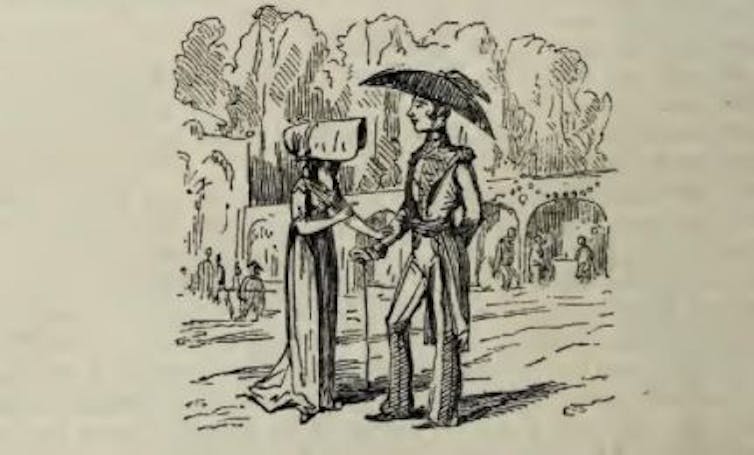
An caricature in Vanity Fair of the fashions of the early 1800s.

An illustration from Vanity Fair entitled Hideous Costumes. Author provided.

In the above illustration, Thackeray caricatures the fashions of the early 1800s. The angular lines of the man’s hat and trousers, and the woman’s elongated bonnet, which mirrors the straight line of her dress, are supposed to exemplify “hideous” Regency fashions.

An illustration from vanity Fair.

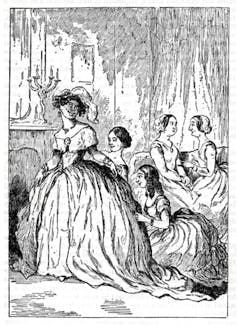
Miss Swartz rehearsing for the drawing room. Author provided.

In contrast, other illustrations in “Vanity Fair” show Thackeray’s characters in dress typical of the mid-century. The image to the right shows the heiress Miss Swartz adorned in an 1840s ball gown, which is cut low off the shoulders and features a pointed bodice and full skirts.

In addition, historian Anne Hollander notes that Charlotte Brontë’s “Jane Eyre” (1847) — the second edition of which was dedicated to Thackeray — likewise plays with the presentation of historical fashion. Though not as overt as Thackeray, “Jane Eyre,” which is supposedly set at the beginning of the century, also “evokes those same Romantic clothes contemporary with its authorship”.

In this sense, just as costume dramas do today, some 19th-century novels adapted, idealised, and even sexed-up fictional fashions to suit public taste.

Danielle Dove, Visiting Research Fellow in Victorian Literature, University of Surrey

This article is republished from The Conversation under a Creative Commons license. Read the original article.

Upcycling old jars is self-care in its purest form

An object is often worth more than its material form. It can bring with it cultural echoes, family history, and personal memory. In The Things We Treasure, writers tell us about their most priceless possessions — and the irreplaceable stories behind them.

* * *

2020 was a year of acquired hobbies. We baked sourdough, made puzzles, poured candles, pressed flowers, and knitted sweaters. The bread, we ate, the candles, we burned, the rest, we kept and wove into the fabric of our homes. Like trinkets that remind us of travels past, the objects that kept us busy have become tangible memories of a year past. It is now 2021, and our homes have become museums of our lives on lockdown.

My own museum looks like this: an old pickle jar I painted when hospitals in New York City were imploding. A tiny pesto jar I turned into a candle holder for date nights. An empty can of tomatoes I wrapped in twine and transformed into a plant pot. All of them were born in isolation — my own Corona-babies made of angst, kitchen rejects, and the urge to feel useful when time moved at a glacial pace.

For those of us privileged enough to complain about the sameness of staying at home 24/7, life screeched to a halt sometime last spring. Mondays bled into Sundays and Sundays bled into Mondays. The clocks may well have stopped, and 2020 could’ve been one draining, drawn-out pause. Except it wasn’t, and all I have to do is look around for proof.

I painted my first pandemic jar to the sounds of sirens in the background. Shortly after, my husband and I left New York to hunker down at his parents’ house in California. We thought we’d be there for a month or two, so I didn’t bring my glass paints. We stayed for five months — enough to buy new paints and start a California COVID collection, but I didn’t know then what I know now, so I just watched the world unravel, feeling weak and out of sorts.

Last time I felt this way, it was 2015 and I was living in London. I was stuck in a stagnant relationship, in a stagnant position at work, and in a stagnant year that I now see as a quarter-life crisis. Looking for an escape, I found solace in used glass containers, which, like me, were emptied and ready for change. I started collecting bottles then, upcycling our own wine bottles and rummaging for more exciting shapes in my retail job’s recycling bins. By the time I moved out a year later, I had amassed two boxes worth of upcycled bottles and jars. My ex asked to keep one of them, I shipped the rest back home to Bulgaria, and shipped myself to Paris.

A lot has changed since then: I moved three more times, met an American boy, endured three years of long-distance, uprooted myself to New York City, married said American boy, and trained him not to throw away pretty jars. I didn’t paint much in those years; collecting objects isn’t synonymous with a nomadic life. But when the pandemic set in and doom-scrolling became a routine, I found solace in glass jars again.

I used to paint cityscapes, autumn leaves, and colorful animals. I now revel in abstract, perhaps more meditative patterns. But it doesn’t matter what I paint, because this isn’t about that. It’s about doing, instead of consuming. Breathing life into something past its prime and giving it a renewed sense of purpose when my own has been diluted. It’s a form of self-care l have learned to seek out, like a ritual that refills my body when it is too empty to feel.

Many of us have learned to build our own self-care rituals. After a years-long hiatus, my grandma rediscovered knitting. “It keeps me from just staring,” she told me. My sister-in-law started playing tennis every day, and my best friend took on sewing. She hadn’t thought much of it until I asked how it makes her feel. “It gives me a small sense of pride at a time when life has lost some of its meaning,” she said.

The last year has been such a whirlwind that many of us haven’t had time to put labels on the things we do and how they make us feel. Until the start of the pandemic, I thought of upcycling as a fun hobby that also happened to be sustainable. I now know that this hobby is self-care in its purest form. And because I know that to be true, the effects of it feel stronger. It may be a trick of the mind, a placebo of sorts, but if it works, does it really matter?

In the face of trauma, it can be hard to seek out the good over the bad. But as winter peaks, I’m learning to make healthy decisions for myself. It doesn’t always work, and I often find myself sinking into the couch, scrolling through the social-media veneer of people doing fun, perhaps unsafe, things while I mope around. But when I’m done moping around, I pull out my paints and sit on the carpet, ready to breathe life into a new glass jar — and into myself.

Related reading:

Student debt is driving more Americans to donate their eggs — and some suffer lasting complications

Janine* was raised by a single mother in the San Francisco Bay Area. With resources tight, both she and her sister needed to find a way to put themselves through college. Her sister started donating her eggs for pay once she turned 20, working two jobs and struggling to stay in school. When Janine turned 19, she started donating eggs as well. “I was a desperate college student, living paycheck to paycheck,” she told me “So, when my sister told me I could make $7,000 donating eggs, I jumped at the chance. You have to get an education. If it weren’t for that desperation, most women wouldn’t do it.” 

The cost of college tuition in the US across all sectors has more than tripled in the past twenty years—well beyond the cost of inflation—making education out of reach for many. The rapidly rising cost of education has led to a rise in student loan debt as parents and students borrow to help ensure their dream of future success.

I’ve learned through my interviews and surveys with more than 600 egg donors that student debt burden leads some Americans to make medical decisions they might not otherwise make. 

Egg donation can help people create the families they desperately desire, and many egg donors have no complications and find egg donation rewarding. However, it is not a medical procedure to be entered into lightly, or under financial duress.  Over 60 percent of the US donors I surveyed agreed that “financial need strongly influenced my decision to donate.” Forty-five percent had between $10,000 and $100,000 of student loan debt, some with more than that, and spent the money from their egg donations to pay down that debt and other education costs. 

While making major medical decisions under the weight of crippling debt, at least 30 percent of egg donors reported feeling underinformed about potential short- and long-term risks and benefits.

Meghan* attended Northwestern University, outside of Chicago, and had accumulated over $100,000 in student debt. She was 23 and employed full time when her friend first told her about egg donation and how much money she could make.

“But I had a really hard time afterward. I had so much pain and bloating I couldn’t walk for a week, and I was nauseous and sick. I was miserable. I almost lost my new job because I couldn’t go to work. So, I decided I was done after that.”

Anna* underwent seven egg donation cycles starting at age 20. Her situation became complicated when the IRS came after her for taxes and penalties on the more than $60,000 she had made, and put a lien on her accounts. Her clinic never told her egg donation income was taxable, or that they had issued a 1099 on her. 

Anna underwent two more egg donations after she intended to quit just so she could cover a fragment of the IRS and student loan payments. Immediately following her seventh and final donation, Anna was rushed to the Emergency Room in extreme pain. After three days in the hospital losing blood, a doctor finally did an ultrasound to discover her ovary had twisted in her body and had to be removed. Medical bills amassed on top of her tax bills and student loan payments, leaving her with very little to live on. “It’s been a nightmare,” she told me. “I ended up in a deep depression because of it.”

Some donors in my study have undergone as many as 19 egg donation cycles—well beyond The American Society for Reproductive Medicine recommendation of no more than six in a lifetime. There are guidelines, but no established policy that prevents people desperate for money from continuing to donate. 

But if American egg donors often donate out of desperation, those from outside the US cite very different rationales. Indeed, I spoke with more than 100 egg donors living in other countries, including Spain, Canada, the UK, Australia, South Africa, and Brazil. Not a single egg donor from any of these locations cites student loan debt or high cost of education as a motivating factor behind becoming an egg donor. Not one.

The United States emerges in my study as the only country where women in their 20s feel compelled to make medical decisions with life-long implications to reduce or eliminate the affliction of student debt. Without this burden people may still decide to donate eggs for financial relief—even in countries like Spain where donor compensation is much lower than in the US—but they are not driven by the same financial desperation arising from the cost of education. 

Student debt grips the lives of many Americans in an unrelenting chokeholdderailing decisions to have children, buy homes, invest in retirement, and live unencumbered. Student loan forgiveness would make more resources available to invest in living life and building brighter futures. 

The Biden administration must heed the calls to reduce this burden. A just and humane society depends on it. Millions of Americans, including women, students of color, and first-generation college graduates are disproportionately affected by student debt — many for a lifetime. For the sake of students like Janine, Meghan and Anna, we need student debt relief coupled with reining in the high cost of education.  

*Names have been changed to protect privacy.


Behind the Aunt Jemima rebrand is a story of Antebellum romanticization — and concerns about erasure

What is Aunt Jemima’s maple syrup? 

After the Quaker Oats Company purchased the Aunt Jemima Mills Company in 1926 — which was then known for its ready-made “self-rising pancake flour” — it eventually introduced Aunt Jemima syrup 40 years later. It’s one of the most recognizable brands of “fake syrup,” which is made from corn syrup and high fructose corn syrup that is dyed and processed to mimic the appearance and flavor of pure maple syrup, which is made from maple tree sap. 

As The Washington Post reported in 2015, most Americans overwhelmingly prefer the taste of artificial syrup. Seventy percent of the 1,000 consumers surveyed by the publication indicated that they would rather reach for a brand like Aunt Jemima or Mrs. Butterworth’s than pure maple syrup. A large part of that preference can be attributed to price; you can purchase a gallon of Aunt Jemima for $16.80 on Amazon, whereas a gallon of Grade-A maple syrup starts at $59.99. 

Out with Aunt Jemima, in with the Pearl Milling Company

Amid nationwide Black Lives Matters protests, Quaker Oats announced plans in June 2020 to remove the image of Aunt Jemima from its packaging and changing the name of the brand. This week, the company announced that it had decided on a new name: The Pearl Milling Company.” 

For many, the change is long overdue — but the shift continues to raise questions about Black representation on mainstream products, as well as the afterlife of racist imagery and the continued romanticization of the Antebellum South. 

“We recognize Aunt Jemima’s origins are based on a racial stereotype,” Kristin Kroepfl, vice president and chief marketing officer of Quaker Foods North America, said in a news release in June. “As we work to make progress toward racial equality through several initiatives, we also must take a hard look at our portfolio of brands and ensure they reflect our values and meet our consumers’ expectations.”


What do you pour on your pancakes? Tell us in the comments!


At the time, other brands announced similar changes: B&G Foods announced that it would conduct a review of Cream of Wheat’s packaging, which depicts a Black chef who was originally based on Rastus, a racist caricature portrayed in minstrel shows. (The company changed the mascot in the 1920s to portray Barbados-born chef Frank L. White, but some say the connotation still remains.) ConAgra Brands released a statement saying it had “begun a complete packaging review” of the Mrs. Butterworth syrup brand, as the bottle was reminiscent of Mammy caricatures. 

Mar’s announced that it would evolve the “visual brand identity” of Uncle Ben’s products, which also originated in racist stereotypes and imagery and currently depict an elderly Black man. Dixie Beer Brewery and Eskimo Pie voiced similar initiatives, too. 

There was some pushback, specifically from white consumers who didn’t view the Aunt Jemima logo on the more contemporary packaging — the character’s “mammy” headscarf was removed during a 1989 update — and name as racist. According to Toni Tipton-Martin, the James Beard Award-winning food writer and author of the book “The Jemima Code: Two Centuries of African American Cookbooks,” the Aunt Jemima character and trademark “was used to create wealth for people that did not include the very people that the trademark was based on — and that would be African American women.”

“Today, it’s an innocuous figure, which is why I think we’re seeing the blowback and the questioning of her removal, because people see faces on packages all the time,” she told Salon at the time. “If you are talking about the origin story, then there was a significant message being telegraphed to the buyer — and M.M. Manring talks about this in the book ‘Slave in the Box.’ There’s this concept of assuring the home cooks who no longer had Black women in their kitchens through emancipation, they could still maintain the high quality cooking with the purchase of this product.” 

Referred to in Tipton-Martin’s book,  “the Jemima Code” focuses on the descriptions of and codes surrounding Black women who lived and worked in the plantation South, especially the caricature of Aunt Jemima. The logo signaled the quality of the product within to white consumers — without serving as a reminder of the cruel reality of enslavement in pre-Civil War America. Tipton-Martin said there was a message for Black shoppers, as well. 

“It would serve to remind African Americans that your options are limited,” she said. “You will always be the ‘slave in the box,’ hence the title of that excellent book. And those two concepts fused over the years so that only African Americans feel that identity, pain and loss of agency associated with characterizing African American female cooks as those who do the hard labor in the kitchen.” 

Fast-forward to February 2021, and Quaker Oats announced that the official name is changing from “Aunt Jemima” to “Pearl Milling Company.” PepsiCo, which owns the Quaker Oats brand, explained the story behind the new name in a Tuesday statement.

“Though new to store shelves, Pearl Milling Company was founded in 1888 in St. Joseph, Mo., and was the originator of the iconic self-rising pancake mix that would later become known as Aunt Jemima,” the statement read. 

The rebranded Pearl Milling Company also said in the statement that its new name was “developed with inclusivity in mind” and workshopped with “consumers, employees, external cultural and subject-matter experts and diverse agency partners.”

While removing racist imagery from products is imperative, some relatives of the women who portrayed Aunt Jemima throughout the product’s history are worried that the rebrand will contribute to the erasure of the legacies of female Black professionals. 

Descendants of Lillian Richard, who portrayed Aunt Jemima alongside 11 brand ambassadors starting in 1925, claimed that the company decided to rename the brand without consulting the families of the women who brought the character to life, according to WBUR.

While Vera Harris, Richard’s niece, supports the decision and the Black Lives Matter movement, Aunt Jemima represents a part of history for her family and the town of Hawkins, Texas.

“Erasing my Aunt Lillian Richard would erase a part of history,” Harris, who serves as family historian for the Richard family of Hawkins, told the station. “All of the people in my family are happy and proud of Aunt Lillian and what she accomplished.”

In Hawkins, a historical marker commemorates how she made a career during a time in history when Black women had very few opportunities. To keep her aunt’s legacy alive, Harris told WBUR that she hopes Quaker Oats comes out with a commemorative box or bottle to recognize the many women who portrayed Aunt Jemima over the years. The back of the box could list their names and put a spotlight on one of the women each month, she suggested.

Harris would like to see the box include a photo of her aunt dressed as Aunt Jemima with the scarf — but also a photo of Richard looking like herself to show people a more complete picture.

“She was an intelligent, young, vital, beautiful Black woman that took the job,” Harris said. “She understood the times that she lived and she just wanted to work.”

Brand recommendations, plus Salon’s favorite recipes featuring maple syrup

Pearl Milling Company products won’t officially be on the shelves until June, according to the company’s release. This, combined with the increased attention on the racist roots of Aunt Jemima, has inspired many consumers to look for Black-owned maple syrup companies. 

One such brand is Michele Foods, which was founded and is owned by Michele Hoskins of South Holland, Ill. Her company, which saw a 78% increase in sales following news of the Aunt Jemima rebrand, sells gourmet maple syrup (as well as butter pecan syrup and honey creme syrup). The packaging also features an illustration of Hoskins on the bottle. 

Deven and Marquita Carter are the owners of Blanket Pancakes & Syrup, which is located in Charlotte, N.C. They sell original, vanilla bean and cinnamon syrups, which are free from preservatives and high-fructose corn syrup. 

Once you pick them up, here are some of Salon’s favorite recipes featuring maple syrup: 

This S’mores Tart is so simple to make (the filling is just chocolate chips and cream)

We can’t overstate how much we love this s’mores tart. It’s so simple to make (the filling is just chocolate chips and cream) and strikingly geometric and luscious to behold. The marshmallow topping quickly broils in your oven to a gorgeous golden crust and brings to mind summer campfires (with fewer charred-marshmallow rejects). It was inspired by our “Weekends with Yankee” visit to the Sandy Pines Campground in Kennebunkport, Maine, where we made gourmet s’mores with a whole smorgasbord of candies and cookies.

Bonus tip for non-bakers: You can always make this tart with a store-bought graham cracker crust.

***

Recipe: S’mores Tart

Total Time: 55 minutes
Hands-On Time: 40 minutes
Yield: 8-10 servings

For the crust

Ingredients:

  • 12 graham crackers, roughly broken
  • 7 tablespoons salted butter, melted
  • 1/4 cup granulated sugar

Instructions:

Preheat oven to 350° and set a rack to the lower third position.

In a food processor, pulse the graham crackers, butter, and sugar until well ground. Press the crust mixture into a 9-inch tart pan with a removable bottom. Set the tart pan on a sheet pan and bake until the crust is set but not browned, about 10 minutes, then allow it to cool at least 1 hour or up to overnight.

For the filling

Ingredients:

  • 8 ounces semisweet or bittersweet chocolate chips (go with semisweet unless you prefer very intense chocolate flavor)
  • 1 cup heavy cream
  • 1/4 teaspoon kosher salt
  • 19 large marshmallows, halved crosswise
  • 50–60 mini marshmallows

Instructions:

Pour the chocolate chips into a medium bowl. Put the cream into a small saucepan and set over medium-high heat, stirring occasionally, until it just begins to steam; watch closely and don’t let it boil. (If you overheat the cream, the chocolate may separate.) Pour the hot cream immediately over the chocolate and add the salt. Let the mixture sit 3 minutes, then stir thoroughly to combine.

Pour the ganache evenly into the cooled, prebaked tart crust. Chill it in the refrigerator at least 1 hour and up to overnight to let the ganache set. Just before serving, preheat your broiler and set a rack so it is about 7 inches from the heating element. Cover the top with the halved marshmallows, then fill in any holes with the mini marshmallows. Broil the tart, turning frequently, until the marshmallows puff and turn golden brown, about 45 seconds. It will burn quickly, so keep the door open and pay attention! Remove from the heat and refrigerate for at least 30 minutes to let the tart set, then cut with a sharp knife, dipping it in hot water as needed to prevent sticking, and serve.

The fridge organizing tool you’re not using (but should)

Welcome to Storage Wars, a new series about the best ways to store, well, everything. From how to keep produce orderly in the fridge (or not), to ways to get your oddball nooks and crannies shipshape; and yes, how to organize all those unwieldy containers once and for all — we’ve got you covered.

* * *

This past year, my fridge has been through tumultuous times, swinging between desert island-empty and world-is-ending-full. I’ve used the lean times to clean it out: wiping down shelves, removing expired foods, and airing it out (an open packet of baking soda really does wonders for odors!). But then, in the blink of a blizzard, it’d be full again.

And if there’s one thing I’ve learned from having a very full fridge, it’s that it quickly descends into chaos. And food waste.

Some of the best tips I’ve learned from working at Food52 are around how to extend the life of food in my fridge (lower shelves for dairy and eggs! Separate ethylene-producing fruits and veggies from ethylene-sensitive ones!). But there’s a separate problem that has long plagued my fridge — a complete lack of order. The biggest culprits (and victims)? My condiments, chutneys, and spreads, teeny containers of takeaway sauces, mason jars of pickled veggies, and that bottle of mold from who-knows-when stuck in the back.

My freezer reported similar scenes of chaos: packs of samosa, waffles, and black bean burgers collapsing on each other.

On the verge of giving up, I turned to the corners of the internet (Instagram and Pinterest, of course) that order-seekers go to for a shot of hope, and there staring at me was the solution to my sorting woes: BINS. Yes, bins. The kind that go in your pantry, below the sink, and on your bathroom ledge. But also belong in your fridge.

I rushed out an email to organizing pro, Rachel Rosenthal: “Was I missing a trick,” I asked? Short answer, yes — and she’s been on it all along: “It’s actually one of my number one go-to organizing hacks.” Zoning, she says, is the outcome I was looking for. “As with all organizing,” she continued, “it’s important to create categories in your fridge: snacks for the kids, dinner ingredients, leftovers, produce—and bins help you do that.”

Rosenthal especially recommends bins for their stackability — to utilize the height in your fridge. “This allows you to maximize the space by going vertical but still allows for easy access for the items stored underneath.” As she said that, I had a feeling of déjà vu. Wait a minute — I was already doing that . . . but in my pantry.

That got me thinking: If it’s good for your pantry, it’s probably good for the fridge. After all, the same principles apply: zone, label, stack, elevate. So, why stop at bins? Why not employ all pantry organizers — trays, baskets, lazy Susans, even tiered shelf organizers? Why hadn’t I thought of that before?

As it turns out, buying bins was way more exciting than I thought it’d be: there were bins to contain condiments and yogurts, for berries and yogurts, even divided bins for freezer contents. And if you’re not keen on accumulating more plastic, which I totally get, I have two words for you: wicker baskets! I came across the inspiration the other day (I’m on a roll.) and it prized my organizing brain wide open. “Farm-stand vibes for your city fridge,” Caroline Mullen, Assistant Editor, called it. Try saying no to that.

Before you go, I’m going to leave you with one last thought: Once you’ve sorted your fridge into bins, you’ll be left with less drips and dribbles on your shelves. All you need to do is clean out the bins each month (or wash/replace their liners) and your fridge will need to be deep-cleaned that much less. The wins never stop coming!

My (New) Favorite Pantry Fridge Organizing Tools:

1. The Home Edit Fridge Storage Solution, The Container Store

The Home Edit ladies are at it again, telling us what we need before we even realize we need it. This collection of bins is great as a combined buy, but if you’re like me, you’ll pick individual items to suit your needs (Pssst: I went with thisthis, and this.)

2. Wire Basket, IKEA

Wire mesh bowls and baskets are incredibly useful to have around — just ask your fruit and eggs. You can also use these instead of plastic bins to corral bottles together, but you’ll want to use liners so things don’t drip onto your shelves (the very thing you want to avoid!)

3. Food Storage Container Bin With Handles, Amazon

This conveniently sized storage bin (with handles for grab-n-go!) is perfect for boxed foods, condiments, and baking supplies. It’s also great for using throughout the home: we can see it holding medicines, toiletries, craft and school supplies . . .

4. Nested Mixing Bowls, Food52

Instead of buying bins for berries and citrus, maybe let your mixing bowls do double-duty in the fridge. And when they’re not needed (my fridge in lean times), stack ’em away neatly — they nest together!

5. Pull-Out Under Shelf Drawers, Walmart

These retractable under-shelf bins can be adjusted to the size you need to maximize space utilization. Plus, those candy colors get me every time.

This post contains products independently chosen (and loved) by Food52 editors and writers. As an Amazon Associate and Skimlinks affiliate, Food52 earns a commission on qualifying purchases of the products they link to.

“The Luminaries” is a simple, heavenward gaze at an affair interrupted by a con

Beauty is the wind pushing “The Luminaries” through its six hours, and it is no weak gale. When the plot thins and reveals the ordinariness behind the narrative’s pretensions it’s usually enough to drink in the scenery as it’s translated through cinematographer Denson Baker’s lens. Sweeping shots capture every magnificent glint and spray the ocean offers up, veil the eyes with greenery, and drape the imagination with otherworldly lighting. New Zealand’s tourism board should be pleased.

As for how the viewer might feel, that depends on what you’re expecting from the limited series.

“The Luminaries” is based on Eleanor Catton’s 2013 novel, a highly structured work that plays with the concept of circles within circles and progresses from very thick descriptive passages to segments that are increasingly pared down as it puts together a murder mystery through the perspectives of 12 men.

Some characters’ personality profiles are dictated by the zodiac while others represent planets, the moon and the sun. Assuming you are curious to see how this translates to TV, let me spare you the energy and divulge that it doesn’t.

More accurately, Catton opted for a simpler solution in adapting her novel to the screen. She cast aside much of the creativity that contributed to her winning the Booker Prize in favor of a facile plot about thwarted lovers, set in 1865.

This presents a problem straightaway, though, since the actors at the heart of the romance, Eve Hewson and Himesh Patel, lack the slightest hint of a spark between them, making all the pining Patel’s Emery Staines does for Hewson’s Anna Wetherell seem . . . off.

They first see each other on a ship taking them to New Zealand in a meet-cute that comes off like the beginning of a nice friendship and little else. The two do have a few things in common: each seeks a clean slate. Emery intends to get in on the gold rush, while Anna’s plans aren’t nearly as clear. And as it turns out, they also share a birthday.

Plans to get together for dinner are derailed by a pickpocket in town who leads Anna to Lydia Wells (Eva Green), a sophisticated charlatan acquainted with all the best people in town, most of whom are reprehensible but dress like gentlemen.

In the meantime Emery is betrayed by his friends and falls into the clutches of a con man named Carver (Martin Czokas) who swoops in to offer guidance and smoothly gets the young naïve Brit to sign his life away in a bad deal.

Step by step the two mount an escalator of worsening choices compounded by the fact that the people deceiving them are playing angles against other people even as they’re bleeding each of them for their own reasons.

Emery gets the better side of the deal since he makes a true friend in a Maori man named Te Rau Tauwhare (Richard Te Are). Anna must navigate Lydia’s manipulations that begin from the moment they meet when she realizes the new arrival is illiterate. But Anna’s inability to read doesn’t mean she’s stupid. Soon she figures out that her new benefactor, a self-styled soothsayer and proprietor of an astrology-themed kinda-sorta-brothel, is a fraud on many levels.

When Lydia’s estranged husband Crosbie (Ewen Leslie) stumbles through the doors of her palace unexpectedly, spilling a fortune’s worth of gold on the floor, the flimsy table upon which Anna’s life is balanced flips over.

Simple, yes? Only for the purposes of writing about it. In reality “The Luminaries” contains a number of barely developed secondary and tertiary side characters muddying its progress, many of whom have some knowledge of either Anna or Emery or the murder.

Yes, there is a murder, and this isn’t a spoiler since that’s where the story begins, with the overly used in medias res treatment. We do not meet Anna on the boat but stumbling up a hill clutching a wound in her stomach. When she pulls her palm away to look at the blood, specks of gold flutter forth, as if she’s bleeding riches.  At first it looks like she might be magical; she isn’t, except when she is.

The supernatural aspect of “The Luminaries” isn’t confusing as much as it is a bit of a lazy solution to the quandary of how to ensure these lovers can return to one another somewhat organically in ways beyond the standard chance encounter. During one of Lydia’s lyrical speeches about fate and destiny and the stars she raises the concept of astral twins, and naturally this is what Emery and Anna turn out to be. The implications of this emerge in the course of the story, and it plays into a subplot about stolen identities.

Does that make sense? Probably not. Yet as obtuse as that may read, simplicity defines “The Luminaries.” Occasionally the narrative shoals slow it down too. Again, I refer you back to its gorgeousness and personality, paired concepts realized in Green’s performance and chic, color saturated wardrobe. You can’t miss her, and why would you want to?

As she purrs Lydia’s ridiculous star-gazer hooey she soaks every syllable in temptation; she’s where the chemistry is hiding in this series, especially noticeable when she and Czokas are together. Anna might not believe in Lydia, but Green beguiles us into believing in her, as we did in “Penny Dreadful.”

Hewson and Patel give credible performances, although each is at their best when they’re with other people, and that’s not something you want to notice in your romantic leads. The . . .  questionable? positive? . . . side of the adversity written into their separate star paths is that it keeps the machinations of plot interesting.

Catton’s book is far more adventurous, and it’s strange to think that she and her co-writer and series director Claire McCarthy diluted the novel’s ambition so completely. The plot’s lack of confidence notwithstanding, for some people Green’s presence may provide enough reason to drift along from one beautiful sight to the next, unconcerned as to where it’s all leading.

“The Luminaries” premieres Sunday, Feb. 14 at 9:30 p.m. on Starz.

Poor ventilation in multifamily buildings may lessen benefit of staying at home to avoid COVID

Lindsey first noticed the symptoms in mid-December. Her wife was even sicker, with a high fever. Six days later, testing confirmed it: they both had Covid. Lindsey knew she had to tell the neighbors upstairs. The two apartments share a thermostat and heating system in a five-unit, 1920s-era brick building in a Maryland suburb of Washington, D.C. Cooking smells from above frequently infiltrate their apartment, and Lindsey (whose name has been changed; she agreed to speak on condition of anonymity) was concerned she and her wife could pass the illness on to their neighbors, who are also the building’s owners.

When she went to warn them, she was in for a surprise — one with implications not only for Lindsey and her wife, but also, potentially, for public health messaging and policy nationwide.

“I told my neighbors that we had it, and that we would prepare by covering the vents,” Lindsey said. “Little did I know that they were sick, and we were incubating in it.”

In fact, the neighbors were just preparing to emerge from quarantine. But no one thought to notify the tenants with whom they share a network of vents and ducts that during winter recirculates air between the two units.

Airborne transmission of the virus that causes Covid-19 has been a subject of considerable debate and confusion over the past year. For months, public health experts openly disagreed on how far the virus could travel after being expelled in the breath of an infected person, resulting in a barrage of conflicting messages. The U.S. Centers for Disease Control and Prevention (CDC) has repeatedly contradicted itself on the issue, saying one thing and then another.

An open letter

Last November, a group of 239 scientists penned an open letter to the World Health Organization and other national and international bodies urging that airborne transmission be taken seriously. Existing evidence demonstrates “beyond any reasonable doubt,” they wrote, that viruses released by breathing, talking and coughing can remain aloft in air and pose a risk of infection at distances in the tens of meters.

This occurs most often within enclosed indoor spaces, especially with prolonged exposure or poor ventilation, the CDC now says. Virus transmission between rooms, even apartments, is considered less likely — yet that’s exactly how Lindsey and her pregnant wife, who say they took extra care to avoid the virus, believe they ended up getting sick: in the one place they thought was safe.

Rare as it may be, their story is plausible, University of Colorado professor of mechanical engineering Shelly Miller told FairWarning. She spoke with Lindsey by phone in mid-January after Lindsey reached out to her by email.

Miller, an expert in airborne transmission of Covid, later used Twitter to seek out other opinions on Lindsey’s case — and perhaps more leads. She got them, including a number of new anecdotal reports like Lindsey’s. Multiple people referred her to a recently published case study in a peer-reviewed journal describing an outbreak in a South Korean apartment tower where the virus appears to have spread from floor to floor via a ventilation shaft.

Miller also learned of an outbreak in an Australian “quarantine hotel”, where residents must stay inside their rooms for 14 days, yet four guests in two different rooms and a member of the cleaning staff, all on the same floor, contracted the same new, highly infectious U.K. strain of Covid.

The outbreak led Queensland Premier Annastacia Palaszczuk to order an evacuation of the hotel and to speculate publicly that the virus may have been transmitted through the air-conditioning system.

Max Sherman, a senior scientist with the Lawrence Berkeley National Laboratory and distinguished lecturer with the American Society of Heating, Refrigerating and Air-Conditioning Engineers, says that in addition to air-handling systems, natural airflow through multifamily buildings — dictated by differences in pressure and temperature — could also theoretically spread the virus: under doors, perhaps, or through even smaller gaps.

“If you open your window to get some ventilation, that’s good for you, but if you’re pushing infected air from your room into the hallway, you’re putting other people at risk,” Sherman said. “If the infected apartment is the one that’s getting the fresh air, then it’s contributing some amount of infected air into other places.”

Not airtight

This phenomenon may be more common than many think, says Monica Rokicki-Guajardo, a building scientist based in Virginia. Another potential pathway for unintended air flow between adjoining apartments is the common or “party” wall, a shared wall separating two individual units that is typically not airtight from top to bottom.

“If you have a negative pressure on one side and a positive pressure on the other, and there’s a hole for it, it’s going to move,” Rokicki-Guajardo said. “I’m not sure if there’s a way to solve it, as a matter of policy, because it would take too long, and it would freak people out.”

Even back in the early months of the pandemic, officials in New York State had some indication that the virus could spread through housing. A May 2020 report determined that two-thirds of roughly 1,000 patients hospitalized at 100 different hospitals had been sheltering at home prior to infection. Most were people of color in New York City, and thus more likely to live in multi-family housing in which air filtration systems might be poorly maintained. Governor Andrew Cuomo called the findings “shocking.”

Yet as recently as December 31, San Francisco and Los Angeles County, both of which experienced large surges in Covid cases over the preceding month, issued new “safer-at-home” orders requiring residents to stay in whenever possible — without so much as mentioning multifamily housing. Los Angeles’ 15-page order includes specific rules for playgrounds, restaurants, zoos, and hair salons, but not apartment buildings or condominiums.

FairWarning reached out to officials in both cities to ask why their recent orders did not address potential airborne transmission in multifamily housing, whether within common spaces like lobbies or hallways or between units via air-handling systems.

Los Angeles County did not respond to multiple requests. A representative of San Francisco’s COVID Command Center replied via email that “there is currently no evidence to date that viable virus has been transmitted through a mechanical ventilation system that resulted in disease transmission to people in other spaces of the building.”

Back in Maryland, Lindsey begs to differ. And as a building contractor working throughout the D.C. metro area, she also believes there are many other buildings in the region, especially older brick ones, that have been carved into smaller apartments still sharing a central heating, ventilation and air-conditioning (HVAC) system.

“That’s a common problem,” she says. “HVAC retrofits are very costly because of the brick. To run all that new ducting is costly.”

Educating landlords

As a result, she also believes public health officials should be doing more to head off this potential risk — not by forcing landlords to renovate their HVAC systems, but by educating them about airflow and filters, and even requiring them to disclose to tenants the presence of shared ventilation units. Her landlord balked at the latter suggestion, she said.

Meanwhile, as the pandemic enters its second year and a series of new, more infectious virus variants begin to circle the globe and threaten the U.S. anew, home is where the CDC and other public health authorities continue to say we’re safest, often without acknowledging any increased risk of airborne transmission from sheltering in crowded, substandard or aging multifamily housing.

On its website, the CDC offers a series of “considerations” for owners and operators of multifamily housing. Among them are familiar practices like wearing masks and maintaining social distancing in public areas. But the document does not address the potential for transmission between units through air-handling systems or incidental air flow.

William Bahnfleth, a professor of architectural engineering at Pennsylvania State University and chair of the American Society of Heating, Refrigerating and Air-Conditioning Engineers’ Epidemic Task Force, said there are a number of actions that local health authorities can take to protect residents of multifamily buildings.

He said authorities should recommend, if not require, inspection of air filters and other components of HVAC systems to assure that individual apartments or rooms are properly ventilated. They could also advise landlords on the use of in-room air cleaners, he added.

For tenants concerned they may be breathing high concentrations of their neighbors’ air, Lindsey suggests a simple test that in her case was prophetic: “If you can smell your neighbor’s food pumping through into your living room, that’s a sign,” she said. “If those molecules are coming through, that’s a good sign that there is air exchange.”

The science behind aphrodisiacs

It’s Valentine’s Day, when couples all over the world plan special dinners and desserts to “get in the mood,” as it were. Indeed, in the Western World, our sole holiday celebrating love and romance has its own concomitant food culture: chocolates, strawberries, oysters, caviar and red wine are all intrinsic to Valentine’s Day menus because of their reputation for being aphrodisiacs — meaning food that can, supposedly, make one feel more amorous.

The idea that some food or drink are aphrodisiacs dates back millennia: The ancient Greeks believed in the sensual power of pomegranates, truffles and garlic; the ancient Roman poet Ovid recommended everything from eggs to “honey from Mount Hymettus” (a range in the Athens area) to get into the mood; and the medieval philosopher St. Thomas Aquinas argued that meat and red wine could produce the “vital spirit.” And Americans seem to believe that certain foods enhance the mood: after all, Americans on average buy roughly 58 million pounds of chocolate in the week leading up to Valentine’s Day. And though the idea of aphrodisiac food is widespread, is there any science to it? Do certain foods really make us feel more horny, or romantic?

As it turns out, they do. Nutrition experts say that aphrodisiacs do have some science to them, although that doesn’t mean that there are foods which automatically heighten sexual desire.

“Food can act as an aphrodisiac in several ways,” Dr. Lauri Wright, spokesperson for the Academy of Nutrition and Dietetics and associate professor at the University of North Florida, told Salon by email. “Some foods relax blood vessels and improve blood flow to the genitals, similar to Viagra. Foods that increase blood flow include red wine, dark chocolate, strawberries, beef, walnuts and avocado. Individuals that don’t have compromised circulation won’t see any changes from consuming these foods.”

She added that, in the case of foods like chocolate, caviar and oysters, which pop culture has accepted as aphrodisiacs, “there is no scientific evidence to support” the belief that they are, and “in fact, no evidence has shown that there is any food that heightens sexual desire.” She said that “one ‘food’ that has been shown to increase sexual arousal is alcohol, by decreasing inhibitions. The downside however is alcohol can decrease sexual performance.”

Likewise, there is a psychological component to certain foods acting as aphrodisiacs that is complimented by the way our bodies naturally respond to them.

“Typically things that become associated with sex or as aphrodisiacs are either foods that are very sensual — so that the sight, touch, smell and taste are enticing. I would probably put strawberries kind of in that category,” Dr. Nan Wise, a sex therapist and behavioral neuroscientist, told Salon. “They stimulate the senses which can stimulate desire, but I would not call them scientifically anything that is actually an aphrodisiac.” Wise also noted that foods can mentally have an aphrodisiac effect, regardless of their actual chemical properties, because they look like things that reminds us of sex — in other words, acting as subtle psychological hints.

“Things like oysters look a little bit like a vulva, so anything that looks like a genital has been associated historically with sex,” Wise explained. “Things that look like penises or in some way like female genitalia that have been associated with sex by looking like that. People make the connection with that, but that’s not aphrodisiacs.” She said that in history sometimes have people taken this more literally, such as when cultures have eaten animal testicles because they are related to reproduction.

“The idea of something being reproduction-related is sensual or exotic,” Wise told Salon, adding that “caviar fits both of those categories.”

There are some studies which claim to have discovered aphrodisiac qualities in certain herbs. A 2013 study in Pharmacognosy Reviews found that ambrein, a major ingredient in the Arab aphrodisiac Ambra grisea, “contains a tricyclic triterpene alcohol which increases the concentration of several anterior pituitary hormones and serum testosterone.” The same study found that Panax ginseng, which is used as an aphrodisiac in traditional Chinese medicine, “works as an antioxidant by enhancing nitric oxide synthesis” in erectile tissue in the genitals. 

A 2018 study in the Journal of Chemical and Pharmaceutical Research also identified Panax ginseng as a useful herb in helping sexual dysfunction, noting that the same is true of “Cannabis sativa L.” and a number of other herbs.

Martha Hopkins, co-author of “Intercourses: An Aphrodisiac Cookbook,” told Salon that there is another psychological way in which food can heighten arousal: The mere fact that you put the thought into preparing someone a meal that you believe they will enjoy and find to be romantic.

When cooking an “aphrodisiac” meal, it is “truly the thought that counts,” Hopkins told Salon. She said that most partners feel flattered and turned on by seeing their partners do an elaborate task for them, like cooking, regardless of outcome of the food or ingredients.

Still, the scientific jury is out on whether so-called aphrodisiacs have more than a minimal effect. A 2011 scientific review that analyzed multiple studies into aphrodisiacs concluded that “although most studies showed positive effects of aphrodisiacs on sexual enhancement, more studies are needed to understand their mechanism of action. . . . The need for clinical trials using larger populations is also evident to prove the effectiveness of aphrodisiacs for human use.” 

Clinical trials aside, the human mind is complex, and humans can be turned on by all sorts of things unrelated to physiological stimuli. If a food seems to put you and your partner in the mood and doesn’t hurt anyone, have fun with it.

“I think it really speaks to human beings having a desire to have a desire for sex and mixing up a whole lot of stories… [we] invest in certain substances with the power to turn this on — giving the substances the power of the belief,” Wise told Salon.

Marjorie Taylor Greene threatens fellow GOP congressman for offering to testify against Trump

Never one to stay on the sidelines, controversial Rep. Marjorie Taylor Greene (R-GA) issued a veiled threat on Twitter aimed at Rep. Jaime Herrera Beutler (R-WA) for coming forward and offering to testify that Donald Trump was well aware the Capitol was under assault when he spoke with Rep. Kevin McCarthy (R-CA) on Jan. 6th.

Herrera Beutler posted a statement late Friday night offering up information and calling on other “patriots” to come forward and testify against the former president.

That, in turn, led Taylor Greene to respond, “The gift that keeps on giving to the Democrats. First voting to impeach innocent President Trump, then yapping to the press and throwing @GOPLeader under the bus, and now a tool as a witness for the Democrats running the circus trial. The Trump loyal 75 million are watching.”

Those comments were perceived by many on Twitter as Taylor Greene inciting “mob violence” against her Republican colleague.

You can read some comments below:

What connects Trump’s two acquittals: The profound danger of the “Dershowitz precedent”

Donald Trump, who as president incited a riot in an effort to stay in office despite losing the 2020 election, was acquitted by the U.S. Senate on Saturday, putting an end to his second impeachment trial.

He was not acquitted because he was innocent. He was acquitted for one reason: Donald Trump and his supporters have a toxic sense of entitlement, believing that they should never lose an election. They would rather destroy democracy than accept being the losers. (This statement does not include the Republicans who know better but are too afraid of Trump’s “movement” to stand up to them.)

We shouldn’t have to say this, but it is necessary because Trump and his supporters have accepted as an article of faith that they must never be told “no.” This impulse motivates them to disregard laws, logic, facts and even basic human decency when the world doesn’t accede to their tantrums. Given that it is a blatantly anti-democratic instinct, they obviously need some rationalization to prop it up —  and they were supplied with one during Trump’s first impeachment trial, early in 2020. 

Last February I was on the phone with the man who articulated that rationalization most clearly, the legendary civil liberties attorney and longtime Harvard Law professor Alan Dershowitz. He was one of Trump’s impeachment lawyers — representing him during that first impeachment trial, not the one just concluded — and he was pissed about the way the media had depicted his defense of the then-president.

“My argument is very simple,” Dershowitz said. “If a president does something entirely lawful, and part of his motive for doing it is to help himself get re-elected because he thinks that’s in the public interest, that mixed motive would not turn innocent conduct into a crime or an impeachable offense. That’s all I said. Everything else is a mischaracterization.”

He later added, “If a president does anything unlawful, that’s completely different.” 

(Salon reached out to Dershowitz to be interviewed in a follow-up for this article; he initially agreed but did not reply to subsequent efforts to reach him.)

At the time, Dershowitz was responding to an editorial by Andrew Napolitano, the Fox News legal analyst and former New Jersey judge who had just published an op-ed attacking Dershowitz’s argument, saying that since “every president seeking reelection believes his victory will be in the national interest,” the result here could be that “all presidential efforts toward that victory are constitutional and lawful.” Napolitano characterized this as a “morally bankrupt, intellectually dishonest argument,” one that “effectively resuscitates from history’s graveyard President Richard Nixon’s logic that ‘when the president does it, that means that it is not illegal’ because the president is above the law.”

Dershowitz, for what it’s worth, had told the Senate much the same thing: “[E]very public official that I know believes that his election is in the public interest. And if a president does something which he believes will help him get elected in the public interest, that cannot be the kind of quid pro quo that results in impeachment.” (He cited a financial bribe as something that would be illegal.)

It seems like eons have passed since that conversation. Since then America has endured the worst pandemic in a century, one of the worst economic setbacks since the Great Depression and a riot in the Capitol perpetrated by right-wing extremists — that last event prompted by the first sitting president to lose an election and refuse to accept its results. (Ten previous presidents had been defeated in elections; all accepted the voters’ verdict.) As the entire world knows, Trump was impeached for a second time because — after his own Justice Department, dozens of state and federal judges and the entire Supreme Court had rejected his claims that the election was illegitimate — he told his followers on Jan. 6 that “we are going to the Capitol” to give Congress “the kind of pride and boldness that they need to take back our country.” (Four rioters and one police officer died, while hundreds of others were injured; so far there have been more than 200 arrests.)

It seems important to return to Alan Dershowitz, even if the first Trump impeachment feels like ancient history, because there’s a direct line between the belief system used to defend Trump during his first impeachment and his efforts to overturn his loss in the 2020 election.

Simply put, that’s the idea that, for Trump, there are only two possible outcomes of any election where he’s a candidate: He wins, or the whole thing is “rigged.” Since the latter is unacceptable, anything he does to achieve the former outcome is, by definition, justified.

Trump conditioned his supporters to think this way long before he became president. When he lost the Iowa caucuses to Sen. Ted Cruz of Texas in 2016, he accused his opponent of stealing that election. After winning the Republican nomination that year, Trump insisted without evidence that Democratic nominee Hillary Clinton was engaged in voter fraud and even refused to answer a debate question about whether he would accept the election results if he lost. He later told a rally of his supporters that he would only accept the results “if I win.”

As president, Trump continued spreading the message that it was impossible or unthinkable for him to ever lose an election. He was bitter over losing the national popular vote to Clinton (by nearly 3 million votes) and created a voter fraud commission to prove he had won that too. (It was disbanded after failing to produce any significant evidence of fraud anywhere in the nation.) As the 2020 election approached, Trump again told supporters that “the only way we’re going to lose this election is if the election is rigged.” During a debate, he once again refused to say whether he would concede if he lost the election, instead boasting that he would not “give a direct answer” and telling the moderator that he is not a “good loser.” (Trump’s refusal to accept losing has, according to experts interviewed by Salon, roots in everything from narcissistic personality traits to the fact that his sense of manhood — and that of his supporters — is tied up in always being “winners.”)

Trump repeatedly brought up baseless conspiracy theories and alternative facts during the 2016 and 2020 elections to “prove” that he was the victim of a vast conspiracy — and experts unanimously said he was wrong which only reinforced, for him and his supporters, that such a conspiracy existed. Those arguments were always after-the-fact rationalizations to support one thesis: If Trump doesn’t win an election, that is a grave injustice.

Let’s review, if we can stand it, why Trump got impeached the first time around. In July 2019, he called Ukrainian President Volodymyr Zelensky and threatened to withhold $391 million in military aid which had already been allocated by Congress unless Ukraine announced a spurious criminal investigation into Hunter Biden, who I probably don’t have to tell you is the son of the current president (then of course a Democratic candidate). Trump later insisted that there was no “quid pro quo,” but it defies common sense to describe withholding promised funds while asking for a “favor” as anything other than a thuggish attempt at coercion. 

Trump had no legal right to withhold that money. As the Government Accountability Office pointed out at the time, Trump’s claim that he had a “policy reason” reason for denying $214 million of that Ukraine aid was incoherent: The Impoundment Control Act “does not permit the President to substitute his own policy priorities for those that Congress has enacted into law” and the Constitution “specifically vests Congress with the power of the purse.” The fact that Trump’s motive was evidently corrupt made the whole thing more sinister, but it was illegal regardless.

In other words, Alan Dershowitz’s argument was wrong from beginning to end. Trump did not commit an otherwise innocent act that was only construed as illegal because its underlying motive was to win an election, analogous to Abraham Lincoln allowing Union soldiers to go home to vote in the 1864 presidential election because he believed they’d support him. (An example Dershowitz cited during our interview.) He was also wrong on a deeper level because of the implicit argument that anything Trump (or any other hypothetical president) does with the primary motivation of getting re-elected is effectively acceptable. From there it’s a short step to lying to the American people about mail-in ballots, filing frivolous lawsuits, inciting a riot or virtually anything else.

This way of thinking is not normal. In fact, in terms of American political history, it’s profoundly and freakishly new.

Let’s take a brief look at the other presidents who were either impeached or nearly impeached. Of the bunch, the only one who could legitimately plead innocence was the first one, Andrew Johnson. Despite being an unrepentant racist and incompetent commander in chief, Johnson was wrongfully impeached; Congress simply opposed his policies and kept trying to entrap him into breaking the law. Eventually they succeeded by passing the Tenure of Office Act, which prohibited the president from firing Cabinet members without Senate approval. That law was not only unconstitutional — violating the separation of powers between the three branches of government — but self-evidently impractical, since no president can effectively govern if employees are allowed to be insubordinate. Congress eventually impeached Johnson after he disregarded the Tenure of Office Act and fired Secretary of War Edwin M. Stanton, also including a few unrelated, but equally spurious, accusations. He avoided conviction by one vote. 

The other presidential impeachments or near-misses involved criminal conduct that, though serious, were nowhere near as severe as anything done by Trump. Richard Nixon resigned before a near-certain impeachment in the House and conviction by the Senate over the Watergate scandal, which mostly concerned a cover-up of his connection to a burglary at Democratic National Committee headquarters. Nixon was obviously motivated by a desire to boost his chances of re-election, but neither he nor his staunchest advocates ever claimed he had some inherent right to do anything and everything to win. Republicans insisted for years that Nixon was innocent and being hounded by a liberal media witch hunt (the past is prologue!), but never disputed that if he were actually guilty, that would be unacceptable. After a secret tape recording made clear that Nixon had directed a cover-up of his role in the burglary, Republicans changed their tune, making clear to the leader of their party that he’d have to resign to avoid conviction in the Senate, which he did.

Bill Clinton was only the second president after Johnson to be impeached, after a series of sordid and unethical episodes that come nowhere near Nixon’s misconduct, let alone Trump’s. Clinton apparently lied under oath about an extramarital affair during a sexual harassment lawsuit and then obstructed justice during the subsequent investigation by tampering with evidence and asking others to lie for him. Democrats at the time largely rallied behind Clinton, but in retrospect his actions were indisputably sketchy: He had a sexual affair with a much younger White House intern, and even if his testimony about that might not meet the technical standard of perjury, it was certainly dishonest. In the post-Me Too era, it’s exceptionally difficult to defend Clinton, given the sheer number of credible accusations of sexual misconduct made against him. Still, neither Clinton nor his supporters ever argued that he had some inherent right to do whatever he liked and remain president.

While declining to comment on the specific arguments made by Dershowitz, his former Harvard Law colleague Laurence Tribe agreed that Trump’s acquittal in the first impeachment trial paved the way for the misconduct that got him impeached a second time.

“The first impeachment led almost inevitably to the second once Trump, whose whole modus operandi is built on lying, cheating, and stopping at nothing to secure power and fame was validated by the Senate’s unfortunate acquittal the first time around,” Tribe told Salon by email.

“Having thought nothing of exposing the people of Ukraine to slaughter at the hands of Russia by threatening to withhold congressionally appropriated aid in an effort to pressure Ukraine’s president Zelensky into injuring Biden by pretending to be investigating him and his son criminally, Trump upped the ante by threatening criminal prosecution of Georgia’s Secretary of State Raffensperger in order to get Raffensperger to steal that state’s electoral votes from Biden and, when that failed, by inciting insurrection by an armed and angry mob in a treasonous attempt to overturn the results of the 2020 election.”

Once again, Senate Republicans have acquitted Trump even though he is obviously guilty, which is precisely the same position they took during his first impeachment. On that occasion, only one Republican senator had the fortitude to vote to convict, and at least this time around Sen. Mitt Romney of Utah was joined by six of his colleagues: Richard Burr of North Carolina, Bill Cassidy of Louisiana, Susan Collins of Maine, Lisa Murkowski of Alaska, Ben Sasse of Nebraska and Pat Toomey of Pennsylvania. Their names will be remembered honorably, but it’s hard to say whether they have a future in the Republican Party considering that the other 43 GOP senators, along with the vast majority of Republican House members, voted against impeachment, effectively endorsing Trump’s coup attempt. 

Just as they argued in 2020 that threatening a country with foreign invasion unless they help you cheat in an election isn’t extortion, Republicans have argued this year that telling your supporters to take over the Capitol unless Congress helps you steal an election isn’t inciting a riot. Motivated by a mixture of partisanship, career opportunism and fear of Trump’s increasingly fascistic supporters, they have reinforced the idea in MAGA world that if their Dear Leader doesn’t win an election, that election simply does not count.

So where do we go from here?

The best-case scenario is still disgusting: Trump could be shoved down the Republican Party’s collective memory hole and dismissed as an aberration, one to be forgotten as we resume the more or less functional democratic politics that existed in our country before Trump took office. The worst-case scenario, however, is all too plausible: Trump, or someone very much like him, gets elected president in the future, understanding full well that now, for Republicans, the Dershowitz precedent holds that there is no legitimate way for them to lose an election.

Valentine’s Day: COVID-19 wilted the flower industry, but sustainability still a thorny issue

Cut flowers are a multi-billion-dollar business globally, closely linked to social events and holidays, such as Christmas, Hanukkah and Mother’s Day, and to happy and sad occasions, like weddings and funerals.

And then there’s Valentine’s Day.

In the United States alone, an estimated $1.9 billion worth of cut flowers are sold on or before Valentine’s Day each year. As Valentine’s Day approaches, and the chill of winter lingers, it leaves one wondering: Where do all these flowers come from? How do those roses get from grower’s land to lover’s hand?

As a professor who studies sustainability, I’ve investigated the impact of many business models, including cut flowers. If there’s enough money to be made (or favour to be won), the social and environmental implications of business decisions often are trumped by short-term economics.

The flower industry

Since 2019, the worldwide cut flower market had been blooming. The market for cut flowers, houseplants and landscape greenery was expected to grow roughly 6.3 per cent over the five years ending in 2024.

But that market wilted to an estimated US$29.2 billion in 2020, a 6.2 per cent contraction from 2019, largely due to the pandemic. In top spot, the United States accounted for US$7.9 billion, or 27 percent of the 2020 global market.

Florists typically sell cut flowers, as well as floral arrangements and potted plants. These items come from both domestic and foreign flower farms and wholesalers. In the U.S. and Canada around 80 per cent of these flowers are imported.

Florists are small businesses. In both Canada and the United States, the average florist has only about two employees. In Canada, the florist industry consists of an estimated 2,822 retail businesses, 5,054 employees and annual sales revenue of $602 million. In the U.S. last year, there were 31,663 florists, with 65,000 employees, in a US$5 billion market.

The cut flower supply chain

The cut flower supply chain often starts in Colombia. About 80 per cent of cut flowers sold in the U.S. are imported. Colombia is the No. 1 country of origin and Ecuador is No. 2.

While the Netherlands produces 80 percent of the world’s tulips, Colombia and Ecuador are the world’s largest producers of carnations and roses, respectively. As a symbol of love and romance, roses are the world’s most popular flowers.

The top four flower producing countries in 2019, in terms of export revenues, were: The Netherlands ($4.6 billion), Colombia ($1.4 billion), Ecuador ($879.8 million) and Kenya ($709.4 million).

Table showing rank of various flower exporting countries

Flowers grown on the Bogotá Plateau are cut, combined into bundles and hydrated for up to 24 hours — in preparation to enter the “cold chain.” As roses travel to Bogotá’s El Dorado International Airport in refrigerated trucks, shipping and storage temperatures are maintained at about 1C.

Next, those roses are flown to Miami, Fla. In fact, most cut flowers destined for the U.S. or Canada arrive via Miami International Airport.

In the case of Edmonton-based Grower Direct, roses and other cut flowers are loaded onto refrigerated trucks for direct delivery to stores across Canada. The entire journey, from farm to flower shop, takes as little as four days. Despite the speedy journey, 45 per cent of all cut flowers die before they are sold.

Low wages, pesticides and greenhouse gases

Sustainability attempts to balance social, environmental and economic implications of decisions and actions, today and into the future.

While the cut flower industry provides jobs for producers and distributors, there is a price. The International Labor Rights Fund notes that the industry has a reputation for low wages and poor working conditions. Workers on Colombian flower farms are predominantly female. They work 16 or more hours a day for a monthly wage of about $300.

Since flowers are not classified as edible, they are often exempt from pesticide regulations. Thus, many flower production workers in Ecuador and Colombia have suffered from respiratory problems, rashes and eye infections caused by exposure to toxic chemicals in fertilizers, fungicides and pesticides.

The Fairtrade movement is a response to this mistreatment. It aims to improve working conditions for flower farmers and workers, as well as living conditions in their communities, by ensuring they earn a living wage and by protecting their rights.

Moving flowers from South America to North America, in refrigerated trucks and cargo planes, in and out of warehouses along the cold chain, yields a large carbon footprint. During a typical peak season, 30-35 cargo planes arrive in Miami from Bogotá every day to meet American demand. While local production would ground some of those flights, growing flowers in greenhouses can use as much energy as shipping them from Colombia by air freight.

COVID-19 impact

On March 11, 2020, the World Health Organization declared COVID-19 a “global pandemic.” The timing could hardly have been worse for the cut flower industry.

Spring is the industry’s busy season, with weddings, Easter and Mother’s Day. But soon, weddings were being postponed and flower shops closed. As lockdowns went into place around the world, the market wilted. Growers in Kenya and Colombia began to toss roses away.

Now, as lockdowns and other restrictions begin to ease up, there is optimism that 2021 will be better, starting with Valentine’s Day. Indeed, the Society of American Florists anticipates “the biggest Valentine’s Day in decades” in 2021.

But what if you forget to bring a bouquet of roses to your Valentine on Sunday? You could remind him or her or them about the social and/or environmental ills of the cut flower industry.

Or, you could just buy the damn flowers. But be sure they are Fairtrade certified or locally grown. And be sure to wear a mask.

Paul D. Larson, CN Professor of Supply Chain Management, University of Manitoba

This article is republished from The Conversation under a Creative Commons license.

Isn’t it iconic? Alanis Morissette is Jenny Slate’s imaginary friend in Fox’s “The Great North”

“The Great North,” the new adult animated series on Fox, gives its characters — and its viewers — a lot of room to let their imaginations roam. From depicting Alanis Morissette (yes, the Alanis Morissette, who voices herself) as a floating torso who offers advice from the glow of the Aurora Borealis, to diving into a town-wide Feast of Not People festival, think of the show as a wacky, snow-covered cousin of “Bob’s Burgers.”

That vibe is derived, in large part, from the experiences of “Bob’s Burgers” writing partners and sisters Wendy Molyneux and Lizzie Molyneux-Logelin, who found that growing up in the wide-open spaces of rural Indiana offered different opportunities for storytelling. It’s one of the reasons they decided to set their new series “The Great North” in Alaska. 

“When we were little, we found what turned out to be a cow bone in a cornfield,” Molyneux said in an interview with Salon. “But for a week, my friends and I were like, ‘We have discovered a murder.’ So, my childhood is making a bit of a cameo here.” 

It’s a setting that has long inspired the imagination (like in the long-running and beloved series “Northern Exposure“) and still inspires unique adventurous activities, like capturing an errant moose, flying a puddle jumper in search of avocados, and a hyper-competitive curling league. 

“The Great North” centers on the trials and triumphs of the Tobin family, which is led by single dad Beef (Nick Offerman). He’s desperate to keep his only daughter, Judy (Jenny Slate) close, though she has artistic dreams that lead her away from the family fishing boat to work in the local mall’s glamour shot studio. Will Forte plays Judy’s eldest brother, Wolf, whose fiance Honeybee (Dulcé Sloan), has recently moved to Alaska to be with him. Then there’s Ham Tobin (Paul Rust), the middle brother, and Moon (Aparna Nacherla), the youngest. 

The Great North

Each episode is, quite literally, an adventure. Browsing the episode titles, there’s “Sexi Moose Adventure,” “Feast of Not People Adventure,” “Avocado Barter Adventure,” and “Romantic Meat-Based Adventure.” You’ll, uh . . . probably notice that meat is a enduring theme through the show, from serving as the basis of Beef and Ham’s actual names, to being the chosen theme of a local single’s event (which Judy obviously pushes her dad to attend). 

While the setting of “The Great North” separates it from their other Loren Bouchard-produced show “Bob’s Burgers,” where most of the activity takes place in the titular family restaurant in an unnamed seaside community, the two shows do share some DNA. Besides appealing to carnivores, both are set in the same general universe. 

Also, according to the sisters, they’re knit together by a common thread in how they depict their main families. Where many animated shows still mine sitcom-style family conflict – where the mom is the scold and the dad is kind of inept – for storylines, “Bob’s Burgers” and “The Great North” take a different tack. 

“I think sometimes comedy can come from shared delusion, right?” Molyneux said. “People who are weird in the same way. I think that’s where a lot of ‘Bob’s Burgers’ and ‘The Great North’ family vibes come from. They’re all in agreement that they like each other and that they like all the same weird stuff. They’re all participating in the same game.”

To create this weird family, the early stages of working on “The Great North” focused on securing the vocal talent essential to conveying these quirks.

“We really wanted to work with Nick Offerman and we were also huge Jenny Slate fans, so they came to mind,” said Molyneux-Logelin. “I think from there, we just naturally started thinking about what sort of dynamic they would have — father and daughter? I think that’s where we sort of built out the Tobin family, and we knew we wanted them to have a special connection, a special bond. So that’s when the idea came up of a single father and his only daughter.” 

Beef isn’t single through divorce or death. Rather, Judy’s mom has been in the wind for a while, which drives the early preview episode “Sexi Moose Adventure” (available now on Hulu). Therefore, the writers of the show knew that wanted to imbue the show with some additional female energy.

Enter Judy’s imaginary friend, Alanis Morissette. 

“We had started thinking about the idea that Judy might want to have someone to talk to, an imaginary friend or a muse,” Molyneux said. “We thought it should be someone who’s from the northern parts [Morissette is originally from Ottawa, Canada]. We eventually hit on Alanis because she was part of our childhood and adolescence, and it just clicked right away. We wrote it and just kind of hoped she would say ‘yes,’ which is not usually a great strategy, but in this case it worked out.” 

The “You Oughta Know” singer apparently had a great sense of humor about working on the show, and was often in on the joke. 

“It’s been just so much fun and she’s really, really funny,” Molyneux-Logelin said. “Sometimes we’re taking pieces of her music or her life and using it as advice to help Judy. You never know exactly how someone is going to react to that, and she’s just been so phenomenal.” 

With the addition of voices like Morissette — as well as characters like Honeybee and Judy — the sisters hope that “The Great North” will continue challenging what they characterize as a long-standing assumption that women aren’t as interested in watching animation as men, something that “Bob’s Burgers” characters like Tina, Louise and Linda have helped challenge as well. 

“I think especially with Tina, she really grabbed a lot of attention of girls that were more in that teenage space that really felt a real connection with her,” Molyneux-Logelin said. “I wasn’t surprised. I think that there’s always been that appetite for girls to see themselves in characters like that.” 

The sisters said that in working with Jenny Slate, who voices Tammy on “Bob’s Burgers” and recently stepped down from voicing Missy on “Big Mouth,” one of their goals was definitely to create another strong girl character that would sort of speak to “a little bit of how Wendy and I felt in our teen years of maybe not being the ‘coolest girl,’ but being drawn to this artistic world,” said Molyneux-Logelin.

Her sister agrees, adding that the idea that women wouldn’t like animation is an absurd cultural presumption, but one that still persists. 

“Of course women love animation. The question of, ‘Would women enjoy animation?’ feels like asking, ‘Do you think women would eat bread?'” Molyneux said. “‘Would they like to eat the bread with their mouths?’ And it’s like, ‘Of course they would eat the bread with their mouths! They are hungry and have bodies.’ It’s such a bonkers question.”  

“The Great North” premieres on Feb. 14 at 8:30 p.m. on FOX. The two early episodes that already previewed are currently streaming on Hulu

Trump fears he will face criminal charges for role in inciting Capitol Riot: report

Former President Donald Trump was not convicted following his second Senate impeachment trial, but reportedly fears criminal accountability for his role in the insurrection, CNN’s Kaitlan Collins reported Saturday.

“Kaitlan, I understand you are hearing that despite the acquittal, the former president is still very much worried about his legal future,” CNN’s Wolf Blitzer said.

“He is, Wolf,” Collins replied. “And privately he has expressed concern that he could be charged related to the January 6th rally — or riot I should say. That’s what he told multiple people.”

“That’s in part why he has been so quiet every since he left the White House,” she explained. “We hardly heard from the president, only in written statements, he does not have access to his twitter account and one adviser to the president told me that is directly related to that, is that he is concerned that charges could happen and could be awaiting him.”

“When you saw Mitch McConnell come out to try to explain his acquittal vote and he very strongly implied that the legal system should take care of Donald Trump, saying he was practically and morally responsible for that riot, that really does get at the heart of a big concern for the former president,” Collins continued. “It’s something that Liz Cheney said as well, implying there could be a prosecution in Donald Trump’s future related to what happened on January 6th and the role that he played in it.”

Watch:

Republican senators condemned as “cowards and fascists” after Senate acquits Trump

The Senate on Saturday acquitted Donald Trump on the single charge of inciting an insurrection against the U.S. government, with 43 Republicans voting to let the former president off the hook for his role in the deadly assault on the U.S. Capitol Building last month.

The largely party-line vote — with every Democrat and just seven Republicans voting to convict — capped off a historically speedy trial that included no witness testimony despite House impeachment managers’ last-minute push, which Senate Democratic leaders reportedly quashed behind closed doors.

“While a majority of the U.S. Senate has voted to convict Trump for his constitutional crimes, the Senate has failed to muster the two-thirds vote needed to convict him for crimes to which the senators themselves were eyewitnesses,” said Lisa Gilbert, executive vice president of consumer watchdog group Public Citizen. “So, this day, Feb. 13, 2021, will … be remembered for all American history as a stain on our history.”

Throughout the week of proceedings, many Republican senators didn’t bother trying to maintain even the appearance of upholding their oaths to act as impartial jurors in the trial, making their votes against convicting the former president unsurprising.

As Common Dreams reported, Sens. Ted Cruz, R-Texas, Lindsey Graham, R-S.C., and Mike Lee, R-Utah — each of whom voted to acquit Trump — met with the former president’s lawyers on Thursday to discuss “legal strategy.” Sen. Roy Blunt, (R-Mo., who also voted to acquit the twice-impeached former president, referred to Trump’s defense team as “our side” when speaking to the press earlier this week.

“The Republican senators who voted to acquit are cowards and fascists, and that is all their party stands for today,” Rep. Mondaire Jones, D-N.Y., tweeted Saturday.

The seven Republicans who voted to convict the former president were Lisa Murkowski of Alaska, Richard Burr of North Carolina, Bill Cassidy of Louisiana, Susan Collins of Maine, Mitt Romney of Utah, Pat Toomey of Pennsylvania and Ben Sasse of Nebraska. 

“Our Constitution and our country is more important than any one person,” Cassidy said following his vote. “I voted to convict President Trump because he is guilty.”

Sean Eldridge, president of advocacy group Stand Up America, said in a statement that “it’s unfathomable that anyone hearing or seeing the mountain of evidence presented in Trump’s second impeachment trial could walk into the Senate chamber and vote against his conviction — much less the same people whose lives were threatened by the violence he incited.”

“Blinded by their partisan cowardice, these GOP senators are now complicit in Trump’s escalating assaults on our democracy,” said Eldridge. “History will judge them harshly for failing to uphold their oath to defend the Constitution — and now it will be up to voters to hold them accountable.”

The enduring mystery of Critchfield’s spruce

The first and only time Steve Jackson spoke to Bill Critchfield was in the late 1980s. Critchfield, an authority on the conifers of North America, was at home recovering from a heart attack. Jackson, then a postdoctoral researcher at Brown University, had called looking for advice on how to tell jack pine from Virginia pine.

Jackson was also curious about something the elder botanist had mentioned in a recent paper: mysterious spruce fossils from the American Southeast. The fossils dated to the end of the Pleistocene ice age, about 18,000 years ago, and had been found across the region, including in Louisiana’s Tunica Hills. Scientists had usually identified the fossils as white spruce, a species that now lives far to the north, but they’d been arguing for decades about what its presence said about the region’s ice age climate. Some held that white spruce pointed to a climate similar to modern Canada or Alaska. Others argued that the climate had been milder than that, and suggested that the spruce fossils had been carried south from somewhere else.

In his paper, though, Critchfield had suggested a third possibility. “Critchfield said, ‘You really need to follow up on this,'” Jackson recalls. “‘I don’t think those are white spruce.'”

So begins the mystery of a tree at the center of the so-called Quaternary conundrum, the apparent mismatch between how scientists project a changing climate will affect living things in the future and how it seems to have affected them in the past. Specifically, the disagreement is between mathematical models and the fossil record. Scientists use both to peer into the future, assuming that the way the world worked today and yesterday is also how it will work tomorrow.

The models and the fossils agree on the broad outline: When the climate changes, the arrangement of the world’s species changes, too. They shift upslope and down, toward the poles and away. Some species grow more common, others rarer.

As our current climate warms, this rearrangement is again underway. Around the world, scientists have observed species shifting their ranges, including plants, seemingly the slowest, least mobile of lifeforms. Seed by seed, plants are following the climatic conditions that suit them. While it is so far subtle, this movement could be one of climate change’s most profound effects. Plants are the basis of life on Earth, providing food and habitat for countless other species — humans included. And the migration of plants is likely to drive the migration of people.

There is also the question of the long-term effects of climate change on the diversity of life. For decades, scientists have worried — and the models have suggested — that many species would be unable to keep up with the rate of change, and could face extinction. Plants would be especially at risk. As one scientist summed it up in the journal Climate Change in 1989: “The speed with which the climate is expected to change in the next century presents a problem: Can vegetation track climatic changes that occur so rapidly?”

On the one hand, the broad fossil record seemed to suggest that it could. As the ice age began to fade roughly 18,000 years ago, temperatures spiked, seas rose, and species raced to follow the conditions that suited them. But few seem to have gone extinct. Those that did were mostly large mammals, including mammoths, mastodons, and giant ground sloths — all highly mobile. There didn’t seem to be any similar cluster of extinctions among plants. At the time of Jackson’s phone conversation with Critchfield, in fact, no plants were known to have gone extinct in the late Pleistocene in North America.

But the spruce cones of Louisiana’s Tunica Hills hinted at another, less hopeful possibility: that many plants had gone extinct, and scientists simply hadn’t noticed.

* * *

Today, the Tunica Hills are covered in oak and loblolly pine, sweetgum and pawpaw, Osage orange and flowering magnolia, along with many other plants. The flora is typical of southern uplands, suggestive of heat and humidity. But other scenes lie buried not far below. It was here, in the 1930s, that a botanist found fossil cones of what he believed to be white spruce, beginning a decades-long scientific debate.

The cones dated to the late Pleistocene. At that time, Canada lay under a mass of ice that, at its largest, was as big as the one now covering Antarctica. Ice sheets held so much water that the sea was 400 feet lower than today. Scientists of the mid-1900s knew that the edge of the ice cut across the Midwest, reaching as far south as Ohio. They thought that few trees were likely to have survived farther north. But they disagreed about what had happened to forests south of the ice.

On one side of the debate was University of Cincinnati plant ecologist Emma Lucy Braun, who thought that the effects of the glaciation on plant communities were relatively mild. In a series of papers published in the 1940s and 1950s, she argued that the plants of the modern boreal forest had migrated south in response to cooling temperatures, mingling with less cold-tolerant temperate forest species, but that farther south, the species-rich forests of the Appalachians and the American Southeast had maintained roughly their present arrangement. White spruce fossils from along the Gulf Coast seemed to contradict this view. Straight-trunked, with steepled boughs, prickly needles, and oblong, scaled cones, white spruce can now be found from Newfoundland all the way to the Alaskan Arctic. Just as a palm fossil signals tropical heat, a white spruce fossil signals cold. But Braun dismissed the problem, writing that the spruce cones may have floated south down the Mississippi.

On the other side was Yale ecologist Edward Deevey. He thought the glaciation had sweeping effects on North America’s plants. The cold had likely pushed the temperate forests of the modern United States “south of the Rio Grande and deep into peninsular Florida,” he wrote in a 1949 paper titled “Biogeography of the Pleistocene”; the boreal forests of Canada and Alaska, meanwhile, had retreated all the way to the Gulf of Mexico. When Deevey looked around him, he saw a floral community shaped by the ice ages. “No distribution is taken to be old unless it can be proved not to be young,” he wrote. For him, the white spruce fossils were evidence.

The debate remained unsettled by the early 1970s, when Louisiana State University graduate students Hazel and Paul Delcourt visited the Tunica Hills. They waded up the Little Bayou Sara to the bluff where the spruce cones were discovered decades earlier. “At first I saw nothing more than a pile of leaves, twigs, and other plant debris,” Hazel Delcourt wrote in her 2002 book “Forests in Peril.” But as they dug into the bank, they soon found spruce fossils.

These fossils didn’t seem to support Braun’s hypothesis that spruce bits had floated down the Mississippi, Delcourt wrote — even the most delicate parts were intact. But they didn’t quite support Deevey’s hypothesis, either. They were mixed in with fossils of other species that painted a picture of a milder climate. Spruce, Delcourt wrote, “just didn’t fit in.” Then there was the oddness of the fossils themselves. The cones were twice the length of modern white spruce cones, and the wood was “peculiar,” the growth rings unusually narrow. But the Delcourts didn’t pursue the question, and the spruce fossils’ true identity remained a mystery.

Years later, in the early 1990s, prompted by the phone call with Critchfield, Jackson visited the Tunica Hills, in the company of a Louisiana-based geologist. He still remembers the feeling when he broke open a piece of sediment and saw a spruce cone sticking out of it. “‘Wow, I don’t think this is white spruce,'” he remembers thinking. “It was thrilling,” he says. “‘This is something that no longer grows on the Earth.” Back at his lab at Northern Arizona University, he set about investigating whether his hunch was right.

Although he knew the fossils dated to the late Pleistocene and weren’t that old, Jackson says he set that aside. This was to avoid a possible trap, one that seems to have snared many of his predecessors. As Charles Darwin noted in “On the Origin of Species,” the farther back in time you go, the less fossilized creatures resemble modern creatures. By the late Pleistocene — practically yesterday in geological time — nearly all of the fossils are of species that still exist. Earlier botanists had assumed that the fossils were white spruce, because that was the modern spruce that the cones most resembled.

But Jackson tried to forget his preconceptions. He pretended to be “in some deep, distant, far-off period of time in which I could no longer depend on there being modern species,” he says. He focused only on the fossils’ physical traits. By the size of the cones, the dimensions of the seeds, the anatomy of the needles, and other, more arcane measures, he determined that the tree really was something different. The reason that white spruce fossils seemed to contradict their settings was because they did — the fossils weren’t white spruce. In a 1999 paper with his graduate student Chengyu Weng, now a paleoecologist at Tongji University in Shanghai, Jackson announced the discovery, naming the tree after Bill Critchfield, who had died months after their phone call. The mysterious spruce became Picea critchfieldii.

One mystery was solved, but another remained — one with implications for other plant species, including those that humans rely on for food and more: Why did the tree go extinct?

* * *

Extinction is complicated, involving not just individuals, but whole populations, not just death, but also failure to reproduce. Sometimes it happens suddenly, but more often it follows a long decline. Sometimes it has a single cause, but more often there are many. Understanding why Critchfield’s spruce went extinct could help scientists know what other species may face in the future. “It may or may not be representative,” Jackson says. “Each extinction is different. But even knowing the details of a single extinction can be instructive in telling us, ‘These are the sorts of things that can happen.'”

In a broad sense, the potential culprits in the tree’s extinction — and all extinctions — fall into three categories. The first is changing physical conditions. During the millennia before the tree went extinct, the world experienced several climatic shifts. First, beginning around 20,000 years ago, it rapidly warmed; around 13,000 years ago, it suddenly cooled, before warming again after another thousand years. Perhaps at some point during the climatic seesawing of the late Pleistocene, Jackson says, places with the physical conditions Critchfield’s spruce needed to survive disappeared.

The second potential cause of the tree’s disappearance is other living things. Maybe the changing environment tipped the odds of competition to another species of tree or plant, or new physical stress left the tree vulnerable to some insect or fungus. Humans could even have played a role. At the time of the tree’s disappearance, they were spreading across the Americas. They could have carried a new pest with them, like the deadly invasive beetles and fungi that killed off American elms and chestnuts in the 1900s.

Other scientists think people could have played a more direct role. University of Arizona paleontologist Paul Martin suggested that the tree may have succumbed to human-lit fires. Martin, who died in 2010, is best known for theorizing that human hunters caused the extinctions of North America’s mammoths, giant ground sloths, cave bears, and many other large mammals at the end of the Pleistocene. Their fires might have killed off Critchfield’s spruce, too. In a 2005 book, Martin wrote of the spruce, “It should not surprise us if an occasional plant species were drawn into the overkill vortex.”

The third potential reason the spruce went extinct is the simplest: It got stuck. As the climate changed, and places with suitable physical and biological conditions shifted, the spruce didn’t keep up. “It couldn’t migrate fast enough,” Jackson says, “or something bad happened along the way.”

Jackson intended to follow his discovery of Critchfield’s spruce with more fieldwork in the Southeast. He wanted to gather more data about the tree’s range and abundance in the time leading up to its disappearance, to begin to work out why it went extinct — and what, if anything, its extinction might say about future extinctions. “All we’ve got are these little fragments of information,” he says. But his applications for funding were declined, and then the geologist who was his guide in the Tunica Hills died. At that point, Jackson says, he gave up. The trail went cold.

* * *

Today, most paleobotanists favor Deevey’s take from the late 1940s: Even small amounts of climate change can have drastic effects on the arrangement of the world’s plants. Since the late 1800s, the world’s average surface temperature has risen by roughly 2 degrees Fahrenheit, an increase that scientists have in recent years tied to lengthening fire seasons, growing numbers of drought-killed trees and insect outbreaks, and sudden transformations of ecosystems — from forests to grassland, from grassland to desert, from tundra to scrubland. In one recent study, a group of researchers at the University of Miami and the National University of Colombia at Medellín analyzed millions of plant records from across North, Central, and South America. They found that from 1970 to 2011, warmth-loving plants have become more common nearly everywhere they looked, from the Amazon to the Arctic. That kind of rearrangement isn’t necessarily bad, from a plant’s perspective, says Jacquelyn Gill, a paleoecologist at the University of Maine. “That’s a sign of resilience.”

The question is whether plant species will be resilient enough. For decades, scientists have worried that many plants wouldn’t be able to move fast enough to keep up with the changing climate. The predicted rate of climate change, “is likely to outstrip many species’ ability to stay within appropriate climatic ranges,” wrote one scientist in a 1991 paper, in a typical example. “Ninety-five percent of the rare plants in the southeastern United States may be vulnerable to extinction as a result.”

Often, these worries were backed up by models. Models are attempts to approximate, mathematically or otherwise, how a slice of the world behaves, especially one that is difficult to directly observe. One type of model attempts to project where a species might be able to survive in the future. Such models are based on the climate in the species’ current range. Once the model can reliably project where the species lives right now, it can project its range in the future.

What many of the models showed was dire. In one influential 2004 study in the journal Nature, researchers examined the extinction risk to species living in regions comprising roughly a fifth of Earth’s land. Based on a series of models, they projected that between 15 and 37 percent of the species in those areas would be “committed to extinction” by 2050, due to climate change.

But there seemed to be a mismatch between the grim forecasts of the models and the recent fossil record, as another group of researchers pointed out in a 2007 review article. While the fossil record showed that climate change caused upheaval, it didn’t clearly show that it also caused extinctions. “We note a Quaternary conundrum,” the authors wrote — although the modeling data suggested that many species could be at risk from climate change, they wrote, “during the recent ice ages surprisingly few species became extinct.” Among plants, extinctions were even rarer. In North America, the only plant known to have gone extinct in the late Pleistocene was Critchfield’s spruce.

There are a couple of possible explanations for the discrepancy. One, as the modelers themselves often point out, is that the models are underestimating the range of conditions in which species might survive. The real range of a species might be shaped not only by climate, but also by soil composition, drought frequency, the presence or absence of competitors or predators, among a host of other factors, as well as the species’s past and present success in reaching otherwise suitable places. The current absence of a species from a place doesn’t necessarily mean it couldn’t survive there.

The other possibility is that more species went extinct in the recent past than scientists think. At first glance, the pattern from the Pleistocene seems to hold into the deeper past: Plants do seem to be more resistant to extinction than animals. Roots make plants individually tough, and seeds make plant species collectively tough. Luke Mander, a paleobotanist at the Open University in the United Kingdom, describes this idea by comparing the hardiness of plants in a botanical garden to animals in a zoo. If you hit all the animals on the head with a hammer, you’ll probably be left without a zoo. But if you do the same to the plants, he says, you’ll still have a botanical garden the next day.

On the other hand, Mander says, the story of Critchfield’s spruce suggests scientists may simply have missed many floral extinctions. Due to the difficulty of identifying the small, scattered fragments of the fossil record to the level of species, scientists who study extinction in the past often work in higher taxonomic rankings — at the level of “spruce,” for example, rather than of “white spruce” or “red spruce.” This means that, if a plant goes extinct but has many surviving relatives, as Critchfield’s spruce does, it could be easy for scientists to miss its disappearance from the fossil record.

For now, it remains unclear whether the spruce is a hint that more extinctions remain undiscovered — that the dire predictions of the models are right — or whether it is the exception that proves the rule of floral resilience. “Did I happen to stumble on the one major tree species that bought it at the end of the Pleistocene?” Jackson says. “Or is it the tip of an iceberg we can’t access because we haven’t applied the tools, or we lack the tools? I think that’s still an open question.”

* * *

Two decades after Jackson and Weng announced their discovery of Critchfield’s spruce, the tree remains an enigma. It often gets mentioned at scientific conferences, Gill says, held up as a curiosity. “I think it could be a bit of a Rorschach test, where we can project on this tree sort of what we want to see,” she says. One could say that extinction is natural, and that we’re fortunate that only this species, and not other species of spruce, went extinct, she says. “Or you could look and say, ‘It’s a warning, a canary in the coal mine. As the climate changes, we need to make sure we’re helping species not end up like this example,'” she says.

But scientists may still arrive at a better understanding of the tree itself. In the early 2010s, a group of researchers at the University of Illinois Urbana-Champaign and the Illinois State Museum developed a method that could potentially be used to more easily track the tree’s whereabouts with pollen. Pollen can last for thousands of years in low-oxygen environments like peat bogs and lake beds, and is far more widespread than larger fossils like the needles and cones that Jackson used to identify Critchfield’s spruce. The problem is that the pollen of different species of spruce, shaped like a half-deflated Mickey Mouse head, is hard to tell apart by eye. The researchers took a statistical approach, using the minute differences in average dimensions of the pollen grains of the various spruce species to train a computer to sort between white and black spruce.

In a 2014 paper, the research group showed that pollen of Critchfield’s spruce has a distinct morphology from other spruces’ pollen, meaning a computer may be able to learn to pick it out as well. The main purpose of the work was to be able to investigate the dynamics of the population over time, according to Mander, the study’s lead author. Being able to reliably identify Critchfield’s spruce pollen could show the tree’s whereabouts and abundance through time, and help pinpoint when it went extinct.

Eventually, pollen could provide an even closer look at the tree. In the early 2000s, forest geneticist Laura Parducci, now of the Sapienza University of Rome, showed that it was possible to analyze DNA from ancient pollen grains. Recently, Tim Temizyürek, a graduate student in her lab, tried to develop a way to automate this process and get a more complete picture of the grains’ genomes. This would provide a vast new trove of information, Parducci says, and could allow researchers to confirm whether Critchfield’s spruce is indeed its own species, and if so, how it is related to other spruces. Significant hurdles remain. At the moment, the success rate in extracting DNA from 10,000-year-old pollen grains is only 1 or 2 percent, or even less in older samples. And the work of preparing samples manually, as Parducci did in the early 2000s, is so painstaking as to be prohibitive, while samples of ancient pollen seem to be too contaminated for the automated method Temizyürek tested. But if researchers can find a way around the contamination issue, Parducci says, there’s much to be learned from analyzing these ancient grains.

That, for now, is where the story of Critchfield’s spruce ends. As Gill points out, it has a shape-shifting quality. While it contains all the classic elements of a mystery — a sudden disappearance, an investigation, suspects and red herrings and scattered clues — it remains a mystery unsolved, neither a clear sign of hope nor an obvious harbinger of problems to come, for plants or the people who depend on them.

But Parducci suggests another possible ending, unlikely but not so unlikely that it should be ignored: Maybe, she says, the tree is still out there somewhere. “Maybe it’s somewhere else.”

Jackson, for his part, thinks the tree is extinct. Botanists have examined the trees of North America pretty closely, he says. “People would’ve seen it.” Still, he doesn’t completely rule out the possibility. In the 1980s, he notes, a botanist found an unusual tree hidden deep in the mountains of Northern Mexico. Now known as the Martinez spruce, it was new to science. It’s not impossible, Jackson says, that Critchfield’s spruce could have a similar story — maybe, it too, remains somewhere in the remote mountains of Mexico. Perhaps it is just a single stand of trees, straight-trunked with steepled boughs, prickly needles and oblong cones, seen but unnoticed, hidden in plain sight.

* * *

Zach St. George is a freelance reporter and the author of “The Journeys of Trees: A Story about Forests, People, and the Future.” He has written for The Atlantic, Scientific American, and many other publications.

This article was originally published on Undark. Read the original article.

The coronavirus pandemic is making many Americans rethink having kids

When lockdowns rippled across the country last March, many experts speculated that couples cohabitating together would be more apt to have sex and therefore procreate. There is precedent for this speculation: a month-long blackout in Zanzibar in 2008 — in which many were forced to stay home more frequently, just as one might during a pandemic — caused a mini-baby boom nine months later. 

Yet predictions of a pandemic baby boom did not take into account how the loss of jobs, income, childcare services — and an overburdened healthcare system fighting a highly contagious coronavirus — would take a massive mental and emotional toll on women and families across the country. Monthly birth data shows that being confined to one house with your significant other doesn’t make for primed conditions to bring another human being into this world, even if popular Etsy baby-wear emblazoned with “Mommy and daddy didn’t practice social distancing” suggests otherwise.

According to a Bloomberg analysis, births decreased by 19 percent in California between December 2019 and December 2020. Data from Florida, Hawaii, Arizona, and Ohio show large declines in birth rates since the pandemic started compared to the previous year’s data, too. A survey conducted by Modern Fertility, a company that sells fertility tests directly to consumers, found that 30 percent of nearly 4,000 people surveyed stated they changed their fertility plans due to COVID-19. One in four of those respondents said they’ve become unsure about having children at all; the most commonly cited reason was uncertainty about the world. Notably, a similar number of respondents stated that COVID-19 accelerated their timelines for having children.

Indeed, this tumultuous moment has caused many to rethink having kids. 

Sarah Logan, editor of The Bunny Hub, told Salon via email that she and her husband decided not to have another baby right now because of the pandemic.

“These difficult times are not the best time to have another family member,” Logan said.

Sandra Henderson, a love dating coach in Los Angeles, told Salon via email she can’t help but feel “worried” about raising a child in this “chaos.”

“For us, it is better to have a child when everything’s back to normal and where everything and every place is a safe place to be,” Henderson said. “Plus, we are both working from home now, and with lots of responsibilities we are currently juggling in our hands right now, we think we really can’t do it for now.”

Mike Miller, editor-in-chief of Wilderness Times, said via email in the beginning of 2020 he and his spouse were talking about having a third child, but decided to put that idea on hold.

“During the early days of the pandemic, it was the sheer amount of fear and uncertainty that deterred us from falling pregnant,” Miller said. “The thought of going through a pregnancy while the healthcare system is collapsing is absolutely terrifying; we just couldn’t deal with any added stress, let alone another human life to take care of and keep safe in amongst all the madness.”

Nearly a year later, they are still on pause.

“With both of us working from home while there are two little rugrats running circles around us all day long, it’s a miracle we manage to get anything done,” Miller said. “We know we’re not getting any younger, but unfortunately our biological clocks don’t always align perfectly with our plans in life; if there’s one thing I’m sure of, it’s that no good comes of forcing something that doesn’t feel right. So, our plan is to sit tight and see how things unravel.”

But deciding not to have children during the pandemic is a choice that not everyone has the privilege to make. For some who were pregnant and seeking abortions just as the pandemic hit, lockdown limited their access to providers and clinics as a handful of states made it it nearly impossible to terminate pregnancies. For people who were planning on undergoing fertility procedures like in vitro fertilization, the pandemic completely threw a wrench in those plans too — as, at the beginning of the pandemic, many of these appointments were put on hold, delayed, or deemed “non-essential” or “elective” procedures.

Sarah Urbanski had originally planned to utilize a known donor’s sperm who lived abroad. The known donor would also be the same donor for her partner’s pregnancy later on. But the couple quickly realized that once the pandemic hit, due to travel restrictions, that they were going to have to change plans.

“We pivoted to egg retrievals to allow ourselves to push our timeline out with our known donor hoping that travel restrictions might lessen,” Urbanski said, adding that they’re now doing reciprocal IVF which is when one partner supplies the eggs to be used for IVF, while the other partner carries the pregnancy. “We’re trying to see it as a wonderful option for us, but no part in our fertility journey has gone according to what we originally had planned.”

Urbanski said they will be working with an anonymous donor from a cryobank now, but it’s been tough to rework their original plan in the middle of the pandemic.

“Any given day there’s definitely some highs and lows and you know there’s nothing really easy about that, and we’re not in a vacuum,” Urbanski said. “We have folks who are becoming pregnant and announcing that, and we’re so happy for people in our chosen family and community. But it’s definitely tough when we’re coming around — you know, a year and a half, two years that we’ve been talking about this — and we still feel like we’re at the starting line of our journey.”

Joe Biden echoes MLK’s call to save America’s soul. But is that even possible?

When Martin Luther King Jr. preached his famous sermon “Beyond Vietnam” at Riverside Church in New York City in April 1967, I don’t recall giving his words a second thought. Although at the time I was just up the Hudson River attending West Point, his call for a “radical revolution in values” did not resonate with me. By upbringing and given my status as a soldier-in-the-making, radical revolutions were not my thing. To grasp the profound significance of the “the giant triplets of racism, extreme materialism, and militarism” to which he called his listeners’ attention was beyond my intellectual capacity. I didn’t even try to unpack their meaning.

In that regard, the ensuing decades have filled a void in my education. I long ago concluded that Dr. King was then offering the essential interpretive key to understanding our contemporary American dilemma. The predicament in which we find ourselves today stems from our reluctance to admit to the crippling interaction among the components of the giant triplets he described in that speech. True, racism, extreme materialism, and militarism each deserve — and separately sometimes receive — condemnation. But it’s the way that the three of them sustain one another that accounts for our nation’s present parlous condition.

Let me suggest that King’s prescription remains as valid today as when he issued it more than half a century ago — hence, my excuse for returning to it so soon after citing it in a previous TomDispatch. Sadly, however, neither the American people nor the American ruling class seem any more inclined to take that prescription seriously today than I was in 1967. We persist in rejecting Dr. King’s message.

King is enshrined in American memory as a great civil rights leader and rightly so. Yet as his Riverside Church Address made plain, his life’s mission went far beyond fighting racial discrimination. His real purpose was to save America’s soul, a self-assigned mission that was either wildly presumptuous or deeply prophetic.

In either case, his Riverside Church presentation was not well received at the time. Even in quarters generally supportive of the civil rights movement, press criticism was widespread. King’s detractors chastised him for straying out of his lane. “To divert the energies of the civil rights movement to the Vietnam issue is both wasteful and self-defeating,” the New York Times insisted. Its editorial board assured their readers that racism and the ongoing war were distinct and unrelated: “Linking these hard, complex problems will lead not to solutions but to deeper confusion.” King needed to stick to race and let others more qualified tend to war. 

The Washington Post agreed. King’s ill-timed and ill-tempered presentation had “diminished his usefulness to his cause, to his country, and to his people.” According to the Post’s editorial board, King had “done a grave injury to those who are his natural allies” and “an even greater injury to himself.” His reputation had suffered permanent damage. “Many who have listened to him with respect will never again accord him the same respect.”

Life magazine weighed in with its own editorial slap on the wrist. To suggest any connection between the war in Vietnam and the condition of Black citizens at home, according to Life, was little more than “demagogic slander.” The ongoing conflict in Southeast Asia had “nothing to do with the legitimate battle for equal rights here in America.” 

How could King not have seen that? In retrospect, we may wonder how ostensibly sophisticated observers could have overlooked the connection between racism, war, and a perverse value system that obsessively elevated and celebrated the acquisition and consumption of mere things. 

More than the sum of Its parts

In recent months, more than a few stressed-out observers of the American scene have described 2020 as this nation’s Worst. Year. Ever. Only those with exceedingly short memories will buy such hyperbole. 

As recently as the 1960s, dissent and disorder occurred on a far larger scale and a more sustained basis than anything that Americans have endured of late. No doubt COVID-19 and Donald Trump collaborated to make 2020 a year of genuine misery and death, with last month’s assault on the Capitol adding a disconcerting exclamation point to the nightmare. 

But recall the headline events following King’s Riverside Church presentation. The year 1968 began with the Tet Offensive in Vietnam, which obliterated official claims that the United States was “winning” the war there. Next came North Korea’s audacious seizure of a U.S. Navy ship, the USS Puebloa national humiliationSoon after, President Lyndon Johnson’s surprise decision not to run for reelection turned the race for the presidency upside down. 

In April, an assassin murdered Dr. King, an event that triggered rioting on a scale dwarfing 2020’s disturbances in Minneapolis, Minnesota, Portland, Oregon, and Kenosha, Wisconsin. (Mere days after the assassination, as I arrived in Washington for — of all things — a rugby tournament, fires were still burning and the skies were still black with smoke.) That June, not five years after his brother was shot and killed, Senator Robert Kennedy, his effort to win the Democratic presidential nomination just then gaining momentum, fell to an assassin’s bullet, his death stunning the nation and the world. The chaotic and violent Democratic National Convention, held in Chicago that August and broadcast live, suggested that the country was on the verge of coming apart at the seams. By year’s end, Richard Nixon, back from the political wilderness, was preparing to assume the reins as president — a prospect that left intact the anger and division that had been accumulating over the preceding 12 months. 

True enough, the total number of American deaths caused by COVID-19 in 2020 greatly exceeds those from a distant war and domestic violence in 1968. Even so — and even without the menacing presence of Donald Trump looming over the political scene — the stress to which the nation was subjected in 1968 was at least as great as what occurred last year.

The point of making such a been-there/done-that comparison is not to suggest that, with Trump exiled to Mar-a-Lago, Americans can finally begin to relax, counting on Joe Biden to “build back better” and restore a semblance of normalcy to the country. Rather the point is that the evils afflicting our nation are deep-seated, persistent, and lie beyond the power of any mere president to remedy. 

America’s 21st-century racist wars

A devotion to life, liberty and the pursuit of happiness defines the essence of the American way of life. So the Founders declared and so we are schooled to believe. Well, yes, replied Dr. King in 1967, but racism, materialism and militarism have likewise woven themselves into the fabric of American life. As much as we may prefer to pretend otherwise, those giant triplets define who we are as much as Jefferson’s Declaration or the Framers’ Constitution do. 

For various reasons, Donald Trump not least among them, racism today again ranks atop the hierarchy of issues commanding national attention. Political progressives, champions of diversity, cultural elites and even multinational corporations attentive to the bottom line profess their commitment to ending racism (as they define it) finally and forever. Some not-trivial portion of the rest of the population — the white nationalists chanting “You will not replace us,” for example — hold to another view. The elimination of racism, assuming such a goal is even plausible, will surely entail a further protracted struggle.

By 1967, King had concluded that winning that fight required expanding the scope of analysis. Hence, the imperative of speaking out against the Vietnam War, which until that moment he had hesitated to do. For King, it had become “incandescently clear” that the ongoing war was poisoning “America’s soul.” Racism and war were intertwined. They fed upon one another. 

By now, it should be incandescently clear that our own forever wars of the twenty-first century, fought on a distinctly lesser scale than Vietnam, though over an even longer period of time, have had a similar effect. The places that the United States bombs, invades and/or occupies typically fall into the category of what President Trump once disparaged as “shithole countries.” The inhabitants tend to be impoverished, non-white, non-English speaking and, by American standards, often not especially well-educated. They subscribe to customs and religious traditions that many Americans view as primitive if not altogether alien. 

That the average GI should deem the lives of Afghans or Iraqis of lesser value than the life of an American may be regrettable, but given our history it can hardly be surprising. A persistent theme of American wars going back to the colonial era is that, once the shooting starts, difference signifies inferiority. 

Although no high-ranking government official and no senior military officer will admit it, racism permeates our post-9/11 wars. And as is so often the case, poisons generated abroad have a curious knack for finding their way home. 

With few exceptions, Americans prefer to ignore this reality. Implicit in the thank-you-for-your-service air kisses so regularly lofted toward the troops is an illusion that wartime service correlates with virtue, as if combat were a great builder of character. Last month’s assault on the Capitol should finally have made it impossible to sustain that illusion. 

In fact, as a consequence of our post-9/11 “forever wars,” the virus of militarism has infected many quarters of American society, perhaps even more so in our day than in King’s. Among the evident results: the spread of racist and extreme right-wing ideologies within the ranks of the armed services; the conversion of police forces into quasi-military entities with a penchant for using excessive force against people of color; and the emergence of well-armed militia groups posing as “patriots” while conspiring to overturn the constitutional order.

It’s important, of course, not to paint such a picture with too broad a brush. Not every soldier is a neo-Nazi — not even close. Not every cop is a shoot-first, then-knock racist thug. Not every defender of the Second Amendment conspires to “stop the steal” and reinstall Donald Trump in the Oval Office. But bad soldiers, bad cops, and traitors who wrap themselves in the flag exist in disturbingly large numbers. Certainly, were he alive today, Martin Luther King would not flinch from pointing out that the American penchant for war in recent decades has yielded a host of perverse results here at home. 

Then there’s King’s third triplet, hidden in plain sight: the “extreme materialism” of a people intent on satisfying appetites that are quite literally limitless in a society that has become ever more economically unequal. Americans have always been the people of more. Enough is never enough. True in 1776, this remains true today.

A nation in which “machines and computers, profit motives and property rights” take precedence over people, King warned in 1967, courts something akin to spiritual death. King’s primary concern was not the distribution of material wealth, but the obsessive importance attributed to accumulating and possessing it.

Embracing equity as a major theme, the Biden administration holds to a different view. Its stated aim is to enable the “underserved and left behind” to catch up, with priority attention given to “communities of color and other underserved Americans.” In short: more for some, but not for others. 

Such an effort will inevitably produce a backlash. Given a culture that deems billionaires the ultimate fulfillment of the American dream, the only politically acceptable program is one that holds out the promise of more for all. Since its very first days, the purpose of the American Experiment has been to satisfy this demand for more, even if perpetuating that effort today inflicts untold damage on the natural environment. 

Prophetic deficit

In his Riverside Church sermon, King mused that “the world now demands a maturity of America that we may not be able to achieve.” In the decades since, has our nation “matured” in any meaningful sense? Or have the habits of consumption that defined our way of life in 1967 only become more entrenched, even as Information Age manipulations to which Americans willingly submit reinforce those habits further?

Maturity suggests wisdom and judgment. It implies experience put to good use. Does that describe the America of our time? Again, it’s important to avoid painting with too broad a brushstroke. But ours is a country in which 74 million Americans voted to give Donald Trump a second term, a larger total than any prior presidential candidate ever received. And ours is a country in which millions believe that a cabal of Satan-worshiping pedophiles controls the apparatus of government.

Whether wittingly or not, when Joe Biden committed himself in 2020 to saving “the soul of America,” he was echoing Martin Luther King in 1967. But saving the nation’s soul requires more than simply replacing Trump in the Oval Office, issuing a steady stream of executive orders, and reciting speeches off a teleprompter (something that Biden does with evident difficulty).  

Saving that soul requires moral imagination, a quality not commonly found in American politics. George Washington probably possessed it. Abraham Lincoln surely did. For a brief moment when delivering his Farewell Address, President Dwight Eisenhower spoke in a prophetic voice. So, too, did Jimmy Carter in his widely derided but enduringly profound “Malaise Speech” of 1979. But as this mere handful of examples suggests, the rough and tumble of political life only rarely accommodates prophets.

While Joe Biden may be a decent enough fellow, at no point in his long but not especially distinguished political career has he ever been mistaken for possessing prophetic gifts. Much the same can be said about the highly credentialed political veterans with whom he has surrounded himself: Kamala Harris, Antony Blinken, Lloyd Austin, Jake Sullivan, Janet Yellen and the rest. When it comes to diversity, they check all the necessary boxes. Yet none of them gives even the slightest indication of grasping the plight of a nation held in the grip of King’s giant triplets.

As a devout Christian and a preacher of surpassing eloquence, King knew that salvation begins with an admission of sinfulness, followed by repentance. Only then does redemption become a possibility.

Only by acknowledging the evil caused by the simultaneous presence of racism and materialism and militarism at the heart of this country will it be remotely possible for the United States to take even the first few halting steps toward redemption. We await the prophetic voice that will awaken the American people to this imperative.

Copyright 2021 Andrew Bacevich

To stay on top of important articles like these, sign up to receive the latest updates from TomDispatch.com here.