Spring Sale: Get 1 Year, Save 58%

Fox News host grills Trump spokesman on his Proud Boys remarks: “They’re celebrating it”

President Donald Trump’s request that the far-right Proud Boys group “stand back and stand by” is drawing heavy criticism, especially because the group itself is openly celebrating the president’s remark as an explicit endorsement.

Fox News host Sandra Smith on Wednesday grilled White House spokeswoman Alyssa Farah about what the president meant and asked her if she wanted to walk back any of his statements.

“The president saying, ‘Proud Boys, stand back and stand by’, does the White House or the president want to clarify or explain what he meant by that, because they’re celebrating it, the group,” she said.

“I don’t think there’s anything to clarify,” Farah replied. “He’s told them to stand back. This president has surged federal resources when violent crime surges in cities. He’s leading — he doesn’t need any sort of vigilantism!”

In fact, Trump has egged on right-wing vigilantes in the past, and last month even defended teenager Kyle Rittenhouse, who has been arrested for murdering two Black Lives Matter demonstrators.

You can watch the video below via Twitter:

Secretive group who bankrolled Brett Kavanaugh confirmation is now backing Amy Coney Barrett: report

A secretive conservative group is bankrolling the confirmation battles for President Donald Trump’s Supreme Court nominees, but it’s not clear who funds that activity.

The right-wing Judicial Crisis Network has spent $27 million in dark money to block President Barack Obama’s 2016 Supreme Court nominee, only to turn around and spend millions ushering Neil Gorsuch and Brett Kavanaugh through their confirmation process, reported The Daily Poster.

The shadowy organization, originally founded in 2004 to promote President George W. Bush’s judicial nominees, received $15.9 million from a single donor between July 2018 and June 2019, when the group was promoting Kavanaugh’s controversial nomination.

JCN will now spend at least $10 million to promote the also controversial nomination of Amy Coney Barrett to replace the recently deceased Ruth Bader Ginsburg just weeks before the presidential election.

The group plans to spend $3 million on ads promoting Barrett, just as it spent millions to build support for Kavanaugh and Gorsuch after helping to block Obama’s nominee, Merrick Garland, from getting a Senate hearing.

The Koch Network’s Americans for Prosperity and the U.S. Chamber of Commerce are also pushing Barrett’s speedy confirmation by the Republican-led Senate.

JCN is effectively controlled by Trump judicial adviser Leonard Leo, a longtime executive at the Federalist Society, but its sources of funding are a complete mystery.

Their sources don’t show up Center for Political Accountability database, and they don’t appear to be listed in an Internal Revenue Service database.

The dark-money Wellspring Committee had plowed money into JCN for years before shutting down two years ago, but it took in tens of millions of dollars from a single donor in 2016 that almost all was passed on to the right-wing activist group.

Trump is scared sh**less: He can’t handle the truth, so he wouldn’t let Biden talk

Forget the euphemistic language being used by much of the mainstream press to describe Tuesday night’s presidential debate between Donald Trump and former Vice President Joe Biden. That wasn’t a “contentious debate,” nor were the candidates “bickering.” No, Biden showed up to do normal politician things, only to find himself trapped on stage with Trump, a shit-flinging monkey whose only purpose was to prevent anything resembling truth from slipping through and touching the ears of the public. 

For an hour and a half, the same thing kept happening over and over. (And over, and over.) Biden would try to talk, about literally anything — Trump’s failures, his own policy ideas, the state of the nation, hell, possibly the weather — and Trump would immediately interrupt the second he heard a truth about to be stated, ranting over Biden and silencing any factual information or expression of decency under a blanket of lies and vitriol.

Trump and his supporters no doubt imagine that his performance was a triumphant display of animalistic dominance. But like all bullies, their posturing is a thin disguise for the cowardice underneath. What was really on stage was a man so incredibly terrified of being held to account, even a little, and so fearful of the facts that he lashed out like a cornered rat at even the barest hint that his opponent might say things that are true. 

Trump lied about everything: Health care, the coronavirus, mail-in ballots, the economy, jobs, policing, Black Lives Matter protests and on and on.

It would certainly be easier to list the things he didn’t lie about.

Unfortunately, that list has only one item on it: Trump was entirely sincere about his unwillingness to condemn white supremacists and right-wing militias. We can go ahead and trust Trump was telling the truth when he asked such groups to “stand by,” building on his already extensive history of encouraging armed far-right militants to use violence and intimidation to help him steal the election. 

(These groups heard Trump loud and clear, and are celebrating Trump’s support for their violent desires.) 

It is customary for post-debate takes to focus on the question of who “won” the debate. In this case, that’s a little like trying to determine who “won” a football game where one team showed up to play and other team set fire to the field, tore off their jerseys, and ritually sacrificed kittens while howling at the moon. 

To be certain, Biden has a real talent for not suffering fools gladly, when he chooses to use it. He famously deployed this skill in the 2012 vice presidential debate against Paul Ryan, deliciously wiping that smug expression off Ryan’s face repeatedly throughout the night. After a shaky start, Biden dug in and found that part of his personality again Tuesday, smiling condescendingly at the raving Trump and repeatedly calling out Trump’s monkey act for what it was. 

“Will you shut up, man? This is so unpresidential,” he zipped. 

“Maybe you can inject some bleach into your arm,” he quipped

“It’s hard to get any word in with this clown, excuse me, this person,” he zapped

The zingers were scripted and rehearsed, of course — the T-shirts went on sale immediately — but that didn’t diminish their impact, since anyone with a shred of remaining decency left fiercely agreed with the sentiments. Still, contempt usually works its magic by triggering shame in its target. That’s how it worked on Ryan in 2012, leaving him sputtering in the face of Biden’s ridicule. 

Trump, however, is shameless. There was little Biden could do to staunch the flow of lies and nonsense.

What came to mind instead is the famous Disney cartoon “The Sorcerer’s Apprentice.” Biden was in the role of Mickey Mouse, and the more he tried to stop the deluge of lies pouring from Trump’s pinched and sneering mouth, the more the bullshit flowed.

It was overwhelming, and frankly triggering for anyone who has residual trauma from being abused or bullied. I’m usually pretty calm watching these live political events, pouring my thoughts into Twitter or in snarky remarks on Salon’s internal Slack channel. But I found myself losing control, yelling, “SHUT UP” in response to Trump’s grating voice, a mixture of fingernails on the chalkboard and cats fighting, as he poured out another bucket of lies. 

Understandably, some pundits are calling for the future debates in this series to be canceled, especially if Trump keeps using them to encourage right-wing militias to get ready for violence. (There’s a vice-presidential debate betwen Mike Pence and Sen. Kamala Harris scheduled for next week, and two more Biden-Trump debates before the end of October.)

There can be little doubt that Trump’s behavior is not helpful for his campaign. There’s a significant chunk of would-be Trump voters who want to imagine themselves as good people, and he’s doing absolutely nothing to bolster their delusions. Even “Fox & Friends” co-host Brian Kilmeade complained that Trump didn’t do the bare minimum of pretending to condemn white supremacists, suggesting that Trump’s propagandists understand this isn’t a good look for him. 

Of course, that concern is rapidly being overtaken by the “Dear Leader” impulse on the right. The diligent atrocity-documenters of at Media Matters spent Wednesday morning collecting examples of Fox News commentators defending white supremacists and other far-right militants, and accusing “antifa” of being the engine of violence. In reality, of course, the majority of shootings and all the car attacks at protests — including the shooting of three men in Kenosha, Wisconsin, that left two dead — have been at the hands of those right-wing extremists Fox News and Trump keep claiming are heroes. 

Understandably, a lot of liberal viewers saw Trump’s display last night and freaked out. And yes, it is legitimately scary, and emotionally overwhelming, to have a man who is legally the president of the United States acting like an imperious bully who shouts down criticism and encourages armed men to use violence to suppress dissent. (And here I thought the right was against “cancel culture“!) Again, if you’ve ever been the victim of abuse or a hate crime, it’s hard to watch Trump act out like that without feeling a powerful, involuntary reaction.

What’s critical to understand here, however, is that none of this is the behavior of a man who thinks he’s winning. Trump is lashing out because he knows he’s a failure and a loser, and he’s trying to hold that truth at arm’s length with a torrent of lies and violent threats. He’s resorting to drastic measures because he’s lost control of the situation. He knows Americans want to throw him out — leaving him to face possible criminal charges and bankruptcy — and he’s panicking. He’s threatening people and making false fraud allegations because he wants people to give up on voting, as he knows that’s how they can drive him out.

Trump is a coward who uses bullying and threats to conceal his fear. He can be defeated, if people see him for what he is. 

As Barack Obama said at the Democratic National Convention last month: “Don’t let them take your power from you.” Thirty-four days to go. 

Noam Chomsky: Trump is a “sociopathic maniac” capable of provoking “civil war” if he does not win

“Unhinged,” “thuggish,” “racist,” “undisciplined” and “appalling” are among the many derogatory adjectives that have been used to describe President Donald Trump’s performance during his debate with former Vice President Joe Biden on Tuesday, September 29. But such adjectives were being used to describe Trump long before the debate, and one author who has not been shy about stressing that he considers Trump to be the most dangerous president of his lifetime is Noam Chomsky — who, in an interview with Smashing Interviews Magazine published this week, laid out a variety of reasons why he is so troubled by Trump’s presidency.

The fact that Chomsky considers Trump’s presidency the absolute worst he has ever lived through is saying a lot considering his age. The left-wing author, now 91, was born in Philadelphia on December 7, 1928, when Republican Calvin Coolidge was still president and Herbert Hoover was four months away from being sworn into office. Chomsky is old enough to remember everything from the Great Depression and World War II to Watergate to 9/11 — and now, he is living through the worst health crisis since the Spanish flu pandemic of 1918/1919. Trump’s COVID-19 response, Chomsky stressed during the interview, has been disastrous.

Chomsky told Smashing Interviews, “In Trump’s first days in office back in January 2017, some of his first acts were to dismantle the pandemic response program that had been executed under (President Barack) Obama. He immediately started efforts to defund the Center for Disease Control and all other health-related aspects of the government. That went on for years and went on as late as this past February. While the pandemic was raging, he was denying — and other countries were reacting. Trump presented his budget proposal for 2021 defunding the Center for Disease Control even further.”

But COVID-19 is only one of the reasons why Chomsky is so troubled by Trump’s presidency. Chomsky, during the interview, also lambasted Trump for everything from his terrible environmental record and failing to take climate change seriously to showing a total contempt for liberal democracy.

“On the climate issue,” Chomsky warned, “Trump continues to make it much more dangerous. Deterioration of democracy has reached a truly incredible point. Trump’s already cleansed the executive branch of any independent voice. The inspectors general who are supposed to supervise executive departments started looking into the swamp of corruption Trump has created; so, he fired them.”

Chomsky continued, “The latest move was to publicly state that if he doesn’t like the outcome of the election, he may refuse to accept it. That’s never happened in the history of parliamentary democracies. And now, people in high places are taking him seriously. There’s a high level independent commission of leading figures in the Republican and Democratic parties and other independent analysts that’s been running ‘war games,’ asking what’s likely to happen in the coming election if Trump refuses to leave office.”

The 91-year-old author even went so far as to say that he believes Trump is unhinged enough to encourage a civil war in the United States.

Chomsky told Smashing Interviews, “Unless Trump wins the Electoral College, every scenario they run leads to civil war if Trump and the Republicans just refuse to accept it. There are a lot of options they could pursue to try and undermine it. It’s like the actions of a dictator in a neo-colony somewhere — a small country that has a military coup every couple of years. There is no historical precedent for this in a functioning democratic society. That’s deterioration of democracy at a level we’ve never seen before and being taken very seriously in the most respectable places . . . We have a sociopathic maniac in the White House.”

Undecided voters praise Biden’s debate performance while labeling Trump “unhinged” and a “crackhead”

Undecided voters panned President Donald Trump’s disastrous debate performance on Tuesday, though it is unclear how effective either candidate was at swaying voters still on the fence between the two candidates.

Voters in a virtual focus group hosted by Republican pollster Frank Luntz largely had positive things to say about Democratic nominee Joe Biden’s performance. In contrast, they heavily criticized Trump, who incessantly interrupted Biden and moderator Chris Wallace of Fox News to launch into a cascade of heckles and lies.

Voters described Biden as “better than expected,” “coherent” and a “nice guy lacking vision.”

Voters described Trump as “unhinged,” “un-American,” “chaotic,” a “bully” and “arrogant.”

One voter, Ruthie from Pennsylvania, said Biden won her over, and debating Trump was “like trying to win an argument with a crackhead.”

But the debate did not seem to sway most of the 15 voters, who were based in key swing states like Arizona, Florida, Iowa, North Carolina, Ohio, Pennsylvania and Wisconsin. Four of the voters said they would back Biden, while two said they would back Trump. The rest remained undecided.

“You just saw 90 minutes. How can you still be undecided?” Luntz asked. “Please explain that to me.”

Overall, early polls suggest Biden won the debate. A CBS News poll showed Biden winning 48-41, while a CNN poll showed Biden wining 60-28.

Trump’s refusal to condemn white supremacists seemed to stick out most in the minds of most of the voters.

“That was definitely his worst moment . . . It’s literally the easiest thing he could accomplish, and he still didn’t do it right,” Travis from Arizona said.

“He will not denounce anyone who supports him,” Joe from Arizona added, “and that was on display today.”

The voters also expressed concerns over Trump’s false claims stoking doubt in the security of voting by mail. 

“I’m not exaggerating when I say almost literally everything Donald Trump says about mail voting is wrong in whole or in part,” CNN fact-checker Daniel Dale tweeted on Tuesday. “Like almost every single claim, every single example.”

But voters also wished that Biden would have done more.

Kimberly, a Black voter from Ohio, warned that the chaos of the debate risked “turning off” voters from casting a ballot at all.

“They were both bickering at each other like two old men in a nursing home,” Travis from Arizona said.

“What I want to see in the next debate is why should Joe be elected — not why shouldn’t I vote for Trump,” Jeremy, also from Arizona, added.

Biden did, however, seem to benefit from Trump and his associates’ attempts to paint Biden as “senile” ahead of the debate.

“I was surprised that he did as well as he did,” Joe from North Carolina said. “Some part of the narrative that Trump has spun so far that Biden may not be up to this task — it certainly did plant a seed of doubt in my mind.”

Biden also seemed to reassure some voters after Trump’s repeated baseless attacks trying to spin the former vice president as some sort of radical.

“My biggest concern about Biden going in and just throughout the whole primary was the radical left, so to speak, taking over the party,” said Joe from Arizona, but Biden’s answer won him over. 

Ruthie from Pennsylvania argued that it was “irrelevant” whether Biden would be able to stand up to Trump’s attacks in upcoming debates.

“It’s like me thinking it’s relevant that I can win an argument with a crackhead,” she said. “That doesn’t matter.”

You can watch the video below via YouTube

“That was a sh*tshow”: Even Fox News can’t defend Trump after he refused to denounce white supremacy

President Donald Trump was widely denounced by nonpartisan journalists and undecided voters after he derailed the first presidential debate with a torrent of heckles and lies.

Trump steamrolled over moderator Chris Wallace of Fox News and seldom allowed Democratic nominee to finish a sentence uninterrupted, though he did little to bolster his own case for a second term. Trump repeatedly and falsely accused Biden of supporting Medicare-for-All, the Green New Deal and defunding the police — which Biden spent an entire primary campaigning against — and attacked his son Hunter as the vice president paid tribute to his late son Beau.

A CNN poll found Biden as the winner of the debate by a margin of 60-28, though New York Times poll analyst Nate Cohn noted that “there was no winner, certainly not the United States.”

The most stunning moment of the night came toward the end of the calamitous 90-minute affair when the president refused to denounce white supremacists and called for his supporters to “watch” polling places, which critics called “voter intimidation.”

“Are you willing, tonight, to condemn white supremacists and militia groups?” Wallace asked. “And to say that they need to stand down and not add to the violence in a number of these cities, as we saw in Kenosha and as we’ve seen in Portland?”

Trump said he was “willing to do that” before arguing that “almost everything I see is from the left-wing — not from the right-wing.”

Wallace and Biden both pressed Trump to condemn white supremacy again.

“White supremacists,” Wallace said.

“Proud Boys,” Biden added, naming a specific extremist group.

“Proud Boys: Stand back, and stand by,” Trump said. “But I’ll tell you what, somebody’s got to do something about antifa and the left, because this is not a right-wing problem. This is a left-wing problem.”

Wallace also asked Trump to urge his supporters not to engage in civil unrest over the results of the election. Trump instead called on his supporters to “watch” polling places, adding that “bad things happen in Philadelphia.”

The Proud Boys, which was labeled a hate group by the Southern Poverty Law Center and has been engaged in numerous violent demonstrations, celebrated Trump’s comments.

Trump also claimed to have the endorsement of the sheriff of Portland, where the Proud Boys have been especially active.

“As the Multnomah County Sheriff, I have never supported Donald Trump and will never support him,” Sheriff Mike Reese said after the debate.

Democratic vice presidential nominee Kamala Harris said Trump’s comment was “not a dog whistle” to white supremacists” — it was a “bullhorn.”

Former Sen. Rick Santorum, R-Pa., now CNN’s resident Trump defender, claimed after the debate that Trump had refused to condemn white supremacists, because he does not like to criticize his supporters.

“He was asking the president to do something he knows the president doesn’t like to do,” Santorum said of Wallace. “Which is say something bad about people who support him . . . talking about the white supremacists, number one.”

The comment was so bad that even Donald Trump Jr. rushed to do damage control, arguing that his father misspoke.

“I don’t know if that was a misspeak, but he was talking about having them stand down,” he told CBS News. “He’s more than happy to condemn that.”

Even Trump-friendly Fox News hosts were stunned by the president’s refusal to condemn white supremacists.

“Donald Trump blew the biggest layup in the history of debates by not condemning white supremacists,” “Fox & Friends” co-host Brian Kilmeade said. “I don’t know if he didn’t hear it, but he’s got to clarify that right away. That’s like, ‘Are you against evil?'”

Co-host Steve Doocy argued that no candidate won the debate, but Kilmeade noted that “we were the big losers last night, meaning the American people.”

Trump’s incessant heckling drew widespread condemnation across the media landscape.

“That was a sh*t show,” CNN chief political correspondent Dana Bash said. CNN host Jake Tapper called the debate “a hot mess, inside a dumpster fire, inside a train wreck.” MSNBC host Rachel Maddow described Trump’s performance as a “monstrous cavalcade of increasingly wild and obscene lies.” NBC News anchor Chuck Todd said it was a “train wreck of the making of one person . . . President Trump did this.”

The debate did not play well with undecided voters, either. Voters in a virtual focus group hosted by Republican pollster Frank Luntz said relatively positive things about Biden’s performance, but described Trump as “unhinged,” a “crackhead,” and a “bully.”

The event also became a global embarrassment, with journalists at international news outlets panning the night as “the most toxic debate I’ve ever seen,” “one of the worst TV viewing experiences in my life” and a “clusterf*ck.”

CNN host Wolf Blitzer said the debate was an “embarrassment for the United States.”

“It raises a lot of questions about the future of a presidential debate between these two candidates,” he said. “I wouldn’t be surprised, by the way, if this is the last presidential debate.”

A debate that will live in infamy: That sweaty, red-faced liar is actually our president

At the conclusion of the first debate between Donald Trump and Joe Biden on Tuesday night, CNN’s Dana Bash gave the best review of the proceedings: “That was a sh**show.” Her colleague Jake Tapper who described it as “a hot mess inside a dumpster fire inside a train wreck. That was the worst debate I have ever seen. In fact, it wasn’t a debate. It was a disgrace. It’s primarily because of President Trump, who spent the entire time interrupting [and] lying.” Or maybe Rachel Maddow’s assessment on MSNBC — a “monstrous cavalcade of increasingly wild and obscene lies” — draws the most accurate picture of what went down in Cleveland on Tuesday night.

However you want to phrase it, a great truth was expressed by Wolf Blitzer when he opened his show:

I’d like to welcome viewers from here and around the world. Clearly this debate was an embarrassment for the United States …

I would only add that it was an embarrassment entirely because of Donald Trump’s sophomoric behavior, which was more befitting a nasty tween bully trying to shake someone down for his lunch money than the president of the United States. But then, why would we expect otherwise? The Donald Trump whom millions of people watched in horror as he lied, insulted, interrupted and acted like a barbaric brute is who he is virtually every day at his briefings, press avails, interviews and, most especially, the grotesque super-spreader events he calls campaign rallies. To expect him to behave with the decorum befitting the leader of the most powerful country in the world is absurd. He simply doesn’t know how.

To the extent that he has ever cared about attracting back some of those “suburban housewives,” as he likes to call them, this debate was a massive failure. His sweaty face and angry grimace formed the surreal picture of every woman’s worst nightmare — the domineering boss, the cruel boyfriend, the violent father, the abusive husband. He could not have done more to drive them away.

Biden was fine. He’s never been a great debater but he held his own and managed to speak directly to the American people as much as possible over the cacophony of lies and fatuous insults. He told Trump to shut up, which would have been satisfying if Trump had actually done it but he just kept growling and grunting his way through one incoherent rant after the other. This was the Trump Show all the way, and a cheap and ugly display from beginning to end.

Unfortunately, the moderator, Fox News anchor Chris Wallace, was hapless throughout although I did feel some pity for him. Moderating a debate between a normal politician and an angry, petulant ignoramus isn’t easy. Wallace lost control from the beginning and was never able to get it back. It was a low point for his career.

We heard that Trump had prepared a bit for the debate with former New Jersey Gov. Chris Christie and some flash cards and the notoriously short-tempered Jersey Boy must have worked him up into a frenzy. Christie himself must have had second thoughts because he reportedly said that he thought Trump “came in a little too hot,” which was the understatement of a lifetime. Trump was completely unhinged.

His insults were off the charts. For instance, after Biden’s criticized Trump’s COVID response by saying, “A lot more people are going to die unless he gets a lot smarter a lot quicker,” the president came unglued and snapped back:

Smart? You graduated either the lowest or almost the lowest in your class. Don’t ever use the word “smart” with me. Don’t ever use that word. Because you know what? There’s nothing smart about you, Joe.

Trump went on to spout an egregious lie from the right-wing fever swamps that Biden didn’t know which college he went to. Coming from the man who had his former henchman, Michael Cohen, threaten his college officials if they released his transcripts, that’s real chutzpah.

There was a lot of that sort of thing. But there were two occasions when Trump said things that were downright chilling. The discussion of “race and violence” (an unfortunate framing by Wallace, to say the least) was awful. From Trump saying that he canceled diversity training because it made “certain people feel as if they had no status in life — a sort of reversal” (meaning “reverse racism,” a right-wing trope) to yet another refusal to disavow white supremacy, Trump’s own racism was on full display.

When Trump asked who specifically he was supposed to disavow and Biden suggested the gang of far-right thugs known as the Proud Boys, Trump couldn’t do it. Instead he issued a call to arms:

The Proud Boys heard the call:

That leads to the other issue that should give every American a few sleepless nights. Once again, Trump refused to say if he would agree to wait for the ballots to be counted, and did not promise to urge his supporters to stay calm:

As for “poll watchers,” they are designated by local election officials. They’re not just random citizens crowding into polling places to breathe down the necks of voters. That’s called voter intimidation and it’s illegal. Nonetheless, I’m sure the Proud Boys heard that call too, as well as any number of other MAGA-heads who are prepared to keep people from voting by any means necessary.

Trump perhaps thought he could behave like a rabid dog and make Biden cower in the corner — and at least that didn’t happen. Biden was solid enough and Trump’s antics were so over the top that the whole exercise ended up feeling like an assault on the whole system. James Fallows of the Atlantic put it this way:

[T]his was a disgusting moment for democracy. Donald Trump made it so, and Chris Wallace let him. I hope there are no more debates before this election. If they happen, I won’t waste another minute of my life watching them.

It was exhausting and depressing, and I have to imagine that many viewers changed the channel after about 45 minutes of it. That spectacle was literally painful to watch at times because it reminded us how much our democracy has been degraded and demeaned by this man for four long years. Now he’s openly calling for violence and intimidation around the election. He may end up finally leaving office at the end of this ordeal, but it appears that he’s prepared to leave a smoldering ruin of a country in his wake. 

The traumatizing terror of Trump’s debate performance: We just witnessed an assault on democracy

Let’s talk about trauma.

That term has made the rounds extensively over the last decade or two, and to a particularly heightened degree within the last four. No coincidence there, considering the rise of the #MeToo movement and the national televised hearings for Brett Kavanaugh, who was confirmed to the Supreme Court despite testimony by Dr. Christine Blasey Ford alleging that he sexually assaulted her when they were teenagers.

But that event opened old wounds across the nation while also leading to profound and nuanced discussions about the lasting impact of trauma on its victims — particularly the way that trauma plays havoc with the memory save for a few horrifying details.

Trauma’s shock can numb us to the horrors in which we’re engulfed, sometimes to the point of creating feelings of intense disturbance around events, places and practices that are under normal circumstances completely safe. Only those who deal out trauma or deny its existence dismiss its impact — that is, if they even acknowledge they’ve traumatized anyone.  

If you are wondering what any of this has to do with the chaos masquerading as a presidential debate on Tuesday night, then I can only guess you fall into one of two camps. Either you weren’t watching — a wise choice — or you are so accustomed to Donald Trump passing off bullying as leadership that you don’t see what occurred as a problem. And, I hate to break it to you, that makes you a participant in continuing the trauma cycle.

If we’re going to discuss what happened on Tuesday night, we should be honest in the terms we use: that was not civilized discourse between Trump and his challenger, former Vice President Joe Biden. It was the first of what is supposed to be three debates, but who knows if the electorate has a stomach for two more of these? Nobody won. Everybody lost, with the world watching us fail and stumble.

This one took place at the Health Education Campus of Case Western Reserve University and Cleveland Clinic in Ohio before a small audience of each candidate’s family and staffers.  The setting itself might have a bitter irony to it if the confrontation’s “moderator” Chris Wallace were able to get the candidates to engage in any substantive discussion about Trump’s shoddy pandemic response, their differing approaches on mitigation strategies or even mask wearing. Biden’s wife Jill wore a mask while sitting in the audience, as did Melania as she entered; Trump’s children did not.

Only Biden seemed prepared to do any of those things. Trump came to his debate podium with his own plans, mainly a strategy to dominate airtime while knocking his opponent off-balance. His bludgeons of choice were cheap ad hominem attacks that had nothing to do with the topics at hand, and distractions from the topic of tax returns. Biden stayed on his game nevertheless, even keeping his temper in check save for the moments he took to state the obvious, as he did during Trump’s attempt to bloviate as Biden talked about eliminating his administration’s tax cuts.

“You’re the worst president America has ever had, come on,” Biden fumed.

To some, Biden’s appeals to those who have lost loved ones to COVID-related illnesses are a demonstration of his sensitivity to the woes and concerns of the common man. Trump’s bombastic theatrics in the face of this were a show for his base, for whom such aggressive displays are markers of strong leadership.

How do we process such derangement when it sustains itself over an hour and a half?

We can be understated, like your relative at holiday dinner who cuts the tension following a screaming match between that racist uncle and the cousin who’s had enough with, “Who wants pie?” That’s the tactic Fox News’ Martha MacCallum adopted, describing Trump’s tantrum “a tumultuous back and forth, no holds barred.”

Her co-host Bret Baier, playing the part of the relative in denial about having a murderer in the family, described it thusly: “I do feel like we’ve been through something, and maybe you at home might feel it too.”

Which is quite different from the position of CNN’s Dana Bash: “That was a sh*tshow.”

“We are beyond the partisan. We are beyond politics,” declared her CNN coworker Van Jones. “We are in an immoral swamp of misbehavior that we wouldn’t tolerate from our children in a kindergarten class.”

We can be plainspoken in what the abuse in question implies, as Rachel Maddow was. “It feels like a choice between a type of civic normal politics, where there are debates, which have rules,” she said “… or we have what we have seen tonight, and what this incumbent president is promising, which is a monstrous, unintelligible display of logorrhea which has absolutely nothing to do with civic discourse, with debate, or even with the integrity of the contest that they’re about to approach.”

Now that it’s all over save for the night sweats, it’s really important to understand what it was that Americans and untold millions in nations around the world were subjected to. MSNBC’s Nicolle Wallace put it best when she framed it as an assault.

To her it was an assault on the senses, and she’s not wrong. Debates can be tough to sit through for many reasons, and sometimes calling them crazy is a compliment. This was different. This was a televised assault on the last vestiges of decorum and whatever passes for normalcy in these deeply abnormal days we’re living in. This was excruciating, like having klaxon horns taped to your ears while the cruise ship is sinking.

And while there are people who would excuse Chris Wallace for his inability to control Trump’s wild bucking, Nicolle Wallace is having none of it. Neither should you. “Try driving down the freeway in a rainstorm with an eight year old in the back seat screaming,” she said. “There’s always something you can do…there’s always something you can deprive a misbehaving child of. In this case it was Donald Trump desperate for the oxygen of airtime.”

Tuesday’s event was a brickbat to democratic etiquette, one that quickly got away from Chris Wallace and initially caught Biden off guard. Neither had faced this version of Trump before, a man backed into a corner but still secure in the completeness of his corruption, even with more than 206,000 Americans dead from COVID-19-related illnesses, the result of a pandemic he delayed in responding to, needlessly resulting in thousands more deaths.

This year’s Trump model has shown us time and again that rules and laws don’t apply to him. Therefore, his refusal to play by rules agreed upon by his team and Biden’s prior to the debate should not have caught anyone flatfooted – and surely not Chris Wallace, whose previous turns as a debate moderator won him respect and acclaim from most quarters.

But Trump interrupted Biden almost constantly as Biden attempted to answer questions or respond to his opponent’s statements. Furthermore, Trump blasted past Wallace’s irritated admonishments that he adhere to the agreed-upon debate rules.

The Trump of 2016 that Hillary Clinton handily shredded was a game show host with a few tricks up his sleeve but no public service record and no political will backing his every move, regardless of how craven.

Today’s Trump has ample experience in running roughshod over the media and distorting facts and reality itself to the point that his followers will believe his lies more than they trust science, facts and history. CNN’s Daniel Dale was on deck to fact check Trump but wasn’t machine-gunning correctives on Twitter as he might have been in the past, because most of the lies Trump repeated last night are among his greatest hits.

Anyway, fact checks barely matter anymore since the people who support Trump don’t believe anything that doesn’t come from his mouth. Cutting his mic could be a solution for future moderators, but in order for that to work he’d have to agree to it in the debate negotiations, and what’s the likelihood of that happening?

The days and hours leading up to the debate were full of chatter questioning its purpose. After what we saw on Tuesday, those skeptics have a point. In elections past presidential debates served as a means of contrasting one candidate’s temperament against that of his or her opponent. Ideological differences and a demonstrative confidence in one’s platform play some role here, but they’re really about selling the public on who these candidates are as people.

Tuesday’s performance didn’t illuminate anything about Trump or his leadership style that Americans didn’t already know. Instead it painted Trump as “the abuser” of the proceedings, in Nicolle Wallace’s words  – and, as she pointed out, that places Chris Wallace among the abused.

“This is a serious subject,” Wallace said at one point, “so”… deep sigh … “let’s try to be serious about it.”

Wallace did what he believed he could do, asking the candidates questions about healthcare, the pandemic, race, the Supreme Court and to the surprise of many, climate change.

But Trump’s chest thumping, whether via his cheap shots at Biden’s intelligence or his attempts to denigrate the military record of Biden’s late son Beau, or to bring up the widely discredited and unsubstantiated corruption allegations about Hunter Biden’s business dealings in Ukraine, ensured that none of the important answers stuck. Instead we’re still worried about the same thing he had us fretting over before the debate, which is his refusal to guarantee a peaceful transition of power.

However, as much as Biden could do so, the debate allowed him to speak directly to the audience by looking into the camera while Trump glowered at him. In those fleeting moments it might not have mattered that we couldn’t absorb what either man was saying – if Biden needed to play the role of the adult in the room while his opponent was erupting in plain sight, achievement unlocked. For a sound bite or two.

Whereas Trump’s method is a favorite among assailants, which is to stun.

When Chris Wallace asked Trump if he were willing to disavow white supremacy, he called out the white supremacist group the Proud Boys by name, telling them to “stand back and stand by.” Later, he made the alarming suggestion that his supporters show up at polling places on election day to supervise the process.

Of course, he also made that comment during an uninterrupted two-minute closing rant devoted to undermining the election and spewing falsehoods about mail-in voting – time which, according to the debate rules he steamrolled for the previous 80-something minutes, he was allowed.

So what will we remember about Tuesday night’s debate, besides the existential terror, disillusionment and resultant depression produced by watching it?

Before answering that, let’s consider what we can recall about presidential debates past. Ronald Reagan won the election in 1980 with a few humorous zingers that made him seem like an amicable old guy and by asking voters a simple question: “Are you better off than you were four years ago?”

Mitt Romney lost in 2012 on that unforgettable “binders full of women” comment. The simplest words can be a candidate’s making or undoing.

No such punchlines sealed the deal for either candidate last night, which is appropriate for a night with no winners and millions of people nursing bruised psyches. Biden might have come close when he attempted to commiserate with Wallace as Trump kept interrupting his opponent. “It’s hard to get any word in with this clown,” Biden said before making a theatrical feint at decorum: “…excuse me, this person.”

But to Trump, the performer with a talent for seeming unproduced when the truth is quite the opposite, this election isn’t about a motto or a good line, or persuasion. Tuesday’s debate was meant to dissuade anyone who thinks their vote might make a difference from even trying to pry him from office — the act of a man who Maddow explains is running against the election itself.  It was to numb us into despair and inaction. That’s how abusers maintain their power over others.

As a nation we may not recall many specifics about Blasey Ford’s testimony, but the line I’ll never forget is this. “Indelible in the hippocampus is the laughter, the uproarious laughter between the two. And their having fun at my expense.”

She was referring to referring to Kavanaugh and his friend Mark Judge, who she recalls being present when Kavanaugh allegedly held her down and pushed his hand over her mouth.

If we’re going to make it through two more of these, we’re going to have to adopt a survivor’s mentality, be on our guard and brace ourselves for a slightly different version of the same kind of vitriol.

It starts by refusing to call what happened on Tuesday night a debate.

The coming civil war caused by Trump’s ego

What is America really fighting over in the upcoming election? No particular issue. Not even Democrats versus Republicans.

The central fight is over Donald J Trump.

Before Trump, most Americans weren’t especially passionate about politics. But Trump’s MO has been to force people to become passionate about him – to take fierce sides for or against. And he considers himself president only of the former – whom he calls “my people.”

Trump came to office with no agenda except to feed his monstrous ego. He has never fueled his base. His base has fueled him. Its adoration sustains him. 

So does the antipathy of his detractors. Presidents usually try to appease their critics. Trump has gone out of his way to offend them. “I do bring rage out,” Trump unapologetically toldjournalist Bob Woodward in 2016. 

In this way, he has turned America into a gargantuan projection of his own pathological narcissism. 

His entire re-election platform is found in his use of the pronouns “we” and “them.” “We” are people who love him, Trump Nation. “They” hate him.

In late August, near the end of his somnolent address on the South Front of the White House accepting the Republican nomination, Trump extemporized: “The fact is, we’re here – and they’re not.” It drew a standing ovation.

At a recent White House news conference, a CNN correspondent asked if he condemned the behavior of his supporters in Portland, Oregon. In response, Trump charged: “Your supporters, and they are your supporters indeed, shot a young gentleman.”

In Trump’s eyes, CNN exists in a different country: Anti-Trump Nation.

So do the putative rioters and looters of “Biden’s America.” So do the inhabitants of blue states whose state and local tax deductions Trump eliminated in his tax overhaul. So do those who live in the “Democrat cities,” as he calls them, whose funding he’s trying to cut.

California is a big part of Anti-Trump Nation. He wanted to reject its request for aid battling wildfires “because he was so rageful that people in the state of California didn’t support him,” said former Department of Homeland Security chief of staff Miles Taylor.

New York is the capital of Anti-Trump Nation, which probably contributed to Trump “playing down” the threat of Covid-19 last March, when its virulence seemed largely confined to that metropolis. Even now, Trump claims the US rate of Covid-19 deaths would be low “if you take the blue states out.” That’s untrue, but it’s not the point. For Trump, blue states don’t count because they’re part of Anti-Trump Nation. 

To Trump and his core enablers and supporters, the laws of Trump Nation authorize him to do whatever he wants. Anti-Trump Nation’s laws constrain him, but they’re illegitimate because they are made and enforced by the people who reject him.

So Trump’s call to the president of Ukraine seeking help with the election was “perfect.” It was fine for Russia to side with him in 2016, and it’s fine for it to do so again. And of course the Justice Department, Postal Service, and Centers for Disease Control should help him win reelection. They’re all aiding Trump Nation. 

By a similar twisted logic, Anti-Trump Nation is dangerous. Hence, says Trump, the armed teenager who killed two in Kenosha, Wisconsin acted in “self-defense,” yet the suspected killer of a right-winger in Portland deserved the “retribution” he got when federal marshals gunned him down.

It follows that if he loses the election, Trump will not accept the result because it would be the product of Anti-Trump Nation, and Trump isn’t the president of people who would vote against him. As he recently claimed, “the only way we’re going to lose this election is if the election is rigged.” 

In the warped minds of Trump and his acolytes, this could lead to civil war. Just last week he refused to commit to a peaceful transition of power. His consigliere Roger Stone urges him to declare “martial law” if he loses. Michael Caputo, assistant secretary of public affairs at the Department of Health and Human Services, warns “the shooting will begin” when Trump refuses to stand down.

Civil war is unlikely, but the weeks and perhaps months after Election Day will surely be fraught. Even if Trump is ultimately forced to relinquish power, his core adherents will continue to view him as their leader. If he retains power, many if not most Americans will consider his presidency illegitimate. 

So whatever happens, Trump’s megalomaniacal ego will prevail: America will have come apart over him, and Trump Nation will have seceded from Anti-Trump Nation.

Rev. Al Sharpton on Trump, Biden and America: “This is a hard test for the country”

Tuesday night’s debate between Donald Trump and Joe Biden was one of the most anticipated, and perhaps consequential, in recent American history. After it was concluded, their confrontation was memorably described as a “sh**show” (by CNN’s Dana Bash) and “a hot mess inside a dumpster fire inside a train wreck” (by Jake Tapper). 

President Trump lied about the coronavirus pandemic for at least six months and has made choices — including active sabotage of the coronavirus relief efforts — that have killed thousands of people in the United States. Trump should be criminally charged with negligent homicide or crimes against humanity. On Tuesday, he not merely failed to show contrition but celebrated what he sees as his exemplary handling of the pandemic.

With Election Day just five weeks away, Trump still refuses to commit to a peaceful transition of power if he loses. Moreover, Trump, his servants, and broader movement, are actively working to circumvent the people’s will and democracy by using the courts and other means, including violence, to keep him in power indefinitely. In many ways, that too is unprecedented in recent American history. In all, the future of the country’s democracy hangs in the balance on Election Day 2020 and in the following days and weeks.

Further raising the stakes for the Trump-Biden debates, the New York Times has obtained Trump’s tax returns which show that he owes hundreds of millions of dollars in loans that will soon come due. Trump has paid no federal income taxes in 10 of the years between 2000 and 2015. In 2016 and 2017 Trump paid only $750 in income tax each year.

The picture painted by these tax records is of a man who is fabulously corrupt and therefore vulnerable to being blackmailed or otherwise manipulated to act against the national security interests of the United States and the American people.

The Democratic ticket of Biden and Sen. Kamala Harris represents a return to relative normalcy (for better or worse) and at least the hope for a better future where the damage caused by Trumpism and its vast apparatus of racism, sexism and other forms of cruelty can begin to be repaired. In contrast to Trump’s bombast, unpredictability, childishness, ignorance, malignant narcissism and other mental pathologies — all of which were on display in Cleveland on Tuesday evening — Biden offers comfort, maturity and intelligence.

But debates have little impact on average voters’ decision-making, as political scientists have shown. This is likely to be especially true for the 2020 presidential election given the highly polarized environment and the fact that a large majority of registered voters have already decided which candidate to support. As such, the 2020 presidential debates will mostly influence undecided and other low-information voters, many of whom will waver between the two candidates until Election Day. Ultimately, the narrative that is generated about the first debate (and those that follow) will matter more than the substance of the political issues fought over by Trump and Biden during the event itself.

After the first debate both Biden and Trump will claim victory and their supporters will agree. Regardless of the substantive political outcome, the first debate was a political spectacle.

How difficult is it to debate someone who has no limits of morality or human decency but who is also a devious master of television and political performance art? Why have the Democrats and many members of the news media been unable to grapple with the moral and political crisis represented by Donald Trump and his movement? What motivated so many among the mainstream corporate news media to enable and normalize Trump and his assault on American democracy and freedom?

In an effort to answer these questions I recently spoke with the Rev. Al Sharpton. He is the host of MSNBC’s “PoliticsNation” and founder and president of the civil rights organization National Action Network (NAN). Sharpton also hosts the nationally syndicated radio show, “Keepin’ It Real.” His new book is “Rise Up: Confronting a Country at the Crossroads.”

At the end of this conversation, Sharpton also offers hope that outrage over the killing of George Floyd can help to forge a multiracial alliance that will ultimately defeat Donald Trump’s racist and fascist movement and put the country back on a better path for the future.

You can also listen to my conversation with Rev. Al Sharpton on my podcast “The Truth Report” or through the player embedded below.

How are you feeling? There is so much despair, worry, and fear as Election Day 2020 approaches. All of that being amplified by the passing away of Ruth Bader Ginsburg.  

I am worried and fearful. I have a range of emotions, really. But I use my fear to drive me to doing more of the work I care about. You can use fear to paralyze you or you can use fear to empower you. I try to use fear to empower me to fight the forces that I am afraid of in these very precarious times with Donald Trump and all that he has summoned and empowered.

Why do you think so many people, including too many people in the chattering class and commentariat, have been so afraid for so long to tell the truth about Trump and what he represents? Many of those same voices, even now, are still in denial about Trump and his movement.

Some of it was because they could not believe someone could be this corrupt, narcissistic and insensitive. Some of the fear of the truth was driven by ratings. Donald Trump was good for their media business. There was self-interest: The media business became inadvertently corrupted by the master corrupter in the form of Donald Trump. But here we are. The truth has become so blatant and ugly that the pundits and chattering class you described cannot deny it. But they are very late to the truth. This has cost a lot of people their lives and health. We tried to warn people about what would happen, and we were called alarmists, flame throwers, and the like — and now look at where we are with Donald Trump, four or so years later.

I hate to tell people “I told you so” when I warned that Trump would win in 2016 and be a fascist and authoritarian disaster for the country and the world. But what should we do when those folks who were in denial and mocked us want help and wisdom now? There has got to be some accountability for those people who helped to make the Age of Trump possible.

I think that there does need to be accountability. I think we have to help them, but we also have to remind them of their errors so that they can tell the cynics and doubters of the future by admitting that in the past they were doubters.

You know Trump. You’re from New York. What did you understand about Donald Trump that people in other parts of the country did not?

Donald Trump and his father were sued in the 1970s for racial housing discrimination. That was when Trump got on my radar as a young activist. And then in the 1980s, Trump purchased a lot of property and casinos in Atlantic City. In order to be able to draw people into Atlantic City, he got the exclusive rights to the Atlantic City Convention Center. He wanted to have fights there. He had his Miss America pageant there too.

Trump hooked up with boxing promoter Don King. Trump knew that a large part of the city council at that time was Black, and he didn’t want to have any problems. So King told him, “Let me get you and Al Sharpton together.” I knew Don King. He had supported our organization at the time. He supported Rev. [Jesse] Jackson as well.  I never really trusted Donald Trump, but I felt that he was the kind of person who was transactional. Trump would do what was right if it was advantageous to him. I would talk to him. Sometimes I would go to see Mike Tyson’s fights and Trump and I would be at ringside together.

And then when Trump went after the Central Park Five with those newspaper ads, I marched against him. Trump called Don King and said, “Why is he marching on me? I thought we were all right.” And Don said, “That doesn’t mean anything to Sharpton. If he feels you’re wrong, you’re wrong.”

Then in the 1990s Donald Trump became a Democrat. He supported Freddy Ferrer for mayor. He also supported [longtime New York congressman] Charlie Rangel. He came to my National Action Network convention twice.

Trump would later pivot to birtherism against Barack Obama. [After that happened] I got a call from someone who was a mutual friend of Michael Cohen. He wanted to set up a meeting to clear the air with me and Donald Trump. So I agreed to the meeting. I went to Trump Tower. Donald Trump says to me, “You know I’m not a racist.” I said, “You know good and well this man was born in this country.” I wouldn’t back off, he wouldn’t back off. And we argued about 45 minutes.

So I left after 45 minutes, and my friend said to me in the elevator, “What are you going to do?” I said, “I’m going on my show tonight and say what happened because Donald Trump will lie.” Sure enough, he went on Fox and said, “Al Sharpton came and told me he understands that I’m a great guy.”

Donald Trump is a liar. I believe that he is also a racist. I saw him not long after that, at the 40th anniversary of “Saturday Night Live,” and I’ll never forget it. Trump leaned over to me with this little smile on his mouth, and he said, “You got to do what you got to do, and I’ve got to do what I got to do.” And I said, oh, he’s all in on this.

Trump was committed to using racism to get political capital, and only a racist could be comfortable with that. I don’t care who you are, you’re not going to run with something as despicable as birtherism unless you are a racist.

He rose on racism, and he is also a dishonest person. He is also a narcissist. He does not care about the Republican Party. Everything is all about him. The country is now in limbo or some type of no man’s land. We as a country are now forced to discuss if there is going to be a peaceful transition of power if Biden beats Trump. Donald Trump admires autocrats and dictators and will get as close to being one as he can. Only those people who have dealt with him, as I have for 30-some-odd years, really understand that Trump truly does see himself as a dictator.

Mike Tyson famously said that no plan survives getting punched in the face. Thinking about Tyson’s wisdom, what were the Democrats not prepared for in their fights with Donald Trump? Trump is relentless. He has been winning on almost every issue for four years. But every time he breaks another norm or boundary, the Democrats and the mainstream news media act shocked. Donald Trump is not subtle. He says what he is going to do and then he does it.

That is exactly right. I told DNC chair Tom Perez and all of the primary candidates as well that when you get into a fight with Trump it is not a professional boxing match where you come in the ring wearing gloves and there are rules and a referee.

To fight Trump, you will need a broken bottle and a razor because you’re in a street fight. Trump will do anything. I worry that many Democrats do not have the grit to understand that there is nothing Trump will not do. There are no boundaries to Trump’s behavior. You cannot fight Donald Trump by following the rules playbook. There is an entirely different world and terrain that you have to fight Donald Trump on. Trump can be forced to back up and retreat. But you have to force him to do it. You have to back him up!

Trumpism is a moral crisis and a political crisis. If we do not summon that moral language and state plainly and clearly that Donald Trump and what he represents is evil then the understanding of the crisis and danger is already insufficient, if not wrong. If that moral language and framework are not used, then we cannot defeat Donald Trump and his movement.

You must summon the moral language. You have got to have the strong, moral, internal fortitude to know that this struggle is bigger than you are, bigger than one person. You might get bloody in the struggle, but you have got to keep struggling and holding up against the attacks.

Otherwise, you will be defeated because there is nothing that Trump will not do. You call Trump any name you want. He enjoys that. You have got to face Donald Trump head-on. I don’t care what the polls say. Joe Biden and Kamala Harris need to run like they’re 20 points behind, because we do not know what Trump is going to do between now and the election. We also do not know all of the games and tricks that Trump and his campaign are going to try with voting before and on Election Day. Nothing stops Donald Trump. To win, you have to go all in and swing with all that you have at all times.

How does your background in the Black Christian prophetic tradition inform your understanding of the Age of Trump and what must be done?

We are in days of reckoning. We will see what people’s commitments really are. How much are they willing to suffer and struggle? The harder the test, the higher a person can go. This is a hard test for the country and one that I take very personally. To have been around giants in the civil rights movement who paved the way in the 1960s, those experiences and that mentoring helped to prepare me for what I’m doing today. The elders of the civil rights movement, such as John Lewis, so many of them are gone. If we are not prepared to keep the fight going, we should not have wasted their time.

We are in worse shape now than we were 20 years ago with social justice and economic justice. This is a time for me and us to work overtime. Put your foot on the gas and don’t stop until we get out of this disaster.

Black people are the miner’s canary for American democracy. We keep struggling to fight for and improve it even though we as Black people have been stigmatized and marginalized in American society. Is there a point where Black Americans, and other people committed to the freedom struggle, can and should say, “Enough! We are done”?

We as Black Americans and Black people cannot say “no more,” because then what happens to those that are dependent on us, even if they don’t know it? What happens to all the work that has been done by those before us? It is not up to us. I believe we were born to do this service, and this is what we must do. You’ve got to risk your reputation in order to build a nation. We have to be committed. If you’re not willing to do that, you need to get off the field and let somebody that is sincere do what must be done.

How do we better explain to our white brothers and sisters how white supremacy and racism hurts them too?

We have to explain the results of racism. It denigrates their morality and their character. Many white people, because of racism, do not enjoy the genius and the creativity and the innovations that nonwhite folks, Black, brown, Asian, Native American, have contributed to the country and world. Racism robs white folks of that excellence which they can enjoy.

Some white people will never come along, but others will. One of the things that has been very encouraging to me is that in this summer of activism, we have seen as many white people as Black people. I go to marches and sometimes I have seen more whites than Blacks. And I’ve never seen that before in all the years I’ve been out here. I believe one of the reasons we are seeing so many white folks at these marches is when the George Floyd murder happened it was at the height of the pandemic. Most of the country was under lockdown.

And because of that lockdown and fewer distractions, white people and others kept seeing the images of this cop with his knee on this man’s neck while he was begging for his life.

Let’s be honest, all Black people did not support Dr. King. But enough did to break down the walls of Jim Crow. And if enough Black and white folks get together, we can take the country out of the era of Trump and get on the right road. As I write in my new book “Rise Up,” we are at the crossroads. We’ve got to force this country to the correct road, knowing that the majority will never march or be socially and politically active. But we can get enough people to help save the country and put it on a better path.

If Joe Biden came to you and said, “I need some advice about how to deal with Donald Trump in these debates,” what would you tell him to do?

I would tell Joe Biden not to go tit-for-tat with Donald Trump. Biden needs to rise above Trump but address him directly in an aggressive way so when Trump goes with that street-fighter approach Biden can then say, “See, you have no class. You are beneath the office of the presidency.” Then Biden should go right into his policy positions. You need to hit Trump back, put him in context, but don’t become him. Biden should not try to out-lowball Trump or call him names. Address Trump’s attacks. Don’t try to duck them. Call it out for what it really is.

Biden can say, “Do you want this clown to be president? Let me tell you what my health care plan is.” Biden should not spend all his time trading insults with Trump, but instead should explain who he is and what he knows. Biden has to show the audience that he is not afraid of Donald Trump. But he should also show the American people that he is strong but not a street bully like Donald Trump.

What is your greatest hope right now? What is your greatest fear?

My greatest hope is that we can get the country back on the course of where it was headed. We were doing that with a lot of pushing during the Age of Obama. Obama wasn’t perfect, but he was a step in the right general direction. And my greatest hope is that we can see a intergenerational, multiracial movement that will push it that way and maintain it. If Biden wins, I am going to keep him accountable. I told him that: I’ll be up there the next day, pounding on the White House door, holding him accountable as I did with President Obama.

My greatest fear is that we become so dismayed and discouraged that we give up and we lose, not because we couldn’t win, but because we wouldn’t fight.

The New York Times pulls back the covers on Trump, an unrepentant tax cheat

The richly detailed examination of Donald Trump’s taxes in today’s New York Times carries two crucial but unstated messages. One is about Trump. The other about what chumps we Americans are when it comes to our own income taxes.

Trump paid no income taxes in 10 of the last 17 years while raking in as much as $153 million in a single year.

The year he ran for president he paid just $750. He paid the same sum during his first year in the Oval Office. That’s less than the average monthly rent paid by Americans, which was $1,023 in 2018.

That Trump is a serious tax cheat is no surprise to DCReport readers. Four years ago, I revealed that Trump lost two income tax fraud trials. He fabricated a consulting business in 1984. It showed no revenue, yet Trump claimed more than $600,000 in deductions. He could not produce a single receipt.

Trump’s longtime tax lawyer and accountant, Jack Mitnick, testified during one of the two civil fraud trials that Trump forged the tax return. Mitnick was Trump’s witness, by the way, showing just how much chutzpah Trump has.

The forgery testimony would have justified a criminal charge. It was also part of a pattern. In 1983, New York City Mayor Ed Koch took note of Trump’s multiple sales tax frauds. The mayor said Trump belonged behind bars. One city audit of his first big project, the Grand Hyatt in Manhattan, showed Trump hid and destroyed records so he could cheat the city out of $3 million a year.

Learning only how to fight

But Trump learned nothing. Getting caught cheating, again and again, didn’t make him into anything even vaguely resembling an honest taxpayer.

What Trump did learn long ago from his mentor and “second father,” the notoriously corrupt lawyer Roy Cohn, was to lie, cheat, steal and never ever apologize or concede any fact. Just tie the authorities up for years and make them pour their limited resources into a case so they will give up and cry uncle – that’s the Roy Cohn way.

The New York Times report makes clear Trump continued into this century making up tax deductions out of thin air. That’s criminal and should be prosecuted, but our federal government has a policy of not indicting presidents no matter what crimes they may commit, leaving the task up to Cy Vance, the Manhattan district attorney.

In just two years, 2008 and 2009, Trump took $1.4 Billion in tax deductions. Note that B. Nothing in The Times report suggests he had assets and income that would justify such huge write-offs.

Deducting personal expenses

The paper also showed  Trump took deductions for his oldest son’s personal legal bills, a definite no-no. He deducted more than $70,000 for his hair styling. And he gave daughter Ivanka more than $700,000. The president called the money Ivanka got a fee, but it looks like a disguised gift in which Trump both evaded the gift tax and deducted it as a business expense. That’s also a no-no.

In tax matters our federal government never prosecutes over a single act of tax cheating. Instead, it goes after repeated misconduct. People have been sent to prison for cheating the government out of less than $1,000 because of a policy that is intended to intimidate people of every economic level into voluntarily complying with our tax laws.

Where the blame belongs

But Donald doesn’t learn. That’s the unstated message in The Times’ news account. Even being excoriated by a judge for making up tax deductions didn’t change Trump’s behavior.

The newspaper’s other unstated message is aimed at the rest of us. We are chumps.

We elected representatives, senators and presidents who have created two income tax systems, separate and unequal. One is for most of us – workers, pensioners, students on scholarship and stock market investors. In that system all our income is reported to the IRS and taxes are taken out before we get our money.

We can’t cheat. The computers will catch us if what the IRS has been told by our employers and others differs by as little as $10 from what we report on our tax returns.

But Donald Trump operates in the other tax system. It’s for people who control privately held businesses. Donald has more than 500 of them.

A Toothless IRS

Trump and his like tell the IRS how much they took in. There is little or no verification, nothing like how our employers file W-2 wage reports on us. These rich taxpayers pay whatever they want, which you can be sure is never more than the legal minimum, subject to audit.

This is a system designed to enable cheating. IRS studies, court cases, experiments by state tax agencies and official reports to Congress all show, as I have been reporting for decades, that this system is utterly corrupt.

Think about this for a moment. Congress doesn’t trust you, but it trusts the Donald Trumps of the country to pay what the law requires. If that doesn’t offend you, it should.

Fewer audits of the super-rich

Audits have become rare and are moving in the direction of extinction. That’s because Congress has cut and cut and cut the IRS staff. The number of IRS revenue agents, as auditors are called, has been cut from almost 14,000 in 2010 to fewer than 9,000 in 2018. Trump is cutting their ranks even more.

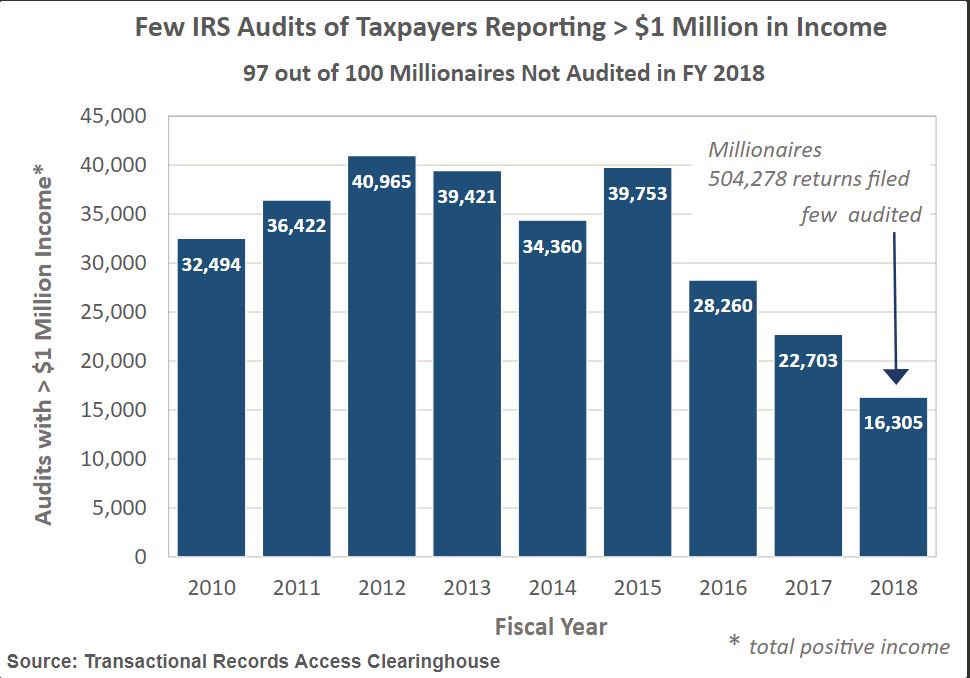
In 2012 the IRS audited almost 41,000 taxpayers with incomes of $1 million or more. By 2018 that number was down to just 16,300.

This decline took place while the number of people making millions and billions of annual income has been growing fast, almost doubling since 2010 to more than 504,000 households.

In 2018, fewer than three out of every 100 millionaires were audited, down from eight out of 100 in 2010. Even then, the audit rate was tiny, especially compared to the opportunity to cheat.

Uncollected Taxes

In 2010, audits identified $5.1 billion of income taxes owed by millionaires and billionaires. But in 2018, only $1.9 billion of unpaid taxes were found, according to data that a federal court ordered the IRS to give to the Transactional Access Clearinghouse at Syracuse University.

“Few audits mean many millionaires escape paying billions of dollars owed the U.S. Treasury,” the Clearinghouse says.

You’re stuck with the tab

Every dollar not paid by Trump and those like him is a dollar you must make up for through higher taxes, fewer government services or more federal debt. It’s a system in which you must pay one way or another while rich tax cheats enjoy personal jets, yachts and golf.

Many IRS audits are cursory. When I was The Times tax reporter, I reported on the trend toward what disgusted revenue agents called “audit lite,” a term intended to foster an image of thin and tasteless low-calorie beer. So even the audits now underway may not catch the cheats.

We must pay our income taxes like it or not while rich business owners like Trump decide what they want to pay. And their risk of getting caught cheating is tiny and shrinking each year.

The politicians who have supported ever tighter rules on verifying the income of most Americans and stripping away most of their ability to deduct charitable gifts, state and local taxes or mortgage interest are conservative Republicans. Some Democrats have gone along while other Democrats have fought for a bigger IRS to pursue business owners who cheat on their income taxes.

We keep electing people who make us pay whole while letting those best able to pay slip away. We are chumps.

Why Trump’s promise to save manufacturing was one he never intended to keep

Bob Kemper recalls the hope Donald Trump intentionally stirred in 2016 by pledging to revive manufacturing and keep factories busy producing steel, aluminum and other materials for a major infrastructure overhaul.

Kemper knows that seductive rhetoric won over many Americans, including some of his co-workers at U.S. Steel’s Great Lakes Works in Michigan.

Over the past four years, however, Trump repeatedly showed Kemper’s colleagues and millions of other workers that his vow to save manufacturing was just a con to win the election, not a promise he ever intended to keep.

Trump failed to deliver the manufacturing renaissance that propelled him to the White House and then stood idly by while wave after wave of factory closures devastated the very families who pinned their hopes on him.

Instead of bringing industry back, as he boasted during a visit to Detroit in 2016, Trump turned a blind eye when U.S. Steel announced in 2019 that it would lay off as many as 1,500 workers at its Great Lakes Works site in Ecorse and River Rouge and idle much of the complex because of low demand for steel.

“It was a feint and a lie,” Kemper, grievance chairman for United Steelworkers (USW) Local 1299, which represents Great Lakes workers, said of Trump’s pledge. “He told Americans what they wanted to hear. It’s all broken promises.”

On Trump’s watch, hundreds of factories like Great Lakes went dark—and America’s manufacturing sector fell into recession—even before the COVID-19 pandemic struck. His botched response to the health crisis further wrecked the economy and forced still more producers of steel, aluminum, paper and other products to cut back or close.

Since Trump took office, hundreds of thousands of manufacturing workers lost family-sustaining jobs, including more than 16,000 in Pennsylvania, Ohio, Michigan and Wisconsin in 2019 alone.

The factory closures decimated local communities and further eroded America’s capacity to produce critical goods like face masks for health care workers and supplies for the armed forces, putting the nation’s security at risk.

“Heaven forbid we ever get into a real conflict, and we don’t have the capability to produce our own steel for our military,” Kemper noted.

In 2016, Trump repeatedly touted a massive infrastructure program that would fund urgently needed improvements to the nation’s crumbling roads, bridges, locks, dams, ports and drinking water systems.

Infrastructure investment also would have generated surging demand for steel, aluminum, cement and other products, created millions of jobs, and rebuilt a manufacturing sector vital to national security. It would have injected new life into many factories.

Yet even though his Republican cronies controlled both houses of Congress for the first two years of his term, Trump failed to deliver any infrastructure campaign.

“That could have easily been pushed through, but there wasn’t any real motivation to do that,” Kemper said of Trump.

Now, he observed, “all kinds of steel mills are shutting down and going away. This administration has walked us back I don’t know how many years.”

Trump abandoned the very workers he looked in the eyes and swore to help.

During one visit to Ohio in 2017, for example, he told residents living near General Motors’ Lordstown assembly plant not to sell their houses and move away because he intended to rejuvenate manufacturing. But Trump failed to create the jobs he promised and even lost those at Lordstown. General Motors closed the facility in 2019, throwing hundreds out of work.

And in Michigan four years ago, Trump bragged that his election would be a “victory for the wage-earner” that returned millions of unemployed workers to mills and plants. Yet Trump failed to lift a finger when, before the pandemic, Gerdau Special Steel North America announced plans to lay off about 140 workers at its Jackson, Michigan, site.

Although Trump crowed about reviving manufacturing, “there was no plan behind it. There was no substance,” noted USW Local 8339 President Shawn Crowley, who represents the Jackson workers.

That didn’t surprise Crowley at all. He never believed that a callous businessman who serially cheated the contractors and workers he hired for his hotels and casinos would do anything but stiff America’s working families as well.

“I thought it was a joke, and I still think it’s a joke,” Crowley said of Trump’s bluster. “I knew the dude’s record. He screwed over tons of his own workers. That’s his whole MO. Why would I ever think he’d do something better?”

America cannot afford to lose any more production capacity or family-supporting manufacturing jobs.

Unlike Trump, Democratic presidential candidate Joe Biden has both the will to rebuild the manufacturing base and a concrete, detailed blueprint for accomplishing this crucial mission.

His Build Back Better plan prioritizes a major infrastructure campaign—carried out with U.S.-made materials like the steel that Kemper’s colleagues made at Great Lakes—as well as a long-term federal investment in manufacturing facilities and the workers and technology essential to operating them.

Biden’s plan also includes a federal commitment to stockpiling critical goods and strengthening supply chains. That will ensure that America never again runs short of medical equipment during a pandemic and produces all of the supplies essential for military preparedness. And it will enhance the nation’s capacity to build items critical to everyday life, like washers and refrigerators as well as the auto components that USW members made at Gerdau’s Jackson plant.

In addition, the plan calls for stronger labor protections, such as those provided in the Protecting the Right to Organize (PRO) Act, so that Americans can more easily form unions, fight for decent pay and rebuild manufacturing communities. Workers must have a voice in the workplace, Kemper said, because CEOs care “only about their own pockets and the pockets of their shareholders.”

Many of Kemper’s colleagues struggle to find new jobs providing pay and benefits comparable to what they earned at Great Lakes—a challenge compounded by the COVID-19 downturn.

Dead-end, minimum-wage jobs are all some can find in Trump’s mangled economy.

And Kemper realizes that many more workers will suffer a similar fate unless America takes swift, decisive action to save its manufacturing base.

“There’s no time to waste,” he said. “It should have been started four years ago. It needs to happen right now.”

“Would you shut up, man”: First Trump-Biden debate a disastrous, chaotic, nearly unwatchable mess

The first twenty minutes of Tuesday night’s debate was denounced in real-time as a nearly “unwatchable” and tedious “charade” after Fox News moderator Chris Wallace proved incapable of refereeing exchanges between President Donald Trump and Democratic nominee Joe Biden.

“Would you just shut up, man,” Biden declared towards the end of an initial round of questioning after Trump refused to stop interrupting him.

“This is utterly unwatchable,” tweeted progressive journalist Krystal Ball after just 17 minutes.

“This debate is chaotic and unfocused because Chris Wallace and his team didn’t have the guts to control the mics,” commented John Nichols of The Nation. “The interruptions don’t add anything to the discourse. They disrupt it.”

For many progressive commentators, it was both a grotesque and depressing political and media display given the current realities in the world.

“I have nothing snarky to say,” tweeted journalist and former Bernie Sanders campaign speechwriter David Sirota at 9:20 pm. “I have only this to say: this is a sad state of affairs when thousands are dying from a pandemic, an economic crisis is destroying millions of lives and climate change is burning down the planet’s ecosystem.”

Others, like Working Families Party national director Maurice Moe Mitchell, called on viewers to recognize what Trump’s performance is designed to achieve:

“Wallace lost control immediately,” lamented Zach Carter of the HuffPost, “there’s nothing of substance to be gleaned from this fracas, and the president looks like a jerk.”

“Tonight, America saw a sad, unhinged, orange-in-the-face embarrassment of a president who showed no temperament to lead this country,” said Adam Green, co-founder of the Progressive Change Campaign Committee, in the wake of the debate.

The president, said Green, “would have done better to take Joe Biden’s advice—and shut up, man—rather than show his inadequacy in tackling the coronavirus and economic plight of millions of Americans. It was an embarrassment. Joe Biden made clear that by replacing Donald Trump, we can achieve competence in the White House and address key progressive goals from health care to corporate accountability to tackling systemic racism.”

“No question about it”: Former Watergate prosecutor predicts Trump and Ivanka may end up behind bars

A former federal prosecutor during the Watergate investigation, which uncovered criminal activity that led to former President Richard Nixon‘s resignation, said the bombshell New York Times report on President Donald Trump‘s taxes suggests that he could ultimately face time behind bars along with his daughter, senior White House adviser Ivanka Trump.

“No question about it,” Nick Akerman told CNN’s Erin Burnett in a Monday interview. “And his daughter could go to jail, too. Tax evasion is a five-year felony. It’s a pretty serious crime, and the more money that’s stolen, the longer you go to jail.”

Akerman, who investigated Nixon’s taxes during the Watergate probe, said The Times report revealed that he was a “rookie amateur” compared to Trump.

“What Nixon did was essentially backdate one deed for a gift of papers to the U.S. government. He basically created a phony deed,” said Akerman, whose investigation prompted the political precedent of every major-party presidential candidate publicizing his or her tax returns — until Trump.

The Times report, he said, laid out “a whole series of activities that could qualify as tax fraud — not tax avoidance.” While the headline read, “Trump Tax Avoidance,” Akerman said there is “a key difference” when it comes to fraud — a more serious crime.

Tax avoidance means trying to get the most deductions legally permissible under the tax code. 

“Tax fraud is lying about what your income was,” Akerman said. “Lying about what your deductions are.”

Akerman said the report suggested multiple instances of fraud — the “most glaring” example being an allegation involving consultant fees that Trump appears to have paid to Ivanka, but which he later wrote off as a tax deduction.

Ivanka’s 2017 financial disclosures show she received a $747,622 payment from a consulting company called “TTT Consulting,” which she apparently co-owned with other family members. That figure matches the exact amount that her father wrote off as tax deductions for consulting fees on two Trump Organization hotel projects from the same year.

The arrangement, Akerman said, raises questions about a possible effort on the president’s part to reduce his business’ tax liability by not compensating family members directly. Because Ivanka was already an employee of the Trump Organization, he said, he could think of “no legitimate reason” as to why her father would have paid her in such a manner.

And there may be only one reason why the Trump family would not face criminal liability, Akerman said: the same as-yet untested constitutional provision that stymied former special counsel Robert Mueller.

A grand jury empaneled by Manhattan District Attorney Cy Vance has subpoenaed Trump’s tax returns in order to help inform charging decisions in a broad inquiry into his finances — including possible criminal tax fraud.

“The only thing that’s saving [Trump] at this point is the Department of Justice’s guideline that says you can’t indict a sitting president,” Akerman said. “Once he’s no longer a sitting president, he is subject to being indicted.”

“Any decent prosecutor” could make a “pretty viable” case, Akerman concluded.

CNN’s Jake Tapper nails Trump-Biden debate: “Hot mess, inside a dumpster fire, inside a trainwreck”

CNN’s Jake Tapper on Tuesday offered a succinct analysis of the 2020 presidential debate between President Donald Trump and former Vice President Joe Biden, calling the spectacle “a hot mess, inside a dumpster fire, inside a train wreck.”

“That was the worst debate I have ever seen,” Tapper said. “In fact, it wasn’t even a debate. It was a disgrace.”

Tapper put the majority of the blame on President Trump, who he said “spent the entire time interrupting, not abiding by the rules he agreed to, lying, maliciously attacking the son of the vice president.”

“I can tell you one thing for sure: the American people lost tonight,” Tapper argued. “Because that was horrific.”

“You took the words right out of my mouth,” CNN Chief Political Correspondent Dana Bash replied, noting Tapper used some “high-minded language” in his description of the event.

“I’m going to say it like it is:” she continued. “That was a shit show.”

Correspondent Abby Phillip agreed, calling the debate “a complete disaster, on all fronts.”

“If you came into this thinking that two men, in their 70’s, who want to be the leader of the free world for the next four years, could have a reasonable exchange of ideas… you came away from the debate thinking it’s not possible,” Phillip said.

As moderator Chris Wallace of Fox News noted, the president and vice president have agreed to participate in two more debates before the November elections.

Watch the video below, via CNN:

Donald Trump Jr.’s pre-debate appearance draws questions: “How much coke did Don Jr. snort?”

An excited performance by Donald Trump Jr. led to questions about drug use on Tuesday.

Just minutes before the first 2020 presidential debate between President Donald Trump and Vice President Joe Biden, Donald Trump Jr. was seen appearing on three major networks.

On ABC News, Donald Trump Jr. spoke quickly as he attacked Biden.

“I’m not so worried about the two hours of debate or the 90 minute debate, I’m worried about the other 22 hours of the day where Joe seems to struggle, where he’s on a teleprompter,” he ranted. “I mean, he hasn’t had to campaign in the same way.”

“I know people, honestly, George, running for first grade class president that have spent more time campaign than Joe Biden has for president of the United States,” the president’s son continued. “When you have a mainstream media that will sort of let him get away with that, to not answer questions, you know, so that’s difficult.”

He added: “So I think Joe Biden should do fine. He’s been doing this for a very, very long time. This should be his happy place. So, we’ll see what happens.”

Twitter users reacted by suggesting Donald Trump Jr. was abusing drugs.

Metal particles, breathed by pregnant women, show up in placenta: study

If the novel coronavirus pandemic wasn’t cause enough to wear a mask outside, a new study may have just given pregnant women another reason: Air pollution particles, including metals, emitted by automobiles have been found in infant placentas. The study is shocking for what it says about the ability of airborne pollution to seep deep into the human body, even in places with multiple layers of biological protection that evolved to keep foreign matter out. 

Inhalable airborne particulate matter is linked to “a wide range of adverse health outcomes” in babies, including respiratory issues and low birthweight, the study‘s co-authors explain. The study, which was published in the journal Science of the Total Environment and funded by Barts Charity, notes that elemental carbon from traffic is one of the primary types of particulate matter that scientists are worried could be harmful to humans. Other harmful metals that they studied included “iron-rich and often strongly magnetic nanoparticles originating from high-temperature processes such as diesel engine combustion and brake-wear.”

To test for these and other dangerous airborne particles, the scholars recruited 15 healthy pregnant women from London who do not smoke, all of whom had pregnancies without any complications. 

The authors specifically found that the types of particulate matter that found their way into placentas could be linked to automotive traffic and fossil fuels, explaining that “analysis of the nanoparticles present in the [placental cells] strongly suggests an origin predominantly from traffic-related friction and fossil fuel combustion sources.” They conclude that “heavily trafficked urban roads” likely cause fetuses to be exposed to these nanoparticles.

Professor Jonathan Grigg from Queen Mary University of London, a lead author of the study, told Science Daily that “our study for the first time shows that inhaled carbon particulate matter in air pollution, travels in the blood stream, and is taken up by important cells in the placenta. We hope that this information will encourage policy makers to reduce road traffic emissions in this post lock down period.”

The study is particularly important because it may have helped shed light on the biological mechanisms that cause air pollution to put newborns at risk.

“Pollution levels in London often exceed annual limits, and we know that there is a link between maternal exposure to high pollution levels and problems with the fetus, including risk of low birthweight,” Dr Norrice Liu from Queen Mary University of London added. “However, until now we had limited insight into how that might occur in the body.”

A postdoctoral research assistant, Lisa Miyashita, told HealthDay that “we have thought for a while that maternal inhalation could potentially result in pollution particles traveling to the placenta once inhaled. However, there are many defense mechanisms in the lung that prevent foreign particles from traveling elsewhere, so it was surprising to identify these particles in the placental cells from all 15 of our participants.”

The chief executive of the charity that sponsored the study argued that it has sobering implications about the health toll that air pollution is having on the new generation.

“This is an incredibly important study and immensely relevant to mums-to-be in our local community, indeed in any urban community anywhere in the world,” Fiona Miller Smith told Science Daily. “In the current climate it can be hard to see beyond COVID and so we are particularly proud to have funded this vital work and truly hope that it will lead to greater awareness of the risks of pollution to the unborn child.”

The placenta is an organ that develops in a uterus so that the mother’s body can provide nutrients, antibodies and oxygen to the fetus, as well as removing waste from the fetus’ body through that of its mother. In addition, the placenta puts hormones into the mother’s body to help the mother through the pregnancy.

Other recent studies have found that the air a mother breathes can find its way into the placenta. A small study published in July by Italian scientists found that, among 31 women who delivered babies in March and April, there were traces of the coronavirus in placenta, in fluids obtained through vaginal swabs, in umbilical cord blood and, in one case, in breast milk. University of Milan immunology specialist Dr. Claudio Fenizia, who led the study, told The Washington Post that while their results should be considered preliminary. “Our study should be considered a ringing bell to raise awareness that [transmission] is possible,” Fenizia added.

A judge just dismissed efforts to stop pesticides and GMO crops from being used in wildlife refuges

A Washington federal court last week dismissed a lawsuit against the U. S. Fish and Wildlife Service after a pair of nonprofit groups sued the agency for reversing previous bans on specific insecticides and genetically modified organisms (GMO) in national wildlife refuges.

“It’s incredibly disappointing, but this case was intended to look at this issue at a national level, and what the court said is you need to go and look at it at a case specific level,” Hannah Connor, Senior Attorney at the Environmental Health Program, told Salon. “So as it’s done individually, and that means that there’s going to be a limited review of the actual impacts of this decision across the refuge system, which will only detriment wildlife and the habitat that they crave to be able to survive.”

The Center for Food Safety (CFS) and Center for Biological Diversity (CBD) filed their lawsuit against the agency in 2018 after the decision was made to reverse a 2014 policy phasing out GMO seeds, according to Bloomberg. The U.S. District Court for the District of Columbia dismissed the lawsuit on the grounds that the plaintiffs failed to show that they would be harmed by the policy reversal, adding that the alleged injuries put forward by individual members are speculative and therefore do not establish standing.

“Unfortunately, as a result of dismissal, we expect and we’ve already seen that different refuges around the country will start implementing this reversal policy, meaning they’re gonna start approving genetically engineered crops to be planted and neonicotinoid pesticides to be used,” Sylvia Wu, a senior attorney for the Center for Food Safety, told Salon. Neonicotinoid pesticides, whose active ingredient is a nicotine-like molecule, are largely accepted by scientists to have been responsible for a massive decline in bee populations that threatened the human food supply. Those same pesticides are now being linked to bird deaths, too. 

“Our next step is to monitor these developments as we had done before the lawsuit, to continue to engage with refuge managers and the public, hopefully to educate them about the harms of these uses, but you know, if these harmful uses are implemented, we will continue to monitor them and take legal action as appropriate,” Wu continued. 

Wu elaborated on the original 2014 memo issued by the agency, noting that when it banned certain GMOs from refuges, “the majority of genetically engineered crops that are grown in the U.S, as well as back then on refugee lands — we’re talking genetically engineered corn and soy — the majority were specifically engineered to resist the use of pesticides, with many of them like the herbicide Roundup containing glyphosate. These are crops that are designed to withstand multiple applications of the pesticide glyphosate. This technology has made glyphosate the most-used pesticide in the United States.”

She added, “We know there have been a lot of lawsuits filed specifically about the harm of glyphosate. The World Health Organization identified it as a possible carcinogen. Our EPA unfortunately has refused to follow suit. As a result there have been multiple lawsuits filed against Bayer — which now owns Monsanto, the manufacturer of Roundup — and the folks that have developed cancer and various health illnesses, farm workers and farmers, that have been impacted by the use of glyphosate.”

Wu pointed out that the same 2014 memo also banned neonicotinoids. She noted that they affect not merely bees, but also “sensitive protected insects species, like the Monarch butterfly.” 

Indeed, numerous animal and plant species are threatened by the use of pesticides and GMOs in wildlife refuges.

Connor discussed a few examples, including whooping cranes. 

“Whooping cranes are migratory, which means that they will go across large spots of the country and in that progress will make a stop so that they can recharge themselves, so they can get some kind of forage, some kind of food,” Connor told Salon. “And when they do that, if they stop at a wildlife refuge, the expectation is that that forage is not going to be something that’s really detrimental to them. But whooping cranes are ingesting pesticides, and that is really problematic for an already imperiled species.”

Connor also mentioned Monarch butterflies, which have declined because by 80% in the last two decades due to a decline in milkweed that’s “largely attributed to glyphosate use.”

Mussels, too, she said were threatened by the use of pesticides in wildlife refuges. 

“There are such a wide diversity of [mussels] that formerly existed in waterways with some of the most charming names you’ve ever heard, like the pocketbook mussel or the orange-footed pearly mussel, and so many of them have ended up on the endangered species list in part because of pesticides,” Connor explained.

Hillary Clinton’s new podcast ignores Trump and reveals her as a smart, compassionate interviewer

Hillary Clinton’s new podcast “You and Me Both” debuted Tuesday morning and offers both a more personal look at the former United States secretary of state and presidential candidate’s life and values and a welcome opportunity to contemplate a wide variety of issues knit into our country’s fabric, from the pandemic response to pop culture.  

“I’m excited to bring these eye-opening, powerful, sometimes hilarious conversations to the forefront and open up new avenues of discussion with some of the people I find most fascinating,” said Clinton in a release. “This podcast is a chance to talk about subjects that are too often overlooked and share the inspiration and education I’ve gotten from my guests.”

“You and Me Both” is produced by iHeartMedia and follows Clinton’s 2016 podcast “With Her,” which was co-hosted by Max Linsky. That podcast was decidedly more campaign mechanism than traditional show; it was very focused on the upcoming election and there were discussions with campaign volunteers, employees and a few fellow politicians.

In that podcast, Clinton co-hosted most of the episodes, but this time she is fully in the driver’s seat conducting interviews with a bevy of guests, leading the wide-ranging conversations with compassion. While politics are part of the focus, as the title indicates, it’s more about trying find common ground and moving forward, both things that Americans are having difficulty with.

Here’s what Salon readers should know about “You and Me Both.” 

What’s the format of the podcast? 

Each episode of “You and Me Both” comes in at about 40 minutes. Over the course of that time, Clinton “gets into some of today’s biggest questions with all sorts of amazing people.” Some of the topics covered include faith, grief and the mythos surrounding the “American Dream.” 

Is Hillary a good interviewer? 

Unsurprisingly, yes. Her questions for her guests are considered and researched, but are natural enough that the conversation doesn’t feel stilted; it’s like listening to two friends have a (really deep) chat over a coffee. 

Granted, it helps that she’s chosen guests who are gifted public speakers. The first episode on faith, for instance, features Rev. Dr. William Barber II, Krista Tippett — the host of the public radio program and podcast “On Being” — and actor and former “Daily Show” correspondent  Aasif Mandvi. These are all folks who basically make their livings talking. 

That said, the interviews range in tone and scope in a way I wasn’t necessarily anticipating. That episode opens with Rev. Barber offhandedly telling Clinton that, as they say in the South, he’s “glad to be seen and not viewed.” She responds with a humorous anecdote about attending a viewing where the deceased’s leg shot up straight out of the casket for no discernable reason. Two minutes later, they are discussing how, in Barber’s mind, there is “no separation between Jesus and justice.” 

That leads into our next question. 

How political is “You and Me Both”? 

“You and Me Both” is grounded in politics, but in the episode and clips available for review, the name “Trump” never passes Clinton’s lips. It’s less about discussing the policies of specific political leaders and more about her guests’ views on how our  political and social systems at large have cumulatively impacted our nation and its people. 

It’s also pretty future-focused; underlying most of the interview questions is another unspoken one: “What can we as a nation be doing better?” 

The interview with Rev. Barber, in which he discusses current demonstrations surrounding the deaths of individuals like George Floyd and Breonna Taylor, is a great example of this.

“If we don’t miss the moment, if we match our policy decisions to the mourning we see in the streets, and if we don’t treat this as a spectacle event rather than recognizing this as a call for reconstruction,” Barber said. “This is a moment we can fundamentally shift.” 

There’s a lot of hope to be found in that exchange, but there’s something decidedly bittersweet about listening to this podcast right now, too. 

As I type this, the nation is preparing for the first presidential debate of 2020 and it’s hard not to consider the fact that this woman, who can host these reasoned and compassionate conversations with such ease, could have been our president instead of a man who rambles about protesters using tuna cans as projectiles. 

So, while the interviews themselves veer a little more personal than political, they will likely make you consider (or reconsider) your own politics. 

How personal does Hillary get on “You and Me Both”? 

A lot has been written about Clinton’s perceived coldness or impenetrability. As the Brookings Institution put it in a 2017 article, “she is someone so interested in solving problems that she skips right past the emotion that drives so many voters.” 

The first episode of “You and Me Both,” Clinton offers some background on why she has something of a wall built up in public. In her conversation with Krista Tippet — who, in a lovely turn, kind of flips the interview around to ask questions of Clinton — Clinton speaks about her religious upbringing. She was raised in the Methodist church and had a particularly influential youth pastor who took her as a young teenager to see Martin Luther King, Jr. speak in Chicago. 

“I always believed that faith was a constant in my life,” she said. 

But then she speaks about how she was invited to speak at the University of Texas in 1993, shortly after her father died following a stroke. She used that as an opportunity to speak about religion and some of the “big questions” associated with the loss of a loved one. 

“I talked about meaning and life and I remember just being ridiculed by the press,” she tells Tippett. “What right did I have as a first lady to raise these issues in public?” 

From that point on, she kept her religious views more private. This serves as a nice lead-in to her conversation with Aasif Mandvi, who discusses how 9/11 pushed him, as a Muslim, to make his private life and convictions more public as a way to increase cultural understanding. 

“I leaned into it and I found a voice around it,” Mandvi says. 

And in a sense, that’s what it feels like “You and Me Both” is for Clinton, an opportunity to lean into her lived experiences and present them to the public in a way that is decidedly more casual than her typical public persona.

But if you’re looking for a tell-all about Clinton’s life, this isn’t it. It really is more focused on the lives and opinions of her guests.  

What should I expect from the season? 

Speaking of guests, the first season of “You and Me Both” Clinton will interview a range of guests. Over the course of 24 episodes, she’s slated to speak with guests like Gloria Steinem, chef and fellow podcaster Samin Nosrat, comedian Patton Oswalt, Stacey Abrams, Ann Friedman, Sarah Cooper and “Queer Eye” personality Tan France. 

The first episode of “You and Me Both” is now available and new episodes will be released weekly. You can listen on iHeartRadio here. 


The adult vs. the alien: Former Trump and Biden insiders on tonight’s debate

After months of contentious debate at long distance due to the ongoing coronavirus pandemic, President Donald Trump will stand beside Democratic rival Joe Biden on stage for the first debate of the 2020 cycle on Tuesday night in Cleveland. The much-anticipated face-to-face matchup will set in motion the final countdown to one of the most consequential elections in modern history.

Members of the two candidates’ inner circles predict that the winner of debate night will be decided by contrasts of competence and character, and they view the competition as Biden’s to lose. Salon reached out to a number of Trump and Biden associates — as well as campaign veterans, including Omarosa Manigault-Newman, Michael Cohen, A.J. Delgado and Philippe Reines — to find out how each candidate can come out on top.

Each interview painted a portrait of an incumbent on shaky ground, one who’s as unsure of his opponent as he is of himself. Although the themes of this election cycle are nothing like 2016, Trump has done little but remix his winning formula from four years ago. Given Trump’s state of mind, Biden should not feel pressure to overperform, according to the group of insiders who spoke with Salon. Instead, the former vice president needs to stick to the issues, offer a competing vision of leadership and allow the contrast to speak for itself.

Philippe Reines, the longtime Democratic strategist who played the role of Trump in 2016 during Hillary Clinton’s debate preparation, told Salon that Biden needed to keep top of mind that the president was “the most predictable, unpredictable person.”

“After four years now, there are a million people who can impersonate Donald Trump, but if you don’t know Joe Biden, that doesn’t do much good,” he said. “But remember that Trump is the most predictable, unpredictable person. In 2016, I told the Clinton team that 100% of what I’m about to say is going to sound insane, but 95% of it are the things he says all the time. Five percent he has said before but doesn’t repeat often, and only the last 5% is my guessing of what he might say.”

“We mostly know what he’s going to say,” Reines added, “because he’s told us what he’s going to say.”

Reines also pointed out that the debate could have several significant contextual differences from 2016, chiefly the fact that outside of press conferences and a few fairly soft interviews, Trump has not had personally faced a sustained public challenge of his record over the last four years.

“Trump only has his rants, his rallies and his press conferences” to draw on, Reines said. Of contentious exchanges with reporters, “hardly any of it is a debate,” and Trump “often ends press conferences in the middle of a question by walking out of the room.”

Given this record, Reines found it shocking that some pundits still predict that Trump could deliver a competent performance.

“Everything about him debating is a f**king mess,” he said. “It’s 2020. We’ve been through this for four years now, and I really hope there are no humans left on the planet who are saying, ‘Will tonight be the night? Will he be presidential?'”

“If you just plug in the guy we’ve all seen on TV for the last four years, take that guy and plug him into an audience a thousand times larger than what he’s had on cable news — that’s not going to go well for him,” Reines said.

Former Trump 2016 campaign adviser A.J. Delgado said Trump no longer had a fastball to pitch. Instead, 2020 is “Trump Campaign: The Remix.”

“Trump is losing. He knows it. His campaign knows it, so he’s under a lot of pressure to turn the tide,” she said. “He’ll try to obfuscate tonight and turn the conversation to non-issues and fluff.”

“He doesn’t win on the economy — one recent study said Biden’s jobs plan would create 7 million more jobs than Trump’s,” she continued. “He doesn’t win on his handling of COVID. He doesn’t win on any substantive issue. So he will try to spin, spin, spin and hope to sow confusion.”

“And the campaign itself is so desperate now that it’s resorting to tweeting conspiracy theories about Biden wearing an earpiece —  it’s the same thing we tried with Hillary in 2016,” she added. “He has the most low-energy campaign team in history, with no new ideas, so we get what we’re seeing now: ‘Trump Campaign, The Remix.'”

Former Trump campaign aide and White House adviser Omarosa Manigault-Newman shared the same view: Trump will not be able to stand on his own record.

“Trump will probably be very aggressive and try to make Biden look weak in contrast,” she told Salon. “He will not discuss policy specifics but will rely on personal attacks and falsehoods.”

Manigault-Newman also highlighted a few area where she viewed Trump as particularly weak.

“Trump will be reluctant to talk about Russian bounties, lack of a health care alternative and his disastrous COVID response,” she predicted. “Oh, and of course, taxes. He will stick to his audit lie.”

Trump’s former personal attorney Michael Cohen appeared to agree on that front. He told Salon that Sunday’s bombshell New York Times report about Trump’s tax returns — which revealed that the president, who brags about his billions, paid only $750 in income tax in 2016 and 2017 — is probably taking up valuable psychological space.

“Donald Trump’s financial records are the Rosetta Stone for understanding the depth of his corruption and crimes, and the more it is unraveled the more he will unravel,” Cohen said. “It’s the reason he’s fought so hard to keep it under wraps: His entire image and self-worth is based on an inflated financial worth.”

Reines said that Trump while Trump’s tax answers might be misleading, he has rehearsed for this moment for years.

“His tax response is particularly refined. It was the easiest response for me to simulate in 2016, and it was really near impossible to get over,” Reines said. “Not because I was doing it well, but he just had it down.”

Moderator Chris Wallace may “press him on it, and he’ll call it fake news, say that he’s paid hundreds of millions of dollars in taxes over the years, which obviously isn’t true, but he can fudge it a bit,” Reines added. “Everyone thinks he’s going to collapse at the tax question, but he probably won’t.”

Delgado contended that Trump was hurting from a dearth of campaign veterans who had lost control of an already-erratic candidate.

“There’s no preparing him and, to be frank, he doesn’t have top brass, top talent available to prep him anyway,” she said. “We can already see they have nothing. They’re out on social media tweeting lazy memes and questions like, ‘Where’s Hunter?’ Look: No one cares about Hunter.”

“And it’s foolish, anyway, to open up that door to discussion of Ivanka’s Chinese trademarks, Jared’s inability to obtain security clearances, the Trump Organization’s foreign entanglements and on and on,” she said.

Longtime Biden confidant and Democratic strategist Moe Vela, the first Latino to hold two senior White House roles — during the Clinton and Obama administrations, when he served as director of administration for then-Vice President Biden — told Salon that the Democratic candidate’s mission tonight was to showcase those contrasts.

“Knowing the vice president — having worked for him, what you’re going to see tonight is another high-profile contrasting event,” Vela said. “He’s going to take this opportunity with a huge audience to demonstrate the contrast of leadership styles, of demeanor, dispositions, the way they carry themselves. Steady-as-he-goes Joe Biden versus the petulant, petty bully of Trump. Trump can’t help himself. He’ll pull it all out, but there’s going to be an adult in the room.”

Asked whether Trump would be able to throw Biden off his game with insults, given cryptic allusions to a “guest list” and Trump’s baseless allegations that Biden was taking drugs to boost his cognition, Vela dismissed the idea out of hand.

“I know Joe well enough to say he won’t be bullied. It’s not in his nature to be victimized, and on behalf of all people who have been bullied, he won’t allow that,” Vela said. “But he won’t get into the name-calling and the ugliness.”

“Joe will instead focus on sharing with the American people his plans for the future — what he will do to get us out of the mess the other guy on stage got us into,” he added. “Let him be the good debater he is, and that will in itself dispel this ridiculous notion.”

Reines agreed, adding that while voters likely desired civility and sobriety, it did not mean that they wanted to see Trump’s opponent turn the other cheek.

“If I were advising, in a perfect world, Biden opens up by saying, ‘Thank you Chris [Wallace], and thank you Case Western University for hosting us. I now yield the rest of the evening to my opponent.'”

Why the Midwest can’t contain the coronavirus

As a Californian with family in the Midwest, my Instagram feed has become a slideshow of two jarringly different pandemic experiences. I see acquaintances in Kansas having large parties, no masks in sight, literally popping bottles of champagne indoors. An old friend having a big wedding in Wisconsin, and a gender reveal party in Illinois, too, were both mask-free affairs. This observation of the digital world transcends into the real one: a close friend who just returned from Iowa said it looked like the pandemic “never happened.”

The culture around the pandemic in the San Francisco Bay Area, where I live, is much different. In many ways, life still feels like it did in March, when the region first descended into a shelter-in-place status. I don’t know anyone here in California who’s hosted or attended a gathering with more than 10 people without observing the recommended mitigation strategies like wearing a mask, being outside and social distancing. Salons, gyms and hotels are just starting to open. Indeed, the difference between the Midwest and California is a bit confusing, particularly as cases rise in the Midwest. 

According to the Covid Tracking Project, the Midwest is currently experiencing a coronavirus surge. And while there’s a mix of reasons behind this new surge— including the (possibly premature) reopening of some cities, universities and schools, and big gatherings like the the Sturgis motorcycle rally— there is a strong link between the low likelihood of public mask-wearing and the places where cases are rising, as The New York Times has reported. Indeed, the Midwest seems to struggle uniquely with mask-wearing, as the Times county-level data reveals.

Given what we know about the success of mitigation strategies like donning a mask, it may seem peculiar for states like Iowa to suddenly surge in cases. That suggests that the midwestern surge originates not because of lack of public health knowledge, but because of cultural reasons, or because of the politicized nature of masks, or both — something that is borne out by locals’ observations. 

Take Polk County, Iowa, for example. Over the summer, the state of Iowa emerged as a coronavirus hotspot. Nola Aigner Davis, Public Health Communications Officer of the Polk County Health Department in Iowa, told Salon Polk County remains one of the top 10 hotspots in the United States. Davis emphasized that it’s been difficult to get the coronavirus under control in part due to the lack of people wearing masks and social distancing.

“There are people who are still skeptical about this disease and [how] dangerous and deadly it can be. . . . or it’s just people who this isn’t something they’re accustomed to, like wearing a mask or social distancing,” Davis said. “Well, we see every day that people are hospitalized and people are dying from this disease.” 

Davis said she’s concerned about her constituent having “COVID-19 fatigue,” a neologism that describes the condition in which the constant stress of the pandemic eventually leads to complacency, and the inability to make good decisions. Davis said COVID-19 fatigue reveals itself when, for instance, people who are awaiting coronavirus test results don’t stay home until they’ve discovered whether or not their are positive.

“This is something that no one thought would last this long,” Davis added. “We would not be wearing masks this long, we would not be social distancing this long; I think when you develop a new way of life that people are not accustomed to, and you want your old life back, it’s just very tiresome.”

Brady Kirkpatrick, who lives in Omaha, Nebraska, said the state has been “mostly lax” about the pandemic since the beginning. In Omaha, where coronavirus cases were rising in the summer, the city council passed a mask mandate. However, Kirkpatrick said that in his experience, “most businesses only require you to wear your mask upon entry.”

“At the gym, about half the members wear masks while working out,” Kirkpatrick said. “It seems that most people aren’t very concerned about it since the cases here are fairly low, and the city is pretty spaced out.”

Omaha is seeing lower cases after the mask mandate, even if not everyone is taking it seriously as Kirkpatrick says. However, according to AP News, the state’s seven-day rolling average for positivity rate is rising.

“Overall, many people here are sick of COVID and the rules that have been enforced,” Kirkpatrick said.

The state of Wisconsin is currently in a state of emergency, as hospitals in the northeast part of the state are near capacity and local resources remain strained. In Dane County, where the University of Wisconsin–Madison (UW) is located, the county experienced its first significant surge in September since the pandemic began, according to Dane County Executive Joe Parisi, which it’s still battling. The University started in-person classes, but paused them one week later because of a coronavirus outbreak. However, the county’s health officials say in-person classes weren’t the only reason behind the surge.

“The number of cases associated with UW is a concern, but plenty of virus is spreading elsewhere in the community too,” Janel Heinrich, Director of Public Health Madison & Dane County, said in a statement.

In Louisville, Kentucky, Lori Cheek told Salon over email that it’s hard to “comprehend” how “most of the people are dealing with this pandemic at this point.” Wearing a mask is not the norm where she lives, Cheek says.

“I’m scared to go inside the public areas in my own apartment building,” Cheek said. “I only take the elevator to and from my 6th floor apartment when I’m taking my bike in and out of the building, and every time the door opens, there’s someone trying to get in the elevator with me without a mask.”

According to a Gallup poll published in mid-July, forty-four percent of U.S. adults say they “always” wear a mask when outside their homes, and 28 percent say they do so “very often.” Interestingly, a majority of those who wear masks are either women or Democrats. The poll found that 61 percent of Democrats polled said they always wear a mask. Among Republicans, a majority of them said they wear masks infrequently. A Pew Research Center study found a similar partisan divide.

Both the Centers for Disease Control and Prevention (CDC) and the World Health Organization (WHO) recommend cloth masks for the general public. Health experts strongly agree that the evidence is clear that masks can help prevent the spread of COVID-19.

Yet the act of wearing a mask has become politicized in part due to President Trump’s rhetoric and resistance around it. In Wisconsin, where there’s currently a statewide mask mandate, a conservative law firm is asking a state court to block the enforcement—despite the state’s health department’s recommendations to wear them and avoid large gatherings.

“It is a proven method to prevent the spread of COVID-19,” Jennifer Miller, a spokesperson at the Wisconsin Department of Health Services, told Salon in an email. “That said, masks and/or face coverings do not take the place of social and physical distancing, so we also encourage people to stay home as much as possible, maintain at least six feet of separation between themselves and others when they must go out, avoid large gatherings, and follow simple health hygiene habits like washing their hands frequently and thoroughly and covering coughs and sneezes.”

According to the World Health Organization, there have been 33,249,563 confirmed cases of COVID-19 around the world and over one million deaths. The United States accounts for more than 20 percent of the global death toll. Indeed, many are wondering how the United States will ever overcome this pandemic, especially as states in the Midwest enter the autumn and winter seasons.

“If we don’t practice these mitigation strategies, we’re never going to see this virus go away,” Davis from the Polk County Health Department in Iowa said.

It’s debate night: But beware of terrible media coverage

The basic problem with political debate coverage is that it plays to all the worst instincts of elite political reporters, most notably their tendency to treat the presidential election as if it were a sporting event like a horserace or a boxing match.

As I wrote in my essay explaining the excess of horserace coverage, that’s because “Who’s winning?” and “How are the optics?” are vastly easier and less controversial questions for most political journalists to raise — and to answer — than “Who’s right?” and “Is that a good idea?”

But sports-style coverage has never been more inappropriate than it is today, because it also fundamentally equates the two candidates. It suggests that they are playing the same game, when they are playing entirely different games. It casts them as competing on an even playing field, when they are not playing by remotely the same rules.

First and foremost, of course, Donald Trump notoriously doesn’t care about facts. Debate rules should require truth-telling, and include methods for the moderators to call out outrageous violations and exact some sort of penalty. But real-time fact-checking has actually been ruled out by the debate organizers (to their shame).

Sports-style coverage also normalizes this highly abnormal election.

The story of this race is not: Joe Biden and Donald Trump are both running for president, you pick. It’s: America is on a precipice. As I wrote in my inaugural Press Watch column, 11 months ago — before impeachment! Before the pandemic! — re-electing Trump would be an act of collective national insanity.

That’s even more true today.

Of course we need to have debates, and journalists need to cover them. But that coverage will almost inevitably focus on zingers and optics rather than on the vast imbalance between the two candidates and the vast difference in what this country will be like four years from now depending on who wins.

Even before the debate, Trump was already making outrageous insinuations about Biden  — projecting, if past is prologue — and the New York Times has simply presented that as a sign of the “absence of guardrails.”

And don’t look to journalistic fact-checking as is currently practiced to solve anything. While I’ll eagerly watch what looks to be an aggressive fact-checking initiative from CNN, I don’t think fact-checking should be independent of the main coverage.

As it happens, the worst sports analogy I’ve seen lately actually came in Washington Post fact-checker Glenn Kessler’s debate preview on Tuesday morning, in which he wrote  that “Biden is in the middleweight or welterweight class. Trump, however, is the heavyweight champion of falsehoods.”

The framing was clear: They are both engaging in the same sport — when any thinking journalist knows they are not.

Quarantine book club: Reading for mental health in a plague year

It’s September of 2020, which I am now calling “the Plague Year.” Not only do we have the coronavirus, the election looming over us, injustices in our systems emphasized on video on Twitter and protests in the streets, but we are dealing with the enforced confinement that a highly contagious virus requires — you still can’t hug a friend or fly across the country to see your families. On top of this, our Seattle September began with blinding, choking wildfire smoke from every direction, which sat on top of us for weeks. During that time, I broke a tooth, struggled with insomnia, and experienced nightmares. I checked in with a mental health professional, who diagnosed “stress, anxiety, and PSTD.” No kidding!

This year, and I am sure this is the case for many others, reading has become more important to my mental health than ever. I mainly write poetry, and published a book of apocalypse poetry in 2016, but my reading this year — fiction, non-fiction, and poetry — has focused on survival, disaster, and things I hoped would help me build resilience, compassion, and empathy. It became more than a hobby; it became a lifeline. 

I have a primary immune deficiency and multiple sclerosis, which meant that more than most people, I was going to have to stay in and rely on, in the words of John Berryman in “Dreamsong 14: Life, Friends is Boring”—my own inner resources. Shudder. 

I’m sure I am not the only one to turn to the poetry of Emily Dickinson, perhaps the patron saint of isolated writers, but during the last eight months, I’ve also looked to her letters (“Selected Letters,” edited by Thomas H. Johnson). How did she survive in a society and with a family hostile to intellectual behavior from a woman during a time of unimaginable upheaval, during the Civil War, and much death by many diseases — smallpox and scarlet fever were still prominent killers in the 1860s, when they were barely aware yet of germ theory? Of course, death permeated every poem she wrote. Did Emily really have agoraphobia, as some have suggested, or was she merely being prudent/prophetic in an age when many people died in childhood of strep or flu? Her insistence on staying in her home, from my perspective, seems like a form of survivalism. 

Another book, recommended by my younger brother, proved to be much more uplifting than the title suggested: Rebecca Solnit‘s “A Paradise Built in Hell,” which tells the story of multiple disasters in the recent American past, and how the human characters in those terrible stories managed somehow to not only survive, but often to perform amazing acts of heroism and kindness in the midst of chaos and terror. The book infused me with feelings of hope and resilience. (And the bonus — I didn’t even know my little brother was a Solnit fan!)

In an effort to build perspective and foster closeness with my mother, who lives miles away in Ohio who I can’t visit in person, we started a two-person book club, beginning with a trio of Joan Didion books: “The White Album,” “The Book of Common Prayer,” and “The Year of Magical Thinking.” Joan Didion is considered a founder of the creative non-fiction/personal essay genre, but my mother and I, both having studied journalism in college, had never been assigned her work. Didion’s obsessions with death, apocalypse, and separation between family members, especially mothers and daughters, created a fitting backdrop for discussions about racial unrest in the ’70s versus now, and the way that many then imagined the end of the world was truly nigh. I discovered in “The White Album” that Didion had been diagnosed in midlife (as I was) with multiple sclerosis. Didion famously interviewed one of the Manson girl murderers while she was awaiting trial; she also depicted drug-addled toddlers in California. No wonder she had anxieties about where her culture was heading. My mother’s perspective about the unease of the ’70s, captured in “The Book of Common Prayer “and “The White Album,” has helped me realize how and why America might still be struggling with some of the same issues. 

To understand an apocalyptic dystopia, which you might argue we are now facing — climate change, coronavirus, villains in politics, violent police conflicts and ever-growing protest groups, class and race differences showing up in everything from COVID-19 death rates to educational challenges for children —I wanted to read more about other imagined apocalypses. Margaret Atwood, who appeared virtually earlier this month with the Seattle Arts and Lectures series in an interview with Cheryl Strayed via Zoom, had inspiring words. Strayed asked Atwood, who admitted to having a pronounced dark side, if there was any reason for optimism. “The future is not written yet,” she replied. At another public reading in Seattle years ago, she was asked for advice about the apocalypse: “Always carry cash,” she quipped. Atwood’s book recommendations included Ursula Le Guin’s excellent essays and Klaus Mann’s “Mephisto.” I would also add Atwood’s “Wilderness Tips.”  

Rereading her very popular “Handmaid’s Tale” today — it was published when I was twelve years old — is soberingly prescient about an imagined future where America, having been (perhaps?) attacked by terrorists, is taken over by right-wing, white Christian politicians who return women by force to “their place” in the home in violent, sadistic ways. (Look to our new Supreme Court nominee Amy Barrett and her Catholic cult “People of Praise” which includes “handmaids!)  Atwood’s new follow-up book, “The Testaments,” a wittier visit to her dystopia from the perspective of multiple narrators, including a villain from the previous book, is surprisingly optimistic, a sign of Atwood’s own more hopeful perspective as she has grown older, but still examines questions of surviving trauma and oppression. 

I had similar thoughts reading Octavia Butler’s science fiction classic, “The Parable of the Sower.” Butler, who suffered from mild dyslexia as a child as I did, and relocated, as I did, in mid-life to the same county in Washington State, has always felt important to me. Butler correctly predicted many of our current issues. Her “Parable of the Sower” from 1993 focuses on problems ripped from California’s current headlines: global warming, fires, disappearing water supplies, homelessness, gated communities protected by citizens brandishing guns, literacy issues among the young. Her young, empathetic narrator forced from her gated community to the unruly streets to find allies, in a heroic arc that also inspires, planting seeds, using empathy to build unlikely connections. The oppressive sense of suffering all around her – as oppressive as wildfire smoke – spurs her to become a leader, taking action in what appears to be hopeless circumstances. It serves as a timely reminder for us to take action to reduce suffering in the world. And carry some seeds in our pockets as we go.

Siri Hustvedt, whose work I fell in love with her masterwork on gender in the art world, “The Blazing World,” thoughtfully navigates her own neurological issues in “The Shaking Woman, or the History of My Nerves.” Her study of the effects of trauma on children in the novel “Sorrows of an American” – specifically, a family history of neurological responses to traumatic events, including a child suffering PSTD after witnessing 9/11 from her window. Since I suffer from neurological effects of MS particularly when I’m under stress, her perspectives helped me realize I’m not alone. 

Yoko Ogawa’s brilliantly chilling “Memory Police” imagines a dystopia in which a totalitarian government censors people’s memories as things themselves mysteriously disappear: birdsong, perfume, books, people. In a world where everything is taken away, what loss is the most important? 

Other apocalypse-oriented books that provided me with inspiration this year included Ilya Kaminsky’s “Deaf Republic,” about an oppressive government using police to disappear dissenters and the protestors who are murdered in the street who develop a secret sign language to communicate around unfriendly security forces. It’s clear that Kaminsky is drawing parallels not only to Russian’s oppression of the Ukraine (where Kaminsky was born) but our current American political culture. Jericho Brown highlights American cultural oppression in “The Tradition,” in which complicated god figures might save or violate you, where illness and violence continually threaten the speaker’s body, and where family, faith and country are sources of fear as much as love. Matthea Harvey’s “Modern Life,” forecasts police militarized against citizens, controlled speech, and my favorite, sentient child robots (not quite there yet, but probably around the corner). Her poems combine humor with horror in a particularly effective way for today’s readers. Lesley Wheeler’s “The State She’s In” directly addresses the anxieties of our present state, environmental, political, and social. Poetry, I think, provides a singular kind of respite from the stress of the depressing news cycle, isolation, anxiety and rage, by putting the reader into almost automatically mindful state, considering image and emotion, forced to slow down to notice the beauty and brutality of language. 

So, can reading really address the state of anger, despair, and confusion so many of us are in? I can only say that books (along with gardening, cats, chocolate, and phone calls with friends) definitely helped me hold on to not only sanity and hope, but also serve as a reminder of why we continue to act to address injustice instead of just saying “that’s the way it’s always been.” Reading also provided a useful context to talk with family and friends who were also experiencing anxiety about politics, race, class, and fear of illness and death. Discussing books — even on social media — seems safer and more enjoyable than merely doomscrolling or rehashing whatever the day’s traumatic news cycle had revealed.

My next two reads are non-fiction: a biography of Jack London’s wife, “Charmian Kittredge London: Trailblazer, Author, Adventurer” (sounds inspiring, doesn’t it?) by Iris Dunkle, and “World of Wonders: In Praise of Fireflies, Whale Sharks, and Other Astonishments,” by Aimee Nezhukumatathil. Will you join me? At worst, it might distract you from your troubles—at best, they might inspire us both to live more meaningfully in our time of crisis. 

Reading List: 

Amy Coney Barrett tied to far-right religious cult that believes women should “submit” to husbands

Now that President Donald Trump has nominated far-right Judge Amy Coney Barrett for the U.S. Supreme Court, her connection to the extremist quasi-Catholic cult People of Praise is once again coming under scrutiny. Trump’s supporters are trying to paint criticism of Barrett as anti-Catholic, but in fact, People of Praise is controversial within Catholicism and isn’t exclusively Catholic. And the Associated Press is reporting on some of its disturbing practices.

People of Praise does not practice traditional Catholicism, but rather, has been greatly influenced by far-right fundamentalists and Pentecostal evangelicals. While many of members have been Catholics, evangelical Protestants have been participants, as well.

Associated Press reporters Michael Biesecker and Michelle R. Smith explain, “People of Praise is a religious community based in charismatic Catholicism, a movement that grew out of the influence of Pentecostalism — which emphasizes a personal relationship with Jesus and can include baptism in the Holy Spirit and speaking in tongues. The group organizes and meets outside the purview of a church and includes people from several Christian denominations, but its members are mostly Roman Catholic.”

One of the most controversial aspects of People of Praise is the severely patriarchal belief system it promotes. People of Praise used to refer to female members as “handmaids.”

Former People of Praise member Coral Anika Theill, who joined the group in 1979 and is now 65, told the Associated Press that when she was a member, women were expected to live in “total submission” to their husbands. Theill told AP, “My husband at the time was very drawn to it because of the structure of the submission of women.”

Theill has written about her experiences with People of Praise in her book, “Bonsheá: Making Light of the Dark.” Biesecker and Smith note that in her book, Theill “recounts that in People of Praise, every consequential personal decision — whether to take a new job, buy a particular model car or choose where to live — went through the hierarchy of male leadership. Members of the group who worked outside the community had to turn over their paystubs to church leaders to confirm they were tithing correctly.”

According to Theill, her husband accompanied her to gynecological appointments to make sure she was not obtaining birth control.

Adrian Reimers, another ex-member of People of Praise, wrote about the group in his 1997 book “Not Reliable Guides.” According to Reimers — who now teaches at Notre Dame University — People of Praise believe that wives must “submit in all things” to their husbands.

Reimers wrote, “A married woman is expected always to reflect the fact that she is under her husband’s authority. This goes beyond an acknowledgment that the husband is ‘head of the home’ or head of the family; he is, in fact, her personal pastoral head. Whatever she does requires at least his tacit approval. He is responsible for her formation and growth in the Christian life.”

Biesecker and Smith report that another ex-member of People of Praise, 56-year-old Lisa Williams, has described her experiences with the group in a blog called Exorcism and Pound Cake. According to Williams, “I remember my mother saying a wife could never deny sex to her husband, because it was his right and her duty. Sex is not for pleasure. It’s for as many babies, as God chooses to give you . . . Women had to be obedient. They had to be subservient.”

Trump considered nominating Barrett, a federal appellate judge, for the U.S. Supreme Court after Justice Anthony Kennedy announced his resignation in 2018. The president ended up nominating Brett Kavanaugh instead, and he was confirmed to the High Court after a series of turbulent hearings in the Senate. But Trump’s allies said he would keep Barrett in mind if any more seats on the Supreme Court became vacant while he was president. And a seat became available when Justice Ruth Bader Ginsburg died of cancer on Friday, Sept. 18.

Senate confirmation hearings for Barrett are set to begin on Oct. 12.