Spring Offer: Get 1 Year, Save 58%

Biden cuts trip short to return to White House after Iran launches drone attack against Israel

On Saturday, President Joe Biden boarded Marine One at Gordons Pond in Rehoboth Beach, Delaware, cutting a weekend trip short to return to the White House after learning that a series of drones had been launched from Iran to Israel. 

Earlier this week, the U.S. Embassy in Jerusalem issued a security alert restricting its employees and their family members from personal travel outside the greater Tel Aviv, Jerusalem and Be’er Sheva areas until further notice “out of an abundance of caution,” according to NBC News. And fears of an imminent retaliatory attack by Iran after a prior attack in Syria killed one of its top generals proved to be valid, with NSC spokesperson Adrienne Watson confirming today's drone strike in a statement, saying, "President Biden has been clear: our support for Israel’s security is ironclad. The United States will stand with the people of Israel and support their defense against these threats from Iran."

Aside from the initial drone attack, officials are saying that they expect Iran to launch missiles in an extended operation expected to last late into the night. Back at the White House, Biden will be meeting with principals of the National Security Council to discuss the situation and plan next steps. 


Michael Cohen calls Trump a “petulant man child” in response to Truth Social attack

Donald Trump is currently being held under the guidelines of a gag order issued by Judge Juan Merchan, which prohibits "making or directing others to make public statements about known or reasonably foreseeable witnesses concerning their potential participation in the investigation or in this criminal proceeding." But days before his New York criminal trial, he seems to have done just that.

In a post to Truth Social on Saturday, Trump writes, "Has Mark POMERANTZ been prosecuted for his terrible acts in and out of the D.A.’s Office. Has disgraced attorney and felon Michael Cohen been prosecuted for LYING? Only TRUMP people get prosecuted by this Judge and these thugs! A dark day for our Country. MAGA2024!!!"

Cohen, Trump's former attorney and a key witness in his upcoming hush money trial, fired-back at Trump's attack with his own post to social media, writing, "When does enough become enough and the petulant man child gets a time out in lockup for his bad behavior?"

As MTN points out, Trump's most recent violation could be seen as an attempt to bait Merchan into a reaction that the former president could try to use to delay his trial proceedings, having filed at least ten motions to delay already.


The rise and fall of O.J. Simpson, as seen on TV

Some of us have never known a time when O.J. Simpson wasn't onscreen somewhere or part of the cultural conversation. Starting in 1975, Simpson was the cheerful and dashing personification of Hertz's efficient car rental process, leaping over stanchions and half-walls, as well as flying through airport concourses — all while wearing a three-piece suit and never breaking a sweat.

Like Simpson, everyone is selling something to make it in this world. Simpson's natural talent was selling himself, and he was one of the best at doing so — until he became one of the most reviled people in America. Understanding this makes Simpson's legacy a lot less complicated in the influencer era, where not only Kim Kardashian but everyone else is encouraged to present themselves as a brand and capitalize on whatever products they can associate with their thoroughly curated personalities.

Simpson, who died Wednesday at the age of 76, is mainly remembered as one of the greatest running backs of all time who was later acquitted of two murders that many remain convinced he committed.

But years before he was inducted into the NFL Hall of Fame, before he had signed with the Buffalo Bills and before he had even graduated from the University of Southern California, Simpson wanted to be eternally famous. In the darkest interpretation of that desire, he got his wish.

Simpson was led by the public's perception, or his interpretation of it, that enough ubiquity and money places a person beyond reproach. Before his 1994 fall, his success seemed to bear out that hypothesis.

Simpson's singular combination of athleticism and handsomeness attracted many more endorsement deals, attaching his name to everything from cowboy boots to chicken and beverages — including, predictably, an orange juice brand. But if you appreciate cosmic irony, watch his first TV appearance on an episode of "Dragnet 1967."

Simpson had no lines to distinguish himself from the group of men being courted by Joe Friday to join the police force. Nevertheless, his character sits there on the far right, appearing to listen intently as the TV detective makes his case.

"I won't talk about the contribution you'd make to society as a policeman. I won't mention the satisfaction you'd receive helping your fellow man, of being a vital, important, active member of your community. Maybe those things are important to you, maybe they're not. That's for you to decide," Friday tells the group that includes Simpson's character. "But if you are interested in a job with a future that's exciting and far from routine, a career that offers unlimited opportunities, as well as guaranteed security, I sincerely suggest you consider joining the department."

There are lines that ricocheted back in time to haunt Simpson — and everyone who lived the 1995 trial that forever altered popular culture and media. That "Dragnet" pep talk, however, isn't one of them.

Instead, we recall simpler ones, such as "If it doesn't fit, you must acquit" or — as a tidy row of Girl Scouts yelled at Simpson as he sprinted past them in one of his earliest Hertz commercials — "Go, O.J., go!"

More than a creature of American celebrity worship, Simpson was a product of as-seen-on-TV ubiquity. After retiring from the NFL in 1979, Simpson starred in an array of TV movies, as well as co-starred in 1988's "The Naked Gun: From the Files of Police Squad!" with Leslie Nielsen and each of its sequels. While he was still playing professional football, Simpson appeared in the 1977 miniseries "Roots" as an African tribesman and hosted a 1978 episode of "Saturday Night Live."

In 1975, the ad executives responsible for hiring Simpson to represent Hertz had just seen him win the third round of the ABC "Wide World of Sports" special called "The Superstars," an early version of a reality athletic competition.

Simpson's natural talent was selling himself, and he was one of the best at doing so — until he became one of the most reviled people in America.

Between such appearances and those Hertz ads, which ran heavily through the '80s, along with the assortment of TV and movie roles that followed, Simpson won millions of fans who never watched him play or cared about the sport.

He also forged a path for high-profile athlete endorsements long before Nike welded its destiny to Michael Jordan, Muhammad Ali hawked Bulova watches, "Mean" Joe Green lovably smiled in that 1979 Coke ad or Shaquille O'Neal lent his image to promoting anybody who threw a check at him.

Simpson expanded his filmography while he played in the NFL, but nothing hurtled him toward massive fame more efficiently than those endorsements. By the time he divorced Nicole Brown Simpson, in 1992, according a 1994 Washington Post story, he was making more than $1 million a year — $550,000 of which came from Hertz.

Knowing what we know now, though, that "Dragnet" monologue is shaded in levels of bleak irony. Studious examinations of Simpson's life, the best of which is ESPN’s five-part 2016 documentary "O.J.: Made in America," confirmed that he desperately wanted to be a vital, important active member of his community, only not the one to which Joe Friday referred.

As Simpson's renown grew, he insulated himself more and more deeply in whiteness, as "Made in America" put forth. The Kardashians are stars and billionaires today, in part because their father, the late Robert Kardashian, was Simpson’s best friend and served on his legal team, one of the many white celebrities who rallied around Simpson following his 1994 arrest.

We need your help to stay independent

That "Dragnet" episode aired around the same time that Simpson won the Heisman Trophy, in 1968, and marked a crossroads for Simpson that figured into his negotiations to join the Buffalo Bills. An appearance in the pilot episode of CBS's "Medical Center" could have launched an acting career, but the Bills guided Simpson into their camp with a $650,000 contract that paid out over five years.

Wealth is relatively easy for a professional athlete to come by these days, but at the time, that figure represented the highest payout in professional sports. Lasting fame, on the other hand, is never as certain, especially back in the '70s and '80s, unless one abided by a set of unspoken rules.

Simpson knew this as early as 1976, when The New York Times ran a story rhapsodizing over his shocking success as Hertz’s pitchman, part of a $12.6 million advertising campaign. It read:

Mr. Simpson seems hardly surprised at his success as a promoter. "People identify with me and I don't think I'm that offensive to anyone," he said recently, as he leaned back in a chair in one of the stadium's offices and watched the snow falling outside.

What, if any, impact has Mr. Simpson's being black had on his effectiveness? "People have told me I'm colorless," he said. "Everyone likes me. I stay out of politics, I don't try to save people for the Lord and, besides, I don't look that out of character in a suit."

One wonders if the story's headline might have been phrased differently had it come out after "Roots," which debuted a couple months later. "Hertz Is Renting O.J. Simpson And They Both Stand to Gain," it declared.

Probably not. Times have changed, as they say, but not that much.

Regardless of whether that wording was intentional, the dual implication of a corporation leasing a Black man for profit was one of those demonic details about race that most Americans, Simpson included, pretended not to see well into the '90s.

Our sight was temporarily restored after Simpson was charged with murdering his ex-wife Nicole — a white woman — and her friend, Ronald Goldman, on the night of June 12, 1994.

The dual implication of a corporation leasing a Black man for profit was one of those demonic details about race that most Americans, Simpson included, pretended not to see well into the '90s.

Ryan Murphy's Emmy-winning 2016 limited series, "The People v. O.J. Simpson: American Crime Story," opens with footage of Rodney King's 1991 beating and the subsequent 1992 riots after the policemen who assaulted King were acquitted.

If America, like Simpson, had deceived itself into thinking that it, as a nation, had moved past racism and inequity, footage of Los Angeles' long-simmering rage exploding through its streets proved otherwise.

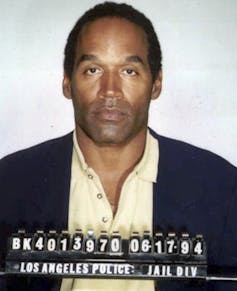
Simpson's arrest and televised trial exposed other aspects of that divide, which Salon's executive editor Andrew O'Hehir summarized with clarity in his 2016 analysis of "O.J.: Made In America." For one, Simpson's trial exposed the lie of white corporate media's promotion of a post-racial America. Both Newsweek and Time magazines featured Simpson's mugshot on their covers in 1994, but Time darkened the image, playing into stereotypes of Black menace while claiming aesthetic reasons for its choice.

Years later, a colleague would refer to that marker of Simpson's reversal of fortune as his "There and Black Again" moment. There is truth to that statement: As soon as the ratings estimates clocked the live audience for Simpson's slow-motion Bronco getaway at 95 million viewers, his grip on the media was lost forever.

Onlookers stood on overpasses or streets holding handmade signs screeching a familiar cheer back at him — "Go, O.J., go!" — but this time in jest, as if his connection to a double homicide was not to be taken seriously.

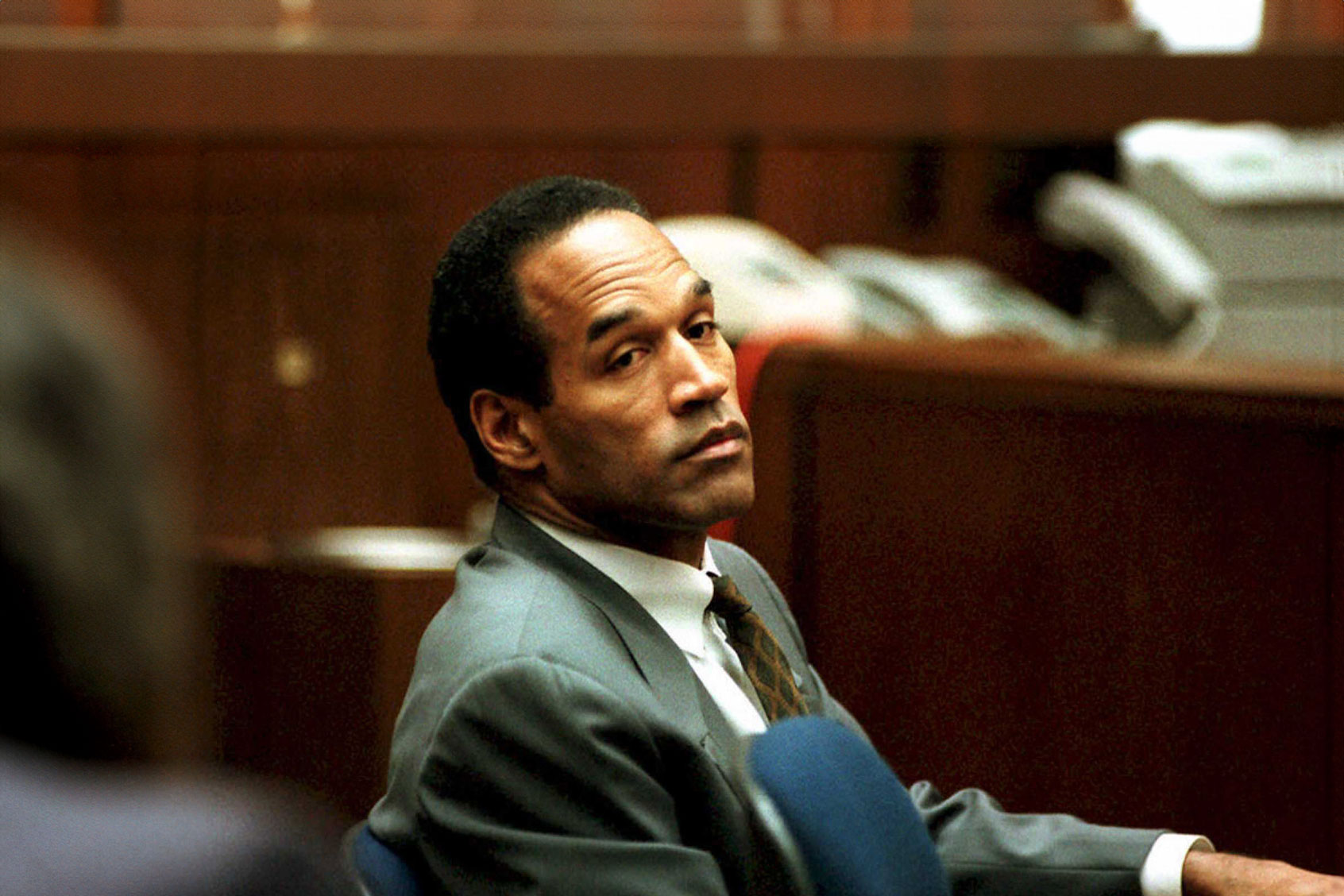
OJ SimpsonO. J. Simpson sits in Superior Court in Los Angeles 08 December 1994. (POOL/AFP via Getty Images)From there, Simpson's fate was co-opted, not rented or leased, by cable's 24-hour news machine. Simpson created the perfect nexus of breaking news, tabloid TV and the nascent true crime genre. Anchors at both traditional news outlets and CNN scrambled to be the first to unearth new details, and they, along with the attorneys, witnesses, the judge and Simpson himself were flattened into two-dimensional characters. Dan Abrams, Greta Van Susteren, Nancy Grace and Jeffrey Toobin are among the anchors who careers soared on the trial's tailwinds. 

Crashing in Simpson's guest house injected a second wind into the flagging career of Brian "Kato" Kaelin, whose name came up in late-night monologues enough to earn him cameo appearances on shows like "MADtv," along with movie appearances and celebrity reality show stints.

Court TV grew from a niche network into a wall-to-wall crime case, as it began providing content to other outlets. Lyle and Erik Menendez's first trial in 1994 proved the public's appetite for watching court cases starring young, rich and handsome men who killed their parents.

Simpson's level of fame on top of similar circumstances, along with surfaced reports of spousal abuse long ignored by the Los Angeles Police Department, made the wall-to-wall trial coverage more addictive than a soap. An estimated 140 million tuned in to Simpson's acquittal verdict when it was announced live on Oct. 3, 1995. MSNBC and Fox News both launched in 1996. 

An estimated 140 million tuned in to Simpson's acquittal verdict when it was announced live on Oct. 3, 1995. MSNBC and Fox News both launched in 1996.

A little more than a year before his trial, Simpson made an action pilot called "Frogmen," playing the leader of a Navy SEALs team. NBC was on the verge of picking the show up but reversed course after its star was charged with two murders.

We may never know whether Simpson might have polished and relaunched his star after a time if he had performed any remorse instead of tooling around in a golf cart days after his acquittal, lamely vowing to hunt "the real killers." Audiences have an unsettling habit of looking past the worst sins committed by their "problematic faves," even after they have been convicted in a court of law — and especially if they can convince their followers that they were somehow wronged by a system set against them.

Though Simpson was acquitted of Brown's and Goldman's murders, he was found liable for their deaths in a 1997 civil suit verdict in which he was ordered to pay $33.5 million in damages. From there, Simpson leached from the bones of his notoriety by attempting to publish a book called "If I Did It," an alleged hypothetical description of the murders he maintained he hadn't committed. He also recorded a Fox special to accompany its publication. Fox pulled both in 2006 after more than a dozen affiliates refused to air it.


Want a daily wrap-up of all the news and commentary Salon has to offer? Subscribe to our morning newsletter, Crash Course.


The TV special finally aired in 2018 as "O.J. Simpson: The Lost Confession?", while Goldman's family released the book after securing the rights to its publication in order to recoup some of the civil damages they're owed. Most of that money hasn't been paid out.

But that disgrace was preceded in 2007 when Simpson produced exciting new footage that led to his arrest and subsequent conviction in 2008 on armed robbery and kidnapping charges for stealing sports memorabilia and collectibles in Las Vegas.

Simpson tried to recapture some of his media glory in 2019 by joining Twitter, limiting his public expression to 280 characters and some of the smallest squares of video available.

Following his 2017 prison release, Simpson tried to recapture some of his media glory in 2019 by joining Twitter, limiting his public expression to 280 characters and some of the smallest squares of video available.

One might see that as his means of helping his fellow man, as some "Dragnet" writer suggested his fictional justice field recruit might do way back when. But his late-in-life actions ensured Simpson's infamy would outrun all of his legitimate accomplishments as a record-setting athlete, sports endorsement pioneer and all-around telegenic performer.

Simpson was trying to score points with a public who no longer saw him as a football legend, an affable movie star, a trusted network commentator, colorless or inoffensive. A monstrous crime irretrievably changed our impression of him nearly 30 years ago, and he never made much of a case for us to turn from that channel.

"The People v. O.J. Simpson: American Crime Story" streams on Hulu. "O.J.: Made in America" also streams on Hulu with an ESPN+ subscription.

Reese Witherspoon wonders if streaming platforms are making it harder to become a star

Reese Witherspoon participated in an industry conversation at a PaleyFest event for "The Morning Show" on Friday,  expressing her concerns that streaming platforms could make it harder for up-and-comers to build the type of careers that she and co-star Jennifer Aniston have.

Speaking to moderator Kara Swisher, a contributing editor at New York Magazine, Witherspoon said that initially, streaming seemed like a good thing as it made it easier to get projects up and out, but she views it as a roadblock now, creating a new difficulty when it comes to standing out as an actor.

“Are careers like ours possible ever again? Are there opportunities for people to really emerge as a star? How do you know with no data transparency? How do we even know if something did well or didn’t do right?” she said. "And it’s tough as an actor — how do you negotiate? How does a producer? How do you market? If you don’t know where you sit in a landscape, how do you value something?”

Aniston, who was also on-hand for the discussion, weighed-in with her own thoughts on the matter, saying, “We did start in this industry in a time when it was so glamorous and so fun, and [you would] just to go on auditions and auditions and just hope that you get it. And if you get that Movie of the Week and then hope you get that little guest star on 'Quantum Leap.' When it was so simple, and now it is becoming so… it’s too much sometimes.”


How to balance sweet and savory like a “Top Chef”

We’re four episodes into the new season of “Top Chef,” which means there is both quite some ways to go to the finale, and that I’ve seen enough to compare it more accurately to seasons past — and something feels a little off. 

There are some odd editing and production decisions this go-around, like when (and spoilers abound moving forward) Charly was given Michell’s immunity despite having nothing to do with her dish, but Danny wasn’t extended immunity when he had a clear hand in Rasika’s dish. Bizarre. The cast is lovely, but sans a few standouts, they seem a bit lacking, prompting a lot of disappointed judging reactions, especially in this episode. 

Perhaps the recent seasons, which were filmed throughout COVID and had casts of “all-stars” and international alumni galore, spoiled viewers a bit. Either way, I hope as the group dwindles, the strongest cheftestants emerge from the pack. 

While the season thus far may feel a bit disjointed, one of the main points of the challenge in this week’s Frank Lloyd Wright-inspired episode was, ironically, about duality — or the balance between two opposing concepts, like darkness and light. One of the most classic culinary juxtapositions of this type is the balance between sweet and savory flavors, from Kaleena's maligned mushroom cheesecake ("It's like a tack" said judge Tom Collichio, about the crust), Michelle's mushroom biscuit, or Michelle's inspiration of fried chicken with stewed, sweetened apples, to name some examples.

Bridging the gap between sweet and savory — or blurring it entirely — is one of my personal favorite things to do in the kitchen and I like seeing it get some shine on the show. There's a clear interplay there, or a duality, if you will!

This "blurring" of the line can be seen in so much: Salty desserts (which became all the rage about a decade ago and I am still very happy about that); chicken and waffles doused in real maple syrup; cranberry sauce on a Thanksgiving plate; pineapple on pizza; sweet-and-sour sauces; mostarda; agrodolce; the Italian custom of using crushed amaretti cookies in pasta dish; meatballs with a grape jelly-bbq sauce; cheese and fruit danishes; pastellitos; goiabada; and also dipping cream cheese-stuffed, deep-fried crab rangoon in a sweet chili sauce.

We need your help to stay independent

I love the juxtaposition, the brightness of sweetness against the sometimes fatty savoriness. It's such a bombastic flavor experience. It also brings to mind the always-incredible pairing of olive oil and flaky salt on any sort of frozen treat (I first tried this on a lemon semifreddo at Gabrielle Hamilton's Prune and was nearly knocked out of my seat). 

Obviously, I'm a big fan. If you're not, though, then lean into some of the lighter moments of this sort of interplay: Maybe a citrus-tinged whipped butter, a peach or apricot-laced BBQ sauce on grilled chicken breasts, a cheese platter with your favorite jam, pickled watermelon rind and candied orange peel, or a slightly spicy chocolate dessert, incorporating the bite and heat of chili with the lush sweetness of the familiarity of chocolate.

I promise, the dichotomy is a winner for a reason. When you're able to fuse the two disparate flavor profiles to the point in which someone is unable to discern if you're serving them a savory dish or a dessert, then you've truly conquered the notion.

"Top Chef," Episode 4 Takeaways

  • I loved the Manny/Kevin dynamic. I think they're both super talented and very root-able and their humorous, likable presence, especially in a relatively dour episode, was really refreshing with their boisterous laughing, their big smiles, and their energy overall. The "Damanda" pairing also seemed so lovely!  
  • -We bid adieu to Alisha, who I found to be refreshing. She feels both like a "Top Chef" competitor of yore and like someone you'd actually meet in a restaurant kitchen. Alisha brought a certain authenticity and "old school" Top Chef energy that — for me — has been sorely missing from the show. 
  • Thus far, sans maybe Michelle and Danny, this is inarguably Rasika's competition to lose. I'm so happy to see her doing so well. It's curious that someone specializing in Tamil food is excelling in such a way right after Padma's departure. I would've loved to have heard her feedback on Rasika's terrific food.

All the reasons why “Game of Thrones” villain Joffrey Baratheon deserved his “Purple Wedding”

It's been 10 years since Joffrey Baratheon was served his just desserts — pigeon pie, to be specific, followed by a golden goblet of strangler poison.

I should preface by saying I don't relish death of any kind. And yet that moral principle is hard to square with "Game of Thrones" fandom, thanks to series author George R.R. Martin and HBO adaptation creators David Benioff and D. B. Weiss. As any loyal viewers of HBO's popular series know, one should never get too attached to a character, lest they end up decapitated, flayed, skewered or incinerated by dragon fire. 

That being said, I know I'm not alone when I say that Joffrey's (Jack Gleeson) death was a satisfying watch, especially since the entire fan base was still reeling from the Red Wedding massacre of House Stark that transpired not long before. Surreptitiously poisoned by Lady Olena Tyrell of House Hightower (Diana Rigg) at the dinner following his wedding to her granddaughter, Margaery (Natalie Dormer), Joffrey's demise is not pretty: The newly minted king gags on poisoned wine before asphyxiating, blood running from his nose, twitching in purple-faced contortions as his mother, Queen Cersei Lannister (Lena Headey) wails over his body.

Rivaled only by Ramsay Bolton and his gruesome affinity for siccing hounds on his victims, Joffrey's predilection for cruelty landed him a proportionate end. Knowing that his claim to the Iron Throne was by all suspicions illegitimate — as he was likely the product of a forbidden relationship between Cersei and her bother, Kingslayer Jaime Lannister (Nikolaj Coster-Waldau) — made his death even more palatable. 

As Weiss said on a recent episode of Josh Horowitz's "Happy Sad Confused" podcast, "With 'Thrones,' there was so much killing of good guys, and we finally got to really kill both Joffrey in season 4 and Ramsay Bolton in season 6. It was fun to go back to the old-fashioned joys of just killing off a really bad guy. It felt like it was balancing the scales a little."

Here's a list of reasons why the "Purple Wedding" made fans breathe a collective sigh of relief a decade ago.

01
Instructing the Hound to kill Mycah, the butcher's boy (S1 Ep. 2)
The humble son of a butcher, Mycah (Rhodri Hosking) befriends Arya Stark (Maisie Williams) during her family's trip to King's Landing, and the pair engage in a friendly duel with wooden swords by a riverbank. When Sansa Stark (Sophie Turner) and Joffrey, in the middle of a courting outing, happen upon them, Joffrey gratuitously demands that the boy face off against him and his very real, non-wooden sword.
 
When Arya's dire wolf Nymeria attacks Joffrey to intervene, chaos — and two deeply unnecessary killings (Mycah and Sansa's dire wolf, Lady, who is executed in Nymeria's place) — ensues.


02
Executing Ned Stark (S1 Ep. 9)
Ned Stark's (Sean Bean) execution is the introduction to the litany of shock-value deaths that follow over the course of eight seasons. It also catalyzes the seismic civil war also known as the War of the Five Kings, that drives much of the series' plot. 
 
When Ned learns of Joffrey's bastard status while serving as Hand of the King in King's Landing, he confronts Queen Cersei about her and Jaime's deception. Though he is able to inform King Robert's (Mark Addy) brother, Stannis Baratheon (Stephen Dillane), Ned is ultimately betrayed by Master of Coin Petyr Baelish — known as "Littlefinger" — played by Aidan Gillen, and jailed for treason. Joffrey elects to have the ruler of Winterfell beheaded publicly by Ser Ilyn Payne (Wilko Johnson) in front of his two young daughters and the rest of the city. 
 
To add insult to injury, the ever-sadistic Joffrey forces Sansa to stare at her late father's head mounted upon a pike in the following episode. 
03
Slaughtering King Robert's bastards (S2 Ep. 1)
Joffrey is incensed upon learning that Robert not only fathered bastards across King's Landing but that many believe his own parentage to be just as dubious. 
 
In a moment of violent judgment, Joffrey orders a citywide massacre of all of Robert's bastards, the most heartrending of which occurs in one of Littlefinger's brothels, when the newborn son of a sex worker is ruthlessly slain. 


04
Killing Ros in his bedroom with a crossbow (S3 Ep. 6)
After Littlefinger learns that sex worker Ros (Esmé Bianco) — we meet her in season one astride Tyrion Lannister, played by Peter Dinklage — has been spying on him at the behest of the King's Master of Whisperers, the eunuch Lord Varys (Conleth Hill), he sells her off to Joffrey.
 
The barbaric fledgling king uses Ros for live target practice, stringing her up in his bedroom and shooting her multiple times with his crossbow. 


05
Threatening to assault Sansa on the eve of her wedding to Tyrion (S3 Ep. 8)
By this point in the series, viewers can't help but feel awful for Sansa, now a prisoner in King's Landing and Joffrey's personal, emotionally manipulated punching bag.
 
Though they were at one time betrothed, the engagement is broken off when Joffrey decides to marry Margaery instead. To consolidate as much power as possible, Head of House Lannister, Tywin, instructs his son Tyrion to marry Sansa, much to her initial chagrin. 
 
“I suppose it doesn’t matter which Lannister puts the baby in you. Maybe I’ll pay you a visit tonight after my uncle passes out,” Joffrey menaces at Sansa's wedding ceremony, adding that he'll have his men hold her down during the hypothetical assault. 


06
Parodying the deadly War of the Five Kings at his wedding (S4 Ep.2)
One of the last of Joffrey's cruel jabs directed at Sansa takes place on the day of his death, at his wedding ceremony. While grieving the recent murder of her brother Robb Stark and mother Catelyn Stark by Lannister ally Walder Frey (David Bradley), Sansa is shocked to see Joffrey has ordered a group of people with dwarfism (a separate act of mockery of his uncle Tyrion) to reenact the war in a joking manner. The players lend specific focus to Robb's decapitation — after being murdered at the Red Wedding, the then-King of the North's dead body was grotesquely paraded atop a horse, fitted with the head of his slain dire wolf, Grey Wind.
 
The spectacle doesn't sit well with most of the wedding guests; ultimately, however, it's avenged by Joffrey's death, which happens shortly after. 


It’s a massive election year around the world too — and democracy may be losing

Nearly half the world’s population live in countries that will hold national elections this year, the largest such proportion in more than a century. But the big picture is complicated: “Over half of the 60 countries holding national elections this year are experiencing a democratic decline, risking the integrity of the electoral process…. The worsening election quality is concerning, given the pivotal role elections play,” warns the V-Dem Institute in a press release announcing its 2024 report, titled “Democracy Winning and Losing at the Ballot.” 

Elections are “critical events,” the report explains, “that can either trigger democratization, enable autocratization, or aid stabilization of autocratic regimes”: 

Surprise victories for a democratic opposition in critical elections can lead to the ousting of an incumbent, even in autocratic settings. The Maldives and Zambia are two recent examples of this.

Contrastingly, elections can also serve as powerful instruments of legitimation and spur further autocratization when challengers fail, such as in Hungary and Türkiye in recent times. The fact that a majority of elections during the “record election-year” 2024 take place in such contested spaces makes this year likely to be critical for the future of democracy in the world.

The extraordinary wave of 2024 elections, which encompasses seven of the world’s 10 largest countries — Bangladesh, India, Indonesia, Mexico, Pakistan, Russia and the U.S. — along with other prominent nations such as Iran, Mexico, South Africa, South Korea and the U.K., comes as the erosion of democracy, or “autocratization,” in V-Dem’s language, continues in many different places. 

Strikingly, the report includes two contrasting perspectives: a commentary from four investigators in the larger V-Dem Project argues that the current erosion of democracy “is fairly modest,” and calls for “a more measured tone,” while a special boxed section points in the opposite direction, highlighting a growing threat that V-Dem isn’t fully capable of measuring: the authoritarian-dominated BRICS bloc of nations, which allies the autocratic regimes of Russia, Iran and China with large Global South democracies such as Brazil and South Africa.

Other signs also hint at more troubling trends. Perhaps most notably, Israel has dropped from the ranks of liberal democracies for the first time in 50 years. That has nothing to do with the current war in Gaza or Israel’s treatment of Palestinians in the occupied West Bank, but primarily reflects “substantial declines in the indicators measuring the transparency and predictability of the law, and government attacks on the judiciary.” 

Arguably, V-Dem has no measures that capture Israel’s deepest democratic flaws. “We can only speak to issues [on] which V-Dem has data, hence not on topics such as toxic ethno-nationalism,” V-Dem Institute director Staffan Lindberg, lead author of the report, said via email. “While we provide the most comprehensive database on democracy in the world, there are indeed areas we do not cover.” 

While the U.S. persists in depicting itself as the global avatar of democracy, its support for Israel’s war in Gaza puts it at odds with the vast majority of the world, and undermines support for the war effort in Ukraine as well as the case for democracy more broadly. While our collective ability to make sense of autocratization and democratization continues to advance, the questions keep piling up even faster. As you may have noticed, we live in a time of chaotic flux.

Overall, according to V-Dem’s report, the share of world population living in “autocratizing” countries has overshadowed the share living in democratizing countries since 2009, with the starkest declines seen in Eastern Europe, South Asia and Central Asia. Latin America and the Caribbean go “against the global trend,” the report finds: “Democracy levels increase, and large countries are more democratic than smaller ones.” There are some indications that “the autocratization wave is slowing down,” but that is far from a clear verdict. 

Deeper forces, longer patterns

This history-shaping year of elections could have significant effects — but in what direction? Only three of this year’s major elections are in democratizing countries, while 31 occur in more autocratic contexts. Furthermore, underlying forces that are difficult to define will play a significant role. In 2021, Max Fisher analyzed V-Dem data for a New York Times feature, and found that the U.S. and its allies were responsible for a large share of democratic backsliding that occurred in the 2010s (36%), while their contribution to democratization was a meager 5%.  

While the U.S. persists in depicting itself as the global avatar of democracy, its support for Israel’s war in Gaza puts it at odds with the vast majority of the world, and undermines support for the war effort in Ukraine and the case for democracy more broadly.

The picture was very different after the end of the Cold War. There was a broad trend of democratization in the 1990s, largely resulting from relaxed great-power backing for autocratic allies, both in the former Soviet bloc and in regions where the U.S. had “backed or installed dictators, encouraged violent repression of left-wing elements, and sponsored anti-democratic armed groups,” as Fisher wrote. After 9/11, however, the U.S. revived it’s longtime support for autocratic allies, particularly in the Islamic world. 

Contrary to conventional wisdom, Fisher found that U.S. policy had a stronger impact on autocratization than any policies enacted by the authoritarian governments in Russia and China, “whose neighbors and partners have seen their scores change very little.”

These contradictions of American policy are part of a larger pattern, as described in the recent book “The Deep Roots of Modern Democracy” (Salon interview here). While liberal democracies remain dominant in Western Europe, that dominance rests partly on ethnocentric foundations that are ultimately at odds with the values such democracies claim to support. History suggests, in fact, that Euro-American liberal democracies have played a significant role in retarding democratic progress elsewhere. Their interest in “stability,” free trade and military alliance have taken precedence over a rhetorical commitment to democracy. 

Using its fourfold “Regimes of the World” categories — liberal and electoral democracies on one hand, electoral and closed autocracies on the other — V-Dem finds the world “almost evenly divided between 91 democracies and 88 autocracies,” with a severe population imbalance: More than 71% of the world’s population, or 5.7 billion people, live in autocracies, a dramatic increase from 48% 10 years ago. Only 29% of the global population (2.3 billion people) live in liberal or electoral democracies.

“The level of democracy enjoyed by the average person in the world in 2023 is down to 1985 levels,” V-Dem reports. ; by country-based averages, it is back to 1998,” V-Dem reports. Nearly all of what the institute defines as “components of democracy” are getting worse in more places than they’re getting better, and three of those components stand out: “freedom of expression” has gotten worse in 35 countries; “clean elections” are deteriorating in 23 countries (but improving in 12); and “freedom of association” is more restricted in 20 countries (and expanded in just three).

“Autocratization,” V-Dem finds, is ongoing or accelerating in 42 countries that are home to 35% of the world’s population — but India, now the most populous country in the world, accounts for half of that 2.8 billion total. Of those 42 nations, 28 were previously considered democracies, “illustrating that democratization processes are fragile and are often reverted,” as the report notes. One common theme is that free and fair elections are increasingly being undermined around the world; the autonomy of election management boards is weakening in 22 of the 42 autocratizing countries.

Democratization trends are much weaker, the report finds: While that process is found in 18 countries, they account for just 5% of the world's population, and the majority of them, roughly 216 million people, live in Brazil. The nine nations V-Dem considers “stand-alone” democratizers (rather than autocratizing countries making “U-turns”) represent just 30 million people, less than 0.4 percent of the global population. Several are tiny island states, such as Fiji, the Seychelles, the Solomon Islands and Timor-Leste; the largest such country is the Dominican Republic, with 11 million citizens. 

More than 71% of the world’s population, or 5.7 billion people, live in autocracies, a dramatic increase from 48% 10 years ago. Only 29% of the global population lives in liberal or electoral democracies.

V-Dem also finds that 25 countries are “near misses” of autocratization, while nine are “near misses” of democratization. So both categories could increase once this history-shaping election year provides a clearer picture — or doesn’t.  We’ve already seen various post-election chaos in countries both large and small, including Argentina, Pakistan and the Netherlands, where a far-right party won the most seats in a Nov. 22 election but has been unable to forge a coalition government. 

But even the recent sham election in Russia — which took place after the death in prison of Alexei Navalny, the only plausible threat to Vladimir Putin — provided an opportunity for organized protest, which is normally impossible, via the “noon against Putin” initiative. That could be just a ripple without consequences, as Putin tried to portray it, but years from now it could also stand out as an unlikely turning point — a worldwide pro-democracy protest (since it included overseas Russian embassies) when no such thing seemed possible. V-Dem has no way to capture or measure such things. 

As noted above, there’s a tension in the report itself that heightens the uncertainty. The commentary from four investigators arguing that democratic decline is “fairly modest” focuses most heavily on V-Dem’s partial reliance on population-based measures. India’s disproportionate impact is their main concern. Yet the report also contains information pointing in the opposite direction — most notably the expanding influence of the so-called BRICS+ bloc of nations, comprising Brazil, Russia, India, China, South Africa and a growing list of smaller allies.

The BRICS challenge

The boxed section entitled "BRICS Expansion and the Future of Global Democracy" notes that the growing power of these developing nations “sends a message about a shifting balance of global power and an emergence of a multipolar world, and that the weakening relative power of democracies “also poses questions about prospects for human rights and democratic freedoms around the world.” 

For generations, a comforting narrative has assured us that expanding global trade will  lead inevitably to increasingly open and democratic societies and an era of international peace. That was Richard Nixon’s original rationale in going to China, and the impetus behind the “free trade” push of the 1990s. But the BRICS+ group’s “total share of global real GDP has more than tripled during the last 30 years,” while the G7 nations’ “share of world real GDP has shrunk from 68% in 1993 to 44% in 2023”:  

The relative success of BRICS is all the more remarkable when taking into account that ideologically different autocracies China and Russia and now electoral autocracy India managed to work pragmatically together with still democratic Brazil and South Africa for many years. Even the Sino-Indian border dispute, and Russia’s invasion of Ukraine and the following sanctions did not break up the block.

V-Dem’s liberal democracy index, or LDI, reveals stark differences between the G7 and BRICS+. (That index measures rule of law, checks and balances, civil liberties, free and fair elections and a free and independent media.) Within BRICS. Brazil and South Africa represent relatively democratic systems, while Russia and China are the world’s leading autocracies, which also describes recent additions such as Egypt, Ethiopia, Iran, Saudi Arabia and the UAE. India, by the way, slipped from V-Dem’s “electoral democracy” category to “electoral autocracy” two years ago, and its LDI score has fallen by almost half in the last decade.  

Brazil presents an opposed example, as the world’s largest democratizing country. It could have gone the other way, had former President Jair Bolsonaro won re-election.  But Lula’s 2022 victory and the unified rejection of Bolsonaro’s attempted insurrection — strikingly different from what happened in America — can be seen as a "critical event" that affected the country’s political system as a whole. 

The report’s boxed section on Brazil notes the importance of such events in halting or reversing autocratization, and highlights specific factors in that process. That began before the election, when Brazil’s electoral management body actively sought to counter disinformation and misinformation “and to disavow fake news about the electoral process.” The Brazilian courts investigated “digital militias,” meaning “online criminal groups that work against democracy and the democratic state.” There was a broad pro-democracy alliance of opposition parties; Lula’s running mate was a political centrist who had been “his political adversary for decades.” 

Brazil’s system successfully resisted Bolsonaro’s attempts to change the rules in his favor, aided by diplomatic support from the U.S., Britain, France and Germany. International observers agreed the election was free and fair and rapidly recognized Lula’s victory. Legislators, law enforcement officials and the Brazilian Supreme Court all accepted the results and rejected Bolsonaro’s claims of fraud. And despite Bolsonaro’s leading comments in praise of Brazil’s former military dictatorship, the troops stayed in their barracks and made no moves toward a coup. More recently, Bolsonaro was convicted on charges of abusing his power as president, and is now ineligible to seek or hold public office until 2030.

Brazil's example suggests that the pathway to reversing autocratization and restoring democracy is clear. Having the will and capacity to follow that path is quite another matter.

That example suggests that the pathway to reversing autocratization and restoring democracy is clear, although having the will and capacity to follow that path is another matter altogether. Donald Trump, as we know, has not been barred from running again, even after Jan. 6. Indeed, the Supreme Court basically rewrote the 14th Amendment to make sure he could run. Beyond that, the U.S. lacks some of the central institutions that Brazil drew on, such as the electoral management body and a federal court system with investigative powers. But the criticial need to consolidate a broad pro-democracy alliance faces no such barrier. What stands in the way is mostly the perversity of our political system, which helped empower Trump in the first place. 

Decoding the global state of democracy

The challenge on the world stage is considerably more difficult. As noted above, democratic decline has been the dominant trend since 2009, most starkly in Eastern Europe, South Asia and Central Asia, with Latin America and the Caribbean going the other way. A historical comparison between those regions is illuminating, as shown in this chart tracking changes from 1973 through 2023. 
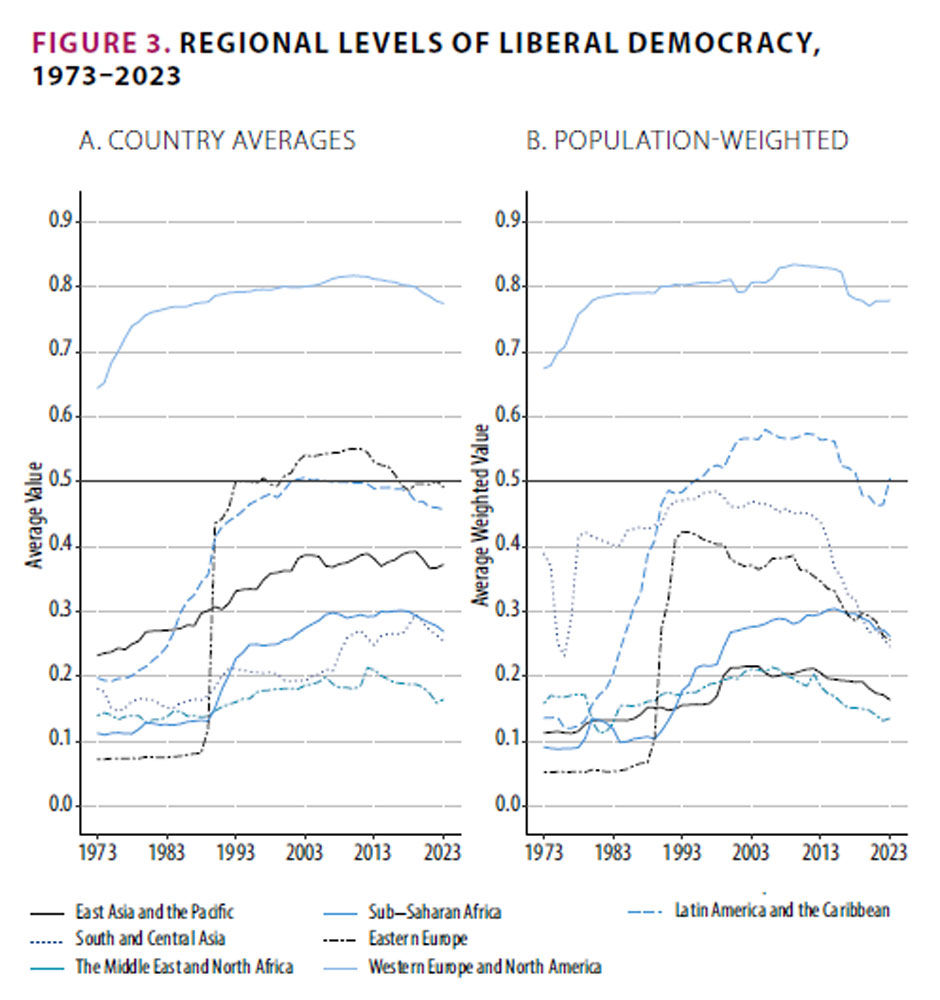
Democracy Report 2024: Democracy Winning and Losing at the Ballot figure 3Graphic from "Democracy Report 2024: Democracy Winning and Losing at the Ballot" (Courtesy of University of Gothenburg: V-Dem Institute)Both regions were strikingly similar in the early ‘90s, but by 2023, they had steadily diverged. Another chart in the report show each region by percentage of regime type, which makes their current condition strikingly distinct: Latin America and the Caribbean are largely democratic (gray zone or better), while Eastern Europe is 66% electoral autocracy. So the question is why and how that happened.
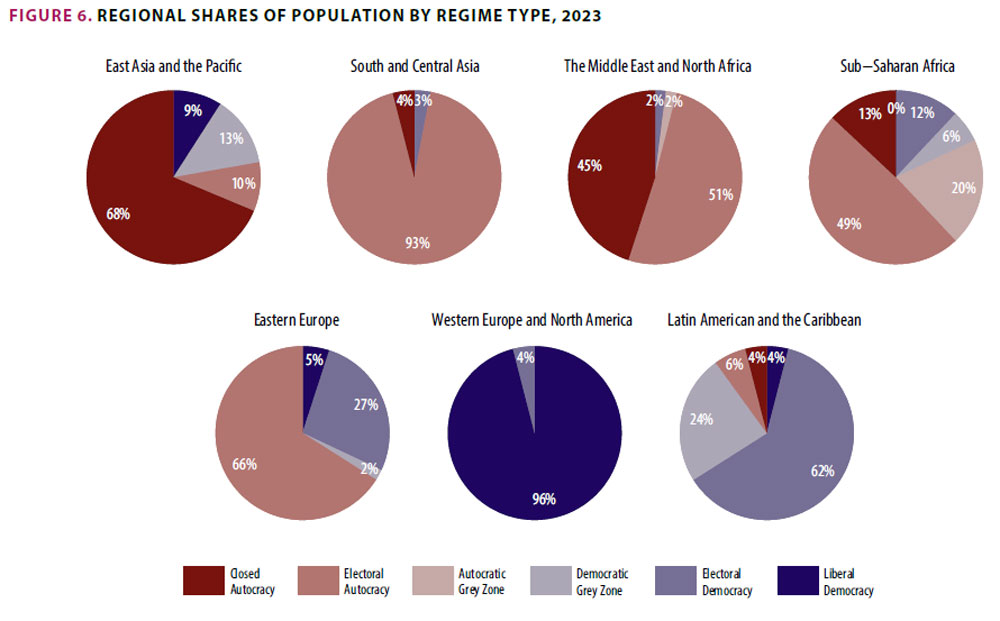
Democracy Report 2024: Democracy Winning and Losing at the BallotGraphic from "Democracy Report 2024: Democracy Winning and Losing at the Ballot" (Courtesy of University of Gothenburg: V-Dem Institute)A partial answer is suggested by the argument laid out in “The Deep Roots of Modern Democracy,” which holds that port cities and access to global trade routes are crucial ingredients. Eastern Europe is largely landlocked, and therefore would logically have a harder time building strong modern democracies, compared to the oceanfront regions of Latin America and the Caribbean.  

That also helps explain why Western Europe and North America are the only world regions almost entirely governed by liberal democracies, and why they haven’t spread as inevitably as ideologues of the “End of History” era once suggested. In effect, Europe and the U.S. have been a negative influence overall, due to economic imperialism and military intervention, which have done more to prop up elite rule in many places than to spread democratic values and practices. 


Want a daily wrap-up of all the news and commentary Salon has to offer? Subscribe to our morning newsletter, Crash Course.


Representative democracy is primarily a means of national elite coordination and conflict, subject to broad popular constraints. Its organized influence varies considerably over time as well as between countries. In most of Western Europe that influence helped create robust welfare states, something that never quite happened in the U.S. The American and European elites who drive foreign policy have inherited deep assumptions and orientations drawn from the era of colonialism and imperialism, even as overtly racist or nationalist assumptions have been rejected.

While the U.S. generally claims to value democracy as an abstract goal, our government does not actually pursue that goal in any meaningful or consistent fashion. We have something like 750 military bases around the world as of 2020, but nothing remotely comparable devoted to spreading democracy. Most Americans take that for granted as our nation’s way of being in the world, which supposedly has something to do with spreading freedom and democracy. That’s not how most of the world sees America, or what our lopsided defense budget says. Over and over again, it’s not what America’s global actions actually produce. 

V-Dem’s data can’t cover everything, as Lindberg acknowledged. But it does provide a wealth of guidance about specific aspects of democracy that can be improved. If Americans were as seriously committed to democracy as we like to believe, perhaps we would restructure our national priorities accordingly. 

“Key player”: Legal scholar says Hope Hicks’ hush-money testimony could be “devastating” for Trump

Former White House communications director Hope Hicks is expected to take the stand in Donald Trump's New York hush-money criminal trial — and legal experts say her testimony could be pivotal to the prosecution.  

Last year, Hicks met for several hours with prosecutors in the Manhattan district attorney's office, according to NBC News. They allege the former president falsified business records around a hush-money payment the former president's then-lawyer Michael Cohen made to adult film start Stormy Daniels near the end of his 2016 presidential campaign.

Hicks served as Trump's campaign press secretary at that time, and because of her position as one of Trump's most trusted aides, her testimony at the criminal trial, which begins jury selection Monday, could be "devastating" for him, Bennett Gershman, a Pace University law professor and former New York prosecutor, told Salon.

"Hicks was a fixture in Trump’s 'inner circle,'" he said, speculating that "given her status, she very likely was a key player in the frantic discussions between Trump, Cohen and David Pecker of [American Media Inc.] about the bombshell report that Stormy Daniels was about to go public about her sexual affair with Trump, and the efforts they made to keep her silent by paying her off."

In 2019, an attorney for Hicks said that she had not known about the hush money payment until it became public. But, in an affidavit for Cohen's federal criminal case, an FBI agent who had been investigating Cohen said he believed Hicks was involved in the payment negotiations with Daniels, whose real name is Stephanie Clifford, over her alleged sexual encounter with Trump in 2006, NBC News notes. 

The affidavit outlined that the negotiations began after the Trump campaign grappled with the Oct. 7, 2016, release of Trump's "Access Hollywood" hot-mic tape, in which he's heard professing that he can grope women without consent. 

“I have learned that in the days following the Access Hollywood video, Cohen exchanged a series of calls, text messages and emails with Keith Davidson, who was then Clifford's attorney, David Pecker and Dylan Howard of American Media Inc., the publisher of the National Enquirer, Trump, and Hope Hicks, who was then press secretary for Trump’s presidential campaign,” the affidavit said.

"Based on the timing of these calls, and the content of the text messages and emails, I believe that at least some of these communications concerned the need to prevent Clifford from going public, particularly in the wake of the Access Hollywood story," the FBI agent added in the document.

Given Hicks' role on the Trump campaign, her involvement in both in-person and phone communications with Trump and Cohen about the "emergency" Daniels' claim of an encounter would pose is "likely," Gershman said. 

Court records noted that Hicks called Cohen at 7:20 p.m. on Oct. 8, 2016 — their first call in weeks — for a four minute conversation, with Trump having joined the call seconds after it began, according to NBC News. Hicks and Cohen spoke after Trump left the call, and afterward Cohen called Pecker, the president of AMI.

Moments later, Howard, AMI's chief content officer, phoned Cohen. Cohen then called Hicks and spoke with Pecker again. At 8:03 p.m., Cohen began what would be an eight minute phone call with Trump, the unsealed federal court documents indicated, per NBC News. 

Court records also show Trump and his former fixer speaking twice on Oct. 26 — the same day Cohen wired the $130,000 that would eventually be sent to Daniels' attorney to an escrow account.

Trump has denied sleeping with Daniels and denies committing any wrongdoing. He has pleaded not guilty to charges in Manhattan and dismissed the district attorney's case as politically motivated.  

We need your help to stay independent

Cohen and Daniels are expected to be key witnesses in the case but Hicks will also be "important," former federal prosecutor Neama Rahmani told Salon, noting concerns with the credibility of both key witnesses. Cohen, who in 2018 pleaded guilty to charges related to the hush money payment, is an "admitted liar" whose cross-examination will be "brutal" as a result, while Daniels, having been "paid to keep quiet," presents "her own credibility issues," Rahmani explained.  

"So Hicks is going to be a better witness, at least from a credibility standpoint," he said.

Hicks could also be "particularly helpful" for the prosecution because, as an ex-Trump employee, "she is less likely to be subject to suggestions that she is biased against him," former U.S. attorney Barbara McQuade told Salon, explaining that her closeness with Trump may make the jury find her testimony "particularly credible."

Hicks testified before the Democratic-controlled House Judiciary Committee in 2019 that she was not involved with the hush-money discussion, adding that she informed the FBI that she did not, "to the best of her recollection," learn of Daniels' allegations until early November 2016.

The Democratic chair of the committee questioned the "apparent inconsistencies" in Hicks' testimony after the FBI affidavit was unsealed in 2019. Shortly after, Hicks' lawyer, Robert Trout, rebuffed reports claiming Hicks' involvement as "simply wrong," according to NBC News. 

Based on Hicks' congressional testimony and reports about her meetings with the FBI and testimony before the grand jury that investigated the aftermath of the 2020 election, Rahmani said he's unsure exactly "how much she knows" and if she'll be able to provide "more substantive testimony" than speaking to phone calls happening and a series of calls occurring on the days of interest.


Want a daily wrap-up of all the news and commentary Salon has to offer? Subscribe to our morning newsletter, Crash Course.


Even then, MSNBC legal analyst Lisa Rubin said on X, formerly Twitter, that Hicks' history of speaking with prosecutors and officials "suggests she'll be forthcoming" with what she knows if she's called as a witness in the Manhattan trial. 

In an interview with the FBI, Rubin said, Hicks indicated that "the only other time" she had seen Trump as angry as he was when special counsel Robert Mueller was appointed was "when the Access Hollywood tape came out during the campaign.

Other instances of Hicks' willingness to speak came during the 2019 congressional testimony where she explained that her phone call with Cohen on Oct. 8 was about rumors of a different tape said to be of Trump in Moscow "with Russian hookers, participating in lewd activities" and that she called to ask him to contact TMZ, which she had been informed may have the tape, Rubin explained.

Hicks also recognized that she publicly denied, at Trump's direction, a relationship between him and Playboy model Karen McDougal — whose silence about alleged sexual encounters Trump is also alleged to have bought — and admitted that she had told "white lies" while acting as a communications aide though said she had "never been asked to lie about matters of substance or consequence."

"But perhaps most important is what she didn't say," Rubin said, noting that Hicks declined to answer questions about her time at the White House, leaving anything she learned as its communications director "off limits." 

"Will it remain so at trial, especially after all the litigation about executive privilege and who controls it? Nope," she added. "And the DA's office could be seeking her testimony as much for what she saw/heard in the WH as for what she understood before the '16 election."

Hicks' testimony, then, could pose a considerable threat to the former president, legal experts told Salon. McQuade said that the ex-Trump aide could provide the court with "firsthand eyewitness testimony" about any observations she had about documents Trump signed or statements he may have made about their purpose.

Such testimony, Gershman added, would be crucial evidence "that Trump knew the peril he faced and concocted the payoff scheme to keep Daniels silent."

Rahmani also expects Hicks, should she be called to the stand, to "corroborate" Cohen and Daniels' testimonies that phone calls and payments were made and that the involved parties had discussions about the Enquirer, Daniels and McDougal. Though it may not amount to "direct evidence" that the calls were about the hush money payments, he said, it would "certainly" be "circumstantial evidence" consistent with other witness testimony.

What Hicks' proximity to the former president, Cohen and the situation at the time make "clear," Gershman added, "that if Hicks testifies, and if the jury believes her, it would be devastating evidence against Trump and make a conviction much more certain."

Why America’s plutocrats are lining up to pay Trump’s legal bills

During his first presidential run back in 2016, Donald Trump’s credibility as a “populist” rested largely on the fact that he was a billionaire. Unlike his opponents, who he accused of being “controlled” by their donors, the New York real estate developer claimed to be entirely self-funded and therefore free from any kind of outside influence. “I don’t need anybody’s money,” he bragged at his announcement in 2015, where he disparaged his opponents as mere puppets to plutocrats like himself

This was a paradoxical yet also powerful message that ultimately helped propel the billionaire to victory.n. Trump’s Democratic opponent, Hillary Clinton, embodied the Washington establishment and had a long history of courting big donors to fund her political career. This made her particularly vulnerable to his attacks. While Trump could claim with some credibility to funding his own campaign, there was little doubt that Clinton was the preferred candidate of the donor class. Big donors weren’t necessarily thrilled with the prospect of a Clinton presidency, but most considered Trump too much of a wild card to get behind. In any case, few thought he had any chance of winning. 

Fast-forward to the present, and Trump is no longer the outsider that he was back in 2016. Though still something of a wild card (for democracy, at least), many of America’s economic elite are no longer filled with the kind of trepidation that they had about him eight years ago. And unlike in 2016, Trump is heading into his third consecutive run for president as the clear favorite in the polls. 

There is another major difference in Trump this year that has become increasingly obvious in recent weeks as the former president has struggled to pay his legal fees and other costs related to his ongoing criminal and civil trials. Trump no longer appears to be the financially independent anti-politician that he was in 2016. Indeed, if any candidate appears to be desperate for big donor cash this year, it is Donald Trump. 

With his campaign and associated Super PACs facing a cash crunch after spending more than $100 million (and counting) on legal bills, the former president and his team have become increasingly focused on courting the very same big donors that Trump once scorned. Even more humiliating, the former president has reportedly started working the phones for “hours at a time” and blocking out entire days to make “personalized” pitches to potential financial backers, including many of his fellow billionaires. The candidate who once mocked his opponents for soliciting money from wealthy donors has thus become the pandering politician who he railed against eight years ago. Gone is the swaggering, self-funding billionaire telling donors to shove it; in his place comes an embattled politician who is low on cash and anxious to charm his plutocratic peers. 

Fortunately for Trump, this charm offensive is starting to pay off.

Now that Trump has secured his Republican nomination, America’s economic elite seem to be warming up to the former president’s reelection bid. Last week, the RNC and Trump campaign announced an impressive $65.6 million haul for March, tripling what they raised in February. A few days later, the campaign held its first major fundraiser since Trump clinched his party’s nomination in March, and reportedly brought in a record-breaking $50.5 million. Held at the home of a hedge fund billionaire John Paulson, the dinner was attended by a who’s who of conservative plutocrats, including casino mogul Steve Wynn, hedge funder Robert Mercer, Johnson & Johnson heir Woody Johnson, fracking billionaire Harold Hamm, and many others. With tickets starting at $250,000 and going up to $814,600 per guest — the legal limit for a joint fundraiser — the event injected much-needed cash into the coffers of the Trump campaign and the RNC, along with the Super PAC currently paying Trump’s legal bills, which received a cut from each donation. The more than $50 million raised was nearly double the $26 million raised by the Biden campaign at its star-studded fundraiser in New York City the previous weekend.

These impressive numbers indicate that the Republican donor class has lined up behind their candidate. But it’s not just Republican billionaires who seem to have made peace with Trump. While most of the guests at Trump’s big fundraiser on Saturday have been GOP donors for years, there have also been signs suggesting that other billionaires are coalescing around the effort to dethrone Joe Biden. 

As Brad Stone recently observed in Bloomberg, Trump’s “most visible supporters” this time around are no longer “angry blue-collar workers” but “some of the most successful businessmen in the country.” Importantly, this includes businessmen who have previously been apolitical or even supportive of the Democratic Party. The most prominent example of this trend has undoubtedly been Elon Musk, who claims to have voted for Biden in 2020 but now presents a second Biden  term as an existential threat to the country. “I voted 100% Dem until a few years ago. Now, I think we need a red wave or America is toast,” the billionaire recently posted on X, where he regularly boosts right-wing conspiracy theories and misinformation on everything from voter fraud to immigration to Covid vaccines. While the Tesla CEO has yet to explicitly endorse Trump, he has consistently used his megaphone to rail against Biden and amplify right-wing talking points. 

Musk is hardly alone among his fellow billionaires. Consider the case of hedge fund manager Bill Ackmam — a longtime donor to centrist Democrats who has become increasingly critical of the party over the Biden years. Like Musk, Ackman regularly vents against “wokeism” on X, and in January he officially renounced his ties with the Democratic Party. “I was a Bill Clinton Democrat and what the party has morphed into is not something I want to be associated with,” said the Wall Street billionaire. 

Musk and Ackman have both presented their turn away from Biden and the Democratic Party as a principled response to the cultural extremism and “woke” politics that has supposedly infected the party in recent years. But there is a much more plausible explanation for the growing revolt of the billionaire class that has little to do with “principles” and everything to do with material interests. 

While Musk talks a lot about the “woke mind virus,” there’s little doubt about what initially drove him away from the Biden administration. Almost from the beginning of Biden’s term, the Tesla CEO has complained about the administration’s supposed hostility towards his companies, which he has repeatedly blamed on the president’s pro-labor bias. “Seems to be controlled by unions,” said Musk on Biden back in 2021, shortly after the president held an EV summit at the White House that included Detroit’s Big Three and the United Auto Workers (UAW) but not Tesla. When Democrats in Congress unveiled a bill that would have given a $4,500 tax incentive to consumers for buying union-made EVs around the same time, the notorious union buster had a predictable response: “This is written by Ford/UAW lobbyists.” Musk’s animosity towards Biden has only deepened in the years since, especially as the administration has continued to advance a broadly pro-union agenda. In January, Musk essentially declared war on Biden’s National Labor Relations Board (NLRB) when his rocket company, SpaceX, filed a lawsuit challenging the constitutionality of the 90-year old New Deal agency.

We need your help to stay independent

This conflict between Musk and Biden reflects a broader trend. The more the Biden administration has advanced a populist economic agenda that bolsters the labor movement and confronts monopolistic corporations, the more critical billionaires and corporate CEOs like Musk have become of the president. “The simplest and easiest explanation for this [billionaire] blowback,” notes Stone, is the “barely concealed fear that a majority might be coming for their wealth.” This was clear after Biden put forward a plan to increase corporate taxes and create a minimum tax for anyone worth more than $100 million during his State of the Union address last month, which immediately drew the ire of billionaires crying “socialism.”

It is for similar reasons that many plutocrats who once criticized Trump now seem to be warming up to the former president’s second election bid. In 2016, Trump ran as a populist and could make a legitimate claim to independence. But in the end it didn’t matter. As a plutocrat himself, Trump did not need to be “controlled” by the plutocrats because he instinctively shared most of their goals, be it tax cuts for the rich, deregulation, or undermining organized labor. Trump claimed to be the candidate of working men and women, but his Cabinet was stacked with Wall Street swamp creatures like Steve Mnuchin and Wilbur Ross, along with militant union busters like Eugene Scalia — a man who spent his career as a corporate lawyer representing union-busting employers — running the Labor Department. In addition to lower taxes, corporate America also benefited from the Trump administration’s unprecedented assault on the regulatory state, with Trump officials rolling back hundreds of regulations on everything from the environment to workers’ rights to big finance

The stark contrast between the Biden and Trump administrations on the economy belies the claim often heard on the “populist” right that the Democratic Party is now the “party of the rich” while the GOP has become a “working class party.” Right-wing populists assert that the Democratic Party has become increasingly disconnected from the concerns of working people as its base has grown more affluent and college-educated. According to this narrative, the former party of the people has abandoned its earlier pro-worker disposition while embracing “woke” cultural politics that appeal to its heavily suburban and college-educated base. 

But the actual facts paint a very different picture. Indeed, a recent study by political scientists Jacob S. Hacker and Paul Pierson found that Democratic discourse and policy initiatives continue to show a “clear emphasis on economic priorities,” and that they have actually grown more populist during the Biden years (in contrast, Republican discourse greatly emphasizes cultural issues while keeping discussion of their unpopular economic policies to a bare minimum). 

In their 2020 book, Let Them Eat Tweets, Hacker and Pierson described Trump’s politics as “plutocratic populism” because he employs populist rhetoric and themes to advance plutocratic ends. In 2016, many in the donor class seemed genuinely turned off by Trump’s anti-elitist persona. Trump was an unknown quantity who at times appeared to be genuinely populist on economic issues. But after his first term America’s plutocrats no longer fear that Trump would pursue a populist economic agenda. Besides, the so-called “elites” who Trump targets today are not billionaires but college-educated professionals who tend to vote Democrat and work in white collar professions, particularly in academia, journalism, and other opinion-shaping fields. For pluto-populists like Trump, the real problem with today’s society is not so much that elites exist but that the wrong elites have gained too much power over everything from the federal government (i.e. the “deep state”) to the press to the top universities. Many plutocrats sympathize with this view, seeing themselves as the real elite taking on an undeserving and malevolent pseudo-elite in the “professional managerial class.” In his Bloomberg piece, Brad Stone touches on this very real intra-elite conflict and how it explains the swelling plutocratic support for Trump, which “feels tinged with real anger and a palpable tension between the über-wealthy and other elites in politics, academia and the media, who view each other with increasing disdain.” 

For the billionaire class, the Biden administration has come to represent not just a threat to their material interests but to their outsized egos. When Elon Musk is snubbed by the White House at an EV event, it is a personal affront to the man who proclaims he has done “more for the environment than any single human on Earth.” For many billionaires, Biden simply does not give them the respect or fawning praise they feel they deserve. But soon enough they may have one of their own back in the White House — and this time Trump is aiming to please the “forgotten billionaires and millionaires” of America.

After Florida and Arizona abortion bans, some abortion funds are being pushed to the brink

Since the U.S. Supreme Court’s ruling in Dobbs v. Jackson Women’s Health Organization overturned Roe v. Wade, which provided Americans with a constitutional right to access abortion, states have been able to make their own laws on abortion access. This month two states, Florida and Arizona, passed laws that will make abortion services extremely difficult to access in an already restrictive landscape. As a result, the Chicago Abortion Fund (CAF), a non-profit organization that provides medical referrals and funds to people who are facing barriers to access abortion services, is preparing for an influx in patients — especially from Florida. 

“Any time there is a shift in access, it impacts the whole ecosystem,” Megan Jeyifo, executive director of CAF, told Salon. “Just as a result of appointment availability, figuring out where people are going, and what kind of resources are available when they get there.” 

Jeyifo elaborated that Florida is their biggest concern, as Illinois is likely to see an increase in patients from that state. Since Dobbs overturned Roe, Illinois has already seen an influx in patients from the south. Data from the Society of Family Planning #WeCount found that after Dobbs, Illinois saw the biggest increase in out-of-state abortions. Notably, Florida saw the second biggest increase. The bordering states of Florida, Alabama and Georgia, also face near-total bans. California saw the third biggest increase in out of state abortions.

“We know Florida has been serving much of the southeast,” Jeyifo said. “And we will certainly feel it immediately on May 1.”

Earlier this month, after nearly two years of legal challenges, the Florida State Supreme Court effectively ruled that a six-week abortion ban with few exceptions will take effect on May 1, 2024. Technically exceptions exist for rape and incest, but they require a copy of a police report, medical record or court order. The near-total ban will force Floridians to travel across at least two state lines to access care after six weeks of pregnancy.

"Any time there is a shift in access, it impacts the whole ecosystem"

To prepare, Jeyifo said, the Chicago Abortion Fund is working on ways to expand its services and budget. They’ve hired two additional support coordinators and additional patient navigators for their hotline. They’ve focused on hiring bilingual speakers to communicate with Spanish-speaking callers. They’re strengthening relationships with abortion funds. But one major barrier to doing all of this is that they’re struggling to bring in enough funds for expansion. Jeyifo told Salon they’ve never had to turn someone away from their services, but they’re “on the brink” of doing that “for the first time,” right as they’re about to face an influx in patients. 

“If we don't have sustained support for those increases, the only people who are going to be able to access the robust protections we have in Illinois, the amazing clinicians we have in Illinois, are going to be people with means, and that is not what we want to happen,” she said. “We want to make sure that people most impacted by these bans can access all of the incredible work we've done in our state to expand them.”


Want more health and science stories in your inbox? Subscribe to Salon's weekly newsletter Lab Notes.


As Jeyifo said, when one or two states makes abortions harder to access, it affects states where abortions remain legal — and it puts more pressure on abortion funds in these states. A 2023 study published in JAMA Network Open found the number of out-of-state residents seeking abortions in Massachusetts rose to 37 percent in the four months after the Supreme Court ruled on Dobbs v. Jackson Women's Health Organization. Some patients traveled from as far away as Texas.

Despite bans and what anti-abortion activists want, abortion bans aren’t decreasing the actual number of abortions. According to a recent Monthly Abortion Provision Study, researchers found that the number of abortion in the U.S. increased by 10 percent in 2023 compared to 2020. In fact, abortion numbers were at their highest in 2023 in over a decade. Guttmacher Institute attributed the access to telehealth and increase in financial support to the rise despite abortion bans.

CAF isn't the only abortion fund worried that they won’t be able to support the influx in patients from Florida. In a statement, the DC abortion fund said it has “continually supported Floridian abortion seekers in the post-Dobbs era; whether they’re native Floridians coming to us for care after 15 weeks, or they’re Southerners forced to travel twice for their abortion due to gestational bans,” said Jade Hurley, DCAF’s communications manager.

We need your help to stay independent

“We expect the forced migration, starting May 1, to overwhelm clinics in North Carolina, Virginia and DC,” Hurley said in a statement. “In turn, overwhelming us abortion funds. We just don’t have the dollars, appointments, or capacity to serve everyone who will need us this summer.” 

This month, the Arizona Supreme Court upheld a 1864 law — also passed long before Arizona even achieved statehood or women had the right to vote — that will ban nearly all abortions in the state. The decision superseded the lower court’s ruling on a 15-week ban that happened in 2022. While the state’s highest court put the decision on hold for 14 days, and sent it back to the lower court to consider “additional constitutional challenges,” as it stands the law going into effect is likely imminent. While Jeyifo doesn’t anticipate as big of an influx of patients from Arizona as Florida, amid reports that California clinics are preparing for such a scenario, she doesn’t rule it out. 

“There was a period of time where Arizona had no access for a while,” she said. “And we certainly saw people from Arizona coming all the way to Illinois.”

Olivia Cappello, spokesperson for Planned Parenthood Federation of America, told Salon she’s “gobsmacked” by how much restricting access in these two states will have an impact “on the abortion access network across the country.”

"Peoples’ lives are at risk."

“In the case of Florida, it means that there are going to be thousands of patients a year who have to travel out of state for care, or else carry a pregnancy to term,” Cappello said. “It’s not going to be only an impact on abortion providers, and abortion funds out of state, it’ll be a real impact on the maternal health care networks in those states, too.” 

“Peoples’ lives are at risk,” Cappello said, adding that she’s been hearing from Planned Parenthood affiliates that they are concerned about having the capacity to see the increase in patients. For Planned Parenthood affiliates who are in states facing impending restrictions, they’re trying hard to connect patients who will need care with providers in other states. But still, traveling isn’t easy or possible for everyone. 

“The reality is there are so many logistical barriers that not everyone is going to be able to do that,” Cappello said. “Even when they have assistance from Planned Parenthood or from abortion funds from their own networks.”

Cappello emphasized that the ripple effects of these near-total bans will have lasting effects on maternal health in the United States, too. 

“It will have a significant effect on whether the state has providers of obstetric and gynecologic care, with people not wanting to train in those days or to stay in those states because they fear criminalization for offering the care that they are trained and ready to provide,” Cappello emphasized. “And we've already seen that sort of brain drain happen in states like Idaho, where in the months after Dobbs, hospitals have shut down or maternity wards or they do not have the staff to manage them.”

Judge denies Hunter Biden’s motion to dismiss firearm charges

U.S. District Judge Maryellen Noreika handed down three separate filings on Friday, rejecting motions filed by Hunter Biden in 2023 asking for the gun charges against him to be dismissed.

Noreika highlighted in her decision that Biden's claim that the case should be dropped because of “vindictive prosecution” was not valid, and that his expressed view that special counsel David Weiss buckled “under political pressure” in bringing the case against him didn't fly either.

The Trump-appointed judge went on to specify that Biden’s legal team didn't adequately back their claim that the special counsel was prompted to go after the case because of a push to do so by "outside influences," writing in her filings, “The pressure campaign from Congressional Republicans may have occurred around the time that Special Counsel decided to move forward with indictment instead of pretrial diversion, but the Court has been given nothing credible to suggest that the conduct of those lawmakers (or anyone else) had any impact on Special Counsel. It is all speculation."

Biden pleaded not guilty to the charges against him back in September, which include two counts for failing to disclose drug use while attempting to purchase a weapon and another for unlawful possession of a firearm while addicted to a controlled substance.


Trump calls Marjorie Taylor Greene’s push to oust Mike Johnson “unfortunate”

Mere hours before Donald Trump held a joint press conference with Speaker of the House Mike Johnson (R-LA) at Mar-a-Lago to discuss "election integrity," Rep. Marjorie Taylor Greene (R-Ga.) appeared in a segment of Steve Bannon's "War Room," during which she referred to Johnson as being "full of s**t." But Trump, apparently, sees things differently.

Making a point to praise Johnson as "doing a very good job" and adding that "he’s doing about as good as you’re going to do," Trump said he stands by the speaker. He views Greene's push to remove him from office as "unfortunate." 

“We’re getting along very well with the speaker — and I get along very well with Marjorie,” Trump said, along with his opinion that there are “much bigger problems” right now.

Aside from talk of MTG, Trump and Johnson's tag-team talking points during Friday's press conference included a stand-out statement regarding a crackdown on noncitizen voting — which is already illegal — with Johnson saying that Republicans are going to push legislation requiring proof of citizenship at the polls.

Watch here:

Biden continues to chip away at student loan debt

With an eye set on young voters this election year, President Joe Biden is clicking away on his student debt relief strategy, wiping out an additional $7.4 billion for 277,000 borrowers on Friday.

After the Supreme Court gave a big thumbs down to last year's plan to cancel $400 billion in student debt, the White House has been handling the issue in chunks in an effort to make good on Biden's promise despite pushback from Republicans. And so far, a total of $153 billion has been canceled, with plans for further rounds underway.

According to The New York Times, Biden outlined his efforts on Monday, breaking down a new attempt to wipe out student loan debt on a larger scale that will reduce the amount that 25 million borrowers still owe on their undergraduate and graduate loans. But it has to break through legal challenges first, as well as opposition from people like Representative John Moolenaar, Republican of Michigan, who spoke against such efforts during a hearing on Wednesday.

“You’re incentivizing people to not pay back student loans and at the same time penalizing and forcing people who did to subsidize those who didn’t,” says Moolenaar. 

“From day one of my Administration, I promised to fight to ensure higher education is a ticket to the middle class, not a barrier to opportunity,” Biden said in a statement against views matching the above. “I will never stop working to cancel student debt — no matter how many times Republican elected officials try to stop us.”

Billionaire Trump megadonor is funding “moderate” campaign to defeat progressive lawmaker Summer Lee

Representing itself as a group of concerned local citizens, the "Moderate PAC" last week began airing a 30-second ad accusing progressive first-term Rep. Summer Lee, D-Pa., of being disloyal to President Joe Biden.

"Our rights are under attack, our democracy at risk, and in this moment, Representative Summer Lee is opposing President Biden," the narrator intones over saturated imagery of rioters storming the U.S. Capitol on Jan. 6, 2021. It closed by calling for voters to support local Pittsburgh-area politician Bhavini Patel, Lee's challenger for the 12th district congressional seat. The two face in a primary contest later this month.

But the Moderate PAC is not what it appears to be. Far from centrist, its chief backer is actually a GOP megadonor and staunch supporter of former President Donald Trump, whose own inflammatory rhetoric inspired the Jan. 6 insurrection. Indeed, according to the PAC's most recent financial disclosures, hedge fund billionaire Jeff Yass contributed $1.8 million of the $2 million the group has raised since it was established in 2022 by Ty Strong, a former analyst with the consulting firm Booz Allen Hamilton.

Moderate PAC can claim some donations from local organizations and individuals, but their donations have been dwarfed by Yass' lavish spending, which has been focused as of late on taking down the first Black woman to join Pennsylvania's congressional delegation. So far this cycle, Moderate PAC has spent $586,000 on a campaign tarring Lee, first elected in 2022, as an "extreme socialist."

Yass, a supporter of conservative policy initiatives and a member of Trump's informal brain trust, wields outsized influence in Republican politics. His company, Susquehanna Investment Group, holds a $22 million stake in Trump Media. Last month, Business Insider reported that Yass, whose company has a 15% stake in TikTok parent compay ByteDance, may have influenced Trump to flip from advocating for a TikTok ban to lobbying House Republicans to oppose it.

Even before the latest disclosure, Lee was drawing attention to Yass' influence in her own campaign ads, one of which features a supporter declaring: "I know Republican-funded Super PACs are lying about her again." 

Lee, who has also been targeted by the American Israel Public Affairs Committee (AIPAC) for speaking out against Israel's actions in Gaza, counts on support from progressive groups like the Working Families Party and Justice Democrats, which have collectively spent $600,000 on her behalf.

"Every cycle Republican billionaires find a new Super PAC to spend millions of dollars against me in the final weeks of my election," Lee told Salon. That, she argued, is "because there's no greater threat to Donald Trump than a Black woman that expands our Democratic electorate, delivers on Democratic priorities from abortion rights to environmental justice, and unapologetically stands up to billionaires and corporate power on behalf of marginalized people."

We need your help to stay independent

Patel, who has no control over outside spending, initially welcomed Moderate PAC's support, sending an email last month to supporters that praised its ads for "[highlighting] the movement of mainstream Democrats to coalesce behind Bhavini Patel."

Asked Friday if she would call out and reject support from the Republican megadonor, Patel told Salon that she has "denounced Jeffrey Yass on the debate stage." She also insisted she is "the only candidate in this race 100% behind President Biden."

Moderate PAC, which previously represented itself as speaking for disgruntled Democrats, did not immediately respond to a request for comment.

Yass' support of  Moderate PAC is but one example of a now-common strategy to undermine progressive members of Congress in Democratic primary elections. AIPAC, an officially nonpartisan lobbying group, has spent millions of dollars from both conservative and liberal donors to attack Democratic candidates deemed to be insufficiently pro-Israel, though many of their ads criticize them on unrelated issues. In an escalation from previous election cycles, groups like AIPAC are taking an active role in recruiting primary opponents to progressive incumbents like Jamaal Bowman, a New York congressman in danger of losing his seat to Westchester County Executive George Latimer.

Though AIPAC reportedly sought a 2024 challenger to Lee, the organization has not officially stepped into Lee's primary battle with Patel, for now. If they decide to take her on, Lee will be prepared; in 2022, she overcame $5 million worth of AIPAC money to prevail by a mere 1,000 votes.

Emilia Rowland, a spokesperson for Lee, argued that the revelation that Yass is behind the lawmaker's primary rival should inform voters' decisions.

"After weeks of lies and coverups, voters have the right to know that Republicans' number one donor this cycle is the number one financial supporter of Summer's opponent in the April 23 Democratic primary," Rowland said.

“I’m not black, I’m O.J.”: What Simpson’s life shows about transcending race and being trapped by it

It’s still unclear when – or if – O.J. Simpson actually said the words that rapper Jay-Z attributed to him in his 2017 Grammy-nominated song “The Story of O.J.”

But the words stuck and came to symbolize the complicated relationship the Black community had with Simpson, who died on April 11, 2024, from complications of prostate cancer. He was 76 years old.

“I’m not black, I’m O.J.,” Jay-Z wrote.

Indeed, O.J. did transcend race. He had the life of the rich and famous that many Black and white people could only dream of. In the early 1990s, the former professional football player and Hollywood actor was earning US$55,000 per month and had a net worth of nearly $11 million, according to court records.

But it all came crashing down on June 12, 1994, after the vicious killing of his former wife Nicole Brown Simpson and her friend Ron Goldman.

Simpson was charged in both murders and during the trial became the epitome of Black, male toxicity. Though acquitted – in large part because of the Los Angeles Police Department’s racist history of police brutality – his trial exposed the racial divisions within America and the deep-seated resentment that many Black people had for the U.S. criminal justice system.

As a scholar of ethnic studies, I followed the case of O.J. Simpson as it unfolded and understood the jubilation that many Black people felt after his acquittal. I also understood that jubilation was more about the fairness of the criminal justice system than it ever was about O.J.

The rise of a Black media star

During the early 1960s, Orenthal James Simpson was a cultural hero for millions of Black boys and girls who saw him dominate college football as a star running back for the University of Southern California. He led the team to a national championship in 1968 and earned a Heisman Trophy, the sport’s highest award.

A Black man stands next to a white woman as they pose for a photograph.

O.J. Simpson and his wife Nicole Brown Simpson attend a party in New York City in 1993. Rose Hartman/Getty Images

Simpson went on to have a spectacular professional football career before turning his star power to Hollywood movies and commercials, the most memorable of which saw him running through an airports to get a Hertz rental car.

Tragic fall

All of that stardom made Simpson’s arrest on June 17, 1994, even more bizarre.

I recall watching the slow-moving chase of the white Ford Bronco in which Simpson fled, followed by dozens of police cars on a Los Angeles highway. Inside the Bronco, Simpson held a gun to his head.

Given his behavior, Simpson appeared to be guilty in the court of public opinion. But during the trial, defense attorney Johnnie Cochran was able to shift the focus of the case away from Simpson’s erratic behavior and to the racist behavior of the Los Angeles Police Department.

A photograph of a Black man taken by the Los Angeles police.

O.J. Simpson following his arrest in Los Angeles on June 17, 1994. Kypros/Getty Images

In what was dubbed by media analysts “the trial of the century,” Cochran was able to create reasonable doubt in the minds of the jury after he detailed the numerous forensic mistakes that Los Angeles police made in handling evidence in the case. Cochran’s defense ended with Simpson trying on a pair of gloves that prosecutors claimed were used in the murders.

“If they don’t fit, you must acquit,” Cochran told the jury.

They didn’t fit.

The Simpson trial came at a time when police brutality in Los Angeles had become the subject of national media attention after the March 1991 beating of Rodney King by four Los Angeles police officers. A year later, on April 29, 1992, a jury found the four officers not guilty, and that verdict triggered days of riots in Los Angeles.

In my view, this backdrop was partly the reason why Black people saw Simpson as yet another Black man falsely charged with – and often lynched for – a crime involving a white woman.

No longer a symbol of the American dream, O.J. became the black face of domestic violence and a tragic lesson on the flaws of the U.S. criminal justice system.


Rodney Coates, Professor of Critical Race and Ethnic Studies, Miami University

This article is republished from The Conversation under a Creative Commons license. Read the original article.

Former federal prosecutor: Trump team “snookered” Judge Cannon over witness identities

The Trump-appointed judge presiding over the former president's classified documents case agreed earlier this week to protect the identities of potential government witnesses, a move that one legal expert argues is a product of her realizing by earlier siding with Trump's legal team  she was on the wrong side of the law.

Judge Aileen Cannon's reversal came after special counsel Jack Smith had argued that redacting witness identities was necessary  to protect the witnesses from harassment. She had previously denied such a request, a decision that, if upheld, some experts believed could cost the judge her job.

Harry Litman, a former deputy assistant attorney general who is now a legal analyst with the Los Angeles Times, said in a video on his YouTube channel this week that Cannon "overruling herself" was the inevitable consequence of earlier bowing to pressure from Trump's legal team to fight a losing battle. "The Trump team basically snookered her into applying the totally wrong legal standard and therefore granting their motion to release information to the public at this discovery stage," he said.

The Washington Post noted that Cannon's decision comes after months of tension with federal prosecutors, in which the two repeatedly clashed over the contours of the case. Cannon has come under scrutiny for a series of unorthodox rulings and allowing a pile-up of legal and logistical issues to delay the trial. Though Cannon appeared to reluctantly side with Smith on the witness issue, her 24-page opinion admonished the prosecution over their procedural handling of the request and arguments that "could have and should have been raised previously."

Litman said that Cannon's grudging concession shows that the prosecution had the better side of the argument. "They had her dead to rights," he said. "And she could have just graciously said 'Oops, my bad!' but she didn't. So it's very defensive and thin-skinned, but it does force [Cannon] to do the right thing and change the tune."

“I root for the underdog”: John Magaro on playing outsiders, from “Past Lives” to “LaRoy, Texas”

John Magaro seems to have a penchant for playing nice guys. In last year’s “Past Lives” he was Arthur, the understanding husband to Nora (Greta Lee), when she reconnected with her first love, Hae Sung (Teo Yoo). A vulnerable speech Arthur gave was among the Oscar-nominated film’s most moving scenes. 

Magaro also played mild-mannered Cookie in Kelly Reichardt’s gem of a Western, “First Cow.” Working with King Lu (Orion Lee), Cookie steals milk from a wealthy landowner (Toby Jones) to make and sell oily cakes, which eventually gets them into a bind.

"I’m interested in the struggle of dealing with our depressions and our anxieties."

In his latest film, “LaRoy, Texas,” written and directed by Shane Atkinson, Magaro stars as Ray, a milquetoast husband whose former beauty queen wife Stacy-Lynn (Megan Stevenson) is cheating on him with his brother, Junior (Matthew Del Negro). Ray hopes to improve his marriage by getting his wife the money she needs to open a beauty salon. Just as he hits rock bottom, cash literally falls in his lap. Ray is mistaken for a hitman and asked to kill James Barlow (Vic Browder). Unexpectedly, Ray does just that in an act of self-defense. However, the murder sets off a chain of events involving a briefcase full of money, blackmail schemes and other shenanigans. 

As Ray teams up with Skip (Steve Zahn), a private detective, to figure out who is after him (and what is really going on), Magaro lets his character evolve and become less passive and more self-possessed. The rapport between Ray and Skip is amusing. Likewise, the cockeyed view of these Texans, who sometimes, but not always, let other people get away with things, is endearing.

Magaro spoke with Salon about this penchant for playing humble characters and making the Southern-fried caper comedy, “LaRoy, Texas.”

What appealed to you about playing Ray who is rather passive, rather than say, the showier role of Skip? 

I’ve been acting for a while and I feel I’ve played dark characters, from school shooters to alpha-type guys, and in “Overlord,” where I played a very loudmouth New York soldier.  Recently, it’s been these kinds of sweet, passive people, but I don’t know if I am actively seeking it, but maybe it’s just coming to me and I’m responding to it. 

What I do think I respond to about these characters is the outsider status of them. I respond to outsider storytelling, and this is why I have such an affinity for indie filmmaking and this kind of scrappy indie filmmaking and first-time directors. I root for the underdog. I think that’s part of it. I’m interested in the struggle of dealing with our depressions and our anxieties. These are things that I deal with. For me, it is cathartic, in a way, to play characters who are dealing with depressions or insecurities or uncertainties in their life. Those are stories I am interested in. Beautiful people who have a lot of money — it is hard for me to sympathize with those stories. What do you have to complain about? That sounds mean. But because I don’t have those things, I find the story of the outsider more intriguing. Ray certainly is like that and very beaten down and he is in a place in in his life in complete, complete emptiness. He is pushed into these circumstances that are insane and unexpected. He changes over the course of this, and that arc is interesting to play.

I did a film called “Not Fade Away” a few years ago — which is nothing like this — about a guy who is very insecure who transcends into becoming a local rock star. There is something of that in Ray where he goes from a pushover to embracing this darkness and coming out of his shell. 

LaRoy, TexasMegan Stevenson and John Magaro in "LaRoy, Texas" (Brainstorm Media)

What do you think about Ray’s relationship with his wife, whom he hopes to impress by getting her money? His brother overpowers him at the business they co-own. Is he blind to all and goes along to get along to not lose what he has? 

Ray is a man who has grown up in a town and has never really left that town. He was handed a job from his family. He married a woman who went to his high school. His world is so small, and when you are from a town that is so small, where everyone knows each other, the stakes become higher. It’s not New York, where you can go from one group to another. Ray is stuck there, and he is so afraid to shake anything up. This is all he knows. He doesn’t want to rock the boat in any way. He is not an idiot. He’s not blind, but he has chosen to put blinders on. 

You have a terrific rapport with Steve Zahn as Skip. Can you talk about creating their unlikely friendship? Both men believe in the other, which is how they come to believe in themselves. 

The dynamic of these two is at the core of the story. “LaRoy, Texas” melds so many genres together — the hard-boiled noir, the dark comedy, the western, but there is also this buddy comedy component. Skip is like the brother Ray never really had. Skip believes in Ray and jokes around with him, and Ray is able to bust Skip’s chops and stand up to him. He can’t do that with his own brother, but with Skip, he can sass him back. That friendship that develops is such a fun part of the story and it was fun to play.  

Ray is at a low point when he is given an unexpected opportunity to kill James Barlow. Why do you think he acts the way he does? He becomes empowered as a result. It is not just that he is suicidal, cuckolded and broke that turns him though. Thoughts?

"I don’t understand films where it is violence for violence’s sake."

It is unexpected. I believe if that guy had not jumped in the car, Ray would have been found dead the next morning. But because of the twist of fate, he is presented with this thing. The rational thing is that he has been given some money, so it’s a bit of a reprieve; he has cash in hand so he can throw money at his wife to appease her for a little longer. But also, it gives him something to do. He gets to cosplay as a hitman for a minute, even if he has no intention of killing the guy. It takes his mind off his depression. Ray is going to step in the shoes of being a hitman, and things keep building and taking unexpected turns that send Ray on a path of ever-darkening chaos. 

What I love about “LaRoy, Texas” is that the film has the characters figuring things out as the audience does. Some information is known, some is discovered and some is surprising. Things get more complicated not clearer as Ray and Skip investigate. Can you talk about the knotty plotting? It is fun to watch Ray slowly figure things out and make some questionable decisions. We are interacting because we are invested. 

That’s the fun — you want to yell at the screen, “Don’t do that!” That lets the audience come along for the ride. What I like is that Shane [Atkinson] wrote it cleverly and lets us stay ahead of the audience and giving them clues and not letting viewers get ahead of the mystery. Because of his circumstances, Ray is forced to take his blinders off and open his eyes. There is a scene with a character where he touches on deep, complicated themes, like why stay in a relationship if you are treated so poorly? What makes us do this? It's almost like a therapy session. He is forced to open up his brain. There are a lot of parallel characters to Ray in this story. That duality of character and layers to who we are as people is such a huge component of this film. 

What can you say about fighting and using firearms as Ray does here. You don’t strike me as a violent guy, and maybe that’s the humor of things?

I am not a fan of, and I don’t understand films where it is violence for violence’s sake. These action movies where they are killing people nonchalantly. I get it, but for me, it’s disturbing. The only film I’ve killed people in was “Overlord,” and we were killing Nazis and zombies, so I didn’t feel as remorseful. In “LaRoy, Texas,” it’s a man pushed to his brink. I think it’s important, as an actor, to have that respect that if there is going to be a death, or a gun, or murder on screen, it has to have value and be earned. That’s why Ray has to go where he does. I don’t think he is a hero, and I’m glad folks stay with the story and root for him. It was hard to strike a balance of keeping him sympathetic and engaging. But at the end of the day, he does really terrible things. It’s OK to acknowledge that. It’s complicated. Like so many things in life, there are gray areas, and humans are very complex, and when pushed they can show sides of themselves that they did not know about, and that other people do not expect.


Want a daily wrap-up of all the news and commentary Salon has to offer? Subscribe to our morning newsletter, Crash Course.


This is the first feature you produced. What prompted you to start producing?  Are you looking to take on more at this point in your career?  

You do this for a long time and start to know more people and I think as actors you don’t have control. You are at the whim of yeses and nos. Actors often want to become a director or writer. Producing was what I found to help facilitate things I believe in projects I want to do. Actors come to a point in their career where they want to have more say in the stories they are telling and introducing into the world. I want to do more. I still want to continue to act, that is my primary purpose, but I definitely want to get deeper into producing and directing more. I think it’s important for creative artists to constantly be challenging themselves to be learning and attempting to do things they don’t know. It only betters you as an artist and as a person. 

“LaRoy, Texas” opens in theaters and on demand April 12.

How secret weddings became the new “it” wedding

On April Fool’s Day, “The Queen’s Gambit” and “The Menu” actress Anya Taylor-Joy posted a series of photographs to her Instagram page: one of her walking through a haunted-looking hall with yellowing wallpaper and dark stained glass, wearing an intricately embroidered Dior wedding gown; one of her enveloping friends, including Cara Delevingne, with her gauzy veil; one of the “anatomically-correct heart-shaped cakes” served to guests on white plates.

“Two years ago, on April Fools, I secretly married my best friend in New Orleans,” Taylor-Joy wrote. “The magic of that day is ingrained in every cell of my being, forever.” 

This was news to Taylor-Joy’s fans, many of whom believed the actress had wed longtime partner, musician Malcolm McRae in Italy last year. However, this post revealed she had actually gotten married in a secret ceremony the year prior, and Taylor-Joy isn’t alone. Secret weddings are on the rise. 

Over the last five years, numerous celebrity couples, including Emma Stone and Dave McCary, Margot Robbie and Tom Ackerly, Colin Jost and Scarlett Johansson, Dave Franco and Alison Brie, have all wed in secret, shunning the seemingly obligatory magazine spreads and talk show appearances about the ceremony. According to wedding planners and experts, this trend is true even among the non-celebrity set. It seems that the new “it” wedding is no one knowing you had one at all (that is, at least until you’re ready to share the well-lit and manicured professional photographs a few months — or years — later). 

Of course, it should be said that the pandemic completely disrupted the wedding industry; according to The Knot’s 2020 Real Weddings Study, 90% of couples who were set to wed that year were affected by COVID, prompting a tsunami of cancellations and postponements, the ripple effects of which are still being felt in the industry four years on. About a third of those couples reportedly “went ahead with a minimony or legalizing their union,” but I don’t think the rise in secret weddings can be solely attributed to an initial wave of couples opting for more small-scale or casual ceremonies out of necessity, with others simply following suit. 

Instead, the shift towards more intimate weddings could be interpreted as a response to two decades of weddings increasingly serving as a form of blockbuster entertainment, both on and off television. 

We need your help to stay independent

For much of human history, weddings have been something of a public celebration. The Ancient Greek and Roman elite held multi-day nuptial feasts, a tradition that was carried into the Middle Ages when weddings served as important political and social transactions between countries and kingdoms. Much of contemporary Western wedding culture, including the white dresses and elaborate floral arrangements, can be traced to Queen Victoria’s wedding to Prince Albert in 1840, a pairing that seemed to be based on love rather than, or perhaps in addition to, royal obligation, which aided in the romanticization of the affair. 

The ensuing century saw the early days of the “celebrity wedding” — including that between Rudolph Valentino and Jean Acker in 1919, and between "America's Sweethearts” Douglas Fairbanks and Mary Pickford in 1920 — a concept that gained traction as the film industry grew and movie stars began to become household names. This further helped entwine wedding planning with aspirations of luxury and glamor. But then, 20 years ago, in July 2004, the first episode of the WE TV series “Bridezillas” debuted, transitioning weddings from sheer spectacle to emotional bloodsport. The series description reads: 

Godzilla has nothing on a bride-to-be planning her dream wedding, as evidenced by the aptly named "Bridezillas." The docu-series follows women who were perfectly normal before wedding planning took over her life. Grimly determined to realize their "dream wedding" at all costs, these out-of-control brides make the time leading up to their day of days an utter nightmare for everyone around them. In the end, they hope all the stress and meltdowns are worth it and they have the perfect wedding they've been dreaming of since they were little.

Whether the series, which ultimately ran for 13 seasons, was a relatively artless commentary on the capitalistic chokehold the wedding industry has on American women (per The Knot, the average wedding last year cost $35,000) or simply a parade of misogynistic stereotypes gussied up in off-the-rack Vera Wang depends on how you watch the show, but it did help cement this idea in pop culture of brides and grooms having different on-stage and off-stage personas. This is actually a broader phenomenon that sociologist Erving Goffman identified called “dramaturgy.” 

Per Goffman’s Dramaturgical Theory, social interactions can be viewed through the lens of theatrical performance. Individuals engage in impression management, strategically presenting themselves to others to shape how they are perceived. This can be done in small ways — like adopting a different tone in a professional email than the one you might use in a text to your spouse, or choosing to wear something a little daring to an event your crush is attending — and can occur often many times throughout a single day or even single conversation.

As such, Goffman distinguishes between front stage and backstage behavior, where the front stage represents the public performance of self, while the backstage refers to the private preparation and rehearsal of that performance. For weddings, the ceremony and reception, the “public” parts of the wedding, would be considered front stage, while the planning is considered backstage. In the world of theater, the backstage isn’t often open to the public. It’s a private area for the actors to prepare. 

What wedding entertainment has done, from “Bridezilla” to “Say Yes to the Dress” to “Four Weddings,” is erase the distinction between the public persona and the private persona, making the entire process performative, and that can be exhausting. Even if the average American couple doesn’t have a camera crew following them around as they prepare for their wedding, they have relatives with cellphone cameras and nieces with TikTok — but there’s an easy solution if one wants it. 

"Secret weddings provide a way to truly have your wedding cake and eat it, too."

According to Goffman’s theory, the backstage area also serves as a sanctuary; it’s a place to retreat from one’s on-stage performance and return to who they really are. Within this framework, secret weddings take place completely backstage. They’re intimate, they’re private and they’re free from the prying eyes of a judgemental public. 

Is there still some element of performance here? Of course, even the couples who marry in secret are making choices about how they do present themselves to those in attendance, but all of life requires a little performance. For those  who want to avoid the pressure of a spotlight on their big day — especially those who already spend much of their lives in one— secret weddings provide a way to truly have your wedding cake and eat it, too.

Secret Service and police say they’re ready to address security concerns at Trump’s Manhattan trial

No former president has ever been put on criminal trial, but both the U.S. Secret Service and New York City Police Department said Friday that they are prepared to handle security at what is sure to be a media spectacle.

“The U.S. Secret Service is prepared to effectively carry out our protective mission here in New York," Patrick J. Freaney, special agent in charge at the U.S. Secret Service's New York Field Office, said in a statement. "While operational security precludes us from going into specifics, the U.S. Secret Service will not seek any special accommodations outside of what would be required to ensure the continued safety of the former president."

Former President Donald Trump is charged with falsifying business records to cover up a payment he made to adult film actress Stormy Daniels ahead of the 2016 election so that she would not speak publicly about an alleged affair. Trump, who professes his innocence, has repeatedly tried to delay the trial, without success. Jury selection is set to begin Monday, April 15.

It is not just Trump's security that is potentially threatened at the trial. The former president has a record of inciting violence among his supporters and has used his Truth Social platform to attack Manhattan District Attorney Alvin Bragg and Judge Juan Merchan, as well as the latter's family, resulting in a gag order.

Police say they are prepared.

"Planning for high-profile security events is very familiar ground for the New York City Police Department," NYPD Commissioner Edward A. Caban said Friday.

"In coordination with the U.S. Secret Service and the NYPD, we stand ready and able to protect the safety of everyone in the courthouse during this trial, maintaining a secure and safe courtroom environment in facilitating the needs of the court, the trial participants, the media and the general public," added Michael Magliano, head of court security in New York.

“Golden Bachelor” split: Gerry Turner and Theresa Nist call it quits

"Golden Bachelor" stars Gerry Turner and Theresa Nist are getting a divorce three months after their televised wedding. 

The couple sat down with ABC's "Good Morning America" on Friday to share the news. 

“Theresa and I have had a number of heart-to-heart conversations, and we’ve looked closely at our situation, our living situation, so forth and — and we’ve kind of come to the conclusion mutually that it’s probably time for us to — dissolve our marriage,” Turner told ABC's Juju Chang.

“Get a divorce?” Chang asked. “Yes,” Turner said.

“We have received so much love and support from so many people who watched ‘The Golden Bachelor,’ and I don’t think we can tell you how many people told us that it gave them so much hope,” Nist said. “We want none of that to change for anybody.”

Turner and Nist met during the inaugural season of the "Golden Bachelor," a spinoff of ABC's wildly popular reality dating show, "The Bachelor." Turner ultimately proposed to Nist during the show's finale, which aired in November. 

“The thing that strikes me the most in our conversations, it’s been how dedicated both of us are to our families," Turner shared in the interview. "So we look at these situations and I think we just feel like it’s best for the happiness of each of us to, to live apart.”

“I still love this person,” he added. “There’s no doubt in my mind, I still am in love with her. I root for her every day.”

“Yeah, I still love him," Nist affirmed. 

J.K. Rowling slams Daniel Radcliffe and Emma Watson for supporting transgender rights

J.K. Rowling is hitting out at former "Harry Potter" actors Daniel Radcliffe and Emma Watson for previously supporting transgender rights. 

The fantasy series creator, who frequently posts her views about transgender identity on social media, responded to an X user who wrote, "Just waiting for Dan and Emma to give you a very public apology … safe in the knowledge that you will forgive them" for demonstrating solidarity with transgender people several years prior.

"Not safe, I'm afraid," Rowling tweeted in reply. "Celebs who cosied up to a movement intent on eroding women's hard-won rights and who used their platforms to cheer on the transitioning of minors can save their apologies for traumatised detransitioners and vulnerable women reliant on single sex spaces."

The support in question stems from a response to a June 2020 essay Rowling published criticizing trans people. "I refuse to bow down to a movement that I believe is doing demonstrable harm in seeking to erode 'woman' as a political and biological class and offering cover to predators like few before it," she wrote, per PEOPLE.

Shortly thereafter, Radcliffe published a short essay of his own for the "Trevor Project." 

"Transgender women are women," the actor wrote, in part. "Any statement to the contrary erases the identity and dignity of transgender people and goes against all advice given by professional health care associations who have far more expertise on this subject matter than either Jo or I." 

Watson elected to speak out on social media in a series of tweets, writing, "I want my trans followers to know that I and so many other people around the world see you, respect you and love you for who you are."


After Dobbs, twice as many women sought tubal ligation than men turned to vasectomies

Immediately after the Supreme Court overturned Roe v. Wade, Google recorded the highest volume of searches for “vasectomy” in the past five years. Last year, published data in the International Journal of Impotence Research identified a significant uptick in vasectomy consultations after the Dobs decisions.

Anecdotally, urologists previously told Salon they’ve seen an increase in interest in vasectomies post-Dobbs, and patients have usually been younger and childless. However, since Dobbs there has yet to be a study displaying a comprehensive view of the permanent contraception landscape in the United States post-Dobbs — until this week. 

Published today in a JAMA Health Forum research letter, policy researchers from the University of Pittsburgh School of Public Health and Boston University show how the 2022 U.S. Supreme Court ruling affected preferences for permanent contraception among males and females between the ages of 18 to 30. It’s the first study to assess how the Dobbs ruling affected both females and male interest in permanent contraception procedures. What the researchers found was that despite all the attention on male vasectomies post-Dobbs, the rise in tubal sterilizations among females was twice as high as the increase among vasectomies in males.

"These patterns … may reflect the disproportionate health, social and economic consequences of compulsory pregnancy."

“This increase is likely reflecting the fear or anxiety among young people about restricted access to abortion and potentially restricted access to contraception down the road,” lead author Jacqueline Ellison, an assistant professor in the Department of Health Policy and Management at the Pitt School of Public Health, told Salon. “The findings have implications for understanding how abortion bans affect reproductive autonomy beyond just the ability to access abortion, and that abortion policy is also shaping contraceptive decision making. We really need to understand this.”

Ellison and her colleagues looked at national electronic medical record data to see specifically how the Dobbs ruling might have changed rates in both tubal ligations and vasectomies from April 1, 2021, to May 31, 2022, — pre Dobbs — to June 1, 2022, to September 30, 2023, after Dobbs. Ellison said they found an “abrupt” increase. Prior to Dobbs, the researchers found the permanent contraception rate increased by 2.84 among females and 1.03 procedures among males. After Dobbs, the permanent contraception rate increased to 58.02 among females and 26.99 procedures among males. 


Want more health and science stories in your inbox? Subscribe to Salon's weekly newsletter Lab Notes.


“The increase in procedures for female patients was double that for male patients,” the researchers said in their study. “These patterns offer insights into the gendered dynamics of permanent contraceptive use and may reflect the disproportionate health, social and economic consequences of compulsory pregnancy on women and people with the capacity to become pregnant.”

Additionally, the researchers found that the increase in tubal ligations was sustained after the initial peak — while the increase in vasectomies waned. The study did have some limitations, specifically the researchers were unable to look at state or health care organizations, as the platform they used didn't provide this data.

"We were therefore unable to assess the potential outcomes of state abortion policy or account for changes in the sample attributable to fluctuations in the organizations contributing data over the study period," the authors write. "Additionally, our findings do not provide insight into the differential experiences of Black, Indigenous, Hispanic, disabled, immigrant and low-income women, who disproportionately encounter interference and coercion in their contraceptive decision-making."

In other words, that means they couldn't tell if vasectomies in Texas rose post-Dobbs, for example.

We need your help to stay independent

“The fact that people who can get pregnant are more likely to experience the consequences of abortion bans is probably contributing to the differential effects that we're seeing,” Ellison said, noting that tubal ligation is more expensive than vasectomies. “The cost and complexity of the procedure of a tubal ligation is much higher, yet we're still seeing different uses of tubal sterilization versus vasectomy.”

Ellison said this study emphasizes that the Dobbs decision increased the demand for permanent contraception, which is still “highly gendered.”

“People who get pregnant are overwhelmingly responsible for this tendency relative to cis-men,” she said.

“I know where I came from”: “Finding Your Roots” unearths its viewers’ ancestral mysteries

Megan Robertson is a pediatric speech-language pathologist from Mechanicsburg, Pennslyvania. She's also a mom to her eight-year-old daughter. But for years she and her family have tried to solve the looming mystery of her great-grandfather, Green.

A big fan of PBS' genealogy show "Finding Your Roots," she applied to be part of a viewer-centered episode, which sparked a new journey for her family. She never thought she would get picked for the special tenth season finale episode, titled "Viewers Like You," with thousands of nationwide applicants also vying for a chance for the show's researchers to uncover their family mysteries, too. 

But Robertson ended up being one of three viewers plucked from everyday life to appear onto the PBS show hosted by Henry Louis Gates Jr

Salon talked to Robertson about the intrigue around her great-grandfather, his complicated story and the importance of Americans discovering their deep origins. She also said that if Gates and "Finding Your Roots" decide to try another viewer-centered episode, she ""encourages everyone to try. Because if you don't try, you'll never know." 

The following transcript has been lightly edited for length and clarity.

What was it like being picked by "Finding Your Roots?" And have you been a fan of the show in the past?

I've been a longtime fan of the show. I've watched it for many years. I've watched most of the episodes and having been a longtime fan, I'm obviously a big fan of Dr. Gates. And so I follow him and "Finding Your Roots" on all of the social and social media channels that they are part of. And so when he posted about the open casting, I immediately was like, "Well, I have a family mystery."

It was a couple months until I heard anything, but getting picked for the show — not to sound cliche — but [it] was completely life-changing. I mean, I got to tell my great-uncle who his grandparents were, which is something that we've looked into for a long time and had no success finding any information out about so to be able to provide that information to my entire family was was above and beyond anything I could ever ever imagined.

This story really begins with your great-grandfather Green. What about him was so shrouded in mystery to your family?

Green passed away when my grandfather was only five. He was a railroad worker in Yeager, West Virginia. He was tragically killed on the railroad when my grandfather was five. If my grandfather even remembered him, you know, we didn't talk about him a whole lot. I don't think that his widow spoke about him very much. I think it was too much for her.

So, we didn't have any information about him. We knew that he was a veteran. He served in World War I, which was also not mentioned in the episode, but he served in World War I. And that was about the extent of information that we heard about Green.

What were the implications of the reveal, learning that he was abandoned by his mother to start another family? 

The entire taping take took about six hours. So, there was so much conversation between myself and Dr. Gates that was not in the episode.  

"To make that kind of decision to leave the two boys and move to a different state and to start a basically new family, and then go on to have five more children — it was something, trying to think about that as a mom."

We talked a lot about it because I'm a mom. You know, I have an eight and a half-year-old, she's almost nine now, thinking about her as a five-year-old. That [Green's mother] just left and how that must have been for her, but also for them. To make that kind of decision to leave the two boys and move to a different state and to start a basically new family, and then go on to have five more children — it was something, trying to think about that as a mom. 

What was it like sharing this with your own family?

My family are not strangers to adoption, I have cousins who are adopted. To tell them that it was an adoption story, but it turned into something so much more and brought a lot of closure to it. Knowing that we come by our surname honestly, you know, was another thing.

I've always felt like a Church. I've always felt like a Church and knowing that might have been something else was always kind of gnawing at me because I always felt very close to the Church side of my family. Getting to share that information with them was amazing. We're actually going to go down to Florida and bring along the ancestral tree and show my great uncle. The whole side of the family, which he's never seen yet, so we're gonna go do that in a couple of weeks.

It was really beautiful that you had an emotional reaction to being named Halsey or finding out what your surname was. What went through your mind when that was revealed to you?

The story that I was always told growing up was that Green's mother was likely a very young teenage girl. They didn't really go into that in the episode, but that I had always been told that she was a very young teenage girl and that she had worked in the physician's office, and that Green was likely as a result of a relationship that she had with the physician.

We need your help to stay independent

But he was married … and that's why, in the episode, I mentioned that I was prepared to be angry with him because I thought that she was this young, vulnerable child and to find out that was incorrect [and there was] a whole different story. 

We had always been told the physician in the town's last name was Holtz, so we had thought it was probably going to be Holtz. We had heard Moxley. We heard Holtz. We had heard a couple different last names, but Holtz was the one that always made the most sense for some reason. 

So, to look down with a page to a last name that I've never heard of, like, "I don't know any Halsey." You know, I had never seen that last name. It was nothing on our radar at all. Just, I couldn't contain it. It was very emotional because that didn't look or sound like any last name that I ever thought I would be connected with. 

Finding out who you are is a lasting process for Americans, especially looking at genealogy. Did you ever do digging on your own? What is the process like and why you start to do this?

We had done what a lot of Americans do, and we did 23andMe.

We did that a few years ago and the overwhelming thing about 23andMe was that it had linked me to, like,1,700 people. I didn't even know where to begin to look through those because there were so many surnames listed. 

So, when I started going through the show, they sent me additional tests. They sent my dad the genome test, and we got a lot of more information, but I think a lot of Americans can be overwhelmed with that. They don't know what to do after that. It's a little easier when you come from somebody named "Green," it's easy to track those kinds of things, but when you hit a dead-end like adoption, or you hit a dead-end where a family member dies before any information can be given, we don't know where to look for that information. 

How do you feel like the show was able to kind of reconcile all of those questions that you had?

They gave me a lot of closure. They were able to tell me definitive answers. It wasn't, "Well, more than likely …" or "more than likely the surname was this." It was definitive. DNA doesn't lie. They've said it in so many episodes, "DNA don't lie." 

Being able to put names to all of that, they went clear back to my 12th great-grandfather. I mean, way, way back and I have names for everybody. I have places of birth and I know where I come from. 

How has your life changed before and after the show? Do you feel like there's been a shift?

There's there's definitely a shift. I actually emailed Dr. Gates this morning and I told him my family feels closer than we have in a lot. We're a very tight-knit family, don't get me wrong, but I feel like we were closer. I got to go visit my side of the family in West Virginia for Easter and I brought along the ancestral tree and to lay it out in front of my family because almost all of them came.

It is a huge family tree and to be able to show that to them, and to go through and look at all the names and "Oh, this person has the same birthday" and just looking through all that kind of stuff, it really brought us together.

My grandmother is around 93, 94 years old and she has dementia, but she was pointing out the name of her mom and she was like, "That's my mommy." It's really brought us together as corny as that sounds, it really has — to be able to walk through all that with them.

What has this experience meant to you? What do you think it will mean to other people if this is opened up to other viewers? What has the impact been?

Personally, I mean, I obviously did this a lot for my dad to be able to give him information, because I got all four of my grandparents until I was in college and he didn't know his grandparents. It's meant so much to me. More than anything, it's meant that I got to give the gift to my family. I got to do that for them and that that was a lot.

"I think that it helped us realize that generational trauma is a very real thing, but that you can overcome that in one generation."

I hope for other Americans, I hope it encourages them. I hope it encourages people who feel like they can't find answers. There's hope for finding answers. There's DNA test kits and there's people. 

I've met lots of local genealogy people in Harrisburg recently over the weekend, where that's their thing. They love to do that. They love to dig. There are resources out there to help people. Even if you don't get picked to be on a TV show like this, there are lots of people who are willing and able to help you. 

Why is there such an importance in finding out what your origins are like? Why do you think that that holds such stock for people and why did it hold to just stock for you?

I think especially in our country nowadays, speaking from my personal experience, locally, when there's a lot of argument about what should be taught in schools and what shouldn't be taught in schools and that kind of thing that speaks to me because that we've been dealing with that on a local level where I live. So needing to know that information and needing to be able to provide that information to my daughter, and providing accurate information to her and not sugarcoating where we come from— those kinds of things that was really big for me.

What do you think is the larger effect this has had on your family and your relationships with your family?

It pulls out what we as a family overcame from generation to generation because we are very tight-knit, whereas Green could have gone the opposite direction. Green could have been very bitter about what happened to him. Instead, it just brought him to be a family man. So instead of being a loner, and instead of abandoning people, instead of doing all of that, it brought him together.

For the rest of my family, I can speak for them as well, that it brought us together. We've all kind of thought individually and as a group [about] all of the terrible scenarios that it could have been, and to know that it was just it was a mom. It was a mom making a hard decision and it wasn't any other terrible circumstance, I think that it helped us realize that generational trauma is a very real thing, but that you can overcome that in one generation. Green had this terrible, weird childhood of going from household to household and knowing that, although he passed away when his children were young, his widow, kept us all together. So I mean, my dad knew her. He called her Ma Church. She passed away when my dad was in elementary school, but he remembers her very fondly. And she kept the whole family together after Greene passed away and I think it just brought us all together.  

Finding Your Roots” airs Tuesdays at 8 p.m. ET on PBS.

In the new “Bridgerton” season three trailer, Penelope and Colin’s love story slowly blossoms

"Bridgerton" is back — and this time its central love story focuses on Lady Whistledown herself. Wallflower Penelope Featherington (Nicola Coughlan) and hot commodity on the marriage market, Colin Bridgerton (Luke Newton), finally get their long-awaited spotlight as a couple.

The trailer released on Thursday showed glimpses of last year's fan-favorite main couple, Kate Sharma (Simone Ashley) and Anthony Bridgerton (Jonathan Bailey), but it transitions to highlighting Penelope, who seems to be frustrated at the prospects of living at home in her third season as a lady of society with no prospects. She said in the trailer, "I cannot live at home any longer. I must take a husband." Then Colin, Penelope's longtime childhood crush and friend appeared, back from his travels across Europe with a sophisticated, charming new personality and perspective.

At the end of season two, Penelope was devastated when she heard Colin say he would never pursue her. The third season will follow the pair finding Penelope a husband and slowly along the way, Colin falling in love with his childhood friend. He asked his mother in the trailer, "Do you believe the best foundation for love is friendship?"

"If a husband is what you seek. Let me help you. Are we not friends?" Colin tells Penelope with his hand reached out for her to shake. 

"Friends," she responded with a handshake.

The new season will be told in two parts with the first airing on May 16 and the second airs on June 13 on Netflix.