Spring Sale: Get 1 Year, Save 58%

Nic Cage embraces his Jungian “notoriety and infamy,” living in our collective unconscious rent-free

Nicolas Cage knows he occupies real estate in your head. Maybe it’s the size of a closet. Maybe it’s a mansion or a townhouse. Maybe your brain is Planet Nicolas Cage. He knows he’s in there somewhere.

This is inferred, not specified, during our recent conversation about “Dream Scenario,” his latest film, and, if it were up to him, his "adios" to cinema. Cage invokes the Spanish “goodbye” a few times within the 20 minutes allotted for our talk, unprompted, as he has with other reporters to whom he’s spoken about his starring role in Kristoffer Borgli’s surreal fantasy about viral fame.

“Dream Scenario” casts Cage as Paul Matthews, a mild-mannered evolutionary biologist and tenured college professor who suddenly pops up in the dreams of people he’s never met. This unexplained phenomenon makes Paul famous overnight, which he tries to use to launch his academic theories into the public sphere. But fame is fickle, and Paul quickly transforms from a delightful curiosity into a person nobody wants around, and for reasons he can’t control.

One might understand the desire to ask Cage for his own perspective on what it feels like, given that he is one of the most recognizable people on Earth. All Cage would say during a recent Zoom conversation, referring to his latest role is “I did see, not that it was meta, but I did see how I could apply my own experience.”

By this, he’s referring to the real-life memeification of his likeness and his personality, the most relatable parallel he sees between his life and the “Dream Scenario” plot. 

Placing this quote in full context, I had told him that I watched “Dream Scenario” back-to-back with “The Unbearable Weight of Massive Talent,” the oddball action comedy in which he plays a version of himself who is dying for a comeback.

Very different movies, Cage reminds me — “Massive Talent” was written for him while “Dream Scenario” was not. That may be, but in some sense they are in conversation with each other, which Cage acknowledges.

"I was interested in film performance. Well, then along came the Internet."

“When I decided to be a screen actor back in the early '80s, we didn't have the internet. We didn't have the viral memes that have since emerged,” he explained. “I signed up to do movies that I had hoped would even begin to approach the great movie stars that I grew up with and admired — movies like ‘Midnight Cowboy’ and or you know, James Dean in 'East of Eden.' Or Marlon Brando or Bette Davis. So that's what I was interested in. I was interested in film performance.

“Well, then along came the internet,” he continued, “and along came what I have since coined my memeification where it was folks online cherry-picking specifically the meltdown moments, the so-called ‘Cage Rage’ moments which kind of developed this idea that I was a maximalist.”

The truth in that was affirmed after our chat when, in separate interactions with friends, mentioning that I had interviewed him elicited virtually the same question: “Is he weird?”

Not at all. But this brings us to something else Nicolas Cage is aware of, which is a) he is Nicolas Effin’ Cage, and b) that means something different to various generations of moviegoers. There's no arrogance in this, merely acknowledgement that depending on what you’ve seen of a filmography that spans four decades and has touched nearly every genre, he could be anything to you. 

His co-starring roles in two 1987 classics – Joel and Ethan Coen’s “Raising Arizona” and Norman Jewison's rom-com “Moonstruck” – concurrently established his facility with comedy and his appeal as a romantic lead. He entered the '90s starring in David Lynch's "Wild at Heart" before toplining commercial action blockbusters including “Con Air” and “Face/Off.” These, and the “National Treasure” movies, marked him as a bankable hero through the ‘90s and aughts. And in these same decades, he earned a best actor Oscar for his performance in 1996 “Leaving Las Vegas” and a nomination for his outstanding work in 2003’s “Adaptation.”  

It is equally as likely that younger audiences associate him with his numerous direct-to-video releases and other smaller features, part of a slew of work undertaken to repay massive debts owed to the I.R.S. along with the liquidation of many properties he purchased over the years. At one point, Cage owned two castles – one in Germany and another in England – as well as a dinosaur skull.

These details are not drawn from our chat but borrowed from the small Nicolas Cage Museum of Natural History in my brain. To that collection he adds clarifying phrases related to his filmography. “Massive Talent” jokes about this by having the fictional Nic Cage describe his performance style as “nouveau shamanism.” With me, he cites his minimalist performances like his acclaimed turn in “Pig” and refers to channeling German expressionism for “Vampire's Kiss,” both of which are in service of “playing what could be done with film performance and not just getting stuck in kind of ad infinitum interpretation of 1970s naturalism.”
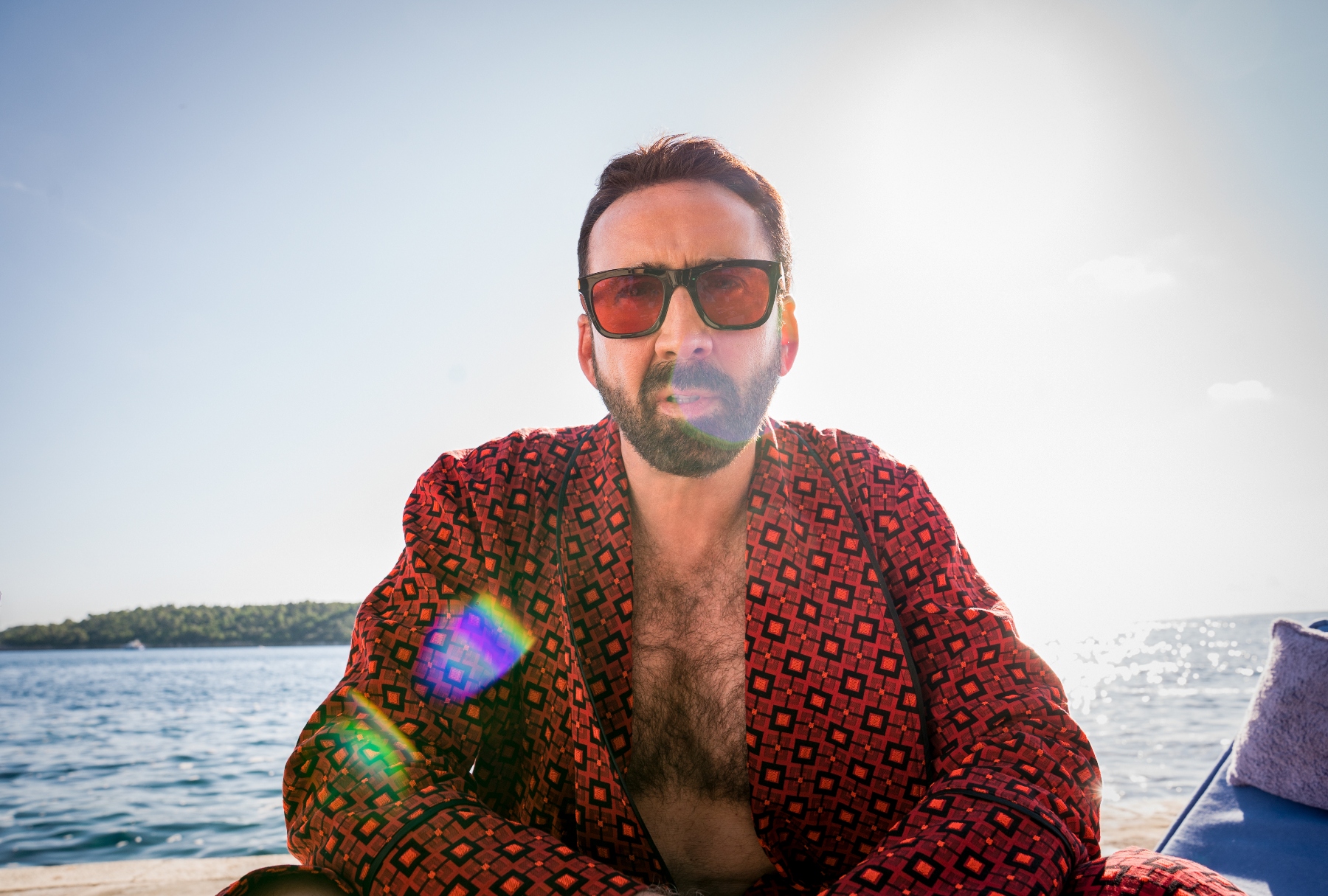
Nicolas Cage in "The Unbearable Weight of Massive Talent" (Katalin Vermes/Lionsgate)In reality, the actor takes his approach quite seriously, citing his source material as professorially as Paul Matthews would. The actor’s fans have no doubt heard him talk about the way his tragic outburst in “Moonstruck” was inspired by a moment in Fritz Lang’s “Metropolis,” or that he drew from James Cagney’s mien for the prison fight scene “Face/Off.”

All that effort was overpowered for a time by endless “Cage Rage” memes and videos.

We need your help to stay independent

He says he discovered them for the first time back in 2008 or 2009, when “I stupidly Googled my name, which I don't recommend. That's my New Year's resolution, is not to Google my name anymore.”

The search yielded a barrage of cherry-picked scenes of Cage, in an assortment of roles, freaking out. There he was screaming the alphabet in “Vampire’s Kiss,” or yelling about the misery of losing his hand, and his bride, in “Moonstruck.” Andy Samberg began lampooning him on “Saturday Night Live.”

"It was an adjustment. I had to become friends with [memeification] … because I think it kept me in the conversation."

“I was bewildered and trying to process what was happening to me with these viral mashups,” Cage admits, “Like, ‘Nicolas Cage loses his s**t.' There was no reference point. And so I had to put those feelings of frustration and confusion and stimulation somewhere, you know. I like to turn lead into gold.”

He sees “Dream Scenario” as one place to put that, “although no one was really thinking about when they cast me.  It was my own private understanding of how I wanted to play Paul Matthews and what I could bring.”

“But you bring up an interesting point,” he concedes, “which is that now we can all experience notoriety and infamy. Another advent that happened after I decided to be a film actor is that everyone now has a cell phone. Everyone has a video camera and their cell phones and everyone can videotape somebody on an airplane having a meltdown. 

He concludes, "I think that's what Kristoffer was really talking about, how the speed of the viral image is so fast, that it becomes almost like a collective unconsciousness, like what Jung was talking about.”

As for becoming a famous meme subject, "I am not upset about it. It was an adjustment," Cage admits. "I had to become friends with it, and I subsequently have because I think it kept me in the conversation. I don't think 'Unbearable Weight of Massive Talent' would have happened if that didn't happen to me."

Conversations circling around metatextuality demand some disclosure, in that any journalist speaking to a celebrity knows they are part of a food chain. The studio and the star have a message they wish to broadcast. In talking with someone like Nicolas Cage, then, regardless of your questions, they will ensure their talking points are covered.

One is that adjacent to that previously mentioned “adios,” Cage is on the verge of 60, making him ready for a new challenge.

“My dad died at 75, and that was a long time ago, but I'm doing the math,” he said. “I'm thinking, OK, let's get as I'll do as much as I can now because I really want to take stock and what's important in the next 15 years. If I'm lucky enough to live longer than 75, great. But you know, I'm going to see how I'm going to spend my next 15 years.”

What he means is,  “I am excited about the potential of television."


Want a daily wrap-up of all the news and commentary Salon has to offer? Subscribe to our morning newsletter, Crash Course.


Cage called “Dream Scenario” a masterpiece, saying he’d be thrilled to go out on a high note like that. But he has other commitments before he can leave cinema behind.  “I've made over 100 movies now. I've lost count,” he said. “I think I've said what I've had to say. Let's try something else.”

Five of those movies – six, if you count his digitally rendered cameo as an alternate universe’s Superman in “The Flash,” came out this year. Cage calls this hectic release parade a “logjam” created by COVID-19 delaying production along with this summer’s WGA and SAG-AFTRA strikes. The pacing was more along the lines of two or three films a year, which is still quite a bit and establishes he has the type of stamina that series entertainment demands.

Cage views TV’s possibility from another angle. “My son got me into ‘Breaking Bad,’ and I was enamored with Bryan Cranston as he's staring at a suitcase for one entire episode,” he said. “And I'm like, we don't have time to do that in feature films. This would be a new experience.”
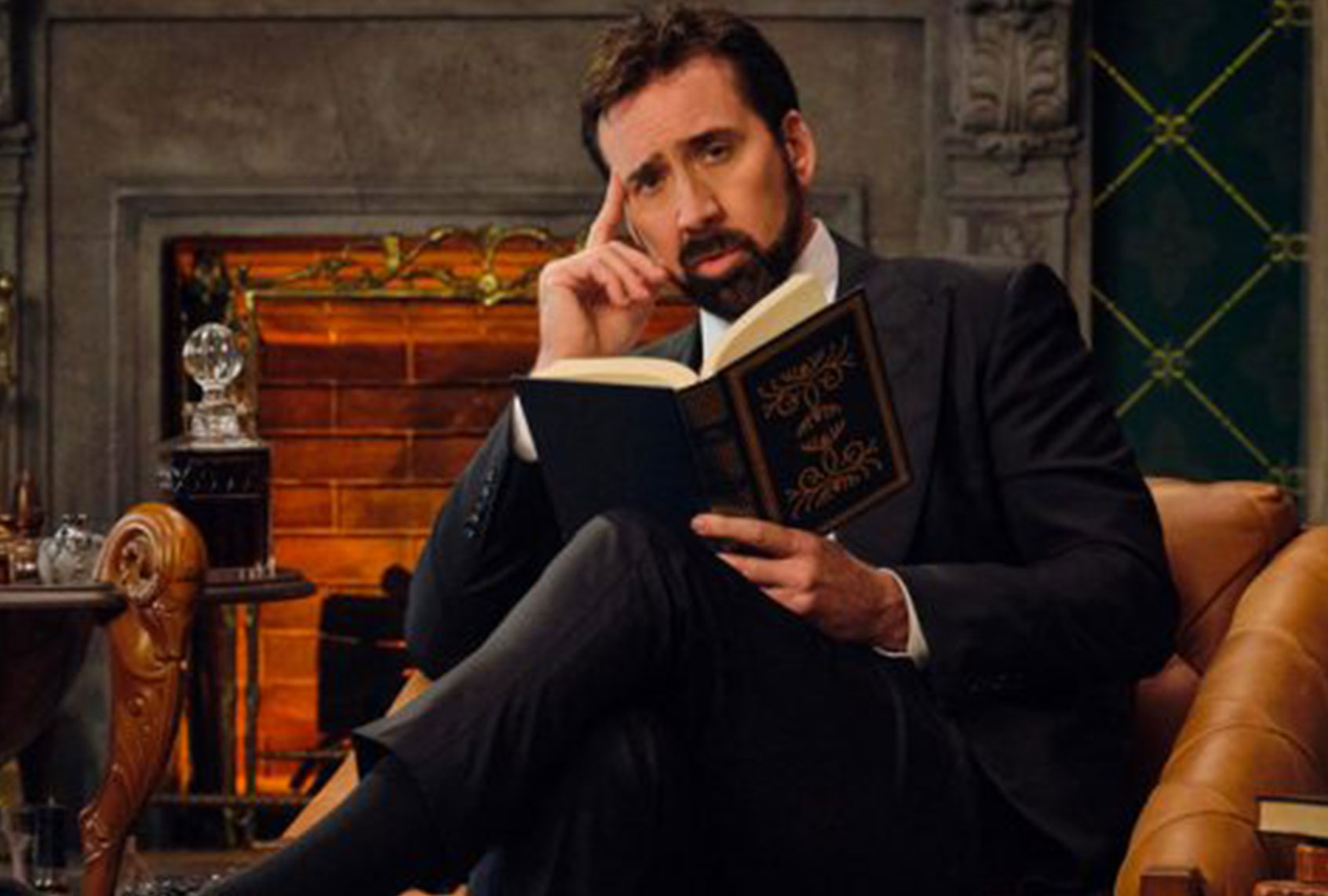
The History of Swear WordsNicolas Cage in "The History of Swear Words" (Netflix)For Cage, sure — his role in Netflix's “The History of Swear Words" notwithstanding. But not necessarily for people who have enjoyed his more recent, quieter performances. Like the mournful chef who has withdrawn from society in revenge thriller “Pig,” in which he has the least lines and takes beatings instead of doling them out. Or “Dream Scenario,” where the world squashes his professor, who is already feeling small and useless, into something infinitely flatter after inflating his ego for a brief time. TV is a performer’s medium, as many longtime film stars have come to realize. There is room for maximalism and minimalism. There is more than enough space for Nicolas Cage, whichever versions he chooses to manifest for that new medium.

“We'll see if that happens,” he tells me, a note of humility tethering his confidence to Earth. “I don't know. We'll see.”

"Dream Scenario" is currently in theaters.

“The facts don’t lie”: NY AG explains how Trump’s expert witnesses help her case against him

New York Attorney General Letitia James said that Donald Trump's pricey expert witnesses are actually helping her civil case against the former president and his real estate empire.

"Over the past few days, we continue to hear testimony from the defendants' many expert witnesses," James said of the fraud case in a video message posted on X, formerly Twitter, Friday. 

James explained that one of Trump's experts "admitted that the valuations of some of the properties on Donald Trump's statement of financial condition were neither 'proper,' nor 'reasonable.'" Another expert, who's a member of Trump's Mar-a-Lago resort club, testified that Trump asked him personally to "help" in the trial when they crossed paths at the club, James further explained.

The prosecutor also claimed that Trump's political action committee, Save America, paid another Trump expert, an accounting professor, to testify that the value of Trump's triplex was inflated. "On that we can agree," James said.

We need your help to stay independent

"He also had a lot to say about Donald Trump's statements of financial condition, even though he has not prepared a financial statement since the 1980s," she said of Trump's third witness. That witness is Eli Bartov, a research professor at New York University's Stern School of Business, who has charged Trump at least $877,500 in fees for his testimony amounting to an hourly rate of $1,350, according to Business Insider. Of the 11 experts called by the defense, two testified for free, and the rest cost Trump's legal team over $2 million.

"Donald Trump can continue to try to distract from reality. He can continue to call me names. But as the judge said today, 'the standard is truth.' And the truth is on our side," James said in the message.

Her civil fraud case, which seeks $250 million in penalties and a ban on Trump's, his sons' and other key Trump Organization executives' ability to do business in the state, accuses the defendants of knowingly inflating the value of their assets on statements of financial condition to obtain better loan terms and deals. 

On Monday, the trial entered its 11th week. The former president was slated to testify during Monday's proceeding but announced on his social media platform, Truth Social, Sunday that he would no longer be taking the stand

In response, James issued a statement saying, "Whether or not Trump testifies again tomorrow, we have already proven that he committed years of financial fraud and unjustly enriched himself and his family. No matter how much he tries to distract from reality, the facts don’t lie."

Ahead of the trial in September, presiding Judge Arthur Engoron issued a partial summary judgment that found Trump and the other defendants liable for defrauding banks and insurers. 

2023 is the Year of Grimace: The McDonald’s mascot took over our social media, footwear and more

When McDonald’s released the Grimace Birthday Meal on June 12, it didn’t anticipate tainting the reputation of its once-lovable, globular-shaped mascot.

At the forefront of the special offering — which came with the choice of a Big Mac, 10-piece Chicken McNuggets and fries — was a berry-flavored milkshake, aptly called Grimace Shake. Inspired by Grimace’s iconic color, sweetness and personal love for purple beverages, the shake took off on TikTok with the #GrimaceShake trend. 

The formula behind the trend was simple. Its message, however, was more sinister. Users filmed themselves excitedly taking sips of the shake before cutting to scenes of them contorted in painful positions and bleeding purple. An innocent treat suddenly transformed into something incredibly sinister. And an innocent character from McDonaldland had suddenly been casted as a ruthless murderer.  

Why Grimace became a target of hate still remains an unanswered question today. Perhaps people took offense to his smile? Or maybe the issue was with his big, soulless eyes? Regardless, Grimace became both a villain and a prominent figure within pop culture. So much so that the question “Who is Grimace?” topped search terms in an astounding 29 U.S. states, per Google Trends data obtained from summer 2023.

McDonald's also benefited in summer sales from the increased exposure. According to the fast food giant’s quarterly earnings report, net sales were up 14% and net income increased to $2.31 billion, compared with $1.19 billion a year earlier.

The Grimace shake officially bid adieu to McDonald's restaurants a little less than a month later on July 9. But Grimace’s legacy still prevailed. In November, McDonald’s introduced a line of custom-designed clogs in collaboration with Crocs. The designs included three classic Crocs and one Crocs sandal featuring McDonald’s mascots Grimace, Hamburglar and Birdie, along with the chain’s classic red and yellow color scheme, according to CNBC. The shoes were released on Nov. 14, retailing for between $70 and $75. Customers could also buy matching socks for $20 each and several McDonald’s-themed charms, including french fries, the Big Mac and the famed Golden Arches logo.


Want a daily wrap-up of all the news and commentary Salon has to offer? Subscribe to our morning newsletter, Crash Course.


“Inspired by everyone’s purple bestie, these sandals lined in faux fur will have you feeling like you’re walking a day in Grimace’s shoes,” McDonald’s wrote in a press release for its Grimace x Crocs Cozzzy Sandal. “The Grimace Cozzzy Sandal features his loveable expression on the straps, comes with his favorite treat – a shake in the form of a Jibbitz™ charm, and can be paired with matching socks.”

The Grimace-themed merchandise didn’t stop there. Most recently, McDonald’s launched the Grimace ugly sweater in anticipation of the holiday season.

“It's funny to wear the face of a mascot that killed more people in 2023 with milkshakes than anyone in history, but it really does scream Christmas spirit with the shake cups right under a smiling Grimace,” Instagram account @snackolator, who first broke the news, wrote. The purple knit sweaters, which cost $65 each, are currently sold out on the Golden Arches Unlimited website. At this time, it’s unclear if McDonald’s has plans to restock the sweaters for Christmas.

It’s also unclear if the Grimace Shake will make its comeback during Grimace’s birthday next year (he’ll be turning 53!). Until then, we’ll be stocking our closets with Grimace paraphernalia and looking back on 2023, the Year of Grimace.

This easy, creamy pasta is perfect for weeknights and comes together in less than 30 minutes

There’s a cheap, delicious way to whip up a batch of pasta with a creamy lemon flavor that will impress everyone in your orbit. Unless they hate pasta . . . which is impossible. 

I was teaching my creative nonfiction class the other day. We had just discussed “The Men We Reaped” by Jesmyn Ward and were moving to workshop student essays when I heard an angry growl. 

“Sorry, professor,” a semi-embarrassed student said while rubbing his belly, “Campus lunch was scarce and gross; I’m starving, you know how it is.” 

“Oh, I know exactly how it is,” I quickly replied. 

The class laughed, poking fun at the school’s offerings, asking me to help out some fellow writers by ordering pizza. I do this for my writing classes from time to time. Primarily for graduate students because writing a memoir is difficult, vulnerability is difficult, being judged is difficult, and we all know that greasy, cheesy slices of pizza tend to make everything better. 


Want more great food writing and recipes? Subscribe to Salon Food's newsletter, The Bite.


“I would order pizza if we had time; we don’t,” I said, “But you’ll need to learn how to fill up without relying on takeout and campus cuisine.” 

“Professor, you wrote so much about takeout,” my hungriest pupil pushed back, “What’s the deal? You against it now?”

“I’m not against it,” I laughed, “40-year-old me is just paying the price for consuming years of junk.” 

"I had financial aid, which allotted me a budget for campus dining, but hell no. I was too much of an aspiring artist to eat warm lunch meat, unseasoned chicken, or pigs in a blanket."

I then explained my college days, which seemed like so long ago. I’m sure the food would have been was great, but I lived off of cigarettes and cheap booze nonstop. I swear it felt like I only read, smoked, and drank in that order. 

I had financial aid, which allotted me a budget for campus dining, but hell no. I was too much of an aspiring artist to eat warm lunch meat, unseasoned chicken, or pigs in a blanket. 

So, my friends and I would compile our money every once in a while to cop some groceries and a bottle of booze to share, when we couldn't afford to eat at some of our favorite restaurants. And it was during one of those nights we messed around and created our lemon pasta.

We need your help to stay independent

Creamy pasta with Parmesan and lemon
Yields
3 to 4 servings
Prep Time
05 minutes
Cook Time
15 minutes

Ingredients

¾ pound of linguine

3 tablespoons olive oil

2 tablespoons butter

1/2 cup diced onions

3 teaspoons salt

4 tablespoons freshly squeezed lemon juice (and zest, optional) 

1 tablespoon red pepper

1 tablespoon black pepper

1 tablespoon Italian seasoning

5 ounces of cream cheese

Parmesan (season to taste)

1 cup heavy cream


Directions

  1. In salted, boiling water, cook linguine how you normally cook linguine (I recommend following the directions on the box).
  2. In a medium pan over medium-low heat, sauté onions in butter and olive oil until soft and translucent. 
  3. Add salt, lemon juice, black and red pepper, Italian seasoning, cream cheese, Parmesan, heavy cream and, if using, lemon zest. Cook until melted and well combined, about 5 minutes.
  4. Mix in noodles and a little bit of starchy pasta water (to make the dish a little saucy), but don't drown out your noodles. This is not a saucy dish. 
  5. Serve with garlic bread. 

What 30 years of Food Network Christmases have taught me about the holidays (and myself)

For as long as the Food Network has been celebrating Christmas, I’ve been watching. On Nov. 23, 1993, the network was launched with shows like “Essence of Emeril” and “Desserts with Debbi Fields” and then six months later, I was born. Since then, the channel has shaped how I celebrated the holidays. 

When I was nine, for instance, I received an Emeril Lagasse-branded miniature chef’s uniform, complete with a starchy white coat and toque. I wore them the next December when I launched my own neighborhood cookie delivery service, The Batter Bowl, which served only two varieties: my mom’s chocolate chip and Sandra Lee’s five-ingredient, semi-homemade (yet foolproof) sugar cookies, both of which I’d transport to customers around our suburban Chicago cul-de-sac in a small pull-along wagon. 

I watched all the “Good Eats” Christmas specials — “It’s a Wonderful Cake,” “The Cookie Clause,” “School of Hard Nogs,” and “Twas The Night Before Good Eats” — with interest and dreamed of eating around Ina Garten’s cozy dinner table, lit with candles and decorated with holly. 

Even today, my family isn’t really a Hallmark Christmas movie family, or even the type that will tune in and out of the inevitable 24-hour “A Christmas Story” marathons. Instead, our background viewing during December has become an almost “Nutcracker”-like whirlwind of on-screen bakers dashing around their competitors with gingerbread pieces and a plump pastry bag of royal icing, a kaleidoscopic array of sprinkles, nonpareils and tiny decorative candies at their disposal. 

I could venture a few guesses as to how this came and remains to be, but — aside from a few family members possessing a genuine love of cooking — I think it can be largely attributed to how pleasantly neutral the programming is. Some food television will artfully prompt questions about politics or religion, which, during the holidays, inevitably seem to open the door for other, more pointed inquiries like, “Why aren’t you married yet?” or “Who says you need therapy?” 

“Holiday Baking Championship: Gingerbread Showdown” will not prompt these questions. It will usher you from sugar-coated episode to sugar-coated episode, and on a larger scale, from year to year. 

Over the last 30 years, the Food Network’s programming has experienced an overall shift that feels perhaps most evident around the holidays. This isn’t a novel observation. When the network originally launched, it did so with what have come to be known as “stand-and-stir” shows, standard instructional programs that used to take up the majority of the channel’s airtime. But over the last three decades, thanks in part to the Food Network, food became more integrated into pop culture at large. 

We need your help to stay independent

Chefs are no longer just chefs; they are celebrities and humanitarians. Everyone, from Paris Hilton to Selena Gomez, wants a cooking show. Prestige television, like “The Bear,” centers around our collective appetite for kitchen dramas. And the Food Network became something of a competition series generator, launching new programs and personalities with stunning frequency. Whether this is what longtime viewers of the network actually want is a topic of perennial debate (as evidenced by the numerous, spirited Reddit threads about it). 

I used to have stronger feelings about it myself, but I think in these debates, people are often actually trying to grapple with bigger questions about how they want their holiday to look and feel, something that comes with both a lot of personal and societal pressure. I know that I certainly am. 

As a kid raised in a particularly conservative branch of Christianity, I thought that my future would consist of getting married at a very young age and then having several children in quick succession. That was the template of purity that was laid out for me, so any future Christmases that I envisioned for myself saw me catering to an amorphous, faceless family of my own. I didn’t know who they would be, just that they would be there and I would be expected to care for them. But, to borrow a line from Jurassic Park (another piece of pop culture that just celebrated its 30th anniversary), life finds a way. 

 I think in these debates, people are often actually trying to grapple with bigger questions about how they want their holiday to look and feel, something that comes with both a lot of personal and societal pressure

When I was 17, I called off an engagement and dropped out of Bible college to forge a new path, decisions that, over a decade later, still fill me with immense gratitude, a little pride and the occasional pang of what can only be described as phantom guilt, that particular feeling of being sorry that you don’t actually feel sorry about something. It also means that the holidays now feel a little more open and, sometimes, a little more rudderless. 

Perhaps inspired by the milestone birthday, I’ve spent the last several weeks combing through artifacts of holidays past to see what sparked a little joy: There’s the outline of the Chicago-style hot dog I painted for my Dad a few years ago, a bundle of Christmas cards, a matchbook from some red sauce joint that served as a last-minute dinner on a snowbound DC holiday. And, thanks to the surprisingly expansive archive on Discovery+, all of the Food Network Christmas programs I used to watch. I’ve spent hours sifting back through old episodes of “Essence of Emeril,” “Everyday Italian” and “Barefoot Contessa,” augmented with a few newer favorites like “Girl Meets Farm.” 

The experience has reminded me of the ways that food was a conduit to the life I have now, exposing me to lifestyles and cultures other than my own. It reminded me that holidays are truly what you make them; it often takes real time and effort to produce the “holiday magic” that is so easy to take for granted, whether it’s in the form of a gigantic multi-tiered gingerbread  chalet or a cozy Christmas dinner. 

It also reminded me in a really concrete way that the more things change, the more they stay the same. 

My parents have long moved out of my childhood home, but in a bizarre twist of fate, they recently moved into one designed by the same architect. The floorplan is nearly identical. When I spoke with my mom on the phone the other day about an upcoming visit, we joked that I would experience major déjà vu; I had never been in this house, but yet I had. Since I’ll be going during December, it will also sound exactly the same: the soundtrack of whisks, countertop mixers and countdown clocks emitting from the television, covering the silences of things left unsaid.

CORRECTION: A previous version of this story erroneously listed the launch of Food Network as April 19, 2003. This story has been updated with the correct date: Nov. 23, 2003.

Fox News host calls out GOP’s Hunter Biden failure: “They have not connected the dots” to Joe Biden

"Fox and Friends" co-host Steve Doocy called out Republicans in Congress for failing to provide any evidence for their growing accusations of corruption against President Joe Biden.

During a Monday morning segment regarding crimes Republicans allege were committed by President Joe Biden and his family, the Fox News host argued that the GOP has been unsuccessful in proving any such illegality.

“The Republicans at this point don’t have — they’ve got a lot of ledgers and spreadsheets — but they have not connected the dots. They’ve connected the dots, the Department of Justice did, on Hunter, but they have not shown where Joe Biden, you know, did anything illegally,” Doocy said. 

His comments came during a discussion focused on a CNN poll from September which indicated that the majority of Americans believe that the president had a hand in his son's, Hunter Biden, reportedly corrupt business dealings. Hunter was indicted last week and charged with nine federal tax crimes for what prosecutors are calling "a four-year scheme to not pay at least $1.4 million" in federal income taxes for the years 2016 through 2019. However, as Mediaite noted, since the poll was published, the GOP-led House Oversight Committee's hearings on the matter have failed to produce substantive evidence of criminal activity that would lead to Joe Biden's impeachment. 

Still, co-host Ainsley Eardardt insisted, "Don't you think that if they have this inquiry, which we are all supportive of, and if they find enough evidence, the voters are smart enough" to support an impeachment? 

"If they have the stuff," Doocy replied.  

“Now, here’s the other breaking news, and that is the Republicans are threatening contempt of Congress if Hunter does not show up for a closed-door deposition,” Doocy continued. “Ultimately, on this show, we’ve been calling for Hunter to go and sit in a chair on Capitol Hill in front of the TV cameras for the last year. Now, Hunter’s lawyer, Abbe Lowell, says he will do that, but Comber and Jim Jordan say it’s not negotiable. He’s got to be in private. According to Hunter Biden’s team, they don’t want to do it because of.”

Global general strike for Gaza kicks off in the West Bank

Streets were empty and shops were closed across the West Bank on Monday as people in the occupied territory held a general strike to protest Israel's assault on the Gaza Strip, part of a broader day of action that included work stoppages in Lebanon, Jordan, and elsewhere around the world.

Since Israel's latest war on Gaza began following a deadly Hamas-led attack in early October, violence by settlers and occupying forces in the West Bank has surged, making 2023 the deadliest year in the Palestinian territory in nearly two decades. According to the humanitarian group Save the Children, Israeli soldiers or settlers have killed more than 100 kids in the West Bank so far this year—three times the number killed in 2022.

In the Gaza Strip, Israeli forces have killed more than 7,000 children in less than two months, and more than a million kids are currently at grave risk as Israel expands its ground operation to include areas of southern Gaza that were previously seen as relative safe havens.

"The situation is extremely difficult," Hussein al-Sayyed, who is staying with relatives in the southern city of Khan Younis after fleeing Gaza City earlier in the war, toldThe Associated Press. "I have children and I don't know where to go. No place is safe."

The West Bank's general strike kicked off what's expected to be an international day of strikes and other protests around the world demanding an end to Israel's bombardment of Gaza.

Amman-based Roya Newsreported that the United Nations Relief and Works Agency for Palestinian Refugees (UNRWA) in Jordan took part in the protests, "closing all its facilities, including its schools, and urging all employees and students to stay at home."

The protests come days after the United States vetoed a U.N. Security Council resolution calling for an immediate humanitarian cease-fire in the Gaza Strip. The move drew immediate and widespread backlash from humanitarian groups and lawmakers around the world, including some in U.S. President Joe Biden's party.

"Shameful," Democratic Rep. Alexandria Ocasio-Cortez (D-N.Y.) wrote Sunday in response to the veto. "The Biden admin can no longer reconcile their professed concern for Palestinians and human rights while also singlehandedly vetoing the U.N.'s call for a cease-fire and sidestepping the entire U.S. Congress to unconditionally back the indiscriminate bombing of Gaza."

Muwafaq Sahwil, secretary of the Palestinian political party Fatah in Ramallah and el-Bireh, toldAl Jazeera that Monday's strikes are "a message to the U.S. administration that stands against the aspirations of our people."

"It is also a message from people around the world to their politicians and the international community to stand up for the Palestinian people who have been suffering from occupation for 75 years," said Sahwil. "We hope the strike will push the international community to help stop the war and to respond to Palestinians' aspirations to achieve self-determination."

Trump’s campaign is growing nervous about his behavior

U.S. presidents have been accused by their political rivals of wanting to be kings or dictators ever since the very beginning of the Republic. It's even a charge that's had some merit from time to time.

In 1800, Thomas Jefferson charged John Adams with acting like a king when he expanded federal power and passed the Alien and Sedition Acts, which effectively made it a crime to criticize the government. But Adams lost his re-election and gracefully conceded, establishing the tradition of the peaceful transfer of power that until very recently was observed by every president. Then there was Andrew Jackson, who critics assailed as a would-be king for wielding his veto pen for political purposes and challenging the primacy of the Supreme Court to decide constitutional matters, among other things. But he too left peacefully after eight years. Abraham Lincoln was repeatedly accused of being a dictator during the Civil War for implementing numerous extreme measures including the suspension of habeas corpus and the jailing of journalists. And in the 20th century, both wartime presidents Woodrow Wilson and Franklin Roosevelt were called dictators for expanding the powers of the presidency. Roosevelt even ran for four terms, precipitating the 22nd Amendment which limits future presidents to only two. 

A few years back, President George W. Bush jokingly said, “If this were a dictatorship it would be a heck of a lot easier… as long as I'm the dictator." But except for that quip, I don't think there's any example of a president or someone running for president actually saying that he planned to be a dictator … until Donald Trump. Not that anyone should be surprised by that. He is, after all, the president who plotted a coup to stay in office and fomented an insurrection to obstruct the peaceful transfer of power. 

Last week, Fox News' Sean Hannity asked Trump a simple question: "Do you in any way have any plans whatsoever have any plans if you are re-elected president to abuse power, to break the law, to use the government to go after people" and Trump said, "like they are doing now" and went on to talk about how he's been indicted more than one of the greatest criminals of all time, "if you happen to like criminals" —- Al Capone. 

Hannity pressed the question again:

I want to go back to this one issue, though, because the media has been focused on this and attacking you. Under no circumstances, you are promising America tonight, you would never abuse power as retribution against anybody.

Trump's answer was, "except for day one." Hannity was taken aback. Trump explained, "He says you’re not going to be a dictator, are you? I said, no, no, no. Other than day one. We’re closing the border and we’re drilling, drilling, drilling. After that, I’m not a dictator. Okay?" 

Actually, it's not ok.

If Hannity were anything but a Trump flunky he would have at least followed up and asked him exactly what plans he had to accomplish those two things on "day one." But he didn't because he knew that Trump was trying to be clever and have it both ways. He admires dictators and it's clear from his stated agenda that he plans to implement it through the use of dictatorial powers. But he smugly said he just wants to use them for rather mainstream Republican policy goals rather than revenge which Hannity quickly acknowledged and then moved on. After all, the crowd loved it. 

We need your help to stay independent

It was clear from Hannity's question that he was worried about the fact that the media has finally focused on the threat of a second Trump term. He did everything he could to give Trump the opportunity to say, "Of course I'm not going to abuse my power or become a dictator, that's ridiculous" but Trump couldn't do it. 

It's starting to concern other people around him as well.

The few professionals in the Trump campaign understand that it's lethal for Trump's chances in the general election if the public is actually informed of what he plans to do.

Many of the stories last week featured background quotes from people dropping names of potential Cabinet picks and other personnel choices for a second Trump term which clearly spooked the campaign. Axios had reported that people like Tucker Carlson were on a short list for VP while cronies Steve Bannon and Kash Patel were named for other important posts in the administration. Patel immediately appeared on Bannon's podcast to declare that they certainly did have big plans, one of which was to go after the media, "whether it’s criminally or civilly, we’ll figure that out." He told Bannon that they had a "bench" of "all-American patriots" who would get the ball rolling immediately.

This is likely what led senior campaign advisers Susie Wiles and Chris LaCivita to issue a statement on Friday, saying that "no aspect of future presidential staffing or policy announcements should be deemed official" unless it came from them. This was on the heels of a similar statement from a couple of weeks ago after the first flurry of reports about the planned dictatorship started appearing in the mainstream media, in which they proclaimed that "any personnel lists, policy agendas, or government plans published anywhere are merely suggestions." 

But that's not true at all. Agenda 47, right there on his campaign web site, is hair raising. Here's just one of the more recent videos in which he promises "take the billions and billions of dollars that we will collect by taxing, fining, and suing excessively large private university endowments, and we will then use that money to endow a new institution called the American Academy" where there will be no wokeness or jihadism allowed.


Wiles and LaCivita can try all they want to distance the campaign from the likes of Bannon and Patel but they aren't the problem. The candidate is. 

You might have thought that Trump would press pause on all the dictator talk considering that his campaign is obviously getting very nervous about it. But no. He appeared before the New York Young Republicans over the weekend and repeated his "dictator on day one" line, making even less sense than before:


Want a daily wrap-up of all the news and commentary Salon has to offer? Subscribe to our morning newsletter, Crash Course.


Wiles and LaCivita wrote in their statement that "he is not interested in, nor does he condone, selfish efforts by ‘desk hunters" — but that doesn't seem to be the case:

The few professionals in the Trump campaign understand that it's lethal for Trump's chances in the general election if the public is actually informed of what he plans to do. Now that the press is no longer under the illusion that ignoring what he says is the best way to cover him, those pros are starting to realize that they can't control Trump or the people around him. They aren't the first to have that rude awakening. It would be a big relief if they were the last.

MAGA women want a Hallmark “home for the holidays” fantasy — but their votes run their kids off

Hallmark's popular, if painfully corny, Christmas movies, definitely have a casting formula for their heroines: Mostly white, clean-cut, and of an in-between age. That is, young enough to be plausibly short of middle age, but old enough to sell the standard Hallmark plot: Urban professional leaves the city to get a new lease on life, by returning to her parents in small town America and marrying the boy next door. But the women who actually watch Hallmark movies are much older than the stars. Over 70% of the Hallmark audience is past 50 years old. This breakdown of the most popular Hallmark Christmas movies shows they're mostly a hit with the Medicare crowd, with over half of the audience aged 65 and up. 

Hallmark is selling a fantasy to older, mostly Republican viewers: That their wayward daughters will give up on life in the big city and return home to live near their mothers. 

The audience for Hallmark movies, in other words, doesn't look quite like its heroines, but more like their mothers. It's also a very white audience that is more concentrated in Republican-voting areas. As Amanda Festa at Samba TV writes, "Hallmark’s conservative beginnings have been slow to change," and "this is certainly reflected in the channel’s holiday viewership."  

A lot of the critical reaction to the popularity of Hallmark movies assumes they are selling a comforting, if reactionary reverie of retreat from urban life to small town simplicity. In light of these demographics, however, I'd argue the story being sold is even narrower than that. Hallmark is selling a fantasy to older, mostly Republican viewers: That their wayward daughters will give up on life in the big city and return home to live near their mothers. 

(As I noted on Friday, the actual daughters in question are way more invested in the Taylor Swift narrative: Daughters who have flown the coop and are very happy living their busy lives with a cat in the big city.) 


Want more Amanda Marcotte on politics? Subscribe to her newsletter Standing Room Only.


The sad irony in all this is that the Hallmark-loving grandmothers of America, by voting for Republicans, are working against their own dreams of having adult children — and grandchildren — who live next door. As Timothy Noah wrote recently in a cover article for the New Republic, the increasingly authoritarian policies passed by Republican leaders are leading to what he deems the "Red State Brain Drain": "an out-migration of young professionals" from GOP-controlled states to the more welcoming pastures of blue state America. 

There are many reasons the under-50 set are taking their college degrees and robust contributions to the tax base out of red states into blue ones. The biggest concerns are for their own school-age children. They want their kids to go to schools without book bans, to have access to reproductive health care, to be safe from violence and, should they identify as LGBTQ (as many in Gen Z do), that they will be affirmed instead of bullied. But for people in professions like teaching, medicine, science or the arts, it's just increasingly hard to feel safe and supported in red states. So they leave

Noah's focus is on how the brain drain is impacting life in red states, which are seeing massive shortages in teachers, doctors, and other necessary educated professionals. "And much as Republicans may scorn Joe (and Jane) College, they need them to deliver their babies, to teach their children, to pay taxes," he writes. But, if the popularity of Hallmark movies is any indication, there's another loss a lot of Republicans have brought upon themselves by relentlessly electing authoritarian leaders: The loss of their own children's presence.

The first couple that Noah profiles — Kate Arnold and her wife, Caroline Flint — are a good example. The two were both doctors serving in Oklahoma, which is in desperate need of more medical professionals. They lived in the state because they have roots there. But after abortion was banned, the familial connection to Oklahoma could not overcome their anger and fear at living in a place that makes it so hard to live their lives and do their jobs. So they moved to D.C. They easily named four other friends who had left Oklahoma for similar reasons recently. And this is despite the fact that, due to the higher demand for doctors in Oklahoma, the two women could make way more money in their home state, while paying much less for housing. 

There's a lot of angst in red state America over the loss of young people in general, but especially with those MAGA voters whose adult children have moved to far-flung places. Right-wing media outlets clearly understand this, because they churn out an endless stream of propaganda about how all those young white people who go to college and move to the big city are brainwashed idiots who will rue the day they left their hometowns behind. 

In the real world, your harried urban professional daughter will never come home to Oklahoma or Texas or Florida, because, for one thing, she can't get an abortion if she needs one.

Fox News is an endless drumbeat of stories falsely painting American cities as hellscapes where residents have to hopscotch over sleeping junkies in between enduring armed robberies at the hands of Black Lives Matter protesters. This narrative has long been a mainstay of the right-wing noise machine, but there's one major thing that's shifted about it. In the past, the "scary cities" framework was mostly an excuse for blatant race-baiting and thus tended to focus on cities with large Black populations, like New York City, Washington, D.C., Chicago, and Philadelphia. That is still a big part of it, of course, but now a lot of the anti-urban hysteria has shifted to cities that are a whole lot whiter: Seattle, San Francisco, and even Portland

In these segments, the villains are educated white "elites" — like many of the children of Fox viewers — whose supposed youthful idealism has allowed crime, drug addiction, and homelessness to run amok. Another flavor of this hate comes in right-wing scare stories about dystopian police states created by liberal overreach in the name of public health or environmentalism. To hear conservative pundits carry on, one would think wealthy liberal cities have vaccine checkpoints on every corner and cameras in your homes to keep you from drinking soda. Conservative media is even using urban walkability proposals to float conspiracy theories that people will be banned from leaving cities.  The claim is urban residents will be "imprisoned in our local communities and condemned to forage and eat bugs," with "no football games, no concerts, no amusement parks, certainly no church."

We need your help to stay independent

And, of course, the increasingly loud right-wing war on education is a big part of this.

The Republican attacks on college professors, the fear-mongering about "woke" college kids, and the substantive efforts to run off faculty and/or deprive them of free speech flow directly from years of conservative messaging treating college itself as a threat. A big part of this is that it's college, of course, that freed so many young people to get the hell out of red state America. 

It's messaging that fits with Donald Trump's "retribution" style of politics. Rather than asking why young people are leaving and how to get them back, it's about lashing out at them and entertaining fantasies of revenge. (Just wait until that wayward daughter gets mugged! That'll teach her to leave suburbia.) But it's a long, ugly act of MAGA America shooting itself in the foot. The truth is a lot of younger professionals would be open to living in red states if the political situation weren't so terrifying. The housing is cheaper and often the job opportunities are more plentiful, especially in education and health care. And many people would like to be closer to aging relatives, to help them out and have them in their grandkids' lives. 

But by voting for Republicans, red state denizens are making sure their Hallmark dreams will never come true. In the real world, your harried urban professional daughter will never come home to Oklahoma or Texas or Florida, because, for one thing, she can't get an abortion if she needs one. Or her own child will be punished for saying "gay" in school. Or she will worry every day about her kid getting killed in a mass shooting. Fox News paints the blue states as crime-ridden hellholes, but college-educated people under 50, who have the privilege to choose where they live, see it very differently. The word they use for blue states is "safe." 

Jason Stanley on “undermining propaganda” with fascism: “Trump is robbing democracy of any meaning”

Donald Trump is a dictator in waiting. He is now publicly declaring that he will be a dictator on “day one” of his regime if he returns to power in 2025.

Like other dictators, Trump is a megalomaniac, possessed by delusions of grandeur and omnipotence. As part of that pathological and extremely dangerous behavior, Trump has repeatedly demonstrated that he appears to be profoundly mentally unwell. As seen last weekend in Iowa, Trump is now going so far as to basically declare that he is some type of Chosen One, and that “God” and “Jesus” will intervene on behalf of him and the American neofascists in their campaign to defeat President Biden and the Democrats.

The love and adoration that Trump’s followers feel toward their Dear Leader only grows the more dictatorial, fascistic, and hostile to human decency and the good society he becomes. The cruelty is always the point; Trump hates the same people his followers do; Like other cult leaders, Trump’s relationship to his MAGA followers is both parasitic and symbiotic.

Fascism, as an extension of today’s version of American conservatism, is a form of religious politics (a movement of faith, action, and violence more than reason and reflection) that is largely immune from empirical reality and the type of obsolescent normal politics that the mainstream news media and larger political class are slavishly devoted to.

"When you use the correct words to condemn Trump as a fascist or corrupt or what have you, those words will not have any force behind them because of how they have been weakened by Trump and his agents."

In total, the MAGA movement and American neofascism are revolutionary projects, decades in the making, to end multiracial pluralistic democracy and replace it with an American Christofascist Apartheid plutocracy. As seen with Project 2025, Agenda 47, and the Red Caesar scenario for example, the Republican fascists and "conservative" movement have made great progress in creating the infrastructure to implement these plans.

The mainstream American news media and responsible political class, however, continue to act shocked and surprised by Trump’s Hitler-like threats and agenda. In so many ways, this is all anticlimactic and obvious: Trump and the other American fascists have been telegraphing and announcing in plain sight their plans to end the country’s democracy for more than seven years. To be in denial for so long is a form of malpractice and betrayal of the responsibilities by the so-called guardians of democracy.

We need your help to stay independent

So I spoke with Professor Jason Stanley, one of the first people with a prominent public platform to sound the alarm about Trump and the MAGA movement’s fascist threat to American society. He is the Jacob Urowsky professor of philosophy at Yale University and author of “How Fascism Works.” His new book (co-authored with David Beaver) is “The Politics of Language.”

In this wide-ranging conversation, Stanely reflects on why the mainstream American news media and political class were in denial for so long about the fascist reality, how they are now much too late in waking up to the dangers of Trumpism and fascism, and why such poor decisions and overall failures may doom the country’s future. Stanley also explains, contrary to the self-soothing narrative advanced by too many pundits and commentators that the ex-president is stupid or a buffoon, that Trump is a master propagandist who has deftly outmaneuvered and manipulated the news media into doing his bidding.

This interview has been lightly edited for length and clarity

How are you feeling as you take a measure of our collective emotions here in this country at this moment?

I'm experiencing a sense of reality denial. This is from the media and also in the circles in which I operate. There is still a part of the left that still believe that Hillary Clinton and Donald Trump are not that different. Even after all that has happened, they still believe such a thing. I have encountered members of the professional class, Republicans, who support Trump because the idea of Kamala Harris being president is not acceptable to them. Then there are headlines from the likes of the New York Times with verbiage such as, "A second Trump term may be even as or more disruptive than the first." Really? Maybe?

In all and from some many parts of American society there is this mass reality denial where people are digging in for stability out of desperation.   

The elite news media is finally waking up, if only for a second, to the reality of Trumpism and American fascism and how he is going to be a dictator. But here is the problem: they sound the alarm, but I don't think they really believe it because the next day it is back to the obsolete horse race coverage and ill-conceived "hot take" and superficial controversy of the day. These stories about Trump and fascism should be on the front page every day. The mainstream news media is so late to the reality of the situation they really have no credibility left as I see it.

It's surreal. No amount of reality will change them. I'm shocked, by the way the media is reacting to every new claim that Trump is a fascist as if this were news. Those like me, you, and a select group of others have been saying for years that Trump was a potential fascist dictator and there is a movement behind him. They dismissed us and laughed at us. Now instead of turning to those of us who were accurate and sounding the alarm years ago, the media is turning to people, supposed experts, who only now are realizing that we're facing a fascist, social and political movement. Such people should not be the ones turned to by the news media to be talking about the near-term future of Trump and this fascist movement and the danger. Why? They have quite clearly demonstrated total unreliability. For example, a person who is so late to this danger and reality can go back instantly to normalization. Who knows what someone who was so blatantly wrong for so long about social reality will believe or say? The current commentators were so far behind the fact that Trump is a fascist that they will not be able to properly comprehend such tricks. Most importantly, in 2023, they are just starting to think about fascism.

Trump is doing something very sophisticated right now that is going to take these people who are late to the danger by surprise. Trump is saying that Joe Biden is the real threat to democracy. That is such a smart move. Every horrible thing Trump is accusing Biden and the Democrats and his other opponents of being is a reflection of Trump. These are expressions of intent by Trump. In his own fascist twisted way Trump is the most honest politician of my lifetime. Trump is a master of politics. He says what he means, and he means what he says. If you know how to read Trump correctly then you understand his intentions and plans. If you are just now realizing that Trump is a fascist, you're going to be looking for signs to assuage yourself that you are just being hysterical, because you spent so many years calling those of us who have been correctly describing reality, hysterical. The people who the media are turning to now as alarm sounders are not equipped to understand what is really happening. 

The commentariat– especially too many centrist and liberal types — really are in denial about Trump's deep strategy. It is easy for them to call him names and mock him and the MAGA movement and the Republicans. When I look at Trump and his machine, I see something very sophisticated. For example, so many of the usual suspects who have been so late and so wrong about the crisis, are saying that Trump's attacks on Biden as an "enemy of democracy" won't work because "who would believe it?" — "It is so obviously wrong." They aren't the audience. Their egos and hubris and narcissism will not allow them to see that fact. They are not the center of the political universe.

They have been manipulated by Trump to the extreme. Trump is muddying the waters. For those people who have not been paying attention to politics, it will just seem like two people calling each other names. Biden and Trump are both saying each other is a threat to democracy, which is obviously not true. Trump has been charged with actual crimes. Trump's literally saying, "I'm going to arrest Joe Biden" and all these other "enemies" because they're not bowing down to him. In the end, for most Americans, it is all going to seem like "polarization" and "partisanship" with the two sides fighting. The media has consistently normalized and enabled Trump. The American news media keeps featuring these talking heads and experts and the like who will make the American people feel better about themselves and feel better about the crisis. That is irresponsible. 

Do words and language like "fascism" and "democracy crisis" actually have any currency anymore in the popular discourse?

Trump is trying to rob those words of meaning, which is very smart. Trump is so much smarter than the people in the media who he is manipulating. As I discuss in my book, a method of propaganda is to try to rob the language of ideals of meaning. To that point, by accusing Joe Biden of being the one that threatens democracy, Trump is robbing "democracy" of any meaning. That is called "undermining propaganda". As applied here, the proponent of democracy is labeled as being the antidemocratic one. What Trump is doing with language and propaganda is very clever. Moreover, when you use the correct words to condemn Trump as a fascist or corrupt or what have you, those words will not have any force behind them because of how they have been weakened by Trump and his agents.

Here is something else that is verboten among the mainstream media and political types that I have said repeatedly: Trump is funny and charismatic. He is devious and beguiling and evil. Evil can be entertaining and fun. Trump is compelling. Why are so many people who should know better afraid to say that?

One of the reasons the elite media and mainstream media responded so negatively to those of us who warned about Trump and fascism years ago is that they thought they were the smart and superior ones. They believed that Trump was stupid and a buffoon. No one like Trump could make it through the American system, the guardrails, the institutions, and, especially, people like us! The time has come to recognize that Trump is an incredibly compelling and magnetic figure. He is a cult leader and a master of crowds right out of the history books in his ability to use propaganda. To actually say that Trump is a buffoon makes you, the person saying it, the real buffoon.

The media cannot admit they're wrong. They cannot go to the people who told them they were wrong from the very beginning. The media has to go to the figures who agreed with them that this was all hysteria. They are all part of the same class and social circle. It's only those people who finally in December 2023 are realizing that we have a fascism problem in America that the mainstream media will feature. To talk with the people who were telling the truth long before would make the news media look like fools for not seeing what was going on right in front of them with Trump and the MAGA movement at least seven years ago. Most importantly, if you have only realized these things in 2023, you are just starting to think about what that means. Even if you are smart, you are too far behind the curve.

History is going to write about the failures of the American media in the Age of Trump and this democracy crisis and rising fascism. Just as history has harshly judged the conservatives in Nazi Germany for underestimating Hitler because they thought they could control him; the same types of judgments are going to be made about the American media wildly underestimating Trump and laughing at the threat he represents for so long.

When you heard Trump recently channeling Hitler and the Nazis, how were you feeling? What went through your mind?

None of this is new. Trump has been making these types of threats, using racism and white supremacy, etc for a long time. The media is now picking up on it more than they were before. In 2018, the media didn't recognize what Trump was doing as a coherent set of patterns. They're slightly better now in terms of recognizing what Trump is doing as Nazi propaganda. But the media is still insisting on believing that Trump does not mean what he says. Trump always means what he says. Trump is going to come after me and other people who have been identifying the danger and telling the truth about fascism. For ordinary citizens, as long as you don't say anything about politics, you will be fine. For immigrants, it will be truly horrifying.

Trump is saying that anyone who criticizes him is a "Marxist" who's going to be targeted as harshly as he "legally" can. Trump will target leftist intellectuals in universities, non-profits, and media. More specifically, he will target the concepts and structures that expose him, such as Critical Race Theory, as “Marxists”, and threats to the nation. That’s just how this stuff works.

How do you make sense of those people who are still saying that Trump is just being hyperbolic? That he won't be a dictator, that these are just exaggerations because he won't be able to do it anyway.

The more extreme the situation, the more intense the denial. As the saying goes, we are truly living in "historical times."

How do we balance hope and optimism?

I think a sense of urgency is required. Unfortunately, the news media is intentionally trying to destroy that sense of urgency. The mainstream media is all about telling people what they want to hear, and what makes them feel good, and not about real news that is upsetting. And if you tell people that the country is experiencing an extreme emergency from Trump and this fascist threat to the country, most Americans don't want to hear that. And again, when the media goes to "experts" who are willing to sound the alarm, it is mostly people who are too late realizing it. We are at the end of 2023. The election is less than a year away. 


Want a daily wrap-up of all the news and commentary Salon has to offer? Subscribe to our morning newsletter, Crash Course.


How are you orienting yourself? How do you suggest people orient themselves when they're literally living in such an era?

When a war is happening, people deny it until it's in their front yard. And so, these levels of denial and doubling down and tripling down on it, that these are not historical times, that this is business as usual, is what people do in these times of crisis. That behavior continues especially when you've been wrong so many times. It gets worse: When you've been wrong so many times, you're invested in being wrong. So how do you wake people up who not only run the levers of power and media, but are invested in continuing with the same errors? It's very difficult.

One thing that has helped me to navigate these historical times, the Trumpocene, is that I am not an American exceptionalist. I think this is a fine country in many ways. It's my home. But I don't think that the United States is somehow magically imbued with a power to resist the horrible forces that have afflicted other countries. Jim Crow was a fascist system. Once you understand that, there's no guarantee of any of these rights or no guarantee of any fairness in this country. We have a classic fascist situation in this country right now. Trump is a fascist leader who intends to overthrow the country and democracy — and he's very good at it. It's all now finally dawning on people. The cognitive dissonance must be enormous for those who laughed, and mocked, and didn't take this threat seriously.

How does the right-wing assault on education as seen in Florida and across the country fit into the fascist model?

In Florida, DeSantis and the Republicans are doing what Orban did in Hungary with Central European University. New College of Florida has basically been destroyed. Authoritarian systems go back to previous practices. In this country we're going to return to a kind of Jim Crow education. The Trumpists and the fascists understand something that liberals don't, which is that education shapes and molds people. Liberals have this idea that you learn some facts and then you make your own decisions. That is simply not how it works. Education shapes and forms people. Every authoritarian regime understands that fact. In terms of replacing textbooks with nationalist drivel, policing teaching, the school systems, and the whole educational system the American fascist movement is way ahead of liberals. They know this is going to keep the fascists in power in the future.

Yesterday, Trump publicly said that he is going to be a dictator but "only on day one" of his new administration because then he will stop after he gets certain things done. Because it demands engagement even though the answer is obvious, do dictators ever just stop?

What Trump really means is he's going to change all the laws, and then the new laws will enable him to do what he wants. According to the new laws, Trump will no longer be a dictator. The new laws that Trump puts in place will be about fealty to him. He will declare a state of emergency and change the laws.

How are you making sense of the decision to stay here in the United States if Trump and the American fascists take over vs the decision to leave? Lots of people are struggling with that right now.

I am thinking about that decision for myself. There is so much reality denial out there. The inertia is too great for many people. Their friends and family may talk about leaving the county, but in the end, they will remain in denial. If you have transgender kids, or you're transgender yourself, you've got to try to leave the country if Trump and the fascists win. But if you are someone like me you probably have to stay. This is my country. If I leave, I will have less of a voice in the opposition. There are family considerations too. I think for all of us, we want to stay where our loved ones are. And either you bring them all together or you stay here and fight.

Why some researchers are rethinking the “grandmother hypothesis” of menopause

If we’re lucky enough to have grandmothers in our lives, they can play an integral role in our well-being. From being a trusted friend to being a connection to a family’s heritage and ancestry, and a source of wisdom, there's a lot to learn from grandmothers. 

From an evolutionary perspective, they’re not just here to pass on old family traditions and recipes for fun. Many biologists and anthropologists believe that grandmothers are key to human survival. In a recently published study in the journal PLOS One, anthropologists suggested that women were hunters in hunter-gatherer communities and grandmothers were actually the most skilled ones. Yet, a transformative and complex hormonal process in a human female’s life, the one that enables them to be free to look after their own kids’ kids, remains a mystery to scientists: menopause. 

Menopause is a normal part of human aging. Between the ages of 40 and 50, most women lose their ability to reproduce as their monthly menstrual cycles end. As a result, a woman’s ovaries atrophy. The hormones that stimulate the process decline. Yet, women still live decades into their postmenopausal lives. If natural selection favors genes that reproduce, why can’t women have children throughout their entire lifespans? It’s an important question that doesn’t quite have a direct answer. 

“We do not know for sure, but I think the ‘grandmother hypothesis,’ is the best theory that we have right now to explain not only menopause, but the post-reproductive lifespan that women have,” Agnès Lacreuse, a professor in the department of psychological and brain sciences at the University of Massachusetts Amherst, told Salon. 

"I think the ‘grandmother hypothesis,’ is the best theory that we have right now to explain not only menopause, but the post-reproductive lifespan that women have.”

The Grandmother Hypothesis first originated in a 1957 paper by the ecologist George C. Williams, and as Lacreuse said, is often used to explain the existence of menopause. It states that human females evolved to live after menopause for the purpose of investing in and helping their grandchildren, which would better improve their own fitness instead of reproducing until old age.

In the 1980s, scientists began to make observations of a group of hunter-gatherers in Tanzania called the Hadza. What they found was a correlation between how well children grew and their mother’s foraging work. But when the mother had another kid, the kid’s growth correlated with the grandmother’s foraging work. Their observations suggested that a grandmother’s support allows a mother to focus their energy and resources on having more children, leaving more copies of her genes in future generations, with the help of a grandmother. In other words, it supported the grandmother hypothesis. 

Until recently, the only non-human species of mammals that were known to experience menopause were a select few specie, such as orcas — not primates. But in late October, a new study came out suggesting that our closest relative, chimpanzees, also experience menopause. The findings were based on observations made in the Ngogo chimpanzees in Uganda. Researchers stated in their study, published in the journal Science, that they "found clear evidence for menopause in females living past the age of 50.” But unlike what has been observed in killer whales, these females were “not involved in the raising of related offspring, suggesting that a different process is driving its development."


Want more health and science stories in your inbox? Subscribe to Salon's weekly newsletter Lab Notes.


Scientists have observed that chimpanzees leave their groups and families before reproducing. The reasons are unknown. Some speculate that it could be a way to avoid the consequences of inbreeding. But if younger female chimpanzees are leaving their homes, while the older females stay and go through menopause, how does that change what we know about why human females get menopause through the lens of the grandmother hypothesis?

Kevin Langergraber, a professor and primatologist at Arizona State University and lead author of the study, told Salon he does believe that his latest research weakens the grandmother hypothesis, and it has caused other researchers to rethink it as well. But he elaborated that it weakens a “strict version of the grandmother hypothesis.”

“That's not to say that the grandmothering might have still been quite important in lengthening the post reproductive lifespan because it is still about twice as long in humans as it is in chimps,” he said. “But maybe it's some other reason that it sort of gets off the ground, and then grandmothering helps extend it and make it more extreme in humans.”

"Clearly, grandmothers have these benefits, they have these fitness benefits on their descendants."

Notably, observations have been made in other mammal species that experience menopause, like the killer whale, that support the grandmother hypothesis. In one study published in 2019, grandmother orcas appeared to increase the chances of survival for their grand-offspring. They played an important role in leading the group to food when few salmon were around. 

Langergraber said there has been a history of skeptics around the grandmother hypothesis, in part because of how difficult it is to test and observe. 

“Clearly, grandmothers have these benefits, they have these fitness benefits on their descendants,” he said. “But people had questioned whether those benefits were sufficiently large enough to offset the costs of stopping reproduction.”

Lacreuse said she is hesitant to suggest that just because one population of chimpanzees appears to go through menopause, doesn’t mean that all do. She noted that this finding only applies to this specific population, which appears to live longer than other populations, and perhaps there’s more to mine about menopause within this context. 

We need your help to stay independent

“I think there is something special about this particular population,”Lacreuse said. “They have plenty to eat, it seems some kind of Eden for chimpanzees and in these conditions, yes, it can live long enough to show menopausal state.”

From a scientific point of view, she said it would be helpful to understand what it is about these specific conditions that have led to menopause. For this reason, Lacreuse said she doesn’t believe that the most recent chimpanzee study discredits the grandmother hypothesis.

“There is another hypothesis that females would cease reproduction to avoid competition with younger females, and that seems to explain some of the data in chimpanzees,” Lacreuse said. “It’s obviously a valid hypothesis, and one hypothesis doesn't negate another one, both can be in place.”

In general, menopause remains an evolutionary mystery in part because it’s a rare phenomenon. As Langergraber said: “It's always hard to understand the evolution of traits that occur in only a few species.”

Trump declares that he won’t be testifying in fraud trial via all caps rant on Truth Social

The night before he was scheduled to testify as one of the final defense witnesses in his months long $250 million civil fraud trial, which is ramping up to its final week of testimony, Donald Trump is saying that he has no plans of returning to testify in his own defense. 

In a thread of all caps messages rattled off on Truth Social Sunday night, Trump expressed his reasons for making this last minute decision, saying:

"THEY CLAIMED THAT MAR-A-LAGO WAS WORTH ONLY $18,000,000,  WHEN IT IS WORTH 50 TO 100 TIMES THAT AMOUNT, IN ORDER TO ILLEGALLY REDUCE MY VALUES & MAKE A FAKE CASE AGAINST ME. THEY DID THIS ON OTHER PROPERTIES, AS WELL, & WOULDN’T GIVE ME A JURY. LIKEWISE, THE A.G. THUGS DO NOT WANT TO ACKNOWLEDGE THAT I HAVE PAID ALMOST 300 MILLION DOLLARS IN NEW YORK CITY & STATE TAXES DURING THE YEARS IN QUESTION. IMPORTANTLY, I WON AT THE APPELLATE DIVISION, WHICH EFFECTIVELY ENDED MOST OF THE CASE, BUT THE  BIASED JUDGE REFUSED TO ACCEPT THEIR ORDER, AN UNHEARD OF FIRST! BASED ON THE ABOVE, AND THE FACT THAT OUR UNASSAILABLE FINAL EXPERT WITNESS HAS BEEN SO STRONG AND IRREFUTABLE IN HIS TESTIMONY, WHICH WILL CONCLUDE ON TUESDAY, & THAT I HAVE ALREADY TESTIFIED TO EVERYTHING & HAVE NOTHING MORE TO SAY OTHER THAN THAT THIS IS A COMPLETE & TOTAL ELECTION INTERFERENCE (BIDEN CAMPAIGN!) WITCH HUNT, THAT WILL DO NOTHING BUT KEEP BUSINESSES OUT OF NEW YORK, I WILL NOT BE TESTIFYING ON MONDAY. MAGA!"

In a response to this change of heart, New York Attorney General Letitia James issued a statement of her own, saying, "Whether or not Trump testifies again tomorrow, we have already proven that he committed years of financial fraud and unjustly enriched himself and his family. No matter how much he tries to distract from reality, the facts don’t lie."


“It’s as fresh as the day I cut it”: Brenda Lee on “Rockin’ Around the Christmas Tree”

When Salon connects with Brenda Lee, by sheer coincidence it’s mere hours after the music legend learned some incredible news: Her festive 1958 single “Rockin’ Around the Christmas Tree,” had just ascended to No. 1 on Billboard’s Holiday 100 chart for the first time.

When it’s noted she must be excited, Lee immediately responds: “You just don't even know. It's just the most amazing thing to me.” She’s then quick to give credit to many people involved in making the tune a success. “It's all because of the work of my label. There's been a lot of work, trust me, that's gone into this,” she says. “And the writer and the musicians and just everybody. It’s a magical time.”

Her performance channels the effervescence of youth — and the excitement of the holidays.

Of course, you can certainly say the same thing about “Rockin’ Around the Christmas Tree.” Written by Johnny Marks — a seasonal songwriting superstar who also wrote festive tunes like "Rudolph, the Red-Nosed Reindeer" and “Holly Jolly Christmas” — and produced by Owen Bradley, the tune is among the first major Christmas songs of the rock ‘n’ roll era. 

Given its swinging guitar riffs, a loose-limbed dance groove and an upbeat sax solo, it's an ideal theme song for a hopping holiday party. “Rockin’ Around the Christmas Tree” features a who’s-who of Nashville session players — including guitarists Harold Bradley and Hank Garland; bassist Bob Moore; pianist Floyd Cramer; drummer Buddy Harman; and saxophonist Homer "Boots" Randolph. Backing vocals come from one of Nashville’s legendary vocal groups, the Anita Kerr Singers. 

Lee, meanwhile, was just 13 years old when she recorded the song. Her performance channels the effervescence of youth — and the excitement of the holidays. That jubilance hasn’t wavered over time. Earlier this week, Lee joined Keith Urban and Vince Gill at Nashville’s Bridgestone Arena to perform a suitably celebratory version of “Rockin’ Around the Christmas Tree” during the All For The Hall event. Living up to her nickname Little Miss Dynamite, Lee commanded the stage, belting out her signature song with jolly aplomb.

Salon talked to Lee about what she remembered recording the song, filming a music video this year for “Rockin’ Around the Christmas Tree” (“They just said, ‘Do what you want to do. Have fun.’ That's what we did.”) and the long-term impact of the song.

I want to talk about what you remember most about recording the song. When you look back now and see the musicians on there, it’s a who's-who of Nashville session players. What are your most striking memories of it?

The Quonset Hut [recording studio] on 16th Avenue South is where I cut all my stuff. And it was in the heat of summer, of course, when you record your Christmas stuff, where it can come out at Christmas.

But my precious, precious producer Owen Bradley — I walk in the studio, he must have had the air conditioning down to zero. He had a big Christmas tree. It was all decked out in Christmas lights and everything. And it was just a magical time.

I was going to say — when it is so warm like that, it can be hard to get into a festive mood. Did you do anything before you came into the studio to get yourself mentally prepared? 

No — to me, it was just going to be another session of a song that I loved. But when I walked in and everything was Christmassy, it was just magical.

So how did this session go? Was the song cut in a couple of takes? How did it unfold?

No, it was cut in one take. 

Wow. 

One rehearsal with the band, and one take.

As a vocalist and musician, what did you learn from being able to collaborate with that high caliber of musicians when you were so young and early in your career?

"It came through, as good songs do, and now it's one of the songs that I have to sing every time I sing anywhere."

I don't think you think about that at the time, because you are young. But I was blessed to work with the best of the best for a long, long time. And I learned from the best from those musicians from Owen Bradley. The Anita Kerr singers, Brenton Banks and his strings. Grady Martin, Hank Garland, Floyd Cramer, Buddy Harmon, Ray Edenton — oh, good Lord, I could just go on and on and on.

It is true that when you work with artists like that, it’s just another session. You don't realize until years later what you've picked up from them — or that when you get used to a certain caliber of musicians, it does very instinctually make you better. 

Oh, it does. It absolutely does. And then the songs that Owen got for me were just unbelievable. That somebody would trust a child, which is what I was, with their life's work — I just got the best of the best. 

And Owen really knew what suited your voice and your personality. That really stands out when you look at everything.

You hit it on the head right there. He sure did. He knew all of his artists like that. Patsy Cline, Burl Ives — the list goes on and on. But Owen knew his people. And there's a little sprinkling of Owen Magic in everything you hear from the folks that he recorded.

Rockin' Around the Christmas TreeA Rockin' Christmas With Brenda Lee (Universal Music Group)It was so interesting to me when I learned that you cut “Rockin’ Around the Christmas Tree” and that it didn't become a hit until a couple years later, when you had additional pop hits. Was that frustrating at all for you?
I don't remember being frustrated. I might have been a little disappointed, because we all loved the song so much. And we wanted it to do really good. And when it just didn't for a minute, we thought, “Oh, lordy, lordy.” But it came through, as good songs do, and now it's one of the songs that I have to sing every time I sing anywhere.

[Laughs.] There are worse songs to have in your catalogue where you’re like, “OK, I need to sing that again.” I mean, because it's such a joyous song. It’s one of those songs that’s pure joy and happiness.

It is! It's a happy song.

As a vocalist, is there any difference between cutting a Christmas song versus cutting a song that's not for the holidays? Do you have to put anything special into it?

I never did. I just always sang the way I sang, and it came out the way it did. And they either liked it or they didn’t. [Laughs.]

And it’s good not to overthink it either. Sometimes if you put too much effort into it, people think you're trying too hard. That’s another great thing about “Rockin’ Around the Christmas Tree” — it sounds effortless. There isn't any strain to it. As we talked about, there’s joy to it — and it's very sincere and genuine.

Yeah. And I think one of Owen’s secrets, when we went into the studio, is we didn't do a song over and over and over and over. We usually got it in the second take, if not the first.

It is true that when you labor over something, sometimes your first take is the best. 

It is, even with flaws. It turns out to be the best one.

“Rockin’ Around the Christmas Tree” was in “Home Alone,” which I think is one of the first instances that introduced the song to new generations. What other places has the song been that you think helped it resonate with other people?

I think “Home Alone” pretty much did it. I got a call one night, and they said, “Brenda, have you seen that new movie, ‘Home Alone’?” And I said, “No.” They said “Well, your song’s all over it!” I said, “Which one?” [And they said] “‘Rockin’”!”

I went to the theater and saw it and I was so joyous because I love the songwriter, I love this song. Of course I loved all my buds that played on it. I was just so proud.

Rockin' Around the Christmas TreeTrisha Yearwood and Brenda Lee in "Rockin' Around the Christmas Tree" (Alexa King Stone)What are some other interesting or unexpected places that you've heard the song pop up over the years?
Oh gosh. Overseas is real fun, when you when you go to someplace like Japan. Especially when I first started going over there in the 1960s, and you hear “Rockin’” when the cold weather hits, it's like, “Oh my goodness.” 

Owen Bradley used to say, a good song is everything. If it's good, it's everything — and you'll hear it.


Want a daily wrap-up of all the news and commentary Salon has to offer? Subscribe to our morning newsletter, Crash Course.


When you hear the song in public, do you tell people, like “That's me!”? I would be so proud if I were you.

Well, you know what, this is gonna sound trite maybe — but it always amazes me that it's me. I hear it and I go, “Oh, they’re playing ‘Rockin’’!” [Laughs.’

The song is popular on TikTok as well with kids, as the intro is perfect for very short videos. Is there anything else that you want to do with the song that you haven't yet? Are there any other places that you'd love to see the song?

I’d love to see it everywhere. I'm selfish. Just get it everywhere. [Smiles.] Because I think it's such a great song. It's a happy song. The lyrics are good. And there's really nothing you can complain about — like, some of the songs that come out today you might not want your kids to hear. Or you might not want to hear it yourself. But it’s just fresh. It’s as fresh as the day I cut it.

Elon Musk flips the switch on Alex Jones’ X account after doing one of his weird polls

In 2018, Twitter (as it was still called then) made the decision to permanently ban Alex Jones from the social media platform after he and his show "Infowars" violated their policy against abusive behavior, and Elon Musk — who took over ownership in 2022 — initially agreed to uphold this decision but has seemingly changed his mind. 

According to AP News, The company said under its previous ownership that Jones would not be allowed to create new accounts or take over any existing ones, and that they would monitor reports about other accounts potentially associated with Jones or "Infowars" and “take action” if any attempts to circumvent the ban were discovered. In November of last year, Musk seemed to still be on board with this, saying a firm "No," to a user suggesting that Jones be reinstated, but after conducting a poll on Saturday to re-gauge general interest on whether or not the ban should remain in place, he's flipped the switch to restore Jones' account, doing his whole "Vox Populi, Vox Dei" thing when the results tallied up in Jones' favor by over 70%.

As Mediaite points out, Musk raised the prospect of bringing Jones’ account back on Saturday when the right-wing account @ALX demanded it after Jones was interviewed by Tucker Carlson. During that interview, Jones was in rare form, claiming to have it on good authority that President Biden wanders around the White House fully naked. 

Does Frasier Crane listen to Donald Trump?

Like any classic vehicle, it took a few episodes for the “Frasier” revival’s engine to warm up before its new parts acclimated, letting both the show and the audience relax into its familiar purr. Joe Cristalli and Chris Harris could have made the show more adventurous by placing Kelsey Grammer’s Dr. Frasier Crane in an entirely new situation, which might have been more rewarding.

By the season’s end, though, the showrunners’ choice to resume the classic’s form wins out, and no episode argues this as successfully as the recently streamed season finale “Reindeer Games.” The episode culminates in Frasier’s firefighter son Freddy (Jack Cutmore-Scott) bouncing between his father’s apartment and that of his friend Eve (Jess Salgueiro).

Frasier has willed a stiff overwrought Christmas party into existence overnight. Eve prefers to quietly tuck into a Hallmark movie marathon. They’re both needy and conveniently situated across the hall from each other, setting up prime conditions for French farce-style comedy choreography as Freddy nicks treats from his father’s bountiful gathering, then a few guests, until eventually one side of the hall is merrier than the other.

Classic “Frasier” antics are easy to replicate. Grounding comedy in a unifying sense of grief is a much taller order. This is Eve’s first Christmas without her husband and Frasier’s first in Boston and without his father Martin (the late John Mahoney). Freddy takes it upon himself to comfort each of them without acknowledging that he’s also mourning. Eve’s husband was Freddy’s closest friend. Martin was, of course, Freddy's grandfather.

FrasierKelsey Grammer in "Frasier" (Chris Haston/Paramount+)Such sentimental dichotomy is intrinsic to Frasier Crane’s lovability. He’s a pompous curmudgeon who comes from humble origins, a Harvard-educated celebrity psychologist whose father Martin was a cop baffled by how he ended up with a pair of effete sons who live for the opera. He exudes confidence but is thin-skinned; he’s highly sociable and profoundly lonely.
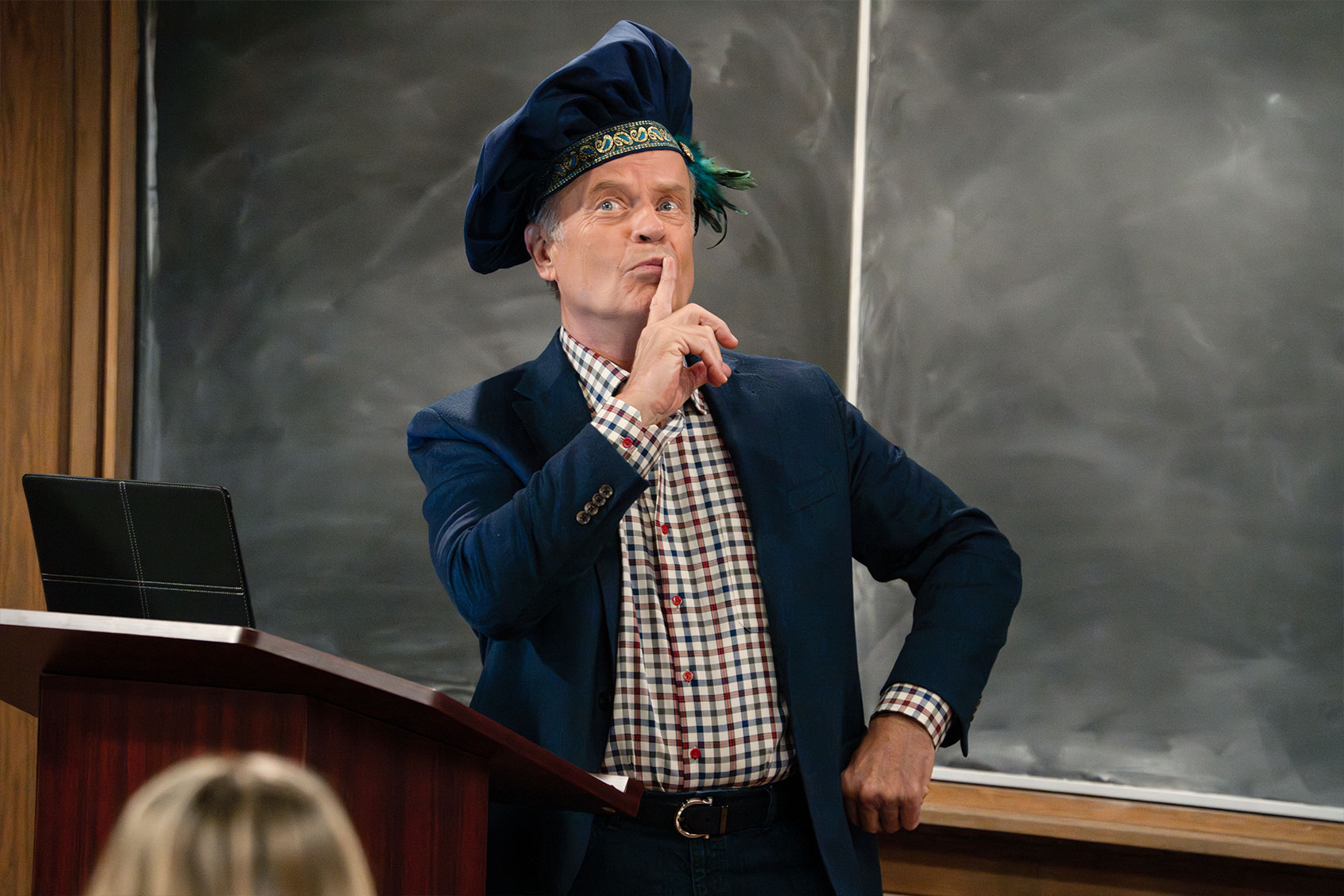
But these Boston episodes find a fresh purpose for Frasier by returning to the dynamics at play in his Seattle condo, with the economics in reverse. Freddy lives with Frasier, just as Martin did, but Frasier is determined to see to his grown son’s every need to make up for putting his career ahead of his family when Freddy was growing up. And Freddy, a blue-collar man like Martin, resists his generosity until, at last, the two learn to live together. Like father, like son . . . who must learn to like his father.

I hadn’t planned to revisit “Frasier” or review the finale, but doing so is vital to understanding why we’re drawn to it, and what it is telling the audience about the human condition.

Revisiting “Frasier” is vital to understanding why we’re drawn to it, and what it is telling the audience about the human condition.

“Frasier” is an intellectually stimulating comedy anyone can connect with, easy without being simplistic, comforting without gritting up our feelings with saccharine. A sitcom about family that trades poppets mugging for the cameras for digging into the universal conflict between generations, social class and modes of thinking.

That has not changed since “Frasier” first debuted in 1993. Neither has Kelsey Grammer’s politics. Grammer has always been an out-and-proud Republican, and like many white male conservatives of his generation – he’s 68 years old – his views have only slid rightward as the years wear on.

Early last week when BBC Radio 4’s Justin Webb asked Grammer if he was still supporting Donald Trump, it should not have been at all shocking when he said, “I am. And I’ll let that be the end of it.” According to CNN.com, after the interview Webb commented that Grammer would have been “perfectly happy to go on talking about it,” but the Paramount+ PR team nipped that in the bud.

That shutdown was inevitable. The reason is in a name: Roseanne Barr.

As an eternally curious person, I wish Grammer had been allowed to elaborate. That might provide a window to the minds of those whose politics are extremely at odds with their charismatic façade and public behavior.

Grammer’s admission generated headlines and ignited a minor uproar on social media, which is indicative of the public’s short-term memory, lack of history and above all, people’s unwillingness to search for answers on Google. It only takes a few clicks to find that in past election cycles, he’s endorsed Rudy Giuliani in the 2008 election primaries, Michele Bachmann in 2012, and Ben Carson in 2016 before throwing his support behind the Great Pumpkin.

That same year, when The Guardian asked Grammer, “Which living person do you most admire, and why?” he answered, “[Vladimir] Putin. Because he is so comfortably who he is.” Months before he dropped by “The Late Show with Stephen Colbert” to reminisce about waiting tables and scarfing down fudge sundaes before making the audience explode with laughter by admitting how different his tastes are these days: “My favorite snack is caviar,” he said.

There is a strain of person who views the world less in terms of Black and white than through a green lens.

Grammer has remained present onscreen since “Frasier” went off the air in 2004, adopting a "no small roles, only small actors" attitude toward his choices. Although an attempt to return in another TV comedy via ABC’s abysmal “Hank” flamed out quickly, he earned a Golden Globe for starring in “Boss” about a corrupt Chicago mayor (ah, that classic conservative bugbear!) struggling with a degenerative disease. Critics praised his performance, but few people watched, leading to Starz canceling the show after two seasons.

FrasierKelsey Grammer in "Frasier" (Chris Haston/Paramount+)Playing Frasier Crane made him incredibly rich. So has playing to the audience’s sensibilities. What may confuse people about his conservatism is the fact that Grammer has worn many hats, including executive producing shows like “Girlfriends,” which was created by a Black woman and headlined by a Black cast – including Tracee Ellis Ross. He was also a key E.P. behind “Medium,” and in 2010 co-starred in the very gay “La Cage aux Folles” on Broadway.
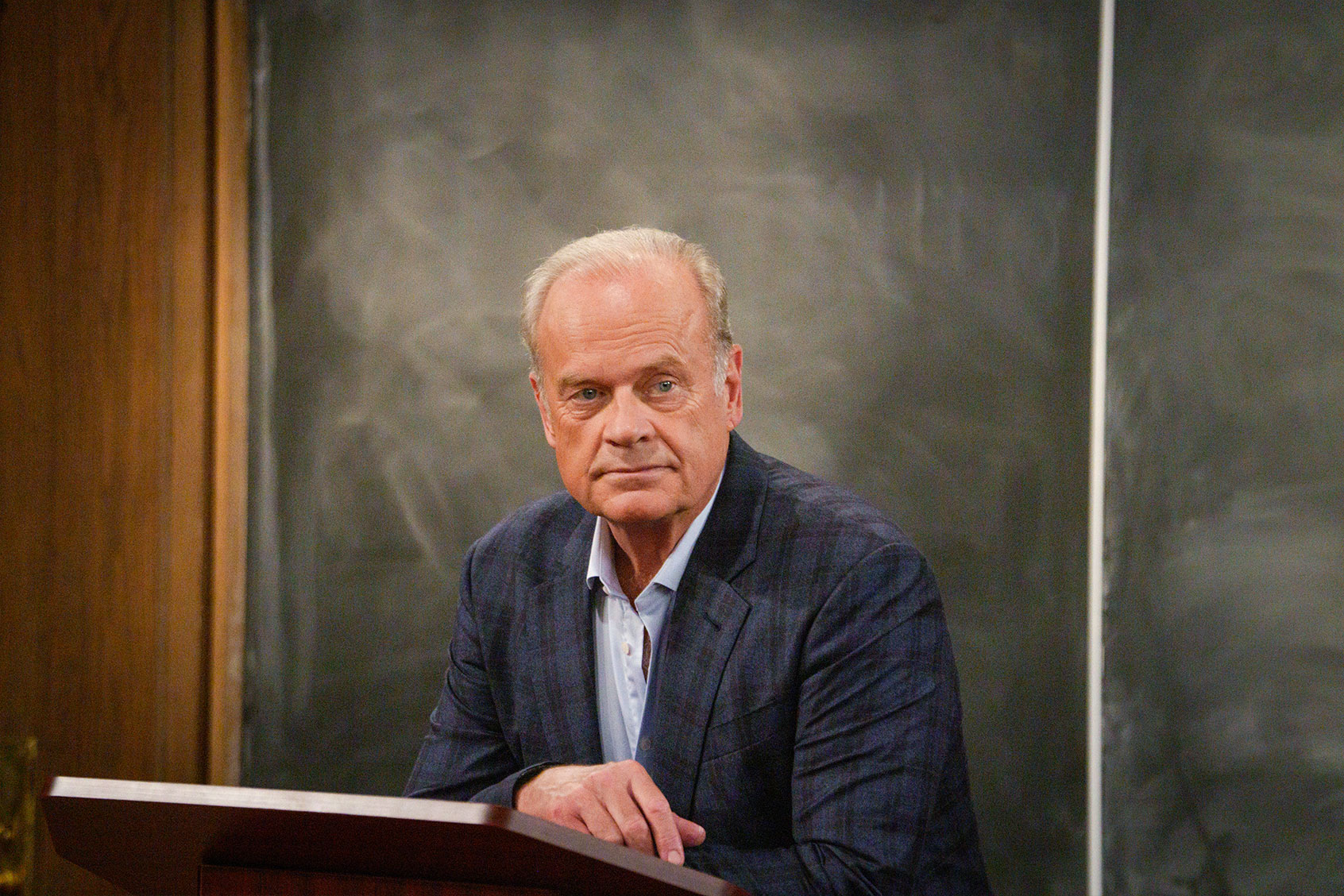
There is a strain of person who views the world less in terms of Black and white than through a green lens. Having an estimated net worth of $80 million alters your perception of others, especially when you followed the Horatio Alger model of working your way up from nothing and, through a combination of luck and talent, landed one of the most iconic TV roles of the 20th century.

Grammer is also strategic. As open as he’s been about his right-wing politics, you’ll notice he hasn’t appeared on the Trump Train next to Scott Baio, Kid Rock or Antonio Sabato, Jr. – yet. If the actor were to spell out his reasons for supporting Trump now – even in the wake of his 91 indictments, fomenting an insurrection and declaring he’ll turn the U.S. into a dictatorship – Trump would celebrate Grammer’s endorsement on the campaign trail like he celebrated the “Roseanne” revival’s success.  

No mainstream media company wants that kind of radioactivity attached to its lineup. And “Frasier” and its namesake characters are assets both Grammer and now Paramount have been careful to protect. The public can’t help seeing shades of the character in everything he does; what is Dr. Hank McCoy of “The X-Men” if not a mutant version of Harvard’s favorite guest lecturer?

FrasierKelsey Grammer in "Frasier" (Chris Haston/Paramount+)Divorcing a blue fur-covered superhero from the man voicing him is easier, largely thanks to CGI, than considering Grammer’s politics as separate from “Frasier.” Sitcoms like “Last Man Standing” and the 2018 version of “Roseanne” infused their partisan views of their stars into their storylines, although the partisan rhetoric that bled into Tim Allen’s show was purely ideological and mildly presented even then.  


Want a daily wrap-up of all the news and commentary Salon has to offer? Subscribe to our morning newsletter, Crash Course.


The “Roseanne” revival attempted to do the same, but its fatal error was in having its main character share the same name and views as the woman who played her, who couldn’t refrain from dropping racist slurs on social media at the peak of her comeback’s success.

Grammer is neither mentally ill nor stupid. He mainly uses X, the platform once known as Twitter, to correct grammar — homophonically appropriate — and promote his work and other titles.  More helpfully, his first name isn’t Frasier. That may not stop some from scanning the latest “Frasier” episodes for clues that it has been quietly seeping MAGA poison into our brains. To this I say: see for yourself.

People will view “Frasier” through whatever lens they choose; such is the nature of digesting art and culture. But that is why the show was a broadcast hit in the ‘90s and early Aughts when angry right-wing media was in ascendance and Fox News was but a Stage 1 cancer. “Frasier” gave that audience a sherry-swilling, opera-loving member of the elite to both laugh at and emulate. Everyone else watched the man they came to love on “Cheers” develop into a flawed gentleman somewhat humbled by life for whom we wished a happy ending.

Grammer’s dedication to Trumpism will inevitably ruin “Frasier” for some nevertheless. But skilled actors melt into their characters, convincingly wearing fictional souls on their skin. That makes the story a show tells more influential than the individual lending a body to a stage. Grammer’s politics have always been polarizing. “Frasier” won’t change that. By the same token, if the show if your quiet oasis of common ground in hectic times, its star should not be assigned the power to take that away from you.

All episodes of "Frasier" are streaming on Paramount+.


Trump calls DeSantis a “bobble head” and Christie a “sick puppy” in debate critique

Taking to his preferred platform for airing late night thoughts and general grievances, Donald Trump wrote an inspired critique on Truth Social of Wednesday's Republican presidential primary debate that could easily land him a job as a culture blogger for the right wing outlet of his choosing, 

Although it would be hard to beat the yet to be identified panelist on Megyn Kelly's SiriusXM wrap-up show whose hot mic picked up their observation that Ron DeSantis gave the appearance of someone who'd just shot their dog prior to taking the stage for the debate that night, Trump gets pretty close in his reflections on the event, writing that the Florida Governor and presidential hopeful looked like a "bobble head" in high heels.

"So many people are asking what I thought of history’s lowest rated 'presidential' debate, & how would I rate the players. It’s so easy to be a critic, but who on this subject would be better than me," Trump says at the start of his review. "To begin with, I thought Ron DeSanctimonious was terrible, with his bobble head facial movements & his walking on eggs . . . [his] weird bobbing head and fresh mouth make his high heels look good – He’s walking on eggs!"

Switching gears to rate Chris Christie's looks and performance during the debate, Trump goes on to say, "That Sloppy Chris Christie was worse. He’s not fit, mentally or physically, to be President plus, he suffers from TDS, or Trump Derangement Syndrome, at levels not seen before. In other words, he is a “sick puppy” . . . He’s dead, but so is Ron."


“Trump derangement syndrome” is real — but it’s not what they say it is

Like the malicious, boastful schoolboy he will forever be, Donald Trump smirkingly twists apt descriptions of himself and his often cartoonishly deranged acts against those who point out his transgressions. And as in a game of Follow the Leader, his fellow Republicans continue to project their own psychopathies on the truth-tellers.

Thus the all-too-accurate pejorative "Trump crime family," describing decades of phony charitable and educational scams, purposeful misstatements of property values and massive grifting during the White House years, becomes mock-outraged references to the “Biden Crime Family.”

Call one of his ravings sent out in the wee hours on his social media platform Truth Central deranged, and he’ll latch onto that word to use as invective against his political opponents.

As Salon’s Heather Digby Parton recently noted, Trump is even trying to turn the tables on the increasing number of historians, journalists and politicians who warn that the former grifter in chief is an obvious threat to the continuation of our democracy. Yes, the twice-impeached ex-president who lies about and despises the free press and talks about suspending the Constitution now regularly claims that he is somehow protecting all of us from “Joe Biden’s war on democracy.”

As it turns out, Trump’s exhortation to insurrection, “Fight like hell or you won’t have a country,” turned out to be a warning to all non-faux patriots, the great majority of Americans, who now are now forced to be conservative, whatever else they may be —conservative about preserving the Constitution, political norms, the rule of law and freedom of the press — because no one else seems willing to do that any longer.

That the 77-year-old former president who is still attempting to overturn the 2020 election simply makes use of the “I know you are, but what am I?” taunt of a pre-teen is laughable (Parton calls it “his latest tribute to the late great Pee-wee Herman”) and also repugnant, because he’s supposed to be an adult. But, like all con men and authoritarians, who are also essentially swindlers, he knows that if you repeat something often enough, an amazing number of people will come to believe it.

Or they’ll believe it because they just want to believe it. As Paul Simon long ago wrote in the classic “The Boxer”:  “A man hears what he wants to hear/ and disregards the rest.”

If Nazi propaganda minister Joseph Goebbels were here today to witness such rhetoric, he’d no doubt applaud how well it is following form. He might even burst into laughter in delight at how amazingly successful it has been in the United States.

As Rachel Maddow (who likely doesn’t enjoy talking about it, but can tell you a bit about the history of American Nazis) recently noted, Trump uses terms like "fascist" against his critics because, as always, his mission is to obfuscate the truth. As she recently remarked: “He knows he’s going to get called a fascist for talking this way. And he’s calling all of his opponents fascists, too, trying to rob that word of its meaning.” 

I thought Maddow’s use of "rob" was well chosen; much of the endless Trumpian grifting involves begging and then misusing money from supporters who, in many cases, can't really afford to donate to his campaign. But if you’re going to be a successful grifter, you cannot concern yourself about those you hurt. Much better have no conscience at all.

Trump and his supporters borrowed TDS to dismiss their critics for opposing everything Trump puts forward — all his great ideas and well-thought-out plans for protecting the public, boosting the economy  and bolstering democracy.

This brings me to "Trump Derangement Syndrome," a term that has been in use so long that these days people often just go with the acronym. Trump just used it to hit back at former congresswoman Liz Cheney, who recently published a book, "Oath and Honor," aimed at warning about the dangers of a second Trump presidency.

Trump and his supporters borrowed the term to dismiss their critics for “reflexively” opposing everything Trump puts forward. You know, all his great ideas and well-thought-out plans for protecting the public, boosting the economy, enhancing our leadership on the world stage and bolstering our democracy.

I recently found myself in an email exchange with someone who had taken offense to a recent opinion article of mine about the Biden economy. After I responded, he became reasonably civil, and I was beginning to enjoy the exchange. But his parting shot — skillfully glancing, not direct — was “TDS is real,” which, of course, implied I was suffering from anti-Trump psychosis and might need to seek counseling.

Coming on the jackbooted heels of Trump’s use of Hitler’s term "vermin" to describing the large majority of the U.S. population who aren't members of his weird, violence-seeking cult — which includes many Republicans and actual Christians — I wondered whether something similar had been used by Nazi propagandists against those who criticized Hitler. 

There's no question the Nazis used derisive language to push back on their critics, especially against Jews, socialists, intellectuals, artists and others who could not be expected to fall in line. But critics of the Nazis didn't have much time to voice objections to what they saw happening after Hitler came to power during a declared state of emergency, before he ordered his stormtroopers to start arresting or simply killing those who opposed him. Had the Nazis needed to twist the truth with their critics, maybe they'd have come up with something like Hitler-Hysterie Syndrom, shifting the blame to those who were paying attention. Even the German conservatives and major capitalists who thought they could control Hitler found that they could not, much like the "moderate" old guard in the Republican Party. 

In this era of the Trump cult, all of this sounds familiar to many Americans, and more than a little terrifying. Trump has actively encouraged followers to commit acts of violence since his first campaign began in 2015. Now his campaign spokespeople say that his critics will be “crushed.” Is it a form of psychosis to be unhappy with that prospect? Was it deranged to be perplexed or horrified by his chaotic and damaging reaction to the pandemic?

In an early comment on the right’s use of of the term, New Yorker writer Adam Gopnik observed that TDS was a reasonable reaction to Trump because of his “appetite” to prove his authority through violent means:

With Trump, it is perfectly clear that he only has a series of episodic wounds and reactions — it’s all fears and fits. If he were the governor of a state, or the leader of a much smaller country, we could already begin to discount the more vivid fears with which his ascent to power was met. The problem is that he is the President of the United States, and that the one appetite that he does have is for announcing his authority through violence, a thing capable of an unimaginable resonance and devastation. That’s the only Trump Syndrome we ought to worry about, and it can become deranged.

As a New Yorker, Gopnik no doubt knew all one needs to know about Donald Trump (which, truly, isn't much: "blustering con man" gets you much of the way there) and his long history of being “a user of users,” as the late Village Voice reporter Wayne Barrett worked hard to detail and explain.

Modern-day white nationalists like Steve Bannon and Stephen Miller have barely changed the Nazi approach at all:  disparaging immigrants, trashing the free press, dehumanizing political opponents, normalizing calls for violence against perceived enemies. There’s a way to do this sort of horror, and Trump and his gang of angry misfits regularly crib from some of the most abominable people the world has ever known. 

As Timothy Snyder, the Yale historian and author of "On Tyranny," wrote in a New York Times op-ed about Hitler: “The form of his propaganda was inextricable from its content: the fictionalization of a globalized world into simple slogans, to be repeated until an enemy thus defined was exterminated.” 

Trump is a man of simple slogans, of schoolyard putdowns. He’s the type of person who tries to “own” others by giving them a nickname. Hitler depended on the simple slogans of propaganda, repeated endlessly, and had this to say about the public's susceptibility to the "Big Lie": 

It would never come into their heads to fabricate colossal untruths, and they would not believe others could have the impudence to distort the truth so infamously. Even though the facts which prove this to be so may be brought clearly to their minds, they will still doubt and waver and will continue to think there may be some other explanation. 

Trump himself, with his tirades against the free press, his violent fantasies about his political opponents and his eagerness to dehumanize anyone who opposes or criticizes him, is highly adept at delivering propaganda. He’s good at it and often renders it “entertaining,” which makes all that hate go down easy. As many writers have noted over the years, Trump appeals to people who aren't particularly interested in politics or policies, but who are pleased to have their prejudices supported and enjoy the show of Trumpian invective directed against anyone who might find their views deplorable.


Want a daily wrap-up of all the news and commentary Salon has to offer? Subscribe to our morning newsletter, Crash Course.


Godwin’s Law (apparently formulated 1991) states that once you compare someone to Hitler or the Nazis, the argument is over. But Mike Godwin himself, in a 2018 opinion essay for the Los Angeles Times, tried to clarify what he meant:

GL is about remembering history well enough to draw parallels — sometimes with Hitler or with Nazis, sure — that are deeply considered. That matter. Sometimes those comparisons are going to be appropriate, and on those occasions GL should function less as a conversation ender and more as a conversation starter. 

In the case of Donald J. Trump, the comparisons have long been more than appropriate — now he’s daring us not to make the comparisons. Mob-speak style, he'll disclaim it with a wink and a smirk, but you know he takes it as a compliment — and his followers love when he says such un-American (and un-Christian) things as his recent statement that immigration is "poisoning the blood of our country."

According to many who know him well, including his psychologist niece, Mary Trump, our most recent ex-president is a highly disturbed and dangerous person. But most of us already understand that America can “stand back and stand by” for the end of democracy if this man re-enters the White House. 

With his tirades against the free press and his violent fantasies about political opponents, Trump is highly adept at propaganda. He often renders it “entertaining,” which makes the hate go down easy.

As for the true nature of TDS, I received an email from someone calling himself “Hang Obama” responding to my commentary on Joe Biden’s management of the economy, which has managed to fend avert the long-anticipated recession. The subject line of this person's email was “Lying k!k3,” and this was what it said: “The day of retribution will descend upon you usurping jews [sic] like a flock of brave hama$ (funded by bibi) freedom fighters.”

Technically speaking, I’m a Christian. A Presbyterian, as it happens, with friends of various religious faiths or none at all. But there it is, TDS in action. You can hear it at Trump's rallies — in the unnerving cheers and raucous laughter of his fervent followers as they respond to his increasingly deranged ravings, still playing that invisible accordion behind the podium. 

We can apply the diagnosis of TDS to the man-child himself or his followers, but not those of us over here in the reality-based community. If we react reflexively to Trump, it's because he lies reflexively, claiming that he's got good ideas and is the man for the job. He’s proven, time and again, that he’s not the man for any job. Now he increasingly speaks of himself in divine terms, which as many experts agree is terrifying, whether it represents genuine delusion or just another cunning maneuver to draw his cult members in even deeper.

Applied to those who see him for who he is, TDS was always a psychological projection. But it is real — and it's a clear and present danger.

Being Black and pregnant in the Deep South can be a dangerous combination

O’laysha Davis was a few weeks shy of her due date when in mid-August she decided it was time to switch doctors.

Davis had planned to give birth at a small community hospital about 20 minutes from her home in North Charleston, South Carolina. But that changed when her medical team started repeatedly calling her cellphone and pressuring her to come to the hospital and deliver the baby.

Davis said she’d told her doctor on more than one occasion that she was opposed to inducing labor early. Eventually, she reached her wits’ end.

“It was ridiculous,” said Davis, 33. “I don’t feel heard most of the time. I feel like it’s their way or no way, you know? Like you don’t have a choice.”

Davis had given birth twice before and knew from experience that Black women, like herself, and their infants face higher health risks during pregnancy and childbirth. In 2021, Davis lost a baby in the womb after a dangerous pregnancy complication in her first trimester.

“I was very fearful that the same thing would happen,” Davis said when she found out in late 2022 that she was pregnant again.

Her fears weren’t unfounded. Across South Carolina, Black infant and maternal deaths are troubling. About an hour and a half northwest of Charleston in Orangeburg County, the infant death rate was the highest in the state in 2021. Higher, in fact, than it was 50 years earlier in 1971, according to data KFF Health News obtained via a Freedom of Information Act request from the state health department. All but one of the 17 infants who died in 2021 in Orangeburg was Black.

Statistics like this scared Davis. But it was a horror story out of Georgia that really caught her attention: In July, a Black infant was decapitated during delivery by an obstetrician who allegedly used excessive force. Davis was eight months pregnant when the news broke.

“Something’s terribly wrong,” she recalled thinking.

‘Moving in the Wrong Direction’

In places such as Kansas, Arizona, and Wisconsin, for example, Black infants die at more than double the rate of white babies.

Being Black has always been dangerous for pregnant women and infants in the South. The origin story of modern reproductive medicine can be traced to experiments conducted on Black enslaved women in Alabama during the 1840s by physician J. Marion Sims, the so-called Father of Gynecology, who subjected his patients to painful pelvic surgeries without anesthesia and drugged them with opium.

Sims, a native South Carolinian who is memorialized on the Statehouse grounds in Columbia, is credited with inventing an early version of the vaginal speculum, which he designed after probing an enslaved woman named Betsey with the bent handle of a spoon.

Fast-forward nearly 200 years, following a legacy of systemic discrimination that has prevented some Black families from getting health care: Poor outcomes for Black women and babies across the United States are alarmingly high compared with white patients.

These problems aren’t unique to the South. In places such as Kansas, Arizona, and Wisconsin, for example, Black infants die at more than double the rate of white babies. In Flint, Michigan, where more than half of residents are Black, the infant mortality rate for all babies in 2021 exceeded the rate in any Southern state.

But in Deep South states like South Carolina, Louisiana, and Mississippi, infant mortality rates in rural counties, especially for Black babies, often resemble those in much poorer parts of the world.

Things are poised to get worse. More than one year after the U.S. Supreme Court issued its decision in Dobbs v. Jackson Women’s Health Organization, allowing state legislatures to outlaw abortion, most states in the South have passed either full or partial bans. Both research and preliminary data suggest this will further jeopardize Black women and babies.

In 2021, 42% of all reported abortions in the United States were obtained by Black women, accounting for a larger share than any other race, according to KFF data. And more than half of all Black Americans live in the South, where many of the country’s strictest abortion policies were enacted this year and last.

“There is so much anger. This type of legislation uniquely impacts women of color and other historically marginalized groups.”

Already, birth rates in states that banned or restricted access to abortion have increased since the Dobbs ruling. State-level abortion bans will undoubtedly prove fatal for some people, particularly Black women and children, who are more likely to die before, during, and after childbirth than white women and children.

“There is so much anger,” said Kelli Parker, director of communications and marketing for the nonprofit Women’s Rights and Empowerment Network. “This type of legislation uniquely impacts women of color and other historically marginalized groups.”

In Texas, for example, infant mortality data from the Department of State Health Services shows the number of babies who died during their first year of life significantly increased after lawmakers passed a six-week abortion ban in 2021, according to data obtained by CNN through a public records request. In Texas, Black babies die before their 1st birthday at a rate more than twice that of white infants. That’s because the health of the mother often translates to the health of the infant, and Black women face much higher pregnancy risks, such as high blood pressure, stroke, and hemorrhage.

In South Carolina, where the state Supreme Court upheld a ban that outlaws abortion if fetal cardiac activity can be detected, non-Hispanic Black infants are also more than twice as likely to die during their first year than non-Hispanic white infants. And the state’s Black infant mortality rate increased by nearly 40% from 2017 to 2021.

Meanwhile, non-Hispanic Black women in South Carolina experienced a 67% higher pregnancy-related mortality ratio compared with their white counterparts in 2018 and 2019, according to the latest data from the state’s Maternal Morbidity and Mortality Review Committee.

“We have a lot of work to do,” said Sarah Knox, senior director of policy and advocacy at the nonprofit Children’s Trust of South Carolina. “Unfortunately, our latest data shows we are moving in the wrong direction.”

Most states haven’t released infant and maternal death data that reflects the impact of the Dobbs decision. But maternal health experts aren’t optimistic.

A KFF survey conducted this year of 569 OB-GYNs found that most doctors reported the Dobbs decision has worsened pregnancy-related mortality and exacerbated racial and ethnic inequities in maternal health.

But Dobbs isn’t the only factor. Across the South, public health experts point to a confluence of things: the closure of rural hospitals, the scarcity of doctors and midwives, the pervasiveness of obesity and chronic disease, and many states’ refusal to expand Medicaid under the Affordable Care Act.

In many cases, though, the intersection of poverty and structural racism in medicine is to blame for the deaths of Black women and their infants.

A KFF survey released this week found Black patients regularly said their health care provider assumed something about them without asking; suggested they were personally at fault for a health problem; ignored a direct request or question; or refused to prescribe them pain medication they thought they needed. More than half of all Black respondents also said they prepare to visit their health care provider by expecting insults or by being very careful about their appearance — or both.

“People are tired of being bullied by their providers,” said Tiffany Townsend, a midwife and the owner of De la Flor Midwifery in Columbia, South Carolina.

In the KFF survey, Black women reported the highest rates of unfair treatment, with 1 in 5 saying a health care provider treated them differently because of their racial or ethnic background. And about twice as many Black adults who were pregnant or gave birth in the past decade said they were refused pain medicine they thought they needed compared with white adults.

The nation’s Black maternal mortality rate is almost three times as high as the rate for white women. Townsend, one of the few Black midwives practicing in South Carolina, said that’s because doctors often ignore their patients’ complaints until it’s too late.

“They don’t listen,” she said.

‘Using Their Voice’

In March 2012, Kim Smith was about 22 weeks pregnant when she felt an “unbelievable pain” in the upper-right side of her abdomen. She was immediately admitted to a hospital in Lexington, South Carolina, where she was diagnosed with HELLP syndrome, a severe case of a pregnancy condition called preeclampsia, which is marked by high blood pressure. She’d been tested for preeclampsia a few weeks earlier and the results were negative.

While the preeclampsia rate is much higher among Black women than white women, the diagnosis still came as a shock to Smith, who liked to run, taught aerobics classes in college, and thought of herself as a healthy person. She hadn’t considered the possibility of a high-risk pregnancy.

“I was placed in a wheelchair and rushed to get an ultrasound,” she remembered after arriving at the emergency room. The first ultrasound showed a faint heartbeat, but within a few minutes, it had stopped. Smith was prepped for labor and delivery, but it was too late. The baby she had named Lauren Kelly didn’t survive.

More than half of all 516 fetal deaths reported that year in South Carolina were linked to Black mothers.

The loss of her daughter devastated Smith. She has since given birth to three boys and channeled the pain of her first pregnancy into the development of a patient navigation app called “Lauren,” funded by the South Carolina Research Authority, which she hopes will be used to spare other women from a similar loss.

The app is designed to allow pregnant and postpartum women to track their stress levels and vital signs, including their blood pressure, and to automatically relay those readings to their physicians. While not a diagnostic tool, Smith intends for the app to empower patients with real-time information so they can identify potential problems early and use it to advocate for themselves.

“You have to use your voice. You have to speak up,” said Smith, who wants the Lauren app to be made available free to pregnant women enrolled in Medicaid. “I’m still finding that people are not using their voice when they go into the doctor’s.”

New Research

Across the South, researchers are trying to identify solutions to improve health outcomes for mothers and babies. “Nothing seems to be moving the needle,” said Joseph Biggio, a maternal-fetal specialist at Ochsner Health in New Orleans.

The National Institutes of Health recently awarded Ochsner Health and its partners a $16.5 million grant to establish the Southern Center for Maternal Health Equity to address Louisiana’s high maternal mortality rate. Part of that research will involve finding ways to deliver care in rural parts of the state where hospitals have closed, high-risk specialists don’t exist, and pregnant women are disproportionately Black.

Biggio said the new research center will also compare birth outcomes in Louisiana to those in neighboring Mississippi, where infant and maternal mortality rates are the highest in the country, according to the Centers for Disease Control and Prevention.

A key difference between these two Deep South states: Lawmakers in Louisiana have expanded access to the Medicaid program under the Affordable Care Act, while lawmakers in Mississippi haven’t.

Women in most states who qualify for Medicaid during pregnancy are also covered for 12 months after they give birth. But every year, many childless women in Southern states are not eligible for the low-income health insurance program until they become pregnant. Medicaid expansion, as it was designed under the Affordable Care Act, would fill this gap by loosening eligibility restrictions, but most states in the South haven’t adopted the expansion.

Some health care policy experts believe that covering women before they become pregnant and between pregnancies would reduce the burden of obesity, diabetes, and hypertension, and the risks those conditions pose to women and infants.

Tracking long-term improvement is crucial because success won’t be achieved overnight, said John Simpkins, president of the North Carolina-based MDC, a nonprofit focused on improving racial equity and economic mobility in the South.

“If we’re talking about population health improvements, then really the intervention should be beginning with kids who are being born right now, and following them through adulthood, and then probably their kids,” Simpkins said. Medicaid expansion, for example, could raise families out of poverty, but those benefits might not be realized for another generation, he said.

“I’ve found that the things that work the most are sustained investment over time,” he said.

But this work isn’t relegated to the South. In the majority-Black city of Flint, Michigan, for example, researchers are poised to launch in 2024 a multiyear project called Rx Kids to determine if direct, unrestricted cash payments to pregnant women and new moms improve birth outcomes.

“This is standard in other countries. This is common, basic sense,” said Mona Hanna-Attisha, a pediatrician and the associate dean of public health at the Michigan State University College of Human Medicine, who is leading the Flint research.

Poverty tends to peak just before a woman gives birth, she said, and the project in Flint will attempt to offset that hardship by offering every woman in the city who becomes pregnant, regardless of race, a payment of $1,500 at the halfway point of her pregnancy and then an additional $500 a month during the first year of her infant’s life, for a total of $7,500.

“This is designed to address this critical window, both economically and neurodevelopmentally,” Hanna-Attisha said. “It’s fundamentally how we are supposed to take care of each other. And it is not revolutionary.”

‘Extra Bad for Black Women’

Back in Charleston, the first seeds of concern had been planted during the first half of O’laysha Davis’ pregnancy when, she said, an OB-GYN prescribed a drug to control high blood pressure. She’d declined to take it — against her doctor’s guidance — because her blood pressure is normally “up and down,” she said. It wasn’t unusual for her reading to be high at the doctor’s office and normal at home, a common phenomenon known as “white coat hypertension.”

But high blood pressure during pregnancy, if left untreated, can be fatal for moms and babies. Along with medication, Davis’ doctor recommended delivering the infant a few weeks before her due date to avoid complications.

It wasn’t necessarily bad medical advice, but Davis feared the risks associated with inducing labor early, knowing that babies born after 39 weeks of gestation are generally healthier.

“I’m not getting an induction. Don’t schedule me,” she told the doctor.

Her OB-GYN scheduled one anyway. But on the morning of the scheduled induction, Davis received mixed messages from the hospital. First, there wasn’t a hospital bed available, so they told her not to come in. Later that day, though, in phone calls to Davis and her emergency contact, they advised that she come in immediately.

Finally, Davis said, she lost trust in her medical team. Compelled to find someone who would listen, she Googled the names of midwives in Charleston.

Davis reached midwife Nicole Lavallee by phone.

“I have the same conversation multiple times a week,” Lavallee said, with women who feel their medical team has stopped listening to them. “It’s extra bad for Black women.”

Lavallee connected Davis with a doula, then helped her make an appointment at another birthing hospital in Charleston.

Davis avoided an induction. She felt the first pains of labor at home and then delivered her baby — a girl named Journee Divine — on Aug. 31, a few days shy of her due date, at the Medical University of South Carolina.

“I labored at home, which is what I wanted to do to begin with,” she said. “I’m going to do it my way.”

KFF Health News is a national newsroom that produces in-depth journalism about health issues and is one of the core operating programs at KFF—an independent source of health policy research, polling, and journalism. Learn more about KFF.

Subscribe to KFF Health News' free Morning Briefing.

Sexually transmitted diseases are surging in America. The CDC explains what to look out for

Sex is more than just a pleasurable experience, it's an important part of one's mental and physical health. One of the essential elements of maintaining that health is monitoring for sexually transmitted infections (STIs). But the landscape of diseases that most people learned about in sex ed — if they had it at all — is changing, with new conditions emerging without the same level of surveillance for things like gonorrhea and syphilis.

Even with advances in treatment and contraception, Americans have been experiencing a surge in STIs like chlamydia, gonorrhea and syphilis, all three of which saw significant increases between 2020 and 2021, the most recent year data is available. There are also relatively new or rare diseases circulating that some people may not have ever heard of in a sex ed class, such as Mycoplasma genitalium (Mgen for short), Shigella flexneri, Neisseria meningitidis and Lymphogranuloma venereum (LGV). But all of these can cause unpleasant infections spread through sexual activity.

Here's a few things most people should know about these illnesses and what to look out for.

01
Chlamydia
In November, the Food and Drug Administration (FDA) approved the first test ever for chlamydia and gonorrhea that has an at-home sample collection. Indeed, it is the first STD test with at-home sample collection ever authorized by the FDA except for a previous test used to detect HIV. While chlamydia and gonorrhea are not as severe as HIV, the former disease is certainly a menace.
 
Chlamydia symptoms include burning while urinating and suffering from discharge from your genitalia. Men can also suffer from pain and swelling in their testicles, while women can endure such damage to their reproductive systems that they are unable to successfully get pregnant later. Although it is difficult to account for many cases of chlamydia, as of 2018 the CDC estimated that there were four million cases of the disease in the United States. In 2021, there were a total of 1,644,416 confirmed cases has been reported to the CDC.
02
Gonorrhea
Although gonorrhea is often asymptomatic, it can also lead to symptoms in men such as a white, green or yellowish discharge from the urethra. For women, gonorrhea is either asymptomatic or has symptoms that can be mistaken for other diseases such as vaginal or bladder infections. If gonorrhea is contracted during anal sex, the symptoms can include discharge, itching and painful bowel movements, and if contracted during oral sex can lead to a sore throat.
 
Yet the real threat with gonorrhea is what it does to the body in the long-term: For women, gonorrhea infections can lead to pelvic inflammatory disease (PID) after spreading into the uterus or Fallopian tubes, leading to infertility. Men can also become infertile after contracting gonorrhea it is occurs in conjunction with epididymitis. Untreated gonorrhea can also cause a potentially fatal blood infection known as gonococcal infection (DGI). In 2021, 710,151 cases of gonorrhea were reported to the CDC, making it the second most prevalent STD after chlamydia.
 
While "regular" gonorrhea is bad enough, there is a growing issue with antibiotic resistant strains that don't clear up with typical medications. This means, there's a risk that one day in the future, we won't be able to shrug this disease off like we do with other relatively minor infections. Every time gonorrhea is treated with antibiotics, it can help the pathogen evolve ways of evading it.

Want more health and science stories in your inbox? Subscribe to Salon's weekly newsletter Lab Notes.


03
Syphilis
"Syphilis increases are particularly concerning, with a jarring 32% increase in a single year from 2020 to 2021," the CDC told Salon by email. They added that the most recent national data on the syphilis epidemic found that cases among newborns have increased by ten-fold in the past decade. In fact, a recent outbreak was even recorded in Houston, Texas.
 
"These cases are tied to increases in syphilis among reproductive-age women and their partners and are especially serious as they can result in tragic outcomes, like miscarriage, stillbirth, infant death and lifelong medical issues," the CDC explained. "These cases occur when mothers do not receive timely testing and treatment during pregnancy." Although syphilis had reached a historic low in 2000 and 2001, in 2021 176,713 cases of syphilis (all stages and congenital syphilis) were reported to the CDC.
04
 Mycoplasma genitalium
Mgen, which is short for Mycoplasma genitalium, is a particularly ominous bug because of how difficult it is to treat. As of 2018, the overall prevalence of Mgen among people ages 14 to 59 was 1.7%, but that number is slowly but steadily rising. It's not typically screened for at many STI clinics or doctors offices.
Since the bacteria lacks a cellular wall, it can ward off typical antibiotics that would otherwise stop it from reproducing. Even worse, the disease can lead to infertility, cervical inflammation, preterm birth and even miscarriage in women, as well urethral inflammation and infertility in men. Although scientists are not yet sure this disease can lead to infertility, it appears to be permanent.
 
"From 2017-2018, estimates were that nearly 2% of adults from ages 14-59 years had Mgen," the CDC wrote to Salon. "However, there were no FDA-approved diagnostics (tests) for Mgen until 2019."
05
Shigella flexneri
Shigella flexneri isn't always passed through sex. It is commonly contracted by young children, with an average of 28 cases per 100,000 in children younger than 4 years and 25 cases per 100,000 in 4 to 11-year-old children. It is the most common cause of diarrheal illness in children under 5 years old in Saharan Africa and South Asia.
 
As the CDC explained to Salon, this is not exclusively a sexually transmitted infection, but it can be spread through sexual contact. Its main symptoms include feverishness, stomach pain, feeling the need to defecate even when the bowels are empty, with prolonged or bloody diarrhea. There are a reported 450,000 infections involving various strains of Shigella in the United States every year, and in addition to sex it can be spread through contaminated water or food or by touching one's orifices after it gets on one's hands. It can also be spread through feces, such as someone being infected after changing a diaper from an infected baby. It can also spread through anal sex, with a 2023 review in the journal Sexually Transmitted Infections warning that oral to anal contact is especially risky.
06
Neisseria meningitidis
Neisseria meningitides is a nasty little bug that can cause meningitis, which can be deadly. has an incident rate of less than 1 out of 100,000 cases per year in the United States, but worldwide there are an estimated 1.2 million cases per year. As the CDC explained, this is not exclusively a sexually transmitted infection, though it can spread through the urethra and rectum, as exemplified by an outbreak in Vietnam earlier this year. Thankfully its numbers have been on the decline since the 1990s. The agency also reported that in 2019 there were only 375 total cases of meningococcal disease reported in the United States, or an incidence rate of 0.11 cases per 100,000 persons.
 
In cases of meningococcal meningitis, the main symptoms of the disease are headaches, feverishness and stiff necks; in cases of meningococcemia the symptoms include rashes and sepsis. Roughly 10 to 15 out of every 100 people who get diagnosed with this disease will die — many others will be left with permanent disabilities including deafness, nervous system problems, loss of limbs and brain damage.
07
Lymphogranuloma venereum
To better understand this condition, Salon reached out to Ronnie M. Gravett, MD, MSPH, an assistant professor of infectious diseases at the University of Alabama Birmingham's School of Medicine. He explained to Salon by email that it is difficult to know the prevalence of Lymphogranuloma venereum because the existing systems for monitoring diseases do not focus on LGV.
 
"Think of it this way: all LGV is caused by Chlamydia trachomatis, but not all chlamydia infections are cases of LGV," Gravett explained. "Although chlamydia is very common and reported in annual surveillance reports by the CDC, LGV is more rare than mucosal chlamydia, aka the 'regular' chlamydia." Public health officials currently can identify chlamydia on a larger public health scale, but cannot do so as of yet with LGV cases. LGV took off during the early days of the COVID-19 pandemic, when a total of 284 LGV cases were diagnosed (primarily among HIV patients and men who have sex with men).
 
According to Gravett, common symptoms of LGVB include discharge like pus, mucus and even blood from the anus and/or rectum. Occasionally this can also happen in the vagina or penis. "'Tenesmus,' or the sensation of anorectal fullness and discomfort, may also be present.
 
Importantly, LGV can cause an ulceration at the site of exposure, i.e., on the anal verge or higher up in the anus or rectum. Given its location, the ulcer may not ever be seen." He also noted that LGV is more invasive than traditional chlamydia, "so it can spread to lymph nodes and cause enlarged lymph nodes, which may or not be detected."

We need your help to stay independent

In addition to being aware of the details of these STDs, it is also important to be cognizant of which groups are more likely to be impacted by them. As the CDC told Salon by email, "While STIs are common in all U.S. regions and across all groups, some communities are hit especially hard. The 2021 data show STIs continue to disproportionately affect gay and bisexual men and younger people." The CDC added, "Additionally, a disproportionate number of cases were diagnosed among Black/African American and American Indian/Alaska Native people, groups more likely to face social conditions that make it more difficult to stay healthy."

As with any sexually transmitted disease, the best way to prevent them is to use condoms (if applicable) or practice safer sex. If you notice any unusual symptoms, especially related to the genitals, it's best to get a medical examination or an STI test. When caught early, most of these diseases are manageable. Because of taboos around sex, some people are embarrassed about STIs, but they're really just like any other form of illness. Taking it seriously and being diligent about it ensures that sex remains a pleasurable part of someone's lifestyle.

The “dark money ATM of the right” is funneling money to hate groups while hiding donor identities

Donors Trust, also known as the “dark money ATM of the right,” funneled $257,600 to six organizations that have been designated as hate groups by the Southern Poverty Law Center, an Accountable.US review of Donors Trust’s 2022 tax filing revealed.

The David Horowitz Freedom Center, an SPLC-designated anti-Muslim hate group, received the highest amount of donations totaling $142,000, followed by The VDARE Foundation, a white nationalist hate group, which received $34,500. 

The Thomas More Law Center, another SPLC-designated hate group and “religious-right organization,” which has worked to overturn federal hate crimes law, pulled in $30,000. No Left Turn in Education and the Center for Immigration Studies both received $20,000 each while the Family Research Council pulled in $11,100.

It comes as “no surprise” that Donors Trust dumped hundreds of thousands of dollars into “known radical hate groups,” Caroline Ciccone, Accountable.US president, told Salon. “Donors Trust has become infamous as a massive war chest for the far-right’s most extreme causes,” Ciccone said.

The David Horowitz Freedom Center, which was initially founded as the Center for the Study of Popular Culture in Los Angeles to “establish a conservative presence in Hollywood,” was later rebranded to focus on “the efforts of the radical left and its Islamist allies to destroy American values,” according to SPLC. Since then, the center has launched a network of projects giving anti-Muslim voices and radical ideologies a platform to promote hate and misinformation.

The organization has emerged as a leading sponsor of conferences and seminars promoting anti-Muslim sentiments in Horowitz's network to organizing elaborate weekend retreats that bring together government officials with influential figures and activists from the far-right. David Horowitz himself has been “a driving force of the anti-Muslim, anti-immigrant and anti-black movements,” since the late 1980s, SPLC noted.

Donors Trust also has a history of funding groups linked to white supremacists, giving more than $2 million in donations. One such organization is the VDARE Foundation, whose founder believes that diversity has weakened the United States, and that the increase in Spanish speakers is a “ferocious attack on the living standards of the American working class,” The New York Times reported in 2019. 

VDARE.com has been labeled a “hate website” by SPLC for its ties to white nationalists and  “academic proponents of scientific racism.” It has provided favorable coverage of the white nationalist movement, engaged key propagandists associated with the movement and actively taken part in various white nationalist events all while cultivating relationships with like-minded extremists within conservative circles. In 2019, the foundation received $1.5 million from Donors Trust.

We need your help to stay independent

The main concern with groups like Donors Trust, a donor-advised nonprofit that directs money to other organizations and groups aiming to shape policy, is that “they facilitate the funding of controversy,” Roger Colinvaux, a professor of law at the Catholic University of America, told Salon.

“A DAF allows a donor to launder their identity through the DAF,” Colinvaux said. “This is even better than anonymous giving, because the actual donor is the DAF sponsor, not the donor advisor.”

With regular anonymous giving, the gift is still actually from the anonymous donor. But a DAF grant legally is from the DAF sponsor, not the person who funded the gift or provided the advice, he explained.

“I think this makes a difference because it interposes an entity between the true donor and the controversial group, giving funders distance to support causes without accountability,” Colinvaux said.

Donors, who might not feel comfortable making direct contributions to certain groups, can hide behind a DAF.

“So, in this regard, I think DAFs are harmful to the broader charitable sector overall because they amplify controversy, and the charitable sector in turn becomes more and more associated with controversy instead of with what many people think of as core charity – helping those in need,” Colinvaux added.

Donors Trust primarily funds conservative and libertarian groups. The 501(c)(3) charity operates quietly but wields significant influence as a financial hub for the conservative movement. It has channeled millions of dollars in anonymous contributions to support various right-leaning causes, including giving a $48.7 million gift in 2020 and $17.1 million in 2021 to the 85 Fund, a group founded by right-wing legal activist Leonard Leo, more prominently known for his role in building the conservative supermajority on the Supreme Court. In turn, the 85 Fund gave Donors Trust over $12.4 million in 2020 and $71.1 million in 2021, according to Accountable.US.

Donors Trust has been involved in funneling millions of dollars to other organizations like the Heritage Foundation, the NRA’s Freedom Action Foundation, the Cato Institute, the American Enterprise Institute, the Federalist Society and the Americans for Prosperity Foundation.

In 2022, the group directed over $16.5 million exclusively to organizations affiliated with Project 2025, NBC News reported. One of the groups, the Teneo Network, which received the largest contribution exceeding $3 million, serves as a crucial source of talent for the conservative movement across different sectors including business, media, finance, entertainment, and politics.

In the past, the dark-money group has offered nearly $10 million in anonymous donations to various organizations that contested the 2020 election and propagated unsupported allegations of voter fraud, according to The Daily Beast.

Two of those groups played major roles in the events surrounding Jan. 6. The Tea Party Patriots, listed as a rally organizer, received $250,000 and Turning Point, a right-wing group led by Charlie Kirk, provided buses to D.C. and participated in the "March to Save America" before the event. In total, Turning Point groups received $780,000 in trust contributions in 2020, The Beast reported.

Describing itself as “a charitable savings account”— Donors Trust serves as an intermediary that enables wealthy donors to deposit funds in bulk, which are then invested for tax-free growth. Those contributing to the DAF don’t have the final say over where their money goes, but they do get to suggest what areas or causes they wish to support.

Donor-advised funds such as Donors Trust, Fidelity Charitable and Vanguard Charitable effectively act as “pass-throughs” to shield the true source of funds, Anna Massoglia, editorial and investigations manager at OpenSecrets, told Salon. Major donors are relying on DAFs to give to groups advocating around divisive issues or with other controversial activities since the donor-advised fund can "act as a buffer" between the recipient and the donor.


Want a daily wrap-up of all the news and commentary Salon has to offer? Subscribe to our morning newsletter, Crash Course.


“Multiple major donor-advised funds have provided support to organizations that SPLC has labeled as hate groups, raising millions for those groups while shrouding donors' identities,”  Massoglia said. “The anonymity provided by donor-advised funds like Donors Trust can enable donors to secretly steer funds to groups that advocate for controversial causes with few — if any — repercussions.”

Donors Trust has received support from a number of conservative benefactors including Charles Koch, the DeVoses and the Bradleys.

Being one of the most influential conduits of funds in Republican-leaning circles, Donors Trust amasses power and influence in the broader conservative movement. Tax records reveal that the nonprofit has used this influence to fund extremist groups.

“The lack of public oversight and knowledge surrounding donor-advised funds leaves the public in the dark about the identities of donors fueling causes that are considered controversial or and views that may be considered extreme…” Massoglia said. “With these funds contributing to organizations designated as hate groups, the absence of transparency impedes the public's understanding of the financial forces shaping conservative initiatives. Major donor-advised funds from steering contributions from secret donors to organizations labeled as hate groups underscores the need for screening processes when vetting the beneficiaries of funds.”

Henry Kissinger and the genocide in Bangladesh: Low point in a career of evil

The cataract of news and pontification about Henry Kissinger's death reminds me of an email I sent out nine years ago with some notes on a book that chillingly documented — mostly from Kissinger's own words — a piece of his record that should be getting a lot more attention. What follows is an edited and updated version of that 2014 email.

The book was "The Blood Telegram: Nixon, Kissinger, and a Forgotten Genocide" by Gary J. Bass, a former reporter turned Princeton professor. Its subject is Richard Nixon and Kissinger's pro-Pakistan "tilt" in the 1971 India-Pakistan war and their astonishing indifference to the slaughter of Bengali civilians in what was then called East Pakistan (and is now Bangladesh) carried out by troops sent by their great friend Yahya Khan, then Pakistan's president and commander in chief of its army. 

Bass documents his story largely from Nixon's and Kissinger's own words, as captured on the White House tapes that became notorious in the Watergate investigation. The telegram in his title, sent to the State Department by Archer Blood, the U.S. consul general in Dhaka (then called Dacca), East Pakistan's capital city, and signed by nearly all the rest of the consulate staff, documented the atrocities and objected — vainly — to the Nixon-Kissinger policy. 

Bass is religious about not reading minds, not guessing at or speculating about Nixon's or Kissinger's consciousness or motivations, not going beyond the record of their words. He characterizes what they said and did, not their character. But reading their words leaves little doubt that those two between them had about as much moral consciousness as a cockroach. They didn't care about crimes against humanity or about human suffering on any scale. A revealing example is a Nixon quote from the White House tapes: talking to Kissinger in the Oval Office in May 1971, Bass writes:

Nixon bitterly said, "The Indians need — what they need really is a —" Kissinger interjected, "They're such bastards." Nixon finished his thought: "A mass famine."

An astonishing comment. They might not have liked Indira Gandhi or Indian national policy, but what kind of person would wish mass starvation on the poorest and most powerless of India's people?

It's hard to imagine how a man who started out as a Jewish refugee from the Nazis could be as conscienceless as Kissinger was about the slaughter in East Pakistan. But the evidence of his moral blindness is absolutely convincing.

In Kissinger's case, it's particularly hard to imagine how a man who started out as a Jewish refugee from the Nazis could be as conscienceless as he was about the slaughter in East Pakistan. But the evidence in Bass' book of his moral blindness is absolutely convincing. The same goes for Nixon. Before reading it I would have bet quite a lot of money that my opinion of either of those two men — whose policies shaped the events and the enormous human suffering I personally witnessed on the ground in Vietnam, Laos and Cambodia during the last three years of the Vietnam War — could not possibly get lower than it already was. But it did.

"The Blood Telegram" doesn't just reveal Nixon's and Kissinger's moral thuggishness. It also explodes the tale that they and their supporters have pushed for all these years, which holds that they were supreme realists who made hardheaded, pragmatic decisions on the basis of real-world practicalities and a calculation of national interests. 

In page after page of the discussions on Bangladesh reproduced in "The Blood Telegram," there is not the slightest hint that Nixon and Kissinger were pragmatically weighing national interests and capabilities against human concerns. Instead, over and over, their words make unmistakably clear that the human consequences of their policies weren't part of the equation at all. And it's just as unmistakable that there was no pragmatic argument for those policies anyway. Nothing Nixon and Kissinger did was going to prevent East Pakistan from declaring independence, and that was obvious at the time. Any true realist would also have seen that no reasonable U.S. interests were served by their decisions — not even their commitment to looking tough. If you go to those extremes to look strong and resolute and then don't achieve your declared goal, you weaken your credibility instead of strengthening it. You weaken it more, in fact, because you made the stakes that much higher. 

We need your help to stay independent

The main driving force behind the Pakistan tilt, in Bass' account, was Nixon's and Kissinger's shared obsession with preserving their then-still-secret "opening" to China. That need outweighed everything else, including the most obvious realities about the Chinese system. This is Kissinger from the White House tapes, speaking in November 1971: "Oh, the Chinese are a joy to deal with compared to the Indians." He was talking about Mao Zedong's China, let's remember — which is right up there with (and possibly ahead of) Stalin's and Hitler's on the top three list of history's most murderous regimes. If either Nixon or Kissinger was ever bothered by that, it's not evident from any of the quotes in this book. 

Presumably Kissinger believed that reaching out to China was good geopolitical strategy, but everything we know about him makes it seem that the prospect of personal glory was also a significant motive.

Bass doesn't put it this way, but my impression from the book is that Kissinger, in particular, was glued to the China opening to the point of being delusional, and not just regarding the nature of Mao's regime. Kissinger confidently asserted that U.S. diplomacy with China would quickly end the Vietnam War, and he and Nixon based their Pakistan "tilt" in part on an expectation that the Chinese would be willing to risk nuclear war with the Soviet Union in order to protect Pakistan from India (perceived as a Soviet ally at the time). Both of these were unlikely propositions, the opposite of cold-eyed realpolitik. Presumably Kissinger really believed that reaching out to China was good geopolitical strategy, but everything we know about his record and character makes it seem that the prospect of personal glory was also a significant motive — possibly the most significant one.  

"The Blood Telegram" also shows that Nixon and Kissinger deliberately and consciously resorted to lying and lawbreaking in the pursuit of their policies. The most notable lie was Kissinger's assurance, repeated to various Indian leaders from Prime Minister Indira Gandhi on down, that the U.S. would oppose Chinese aggression or threats against India. In an in-person meeting with Gandhi, Bass writes, Kissinger promised that "America would, under no circumstances, allow any outside power to pressurize or threaten India." In fact, Nixon and Kissinger explicitly hoped the Chinese would threaten intervention to deter an Indian war against Pakistan. As that war began in early December of 1971: 

Kissinger told the president that "we could give a note to the Chinese and say, 'If you are ever going to move this is the time.' Nixon immediately agreed. … The president argued that "we can't do this without the Chinese helping us. As I look at this thing, the Chinese have got to move to that damn border. The Indians have got to get a little scared."

The lawbreaking — with the full awareness of U.N. ambassador (and future president) George H.W. Bush, deputy national security adviser (and future secretary of state) Alexander Haig, White House chief of staff H.R. Haldeman and others — involved getting Iran (then a U.S. ally) and Jordan to give Pakistan U.S.-supplied weapons from their arsenals, including aircraft, which was explicitly prohibited by U.S. law. The tapes show conclusively that Nixon and Kissinger knew such a transfer would be illegal — and both the State Department and the Defense Department told them that, in categorical terms. But they did it anyway and spoke about it bluntly, with no apparent qualms about breaking the law. 


Want a daily wrap-up of all the news and commentary Salon has to offer? Subscribe to our morning newsletter, Crash Course.


When speaking with Nixon before a press conference, Kissinger said, "This military aid to Iran that Iran might be giving to West Pakistan. The only way we can really do it — it's not legal, strictly speaking." Nixon and Kissinger recognized the need to conceal what they were doing: "We'll have to say we didn't know about it," Kissinger said, adding that they could give Iran extra aid the following year in return for Iranian cooperation. On another occasion, Nixon bluntly told Haldeman: "We're trying to do something where it's a violation of law and all that." 

After State Department officials raised the legal issue in one situation room meeting, Kissinger said scornfully: "We shouldn't decide this on such doctrinaire grounds." An interesting viewpoint, and one we have also heard from officials of a more recent administration: Obeying the law is doctrinaire? 

Kissinger consistently reinforced Nixon's impulse to ignore the law, but also took precautions to cover his own backside by getting Haig to compile memoranda showing that Nixon knew about and approved the illegal transfers. Reading that provided one of the moments when it became clear to me that however slimy I already thought Kissinger was, it was an underestimate.

Bass' final chapter documents that the outcome of Nixon and Kissinger's hell-bent support of Pakistan was not grateful appreciation or improved relations between the two countries. Instead, the new Pakistani president and many of his fellow citizens felt betrayed (Bass puts the word in italics) by the U.S. As any true realist could have told them, that's the risk in backing a loser: You get blamed for the loss. So much for Nixon and Kissinger as the ultimate pragmatists.

3 simple ways progressives can put their values to practice this holiday season

As we gather with family and friends to celebrate the holidays, millions of us will also set aside time to give back — through volunteering, political advocacy, and financial support. In a season inspired by generosity, we have an opportunity to focus our giving on justice, equality, and political change.

And while there’s no shortage of causes to support this year, it can be tough to figure out where your dollars will make the most impact. For years, many donors have been told to solve this problem by giving to groups with the smallest overhead budgets or the highest growth rates, interpreting these metrics as signs of maximal impact.

As feminists, when it comes to supporting non-profits, we have a different theory of change. There’s a lot to be said for the simple act of charity; but in this moment, we are called to think bigger: to support the movements that address underlying causes of inequality and injustice around the world. While there’s no one-size-fits-all approach to giving, as philanthropists and social justice activists with a combined four decades in the field, we’ve collected a few best practices on how to support that broader change and are sharing them below. 

Invest in Black women.

Many of us look at the rising tides of authoritarianism and injustice sweeping nations across the globe and feel helpless to stop its horrifying escalation. 

We need your help to stay independent

Luckily, there is an answer. Black feminists have been on the forefront of nearly every meaningful social movement in modern history. Too often, assaults on Black women’s bodies and livelihoods operate as “canaries in the coal mine,” sounding the alarm bell on hate, discrimination, and inequity long before these trends emerge in the mainstream. It’s no accident that reproductive rights, LGBTQ rights, and racial equity are among the first lines of attack for fascists around the world, from Hungary to Brazil to the United States. In the face of these attacks, feminist organizing takes a proactive stance against inequity to transform society, systems, and culture for the better. 

According to the Black Feminist Fund, Black feminist-led organizations receive a shocking 0.1% – 0.35% of annual grants made by foundations; yet these are the very organizations who hold the solutions to the problems so many donors want to solve. Don’t let this status quo take hold in a new generation of givers—let’s fill the gap, and defeat authoritarianism in the process. 

Support women’s funds and other social justice funds to ensure your money reaches activists on the ground.

If you want to support social movements and the people who lead them, but aren’t sure how to reach them, we’ve got good news. Women’s funds and other social justice funds are already doing the legwork for you, and are ready for your support. Sometimes called intermediaries, public charities or pooled funds, these entities pool resources to make a larger collective impact—while making sure your dollars reach grassroots organizers who are creating change from the ground up.

Much like investing in mutual funds, supporting these institutions allows you to benefit from the knowledge of experts who create a balanced portfolio of movement-linked grantees. Many of these may not have a high profile, but are doing outstanding work in communities overlooked by private philanthropy; you probably wouldn’t find them otherwise, especially if you’re giving internationally from the United States. For example, MADRE supports women and communities on the ground in countries torn apart by war, whether in Gaza or Iraq; the Black Feminist Fundmaximizes resources for Black feminist organizers, creating a world where liberation is achieved and freedom abounds; and the Ms. Foundation for Women provides strategic assistance to organizations at the intersection of gender and racial equity. This is just a snapshot of the many organizations allowing your money to go further, faster with pooled support. 

Don’t be afraid to get political: Make donations that are not tax-deductible.

We are in the midst of an historic disruption—in politics, the economy, and the planet. Gone are the days when donors could operate as detached, disinterested, and above the fray—the coordinated attacks on the foundations of our democracy pose too grave a threat. 

In fact, without a functioning democracy, we are incapable of making progress on racial, gender, climate and economic justice. Rather than shy away, donors need to join the struggle. For those giving in the US, this means giving beyond tax-advantaged 501(c)(3) funding. These donations may not come with a tax benefit, but they pay off manifold in social change—supporting organizations that elect pro-democracy candidates and pass pro-democracy policies. In the US, an imbalance in political giving has tilted the scales for decades: just look at the current Supreme Court rolling back civil rights in real time—the direct result of years of right-wing donations. In order to meet that challenge with an equal and opposite force, donors who believe in democratic institutions need to be prepared to give accordingly to politically-oriented organizations.

Hundreds of elephant seals dead as bird flu hits Antarctic, raising fears penguins could be next

In a further red flag for penguin populations in Antarctica, a new report reveals that hundreds of elephants seals have been found dead. While on the surface the two trends may seem unrelated, the chair of the Antarctic Wildlife Health Network, Dr. Meagan Dewar, told The Guardian on Friday that "at some sites we’ve had mass mortalities, where we are getting into the hundreds" when it comes to elephant seal populations. Then came the stinger: "There is a likely chance it could be avian influenza," colloquially known as bird flu.

Avian flu has already been confirmed at eight testing sites across the Antarctic, with twenty other site results still pending at the time of this writing. Observers in the Antarctic have reported elephant seals displaying avian flu symptoms including coughing, mucus accumulations around their noses and breathing difficulties. Birds with avian flu suffer from spasms, lethargy and an inability to fly. The virus has already killed over 500,000 seabirds and over 20,000 sea lions in Chile and Peru, and experts are concerned that it could have a catastrophic effect on Antarctic penguin colonies if it reaches them.

This is not the first sign that avian flu is going to reach Earth's southernmost continent. In October a report by the British Antarctic Survey confirmed the avian flu's existence near Antarctica on Bird Island in the South Georgia region, particularly afflicting a species of bird known as the brown skua. In their report, the British Antarctic Survey highlighted the risk to a wide range of local bird populations.

“There are species on some of the Antarctic islands and sub-Antarctic islands that are unique to those islands, and only occur in small numbers, in hundreds or thousands,” Thijs Kuiken from Erasmus University Rotterdam in the Netherlands, who was not involved in the study, told New Scientist. “If the virus reaches those populations, they are in threat of extinction.”

James Cameron reveals interesting detail about casting for “Titanic”

Director James Cameron is still being asked about "Titanic," even though the movie has been out for 26 years and he's made even bigger blockbusters since, rolling out "Avatar" in 2009 and "Avatar: The Way of Water" in 2022, both of which re-sank that boat when it came to ticket sales. That being said, fans of his 1997 romantic disaster film — which cemented Leonardo DiCaprio as a leading man and catapulted Kate Winslet into stardom — hold it as a nostalgic treasure and delight in learning new trivia about it, which Cameron is called upon to dole out whenever an opportunity surfaces. 

In a recent interview with Los Angeles Times pegged to the release of a new 4K Ultra HD edition of "Titanic," Cameron reveals an interesting tidbit about why they sought out a certain demographic of extras for the film and how the choosing of those extras saved them from going even more over budget than they did.

“We only cast short extras so it made our set look bigger,” says Cameron. “Anybody above 5’8”, we didn’t cast them. It’s like we got an extra million dollars of value out of casting.”

Elsewhere in the 5 hours of bonus features included in the new edition, Cameron visits a hypothermia lab in New Zealand with a team of scientists and two stunt performers to put an end to the long-asked question of whether or not Jack could have really fit on that floating door.

“I was tired of people banging on year after year,” says Cameron, with The Times pointing out that he and his team put Jack and Rose through every conceivable scenario in freezing temperatures to see if they both could have survived. “The funny thing is, people are still arguing about this 25 years later,” he furthers. “I guess that’s a good problem to have.”