Spring Sale: Get 1 Year, Save 58%

5 ways to avoid stress this holiday season: It’s all about boundaries

I have been known to be a very giving person. My cousin Lo cried hysterically because someone had stolen his Nintendo Game Boy, I gave him mine. Friends from the building I grew up in would often have holely shoes in late August, with no hopes of getting new sneakers before school started in September, and when I was aware, I gave them mine. As a matter of fact, this morning there was only enough oat milk left for one bowl of Cheerios that my daughter and I both desperately wanted – and as you can probably guess, I gave it to her, no thoughts, no complaints, no questions asked. 

I like to give. Not because I want credit, attention, or dream of collecting favors that I can cash in during a difficult time­­ – it just feels right. At one point I thought I was the most giving person in the whole city of Baltimore, and then I met my wife. My wife Caron would happily drive you to the airport during rush hour, let a stranger use her phone as a hotspot for Wi-Fi and spend her only free weekend during the month solving all of your problems, even the ones you didn't know you had. She is that nice. 

Put us together and you have a holiday nightmare­­ – two people who will proudly sacrifice their joy, fun and all of the holiday cheer, just to make our families happy. 

I didn't realize this until Thanksgiving not long ago. We were just coming out of the super scary pandemic status and returning to some sense of normalcy. My dad was also freshly out the hospital, and this would be my daughter's first Thanksgiving with my parents, my sister, her husband, my little brother Trey and our cousin Buck. Do I need to say that this was a disaster? 

I am Black, everyone in my family is Black – that means sweet potatoes and macaroni and cheese are more important than the meaning of Christmas, and the reasons we celebrate Thanksgiving. 

For starters, I told my mother that my wife loves this holiday more than anything, and dreams of having a beautiful time. I explained that I dream of being a good husband, so we are going to stay home so that I can curate her perfect day, but my mother is welcome to stop by and get a plate. Instead, my lovely mother insisted that we come over, and by insisted I mean, she laid down the law and wasn't taking no for an answer. 

“OK, Ma,” I said, “How about I cater everything except the dishes you want to prepare?” 

“I'll make sweet potatoes,” she answered. My sister's husband chimed in, saying that he would make the macaroni and cheese. For the readers who don't know me, I am Black, and everyone in my family is Black – that means sweet potatoes and macaroni and cheese are more important than the meaning of Christmas, and the reasons we celebrate Thanksgiving. These dishes are oxygen and water–– essential to our very existence, meaning, that the penalty for messing these up, could potentially be a serious beat down, life in prison or death. 

I called the catering company, a delicious restaurant called Black Sauce, and ordered collard greens, smoked cabbage, smoked jerk brisket, curry snapper, dressing or as we call it stuffing, and apple butter biscuits. My wife had her father fry a huge turkey, and she whipped up a batch of her favorite potato salad. As you can imagine we were so excited on the car ride to my mother's house. 

Who in the hell freezes or eats frozen macaroni and cheese?

3 p.m. 

Upon arrival we were greeted by my smiling mother and father­­ – who was still kind of sick, but well enough to crack a grin at my daughter. She was so happy to see him. 

“Would you guys like to have a plate, I made greens, a turkey, stuffing and was thinking of making cabbage too,” my mother chuckled, “I actually made everything except sweet potatoes!” 

“What?” I responded,"Come on, Ma, you had one job."

After explaining how weird it would be to have two identical dinners, one made by gourmet chefs who studied the culinary arts and one prepared by mother last minute, (I'm sure you know who won that battle) on top of the fact that there were no sweet potatoes – my sister and her husband walks in with a tray of frozen macaroni and cheese. I mean, hard as a brick. Who in the hell freezes or eats frozen macaroni and cheese?

3:45 p.m.

After talking to the gods of every religion, we all calmed down and figured out a way to salvage the day. I made everyone vow to never mention the fact that we as Black people, sat down to have a holiday dinner without sweet potatoes, while waiting for the macaroni and cheese to thaw out. 

The food from Black Sauce was beyond delicious, and honestly made up for the items we lacked.

My wife had brought over some games: Uno, Taboo and Monopoly. We had a decent amount of liquor, and the party was about to get started. This day will be great, I thought.  

4:20 p.m.

“I think I'm tired, and maybe your father's tired,” my mother said as I cracked the box of Uno cards open. “Maybe we should clean up and shut the party down.” 

I watched my wife's head do a complete 360 like that lady from "The Exorcist." She didn't blurt out anything crazy or storm out of the room; however, she was devastated. After all, she loves family gatherings on holidays. Not the kind of gatherings that take two or three hours, but the long "eight to 10 hour, belly so full that you have to unbutton so the gut can hang, all the liquor bottles are dry, and we won't be able to do anything when we get home but sleep until 10 or 11 a.m. the next day because we were all so full, and so tired and so satisfied" kind of family gathering. We had attempted to do this for her side of the family a few years earlier and failed. This debacle made us 0 and 2. 

We went home, watched movies and ended up having a great night, ultimately realizing that we were enough. When we awoke the next day, the two of us had a long conversation about taking control of our holidays and not giving people the power to dictate our fun or experiences. 

Here’s five rules I took away from the experience that will assure your holiday season will be a time worth remembering:


01
Curate who can come to the party
I know you love your family just as much as I love my family. And the holidays are a time we build on that love, share stories and truly get a chance to connect; however, this does not mean you have to tolerate them. Some of us rarely get any time off during the year, so spending that free time with that uncle who has been an a**hole for 20 years should be a hard no. Sharing the same blood as a person should not require you to sacrifice joy. Sometimes, the company of good friends can be better than hanging with toxic family.
02
Don't feel obligated to eat just anything
Food is meant to be enjoyed, and you should not be forced to eat something disgusting just because grandma made it with love. Let me tell you something – grandma did not make it with love, because if she did make it with love, then she would have asked you how that dish made you feel. She would care if you thought it was disgusting or not and make the appropriate changes to make sure you are having a good time too. Eat your favorite foods, spend time at your favorite restaurants, and take every available opportunity to celebrate yourself­­. Life is hard and you should not be punished during the most magical time of the year. 
03
Protect your finances
Don't go broke entertaining family and friends, don't go broke on buying elaborate gifts, don't go broke trying to create the best Christmas ever. Nine times out of 10, people won't remember the fancy gifts you bought, but they will remember how you made them feel, so make sure they are having fun, and you are having fun. Everyone deserves fun. 
04
Prioritize joy
The holidays should not be about stress­­. Your number one goal should be joy. How many ways can Thanksgiving and Christmas and Kwanzaa and Hanukkah or whatever you celebrate be the most exciting days of your year? Think about that before you make plans. 
05
Remember why we gather in the first place
These times of year we choose to gather should always be about giving, laughing and connecting. Our need to impress, and society's growing obsession with the glorification of luxury is making us forget what the holidays are about. I recommend you establish your own set of traditions and values for holiday season, and work really hard to sticking to them. 

Want a daily wrap-up of all the news and commentary Salon has to offer? Subscribe to our morning newsletter, Crash Course.


My wife and I are still giving people, and I am happy to say that our holidays got better when we finally learned to give to ourselves as well. Because if you lose your sanity chasing the perfect Christmas or whatever, then what's the point?

“Can’t make this up”: Dems troll James Comer with “subpoenas” after $200K loan to brother revealed

Democrats on Thursday mocked House Oversight Chairman James Comer, R-Ky., after The Daily Beast revealed that he loaned his brother $200,000. 

Rep. Jared Moskowitz, D-Fla., a member of the Oversight committee, trolled Comer by mocking his Wednesday video in which he signed off on subpoenas to President Joe Biden's brother James and son Hunter.

"It has been reported that Comer also loaned his brother $200k. We fully expect James to comply, just like the Trumps," Moskowitz quipped on X/Twitter.

Comer subpoenaed James Biden on Wednesday as part of his ongoing congressional investigation into unsubstantiated claims of the Biden family's "shady business practices." He has implicated James Biden in the alleged business scheming, taking particular interest in two personal loan repayments from James Biden to his brother for $40,000 and $200,000 — transactions that occurred in 2017 and 2018 when Joe Biden was neither in office nor a candidate. 

The "shady business" Comer purports is part of these repayments, however, mirrors similar transactions between himself and his own brother, according to The Daily Beast's Roger Sollenberger

Kentucky property records show that Comer and his brother swapped land related to their multi-million-dollar family farming business with one deal also involving $200,000 and a shell company. In that transaction, Comer funneled extra money to his brother, while other recent land swaps were quickly followed by new applications for special tax breaks, state records show. "All of this, perplexingly, related to the dealings of a family company that appears to have never existed on paper," Sollenberger writes.

Unlike with the Bidens, Sollenberger adds, Comer's decades-long history borders on being a conflict of interest between his official role and his private family business.

Though Comer and his GOP allies in the House of Representatives have attempted to cast the Biden transactions as evidence of possibly impeachable offenses, multiple news organizations — including CNN, The Wall Street Journal, FactCheck.org and the conservative-leaning Washington Examiner — have all put to bed the idea that the payments amount to more than a brother helping out a brother. Still, Comer persists. 

Earlier this year, The Daily Beast reported that Comer's inquiry into the "weaponization" of government resources ran similar to Comer's own investigation-meddling scandal. The outlet also reported that Comer's oversight hearing this year into abuse of the COVID loan program also invoked the Kentucky representative and his brother. 

"This time, the irony is even richer," Sollenberger writes.

“Even if this was a personal loan repayment, it’s still troubling that Joe Biden’s ability to be paid back by his brother depended on the success of his family’s shady financial dealings,” Comer said in a press release last month.

Comer's investigation, however, has failed to produce any evidence showing that Joe Biden's loans have any connection to family business activities, let alone to actions taken while he was in elected office. Comer, on the other hand, has held important governmental positions in agriculture oversight since 2003, while running a family farming business. Those roles overlapped in 2019, the year of land swaps, and he only pulled away from an agriculture-oversight position in 2020, one year after his family business moved away from farming.

Delaney Marsco, senior counsel for ethics at nonpartisan watchdog Campaign Legal Center, told The Daily Beast that Comer's coinciding public and private roles prompt concern over whether he may be attempting to "game a personal business advantage."

“Conflicts of interest can occur when members serve on committees overseeing industries in which they are heavily invested or in which their business interests are intertwined,” Marsco said. “Voters have a right to know that lawmakers are using their considerable power in the interest of the public, not to game a personal business advantage.”

A Comer spokesperson did not return The Daily Beast's request for comment. 

We need your help to stay independent

In 2018, Comer — a member of the House Agriculture Committee since his election to Congress in 2016 — was selected to negotiate the Farm Bill, a position an office press release from that time characterized as “an important role in shaping America’s agriculture and nutrition policy" with Comer calling the bill “the most impactful legislation signed into law this year.”

Prior to that, Comer served as Kentucky's Agriculture Commissioner after having sat on the state legislature's agriculture committee for eight years. Throughout that time, Comer, his brother and his father ran a farming business with Comer valuing his portion of the company between $1 million and $5 million by the time he ascended to Congress.

That company, "Comer Land & Cattle," however, doesn't appear to exist on paper. Sollenberger reports that there is no record of an entity by that name in business filings with the Commonwealth of Kentucky or any other jurisdiction. The Daily Beast's statewide search for business officers also only associates Comer with three defunct entities and the still-active Tompkinsville-Monroe County Chamber of Commerce, where he was a founding member but has since been removed. 

Comer appeared to have changed the family business' focus from farming land to leasing it, a move he boasted in a podcast interview last month as the way he "accumulated wealth." The change in the company direction in 2019, following his father's death that year, came just ahead of Comer's departure from the House Agriculture Committee a year later with his official website no longer listing the committee by August. 


Want a daily wrap-up of all the news and commentary Salon has to offer? Subscribe to our morning newsletter, Crash Course.


The land swaps between Comer and his brother, Chad Comer, occurred months after they lost their father, who died without a will, according to Monroe County deed records. His two sons were then left to divvy up the land inheritance.

In an April 2019 land swap, James Comer gifted his brother, through a $1 transaction, his share of two inherited tracts in Clay County, Tennessee, with a share value amounting to $175,000, the deed of sale shows. The value of James Comer's share is the same as the full value of the property in 1994 when the brothers and their father first bought it for $175,000, according to the deed.

In September, Chad Comer applied for a "Greenbelt Assessment," on that property, Clay County records show. That special agricultural tax break assesses property taxes at its "use value" instead of fair market value provided the land generates a certain annual income. 

The same day James Comer gave him that land, Chad Comer gave him an apparently more valuable piece of property in Tennessee, the exact value of which James Comer whited out on the deed, writing "exempt" in its place. Macon County records show that their father had originally purchased that land for $203,000 in 2015, meaning that while Comer appears to have netted a value of $30,000 in the land exchange, he did not make that public record.

The amount of money involved in these transactions is nowhere near the millions, but they're comparable to the Biden loans, the largest of which amounts to less than the 2015 value of Comer's "exempt" purchase, Sollenberger wrote.

Democrats had a field day with the revelation after Comer repeatedly hyped Biden's loan.

"Can't make this up," tweeted Rep. Don Beyer, D-Va.

Rep. Eric Swalwell, D-Calif., shared Moskowitz's video.

"James Comer has been asked to provide documents of his questionable transaction with his brother," he wrote. "Will he comply?"

The actors strike is over – tentative deal reached with Hollywood studios

SAG-AFTRA has officially reached a tentative agreement on a new three-year contract with film and TV studios, thus ending the longest actors strike in Hollywood history. 

On Wednesday, the union announced that the 118-day strike would officially conclude at 12:01 a.m. PT on Thursday. The SAG-AFTRA TV/Theatrical Committee approved the agreement in a unanimous vote held on Wednesday. The agreement will to go to the SAG-AFTRA national board for approval on Friday.

Details of the agreement are still sparse, but the union is expected to provide more information prior to the ratification vote. In a message sent to members Wednesday night, SAG-AFTRA disclosed the contract is worth more than $1 billion. The agreement includes major pay increases — which are significantly higher than the increases received by the Writers Guild of America and the Directors Guild of America, Variety reported — along with first-ever protections for actors against their likeness being recreated through artificial intelligence. There’s also a “streaming participation bonus,” along with increases in pension and health contributions and “critical contract provisions protecting diverse communities.”

If the deal is ratified, the contract could soon go into effect, The Hollywood Reporter explained. But if not, then labor negotiators would resume bargaining with the Alliance of Motion Picture and Television Producers (AMPTP).

“We have arrived at a contract that will enable SAG-AFTRA members from every category to build sustainable careers,” the union added in its message to members. “Many thousands of performers now and into the future will benefit from this work.”


Your kitchen will smell so good after making this southern sweet potato pie with an orange twist

This sweet potato pie gets a bright lift from citrus zest, as well as fresh juice. The filling is gluten-free and tastes lighter and silkier than any sweet potato pie I have ever had. It is inspired by a recipe from one of my mother’s beloved cookbooks, published in 1995, called "Dori Sanders Country Cooking" by Dori Sanders. I have made some changes to it over the years and created a shortcut for the homemade orange and nutmeg infused crust that makes this pie even more special. 

I understand why mom loved this cookbook so much. Not only does Ms. Sanders fill it with her own tried and true family recipes, but she also includes anecdotes about growing up on and working the family farm in Filbert, South Carolina. One of the recurring themes connecting many of her stories is how we tell our family histories through our cooking.

What we make, how we serve, the foods we love — it all provides insight into who we are, where we are from and who our people were. 

I relate to her family having one person whose influence on food, manners and entertaining was profound and far-reaching. I think how common it is for there to be that one individual who comes along every two or three generations and shapes the way things are done in a family for a very long time.

For Dori Sanders, it was her Great-Aunt Vestula, who visited often but came to live at the farm after spending most of her life as a live-in cook for a family in Charleston. When Aunt Vestula came, she brought with her all the techniques she had learned, as well as a whole host of new ingredients to add to their family dishes. Once her health declined, she continued to direct her nieces with authority from her straight-backed chair and never gave up her role as teacher and matriarch of the family.          

I don’t remember sweet potato pie being a main attraction among the dessert offerings at Thanksgiving or other fall holidays when I was growing up, but it would have been had it had been this one. I am sure there was a sweet potato pie or perhaps a pumpkin pie, but our family had other favorites. It wasn’t until I was grown that I began including one or the other for my own family’s autumn and winter celebrations, but this Orange Sweet Potato Pie is a standout. 


Want more great food writing and recipes? Subscribe to Salon Food's newsletter, The Bite.


What I enjoy most about sweet potato pie in general is its earthy, almost nutty quality and I think coconut sugar, with its hint of caramel flavor, is just the right sweetener to enhance it. Coconut sugar is also slightly less sweet than regular sugar, which is a plus because sweet potatoes only get sweeter as they bake. If you aren’t careful, you can end up with a pie that is sickeningly sweet . . . but not this one. This Orange Sweet Potato Pie is an elevated version without a doubt; there is nothing typical about it.

Choose an extra sweet variety of orange citrus, like a satsuma or other small mandarin, to really punch up the orange flavor in this pie and don’t hold back on the zest either . . . or the nutmeg for that matter. It all balances beautifully.

And speaking of beauty, this pie is a gorgeous shade of deep, rich amber. The brown coconut sugar deepens the orange color of the potatoes and what you pull from the oven is as pretty as a picture. It is mouthwatering served slightly warm or at room temperature, just as it is, but it can handle a little dollop of whipped cream, if you desire.

I think it is the perfect sweet potato pie.             

We need your help to stay independent

Orange Sweet Potato Pie
Yields
8 to 12 servings
Prep Time
20 minutes
Cook Time
55 minutes

Ingredients

1 unbaked pie shell

2 cups cooked, well mashed sweet potatoes (about 3 small sweet potatoes)

1 cup coconut sugar, plus a 1 Tbsp (or granular sugar of choice)

3 eggs

2/3 cup half-n-half

4 tablespoons melted butter

3 tablespoons fresh orange juice, divided (or satsuma, tangerine etc)

1 1/2 teaspoon vanilla

Zest of 1 small lemon

1 teaspoon nutmeg, divided

Zest of 1 small orange (or orange citrus of choice)


Directions

  1. Preheat oven to 350F.

  2. Prepare Pie crust: If making a homemade piecrust, incorporate the following into your recipe: 1 Tbsp fresh orange juice, 1/2 tsp nutmeg, orange zest, 1 tablespoon sugar. 

  3. If using a ready made pie crust, bring to room temperature then using your fingers spread sugar, nutmeg, orange juice and orange zest right onto the bottom of pie crust before adding the filling.

  4. Prepare the filling: In a mixing bowl add cooked, mashed sweet potatoes, 1 cup sugar and eggs. Mix well, 3-4 minutes, using a hand mixer. Make sure there are no lumps of sweet potato. Mash them well beforehand.

  5. Add half-n-half, butter, 2 tablespoons orange juice, 1/2 teaspoon (or more) nutmeg and vanilla and stir or use mixer to combine.

  6. Stir in lemon zest.

  7. Pour into prepared pie shell and bake 50 minutes or until fully set. Small cracks will appear on top and a knife will come out clean when inserted into the middle.

  8. Serve warm, if possible or at room temperature.


Cook's Notes

Dairy: Non-dairy alternatives like coconut cream or unsweetened creamers work fine in this pie, but if you don’t have a problem with “real” cream, using 1/3 cup of heavy cream makes this pie extra delicious. The other 1/3 can be a lighter (like coconut cream).

Nutmeg: I enjoy nutmeg and use a heavy hand when measuring. If you don’t like it as much, feel free to use the scant 1/2 tsp measures called for in the both the filling and the crust. It will not be overpowering in that amount.

Sweet Potatoes: I prefer baking my sweet potatoes in the oven rather than boiling or steaming them for this recipe. Baking dries them out a bit and enhances their naturally rich flavor. Simply wash, dry, pierce the skin of each several times with a fork, place on a lined baking sheet and bake for about an hour in a hot oven. Allow them to cool before removing the skin.

Cranberries can bounce, float and pollinate themselves: The saucy science of a Thanksgiving classic

Cranberries are a staple in U.S. households at Thanksgiving — but how did this bog dweller end up on holiday tables?

Compared to many valuable plant species that were domesticated over thousands of years, cultivated cranberry (Vaccinium macrocarpon) is a young agricultural crop, just as the U.S. is a young country and Thanksgiving is a relatively new holiday. But as a plant scientist, I've learned much about cranberries' ancestry from their botany and genomics.


New on the plant breeding scene

Humans have cultivated sorghum for some 5,500 years, corn for around 8,700 years and cotton for about 5,000 years. In contrast, cranberries were domesticated around 200 years ago — but people were eating the berries before that.

Wild cranberries are native to North America. They were an important food source for Native Americans, who used them in puddings, sauces, breads and a high-protein portable food called pemmican — a carnivore's version of an energy bar, made from a mixture of dried meat and rendered animal fat and sometimes studded with dried fruits. Some tribes still make pemmican today and even market a commercial version.

Cranberry cultivation began in 1816 in Massachusetts, where Revolutionary War veteran Henry Hall found that covering cranberry bogs with sand fertilized the vines and retained water around their roots. From there, the fruit spread throughout the U.S. Northeast and Upper Midwest.

Today, Wisconsin produces roughly 60% of the U.S. cranberry harvest, followed by Massachusetts, Oregon and New Jersey. Cranberries also are grown in Canada, where they are a major fruit crop.


A flexible and adaptable plant

Cranberries have many interesting botanical features. Like roses, lilies and daffodils, cranberry flowers are hermaphroditic, which means they contain both male and female parts. This allows them to self-pollinate instead of relying on birds, insects or other pollinators.

A cranberry blossom has four petals that peel back when the flower blooms. This exposes the anthers, which contain the plant's pollen. The flower's resemblance to the beak of a bird earned the cranberry its original name, the "craneberry."

When cranberries don't self-pollinate, they rely on bumblebees and honeybees to transport their pollen from flower to flower. They can also be propagated sexually, by planting seeds, or asexually, through rooting vine cuttings. This is important for growers because seed-based propagation allows for higher genetic diversity, which can translate to things like increased disease resistance or more pest tolerance.

Asexual reproduction is equally important, however. This method allows growers to create clones of varieties that perform very well in their bogs and grow even more of those high-performing types.

Every cranberry contains four air pockets, which is why they float when farmers flood bogs to harvest them. The air pockets also make raw cranberries bounce when they are dropped on a hard surface — a good indicator of whether they are fresh.

These pockets serve a biological role: They enable the berries to float down rivers and streams to disperse their seeds. Many other plants disperse their seeds via animals and birds that eat their fruits and excrete the seeds as they move around. But as anyone who has tasted them raw knows, cranberries are ultra-tart, so they have limited appeal for wildlife.


Reading cranberry DNA

For cranberries being such a young crop, scientists already know a lot about their genetics. The cranberry is a diploid, which means that each cell contains one set of chromosomes from the maternal parent and one set from the paternal parent. It has 24 chromosomes and its genome size is less than one-tenth that of the human genome.

Insights like these help scientists better understand where potentially valuable genes might be located in the cranberry genome. And diploid crops tend to have fewer genes associated with a single trait, which makes breeding them to emphasize that trait much simpler.

Researchers have also described the genetics of the cultivated cranberry's wild relative, which is known as the "small cranberry" (Vaccinium oxycoccos). Comparing the two can help scientists determine where the cultivated cranberry's agronomically valuable traits reside in its genome and where some of the small cranberry's cold hardiness might come from.

Researchers are developing molecular markers — tools to determine where certain genes or sequences of interest reside within a genome — to help determine the best combinations of genes from different varieties of cranberry that can enhance desired traits. For example, a breeder might want to make the fruits larger, more firm or redder in color.

While cranberries have only been grown by humans for a short period of time, they have been evolving for much longer. They entered agriculture with a long genetic history, including things like whole genome duplication events and genetic bottlenecks, which collectively change which genes are gained or lost over time in a population.

Whole genome duplication events occur when two species' genomes collide to form a new, larger genome, encompassing all the traits of the two parental species. Genetic bottlenecks occur when a population is greatly reduced in size, which limits the amount of genetic diversity in that species. These events are extremely common in the plant world and can lead to both gains and losses of different genes.

Analyzing the cranberry's genome can indicate when it diverged evolutionarily from some of its relatives, such as the blueberry, lingonberry and huckleberry. Understanding how modern species evolved can teach plant scientists about how different traits are inherited and how to effectively breed for them in the future.


Ripe at the right time

Cranberries' close association with Thanksgiving was simply a practical matter at first. Fresh cranberries are ready to harvest from mid-September through mid-November, so Thanksgiving falls within that perfect window for eating them.

Cranberry sauce was first loosely described in accounts from the American colonies in the 1600s and appeared in a cookbook for the first time in 1796. The berries' tart flavor, which comes from high levels of several types of acids, makes them more than twice as acidic as most other edible fruits, so they add a welcome zing to a meal full of blander foods like turkey and potatoes.

In recent decades, the cranberry industry has branched out into juices, snacks and other products in pursuit of year-round markets. But for many people, Thanksgiving is still the time when they're most likely to see cranberries in some form on the menu.

Serina DeSalvio, Ph.D. Candidate in Genetics and Genomics, Texas A&M University

This article is republished from The Conversation under a Creative Commons license. Read the original article.

Dripping in diamonds, Frosties and Diet Coke: The high-lows of “Real Housewife” Lisa Barlow’s tastes

This past weekend, 160 Bravolebrities and 30,000 of their screaming fans descended upon Las Vegas for BravoCon, a now-annual, three-day celebration of shade, glam, outrageous wealth, stilted and scripted jokes, panels and general hilarity. 

Prior to one of the panels, “The Real Housewives of Salt Lake City” star — and one of my favorite housewives across all franchises — Lisa Barlow stood atop the escalator to the panel stage, holding a tray of Wendy’s Frosties as a whole crew of people dressed in Wendy’s uniforms began to descend the other escalators nearby. 

While it was quite the production, this isn't exactly just schtick: Barlow is often seen schlepping around an enormous Big Gulp, numerous cans of Diet Coke or fast food galore. She is a tried-and-true fast food aficionado. And this isn’t her first collaboration with Wendy’s; she's currently part of the company's "Who's Beefing" campaign, a cutesy tie-in of the "beef" between arguing housewives and the beef in Wendy's burgers.

Of course, Barlow is also very wealthy and very privileged. In the first episode of the current season, as the ladies head to California for a girls’ trip, Barlow loses a $60,000 ring in the bathroom of the Palm Springs airport. This (and the ring's eventual replacement) becomes a major storyline, and a source of conflict between her and new housewife Monica Garcia, throughout the season. This high-low juxtaposition — much like the caviar-potato chip pairing seen on the series — is another example of why “Housewives” is so alluring and topsy-turvy. Lisa Barlow eats McDonald's, Wendy's and 7-Eleven with a $60K ring on her hand. It’s simultaneously maddening and hilarious — a perfect encapsulation of all that makes Lisa Barlow such a fan favorite.

Of course, the “Housewives”-fast food crossover universe doesn't start and stop with the Barlegend. Many Housewives have been shown in their fast food era, from fellow “RHSLC” cast member Mary Cosby hanging back during an activity and having a producer fetch her very specific McDonald’s order (a 6-piece McNugget, a Filet-O-Fish and large fries) to Kyle Richards including a fast food burger tent at her annual white parties on the Beverly Hills franchise. 

And while fast food isn’t exactly cheap anymore, as Salon Food pointed out recently, it doesn’t necessarily have the same cultural cache as Nobu. That said, many Housewives love to lean into the “I’m rich! I’m ostensibly famous! But look — I’m just like you!” aspect of consuming fast food on camera. I think this often falls flat. 

For Barlow, though? Her love for fast food strikes me as genuine.

We need your help to stay independent

In her first-ever confessional on the premiere of "Real Housewives of Salt Lake City," Barlow explicitly notes her love for fast food. In another of LB’s most recognizable scenes, she picks up her younger son from school, greets him as “baby gorgeous,” and then heads to various fast food drive-thrus before driving home to feast. 

In addition to fast food, she's also a proponent of Kit Kats, which she once claimed that she "needed" to eat to feel better post-conflict. Barlow is also fond of Sonic, Del Taco — which she once touted during a fishing scene on RHOSLC — and Taco Bell. Mary Cosby, arguably the funniest and most chaotic of current casts, once famously told Barlow that she "doesn't eat enough vegetables."

Earlier this year, Barlow was featured in New York Magazine's The Strategist, detailing her favorite items. One was Diet Coke.

"I’m actually sipping on Diet Coke right now. I’m a 7-Eleven fountain-drink girl,” Barlow said. “I grab one every morning in a Styrofoam cup with pebbled ice. I never grew up drinking sodas because my parents only had water or fruit juice in the house. But when I went to college in Utah, it was the thing to drink. Like everyone went to the Hart’s Gas Station and got a Diet Coke with lemon. That stuck with me."

As Tom Smyth puts it in a profile of Barlow for The Cut: "That’s part of the reason Lisa Barlow’s meals of choice stand out so much and why none of the above delicacies is quite as gripping as the sound of her melodic New York drawl ordering a Baja Blast from the comfort of her Porsche." 


Want more great food writing and recipes? Subscribe to Salon Food's newsletter, The Bite.


However, in speaking with Smyth, Barlow indicates she didn’t anticipate her drive-thru orders being a focal point of the show, though she is particular about her orders. 

"I never really thought anything about my eating habits or my restaurant choices,” she said. “When we went to the drive-through in season one, that was just us being us. So it surprised me that it was such a thing with the audience."

She continues: “Sometimes I’ll even bring my food home and make my own dipping sauce, like a great béarnaise sauce. But I would definitely go for the burger: lettuce, tomato, no onion and cheese. And I actually love two different kinds of cheeses. But it would definitely be a burger, onion rings and a great dipping sauce, with my Diet Coke easy ice with lemon." 

Her ideal Diet Coke comes from Sonic with “pebble ice and a Styrofoam cup,” by the way. 

Clearly, Barlow's adoration for the various fast food empires is genuine, though I don’t necessarily "stan" her because of her love for fast food, which I generally don’t eat. I just genuinely get a kick out of Lisa Barlow as a person and a character. Barlow’s matter-of-fact approach, droll nature, deep voice and utter lack of a poker face never fail to crack me up. (I’m also especially fond of her riveting and oddly earnest rendition of “Away in a Manger.” Mariah Carey, who?)

Essentially, I just love how much Lisa loves herself — she once yelled “Lisa Barlow is an amazing human being!” mid-argument. But for those who seek out relatability via their Housewives viewing habits, enjoy Barlow's dichotomous epicurean tastes or are just immense fans of fast food, it doesn’t get much better than LB. And if that doesn't sum up one of the distinguishing factors that make Housewives such a fun, all-consuming universe, I don't know what does. 

As Barlow herself would put it, “I love that!”

“Loki” speaks to Marvel’s biggest concern – if only the studio will heed it

Isn’t it convenient when a Marvel TV show unintentionally summarizes the broader issues afflicting its larger universe?  In Season 2 of “Loki,” Tom Hiddleston’s villain-turned-hero has done everything possible to stop the universe from coming undone only to witness his friends from the Time Variance Authority spontaneously spaghettify — and that’s a real astrophysical concept, by the way — moments before he can save them or anyone else.

Guiding his efforts in this second season, along with Owen Wilson’s Mobius, is Ke Huy Quan’s Ouroboros, the nerdy brainiac running the TVA’s Repairs and Advancement Department. Summing up everything that has happened since the premiere would barely make sense, but that's not really necessary. All you need to know is that in the season’s penultimate episode “Science/Fiction,” when Loki encounters a version of Quan’s O.B. – who is a writer as well as a scientist – O.B. explains the difference between scientific theory and speculative storytelling, i.e. Marvel's bread and butter.

“With science, it’s all what and how,” says O.B. “But with fiction, it’s why. So: why do you need to do this?”

O.B.'s talking about Loki’s mission to restore the universe’s tight, stable weave, but if you were to ask Marvel execs that question concerning their plan moving forward  — Why do you need to churn out so much numbing content every year? —  they probably wouldn't have a defensible response.

At the close of “Science/Fiction,” Hiddleston’s Loki stumbled into a solution for this multiverse-ending problem that should explain everything — if the season’s creative propulsion holds. The (possibly) reformed trickster god seems to know what he’s doing, as does head writer Eric Martin and the rest of the folks running the show.

The same can’t be said of Marvel itself, according to a recent Variety story enumerating the disarray in Marvel’s business suites where executives have lost the thread due to the MCU’s overextension.

The company’s ills were, and are, a fiction problem – in that Marvel it bent on pushing out too much of it that isn’t worth our attention.

Future releases have been mapped out through 2026 and well into Phase Six — we’re in Phase Five now, in case you aren’t keeping track due to, you know, having a life — but the franchise’s box office returns are declining along with the product’s quality. Variety points to an array of problems – sloppy, poorly finished visual effects, flaccid scripts and a lack of solid direction from studio head Kevin Feige.

This isn’t news to consumers, who were already weighing whether paying to see its movies in theaters is worth the extra time and inconvenience when you can just wait and watch them at home. Accordingly, opening weekend expectations are low for “The Marvels,” which hits theaters Friday — hours after the “Loki” finale drops — and has a $250 million budget to make back.

“The Marvels” returns Brie Larson to the screen as Carol Danvers, but this time she’s joined by two characters who debuted in two of Marvel’s better TV shows. Iman Vellani’s Kamala Khan was introduced in 2022’s “Ms. Marvel,” and Teyonah Parris’ Monica Rambeau co-starred in “WandaVision,” the MCU’s first TV show.

“The Marvels" is expected to make between $60 million and $65 million (down from the previously projected $75 million and $80 million) on its opening weekend. In comparison “Captain Marvel” grossed $153.4 million over its opening weekend in 2019 and went on to top $1 billion in worldwide box office sales, becoming the first female-led superhero film to cross that threshold.

We need your help to stay independent

But that pre-dated Marvel's TV aspirations and the release of “WandaVision,” which aspired to do more with the medium than simply extend another smash-and-shatter superhero yarn over multiple episodes. “WandaVision” is about a pair of superheroes who end up battling an existential evil, same as all superhero stories, except its world-ending adversary is grief. And it gifted us with the heartbreaking wisdom that defined grief as love persevering.  

By the time “Ms. Marvel” came out, though, we’d been slammed with so many other angsty tales that fell short of that first series’ ingenuity that Vellani’s surefooted performance in "Ms. Marvel" and the incorporation of cultural legacy in her story was viewed by a comparatively smaller audience. That was less the fault of that show, which is quite entertaining, than Marvel’s inability to raise it above the glut of mediocrity surrounding it.  

Another O.B. quote from “Science/Fiction” speaks to this: the company’s ills were, and are, a fiction problem – in that Marvel it bent on pushing out too much of it that isn’t worth our attention.

LokiTom Hiddleston as Loki in "Loki" (Photo courtesy of Marvel Studios)If a culling is in the cards, as Variety’s insiders and other industry experts suggest, let’s hope “Loki” isn’t designated for pruning because it justifies its existence by functioning like a standalone TV show instead of a flimsy bridge to the next movie. Mind you, the shared quest in which Loki and Sylvie (Sophia Di Martino) embarked to establish their glorious purpose ended with meeting Jonathan Majors' Kang the Conqueror, aka, He Who Remains, who returns in this season as a late-19th century inventor named Victor Timely.

Then it returned after a two-year absence with a storytelling jumble, but one guided by commanding, assured writing and an ensemble cast that commits to its oddity. When the second season debuted six weeks ago the question most asked revolved around Majors' continued role in the show, along with a curiosity as to why Marvel continues to stick with him when his publicists, management firm and other film producers have parted ways with the actor.

"Loki" justifies its existence by functioning like a standalone TV show instead of a flimsy bridge to the next movie.

But in its execution “Loki” demonstrates that a skilled cast and capable writers can work a company-mandated guest star into its plot without surrendering its identity to that person and/or their character. 

It dawns on Loki that salvation doesn’t rely on figuring out when or where to be, or why. “It’s about who,” he says. Marvel being Marvel, a betting person can guess the season's outcome will present a way to undo everything that frayed into catastrophe at the end of last season by somehow changing the moment that altered everything. That’s a matter of following narrative schematics, something every show is obligated to do.LokiSophia Di Martino as Sylvie in "Loki" (Photo by Gareth Gatrell/Marvel Studios)


Want more health and science stories in your inbox? Subscribe to Salon's weekly newsletter The Vulgar Scientist.


What “Loki” achieves beyond that is something most Marvel content barely bothers with, which is to negotiate the lead character’s moral and emotional evolution over 12 hours instead of two. Against the smartest shows on TV, this observation is laughable, but “Loki” doesn’t need to compete with, say, “Drops of God.” It merely has to be more ambitious and engaging than most of what shares its superhero tent and creatively stalwart enough to finds its way apart from those other titles, which this second season hints that it can do.

This isn’t the work of any single character or actor, but a collaboration of performance, character nuance and a conscious emphasis on atmosphere. Loki isn't the first Asgardian condemned to be human for a time, but between him and Thor, his journey to understanding what it means to be flawed, fallible and to need other people has been more gradual; that is the gift small-screen serialized storytelling affords a character's evolution. It's been satisfying to watch this play out in Hiddleston's performance but also, in a more limited capacity, through Di Martino's.

The scene that evokes this most poignantly wasn’t shot in some CGI-constructed TVA set but in a record store where Sylvie’s confident swagger is dissolved by a few strains of The Velvet Underground’s “Oh! Sweet Nuthin’” after a long work day that happens to be her last on Earth. Di Martino’s stricken expression says it all as Sylvie realizes her anarchic dedication to free will might cost her, and all of us, moments of simple sad beauty like that one.

Before Sylvie can surrender to that salubrious melody everything around her turns to noodles, a fate Loki realizes can only be avoided by rewriting the story, and maybe that's a coded message from the writers to their overextended bosses. American cinema and the filmgoing audience would be better off with fewer Marvel titles flooding the entertainment space, certainly. But "Loki" reminds us we’re not wrong to believe some are capable of more than we’ve been trained to expect.

“My jaw almost dropped”: Expert stunned Ivanka offered “proof” Trump was “robbing Peter to pay Paul”

MSNBC legal analyst Lisa Rubin said her "jaw almost dropped" during a key part of Ivanka Trump's testimony in her father and brothers' New York fraud trial. The tail end of Ivanka Trump's direct examination by prosecutors revealed that Donald Trump, as part of lending agreements with Deutsche Bank, guaranteed that he could repay the principal, the income and the operating expenses of the relevant asset. "And that's a big guarantee," Rubin said. "What we learned today is that behind the scenes, Donald Trump entered into an agreement with each of his three adult children, whereby they pledged assets of their own to help him satisfy the guarantee, which, according to his contract with Deutsche Bank, was supposed to be his and his alone."

"He was literally borrowing money from his kids’ piggy banks in order to satisfy Deutsche Bank that he had enough money to borrow from them what he had," Rubin explained. "And I’m not sure the impact of that struck everyone in the courtroom, but like I said, my jaw almost dropped. I almost dropped my phone on the floor. I was just astonished by the proof that Donald Trump was robbing Peter to pay Paul, so to speak." On the stand, Ivanka Trump repeatedly testified that she "didn't recall" answers to questions from the prosecution about key details regarding some of her father's real-estate dealings. New York Attorney General Letitia James, who brought the case against the former president, his company and his sons, vowed Wednesday to prove that Ivanka Trump personally benefited from the Trump Organization's fraudulent activities, despite her dismissal from the case as a defendant earlier this year. 

“She threw him under the bus”: Legal expert says Ivanka’s testimony may backfire on Trump

Ivanka Trump's testimony in her father and brothers' New York civil fraud trial hurt her family members far more than it helped them, according to CNN legal analyst Norm Eisen. "She threw him under the bus," he told host Wolf Blitzer Wednesday evening. "She did not defend these financial statements. She said she didn't prepare them. She didn't review them and approve them. So if he was looking to her for help, he didn't get it. Or a lot of 'I don't knows' and 'I don't remembers' to protect herself." Eisen also highlighted the "one Perry Mason moment" he spotted in the New York Attorney General team's questioning: "Because this proceeding has been about dishonesty and New York confronted Ivanka with a personal guarantee. Her father was supposed to make a personal guarantee. They confronted her with evidence that the father turned around and demanded that his kids guarantee him for the guarantee. So it was neither personal nor guarantee." 

Evidence introduced as Trump testified Wednesday showed that her father struck a deal with Deutsche Bank that required him, in exchange for very low interest rates, to sign a personal guarantee that he'd cover all principal, annual and operating income, and attest that he had a minimum net worth of $2.5 billion. Trump and an organization executive acknowledged in an email exchange that the latter requirement posed a problem for her father, but the former president went on to inform the bank that he had over $4 billion in net worth.

Cancel the Donald Trump reality show: War in the Middle East makes Don’s courtroom antics irrelevant

Democracy is a legitimate form of government for one very important reason: It works.

It worked to the detriment of the Republican Party in local and state elections across the country on Tuesday – and that is why Donald Trump and his supporters continue to wail like banshees. So it’s official: They have little to no legitimate claim to power.

Democracy needs shared facts and trust to work. We trust our elections are fair. We trust each other to vote fairly and act reasonably in doing so. We trust the media to report the election results factually. We trust there will be a peaceful transfer of power.

My sister, a resident of Kentucky, sat next to a man at a bar Tuesday night watching the election results. When a CNN report showed incumbent Andy Beshear leading in the governor’s race, the man next to her turned and said “It’s CNN. You can’t trust it. It’s all Fake News.”

The world teeters on the brink of war. Trump is whining about his problems.

That’s where Trump has been most successful – convincing people in this country that the problem is the system and not the fact that the candidate they support is not accepted by a majority of the people. Trump and his supporters scream they are victims. They make unsubstantiated claims about voter fraud and have yet to win a single case in court that proves them right. Trump’s congressional elves, like Rep. Steve Scalise, R-La., still won’t admit Trump lost in 2020. Scalise and Trump’s other sycophants in Congress disgorge daily disinformation devoured by a ravenous minority of disenfranchised voters who are only that way because they, like Trump, cannot accept reality. When someone examines the role of disinformation in the political process – and how Trump has manipulated it to get an advantage – the investigators are criticized for being part of the problem. Trump and those like him, namely Rep. Jim Jordan, R-Ohio – who nearly became speaker of the House – paint anyone who questions them as being part of a vast censorship conspiracy. People are labeled  “communists,” “fascists” or worse – anything for the cause of power. 

The January 6 hearings in Congress were “staged, Deep State fakes” run by Democrats. The Jan. 6 insurrection never happened. The sun rises in the west or north – wherever Donny says it rises over the flat Earth. And while it all undermines democracy, Trump and his acolytes don’t care. The former president is a child who never grew up, never had decent parenting, never had to work for a living and believes whatever he wants he should get and if you don’t give it to him, he’s going to scream like a toddler until he gets his way. Trump, born into wealth, has been a golden toilet in a Holiday Inn his entire life: Unacceptably out of place and wildly overpriced. 

We need your help to stay independent

That was never more apparent than when Trump appeared in New York civil court this week to defend his business interests. Justice Arthur Engoron, is overseeing the case that will determine how much Trump will have to pay after a summary judgment was issued that showed he and his company were liable for fraud. Justice Engoron repeatedly appealed to  Trump’s lawyer, Christopher Kise, to rein in the former president. As Trump puckered his lips and shrugged his shoulders, Kise replied that his client’s stature — as the “former and again soon-to-be chief executive of the United States” — afforded him leeway, which I suppose included the puckered lips and shoulder shrug.

No. It does not

Trump needs to be held accountable as anyone else would be. We need to see that. We do not need the Donald Trump reality show. We don’t need to see Trump getting out of his car and walking to the steps of the courthouse while news anchors and pundits wax philosophical about it. We do not need to see Trump treated like the King he thinks he is and always will be. Discretion is a needed component in covering the news – and it is what is most lacking. We need to keep our eye on the world outside of Trump’s solipsistic narcissism.

Biden has abandoned his bully pulpit.

Monday at the White House, the problem was two aircraft carrier groups in the Middle East, a nuclear sub and a White House saying it wants to make sure that Hamas, Iran and the world understand that the U.S. ain’t messing around. On background, an administration official told me, “The reason those forces are there are to help prevent that from happening. We’re sending a signal about how seriously we take our interests in the region.”

This is important because there is a growing fear in the United States and around the world that things are unraveling. It is counter-intuitive for many to think otherwise when they see an increasing American military presence in the region. It looks like someone’s going to get messed up.

About the time the White House was dealing with that, Trump was in New York giving a real estate valuation lecture in a court of law and pontificating as if he owned the court. 

“Mr. Kise, can you control your client? This is not a political rally,” Judge Engoron said in the opening moments of the testimony, adding, “We’ll be here forever, and we’ll accomplish nothing.”The judge sounded like the dad Trump always needed.

Tuesday at the White House more questions were raised about the growing problem in the Israel/Hamas war. Again, it was about containing the conflict. “I think what we've been trying to do is send a strong signal, Brian, of deterrence to any other actor in the region, be that a nation-state or a terrorist group, that now is not the time to think about widening and escalating – deepening this conflict,” National Security Council spokesman John Kirby said when I posed the containment question Tuesday. The U.S. has sent Secretary Anthony Blinken to the region, and I asked Kirby about the diplomatic efforts because of a reported public disagreement between Secretary Blinken and two Arab prime ministers in a press conference in Jordan. I also asked that because, so far, we’re still getting shot at. 

 “We feel confident that we're doing everything we can to support our ally and partner and to make it clear that we're going to protect and defend our interests in the Middle East,” Kirby explained.

Wednesday an unmanned U.S. military drone was shot down off the coast of Yemen by Houthi forces, a defense official told CNN. The U.S. military also said it struck a weapons storage facility in eastern Syria used by Iran-backed militants.

This is getting very real, very fast. 

Meanwhile, recent political polls show Biden trailing Trump in key battleground states. Democratic strategists acknowledge the problem, but part of it is of the president’s own making. Biden has abandoned his bully pulpit. He sends Press Secretary Karine Jeanne-Pierre into the briefing room to talk about cheap drugs and other issues, and Kirby to talk about national security issues.

We see Biden at staged events – slickly done and with ample graphics, props and friends. But he doesn’t own the public arena. 

He’s barely in it. 

As a result, a president who has worked a bipartisan mini-miracle to pass an infrastructure bill and help keep the government open and is dealing with border issues no president has dealt with in 40 years, all while bringing down prescription drug prices and managing two proxy wars in Asia and the Middle East, still trails a former president who has been impeached twice, found liable for fraud and rape in civil court and is currently facing 91 felony charges in four different jurisdictions. If you presented it as a Hollywood script it would only be bought if it were labeled satire.

But there is hope – and we saw it at the ballot box Tuesday.


Want a daily wrap-up of all the news and commentary Salon has to offer? Subscribe to our morning newsletter, Crash Course.


Kentucky showcased the Democratic bench strength. Beshear won his re-election bid against a candidate endorsed and financially backed by Donald Trump, Senate Majority Leader Mitch McConnell and Senator Rand Paul. In some circles better known as “The Unholy Trinity of the damned.” Beshear did this by supporting a woman’s right to choose and by doing his job. When there was a flood that devastated parts of the Bluegrass State, Beshear helped them any way he could. And, he also made sure the press was along for the ride. 

The abortion issue also worked in Virginia, where GOP Governor Glenn Youngkin promised an abortion ban and other medieval legislation. The Republicans lost control of the House and the Senate there. Youngkin brought the press along for the ride that derailed him.

“It’s official: there will be absolutely no abortion ban legislation sent to Glenn Youngkin’s desk for the duration of his term in office, period, as we have thwarted MAGA Republicans’ attempt to take total control of our government and our bodies,” Virginia Senate Democratic Caucus Chair Mamie Locke said in a statement referencing Donald Trump’s “Make America Great Again” slogan.

In Ohio, a red-leaning state, voters enshrined abortion into the state’s constitution and they legalized weed to boot. The press reported it all. I don’t know if edibles were involved. That really upset former senator Rick Santorum who, while appearing on News Max Tuesday night, called both abortion and legal marijuana “sexy issues” and that “Pure democracy is not the way to run a country.” The fact that Rick Santorum is a “former” senator from Pennsylvania tells you what the American people think of his evaluation of democracy. In a nutshell, there’s good reason to hope. Trump is still mired in courtroom dramas and engaged in antics that would embarrass a 12-year-old. But the Democrats have found ways to nullify his influence. 

The country needs that and the common sense our democracy has provided on occasion over the years; The world teeters on the brink of war. Trump is whining about his problems. 

Who cares?

Trump has no vested interest in making the system work for all of us. He only wants it to work for him. And that, folks, is not democracy. And right now, the world’s got no time for the lunacy of Donald Trump.

How Yoko Ono and a publishing temp saved the Beatles’ Holy Grail from the scrap heap

When it comes to the story of the Beatles, no one has been more vilified than Yoko Ono. For nigh on 50 years, she has been cast as the villainess who broke up the group, the evil temptress who cast a spell on John Lennon, married him and proceeded to tear the time-eclipsing rock band asunder. At least, that’s how the mythology goes. It has made for a story — one part racist, two parts misogynistic — that seemingly never dies, that has persisted into the present day. 

In September 1980, during the final weeks of his life, Lennon admitted his frustration to journalist David Sheff. “Anybody who claims to have some interest in me as an individual artist, or even as part of the Beatles,” he remarked, “has absolutely misunderstood everything I ever said if they can’t see why I’m with Yoko. And if they can’t see that, they don’t see anything.” Incredibly, not even Ono’s unfathomable trauma at having witnessed her husband’s senseless murder would quell the naysayers and detractors who disparage her name.

In February 1988, with the first decade of her widowhood nearing its close, Ono would quietly and, perhaps most important, swiftly perform an act of kindness that preserved what music historians have described as the Holy Grail of the Beatles’ legacy. For Ono, the opportunity would arrive in the unlikely form of Leena Kutti, a 43-year-old Estonian immigrant whom Ono would never meet.

Like Ono, Kutti was a headstrong expatriate who was willing to make considerable sacrifices to further her art. The kanji meaning of “Yoko” translates as “Ocean Child,” befitting the woman who would travel across the breadth of two oceans as she made her way in the world as a budding conceptual artist — first, in 1940, when her family first left Tokyo for New York City, and later, in 1966, when she opened her "Unfinished Paintings" exhibition at London’s Indica Gallery. "Unfinished Paintings" would shortly bring Lennon into the artist’s orbit, and one of the 20th century’s greatest love stories would be born.

Kutti’s immigrant journey had begun some two decades earlier. In 1949, five-year-old Kutti disembarked at Ellis Island from the USS General Harry Taylor, the Navy transport ship that ferried her, along with her mother, her sister, and thousands of other refugees from the West German port city of Bremerhaven, where they had alighted after escaping the horrors of Soviet-occupied Estonia. The Kuttis were among the fortunate few who were able to flee the reassignment camps. Hundreds of thousands of others would be doomed to lives of toil and despair in the far reaches of Siberia.

For Leena, the voyage on the USS General Harry Taylor had been a revelation. She would never forget the first time she was presented with a fresh orange during her two-week crossing. Or when she and her family were processed at Ellis Island and the attendant gleefully noted that Leena had been born on Halloween, a foreign concept to the refugee if ever there were one. Over the ensuing years, her family life would take the predictable course for members of the Eastern European immigrant class. Until the mid-1950s, the Kuttis lived under the good auspices of a sponsor family in suburban Baltimore. Meanwhile, Leena’s mother struggled to make ends meet in her adopted country while proudly working towards American citizenship for herself and her school-aged daughters. And later still, in February 1964, as Kutti pursued an undergraduate art degree at the Maryland Institute, she would experience a bona fide pop-cultural explosion. Along with 75 million other Americans, she tuned in to watch the Beatles perform on "The Ed Sullivan Show," and she was hooked.

By the 1980s, Kutti was living the life of a working New York City artist, plying her passion by night as a painter, while making ends meet by day as a temp. The city afforded her with an endless array of short-term assignments — clerical jobs, mostly — that left her with plenty of hours to make new art. In those days, she was living in Brooklyn — “when it was deserted,” she later recalled, “before it became Hipster Land.” By then, she had tried on many careers, including a stint in documentary filmmaking, and enjoyed a bevy of adventures — even hitchhiking cross-country with a girlfriend to California during the 1970s. And her tastes had grown edgier over time, leading her to favor the bluesy hues of the Rolling Stones over the Beatles’ sweet optimism.


Love the Beatles? Listen to Ken's podcast "Everything Fab Four."


In February 1988, Kutti accepted an assignment to work at G.P. Putnam’s Sons, the vaunted New York City publishing house. The temp agency assured the 43-year-old artist that it would be a short-lived gig — a week at the most. Kutti was in the running for a long-term opportunity that would soon be opening up at Credit Suisse. The job at Putnam’s brought her to the New York Life Building — and, more specifically, to the basement. Known as the “storage room” in the parlance of the publisher’s staff, the dusty basement level was packed to the gills with every possible kind of detritus. It was mostly clerical stuff — paperwork and contracts associated with a century in the life of American publishing. But there were strange things, too, hidden among the attendant accumulation — objets d’art such as paintings, sculpture, photographs. And Kutti’s job, more or less, was to throw it all out.

He must have been some kind of chronic hoarder, an avid photographer apparently, and an enthusiastic journaler.

In 1982, Putnam’s had purchased Grosset and Dunlap, the august imprint that could trace its lineage back to 1898. The publisher was founded by Alexander Grosset, a shy Scotsman who teamed up with George Dunlap, a gregarious Pennsylvania transplant, to raise $1,000 in order to establish a hardcover reprint house that would make a fortune peddling the likes of Rudyard Kipling and Zane Grey before taking aim at the burgeoning children’s literature marketplace. “'It’s like finding a cornucopia,” Peter Israel, Putnam’s president, said at the time of the 1982 acquisition. “They have a backlist of children’s books second to none” — classic works like Nancy Drew and the Hardy Boys, Tom Swift and the Bobbsey Twins. But what Putnam’s was really after was lucrative Ace Books, Grosset and Dunlap’s mass-market paperback division. By 1988, Putnam’s offices in the New York Life Building were overflowing, literally, with material.

Assigned to help clean out the storage room, Kutti rolled up her sleeves and began sifting through the materials, which had accumulated in haphazard fashion over the decades. The foreman, also a temp, told her that their task, essentially, was to empty the basement out. He expected that they would be consigning most of the stuff to the garbage heap, but on the off-chance that they found anything of value, those items could be transported to the company’s storage facility across the river in New Jersey. 

We need your help to stay independent

It was around the second day on the job when Kutti happened upon the four bankers boxes. Almost immediately, she could tell that they held contents of a particular significance. As she sifted through the boxes, she gazed at what seemed like vintage photographs of the Beatles — thousands of them. And then she found a manuscript titled "Living the Beatles’ Legend: Or 200 Miles to Go." It was an oddly formatted specimen — printed in all caps. And further still, she discovered a spate of leather-bound diaries. Leafing through their pages, Kutti was able to ascertain that the boxes must be the property of Malcolm Evans, a name that meant nothing to her. From the looks of the booty that lay before her in the basement, he must have been some kind of chronic hoarder, an avid photographer apparently, and an enthusiastic journaler who peppered his voluminous diary entries with madcap, colorful — even psychedelic — illustrations.
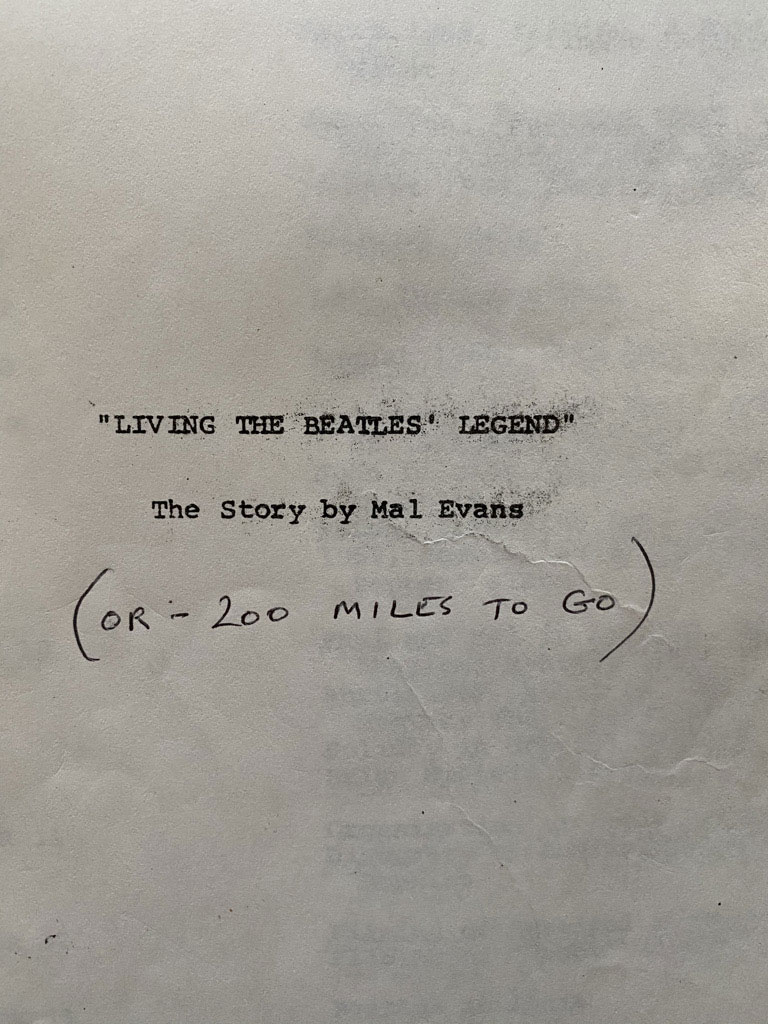
LIVING THE BEATLES LEGEND: The Untold Story of Mal EvansLIVING THE BEATLES LEGEND: The Untold Story of Mal Evans (Malcolm Frederick Evans Archive)That night, before making her way back to Brooklyn, Kutti was determined to salve her curiosity. And it wouldn’t take very long. Stopping by the New York City Public Library, Kutti quickly ascertained that Evans had been a large man, an affable gentle giant, that he had thrown over a career as a Liverpool telephone engineer to serve as the Beatles’ road manager, that he had traveled the world as their Man Friday, even playing the odd instrument on some of their songs, and that he had been shot dead at age 40 — almost inexplicably — at the hands of the LA police in January 1976, only scant weeks before he was set to submit his memoirs for publication with Grosset and Dunlap. 

Evans’ loss had been felt acutely in the Beatles’ inner circle. “Mal was the nicest, gentlest person,” George Harrison lamented. “He was a big guy, but he was really sweet.” Paul McCartney was even more vociferous in his defense of his fallen comrade. “Mal was a big loveable bear of a roadie,” he recalled. “He would go over the top occasionally, but we all knew him and never had any problems. The LAPD weren’t so fortunate. They were just told that he was upstairs with a shotgun and so they ran up, kicked the door in, and shot him.” McCartney was particularly emphatic when it came to Mal’s state of mind during the tragic events of January 1976. “He was not a nutter,” he said.

For Kutti, the discovery of Big Mal’s untimely demise made for a bitter pill, a fact that seemed to grow even more tragic when she learned that he had left behind a wife and two children in England. Flush with a new sense of resolve, she was determined to get those prized bankers boxes into the hands of Evans’ family. In her zeal, Kutti brought the materials to the attention of the foreman, who reminded her that they were on a search-and-destroy mission, not a recovery project. But Kutti persisted, informing him “that there’s stuff here about the Beatles.” Incredibly, the foreman thought she was referring to insects, which left her even more frustrated. “I guess he just wasn’t into music,” she said. “I could tell that he was older than I was.” But she wasn’t giving up the ghost so easily. When she insisted that the boxes were the rightful property of Evans’ family, the foreman threw his hands up and sent Kutti to the Putnam’s corporate offices, where she spoke with Louise Bates. 

Kutti handed the doorman a sealed envelope addressed to “Ms. Yoko Ono,” with the word “personal” scrawled underneath.

After acquiring Grosset and Dunlap, Putnam’s moved the entire operation — save for the basement storage room, that is — to their corporate facilities, which were located 10 blocks north of the New York Life Building at 200 Madison Avenue. At this point in her career, Bates had taken on a kind of legendary status in the publishing industry. In her role as Director of the Contracts, Copyrights, and Permissions department, Alyss Dorese didn’t flinch when it came to finding a place for Bates at Grosset and Dunlap. “She was well over 65 when I hired her,” Dorese recalled, “and I got a lot of flak for hiring someone of her age. But she was a terrific person and a wonderful worker of the old school who loved detail.” Putnam’s had kept Bates on after purchasing Grosset and Dunlap, and Bates had come to adore her well-earned senior status as one of the industry’s doyens. When she met with Bates in her Midtown office, Kutti could tell that she was being taken seriously. But it also became clear that Mal’s bankers boxes made the older woman feel uncomfortable. Soon, Bates was explaining that she would need to check with legal, possibly even send the materials out to Los Angeles for consultation with the original lawyers who handled the contract. 

To Kutti’s way of thinking, Bates appeared to be overly concerned. On its face, the evolving imbroglio seemed like a decidedly simple issue to the temp, with an equally simple solution: by rights, the materials belonged to the surviving family members back in England. That Saturday, February 13th, Kutti decided to take matters into her own hands. She took the subway uptown to the corner of W. 72nd Street and Central Park West. Stepping up to the copper-plated sentry box adjacent to the Dakota’s majestic archway, Kutti handed the doorman a sealed envelope addressed to “Ms. Yoko Ono,” with the word “personal” scrawled underneath. Having written her telephone number in the note, Kutti didn’t mince words. “This is regarding some of Malcolm Evans’s personal effects,” she wrote. “I feel they should be returned directly to the family.” Kutti knew that leaving a note for John Lennon’s widow, a lightning-rod of a public figure who surely received countless inquiries every day, was a long shot at best. 

But Kutti didn’t stop there. She was determined to make a thorough accounting of Mal’s forgotten archives. That Monday, she compiled a six-page inventory of the bankers boxes. As she began to organize the materials, they seemed even more tantalizing than before: there was an autographed color photo of Elvis Presley, a signed drawing of Mal by John Lennon, and yet another drawing of the roadie by McCartney, inscribed with the words “To Mal the Van from James Paul the Bass.” There were 10 Super 8 films in total, with titles like “Family Holiday,” “Beatles India,” “Africa,” “Greece” and “Plane Trip (Paul).”

When Kutti returned to the storage room later that week, with her gig at Putnam’s swiftly coming to an end, the boxes were no longer in the basement. Not to be deterred, the temp made her way to Bates’ Midtown office, where all of the boxes were stacked neatly beside her desk. Again, Kutti couldn’t help noticing how uncomfortable and worried the woman seemed — “like she wanted to deal with the stuff and get it over with as quickly as she could.” Bates seemed to be fretting in particular about “the lawyers in LA,” who wanted the materials, but didn’t want to pay the freight to ship the boxes to the West Coast. For the life of her, Kutti couldn’t make sense of the fact that “they were so worried about the cost, that they couldn’t begin to understand how important and valuable all of this stuff was.”

With her new gig beginning on Monday at Credit Suisse, Kutti realized that the clock had seemingly run out. But she had one more card up her sleeve. She made a Xerox copy of the inventory, rifled through the international telephone books at the New York Public Library, and, putting pen to paper, wrote a letter to Lily Evans at 135 Staines Road East in Sunbury-on-Thames. If nothing else, the temp wanted to ensure that Mal’s widow knew about the bizarre drama playing out in New York City.

What Kutti didn’t know is that Yoko had received her message alright. Indeed, by the time Kutti had begun her new assignment in Credit Suisse’s 11 Madison Avenue offices, the wheels were already in motion at Gold, Farrell, and Marks, Apple Corps’ law firm, which was coincidentally just across the street from the New York Life Building. One of the firm’s partners, Paul V. LiCalsi, had taken the lead on behalf of Yoko and Neil Aspinall, Mal’s former counterpart in the band’s circle who had been appointed in 1976 as Executive Director of Apple, the Beatles’ holding company, in the wake of the dissolution of the group’s partnership.

What LiCalsi and his team accomplished in a few short days was a masterpiece of lawyering. When Apple took possession of the bankers boxes, they extracted an agreement from Putnam’s to protect Mal’s legacy. Putnam’s attorney Matthew Martin wrote to Apple, stating that “per our phone conversation of March 14, 1988, this will confirm that neither Grosset and Dunlap nor the Putnam Publishing Group or any of its subsidiaries or affiliates own any copyright or publication rights in and to the untitled literary work on the Beatles (including text, photographs, drawings, memorabilia, and other materials prepared and collected for the work) which was to have been authored by Mal Evans.” Most importantly, Martin added, parroting Apple’s express instructions, “please be assured that neither Grosset nor Putnam has any plans or intentions of publishing any material authored or prepared by Mal Evans.” 
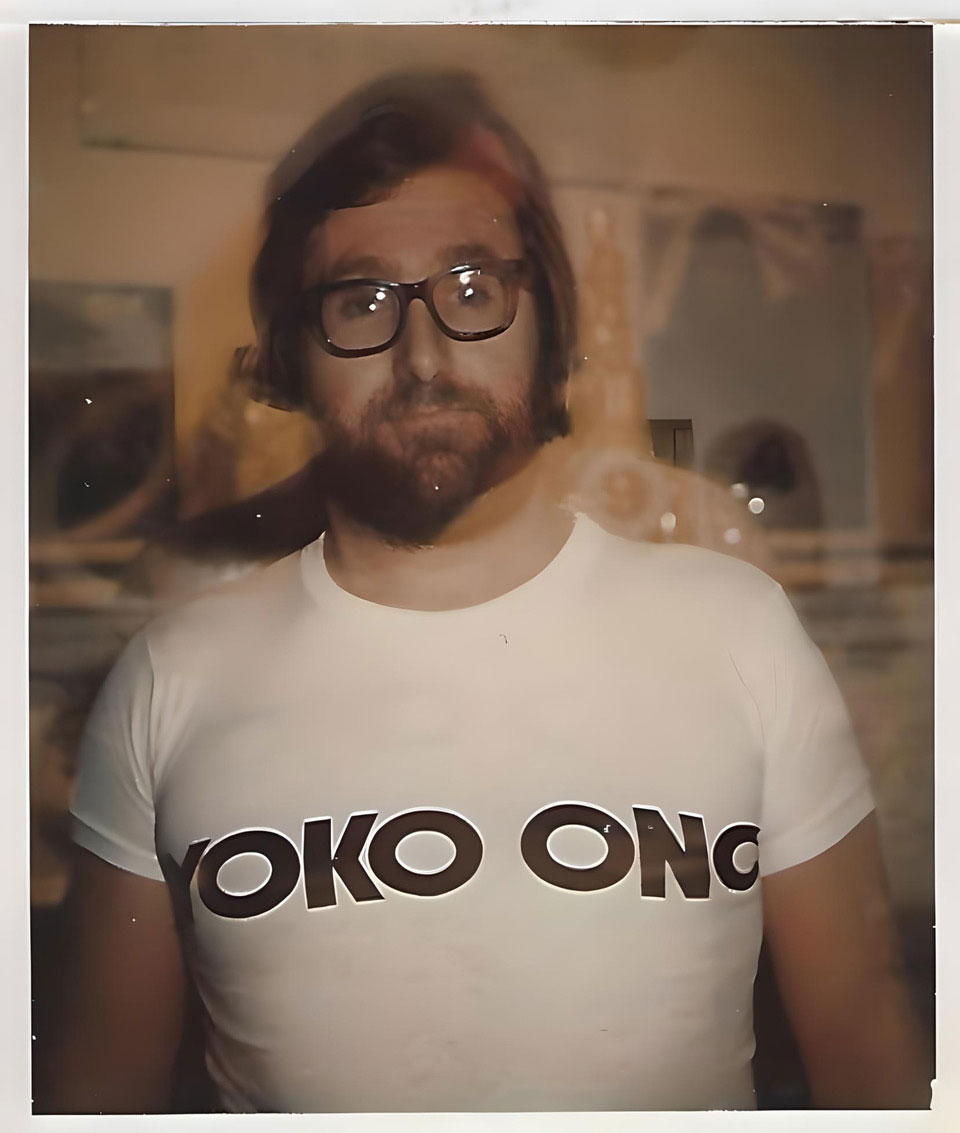
Mal EvansMal Evans in "LIVING THE BEATLES LEGEND: The Untold Story of Mal Evans" (Malcolm Frederick Evans Archive)That December, Kutti would realize that her labors hadn’t been in vain when she received a Christmas card from Mal’s widow Lily, who profusely thanked the artist for her selfless efforts on behalf of the Evans family. That March — less than a month after Kutti made her first trek into the basement of the New York Life Building — Aspinall had ensured that his old friend’s materials were transported by Federal Express and placed in Lily’s arms at her London home. After a dozen long years, the fruits of Mal’s life and work had finally been returned to the bosom of his family.

Within a year, Yoko made a point of meeting with Lily and her adult children Gary and Julie in London, where they shared a meal and talked about old times. In the late 1960s, their paths had crossed often. Gary held cherished memories of John and Yoko playing Father and Mother Christmas at Apple’s annual holiday bash. Lily and her children were grateful, of course, for Yoko’s heroic role in making good on Kutti’s discovery and swiftly returning Mal’s effects to his family after languishing for so many years in cold storage. In Gary’s memory, it was a beautiful evening, although he had been nervous at the outset. Now in his late-20s, Gary had been self-conscious about his weight at the time, and Yoko quickly intuited the source of his anxiety. “Just be yourself,” she told him. “Stop trying to look slim for me.” 

For Gary, the reunion made all the difference. “That completely broke the ice,” he recalled. As the hour grew late, Yoko made the sad realization that their loved ones, in one way or another, had been vanquished by gun violence. They shared a tearful embrace before they left her suite that night. For Gary, Yoko’s warmth and generosity had helped him to rethink his dad’s role —not only with the Beatles and their lives, but also his own. 

For several more years, the materials would be stored in the family’s attic, where Gary would periodically make forays into Mal archives and come to know his father beyond the grave. And as Gary came to discover, there would be hard truths to be learned about the reality of his father’s existence. Mal Evans was a man who lived his life in compartments, one of them reserved for his family and the other for the Beatles. In the former, he reveled in the love of his wife and children, whom he unquestionably adored. In the latter world, he lived like a medieval rogue, a free-wheeling sort who sucked the marrow out of every last moment. Mal ultimately lived the way he did — with great deliberateness, often recklessly, and without apology — because he expressly chose to do so, step by step. 

For Mal, being in close proximity to the Beatles’ special brand of stardom, and having ready access to every form of pleasure known to humankind, trumped the joys and commitments of family. And with nary an exception, when it came to the Beatles versus his family, the Beatles won the sweepstakes every time, bar none. Even in his final days, when he was living thousands of miles and an ocean away from his estranged family with another woman in Los Angeles, Mal still couldn’t quite make it home.

Over the years, as the archives rested in the garret at 135 Staines Road East, their mere existence has emerged as the stuff of myth among Beatles aficionados the world over — a Holy Grail, of sorts, filled with never-before-seen photos and untold treasures and artefacts. At Beatles conventions, fans speak in hushed tones about Mal’s lost diaries and his unpublished memoirs. In 2004, the archives briefly made headlines across the globe when Fraser Claughton, a 41-year-old farmer from Tinkerton, England, claimed to have discovered Mal’s long-lost treasure trove in an old suitcase. Having travelled to Australia for a friend’s birthday celebration, Claughton ventured into a flea market outside of Melbourne, discovered the priceless items, and quickly snapped up the timeworn luggage for the bargain sum of 50 AUD. The ensuing jubilation over the supposed recovery of Mal’s archives proved to be short-lived, when Claughton’s discovery was revealed to be a hoax, a cynical money-grab that was swiftly rebuked by collectors. Unbeknownst to the public, the materials were safely ensconced in Sunbury-on-Thames. The following year, Lily put an end to the speculation when she consented to a feature story in The Sunday Times Magazine, which published a few excerpts from Mal’s diaries for the first time.


Want a daily wrap-up of all the news and commentary Salon has to offer? Subscribe to our morning newsletter, Crash Course.


In the years since Ono and Kutti’s steadfast efforts on behalf of his family, Gary’s appreciation for the archives has only deepened. What were once painful reminders of a wayward, seemingly indifferent father have come to provide a powerful reconnection with the past. Gary has even found a sense of solace amidst his dad’s carefree, world-breaking adventures with the Beatles. Somewhere beyond the roadie’s own flaws and infelicities, the pages of Mal’s diaries, painstakingly recorded from 1962 to the mid-1970s, reveal an abiding affection for his son. For Gary, the archives’ mere existence has made all of the difference.

The same woman who saw “Now and Then” into the hands of the surviving Beatles in the 1990s — and into the ears of the whole wide world in 2023 — didn’t blink an eye when it came to preserving a family’s legacy. Bravo, Ocean Child.

"LIVING THE BEATLES LEGEND: The Untold Story of Mal Evans" will be released Nov. 14.

“You’re just scum”: Nikki Haley warns Vivek Ramaswamy to “leave my daughter out of your voice”

Former U.N. Ambassador Nikki Haley repeatedly snapped back at Republican primary opponent Vivek Ramaswamy during Wednesday’s GOP debate. Ramaswamy repeatedly tangled with Haley and at one point took issue with her criticizing him at a previous for using TikTok despite its ties to China. “She made fun of me for actually joining TikTok while her own daughter was actually using the app for a long time,” Ramaswamy said. “So you might want to take care of your family first before preaching to anyone else.”

“Leave my daughter out of your voice,” Haley shot back. “You’re just scum,” she said. Haley also hit back at Ramaswamy after he referred to her as “Dick Cheney in 3-inch heels” over her foreign policy views. “I'd first like to say they're 5-inch heels and I don't wear them unless you can run in them,” she said. “The second thing I would say is I wear heels and they're not for a fashion statement. They're for ammunition."

“Puts Trump in a box”: Experts say Judge Chutkan just forced Trump to “put up or shut up” on defense

U.S. District Judge Tanya Chutkan on Wednesday ordered former President Donald Trump to formally declare whether he plans to argue that he was acting on the advice of his lawyers in his D.C. election subversion case.

Chutkan partially granted a motion from special counsel Jack Smith’s team asking her to require Trump to declare whether he plans to use the advice-of-counsel defense, in which a defendant argues that he relied in good faith on the advice of his attorneys.

Smith in a filing last month noted that several Trump lawyers have said in media interviews that Trump was acting on the advice of his lawyers.

"When a defendant invokes such a defense in court," Smith's office argued, "he waives attorney-client privilege for all communications concerning that defense, and the government is entitled to additional discovery and may conduct further investigation, both of which may require further litigation and briefing."

Chutkan in her order on Wednesday wrote that while federal rules “do not expressly require advance notice of the advice-of-counsel defense” but “because waiting until trial to invoke the defense—and comply with the disclosure obligations it triggers—could cause disruption and delay, some district courts have concluded that they nonetheless have inherent authority to order defendants to provide advance notice if they intend to do assert the defense.”

Chutkan gave Trump until January 15 to disclose whether he plans to use the defense after Smith’s team requested notification by December 18.

Former U.S. Attorney Barb McQuade called the order “big and appropriate.”

“If Trump plans to use advice of counsel defense at trial in election interference case, he waives attorney-client privilege and must turn over documents to prosecution. He can’t have it both ways,” she wrote on X/Twitter.

We need your help to stay independent

The judge’s order “puts Trump in a box on one of his main defenses,” tweeted CNN legal analyst Norm Eisen.

“She's requiring that he disclose private communications” with the attorneys, Eisen explained, “or else he can’t advance the defense. No good choice for him here.”

The order means “Trump has to put up or shut up on this well in advance,” wrote former U.S. Attorney Harry Litman.


Want a daily wrap-up of all the news and commentary Salon has to offer? Subscribe to our morning newsletter, Crash Course.


“He doesn't have the legal basis for asserting advice of counsel— and he'd have to waive privilege—so getting it out in the open early will preempt them from pulling fast ones,” he added.

Former U.S. Attorney Joyce Vance predicted that Trump will have a “heavy lift convincing the judge to permit him to use an advice of counsel defense at trial.”

“Among other things, because you can't rely on the advice of your co-conspirators, even if they're lawyers,” she wrote. “If the Judge rules against him, it can't be mentioned at trial.”

Vampire viruses prey on other viruses to replicate themselves

Have you ever wondered whether the virus that gave you a nasty cold can catch one itself? It may comfort you to know that, yes, viruses can actually get sick. Even better, as karmic justice would have it, the culprits turn out to be other viruses.

Viruses can get sick in the sense that their normal function is impaired. When a virus enters a cell, it can either go dormant or start replicating right away. When replicating, the virus essentially commandeers the molecular factory of the cell to make lots of copies of itself, then breaks out of the cell to set the new copies free.

Sometimes a virus enters a cell only to find that its new temporary dwelling is already home to another dormant virus. Surprise, surprise. What follows is a battle for control of the cell that can be won by either party.

Representative TEM images of isolated phagesRepresentative TEM images of (A) MulchRoom; (B) MindFlayer; (C) MiniFlayer; (D) MiniFlayer adsorbed to MindFlayer neck; (E) MindFlayer neck proteins displaying residual MiniFlayer tail fibers; (F) MindFlayer/MiniFlayer adsorbed to S. scabiei. Arrowheads indicate attachment points. (Tagide deCarvalho, CC BY-SA)But sometimes a virus will enter a cell to find a particularly nasty shock: a viral tenant waiting specifically to prey on the incoming virus.


I am a bioinformatician, and my laboratory studies the evolution of viruses. We frequently run into “viruses of viruses,” but we recently discovered something new: a virus that latches onto the neck of another virus.

A world of satellites

Biologists have known of the existence of viruses that prey on other viruses – referred to as viral “satellites” – for decades. In 1973, researchers studying bacteriophage P2, a virus that infects the gut bacterium Escherichia coli, found that this infection sometimes led to two different types of viruses emerging from the cell: phage P2 and phage P4.

Bacteriophage P4 is a temperate virus, meaning it can integrate into the chromosome of its host cell and lie dormant. When P2 infects a cell already harboring P4, the latent P4 quickly wakes up and uses the genetic instructions of P2 to make hundreds of its own small viral particles. The unsuspecting P2 is lucky to replicate a few times, if at all. In this case, biologists refer to P2 as a “helper” virus, because the satellite P4 needs P2’s genetic material to replicate and spread.

Bacteriophages are viruses that infect bacteria.

Subsequent research has shown that most bacterial species have a diverse set of satellite-helper systems, like that of P4-P2. But viral satellites are not limited to bacteria. Shortly after the largest known virus, mimivirus, was discovered in 2003, scientists also found its satellite, which they named Sputnik. Plant viral satellites that lurk in plant cells waiting for other viruses are also widespread and can have important effects on crops.

Viral arms race

Although researchers have found satellite-helper viral systems in pretty much every domain of life, their importance to biology remains underappreciated. Most obviously, viral satellites have a direct impact on their “helper” viruses, typically maiming them but sometimes making them more efficient killers. Yet that is probably the least of their contributions to biology.

Satellites and their helpers are also engaged in an endless evolutionary arms race. Satellites evolve new ways to exploit helpers and helpers evolve countermeasures to block them. Because both sides are viruses, the results of this internecine war necessarily include something of interest to people: antivirals.

Recent work indicates that many antiviral systems thought to have evolved in bacteria, like the CRISPR-Cas9 molecular scissors used in gene editing, may have originated in phages and their satellites. Somewhat ironically, with their high turnover and mutation rates, helper viruses and their satellites turn out to be evolutionary hot spots for antiviral weaponry. Trying to outsmart each other, satellite and helper viruses have come up with an unparalleled array of antiviral systems for researchers to exploit.

The satellite virus MiniFlayer (purple) infects cells by attaching itself to the neck of its helper virus, MindFlayer (gray). Tagide deCarvalho, CC BY-SA

MindFlayer and MiniFlayer

Viral satellites have the potential to transform how researchers understand antiviral strategies, but there is still a lot to learn about them. In our recent work, my collaborators and I describe a satellite bacteriophage completely unlike previously known satellites, one that has evolved a unique, spooky lifestyle.

Undergraduate phage hunters at the University of Maryland, Baltimore County isolated a satellite phage called MiniFlayer from the soil bacterium Streptomyces scabiei. MiniFlayer was found in close association with a helper virus called bacteriophage MindFlayer that infects the Streptomyces bacterium. But further research revealed that MiniFlayer was no ordinary satellite.

Microscopy image of a small round virus colored violet attached to the base of a larger round virus colored gray with a long tail

This image shows Streptomyces satellite phage MiniFlayer (purple) attached to the neck of its helper virus, Streptomyces phage MindFlayer (gray). Tagide deCarvalho, CC BY-SA

MiniFlayer is the first satellite phage known to have lost its ability to lie dormant. Not being able to lie in wait for your helper to enter the cell poses an important challenge to a satellite phage. If you need another virus to replicate, how do you guarantee that it makes it into the cell around the same time you do?

MiniFlayer addressed this challenge with evolutionary aplomb and horror-movie creativity. Instead of lying in wait, MiniFlayer has gone on the offensive. Borrowing from both “Dracula” and “Alien,” this satellite phage evolved a short appendage that allows it to latch onto its helper’s neck like a vampire. Together, the unwary helper and its passenger travel in search of a new host, where the viral drama will unfold again. We don’t yet know how MiniFlayer subdues its helper, or whether MindFlayer has evolved countermeasures.

If the recent pandemic has taught us anything, it is that our supply of antivirals is rather limited. Research on the complex, intertwined and at times predatory nature of viruses and their satellites, like the ability of MiniFlayer to attach to its helper’s neck, has the potential to open new avenues for antiviral therapy.

Ivan Erill, Professor of Biological Sciences, University of Maryland, Baltimore County

This article is republished from The Conversation under a Creative Commons license. Read the original article.

Smart climate policy is good for people, not just the environment

It is difficult to read about global heating and climate change without being pessimistic. Every new report warning that humanity is entering "uncharted territory" or exceeding our limits as a stable ecosystem can produce feelings of hopelessness and despair. Yet even as Earth roils through unprecedented heatwaves and animals like river dolphins face extinction, there is still hope that climate change can be at least partially mitigated. But the fight is far from over and it won't be easy.

"It is clear that since the 2015 Paris Climate Agreement that trillions of dollars from the multinational banks have flowed to the fossil fuel industry…"

John J. Berger's new book, "Solving the Climate Crisis: Frontline Reports from the Race to Save the Earth" chronicles the experiences of ordinary people fighting climate change, from business leaders, politicians and farmers to scientists, engineers and activists. Berger identifies practical, real-world solutions that can empower ordinary citizens to fight for their environment.

Berger brings to this endeavor his invaluable background as an environmental science and policy specialist who has written for publications like Scientific American, the Boston Globe, the Los Angeles Times and others. He has also written and edited 11 books, including three previous works about climate change.

This interview has been edited for length and clarity.

One of the biggest problems with stopping greenhouse gas emissions is financial. How do we go about preventing financial institutions and banks from continuing to finance the development of oil, coal and gas assets?

I know that Third Act [a community advocacy group] is addressing this issue by urging members to boycott certain banks that are prominently associated with funding carbon bombs, so to speak, which if developed could add over their lifetime a billion tons of carbon dioxide to the atmosphere. Almost any of these projects would be a significant step backward in the effort to get towards zero greenhouse gas emissions on a net basis.

I think that the environmental movement needs to do a great deal more thinking about this issue. I don't think it has been adequately discussed and completely understood, but it is clear that since the 2015 Paris Climate Agreement that trillions of dollars from the multinational banks have flowed to the fossil fuel industry for continued expansion of oil and gas drilling and production and exploration.

"Mass movements of concerned and indignant people can shed light on practices that are comfortable for large institutions to pursue when they do so in darkness."

That money should rather be used to facilitate the clean energy transition. And those dollars should be used to renovate buildings, make them more energy efficient, and to deploy vast numbers of renewable energy generators in the form of wind turbines and solar power on rooftops and on other available spaces, as well as in central station solar powered facilities. That money, in other words, could be put to much better use. I don't think anybody really knows today how to stop this flow of capital. But in the past, we have discovered that mass movements of concerned and indignant people can shed light on practices that are comfortable for large institutions to pursue when they do so in darkness.

So I think, as the saying goes, sunlight is the best disinfectant. That will be helpful, but more needs to be done strategically in general to move large financial institutions. They act according to their economic self-interest. And if it can be that these transactions can be structured so that it's more profitable for them to invest in the clean energy transition than in perpetuating our addiction to fossil fuels, then the money will flow in that direction. Just as the fact that new solar generating capacity is now the cheapest new capacity in the world has meant that it's been difficult or more difficult to fund new fossil fuel power generating facility. And the vast preponderance of new generation capacity that's being built now is renewable.

That makes a great deal of sense.

To the economic change, changing the incentive structure so that the money will flow in a different direction. And there has to be some regulation of investments that have huge public costs. One could envision steep rising carbon fees that would operate throughout the economy, and that would be incident on the fossil fuel industry. If the fossil fuel industry can be so regulated that it becomes a less profitable industry, then it will have fewer resources to attract the banking community to its aid.


Want more health and science stories in your inbox? Subscribe to Salon's weekly newsletter Lab Notes.


"This accusation that people through their dietary habits are somehow responsible at large for climate disruption is really a half-truth."

My next question is related in a sense, because you're discussing how people can make a difference. What kinds of actions people can call for and engage in order to bring about positive change? That's something that I like about your book. It's not bleak and dire. It tries to be proactive. I'm now thinking about something that I commonly hear from climate change deniers, which is, they fear the government wants us to eat nothing but bugs and grass. I'm wondering if you could discuss how we can reduce or eliminate the 20% of total greenhouse gas emissions that can be attributed to agriculture and bad land use without the extreme measures that the deniers insist are necessary. 

This is actually also an extremely challenging question, and it involves some cultural changes, but we are not going to convince people overnight to change their dietary habits. And that's something that people will resist vehemently. And I don't think that we need to tell people, you cannot eat meat. I think people could be told, for example, if you reduce your consumption of meat, you will be aiding in the transition towards a cleaner agricultural sector.

But I think in a way, this accusation that people through their dietary habits are somehow responsible at large for climate disruption is really a half-truth. The fossil fuel industry and climate deniers love to put blame on the individual. And then the individual turns around and says, "Well, my scope of activity or my leverage on these massive national and global issues is very limited." And they become frustrated and they despair.

I think, again, in the agricultural sector, one can find ways in which adopting environmentally sensitive practices can be made more profitable. And I talk about the work of rancher Gabe Brown in my book, and he pioneered regenerative agricultural practices in the 1990s and to the present day and has become something of an apostle of regenerative agriculture. He was going broke when he followed the conventional industrial agricultural model, and he turned to regenerative agriculture, to farming without herbicides, without pesticides, without irrigation, without plowing.

It was a matter of necessity, but he found that he was able to enrich the soil through his use of diverse cover crops. And more lately, the use of fungi to help rejuvenate the soil. The soil became very carbon rich and supported a rich flora and a rich microflora. The soil became healthy and produced healthy crops, healthy animals.

And ultimately the people that eat healthy food tend to be healthier than people, for example, that are reliant on more expensive processed food that is less nutritious and laced with chemicals that can be problematic for our health. So I think it's important for people to look analytically, very carefully, at what's happening in the agricultural sector, not just from an environmental point of view, but from an economic point of view to show that the policies that people like Gabe Brown have been pursuing are actually more profitable than policies that follow the industrial agricultural model that is so energy intensive, and also tends to waste a lot of water and to create biodiversity problems as a result of herbicide and pesticide use. 

"We ought to be paying farmers for the ecological services that they provide, and we can encourage them to do that on a national scale."

There is another element to the answer to that question, which is that as a result of the kind of regenerative agricultural practices that Gabe Brown and others like the Marin Carbon Project out here in Northern California are pursuing, the soil becomes rich in carbon and government programs can and should be expanded to provide farmers with payment for additional tons of carbon dioxide that they're able to trap and store on a semi or permanent basis in the deep contours of their soil. And the way that happens is that if you plant deep rooting prairie plants, for example, the roots can penetrate down as deep as 30 feet, and when roots like that die, they enrich the soil with the carbon from their biomass.

Of course, one doesn't just plant prairie plants, but [a] diverse mix of cover crops that can enrich the soil with their roots and their exudates and the fungi and the whole soil ecosystem that thrives on keeping roots in the soil, keeping the ground cover present as opposed to allowing the soil to lie barren and fallow and then to graze it with live animals so that they fertilize the soil naturally. 

And in a way it emulates some of the natural processes that took place for thousands of years on the prairies of the United States and other vast grasslands. So summarizing that, we ought to be paying farmers for the ecological services that they provide, and we can encourage them to do that on a national scale and also on an international scale because this is an example of a natural climate solution that can, if done pervasively over billions of acres of range lands and crop lands, store billions of tons of carbon dioxide in the soil very safely and also extremely economically relative to other, more costly ways of getting carbon dioxide out of the atmosphere. 

I want to transition to a different area ripe for decarbonization: Transportation. That is another area where people have this emotional investment, not just in cars, but in coal rolling, or in cars that have very bad emission standards, to put it mildly. What is your advice to people who want to have intelligent conversations about green transportation? 

I think that we need to build cities that prioritize human habitation over prioritizing spaces for vehicles and for vehicle use. Vehicles have their place, but relative to the vehicles that are used in most of the rest of the world, our vehicles tend to be oversized and overpowered, and they use more raw materials and fuel than they need to in order to deliver the services that are required.

"There are great many trips that don't require a car that can be done on a bicycle or an electric bicycle."

So even if you weren't going to electrify transportation, which is increasingly happening now that 7% of new automotive sales are electric, we could still make major improvements by discouraging the use of unnecessarily large and heavy and dangerous vehicles that are [a] danger to pedestrians as well as to the environment. That's one thing that can be done. If you analyze most of the trips taken, I don't have the exact statistics at my fingertips, but something like two-thirds of all the trips taken are under five miles. 

So there are great many trips that don't require a car that can be done on a bicycle or an electric bicycle or an electric scooter or a small local use urban vehicle that maybe doesn't exceed 25 or 35 miles per hour, but is perfectly fine for going to the grocery store and picking up groceries.

And we also need to make cities much more friendly to bicycles so that you don't take your life in your hands when you decide that you want to go out for a bike ride because there's no separation between the roadway and the bikeway. In fact, in many places there's no bikeway. But if you go to advanced European cities like Copenhagen for example, or Stockholm or Amsterdam, you'll see they've given a great deal of thought to bikeways and to make the urban areas accessible. We also want people to be located in dense or semi-dense, mixed use residential and commercial neighborhoods as they are in Copenhagen, where virtually the entire population is within half a mile of the subway. 

We need your help to stay independent

And when the city plans and implements a new development, they make sure that it's a mixed use residential and commercial area with a public transportation. So this basically obviates the need for everybody to own their own vehicle. Some people need to use vehicles and maybe they want to keep that vehicle in a garage for 95% of the time in order to have it available for that few percent of time when you actually need a long distance vehicle. But other people may prefer to just rent a vehicle on a daily or weekly basis when they need it for such purposes.

So I think that we probably have more car ownership than we need as a society, and we could probably more cost effectively accomplish many of our errands and transportation needs with vehicles that are shorter range and more economical to operate or healthier to operate. Because there've been studies that show that cycling, for example, regularly can extend your life by something on the order of five or seven years. So these things are good for the environment and they're also good for people.

“I’m so tired of these psychos”: Moms for Liberty is now a toxic brand

"We have more people. That's a huge part."

Jane Cramer, a mother from Bucks County, Pennsylvania, explained to Salon earlier this year that she felt good about the ragtag team she'd helped assemble to boot Moms for Liberty, the well-funded conservative parents’ rights group, off of her local school board. "We're not organized in the best ways necessarily, but it kind of all fell into place,” Cramer told me. “And we're all obsessed a little bit.”

Last month, I published an investigative report about how Moms for Liberty, a group dedicated to rewiring American education toward the far right, had taken over the board of education in the Pennridge School District, about half an hour outside Philadelphia. Moms for Liberty, a heavily funded astroturf organization linked to GOP leadership, wasn't especially subtle in its strategies, pinpointing a handful of swing districts in purple states, like Virginia and Pennsylvania, and targeting school board elections, which are usually low turnout and easy to win. Once installed, Moms for Liberty members started banning books and Pride flags, as well as protesting that teachers were "grooming" kids with "smut," which usually meant either a history book or acclaimed, age-appropriate fiction. The idea was to create moral panics around sex and race that could tip national elections towards Republicans. 

Well, it backfired.

As I reported, parents in the Pennridge district eager to fight back against right-wing radicals formed the Ridge Network and got the word out, arguing to voters that the group was degrading the quality of the public schools. This week, those efforts paid off: Democrats won all five of the open school board seats in the district, wresting control away from Moms for Liberty.  

Cramer, on her TikTok account, celebrated:


@cringfql5dx #wewon #election #stopmomsforliberty #inclusiveeducation #vermilioneducation #savepennridge #pennsylvania #pennridgepride #win #schoolboard @60 Minutes ♬ All I Do Is Win – DJ Khaled


By the time this election rolled around, Moms for Liberty seemed to have already realized their brand had become poisonous. As the Daily Beast reported, "In 2021, Moms for Liberty claimed credit for 33 seats in Bucks County," but in this election cycle, the group "endorsed only a single candidate in the county." The Philadelphia Inquirer reports that some Republican candidates wanted the group to keep its distance, fearful of the taint. And that was my sense of things in the Pennridge district this fall. School board members who had links to Moms for Liberty tried to downplay it and ended up getting outed by investigators from the Southern Poverty Law Center (SPLC).

Moms for Liberty, in the end, was a very expensive trap that the Republicans built for themselves. 

The school board election is the latest in an escalating series of victories for the Ridge Network and other resistance efforts in Pennsylvania. Last month, the Democratic-controlled state legislature held hearings about the threat of book banning, allowing parents and educators to speak out. One of those parents, Darren Laustsen, told Salon about his attempts to expose backdoor book banning at Pennridge, which involved books mysteriously being "checked out" so that students couldn't read them all year. In late October, he won a lawsuit against the school district over what the judge called a "cover-up" of such secretive book bans.

We need your help to stay independent

But Laustsen isn't resting on his laurels. He's still out there raising awareness of the radicalism of Moms for Liberty. He recently tweeted a story about Moms for Liberty activists demanding the arrests of librarians for letting kids read young adult novels, adding, "I am so tired of these psychos."

It's remarkable how swiftly Moms for Liberty became such an albatross organization. As many Pennridge parents complained to Salon, much of the initial media coverage of the group was credulous, buying into the false narrative that it's a grassroots group of normal parents who are simply "concerned" about liberal "excesses." In reality, the group was founded in 2021 by the wife of the chair of the Florida Republican Party and was immediately so well-resourced and fully staffed that it could only be they were propped up by secretive, wealthy donors. 

The suspicious aura of money around the group was interesting to journalists, but what really damaged Moms for Liberty was that they underestimated the intelligence of the people in the communities they were targeting. The parents of Pennridge were not fooled by attempts to characterize literary fiction as "pornography." Local residents also feared that rewriting history classes to adhere to right-wing mythologies would ultimately harm the school's reputation, which could hurt both their property values and the ability of their kids to get into good colleges. Above all, multiple parents expressed a belief that schools should be preparing kids for the real world. They worried that right-wing whitewashing of history, social studies and other courses would leave kids without the basic skills necessary to thrive in a diverse, dynamic society. 

Moms for Liberty's membership is not handling the rapid, dramatic decline of their organization well:

Moms for Liberty was started, in a fairly obvious manner, to help boost the national prospects of Republicans. So it's a delicious irony that, in two short years, the organization is mostly known as a symbol of the MAGA extremism that is driving down the overall popularity of the GOP, leading to yet another election cycle where Democrats overperformed expectations. The group was meant to put a family-friendly gloss on right-wing extremism. Instead, they got parents and teachers, many who barely have time to work and care for their families, to become political organizers. Messing with people's schools was not, it turned out, a genius political strategy. 


The secret to Trump’s revenge plot: He’s making his plans for vengeance public

If he wins the 2024 election, Donald Trump will be America’s first dictator. This plan of retribution is advancing rapidly in preparation for Trump’s return to the White House – an outcome that seems increasingly likely given early polls which show him leading President Biden in key swing states. Trump’s MAGA supporters and tens of millions of other Republican voters support the traitor ex-president and his attempt to end multiracial democracy and to replace it with a new form of American apartheid. The Republican Party is in Trump’s thrall

As an institution, the mainstream American news media is not built for this moment. They have had more than seven years to adapt. They have mostly chosen not to. In that way, the American news media in the Age of Trump is like a sports team that is continuing to run the same plays even though the game has radically changed and, in many ways, has passed them by. As a result, they (and the American people) keep losing.

From the bothsidesism to access journalism to confusing neutrality with objectivity and an emphasis on the horserace instead of the consequences, the media's obsession with gossip and personalities has provided an undue platform for Trump and other malign right-wing actors to rehabilitate their reputations and circulate their propaganda and lies. Careerism, a lack of intellectual curiosity, and emphasizing profits over bold truth-telling allow the cycle to continue as our democracy languishes. 

The Trumpists are not hiding in the shadows because, as the world saw on Jan. 6 when Trump’s MAGA attack force overran the Capitol with their faces uncovered and while recording their crimes, they have no plans of being defeated.

For the news media to effectively counter Trumpism, there must be changes to its institutional culture that allow for substantive and sustained pro-democracy journalism. Because, in more than seven years, the American news media has not yet made these institutional changes, even when there are attempts to strongly confront Trumpism and the other illiberal forces that are threatening the nation, such moments are fleeting. The most recent example is the much-discussed reporting by The Washington Post and the New York Times on Trump and the American neofascists’ plans to end American democracy by invoking the Insurrection Act (meaning martial law), criminalizing dissent, nullifying the First Amendment, deporting “criminals” and other “enemies of the state” under the Alien Enemies Act, using the military to occupy Democratic-led cities, freeing the Jan. 6 MAGA terrorists who will then become Trump’s personal enforcers, and replacing career government professionals who follow the Constitution and rule of law with Trump regime loyalists.

We need your help to stay independent

It is critically important in terms of national agenda setting that The Washington Post and New York Times, as two of the country’s leading news publications, are sounding the alarm loudly about Dictator Trump and his cabal’s plans to end American democracy. Unfortunately, those warnings are muted by many of the same bad habits that helped to normalize the Age of Trump in the first place. In an excellent essay at the Inquirer, William Bunch explains:

There was a shocking and incredibly important story on the front page of the New York Times last week. As reported by an A-team of journalists including two Pulitzer Prize winners, the Times warned its readers that Donald Trump — if returned to the White House in 2025 — is grooming a new team of extremist government lawyers who would be more loyal to their Dear Leader than to the rule of law, and could help Trump install a brand of American fascism.

You say you didn’t hear anything about this? That’s not surprising. The editors at the Times made sure to present this major report in the blandest, most inoffensive way possible — staying true to the mantra in the nation’s most influential newsroom that the 2024 election shouldn’t be covered any differently, even when U.S. democracy is on the line.

“Trump Allies Want a New Style of Lawyer if He Returns to Power” was the original online headline for the piece, as if maybe they were talking about colorful drawling Southerners with seersucker suits, rather than rabid-dog ideologues who would do the dirty work of overturning an election that career government attorneys refused to do before Jan. 6, 2021.

That “new style of lawyer” — pro-Trump, “America First” zealots who think the ultraconservative lawyers bred in the Federalist Society are too soft to carry out their leader’s autocratic call for a “final battle” against traditional democratic governance that he calls “the deep state” — was described, numbingly, by the Times as “more aggressive legal gatekeepers.” Their dangerous antidemocratic mission was blandly outlined as a plan to “take control of the government in a way unseen in presidential history.”

I’m picking on this one article in the Times, and its timid, inoffensive packaging, not because it is unique, but because it is far too typical right now. In one of the most perilous moments of crisis the world has seen in 75 years, and with the basic notions of free speech under assault, most newsrooms aren’t fighting back. They are, instead, pulling their punches in a defensive, “rope-a-dope” crouch, and thus failing to truly inform — when democracy itself is at risk….

We are at war, dammit, literally and figuratively, and we can’t win this fight by hiding in the corner and absorbing the punches.


Want a daily wrap-up of all the news and commentary Salon has to offer? Subscribe to our morning newsletter, Crash Course.


At Press Watch, media critic Dan Froomkin makes the sharp move of actually rewriting The Washington Post’s and New York Times’ recent stories about Trump’s plans to become a dictator:

The Post’s word choices were similarly pusillanimous. After describing Trump’s plans to prosecute critics and have the military put down protests, the authors arrived at this whingey conclusion: “Critics have called such ideas dangerous and unconstitutional.”

That’s insufficient. The essential, missing context is: This is how democracies die.

Let me rewrite that for you.

The article by Jonathan Swan, Charlie Savage and Maggie Haberman was eventually headlined: “If Trump Wins, His Allies Want Lawyers Who Will Bless a More Radical Agenda”.

That’s way better than the original headline: “Trump’s Allies Want a New Style of Lawyer if He Returns to Power.” I guess we should be grateful for that.

But neither comes close to telegraphing the truth. Let me rewrite that headline for you: “If Trump Wins, His Allies Want No Obstacles to Dictatorship”.

The Times subhead was “Politically appointed lawyers sometimes frustrated Donald J. Trump’s ambitions. His allies are planning to install more aggressive legal gatekeepers if he regains the White House.”

Let me rewrite that, too: “Politically appointed lawyers sometimes frustrated Donald J. Trump’s ambitions. His allies are planning to install enablers instead.”…

Over the years, I’ve also decried journalistic timidity. “Great political journalism requires the courage to state the obvious,” I wrote in 2019. “Sadly, our access-dependent, approval-seeking, risk-averse, group-thinking elite Washington press corps often doesn’t have the guts.”

At his site Weekend Reading, Michael Podhorzer, who is the former political director of the AFL-CIO and now a Senior fellow at the Center for American Progress, implores the American news media to engage in some long-overdue critical self-reflection:

The media needs to decide whether they are covering this election as if it’s an election like any other, or the election that will decide whether the MAGA movement succeeds in ending American democracy. As long as the media chooses the first option, it is creating a self-fulfilling prophecy. …

I’d like to ask members of the media this question directly: If Trump wins – and if he fulfills any of his long list of deranged promises, some of which involve breaking America beyond repair – how do you think history will judge how you covered this election? Will future generations ask whether voters had a good enough idea about how other voters would vote, or would they ask whether voters had a good enough idea of what was in store for them?…

Because of its institutional myopia and other failings, the American mainstream news media is continuing to miss an obvious and critically important aspect of the plans by Trump and the Republican fascists and larger “conservative” movement to end American democracy: This is all being done in public.

The titles and details of these antidemocracy plans such as Agenda 47 and Project 2025 are not beyond top secret or compartmentalized and encrypted code words that require a book cipher or where the documents are burned after reading. These detailed plans to end American democracy are available online, in books about “Project 2025” and discussed on podcasts, Youtube videos, television, and at conferences and other public events. The Trumpists are not hiding in the shadows because, as the world saw on Jan. 6 when Trump’s MAGA attack force overran the Capitol with their faces uncovered and while recording their crimes, they have no plans of being defeated.

Why is infant mortality so high in the US? Because our health care system fails mothers, too

This week, the Centers for Disease Control and Prevention (CDC) released new data on a tragic trend: more than 3,700 cases of congenital syphilis were reported in 2022, nearly ten times the number recorded 10 years ago. 

If left untreated, congenital syphilis can lead to stillbirth or infant death. Infants who survive may have severe developmental delays, become blind or deaf. In 2022, the disease caused 51 infant deaths and 231 stillbirths. Congenital syphilis can be prevented, but it requires testing a pregnant woman for syphilis right away. The CDC said nearly 90 percent of the new cases in 2022 could have been prevented with timely testing and treatment. In 40 percent of the cases, there was no evidence that the pregnant woman had received prenatal care.

The news comes nearly a week after another startling statistic was released from the CDC — that the infant death rate in the country increased by 3 percent in 2022. It marks the first significant increase in about two decades. 

Women in the U.S. are dying from pregnancy-related causes before, during and after childbirth at a higher rate than any other developed nation.

Dr. Marie E. Thoma, an associate professor in the department of family science at the University of Maryland, told Salon that in general, the U.S. ranks very poorly compared to other high-income countries. While she cautioned to call it a “crisis,” the news “definitely set off some alarm bells,” and emphasizes the need for improvement. Overall, there have been declines in infant mortality rates over the past 20 years due to a number of public health and medical advances in the U.S.

Thoma said what we’re seeing is likely a consequence of another crisis that is inextricably linked to infant health: the maternal health crisis. Women in the U.S. are dying from pregnancy-related causes before, during and after childbirth at a higher rate than any other developed nation. When the healthcare system fails mothers, it fails infants, too, as recent data has shown.

“Several of the recent initiatives to address infant health were specific to infants and haven't done as much for mothers,” Thoma told Salon. “Whereas, advances in maternal health can continue to address both maternal and infant health combined.”

The drive behind the infant mortality rates appears to be due to a rise in maternal complications, and bacterial sepsis, which is often correlated with issues that come up during pregnancy and around birth. Joy Baker, an OBGYN based in Georgia told Salon the mother and fetus are a unit and should be treated as so.


Want more health and science stories in your inbox? Subscribe to Salon's weekly newsletter Lab Notes.


“Whenever you have a mom that is not at her best health, you're going to always see that infants aren’t going to do as well,” Baker said. “And that’s mainly because the baby is completely dependent on the mom.” 

For example, Baker said, if a mother doesn't have great cardiovascular health, it makes it harder to send good blood flow oxygen and nutrients to the fetus. If she's dealing with diabetes and has really high blood sugar, that could lead to preterm birth, increasing the risk for complications. Historically, public health policies have approached infant health and maternal health as separate entities. But as Thoma pointed out, since at least the 1980s, there have been calls to think of them combined. As researchers posited in 1985: “Where is the M in MCH [maternal and child health]?”

“We're asking that same question, and I do see a lot of momentum now,” Thoma said. “I think there's a lot more attention to the issues, a lot more policy investment, but we need to pass the policy.”

“Where is the M in MCH [maternal and child health]?”

Thoma said she thinks the White House has a comprehensive blueprint for what can be done to address the maternal health crisis, which first suggests expanding healthcare access and coverage. Currently, Medicaid, which finances 4 in 10 births and only covers a woman 60 days postpartum. However, more states are offering coverage to women postpartum up to 12 months, with specific qualifications. 

Experts agree that access to healthcare for mothers seems to be one of the drivers behind the rise in infant mortality rates — both in terms of general deaths and a large contributor to the rise in congenital syphilis. But it’s not just health insurance coverage. Regarding congenital syphilis, the CDC has previously said data suggests there are multiple issues at play, such as reduced access to STD prevention due to drug use, poverty, stigma and cuts to STD programs at the state and local levels. Defunding public programs could have hindered access to treatment for all moms.

Since the 2008 recession, local health department workforces have shrunk and the pandemic likely exacerbated the issue leading to fewer options for pregnant women. More than 5.6 million women live in counties with no or limited access to maternity care, areas that are commonly called “maternity care deserts.” 

“Access to care is a major issue, we know that we're probably about 9,000 OBGYNs short in this country,” Baker said. “That's a major issue, women having access to good prenatal care, being able to get into a clinic to see a doctor or midwife, a nurse practitioner, who can help guide the pregnancy — that can be a real issue for folks who are living in maternal care deserts.”

An investment in women’s health services needs to be prioritized, the White House’s initiative said, particularly to address maternity care deserts. In a statement, Sandy Chung, president of the American Academy of Pediatrics (AAP) said the increase in infant mortality rates is  “disturbing and disappointing.”

We need your help to stay independent

“Racial and ethnic disparities related to accessible healthcare — including prenatal health services — are just one of the many possible reasons for lower birth weights of babies and sometimes, infant deaths,” Chung said.

Jennifer Smilowitz, a professor of nutrition and health equity at the University of California-Davis, said in order to solve infant mortality in the U.S., the entire system needs to embrace both maternal and infant health as one. 

“The problem is the current medical system is set up where the mother and the infant are not treated as a dyad,” Smilowitz said. “They are a dyad.”

Actors who’ve dragged Marvel for its capitalistic, IP-driven franchise

Marvel Studios used to weld a certain unprecedented power in the industry. Its star-studded, Robert Downey Jr.-backed franchise hit its peak during the most recent blockbuster Avengers films with exposés revealing a slew of internal crises like the glaring Jonathan Majors problem or just the general Marvel-film fatigue with all the shows and films coming out back to back. It seems like the same power that made Marvel movies insanely popular is also causing it to dwindle. 

Even actors like "The Bear" star Jeremy Allen White are not taking the Marvel bait used to lure in rising stars in the industry. White revealed in an interview with British GQ that he had a meeting about joining the Marvel Cinematic Universe that didn't play out well because he had an "attitude." The star said he is steadfast in solely acting in independent films.

White is just one of many industry people who have been speaking on the potential side effects of Marvel's IP-driven franchise formula. Infamously, a figurehead of cinema, Martin Scorsese, has publically stated his disinterest in superhero films. When asked about Marvel films, Scorsese said, "That’s not cinema . . . Honestly, the closest I can think of them, as well made as they are, with actors doing the best they can under the circumstances, is theme parks. It isn’t the cinema of human beings trying to convey emotional, psychological experiences to another human being.” 

Scorsese's comments have sparked endless discourse on the meaning of cinema, and similarly many actors have reiterated his comments on the spectacle surrounding Marvel and its movies.

Here are actors that have dragged Marvel for its formulaic, IP-driven comic book movie-making machine: 

Jennifer AnistonJennifer Aniston (Emma McIntyre/WireImage/Getty Images)

The longtime "Friends" actor is known for not mincing her words on the industry's wide issues. When Aniston returned to television for "The Morning Show" on the streamer Apple TV+, she stated that the industry has changed, and now it's the streamers that have quality television shows.
 
"And then you’re seeing what’s available out there, and it’s just diminishing and diminishing in terms of, it’s big Marvel movies," Aniston said. "Or things that I’m not just asked to do or really that interested in living in a green screen." 
 
This take is one that most of the actors who have spoken out against the studio and its monopoly over the industry share. And diehard Marvel stans did not take a liking to Aniston's opinions. 


Jon HammJon Hamm (Brian Babineau/NHLI via Getty Images)
The "Mad Men" actor has been previously considered for several superhero films specifically playing a villain in one of the "X-Men" franchise films. However, the actor said, "These conversations happen, and then life intervenes.”
 
Years after he was considered for the role he said he made the right decision in saying no. The star critiqued the fact that once an actor signs on to a superhero film, they are contracted to film a series and crossovers.
 

“The deals that they make you do are so draconian. And, of course, you are signed on for not only the movie that you are signed on for . . . but at least two more that you haven’t read and you have no idea what they are going to be and all the crossover ones you are going to have to do," Hamm said. "For me to sign on now to do a superhero movie would mean I would be working until I am 50 as that particular superhero. It’s a lot of work at one thing which is not necessarily the reason I got into the business which is to do many things. If you want to spend all day pressing the same key that . . . seems an odd choice."

Christian BaleChristian Bale (Samir Hussein/WireImage/Getty Images)
The DC "Batman Begins" star has even drank the Marvel Kool-Aid. Most recently, Bale starred as villain Gorr the God Butcher in the mixed-reviewed fourth Thor movie, "Thor: Love and Thunder," but wasn't a fan.
 
Bale said that his experience on set was “monotony,” and that he couldn’t “differentiate one day from the next" due to solely shooting in a green-screen space.
 

“That’s the first time I’ve done that,” he said. “I mean, the definition of it is monotony. You’ve got good people. You’ve got other actors who are far more experienced at it than me. Can you differentiate one day from the next? No. Absolutely not. You have no idea what to do. I couldn’t even differentiate one stage from the next."


The actor said he would only return to the MCU if there was "a good character or a good director, you know, if it's an interesting thing.

John ChoJohn Cho (Vivien Killilea/Getty Images)
The "Star Trek" and "Cowboy Bebop" actor had similar thoughts to Jon Hamm's and was not shy in his piercing statement about Marvel, comparing the contract deals to "indentured servitude."
 
In 2016, he told Vulture that the process of becoming a superhero "doesn't sound fun." But most importantly, he said "the problem now is whenever you do a movie they sign you to like, a three-picture deal, because if you play, you know, Condorman, you’re young, you’re just in from Ohio or whatever, you’re signing a 15-year contract, and they have the option to make three or four. That’s the weird thing about it — all these indentured servitude contracts."
Simon PeggSimon Pegg (Bryan Bedder/Getty Images)
Wanting more freedom in filmmaking seems to be a theme. Also known for starring in the "Star Trek" and "Ice Age" franchises, Pegg said he'd never want to join the MCU due to its lengthy contractual obligations.
 
"I'm not in any rush to join the MCU or anything like that," Pegg said. "I kind of feel like I kind of want to be a bit more free. You join those things and then you're tied to them for years and that can be a little bit restrictive."
 
He also said that he wants "to do more sort of grown up stuff in the future," and Marvel would not be included in that.
Jeremy Allen WhiteJeremy Allen White (Cindy Ord/WireImage/Getty Images)
White is currently at the center of the Marvel discourse. He has been on the rise since the intense Chicago-set culinary drama "The Bear" catapulted the "Shameless" star to even greater heights. He is currently starring in the upcoming biopic "The Iron Claw," about the tragic story of the wrestling Von Erich brothers.
 
During promo for the film, he shared a story about being considered for a role by the Disney-run studio. Even his "The Bear" co-star Ayo Edebiri is a part of the MCU's new "Thunderbolts" film.
 

“I had a meeting for a kind of Marvel-y movie, and I had an attitude,” White said. “I think I played it all wrong.” White was skeptical in front of the film executives saying “ ‘Tell me about why should I do your movie.'" "They were like, 'F**k you,'" White said. "And I was like, 'Right on.'"


He told GQ: “I am confused at how the pinnacle of an actor’s career has ended up in that place. . . They get really good filmmakers to do those movies and obviously they get really good actors to do those movies," echoing sentiments similar to Scorsese's. White said he's not sure he should be burning bridges at what is this critical point in his career but he doesn't regret it. “I played it the way I wanted to play it.”


“We will rewrite the next chapter”: Exonerated “Central Park 5” member wins New York City election

More than three decades after Yusef Salaam and four other Black and Latino men were wrongfully convicted of brutally assaulting a woman in New York City's Central Park, Salaam will be joining the council of the largest city in the United States following his victory in Tuesday's election.

Salaam ran unopposed after winning his Democratic primary election in District 9 in June with more than 50% of the vote, his closest competitor trailing him by 25 points.

His progressive policy platform centered housing justice including eviction prevention; economic justice; "equitable public safety measures," including investments in community programs and alternatives to incarceration; and environmental justice.

Two decades after he and the rest of the "Central Park 5" were exonerated by DNA evidence, Salaam said before the election that his opportunity to join the New York City Council, representing parts of Harlem, "means that we can really become our ancestors' wildest dreams."

Janai Nelson, president and director-counsel of the NAACP Legal Defense Fund, called Salaam's ascension to the city council "the sweetest victory" for those who grew up in New York City when the public was wrongly led to believe that the then-15-year-old was guilty of rape and saw him sent to prison for seven years.

We need your help to stay independent

"It says so much about the indestructible human spirit and this righteous Black man," said Nelson.

Since his exoneration, Salaam has been a poet, public speaker, and activist, calling for "criminal justice reform, prison reform and the abolition of juvenile solitary confinement and capital punishment." He serves on the board of the Innocence Project and is a founder of Justice 4 the Wrongfully Incarcerated.

"Working-class voters, voters of color, and those who are disenchanted with the political process are central to our campaign," he wrote on his campaign website. "As a victim of a broken criminal justice system, I understand the challenges faced by those who are marginalized and neglected by the powers that be."

Former Republican President Donald Trump—whose daughter testified Wednesday in his civil fraud trial in Manhattan, one of several criminal and civil cases against him that are now proceeding in court—called for capital punishment for Salaam and the rest of the Central Park 5 in the 1990s, and refused to apologize for doing so nearly twenty years after their exoneration.

"Together, we will rewrite the next chapter of our story ensuring that no one is left behind," said Salaam at his victory party Tuesday evening. "We will rebuild our community with the principles of fairness, healing, and progress of the forefront of our efforts."

First reactions to “The Marvels”: See what critics are saying about the MCU’s woman-centric film

Marvel Studios’ woman-centric superhero film “The Marvels” has wowed critics in anticipation of its release in theaters on Nov. 10. The film held its premiere in Las Vegas on Tuesday along with press screenings in New York and Los Angeles.

Helmed by "Candyman" director Nia DaCosta, the latest MCU movie centers on Carol Danvers/Captain Marvel (Brie Larson), who spurred a civil war among the alien Kree race following the destruction of the Supreme Intelligence. Mayhem ensues when Danvers’ powers become entangled with those of superfan Kamala Khan (Iman Vellani), aka the hard light-constructing Ms. Marvel, and Monica Rambeau (Teyonah Parris), who has her own powers from going through a witch hex. The trio must learn to use their unlikely powers to come together and defeat the Kree for good. 

“The Marvels” is a sequel to 2019’s “Captain Marvel,” which grossed over $1 billion when it was first released. The latest film, however, has been projected to not perform as well and there are a few reasons why. First, there’s the ongoing Marvel fatigue — both amid fans and skeptics alike. There’s also the ardent backlash from men’s rights activists and incels, who decried the film and its cast shortly after the trailer was released in April. And, most importantly, there’s the fact that the cast wasn't able to promote the film amid the SAG-AFTRA strike.

Although “The Marvels” is predicted to be a box office disappointment, the film has already raked in a slew of positive remarks from critics and journalists. Many praised the trio’s feel-good antics along with the film’s dedication to the comic books and Larson’s return to the MCU.   

Here are just a few first reactions to the film:

The AP's Lindsey Bahr praised Vellani but was more lukewarm about the movie overall:

The stakes feel immensely low in “ The Marvels,” and it’s not because this is a movie that spends a fair amount of time following cats or has an out-of-nowhere musical number. It’s possibly that somewhere along way, Marvel movies just stopped feeling like events. 

Variety's Owen Gleiberman is confused, not grasping many of the actions or even characters correctly (and spoiling some surprises), which may explain his overall "meh" reaction: 

As Taika Waititi established in his “Thor” films, there’s a place in the MCU for wackjob silliness. But in “The Marvels,” the bits of absurd comedy tend to feel strained, because they clash with the movie’s mostly utilitarian tone. 

While The Hollywood Reporter's Lovia Gyarkye wasn't a fan of the plotting, she felt the performances and character work propelled the movie: 

Larson, Parris and Vellani have a natural and infectious rapport. Their undeniable chemistry anchors one of the stronger threads of "The Marvels," which wrestles with Carol’s isolation and ego. Larson is steadier in this installment of the Captain Marvel franchise . . . Parris, who worked with DaCosta on "Candyman" and most recently demonstrated her range in "They Cloned Tyrone," is always a pleasure to watch. She brings an understated warmth and nerdiness (akin to Letitia Wright in "Black Panther") to the film.. . .But it’s Vellani who really splashes. Her character’s bubbly personality adds levity and humor to "The Marvels," making it lighter fare than its predecessor. The actress indeed does a lot with a role that could easily be one-note, stealing nearly every scene in the process. 

IndieWire's Kate Erbland found the whole affair "incoherent" while also appreciating the Vellani's charisma:

Tellingly, the most pleasurable moments in Nia DaCosta’s “The Marvels” don’t hinge on the audience having an encyclopedic knowledge of all things Marvel. Hell, they don’t even hinge on the audience being particularly inclined toward anything Marvel. They’re just solid pieces of blockbuster filmmaking: charming stars (like the full-force charisma of Iman Vellani and the appealing vulnerability of Teyonah Parris), sprightly action, and zippy humor.
 

Steven Weintraub, editor-in-chief of Collider, said:

Happy to report #themarvels is a blast. It’s fun, funny & the cast is so good together. Is it one of the best Marvel movies? No. But I had a smile on my face a lot. Definitely worth seeing in a movie theater. 

Also the after the credits scene is 

Excited for what’s next.

Erik Davis, managing editor for Fandago, said:

Nia DaCosta’s #TheMarvels is a great time at the movies! It’s well paced & full of frantic, hilarious energy. I even liked it more than 2019’s  #CaptainMarvel. This thing moves! The location-swap action is a blast & the end credits scene is. I’m definitely a fan.

Iman Vellani really does steal the movie, too. She does a good job adding that wide-eyed “Holy Cow!” humor to the story – it reminded me at times of Spider-Man’s trip to space in Infinity War. 

Solid surprises, strong cast chemistry, unique action sequences, lots of Flerkittens and a light, breezy runtime. An MCU win in my book.

Washington Post reporter Herb Scribner said:

My early #TheMarvels review — 

—Yes.  So much yes. 

—This film is so much fun and exactly what a comic book movie should be. It’s funny, silly, short and sweet, action-packed. Loved the cosmic sci-fi moments. Plenty of MCU interconnectivity without being overbearing. 

—We will be talking about this movie for years to come.

Entertainment journalist Kristen Maldonado said:

#TheMarvels is the most fun I’ve had watching a superhero movie in a while! It’s hilarious, action-packed & full of girl power. Kamala was a stand out & so many moments surprised me. There was a great balance of the team, while dropping shocking bombs that will change EVERYTHING.

Rachel Leishman, assistant editor for The Mary Sue, said:

#TheMarvels is so much fun, action-packed goodness, but genuinely hilarious and exciting to watch from start to finish. I love my girls so much and seeing them fight all three together truly is so special. Higher, further, faster baby!

Of course, some critics weren't all too impressed with the film. Some felt as though certain scenes were a tad bit "silly" while others expressed annoyance with the film's editing and lack of a cohesive plot:

Take for example Collider’s Nate Richard, who said:

I went into #TheMarvels with extremely low expectations and it wasn't half bad.

Iman Villani and Teyonah Parris are easily the highlights. Love their chemistry with Brie Larson.

Unfortunately, the story is a huge mess with an underutilized villain and an underwhelming finale.

And Discussing Film’s Andrew J. Salazar, who said:

Despite everyone on screen trying their best, #TheMarvels feels like it lost its battle in the editing room. 

Scenes don't flow into each other & you can't tell when the first act or second act begins. There's a few really dope scenes but studio interference might be to blame.

And ComicBook.com’s Brandon Davis, who said:

The Marvels is a fine MCU entry.

Carol, Kamala, and Monica are really great, especially together in very creative action scenes! First 25 minutes really rocked, exciting MCU stuff by the end.

Villain is forgettable. VFX vary, both good and bad. Some silly scenes didn’t work.

“The Marvels” currently holds a 57 percent score on the movie review aggregate website Rotten Tomatoes.

Fluoride: Very high levels in water associated with cognitive impairment in children

Fluoride is one of the more abundant elements naturally found in drinking water and levels around 0.7mg per liter have been proven to reduce tooth decay. This is why some countries add fluoride to drinking water.

However, fluoride in drinking water is a controversial topic. There is concern about the potentially harmful effects of adding fluoride to our water and food. Scientists debate the pros and cons of fluoridation and for many of us it may be hard to decide what conflicting scientific results mean for our health and that of our families.  

When scientists reviewed all the evidence on the links between high fluoride and neurological problems, they found that damage to mental ability might exist for communities that use water with fluoride above recommended values. But it was not possible to show that it directly caused neurological disorder.

A new study from Tulane University in America adds to the debate. It suggests a link between high fluoride levels in water and cognitive impairment in children.  

The study, published in the journal Neurotoxicology and Teratology, was based on 74 children in Ethiopia who were exposed to high fluoride in drinking water — averaging 7.6 milligrams per liter. This is well above the World Health Organization's recommended limit of 1.5mg per liter.

In England, some local authorities adjust the level of fluoride to 1mg of fluoride per litre of water. And in the US, the maximum permitted amount in tap water is 4g per liter of water.

Higher levels of fluoride are already known to stain people's teeth and cause brittle bones (called fluorosis). This latest study found that children drinking water with high levels of fluoride performed worse in tests designed to evaluate new learning and memory.


Groundwater

Rural communities in this part of Ethiopia, as well as in other developing countries, mostly rely on groundwater from a hand-pumped supply. Most families in this study have similar living conditions and culture. This offered the researchers a setting with restricted socioeconomic differences between children, but with a range of water supply fluoride between 0.4 and 15.5mg per liter.  

The researchers tested memory and new learning in two ways. Children were asked to make three drawings from memory and worked with programs on tablet computers that test the way the brain manages learning and memory. The results of the tests were then compared with fluoride levels and other potential contaminants that influence the brain such as arsenic and lead. Only fluoride was substantially above existing recommended levels.

The graphs in the paper show data is scattered and does not follow an obvious straight line relationship between fluoride in drinking water and children's abilities.

After detailed statistical analysis and adjustments of the data for demographics, health status and other likely influences, there were some tests where lower scores could be due to fluoride effects on cognitive abilities. But overall, most of the tests did not have consistent, statistically significant results.  

Many studies that explore the health effects of natural or artificial environmental contaminants also find these relationships are not straightforward as there are so many differences between people.  

The recent paper did not find a strong association between high fluoride in drinking water and the mental abilities of children aged five to 14 years. They found that high fluoride concentrations could account for around 5% of the variability in the children's abilities, but the majority of the difference is due to other factors.

They advise that new advanced studies are urgently needed to better understand the links between mental development and fluoride exposure from the womb to adulthood.

Given that nearly 180 million people worldwide may be exposed to naturally elevated fluoride (many in Asia and Africa), more science is needed to establish if there are threshold levels where fluoride negatively affects health.

Robert Kalin, Chair Professor, Environmental Engineering for Sustainability, University of Strathclyde

This article is republished from The Conversation under a Creative Commons license. Read the original article.

“End of our country as we know it” if Trump wins 2024, says Hillary Clinton on “The View”

On Wednesday’s episode of “The View,” Hillary Clinton made it clear that she’s not looking forward to Donald Trump’s comeback if the former president were to be re-elected in the upcoming 2024 election.

“I can’t even think of that because I think it would be the end of our country as we know it,” Clinton said after co-host Sunny Hostin asked her to envision the possibility of another Trump presidency.  

Directly following her loss to Trump in the 2016 United States presidential election, Clinton had said she was willing “to give him a chance” and “support the president we have.” But her attitude all changed once Trump was inaugurated, Clinton clarified, adding that his accusatory behavior and habit of fabricating information and slandering his critics made her believe that he wasn’t qualified for the office.

Clinton claimed Trump “would be even worse now” because he was “somewhat restrained” during his first term in office: “Now, if he were ever near The Oval Office again, find people who have no principles, no conscience, who are totally tied to his fortunes, literally, and therefore would do whatever he said.”

“Take him at his word,” Clinton warned. “The man means to throw people in jail who disagree with him, shut down legitimate press outlets, and do what he can to literally undermine the rule of law in our country’s values.”

“Full-blown circus”: Experts say Trump’s list of 127 defense witnesses won’t fly with the judge

Former President Donald Trump’s potential list of witnesses in his $250 million civil fraud lawsuit in New York exceeds 120 people, which has the potential to drag out the legal proceedings. 

The lawsuit by New York Attorney General Letitia James accuses Trump and his family businesses of inflating real estate asset values to deceive lenders and insurance providers into receiving better terms for loans and insurance policies. James has asked that the former president pay $250 million and that he and his sons be permanently barred from doing business in New York.

Justice Arthur Engoron, the judge overseeing the case, already ruled before the trial even started that Trump and the other defendants were liable for fraud. However, when the trial ends, Engoron will make the final decision regarding the extent of Trump's penalties or any other punitive measures. 

Trump, his adult children, and his closest business advisers have been called to testify so far. The attorney general’s office is expected to rest its case after Ivanka’s testimony. She was the top executive at the Trump Organization between 2011 and 2017.

Trump's lawyers filed a list of 127 potential witnesses they may ask to take the stand in the trial, including many witnesses who have already testified.

“At the end of the day, particularly in a bench trial, Mr. Trump’s histrionics and chaos creation may help him politically, but not in court,” James Sample, a Hofstra University constitutional law professor, told Salon. “Witnesses who add genuine value are entirely appropriate. Witnesses whose testimony is irrelevant, duplicative or strictly political will likely be given an appropriately short leash.”

Throughout the trial, the Trump team's legal approach has revolved around prolonging the proceedings by repeatedly challenging the evidence presented by James and raising legal arguments that Engoron had already barred.

During his own testimony, the former president used his time on the stand to attack the attorney general, calling her a “political hack” and lashing out at the judge in a manner reminiscent of his campaign trail speeches. 

At one point, the judge warned Trump to stop using the courtroom as a “political rally” and warned his attorney “to control him” or he would be removed as a witness. 

Trump did, however, acknowledge that valuations for his properties were not always accurate, but also asserted that these inaccuracies were inconsequential to the financial institutions that used them to price deals.

While Trump has the right to mount a “vigorous defense,” the court is not likely to look favorably on witnesses whose testimony is irrelevant to the claims in the case, Sample said. 

“The key is that the relevance of the testimony will be defined, importantly, not by what Mr. Trump thinks the law is or should be, but rather by New York law,” he added. 

We need your help to stay independent

It comes as no surprise now that the former president’s team has an extensive roster of witnesses to call on, potentially leading to further delays in the proceedings, and possibly stretching the Trump team's defense to over a month.

“There is no way the defense will call 100 witnesses,” former federal prosecutor Neama Rahmani told Salon. “They may not even call 10 witnesses. This is a cat and mouse game so the attorney general’s office doesn’t have time to prepare their cross-examination.”

The fraud case is a bench trial and the only issues are about the properties being inflated, who caused them to be, who knew about it, and what harm was caused by the overvaluation, Rahmani explained. The judge isn’t going to allow more than a hundred witnesses to testify about irrelevant issues like Trump tried to on Monday, he added.


Want a daily wrap-up of all the news and commentary Salon has to offer? Subscribe to our morning newsletter, Crash Course.


Apart from this lawsuit, Trump is a defendant in four separate criminal cases, two of which are linked to his efforts to challenge the 2020 presidential election victory of Democrat Joe Biden. In these cases, Trump’s legal team has employed a similar strategy of dragging out the legal process in an attempt to delay his trials. 

"Prolonging the trial with lots of witnesses may make for good political theater, but it won’t move the ball forward in the legal case,” Rahmani said. “Judge Engoron has done a poor job controlling his courtroom so far, and if he were to allow this, it would turn into a full-blown circus.”