Spring Sale: Get 1 Year, Save 58%

Trump’s retribution plan: Becoming America’s first dictator

Donald Trump is a very honest liar.

When Trump says he is going to hurt you he means it. This is one of the primary reasons his political cultists are so loyal to him.

On this, journalist Masha Gessen warns and advises: “Rule #1: Believe the autocrat. He means what he says. Whenever you find yourself thinking, or hear others claiming, that he is exaggerating, that is our innate tendency to reach for a rationalization. This will happen often: Humans seem to have evolved to practice denial when confronted publicly with the unacceptable.”

In her new book, former White House aide Cassidy Hutchinson shares how during the Jan. 6 terrorist attack on the Capitol by his followers, Trump was heard chanting “hang” as Mike Pence was fleeing for his life. Cassidy’s account is but one more example of many showing how the disgraced and mentally unwell ex-president likely has what psychiatrist Dr. Justin Frank suggests is an erotic relationship to violence.

In an interview with CNN on Tuesday, Cassidy issued the following warning about her former boss: “I think that Donald Trump is the most grave threat we will face to our democracy in our lifetime, and potentially in American history.”

Confirming Hutchinson’s warnings, in a Sunday post on his Truth Social disinformation platform, Trump again threatened to end freedom of the press and the First Amendment if he returns to power.

They are almost all dishonest and corrupt, but Comcast, with its one-side and vicious coverage by NBC NEWS, and in particular MSNBC, often and correctly referred to as MSDNC (Democrat National Committee!), should be investigated for its “Country Threatening Treason.” Their endless coverage of the now fully debunked SCAM known as Russia, Russia, Russia, and much else, is one big Campaign Contribution to the Radical Left Democrat Party. I say up front, openly, and proudly, that when I WIN the Presidency of the United States, they and others of the LameStream Media will be thoroughly scrutinized for their knowingly dishonest and corrupt coverage of people, things, and events. Why should NBC, or any other of the corrupt & dishonest media companies, be entitled to use the very valuable Airwaves of the USA, FREE? They are a true threat to Democracy and are, in fact, THE ENEMY OF THE PEOPLE! The Fake News Media should pay a big price for what they have done to our once great Country!

Trump is not exaggerating, or posturing, or just being hyperbolic as too many in the American news media, the country’s political class, and among the general public would like to believe – which at this point is delusional. When Trump calls the news media “the enemy of the people” and invokes the Nazis and their attacks on the “lugenpresse“, he is threatening members of the news media (and public more broadly) with prison – and worse if they dare to oppose him.

At a rally in Iowa last Wednesday, Trump told his followers that he is going to invoke the Alien Enemies Act, which is a little-used law that gives the president unilateral power to deport and detain non-citizens who are older than 14 years old. The Alien Enemies Act was last used by President Roosevelt during World War 2 to put Japanese Americans in concentration camps. Trump has also promised to reinstate a ban on travel to America from Muslim countries as well as his regime’s evil “family separation” policy – and presumably the concentration camp system that accompanied it.

Trump is threatening to use the Alien Enemies Act against “drug dealers” and “suspected gang members”. Trump should not be believed: given his past behavior and announced plans to become a dictator he will likely use that law to target his personal and political enemies. As seen in his recent attacks on Gen. Mark Milley, Trump is escalating his fascist threats of violence as part of his plan to become America’s first dictator. 

In an interview earlier this month with Hugh Hewitt, Trump summoned the white supremacist conspiracy theory lie that the “Democrats” and “the left” are “importing” black and brown people from “Third World countries” in an attempt to replace “real Americans”, i.e. White “Christians”:

These are corrupt people. These are fascists. These are Marxists. These are communists. These are sick people that are destroying our country. We have millions of people coming in. I’m in New York right now, and I just rode through the streets. I’ve never seen anything like it. New York, I’ve never seen it looking like this. And you have thousands and thousands of people in plain sight that come from foreign countries that most people never even heard of. It’s not just countries adjoining us. It’s foreign countries that many people have never even heard of. They’re coming from all over Africa. They’re coming from areas of the world that nobody can believe, and how far it is away for them to get there. These cartels are making a fortune, and they’re destroying our country, and we’re doing nothing about it. And we have a president that’s incompetent and corrupt.

In his interviews and speeches and other communications, Trump is also continuing to announce his plans to deploy the military to occupy America’s cities (meaning major cities with large populations of nonwhites in “blue” parts of the country), put homeless people in camps, use the Department of Justice to punish and imprison his political rivals (including President Biden), and to criminalize transgendered people.

We need your help to stay independent

In all, Trump’s plans are an extension of a decades-long revolutionary project by the “conservative” movement and white right to end multiracial pluralistic democracy and replace it with a Christofascist plutocracy. These plans to end American democracy are detailed in Trump’s Agenda 47 and the Heritage Foundation’s Project 2025.

In a 2022 essay at Current, historian John Fea reflected upon the lessons for how to turn the United States into a fascist nation as instructed in the 1938 satirical novel “The School for Dictators”:

1. Encourage anti-intellectualism.

2. Undermine moral standards, especially among lawmakers.

3. Pursue power for power’s sake. 

4. Develop a spiritual connection with loyal followers. 

5. Rewrite national history.

6. Create political chaos.

Some eight decades later, “The School for Dictators” is a prophetic guidebook for the Trumpocene.

For more than seven years, the American news media has, largely, continued to fail in its responsibilities to defend American democracy against Trumpism and neofascism. In a time of democracy crisis, the news media should be speaking truth to the powerful, shining a light on the threats to democracy and civil society, and helping the public to understand the nature of the challenge and what they should do about it. Instead, the American news media has decided to play referee or alternatively to behave like a traffic cop who does not intervene to stop the crimes he or she is witnessing.

Donald Trump is an objective threat to American democracy and civil society. That is a fact. Instead of stating that fact consistently and plainly, the American news media has decided to be neutral and to create false standards of “fairness” and “balance” and “bothsideism” that reduce these existential dangers to being mere “partisanship” and “polarization” where the Democrats and Republicans, Biden and Trump, those Americans who believe in a real democracy vs the supporters of the MAGA movement and neofascism, are all more or less equivalent.

In all, profits and entertaining and distracting the public matter to the mainstream news media more than telling uncomfortable truths.

In a recent post on X, the platform formerly known as Twitter, author Stephen Beschloss described such irresponsible behavior by the country’s news media in the following way:

Trump is getting worse, more dangerous, more bent on inciting violence. This is not a presidential candidate; this is a criminal defendant seeking to save his own skin no matter how much damage it causes. The media must stop pretending this is a normal presidential horse race.

At New York magazine, Eric Levitz engages in this bold truth-telling:

In this context, a news outlet can cover Trump’s affronts to democracy. But it can’t quite internalize them. For such a publication to fully behave as though it has a working memory — and a capacity to rationally weigh the significance of disparate pieces of information — would be for it to resemble a partisan rag.

The most salient truth about the 2024 election is that the Republican Party is poised to nominate an authoritarian thug who publishes rationalizations for political violence and promises to abuse presidential authority on a near-daily basis. There is no way for a paper or news channel to appropriately emphasize this reality without sounding like a shrill, dull, Democratic propaganda outlet. So, like the nation writ large, the press comports itself as an amnesiac, or an abusive household committed to keeping up appearances, losing itself in the old routines, in an effortful approximation of normality until it almost forgets what it doesn’t want to know.

Once again, as Masha Gessen warns, “Believe the autocrat. He means what he says.”

The autocrat – and in the case of Donald Trump, he who wants to be a dictator – is not kidding. Denial, wishcasting, hope peddling, and hiding behind “centrism”, “norms”, “consensus”, “institutions”, “the guardrails”, “tradition”, “American Exceptionalism”, “our leaders”, “the adults in the room”, and other myths and fantasies and failed psychological coping mechanisms will not save you or American democracy from Trump and the Republican fascists’ cruelty and destruction and pain. 

Trump has “masterfully” crafted a narrative where he’s the “victim of biased prosecutions”: expert

The judge presiding over Donald Trump’s federal 2020 election interference case has declined to recuse herself, dismissing an attempt by the former president’s legal team to have her disqualified from the case.

In a strongly-worded ruling, U.S. District Judge Tanya Chutkan rejected the assertions made by Trump’s lawyers that she had demonstrated bias against the former president through statements made during two cases connected to the Jan. 6, 2021, attack on the U.S. Capitol by Trump supporters.

Chutkan, a former public defender who was nominated to the federal bench by Barack Obama, has strongly condemned the Jan. 6 Capitol attack while imposing sentences on convicted rioters and has often exceeded the prison sentences suggested by prosecutors. Those facts were used by Trump’s defense team as evidence of her alleged bias.

Adanté Pointer, a civil rights attorney in Oakland, California, described these recent efforts to get Chutkan to recuse herself as “nothing more than the latest attempt by Donald Trump’s legal team to derail the criminal cases that have been brought against him.” Pointer continued, “Criminal defense is generally about muddying the waters, and in this regard, Donald Trump, his legal team and his campaign have been masterfully crafting a narrative where he appears to be the victim of biased prosecutions that are being conducted by political operatives who are out to get him.”

Trump’s team argued that prior statements Chutkan made to individuals accused of involvement in the Jan. 6 Capitol attack called into question her ability to “administer justice neutrally and dispassionately.”

In one hearing, Chutkan told the defendant that the people who “mobbed” the Capitol on Jan. 6 showed “blind loyalty to one person who, by the way, remains free to this day.” In another, the judge said that the “people who exhorted you and encouraged you and rallied you to go and take action and to fight have not been charged.”

But in her written decision, Chutkan said she sees no reason to step aside since she has “never taken the position” that Trump should be “prosecuted or imprisoned,” as his lawyers had argued.  

Her previous statements, Chutkan wrote, “certainly do not manifest a deep-seated prejudice that would make fair judgment impossible.”

We need your help to stay independent

Attempting to have a judge disqualified is a complex and delicate strategy that carries the potential risk of souring the relationship between the judge and the defense in court, Pointer observed. Defendants are usually hesitant to bring such a motion unless they have “bulletproof evidence.”

“If you criticize a judge’s character or question their ability to follow the law and be a neutral arbiter of the law, and you don’t prevail in the motion, the judge may become more critical of the defense team. That may undermine their credibility with the judge as the proceedings move forward,” Pointer explained

Among legal experts, there was a broad consensus that Trump’s request for Chutkan’s recusal was unlikely to succeed, since it appeared to lack substantial merit.

“The motion for recusal was always a long shot, and seemed to be designed more to disparage the reputation of the judge than to seek any legitimate legal recourse,” said University of Michigan law professor and former U.S. Attorney Barb McQuade. Chutkan explained in her order, McQuade noted, that “her prior references to Trump were in response to defenses raised by defendants appearing before her for sentencing, who blamed Trump for their own misconduct on Jan. 6.”

Effectively, Chutkan was telling those defendants that she understood their arguments that Trump had incited their actions, but was nonetheless holding them responsible for their crimes, McQuade added. 

“There is nothing about her prior statements that would meet the recusal standard of causing a reasonable person to fairly question her impartiality in this case,” McQuade continued. “But by simply raising this idea, Trump has created a talking point that he will use throughout the litigation to argue that he was unable to get a fair trial.”


Want a daily wrap-up of all the news and commentary Salon has to offer? Subscribe to our morning newsletter, Crash Course.


Recusal motions, especially those based on allegations of bias, are “relatively infrequent and are very rarely granted,” longtime Harvard Law constitutional scholar Laurence Tribe told Salon. 

In cases where an accused individual’s legal defense is relatively weak, however, the defendant may be inclined to consider such a motion as part of an overall strategy, “hoping either to strike gold” with an actual recusal or “to poison the eventual jury pool or influence public opinion against the judge,” Tribe added.

Trump’s lawyers filed their recusal motion following a substantial setback from Chutkan, who has scheduled the trial for March of next year. Trump had requested a delay until well after the 2024 presidential election, when hopes to return to the White House. Chutkan’s decision came before Trump’s defense team had lodged any substantive motions meant to challenge the charges against the former president.

“It’s hard to imagine that any experienced and competent lawyer wouldn’t realize that a recusal motion under these circumstances would lack basis and would represent a blatant effort to influence public opinion.”

“Trump’s lawyers, if they’re any good, must have warned their client that there is no plausible legal basis to seek Judge Chutkan’s recusal,” Tribe said. “Whether they were that candid with him or, fearing his wrath, just did his bidding without question, it’s hard to imagine that any experienced and competent lawyer wouldn’t have realized that a recusal motion under these circumstances would lack basis and would represent a blatant effort to influence public opinion while increasing the risk to the physical safety of the judge and her family.”

Andrew Fleischman, an Atlanta defense attorney, told Salon that in his judgment it is usually a “mistake” to seek a judge’s recusal, adding that he had never believed think Trump’s request stood much chance of success anyway. 

“Trump’s lawyers tend to kind of just do stuff and see what happens,” he said, “and a lot of times recusal motions are filed because the client, rather than the lawyer, thinks it a good idea.”

This marks the second time that the former president has made an unsuccessful attempt to have a judge disqualified from one of his criminal cases. 

Judge Juan Manuel Merchan, who is set to preside over Trump’s trial in New York on campaign finance charges, dismissed similar requests for his recusal after Trump claimed that Merchan was biased because his daughter had worked as a political consultant for Democrats, including for President Biden’s 2020 campaign and before that for future Vice President Kamala Harris. Merchan asserted his confidence in his “ability to be fair and impartial.”

Trump and his defense team are trying “to cast the judge as being biased against him,” so that if he is found guilty he and his supporters can claim it was “an illegitimate conviction.”

Fleischman observed that while it’s relatively common for judges to face recusal motions, at the federal level “it’s extremely rare” for them to be granted. He cited the famous example of Caperton v. Massey, a case under an appellate judge who had accepted large campaign donations from a coal magnate who was appealing a $50 million judgment. Even there, he noted, several Supreme Court justices concluded the judge’s behavior was “not particularly recuseable.” 

“To get recusal, you have to show that the judge is biased against you, and that the bias stems from an extrajudicial source,” Fleischman said. “If you run over a judge’s dog on the way to court, and he’s mad at you, that’s extrajudicial bias. If you have a trial about all the dogs you’ve run over, and by the end of it the judge hates you, that is perfectly permissible bias.”

Successful motions for recusal usually involve a judge’s close prior relationship with a party in the case or a judge’s financial stake in the outcome, he explained. There was little basis for the Trump team’s claim in this case because Judge Chutkan’s statements came from hearings she had presided over, meaning the source was not extrajudicial.

Trump and his team may have larger public opinion in mind, Pointer suggested. They have tried “to cast the judge as being biased against him,” so that if he is found guilty he and his supporters can claim it was “an illegitimate conviction.” This follows Trump’s larger strategy “of framing criminal prosecutions, congressional inquiries and civil judgments, as well as his election loss, as being illegitimate,” Pointer continued.

Considering Trump’s favorable polling numbers among Republicans, this message appears to be working, he added. Any potential jury would likely be made up of “some cross-section of society,” Pointer said, and since federal trials require a unanimous verdict, “one conservative Republican on the jury could thwart a criminal conviction if he or she believes Trump’s argument.” 


If we can’t fix this “frightening” problem, then we have “no hope” of addressing the climate crisis

One of the world's most prominent advocates for taking action to halt human-caused climate change is Dr. Michael E. Mann, a professor of earth and environmental science at the University of Pennsylvania. The climatologist and geophysicist's latest book is "Our Fragile Moment: How Lessons from Earth's Past Can Help Us Survive the Climate Crisis." One might expect it to follow the pattern one so often sees in the literary sub-genre of climate change non-fiction: A breakdown of how the human-caused greenhouse gas effect is warming the planet, a bemoaning of the entrenched powers that thwart necessary reforms, and by extension, a bleak conclusion about humanity's future.

"We are warming the climate on a timescale that's a million times faster than what nature was able to do on its own. That's what makes this moment so fragile."

Yet "Our Fragile Moment" doesn't fall into those traps. Instead of being dire, the book dares to be optimistic: Mann argues that an Earth too hot to support life is unlikely to occur unless there is total inaction on climate change, which does not appear to be happening. Our current trajectory for warming, though dangerous and civilization-altering, is not as bad as some of the earlier worst-case scenarios that scientists warned about.

Additionally, "Our Fragile Moment" celebrates the beauty and resilience of our planet's history by probing it in depth. To complement Mann's glass-half-full perspective on our battle against climate change, the book celebrates the sheer joy of scientific knowledge our species is able to enjoy. Mann reviews the history of Earth's various periods of global climate change over the previous 4.5 billion years, from periods of intense heat to a time when Earth was a "snowball," literally covered in snow and ice.

While the book contains sobering stories detailing everything from civilization collapses to mass extinctions, "Our Fragile Moment" avoids the pitfalls of pessimism simply by sharing scientific knowledge in a neutral and accessible way.

"Skepticism is a good thing in science, but there are a lot of bad faith out efforts to distort and impair understanding, and that's not skepticism. It's anything but skepticism."

That is not to say that the book lacks politics. There is abundant evidence that the fossil fuel industry and its enablers in media and government are hindering progress on climate change. Mann documents how conservative media mogul Rupert Murdoch and Republican politicians remain very effective in preventing the full measure of necessary climate reforms from being implemented. As such, "Our Fragile Moment" doubles as both a succinct history of Earth and a plea for humanity to continue thriving on this planet, in spite of its own excesses.

This interview has been lightly edited for clarity and context.


Want more health and science stories in your inbox? Subscribe to Salon's weekly newsletter Lab Notes.


Your book includes a lot of information about Earth's geological history. Are there any easy ways for lay people to remember that complicated timeline?

"We are warming the climate on a timescale that's a million times faster than what nature was able to do on its own. That's what makes this moment so fragile."

I would say that roughly speaking: Life on Earth has been around for 4 billion years, and so for billions of years, conditions have been conducive to life and life has played an increasingly important role on the climate itself. Two and a half billion years ago, we had a Snowball Earth. Then we step forward — you can think of telescoping in on finer and finer timescales — we get from the billion year timescale to the hundreds of millions year timescale. And, at 250 million years, we have the greatest mass extinction event on Earth. There are lessons that we draw from that. Then we zoom in again: Now, we're talking 65 million years ago, and we have the episode that led to the extinction of the dinosaurs. Then we zoom ahead to just a few million years ago, and primates are on the scene. At every step, you have climate changing and climate impacting life.

It's shaping the planet and guiding life, and ultimately, life is impacting the climate itself. That now is happening in a way that we've never seen before, where for life on Earth human beings are now the major lever on the climate. We are warming the climate on a timescale that's a million times faster than what nature was able to do on its own. That's what makes this moment so fragile. We have really taken hold of the climate system, and we are very rapidly leaving that envelope of climate variability in which human civilization evolved.

You mentioned in your book there is a tendency on the part of the media to promote a somewhat alarmist approach to climate change, and that this seems to be derived from, if not scientific illiteracy, at least a lack of familiarity with the complexities of climate science. What are some solutions to this so that the media can balance emphasizing the reality of human-caused climate change with explaining the nuances of science? 

Yeah, that's a great question. It's something we all struggle with: Journalists struggle with it, scientists struggle with it. How do we characterize this in a way that best frames what we know from the science? It's a challenge for all of us. I wouldn't want to imply that it's the media's fault or something. We all struggle with how to take complex science and the nuances and the message.

"The evolution of science occurs through incremental increases in our knowledge that don't radically change our understanding, but fine-tune it. "

I talk about the whiplash effect, as [journalist] Andy Revkin once called it. The fact that you knew you need a news hook for a story and so, of course, you want to present what's new and different and novel and exciting and just that very process. And that's not even in the hands of journalists — it's editors and media outlets and how they frame it. There is the incentive structure.

And this is true for press offices at universities and the press releases that they write, which all sort of emphasize about the given study, how much it adds to our understanding, and how there's a tendency to imply that it completely changes our way of understanding the world. Yet scientific understanding doesn't work that way. I talk about some examples in the book that there are paradigm-breaking developments: Plate tectonics was one of them, chaos theory is another and we can go on.

"That's what's so frightening here. It's the rejection of evidence, of reality. And, once we lose that, we are truly lost."

But, by and large, the evolution of science occurs through incremental increases in our knowledge that don't radically change our understanding but fine-tune it, and so that's the struggle. I think that's the challenge: How do we solve that problem? I think you and I are a good example. You've got journalists and scientists who develop close working relationships. We know each other well. You can contact me. I know that if there's something interesting that I think might be worth reporting, I can bring it to your attention. So, I think actually relationships between scientists and journalists are the way that we sort of deal with those challenges.

I agree. I now think it's important to look at the other side of the coin, which is how climate change deniers weaponize the virtue of scientific uncertainty to advocate inaction. I think it's important that — I like how you detailed this in your book — to define what real skepticism is versus what I would call faux skepticism.

Skepticism is a good thing in science, but there are a lot of bad-faith efforts to distort and impair understanding — and that's not skepticism. I think, for too long, we allowed climate deniers and contrarians and critics to sort of frame themselves as skeptics in the mantle of Galileo. It's anything but skepticism.

When you're rejecting the evidence based on the flimsiest of arguments that don't hold any water at all, that's not skepticism. It's agenda-driven anti-science — and that's what we're dealing with today. And, of course, I don't see how you and I can have this conversation today without talking about what transpired last night [the first 2024 Republican presidential debate], where one of the two major parties made it crystal clear that yes, their official stance is that humans are not warming the planet. That is so frightening. It just drives home how this debate is no longer based on like good-faith differing, good-faith differences and interpretation of the evidence. It's based on rejection of the evidence. That's what we're dealing with today.

To use your Galileo analogy: I would argue that the elegance of that analogy is that Galileo created a telescope, and the church literally refused to look through his telescope. The deniers would be cast in the role of the Catholic Church at that time because they had a figurative telescope, and they were refusing to look through it.

Yes, I think that's exactly right, and there are other layers of absurdity to that framing, as well. Galileo was actually a mainstream scientist. He was the chair of his department. He contributed to the peer-reviewed literature. So, he was anything but a maverick sitting on the sidelines throwing potshots at the scientific establishment, which is the way that these wannabe Galileos would frame themselves.

What we're really talking about is partisanship, tribalism, people thinking in terms of politics as a team sport rather than finding the truth. In contrast, when I was reading "Our Fragile Moment," I was thinking of the cumulatively hundreds of years of detailed and meticulous scientific research that went into acquiring all of this information. Can you explain what the actual legitimate process of scientific research looks like?

I think that's a great way of framing it, and I think there is some irony, particularly when it comes to this book because I'm presenting billions of years. It's a Carl Sagan, "billions of years" of information, of data, of evidence. And we have people last night who are literally rejecting billions of years of evidence.

The key lessons that Earth history has to offer us from the earliest beginnings of our planet, it's jarring. We really are taking this very long-term perspective, this deep dive. And I document it meticulously with references to the scientific literature and try to break it down in ways that people can understand. 

And, yet, one of our two major parties now will a priori reject whatever it is I have to say or show in this book. In chapter four, I go on this diversion, and there's some popular culture references. You and I both are movie buffs, and I think we've even talked about dystopian 1960s, '70s films and the role that they played. "Planet of the Apes" was one of those dystopian films. It's mentioned in the book, and that's what we were dealing with, where the apes were covering up the evidence as best they could that apes had descended from humans. The levels of irony to that are just remarkable. That's where we are today. That's where we are.

"When you're rejecting the evidence based on the flimsiest of arguments that don't hold any water at all, that's not skepticism. It's agenda-driven anti-science."

We've discussed "Soylent Green," and I've said that that movie was remarkably prescient, especially in determining the deterioration of culture. I feel like there's a cynicism — you use the word venal — because there's a sort of very detached, almost nihilistic perspective that I feel has entered our culture. To me, if you're arguing that "Maybe the earth is heating, but even if it is, I don't want to look at whether it's caused by people and prefer to just let it happen so that I don't have to deal with it" — that is beyond just being stubborn. Nihilism seems to be at play.

Yes, I think it is nihilism. I think it's bad faith. It's tribalistic. It's a refusal to even look at what the evidence is. We have one of our two major parties whose very platform involves the rejection of scientific evidence, whether it's the rejection of the health crisis we have faced in recent years in the form of the pandemic and the solutions to that crisis or the rejection of the even greater crisis that is looming in the background — the climate crisis.

I think you put your finger on it — and that's what's so frightening here. It's the rejection of evidence, of reality. And, once we lose that, we are truly lost. And, if we can't fix it — the fundamental problems we have right now with our democracy and the nature of our public discourse and our political discourse — we have no hope of addressing the climate crisis.

I want to go back to Carl Sagan, who you mentioned a moment ago. Can you elaborate on the connection between the efforts to discredit Sagan's discoveries about nuclear winter in the 1980s and climate change denialism today? Also, right now, thanks to the movie "Oppenheimer," nuclear war is very much part of the zeitgeist.

I allude in the book to the fact that Putin's threat to use tactical nuclear weapons in the current conflict [in Ukraine] — we've not gotten past that crisis. It suddenly becomes far more salient, I think, looking back at the nuclear winter debate and the lessons that it offers us for today. There are all sorts of remarkable parallels and connections, which I struggled to outline in a way that was coherent because there are just so many interesting threads that connect them.

One of them, of course, is just that [Sagan's warning] was about climate change. Fundamentally, nuclear winter was about a global cooling episode, and it was based on climate model simulations. And a group arose — now these groups are called dark money groups — but this was an industry-funded front group, the George Marshall Institute that came into being because the military-industrial complex saw Sagan's messaging on the threat of nuclear winter as a threat to them.

We need your help to stay independent

And just like the fossil fuel industry, they hired scientists to act as attack dogs on their behalf. And so you had scientists who were basically paid to try to discredit Carl Sagan, and one of the avenues they took was to try to discredit climate models. So, what's ironic is that, of course, the George Marshall Institute in later years would remake itself as a climate denial group.

But they started out as sort of a Cold War-promoting interest group that was working for the military-industrial complex. As that became less of an issue with [Soviet Union President Mikhail] Gorbachev and [American President Ronald] Reagan signing on to peace agreements, that sort of went on to the back burner. The George Marshall Institute needed another issue, and then, of course, the fossil fuel industry was more than happy to have them go down that thread of discrediting climate models because that would become ever more important in the context of the even greater debate over climate change and fossil fuel burning.

Japanese study detects microplastics in clouds, potentially altering the climate

No one wants to imagine giant cloud filled with plastic raining crud water all over them. Unfortunately, that is increasingly becoming reality, according to a recent study published in the journal Environmental Chemistry Letters. A team of Japanese scientists analyzed cloud water sampled at Mount Fuij and other Japanese mountains summits from 1300 to 3776 meters in altitude to search for microplastics. A microplastic is defined as a plastic particle that is five millimeters or less across or in length. Plastic pollution has been linked to cancer, infertility, immune diseases and inflammatory bowel disease. Microplastics are so pervasive that they appear in the fish and other foods we eat, the water we drink, in countless common household products and even in our blood.

Apparently microplastics are also, quite literally, in the clouds, yet another reminder that human influence on our planet extends to the trenches of the oceans and far out into orbit around Earth.

“Our finding suggest that high-altitude microplastics cloud influence cloud formation and, in turn, might modify the climate,” the authors write. Considering that more than 10 million tons of plastic will be dumped into the ocean from land every year, it is perhaps unsurprising that the scientists found most of the airborne microplastics originated from the ocean, based on their backward trajectory analysis. They noted that their study was the first to officially discover airborne microplastics in cloud water both in the atmospheric boundary layer and in the free troposphere.

That “Love Is Blind” twist gives us a glimpse at the meddling behind reality TV drama

Netflix’s reality dating TV series “Love Is Blind” is built upon the premise that two people can build an emotional sight unseen – only talking  through a wall in adjoining rooms known as pods – fall in love and become engaged. While it’s worked for some couples, it hasn’t for the most others. The latest season, which premiered Sept. 22, shows us that the series’ formula may be broken though, offering a glimpse into the larger role that manipulation always plays in reality TV.

In the Houston-set fifth season, we witness the blossoming love story between Aaliyah and Uche. They’re your typical artist couple, bonding over their love of poetry and playing guitar. But their relationship takes a turn when Aaliyah reveals she previously cheated on her last partner. Uche immediately lashes out at Aaliyah because of her previous past and actions, which she boldly took responsibility for. But Uche does not want to hear her.

The relationship is dead . . . as apparently finding true love is on “Love Is Blind.”

Aaliyah leaves the pods sobbing uncontrollably and confides to fellow contestant Lydia that Uche may leave her. Lydia consoles Aaliyah. Eventually though, Uche apologizes and moves on from Aaliyah’s indiscretion. But then it’s Uche’s turn to reveal his past to Aaliyah. It turns out that the used to date Lydia, the woman whom Aaliyah has bonded with in the experiment and has confided in about Uche. He claims they dated for a short while, but he had no idea that Lydia was coming on the show.

Love is BlindAaliyah Cosby in “Love Is Blind” (Netflix)Aaliyah is stunned and unable to process the news. When Aaliyah confronts Lydia, the confidant spills the beans and begins listing all the personal details about Uche’s life: his wealth, his friends and even his poor dog – eliminating Aaliyah’s right to learn about her love interest organically by getting to know him. And then Lydia reveals she and Uche had slept together only three months prior.

Needless to say it doesn’t help the relationship and prompts Aaliyah to unexpectedly leave the experiment altogether. She cannot handle the pressure surrounding Lydia and Uche’s history. Not only that, but it turns out that Lydia and Uche had seen each other only a month prior to the show starting filming, and Uche alleges that Lydia came on the show for him. Uche and Aaliyah try to make it work and meet in person but the relationship is dead . . . as apparently finding true love is on “Love Is Blind.”

Reality TV shows are known for producer manipulation and meddling to heighten contestant reactions and thus entertain the viewers, so this is something that we are used to seeing in this environment. “Love Is Blind,” however, sells its audience a different type of reality TV dating show. This one-of-a-kind experiment is supposed to help its contestants find a true, authentic connection not based on the physical, superficial barriers that may deter its contestants in the real world – but rather an emotional connection based on shared information. They’re supposed to find their Season 1 Lauren and Cameron love story.

Love is BlindUche Okoroha in “Love Is Blind” (Netflix)

But this season doesn’t seem to have created as many potential couples as previous seasons. And maybe that has to do with the numerous emotionally battered contestants who have been seemingly run through the show’s tasking process. That’s what is so interesting about the twist. It’s the show’s responsibility to uncover what the contestants’ pasts so the producers should have known about the previous relationship between Lydia and Uche. The show’s creator Chris Coelen told Variety, “It was a complete shock,” when producers learned the news while filming, after Lydia recognized Uche’s voice.

Reality TV production ethics are as murky as shark-invested waters.

Pulling the two aside, Coelen claims the producers at first wanted them to leave the show since their previous involvement defeated the purpose of the blind dating experiment. However, both Lydia and Uche convinced the show to let them stay, since they supposedly were not interested in dating each other having already broken up once before. So it seems Lydia was satisfied, Uche was satisfied, and the show still had two attractive contestants.

But what about Aaliyah? 

While it’s true that everyone has a past, and exes are a reality, very rarely does that ex console you and claim, “I just see myself in you. We are almost the same woman.” And rarely does that ex and the man you’re falling for get picked to participate in the same blind dating show. And rarely does that man tell you that this ex seemed “100% into me.” It’s no wonder that Aaliyah was confused and didn’t know who or what to believe . . . or trust.

Love is BlindLydia Velez Gonzalez and Aaliyah Cosby in “Love Is Blind” (Netflix)This was an unfair consequence of the producers’ decision to let Uche and Lydia stay. And it’s possible that they may have encouraged the two to hold off revealing their relationship to potential partners until things got serious. Which again, is unfair in this experiment when everyone is supposed to lay themselves bare and be their truest selves.
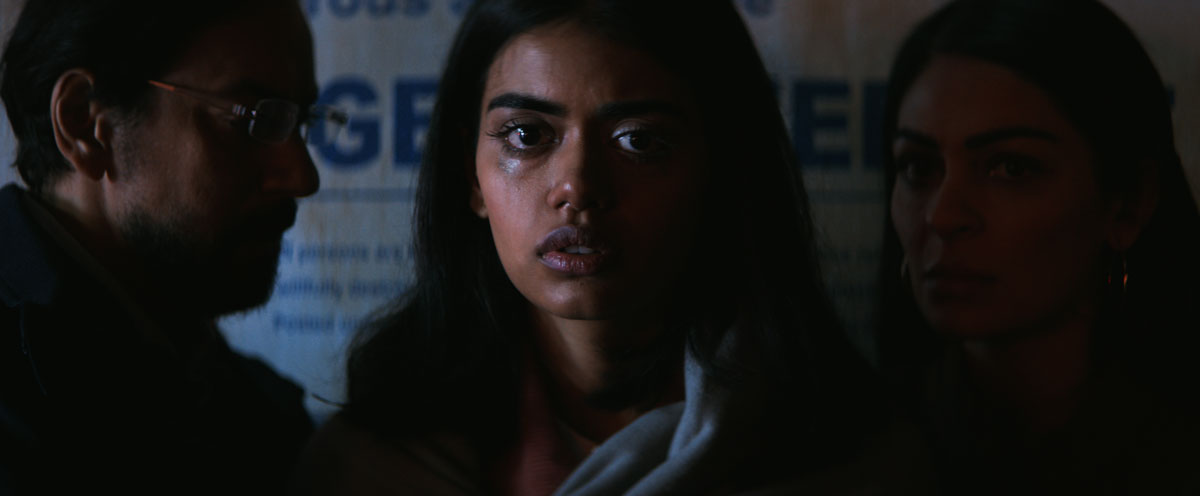
Reality TV production ethics are as murky as shark-invested waters. Of course, the contestants sign away their privacy and hand their mental and emotional state into the hands of a masterminding producer ready to exploit the emotions of their contestants. They know they’ve signed up to be put through an emotional wringer but they are promised the potential idea of a long-lasting marriage and partnership out of all of it. So the good outweighs the bad, right?

Regardless, the complicated conditions on “Love Is Blind” have led to a lawsuit from the show’s previous contestants who alleged that they were isolated for hours “with no access to a phone, food, water or any other type of contact with the outside world.” Outside of the lawsuit, a former contestant said that she expressed past suicidal ideations prior to being cast but was cast in the show’s second season anyway. While filming the contestant had a panic attack and told producers she was having suicidal thoughts and wanted to leave the show but according to the CEO of the production company, Kinetic Productions, Chris Coelen said that the contestant did not share that with production.

We need your help to stay independent

“She didn’t inform the production team that she was having any thoughts of self-harm,” Coelen said. “If she had, we wouldn’t have continued to film with her.” Coelen said the show offers on-set therapy and a line to a 24/7 on-call therapist to contestants who need the support. He urged that all contestants are free to leave the show without retaliation if they feel like it is best for their mental health. 

I’m sure the truth lies somewhere between the experiences of the contestants but I find it hard to believe a show like “Love Is Blind” doesn’t have mental health professionals nearby, working on its set. Even if they do, I also believe that these contestants are still vulnerable in one way or another. In the case of Uche and Aaliyah, dishonesty and possible producer manipulation led to the negative outcome of the relationship. I don’t think it could have ever worked no matter how hard they tried to salvage the relationship because of how intricately intertwined their story became with the entertainment and spectacle aspect of the show’s appeal. 


Want a daily wrap-up of all the news and commentary Salon has to offer? Subscribe to our morning newsletter, Crash Course.


The twist may keep “Love Is Blind’s” dedicated audience deeply engaged as the weekly episodes drop. But breaking the traditional aspects of the experiment seems to give us an understanding that whatever magic and ideal of love that worked early into the show’s tenure doesn’t have the same allure as contestants have grown disillusioned with their alleged experiences. In the long run, producers and the people behind the scenes have a responsibility to protect the contestants on their shows. They aren’t just two-dimensional Sims characters that people behind the screen can computer-generate to make choices that decide the outcomes of their dating lives.


Clip from “Beetlejuice” used in bizarre new Trump campaign video

A new campaign video shared to Truth Social by Donald Trump on Wednesday kicks off with a clip from “Beetlejuice,” the 1988 comedy/horror film directed by Tim Burton and starring Michael Keaton as “the ghost with the most” himself. And while it’s uncertain if the inclusion of this clip is a nod to Lauren Boebert being thrown out of a Denver production of the musical inspired by the film a few weeks back, it sure seems likely. 

In the brief clip from “Beetlejuice,” Alec Baldwin as Adam Maitland and Geena Davis as Barbara Maitland are engaging with a television set, which is a running theme throughout the rest of Trump’s video, which also features clips from “The Goonies,” “Napoleon Dynamite,” “Forrest Gump,” “Gremlins,” and many others that have no apparent connection with one another aside from the fact that many of the clips feature television sets.

Interspersed in all of this, snippets of Trump are shown from throughout the past few years while a voiceover from the former president and 2024 hopeful sings his own praises, asking viewers to “choose greatness.” 

Watch here.


“An unmitigated disaster”: House GOP’s first impeachment inquiry panned by Republicans

The House Oversight Committee’s first hearing for the impeachment inquiry into President Joe Biden got off to a rocky start Thursday as the Republican witnesses’ testimony appeared to hurt the committee more than help and frustration set in in the chamber. 

In his written testimony to the committee, Jonathan Turley, a George Washington University Law School professor pulled by Republicans as a key witness for the hearing, called into question the evidence Republicans have claimed to gather against Biden, who they allege benefitted from his son, Hunter Biden’s, overseas business dealings during his vice presidency.

“I have previously stated that, while I believe that an impeachment inquiry is warranted, I do not believe that the evidence currently meets the standard of a high crime and misdemeanor needed for an article of impeachment,” wrote Turley, who has testified at impeachment hearings for former Presidents Bill Clinton and Donald Trump, and, as he noted in the document, substantiated the two articles of impeachment during the latter’s inquiry that the House later adopted.

He reiterated this statement during the hearing, testifying to the committee that he, in fact, does not “believe that the current evidence would support articles of impeachment.”

While Turley based his support for the opening of a formal inquiry into the elder Biden on the evidence Republicans touted, outlined in the written testimony, and polls reflecting the public’s levels of concern over the president’s alleged misconduct, he declared that his appearance before the committee Thursday would not be to discuss any evidence of President Biden’s wrongdoing himself, leaving that task to the other witnesses. His testimony, instead, set out to advise the committee on the “historical and legal aspects of this inquiry” by offering a perspective of the “guardrails” for launching them in hopes of prompting the House to “restore important procedural and due process protections” to the process that he believes recent impeachment inquiries have departed from.

Restoring these safeguards “will demand something that is never easy for a majority, namely, voluntarily accepting limits on their own ability to impeach,” Turley wrote. “However, the committees carrying out this inquiry could repair what I view as an erosion of best practices in the investigation of presidents.”

Despite Turley’s citation of polls indicating in his written testimony the public’s “deep distrust” of the Justice Department’s ability to fairly investigate the president and his son, a national NBC News survey found that 56% of registered voters do not support the committee holding impeachment hearings for President Biden. 

An overwhelming majority of those who oppose the hearings are Democrats. 73% of Republicans, meanwhile, support the proceedings. Six in 10 independents oppose the proceedings, while 29% believe Congress should carry them out. 

Unlike during the Trump era, NBC News notes, the prospect of Biden’s impeachment is less influential for current voters with half of them saying their congresspeople’s votes to impeach and remove Biden from office “would make no difference either way” in how they might vote in their local congressional races in 2024. In December 2018, 34% noted their legislators’ votes on whether to impeach Trump would not influence their vote. 

Just as Turley declined to provide any evidence to the committee, the other Republican witnesses did not either, as Rep. Alexandria Ocasio-Cortez, D-N.Y., established during the hearing.

Ocasio-Cortez first asked Turley if he would be “presenting any first-hand witness account of crimes committed by the president of the United States.” After the legal scholar responded in the negative, she asked the same of the two remaining Republican witnesses — forensic accountant Bruce Dubinsky and Eileen O’Connor, an attorney of federal administrative and tax law. They both responded, “I have not.”

“I shouldn’t have asked Turley a question,” Republican Rep. Lauren Boebert reportedly complained to an aide on Thursday. “He was a crappy witness.”

We need your help to stay independent

Other Democratic committee members further questioned the absence of evidence from the witnesses with one asking why Rudy Giuliani, the former New York mayor-turned-personal attorney for Trump, wasn’t called to testify given his previous side quest in Ukraine to find information on the elder Biden.

“When I walked into this hearing room, my first question was, ‘Where’s Rudy Giuliani?'” Rep. Stephen Lynch, D-Mass., said. 

“This is supposed to be an inquiry on the facts against the president for potentially an impeachment, articles of impeachment,” Lynch continued. “The one person, the one person, who was an agent of President Donald Trump, was sent to Ukraine to dig up dirt, find some dirt on Joe Biden.

“Just like [Trump] said to the election officials in Georgia, ‘find me 11,780 votes.’ [He said to Giuliani] ‘Find me some dirt on Joe Biden.’ And we do not have him here? We are not allowed to ask him questions,” Lynch added before reading off a transcript of a call between Trump and Ukrainian President Volodymyr Zelensky.

In the exchange, Trump is “actually placing Rudy Giuliani in Ukraine with the imprimatur of authority for the president,” Lynch said, addressing minority witness, Michael Gerhardt, a University of North Carolina at Chapel Hill law professor. “Professor Gerhardt, would it not be helpful to have a factual witness here?”

“It seems obvious he should be brought before the committee,” Gerhardt responded. 

Frustration also consumed the GOP during the impeachment hearing, according to CNN, who were aggravated by their witnesses’ testimony countering their narrative and saying that there’s no evidence of Biden’s crimes.

“Picking witnesses that refute House Republicans arguments for impeachment is mind blowing. This is an unmitigated disaster,” a senior Republican aide told CNN Capitol Hill reporter Melanie Zanona.

When Rep. Dan Goldman, D-N.Y., did call a point of order during the hearing to present evidence, however, House Oversight Committee Chairman James Comer, R-Ky., refused to recognize it.

“You’re out of order, Mr. Goldman,” Comer said, speaking over the representative, who asserted that he should be able to call the point of order, and insisting on giving the floor to Rep. Byron Donalds, R-Fla., to speak.

“I have a point of order. I asked to introduce something by unanimous consent. Is it being introduced?” Goldman asked Comer, who continued to steamroll over him and call for Donalds to speak. “The rules require you to recognize me,” Goldman added.

“No,” Comer responded flatly before the two briefly continued the back-and-forth about the point of order.

“Mr. Chairman, can I just make a parliamentary inquiry then. Are we not to make points of order on either side during the questioning?” Goldman asked once Comer returned attention to Donalds.

“You keep speaking about no evidence. Why don’t you all just listen and learn?” Comer replied.

“I’m trying to introduce evidence!” Goldman explained, seemingly hardening his tone in frustration.

“You’ve already had your share of evidence,” Comer responded before returning focus to Donalds. 

House Speaker Kevin McCarthy announced the impeachment inquiry — to be led by the House Judiciary, Oversight and Ways and Means committees — into the president earlier this month following House Republicans’ months-long investigation into the president that, notably, failed to kick up any substantial evidence of the elder Biden’s wrongdoing with regards to his son’s activities. 

His decision to launch the inquiry added fuel to the firey tensions in the House GOP with his colleagues split over whether an impeachment inquiry into the president — alongside the far-right members’ intense focus on Hunter Biden’s personal legal woes — is necessary.

Drinking a gallon of water a day probably won’t help you lose weight

It’s often claimed that if you’re trying to lose weight, one of the things you should do each day is drink plenty of water — with some internet advice even suggesting this should be as much as a gallon (about 4.5 liters). The claim is that water helps burn calories and reduce appetite, which in turn leads to weight loss.

But while we all might wish it was this easy to lose weight, unfortunately there’s little evidence to back up these claims.


Myth 1: water helps burn calories

One small study, of 14 young adults, found drinking 500ml of water increased resting energy expenditure (the amount of calories our body burns before exercise) by about 24%.

While this may sound great, this effect only lasted an hour. And this wouldn’t translate to a big difference at all. For an average 70kg adult, they would only use an additional 20 calories — a quarter of a biscuit — for every 500ml of water they drank.

Another study of eight young adults only saw an increase in energy expenditure when the water was fridge cold — reporting a very modest 4% increase in calories burned. This may be because the body needs to use more energy in order to bring the water up to body temperature or because it requires more energy for the body to filter the increased volume of fluid through the kidneys. And again, this effect was only seen for about an hour.

So although scientifically it might be possible, the actual net increase in calories burned is tiny. For example, even if you drank an extra 1.5l of water per day, it would save fewer calories than you’d get in a slice of bread.

It’s also worth noting that all this research was in young healthy adults. More research is needed to see whether this effect is also seen in other groups (such as middle-aged and older adults).


Myth 2: water with meals reduces appetite

This claim again seems sensible, in that if your stomach is at least partly full of water there’s less room for food — so you end up eating less.

A number of studies actually support this, particularly those conducted in middle-aged and older adults. It’s also a reason people who are unwell or have a poor appetite are advised not to drink before eating as it may lead to under-eating.

But for people looking to lose weight, the science is a little less straightforward.

One study showed middle-aged and older adults lost 2kg over a 12-week period when they drank water before meals compared with people who didn’t drink any water with their meal. Younger participants (aged 21 to 35) on the other hand did not lose any weight, regardless of whether they drank water before their meal or not.

But since the study didn’t use blinding (where information which may influence participants is withheld until after the experiment is finished), it means that participants may have become aware of why they were drinking water before their meal. This may have led some participants to purposefully change how much they ate in the hopes it might increase their changes of losing weight. However, this doesn’t explain why the effect wasn’t seen in young adults, so it will be important for future studies to investigate why this is.

The other challenge with a lot of this kind of research is that it only focuses on whether participants eat less during just one of their day’s meals after drinking water. Although this might suggest the potential to lose weight, there’s very little good-quality evidence showing that reducing appetite in general leads to weight loss over time.

Perhaps this is due to our body’s biological drive to maintain its size. It’s for this reason that no claims can be legally made in Europe about foods which help make you feel fuller for longer with reference to weight loss.  

So, although there might be some appetite-dulling effects of water, it seems that it might not result in long-term weight change — and may possibly be due to making conscious changes to your diet.


Just water isn’t enough

There’s a pretty good reason why water on its own is not terribly effective at regulating appetite. If it did, prehistoric humans might have starved.

But while appetite and satiation — feeling full and not wanting to eat again — aren’t perfectly aligned with being able to lose weight, it might be a helpful starting point.

Part of what helps us to feel full is our stomach. When food enters the stomach, it triggers stretch receptors that in turn lead to the release of hormones which tell us we’re full.

But since water is a liquid, it’s rapidly emptied from our stomach — meaning it doesn’t actually fill us up. Even more interestingly, due to the stomach’s shape, fluids can bypass any semi-solid food content that’s being digested in the lower part of the stomach. This means that water can still be quickly emptied from the stomach. So even if it’s consumed at the end of a meal it might not necessarily extend your feelings of fullness.

If you’re trying to eat less and lose weight, drinking excessive amounts of water may not be a great solution. But there is evidence showing when water is mixed with other substances (such as fiber, soups or vegetable sauces) this can delay how fast the stomach empties its contents — meaning you feel fuller longer.

But while water may not help you lose weight directly, it may still aid in weight loss given it’s the healthiest drink we can choose. Swapping high-calorie drinks such as soda and alcohol for water may be an easy way of reducing the calories you consume daily, which may help with weight loss.

Duane Mellor, Lead for Evidence-Based Medicine and Nutrition, Aston Medical School, Aston University

This article is republished from The Conversation under a Creative Commons license. Read the original article.

“It Lives Inside”: When a horror movie defangs its demon with poor metaphors

Perhaps my greatest grievance with many Western horror films is that they’re still lacking on the diversity front. White people continue to dominate the genre, appearing as main characters and subjects of mainstream lore. Narratives featuring Black characters are right behind, although in comparison, representation as a whole remains abysmally low. And let’s not even get started on Asian folks, who are almost nonexistent (did anyone see “Umma”? No? Well there you go). Aside from appearing as background characters, Asians are rarely the primary focus in horror.

Sure, there are a handful of Hollywood remakes of select Japanese horror movies. But, original stories about Asian-centric nightmares, myths and legends are showcased only once in a blue moon. That’s why I was thrilled (no, ecstatic) to hear about “It Lives Inside,” the directorial debut from Bishal Dutta that features a South Asian protagonist. I had high hopes for the film prior to watching it at my local AMC. But instead of walking away feeling satisfied, I left my theater feeling, well, disappointed.  

Dutta attempts to use the Pishacha as commentary on Sam’s real-life fear, but it’s ultimately unsuccessful.

The film itself follows Samidha (Megan Suri from “Never Have I Ever”), who is your average American high schooler. She’s well-liked by her peers, her friends and her teacher Joyce (Betty Gabriel). She’s brown, so of course, she’s incredibly studious. And she’s got a crush on the popular (yes, white) boy in town, Russ (Gage Marsh).

Samidha perceives her biggest obstacles to be her East Indian culture and heritage. It’s why she goes by the name “Sam,” which is her attempt to assimilate in a predominantly white school and neighborhood. It’s why she’s constantly at odds with her traditional, yet well-meaning mother Poorna (Neeru Bajwa). And, it’s why she’s cut ties with her former best friend Tamira (Mohana Krishnan), who’s been showing up to school looking real beat-up.

Tamira’s got dark, menacing under eye-bags. She’s often mumbling what sounds like chants to herself. And her hair is so disheveled that she looks like Samara Morgan from “The Ring.” Tamira’s also seen carrying around a glass jar that contains a creepy, black wispy-like being inside it. In an act of annoyance, Sam knocks the jar out of Tamira’s hands while they’re in the girls locker room, thus freeing the creature and sending Tamira into a frenzy.

That’s just the beginning of everything wrong with “It Lives Inside.”

Later in the movie, it’s revealed that Tamira’s creepy, black wispy-like companion is actually a Pishacha, a flesh-eating demon that appears in Hindu and Buddhist mythologies. The Pishacha, when out in the open, preys on humans, specifically feeding on their negative emotions, be it loneliness, depression or anger. The only way to contain it is to trap it in a vessel, hence the glass jar.

It Lives InsideIt Lives Inside (Neon)Where the movie messes up is how it chooses to portray the Pishacha. The demon serves to “other” Sam as she gradually slips into insanity and takes on an appearance similar to Tamira’s. That sense of “othering” is also an all too familiar concept in many Indian-American teen stories. In fact, it’s a fear — and it’s certainly a fear of Sam’s. She rejects the school lunch that her mom packs for her, instead choosing to go hungry rather than eat Indian food in front of her white peers. She begrudgingly attends an at-home religious puja before leaving in a hurry. And, she shames her own mother for latching onto Desi customs. From the get-go, Sam does everything in her power to not be known as the brown girl in town. She’s fine with being viewed as a spectacle, which we see when one of her white friends takes a video of her speaking Hindi. But being viewed solely as the brown girl is her greatest nightmare come to life.     
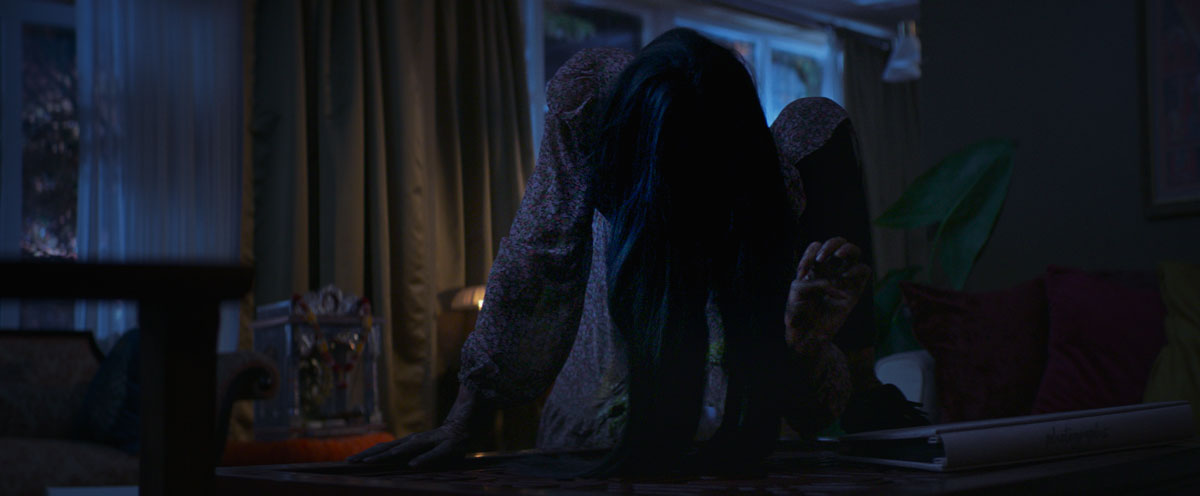
Dutta attempts to use the Pishacha as commentary on Sam’s real-life fear, but it’s ultimately unsuccessful because we don’t see how being “othered” actually affects her. Sam isn’t alienated at school or in her neighborhood. Following the Pishacha’s vicious murder of Russ, we don’t see Sam being ditched by her friends. We don’t see her being vilified or shunned within her neighborhood — all we see is a brief clip of several onlookers looking at Sam with suspicion at the scene of the crime. We also don’t see any drastic change in her relationship with Joyce. The only consequences that Sam faces are physical; she literally looks like her soul has been sucked out of her body. She also suffers from hallucinations as the Pishacha slowly possesses her mind.

Some Pishachas have two hands, while others are understood to have multiple.

It’s also worth mentioning that Sam learns about the Pishacha through Joyce, who informs her about the demon’s origin story after doing a quick Google search. Considering the themes in Dutta’s story, wouldn’t it have made more sense if Sam learned about the Pishacha through her own parents? I think it would have, which is why that scene struck me as inconsistent with the overall plot.

“It Lives Inside” essentially has two stories in one. The primary narrative is about the Indian-American experience. The secondary is a monster story. Dutta tries to mesh both into one cohesive plot in an attempt to tell a metaphorical horror tale that casts the monster as more than just a monster. However, it doesn’t work in the end.  


Want a daily wrap-up of all the news and commentary Salon has to offer? Subscribe to our morning newsletter, Crash Course.


Personally, I think the movie would have been a much better watch if Dutta focused on the mythology behind the Pishacha – mainly because Pishachas are pretty darn terrifying. The entities were first mentioned in the Mahabharata, a Sanskrit epic poem narrating the events and aftermath of the Kurukshetra War, which later served as the basis for the events of the Bhagavad Gita. Pishachas are said to be a creation of the Hindu god Brahma. They are also the sons of Krodha, “a mental state similar to wrath or fury, and foster corruption and chaos in the lives of their victims,” per an explanation from “Bloody Disgusting.”

It Lives InsideIt Lives Inside (Neon)

Drawings of the Pishacha show a dark, often pot-bellied, being with wide eyes and a frightening smile that displays its fang-like teeth in full view. Some Pishachas have two hands, while others are understood to have multiple. Pishachas possess the ability to shape-shift, meaning they can take on human-like appearances or, in some cases, become completely invisible. The Pishacha likes darkness and is typically said to be seen at crossroads, cemeteries, crematoriums and other locations that harbor the spirits of the dead. They also like hanging out at sites of violent catastrophe and tragedy. Pretty gnarly stuff!

As for the Pishacha’s main motives, they enjoy inflicting pain on their victims. In addition to feeding on human energy, the Pishacha may possess their victims’ thoughts, ultimately driving them to insanity. We see this in “It Lives Inside,” when a Pishacha-debilitated Sam imagines the demon lurking in her closet and in another instance, mistakes the demon for her mother when she hears crying late at night. 

By the end of the movie, Sam learns to embrace her culture and even grows closer to her mother, all while her body is used as a newfound vessel for the Pishacha. As for how a whole demon was able to help her have that realization, it’s still quite unclear. Sure, Sam helps her mom set up a puja and memorizes a few Hindu prayers in preparation for defeating the Pishacha. But that’s about it.

“It Lives Inside” has its good moments, but the weak parts are too hard to dismiss to give the movie a favorable review. For now, I’ll be twiddling my thumbs, waiting for Hollywood to come out with another Indian-American horror story soon.

It’s been 10 years since “Yeezus” and the Kanye we will never see again

“Yeezus,” our last piece of the old Kanye turns 10 years this year. 

“Yeezus,” the sixth studio album by Kanye West (also known as Ye) may have been his last great album when considering raw creativity, appropriate track list void of boring skits, and the fact that he was rapping. There was some singing, and there were some antics that have nothing to do with music because Kanye will Kanye –  but again, the dude was rapping as if his life depended on it, as if he didn’t have a deal, as if he was trying to rival “The College Dropout” – and we may never see that again. 

One of Kanye West’s most considerable talents, his best talent in my opinion, the one talent that he never gets credited for – drum roll, please – is his ability to recognize talent. Mr. West is a master at aligning himself with talent. Kanye created good music and released projects from artists such as 2 Chainz, Big Sean, and Pusha T. These rappers all had respect in their own right before Kanye. Still, his planning, production, and how he reintroduced them to the world catapulted these guys to unimaginable levels. Kanye also has early ties in fashion to Don C, creator of Just Don; Tremaine Emory, the founder of Denim Tears; Jerry Lorenzo of Fear of God, and the biggest of the crew, Off White creator, Nike collaborator, and Creative Director of Louis Vuitton, the late great Virgil Abloh. All of these men are at the top of the fashion industry, they literally run street wear and have done collaborations with everyone from Zegna to Dior to Adidas and countless other legacy brands. 

This may be the first and last time Kanye realized you don’t have to be loud to communicate your point. While the artwork was quiet, the rollout was everything but.

It was Virgil who came up with the album artwork for “Yeezus.” Virgil’s design was a master class in minimalism, especially when considering the history of hip-hop. Rap artists proudly celebrated the tradition of going all out on those album covers – challenging designers to create elaborate, flashy images like the blinged-out Hot Boys covers, images of wealth and high-end art on Jay-Z album covers, and the playful, cartoonish images that eventually led to more graphic pictures that Kanye used himself. All of the art was always over the top. Virgil took it back to the essence of how we mass produce units and moved them in the streets, the beginning of the bootleg CD era. Convincing Kanye to release a blank CD in a clear case that appeared to be sealed with a piece of red tape: art. It said nothing but, at the same time, screamed. 

We need your help to stay independent

This may be the first and last time Kanye realized you don’t have to be loud to communicate your point. While the artwork was quiet, the rollout was everything but. On May 17, 2013, Kanye started promo by dropping his single “New Slaves” through video projections in 66 locations worldwide. 

Another forgotten promo tool Kanye used for the album was the Confederate flag. 

This is also the same year the viral meme was created, where Kanye screams, “You ain’t got the answers, Sway!” to long-time MTV personality and host of “Sway in the Morning,” Sway. While recording the show, Kanye became frustrated with his relationships with legacy brands like Louis Vuitton and Gucci. Keep in mind this is years before his friends mentioned earlier took over the industry. Kanye felt that those legacy brands’ inability to directly connect with the culture and partner with someone like him was disrespectful. Sway felt that Kanye didn’t need legacy brands; he, like many, believed that the rapper was already iconic and questioned him on his reasons for not being 100% independent. After all Kanye’s Nike sneaker instantly sold out and was a pioneer in the birth of the sneaker resale market, and his APC collaboration did the same, selling an Egyptian cotton T-shirt for 100 bucks. Maybe Kanye wanted validation from those brands that he has spent hundreds of thousands, maybe millions of dollars on, or maybe their European affiliation made them appear more attractive, or maybe Kanye was having a bad morning. Either way, he exploded on Sway. (Years later, in 2022, Kanye recanted his statement from the classic interview and agreed that Sway indeed had the answers.)

Another forgotten promo tool Kanye used for the album was the Confederate flag. Was this the beginning of his MAGA love? He started wearing a flight jacket with a patch of the flag stitched onto the sleeve. People were pissed off, and rightfully so, as the Confederate flag has been nothing more than a poster for racism; Kanye took to 97.1 AMP radio and stated: 

“You know the confederate flag represented slavery, in a way, that’s my abstract take on what I know about it, right. So I wrote the song ‘New Slaves.’ So I took the Confederate flag and made it my flag. It’s my flag now. Now what are you going to do?”

The difference between Kanye West and other rappers, is that he always goes above and beyond to bring the tension to his name when releasing the project, which baffles many because the art is so strong. Strong enough to stand on its own without dog whistles or “look at me” interviews.

The Track List 

  1. On Sight  
  2. Black Skinhead  
  3. I Am a God (Ft. God)  
  4. New Slaves 
  5. Hold My Liquor 
  6. I’m In It 
  7. Blood On the Leaves  
  8. Guilt Trip 
  9. Send It Up 
  10. Bound 2 

Other than “Bound 2” the album ventures away from a classic hip-hop sound. Kanye used experiential sounds and repetitive messaging to create a truly original effect. But still, Kanye was rapping. In my favorite track “Blood on the Leaves,” Kanye hops on the Nina Simone samples and sings: 

I don’t give a damn if you used to talk to Jay-Z
He ain’t with you, he with Beyoncé, you need to stop actin’ lazy

She Instagram herself like #BadB***hAlert
He Instagram his watch like #MadRichAlert
He only wanna see that a** in reverse
Two-thousand-dollar bag with no cash in your purse
Now you sittin’ courtside, wifey on the other side

Gotta keep ’em separated, I call that apartheid
Then she said she impregnated, that’s the night your heart died
Then you gotta go and tell your girl and report that
Main reason cause your pastor said you can’t abort that

Now your driver say that new Benz you can’t afford that
All that cocaine on the table you can’t snort that
That going to that owing money that the court got
All in on that alimony, uh, yeah-yeah, she got you homie
‘Til death but do your part, unholy matrimony

In the most bizarre way possible, he goes from talking about superficial relationships to the Nina Simoe sample, her sweet voice singing about Black bodies hanging from trees in the South, hence the title “Strange Fruit” (her cover of Billie Holiday’s original). Her homage to the lost people, which she celebrates with her beautiful voice, becomes identical to how Kanye uses this beautiful sound to sing about lost people who weren’t hanging from trees but shackled to clout, debt and social media notoriety. 

The track list was perfect, the sound was excellent, and the album perfectly matched society’s mood at that particular time. The only sad part is that we didn’t know that we would never see that Kanye again.


The landscape in New York City is sinking, accelerating risk of sea level rise and flooding: study

As humans continue to dump greenhouse gases into the atmosphere, the resulting climate change causes sea levels to rise. Given that New York City is on average less than three yards above sea level, America’s largest metropolis is vulnerable to sea level rise, which will cause widespread flooding. Yet this process will be worsened by the vertical motion of the land itself, according to a recent study published in the peer reviewed journal Science Advances.

Using remote sensing technology, researchers from NASA’s Jet Propulsion Laboratory in Southern California and Rutgers University in New Jersey studied the upward and downward motion of New York City’s land from 2016 and 2023. This so-called uplift and subsidence was only partially caused by natural variables, such as the earth in that region sinking back down after the last ice age. Human activity, such as constructing landfills and reclaiming land, also significantly contributes to subsidence.

Overall the NASA scientists learned that the New York City metropolitan area subsides by an annual average of 0.06 inches (1.6 millimeters), roughly equivalent to the monthly growth of a human toenail. Some areas are subsiding more quickly: For example Arthur Ashe Stadium, the world’s largest tennis stadium, is sinking at a rate around 0.18 inches (4.6 millimeters) per year. While this may seem like a small amount, it does add up and is predicted to even accelerate as climate change worsens.

“Our results inform ongoing efforts to adapt to sea level rise and reveal points of [vertical land motion] that motivate both future scientific investigations into surface geology and assessments of engineering projects,” the authors conclude.

Here for the right reasons: Why “The Golden Bachelor” is already our favorite edition

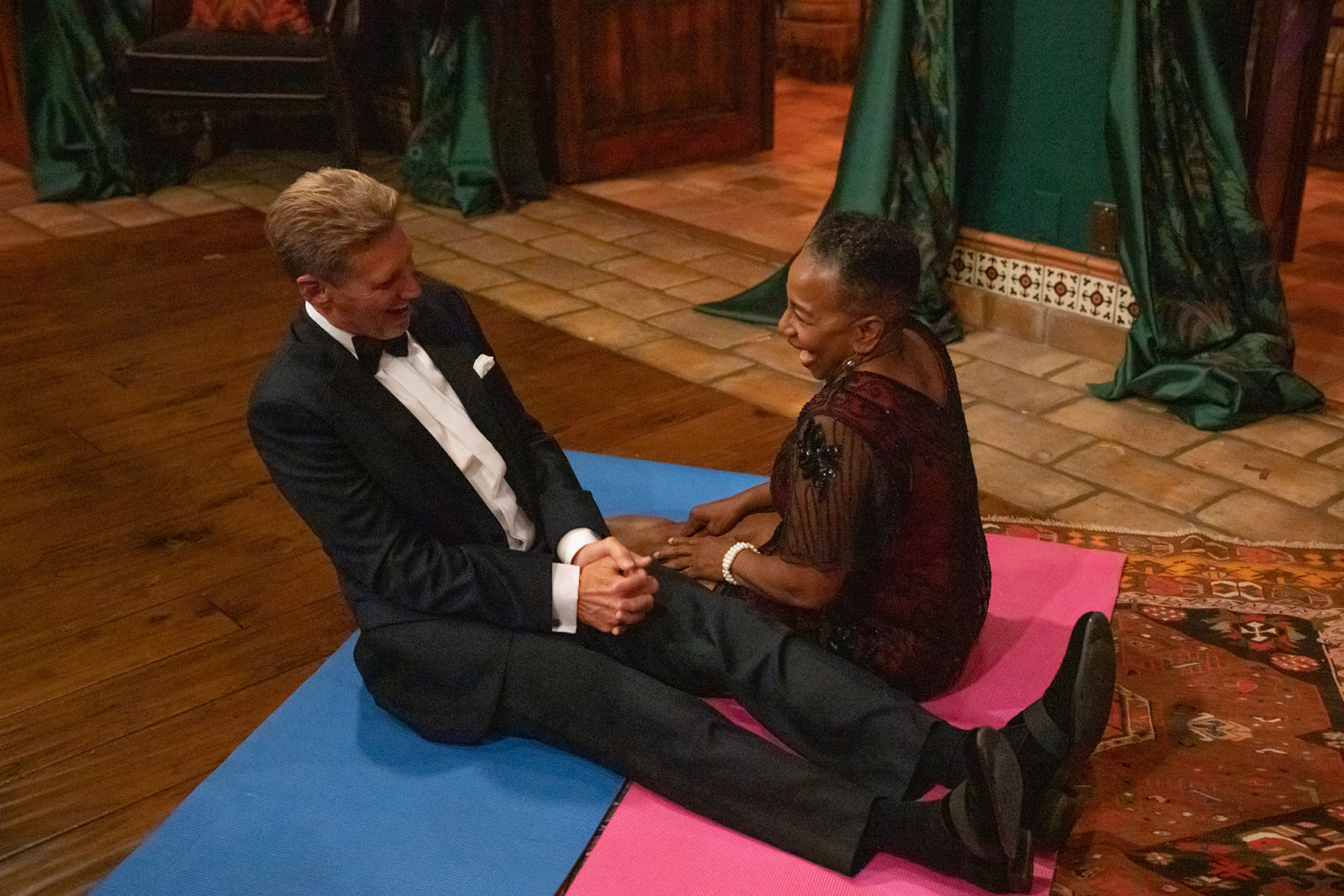
The producers of "The Golden Bachelor"  want you to feel for Gerry Turner, perhaps more than any other lead in the brand's history, before rooting for him. Shortly into its premiere, the 72-year-old Indiana man breaks down as he describes losing his wife of 43 years in 2017. His heartbreaking account will probably make you cry too, especially if you consider yourself to be part of the Bachelor Nation. Gerry proves that soulmates are real — he found his and loved her for decades.

Although he met the love of his life in high school as opposed to McMansion kitted out with video cameras in every room, they had the existence many people want — children, abiding love, and eventually a dream house fate saw fit to let them enjoy for a tragically brief time. 

Presenting previous heartbreak as a worthiness test for its lead is a classic "Bachelor" ploy. But Gerry's lament is drawn from a cask of finely aged romance no twenty- or thirtysomething could possibly access, a heretofore unknown cocktail on this show. Never before have we been more assured that a man really is there for the right reasons.

Plus, in a franchise that parades youthful hard bodies before the audience and only recently embraced the concept that its Bachelors and Bachelorettes don't need to be white, "The Golden Bachelor" dares to float the idea that seniors deserve a fresh start at love too. Real ones, not the improbable "…And Just Like That" versions.

Then again, it's only willing to break new ground to a certain extent. The world is full of Black, brown and Asian silver foxes who are north of 70. Nevertheless, for this spinoff's virgin voyage, the producers went with another white man, a Boomer this time. Gerry looks like an older version of Reed Diamond, i.e. he's easy on the eyes, but he still solidifies the producers' long-held picture of an Everyman being white.

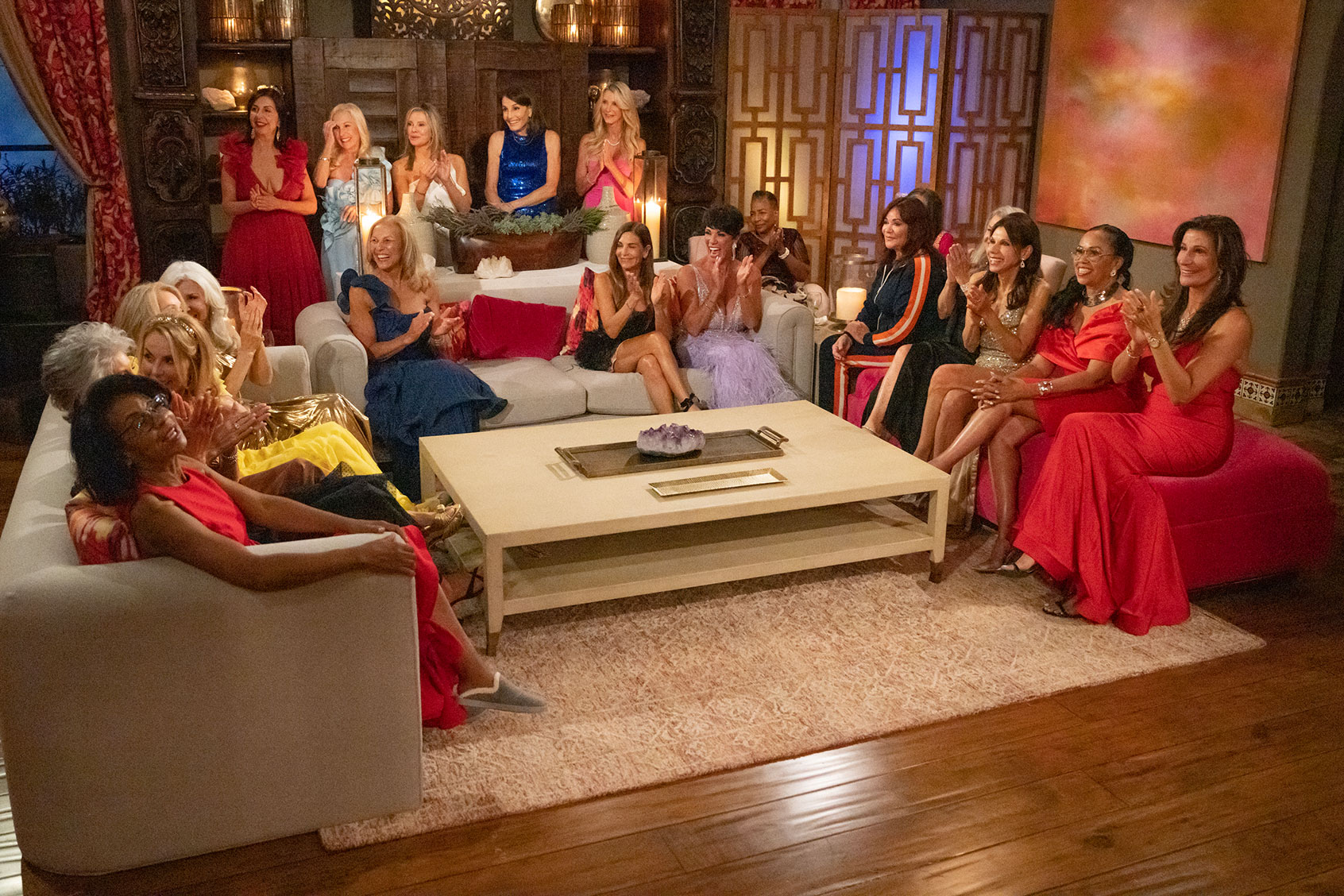
By the end of "The Golden Bachelor" series premiere, it become clear that Gerry's quest for companionship isn't the main pitch. That spotlight belongs to the contenders, a pool initially comprised of 22 women ranging between 60 and 75 years old, most of them weirdos.

The Golden BachelorThe Golden Bachelor (ABC)

These women present the broadest array of mature female archetypes that we've seen on TV since "The Golden Girls."

Many step out of their limos sparkling like disco balls in formal grown encrusted in beads and sequins. Some are prop jokesters, like the woman who tells Gerry she grew up on a chicken farm "and my eggs are still very fresh" before starting to cluck like a hen.

Another meekly admits she's nervous before engaging him in a deep breathing during which she sounds an expletive instead of "om." There's a grandmother carrying pom-poms, a nana who launches into a striptease moments after saying her first hello, and a vixen who claims that Prince's 1979 hit "Sexy Dancer" was written about her. One is a ringer, the aunt of a famous ABC star and "Bachelor" stan.

Theatrical introductions come with this gig, but the separation worth monitoring as the season rolls on is how many of those first impressions match a woman's innate personality. That's ever the case in these shows. But unlike their more junior counterparts, "The Golden Bachelor" ladies didn't come of age posing for selfies or constructing brand identities on social media.

We need your help to stay independent

This doesn't mean they aren't aware of the camera – they assuredly are. But most are terrible at playing to it, like the seductress who draws Gerry into a laughing exercise that makes it seem like she's escaped from an asylum.

For now. On the whole, most appear to be there for the adventure as opposed to the exposure, although I'm betting a standout or two could fit into Andy Cohen's Bravoverse.  That also changes the McMansion chemistry — somewhat — from a den of backstabbing into a gathering of Aunties Who Party.

The Golden BachelorThe Golden Bachelor (ABC)All this is said with the greatest affection, by the way, since these women present the broadest array of mature female archetypes that we've seen on TV since "The Golden Girls," and with purpose.

The audience for "The Bachelor" brand is overwhelmingly female, unsurprisingly. But it also skews older, according to 2020 data compiled by YouGov.com that found that a quarter of the women watching these shows are older than 65, part of the slight majority of the Bachelor Nation audience that is over 45. That translates to a viewership that is either on the verge of being contemporaries of these women or that is already among them; either way, they're seeing a lot of more themselves in this spinoff than in other "Bachelor" iterations.  

The audience for "The Bachelor" brand is overwhelmingly female, unsurprisingly. But it also skews older.

At the ripe old age of 21 years and six months, "The Bachelor" franchise doesn't have many new moves. The reality competition may have outlasted the length of the average marriage, but it hasn't made a bulletproof argument that it is an effective path to Happily Ever After.

That's not entirely the fault of this show, or "The Bachelorette," or "Bachelor in Paradise"; mobile phone app gamification of mating and dating shoulders much more of that blame. But men and women were winnowing down pools of potential suitors long before Tinder, Bumble and Grindr were thought of through matchmaking and speed dating.


Want a daily wrap-up of all the news and commentary Salon has to offer? Subscribe to our morning newsletter, Crash Course.


Between this brand and the pageant of imitators – "Love Island," "Love Is Blind," "Married at First Sight," "FBoy Island" to name a few – the viewers buying in the ABC show's founding premise are vastly outnumbered by the people just tuning in for the mess. Count on "The Golden Bachelor" to serve that second audience amply and with relish – remember, there's a chicken lady in this house.

The Golden BachelorThe Golden Bachelor (ABC)But there's also a mote of hope that within this small constellation of randy, unfiltered sexagenarians and septuagenarians is the woman Gerry Turner is seeking: "the person who can lay down beside you at night, and not have to say anything, and you feel it," he says in his tearful statement of purpose. "That's love."

Other Bachelors who came before couldn't possibly know what Gerry's talking about. And that makes us want the best for him despite knowing what these seasons eventually degenerate into. "If this hen doesn't get the rose tonight," declares one woman, "there's gonna be a lot of hellraising in this hen house." Love can change a lot of things, but the reality TV camera's effect on the human psyche tends to conquer all.

"The Golden Bachelor" premieres Thursday, Sept. 28 at 8 p.m. on ABC.

I’m a microbiologist and here’s what (and where) I never eat

Every year, around 2.4 million people in the UK get food poisoning — mostly from viral or bacterial contamination. Most people recover within a few days without treatment, but not all are that lucky.

As a microbiologist, I’m probably more acutely aware of the risk of food-borne infections than most. Here are some of the things I look out for.


Eating outdoors

I rarely eat alfresco — whether picnics or barbecues — as the risk of food poisoning goes up when food is taken outdoors.

Keeping your hands clean when handling food is key to not getting sick, but how often do you find hot running water and soap in a park or on a beach? You can use alcohol hand gels (they’re better than nothing), but they don’t kill all germs.

Also, food tends to attract an array of flying and crawling critters, such as flies, wasps and ants, all of which can transfer germs, including E coli, Salmonella and Listeria, to your food.

Keeping perishable food cold and covered is essential as germs can double in numbers if food is allowed to warm up to 30℃ for more than a few hours. For barbecues, meat needs to be thoroughly cooked and a meat thermometer is a good investment to avoid food poisoning. Do not eat meat if its internal temperature is less than 70℃.  


Buffets

Knowing what food-related conditions bacteria prefer to grow in, I am very mindful of the microbiological safety of hot and cold buffet displays.  

Indoors, food can be exposed to contamination from insects, dust and above all, people. Food poisoning is, therefore, an inevitable risk when dining at a buffet.  

Contamination comes from buffet visitors touching food and germs can be sprayed on to buffets from people sneezing or coughing close to the food. Even indoors, one must consider contamination by insects, such as flies or wasps, settling on the uncovered food. Also, germs may be deposited from the air, which is rich in bacteria, fungi and viruses.

I always look at the clock when I’m at a buffet as there is a two-hour catering rule: Perishable food will become unsafe to eat within two hours if not kept covered and refrigerated. The problem is buffets tend to be laid out before you arrive, so it is difficult to tell if the platters of cooked meat, seafood, salads, desserts and appetisingly arranged fruit and vegetables will have been sitting for more than two hours when you come to eat them.  

For hot buffets, such as those served at breakfast in hotels, I always avoid lukewarm food, as bacteria that cause food poisoning can grow quickly when food is kept at less than 60℃. Hot food should be served hot, that is at a temperature of at least 60℃. If there is any uncertainty about the safety of the food on offer, I reluctantly breakfast on freshly toasted bread and individually packaged marmalade.


Oysters

There are some foods I never eat and raw shellfish, such as oysters, is one of them. This is because oysters are filter feeders and can concentrate germs, such as Vibrio and norovirus, in their tissue.

A Vibrio-contaminated oyster does not look, smell or taste different, but can still make you very ill. The US Centers for Disease Control and Prevention estimates that about 80,000 people get Vibrio infections from raw oysters and in  the US alone 100 people die from vibriosis each year.

It is also possible to pick up food poisoning from eating any raw shellfish (clams, mussels, whelks, cockles). I only eat shellfish that are well-cooked because heat effectively kills harmful germs.  


Bagged salads

I never eat bagged salads, largely because one of my research areas is fresh salad safety. It has been found that bagged lettuce can contain food poisoning germs such as E coli, Salmonella and Listeria.  

My research group has found that these pathogens grow more than a thousand times better when given juices from salad leaves, even if the salad bag is refrigerated. Worryingly, the same germs use the salad juices to become more virulent and so better at causing an infection.

For those salad lovers alarmed by this information, most bagged salads are safe if stored refrigerated, washed well before use (even ready-to-eat salad should be washed) and eaten as soon as possible after buying it.  


Cooking practices

In terms of cooking practices, I have a list of dos and don’ts.  

For perishable foods, I regularly check use-by dates, but if it is before the expiry date and the food package looks swollen or when opened the food looks or smells different than expected, I throw it in the bin as it could be contaminated.

I never use the same chopping boards for raw and cooked foods and washing my hands before and after handling food is instinctual.    

One of my “never do” practices is reheating cooked rice. This is because uncooked rice can contain spores of Bacillus cereus, a food-poisoning germ.

Although the Bacillus cells are killed by cooking, the spores survive. If the rice is left to cool and sit at room temperature, the spores grow into bacteria, which will increase in numbers quickly as rice is a good Bacillus culture medium when at room temperature.  

The rice-cultured Bacillus can produce toxins that, within a few hours of ingestion, can cause vomiting and diarrhoea lasting up to 24 hours.


Dining out

I find that having a high level of food safety awareness causes me to be first in line for buffets, to be cautious about eating from breakfast bars and to watch the clock for how often perishable food is replaced. I never collect “doggy bags” of food leftovers (they have usually exceeded the two-hour time limit), even if they really are intended for a pet.  

The benefits of being a microbiologist are that we know how to avoid food poisoning and, in return, people have confidence our cooking is very safe to eat.

Primrose Freestone, Senior Lecturer in Clinical Microbiology, University of Leicester

This article is republished from The Conversation under a Creative Commons license. Read the original article.

This delicious, 5-ingredient homemade candy has been passed down through my family for generations

This is my great-grandmother’s, my Grandma Bah’s, recipe. She was my mother’s maternal grandmother and she was a wild woman . . . and an exceptional cook. She lived her life on her own terms  much like my mother did left a big impression whether you met her only briefly or spent a lifetime with her.  

By the time I was born, she lived close to 1500 miles away in Colorado, so I was lucky to have gotten to know her at all, to have had twelve or so years of intermittent visits to be charmed by her. Unfortunately, once I was old enough to have helped her in the kitchen, she was enjoying being out of it.

Thankfully, my mother cooked from and kept her recipes and now I have them. I have inherited them all or at least all that my mother had tucked away in books, scribbled on the backs of envelopes and written out on note cards. It is bittersweet to have now become the keeper of the recipes.  

The first time you make homemade candy, it can be an adventure. And just like any adventure, you need proper gear.

For candy-making, you need a candy thermometer because the whole game centers around getting your sugar syrup, the base for your candy, to the right stage (temperature) so that it turns out with the proper consistency. All of that may sound difficult, but it isn’t at all.  

For this candy, the syrup must be heated to between 235-245 F, which is actually within the temperature range for both “soft ball,” the stage for pralines and buttercreams, and “firm ball,” the stage for caramels. You must stir the mixture constantly while keeping an eye on your thermometer because after several minutes of not much happening, things ramp up pretty quickly once the dates, milk and sugar start to thicken and bubble. 


Want more great food writing and recipes? Subscribe to Salon Food’s newsletter, The Bite.


The adventure is all but over once you get your base to the proper temperature. After that, it’s pulled off the heat and your last ingredients are added before turning it onto damp tea towels to mold into log shapes. A bit of refrigeration time and you’ve got candy! Once fully chilled, you can remove from the tea towels and wrap in wax paper. Store in the refrigerator and cut to serve as desired.

This candy is sweet like you would expect cooked-down, reduced fruit and sugar would be, but remember, it is candy. But I will say that the addictively rich, maple-y, caramel-y flavor of the dates will remain even if you choose to make a less-sweet version.   

These simple ingredients — milk, sugar, dates and pecans (plus a pat of butter) — are all you need to make this wonderful confection. No preservatives, no high-fructose corn syrup, nothing artificial. It’s fun. It’s easy. It keeps well and makes a great gift.

So what are you waiting on? Get on with your next kitchen adventure and make yourself some candy.       

Date Nut Candy
Yields
02 10″ x 2″ candy logs
Prep Time
15 minutes (plus at least 1 hour refrigeration time) 
Cook Time
10 minutes

Ingredients

2 cup sugar (I uses coconut sugar)

1 cup milk

8 ounces chopped dates

1 tablespoon butter

4 cups chopped pecans, lightly toasted


Directions

  1. Spread chopped pecans onto a cookie sheet and lightly toast. Set aside.

  2. Combine sugar, milk and dates in a medium saucepan and cook on medium heat, stirring constantly, just until mixture reaches “soft ball stage,” which is between 235-245 F using a candy thermometer. (This stage can also be determined by dropping a bit of your hot mixture into very cold water. Using your fingers to gather it up, if it forms a ball in the cold water, it has reached the soft ball stage. It will flatten when removed from the water.)

  3. Remove from heat as soon as it reaches soft ball stage and quickly stir in butter and pecans. 

  4. Divide mixture in half and place each half on a damp tea towel.

  5. Wrap and shape each portion into a 10″ x 2″ log and refrigerate at least an hour before cutting into slices to serve.

We need your help to stay independent


Cook’s Notes

Sugar: My great-grandmother’s original recipe called for more sugar (three cups instead of two), but I have always reduced it when making it myself, sometimes by even more than the two cups stated above. I also use coconut sugar, which is not nearly as sweet as regular sugar.

Milk: Feel free to substitute coconut cream, non-dairy milk, half-and-half or any combination you like. I would caution against using a “thin,” watery milk, like skim or rice milk. I often use coconut cream or a mixture of plain almond milk with a splash of heavy cream.

“Hostile”: Jim Jordan fires off nine-page response after DA Fani Willis rebukes his investigation

House Judiciary Committee Chairman Jim Jordan, R-Ohio, sent a response letter to Fulton County, Ga. District Attorney Fani Willis Wednesday after she rebuked the investigation he opened last month into her probe of former President Donald Trump’s efforts to overturn the election in her state.

The latest letter from the Ohio representative explains Congress’ “clear legislative interest” in making sure elected prosecutors don’t abuse their authority to politically “target federal officials,” which is one of Jordan’s main accusations against the Atlanta-area district attorney. He argues, in the letter, that the “Constitutional and legal precedent” Willis cites does not provide her with any basis to reject compliance with the committee’s requests.

“Your letter reinforces the Committee’s concern that your prosecutorial conduct is geared more toward advancing a political cause and your own notoriety than toward promoting the fair and just administration of the law,” Jordan opened in the nine-page letter, later referring to Willis’ response to his initial communication “hostile” and suggesting it indicates she is “actively and aggressively engaged in such a scheme.”

Jordan launched the investigation into Willis’ handling of her sprawling racketeering indictment late last month, just 10 days after she brought charges against the former president and his 18 co-defendants alleging an expansive conspiracy to subvert his 2020 electoral defeat.

In his initial letter notifying her of the congressional probe, Jordan accused Willis of being politically motivated in her prosecution of Trump, deeming the indictment an attempt to interfere with the upcoming presidential election. The Republican representative asked whether she communicated or coordinated with the Department of Justice, which has indicted Trump in two other criminal cases including a parallel 2020 election case, and whether she used federal funding to carry out her years-long probe of the former president and his associates. He also gave Willis a Sept. 7 deadline to turn over any documents and communication related to the committee’s inquiry.

Willis fired back in a nine-page response on the day of the deadline, blasting Jordan for including “inaccurate information and misleading statements” and accusing the Ohio Republican of attempting to interfere with a state criminal matter while trying to punish her for his own political gain. “Your letter makes clear that you lack a basic understanding of the law, its practice and the ethical obligations of attorneys generally and prosecutors specifically,” Willis wrote to Jordan in her reply.

As she laid out the legal precedent and rebuttal to his arguments — which she wrote included the “notion that different standards of justice should apply to a select group of people” — and declared the committee’s investigation an “unjustified and illegal intrusion,” she asserted that the federal funding her office had been granted was used for its intended purposes and provided a spreadsheet summarizing the programs and initiatives the grants went toward.

In Wednesday’s letter, the committee chairman renewed his document request and extended Willis’ deadline to produce additional materials to Oct. 11, adding that the committee is willing to prioritize any records “reflecting the coordination between your office and the Department of Justice.”

We need your help to stay independent

He also endeavored to delineate five counterpoints to her response’s arguments to “assist Willis in understanding the relevant Constitutional and legal authorities of the Committee’s oversight,” according to the committee’s X post. The letter pushed back on her rejection of the request, arguing that the group has the constitutional authority to conduct oversight into her “apparently politically motivated prosecution,” that the inquiry pertains to a matter that could prompt legislation and that the probe “does not usurp executive powers.”

“If state or local prosecutors can engage in politically motivated prosecutions of senior federal officers for acts they performed while in federal office, this could have a profound impact on how federal officers choose to exercise their powers,” Jordan wrote in the letter, adding that, as demonstrated by the full Fulton County special grand jury report, Willis “contemplated an even more extensive intrusion into federal interests, targeting U.S. Senators—including the current Ranking Member of the Senate Judiciary Committee—for actions they undertook in their official capacities.”

Notably, Willis did not indict every individual recommended for charges by the Fulton County special grand jury. Sen. Lindsey Graham, R-S.C. and former Republican Sens. David Perdue and Kelly Loeffler of Georgia, though overwhelmingly recommended by the jurors, were excluded from Willis’ indictment. 

Willis likely decided against charging them, legal experts offered at the time of the full report’s unsealing, to avoid murky Constitutional issues related to the lawmakers’ acting or speaking under an official capacity.

Indicting the senators “would have 1) potential constitutional hurdles and 2) would give folks like Jim Jordan a clear ‘hook’ to do what he’s doing now,” Asha Rangappa, a lawyer and former FBI special agent, tweeted earlier this month. 

Acclaimed actor Michael Gambon known for playing Dumbledore in “Harry Potter” series dies at 82

Michael Gambon, the beloved and decorated Irish actor who played childhood fan favorite character headmaster Dumbledore in the “Harry Potter” series has died at 82, a statement from his family said.

“We are devastated to announce the loss of Sir Michael Gambon. Beloved husband and father, Michael died peacefully in hospital with his wife Anne and son Fergus at his bedside, following a bout of pneumonia,” the statement said. The statement did not share when the actor passed away.

Throughout his decades-long career, Gambon was known for his widespread catalog of work across all platforms. Gambon’s most recognizable recent work was the long-bearded wizard Dumbledore who guided child wizards Ron, Hermoine and Harry through the trials and tribulations of the wizarding school, Hogwarts. More than just “Harry Potter,” Gambon was known for the 1980s hit TV series “The Singing Detective.” He also was in other successful blockbuster film series like “Paddington” and “Kingsmen.” In television, he played characters from Inspector Maigret to Edward VII, Oscar Wilde to Winston Churchill. 

Off the screen and on the stage, Gambon was one of the original members of the Royal National Theatre and a leading thespian of his generation alongside the legendary Laurence Olivier. He has won three Olivier Awards and four BAFTA Awards. In 1998, he was knighted by Queen Elizabeth for his prestigious work in theatre.

The curious case of Bob Menendez’s Republican defenders

As Sen. Bob Menendez, D-N.J., remains mired in scandal after being federally indicted on corruption charges last week, his Democratic colleagues in Congress have seemingly rushed to distance themselves. Curiously, several Republicans have defended him from calls to step down.

Federal prosecutors allege that nearly half a million dollars in cash and gold bars were discovered in Menedez’s New Jersey home. The democratic legislator has claimed the money came from his own personal savings account over the years — funds he claimed were legitimately earned from his career as a politician and lawmaker. Prosecutors have claimed Menendez and his wife took gold bars, a Mercedes, and cash to assist businessmen and the Egyptian government. Menendez, who has refused to resign despite calls to step down from a number of Democratic senators, has received support from some Republicans. 

“Senator Menendez has a right to test the government’s evidence in court, just like any other citizen,” Cotton wrote on X, the platform formerly known as Twitter. “He should be judged by jurors and New Jersey’s voters, not by Democratic politicians who now view him as inconvenient to their hold on power.”

Floridian GOP Senator Marco Rubio shared in Cotton’s sentiment, tweeting, “The allegations against the Senior Senator from New Jersey are nasty & the evidence offered difficult to explain away. But in America guilt is decided by a jury, not politicians in fear of their party losing a Senate seat.”

Other GOP lawmakers suggested that Menendez’s fate be left in the hands of New Jersey voters.

Sen. Susan Collins, R-Maine, noted that while the charges against Menendez are “extremely serious … it’s up to him and the voters of New Jersey to make the resignation decision.” Sen. Steve Daines, R-Mont., echoed Collins’ sentiment, saying, “That’s up to the Democrats,” when asked if Menendez should resign. “Whether Bob Menendez steps down is a decision for the voters of New Jersey,” claimed Sen. JD Vance, R-Ohio. “Clearly the guy’s been accused of some pretty crazy stuff … but we do have innocence until proven guilty here.”

“Everyone is entitled to the presumption of innocence, and Bob is as well,” stated Sen. Ted. Cruz, R-Texas.

 Menendez pleaded not guilty in a federal courtroom in Manhattan on Wednesday. Earlier this week he vowed to not resign, even though more than half of all Democrats in the Senate have said he should go.

This year’s chaotic vaccine rollout is wildly different than before. Can we fix it in time?

After Judy Le heard that the latest COVID-19 vaccine was approved, she set up an appointment at her local CVS pharmacy in Charlottesville, Virginia to get vaccinated. With an upcoming trip planned, she wanted to get as much protection as possible against the virus. But the morning of her appointment, the store called to cancel because they ran out of vaccines, she said. 

“I’ve just been reading a lot about more cases right now, so I just wanted to get it sooner rather than later,” Le told Salon in a phone interview.

On September 11, the Federal Drug Association (FDA) approved the latest COVID-19 vaccine formulated to protect against some of the strains circulating now, but the deployment of this round of vaccines looks very different than the initial rollout, where public health officials went so far as partnering with barber shops to ensure vaccines were distributed to communities. 

These vaccines are the first that aren’t rolled out by the U.S. government, and without funding that was directed to public health programs in the state of emergency, the outreach is nowhere near what it was at the height of the pandemic, said Lori T. Freeman, the CEO of the National Association of County and City Health Officials (NACCHO). 

Outreach is nowhere near what it was at the height of the pandemic.

As a result, some people ready to roll up their sleeves to get the latest COVID-19 vaccine are being met with delays, canceled appointments and out-of-pocket costs. Meanwhile, pharmacists are walking out of CVS pharmacies and demanding the chain hire more staff to handle an overwhelming workload, while Rite Aid prepares for bankruptcy.

“Without a pandemic, without a public health emergency, and with COVID dollars clawed back with the debt ceiling negotiations, all of that money for big campaigns is lacking,” Freeman told Salon in a phone interview.

All insurers are legally required to cover the COVID-19 vaccine, and the federal government is stepping in to pay for vaccines for those who lack insurance through the Bridge Access Program. But insurers have been slow to implement these vaccines into their systems, leading to the stuttered rollout of the vaccine, said Dr. William Schaffner, an infectious disease and health policy professor at Vanderbilt University Medical Center.


Want more health and science stories in your inbox? Subscribe to Salon’s weekly newsletter Lab Notes.


“There have already been people who have gone to their pharmacies and physician’s offices looking for the vaccine and have discovered that they haven’t been covered yet, so that means they’re going to have to come back again,” Schaffner told Salon in a phone interview. “A vaccine deferred is often a vaccine that is never received, unfortunately.”

Lead Director of External Communications at CVS Health Amy Thibault told Salon in an email that delays were due to supply issues.

“Our pharmacies are receiving the updated COVID-19 vaccine on a rolling basis, but we’re experiencing supplier delivery delays,” Thibault wrote. “Regarding coverage, we’ve seen significant progress with payers updating their systems to enable coverage for the updated COVID-19 vaccines.”

“A vaccine deferred is often a vaccine that is never received, unfortunately.”

Although the public health emergency ended in May, people continue to be hospitalized and die from COVID-19, with more than 1.1 million Americans killed by the virus since the pandemic began. Nationally, COVID hospitalizations have been steadily increasing since June, along with the rise of Omicron variants like EG.5 (nicknamed “Eris”) and FL.1.5.1 (nicknamed Fornax.) The vaccines are predicted to work against these strains of the SARS-CoV-2 virus, which evolves naturally in ways that will sometimes render vaccines next to useless. This is why new shots must be developed with some regularity.

Meanwhile, approximately 18 million Americans have developed long COVID and data suggests that number will continue to rise with more infections. Although the immunocompromised, elderly and people with other health conditions are the most vulnerable to severe infection, COVID-19 continues to be one of the top 10 leading causes of death for children in the U.S.

This rollout, including mRNA vaccines from Pfizer and Moderna, boosts immunity toward Omicron variants. The Centers for Disease Control and Prevention (CDC) recommended the shots for everyone 6 months and up and projects that this could prevent 400,000 hospitalizations and 40,000 deaths over the next two years. 

One reason the CDC gave this blanket recommendation was simplicity, Schaffner, who attended the CDC’s advisory committee meeting, said. This stems in part from parallel messaging on this year’s “triple threat” of influenza, COVID-19 and respiratory syncytial virus (RSV), the viruses that could cause significant illness and death this fall and winter. A newly approved RSV vaccine now exists, which was recently recommended by the CDC for pregnant people and adults 60 and up to protect themselves.

However, people are already vaccine-hesitant and pandemic-fatigued, thus complicating an already full vaccination season, which could reduce uptake. In a survey released this week by the Kaiser Family Foundation (KFF), just 23% of Americans said they definitely planned to get the latest COVID-19 vaccine, and another 23% said they might.

But even those who want the shots may struggle to actually get them. Nursing homes, which have been decimated by the pandemic, have been waiting for vaccines, according to a recent report from KFF Health News (which is not affiliated with KFF), but neither the RSV or the COVID shots have been easy to get.

“This is a much more complicated vaccination season than we have ever had before,” Schaffner said. “I think this year will be a learning experience both for the general public and for providers.”

“This is a much more complicated vaccination season than we have ever had before.”

Not everyone agrees with the CDC’s approach. Dr. Paul Offit, Director of the Vaccine Education Center at the Children’s Hospital of Philadelphia, said that if fewer people are expected to get vaccinated this year, the vaccine should have targeted the people most at risk for being hospitalized first. That’s what public health officials from the U.K., Germany and some other European countries did.

“I think the best messaging comes with being straightforward with the American public about who really most benefits from this because I think that gives you your best chance of getting people in those groups to get vaccinated,” Offit told Salon in a phone interview. “You could argue when you say ‘give it to everybody,’ that is interpreted as everybody is equally at risk — when that’s not true.”

However, the healthcare system is very different in the U.S. than in European countries, Offit added.

“We don’t have a national health system and this is where that shows,” he said.

 Just 6 million doses have been put aside for the uninsured through the Bridge Access Program, when at least 27 million people in the U.S. are uninsured.

Regardless, the question remains about how many people will take the new vaccines. Only about one in five people got last year’s bivalent booster and one in four adults in the U.S. are completely unvaccinated, according to CDC data and the KFF survey. Although it has been improving over time, uptake has been particularly low in Black communities, in part because vaccination sites are disproportionately located in white neighborhoods but also because of decades of mistrust built up in response to prior medical malpractice.

Notably, just 6 million doses have been put aside for the uninsured through the Bridge Access Program, when at least 27 million people in the U.S. are uninsured, Freeman said. The demand for vaccines is a moving target that distributors are trying to balance without losing money, she added, especially because these vaccines have to be kept cold and take resources to store and administer.

We need your help to stay independent

“Six million doses split out in that way doesn’t seem to be a lot of doses or a lot of coverage,” Freeman said. “We really don’t know what the demand is going to be.”

Schaffner said he expects some of the wrinkles in the rollout to smoothen out over time. Although Le wasn’t able to find a Moderna shot near her home in Charlottesville, which she preferred, she was able to get vaccinated with a Pfizer vaccine in the next few days from a local Walgreens. Although the pharmacy staff was doing the best they could, she still had to wait an hour and a half to get the vaccine, she said.

“It’s really a crucial moment,” Freeman said. “This is the best time to make sure that people that want it and need it most get it.”

“They have to stop the debates”: After second GOP face-off, Trump demands RNC silence his opponents

While Donald Trump avoided questions from the Fox Business moderators and his Republican rivals for the GOP’s presidential nomination at the Ronald Reagan Library in California on Wednesday, he spoke with the right-wing outlet Daily Caller on Thursday to complain about it all. 

“They have to stop the debates,” the former president demanded. “Because it is just bad for the Republican Party.”

On Wednesday night, Trump was directly challenged by the other Republican candidates for skipping his second debate.

Former New Jersey governor Chris Christie, a one-time top Trump adviser, said the businessman now “hides behind the walls of his golf clubs and won’t show up here to answer questions like all the rest of us are up here to answer.”

“He should be on this stage tonight,” said Florida Gov. Ron DeSantis, explaining to the conservative audience that “He owes it to you to defend his record where they added $7.8 trillion to the debt. That set the stage for the inflation we have now.”

But Trump, who has consistently trounced his opponents in public polls, dismissed their critiques as noise. 

“They are not going anywhere. There is not going to be a breakout candidate,” he told Daily Caller reporter Henry Rodgers.

Trump said that he has no plans to attend the third GOP debate in Miami, Florida, scheduled for November.

“I am very concerned about the RNC not being able to do their job.”

Fox News hosts bewildered after residents roast reporter: “Who are you getting your facts from?”

Fox News hosts were floored after a recent man-on-the-street interview with Seattle, Washington residents seemed to indicate that they were unconcerned about alleged drug use and crime.

“The arrogance and the ignorance of Seattle residents that Johnny interviewed is shocking,” said “The Five” co-host Jeanne Pirro in reaction to a clip of Johnny Belisario, an associate producer on “Jesse Watters Primetime,” this week. “I mean, how could they be clueless?”

Belisario interviewed numerous people who seemed to mock the premise of his questions on crime and homelessness in the city. 

“Who are you getting these facts from?” one person pushed back on Fox News.

“I’ve never seen any crime in Seattle. I’ve never seen any of it. I’ve seen fun and laughter, and laughter and fun,” one interviewee told the network.

“People don’t just come up and try to rob people on the street. Do you walk around everyday just like, ‘Someone’s gonna rob me’ every second?” said another.

On “The Five,” co-host Jesse Watters was left sputtering trying to explain the segment gone wrong. 

“Well, they’re in denial,” Waters insisted. “And if you look at the demographics of the city, it’s understandable. It is a very, highly educated city. Very white, very LGBTQ, very secular. And they all believe in the same thing, which is, criminalizing crime is racist. There is someone, a victims’ advocate, who just quit after 25 years because she said crime victims are being pressured by courts to recommend non prison sentences. So if you get assaulted, you’re supposed to want that person to go to rehab instead of prison, and they’re being bullied into doing this. It’s about white guilt and it’s about people learning from these professors that in order to make everybody equal, they can’t punish criminality. And it’s gotten so bad that criminals are now coming into the city. We did it with sex offenders. We used to see these sex offenders go to places like Vermont or California, where they know they can get away with preying on children because they know that there’s soft sentences. They’re doing the same thing here and it’s predatory.”

Watch below, via Media Matters:

Donald Trump’s thrill ride is nearly over — but the media refuses to let go

This is the end, beautiful friend
This is the end, my only friend
The end of our elaborate plans
The end of everything that stands — Jim Morrison 

I take no joy in saying this, but we in the press are moral cowards.

Last Friday, former President Donald Trump called for the execution of U.S. Army Gen. Mark Milley, the outgoing chairman of the Joint Chiefs of Staff, branding him a traitor. This was because Milley told his Chinese counterparts, toward the end of the Trump administration, that the U.S. was not planning to invade China and start World War III. In other words, Milley reiterated official U.S. policy since the end of World War II, which Trump is apparently unaware that we won. But forgive him: He also seems to think Jeb Bush was president.

A few days later, our actual president, Joe Biden, made history by standing on a picket line with striking UAW members in Michigan. 

We in the press didn’t tell you much about that, but we wasted airtime, pixels and ink reporting that Trump calls himself “pro-worker” — though there is no evidence of that to be found anywhere. We also told you that Biden wears tennis shoes. We pretty much ignored Trump’s threat against the chairman of the Joint Chiefs — who Trump himself appointed, by the way. We have also done minimal reporting on the New York judge who imposed the “corporate death penalty” on Trump’s business enterprises this week and may end up confiscating Trump’s property, after issuing a summary judgment that Trump’s companies actively engaged in fraud over many years. 

There’s a potential government shutdown coming this weekend, but that took a back seat to an outlier political poll that shows Trump leading Biden by 10 points.

Those still capable of cogent thought may well wonder: When did this country jump the shark?

Dahlia Lithwick, a member of Mary Trump’s “Nerd Avengers,” said on the podcast Wednesday,  “We have achieved a point where lawlessness is the goal itself.” So while she may not pinpoint when we jumped, she certainly knows where we landed. This is the end, beautiful friend.

Take a look around. Who would want their children to grow up and become members of Congress? Bob Menendez, George Santos, Marjorie Taylor Greene, Jim Jordan, Lauren Boebert, Kevin McCarthy . . . the list goes on and on with people we’d abhor if we met them in everyday life. There isn’t one of them I’d invite to a neighborhood barbecue. They are lawless without exception and without care. It’s not just Donald Trump.

They deflect from real issues by bombarding the public with facts taken out of context and outright lies. When that doesn’t work, they resort to bullying. “I’m at the point where, fine, investigate Joe Biden. Investigate Hunter Biden. But also hold Jared Kushner and Donald Trump accountable,” former GOP strategist Kurt Bardella said on the same podcast. 

Bardella also said that after this week’s ruling by New York Supreme Court Justice Arthur Engoron, if the press doesn’t “mention fraud every time we mention Trump’s name,” then we’re not doing our job. Mind you, Trump was also labeled as a rapist in civil court, and we rarely mention that either. We routinely ignore his 91 felony charges in four jurisdictions when we talk about his so-called politics, and we seem to have forgotten he’s already been impeached twice. We pretend that his many lies are changes in policy. Anyone who expects the press to responsibly report the reality of Donald Trump at this point may, in fact, be as delusional as Trump.

And Trump is truly delusional. “Brick by brick, Donald Trump is a fantasy. He’s the biggest fraud there is,” political commentator Danielle Moodie told Mary Trump.

Every bit of reporting we do on him should stress that. It’s not like his delusion is a secret. “We in the family knew it,” Mary Trump said, explaining the fraud perpetrated by her uncle — before describing him as the greatest fraud ever perpetrated on America. 

Agreed. But don’t count on the press to inform you about any of that. We’re too busy pretending, and entertaining you by treating Trump as if he were a charmer, or a savior. 

If the press doesn’t “mention fraud every time we mention Trump’s name,” then we’re not doing our job. Mind you, Trump was also labeled as a rapist in civil court, and we rarely mention that either.

It isn’t just the press that is filled with cowards. The Republicans in Congress are repugnant criminal cowards. The Democrats are eunuchs and moral cowards. While the Republicans pursue Hunter Biden — and if he’s guilty of something, so be it — the Democrats have not said one word about Jared Kushner, Eric Trump or Donald Trump Jr. There is more than enough evidence to investigate those three for trading White House access for billions in foreign investment. Yet so far, nothing.

The Democrats don’t want to look like they’re gutter-fighting quite as dirty as the GOP, and seem to lack any desire to pursue obvious corruption. Thus it appears to millions of American voters, including many potential voters still on the fence, that the Bidens have the most to hide.

I cannot say it enough. We have two political parties in this country: One has no heart. One has no head.

And the press? We have neither.

So busy are we trying to pretend we’re even-handed that we present propaganda as fact just to look fair. That’s not our job. The moronic desire to be “objective” blinds us from our true mission: providing vetted facts. 

Exactly three years ago, I asked a simple question of Trump in the White House briefing room: Would he accept a peaceful transfer of power? Three years and 91 felony charges in four jurisdictions later, we know the answer. He continues to deny that he lost the 2020 election. He continues to obfuscate, confuse, lie and cheat. We continue to let him get away with it.

When he said to me in the White House briefing room that if we stopped counting ballots at the moment of his choosing “there would be no change” in power, that should have been enough. Hell, when he made fun of a reporter with a disability, that should have been enough. When he made fun of veterans or called dead Marines “suckers,” that should have been enough. It wasn’t. It’s never enough, and we never doggedly pursue the facts.

Lithwick said that Trump has never been caught. I respectfully disagree: He is always getting caught in his own lies. We just allow him to go free without forcing him to take responsibility for his actions.

We need your help to stay independent

Lost in a Roman wilderness of pain
And all the children are insane
All the children are insane — Jim Morrison

The rest of the insane clown posse of children in the GOP got together Wednesday night for their latest attempt to stop Trump — who won’t attend a debate because he’s scared s**tless. How deeply disturbing it must be to be running against Trump as a member of the Republican party.

Not only do you have to run against a seditious criminal fool, but you have to do so in an environment where he has risen far above the other candidates who, while guilty of a great deal of stupidity, are not facing 91 felony charges. That alone should give them a leg up. 

Nope. And they continued to support their near-certain standard-bearer on Wednesday night, even as they tried to run against him. Sure, there was slightly more negative treatment of him from some, like former New Jersey Gov. Chris Christie. But in the end, the also-rans lived up to their name.

When Donald Trump told me in the White House briefing room that if we stopped counting ballots at the moment of his choosing “there would be no change” in power — that should have been enough.

If you want to defend Trump, go ahead. Defend a man who is a fraud, a rapist and an insurrectionist. He has been impeached twice and indicted in four different jurisdictions on 91 felony charges. Don’t forget he also kept classified information in his bathroom and refused to return it when asked. Defend all of that. Defend his criminality by using false equivalency and “whataboutism.” Defend it all with aplomb and own it.

I won’t. I was in Trump’s White House every day of that administration. If you weren’t, then you can stick your opinions someplace where ignorance and information are equal, like the nether regions of Trump’s mind.

Donald Trump is a menace. That’s not “politics.” That’s just a fact. 

He is facing charges because he’s a dangerous would-be despot. There is no evidence any part of the electoral process was hijacked — except for the ballot boxes he tried to steal and the witnesses he desperately tried to intimidate.

Donald Trump is a traitor, a moron and a goon. If you believe he’s the second coming, mind your Matthew 7:15: “Beware of false prophets, which come to you in sheep’s clothing, but inwardly they are ravening wolves.”

The Biden White House and the Democrats have no heart for the fight they face, and no head for it either. In an attempt to avoid getting their hands dirty, they’re allowing the country to bathe in Trump’s filth without responding to it. We heard a rare exception from Biden this week in San Francisco when he said, “Donald Trump and the MAGA Republicans are determined to destroy this democracy.”

White House spokesman Andrew Base backed that up by saying that “to abuse presidential power and violate the constitutional rights of reporters would be an outrageous attack on our democracy and the rule of law.” 

We need more of that and a lot less of people in my profession giving false equivalency between Trump and his GOP competitors, much less the current president. If this is the end, then let it be Trump’s end — not our country’s.

At the end of the day, will some of my fellow journalists grow a pair? We make decisions every day based on money and audience share, not journalism. Trump went on “Meet the Press” because he’s good for ratings. We cover him as if he were equal to Biden for the same reason.


Want a daily wrap-up of all the news and commentary Salon has to offer? Subscribe to our morning newsletter, Crash Course.


I encourage my professional comrades to consider this: There are millions of people who will tune into the facts if we consistently deliver them. Facts are the true coin of our realm. Ratings could be had if we did our job the way we’re supposed to. There is a market for solid reporting. 

Here are some facts:  Donald Trump is despotic and deranged. His politics are nothing but grift. His life is about fleecing others. We should preface every mention of him by stating that he’s been indicted in four jurisdictions for 91 felonies. He’s been labeled a rapist and a business cheat in civil court and he was impeached twice. 

Report that every single day. Don’t tell me he’s “pro-worker.” He’s only pro-Trump.

Late on Wednesday evening, U.S. District Judge Tanya Chutkan told Trump that she won’t recuse herself in his federal election interference case. That news, along with the New York summary judgment that could force Trump to forfeit all his real estate holdings in and around his hometown, offer the latest signs that Donald Trump’s prominence on the world stage is ending. He’s had a good run to ruin, and has never had to clean up any of his many expensive messes.

If he’d looked at the ticket he swindled to get on this ride, he might have seen that the bill comes due when the ride ends. It’s a bitch being held accountable. Just ask your average crossroads demon.

For Trump, the accountability ride has begun, and it promises to get much darker for him than the thrill ride that preceded it. 

On that ride, anything goes and he always got what he wanted, no matter what.

But guess what? This is the end of that ride.

The West is the best
Get here and we’ll do the rest
The blue bus is calling us — Jim Morrison

A study in contrasts: Biden stands with auto workers, while Trump looks down upon them

This week, President Joe Biden did what no president has done before: He walked a picket line in solidarity with striking workers. He joined a group of red shirt-clad members of United Auto Workers (UAW) outside a General Motors facility in Michigan, and stood shoulder-to-shoulder with them as Shawn Fain, the president of UAW, spoke to the crowd for about ten minutes. Then Biden took the bullhorn and spoke briefly.

“You’ve heard me say it many times. Wall Street didn’t build the country. The middle class built the country, and unions built the middle class. And that’s a fact. So, let’s keep going,” he told the group of striking workers. “You deserve what you’ve earned, and you’ve earned a hell of a lot more than you’re getting paid now.”

He finished there, but did answer when a union member asked him if he agrees that “the UAW get a 40 percent increase.” Biden replied, “Yes, I think they should be able to bargain for that.”

Biden’s brevity, even more than his baseball cap and fleece jacket, conveyed a message: He is letting the workers take the lead. The entire event was structured to send a message that the Biden White House is here to serve the union, as they navigate the tricky transition to manufacturing electric vehicles. Biden’s posture in every photo sent the message: He is not here to tell union organizers what to do. 


Want more Amanda Marcotte on politics? Subscribe to her newsletter Standing Room Only.


Contrast that with Donald Trump’s much-hyped speech Wednesday night at Drake Enterprises. Even though much of the press portrayed it as “reaching out” to the members of the UAW, the car parts factory is not a union shop. Craig Mauer of the Detroit News reported that one woman holding a “union members for Trump” sign acknowledged she wasn’t a union member. A man with a sign that said “auto workers for Trump” admitted he wasn’t even an autoworker. 

Before he even said a word, the choice suggested Trump’s pitch to workers would sidestep the issues central to the labor movement, such as their right to organize and collectively bargain. Trump’s speech was the usual rambling brags, lies about Biden, and barstool-style rants about the supposed evils of windmills and electric vehicles. He praised himself for having associated in the past with “people like you,” and claimed, as usual, to be a victim supposedly targeted for “risking it all.” At one point, he complained, “now I get indicted like every three days.” 

He also wished that “United Auto Workers will endorse Donald Trump for President,” complaining “They always endorse a Democrat,” which he ascribed to a “bad habit.”

Trump used a lot of adjectives, but the meat of his speech was repeating the automaker line that industry is benevolent and it’s unions that are the problem: “You’re striking for wages but your jobs are only going to be here for two or three years if you’re lucky.”

“Your current negotiations don’t mean as much as you think,” Trump said, continuing his theme that workers themselves are not to be trusted, but that they need his guiding hand to know what is good for them. 

In the midst of his Trump’s repeated, hard-to-follow digressions — mostly on the subject of his own greatness — one theme emerged: Trump claims that it’s him and the industry looking out for workers, and not the unions. 

The contrast with Biden couldn’t be more stark. Biden was on the ground with the workers, letting them tell him what they needed in this rapidly changing industry. Trump was standing over workers, issuing a long-winded lecture centered on one theme: How he and the automakers are owed their loyalty. He repeatedly insulted the union organizers that are fighting for workers to have higher wages and better job projections. Biden invited labor leaders to lead the way. Trump took a paternalistic view that workers need to give up on unions and trust the car manufacturers to take care of them. 

The differences aren’t merely aesthetic. They reflect a vast policy difference between Biden and Trump on the labor issue. As his standing-back posture during the UAW event suggested, Biden’s record in the White House has mostly been supportive of the labor movement. Trump, however, has consistently embraced anti-labor and pro-corporate policies.

Biden’s White House frequently calls him the “most pro-union president in history,” which is political fluffery, but rooted in facts. As labor historian Erik Loomis told the Atlantic, “past presidents may have put a lot of the pressure on the union leaders” during negotiations, but Biden “is using his power to put pressure on the companies.” Even though President Franklin Roosevelt signed a lot of pro-union legislation, Loomis argued, “the difference is that Biden is using real political capital in favor of unions in a deeply divided America.”

Biden stacked the National Labor Relations Board (NLRB) with labor lawyers, who have been busy pulling the slow-moving levers of government in favor of union organizing. After decades of Republican attacks on labor and Democratic neglect, Harold Meyerson of the American Prospect wrote in August, the changes at the NLRB “effectively makes union organizing possible again.” The changes are detailed and wonky, but the main takeaway is that Biden has refitted the NLRB with tools to punish employers who illegally interfere with workers’ right to organize. 


Want more Amanda Marcotte on politics? Subscribe to her newsletter Standing Room Only.


These machinations are bureaucratic and often boring, so they garner little media attention. Progressive pundits often overlook Biden’s accomplishments on this front, as well, because they tend to be more focused on top-down strategies for economic progress, such as passing big social spending bills. Labor organizing, however, is a bottom-up strategy, where better living conditions for workers are built by workers and union representatives, one contract at a time. Both strategies have value, but the latter is often too complex to get as much discussion in the social media-driven era. 

Trump’s record is the opposite of Biden’s. As labor expert Steven Greenhouse wrote in the Detroit Free Press on Monday, “Trump and his administration did far more to stab workers in the back.” For four years, Trump undermined safety regulations and rolled back regulations guaranteeing overtime pay and the right to organize. As Greenhouse notes, “When nominating U.S. Supreme Court justices, Trump chose people who were far friendlier to corporations than to workers. One of his appointees provided the deciding vote in Janus v. AFSCME — the most important anti-union decision in decades.”

And as John Cassidy writes in the New Yorker, Trump also “introduced new restrictions on unionization votes and made it easier for firms to classify workers as independent contractors, thus depriving them of union wage scales and benefits.” Biden, on the other hand, made a point of hiring people who swiftly undid Trump policies, and passed new rules advancing the rights of workers. 

Instead of trying to woo workers with pro-labor policies, Trump and his fellow Republicans are hoping to use culture war antics and divisive identity politics to pit union workers against young environmental activists. Trump dug hard into this idea, calling environmentalists “loons” and “Marxists,” ignoring the scientific evidence that climate change is real and fueled by carbon emissions. 


Want more Amanda Marcotte on politics? Subscribe to her newsletter Standing Room Only.


There’s little doubt that these tactics have worked in the past. Many older working class people have been taken with grievance-oriented claims that young, college-educated idealists want to save the planet, but not their jobs. But that view is challenged by the UAW, which is explicitly trying to navigate these industry changes. As the New York Times noted, the anti-electric car ads Republicans are running do “not specifically mention the strike.” Trump doesn’t have much of a message, besides demonizing electric cars. But that evades the issue of how American manufacturers can compete, if foreign automakers take the lead on the increasingly viable electric car market. 

Biden had tried policies to incentivize electric vehicles that are union-made, but Sen. Joe Manchin, D-W.Va., torpedoed the effort. It may be that Biden is hoping this UAW strike will succeed where legislative efforts failed, to keep electric vehicle manufacturing jobs in union hands. Biden has repeatedly argued that his legislation will create “record profits” for automakers by keeping electric vehicle manufacturing in the U.S., and framed his support for UAW as a way to “ensure record corporate profits mean record contracts for the UAW.”

The UAW president, Shawn Fain, has been critical at points of Biden, and there have been a lot of complaints that the president didn’t fight hard enough to keep electric vehicle manufacturers in union hands. But Biden’s efforts to step up support are clearly appreciated, with Fain remarking that, “we know the President will do right by the working class.” On the subject of Trump, however, Fain has been resolutely negative. 

“I find a pathetic irony that the former president is going to hold a rally for union members at a nonunion business,” Fain told NBC News. “I don’t think the man has any bit of care about what our workers stand for, what the working class stands for. He serves a billionaire class and that’s what’s wrong with this country.”

As Trump’s speech indicated, he is hoping to use bombast and culture war politics to persuade workers that their interests align more with the industry than with the unions. Dan Pfeiffer, who worked as Barack Obama’s top communications official, is skeptical it will work. As he writes in his newsletter, “Not only are labor unions popular, they are more popular than they have been in decades,” sitting at 67% approval. Support for the UAW strike went up after it started, which is counter to most historical trends. 

Trump wants in on this labor action, which is why he’s pretending to support labor, even as both his record and his remarks Wednesday night demonstrate anti-union views. Sarah Jones at New York magazine took the mainstream media to task for their coverage of Trump’s visit, noting, “Donald Trump is not going to speak to striking autoworkers on Wednesday. He is going to a non-union auto supplier in Michigan, where he will perform a pro-labor routine in front of workers who are not represented by the UAW.” She points to multiple mainstream outlets that misrepresent Trump’s visit and even, falsely, imply that Trump has sympathetic views for labor rights. But Biden’s visit seems to have transformed the coverage, by creating this contrast. By Wednesday, most major outlets were running articles highlighting Trump’s anti-labor record, versus Biden’s far more pro-union policies. 

It’s unlikely, however, most of the press will even notice that Trump’s speech was an anti-union, pro-industry diatribe. Trump’s tendency to talk at length, mostly about himself but also about weird stuff like windmills, distracts from the actual points he’s making. But to those listening carefully, it was quite clear: Trump was waving off unions as useless and asking workers to put their trust in their employers and right-wing leaders like him. Biden, on the other hand, sent a clear message of faith in the workers themselves — and a willingness to let them take the lead. 

Bob Menendez and the gold bars: A short history of New Jersey corruption

Hard-wired into our national self-image is the concept of American exceptionalism, the notion that our country stands out for all the ages as the best hope for humanity, despite its original sin of slavery.

Yet as a lifelong resident of New Jersey, the crossroads of the American Revolution, I have had to reconcile this idealized view with my decades of first-hand reporting on the systemic and endemic political corruption in my state, one of the original 13 colonies.

New Jersey is truly exceptional, in a dystopian sense — and no one personifies that better than Sen. Bob Menendez, who was indicted this week on federal charges of bribery and corruption. 

According to the U.S. Senate historian, only 13 sitting senators have ever been criminally indicted, out of more than 2,000 Americans who have served in what is sometimes called the “club of 100.” Menendez now has a unique distinction: He’s the only senator to be indicted twice.

People in my state certainly remember the case of Sen. Harrison Williams, a four-term New Jersey Democrat convicted in 1981 on nine counts of bribery for his role in the Abscam scandal. The FBI snared Williams along with a half-dozen sitting members of the House of Representatives, one of them from New Jersey, and Camden Mayor Angelo Errichetti, an infamous South Jersey power broker. (That scandal was the basis for the 2013 film “American Hustle.”)

In 2009, federal prosecutors had to use school buses to round up the dozens of defendants in a “corruption and international money-laundering investigation stretching from the Jersey Shore to Brooklyn to Israel and Switzerland” that “culminated in charges against 44 people, including three New Jersey mayors, two state assemblymen and five rabbis,” as the New York Times reported at the time.

Perhaps an anthropologist would attribute this to the state’s demographic status as the nation’s most densely populated state, with 9.3 million people packed into a land area about one-fifth the size of Virginia and one-tenth the size of Minnesota, both of which have smaller total populations. A political scientist might blame it on New Jersey’s bewildering welter of overlapping jurisdictions: We have 564 municipalities and close to 600 local school districts spread across 21 counties, along with thousands of independent government authorities and publicly owned utilities. 

Menendez continues to resist calls to resign, despite dozens of his Senate Democratic colleagues and New Jersey Gov. Phil Murphy, also a Democrat, asking him to do so. Menendez insists he will not surrender his seat until his case is resolved in court — or until New Jersey voters reject him in next year’s election — as if holding high public office were a constitutional right or a question of personal liberty.

Menendez attempted to explain the vast quantities of cash discovered by FBI agents in his home as evidence of his eccentric but entirely legal habit of withdrawing money from the bank and stashing it around the house. “This may seem old-fashioned,” he said.

“I firmly believe when all the facts are presented not only will I be exonerated but I will still be New Jersey’s senior senator,” Menendez told reporters at a Sept. 25 press gathering. “A cornerstone of the foundation of America’s democracy and our justice system is the principle that all people are presumed innocent until proven guilty, all people. I ask for nothing more and expect nothing less.” He formally pleaded not guilty in federal court on Wednesday

At his press event, Menendez attempted to explain photographs presented by federal prosecutors showing vast quantities of cash discovered by FBI agents in his home as evidence of his eccentric but entirely legal habit of withdrawing money from the bank and stashing it around the house. “This may seem old-fashioned,” he said, “but these were monies drawn from my personal savings account based on the income that I have lawfully derived over those 30 years,” he said.

During his Sept. 22 press conference, Damian Williams, the U.S. attorney for the Southern District of New York, said prosecutors had DNA and fingerprint evidence linking the hundreds of thousands of dollars in cash found in Menendez’s home to indicted co-conspirators.

Menendez didn’t offer any explanation for the bars of gold bullion also found in his home.

We need your help to stay independent

An outside observer might conclude that, in the face of this overwhelming evidence, Menendez seems disconnected from reality. It’s not that simple. His alleged misdeeds can be seen as an inevitable product of my state’s political culture, which nurtured and reinforced the senator’s worldview regarding power — what it is, how to preserve it and what it’s for. When we talk about the obscene concentration of wealth in the U.S., we can’t lay all the blame on Wall Street: American politics are marinated and pickled in money.   

Menendez’s previous indictment came in 2015, on federal charges stemming from his unsavory relationship with Salomon Melgen, a Florida doctor. The Justice Department alleged that between 2006 and 2013, Menendez had taken close to $1 million worth of “lavish gifts and campaign contributions from Melgen in exchange for using the power of his Senate office to influence the outcome of ongoing contractual and Medicare billing disputes worth tens of millions of dollars to Melgen and to support the visa applications of several of Melgen’s girlfriends.”

During that trial, Sen. Cory Booker, New Jersey’s other Democrat in the upper chamber of Congress, testified as a character witness for Menendez, as did Sen. Lindsey Graham of South Carolina, a Republican. This time around, Booker has called for Menendez to resign, while Republicans have largely stayed quiet. 

After the jury deadlocked and was unable to reach a verdict, federal prosecutors opted not to retry Menendez. Melgen, his friend, campaign donor and co-defendant, was convicted on charges of massive Medicare fraud. On the last day of Donald Trump’s presidency, Melgen’s sentence was commuted to time served and he was released from prison.

Throughout Menendez’s first indictment and prosecution, he had the kind of near-unanimous support from his fellow Democrats that Trump enjoys today from almost all Republicans. From 2008 to 2011, Menendez had served as chair of the Democratic Senate Campaign Committee, which is responsible for raising tens of millions of dollars from every commercial interest under the sun.

Historically, senators from New Jersey have gravitated to that fundraising hot seat: Former Sens. Jon Corzine and Bob Torricelli both put in their time soliciting donations to help elect more Democrats. Perhaps the Soprano State’s pay-to-play transactional ethos has a national or even global application.


Want a daily wrap-up of all the news and commentary Salon has to offer? Subscribe to our morning newsletter, Crash Course.


In April 2018, Menendez was “severely admonished” by the bipartisan Senate Select Committee on Ethics for taking and not disclosing “gifts of significant value from Dr. Melgen” while using his position “as a member of the Senate to advance Dr. Melgen’s personal and business interests.” Yet after Democrats regained the Senate majority in 2021, Menendez became chair of the Foreign Relations Committee, a post of enormous prestige and influence that — according to the narrative put forward by federal prosecutors — he wielded to maximum advantage. (Under Senate rules, he resigned that post this week.)

Back in the parallel universe of New Jerseystan, Menendez’s consolidation of political power continued, aided and abetted at the highest level of state government. In 2021, Gov. Murphy nominated Rob Menendez, the senator’s son, as a commissioner of the powerful Port Authority of New York and New Jersey. The younger Menendez was also an attorney at Lowenstein Sandler, a top donor to his father’s political action committee, according to OpenSecrets.

Last year, Rob Menendez got the nod from New Jersey’s political machine to run for the U.S. House seat that his father formerly held, before he was picked by newly-elected Gov. Jon Corzine in 2006 to fill Corzine’s Senate seat. 

Does Menendez seems disconnected from reality? It’s not that simple. His alleged misdeeds can be seen as an inevitable product of my state’s political culture, which nurtured and reinforced his worldview regarding power — what it is, how to preserve it and what it’s for.

To be clear, both political parties in New Jersey and New York have historically used the Port Authority as a conveyor belt for spoils for deep-pockets donors. Almost 20 years ago, New Jersey Gov. Jim McGreevey installed real estate developer Charles Kushner — yes, the father of Jared Kushner, as well as McGreevey’s single biggest campaign donor — onto the board of the bi-state agency that oversees the region’s vast transportation infrastructure.

Charles Kushner pled guilty in 2004 to 16 federal counts, including tax fraud, witness retaliation and making false statements to the Federal Election Commission. Trump later pardoned him.

In the latest Menendez indictment, U.S. Attorney Williams alleges that between 2018 and 2022, Menendez and his wife, Nadine, “engaged in a corrupt relationship with … three New Jersey businessmen who collectively paid hundreds of thousands of dollars of bribes, including cash, gold, a Mercedes Benz, and other things of value” in exchange for Menendez agreeing to “use his power and influence to protect and enrich those businessmen and to benefit the Government of Egypt.” 

Specifically, Menendez is accused of providing Egyptian officials with non-public information about staff at the U.S. embassy in Cairo, as well as ghost-writing a letter on behalf of the Egyptian government aimed at persuading his Senate colleagues to release aid to that country. He also allegedly provided information about when, as Senate Foreign Relations chair, he would sign off on the release of $99 million in U.S. munitions to Egypt.

Prosecutors also charge that Menendez illegally inserted himself into ongoing state and federal criminal investigations that had targeted his co-defendants and their associates. None of the names of law enforcement officials he allegedly tried to pressure are mentioned, although the filings claim those individuals “did not treat the case any differently as a result of Menendez’s actions.”

According to the 39-page indictment, Menendez met with an unnamed “Candidate” under consideration as a potential U.S. attorney for New Jersey. He has been identified by reporters as attorney Philip Sellinger, a longtime partner at Greenberg Traurig.

The purpose of that meeting, prosecutors allege, was to link Menendez’s support for Sellinger’s candidacy to the question of how Sellinger would handle a bank fraud case involving one of Menendez’s co-defendants. Sellinger apparently told Menendez that due to previous work he had performed in private practice he would likely have to recuse himself from the bank fraud case.

“Menendez subsequently informed [Sellinger] that he would not put forward [Sellinger’s] name to the White House” as U.S. attorney, prosecutors claim, saying that he would recommend “a different individual for the position.” 

The indictment further alleges that Menendez’s next pick for the job became the subject of “critical” news reports, and that an unidentified intermediary then told Menendez that Sellinger would not have to recuse himself. Menendez advanced Sellinger’s nomination, and he was confirmed by the Senate in December 2021. After Sellinger disclosed his previous link to the bank fraud case to his bosses at the DOJ, however, they determined that a recusal was in fact warranted.

That didn’t deter Menendez, prosecutors say, from persisting in trying to reach inside the U.S. attorney’s office in Newark to make his influence felt. Williams’ indictment maintains that federal prosecutors were insulated by their superiors from Menendez’s efforts and “did not treat the case differently as a result of the above-described contacts.”

What could account for the immense hubris and entitlement of Menendez’s alleged behavior? Perhaps answers can be discerned in what was left out of the indictment, namely Menendez’s longtime relationship with Sellinger and his international law firm, Greenberg Traurig.

In 2012, Sellinger persuaded then-Vice President Joe Biden to attend a fundraiser for Menendez at Sellinger’s home that created so much disruption that local schools were forced to close early. In 2018, Herb Jackson of NewJersey.com reported that Greenberg Traurig had donated $62,500 of the $5.1 million defense fund Menendez amassed for his legal defense in the Melgen case.

Is that evidence of corruption? Not in the legal sense of that word. It is evidence of how America’s political economy works, and how closely members of the wealthiest classes in our nation are tied to each other. It’s the invisible hand that wants to tip the scales of justice — which sometimes becomes all too visible in New Jersey.

James Comer brings the MAGA circus to town: What the House GOP witness list says about impeachment

Move over, Nero. Rome is burning, so why not fiddle around with some extremist, evidence-free attack on a president?

Could House Oversight Chair James Comer, R-Ky., have possibly picked a worse time to launch an evidence-free impeachment inquiry than days before a government shutdown? Could any political stunt better illustrate childish partisan prank-making at a time when we could use some adults in the House?

It’s all about distraction.

“Don’t look over there, where a New York judge just ruled that the Trump Organization is liable for fraud,” says the carnival barker. “Looky here, we’ve got some right-wing opinion bloviators coming to testify against Joe Biden.”

“They can speculate about why there might be evidence somewhere down the line. But finding it? That’s not their department.”

Never mind. There will be soundbites for Fox News and an opportunity for Comer to grift for dollars based on presidential guilt by association with his son.

Need a timely example? 

On Tuesday, House Republicans released emails showing that in July and August 2019, Hunter Biden and his business partner, Devon Archer, received two money wires from China totaling $260,000. The listed address was Joe Biden’s home in Delaware. Comer called it “Joe Biden’s abuse of office.”

Fact: The wires were sent to Hunter Biden, not his dad. There’s not a speck of evidence that Joe Biden had anything to do with the wired funds.

Fact: Devon Archer testified under oath in August to Comer’s committee that he had no knowledge of any wrongdoing by Joe Biden.

Let’s stipulate that Hunter Biden and Archer did business in China. Let’s even stipulate that Hunter Biden has struggled with addiction and substance abuse and may have shamefully tried to cash in on his last name.

Do we now tar presidents with the brush of an impeachment inquiry before we have a single fact that they profited from any abuse of office?

Republican after Republican has admitted that there is no evidence connecting Joe Biden to the questionable business dealings of his son.

https://twitter.com/HeartlandSignal/status/1707103282001277004 

We need your help to stay independent

On Sept. 17, Rep. Michael McCaul, R-Texas, admitted on Fox News that “we don’t have the evidence” to support impeaching President Biden. On Sept. 12, it was Rep. Don Bacon, R-Neb., who said Republicans needed clear evidence of a high crime or misdemeanor, not just an assumption there might be one.

The day before, it was Rep. Dave Joyce, R-Ohio, telling Forbes he was “not seeing facts or evidence at this point” that would lead to an impeachment inquiry.” Last month, Rep. Nick Langworthy, R-N.Y., admitted to a Fox News hoost:  “[W]e’ve never claimed that we have direct money going to POTUS.” 

The goal is obvious. With a Trump criminal conviction in the 2024 forecast on charges of trying to overturn the last presidential election, the former president’s allies have heeded his demands to start an impeachment inquiry or “fade into OBLIVION.” 

Facts be damned. It’s the smell of an investigation that counts. 

Remember when we learned, months after Trump’s post-election efforts to overturn it, what he had told Jeffrey Rosen, his acting attorney general? “Just say the election was corrupt and leave the rest to me and the Republicans.” 

So Republicans once again trot out Jonathan Turley, the law professor and paid Fox News contributor whose contributions are conspiracy theory and revisionist history. Recall that in 2020, even Fox News host Steve Doocy debunked Turley’s promotion of the Dominion voter fraud conspiracy theory, which claimed that ballot-counting equipment in Michigan had switched “thousands of votes” from Trump to Biden.

Last month, Turley claimed on Fox News that in Trump’s infamous phone call to Georgia Secretary of State Brad Raffensperger on Jan. 2, 2021, the then-president was “just making the case for a recount.”

You can scour the transcript of that call and never find Trump using the word “recount.” You will find Raffensperger telling Trump that Georgia had already done a machine count, a hand tally and a recount. 

Nice try, Professor.


Want a daily wrap-up of all the news and commentary Salon has to offer? Subscribe to our morning newsletter, Crash Course.


Comer is also calling forensic accountant Bruce Dubinsky. Presumably, that’s because last month he described on Fox News some payments from a Russian oligarch to Hunter Biden and Archer, speculating about why they might have used shell companies. He didn’t say a single word about any connection between those payments and Joe Biden. 

The third witness is former Trump transition team member Eileen O’Connor. It’s not clear what she’ll testify about, though if you want to learn about her, watch her on this Federalist Society webcast entitled, “The dictatorship of woke capital.” 

Or you can check her LinkedIn page, where she recently reposted a video of a line of dark-skinned men marching across parched ground and this accompanying statement:

If this doesn’t stop QUICKLY, then the ENTIRE USA will be INVADED with MILLIONS of Military aged men, from MANY different countries who are ready to cause total HAVOC while getting paid $2200 a month in welfare to do so.

The MAGA circus has come to town and partisan 2024 politics has taken over the center ring. 

Meanwhile, the federal government is on course to shut down next week. Businesses large and small will be hurt as government payments to contractors halt. Members of the military and civil servants, many of whom live hand to mouth, will lose their paychecks.

One group of government employees will not: members of the U.S. Congress. On the Republican side, Comer has vowed to keep his inquiry going even if the government shuts down. Fat and happy, House Republicans apparently don’t mind engaging in pure theatrics while the curtain falls on ordinary citizens.

It’s best to focus our attention where facts matter, like a New York judge’s historic ruling Tuesday, based on ample evidence, that Trump is a fraud. The House impeachment inquiry without facts is just another fraud on the people, compliments of the greatest political huckster in American history.