Spring Sale: Get 1 Year, Save 58%

“Now we’re doing Trump Mobile”: The president’s family business shifts to hawking cell phones

Eric Trump announced the next business venture for the family: mobile phones through Trump Mobile. 

On Monday, Trump spoke on Fox News with Maria Bartiromo from Trump Tower in New York City about the new endeavor. 

"We're using technology as a company to correct the problems," Trump said. He pointed to Truth Social, his father's social media platform, as being a correction "for freedom of speech." Trump also said that the company's work in crypto comes after "they were de-banking all conservatives," describing himself as "the most cancelled person probably in the history of the country."    

Trump, without evidence, called Trump Mobile "safer" than other phones and touted "more functionality and features." Trump also said the business would be centered in the U.S., at least when it comes to handling customer service. "You're not calling up call centers in Bangladesh. We're doing it out of St. Louis, Missouri."  

A post on the Trump Organization's website lists the monthly cost as $47.45, a nod to the president, with smartphones selling for $499. It lists unlimited data and free international calling, including "many [countries] with American military bases" to "honor" American military families. It also includes "complete device protection" and "no contracts, no credit checks" as added benefits.


Start your day with essential news from Salon. Sign up for our free morning newsletter, Crash Course.


"I really believe we're going to have one of the best tech platforms as part of the Trump Organization," Trump said, describing the organization's intersection of real estate, crypto, branding and tech.   

The move by the Trump Organization may raise ethical questions about the president's involvement in a personal business deal. A disclaimer from Trump Mobile claims it's just a licensing deal. "Trump Mobile," it reads, "its products and services are not designed, developed, manufactured, distributed or sold by The Trump Organization or any of their respective affiliates or principals. T1 Mobile LLC uses the ‘Trump’ name and trademark pursuant to the terms of a limited license agreement which may be terminated or revoked according to its terms.”   

“Strong supporter” of Trump charged with politically motivated Minnesota killings

The suspect in two politically motivated shootings in Minnesota has been captured and faces multiple charges.

Vance Boelter was arrested by police on Monday, near the woods by his home in Green Isle, Minnesota. Boleter was subsequently charged with two counts of second-degree murder for the killing of former Democratic state House Speaker Melissa Hortman and her husband, Mark.   

Boelter allegedly killed the Hortmans in their home on Saturday, before fleeing the scene.

Authorities say he then targeted state Senator John Hoffman and his wife, Yvette, in their home, about nine miles from the Hortmans.

Boelter faces two counts of attempted murder for targeting the Hoffmans, per charging documents. 

Governor Tim Walz called the 48-hour manhunt for Boelter a "dangerous" operation to "deliver justice to Melissa and Mark Hortman."

Speaking at the late-night press conference, Walz also praised Hope Hoffman, the daughter of Senator John and Yvette Hoffman, for calling 911 and alerting police when Boelter entered their home, pretending to be a police officer.

This led police to the Hoffmans, as well as the nearby Hortmans.  

“I’d like to say on behalf of the state of Minnesota, the heroic actions by the Hoffman family and their daughter, Hope, saved countless lives, and we are grateful,” Walz said.      

The motives of the attack are still unknown. According to Boelter's roommate and friend, David Carlson, he was a "strong supporter" of President Donald Trump. Videos are making their rounds of Boelter preaching about sexuality in Central Africa. Meanwhile, the Republican Party of Minnesota declined to share Boelter's voter data in the presidential primary, citing privacy concerns

Trump takes aim at states’ rights, and the Constitution

Five months into Donald Trump's second term, it already feels like five years. The administration's shock and awe strategy has left the country dizzy. There's the daft tariff scheme that has caused Americans to be worried about an economic crash. We've watched as the civil service, legal system, academia, corporations and even churches have been forced to deal with an unprecedented assault by an administration hellbent on dominating nearly every independent institution in our society. Now, with Trump's mass deportation push into Los Angeles and his decision to federalize the California National Guard, the Constitution itself is being assailed with direct threats to state and local sovereignty. 

For as long as most of us can remember, "states' rights" was the bedrock of American conservative ideology. For generations, Southern states used the concept to justify slavery, the Civil War and generations of Jim Crow. And while liberals didn't approve of states' rights arguments being used to deny universal human rights (and believed those arguments were not made in good faith), they did not deny the concept of state sovereignty itself under the Constitution. Short of amending the document, or tearing it up altogether, they recognized it was pointless to pretend that federalism didn't exist or to only recognize the idea when it was politically useful.

The ruling proved that the idea of states' rights still exists among conservatives, at lease when it is useful to their cause.

Recently, the conservative Supreme Court reified the concept with the Dobbs decision, reversing the constitutional right to abortion under Roe v. Wade and holding that states have the right to regulate abortion, even including banning it altogether. The ruling proved that the idea of states' rights still exists among conservatives, at least when it is useful to their cause.

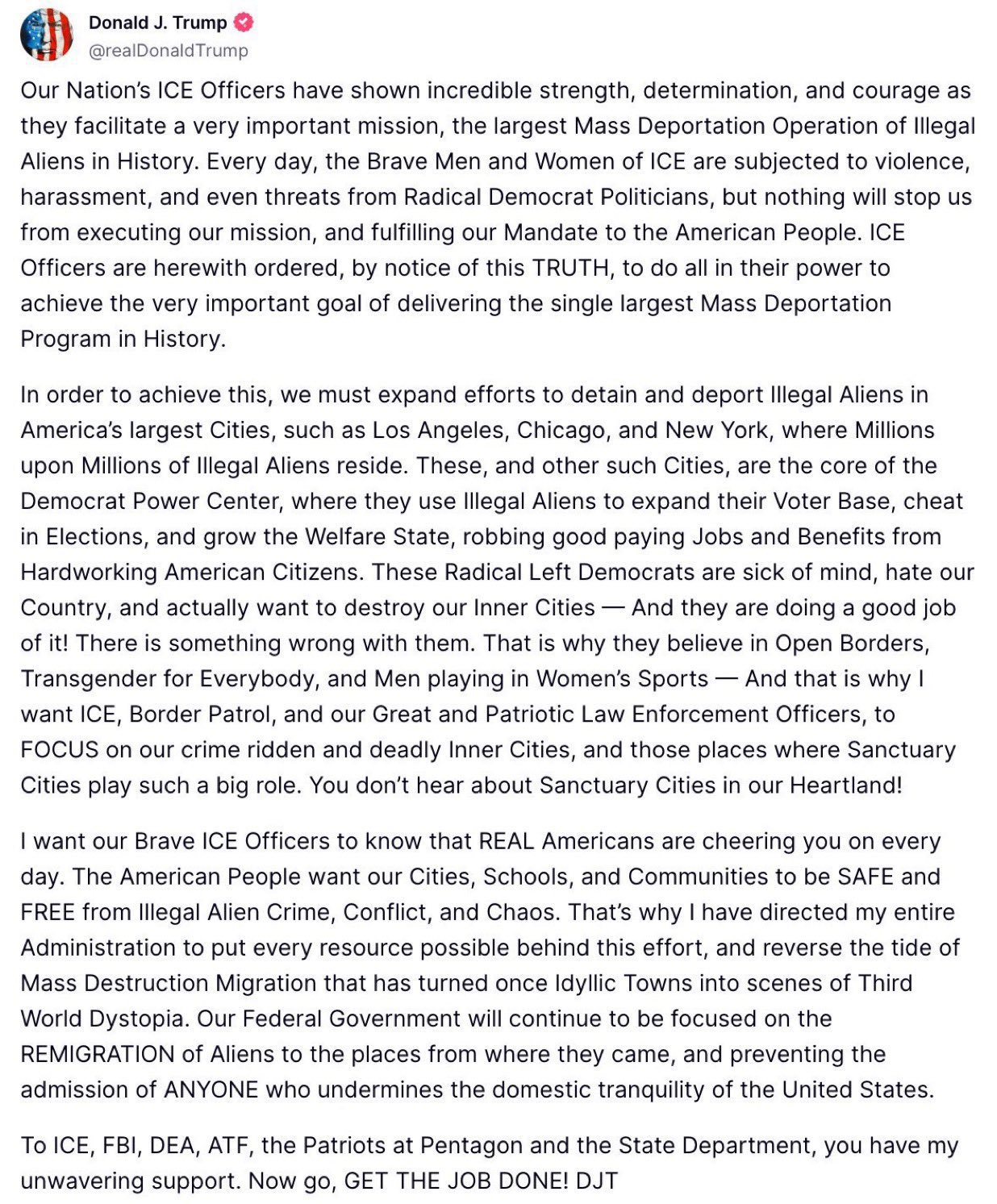
In his first inaugural address, Trump waved the federalism banner, pledging to transfer "power from Washington, D.C., and giving it back to you, the American people." But over the course of his first term, and now, five months into his second term, he appears to have decided that the ideology — like many other tenets that once defined the GOP — is no longer operative. In a Sunday night rant on Truth Social, he ordered ICE to step up its raids in cities and states that are run by his political enemies:

Trump is being very clear here about why he's targeting these cities. It's not because of immigration, although he's using that as an excuse. After all, two of the three states with the largest populations of undocumented people are the red states of Texas and Florida. And in recent days, Trump has exempted the agriculture, hospitality, and meatpacking industries, which apparently aren't part of the "Democratic Power Center." (The construction and manufacturing sectors better get on the ball and start doing some serious bootlicking.) No, he sees this as a way to start a conflagration in these cities, giving him the excuse to supersede the power of elected state and local officials by sending in troops, whether it be federalizing state National Guards or sending in active duty Marines.

On his way to the G7 Summit on Sunday, Trump claimed that if he hadn't ordered the federalized National Guard to Los Angeles last week the city would be on fire:

That is nonsense. There are protests and the Los Angeles Police Department was and is handling them. But there's a method to his madness, even if he doesn't fully recognize it himself. On Sunday, Dr. Ruth Ben-Ghiat, author of “Strongmen: Mussolini to the Present," wrote in the New York Times that by calling up troops to patrol Los Angeles, giving a partisan speech at Fort Bragg and presenting Saturday's military birthday parade, Trump is trying to get the American public used to a different relationship with the military. In this new version, we are supposed to see the military as an institution that explicitly serves the president and his political agenda. 

Ben-Ghiat goes on to explain that this is often a way that despots exert power, observing:

The Trump administration is now using the second-largest city in the country as a backdrop for its efforts to create the perception of a national crisis. Doing so could allow it to justify measures that would empower the government to act against its own citizens. This is concerning enough. Even more worrying is what history shows us: that all too often, such crises become semi-permanent — “not the exception but the rule,” as the anti-Nazi philosopher Walter Benjamin once observed.

The rhetoric in Trump's Truth Social post — that Democratic politicians and their voters are "sick of mind" and "hate our country" — means it is likely there will be more arrests and roughing up of Democratic politicians who try to do their jobs. And we can probably expect more violence, including the kind we saw this weekend in Minneapolis, when a far right extremist assassinated a Democratic politician and her husband, and wounded two others. That's the type of crisis Trump seems determined to provoke.

We need your help to stay independent

But I don't think he should count on the public at large, even in red states, complying with his plans. For all of his activity this past week, there was one event that dwarfed them all: 

Based on crowd-sourced records of No Kings Day event turnout, and extrapolating for the cities where we don't have data yet, it looks like roughly 4-6 million people protested Trump across the U.S. yesterday. That's nearly 2% of the U.S. pop!

Mobilized anti-Trump resistance is exceeding 2017 levels

[image or embed]

— G Elliott Morris (@gelliottmorris.com) Jun 15, 2025 at 7:10 AM

This is rigorous analysis by credible data researchers and it, along with recent polling, shows that the majority of the public is not fooled. (From the way the troops marched in his very low-energy parade, it appears they aren't sold on Trump's efforts either.) 

But the military spectacle in D.C., along with the events in L.A., was a sobering reminder of where Trump sees American power being concentrated. Not in the states, as former conservative hero Ronald Reagan believed. And not even in the federal government in Washington, where the streets are being inspected for damage from tanks and military vehicles. But in himself as a would-be king.

Poop is poop: It’s time to legitimize pet parents

Years ago, a woman in her 60s whom I had just met pulled out a stack of photos to show me how she had celebrated her dog’s birthday: in a neighborhood bar, with balloons and beer for the humans and a little cake made of Milk-Bones and chicken liver for the dog. Everyone, including the dog, looked like they were having a nice time. “Is this your only child?” I asked jokingly. She looked at me with a combination of scorn and pity. “He’s my dog, honey. I raised all my kids already.”

I thought of that moment recently when I saw the unexpectedly hilarious People magazine headline: “Kristin Chenoweth slams non–pet owners who say her dog isn’t her ‘baby’: ‘She came out of my vagina.'" The gist was this: Chenoweth, the showbiz dynamo who broke out as Glinda in the original run of “Wicked” and will play the title role in the much-anticipated musical “The Queen of Versailles,” is currently partnering with a dog-food subscription service called Nom Nom. This involves doing a lot of interviews about her relationship with her dogs, past and present. And that, in turn, has led to headlines taking Chenoweth’s joke both literally and very personally. 

There’s no question that Americans love pets: Statistics from the trade organization American Pet Products Association released in 2023 showed that 66% of Americans have pets, and that they spend significant amounts of money to ensure they’re living their best lives. But the question of whether “pet parent” is a legitimate identity (something that’s debated repeatedly and often angrily online) points to a discomfort with a world in which pets are no longer part of the family, but the family itself, full stop. The result is a sustained collision between unfettered consumerism, gender-role anxiety and entrenched beliefs about what kinds of love are valid and meaningful. 

There was a time when the phrase “pet parenting” was an acronym for a decidedly human enterprise called Parent Effectiveness Training. These days, it’s likely buried in search results under pages of goods and services marketed to enthusiastic pet owners that go well beyond contemporary expectations like doggy day cares, cat hotels and raw-food delivery services. Self-optimizing humans can now optimize their pets as well, with color-changing kitty litter that detects urine abnormalities, FitBark activity monitors and a range of button-training programs to hone interspecies communication; physical-therapy centers for aging and injured dogs offer healing modalities including acupuncture, massage and aquatherapy.

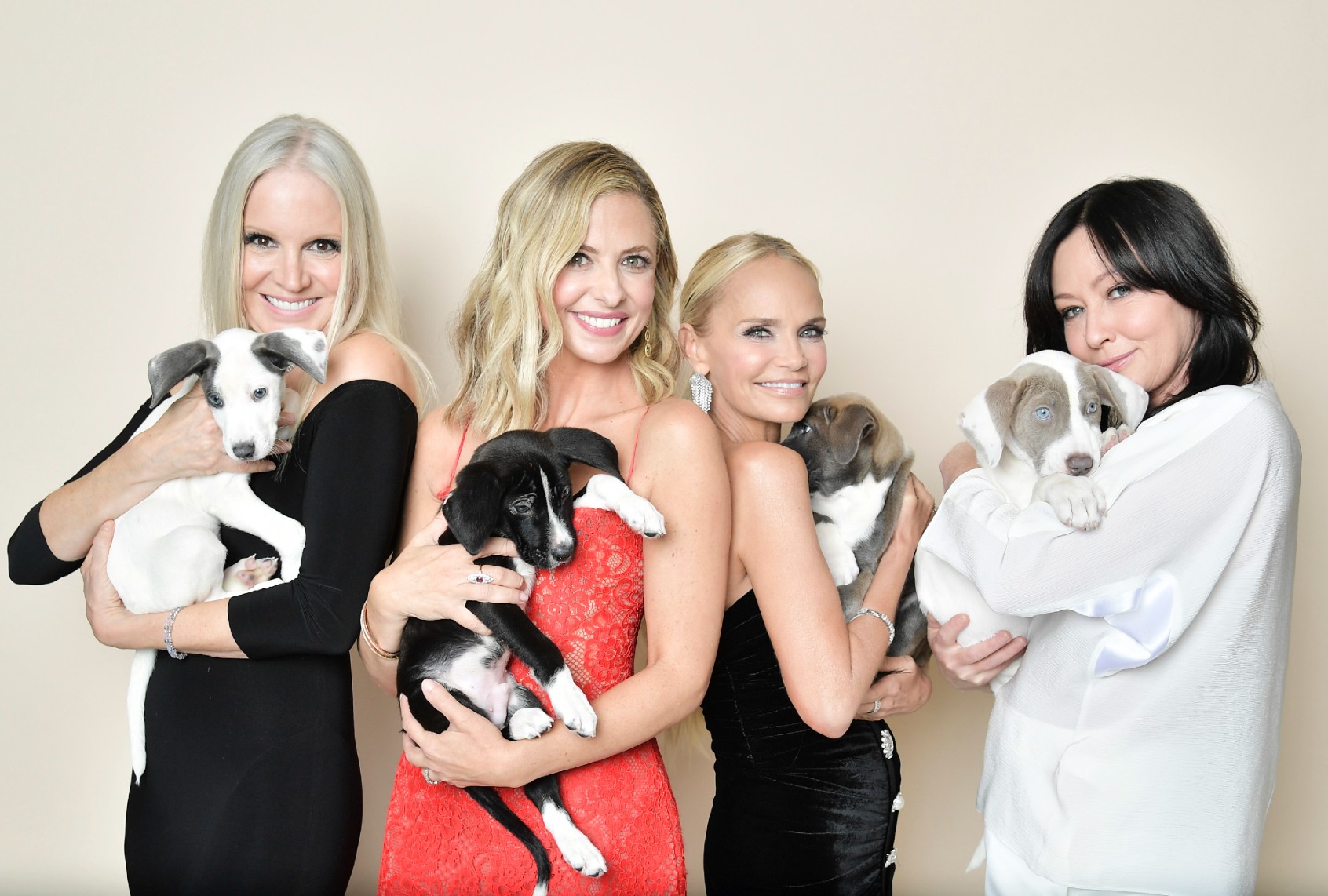
(L-R) Michelle Vicary, Sarah Michelle Gellar, Kristin Chenoweth and Shannen Doherty in the Getty Images & People Magazine Portrait Studio at Hallmark Channel and American Humane Society's 2019 Hero Dog Awards at the Beverly Hilton on October 05, 2019. (Neilson Barnard/Getty Images for Hallmark Channel)

The question of whether “pet parent” is a legitimate identity (something that’s debated repeatedly and often angrily online) points to a discomfort with a world in which pets are no longer part of the family, but the family itself, full stop. 

Pets and humans have ever-broader options for entwining their daily lives, routines and milestone moments. There are 23 states in America where your dog, cat — any pet who is willing to ink a paw, really — can be an official witness to your wedding, and a smaller number in which your pet can actually serve as a wedding officiant. A growing number of restaurants and cafés offer dog menus, and at a few, like San Francisco’s upscale Dogue, good boys and girls are the target customers for a menu of braised-beef short ribs and antelope-heart pastries. Human-sized pet beds, memory-foam mattresses and co-sleeping attachments all exist to make sure everyone’s on the same level and getting a good night’s sleep.

Reactions to this new normal have been very telling. In November 2023, the New York Times published a feature titled “When your significant other has four legs,” profiling several women who were quite happy to put down the dating apps and focus on their own lives, which include rewarding relationships with their pets. Comments on the piece brimmed with hostility for the very idea that a life prioritizing pets might be more joyous and meaningful than one spent searching for a suitable human. “This is gross. Sad. Abnormal,” read one. “Great story about taking the easy way out,” snarked another. 


Start your day with essential news from Salon. Sign up for our free morning newsletter, Crash Course.


Because birth rates around the globe have been on the decline for more than a decade, trends in pet primacy are regularly framed as usurping the rightful role of human children. It’s not a spurious conclusion: Census data shows that the percentage of women aged 30–44 with no children is higher than it’s been since 1960. Millennial women, ushered into adulthood by the 2008 financial crisis with untenable student-loan debt and a front-row seat to a sh*tshow of school shootings, environmental destruction and educational defunding feel both less equipped to have children and less interested in navigating the economic challenges of doing so. Add in the reversal of Roe v. Wade, that’s turned planned-for and much-wanted pregnancies needlessly tragic, and it’s not difficult to see why starting traditional families isn’t a priority. 

But there seems to be some difficulty in understanding that choosing pets in the absence of either romantic partners or biological children isn’t the same as replacing either of those relationships. When women are the ones doing the choosing, though, there’s a thread of real anger at the idea that they are not only reneging on a social contract but rubbing it in the faces of those who haven’t. Friction between pet parents and so-called real parents abounds online, from TikToks that mock people who insist on bringing their dogs everywhere they go to Reddit threads that insist people who refer to their cats as “the kids” are stealing valor to longform stories of bad pet-parent behavior engineered to make everyone who reads them as angry as possible at everyone involved. 

There seems to be some difficulty in understanding that choosing pets in the absence of either romantic partners or biological children isn’t the same as replacing either of those relationships.

Pitting groups of people against one another based on differences in lifestyles and beliefs (like, say, whether the term “fur baby” is ever acceptable to use) has always been a successful way to take the heat off of the political and institutional entities that exert the most control over how well both people and their pets live. There’s been a longstanding reluctance to connect, in plain language, diminished material choices with the global slump in birthrates; it’s much easier to point to overindulged pets than to reckon with social and economic factors that keep everyone from thriving. 

The chief complaint about pet parenting seems to be that it wastes valuable love that could go to a human child on a fuzzy facsimile of one, as though companionship is a zero-sum proposition. Even the late Pope Francis — who took his name from the patron saint of animals — had some harsh words in 2022 for adults who have pets but not children, suggesting that opting out of childrearing is “selfish” and “takes away our humanity.” (Spoken like a man who has never had to pay preschool tuition and failed to understand that wiping a butt is no different from scraping poop out of the grass with a hand covered in a purple, lavender-scented poop bag purchased at Whole Foods. Poop is poop, Francis.) 

We need your help to stay independent

It’s worth keeping in mind who benefits from ginned-up wars about what makes a legitimate parent — because it’s not the people who could, perhaps, once afford to have both children, pets and even a mortgage, but these days are lucky to be able to afford just one. The people who cast pet parenthood as sad or unnatural are people who aren’t actually interested in human quality of life. Instead, they are the techno-pronatalists scrambling to maintain a white-supremacist bulwark against immigration, and the conservative reactionaries like the authors of Project 2025, whose stated aim of “restor[ing] the family as the centerpiece of American life” works by taking choice, autonomy and dignity away from citizens. 

Which is why more of us might want to take Kristin Chenoweth’s path and lead with absurdity. Go ahead and Photoshop your cat into ultrasound photos; send your nosy in-laws a holiday card of you and your dog frolicking in the snow; celebrate the relationships you have instead of waiting around for the ones you don’t. Caring for living things, regardless of species, is always an act of hope. But trolling those who complain that you’re doing it wrong can be very satisfying.

Conspiracy theories about Minnesota shooter aren’t just deflection. They’re dangerous

Since the tragic events in Minnesota on early Saturday morning that left two dead and two others in critical condition, state authorities have painted a clear picture of what Vance Boelter, 57, is accused of doing. They say Boelter murdered former Minnesota House Speaker Melissa Hortman and her husband Mark, and also shot State Sen. John Hoffman and his wife Yvette. Gov. Tim Walz, D-Minn., called the shootings "a politically motivated assassination" targeting Democrats. Police recovered a list of around 70 potential targets, including politicians, community leaders and abortion providers. All the listed politicians were Democrats. According to the New York Times, Boelter's roommate and longtime friend says the suspected shooter voted for Donald Trump. Boelter's online activities show he is a right-wing Christian who opposes abortion and denies that LGBTQ identities are real. While we don't yet have the text of the manifesto Boelter left behind, it's fairly obvious what's likely to be in it. 

Despite these facts, it didn't take long for MAGA forces online to snap into action with a false counter-narrative: that Boelter is a left-winger and Republicans are the real victims. Trump's traveling companion Laura Loomer falsely claimed Boelter "was friends with Walz" and was associated with the "No Kings" protests. "The organizers of NO KINGS and @GovTimWalz need to be detained by the FBI and interrogated," she demanded. Dating "guru"-turned-MAGA influencer Mike Cernovich also blamed Walz, claiming the governor had Hortman — who was actually Walz's friend — "executed" for voting one time with Republicans on a bill. "MORE DEMOCRAT TERR0RISM!" screamed Nick Sortor, a far right influencer with over a million followers on X. Glenn Beck, Breitbart and other far-right outlets went to work on Facebook, suggesting to their audiences that Walz was responsible for the shooting, even though he was on the list of Boelter's targets. Charlie Kirk of Turning Points USA blamed the shooting of Democratic lawmakers and their family members on anyone who objects to rising fascism. 

Even by MAGA standards, the justifications for these leaps of logic are based on extremely thin gruel. First, the suspect had fliers for the "No Kings" demonstrations. Common sense tells us that's because he was probably considering an attack on the Democratic crowds turning out to protest Trump. That's also the conclusion the police swiftly arrived at, which is why they tried and failed to cancel protests in the area. (There was no violence at those protests, but there was a shooting at the Salt Lake City protest and car attacks at demonstrations in California and Virginia.) Second, Boelter had served for many years on a 41-member bipartisan business development board, and one of the various Minnesota governors who had rubber-stamped his appointment was Walz. There is no evidence that Walz has even met Boelter, but this tenuous connection was all the conspiracists needed to run with an elaborate story that the two men are co-conspirators in a plot to kill Republicans. The victims, in this telling, were basically Republicans — all because one of them once voted against her party on a single bill. 


Want more Amanda Marcotte on politics? Sign up for her free newsletter, Standing Room Only.


The first purpose of these disinformation efforts is, of course, to muddy the waters so that people with conservative inclinations, who may still abhor political violence, have a rationale to keep supporting Trump. On Facebook, liberals posting about the shooting are already seeing confused friends and relatives show up in their comments, asserting a connection between Boelter and Walz that isn't there. But the other potential effect of these conspiracy theories, whether intended or not, is to encourage more political violence from the right. 

Right-wing conspiracy theories that make excuses for MAGA violence function as incitement in two ways. First, it signals to would-be terrorists that, if they take violent action, they can expect support from MAGA cheerleaders in cyberspace. Second, it creates counter-narratives that allow potential killers a rationale that they are acting in "self-defense." That hurting and killing Democrats is justified because, according to the conspiracists, Democrats started it. 

In the most recent episode of my YouTube show, "Standing Room Only," journalist Kat Tenbarge described how this works using a term from psychology: DARVO, which is short for "deny, attack, and reverse victim and offender." It's a tactic domestic abusers use to avoid accountability: Deny you hurt her, call her a liar, then claim that actually, she abused you. 

The Boelter conspiracy theory is pure DARVO: Deny he was a Trump supporter, call Democrats liars and say that actually, it's Democrats who are killing Republicans. Even though the victims of this attack are very much Democrats, the pretzel logic of DARVO leads to outlandish efforts to find a stray vote or two not on the Democratic party line to recast the offenders as "Republicans." 

The same strategy was used by MAGA thought leaders to justify the violence of Jan. 6, as well as the attempted kidnapping and murder of former Speaker of the House Nancy Pelosi, D-Calif. in Oct. 2022. Conspiracy theories blaming the "deep state" for the Capitol riot, and not the MAGA rioters, gave Trump the cover he needed to recast the insurrectionists as "warriors" and heroes, granting them all pardons. Pelosi was not home when her would-be attacker invaded, but he nearly killed her husband, Paul Pelosi. Rather than admit the assailant was motivated by MAGA conspiracy theories, much of the right went straight to DARVO, falsely claiming that Paul Pelosi brought the attack on himself. Trump used that conspiracy theory for "jokes," unsubtly signaling to his base that he would enjoy seeing more attacks like this. Which is what appears to have happened in Minnesota over the weekend. 

Because conspiracy theories like the ones propagated by the right after Jan. 6 and the attack on Paul Pelosi —and now in the wake of the Minnesota shootings — work to encourage more violence, it's a chilling barometer of our culture that the majority of MAGA influencers and media outlets moved immediately into lying about the alleged shooter and his motives. At a bare minimum, this lack of hesitation suggests an utter disregard for human life — or at least for the lives of Americans with different political views. They don't care that their rhetoric could serve to encourage would-be terrorists. Or worse, they feel that violence in the name of politics is a desirable outcome.

Cruel but “necessary”: Can cutting off rhino horns — and selling them — help save rhinos?

Johan Marais spots a rhinoceros from a helicopter and shoots it with a tranquilizer dart. Another five minutes will pass before the rhino goes down. A team is ready on the ground to make sure the animal is well positioned when it loses consciousness. A rhinoceros is so massive that if it falls asleep on its legs, blood flow could be cut off, leading to circulatory problems and significant injury.

When Marais approaches the unconscious rhino, he covers its eyes to protect them and then uses a chainsaw to cut off its horns, down to about 10 centimeters, which avoids cutting into living tissue and causing a hemorrhage of the horn so that he doesn’t cut into living tissue, which could cause a hemorrhage.

No, Marais isn't a poacher — quite the opposite. He's a veterinarian in South Africa who hopes to save these rare and endangered animals from poachers. After the operation is complete, his team carefully collects the leftover shavings — even those could be valuable to profiteers eager to sell rhino horn on the black market. 

Dehorning rhinos to save them may seem perverse. But it's become much more common in recent decades, in a last-ditch effort to save populations of black and white rhinos in South Africa and surrounding countries, where poaching threatens their survival. Although dehorning has been linked to some behavioral changes in rhinos, it has also been proven to keep them alive.

Conservationists say they hate mutilating these anmals, whose magnificent horns are integral to their being. But the alternative for someone like Marais, founder of the nonprofit Saving the Survivors, which is dedicated to treating wounded wildlife species, is worse. Sometimes, he told Salon, he has to tend to rhinos who have been shot and badly wounded, “sometimes with half their faces hacked off while they are still alive."

Faced with that choice, Marais said in a phone interview, “You have to decide which one of the necessary evils you go for. Most vets will tell you that we hate to dehorn these animals, but because of the current situation, it’s one of the tools that we have to use.”

Although dehorning has been linked to some behavioral changes in rhinos, it has also been proven to keep them alive.

Wildlife managers began dehorning rhinos in 1989 as the illegal wildlife trade skyrocketed, affecting both black and white rhino populations that had dramatically dwindled in South Africa and neighboring countries. Many stopped dehorning rhinos in later years as populations began to recover, but in 2014, more rhinos were killed in the illegal wildlife trade than in any previous year. Since then, many parks and reserves have returned to the practice.

There are fewer than 23,000 rhinos left in the wild, and around 400 are killed annually in recent years. Although there have been some signs that the pace of poaching has slowed, research suggests that's probably because there are fewer available rhinos to poach. 

About 80% of the world’s remaining rhinos live in South Africa, which has become the epicenter of the illegal wildlife trade involving these species. The reasons why it's happening are numerous and complex. Rhino horn is sold for tens of thousands of dollars per kilogram, and seen as a status symbol in parts of the world. Many regions impacted by the trade have high levels of inequality and poverty, and corruption makes law enforcement challenging.

“South Africa is one of the most unequal societies in the world, and in many ways this poaching crisis is a symptom of inequality,” said Timothy Kuiper, a researcher at Nelson Mandela University in South Africa. Poor people “can be recruited by these criminal syndicates" who come into an area and present poaching as "a quick way out of poverty.”

We need your help to stay independent

A study conducted by Kuiper that was published recently in Science found that dehorning rhinos was associated with a 78% reduction in poaching between 2017 and 2023 across 11 reserves in South Africa, where about one-quarter of Africa's rhinos resided at the start of the study period.

“Millions of dollars have been spent on ranges, tracking dogs, cameras, helicopters, fancy alarms and fences, and none of it was bending the curve or making a significant inroad in reducing poaching,” Kuiper said. “Dehorning was pursued as almost a last-ditch effort, but in hindsight — apart from the possible ethical concerns—it is a very logical and direct way" to disincentivize the illegal trade in rhino horn.

In the region studied by Kuiper, $74 million was spent to try to reduce poaching between 2017 and 2023, but 1,985 rhinos were still killed for their horns.

Questions remain about the long-term effects of dehorning rhinos. Their horns are made of keratin, like human fingernails, and the procedure is not thought to be painful. However, one study published in 2023 found that while dehorning apparently ensured greater survival rates among black rhinos, it was also linked to almost a 50% reduction in their habitat range. 

“This tells you that after you have dehorned an animal, they know they haven’t got a horn anymore,” Marais said. “Obviously, they don’t want to walk into a situation where they can’t defend themselves.”

"After you have dehorned an animal, they know they haven’t got a horn anymore. Obviously, they don’t want to walk into a situation where they can’t defend themselves."

Another concern is that dehorning some rhinos and not others will accelerate poaching to regions where rhinos are not dehorned. And even if all living rhinos were dehorned, desperate poachers could still kill them for the remaining horn on their heads, said Lucy Chimes, a black rhino ecologist at the South African nonprofit Wildlife ACT. The recent study in Science reports that more than 100 rhinos were still poached during the period in question, even after they were dehorned.

Dehorning is also temporary by design: Within about 18 months, a rhino's horn will grow back. Each dehorning costs about $600, a significant sum in the African context, although that represents just over 1 percent of the entire budget for rhino protection rhinos, and other security measures are far more expensive. 

As the costs of keeping rhinos continue to increase, many wildlife managers are selling their rhinos to other reserves, which has reduced the animals' natural range. In general, Marais said, it’s healthier for rhinos if they're allowed to roam naturally rather than displacing them. Reducing their range can also have downstream effects on the entire ecosystem, he added.

“We're not only losing the rhino numbers, but we're losing the habitat as well,” Marais said. When you lose habitat, he continued, "you lose the biodiversity that goes with it, all the little insects, the owls that nest in the grass, the ants, the worms and the grass itself.”

Ultimately, dehorning is not likely to be a long-term solution for the rhino population. Indeed, most proposed solutions meant to curb rhino poaching are focused on the rhinos — the supply side of the problem, one could say — instead of dealing with the enormous demand. “I don’t know if there is a long-term solution until you deal with demand and poverty,” Chimes said. 


Start your day with essential news from Salon. Sign up for our free morning newsletter, Crash Course.


Conservationists also debate what to do with the sawed-off rhino horns. Thousands of them are now in storage facilities in South Africa, with some people arguing that they should be burned to avoid the obvious risk of theft, keeping them off the black market. Others have suggested that the horns should simply be sold into that very black market, and that perhaps legalizing that trade could help save rhinos.

Marais thinks it's worth trying. Money realized by such sales, he says, could be reinvested in conservation projects designed to help rhinos. A property owner could use the money from selling horns “to have more people on his property that can do security patrols, upgrade his fences or buy a helicopter to do surveillance,” Marais said. “If all our fears come true and it actually makes the problem worse, then we stop. But at least we should try it and see. Maybe, just maybe, it will make a difference.”

“Was US intel wrong?”: Fox News’ Baier doesn’t buy Netanyahu’s justification for attacking Iran

Prime Minister Benjamin Netanyahu had no reason to expect a hostile reception on Fox News

After all, he'd been warmly welcomed in the halls of Congress by Democrats and Republicans alike. The GOP is even more unwavering than their nominal opposition in their support of Israel, so the conservative media giant could be expected to offer glad-handing and softball questions. 

That's not what the Israeli leader got when he sat down with Bret Baier on Sunday. The anchor repeatedly pushed back on Netanyahu's justifications for launching missile strikes on Iran. After several days of missile exchanges between Israel and Iran, Baier was critical of Netanyahu's assertion that his "preemptive strike" was necessary.

"We were facing an imminent threat, a dual existential threat, one, the threat of Iran rushing to weaponize their enriched uranium to make atomic bombs with a specific and declared intent to destroy us," Netanyahu said. "It was the 12th hour. We did act to save ourselves, but also, I think, to not only protect ourselves but protect the world from this incendiary regime. We can’t have the world’s most dangerous regime have the world's most dangerous weapons."

Baier didn't buy it, pointing out that U.S. intelligence has found no proof of an Iranian nuclear weapons program. 

“Less than two months ago, the new director of national intelligence, Tulsi Gabbard, testified on Capitol Hill saying that everything had been suspended since 2003 and had not restarted, that the nuclear program had not been restarted by the Iranians," he said. "So, did something change from the end of March until this week? Was the U.S. Intel wrong?”

Netanyahu countered that Iran would "achieve a test device and possibly an initial device within months."

Elsewhere in the interview, Netanyahu claimed that two assassination attempts on President Donald Trump in 2024 were orchestrated by Iranians. 

"These people who chant death to America, try to assassinate President Trump twice, killed 241 of your Marines in Beirut, killed and injured thousands of American soldiers in Afghanistan and Iraq," Netanyahu said, "do you want these people to have nuclear weapons and the means to deliver them to your cities?"

"You just said Iran tried to assassinate President Trump twice. Do you have intel that the assassination attempts on President Trump were directly from Iran?"

Watch the interview below:

“Regime change”: Cruz, Graham call for US involvement in Iran-Israel conflict

A spectre is haunting the mall. Jean rises are getting lower, baby tees are back in production and Republicans are openly calling for "regime change" in the Middle East. There's no doubt about it, the 2000s are back.

Following days of missile attacks between Iran and Israel, Sens. Ted Cruz and Lindsey Graham hit the Sunday shows to advocate for U.S. involvement. 

Graham called for American escorts over Iran during a stop by CBS's "Face the Nation."

"If diplomacy is not successful, and we are left with the option of force, I would urge President Trump to go all in, to make sure that when this operation is over, there's nothing left standing in Iran regarding their nuclear program," he said. "If that means providing bombs, provide bombs. If it means flying with Israel, fly with Israel. 

Graham was not alone in banging the war drums. Just four years out from the end of the war in Afghanistan, Cruz visited Fox News to say we should always be at war with Westasia. 

"I think it is very much in the interest of America to see regime change," he said. "I don't think there's any redeeming the ayatollah."

Not all party members are champing at the bit for another war. Sen. Rand Paul, R-Ky., chastized Graham over his eagerness to get involved while talking to NBC's "Meet the Press."

"His initial response was 'game on,' and I don't consider war to be a game," Paul said. "Hundreds of thousands of people may now die."

President Donald Trump has publicly encouraged a diplomatic resolution between Israel and Iran, stressing that the United States was not involved in the initial attack on Tehran.

"We will have PEACE, soon, between Israel and Iran! Many calls and meetings now taking place," he wrote on Truth Social on Sunday. 

Love Thai food? Try its chocolate

I don’t have many vices. I exercise daily, don’t smoke. I don’t even drink coffee. But I do have a serious sweet tooth. My daily fix? Chocolate

While living in various Asian countries for the better part of a decade, I’m typically bound to international brands like Cadbury and Ritter Sport. But not in Thailand. Craft chocolate bars are in abundance, riding the wave of increased demand for artisanal, locally-made products.

“Thailand is a nation deeply passionate about food and flavor,” says Daniel Bucher, Founder and Managing Director at Bangkok-based chocolate factory Pridi Cacaofevier. “Once a new taste captures the public's interest, there's an incredible drive to explore its nuances in depth. Chocolate has recently captured that attention, leading to widespread experimentation and a vibrant chocolate scene.”

Starting in 2018, Kad Kokoa has been a pioneer of Bangkok’s artisan chocolate scene, including its Sathon cafe, whose sugary aromas rival any Parisian chocolatier. The Thai team prides itself on being single-origin specialists, showcasing each region’s unique cocoa terroir. Its most popular flavors are the award-winning Chiang Mai bar with honey and floral notes, and the Chumphon bar, which leans richer with chocolatey flavors and hints of brownie and caramel.

“We focus on minimal intervention, using only cacao and organic sugar in most bars to let the natural characteristics of the beans shine through. Our commitment to sustainability and direct relationships with farmers further distinguishes Thai chocolate on the global stage,” says Nuttaya Junhasavasdikul, co-founder and CMO of Kad Kokoa.

Siamaya Chocolate is based in the ancient northern city of Chiang Mai, a perennially popular spot on the Thailand tourist route. “Most of the cacao grown in Thailand is the genetic offspring of a single variety called Chumphon-1, a cacao breed created by Thai researchers a few decades ago,” says Neil Ransom, founder and CEO of Siamaya Chocolate. “Thai craft chocolate is typically single-origin, lighter-roasted and paired with fresh regional ingredients. The result is fruitier, more aromatic, and distinctly tropical, with less reliance on vanilla to mask unwanted flavors associated with industrially processed cacao.”

And while wincingly bitter single-origin bars line the shelves, Thai chocolate really shines with its flavored creations. Think Tom Yum Dark Chocolate, Durian Milk Chocolate and the best-selling Thai Tea Milk Chocolate.

We need your help to stay independent

“Thailand also just happens to produce some of the best fruits and spices in the world. Showcasing those ingredients in chocolate lets us celebrate local food culture and agriculture, differentiate ourselves in a crowded market, and give locals and travelers a taste they can’t find elsewhere,” says Ransom.

Pridi Cacaofevier is also known to shock and delight customers with its wild flavors, particularly its PlaPlaPla bar, made with organic fish sauce caramel chunks, an Asian play on the beloved salty and sweet flavor profile.

Besides sourcing its beans from northern farmers and farming cooperatives, Bucher and his chocolate makers do the same for the ingredients blended into the bars. Strawberries come from Chiang Dao, lime skin from Nan and Makwaen Northern Thai pepper from the hill tribe communities around Chiang Rai.

Although Thai chocolate isn’t as recognized as producers like Switzerland or Belgium, enthusiastic chocolatiers are fighting to be. Last year, Bucher helped found TACCO (Thailand Association for Cacao and Chocolate). Most of its members are currently farmers seeking to act as a unified voice in government dealings, promote Thailand as a premium chocolate creator and increase production and consumption on a global scale.

“Our mission is to elevate and establish Thailand as a recognized and respected player in the global craft chocolate market,” says Bucher. “We recognized the incredible potential of Thai cacao and the burgeoning community of passionate makers.”

“The Life of Chuck” forces twee positivity in a time when we need it the least

It’s nearly impossible to remain stoic and jaded in the face of someone who is dancing like no one’s watching. And in his new film, “The Life of Chuck,” writer-director Mike Flanagan is betting that even the most weary viewer will be charmed by the sight of Tom Hiddleston busting a move in the middle of the street. The film comes courtesy of the softer side of Stephen King, adapted from a story in his 2020 collection of novellas, “If It Bleeds.” And while Flanagan is no stranger to adapting King’s works — having tackled “Gerald’s Game” and “Doctor Sleep” (to varying results) — “The Life of Chuck” is not a thriller or a horror, but rather a slice of feel-good optimism. But that doesn’t mean the film is devoid of scares, oh no. In fact, “The Life of Chuck” makes the most terrifying assertion of the summer so far: Twee is headed for a revival. 

Watching the expertly choreographed, extended dance scene in the film’s middle act, it’s difficult to stop the brain from wandering back in time to the 2000s, when this kind of sequence was common in twee staples like “(500) Days of Summer” and “Napoleon Dynamite.” But in case you experienced a head injury by sticking your head out of a moving vehicle after reading Stephen Chbosky’s “The Perks of Being a Wallflower,” Flanagan’s film is here to bring the twee movement back for a new, precarious age. After Chbosky’s 1999 book sold millions of copies and inked countless infinity sign tattoos, twee art hit the market hard, marked by characters who were both precious and precocious, determined to be their own person no matter who disagreed; think “Juno,” “Where the Wild Things Are” and almost everything Miranda July, Wes Anderson and Zooey Deschanel did between the years 2001 and 2012. The message of these films was often that, no matter how difficult things get, everything will be alright in the end if you persevere. 

Annalise Basso as Janice Halliday and Tom Hiddleston as Charles "Chuck" Krantz in "The Life of Chuck" (Courtesy of Neon)
Though it may provide some brief comfort for those powerless to its twee-lite charms, “The Life of Chuck” is just a loosely applied bandage, a “YOLO” bumper sticker that falls off the car the second the terrain gets a little too rough.

“The Life of Chuck” feels like a holdover from this era of feel-good fare, reworked and retrofitted to align with our contemporary anxieties. With three distinct acts told in reverse chronological order, even the film’s structure (which is faithful to King’s book) seems like it’s aiming for the kind of quirkiness that twee art typically boasted. But turn-of-the-millennium twee passed off its intrepid hopefulness with fully fleshed characters whose ambitions for stability looked just like ours. In Flanagan’s film, the titular Chuck (Hiddleston) is less aspiring, content with a humdrum accounting job and a fairly basic existence. If twee as it was made the future feel bright, twee as it is in “The Life of Chuck” makes the future feel bearable, if that. While that’s the most some of us can ask for right now, the film weaponizes our cultural anxiety and declares that living a tolerable life in a burning world is enough, so long as we make the most of it. Flanagan preys on the audience’s nostalgia and our desperate search for something heartwarming, wherever we can find it. And though it may provide some brief comfort for those powerless to its twee-lite charms, “The Life of Chuck” is just a loosely applied bandage, a “YOLO” bumper sticker that falls off the car the second the terrain gets a little too rough.

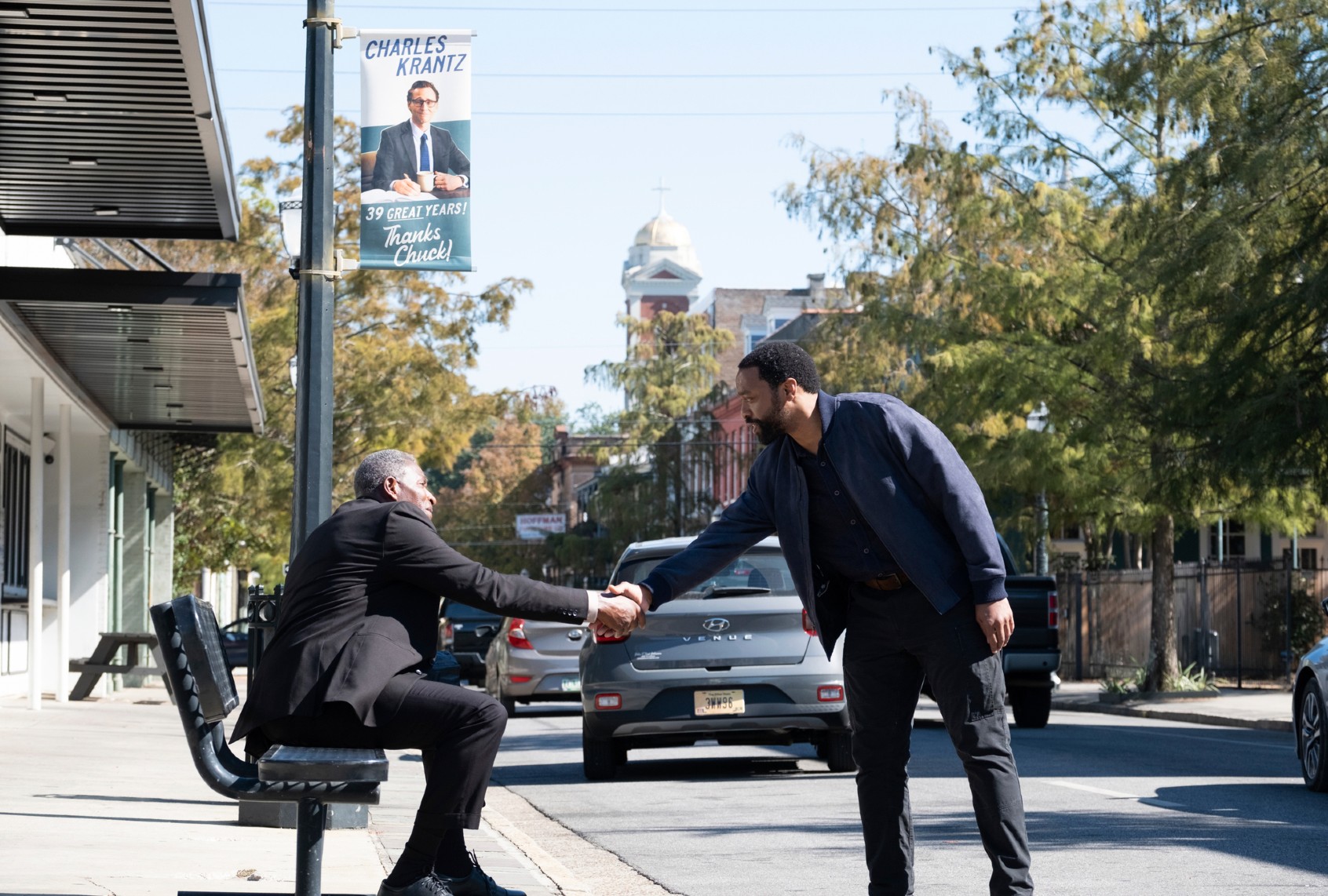
In the first act of Flanagan’s movie — that’s Act 3 for those who need to be reminded that “Life of Chuck” is not your average narrative feature, OK! — the world is ending. A massive earthquake has hit California, sending 90% of the state into the ocean. The internet is down forever, crops are dying, bees are extinct, the weather is erratic and famine is beginning to plague the world. For local elementary school teacher Marty (Chiwetel Ejiofor) and most of those around him, global strife is the new norm. If a sinkhole opens up and swallows 10 cars, leaving traffic backed up for miles, people will just abandon their vehicles and walk five miles home. The only thing that seems to brighten people’s days, or at least distract them from the ceaseless suckfest that is their new life, are billboards depicting a smiling accountant named Chuck Krantz, thanking him for “39 great years” at the bank where he works. 

Marty’s world is a heightened version of the discord we’re experiencing these days, but the calamities and the characters’ detachment from them don’t feel far from our reality. One morning, Marty’s neighbor, Gus (Matthew Lillard), stops to warn Marty of an impossible traffic jam that will get him to work by noon at the earliest. Their brief hello turns into a moment to recall everything that has gone wrong, and just how quickly it all went to sh*t. When Gus mentions protests that swiftly quelled as people realized there was no solution, the mind immediately jumps to Los Angeles, and the protestors objecting to ICE’s presence in their communities, as well as to all the people going about their days, acting like nothing is wrong. 

Carl Lumbly as Sam Yarbrough and Chiwetel Ejiofor as Marty Anderson in "The Life of Chuck" (Courtesy of Neon)
While Flanagan understands humanity’s penchant for complacency in the face of chaos, his script does little to elucidate the reasons people turn a blind eye to their fellow humans’ suffering, much less pose any solutions. And as this act goes on, he opts for a trite missive about being with the one you love at the end of the world. Flanagan might portray Marty as the last remaining pillar of his community, but Marty’s characterization is too thin to grasp onto, and Flanagan spends far more time depicting a world crumbling at our feet. The imbalance preys on the audience’s existing anxieties, buried just below the surface, in a cheap move that makes the film’s picture of human misery more affecting than Marty’s good nature, just to drive home this act’s mawkish finale.

To be fair, there is a reason for Marty’s thinly sketched personality. Everything in Act 3 is not entirely as it seems, but to spoil that would be to take the whole movie with it, and maybe “The Life of Chuck” will be exactly what you need at this very moment. The film’s marketing, which insists this is from “the hearts and souls of Mike Flanagan and Stephen King,” would certainly like you to think so. Tom Hiddleston even wrote an essay about the film’s demonstration of “the courage and connection we need when the world is falling apart.” (Though, for the life of me, I can’t find this essay published anywhere, though Hiddleston has delivered the canned line on red carpets, too.) 


Start your day with essential news from Salon. Sign up for our free morning newsletter, Crash Course.


“The Life of Chuck” doesn’t confront the audience with the bleak realities of modern life to change their minds and open their hearts; it uses our dread against us. The film’s unconventional narrative construction and big, undeniable centerpiece dance sequence are little more than smoke and mirrors, distracting us from realizing that Flanagan’s script doesn’t have anything new or practical to say.

As someone who raised himself on the kind of twee films that “The Life of Chuck” is ostensibly mimicking, I desperately wanted to come away with some kind of attachment to it, some scene that would move me enough to believe the hype. But the closest I ever came to chills was during the dance sequence in Act 2, when we meet the real chuck for the first time, and something calls him to move to the beat of a busker’s drums in the middle of the street. The scene is earnest and exciting, the closest the movie comes to conveying its you-only-live-once message, which segues into Act 1, where we follow a young Chuck (Benjamin Pajak) as he experiences great loss and finds comfort in the release of dance.

Compared to its first act, this final portion of the film makes the concept of happiness seem vintage. Despite some seismic deaths in the family, Chuck’s life as a child in the '80s is irrefutably better than the one we see him experiencing in Act 2, and certainly more so than the one Marty is enduring in Act 3. Flanagan traces Chuck’s life backward in time, letting us watch as the joy slips away, favored for an existence that prioritizes things that are practical and safe. In this last act, the film returns over and over again, ad nauseam, to a quote from Walt Whitman’s “Song of Myself” — “I am large, I contain multitudes” — to hammer down the small ways Chuck’s curiosity is stamped out in his childhood. For a few brief years in his life, after hearing this passage of Whitman’s poem in class, Chuck allowed himself to feel wonderful, until a horrifying discovery set him on a different path. And by the end of his film, Flanagan hopes that, by having watched Chuck lose his sense of self, the viewer will rediscover theirs. 

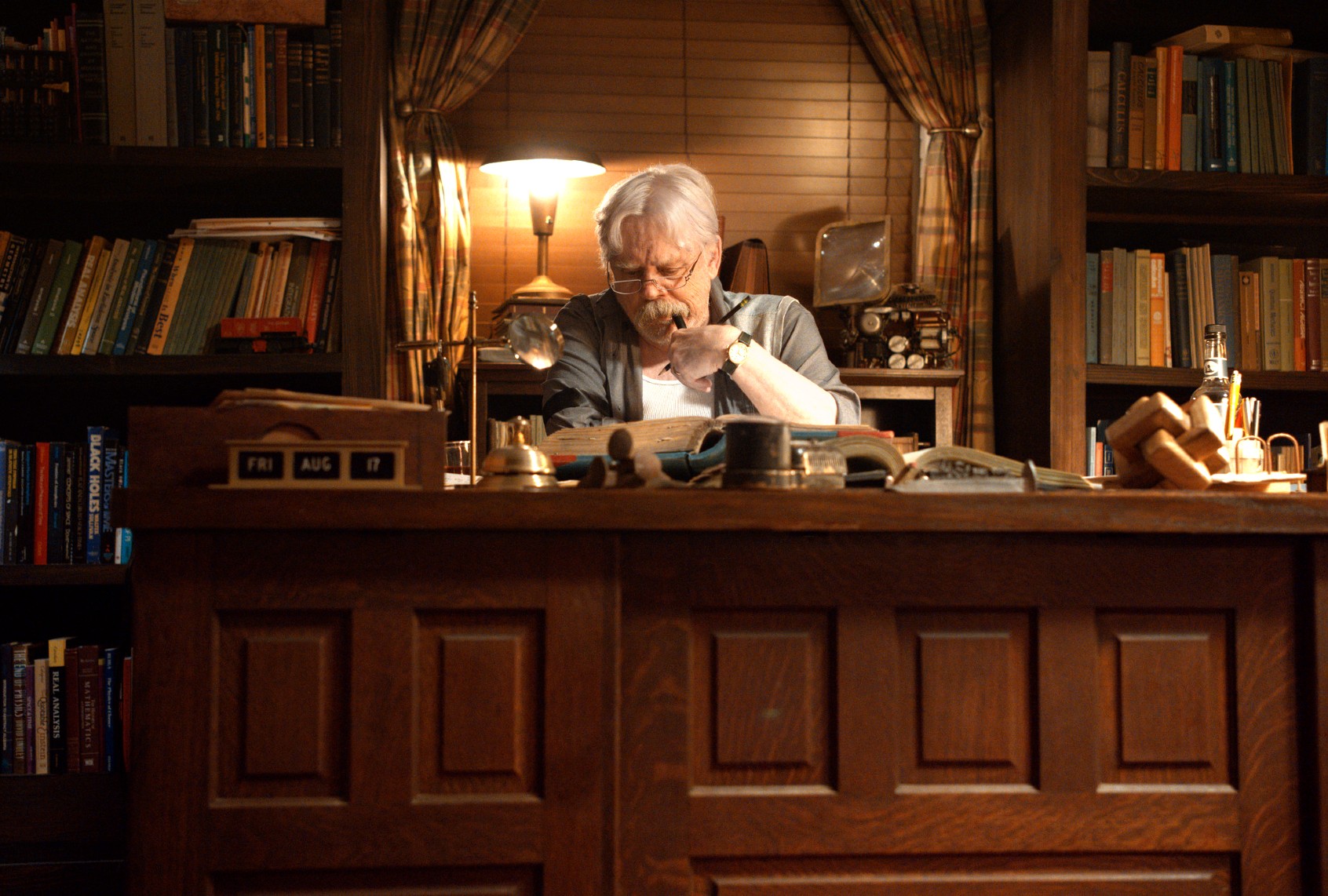
Mark Hamill as Albie Krantz in 'The Life of Chuck" (Courtesy of Neon)
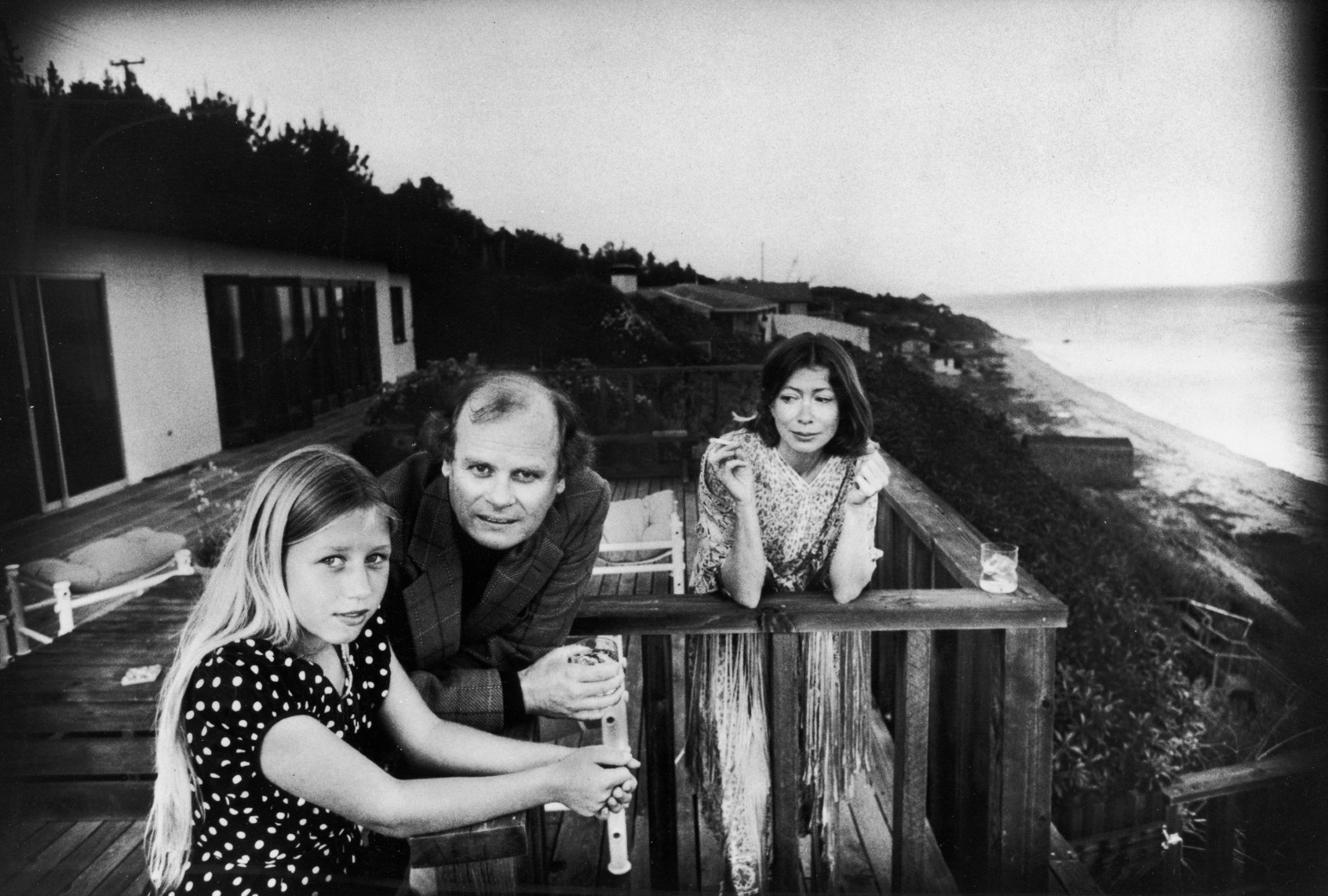
But that’s a big ask, and the film’s rickety foundation of soothing bromides is hardly enough to build upon. How are we supposed to get busy livin’ or get busy dyin’ — as another one of King’s characters famously said — with so much stacked against us? Do we cut a rug out in public? Read Walt Whitman? Go be close to the people we love and wait for the nuclear winter? Flanagan is too concerned with the bones of his story to give us any of the meat, and once you poke at it, the skeleton falls apart. His version of twee has been hollowed out and boiled down to empty platitudes, bereft of any legitimately inspiring or actionable takeaways for the viewer. “The Life of Chuck” doesn’t confront the audience with the bleak realities of modern life to change their minds and open their hearts; it uses our dread against us. The film’s unconventional narrative construction and big, undeniable centerpiece dance sequence are little more than smoke and mirrors, distracting us from realizing that Flanagan’s script doesn’t have anything new or practical to say. 

With all of that flash and panache, the viewer might be lulled enough to recall a time not too long ago, when the sensible self-prioritization of twee was fading, and the recklessness of “YOLO” was creeping into its place. Had Flanagan taken King’s you-only-live-once theme and presented reasonable, modern ways to put it into practice, “The Life of Chuck” might not feel like such a void of meaning. Life’s impermanence should drive us, yes. But spending all of our time concerned with living our own lives to the fullest keeps us from seeing all the beauty, kinship and aid that those around us have to offer, and all we can offer them in return. Unlike the golden age of twee, dancing in the street and running into the arms of the one person you love aren’t enough for a happy ending. The world looks a hell of a lot different now. We are not infinite, as Chbosky said in “Perks of Being a Wallflower,” and a blunt bang won’t save you any more than it will Zooey Deschanel. Flanagan’s pastiche of palatable comfort might be well-meaning and familiar. But in modern practice, “The Life of Chuck” is no more than a nostalgia tranquilizer, designed to comfort you after you roll your ankle on a two-step, dancing like no one’s watching.

“Going at it hot and heavy”: Trump shares view of Israel-Iran conflict, promises “peace soon”

As Israel was launching another round of missile strikes on Tehran, Donald Trump took to Truth Social to promise the end of hostilities between the U.S. ally and Iran.

"Iran and Israel should make a deal, and will make a deal, just like I got India and Pakistan to make, in that case by using TRADE with the United States to bring reason, cohesion, and sanity into the talks with two excellent leaders who were able to quickly make a decision and STOP!" the president shared to his personal social media platform on Sunday.

Trump went on to list several other countries that were "going at it hot and heavy" until he stepped in to broker peace.

"There is peace, at least for now, because of my intervention, and it will stay that way!" he wrote. "Likewise, we will have PEACE, soon, between Israel and Iran! Many calls and meetings now taking place."

Earlier on Sunday, Israeli Prime Minister Benjamin Netanyahu promised that Iran "will pay a very heavy price" in the ongoing conflict and promised to continue attacks on Tehran "for as long as it takes."

Trump has disavowed Israel's attack on Iran, saying that the U.S. "had nothing to do with the attack" while promising swift retaliation if Iran attacked American military outposts. 

"If we are attacked in any way, shape or form by Iran, the full strength and might of the U.S. Armed Forces will come down on you at levels never seen before,” Trump wrote on Truth Social.

Iranian President Masoud Pezeshkian didn't buy Trump's talk, especially after Trump called Israel's initial attack "excellent" and "very successful." Pezeshkian said on state television that Israel "is not capable of any action without the permission of the U.S.” and that it carried out attacks "with the direct support of Washington.”

Trump seemed confident he could bring Iranian and Israeli leaders together, though he complained that he wouldn't be credited with any hypothetical peace in the media.

"I do a lot, and never get credit for anything, but that’s OK, the PEOPLE understand," he said. "MAKE THE MIDDLE EAST GREAT AGAIN!"

Everybody hates Bibi — but he keeps on winning

It’s the defining anecdote for any article of this type, repeated ad infinitum without entirely losing its resonance: After his first meeting with Israeli Prime Minister Benjamin Netanyahu, President Bill Clinton reportedly asked a circle of aides: “Who the f**k does he think he is? Who’s the f**king superpower here?”

That was in the summer of 1996, just after the 46-year-old Netanyahu had won his first election as leader of the Likud party. He was already a media star in the U.S., familiar to CNN viewers as an Israeli government spokesman during and after the first Gulf War. He spoke flawless American English, having spent much of his childhood in upstate New York and then attended MIT, where he earned multiple degrees. No one mistook Bibi — a nickname deployed in countless New York Post headlines — for a liberal even then, but his affect and demeanor suggested an energetic pragmatist fashioned by the neoliberal era, ready to lead the Middle East into the future.

Clinton was the first president to perceive the powerful will and lust for dominance beneath Netanyahu’s telegenic surface, but he certainly wasn’t the last. Nearly 30 years later, Donald Trump finds himself facing Clinton’s rhetorical question in a new register, as Netanyahu has started a war without him and reduced Trump to a non-comic sidekick role. Bibi has relentlessly pursued his vision of the Middle East’s future, in defiance of nearly unanimous opposition from the rest of the non-American world, and is closer than ever to realizing it.

Now that Israel’s longtime leader has rolled the dice on a long-anticipated war with Iran, clearly aiming for a “death blow” against the greatly weakened theocratic regime in Tehran, it’s time to appreciate the scale of his accomplishment, and the extent to which he has been underestimated. How long this war will last and where it will lead is unknowable, and the possibility of catastrophic blowback — either now or in the future — for Israel, the region and the entire world is unmistakable. 

Don’t misunderstand my tone as laudatory: In 17-plus years as prime minister across four decades, Netanyahu has continually outdone himself in viciousness, criminal depravity and shamelessly immoral or amoral statecraft. He has turned a controversial but undeniably democratic and dynamic nation into a semi-authoritarian armed fortress and a global pariah. Whether or not Israel under Netanyahu practices apartheid or has committed genocide are ideological or semantic questions, largely determined by one’s prior assumptions. But the facts about brutal expansionism in the West Bank and mass death in Gaza speak for themselves. 

In 17-plus years as prime minister, Netanyahu has continually outdone himself in viciousness, depravity and shamelessly amoral statecraft. He has turned a controversial but undeniably democratic nation into an authoritarian armed fortress and a global pariah.

There’s no point in denying, however, that according to his own dark theory of geopolitical reality, Netanyahu has created the conditions for decisive victory. He did not plan or facilitate the Hamas attack on Israel in October 2023 (contrary to various internet conspiracy theories), but in a real sense it served his purposes. He exploited that traumatic event to launch the invasion of Gaza, where Israeli forces have committed war crimes on a nearly indescribable scale, with the active if not enthusiastic support of two American presidents from opposing parties. If Trump’s glorious vision of a luxury beachfront resort remains unlikely to be fulfilled, what will actually become of Gaza is almost too painful to contemplate.

While the destruction of Gaza was in process, Israeli agents also executed a startlingly effective attack on Hezbollah, the Iranian-supported militia operating mainly in Lebanon, decapitating its leadership with missile attacks and the now-legendary exploding pagers. Conventional wisdom among Middle East analysts had held in recent years that Hezbollah was a well-armed and well-organized operation, prepared to wage a debilitating long war against Israel. So much for that.

There’s a discernible pattern here that I don’t claim to understand, although I'm afraid the most likely explanation can be summed up with the words “military-industrial complex.” Foreign policy analysts routinely, and often wildly, exaggerate the threat level posed by anti-American or anti-Western forces, presenting them as shadowy hordes ready to overrun civilization at any moment. Consider, for instance, the Soviet military in the ‘80s, Saddam Hussein and the Republican Guard, al-Qaida and its numerous unappetizing offshoots, North Korea, the Gadhafi regime in Libya and, oh yeah, the Assad regime in Syria — which abruptly collapsed last December in a manner that didn’t carry obvious Israeli fingerprints but really didn’t need to.

Whether Israel’s spectacular assault will succeed in destroying Iran’s nuclear capability and bringing down the regime, or — as in the fantasies of Fox News, John Bolton and all those “mainstream” Republicans we’re supposed to miss so much — will drag the U.S. into yet another disastrous overseas war, remains to be seen. But Netanyahu has played one more American president for a chump, which should come as no surprise. He used Trump’s compulsive need to be the center of attention, and his delusions of being a master dealmaker, as a smokescreen and then shoved our supposedly anti-interventionist president (like all others before him, to be fair) to the sidelines as a cheerleader and collaborator. 

Netanyahu used Trump’s compulsive need to be the center of attention, and his delusions of being a master dealmaker, as a smokescreen — and then shoved him to the sidelines as a cheerleader and collaborator. 

Sure, Trump gets to claim he was for Bibi's war all along and only pretended to be against it (or something). He isn't fooling anyone, and he's making core MAGA supporters distinctly uncomfortable. They voted for a lot of things that don't make sense, but carrying water for Israel was definitely not on the list. Trump badly wanted the so-called win of cutting a deal with the Iranians, even if that deal looked almost exactly like the one Barack Obama made a decade ago, which Trump then ditched. It still would have been better than his supposed deal with China on trade or the Houthi regime in Yemen on shipping, both of which amount to plenty of bluster followed by retreat. Instead he got thoroughly pantsed by Netanyahu, and has to pretend he didn't notice.

Netanyahu has outlasted four American presidents — five if you count Trump’s first term, which certainly looks like a different era from here — and keeps coming back for more, like the villain in a slasher-movie sequel. Somehow or other he has bent all those very different men to his will, gaslighting them into convincing themselves that he will accept some version of a peace settlement short of his obvious goal, which is twofold: Crushing any realistic possibility of an independent Palestinian state, and establishing Israel as the region’s unchallenged hegemonic power. If I had to guess right now, he's gonna get both of them.


Start your day with essential news from Salon. Sign up for our free morning newsletter, Crash Course.


“Gaslighting” has become a journalistic cliché detached from its original meaning, but it definitely fits in this case. Netanyahu has seduced and manipulated one president after another in much the same way an abusive lover does, because he understands the underlying dynamics of the relationship — in this case, the upside-down relationship between the U.S. and Israel — much better than they do. He persuades them that they control that relationship and are making their own decisions for their own reasons, trusting that the mind-bending drug of American narcissism will prevent them from noticing that they are simply following the contours of his script. It hasn't failed him yet.

Netanyahu has survived numerous political scandals, a criminal indictment, months of angry street protests and a series of extramarital affairs, not to mention the greatest Israeli intelligence failure in 50 years that led up to Oct. 7, 2023, for which he has refused to accept any responsibility. He is at least as much loathed as loved by the Israeli public, and in recent years has hardly ever commanded majority support. But his domestic opponents have never been able to finish him off and he has shamelessly exploited every new crisis, many of them self-inflicted, to avoid electoral defeat and further consolidate his power. 

If that sounds like someone we know, it should. But it’s Trump who took lessons from Bibi, not the other way around. I can’t imagine a more damning indictment of our age than this: If our civilization survives long enough for historians to look back at the first quarter of this century, it won’t be Trump or Obama or Vladimir Putin who stands out as its defining figure. It’ll be this guy.

“Summoning the demon”: Steve Bannon stokes fear of an AI “apocalypse”

Pressure to regulate AI, fueled by apocalyptic prophecy and long-held animosity of tech giants like billionaire Elon Musk, is building within MAGA, and it might be enough to get something done in Congress.

AI-generated images, ranging from muscle-bound depictions of President Donald Trump to memes portraying the president’s opponents as communists, have become a hallmark of online conservatism over the past few years.

Percolating in the background, however, has been a resistance to AI technology, rooted in the conservative movement’s skepticism of Big Tech. Criticism of AI on the right ranges from relatively mundane concerns over AI’s potential ability to defame to warnings that AI has a role to play in the end times.

Central to the concern of right-wingers is the concept of the AI “singularity” — the name for the hypothetical point at which AI becomes able to improve itself, leading to an uncontrollable cascade of advancements in the technology — and Musk, who often features prominently in right-wing critiques of AI for his influence in the Trump administration, a 2014 interview where he predicted that “with artificial intelligence we are summoning the demon” and for his longtime social media profile, in which he sported armor bearing the Sigil of Baphomet.

“If you listen to the four horsemen of the apocalypse — Dario, Musk, Altman… they talk right now about the Big Bang, that this is the Big Bang time for artificial intelligence,” former Trump adviser Steve Bannon said on a recent episode of his podcast, “War Room.” “As sure as the turning of the Earth, this is going to be the most fundamental radical transformation in all human history, going back to the absolute beginning,” Bannon continued, “and what you have is the most irresponsible people doing it for: one, their own efforts for eternal life, because they do not believe in the underlying tenants of the Judeo-Christian West; and also money and power. It must be stopped.”

“As sure as the turning of the Earth, this is going to be the most fundamental radical transformation in all human history, going back to the absolute beginning.” — Steve Bannon

Contemporary discussions of the AI singularity trace their roots back at least to the 1993 paper, “The Coming Technological Singularity: How to Survive in the Post-Human Era,” by Vernor Vinge, a mathematician at San Diego State University.

In the seminal 1993 paper, however, Vinge, who died in 2024, argued that “we are on the edge of change comparable to the rise of human life on Earth. The precise cause of this change is the imminent creation by technology of entities with greater than human intelligence.”

In short, Vinge predicts that by 2030, humans will be capable of creating a machine with greater than human intelligence, which would then lead to a cascade of technological progress. Basically, once humans design an AI smart enough to improve itself, it’s off to the races.

We need your help to stay independent

Notably, there is no single definition of what qualifies as the point of singularity, though many use computer scientist Ray Kurzweil’s definition of it being a point where technological growth reaches a speed where it is no longer predictable. There is also some shakiness on the definition of different stages of AI that could lead to the point of singularity, namely artificial general intelligence (when AI becomes on par with a human) and artificial super intelligence (when AI becomes much smarter than a human). 

While discussions of the singularity have been percolating online for years, recent developments in AI technology and headlines warning of a potential AI apocalypse have elevated the topic. One Axios headline, for example, warned of a “white-collar bloodbath” resulting from AI taking jobs from humans. Another headline from The Guardian sounds the alarm on an AI “superintelligence” potentially “escaping human control.”

Daron Acemoglu, an economist at the Massachusetts Institute of Technology who has written extensively on AI and automation, told Salon that a lot of the warnings coming out of the AI industry are effectively marketing tactics.

However, Acemoglu said, that doesn’t mean that there isn’t increased uncertainty about the future of AI. And even Acemoglu, a prominent critic of some of the most bombastic claims about the future of AI, said that while he once expected that artificial general intelligence was attainable in the next 60 years, it might be coming sooner, given recent improvements in the technology. He maintains, however, that the calculations made by the current generation of AI are fundamentally different from how humans think.

"This moratorium is not what President Trump ran on." — Rep. Marjorie Taylor Greene

“The more talk of artificial super intelligence we have, the more of a boost these companies get, especially in terms of being able to raise funding, in terms of being in the spotlight and high status, high ability to convince others,” Acemoglu said.

In right-wing circles, expectations for the future of AI vary as well. Joe Allen, a conservative writer and the author of “Dark Aeon,” a book on transhumanism and artificial intelligence, told Salon that on the fringe side of the right, you have characters like Alex Jones, the creator of InfoWars, who take the idea of the singularity “entirely too seriously” while on the “normie-con” side you have people who “don’t know about or don’t care about the technology.”

Allen told Salon that he doesn’t think Bannon means to be taken in a literal way when he talks about Musk and other technologist billionaires as the four horsemen of the apocalypse, as predicted in the Book of Revelation. 

“However, when Steve talked about transhumanism being a blasphemy of the Holy Spirit, I think he means it in a much more literal sense than I would take it myself,” Allen said.

Looming over Bannon’s discussion of AI on the right is also the ongoing struggle for influence between Bannon and Musk. Bannon has been a longtime critic of Musk and has recently called on Trump to nationalize Musk’s SpaceX. AI, which many on the right are already skeptical of, may just be another front in the same power struggle.

In between the normie cons and those very concerned about AI and transhumanism, Allen said, there are significant numbers of “traditional Christians, traditional Jews and traditional Muslims who have enormous apprehension.” Whether these concerns are rooted in concerns about job loss, surveillance or a fear that the pursuit of superintelligent AI might constitute blasphemy, general suspicion of AI, among both Democrats and Republicans, is beginning to show up in public polling.

A recent Pew Research survey, found that majorities in both parties are concerned that AI technology is under-regulated. Among Democrats, 64% of respondents said they were concerned that AI regulation would not go far enough, while among Republicans, 56% said the same. Among the general population of American adults, 58% said they were concerned that regulation would be insufficient, while just 21% said that they were worried it might go too far.

This popular opinion, however, hasn’t manifested into action from elected officials, at least not yet. Former President Joe Biden’s policy towards AI, combined with a lack of legislative action, was criticized for doing too little to rein in Big Tech’s domination of the industry. 


Start your day with essential news from Salon. Sign up for our free morning newsletter, Crash Course.


The GOP’s budget bill, which has already passed the House, also includes a 10-year moratorium on state-level regulation of AI, though it seems that the Senate has softened this provision and instead wants to withhold funding for broadband projects if states choose to regulate AI.

That doesn’t mean, however, that there’s no opportunity to pressure at least some Republicans into heeding their base’s distrust of AI technology and the people behind it. 

Given the slim majority Republicans hold in both the House and the Senate and the opposition the measure has drawn in the Senate, from Sen. Josh Hawley, R-Mo., and Sen. Marsha Blackburn, R-Tenn., and in the House, from Rep. Marjorie Taylor-Greene, R-Ga., who voiced her opposition only after voting for the bill, there may be an opportunity for conservatives to change the language in this bill in the reconciliation process. 

In a comment to Salon, Greene expressed hope that the Senate parliamentarian would strike the AI language out of the reconciliation bill for being unrelated to federal spending.

"This moratorium is not what President Trump ran on," Greene said. "He promised to secure our borders and unleash American energy dominance, and the One Big Beautiful Bill delivers. The AI regulation moratorium is a poison pill and has no place in this legislation."

Who’s the real invasive species: us or them? Ecologists are rethinking urban biodiversity

Climate change is already having a profound impact on cities, as global urbanization pushes more and more people to live in them. The animals who cohabitate with human, whether we appreciate their presence or not, are changing too. Specifically, there’s been an increase in invasive species — a term used to describe introduced organisms that bring dramatic and often destructive changes, and sometimes can drive other species to extinction.

But here’s the thing: Invasive species don’t stop evolving themselves. Consider the infamous brown rats of New York City, which have evolved longer noses and shorter upper molar tooth rows, the better to enjoy the Big Apple’s colder weather and higher-quality food. Other invasive species are adapting behaviorally, physically and genetically to life in cities as well. While invasive species pose major public health implications and can certainly affect humans’ quality of life, their adaptive abilities can rival those of human migrants and pose a puzzling question: Who’s the real invader here?

Brian Verrelli, a professor in the Center of Biological Data Science at Virginia Commonwealth University, sees many of these questions as philosophical.

“What does it mean to invade something, right?” he asked in a video interview. “What does it mean for humans to invade one area or another? Are there areas that we invade, or are humans welcome freely to move around the planet? We know that’s the case in some places, and certainly not the case in others.

“It’s a bit of an interesting, hypocritical conversation,” Verrelli added, given that “we are facilitating the movement of these organisms around the planet.”

Rats have invaded new continents because ships carrying them in the hold. Spiders move across continents inside our cars. And we have all literally “translocated” organisms from one place to another, Verrelli said, because we wanted to — flowers and household pets, for example.

“Traveling globally, one notices the same suite of species in many cities … biological invasions creating a kind of global Cuisinart where the urban biota becomes homogeneous.”

“Traveling globally, one can notice the same suite of species in many cities around the world — biological invasions creating a kind of global Cuisinart where the urban biota becomes homogeneous,” Laura Meyerson, a professor at the University of Rhode Island who studies invasive species and ecological restoration, told Salon. ”

She cited the nearly ubiquitous tree of heaven (Ailanthus altissima), which is found in cities around the world. “This introduced tree is threatening important ancient ruins such as the Roman Colosseum. Interestingly, it is the host plant in its native range for the spotted lanternfly,” an invasive pest that has recently gotten a lot of attention in North America. “Other common species in urban areas globally are Norway rats and English pigeons, both of which can spread disease,” Meyerson said, along with “European starlings and the common reed (Phragmites australis), both of those being aggressive introduced species that displace native species.”

But Verrelli believes that if we can’t exactly determine who counts as an invader, we also can’t really say what’s being invaded. That might sound like an abstruse philosophical argument, but he says it’s a hot debate within the scientific community.

“We have what are called ‘stud books’ for our primates at zoos all over the world,” Verrelli said. “We don’t count that as invasion, but we are directly facilitating that. I’m hitting this note because it very much underlies our idea of invasion and gene flow, how genetics moves around and what it means to point to an organism and say it belongs to a certain species.”

Verrelli has studied the spread of black widow spiders, an increasing medical health concern in cities along the West Coast. People now encounter these potentially deadly spiders, which used to be found in isolated desert areas, in urban or suburban garages and yards.


Start your day with essential news from Salon. Sign up for our free morning newsletter, Crash Course.


“As we’re altering the landscape within cities, these areas are becoming attractive to black widows,” Verrelli said. “They’re all around us now, so we need to be able to understand what’s happening as they’re moving into cities.”

There are important health and environmental questions about whether black widows are becoming more deadly or displacing other arachnid species, but Verrelli raises a different question: “They were here first. Are they really invading the urban area? Yes, because we plopped the urban area down in the middle of the desert.” Verrelli spent nine years in Arizona, an arid environment where many organisms struggle to survive, but that has now been altered and made more hospitable by human habitation.

“For a long time, most ecologists didn’t treat urban areas as ‘natural’ environments, because humans lived in them. … If we don’t believe humans are part of the natural world, we’re in trouble.”

Indeed, the American Southwest is particularly vulnerable to invasive species, including highly adaptive species that can affect human health, largely thanks to the rapid spread of urbanism — which can bring water to desert environments while also creating artificial heat islands in colder climates, and allowing tropical species to expand their ranges.

Meyerson defines invasive species as “non-native species introduced either intentionally or accidentally by humans outside of their native range,” while noting a crucial distinction between non-native but non-invasive species — tulips were imported to North America from Europe, for example, but do no ecological harm — and invasive ones.

Most invasion scientists aim “to prevent introductions of harmful invasive species in the first place through public education, better screening tools and risk assessments,” she said. But once such species are introduced, detecting and eradicating them quickly becomes the goal. If that doesn’t work, the next goal is about managing and containing them, preventing further spread, and supporting native species by managing green spaces and natural habitats within the urban environment. “Urban areas can also be important stopover sites for migrating species,” she added. “We need to manage these areas to help support these seasonal migrations.”

It’s no longer reasonable, Verrelli believes, to draw a neat line between urban and wild spaces. “For a very long time, even most scientists studying urban areas as ecologists didn’t really treat urban areas as ‘natural’ environments, because humans lived in them,” he said. “That’s something that I smile at, because if we don’t believe humans are part of the natural world, we’re in trouble. Most of our natural world is going to be consumed by humans, in which case we’re ignoring a major influence on how organismal biodiversity is successful.”

Are invasive species adapting in cities? Yes and no

Patterns of evolution play out in urban environments. A classic example often taught in high school biology classes is that of industrial melanism in the peppered moth, a British species tha looks, well, “peppered,” with black dots on a mostly white background. There had always been occasional all-black moths, but from the mid-19th century, observers began to see more and more black moths in the industrial cities of England and Scotland. The mostly white moths stood out in the sooty environment and became easy prey for predators. Ultimately, the ones able to blend in were more likely to survive and reproduce.

“This is largely the future, whether we like it or not. As we move into the future, we’re preparing a new environment that’s evolving all the time.”

This is an adaptation — in evolutionary biology, a trait that arose due to natural selection. But when we casually talk about species adapting to life in the big city, that’s not always what we’re describing. A bear that overturns your trash can and figures out how to get your leftovers isn’t “adapting”; it’s just repurposing a behavior that evolved in its natural or ancestral environment. This kind of transfer of an evolutionary adaptation to a new context is called “exaptation.”

“It’s really important that we know the difference between these two,” Verrelli said. “We’re not just trying to classify for the purpose of classification. If we can tell the exaptations versus the adaptations, then we are going to really understand the selective agents.” Verrelli cites the work of Kristen Winchell at NYU, who has studied anoles lizards moving from forests into urban areas in Puerto Rico. In cities, she found, these lizards evolved longer legs relative to their body size, allowing them to crawl up metal pipes. That’s not an exaptation, where the same structures that let them climb trees are applied to the new setting, but actual evolutionary adaptations. In Verrelli’s view, understanding this difference isn’t about discouraging these animals’ presence, but making it easier for us and them to live in harmony and reasonable comfort. If an urban lizard can’t climb up a pipe, an urban cat may select it right out of existence.

“How do we design the urban environment to make them more readily livable to these organisms?” Verrelli asks. “What kind of surfaces should we be developing? What kind of areas? Where do we put light, where do we not put light?” Such questions will be “very important to understanding how organisms can move through urban environments.”

Adapting our thinking — and sharing the space

Sometimes our attempts to address invasive species can be counterproductive: Meyerson cites the example of the American elm, a formerly popular street tree appreciated not only for their beauty but also their hardiness under harsh urban conditions. But Dutch elm disease, an invasive fungus spread by bark beetles to which the native trees had no defense, has decimated the elm by tens of millions across the continent. “Ironically, many of these street trees were replaced by other introduced invasive species such as Norway maple or callery pear,” she said, “which in turn have their own impacts.” Introduced species are wreaking havoc due to similar lack of evolved defenses in the American beech, many amphibian species and North American bats of different kinds. Generalist creatures, those that can thrive in a variety of environments, will most easily adapt to city life and may go on to decimate native species.

There is general agreement that we are no longer dealing with either a purely urban, human environment or a purely wild and untouched one.

We need your help to stay independent

But while Verrelli belongs to one side in the ongoing debate among conservation biologists, the other includes those who believe cities are an incurable blight and that their spread must be reduced or reversed. His side, roughly speaking, sees urbanization as a permanent reality and harmonious biodiversity — sharing these spaces with our plant and animal relatives — as the most important goal. They see the distinction between wild spaces and urban spaces collapsing, which is happening anyway, not always harmoniously.

“In understanding invasion, we need to learn more about cities,” Verrelli said. “We need to learn more about invaders. We need to learn more about how they’re doing, what they’re doing. That’s why we study things like bedbugs and black widows, because these are good models to learn about how this is happening, and because it’s going to keep happening.

“Instead of the idea of, let’s go study things outside of cities, because this are the important areas we need to conserve, I’m on the other side. We need to study invasions in cities, because this is largely the future, whether we like it or not. As we move into the future, we’re preparing a new landscape that’s evolving all the time. Let’s prepare biodiversity for it as well.”

No kings, no tyrants, just tanks

Protesters in more than 1,800 cities across the United States and in 19 other countries are taking to the streets Saturday for a coordinated global protest against authoritarianism, political violence and rising strongman politics.

Under the rallying cry “No Kings,” the movement’s flagship demonstration is happening in Philadelphia, while cities like New York, Atlanta, Chicago, Toronto, London and Nairobi are also seeing crowds. Abroad, the campaign adopted the name “No Tyrants” in countries where monarchies remain in place, such as Canada and Australia.

The timing is deliberate: Saturday marks former President Donald Trump’s 79th birthday, which he plans to celebrate with a large military-style parade in Washington, D.C. The event also marks the 250th anniversary of the U.S. Army and is scheduled to feature more than 6,600 troops, 150 military vehicles and 50 aircraft despite a forecast calling for rain and possible thunderstorms.

Critics have likened the display to the type of state spectacle more often seen in autocratic nations. Parade supporters insist the celebration honors military service. But organizers of the “No Kings” movement say it’s a dangerous blurring of patriotism and personal glorification.

“This isn’t just about one man,” reads a statement on the campaign’s website. “It’s about stopping a political culture that idolizes power over people.”

The protests and parade come amid an already volatile weekend. In Minnesota, officials confirmed the fatal shooting of former House Speaker Melissa Hortman and the wounding of state Sen. John Hoffman was politically motivated. In the Middle East, new missile exchanges between Iran and Israel are escalating regional tensions.

While Trump prepares for his prime-time spectacle in D.C., protesters around the world say the bigger message is clear: democracy can’t survive unchecked power.

Father’s Day hits record sales high

With Father’s Day just around the corner, Americans are projected to spend a record $24billion on dads and father figures this year, per survey data from the National Retail Federation (NRF) and Prosper Insights & Analytics. That's up from $22.4billion in 2024 and the prior peak of $22.9billion in 2023.

Shoppers plan to shell out an average of $199.38 per person, nearly $10 more than in 2024, with the 35–44 age group leading the charge at an average of $278.90.

Father's Day gifting is evolving: while 58% of consumers still buy greeting cards, many are opting for more meaningful presents. 55% will purchase clothing, 53% special outings, and 50% gift cards.

Experience-driven gifts continue to gain momentum:

  • 43% plan subscription boxes (up from 34% in 2019)
  • 30% intend to give experiences like concert tickets (up from 23% in 2019)

“As consumers prioritize Father’s Day gifts that are unique or create special memories, categories such as special outings and personal care items have seen an increase in popularity this year,” said Phil Rist, EVP of Strategy at Prosper. “A special outing offers an opportunity to create new memories and celebrate together, while a personal care item allows dad to feel pampered.”

Online shopping continues to lead, with 41% of purchases made digitally. Department stores follow at 35%, discount and specialty stores at 23–22%, and 19% shop in local or small businesses.

“Americans are embracing meaningful traditions and holidays, and this Father’s Day, spending on gifts and other holiday items is expected to reach record levels,” said Katherine Cullen, VP of Industry and Consumer Insights at NRF. “As consumers look to recognize the father figures in their lives, retailers are prepared with gift ideas, special deals and convenient shopping options to help customers find the right gifts.”

Held on Sunday, June15, Father’s Day 2025 will likely mark a milestone for both heartfelt celebrations and retail success.

“Notes to John” gives Joan Didion a worthy opponent: herself

It’s a bit awkward to give a “best of” accolade to a book when you’re not entirely sure it should exist. There were only a few months between the announcement that a folder of journal entries had been found in Joan Didion’s office shortly after her death and the publication of them as “Notes to John” (Knopf, April 2025), and the book was greeted with roughly equal amounts of excitement and concern. On the one hand, this was very personal, unpublished work from a famously private writer; if Didion wanted the journal published, wouldn’t she have already made that known? On the other, this was very personal writing that Joan Didion perhaps never intended to publish — but if she didn’t want it in the hands of nosy readers, wouldn’t she have destroyed the papers or instructed someone else to do so? 

Without confirmation either way, reviewers have batted the book around an ethical blank space. Some believe it’s a cynical cash grab by the author’s heirs, some that it’s simply a troubling betrayal of privacy. Others are confident that Didion purposely left their fate up to, well, fate. But everyone who cares enough to have an opinion about these deeply personal chronicles seems, regardless, to be reading them.

“Notes to John,” for what it’s worth, is unquestionably a narrative, one that takes place over a little more than a year, from 1999 to 2002. The notes are all addressed to John Gregory Dunne, Didion’s husband and lifelong writing partner. Each is a meticulous account of a session with a psychiatrist, volleys of “I said” and “he said” with little exposition or context save for an occasional footnote. Almost all the notes center on Didion and Dunne’s daughter, Quintana, who in her own sessions with a psychiatrist had expressed concern that Didion was depressed and should “see someone.” 

The notes to John tell Dunne nothing he didn’t already know; what’s chronicled is a process by which a set of fresh eyes pushes Didion to accept that she can’t control every narrative.

This format—”what I did in therapy today,” more or less—is raw and occasionally repetitive. It gets unwieldy at times: Though the dialogue recreated in each note is between the author and her doctor, Didion is also talking directly to John (“you”), and the doctor is talking to Joan (also “you”) as well as reporting things to Didion that were said about Quintana by her own doctor.

The narrative isn’t one of progression, but of volatile stasis as Didion and Dunne attempt to help Quintana, then in her 30s and grappling with depression, isolation and alcoholism. But the sessions are about Didion, both because she is consumed by the fear of losing Quintana (both doctors had by that time identified her as a suicide risk), and because she’s reckoning with what “helping” can look like within a deeply codependent mother-daughter relationship that itself has unfolded against a chaotic family background.


Start your day with essential news from Salon. Sign up for our free morning newsletter, Crash Course.


Didion and Dunne, who adopted Quintana as a newborn, were loving parents who folded their new daughter into the life they lived in tandem — editing each other’s writing and collaborating on screenplays, throwing parties and taking gossipy phone calls from separate offices in the same house. In casting her mind back to Quintana’s early life, Didion is at times comically disingenuous: She recalls “never ever” feeling guilty about working; rather, she says, the guilt was about “not engaging, not being there emotionally” — which she couldn’t be, because working “was the way I found to not be there emotionally.” She’s aware that Quintana was raised in a home where alcohol was a constant accessory and sometimes a visible problem. And she’s aware that her enmeshment with Quintana is compounded by a relationship with Dunne that left their daughter feeling like an interloper. 

Quintana Roo Dunne, John Gregory Dunne and Joan Didion, 1976 (John Bryson/Getty Images)
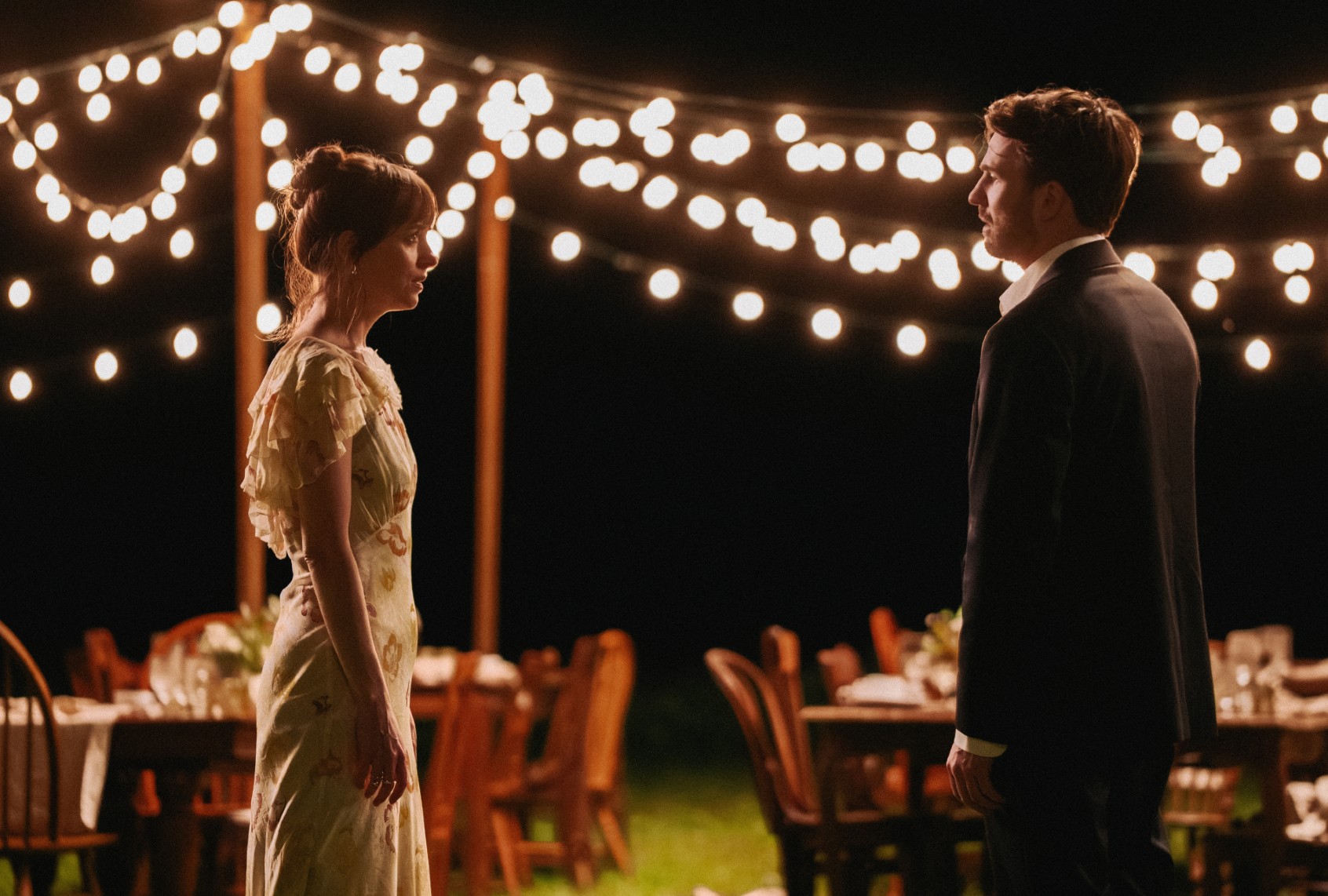
What makes “Notes to John” so worth reading — what to me, at least, justifies its publication — is something that also makes it unavoidably meta: The patient/doctor interplay in which MacKinnon recognizes the stories Didion tells herself in order to live.

The notes recount dinners and discussions, arguments and détante. There is confrontation and denial, improvements followed by backslides. The notes to John tell Dunne nothing he didn’t already know; what’s chronicled is a process by which a set of fresh eyes pushes Didion to accept that she can’t control every narrative.  

It’s a setup that wouldn’t work if the psychiatrist resembled the detached, slightly sinister Freudians who populated the milieus most familiar to Didion and Dunne — Hollywood films, cartoons in The New Yorker, their own fiction and nonfiction. “Notes to John” requires a compelling foil for Didion, and Roger MacKinnon is that: Director of the Columbia Center for Psychoanalytic Training and Research, former president of the New York Psychiatric Society, author, revered clinician. “If you can imagine John Wayne in a blue suit playing a psychiatrist, you begin to get the feel,” is how MacKinnon was introduced in a 1992 New York Times article about the impact of new drugs on emergency-psychiatry training protocols. And even a casual Didion reader probably knows how large Wayne loomed in her life and work. 

What makes “Notes to John” so worth reading — what to me, at least, justifies its publication — is something that also makes it unavoidably meta: The patient/doctor interplay in which MacKinnon recognizes the stories Didion tells herself in order to live and calls them out: 

“I said I may have been overprotective, but I never thought [Quintana] saw me that way. In fact she once described me, as a mother, as ‘a little remote.’ Dr. MacKinnon: “You don’t think she saw your remoteness as a defense? When she uses remoteness herself as a defense. Didn’t you just tell me? She never looks back?”

MacKinnon is fact-checking Didion in real time, refusing to let her apply her fearsome talent for story-spinning to her own life. Another dramatic touch is that the mother’s and daughter’s psychiatrists are in close contact, but often approach key pain points differently. MacKinnon encourages Didion to load parental guilt onto Quintana so she’ll reconsider self-destructive habits, while Quintana’s doctor thinks this is a bad idea. It can’t end well; as we already know, it doesn’t. 

John Gregory Dunne died in 2003; Quintana Roo Dunne died two years later. Didion’s final two books, 2005’s “The Year of Magical Thinking” and 2011’s “Blue Nights,” are her most personal, and “Notes to John” gives further context to both. Didion once wrote that “writers are always selling somebody out,” but her husband and daughter were, for her, not among them. She didn’t put the word “abuse” to the resentments and rages Dunne was well known for; she didn’t acknowledge alcohol’s role in the cascade of illnesses preceding Quintana’s death. “Notes to John” was never going to be a tell-all. But what it shows — contradictions, failings, rationalizations, self-delusion, despair — is moving, particularly if you’re familiar with the neon-bright dread of addictions that can’t be loved away. Concluding that Didion left these pages behind so they would eventually take shape as the penance of an unreliable narrator is surely too tidy. By saving as much of the truth as she could bear until none of those involved were around to feel the impact, though, she was right on brand. 

Zucchini deserves an apology — and a spot on your summer table

My earliest memory of my mother’s home garden was her formidable yet beloved zucchini plant. Tucked underneath a bush of sprawling, heart-shaped leaves would be yellow squash blossoms that blessed us with fresh squash in the blink of an eye. In our household, zucchini was a summer staple. In fact, there was never a dinner where we didn’t eat zucchini, whether it was enjoyed as a main dish or a simple side. Parmesan-crusted zucchini spears were enjoyed with baked salmon and a creamy mushroom risotto. Slices of homemade zucchini frittata were eaten with roasted potatoes and a mixed greens salad. Slow-roasted zucchini seasoned with lemon and herbs were paired with grilled chicken kebabs. And chunks of cooked zucchini were slyly thrown into soups and spaghetti.

I understand now why zucchini was being shoved down my throat shortly after my mother’s first harvest. It was an effort to get rid of her bountiful supply of courgettes before they succumbed to spoilage.

For decades, the summer squash has earned a bad reputation for being abundant, rather too abundant. As written by Bon Appétit’s former food director Carla Lalli Music, “Zucchini is like the glass of water that’s been sitting on your bedside table while you were away all weekend during a heatwave, and you know your cats have been drinking out of it.” 

The list of insults continued ("“Zucchini is like your husband’s gym socks. Even when they’re clean, you’d rather not touch them") until Music made her feelings about the squash glaringly clear: “Zucchini takes something that should be good — fresh summer produce — and makes it bad, just by, like, being itself.”

In culinary spaces and literature, zucchini is often treated in the same manner as weeds, shamed for growing untamed and unabashedly. Zucchini is one of the easiest plants to grow in any kind of soil. Its production is often described as “cyclical,” meaning the more you harvest, the more the plant will produce. A single zucchini plant can produce between six and 15 pounds of zucchini in one growing period. That’s up to 20 fruits depending on the size at harvest.

“Zucchini, the slender green squash from Europe that has become an American favorite, is overrunning the gardens, as it does every year at this time,” wrote food writer Florence Fabricant for The New York Times back in August 1980. “Plants that seemed to be picked clean the day before are found bearing a new crop by the next morning.”

Fabricant pointed to the influx of zucchini-themed cookbooks released at the time, saying, “We are now as deluged with zucchini cookbooks as we are with zucchini.” There’s “The Zucchini and Carrot Cookbook” by Ruth Conrad Bateman; “The Zucchini Cookbook,” published by Planned Parenthood of Santa Cruz County, California; “Zucchini Cookery” by Virg and Jo Lemley; “The Zucchini Cookbook” by Paula Simmons and “Zucchini Lover's Cookbook” by Addie Gonshorowski. The recipes are plentiful and experimental, ranging from zucchini with walnuts and zucchini pancakes to zucchini with Bagna càuda sauce and zucchini lasagna (the pasta is replaced with thin slices of squash).

We need your help to stay independent

Zucchini cookbooks are still plentiful today, underscoring an ongoing desire to find new ways to enjoy zucchini and squash (pun intended) “zucchini anxiety.” Per an old thread posted in the r/Cooking subreddit, a desperate home cook with two pounds of surplus zucchini on their hands inquired, “Help! I have too much zucchini! What should I cook before it spoils?” Similarly, another homecook burdened by dozens of zucchini asked for ways to make the squash more palatable (“Help me get over my prejudice against zucchini before I drown in the stupid vegetable…I’ve always found the texture unpleasant and the flavor uninspiring, but I also really hate to waste food,” they wrote). Just this week, a self-proclaimed zucchini hater sought out recipes that mask zucchini’s “unappealing” texture and “watery” taste.


Want more great food writing and recipes? Sign up for Salon’s free food newsletter, The Bite.


It’s interesting how a humble squash taps into such rich emotional territory: shame, excess, disgust and the pressure to transform glut into value. But frankly, zucchini deserves so much more love. Its most criticized traits are actually its biggest assets. Unlike most vegetables and squash, zucchini is highly versatile considering that it can be cooked in various ways and used in sweet and savory dishes. There’s also power in zucchini’s lack of bold flavors, making it a blank slate for home cooks and chefs alike to experiment with.

As for its abundance problem, zucchini has been described as a “gateway drug” to combat rising food insecurity through community gardening and community engagement. According to a 2023 EdNC report titled, “Zucchini and a goal of zero hunger: This school opened a community garden just in time for summer break,” zucchini along with squash, cucumbers and watermelon are planted in the West Oxford Elementary School community garden. The school is located in Granville County, North Carolina, where 18 percent of children under the age of 18 experience food insecurity and 59 percent of children receive free and reduced school meals, according to the 2021-2022 Granville County Profile. In 2021, data from Granville County indicated that 21 percent of children under the age of 18 experienced food insecurity while the percentage of students who received free and reduced school meals remained unchanged.

That’s all to say that zucchini doesn’t deserve the overwhelming hate it gets. Yes, it may be overbearing, but at its core it’s humble, uniquely delicious and a quiet problem solver.

“No Kings” protests test FL protest law

Florida’s controversial “anti-riot” law, signed by Gov. Ron DeSantis in 2021, resurfaced ahead of nationwide “No Kings” protests and a parade celebrating President Donald Trump’s birthday in Washington, D.C.

The law grants civil immunity to drivers who injure or kill someone while fleeing a protest blocking a roadway, but only if the driver claims they feared for their safety. Critics argue this provision encourages reckless behavior and endangers public safety.

In a podcast interview, DeSantis defended the law, saying drivers surrounded by a threatening crowd have the right to “flee for your safety,” even if it means hitting someone. He added that such actions would be the protesters’ fault for obstructing traffic.

Legal experts warn that while the law offers a defense in civil court, it does not grant immunity from criminal charges. Drivers could still face prosecution if their use of force is deemed excessive or unjustified.

The “No Kings” protests, scheduled to coincide with President Trump’s 79th birthday and Flag Day, aim to oppose perceived authoritarianism. Demonstrations are scheduled in cities nationwide this afternoon, and Trump’s birthday parade is this evening in the nation’s capital.

The revival of DeSantis’s law sparked concern among civil rights groups, who say it disproportionately targets marginalized communities and threatens free speech.

With tensions rising, authorities urge all parties to respect safety and rights as protests and celebrations unfold.

UPDATED: Minnesota lawmakers targeted in shooting

The authorities are currently seeking 57-year-old Vance Boelter, suspected of shooting two Minnesota lawmakers. Boelter was previously appointed by Governor Walz in 2019 to the Governor’s Workforce Development Board. Police found fliers in his car with the words “No Kings,” a reference to the group protesting nationwide today. The group also canceled Northeastern Minneapolis rallies and urged protesters and residents to follow local law enforcement directives, including the ongoing shelter-in-place order. Officers briefly confronted Boelter posing a police officer at Rep. Hortman’s home before he fled.

Updated June 14, 2025 at 2:00 P.M.


Former Minnesota House Speaker Melissa Hortman and her husband were killed in a targeted shooting Friday night. State Sen. John Hoffman and his wife were also shot and wounded.

Gov. Tim Walz confirmed the deaths Saturday, calling the shooting a “politically motivated assassination.”

“We must all… stand against all forms of political violence,” Walz said.

The suspect, who remains at large, was reportedly impersonating a police officer. A manhunt is ongoing in Brooklyn Park, a northern suburb of Minneapolis, where both lawmakers served.

Hortman, a Democrat first elected in 2004, was a key legislative leader and former House Speaker. Hoffman, also a Democrat, has served in the Senate since 2012 and previously held local school board leadership.

Both couples were shot at their homes in the northern Minneapolis suburbs of Brooklyn Park and Champlaign. The motive is still under investigation, but authorities said the attack was politically driven.

The Minnesota Bureau of Criminal Apprehension is leading the search for the suspect.

Updated 10:00 A.M. CT, June 14, 2025


A shelter-in-place order remains in effect Saturday morning in Brooklyn Park, a northern suburb of Minneapolis, after two Minnesota state lawmakers and their spouses were shot by a suspect impersonating a police officer, officials said. A mobile alert went out to Minneapolis area residents warning them to "shelter in place."

Democrats Sen. John Hoffman and Rep. Melissa Hortman and their spouses were among those injured. Police have not confirmed whether the shootings took place at the same location but said the victims were specifically targeted. The extent of their injuries has not been publicly released.

The suspect, described as a white man with brown hair wearing body armor over a blue uniform-style shirt and pants, remains at large and is considered armed and dangerous. Authorities are urging residents near Edinburgh Golf Course to remain indoors and call 911 with any information.

Gov. Tim Walz said the State Emergency Operations Center has been activated, and that state agencies are assisting local law enforcement. The FBI and Hennepin County Sheriff’s Office are also involved in the search.

The shooting comes amid a rise in politically motivated threats and violence across the country. Minnesota, already a flashpoint for national debates on policing and public safety following the 2020 murder of George Floyd in Minneapolis, has faced heightened tensions in recent years between officials and extremist groups.

The investigation is ongoing, and officials have not released a possible motive.

Original story: Posted June 14, 2025 at 10:00 A.M. ET

Don’t call it a rom-com: With wit and heart, “Materialists” transcends the tired form

Back when America’s greatest straight-shooter, Wendy Williams, had her daily talk show — or, “The Before Times,” as I like to call it — there were a multitude of regular bits Williams would do for her audience that frequent viewers lived for. One of the best oft-repeated Wendy-isms was sparked when she’d recall something from her fascinating, checkered past. Williams would look into the camera, mime taking a drag from a cigarette, throw her head back and say, “I have lived!”

Watching “Materialists,” Celine Song’s star-studded, highly anticipated follow-up to her 2023 debut, “Past Lives,” it’s hard not to imagine the writer-director working over her laptop late at night, deep into her screenplay, lighting up a Marlboro Red and uttering the same three words. Song’s film is, after all, marvelously layered and rife with realism. Her simple, unvarnished honesty stings in all the right ways, even in a time when most of us go to the movies looking for a break from the weariness of everyday life. With the way “Materialists” has been marketed — with the classic voiceover narration in its trailer and simple, no-frills poster — many viewers who are looking for that reprieve might feel a bit duped. Wasn’t this supposed to be a fresh, elevated take on the romantic comedy, where Dakota Johnson must grapple with the impossible decision of choosing between Pedro Pascal and Chris Evans? A movie where the perennially single New York matchmaker has finally met her match in two highly eligible bachelors?

Dakota Johnson and Chris Evans in "Materialists" (Atsushi Nishijima)
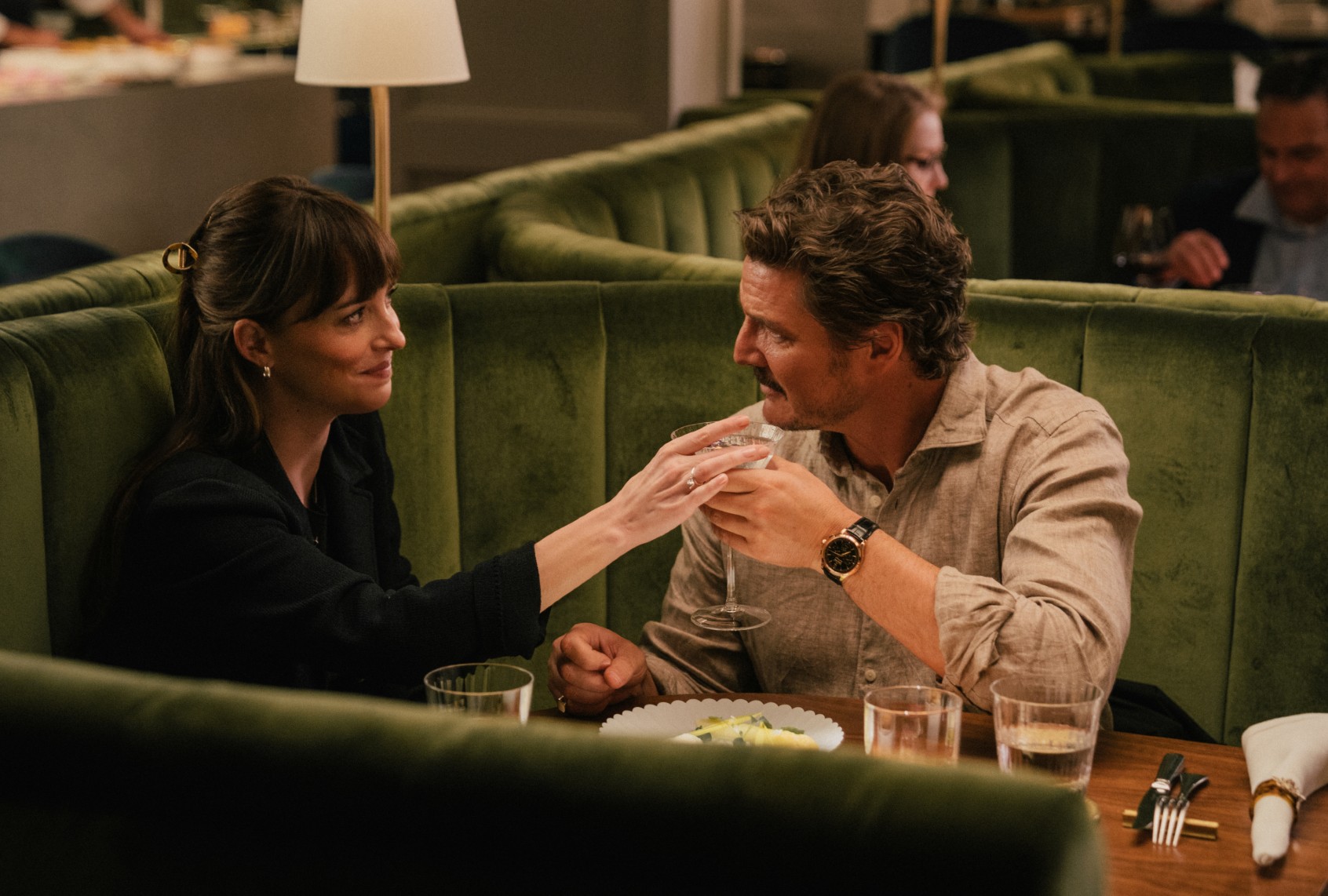
 Song resists the urge to follow a formula, forging questions about love and romance that can’t all be answered by the time the credits roll. Love is never that simple, and Song’s take on the romantic comedy is not for the idealists who believe it can be.

While “Materialists” does boast plenty of the old-school wish-fulfillment you’d find in films like “13 Going on 30” and “How to Lose a Guy in 10 Days,” the lavish New York highrises and dreamy dates only last as long as the buzz from a particularly effervescent glass of good champagne. Navigating dating today, one has to be practical, and Song’s characters weigh risk and reward constantly, stopped by their heads before their hearts can do all the talking. She understands there is a formula to our narcissism and neuroses; patterns and mathematical sets of criteria drive our decisions. When overcome by uncertainty, pragmatism is the way to go. Yet, Song resists the urge to follow any formula herself, forging questions about love and romance that can’t all be answered by the time the credits roll and the lights go up. Love is never that simple, and Song’s take on the romantic comedy is not for the idealists who believe it can be.

That’s not to say Song is entirely disinterested in genre conventions, only that she regularly finds new and thoughtful ways to approach them. Take Johnson’s character Lucy, who clacks her way through the West Village in stilettos and a tailored blazer, treating clients for the matchmaking business she works for, Adore, to coffee as she runs down their dating do's and don'ts and dealbreakers. From Lucy’s outward appearance and a quick peek inside Adore’s startup-chic offices, which look as though they’ve been furnished from the expensive side of Wayfair, one would think Lucy is rolling in dough. This is New York, the country’s most expensive city, and Lucy is in a reasonably swanky Manhattan pad, just like the Jenna Rinks and Andrea Sachs’ of the rom-com world. But as she reveals during a pseudo-client pitch to the multi-millionaire private equity magnate Harry (Pascal), Lucy only makes around $80,000 a year after taxes. (Which, let’s be real here, is nothing to scoff at outside of the fantasy of a rom-com.) Her air of wealth comes with her consummate professionalism. If Lucy wants to hook a big fish to present to her clients, she needs to look the part, and the only thing that attracts a man more than money is a woman who looks like she doesn’t need any.

That’s also what makes Harry such a unique catch. Just as Lucy isn’t entirely who she presents herself to be, neither is Harry. He isn’t chronically concerned with the physical details of who he dates or their salary, only their potential connection and the value they could bring to his life. Like Lucy, he looks at dating as a series of ratios and statistics, numbers he can calculate that will add up to the best, happiest, most stable future. And just as Lucy’s thinking she’s found someone who sees life the same way she does, chatting at the singles table of a client’s wedding, she’s interrupted by a mathematical anomaly: her ex-boyfriend, John (Evans). 


Start your day with essential news from Salon. Sign up for our free morning newsletter, Crash Course.


The two haven’t seen each other in years, after an argument about money on their anniversary ended in a messy shouting match in the middle of the street. Lucy’s upped her net worth since then, but John, who’s working the wedding as a cater-waiter, is still scraping by, trying to make it as a theater actor. Nevertheless, he faithfully remembers Lucy’s drink order, setting down a Coke and a beer just as Harry asks what she’d like. No amount of on-paper perfection can match the cool finesse of an ex you never really got over. 

In a regular rom-com, this would be the setup for a classic love triangle. But as Song so blisteringly demonstrated in “Past Lives,” reducing the complicated push-pull of romantic emotions to a simple storytelling device is a disservice to the heart. In her first feature, about a woman who reconnects with her childhood crush as a married adult, Song explored the ways love and rationality war, and how the question of what could’ve been never fully goes away. In “Materialists,” she builds on that query, creating her own thematic universe where movies made by adults, for adults, have problems that actually reflect the adult experience. 

Dakota Johnson and Pedro Pascal in "Materialists" (Atsushi Nishijima)

Song resists the urge to deliver her characters in neat, palatable packages. A perfectly archetypal rom-com lead, looking as gorgeous as Johnson, Evans or Pascal, would be enough to draw audiences regardless of whether the film itself was realistic. Instead, we meet Lucy, John and Harry as they are: people with personalities, quirks, flaws and regrets. They war between rationality and heart, ego and id. They are consumed with themselves, but long to be outside their heads. They are powerless to the pull of memory, yet paralyzed by their contemporary comforts. 

To someone like Lucy, John’s resistance to giving up his art is admirable until it becomes aggravating. But isn’t someone with real passion going to be the person you want to be with as life moves forward? As Lucy so astutely puts it, opulence and a generalized sense of ease are great, but love has to be on the table, too.

As Lucy moves forward with Harry and puts John on the back burner, she steps her Afterpay-charged Miu Miu heels into the world her clients have been seeking access to. The question of whether she’ll meet her material needs vanishes practically overnight, but her whirlwind romance spins so fast that her pleasure center and perception of reality dull even faster. The first half of Song’s film is witty and strikingly romantic, giving her audience a firsthand look at what it feels like to be a woman like Lucy, falling in love with someone who checks every box. But when Lucy’s most persistent client, Sophie (Zoë Winters), experiences a crisis, Song makes a bold and brazenly honest tonal shift that spits Lucy out of love’s vortex and back into the real world, forcing her to realize that checked boxes don’t eliminate risk.

While this change in mood does see Song spoon-feeding some of the film’s themes that could stand to be less overt, it’s difficult not to be dazzled by the earnestness on display, thanks largely in part to her central trio of actors. Anyone who has somehow picked up the notion that Johnson can’t hold a film like this together has been misled. As Lucy, she is refreshingly droll, hitting the film’s comedic beats with a softer touch that lends itself to her character’s tendency to play the spin doctor. It’s impossible not to be charmed by her, and even easier to see how men like John and Harry, who seem so different from one another, could fall head over heels for Lucy. Pascal’s role is somewhat smaller (though no less critical) than Evans’, but both actors make fantastic use of an opportunity to work with a filmmaker like Song, turning in some of their finest work to date. 

Dakota Johnson in "Materialists" (Atsushi Nishijima)

In Evans’ case, “Materialists” boasts his best performance since 2013’s “Snowpiercer.” John is a bleeding-heart romantic who clings to his us-against-the-world fantasies at the detriment of his livelihood. To someone like Lucy, his resistance to giving up his art is admirable until it becomes aggravating. But isn’t someone with real passion and a work ethic going to be the person you want to be with as life moves forward? As Lucy so astutely puts it, opulence and a generalized sense of ease are great — perfect, even — but love has to be on the table, too.

In exploring the pull between love and liquid assets, Song cleverly acknowledges how we’ve been facing this internal war for epochs. What has changed from the first time two people fell in love, and what hasn’t? And is love in its purest and simplest form enough in a world dictated by cash flow and ruled by big egos? 

As was the case with “Past Lives,” Song isn’t searching for a definitive answer because she knows that one doesn’t exist. What constitutes romance is different for everyone, and when you get to the matter of love itself, issues become even more knotty. Humans are too complex to have their emotional journeys tied up with one 120-minute movie, and though she opts for a relatively feel-good ending, the amount of interpersonal work Song puts her characters through suggests that their stories continue even after the credits have finished. Life doesn’t screech to a halt after a Pollyanna rom-com ending, just like love isn’t cast in amber, destined to be preserved forever. We have to keep going to see what happens next, remaining open to the possibility that love could end up as fleeting as a material comfort. Being scared of losing something is what makes you work that much harder to keep it.

“The road to authoritarianism”: Tim Walz says the time for “sternly worded letters” is over

Minnesota Gov. Tim Walz was testifying before Congress about his state's handling of immigration when he learned Sen. Alex Padilla, D-Calif., was forcibly removed from a Department of Homeland Security news conference Thursday.  

The irony, he told the attendees of the Center for American Progress’ “Listening to Lead” event Friday, was in lawmakers grilling him and his colleagues, Govs. Kathy Hochul, D-N.Y. and JB Pritzker, D-Ill., over the “incredible crime of treating people like human beings” as FBI agents tackled a sitting senator to the ground and handcuffed him in Los Angeles. 

“I am not prone to hyperbole. I am prone to, like, popping off a little bit. I know that,” Walz said, prefacing his argument that Americans are living in a “dangerous” time. “I believed all along we were marching towards authoritarianism, and people were telling me in December, ‘You know, you're overreacting.’ And I said, “The road to authoritarianism is littered with people telling you you're overreacting.”

Walz shared the anecdote and warning Friday during an hour-long conversation at the Center of American Progress in Washington, DC, moderated by CAP President Neera Tanden. The former vice presidential candidate spoke to a crowded room and cohort of virtual participants about a range of topics, spanning the cuts to Medicaid and the Inflation Reduction Act to his approach to immigration as a Democratic governor and constructive criticism of the Democratic Party.

Democrats look for a quick message to address conservative voters, whom they accuse of voting against their own self-interests, to inform them of an issue like the impact of tariffs and solve a problem, he argued. 

“Our message has to be more diverse,” Walz said. “You can't just say they voted against their own self-interest because they're telling us, for some reason, something in there motivated them to do that.”

The debate over immigration is an example, he said. Walz referenced his arguments during the House Oversight Committee hearing on sanctuary states and cities with him, Hochul and Pritzker as an example of the kind of messaging Democrats should lean into to best seize on the impact of Republicans’ policies.

We need your help to stay independent

The governors, he said, spoke about complying with federal law in contacting DHS over immigrants arrested and convicted of felonies — but also how they wouldn’t contact Immigration and Customs Enforcement if someone hadn’t yet received due process. 

“I think, as Democrats, striking a balance between doing immigration according to the law and keeping our humanitarian values in place shows that we do care,” said Walz, who earlier in the week said he would sign a recently passed budget bill that would end state-funded health care for undocumented adults. Walz, for his part, said Friday that the move was a compromise with Republican state lawmakers who he said threatened a government shutdown.  

Still, the Republicans have capitalized on and taken the Democrats’ kindness for weakness, Walz added. He said that Hochul and Pritzker are examples of leaders who rose up to protect less fortunate Americans in their respective states and don’t allow the Republicans to bully their residents.


Start your day with essential news from Salon. Sign up for our free morning newsletter, Crash Course.


“I think there needs to be a more robust Democratic Party, and I don't think all these sternly worded letters get it done,” he said, adding. “We have to have a robust strength of morals, value sticking up for those less fortunate — that's why I think it's a mistake to focus just on economics and allow trans children to get bullied.”

“I think they have to go in, and we look weak if we don’t do it,” Walz added.

Walz said that when facing a president who “sucks up so much oxygen” and dominates the news cycle, people and leaders on the center-left of the political spectrum should be working to fill in “all the lanes” whether it be by joining podcasts, hosting large rallies like Sen. Bernie Sanders, I-Vt., and Rep. Alexandria Ocasio-Cortez, D-N.Y., or holding town halls in places like Wheeling, W.Va. 

He also encouraged fellow Democrats to take a play out of his book, recalling the success of the heckling he started by calling Trump and his allies “weird” during the 2024 presidential campaign as well as his “full blown feud” with tech billionaire Elon Musk. 

“We're going to have to be better at it,” Walz said about hitting Trump and his allies back, referencing the gap between the working class and the wealthy. “We have to single them out.” 

Deliberative democracy: Sounds boring — but it just might save us

For more than 30 years, Stanford political scientist James Fishkin has been exploring and demonstrating the capacity of small, representative "mini-publics" to make thoughtful meaningful political decisions. The results of those explorations, and their potential for the future, are presented in his new book,"Can Deliberation Cure the Ills of Democracy?"

When Fishkin began his work around the end of the Cold War, most people in academics and the general public still believed that democracy was working well. Francis Fukuyama’s influential bestseller "The End of History and the Last Man" even argued that we had reached “the end-point of mankind's ideological evolution and the universalization of Western liberal democracy as the final form of human government." There certainly were academic debates about democracy’s flaws, both practical and theoretical, but Fishkin’s interests seemed marginal to most of them.

Things have changed dramatically since then. Partisan polarization and voter alienation are key symptoms of worldwide democratic backsliding. Those are symptoms of mass dissatisfaction with democracy’s effects on people’s everyday lives, and Fishkin’s work speaks directly to ways we might remedy the situation, and combat the dramatic rise of corrosive disinformation. 

While Fishkin’s book takes account of the major issues in political philosophy and political science that have been debated in recent decades, what’s most compelling about it are his empirical results. Those results suggest that ordinary citizens, in small groups composed of representative samples, can make sound, fact-based decisions — at the same public-spirited level that James Madison sought to ensure in his design of the U.S. Constitution

Fishkin draws on the deliberative aspects of Madison’s design, along with the Athenian model of democracy — which involved multiple deliberative bodies fulfilling different functions — as inspirational guideposts. But the model developed in his own work over the last 30 years, along with collaborators around the world, provides the strongest argument. 

He clarifies what it means for democratic government to reflect the will of the people, specifying four criteria: Inclusion on an equal basis, meaningful choice, consequential deliberation, and impact on policy. And he demonstrates, through a diverse range of examples, that properly designed deliberation can vindicate the promise of democracy, even at a moment when global faith in that promise seems to be fading to nothing. 

In my recent conversation with Fishkin, I focused mainly on his results rather than on the underlying academic arguments — which are addressed at length in his book. This interview has been edited for clarity and length.

The title of your book poses a question: Can deliberation cure the ills of democracy? But that in itself raises questions. Here’s the first one: What do you mean by deliberation?

By deliberation, I mean when people weigh the trade-offs for competing reasons for collective action for policy proposals. When they actually consider arguments for and against and discuss them in a civil manner, in an evidence-based environment, with fellow citizens.

"When people discuss in moderated forums, they actually consider the competing arguments. If they engage in discussion with other citizens in a civil, evidence-based environment, magical things happen."

The core idea of deliberation, even the root of the word, goes back to the idea of weighing. But we have found that only when people discuss in moderated forums with diverse others do they actually consider the competing arguments. If you tell them an argument that’s different from the position they already have, it may backfire. But if you engage them in a discussion with other citizens in a civil, evidence-based environment, magical things happen. 

We have a particular design for this deliberation, which has now worked in 160 cases on every inhabited continent around the world. It does a lot of quite surprising things in this era of disinformation and polarization.

Could you say something about some of those 160 cases, to give a flavor of what they look like? 

There are a lot of cases in the book. We've done these things all over the world and have a track record. So, when President Moon Jae-in of South Korea came into office [in 2017] he had an anti-nuclear position. That is, his party did. But he had a couple of nuclear reactors that were half built and had to make the difficult choice: Does he continue building the nuclear reactors? If he doesn't, then not only are there sunk costs, but there's the problem of importing fossil fuels, and he's concerned about climate.

We had done a number of projects with South Korean collaborators. So he announced that he would appoint a scientific committee and they would do a national deliberative poll to decide whether or not to build the reactors. Public opinion moved sharply in favor of building them, and they're now built.

You also had another energy-focused deliberative poll, here in the U.S. 

Years ago, when I first started, we did a number of projects in Texas about how the state was going to get its energy, because it was growing very fast. The Public Utilities Commission sanctioned these projects with each of the eight utility companies in the state, and the result was a big surprise. 

We had an independent advisory group, we had good samples of each of the areas of Texas the utilities served and we had all the options for providing electricity: coal, natural gas, conservation — meaning cutting the need for energy — and renewable energy, especially wind power. The big surprise in all eight areas was that when people were asked if they would pay more on their monthly bill — and remember, these are representative samples, in some areas involving quite poor people — they were willing to pay more for wind power, because it was clean. 

"What the people really think is the fundamental question facing democracy, which has got to make a connection with the will of the people. That's almost impossible to measure with all this noise and disinformation and misinformation."

The percentage willing to pay more went from 52% to 84%, averaged over the eight projects. This led the commission to sanction big investments in wind power, and the state went from being the dead last among the 50 states in the amount of wind power to be first by 2007, surpassing California. There's been no looking back. It's still the leader in the United States in the amount of wind power, and has also made big investments in conservation. 

I developed this process in order to assess the will of the people, because everybody's trying to persuade, manipulate and distort public opinion for their own interests. So what the people really think is the fundamental question facing democracy, because democracy has got to make a connection with the will of the people, and that's almost impossible to measure with all this noise and disinformation and misinformation. I developed this for that purpose, and it served it well, as I say, in 160 cases, on all kinds of topics, around the world. 

But while you’ve been doing this, democracy on a global scale has been struggling.

We have extreme partisan polarization. This puts democracy at risk because it creates deadlock and a perception that democracies can't get anything done. So we need to deal with the polarization. So when we did this America in One Room project …

Which Salon covered …

I was very surprised that the deliberations produced dramatic depolarization between Republicans and Democrats on the most contested issues — and the most extreme people where the ones to change the most. I think that's probably because they were in their filter bubbles and had been the least exposed to the other side of the political divide and the arguments that were motivating them. 

We found on immigration, for example, that before deliberation, about 80% of the Republicans wanted to send all undocumented immigrants back to their home countries. After deliberation, that dropped to 40% and we had similar movements of opinion on all the other immigration topics among the Republicans. And we had some big movements among Democrats on the most expensive redistributive proposals. So both sides moved dramatically closer together. 

Talk about the one-year follow-up.

We went back to those people year later to see how they voted in the election in 2020. We had a large control group, and they got the election almost perfectly right. The people who deliberated moved in dramatically different ways, according to their considered judgments on the issues, and it happened to lead them to support Biden over Trump. 

"Before deliberation, 80% of the Republicans wanted to send all undocumented immigrants back to their home countries. After deliberation, that dropped to 40%." 

We sorted this out in an article in the American Public Science Review, which is informally summarized in the book, where we found that the people who deliberated became more civically engaged. They continued to spend a lot more time and attention on the campaign. They kept learning more. They developed a greater sense of political efficacy. They thought they had opinions worth listening to. And when it came to voting, they made a coherent connection between what they thought about the issues and how they voted. 

My political science colleagues — some of them have said that the only thing that explains voting is party loyalty. It's all tribalism, there's nothing else. If you find a deliberative voter, that's about as common as finding a unicorn. Well, the deliberative process created unicorns a year later. 

You followed that with an online project using AI. How did that work?

We did the same thing on climate change. We had 1,000 deliberators,  and we have developed an AI-assisted platform with computer scientists here at Stanford, so we don't need the moderators. We divided that 1,000 people into 100 small groups of 10. The platform controls the queue for discussion and makes sure that everybody speaks. It invites those who haven't volunteered to speak: Everybody gets 45 seconds, then you move to the next person. People begin to get the rhythm of that. It intervenes if people are uncivil to each other, and it guides people in coming up with the key questions that they want to ask panels of competing experts who represent different points of view. 

There's an hour and a half in small groups, and an hour and a half of plenary sessions where they asked the questions. The experts don't give speeches, they just respond to people's questions. Then another hour and a half in small groups and another hour and a half of plenary sessions. It goes on for an entire weekend. 

The platform works just as well as face to face, and people like it as much, but it's much cheaper. You don't have to fly people in, and you can expand to any number without training hundreds or thousands of moderators. We developed it with the idea that eventually we can spread this to very large numbers. But for deliberative polling, we have representative samples so we can show what the public would think. If we can spread the model, we could show what the public will think after the deliberative process. 

So what were the results?

We had depolarization. Republicans changed very dramatically on climate change. For example, instead of about 35% of the Republicans thinking there was anything to climate change, it went to 55% pretty consistently, and both Republicans and Democrats moved closer to supporting most of the 68 or so specific proposals for what to do about climate change. 

We went back to them a year later, before the midterm elections, and we found that deliberators voted according to climate change as a preference, but the control group voted on all the other issues you'd expect — you know, immigration, crime, things like that. So we got a big difference. 

Looking at the big picture, how would you summarize your findings? 

We have a process which, every time we use it, produces surprises. The first surprise is that people change their views. The second surprise is that they change their views in a way that's depolarizing. A lot of political scientists have been saying that our divisions are not only polarized, they're calcified, meaning they're immovable. No, they're not immovable. If you have a condition where people actually learn to listen to each other in a civil way, they move in surprising ways. Then their voting is not just tribalism and party loyalty. When people actually have the experience of thinking about the issues, it has a lasting effect even a year later. 

So we think that if this kind of process became routine and it spread, it would cure the partisan divisions, it would cure the ambiguity about what on earth the will of the people could mean. Instead of people considering just an impression or soundbites or headlines, or not having any real opinion at all and just deferring to their parties or answering questions almost at random, we’ve shown that everybody is capable of informed judgment and deliberation on a reasoned basis. 

"Every time we use it, this process produces surprises. The first surprise is that people change their views. The second surprise is that they change their views in a way that's depolarizing."

We've done this, as the book describes, all over the world, even in countries where literacy levels were low.  Everywhere we go, we find that the public's actually very smart if you give them a chance to think about the issues and you make it easy and inviting for them to do so. 

As I mentioned, we covered America In One Room, which I thought was a great example. But the media as a whole ignored it. What can be done to make this research more impactful, to actually change how democracy works? 

In some countries we've had more success. I'll give you an exotic example. I'm just back from Mongolia, a competitive democracy in between Russia on one hand and China on the other. We had a big celebration of 10 years of deliberative polling. In Mongolia, before they can change the constitution they have to do a national deliberative poll, with an independently elected advisory committee supervising and vetting suggestions for constitutional amendments from the public. 

More than 700 people gathered from all over the country for face-to-face deliberations in the parliament building. They evaluate all the proposals and the results are sent by the advisory committee to the parliament. If the parliament approves an amendment by two-thirds majority, it’s passed.

That has now happened twice. Most recently, because the public thought they had two big parties that were at loggerheads and in deadlock. The people thought there ought to be additional parties, and proposed an amendment which would add additional members of parliament. You know how hard it is to get the public to pay for additional politicians? You can imagine, right?  

But the additional members would be elected by proportional representation, on the argument that would bring in additional parties. That passed by two-thirds vote, they had an election and, sure enough, more third parties were elected. That speaks to a profound problem that countries around the world face: How can they combine the thinking of the public and the thinking of the elected representatives in a coherent process? This combines the thinking of the public in the deliberative poll with the representatives in the parliament, and so they changed the constitution. 

That’s a dramatic institutional change. But it’s more common that you have examples responding to policy problems that are politically difficult, if not outright crises. 

We have done this a bunch in Japan. In particular, one happened when the government was about to privatize the pension system, because the Japanese population is aging and the ratio between the workers and retired people is worsening. They wanted private accounts, and in polls about 70% of the public was in support. But my colleagues in Japan at Keio University, working with us, created a deliberative poll. It turned out that when people actually understood that they would have to take responsibility for their private accounts and invest them in the stock market, they didn't want the risk. They wanted something guaranteed and they were willing to pay more taxes, particularly a consumption tax they thought could be raised to finance the pension system. 

So support for privatization went from 70% to 35%, it was cut in half. The government killed the proposal for privatization and adopted the proposal of raising the consumption tax instead. They actually implemented the results of the deliberative poll and were, in fact, impressed by the thoughtful considerations of the public. There are lots of cases like that in different countries. 

Your book also features a variety of other examples and impacts that could enhance democracy. Tell us about some of those.

We found such lasting effects from deliberation. Once people do this, they have greater respect for what I would call the guardrails of democracy, for protecting the voting process and everybody's access to it. We did another project like that, America in One Room, and we think that should be a form of civic education that can spread in the schools. On our website, if you search for “deliberation in the schools” you'll see that we've been doing projects in schools all over the United States.

"I think that deliberation, whether spread broadly in the schools or before national elections, before referendums, before initiatives, could become part of everyday life."

We think it should be spread in the schools, and we think it could be used to create ballot propositions. We did that once in California. There ought to be a process where these deliberations give rise to ballot propositions, instead of very wealthy individuals funding signature collection drives. It's $3 million or more to get something on the ballot there, even before you get to a campaign. There ought to be a way of getting public interest propositions on the ballot, and then you ought to have deliberation about the merits of the ballot proposition, and that's on the ballot as a recommendation.

I think that deliberation, whether spread broadly in the schools or spread broadly before national elections, before referendums, before initiatives, could become part of everyday life. If it did, we would end up with more deliberative voters, more mutual respect, less extreme polarization. We would cure some of the things that are crippling our democracy. 

There are other forms of public deliberation out there that you distinguish from yours, such as the citizens’ assemblies that have been used in Europe. Can you explain how your model differs from those, and what some of the problems are that your model avoids? 

The first thing is, if you're going to have a random sample of people deliberating, you need to have a good random sample. You need to know where the people in the sample start and whether they are representative. So in the French citizens’ convention or the Irish citizens’ assemblies — those are the most prominent examples — there was no measure of public opinion at the beginning. By law they couldn't collect it in Ireland, and the French didn't collect it. 

The French recruited their sample for their national citizens’ convention on climate by sending out 400,000 text messages. They ended up with 150 people, and they never measured whether the people who were recruited were especially interested in climate or not. But of course they were — they were being recruited to deliberate for a whole year, and it ended up being two years. Who's going to give up a year or two of their life unless they are actually interested in the issue? 

Right. Your process is very different.

"As a byproduct, it has all these wonderful effects: People become more tolerant of each other, more respectful, more engaged in public dialogue."

When we recruit people, we don't tell them what the issue is. But before we invite them, they've taken a questionnaire and we find out their attitudes. Then we have a control group that doesn't deliberate and answers another questionnaire at the end of the whole process. So we can compare the deliberative group's views with the control group, and if it's a high-quality poll we know whether it's representative. It seems to me that the first question is, “Why should other people pay attention?” The reason is that they should if the people who deliberate are representative of the country. If they are, and then they change their views for coherent reasons, it's worth listening to those coherent reasons and understanding why they change. That's the basic logic of the deliberative poll, but not the citizens’ assembly. 

But it's not the only difference.

The other problem is that a citizens’ assembly has to come to an agreed consensus, sort of like a jury verdict. All the criticisms of deliberation come out of jury literature. Juries do a fairly good job of deciding certain questions of fact — is somebody guilty or not? — but they are dominated by the more educated people, the more advantaged. Jury foremen are almost always educated white males. So they are dominated by certain groups and then, as Cass Sunstein has shown, they move to more extreme positions as people go along with the rest of the crowd, because of the social pressure of reaching a verdict. 


Start your day with essential news from Salon. Sign up for our free morning newsletter, Crash Course.


We collect our opinions in confidential questionnaires. People never have to say how they finally come out. Rather, they engage in a discussion. Sometimes they play devil’s advocate. They think about the issues and then take a private questionnaire at the end. So we insulate the considered views from the social pressure to go along. That's very important, because we don't get the movement towards extremity that you get in jury experiments, we don't get dominant action by the more advantaged people, and we have samples large enough to be statistically representative of the country and for the opinion changes to be evaluated statistically. So we know what's a significant change and what is not. 

That's why our model is different. We want to protect the integrity of the individual opinions before and after, and we want to understand the opinion changes.  So these other versions are not based in social science in the same way. I think we have to use social science to protect our credibility. I am interested in showing what people would really think, what the will of the people is on a given issue. 

As a byproduct, it has all these wonderful effects: People become more tolerant of each other, more respectful, more engaged in the public dialogue. They vote according to their considered judgments about what should be done, not necessarily just in terms of party loyalty. 

Finally, what's the most important question I didn’t ask? And what's the answer? 

Well, why do I have a question mark at the end of the title of the book? I have a question mark because it's a question of collective political will. You don't need to change the Constitution to spread deliberation. You just need the political will to do it. 

It's very much like Benjamin Franklin's famous response to the question, "Are we going to have a republic or monarchy?" He said, "A republic, if you can keep it." Well, you could have a deliberative system, a more deliberative society, if you had the political will to implement it. I have a whole list of things in the back, most of which we have tried and shown to be viable with important results. We've test-driven the process in all kinds of contexts. and if we could just get the attention of the public and had all kinds of venues to spread it, we could cure the ills of democracy.

So the question mark is for us, not for me. It's for us. By employing technology we can make it more practical, but it's still the question of: Do we want to do things the way we’ve been doing them, where democracy is under threat because people have a perception that it doesn't get anything done? Or do we want change? 

Our film imagined a post-Roe nightmare. Then it came true

When I first met Amy in the emergency room, she had a minor laceration on her finger. She claimed it was from an accident in the kitchen, but her cowering posture, downcast eyes and hesitant responses to basic questions suggested there was more to her visit than she was letting on. 

Amy reminds me of the girls I grew up with. Delicate, but exhausted and under pressure. She works long hours at a convenience store with a manager who offers no flexibility. Determined to save enough for college classes toward her degree, Amy has also shouldered the responsibility of supporting her mother, who has grown dependent on painkillers. She cleans homes to cover unexpected expenses, like becoming pregnant after a condom broke during sex, but she was unable to scrape together enough cash to purchase the morning-after pill. 

On June 3, the Trump administration revoked guidance that required hospitals to provide emergency abortions for patients in need. This national directive was issued in 2022 by the Biden administration, using the Emergency Medical Treatment and Active Labor Act (EMTALA), after the Supreme Court overturned Roe v. Wade, and it was intended to assist women facing medical emergencies and other serious complications. The Trump administration’s action is just the latest salvo in an ongoing battle, one in which reproductive freedom seems to be losing ground every day. The mood, among both doctors and patients, is one of persistent uncertainty and fear. Here in the emergency room, Amy and I both feel it. 

The cut on Amy’s finger was a ruse — a desperate act to access care. She is pregnant and doesn’t want to be. But in our state, abortion is illegal. As an emergency physician, I tell her – quietly – that if she travels to another state, she can receive proper care. She’ll need to budget a certain amount of cash for travel expenses. We keep this conversation between us.

The possibility of this scene has become all too familiar a worry in real life, but the truth is that Amy isn’t real. And I’m not really an emergency physician, I just play one in a movie.  

A few months after the Supreme Court overturned Roe v. Wade on June 24, 2022, while we were both still attending journalism school at New York University, my friend Nate Hilgartner approached me about a film he wanted to write and direct about the ethical implications of a post-Roe world. He had me in mind to play a doctor in a rural town torn between her duty to help her patient and the imperative to obey restrictive new laws. It would be an American horror story, he told me. At the time, it seemed prophetic but impossible, a bit of artful exaggeration to warn against a dystopian tendency. Today, it’s our reality, and in some ways, things are worse.  

The consequences of a woman not receiving the reproductive healthcare of her choice could lead someone like our fictional protagonist to lose her ability to create a life on her own terms, trapping her in a cycle of poverty with a lack of education. 

In Georgia, a pregnant woman who has been declared brain-dead is being kept on life support until her baby can be delivered. Across the country, women have been turned away from emergency rooms after suffering ectopic pregnancies, which require an emergency abortion to prevent potentially fatal outcomes. Doctors have been reprimanded and fined, including Caitlin Bernard, an OB-GYN from Indiana, who performed an abortion on a 10-year-old rape victim denied an abortion in Ohio. Three years ago, all of this would have sounded like fiction, a fever-dream storyline out of The Handmaid’s Tale.

An investigation by ProPublica in December 2024 revealed that doctors in states with abortion bans often feel abandoned by lawyers and hospital leaders when seeking guidance on how to proceed with patients in emergencies. Since information about managing the bans in each state have been provided only on a “need-to-know” basis, many doctors are left to navigate alternative options on their own, with some becoming too afraid to offer care, fearing professional and personal consequences. Sen. Ron Wyden (D-Oreg.) described the situation as doctors “playing lawyer” and lawyers “playing doctor,” leaving pregnant women facing life-or-death situations caught in the middle. Experts warn that the decision to eliminate access to emergency life-saving abortions will further exacerbate the crisis for doctors.

We need your help to stay independent

The Trump administration’s order to revoke emergency abortions sends a clear message to women who lack adequate resources to afford proper care. EMTALA, enacted in 1986, was designed to protect patients and ensure they receive stabilizing emergency care, regardless of their insurance status or ability to pay. While all pregnant women benefited from this law, it now appears that only those with sufficient health care and life circumstances will be able to survive potential emergencies. 

I am a writer and an actor, not a doctor. But for a time I imagined what it was like to be seated across from a woman scared and uncertain about the choices she could make about her body. Amy may not be real, but her plight is. Many of us may not admit it, but we’ve had our scares, moments where we’ve had to seriously consider the possibility of what we’d do if confronted with a pregnancy we weren’t ready to have. At an age where I contemplate my own reproductive future, I am given pause: How can anyone assume there will never be complications in their pregnancy? Stories like Amy’s aren’t just about the right to make decisions about our bodies; they’re also about the painful truth that those choices often come with a cost.

When we set out to make this film, No Choice, we hoped to imagine a plausible future — not to prophesy our present reality. We could never have predicted just how quickly real-world headlines would not only validate our story, but outpace its darkest possibilities. Making a film was just one of many actions we hope other people will take to challenge the belief that a woman’s body belongs to the state, not to herself. No Choice premieres in Los Angeles at the Dances With Films festival on June 23 — just one day shy of the third anniversary marking the fall of Roe v. Wade.