Spring Sale: Get 1 Year, Save 58%

Why menstrual cups in space matter

When America’s first woman in space, Sally Ride, was preparing for her 1983 liftoff, NASA’s male engineers were so clueless about menstrual periods that — when trying to tally how many tampons Ride needed for her six-day flight — they asked her “Is 100 the right number?”

“No,” Ride told them. “That would not be the right number.” 

Things have changed a bit for menstruating astronauts since the ’80s, though not as much as they need to. NASA still sends tampons and pads into orbit on space-bound payloads, but this can quickly get expensive. Supply runs to the International Space Station can cost around $10,000 per pound, though, so every inch of a spacecraft’s real estate — including that needed for bio-waste — is precious. Meanwhile, the agency’s goal is to get overall per-pound cost under $1,000 within 25 years. 

That’s where the AstroCup payload project comes in. It’s the product of a team of researchers and program co-designer Lígia Fonseca Coelho, a Fulbright Scholar and astrobiology researcher from Técnico University, in Lisbon, Portugal. 

In 2019, Coelho realized that reusable menstrual products like menstrual cups weren’t even options considered in space agency planning, despite their increasing adoption on earth through products like flexible menstrual cups. So she started working on bringing astronauts new options for period support and space agencies a new way to condense payload size.

“Women’s health in space is an understudied area of research,” said Coelho in a statement. “Certain topics, such as menstruation, are taboo, so we don’t talk about it. And if we don’t talk about it, people are not going to invest in it.”


Want more health and science stories in your inbox? Subscribe to Salon’s weekly newsletter The Vulgar Scientist.


Most astronauts choose to opt-out of menstruation altogether for the course of their space-faring, known as medically-induced amenorrhea.

By October 2022, Coelho and her colleagues had launched two menstrual cups into space on the Portuguese rocket Baltasar. After a few brief minutes in microgravity, the cups performed well, returning to earth unharmed by the hostile physics of the trip. Post-flight tests with a blood-substitute fluid showed promising results also, proving they could hold up to the intensity of a suborbital rocket launch. 

“Now we know that cups made by Lunette, and probably other brands, are very resilient in the turbulence and microgravity of a rocket launch,” she said. Though several companies competed to be in the team’s tests, Lunette was selected based on its company ethos toward sustainability.

Close living quarters and hygiene-tech constraints can make periods in space less convenient for astronauts than those had on Earth. Most astronauts choose to opt-out of menstruation altogether for the course of their space-faring, known as medically-induced amenorrhea. It’s usually accomplished by hormonally suppressing periods via birth control pills, progestin shots like Depo-Provera or intrauterine devices. 

But for months-long stints on the International Space Station, not to mention the rising potential for travel to Mars, long-term hormone suppression may not be every astronaut’s preference. 

“If you say to a woman, ‘you have to put your reproductive system on hold for five years and this is the only way you can go to Mars,’ we are going to have problems,” Coelho said. “With AstroCup, what we really wanted was not only to launch the cup but to launch this conversation.”

Even without the bulk of tampons and pads, though, the smallest period-suppressants quickly amount to a big shipping cost when delivering long-term supplies. Researchers estimate that a three-year exploration class mission would require about 1,100 birth control pills — complete with space-proof packaging — which would add even more mass and disposal requirements for the flight.

“If we don’t talk about it, people are not going to invest in it.”

The AstroCup team, however, could cut that size-demand down significantly. Even the test run was compact. Their initial experiment needed only a 100-by-100 millimeter container, yet still included instruments to measure accelerations, pressure, temperature and humidity. Nonetheless, open questions about the viability of menstrual cups in space remains. After all, it’s a very hostile environment off-planet.

We need your help to stay independent

Space-proofing is the AstroCup team’s next task. They’re currently hunting for companies and academic researchers they can partner up with, in order to get the Lunette cups onto the ISS. Once there, the AstroCup team will be able to measure how well the cups hold up in long-term exposure to radiation. Next, the team is eyeing Mars.

“It’s already going to be uncomfortable to not have air to breathe, to not have water from a natural source to drink. They won’t have the same amount of gravity. Sleeping is going to be weird,” Coelho said. “Let’s make them as comfortable as possible so they can have their normal human processes happen in a positive way, so they can focus on finding life on Mars, on building the colony, on putting us in the next frontier.”

“You’re a little bit scared”: TikTok chef Nick DiGiovanni found an unlikely friend in Gordon Ramsay

Nick DiGiovanni isn’t here to teach you how to weigh your flour and stir up a pot of soup. What the “MasterChef” veteran, Guiness World record holder and social media star — with over 25 million followers all of his platforms — wants to offer instead is the encouragement and enthusiasm to help you teach yourself to cook the things you like to eat, the way you like to make them. And his own personal way doesn’t involve scales or soups.

In his debut cookbook  “Knife Drop: Creative Recipes Anyone Can Cook,” DiGiovanni offers techniques and recipes for becoming a more confident, intuitive home cook, whether you’re making browned butter, compost cookies or a “yolky gnocchi” that’s as luxurious as it sounds. As he explained to me, “I’m all about fearlessness. I want people to cook for fun and without having to think too much,” which is why he encourages tasting everything and stressing less about measuring. 

Watch Nick DiGiovanni’s “Salon Talks” episode here to hear the 27 year-old Rhode Island native talk about what he’s learned from his mentor Gordon Ramsey, why he likes collaborating with non-chefs like Tom Brady and the Jonas Brothers, and how you can overcome anxiety about messing up in the kitchen.

The following interview has been lightly edited for clarity and length.

Let’s go back to the place that got you here, which is “MasterChef.” You were in school and near the end. You took time off to compete on this TV show. What was it about that moment in your life, that you said, “This is the time, this is the place”?

I was finishing up college. I always like to talk about the concept of fearlessness, and I think it’s true that it often is easier to be fearless the younger you are. It was a point in my life where I wanted to chase cooking in every possible way. I just saw “MasterChef” as an opportunity where it might amount to nothing, or it might amount to a career-changing opportunity that I could run with in a way that I just, at the time, didn’t know, of course. I figured, why not take it?

You pursued a culinary career in a really different way. You studied it from a much more academic and business-oriented perspective and took into account big ideas like climate change and sustainability. Why didn’t you want to go to the Culinary Institute of America or apprentice at a restaurant right away?

“I’m all about fearlessness. I’m all about going into the kitchen and not really wanting to rely too heavily on a reference.”

It’s true. I took a unique approach to food in that sense, where I came at it with a bit more of a traditional education background and found my path that way, which  is very unconventional. For me, it allowed me to explore food in different ways. I liked exploring it through the lens of climate change and the environment because it ties in very closely. 

In college, that was a nice way to still be doing the classic academic route while doing something that I loved. I was studying food and learning a lot from it.  I still carry that whole side of food with me today, where we try to do a lot with teaching people about how it ties to the environment, so I haven’t forgotten that educational side of it as things have moved forward.

It’s clear that being on “MasterChef” was life changing for you, which of course, brings me to Gordon Ramsay. I heard that you kept a journal while you were doing it because you wanted to write down some of the things that he said.

Yes.

What was your expectation of Ramsay and what did you learn about him?

He’s a fantastic mentor. When I went into “MasterChef,” all I knew of course was the really intense — the yelling, the screaming. You’re a little bit scared. I remember, even just a few days in, I was still a little bit on edge around him, as I think everybody was. But when you meet someone, you can pretty quickly tell who they are in many ways, and I pretty rapidly realized that he was also just this caring, passionate guy. When I started to see through some of those layers, that’s when I really felt comfortable and realized that this could be someone that not only would I really look up to, but learn a lot from, and I had a newfound respect for who he is as a person.

Now you’re in this place where you are a well-known figure as well. You are navigating having followers listen to you, take your advice and critique your recipes. What were some things that Gordon Ramsay told you early on that stuck with you about managing that persona as an authority on food?

The number one and very simple thing that I’ve taken from him and learned from him on that front is just being good to the people around you. It’s such a simple thing. If you’re friendly with people, and if you just be yourself, and if you’re good to them, it makes everything easier. That’s the number one most important thing. 

That was easy for me to see with Gordon and his team, that he treated everyone just like they were his brother or his sister or his friend or whatever. He treated everyone like a person, he treated everyone like you should treat them. That’s very easy to see, by the way, when you’re around him. I also think it’s very easy to see if someone is not that way. That was the biggest takeaway that I had, without a question, was just the fact that he’s very good to the people around him. I genuinely have tried to take that same teaching away, and for me, it’s made things a lot easier too.

You collaborate with other creators all the time on your social media, but you also collaborate with celebrities and public figures who are not necessarily known as cooks. Whether it’s the Jonas Brothers or Tom Brady or Brian Baumgartner from “The Office” making a Frito Pie together. Why do you seek out these kinds of collaborations?

It’s a fair point that it’s a unique combination, at times, to be with someone who is a superstar on a football field, but you don’t know anything about what they’re like in the kitchen. The way I look at it is actually quite simple. It’s that every single person out there has a totally different food journey. You might have grown up with a special dish that you remember your mom cooking for you, or you might have been on a trip somewhere where you tried this food that most people have never heard of — and you can share that story, or that experience, with people, when you talk about food. 

@nick.digiovanni World’s Smallest Burger! . . . We used @ShaqDieselONeal sized 1/2 lb 100% Angus beef patties from @Meat District to create the perfect burger. Available at select @Walmart ♬ original sound – nick.digiovanni

Every single opportunity that I’ve had like that, I go into it knowing that if we spent some time together and talked about what are your favorite food memories, I would probably learn so many things about it. Everyone has a different food journey, and you can learn something from anyone out there about food that you never would’ve thought.

We need your help to stay independent

Let’s talk about your food journey. You take a lot of influence from your family, grandparents and background. I see a lot of New England in the dishes that you make. In the past several years, you’ve been traveling all over the world.

I think about this almost in the way that I’ve structured my book, where there’s some foundational recipes and instruction up front to give you those basics if you want them. If you already have them, then I don’t want to force anyone into learning how to make brown butter or caramelized onions. But I learned those foundations from my grandparents and from my family. Once I learned those things as a kid, I feel like I can now take them and go anywhere in the world. Any dining experience that I have, I remember those foundations and those basic things that I learned way back when, and I carry them with me everywhere.

I want to ask you about some things that are not in the book. What have you got against soup?

I knew I was going to get a hard time about that. The cookbook does have a section in there, of course, as you’re alluding to. The soup section is not there. It says, “Error not found.” I don’t have anything against soup. I just feel as if soup is a recipe and a concept in general where you may spend so much time on it, and then, at the end of the day, it’s all going to be blended into one little pile of mush, and there’s no texture, there’s no excitement, most of the time with soup.

“If you can find simple, basic things to practice on, then suddenly, when you have a nice rib eye or lamb chops, you won’t be so scared to go and give it a shot.”

Food, it’s a labor of love, you put so much into it, and I like for that to show on the plate. That’s one reason. I think there are multiple reasons, but that’s one big reason for me, is just I feel as if there is food that is much more exciting than soup, and I couldn’t justify putting soup in my first book.

I’m going to ask you about something else that’s not in the book. When I saw your list of equipment that you recommend home chefs have, I read that list twice. Then I showed it to somebody else in my family, and I said, “Am I not seeing a scale on this list?”

No scale. I consider myself more of a savory cook than a pastry chef. Baking and pastry is where, if I were going to go start way back from the basics and learn a bunch, I would dedicate more time to learning there. Moving forward, I want to learn more there. If this was a book focused on pastry and baking and that kind of thing, it would, without a question, have a digital scale. That would be the first thing on the list. But with cooking, I’m all about tying back to that word, fearless. 

I’m all about fearlessness. I’m all about going into the kitchen and not really wanting to rely too heavily on a reference. I don’t like to cook with amounts. I know I have to put amounts here because it’s a cookbook, but it is my hope that with this book, and in general, people will be able to go into the kitchen, confident enough to cook without numbers, cook without stopping everything and measuring things out. That was the simple reason that I didn’t have a scale. I want people to cook for fun and without having to think too much.

You talk in the introduction about fearlessness. Yet, a lot of us have fear, especially because food is so expensive. Ingredients are so expensive. It feels like the stakes are really high. It’s our time, it’s our money, and if something goes wrong, it’s cost us both of those things.

Very true.

How do we get over that and get into the kitchen and feel comfortable?

It’s scary sometimes. There are mind-boggling prices when you walk into the grocery store now. I haven’t had lamb chops for months and months and months. I can’t remember the last time I had them because when you go into the grocery store, I just can’t justify paying some of those prices anymore.

I did an hour-long masterclass video on YouTube not that long ago that I love. It’s one of my favorite videos that we’ve ever made. In there, pretty early on, I’m teaching fundamentals, basics. I’m showing people how to get a nice golden brown crust on something. Very simply, we took potatoes, and you can buy a bag of potatoes for very cheap, and we took little rings of them, potato fondant type, and I just say, “Use a potato, use whatever you want, but in this case, potato is a great way because you’re not going to worry about wasting. You can still eat them [no matter what], but you’re not going to worry about going through, if you burn one, you’re not going to worry about wasting a tiny bit of potato here and there.” It’s a much better thing to learn on than really anything else.

It’s all about practice. Just like anything in life, it’s all about experimentation and practice and just doing it. So if you can find simple, basic things like that to practice on, then suddenly, when you have a nice rib eye or lamb chops, you won’t be so scared to go and give it a shot.

There’s so many great recipes in you book. Was there a recipe that you struggled with the most? 

The front cover says, “creative recipes anyone can cook,” and I really wanted to stick to that. Certain recipes, such as the pork belly khao soi, it’s this dish that I have at a Thai restaurant up the road from my place, and I love it so much that I had to make my own version. But there are multiple components. You’ve got to get that pork belly nice and crispy, and it’s got to be perfect. And you’ve got to make that incredible broth that’s not overly complicated, but it’s got to be robust and it’s the star of the dish.

You have to make sure that’s flavorful and that you nail that. There’s multiple steps and components to it, to the point that it was hard to put it into words in such a way that I could justify being a recipe that anyone can cook. So that was the challenge, here and there. The more complicated recipes became difficult to get perfectly worded.

For someone who is approaching this book and does feel a sense of intimidation about cooking and wants it to be approachable, what’s a recipe that you would say, “Here’s where you should start”?

“Give me a glass of brown butter and I’ll drink a cup of it.”

I’m comfortable with anyone out there going into the fundamental section and nailing one of those. Caramelized onions, for instance. I mentioned it earlier, it sounds so basic and so simple, but if you’ve never tasted deeply rich caramelized onions, you have to. It’s a great way to practice cooking, and suddenly it tastes like candy, once you’ve put in that love and that time to make it and really cook the onions down. Something like that is so simple, but you can then turn around and use it for so many amazing things. You can make caramelized onion dip, you can make a patty melt with it, you can make whatever you want. A french onion soup, I’m sorry, soup section, but french onion soup.

I would really say, you can open up that fundamental section and pick something that excites you. Brown butter is what I would pick, personally. It’s my favorite thing. Give me a glass of brown butter and I’ll drink a cup of it.

And then, spoon that stuff from the bottom.

Get all the nice, beautiful golden milk solids and all the flavor. Any of those fundamentals, anyone can do it.

Nick, I’m really excited to make your yolky gnocchi with the brown butter.

Favorite recipe in the book.

“Forced gratuity”: Are those automatic service charges on a restaurant bill legal?

Picture this. You’re out to dinner with your six closest friends and after enjoying a delicious meal of Parisian gnocchi, Lamb Merguez, Black Bass and Golden Ossetra Caviar (yes, these are just a few menu offerings at Lutèce), you’re handed the bill. Alongside the standard fees, like taxes and a service surcharge (a.k.a. a “COVID surcharge”), there’s an automatic 18% gratuity on the bill. You may be a bit confused, wondering what in the world that entails. But you dare not pester your server about the validity of the charge and happily hand over your card. 

The fee, known as automatic gratuity or forced gratuity, is usually a set percentage of the pre-tax total that goes directly to the servers and other staff who provided service during a meal. Some diners may balk at the idea of having to pay a set gratuity, but the charge is not a tip and instead, a service fee that is treated as a wage for workers. Such gratuities originated in 2012 and were officially enforced in 2014. And, to the dismay of a few stingy restaurant-goers, the charges are 100% legal, per the Internal Revenue Service (IRS).

The IRS explained that in order for a charge to be qualified as a tip, it must be determined by the customer, who decides who receives the tip and how much to pay. A tip must also be made free from compulsion and should not be the subject of negotiations or dictated by employer policy. On the other hand, service charges include automatic gratuity placed on large dining parties, banquet event fees, cruise trip packages, hotel room service charges and bottle service charges.

Most automatic gratuities are placed on dining parties of 6 to 8 or more and range between 15 and 18%. If customers would like to tip their servers the full 20% (or 25%), they can still choose to do so by paying extra in order to satisfy their desired tips value. Of course, the most important thing to remember about automatic gratuities is that they are a necessity for service workers, who have been hit especially hard amid a ruthless pandemic. “In any case, never complain about this fee; a server’s hourly wage is not what sustains them, and gratuity should be a necessity every time you dine out anyway, whether it’s listed right on the bill or not,” wrote Brianna Wellen of The Takeout.

We need your help to stay independent

That being said, automatic gratuity remains a divisive topic, with some asserting that being forced to pay a pre-set service charge, even when the service is mediocre or even abysmal, is unfair. Some believe the charge is a so-called fraud now that fast food businesses are slapping customers with their own mandatory delivery service fees. As G.E. Miller of 20 Something Finance, a personal finance website, said, “A bit of a sham, since according to many food delivery drivers, they sadly never see a penny of the delivery service fee, even after incurring all of the costs associated with food delivery.”

Miller continued, writing, “Suggested tip amounts so that I don’t have to play a guessing game, use my brain for math, or break out a phone calculator? That’s fine and dandy. But the automatic gratuity (an oxymoron) particularly rubbed me and I’m sure many others the wrong way.”


Want more great food writing and recipes? Subscribe to Salon Food’s newsletter, The Bite.


Another opponent of automatic gratuity is the infamous Pastor Alois Bell, who, in 2013, objected to an automatic service charge of 18% when she and nine other diners went out to a St. Louis Applebee’s for a post-service meal. Instead of paying the charge, Bell crossed the tip off of the bill and hand wrote the note: “I give God 10% why do you get 18,” Forbes reported. Bell later said that she’s a pastor and claimed she left cash on the table worth just over 17% of the bill, which seemed unlikely considering her ardent anti-autogratuity stance.

Whether you support the automatic gratuity policy or not, there’s no denying the fact that the charge can legally be enforced by restaurants. So, remember, the next time you’re dining out with company, tip your waiter and pay your autograt please!

After spending a reported $40M in donations on legal fees, Trump requests $60M refund to pay more

In recent reports from The Washington Post and The New York Times, Save America, the political action committee that Donald Trump has been using to pay his own legal fees, and those of his underlings roped into his mess, has requested a refund of $60M paid to “another group supporting the Republican front-runner,” after shelling out an alleged $40M on fees already. This suggests a mounting financial issue that we’ll get a better look at on Monday with the release of an expected Save America Federal Election Commission filing.

Per The New York Times, “Save America began 2023 with just $18 million in cash on hand, which is less than half of what was spent on legal bills this year.” They further that, “campaign finance experts are divided on whether Trump is even able to continue to use the PAC to pay for his personal legal bills, as he became a candidate last November.” With some calling Trump’s use of campaign donations in this way “a grift,” others see the money as well spent. “The ‘Trump paid $40m in legal fees’ attack is so lame,” said Ohio Sen. J.D. Vance in a Tweet on Saturday. “I have good friends who did nothing wrong who had their legal fees paid by Save America PAC. Would you rather they throw all of their employees under a bus?”


China’s Great Leap Backward: So much for the next dominant superpower

The “Chinese century” is over.

After all the prognostications, projections and proclamations of the past 20 years asserting that China would soon overtake the U.S. as the world’s dominant superpower, the People’s Republic is now facing twin perpetual headwinds, and has no realistic options for countering either of them.

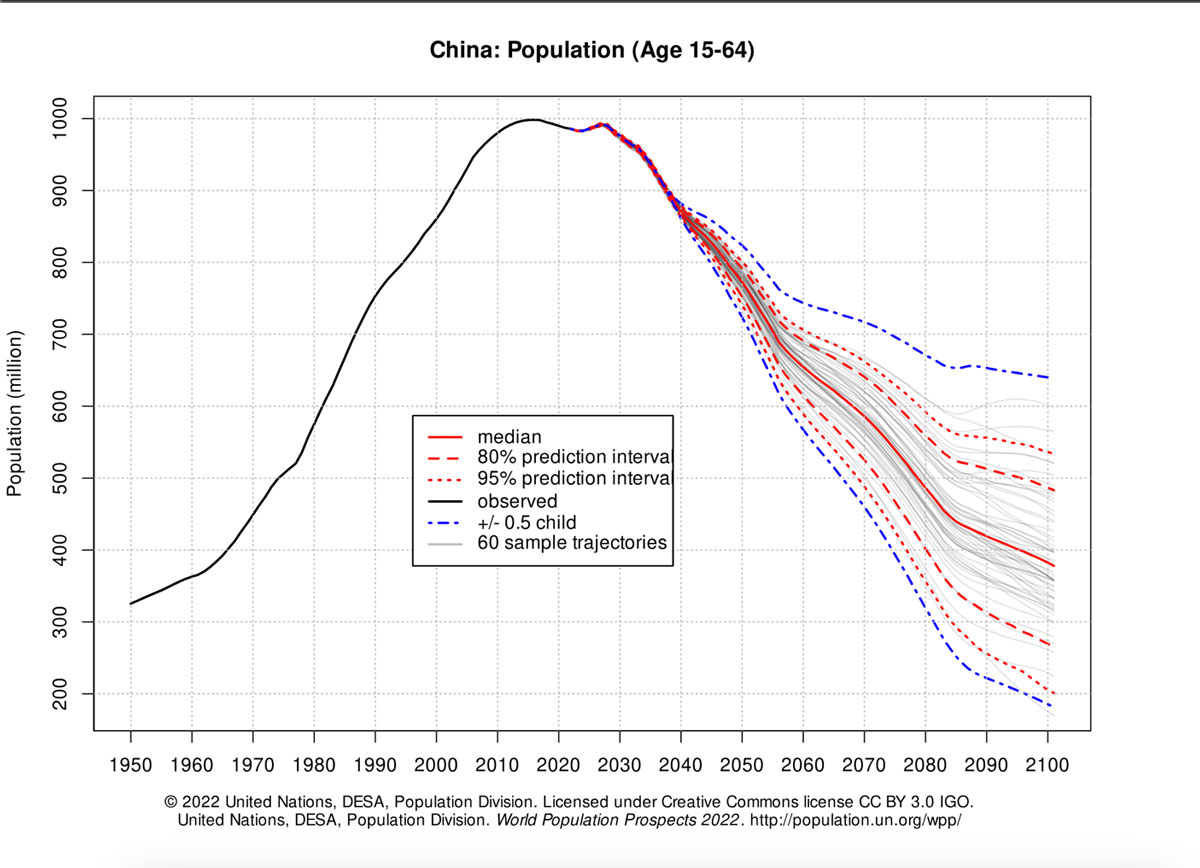
The first could accurately be described as the strongest long-term force driving the fates of all great powers: demographics. What was, for many previous decades,China’s ultimate advantage — its never-ending supply of working-age laborers — peaked at almost exactly one billion people in 2010, according to the Chinese census. The next census, in 2020, revealed that for the first time since China’s economic liberalization in the 1970s, the working-age cohort had shrunk, decreasing by more than 30 million. The U.N. estimates that this group will continue to contract, dropping to 773 million by 2050. (In other words, between now and then China is likely to lose a number of workers larger than the entire population of Brazil.) The under-14 population will also fall in that same period, from just over 250 million in 2020 to a median projection of 150 million in 2050. Not only will the workers be disappearing, but nobody is expected to replace them.

(United Nations)Every age-related trend in China is going in the wrong direction. The nation’s median age, once well below the Western world’s, is now older than America’s and headed further north with every passing year. Deaths outnumbered births last year for the first time since 1961. The fertility rate, which normally must be at 2.1 children per adult woman just to maintain a steady population, has slipped to below 1.1 — a figure made worse by the fact that, unlike in virtually every other country on the planet, China doesn’t have a relatively even gender split in its  adult population, the long-term result of male favoritism combined with the central government’s infamous one-child policy. Basic math dictates that tens of millions of these “extra” men will never start families of their own. To compound the problem even further, women in China have indicated lower interest in having children than ever before; more than two-thirds have expressed “low birth desire.” According to Prof. James Liang of Peking University,  fertility rates in Beijing and Shanghai have fallen to an astonishing 0.7, “the lowest in the world.
In Japan, economic stagnation produced a period that was called the “Lost Decade.” That stagnation eventually persisted so long that some began to refer to it as the “Lost Generation.” In China, an even more ominous buzz-phrase has become popular online: The “Last Generation.”

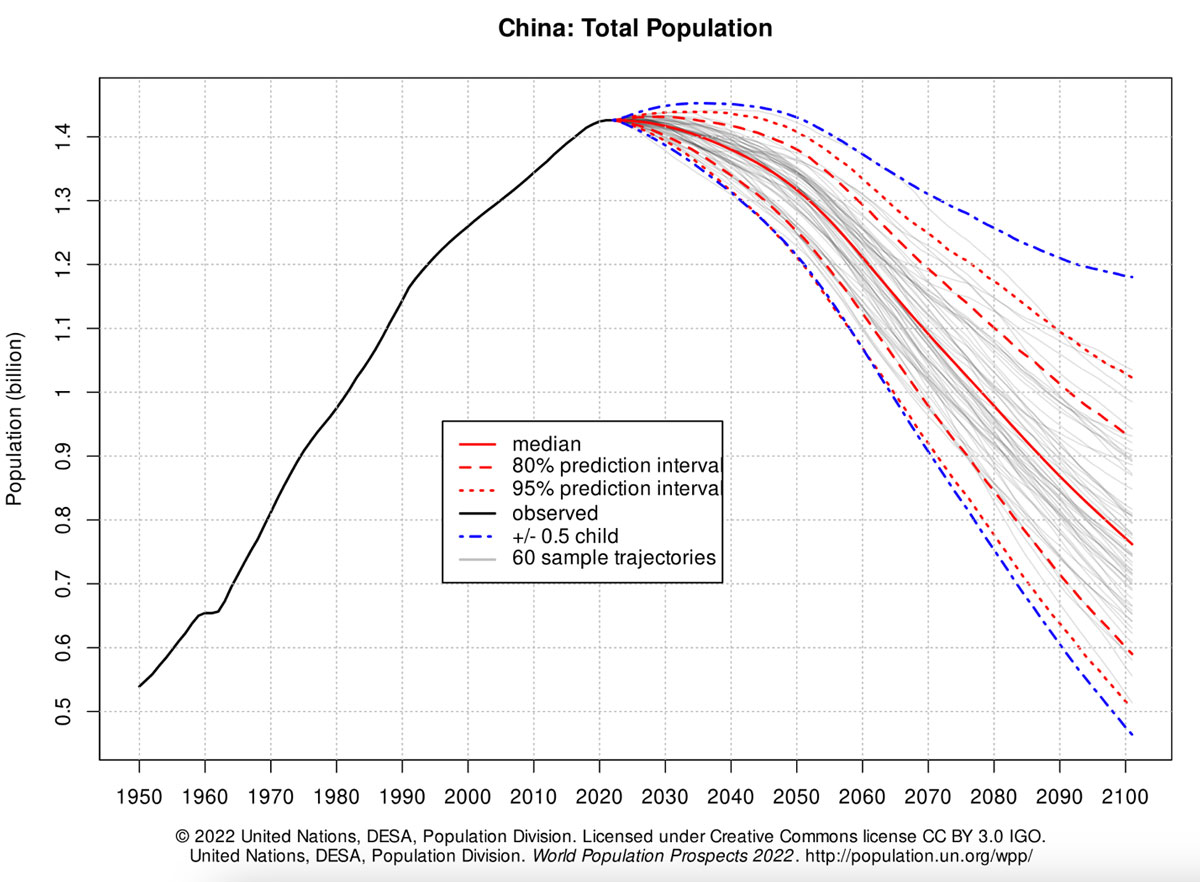
Much has been made of the difficulties China will face in attempting to manage a rapidly-shrinking workforce against a rapidly-growing retirement age population, which is projected to double by 2050. But that issue may actually be preferable to what is likely to happen afterward, or perhaps sooner if some of China’s older population doesn’t wind up living as long as expected. Here are the UN estimates for China’s total population between now and 2100:

(United Nations)Notice the lower-end expectations at the end of the century: 600 million, 500 million, perhaps as low as 450 million. Even the median projection puts the number at around 750 million. This is not just a rogue estimate by a single U.N. agency — the Shanghai Academy of Social Sciences has issued an extremely specific prediction of 587 million. If you think China has ghost cities now, imagine that vast nation with barely one-third of the population it has today. What will happen to property values in a country where between 50 and 70 percent of its people have disappeared? What will happen to tourism? To retail? So many articles have been written about what happens when a modern society grows “too old,” as has happened in Japan and Germany, among others. But how many have been written about what happens when the majority of a modern society vanishes altogether?
To make matters worse, if that seems possible, all these numbers rely on official Chinese statistics, and the government has likely been overstating them. According to an extensive examination of different sets of books by University of Wisconsin Prof. Yi Fuxian, it’s possible to find the “fudging” effects by comparing local and provincial data to that published at the national level.

If you think China has ghost cities now, imagine that vast nation with barely one-third of the population it has today. What will happen to property values in a country where between 50 and 70 percent of its people have disappeared?

“For the official statisticians,” Yi explains, “the primary school enrolment data should be reliable because public education covers every Chinese child. They were wrong, however, because primary school enrolment data in China is often inflated so that local authorities can claim more education subsidies from Beijing. … According to a report by CCTV on January 7, 2012, the Jieshou city in Anhui province reported 51,586 primary school students, when the actual number was only 36,234, allowing them to extract an additional 10.63 million yuan (about $1.54 million) in state funding. On June 4, 2012, China Youth Daily reported that a middle school in Yangxin county, Hubei province reported 3,000 students, while the actual number was only 700.”

In a country as large as China, what do these figures look like when aggregated to a national scale?  According to Yi, government data “showed that China had 366 million new births” between 1991 and 2010, “but the group aged 0-19 in the 2010 census was only 321 million.” In other words, either 45 million of those children had died between birth and the census, or they never really existed in the first place. 

That was just one cohort, in one census, but it’s hardly the only example. “In 2010, the population aged 3-14 was only 169 million, according to the 2010 household registration database, and 176 million, according to the 2010 census,” Yi continued. “Yet, according to the Chinese statistics bureau, there were 210 million births in the 1996-2007 period.” Again, either China has secretly experienced the greatest wave of mass child deaths that the world has ever seen, or the birth-rate numbers were always grossly exaggerated.

China’s demographic headwinds, therefore, may be hurricane-strength. To be fair, most major nations in the West also face declining birth rates and aging citizens. The enormous difference in projected demographics, at least in many of those cases, comes down to immigration. Even with a current fertility rate of only 1.6, the U.S. population projects to reach roughly 400 million by the end of the century, according to the U.N.’s median estimate. East Asian countries tend to have much more restrictive immigration policies, but nowhere is this as true as in the People’s Republic. Since 1950, which is as far back as the data goes, China has never experienced a single year of net positive migration. Ever.

As previously mentioned, Beijing faces not one but two enormous burdens going forward. The second should not come as much of a surprise, as it was intertwined with China’s population burst during all the good years: the economy.

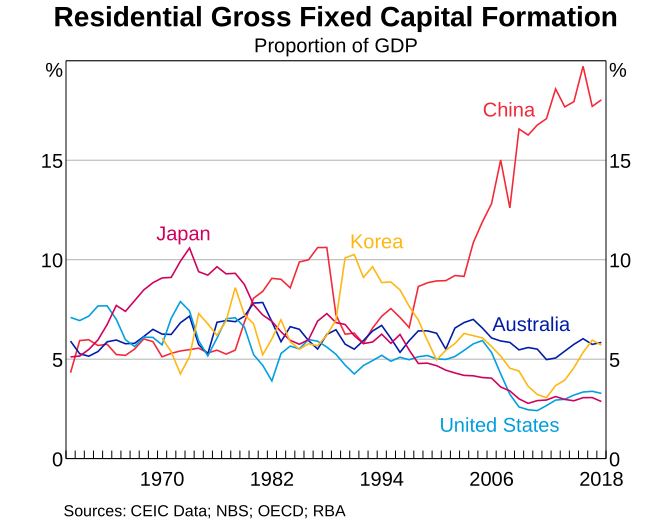
Yes, the mighty Chinese economy, the boomiest boom that’s ever boomed… is going to become a big, big problem. Much of this problem will, of course, be caused by the enormity of the demographic crunch. But there are specific details that will amplify the impact of that crunch. A whopping 70 percent of Chinese household wealth is held in real estate. Seventy. Percent. (The comparable number in the U.S. is less than half that.) The demand for investment properties has been so high that China’s construction eruption simply cannot be reasonably compared to those that have occurred in any other major economy, even ones that have experienced giant housing bubbles of their own. As this graphic from the Reserve Bank of Australia shows, “residential gross fixed capital” as a proportion of GDP is close to 20% in China — the comparable proportions in Australia, Japan, South Korea and the U.S. are all around 5% or less.

Keep in mind that China’s population is shrinking, and will continue to do so with increasing velocity. According to the World Bank, home price-to-income ratios in Beijing, Shanghai, and Shenzhen exceed “a multiple of 40;” the same figure is “only” 22 in London and 12 in New York, two notoriously expensive cities in the West. 

It is likely impossible to overemphasize the potential economic damage that will likely ensue when previous decades of population growth, urbanization and the frenzied real estate investment that has accompanied them run into the brick wall of new decades with consistently fewer buyers — and that doesn’t mean  “fewer buyers” in the normal sense of a bubble popping, but the literal absence of hundreds of millions of buyers over time. What will happen as those aforementioned ghost cities begin to multiply? And perhaps the more important question: How can China possibly make its all-important transition to a consumer-based economy when consumers as a whole have shoved so much of their wealth into properties that will often end up being worthless? How in the world is this supposed to work? How could it work?

We need your help to stay independent

That consumer transition becomes more necessary every day, because China has no other realistic option for productive growth moving forward. For years, Beijing has obsessively pushed economic activity toward investment, which sounds appealing at first simply because of the connotations of the word. But the Middle Kingdom long ago started running up against the law of diminishing returns when it comes to endlessly increasing investment. As Carnegie’s China scholar Michael Pettis explained earlier this year, “China has the highest investment share of GDP in the world. It also has among the fastest growing debt burdens in history. These are not unrelated. With growing amounts of investment directed into projects whose economic benefits are less than their economic costs, the surge in China’s debt burden is a direct consequence of this very high investment share.”

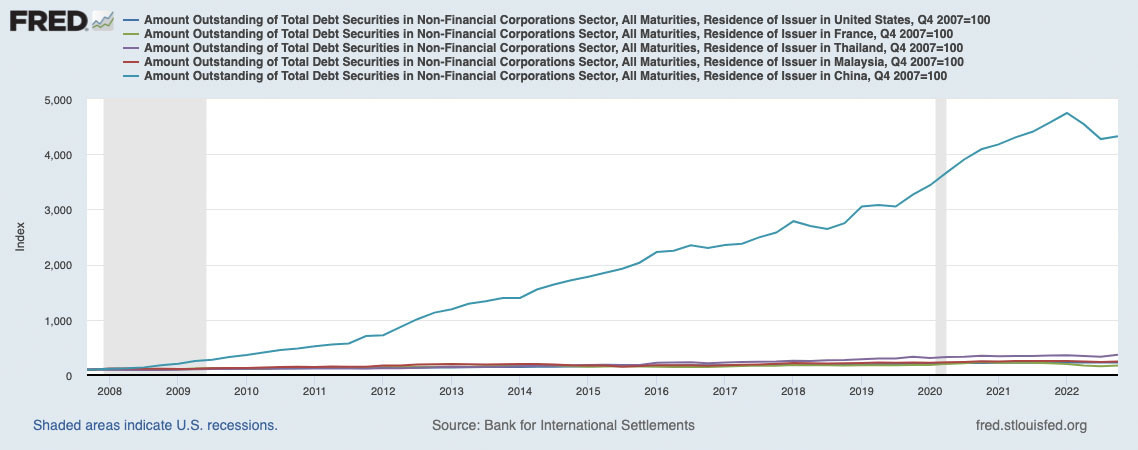
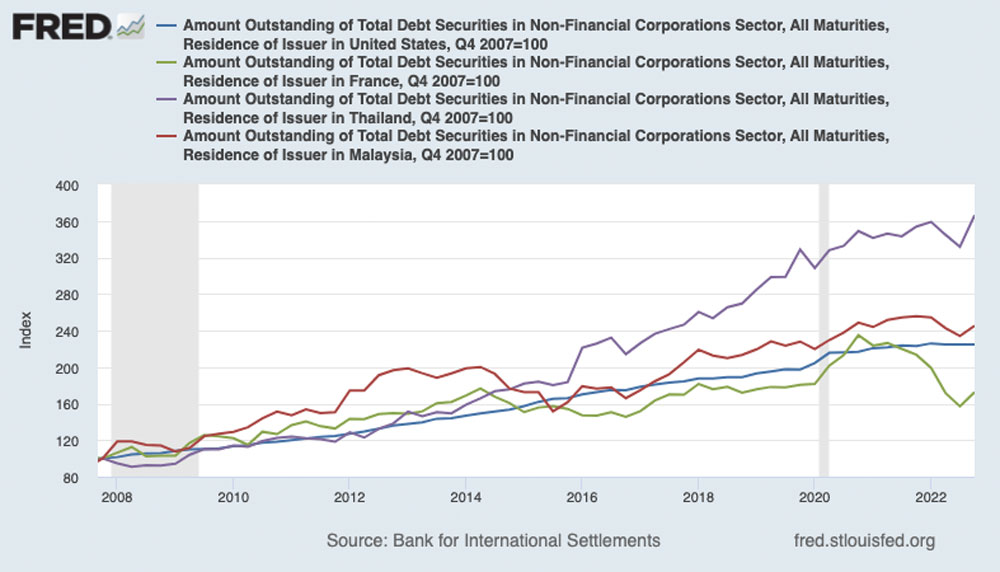
Pettis is not strictly talking about central government debt here, but rather total debt within the economy. Given the prodigious real estate boom in the People’s Republic, one could be forgiven for assuming that’s mainly what Pettis is describing, and such data surely factors into the next two charts. But there are many other sectors that do as well. Below is a graph of the increase in all outstanding non-financial corporate debt in four nations — the U.S., France, Thailand and Malaysia — since the global financial crisis. For simplicity’s sake, the debt level in each country was set to a value of 100 in the final quarter of 2007, and the data goes through the final quarter of 2022:

(Federal Reserve)

That’s admittedly not the easiest visual aid to digest, so here’s a summary: The total amount of such debt in the U.S. increased over those 15 years to a level of 220, or slightly more than double the amount that existed in 2007. Malaysia, which has posted the fastest average growth of the four countries in that time, wound up with almost the same relative amount of internal debt growth. France and Thailand, which have both had economic struggles in the post-crisis period, took very different paths and ended up at the bottom and top of the chart, respectively.

Here’s why the comparison is worth digesting. Below is the same exact chart, except with China added:

(Federal Reserve)The enormity of the Chinese debt load makes the differences between the other four nations practically vanish. Notice the scale on the left side of the graph. Starting at a base of 100, the Chinese measurement reached nearly 5,000 last year, or 50 times what it was in 2007.
Most nations tabulate their economic activities and eventually spit out a number that is recorded as GDP. In China, the central government determines what GDP shall be for the quarter, and then it’s up to officials to hit their numbers.

There is likely no economist on the planet who would advocate multiplying any significant category of debt 50 times over, no matter what the reason. But this is as much the result of political pressure to hit government GDP targets as anything else. To go back to Pettis, he explains the Chinese view by saying that for Beijing, GDP is an input, whereas virtually every other country understands it as an output. In other words, most nations tabulate their economic activities and eventually spit out a number that is recorded as GDP. Many arguments are fought over exactly how to go about that calculation and what it means, but the basic premise is pretty much the same. In China, the central government determines what GDP shall be for the quarter, and then it’s up to provincial and local officials to do whatever is necessary to hit their numbers, regardless of the actual necessity or utility of the projects. (Furthermore, if those officials can’t even reach their goals by incessantly building  bridges to nowhere, they may simply lie and claim success anyway.)


Want a daily wrap-up of all the news and commentary Salon has to offer? Subscribe to our morning newsletter, Crash Course.


Local governments are forbidden from directly borrowing money, so their administrators do what any local government apparatchiks worth their salt around the world do when they need money they’re technically not supposed to have: They find a loophole and exploit it relentlessly. In China’s case, that means forming “independent” corporations known as “Local Government Financing Vehicles,” which are somewhat-inexplicably allowed to be the equivalent of Clark Kent putting on a pair of glasses to fool everyone into thinking that he’s not Superman. The LGFVs can borrow money that local governments can’t. So that’s what they do. Especially when the alternative is to displease the Politburo.

As you might imagine, this type of policy-making does not tend to result in more money allocated to things like expanding sick leave, pension reform, parental leave, debt reduction or anything else that fails to artificially goose GDP. Instead, funds are dumped into watermelon museums that nobody needs and endless Skynet (they seriously call it that) “internal security” cameras that people need even less. 

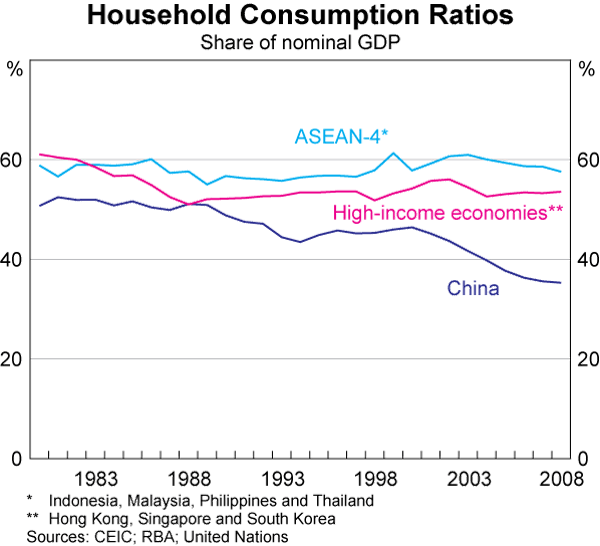
The ironic lack of social safety nets in an ostensibly Communist country, combined with a seemingly unstoppable regime of compulsive over-investment, has for many years resulted in the exact opposite of what China needs — consumers have felt and still feel it necessary to have some of the highest savings rates in the world, which means they aren’t becoming a larger part of the economy but rather a smaller part of it. Here’s a graph published by Reuters, which shows that private consumption as a share of Chinese GDP has been falling for decades. A similar chart from the Reserve Bank of Australia compares household consumption in China to other major Asian economies:

(Reserve Bank of Australia)All these factors, and likely many more, have recently produced a series of announcements that, at least to some, were not much of a surprise: “China’s economy may never overtake the U.S.,” declared Business Insider. “China Quietly Abandons Goal of Overtaking U.S. Economy,” opined Newsweek. Nikkei chimed in that “China’s GDP is unlikely to surpass U.S. in next few decades.

“The next few decades” is probably generous. The Chinese economy, if measured by anything remotely approaching the slightest degree of accuracy, won’t surpass America’s because it can’t. The structural forces that have allowed it to grow at breakneck speed for half a century are now the same forces preventing it from continuing to do so. Chinese labor costs today are significantly higher than costs for the same amount of labor in both its Asian neighbors and Latin America, including Mexico, where manufacturing for the American market is much more convenient despite the overhanging power of the cartels. In fact, Mexico became the largest overall U.S. trading partner in the first quarter of this year, after surpassing China to become the biggest trade partner specifically for manufactured goods last year.

The Chinese economy won’t surpass America’s because it can’t. The same structural forces that allowed it to grow at breakneck speed for half a century are now preventing it from continuing to do so.

China’s “factory of the world” status is slowly evaporating because cheaper workers can now be found elsewhere, which often come without problems like blatant IP theft across countless industries or figuring out whether any given supply chain involves Uyghur forced labor camps. The Chinese population is shrinking, meaning that domestic labor costs will continue to surge upward even as overall GDP growth falls. The government in Beijing is worried about “South Park” and Winnie the Pooh. China is no longer a place where capitalist dreams go to succeed, and indeed the fact that it ever was reflects one of the biggest mistakes the Western world has made since the fall of the Iron Curtain.

President Xi Jinping probably won’t be  happy with the way the rest of the “Chinese century” is likely to turn out. If it’s any consolation, he should be happier right now than he will be in the years ahead.

Jamie Foxx’s performance in “They Cloned Tyrone” adds to his legendary body of work

Jamie Foxx‘s brilliant performance as Slick Charles in Netflix’s sci-fi cloning conspiracy comedy “They Cloned Tyrone” is a cause for a few celebrations. 

Celebration one for is the fact that the movie got made. “They Cloned Tyrone,” directed and co-written by Juel Taylor, is a futuristic ‘hood mystery based around a white and white-adjacent corporate agenda to control the Black community through fried chicken, drugs and perms. Yes, you read that right ,and yes, this is a big Hollywood production that made it to select theaters before its Netflix debut.

In the film, three unlikely people stumble upon each other and discover the plot for Black destruction collectively, and as a result challenge each other in different ways to right the many wrongs happening in their orbit. Who are the heroes that infiltrate the layer of evil corporate white people, expose and ultimately destroy this agenda? Not cops, not an online actvist, not an army commander, not even a firefighter – but a gritty drug dealer named Fontaine, played by John Boyega, a genius sex worker heavily inspired by Nancy Drew who goes by Yo-Yo ( Teyonah Parris) and a yak-guzzling slick-talking pimp named Slick Charles, played by Jamie Foxx, which brings us to . . .

Celebration two is for Jamie Foxx. In real life, the Oscar-winning actor has been dealing with mysterious, severe life-threatening health issues and addressed his medical status in a recent Instagram post: “I want to thank everybody for the prayers and messages. I cannot even begin to tell you how far it took me and how it brought me back. I went through something I thought I would never ever go through. Many people wanted to hear updates, but honestly, I just didn’t want you to see me like that.” 

“I’ve heard some people say I was blind, but as you can see, the eyes are working . . .” Foxx continued, “Some people said I was paralyzed. I’m not paralyzed, I’m not, but I did go through hell and back; my road recovery had some potholes as well, but I’m coming back, and I can work, so I want to thank people.” 

Those same kinds of Jamie Foxx clips started circling online in a way that was frightening as it was inspiring.

“They Cloned Tyrone” was optioned by Black List back in 2019, which means the creative team has been on a five-year journey with this project.  Obviously Foxx filmed this movie before his recent health crisis, but there was so much gossip surrounding his illness – speculating whether he would live or die – that we thought we may never see him again (or this would be a posthumous appearance).

Society has a funny way of giving some of the most influential people in culture their flowers after they can’t receive them. Michael Jackson was treated like a silly caricature during his last days, being the butt of so many jokes, that people seemed to forget that he made music. But after his death was announced, his best songs began looping on every station. The same thing happened with Whitney Houston. People mocked her, saying, “Crack is whack,” so much that her addiction drowned out the fact that she is one of the most gifted songstresses ever. And then Houston passed away, and we were reintroduced to the songs that made us fall in love with her. Those same kinds of Jamie Foxx clips started circling online recently in a way that was frightening as it was inspiring. 

Everyone remembers Foxx’s unbelievable Ray Charles transformation in “Ray,” but many forget he’s also a genius comedian. A master of sketch comedy during his days of playing Wanda on “In Living Color,” and as if God was running out of people to give talents to – Foxx can also sing like an angel. The man has snagged an Academy Award, a Grammy, a Golden Globe, a Critics Choice Award, a bunch of NAACP awards and many more golden trophies throughout his career. Unfortunately, the idea of losing him was needed to remind us of how great he is, but thankfully the Foxx is back. 

Slick Charles in “They Cloned Tyrone” is vintage Foxx with snappy one-liners in combination with an emotional tug-of-war between the many different parts of the film. Should Slick Charles focus on being a pimp or save the world or just save himself? Foxx executes all of this while still making us laugh and be angry and wonder what he’s going to do next. I wouldn’t be surprised if his performance will allow him to add another trophy to his award collection. 

And when we realize we have the power, the sky won’t even be a high enough limit.

And the final celebration goes to “They Cloned Tyrone’s” messaging. The creators don’t hesitate to put the people first. The film is a clear example of how the Black community are the only ones who have the power to save the Black community – not fast-talking politicians, CNN talking heads or celebrity activists with catchy usernames and a talent for creating viral hashtags. The regular everyday people in the community fully understand the issues and have the proximity needed to force the kind of change we need. And when we realize we have the power, the sky won’t even be a high enough limit.

“The Cloned Tyrone” is streaming on Netflix.

Trump calls Biden “A dumb son of a b**ch” during rally in Pennsylvania

Statements made by Donald Trump during a rally at Erie Insurance Arena in Erie, Pennsylvania on Saturday gave no indication that the looming threat of incarceration for this, that and the other is warranted. To hear it from the man himself, everyone is to blame but him. Carving out plenty of time to rip into the Biden family, per usual, Trump drew comparisons between his family’s legal drama and theirs, attempting to convince the crowd that he was being raked over the coals, while the “Biden crime family” was not. Throughout his speech, the former president lashed out at Joe Biden, going so far as to call him “A dumb son of a b**ch” at one point. 

“We have somebody who’s not at the top of his game. Never was at the top of a game,” Trump said, getting worked up as the crowd cheered him on. And while this obsession with the president is not new, or unique, the way in which he’s ramping up the expression of his anger has taken a dramatic turn. Before his rally on Saturday, Trump posted a clip to Truth Social featuring a montage of Biden falling down over the years, interspliced with an image of a toothy wolf. 

Disability rates rose sharply during the pandemic. Long COVID is largely to blame

Michael was a 46-year-old Black man, Marcie Roth recalled to Salon, and his life was destroyed following a heart attack.

Roth is the executive director and chief executive officer of the World Institute on Disability, an international nonprofit center on public policy. As she recalled Michael’s story, her voice was filled with emotion. Michael’s heart attack had nothing to do with COVID-19, but because it left him disabled, he was sent to a nursing home. While there, he developed a COVID-19 infection, so the nursing home sent him to a hospital. That is where ableism reared its ugly head.

“The hospital made a decision that they were going to deny care because of Michael’s disability.”

“The hospital made a decision that they were going to deny care because of Michael’s disability,” Roth told Salon, who added that his race also appeared to be a factor. “They were having good conversations. Their family was very involved, and all of a sudden, he was determined by the hospital to be not worth treating.”

Instead they moved him from the intensive care unit to hospice care. “His wife recorded the conversation, but essentially, they said to her, ‘Do we want to be extremely aggressive with his care, or do we feel like this would be futile?” Roth said. Because Michael was paralyzed and had a brain injury, the doctors insisted he had a low quality of life.

“Ultimately the hospital was limiting his care even though they didn’t have a large number of patients with COVID,” Roth concluded. “I guess they decided that he couldn’t survive further treatment, and then a guardian signed off on withholding his care. That guardian was not his wife, and it was not one of his children.”

There are far too many stories out there like Michael’s. (Salon has chosen to leave out his last name to protect the privacy of his family.) During the COVID-19 pandemic era, more than 3 million people over the age of 18 have so far come forward with disabilities, and many more are expected to follow, according to recent data from the U.S. Bureau of Labor Statistics (BLS.) The COVID-19 saga, which is still not entirely over and is no longer considered an emergency, is inextricably linked with that of disability rights.

This link manifests in two ways: It has disproportionately afflicted disabled individuals and, as that BLS data reveals, it has created a whole new group of disabled people.

Per the first group, Salon reached out to Darcy Milburn, Director for Social Security and Healthcare Policy at The Arc, an organization serving people with intellectual and developmental disabilities

“The COVID-19 pandemic was a complete catastrophe for our community,” Millburn explained. “Aside from the death toll, people with disabilities were hit first and hardest, and we’re still grieving.”

For one thing, health care systems often failed disabled people, from providing inferior care to struggling with accommodating their disabilities in the first place. Although Millburn thought the pandemic had at least raised awareness of pre-existing inequities in the health care system, the status quo for disabled people in 2023 is hardly better than it was in 2020. Millburn and Roth both touched on the same theme — that because disabilities are so individualized, there are countless little ways that ableism can interfere with the providing of quality health care.


Want more health and science stories in your inbox? Subscribe to Salon’s weekly newsletter The Vulgar Scientist.


“The COVID-19 pandemic was a complete catastrophe for our community.”

“It goes in many different directions for people with disabilities,” Roth pointed out. “The challenges of navigating COVID have been in many ways more complex than for other people.”

For instance, people who are hard of hearing struggle with the constant wearing of masks. Those who can’t maintain personal hygiene like washing their hands without assistance likewise struggled. In fact, many disabled people live alone, and as such were effectively stranded when seeking access to the same help that non-disabled people can take for granted.

“Not having access to personal protective equipment has made [life] more difficult,” Roth told Salon. “People who are living in the community with support have had a more difficult time getting people to come into their home. I think among the greatest challenges has been the complete exclusion of those rights-based protections that people with disabilities have to be in the community to have physical access, program access, effective communication access, to be prevented from institutionalization.”

Disabled individuals also struggle with societal intolerance. Among other things, there still exists in American culture a pervasive prejudice against receiving public assistance. This is particularly ironic, since scholarly research finds that society as a whole benefits from providing accommodations to people with disabilities. There is also a notoriously long wait associated with qualifying for the Medicare insurance coverage that so many disabled people require to survive, and the assistance that exists is hardly lavish. In fact, some advocates argue it is inadequate for achieving any kind of meaningful financial security. For example, a 2019 report from the Center for American Progress found, “Disabled adults experience poverty at nearly twice the rate of their nondisabled counterparts.”

“Disabled adults experience poverty at nearly twice the rate of their nondisabled counterparts.”

“The SSI [Supplemental Security Income] asset limit is the total amount of financial resources that someone is allowed to maintain while also being on SSI,” Millburn pointed out. “The assets means the total value of cash-on-hand savings accounts, some retirement accounts, life insurance policies over a certain amount of money, burial funds, that kind of thing. People on SSI have not been allowed to have more than $2,000 in assets since 1989. It’s a travesty.”

From there, they are given the bare minimum of what will be required to provide food, clothes and other necessities, an amount that varies from individual to individual but often is around $600 per month.

There is also the emerging category of patients who develop long COVID, or COVID-19 with long-term symptoms that can last for months or even years. COVID-19 has been found to occasionally cause long-term disabilities including mental health problems (the SARS-CoV-2 virus can change the brain’s structure), metabolic disorders, joint pain, respiratory problems, cardiovascular diseases and neurological problems. Even worse, there is scant medical research on the consequences of being a so-called “long-hauler.” While there is a comparative wealth of information about people with pre-existing disabilities (since those disabilities have existed long before 2020), COVID-19 is a new disease. No known human has had it for more than a few years.

We need your help to stay independent

“The coronavirus pandemic has certainly caused new long-term disabilities among millions of people,” Andrew Wylam, president of Pandemic Patients, a non-profit that works to help people harmed by COVID-19 and post-COVID conditions, told Salon by email. “The outcomes of long COVID are still unclear, but we’re seeing that some people do show some recovery while others’ symptoms decline or stay the same. The nature of these impairments is blended, with some being primarily cognitive and others being physical or associated with organ damage.”

Wylam later offered insight on how to raise awareness of and learn more about long-haul COVID-19.

“COVID-19 is still spreading and still causing disability,” Wylam wrote to Salon. “We need to keep working to educate people about the risks of long COVID and how to recognize it. I think a lot of people recover from their acute COVID-19 infection and when they develop long COVID symptoms a few months later they don’t attribute it to the prior infection. That makes it difficult for people to make the association between the onset of new symptoms and COVID-19, which can make it hard to persuade people this is an important issue.”

In Wisconsin, women’s health care is constricted by an 1849 law. These doctors are aghast

GREEN BAY, Wis. — The three women sitting around a table at a busy lunch spot share a grim camaraderie. It’s been more than a year since an 1849 law came back into force to criminalize abortion in Wisconsin. Now these two OB-GYNs and a certified midwife find their medical training, skill, and acumen constrained by state politics.

“We didn’t even know germs caused disease back then,” said Kristin Lyerly, an obstetrician-gynecologist who lives in Green Bay.

Like undertakers and garbage haulers, obstetricians see the nitty-gritty of human existence that can be ghastly and grotesque. A fetus with organs growing outside its body. A woman forced to birth a baby with no skull to push open her cervix.

OB-GYN Anna Igler regularly performed abortions for medically indicated reasons before the Supreme Court overturned the right to abortion last year. She is beyond fed up.

“I’m at a different level with it now,” she said. “Part of me is so upset at people for sticking their head in the sand.” With her world inside a Green Bay hospital in turmoil, she said, she cannot fathom that people might be oblivious to the government’s incursion into their medical care. “So many people I’ve talked to have no idea what our laws are in our state.”

Even now, a year later, Igler said, expectant parents come into her office with the assumption that if their fetus has a lethal genetic disorder, like anencephaly or trisomy 13 or 18, they can end the pregnancy safely.

“They are shocked when I tell them they can’t,” Igler said, “and they are shocked when I tell them we are following the law from 1849.”

She was referring to the state’s original abortion law, which was passed before the Civil War, when women could not vote or own property. The law makes it a felony to perform an abortion at any stage of pregnancy, unless it would prevent the death of the pregnant person.

It had been some time since these women were together, and they were eager to compare notes. The certified midwife spoke on the condition of anonymity because she’s not authorized to talk to the media and is concerned about losing her job at a local health system. “My biggest issue right now is getting medication to end a pregnancy that has already passed,” she said. “I’m finding locally that pharmacists just won’t dispense the medication.”

She offered a rundown: One pharmacist told her patient that misoprostol, a drug that causes cramping to expel the pregnancy tissue, had expired. Another, at a Walgreens, simply canceled the order. A third said he needed preauthorization, noting, “It’s a $3 pill, and we’re not going to get preauthorization on a weekend.”

The midwife said she and physician colleagues in her practice have half-joked that they’d send a gift basket to one pharmacist in town she’d found who will fill their prescriptions for abortion pills.

Now, when a patient miscarries, the midwife said, “we warn patients that this might happen, and they are like, ‘But my baby is dead,’ and I tell them, ‘I’m sorry. I don’t know why, but a lot of pharmacists in Green Bay think it’s their job to police this.'”

A year into this new era of compulsory birth for most women with pregnancies, the dismay and disorientation of those first few months have settled into, if not acceptance or resignation, a kind of chronic fear. Obstetricians and gynecologists are fearful of practicing medicine as they were trained.

A recent survey by KFF pollsters of OB-GYNS in states with abortion bans found 40% felt constrained in treating patients for miscarriages or other pregnancy-related medical emergencies since the Supreme Court’s Dobbs v. Jackson Women’s Health Organization decision last summer. Nearly half of them said their ability to practice standard medical care has become worse.

The specter of felony charges and losing a medical license has led to futile exercises.

Under the Wisconsin abortion ban — and bans in at least 13 other states — physicians who cannot detect fetal cardiac activity should, in theory, not face criminal charges for prescribing pills for a medication abortion or performing abortions. But physicians here in Green Bay, and others interviewed in Madison, said they — and the litigation-averse hospitals they work for — are requiring patients whose pregnancies are no longer viable, or who have gestational sacs that do not contain an embryo, to return for multiple ultrasounds, forcing them to carry nonviable pregnancies for weeks.

Before Wisconsin’s abortion ban, Igler would typically use the ultrasound machine in her office to detect when a patient’s pregnancy had ceased. She would break the news to expectant parents there. In some cases, a patient wanted further ultrasounds and she would refer them to the fetal-imaging department. It might help with their grieving, and “I was happy to do that for them,” Igler said.

But her bedside ultrasound can’t record and save the images that Igler would now need to prove that her medical judgment was reasonable during a criminal prosecution, so she is compelled to send all her patients for additional imaging.

“It seems cruel to show a woman her nonviable, dead baby and then say, ‘Well, now I have to bring you over to fetal imaging so we can record a picture and you have to see it again,'” she said.

In March, Rep. Ron Tusler, a Republican who represents a rural swath of Wisconsin south of Green Bay, posted on Facebook, “Thank God for the Dobbs decision!” In response, a local resident asked, “If my non-verbal, non-ambulatory 14-year-old daughter is assaulted, should she be forced to carry?”

The exchange escalated into a confrontation. “Is her health jeopardized?” Tusler asked. “Is she unable to leave the state? Can she provide consent?”

In the torrent of vitriol, certain moments stand out. Igler was incensed at the callous response and jumped in, writing: “Are you a monster, Ron Tusler? Do you know what compassion is? Come the next election, you will feel the backlash of your inhumane and outdated views. Get your hands off women’s bodies and out of the exam room. I’m an obstetrician. I’m the expert, not you.”

Tusler shot back that Igler was “angry she can’t kill babies until and occasionally after birth” and asked whether “I’m a monster for stopping her.” He wrote, “Honestly, how many babies have you aborted? How much money have you made from it? Did your hospital harvest the bodies for stem cells?”

The lunchtime rush at the restaurant in Green Bay had eased, and the women stared at the Facebook post on Igler’s phone.

She shook her head in baffled amusement. “This doesn’t even make sense,” she said. “It’s a conspiracy theory. I make so much more money if people actually have their babies. And if I don’t give out birth control, I would make a lot more money.”

Those sitting at the table laughed at the absurdity.

The salad bowls were empty. Everyone had told their own abortion stories. Igler was forced to travel to Colorado after her baby, at 25 weeks, was ravaged by a viral infection; Lyerly had lost a pregnancy at 17 weeks and did not want to endure the trauma of a vaginal birth.

Some 22 million women living today have had an abortion. It doesn’t take much effort to find a few of them.

Igler has found a community of women to grieve with, in a Facebook group called “Ending a Wanted Pregnancy.” There are an untold number of other online groups.

“Politicians would like to believe we live in a perfect world where these things don’t happen,” she said.

The Wisconsin Legislature is one of the most gerrymandered in the country, according to Princeton University’s Gerrymandering Project. Republicans hold a majority in the state Senate and Assembly, and last month Senate Republicans voted unanimously to keep the 1849 abortion ban.

But a judicial alternative to restoring abortion rights has begun to unfold. In April, Janet Protasiewicz, an abortion rights supporter promoted by Democrats, won a seat on the Wisconsin Supreme Court, giving liberal justices a narrow majority and opening a path for a ruling on the legitimacy of the 1849 law. On July 7, a Circuit Court judge in Dane County, Diane Schlipper, appeared to doubt the validity of the pre-Civil War-era ban, allowing a lawsuit by Attorney General Josh Kaul, a Democrat, to proceed.

For now, Lyerly is driving across the border to work in rural Minnesota. “I want to practice medicine here,” she said, “but first we have to get rid of this law.”

KFF Health News is a national newsroom that produces in-depth journalism about health issues and is one of the core operating programs at KFF—an independent source of health policy research, polling, and journalism. Learn more about KFF.

Bruce Springsteen and John Mellencamp can teach Jason Aldean a thing or two about small towns

One of the many absurdities of present political discourse is that the people who most obnoxiously declare their love for America hate most of its institutions, people and traditions. The latest example of the right-wing contradiction between sentimentality and substance is country singer Jason Aldean‘s statement that he is a “proud American.” “I love our country,” he said, before eloquently adding, “I want to see it restored to what it once was before all this bulls**t started happening to us.” 

It is not only easy to find better politics in small towns, but also better music.

Aldean was defending and explaining his new hit single, “Try That in a Small Town.” Written by Kelley Lovelace, Neil Thrasher, Tully Kennedy and Kurt Allison, “Try That in a Small Town” has Aldean adopting a vaguely threatening posture, telling listeners that if they “cuss out a cop” or “stomp on the flag,” they are likely to suffer the penalty of vigilante violence. “You cross that line,” Aldean snarls in an unconvincing and boring attempt at bravado, “It won’t take long for you to find out . . .” 

Aldean is fond of wearing muscle shirts even though his arms have no size or definition. His wardrobe is emblematic of his music and politics – a costume suggesting strength, but exposing that there’s nothing really there. It is tempting to leave it at that, but Aldean has millions of fans who have shot the song up to No. 2 on the Billboard Hot 100, all while he whines about “cancel culture.” The song provides an insight into the paranoia, hostility and estrangement that define contemporary Republican politics.

To what exactly is Aldean referring when he decries “bulls**t”? He mentions flag burning – something that may or may not offend people – but, like cussing at a cop, is protected by the First Amendment of the United Constitution. Evidently, the “bulls**t” goes back to the founding of the country when the constitutional framers wrote down the words of the Bill of Rights. In the second verse, he sings not about gun control, but a favorite and asinine conspiracy theory of the paranoid right: “Got a gun that my granddad gave me / They say one day they’re gonna round up / Well, that s**t might fly in the city, good luck.”

There is no “they” planning a gun confiscation program. Gun control is another matter. Perhaps, Aldean has forgotten that the March for Our Lives mass demonstration that took place in 880 cities, many of them small towns, across the United States on March 24, 2018 was organized by survivors of the Parkland, Florida school shooting. Parkland has a population of 35,000 people. There are many people in small towns who don’t like the idea of risking violent death every time they attend class, shop in a grocery store or attend a county music concert in Las Vegas (where Aldean was a performer).

The video for “Try That in a Small Town” signifies the less obvious, but more insidious message of the song. It originally included footage from Black Lives Matter protests – now edited out – and shows Aldean and his band performing at the steps of the courthouse of Columbia, Tennessee – the site where a racist mob of terrorists lynched Henry Choate, a Black teenager, in 1927. It is plausible that Aldean and his brain trust did not know of the lynching when they selected the location, but the ugly coincidence demonstrates the danger of what Sheryll Cashin, professor at Georgetown Law School, calls, “boundary maintenance” – that is the “intentional state action to create and maintain a racialized physical order.” The state action, as Cashin explains, produces attendant social and cultural effects.

“Try That in a Small Town” amplifies the “Real Americans” cliché that Sarah Palin used to animate the Republican electorate in 2008, and now functions as right-wing dogma. One lyric brags that the town is full of “good ol’ boys raised up right.” This nonsense implies that American authenticity exists only in a small exurb somewhere far from “the city” where white people dutifully file into the megachurch every Sunday morning. A Puerto Rican lesbian who works as a nurse at New York hospital is, somehow, less of an American than the white guy fondling his “granddad’s gun.” CMT has refused to play the “Try That in a Small Town” video, and in response, South Dakota governor, Kristi Noem, and governor of Florida, Ron DeSantis – two proud America-haters – have come to his defense.

It is not only easy to find better politics in small towns, but also better music. One of the most influential songs to depict small town life is John Mellencamp‘s 1985 hit, “Small Town.” Taking inspiration from his hometown of Seymour, Indiana, Mellencamp sings about a beautiful and hospitable community. Over a sparse, roots rock arrangement that bounces along with an infectious melody, Mellencamp boasts that in the “small town” of his youth, “People let me be just what I want to be.”

The song is one of the most dramatic moments on his record, “Scarecrow” – a collection of songs that protest big agriculture’s destruction of the family farmer, racism and American indifference to poverty. The record juxtaposes protest with celebration of individual courage and compassion. In “Small Town,” the singer announces an undying love and loyalty for those whose kindness and support helped shape him. A tribute to his grandfather, “Minutes to Memories,” makes use of a rock-meets-twang guitar riff and big Motown drum beat, to praise the integrity of those who believe “an honest man’s pillow is his peace of mind.”

Mellencamp’s thoughtful love for his “small town” . . . provides an artistic model for how to balance patriotism and protest.

In the same year that Mellencamp released “Small Town,” he collaborated with Willie Nelson and Neil Young to found Farm Aid – an annual benefit concert and organization committed to assisting family farmers. Unlike Aldean’s posturing, Mellencamp’s activism has directly benefitted those struggling with hardship and deprivation in states like Indiana, and Aldean’s native Georgia.

Mellencamp also showcases the maturity necessary to wrestle with the sublime and hideous in his beloved small town America. While songs like “Small Town,” “Cherry Bomb” and “Thundering Hearts” give a romantic view of provincial villages, he also writes and performs music that condemns and mourns the bigotry and narrow-mindedness so often prevalent in those same places. “Jackie Brown” is one of the most moving lamentations of poverty put to record, “Jena,” gives fiery denunciation of a history of hate crimes in Jena, Louisiana and “Melting Pot,” over Dave Grissom’s blistering lead guitar, explores American hypocrisy in public policy and race relations. “Pink Houses,” Mellencamp most famous slice of Americana, balances patriotic celebration with rage against continual exploitation of the poor.

We need your help to stay independent

The left too often dismisses patriotism as naïve or central to destructive right-wing politics of hatred and exclusion. But people have a healthy desire to feel proud of their homes and heritage. Mellencamp’s thoughtful love for his “small town,” as opposed to Aldean’s reactionary tantrum, provides an artistic model for how to balance patriotism and protest.

Bruce Springsteen gave equal weight to both impulses in his 2007 song, “Long Walk Home.” Set in a small town with familiar locales – a barbershop, mom and pop grocery store, VFW – Springsteen’s character navigates the American landscape after the Bush administration’s invasion of Iraq and violation of civil liberties. As the song swells to a triumphant conclusion, featuring a characteristically powerful Clarence Clemons saxophone solo, Springsteen sings,

My father said “Son, we’re lucky in this town,
It’s a beautiful place to be born.
It just wraps its arms around you,
Nobody crowds you and nobody goes it alone.
That flag flying over the courthouse
Means certain things are set in stone.
Who we are, what we’ll do and what we won’t.”
It’s gonna be a long walk home . . .

Mellencamp is proud of a small town where he can be just what he wants to be, and Springsteen imagines an idyllic setting of communal solidarity and individual freedom. Their small town vision welcomes the Black Lives Matter protester, the trans teenager and the elderly, white Christian. All have a home. The flag, rather than menacing those who oppose official policy, provides security and assurance – representing the Bill of Rights, democratic safeguards, the rule of law and a culture of personal choice.

The unfortunate popularity of Jason Aldean should not deceive the causal observer. As the CMT video ban would suggest, his brand of parochial prejudice is losing in music and politics. Tyler Childers, an neotraditional country and Americana singer/songwriter from Kentucky writes country songs telling the stories of progressive politics and largehearted humanity in rural America. His newest song and video, co-written with Kentucky poet laureate, Silas House, “In Your Love,” beautifully depicts a gay romance. He has previously written rallying cries for racial justice, and protest songs against religious bigotry – all from a small town perspective.

Rhiannon Giddens, one of America’s most exciting and brilliant songwriters, hails from Greensboro, North Carolina – not exactly a small town, but she makes use of pastoral settings to explore racial oppression and indigenous history. As one music critic wrote of her work, it “systematically dismantles the myth of a homogenous Appalachia.”  

Childers and Giddens have not commented on “Try That in a Small Town,” but Jason Isbell, who has a storied history of progressive protest songs from a small town vantage point, first with the Drive-By Truckers and now as a solo artist, ridiculed Aldean for promoting violence, and challenged him to “write his own song.”

The hospitality of Mellencamp’s and Springsteen’s small towns are . . . conquering more electoral territory.

Miranda Lambert, one of the most popular mainstream country singer/songwriters, places at the center of her musical and political philosophy, “ya’ll do ya’ll,” expressing support for LGBTQ rights and acceptance, and lambasting laws in Tennessee and Texas that prohibit public drag shows.

The hospitality of Mellencamp’s and Springsteen’s small towns are not only influencing younger musicians, but conquering more electoral territory. Joe Biden became president partially because of strong support in the suburbs of Phoenix, Philadelphia, Pittsburgh, Detroit, Milwaukee and Atlanta. Congressional districts representing large metro suburbs continue to turn Democratic. Many of the Black Lives Matter demonstrations in 2020 took place in small towns like Valparaiso, Indiana and Havre, Montana. I live in a small town of Indiana with a population of 24,000 people. It has its own Black Lives Matter chapter, and a local environmental group.


Want a daily wrap-up of all the news and commentary Salon has to offer? Subscribe to our morning newsletter, Crash Course.


Aldean’s dark and restrictive small town mentality is moving out of the suburbs, especially as they become more liberal, and into exurbia. Further from an urban center and with fewer people and less diversity, exurbia is now the breeding and staging ground of right-wing extremism. The lyrics of “Try That in a Small Town” are shallow, but no more or less foolish and paranoid than the nightly ravings on Fox News or the lies of Donald Trump’s speeches. The reactionary, exurban mentality has turned against the American culture, visible in provincial and urban America alike, of Mellencamp, Springsteen, Giddens and Lambert. It lives in a world of conspiracy and fear, imagining that an America that never truly existed is under assault from a coordinated plot. Multiculturalism, secularism and sexual liberalism are not the hallmarks of genuine, grassroots progress, but evil schemes to undermine white, Christian society.

The reality is that the progressive small town is winning throughout much of America, and those who want to “make America great again” or “restore” the country to what it once was will find that a clock only ticks forward. Willie Nelson has probably forgotten more about small towns and American history than Aldean will ever learn. He might have put it best with a lyric that is both summational and aspirational: “The world’s getting smaller / And everyone in it belongs.”

The other war from hell: Struggle and suffering in Sudan — while the world looks away

It’s been devastating, even if no one’s paying attention.

Three months of fighting in Sudan between the army and a paramilitary group called the Rapid Support Force has left at least 3,000 people dead and wounded at least 6,000 more. Over two million people have been displaced within the country, while another 700,000 have fled to neighboring nations. According to the World Health Organization, two-thirds of the health facilities in Khartoum, the capital, and other combat zones are now out of service, so the numbers of dead and injured are believed to be far higher than recorded, and bodies have been rotting for days in the streets of the capital, as well as in the towns and villages of the Darfur region.

Almost all foreign nationals, including diplomats and embassy staff, are long gone and so, according to Al Jazeera, hundreds or thousands of Sudanese who had visa applications pending have instead found themselves marooned in the crossfire with their passports locked away inside now-abandoned embassies. In the Darfur region, according to non-Arab tribal leaders, the RSF and local Arab militias have been carrying out mass killings, raping women and girls, and looting and burning homes and hospitals. Earlier this month, UN humanitarian chief Martin Griffiths told the Associated Press, “If I were Sudanese, I’d find it hard to imagine that this isn’t a civil war… of the most brutal kind.”

According to the UN, half the country’s population, a record 25 million people, is now in need of humanitarian aid. And worse yet, half of those are children, many of whom were in dire need even before this war broke out. Tragically, global warming will only compound their misery. Among 185 nations ranked by the Notre Dame Global Adaptation Initiative, Sudan is considered the sixth most susceptible to harm from climate change.

Heat waves, drought and flooding are projected to become ever more frequent and intense as the atmosphere above Sudan warms further. This summer war and weather have been converging in strikingly deadly ways. With cloudless skies, water and electricity services largely knocked out, and daily temperature highs in the capital recently ranging from 109° to 111° Fahrenheit, the misery is only intensifying. Meanwhile, in the Darfur region and across the border in eastern Chad, the season of torrential rains is about to begin. The country director for Concern Worldwide in Chad says that many of the quarter-million Sudanese refugees there “are living in makeshift tents made from sticks and any material they can find, which means they are not protected from the heavy rains. The situation is catastrophic.”

This conflict will not be televised

Among the refugees from this war are some of our own relatives and in-laws, part of an extended Indian-Sudanese family who have lived in Khartoum all their lives. In May, they fled the escalating violence, some via a perilous, hair-raising 500-mile road trip across the Nubian Desert to Port Sudan. There, they caught a ship across the Red Sea to Jeddah, Saudi Arabia. Their goal, as they informed us in June through voice messages, was Egypt — so far, the most common destination for Sudanese refugees over the past three months. Mind you, desperate as they may be, our relatives are in a far less perilous situation than people fleeing the Darfur region for Chad. Still, they are leaving behind a life built up over decades, without knowing if they will ever be able to return to Khartoum.

And here — for us — is a disturbing reality. We’ve had to do a lot of searching to find significant information in major U.S. media about the struggle in Sudan, still less the plight of its refugees — though recently there were finally substantive reports at NPR and in the Washington Post. Still, the contrast with 16 months of breathless, daily, top-of-the-hour reporting on the Ukraine war and the millions of people it’s displaced has been striking indeed.

We’ve had to do a lot of searching to find information in U.S. media about the struggle in Sudan, still less the plight of its refugees. The contrast with 16 months of breathless daily reporting from Ukraine has been striking.

There’s a major difference as well between Washington’s responses to each of those wars. Before the fighting broke out in Sudan, the country had about 30% fewer people living in need of humanitarian assistance than Ukraine. Now, it has almost 50% more than Ukraine. Given those relative needs, U.S. humanitarian aid to Sudan in fiscal 2023 ($536 million) was not all that skimpy compared with the humanitarian aid going to Ukraine ($605 million). — not, at least, until you add in the $49 billion in military aid Washington has been sending to Kyiv — 80 times the civilian aid, to which has only recently been added fundamentally anti-humanitarian cluster bombs. In the past year, in other words, Ukraine got 13% more humanitarian aid than Sudan but 93 times more total aid when you count war assistance.

And the U.S. is not alone. The entire world is lagging badly in its response to the humanitarian tragedy in Sudan. William Carter of the Norwegian Refugee Council recently lamented, “I haven’t seen it treated with urgency. It’s not ignorance; it’s a case of apathy.” Admittedly, conditions in Sudan and Chad make aid delivery difficult now, but Western powers, Carter pointed out, are simply “not willing to stick their necks out.”

Sidelining civilians, coddling generals

Washington has assisted Ukraine massively since the war there began. In contrast, its actions in the months leading up to Sudan’s current conflict were not only ineffective but may even have made war more likely.

Some background: Four years ago, a popular uprising overthrew the country’s longtime autocratic president, Omar al-Bashir. A sovereignty council was formed to negotiate a transition to democracy. Susan Page, who served as the first U.S. ambassador to the Republic of South Sudan, has written that the council’s designation as a “civilian-led transitional government” was “always a bit of a fig leaf,” given that its membership included more military officials than civilians. The transition was even led by military officials, including the two men who command the forces now locked in battle, Sudanese army chief Gen. Abdel-Fattah Burhan and Gen. Mohamed Hamdan, who leads the RSF paramilitary group.

We need your help to stay independent

After two years of obstructing the work of the sovereignty council, that odd duo joined forces in an October 2021 coup and took control of Sudan. The negotiations over a democratic transition, mediated by the U.S., Britain, the United Arab Emirates and Saudi Arabia, nonetheless went on for another 18 months, while those generals continued to stonewall. According to Sen. Chris Coons, D-Del., the generals even stooped to outright extortion, hinting that if they didn’t get full backing from the West, they’d create a fresh migration crisis in Europe by kicking out hundreds of thousands of their fellow Sudanese and sending them northward. Still, last February, with military-civilian negotiations bogged down, Coons remained hopeful, writing,

The Sudanese people … are not backing down in the defense of their political gains. Even in the face of persistent killings, sexual violence, and arrests by the regime, a massive, nationwide pro-democracy movement has for months maintained nonviolent street protests. The determination these thousands of people have shown as they risk their lives against heavily armed security forces should serve as a reminder the world over of how precious democracy truly is.

Coons urged the Biden administration to throw its weight behind the pro-democracy movement, with sanctions that would hit the military leaders hard while sparing civil society: “A modern, comprehensive set of sanctions on the coup leaders and their networks,” he wrote, “will disrupt the military’s revenue streams and their grip on power, creating an opening for the nation’s nascent democracy movement to grow.” As is now painfully obvious, Biden didn’t take Coons’ advice and, six weeks later, the shooting started.

A government adviser told the New York Times that U.S. diplomats in Sudan had “made the mistake of coddling the generals, accepting their irrational demands, and treating them as natural political actors.”

In an article published soon after the outbreak of fighting, Edward Wong and three colleagues at the New York Times reported that some of the people who played a part in the negotiations told them that “the Biden administration, rather than empowering civilian leaders, prioritized working with the two rival generals,” even after they’d seized power in that coup. A high-level government adviser assured the Times that senior American diplomats “made the mistake of coddling the generals, accepting their irrational demands, and treating them as natural political actors. This fed their lust for power and their illusion of legitimacy.”

“A critical puzzle piece”

The broad lack of concern for the Sudanese people in the U.S. and other rich countries also contrasts sharply with the intense geopolitical interest in Sudan of certain regional powers. Mohammad Salami of the International Institute for Global Strategic Analysis observes that Washington’s Persian Gulf allies have big plans for Sudan, thanks to its strategically important Red Sea coastline, its wealth in mineral resources, and its potential for tourism and agricultural production. (We can’t help wondering if they’re taking into account the degree to which its farming may, in the future, be clobbered by climate change.) Looking ahead, Salami writes, “The United Arab Emirates and Saudi Arabia have long-term plans for Africa, and for Sudan as their gateway to it.” 


Want a daily wrap-up of all the news and commentary Salon has to offer? Subscribe to our morning newsletter, Crash Course.


Until the recent chaos began, Sudan had also been a gateway for refugees from Asia, the Middle East and other parts of Africa. Writing less than three weeks into the Sudan conflict, MSNBC columnist Nayyera Haq observed that many of the people then fleeing the country were, in fact, repeat refugees, having fled previous conflicts in Syria, Yemen and Myanmar, among other places. As Western diplomats and embassy staff across Khartoum rushed for the exits (echoes of Kabul and Kandahar two summers ago!), Haq concluded,

Sudan, once considered a far-off nation, is now a critical puzzle piece in this era of great power competition among global economies. As boundaries continue to blur because of technology and climate change, forced migration is more common: millions flee north from Latin America to the U.S., from Syria to Europe, and now across East Africa. But the same countries eager to extract oil and minerals from Africa are quick to shut down, only watching out for their own as Sudan devolves into chaos.

Sudan is indeed rich in mineral resources that span the alphabet: aluminum, chromium, cobalt, iron, manganese, nickel, rare earths, silver and zinc. All of those are important to the world’s renewable energy and battery industries. But Sudan’s biggest source of wealth lies in its gold deposits. The gold-mining industry is largely owned by a Russian-Sudanese joint venture headquartered in the northeast of the country. The wealth it’s generated hasn’t benefited the Sudanese people. Before the recent chaos, in fact, it was being split by the military regime, the Russian government and none other than the infamous warlord Yevgeny Prigozhin’s Wagner Group, which had been managing the joint venture’s gold-mining and processing operations since 2017. And Wagner being Wagner, it has also now taken sides in Sudan’s war, according to the U.S. Treasury Department, by providing surface-to-air missiles to the RSF paramilitary forces.

Unworthy victims

The paucity of attention paid to civilian victims of the conflict in Sudan compared to Ukrainian civilians brings to mind the contrast between “worthy” and “unworthy” victims drawn by Edward Herman and Noam Chomsky in their 1988 book “Manufacturing Consent.” They contrasted the extensive media coverage of the 1984 murder of a Polish priest, Jerzy Popieluszko, during the Cold War with the lack of the same when it came to more than two dozen priests and other religious people slaughtered by governments and death squads in El Salvador and Guatemala in those years., Having been murdered by agents of a Communist government. Popieluszko was regarded as worthy of attention in the American media of the time, while his counterparts slaughtered by Central American governments allied with the U.S. weren’t. In a similar fashion, white Europeans now being killed, wounded or rendered homeless by Russian troops are victims worthy of media attention, while Sudanese facing similar fates aren’t.

To be fair, a previous horrific conflict that gripped Sudan’s Darfur region from 2003 to 2008 did receive significant coverage in the Western media thanks to a convergence of unusual circumstances. Chief among them was the massive attention it received from celebrities of the time, including Angelina Jolie, George Clooney, Lady Gaga and Mia Farrow. Sudan’s media appeal of 15 years ago was, however, an exception to the rules of this world of ours. Today, such celebrities and the media seem to be gripped by a kind of compassion fatigue

Of course, like most Americans, we were paying no attention whatsoever to developments in Sudan before the fighting started — and before we learned that our own kinfolk were in danger. Now, what choice do we have but to keep up with the latest developments?

For weeks, our relatives were in limbo, trying to reach Egypt. Some were already in Jeddah, Saudi Arabia, but stuck there. Others had made it to Addis Ababa, Ethiopia. We were by then in touch and they acknowledged that they were “better off than most,” meaning they weren’t being pinned down in a deadly 110° war zone without passports, electricity or running water, nor were they, like so many Sudanese, trapped in squalid refugee camps.

Our relatives have acknowledged that they’re “better off than most,” meaning they weren’t being pinned down in a deadly 110° war zone without passports, electricity or running water, or trapped in a squalid refugee camp.

Only the other day, we finally learned that they had arrived safely in Egypt. Back in Khartoum they’d operated a small school, and they’re now hoping, if they can work their way through Cairo’s bureaucracy, that, as one of them put it, “Next year, Inshallah, we can start our school here, if we are still here and still war-driven.” Their futures have indeed been driven by war into a hard-to-imagine future. As one put it, “Nothing seems to be settling down in Sudan anytime soon.”    

Sadly, their assessment seems all too accurate. Since April, at least 10 ceasefires between the army and the RSF paramilitary outfit have broken down more or less instantly. In mid-July, leaders of the six countries bordering Sudan met, in the impressive-sounding words of Egyptian President Abdel Fattah el-Sissi, to formulate “an executive action plan to reach a comprehensive solution to the Sudanese crisis.”

Not so surprisingly, though, no such plan has yet emerged. Given its resources and its geographical centrality, an assortment of richer, stronger countries all want a piece of Sudan, but none of those plans include the war’s victims. To make matters worse, in this war (as in others to come), climate disruption will be a “threat multiplier.” Worse yet, as long as our media fails to see the Sudanese conflict or, more importantly, the Sudanese people as worthy of extensive reporting, the realities of the ongoing war there will continue to lie somewhere beyond the horizon.

Did I just become a citizen of a country that doesn’t want me?

When the news that the Supreme Court had ruled in favor of doing away with race-conscious college admissions, I was on a plane, traveling to Texas to be sworn in as an American citizen. By the time we landed, my texts and social media feeds were consumed by the ruling. While other passengers hopped out of their seats to grab overhead bags, I sat stunned. Was I really going to go through with raising my right hand to swear that, should the law require it, I would bear arms to protect a country that keeps telling me it’s not sure if it wants to protect me? 

Let me back up. For the last 29 years, I’ve resided in the U.S. — as a student, an arts administrator, a curator, a writer, and most recently, a business owner. I’ve lived in New York, Boston, Philadelphia and Austin. I have been a permanent resident of the U.S. since 1994, but Montreal has always felt like home to me.

Some of my life’s biggest changes have happened during this time. I became a parent. I got married. (In that order.) I was quite comfortable with my permanent resident status — much like the comfort that comes with a non-committal relationship, which I know a lot about. But after nearly three decades, I am no longer comfortable not having a vote in the country where I am raising a child and growing a business. I’m no longer comfortable not having a say in how my body, my child, the people I work with, my friends, neighbors and family are cared for.

Why has it taken me nearly 30 years to make this decision? The most honest answer is that I don’t know if I feel safe here. Because I am a Black queer woman. Because I have been detained by U.S. Border Control. Because an immigration officer once told me that Americans lynch Canadians. Because guns. Because a growing scarcity mindset has made it harder for people to be kind to each other. But the decision to become an American citizen moves beyond me— anchored to the belief that after nearly three decades, it is my responsibility and privilege to shape a country for the people who I care for, and for those who care for me. This belief let me begin the citizenship process.

Along the way, my resolve in this belief would continue to be tested, along with my fears about living in this country.

* * *

Six months after completing an online questionnaire that asked questions like Have you EVER been a habitual drunkard? I was invited to an in-person interview. When the officer, seemingly making small talk, asked, “Aren’t you moving the wrong way? Do you not like free Canadian health care?”

A trap! I thought, laughing nervously. “Well, these things are complicated,” I said, trying my hand at witty banter. But he stayed quiet.

Why has it taken me nearly 30 years to make this decision? The most honest answer is that I don’t know if I feel safe here.

I aced my verbal exam by answering six questions in a row correctly. Some were easy: What is the ocean on the West Coast of the United States? Others were a little trickier: What is the supreme law of the land? And after I was asked —  twice— “If the law requires it, are you willing to bear arms on behalf of the United States?” I was invited to return the following week for a swearing-in ceremony. 

I flew back east to my husband and child who were visiting family in New Jersey, before returning to Texas by myself. While still on the plane, I learned of the Supreme Court’s decision to ignore the far-reaching impacts of systemic racism. The announcement continued to test my fears and my resolve. But I got off the plane to pick up a rental car to make the hour-and-a-half drive to San Antonio, where I would be sworn in.

My drive in the rental — a red pickup truck — gave me plenty of time to think about how I got to this point. I drove with the windows down. From time to time, I checked my rearview mirror.

* * *

My parents emigrated from Trinidad to Montreal in the 1960s. Because Trinidad was still a crown colony at the time, my father actually entered Canada on a British passport. As a child, the fact that my parents left where they were from, for somewhere new, was such a non-thing — in line with the experiences of many of my friends’ parents, who’d come from Italy, China, Ukraine, Portugal. (And that was just on our block.) I simply believed that moving away was something you do when you grow up. Even my name is evidence of the role moving away plays in my family’s history. Lise is a common French-Canadian — not French — name. And Ragbir is a common Indo-Caribbean — not Indian — name. Both names allude to the far-reaching and ongoing impact of colonialism as we give power to borders and trust a fiction that has shaped histories and lives.

“Hello everyone! Are you all ready to become American citizens today?”

In the 1980s, as Quebec politics increasingly shaped the provincial economy, my parents applied for Permanent Resident status in the U.S., in an effort to keep their options open. Like many West Indians, their siblings had dispersed across the globe, with many ending up in the U.S. — New York, specifically. Throughout grade school, I can’t remember a summer, Easter, or Canadian Thanksgiving when we didn’t pack the car to make the seven-hour drive from Sherbrooke Street to Flatbush Avenue via I-87.

In high school, I started making the trip without my parents, to visit cousins and see shows by artists like The Pharcyde, De La Soul and KRS One. As such, New York became the backdrop to my coming of age. New York wasn’t like Montreal. At parties in Brooklyn, I wasn’t the only Black person. Standing in line at Gloria’s roti shop, I wasn’t the only kid with Trini parents. So when my parents were approved for permanent resident status after waiting nearly 15 years, I jumped at the chance to move south. Within months, my parents let their status wane. They never took up residency and remain in Canada to this day.

* * *

On the drive from Austin to San Antonio, I saw a range of bumper stickers that continued to test my fear and resolve: “Country girls don’t retreat, they reload.” “Dump Joe and the Hoe.” “I’ll keep my guns, freedom, and money. You keep the change.”

My seatbelt felt tight as I drove.

In a strip mall in the San Antonio suburbs, people meandered through the parking lot of an immigration office carrying official-looking envelopes and little American flags. The majority of us in attendance were people of color, as were the immigration officers who were patient, and I daresay, joyful.

After being herded through a metal detector, I was asked to hand over my green card. “You’re taking it? Like, for good?”

“That’s right. You don’t need it anymore,” the officer said with a smile. I didn’t tell him I’ve been carrying my green card with me every day since 2015. Without it, I felt vulnerable, even as I made my way to the ceremony room.

Inside, nervous-looking people were taking selfies, or reading the letter from the President that we each found on our seats. I did neither.

I walked into the Texas heat carrying my little American flag. People looked at me as though I’d just won a prize.

“Hello everyone! Are you all ready to become American citizens today?” asked a cheerful man from the podium. He looked to be my age. Dark hair. Olive skin. He identified himself as a supervisor. The room full of people nodded as if on cue, and I felt like I was the only one having mixed feelings.

He ran through a list of dos and don’ts. (Do raise your right hand when told. Don’t record anything.) He’d obviously done this about a million times and clearly loved it. His enthusiasm was infectious.

He led us in a rehearsal of the oath. Then, perhaps sensing the collective anxiety, he coaxed a room full of about-to-be Americans into doing the wave, like we were at a baseball game or a Beyoncé concert. We had to do it twice because the first time we messed up. You know, nerves. But by the time we were done, everyone was laughing and smiling at each other and we felt like we were in this wild thing together. He didn’t miss a beat — he launched straight into the ceremony.

“Can you all please raise your right hand?” The words were a blur, but I said “I do” at the right time and the woman next to me bounced up and down, her blonde bob swinging above the straps on her summer dress. She went to hug me, but my face said, That was nice and all, but please don’t.

One by one our names were called to receive our naturalization certificate. When the supervisor handed me mine I thanked him and said, “You were really good. You made that so pleasant and easy. And you were just so kind.”

“Well, thank you,” he said. “I try.”

I walked into the Texas heat carrying my little American flag. People looked at me as though I’d just won a prize. I didn’t have the urge to hug strangers out of sheer joy, so part of me felt like a fraud. Another part of me, however, was proud —I’d moved through my fear to stand on this side. I did this thing that people have died for. I did this thing that gave me an extra coat of armor — for better or worse.

We need your help to stay independent

Around me, families cheered and cried and hugged and laughed. I choked down the knot in my throat and made my way through the crowded lot. In my truck, I locked the doors, placed my certificate and flag on the passenger seat and took a snapshot to send to family and friends, most of whom knew about my mixed feelings. One friend suggested I listen to Jimi Hendrix’s version of “The Star-Spangled Banner,” which I did, on repeat. The rendition is perfect dissonance: a balance of hope and frustration and beauty and pain. The certificate and flag sat in the passenger seat while I drove back to Austin.

* * *

I have always believed that my parents’ choice to leave the island of Trinidad for the island of Montreal had a very matter-of-fact, straightforward quality to it. And maybe it was that way for them. In fact, for millions of people, leaving where you’re from is what you do. In 2020, it was estimated that more than 280 million around the world left their place of birth — because it was expected of them, or it was necessary, or they had no choice.

But officially leaving wasn’t straightforward for me. The decision to become a U.S. citizen wasn’t like the decision my parents made. Yes, the world is different now. For one, Trinidadians no longer have automatic British passports like my father did. But change doesn’t end there.

In addition to the blow to Affirmative Action, in the same week, the Supreme Court shot down President Biden’s proposal to forgive student debt and ruled that businesses are allowed to discriminate against members of the LGBTQ community. In one week, we saw how much this country is changing — and how far we need to go.

In a recent conversation with my parents, my mother said that while she understands why I did it, she struggles with the idea that I became a citizen of a country where some of the laws seem unjust. My father, on the other hand, said that if he could, he would do exactly what I did. “I think the U.S. is through a rough time—maybe like growing pains—but they will get back on track,” he told me. 

This is not an argument for, or against, becoming an American citizen. I know this is a privilege that many have lost their lives trying to attain.

He added that when he left Trinidad in the ’60s, he had initially planned to go back some day. “I didn’t want to stay in Canada,” he said. “For decades, Trinidad was my home. But now Montreal feels more like home.”

I wonder if the same thing will happen to me. Maybe, like him, it will take time.

Before I’m told to go back to where I came from, let me be clear: This is not an argument for, or against, becoming an American citizen. I know this is a privilege that many have lost their lives trying to attain. I know that my citizenship lets me move about the world with an ease unknown to billions of people. I know that legally, my citizenship lets me voice my opinion without risk. But with the Supreme Court rulings that we’ve seen in the last year, for someone like me — even with all the privilege that comes with being an American — the decision to dig deeper into this country is complex, even as I stand on this side of my fear, equipped with all the privileges that come with being an American.

When I got home, I read the letter from President Biden. In addition to acknowledging the courage it takes to start a life in a new country, the letter declares that America is a nation of possibilities and that the country has flourished because of immigrants. But I was most struck by this line: “Thank you for choosing us and for believing that America is worthy of your aspirations.”

Maybe one day the world won’t have borders, education will be available to everyone, and regardless of race, gender, sexual orientation, age or ability, we will all be treated equally. But until then, I raised my right hand and took an oath to protect this country because I want to believe that my voice will add to the chorus of change. Because I want to believe that as we move forward, we can all be protected. I don’t know how long this will take, or even if it’s possible. But as a new American citizen inspired by an immigration supervisor, I have to try.

The secret “Barbie” message everyone can get behind is that Allan is amazing. He is also like us

All things considered, it’s a small miracle the right-wing fun police obsessed with ripping the legs off “Barbie,” and good times in general, hasn’t gone in harder on Allan. The discontinued doll has all the traits joy killers look for in a soft target: designated as “Ken’s buddy,” not his friend, Allan screams beta male, a type his human counterpart Michael Cera excels at playing. To the LGBTQIA audience he’s as queer-coded as “Earring Magic Ken” without the flashy clothes or BDSM pendant.

Allan’s rainbow striped top is its own fashion don’t, as if Mattel intentionally boxed him in ugly casual wear to encourage kids to follow its main sales pitch suggestion: He can fit into Ken’s clothes. Wow!

Ask anyone who had to wear hand-me-downs to school back in the hyper-materialistic 1980s and 1990s, and they will concur that nothing screams, “Ostracize me!” like recognizably outdated and used clothing.  

Marching through your formative years wearing highwaters and vision-damaging patterns is a surefire way to build character in a kid, and that goes some of the way to explain Allan.

In Greta Gerwig and Noah Baumbach‘s script, Helen Mirren‘s narrator contributes a little more detail when Margot Robbie‘s Barbie heads to Barbieland’s fake beach for a stroll. Upon arriving she’s greeted by an assortment of Kens, starting with her counterpart Stereotypical Ken (Ryan Gosling) before friendly hellos rain down from other Kens played by Simu Liu, Kingsley Ben-Adir, Ncuti Gatwa and Scott Evans.

  A nation under the groove of “Barbie” has fallen hard for a doll almost completely forgotten by popular culture.

Robbie’s Barbie also exchanges perky hellos with fellow Barbies played by, among others, Issa Rae, Alexandra Shipp, Dua Lipa, Hari Nef, Ana Cruz Kayne, Emma Mackey, Nicola Coughlan and Sharon Rooney. Every interaction is artificially bright and friendly, except for the terse hellos exchanged by Liu’s and Gosling’s Kens, who are rivals.

Then Allan says hello to Barbie. His greeting is warm, real and not as loud as everyone else’s. When Barbie sees him, she acts just short of surprised, as if he isn’t there with everyone else every day. “Oh – hi, Allan!”

At this Mirren’s narrator deadpans, “There are no multiples of Allan. He’s just Allan.” Throughout the film the narrator pops up here and there without warning or explanation, calling attention to bonus ironies for our amusement. The Barbies and Kens don’t hear her, but Allan does. When she points out in a flat tone that Allan is “just Allan,” Ken’s buddy replies in a tone merging sheepishness with befuddlement, “Yeah I . . . I’m confused about that.”

This is the moment a nation under the groove of “Barbie” falls hard for a doll almost completely forgotten by popular culture. Millions are embracing Allan as the movie’s surprise hero, reflected in the price of those long-rejected Allan dolls spiking on eBay, to TMZ’s delight. Thank Cera’s signature vibe for part of that. He may not have been the only actor up for the job, but it’s nearly impossible to imagine, say, Jonathan Groff delivering the correct proportions of common sense and cheer that makes Allan shine as the one genuine fellow in a pleasantly pink and plastic world.

That could be because he can be anything the audience needs him to be. Allan isn’t a blank slate, but he is an open book; he doesn’t entirely fit in, but everyone agrees he belongs there.

BarbieMichael Cera as Allan in “Barbie” (Warner Bros.)In a sea of Ken and Barbies, Allan is content with his place in the world as long as everyone’s happy and nice to each other. He doesn’t necessarily want to be alone, but he’s fine with being left alone. That makes him the doll for the anti-Barbie crowd. Allan represents the rest of us.
In our reality, a guy like that might form ‘NSYNC – a group “Barbie” confirms is completely made up of Allans that went rogue without anyone ever noticing. “Yes, even him!” says Cera’s Allan, anticipating disbelieving rebuttals while ignoring that the Allan he’s referencing is no longer as adored or adorable as an Allan should be.

We need your help to stay independent

Of course in 1964, when Mattel introduced Allan, the doll had no behavioral traits aside from what the toy company assigned to him. As it turns out “buddy who can fit into Ken’s clothes” didn’t do much for Barbie-loving children. He and Barbie’s more sensible pal Midge, who was introduced in 1963, were designed to date each other and go on double dates with Ken and Barbie.

Another Alan – spelled with one L – appeared on toy store shelves in 1991 as a brunette with a European tennis player’s shag. This Alan was made to marry Midge, get her knocked up, and piss off parents groups who worried an eternally ready-to-pop Midge (played by Emerald Fennell) would encourage teen pregnancy.

Ken was always an accessory, not a necessity. So what does that make Allan?

Eventually it became clear that neither Barbie’s juvenile fans nor their parents viewed Allan, or Alan, as a necessity. If a child wanted a male-appearing, genital-free doll in Barbie’s life, they got Ken. More likely they went without or borrowed their sibling’s G.I. Joe.

This was always the conundrum of Ken – it’s never just Ken. It’s always Barbie and Ken, which drives Gosling’s toy man to despair and eventually to a childish interpretation of patriarchy.

There’s a scene where Robbie’s doll remarks to America Ferrera’s human, Gloria, that men are superfluous. There’s no malice in her voice when she says this since from her experience, – which reflects that of the girl or woman playing with her – that’s true. Barbie is the center of her universe of play.

What she really means, though, is Ken is superfluous. Ken was always an accessory, not a necessity. As the movie establishes, what Ken is to Barbie is never specified. As his power ballad bewails, he’s just Ken.

So what does that make Allan? This should induce a crisis of confidence in a doll coded as a boy, and a lone one at that, in a land ruled by Barbies where the Kens have no solid purpose besides “beach.”

Not Allan. His status as the harmless nice guy who doesn’t want anything from Barbie or Ken relieves him of any pressure to do, say or be anything other than Allan. He is both participant and detached observer. Where the other dolls dance to Barbie’s choreography, Allan cheerily lumbers on and off the beat. When he plays the part of the athletic hero – when he’s trying to be like Ken – he’s clumsy, awkward and gets hung up on walls and barricades he’s only equipped to go around.

When he notices his chill wonderland degenerating into a place where all his fellow dudes want to do is rave about “The Godfather” and have their eardrums pounded by Matchbox 20 songs, he reveals himself to be a political outsider. Turns out Allan doesn’t vibe with all that “Kenergy,” so he tries to bounce.


Want a daily wrap-up of all the news and commentary Salon has to offer? Subscribe to our morning newsletter, Crash Course.


That doesn’t make Allan soft. When Gloria and her daughter Sasha (Ariana Greenblatt) hit a roadblock to escape a Ken doll junta, Allan pummels the versions of his supposed buddy blocking them. (One takeaway from this is that Scott Pilgrim was also an Allan.) This is an act of desperation and dedication to Barbieland under Barbies, but mainly frustration. Life in the Barbie matriarchy wasn’t entirely equal, but it lacked Ken’s enthusiasm yen for subjugation . . . and horses.

Much is being made of what “Barbie” is versus what it should be, and what it is messaging about feminism or failing to. Its conclusions about self-actualization pull less attention, as is the way of all innocuous, pleasing outcomes.

Barbie realizes she’s taken Ken for granted and encourages him to figure out who he is apart from her – “It’s Barbie, and it’s Ken,” she suggests. Then she realizes she can’t revert to being the doll she’s always been.

Allan continues as he always was – just Allan. There are no multiples. We wouldn’t want him any other way.

Your next-door neighbor should be a park, not a smokestack

For as long as I can remember, summer has always been my time to play outdoors. Unfortunately, extreme heat and wildfire smoke blanketing the East Coast has boxed my family indoors far too frequently in recent weeks. We have received several alerts about camp being held indoors due to poor air quality, and weekend hiking trips have been postponed on multiple occasions. Washington, D.C. is usually hot in the summer, but every year it gets hotter and hotter, and wildfire smoke is an entirely new thing for us.  

The wildfire smoke coming from Canada, while an alarming sign of our changing climate, is atypical here in D.C., but for many families around the country, dangerous heat and air quality are an everyday reality. Many communities struggle with urban air pollution resulting from factories, energy plants and other polluting companies or industrial sites and freeways that encroach on their neighborhoods. Still others struggle with oppressive heat as a result of warming temperatures and a lack of tree canopy to provide shade and keep communities cool.

For many families around the country, dangerous heat and air quality are an everyday reality.

These communities, also referred to as fenceline communities, are more often than not Black, Indigenous or communities of color. A 2017 report from the NAACP and Clean Air Task Force cited that Black Americans are 75% more likely than the average American to live in a fenceline community. A Center for American Progress report based on 2017 census data found that 74% of nonwhite people live in a nature-deprived area, compared to the 23% of white people who live in nature-deprived areas. The American Lung Association 2023 State of the Air report found that people of color are 3.7 times more likely to live in a community with poor air quality.

Racist land use policies like sacrifice zones and redlining have brought us to this point, with such communities negatively affected by long-term health challenges such as asthma and lead poisoning, to which children are especially vulnerable.

The reality for many communities is that they have to live within walking distance from a smokestack when they should be living by a park or green space instead, leaving parents and individuals grappling with the choice of remaining indoors away from healing nature or breathing in heavy pollutants outside. 

The reality for many communities is that they have to live within walking distance from a smokestack when they should be living by a park or green space instead.

The Biden Administration has taken positive steps to reduce air pollution, including their proposals to reduce soot and mercury, and to address carbon pollution from fossil fuel power plants, but there is so much more to be done to ensure children, families and communities can enjoy outdoor public spaces in a safe and healthy way.

We also need our leaders to support efforts to green our cities and create more urban nature pockets, which would increase the accessibility of green spaces for communities, providing respite from the heat, as well as address day-to-day air quality issues. Urban parks can do a lot to reduce air temperature, pollution, UV radiation and carbon dioxide at the local level. A research paper from the National Recreation and Park Association found that U.S. urban park trees remove 75,000 tons of pollution per year.

We need your help to stay independent

There are already communities and organizations working on this problem and they need support to continue their work from both the public as well as policymakers. The recently passed Inflation Reduction Act and Infrastructure Investment and Jobs Act provide an unprecedented opportunity to reverse the tide that is keeping our families inside. Funding from these landmark bills promises new opportunities for curbing our climate emissions and cleaning our air, while expanding tree canopy, green spaces and areas for outdoor recreation.

We all deserve to enjoy time outside on public lands without having to worry about whether we will be able to breathe, strong air quality standards and more tree canopy are tangible ways to turn that hope into a reality.

New to the kitchen? These are the only pots and pans that you actually need

The kitchen should be a fun, enjoyable place where you can explore foods, celebrate flavors, express your creativity or even glean some “therapy” through your cooking. But what pots and pans do you actually need to get started? 

Many places sell “starter kits” with three or four pots and pans each, which are neat, but you don’t really need one of those.

For most, having a few necessities on hand is best. You’ll need:

  • A small nonstick skillet
  • A cast iron skillet
  • A larger nonstick skillet
  • A stainless steel skillet
  • A saucepan
  • And a pot or two 

That’s really it. There is, obviously, much more cookware out there and much of it is stellar, but if you’re a true beginner, don’t feel pressured to spend money on that superfluous stuff. Buy high-quality, which will last you for some time, but also don’t feel the need to spend exorbitant amounts of money on the “top of the line” stuff.

Most of these products are made with stainless steel or aluminum, aside from the cast iron, but feel free to buy ceramic if you’d be more comfortable with that. There’s also copper cookware, but that can be very pricy.

Sizing-wise, I’d aim for anything from an 8″ to a 12″ ; I like a tiny nonstick for eggs, but generally, you can use various sizes for the same tasks without much of an issue.

Now that you have the basics down, here’s a quick overview of the different types of cookware you’ll come across in your search. 

Nonstick

A bit more streamlined and utilitarian than other pans (i.e cast iron), nonstick pans are great options for eggs of any kind, sautéeing various proteins, breakfast items, pan-roasting vegetables and much more. I also like them a lot for fish, from scallops to bass.

Nonstick also makes for a great “everyday” pan for whatever random item you might be cooking up.

We need your help to stay independent

Stainless Steel

A stainless steel pan is a good option to have on hand, as well; it’s perfect for browning or sautéing, as well as making pan sauces.

To me, a sauté pan and a skillet an be used pretty interchangeably, but there are certain tasks that might make more sense in one over the other. Essentially, a skillet (sometimes called a frying pan) has more sloping sides, while a sauté pan will have straight sides. A quintessential dish to make in a sauté pan or skillet is risotto.

You also can’t forget a saucepan and/or a good ol’ pot, for making sauces and pastas (of course), potatoes, boiled vegetables, grains and so, so much more. A large, deep pot (or sometimes a called a stock pot) is also good to have on hand; it’s perfect for if you’re boiling a ton of pasta, making a whole cauldron of marinara for a family gathering ,or making a simmered-all-day-long chicken soup when you’re feeling under the weather.

Generally, I also love oven-safe pans, especially for dishes that might be best finished in the oven or under the broiler. 

Cast-iron

Cast iron is legitimately perfect for steak, but it’s also great for anything you’d like to sear, as well as some desserts and pizza crusts. It’s also wonderfully heavy and durable. They distribute heat more evenly than other pans. 

Generally, I also love oven-safe pans, especially for dishes that might be best finished in the oven or under the broiler. Nothing is as reliable as cast-iron when it comes to that.

Honestly, I don’t work with cast-iron all that much. It’s quite literally the only way I’ll cook a steak, but for everything else, it can just be simpler to work with other pots and pans. “Properly” cleaning and seasoning a cast-iron is just too much of an undertaking for me, frankly. 


Want more great food writing and recipes? Subscribe to Salon Food’s newsletter, The Bite.


Good to have, but not necessary 

Dutch ovens are perfect for braising, but can sometimes be absurdly expensive, so I’m not calling it a must-have. Grill pans and woks are really cool, too, but also not a “must.” There are also crepe pans or omelette pans, but you definitely don’t need those (but they could be fun for the right cook). 

Judge throws out Trump’s lawsuit against CNN

On Friday, Trump-appointed U.S. District Judge Raag Singhal tossed the former president’s $475 million defamation lawsuit against CNN, which accused the network of inciting “readers and viewers to hate, contempt, distrust, ridicule, and even fear” him during the height of his “Big Lie” era, according to Politico. Per their reporting, the judge “reasoned that because all of CNN’s statements were opinion, Trump could not legally sue the network for defamation.”

In response to Trump’s claims that CNN “likened him to Adolf Hitler,” and should therefore be punished, Singhal wrote in his dismissal, “The Court finds Nazi references in the political discourse (made by whichever ‘side’) to be odious and repugnant. But bad rhetoric is not defamation when it does not include false statements of fact. CNN’s use of the phrase ‘the Big Lie’ in connection with Trump’s election challenges does not give rise to a plausible inference that Trump advocates the persecution and genocide of Jews or any other group of people. No reasonable viewer could (or should) plausibly make that reference.”

Trump’s lawsuit was dismissed “with prejudice,” which means that he will not be able to file another one singing the same tune. 

Dangerous visions: How the quest for utopia could lead to catastrophe

Visions of utopia are ubiquitous throughout Western history. They’ve inspired great works of art and literature, motivated countless believers to obey God’s commandments and driven some of the bloodiest conflicts in the collective biography of our species.

Utopian visions are also a central feature of the hype around artificial general intelligence, or AGI. In an article titled “Why AI Will Save the World,” the tech billionaire Marc Andreessen writes that advanced AI systems will enable us to “take on new challenges that have been impossible to tackle without AI, from curing all diseases to achieving interstellar travel.” The CEO of OpenAI, Sam Altman, similarly declares that with AGI “we can colonize space. We can get fusion to work and solar [energy] to mass scale. We can cure all diseases.” Utopianism is everywhere in Silicon Valley.

The problem is that utopia has a menacing underbelly. First, its pursuit can cause profound harms to those who happen to be standing in the way. This is why utopian fantasies have fueled some of the worst atrocities in history: If the means are justified by the ends, and the ends are quite literally a utopian world of infinite or astronomical amounts of value, then what exactly is off the table when it comes to realizing those ends?

We can already see this sort of thinking in the race to AGI: Companies like OpenAI have engaged in massive intellectual property theft, resulting in a slew of lawsuits, and systems like ChatGPT are built on the brutal exploitation of people in the Global South, some of whom were paid $1.32 per hour to sift through some of the most horrendous material on the web. These harms are surely worth the benefits, given that, in Altman’s words, “we are only a few breakthroughs away from abundance at a scale that is difficult to imagine.” 

Second, the realization of utopia could also have catastrophic consequences, as most utopian visions are inherently exclusionary. There is always someone who is purposely left out in any imagined utopia — some undesirable group whose presence in paradise would disqualify it from counting as such. If the Christian heaven were to include atheists, for instance, it wouldn’t be heaven. Hence, one should always ask who a particular utopian vision is for. Everyone, or just a select few? If so, which people are allowed in and which are banished to perdition, if not sentenced to be annihilated?

One should always ask who a particular utopian vision is for. Everyone, or just a select few? If so, which people are allowed in and which are banished to perdition?

Although religious belief is rapidly waning in the West, utopianism is not. That makes it important to understand the nature and potential dangers of utopian thinking. To get a better handle on these issues, I contacted my colleague Monika Bielskyte, a brilliant futures consultant who counts Universal Studios, DreamWorks and Nike among her past clients. She also consulted on the blockbuster movie “Black Panther: Wakanda Forever,” and over the past decade has given talks about the future at major media and tech conferences around the world. Subverting a term from the tech guru Kevin Kelly, she developed the “protopia futures” framework, which proposes a regenerative and inclusive vision for the future as an alternative to the utopia-dystopia binary.

In our phone conversation, we discussed a range of topics, including the origins of utopian thinking and whether the tech elite are “true believers” or are merely using utopianism as a “smokescreen” to distract from their destruction of the planet. This interview has been edited for length and clarity.

I’ve become very interested in this claim that utopia is inherently exclusionary. I heard you say on a podcast that marginalized peoples are often better off in imagined dystopias than utopias. Could you elaborate?

It’s not even that they’re better off in dystopias than utopias — they literally don’t exist in utopias! Almost without exception, marginalized people are outright erased from all but the most recent utopian visions. Pretty much the only place where marginalized peoples exist in sci-fi and futurist visions have been in dystopias (and their presence is often perceived as a signifier of dystopia), because there’s literally no place made for them in utopia, given the eugenic and exclusionary nature of utopianism. For example, the presence of queer people, disabled people and neurodivergent people in some way denies the very nature of utopianism — because if disability still exists (let alone is celebrated), is it even utopia? There’s a whole set of superficially inspiring futurological visions that outwardly celebrate this erasure.

“The presence of queer people, disabled people and neurodivergent people in some way denies the very nature of utopianism — if disability still exists (let alone is celebrated), is it even utopia?”

Then you inevitably have to ask the question: how did we arrive at the point where all of these people of marginalized backgrounds are literally gone? Was there a targeted genocide? A kind of eugenic elimination of those particular identities? So that’s why these visions create this really difficult situation where a lot of creative people from these marginalized backgrounds end up having that preference for the dystopian genre, because those were the only sci-fi visions in which they saw themselves as kids or teenagers. 

So we start thinking, “Well, is that the only story of the future that we can be telling as marginalized peoples — of never-ending oppression and struggle?” Consequently, this creates a narrowing of possibilities of actually imagining a future where people of marginalized identities are not in this continued or even expanded state of oppression, but actually become the leaders, visionaries and healers of the kind of world that, right now, we should be hoping and dreaming of and working toward.

For example, I have this conversation with some peers of mine who are in the field of future-making as writers, directors, etc.: people from the Global South — by which I mean the Majority World and its diaspora — along with queer folks and the disabled and neurodivergent communities, who still too often feel that it is only within a dystopian framework that we can tell our stories. But the continuous regurgitation of dystopian inevitability reinforces our lack of agency in imagining a radical shift of any social, cultural or political narrative — thinking that we can invent all these “magical” technologies and imagine all these extraordinary scientific advances, and yet we still cannot see a pathway towards a future that is beyond racism, homophobia, ableism, xenophobia and so on. We do not have the luxury to fetishize dystopia, because we, or our ancestors, have already lived through it.

So why do we endlessly rehash these exhausted narratives and visions of the doomed future instead of using our time, energy and talent to envision what an actual liberation for oppressed peoples and a regenerative, life-centric society could look like? This is what the real danger of both utopian and dystopian visions is: They can have a toxic effect upon our imaginations, by distracting us away from both present-day oppression and liberatory future possibilities. It’s why we started the Protopia Futures collective, to counter dystopian escapism as well as the utterly unrealistic and profoundly misinformed techno-solutionist narratives, and actually work toward what could be those shared “yes” visions of the future.

The particular utopian visions discussed by techno-futurists today — transhumanists, longtermists and the like — are fairly novel, as they deal with advanced technologies that weren’t discussed much or at all before the mid-20th century. Yet these visions didn’t come out of nowhere. They have a lineage, a genealogy, that goes back to traditional religion. Could you help us understand the history of utopian thought in the West?

So much of it has roots in Christian ascensionist narratives, a binary vision of paradise and hell (which is the predecessor of today’s cosmic heavens and earthly soil utopia-dystopia binary) and its way of “sorting” who gets into each. This narrative is fundamentally settler-centric and human-centric. Only a narrow group of humans have the potential to reach paradise, based on a very homophobic and colonial idea of “morality,” and no space at all is reserved for non-human species in “heaven.” (This version of heaven, containing only humans, would be a kind of hell for most Indigenous people.) So Christian paradise, as the origin story of western utopianism, already has dystopia and exclusionism embedded within it.

We need your help to stay independent

I’m reminded of a term that’s started to go mainstream: the “Eremocene,” or “Age of Loneliness,” which describes a time when we have extinguished so many other species and become increasingly isolated as a human species on this planet — a kind of existential isolation and loneliness that results from being separated from the biosphere through this violent genocide of species and the extinction of their sensory worlds, as one of my favorite authors, Ed Yong, writes in his brilliant new book “An Immense World.”

Many historical conceptions of utopia have also been exclusionary around these very lines of sexuality and ability anchored in settler-colonial “morality.” Nazi Germany’s justification for the utopian vision of the “Aryan Lebensraum” expansion provides an obvious example. The genocide began with the targeting of disabled and queer people and led to mass extermination of Jewish and Roma people and other minorities who were also associated with moral and physical “failures” for the purpose of dehumanization and expropriation.

Similarly, the Soviet Union, especially under Joseph Stalin, justified mass ethnic cleansing, imprisonment, torture and genocidal campaigns to justify the achievement of communist “Fatherland” utopia — i.e., Holodomor [the Ukrainian famine of the early 1930s]; Stalin’s purge of Jewish people; the ethnic cleansing of the Crimean Tatars; the suppression of Indigenous cultural traditions and their forceful replacement by Communist ideology across Russia’s colonial realms, including Siberia, the Caucasus and Central Asia; the criminalization of homosexuality; utilizing mental health facilities and mental health justifications to eliminate opponents of the regime; and so on, as well as environmental destruction on an unprecedented scale.

I think the easiest way to measure the genocidal capacity of any given utopia is to look at how it treats marginalized peoples, especially those at the intersection of indigeneity, queerness and disability.

“Our lack of historical literacy of racist, ableist, homophobic, transphobic and anti-Indigenous biases, built on scientific grounds and amplified by technology, predisposes us to ignore how these discriminatory tendencies persist into the tech world today.”

The key point is that this toxic legacy is still with us today. Our lack of historical literacy of racist, ableist, homophobic, transphobic and anti-Indigenous biases, built on scientific grounds and amplified by technology, predisposes us to ignore how these discriminatory tendencies persist into the tech world today, and suffuse the scientific community. These narratives are like the water that we swim in, and hence are invisible to many people within these milieus. Even today, I see so many “progressive” people, with often the best intentions, unknowingly echoing eco-fascist talking points in their desirable future visions that disregard the access needs of disabled people, or environmental justice issues between the Global North and Global South. 

You’ve said in some of your talks that designing the future must always be a cooperative endeavor — that it doesn’t work if one group of people aims to dictate what the future will look like, even if they express concern for the wellbeing of other groups. Could you elaborate on this point?

That’s right. If you’re hoping to design something that’s not harmful to start with — let alone something that is useful or actually beneficial — you can never design for somebody, you can only design with them. And by “with,” that doesn’t mean that you just choose one “token” person and then pretend that you’re inclusive. You actually have to work with communities that are at that bleeding edge of harm, you need to ensure that key leadership consists of the most impacted groups. Because otherwise we just end up with harmful tokenization — that is, predatory inclusion. This was exemplified by last year’s push for crypto in the Global South and diaspora communities. When Spike Lee released a commercial about how crypto is the new money, it utilized a lot of really talented, prominent Black, brown and queer creatives to promote a vision that is fundamentally about extracting from their very communities. So even though some of the people involved may have benefited from those ads, their communities were ultimately harmed by the crypto push. That’s one of a million examples of predatory inclusion.

A central feature of the techno-utopian visions influential within Silicon Valley today involves a narrative about humanity “transcending” itself. Our biological bodies are often derided as “meat-bags” that must be cast aside, replaced by robotic or computer hardware. Ultimately, the aim would be to replace biology altogether by “uploading” our minds to the cloud. I wonder how much this is influenced by the legacy of Christianity, which saw the body as sinful. After all, there are some cultural traditions — for instance, some Indigenous traditions — that don’t see our bodies this way. Could you elaborate on how some of these traditions envisioned the future?

First of all, Indigenous accounts of what would constitute an aspirational future or present are not uniform — there is a considerable diversity of views, of course. But, fundamentally, from the Indigenous perspective, you don’t see yourself as apart from either your body or the other bodies you are codependent with. By “other bodies,” I mean all other life, including bodies of other humans, but also plants, fungi and so on. All the transcendence and all the joy and pleasure that one experiences is not through being removed from this. It is, in fact, by deepening our interdependence with it.


Want a daily wrap-up of all the news and commentary Salon has to offer? Subscribe to our morning newsletter, Crash Course.


This is where there’s this fundamental clash in civilizational visions, you could say, between the colonial TESCREALists — advocates of the TESCREAL bundle of ideologies — and Indigenous perspectives. So, if TESCREALists say that they know better than the Indigenous people about the aspirational future we should aim for, then, again, it’s the same “manifest destiny” colonialism all over again. Not just in this desire to go out there and subject all these complex ecosystems to our own will, but even in this very notion that we should aspire toward removing ourselves from our own bodies and from the ecosystems within and around our bodies, and even from Earth itself. Some harmful olden-day futurist notions persist, such as Buckminster Fuller’s “Spaceship Earth” metaphor — it seems appealing on the surface, but fundamentally misunderstands the fact that neither our home planet nor our very bodies can be engineered down to component parts, let alone zeroes and ones. As Indigenous people have always known, consciousness is not reducible to mathematical calculations, it’s embodied, interconnected and inseparable from the matter that is life. 

So the way I see it, the techno-utopian visions of a colonized cosmos and transcended Earth are really just about finding ideological ways to justify compounded human and biosphere genocide happening today — a way to say that in light of those grand visions, extinction of species or languages is ultimately “not that important.” That is absolutely false. It’s not that we shouldn’t aim to learn more about the cosmos, but that we need to refocus more energy to understanding and regenerating the damage we have wrought upon ourselves and this planet — improving soil health and the health of our oceans, rewilding, etc., are more future-worthy endeavors right now. Instead of fantasizing about machine or alien consciousness, we should prioritize understanding non-human animal consciousness, because we are rendering species extinct before we are even able to learn about their perception and sensory experience of the world we share. 

Finally, to what extent do you think the tech elite actually buy into their techno-utopian vision of being digital posthumans and colonizing space? Are they true believers? Or might they be exploiting the promise of utopia to “justify” their greed and ruthless quest for power in the present?

“The way I see it, techno-utopian visions of a colonized cosmos and transcended Earth are about finding ways to justify human and biosphere genocide happening today — in light of those grand visions, extinction of species is ultimately ‘not that important.'”

This is where I sometimes think that you and I might have slightly different views on the matter. It seems to me that some of the tech gazillionaires that sell us these grand civilizational fantasies of intergalactic colonialism are just doing it to obfuscate and justify much more banal goals of personal enrichment and keeping up their scams. Elon Musk’s Tesla edifice has been collapsing for a long time because it was sort of “crypto” before crypto, by which I mean that it is built on a pyramid-scheme type of hype, as detailed in Edward Niedermeyer’s book “Ludicrous.” Musk was being called the wealthiest man on Earth but it was fictional, inflated stock money dependent on false promises he can’t keep up with anymore — and in order to keep up with the scam in an increasingly competitive market, you need to stake increasingly unrealistic claims and hope you won’t get called on it. In general, this is also how most tech bubble/hype cycles work — they’re predicated on the majority public’s lack of future literacy and the media’s willing participation in pumping up these sensational headlines with little critical inquiry behind the claims of those set to profit from them.

So my sense is that the talk of humanity becoming “multiplanetary” is just a way to put a sci-fi smokescreen up to the media and general public—capitalism always needs a new frontier, so space colonialism is this kind of deus ex machina to detract us from the reality that there is no “infinite growth” on a finite planet, and that we need fundamental restructuring of our societies and economies based on principles of equity and justice.

I’m sure there are some “true believers” in the transhumanist, cosmist, longtermist movements. But I think that for somebody like Musk, the much more immediate goal is to develop the means to reach and, through robotic peripherals, mine the asteroid belt, to extract platinum, gold, diamonds and other rare minerals, especially those needed for batteries, microchips and so on. When Musk realized that his self-driving cars, his vision for Tesla, actually would not deliver on the promises, he still had to keep up with these grand visions of humanity’s future, because he had gotten used to that level of power, influence and adulation. He has to keep inflating his vision by selling this fantasy, and because of the lack of future literacy, people keep buying into it. That being said, he might just be a delusional apartheid heir who has a dream to bring back the hierarchical structures of apartheid South Africa on a cosmic scale. Either way, whether he’s a true believer or just a cosmically greedy man, the fact that he possesses so much influence on global future narratives and economies puts the rest of us in grave danger.

“Many of the richest and most influential men in tech never really grew out of that teenage phase of being fanboys of particular sci-fi authors, movies or series. They cling to these sci-fi fantasies of eternal lives in the cosmic matrix.”

In my talks, I often say that ultimately it’s those who control the fantasy who control the future. So many of the richest and most influential men in tech never really grew out of that teenage phase of being fanboys of particular sci-fi authors, movies or series. They cling to these sci-fi fantasies of eternal lives in the cosmic matrix and other fictional stuff, even though the bleeding edge of scientific research suggests that minds cannot just be reduced to a digital program, because our consciousness is embodied and interconnected with an ecosystem that it’s codependent with.

But if they admit that all they want is, ultimately, to mine the asteroid belt, then all of a sudden they’re going to have much more intense scrutiny. Who should have the right to go and mine asteroids? Could a single company in the Global North have this right? What kind of neocolonial relationships could that perpetuate between the Global North and Global South? Similarly, with AI, the more you talk about these visions of artificial general intelligence, the easier it is to divert attention away from the real issues of how these very fallible yet increasingly dangerous AI tools are being designed, used and abused. What bias gets embedded within them, whose data gets expropriated for it, who gets the access and what type of behavior and manipulation does this allow and to whom.

So I tend to think that these people are not as “smart” and “visionary” as they’re often perceived, but also not so foolish — especially someone like Peter Thiel — as to actually believe that the utopian fantasies they’re peddling would not spell dystopia for most of the rest of us. It’s not that they don’t know how to read dystopian narratives critically, or that they fully buy into technology being the magical panacea for problems that are fundamentally social, cultural and political. It’s that they actually see how dystopias (sometimes disguised as utopias) can be used as product roadmaps, not just because there’s money to be made while the world burns, but because there’s money to be made by setting the world on fire.

Dystopia is not a bug, it’s a feature. It will take all of us to resist it, and to fight for the kind of future that is actually livable. We must do all we can to resist these lures of eschatological tech theologies and accelerationist fantasies, because they are designed to benefit the few, while harming, if not outright extinguishing, the rest of us.

After a dystopian “mandemic,” the wacky “Creamerie” pokes at the remaining “inequities among women”

Imagine a pandemic (well, I guess you don’t have to). Then, imagine that the virus only affects people with Y chromosomes, i.e. mostly men. How would the “mandemic” change the world? The thought experiment is the premise behind “Creamerie” (streaming on Hulu), a dystopian comedy drama created by and starring Perlina Lau, J.J. Fong, and Ally Xue and directed by Roseanne Liang. (“Creamerie” is locally funded New Zealand production with standard New Zealand acting contracts that are not subject to the SAG-AFTRA strike.)

Since its release in 2021, the series quickly garnered a cult following in New Zealand and Australia. The inception for the show came after Lau, Fong and Xue decided to take a break from the comedic web series, “Flat3,” which they had been working on together. During one of their routine catch-ups, they got to talking.

“I was watching ‘Handmaid’s Tale‘  — that was sort of the height of ‘Handmaid’s Tale,’ and Trump was in power. We sort of looked around and thought: it’s quite a grim world,” Lau told Salon. “We loved ‘Handmaid’s Tale.’ We’re very inspired by it. We thought: what if we could create a show like that but less depressing?”

“It’s scary to think that just because you won a certain right that doesn’t mean that it will stay.”

Thus, “Creamerie” was born. Set eight years after the mandemic, where men are essentially extinct and women rule the world, the series follows friends Pip (Lau), Jamie (Fong) and Alex (Xue) who run a dairy farm in the small town of Hiro Valley. Here, law and order is dictated by Wellness, a group that is essentially a girlboss’ wet dream. It’s run by cult leader Lane (Tandi Wright) who preaches the virtues of yoga, meditation and cheesy corporate slogans like “The future is female!” When the friends accidentally run over a man, Bobby (Jay Ryan), the crew learn that the virus hasn’t affected all men, and in fact, these men are on the run from a covert operation that “milks” them for their sperm — literally. 

The show’s jokes and raunchy lines land even harder in today’s post-Roe America. While the creators are from and based in New Zealand where public health operates much differently, it was certainly on the mind for Lau when conceiving the show. “It’s scary to think that just because you won a certain right that doesn’t mean that it will stay,” continued Lau. To watch the show reverse the gender dynamics and reproductive rights is not just powerfully apt, but cathartic.

Check out the rest of Salon’s interview with Lau who breaks down the second season, Pip’s character and New Zealand humor.  

The following interview has been lightly edited for length and clarity.

How did you approach creating Season 2?

A lot of Season 1 was spent trying to flesh out the characters and figure out who they all were, and we knew from the get go that we wanted to make them really different so that their motivations would be different and their agendas would be different. So for Season 2 that was already quite clear to us. The season is really about trying to get all the answers to the questions that they have. Each character is still on the same mission, but even more so. We’ve always had a three-season arc in mind. So the first season would be the rural community of Hiro Valley. The second season would be going to the city, so this season is about trying to figure out whether this is something that’s just contained to where they were living, or whether it’s something bigger.

Creamerie“Creamerie” creators Ally Xue, Perlina Lau, director/writer Roseanne Liang and J.J. Fong (Matt Klitscher/Flat3 Productions)Both Season 1 ends and Season 2 begins with Pip regretting her loyalty to Wellness because it jeopardizes her friends. What do you think the draw of this cult was for Pip? Should we sympathize with a cult’s followers?
“In New Zealand, you just don’t see three Asians women being the leads of the show.”

Pip’s a very funny character, because I think there is a part of her that’s in all of us, but that’s blown up to be a huge part. I think that she thought, “Well, if I can get us in there it’s going to help me and Jamie and Alex. I’m doing this for us.” I think she likes to think she’s got the greater good in mind and at heart but she sort of just stuffs that up, keeps stuffing it up. So in Season 2 she’s very much in the dog box, and I think she’s realized what a mistake she’s made.

In the show, wellness is an instrument of oppression. Why was this an important aspect of the story?

We wanted to explore the idea, and particularly with Season 2, that power corrupts. And we just wanted to use the idea of wellness because that’s sort of been quite trendy. We thought, what if you had a beautiful villain, someone who actually looks really appealing, that the life they appear to lead is really nice, very calm and Zen and flip that around and actually use it as a weapon rather than for good. It’s sort of like a toxic positivity.

Even when she’s not trying and failing to gain the recognition of those in Wellness, she’s constantly being teased by Alex. Pip’s a bit of a social outsider with the exception of Jamie. Why do you think that is? How did you prepare to explore and develop her character?

I think ultimately Pip doesn’t really know herself. I think when you have a character like that or a person like that, it just means that they can be swayed quite easily, or rather they can be easily influenced. In terms of preparing for the character, it sort of reminded me of moments when I was younger, when you’re in school and you just don’t know who you are. You don’t know who your people are, you don’t know who you want to trust or be friends with. I think that I tapped into those memories. So it’s effectively that moment in my life or in our lives as an adult and turned into a character.

We need your help to stay independent

Would you say that’s her ultimate weakness then, not knowing who she is?

I don’t know if I call it a weakness. I think everyone is on a different timeline when it comes to knowing who you are. Some people figure it out really early on and other people figure it out later on. We always thought Pip was someone who probably worked as a middle manager and had aspirations of being in local politics. She sees herself as someone who can win the people over, she’s someone who can do the networking and that sort of stuff, but maybe she just didn’t quite land there before the pandemic hit. So then she kind of had to hunker down for eight years in this case. So those wants and needs are still there, but she hasn’t been able to exercise them.

What would you say her greatest strength is?

Perhaps her strength is also her weakness, that she does try to do the right thing. Even though it takes her a while to get there in the end, her heart is always in the right place. She still considers all avenues, even if she’s ended up choosing not quite the right thing. I think she does think about other people. She does want to try and do right by them.

“We absolutely stand in solidarity with the WGA and SAG-AFTRA.”

CreameriePerlina Lau (Matt Klitscher/Flat3 Productions)Can we also take a moment to appreciate Pip’s bangs? It feels like such a central part of her character, like for instance in Season 1 when she is able to alert Jamie that Wellness is coming by telling her “I’m thinking of growing out my fringe.” How do you feel about the role the fringe plays in Pip’s character?
The fringe is like the fifth core cast of the show. Maybe it should have its own IMDb page. I’ve had a fringe since I was like 20, so we thought I’ll just keep the haircut for the show. We loved the idea of a low-maintenance hair and makeup show. We thought if we do a show about a pandemic and it’s just women, we could all wear activewear and no makeup all day. Then it just became an “in” joke both in and outside of the show that I always had my perfect fringe. I think anyone who’s ever had bangs knows how high maintenance they are. I probably lost a year of my life just keeping it tidy.

Aside from Pip, her friends and her family, one can’t help but notice they are the only Asian characters in a sea of predominantly white women. What conversations went into this casting, and why was it important?

We’ve always been very conscious about casting. None of the characters in the show are just because or coincidental. We’ve thought about every character. We’ve got our three women at the center of the storyline, and in New Zealand, you just don’t see three Asians women being the leads of the show. Because three is quite a lot, so for three to occupy all main cast, plus Jay Ryan of course. On top of that, it’s comedy and drama — there’s just no other show like it. Both on and off screen, we want to make sure that there is diversity in the characters and the people being portrayed. For us, we always knew that we would have a white woman at the top, because in some ways that’s a comment on intersectionality, on gender politics and that if even if you do take men out of the picture or those with the Y chromosome, there are still inequities among women.

Unfortunately, Americans can relate to that lack of representation and inequity. While the show handles that it also balances gender dynamics, and it does so with a lot of humor. One of the funniest moments in Season 2 to me is when it’s revealed that the men that the resistance saved died because they wanted to play “IRL Call of Duty.” What kind of conversations went into creating that joke and the show’s depiction of men overall?

That was something we just thought was incredibly funny. A lot of what we do in terms of coming up with ideas is often you’re talking about an idea, you’re sort of swirling around on it, and actually, if you end up flipping it, what does that look like? Maybe you expect them to die in this very dramatic, huge, heroic way but actually, they just died in this really silly, nonsense way. We thought: what would it be like if there’s only a handful of you? Of course, you’re going to be coddled because you’re an asset in this world. So what happens to people when they get coddled, they become, not weak necessarily, but they don’t do anything. They’re just sort of hanging around. 

In Season 2, we’re also introduced to Sea Captain, who is a trans man. How does this society deal with trans men and women? Were they spared from the mandemic?

So that’s played by Zoe Terakes, an amazing Australian actor and that was a real treat for us to have him on the show. But we’ve created a show where those with, well now we know not everyone, but those with Y chromosomes were wiped out. So trans men would still be in the world.

In the episode with the Sea Captain, he takes the crew to an underground black market, where Pip spends a while reading “Fifty Shades of Grey.” What inspired the inclusion of the book?

With that book, everyone can agree that that’s sort of the book of our generation. It landed and every person read it. But also, it has a lot of humor surrounding it, because it’s that damsel in distress kind of character. In some ways, it was a bit of a throwback to Season 1, because there’s the idea that you’re meant to hand in all that kind of material to stop you from being tempted or to remind you of men. It was also a fun moment to break a quite serious scene. I think for this season, Pip’s very much the comic relief in that regard. But I also think that if any of us saw that book or saw something that we weren’t allowed, you couldn’t help going up to it. And then, she stood there for too long.

So at the end of the season, it’s revealed that Jamie is pregnant with a baby boy and is treated much more reverently because of it. Despite saying that the future is female, Lane and her followers ironically worship this baby boy. What kind of conversations went into this reversal? 

In this world getting pregnant is such a rare and wanted thing. I think that if you did have such a big event like this pandemic that wiped out half the population, firstly the world needs it, but also people still want to have children. I think that desire will still stay there. And in this world if you are pregnant with a boy as well, you’ve got the thing that people want or they don’t have and you could be potentially the key to continuing the population. With that comes a bit of power, like you said, reverence. It comes with respect. That’s something that these women in that group like Jamie haven’t had.

Creamerie“Creamerie” creators J.J. Fong, Ally Xue and Perlina Lau (Matt Klitscher/Flat3 Productions)“Creamerie” comes at a time where entertainment around women’s dystopia is on the rise, from “Handmaid’s Tale” to “Class of ’07” to “Yellowjackets.” How do you think “Creamerie” adds to or varies from this genre? 

We’ve always been inspired by a work that has a lot of leading ladies or stories about women, even going back all the way to “Sex and the City,” where you’ve got four female leads. We always knew hopefully whatever we made would add to that tapestry. But I suppose for this particular story, it combines both drama and New Zealand’s sense of humor, where you find the humor in the really silly, small, banal things. It’s a chance to show our country and our landscape.


Want a daily wrap-up of all the news and commentary Salon has to offer? Subscribe to our morning newsletter, Crash Course.


During this time, there is also currently a major strike happening in entertainment. I know that the show is a New Zealand production under that contract so you’re not subject to the SAG-AFTRA strike, but I was curious if you have any thoughts, maybe from a New Zealand perspective, about some of the things that they’re fighting for?

We absolutely stand in solidarity with the WGA and SAG-AFTRA. There’s such a pay gap and disparity between what the top execs are earning and what the performers and writers are earning. With the advent of AI, this is the chance to try and jump on top of it and negotiate and lock in what the future may look like for the next few years and ensure that these creatives get to keep doing their job and that it’s sustainable. 

Lastly, I wanted to talk about Bobby because he seems to have a certain tension with Pip. Do you ship the two together?

We want to leave that up to the audience, because we want them to wonder whether it’s actually real or whether it’s happening in Pip’s head. Because I suppose she’s quite naive. She’s quite young in that sense. When you are younger, you have these crushes that actually nothing ever comes of it. We wanted to treat it that way and let the audience decide what they make of that relationship. And also not every show has to have a romantic relationship. We leave it up to the viewers to decide.

Both seasons of “Creamerie” are now streaming on Hulu stateside, on TVNZ+ in New Zealand and coming to SBS On Demand and SBS VICELAND in Australia on Aug. 28.


Moms for Liberty hit with tax complaint

A Michigan attorney confirmed this weekend that she's filed a tax complaint against the rightwing parental rights group, Moms for Liberty, alleging that the organization is in violation of its 501(c)4 non-profit status. According to The Guardian, which gained access to the private complaint, "experts in tax law say an IRS investigation into the Moms for Liberty, named an extremist group by Southern Poverty Law Center, would take at least two years. If their non-profit status is revoked, it would most likely cause the group to re-characterize as a private organization, further decreasing transparency about how money is flowing into it."

"It would be a permissible educational purpose if there were advocating to remove gender discussions from classrooms and schools if there was a balanced presentation of benefits and drawbacks of using a person's preferred pronouns, supporting LGBTQ youth, impacts on children of being 'exposed' to LGBTQ supportive environments," the complaint states. "There is not."

Per The Guardian's report, Moms For Liberty did not comment on the matter directly, saying only that "they would be unable to respond to questions without seeing a copy of the complaint."


Unlocking the brain’s spiral symphony: a new path to understanding brain activity

Imagine going to the orchestra and instead of a symphony, each musician plays solo, one movement at a time – a violinist during one piece, a cellist during the next, perhaps a clarinetist after that.

Until recently, that is the equivalent of what neuroscientists have done: recording the spikes of each neuron individually.

However, a shift is underway as researchers embrace a grander perspective that has led to a remarkable discovery: mysterious spiral brain waves that dance in the outer layer of the brain – the cerebral cortex – which may play a crucial role in organizing complex brain activity. 

The cerebral cortex, a convoluted outer region of the brain, takes center stage in numerous high-level functions including reasoning, emotion, thought, memory, language and consciousness. This intricately folded area accounts for nearly half of the brain’s mass, playing an integral role in our cognitive experience.

The research, published in June by University of Sydney and Fudan University scientists in Nature Human Behaviour, may lead to fresh pathways of understanding brain disorders, like Alzheimer’s disease and cerebral palsy, the authors say.

The waves exhibited a mesmerizing interplay of clockwise and counterclockwise rotations across diverse brain regions, frequently converging at the intersections of distinct brain networks.

“These emergent waves enable us to understand how different brain regions or networks are effectively coordinated during cognitive processing,” senior author and University of Sydney Associate Professor Pulin Gong told Salon. “These emergent waves enable us to understand how different brain regions or networks are effectively coordinated during cognitive processing.”

The scientists took magnetic resonance imaging (fMRI) brain scans of 100 young adults between the ages 22 and 35. Participants engaged in cognitive tasks, such as solving math problems, leading to a fascinating observation: the waves exhibited a mesmerizing interplay of clockwise and counterclockwise rotations across diverse brain regions, frequently converging at the intersections of distinct brain networks.

The team analyzed the imaging data collected as part of the Human Connectome Project (HCP) using methods employed by fluid physicists studying wave patterns in turbulent flows. What has been used to, for example, create more efficient piping systems, is now helping scientists understand the brain better. The HCP is an open science project containing brain scans from hundreds of participants, who are monitored either while sitting quietly in the scanner in a resting state or performing one of several simple tasks. 

The spiral waves are brain signals emerging from the collective activities of millions – potentially even billions – of neurons at the microscopic level. 


Want more health and science stories in your inbox? Subscribe to Salon’s weekly newsletter The Vulgar Scientist.


This large-scale approach to neuroscience could uncover various mechanisms underlying disorders of the nervous system.

“One key characteristic of these brain spirals is that they often emerge at the boundaries that separate different functional networks in the brain,” Ph.D. student and lead author Yiben Xu said in a statement. “Through their rotational motion, they effectively coordinate the flow of activity between these networks. In our research we observed that these interacting brain spirals allow for flexible reconfiguration of brain activity during various tasks involving natural language processing and working memory, which they achieve by changing their rotational directions.”

This large-scale approach to neuroscience could uncover various mechanisms underlying disorders of the nervous system, and potentially even lead to new diagnostic tests, the authors say. 

In future work, the authors plan to integrate experimental recordings with modeling studies to better understand the mechanisms underlying the brain spirals and delve deeper into their functional roles in cognition.

Understanding these wave patterns better could provide insights into how plasticity breaks down with disease.

The scientists behind this recent paper are not alone in their study of brain waves. Lyle Muller, assistant professor of applied mathematics at the University of Western Ontario, leads a lab that has been exploring the links between traveling waves during sleep and neural plasticity – the process through which the brain learns and integrates new memories. This critical function deteriorates during neurodegenerative diseases.

Muller and his colleagues found that rotating wave patterns called spindles that occur during non-REM sleep – when our brains, breathing and heart rate slow – could enable plasticity required for storing memories during sleep. Because these spindles change with aging, understanding these wave patterns better could provide insights into how plasticity breaks down with disease, Muller said. 

“While this is a fundamentally new way of studying the brain, understanding neural activity with a dynamic, systems-level approach has a lot of promise for understanding disorders of the nervous system,” Muller told Salon. “Understanding the link between traveling waves, sleep and the aging process, by analyzing direct electrical recordings that have a strong link to the activity of single neurons, is a priority for future research in my lab.”

We need your help to stay independent

The spiral waves seen by Gong and his team span several brain areas, Muller said and could represent an interesting mechanism for coordinating flow of information through the neural circuits of the brain.But, he said it is not yet clear how. 

“Testing whether these spiral wave patterns can lead to new predictions of neural circuit dynamics and behavior, and confirming their specific underlying mechanism through computational modeling, will tell us whether these new spiral wave patterns are telling us something interesting about the symphony of neurons in the human brain,” Muller said, “or whether they may be more related to supplementary functions, like the tuning of the instruments or the lighting in the performance hall.”

The race to defuse an oil ‘time bomb’ disaster threatening the Red Sea

Ten days ago, the crew of a ship called the Nautica lifted anchor in Djibouti and motored north in the Red Sea. Two tugboats met the vessel about five and a half miles off the coast of Yemen, then guided it into place alongside the FSO Safer, a crumbling, abandoned oil tanker thought to hold 1 million barrels of crude.  

Thus began an operation that’s the ecological equivalent of placing the pin back into a hand grenade.

Since 2019, the United Nations has likened the Safer (pronounced “suffer”) to a floating time bomb, one that could, through accident, structural failure, or attack, spill its cargo at any moment. That could release up to four times the oil spilled in the Exxon Valdez disaster, fouling the Red Sea for decades, if not centuries. Despite posing so great a risk for almost a decade, a vicious war in Yemen left the Safer beyond reach until May, when a U.N.-hired crew was allowed aboard to take the first steps in an emergency operation that could begin as early as today: transferring the oil to the Nautica, banishing the Safer to a scrapyard, and leaving the Nautica in its place.

Just getting this far is a diplomatic triumph for the U.N. Where others failed, it convinced the warring parties — particularly Houthi insurgents, who control the area around the Safer — that preventing an environmental and economic catastrophe was in their best interest. But some see this mission in a less flattering light: Even if all goes to plan — and in Yemen, that’s always an “if” — it will still leave a million barrels of oil floating in a conflict zone.

That left one Yemeni oil executive with state company SEPOC, which legally owns the Safer, grousing that the U.N. merely traded one time bomb for another. Sir Alan Duncan, a former British special envoy to Yemen who’s had a long career in the petroleum business, was more charitable when he called the operation progress but noted that the Nautica could wind up in the same position 10 years from now.

“It’s as good a plan as [the U.N.] were allowed to deliver,” he told Grist. “It’s only half a solution, but it’s better than nothing.”

A rusting and decaying oil tanker called the FSO Safer is seen in the Red Sea with the sun shining brightly directly above it.

The decaying FSO Safer, with about 1 million barrels of oil aboard. Courtesy of the United Nations

The FSO Safer was an oil tanker built for another age. In the late 1950s, the temporary closure of the Suez Canal, which had long constrained the size of such vessels due to its breadth, inspired shipbuilders to think bigger. Then in the 1970s, a spike in world oil prices drove demand for even bulkier tankers that could move more crude at lower cost. The Esso Japan, built in 1976, was one of a class of “ultra large” oil vessels built in response to these trends. At almost 1,200 feet long and 230 feet wide, it could carry as much as 3 million barrels — twice the capacity of the Exxon Valdez, built a decade later.

In 1987, after a number of oil finds increased Yemen’s crude output, the vessel got a new name and career. Outfitted with updated gear and rechristened the FSO Safer, it was moored in the Red Sea. A pipeline two feet in diameter linked it to oil fields almost 275 miles away. Under its new owners, the Yemeni government, it became a key economic asset, a floating bank that could transfer the nation’s crude to tankers still working the high seas.

But even in this role, the Safer had a best-by date. It was to be decommissioned in 2000, according to Ian Ralby, a maritime-security consultant with IR Consilium who has done extensive research on the ship. SEPOC, one of Yemen’s national petroleum companies, decided it could stay in operation, getting maintenance as needed. But as war broke out in 2014, a fanatical rebel group called the Houthis sacked the capital of Sana’a. They soon realized a strategic gift lay just offshore: the Safer, loaded with black gold.

As the war intensified, the Safer drifted into the shadows. In 2015, an international coalition led by Saudi Arabia and the United Arab Emirates began a blistering, occasionally horrific, air campaign in an effort to restore the former government. The Houthis, supported by Iranian arms, have largely held their ground, forcing peace talks with the Saudis. But the Yemeni people have paid dearly. At least 377,000 have died of war, famine, and disease. Today, some 17 million Yemenis remain food-insecure and heavily reliant on humanitarian aid brought through the Houthi-controlled port of Hodeida, about 30 miles from the Safer.

It was not until years after the war began that the first reports by international analysts picked up on Yemeni warnings of the looming disaster. Tankers, even stationary ones, require vigilant maintenance against corrosion by heat, humidity, and the salty ocean environment. These reports showed that the Safer, save for the efforts of a small crew keeping the ship on life support, was not getting it.

This posed two critical risks. On a functioning oil tanker, inert gasses are periodically pumped into its tanks to keep the payload from catching fire or exploding. The Safer’s systems were kaput. Such ships also have the integrity of their hulls regularly checked. The Safer was last checked in 2015, a particular concern because unlike modern tankers, it has only one hull between its cargo and the sea. The combination of these factors meant the Safer could, with no notice whatsoever, crack like a walnut or erupt at the slightest spark. 

“When you learn about it you think ‘holy s—,'” said Paul Horsman, an oil spill specialist with Greenpeace. “Why has this been left so long?”

A spill would cause breathtaking damage to Red Sea communities and the environment. According to U.N. estimates, in Yemen alone it would devastate the livelihoods of 2 million workers and family members dependent upon the fishing industry. Beyond sowing chaos in the aquatic food chain and casting toxic fumes over Yemeni farmland, it could poison Red Sea coral reefs currently under study for their resilience to ocean warming.

The cleanup, ballparked at $20 billion, would be daunting. The chemistry of Yemeni light crude makes it prone to mix with seawater, rather than float on top of it, and disperse over large areas. By the time crews arrived, said Chris Reddy, a senior scientist at the Woods Hole Oceanographic Institution, they might not even know where to start.


Want more health and science stories in your inbox? Subscribe to Salon’s weekly newsletter The Vulgar Scientist.


As it turned out, the Houthis and their enemies understood the risk the FSO Safer posed. They just disagreed on what to do with the oil, and their mutual hatred left them in no rush to strike a deal. Far from an imminent disaster that threatened them both, the Safer became a strategic tool of war, “part of the conflict” as one diplomatic source put it..

An initial proposal, allegedly floated by Saudi Arabia and UAE, was to empty the Safer, cart off its oil and have the decrepit ship decommissioned in Bahrain. The Houthis rejected this flatly. Their position was cynical, but clear: They demanded an arrangement under the U.N. that would let them sell the crude and use at least part of the proceeds to govern the parts of Yemen they controlled. (Just what that might yield remains an open question, because petroleum degrades over time and prices fluctuate. Estimates have ranged from $50 to $90 million, though a new inspection may show otherwise.)

The Houthis also stipulated that no one could touch the ship without a sale in place. To their mind, whatever happened next was on Saudi Arabia, UAE, and their Western backers. “We hold the countries of aggression responsible for any damage that may befall the marine or navigational environment,” a Houthi leader tweeted in April 2019.

U.N. negotiators begged them to at least allow a safety inspection. But the Houthis, fearing an inspection might be a prelude to taking the oil, waffled. Meanwhile, the war fell into a bitter deadlock. The Saudis, Emiratis, and Yemenis seemed to grow more disengaged from the Safer, experts said, less concerned with addressing the crisis than making sure the Houthis took the blame for it. “If it explodes, it’s not our fault,” a Yemeni official told the Sana’a Center in 2020.

“Neither of Yemen’s main warring parties act like they have the slightest responsibility for preventing the massive catastrophe that could befall their country and the region,” the Center wrote, calling the behavior “obscene.”

The absurdity of the situation was underscored in November 2020, when the Houthis granted a U.N. request to inspect the Safer, only to scuttle the trip through excessive logistical and paperwork demands.

Though the U.N. didn’t have the political blessings to address the Safer, it wanted a plan ready. After the inspection debacle, a Yemeni wheat magnate, recognizing that a spill would close the country’s ports, suggested simply moving the oil to a new ship moored in the same spot. This would minimize the odds of an ecological and economic catastrophe without hurting anyone’s bargaining position.

A black and blue speedboat with a machine gun on its deck patrols the area around the rusty and decaying oil tanker FSO Safer on the Red Sea.

A Yemeni coast guard boat patrols the waters around the FSO Safer oil tanker. Mohammed Mohammed/Xinhua via Getty Images

By December 2021, the U.N. had sketched out a draft plan, estimated to cost $80 million. The switcheroo would unfold in two stages. In the first, a salvage ship would pull up alongside the Safer, send a crew to stabilize the oil, and confirm that the tanker could survive removing it. Then a second vessel, bought by the U.N., would connect to the Safer and suck the oil out of its belly.

That done, the Safer would be hauled off to scrap and the new tanker equipped with a buoy that could offload the crude to another vessel. That provided the diplomatic linchpin of the deal: It meant that if the Houthis and Yemeni government ever agreed on how to dispose of the petroleum, the necessary machinery was in place.

It was the first plan with the political and technical elements to have a chance of working. Yet inexplicably, despite years of fundraising efforts, at no point has it been fully funded. Due to Russia’s invasion of Ukraine, which has driven up prices for oil ships, the budget for the Safer rescue ballooned to $143 million. The U.N. estimates its current purse at $121 million. It chose to start the operation anyway, raiding $20 million from an emergency fund earmarked for things like mitigating droughts in Malawi and providing flood relief in the Philippines.

The U.N. calls this a temporary fix; to avoid violating its own regulations, it must somehow return that money. It is unlikely that any of it will come from the world’s governments, experts said. The largest funder so far is Saudi Arabia, which has pledged $18 million. Other anchor donors include the Netherlands, Germany, the United States, and the United Kingdom, each of which has offered at least $10 million.

Some might be innocent enough to ask how the world’s governments can’t pony up the last $20 million needed to prevent a $20 billion oil spill. According to one official familiar with the fundraising, the reason comes down to responsibility. No one country wants to give significantly more than any other, lest they stand out. “It creates ownership, so to speak, over a problem that isn’t necessarily yours,” this source told Grist.

This shortfall prompted the U.N. to pursue the 12 or so oil companies in Yemen which, before the war, likely used the Safer. This hasn’t been particularly fruitful. For one thing, it’s not entirely clear who owns — as a legal matter — the barrels sloshing in the Safer. The likely owners are the Yemeni government and the firms that were drilling there when the war started. Though there have been independent efforts to tabulate who owns what, they are not considered conclusive. That hampers efforts to assign responsibility.

The second barrier is liability. According to the fundraising official, oil-company lawyers fear that contributing to the rescue fund could cause reputational harm by associating them with the problem — or legal exposure if the salvage operation goes sideways. 

Still, the International Association of Oil and Gas Producers did pledge $12 million. Horsman, of Greenpeace, called that a pittance, pointing to the billions in profits oil companies have booked since the Ukraine invasion. “CEOs could find that money in their top drawers,” he said.

The FSO Safer, with about 1 million barrels of oil aboard. Mohammed Hamoud/Getty Images

So what broke the deadlock and made this salvage plan possible? Experts interviewed for this story told Grist it was the gradual convergence of many factors.

Nadwa Al-Dawsari, a nonresident scholar at the Middle East Institute, said a major one was that Saudi Arabia, unable to deal the Houthis a knockout blow, developed war fatigue. This has reduced the intensity of the conflict over the last year, creating space on both sides for luxuries like addressing the Safer. “The Houthis realized, ‘I guess we can let this one go,'” Dawsari said.

Throughout the fighting, many ceasefires have been signed and broken. But diplomats say the latest, signed in March 2022, has been respected, allowing the possibility of a truce to emerge. This thaw helped the U.N. sell both sides on the rescue mission. Negotiators shuttled between the Houthis and the Yemeni government, framing it as a way to prevent a spill while punting on the knottier questions about what to do with the oil. By late 2022 both sides had formally blessed it. This gave the U.N. a clear runway for its final preparations, which included buying an oil tanker, hiring a salvage crew, and taking out a one-of-a-kind insurance policy for a one-of-a-kind tanker rescue. 

Over the last seven weeks, teams with SMIT Salvage, the Dutch contractor the U.N. hired to execute the Safer operation, puffed inert gas into its oil tanks, sent divers to check its hull, and shored up the ship’s pipes and pumps. SMIT is a company of some renown; in 2021, it dug out the Ever Given, a container ship that lodged in the Suez Canal, causing a global shipping snafu.

The Safer operation, which is expected to take two weeks to complete, is comparatively routine by industry standards. But no one who has followed the saga is exhaling just yet. “The ship has been so precarious all these years,” said Ralby, the consultant with IR Consilium. “We could just get badly unlucky.” A pipe could burst onboard, or the underwater pipeline could rupture. It’s also suspected that the waters off Yemen have been mined during the conflict. If one broke loose, it could bring disaster.

The U.N.’s funding shortfall remains unresolved. After years of repeated fundraisers — like the online crowdfunding campaign that raised $300,000, including a contribution from a Maryland elementary school — government donors are considered tapped. It’s left to private donors to provide the last $20 million. As an inducement, the U.N. has offered oil companies contracts that it believes would free them of liability if they chip in. So far, it hasn’t produced any donations, according to the fundraising official.

Looming in the background is the most unpredictable variable of all: the war. In the long and brutal arc of the conflict in Yemen, the current moment qualifies as a relative calm. Peace talks between Houthi and Saudi officials have not yet collapsed, and violence is at a low ebb. Regardless, some analysts feel it’s doubtful a truce will resolve the deep social and economic fissures that sparked the conflict. If history’s a guide, Al-Dawsari said, it’s just a matter of time before the Houthis launch a new offensive.

If hostilities resume, what would that mean for the FSO Safer, or its replacement, the Nautica (which, through an agreement between the Houthis and the recognized Yemeni government, has been renamed the MOST Yemen)? Outside experts note that either vessel would be within range of Houthi artillery or drones. U.N. officials say they have no choice but to trust everyone involved not to target it. 

“It is an operation for which there are no absolute safety nets. Let’s be very clear,” Achim Steiner, administrator of the United Nations Development Programme, said in May, responding to a reporter’s question about the security of the site. “So far we’re receiving all the collaboration that all sides have committed. But you mentioned terrorist attacks. It’s a possibility.”


There are those who argue there isn’t much to learn from the long, strange, and as-yet unresolved story of the FSO Safer. They say the crisis was born of a freakish coincidence: An aging ship carrying a volatile cargo in the sovereign waters of a nation rendered helpless by war. “If there wasn’t a conflict, this problem would have been solved very easily,” said the official involved in fundraising.

Yet the Safer is a parable about where the environment, and the existential crisis the planet finds itself in, stands within the hierarchy of global priorities. One reason so many world leaders, legislators, and citizens of the world struggle to tackle climate change is that they find it abstract: The science predicts long-term shifts with consequences that will appear in unpredictable places and ways. Yet even in the case of the FSO Safer, with its imminent, local, and easily understood threat of grave harm, Gulf nations and the world community still needed five years to solve half the problem.

It’s been a sobering education, said Musaed Aklan, a senior researcher with the Sana’a Center for Strategic Studies — but also a reminder to not give up. “During conflicts, political interests take priority, while environmental issues become secondary,” he said. “However, we must continue pushing for environmental issues and, most importantly, the lives of locals and their livelihoods. Political progress is difficult but necessary, and we must push leaders to compromise for the greater good.”

Editor’s Note: This story has been updated with a new quote from a source.

This article originally appeared in Grist at https://grist.org/international/the-race-to-defuse-an-oil-time-bomb-disaster-threatening-the-red-sea/.

Grist is a nonprofit, independent media organization dedicated to telling stories of climate solutions and a just future. Learn more at Grist.org


How Russian colonialism took the Western anti-imperialist Left for a ride

“Fucking shit Russian car,” my driver spat as a Lada sedan passed us on the highway from Georgia’s capital of Tbilisi to Stepantsminda during my trip there in 2019, shortly after our long conversation touched on Russia’s 2008 invasion of Georgia.

His momentary flash of anger was an eye-opening glimpse at the consequences of Russia’s steadfast refusal to let go of the 14 nations whose independence following the 1991 collapse of the Soviet Union dictator Vladimir Putin infamously called “the greatest geopolitical catastrophe of the century” – not to mention the ethnic minorities still under Moscow’s yoke – and its brutal punishment of Georgia and Ukraine for daring to seek a bright future outside of Russia’s sunless orbit.

The full-scale invasion of Ukraine has cast a long-overdue spotlight on Russian imperialism and colonialism, yet many Westerners fail to grapple with how Russia’s colonial legacy continues to this day and is part and parcel to its war against Ukraine and descent into fascism. Consequently, many end up whatabouting, excusing and even overtly sympathizing with an empire whose colonial practices mirror those of historical Western European empires in cruelty, chauvinism, thievery, exploitation, cultural erasure, racism and genocide and that is now ruthlessly attempting to conquer one of its neighbors.

Russia displayed that ruthlessness last week when it lobbed missiles at Odesa, damaging port and grain storage facilities as well as its historic center, a UNESCO World Heritage site.

“They’re interested in lands and influence and a buffer zone between them and the West, in sea access – but not in people and not in culture,” said Ukrainian Parliament adviser Yuliia Shaipova who, together with her husband, Aspen Institute NextGen Transatlantic Initiative member Artem Shaipov, was at home in Odesa after hiding in a nearby bomb shelter.

Yet, Westerners safe from bombardment like long-shot third-party presidential candidate Cornel West continue to accommodate Russia. In a July 13 interview with CNN’s Kaitlan Collins, West called Russia’s invasion “criminal” but insisted it was “provoked by the expansion of NATO” and is a “proxy war between the American Empire and the Russian Federation,” adding Neville Chamberlain-esque icing on the appeasement cake by proposing Ukrainian territorial concessions to Russia.

The tell in West’s remarks was calling the U.S. an empire but referring to Russia by its de jure name, implicitly erasing its imperial, colonial character. It’s a common tendency among the segment of the left to which West belongs, one that Kazakhstan-born Pitzer College sociology professor Azamat Junisbai attributes to ignorance and a myopic, know-nothing focus on American imperialism to the exclusion of imperialism by other nations.

“They’re kind of imperial about their anti-imperialism,” Junisbai said. “There’s something very provincial and strange about it where you literally do not know anything about what’s happening beyond this one issue you care about.”

While West and other leftists blame “NATO expansion” for provoking Russia, Junisbai compares NATO membership – which, after all, the former Warsaw Pact and Baltic countries all sought voluntarily – to a restraining order against an abusive partner.

“People don’t recognize that there was an abusive relationship, that there was colonialism,” he said, speculating that blindness to Russian colonialism could be due to a failure of Western education systems as well as Soviet propaganda and leftist valorization of the Soviet Union as a foe of Western imperialism. Another potential culprit is knee-jerk distrust toward American foreign policy popular among some leftists and alternative media that leads to a simplistic “the enemy of my enemy is my friend” worldview.

“People, I think, just get so wedded to their vision of themselves as fighting ‘The Man,’ fighting the power that they are blinded and taken for a ride by Russia, in this case serving as useful idiots,” Junisbai said.

Both Yuliia and Artem Shaipov pointed the finger at academic studies of Russia in the West that view it through Moscow’s imperial lens. The two have published articles advocating for a “decolonization” of Russia studies and greater attention to how veneration of the “great Russian culture” – such as the genocide- and conquest-glorifying literature of Mikhail Lermontov and Alexander Pushkin – has provided a conduit for Russian imperialist ideology to sneak into the Western mind.

“Part of the reason is that it’s Western academia that kind of perpetuates this imperial understanding of our region that benefits Russia’s imperial policies,” Shaipov said, pointing to how Western academic institutions place Ukraine and other post-Soviet nations under Russia’s geopolitical umbrella of “Eurasia.” “It speaks volumes about the reasons why still many people in the West see Ukraine and other independent states as the sphere of influence of Russia.”

The resulting sympathy for Russia’s imperial worldview finds expression among Western academics, media personalities and activists who deny Ukrainians’ agency in repeating the Kremlin conspiracy theory that Ukraine’s 2014 Revolution of Dignity was a “U.S.-backed coup” – as if Ukrainians couldn’t have removed outrageously corrupt Kremlin stooge Viktor Yanukovych from office after his security forces murdered over 100 peaceful protesters without foreigners pulling the strings – or characterize former communist nations’ NATO membership as provoking Russia rather than protecting them from it.

We need your help to stay independent

And it’s a mindset rooted in over 400 years of imperialism and colonialism that caused atrocities as horrific as those of Spain or Britain.

Russia’s conquest of Siberia starting in the 1580s, for instance, included the enslavement of indigenous peoples whom it forced to pay tribute in the form of furs known as yasak on pain of death, resulting in starvation as people struggled to meet yasak quotas instead of feeding themselves in a system some historians have compared to Belgian King Leopold II’s enslavement of the Congo. Russian Cossack gangs raped and murdered while Orthodox missionaries stamped out native religions and alcoholism and smallpox decimated local populations. Today, indigenous people in Siberia and the Russian Far East frequently live in poverty while Moscow strips their lands’ rich natural resources to line the pockets of oligarchs and fuel the glitz of cities like Moscow and St. Petersburg, while their men disproportionately make up the cannon fodder that Russia sends to the Ukrainian front.

“If we take the Russia that is situated behind the Urals – the Central Asian part of Russia, the far East Asian parts of Russia, the [northernmost parts of Russia] – the cities are just being used for extractive purposes, so [the Russians] don’t care even about their own people and minorities that are in Russia itself,” Shaipova said, noting how nearly all of their enormous wealth goes to the Russian metropole. “So basically, take Norilsk or Irkutsk – those cities look like an atomic bomb has exploded there.”

In the Caucasus, where Russia vied with the Ottoman and Persian empires for power, the Muslim Circassians, who had inhabited the area for millennia, resisted Russian domination. So in 1857, Tsar Alexander II ordered their expulsion to the Ottoman Empire under a proposal by Count Dmitri Milyutin, who said it would “cleanse the land of hostile elements” and open their farmland for Christian settlers. The result was the Circassian genocide in which nearly the entire Circassian population was killed or expelled to the Middle East, where most Circassians live today.

Junisbai’s own life is a testament to Russia’s thorough colonization of his country, which began in earnest in the 18th century after Russia conquered it. His mother tongue is Russian rather than Kazakh thanks to generations of Russification that made learning Russian essential to get ahead while casting indigenous languages by the wayside. That led to him being conditioned to look down on Kazakhs who could not speak Russian properly while growing up in Almaty, whose population during the Soviet era was about four-fifths Russian and had only two Kazakh-language schools in the early 1980s, while Kazakhs largely lived in rural areas. Meanwhile, his great-grandfather was a member of the Kazakh intelligentsia, for which the Soviets executed him at Omsk in 1935 during Stalin’s purges. Consistent with Russia’s pattern of extractive relationships with its colonies, Moscow picked Kazakhstan as the place to test nuclear weapons, Junisbai’s mother growing up only a couple hundred miles from a testing site.

The 2022 invasion of Ukraine brought to the forefront the issues of language and Russian colonialism that Junisbai had been thinking about for a while. Today, he spells Kazakhstan’s name as “Qazaqstan,” reflecting the native pronunciation, rather than the more common Russian-based spelling.

“This invasion – just the scale of it and how blatantly imperialist it was – was a point of no return,” he said, regarding how it got him thinking more about those issues. “Like how strange and horrible it is that I am stuck with Russian, and it’s like having something stuck in my body, and I cannot remove it.”

In contrast with its terrestrial empire building, Russia didn’t have as much luck overseas, as its North American and Hawaiian colonies proved unsuccessful, along with its lesserknown attempt to partake in that most infamous example of European colonialism, the 19th-century Scramble for Africa.

Russia’s covetousness toward Ukraine differs somewhat from its other colonization activities, but comes from the same underlying desire to subjugate. It stems from the popular myth that Russia is the legitimate heir to the medieval state of Kyivan Rus, centered on modern-day Kyiv, which Putin cited in a July 2021 pseudohistorical essay denying Ukraine’s right to sovereignty, “On the Historical Unity of Russians and Ukrainians.” But as Ukrainian historian Serhii Plokhy points out in his new book, “The Russo-Ukrainian War,” although the Grand Principality of Moscow – later called Muscovy – derived much of its culture from Kyivan Rus, 15thcentury ruler Ivan the Great invented the myth of Muscovy’s inextricable link to it by declaring himself the sole legitimate heir to the Kyivan princes in order to justify his conquest of the Republic of Novgorod.

“The independent Russian state, born of the struggle between Moscow and Novgorod, resulted from the victory of authoritarianism over democracy,” Plokhy writes.


Want a daily wrap-up of all the news and commentary Salon has to offer? Subscribe to our morning newsletter, Crash Course.


Shaipov said Muscovy inherited its political culture not from Europe, but from the Mongol Empire of which it had long been a vassal.

“This is their political tradition of authoritarianism, oppression and continuous imperial conquest,” he said.

Ukrainians learned that the hard way in the mid-1600s when Ukrainian Cossacks rebelled against their Catholic Polish-Lithuanian Commonwealth rulers and established an independent state, seeking protection from their Orthodox co-religionists in Muscovy. But after helping them achieve victory, their Muscovite allies sought to dominate them, leading to another Ukrainian Cossack rebellion in 1708 that soon allied with Sweden. Muscovy defeated them at the Battle of Poltava in 1709, and in 1721, under Tsar Peter I, Muscovy became the Russian Empire.

In other words, Russian claims of lordship over Ukraine are about as credible as if British leaders called decolonization a “geopolitical catastrophe” and then dredged up medieval manuscripts to make the case against Irish independence.

The Russian Empire collapsed with the 1917 October Revolution, but that tradition of authoritarianism, oppression and imperial conquest persisted as the empire got a new coat of paint, trading tsars for commissars and rebranding as the U.S.S.R.

Numerous nations under Russian rule for centuries declared independence – including Ukraine as well as Belarus, Georgia, Armenia, the Tatar-led Idel-Ural State and others. But the Bolsheviks quickly invaded nearly all of them, forcing them into the newly established Soviet Union, which reoccupied the Baltic nations after World War II, leaving only Finland independent. In Ukraine, Stalin caused the Holodomor, a genocidal famine that depopulated most of the country’s east, allowing its resettlement by Russians. In 1944, he accused indigenous Crimeans – for whom even the term “Crimean Tatars,” Shaipov noted, is a misnomer with colonialist undertones – of collaborating with the Nazis and deported them all, allowing Russians to become a majority in Crimea too.

Those malign political traditions continued after 1991 as Russia crushed the fledgling Chechen Republic of Ichkeria and Tatarstan and sponsored pro-Russia breakaway states in Moldova’s Transnistria region and the Georgian regions of Abkhazia and South Ossetia, where Russia used false accusations of genocide as a pretext for its 2008 invasion, a tactic it would rehash in Ukraine six years later.

And they live on today in Russia’s nationalist, imperialist, bloodthirsty and downright genocidal “Z” propaganda for domestic audiences.

Even Russian liberals remain far from untainted. While Westerners lionize Alexei Navalny as a freedom fighter, Junisbai highlighted his history of racism toward Central Asians.

“Navalny is not really well-liked in Central Asia because he’s the person who contributed to hate crimes against Central Asians in Russia,” Junisbai explained, lamenting how many Westerners continue to see that part of Navalny’s past as marginal.

Navalny also drew scorn for a series of tweets on July 25 in which he called Russian war criminal Igor Girkin a “political prisoner” following his arrest for criticizing Putin.

Shaipov and Shaipova pointed to how Jan Rachinsky, the head of Memorial, rejected the idea of Russian repentance for waging war against Ukraine in his Nobel Peace Prize lecture last year.

“This understanding of themselves as an empire is part of their national identity, and this is also what concerns the so-called Russian liberals,” Shaipova said.

At the same time, Junisbai said people inside Russia consistently fail to acknowledge their nation’s colonial history.

“The surest way to offend a Russian person is to talk about colonialism or Russians as colonizers,” he said

Instead, Russians overwhelmingly view themselves – in true colonialist form – as having civilized Central Asians, believing they were illiterate before Russia introduced Cyrillic, despite Junisbai’s grandfather having written in Arabic script, and that if not for Russia they would still be riding horses and living in yurts.

“It’s just like, ‘we built your schools, we built your hospitals – how dare you be disrespectful, how dare you not appreciate us,'” he said.

This lack of self-awareness stands in stark contrast with European nations that decolonized and, although in fits and starts, today seek to atone for past injustices. In 2021, Germany formally apologized for genocide in Namibia in the early 1900s, while Queen Camilla declined to wear a crown at King Charles’ coronation bearing the Kohinoor diamond, which Britain plundered when it ruled India.

Shaipov and Shaipova said Russia must also undergo decolonization, a process the world should not fear.

“In order for them to heal, they need to go through this healing process and repentance so that they can reconcile with neighboring countries and with the peoples that populate the Russian Federation,” Shaipov said.

But Russia must first remove the Harry Potter-like invisibility cloak that has long allowed its colonial legacy to go unnoticed.

“Once you tear it off, then people can see the horribleness – like, how could people side with an abuser and against someone who’s trying to take out a restraining order against this abuse,” Junisbai said.

“Witnesses lie, recordings don’t”: Ex-prosecutor pinpoints major problem for Trump in new indictment

Former President Donald Trump is facing additional charges in a new superseding indictment filed in the classified documents case alleging that he tried to delete surveillance video at his Mar-a-Lago property last year.

Among the new charges are allegations concerning the mishandling of surveillance footage and charges linked to Trump’s possession of a document without proper authorization, which he has discussed in a prior audio recording.

“Attempting to delete the surveillance footage has not only obstruction of justice ramifications but will also be useful to prosecutors in demonstrating consciousness of guilt,” James Sample, a professor at Hofstra University’s School of Law, told Salon. “It is the consciousness of guilt that is particularly compelling. Innocent parties don’t take steps to delete evidence of innocence.”

Trump, his personal aide Walt Nauta, and a newly named defendant, Carlos De Oliveira, a Mar-a-Lago employee, are charged with two counts of obstruction stemming from allegations that they tried to delete surveillance video at Mar-a-Lago in late June 2022, following a subpoena for security footage.

The indictment alleges efforts by De Oliveira to determine how long security footage was stored on the Mar-a-Lago system. It alleges he later told another Mar-a-Lago employee that “‘the boss’ wanted the server deleted.”

The indictment also accuses De Oliveira of making false statements to investigators about his involvement in moving boxes at the property, saying he “never saw anything.” He has been summoned to appear on July 31, 2023, at the federal courthouse in Miami.

Paul Collins, a legal studies and political science professor at the University of Massachusetts Amherst, told Salon that the new charges are “shocking” and add “further fuel” to the obstruction of justice charges.

“If the government can prove this aspect of the case, it will be exceptionally difficult for the former president to mount a defense,” Collins said. 

The indictment additionally accuses Trump of allegedly possessing the classified document that he was previously heard discussing during a meeting at his Bedminster, New Jersey, golf club on July 21, 2021. 

This discussion was documented in Smith’s initial indictment of Trump, when the ex-president mentioned holding onto a classified Pentagon document about a potential attack on Iran that he acknowledged he could no longer declassify after leaving office.

“If the allegations in the additional charge related to the document, he boasted about and displayed in New Jersey, are proven, that will raise the already high legal and political stakes yet further,” Sample said.

The new superseding indictment alleges that the specific document cited by Trump had a classified marking of “TOP SECRET//NOFORN” and was related to a “Presentation concerning military activity in a foreign country.” 

We need your help to stay independent

Former federal prosecutor Neama Rahmani pointed out that this is still just one more Espionage Act charge in addition to the many others Trump is already facing and won’t really significantly increase prison time if he does get convicted.

However, it does expand the evidence that will be allowed at trial and also brings in another defendant who could potentially flip on the former president, he said.

“It also now ties the document to the recording, and there is really no better evidence to have than the defendant on tape talking about the alleged crime,” Rahmani said. “Witnesses can lie. Recordings don’t.”

The indictment alleges the document was unlawfully in his possession until Jan. 17, 2022, which coincides with the date that Trump handed over 15 boxes of materials to the National Archives.


Want a daily wrap-up of all the news and commentary Salon has to offer? Subscribe to our morning newsletter, Crash Course.


“One of former President Trump’s main legal strategies is to delay, delay, delay,” Collins said. “His lawyers will certainly argue that the added charges should push the trial date back, although the government does not agree with this. I expect there will be a relatively short delay as a result of the new charges, likely a week to a month.”

Following Thursday’s superseding indictment, the Trump campaign released a statement asserting that the charges were designed to “harass” Trump and his supporters. 

The statement called the indictment “nothing more than a continued desperate and flailing attempt by the Biden Crime Family and their Department of Justice to harass President Trump and those around him.”

Trump pleaded not guilty last month to 37 criminal counts related to his handling of classified materials after prosecutors said he repeatedly refused to return hundreds of documents containing information from nuclear secrets to the nation’s defense capabilities.

The former president has denied all charges and has attacked Smith’s investigation, calling him “deranged” and referring to the probe as a witch hunt. 

But legal experts continue to warn that Trump’s actions have placed him in grave legal jeopardy.

“These are serious charges and if the former president is found guilty and does not strike some kind of a sentencing deal,” Collins said, “he may die in prison given his age.” 

“I know this is a controversial view”: Alito says Supreme Court can’t be spoon-fed an ethics code

In a recent interview with the Wall Street Journal, Justice Samuel Alito says that “Congress lacks the power to impose a code of ethics on the Supreme Court.” As AP News points out, this statement comes after Democrats “pushed Supreme Court ethics legislation through a Senate committee, though the bill’s prospects in the full Senate are dim.”

In the interview, which took place in New York in early July, Alito says, “I know this is a controversial view, but I’m willing to say it. No provision in the Constitution gives them the authority to regulate the Supreme Court—period,” stepping forward as the first member of the court to balk — this openly — at the up-tick in scrutiny of general attitudes and behavior when the black robes are off. 

“Congress did not create the Supreme Court,” Alito said. Elsewhere in the interview, he addressed recent scrutiny of his own actions and ethics, saying, “I marvel at all the nonsense that has been written about me in the last year. The traditional idea about how judges and justices should behave is they should be mute. But that’s just not happening, and so at a certain point I’ve said to myself, nobody else is going to do this, so I have to defend myself.” Alito has been called into question for not disclosing a luxury vacation in Alaska that he took with a Republican donor “who had business interests before the court.” Justice Clarence Thomas has also been scrutinized for enjoying similar vacations with donors.