Spring Sale: Get 1 Year, Save 58%

The best new “Black Mirror” episode is a Netflix self-own that plays out our current AI nightmare

As the best fiction writer will tell you, stories with uncannily parallels in reality are products of happenstance and informed guesswork. The sci-fi genre is based on taking a known and spinning out possible ways man’s hubris could make it go dark or terribly awry. That’s why it’s also referred to as speculative fiction.

Even if we know this to be true, “Joan Is Awful,” the sixth season premiere of “Black Mirror,” is an almost supernaturally precise parable that plays with the very real fears popping up in recent news chyrons.

“Black Mirror” creator Charlie Brooker wrote “Joan Is Awful” during the height of the pandemic and completed production on the episode shortly before ChatGPT launched in November 2022. He cannot have known that the trials of Annie Murphy’s Joan would play the real-world anxiety gripping millions. Yet by tinkering with concerns about our mobile devices spying on us and folding those into our current paranoia concerning artificial intelligence running amok, he inadvertently realizes the trepidation workers and Netflix viewers around the world are grappling with.

“Joan Is Awful” is also absurd. What happens to the title character is absolutely ridiculous – or it would be, if deepfake Tom Cruise hadn’t already conquered the Internet. Murphy’s Joan is like most of us — an everyday woman with a middle management job who doesn’t expect to be a victim of such technology and takes her relative invisibility for granted. When the story starts, she is assigned the unpleasant task of firing her friend (Ayo Edebiri) at the behest of an unseen board.

What happens to the title character is absolutely ridiculous – or it would be, if deepfake Tom Cruise hadn’t already conquered the Internet.

Later on the same day, she admits to her therapist that she thinks her fiancé is boring, and yearns for the steamy sex she enjoyed with her toxic ex (played by Rob Delaney).

Joan has her former lover on the brain because he’s in town unannounced and has been peppering her with texts to clandestinely meet. They do, and they kiss, but Joan breaks away to return home to her man and his bland cooking. They sit down to “Netflix and chill,” although Brooker’s fictional version of the service is called Streamberry.

Potay-to, Potah-to . . . however we see it, the home screen greets them with the streamer’s latest hit: “Joan Is Awful,” starring Salma Hayek – whose hair, clothes and job are nearly identical to those of Murphy’s Joan.

Black MirrorAnnie Murphy as Joan in “Black Mirror” (Netflix)The first episode is a replay of every dirty detail of Joan’s day, immediately ruining her life. She tries to sue. But Joan is a nobody who signed all rights to her privacy in the Terms and Conditions she agreed to when she signed up for the service. Who reads those, right?

Her only recourse, she decides, is to ruin Salma Hayek’s life, since Hayek is famous and wealthy and has the resources to take on an international corporation. But there’s an important catch: the actress isn’t playing Joan. It’s a digital version of Hayek licensed for Streamberry’s use. The entire story is a work of CGI animated by a supercomputer. This explains why turnaround time between whatever actions Joan takes in the real world and the heightened, more attractive version served up to Streamberry voyeurs is so short.

So when a desperate Joan draws a phallus on her forehead, waltzes into a church wedding and empties her intestines in the middle of the aisle, Digital Hayek’s Joan does the same, albeit with better hair and flawless makeup. The real (fictional) Hayek is not amused. But she’s also as powerless as Joan.

Four years have passed between the critically panned fifth season and the latest one, and the average impression is that absence has not made the show uniformly better. Season 6 is inconsistent, but “Joan Is Awful” is an exception because it does what a “Black Mirror” episode is supposed to do. Which is to say, it’s hilarious, horrifying and left off-center enough from 2023’s actuality to be off-putting.

These episodes dropped a month and a half into the Writers’ Guild of America’s strike, where setting regulations surrounding AI is a core demand.  WGA members are concerned that studios may use AI to replace human screenwriters, dwindling job opportunities and decreasing compensation as the demand for content escalates. Actors share that concern, as SAG-AFTRA’s membership affirmed by authorizing its own strike if an agreement isn’t be reached by June 30, when that guild’s existing TV and theatrical contracts expire. (Salon’s unionized employees are represented by the WGA East.)

Netflix is represented by the Alliance of Motion Picture and Television Producers in this strike, to which the average binge-watching consumer hasn’t been paying much attention beyond worrying when new episodes of their shows will run out.  

Black MirrorAnnie Murphy as Joan in “Black Mirror” (Netflix)Considering “Joan is Awful” from that perspective, Brooker is cashing in some of his currency as one of the streamer’s signature creators to maneuver the service into a kind of self-own. Top executives probably didn’t fight the episode’s angle, since letting it fly is a sign that Netflix is simply too big to be bothered by a satirical poke from within.

A similar thought applies to the second Season 6 episode, “Loch Henry,” a slight and ghoulish commentary on the exploitative nature of true crime docuseries — Netflix’s bread and butter.

“Joan Is Awful” is hilarious, horrifying, and left off-center enough from 2023’s actuality to be off-putting.

The outrageous comedy of “Joan Is Awful” blunts whatever disquietude we may feel about the episode. When our accidental heroines make their way to the inner sanctum of Streamberry, they stumble upon a metaverse as infinite and varied as the individual observing them.  

There are more Joans than Murphy’s version or Hayek realizes, in the same way that the series within the series shows Hayek’s Joan baffled to see her life story turning up in her Streamberry queue portrayed by Cate Blanchett. We can only surmise that Blanchett’s Joan would be played by Meryl Streep, but that’s irrelevant; the point is that there’s always a better version of each of us out there willing to show the “real” us in our worst light.

Other meta impertinence plays directly to screen junkies. “They have taken 100 years of cinema and diminished it to an app!” the Oscar-nominated Hayek agonizes to her attorney, only to strut into Streamberry headquarters a few scenes later sporting a yellow jumpsuit reminiscent of Uma Thurman’s signature look in “Kill Bill” — itself an homage to the tracksuit Bruce Lee wears in “Game of Death.” Layers have layers, most of them provocative and ultimately meaningless distractions to the true concern.

Black MirrorLeila Farzad as Mona in “Black Mirror” (Netflix)When a reporter sitting with Streamberry’s top executive asks why Joan and everyone else whose life unwittingly becomes entertainment for millions of strangers has to be awful, she explains that positive stories don’t hold our attention. Showing a person’s worst side mesmerizes us and promotes engagement. We’re meant to be distracted by the jumpsuit and the woman wearing it. That way Streamberry – Netflix – gets more effective at monetizing our attention with less creative material.


Want a daily wrap-up of all the news and commentary Salon has to offer? Subscribe to our morning newsletter, Crash Course.


Recently Brooker told Empire magazine that he tasked Chat GPT to write an episode of his signature show. The results were mixed at best.

“[It] comes up with something that, at first glance, reads plausibly, but on second glance, is s**t. Because all it’s done is look up all the synopses of ‘Black Mirror’ episodes, and sort of mush them together,” he told Empire. “Then if you dig a bit more deeply you go, ‘Oh, there’s not actually any real original thought here.'”

Less charitable evaluations of the sixth season have turned this around on Brooker, pointing out themes that have been recycled a few times too many or installments that ignore the operating directive of “Black Mirror.” There is substance to that critique – most of the sixth season’s episodes turn away from gazing at the sinister implications of our reliance on technology to explore the ways that humans are corruptible.

A couple are straightforward anthology-style horror stories having little to do with gadgets or circuitry, preferring to question the morals of the main character’s choices.

These premises may not be original compared to where this series has traveled in past seasons, but they offer a throwback comfort that “Joan Is Awful” denies its protagonists and us. Joan and the celebrities who play her cannot escape the algorithmic menace, no matter how hard they struggle. They can only break the machine generating it, awakening a better future . . . in the present tense.

“Black Mirror” Season 6 is now streaming on Netflix.


New evidence suggests COVID alters the brain — but the extent of changes is unclear

As the pandemic ravaged the globe, it became increasingly clear that COVID, the disease caused by the SARS-CoV-2 virus, does not merely affect the lungs, but it also has effects on the brain. Studies surfaced showing that a COVID-19 infection increased the risk of neurological and psychiatric disorders, caused brain shrinkage and inflammation that mimics Parkinson’s symptoms.

How does that damage manifest in brain scans? Up until now, scientists have only had mediocre images to go by. Thanks to an updated MRI technique, researchers recently got a better look.

“Some may think COVID-19 affects just the lungs,” said Dr. Alexander Wong, a systems design engineering professor at the University of Waterloo. “What was found is that this new MRI technique that we created is very good at identifying changes to the brain due to COVID-19.”

Specifically, through correlated diffusion imaging (CDI), Wong and his colleagues were able to identify that in people who were COVID positive, immediate changes to white matter in two parts of the brain were observed. Previously, Wong invented CDI to detect cancer with better imaging as CDI allows scientists to better see the differences in the ways water molecules move in brain tissue. Since human bodies are made up of a majority of water, understanding how water moves within tissue can provide scientists with information in regards to tissue and its characteristics.

“For example, if water is not flowing, it’s more restricted movement of water, and what that could mean is that the tissue there might see a greater density,” Wong told Salon in an interview.


Want more health and science stories in your inbox? Subscribe to Salon’s weekly newsletter The Vulgar Scientist.


Researchers at Rotman, a world-renowned center for the study of brain function, thought CDI could also be used as a tool to see how COVID could be affecting the brain. In a study published in the journal Human Brain Mapping, Wong and his team looked at the CDI scans of a cohort of people who were either COVID positive or negative. Immediately, they observed differences in the brain scans in the cerebellum and frontal lobe.

COVID-19 can cause changes to the brain — but whether they are damaging or not, is unclear

In the frontal lobe, which is largely responsible for managing thoughts, personality and emotion, there was less restriction of water. In the cerebellum, which is responsible for motor control, there was more restricted diffusion of water molecules.

“In this particular case, when we see more restriction by fusion, that means water is not flowing as well in those particular areas, and essentially, it’s a change,” Wong said. “And so again, what this leads to, we’re not completely sure, but we just observed that the tissue has experienced this change.”

Wong said that the key finding is: “Not only does it affect different areas of the brain, it might affect them differently.”

As to why changes in white matter can be observed in the cerebellum, researchers can only speculate. In the study, Wong and his colleagues suggest that this region of the brain “consistently displays neuropathological abnormalities including immune cell infiltration.” It could be that the cerebellum is very vulnerable to viral entry.

Wong said he hopes one big takeaway from this study is that. as previous research has suggested, COVID-19 can cause changes to the brain — but whether they are damaging or not, is unclear, at least from his study.

“Hopefully, this research can lead to better diagnoses and treatments for COVID-19 patients,” Wong said. “And that could just be the beginning for CDI as it might be used to understand degenerative processes in other diseases such as Alzheimer’s or to detect breast or prostate cancers.”

Here’s how Trader Joe’s become the king of cult-favorite snacks

For many, a trip to Trader Joe’s is more than just a chore or a quick, mid-week grocery run. Instead, it’s a highly awaited affair at their favorite place on Earth — where aisles of both tried-and-trusted goodies and new offerings are beckoning to be bought.  

Perhaps we can call this Trader Joe’s stan culture. Over the years, the California-based retailer — which first opened in 1967 by founder Joe Coulombe — has acquired a loyal fanbase who swear by their products. Some call themselves “Trader Hoes” (it’s quite clever if you ask me) while others prefer the simple title “Trader Joe’s Fans.” Even celebrities are major fans of Trader Joe’s; Hillary Duff, for one, is “obsessed” with the brand’s egg-white salad.

Most of the appeal of Trader Joe’s stems from its snacks, which have the power to spur disagreements amongst consumers or spark great grief, especially when they are on the verge of discontinuation.

In fact, out of all the things that Trader Joe’s has to offer, its snacks get the most praise. Take for example Trader Joe’s Chili & Lime Flavored Rolled Corn Tortilla Chips, a gentrified rendition of classic Takis. Last year, when rumors said that the retailer was planning on discontinuing the beloved snacks, loyal fans on Reddit rallied against the move by creating a petition to keep Trader Joe’s from removing the chips from their store shelves.

“My kid is begging for the chili lime corn chips. Are they discontinued or on backorder?” asked user u/ApprehensiveTwist3 in a post from three months ago. “If they have been discontinued, where are the petitions?” In a separate post, user u/iwillneverreadthiscr said, “I already cannot find them in NYC and I’m gutted about it… GUTTED!” while another user, u/Hot-Cheetah-4592, wrote, “dude i just found out about this today and fell to my knees in the store.”

In anticipation of summer, Trader Joe’s revealed that it will be bringing back seven old products to its stores amid the next few weeks. A few noteworthy items include the Roasted Red Pepper Hummus, which will taste more like a roasted red pepper relish rather than hummus; Tangerine Cream Bars, the luscious and citrusy frozen treat; Ube Mochi, which is ube ice cream wrapped in a sweet glutinous rice; and Organic Sugar Cones, because ice cream is best enjoyed with a cone.

As expected, the recent announcement was met with nothing but excitement. On Reddit, fans celebrated the return of the brand’s Strawberry Lemonade Joe-Joe’s, which are essentially two lemon-flavored wafer cookies with a strawberry smooth crème filling.

“I loved these jojos. I’m ecstatic that they’re back!” wrote user u/Amazaline. Others, like user u/superjudy1 were shocked to hear that the cookies have already made their comeback (“Omg these are back?!?!” they wrote).

This great fascination with Trader Joe’s snacks is a phenomenon specific to Trader Joe’s and Trader Joe’s only. The same level of enthusiasm hasn’t been awarded for other mid-level chain grocers, whether that’s Aldi and Whole Foods or Kroger and Publix. As explained by CNBC’s Catherine Clifford, there’s a whole formula behind Trader Joe’s madness.

Part of that equation is Trader Joe’s ability to sell knockoffs of major brand name products for cheaper prices. After all, Trader Joe’s is owned by German grocery giant Aldi Nord, meaning most of their products are manufactured by one company and then sold under the Trader Joe’s brand.


Want more great food writing and recipes? Subscribe to Salon Food’s newsletter, The Bite.


But Trader Joe’s is also exceptionally good at selling these knockoffs without skimping on their original flavors. There’s Joe-Joe’s, which is Trader Joe’s rendition of Oreos. Many shoppers have claimed that the former are significantly sweeter than their classic sandwich cookie cousins. But despite that, both cookies are practically identical in nature — two wafer cookies with creme filling in the middle. There’s also Trader Joe’s Mango 100% Juice Smoothie, which has identical ingredients to Naked’s Mighty Mango Fruit Smoothie.

Knowing that, it makes sense why shoppers are such major fans of Trader Joe’s snacks. All they need in order to be enticed are lower price tags and classic flavors. And, unlike most comparable grocery chains, Trader Joe’s is the one who’s delivering them both flawlessly.

It’s also worth noting that many of these classic snacks spur nostalgia amongst consumers. So, there’s an emotional aspect of enjoying Trader Joe’s snacks. All in all, it’s the lower price tags, the classic flavors and the nostalgia that is the secret behind Trader Joe’s cult-favorite snacks. It’s also the secret behind Trader Joe’s overall success as it continues to be ahead of the curve.

The Beatles changed Billy Bob Thornton’s life: “Everyone I knew wanted to be in a band”

Academy Award-winning actor Billy Bob Thornton and Grammy Award-winning recording engineer J.D. Andrew, founding members of American rock band the Boxmasters, joined host Kenneth Womack to talk about the hardest part of being a Beatles fan, their new album and tour and much more on “Everything Fab Four,” a podcast co-produced by me and Womack (a music scholar who also writes about pop music for Salon) and distributed by Salon.

Before forming the Boxmasters in 2007, Thornton and Andrew grew up in different areas and eras – with Billy Bob being a first-generation fan of the Beatles and J.D. discovering the band after their breakup.

Thornton, who said he was raised “poor” in Arkansas, explained to Womack that he was “thrilled to get anything from overseas,” which, after watching the Beatles on “The Ed Sullivan Show” in February 1964, included magazines, puzzles and wigs. “I just lived and breathed the Beatles my whole life after that.”

With his uncle being a country musician, Thornton got his start in music by playing drums in that band before forming his own. “Everyone I knew wanted to be in a band after ‘Ed Sullivan’,” he said.

Andrew, who “wasn’t there at the birth of the British Invasion,” said he discovered the Beatles on 1970s radio.

“There was a show called ‘Solid Gold Saturday Night’ in Kansas,” he told Womack. “And they would have Beatles nights, so I’d get to stay up late for it. My dad and mom loved the Beatles – that’s just what we listened to. I wasn’t into anything current until much later in high school.”

His father started playing guitar in his 30s and, having gone to a “very musical school,” Andrew took the instrument and began playing himself. “The sounds, structures, chords I would play – everything that I loved in my life was influenced by [the Beatles’] music.”

LISTEN:

Subscribe today through Spotify, Apple Podcasts, GooglePodcasts, Stitcher, RadioPublic, Breaker, Player.FM, Pocket Casts or wherever you’re listening.

That influence is evident in the work created by the Boxmasters, which they describe as a “two-man full band,” and particularly in their experiences working with late Beatles recording engineer Geoff Emerick. According to Thornton and Andrew, they’d known him for a number of years and he’d wanted to produce something for them, and it finally happened in 2017, a year before Emerick’s passing.

“Working with him was astounding,” said Andrew. “But it’s hard to concentrate on what you’re doing when you want to ask about Beatles stories the whole time. He would share those stories. But not his studio secrets.”

As for their latest album, “’69,” which contains “A Big Sunshine” (the track Womack called the most “Beatlesque” of the bunch), Thornton and Andrew consider the songs to be “what they would sound like if we’d released an album in the year 1969.” Thornton sums it up by saying: “The Beatles changed my whole life. You can’t say that and sound like you’re some groundbreaking interview. But it’s true.”

Listen to the entire conversation with the Boxmasters on “Everything Fab Four” and subscribe via Spotify, Apple Podcasts, Google, or wherever you’re listening. “Everything Fab Four” is distributed by Salon.

Host Kenneth Womack is the author of a two-volume biography on Beatles producer George Martin and the bestselling books “Solid State: The Story of Abbey Road and the End of the Beatles” and “John Lennon, 1980: The Last Days in the Life.” His latest project is the authorized biography and archives of Beatles road manager Mal Evans, due out in November 2023.

“Unfriending” America: The Christian right is coming for the enemies of God — like you and me

“You’ve got a friend in Pennsylvania!” was the theme of the state’s  ad campaign to promote tourism in the 1980s. That was a veiled historical reference to the Society of Friends, better known as the Quakers, the liberal Christian sect to which William Penn, for whom Pennsylvania is named, belonged. But since the early 2000s there has been a quiet campaign in the Keystone State and beyond to unfriend anyone outside certain precincts of Christianity — and most Quakers would almost certainly be among the outcasts.

That campaign got a lot less quiet this April, as many leaders of the neo-charismatic movement known as the New Apostolic Reformation, who have been hiding in plain sight for a generation, began ramping up a contest for theocratic power in the nation and the world. Their first target is Pennsylvania.

All roads lead to Pennsylvania

On April 30, Sean Feucht, a musician and evangelist for conservative Christian dominion, spoke at Life Center Ministries, the Harrisburg megachurch of Apostle Charles Stock. (The honorific “Apostle” designates a leading church office in the NAR.  That said, there are many apostles in the movement, and not all of them pastor churches.) During his appearance, Feucht highlighted his national tour of state capitals, called Kingdom to the Capitol, that he was conducting along with Turning Point USA, the far-right youth group led by Charlie Kirk. “[W]e are going to end this 50-state tour here in Harrisburg,” he announced.

It will probably be three to four weeks before the general election. This is a state, it’s the Keystone State — the seed of a nation — God is not done with this state.

The “seed of a nation” refers to the famous 17th-century words of William Penn. (Much more on this below.) 

Sometimes Feucht’s tour has ventured into darker terrain. He told an audience in Austin, Texas, that “no one has hope for” their city:

Why are we going to all these 50 capitals — because they’re amazing cities? … they’re actually not. They’re the most horrible cities in America.

Indeed. Feucht and his movement consider the 50 state capitals to be demon-infested bastions of ungodly government. His tour has openly become a campaign to “unfriend” the nation. He wrote in an “Open Letter to Church Leaders” on April 23: 

Unfriend? That seems a little harsh for some. Yet [New Testament author] James didn’t seem to think so — “Do you not know that friendship with the world is enmity with God? Therefore whoever wishes to be a friend of the world makes himself an enemy of God.”

Feucht’s effort to connect young people with what his movement considers William Penn’s ancient vision for Pennsylvania is part of the wider, epochal campaign of the New Apostolic Reformation (NAR), a movement at the cutting edge of Pentecostal and Charismatic evangelicalism, which is now the second largest Christian faction in the world after the Roman Catholic Church and the largest growth sector in American and global Christianity.

This is a central story of our time, and one that has scarcely penetrated our national consciousness. Sean Feucht’s ministry, for example, is overseen by NAR apostles — but media coverage does not reflect that context.

Books have been written on the NAR and there has been prominent reporting in the Washington Post, the New Republic, the New Yorker, Religion Dispatches and Salon. But little of this seems to get absorbed into a shared common understanding about the Christian right. 

The NAR seeks to consolidate those Christians it recognizes as “the Church” in what it believes to be the End Times. Although many NAR leaders have been closely aligned with Donald Trump, they insist that they aim for a utopian biblical kingdom where only God’s laws are enforced. Most therefore hold to a vision of Christian dominion over what they call the “seven mountains“: religion, family, education, government, media, entertainment and business. (This is what is meant by Dominionism.) 

The New Apostolic Reformation aims to take over government at all levels, and also to erode institutional Christianity, destroying all doctrines and denominations it sees as obstacles to the Kingdom of God.

But as with any religious movement, the NAR’s notion of what God requires is a matter of interpretation, and in this case God’s intentions are said to be revealed through modern-day, mutually recognized apostles and prophets, some of whom lead vast networks of believers, whom they often call “prayer warriors.” These dynamic networks seek to dissolve traditional Christian denominations and institutions, peeling away members and sometimes whole congregations. When pundits speak of non-denominational Christianity, this is mostly what they mean.

The NAR’s long-term plan is to transform all of institutional Christianity to their vision of how the church was organized in the first century A.D. In their view, the only legitimate church offices, as described in the Book of Ephesians, are apostles, prophets, teachers, evangelists and pastors (but no popes, bishops or presidents). This is called the “fivefold ministry.”

NAR leaders understand perfectly well that their views are revolutionary. In addition to wanting to take over government at all levels, they are engaged in a long-term erosion of institutional Christianity, including the destruction of doctrines and denominations that they see as obstacles to advancing the Kingdom of God. They call such errors the “sin of religion.” That is why NAR apostles and prophets sometimes stay on the down-low — by foregoing churchy garb and open use of their titles, for instance.

Some apostles are patient revolutionaries. Others are accelerationists. Some participated in planning meetings at the White House before the Jan. 6 insurrection and played visible roles in the days leading up to the storming of the U.S. Capitol.

The “seed of a nation”

Dr. Anthea Butler, a historian of African-American and American religion at the University of Pennsylvania, offered a blunt assessment of the situation to an audience at Harvard last year, saying that evangelical Christianity has been “captured by Pentecostals and Charismatics.”

“I worry about our democracy,” she said. “Democracy is belittled” in the “theocratic way in which all of these people are positioning themselves.” 

“I pray we don’t get into a Civil War,” she added.

Plenty of evidence to justify Butler’s concern can be found in a series of 50 prayer conference calls staged by leading apostles in the first four months of 2023. 

Reported here for the first time, audio recordings and transcripts of these calls reveal a religious movement that sees itself at war with demonic forces, and believes that God may enter the fray soon and carry his believers to ultimate victory. The calls follow from prophecies delivered by Apostles Chuck Pierce of Texas and Dutch Sheets of South Carolina. They published an account of their 50 state tour almost two decades ago in their 2005 book “Releasing the Prophetic Destiny of a Nation.” 

These national calls — one per state, held in the same order Pierce and Sheets had visited them — were hosted by Apostle Clay Nash of Arkansas. Clearly the most important was Pennsylvania.


Want a daily wrap-up of all the news and commentary Salon has to offer? Subscribe to our morning newsletter, Crash Course.


A number of elected officials and political figures — nearly all of them Republicans — also participated. These recordings provide an intimate look at the relationship between the Republican Party and this burgeoning theocratic movement. The presence of prominent Republicans on these calls — and sometimes their remarks — reveal the depth and breadth of the movement’s role in state-level GOP politics. 

Doug Mastriano, Pennsylvania’s defeated GOP gubernatorial candidate in 2022, and his wife Rebbie were featured during the final call on April 28, organized by Apostle Abby Abildness. In this intimate setting, Mastriano expressed what may be his core political program: 

Abby said we are the seed of a nation and God has blessed us as a special place. As the Keystone State, we hold the keys for this nation.

Following from Sheets and Pierce, Abildness described Pennsylvania as a “governmental shift state.” She explained what that means: “[T]he way that government would be successful is if all the legislators were believers in God.”

Abildness said the political figures on the call were “representing God unashamedly.” In addition to Mastriano, these included state Reps. Stephanie Borowitz and Dave Zimmerman and Judge Patricia McCullough, who is running for a state Supreme Court seat in 2024. But Abildness complained that “the enemy of our souls is conspiring to take over Pennsylvania leadership.”

Apostles, prophets and public officials

The state calls featured state and national apostolic leaders who offered prophetic prayers. Some of these included intimate, illuminating moments in which religious and political leaders openly opposed to democracy showed their true colors. Some of what they said suggests potential violence to come.

The California prayer call featured state Sen. Brian Dahle, the 2022 Republican candidate for governor, along with his wife, Assemblywoman Megan Dahle. Brian Dahle called on God to raise an army to “push back the enemy … and let the righteous stand”:

As somebody who sits on the [Senate] floor every week, listening to the enemy roar like a lion and move — Father God, they’re coming after our children. They’re coming after the sanctity of marriage. … Rise up an army, Father God! An army of believers, Father God! And then move with your holy spirit here in California.

Dahle epitomizes how deeply NAR elements have been integrated into the Republican Party. He is an adviser to Revive California, a Christian-right political mobilization project affiliated with Apostle Ché Ahn’s Harvest International Ministry in Pasadena. Revive California describes itself as “an association of apostolic leaders uniting to see historic revival and reformation come to California and the United States.” Other advisers include state Senate Minority Leader Shannon Grove, Apostles Jim Garlow and Samuel Rodriguez of New Season Christian Worship Center in Sacramento, and Bill Johnson of Bethel Church in Redding. Three members of Johnson’s church, one of whom is a member of Dahle’s staff, now constitute a majority on the five-member Redding city council. 

The Colorado call also revealed the normalization of this theocratic faction. The newly-elected head of the state Republican Party, David Williams, made clear that he wanted to align the GOP with his version of God. 

“Father God, they’re coming after our children,” said Brian Dahle, the 2022 GOP nominee for governor of California. “They’re coming after the sanctity of marriage. … Rise up an army, Father God! An army of believers, Father God!”

“As the head of the Colorado Republican Party,” Williams declared, “I want to make sure that our renovation [of the party] is dedicated to the Lord and that we have come under his covering and his alignment. And that any decisions that we make on behalf of the people that we wish to serve are in total line and total agreement with scripture and whatever the will of the Lord may be.”

The Alabama call featured Chief Justice Tom Parker of the Alabama Supreme Court. (Former Chief Justice Roy Moore had spoken at Pierce and Sheets’ prophetic 2003 event in the state.) Also on the call was newly-elected state Rep. Mark Gidley. Apostle Kent Mattox identified Gidley as part of his “apostolic cohort” of leaders seeking transformation towards establishing God’s kingdom in Alabama. Mattox said that there is an angel for each state and that Alabama’s was the “Angel of Justice”:

We are calling on the other 50 angels to align with the Angel of Justice, and to begin to move in unison, as uniting angels over the United States of America, to bring about the purposes and plans of God.

Parker explained why, when first elected in 2004, he traveled to Washington to be sworn in by Supreme Court Justice Clarence Thomas: “I wanted to come under that line of faithful interpretation of the U.S. Constitution that he represents.”

Parker also cited Isaiah 1:26, in which God declares: “I will restore your judges, as in days of old, your counselors, as in the beginning. Afterwards, you will be called The City of Righteousness, the Faithful City.” He did not mention that two verses earlier, God says what would happen first: “Therefore the Lord, the Lord Almighty, the Mighty One of Israel, declares: ‘Ah! I will vent my wrath on my foes and avenge myself on my enemies.'”

In any case, Parker wants a charismatic revival in the state’s judiciary. His remarks suggested that he has asked Apostle John Kilpatrick, of the famous Brownsville charismatic revival in Pensacola, Florida, “to speak to our judges”:

So I am asking the Lord to put revival on their hearts … that there will be a growing hunger in the judges of Alabama, and around the nation for more of God. And that they will be receptive to his moves toward restoration of the judges, so that they can play their forecast role in revival in this nation.

The Texas call was organized by Apostles Tom Schlueter and Bob Long, who along with Chuck Pierce had a hand in getting then-Gov. Rick Perry to run for president in 2012, and helping organize his de facto campaign launch — a prayer rally of some 30,000 people. 

The call featured state Sen. Charles Perry of Lubbock. Schlueter introduced Perry, saying, “I consider him a friend, he is a worker for the Kingdom of God,” adding that Perry was “one of the major movers” behind the effort to make Lubbock and other Texas cities what they call “sanctuary cities for the unborn.”  

Perry prayed that God would provide a “protective hedge” around those seeking to advance a “biblical worldview” and for “an army of believers that recognize that what’s at stake is souls, souls for an eternity with you or souls for an eternity in hell.” Perry added, however: “He’s not a god of imposition, he’s a god of choice and we thank you for that.”


Former New Mexico state Sen. Isabella Solis: “We declare a kingdom revolution! … It’s time for the church to get spiritually violent! To love passionately and shift government.”

Iowa’s call featured state Sen. Sandy Salmon and state Reps. Luana Stoltenberg and Brad Sherman. Sherman, who pastors a church in Iowa City, said, “We have been blowing the trumpet to start our meetings. … We are so aware that we are directing the angelic hosts. We are calling the armies of God together and … I just want to declare that tonight that God is calling his army together.”

New Jersey’s call featured Mayor Alfonso Cirulli of Barnegat, who as deputy mayor in 2021 used his township email to organize a bus to Washington for the Jan. 6 protest. He prayed that God “raise up people … that will look at the abomination of … LGBTQ laws, transgender laws, abortion laws, sex curriculum laws.” He hopes these people will “turn this thing around.”

The New Mexico call featured prayers by state Rep. Randall Pettigrew and former state senator and 2022 lieutenant governor candidate Isabella Solis. Since losing that race, Solis and her husband, long affiliated with Chuck Pierce’s Glory of Zion International, have launched an apostolic ministry. On the call she declared, “It’s time for the church to take dominion/possession” and called for God to “superimpose heaven on earth”:

We declare a kingdom revolution! … It’s time for the church to get spiritually violent! To love passionately and shift government.

Solis expressed confidence that there will be “a general of righteousness appointed to govern the state of New Mexico, and the Ecclesia will be established.” 

The New York call featured one of the few Democrats affiliated with this movement, Mary Ann Brigantti-Hughes, an elected judge in the Bronx. (She was censured by the New York State Bar Commission on Judicial Conduct in 2014 for, among other things, coercing employees to pray with her in her office and to attend church services.) Republican Assemblyman David DiPietro prayed that God would “take us from being the most ungodly state” and bring “transformation” and “revival.” 

What’s wrong with this picture?

“The Lord had ordered our steps to end with Pennsylvania, the ‘Keystone State,'” Pierce and Sheets write in their book, adding an explanatory note: “The keystone is the stone at the top of an arch that holds everything together.” They pronounce that God’s government is “the absolute government over our nation and that every other civil government would align with His purpose. Watch for great shakings ahead!”

To be fair, NAR leaders envision the nation that would sprout from this seed as one free of poverty, racism and other forms of injustice. But there are apparent flaws in their utopian vision.

Abby Abildness has been the leading exponent of NAR’s vision for Pennsylvania. In a 2017 Facebook video, she explained:

We are what Chuck Pierce and Dutch Sheets said: We’re the “governmental shift state,” to bring this change in our nation.

The NAR narrative holds that God gave William Penn a vision for a righteous state that would be a “holy experiment” and the “seed of a nation.” Pierce and Sheets also drew on “The Seed of a Nation,” a 2000 book by Darrell Fields, who wrote that Penn had provided

a grand opportunity for this land’s own indigenous people and every other ethnic group that came to America to know God, not through manipulation, but through a righteousness that so firmly confessed the value of all men.

The logical flaw in that argument appears obvious: Not all people who came to the New World wanted to “know God,” at least not in the sense Fields means, and it is emphatically untrue that most Indigenous people welcomed the opportunity to know God in that same way.

William Penn’s notion of religious liberty, says Quaker activist Chuck Fager, “has been revised into the ‘religious liberty’ of the Dobbs decision, the ‘Don’t say gay’ bills, the guns-everywhere laws.”

NAR’s historical interpretations of convenience are a further flaw in their vision. William Penn was unmistakably an important figure in colonial history and an important religious leader, but Fields, Pierce, Sheets, Abildness and other NAR figures ignore his history as a slaveowner. This disconnect between the myth of Penn and the complicated reality strikes at the heart of the NAR identity, which has tried to avoid imputations of racism or white supremacy. NAR overtly embraces all races and ethnicities in its conception of God’s kingdom, and features Asian-American, African-American, Hispanic and Indigenous people as apostles, prophets and other leaders.

Veteran Quaker writer and civil rights activist Chuck Fager doesn’t believe Penn’s legacy is all bad, but says he is horrified by the hijacking of Penn’s anti-theocratic vision and legacy. 

“In Penn’s day, and for many generations afterward, his writings stood as a vigorous, clear, anti-theocratic religious witness” Fager writes. But Penn’s notion of religious liberty, he says, “has been revised into the ‘religious liberty’ of the Dobbs decision, the ‘Don’t say gay’ bills, the guns-everywhere laws, anti-vaxxerism and targeting trans folk and same-sex marriage.”

Fager argues that Abildness and her movement are seeking to build “a biblically-based, utopian model for peace and religious liberty for all the other nations … a ‘God-ordained destiny’ of a utopian network of theocratic states she sees ready to emerge, with Philadelphia serving them as something between Jerusalem and the Vatican.”

Blame it on the Masons

There is a still more disturbing side to Pierce and Sheets’ bright vision of “a grassroots movement” for their utopian theocratic order. Their vision is framed by a darkly conspiratorial view of history.

Pierce and Sheets prophesied the emergence of seven worship centers “that will cut off the head of the enemy in the state.” They are not specific about whose heads might need to be chopped, so I asked Dr. André Gagné, a theology professor at Concordia University in Montreal, what he thought. It’s hard to say where the “seven centers” come from, he said (that number is frequently used in the Bible), but “the phrase ‘enemy in the state’ suggests that the government is infested with demons.”

Pierce and Sheets write that they seek to restore Penn’s original, divinely inspired pre-constitutional utopian vision. But they say the holy seed was contaminated in an epochal and inexplicable twist of fate — and they know who’s to blame. 

It’s an old villain: the fraternal order of Freemasons, whose origins go back to stonemason guilds of the 13th century, and which later became a center of Enlightenment thought and leadership in the 18th century. 

Pierce and Sheets view the Masonic order (a venerable target of right-wing conspiracy theory) as an occult religion, contaminating Christianity and its leaders and obstructing the advance of the Kingdom of God:

We see the contamination of the seed with the leaders of the Masonic order — such as Pennsylvania’s own Benjamin Franklin. As a result, the holy seed of the gospel began to be mixed with the esoteric philosophies of freemasonry. Today the lodge itself lists many Blue Lodges in the State. The result is that thousands, some serving in leadership in the church, have made pacts with other gods.

Gagné told Salon that Pierce and Sheets echo the “systematic demonology” of NAR’s founding organizer, the late C. Peter Wagner, who proposed different forms of “spiritual warfare”: Ground-Level Spiritual Warfare, such as exorcism; Strategic-Level Spiritual Warfare, dedicated to combatting “territorial spirits”; and Occult-Level Spiritual Warfare, which contends with occult practices and “false religions.”

They “clearly see Freemasonry as a dangerous and corrupting influence on Christianity, which leads to demonization — or literal infestation with demons,” Gagné said. “It’s likely that they even see church leaders whose families have Masonic ties as demonized in this way.”

In fact, this is a typical NAR view. Prophet Lou Engle, who has staged large prayer rallies in the U.S. and around the world under the rubric of The Call, offers a good example. In 2011, leaders of The Call in Detroit considered the major focus of their efforts to be a spiritual battle against the “demonic spirits” of freemasonry and Islam.

Like Pierce and Sheets, Abildness takes a dim view of anyone she believes is standing in her way. On the Pennsylvania prayer call, she asked God to deal with unnamed “enemies,” evidently meaning anyone who disagrees with NAR or who publishes anything critical of the movement:

We declare deceptions be revealed and that truths be good news to rally the citizens — including those right-wing watchers that are being drawn to watch this grassroots movement and try to stop it. … We will fight — you will fight — and triumph for us in the battle. Thank you, God. You render victory over enemies’ ineffectual attempts at trying to stop this holy seed.

Similarly, prominent Apostle Lance Walnau issued an imprecatory prayer and prediction in his Easter message on April 8:

In May, you’re going to see some of the disciplinary hand of God come down upon those people that have been standing in the path of what he wants to do.

There is no visible indication that God punished any of his alleged enemies in May, but NAR figures often engage in these kinds of prayers — requests that God smite his (or their) supposed enemies, who turn out to be mostly their fellow citizens, many of them Christians. As Salon reported last year, Mastriano’s political events often featured imprecatory prayers and the blowing of shofars (the ram’s horn used by the ancient Israelite army and now used in traditional Jewish services). One refrain from Psalm 68 was often heard: “Arise, oh God, and let your enemies be scattered!”

Networking the networks

Meanwhile, NAR leaders have been quietly creating a political capacity meant to conquer the seven mountains. This involves building what they call apostolic “relational” networks and blending them to further the tasks at hand. (Such as Doug Mastriano’s improbable campaign for governor.)

On the prayer call, Abildness thanked God “for the righteous alliances growing in Pennsylvania to release the holy seed of a nation. We decree and declare that righteous legislators … will rise up … and that only legislative actions will pass that are aligned with God’s holy purposes.”

These alliances go back to at least 2017 when, Abildness said, Apostle-Prophet Cindy Jacobs asked her to form the Pennsylvania Apostolic Prayer Network, which seeks to organize the state’s 67 counties and operates under Jacobs’ auspices. As western regional organizer Renaid Almgren put it, “We are networking the networks.”

The Pennsylvania model for politically organizing the apostolic networks may well surface elsewhere. The current partner networks include Abildness’ own Healing Tree International, along with Generals International, headquartered in Texas and led by Jacobs; the Heartland Apostolic Prayer Network, based in Oklahoma and led by Apostle John Benefiel; and the Congressional Prayer Caucus Foundation, which operates a national network of state legislative prayer caucuses that promote a package of prefab Dominionism-driven, Christian nationalist bills that until recently was called “Project Blitz.” 

What would Stalin do?

The “unfriending” mentioned by Sean Feucht is in all likelihood just the beginning. Since the 2022 elections, there has been a noticeable uptick in the threatening rhetoric of NAR leaders and the political figures associated with them, both on the prayer calls and in public. Their politics appear to be animated less by “conservative” political philosophy or even strong religious values than by a vengeful vision of purging those who refuse to be converted and are deemed to be demonically possessed enemies. 

Abildness closed out her time on the prayer call by suggesting that Mastriano had not actually lost his race for governor. (Indeed he had, by nearly 800,000 votes.) Perhaps the famous quote attributed to Joseph Stalin, she said, was accurate: “It’s not the people who vote that count; it’s the people who count the votes.” 

NAR leaders like her will likely continue to stoke distrust in the normal function of elections and government. The struggle between what actually happens and conspiracy theories about what doesn’t happen will almost certainly continue. There will always be someone to blame — Freemasons, Communists, witches, antifa, Black Lives Matter or someone else from the long menu of potential scapegoats. The responses will not necessarily be peaceful.

Gov’t Mule embraces Pink Floyd, peace and protest: “We’re in some pretty precarious times”

Warren Haynes is one of the greatest practitioners of rock and roll in the history of the artform. He consistently ranks on “best guitarist” lists, playing with a hard rock intensity and jazz-like virtuosity. At the same time, he amplifies a deep, soulful voice, enabling him to cover everything from Led Zeppelin to Otis Redding

“I made a conscious effort to bring back the concept of more complex song arrangements.”

Over the past 35 years, Haynes has channeled his sizable skills into the creation of an unrivaled resume: He was in the Allman Brothers Band for 25 years, he toured with The Dead, and most significantly, he and the late bassist Allen Woody, who was also in the Allman Brothers, founded Gov’t Mule in 1994. With drummer Matt Abts, Mule’s intention was to make one record and tour behind it as a side project. Things did not go according to plan. Gov’t Mule has never stopped making records and touring the world. They are a staple of the jam scene, and like the Grateful Dead and The Allman Brothers, play unpredictable shows full of improvisation and surprise set choices. Planting a flag in their own territory, they manage to combine the influences of Black Sabbath and Ray Charles into one cohesive presentation. 

They are currently touring to support their new record, “Peace . . . Like a River,” a diverse collection of lively and intricate songs. Taking a dip in the rivers of soul, gospel, jazz, blues and rock and roll, Gov’t Mule’s new songs navigate the search for inner peace, as well as the fight for peace and justice in American politics. “Same As It Ever Was” and the 10-minute epic “Made My Peace” give complex aural summary of self-discovery, taking listeners down many musical twists and turns. “Dreaming Out Loud,” with lyrics heavily inspired by the speeches of Dr. Martin Luther King, President John F. Kennedy, Robert F. Kennedy (Sr.) and John Lewis, enlists guest vocalists, Ruthie Foster and Ivan Neville, to cry out for racial harmony, while “Long Time Coming” celebrates recent protest movements for racial and environmental justice. 

“Peace . . . Like a River” is a riveting record, demonstrating Gov’t Mule’s quest to challenge themselves and their audience with music that is as soulful as it is imaginative. 

I recently interviewed Warren Haynes, lead singer, guitarist, and songwriter for Mule about the new record, changes in mainstream music culture, and the band’s upcoming tour, “Dark Side of the Mule,” which will feature a set paying tribute to Pink Floyd.  

Gov't Mule album; Peace ... Like a RiverGov’t Mule album “Peace … Like a River” (Fantasy)The new record “Peace . . . Like a River” has a variety of sounds and influences, and yet still sounds like vintage Gov’t Mule. What was the process of creating the sound of the new record?
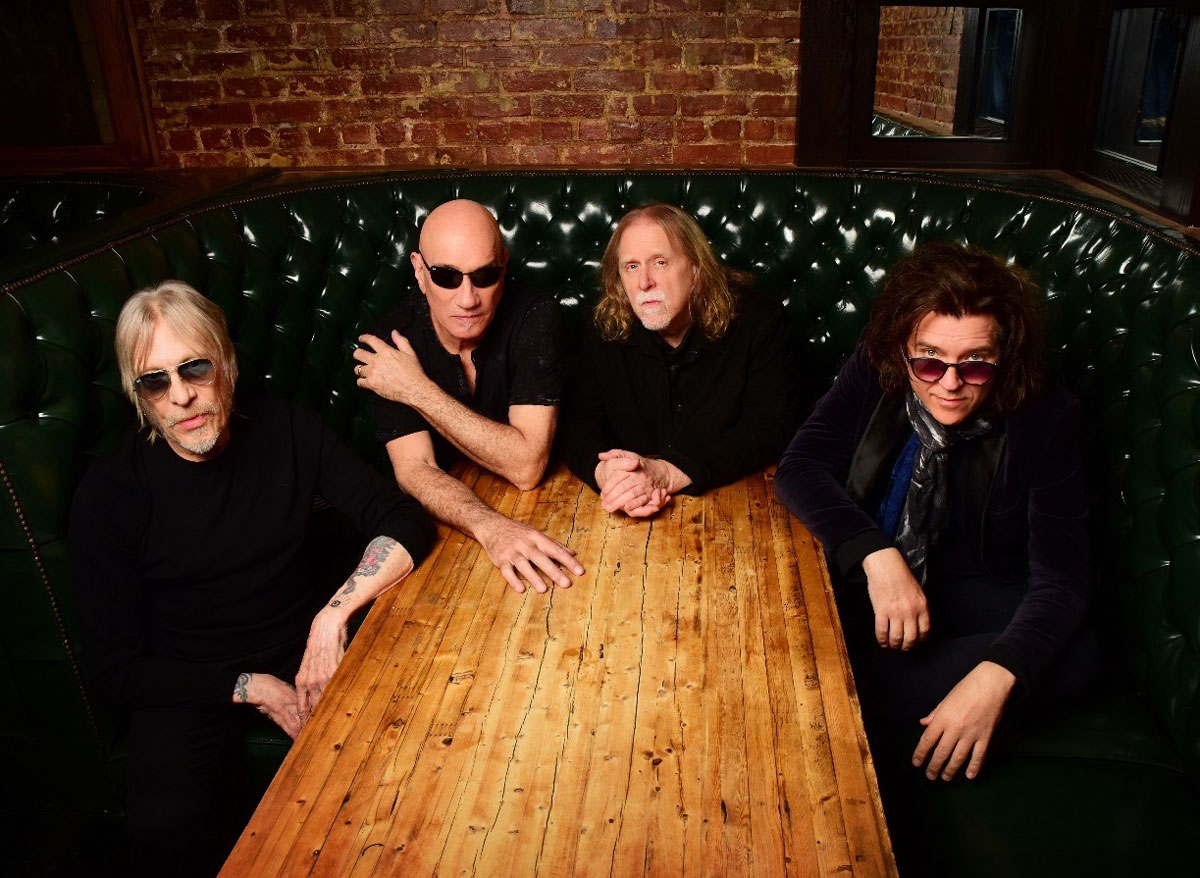
Well, it all starts with the writing process. During COVID, when we were all in our houses, I had so much time to write that I had more new material than I’ve had in a long time. I made a conscious effort to bring back the concept of more complex song arrangements. I was thinking of some of our early stuff, like “Left Coast Groovies,” and some of our songs that have many moving parts. But more importantly, I was thinking about sounds that have influenced us that have many moving parts. All of our favorite stuff from the late ’60s and early ’70s didn’t adhere to the modern-day formula of verse-chorus-verse-chorus. Some of the songs, instead of having two or three sections, would have seven or eight. They’d have tempo changes and key changes. And I thought it might be nice to bring that back – more intricate arrangements. The first four songs on this record really portray that. “Same as It Ever Was,” “Shake Our Way Out,” “Made My Peace” and “Peace I Need” are all good examples of challenging the modern-day short attention span.

When you wrote some of those songs, you composed the complex arrangements? It wasn’t something that came out of the recording?

Yes, for the most part I wrote the songs that way. Some things changed when we got into recording, but I went into the songs with the mindset of not limiting myself. During the whole lockdown, a lot of the songs that I wrote, I’d write on a guitar, and get all these ideas for different sections and parts, and record them, sometimes, on my phone, just so I would not forget them when we got into rehearsal. I had not had that kind of time in so many years that it was great to think that way. 

So it was a silver lining in an otherwise terrible circumstance?

Yeah. Absolutely.

You mentioned “shot attention span.” Why do you think that mainstream music culture has changed from the time when a sprawling epic with a complex arrangement could get on the radio to now you almost never hear that, and often the songs that you do hear are two minutes and 30 seconds with the same loop repeated over and over? What do you think accounts for that change?

It is a combination of a lot of things. Technology always helps dictate those kind of negative changes, negative in my mind. But also it is up to the artists and musicians to fly in the face of the trends. I made a joke with someone recently that if songs get any shorter, they won’t even have a verse. They’ll be nothing but a chorus. I think back to songs like “Band On the Run” or “Bohemian Rapsody” or “Roundabout,” even the radio versions of those songs had so many moving parts, and for whatever reason, people didn’t have trouble following it. It was interesting and it maintained your attention. There was no reason to question it, because it was exciting and creative. I’d like to see the music world get back to that, because individuals as music lovers, as long as something is exciting, they’re not going to be bothered by something conflicting with the norms and modern-day approach. People who really love music always embrace something that it is new, different and fresh.

And welcome the surprise.

Yes, I remember many of the songs that I loved, I loved because I could hear how different they were from the songs surrounding them.

When you attribute many “negative changes” to technology, would you draw a connection between shorter and more repetitive songs and fewer entertainers playing instruments?

Those things are definitely tied together. We’re starting to see more young people playing instruments and pursuing live performance. I’m hoping that it is a sign of a backlash against what Gov’t Mule is rebelling against. You can see when you get on a plane, and it lands, everyone on the plane is looking at their phone. Some of them have legitimate reasons, but others are just jonesing. I remember when cell phones first became in vogue, you would see a person walking down the street on the phone, and everyone would mock him as someone drawing attention to himself. Now, everyone is on their phone. 

That reminds me of the late Senator Danial Patrick Moynihan’s phrase, “Defining deviancy down.”

That’s right. I feel like the powers that be have become content to market to the lowest common denominator. Maybe that’s always been the case, but it was, at least, to a lesser extent. There’s not a lot of focus on music that enlightens people, and that carries over to other products as well.   

Something else that jumped out about the new record, especially in comparison to your 2017 record “Revolution Come . . . Revolution Go,” which was angrier, is that it has a hopeful quality and mood. Is that feeling something you set out to inject into the songs?

“Rock and roll music has always reflected the times, and we’re in some pretty precarious times.”

Yeah, I did not want to write depressing, COVID-centric songs. I wanted to think about what was important in life, based on all the challenges we were going through. What would remain important? What could we let go of? It wasn’t so much a conscious effort as it was what I found myself doing as I was writing. However, I did make sure not to write or record an album that was about how depressed we felt during COVID. There are songs like “Shake Our Way Out” and “Head Full of Thunder” that are definitely coming from a sense of humor sort of angle. All the ones that tie together, like “After the Storm,” “Same As It Ever Was,” and “Peace I Need,” are all exploring different aspects of an individual’s search for inner peace. 

Shervin LainzShervin Lainz (Shervin Lainz)

At the same time there are some political anthems like “Dreaming Out Loud” and “Long Time Coming.” Did you want to issue a comment on the various political crises? More broadly, why do consistently write protest songs? Every Mule record has, at least, one or two.

Rock and roll music has always reflected the times, and we’re in some pretty precarious times. To ignore that is definitely the wrong thing. “Revolution Come . . . Revolution Go” was started, at least in the recording process, on election day of 2016, which forced us into a certain mindset. Here we are, years later, in a different predicament, but obviously America and the world in general are facing many challenges. I wanted to touch on those challenges in a few songs, but focus more on what we are all feeling together. Even though many of these songs are about my personal journey, I think they relate well to others, because during COVID, for the first time in my lifetime, everyone was facing the same fears and challenges.

Relating to what you said earlier about music culture, what would you say has become of the album itself as a vehicle of music now that streaming has become the dominant listening format?

It’s never going to be palatable for me to think of our audience only listening one track at a time. Right or wrong, I feel like we owe it to ourselves and our audience to put albums together with a thoughtful sequence and artwork that reflects the music. We want to keep that spirt alive. In some ways, that concept is coming back. Vinyl is outselling CDs now. It can’t compare with streaming, but even many in the younger generation are excited about vinyl, and many young listeners are starting to get the concept of sequencing a record and why that is important. The instant gratification part of the equation, though, is that someone always has access to the feature track, and is going to start there. But many of our fans don’t adhere to that mindset, and they look at music exactly the way we do.

As a writer, I often think of an album like I do a great book. You can pull a passage or chapter out of the book, and have a great reading experience, but nothing compares to reading the book in completion, and seeing how different parts interact and build off each other.

Right, and for no other reason to get a glimpse into what the artist or the band was thinking in addition to the one featured track during that time period. It helps to know what else was going on in someone’s mind other than one important thought that they had. Even if there was no concept to the record, a lot of our favorite records had songs that connected to each other because they developed in a single period during the artist or band’s life. 

“Pink Floyd’s music is a good example of predicting what was to come.”

I would assume that one of your favorite records is Pink Floyd’s “Dark Side of the Moon” because you are getting ready for a “Dark Side of the Mule” tour this summer in which you’ll play a Pink Floyd set every night. Why that particular record and why Pink Floyd for a tribute tour?

For us, “Dark Side of the Mule” is license to play anything from Pink Floyd we’d like, not only “Dark Side of the Moon.” Although, we do borrow heavily from that record. The fact that the 50th anniversary of that album is upon us is the impetus for doing the tour one last time. It is one of my favorite records. It is musically fantastic, and in some ways, better now than it was when it first came out. That’s really the test of music. Is it timeless? Does it hold up in a modern light, in modern society? All the records that are our favorites do hold up, and allow us to learn something now that we didn’t discover at its release. Pink Floyd’s music is a good example of predicting what was to come. 

What are some of the other records that you would put alongside “Dark Side of the Moon”?

There’s so many. All my favorite Led Zeppelin records, Little Feat records, Steely Dan records. Some of the great singer/songwriter records, like James Taylor‘s “Mud Slide Slim and the Blue Horizon,” Jackson Browne’s early records, Dylan’s early records. I’m only scratching the surface. We won’t even go into blues and jazz. In the blues and jazz world, from 1955 to 1965, there was an unbelievable flood of great music that stretched into the ’70s. With rock and roll, from around 1966 or ’67 to about 1973, there was just an amazing amount of classic, timeless music. I’m not sure why that was, but the soul music world was the same. If you look at the Marvin Gaye records, the Sly and the Family Stone records, and the Stevie Wonder records in that time period, they all have a timeless quality to them. When you hear them now, it doesn’t feel like they were trying to copy anything. They weren’t compromising or selling out. They were making music at the highest level possible for them.

This is a little tangential, but speaking of Pink Floyd, do you have any thoughts on the recent controversies surrounding Roger Waters?

I don’t really have any comment on that. I think Roger is one of the great songwriters of our time, and he has very strong political views – some that I agree with and some that I don’t. But it doesn’t change the music. I don’t see any reason to shy away from the music, because he’s controversial. 

Gov't Mule liveGov’t Mule live (Steven Addington)You’re speaking about music history. You were in the Allman Brothers for 25 years, you toured with The Dead, and Gov’t Mule is a pivotal part of the jam world. How do you describe the jam scene to the uninitiated? What does it mean to you?


The parameters of the jam world are loose and basic. The only real requirement is that you leave some of your songs open for reinterpretation on a nightly basis so that improvisation plays an important part in what you are doing. You play a different setlist night to night, rather than repeating that same set for the entire tour. You should include some strange cover choices, but also some obvious cover choices. There really aren’t any strict musical rules. I’ve said for over 10 years that the jam world should incorporate more jazz, more reggae and more bluegrass, and it is finally starting to happen.

Gov’t Mule is kind of the bastard child of the jam scene – the black sheep – because we’re heavier than other jam bands. But we’re still steeped in improvisation. It is interesting, because when we go to Europe, they don’t have the same understanding and appreciation of the jam band scene. Some people are starting to get it, but the reason we do well in Europe, is they look at us as a rock and roll band – the same way they might look at The Black Crowes. In other parts of the world, they haven’t really fully gotten into what the jam scene is all about, and that’s understandable, because it is a bit bizarre. But, if you are open-minded as a music lover, I would suggest that you will realize it has something to offer. 


Want a daily wrap-up of all the news and commentary Salon has to offer? Subscribe to our morning newsletter, Crash Course.


So many rock and roll legends have died recently. You often write thoughtful tributes on your social media when a legend dies. How do you assess the legacy and meaning of rock and roll, as this is happening?

It is a bit scary that so many of the people that created the music we fell in love with are no longer with us. I would like to think that the timelessness, importance and integrity of it will inspire people to keep it alive. I hope that people realize the difference between trendy music and timeless music. There is always a place for pop music, but there’s always a place for music that aspires to go beyond that, and to offer music lovers something much more challenging and inspired. 

And after writing songs about the search for inner peace, how would you say that experience changed your approach to making music?

I feel like we’re in the beginning of a new chapter. There’s a lot of inspiration right now. We all should feel liberated. Personally, we’re thankful for our chemistry as a band, and thankful for the opportunity to do what we love.

Trump calls for replacement of 20 Republicans who voted to block censure of Adam Schiff

On Wednesday, twenty House Republicans went against the stream in an unexpected act of unity with Democrats — voting to block the decision to censure Rep. Adam Schiff (D-Calif.), who was involved with investigations related to Trump’s ties to Russia.  

This comes after Rep. Anna Paulina Luna (R-Fla.) proposed the move against Schiff on the basis that he “exploited his positions on HPSCI (House Permanent Select Committee on Intelligence) to encourage and excuse abusive intelligence investigations of Americans for political purposes,” according to Newsweek

Per reporting by The Hill, “Luna brought the resolution to the floor as a privileged resolution the same day that former President Trump — who was investigated by Schiff, which sparked GOP ire — pleaded not guilty to 37 counts following a Justice Department indictment on allegations that he improperly retained classified documents and refused to return them. Luna, a Trump ally, first introduced the measure May 23.”

Sounding off against these 20 Republicans who disagreed with his wishes to go after Schiff, Trump called for their replacement via a statement made to Truth Social on Friday night.

“Anna Paulina Luna is a STAR. She never gives up, especially in holding total lowlifes like Adam “Shifty” Schiff responsible for their lies, deceit, deception, and actually putting our Country at great risk, for which he should be imprisoned,” Trump wrote. “He is a Leaker and a Scoundrel. Any Republican voting against his CENSURE, or worse, should immediately be primaried. There are plenty of great candidates out there!”


Want a daily wrap-up of all the news and commentary Salon has to offer? Subscribe to our morning newsletter, Crash Course.


 In a statement made following the decision to table his censure, Schiff said, “MAGA Republicans are going after me because I dared to hold Donald Trump accountable. These efforts to intimidate me will not succeed. I will always defend our democracy.”

The US will send depleted uranium munitions to Ukraine — a health physicist explains what that means

The Biden administration has agreed to provide Ukraine with depleted uranium shells to equip M1A1 Abrams tanks that the U.S. is sending there. Britain has already delivered tanks to Ukraine equipped with depleted-uranium shells.

DU munitions, developed in the 1970s, are not nuclear weapons and do not produce a nuclear explosion. But soldiers or civilians can be exposed to the uranium, either in combat or afterward. Health physicist Kathryn Higley explains what depleted uranium is and what’s known about potential health and environmental risks.

What is depleted uranium?

Uranium, symbolized by the letter U, is a naturally occurring element that is radioactive. Natural uranium is composed primarily of three isotopes: U-234, U-235 and U-238.

These isotopes are all uranium and have the same chemical characteristics, but they have slightly different masses, as indicated by the numbers 234, 235 and 238. Depleted uranium is mainly U-238, with small amounts of other isotopes, including U-235.

The isotope U-235 is fissile, which means that it can be split in a reaction that releases a lot of energy. U-235 in fairly low concentrations is used as fuel in commercial nuclear reactors; in high concentrations, it can power nuclear weapons.

Engineers use a process called enrichment to extract U-235 from natural uranium ore. What’s left over after this process removes some of the U-235 is called depleted uranium.

All uranium is radioactive, and each isotope has its own unique half-life. U-238, the most abundant naturally occurring isotope, constitutes about 99.27% of all natural uranium. It takes approximately 4.5 billion years – roughly the life of the Earth – for half of a given quantity of uranium-238 to decay into other elements. U-235 has a half life of about 700 million years and represents about 0.72% of natural uranium.

Depleted uranium is about 40% less radioactive than natural uranium. All isotopes of uranium decay over time, emitting both radiation and energetic particles and transforming into different chemical elements. In this process, they produce specific isotopes of other radioactive elements such as thorium, protactinium and radium.

Depleted uranium tank shells are extremely hard and dense and can penetrate the walls of Russian tanks.

Why is depleted uranium used in munitions?

Depleted uranium can be manufactured into a very dense material – about 1.7 times more dense than lead. This gives it some desirable characteristics in munitions.

Because DU is a byproduct of the nuclear fuel cycle, plenty of it is readily available. Formed into a projectile, such as a bullet or shell, its high density helps the munition penetrate into a target. Advanced tanks use DU in their armor to protect against armor-piercing munitions.

DU’s density also gives the munition a higher momentum, which enables it to push through materials. Once the munition penetrates a target, it may fragment into smaller pieces and ignite, causing further damage.

Where have depleted uranium munitions been used?

Depleted uranium munitions have been used in the Gulf War in 1990-1991, the Kosovo conflict in the Balkans in 1998-1999 and in U.S. operations in Iraq and Afghanistan. In addition to the U.S. and the U.K., Russia, France and China are known to have DU munitions in their arsenals, and other countries may be importing them.

DU also has nonmilitary applications. Its high density makes it useful for stopping radiation in medical, research and nuclear facilities. It can also be used as ballast to balance weight and provide stability in ships and aircraft.

The alpha radiation that DU emits is not strong enough to penetrate human skin, so just being near depleted uranium is not a health risk. But it may become a health hazard if it is ingested or inhaled, or shrapnel fragments are retained in the body.

A row of munitions with pointed tips

U.S. Army 25 mm rounds of depleted uranium ammunition, photographed Feb. 11, 2004, in Tikrit, Iraq. Stan Honda/AFP via Getty Images

Will these munitions create health or environmental risks on Ukrainian soil?

Numerous studies have investigated the potential health effects of exposure to depleted uranium. They include health studies of soldiers hit by DU shrapnel, and biomonitoring – collecting samples of urine, feces, fingernail clippings and hair from exposed individuals. Investigations have included reviews of military personnel exposed during and after combat.

Some studies have observed uranium above natural concentrations in samples collected from soldiers serving in the Gulf War, Bosnia and Afghanistan who had embedded DU fragments in their bodies. In other instances, researchers studying Gulf War Illness in veterans did not find a difference in uranium concentrations in urine between exposed and unexposed groups.

The U.S. Department of Defense and Veterans Administration started monitoring service members for DU exposure during the Gulf War, and this program is still running. So far, the agencies have not observed adverse clinical effects related to documented exposures.

Fragments and much smaller particles from exploded DU munitions can remain in soil long after conflicts end. This has raised concerns about possible radiation or toxic threats to people who come across these materials, such as local residents or peacekeeping forces. In general, studies of people who were inadvertently exposed to battlefield remnants of depleted uranium munitions show low radiation doses and low levels of chemical exposure that were generally indistinguishable from background level.

In terms of environmental impacts, the scientific literature is largely silent on the extent to which plants or animals can absorb DU from munition fragments, although laboratory studies indicate that this is possible. Researchers and health professionals agree that very high levels of uranium, depleted or otherwise, may cause chemical toxicity in plants – but if this were to happen, it would likely be in the immediate vicinity where the munitions exploded. Scientists continue to examine how DU particles behave in the environment, in order to improve our ability to predict long-term environmental effects.

It’s already clear that large areas of Ukraine’s territory will contain the residues of conflict, including weapon fragments, spilled fuels and explosive residues, long after the fighting there ends. The U.S. and U.K. governments clearly believe that providing DU munitions will improve Ukraine’s ability to defeat Russian tanks and bring this conflict to an end.

This article is republished from The Conversation under a Creative Commons license. Read the original article.

Pesticides in the womb: New research shows how the Bhopal gas disaster is still destroying lives

If the victims were not impoverished, disempowered Indians, the Bhopal disaster would probably be on the lips of every human being alive to this day.

People who were in utero during the Bhopal disaster “report decades later to have higher rates of cancer, higher rates of disability precluding employment, and lower levels of education.”

On the night of December 2nd to 3rd, 1984, a pesticide plant in the Indian city of Bhopal began leaking a toxic chemical called methyl isocyanate. People sleeping miles away recall suddenly waking up because they felt like they were choking. Chemicals burned their eyes and mouths. Survivors tell stories of the streets being strewn with corpses. Men, women and children collapsed to the ground while foaming at the mouth, feces streaming down their legs as they lost control of their bowels.

By the time the immediate crisis had passed three days later, between 7,000 and 10,000 people had already died. The final official death toll is approximately 22,000 — more people than perished during the infamous Chernobyl nuclear disaster in Ukraine. The plant was owned by the U.S.-based chemical corporation Union Carbide India Limited (UCIL), and with all of their wealth and power, the company largely avoided accountability, although in 2010 seven Indian former employees were convicted of negligence.

To this day, hundreds of thousands of people in Central India continue to suffer from severe medical conditions as a result of the accident. Children are born with fingers growing out of their shoulders and missing palates from their mouths. People of all ages languish from ailments of the eyes, lungs and blood. And it appears that the methyl isocyanate didn’t simply cover a large chunk of Central India — it has continued to linger in the environment.

That is where Dr. Gordon C. McCord and other researchers at the University of California San Diego — including Prashant Bharadwaj, Lotus McDougal, Arushi Kaushik and Anita Raj — enter the picture. McCord is the corresponding author of a new study published in the medical journal BMJ Open, one that analyzed data about thousands of Indians — both those exposed to the Bhopal accident and those who were not — to learn about patterns in their overall health and education. By doing so, the researchers hoped to estimate the relative effect of being in utero near Bhopal during the catastrophe.

“While there have been many studies of the disaster’s effects on people living in Bhopal at the time, there has been far less work on the effects on the next generation, or on long-term socioeconomic effects beyond health,” McCord told Salon by email. “To our knowledge, the use of spatial methods with recently gathered survey data to study these long term impacts is novel.”

Their conclusion was sobering: People who were in utero during the Bhopal disaster were decades later more likely to report “higher rates of cancer, higher rates of disability precluding employment, and lower levels of education. Our work also suggests that the effects of the disaster reaches people living up to 100 km (more than 62 miles) away, a wider geographic range of impact than previously acknowledged.”


Want more health and science stories in your inbox? Subscribe to Salon’s weekly newsletter The Vulgar Scientist.


“The methyl isocyanate gas affected respiratory, neurological, musculoskeletal, ophthalmic, endocrine and reproductive systems, and it damaged human chromosomes.”

Poignantly, the authors noted that the long-term health consequences could have been caused not only by the leak itself, but also by residents’ lack of access to quality social services.

“The long-term consequences that we estimate could be the result of both direct effects from exposure as well as lack of subsequent mitigation of the effects through health, disability and education services,” they write. Indeed, the response to the Bhopal gas disaster is so inadequate compared to ongoing human needs that, to this day, scientists cannot ascertain with certainty everything that happened to the bodies of the Central Indians who were impacted by the incident.

“We cannot confirm the reasons in this paper, but there is evidence the methyl isocyanate gas affected respiratory, neurological, musculoskeletal, ophthalmic, endocrine and reproductive systems, and it damaged human chromosomes,” McCord explained. “Miscarriage, stillbirth, and neonatal mortality increased following the disaster. All of this makes it quite plausible that the toxic effects of the gas affected children in utero.”

Although the paper did not focus on advocating for specific policies, there are certain self-evident conclusions that are immediately apparent, at least if the goal is to prevent future humanitarian horrors like the Bhopal disaster.

“This disaster put into stark focus the tradeoff that developing countries face in regulating dangerous industries,” McCord explained. “On the one hand, industrial growth creates jobs and economic development, and on the other it introduces risks that industry and government need to manage through regulation.”

In addition to fairly compensating all of the victims, McCord argued that “more broadly, these long-run inter-generational impacts should inform how policymakers evaluate the appropriate level of regulation and oversight that should be put in place to promote economic growth while minimizing risks to workers and society at large.”

As the authors of the study concluded, “these results indicate social costs stemming from the [Bhopal gas disaster] that extend far beyond the mortality and morbidity experienced in the immediate aftermath.”

Policymakers need to quantify the health impact not only on immediate survivors, but on future generations. “Moreover, our results suggest that the [Bhopal gas disaster] affected people across a substantially more widespread area than has previously been demonstrated.”

Jack Smith is no hero

Special counsel Jack Smith is not a hero, he is just a man. Although it may seem counterintuitive, that is one of the main reasons why Donald Trump and his crime cabal are so afraid of Jack Smith.

A hero is someone who acts selflessly to help others — and does so at great personal risk to themselves. They are not paid or trained to help others. A person can be brave and courageous without necessarily being a hero. By their very nature, true heroes are uncommon.

During his decades-long career, Smith has shown himself to be an extremely skilled and highly competent legal professional and public servant. He has successfully prosecuted international war criminals, corrupt politicians, and members of criminal organizations. The special counsel is methodical, focused and task-oriented. In a recent profile, the New York Times described his career thus far:

Former colleagues said he stood out from the start. He was more intense and more focused than many of his peers. He was known for his succinct and effective courtroom style — so much so that senior attorneys in the office would advise junior prosecutors to watch his trials and take notes, according to a person who worked with him in Brooklyn….

During a panel discussion on “Morning Joe”, MSNBC host Jonathan Lemire shared that “Trump insiders” are deeply fearful of Smith — as they should be:

He is someone who seems immune to what their typical playbook is, which is the smoke screen and the attacks, the assertions of bias and, to this point, that just hasn’t worked.” 

It is no surprise why Attorney General Merrick Garland appointed Smith as special counsel, giving him the responsibility for bringing Trump to justice in what will truly be “the trial of the century.” Smith has summoned his deep skills and talents to develop a devastating case against the traitor ex-president. If convicted, Donald Trump could potentially spend the rest of his natural life in federal prison.

Jack Smith is highly trained, well-compensated, and is not acting selflessly as he pursues justice. In all, he is simply doing his job very well and in accordance with his oath and responsibilities at the Department of Justice as a public servant. So, again, Jack Smith is no hero.

There are many people like Jack Smith in the United States government who do their jobs quietly and expertly in service to the American people and their democracy every day. Donald Trump, like other fascists, demagogues, and authoritarians despise such people because they view them as roadblocks in their plans for total and corrupt power. Such malign actors believe that the state is an extension of their personal interests and ego; the rule of law and the bureaucracy are to be bent to their will.

The label of “hero” places unfair expectations on a person, leaving them in an almost inevitable position to disappoint.

In that way, Donald Trump, like Vladimir Putin and other enemies of real democracy is committed to what political scientists, historians, and other experts have described as “personalist rule.” In a 2021 essay in the Economist, historian Ruth Ben-Ghiat explained, “The concept of “personalist rule”—which organises government institutions around the self-preservation of a leader whose private interests prevail over national ones—provides a useful frame to understand the challenge to democracy and how to overcome it. As dire as turns to illiberalism look, strongmen have particular vulnerabilities and society can take specific actions to curb their behaviour.”

At the Daily Beast, David Rothkopf details how to take advantage of such a worldview: 

During his presidency, Trump was regularly frustrated by the fact that government officials—appointees as well as career officials in the civil service, the military, the intelligence community and the foreign service—were an impediment to the autocratic impulses about which he often openly fantasized. (Remember the time he said he wished his staff would “cower” like North Korean dictator Kim Jong Un’s? He wasn’t kidding.)

But Trump’s real issue with career professionals and even many of the senior officials he himself appointed was not that they “reported to no one,” but that instead they actually understood to whom they did report: the American people. They took their oaths of office seriously, which on a regular basis during the Trump years meant that they foiled some of Trump’s craziest or most dangerous plans by pointing out they were unconstitutional, illegal or gravely damaging to U.S. national interests.

Time and time again, when Trump’s inner circle clicked their heels and said “yessir” and the GOP-led Congress ignored its constitutional responsibilities, really bad ideas were ultimately stopped, slowed or diluted by senior government officials who actually understood the concept and responsibilities of public service.

We have seen extreme examples of how this worked in the course of the Jan. 6 Committee hearings. 


Want a daily wrap-up of all the news and commentary Salon has to offer? Subscribe to our morning newsletter, Crash Course.


At the Brookings Institution, John Hudak highlights the importance of career government professionals and what may happen if Trump and the other Republican fascists are allowed to purge them:

Regardless of what you believe about the permanent government, what is its alternative? It is an executive branch staffed entirely via patronage. In a patronage system, the bulk of the civilian executive branch staff is hand-selected by the president—a system in which each employee of the government owes their allegiance to the president. In its first century of its existence, the U.S. largely operated in this manner. The government was not predominantly staffed by qualified professionals, but by those to whom the president owed political favors. Under that system—one distanced from career civil servants and that at times calls on them to fill certain policy-focused appointments—the government workforce would have far fewer Bill Taylors, George Kents, Fiona Hills, and Alexander Vindmans. Instead, the bureaucracy would look more like the White House political staff, packed with Mick Mulvaneys, Kellyanne Conways, and Stephen Millers. 

Sick societies produce sick leaders. Institutions and organizations reflect the qualities and personalities of their leader(s) and members. Given that Trump has repeatedly shown himself to be a sociopath if not a psychopath, a criminal, immoral and evil, a malignant narcissist, delusional, violent, a fascist autocrat and a de facto cult leader, if he gets his way the entire United States government apparatus would take on those traits. In essence, the United States government would become a type of fascist Cthulhu monster, an extension of Trump’s evil twisted mind and pathological impulses.

Whatever the outcome(s) may be in Donald Trump’s trial for violating the Espionage Act and other laws, we should still resist the impulse to describe special counsel Jack Smith as some type of hero. To hoist that title on him is in many ways an unfair burden because it makes the day-to-day hard work of following through on his tasks and responsibilities into something rarified, almost magical, and thus unbelievable. The label of “hero” also places unfair expectations on a person, leaving them in an almost inevitable position to disappoint. Special counsel Robert Mueller is a prime example of such a fate.

Heroes are real. But Jack Smith is not one of them and that is a good thing. He is instead a man, a human being, like the rest of us, who decided to do his job which in this case means enforcing the law and holding Donald Trump accountable for his many crimes.

In the end, for American democracy and its society to survive the Trumpocene and the larger neofascist nightmare and then ensure such a disaster never takes place again, we the Americans are going to need many more career public servants and government professionals like Jack Smith.

“DOJ really had no choice”: Experts say non-lawyer Tom Fitton’s advice horribly backfired on Trump

Former President Donald Trump, who is charged with stashing national security secrets at Mar-a-Lago and obstructing government efforts to retrieve them, relied on advice from the leader of the conservative organization Judicial Watch, who convinced Trump that he had the legal right to retain the documents and encouraged him to fight against the Justice Department, The Washington Post reported

Trump’s lawyers repeatedly urged him to return the document remaining at his residence but the former president instead turned to Tom Fitton, who doesn’t have a law degree but has remained vocal about Trump having the right to keep the documents he took with him at the end of his presidency.

“If Trump had simply given these documents back, when he was first asked, there would have been no jury subpoena, there would have been no search warrant, and there would have been no criminal charges,” former U.S. Attorney Barb McQuade, a University of Michigan law professor, told Salon. “In fact, in each of those steps of the investigation, if Trump had returned  the documents, there likely would not have been a criminal prosecution.”

Fitton reportedly argued that the records belonged to Trump, pointing to a 2012 court case involving his organization which he claimed granted the former President the authority to exercise control over the records from his own term in office.

Trump has echoed his claims referring to a ruling in which the judge said it was okay for President Bill Clinton to keep audiotapes of his conversations with historian Taylor Branch during Clinton’s White House tenure. 

“Under the Presidential Records Act — which is civil, not criminal — I had every right to have these documents,” Trump said in a speech Tuesday night. “The crucial legal precedent is laid out in the most important case ever on this subject, known as the Clinton socks case.”

But the key difference between the two comparisons is that Clinton’s recordings were from his own interviews with a journalist and not presidential records like Trump’s, legal experts say. 

“The Presidential Records Act distinguishes between ‘presidential records’ and ‘personal records’ and required President Trump to preserve White House documents because those are the property of the U.S government,” Temidayo Aganga-Williams, partner at Selendy Gay Elsberg and former senior investigative counsel for the House Jan. 6 committee, told Salon. 

Even as Trump’s advisers urged him to cooperate with investigators in their efforts to retrieve the classified documents he had taken when he departed from the White House, Trump brought up Fitton’s name whenever he refused to comply with their advice, sources told The Post. 

“Trump all but dared DOJ to indict him,” McQuade said. “In order to be even-handed in applying the law to offenders who willfully abuse their power to handle classified information, DOJ really had no choice but to indict Trump.”

Despite multiple opportunities to avoid criminal charges, Trump consistently refused to return the presidential documents requested by the National Archives since February 2021, sources familiar with the case told The Post. Trump was not charged for the documents he did return voluntarily.

“The national security documents that President Trump is criminally charged with keeping at Mar-a-Lago and refusing to return were always government records and could not be considered personal records in any reasonable reading of federal law,” Aganga-Williams said.

In February, after the National Archives acknowledged retrieving 15 boxes of presidential records from Trump, he began receiving calls from Fitton telling him it was a mistake to give the records to the Archives, CNN reported

Fitton reportedly told Trump’s team that they should never have let the Archives “strong-arm” him into returning them. He then suggested to Trump that if the Archives came back, he should not give up any additional records.

One source told CNN that Trump requested Fitton brief his attorneys on the legal argument. 

Even as Trump publicly maintained that he was fully cooperating with government officials, his behind-the-scenes communication with Fitton reveals a different story.

Contrary to Fitton’s advice to “completely stonewall the government,” Trump did hand over some material in June after a meeting between his lawyers and federal investigators at Mar-a-Lago, according to CNN. 

However, investigators later found evidence suggesting that not all classified material had been returned, despite the former president being issued a subpoena. The FBI eventually carried out a search of Mar-a-Lago last August and found over 100 documents with classified markings at Trump’s Mar-a-Lago residence.


Want a daily wrap-up of all the news and commentary Salon has to offer? Subscribe to our morning newsletter, Crash Course.


Trump intentionally deceived his own advisers regarding the contents of the boxes, telling them they only contained newspaper clippings and clothes, seven Trump advisers told The Post. He consistently refused to return the documents even after receiving warnings from some of his most loyal advisers about the potential risks involved.

His actions have mirrored the advice of Fitton – a staunch election denier who promoted conspiracy theories about Dominion Voting Systems and Smartmatic after the 2020 election, according to Media Matters

Fitton entered Trump’s inner circle after he caught the former president’s attention, who viewed him as one of the most effective critics of the Mueller probe from his frequent appearances on Fox News, Politico reported

His media appearances are also similar to Trump’s. In one interview with Politico, Fitton discussed what he perceived as “abuses” of power by the Justice Department and the FBI, labeled the Mueller investigation as “unconstitutional” and asserted that there was sufficient evidence to arrest and prosecute Hillary Clinton.

He has built a following by appearing on right-wing networks and filing lawsuits against the federal government alleging bureaucratic corruption. 

During one interview, Fitton himself corrected Fox host Jeanine Pirro after she referred to him as a lawyer, and then responded: “you should be, you get more out of courts than anyone I know.”

But Fitton’s limited legal expertise hasn’t stopped the former president from seeking advice from him. It’s only complicated the role Trump’s attorneys play in representing him.

It’s also left Trump scrambling to find legal representation a day before his court appearance after two of his top lawyers stepped down just hours after a Florida grand jury voted to charge him. 

Most recently though, Fitton’s advice appears to have led Trump to being charged with 37 counts including alleged violations of the Espionage Act, obstruction and false statements.

Doubly disadvantaged: Undocumented women earn less than everyone else

Undocumented women workers earn less than women overall and less than undocumented men, making them one of the lowest paid groups in the U.S., according to a new report.

The disparity is driven by both the kinds of jobs they have and the states in which they live, according to a new report by the Gender Equity Policy Institute (GEPI).

The study’s most surprising finding, according to author Natalia Vega Varela, was that such gender pay gaps vary enormously between California, New York, Florida and Texas, the states with the largest populations of undocumented women. Supportive policies in California and New York may have raised pay for undocumented women in those states, she said.  

In New York, undocumented women make $22,000 more than in Texas and $21,000 more per year than in Florida, according to the report. Undocumented women in New York make $11,000 more than their counterparts in California.  

The minimum wage is $15.50 per hour in California and $14.20 in New York (outside New York City, Long Island and Westchester, where it is $15). It’s $11 in Florida and $7.25 in Texas. 

Renata Bozzetto, Deputy Director of the Florida Immigrant Coalition, said the report shows that state policies can lower poverty rates among undocumented people. 

“When you see that an undocumented woman in Florida makes about 50% of what an undocumented woman makes in New York, that means there are possibilities,” she said. “There can be more labor security.”

 Researchers found that the types of jobs held by undocumented women are a key reason for the pay gap. Undocumented women hold lower-paying jobs than undocumented men. 

Undocumented men are 10 times more likely than undocumented women to be truck drivers and 13 times more likely to be construction workers. These jobs both pay more than jobs in which undocumented women are overrepresented, such as housekeeping. Even when working the same jobs, undocumented women are paid less than undocumented men, according to the study.

The author of the report, called “Double Disadvantage,” said it is one of the first to examine the financial plight of undocumented women as separate from the plight of undocumented men in the United States.

Some 21% of undocumented women live below the federal poverty line, making less than $30,000 per year for a family of four. The poverty rate for all women in the United States is around 14%. 

Nearly half of the 5 million undocumented women in the U.S. are mothers, raising another 5 million children who are American citizens. 

Approximately 66% of undocumented women are Latina, 18% are Asian, 8% are white and 6% are Black. 

Diana Ramos, a Los Angeles immigrant rights advocate, said many undocumented women of retirement age do not have access to Social Security payments.

“Some of them are grandmothers who continue to labor because they don’t have access to a Social Security number,” said Ramos, who is the the deputy director for organizing at the Coalition for Humane Immigrant Rights of Los Angeles (CHIRLA).

 The report noted that in New York and California, undocumented women benefit from higher minimum wages, stronger union protections and social programs for noncitizens.

According to David Dyssegaard Kallick, director of the New York-based Immigration Research Initiative, social policies targeted at both men and women will, counterintuitively, always help close pay gaps between men and women.

“If you set a higher [wage] standard, women are going to benefit the most because they were the ones making the least,” Kallick explained. 

In Texas, undocumented women make 74 cents per dollar paid to undocumented men. In Florida, they make 80 cents on the dollar paid to their male counterparts. 

In California, undocumented women make 87 cents on the dollar compared to undocumented men.

But in New York, undocumented women earn nine cents more on each dollar paid to undocumented men.

Both Texas and Florida are “right-to-work” states. Right-to-work laws allow workers in a company with a union contract to avoid joining the union or paying union dues, reducing union membership and revenue.

In 2015, the Economic Policy Institute found that wages in right-to-work states were 3.1% lower than in states without the laws (after accounting for cost of living).

In California and New York, where state health coverage has been made available to some undocumented people, around six in 10 undocumented women have health care, GEPI found. (In 2024, California will offer its Medicaid program, called Medi-Cal, to all undocumented workers below a certain income level.) Coverage rates lag in Texas, where just over a third of undocumented women have health insurance. Over half of undocumented women in Florida are insured. 

Diana Ramos of CHIRLA said she has seen access to health care impact the lives of undocumented workers. Hotel maids and street vendors who work with her organization have received preventative care and eyeglasses through the Medi-Cal expansion. 

Ramos said her mother, an undocumented immigrant, died of cancer at age 64. Her mother died in 2021, before California expanded Medi-Cal to all eligible adults over 50, and did not visit a doctor for preventative care. When she went to an emergency room because of pain, doctors found cancer too advanced to halt, Ramos said. 

“I just feel like if we had had these programs earlier, perhaps some of our folks would still be there with us,” Ramos said. 

Much has changed in California since voters approved Proposition 187 in 1994, which prevented undocumented people from accessing state services, including education and nonemergency health care, Ramos said. 

Robust organizing of Latino immigrants has transformed the policy landscape to bolster social services for immigrants since then, she added. The influence of Latinos grew in California as they came to outnumber whites in 2014. 

In 2013, then-Gov. Jerry Brown signed two landmark laws for immigrants, granting state drivers’ licenses to the undocumented and extending overtime pay to domestic workers. In 2016, lawmakers raised the minimum wage to what would eventually become $15.00 an hour. In 2018, they decriminalized street vending. 

The policies have borne fruit: Incomes for undocumented women in California are up 10% over 2019, according to the GEPI report. Poverty rates dropped 5% from 2015 to 2021.

States such as Florida and Texas today may resemble California in 1994. Texas Gov. Greg Abbott wants to deny undocumented children access to public education. On May 10, Florida Governor Ron DeSantis signed a law that prohibits local governments from issuing IDs to undocumented immigrants. 

A first step toward improving the lives of undocumented women is recognizing them as their own social group, said GEPI founder and president Nancy Cohen.

“They have been largely invisible in our nation’s immigration debate,” said Cohen. “[Americans] really take men as a default and don’t look at the different experiences undocumented women have in their work, wages and poverty levels.”

Google “betraying” users by allowing ads for deceptive crisis pregnancy centers

Digital rights advocates on Thursday warned that Google has become a “willing participant” in the anti-abortion rights movement’s attempts to mislead pregnant people and deny them healthcare as it allows so-called “crisis pregnancy centers” to advertise their services alongside facilities that provide abortion care.

In its latest report on crisis pregnancy centers’ (CPCs) use of internet search engines to promote their anti-abortion services, the Center for Countering Digital Hate (CCDH) found that the anti-choice movement has spent $10.2 million on Google search ads in the last two years.

Over that time period, anti-abortion groups have spent four times as much on boosting deceptive clinics as they’ve spent on ads related to “their constitutionally-protected right to campaign to restrict abortion care,” said CCDH, suggesting that these groups are relying heavily on misinformation to promote their cause.

CPCs are facilities that are often affiliated with national ideological groups that aim to ban abortion care. They purport to offer unbiased mental and reproductive healthcare to pregnant people but, unlike genuine healthcare facilities, are unregulated and have no legal obligation to provide accurate information.

“Staff at fake clinics have been found to impede access to comprehensive, ethical care by using deception, emotional manipulation, delay tactics, and disinformation,” in order to stop clients from obtaining abortion care, the CCDH report says.

Hundreds of thousands of people per month seek information about abortion care using Google’s search engine, but CCDH found that even after Google said nearly two years ago that it would ban ads from fake clinics that advertise an unproven and dangerous method of “reversing” the effects of abortion pills—as many CPCs do—it is still selling ad space to such facilities.

Since Google pledged to crack down on false advertising by CPCs, “fake clinics have targeted more than 15,000 different queries related to abortion, including ‘abortion pill,’ ‘abortion clinic,’ ‘abortion clinic near me,’ and ‘planned parenthood,'” reads the report, titled “Profiting From Deceit.”

“Google is betraying the trust of hundreds of thousands of Americans seeking reproductive healthcare and services,” said Imran Ahmed, CEO of CCDH. “Instead of providing accurate results to people who search for ‘abortion clinics near me,’ Google is directing them straight towards those who wish only to delay and prevent their care using deceptive practices.”

More than 70% of the fake clinics that have advertised on Google’s search results pages in the last two years use deceptive tactics, including claiming to clients that abortion care is linked to diseases including cancer. Thirty-eight percent do not carry disclaimers on their homepage making it clear that they do not provide abortion care.

Forty percent of the clinics advertising on Google continue to promote abortion pill “reversal” despite Google’s pledge two years ago. Proponents of the method claim that a pregnant person can reverse the effects of medication abortion—a two-pill regimen—by ingesting high doses of progesterone after taking the first pill and then forgoing the second pill.

The American College of Obstetricians and Gynecologists says abortion pill “reversal” is “not based on science,” and a 2019 study on the method was halted after several participants were hospitalized for “dangerous hemorrhaging,” CCDH found.

“Despite pledging to ban advertisements of this unproven and unsafe ‘treatment,'” said the group, “Google has since taken $2.6 million in search ad revenue from such fake clinic websites that promote it.”

The Women’s Equality Party in the United Kingdom said CCDH’s new findings show that Google is permitting “deceptive and cruel” groups to target vulnerable people.

In addition to allowing CPCs advertise their services on their search results pages, Google has given an anti-choice marketing firm access to its Ad Grant program, which offers nonprofit groups up to $10,000 per month in free ad credits.

“Google is a willing participant and supporter of the fake clinic industry, profiting from—and even subsidizing—the anti-choice lobby’s campaigns,” said CCDH. “It is the linchpin of a multi-million dollar fake clinic industry that works around the clock to deprive Americans of medical assistance by deceptive means.”

CCDH called on Google to enforce transparency rules for fake clinic by demanding that they make clear on their homepages that they do not provide abortion care and ending Ad Grants for deceptive CPCs.

The group also said the company should “highlight and prioritize genuine abortion clinics in search results” and that lawmakers must empower the Federal Trade Commission (FTC) to prosecute those who use false advertising to promote anti-abortion facilities. While the FTC has established “truth in advertising” rules, “anti-abortion organizations are often unregulated facilities which don’t need to adhere to key principles of patient care,” said CCDH.

“Google and the anti-choice movement must not be allowed to continue to betray Americans seeking reproductive healthcare advice and services,” said Ahmed. “The first step is to dismantle the vast, powerful digital advertising architecture that has been so effectively weaponized to deprive them of their rights.”

GOP accused of breaking debt ceiling deal and “threatening a government shutdown”

The top Democrat on the House Appropriations Committee accused her Republican colleagues on Thursday of increasing the likelihood of a government shutdown by approving spending numbers below the levels set under the bipartisan debt ceiling agreement, which hasn’t even been law for two weeks.

In an appearance on CNN, Rep. Rosa DeLauro, D-Conn., said House Republicans have already “walked away from this deal,” pointing to the House Appropriations Committee’s party-line vote Thursday to set next year’s spending at fiscal year 2022 levels—a substantial cut and well below the topline set by the debt ceiling law.

But the committee’s proposed cuts would apply only to nonmilitary spending, which includes programs related to education, environmental protection, child care, and more.

As HuffPost’s Jonathan Nicholson reported Thursday, the Republican-controlled appropriations panel “stuck with the defense number in the debt limit deal, meaning the total government funding pie would be smaller than what Democrats thought they’d agreed to only weeks ago―and the slice of that pie available for agencies and programs outside of the military would be even smaller.”

DeLauro stressed Thursday that she voted against the debt ceiling agreement because of its proposed domestic spending cuts.

But unlike Republicans, she added, “I’m willing to work within the framework of the agreement.”

“The issue will be how long will the Republicans try to hold this process hostage, and what kind of harm will be done in the interim,” DeLauro said. “We have an obligation because what we can’t do is have the government shut down. And that is potentially where the Republican majority wants to take us: to a government shutdown.”

The federal government will shut down if funding legislation isn’t passed by September 30, which marks the end of the current fiscal year.

The debt ceiling agreement negotiated by President Joe Biden and Republican leaders includes a mechanism aimed at making a shutdown less likely, but it’s not clear it will succeed as members of the far-right House Freedom Caucus signal that they would welcome a shutdown.

If Congress doesn’t approve all of its appropriations bills by January 1, 2024, the newly approved debt ceiling law will kick off “a process to institute a government funding bill for the remainder of the fiscal year that would put in place a 1% spending cut from fiscal 2023 levels for all defense and domestic spending,” The Washington Post explained earlier this month.

Those across-the-board cuts would exceed the proposed spending reductions under the debt ceiling deal—though the process would also prevent a transfer of billions of dollars out of the Internal Revenue Service’s budget.

“The idea is that the potential cuts to defense would motivate Republicans to complete the annual spending process and the cuts to domestic programs would similarly motivate Democrats,” the Post noted. “The spending cuts, however, would not be automatic. The House and Senate would still have to vote on them, but theoretically leaders would compile the votes for it to pass to abide by the agreement. However, there is some skepticism this would be a smooth process.”

“This doesn’t just mean promises broken—MAGA Republican extremism and chaos now includes threatening a government shutdown this fall.”

During a House Appropriations Committee hearing earlier this week, DeLauro slammed her Republican counterparts for abandoning the debt ceiling agreement and proposing funding allocations that are unacceptable to Democrats, heightening the chances of a government shutdown that would disrupt critical public services and programs.

“It appears that threatening a Republican default was insufficient and that the majority is now intent on driving a partisan appropriations process that will steer us into a prolonged continuing resolution at best, but more likely a government shutdown,” said DeLauro.

The cuts proposed by House Republicans, the Connecticut Democrat continued, “would kick 300,000 children out of child care and Head Start; make healthcare more expensive and less accessible for two million vulnerable people who rely on community health centers, and deny access to care for opioid use disorder for 28,000 people.”

“The ink is barely dry on the bipartisan budget agreement, yet we are here to consider the Republican majority’s spending agenda that completely reneges on the compromises struck less than two weeks ago,” DeLauro added.

But Rep. Kay Granger, R-Texas, the chair of the House Appropriations Committee, said Wednesday that she views the spending levels proposed in the debt limit agreement as “a ceiling, not a floor”—a position that House Speaker Kevin McCarthy, R-Calif. has endorsed.

“The allocations before us reflect the change members on my side of the aisle want to see by returning spending to responsible levels,” Granger said Thursday, emphasizing that the bloated military budget would be shielded from cuts under the committee’s proposed spending allocations.

“With just months before the end of the fiscal year, we must not delay,” Granger said. “We need to work quickly to have all twelve bills signed into law by September 30th.”

Other House Republicans haven’t expressed such urgency—and in fact appear perfectly content to shut down the federal government in pursuit of massive spending cuts.

“We shouldn’t fear a government shutdown,” Rep. Bob Good, R-Va., a member of the House Freedom Caucus, told Punchbowl this week. “If we shut it down in order to try to bring fiscal stability and fiscal solvency, that will save the country from an economic and fiscal standpoint for our kids and grandkids.”

Rep. Byron Donalds, R-Fla., voiced the same sentiment, telling the outlet that he is “not afraid of shutdowns.”

The New York Times reported Thursday that after “facing a rebellion by hard-right Republicans over the debt limit agreement, Mr. McCarthy and his leadership team blindsided Democrats this week by setting allocations for the 12 annual spending bills at 2022 levels, about $119 billion less than the $1.59 trillion allowed for in the agreement to raise the debt ceiling.”

Those allocations were then rubberstamped by the Republican-led House Appropriations Committee, setting the stage for a tumultuous and potentially damaging spending fight in the coming weeks.

“Last month, Kevin McCarthy and House Republican leaders made a deal with President Biden. Now they are trying to break it,” Rep. Don Beyer, D-Va., said Thursday. “This doesn’t just mean promises broken—MAGA Republican extremism and chaos now includes threatening a government shutdown this fall.”

Daniel Ellsberg is gone — but he left us an important message

Daniel Ellsberg died on Friday at his home in California. He was 92. With his passing, the world loses a transcendent whistleblower with a powerful ethos of compassion and resolve.

Ellsberg’s renown for openly challenging the mentalities of militarism began on June 23, 1971, when he appeared on “CBS Evening News” 10 days after news broke about the Pentagon Papers that he had provided to journalists. Ellsberg pointedly said that in the 7,000 pages of top-secret Defense Department documents, “I don’t think there is a line in them that contains an estimate of the likely impact of our policy on the overall casualties among Vietnamese or the refugees to be caused, the effects of defoliation in an ecological sense. There’s neither an estimate nor a calculation of past effects, ever.”

And he added: “The documents simply reflect the internal concerns of our officials. That says nothing more nor less than that our officials never did concern themselves with the effect of our policies on the Vietnamese.”

Ellsberg told anchor Walter Cronkite: “I think we cannot let the officials of the executive branch determine for us what it is that the public needs to know about how well and how they are discharging their functions.”

The functions of overseeing the war on Vietnam had become repugnant to Ellsberg as an insider. Many other government officials and top-level consultants with security clearances also had access to documents that showed how mendacious four administrations had been as the U.S. role in Vietnam expanded — and then escalated into wholesale slaughter.

Unlike all those other insiders, Ellsberg finally broke free and provided the Pentagon Papers to news media. As he said in the CBS interview, “The fact is that secrets can be held by men in the government whose careers have been spent learning how to keep their mouths shut. I was one of those.” 

Ellsberg’s mouth, and heart, never stayed shut again. For the 52 full years that followed his release of the Pentagon Papers, he devoted himself to speaking, writing and protesting. When the war on Vietnam finally ended, Ellsberg mainly returned to his earlier preoccupation — how to help prevent nuclear war.


Want a daily wrap-up of all the news and commentary Salon has to offer? Subscribe to our morning newsletter, Crash Course.


This spring, during the three months after diagnosis of pancreatic cancer, Ellsberg made the most of every day, spending time with loved ones and speaking out about the all-too-real dangers of nuclear annihilation. He left behind two brilliant, monumental books published in this century — “Secrets: A Memoir of Vietnam and the Pentagon Papers” (2002) and “The Doomsday Machine: Confessions of a Nuclear War Planner” (2017). They illuminate in sharp, ghastly light the patterns of official lies and secrecy about military matters, and the ultimate foreseeable result — nuclear holocaust.

Daniel Ellsberg often heard that he was inspiring, but he was always more interested in what people would be inspired to actually do — in a world of war on the precipice of nuclear catastrophe.

Ellsberg was deeply determined to do all he could to help prevent omnicide. As he said in an interview when “The Doomsday Machine” came out, scientific research has concluded that nuclear war “would loft into the stratosphere many millions of tons of soot and black smoke from the burning cities. It wouldn’t be rained out in the stratosphere. It would go around the globe very quickly and reduce sunlight by as much as 70 percent, causing temperatures like that of the Little Ice Age, killing harvests worldwide and starving to death nearly everyone on earth. It probably wouldn’t cause extinction. We’re so adaptable. Maybe 1 percent of our current population of 7.4 billion could survive, but 98 or 99 percent would not.”

During the profuse interviews that he engaged in during the last few months, what clearly preoccupied Ellsberg was not his own fate but the fate of the Earth’s inhabitants.

He was acutely aware that while admiration for brave whistleblowers might sometimes be widespread, actual emulation is scarce. Ellsberg often heard that he was inspiring, but he was always more interested in what people would be inspired to actually do — in a world of war and on the precipice of inconceivable nuclear catastrophe.

During the last decades of his life, standard assumptions and efforts by mainstream media and the political establishment aimed to consign Ellsberg to the era of the Vietnam War. But in real time, Dan Ellsberg continually inspired so many of us to be more than merely inspired. We loved him not only for what he had done but also for what he kept doing, for who he was, luminously, ongoing. The power of his vibrant example spurred us to become better than we were.

In a recent series of short illustrated podcasts created by filmmaker Judith Ehrlich — who co-directed the documentary “The Most Dangerous Man in America: Daniel Ellsberg and the Pentagon Papers” — Ellsberg speaks about the growing dangers of global apocalypse, saying that nuclear war planners “have written plans to kill billions of people,” preparations that amount to “a conspiracy to commit omnicide, near omnicide, the death of everyone.” And he adds: “Can humanity survive the nuclear era? We don’t know. I choose to act as if we have a chance.”

Clarence Thomas’ billionaire GOP megadonor pal Harlan Crow gave millions to dark money groups: CREW

Harlan Crow, the billionaire GOP megadonor under scrutiny for lavishing U.S. Supreme Court Justice Clarence Thomas and his relatives with high-dollar gifts, is also “deeply intertwined with the shadowy world of Republican dark money” and has given millions of dollars to secretive right-wing groups, a leading ethics watchdog reported Thursday.

In a new analysis, Citizens for Responsibility and Ethics in Washington (CREW) details how Crow “personally took park in the creation” of the dark money system that flourishes in the wake of the Supreme Court’s 2010 Citizens United v. Federal Election Commission (FEC) ruling.

That landmark decision—in which Thomas sided with the 5-4 majority—affirmed that the First Amendment’s free speech clause prohibits limits on independent expenditures on political campaigns by corporations, labor unions, nonprofit groups, and others.

“Crow’s secret political contributions and undisclosed gifts to Justice Thomas can be seen as two sides of the same coin, offering opportunities to exercise influence, while keeping the public in the dark about who is pulling the strings,” CREW’s Adam Rappaport and Meghan Faulkner wrote in the analysis.

“In helping bankroll the Republican network of dark money groups following Citizens United, Crow has taken full advantage of the diminishing transparency laws around our politics—which Justice Thomas has been instrumental in dismantling,” the pair added. “As a result, we will likely never know the true impact of Crow’s political spending on our government and our elections.”

According to the report:

Crow’s political spending started long before Citizens United opened the floodgates for anonymous money in American elections in 2010. Between 1977 and 2009, Crow and his companies gave more than $2.4 million to federal candidates, parties, PACs, and other political entities. Since Citizens United, he’s spent $13.8 million on federal politics, bringing his lifetime total of spending reported to the FEC to more than $16 million.

Some of Crow’s earlier dark money contributions include a 2004 donation to Swift Boat Veterans for Truth, a group that ran ads dishonestly disparaging Democratic presidential candidate John Kerry’s Vietnam war record, and funding for Liberty Central, a conservative advocacy group run by Ginni Thomas while her husband and other justices deliberated Citizens United.

More recently, Crow gave $2.5 million to the American Crossroads super PAC and $1.5 million to the Congressional Leadership Fund. Both groups are dedicated to electing Republican political candidates.

Crow—who has denied any wrongdoing regarding his relationship with Thomas, as has the justice—has been coy about his dark money contributions.

“I disclose what I’m required by law to disclose,” he told The New York Times in 2011, “and I don’t disclose what I’m not required to disclose.”

House GOP panel releases budget that would “destroy Social Security as we know it”

A panel comprised of three-quarters of the House Republican caucus released a budget proposal on Wednesday that would raise the Social Security retirement age—cutting benefits across the board—while further privatizing Medicare and slashing taxes for the rich, a plan that Democratic lawmakers and progressive advocacy groups said is a clear statement of the GOP’s warped priorities ahead of a critical spending fight this fall.

The proposal outlined by the 175-member Republican Study Committee (RSC), led by Rep. Kevin Hern, R-Okla., would gradually raise Social Security’s full retirement age—the age at which people are eligible for full Social Security benefits—to 69, up from the current level of 67 for those born in 1960 or later.

Nancy Altman, the president of Social Security Workssaid the RSC budget would “destroy Social Security as we know it,” using a “modest shortfall” that’s more than a decade away to justify reducing benefits for millions.

“These changes would transform Social Security from an earned insurance benefit, which replaces wages lost in the event of old age, disability, or death, into a subsistence-level welfare benefit,” said Altman, who noted that the RSC “rules out any options for raising revenue, such as requiring billionaires to contribute even a penny more.”

Currently, just the first $160,200 of wage earnings are subject to Social Security’s payroll tax, allowing the rich to stop contributing to the program early each year.

The GOP’s refusal to force the wealthy to put more of their income into the program “leaves benefit cuts as the only ‘solution,'” said Altman.

“In other words, they want to cut benefits now to avoid cutting them later, which isn’t a solution at all. Indeed, the budget will increase the number of workers who will have no ability to retire while maintaining their standard of living,” she added. “The RSC plan would make it especially hard for Americans so disabled that they can no longer work to claim their earned Social Security, and far easier for the government to take those benefits away.”

Far from raising taxes on the rich, the RSC budget calls for massive tax cuts by proposing a permanent extension of the individual tax provisions of the 2017 Trump-GOP tax law. The Congressional Budget Office has estimated that such a move would add $2.5 trillion to the federal deficit over the next decade.

“The largest group of House Republicans just released a budget that calls for massive tax cuts for the super-rich and raising the Social Security retirement age, a benefit cut for millions of Americans,” Rep. Don Beyer, D-Va., a member of the House’s chief tax-writing committee, wrote on Twitter.

The RSC budget also targets Medicare with a “premium support model” that would subsidize private insurance plans, effectively transforming Medicare into a voucher program—an idea previously advanced by former House Speaker Paul Ryan, R-Wis.

Altman pointed out that the plan contains a “particularly cruel provision” that “would force disability beneficiaries to wait five long years (instead of the current two, which is already too long) before becoming eligible for Medicare benefits.”

“Outrageously, this change would deprive some of the most medically vulnerable people in America of healthcare,” said Altman. “This provision alone would inevitably lead to more medical bankruptcies and increased homelessness.”

The GOP proposal also demands work requirements for “all federal benefit programs” and sides with the pharmaceutical industry in calling for a repeal of Inflation Reduction Act provisions aimed at lowering prescription drug costs.

“The ink is barely dry on the Bipartisan Budget Agreement and House Republicans are already reneging on the deal and undercutting their own speaker,” Rep. Brendan Boyle, D-Pa., the top Democrat on the House Budget Committee, said in a statement, referring to the recently approved debt ceiling measure that sets topline spending levels.

“What’s worse, Republicans are attempting to renege on our sacred promise to American workers and seniors by renewing their attacks on Social Security and Medicare,” said Boyle. “It is astounding that the overwhelming majority of House Republicans support this backwards and extreme budget, but, after they manufactured a default crisis to try to force cruel cuts, I guess we shouldn’t be shocked.”

“Budget Committee Democrats will make sure every American family knows that House Republicans want to force Americans to work longer for less, raise families’ costs, weaken our nation, and shrink our economy—all while wasting billions of dollars on more favors to special interests and handouts to the ultra-wealthy,” Boyle added.

While House Speaker Kevin McCarthy, R-Calif., is not a member of the RSC, he has also signaled plans to pursue cuts to Social Security in the coming months by setting up a bipartisan “commission” that would propose changes to the program.

“Republicans know how politically toxic their plans to gut Social Security and Medicare are, so they are begging Democrats to share the blame,” Altman said Wednesday. “Not a single Democrat should take the bait. Instead, they should fight to protect and expand Social Security and Medicare, and pay for it by requiring the wealthy to pay their fair share. Then, let the American people decide which plan they prefer.”

Run — don’t walk — to your local Trader Joe’s to grab these 11 new products coming this summer

Trader Joe’s is full of surprises, especially when it comes to their lineup of seasonal products. In anticipation of summer, the California-based retailer announced its selection of new summer items, which are slated to hit store shelves by the end of June.

During Monday’s episode of the company’s podcast, co-hosts Tara Miller and Matt Sloan shared a run-down of a few of TJ’s most anticipated products. There’s TJ’s Roasted Red Pepper Hummus, a revamped rendition of a fan-favorite classic. There’s TJ’s S’mores Ice Cream, which is not what you’d expect it to be based on its name alone. There’s also TJ’s Organic Pasta Quintet — because why have just one kind of pasta when you can have five?


Want a daily wrap-up of all the news and commentary Salon has to offer? Subscribe to our morning newsletter, Crash Course.


That’s just a taste of what TJ’s has to offer this summer. As of now, the brand is slated to introduce a total of 11 new store items.

So . . . what are you waiting for? Run — don’t walk — to your local Trader Joe’s to grab these 11 new products coming this summer.

01
Roasted Red Pepper Hummus:
You may be familiar with TJ’s Roasted Red Pepper Hummus. Now, say hello to TJ’s Roasted Red Pepper Hummus! Yes, you read that right — TJ’s is releasing an all-new version of the fan-favorite classic, which touts an improved ingredients list with the same name.
 
Unlike its homogenized, creamy twin, the revamped hummus is akin to a “roasted red-pepper relish of some sorts,” according to our podcast hosts. The showstopper in this hummus is, of course, the red peppers, which offer a great balance of spicy and tangy flavors. Enjoy each layer on their own or stir them all together to make a delicious mix — there’s truly no right or wrong way to enjoy this hummus! Serve them alongside a crudités platter, your favorite crackers or your favorite pita chips.
02
S’mores Ice Cream
If you’ve ever craved s’mores in ice cream form, you’re in luck! TJ’s understands just how important s’mores are during the summer months. After all, there’s nothing like roasting a plump marshmallow by the fire pit and sandwiching it between two graham crackers and a hefty chunk of Hershey’s chocolate.
 
The formula behind TJ’s S’mores Ice Cream is a graham cracker-flavored ice cream with bits of marshmallow and chocolate mixed throughout. Initially, TJ’s wanted the ice cream to be sweet cream flavored with pieces of graham crackers in it, but that plan was immediately scratched when they realized that the crackers became soggy too quickly.
03
Strawberry Lemonade Ice Bar
The great thing about these frozen treats is that they are made specifically for TJ’s in Italy!
 
Per our podcast hosts, the flavors in this bar are “absolutely phenomenal” and incredibly delicious. There’s a light sweetness from the strawberries and the delicious tartness from the lemons. It’s essentially strawberry lemonade on a stick. Even better, you can take the bar off of its stick and blend it with a splash of your favorite liquor (be it vodka or tequila) to make a boozy snack or cocktail (perhaps a strawberry lemon margarita?). So the next time you’re craving a fruity treat on a sweltering hot day, head on over to TJ’s and grab a pack or two of these bars! Each box comes with six bars.
04
Fresh Mozzarella Pearls
These small balls of creamy mozzarella, aka perline mozzarella, are just what you need to spruce up your summer pasta salads. You can also serve them with sliced tomatoes and sweet basil topped with a dash of sea salt and a drizzle of olive oil to make a caprese salad. Or, you can throw them on fresh cooked pasta, which will leave them all melted and gooey. You can just enjoy them plain as a quick midday snack! Simply put, TJ’s Fresh Mozzarella Pearls are a summer must-try.
05
Lemon Pesto Sauce
According to TJ’s product developer Alex, this pre-made, Italian-produced pesto sauce is “made with tons of lemon, lemon rind, and almonds instead of pine nuts.” The almonds in particular give TJ’s rendition a “slightly sweet, bitter, kind of nutty taste,” making it the perfect sauce to top on pasta salads and enjoy alongside TJ’s Fresh Mozzarella Pearls. The sauce is also quite thick, which means you can spread it on toasted sourdough or stir it in with fresh dough to make basil pesto bread rounds or pesto cheese bread.
06
Organic Pasta Quintet
Alex also raved about TJ’s all-new Organic Pasta Quintet, which is a combination of five unique pasta shapes, including shells, mini fusilli and macaroni.
 
Despite the different types of pasta, the Organic Pasta Quintet requires only one standard cook time to prepare, per our podcast hosts. In addition, the pasta is great at holding sauces, whether it’s your classic tomato-based sauce, a creamy white sauce or TJ’s Lemon Pesto Sauce. TJ’s Organic Pasta Quintet is expected to be in stores on or before June 30.
07
Crab Paws
TJ’s has a new summer item for your pooch, too! Say hello to TJ’s Crab Paws, soft-baked dog treats that are basically “a crab cake for dogs.” Your happy pup will be woofing “thank you” after trying these tasty savory treats. Just be sure to purchase the Crab Paws in bulk if they do become your pet’s all-new favorite treat because they are available for a limited-time only.
08
Eucalyptus Candle
TJ’s is updating its home goods section with an all-new Eucalyptus Candle. If you recall, earlier this year, TJ’s asked shoppers to name the next candle scent they wanted to see. Out of the five possible scents, eucalyptus took home the most votes, hence why TJ’s is now introducing its Eucalyptus Candle. Shoppers asked for it and TJ’s is delivering, so be sure to grab this candle ASAP once it hits your local store shelves!
09
Sri Lankan Organic Mango Chutney
Fans of mango chutney will be thrilled to hear that TJ’s is releasing a Sri Lankan Organic Mango Chutney very soon. Per our podcast hosts, “There’s a lot going on here. It is really mango-forward.” Mango is of course the main focus in this show stopping condiment, along with a few spices and seasonings.
 
Sure, you can enjoy this chutney on its own, but it truly tastes best alongside your favorite protein (lamb or poultry), in dips, in street food-style sandwiches and warm curries.
10
Organic Mafalda Corta Pasta
Made specifically for TJ’s in Italy, this Organic Mafalda Corta Pasta resembles “miniature lasagna noodles.” That’s why they would also “look good in a baked dish and pasta salad,” recommended our podcast hosts. For an easy summer meal idea, toss the cooked pasta with TJ’s Lemon Pesto Sauce, fresh veggies and a generous handful of TJ’s Fresh Mozzarella Pearls.
11
Dark Chocolate Pineapple Sticks
You can’t go wrong with chilled, chocolate-covered fruit on a hot summer day. TJ’s all-new candy is guaranteed to be your new favorite dessert this season — it has rich chocolate and pineapple, what more could you ask for? Take it from our podcast hosts, who said, “You’ve got all kinds of textural contrasts here — the slight snap of that chocolate coating, and the really interestingly squishy and fun, fruit jelly-like pineapple center. The pineapple flavor on this thing is unbelievable. This is a really fun candy.”

All roads lead back to flying monkeys: “Lynch/Oz” takes a peek behind the curtain

In 1939, when Victor Fleming’s MGM adaptation of L. Frank Baum’s 1900 children’s novel, “The Wizard of Oz” debuted in theaters, American families were provided the opportunity to momentarily transport themselves away from the grim reality of World War II into another land, just over the rainbow, where the biggest concerns were flying monkeys and a green-faced witch — the original Karen — who hated dogs and was willing to risk it all for a pair of shoes. 

Born seven years after the release of this film, David Lynch would one day mark the event of witnessing Dorothy (Judy Garland) journey from her home in rural Kansas to a place of pure, unexplainable imagination as being formative in his own work as a painter and filmmaker. And in all that, there grew an apparent fascination with monkeys. Not so much monkeys with wings, but monkeys put in close proximity to creamed corn and lots and lots of cigarettes.

Lynch/OzLynch/Oz (Janus Films)Living out his earliest years in Missoula, Montana and Sandpoint, Idaho — places not dissimilar to where Dorothy gazed out at the windswept sprawl of her aunt and uncle’s farm singing about waking up where the clouds are far behind her, the visuals and general themes of Fleming’s film would stick in Lynch’s mind indelibly. Known for creating heady and abstract stuff that prompts a lot of questions that he’d prefer go unanswered, freeing viewers to paint with the brush he provides to break standard narrative and live in a headspace outside of reason or spoon-fed explanation, Lynch found something in Oz that he’s, in many ways, tried to recreate in his own work, where the dreams that you dream of really do come true.

In “LYNCH/OZ,” a documentary by Alexandre O. Philippe features director Karyn Kusama (“Jennifer’s Body,” “Destroyer,” “Yellowjackets“) — along with other directors who are fans of Lynch’s work such as John Waters and David Lowery — as narrators breaking down how elements of things discovered along the yellow brick road found their way into “Twin Peaks,” “Mulholland Drive,” “Lost Highway” and several other of his projects.

During Kusama’s section of the doc, she tells the story of seeing “Mulholland Drive” for the first time at the New York film festival in 2001 and hearing Lynch speak during a Q&A afterwards in which he said, “There is not a day that goes by that I don’t think of ‘The Wizard of Oz.'” 

Elsewhere in “LYNCH/OZ,” there are segments that pay great attention to the winds, bold-colored velvet curtains and ruby-red shoes that pop up again and again in Lynch’s creations, but I was surprised by the lack of monkey talk.  He’s definitely got a thing for them, and it seems pretty clear where it came from. 


Want a daily wrap-up of all the news and commentary Salon has to offer? Subscribe to our morning newsletter, Crash Course.


“The Wizard of Oz” was surprisingly a bit of a flop in theaters, not picking up steam until it began to air on television starting in 1956, after which point it aired regularly and became a family viewing tradition.

When I first watched it as a child, it was during one of the many summers I spent at my grandparent’s farm in rural Illinois. I can easily recall the experience of lying on the carpet of their living room, wiggling my feet along with the now classic soundtrack, occasionally looking out the floor to ceiling window that faced out toward nothing but technicolor green grass and cornfields as far as the eye can see. In this sense, my experience was probably a lot like Lynch’s. Seeing the Wicked Witch of the West (Margaret Hamilton) gazing into her magic ball and then dispatching her army of flying monkeys to hunt down Dorothy, the Scarecrow (Ray Bolger), the Tin Man (Jack Hayley) and the Cowardly Lion (Bert Lahr), I experienced a tremendous fear that stuck with me, making it so that I’d never again be able to see a simian in the same way – henceforth suspecting them of being up to no good, one strong leap away from taking flight and wreaking havoc. 

For Lynch, these early inklings of horror formed a block to be cemented within his building of a mental structure that would house everything he took in from the outside world and turned into unmatchable content. Filtered through the lens of his keen inner mind, swirling into a whirlwind as he honed his craft, and one day cycloning through the roof, “Oz” cracked open a vastness of exploration that he’d later delve into even deeper through his practice of transcendental meditation. 

Lynch often describes his practice of using meditation to gather creative ideas as “catching the big fish.” But there were some big monkeys caught in there too. 

Margaret Hamilton stars as the Wicked Witch of the West in the MGM film “The Wizard of Oz,” 1939. Here she commands her flock of flying monkeys. (MGM Studios/Archive Photos/Getty Images)Those early fascinations have roots, and in the 2016 documentary about Lynch, “The Art Life,” he further describes how such roots twisted their way through his career.

“I think every time you do something like a painting or whatever, you go with ideas. And sometimes the past can conjure those ideas and color ’em,” he said. “Even if they’re new ideas, the past colors them.”

Going by this, when Lynch not so randomly inserted monkeys into “Twin Peaks: Fire Walk With Me” or created a Netflix short in 2017 called “What Did Jack Do?” which centered on himself as a detective interrogating a small monkey who had committed a murder, his past experience with “The Wizard of Oz” was guiding his hand, coloring in what his subconscious mind was sketching. 

In one of my favorite behind-the-scenes clips of Lynch, which you can watch here, at the 1:55 mark, he’s speaking to someone just off screen, listing off filming elements for an unnamed project that he needs them to go out and fetch.

Hand over his eyes, in deep concentration, Lynch ask for a one-legged 16-year-old girl, “A Eurasian girl who’s beautiful and a pet monkey.”

A peek behind the curtain could reveal the meaning behind his vision there. But that would take the magic out of it, wouldn’t it? Only the great and powerful Oz can know. But if you think of Oz as our own potential for creative imaginings, we already know. All roads lead back to flying monkeys. 

DOJ: Rampant violence, racism in Minneapolis PD led to George Floyd’s murder

he Department of Justice has released a scathing, 89-page report of the Minneapolis Police Department conducted after the police murder of George Floyd, shedding light on the culture of unlawful police violence and rampant racism that laid the groundwork for Floyd’s murder three years ago.

The report, released Friday, finds that the Minneapolis Police Department, referred to as MPD in the report, has “systemic problems” and that officers regularly endanger the public and unlawfully deprive people of their rights. The report then cites officers’ use of excessive force, racism against Black and Native American people, discrimination against those needing help in calls for mental health assistance, and violations of the rights of protesters and those engaged in protected speech.

“For years, MPD used dangerous techniques and weapons against people who committed at most a petty offense and sometimes no offense at all,” the report says.

“MPD used force to punish people who made officers angry or criticized the police. MPD patrolled neighborhoods differently based on their racial composition and discriminated based on race when searching, handcuffing, or using force against people during stops. The City sent MPD officers to behavioral health-related 911 calls, even when a law enforcement response was not appropriate or necessary, sometimes with tragic results,” the report continues.

These patterns represent a litany of violations of the public’s constitutional rights, the report finds.

These problems are evident at nearly every step of MPD’s system of law enforcement, from police training and supervision to enforcement and accountability, the report found. These findings were gathered based on evidence from documents, body camera footage, incident files, ride-alongs with officers and other city staff and residents, and more.

The report is incredibly damning and reinforces what abolitionist activists have long said about policing in the U.S.: that violence and racist repression are not limited to the mindset of individual police officers, but rather are a built-in feature of the law enforcement system.

MPD officers regularly use excessive force, “often when no force is necessary,” and “often forg[o] meaningful de-escalation tactics” in order to extract compliance and subdue people, which is illegal, the DOJ found.

Officials reviewed several cases in which MPD used deadly force in which there wasn’t even an apparent threat. In 2017, an MPD officer shot through an open car window and killed an unarmed woman who had called 911 to report a possible sexual assault when she approached their squad car. Once, an officer fired his gun at a car full of six people who were being instructed by police to turn around after the car backed into his squad car. Another time, a man who was a suspect in a shooting was stabbing himself in the neck in an interrogation room in the police station. When apprehended by two officers, they shot at him four times, hitting him twice, while he had his hands in the air.

The report also documents MPD officers’ habit of using neck restraints, similarly to how ex-MPD officer Derek Chauvin murdered George Floyd. Officers used neck restraints in at least 198 encounters between January 2016 and August 2022, and the majority of these restraints were “unreasonable,” the DOJ found. In 44 of these encounters, police didn’t even make an arrest.

The DOJ reviewed one instance in which police officers confronted a Black 14-year-old boy in response to a call from a mother who said her children assaulted her. The boy was lying on the floor playing with his phone and moved away when police stepped forward to arrest him. In response, Derek Chauvin, who was one of the officers responding to the call, repeatedly struck the child in the head with a flashlight, pinned him to the wall by his throat, and proceeded to kneel on his back or neck for over 15 minutes.

The teenager survived, but MPD leadership didn’t even know that the incident had happened until Chauvin murdered Floyd three years later.

The report further details a number of violent and reckless patterns of behavior by MPD officers, including the excessive use of tasers, the use of force against people who are restrained, continual failure to administer medical aid to people in custody, and the frequent use of pepper spray, which the police used especially frequently to repress the uprisings against police brutality that sprung up in response to Floyd’s murder in 2020.

The report also details the rampant racism of MPD. Officers stop Black and Native American people in traffic stops with disproportionate frequency, the report finds: Adjusted for the share of the population, for every one white person stopped between November 2016 and August 2022, MPD stopped seven Black people and eight Native Americans.

This gap increases substantially when considering the rates of the use of force; for every one white person who experienced some form of force from MPD between January 2016 and August 2022, nine Black people and 14 Native American people were subject to force.

After scrutiny of MPD increased substantially immediately following Floyd’s death, a large portion of the police stopped collecting race data in reports, the report finds. Before Floyd was murdered on May 25, 2020, about 71 percent of daily reports had race data included. Immediately after, this decreased to 35 percent.

Interviews with MPD officers and community members unveiled a number of overtly racist remarks, including one officer who allegedly said that police “are going to make sure you and all of the Black Lives supporters are wiped off the face of the Earth,” and racist decorations on a Christmas tree in the lobby of one precinct.

These violations only continued when people rose up in protest against these very behaviors, and the report details four different violations of the First Amendment just from their actions against protesters and journalists documenting protests. During the George Floyd protests in 2020, the report documents one officer saying “You hit him! Nice!” to a fellow officer who hit fleeing protesters with rubber bullets.

Another time, in response to a call about a disturbance by a college party, police put a 19-year-old in a neck restraint and pulled him into the police car after the teenager said “fuck the police” as he walked past two officers. “Hopefully you can tell your friends when you say, ‘Fuck the police,’ now you understand that’s actually not legal unless you’re in a riot or a display of protest,” the officer said, outright lying about the protections provided under the First Amendment while purporting to enforce the law.

“I get so emotional”: Anna Cathcart on “XO, Kitty” resonating worldwide and with the LGBTQ community

In the popular Netflix film trilogy, “To All the Boys I’ve Loved Before,” 14-year-old Anna Cathcart captured hearts as Kitty Song Covey, the clever and sassy youngest sibling among three Korean American sisters. While her older sister Lara Jean (Lana Condor) wrapped up her love story in the third film, in its closing moments a family trip to South Korea planted the seeds for Kitty’s own romantic comedy. A few years later, the now 19-year-old actor is delighting audiences by continuing Kitty’s journey in her own spinoff, “XO, Kitty.”

In the series, Kitty bids farewell to her hometown of Portland, Oregon, and embarks on a new chapter of her life as a high school junior at KISS — the Korean Independent School of Seoul. KISS happens to be the boarding school her late mother attended, and where Kitty’s long-distance Korean pen pal/boyfriend Dae (Choi Min-young) currently studies. 

“To see somebody who feels understood or feels reflected in Kitty’s journey and in Kitty’s story, with her identity and with her sexuality, I get so emotional.”

Upon Kitty’s arrival at school, however, she discovers that Dae appears to be unfaithful and dating wealthy, popular girl Yuri Han (Gia Kim). Although that turns out to be a fake relationship, the rest of Kitty’s semester at KISS is anything but smooth sailing. First, there’s the mix-up that lands her in the boys’ dorm in the same suite as Dae and two other guys. Then, one of those suitemates – the rich, handsome and obnoxious Min-ho (Sang Heon Lee) develops feelings for Kitty – which isn’t convenient to say the least. Despite having the attention of two boys, by the end of term, Kitty realizes that she’s intensely, romantically drawn to . . . Yuri. 

Evolving from “To All the Boys,” “XO, Kitty” mashes up American rom-com genre conventions with K-drama romance tropes. Besides some familiar elements – such as the requisite piggyback ride or the privileged playboy who gets redeemed (Hello, Min-ho!) – the series also plays with popular K-drama tropes, from forced cohabitation (e.g. “My Roommate Is a Gumiho” and “Crash Landing On You”) to the love quadrangle (e.g. “Boys Over Flowers” and “Cinderella and the Four Knights,” the latter of which employs both tropes). With the worldwide success of the series, Netflix recently announced its renewal for a second season, which means that Kitty’s adventures will continue.

Hailing from Canada, Cathcart began acting in commercials for Crayola and Campbell’s Soup when she was just eight years old. At the age of 12, she rose to stardom as Agent Olympia in the popular PBS Kids show “Odd Squad,” earning her a Canadian Screen Award. She later joined the cast of Disney Channel’s “Descendants” series as Dizzy Tremaine (the stylish and kind-hearted daughter of Cinderella’s stepsister), and starred in the 2019 Brat web series “Zoe Valentine” as the show’s namesake. Alongside her acting career, she is pursuing a double major in sociology and creative writing at The University of British Columbia.

In a conversation with Salon, Cathcart delved into the show’s success, Kitty’s journey of self-discovery, her favorite nods to “To All the Boys” and K-dramas and how she relates to Kitty.

The following interview has been lightly edited for length and clarity.

Now that the show has been out for a while, what reaction to the show has surprised you the most?

I think the reaction being so quick was the most surprising — not just about what they were saying but how fast all of the viewers started talking about it. And people started making edits and clips and conversations. It was so fast and so exciting to see. I was in New York when the show came out. I was with Anthony [Keyvan, who plays Q, Kitty’s best friend] because we had convinced each other to go to New York to see the billboard in Times Square. So we were both in New York and we were seeing everybody’s comments only a few hours after it came out. We’re like, “That’s so crazy!” It was so fast. So I think that was the most exciting and overwhelming part to see that people were immediately gravitating towards it, and so passionate about it. 

XOGia Kim as Yuri and Anna Cathcart as Kitty Song Covey in “XO” (Park Young-Sol/Netflix)What are your thoughts on the LGBTQIA+ community’s reaction to Kitty’s coming out?

It means honestly, I think out of all the reactions that I have received from the show, to see somebody who feels understood or feels reflected in Kitty’s journey and in Kitty’s story, with her identity and with her sexuality, I get so emotional. And this can mean a lot to somebody who lives on the other side of the world or someone that I might never get to meet — [that] they’ve been impacted in a positive way by the stories, and that specifically. It really does mean so much.

What was your initial reaction to learning about developing a series surrounding your character?

I think the most honest reaction is that I thought everyone was joking. Like I really did not think it was going to be a real thing because people have ideas all the time. And I’m like, “Oh yeah, like that would be awesome.” But I really did not process it as a real thing until, honestly, I was like on the airplane and then, as we go, it’s like for real, we’re going to Korea! But I think just disbelief is honestly the key feeling that I had.

How did you explore and develop Kitty’s character in relation to her connection with her roots?

I think what’s cool about this series is the first time we’re seeing Kitty really trying to explore her relationship with her mom. And I think that comes with getting older as well, she’s kind of realizing it’s more of a priority for her to be in touch with that part of herself. And because she was so young when her mom passed away, she really doesn’t have a lot of face-to-face experience. I guess learning about her [mother], it’s a lot through her sisters and through her dad. So this experience is really important for her and very valuable to get to be a part of something her mom was a part of, [and] on her own that’s not related to her other family members. That was a really big driving factor for the reasons why she was at KISS, and wasn’t all just about Dae and romantic love because a lot of different types of love are important for her.

In what ways do Kitty’s experiences, such as attending an international school and self-discovery, mirror your own?

I’m definitely in a similar stage of my life, at least in this last year, that Kitty’s going through. I went to university for the first time and I also went to shoot this show and that was very parallel to Kitty’s life in the way of just stepping out of your comfort zone and doing something new and learning how to be independent for the first time and just meeting new people, facing new challenges. A lot of new learning lessons and life experiences happened for me in the last little while and same with Kitty. 

XOSang Heon Lee as Min Ho, Anna Cathcart as Kitty Song Covey and Choi Min-yeong as Dae in “XO” (Courtesy of Netflix)We see a lot of K-drama references in the show, from Kitty sharing the same dorm as her love interests to having a love quadrangle over a typical Western triangle. What is your favorite K-drama moment in the show? 

There’s so many fun tropes, like you just listed, and there’s a lot of different references and things in there. I think the roommate situation is one of my favorite dynamics that was so much fun to read. Originally, when I was reading the scripts, I was so excited about that. And then when I met all the guys and getting to find that dynamic was so much fun.

One of my favorite scenes, I think of the whole series to shoot at least, was the screaming scene when they come into the room and she’s under the covers. And that whole thing was so much fun to shoot, and we didn’t even know each other that well— like I didn’t know the boys very well at that time. So that was very bonding and definitely sticks out.

Did you have any advice from like Lana or Noah Centineo or any of your other co-stars from “To All the Boys”?

Yeah, I talked to Lana before I started shooting, and she was just kind of telling me how, of course it’s so exciting. And some of the greatest things that is the coolest things I’ve gotten to do. But it can be very overwhelming. And sometimes you can get lost in everything. So to remember to take care of yourself, and remember to take time to know what you need and take a break sometimes. That is always a very helpful reminder. And she reminded me of that. So it was very, very nice to have someone to lean on.

What is your favorite “To All the Boys” detail or Easter egg that made it into the series? 

“I hope that other mixed kids can feel . . . that you’re not half of something . . . you’re a mix of everything. And that’s what makes you whole.”

I love the little board moment where she’s saying like 11th grade on the little chalkboard, which she wrote like sixth grade in the movie and Laura Jean wrote 11th grade. So that was a really fun little callback, or something that’s quite subtle and small. Yeah, [and the] Yakult cart when she’s running to the hospital. She runs back and is like, “No, stay focused.” That was such a cute little moment, because I think only like true hardcore fans of the movies will be able to notice that and pick up on that. So it was really fun to sprinkle in those little Easter eggs. I know one that fans really are excited about is that Lara Jean and Peter (Centineo) are still together. That was one that everyone was like PSA, which is super important. Everyone needs to know that though.


Want a daily wrap-up of all the news and commentary Salon has to offer? Subscribe to our morning newsletter, Crash Course.


How does Kitty’s character being mixed relate to your personal experiences?

Growing up as somebody who is mixed race and half Asian, [Chinese and Irish] it’s definitely an experience. It’s not the same for everybody. I grew up in Vancouver where there’s a lot of mixed kids, a lot of mixed Chinese kids and Asian kids, so I felt like I could celebrate my my heritage. And I was very lucky for that experience versus a lot of kids who grew up in different areas, maybe not as common, and they’re met with very, very different reactions, very different challenges. So to play a character who is mixed is so exciting because hopefully, mixed kids can can see a character in a leading role and feel like they can celebrate their heritage as well.

What advice would you give to younger audiences who look like you?

I think I was really lucky that, growing up, I felt like both sides of me — to not make me less of one or less than the other. But those two parts made me whole and that I got to explore different cultures and be a part of two different amazing communities. And that together . . . I just felt very fortunate to have been a part of that. So I hope that other mixed kids can feel like that as well. And that you’re not half of something, you’re not enough of the other one, you’re a mix of everything. And that’s what makes you whole and that’s a really beautiful, exciting thing.

“Very small ‘brain'”: Trump seethes on Truth Social after ex-top aide says he’s “scared s**tless”

Former President Donald Trump rebuked former chief of staff John Kelly on social media Friday after his former top aide told reporters earlier this week that his former boss is afraid he may finally be held accountable for his actions.

In an interview with The Washington Post Tuesday, Kelly said that twice-indicted Trump was “scared  s—less” despite his nonchalance leading up to his Tuesday arraignment in the federal investigation into his alleged illegal retention of national security documents and obstruction of government efforts to retrieve them. Trump pleaded not guilty to all 37 charges.

“This is the way he compensates for that,” Kelly said. “He gives people the appearance he doesn’t care by doing this. For the first time in his life, it looks like he’s being held accountable. Up until this point in his life, it’s like, I’m not going to pay you; take me to court. He’s never been held accountable before.”

He added that Trump’s refusal to return the documents didn’t come as a surprise because the former president is especially unlikely to fulfill requests of people and agencies he dislikes.

“He’s incapable of admitting wrongdoing. He wanted to keep it, and he says, ‘You’re not going to tell me what to do. I’m the smartest guy in the room,'” Kelly also told The Post Tuesday.

Trump fired back in a post to Truth Social Friday morning, calling Kelly “weak and ineffective” and claiming he struggled to navigate the political world among several other digs.

“John Kelly pretended to be a ‘tough guy,’ but was actually weak and ineffective, born with a VERY small ‘brain.’ He had a hard time functioning in a political world, and was truly an exhausted and beaten man when I fired him,” he wrote. “In the end he was a ‘mummy’ who sat in his office and stared at the ceiling – he was ‘shot.’ I’ll never forget how his very nice wife told me that ‘John loves you, and respects you more than anyone, he will always say the BEST things about you.’ Oh well, so much for that!” 

Neither Trump’s repeated online outbursts in response to his indictment nor the charges themselves have seemed to turn voters against him. According to HuffPost, Republican strategists have said the indictment will likely boost his support in the upcoming election. 


Want a daily wrap-up of all the news and commentary Salon has to offer? Subscribe to our morning newsletter, Crash Course.


Trump, now the first former president to be federally charged, and allied politicians have also made concerted efforts to discredit the investigation and regurgitate his claims of prosecutorial misconduct.

He has also raised over $7 million in donations since news of his indictment broke last Thursday, according to CNN. The Republican primary frontrunner was regaled by a sea of supporters, some of whom told media that the Justice Department probe was a “witch hunt,” at a Cuban eatery in Miami following his arraignment Tuesday.

“It’s part public relations and part babysitting,” former White House Press Secretary Stephanie Grisham also told The Post. “He wants people to see the cheering crowds so they don’t think anything is going wrong. It’s also because the staff around him wants to keep him busy and wants to have people cheering for him and giving him the ego stroke that he’ll need so they don’t have to deal with him being completely pissed.”

Kelly has critiqued Trump on several occasions since leaving the chief of staff role in 2019. In 2020 he warned American voters to be careful when selecting presidents and consider their morals in the process, and in 2022 he accused Trump of weaponizing his presidential powers against political opponents who made him “look bad.” Kelly also admonished Trump for praising Russian President Vladimir Putin for carrying out an attack on Ukraine that year.

Despite his criticism of the former president, Kelly has also met his fair share of controversy. He reportedly once referred to Confederate General Robert E. Lee as an “honorable man” and claimed some undocumented migrants are “too lazy” to apply for the Deferred Action for Childhood Arrivals (DACA) program in an attempt to defend a Trump immigration policy.

Trump lawyer abruptly quits his CNN lawsuit over “irreconcilable differences”

Attorney Jim Trusty on Friday withdrew from former President Donald Trump’s lawsuit against CNN just days after abruptly quitting his Mar-a-Lago legal team hours after charges were announced, Politico reports

Trusty notified the U.S. District Court of Southern Florida of his withdrawal from the former president’s pending defamation lawsuit against CNN in a signed filing. The suit, filed in October, alleges the network disparaged Trump by calling him a “‘racist,’ ‘Russian lackey,’ ‘insurrectionist,’ and ultimately ‘Hitler.'”

“Mr. Trusty’s withdrawal is based upon irreconcilable differences between Counsel and Plaintiff and Counsel can no longer effectively and properly represent Plaintiff,” Trusty wrote in the filing.

The withdrawal comes after Trusty and fellow Trump lawyer John Rowley resigned from Trump’s legal team shortly after news broke last Thursday of Trump’s indictment by a Florida grand jury in the Justice Department’s investigation into his handling of classified materials post-presidency and alleged attempts to obstruct government efforts to reclaim them.

In a joint statement released hours after the indictment, the lawyers said that they would no longer be representing Trump in the classified documents case or the Jan. 6 investigation. 

“Now that the case has been filed in Miami, this is a logical moment for us to step aside and let others carry the cases through to completion,” they wrote. “We have no plans to hold media appearances that address our withdrawals or any other confidential communications we’ve had with the President or his legal team.”


Want a daily wrap-up of all the news and commentary Salon has to offer? Subscribe to our morning newsletter, Crash Course.


Shortly before his resignation, Trusty appeared on CNN and alleged that federal prosecutor Jay Bratt had “extorted” Trump aide Walt Nauta’s attorney, Stanley Woodward, in the probe by bringing up Woodward’s pursuit of a judgeship in D.C.

“He, apparently along with five other people in his presence from DOJ, extorted a very well respected, very intelligent lawyer from Washington D.C., saying essentially if you want this judgeship that’s on Joe Biden’s desk, you have to flip your guy to cooperate against the president of the United States,” Trusty told anchor Kaitlan Collins.

When Collins asked if Trusty had any evidence of the claim, Trusty said there was sworn testimony. Collins responded with skepticism: “That’s what you’re saying… We don’t have any evidence of that ourselves.”

The dwindling of his legal team puts Trump in a sensitive position, considering recent reports of his search to hire additional representation, namely a national security attorney who can attain a security clearance. His team’s lack of a specialist leaves him without an expert who can help him navigate Espionage Act charges, which are included in the 37 counts outlined in the indictment alongside allegations of obstruction and making false statements.

“The issue isn’t navigating the Espionage Act charges themselves, which are relatively straightforward; the issue is navigating the Classified Information Procedures Act (CIPA) and knowing how to exploit all its procedural mechanisms to the client’s benefit,” Adam Kamenstein, a former federal prosecutor and current partner with Adams, Duerk & Kamenstein, told Salon.

Trump appeared in court for his arraignment Tuesday with two of his remaining lawyers handling the documents case: Todd Blanche and Christopher Kise. The former president is also expected to add an additional law firm to his defense team.

“Suspicious circumstances”: Giuliani now claims GOP witness behind Biden bribery allegation is dead

Former Trump attorney Rudy Giuliani claimed that the key whistleblower in the House Oversight Committee’s investigation into President Joe Biden and his son’s alleged bribery has died.

Committee Chair Rep. James Comer, R-Ky., and Sen. Chuck Grassley, R-Iowa, claimed to have seen an FBI document that indicated Biden accepted a bribe and participated in a money laundering scheme with his family.  The file, an FD-1023 form that allows the public to submit tips to the government about possible crimes, according to the lawmakers, allegedly also suggests that there are audio recordings of the incident. But neither Comer nor Grassley, nor the FBI or Rudy Giuliani have the tapes, and several Republicans this week told the press that they don’t know if the recordings even exist.

Newsmax has repeatedly questioned Comer, Grassley and Sen. Ron Johnson, R-Wis., about the purported audio files, and Johnson recently told the outlet that Grassley never actually said that the recordings exist.

In a Saturday interview with Newsmax, Giuliani claimed that the whistleblower that informed him of the Bidens’ alleged scheme had died.

“I did tell them three years ago, and they followed up on none of the evidence I gave them,” Giuliani said.

Former Attorney General Bill Barr, however, rebutted that claim in The Federalist last week, saying that the inquiry was “sent to Delaware for further investigation.”

Barr’s autobiography suggests that Giuliani could be the person who submitted the FBI form. Rep. Jamie Raskin, D-Md., called the report an example of “secondhand hearsay.” and explained that its claims only “surfaced after Rudy Giuliani was making particular allegations” about the Bidens and Ukraine in early 2020.

“They were hoping that the people would just disappear or die,” Giuliani alleged. “It’s extraordinary. I gave them one witness that any investigator would jump through hoops to get to. Gave them a witness who was a woman, she was the chief accountant at this crooked company Burisma. She was the wife of the former owner, who died under suspicious circumstances. And she was willing to give up all of the off-shore bank accounts. Including the Bidens.”

The person Giuliani may be referring to is the wife of Mykola Lisin, a co-founder of Ukrainian energy company Burisma, according to Raw Story. Lisin died in 2011, which predated Giuliani’s trip to Ukraine to search for information on the president as well as Biden’s first visit to Ukraine and Hunter’s ascension to the company’s board. The “suspicious circumstances” Giuliani alleged were a car accident.

Only right-wing outlets have reported the wife’s death though none of them appear to know her name, Raw Story noted, and no report has details of the so-called mysterious circumstances Giuliani said surrounds her death either.

Grassley said during a Monday committee hearing that the purported whistleblower kept the alleged “tapes” as “insurance.” 

“According to the 1023, the foreign national possesses fifteen audio recordings of phone calls between him and Hunter Biden. According to the 1023, the foreign national possesses two audio recordings of phone calls between him and then-Vice President Joe Biden. These recordings were allegedly kept as a sort of insurance policy for the foreign national in case he got into a tight spot. The 1023 also indicates that then-Vice President Joe Biden may have been involved in Burisma employing Hunter Biden,” Grassley claimed.

“…Special Counsel Jack Smith has used a recording against former President Trump. Well, what’s U.S. Attorney Weiss doing with respect to these alleged Joe and Hunter Biden recordings that are apparently relevant to a high-stakes bribery scheme?” he continued.


Want a daily wrap-up of all the news and commentary Salon has to offer? Subscribe to our morning newsletter, Crash Course.


Comer also told Fox News host Sean Hannity on Thursday that a source in the investigation into the Bidens’ alleged money laundering scheme was missing, which follows last month’s reports that a different source in the probe had also disappeared, according to Mediaite.

“And you estimate that nine Biden family members were beneficiaries – including grandchildren were being funneled money through these shell corporations, fake LLCs,” Hannity said to the conservative lawmaker, before referencing the purported audio recordings. “You say about between 20 and $30 million from foreign nationals. Is that true? And what do we know about the 17 tapes? Do we have them? Do you know who has them?”

“Well, with the money, first of all, we’ve already tracked down a little over $10 million,” Comer responded. “We’re pretty confident, from other sources that that number will grow to beyond 20 million and it could be more if you factor in the president’s brother, who dealt mainly in the Middle East.”

“With respect to the tapes, look, it mentioned in the FBI form that the oligarch had 17 tapes of Biden – two with Joe Biden accepting the bribe, that he used that as an insurance policy,” he added.

When Hannity asked if Comer had been in contact with the “high-ranking member or owner of Burisma,” Comer replied that he hadn’t.

“Unfortunately, nobody’s had any contact with him for the last three years,” Comer said. “You know, the MSNBC makes fun of me when I said that there are a lot of people that were involved in the Biden shenanigans that are currently missing. But with respect to this oligarch, we think we know where he is. He just hasn’t been seen in public in a long time, but we’re following the money.”

Despite the host of accusations levied against Biden and his family, no tangible evidence has surfaced.