Spring Sale: Get 1 Year, Save 58%

Farm families are struggling to grow their businesses in child care deserts. Can the farm bill help?

Kerissa and Charlie Payne are beginning farmers living their dream of raising two daughters on a farm in Central Ohio. By conventional measures, their livestock farm, Covey Rise, is a success. Yet, below the surface, the challenge of finding quality affordable child care has kept their business from growing and reaching its full potential.

“It feels like we’re always split between keeping the kids safe on the farm, being a good parent and the needs of the farm,” Kerissa Payne said.

The United States has a child care crisis, yet the issue remains largely invisible in the farm sector. For too long, the nation has ignored the fact that farm parents are working parents who must juggle child care while working what can be one of the most dangerous and stressful jobs in America.

But as Bob Dylan might say, “The times they are a-changin’.”

For the first time in history, the two largest farm organizations, the American Farm Bureau and the National Farmers Union, have included child care in their policy priorities for the 2023 federal farm bill, a massive spending bill that passes every five years. As rural researchers, our conversations with policymakers suggest that there may be bipartisan support to help increase access to affordable quality rural child care as lawmakers hear from families.  

Over the past 10 years, we have interviewed and surveyed thousands of farmers across the country to understand how child care affects farm business economic viability, farm safety, farm families’ quality of life and the future of the nation’s food supply. What we found debunks the three most common myths that have kept child care in the shadows of farm policy debates and points to solutions that can support farm parents.


Myth #1: Child care is a not a problem in the farm sector

Despite hearing from countless parents about their challenges with child care, the issue has been largely invisible among farm business advisers, farm organizations and federal and state agricultural agencies. When we were interviewing advisers and decision-makers about this topic early in the COVID-19 pandemic, common first reactions we heard were: “child care is not an issue for farmers,” “we have never thought to ask about it” and “does it affect the farm business?”

Nationally, three-quarters (77%) of farm families with children under 18 report difficulties securing child care because of lack of affordability, availability or quality. Almost half (48%) report that having access to affordable child care is important for maintaining and growing their farm business.

Our research has consistently found child care is an issue that affects all of agriculture regardless of farm size, production system or location.

            A smiling little girl in a bright pink coat looks through the wires of a fence at the cattle beyond.
Growing up on a farm can be fun and educational, even as parents worry about risks. Kerissa and Charlie Payne
           

Access to child care is especially acute in rural areas, where even before COVID-19, 3 in 5 rural communities were categorized as child care deserts. The high cost of child care left the Paynes in a position familiar to many Americans —  they make too much to qualify for child care support, but they don’t make enough to afford the type of quality child care they want.

The Paynes’ experience reflects what we consistently hear from farmers: Child care affects the trajectory of the farm business and the ability of a farm family to stay on the land.


Myth #2: Farmers don’t want or need help with child care because they have family help

Perhaps one of the biggest myths we have heard is that farm parents want to do it all on their own and when they need help, they have family members who can watch the children.

This might work if relatives are nearby, but almost half of farmers we surveyed said their own parents were too busy to help with child care, had died or were in declining health.

Often, farm parents have had to move away from family and friends to find affordable land. These parents consistently said the lack of community made it harder to take care of their children.

Farmers have repeatedly said that it is a myth that they don’t want help taking care of children. The problem is that they cannot find or afford help.


Myth #3: Children can just come along when doing farm work

While wonderful places to grow up, farms can be dangerous, with large equipment, electric fencing, large animals, ponds and other potential hazards. Every day, 33 children are seriously injured in agricultural-related incidents and every three days a child dies on a farm.

Farm parents we spoke with recounted stories of children who died after falling out of a tractor, drowned when they fell into a pond or were maimed by a cow. Almost all farm parents — 97% — have worried that their children could get hurt on the farm.

In our research, parents talked about constantly weighing the risks and benefits of having children on the farm. One farmer had hoped his young son would “be my little sidekick and do everything I did.” However, the reality was different. He admitted he “didn’t think about a baby not being able to be out in the sun all day,” and he was struggling to balance care work and farm work. The government has spent millions of dollars on farm stress programs, yet child care’s role in creating and exacerbating farm stress is rarely talked about.

            A baby's bottle sticks out the front pocket of bib overalls.
Without affordable child care, farm parents often do double duty. Kerissa and Charlie Payne
           

The Paynes asked a question we heard from many other parents: “Why is farming the only occupation where you are expected to take your kids to work?”

Farm safety programs have traditionally focused on education. However, our research shows that farm parents are highly aware of the risks. Instead of education, parents explain that they need resources to help with child care — 86% said they sometimes bring children to the farm worksite because they lack other options.


Finding solutions to support child care

There is no one-size-fits-all solution to America’s child care problems, particularly for farm parents, who are juggling raising their own families while working to feed and clothe the nation.

In our research, farmers spoke about a wide range of solutions: free or affordable quality child care, before- and after-school programs, better parental leave policies for wage and self-employed workers, financial support for safe play areas on the farm, college debt relief, free college tuition and more affordable health insurance.

Seeing his farm community struggling with child care, Adam Alson, a corn and soybean farmer in Jasper County, Indiana, co-founded Appleseed Childhood Education, a nonprofit dedicated to creating care and education opportunities for children from birth through high school. It opened its first early learning center in 2023 with a mix of public and private support.

Alson sees investing in child care as a path to attracting and retaining young farmers and families and a strategy for growing and retaining the rural workforce.

“Throughout our country’s history, we have valued the importance of our rural communities and have invested in them and in sectors where the market does not go,” he said. “In 2023, quality child care is one of those sectors.”

As one Ohio farmer put it: “If America wants farmers, farm families need help with child care.”

Shoshanah Inwood, Associate Professor of Rural Sociology, The Ohio State University and Florence Becot, Associate Research Scientist in Rural Sociology, Adjunct Faculty – National Farm Medicine Center, The Ohio State University

This article is republished from The Conversation under a Creative Commons license. Read the original article.

Astronomers spot an aurora and a powerful radiation belt in another star system

Typically when we think of radiation, we might picture mutated monsters or the fate of poor Marie Curie, the pioneering scientist and two-time Nobel prize laureate who died from her research into the effects of ionizing radiation. But there is a delightful band of radiation that surrounds the Earth, created courtesy of Earth’s magnetic field, which repels some pretty nasty particles from space. Without it, life on this little planet would likely have a harder time surviving (indeed, some astrobiologists say life might not exist on Earth at all if not for the protective presence of our magnetic field).

Now, for the first time, scientists have detected such a radiation zone in another solar system. Other planets in our neighborhood, including Jupiter, Neptune and Uranus also have these donut-shaped radiation belts, which can stretch out farther than 10 times a planet’s radius. But this is the first time one has been spotted elsewhere in the universe. The research was published this week in the journal Nature.

To find this radiation band, astronomers employed an array of 39 radio dishes scattered across the globe, stretching from Hawaii to Germany, aiming it at the ultracool dwarf LSR J1835+3259. This object is about 18 lightyears away, located in Lyra, the minor constellation often depicted as a vulture carrying a lute.

“We are actually imaging the magnetosphere of our target by observing the radio-emitting plasma — its radiation belt — in the magnetosphere,” Melodie Kao, a postdoctoral fellow at the University of California, Santa Cruz and the study’s lead author said in a statement. “That has never been done before for something the size of a gas giant planet outside of our solar system.”

LSR J1835+3259 is called an ultracool dwarf because it is much colder than most stars and looks mostly brown, but it’s also tiny — just about the size of Jupiter. This star also has some pretty intense auroras, which on Earth are called the northern lights. These are the undulating chartreuse and magenta streamers of light that appear around the poles. They are generated by disturbances in the magnetosphere caused by the solar wind, which is an all-encompassing river of charged particles emitted by stars.

Auroras are good indicators of radiation belts, but they are hard to detect outside the solar system not only because of the extreme distance, but because the signal strength from this kind of energy is relatively faint. Additionally, low-level cosmic radiation can conceal some of this information as it travels to our telescopes.

But the radiation belts on LSR J1835+3259 are quite large and intense — about 10 million times brighter than those surrounding Jupiter, which is itself many times more powerful than the auroras on Earth. Our planet’s auroras may last a few hours on a good night, but on Jupiter, they never end.


Want more health and science stories in your inbox? Subscribe to Salon’s weekly newsletter The Vulgar Scientist.


“Auroras can be used to measure the strength of the magnetic field, but not the shape. We designed this experiment to showcase a method for assessing the shapes of magnetic fields on brown dwarfs and eventually exoplanets,” Kao said. “When we’re thinking about the habitability of exoplanets, the role of their magnetic fields in maintaining a stable environment is something to consider in addition to things like the atmosphere and climate.”

Which means that one day we could detect radiation belts on other planets, which would have interesting implications for any life that may exist there.

As mentioned, magnetic fields like Earth’s serve an important purpose. They swat away cosmic energy, including bursts of extremely high-energy particles that come from outside our solar system, which would eviscerate the DNA of most living creatures. Those particles are channeled into Earth’s radiation belt. 

Mars used to have a radiation belt, but it disappeared over time as its magnetic field all but disappeared. The lack of this shield is one of many reasons it would be extremely difficult, if not impossible, for humans to live on Mars. If other objects in the universe do turn out to have radiation belts, it’s a good indicator that life can flourish there as well.

There are still many questions about the radiation belts on LSR J1835+3259, including their source. It could be due to volcanic activity on a yet-to-be-discovered planet or moon. After all, Jupiter’s magnetosphere is seeded by its moon Io, the most volcanically active body in our solar system, which is stripped of about 1 ton of material every second as it swings past the gas giant. In this way, Io contributes to Jupiter’s massive magnetosphere. Similar relationships could exist in other corners of the universe, which would tell us plenty about the possibility of life elsewhere in the cosmos.

Elon Musk defends Soros attack, rejects white supremacy claims in wild CNBC interview

In a Tuesday interview with David Faber of CNBC, tech billionaire and soon-to-be-former Twitter CEO Elon Musk said he would not stop sharing his controversial beliefs on the social media platform he owns, mere hours after posting a tweet about liberal billionaire donor George Soros that was widely criticized for deploying antisemitic tropes

“I’ll say what I want to say, and if the consequence of doing that is losing money, so be it,” Musk told Farber during the sitdown interview, broadcast live from a Tesla corporate facility in Texas. 

Musk went after Soros in a series of tweets on Monday, comparing the Hungarian-born businessman and philanthropist to the Marvel Comics supervillain Magneto, who like Soros is a Jewish survivor of the Nazi Holocaust.

“Soros reminds me of Magneto,” Musk wrote on Monday evening. In a separate tweet, Musk claimed that Soros “hates humanity” and “wants to erode the very fabric of civilization.”

During Musk’s tenure at Twitter, antisemitic speech and related conspiracy theories have spread rapidly, according to The Washington Post. A study first shared with The Technology 202 determined that Twitter posts appearing to contain antisemitic language increased by 105 percent between Musk’s takeover on Oct. 27, 2022, and early February.

When questioned by Faber about the tweets, Musk described himself as “prosemite.” His attacks on Soros, however, drew the attention of David Saranga, an official at Israel’s Foreign Affairs Ministry, who wrote that Twitter is “filled with AntiSemitic conspiracies and hate speech targeting Jews around the world.”

“Unfortunately Twitter does nothing to address this problem,” he added. 

Faber also questioned Musk about his reluctance to believe that a mass shooter who recently killed eight people at a mall in Allen, Texas, held white supremacist views, as now seems glaringly obvious. Musk had appeared to imply that the Latino background of the shooter, Mauricio Garcia, meant that he could not be a white supremacist and evidence to the contrary could be a “bad psyop,” or psychological operation. After the open-source intelligence group Bellingcat shared information about Garcia’s white supremacist and neo-Nazi beliefs, Musk claimed that the Netherlands-based research group “literally specializes in psychological operations.” 


Want a daily wrap-up of all the news and commentary Salon has to offer? Subscribe to our morning newsletter, Crash Course.


“This is either the weirdest story ever or a very bad psyop!” he added.

“I think it was incorrectly ascribed to be a white supremacist action,” Musk said to Faber. “Do you know what Bellingcat does? Psyops.” 

“I’m saying that I thought ascribing it to white supremacy was bullshit,” he continued. 

“There’s no proof, by the way, that he was not,” Faber said, referring to Garcia.

“I would say there’s no proof that he is,” Musk replied.

On this issue at least, the evidence appears overwhelming. The AP reported last week that Texas Department of Public Safety regional director Hank Sibley said at a news conference, describing Garcia, “We do know he had neo-Nazi ideation. He had patches. He had tattoos.” 

On the less urgent topic of remote work in the tech industry, Musk said, “”People who make your food that gets delivered — they can’t work from home. The people that come fix your house, they can’t work from home, but you can? Does that seem morally right? That’s messed up.”

“You see it as a moral issue?” Faber asked. 

“Yes. It’s a productivity issue, but it’s also a moral issue,” Musk said.

In a rare admission of error, Musk conceded during the interview that he should not have fired so many of Twitter’s employees. He has reduced the workforce by around 80 percent since purchasing the company last fall for $44 billion. 

“There’s no question that some of the people who were let go probably shouldn’t have been let go,” he said. “We certainly did not have the time to figure out — we had to make widespread cuts to get the run rate under control.”

“We absolutely need to hire people,” he said. “And if they’re not too mad at us, probably rehire some of the people that we let go.”

Musk added that he envisions Twitter as “a cybernetic collective mind for humanity.” When asked by Faber if he is worried that his opinionated posts might be affecting the financial welfare of his companies negatively, Musk responded with a quote from “The Princess Bride”: “Offer me money. Offer me power. I don’t care.”

After testifying in front of grand jury in Mar-a-Lago case, key Trump lawyer quits

A key lawyer in former President Donald Trump’s Mar-a-Lago classified documents investigation resigned from Trump’s legal team amidst what appears to be the final stretch of special counsel Jack Smith’s probe into the documents and attempts to impede the 2020 election.

CNN first reported Trump attorney Timothy Parlatore’s Tuesday departure, which had been rumored among Trump’s inner circle for several weeks, initially citing two sources familiar with the matter before receiving a statement from Parlatore confirming his exit. 

“It’s been an incredible honor to serve and work through interesting legal issues. My departure was a personal choice and does not reflect upon the case, as I believe strongly the (Justice Department) team is engaging in misconduct to pursue an investigation of conduct that is not criminal,” Parlatore told CNN.

The high-profile lawyer played a crucial role in Trump’s ongoing legal disputes. Last year, he organized searches for additional documents at Trump Tower, Mar-a-Lago, Trump’s properties in Bedminster, a Palm Beach office and a storage unit in Florida. He also appeared before a grand jury for about seven hours in December while Trump’s team battled with the Justice Department, which had attempted to hold Trump in contempt for not handing over classified documents after receiving a subpoena last May.

“I chose to go in there because I felt that it was a good opportunity as a trial lawyer for me to go in and be able to speak directly to the grand jury to explain to them what we did, to explain to them how we had complied with the subpoena, how there was no obstruction,” Parlatore told CNN last month.

“They repeatedly tried to ask me about my conversations with President Trump, which is totally outside the scope of what I was there for,” he later added of the questions prosecutors asked him.


Want a daily wrap-up of all the news and commentary Salon has to offer? Subscribe to our morning newsletter, Crash Course.


Parlatore recently co-wrote a letter to House Intelligence Chairman Mike Turner requesting that Congress advise the Justice Department to step back from the classified materials investigation, citing a belief that the intelligence community should be conducting the probe.

His exit serves as another example of the internal turmoil of the former president’s legal team as they navigate his deck of legal disputes.

According to Politico, the former Trump attorney, in a recent CNN appearance, expressed a distaste with Joe Tacopina, the New York lawyer who represented Trump in his recent civil trial over the sexual battery and defamation of writer E. Jean Carrol. Anchor Kaitlan Collins questioned him about Trump’s criminal charges regarding hush money payments, another case Tacopina is working on.

“I’m not going to comment on Joe Tacopina,” Parlatore reportedly told Collins. 

Chris Kise, a Florida attorney brought on to Trump’s legal team last summer to aid in the Justice Department investigation, was also reportedly sidelined on the case within a month and assigned to work on the New York attorney general’s civil case against the former president.

Parlatore previously garnered national attention for representing a Navy SEAL accused of war crimes who was later acquitted.

Duped by Durham: Media fall for the spin on report about Trump-Russia probe

The long-awaited Durham Report about the “investigation of the investigation” of the origins of the Russia probe was finally released on Monday after four long years. And just like everything that touches Donald Trump these days, the right insists that it says something completely at odds with reality.

But what else is new?

Every nonsensical charge made by Donald Trump is deemed by his supporters to automatically be true and every charge against him is a hoax or a witch hunt. In this case, Trump and his media enablers have been touting this investigation for years as “The Big One” that finally proves that “Russia, Russia, Russia” was a witch hunt, set up by Hillary Clinton and the Democrats. The report fails on every count to prove that case.

All Durham concluded was that the FBI should not have opened a full investigation but rather a preliminary investigation based on what it knew at the time. He says that when they got a tip from an Australian diplomat who had a conversation with a Trump campaign official saying the Russians were working to get Trump elected in the days right after the hacking of the Democratic National Committee computers, they used the wrong process to start their investigation. That’s it. The rest is all smoke and mirrors.

Durham insists the FBI was too zealous in its investigation even though their suspicions were clearly vindicated when it became obvious that something very weird was going on with Trump’s campaign that summer. After getting the tip from the Aussie diplomat, they observed that Trump hired a campaign chairman who had been working on behalf of Russian interests in Ukraine for years and was neck-deep in debt to a Russian oligarch. They saw that Trump was saying publicly that he wanted the Russians to do more hacking (which they did the day after he asked them to ) and although they didn’t find this out until later, the fact remains that Russians were meeting with the campaign and family members at Trump Tower with offers to pass on dirt on Clinton. There were half a dozen other very unusual Russia connections that demanded investigation. If the FBI hadn’t pursued all those leads it would have been a monumental dereliction of duty. A foreign government was blatantly interfering in the election.

Because Durham has no facts, his report is little more than innuendo and insinuations.

Moreover, unlike Durham, the special counsel investigation that grew out of the FBI’s original investigation successfully convicted a whole bunch of people for crimes they uncovered. The report they issued did not find that the Trump campaign had illegally conspired with Russia but it certainly found that Russia worked to get Trump elected. They indicted 26 Russian nationals and 3 Russian organizations, including 12 intelligence agents, for hacking the Democratic Congressional Campaign Committee, the Democratic National Committee, and Hillary Clinton’s campaign. Nonetheless Durham still fatuously maintains that Hillary Clinton was behind this nefarious plot to frame Trump even though his sad trial trying to prove that turned out to be a dud and ended in acquittal because the facts don’t back up any of it and it makes no sense. (The only other person he put on trial was acquitted too.)

And lest we forget, special counsel Robert Mueller’s report also found that Trump obstructed the investigation over and over again, obviously leading to even more suspicion that he must be trying to hide something. What innocent person acts the way Trump acted?

None of that apparently affected Durham (and former Attorney General Bill Barr’s) preconceived conclusion that the investigation was unjustified from the get-go and the FBI was just out to get Trump. Because Durham has no facts, his report is little more than innuendo and insinuations, offering up nothing of substance that wasn’t already revealed in the earlier Department of Justice Inspector General’s report.

Needless to say, the reaction among Republicans was insane, starting with Trump himself who posted this on his social media platform:

THEY ARE SCUM, LIKE COCKROACHES ALL OVER WASHINGTON, D.C. Congratulations to John Durham on a Report that is being praised for its quality, importance, and professionalism, by friend and foe alike!”

You knew he would say that no matter what was actually in the report. After all, he claimed total vindication from the Mueller Report as well. And, as happened then, he was supported by the Republican establishment despite the fact that many of them know better:


Want a daily wrap-up of all the news and commentary Salon has to offer? Subscribe to our morning newsletter, Crash Course.


Presidential candidate Nikki Haley lied energetically on Fox News:

“It’s a top law enforcement agency that didn’t follow the laws,.To see what happened is unthinkable. Heads need to roll over this. Anybody that touched it or had a part in it needs to be fired and every one of their senior managers needs to be fired. The FBI has lost complete credibility when it comes to this and they have a lot of fixing to do to get the trust back of the American people.”

Ron DeSantis too:

Unfortunately, some members of the mainstream media are helping to validate these lies. 

Media Matters tracked how CNN’s initial reaction, contending that the report is “devastating to the FBI” and “to an extent exonerates Donald Trump” was used as proof among numerous right-wing media outlets, activists and even QAnon influencers that Trump was right all along. Even Fox got in on the action:

Fox & Friends personalities praised Tapper’s commentary. After airing a video of Tapper, co-host Brian Kilmeade said, “Did you ever think you’d hear that on CNN? It does exonerate Donald Trump! Sure. The last person you’d think to do that!”

That’s going to be the right-wing narrative from now on and apparently, CNN is going to carry that line as well. Even so, some activists are unhappy with John Durham, proving that no good deed goes unpunished. Judicial Watch put out a statement that concludes with this:

Durham let down the American people with few and failed prosecutions. Never in American history has so much government corruption faced so little accountability. Let me be clear, the FBI and Justice Department – and their political masters in the Obama White House – are responsible for the worst government corruption in American history. President Trump is a crime victim who was targeted by a seditious conspiracy by Obama, Biden, Clinton and their Deep State allies.

If it was only Donald Trump bellowing about this, maybe we could just breathe a sigh of relief that the “investigation of the investigation” is finally over and everyone will shut up about this nonsense. But since all the GOP presidential candidates have jumped on the bandwagon, we’re going to be hearing a lot more about the Deep State’s “weaponization” of politics, all because the Republican Party just can’t quit the criminal miscreant they accidentally put in the White House in 2016. It’s going to be a long campaign.

“A defense lawyer’s nightmare”: How Trump’s CNN town hall answers are a “prosecutor’s dream”

Last Wednesday, CNN gave Donald Trump, the traitor ex-president, confirmed sexual predator, the first former president to be indicted and arrested for allegedly committing a felony, who is also an obvious sociopath and fascist, more than an hour during prime time for a fake town hall meeting.

This is the same man who sent out the following Mother’s Day “greeting” via his Truth Social disinformation platform on Sunday:

Happy Mother’s Day to ALL, in particular the Mothers, Wives and Lovers of the Radical Left Fascists, Marxists, and Communists who are doing everything within their power to destroy and obliterate our once great Country.

Please make these complete Lunatics and Maniacs Kinder, Gentler, Softer and, most importantly, Smarter, so that we can, quickly, MAKE AMERICA GREAT AGAIN!!!

Quite predictably, during his fake “town hall” meeting Trump demagogued, lied, bullied, threatened, and put on a fascist performance to the great approval of the studio audience (which consisted of Republicans and right-leaning independents). CNN knew and expected Donald Trump to be his true horrible self. In fact, CNN chairman Chris Licht reportedly told Donald Trump to have “a good conversation and have fun”. To that end, the “town hall” was by design a spectacle, a political car wreck.

CNN’s decision would prove to be very lucrative: the Trump “town hall” was watched by millions of people. Trump continues to be a rating-booster and money-maker which means that the other news networks will take notice and likely give him more attention and not less. Once again, the “media” in the “news media” is business and profits.

The 2024 presidential season is in its early stages and if CNN’s fake town hall special is any indication, instead of telling the objective truth about Trump and Republicans representing an existential threat to American democracy, the mainstream news media is going to “horse race”, “both sides”, “balance”, “objectivity”, and “fairness” the country and its people into another Trump presidency and all of the (even worse) horrors he has promised to unleash.

In what is the second of a two-part series, I asked a range of experts for their insights about what the Trump CNN town hall spectacle really means, what it reflects (or not) about the American news media, and where we are in the Trumpocene and the larger democracy crisis as the 2024 presidential season is gaining focus.

Jennifer Mercieca, professor of communication at Texas A&M, and author of “Demagogue for President: The Rhetorical Genius of Donald Trump.”

As someone who has studied Trump’s rhetoric for the past eight years, I expected that Trump would use the CNN opportunity to spread lies and conspiracy, to spin the jury’s decision against him in the civil case with E. Jean Carroll, and to attack his opposition. Trump has never allowed himself to be held accountable for his words or actions, I didn’t think Kaitlan Collins would succeed where everyone else had failed. Trump uses the kind of rhetorical tricks that would disqualify a high school or collegiate debater in a debate tournament, the kind of rhetorical tricks that used to be disqualifying for anyone seeking political office. Trump uses rhetorical tricks to violate the rules and norms of debate, just like he violates the rules and norms of democracy.

“I so disagree with folks who say CNN shouldn’t have held this town hall. Trump is evil. You can’t ignore evil.”

If there was any “news value” in what happened on CNN it was in learning that Trump hasn’t changed and that Republican voters will continue to cheer him on. The audience laughed and clapped for Trump as he attacked his sexual assault victim and as he called Collins a “nasty woman.” The audience of Republican voters clearly attended the town hall hoping that Trump would do just that–that he would “own the libs” and “own CNN” and that he would act as a demagogue. The audience wasn’t objective or neutral, it was partisan for Trump.

My main takeaway after watching the CNN debacle is that this is a dangerous time for democracy in America. The media are unable or unwilling to hold Trump accountable. Trump is very skilled at using the media’s platform to undermine the media–and democracy. Political scientists tell us that the party must hold its own members accountable to democratic norms, but the Republican Party has been unable or unwilling to do so with Trump. In 2020 the American voters held Trump accountable for his failed presidency, but he refuses to admit that he lost, thereby denying the people the power to decide the election. Donald Trump is an unaccountable leader, a dangerous demagogue–and he shouldn’t be given a platform to attack democracy.

Joe Walsh was a Republican congressman and a leading Tea Party conservative. He is now a prominent conservative voice against Donald Trump and the host of the podcast  “White Flag with Joe Walsh.”

I expected the town hall to be a friendly audience for Trump, he’s running in the Republican primary, so of course the audience should be Republican voters. I expected Trump to be his usual engaging, entertaining, ignorant, cruel, and dishonest self. I expected Kaitlan Collins to ask tough questions, to focus on January 6th and Trump’s legal issues, and I expected the debate to overall be a win-win for everyone – Trump, CNN, and the American people. And, generally, that’s how it played out. Donald Trump is manifestly unfit to be President, and this town hall simply reminded everyone of that. I did expect Trump to pivot away from the “rigged election” bullshit more often and focus on Biden and moving forward, but he’s Trump, it’s all about him, he’s always the victim, and that’s what he focused on. I think CNN performed a public service. Trump will probably be the nominee, he must be exposed for who he is at every single opportunity. And that’s what CNN did.

I so disagree with folks who say CNN shouldn’t have held this town hall. Trump is evil. You can’t ignore evil. Not if you want to defeat it. You have to expose it, confront it, fight against it, in order to defeat it. That’s all CNN did…expose the evil that is Trump. I mean, he’s the leader of one of America’s two major political parties, he will be the GOP nominee, and he has a decent chance to be President again. OF COURSE, the media must give him a platform. But what the media must do is expose him when they give him that platform – call out his lies, fact check him, call out his bigotry, his authoritarianism, his corrupt and criminal activity, etc. And I think CNN did a pretty good job of that. Some people are upset that it was a partisan town hall format, so it felt like a Trump rally. Tough. He’s running to be the GOP nominee. Of course, the audience should be Republican. And the laughing and cheering they did at all the cruel dishonest things he said exposes my former political party for what it is – a cruel, anti-democratic cult. The country needs to see that as often as possible too, and CNN showed the country that the other night.

The left needs to quit whining and quit complaining about CNN. They need to face the facts: one of our two major political parties is an anti-democratic cult. The media should not ignore that party. The media must expose that party. And that’s all CNN did. Then it’s up to the American people to decide.

In the end, CNN performed a public service for a general election electorate. This is the group that cannot afford to look the other way. This is the group that must confront the evil of Trump, no matter how uncomfortable or inconvenient it might be. And this is the group that must get up off of their ass come November 2024. Constant exposure to Trump will help get them up off of their ass. Bring on many, many more Trump interviews and town halls!

Federico Finchelstein is a professor of history at the New School for Social Research and Eugene Lang College in New York. He is the author of several books, including “From Fascism to Populism in History.” His most recent book is “A Brief History of Fascist Lies.”

As the history of fascism shows, fascist leaders use the repetition and amplification of big lies to attack the sources of real information. Their aim is to replace reality with their propaganda and independent media always stands in the way.

Trump replicates the same strategy even using real media to spread lies. Mainstream media should know better. What CNN did (with its so-called “town hall”) represents a dangerous move towards the legitimation and amplification of lies. But this is not new, and sadly it is to be expected. There is a refusal to learn from past mistakes. This is partly how Trump was able to win the presidency in the 2016 presidential election. He was enabled by many sectors of the media. He was given attention he did not deserve as an extremist candidate.

For these types of wannabe fascist leaders, the media represents a danger to their propaganda efforts, and they try to use it as a tool to manipulate, not one to inform.

In search of attention, CNN allowed itself (during the “town hall”) to be used and manipulated, rendering itself useless as a source for real information.

Mark Jacob is the former metro editor at the Chicago Tribune.

When the CNN town hall with Trump was announced, I expected it to be a disaster for the news industry and the American public. And it was.

But I was surprised about one thing: The questions were tougher than I anticipated. The problem was host Kaitlan Collins didn’t demand answers to those tough questions. Trump was allowed to wriggle out of any interrogation he didn’t like. And the problem with a live show featuring a professional liar like Trump is that he can lie faster than you can correct him. That’s why it’s better to do taped interviews where you can insert fact-checking and evidence later. But even in a live show, CNN could have shown video and social media posts to prove Trump was lying. They didn’t. I think they made a conscious decision not to be that confrontational because they didn’t want him to walk out. They made a programming decision when they should have made a journalism decision.  

I wish I could say CNN learned something here. But frankly, the execs at CNN acted a lot like they did in 2016, pretending they were under some kind of obligation to give a platform to a con artist.

Shan Wu is a former federal prosecutor who served as counsel to Attorney General Reno. 

I fully expected Trump to maintain his denials and fabrications but did not realize the audience would end up being vehement Trump fans. I did not expect Kaitlan Collins or any moderator to rein in Trump because there is not much a moderator or journalist can do when the subject is simply spewing lies – if they engage in argument then they are doing just that – engaging in argument.  The most they can do is to terminate the event or interview. After seeing it I actually thought there was some value for the country and Republicans to see exactly how Trump was continuing to espouse the same lies and denials.  However, it would have been much more valuable if the audience had been genuinely independent or undecided which I think would have resulted in hard questions to him about how he can continue to maintain his lies and misogynistic treatment of women.  This likely would have yielded greater value.  For the future, any such town halls need to have actual undecided voters not ones just wanting to attend a Trump rally. But to make sure the coverage is valuable and not simply a campaign rally the format needs either to be pointed questions with no audience or an audience that is not a bunch of rallygoers.  To the extent CNN did not realize what kind of audience they were getting then they should acknowledge that error.


Want a daily wrap-up of all the news and commentary Salon has to offer? Subscribe to our morning newsletter, Crash Course.


The criticism of journalists and news organizations like CNN for giving Trump a platform by covering him misses the mark. Expecting a news organization to select who to cover on the basis of who they do not want to promote is no different from selecting to cover those they want to promote. But when a subject being covered begins to spew hate speech, speech inciting violence or misogyny or racism then the news organization should cut them off during that particular interview or event or even debate. News organizations cannot control what subjects say, but they can make the decisions about when not to broadcast specific statements about specific issues. Trump is newsworthy but the news needs to be able to make the hard calls and open themselves up to criticism for deciding what (not who necessarily) is worthy of broadcasting.

Trump’s remarks about his possession of classified documents were a defense lawyer’s nightmare and a prosecutor’s dream since he basically admitted knowing he had the documents and they belonged to him. Similarly, his pledge to issue pardons to Proud Boys and other convicted Jan 6 defendants makes it very hard for him to distance himself from the violence of that day in the future.

Dr. Mark Goulston is a leading psychiatrist, former FBI hostage negotiation trainer, and the author of the bestsellers “Just Listen” and “Talking to ‘Crazy”.

Donald Trump has sacrificed being respected, trusted and people having confidence in him for being adored and adulated. I believe he deeply covets being respected by legitimately powerful people, but he doesn’t realize or accept that such people believe you have to earn those through your track record of deeds done, not just words and demands for it spoken. And if he can’t garner that respect, trust and confidence, he will name call those people to try to diminish their legitimacy and convince his followers and the world that their opinions don’t matter. It’s like the infantile response some people have about being fired by saying, “You can’t fire me, because I quit.”

Given that he was planning to have an audience of Republicans in a somewhat insular state like New Hampshire who were probably loyal to him on a station, CNN, which has a less favorable view of him, I expected the CNN facilitator to try to reign him in and not be able to. That is exactly what happened. I think it was overly optimistic to expect to direct the interview especially since the Republican audience was in a more intimate setting and would love being thrown “red meat” through his hyperbole, sarcasm, dismissive facial expressions, which they appeared to do.

I also think it was naive to expect the audience to see through his antics and want to hear thoughtful and direct responses to any questions he didn’t want to answer. It seems as if CNN was attempting to score a ratings coup, which it probably did, and which only served to diminish people’s regard for the station.

Trump’s M.O. is always to keep interviewers – who might be getting too close to a question he doesn’t want to answer – on the defensive by pushing them to have to manage their frustration and anger and if it were a male interviewer, their rage. Managing frustration, anger and especially rage are very difficult to manage and trying to do so can make it difficult to stay calm and focused and holding the person doing it to you accountable (remember smiling on the surface Jeb Bush during the 2016 debates, smiling on the outside and seething on the inside). That is because there is something that goes on in the interviewer’s mind that I refer to as the “outrage engrage” bifurcate, where after someone like Trump does something outrageous (such as telling Kaitlan Collins that she was a nasty person) our knee jerk reaction is to become enraged afterwards which makes it’s extremely difficult to concentrate and stay focused.

What is going on in that person’s mind is something referred to as an amygdala hijack, which serves as an emotional sentinel in our brain and when overloaded it signals the brain to shift blood flow away from the thinking upper human brain (pre-frontal cortex) into the non-thinking lower reptilian survival fight or flight brain and makes it difficult to think. The best defense against this as an interviewer is to let someone like Trump bait you, then pause for a couple seconds (which will make them nervous that their provocation didn’t work), and then calmly say, “That sounded really important, would you run that by me again in a calmer and normal voice, because the way you just said it triggered me and made it difficult to listen and consider what you just said and it did sound important.”

In all likelihood, they may come back at you and say, “That just shows how stupid you are,” to which you again pause and say, “That might be so, but it did sound important because you were so passionate about, so please do say it to me again in a calmer and normal voice so I can make sure I don’t miss it.” If they won’t let go of baiting you, you can respond, “Well looks like I’m not going to get what you said, let’s move on to the next topic.”

Living like Rudy: Giuliani is the face of MAGA “freedom”

It’s time to count down to the “cancel culture” complaints: Rudy Giuliani has been sued for sexual abuse.

In a case that is both somehow stomach-churning and completely unsurprising, Noelle Dunphy claims she was hired in 2019 with a promised salary of $1 million a year for “business development work,” but soon discovered that Giuliani expected lots of sex as part of the deal. She is accusing the former New York City mayor, who found a second career as a lead attorney in Donald Trump’s 2020 coup attempt, of multiple forms of rape and sexual harassment. 

The nearly 70-page complaint is overwhelming in its descriptions of Giuliani’s depravity, though all of it is completely believable in light of Giulilani’s already known and often quite public bad behavior. On top of the relentless sexual abuse, she also describes him as constantly drunk and spewing invective about women, people of color, and Jews. She also portrays him as thoroughly corrupt, offering to sell pardons from Trump for $2 million a pop, and discussing their plans for an attempted coup long before Trump lost the election. Throughout all this, Dunphy claims Giuliani never did pay her what was promised.


Want more Amanda Marcotte on politics? Subscribe to her newsletter Standing Room Only.


Dunphy claims to have documentary evidence in the form of emails, tapes, and texts. Only a few are included, likely in hopes Giuliani will settle out of court to keep the rest from being released. No need to recount the disturbing details here, as they can be read in Gabriella Ferrigine’s reporting for Salon or in the lawsuit itself. But the grim reality is only the alleged drinking, which makes him embarrassingly sloppy, has done any real damage to Giuliani’s standing with the GOP base. 

What Giuliani stands accused of is what all the right-wing whining and crying about “cancel culture” has always been about: the “right” to drop racial slurs and abuse women — or worse — without fear of social consequence.

After all, what Giuliani stands accused of is what all the right-wing whining and crying about “cancel culture” has always been about: the “right” to drop racial slurs and abuse women — or worse — without fear of social consequence. No doubt that some will take umbrage at this characterization. They’ll insist they’re not talking about protecting people like Giuliani, who is alleged to have called people names like “c*nt” and “f*g,” and who reportedly said Jewish men had “inferior” penises due to “natural selection.”

But it was just this month that the MAGA crowd rushed to the defense of Tucker Carlson, after the Fox News host got fired, supposedly because of similarly racist remarks made in text messages. According to the New York Times, the text that “set off a panic” at Fox was one in which Carlson fantasized about watching Proud Boys would “kill” a leftist protester, even though that kind of gang violence, according to Carlson, is “dishonorable” and “not how white men fight.” 

There haven’t been “limits” in a long time, not for the crowd that treats the January 6 insurrectionists like heroes. 

Many commentators were understandably skeptical that these comments did Carlson in. They didn’t differ all that much from what he said nightly on-air, where Carlson would routinely repeat talking points clearly drawn from reading white nationalist and neo-Nazi websites. But even the perception that Carlson got canned for being a white supremacist was enough to set off a temper tantrum in the Fox News audience. The network’s ratings have plummeted, with the primetime viewership being half what it was when Carlson had the 8PM slot. This was driven in no small part by a chorus of prominent right-wingers, including former NFL player Brett Favre, calling for a “boycott” of Fox to punish them for this supposed sop to anti-racism. 

Gross, but also just how things work on the right now. It’s not just the MAGA movement has no boundaries when it comes to bigotry or violence. They are eager to reward people for both with adulation.


Want more Amanda Marcotte on politics? Subscribe to her newsletter Standing Room Only.


Donald Trump’s CNN “town hall” last week is a good example. After some perfunctory denials of raping journalist E. Jean Carroll, even though a jury just found him liable for “sexual abuse,” Trump ranted at length on the topics of how Carroll had it coming and how “fortunately,” men like him usually get away with rape. The crowd was elated, laughing and applauding as Trump rolled out these apologies for sexual violence. 

The same crowd is turning Daniel Penny, a former Marine who was filmed killing a homeless man on a subway, into a hero. So far, Penny’s GoFundMe has raised $2 million, due to open support from Republican politicians. This was after Texas’s Republican governor, Greg Abbott, vowed to pardon a former US Army sergeant similarly named Daniel Perry, who was sentenced to 25 years in prison for killing a US Air Force veteran at a Black Lives Matter protest in Austin. Abbott hasn’t backed down, even though text messages reveal that Perry shared “white power” memes, compared Black Lives Matter protesters to “a zoo full of monkeys” and wished he could shoot protesters and “get paid for hunting Muslims in Europe.” Perry’s online communications also involved sexualized exchanges with minors, after he googled “good chats to meet young girls.” And this all comes after MAGA rallied around Kyle Rittenhouse, the teen who killed two men after deliberately arming himself to confront Black Lives Matter protesters. 

Jack Teixeira, who was arrested on serious charges of leaking troves of classified documents online, did not kill anyone. But there was little doubt from the get-go that he was both radicalized and racist. Teixeira spent much of his time online in a group called “Thug Shaker Central,” which was mostly dedicated to racist jokes and memes. Recent reporting from the Washington Post shows Teixeira imagined he was prepping for a civil war aimed at destroying people he hated, including Jews, LGBTQ people, and people of color. “Jews scam, n—-rs rape, and I mag dump,” he declared in one video. (“Mag dump” is slang for firing off an entire gun’s magazine at once.) Teixeira was also swiftly adopted as a hero-martyr on the MAGA right. Carlson, before he was fired, pretended Teixeira leaked documents as some kind of “expose” of government wrongdoing, though there’s no actual government wrongdoing uncovered in the leaks. Rep. Marjorie Taylor Greene, R-Ga., falsely claimed that Teixeira was targeted for being “white, male, christian, and antiwar.” Far from being anti-war, the Washington Post reporting shows Teixeira spoke eagerly of “race war” and of preparing for “violent struggle against a legion of perceived adversaries — including Blacks, political liberals, Jews, gay and transgender people.”

There haven’t been “limits” in a long time, not for the crowd that treats the January 6 insurrectionists like heroes. 

Giuliani is a gross old man who butt dials reporters and whose vodka sweats have led to hair dye leakage on national television. 

It seems he’s quietly getting cut loose from the larger MAGA world. But mostly because he’s sweaty and, as an aide to Fox News head Rupert Murdoch complained in a leaked text message, “I think the booze has got to him.” But in most ways, Giuliani remains the avatar for what MAGA is talking about when they speak of the “freedom” supposedly under threat from “cancel culture”: The ability to be a loudmouth racist who, to quote Trump, can “grab them by the pussy,” all without facing a single social consequence for it. 

Texas GOP’s attempts to erode blue cities’ power gets one step closer to becoming law

Sign up for The Brief, The Texas Tribune’s daily newsletter that keeps readers up to speed on the most essential Texas news.


Republican state leaders’ broadest effort to prevent Democratic-run cities and counties from enacting progressive policies — which could drastically limit local government’s ability to make rules on areas like labor rights, drought restrictions and even noise complaints — is one step closer to becoming law.

By a 18-13 vote mostly along party lines, the Texas Senate gave preliminary approval Monday to House Bill 2127. The bill must come back before the chamber for a final vote before it heads back to the House to hash out changes made to the bill.

State Sen. Robert Nichols, a Jacksonville Republican and former mayor, was the lone Republican to vote against the bill.

The sweeping legislation — authored by state Rep. Dustin Burrows, a Lubbock Republican — would bar cities and counties from issuing local ordinances that go further than what’s already allowed under broad sections of state law, including labor, agriculture, natural resources and finance.

The bill’s supporters, including Gov. Greg Abbott and business lobbying groups, have long sought such a law to push back against what they say has become a growing patchwork of local regulations that weighs heavy on business owners and harms the state’s economy.

The bill is “a lifeline for small businesses who need consistency and certainty to invest and expand and grow,” said state Sen. Brandon Creighton, the Conroe Republican who carried the proposal in the Senate.

The legislation would overturn any existing regulation that conflicts with it. Opponents say the bill would wipe out mandated water breaks for construction workers in some cities and water-use restrictions during droughts. They warn that local governments would no longer be able to combat predatory lending or invasive species, regulate excessive noise or enforce nondiscrimination ordinances.

“The bill is undemocratic,” San Antonio Mayor Ron Nirenberg said. “It is probably the most undemocratic thing the Legislature has done, and that list is getting very long. Local voters have created city charters, and I can’t imagine that they will be pleased to have their decisions usurped by lawmakers.”

But those changes might be just the start. The bill is so broadly written that no one knows exactly how much it would ultimately limit local governments’ power to make rules. Opponents say the bill’s reach would likely be determined in the courts as businesses contest ordinances they dislike, one at a time. Meanwhile, they fear, local leaders would be powerless to respond to problems in their backyard — and left at the mercy of an uncaring Republican-dominated Legislature. Democrats predicted that lawmakers would be back in two years to try to rein in unintended consequences of the law.

State Sen. John Whitmire, a longtime Houston Democrat who’s running for Houston mayor, said the bill would be the “final nail in the coffin” of local government and put an end to the concept of “local control.”

“I think you’re disrupting a really golden goose,” Whitmire said. “I hope for the sake of the state that I’m wrong.”

State Sen. Sarah Eckhardt, an Austin Democrat, was skeptical of Creighton’s argument that local ordinances are harming the state’s economy, given that most of the state’s economic output is concentrated in the state’s urban areas.

“We [would be] the ninth largest economy in the world if we were our own nation, but you’re saying that business is having trouble here?” Eckhardt, a former Travis County judge, asked Creighton during floor debate on the bill Monday.

Creighton conceded that Texas’ economic activity is concentrated in major metros, but noted that companies like Tesla and Samsung have located just outside of major city limits.

To Creighton, the bill is about reining in cities that have exceeded their authority under state law.

“There is without a doubt, certainty and signaling with this legislation and other bills that are a reminder that jurisdiction matters, that the state constitution matters, and that our businesses matter,” Creighton said. “Because our businesses are panicking.”

Democratic senators brought amendments explicitly stating that the bill wouldn’t nix local nondiscrimination ordinances — which its authors have said the bill wouldn’t touch — and that businesses that sue local governments would have to prove state law substantively regulates the field of law that local rules seek to address. They also tried to allow cities to mandate water breaks for construction workers and enact “fair chance” hiring policies — aimed at giving formerly incarcerated people a better chance at landing a job and reducing the chance they will reoffend. But all of those amendments failed.

The bill represents a considerable escalation — if not the climax — of Texas Republican leaders’ crusade over much of the past decade to erode the power of the state’s large urban areas, which are often controlled by Democrats. As early as 2017, Abbott had mused about an “across-the-board” ban on local regulations.

As a result of moves by the Legislature in recent years, cities and counties can’t regulate fracking within their limits or require landlords to rent to low-income tenants with federal housing vouchers. Lawmakers also made sure cities and counties check in with voters first before making cuts to their police spending or raising property taxes above a certain amount each year.

Republicans and business groups have particularly chafed at local ordinances that aim to give greater benefits to workers than those allowed under state law, like mandatory paid sick leave — which has been approved by three major cities but has stalled out in the courts — and mandated water breaks for construction workers in Austin and Dallas.

Much of the Monday debate revolved around what the Occupational Safety and Health Administration does and doesn’t do, especially as the bill’s critics have largely rallied around safeguarding mandated water breaks for construction workers laboring under the Texas heat. In particular, Creighton argued that OSHA’s rules and guidelines are enough to do the job.

Labor groups, however, have repeatedly said that the federal agency is ill-equipped at protecting workers from heat stress. Its current general guidelines on workplace safety have been shown to fall short on this issue — and it could take years before the agency has in place specific national heat standards. And while OSHA has tried to ramp up its effort to tackle the challenge in the meantime, labor advocates have cautioned that it is likely hindered by the agency’s chronic under-staffing and under-resourcing.

“This brazen power grab tramples on the voices of local voters and harms working families,” Texas AFL-CIO President Rick Levy said in a statement. “Instead of solving local problems locally, local governments will have to come to Austin to seek permission to act from extreme state officials who have already shown that they have never met a worker protection measure they like.”

Republicans have also taken aim this year at specific local regulations, including bills to prevent local governments from enacting mask mandates and installing protections for tenants facing eviction.


Tickets are on sale now for the 2023 Texas Tribune Festival, happening in downtown Austin on Sept. 21-23. Get your TribFest tickets by May 31 and save big!

This article originally appeared in The Texas Tribune at https://www.texastribune.org/2023/05/15/texas-legislature-local-control/.

The Texas Tribune is a member-supported, nonpartisan newsroom informing and engaging Texans on state politics and policy. Learn more at texastribune.org.

Expert: US has long history of silencing Black officials and disenfranchising their constituents

Mississippi legislators have enacted a law that would create a new judicial system covering the state’s capital city, Jackson, in place of the current county court system.

Set to take effect July 1, 2023, the move by a Republican-dominated legislature has been criticized by opponents as creating a “separate and unequal” court system that is not answerable to the majority-Black community it would seek to govern.

The law was justified by supporters as an effort to curb the city’s crime level, which includes one of the highest murder rates in the nation. But the move is the second time in as many months that state legislatures have taken highly visible actions to effectively disenfranchise Black voters: On April 6, the Tennessee House of Representatives expelled two Black members who represented mostly Black districts.

As a sociologist who studies race and ethnicity, I have closely followed these moves by the states. Throughout U.S. history, I see three main periods of legislative disenfranchisement in which legislative bodies have voted to expel members. These events have been shown to be a form of “white backlash” working to keep Black officeholders out of power and their constituents powerless without representation.

Reconstruction and legislative disenfranchisement

After the Civil War, the United States engaged in a brief period known as Reconstruction, which lasted from 1865 to 1877. It was a deliberate attempt to reverse the negative effects and legacies of slavery by enacting economic, political and social policies that directly benefited the formerly enslaved Black people of the South.

The efforts included formally abolishing slavery nationwide, guaranteeing equal protection of the laws to everyone regardless of race, and allowing formerly enslaved people to vote. In addition, formerly Confederate land was set aside for newly freed Black families, and former Confederate soldiers were not allowed to vote.

But after Tennessee politician Andrew Johnson, who had been Abraham Lincoln’s running mate in 1864, took office upon Lincoln’s assassination, many of those provisions of Reconstruction were reversed. Former Confederate combatants were allowed to vote, and confiscated Confederate property was returned to its prewar owners.

In addition, Johnson and Congress made it easier for defeated Confederate states to rejoin the Union, which allowed former Confederate leaders to regain their previous positions of power in local and national governments.

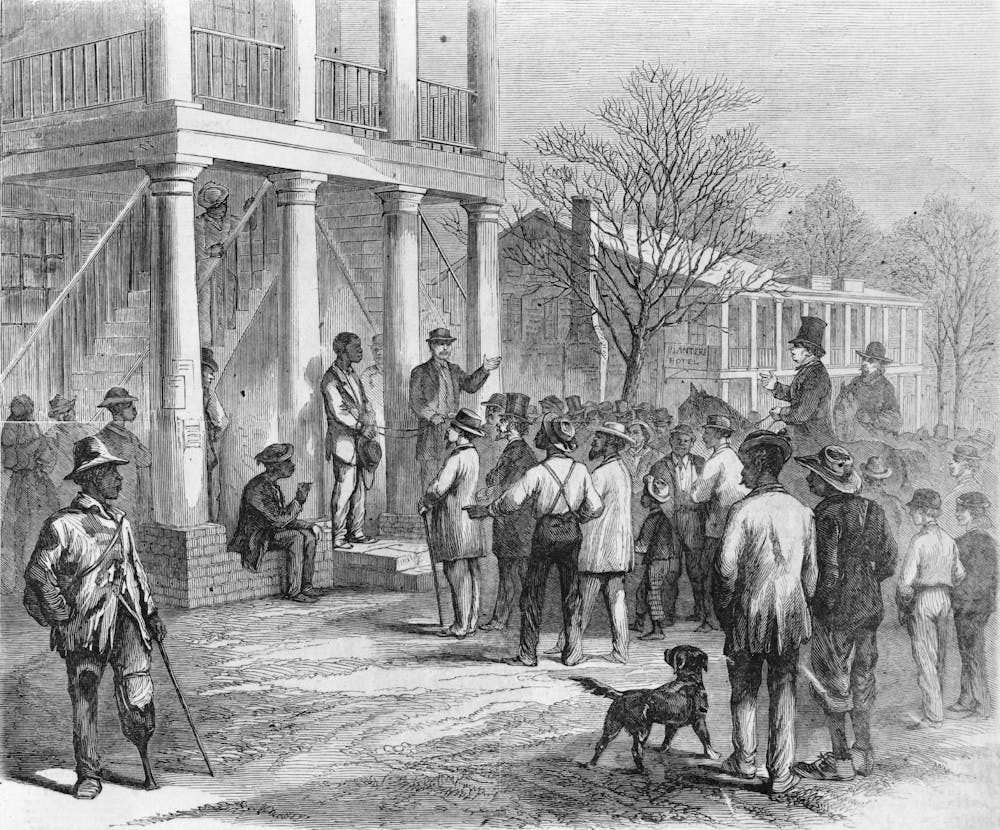
Georgia was originally readmitted to the Union in July 1868. But just two months later, in September, the Democratically controlled Georgia Assembly, with a total of 196 members, voted to expel all 33 of its Black elected officials.

Immediately upon making themselves into an all-white legislature, the remaining assembly members enacted the infamous Black Codes. These codes created a unique set of laws specific to the newly freed Blacks, including limiting the types of work they could do.

Collectively, the legislative expulsion of the Black officials and the imposition of the Black Codes served to effectively disenfranchise the Black voters of Georgia. Senator Henry McNeal Turner, one of those expelled, defiantly asked: “Am I a man? If I am such, I claim the rights of a man.”

A drawing of a Black man standing on a porch with people surrounding him.

Under the Black Codes, which were restrictive laws in the post-Reconstruction South, a Black person could be sold into what was effectively a new version of slavery if they could not repay fines or debts. Interim Archives/Getty Images

The civil rights era

Another major effort to disenfranchise Black Americans came during their next major push to achieve political, social and economic equality: the Civil Rights Movement of the 1950s and 1960s. Opponents targeted two prominent civil rights activists who had been elected to represent their communities: Adam Clayton Powell Jr. and Julian Bond.

Bond was elected as a Democrat to the Georgia House of Representatives in 1965, but on Jan. 10, 1966, the Democratically controlled House voted not to seat him, citing his criticism of U.S. involvement in Vietnam and support of students who were protesting the war. A year later, the U.S. Supreme Court unanimously ruled that Bond’s First Amendment rights had been violated and ordered that he be seated. But for that intervening year, his constituents had no voice in their state legislature. Bond ultimately served in the Georgia legislature for another two decades, before turning to teaching and activism.

Powell’s situation was different. He was the first African American to be elected to Congress from New York and from any state in the Northeast. Starting in 1945, he represented the district that included the majority-Black Harlem neighborhood of New York City. He became one of the most important Democrats in the House, but in the mid-1960s, he found himself embroiled in personal and financial scandals.

After the election of 1966, the House created a committee to investigate Powell’s actions and refused to seat him until the committee’s report was complete. The report found fault, but committee members were split on the proper discipline for Powell. Ultimately the whole House voted to keep him out.

Powell sued to reclaim his seat, saying the House had excluded him unconstitutionally. He also won the special election in April 1967 created by the vacancy but didn’t take his seat because of the lawsuit. The removal of Powell meant that Harlem was the only congressional district in the nation without a representative from 1967 to 1969.

In 1969, the U.S. Supreme Court ruled that the House had acted unconstitutionally by refusing to seat Powell. By then, Powell had also won the 1968 regularly scheduled election and had been seated, though without the seniority and committee positions that would normally have been given to someone who had continuously been a House member.

Black Lives Matter movement

In the aftermath of the George Floyd killing, a new social movement emerged across the United States. With this new activism came another “white backlash” in the form of legislative disenfranchisement.

In May 2022, Tiara Young Hudson, a long-serving Black public defender, won the Democratic primary for a judgeship in Jefferson County, Alabama. More than half of the county’s population is nonwhite. Facing no opposition in the general election, she was expected to win and take office.

But two weeks after the primary, a state judicial commission, divided along racial lines, eliminated the position she was a candidate for and created a new judgeship in the majority-white Madison County.

Hudson immediately sued to block the shift, saying it violated the Alabama Constitution and only the state legislature had the authority to reallocate judgeships. In March 2023, the state supreme court dismissed Hudson’s complaint, effectively stripping the Black people of Jefferson County of a representative they had elected to be their voice on the state’s roster of judges.

And on April 6, 2023, the Republican majority of the Tennessee House of Representatives voted to expel two Black legislators – Justin Pearson and Justin Jones – for participating in a protest calling for gun legislation following yet another mass shooting.

Within days, both Pearson and Jones had been temporarily reinstated by processes for filling vacant seats, but still face special elections to fully reclaim their seats. Their alleged violation was participating in a protest against the legislature’s rules – but their real violation, I believe, was that they were Black, outspoken and pushed for change.

Rodney Coates, Professor of Critical Race and Ethnic Studies, Miami University

This article is republished from The Conversation under a Creative Commons license. Read the original article.

Florida teacher under investigation for showing Disney movie with gay character

An elementary school teacher in Florida is under investigation by the Florida Department of Education (FDOE) for showing a Disney movie featuring a gay character, an action that a right-wing member of the school board claims is in violation of the state’s “Don’t Say Gay” law.

Jenna Barbee, a fifth-grade teacher in the Hernando County School District, showed her students the film “Strange World” as part of a science lesson. The animated action-comedy is about a group of people who travel to the inside of a fictional planet. One of the characters is a gay teenager, whose sexuality is not an important part of the plotline and is only alluded to briefly in the film.

Barbee has said on social media that although she didn’t select the film solely because of the gay character, she does have LGBTQ students and felt it was important to foster an inclusive classroom.

The school district has confirmed that Barbee’s showing of the movie is the basis for the investigation, which came about after just one parent complained about the film being “inappropriate.” At a recent school board meeting, Barbee said that she believes she is being targeted by Shannon Rodriguez, a board member whose child is in her class, and who was endorsed by the far right group Moms for Liberty in last fall’s board elections.

Though Moms for Liberty purports to be a grassroots organization of concerned parents, it is actually funded by conservative groups and has deep ties to Republican operatives, Media Matters has documented. The group, which has more than 100 chapters across the U.S., has coordinated demands for changes to a number of school rules, including for the loosening of COVID-19 prevention protocols and for censorship of lessons on Black or LGBTQ history. The organization frequently engages in fear mongering and pushes baseless and harmful rhetoric about “groomers” to achieve their ends.

Barbee defended her action at the recent board meeting.

“The word indoctrination is thrown around a lot right now, but it seems that those who are using it are using it as a defense tactic for their own fear-based beliefs without understanding the true meaning of the word,” Barbee said.

At that same meeting, Rodriguez accused Barbee of “playing the victim,” claiming that she was imposing her beliefs on her students.

The state’s “Don’t Say Gay” law bars K-3 teachers from discussing LGBTQ issues in the classroom, but allows “age-appropriate” conversations about such topics for older grades. Although the state legislature recently passed an expansion of “Don’t Say Gay” that forbids discussion of LGBTQ topics at any grade level, Gov. Ron DeSantis, R, has not yet signed it into law.

Given that the character’s sexuality was not part of the classroom discussion, however, it’s unlikely that Barbee is in violation of the law. Barbee has also noted that all parents of students in her class signed a permission slip at the beginning of the year allowing their children to view PG-rated films in the classroom. “Strange World” has a PG rating.

In a subsequent TikTok video, Barbee said that her students are now being harassed by FDOE officials, who are removing children from her class, one at a time, to discuss whether or not she was indoctrinating them.

“Do you know the trauma that is going to cause to some of my students? Some of them can barely come and have a conversation with me, and are just getting comfortable with me, and now an investigator is allowed to come and interrogate them,” Barbee pointed out. “Are you kidding me? What is that showing them?”

How Donald Trump influenced “Ted Lasso”

Soccer  managers Pep Guardiola and Jürgen Klopp. Basketball coach John Wooden. Maybe even high school football coach Eric Taylor of “Friday Night Lights.” But . . . Donald Trump? “Ted Lasso” star Jason Sudeikis has revealed in an interview that the title character he plays on the Apple TV + show was actually inspired in a meaningful way by the ex-president. 

“Saturday Night Live” alum Sudeikis developed Ted, an American football coach pluckily heading a British soccer team, nearly a decade ago in a faux commercial called “An American Coach in London.” 

In an interview with The Guardian, Sudeikis said he originally conceived of Ted as a grumpier, more caustic figure. Ted “was more broadly comic – ‘belligerent,’ Sudeikis calls him – so why make the new version so warm and fuzzy?” Sudeikis told The Guardian, “It was the culture.”

Sudeikis described Trump’s influence and “what he unlocked in people . . . I hated how people weren’t listening to one another.” Despite not being “terribly active online,” Sudeikis was still impacted by Trump around 2015, when Trump announced his first presidential campaign, following a golden escalator descent at Trump Tower.

And that character Sudeikis was planning to revisit, to perhaps develop into his own show? Sudeikis felt Ted could no longer be angry and bombastic, not in the face of Trump. He told The Guardian, “It was like, ‘Boy, I don’t want to add to this.’ Yeah, I just didn’t want to portray it.” As CNN described it, “the character became the warm, affable, positive quote machine viewers first came to love at the height of the pandemic in 2020.”


Want a daily wrap-up of all the news and commentary Salon has to offer? Subscribe to our morning newsletter, Crash Course.


Instead of shouty, Ted the character became folksy, supportive and unfailingly positive, often to the point of extreme, sometimes to the criticism of “toxic positivity.” Three years on, some of that lovable charm may be chipping off a bit, while, as The Guardian writes “the line between Sudeikis and his saintly creation have become blurred over time.” 

But the show has been rumored to be ending after this third season, and Sudeikis firmly came down on the side of curtains for Ted. Discussing the “final day of filming” with The Guardian he said, “The show may be over, but what we learned here . . . It’s not like Vegas: what happened here, stays here. No, what happened here, take it, take it to your village, take it to your family, take it to your next project. For real.”

“More than just crafts, cooking and cocktails”: Martha Stewart’s brand has always been subversive

At the age of 81, Martha Stewart has become the oldest Sports Illustrated swimsuit edition cover model in history. To those who know Stewart only through the lens of mile-high apple pies and Shaker baskets, the decision might have come as a surprise. But to those of us who have been following the lifestyle queen’s seemingly seasonless “Hot Girl Summer,” the turn likely felt inevitable.

To be clear, I fall into the latter category.

I vividly remember early in the pandemic when tabloids ran headlines that were equal parts “you go girl” and pearl-clutchy after, as People magazine put it, Stewart shared a “sultry pool selfie on Instagram.” You’ve probably already seen the widely-shared image of Stewart propped on the edge of her East Hampton pool, wearing a sleek black one-piece and pursing her frosted pink lips at the camera.

“Wait, is this a thirst trap?” one commenter wrote, while another added: “Okkk, Martha, servin’ up more than just crafts, cooking and cocktails today!”

This wasn’t the last “thirst trap” — social media parlance for a spicy photo — that Stewart would post. There were those mirror selfies, as well as that topless Green Mountain Coffee Roasters campaign. (She enjoys her coffee with the flavor of pumpkin spice and “nothing else.”) But being a SI Swimsuit model is perhaps one of the greatest thirst traps of all.

Through it all, detractors of Stewart have dismissed these playfully sexual images as incongruous with the wholesome lifestyle brand she has built for nearly four decades. It’s an argument that smacks a bit of sexism and ageism, but as someone who has spent a lot of time poring over Stewart’s life and career, I would say it’s an argument that is also wholly inaccurate.

Since the beginning of her career, the ethos of Stewart’s work has been about elevating everyday experiences to live life more fully. Increasingly, we’re seeing her take that philosophy outside of the home.

***

There’s a recurring bit from the “Iliza Shlesinger Sketch Show” in which the titular comedian plays a lifestyle show hostess, a la “Martha Stewart Living.” At one point, she daintily wraps a piece of tulle ribbon around a raw fish carcass. “Now, doesn’t that look normal?” she mews to the studio audience as the camera zooms in on her creation.

I love this sketch for a variety of reasons, but mostly because when the series initially aired on Netflix in 2020, it quickly became a meme in a group chat filled with friends who had picked up what can best be described as “urban homesteading” activities, such as baking sourdough and quilting, amid the pandemic. In that context, the meme took on a darker humor. Like, “Hey, I know the world is burning around us, but I decorated this inane object in my house that serves no real purpose. Observe my handiwork.”

Since the beginning of her career, the ethos of Stewart’s work has been about elevating everyday experiences to live life more fully. Increasingly, we’re seeing her take on that philosophy outside of the home.

As someone who works in food (and has heard pretty much all the bad-faith arguments about why food, or lifestyle topics in general, shouldn’t be considered as deeply as “harder news” topics like politics and technology), I think a similar sentiment underlies much of the criticism of Stewart’s work throughout her career.

That was certainly the case in author Jerry Oppenheimer’s “Just Desserts: The Unauthorized Biography of Martha Stewart,” which promised to shatter Stewart’s perfect image.

“Stewart’s personal life is a far cry from the cheery portrait of the epitome of household perfection she paints for her fans in her writings and public appearances,” Oppenheimer wrote in the book’s description. “Now for the first time, ‘Just Desserts’ reveals how her driving ambition shattered her marriage, strained her relationships with her daughter and family and destroyed friendships.”

The book hasn’t aged particularly well. As one Amazon reviewer astutely pointed out, it’s essentially a blend of National Enquirer-esque blind items and condescending gossip from unnamed “chums.”

“He set out with a premise that Martha is a cross [between] Maria from ‘Sound of Music’ and Mother Theresa and then victoriously shows us that this isn’t the case,” they write. “For example, did you know that she lied about catering her first party when she was seven? Furious research by [Oppenheimer[ has proved that her mother helped her!”

Because so much of Stewart’s work is perceived as über-aspirational, there’s an intense societal desire among some — such as Oppenheimer — to kick her legs out from under her or reveal that it’s somehow all a sham. These are the same people who reacted in delight when Stewart checked into prison for a five-month stint in 2004 after lying about her sale of ImClone stock, an event that especially shattered the illusion that she was superhuman.

But — as author Joan Didion pointed out in her New Yorker profile of the lifestyle mogul four years earlier — “by branding herself not as Superwoman, but as Everywoman, Stewart has made even her troubles an integral part of her success.”

“She presents herself not as an authority but as the friend who has ‘figured it out,'” Didion wrote. “The enterprising if occasionally manic neighbor who will waste no opportunity to share an educational footnote.”

It’s a subversive way to approach our cultural attitudes toward domestic labor. Stewart herself described her inspiration for her work on “The Charlie Rose Show” as such:

I was serving a desire — not only mine, but every homemaker’s desire, to elevate that job of homemaker. I was floundering, I think. And we all wanted to escape it, to get out of the house, get that high-paying job and pay somebody else to do everything that we didn’t think was really worthy of our attention. And all of the sudden, I realized: It was terribly worthy of our attention.

In her assessment of Stewart’s detractors, Didion echoes this sentiment, referring to many of them as “misogynistic in a cartoon way.”

“Oddly uncomfortable, a little too intent on marginalizing a rather considerable number of women by making light of their situations and their aspirations,” Didion wrote, which is an applicable description of many of those in the comments section under Sports Illustrated’s cover model announcement.

***

In its recounting of Stewart’s “thirst trap era,” Spy posited that she had actually entered her “bad girl era” (both phrases are used seemingly interchangeably in the story) following her release from prison. It was during this time that Stewart began more seamlessly blending her lifestyle brand with her actual life, which also saw her exploring more celebrity friendships, including those with Kris Jenner and Snoop Dogg.

Both relationships, but especially Stewart’s friendship with Snoop, have garnered a significant amount of media attention because — much like her decision to grace the cover of Sports Illustrated in a swimsuit — they’re considered somehow antithetical to a particular brand of wholesome, wicker-encased Americana.

I’m thankful to Stewart for providing a template for continuing to live life fully, even if there are those who would prefer that we stay in the kitchen.

But as Stewart wrote on Instagram regarding the cover, her motto has always been “when you’re through changing, you’re through.”

“So I thought, why not be up for this opportunity of a lifetime?” she said. “I hope this cover inspires you to challenge yourself to try new things, no matter what stage of life you are in.”

Granted, Stewart has certain privileges and resources that make her version of living one’s best life look radically different than most. She is white, thin and wealthy, to name a few. But endeavoring to do so, and being stylish along the way, remains at the core of her brand.

In the end, one thing remains true: Martha Stewart, the woman, and Martha Stewart, the brand, are inseparable. I’m thankful to her for providing a template for continuing to live life my fully, even if there are those who would prefer that we stay in the kitchen.

5 budget recipes from Martha Stewart that are destined to become your new summertime favorites

In anticipation of the spring and summer seasons, Salon Food shared a slew of budget friendly recipes from Food Network alums Giada De Laurentiis and Ina Garten. Now, we’re focusing our attention on Martha Stewart, who also has a ton of budget recipes ready to share! After all, Martha is dubbed the “Queen of Domestic Arts,” which makes her nothing but an expert on affordable, easy-to-prepare meals.

Whether you’re looking for simple weeknight meals, fun BBQ sides or tasty sweet treats, Martha has got it all. The recipes below feature a short list of ingredients that don’t forgo quality, taste or feasibility. 


Want more great food writing and recipes? Subscribe to Salon Food’s newsletter, The Bite.


From Martha’s simple coleslaw to her eggplant and roasted-pepper pasta, here are five budget friendly recipes to enjoy this season. Enjoy!

No summer BBQ party is complete without a heaping bowl of coleslaw. Martha’s recipe for a simple coleslaw can be enjoyed as a stand-alone salad or alongside burgers, grilled chicken and pulled pork sandwiches. All you need is shredded cabbage, carrots, mayonnaise, Dijon mustard, white-wine vinegar, salt and ground pepper. So simple!
Who said soup can only be enjoyed in the winter? And who said soup can only be enjoyed hot? Martha argues that chilled soup — namely her silky-smooth Creamless Creamy Corn Soup — is a summer staple because it’s refreshing and oh-so satisfying. The recipe calls for unsalted butter, a Vidalia onion, salt, unbleached all-purpose flour, ground turmeric, corn kernels, chicken or vegetable broth and cayenne pepper (which adds a touch of heat).
Smoky roasted peppers and garlicky sauteed eggplant are the showstoppers in this easy-to-prepare summer pasta dish. In addition to the eggplant and peppers, you’ll need extra-virgin olive oil, garlic, salt, ground pepper, fresh oregano, red-wine vinegar, parsley, mozzarella and your favorite brand of curly pasta. Serve this dish hot, warm or at room temperature.
Nothing screams summer like a colorful popsicle! Martha’s multicolored Very Berry Ice Pops are the perfect treat to enjoy by the poolside during a hot, humid summer outing. The recipe takes only 30 minutes to make (before freezing) and requires a pound of blackberries, a pound of raspberries, sugar and heavy cream.
This vegetarian salad is essentially a deconstructed taco filled with sweet potatoes, finely grated lime zest, cilantro leaves, chopped romaine hearts, black beans, pickled jalapenos, sliced radishes, lightly crushed tortilla chips and crumbled goat cheese. There’s also chili powder and fresh lime juice, which add a hint of spice and tang. Trust us when we say that Martha’s salad will soon become your go-to meal on Taco Tuesdays.

Nigeria’s street food adds to the plastic problem — green leaves offer a solution

Street food is popular in Nigerian cities. Most of the local food delicacies are sold by vendors whose livelihoods depend on informal subsistence activities such as local food production and street food hawking. They are part of Nigeria’s vast informal sector, which accounts for 57.7% of the country’s economy.

But most food prepared by vendors has to be consumed within a short time to avoid spoilage. Refrigeration capacity is limited because of unreliable power supplies in the country.

The popularity of food sold by street vendors is part of a global shift in urban areas to “fast foods”. Most of the fast food in Nigerian cities is packaged in plastic bags. These are bad for the environment.

Leaves could be an alternative for packaging. But their use in cities has not been fully explored — so we studied the possibility and sustainability of using natural leaves as packaging material for traditional foods in Nigeria. Leaves are still used in the Nigerian countryside to package food.

We analyzed academic literature as well as policy briefs and project documents from governmental and nongovernmental organizations. We found that leaf-type packaging material had several environmental advantages:

  • They are organic so they contain no artificial chemicals that can pollute the environment.

  • Their waste is easy to handle as they degrade fast.

  • Making them does not involve the use of energy, like burning of fossil fuels that could pollute the environment, unlike the production of synthetic packaging materials.


In the second part of our work we proposed a model that would help ensure the environmental sustainability of local food packaging materials. This model is based on the principle that good food packaging should protect food, be appealing and preserve taste and nutrition. And there has to be a commitment to public health and environmental safety.

Considering that local food has been packaged in leaves since long ago in Nigeria, we concluded that there’s a strong case for reviving the use of natural leaf type packaging in the country’s cities.

Based on our research, we recommend that strong institutions and policies be put in place to oversee the local food industry. We believe that our work is critical in informing food, health and environmental policy decisions in Nigeria and other developing regions.


Alternative packaging

Our research involved looking at three phases of the leaf-type material used for food packaging in Nigeria. The first stage is when the leaf is sourced as the raw material for packaging; the second when it is used for packaging; and the final stage is when it is disposed of as garbage after use.

In rural areas, sources of green leaves for food packaging are backyard farms, nearby forests and bushes. People cultivate the source plant species close to their homes for convenience in daily use. These packaging materials are processed entirely naturally or organically.

But these materials are not abundantly available in urban areas. People living in towns and cities use discarded cans, old newspapers, foil, cellophane and polythene bags as substitutes.

There are special traditional types of Nigerian delicacies that are prepared, served and packaged using vegetable leaf wrappers. They include ogiri (spices), ukpaka (bean seed), akara (bean cake), agidi (corn cake) and fufu (cassava).


            Plate of rice and stew served on a large green leaf

Local rice and pepper stew are popularly served on leaves. Obiora Ezeudu
          

Green leaf packages prevent nutrients from being lost through evaporation or transpiration. They are easy to handle, making food distribution and transportation simple. And they protect food products from deterioration.

Environmentally, using vegetable leaves instead of synthetic packaging on a bigger industrial scale might cut down on carbon emissions. Used leaves also degrade quickly.


A model for use

Our circular economy concept has been developed as a possible way to achieve sustainability objectives. It seeks to ensure availability of local packaging materials in urban areas.

The proposed model would integrate stakeholders and activities in the value chain. It covers effective urban planning, proper waste resource management  and wealth creation while considering social, political and economic realities typical to the developing world. The model explains the roles that all stakeholders, policies and institutions will play to make leaves abundantly available in cities while ensuring environmental sustainability.

For instance, while urban planning is concerned with tree-planting for aesthetics, using our model, the choice of trees could be those species that provide multiple functions.

The outcome shows that the green leaf packaging material for indigenous food items in Nigeria could work in terms of market viability and social acceptability.


What stands in the way

There is an urgent need for new regulations and better control of local food production, packaging and consumption in Nigeria. Two major factors inform this:

  • Many of Nigeria’s food processing facilities are still home-based or in cottage industries using rudimentary tools and procedures.

  • There is minimal consideration for good manufacturing practices and hygienic production processes. This leads to frequent chemical and microbial contamination.

We identified some solutions.

Food packaging requires investment in technology and innovation. This investment is missing in Nigeria.

We also believe that if the government creates adequate channels, nongovernmental and private organizations could salvage the situation. There have been cases where developmental organizations bypassed government institutions and worked directly with private sector organizations and nongovernmental organizations involved with vendors or street food marketers and others at the micro-economy level.

This support could be in the form of basic health, hygiene and safety education and providing them with equipment like gloves and disinfectants.

Obiora Ezeudu, Research Associate, University of Nigeria

This article is republished from The Conversation under a Creative Commons license. Read the original article.

Fox co-host calls out Tomi Lahren for downplaying Biden’s warning about “white supremacy”

Far-right Fox commentator Tomi Lahren argued on Sunday that the United States does not have a white supremacy issue, claiming that Democrats have concocted notions of “ultra-MAGA white supremacist threats to democracy.”

President Joe Biden during a speech on Sunday at Howard University warned that white supremacy is “the most dangerous terrorist threat” facing the United States.

Lahren accused Biden of using the threat of white supremacy as a “boogeyman.”

“They’ve been able to use this,” Lahren said. “It’s no coincidence they echo this every time they get a chance because they want those independents, those Democrats and especially those liberal voters to actually believe the biggest threat we face is white supremacy because they can’t really solve that. Right? You can solve the border crisis. That’s solvable. Donald Trump did it! You can solve national security, to an extent. You can’t solve this boogeyman called white supremacy, and that’s why they continue to echo it because they don’t actually have to do anything. They just get to fire people up and make people feel like oppressors and victims, and it’s a talking point that unfortunately has been very effective, so they’re going to keep using it.”

Lahren in 2019 attacked former President Donald Trump, accusing him of taking a “sham border deal” from Democrats, in which Trump got no funds to continue border wall building. 

Lahren’s co-host and Marine Corps veteran, Joey Jones, seemed to make an attempt at smoothing over Lahren’s tirade, stating that “white supremacy is not a good thing.”


Want a daily wrap-up of all the news and commentary Salon has to offer? Subscribe to our morning newsletter, Crash Course.


“I’m all for attacking where it exists,” Jones added.

“The body count for lone wolf terrorists in this country is higher now than it’s been in a long time,” he said. “I am for anything to help with that and have those discussions.”

He clarified, however, that white supremacy is “separate from our border security.”

“It was a life changer for me”: Andrew McCarthy on his Brat Pack origins and a recent 500-mile walk

“Look, it is a life changer,” says actor and director Andrew McCarthy. “It really is.” For centuries, pilgrims of all stripes have been drawn to the 500-mile Spanish route known as Camino de Santiago, a trail that has over time come to symbolize everything from a medieval religious quest and a modern tourist experience. But the man so synonymous with a certain ’80s-era shorthand (he named his last memoir “Brat”) told me during a recent “Salon Talks” conversation that for him, the trek represented something uniquely precious — a chance to spend a few uninterrupted weeks with his 19-year-old son. 

As McCarthy writes in “Walking with Sam: A Father, a Son, and Five Hundred Miles Across Spain,” forging an adult relationship with your newly grown-up kid (“Dead to Me” actor Sam McCarthy) can be its own rough road. But as the two men — one nursing his first real heartbreak and the other retracing a journey he’d made a quarter of a century before — journey across Spain, they find a new way to relate to each other, one step at a time. 

Coincidentally, the transformative power of the Camino de Santiago also gets an endorsement from another “St. Elmo’s Fire” star, Emilio Estevez, whose recently rereleased film “The Way” is set along the route. Speaking to Salon’s Alli Joseph earlier this month, Estevez said, “You are inspired not just by your own journey, but you’re inspired by those who came before you and who did this walk. It’s impossible to not walk in that history when you’re on this ancient trail.” 

For McCarthy, he says that the walk represented a chance to enjoy “the great luxury that you have with adult children occasionally, which was time,” even if he did admittedly have “a lot of meltdowns” along the way. He also shared details of the Brat Pack documentary he’s making, why his teen daughter doesn’t want to watch old movies with him kissing Molly Ringwald, and how a little Meat Loaf helps make the journey more fun. And for anyone considering following in his footsteps, he encourages just taking a deep breath and hitting the road. “If you’re in a moment of transition or crisis,” he says, “go walk the Camino.” Watch Andrew McCarthy on “Salon Talks” here, or read our conversation below.

The following interview has been lightly edited for clarity and length.

This is the second time in your life you walked the Camino de Santiago. Talk to me about the first time you did this 500-mile walk.

Back in the early ’90s, I read a book by a fellow named Jack Hitt called “Off the Road.” I’d never heard of the Camino de Santiago, which is an ancient pilgrimage route that’s in the north of Spain. Back in the day, in the eighth century, they said that the bones of the Apostle St. James had been discovered in the farther westernmost reaches of Spain. Anybody who walked there would get half their time in purgatory knocked off, which is a good deal, right? Really, it was about real estate in the sense that Islam had taken over the Iberian Peninsula and the Catholic Church wanted it back. They said, “As you’re marching across Spain to get your almighty soul purged, kick out those Moors.” It led to the Crusades and all that stuff. So, it’s a religious route or was and still is, but I think it largely came about because of real estate.

I walked in the early ’90s and I found it a real life-changing experience. In a word, it revealed how much fear that I carried in the world and walked through the world with. That was liberating to me in a way that I had no idea. I didn’t even know fear was a part of my life until that moment of its first absence.

I had a sobbing fit in a field of wheat in the middle of Spain and I just had a temper tantrum, which is, as people say, a white light experience. I was revealed to myself in a way that was such a relief. I felt like me, in a way that I really hadn’t before. It was a profound experience. That led to me continuing traveling and everything beyond that, and slowly evolved into being a travel writer. That moment, that instant walking the Camino, really changed my life.

It was a pivotal moment in your career where you were feeling in the depths about where you were going with your acting. 

“I didn’t even know fear was a part of my life until that moment of its first absence.”

Yeah, it was after all the Brat Pack and all the success of being 22, 23. I had abused a lot of alcohol for a number of years during that time. It was after that and without even knowing I was looking for anything, when I picked up Jack Hitt’s book. I read it on a plane and I said, “I’m doing that.”

It’s funny because back then there was no internet to look it up. I’d never heard of the Camino de Santiago. In the back of the book it said [Hitt] worked for Harper’s Magazine, and so I called up Harper’s and I said, “Can I talk to Jack Hitt?” They went, “Yeah, hold on.” This was back when people used to go to the office and work, I guess. He got on the phone and I said, “Hey Jack, you don’t know me, but I read your book.” He was like, “You read my book?” He was thrilled. He was very gracious, and I said, “What do I do? How do I do it?” He told me, and off I went to Spain.

It’s a generation later, and you have a 19-year-old son. What is it about this time in his life that you say, “We’ve got to grab this moment now?” 

I left home at 17 and never looked back, and my relationship with my father basically ended at that moment. I didn’t want to have that happen with my kids. I think I’ve harbored a not-so-unconscious fear that one day he would leave, and that’d be the end of it, be over. He’d be gone, and that would just be recreated, that cycle. I really didn’t want that. I had no template for how you have a relationship with an adult child. You’re used to the parent-child dynamic, but that no longer applied because he’s either not listening to me or not interested in what I have to say in disciplining him or that kind of thing. So I’m like, “Well, where do we go? What do we do?”

Because that first walk of mine has been so transformative and so embedded me in myself in a way that I had never been up to that moment, I thought if I could get him to go with me, we could at least see each other. I think that’s one of the things we do with family members and with kids and parents and kids with their parents, we don’t see them. We see our projection of them and we project ourselves onto them, particularly when they’re like us. My son is like me in some way, so I just project, he must be feeling all the things I feel. And he’s not, newsflash. It was an opportunity to see each other as adults. I’ll always be his father and I’m not interested in being his pal, but I wanted to know, how do we relate going forward? And he was game to do that.

Which is extraordinary.

That was rare. I never would’ve done it with my father had he asked. That was an amazing gift he gave me, by saying yes. He was also at a moment of sort of crisis in his life. I’ve always said to many people, if you’re in a moment of transition or crisis, go walk the Camino. I’ve had friends who lose jobs and I say, “Go walk the Camino.” They’re like, “I need to get a job. I’m not going walking again.” I’m like, “No, you need to go walk.” The few that actually listened to me all come back and go, “That was the best thing I ever did.”

“If you’re in a moment of transition or crisis, go walk the Camino.”

He was at a moment in his life when he was vulnerable, and I said, “Any desire to go walk Spain?” He, in his despair, said, “Yeah, fine.” At that instant, literally, I went to the other room, I bought two plane tickets. Two days later we were in Spain because I knew, in a couple days he’d bounce back and would think better of this and not want to do this. We were on the ground walking before he knew what hit him.

There are so few guidelines for how to parent an adult, especially when you have not had that template with your own parents. This book is about, how do I have an adult relationship with my adult child?

I had no idea what I’m doing. I just came to the realization, I’ll share myself with him, warts and vulnerabilities and frailties and insecurities and all, and let him see me. When you’re a parent of a smaller child, you’re this figure in their lives and they don’t see you, they see this figure. I don’t know about other people, but I would encourage, in a certain way, that feeling of, “I’m the parent.” It serves our ego.

You’ve got to let that go when they’re adults because they see through it, they’re not interested in that, and you don’t have anything to offer them in that way. What I say now is I’m advocating for Sam now to Sam. He may not agree with what I’m advocating for him, but that’s all I’m giving it to him. This is what I think, Sam, do whatever the hell you want.

There’s so much in this book about Sam explaining social media to you. We did not have to grow up with Instagram or Raya with so much of our lives documented. But you were a young person very much in the public eye, and Sam knows the young version of you in a way that a lot of people his age don’t know their parents.

I wrote a book several years ago about my time in the Brat Pack. He listened to the audiobook of it a couple times, and he said, “Wow, I had no idea.” He said to his sister, who’s 16, “If you want to know who Dad was when he was young, you need to read his book.” 

“I’ll just share myself with him, warts and vulnerabilities and frailties and insecurities and all, and just let him see me.”

It is a weird and interesting thing. They can look and see this young person that was me, their father, long before they were born. My daughter’s friends told her she had to watch “Pretty in Pink,” and so she watched the trailer and saw me kissing Molly Ringwald. She’s like, “I’m not watching a movie [of you] kissing some person. No, I’m not watching that.” I think she’s right.

Sam is so generous in letting you depict him the way that he is in this vulnerable, messy moment in his life. He even does his own narration on the audio version.

Yeah, in the audiobook we did together, he read off his own dialogue. 

How did you work together with him in that collaborative way? 

The audiobook was sort of like the walk: fights, frustration, deep breaths, some laughs and in the end it seemed to work out.

This is a big leap of faith for a now 21-year-old to do.

In fairness, he hasn’t read it. I gave it to him. I said, “Sam, you might want to read this before I turn it in.” He’s not a big reader, so he read some pages and then he’s like, “Yeah, no.” Hopefully someday he might, and we’ll see if he’s still talking to me then.

But also, it’s about him, but it’s largely about me and my perspective and perception and parenting. He’s a foil in a certain way to me and my own idiocy.

And you have a lot of meltdowns in this.

I do have a lot of meltdowns. I really do.

It’s also about memory and revisiting our own past selves. There’s so much in this book that is about re-walking these exact steps and having this very, very different experience. You saw that a lot changed.

Also, memory’s so unreliable. We think we know exactly what happened, and it just is not accurate. So many times in my experience, I think I know exactly what a place is like, and it’s just not like that. There are places I went to that I knew I was before and I had no recollection, it looked nothing like what I said. It was a real shock to me to walk in the footsteps of 25 years ago. Yes, more buildings get put up and stuff like that, but a lot of it, what an unreliable narrator I am in my own life. That was interesting for me to discover.

As are we all, though.

Absolutely. We tell ourselves things we have to, to get through the day and to justify behaviors, and so that was interesting to come to see.

In the book you talk about meeting up with someone who had gone on the same trip at the same time. Looking at photographs, even the photos were different.

“This moment in time, particularly with my son, this is over and it will never come again.”

After the first trip, a friend I’d met on the trip had another friend in town who was on the trip. We were walking the same day, the same trail. It was like we were on different planets, the photos he took and the stories he told. But that’s all of us. Whatever cheap metaphor you want to use, we’re all walking a different path, even though we’re walking the same thing.

Sam walked a very different Camino than I did, and that’s as it should be in a certain way. We also tend to project our experience, other people must be feeling the same. And they’re not. That’s a great thing to realize because then there’s space for him and space for me, and then we can come together in the middle there where there’s space. Because if you’re just projecting onto it, it’s so solidified in a certain way. And so to just back off a little bit, if it makes any sense.

Especially, I think when it comes to those family dynamics, because there’s always going to be that part of you that sees that child as a child.

Totally. My family, it’s the same thing. My brother, a million years ago, called the Fire Department and called in a false alarm and that’s still how we see him. Pete’s the guy that called in the Fire Department. To this day he denies it, 40, 50 years later. But that’s how we see him and we’re not seeing him really, we’re seeing that. 

What does the pilgrimage look like now, especially post-COVID?

It’s much more crowded than when I walked 27 years ago, and there’s much more infrastructure to support people. They realized it’s an industry now, because it’s gotten so much more popular than it was when I walked it years ago. But you still need to walk. You’re still walking step after step for 500 miles. So it, in essence, hasn’t changed at all and hasn’t since the eighth century. You still have to walk the walk. Things change and there are more and nicer places to sleep if you want, but you’ve still got to get up and get there.

And some people take cabs.

There is always the guy who’s going to take the cab and hop out of the cab and act like he didn’t.

You wrote an op-ed for the New York Times about the ways in which we connect with ourselves, our memories, our creativity, our paths, literally through walking. Yet we live in a country that actively discourages that and builds cities that you can’t even walk in. Andrew, for those of us who can’t do 500 miles in Spain, how do you think we can connect with that?

We were created to think and move at a walking pace. There’s something about the rhythm of walking that releases the rhythm of thinking. It releases tension, it fuels creativity. Like you said, and all the abundant documentation of famous writers saying really witty and smart quotes about what walking does for them. I think it’s also an attitude of, instead of seeing walking as the slowest way to get somewhere, which is how I always viewed it, to be walking into yourself, walking home to yourself. That’s how I view walking now. Luckily I have a dog, so I have to walk her every day and I walk in Central Park. A lot of it is attitude too of just walking into myself, as opposed to, “I can’t get a cab, so I’ve got to walk.”

In the book too, you also talk about, do I put in my earbuds? 

“I also turn 60 this year, which is sort of shocking to me.”

That’s a thing with all the pilgrims. Some are very precious about how [they walk]. My life’s not that precious. I’ve just got to get there. And today, if I need a little Bob Marley, I’m going to plug it in. It’ll help me get there.

Get a little “Bat Out of Hell.”

Meat Loaf always comes in handy.

You said at the end of the book you would never do it again.

Did I?

You do.

My son was ready to do it again. He was ready to walk a whole other one.

He was like, “I’m ready to go right now. I could turn around.” Would you do it again?

Yeah, sure, I’d do it again today. But it’s one of those things that was such a big experience. You have such mixed feelings when it’s over, you’re so relieved to be there and so thrilled and proud, and there’s a joy in it but there’s also such melancholy that that’s over. This moment in time, particularly with my son, this is over and it will never come again. I knew that the whole time. I had the great luxury that you have with adult children occasionally, which was time, which you never get with adults. I had that with him.

Maybe we’d walk it again, but it’ll never be like it was. So there was a great melancholic, bittersweet feeling at the end of it. Because it was such a big experience, I wouldn’t want to walk it again too soon. When I did it the first time, I had the same feeling. I go, “I’ll do that again within about 10 years.” Took me 25, but you know? My son, when we finished it, goes, “We’ll do it in 25 years, Dad.” I’m like, “We’ve got to do it a little sooner than 25.”

But yeah, I would go again. If one of my other kids bought in too, which I’m sure they won’t. My daughter was like, “Can we just go to Paris, Dad?” But look, it is a life changer. It really is.

You have been acting more in the past few years. You’ve been doing other kinds of projects. Do you see a connection between this and the work that you’ve been doing just in the past couple of years?

Well, it’s just brought me home. It just brings you home to yourself. I also turn 60 this year, which is sort of shocking to me. I never once blinked about age 40, 50, never even thought about it. But 60 kind of struck me as, “Wow, that’s the beginning of being old.”

You say in the book, you spent your whole career being young. 

I was young and I was famous for being young. I was famous when I was young, and then I was famous for having been young. To suddenly be sort of the beginning of being old, I somehow missed the middle.

I’m just finishing a documentary about the Brat Pack. After that book I wrote, it occurred to me, I’ve never talked to any of the old gang about it. It was a very life-changing event for me, the Brat Pack. It changed who I would become and my place in the world. Thirty-five years later, when I’m introduced, that’s going to be in the introduction. And who would’ve thunk that at the time? 

“Who wants to be called a brat? Who wants to be stuck in a pack?”

I went back and dug up a bunch of the guys from back then. I hadn’t seen Rob Lowe in 30 years, Emilio Estevez in 35 years. Demi Moore, and Ally Sheedy, I hadn’t seen them in so long. I went to each of them and said, “Hey, will you talk to me about this? Because we were members of a club that we didn’t ask to join that no one else was. We’re the only ones that know what it was like.”

It was a life changer for me. It’s taken me decades to come to terms with it and see it as a beautiful thing. I’m the avatar of a certain generation’s youth, as are the other actors. But initially, the Brat Pack was really an albatross for a lot of us career-wise and we hated it. Who wants to be called a brat? Who wants to be stuck in a pack? We found it really adversely affected our careers when we were young. So to have this thing stay with you for so long, it ultimately transforms into this beautiful kind of thing. People look at me, they come up to me and go, “Oh my God, the Brat Pack, those movies.” Their eyes glaze over, and suddenly they’re talking about themselves really, their own youth, and I represent that to them. That moment in life when your life is a blank slate to be written upon and you’re just cusping into the world, like my son was in this book.

It’s a beautiful, attractive phase. It’s a moment and it doesn’t last long. To represent that for people, I’ve come to realize that’s a real gift. But that took me years to acknowledge and to understand. I went back and chatted with everybody, to find I had so much affection for everyone when I didn’t particularly at the time. We were young and competitive and scared and insecure. To go back and see everybody and just have so much affection. Rob, when I saw him, I’m like, “Wow.” He was the first one I ever was in a movie with at 19 years old in 1982. I think everyone was wonderfully surprised by it, not only affection for each other, but then for our own youth. That was very, dare I not say healing, but it was a nice experience to have.

It’s all about just going back on the same road again.

I know. What had Joseph Conrad said? He spent his first half of his life at sea, and the second half of his life writing about the first half of his life? The Brat Pack is just the same.

“My editors were just egging me on”: “Yellowface” author on depicting the cutthroat publishing world

When I ask R. F. Kuang how her work as an academic has influenced her work as novelist, she says, “Mostly it means that I don’t have enough time to sleep!” 

The author of five novels, including a bestselling trilogy that started in 2018 with “The Poppy War,” Kuang is a PhD student at Yale University, studying East Asian Languages and Literatures. Her fourth novel, “Babel: An Arcane History” drew upon her love of language, literature and academic settings. She says, “I think the things that I research and am thinking about in an academic sense always trickle into my fiction, which is why so many of my main characters tend to be students.”

But in her latest novel, “Yellowface,” they are writers. “Yellowface” is a standalone novel about two young novelists, one who is Asian and one who is white. One who is hugely successful and one who has yet to make it. One who dies tragically and early — and one who steals her friend’s unpublished manuscript and racial identity. “Yellowface” is a novel about cultural appropriation, ambition, racism and the scandal-laden publishing industry, but at the story’s core, according to its author, it’s a thriller about friendship. And what goes wrong. 

Salon talked with Kaung about her new book, unreliable narrators and the publishing industry.

This interview has been lightly edited for clarity and condensed.

How did you first start writing fiction?

I thought it would be fun to jump to a novel that reads more like scrolling through Twitter.”

I think most writers I know just have always written compulsively, and that was certainly the case with me. I was always coming up with stories and writing fan fiction, writing fictional versions of a diary that wasn’t about me but about other characters who I thought were cooler. But I didn’t write anything for publication until I was in college and took a gap year in between my sophomore and junior years. I went to Beijing for a bit. And that’s when I wrote my first novel, which became “The Poppy War.”

And you never looked back.

Well, I signed a few book contracts, so I wasn’t allowed to look back!

All of your books so far, the “Poppy” trilogy, “Babel” and now “Yellowface” have been in pretty different styles. What inspires you to change your writing style in such a way for each project?

Oh, I just get bored really easily. I hate doing the same thing multiple times in a row. And I had to do that for “The Poppy War” trilogy. I found it stifling. I think it’s really hard to work on one project for five years, between the ages of 19 and 24, which is how old I was when I started and finished that trilogy. I was changing so much as a person. I graduated college, I was becoming an adult, finding my own apartment for the first time. That whole time I was working on the same characters, the same plot lines, the same themes that I thought of when I was a teenager. So by the time I wrapped up “The Poppy War” trilogy, I told myself: I’m never gonna lock myself into a project that doesn’t have the ability to account for myself changing again.

So, I switched gears and instead of getting another epic fantasy novel, I did a big doorstopper historical fantasy. And then after that, I thought it would be fun to jump to a novel that reads more like scrolling through Twitter. I just really love jumping between voices and experimenting and giving myself new creative challenges. Certainly my favorite authors just put up the same kind of novel over and over again for their entire lives. But I could never do that. I think it would feel like creative death.

R.F. KuangR.F. Kuang (John Packman)And that’s one definition of an artist, too: someone who is constantly moving, constantly changing, constantly experimenting. Do you read extensively in the genre you’re writing a book in before or during the writing? For example, “Yellowface” is more literary fiction. Did you read a lot of literary, commercial novels?

It’s kind of like sitting at the bar with your nastiest friend while she insults everybody who walks through the doors. It’s not a voice that we want to adopt or even a voice that we want around us all the time, but it’s really fun to read.”

I always try to read as widely as I can in the genre that I’m entering. I started doing this deliberately when I was drafting “Babel,” because I knew it’s very easy to spot a bad imitation of Victorian description, and the only way that I was going to get away with it is if I spent the time with the Victorians that I did, able to convincingly imitate their synthesis and colloquialism, the rhythm and flow of how they put words together. I went back and read a lot of Dickens, a lot of Thackeray; I read Austen, even though she’s not Victorian era, and I had a lot of fun with that. When I was switching to “Yellowface,” I made it a priority to digest a lot of fast-paced, very quick, very contemporary literary fiction. 

And in particular, I’m interested in psychological thrillers and female-led psychological thrillers. I’m detecting a similar voice throughout a lot of our more popular works in that genre, which is this really nasty, condescending narrator who you’re kind of compelled or are addicted to listening to because she is so mean, and she’s so judgy. It’s kind of like sitting at the bar with your nastiest friend while she insults everybody who walks through the doors. It’s not a voice that we want to adopt or even a voice that we want around us all the time, but for whatever reason, it’s really fun to read.

It really does lend to the compulsive nature of the book because we keep reading to see if she’s gonna get hers, if somebody’s finally going to change her, or if she’s going to change. Was it hard to write from her voice, the voice of the narrator, June? Was it uncomfortable — or even therapeutic?

No, it wasn’t hard at all. It felt very easy. In fact, it was just a lot of fun. I was just so gleefully bad. It’s similar to just mucking around in mud and getting yourself dirty. I think it was cathartic and just really entertaining, to look at the world through Juniper Song’s eyes.

So how would you describe “Yellowface,” the book that Juniper Song narrates?

It’s this ridiculous thriller that satirizes the publishing industry by looking at the relationship between two friends: a white writer and an Asian writer. The Asian writer dies in a freak pancake-eating contest. And the white writer, our protagonist Juniper Song, steals her unpublished manuscript and passes it off as her own all the while passing herself off as Chinese American. So, it does look at things like cultural appropriation and racism in the industry and the ways we can commodify and talk about racial identity in very reductive terms. But at the heart of it, it’s just a psychological thriller about a relationship between two best friends that’s gone very badly wrong.

There’s just a kind of demonic, unhinged quality about all of these books, because we’re living demonic, unhinged lives.” 

I read an interview recently where you characterize the book as your pandemic novel. Can you say more about that? 

I think we can always tell when a novel is somebody’s pandemic novel, in a lot of books that came out in late 2022 and early 2023. Because if you account for the production cycle always being like 12 to 18 months, then you know somebody was drafting in late 2020, early 2021. There’s just a kind of demonic, unhinged quality about all of these books, because we’re living demonic, unhinged lives. A lot of us are very isolated. I had been locked down for so long, it was driving me stir crazy. It was impossible to see my friends. And when you spend that much time with yourself, you also spend a lot of time with your ugliest feelings and there’s nothing to distract you; you’ve nowhere to send them. So it all gets channeled into these very absurd books.

Yellowface by R.F. KuangYellowface by R.F. Kuang (Courtesy of William Morrow)We talked a little bit about the sort of villain of the book, the writer June, who’s also the narrator. She’s often unlikable, unreliable. And the more likeable character, the writer Athena, is killed off early, which is not a spoiler, of course — but was it hard to let that character go?

Not really, because I didn’t feel like I let her go. Obviously, she dies in the first chapter. But her specter hangs over the entire novel. We’re constantly getting pieces of her through flashbacks or warped versions of her through recounting. It was fun to keep her a consistent presence kind of looming over everyone’s shoulders — and also this unstable presence, where you’re not really sure if you’re being told the truth about her, or if you’re receiving somebody’s biased account of their sour relationship with her. So I think it’s very prevalent throughout the rest of this book. I didn’t feel like I had to let her go.

That leads into something I want to ask you, which is that Athena’s not perfect either. We get a slow reveal of her character. Was that a deliberate choice to resist this kind of model minority, perfect character? Or is it filtered through June and others’ perspectives?

We’re definitely getting a warped perspective on Athena. And I like to think that maybe she’s not as nasty or as much of a b**** as everybody’s making her out to be. At the same time, she’s probably not a great person, not somebody you’d want to be close friends with. And that’s because I think novels about perfect victims are so boring. It would not be half as fun to read if Athena was just this saintly, innocent women who had all her work stolen from [her]. I think I have a lot more fun writing when everybody’s morally gray.

One of the things I love about the novel is that it’s not just about the experiences of writers. It’s also about the struggles of working in the publishing industry. Being a lower level editor, being a sensitivity reader, being a young employee of color in the industry. Was it important for you to cover so much of the publishing world?

I remember acutely the feeling of walking into a bookstore for a signing and not having a single person show up.

I wanted to explore how tough it can be on the other side. I think authors like to complain about their publishers a lot; publishers probably like to complain about their authors a lot. The truth is that everybody’s struggling in this industry together. And oftentimes, we are frustrated that your editor is not responding to your emails. That’s because he has a million other book submissions to work on, he’s not getting paid enough to do it. And there’s just not enough hours in the day to cover the workload that they’ve been assigned. I think we’re seeing a lot of breaking points in the industry.

It was interesting timing that the HarperCollins union went on strike while “Yellowface” was in production. Obviously, I’d written the book before strikes were even being discussed. But watching that all play out and listening to conversations about how the industry changed in order to better serve their employees, which in turn better serves their authors, I think it helps the importance of putting out a book like “Yellowface” right now.

I was going to ask if the strike had impacted the book, the edits or production in some way.

The book was in pretty late in production by the time the strike happened. It didn’t change the draft at all. But, you know, it did help remind me what we’re all fighting for.

What was your publishing journey like, especially for your first novel?

There’s been a lot of ups. There’s been a lot of downs. It’s interesting that people keep assuming that Athena is based on myself when actually I have very little in common with her aside from being erased and gendered in the same ways. Athena is this kind of Cinderella story, overnight bestseller, has never known failure, and my early publishing experience was a lot more like June’s. The reason why I’m able to write sympathetically about her resentment and frustration with the industry is because I’ve had those thoughts. I’ve had to share in that frustration. I remember acutely the feeling of walking into a bookstore for a signing and not having a single person show up. The humiliation, the shame, the sheer awkwardness — and the bookstore manager is like, Oh, no, maybe it’s time to pack up. And the heartbreak of watching your sales numbers dwindle. I know it all. 


Want a daily wrap-up of all the news and commentary Salon has to offer? Subscribe to our morning newsletter, Crash Course.


I don’t think I’ve read a more real rendering of what the publishing process is like as an author: how helpless you feel, and the pressure. As a novelist, it was very relatable. Were you at all worried about reactions from publishers over how this book is critical of them or of the industry?

Obviously, I hoped that somebody would buy it. Somebody did and they’re very enthusiastic about it. My agent, I think, was more worried about offending people than I was. She actually didn’t want to put it on submission at all when I sent the first 100 pages, because it is so in-your-face and mean in its tone. But what I found through the process is that I think people in publishing are also very ready, and are fed up with the issues discussed in the book and they’re ready to talk about it and talk about it openly. I’ve had just an amazing time working on this book with my team in the U.S. and the UK, because everyone has gotten kind of unhinged about the production process. I mean, the early galleys that they put out in the UK, the cover was hilarious, because they were just mocking every single thing, every single strategy that we used on my books in the past. And in the U.S., it really felt like my editors were just egging me on and encouraging to make the book even more transparent and more vicious and more pointed about the realities of the industry. 

It’s good to remember always that there are a lot of people in this industry who are there because they care about the work and their authors, and about getting stories out to audiences which have never had that kind of platform or reach before — and they’re not getting paid nearly enough to do it. But I think I’m very fortunate to work with that kind of person.

Trump declares victory over Durham report on Truth Social — but legal expert calls out key omissions

Former President Donald Trump erupted after the release of special counsel John Durham’s report on his probe of the FBI’s investigation into Trump’s 2016 campaign ties to Russia. 

The report singles out the FBI for acting on “raw, unanalyzed, and uncorroborated intelligence,” and for handling “important aspects” of the probe in a “seriously deficient” manner rife with “confirmation bias.”

Though legal experts widely panned the report as a failure, Trump declared it a win on Truth Social.

“WOW! After extensive research, Special Counsel John Durham concludes the FBI never should have launched the Trump-Russia Probe!” Trump wrote. “In other words, the American Public was scammed, just as it is being scammed right now by those who don’t want to see GREATNESS for AMERICA!”

“The Durham Report spells out in great detail the Democrat Hoax that was perpetrated upon me and the American people,” the ex-president said in another post. “This is 2020 Presidential Election Fraud, just like ‘stuffing’ the ballot boxes, only more so. This totally illegal act had a huge impact on the Election. With an honest Media, we are looking at the Crime of the Century!

“THEY ARE SCUM, LIKE COCKROACHES ALL OVER WASHINGTON, D.C.,” Trump raged. “Congratulations to John Durham on a Report that is being praised for its quality, importance, and professionalism, by friend and foe alike!”

Trump singled out the Department of Justice in one post, writing, “JACK SMITH AND THE SPECIAL PERSECUTORS OFFICE ARE PLAYING THE SAME GAMES WITH ELECTION INTERFERENCE AND FAKE PROSECUTIONS AS JAMES COMEY, ONLY FAR MORE OBVIOUS.”

“THE DOJ MUST END THIS CHARADE RIGHT NOW, AND THAT GOES TO THEIR USE OF D.A.’s & A.G’s IN ATLANTA & NEW YORK. MAGA!!!” he added.


Want a daily wrap-up of all the news and commentary Salon has to offer? Subscribe to our morning newsletter, Crash Course.


Following the report’s release, legal experts have flagged that the report is missing critical components and should be viewed with scrutiny.

Former U.S. Attorney Barb McQuade, a University of Michigan law professor, took to Twitter to underscore some of the report’s omissions, which she feels contributed to an incorrect conclusion that the FBI probe into Trump’s dealings with the Kremlin was baseless.

The “FBI was properly concerned about Russia’s efforts to influence the presidential election,” she tweeted.

“Trump had other concerning ties to Russians: real estate deals, Miss Universe Pageant, loans from Russian lenders, Trump Tower Moscow project,” McQuade continued. “Campaign Chairman Paul Manafort had lobbied for pro-Russian oligarchs. Trump campaign members also had ties to Russia. Mike Flynn was paid $45,000 by Russia Today in 2015 for a speech he gave at a banquet where he sat next to Putin. He later lied to FBI about his calls with the Russian ambassador about sanctions during the transition.”

“Failing to investigate these ties would have been a breach of duty by FBI,” McQuade asserted. “The Durham Report provides fuel for the false claim that the Russia probe was a hoax. Don’t fall for it.”

How does food get contaminated? The unsafe habits that kill more than 400,000 people a year

Unsafe foods, according to the World Health Organization (WHO), contribute to poor health, including impaired growth and development, micro-nutrient deficiencies, noncommunicable and infectious diseases and mental illness. Globally, one in ten people are affected by food-borne diseases each year. Antonina Mutoro, a nutrition researcher at the African Population and Health Research Center, explains what causes food contamination and how we can lower the risk of disease.


What is food contamination?

Access to safe and nutritious food is a basic human right which many do not enjoy, partly because of food contamination. This is defined as the presence of harmful chemicals and microorganisms in food that can cause illness. According to the WHO, food contamination affects about one in every ten people globally and causes about 420,000 deaths annually.

Food contamination can be:

  • physical: foreign objects in food can potentially cause injury or carry disease-causing microorganisms. Pieces of metal, glass and stones can be choking hazards or cause cuts or damage to teeth. Hair is another physical contaminant.

  • biological: living organisms in food, including microorganisms (bacteria, viruses and protozoa), pests (weevils, cockroaches and rats) or parasites (worms), can cause disease.

  • chemical: substances like soap residue, pesticide residue and toxins produced by microorganisms such as aflatoxins can lead to poisoning.


What are the most common causes of food contamination?

The most common cause of food contamination is poor food handling. This includes not washing your hands at the appropriate time — before eating and preparing food, after using the toilet or after blowing your nose, coughing or sneezing. Using dirty utensils, not washing fruits and vegetables with clean water and storing raw and cooked food in the same place can also be harmful. Sick people should not handle food. And you should avoid consuming under-cooked foods, particularly meat.

Poor farming practices can also contaminate food. This includes the heavy use of pesticides and antibiotics or growing fruits and vegetables using contaminated soil and water. The use of inadequately composted or raw animal manure or sewage is also harmful.

Fresh foods can lead to a number of illnesses. In Kenya, for instance, the contamination of meat, fruits and vegetables with human waste is relatively common. This is attributed to the use of contaminated water to wash food. Flies carrying contaminants can also directly transfer fecal matter and bacteria onto plant leaves or fruits.

Street foods are another common source of food contamination. These foods are widely consumed in low- and middle-income countries because they’re cheap and easily accessible.  


What are the signs that you’ve eaten contaminated food?

Biological and chemical substances are the most common food contaminants. They account for more than 200 food-borne illnesses, including typhoid, cholera and listeriosis. Food-borne illnesses usually present as diarrhea, vomiting and stomach pains.

In severe cases, food-borne illnesses can lead to neurological disorders, organ failure and even death. It’s therefore advisable to seek immediate medical attention if you begin to experience symptoms like persistent diarrhea and vomiting after eating or drinking.

Children aged under five are the most vulnerable to food-borne illnesses. They bear 40% of the food-borne disease burden. A child’s immune system is still developing and can’t fight off infections as effectively as an adult’s.

In low- and middle-income countries, reduced immunity in children can also occur as a result of malnutrition and frequent exposure to infections due to poor hygiene and sanitation, including a lack of access to safe water and toilets. Additionally, when children are ill, they tend to have poor appetites. This translates to reduced food intake. Coupled with increased nutrient losses through diarrhea and vomiting, this can lead to a cycle of infection and malnutrition and, in extreme cases, death.

Pregnant women and people with reduced immunity due to illness or age are equally vulnerable and extra care should, therefore, be taken to prevent food-borne illnesses among these groups.


What can we do to prevent food contamination?

Food-borne illnesses also have negative economic impacts, especially in low- and middle-income countries. The World Bank estimates it costs more than US$15 billion annually to treat these illnesses in these countries. So it’s important to have preventive strategies in place.

Food contamination can be prevented through simple measures:

  • washing your hands at key times (before preparing, serving or eating meals; before feeding children, after using the toilet or after disposing of feces)

  • wearing clean, protective clothing during food preparation

  • storing food properly

  • washing raw foods with clean water

  • keeping raw and cooked foods separate

  • using separate utensils for meats and for food meant to be eaten raw.

Good farming practices, such as the use of clean water and application of approved pesticides in recommended amounts, can help prevent food contamination.

Food vendors also need to be trained on food safety and provided with clean water and proper sanitation.

As part of the research team at the African Population and Health Research Center, I’m working on the Healthy Food Africa project, which aims to boost food security in urban informal settlements through the promotion of food safety. In Kenya, the project is working closely with the Nairobi county government to develop a food safety training manual targeting street food vendors. This will go a long way towards improving food safety in the city.

Antonina Mutoro, Postdoctoral Research Scientist, African Population and Health Research Center

This article is republished from The Conversation under a Creative Commons license. Read the original article.

“That’s an actual crime”: Experts stunned at alleged Giuliani-Trump plot to sell pardons for $2M

A woman employed by former New York City mayor and Trump attorney Rudy Giuliani alleged in a lawsuit filed on Monday that Giuliani talked about selling pardons and shared plans to flip the 2020 presidential election.

Noelle Dunphy in a 70-page complaint stated that Giuliani repeatedly sexually assaulted and harassed her, often engaged in racist and antisemitic language, and did not pay her. Dunphy, who is seeking $10 million in damages, also says Giuliani kept her employment “secret” once she was hired, only paying her around $12,000 and owing her nearly $2 million in unpaid compensation.

“Mayor Rudy Giuliani unequivocally denies the allegations raised by Ms. Dunphy,” a Giuliani spokesperson said. “Mayor Giuliani’s lifetime of public service speaks for itself and he will pursue all available remedies and counterclaims.”

The complaint also states that Giuliani claimed he had “immunity” and discussed presidential pardons, which he said he was selling for $2 million and would split with then-President Donald Trump. Giuliani purportedly told Dunphy she could send individuals seeking pardon directly to him so that they did not need to “the normal channels” of the Office of the Pardon Attorney.

NBC reported that Trump pardoned 74 people and commuted the sentences of 70 others shortly before leaving office in 2021.

The Intercept’s Ryan Grim zeroed in on the portion of the lawsuit related to the pardons.

“That’s an actual crime,” he tweeted, arguing it would be a “stronger” case than “some fake book keeping on hush money.”


Want a daily wrap-up of all the news and commentary Salon has to offer? Subscribe to our morning newsletter, Crash Course.


Former federal prosecutor Renato Mariotti wrote that selling pardons would violate laws dealing with “bribery and theft of honest services.”

“It’s trading an official act (a pardon) for a private benefit ($),” he tweeted.

Dunphy in the suit also claimed that Giuliani in 2019 disclosed Trump’s plans in the event that he lost the 2020 election, including that Trump’s team would claim that there was “‘voter fraud’ and that Trump had actually won the election.”

Giuliani’s New York law license was suspended in June for his “demonstrably false and misleading” conspiracy theories surrounding the 2020 election. 

The new COVID variant has symptoms that are similar to allergies. Here’s how to tell the difference

Nothing in life is certain except death, taxes and that the SARS-CoV-2 virus will keep mutating. Despite both the White House and the World Health Organization recently declaring an end to the public health emergencies characterizing the last three years of the pandemic, the pathogen responsible for COVID continues to circulate, still daily infecting large numbers of people, sometimes hospitalizing and killing them or giving them long-lasting symptoms.

In the U.S., 1,100 people died from COVID the week ending May 3, so even though recent stats suggest COVID deaths dropped in 2022. Still, the disease ranks fourth among the leading causes of death in the U.S., meaning it is still killing a very high number of Americans.

It’s true that infections and death are trending downward and we have better tools than ever to control COVID. But it is also true that viruses naturally mutate, often evolving new strategies to evade our defenses.

Meanwhile, as SARS-CoV-2 mutates, its symptoms often manifest differently. And the latest batch of variants that are spreading in North America appear to have symptoms very similar to allergies, especially conjunctivitis or pink eye. That means many people have COVID, thinking it’s just related to the weird, exceptionally bad allergy season. Unfortunately, unlike allergies or the flu, there is nothing “mild” about COVID, not even the most recent variants, whose infections can still cause brain damage and long COVID.

The Centers for Disease Control and Prevention (CDC) keep a weekly tally estimating the total percentage of virus strains currently circulating. All of them right now are the children or grandchildren of the omicron variant that emerged in late 2021. For most of this year, Americans have been battling against Kraken (XBB.1.5), but it is slowly being superseded by its offspring, such as Arcturus (XBB.1.16).

According to CDC data, Kraken made up roughly 67 percent of cases in the week ending May 6, a decline from its peak of 84 percent in April. Meanwhile, Arcturus has jumped to around 12.5 percent of cases, a rise from just 1 percent at the end of March.

While the string of numbers and letters in a variants name may seem confusing — which is why the nicknames exist — they can represent significant differences between virus strains that manifest as entirely different symptoms. They may also allow the virus to better infect different areas of the body. The delta strain, for example, was more likely to infect the lower respiratory tract, while omicron primarily affects the upper respiratory tract, generally causing less damage to the lungs.

It’s simple to clear up any confusion about whether it’s COVID or allergies: Take a test. Even though the virus is constantly mutating, even the take-home COVID tests will still work typically. That’s because they are designed to capture a wide variety of mutations to the N protein, which differs from the spike protein, the part of the virus used to enter our cells.


Want more health and science stories in your inbox? Subscribe to Salon’s weekly newsletter The Vulgar Scientist.


Arcturus first appeared in India, but as it makes its way through North America, it seems to be presenting feverish symptoms more commonly as well as mimicking allergies, specifically conjunctivitis. Often called pink eye, this is a reddish-pink inflammation or infection of the transparent membrane (conjunctiva) that lines your eyelid and covers the white part of your eyeball. It can be quite itchy and caused by bacteria, allergens or viruses. COVID-related conjunctivitis is seemingly more common in children, but so far, much of this data is anecdotal.

In late April, the American Academy of Ophthalmology issued a report that eye symptoms alone are probably not a sign of COVID infection. But if your kid has been exposed to the virus or have other symptoms, such as a fever, body aches, cough, or the prototypical loss of taste or smell, it’s recommended to have them tested.

The vaccines still do a decent job of preventing serious illness and death from these emerging strains of COVID, but their ability to protect against infection is waning. Federal health agencies recently approved a second bivalent booster shot for immunocompromised people or those over age 65.

Lurid lawsuit claims Giuliani “took Viagra constantly” and raped employee — and there’s tapes

A former employee accused former New York City mayor and Trump attorney Rudy Giuliani of sexual harassment in a lengthy complaint filed in New York Supreme Court on Monday.

Noelle Dunphy filed a summons in January, alleging that Giuliani hired her for “business development work” in 2019, subsequently leading to various inappropriate actions on Giuliani’s behalf, and filed the lawsuit on Monday.

The Monday filing, packed with graphic detail, alleges that Giuliani engaged in repeated lewd behavior, including forced oral sex and intercourse. The filing, which states that Dunphy is seeking $10 million in damages, also says that she recorded several of her interactions with Giuliani. The complaint accuses Giuliani of first-degree rape, third-degree rape, first-degree sexual abuse, third-degree sexual abuse, sexual misconduct and forcible touching.

The bombshell suit claims that on February 25, 2019, Giuliani forced Dunphy to have sexual intercourse against her will for the first time, after telling her “that he would not wait any longer.”

“Ms. Dunphy objected and told Giuliani repeatedly that she did not want to have sex. But Giuliani would not take ‘no’ for an answer,” the complaint alleges, adding that Giuliani “eventually forced her into having sexual intercourse with him.”

“She never consented to intercourse,” the suit states, “but she eventually stopped resisting because it was clear that he would not stop pressuring her.” The complaint argues that Dunphy lived under the “virtually constant threat that Giuliani might initiate sexual contact at any moment.”

Giuliani also reportedly pressed Dunphy to work from his apartment, “often demanded that she work naked, in a bikini, or in short shorts with an American flag on them that he bought for her.” During the COVID-19 pandemic, Giuliani allegedly would tell Dunphy to undress during their video calls. 

Giuliani reportedly also shared BDSM sexual fantasies with Dunphy and pushed her to watch BDSM scenes, eventually using abusive and degrading language toward her. 

Dunphy also claims in the suit that Giuliani “took Viagra constantly” during her employment, and would occasionally “point to his erect penis, and tell Dunphy that he could not do any work until ‘you take care of this.'” The suit also states that Giuliani was often intoxicated and that he would make Dunphy “fetch his alcohol and make sure he was a ‘functioning alcoholic.'” 

The complaint includes a number of screenshots of text messages between Dunphy and Giuliani, including requests for Dunphy to join him in the shower and telling her “you’re mine.”

The complaint states that Giuliani believed himself to be above the law because he had “immunity,” claiming that he was selling pardons for $2 million dollars.

“He told Ms. Dunphy that she could refer individuals seeking pardons to him, so long as they did not go through “‘the normal channels’ of the Office of the Pardon Attorney because correspondence going to that office would be subject to disclosure under the Freedom of Information Act,” Dunphy alleges.

In February of 2019, the suit claims, Giuliani divulged Donald Trump’s 2020 election loss plan: “Specifically, Giuliani told Ms. Dunphy that Trump’s team would claim that there was ‘voter fraud’ and that Trump had actually won the election.”

The suit also alleges that Giuliani would sometimes use hateful and racist language when speaking to Dunphy, arguing that it’s time for Jews to “get over the Passover” because “it was like 3,000 years ago,” and asserting that Jewish men have small genitalia. Giuliani also reportedly said Black and Hispanic men physically hurt women because “it is in their culture.”


Want a daily wrap-up of all the news and commentary Salon has to offer? Subscribe to our morning newsletter, Crash Course.


Dunphy also says that Giuliani called her obsessively, even demanding to approve her phone calls at one point. 

“During February 2019, Giuliani’s habit of calling her obsessively continued, including approximately 34 calls on February 1, 2019, 19 calls on February 2, 2019, 44 calls on February 5, 2019, 32 calls on February 6, 2019, 28 calls on February 7, 2019, 36 calls on February 11, 2019, 50 calls on February 12, 2019, 53 calls on February 13, 2019, and 10 calls on February 14, 2019,” the complaint says.

Speaking with The Daily Beast in January, Giuliani’s legal team dismissed the summons filing as “frivolous.”

“These are libelous allegations drafted by an individual with no lawyer, because no lawyer would associate themselves with this nonsense,” Giuliani’s attorney, Robert Costello, said at the time. 

“Unfortunately, when you are in the public eye, you become a target for these predators. Any cursory due diligence will reveal that this person is not truthful and any publication of these lies will be purely malicious on the part of your publication.”

A spokesperson for Giuliani said on Monday that he “vehemently and completely denies the allegations in the complaint and plans to thoroughly defend against these allegations. This is pure harassment and an attempt at extortion.”

Elon Musk, “free speech absolutist,” complied with more than 800 government requests

Elon Musk has called himself a “free speech absolutist.” But the SpaceX and Twitter CEO has faced heavy criticism on his own social media platform for caving in to censorship requests from the Turkish government ahead of that country’s contentious presidential elections. 

The uproar has drawn two elements of Musk’s business dealings into the spotlight — SpaceX’s contracts with the Turkish government led by autocratic President Recep Tayyip Erdoğan, and the record-setting number of times Twitter has complied with government censorship and surveillance requests during Musk’s tenure. 

“To ensure Twitter remains available to the people of Turkey, we have taken action to restrict access to some content in Turkey today,” the company announced in a tweet. 

SpaceX, meanwhile, was contracted to launch Turksat 6A, Turkey’s first domestically produced communications satellite — although the launch date has been delayed and the project now appears uncertain. The satellite is a collaboration with several Turkish government agencies, reflecting the fact that Musk has had business dealings with Erdoğan’s government since at least 2017.  

Wikipedia founder Jimmy Wales blasted Musk for his apparent hypocrisy, pointing to Wikipedia’s years-long battle to secure victory in the Turkish courts. 

“We stood strong for our principles and fought to the Supreme Court of Turkey and won. This is what it means to treat freedom of expression as a principle rather than a slogan,” tweeted Wales.

Musk defended the move as the lesser of two evils, however, in response to a tweet from journalist Matthew Yglesias.

“The choice is have Twitter throttled in its entirety or limit access to some tweets. Which one do you want?” 

​https://twitter.com/elonmusk/status/1657422401754259461 

In fact, this kind of controversy is nothing new for Musk-era Twitter. Despite the CEO’s sloganeering about free speech principles, censorship on Twitter has gotten worse, or so found the tech news outlet Rest of World in its recent analysis, Twitter’s self-reported data shows that the company has not said no to a single government censorship or surveillance request since Musk took over the company. 

Instead, Twitter has fully complied with 808 demands from Oct. 27, 2022 through April 26 of this year, bringing Twitter’s rate of censorship compliance from about 50% in the pre-Musk era to around 80% now. Twitter also has not submitted a transparency report, so exactly what governments are requesting what kinds of data is now treated as a proprietary secret. Twitter also no longer automatically reports the number of copyright violation takedown notices it has received (which previously averaged about 100 a day), worrying some that the company’s financial risks may be on the rise.

After his initial defense of the censorship of Turkish information, Musk pledged that he would at least “post what the government in Turkey sent us.” 

Days later, as pointed out by journalist Jeff Legum, no such post has appeared. News site Turkish Minute has since reported the censored accounts include those of investigative journalist Cevheri Guven, who now lives in Germany, and of prominent Kurdish businessman Muhammed Yakut, who had previously promised to publish evidence over the weekend that Erdoğan had been behind an attempted 2016 coup in the country. 


Want a daily wrap-up of all the news and commentary Salon has to offer? Subscribe to our morning newsletter, Crash Course.


“Musk claims this is how things always are done. Turkey demands censorship and social media companies comply. This is a lie. Under previous management, Twitter fought Erdoğan’s attempts to censor critics,” Legum said in a Monday tweet. 

The move to censor Turkish content comes just days after Musk’s announcement thaty he has chosen his successor and would be stepping down as CEO of Twitter within about six weeks. 

Although Musk did not immediately release the name of his successor, the Wall Street Journal reported Thursday that Linda Yaccarino stepped down as NBC Universal’s head of advertising, and Musk has since confirmed that she’ll be taking the top job at Twitter. 

“A big fat nothing”: Legal experts say “bogus” John Durham report proves “he’s failed miserably”

Legal experts on Monday widely panned the final report from John Durham, the special counsel appointed by former Attorney General Bill Barr to investigate the FBI’s probe of former President Donald Trump’s 2016 campaign’s ties to Russia.

Durham, after nearly four years, on Monday released a 306-page report that criticized the FBI but contained little new information. Durham during the probe brought just two criminal cases but both ended in acquittal.

The report argues that the FBI’s handling of “important aspects” of the Trump campaign probe was “seriously deficient” and clouded by “confirmation bias” toward finding election interference. The report argued that the FBI was less cautious on the Trump probe than investigations into attempts by foreign governments to influence Hillary Clinton’s 2016 campaign. The report also alleged that the FBI “discounted or willfully ignored material information” that countered the narrative of potential collusion between Trump and Russia.

Much of the criticism of the FBI in Durham’s report was already noted in a December 2019 report by Justice Department Inspector General Michael Horowitz. Horowitz concluded that the flaws in the investigation were not politically motivated or intentional and that the FBI had sufficient evidence to launch the probe.

But Durham argued that while “there is no question that the FBI had an affirmative obligation to closely examine,” the FBI should have launched a preliminary investigation rather than a full one.

Durham said he was not recommending any “wholesale changes” to FBI rules, which have already been tightened, but recommended that the Justice Department consider assigning an official to internally challenge steps in politically sensitive cases.

The FBI said in a statement that it had already addressed the flaws noted in Durham’s report.

“The conduct in 2016 and 2017 that Special Counsel Durham examined was the reason that current FBI leadership already implemented dozens of corrective actions, which have now been in place for some time. Had those reforms been in place in 2016, the missteps identified in the report could have been prevented,” a bureau spokesperson said. “This report reinforces the importance of ensuring the FBI continues to do its work with the rigor, objectivity, and professionalism the American people deserve and rightly expect.”

Despite the lack of new information or any criminal convictions, Republicans touted the report on Monday.

House Judiciary Chairman Jim Jordan, R-Ohio, said on Twitter that he would invite Durham to testify next week.

“The Durham Report confirmed what we already knew: weaponized federal agencies manufactured a false conspiracy theory about Trump-Russia collusion,” tweeted Florida Gov. Ron DeSantis.

“The Durham Report spells out in great detail the Democrat Hoax that was perpetrated upon me and the American people,” Trump wrote on Truth Social. “This totally illegal act had a huge impact on the Election. With an honest Media, we are looking at the Crime of the Century!”

“Congratulations to John Durham on a Report that is being praised for its quality, importance, and professionalism, by friend and foe alike!” he added.

But legal experts largely trashed the document.

“This is it? This is the grand summary? It’s Horowitz with some extra commentary,” tweeted national security attorney Bradley Moss. “They’ve got nothing. No grand conspiracy. No effort to take down Trump. It’s ‘you messed up surveilling Page’ and ‘be more careful next time with political-affiliated sources.’ What a flop.”

Former federal prosecutor Renato Mariotti said that Durham’s report is “full of ‘observations’ but does not present evidence of uncharged crimes, as Mueller did.”

“It reads more like Durham’s spin on the OIG report than a prosecutorial document,” he wrote. “Combined with his lack of success in the courtroom, this investigation was a flop.”


Want a daily wrap-up of all the news and commentary Salon has to offer? Subscribe to our morning newsletter, Crash Course.


Former U.S. Attorney Harry Litman said there “really is no precedent for the Durham report.”

“Mueller’s long report explained precisely his reasons for his prosecutorial decisions.  Durham just recycles old cavils about the launching of the Russia investigation that have zero connection to any alleged crime. It’s bogus,” he tweeted.

“The justification for going WAY outside of the regulatory mandate to explain prosecutorial decisions is the Oct 2020 directive from Barr.  This is a corruption of the special counsel process to deliver a political broadside by a prosecutor whose work added up to next to nothing,” Litman added.

Former FBI official Frank Figliuzzi noted in an appearance on MSNBC that Durham was “once a highly respected, hard-nosed prosecutor.”

He “has twisted himself into a pretzel in an attempt to deliver what he could not deliver,” he said. “The goal was to rack up many, many indictments… he’s failed miserably.”

Former federal prosecutor Andrew Weissmann, who served on Mueller’s team, called Durham’s report a “big fat nothing.”

“You wanna talk about a witch hunt or sort of, real, wasted resources,” he told MSNBC. “If John Durham was really just doing an investigation to talk about, what are better policies and practices that the FBI could have and was depoliticizing it, I would’ve been all for that and said, ‘Great. There’s no agency that can’t use greater scrutiny.’ But this was trying to say that there’s a big there, there when there’s no, there, there.”