Spring Sale: Get 1 Year, Save 58%

Zoe Lister-Jones subverts sex in “Slip”: “Through orgasm, she’s being transported into a multiverse”

Zoe Lister-Jones has the elevator pitch for “Slip,” the new Roku series that she created, wrote, directed and stars in, down pat. As she told me on “Salon Talks” that her character Mae is a bored wife who discovers one errant evening that “through orgasm, she’s being transported into a multiverse.” Adultery never had consequences quite like this. 

For Lister-Jones, known best to television viewers for her comedic roles on “New Girl” and “Life in Pieces,” using a “sort of sci-fi lens” was a means to explore female sexuality in a more realistic way. As Mae “slips” from partner to partner and reality to reality, she has to uncover what desire truly really means to her. “I was interested in centering a woman’s pleasure in a way that was integral to the narrative,” she said,” adding that the inspiration for the show also arose from “a sexual awakening in my 30s.” 

After spending the early days of the pandemic “feeling really trapped,” Lister-Jones is now making up for lost time, costarring in Zach Braff’s “A Good Person” and Ari Aster’s “Beau Is Afraid” this year and planning a hoped-for second season of “Slip.” During our candid discussion, she talked to us about the delicate choreography of shooting sex scenes, exploring the “eternal desire for more” from a female perspective, learning to mimic Patti LuPone for “Beau Is Afraid,” and why she’s still looking for answers to “those difficult existential questions.” 

Watch the “Salon Talks” episode with Zoe Lister-Jones here.

This conversation has been lightly edited for clarity and length.

When we meet your character Mae, she’s at a crossroads in her life. Talk to me about who she is, and this transformative thing that happens.

Mae’s stuck in a marriage that’s totally functional, but she’s feeling very restless within it. One night has a lapse of judgment and ends up cheating on her husband. She has a transcendent sexual experience, and wakes up the next morning to discover that she’s now married to the man she cheated on her husband with. Then, over the course of the series, realizes that through orgasm, she’s being transported into a multiverse.

There are plenty of stories out there about someone being stuck in a multiverse or finding themselves in different realities and different paths. We’ve seen that exploration of the “what if,” but I’ve never seen one where your portal into the multiverse is the female orgasm. Why that? 

“It’s a show about fantasy and seeing fantasies played out to their often disastrous ends.”

I was interested in centering a woman’s pleasure in a way that was integral to the narrative. My mom is an incredible video artist and really raised me to look at media and pop culture through a feminist lens. Growing up, she was really focused on the sexual objectification of women on screen. It’s rare that in those scenarios, a woman’s pleasure is actually even a part of the conversation. This is a heady answer, but there was a part of me that wanted to subvert that paradigm. 

I also think, for me personally, I was experiencing a sexual awakening later in my life in my 30s. When I talked to more women that age, it seemed that it was actually a sort of universal experience. I hadn’t seen that explored on screen. I thought this would be a sort of irreverent and comedic way to explore what a sexual awakening might look like, and what a woman’s embodiment might look like through a sort of sci-fi lens.

It is a story that asks the questions of “Why?” Why this is happening, and why we have this dissatisfaction and this hunger and this restlessness. How did you do the research for this? It is a mystical, philosophical, almost scholarly investigation, while being fun and funny and weird.

Well, I’m certainly not a scholar, but I did start to become really intrigued by Buddhism, especially as a central tenet and theme throughout this series, and how desire is reckoned with in Buddhism. Buddhism is so much about how to navigate human suffering. The show is really about that too, and what to do with that eternal desire for more, no matter what stage or station you’re at in your life.

I did read a lot about that philosophy. I thought it translated really beautifully into Mae’s story, because it is about embracing a certain amount of uncertainty in order to quiet a lot of those voices that keep us in a state of restlessness. I definitely didn’t abide by a multiverse formula. I was creating a bit more of a fable that was playing with some old mythologies.

It’s also very much based on your personal life. What inspired this breakthrough story for you?

I was contending with some similar questions and struggles myself. I had this idea about a year before quarantine, but I was working on a number of other things. Then I wrote the whole season early in lockdown, and it really just served as a lifeline for me. It was a way for me to try to answer some of those more difficult existential questions, or at least try to answer them. I still don’t have them answered.

“I thought this would be an irreverent and comedic way to explore what a sexual awakening might look like.”

It was a very important and cathartic experience for me as a writer. Every step of the way has also been cathartic because giving voice to those words as a performer is a whole other thing, and building these worlds. But it’s a show that is also about fantasy and seeing fantasies played out to their often disastrous ends. In quarantine, so many of us were relying on fantasy so heavily because we were so isolated. I really let my imagination run wild and allowed for myself to go on Mae’s adventure with her when I was feeling really trapped.

This is about the extension of the fantasy and the 10 years later and the, “That person that was my fantasy is now my day-to-day, my daily grind.”

Yeah. Boring. Well, the grass is always greener. A universal issue for so many people is coveting what they don’t have or imagining that what someone else has, it would be a happier existence. “Slip” allows you to jump to the other side of the fence and see what that grass would actually look like.

I want to talk about the sex, and creating that environment on a set where you are writing, directing, and then you are there in those moments with these other performers. You had an intimacy coordinator. How do you create that sense of trust, collaboration and safety?

I think it’s helpful that I’m also in the scenes with those people, because I’m putting my own body on the line and at risk, as they are. Inherently there’s more trust from the jump. But our intimacy coordinator was amazing, and it’s so much about being really meticulous in terms of the choreography of each sex scene. 

I also, directorially, really wanted to distinguish each sex scene since they are set pieces of every episode. It was just about having those conversations with my intimacy coordinator and really outlining beat by beat, what body parts would be exposed, what body parts would be touched, and then the actors and their teams consenting to that long before we’re shooting, so there’s no surprises. And then, when we get there, we talk through the choreography again. 

There’s obviously such a harrowing history of people feeling exploited, especially women, in sex scenes in film and television, so that was really important to me to create an environment that felt safe for my co-stars and safe for me.

You have been outspoken about your own experiences on sets and in environments in this industry that were not intimate, but where you still were dealing with individuals, by your own account, who were predatory. How much of an impact does that have? 

“There’s obviously such a harrowing history of people feeling exploited, especially women, in sex scenes in film and television.”

My directorial debut was a movie called “Band Aid” that I also wrote, directed and starred in. On that, I hired a crew that was made up entirely of women. I was interested in what that would feel like, having been on some sets where I witnessed not just inequity behind the camera in terms of hiring practices, but also some uncomfortable experiences. 

I have many amazing relationships professionally with men, but I just wanted to see what that would feel like, and it was incredible. I try to hire as many women as department heads as I can whenever I’m working. But much of the environment on a set is dictated by the person running it and so I take that responsibility really seriously. Energy is really contagious. I try to just set a good example and tone.

You’ve had two pretty big movies come out this year. I’ve heard you say that you don’t know how to not write and make art that’s about your life. When you’re on a set with other people and you’re collaborating with them, is that a challenge for you, to let go of the reins and be in someone else’s reality?

No, I like it. It’s such a nice break from wearing all the hats. When I was doing Ari Aster‘s movie, I remember I was in my trailer and the producer came up and was like, “I’m so sorry you’re waiting so long for your scene.” And I was like, “It’s so nice to just be in a trailer laying down.” I really love being able to do all of those things independent from one another as well as at the same time.

You are a very important figure in “Beau Is Afraid,” and you are also playing a character who is then played by someone else. As an actor, how do you coordinate that, especially when it’s Patti LuPone?

I studied her. I studied her from afar on my own, just watching videos. She’s so singular in her mannerisms and in her tone. Then, once we got to Montreal, where we shot, we spent a lot of time together. I had her read all of my scenes into a recorder, and then I would just listen to the way that she said them and try my best to mimic them. 

In some scenes, we were doing them at the same time because Ari would do quick crosscuts between us. She would always go first, which is a wild experience as an actor, to watch another actor say your lines, and then to go in and try to mimic, but also make it authentic to my own take. But it was a dream. I mean, who better to study?

It must be interesting as an actor to have someone look at you and say, “You know who she could play?”

The greatest compliment.

I have heard you say that you like to lean into the things that scare you. What are you working on right now that is scaring you? Maybe Season 2?

Season 2. Yeah. Roku greenlit a writers’ room for Season 2. We just finished writing the entire second season. I would say that is scary. Second seasons are challenging, so that was quite a task. It was the first time that I had showrun a room. I wrote Season 1 by myself, and I’ve really only written films on my own. That was a new experience and one that was so thrilling. The next film that I’m going to write is definitely something that scares me. I’m not going to talk about what it is, but it’s elevating.

The fact that Roku has done this with you is unusual and unique. They just gave you almost carte blanche with this show. How did that come about?

Dakota Johnson‘s production company, TeaTime, came on board, and we brought it to Roku. They read all seven scripts and gave me a green light to series without one script note, and within a couple months, we were in pre-production, which is really unheard of. It was such a fast-tracked production schedule, but it was such a vote of confidence. 

“The next film that I’m going to write is definitely something that scares me.”

I wrote all seven because I wanted someone to put their trust in the vision and to see that I had it. I had come from a studio film, and I think I intentionally wanted to create something that had a few less hands in it. I couldn’t believe that Roku afforded me that opportunity and that much creative freedom, and I’m so grateful to them.

Growing up, your mom was a big film buff, but you went to a lot of independent alternative films. You have said you still have gaps in your pop culture knowledge. What’s a blockbuster that you have never seen? 

Oh God, there’s so many. I’ve never seen “Star Wars.” I think I’ve seen sort of bits and pieces. I think I saw “Return of the Jedi.”

But you don’t want to commit.

I can’t commit to that. I could answer not a single question. I know characters’ names.

If I said Han Solo to you . . .

I’d understand. I have to be able to function as a human being in this world, so I know how to fake it till I make it. I don’t even know if I’ve seen “The Wizard of Oz” all the way through. My mom really was not a pop culture [person]. She was very sort of anti-capitalist and wanted me to just be exposed to obscure, bleak European cinema.

“Slip” is now streaming on Roku.

The mystery of the Taylor Swift memoir: Who profits, who leaked it and who is it even by?

“I’m the problem. It’s me,” Taylor Swift sings in her smash hit “Anti-Hero” from her latest album “Midnights.” But over the weekend, one could have swapped out BookTok as the singer of the song. Or more likely, the publishing industry. They’re the problem. It’s them.

Someone needs to take responsibility for the strange case of the as of yet untitled — and as of yet unauthored — memoir from Flatiron Books that has an initial purchase order of one million copies. As ET Canada writes, that’s “an unusually large number for a book that hasn’t even been announced yet.”

Swift fans, with the detective work of true crime podcasters, began to find signs of the impending book everywhere.

The rumors about Swift being the author of said memoir began to swirl after a TikTok video from Good Neighbor bookstore posted. The TikTok, which has since been deleted, allegedly “at the request of the publisher,” talks about a “non-political” and “fun” book that “skews toward a younger audience.” The TikTok also mentions a recent social media post from Swift that includes the phrase “dear reader.” Which . . . also happens to be a song title on one of the editions of Swift’s “Midnights.”

What’s a book fan to do? If that reader is also a Swift fan, apparently start pre-ordering this mystery memoir in record numbers, despite the fact that the publisher has neither confirmed nor denied it’s by Swift (or named anyone as the writer at all). It’s now the No.1 book on Amazon in the Photography & Video category. Does this memoir grab illustrate the power of Swift — or of BookTok — or the desperation of the publishing industry? Is it genius or unethical to accept pre-order money for a book which has no listed author yet? Or is it simply the latest in our culture of scams and swindlers?

After the TikTok from Good Neighbor went viral, some Swift fans, with the devotion and detective work of true crime podcasters, began to find signs of the impending book everywhere. It was not simply the “dear reader” remark and title, it was the numbers game. The untitled memoir is to be released on July 9, which Swift referenced in her social media post. That falls on a Sunday, and books, especially by traditional publishers, are usually released on Tuesday.

Continuing the number theories, the publisher has promised details about the book, including its mystery author, will be revealed on June 13, Swift’s lucky number, which she is very public about. As ET Canada writes, “even more tantalizingly, the [TikTok] video also revealed that the mystery book has a length of 544 pages, which is seen [as] a numerological clue, since adding up the numbers reveals that 5+4+4 = 13.”

This fervor and flurry of book purchasing could be seen as an example of the power of BookTok.

These number clues both feel like a lot of work to puzzle out, and have the air of hopeful desperation about them, when you want something to be true so badly you’re willing to fall prey to magical thinking. Publishing, as an industry, isn’t exactly known for being cutting edge or trendy, but many of its marketing employees certainly are young. There would be Swift fans on staff at the publisher, and Swift, as an artist, definitely has enough power to dictate that her hypothetical book should be released on a certain, non-standard day.

But the larger question is who cares? It doesn’t matter if the book is by Swift or other notable, likely candidates, including Britney Spears (though her book contract is allegedly with a different publisher). This fervor and flurry of book purchasing could be seen as an example of the power of BookTok. One video launched a thousand (likely, many many more) pre-orders, one video based on a rumor, a feeling and insight one bookseller had. 

It reeks of exploitation, particularly the ready acceptance of those pre-orders.

The darker side of it? Perhaps this is an example of manipulation on the part of the industry. Either the publisher knows the book is by Swift and is not saying. Or, they know it’s not by Swift and are not saying. Regardless, it reeks of exploitation, particularly the ready acceptance of those pre-orders. Swift has a huge number of young, female fans (teens and kids especially aren’t known for having a lot of disposable income). The musician also has a devoted following of queer listeners, many of whom hope Swift is queer too and might come out someday; maybe this book is that day. To give listeners, especially young ones, hope that may be entirely false feels disingenuous. 


Want a daily wrap-up of all the news and commentary Salon has to offer? Subscribe to our morning newsletter, Crash Course.


Perhaps news was leaked that the book might be by Swift, but once the publishing industry found out about the leak, they had a chance to hold off on pre-orders or to collect that cash. At least Good Neighbor, the bookstore whose video started this avalanche, had the decency to promise if the book is not by Swift they will return pre-order money to fans. Another log in the fire that this is a Swift memoir? At the end of the film “All Too Well,” her character is a writer headed to perform a reading of her latest hardcover release. But that book? It’s a novel.

Trump falsely claims he’s “not allowed to speak or defend” himself — after no-showing trial

Former President Donald Trump falsely claimed on Tuesday that he was “not allowed to speak or defend” himself in the civil rape trial brought against him by longtime columnist E. Jean Carroll. 

The trial, in which Carroll accused the former president of sexually assaulting and subsequently defaming her, is drawing to a close on Tuesday as jurors begin deliberations.

“Waiting for a jury decision on a False Accusation where I, despite being a current political candidate and leading all others in both parties, am not allowed to speak or defend myself, even as hard nosed reporters scream questions about this case at me,” Trump wrote on Truth Social on Tuesday. “In the meantime, the other side has a book falsely accusing me of Rape, & is working with the press. I will therefore not speak until after the trial, but will appeal the Unconstitutional silencing of me, as a candidate, no matter the outcome!”

Trump has not stopped commenting on the case despite warnings from the judge and chose to not appear at the trial. The former president last week claimed he was going back to New York to “confront” Carroll but blew through the judge’s Sunday deadline to file a motion to request to testify. 

Former U.S. Attorney Joyce White Vance mocked Trump’s claim on Twitter.

“Narrator: Trump was not only allowed to speak & chose not to, but was given a second chance by the judge after all of the evidence closed,” she wrote.

Roberta Kaplan, a lawyer for Carroll, argued during her closing statements on Monday that Trump’s inability to show face at the trial rendered him “a witness against himself.” 

Michael Ferrera, another of Carroll’s attorneys, said Trump “just decided not to be here. He never looked you in the eye and denied raping Ms. Carroll.”

Trump attempted to invalidate Carroll’s allegations ahead of her testimony, calling her claims a “made up SCAM” on Truth Social.

“I hope you’re more successful because we are getting into an area, conceivably, in which your client may or may not be tampering with a new source of potential liability,” the judge warned Tacopina after Trump’s posts.

If Kroger and Albertsons merge, communities will lose their grocery stores. Could Amazon save them?

It’s no secret that Amazon has wanted to get into the grocery game in a more serious way for quite some time. The global e-commerce company first launched Amazon Fresh — a grocery delivery add-on for existing Prime members — back in 2007.

Ten years later, in a $13.4 billion deal, Amazon went on to acquire Whole Foods in a move that The New York Times categorized as “represent[ing] a major escalation in the company’s long-running battle with Walmart, the largest grocery retailer in the United States, which has been struggling to play catch-up in internet shopping.”

Then, in 2020, a handful of physical Amazon Fresh locations were launched across the U.S., mostly clustered in suburbs outside major cities. Despite these moves, as CNBC reported last year, Amazon is “still just a niche player in the industry.”

“As of mid-December, Amazon.com and Whole Foods accounted for a combined 2.4% of the grocery market over the past 12 months,” CNBC’s Annie Palmer wrote. Walmart, meanwhile, accounted for nearly 18%.

But the grocery landscape has also changed a lot in the now-nearly 20 years since Amazon first launched Fresh. Most notably, our country is on the precipice of having Kroger and Albertsons, two of its largest supermarket companies, merge in a deal that is hotly contested by both food security advocates and grocery union representatives. As part of this merger, the combined companies are expected to divest at least 500 stores across the country. (The deal is currently under review by the Federal Trade Commission.)

As Salon Food reported, this has actually been one of the main concerns — in addition to those about higher food costs and lost jobs — surrounding this burgeoning grocery mega-monopoly. People having less options to buy food is hardly ever a good thing, especially in a country where the U.S. Department of Agriculture estimates about 19 million residents (6.1% of the population) live in “low-income, low-access areas and have trouble getting to a grocery store.”

People having less options to buy food is hardly ever a good thing, especially in a country where the USDA estimates about 19 million residents live in “low-income, low-access areas and have trouble getting to a grocery store.”

These low-access areas are often called food deserts — and the Kroger-Albertsons merger could contribute to them in ways beyond just divesting locations.

“Supermarket mergers drive out smaller, mom-and-pop grocers and regional chains,” Amanda Starbuck, policy analyst at Food & Water Watch, told The Guardian in 2021. “We have roughly one-third fewer grocery stores today than we did 25 years ago, according to the U.S. census bureau.”

And Amazon may be eyeing this merger as an opportunity, rather than another hurdle to jump through in its effort to gain a foothold in the grocery industry, according to a new report by Business Insider. This could mean that ultimately fewer physical grocery stores close to their communities — but at what cost?

As reporter Gloria Dawson wrote last week, analysts at the financial research firm Bernstein “laid out a model for the company to grow in grocery by embracing more acquisitions,” including acquiring at least some of the stores that are being divested as part of the Kroger-Albertsons deal. The report’s authors described several scenarios for the company, such as quickly rebranding stores or focusing on stores in particular regions. A deal could help Amazon build physical scale and reach in the grocery sector more quickly, the authors added.

“In theory, Amazon could plug acquired stores into its network, which would (potentially at least) prove less painful and costly than building a distribution and logistics network from scratch,” they wrote. “Buying the divested Kroger/Albertsons stores should definitely be on the table at Amazon.”


Hungry for more great food writing and recipes? Subscribe to Salon Food’s newsletter, The Bite.


The authors made it clear that the scenarios they suggested were both hypothetical and viable. And while Amazon declined to comment, Bernstein’s prediction comes at an interesting time for the e-commerce company. Only a few weeks prior, Amazon CEO Andy Jassy sent out his annual shareholder letter, in which he put a spotlight on their rocky run in the grocery business.

“To have a larger impact on physical grocery, we must find a mass grocery format that we believe is worth expanding broadly,” he wrote in the letter, while adding that Amazon needed “a broader physical store footprint given that most of the grocery shopping still happens in physical venues.”

To be clear: Is it confirmed that Amazon will acquire the divested Kroger/Albertsons locations? No. But is it possible? Yes. And would that be a good thing? Well, this is where things get a little hazier.

“Oh, great. Another monopoly benefiting from the monopolization of the American supermarket industry.”

It’s easy to look at the prospect of Amazon taking on these locations with a lot of cynicism. “Oh, great. Another monopoly benefiting from the monopolization of the American supermarket industry.” But for many folks who live in food insecure communities, where supermarket options are already limited, an Amazon-owned grocery store is better than no grocery store.

What this prospect ultimately highlights is the extent to which the American grocery landscape is broken. Here’s the thing: As Purdue University Northwest professor Anthony Sidone recently said, the merger between Kroger and Albertsons won’t even make it the largest supermarket chain in the country.

It will just bring it up to the current scale of Walmart.

“It looks like their strategy will be to serve the grocery market segment that stands between the Whole Foods and Dollar General segments,” Sidone told The Northwest Indiana Times. “The grocery market is extremely competitive and both Kroger and Albertsons might have sensed a squeeze between the opposite ends of the grocery market segments.”

Perhaps — as the cost of a typical grocery visit has shot up by 10% over the last year — the idea of these mega-corporations feeling the squeeze feels like poetic justice. Or perhaps it’s just another reminder that we — and especially our most vulnerable citizens — ultimately have to pay the price with fewer choices when they do.

Georgia GOP chairman tries to evade indictment by throwing Trump’s team under the bus

Attorneys for Georgia GOP Chairman David Shafer claimed that he should not face charges of the 2020 fake elector scheme because he was acting at the behest of lawyers working for former President Donald Trump.

Shafer’s legal team, in a letter sent to Fulton County District Attorney Fani Willis last week, argued that their client was following “repeated and detailed advice of legal counsel” when he assembled a group of “contingent” Georgia electors and acted as one himself, thereby “eliminating any possibility of criminal intent or liability.”

Willis and a team of prosecutors are embroiled in an ongoing investigation into efforts to flip the results of the 2020 election in Georgia. Willis opened the investigation in early 2021 after the revelation of a phone call between Trump and Georgia Secretary of State Brad Raffensperger. In the call, Trump suggested that the election official could “find” the 11,780 votes needed to overturn the state election. CNN reported that she plans to announce possible charges against the former president and his supporters sometime this summer. 

Shafer is under fire for his role in attempting to advance alternate groups of electors in order to block the certification of President Joe Biden’s win. Sources told CNN that Shafer is among those slated to be potentially indicted by Willis.

The letter from Shafer’s team said that he was given “very direct, detailed legal advice on the procedure he should follow, and he followed those instructions to the letter.”

“I believe that any fair-minded person, with possession of all the facts, would conclude that Mr. Shafer and the other presidential elector nominees acted lawfully and appropriately,” the document states.


Want a daily wrap-up of all the news and commentary Salon has to offer? Subscribe to our morning newsletter, Crash Course.


A court filing last week indicated that at least eight of the “fake” electors in Georgia have been granted immunity in Willis’s probe, after agreeing to interviews with prosecutors.

“Based on the details in the actual immunity offers that addressed some of counsel’s previous concerns and counsel’s current assessment of the risks and benefits of the immunity offers, all eight of the electors who were offered immunity accepted,” the filing reads.

‘Regenerative agriculture’ is all the rage — but it’s not going to fix our food system

Decades of industrial agriculture have caused environmental and social damage across the globe. Soils have deteriorated and plant and animal species are disappearing. Landscapes are degraded and small-scale farmers are struggling. It’s little wonder we’re looking for more sustainable and just ways of growing food and fiber.

Regenerative agriculture is one alternative creating a lot of buzz, especially in rich, industrially developed countries.

The term “regenerative agriculture” was coined in the 1970s. It’s generally understood to mean farming that improves, rather than degrades, landscape and ecological processes such as water, nutrient and carbon cycles.

Today, regenerative agriculture is promoted strongly by multinational food companies, advocacy groups and some parts of the farming community. And the Netflix documentary Kiss the Ground features celebrity activists promoting the regenerative agriculture movement.

But as our new research shows, regenerative agriculture may not be the transformation our global food system needs.


Farming must change

About 20-40% of the global land area is degraded. Agriculture caused 80% of global deforestation in recent decades and comprises 70% of freshwater use. It is the biggest driver of biodiversity loss on land and contributes significantly to greenhouse gas emissions.

Global corporations such as Nestlé, PepsiCo, Cargill and Bayer dominate the food system. Some 70% of the global agrochemicals market is owned by just four companies and 90% of global grain trade is dominated by four businesses. This gives these corporations immense power.

Many small-scale farmers struggle to compete in global markets — especially those in poorer, less developed countries in Asia, Africa and Latin America. In an effort to keep up, these farmers also often go into debt to buy chemicals and expensive machinery to boost production.


What’s regenerative agriculture?

Regenerative agriculture is proposed as a more sustainable alternative to industrial agriculture. It can include practices such as:

  • integrating livestock into cropping systems to replenish soil and reduce the cost of animal feed and fertilizer
  • leaving soil undisturbed and covered with plants to retain carbon, moisture and nutrients and reduce erosion
  • regularly moving livestock between paddocks to give pasture a chance to recover
  • using less synthetic chemicals in farming.

But can regenerative agriculture transform the global food system? Our research examined this question.


Our research findings

We explored the origins and current status of regenerative agriculture. We then compared this to other sustainable farming approaches: organic agriculture, conservation agriculture, sustainable intensification and agroecology.

We found regenerative agriculture shares many similarities with the first three movements listed above. Most importantly, it originated in the rich, industrially developed Global North, primarily North America, Australia, New Zealand and the United Kingdom.

This means the movement often fails to credit Indigenous practices it draws from. It also tends to overlook the needs of farmers in the Global South and broader power inequality in the food system.  

Like some other movements, regenerative agriculture is increasingly being embraced by corporations. Nestlé, for instance, aims to source 50% of its key ingredients through regenerative agriculture by 2030.

There are concerns companies may be using regenerative agriculture to “greenwash” their image. For example, experts warn corporations could be using the term to repackage existing commitments, rather than substantially improving their systems.


Agroecology: a different path

We also found that regenerative agriculture is threatening to marginalize another promising sustainable farming movement: agroecology.

Agroecology combines agronomy (agricultural science) and ecology and also seeks to address injustice and inequity in food systems.

The movement is associated with the world’s largest smallholder farmer organization, La Via Campesina and has been endorsed by the United Nations.

Agroecology advocates for Indigenous knowledge and land rights and support for small-scale farmers. It seeks to challenge neoliberalism, corporate dominance and globalization of food systems.

Some researchers question if agroecology alone can produce enough food for a growing global population. But 80% of the world’s food, in value terms, is produced by small family farms. And globally, we already grow enough food to feed ten billion people. The problem is how that food is distributed and wasted and how much is made into ultra-processed foods and other products such as bio-fuels.

Agroecology brings many benefits to farmers and communities. An agroecology project in Chololo village in Tanzania, for example, saw the number of households eating three meals per day rise from 29% to 62%. Average household income increased by 18%. The average period of food shortage shortened by 62% and agricultural yields increased by up to 70%.

But the origins of the agroecology movement in the Global South and its resistance to corporatization, mean it is often marginalized. At events such as the UN Food Systems Summit, for example, corporate stakeholders guide policy decisions while vulnerable farmers can feel sidelined.


Transforming our food systems

Despite regenerative agriculture’s popularity and its focus on sustainable food production, it fails to tackle systemic social and political issues. As a result, the movement may perpetuate business-as-usual in the food system, rather than transform it.

But our food system includes many landscapes and cultures. That means regenerative agriculture could still support more sustainable farming in some settings — though it’s not a catch-all solution.

And voices in regenerative agriculture have called for a shift in the movement’s agenda, putting more emphasis on equity, justice and diversity. So there is hope yet that the movement may help turn the tide against industrial agriculture.

Anja Bless, PhD Candidate, University of Technology Sydney

This article is republished from The Conversation under a Creative Commons license. Read the original article.

Missouri Republican proposes bill that would allow murder charges for getting an abortion

A Missouri Republican has introduced a bill that would allow people to be charged with murder for having an abortion in the state.

The bill would give fetuses the same criminal and civil protections of all citizens in the state, and allow Class A felony charges against people who have terminated their pregnancies. Such charges are punishable by up to life in prison.

The bill was introduced by Mike Moon, a Republican state senator who has also introduced bills that would ban transgender kids from participating in sports teams, bar trans youth from receiving gender-affirming health care, and force teachers to out trans kids to their parents. Moon also achieved notoriety last month for saying that he supported children getting married at 12 years old.

“We deserve to live our lives,” said Sam Hawickhorst, a woman who testified against the anti-abortion bill during a Senate Health and Welfare Committee hearing on Wednesday. “We shouldn’t be having an economic and physical barrier caused by being forced to carry a child.”

Similar bills that would allow people to be charged with homicide for having an abortion have been introduced in Texas, Kentucky, South Carolina, Oklahoma and Arkansas. Homicide is punishable by the death penalty in those states.

After the reversal of Roe v. Wade last June, Missouri was the first state to enact a trigger ban to outlaw abortion in the state. While federal law requires providers to perform abortions in medical emergencies despite state abortion bans, hospitals in Missouri have been documented illegally refusing to provide federally-mandated abortion care in emergencies.

Abortion advocates in the state want to put a constitutional amendment on the 2024 ballot that would restore abortion rights in Missouri. However, the Missouri ACLU is alleging that Republican Attorney General Andrew Bailey is attempting to coerce State Auditor Scott Fitzpatrick into inflating the projected cost of the amendment, which is delaying supporters from collecting the signatures needed to get the measure on the ballot.

“To submit a fiscal note summary that I know contains inaccurate information would violate my duty as State Auditor to produce an accurate fiscal note summary,” Fitzpatrick said.

ACLU-Missouri has sued the attorney general, the secretary of state, and the state auditor for stonewalling the ballot initiation, alleging that the state has missed the deadlines to post the summary and title for the constitutional amendment petition.

“The unilateral actions of the unelected attorney general to hold hostage the people’s constitutional right to the initiative process is an attempt to subvert direct democracy to prevent Missourians from voting on the fundamental right to reproductive freedom,” said Anthony Rothert, Director of Integrated Advocacy at the ACLU of Missouri.

Bailey has made headlines over the past few months for issuing sweeping anti-transgender regulations that would force trans youth and adults in the state to detransition. Several advocacy groups have sued in response, temporarily blocking the restrictions from going into effect.

When a mass shooter is a white supremacist. Does it even matter?

This is the hate that hate produced.

White supremacy and white racism in their many forms are inherently violent, anti-human and evil.

Last Saturday, a 33-year-old man named Mauricio Garcia attacked a mall in Allen, Texas, killing at least 8 people and wounding 7 others. Children were among the victims. As is common to America’s mass shootings, Garcia used an AR-15 assault-style rifle. He also wore body armor and carried a pistol and hundreds of rounds of ammunition. Other guns and ammunition were found in his vehicle outside. A police officer who happened to be at the mall for an unrelated matter was able to shoot and kill Garcia. If a police officer had not been present the death toll would have been much higher.

Social scientists and other experts have repeatedly shown that the number of guns in a community are directly correlated with the rate of gun violence and gun deaths. Texas has some of the weakest gun laws in the United States. The lack of effective gun laws in Texas allowed the shooter to amass the arsenal that he used to commit an act of massive killing.

Garcia’s intent and motivations can be readily determined by his online presence.

Federal and other law enforcement are now focusing on how Garcia appeared to be a right-wing domestic terrorist who was motivated by neo-Nazism.

Rolling Stone reports that:

The suspected mass shooter who killed at least eight people at an Allen, Texas mall on Saturday frequently posted pro-white supremacist and neo-Nazi materials on social media, according to an FBI bulletin reviewed by Rolling Stone.

The FBI’s “review and triage of the subject’s social media accounts revealed hundreds of postings and images to include writings with racially or ethnically motivated violent extremist rhetoric, including neo-Nazi materials and material espousing the supremacy of the white race,” the bulletin reads. 

The document also says the alleged shooter was discharged from the military in 2008 amid “mental health concerns.”

“Mauricio Garcia entered the regular Army in June 2008; he was terminated three months later without completing initial entry training. He was not awarded a military occupational specialty. He had no deployments or awards. We do not provide characterization of discharge for any soldier,” an Army spokesperson said in a statement.

Investigators believe the shooter was a neo-Nazi and an “incel,” according to an internal email circulated by Texas law enforcement.

CNN adds these details:

Garcia self-identified in some posts as an “incel,” a term that the Anti-Defamation League defines as “heterosexual men who blame women and society for their lack of romantic success.” Some posts were sexist and expressed anger toward women.

Another post expressed anger toward family members who “mocked any attempt I made to be masculine…” and “told me I was disturbed…” Yet another described people making jokes or awkward comments about the poster’s likelihood of committing mass murder.

Other photos posted on Garcia’s account include various firearms, some of which, the user wrote, he acquired in recent months. There are also photos of a body armor vest with an RWDS patch – an abbreviation for Right-Wing Death Squad — that authorities have said Garcia wore during the shooting.

In an April 24 post, Garcia praised the shooter in the Nashville school massacre that killed six people, including three children, the month before, referring to the number of people murdered.

Other posts espoused antisemitism and echoed the “replacement theory,” the false notion that a conspiracy is underway to make the US population less White. Some gunmen motivated by racism said they were inspired by the theory.

The mainstream news media and other observers are trying to find granular details of direct and clear cause and effect between Garcia’s alleged act of terrorism and killing and his white supremacist and neo-Nazi beliefs when in fact the explanation(s) and reality are macro level and obvious. To that point, the New York Times uses language such as, “The motive for the attack remains unclear” and features a headline that reads, “After Texas Mall Shooting, Searching for Motive…”

There is no mystery: an avowed white supremacist and neo Nazi who wears patches and insignia about being a member of a “Right Wing Death Squad” went into a mall and shot at least 8 people to death. That Garcia’s decision to shoot and kill and maim other human beings is somehow peripheral to or coincidental to his hateful beliefs strains all credulity and reason. 

The Times’ own reporting points to the obvious violent intent and motivations that are signaled to by wearing a “Right-Wing Death Squad” patch:

The phrase harks back to Gen. Augusto Pinochet’s violent right-wing regime in Chile in the 1970s and 1980s. The Pinochet government was notorious for assembling death squads that murdered their leftist enemies.

More recently, neo-Nazi groups in the United States and members of other far-right organizations like the Proud Boys have claimed the phrase, and often wear the abbreviation on clothing or patches. The Proud Boys in particular often combine RWDS labels with shirts reading, “Pinochet Did Nothing Wrong.”

The online profile being investigated also includes several pictures showing a black tactical vest with an RWDS patch. The patch has the shape of a shield with a notch in its upper right corner — an echo, experts say, of similar patches worn by Nazi SS units.

Aric Toler, who is a researcher for Bellingcat, also highlighted how Garcia’s intent and motivations can be readily determined by his online presence, which included links to neo Nazi and white supremacist sites, images of Nazi and other fascist tattoos, pictures of guns and ammunition, a manifesto, language praising Hitler, images purporting to “explain” why Latinos should become white supremacists in order to “earn” their full Whiteness, photos of Chilean strongman leader Pinochet (who deployed death squads and other extrajudicial means during his reign of terror), and repeated use of white supremacist and misogynistic language.

On Twitter, Toler summarizes:

He also posted his handwritten personal diary. Everything I’ve seen shows that this is about the most textbook mass shooter you’ll ever find, and he tells you about it every step of the way. He’ll be a reference point for decades on mass shooters because he shared so much….

He literally posted multiple identification cards with his name and face, pictures of receipts with his name and city, and photos of the mall where he carried out his mass shooting a few weeks before he did it. He also posted a manifesto/suicide note right before the shooting…..The Allen shooter was obviously a white supremacist / neo-Nazi. He was basically announcing that he was going to do a mass shooting for months beforehand and planned his target weeks in advance.

Predictably, the Republicans, “conservatives”, gun fetishists, and too many among the mainstream news media are somehow treating the massacre in Allen, Texas as though it is like the weather, something spontaneous, and more or less outside of human control.

In reality, right-wing terrorism, including mass shootings, is in fact the opposite: They are almost wholly predictable because they are the intended and designed outcome of a larger political and social climate that encourages such acts of violence through both “stochastic terrorism” as well as direct incitements and commands. To that point, the FBI, Department of Homeland Security, and other law enforcement have continued to warn that right-wing domestic terrorists are the single greatest threat to the country’s domestic safety.

The permission structure for right-wing violence and terrorism begins at the top with the Republican Party’s and “conservative” movement’s leaders, spokespeople, news media, and other influentials.

As Media Matters, the Southern Poverty Law Center, and other watchdog organizations and experts have extensively documented, through a process known as “narrative laundering” Fox “News” and the larger right-wing echo chamber have mainstreamed what were once fringe white supremacist and neo-Nazi beliefs about non-existent “anti-white” conspiracies such as the “great replacement” and “demographic winter” where “white people” are being “replaced” by non-whites who are being secretly commanded and financed by “elites” and “globalists” (meaning Jewish people). The right’s “Black Lives Matter” and “woke” and LGBTQ people bogeyman moral panics are a key part of a strategy to encourage violence and societal discord by scaring “good white Christians” and other “real Americans” that their children, families, and very lives, prosperity, and freedom are under siege by diversity and multiculturalism.


Want a daily wrap-up of all the news and commentary Salon has to offer? Subscribe to our morning newsletter, Crash Course.


Former Fox “News” personality Tucker Carlson mainstreamed white supremacist and racial authoritarian hatred and lies, where on a near daily basis he radicalized the millions of white people who watched his show(s) into believing even more in the necessity and virtues of right-wing violence, bigotry, and hatred.

Donald Trump and the MAGA movement rode such white supremacy and anti-black and anti-brown animus to the White House in 2016 as part of a plan to end multiracial pluralistic democracy. Trump’s regime further empowered and attempted to normalize overt white supremacy – including fascist violence. Trump and his propagandists (and imitators such as Gov. Ron DeSantis) are continuing with that strategy.

One of the defining themes of Trump’s 2024 presidential campaign is a threat and a promise to get “revenge” on his and the MAGA movement’s “enemies” in a Hitler-like “Final Battle.” Other Republican fascist leaders such as Rep. Paul Gosar and Rep. Marjorie Taylor Greene have repeatedly shown themselves to be white supremacists who support right-wing political violence and terrorism.  

It is now part of the Republican Party’s “branding” for its elected officials and candidates to show themselves using guns such as the AR-15 to shoot their “enemies.” This is not symbolic; such images and actions are threats of violence and the harm that will come to Democrats, liberals, progressives, black and brown people, and anyone else who dares to oppose the Republican fascists, “conservatives” and their forces. Black Flags (which signal no quarter or mercy is to be given to one’s “enemies”) outside of homes, on vehicles, and as insignia on clothing are a common feature across red state America and Trumplandia.

The Republican-fascists and larger right-wing propaganda machine have been extremely effective. For example, a majority of Republicans believe that “white people” are “oppressed” and are being “replaced” by non-whites in America. Violence is a predictable response to perceived existential threats; creating the false belief that one’s group is under existential threat is one of the primary ways that malign actors incite genocidal and eliminationist violence as seen in Rwanda and Nazi Germany.

Other polling and research show that a plurality if not majority of Republicans and right-leaning independents support Trump’s coup attempt and the attack on the Capitol on Jan. 6, believe that such events were justified, and that the insurrectionists are patriots or are otherwise not guilty of a serious crime.

Political scientists at the University of Chicago have shown that there are likely millions of Republicans and Trumpists who support and will participate in a second Civil War or other armed insurgency to remove Joe Biden and the Democrats from office, and by doing so end multiracial democracy in America.

Unfortunately, because of bad habits, laziness, obsolete institutional and cultural norms, wish-casting, denial, naivete, or some other maladaptive behavior(s), America’s political class and news media insist on describing the Republican fascists and the larger white right’s attempts to end multiracial pluralistic America as being some type of “culture war.”

As seen in Allen, Texas, and many other examples of right-wing political violence and terrorism and thuggery across the country, this is no culture war: it is a fascist war against democracy and a humane and normal society. The language of “culture war” may make liberals and progressives and other Americans feel like they are superior and safe from the denizens and rubes and other backward folks of Trumplandia and red state America who are “tricked” into “false consciousness” about the primacy of their “Guns, God, and the Flag” – and now cult-like love of Trump and the MAGA movement – but such smugness and a false sense of superiority and accompanying mocking laughter offers no safety, insight, or correct analysis and conclusions about how to counter and defeat the Republican fascists and their forces.

As seen in Allen, Texas on Saturday, America is actually in a slow civil war. In a recent conversation here at Salon, journalist and author Jeff Sharlet offered this intervention and warning:

I think what we understand is that these neofascists are not going to stop, because why would they stop? The pleasure is in transgression. The pleasure is in going further. There is no ideological position to which they are loyal. There is no policy to which they’re loyal. They’re going to keep going. There is no movement per se but transgression. And as soon as something becomes normal, they’ll go further. The folks who imagine “Handmaid’s Tale” as the end zone, no, whatever it is, you have to go further. Now, this is the good news too, because a movement of ultimate transgression is going to burn out. As a society and country, America is going to experience and have to go through fascism. We’re not in it now. There’s a fascist movement now. It drives me crazy. People say, “Well, it’s not like the Hitler regime.” No, it’s not. That was a regime. We don’t have a fascist regime. We could with a fascist movement. It’s worse post-Trump than it was during Trump’s presidency.

Just as Jan. 6 was a trial run, and that Donald Trump is just the prototype, there will be many more acts of white supremacist terrorism and violence as seen in Allen, Texas.

There will be much more blood. America’s slow civil war continues, and it may likely soon speed up and explode with Donald Trump’s second run for the White House. To this point, they’ve been largely undeterred and in no way stopped.

You have been warned – again.

Expert: Trump defense relies on discredited myth about how women are supposed to react to rape

Former President Donald Trump’s legal team ended its closing arguments in his rape trial on May 8, 2023, by saying Trump’s accuser – journalist E. Jean Carroll – was lying about the alleged decades-old assault.

Following the two-week trial, a Manhattan jury is expected to soon reach a verdict about whether Trump is guilty of battery and defamation as Carroll’s lawsuit, filed in 2022, claims.

Trump has always denied that he raped Carroll.

While cross-examining Carroll, Trump’s attorney, Joseph Tacopina, suggested she only came forward with her allegations, in 2019, “because of her disdain for Trump’s politics and because she wanted to sell copies of her book.”

Tacopina also asked Carroll, 79, why she did not scream, call the police or recall the date and time of the alleged assault, which she says took place in a Bergdorf Goodman department store dressing room in Manhattan in 1996.

“I’m telling you, he raped me, whether I screamed or not,” Carroll said in court on April 27.

As a researcher who has studied violence against women for more than two decades, I can tell you that this line of questioning reinforced common myths about sexual assault that have been perpetuated in other high-profile sexual assault cases, such as those of comedian Bill Cosby and Hollywood mogul Harvey Weinstein.

It’s a common refrain, but one without merit.

An older woman wears a beige outfit and stands in the woods in front of a low lying house.

E. Jean Carroll, shown at her home in New York state in 2019. Eva Deitch for The Washington Post/Getty Images

Myths about responses to sexual assault

Over several decades, researchers have documented myths about sexual assault – referred to as rape myths – that are both common and persistently held.

Like the line of questioning directed at Carroll, rape myths imply that “real” sexual assault can be distinguished from false accusations based on how women responded to the assault.

For example, myths that “real” victims will fight back and call the police right away are common. Rape myths are so prevalent that they can even be detected among people with training on sexual assault, such as law enforcement officers and crime lab personnel. In turn, rape myths have serious consequences for decision-making in cases, even in terms of whether or not cases are dismissed.

Contrary to myths, though, people respond in diverse ways when they experience traumatic events, including sexual assault. Certainly, some people fight back, as Carroll testified she did. However, other people may appear conciliatory or passive. The range of responses that people have during traumatic events, referred to as flight, fight or freeze, can be affected by automatic processes, such as stress hormones that are released in response to threat.

People also vary in how they act after sexual assault, such as whether or not they call the police or seek medical care. Carroll testified on May 2, regarding her behavior, saying, “Women like me were taught and trained to keep our chins up and to not complain.”

“The fact that I never went to the police is not surprising for someone my age,” said Carroll, who was about 52 years old at the time of the alleged assault.

It’s actually not surprising for women of many ages. Indeed, a vast majority of rapes go unreported to law enforcement, even though people may disclose what happened to friends, family or other informal support people in their lives.

Myths about responses to disclosure

Women have many reasons for disclosing – or not disclosing – sexual harassment and assault, including to try to prevent others from being harmed, find safety or get help.

After all, research shows that sexual assault can take a serious toll on all aspects of survivors’ lives, from their physical and psychological health to their careers and education. Despite the costs to survivors, those who seek monetary compensation are often met with suspicion.

In 2015, a team of researchers considered responses to sexual assault in a court setting by asking mock jurors to read nearly identical summaries of a sexual assault trial.

The descriptions were the same, except for one important detail: About half of the participants also learned that the victim had filed a civil case to try to get monetary compensation. The mock jurors who read about the civil suit were less likely to say they would convict the defendant.

They also perceived the defendant as more credible, and the victim less so, seeing her instead as greedy and manipulative.

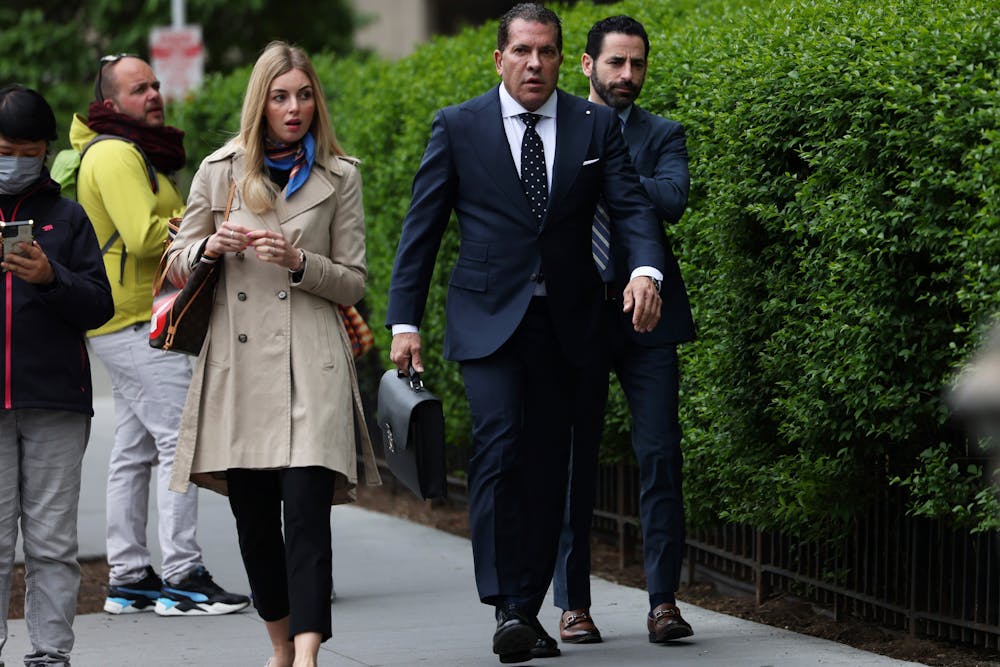
A white man in a dark blue suit walks down a sidewalk, flanked by a woman in a beige jacket and another man in a suit.

Joseph Tacopina, attorney for former President Donald Trump, appears outside a Manhattan courthouse on April 27, 2023. Michael M. Santiago/Getty Images

Women rarely lie about sexual assault

People routinely question women’s credibility when they disclose sexual harassment and assault, and imply that women lie about assault.

However, evidence consistently shows that false reports of sexual assault are exceedingly rare. For example, two different research teams analyzed sexual assault reports made to the Los Angeles Police Department and a large university police department. Using careful criteria for coding allegations and evidence, the teams estimated that only 4.5% to 5.9% of cases were false.

Yet, the vast majority of sexual assault cases reported to law enforcement do not result in convictions. According to research funded by the National Institute of Justice, only about 6% of sexual assault cases reported to the police led to a determination of guilt.

In 2017, when my research team interviewed more than 200 women who were sexually assaulted, we discovered that friends and family commonly responded to disclosures with negative reactions. They treated survivors differently, focused on how the assault affected them instead of the survivors, took control away from survivors and even blamed survivors for the assaults.

In 2019, when another research team pulled together 51 studies like ours on reactions to women’s disclosures, they found a consistent pattern – women who got more negative reactions when they disclosed their assaults had worse mental health outcomes, such as more severe post-traumatic stress disorder symptoms. This pattern suggests that when women disclose, they are trying to get help and support.

When those hopes for support are dashed by negative reactions instead, women’s psychological pain is worse.

Carroll put it this way as she described the impact of negative reactions to her disclosure: “It hit me and it laid me low because I lost my reputation. Nobody looked at me the same. It was gone. Even people who knew me looked at me with pity in their eyes, and the people who had no opinion now thought I was a liar and hated me.”


Anne P. DePrince, Professor of Psychology, University of Denver

This article is republished from The Conversation under a Creative Commons license. Read the original article.

“No special treatment”: Judge bans Trump from posting evidence on social media

A New York judge on Monday banned former President Donald Trump from sharing evidence related to his criminal hush money case on social media.

Judge Juan Merchan’s order, which sided heavily with Manhattan District Attorney Alvin Bragg’s investigation, stated, “any materials and information provided by the People to the Defense in accordance with their discovery obligations … shall be used solely for the purposes of preparing a defense in this matter.”

The order also said that the ex-president may view “Limited Dissemination Materials” from prosecutors only while in the presence of his attorneys and “shall not be permitted to copy, photograph, transcribe, or otherwise independently possess the Limited Dissemination Materials.”

The order added that Trump is banned from reviewing “forensic images of witness cell phones,” though lawyers may show him “approved portions.”

NBC News reported that prosecutors in the criminal case have pushed for “safeguards that will protect the integrity of the materials,” arguing that the likelihood of Trump using the evidence “inappropriately is substantial.”

“About. Damn. Time.” tweeted MSNBC legal analyst Glenn Kirschner.

“This is more like it,” lawyer and political commentator Tristan Snell wrote on Twitter. “No special treatment. ANY defendant doing what Trump did would be treated this way.”

“(Contempt violation coming in 1 2 3…)” tweeted Jeffery Evan Gold, an attorney and legal analyst.


Want a daily wrap-up of all the news and commentary Salon has to offer? Subscribe to our morning newsletter, Crash Course.


Last month, Trump targeted Merchan in a Truth Social rant after learning the judge would be presiding over the case, which involves his role in payments made to adult film star Stormy Daniels leading up to the 2016 election. Trump cited right-wing reports that Merchan’s daughter worked for Kamala Harris’s campaign in 2019 before she dropped out of the presidential race. 

“THE HIGHLY PARTISAN JUDGE & HIS FAMILY ARE WELL KNOWN TRUMP HATERS,” Trump claimed. “HE WAS AN UNFAIR DISASTER ON A PREVIOUS TRUMP RELATED CASE, WOULDN’T RECUSE, GAVE HORRIBLE JURY INSTRUCTIONS, & IMPOSSIBLE TO DEAL WITH DURING THE WITCH HUNT TRIAL. HIS DAUGHTER WORKED FOR “KAMALA” & NOW THE BIDEN-HARRIS CAMPAIGN. KANGAROO COURT!!!”

Trump has also lashed out at Bragg and other prosecutors investigating him.

“Trump continues to post things, false things, dangerous things about the prosecutors who are investigating his crimes, about the prosecutors who have indicted him, have charged him, and they’re actually in court, prosecuting his crimes,” Kirschner warned in a video on Sunday. “And these are posts that deploy lies and disinformation to poison the well of public opinion, to poison all future jury pools. And that put prosecutors and their family and their staff members at risk.”

“Disastrous”: Legal experts pan Trump’s “remarkably bad” lawyer after he’s “humiliated” by judge

Legal experts panned Donald Trump’s attorney Joe Tacopina after his closing arguments on Monday but cautioned that the former president could still prevail against E. Jean Carroll’s rape and defamation claims.

Carroll lawyer Roberta Kaplan on Tuesday reviewed the evidence in the trial for the jury and contrasted her client’s days on the stand to Trump’s refusal to testify.

“You saw for yourself, E. Jean Carroll wasn’t hiding anything,” Kaplan said, adding that Trump “didn’t even bother to show up.”

Kaplan argued that Carroll’s testimony was “credible,” “consistent” and “powerful,” linking her allegations to Trump’s infamous Access Hollywood tape, telling the jury that Trump “grabbed her by the pussy, or vagina, I apologize for my language.”

Kaplan called Trump a “witness against himself” after citing his repeated admissions and lies in his deposition. Kaplan noted that despite Trump’s claim that Carroll was not his “type,” he confused a photo of her for his ex-wife Marla Maples and “only corrected himself when his own lawyer.”

“[Carroll] was exactly his type,” Kaplan said. “He made up an excuse. He said it was blurry, it is not blurry.”

Trump during his deposition defended his comments on the Access Hollywood tape, arguing that it has been “largely true, unfortunately or fortunately.”

“Who would say ‘fortunately’ to describe an act of sexual assault?” Kaplan said on Monday. “He thinks stars like him can get away with it.”

Kaplan then listed a litany of lies by Trump about Carroll. In order to find for Trump, Kaplan argued, you “have to conclude that Donald Trump, the nonstop liar, is the only person here telling the truth.”

Carroll’s attorneys declined to ask for specific monetary damages.

“For E. Jean Carroll, this lawsuit is not about the money,” Kaplan said, but about getting her “name back.”

Legal experts praised Kaplan’s handling of the case while panning Tacopina’s rebuttal.

“Obviously, we won’t know until a verdict arrives” whether Trump’s absence had consequences, wrote MSNBC legal analyst Lisa Rubin. “But did Carroll’s lawyers exploit his absence in their closing and rebuttal? You best believe it.”

Carroll’s lawyers “were as close to perfect as I have seen,” former federal prosecutor Mitchell Epner wrote in a Daily Beast op-ed, while Tacopina’s “disastrous” closing argument “was remarkably bad, largely reduced to various versions of ‘Are you kidding me?'”

Tacopina claimed that Carroll had “abused the system” and brought the case for money “and victimized real rape victims, exploiting their pain and suffering,” according to Law & Crime.

Epner noted that Tacopina made a “few strong points” in his argument, citing Carroll’s inability to specify the date of the alleged attack and Trump’s repeated denials. Tacopina also argued that Carroll did not mention the assault in her diary and that the testimony of Carroll’s psychological expert could not be relied upon.

But Tacopina also made arguments that “have no chance of persuading any juror who was not already on Trump’s side,” Epner wrote.


Want a daily wrap-up of all the news and commentary Salon has to offer? Subscribe to our morning newsletter, Crash Course.


Tacopina attacked Carroll’s expert as a “hired gun” and attacked Carroll for not going to the police about the alleged attack. He argued that Carroll only came forward to “sell books” and disputed her testimony and that of her corroborating witnesses.

Judge Lewis Kaplan, who is not related to Carroll’s attorney, repeatedly shut down Tacopina’s arguments that ran afoul of his rules for the trial.

Tacopina tried to claim that Carroll’s story was made up based on a “Law & Order: SVU” episode that included a rape in a Bergdorf Goodman but the judge instructed the jury not to consider an email about the episode. Kaplan also shut down Tacopina’s attempt to tie Carroll’s decision to sue Trump to anti-Trump attorney George Conway.

During another exchange, Kaplan “ruled that Tacopina had mischaracterized the evidence” while discussing a message sent by Kaplan, Epner wrote, adding that Trump’s lawyer was “humiliated (again) by Judge Kaplan.”

After Tacopina’s arguments, Carroll attorney Michael Ferrara rebutted his key points before turning back to Trump’s comments in the Access Hollywood tape.

“Trump never said it wasn’t true. It was a confession. It was not just locker room talk. I’ve been in locker rooms and I’ve never heard about furniture shopping,” Ferrara said. “Trump said, ‘I move on her like a B-I-T-C-H.’Like in Bergdorf’s, shopping. Grabs them by their genitals. That’s not locker room talk, when Donald Trump says it. He did exactly that.”

Former federal prosecutor Renato Mariotti acknowledged that Tacopina “knows his way around a courtroom” but “he was not the right choice for this case.”

Mariotti also acknowledged that Trump’s absence “made it very difficult for his lawyers to mount a defense.”

“If she prevails,” he tweeted, “Trump’s empty chair at trial may end up being one of the most important factors in that verdict.”

The jury is set to get the case on Tuesday. Epner cautioned that despite Tacopina’s performance “the jury may rule for Trump, largely because of one glaring weakness in Carroll’s case: her inability to identify the day, date, week, month, or year when Trump allegedly raped her in the lingerie department of Bergdorf Goodman.”

Oregon bans plastic foam and PFAS in food containers, promotes reusable alternatives

Oregon on Monday became the 10th state in the U.S. to ban polystyrene foam food containers, dealing another blow to a plastic whose chemical components have been linked to cancer and nervous system damage.

Starting in 2025, a new law signed by Governor Tina Kotek will ban the production, sale, and distribution of polystyrene foam cups and takeout food containers — as well as coolers and packing peanuts — anywhere in Oregon. It’s part of a broader legislative effort in the Beaver State to replace single-use plastics with reusable alternatives.

The polystyrene law also bans toxic “forever chemicals” in food packaging, and a second bill signed by Kotek will make it legal for consumers to bring their own reusable takeout containers to restaurants. 

The legislation was “a long time coming,” said Oregon state Senator Janeen Sollman, a Democrat who cosponsored both bills. Banning polystyrene foam, in particular, had been a longtime priority for her, and she said it took a bipartisan coalition of legislators to finally push the measure through.  

Polystyrene foam, a kind of plastic made from fossil fuels and synthetic chemicals, has long been considered a scourge to public health and the environment. Its primary building block, styrene, is a probable human carcinogen that can leach from the material over time, or when polystyrene is exposed to high heat. Because polystyrene foam is nonrecyclable, it often winds up on beaches or in the ocean, where it breaks into smaller fragments called microplastics that can harm marine life.

Hundreds of cities across the country have already banned polystyrene foam — including Portland, Oregon, where the material has been outlawed since 1990 — and state-level restrictions have gained steam in recent years. Besides Oregon, nine other states and the District of Columbia have banned polystyrene foam food containers, and Hawai’i and California have de facto bans. Many of those bans, like Oregon’s, also include coolers and polystyrene packing peanuts.

Oregon’s legislation also goes beyond polystyrene to prohibit per- and polyfluoroalkyl substances, or PFAS, from being intentionally added to plates, bowls, cups, and other foodware. Tara Brock, Pacific counsel for the nonprofit Oceana, said this was important to ensure that polystyrene isn’t replaced with “regrettable alternatives,” since many foodware products made from paper or other types of plastic are treated with PFAS to give them water- and oil-repellent properties. PFAS, known colloquially as “forever chemicals,” do not break down naturally over time and have been found in the bloodstreams of 97 percent of Americans and hundreds of nonhuman animal species. They’ve been linked to cancer, high blood pressure, and elevated cholesterol.

Oregon is now the 12th state to ban PFAS from food packaging, following Washington, California, New York, Vermont, and others

Under Oregon’s law, people who sell or distribute polystyrene packing peanuts or foodware treated with PFAS after January 1, 2025, may incur a civil penalty of up to $500 a day. Food vendors distributing polystyrene foam food containers will be liable for a smaller penalty of up to $100 a day. 

Oregon state Representative Maxine Dexter, a Democrat, said the bans on PFAS and polystyrene are part of a more holistic effort to move beyond single-use foodware altogether, since most plastic is not recyclable and disposable alternatives made of paper or metal come with their own environmental impacts. The second law signed by Kotek directs the Oregon Health Authority to adopt rules by June 30, 2024, allowing consumers to bring their own containers to restaurants so they can be filled with food. The state’s Department of Agriculture adopted similar rules for grocery stores, which often sell staples like rice and beans in bulk bins, in February.

“We can’t recycle our way out of this issue; we absolutely have to use less,” Dexter told Grist. A big part of that is reduced plastic production, which Oregon is pursuing through a 2021 law that will make companies financially responsible for the waste they generate starting in 2025. But Dexter said new laws are also needed to shift consumer behavior, encouraging more people to carry reusable containers with them on a daily basis.

Oregon’s new reuse law could also protect those who are already familiar with refilling their own jars, tins, and tubs. “A lot of Oregonians have been doing this reuse behavior” and didn’t know it wasn’t allowed under the health code, according to Brock. “I’ve always been that person who brings my old yogurt container to the restaurant to take home my leftovers … We just want to make sure we’re doing it in a way that is safe for consumers.”

Brock said she’s eager for more states to follow Oregon’s lead, and potentially for federal lawmakers to take action to reduce single-use plastics — an objective that’s supported by three-quarters of American voters, according to a recent Ipsos poll conducted for Oceana. The Break Free From Plastic Pollution Act, a bill proposed in 2021, is the strongest example of such a federal policy, and it’s expected to be reintroduced this legislative session. If passed, the act would ban most single-use plastics and place a moratorium on new or expanded plastic production facilities.


This article originally appeared in Grist at https://grist.org/regulation/oregon-bans-plastic-foam-and-pfas-in-food-containers-promotes-reusable-alternatives/.

Grist is a nonprofit, independent media organization dedicated to telling stories of climate solutions and a just future. Learn more at Grist.org

Mushrooms can “talk” to each other — and they get extra chatty after a rain, study suggests

What has no eyes, ears, brains or nerves, but still manages to talk?

The answer is mushrooms — which, despite appearing docile and still as plants, are most definitely not, as they do not even photosynthesize. Yet these inanimate fungi have incredible ways of communicating that researchers are only beginning to understand.

A new study in the journal Fungal Ecology found that a certain breed of mushroom seems to “talk” using electrical signals — and intriguingly, they get especially chatty after a nice rain. The way they talk after the weather — perhaps about the weather? — has not been reported before.

To study this, a team of Japanese researchers inserted subdermal needle electrodes into the caps and stipes of a type of mushroom called Laccaria bicolor. It’s also known as the “deceiver” mushroom because once it ages and fades, it can be hard to identify.

Mushrooms are essentially the fruit of certain fungi, which spend most of their life underground forming webs called mycelium. When a fungus wants to reproduce, it forms mushrooms that drizzle spores, which are akin to seeds in plants. Mushrooms can arise in a multitude of weird shapes and forms, from resembling bird’s nests to dog’s noses. In the case of L. bicolor, they are a roasted peach color on the cap with distinctive lilac gills. These mushrooms are known as ectomycorrhizal fungi, which means they form symbiotic relationships with forest trees.

On a mild, September day in 2021, the researchers entered a forest dominated by Japanese red pine (Pinus densiflora), jolcham oak (Quercus serrata) and loose-flowered hornbea (Carpinus laxiflora) where they found clusters of L. bicolor sprouting around their roots. These mushrooms form protective sheaths around the roots of trees and exchange nutrients with the trees, without which, they couldn’t survive.

The team, led by Yu Fukasawa from Tohoku University, inserted a tangle of wires into six mushrooms. The end result looked like a weird DIY synthesizer project. (People do make noise music using mushrooms, so perhaps not a far-off comparison.) When the wires were installed, it had not rained in about two weeks. The next day, on October 1st, a typhoon rolled through, dropping about 30 millimeters of rain.

Even this small level of precipitation was enough to create voltage spikes in some of the mushrooms. What’s more, the mushrooms seemed to transfer this energy underground through mycelial networks to its neighbors, which could be analogous to a sort of communication. In other words, mushrooms seem to get chatty, especially after rainfall.

“In the beginning, the mushrooms exhibited less electrical potential, and we boiled this down to the lack of precipitation,” Fukasawa said in a statement. “However, the electrical potential began to fluctuate after raining, sometimes going over 100 mV.”

100 mV, or millivolts, is a unit of electrical potential equal to one-thousandth of a volt, or 0.001 volts. It may not seem like much, but it’s a lot for a mushroom.


Want more health and science stories in your inbox? Subscribe to Salon’s weekly newsletter The Vulgar Scientist.


Previous research has demonstrated that mushrooms can sort of talk to each other using electrical signals, although experts still debate whether this is really what we might call language or not. As Salon previously reported, Andrew Adamatzky, a computer scientist at the Unconventional Computing Laboratory at the University of the West of England, Bristol, used sub-dermal needle electrodes to record electrical impulses from four different fungi: ghost, enoki, split gill and caterpillar mushrooms.

The research, which was published in the journal Royal Society Open Science, noticed spiking patterns in these electrical impulses. However, this research remains controversial.

“Human exceptionalism with regard to language was already countered by bees and ants and plants,” Adamatzky told Salon. “I bet all creatures have their own language. Following [Noam] Chomsky’s universal grammar, we could probably discover in future that all living creatures have similar underlying grammars.”

Nonetheless, Adamatzky’s experiments were done in the lab. Fukasawa’s more recent research was the first to demonstrate this sort of communication in the wild and showed that it changed after the rain.

Other factors could explain the surge in voltage, including the physical impact of raindrops on the mushrooms. To make sure, Fukasawa and his team repeated the experiment using “dummy” mushrooms made from melamine sponges (sometimes sold as “magic’ erasers.)

“The result shows that the direct effects of raindrops on the electrical potentials are negligible,” the authors reported. Nonetheless, they outline many ways in which future research can more clearly unravel what’s happening, including by blocking sunlight on the mushrooms and using artificial rainfall of different strengths, ion concentrations in the water or even gel beads “would be worth performing to check the physical and chemical effects of water droplets on electrical potential of living mushrooms.”

Do mushrooms really talk in a way that could be compared to human language? The jury is still out. Notably, research into how fungi communicate using electrical signals is still very much in its infancy — but it is clear there is much to be learned about fungi and their life cycles. From psilocybin mushrooms being used to treat mental illness to pathogenic fungi that could trigger the next pandemic, fungi still have much to reveal about life on Earth.

Republicans weaponize statehouse rules to disenfranchise voters

First, it was the Tennessee Three. Then, a trans lawmaker was kicked out of Montana‘s House chamber. After that, Oregon’s GOP senators held a quorum hostage in their Capitol to prevent Democrats from holding a vote. Now, the North Carolina legislature’s GOP supermajority has introduced and passed a 12-week abortion ban in under 24 hours. 

With the Supreme Court kicking abortion access back to the states, a deadlocked Congress held hostage by extremist rookies, and President Joe Biden pussyfooting around executive orders — 2023 seems to be the year that America’s state legislatures, the Wild West of political skullduggery, are finally stepping into the national spotlight and its long-overdue scrutiny. The dam was broken in 2010 when the Supreme Court’s ruling in Citizens United opened the floodgates to unprecedented campaign spending by dark money groups. In 2010, Republicans held 3,246 state legislative seats to Democrats 4,031. After the 2010 elections, Democrats were down to 3,301 and Republican numbers grew to 3,946. 

Republicans seized full trifectas in 11 states where Democrats either held a full or split government — and the GOP was quick to consolidate that power. Sweeping redistricting reforms and gerrymandered maps became the GOP’s central tool in maintaining local control. And while partisan entrenchment trends in the past two years have seen some blue states become more deeply blue, the GOP’s iron grip on statehouses has grown stronger since.

With the exception of Alaska’s coalition-controlled chamber, Republicans currently control 29 House or Assembly chambers, and 29 Senate chambers. Democrats, on the other hand, control only 20 House or Assembly chambers, and 20 Senates. Following the 2022 midterms, Republicans now serve as the attorney general offices of 26 states. And in 28 states, Republicans have either full trifectas or hold total legislative control.  

Much like the controversial rules packages that come at the start of a new session of Congress, a state chamber’s earliest votes in a session are to approve its annual rulebooks. And like those of Congress, a state chamber’s rules can be suspended on a motion approved by the speaker or chamber leader — for nearly any reason, at nearly any time. 

The expulsion of state lawmakers may seem unprecedented and extreme but it shouldn’t be a surprise. State legislatures — often historically set in a far remove from cities — have long grown rancid with a malicious culture of unchecked sexual harassment and bullying. And the few token gains made by the #MeToo backlash have in many places been eroded entirely. 

And the contempt of the powerful for those in the chamber spreads from the personal to the legislative. Bills are assigned to strategically unfit committees. (As in Kentucky, where abortion bills are routinely assigned to the Veterans Affairs Committee.) Committee hearings for bills are often scheduled, rescheduled, or re-located at the last moment, undermining public participation. Other times, bills are gutted wholesale, hastily stuffed with unrelated substitute language on the floor before being passed out of the sausage factory. 

“You are far more likely to end up in front of a judge than you are to end up in front of the governor.”

And more often than not, all of it happens in the dark; news outlets have cut state Capitol reporters 34% since 2014.

Voter suppression and electioneering tactics play a key role in keeping things quiet in statehouses. Strict voter ID laws, efforts to undermine early voting and mail-in ballots, rigging and purging voter rolls — in 2021 alone, 19 states controlled by Republicans passed 34 laws to clamp down on democratic participation. In 2022, a renewed wave of Republican bills — all of which failed — would have taken election oversight away from nonpartisan election agencies and local officials in seven states, and given partisan officers the authority to overturn election results.


Want a daily wrap-up of all the news and commentary Salon has to offer? Subscribe to our morning newsletter, Crash Course.


As the GOP has elsewhere, Kentucky Republicans have long leaned into the slogans of small government and local control. In the regionally diverse state, rural and urban problems often require locally tailored solutions not reached by blanket mandates passed at a state or federal level. The slogans could be heard in the Capitol from both Republicans and Democrats in decades prior, staving off laws that would have overwhelmed county-level resources. In communities where too few badges patrol long stretches of high-speed backroads, for instance, the state that gave the world bourbon still has dry counties. 

But the meaning behind those rallying cries has changed. These days the slogans are shouted in opposition to federally protected education or healthcare rights.

“When you have lawmakers who are standing up and arguing, yet again, why they should be put in the place of a medical doctor or a medical provider, and be the middleman between a parent and how they want to raise their child — that seems to be the opposite of the party of small government to my eyes,” Angela Cooper of the American Civil Liberties Union told Salon. 

The local control conflict is felt most sharply the latest tactic of GOP-controlled statehouses, preemption laws — designed to undercut the authority of municipal governments and city mayors, almost always Democrats. Preemption played a prominent role in states’ COVID-19 containment efforts.

“As I was talking to the folks at the National League of Cities, which is a broader national group that represents a lot of states and local governments, they said that they are seeing more than 600 of these bills active in legislatures in the country right now,” NPR’s Kelsey Snell recently reported. “They said that it used to be that these things would play out over all 50 states, but they’re seeing it in a narrower group of states this year, particularly when it comes to culture wars issues. They said a lot of bills around rent control, housing, public safety — like policing, LGBTQ rights and education — those things are happening mostly in Republican legislators.” 

For all their messiness and upsets, the 2022 midterms moved Democrats ahead not only in Congress but in statehouses — where they regained control of five chambers from the GOP and picked up 21 seats. The sweep wasn’t a Blue Wave by any means, but in states where Democrats gained statehouse seats during 2022, those gains were slightly larger in most cases than seats gained by Republicans. 

New Hampshire, Pennsylvania, Michigan, Georgia — it shouldn’t be surprising that these states’ Democrats picked up enough seats to regain control of a statehouse chamber. Meanwhile, though, the statehouse seats gained by Republicans more closely illustrate the point. West Virginia, South Carolina, Wisconsin, Iowa, Kentucky, and Florida — Republicans already had control of at least one chamber and they increased their share of seats in them heavily. Red chambers, in many states, got much more red. 

But the midterms did hint at the promise of more statehouse-level gains in 2023. And as the Supreme Court keeps kicking civil rights cases back to the states to decide, it’s simultaneously shining a harsher spotlight on the state lawmakers who are the source of attacks on those rights. 

To those like Cooper and the ACLU, that means the courts play a greater role than ever. Cooper suggests the ACLU’s non-partisan judicial election guides as an important step toward directing public attention to the power of the bench. 

“You are far more likely to end up in front of a judge than you are to end up in front of the governor.” 

Jordan Neely and the politics of disposability

Last Wednesday, my editor asked me to write an essay about the killing of Jordan Neely in New York.

I told her that I didn’t know what she was talking about. I had not yet heard about what happened to Jordan Neely.

The next day, my editor asked me again if I was inclined to write something about Jordan Neely.

I politely told her that I don’t know.

To be expected to write something or otherwise comment every time a Black person suffers some particularly horrible end in public be it from the police, a vigilante, or some other such encounter, is draining and exhausting.

Am I fated to be trapped and tethered to such things as a “Black writer?”

As for being a “Black writer,” I don’t think of myself that way. And in 21st century America, a society where neoliberal multiculturalism and fake “diversity” dominate most areas of our culture at the same time when white supremacy and neofascism are ascendant, I don’t even know what being a “Black writer” really means anymore. But I do know for sure that I am a “blues man.”

There is so much Black death. But we have a finite amount of time and energy. Racial battle fatigue has weathered me; it has weathered so many of us. There is great pressure on people who write and think publicly or aspire to be a member of “The Church of the Savvy” or “the punditry” or the “commentariat” to speak with certainty even when they are uncertain and to be fast when they should be slower and meditative. I am not a careerist; I have no such aspirations. Although I try to resist them, I do feel the pressure to be faster when I would prefer to be more meditative. That is an inescapable consequence of the 24/7 news cycle and a society where it too often feels like nothing really matters anymore because there is always some new crisis, real or manufactured, and empty “content” (digital detritus), competing for our energy and attention.

I have to overcome other challenges as well if I am to write about Jordan Neely.

I don’t watch new-age lynching videos. I have books full of images of Black people being lynched by white people. I don’t want or need to watch what happened to Neely to know that it was horrible. 

Bearing witness is a muscle; it is both a noun and a verb; it is something that we must exercise lest it atrophy.

I often fail to consistently live by the principles of radical empathy, linked fate, and embodied solidarity to the degree, and in the ways, that I aspire to. In practice, this means that the “perfect victim” is much easier to write about because there is much less anxiety about being wrong and elevating someone to the level of righteous victim and then finding out that they were not deserving. 

Jordan Neely is not perfect. I am not perfect. You and we are not perfect. If you are Black or brown, THEY most certainly will find a way to make sure that you, even when you are obviously and clearly the victim, are ultimately responsible for your own suffering and unjust fate.

You ran into the knife ten times that killed you.

You jumped in front of the bullet that hit you.

You somehow provoked your own killing because of your naturally menacing giant and dangerous Black body or that you were somehow not sufficiently deferent and compliant to the white person or other “authority” figure who confronted you for the “crime” of being “suspicious” – which means being Black, breathing, nearby, and just going about your day.

But in the end, I decided to write about Jordan Neely and what happened to him last Monday afternoon on the F subway train in New York City. Why? Because bearing witness is not easy or simple. To truly bear witness demands much of us. Often it is uncomfortable. Bearing witness is a muscle; it is both a noun and a verb; it is something that we must exercise lest it atrophy.

I also remembered that bearing witness is not something that we have to do alone; We can lean on and encourage and support one another; We can bear witness together as a type of chorus.

So what do we know?

Last Monday, Jordan Neely was choked to death on a New York City subway train. Witnesses said that he was agitated and acting “aggressively” as he kept saying that he was hungry, thirsty, and had given up on life. Neely apparently also said that he did not care if he went to jail. Neely, 30, was unhoused and suffering from mental illness. Those same witnesses also report that Neely did not make any threatening moves towards them. A verbal exchange took place between Neely and another passenger (now identified as Daniel Penny). Penny, a 24-year-old U.S. Marine Corps veteran, then put Neely in a rear naked choke hold, taking him to the ground, and continuing to apply pressure to his neck for approximately fifteen minutes. One of the passengers helped to hold Neely down on the ground. Neely quickly passed out. Medical examiners ruled Neely’s death to be a homicide. Penny was questioned by police and then released from custody. At the time of this writing, he has not been charged with a crime.  

In America’s gangster capitalist society, all aspects of life are financialized.

Before Jordan Neely is “read” and interpreted as some type of sociological and/or political symbol, made into a “text” or a slogan, he is first and most importantly a human being. He was a son and a friend and a member of a community. By all accounts, he was a very talented singer and dancer who did a great impersonation of Michael Jackson.

Like so many other millions of other people in America, Neely suffered great tragedy and loss, traumas that contributed to him becoming mentally unwell and unhoused. Moses Harper told CNN that his friend was deeply traumatized by the horrific murder of his mother as a teen. “He was not expecting that, the brutal way she was taken. That had a big impact on him. The brutality behind that, that traumatized him….This kid has cried in front of me. That hurt him in his heart.”

Neely’s aunt told the New York Post that, “My sister Christie was murdered in ’07 and after that, he has never been the same…. It had a big impact on him. He developed depression and it grew and became more serious. He was schizophrenic, PTSD. Doctors knew his condition and he needed to be treated for that…The whole system just failed him. He fell through the cracks of the system.” 

What does the killing of Jordan Neely indicate about us, the Americans, as a society and a people? New York City’s elected leaders failed Jordan Neely and all the other people who may at some point in their life need assistance from the social safety net because they are experiencing a crisis.

At Slate, Nitish Pahwa offers this criticism:

Whatever one makes of these reports, it shouldn’t be difficult to say that the 30-year-old Neely obviously did not deserve to die, and that a nearly 15-minute-long chokehold involving multiple assailants was an alarming overreaction to his cries of distress. But New York’s most powerful officials couldn’t even clear that bar.

Mayor Eric Adams, who has been touted as the future of the national Democratic Party, simply proclaimed that “any loss of life is tragic” and that, while he’d “refrain from commenting further,” he understood that “there were serious mental health issues at play here” and boasted that his “administration has made record investments in providing care to those who need it.” Later, when CNN Primetime’s Abby D. Phillip asked him whether such acts of “vigilantism” are permissible, Adams further demurred: “We cannot just blanketly say what a passenger should or should not do on a situation like that.”…

Gov. Kathy Hochul hardly did better in her initial declaration that “there are consequences for behavior.” It wasn’t until Thursday afternoon that Hochul clarified she meant that the killer should face consequences, although she hesitated to deem the Marine a “vigilante.” Neither Adams nor Hochul mentioned the fact that the city’s medical examiner determined Neely’s death to be a homicide on Wednesday itself. And they both seemed happy to talk up large investments toward “mental health,” while neglecting to explain just what kinds of services they were funding, or what those would do to prevent another homicide of this nature….

Jordan Neely’s hometown failed him—it couldn’t even provide him a stable home and life. The reportedly autistic young entertainer, whose spot-on Michael Jackson impressions often went viral and brought joy to countless New Yorkers for over a decade, was denied a stable life by employers who didn’t understand his condition and cops who arrested him dozens of times instead of pointing him to the help he could have used. When New York’s elected officials continue to embrace aggression against the unhoused, brutal stances on criminal justice, and public-service austerity, other New Yorkers follow by choosing cruelty over compassion. And when they waffle on why a houseless person shouldn’t be killed for complaining about his circumstances, they only pave the way for more deaths to come. Adams and Hochul may say they’re doing what they can for New Yorkers’ mental health. Their actions clearly don’t back that up.

A few of New York City’s leaders chose to tell the truth about the killing of Jordan Neely.

Jumaane Williams, New York City’s public advocate, asked: “What if it was the Black homeless man who had choked to death a White Marine because he was scared? We’d probably be having this conversation with him with charges sitting on Rikers Island.”

As for the former Marine who choked Jordan Neely to death, Myke Cole, who is also a veteran, explains in an essay at Slate how Daniel Penny’s decision to choke another person to death on the floor of a subway train was not an example of “heroism” or proper military training:

In many tweets and news headlines, he is identified as “the Marine” who “recognized this guy as a dangerous menace” or “A former Marine” who “intervened vs a subway psycho” or “a brave Marine who acted in his & others’ defense.

It is this man’s “Marineness,” his status as a military veteran, that is being singled out for relevance, as if he could have acted no other way, and as if it is the training and culture of service members to choke unarmed men into unconsciousness.

This is not true.

In fact, the use of force possibly out of proportion to a threat, creating a media firestorm that casts discredit on the person applying that force, is the polar opposite of how I was trained and antithetical to the culture in which I served as a military member, as a private military contractor, and as an armed intelligence officer serving with the Defense Intelligence Agency in Iraq.

I can’t speak to why this man intervened and choked Neely. But I do know this: Neither the military nor any of the vast network of PMC firms or paramilitary federal agencies that conduct operations side-by-side with it taught this man to choke an unarmed civilian into unconsciousness, unless the military I served in has radically transformed since my discharge in 2020.…

But where he acquired the capacity doesn’t matter. The way he acted is not the way armed service members are trained to act, and anyone claiming that his status as a Marine indicates a kind of professionalism either doesn’t know what they’re talking about or is deliberately obfuscating what it means to have military training in interacting with civilians under duress. The public discourse implying that his actions were in any way in accord with the doctrine and culture of the military—and the legion of institutions, public and private, whose armed members support its mission at home and around the world—is absolutely false.

Whatever the details of Daniel Penny’s fatal encounter with Jordan Neely, one thing is clear: Power is not just something abstract. Power is made most real when it acts on human beings. Necropolitics decides, quite literally, whose lives are valuable, whose are not, and thus who lives or dies.

To that end, in America’s gangster capitalist society, all aspects of life are financialized. As such, dominant American society views unhoused people like Jordan Neely as being disposable, literal human trash. This is even more true for unhoused Black and brown people (and the mentally ill, the handicapped, and the otherwise disabled).

In a new essay that can be read at his website, public scholar Terence Lester offers this context:

I immediately opened Twitter, and there it was: a young Black man, known for his Michael Jackson impersonations and without an address, violently choked and murdered by an ex-Marine. The incident was caught on camera and shared on social media sparking protests and outrage.

Many emotions swirled around in my head as I read the information on Neely’s past, including his 42 arrests and lack of access to mental health resources. I had so many emotions reading the story because Jordan reminded me of the long list of cases where violent attacks against the unhoused have gone unnoticed due to decades of social hatred towards this population and a lack of mental health resources.

Violence towards this community is not just about social stigma, hostile architecture, and public sanitation. It has also been fueled by a long history of political and social rhetoric, public policy, and the stripping of access to mental health resources over decades.

However, people forget that punishment towards a vulnerable population can be fueled by hate itself.

Sometimes, people forget how social stigma and public policy can impact:

  • How the unhoused are seen and treated by society.
  • How mistreatment based on social stigma can impact the self-worth of those experiencing homelessness.
  • The emotional toll that social injustice can have on the unhoused.
  • Whether social constructions influence behavior toward those, who are unhoused.

I wept because, for almost a decade, I have worked in an organization that has worked closely with the unhoused community and seen the violence, public mistreatment, and horrible perspectives about this community.

I wept because time and time again, I have had to write public apologies about the mistreatment that the unhoused community faces while also trying to wrestle through the most challenging moments of their life.

History is indeed a moving train. Last Tuesday, something horrible happened to Jordan Neely on that literal and metaphorical train. All of us, we the Americans, the leaders and the everyday people, share some responsibility for this broken system and how it views and treats some people as disposable – and others such as Jordan Neely much more so than others. We are complicit.

Trump’s rape deposition tape shows exactly why MAGA loves him

Donald Trump, cursed with a sociopathic narcissist’s inability to think even five minutes past whatever bluster he thinks will impress people in the moment, let loose with an especially pathetic bit of bravado last week on a golf course in Ireland. When asked by a reporter about the ongoing civil case in New York City regarding a rape accusation leveled by journalist E. Jean Carroll, Trump implausibly insisted he’s not afraid to show his face in court. “I have to go back for a woman that made a false accusation about me,” he raved. “I’m going to go back, and I’m going to confront this.”

As usual, Trump was lying. The judge gave him until Sunday afternoon to agree to testify, and he ignored the deadline. Trump’s lawyer, Joe Tacopino, expressed frustration to the judge about his lying client, saying, “I know you understand what I am dealing with.” 


Want more Amanda Marcotte on politics? Subscribe to her newsletter Standing Room Only.


Steve Benen at MSNBC wrote, “This isn’t likely to help the former president’s defense,” because it means “jurors won’t hear directly from the defendant.” Instead, they will only watch excerpts from Trump’s deposition, many of which were also released to the public last week. But in watching those clips, it’s easy to see why Trump’s lawyers reportedly told him not to testify. Trump does a piss-poor job at denying the accusations against him. Instead, he comes across as furious at having his “right” to manhandle women questioned. He can’t even keep up the pretense that he believes rape is bad. He would liekly be even more repulsive on the stand.

Well, repulsive to normal people, anyway. It’s important to understand that his mix of aggrieved entitlement and misogyny, which alienates most people, is exactly why the GOP base loves him and will re-nominate him for the presidency next year. 

It’s clear from the context of his remarks that he simply did not think most rapes count as rape because the victim had somehow been “asking” for it.

When a tape was leaked in 2016 revealing that Trump bragged about his repeated sexual assaults to “Access Hollywood” host Billy Bush, Trump dismissed the “grab them by the pussy” rhetoric as “locker room talk.” But during the deposition, he sat for last fall, he kept inadvertently revealing that he really does think that he should have license to sexually assault. He argued that “over the last million years” sexual assault has been the spoils of the privileged, “unfortunately or fortunately.” It’s gross on paper, but watching his body language, one definitely gets the sense of a man who feels the right to assault is being snatched away by #MeToo feminism. 

In large part because of his insatiable need to present as a Lothario, Trump also keeps pretending that various alleged victims aren’t hot enough to earn his violent attention. 

Carroll’s lawyer, Roberta Kaplan, replayed these clips Monday during closing arguments and underscored what they mean. “He actually used the word ‘fortunately’ describing sexual assault,” she told the jury. “He thinks stars like him can get away with it.” She also noted how important it is for Trump to argue “she wasn’t attractive enough to sexually assault.” 

Much has been made of the fact that Tacopino called no witnesses and offered little in the way of a defense. I suspect, however, that he’s banking that out of the 6 men on a 9-person jury, at least a couple will see it Trump’s way: That Trump is entitled to grab whatever pussy he wants. Because, as Trump said, that’s how it’s supposedly been for a “million” years. 


Want more Amanda Marcotte on politics? Subscribe to her newsletter Standing Room Only.


Monday morning, MSNBC host Joe Scarborough called out “evangelicals,” suggesting they are hypocrites who ignore Trump’s sexual predations because they are so hungry for power. In this, he echoed the common Beltway wisdom that there’s some conflict between the “family values” of the Christian right and Trump’s ill-concealed sense of sexual entitlement over women’s bodies. 

In reality, however, there’s no conflict here and never has been. Trump and the Christian right are in fierce agreement on the belief that women have no right to bodily autonomy, that women’s bodies belong under male control, and that the only person at fault in most sexual assault situations is the victim for “tempting” her assailant. Trump’s language suggesting that sexual assault was fine for a “million years” has plenty of echoes within the religious right, which has long argued that women’s second-class status must be maintained out of tradition.

We saw these connections, as well, in the Senate confirmation hearing of Justice Brett Kavanaugh, who was stood up by the GOP because of his opposition to abortion rights and who rallied the GOP troops with his “how dare she” response to credible allegations of sexual assault by Christine Blasey Ford. It’s not that they disbelieve Ford, so much as they don’t think she had a right to say anything about it. 

The Christian right and Trump’s shared contempt for women’s autonomy is most evident in the war on reproductive rights. It’s not just that the religious right doesn’t want women to have any meaningful say in when and if they give birth. It’s all tied into Trump’s view of rape as something women have no right to complain about.

Rape exceptions to abortion bans offend feminists because they are both useless in practice and assume that forced childbirth is a reasonable punishment for having consensual sex. But the reason that Republicans are passing abortion bans without them is for a bleak reason: They don’t want to allow that a woman’s opinion should have any bearing on what happens to her body. 

Most of them have gotten a little more clever in how they talk about this than former congressman Todd Akin, who lost a Missouri Senate race in 2012 after talking about how “legitimate rape” victims supposedly don’t need abortion access. The media discourse got caught up in his biological ignorance, as he argued that female bodies automatically suppress ovulation after a rape, which no. What is more important is the moral implication of what he was implying. It’s clear from the context of his remarks that he simply did not think most rapes count as rape because the victim had somehow been “asking” for it.

Akin was plugged into a long and ugly discourse that argues that a woman has foresaken her right to say no if she is alone with a man, flirts with a man, or even if she walks alone unescorted. It’s built around the assumption that women have no autonomy worth respecting, and so the only way for a woman to “earn” her safety is to always be in the possession of a  man who will guard against other men raping his property. 

The jury hearing Carroll’s lawsuit is expected to start deliberations today. It’s been a remarkable trial because the defense didn’t really commit to their supposed argument that the assault never happened. Instead, they were presented with a defendant who couldn’t hide his sense of entitlement to the bodies of whatever women he deemed attractive enough to assault. The real question is not whether they believe a pathological liar like Trump when he denies this happened. What will likely determine this trial’s outcome is whether any jurors are sympathetic to the MAGA Republican view that women didn’t have a right to say no in the first place, and have no right to complain about it now. 

Scientists figured out chimpanzees have a rudimentary language by pranking them with fake snakes

Humans are not merely adept at communicating danger — it is seemingly built into our brains. That may be true for most social animals, but not all animals can communicate using specific nouns or verbs to refer to present dangers. That, it seems, is the unique power of human language, an ability that provides a strong evolutionary advantage. If you’re chatting idly with your neighbors and suddenly see something dangerous — say, a rattlesnake — mutual yells and shouts abound; and, after the surprise of the snake abates, humans move to recruit others to deal with the problem. 

But whether all animals work and communicate this way, or just humans (or our ape relatives), is an open question. Hence, in a recent study published by the journal Nature Communications, researchers placed fake snakes among wild chimpanzees in Uganda to see if they would respond in the same way as humans — communicating the specific danger, then working together to manage it.

What happened next changed the way we understand the evolution of human language.

Just as humans might react urgently if they heard a person shout “Oh my gosh! Help!”, the chimpanzees were alarmed when scientists pranked them with the chimp version of that phrase.

The researchers from the University of Zurich observed that chimpanzees in Uganda produced a sound they call “waa-barks” in order to recruit other chimpanzees. If a chimpanzee was surprised, they’d produce sounds called “alarm-huus.”

Knowing this, the researchers placed model snakes near chimpanzees, and then played recordings of either one of those sounds, or both together. Consistently, the researchers saw the same results: The spooked chimpanzees reacted “most strongly” and by “showing longer looking responses” when the “waa-barks” and “alarm-huus” were used in the correct combination. That very much implies the existence of a chimpanzee “language,” or at least something akin. 

Just as humans might react urgently if they heard a person shout “Oh my gosh! Help!”, the chimpanzees were alarmed when scientists pranked them with the chimp version of that phrase. As the authors explained, they had predicted that other chimpanzees in the group would join the call expressing alarm and seeking help once it was heard. Importantly, they found that the chimpanzees only reacted in this way when they heard that specific combination of calls; merely giving one of the “waa-barks” in isolation, or one of the “alarm-huus” in isolation, was simply not as effective.

These two phrases might form the basis of a proto-sentence in their language, researchers think. 

“We propose the ‘alarm-huu + waa-bark’ represents a compositional syntactic-like structure, where the meaning of the call combination is derived from the meaning of its parts,” the authors explain in their study. They speculate that this has implications far beyond simply understanding chimpanzee language; it suggests that the complex compositional structures that define human language did not originate with our species, “but that the cognitive building-blocks facilitating syntax may have been present in our last common ancestor with chimpanzees.”

“Humans and chimpanzees last shared a common ancestor approximately 6 million years ago,” study last author, University of Zurich professor Simon Townsend, explained in a statement. “Our data therefore indicate that the capacity to combine meaningful vocalizations is potentially at least 6 million years old, if not older.”


Want more health and science stories in your inbox? Subscribe to Salon’s weekly newsletter The Vulgar Scientist.


In 2022 a study published by the journal Communications Biology demonstrated that chimpanzees can produce as many as 390 unique vocal sequences.

The study is remarkable for what it says about the evolution of language and of the intelligence of the great apes. It follows a flurry of recent interest in the complexities of primate language. In 2022 a study published by the journal Communications Biology demonstrated that chimpanzees can produce as many as 390 unique vocal sequences. While the scientists were only able to connect those vocal sequences to specific objects and actions, that does not mean chimpanzees only have 390 words. Indeed, the way that the chimpanzees combined those vocal sequences suggests they can create new words from them.

“From a purely structural perspective, the capacity to organize single units into structured sequences offers a versatile system potentially suitable for expansive meaning generation,” explained the authors of the study, which analyzed chimpanzees in Côte d’Ivoire. “Further research must show to what extent these structural sequences signal predictable meanings.”

Since the average human 20-year-old English speaker knows an estimated 42,000 words, according to Science magazine, both that study and the new one raise the provocative possibility that chimpanzees can communicate on a level comparable with human beings. Since neither study comes anywhere close to proving that, however, further research will be needed. As the authors of the 2022 study put it, “From a purely structural perspective, the capacity to organize single units into structured sequences offers a versatile system potentially suitable for expansive meaning generation. Further research must show to what extent these structural sequences signal predictable meanings.”

Similarly, primatologist Adriano Lameira has demonstrated through his research that orangutans — which share 96.4% of their genes with humans — have distinct dialects based on their regional cultures, much as human beings do. Lameira argues that orangutans are so intelligent that they deserve legal rights within human judicial systems, both because their lives have intrinsic value and because studying them can help people learn a lot about their own use of language.

“They’re extremely intelligent, they’re very similar to us, they have cultures, they have prototypical behaviors that are assumed to be precursive of language,” Dr. Adriano Lameira told Salon last year.

How Rep. James Clyburn worked with GOP to protect his own district at a cost to Black Democrats

ProPublica is a Pulitzer Prize-winning investigative newsroom. Sign up for The Big Story newsletter to receive stories like this one in your inbox.


The meeting was arranged in secret. On Nov. 19, 2021, the chief of staff for South Carolina’s Senate Judiciary Committee texted Dalton Tresvant, a key aide to Rep. Jim Clyburn, the state’s most powerful Democrat.

“Hey Dalton – Andy Fiffick here,” he said. “We wrapped up some morning things quicker than we thought, so if you want/can come earlier than 1:30 we’re available.”

The state legislature had begun the crucial task of redrawing voting district lines after the 2020 census. Even small changes in the lines can mean the difference between who wins office, who loses and which party holds power. As the process commenced, Clyburn had a problem: His once majority Black district had suffered a daunting exodus of residents since the last count. He wanted his seat to be made as safe as possible. Republicans understood the powerful Black Democrat could not be ignored, even though he came from the opposing party and had no official role in the state-level process. Fortunately for them, Clyburn, who is 82 and was recently reelected to his 16th term, had long ago made peace with the art of bartering.

Tresvant made his way to the grounds of the antebellum Statehouse, a relic still marked by cannon fire from Sherman’s army. The aide carried a hand-drawn map of Clyburn’s 6th District and presented it to Fiffick and the other Republican committee staffers who were working to reconfigure the state’s congressional boundaries.

Some of Tresvant’s proposals appealed to Republicans. The sketch added Black voters to Clyburn’s district while moving out some predominantly white precincts that leaned toward the GOP. The Republicans kept Tresvant’s map confidential as they worked through the redistricting process for the following two months. They looped in Tresvant again near the end, according to public records obtained by ProPublica.

The resulting map, finalized in January 2022, made Clyburn’s lock on power stronger than it might have been otherwise. A House of Representatives seat that Democrats held as recently as 2018 would become even more solid for the incumbent Republican. This came at a cost: Democrats now have virtually no shot of winning any congressional seat in South Carolina other than Clyburn’s, state political leaders on both sides of the aisle say.

As others attacked the Republican redistricting as an illegal racial gerrymander, Clyburn said nothing publicly. His role throughout the redistricting process has remained out of the public view, and he has denied any involvement in state legislative decisions. And while it’s been clear that Clyburn has been a key participant in past state redistricting, the extent of his role in the 2021 negotiations has not been previously examined. This account draws on public records, hundreds of pages of legal filings and interviews with dozens of South Carolina lawmakers and political experts from both sides of the aisle.

While redistricting fights are usually depicted as exercises in raw partisan power, the records and legal filings provide an inside look that reveals they can often involve self-interested input from incumbents and backroom horse trading between the two parties. With the House so closely divided today, every seat takes on more value.

South Carolina’s 2021 redistricting is now being challenged in federal court by the NAACP. The organization contends that Republicans deliberately moved Black voters into Clyburn’s district to solidify their party’s hold on the neighboring swing district, the 1st. A three-judge federal panel ruled in January that aspects of the state’s map were an unconstitutional racial gerrymander that must be corrected before any more elections in the 1st District are held.

But Clyburn’s role already has complicated the NAACP’s case. The judges dismissed some of the group’s contentions partly because Clyburn’s early requests drove some of the mapping changes. The Republicans are now appealing the ruling to the Supreme Court, which has yet to decide if it wants to hear oral arguments in the case.

The redistricting process was the first South Carolina has undertaken since a series of Supreme Court rulings made it easier for states to redraw their districts. In 2013, the high court significantly weakened the Voting Rights Act, removing South Carolina and other Southern states, with their history of Black disenfranchisement, from Department of Justice oversight. And in 2019, the Supreme Court opened the door to more aggressive gerrymandering by barring federal court challenges on the basis of partisanship. But it can be illegal to draw lines based on race. Republican gerrymanders in Florida, Texas and several other states have recently been challenged for targeting Black voters.

The fight over the South Carolina redistricting has exacerbated racial wounds in a state where the growing white population now accounts for about 68% of residents, up from 66% a decade ago. Driven by the immigration of white retirees and a slow emigration of Black people, the state’s Black population has dropped over the years to just over a quarter of its 5.2 million residents. The GOP now controls all major state elected offices except for Clyburn’s seat.

Clyburn’s role highlights an underbelly of the redistricting process: In the South, Black Democratic incumbents have often worked with Republicans in power to achieve their own goals.

Few state Democrats will criticize Clyburn by name on the record. Bakari Sellers, 38, a former state Democratic lawmaker who once served on the redistricting committee, said, “There is a very unholy alliance between many Black legislators and their Republican counterparts in the redistricting process.” Clyburn’s district “is probably one of the best examples.” Moving that many Black voters into Clyburn’s district meant “we eliminate a chance to win” in other districts, he said.

“I’m not saying that we could win, but I’m saying we could be competitive, and people of color, those poor people, those individuals who have been crying out for so long, would have a voice,” Sellers said.

Clyburn speaks in the deep baritone of a preacher’s son, but his voice rises in anger when the subject turns to criticisms of his involvement in redistricting. Unfounded, he says.

In an interview, Clyburn said the redistricting plan signed by the Republican governor in early 2022 proves he did not get all that he wanted, mainly because his district lost its majority Black status. On questions about Tresvant’s work, a Clyburn spokesperson acknowledged that the office had “engaged in discussions regarding the boundaries of the 6th Congressional District by responding to inquiries” but did not answer detailed follow-up questions about his role. Tresvant did not respond to repeated requests for comment.

“Any accusation that Congressman Clyburn in any way enabled or facilitated Republican gerrymandering that wouldn’t have otherwise occurred is fanciful,” Clyburn’s office said in a statement, calling the notion a “bizarre conspiracy theory.” Clyburn agrees with the decision of the three-judge panel and “hopes it will be upheld.”

Backroom Deals

Clyburn’s district, the 6th, itself resulted from what political experts would later describe as a racial gerrymander. After the 1990 census, a federal court imposed a plan that gave South Carolina’s Black population, then about a third of the state, a fair shot at electing a member of Congress. It hadn’t done so since 1897.

The 6th’s boundaries brought in Black people from across the state to create a crescent-shaped district. Black people made up almost 6 in 10 residents. National Democratic Party strategist Bill Carrick, then a South Carolina campaign consultant, said race guided the GOP. “It was like the Republicans decided, ‘Let’s see how many African Americans we can put into one district — instead of our own,'” he said.

This redistricting technique is known as “packing.” Packing can be a double-edged sword, giving underrepresented communities a voice but also limiting them to one — and only one — member of Congress. Clyburn, the first Black person in modern times to head a South Carolina state agency, won the seat in 1992. He rose to prominence in Washington, climbing to the post of House majority whip by 2007. His 2020 endorsement helped Joe Biden seal the Democratic presidential nomination, and he was recently named a co-chair of Biden’s 2024 campaign.

Clyburn’s stature within the state was unparalleled. He had learned early in his career the value of backroom negotiations, at first dealing with staunch segregationists running the state government. His role in Washington required negotiating with GOP leaders to pass legislation though he would publicly criticize them when they rejected Democrat’s initiatives, like new voting rights proposals.

He is best known back home for delivering federal money. Clyburn’s name is emblazoned on taxpayer-funded structures all over the state, including a Medical University of South Carolina research center and an “intermodal transportation center” (otherwise known as a bus station) in his hometown, Sumter.

Clyburn also was willing to help local Republicans. When the family business of George “Chip” Campsen, a top GOP state leader, had a dispute with the National Park Service over how much it owed the federal government, Clyburn co-sponsored a Republican lawmaker’s bill to pressure the service into mediation. The parties then settled in 2002 on favorable terms to the Campsen family company. Clyburn’s office said he did nothing improper. (Campsen did not respond to a question about the deal.)

Clyburn’s ties with Republicans have come in handy during the previous redistricting battle. Clyburn has repeatedly angled to keep a majority Black constituency, according to documents and political observers.

Redistricting is meant to follow clear principles. Each congressional district’s population must be as similar as possible. Maps are supposed to be understandable, with counties and cities kept whole and lines following natural boundaries, like rivers or highways. And the process is designed to be transparent, guided by public input.

But it has rarely worked out that way. Despite a recent history of moves to disenfranchise minority voters, Republicans have sometimes been able to capitalize on individual politicians’ self-interest. In the early 1990s, then-Republican National Committee counsel Benjamin Ginsberg seized upon Black disenchantment with white Southern Democrats’ gerrymanders to forge what has come to be known as the “unholy alliance” between the RNC and Black elected officials. Ginsburg told the Congressional Black Caucus Foundation in 1990 that the RNC would share its redistricting tools with minorities as part of a “natural alliance born of the gerrymander.” The upside for the Republican party is that Black voters in Southern states could be limited to as few seats as possible.

In 1994, the GOP took over the House and the Congressional Black Caucus reached its largest membership since Reconstruction. Redistricting “increased the political power of both groups,” said David Daley, author of “Ratf**ked,” a book on gerrymandering that delves into the history of the alliance between the GOP and Black Southern Democrats. “Republicans regained control of the House, and the Congressional Black Caucus grew to its largest numbers since Reconstruction.”

Clyburn is part of a generation of Black officials who lived through the Jim Crow era and cherished the protections of the Voting Rights Act. But many politicians who agree about the importance of the act say that the notion that Black politicians need majority Black districts to get elected is outdated. Because he’s been in office so long, “Jim Clyburn could win reelection with 20% Black voters,” said former Rep. Mel Watt of North Carolina. “He’s trying to protect the district for the candidate coming after him.”

Despite state and local resistance, the number of elected Black officials in South Carolina increased from 38 in 1970 to 540 in 2000 and continued growing. Yet complaints continued to flood into the Justice Department about gross abuses of voting rights, including biased handling of redistricting.

The last congressional redistricting overseen by the Justice Department in South Carolina was in 2011. Then, as now, the state’s population was booming, and it had gained another congressional seat, which both parties hoped to claim. As is the case today, Republicans controlled the legislature. The Democrats, however, could rely on the Justice Department, which had to preapprove the plan, to prevent gross abuses.

Both Clyburn and the NAACP were among those who publicly submitted their own maps as part of the state’s legal submission to the Justice Department. Clyburn’s map suggested that his district include a Black voting age population of nearly 55%, a higher level than what the NAACP’s map recommended.

Some Democrats proposed moving Black voters out of Clyburn’s district to create a new district, with the hope that the party could elect a second member of Congress. The Republican House speaker blocked the efforts.

Behind the scenes, some lawmakers believed Clyburn was working with the speaker. On a visit to Columbia, the capital, Clyburn went to the House map room and made suggestions to protect his position, according to a nonpartisan former House staff member, who asked not be named because he was not authorized to discuss his work.

During the process, Clyburn met privately with then-Republican state Rep. Alan Clemmons, head of that year’s redistricting panel, according to an account Clemmons later gave to local media. Clemmons said Clyburn had Tresvant act as his “eyes and ears,” the same role that he would take on in 2021. Tresvant “would request specific businesses and churches be included in Clyburn’s district,” according to a 2018 report by The Post & Courier of Clemmon’s account.

Clemmons, now an equity court judge, declined to comment, citing the judicial ethics code.

The 2011 redistricting plan also prompted a federal lawsuit, which unsuccessfully challenged Clyburn’s district as an illegal racial gerrymander. Clyburn did not testify, but in an affidavit, he accused Republicans of making “an intentional effort” to decrease the political influence of Black people by packing them into a single district. He said nothing about his own behind-the-scenes negotiations with Republican leaders.

The 2021 Strategy

Ten years later, Clyburn followed a familiar strategy when Republicans began redistricting again. For the first time, the Justice Department had no oversight role. This time, however, none of his actions were public.

Clyburn’s district had lost about 85,000 people. Each new district had to be drawn to represent 731,203 people. One obvious place to look for additional constituents would be the 1st District, just to the southeast along the coast. That district was overpopulated by almost 88,000. The First District was the last remaining swing district, with a history of tight races. In 2018, a Democrat had won by about 4,000 votes. Two years later, a Republican, Nancy Mace, won it by about 5,000. If the GOP could remove enough Black or Democratic voters from that district, it could give the party a lock on the seat.

The map Clyburn’s aide Tresvant had quietly brought to the GOP at the beginning of the 2021 process included suggestions that would help both Clyburn and the Republicans. His map gave his boss a larger portion of heavily Democratic Charleston County, drawing from Mace’s district. Clyburn’s suggested lines reflected a move of about 77,000 new people to his district, according to an expert who analyzed the maps for ProPublica.

Not every request of his was about race. Clyburn also sought to move an additional 29,000 people into his district from Berkeley County, which he split with Mace. Berkeley is a fast-growing area, adding white voters, but is also home to some of the state’s largest employers.

Clyburn didn’t only suggest adding Democratic voters. He was also willing to give up pockets of his district where elections were trending Republican. One such proposal would help Republicans seal control of the 1st. Clyburn suggested giving up about 4,600 people in Jasper County, an area that was trending Republican as white Northern retirees relocated there.

During the NAACP’s trial, some Republican senate aides said they did not rely on Clyburn’s map. But the staffer for Senate Republicans who was chiefly responsible for redrawing the lines testified that he used it as a starting point. And then the GOP went further. As the redistricting plan made its way through the legislature, Republicans further solidified their hold on the 1st District. Clyburn monitored their progress in calls to Democratic allies, according to two state senators who spoke with him during the period.

A plan proposed by Campsen, the state senator whose family company Clyburn helped years earlier, moved almost all of Charleston County’s Black and Democrat-leaning precincts to Clyburn. The shift gave Clyburn the city of Charleston, where he had deep connections, and consolidated the county’s major colleges and universities into his district, a political plus. The new borders for Clyburn gave him a number of small pockets of Black voters, including about 1,500 in Lincolnville, which juts out of the election map like an old-fashioned door key. “The congressman was hoping to get Lincolnville years and years ago” and finally succeeded in 2022, said the town’s mayor, Enoch Dickerson.

As a result of Campsen’s plan, the Black voting-age population of the 1st District fell to just over 17%, the lowest in the state. In the 2022 election, Mace beat her Democratic opponent by about 38,000 votes — a 14 percentage point landslide, up from her 1 percentage point in the previous election.

Clyburn said nothing publicly as some Democrats in Charleston County, led by former Rep. Joe Cunningham, protested Campsen’s plan. On the Senate floor, Campsen praised Clyburn and said Charleston County would be well served by having both Clyburn and Mace looking out for its interests.

“Jim Clyburn has more influence with the Biden administration perhaps than anyone in the nation,” Campsen said.

As Clyburn monitored the debate, Fiffick kept Tresvant in the loop, texting him again on Jan. 14, 2022, to share a link to the redistricting webpage. It’s unclear why Fiffick sent it.

Campsen’s plan was approved by the legislature and signed by the governor Jan. 26, 2022.

In the end, Clyburn didn’t get everything he wanted. Republicans moved all of rapidly growing Berkeley County to the 1st District. The percentage of Black voters in his district has dipped below 50%, the threshold he long sought to preserve.

The congressman soon got to work serving his constituents. Shortly afterward, Clyburn had Lincolnville added to a federal program that protects historic stops along the Gullah Geechee trail. In the 2022 election, Clyburn won 62% of the vote, lower than the 68% he won in 2020 but comfortable nonetheless.

Consequences

Soon after the new redistricting plan went into effect, the NAACP pressed ahead with its lawsuit against state Republican leaders, charging that many congressional mapping decisions were based predominantly on race. The case dealt with more than just the changes in Mace’s district that had an impact on Clyburn.

A three-judge federal appeals panel ruled that the plan’s division of the 1st and 6th districts was an unlawful racial gerrymander aimed at creating “a stronger Republican tilt” in Mace’s district. The court said that the movement of about 30,000 Black voters into Clyburn’s district was “effectively impossible” without racial gerrymandering.

But the court knocked down some of the NAACP’s claims. In several cases, it said, Clyburn had requested the mapping changes. The NAACP declined to comment.

Antonio Ingram, an assistant counsel for the NAACP Legal Defense Fund, said lawyers for Republican leaders tried to shift the emphasis to Clyburn’s early requests. He said it was “inappropriate to blame a congressman for the General Assembly’s decision to pass discriminatory maps.”

Republican leaders appealed the panel’s decision and asked the Supreme Court to reject the racial gerrymandering charge.

If the court orders that the map be redrawn, it could have ripple effects on Clyburn’s district and other parts of the state. Although a Republican challenger gained ground on him in 2022, he’s considered a shoo-in if he chooses to seek reelection, no matter how the lines are drawn.

Taiwan Scott, who lives in Mace’s district and is the lead plaintiff in the NAACP lawsuit, said racial gerrymandering has deprived Black voters of fair congressional representation. A small businessman in Hilton Head, Scott said Black people are showing disapproval by declining to vote.

“It is bigger than myself. It’s systemic,” he said.

Not your grandfather’s military-industrial complex: Experts say new Pentagon stats are “stunning”

The military-industrial complex (MIC) that President Dwight D. Eisenhower warned Americans about more than 60 years ago is still alive and well. In fact, it’s consuming many more tax dollars and feeding far larger weapons producers than when Ike raised the alarm about the “unwarranted influence” it wielded in his 1961 farewell address to the nation. 

The statistics are stunning. This year’s proposed budget for the Pentagon and nuclear weapons work at the Department of Energy is $886 billion — more than twice as much, adjusted for inflation, as at the time of Eisenhower’s speech. The Pentagon now consumes more than half the federal discretionary budget, leaving priorities like public health, environmental protection, job training, and education to compete for what remains. In 2020, Lockheed Martin received $75 billion in Pentagon contracts, more than the entire budget of the State Department and the Agency for International Development combined. 

This year’s spending just for that company’s overpriced, underperforming F-35 combat aircraft equals the full budget of the Centers for Disease Control and Prevention. And as a new report from the National Priorities Project at the Institute for Policy Studies revealed recently, the average taxpayer spends $1,087 per year on weapons contractors compared to $270 for K-12 education and just $6 for renewable energy.

The list goes on — and on and on. President Eisenhower characterized such tradeoffs in a lesser known speech, “The Chance for Peace,” delivered in April 1953, early in his first term, this way: “Every gun that is made, every warship launched, every rocket fired signifies, in the final sense, a theft from those who hunger and are not fed, those who are cold and are not clothed. This world in arms is not spending money alone. It is spending the sweat of its laborers, the genius of its scientists, the hopes of its children…”

How sadly of this moment that is.

New Rationales, New Weaponry

Now, don’t be fooled. The current war machine isn’t your grandfather’s MIC, not by a country mile. It receives far more money and offers far different rationales. It has far more sophisticated tools of influence and significantly different technological aspirations.

Perhaps the first and foremost difference between Eisenhower’s era and ours is the sheer size of the major weapons firms. Before the post-Cold War merger boom of the 1990s, there were dozens of significant defense contractors. Now, there are just five big (no, enormous!) players — Boeing, General Dynamics, Lockheed Martin, Northrop Grumman, and Raytheon. With so few companies to produce aircraft, armored vehicles, missile systems, and nuclear weapons, the Pentagon has ever more limited leverage in keeping them from overcharging for products that don’t perform as advertised. The Big Five alone routinely split more than $150 billion in Pentagon contracts annually, or nearly 20% of the total Pentagon budget.  Altogether, more than half of the department’s annual spending goes to contractors large and small.

In Eisenhower’s day, the Soviet Union, then this country’s major adversary, was used to justify an ever larger, ever more permanent arms establishment. Today’s “pacing threat,” as the Pentagon calls it, is China, a country with a far larger population, a far more robust economy, and a far more developed technical sector than the Soviet Union ever had. But unlike the USSR, China’s primary challenge to the United States is economic, not military.

Yet, as Dan Grazier noted in a December 2022 report for the Project on Government Oversight, Washington’s ever more intense focus on China has been accompanied by significant military threat inflation. While China hawks in Washington wring their hands about that country having more naval vessels than America, Grazier points out that our Navy has far more firepower. Similarly, the active American nuclear weapons stockpile is roughly nine times as large as China’s and the Pentagon budget three times what Beijing spends on its military, according to the latest figures from the Stockholm International Peace Research Institute.

But for Pentagon contractors, Washington’s ever more intense focus on the prospect of war with China has one overriding benefit: it’s fabulous for business. The threat of China’s military, real or imagined, continues to be used to justify significant increases in military spending, especially on the next generation of high-tech systems ranging from hypersonic missiles to robotic weapons and artificial intelligence.  The history of such potentially dysfunctional high-tech systems, from President Ronald Reagan’s “Star Wars” missile defense system to the F-35, does not bode well, however, for the cost or performance of emerging military technologies.

No matter, count on one thing: tens, if not hundreds, of billions of dollars will undoubtedly go into developing them anyway. And remember that they are dangerous and not just to any enemy. As Michael Klare pointed out in an Arms Control Association report: “AI-enabled systems may fail in unpredictable ways, causing unintended human slaughter or an uncontrolled escalation crisis.”

Arsenal of Influence

Despite a seemingly neverending list of overpriced, underperforming weapons systems developed for a Pentagon that’s the only federal agency never to pass an audit, the MIC has an arsenal of influence propelling it ever closer to a trillion-dollar annual budget. In short, it’s bilking more money from taxpayers than ever before and just about everyone — from lobbyists galore to countless political campaigns, think tanks beyond number to Hollywood — is in on it.

And keep in mind that the dominance of a handful of mega-firms in weapons production means that each of the top players has more money to spread around in lobbying and campaign contributions. They also have more facilities and employees to point to, often in politically key states, when persuading members of Congress to vote for — Yes! – even more money for their weaponry of choice.

The arms industry as a whole has donated more than $83 million to political candidates in the past two election cycles, with Lockheed Martin leading the pack with $9.1 million in contributions, followed by Raytheon at $8 million, and Northrop Grumman at $7.7 million. Those funds, you won’t be surprised to learn, are heavily concentrated among members of the House and Senate armed services committees and defense appropriations subcommittees. For example, as Taylor Giorno of OpenSecrets, a group that tracks campaign and lobbying expenditures, has found, “The 58 members of the House Armed Services Committee reported receiving an average of $79,588 from the defense sector during the 2022 election cycle, three times the average $26,213 other representatives reported through the same period.”

Lobbying expenditures by all the denizens of the MIC are even higher — more than $247 million in the last two election cycles.  Such funds are used to employ 820 lobbyists, or more than one for every member of Congress. And mind you, more than two-thirds of those lobbyists had swirled through Washington’s infamous revolving door from jobs at the Pentagon or in Congress to lobby for the arms industry. Their contacts in government and knowledge of arcane acquisition procedures help ensure that the money keeps flowing for more guns, tanks, ships and missiles. Just last month, the office of Senator Elizabeth Warren, D-Mass., reported that nearly 700 former high-ranking government officials, including former generals and admirals, now work for defense contractors. While a few of them are corporate board members or highly paid executives, 91% of them became Pentagon lobbyists, according to the report. 

And that feverishly spinning revolving door provides current members of Congress, their staff, and Pentagon personnel with a powerful incentive to play nice with those giant contractors while still in their government roles. After all, a lucrative lobbying career awaits once they leave government service.

Nor is it just K Street lobbying jobs those weapons-making corporations are offering. They’re also spreading jobs to nearly every Main Street in America. The poster child for such jobs as a selling point for an otherwise questionable weapons system is Lockheed Martin’s F-35. It may never be fully ready for combat thanks to countless design flaws, including more than 800 unresolved defects detected by the Pentagon’s independent testing office. But the company insists that its program produces no less than 298,000 jobs in 48 states, even if the actual total is less than half of that. 

In reality — though you’d never know this in today’s Washington — the weapons sector is a declining industry when it comes to job creation, even if it does absorb near-record levels of government funding.  According to statistics gathered by the National Defense Industrial Association, there are currently one million direct jobs in arms manufacturing compared to 3.2 million in the 1980s.

Outsourcing, automation, and the production of fewer units of more complex systems have skewed the workforce toward better-paying engineering jobs and away from production work, a shift that has come at a high price. The vacuuming up of engineering and scientific talent by weapons makers means fewer skilled people are available to address urgent problems like public health and the climate crisis. Meanwhile, it’s estimated that spending on education, green energy, health care, or infrastructure could produce 40% to 100% more jobs than Pentagon spending does.

Shaping the Elite Narrative: The Military-Industrial Complex and Think Tanks

One of the MIC’s most powerful tools is its ability to shape elite discussions on national security issues by funding foreign policy think tanks, along with affiliated analysts who are all too often the experts of choice when it comes to media coverage on issues of war and peace. A forthcoming Quincy Institute brief reveals that more than 75% of the top foreign-policy think tanks in the United States are at least partially funded by defense contractors. Some, like the Center for a New American Security and the Center for Strategic and International Studies, receive millions of dollars every year from such contractors and then publish articles and reports that are largely supportive of defense-industry funding.

Some such think tanks even offer support for weapons made by their funders without disclosing those glaring conflicts of interest. For example, an American Enterprise Institute (AEI) scholar’s critique of this year’s near-historically high Pentagon budget request, which, she claimed, was “well below inflation,” also included support for increased funding for a number of weapons systems like the Long Range Anti-Ship Missile, the Joint Air-to-Surface Standoff Missile, the B-21 bomber, and the Sentinel intercontinental ballistic missile.

What’s not mentioned in the piece? The companies that build those weapons, Lockheed Martin and Northrop Grumman, have been AEI funders. Although that institute is a “dark money” think tank that doesn’t publicly disclose its funders, at an event last year, a staffer let slip that the organization receives money from both of those contractors.

Unfortunately, mainstream media outlets disproportionately rely on commentary from experts at just such think tanks. That forthcoming Quincy Institute report, for example, found that they were more than four times as likely as those without MIC funding to be cited in New York TimesWashington Post, and Wall Street Journal articles about the Ukraine War. In short, when you see a think-tank expert quoted on questions of war and peace, odds are his or her employer receives money from the war machine.

What’s more, such think tanks have their own version of a feverishly spinning revolving door, earning them the moniker “holding tanks” for future government officials. The Center for a New American Security, for example, receives millions of dollars from defense contractors and the Pentagon every year and has boasted that a number of its experts and alumni joined the Biden administration, including high-ranking political appointees at the Department of Defense and the Central Intelligence Agency.

Shaping the Public Narrative: The Military-Entertainment Complex

Top Gun: Maverick was a certified blockbuster, wowing audiences that ultimately gave that action film an astounding 99% score on Rotten Tomatoes — and such popular acclaim helped earn the movie a Best Picture Oscar nomination. It was also a resounding success for the Pentagon, which worked closely with the filmmakers and provided, “equipment — including jets and aircraft carriers — personnel and technical expertise,” and even had the opportunity to make script revisions, according to the Washington Post. Defense contractors were similarly a pivotal part of that movie’s success. In fact, the CEO of Lockheed Martin boasted that his firm “partnered with Top Gun‘s producers to bring cutting-edge, future forward technology to the big screen.”

While Top Gun: Maverick might have been the most successful recent product of the military-entertainment complex, it’s just the latest installment in a long history of Hollywood spreading military propaganda. “The Pentagon and the Central Intelligence Agency have exercised direct editorial control over more than 2,500 films and television shows,” according to Professor Roger Stahl, who researches propaganda and state violence at the University of Georgia.

“The result is an entertainment culture rigged to produce relatively few antiwar movies and dozens of blockbusters that glorify the military,” explained journalist David Sirota, who has repeatedly called attention to the perils of the military-entertainment complex. “And save for filmmakers’ obligatory thank you to the Pentagon in the credits,” argued Sirota, “audiences are rarely aware that they may be watching government-subsidized propaganda.”

What Next for the MIC?

More than 60 years after Eisenhower identified the problem and gave it a name, the military-industrial complex continues to use its unprecedented influence to corrupt budget and policy processes, starve funding for non-military solutions to security problems, and ensure that war is the ever more likely “solution” to this country’s problems.  The question is: What can be done to reduce its power over our lives, our livelihoods, and ultimately, the future of the planet?

Countering the modern-day military-industrial complex would mean dislodging each of the major pillars undergirding its power and influence. That would involve campaign-finance reform; curbing the revolving door between the weapons industry and government; shedding more light on its funding of political campaigns, think tanks, and Hollywood; and prioritizing investments in the jobs of the future in green technology and public health instead of piling up ever more weapons systems. Most important of all, perhaps, a broad-based public education campaign is needed to promote more realistic views of the challenge posed by China and to counter the current climate of fear that serves the interests of the Pentagon and the giant weapons contractors at the expense of the safety and security of the rest of us.

That, of course, would be no small undertaking, but the alternative — an ever-spiraling arms race that could spark a world-ending conflict or prevent us from addressing existential threats like climate change and pandemics — is simply unacceptable.

Incarcerated men and women are learning to address their own trauma

Hurt people hurt people, so the saying goes. In California’s prison and parole system, that’s more than 142,000 women and men who have been hurt. Prisons are designed to punish, not heal. But recent research and work within prisons demonstrates that despite concrete and razor wire, incarcerated men and women are addressing their own trauma.

Last week in Norco, I went to the California Rehabilitation Center and talked with more than 200 incarcerated men throughout the day. I was invited as one of a handful of guests to discuss the ripple effects of violence on individuals, families, neighborhoods and communities. In observance of National Crime Victims’ Rights Week, we guests spoke about how our experiences with crime mark us as victim but also witness. But as I listened closely to how the incarcerated men responded and gave testimony, I realized they were also victim and witness. Such a radical, complex idea — that incarcerated people can be both victims and victimizers.

“Anger is an aspect of pain,” explained Nena Messina, a criminologist who researches crime, mental health and substance use. “Learning the skills of how to not react with violence; hurt people hurt people. It is vital that human beings heal from deep, deep wounds.”

A growing body of evidence supports this concept that incarcerated men and women, when given the support and tools, can acknowledge their trauma, take responsibility for the harm they caused and transform.

The same week I visited Norco, there were more than 95,000 people in prison in California. Including parole and other forms of out-of-prison custody, there are more than 142,000 people under the supervision of the California Department of Corrections and Rehabilitation. 

Mental illness is a growing problem inside California’s prisons and jails. In 2018, almost 37,000 people — approximately 29% of incarcerated people — received some form of mental health treatment, according to the California Budget and Policy Center. That’s up by more than 4,000 individuals from five years earlier. 

Among the mental health needs of California’s incarcerated men and women are increased screening for ACEs, or Adverse Childhood Experiences — forms of trauma experienced as children that can have lasting impacts into adulthood. The first study of Adverse Childhood Experiences was a collaboration between the Centers for Disease Control and Kaiser Permanente in Southern California in the 1990s. The ACEs survey found more than 60% of adults suffered a traumatic experience as a child, such as abuse, neglect and violence; witnessing drug and alcohol abuse; and losing a parent to separation, divorce or death. Some 17,000 individuals were surveyed about their childhood experiences and adult health trajectory. But one group was missing from the original study: the incarcerated. 

“Incarcerated people are an invisible population,” said Messina. A survey of childhood trauma among incarcerated people not only creates a more full portrait of community needs; it also helps contextualize crime and substance use, she explained.  

Messina’s work suggests that most incarcerated people have experienced a traumatic event as a child: The incidence among drug-dependent offenders is 77%-90%. Recognition of that trauma may be a starting point for treatment and a potential reduction in rates of recidivism, or the likelihood that someone convicted of a crime will offend again. 

Beginning with her work as a doctoral student, Stephanie Covington was working among women in Southern California with addictive disorders. Some were in treatment, some were in mutual help groups such as 12 step programs, but she kept finding a consistent theme of early and childhood trauma.

“A lot of women who’ve been abused think this is normal and happens to everyone,” Covington explained.

This led her to work with justice-impacted women, who have the highest rates of addictive disorders, she said. That’s also where she began to learn the connection between experiencing abuse and harming others. 

Covington provides trauma-informed care programs in California prisons, including isolated supermax Pelican Bay. She teaches incarcerated people about trauma: how it can lead to aggression, depression and anxiety, and how to cope. Peer facilitation — incarcerated people listening and learning from other justice-impacted individuals — is ideal, she says. “Just to learn about trauma made change,” explained Messina. 

Creating a trusting and nurturing environment in a setting meant to punish individuals has not been easy. The only way to run her program with men in the security housing unit was for them to be essentially standing in cages. Those who completed the program wore shackles and belly chains constraining their wrists at graduation.

The California Department of Corrections and Rehabilitation commissioned multiple studies that demonstrated the cost-effectiveness of implementing Covington’s method. More than half the 511 incarcerated men who participated were in prison for murder, attempted murder or assault. Of those, 75% had more than two adverse childhood experiences — 40% admitted more than five childhood experiences of trauma. More than half of participating men admitted to having suffered severe physical abuse as a child and would go on as adults to hurt others. 

Researchers found improvements in anxiety, depression, PTSD symptoms and aggression. The same changes were found among incarcerated women who worked with Covington. More than half of these women had over four adverse childhood experiences, including verbal abuse, sexual abuse, physical abuse and emotional neglect. Yet they also demonstrated empathy, social connectedness and emotional regulation.

“These things are making a difference for people,” Covington said. 

I arrived at the California Rehabilitation Center in Norco for an event to mark the federally recognized National Crime Victims’ Rights Week, whose existence is an admission of failure: Our system of punitive justice neglects the many who have been harmed. 

I was invited, along with other guests, to speak and listen to incarcerated men. One guest spoke about being sexually assaulted as a child and how it impacted his life, relationships and marriage and shaped his concept of manhood. An author and award-winning investigative reporter spoke about surviving assault and rape as a teenager. I shared my observations as a mitigation specialist and crime reporter

I was assigned to a room with 80 plastic folding chairs in a semicircle. There were no windows, though posters and art brought color to the room. Air purifiers were set next to large fans, creating industrial noise that made it necessary to use a P.A. system. 

Rules and group guidelines were posted on the walls: no cross talk; confidence; no hats; no electronics; be sober; participate; respect. 

The event was organized by Gilbert Bao, who only a few years before was serving a life sentence in Soledad. Some of the men today knew he used to wear blue, like them. In many ways he is a peer. 

Since completing his classes and certification in prison, Bao has become a substance use disorder counselor. At Norco, he teaches the Victim Impact curriculum, which looks closely at various crimes, their impact, the experience of the harmed and how incarcerated people can take responsibility for their actions and change. Bao cannot stray too far from its lesson plans, despite vast wisdom gained while incarcerated. I later asked him about trauma-informed care. He sighed: “There’s very little treatment outside of medication — or overmedication, as I call it.” 

As guests and incarcerated men alike spoke, understanding of trauma and its impact began to surface. No one explicitly mentioned the Adverse Childhood Experience survey, but their lives reflect it.

One speaker asked who in the room had experience with Child Protective Services, prodding to see what sort of support they had had as young men and when they were first impacted by the justice system. About one quarter of the room raised their hands. A man near the front, slouched in his chair with his arms crossed over his chest, didn’t bother to stand or use the microphone in responding.

“It’s hard for me to care about people because nobody cared about me,” he barked over the roaring fans.   

A wiry man, anxious to speak, grabbed the mic when invited to share. 

“I pulled a gun in front of my son. What am I teaching him?” he said. “We gotta stop the cycles of violence.”

A few minutes before the session ended, one man shuffled forward to testify. He briefly shared a story of ordering a friend to kill another person. That friend is serving a life sentence. The speaker recognized the many ways the murder impacted the dead man’s family. Yet he was grateful to contemplate his actions during today’s event and the Victim Impact classes. 

“It gives us the ability to reflect on the ripple effect of violence,” he said. “I was a victim. I’ve victimized people. That shit hurts.”

Over the loud force of the fans, air purifiers and men anxious from sitting for so long, I heard a simple phrase throughout the day: “I’m sorry.” Incarcerated men, strangers, apologizing to a woman, the guest who shared her story of surviving rape decades ago. But their words set something off in that speaker, evident by her tears and voiced appreciation for their apologies. 

Amidst the concrete and razor wire, maybe the men found something in Norco. Whatever the intent of bearing witness to her story, the men vocalized accountability and the desire to heal. 

Covington has seen it. Bao has seen it. Messina has seen it. And now I saw it. 

That shit hurts.

Chile’s national lithium strategy raises questions about the environmental and social costs of EVs

There are few minerals that play as pivotal a role in the global energy transition as lithium. The silvery white, soft, reactive metal is particularly good at storing energy, which is why it is used in all commercial electric vehicle batteries today and is unlikely to be replaced by another material anytime soon. The demand for lithium batteries is expected to grow more than five times by 2030.

Recognizing its strategic importance, economic potential, and its environmental consequences, President Gabriel Boric of Chile, the world’s second largest producer of the metal, announced plans in late April to increase state participation in the country’s lithium industry.

“The main aim of this policy,” said Pedro Glatz, who was a senior advisor to the Chilean Ministry of the Environment until two months ago and was not involved in crafting the policy, “is to provide more wealth, well-being, and welfare to the Chilean people.”

But Indigenous communities and environmental defenders who live near Chile’s lithium resources question whether this wealth-building and the growth of the global electric car industry should come at the expense of their water, homes, and a critical ecosystem.

Over half of the world’s known lithium deposits are located where Chile, Bolivia, and Argentina border one another. Situated within the Andes, parts of the area are drier than anywhere in the world outside of Antarctica. The region is often referred to as the Lithium Triangle because of its mineral-rich salt flats, which form when large pools or shallow lakes of water accumulate on plateaus or between mountain ridges and evaporate. Lithium revenue accounted for nearly 2 percent of Chile’s annual gross domestic product last year. 

In announcing his intention to grow the government’s oversight of the lithium industry, Boric delivered on a campaign promise he made in 2021. Under the new framework, the state will capture more revenue by mandating that private companies partner with public agencies for all future mining contracts. Subject to congressional approval, Boric also hopes to create a publicly owned national lithium company.

Notably, the policy also takes a more ambitious approach to environmental standards across the lifecycle of the industry. The government will create a public research institute to develop new refining technologies, and institute lithium waste and battery recycling.

But critics question whether the plan will do enough to protect the Lithium Triangle from the high costs of extraction. 

Currently, lithium in Chile is extracted by drilling holes in the salt flats and pumping brine to the surface, which is then left to evaporate in large artificial ponds for months at a time. The method has depleted water levels in a region already suffering from a climate change-induced megadrought, affecting local farmers, pastoralists, and a critical wetland ecosystem that supports three iconic flamingo species.

In response to Boric’s announcement, a coalition of Indigenous peoples, environmental activists, and researchers called the Plurinational Observatory of Andean Salt Flats, or OPSAL, released a statement titled “Salt flats are not mines, salt flats are wetlands.” 

OPSAL is worried that lithium extracted from Chile and other South American countries will be primarily used for private electric vehicles in the European Union, the United States, and China, which they call “a false solution to climate change that benefits the most polluting economies of the planet.” They argue that such a solution wouldn’t meet the mobility needs of the majority of the world’s inhabitants, and that attempting to replace all internal combustion engine cars with electric vehicles would create unnecessary sacrifice zones along lithium mining corridors.

Earlier this year, a report from the Climate and Community Project found that expanding public transportation infrastructure and reducing car battery sizes could reduce lithium demand by up to 90 percent in the U.S., suggesting that it’s possible to address the climate crisis while simultaneously protecting Indigenous rights and biodiversity.

Glatz, the former environmental ministry adviser, said that the Chilean government’s active participation in the lithium industry could give it more leverage in international discussions about lithium demand. “If countries want to use these resources, we could be negotiating concessions, both in terms of climate debt, but also in the ways lithium is being used,” he told Grist. “It might be a better use of that lithium to provide batteries for public transportation in the global south, rather than to support an unsustainable lifestyle in the global north, and it’s a shame that these ideas are not in the discussion today.”

OPSAL welcomes increased state participation and hopes that the government will center the Andean salt flats and wetlands in its management of the lithium industry. Boric’s lithium strategy explicitly acknowledges territorial and environmental concerns, and includes a plan to conserve 30 percent of the salt flat region. But OPSAL wants the government to go further by adopting an international convention that guarantees Indigenous people’s right to free, prior, and informed consent — a bedrock of Indigenous rights. Such a guarantee would respect Indigenous communities’ “right to say no to a project that threatens their way of life and the ecosystems where they live,” the coalition said in its statement.

Glatz admits that mining lithium in a sustainable way is perhaps the most challenging part of Boric’s strategy. “I don’t think the Chilean state, or anybody for that matter, knows how to do this in a good way. It is perhaps one of the questions of the 21st century,” he told Grist. “How do we deal with the demand for specific types of resources that are needed for the energy transition, and at the same time not destroy ecosystems or nations that have developed over centuries?”


This article originally appeared in Grist at https://grist.org/international/chiles-national-lithium-strategy-raises-questions-about-the-environmental-and-social-costs-of-evs/.

Grist is a nonprofit, independent media organization dedicated to telling stories of climate solutions and a just future. Learn more at Grist.org

Mission not accomplished, Joe: Despite declaring victory over COVID, health care is code blue

Later this week, President Joe Biden is expected to declare the nation’s COVID pandemic emergency over, even as the nation’s healthcare system is in a deepening access and affordability crisis Washington is in active denial about because the medical industrial complex is paying them to look the other way.

The awful truth is that America’s politics have been so corrupted by corporations that the Supreme Court, Congress, and the White House are all captive to varying degrees to those interests that are steering the 2024 conversation AWAY from healthcare which is actually the central most important labor issue of our time whether the AFL-CIO has the courage to say so or not.

There’s little room for this real-world reality to break through on broadcast or cable-TV where ads for big pharma and Medicare Advantage dominate the messaging.

New York State Senator Jessica Ramos, D, who chairs the Senate’s Labor Committee, told Work-Bites that she’s committed to winning passage of the single payer New York Health Act, precisely because doing so “would certainly leave a lot more money on the bargaining table for wages.”

“Healthcare is becoming increasingly more expensive because we continue to think we are going to have a system that is commodifying healthcare when it’s not a commodity at all” but a human right, Ramos said. “It’s something coming out of the pandemic — that more than ever before — we should understand that it matters that the person next to us on the bus that’s sneezing and coughing that they can regularly see the appropriate doctor.”

While in the first wave of COVID, New York City was the epicenter of the pandemic, as of March of this year New York State’s 77,500 COVID deaths, at 397 deaths per 100,000, ranked it 15th in the nation for mortality. Back in December, an industry survey found that the state’s hospital sector was uniformly plagued by staffing shortages and significant fiscal challenges.

And the budget that came out of Albany recently most likely will fall far short of addressing either issue as the federal government is speeding toward the debt ceiling cliff.

Even now, as the tabloids feature an update on the horrific death of an emotionally disturbed homeless man in the subway at the hands of a civilian who felt he had to subdue him, the city’s FDNY EMS, whose job it is to respond to such scenarios, is woefully understaffed, according to DC 37 Locals 2507 and 3621 that represent that workforce.

Whether it be the wave of mass shootings, suicides, drug overdoses, or the mental health crisis playing out for the growing ranks of undomiciled, things are very much NOT right in America no matter what they say from the White House Rose Garden. And the one strand linking all of these seemingly disparate acute problems is the lack of universal healthcare.

The national public health dashboard is blinking hazards ahead and there’s no more essential gauge of the success or failure of a healthcare system than life expectancy.

THIS S—T IS KILLING US

Last August, the CDC reported the back to back annual decline in life expectancy in 2020 and 2021 “was the biggest two-year decline in life expectancy since 1921-1923” with a “0.9 year drop in life expectancy in 2021, along with a 1.8 year drop in 2020.”

As President Biden attempts to shift our attention away from the ravages of the pandemic, we still have no idea how many healthcare personnel, first responders, transport employees and other essential workers died as a consequence of their workplace exposure though it’s likely in the tens of thousands.

We certainly have not fully processed the significance of this once in a century mass death event that has killed almost twice the number of Americans that died in the so-called Spanish Flu pandemic that started in 1918.

In New York City, a place that once took great pride in its improving life expectancy, the Department of Health and Mental Hygiene recently reported that in 2020 the COVID death toll caused life expectancy to drop from 82.6 years in 2019 to 78 years in 2020, a drop of more than four and a half years.

As the New York Times recently reported, the last time New York City had that sort of “seismic” shock was in  1834 when it  “was just expanding its first railroad line. The penny press was flourishing. Cholera had struck. And smallpox was resurgent.”

“It would be nearly 200 years before another shock that seismic, when the coronavirus pandemic in 2020 caused the death rate in New York City to once again climb about 50 percent over the previous year, according to new data released Friday by the city’s health department,” reported the newspaper.

While the U.S. is four percent of the world’s population it was 12 percent of the planet’s COVID death toll. Let’s call that the profit premium our society pays for the most expensive healthcare system in the world with the most miserable outcomes in terms of premature death as well as declining life expectancy.

And that delta between those two data points is related to the unique role that predatory capitalism plays in our healthcare system which is fueled by scarcity because that’s what produces the obscene profits for big pharma, the health insurance companies and Wall Street which increasingly calls the shots in that sector.

Throughout the pandemic, the American response was defined by scarcity, scarcity of masks, tests, hospital beds and staffing. Even now, as President Biden immorally declares this once in a century public health crisis over, healthcare staffing is critically short across the country even within the CDC complex itself where several key posts are vacant.

As long as we insist on coupling healthcare coverage to our employment, Americans will never see another raise even as our life expectancy continues to decline. At the same time the lack of healthcare coverage kills tens of thousands every year while potentially exposing all of society to another deadly infectious disease because we lack universal care and access.

So far, Congress has been resistant to an objective after action examination of the healthcare system’s response to the pandemic precisely because it’s the unique role of profiteering in the American healthcare system that makes us such a tragic outlier among other wealthy nation.

HEALING US

This point is brilliantly made in a new “must see” documentary Healing Us from filmmaker Kenny Ballentine and narrated by Susan Sarandon. The film tracks the organic growth of the Red Beret, Medicare for All movement inspired by real life American tragedies like the suicide of 23-year-old Danny Desnoyers who was denied his essential prescription because he missed a $20 monthly premium payment on his Medicaid health plan.

As Gretchen Morgenson and Joshua Rosner document in their seminal work How Private Equity Runs and Wrecks America private equity, enabled by our corrupt tax code, has bought up hospitals, medical practices, emergency rooms and nursing homes.

“By way of example, they look into the private-equity acquisition of nursing homes, a favorite target. In those cases, equity ownership equates to a far higher death rate, more visits to emergency rooms, and increased Medicare costs,” Kirkus recounts in a review of the book. “Private equity has also absorbed huge chunks of the medical sector, laying off doctors and cutting out essential services even at the height of the coronavirus pandemic. On that note, the authors observe, private owners took great pains to use the cheapest possible ventilators for Covid-19 patients in critical care, which finally resulted in a federal fine of $40.5 million, a fraction of what they made.”

Kirkus continues. “As Morgenson and Rosner clearly show, the pirates are flourishing; while there were but three ‘debt-fueled billionaires’ in 2005, there were 22 in 2020. Much of this wealth comes from self-dealing, for apart from owning medical providers, private equity is also heavily invested in insurance, ripe with the possibilities of conflict of interest.” 

But as we saw with the tens of millions of dollars in campaign donations invested by the crypto currency industry, it’s possible to induce a certain level of willful blindness on either end of Pennsylvania Avenue when the price is right even as banks linked to it collapse and taxpayers are left holding the bag.

THE ROBBER BARONS HAVE RETURNED

Even before the pandemic, the United States was seeing a level of wealth inequality and concentration not seen since the Gilded Age of the Robber Barons. Now, with companies like Aetna using Medicare Advantage to raid Medicare in broad daylight, we see the aging baby boom generation’s healthcare up for auction.

Pre-pandemic, American life expectancy data showed troubling signs of pronounced racial and economic disparities which only became more pronounced during the pandemic.

“Compared with whites, members of racial and ethnic minorities are less likely to receive preventive health services and often receive lower-quality care. They also have worse health outcomes for certain conditions,” wrote Martha Hostetter and Sarah Klein for the Commonwealth Fund in September 2018.

Scroll forward to April 2022, when researchers Steven Woolf, Ryan Masters and Laudan Aron reported in JAMA how U.S. life expectancy changed between 2019 and 2020, in the first wave of COVID, compared to what was happening in 21 other high-income nations. 

“In this cross-sectional study, calculations of life expectancy based on official death counts revealed that US life expectancy decreased by 1.87 years overall, and by 3.70 years in Hispanic populations and 3.22 years in non-Hispanic Black populations,” the researchers reported. “The decrease in life expectancy in peer countries was a mean of 0.58 years, with no country experiencing a decrease rivaling that of the US.”

“The large and highly racialized decreases in US life expectancy underscore the growing US health disadvantage relative to peer countries and the need for policies that prioritize health and equity,” wrote Woolf, Masters, and Aron.

IN A NEW YORK STATE OF MADNESS

Last year, Wallet Hub ranked New York’s healthcare 20th overall getting dinged for cost (33) and health outcomes (26) with access (11) a bright spot which is likely to dim with the federal government’s rolling back pandemic supports, according to Kaiser Family Foundation.

“Between February 2020 and March 2023, Medicaid enrollment grew by an estimated 20 million people, contributing to declines in the uninsured rate, which dropped to the lowest level on record in early 2022,” KFF reported.  “As states unwind the continuous enrollment provision, we estimate, based on a recent KFF survey, that 17 million people could lose Medicaid coverage – including some who are no longer eligible and others who are still eligible but face administrative barriers to renewal. Decreases in Medicaid enrollment could reverse the recent gains in insurance coverage overall.”

In a note to Albany lawmakers, George Grisham, president of 1199SEIU, the state’s largest healthcare union, warned that Gov. Hochul’s healthcare budget as approved was “a major misstep that will have significant consequences for the safety-net hospitals and other Medicaid-reliant providers.” 

Grisham faulted Hochul for proposing “devastating cuts and refused to truly address the crisis in budget negotiations”. He predicted that the state budget included Medicaid rates “far below the cost of care” that would lead to hospital closures, layoffs, and the “limiting of services in underserved communities.”

The 1199SEIU leader credited Speaker Carl Heastie and Majority Leader Andrea Stewart-Cousins for “staving off the truly draconian cuts contained in the Governor’s initial proposal.”

“As a result of circumstances beyond their control, hospitals statewide need urgent help to sustain their services,” the NYS Health Care Association reported back in December. “According to a fall 2022 survey by New York’s state and allied regional hospital associations, New Yorkers are losing access to healthcare services amid escalating care delivery costs and persistent workforce shortages — and providers expect access to medical services to further deteriorate.”

Compounding their fiscal challenges, 100 percent of the state’s hospitals reported nursing shortages they could not fill with 75 percent unable to fill essential radiology/ medical imaging roles, lab staff, respiratory therapists, physicians, and environmental services personnel.

According to NYS HCA, 49 percent of New York’s hospitals reported “reducing and/or eliminating services to mitigate staffing challenges while ensuring their most critical services remain available” while “77 percent report delaying or canceling building and improvement projects as a result of fiscal challenges — actions that erode the accessibility of healthcare services.”

Twenty-seven percent of the hospitals surveyed reported “being at risk of defaulting on existing loans, which can decrease financial resources available for patient care,” NYS HCA found.  

POVERTY KILLS

As the U.S. shuts down the COVID emergency, we are still losing close to 160 Americans every day to the infectious disease. Evidently, this data point will become just a number that our nation’s leadership ignores like the estimated 183,000 deaths in the US in 2019  before the COVID pandemic that were directly linked to poverty, according to a University of California, Riverside, (UCR) paper published last month in Journal of the American Medical Association. 

The analysis found that only heart disease, cancer, and smoking were associated with a greater number of deaths than poverty. Obesity, diabetes, drug overdoses, suicides, firearms, and homicides, among other common causes of death, were less lethal than poverty,” wrote David Danelski for UC Riverside News.

Danelski continues. “Another finding is that people living in poverty – those with incomes less than 50 percent of the U.S. median income — have roughly the same survival rates until they hit their 40s, after which they die at significantly higher rates than people with more adequate incomes and resources.”

“Poverty kills as much as dementia, accidents, stroke, Alzheimer’s, and diabetes,”  David Brady, the study’s lead author and a UCR professor of public policy told Danelski. “Poverty silently killed 10 times as many people as all the homicides in 2019. And yet, homicide firearms and suicide get vastly more attention. If we had less poverty, there’d be a lot better health and well-being, people could work more, and they could be more productive. All of those are benefits of investing in people through social policies.”

Looking to shop on a budget? Here’s how you can turn $50 at Trader Joe’s into 5 homemade dinners

Trader Joe’s may be known for its eclectic decor and well-stocked frozen food aisle. But, perhaps, the greatest perk of the California-based retailer is its affordable prices. A trip to TJ’s certainly won’t come at the expense of quality — or your paycheck!

If you’re a frugal shopper like I am, you’re probably always looking for ways to save some extra moolah during your grocery runs. That’s why we went on a mission to spend only $50 at TJ’s — and see what homemade dinners could come out of that budget.

In the end, we were pleasantly surprised with our final meal plan and quite confident in our shopping abilities.


Want more great food writing and recipes? Subscribe to Salon Food’s newsletter, The Bite.


So without much further ado, here’s how you can turn $50 at Trader Joe’s into five tasty (and simple) homemade dinners, including Mini Chicken Wonton Stir Fry and Falafel Waffles.

01
“Truffley” Cauliflower Stir Fry

Take stir-fried cauliflower and tempeh to a whole new level with this easy-to-whip-up recipe that calls for only four ingredients! You’ll need a package of TJ’s Organic 3 Grain Tempeh ($2.29), TJ’s limited-time-only Truffley Soy Sauce (which can also be substituted for TJ’s Organic Coconut Aminos Seasoning Sauce, priced at $2.99), TJ’s Extra Virgin Olive Oil ($6.99 for one liter) and TJ’s Riced Cauliflower Stir Fry ($3.79).


To start, mix cut-up tempeh with soy sauce (or coconut aminos) in a medium-sized bowl and let sit for five minutes. Then, cook the marinated tempeh in a bit of oil in a large non-stick pan over medium-high heat. Cook the cauliflower stir fry in the remaining oil until it’s warmed through, before serving with the tempeh.


Total: $16.06 

02
Mini Chicken Wonton Stir Fry

The best part about this dish is that most of the prep. work is already done for you, thanks to TJ’s ready-to-eat Chicken Cilantro Mini Wontons ($3.49). Additional ingredients include TJ’s Baby Shanghai Bok Choy (which can also be replaced with TJ’s Baby Cauliflower, which is $2.69 per pack), TJ’s Extra Virgin Olive Oil, TJ’s Organic Broccoli Slaw ($2.49), TJ’s General Tsao Stir Fry Sauce ($2.99) and rice (optional!).


In a heated skillet, cook the frozen wontons with a tablespoon of olive oil. Add two tablespoons of water, cover and steam them for two minutes. Remove the wontons and add the chopped bok choy (or baby cauliflower) and broccoli slaw to the same skillet. Cook until tender, mix in the General Tsao sauce and stir-fry to combine. Once cooked through, re-add the wontons and serve over rice.


Total: $11.66

03
Battered Fish Nugget Tacos

Perfect for Taco Tuesday, these weeknight tacos call for TJ’s Battered Fish Nuggets ($5.99), Plain Whole Milk Greek Yogurt ($0.99), one fresh lime, TJ’s Organic Broccoli Slaw ($2.49) and TJ’s Corn Tortillas ($1.25).


Place the frozen Fish Nuggets on a greased baking sheet and bake for 15 to 18 minutes. In a large bowl, mix Greek yogurt, lime juice, lime zest and broccoli slaw together. Once the nuggets are cool, construct the tacos by cutting the nuggets in half and placing a few halves on a warmed tortilla. Top each taco with yogurt-lime slaw and an extra squeeze of lime juice. Finish with pico de gallo, hot sauce, cheese or any other toppings your heart desires.


Total: $10.72

04
Falafel Waffles
Thanks to TJ’s pre-made Falafel Mix ($3.29) — made from ground fava beans, chickpeas, cumin, coriander, garlic and onion — you don’t need to make your own homemade falafels for this recipe. Not only are these savory waffles great for dinner, they can also be enjoyed for breakfast and lunch! In addition to the mix, you’ll need TJ’s Sunflower Oil ($3.99) or TJ’s Extra Virgin Olive Oil. For the toppings, you’ll need TJ’s Fire Roasted Red Peppers ($1.99) and fresh lemons.
 

Combine the falafel mix and water in a large bowl. Cover and let it sit for one hour before adding a tablespoon of sunflower oil. Stir and scoop ⅓ of the falafel batter into a heated waffle iron and cook for approximately 12 minutes or until golden brown. Serve with chopped peppers and a squeeze of lemon. If you’re so inclined, gussy it up with some freshly chopped parsley, tahini and hummus, too.


Total: $9.27

05
Roasted Cauliflower Mezzelune and Fried Basil

This spring-themed dish is perfect for evening dinner parties. The recipe calls for TJ’s Roasted Cauliflower Mezzelune ($2.99), TJ’s Extra Virgin Olive Oil, TJ’s Fresh Basil Leaves ($3.29) and TJ’s Grated Parmesan ($2.99).


First, prepare the mezzelune according to the package instructions. In a separate skillet, heat sunflower oil and fry the rinsed and dried basil leaves for 5 to 15 seconds on each side. Serve the cooked mezzelune with olive oil and garnish with grated parmesan and fried basil.


Total: $9.27

“Admission of guilt”: Expert says Trump’s refusal to testify may be “evidence of fear and cowardice”

Attorneys presented their closing arguments on Monday after former President Donald Trump blew past a court deadline to request to testify in his defense.

Trump told Sky News on Thursday while playing golf at his resort in Doonbeg, Ireland, that he would “probably attend” the trial, which centers around Carroll’s claim that he damaged her reputation by calling her a liar and repeatedly denying her accusations that he raped her in a Bergdorf Goodman department store dressing room in the mid-1990.

Judge Lewis Kaplan told Trump’s attorney to file a request to testify by Sunday at 5 pm if he wanted to take the stand but his lawyers made no such filing over the weekend.

“Trump’s decision not to testify will be repeatedly highlighted in closing, as the plaintiff is permitted to do in a civil case,” said Faith Gay, former federal prosecutor and founding partner of Selendy Gay Elsberg. “The jurors may well take that as evidence of fear and cowardice, an admission of guilt and also as disrespect for the process, for the jurors and for the plaintiff and what she has suffered.”

Carroll, who has already testified in detail about the alleged attack, said that Trump “lied and shattered” her reputation after she came forward with the allegations in 2019.

She added a charge of battery under a recently adopted New York law that provides adult sexual assault victims the opportunity to file civil lawsuits, even if the statutes of limitations have long expired.

Trump, who has repeatedly denied Carroll’s allegations, has said that the writer was not his “type” and was “totally lying.” His denials have caused her further torment, she testified.

Trump has called the case against him “a made-up scam” and referred to Carroll’s lawyer as a “a political operative, financed by a big political donor.”

“Any lawyer worth his salt would advise Donald Trump not to testify in this case,” said former U.S. Attorney Barb McQuade, a law professor at the University of Michigan. “As we have all seen, Trump has a very loose relationship with the truth…There is also a risk that Trump would make statements that are offensive to the jury and increase his likelihood of losing his case.”

Trump’s lawyer Joe Tacopina has defended the former president, claiming Carroll made up the story to boost sales of her book.

“Strategically, [Trump] may view it as better for him, politically, to lose this case, pay whatever damages are assessed, and then claim that it was all politically motivated,” McQuade said.


Want a daily wrap-up of all the news and commentary Salon has to offer? Subscribe to our morning newsletter, Crash Course.


The women who have testified in the case so far have demonstrated “Trump’s pattern of or propensity to sexual abuse,” which Carroll promised to show in opening statements of the trial, former federal prosecutor Kevin O’Brien told Salon last week.

He added that it’s “not a good look” for Trump to decline to testify at his own trial. Carroll’s attorney, Roberta Kaplan, “harped on his absence” in her closing statement to the jury this morning.  

“On the other hand, judging from his pretrial deposition, Trump would have made a horrible witness – spiteful, contradictory, given to falsehoods,” O’Brien said.  “So it’s a question of the lesser of two evils – a tough choice here.”

Jessica Leeds, one of the women who testified last week, claimed that Trump also sexually assaulted her with what seemed like “40 zillion hands” on a flight in the late 1970s.

Another witness, Carroll’s longtime friend Lisa Birnbach, took the stand last week and corroborated Carroll’s account of the sexual assault. 

She said that Carroll called her about five to seven minutes after the attack happened and told her she had been shopping with Trump in Bergdorf Goodman before he accosted her in a dressing room and “penetrated” her.

During closing arguments, Carroll’s legal team also replayed the 2005 “Access Hollywood” video in which Trump bragged that celebrities can grab women by the genitals without their consent. 

Judge Kaplan, who is unrelated to Roberta Kaplan, told jurors that they would begin deliberations Tuesday. 

“Trump’s gaffes in his deposition – confusing E. Jean Carroll for Marla Maples, his inability to explain away his admission of assaultive behavior on the Access Hollywood and his demeaning statements about Carroll, other accusers and Carroll’s lawyers – all women — will be highlighted and are prejudicial,” Gay said.