Spring Sale: Get 1 Year, Save 58%

“They were committing fraud”: DOJ probes whether Trump violated law by fundraising off election lies

Special counsel Jack Smith’s team has sought a wide range of documents related to former President Donald Trump’s fundraising after the 2020 election to determine whether he scammed supporters for donations, eight sources told The Washington Post.

Smith’s team investigating the Jan. 6 Capitol attack sent subpoenas in recent weeks to Trump advisers, former campaign aides, Republican operatives and other consultants involved in the 2020 campaign, according to the report. Some of the people have also been interviewed before a grand jury in D.C.

The probe is focused on Trump’s fundraising after the election until he left office on Jan. 20, 2021, when he raised millions by pushing election lies.

Prosecutors are interested in whether anyone associated with the fundraising violated wire fraud laws, which make it illegal to lie over email to scam people out of money, according to the report.

Prosecutors are seeking communications to compare what Trump allies were telling each other privately about the voter fraud claims they pushed to the public, raising more than $200 million, sources told the Post.

Prosecutors used a similar legal theory to charge former Trump adviser Steve Bannon with fraudulent fundraising for a border wall on private land. Bannon was ultimately pardoned before he faced trial but his three co-defendants were convicted or pleaded guilty. Bannon still faces similar charges in Manhattan and has pleaded not guilty.

The House Jan. 6 committee in its report found that the Trump campaign and Republican National Committee’s joint fundraising operation raised $250 million between the election and Jan. 6, sending as many as 25 emails per day falsely claiming the election was “rigged.”

Other emails urged supporters to join the “Trump Army.”

“TODAY. This is our LAST CHANCE,” the Trump campaign said in an email on Jan. 6. “The stakes have NEVER been higher. President Trump needs YOU to make a statement and publicly stand with him and FIGHT BACK.”

Investigators are seeking communications that support or contradict the statements in the fundraising emails and any communications about whether the fundraising emails could incite violence or include false or misleading information, according to the Post.

Prosecutors have also sought information related to the “Election Defense Fund” cited in certain fundraising emails asking donors to help raise money to challenge the election. Investigators asked for any documents about whether such a fund existed or whether there were plans to create the fund, according to the report.

Trump advisers testified to the Jan. 6 committee that the fund was merely a marketing tactic and never existed.

Investigators have asked witnesses about what happened with the hundreds of millions of dollars raised.


Want a daily wrap-up of all the news and commentary Salon has to offer? Subscribe to our morning newsletter, Crash Course.


But it’s unclear whether prosecutors could build a wire fraud case, the Post added, noting that fundraising emails from both parties tend to contain hyperbole and misleading language.

Adav Noti, legal director of the nonprofit Campaign Legal Center, told the Post that the key question in the case is whether “whoever was approving or making the solicitations knew they were false,” adding that fundraising for an election defense fund “had already raised 100 times more money than it could have spent on that. … I think the donors relied on the statements about where the money would go.”

The Jan. 6 committee concluded that virtually none of the money was spent on recounts or legal challenges. Nearly all of the money went to Trump-allied consultants or was moved into the pro-Trump Save America PAC.

“Not only did President Trump lie to his supporters about the election, but he also ripped them off,” the committee’s report said.

Conservative attorney and Trump critic George Conway told MSNBC that the operation “couldn’t have possibly used” all $200+ million to bring “60 meritless lawsuits that were summarily thrown out of court.”

Conway noted the difference between political fundraising where “you can almost say anything” and ads for products where “you’d go to jail for mail or wire fraud” if you are caught lying.

“I think this is going to be a very interesting case for that reason,” he said. “Because the First Amendment should protect people from speech that is designed to fleece hundreds of thousands of people of hundreds of billions of dollars. And that’s essentially what happened here. They made lies saying they needed this money to challenge election fraud, but they were the only ones who were committing fraud. And they were committing fraud on all these people who sent in these checks thinking that they were somehow going to uncover fraud when everyone in the Trump campaign was telling the president of the United States that there’s no there there.”

Trump-appointed appeals court judges allow abortion pill restrictions to take effect

Two Trump appointees on the 5th Circuit Court of Appeals issued a decision late Wednesday allowing parts of a Texas judge’s widely denounced abortion pill ruling to take effect, a move that will restrict access to mifepristone as the case proceeds.

Judges Kurt Engelhardt and Andrew Oldham temporarily blocked the part of the Texas judge’s ruling that would have invalidated the Food and Drug Administration’s 2000 approval of mifepristone.

But the Trump appointees, whose nominations were vocally opposed by rights groups, said the Texas judge’s order to suspend later agency actions that expanded access to the safe medication—including a 2021 decision allowing mifepristone to be distributed by mail—can take effect.

The two appeals court judges also halted 2016 changes that allowed the pills to be prescribed at up to 10 weeks of pregnancy instead of seven weeks. The judges argued the anti-abortion groups that sued the FDA last year brought a timely-enough challenge to the agency’s later policy changes.

Catharina Haynes, a George W. Bush appointee and a member of the three-judge appeals court panel that issued the late Wednesday decision, dissented from the ruling, saying she would have paused U.S. District Judge Matthew Kacsmaryk’s order in full.

The Biden Justice Department is widely expected to appeal to the U.S. Supreme Court, which ended the constitutional right to abortion last year. Democratic-led states, including California and Washington, have been stockpiling mifepristone in preparation for court rulings that limit access.

In 2020, more than half of all abortions in the U.S. were medication abortions, which are typically carried out using mifepristone in combination with misoprostol—though misoprostol can be used alone.

The appeals court panel’s decision came after hundreds of Democratic lawmakers and reproductive rights groups filed amicus briefs warning that, if upheld, Kacsmaryk’s order would have “perilous consequences” that “reach far beyond mifepristone.”

“Providers and patients rely on the availability of thousands of FDA-approved drugs to treat or manage a range of medical conditions, including asthma, HIV, infertility, heart disease, diabetes, and more,” 240 members of Congress wrote in their brief to the 5th Circuit Court of Appeals.

In a separate brief, the Center for Reproductive Rights and more than 100 other organizations argued that Kacsmaryk—also a Trump appointee—penned an order rooted in “debunked data” and packed with “anti-abortion rhetoric rather than scientific terminology.”

“If the decision…takes effect, people even in states where abortion remains legal or protected will be denied access to mifepristone, imperiling access to abortion and jeopardizing the health of persons unable to timely obtain care,” the groups wrote. “Neither science nor law supports this result.”

Legal experts: Trump could face “Espionage Act” charges over new special counsel revelations

Special counsel Jack Smith’s team is probing whether former President Donald Trump showed off a map containing “sensitive intelligence information,” according to The New York Times.

Investigators on Smith’s team have asked witnesses whether Trump showed the map to aides and visitors after taking it with him after he left office, four sources told the outlet.

The nature of the map and the information it contains is unclear but investigators have questioned multiple witnesses about it, according to the report.

Investigators have asked whether Trump showed the map while aboard a plane, a source told the Times. Investigators appear to believe that Trump showed the map to at least one adviser after leaving office based on their questions, another source told the outlet. He may have also shown it to a journalist writing a book, a third source said.

Investigators have also asked whether Trump mentioned Joints Chief of Staff Chairman Mark Milley and whether donors were “ever part of the discussions about the material,” according to the report.

Investigators have asked whether Trump showed classified documents, including maps, to political donors, The Washington Post reported earlier this month.

The Post reported that investigators have compiled evidence of possible obstruction by Trump, including evidence that the former president personally rummaged through boxes of sensitive information after being hit with a subpoena for their return. But investigators are also interested in what Trump did with the documents after leaving office.

Investigators have asked when Trump was at Mar-a-Lago last year and whether he stayed there to look at the boxes before DOJ officials went to the club to retrieve them in June, according to the Times.

Trump usually leaves Florida for his Bedminster, N.J., club earlier than he did last year and was present when DOJ officials visited on June 3, according to the report. Trump had aides bring him boxes to sift through after a grand jury subpoena was issued in May, sources told the outlet.

Trump attorney Christopher Kise told the Times that the DOJ should be more interested in investigating recent leaks of Pentagon intelligence than Trump’s handling of documents.

“Seems the priorities are misplaced here,” he said. “America’s national security apparatus is spending much time and taxpayer money alleging President Trump had old photos of K.J.U. and some outdated map while real wartime intelligence data is flying out the door. Might be time to focus on what matters.”

Federal prosecutors are building a case that Trump obstructed justice by holding on to classified material despite the subpoena after interviewing “nearly everyone who could offer insight” on the matter, according to the report. But it’s unclear whether Smith’s team is also building a case for other charges. The warrant used to search Mar-a-Lago last summer cited potential violations of the Espionage Act.


Want a daily wrap-up of all the news and commentary Salon has to offer? Subscribe to our morning newsletter, Crash Course.


New York University Law Prof. Ryan Goodman predicted that evidence of Trump disseminating national defense information “could put this case into [the] echelon of more serious charges under Espionage Act.”

Palm Beach County State Attorney Dave Aronberg agreed that Smith likely isn’t asking about the map to build an obstruction case.

“I think the reason that they asked about the map is another statute, 18 USC 719 (e), ‘The Espionage Statute,’ says that someone who is unauthorized to have possession of a map and then shows it to someone who can’t see it violates that statute,” he told MSNBC. “So, they’re not just going after him for obstruction, but also espionage, which is punishable by up to ten years in prison. That’s why there’s a lot of trouble ahead.

Attorney George Conway told MSNBC that the Mar-a-Lago case is “the shortest distance between Donald John Trump and an orange jumpsuit.”

“If he was moving documents around himself, if he was trying to hide them so he could show them off to people, well, you know, that’s obstruction of justice,” he said, “even apart from the illegal retention of the documents, which he essentially stole from the American people because he just claimed they belonged to him when they didn’t.”

Is the world unraveling? It can feel that way — but Joe Biden still believes

You know the world has gone sideways when you wake up in the morning, look at the news feed on your phone and see a video of the 87-year-old Dalai Lama asking a prepubescent boy to suck his tongue.

Then, by 8:30 a.m. I had three emails from “friends” of a certain former president who told me that “He” had risen, “He” hates abortion and “He” is pro-guns. I think they were talking about Jesus and not Donald Trump — but who knows.

And before I could digest that lunacy with the proper humor and aplomb, I got notification that a gunman had walked into a bank in my hometown of Louisville (pronounced LOO-a-vull, for the uninitiated, not LOO-ey-vill) and initiated the 146th mass shooting this year, killing five people and injuring nine others before police officers “neutralized” the threat.

I immediately called friends and family to see if they were all right, and found out as I walked down Pennsylvania Avenue in the fresh morning air that I knew at least one of the victims. I headed toward the White House and was distracted by the sweet, pungent aroma of someone smoking cannabis, as well as the thick scent of sunscreen from a mother and three children in front of me, apparently headed toward the queue on the South Lawn for the annual Easter egg roll.

The three kids, ranging in age from four to nine years old, started arguing about their favorite chocolate and whether or not they could get Peeps at the White House. The oldest and  youngest daughter argued with the middle son, observing that Peeps aren’t chocolate. One of them began to scream. I looked at the mother and smiled: I’ve been there, and it feels like your world is unraveling.

As I crossed the street, I saw three supposed Christians standing in front of a wire stand of handouts promoting the Bible. A man walking by asked one of them if Jesus “would support the right to bear arms,” and the preacher responded, “Of course.” I guess “turn the other cheek” only means “turn the other cheek while pulling the trigger of your AR-15.”

That’s when I felt like my life was unraveling.

I’m not the only one to think that. The world seems angrier and more on edge. The two key issues dominating the White House press briefing on Monday were guns and a potential world war — so that sense of unraveling definitely fits in at a White House where the president continues to stress that we are at an “inflection point” in history.

Guns, of course, were at the forefront of the briefing because of the shooting in Louisville, coming just after the shooting in Nashville less than two weeks earlier. The chances of war were discussed for two reasons: recent Chinese war games aimed at Taiwan, and a national security breach that led to a bunch of U.S. intelligence documents about the Ukraine war being shared on social media.


Want a daily wrap-up of all the news and commentary Salon has to offer? Subscribe to our morning newsletter, Crash Course.


National Security Council spokesman John Kirby fielded questions on the latter issues and press secretary Karine Jean-Pierre took questions on the former. Kirby said the Chinese war games — a direct response to Taiwanese President Tsai Ing-wen’s meeting with House Speaker Kevin McCarthy last week — were a “reaction that didn’t need to be made.” That’s a nice way of calling it an overreaction, so my question was whether the U.S. government is concerned about any other, more substantive reactions that don’t need to be made. Kirby offered little reassurance, but said that’s why the administration wanted Secretary of State Tony Blinken to go back to China.

Let us be crystal clear here. We are the closest to a nuclear war we’ve been since the end of the Cold War, and perhaps since the Cuban missile crisis. And the best the current administration could offer this week was to say, “Well, we certainly don’t seek any conflict.”

As for the shocking breach of security that led to all those classified documents on social media, Kirby couldn’t say whether or not it had compromised U.S. efforts to help Ukraine, but vowed that the leak wouldn’t affect the administration’s support.  

None of that is reassuring. Daniel Ellsberg, recently diagnosed with pancreatic cancer, is the 91-year-old political activist who gave us the Pentagon Papers. He told the New York Times this week, “I’m leaving a world in terrible shape and terrible in all ways that I’ve tried to help make better during my years. President Biden is right when he says that this is the most dangerous time, with respect to nuclear war, since the Cuban missile crisis. That’s not the world I hoped to see in 2023. And that’s where it is.”

Domestically, it appears we are unraveling as well. During Monday’s briefing, Jean-Pierre was equally unable to offer support for those who are scared about getting shot in any public venue for no apparent reason. She did explain, when I asked, that Biden wants to get something done. “But, look, we’ve taken action. This is a president who has taken historic actions on this issue. He’s not sat back. He’s not put his feet on the table and let the issue pass him by.”

I asked why Biden, the guy who got a historic bipartisan deal done on infrastructure, cannot even get Republicans and Democrats together to discuss the gun issue. Could he at least get them to the White House to talk? His latest statement demanded safe storage, background checks and liability for gun manufacturers. Republicans, of course, immediately bashed it. 

As I asked Jean-Pierre that question in the briefing room I got a news update on my phone: Two hours after the mass shooting in Louisville, another one occurred, a mile and a half from the first, at a Louisville technical college. It claimed the life of one man, while a woman was injured. The two shootings were called “unrelated.” But I see a relationship — both involved guns.

Let’s get real. I’ve never known a mass shooting that was carried out by a sane person. So people with no criminal past need background checks and cooling-off periods. It’s the guy who bought an AR-15 a week ago and has never owned a firearm before that I’m worried about, not so much the guy next door who has romantic fantasies about his Glock.

Gun enthusiasts don’t get the point. Perhaps they don’t want to. 

I still believe Donald Trump won’t be on the ballot come November 2024 — and if he’s out of the picture, Joe Biden may be done as well. That’s not necessarily a bad thing.

That is not too different from the international problem of using nuclear weapons. I am not as worried about Russia, China or the U.S. launching its ICBMs than about the lunatic in North Korea or a stray actor in a war zone, who could then trigger a larger conflagration that might lead to the annihilation of life on our planet. The crazed lunatic in North Korea and the lunatic in a war zone have more in common with every crazed mass shooter in the U.S. than we will admit. 

That brings me to the 2024 presidential election — should our species survive that long.

I still believe Trump will not be on the ballot come November 2024. Anthony Scaramucci recently said that he thinks Trump will fake an illness to back out of the race. That seems plausible to me as well, since Trump laid the foundation for such a move months ago. He said he was running, but also said that a doctor could change his mind.

The question I have is whether or not Joe Biden will run for a second term. He’s leaned into it, but his actions make me wonder — and recent moves by others in the Democratic Party have me convinced that if Trump is taken out of the picture, then Biden may be done. That wouldn’t necessarily be a bad thing. This country needs younger leadership in both parties — people who don’t have first-hand memories of the Beatles on Ed Sullivan.

I wonder about Biden’s commitment for a couple of reasons. First and foremost, there’s his lack of communication with the press. For a guy who’s supposedly seeking a second term, he cares less than a yawn about taking questions from the public. He sees the press exactly as much as he wants to — which is not often.

He doesn’t seem to care about our concerns at all. He seems set on a path of doing what he believes is right, come hell or high water. His communications about his actions are poor and he seems immune to criticism, even when his staff has to walk back some of the things he says.

Then there’s former White House press secretary Jen Psaki and her recent MSNBC interview with California Gov. Gavin Newsom. It perfectly positioned Newsom to run for the White House. Whether that was on purpose or by accident is the only question. The result is indisputable — it raised Newsom’s national profile.

Finally, there’s this week’s trip to Ireland — a nostalgic tour to Biden’s ancestral home. Tied to the 25th anniversary of the peace deal that ended “the Troubles” in Northern Ireland, this is a journey I’ve been told Biden wanted to make during his first year in office. It sure looks like something you do just before you hang up your spurs for good: a second-term nostalgia trip, with some obligatory politics wedged in between castle and seaside visits.

The deciding factor for Biden may be how many more indictments get hung around Trump’s neck during the next nine months. Each new charge will help bell that cat, and will make another run for the presidency exponentially more difficult for Trump.

As an aside, one thing is becoming abundantly clear: The prosecution of Donald Trump will ultimately result in the prosecution of other elected officials for their many nefarious and criminal activities — perhaps even if the Trump prosecution fails, which it won’t.

Everyone from Mike Pence and Bill Barr down to the lowest elected school board member should and will be held accountable. That’s a good thing.

Biden’s visit to Ireland this week sure looks like something you do just before you hang up your spurs for good: a second-term nostalgia trip, built around castles and seasides.

That could also be a factor in Biden’s proposed re-election campaign. He’s watching the Republican Party unravel and at some point he may simply decide to wash his hands and walk away. He’d probably be happy to visit those green hills of Ireland again.

Then again, perhaps he wants that one last election of his lifetime. Perhaps he needs it.

Perhaps he thinks the world needs him — for we are indeed living in dangerous times.

At the end of the day I know this much: Cool heads and logic must hold sway in dealing with Ukraine and China, if we hope to solve those problems. So far, Biden is the only person with a solid grasp of those things, and that could make him indispensable for the immediate future.

Back at home, Biden is also closer to reality on the gun issue than most other politicians.

I know that the gun lobbyists and enthusiasts, while admitting there “might be” a problem with gun violence, are loath to do anything and will resist any effort to solve the problem. Here’s a simple question for them: Why not try it another way? Give it a shot. Your way hasn’t worked. Never has and never will. Arming teachers? Arming everyone? Have you lost your minds? I’ve been to those places where everybody’s got guns — they’re called war zones. 

I know that Donald Trump is a causative agent in all  this chaos and that as the walls collapse on him, he’ll lash out and distort reality even more.

Michael Cohen said something on Tuesday night that rings true: “People say it’s Adderall. But it is not. He lives to hate. Donald Trump is motivated by hate and revenge. He gets his energy from it.” Trump proved that Wednesday by filing a $500 million dollar suit against Cohen. (It will go nowhere, of course.) It’s simply meant to intimidate Cohen, or anyone else who would testify against him.

Trump’s negative energy continues to add to our fears that everything from gun control to nuclear policy is unraveling. It shows up in just about every aspect of life. He’s Ahab attacking the whale or Khan stabbing at Captain Kirk “for hate’s sake.”

But Joe Biden is actually right to tell us that he has hope. Why? Because a whole lot of this  chaos is just Donald Trump unraveling, not us. And with a little luck, some hope and a healthy bit of logic, we’ll all survive the Trump tornado of turpitude and terror.

Hey, I saw the woman and her three kids after they left the White House. They survived — with chocolate and smiles. We can too.

Defunding public libraries: Republicans’ war on reading goes nuclear

In a sign of how unhinged the Republican war on books has gotten, Texas conservatives have decided fart jokes are “pornography.” In a text message exchange between two book-banning advocates in Llano, Texas, one wrote that it would be better to “close the library” than “put the porn back into the kid’s section!” Among the books that her group deems “porn“: “Larry the Farting Leprechaun,” “My Butt is So Noisy!” and “Gary the Goose and His Gas on the Loose.” Other materials that conservatives in Llano determined were sexually explicit materials meant to arouse libidinous desires include “They Called Themselves the K.K.K.: The Birth of an American Terrorist Group” by history writer Susan Campbell Bartoletti and Tillie Walden’s Eisner Award-winning graphic memoir about ice skating, “Spinning.” All this does make one want to learn more about the masturbatory habits of Texas Republicans, but sadly, the more pressing issue at hand is that this “porn” designation for these books is being used as a pretext by those who wish to shut down the library altogether.

For months, the nationwide frenzy of book banning that has infected the GOP has been inflicted with special vengeance on this small town about an hour and a half’s drive from Austin. It started when county officials in Llano, jumping on the GOP book-banning bandwagon, drew up a list of books to remove from the library. A librarian who refused to comply was fired. Many of the books were targeted for fart jokes, but other targets included books that were anti-racist or pro-LGBTQ, as well as “In the Night Kitchen” by Maurice Sendak, which is commonly targeted by the religious right because it has an innocent drawing of a kid’s naked butt. Local residents successfully sued, forcing the books back onto the shelves, where they were all immediately checked out


Want more Amanda Marcotte on politics? Subscribe to her newsletter Standing Room Only.


All this reading simply cannot be tolerated by today’s GOP.

You’re unlikely to join up with QAnon or become radicalized by incels at the library. The internet, however, is very good at turning otherwise normal people into blithering idiots who love Trump and hate democracy. 

On Thursday, the Llano County commissioners have scheduled a special meeting to discuss shutting down the library entirely. But, as Vice News reported, “text messages entered as evidence in the case show that the vice chair of the library advisory board from February 2 indicated that closing the library system may have been the defendant’s plan all along if the judge’s decision didn’t go their way.”

Republicans behind the book-banning typically deny that they have a larger agenda against education or literacy, instead claiming their goals are limited to keeping a small number of books out of people’s hands. But there’s good reason to think there’s a much larger goal afoot, of stigmatizing the very idea of reading and education. In Florida, the restrictions on books are so severe that many teachers were forced to deny kids access to any books, lest they run afoul of the censorship law. 

Now the anti-reading mania is morphing into a campaign to defund libraries.

On Tuesday, the Republican-controlled state house in Missouri passed a budget that completely defunds all libraries in the state. Again, the pretext invoked is the false claim that librarians are somehow “grooming” children with pornographic material. In reality, the books being targeted are, unsurprisingly, those with themes about self-acceptance, anti-racism, and gay rights. 

The truth is, the “grooming” accusation is a particularly brittle fig leaf, and not just because the books in question are clearly not pornographic. The war on libraries is part of a larger GOP assault on the very concept of public provision of education in any form. Part of the reason is a larger right-wing skepticism of the concept of a “common good.” In 2019 for the New York Times, journalist Monica Potts wrote about how her small community of Van Buren County, Arkansas had gone to war over the existence of the library. This was before the current book-banning craze, and so the anti-library forces in her community were more upfront about why they wanted the library gone: Because Republicans believed that it was a “waste of taxpayers’ money” to provide that resource. In her interviews with residents, Potts discovered a deep hostility among conservatives to the very idea of learning and education, and a desire “to keep people with educations out.” 

“Call me narrow-minded but I’ve never understood why a librarian needs a four-year degree,” one resident told her.

“The people who didn’t frequent the library argued that the community didn’t really need it anymore, anyway,” Potts writes. “After all, if you have internet, you can get whatever you want in a day.”


Want more Amanda Marcotte on politics? Subscribe to her newsletter Standing Room Only.


One can immediately understand, in the age of Donald Trump, how turning people away from books and towards the internet benefits the anti-democratic desires of the GOP. Books range in quality, of course — they let Ann Coulter write them, after all — but overall, there’s a stronger chance of someone developing qualities of thoughtfulness and empathy if they actually read books. The internet has a lot of great stuff on it — you are reading this article there! — but it’s also notoriously good at turning people’s minds to mush. You’re unlikely to join up with QAnon or become radicalized by incels at the library. The internet, however, is very good at turning otherwise normal people into blithering idiots who love Trump and hate democracy. 

The end goal of “school choice” politics is crushing the concept of critical thinking, which tends to undermine the authoritarian grip on power.

As I’ve written about before, the philosopher Umberto Eco was writing in the 90s about how fascists have always cultivated a “distrust of the intellectual world. To the fascist, “thinking is a form of emasculation.” Rationality and science, in this worldview, lead to “depravity.” The paper-thin “porn” pretext has always been about this larger hostility to the very concept of thinking, studying, and reading. 

Libraries are the latest battlefield, but the real white whale for the GOP is the destruction of public education.

This month offered another reminder of that when Republican Gov. Greg Abbott and his supporters in the Texas legislature made a play to defund public schools in the Lone Star state under the guise of “school choice.” As David Brockman of the Texas Observer wrote, the proposal to offer parents “vouchers” to remove kids from public school and enroll them in private school is about sucking so much money out of public schools that they collapse. But equally important, he writes, is what Republicans wish to replace public education with.

Schools that receive vouchers “are not required to satisfy the same requirements public schools must meet.” Basically, it’s a scheme to replace real education with religious indoctrination, often without worrying about if kids are even gaining basic literacy and math skills, let alone critical thinking skills. The end goal of “school choice” politics is crushing the concept of critical thinking, which tends to undermine the authoritarian grip on power. Taken together — the GOP’s war on books and libraries — a picture emerges of what the Republican Party wants Americans to be: mindless, illiterate and compliant. 

Jim Jordan fights on doggedly for his lord and master — but there’s no winning this battle

Last week, one of Donald Trump‘s apparent Jan. 6 co-conspirators, Rep. Jim Jordan, R-Ohio, who chairs both the House Judiciary Committee and its misbegotten Select Subcommittee on the Weaponization of the Federal Government — which has been misfiring as badly as special counsel John Durham’s investigation of supposed wrongdoing in the origins of the Russia inquiry — announced that the Judiciary panel would visit New York next Monday to hold a field hearing on “Victims of Violent Crime in Manhattan.” 

Let’s recall that Jordan was among the four GOP members of Congress referred to the bipartisan House Ethics Committee last December for defying a subpoena for testimony and documents issued by the Jan. 6 select committee.

Last Thursday, Jordan also issued his first subpoena aimed at undermining Trump’s Manhattan indictment, directed at Mark Pomerantz, a former prosecutor on the staff of Manhattan District Attorney Alvin Bragg.  

Pomerantz previously helped lead the investigation into Trump’s finances and his alleged hush money payments to Stormy Daniels, but resigned in early 2022 after Bragg initially declined to move forward with the case. Pomerantz is also the author of “People vs. Donald Trump: An Inside Account,” which concerns an earlier investigation by the Manhattan office to prosecute the former president.

According to the New York Times, Pomerantz has said he will “not be providing documents or testimony” to Jordan’s committee, citing instructions from Bragg.

As Joyce Vance has written, there’s a crucial difference between Pomerantz and politicians who have written books or spoken extensively in public but then and then decline to comply with congressional subpoenas: “Pomerantz was involved in a grand jury investigation. While he went further than some might have in his public conversations, he did not disclose grand jury proceedings — to do so violates the law. And, in any event, the charges Bragg has indicted on are different from the charges Pomerantz wrote about.”

This week Bragg fired back, with an unprecedented lawsuit filed in federal court in Manhattan. In his official capacity as New York County D.A., he sued Jordan and the other members of the Judiciary Committee,, along with Pomerantz.


Want a daily wrap-up of all the news and commentary Salon has to offer? Subscribe to our morning newsletter, Crash Course.


In the introduction to Bragg v. Jordan, the D.A. writes that this suit comes “in response to an unprecedented brazen and unconstitutional attack by the members of Congress on an ongoing New York State criminal prosecution and investigation of former President Donald. J. Trump.” Jordan and his fellow House Republicans, Bragg argues, have conducted “a transparent campaign to intimidate and attack District Attorney Bragg, making demands for confidential documents and testimony from the District Attorney himself as well as his current and former employees and officials.” Bragg specifically cites the subpoena served to Pomerantz just two days after Trump was arraigned in a New York courtroom. 

Whereas most civil suits seek money damages, Bragg is asking the court for a permanent injunction against the Pomerantz subpoena, which he describes as “invalid, unconstitutional, ultra vires [i.e., outside legal authority], and/or unenforceable.”

Judge Mary Kay Vyskocil, a Trump appointee but a well-respected member of the bench, rejected Bragg’s request to enter a temporary restraining order against Jordan and his committee, which is not unusual in itself. That would have immediately prevented any enforcement of the Pomerantz subpoena, even before Jordan’s lawyers could argue on its behalf.

Instead, Vyskocil has set a rapid schedule for considering whether to enter a preliminary injunction. She ordered Bragg to serve the lawsuit on the defendants on Wednesday evening, and the defendants have been ordered to respond by 9 a.m. on Monday, April 17, with a hearing on the matter set for April 19. 

Congress certainly has wide jurisdiction when it comes to judicial oversight, but the principle that ongoing criminal investigations in state or federal courts are off limits is well established. Nevertheless, it’s entirely possible that this lawsuit could wind its way up to the U.S. Supreme Court.

So goes another battle, with several more to come, between Donald J. Trump and his minions on one side, and the rule of law in the United States of America on the other.

The COVID virus has mutated so much since 2019 that some experts say it should be renamed SARS-CoV-3

On Monday, April 10, President Joe Biden signed a bill that immediately terminated the COVID-19 national emergency, first enacted in 2020 as the SARS-CoV-2 virus gripped the country. So does this mean the pandemic is finally, officially over?

Though COVID still makes occasional headlines, some (but not all) Americans have been living life as though the virus has ceased to exist. Wearing a mask in public is no longer the norm save for certain professional settings; relatively few people got the most recent bivalent vaccine; and contracting SARS-CoV-2, the virus that causes COVID, is now typically seen as more of an inconvenience than a life-threatening illness.

"This virus remains unstable — it has not settled into a predictable pattern, which means surveillance systems need to be sensitive to pick up the early signs of another surge."

For others, especially people with weakened immune systems or long COVID, the pandemic is still an omnipresent threat. Even though vaccines, therapeutics and immunity from previous infections are protecting the public from hospitalization and death, not everyone walks away from a COVID infection these days unscathed.

Yet while cases and hospitalizations are trending down, roughly 1700 Americans died from COVID the week ending April 5. Those death rates are only slightly lower than they were in July 2021. Given this, how much progress have we actually made?

Furthermore, every summer for the last three years the United States witnessed a surge in COVID cases — with 2022 bringing a long, sustained plateau of infections and deaths that wasn't historically high, but definitely not low either.

Cases aren't the only thing dropping either — so is surveillance of the virus. We're doing less testing and less sequencing of SARS-CoV-2 genetics.

Given all this, the question begs to be asked: Are we letting our guard down while waving the Mission Accomplished flag?

When asked if there is adequate surveillance for new variants happening, Dr. Margaret Harris, a spokesperson for the World Health Organization (WHO), flatly said no.

"Current trends in reported COVID-19 cases are underestimates of the true number of global infections and reinfections as shown by prevalence surveys," Harris told Salon in an email. "This is partly due to the reduction in testing and delays in reporting in many countries. Reduction in testing means a reduction in genetic sequencing, as you need to find the virus first in order to sequence it."

"We continually call on member states to maintain strong testing and sequencing in order to identify new variants but also to understand the level of SARS-CoV-2 transmission going on in their populations," Harris continued. "This virus remains unstable — it has not settled into a predictable pattern, which means surveillance systems need to be sensitive to pick up the early signs of another surge."

XBB.1.5, nicknamed by some as "Kraken," is thus far the dominant variant for most of 2023, with estimated cases of Kraken exceeding 70 percent since the week of Feb 11. It has far eclipsed the BQ.1 and BQ.1.1 variants. Meanwhile BA.2 and BA.5, the two variants that dominated case counts for most of 2022, have all but disappeared.


Want more health and science stories in your inbox? Subscribe to Salon's weekly newsletter The Vulgar Scientist.


According to the latest CDC variant tracking data, the only other variants really circulating in the U.S. are XBB.1.5's offspring: XBB.1.9 and XBB.1.5.1. Meanwhile, XBB.1.16 is spreading rapidly in India and could eventually make its way to North America. Notably, XBB was first detected in Singapore before its offspring made the jump across the Pacific, though XBB.1.5 was first detected in the U.S. and likely originated in the Northeast.

All these names may sound like gobbledygook to most non-experts — and there is a reason it's so confusing. When variants of the virus mutated and evolved into new strains with significant advantages over old lineages, the WHO began giving these "variants of concern" names from the Greek alphabet. Hence, variants like delta and gamma made headlines when they emerged and began to spread — but the WHO has yet to assign any variants a new Greek name since omicron surged in late 2021. Instead, we have this alphabet soup of named variants, all of which are technically different sub-strains of omicron.

Even a minor variation in a virus' genetics can equate to a huge difference in how well immunity from vaccines and previous infections can stop them. If the virus evolves some kind of advantage — as viruses are prone to do and just as SARS-CoV-2 has done many times throughout the pandemic — another surge is not out of the question.

In mid-March, the WHO updated their definition of what makes COVID variants threatening and currently classifies XBB.1.5 as a "variant of interest," which means it is seen as less threatening than previous variants of concern.

Nonetheless, some virologists have argued that XBB and its close relatives are so genetically different from the very first strain of SARS-CoV-2 that it should technically be renamed a new virus, SARS-CoV-3.

"XBB.1.5 does show a growth advantage and a higher immune escape capacity, but evidence from multiple countries does not suggest that XBB and XBB.1.5 are associated with increased severity or mortality," Harris said. "In countries where the variant has driven an increase in cases, the waves are significantly smaller in scale compared to previous waves."

That's good news, but as the virus bounces between hemispheres, it may gain new mutations that allow it to infect more effectively or evade immunity. Some of our treatments, but not all, have stopped working against XBB strains. Monoclonal antibodies don't stop it, but antiviral drugs like Paxlovid and bivalent booster vaccines are still very effective.

But the combined lack of public interest in the pandemic, exemplified in victory marches from political leadership, has led to a shrinking pool of data on COVID as there is less funding afforded to tracking and research. As we've seen in previous surges, the situation can change without warning. The situation is made worse by wild animals that harbor COVID, a viral reservoir that could spill back to humanity if given the opportunity.

"Very few of us have had the bivalent booster, so in terms of protection, we are kind of vulnerable," Rajnarayanan told Salon.

"The level of genomic surveillance has been dropping off, and there are also indications that funding for wastewater monitoring will be ending in some places," Dr. T. Ryan Gregory, an evolutionary and genome biologist at the University of Guelph in Canada, told Salon in an email. "We have far less information than we used to, which hampers the ability to detect and track new variants. It's also worth noting that India and China include about one-third of the world's population, and we have very little information on variants there."

While overall trends are down, many people would be especially vulnerable to a COVID infection right now, according to Dr. Rajendram Rajnarayanan, an assistant dean of research and associate professor at the New York Institute of Technology campus in Jonesboro, Arkansas.

"Very few of us have had the bivalent booster, so in terms of protection, we are kind of vulnerable," Rajnarayanan told Salon. He noted that COVID is still a serious, life-threatening disease for immunocompromised people and those over 70. Most people who got bivalent booster shots — if they did so at all — received the jab in the fall. By now, that immunity has likely waned and there hasn't been much communication about when or if a new booster will come out later this year. According to NPR, the Food and Drug Administration has said it will allow some people over the age of 65 to get a second bivalent booster, but it hasn't been officially announced yet.

So while infections are trending downward, immunity is as well. In the past, major gaps in immunity have been followed by major surges, such as with delta and omicron.

"When there is a big pause, and some new variant comes, we are not really protected. But when there are repeated waves, the previous wave usually protects the next wave." Rajnarayanan said. "Every time the variant goes down, something goes up later on. Just the gap between the two peaks has changed."

Despite the unpredictability of SARS-CoV-2, the strategy for fighting it hasn't changed. Masking in public, improving indoor ventilation, testing when appropriate, staying home when sick and keeping up with vaccines when possible are good strategies for keeping the virus at bay. But overall, it's not enough to say the emergency is over. We need to be strategic and keep a close eye on the evolution of COVID as well.

"People have changed, our approaches have changed, and we don't need any modern approaches to defeat this virus," Rajnarayanan said. "We know how to do this . . .  we have to do it collectively. That's all there is to it."

Dan Crenshaw boycotts Bud Light — by filling his fridge with one of its parent company’s beers

Rep. Dan Crenshaw, R-Texas, learned how beer monopolies work this week when, in an attempt to join the growing chorus of conservatives vowing to boycott Bud Light over the beer brand’s partnership with transgender influencer and activist Dylan Mulvaney, he posted a video showing the contents of his refrigerator — only to reveal that is was packed with another beer owned by Bud’s parent company, Anheuser-Busch.

“Just saw Bud Light’s stupid ad campaign,” Crenshaw said in the video, which was posted to the congressman’s Instagram feed on Monday. “So, guess what we’re going to do? We’re going to throw out every single Bud Light we’ve got in the fridge.”

At that point, Crenshaw opened up his refrigerator. However, there were no cans of Bud Light inside.

“Alright,” he said. “Well, I guess that was easy.”

Not so fast: As Instagram commenters quickly pointed out, Crenshaw’s refrigerator was stocked with Karbach, a brand that Anheuser-Busch acquired in November 2016.

“Cringe-Shaw….when you realize Karbach is owned by the same company as Anheuser-Busch,” one commenter wrote.

“Way to do your research snowflake,” a second user added. “You just owned yourself.”

Another commenter agreed: The congressman had committed “a tremendous self-own.”


Want more great food writing and recipes? Subscribe to Salon Food’s newsletter, The Bite.


Crenshaw’s clip followed a viral video posted last week by Kid Rock. As Salon Food reported, the footage began with the musician referring to himself as a grandpa who was “feeling a little frisky today.” He then opened fire on various Bud Light cases that had been stacked on a folding table in a field. Eventually, Kid Rock turned back to the camera to direct expletives at both Anheuser-Busch and Bud Light, as well as flip off the audience.

Like other conservatives— including Townhall columnist Derek Hunter, who called Bud Light “the groomer of beers” on Twitter — Kid Rock and Crenshaw vowed to boycott the beer following its campaign with Mulvaney, whose partnership with the brand consisted of a few Instagram posts.

However, those posts were enough for right-wing public figures to use them as a springboard to amplify anti-trans rhetoric during a time when transgender individuals are facing increased threats of violence and laws that may prevent or even criminalize their ability to seek gender-affirming medical care. It’s increasingly clear that the “culture war” about which conservatives continue to wring their hands is largely one-sided. Moreover, it continues to wage as a way for Republicans to emphasize their talking points ahead of the 2024 presidential election.

As one commenter pointed out in Crenshaw’s post, “Negative publicity is better than sliding into obscurity.” And as these boycotts show, failing may actually be a part of the conservative strategy.

Judge overseeing Dominion case scolds Fox News’ lawyers for not being “straightforward”

In a furthering of the Dominion Voting Systems vs. Fox News case, Judge Eric M. Davis of the Delaware Superior Court imposed a sanction on Fox for potentially withholding evidence.

According to the lawyers working on behalf of Dominion, Fox’s lawyers have been pokey when it comes to turning over evidence in a timely fashion for the ongoing defamation case. 

A lawyer for Dominion on Tuesday alleged that Fox News withheld Rupert Murdoch’s role at the network, claiming that he only held an officer role at the network’s parent company, Fox Corp. The voting machine company argued that this limited its ability to obtain communications from the billionaire and Davis agreed that the network has a “credibility problem.”

“Rupert Murdoch has been listed as executive chairman of FOX News in our SEC filings since 2019 and this filing was referenced by Dominion’s own attorney during his deposition,” a spokesperson for Fox said in a statement.

Word of the sanction broke on Wednesday via a report by The New York Times, in which Davis states that if Dominion is required to do additional depositions, “Fox will do everything they can to make the person available, and it will be at a cost to Fox.”

As Salon previously reported in February, “legal experts say that Fox News is in serious trouble after Dominion Voting Systems’ legal filing exposed how the conservative news channel’s executives and hosts privately disparaged election fraud claims from former President Donald Trump while promoting the content on air.”

“This is a pretty staggering brief. Dominion’s filing here is unique not just as to the volume of the evidence but also as to the directness of the evidence and the timeline of the evidence,” says RonNell Andersen Jones, a professor and media law scholar at the University of Utah regarding the case.


Want a daily wrap-up of all the news and commentary Salon has to offer? Subscribe to our morning newsletter, Crash Course.


The trial for this case is scheduled to start on Monday, with Rupert Murdoch expected to testify. According to additional reporting from Bloomberg, Murdoch’s son, Lachlan, Fox Corp.’s CEO, Fox News hosts Maria Bartiromo and Tucker Carlson are also expected to take the stand.

With the trial just days away, Dominion lawyer Davida Brook expresses concern over new “relevant documents from Fox” still coming in.

“We keep on learning about more relevant information from individuals other than Fox,” Brook said in a quote obtained from The New York Times. “And to be honest we don’t really know what to do about that, but that is the situation we find ourselves in.”

Experts say Trump attempt to block Pence testimony is a “surefire loser”

Lawyers for former President Donald Trump are appealing a recent ruling from a federal judge that former Vice President Mike Pence must appear before a grand jury in the Department of Justice’s (DOJ) investigation into the attack on the U.S. Capitol building and Trump’s efforts to overturn the 2020 presidential election.

Both Trump and Pence attempted to block a grand jury subpoena, issued by special counsel Jack Smith in February, that ordered Pence to testify regarding his knowledge of Trump’s plans to usurp the election. Trump tried to block the subpoena on grounds that letting Pence speak to the grand jury would violate his executive privilege, a claim that has been rejected numerous times by federal appellate courts and the Supreme Court in other investigations into Trump’s alleged wrongdoings. Pence, on the other hand, argued that because he was president of the Senate during the January 6 Capitol attack, he was protected by the Constitution’s “speech and debate” clause, which allows legislators to refrain from testifying on matters related to Congress’s work.

Judge James Boasberg of the District Court for the District of Columbia ruled fully against Trump’s arguments and partially against Pence’s. While Pence wouldn’t have to discuss matters related to his work as president of the Senate, Boasberg ruled, the former vice president would still have to provide documents and testify before the DOJ grand jury on his work in the executive branch, and would be required to answer questions from Smith and other prosecutors related to alleged “illegality” on Trump’s part.

Pence has said that he will not appeal that ruling, announcing days after the verdict was reached that he was satisfied that his legislative privilege would be protected. “Having vindicated that principle of the Constitution, Vice President Pence will not appeal the Judge’s ruling and will comply with the subpoena as required by law,” a spokesperson for Pence told CBS News last week.

Paperwork filed by Trump this week suggests that the former president is seeking to appeal the ruling. Though details about the appeal have not been made public since it was formally docketed on Monday, it likely cites the executive privilege claims that have been repeatedly shot down.

Experts believe that Trump will fail spectacularly if that’s the case.

“Former President Trump was always destined to lose all of these executive privilege challenges,” former Obama White House counsel Neil Eggleston told CNN, adding that he would be “very surprised [if] the court of appeals or the Supreme Court would be remotely interested in this issue.” Eggleston cited numerous court rulings on executive privilege claims over the past decades, including rulings handed down during the Watergate era.

Last week, former Manhattan prosecutor Adam Kaufman said that an appeal based on executive privilege claims was likely destined for failure.

“[Trump] may seek to appeal” the ruling by Boasberg, Kaufman said. “It helps to delay and obfuscate. But it’s hard to imagine that it would be a successful appeal.”

Renato Mariotti, a former federal prosecutor, noted that Trump couldn’t use Pence’s arguments in his appeal, meaning it’s almost certain that the appeal rests on meritless executive privilege claims.

“Trump has standing to appeal the order compelling Pence to testify on Executive Privilege grounds only. He does not have standing to appeal the Speech and Debate Clause issues,” Mariotti said. “Unfortunately for Trump, the Executive Privilege issue is a surefire loser under settled law.”

Held down by our bootstraps: The myth of American individualism is a poor excuse for inequality

​​​​​​In Alissa Quart’s new book Bootstrapped — Liberating Ourselves From the American Dream, the author argues that the ideology of American individualism guides us all, whether we are conscious of it or not. If you are practicing individual “mindfulness,” Quart cautions that you might just be adapting to the “needs of the elites.” If you have embraced a punishing work schedule for Uber or Lyft, it’s likely that you are justifying it on the basis of “individual initiative” and “freedom.”

During the pandemic, when we were all at our most vulnerable and in need of a strong social institution, Quart was researching and writing Bootstrapped, to examine how our national myths of individualism contribute to economic inequality and political stalemate. She looked closely at famous literary works — Ralph Waldo Emerson’s essay “Self Reliance” and the pioneer stories of the Little House on the Prairie book series — to expose not only the authors’ personal hypocrisy but, more importantly, how these works have skewed our understanding of American history.

If tales of individual “bootstrapping” — the term itself has a complex history — partially shape how we view ourselves in relation to others, Quart offers an alternative way of exploring the complex web of mutual obligations that are also part of our national experience. How do we “unmake the self-made myth,” Quart asks. Bootstrapped offers a number of ways in which people acting together have created movements and organizations that meet the collective needs that most people have.  

The “bootstrap lie is finite,” Quart writes in her last chapter. Whatever benefits the beliefs provide do not trickle down. We are all interdependent, dependent and independent at different times in our lives. Quart believes that telling those divergent and complex stories can help liberate us from what has become a dangerous ideology. 

Quart is executive director of the Economic Hardship Reporting Project, a nonprofit supporting independent journalists to change systems perpetuating economic hardship. She spoke to Capital & Main from her home in Brooklyn.  

This interview has been edited for clarity and brevity.


Capital & Main: Can you explain the basic theme of the book?  

Alissa Quart: “Pulling yourself up by your own bootstraps” has become a well-known phrase that supposedly describes a requirement to get ahead and advance by your own steam. We become successful, this idea goes, not by dint of birth or privilege — the things that really do tend to make people wealthy and functional in this country. But instead, all you have to do is use your grit and your resilience and you will thrive and prosper. This is a fundamental national myth. The individual is what matters rather than larger structures that help people: strong unions, affirmative action, affordable housing and other support systems.

As you point out, this idea is internalized in many ways. It’s a complicated history, but how did we arrive at this place where individualism is such a strong theme in our national story?

It’s part of our history for sure. You have Benjamin Franklin crediting endless hard work as the great equalizer. Later, Henry David Thoreau wrote of the benefits of radical independence. It also comes from the writer Horatio Alger, who wrote novels that endorsed the view of people achieving success on their own. It’s there in the pioneer stories of how a bunch of brave men settled the West, but even there they were benefiting from the Homestead Act of 1862, where mostly white men got these parcels of land that were essentially taken from Indigenous people.

You also see it in the political speeches of Hoover and Ronald Reagan and even through Bill Clinton. Business leaders like Henry Ford and Andrew Carnegie push the same idea of self-reliance and the theme emerges in religion too, [such as in] the so-called prosperity gospel of Norman Vincent Peale.   

This ideology is not just an ideology. It also serves particular economic and social interests.

You see it translated into tax policy, in our ideas of philanthropy and even in our “nonsystem” child care system, where the argument is that if we are truly independent, women should be able to take care of their families without needing support from a country or commons. And it’s also woven into how we view our own psychology. Often we think that if we are not happy, it’s our problem, and we just have to show more grit, or the new terminology, more “mindfulness,” and we’d achieve greater equipoise. The “pull yourself up by your bootstraps” story, in other words, justifies many different kinds of inequality. 

You point to the gig economy as a way in which this way of thinking diminishes our ability to act collectively. We are told that gig jobs are structured around individual initiative.

I spent a lot of time with gig workers. To start with, yes, they are often being exploited but also they don’t necessarily conform to this idea we have of people who are exploited. Some gig workers said they did these jobs without health care or support because “I have freedom with my time.” “I don’t have a boss yelling at me.” “I have autonomy.” These were the reasons they chose these gig jobs.

But at the same time, during the pandemic they were also mad as they had few protections. They weren’t even getting hand sanitizer or masks. At different junctures, requests for rideshare cars or supermarket shoppers were erratic. Meanwhile, the people running these companies were making money hand over fist while not giving any support to their gig workers and often crushing their union attempts.

Part of your book is about other books. You write about Emerson and Laura Ingalls of Little House on the Prairie and Ayn Rand, pointing out the high percentage of Americans who believed that Rand’s book Atlas Shrugged was the greatest novel ever written.

When I started writing, I was captivated by these myths and how they had become distorted and bastardized. I also saw them as really ripe for satire. I also don’t see as clear a distinction as some do between reporting about the making of a text and reporting on people. I was hoping people would pick up some of these things and use them politically a bit.

Horatio Alger had a completely scandalous biography that most people don’t know. He was a minister in Brewster, Massachusetts, in the 19th century who was chased out of the ministry, and the historical consensus was that he committed pedophile acts. So, his literary life, and his stories about young tramps or peddlers on the street rising to be business titans, was partially an act of self-creation for Alger. And, of course, Trump embraces these rags-to-riches stories about his own family.

Where do these ideas bump up against the politics of the real world? 

You see it in someone like Ronald Reagan where he talks about welfare cheats who are using the state as a piggy bank. There is the “end of welfare as we know it” rhetoric of Bill Clinton where he tried to obligate mothers to have greater restrictions on receiving welfare for their families. And the first con of Donald Trump was that he was a self-made man. All the other lies and cons flow from that one, which leads to his indictment.  

It strikes me that structuring a politics around individualism increases the negative impacts of what we call “failure,” losing a job, not having health insurance, not being able to pay high rents or the enormous costs of education.

If you don’t acknowledge externalities like this and create institutions and policies to support people, then failure is a straight shot downwards. The ideology of individualism actually protects people who already have privilege.   

You write about “girl boss” culture and corporate feminism and the difficult role of mothers in society. What is the impact of pervasive individualism on women in particular?  

We know that women were more likely to be furloughed during the pandemic, and they were much less likely to return to their jobs. I write about what I call the “mother’s revolution,” where during the pandemic there were women whose entire lives were about the dependency of their children, and that wasn’t being acknowledged. So I looked at women and the impossibility of social independence when you have children. A woman I write about with three sons was working at McDonald’s for $9.25 an hour. Even so, she didn’t meet the economic threshold for day care vouchers, so her 14-year-old son had to take care of the two other children, as she was working a night job as well.

There is a gendered element of the self-made myth, because anyone who cares for their elderly parents — often women — or cares for children — often women— knows that there is no total autonomy for human beings. In the past, able bodied white men may have imagined their own autonomy, but they too have been intensely needy, depending upon their wives, mothers, indentured servants, enslaved people — in other words, needing other people’s invisible labor.

You write about therapy. How so? 

I was writing about people who experienced extreme trauma who came from working-class backgrounds. The therapies they experienced tended to be personal psychology, which put pressure on them to heal and be model citizens. In contrast, I also talked to people who were practicing a more class-aware therapy where people pay on a sliding scale or where the therapy is even free. In the latter, there was more awareness of what money and class and inequality have to do with people’s happiness. If a woman can’t leave their partner even if they are emotionally abusive because the woman is unemployed or makes much less money than he does, that’s an important element for a therapist to talk about. 

Is there a way in which a certain type of individualism, which Irving Howe points to in his book on Emerson, provides a potent source of resistance or rebellion? 

Personal responsibility can mean mutual aid. Personal responsibility can mean you have an obligation to participate in the community. It’s a language shift. Similarly, I could imagine an individualism that didn’t just mean Reaganism but also offered a source of resistance, especially if practiced in tandem with others. And sure there are elements of individualism that are nonconformist and that create new cultural and artistic forms that challenge hidebound traditions and are wildly imaginative. That is deeply American as well, along with the negative individualism.   

You argue that we must build off of and celebrate recent political victories. Can you describe those victories?

Some things that Biden and others have achieved have not been celebrated enough. The American Rescue Plan to me was remarkable in parts. So was the implementation of the Child Tax Credit and the eviction moratorium. And slowing down the churn rate off of Medicaid and the Supplemental Nutrition Assistance Program by not making people have to check in for reenrollment. That was driven by the pandemic but also an achievement. In the case of the latter, people stayed on the rolls rather than being kicked out.

You also write about alternatives to the individualist culture, like worker cooperatives and other kinds of voluntarism. You point out that there are around 463 worker co-ops, which is not very many. How can these become scalable? 

These aren’t broad societal solutions necessarily but taken together they represent the seeds of a potential alternative to, say, gig work. I profiled one driver’s co-op cab company in New York and a pizza company in San Jose and a farm in Alabama, and they are on the upswing. With the worker owned cab co-op, the drivers get much more of the share of each ride than they would working for the corporate ride companies like Uber or Lyft.

Ex-prosecutor: Alleged secret Giuliani tapes could have “devastating impact” on Fox News’ defense

A former Tucker Carlson producer accusing Fox News of pressuring her into providing misleading testimony in the Dominion Voting Systems lawsuit filed amended legal complaints on Tuesday claiming there are secret Fox recordings of Rudy Giuliani and other Trump allies admitting they had no evidence to support their Dominion election fraud lies, according to The Daily Beast

Abby Grossberg filed lawsuits in New York and Delaware accusing Fox News lawyers of coercing her into giving false testimony in a deposition in Dominion’s $1.6 billion libel suit that would protect the network and its top talent and executives in the Dominion case. 

“If such recordings exist, it could have a devastating impact on Fox’s defense and potentially undermine it entirely and subject Fox and others with knowledge to sanctions and even potential criminal exposure if false statements and representations were made knowingly under oath or in Court,” John Kaley, former assistant U.S. attorney in the Southern District of New York, told Salon.

“Fox has complied with its discovery obligations in the Dominion case,” a Fox News spokesperson told The Daily Beast in a statement.

Grossberg served as a senior booking producer for Fox News host Maria Bartiromo before moving to Carlson’s show. She was fired after filing a suit against the network, accusing them of discrimination and of coercing her into providing misleading testimony in the defamation case.

Fox News claimed it fired Grossberg for “improperly disclos[ing] information regarding the Dominion/Fox Lawsuit that the Company purportedly believed was privileged,” according to her lawyers, CNN reported

Dominion has accused Fox hosts and executives of damaging its reputation by repeatedly airing false claims after the 2020 presidential election suggesting the election software company changed or deleted votes to help President Joe Biden get elected.

In her suits, Grossberg said she and Bartiromo were being set up to take the fall for Fox’s actions due to the company’s culture of misogyny and discrimination. She claimed that she endured a toxic environment while working at Fox and was subject to harassment by male producers.

Public disclosure of the recordings “would prove to the world that Fox is a political arm of others and not a legitimate news organization and that nothing it broadcasts can be believed by anyone with an open mind,” Kaley said. 


Want a daily wrap-up of all the news and commentary Salon has to offer? Subscribe to our morning newsletter, Crash Course.


Smartmatic subpoenaed Grossberg earlier this month, asking her to produce extensive documentation and records of communications regarding the claims aired on Fox about the 2020 presidential election, NBC News reported

The voting software company is pursuing a $2.7 billion defamation lawsuit against Fox for spreading false claims that Smartmatic technology was used to commit voter fraud in New York Supreme Court. Former host Lou Dobbs’ show was canceled by Fox in February 2021 after he was named in the suit.

Allies of former President Donald Trump, including Giuliani, alleged on Fox News that Dominion and Smartmatic were involved in potential election fraud without providing any evidence.

In her motions to amend her complaints against Fox News, Grossberg alleged that she had recorded several conversations with Giuliani and former Trump lawyer Sidney Powell after the 2020 election, in preparation for their appearances on Bartiromo’s show, according to The Daily Beast.

In a mid-November 2020 recording, Giuliani admitted to Bartiromo that the Trump campaign couldn’t prove some of its Dominion allegations, Grossberg claims. When Bartiromo asked him what evidence he had implicating Dominion in rigging the election, Giuliani allegedly said “that’s a little harder.” 

He also added that he had no evidence to back up the conspiracy theory that then-House Speaker Nancy Pelosi had an interest in Dominion. “I’ve read that. I can’t prove that,” he said.

In another recording between Grossberg, Bartiromo, and someone described as a “high-ranking advisor to and spokesperson for President Trump and the Trump 2020 presidential campaign,”  the campaign official admitted “there were in fact no issues” with any purportedly fraudulent voting machines in Georgia, according to the amended complaint.

Dominion’s underlying defamation case against Fox News is scheduled for trial starting April 17. First Amendment experts view this lawsuit as one of the most consequential defamation cases in recent years. 

Fox News has denied any wrongdoing, arguing that they were reporting on notable allegations, which is protected by the First Amendment.

It’s time to hold pro-gun Republicans accountable: Kentucky can lead the way, right now

With the world watching our city grieve yet another mass-murder-by-gun, Louisville Mayor Craig Greenberg stood behind a podium on Tuesday and pleaded with the Republican-dominated Kentucky state legislature, urging it to change the pro-gun laws it just passed, and to give the city it has consistently undermined more local autonomy and the freedom to “make its own decisions about reducing the amount of illegal guns on our streets, and gun violence that is killing far too many people.” 

“Doing nothing,” Greenberg said,’ is not a strategy.”

“That murder weapon will be back on the streets in days under Kentucky’s current law.” 

That’s not an exaggeration. City officials can remove the firing pin from a confiscated weapon — the legal limit of dismantling — before handing it over to the Kentucky State Police, as required by law, to be sold back to gun dealers.

“It’s time to change this law,” Greenberg said, “and let us destroy illegal guns and the guns that have been used to kill our friends and kill our neighbors.” 

Then he ducked, on the most important single question of the day: Asked whether he would call on Gov. Andy Beshear, a Democrat who was elected by a razor-thin margin in this largely red state, to convene a special session of the legislature to address gun violence, Greenberg flinched.

He wasn’t issuing such a call “at this time,” the mayor answered. “I want to have conversations. I want to work on a plan, and I want to work on getting that implemented as fast as possible. And we can figure out those details later.” 

One has to wonder whether Greenberg actually heard his own words: Doing nothing is not a strategy. He isn’t entirely powerless here. He has the bully pulpit of elected office, and he has the nation’s attention, at least for another day or two.

He should seize that moment and do something. Calling on Beshear to step up costs nothing but courage. The fact that it might not work, and that it will inevitably be seen through the lens of partisan politics, is no defense. 

Greenberg has called on God. At least calling on the governor involves speaking to someone who might be listening. Challenge Beshear to fulfill his oath under the state constitution and summon the Kentucky General Assembly into session.

If Beshear won’t do that, let him be the one to tell the bereaved and traumatized people of Louisville that a special session is not politically expedient and that there’s no pointin even trying, since lawmakers in Frankfort lawmakers are so indebted to their gun-owning voters and the NRA. Let Beshear, who allowed a bill to pass into law that punishes Louisville police for enforcing federal gun regulations, tell our city that he can do nothing to protect it.

Beshear has an opportunity, right now, to make Kentucky’s GOP supermajority, and their pro-NRA Democratic accomplices, stand in the national spotlight and face what they have created. Among their number he might find more Republicans than you’d expect who are ready to take action with their Democratic peers and seek to control this bloodshed.

There have been 29 mass shootings in Kentucky since the Gun Violence Archive started tracking deaths in 2014. One hundred and eighty-three of our state’s kids have been killed with guns during that time; 45 of them were under age 12.

Calling on Beshear to hold a special session is just about the least our city’s mayor could do. In fact, he could do a good deal more than that. 


Want a daily wrap-up of all the news and commentary Salon has to offer? Subscribe to our morning newsletter, Crash Course.


On April 3, the Kentucky State Police received $59,731 from its closed, one-bid online auction of about 250 confiscated guns. KSP made its March collection of 320 serial-numbered guns available online, an inventory that included roughly 20 semiautomatic rifles similar to AR-15s. Proceeds of these gun sales, KSP says, “have been instrumental in equipping Kentucky law enforcement personnel with personal body armor and other equipment.”

On April 4, a day after 250 more guns were put back on gun dealer’s shelves, future mass shooter Connor Sturgeon walked into a Louisville gun shop in Louisville and bought the AR-15 he would use to kill a police officer. 

So here’s what Mayor Greenberg can do: He can publish the serial number on the AR-15 used by this week’s shooter. He can publish the serial numbers of all AR-15s used to kill Kentuckians, so we can find out how many of them were sold in KSP auctions. He can reveal how much money Louisville police have received from KSP gun sales, and how much it has spent treating officers’ gunshot wounds and paying for funerals. 

Greenberg has no power to destroy the weapon that was used to murder people in his own city. But he could buy it at auction, lay it in an open box like a corpse in a coffin, and open-carry it to the state Capitol in Frankfort. He could deliver it personally, as a gift, to those who claim that he wants to take away their guns and their liberty. He could present them with the totemic object they evidently treasure more than they treasure a human life. He could place it in front of the Senate president’s dais or the House speaker’s chair. In other words, Mr. Mayor: Rush the well

Can the heat from running computers help grow our food? It’s complicated

Digital technologies are changing how food is produced. And it’s more than harvesting robots that are arriving on the scene. Companies are now pairing data centers with greenhouses, capturing the heat emitted by computing hardware and reusing it to grow crops indoors.

The new QScale data center development in Lévis, Que. is one such project. The company claims that it will “produce 2,800 tons of small fruit and more than 80,000 tons of tomatoes per year” in greenhouses to be constructed adjacent to the facility.

In promotional campaigns, QScale picks up on the growing public attention to make food systems more local amid supply chain disruptions and rising grocery costs.

As social scientists researching the environmental footprint of digital technologies, we’re interested in the potential benefits and drawbacks of this new emerging connection.


Data centers coming in hot

Every time we access content online — whether it is a video or the latest social media post — it is sent to our device by a different computer, usually located in a large data center. Also known as a “server farm,” a data centers is typically a warehouse-like building that hosts hundreds of computer servers that store, process and transmit big swaths of data.

Data centers are increasingly criticized for their carbon footprint. The majority of emissions result from manufacturing the hardware they use. Servers also run day and night, continuously consuming energy and emitting heat. Backup generators guarantee uninterrupted data flow.

Temperature and humidity levels must be constantly monitored and controlled for the hardware to function efficiently and reliably. Data centers also have high water demands for cooling purposes, so they are especially contentious in dry areas.

To bring energy consumption and costs down, data center operators are increasingly looking to locate their facilities in regions with a cold climate, which often also provide access to low-priced hydropower — both are part of QScale’s sustainability strategy.

In addition, the industry is now viewing “waste heat” as a valuable resource and opportunity to increase its sustainability score. Existing examples of heat recycling from data centers include heating residential buildings and swimming pools. Now, so-called “organic data centers” propose to leverage waste heat for food production.


Agricultural land re-zoned for data centers

QScale’s Lévis data center is a $867 million development, financed by both public and private capital. The Québec provincial government acts as both investor and shareholder.

The government’s investment in QScale is part of two strategic goals: Supporting the province’s status as a hub for artificial intelligence (which relies on data center services and is especially energy intensive) and doubling the volume of greenhouse food production by 2025.

For QScale, pairing the data center with greenhouses is important to position itself in the public debate as “greener” and locally owned in opposition to the multinational competition.

For instance, Google’s new data center development in Beauharnois near Montréal will reportedly not include heat recycling and is also built on land originally zoned for agriculture, which is highly controversial.

When new buildings cover valuable agricultural land, they seal soil — a vital resource for long-term food sufficiency that is already shrinking due to rezoning for urban sprawl. Soil sealing means that fertile land is covered by impermeable materials like concrete.

The Québec government’s intervention to rezone the land slated for Google’s data center was heavily criticized by Québec’s farmers’ union, the Union des producteurs agricoles. The union’s spokesperson pointed out that the cultivable agricultural area is only 2% of the province’s territory.

In QScale’s case, the city of Lévis purchased farmland located next to the data center development. This land is slated to be re-sold to QScale or other parties to develop potential greenhouses. Through its envisioned heat recuperation for indoor agriculture, QScale aims to contribute to local food autonomy. Can this promise hold up?


Are greenhouses green?

Due to short growing seasons, Canada relies heavily on imported fruits and vegetables, especially in the winter. This dependence became clear to the public when the COVID-19 pandemic disrupted supply chains and highlighted the fragility of the global food system.

Climate change and extreme weather events pose additional challenges, which was especially evident in 2021 when a heat dome formed over British Columbia and devastating floods followed later that year.  

Taking crop production out of the fields and into indoor controlled-environment agriculture (CEA) could make the domestic food system more resilient and ensure year-round access to fresh produce in Canada. Potential environmental benefits include reduced emissions from transportation and refrigeration, as well as more efficient land and water use and reduced reliance on agrochemical inputs.

However, CEA systems have high energy demands to control the temperature, humidity and lighting conditions all year round. For example, leafy vegetable vertical farms with artificial lighting consume 100 times more energy than those with natural sunlight.

Depending on the energy source of the local grid, CEA greenhouse gas emissions can outweigh their benefits. The produced crop variety is relatively small, meaning that it cannot fully cover the nutritional needs of a local population.

The economic sustainability of CEA is also open to question. It relies on venture capital investment that is currently drying up and a tech-start-up business model that may not be feasible for food production in the long run.


Who will tend to the data center-greenhouse crops?

As it stands, agriculture in Canada and elsewhere relies on the low-paid, precarious work of seasonal migrants who are barred from unionizing and frequently face abuse.

Conditions in the greenhouse industry are not necessarily better. In 2021, temporary workers at Serres Demers, Québec’s largest greenhouse operator and potential partner for QScale, denounced unsanitary, crowded and dilapidated housing conditions.

While this situation has reportedly improved since it made media headlines, labor struggles for farm workers in greenhouses and fields persist.

Illusion Emploi, an advocacy organization for non-unionized workers in Québec, states that the problems at Serres Demers are representative of widespread labour issues in the industry. The organization implores the government to take action by enforcing labor standards, performing spontaneous inspections without prior notification of employers and ensuring that workers know their rights.


Complex implications

The benefits of integrating digital infrastructure and agriculture are not as clear-cut as their promoters suggest.

While recycling heat from data centers and thereby easing energy demands of greenhouses is certainly better than letting it go to waste, the complex implications of these two newly merging industries must not be overlooked.

If the continuing expansion of digital infrastructures is legitimized by adding greenhouses into the mix, it could conceal other issues at stake including the significant environmental and social impacts of hardware manufacturing, land use and labor.

Janna Frenzel, PhD candidate in Communication Studies, Concordia University and Sarah-Louise Ruder, PhD Candidate at the Institute for Resources, Environment and Sustainability, University of British Columbia

This article is republished from The Conversation under a Creative Commons license. Read the original article.

Mae Whitman on being your Y2K dream girl in musical rom-com “Up Here”: “I’m such a ’90s fanatic”

“I stopped developing in 1999,” admits Mae Whitman. It’s a surprising statement for a 34-year-old to make, but “I’m such a ’90s fanatic,” she said on “Salon Talks.” “I’m going to just keep wearing these clothes and listening to this music.”

After spending a lifetime in front of the camera as a child star in films like “Independence Day,” a teen actor in “Arrested Development” and “The DUFF,” and later in series like “Parenthood” and “Good Girls,” Whitman has finally arrived exactly where she knows she’s always belonged — the New York City of Carrie Bradshaw. As the star of Hulu’s romantic series “Up Here,” Whitman sings, dances and falls in love with “The Flash” actor Carlos Valdes in a Y2K Manhattan, albeit one that’s a little more Coldwater Creek than Manolo Blahnik.

With a creative crew featuring heavyweights from “Hamilton,” “Dear Evan Hansen,” “Book of Mormon” and “Frozen,” the show is a dream come true for Whitman, who gets to flex her dramatic, comedic and musical muscles in every episode. “I remember getting the audition sheet,” she said, “and being like, Oh my God. Oh my God. Oh my God.'” 

Watch the “Salon Talks” episode with Mae Whitman to hear more about why she’s a ’90s girl at heart, how she’s pushed back against “the average standard of unhealthy beauty in this industry” and the secret of growing up in Hollywood and turning out “OK-ish.” 

The following conversation has been lightly edited for clarity and length.

“Up Here” is an incredible, unusual show.

Yes, it is unusual. It’s so funny, everyone’s always like, “Tell it to us in a sentence,” and I’m like, “I can’t.” Because it’s so different. It’s not like anything I’ve seen. It’s not like anything I’ve been a part of. The general idea of it is it’s a love story. It’s a rom-com, which I also love. It has a very ’90s, nostalgic vibe. But I think the hot take on it is, it’s an original musical that is like, what if the voices in your head express themselves through song? 

“If one person can take something from this that makes them feel a little bit better, or a little less alone, or a little more understood … My job is done.”

It’s just a different way of expressing the constant narrative that’s going on in your head and the insecurities and the defense mechanisms. I was drawn to it because on the surface you’re like, sure, it’s funny, it’s light. It’s heartwarming. Then it also really deals with deep, intense themes of mental health and trauma, but it all comes together in this interesting package.

Sometimes you go into something and you’re like, “Yeah. We’ve seen this before. We know if we just rely on this kind of a shot or this trope or whatever, we can do it.” This was, there’s no guidebook. We were figuring it out as we went, which was really exciting.

You have this Greek chorus that’s interesting. And in front of the camera and behind the camera, the amount of musical talent in this show is crazy.

It’s almost comical. You’re like, you guys . . . Is this a practical joke? You can’t all be working on one project. It should be illegal. We got Thomas Kail from “Hamilton.” We got the Lopezes, who did “Frozen,” “Book of Mormon,” “Avenue Q.” I mean, it just goes on and on. And then of course, Stephen Levinson who did “Tick, Tick . . . Boom” and “Dear Evan Hansen.” And Danielle Sanchez. It just keeps going on and on. The list, it never ends. 

I remember getting the audition sheet and being like, “Oh my God. Oh my God. Oh my God.” Initially, I was terrified and intimidated because I’m going to throw myself into the deep end of doing this musical theater situation which I’ve never done before, with the uppermost echelon of people involved. I pictured the audition was going to be “Tar,” where they’re all using giant words that I don’t understand, and making jokes that are way over my head. And it couldn’t have been more opposite than that. 

I think sometimes when people are so good at what they do, they don’t need to be rubbing it in your face. It just comes out of them naturally. It’s in their bones, what they do. They just are so free with it. There was no controlling. It was very collaborative. They wanted to bring people into the job that they identified with something about them. They weren’t trying to mold us into something we weren’t. They wanted us to bring our own spirit and energy to the characters and the project. So thank the Lord.

And it takes place in 1999.

Yes. Great year.

I know you’re a “Sex and the City” fan, so now you get to live in Carrie Bradshaw’s 1999 Manhattan.

It’s unbelievable. Somewhere in a different timeline, she’s down there dealing with her stuff. While I’m uptown, dealing with my stuff.

She’s fighting with Aiden over here, and then you are in plastic pants.

Yes. Brady is at the playground while I’m in plastic pants, dancing down the street. It’s really cool. I’m such a ’90s fanatic. I genuinely am. I stopped developing in 1999. I was like, you know what? I’m going to just keep wearing these clothes and listening to this music.

You’re 11 at this point?

Yeah. Weird. Probably because I was a child actor, somehow I was a little bit ahead where I was like, “I feel like an old man trapped in a young woman’s body right now. I’m exhausted. I’m jaded. I’m tired.” For some reason, it was such a formative time. It’s that time where you’re starting to have crushes and you’re understanding music. And you’re like, “I’m going to Lilith Fair. You guys don’t understand what it’s like. Paula Cole gets me, and you don’t, Mom.” It’s that kind of energy. 

To be able to go back to that time as an adult and live what that felt like was so nostalgic and amazing. And the clothes were incredible. The thing I loved about it too is, it wasn’t the cute side of the ’90s. It was like, we’re going to make this real ’90s. Coldwater Creek ’90s. You’re going to be in sweaters. It’s not going to always be the best concept. Because the real ones, you’ve got to go there. To this generation I’m like, commit. Commit to the look. If you want to go ’90s, really get those cargoes on and be serious about this because it was tough.

You talked about being a child actor. You were the child actor. You were in big time. “When A Man Loves A Woman,” “One Fine Day,” “Independence Day.” You grew up in front of the camera. A lot of actors who went through that did not come out as well as you did. What was it about your upbringing that enabled you to endure this in a way where are OK?

OK-ish.

Yeah. Because it’s a hard industry.

It really is. It’s something I think about a lot. Especially now having played a mom, it brings a completely different perspective to it. You film so many scenes in cars, and I was so used to sitting in the passenger side of a car, looking up at a person playing my parent. I remember the first scene I filmed behind the wheel, looking over at my child from this way. I was like, this is really freaking me out. I think any industry that’s mainly adult-focused, having a child in it can be tricky. Especially with this one, where you’re on camera. 

“You have to be so meticulously careful about the environment that you put your kid in.”

I’m so lucky. My publicist who’s known me since I was a baby would say the same thing. It was really all my parents. I got so lucky. I had genuinely good parents, who were super mature. They helped me get my priorities in order. We communicated about everything. The priority was always truly my happiness as a child. It would be like if there’s a field trip to the dinosaur museum and it coincides with this Martin Scorsese movie, too bad. She wants to do the field trip. It was about me as a human being and what I wanted to do. And luckily being on a set, it felt like home. From the get-go. I’m very social. You create members of a family and you’re a team. In the right setting, it can be a really stimulating and wonderful, and actually protective universe for kids.

But you get into trouble because you really have to have people who have your true and genuine best interest as a person at heart around you. Unfortunately, it behooves people, like any big situation, or corporation, or operation, sometimes shaving a little off the edges, or pushing you or manipulating you a little bit. It can help them out to cut these corners. Little things can have a huge effect on children’s lives, I think. It’s just unfortunate, because you have to be so meticulously careful about the environment that you put your kid in. 

“My parents wouldn’t let me do Dave Letterman when I was a kid because they had seen him make jokes at children’s expenses.”

My parents would pass on everything. They would have long phone conversations, long meetings with people to get a sense of them as human beings, and how they were going to keep me safe. My parents wouldn’t let me do “Letterman” when I was a kid because they had seen him make jokes at children’s expenses. Not anything mean, but just not having them in on the joke. They were like, “No. We don’t want to put you in that situation.” And God bless, Dave Letterman made a tape, and they were like, “Look. This is Dave being really sweet with kids, and we promise we’ll take care of her.” And I did, and they did.

I think you have to be so present. You have to find a way to really focus on bringing yourself back to a place of health and balance. Keeping yourself rooted and not letting the noise up here guide you on your life path, and push you away from what you know to be true and genuine. Honestly, I’m just lucky that I had that, because I would be licking drugs off a sidewalk if I didn’t have my parents keeping things balanced, so I’m forever thankful for that.

You’ve played some really difficult roles. Some indelible roles. With “The Duff,” you worked really hard to create this character and make her real. Watching “Up Here” now, to me, almost feels like a continuation of that story.

Totally.

It’s about the labels that other people put on us, and then the labels that we put on ourselves, and wading through all of that noise.

That’s right. And not letting it throw you completely off course from what you know to be true for yourself. “The Duff” was so important to me. Initially, I was really specific about the script because I have been in that position, having been in this industry my whole life and having not just been a supermodel, or whatever the average standard of unhealthy beauty in this industry. You’d have people who’d be like “Well, you’re not those things. You’re this or that.” That’s exactly the point. There’s this comparison thing that happens and this striving to be this thing. It’s all about perception. We act like things are objective that are completely subjective. We have to be the rulers of change of that.

We have to expand our perspective to realize that doesn’t exist. That thing that’s like, “Well, if you could just be this, then that thing will go away. That stigma, that feeling, that insecurity will go away.” But it’s not that. There’s always something that someone can compare yourself to or that someone will compare you to. It’s about finding a way of being like, “That’s actually just a mindset, and I’m not subscribing to it and I don’t have to.” Then it’s over. It dissipates. 

“Sometimes when people are so good at what they do, they don’t need to be rubbing it in your face. It just comes out of them naturally. It’s in their bones.”

I really had been in positions like that my whole life, growing up in this industry, of body standards and all these things. It was important to me to show I was bullied in high school, I’ve been dealing with this image stuff my whole life, and I want you all to know that it’s not real. It’s a way of being that is outdated and old and we can change it by throwing it in the trash.

You’re right that with this show, it takes that to a deeper level when it comes to mental health and trauma. My whole career has been based on, if one person can take something from this that makes them feel a little bit better, or a little less alone, or a little more understood, then I’m good. My job is done. The one thing that I can do for all the things I can’t is share my experience genuinely. Try to really be vulnerable. I get off on being vulnerable enough to try to communicate to people through the experiences. 

This project . . . First of all, it was extremely vulnerable to do. Not just because it was singing, which is difficult and strange and vulnerable. But because the deeper themes of it are really examining your past trauma and your defense mechanisms and the judgements that you put in place about yourself, about other people, about the world that you live in that maybe you formulated when you were younger, to try to keep you safe. 

The idea of that can be a false sense of safety. The idea that tells you not to run into the middle of the street because you’ll be hit by a car maybe isn’t the same voice you should listen to that says don’t try to do the thing that you really want to do because you’ll fail. There’s a discrepancy. I feel like it’s easy to try to keep yourself in a zone that feels like well, maybe don’t rock the boat. I don’t know what’s on the other side and I can’t control it, so I’m never going to try. As opposed to reframing the idea of the process and going, I’m actually going to find joy in the process of not knowing what’s on the other side, but knowing that whatever it is if I lay the foundation correctly, at least I’ll have myself there. I’ll know how I got there, and where I am. And I trust that it will be more genuine than where I am now. 

When you’re talking about delivering that message and setting that example, you’re not just doing it in your acting. You’ve also been really public about your experience of endometriosis. You’re producing a documentary that’s coming out now. Tell me about what your own experience was. It took you 15 years to get a diagnosis?

Yes.

Fifteen years in pain.

Which by the way, is not uncommon. The average genuine diagnosis time for people with endo is 10 to 15 years. Because the issue of course of women’s health, which is something that is not taken seriously. Is not being funded properly. Is not being developed. Is not being examined properly. It’s this really complicated situation where OB-GYNs have to be trained to do everything. It has to be a huge range of knowledge, as opposed to this very specialized, very specific not really known about [condition] — not rare — one in seven people is affected by endometriosis, they think. Which is insane. But there’s such a lack of awareness. It requires specialized knowledge. It’s really infuriating for people that are asked to have this giant wealth of knowledge to then also have to try to know the ins and outs of this really complicated disease.

I ended up getting to the point where I had a week and a half out of every month that’s good and then the rest of it is completely messed up with pain and bloating and anxiety and stress. The concept of not being able to gain an understanding of what your body is going through is the most infuriating and isolating thing. Because you’re like, am I crazy? Is this not real? Is it not that big of a deal? I would leave these appointments going, what is it? I don’t understand. They’d say, “Oh, well just go on birth control.” Or, “Oh, have a baby.” Imagine. Or, “Oh, get a hysterectomy.” God forbid . . . “It might be this complicated disease, and there’s nothing you can really do about it. You can get a surgery, but it never works.” And et cetera, et cetera. So you just lose hope, and you just deal with it. 

“I had a week and a half out of every month that’s good and then the rest of it is completely messed up with pain and bloating and anxiety and stress.”

I’d be like, OK. Cedars-Sinai, here I come. They’d put me on morphine, I’d be barfing my guts out. I was passing on jobs. It also affected my confidence. People would be like “Oh, you’re flaky. You can’t commit to something.” I’d be like, “I’m dying and I can’t explain to you why, because you don’t understand that this is a real condition.” I feel like it’s a part of my real calling in this life is to try to get as much awareness about that as possible. 

The moment I found my surgeon, Dr. Orbach, I sat across from her, [and] she was like, “You have three hours.” My appointment was three hours long. She drew an upside down diagram of a vagina — upside down — I was like, this woman is incredible. She’s also a Gemini. She drew this thing out, and was writing. She was like, this is what it is. This is what it means. This is why it happens. This is what it can be. I cried hysterically. It was a comprehensive thing. It was your brain, and your heart, and what it does to your nervous system, and all these things. There is a way to manage the pain. There’s no cure for the disease. But with proper treatment, with the proper excision, there’s a way to manage it.

The documentary, “Below the Belt,” I highly recommend everyone watch. Even I, who have been dealing with this for so long, cried like a baby when I saw it in the theater. Everyone that saw it in the theater was crying like a baby. I just really would love for that to be something. Because everyone I meet knows somebody who’s affected by it.

I want to ask you one more question. You love the ’90s. What was your favorite thing about doing a show set in ’99? Was it a song? Was it an outfit? Was it a flip phone?

My serious answer is, the part that was really great about it was not having cell phones. So many conflicts can just be solved by Googling it or Instagram stalking someone. The concept of getting to know someone in a timely manner, where you see what they put forth and you’re not sure what it means. And then, “What are you willing to give? What are they willing to give?” has gone out the window. Now you look at their Instagram and you’re like, “Eww. I don’t like this. I’m not doing it.” It can mess up your judgment of something. It doesn’t play out the way that it used to. And also as an actor, just not looking down. You’re actually looking up, and aware of your situation. 

“If you want to go nineties, really get those cargoes on and be serious about this because it was tough.”

But I think in a fun way, the clothes. Our stylist, Nikki, was so real. She was like, I’m not doing the fake thing. She’s like, I’m going to Delia’s. I’m going to Limited Too. It was very legit. I feel like being able to do that and then also exploring that with Carlos, my co-star, who’s incredible, and wonderfully talented and kind and generous. Every time he would come out in a terrible polo, I would just die laughing because I think it’s the funniest thing of all time.

Also being terrified of Y2K is still to me, iconic. I remember my dad being like, “You don’t understand. The computers are going to explode.” I was like, “No, it’s going to be OK. Let’s try to get through this. Let’s just try to get through to 12:01, Dad. We’ll deal with the rest later.”

And we somehow made it.

Here we are, better than ever.

“The Marvels”: Here’s your primer to Park Seo-joon, your new MCU hero

On Tuesday, Marvel Studios dropped the trailer for "The Marvels," its upcoming woman-centric superhero film, which offered much to dig into.

Helmed by "Candyman" director Nia DaCosta, the highly awaited showcase focuses on Carol Danvers/Captain Marvel (Brie Larson), whose powers become entangled with those of superfan Kamala Khan (Iman Vellani) — who we met in the Disney+ series "Ms. Marvel" — and Monica Rambeau (Teyonah Parris) — who we last saw in the Disney+ series "WandaVision." The trio must ultimately come together and learn how to use their unlikely powers to save the universe from mayhem.

As expected with any MCU trailer, "The Marvels" is riddled with Easter Eggs and surprise appearances, including one from Park Seo-joon. The acclaimed South Korean actor first disclosed his role in a 2022 interview with The Guardian, saying, "When I first heard that the Marvel Cinematic Universe wanted to speak with me, I couldn't believe it. I actually couldn't believe it."

At the time of his casting, not much was known about Park's role. But now — thanks to the additional clues — fans have finally pieced together who Park's MCU character may be.

Although American audiences may not be that familiar with Park, he's been consistently leading movies and TV shows for the past decade, and has a massive following long before his cameo in the Oscar-winning "Parasite." It seems in this case, k-drama viewers may have the leg up on the MCU fandom. 

Here's a closer look at who Park is expected to be playing along with a rundown of his best roles and where you can watch to familiarize yourself with the next MCU hero. 

Prince Yan, the Singing Prince

Prior to the trailer's release, many Netizens theorized that Park would play Amadeus Cho, the Korean-American superhero who succeeded Bruce Banner as the Hulk. That theory, however, was a bust considering that Cho is a teen (in fact, Park is four years younger than Claudia Kim, who plays Amadeus' mother Helen Cho in "Avengers: Age of Ultron") and he isn't strongly tied to Captain Marvel or the other members of the Marvel family.

It was later rumored that "The Marvels" characters would "go to a planet where they can only communicate in song," per one insider on Twitter. Specifically, the planet in question is named Aldana, where the residents speak entirely in rhyme, per Issue #9 of Captain Marvel. Fans then speculated that Park was playing Carol's new "husband" or Yan, the Prince of Aladna.

This seems to track judging from what's seen in the trailer. In one scene, Park is seen sporting a colorful regal outfit, fitted with shoulder pads and a sword, worthy of royalty. His mouth is open wide – either yelling or possibly singing. Another scene reveals an elaborate choreographed dance, which seems to take place on Aladna.

"The Marvels" is set to premiere in theaters on Nov. 10. Watch a trailer for it below, via YouTube:

If you don't want to wait until November to understand what the big deal is about Park and his casting, you can start checking out some of his best roles below – including plenty of action projects – which are available to stream now.

Park's most notable filmography

01
"Parasite" (Digital rental)


By now, most of us have seen Bong Joon-ho's dark comedic thriller about class differences – it won an Oscar after all). But embedded within the story of the impoverished Kim family infiltrating the home of the wealthy Parks is a key cameo by Park Seo-joon.


In the movie, Park plays Min-hyuk, the friend of the Kims' son Ki-woo (Choi Woo-shik). Min-hyuk is now a university student, his path to success has been set, and he does the Kims two favors. First, he gives them a scholar's rock, which promises the family wealth. He also provides the way into the Park family, recommending Ki-woo as his replacement as the English tutor for the Parks' daughter.


Fans of Park Seo-joon were delighted to catch him in such a cameo that, while brief, was impactful. – Hanh Nguyen


02
"What's Wrong With Secretary Kim?" (Hulu, Rakuten Viki)

What's significant about this 2018 rom-com series is that it was released just a year before "Parasite." Therefore, Park had filmed his key movie cameo in secrecy at the height of the show's popularity.


Based on a novel that was then turned into a webtoon, the 16-episode series stars Park as the privileged, arrogant and wealthy vice-chairman of a company, Lee Young-joon, who is thrown for a loop when his longtime secretary Kim Mi-so (Park Min-young) announces she'll be leaving his employ. Realizing how much he relied on her and feeling long-buried emotions that he has yet to identify, Young-joon sets out to try to keep her by his side, even if it means wooing her. 


While Americans may find this an HR nightmare in the making, the series is nevertheless a charming showcase for Park Seo-joon's charisma and some serious business suit porn. – H.N.


03
"Itaewon Class" (Netflix)

File this under your new Netflix recommendations row for Asian revenge, along with "Beef" and "The Glory." 


In this 16-episode series based on a webtoon, Park Seo-joon plays Park Saeroyi, a man who carries out a decades-long revenge scheme against the Jangga Group founder, who had once employed Saeroyi's father before he was killed. The revenge involves . . . opening restaurants!


Although it's not one of Park's more dynamic performances – delayed vengeance is his personality, not to mention a bad bowl haircut  – the show is significant for its setting. The Itaewon district in Seoul is known as one of the most culturally diverse in South Korea, which also plays into the show's more inclusive casting and storytelling. It also famously holds an annual Halloween celebration (the location of last year's real-life tragic crowd crush), which draws revelers from around the world and wows Saeroyi after he's newly released from prison, enough to inspire him to open his first restaurant there. – H.N.


04
"Midnight Runners" (Free on Tubi, Rakuten Viki, KOCOWA+)

Before "Secretary Kim," Park honed his physical comedy chops with this 2017 action-comedy film about two students at the Korean National Police University who witness the kidnapping of a young woman, which leads to uncovering an unfertilized egg harvesting ring. (Yes, this is a comedy!)


Although they're not fully fledged police officers yet, they're determined to put a stop to the kidnappings and rescue the girls. Park is the brawn side of the pair, and there are the requisite training montages to support his role in the partnership. A fun time is had by all. – H.N.


05
"Hwarang: The Poet Warrior Youth" (KOCOWA+, Rakuten Viki)

This period drama boasts a star-studded cast – including k-pop idols BTS' V aka Kim Tae-hyung and SHINee's Choi Minho – and revolves around a group of elite young warriors known as the Hwarang who come into their own during the ancient Korean kingdom of Silla (57 BC-935 AD). 


Park sports a long, shaggy wig here – which could prep viewers for his flowing locks in "The Marvels" – and plays a young man born with less privilege who rises in the ranks of the Hwarang and harbors a huge secret. Besides friendships and power struggles, the series also offers a critique of the class system, which is an ongoing theme in k-dramas. – H.N.


06
"Fight for My Way"  (KOCOWA+, Rakuten Viki)

If you've come this far, then you're really dedicated to checking out Park Seo-joon's back catalog. "Fight for My Way" is arguably one of his best roles in that it's a slice of life series that leans into all the things he does best: action, comedy and nuanced emotion.


In the series he plays Ko Dong-man among a group of four friends who are struggling to have their dreams of successful careers come true. Dong-man is a former taekwondo champ turned nameless MMA fighter after a major disappointment in his past. – H.N.


In addition to starring in "The Marvels," Park is slated to star in "Dream," an upcoming sports comedy-drama feature about a football player who receives disciplinary provision and, as a result, must coach the national football team of ragtag individuals. Park will also star in the disaster-thriller "Concrete Utopia," based on a webtoon film about a group of earthquake survivors, and "Gyeongseong Creature," a horror series about a group of young survivalists who encounter a monster born of human greed.

“Should we all join them?”: NPR first major news outlet to leave Twitter over Elon Musk

NPR on Wednesday announced plans to leave Twitter—the social media platform now owned by billionaire Elon Musk—after being branded last week with a “state-affiliated media” label that, after backlash, was replaced with “government-funded media.”

NPR‘s organizational accounts will no longer be active on Twitter because the platform is taking actions that undermine our credibility by falsely implying that we are not editorially independent,” the media organization said in a statement.

“We are not putting our journalism on platforms that have demonstrated an interest in undermining our credibility and the public’s understanding of our editorial independence,” the statement added. “We are turning away from Twitter but not from our audiences and communities. There are plenty of ways to stay connected and keep up with NPR‘s news, music, and cultural content.”

After the platform’s initial decision last week, NPR president and CEO John Lansing said that “we were disturbed to see… that Twitter has labeled NPR as ‘state-affiliated media,’ a description that, per Twitter’s own guidelines, does not apply to NPR.”

Others also criticized applying that specific label to NPR—including Liz Woolery, PEN America’s digital policy leader, who called it “a dangerous move that could further undermine public confidence in reliable news sources.”

In an email exchange, an NPR reporter informed Musk that—like other U.S. public media—only about 1% of NPR‘s budget comes from the government, while about 40% is from corporate sponsors and 31% is from local stations’ programming fees.

Musk reportedly wrote to the journalist that “the operating principle at new Twitter is simply fair and equal treatment, so if we label non-U.S. accounts as [government], then we should do the same for U.S., but it sounds like that might not be accurate here.”

Twitter then updated the label on NPR‘s main account—which has 8.8 million followers—to government-affiliated, a label that has also been applied to the BBC, which has disputed the platform’s decision.

“The BBC operates through a Royal Charter agreed with the U.K. government, which states the corporation ‘must be independent,'” the British outlet explained Wednesday. “Its public service output is funded by U.K. households via a TV license fee, as well as income from commercial operations.”

In a wide-ranging Tuesday interview with the BBC, Musk said: “We want [the tag] as truthful and accurate as possible. We’re adjusting the label to [the BBC being] publicly funded. We’ll try to be accurate.”

Since Musk finalized his $44 billion purchase of Twitter in October, when he was the world’s richest man, “it has been quite a rollercoaster,” Musk admitted to the BBC. “It’s been really quite a stressful situation.”

The billionaire has come under fire for various platform policy and business decisions, from suspending journalists reporting on the movements of his private jet to laying off Twitter staff. While there was an initial exodus of advertisers, Musk said Tuesday that “I think almost all advertisers have come back or said they are going to come back.”

However, the battle over how or even whether to label publicly funded media and NPR‘s decision to become the first major media outlet to ditch Twitter have some users, such as the U.S.-based advocacy group Free Press, asking, “Should we all join them?”

Missouri state House Republicans vote to defund public libraries

Republican lawmakers in the Missouri state House of Representatives followed through on threats they previously made to librarians, passing a state budget this week that eliminates all funding to public libraries throughout the “Show Me State.”

Around $4.5 million in funds that would have been included in the budget for libraries were instead dropped down to zero, after cuts proposed by Rep. Cody Smith (R), chair of the state House Budget Committee, were included.

The stripping of funds for public libraries was done in retaliation over a lawsuit brought forward by the Missouri Library Association (MLA), which, along with the American Civil Liberties Union (ACLU), is suing the state over a draconian law that bans hundreds of titles in public school district libraries, including books that discuss LGBTQ issues, racial justice and the history of the Holocaust. Any school official, including librarians, who fails to comply with the law could be fined up to $2,000 and/or could be imprisoned for up to a year.

The budget has yet to be passed in the state Senate. Republicans in that legislative body have said they would restore the cuts, but that promise was made before the budget was passed in the House.

“There is no way that money is not going back into the budget,” state Sen. Lincoln Hough (R) said last week.

The passage of the budget, sans library funding, could mean there will be a rare intraparty impasse between GOP lawmakers in the two houses.

Smith has claimed that the reduction of funds for public municipal libraries was needed to ensure the MLA couldn’t use state funds to help “subsidize” its lawsuit — however, the ACLU is not actually charging the MLA any fees but providing legal aid pro bono, thus rendering the GOP lawmaker’s concerns moot.

Responding to the budget being passed in the state House of Representatives, the MLA noted that the complete wiping out of funding to libraries was also unconstitutional, as the state’s highest governing document says the state has a policy “to accept the obligation” of funding its institutions.

“Library funding is guaranteed in the MO constitution. This tactic, meant to bully MLA into submission, instead directly harms public libraries who rely on those funds, especially the smaller, more rural libraries,” the MLA said in a statement.

Other commentators spoke out against the defunding of libraries in the state.

“This newest budget proposal needs to be opposed — by all readers, writers, community advocates, and yes, parents,” wrote James Tager, research director for PEN America, in an op-ed published this week in The Missouri Independent. “But further, the book banning amendment within SB 775 needs to be repealed. It hurts Missouri’s librarians. It hurts their communities. And it hurts their kids.

Others were more direct in their criticism of the state GOP’s actions against libraries.

“Good morning, to everyone… except Missouri House Republicans. This bullshit has to stop!!!” ordinarily mild-mannered actor LeVar Burton, who hosted the popular PBS children’s program “Reading Rainbow” for decades, tweeted in response to the budget bill.

How the bottled water industry is masking the global water crisis

Bottled water is one of the world’s most popular beverages and its industry is making the most of it. Since the millennium, the world has advanced significantly towards the goal of safe water for all. In 2020, 74% of humanity had access to safe water. This is 10% more than two decades ago. But that still leaves two billion people without access to safe drinking water.

Meanwhile, bottled water corporations exploit surface water and aquifers — typically at very low cost — and sell it for 150 to 1,000 times more than the same unit of municipal tap water. The price is often justified by offering the product as an absolute safe alternative to tap water. But bottled water is not immune to all contamination, considering that it rarely faces the rigorous public health and environmental regulations that public utility tap water does.

In our recently published study, which studied 109 countries, it was concluded that the highly profitable and fast-growing bottled water industry is masking the failure of public systems to supply reliable drinking water for all.

The industry can undermine progress of safe-water projects, mostly in low- and middle-income countries, by distracting development efforts and redirecting attention to a less reliable, less affordable option.


Bottled water industry can disrupt SDGs

The fast-growing bottled water industry also impacts the UN’s Sustainable Development Goals (SDG) in many ways.  

The latest UN University report revealed that the annual sales of the global bottled water market is expected to double to US$500 billion worldwide this decade. This can increase stress in water-depleted areas while contributing to plastic pollution on land and in the oceans.

Growing faster than any other in the food category worldwide, the bottled water market is biggest in the Global South, with the Asia-Pacific, Africa and Latin American and Caribbean regions accounting for 60% of all sales.

But no region is on track to achieve universal access to safe water services, which is one of the SDG 2030 targets. In fact, the industry’s greatest impact seems to be its potential to stunt the progress of nations’ goals to provide its residents with equitable access to affordable drinking water.


Impact on vulnerable nations

In the Global North, bottled water is often perceived to be healthier and tastier than tap water. It is, therefore, more a luxury good than a necessity. Meanwhile, in the Global South, it is the lack or absence of reliable public water supply and water management infrastructure that drives bottled water markets.

Therefore, in many low- and middle-income countries, particularly in the Asia Pacific, rising consumption of bottled water can be seen as a proxy indicator of decades of governments’ failure to deliver on commitments to safe public water systems.

This further widens the global disparity between the billions of people who lack access to reliable water services and the others that enjoy water as a luxury.

In 2016, the annual financing required to achieve a safe drinking water supply throughout the world was estimated to cost US$114 billion, which amounts to less than half of today’s roughly US$270 billion global annual bottled water sales.


Regulating the bottled-water industry

Last year, the World Health Organization estimated that the current rate of progress needs to quadruple to meet the SDGs 2030 target. But this is a colossal challenge considering the competing financial priorities and the prevailing business-as-usual attitude in the water sector.

As the bottled water market grows, it is more important than ever to strengthen legislation that regulates the industry and its water quality standards. Such legislation can impact bottled water quality control, groundwater exploitation, land use, plastic waste management, carbon emissions, finance and transparency obligations, to mention a few.

Our report argues that, with global progress toward this target so far off-track, expansion of the bottled water market essentially works against making headway or at least slows it down, adversely affecting investments and long-term public water infrastructure.

Some high-level initiatives, like an alliance of Global Investors for Sustainable Development, aim to scale up finance for the SDGs, including water-related ones.

Such initiatives offer the bottled water sector an opportunity to become an active player in this process and help accelerate progress toward reliable water supply, particularly in the Global South.

Zeineb Bouhlel, Research Associate, Institute for Water, Environment and Health (UNU-INWEH), United Nations University and Vladimir Smakhtin, Former Director of the Institute for Water, Environment and Health (UNU-INWEH), United Nations University

This article is republished from The Conversation under a Creative Commons license. Read the original article.

“They said I’m sorry”: Trump claims court workers were “actually crying” during his arraignment

Former President Donald Trump claimed on Tuesday that “people were actually crying” when he was arraigned in Manhattan last week.

Trump, who has a long dubious history of spinning tales about “big, strong” men crying around him, claimed in an interview with Fox News’ Tucker Carlson that workers were in tears and apologized to him as he was processed. Trump later pleaded not guilty to 34 felony counts of falsification of business records in connection to hush-money payments during the 2016 campaign.

“They were incredible. When I went to the courthouse which is also a prison in a sense, they signed me in and I’ll tell you people were crying,” Trump told Carlson.

“People that work there. Professionally work there that have no problems putting in murderers and they see everybody. It’s a tough, tough place and they were crying. They were actually crying. They said I’m sorry,” he claimed.

Video footage from the court house showed numerous stone-faced court officers around the courtroom. At one point, staff refused to even hold the door open for Trump as he walked to face a judge.

“The only thing we have on the video are the NYPD officers letting the door slam on Trump,” MSNBC host Lawrence O’Donnell quipped on Tuesday. “They won’t even hold the door for him. We don’t see any tears in that video.”


Want a daily wrap-up of all the news and commentary Salon has to offer? Subscribe to our morning newsletter, Crash Course.


ABC late-night host Jimmy Kimmel also mocked Trump over the far-fetched claim on Tuesday.

“Yeah. No, no they were actually laughing they were sometimes that looks like crying you know sometimes you laugh hard enough it turns into crying but it starts as laughing, and then can you imagine this man thinks people were crying because he got in trouble for golf course humping a porn star it’s mind-boggling and it never stops,” he quipped.

What makes “Beef” so seductive? Understanding the intimacy of rage sheds light on that ending

From the moment Ali Wong’s Amy Lau opens her husband George’s safe, “Beef” flips the plot into a tale about much more than simple road rage. This happens well into the premiere, and Amy believes she’s alone in her custom-designed Calabasas home. She opens her husband’s day planner, figures out the safe’s combination and, once it’s breached, she gingerly reaches inside and procures a handgun.

There’s no anger in her facial expression. Coloring it instead is a familiar desire. Amy removes the full mag and clicks it back into the grip empty, finds a place on her bedroom floor, and begins caressing herself with the barrel. She places it against her neck, pulls the trigger, and lets out a groan as it clicks. Then she drags the muzzle across her lips before pressing it between her legs. With each empty click, she lets out a pleasurable sound. Her masturbatory break continues until it’s interrupted by her nemesis, Danny Cho (Steven Yeun), ringing her doorbell.

In that instant, Amy doesn’t yet see Danny as her enemy. It’s only when he talks his way into her house that you see Wong subtly fix her grin in way that hints Amy is entertaining a dangerous fantasy. He’s a handsome contractor and, like a line from a porno, he’s asked her if her husband is at home. She doesn’t realize that the reason Danny’s inquiring is because he wants payback.

Danny assumes Amy’s husband was driving the car that lured him into a vicious chase through the streets. When he finds out that Amy is the villain he’s been looking for, he pisses all over her bathroom floor, sending her flying into the streets after him as he runs to his truck, smiling all the while. She also gets his license plate number as he makes his escape, assuring their war will continue. Then she also smiles.

What is that other part of the quote about all being fair, the companion state to war? Ah yes: Love. Of course, “Beef” isn’t proposing in that scene that Amy and Danny will get together in the classic romantic sense. Nor does it allude to that in its final frames where, for reasons earned in the events leading up to the closer, the two end up in bed together. A hospital bed.  

Instead, between Amy taking pleasure from her husband’s firearm to compensate for the “vanilla” sex that’s left her marriage cold to her driving over a cliff beside the man who hates her, “Beef” thoughtfully digs into the strange intimacy that can fruit from protracted spite. Not from obsession, which is where Danny and Amy’s hateful exchanges begin, but drawn-out wrath.

If we’re finding difficulty with placing a finger on whatever is underlying Danny and Amy’s conflict, maybe that’s because the buzz enveloping their devotion to mutual destruction is oddly erotic. 

“Beef” thoughtfully digs into the strange intimacy that can fruit from protracted spite.

Each has a lot to be frustrated about, but nowhere to express it effectively until they meet one another. First Danny and Amy find one another’s homes, then they hit each other where they live, proverbially speaking. Amy does this partly through sex, seducing Danny’s lazy brother Paul (Young Mazino). Danny returns the favor by catfishing Amy’s husband George (Joseph Lee) by pretending to be an empathetic friend named Zane.

Both moves are motivated by a similar sense that the other person can take it. All that Danny knows about Amy at first is that she’s a rich privileged woman who doesn’t appreciate how good she has it. To Amy, Danny is a shabby workman who invaded her sanctum, the one she paid for with her own money and barely enjoys.

BeefAli Wong as Amy and Joseph Lee as George in “Beef” (Andrew Cooper/Netflix)
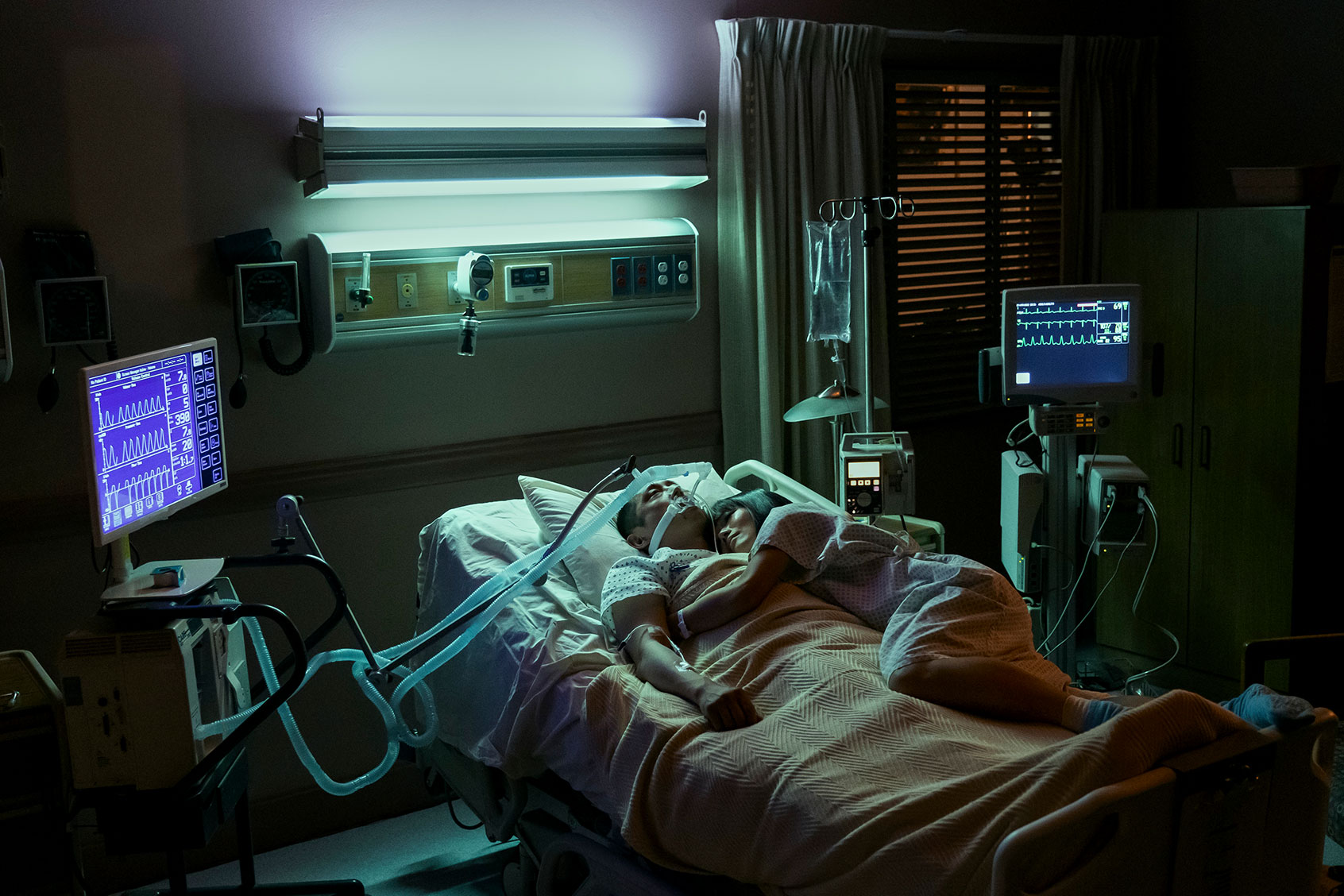
Nobody respects Amy’s sacrifice or her desire for calm, her yearning “to be taken care of,” as she tells George. Out of everyone else in her life, though, only Danny is a target she can destroy with little to no consequences. She’s a famous influencer about to transform her work into a multimillion-dollar payout. Who is he?

Creator and showrunner Lee Sung Jin placed so much care into the smallest details that assuredly nothing about Danny and Amy’s extended conflict is accidental or slapdash. This includes the way their fixation takes the shape of courtship. Lee met Yeun and Wong when they worked together on the animated series “Tuca & Bertie,” where they voiced a pair of characters who date.

Amy and Danny’s energy toward one another trades sweetness and consideration for the type of unhinged passion that razes lives to nothing but ash. You can hear it in Amy’s voice as she leaves a voicemail for Danny moments after an unresolved fight with her husband, which she purrs in a voice worthy of a BDSM queen.

“I would love to let this go. I have a very full life that I’d love to get back to,” Amy coos, adding with arousing, pornographic flourish, “Oh, it’s so full. You wouldn’t know what to do with its fullness. But here’s the thing. Actions have consequences. So I’m gonna find you and take what little you have.” It’s terrifying. It’s also weirdly hot . . . until Danny finds Amy has painted demoralizing phrases on his car.

Displaced anger is the heart of Amy and Danny’s story. If they were simply a pair of people having a terrible day when their lives converged in a hardware store’s parking lot, maybe they could have let it go. But Amy’s marriage is withering as her plant business thrives, and Danny’s efforts to establish himself as a contractor have netted him next to nothing, save for bouts of suicidal ideation. He finds some solace in his faith when he discovers a church community to join, but spiritual comfort isn’t enough to buy a house for his parents.

Explosive rage can be cathartic, as any therapist will tell you. What they don’t often describe, what probably can only be experienced, is the sense of calm that comes before the regret, if regret ever comes. Unloading your pent-up ire on someone is never right, not even if they have it coming, we’re told.

BeefSteven Yeun as Danny and Ali Wong as Amy in “Beef” (Andrew Cooper/Netflix)

But here’s the dirty little secret that well-meaning professionals don’t say to the clients they advise to redirect aggression toward heavy bags, break rooms, or long-distance runs: there’s simply no substitute for verbally devastating another richly deserving human being. Done properly, it can feel downright orgasmic. 

Another is that anger is a luxury – an emotion available to all but that very few can wield without consequence, especially not people of color. This explains why Maria Bello’s venture capitalist investor Jordan is both highly entertaining and deeply aggravating.

Bello dabbles in the full palette of the state we’d call “unbothered” as Jordan inconveniences and insults everyone around her. “OK, hopefully, she’ll get more polite as she gets older,” she drawls, rolling her eyes when Amy and George’s little girl June (Remy Holt) plays shy upon meeting her.

Anger is a luxury – an emotion available to all but that very few can wield without consequence, especially not people of color.

Later, after Jordan has broken up her brother’s marriage and claimed his wife Naomi (Ashley Park), who is also Asian, she dismisses Naomi from an impromptu meeting with Amy as if her lover is her servant.

“She’s so attentive,” Jordan tells Amy after Naomi leaves the room. “Is that a cultural thing, or . . .?”

“No Jordan, it’s not a cultural thing,” Amy says in a tone that could be interpreted as patience but, at this point in the story, we recognize as stuffed-down resentment. Jordan is an appropriator, but in a far worse way than some Coachella festival bunny wearing a sacred Indigenous headdress as a costume. She plunders artifacts, people and her subordinates’ lives. She wants for nothing.

When the wages of Amy’s rage bring violent men into Jordan’s fortress, the wealthy white woman’s privilege ends up being her undoing, and her gruesome comeuppance becomes the plot’s big “O.” Jordan and Naomi run for the house’s panic room, but Naomi gets there first, pushing the automatic button to close the door too soon for Jordan to make it through all the way. Instead, it chomps her in half.

You could say that Amy and Danny’s quarrel finally ate someone alive. Then again, if their fury required a sacrifice, few figures in this opera are more deserving than Jordan.


Want a daily wrap-up of all the news and commentary Salon has to offer? Subscribe to our morning newsletter, Crash Course.


How the intermingling of these ingredients plays out in “Beef” may provide some explanation as to why it is currently the most popular title on Netflix. Anger is seductive and, right now, omnipresent. At a time of rampant uncertainty, it’s a means of claiming power and, bizarrely, establishing a relationship with other people.

What is an outburst, after all, if not a person demanding to be seen, heard and have their right to take up space acknowledged? This is no comfort to the flight attendants and service industry staff taking the brunt of such aggression but, in its rawest form, that’s what these pandemic lash-outs are.

BeefSteven Yeun as Danny and Ali Wong as Amy in “Beef” (Andrew Cooper/Netflix)

Much of the discussion about the ending of “Beef” concerns the violence of the scenes leading up to it and the ending’s ambiguity. The understanding is that they have not discovered love but, rather, a sense of sameness after surviving simultaneous car crashes in the penultimate episode, getting lost in the wilderness and, in an act of hungry desperation, consuming what Amy believes to be elderberries.

Elderberries can be medicine when properly prepared, but are poisonous when eaten raw. The pair violently puke every reserve of bile they have until they begin hallucinating, then seem to switch bodies.

“I see your life,” says Amy, in Danny’s body. “You poor thing. All you wanted was to not be alone.”

Danny replies, through Amy, “You don’t have to be ashamed. It’s OK. I see it all. You don’t have to hide. It’s OK.”

There, at last, they find the parity they don’t have in society. “We should have done this more often.” “What a waste.” “At least we did it once . . . This is nice.”

There’s nothing sexual about what happens next. Danny and Amy emerge from that valley healed but on the verge of plunging into ruined lives. One more time and because of Amy, Danny almost loses his entirely. This finally draws her into Danny’s hospital bed to spoon his motionless body until, in the show’s final seconds, he puts his arm around her. None of this means the two are satisfied but they are, at the end of it all, spent – and you can probably bet that Amy’s over screwing with guns.

All episodes of “Beef” are streaming on Netflix.

Bronze Age Europeans were getting high on all kinds of drugs, hair analysis study finds

The average person has 100,000 hairs sprouting from their scalp, and every one of them tells a story about who they’re attached to. Hair follicles are connected to the bloodstream, which means they can absorb the metabolites of drugs like psychedelics, opioids, cannabis and more. The drugs and their metabolic byproducts then bind to the melanin in hair, locking in evidence of intoxication that stick around in hair even centuries after the person they’re attached to has died.

Es Càrritx is often called a “cult cave” — so named because, approximately 3,600 years ago, it was host to various ritual activities.

Now, a new analysis of hair samples from an island cave off the coast of Spain confirmed that such drug use is nothing new for humanity. Evidently our distant ancestors were getting stoned on some interesting substances, as detailed in the journal Scientific Reports by a group of anthropologists from the University of Valladolid and the Autonomous University of Barcelona. Using forensic toxicology approaches, they analyzed samples of cadavers from the Es Càrritx cave, nestled in the Algendar ravine on Menorca island, providing some of the best evidence to date that ancient Europeans were getting extremely high relatively often.

Es Càrritx is often called a “cult cave” — so named because, approximately 3,600 years ago, it was host to various ritual activities. It later became a burial ground for about 200 people over several centuries. Some of the funerary rituals performed in this cave involved dying certain corpses’ hair red;  other people’s locks were combed, cut and stuffed into tubes made of antler or wood with trippy, eye-like markings carved into the lids.

The hairs and their wooden canisters were analyzed with radiocarbon dating, indicating they were buried in the Late Bronze Age around 3000 years ago. But when the hairs were also screened for drugs, the researchers uncovered a trio of naturally-occurring substances called atropine, scopolamine and ephedrine.

“Considering the potential toxicity of the alkaloids found in the hair, their handling, use, and applications represented highly specialized knowledge,” the authors report. “This knowledge was typically possessed by shamans, who were capable of controlling the side-effects of the plant drugs through an ecstasy that made diagnosis or divination possible.”

Ephedrine is a stimulant that promotes alertness, squashes appetite and can treat colds. It’s produced by many native plants across the world, including in China, the U.S. and Europe. The cold medication pseudoephedrine is a slightly tweaked version of ephedrine, while methamphetamine is a close analog. Its closeness to meth has made it an attractive natural precursor for producing large quantities of the drug in places like Afghanistan.

The plant that these Bronze Age people were most likely eating was thornapple, also known as jimsonweed.

On the other hand, atropine and scopolamine are two closely related hallucinogens that are profoundly different than the “classic” psychedelics like psilocybin or DMT. Instead, they’re both deliriants — that is, they trigger delirium, which can often become overwhelming or unpleasant. This state of mind is colored by confusion, agitation, memory impairment and vivid, dream-like hallucinations.

Plants like henbane (Hyoscyamus niger) and belladonna (Atropa belladonna) produce atropine and scopolamine, but the plant that these Bronze Age people were most likely eating was thornapple (Datura stramonium), also known as jimsonweed. It has distinct, spiky seedpods and muted lavender flowers but many people who have eaten this plant, intentionally or not, have reported some potent, often nightmarish trips.

Some experience reports with thornapple include losing the ability to read for days, feeling clawed by a giant eagle and watching while everyone died and decayed around them as Superman crucified himself. Thornapple likes to grow near crop fields, sometimes contaminating vegetable produce, which has hospitalized many people and triggered massive recalls.

So what were these ancient people ingesting these plants for, anyway? They may have been seeking medicinal relief, or taken them as part of shamanic religious practices, or both. But one thing is for certain: it seems like they were doing these drugs often.

“The length of the hair strands and the analysis of segments all along the hair shafts point to consumption over a period of nearly a year,” the authors wrote. “Hence, drug intake was sustained over time probably well before death.”

That stands in contrast to the mummified heads and cadavers discovered on the Southern coast of Peru, whose hair was analyzed last year, revealing another diary of drug use from 500 to 2100 years ago. As previously reported in Salon, the hair of these individuals revealed they were taking hallucinogenic San Pedro cactus, some of the components of the psychedelic brew ayahuasca and likely even chewed coca leaves, which contain cocaine. But these people were likely fed psychedelics before being ritually sacrificed, rather than taking them regularly.

The Spanish island cave discovery is some of the oldest direct evidence of drug use in European history. This has been hinted at before through other archaeological discoveries, such as traces of opium poppies or ephedrine-containing yew trees, but the presence of these drugs alone hasn’t been enough to prove that people actually consumed them.

The history of European drug culture is increasingly relevant as psychedelic experiences are often popularly perceived of as South American or African cultures’ indigenous rituals that are being “colonized” and co-opted by Westerners. Finding ephedrine, atropine and scopolamine in hair samples is some of the most solid evidence to date that drug use has been a long part of human history all over the world, including in ancient European cultures.

“Fox knew”: Shareholder sues Rupert Murdoch over Fox News’ “stolen election claims”

A Fox Corp. shareholder sued Rupert Murdoch, Lachlan Murdoch and other members of the Fox Corp. board of directors in Delaware on Tuesday, according to NBC News.

Robert Schwarz filed a derivative action — a kind of lawsuit brought by shareholders who claim to have been harmed by a corporation — alleging that Fox executives violated their fiduciary duty by allowing Fox News to air debunked election conspiracy theories, according to the report.

“The Board’s decision to chase viewers by promoting the false stolen election claims has exposed the Company to public ridicule and negatively impacted the credibility of Fox News as a media organization that is supposed to accurately report newsworthy events. The Company is now the subject of two defamation cases, with combined damages claimed to exceed $4 billion,” the lawsuit claims.

The suit cites revelations in Dominion Voting Systems’ $1.6 billion defamation lawsuit in which Fox executives and hosts privately trashed the very conspiracy theories they aired. Fox also faces another $2.7 billion lawsuit from the voting tech company Smartmatic over the false election claims.

“FOX knew — from the Board on down — that Fox News was reporting false and dangerous misinformation about the 2020 Presidential election, but FOX was more concerned about short-term ratings and market share than the long-term damages of its failure to tell the truth,” the new lawsuit says.

Dominion has argued that Fox executives allowed the network to air false election claims over concerns that they would lose their pro-Trump audience.

Fox News has denied that it defamed the company and claims it was merely reporting on the allegations, which is protected by the First Amendment.

Schwarz’s complaint may be the first of several shareholder lawsuits. Several law firms are also eyeing derivative suits against Fox Corp. over the election claims, according to Bloomberg Law.

“They’ve got evidence that the company suffered economically, therefore the shareholders suffered economically,” Doug Chia, a fellow at the Center for Corporate law and Governance at Rutgers Law School, told the outlet. “The board is ultimately accountable for those kinds of things.”


Want a daily wrap-up of all the news and commentary Salon has to offer? Subscribe to our morning newsletter, Crash Course.


Corporate boards tend to be heavily involved in different aspects of the business but media company boards don’t tend to get involved in editorial policies.

“If you’re a news company, and you become known for distributing blatantly false information, people aren’t going to watch your news program or trust it,” Sarah Haan, a law professor at Washington and Lee University, told Bloomberg. “A competent board would have some oversight system in place—they would be made aware if there was some major campaign of false news being promoted through their outlets.”

At least two law firms are investigating Fox’s board of directors for potential breach of fiduciary duty in connection to the Dominion and Smartmatic cases, according to the report. Shareholders would have to prove that a board member failed to provide oversight as hosts made allegedly defamatory statements.

“It would not be a hard sell for the court to say a news organization should avoid intentionally lying about people,” Ann Lipton, associate dean for faculty research at Tulane University’s law school, told Bloomberg. “This is core to like their identity and obviously presents legal risks.”

Experts predict Trump’s bid to delay rape trial “will fail”: He created the “media chaos” himself

Former President Donald Trump’s attorneys asked to delay his upcoming rape trial amid a flurry of media coverage following his indictment over his role in a hush-money scheme to pay off adult film star Stormy Daniels during the 2016 presidential campaign.

Currently slated for April 25, the civil rape trial follows accusations from E. Jean Carroll, a former magazine columnist who accused Trump of sexually assaulting her in a department store dressing room in the 1990s. 

Ahead of the scheduled trial, Trump’s attorneys Joseph Tacopina and Alina Habba asked U.S. District Judge Lewis Kaplan to delay the proceedings by four weeks, citing the “deluge of prejudicial media coverage concerning his unprecedented criminal indictment and arraignment in Manhattan” in a letter to the judge.

Kaplan released the letter publicly on Tuesday night. The letter alleges that “many, if not most, prospective jurors will have the criminal allegations top of mind when judging President Trump’s defense against Ms. Carroll’s allegations,” arguing that a weekslong hiatus would mitigate the risk of “pretrial prejudice.” These jurors, the letter adds, “will have the breathless coverage of President Trump’s alleged extra-marital affair with Stormy Daniels still ringing in their ears if [the] trial goes forward as scheduled.”

Trump’s lawyers also asserted that his recent arrest has led to an increase in public interest in the Carroll-Trump case, claiming that the indictment “drove a more than four-fold increase in coverage of this case,” per an analysis of a spike in Google searches for “Jean Carroll Donald Trump.”

Trump’s legal team is looking for a late May trial when they feel a jury is “far more likely to be impartial than one recently inundated with prejudicial media coverage.”

Reuters reported that Caroll’s attorney, Roberta Kaplan — unrelated to Judge Kaplan — indicated that she will respond to Trump’s appeal in a letter to the judge. 


Want a daily wrap-up of all the news and commentary Salon has to offer? Subscribe to our morning newsletter, Crash Course.


MSNBC legal analyst Lisa Rubin noted on Twitter that despite citing the media frenzy over his indictment in the letter, Trump’s lawyers never “acknowledge how much of that maelstrom Trump created.”

“It also should escape no one that the letter accuses the press of inciting animus toward Trump and threatening Trump’s rights. There are certainly threats and incitement in the public domain right now. But they are not aimed at Trump,” Rubin wrote. “Instead, they’ve been directed at the Manhattan DA, a state court judge, & their respective staffs & families. And those threats have been significant enough that the judge in the Carroll case has ordered not once but twice that the jurors will be anonymous, even to the lawyers.”

Rubin added that for “Trump’s lawyers now to portray him as the hunted, not the hunter, is especially backward, if utterly predictable.”

Attorney Bradley Moss predicted the move would ultimately be unsuccessful.

“Trump is a master. Creates media chaos for weeks. Finally gets indicted. Immediately does media to continue the focus on his indictment. Launches attacks on the prosecutors and judge. Then says the civil trial needs a ‘cooling off period,'” he tweeted. “Rather clever. Will fail though.”