Spring Sale: Get 1 Year, Save 58%

“Endangered me and my family”: Legal experts say Pence’s new interview may be evidence against Trump

Former Vice President Mike Pence over the weekend called former President Donald Trump’s rhetoric “reckless” and said Trump’s speech ahead of the Jan. 6 Capitol riot “endangered” him and his family.

Trump repeatedly refused to call off the mob of supporters attacking the Capitol and at one point tweeted that Pence “didn’t have the courage to do what should’ve been done” as he pushed a legally dubious scheme to block the certification of his loss and try to steal the election.

Pence, following a lengthy pause, told ABC News anchor David Muir that the tweet “angered me.”

“I turned to my daughter who was standing nearby,” he said. “And I said, ‘It doesn’t take courage to break the law. It takes courage to uphold the law.’ The president’s words were reckless. It’s clear he decided to be part of the problem.”

“The president’s words that day at the rally endangered me and my family and everyone at the Capitol building,” he added.

Pence during the Capitol riot spoke with military and Justice Department leaders in an effort to quell the riot.

“Where was the president during all this?” Muir asked.

“David, I was at the Capitol. I wasn’t at the White House,” Pence said. “I can’t account for what the president was doing that day. I was at a loading dock in the Capitol where a riot was taking place.”

“But why wasn’t he making these calls?” Muir pressed.

“That’d be a good question for him,” Pence replied.

The interview was part of Pence’s media tour to promote his new book “So Help Me God.” Pence wrote that Trump complained he was “too honest” when Pence balked at the idea that he could unilaterally block the certification of the election on Jan. 6 and detailed the former president’s efforts to pressure him, according to excerpts published by The New York Times.

“Hundreds of thousands are gonna hate your guts,” Pence recalled Trump telling him. “People are gonna think you’re stupid.”

Pence also wrote that Trump worked with conservative lawyer John Eastman to pressure him into a scheme that has landed both men under legal scrutiny.

“You’ll go down as a wimp,” Trump told Pence the morning of Jan.6, according to the book. “If you do that, I made a big mistake five years ago!”

Pence also penned a Wall Street Journal op-ed last week as he attempts to rebrand as a hero of Jan. 6, detailing his communications with Trump before and after the riot.

“Were you scared?” Pence recalled Trump asking days after the riot.

“‘No,’ I replied, ‘I was angry. You and I had our differences that day, Mr. President, and seeing those people tearing up the Capitol infuriated me,” Pence said he told Trump.


Want a daily wrap-up of all the news and commentary Salon has to offer? Subscribe to our morning newsletter, Crash Course.


While Pence has increasingly spoken publicly about Jan. 6 to promote his book, the former veep has been reluctant to sit for an interview with the House Jan. 6 committee and has privately complained about the panel, according to The New York Times.

Pence’s book and other public statements could be of interest to both the Justice Department and the Jan. 6 committee, wrote MSNBC legal analyst Lisa Rubin, “which could intersperse Pence’s written statement with witnesses’ testimony about the same events in its final report.”

“Something tells me that one or more lawyers in the O’Neill building will be furiously flipping pages,” she wrote, referring to the building where the committee works.

NYU Law Professor Ryan Goodman agreed that the committee report could reference Pence’s statements but the “DOJ has little choice but to interview Pence.”

Other legal observers hammered Pence for speaking up to sell his book but failing to speak to investigators seeking accountability for the Jan. 6 attack.

“Not a real profile in courage here from Mike Pence should have voluntarily given this interview to the Jan 6 [committee] at first light,” tweeted former U.S. Attorney Joyce White Vance. “He’s doing it now to try & resurrect a political career, but he wouldn’t do it for the right reasons earlier, when it could have made a difference.”

It would be amazingly dumb for GOP to impeach Biden — so sure, go for it

At the beginning of last week, the general assumption in the Beltway chattering class was that the midterm elections would be a “red wave,” leading to Republicans taking over state governments, the Senate and a healthy majority in the House of more than 20 seats. Instead, Tuesday turned out to be an anti-MAGA election. Yes, Republicans will (in all probability) end up with an extremely slim majority in the House, but only thanks to extensive gerrymandering. (Without the Republican pickups enabled by redistricting in Florida and New York, Democrats would have won easily.)

The verdict was clear enough: Voters don’t like Republican extremism. Every time they’re reminded that the GOP is controlled by a bunch of conspiracy theory-addled jackasses who worship Donald Trump, voters show up and pull the lever for Democrats, even when they don’t feel all that great about the Democrats either. 

Despite this, here’s a safe prediction for what that barely-there House GOP majority, under the so-called leadership of wannabe Speaker Kevin McCarthy, will be doing in 2023: All MAGA nonsense, all the time. The cornerstone of their agenda, if that’s even the word, will be to impeach President Joe Biden on made-up charges based on conspiracy theories cooked up in the MAGA swamplands — maybe with a side dose of debt-ceiling antics aimed at demanding steep cuts to the two most popular government programs, Social Security and Medicare. Because if their plan for power, after an election in which they nearly screwed the pooch, is to use that power to remind ordinary Americans of all the reasons they hate Republicans, why not go all the way? 


Want more Amanda Marcotte on politics? Subscribe to her newsletter Standing Room Only.


As Heather Digby Parton explained last month at Salon, “a number of GOP officials and political advisers” believe impeachment is “inevitable.” Not because Biden has done anything to merit it, mind you. Even the most rabid MAGA morons struggle to sound like they believe their own conspiracy theories about Biden. It’s just that McCarthy is a weak leader and cannot contain the fire-breathers in his party like Rep. Majorie Taylor Greene of Georgia. (Who has already tried to introduce articles of impeachment against Biden any number of times.)

One would think that, after a midterm election in which GOP candidates lost dozens of offices they otherwise would have won, the momentum for impeachment Biden would slow down. Most voters hate Republican extremism and they especially hate Trump’s childish tantrums, the largest single factor fueling the pressure to impeach Biden. In reality, however, the small margin Republicans will likely have in the House dramatically weakens McCarthy’s already fragile control over his caucus. As Areeba Shah reports for Salon, “a slim majority hands significant power to extreme right-wing members.” To get anything done, McCarthy will have to beg those folks for votes. They’ll be able to extract big concessions from him — such as impeaching Biden over literally nothing.

Still, as he prepares to give into the nastiest people in an already ugly caucus, McCarthy should consider the fate of the man who held his position in the 1990s: Newt Gingrich. After riding a legitimate wave election to big Republican wins in 1994, Gingrich went down the same path that McCarthy is stumbling toward now, and the result was the end of his career as a congressman. 

Nowadays, Gingrich is the face of the impeachment of President Bill Clinton in 1998, which was based on trumped-up perjury charges over his affair with White House aide Monica Lewinsky. But as historian Nicole Hemmer told Salon, “Gingrich understood that impeachment was a political loser.”

As she details in her book “Partisans: The Conservative Revolutionaries Who Remade American Politics in the 1990s,” Gingrich faced a nearly identical problem to the one McCarthy faces now: A Republican House majority that wanted to impeach Clinton, no matter what, and didn’t really care if he was actually guilty of anything. Indeed, as Hemmer documents, impeachment pressure started pretty much the minute Republicans swept the 1994 midterms, gaining a whopping 54 seats in the House. 


Want more Amanda Marcotte on politics? Subscribe to her newsletter Standing Room Only.


Gingrich, however, was reluctant, especially specially after he forced a government shutdown in 1995, hoping the public would blame Clinton. Instead, as Hemmer notes, Gingrich “lost badly to Clinton during the government shutdown,” and then Clinton easily won the 1996 election. The whole gambit backfired, and yet when Gingrich “faced an insurgency in his ranks from his far-right flank,” Hemmer explained, he gave in. Impeachment it was. 

That would lead to the end of Gingrich’s career. Much like this year’s elections, the 1998 midterms were supposed to bring big wins for Republicans. Instead, Democrats gained seats, largely because voters were disgusted by the spectacle of hypocritical Republicans impeaching Clinton over a personal failing and turned on the GOP. Gingrich was famously one of the biggest hypocrites, given his long history of adultery, which included an affair with a woman 23 years his junior — during the impeachment. 

As Parton notes, Republicans tell themselves it will be different this time, because they think they have a delicious spin to justify impeaching Biden: It’s payback for Trump’s two impeachments. She quotes Sen. Ted Cruz arguing that “Democrats weaponized impeachment” and “what’s good for the goose is good for the gander.”

Republicans’ delicious spin on impeaching Biden is that it’s payback for Trump’s two impeachments. That will play will with rabid right-wingers — but why does Ted Cruz think it will play outside the true-believer base?

This argument will play well with rabid right-wingers, who love to tell themselves stories about how they and Trump are innocent victims of the “deep state” that is out to get conservative Americans for vague-but-sinister reasons. But Cruz clearly thinks the rest of America is stone-cold stupid, if he actually believes that argument will fly with anyone outside the true-believer Trump base.

Because here’s the thing about both of Trump’s impeachments: He was guilty. He was caught on tape trying to run an extortion scheme against the president of Ukraine. He incited a riot live on TV, in full view of the entire nation. These are the kinds of crimes that would land most people in prison, and he only got away with them because of his office and his political clout. Republicans barely pretended to have any other reason beyond perceived political expedience for their decision to acquit him in the Senate both times. 


Want more Amanda Marcotte on politics? Subscribe to her newsletter Standing Room Only.


Whatever thin excuse Republicans may cook up to impeach Biden, it’s unlikely to make much sense to people who don’t live in the Fox News Cinematic Universe. Whatever Cruz thinks of the public’s intelligence, most people know the difference between trying a guilty man and persecuting an innocent one. Going after Biden for made-up nonsense will likely play out like the impeachment of Clinton did, and perhaps even worse: It will serve as a stark reminder that the Republicans are controlled by the worst people in the country. (And in many cases are the worst people)

But even though we’ve seen this script play out before, Republicans leaders seem determined to act it out all over again. “Each Republican leader started by trying to co-opt the radicals,” Hemmer explained. “Each ended by capitulating to them.” They’re trapped by the MAGA base for the same reason they’re trapped by Trump. As bad as these people are for the party’s image, they’re also the source of most of their votes and a huge amount of their funding. Republicans can’t win with the MAGA nuts, and can’t win without them. So even though Kevin McCarthy knows full well that it’s a losing proposition to impeach Biden, expect to allow the right-wing zealots to push him right off that cliff. 

Election-denier candidates lose secretary of state races in Arizona, Nevada

Over the Veterans Day weekend, two additional Democratic candidates for secretary of state defeated Republicans who endorsed former President Donald Trump’s “Big Lie” that the 2020 presidential contest was stolen, delivering another blow to far-right conspiracy theorists running for top elections posts.

In Arizona, Democrat Adrian Fontes beat his Republican opponent Mark Finchem, a state lawmaker with ties to the Oath Keepers who was at the U.S. Capitol during the deadly Jan. 6, 2021, insurrection and who said he would not have certified Biden’s victory in the state.

In Nevada, Democrat Cisco Aguilar won his race against Republican election denier Jim Marchant, who organized a nationwide coalition of voter suppression advocates to campaign for top election oversight roles.

“There’s an emerging blue wave in secretary of state races,” journalist John Nichols wrote on social media.

Fontes said that Finchem “represented a danger to democracy if he had won,” the Associated Press reported. “The secretary of state, working with the governor and attorney general, has broad authority to rewrite the state’s election rules and plays a role in the certification of results.”

“Finchem had emerged as one of the most prominent Republicans running for secretary of state positions around the country who falsely claimed that Biden was not elected legitimately,” the AP noted. “He had argued for significant changes to Arizona’s elections after Biden won the state in 2020 and had been endorsed by Trump.”

The AP further reported:

After winning the state’s primary election in August, Finchem said he wanted to restore the rule of law to elections in the state, declaring: “Right now, we have lawlessness.”

There was no evidence of widespread fraud in the 2020 elections, including in Arizona, where reviews of the voting upheld Biden’s narrow victory.

He joined with Kari Lake, the Republican candidate for governor, in a lawsuit seeking to get rid of the machines that tabulate votes for the midterm elections and replace that process with a hand-count of all ballots in the state. Election experts say full hand-counts can be painfully slow, are prone to human error and are not as accurate as machine tallies.

The lawsuit alleged that the vote-counting machines used in Arizona aren’t reliable, a claim for which there is no evidence. They are appealing a decision by a federal judge to dismiss their lawsuit.

More than 210 GOP candidates who spread doubt and lies about Biden’s 2020 victory have won congressional seats and races for governor, secretary of state and attorney general so far, but the vast majority of them are headed to the U.S. House and Senate.


Want a daily wrap-up of all the news and commentary Salon has to offer? Subscribe to our morning newsletter, Crash Course.


Election-denying candidates for the top three statewide positions have fared significantly worse across the nation, especially in swing states, where midterm voters have largely rejected the MAGA loyalists who supported overturning Trump’s 2020 loss.

“Without a doubt, election denial is alive and well, and this is a continuing threat,” Joanna Lydgate of States United told the AP earlier this week. But Tuesday “was a really good night for democracy.”

“Partisan control of election administration poses problems at this point in the U.S., as it faces threats to democracy. It erodes public trust and intensifies partisan gamesmanship.”

That assessment was shared by Arizona State University professor Thom Reilly, who wrote this week that “people by and large rejected election deniers serving as chief election officials.” However, he warned, “more hyperpartisan candidates will likely run for the chief election offices in more states in the future.”

“This kind of partisan control of election administration poses problems at this point in the U.S., as it faces threats to democracy,” wrote Reilly. “It erodes public trust and intensifies partisan gamesmanship, which in turn further erodes public trust.”

He continued:

The U.S. is the only democracy in the world that elects its election officials, and one of the very few to allow high-ranking party members to lead election administration.

In the past, these down-ballot, statewide offices generated little attention. After all, studies have shown both local Democratic and Republican chief election officials acted in impartial ways.

However, there is growing evidence that trust in this important office — often in charge of running and certifying elections of their local, state and national leaders — may be eroding.

It is important to keep in mind that a secretary of state or chief election officer can’t single-handedly change election results. But they do have a good deal of influence over elections and voting processes before, during and after an election in a state.

They can refuse to certify the results of an election, triggering a governor or courts to become involved. They influence which issues become ballot measures and how they are described, and they can decertify voting machines.

“This election season raises questions, and exposes flaws, about how senior election officials are selected in the U.S.,” Reilly added. “The platforms of these election deniers who appeared on the 2022 midterm ballot illustrate the risk that this dynamic poses to ongoing voter trust and future election results.”

In yet-to-be-decided Arizona races, far-right gubernatorial candidate Lake currently trails Democrat Katie Hobbs by more than 30,000 votes with 83% of ballots tallied. Arizona’s Republican candidate for attorney general, Abraham Hamadeh, trails Democrat Kris Mayes by nearly 20,000 votes with the same percentage of ballots counted. Maricopa County, which includes Phoenix and is the state’s most populous, is not expected to finish counting until after the weekend.

Meanwhile, in Nevada, Democratic attorney candidate Aaron Ford defeated Republican Sigal Chattah. However, in a departure from the state’s emerging pattern of rejecting Trump-backed candidates for top statewide positions, Republican Joe Lombardo, the sheriff of Clark County, beat incumbent Democratic Gov. Steve Sisolak.

Also on Friday night, incumbent Democratic U.S. Sen. Mark Kelly of Arizona took down GOP challenger Blake Masters. That left the Senate at 49-49 between Republicans and Democrats, until control of the chamber was settled on Saturday when incumbent Democratic U.S. Sen. Catherine Cortez Masto of Nevada was projected to win over Republican Adam Laxalt. Given the potential tie-breaking vote of Vice President Kamala Harris, 50 seats is enough to ensure majority control for Democrats. 

They could yet win 51 seats, depending on the outcome of next month’s runoff election in Georgia between Democratic Sen. Raphael Warnock and Herschel Walker, a right-wing former football star.

Raskin blames Trump for 155 election deniers in Congress

Rep. Jamie Raskin (D-MD), a House Jan. 6 Committee member, said that “political contamination” by former President Donald Trump will result in at least 155 deniers of the 2020 election results serving in Congress next year.

CBS host Margaret Brennan reported on Sunday that her network had tallied election deniers who will serve in the new Congress. According to the tally, deniers of the election won 155 House seats and nine Senate seats in the U.S. Congress. That was in addition to 18 wins at the state level.

“That’s a statement about the political contamination of the GOP by Donald Trump,” Raskin told Brennan. “Kevin McCarthy and other leaders in the Republican Party are now required to make a decision about whether they’re going to try rid themselves of Donald Trump and his toxic influence on the party.”

Raskin called it a “real problem” for McCarthy.

“There are certain pro-Trumpists within his House caucus who refuse to accept that he’s really with Trump,” the Democratic lawmaker said. “And they want to get rid of McCarthy.”

The congressman predicted that some of his Republican colleagues “might just vote for Trump” to become Speaker of the House.

“The Speaker of the House does not have to be a member of the House,” he explained. “They talk about it repeatedly and if Trump decided he wanted to do it, it would propose a profound problem for their party because they refuse to do the right thing early on.”

Watch the video below from CBS:

Ron Johnson says Biden is “compromised” by China

Sen. Ron Johnson (R-WI) said on Sunday that he has a “feeling” that President Joe Biden is “compromised” by China.

Fox News host Maria Bartiromo asked Johnson about his expectations for an upcoming meeting between Biden and Chinese leader Xi Jinping.

“It’s hard to say,” Johnson said. “We’ll get some kind of readout from it. But again, I just — my feeling is that Joe Biden is highly compromised.”

Johnson pointed to the end of a Trump-era policy, the China Initiative, that was criticized as a blunt instrument for cracking down on espionage by China.

“There’s only one explanation,” Johnson insisted. “Joe Biden is compromised.”

“I’ve been asking the question for months,” Bartiromo agreed. “Absurd.”

But many, including Just Security, called for the program to be canceled following Donald Trump’s presidency.

“The reverberating effects within the scientific community threaten to undermine the primacy of U.S. science and technology at a time when the pandemic and climate change have become predominant threats to Americans’ health and prosperity,” the organization noted earlier this year.

Watch below:

Pickleball’s uphill climb to mainstream success

Most newer sports are hybrids of older ones, and pickleball is no exception. The progeny of tennis, badminton and ping-pong, pickleball is played by singles or doubles teams who hit a ball back and forth over a 3-foot-high net until one opponent commits a fault.

In 1965, the inventors of pickleball played with what they had – a repurposed badminton setup, ping-pong paddles and a perforated plastic ball.

Today’s 4.8 million American pickleballers have much more to play with: In the U.S. there are 38,140 courts, 300 manufacturers of pickleball equipment and hundreds of grassroots clubs.

There’s been a good amount of speculation about the explosion of pickleball’s popularity. But now the sport seems poised to burst into the mainstream, with Lebron James and other luminaries of the NBA and NFL recently announcing large investments in the professional circuit.

Still, the young sport is not immune to growing pains. As I argue in my book “Emerging Sports as Social Movements,” the popularity of some fledgling sports may seem self-evident in splashy headlines. But their less visible social undercurrents ultimately shape whether they’ll continue to attract new players and fans.

Pickleball’s feudal period

For an organized sport to grow, it needs structure – a common set of rules, rankings, equipment standards, scheduled events and a sense of identity that can unite players and fans.

At present, pickleball’s social fabric is spread thin and woven together by a network of competing interests. For every headline about pickleball’s miraculous growth you can also find stories about conflicts and infighting among various leagues and governing bodies, as well as between pickleballers and tennis players.

The sport has three professional leagues battling for control of the pickleball kingdom. It has two international governing bodies: the International Federation of Pickleball and the World Pickleball Federation. The lesser lords of pickleball also feud with tennis players over dual-use courts and plans for expansion in public parks, with reports of “turf wars” and “a tug-of-war” between the two racket sports.

Picklebalkanization,” anyone?

Internal squabbles are common in emerging sports movements. Cornhole, disc golf and esports, for instance, have faced similar challenges. In some cases, conflict can be a good thing. It may spur innovation. But it can also leave some would-be fans, sponsors and players wondering whom they should watch, invest in or play for.

Compared with traditional racket sports, pickleball is less expensive, requires less space and may be more compatible with the aches and pains that come with age. And unlike other emerging sports, pickleball’s future seems bright. But for now it has more in common with French feudalism of the ninth century – when territorial disputes were commonplace – than a modern unified sport movement headed for the Olympics.

Birds of a feather dink together

If two strangers meet in a bar and happen to share an interest in pickleball, they won’t be strangers for long. Shared passion is the glue and fuel of emerging sports communities. But the human tendency to bond with those who are like us also poses a problem for sports seeking to achieve widespread popularity.

Sociological studies show that our love of sameness partly explains why our groups and social networks tend to be homogeneous, such as male-dominated occupations, predominantly white community groups, and friendship circles united by a single religion. For grassroots sports, which spread through social networks, the sameness problem can limit growth by narrowing the flock to those with similar feathers.

Pickleball insiders like to talk about the sport’s relatively balanced gender ratio, which stands at roughly 60% to 70% men and 30% to 40% women. The newest professional league, Major League Pickleball, is promoting the sport through mixed-gender competitions, with teams comprising two men and two women – a unique format in the male-dominated world of pro sports.

But grassroots sports sprout from the ground up, and long-term growth depends partly on the demographic diversity of core players. Pickleball may be trending younger, but one-third of its avid players are of retirement age. Roughly half the population of pickleball players probably saw the Apollo 11 moon landing. Calculating accurate statistics on niche communities is difficult, but based on my review of multiple academic and journalistic sources, pickleballers are predominantly older, white, affluent and suburban. For instance, two survey-based studies with large samples estimated the proportion of white players at 93.5% and 94.1%.

Demographic homogeneity is a tough trend to buck. Of course, some sports, like golf and NASCAR, have expanded their reach without solving the sameness problem. But given the nation’s reckoning around race and gender, a successful push for greater diversity could be the one thing that separates pickleball from the crowd of dreamer upstarts.

Will the revolution even need to be televised?

That sports grow when mainstream media pay attention to them seems obvious. Increased media coverage from ESPN or CBS attracts more participants and consumers, enticing sponsors and fostering stronger sport institutions.

Yet, as a growth strategy, buying airtime on ESPN – which sports like cornhole and ax throwing are doing – may provide little more than airy hope. As pickleball strives to expand its audience, it faces stiff competition from traditional sports brands like the NFL and NBA, as well as emerging brands like esports, mixed martial arts, disc golf, cornhole, drone racing, round net, darts and ax throwing.

With so many options, some sports just won’t make it big. The history of emerging sports is filled with booms and busts. Interest in gambling sports like jai alai and horse racing has declined tremendously since the late 20th century. ESPN’s X Games popularized alternative sports like skateboarding in the late 1990s, but some disciplines, like street luge, were left behind. Drop “poker” in a Google Trends search box and you’ll see that the Texas hold ’em boom lasted for about three years, from 2004 to 2006.

The next big thing in sports may not boom at all. Given that younger consumers are migrating to streaming services, the revolution may not be televised to a mass audience but instead will be streamed to die-hard fans.

Niche sports like pickleball may have an advantage as sports spectatorship fragments. For small sports, a modest audience with slow but steady growth could be a recipe for sustainable success. There are numerous options for watching pickleball matches, such as YouTube channels, livestreams via Facebook, fuboTV, and some coverage on broadcast and cable channels, but demand for live coverage remains modest.

Ultimately, with so many shiny new sports to choose from, the winners will be determined not by flashy media exposure or top-down commercial forces but rather by bottom-up community development. No matter how hot the publicity gets around pickleball, the consumer base for watching the sport will draw heavily on people who already love playing it. The love of any sport has roots in culture – not commerce.

If pickleball lives up to the hype, it will do so on the backs of volunteers and grassroots organizers who can transform a loose network of casual players into an international community of pickleball fanatics.

Josh Woods, Professor of Sociology, West Virginia University

This article is republished from The Conversation under a Creative Commons license. Read the original article.

Maintaining the “Magpie Murders” main title mystery: The clues, the murders and a bird masquerade

Rule No. 1 for a whodunit: Don’t give away the ending too early. 

That goes double for PBS’ “Magpie Murders” because of its mystery-within-a-mystery format. In the series, publisher Susan Ryeland (Lesley Manville) discovers that the final chapter (and therefore the solution) of the murder mystery she’s editing is missing. What’s worse, the novel’s author Alan Conway (Conleth Hill) has also died, taking all answers with him. The “Magpie Murders” opening credits sequence encapsulates this dual narrative, traveling between the pages of the 1950s-set whodunit to the real-life mystery at the heart of the writer’s death.

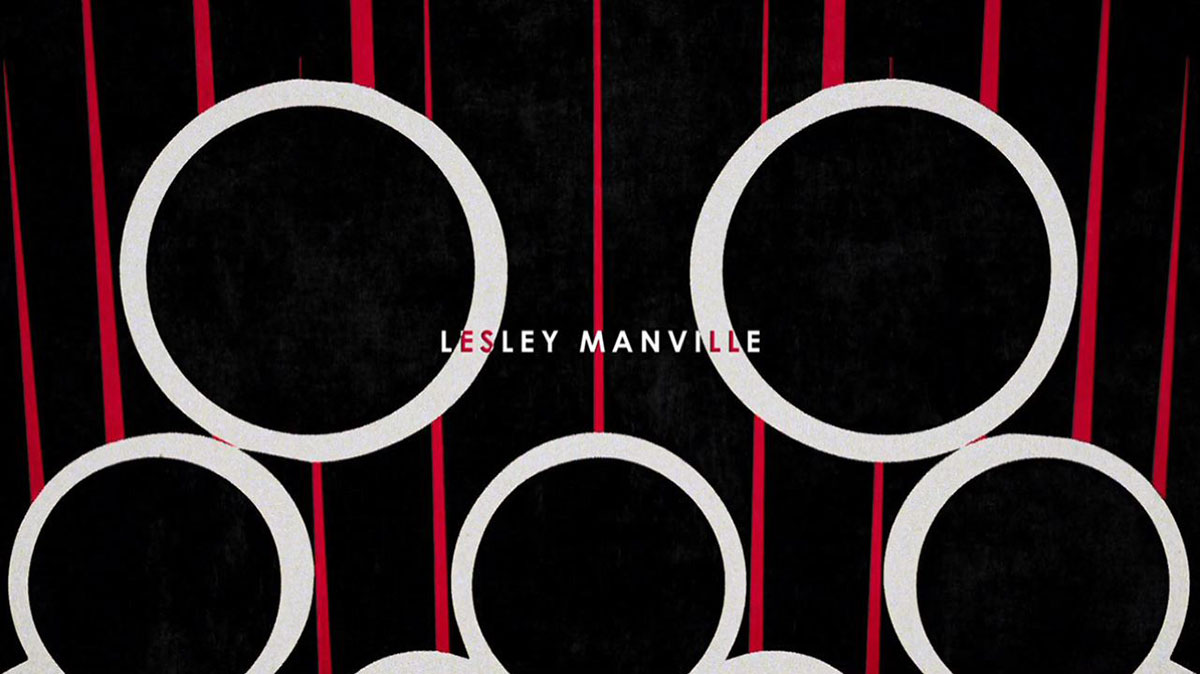
The graphically bold main titles – told in bright red and black illustrations – blend images one into another, oscillating between murder and writing imagery. Fluttering manuscript pages assemble themselves into a staircase down which a body falls. A fountain pen literally becomes a sword. Another body plummets, only to dissolve into a flurry of books. Throughout, Murray Gold’s sprightly theme song plays, giving an upbeat energy to the cozy mystery. By the end, two resolute figures stand side by side as the series’ title flashes onscreen.

Anthony Horowitz adapted “Magpie Murders” for TV based on his own novel of the same name. Ben Hanbury of the Emmy-winning Huge Designs, fittingly was reminded of the publishing world while creating the series’ main titles. 

“I often think it’s a bit like a book cover,” Hanbury told Salon. “We want the titles to be something which gets the viewer excited about what they’re going to see and gives them a flavor of what it’s about. . . . My hope would be that people would find it exciting and intriguing. What does that mean and what does this means? And then maybe that would make more sense as we went along.”

Much like a murder mystery novelist, Hanbury must dole out just enough clues to fascinate and flummox . . . but not tip the hand. He acknowledges it’s a bit of a tightrope act, one that required he actually remove one image that may have given too much away. 

“I think they decided that was too much of a spoiler,” Hanbury said after showing Salon the confidential image. “That’s the balance, isn’t it? We need to work out what’s going to allude to the story and what maybe is too far past that line.”

Take a look at the “Magpie Murders” main titles:

Magpie Murders Opening Titles from HUGE on Vimeo.

The design and overarching concept

The striking colors and graphic style are what catch the eye first. Although they somewhat echo the colors of the book’s original cover, Hanbury actually found inspiration elsewhere in the publishing world.

“Initially, I was inspired by Penguin Books, which in the ’60s did loads of crime novels that I would imagine were very quickly and cheaply thrown out there,” said Hanbury. “They’re all white, black and green and they have graphics on the front, often very compelling and quite simple . . . very concise. And I thought it’s quite an idea to really make an almost stripped-down and pare back the visual language. I started with green and orange and then through tweaking just decided red was a bit more striking.”

The simple style allows Hanbury to play with incongruous objects, upending expectations by playing with their sizes. For example, the main titles open to what look like bells chiming – in time to notes in Murray Gold’s tinkling theme song – but pull out and invert to reveal themselves to be typewriter keys going up and down.

“The nice thing about having such a simple style and simple palette is it really frees you up to play with scale,” said Hanbury, “to be really close in on typewriter keys and then be zoomed out on a giant staircase. I felt like that was part of the excitement of it, that you could be really macro and and really wide. That would keep the energy going.”

Anagrams and fatal descents

Magpie Murders title sequence cardMagpie Murders title sequence card – typewriter keys (HUGE Designs)

As the names of the actors and various behind-the-scenes talent appear on screen, their letters are first jumbled up before resolving into the correct order. This is a direct reference to the author Alan Conway’s penchant for making anagrams. In the series, he even uses his fictional detective Atticus Pünd’s name as the inspiration for an anagrammed computer password: “CAT UP NUDIST.” Although Hanbury initially wanted each name to appear in a coherent anagrammed form first, he gave that up since they were onscreen too briefly to be read that way.

“I thought that was quite a nice part story where you realize that Atticus Pünd is an anagram,” said Hanbury. “At the time, I thought oh wouldn’t it be really funny if all the cast names came in as anagrams . . . I think I had one or two but that was a lot because they’re only there for like one frame.”

Magpie Murders title sequence cardMagpie Murders title sequence card – falling down stairs (HUGE Designs)

Of the many images he wanted to work in is the first death that Alan Conway writes in the book involving a housekeeper who tumbles down the stairs of Pye Hall.

“I thought that having this giant staircase was a question that came to mind because that’s the first murder that happens in there for the housekeeper,” he said. “I thought that would just be amazing to go through a doorway and suddenly fall right down.”

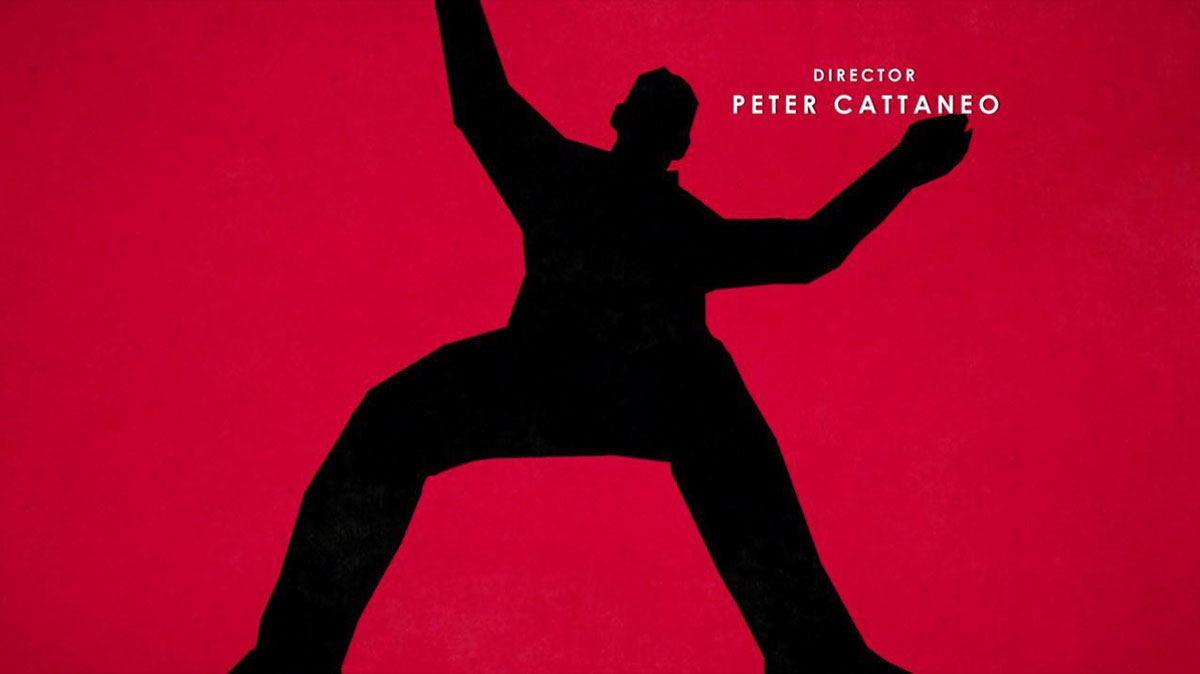
This is not the only tumble someone takes, however. Author Alan Conway’s death falling off a tower is initially ruled a suicide, but the more Susan investigates, the more likely it seems that he’s been murdered. In this case, Hanbury depicted the falling body straight onward, reminiscent of the Saul Bass design for Alfred Hitchcock’s “Vertigo” film poster.

“It was very silhouetted. Hopefully, that didn’t give too much away,” said Hanbury. “Sometimes we’d certainly like to plant little Easter eggs that maybe aren’t obvious in the first viewing. But as you go into other episodes or repeat viewings, you see that was what that means. I think I thought it would be quite a nice visual cue to see the death of Alan. And then as he falls, his body is turning to books, almost like that’s the depth of his his empire.”

Magpie Murders title sequence cardMagpie Murders title sequence card – falling man silhouette (HUGE Designs)

The visual dual narrative

Deciding on the narrative of the main titles was tricky as well since it would involve telling two stories and how they dovetail together. Author Alan Conway drew inspiration from his own life, which means that many people he knew appeared as alter egos in his period novel. 

“When I read the scripts, what I really loved is that there’s this dual storyline going on. On one hand, you have the story of the editor Susan, and she’s investigating the death of the author, Alan. And he has this other story, the story of his final novel, that of Atticus Pünd. In the show, it jumps from one story to the next, but they all blend quite seamlessly together and often have the same people appear in both stories and have the same locations in both stories. 

“So I thought, Oh, I’d love to try and capture that dual story that also is one story,” he continued. “I have to come up with a visual language that would hint at that thing. I thought we can have one color palette for the world of the author, and then a slightly inverted palette for the world of the novel. And then objects can travel through both those worlds. And we can zip between one another in the same way that the story does on the show.”

Magpie Murders title sequence cardMagpie Murders title sequence card – fountain pen (HUGE Designs)

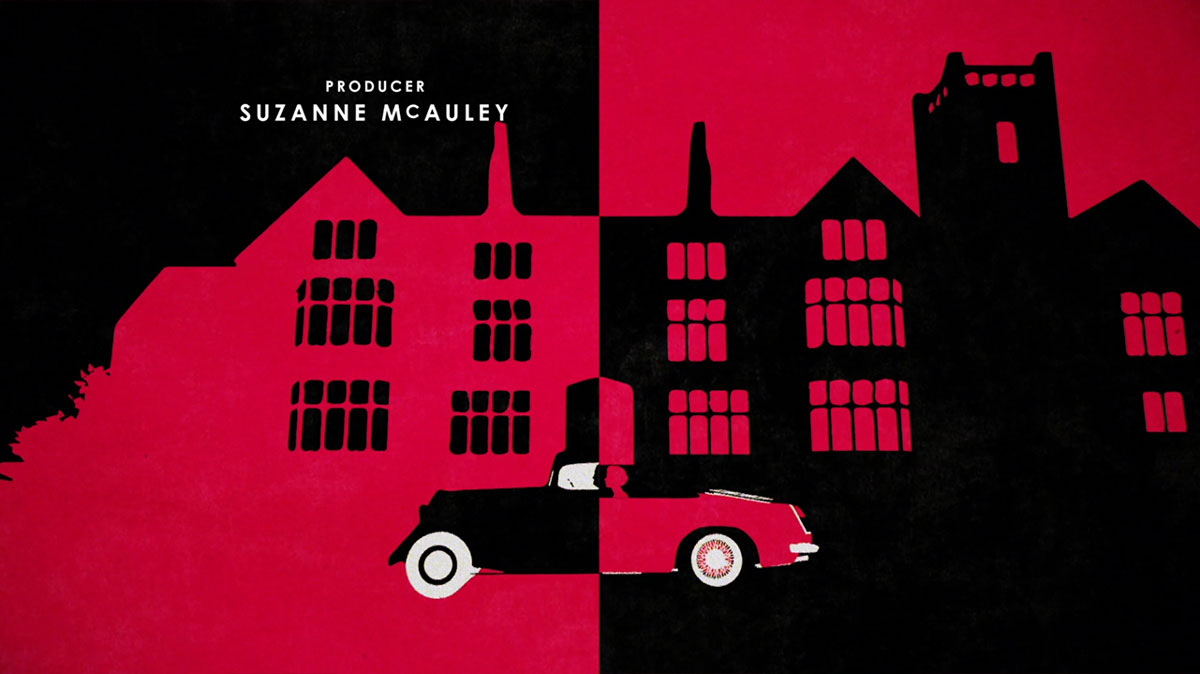
The visual language of the transitions also allowed for movement in the sequence, which naturally led to a sequence where Susan drives her convertible down the road to Alan’s home of Abbey Grange, which is the inspirational blueprint for the book’s manor Pye Hall, where a key murder takes place.

“I thought it’d be really nice to have a fountain pen go into that tiny little detail and becomes a sword,” said Hanbury. “The camera swings around at that point, and then you suddenly have this one-point perspective of a road. I was really keen to get Pye Hall, which is also the home of Alan. That’s one of the few objects which appears with a line down the middle and appears on both the red background and the black background. That ended up being the nice segue. 

Magpie Murders title sequence cardMagpie Murders title sequence card – manor split screen (HUGE Designs)

The credits finish with silhouettes of editor Susan Ryeland and the book’s detective, Atticus Pünd. In the series, Susan actually begins to imagine conversations with Pünd, who gives her hints on how to parse through the various clues in murder mysteries.

“The split-screen, that dual part, was because you see this partnership of Susan and Atticus, almost like they’re working together in different worlds. So I thought I thought that was really fascinating that you have these two characters that on one hand, we separate, but on the other hand, almost like it could be in a classic sort of crime detective partnership.”

The magpie masquerade

Although it wasn’t Hanbury’s job to include any red herrings in the main titles, there was another animal he included that could prove a bit distracting. The magpies of the title are a reference to the nursery rhyme correlating the number of magpies seen with good or bad luck: 

One for sorrow, two for joy
Three for a girl, four for a boy
Five for silver, six for gold
Seven for a story yet to be told 

Magpie Murders title sequence cardMagpie Murders title sequence card – Magpies (HUGE Designs)

Knowledgeable ornithologists looking at the magpies in the credit sequence might notice that something is a bit off.

“The birds in the titles aren’t actually magpies,” Hanbury admitted. “Often we have to work quickly and find 3-D models that we can use and that are already rigged. We found one of a raven or crow, or bird that is slightly similar, and then I had to basically edit the module and start painting and adding bits of white to make it more magpie-looking. But I think the keen-eyed birdwatcher would realize the shape’s a bit different.”

“Magpie Murders” airs Sundays at 9 p.m. on PBS. 

Don’t fear the hot flash: Menopause isn’t a disease — but it is a health issue we need to talk about

My friend Sheila was in tears. She’d texted me a few days earlier to say that her most recent pap smear had revealed some suspicious cells. She’d been experiencing serious pain — especially during sex — and erratic bleeding. Now, she told me that when she’d talked to her doctor on her follow up appointment, he’d shrugged it all off as “normal aging” and hustled her out the door.

I wish I could say that Sheila’s story was unusual.

There are roughly 30 million women in America between the ages of 45 and 59. A whole lot of them are facing the biggest health challenges of their lives largely in the dark, stuck in a culture in which aging can be personally and professionally costly and in a medical system that often lacks the resources or curiosity to care for them. Do you want to know why a recent study on “stereotype incongruity perceptions for middle-aged professional women” found that in work interactions, women of a certain age are often perceived as “not fulfilling feminine niceness prescriptions”? It’s sexism, sure. But it’s probably also because they’re all on their last good nerve.

I was thinking of Sheila while reading Dr. Suzanne Gilberg-Lenz’s new book, “Menopause Bootcamp: Optimize Your Health, Empower your Self, and Flourish As You Age.” The time of life in which menstrual cycles slow down and stop — and the changes that go along with it — are still rarely well-managed, or even acknowledged. How’s 58-year-old Kamala Harris doing? Or 52-year-old Melania Trump? Or 53-year-old Jennifer Lopez? Are they having hot flashes in the middle of their meetings? Are they afraid of a breakthrough gush of bleeding in public? Are they not sleeping at night? I don’t know, because growing older for many women means figuring out how much to go along with what Gilberg-Lenz calls “the ruse of youth.” 


Want more health and science stories in your inbox? Subscribe to Salon’s weekly newsletter The Vulgar Scientist.


In her book, Gilberg-Lenz talks about what’s actually going on inside the menopausal body and brain, why there are no one-size-fits-all solutions, how to “build your team” of mutual support and information and why she doesn’t love the term “perimenopause.” 

“Here’s my issue with the term,” she said during a recent phone conversation. “I feel like it was very important at a certain point because it did validate by naming a set of symptoms that women were having. For instance, instead of getting dismissed, they might hear, ‘This is perimenopause.'”

“It’s turning something that is not a disease into a disease.”

But, she said, “‘Peri’ just means the time around menopause. Your entire life is pre-menopause.”

She added, “I think the term also pathologized it. When really nobody was talking about it, this was a way of reclaiming a real experience and giving some sense of control and agency. Now it’s turned into yet another marketing term, and I feel like it’s turning something that is not a disease into a disease. That’s my concern. I’m not against it per se. But I would like people to be a lot more careful about their language, because they could be inadvertently feeding into something that’s not what they want. Do we want to now consider aging in women a disease? Because it’s not. This is a state of being alive. Let’s just make sure we’re discussing it, acknowledging it, and creating opportunities for people to make decisions about how they want to live their most healthy life.” 

“We don’t say a goddamn thing to women our age.”

The confounding thing for many people facing menopause is the glaring void of accurate information and resources.

“We give adolescents whole sex ed courses,” said my friend Deborah Copaken, who wrote the scorching memoir of her own health odyssey, “Ladyparts.” “We say, ‘Here’s what’s going to happen to your body. You’re going to get breasts; you’re going to get pubic hair; you’re going to have sexy dreams, all that stuff. We don’t say a goddamn thing to women our age. What?” 

So what should someone be on alert for? I ask Dr. Gilberg-Lenz what her patients come in concerned about, and she rattled off a lengthy list.

“Menstrual changes, changes in their cycle,” she said. “How often they’re bleeding, how much they’re bleeding, what that feels like. PMS becoming just intolerable. Or they have breast tenderness. The mood stuff — more panic and anxiety, and very quick to lose their temper. Irritability. Difficulties sleeping, maybe falling asleep, or waking up a bunch of times not able to fall back asleep. Gaining weight out of what appears to be nowhere in their midsection. And then sexual complaints — vaginal dryness, sexual pain, libido loss, change in the quality of their orgasms.”

Of course, not everyone experiences the same symptoms or the same intensity of them, but it would be nice if we could at least do better at educating each other about them and helping women manage them. 

One resource Dr. Gilberg-Lenz recommends is the North American Menopause Society.

“They’re really serious about taking care of people transitioning into entering menopause,” she said. “They really do care, they’re committed, and they’re educated.” 

Copaken added, “Go online to your insurance and search for these words: ‘menopause, menopause treatment, menopause health.’ You’re not just looking for a gynecologist, because, by the way, many gynecologists have no idea. You’re looking for a gynecologist who specifically specializes in menopausal medicine.”

Fortunately, more and more of the walls of silence around menopause are starting to crack. Just this past fall, the skincare brand Boots introduced a “menopause-friendly” line. And more celebrities are starting to come forward about their experiences. “When I was going through menopause myself, I wondered,” Salma Hayek told AARP last year, “how come nobody talks about this in the movies?”

Menopause can suck, but nobody should suffer in silence. And this time of life doesn’t have to be grim.

“Not to contribute to the ‘spiritual bypass’ or ‘toxic positivity,'” said Dr. Gilberg-Lenz, “but there are so many great things about menopause. There’s the growing confidence in our own sensibilities and less reliance on the opinion of others: the ‘no f**ks to give fifties’ is definitely real. Sex is decoupled from pregnancy! Sure, you may need to work at it, re-discover what sex can be for you alone or with a partner and invest in understanding how to improve sexual health as we age. But it can be a source of satisfaction, creativity, intimacy and vulnerability that can reinvigorate a long-term relationship or motivate a new one.”

“Even though a lot of us are in the sandwich generation, caring for kids and aging relatives, just as many of us are liberated from daily family obligations,” she added. “Although we need to re-explore and re-invest in what we actually want or what our actual personal preferences are, that in and of itself can be amazingly fun and joyful. You get to focus on you, not everyone else.”

And that sounds really liberating. Speaking from her own apparent “no f**ks to give fifties” this week, Jennifer Aniston revealed that she had tried for years to become pregnant, and now “The ship has sailed.” Then she added, “I have zero regrets. I actually feel a little relief now because there is no more, ‘Can I? Maybe. Maybe. Maybe.’ I don’t have to think about that anymore.”

Tofu: To press or not to press?

Try posing the following question to your social media town square: “Are you a fan of pressing tofu or do you think it’s overrated?” and you’ll likely find yourself inundated with a range of responses — almost all of them supremely self-assured.

“I always press it. I use the tip from America’s Test Kitchen to slice it, freeze it, thaw, and then squeeze out the extra water.” (Two responses mirrored this.)

“Overrated. I prefer ‘pre-pressed’ tofu if I need something with low moisture.”

“I only do it when I’m pan frying so it gets a better crust. Otherwise not worth the time.” (A few responses emulated this one, too.)

“I do not press tofu other than to give it a dab just to remove excess moisture.” 

That last response, which falls closest in line with my own view, particularly when frying tofu, comes from J. Kenji López-Alt, chef, food writer and author of The Food Lab: Better Home Cooking Through Science. “For cottony-style tofu (i.e., the most prevalent in Western supermarkets), really all pressing accomplishes is it turns one type of tofu into another type,” López-Alt added. “For silken-style tofus, you cannot press out excess liquid anyway, as the gelled matrix is so tight, you’d end up just breaking it.” 

In other words, enough lower-moisture tofu styles — from extra-firm to baked, fried, and smoked — exist in the market nowadays to largely negate the pressing step altogether. So unless you’re trying to avoid a trip to the grocery store, why bother? Several respondents echoed this sentiment; one in Boston shared a screener of his favorite pressed tofu from local maker Chang Shing Tofu, which is maddeningly hard to find outside Massachusetts, by the way. 

Not so fast, anti-pressers!

I didn’t tell most of my respondents what prompted this informal survey in the first place. I received a tofu press from U.K.-based Tofuture, which had left me wondering about the need for such gadgets when I’m often too lazy to even press tofu using the old, book-weighted pan method. 

When I confessed as much to Jenny Yang, she replied that she and her mother (who still makes tofu at home the traditional way) enjoy amassing the various tofu presses they come across in shops and online. This is in spite of the fact that Yang is the owner and president of Phoenix Bean, a small-batch tofu maker in Chicago that supplies all of the above low-moisture varieties to retailers in seven Midwestern states. 

Indeed, Yang was surprised to learn that so many had abandoned the pressing step, largely because commodity-manufactured tofu — made by coagulating soy milk then curling it on the tray — is saturated with liquid. 

“It all depends on what kind of tofu people buy or use or are familiar with,” Yang said. “That’s why many recipes say to press it, to cover all kinds of tofu.” 

Especially when frying, she added, removing liquid through even a light pressing helps prevent splattering. 

Like Yang’s mom, Phoenix Bean manufactures tofu using traditional methods, starting with soaking soybeans until they sprout, then adding water and stone-grinding them. The entire protein-rich soy slurry (including the plant fibers) is cooked and pressed in a forming box lined with cheesecloth, during which time the flavorful tofu water drains out. This enables Phoenix Bean to customize the texture, moisture and density of its curds, from extra soft to al dente tofu “noodles.” 

The tradeoff, if you deem it one, is that the products lack the months-long shelf of machine-processed tofu, which defies time in its acidic brine. Because I can’t find small-batch tofu like Phoenix Bean and Chang Shing in southern New Mexico, I typically resort to Nasoya or the grocery store’s private-label brand — always suspended in slippery liquid. 

As such, you may rightly wonder why I left the Tofuture press unopened in its box for months after it arrived, despite reliably cooking tofu each week. Beyond my aforementioned laziness, I chalked this up to a long-held, inexplicable hangup about welcoming new kitchen gadgetry into the fold. (A dear friend encapsulated this sentiment a few weeks ago: “My rule of thumb with any kitchen gadgetry is, is it worth cleaning it?” And just like that, two more weeks of tofu cookery passed, sans press.) 

After finally trying it out this week, however, I wholeheartedly deem the Tofuture press worth the cleanup. I only had about 20 minutes to press my firm commodity tofu block before cubing and frying said curds up for lunch with a little sea salt, lime zest and juice. I placed it in the slotted inner tray, put the lid on and secured the (cleverly adjustable) elastic bands around the hooks. When the tofu emerged, compact and branded lightly with the Tofuture name, it had released just enough brine to crisp up beautifully when I slowly pan-fried it in grapeseed oil — on another excellent tip from López-Alt. 


Want more great food writing and recipes? Subscribe to Salon Food’s newsletter, The Bite.


“Moderate heat and plenty of time will get it very crispy, even without a coating or deep frying,” he noted.

While I can’t guarantee that this little green box will change my too-lazy-to-press ways for good, I sincerely appreciated its simple functionality and tidiness. (Plus, I know one enthusiastic tofu-press collector in Chicago should it lie dormant too long.) 

If, however, after all this back and forth you remain decidedly anti-press though still open to crispier tofu, López-Alt offers up a few alternatives for drying it really well beyond blotting vigorously with paper towels. 

“I simmer it briefly, or pour boiling water over it then immediately set it out on a rack to air-dry, or place it on a rack in a very low oven for a little while or uncovered in the fridge overnight to encourage evaporation,” he said.

You may notice that nearly all of said steps require additional dishes; weigh this accordingly. 

Salon Food writes about stuff we think you’ll like. While our editorial team independently selected these products, Salon has affiliate partnerships, so making a purchase through our links may earn us a commission.

A Smitten Kitchen hack will smash your squash anxiety (and result in cheesy, spicy goodness)

It was a vibrant autumn afternoon, in one of my favorite eateries. I was seated at Woodstock’s Dixon Roadside, the cozy yet modern restaurant from the same folks behind Phoenicia Diner, drinking pinot out of a can and feeling all was right with the world. Best of all, I was eating exactly the kind of thing I’d never make for myself at home — a generous portion of ancho roasted butternut squash. It was insanely good, a dish I’d gladly eat weekly. But I have squash obstacles. 

Squash is undoubtedly one of the best things about the fall, but I always recoil from actually buying them, because then I’d have to cut into them. Give me a can of pumpkin puree and I’m golden. Give me some of the pre-cut stuff at the supermarket, and sure, maybe I’ll give it a sniff. Show me a whole butternut or a kabocha or an acorn and I’m like, “What is this, the safe at the Bellagio?” 

Perhaps you too struggle with squash anxiety. Maybe you’ve ineptly thrown your full weight on a delicata only to have it skitter away from you down the counter. Maybe you just don’t want this to be the way you lose a finger today.

Luckily for me, however, I recently interviewed Smitten Kitchen’s Deb Perleman, and happened to mention to her my terror of squash cutting. “It’s scary,” she concurred. But then she, in her encouraging Smitten Kitchen way, offered some advice. “Always cut against a flat surface,” she said. “Don’t try to cut into a soccer ball. Cut a little edge off the bottom, get it solid on the surface, and then you can really push down on the knife.” And let me tell you, I went right out and bought a damn squash.


Want more great food writing and recipes? Subscribe to Salon Food’s newsletter, The Bite.


Some people peel their squash, but I think slicing it is enough of a challenge for one day. My Dixon Roadside squash was roasted with ancho, but my spice rack has chipotle powder so that’s what I used. And because I wanted a squash that was a little tangy and sweet, I used brown sugar and vinegar for balance. Then, just to push the whole thing to another level, I topped it with some grated parmesan cheese and roasted pepitas. Boom, suddenly I had a squash. A really, really good squash.

This is a squash that says, “I am not a side dish.” Nobody puts this squash in a corner. It is hearty and substantial and a little dramatic, even. It’s also hands-off enough to slide into your weeknight repertoire like it’s no big deal at all. The hardest part is just cutting the thing in half — and it turns out that’s so hard at all either.

* * *

Inspired by  The Fig Jar and Dixon Roadside

Spicy Roasted Butternut Squash
Yields
 2 servings
Prep Time
 10 minutes
Cook Time
 60 minutes

Ingredients

  • 1 butternut squash 
  • 2 tablespoons of olive oil
  • 1/4 cup of brown sugar
  • 2 teaspoons of ground chipotle 
  • 1 tablespoon of apple cider vinegar 
  • 2 tablespoons of grated parmesan or romano cheese
  • Optional: 2 tablespoons of pepitas 
  • Salt and pepper to taste


Directions

  1. Preheat your oven to 400 degrees. Line a sheet pan with parchment.
  2. With a sharp knife, slice a little bit off the bottom and top of the squash. Turn it on to a level surface and slice lengthwise. Take your time. Scoop out the seeds.
  3. In a small bowl, stir together the olive oil, brown sugar, ground chipotle and vinegar.
  4. Lightly score the squash halves with a few shallow cuts, then brush or spoon your olive oil mixture evenly over both.
  5. Roast cut side up on your sheet pans for roughly one hour, until very burnished and tender.
  6. Top with cheese and pepitas, and salt and pepper. Serve immediately, with hot sauce on the table for extra kick.

Cook’s Notes

Because Dixon’s Roadside serves their squash with spiced chickpeas, I made my meal with some simple lemony fried chickpeas

Salon Food writes about stuff we think you’ll like. While our editorial team independently selected these products, Salon has affiliate partnerships, so making a purchase through our links may earn us a commission.

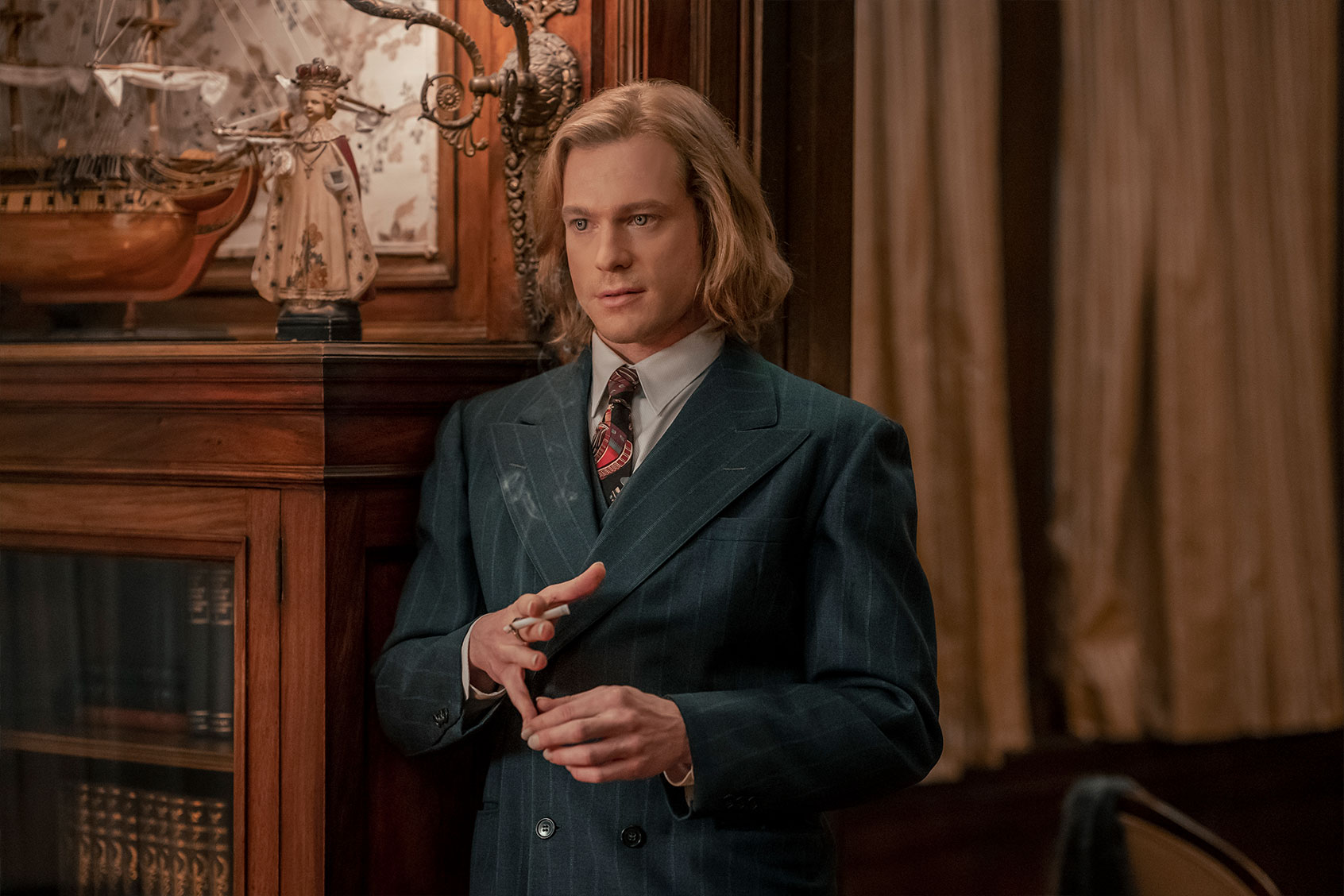
Changing “Interview with the Vampire” made it more alluring while staying true to its spirit

Many debates concerning TV adaptations of famous literature eventually come around to whether some of major changes add to the lore or detract from it. Walking that line is tough for showrunners, who are essentially tasked with remaining faithful to the original, beloved plot without committing some small screen equivalent of taxidermy.

A successfully adapted work from existing I.P. should be a vision that is expressly televisual, familiar to fans and yet a work unto itself, able to be enjoyed whether you've consumed the work that inspired or are coming in cold.

There are some works, such as Neil Gaiman's "The Sandman," that use the source material as a storyboard directing elaborate visions to come to life while making a few casting adjustments that honor the spirit without altering from the script. Maybe this is simple fan service. On the other hand, maybe this is also realizing a long-deferred dream fans have had since the comics were first published. Either way, it works.

Then we have AMC's adaptation of "Anne Rice's Interview with the Vampire," an update of a story passed around by teens and tweens a generation or two before "The Twilight Saga" swept the graveyard. Rice's vampires are a reconfiguration in themselves, romantic beings who stride across history like gods, watching human ages rise and fall while remaining steadfastly apart from it.

On the page Louis de Pointe du Lac, the protagonist of "Interview" is haunted by regret, loneliness and ennui. He's also an 18th century white plantation owner in life who, after he was made a vampire, allows his lover Lestat de Lioncourt to feed on the enslaved people forced to work his land. When those people mount an uprising, Louis and Lestat to kill them all and burn the place to the ground to prevent anyone from revealing their existence.

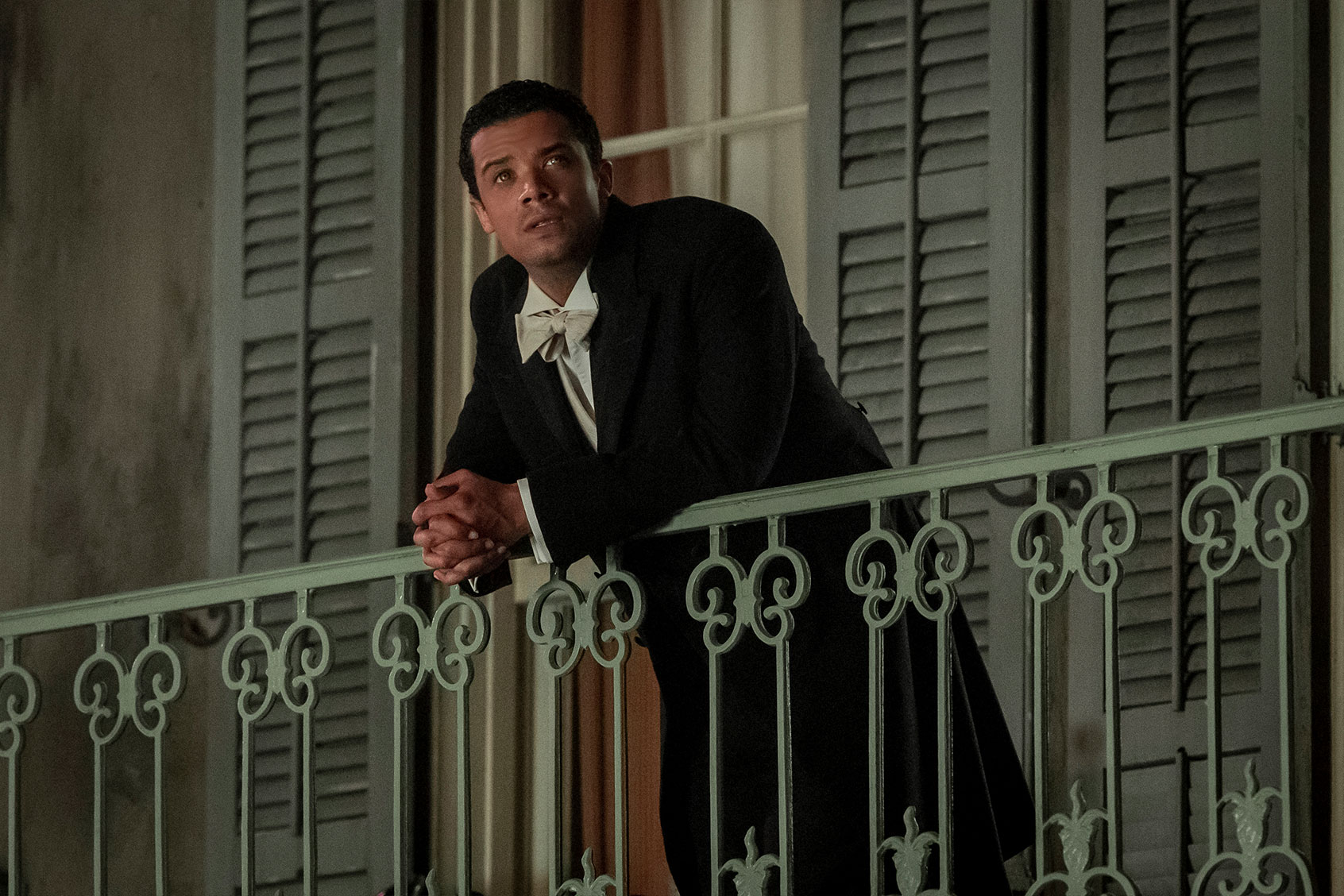
That would not go over well in 2022, reason enough for producer Mark Johnson and showrunner Rolin Jones to transplant Louis and Lestat into early 19th century New Orleans. Choosing to reintroduce Louis as a Black man in the post-Reconstruction era South (played by Jacob Anderson) and having him and Lestat (Sam Reid) live as prominent members of New Orleans society recasts the reader's relationship with the pair and the nature of Louis' psychic turmoil.

Interview with the VampireJacob Anderson as Louis De Point Du Lac in "Interview with the Vampire" (Alfonso Bresciani/AMC)

He isn't merely tormented by the barbarity of vampirism, which he refuses to indulge as far as that goes. He's tortured by knowing and being reminded time and again that regardless of his supernatural abilities, wealth and the relative privilege and comfort money brings, he is still held in lower regard than Lestat and the white politicians who run the town.

Worse, any financial success he manages to create for himself, his family (which rejects him), and his community can be legislated away by these envious men who set him up to fail.

And when he attempts to send them a message through brute force, creating a gory spectacle out of a corrupt official who richly deserves his demise, the white townspeople response by violently attacking the entire Black community, an assault he can't possibly defend.

There will always be a contingent who moan over TV and film producers' decisions to make white characters Black or assigning them to another non-white culture, using the excuse that filmmakers should portray these figures as the authors originally intended. This didn't work with "The Sandman," since Gaiman had a hand in casting the characters and shaping its episode, slapping down anyone who tried to complain about it.

Arguments against incorporating Black hobbit and dwarves and other people of color into "Lord of the Rings: The Rings of Power" that make the old canon claim are similarly spurious since these races and worlds containing them don't exist and therefore can look any way their adapter pleases.

But the way "Interview" uses Louis' Blackness, and that of their vampire daughter Claudia (Bailey Bass), transforms a familiar and beloved story while remaining true to its roots. That choice makes the universe Rice built less predictable, more heartbreaking and frightening in a completely fresh way. The love between Louis and Lestat is eroticized and defined in clear terms: they are gay men, tolerated to a point because they're rich.

Interview with the VampireBailey Bass as Claudia in "Interview with the Vampire" (Alfonso Bresciani/AMC)

However, if loneliness is the novel's major theme, the series trades that to mull the meaning of power. Society sets limits on Louis, but so does Lestat. In the book, Louis paints his maker and partner as an unfeeling monster. The series ups that ante to make him a possessive domestic abuser. Lestat doesn't want to share Louis with anyone, and certainly not another immortal trapped in a 14-year-old girl's body.

But he also uses Claudia to make Louis suffer, reading from pages in her exhaustive diary that let him know that the girl he saved is one he also doomed to being a woman forever trapped in a pubescent body.

It must be said that the producers made one choice with Claudia that was completely unnecessary and lazy, which is to have her survive a sexual assault that occurs while she's run away from her vampire guardians. The writers don't show it, perhaps regarding that as progressive; it's still a reductive, damaging excuse for explaining how a female character becomes tougher and smarter while she's living her part of the collective story separately from the rest of the coven.


Want a daily wrap-up of all the news and commentary Salon has to offer? Subscribe to our morning newsletter, Crash Course.


That also fails to make the most of what makes Rice's "Vampire Chronicles" so compelling. They are competing perspectives of various unreliable narrators, each approaching a shared history with their own agenda.

Interview with the VampireSam Reid as Lestat De Lioncourt in "Interview with the Vampire" (Alfonso Bresciani/AMC)Eric Bogosian's journalist Daniel frequently calls this out throughout the season. (He's another inspired change, albeit an older version of the novel's young journalist, hired by Louis in the sunset of his career to record the vampire's updated and, from his report, more honest version of his life story.) Louis professes his wish that Daniel's work mean something, while Daniel reminds his predator host that once the story published, how the public interprets it will be completely out of their hands.

One could easily view that as the producers' rebuttal to malcontents eager to take them to task for making over Rice's characters to believably meet modern times in all of their complexity. The effort to portray an inclusive world is wonderful, of course. But the way it uses its creative shifts from the novel to augment what Rice left her readers makes it especially toothsome and unpredictable, leaving room to live and grow for many seasons. For now, we'll accept the gift of knowing it'll return for a second.

The season finale of "Interview with the Vampire" premieres Sunday at 10 p.m. on AMC. All episodes are currently streaming on AMC+.

How to eliminate pet odors in your home

I share my home with two adorable dogs and a precious kitty, and while there are many great things about having a multi-pet household — endless snuggles, never feeling lonely, constant entertainment — one of the downsides is that pet odors can take over quickly. Between wet dog funk and litter box odors, I have to stay on top of cleaning to prevent my house from smelling like animals all the time.

If you’re looking for ways to get rid of pet smells, there are a few easy steps — and several game-changing products — that you should incorporate into your regular cleaning routine. Here’s how to keep your home smelling fresh and clean, no matter how many animals you share it with.

Wash pet bedding regularly

When was the last time you washed your dog or cat’s bed? These areas tend to be hotspots for unpleasant odors, as they collect dirt, grime, hair, and drool. Experts recommend washing pet bedding once a week — not only does this help get rid of smells, but it also protects your pet from bacteria and viruses, such as salmonella, leptospira, and streptococcus, that they may have tracked in.

The good news is that most pet bedding can be cleaned in the washing machine, making it easy to care for. Choose a hot water or sanitization cycle to kill off any odor-causing bacteria. You can also add 1/2 cup of white vinegar to the laundry cycle to help to neutralize smells.

If your pets are allowed on the furniture, you’ll also want to think about how you can keep these surfaces clean — after all, if your pooch sleeps on the sofa every day after playing outside, the cushions will eventually start smelling like a wet, dirty dog.

One of the easiest solutions is to simply invest in a couch cover. (There are similar products available for armchairs and even your bed, too.) These covers are generally waterproof and machine-washable, and they prevent odors from settling into the cushions, as well as stains from dirty paws or drool. Plus, when you have unexpected visitors, you can simply remove the cover and not worry about whether the sofa smells.

Stay on top of litter box maintenance

Cats usually aren’t quite as smelly as their canine counterparts, especially if they stay indoors, but a poorly-maintained litter box can quickly stink up your home. To minimize litter odors — and keep your cat happy — you’ll want to scoop out waste every day, and you should change clay litter at least once a week. If you have more than one cat, you might need to scoop and/or replace the litter more frequently.

When you do swap out your cat’s litter, be sure to wash out and dry the litter box to get rid of any odors. There are also odor-eliminating powders that you can mix into litter to stop smells from seeping out into your house.

Deep clean carpets and furniture

Regular vacuuming can help remove pet hair and allergens from your rugs and furniture, but they’ll likely need periodic deep cleaning, too. Most people only need to deep clean their carpeting once a year, but if you have a multi-pet household, you’ll want to do it every six months — and potentially more frequently in busy areas of your home. After all, pets track in lots of dirt, dust, and allergens, and unpleasant odors can become trapped in floor coverings, making the whole room smell.

On average, professional carpet cleaning costs between $100 and $250, depending on how much carpeting you have. Most services will also clean furniture, too, if you want to get everything done in one appointment. However, if you want to save some money in the long run, there are plenty of at-home carpet cleaners that cost around the same amount, and you’ll be able to use your machine as frequently as needed.

Use UV light to find hidden accidents

It’s impossible to keep an eye on your pet at all hours of the day, which means there’s always a chance they had an accident without you knowing. If there’s a lingering odor after you’ve cleaned your home, you may want to break out a UV light to locate the source of the smell.

UV flashlights are an inexpensive tool to keep in your arsenal, and their ultraviolet rays make cat and dog urine glow in the dark. All you have to do is shine the light around the room, and you’ll be able to spot any dried-up stains that you may not have noticed. If you do find old accidents, the Rocco & Roxie Stain & Odor Eliminator is an enzymatic cleaner that’s amazing for removing these kinds of old stains, as it contains natural enzymes that feed on ammonia odors and organic matter.

After you clean up the spot, you can use the UV light again to ensure you removed all traces of the accident — if some spots are still glowing, go over the area again.

Break out the odor neutralizers

Once you’ve cleaned your pet beddingfurniture, and rugs, your home should be odor-free, and you can keep your house smelling fresh with the help of odor eliminators. They come in a variety of different forms, including aerosol sprays, gel beads, and scented candles, and you can place them around your home — focusing on locations where your pets hang out — to prevent odors from lingering.

Odor neutralizers are generally inexpensive, but if you’re willing to spend a little more, an air purifier can also help prevent pet smells from taking over your home. Just be sure to select an air purifier with carbon filters, which are more effective for odor removal.

Wildfire smoke may warm the Earth for longer than we thought

Wildfires are a major source of air pollution. They are also predicted to worsen as climate change progresses.

Within the smoke particles produced by these fires is a wide range of organic chemical compounds known as “brown carbon.” Brown carbon absorbs sunlight, and in doing so, contributes to global warming.

Over time, the brown carbon is bleached by chemical reactions with oxidants in the atmosphere (such as ozone) and becomes white. This means that it stops absorbing light and stops warming Earth.

This bleaching process is heavily dependent on atmospheric conditions, which vary across regions. The longer it takes for brown carbon to become white, the greater an impact it can have on the environment.

As atmospheric chemists living in a region frequently polluted by wildfire smoke, we wanted to know more about these effects. We worked together with atmospheric chemists at the University of Toronto and Oklahoma State University, along with atmospheric modellers at the Massachusetts Institute of Technology, to find out just how long this bleaching process takes and the atmospheric impacts.

Guardian News takes a look at why wildfires are getting worse.

Aerosols and climate

Aerosols are microscopic liquid and solid particles suspended in the atmosphere. They’re smaller than the width of a human hair, but are still made up of many molecules.

Aerosol particles are everywhere and have a large effect on both health and the climate. When aerosol particles interact with light, a portion of the light is absorbed but the rest reflects and scatters off of the particles.

For most types of aerosol particles, the amount being absorbed is negligible. That means a lot of the light reflects back to space. Through this mechanism, some of the pollution we create actually masks the full impact of greenhouse gases.

Some aerosol particles, however, are coloured, which means they are absorbing some light. Any light from the sun that is absorbed instead of getting reflected back into space is converted into heat and warms the planet.

Aerosol particles from smoke contain brown carbon. The various molecules that make up brown carbon are similar to some organic dyes, overall giving it a characteristic brown colour. However, when ozone in the atmosphere reacts with brown carbon, it can transform it into new colourless molecules that do not warm the earth.

Significantly slower reaction

It was previously assumed that reactions between brown carbon and ozone were relatively fast. Within one day of being emitted from a fire, brown carbon would mostly stop absorbing solar radiation. But now, through a combination of laboratory experiments and atmospheric simulations, it is clear that the reaction between brown carbon and ozone can be significantly slower.

Experiments on pine wood smoke showed that brown carbon quickly lost its colour when exposed to ozone in a warm, humid environment. Conversely, when the temperature and humidity were decreased, the brown carbon remained.

This is because temperature and humidity change the viscosity of aerosol particles. Humid conditions lead to a lot of water getting absorbed into the particles, and as a result they become very fluid. But if that water is removed and the aerosols get cold, they become very viscous, like molasses — or even glass in extreme conditions.

For an oxidant like ozone to bleach brown carbon, ozone needs to penetrate and mix within the smoke particles. When smoke particles become viscous, the oxidants take an extremely long time to mix — over a year in some cases.

At altitudes less than 1 km in the atmosphere, conditions are relatively warm and humid so smoke particles are often not very viscous and brown carbon bleaches quickly. But at higher altitudes the air is drier and colder. When smoke particles get up to these heights, they can become highly viscous and the bleaching process can be so slow that it practically does not happen.

Atmospheric modelling

The result is significantly different when we put this new, longer-lasting brown carbon into an atmospheric model that simulates the transport of aerosols around the planet and how they interact with solar radiation. The new results show a warming effect on the climate from brown carbon that is twice that of the previous estimate.

This represents another important piece of the climate puzzle.

The Stockholm Resilience Centre’s Planetary Boundaries framework identifies the processes that regulate the stability and resilience of the Earth system. Aerosols are classified as one of the nine key ways that humans change the environment, but the total risk they pose remains unquantified within the Planetary Boundaries framework.

Research on aerosols can bring us closer to understanding their total effect on the environment, which will make us more prepared and better equipped to deal with the future of our planet.


Nealan Gerrebos, PhD Student, Chemistry, University of British Columbia and Allan Bertram, Professor, Chemistry, University of British Columbia

This article is republished from The Conversation under a Creative Commons license. Read the original article.

The forgotten immunocompromised are shouting from the trenches

Hi. I’m down here. Can you hear me?  I’m your friend — your relative — your coworker — the one who lives with only a fraction of the immune system you have at your beck and call. Yes, I’m one of many who falls under that “i” word that you might be sick of hearing: Immunocompromised.

Millions of people with compromised immune systems exist — in spite of the collective, tacit declaration that the pandemic is over. A significant number of them, myself included, don’t respond to COVID vaccines, or respond minimally. According to The Atlantic, close to three percent of adults in the U.S. take immunosuppressants, totaling at least seven million immunocompromised people throughout the country. In July of 2022, the Drug Discovery World noted that immunocompromised COVID patients are more likely to require hospitalization and are about four times more likely to die once in the hospital than hospitalized immunocompetent COVID patients. Now, as the virus continues to circulate and mutate, the immunocompromised population is stranded in the trenches, pleading to be remembered.

You can’t typically tell that someone is immunocompromised. I probably look healthy when I roam the grocery story, one of the few customers still wearing a KN-95 mask. But I see the eye rolls from customers and employees. I feel their judgement as I reach for a crown of broccoli, this white cloth hiding my irritation from the ignorance in the air. I sense some think this face covering shouts my political stance. Perhaps they believe I wear it because I’m overly paranoid. But I wear it because I have no CD20 cells, a subset of B-lymphocytes that attack viral invaders. An invisible, purposely-induced deficiency of these cells prevents further neurological damage to my body. Hence, I wear a mask solely as a mode of defense against the viral threat that many have dismissed as “just a cold.”

But a simple cold is never simple when you live with an autoimmune condition strong enough to dismantle your ability to walk. Indeed, without the body’s full pathogen fighting abilities, a routine illness, seemingly benign, can pose a serious threat to those of us with immunocompromised conditions of any kind.

The other day, a maintenance worker came to my house to work on my HVAC system.  I explained my predicament and asked him if he wouldn’t mind wearing a mask while in my home. “But I don’t have COVID,” he replied, confused.  I explained that multiple sclerosis (MS) runs rampant in my body, and as a result, I’ve lost a full class of B cells.

We’re here and we matter. We’re your friend, your relative, your coworker. And one day, we could easily be you.

This is an odd ritual, and one I don’t think that most of the immunocompetent population has to go through: providing personal health details to a stranger in order to validate my request — as if validation is required in the first place. But this is my home; the one place I can ensure a viral threat isn’t lurking in the distance.

Until you have lived through a cold in a body that is already fighting a disease, a body with limited defenses, you haven’t considered the full meaning of the words just a cold. You haven’t experienced your limbs, heavy like cement, and your brain, fatigued like thick fog on a Monday morning. You’ve never succumbed to the mixture of MS and viral replication, a combination I liken to the perfect storm on a cold, winter’s night. The effects can be brutal. And that is only just the beginning.

At the start of 2022, The New York Times labeled the seven million immunocompromised people in America “the forgotten.” Doctors and researchers admit that not as much research has been done on this group compared to the rest of the population;  as a result, it is unknown how protected many of us are. The science typically used to make safe health decisions are lacking and many of our choices are still guesswork.


Want more health and science stories in your inbox? Subscribe to Salon’s weekly newsletter The Vulgar Scientist.


Maybe I’ll survive COVID without being admitted to the hospital. My chances are good, although not as high as yours. Sure, there’s a possibility I’ll avoid long COVID, too. Maybe odds are in my favor. But I live with Long MS, and as a result I will not gamble with my health anymore.

Living with a chronic health condition is no easy feat. It greets you, unexpectedly, like a ghost in the night. It stays, indefinitely, hanging from your limbs, weighing you down, day after day after day. It doesn’t worry whether you have children to care for or an event to celebrate or a job to fulfill. It makes life that much harder. Today. Tomorrow. Forever.

I wish I could go back to the time when a cold was just a cold, but that is a choice that has been taken from me.

Do you hear me from way down here? I’m not telling anyone how to live their life. I’m not asking you to wear a mask as we enter public places together. I’m simply showing you that we, those who are immunocompromised, are shouting, loudly, to be heard. We deserve recognition that our lives are valued like yours. We want to be remembered as seven million Americans who matter to the majority. When you come to our home, we expect you to protect us in the one place we feel safe. We want you to see us, not as political activists (we’re not), but as people. It would be swell if you could remember that immune system status is invisible. It would be kind if the world considered us and our complicated situations as they wonder why some haven’t moved on beyond the crux of COVID.

It may be just a cold for you. But I’m down here with the seven million forgotten, calling out to you, because it’s not that simple for us. We’re here and we matter. We’re your friend, your relative, your coworker. And one day, we could easily be you.


The best way to store flour isn’t what you think

Have you ever pulled a two-year-old bag of flour out of the cupboard and wondered if it was still good to use? As a recipe developer, I go through a bag of flour every couple of weeks, so I wondered how long does flour last and how the heck do I store it? Is there any way to know when it’s gone bad? “I advise people to remember that flour is perishable — it’s not salt, it’s not sugar, and it’s definitely not inert. Take care of it,” says Martin Philip, an award-winning author, baker, and baking ambassador for the King Arthur Baking Company. Taking a closer look at different types of flour the grains themselves will help give us the answers.

Types of flour

All whole grain kernels are comprised of three parts: the bran, the endosperm, and the germ. The bran is the outer shell, the endosperm contains starch and protein, and the germ carries the genetic information of the grain and fat. That fat turns rancid over time, which is why some types of flour are best kept cold, while others are stable at room temperature.

White flour

White flour including all-purpose flour, pastry flour, bread flour, and cake flour use only the endosperm of the wheat kernel — which has no oils in it — and don’t require cold storage like other types of flour such as whole wheat or rye. Frank Tegetoff, a research and development specialist from the King Arthur Baking Company, recommends transferring the flour from its original paper bag to an airtight container, which will help keep out moisture and bugs. Whether your container is glass or plastic is up to you — just make sure the lid is closed tightly. Store the container in a cool, dry, and dark spot like a cupboard or pantry for up to one year.

Whole wheat flour

Whole wheat flour uses the entire wheat kernel — including the bran and the germ. The germ contains a little bit of fat which, when exposed to oxygen, can go rancid over time. “Freezing slows that process,” said Philip. While whole wheat flour can last up to several months in the pantry or on the counter, its shelf life varies based on factors such as temperature, humidity, and its age. Storing whole wheat flour in an airtight container or sturdy resealable plastic bag (Philip recommends double bagging) in the freezer will ensure that your flour lasts through its expiration date.

Rye and other whole grain flours

The same storage rules also apply to rye and all other whole grain flours. Keep them in an airtight container in the freezer. And label them clearly, especially if you’re storing more than one type of flour.

Gluten-free flours

Gluten free flours can be subdivided into white and whole grain types.

White gluten-free flours include white rice flour, tapioca flour, and potato flour. These flours are made up almost entirely of starch and contain no fats. If kept relatively cool and dry, these flours have an almost indefinite shelf life. Store these at room temperature in airtight containers.

Whole grain gluten-free flours include brown rice flour, sorghum flour, amaranth flour, and oat flours. These should be stored like other whole grain flours — in airtight containers in the freezer, where they will last for at least one year. Like all other whole grains, these contain fat that can go rancid over time at room temperature.

Polenta, cornmeal, grits, and masa harina

Polenta, cornmeal, and any flour or meal made from corn kernels are best kept cold — preferably in the freezer. This is especially important for any corn product labeled “stone ground” or “whole grain,” as these will contain the germ of the corn kernel. Degerminated corn products, which make up the majority of big brand cornmeal and polenta, are technically shelf stable for up to a year, but experts agree that the freezer will keep them fresher tasting for longer.

Nut flours

At this point, we know that fat, when exposed to the air, can quickly go rancid. “A whole nut is nature’s perfect storage system,” said Tegetoff. “The more we make it easy to use and enjoy (shelled, chopped, ground), the more we take away it’s natural protection and hasten its demise. With each refinement more and more of the oils are exposed to oxidation.” Storing your nut flours in the freezer will help stave off rancidity and oxidation at least through their expiration date.

Baking mixes

“With this type of mix, the goal is to prohibit the activation of the leavener(s),” Tegetoff said. Once opened, any leaveners in a baking mix such as baking powder or baking soda need to be kept cool and dry in order to retain their full power. He suggests transferring baking mixes into airtight containers or even resealable plastic bags and storing them in a cool dry place (the pantry is fine) out of direct sunlight.

Whole grains and home-milled flour

Milling flour at home has become more popular since the sourdough boom, and home-sized mills produced by brands like Mockmill are gaining popularity. But how long does home-milled flour last and how should you store it?

“Use it, don’t store it,” said Dr. Stephen Jones, a professor and director of the Bread Lab, an extension of Washington State University. If you have the luxury of an at-home grain mill, you’ll reap the most benefits by using fresh-milled flour sooner rather than later. If you need to store it, allow it to cool down before placing it into an airtight container. If you don’t plan on using it within a few days, store it in the freezer.

Unmilled whole grains will keep for much longer, as the germ is securely protected by the outer bran layer. Store whole grains in an airtight container in a cool dry place for up to 5 years or in the freezer indefinitely. Dr. Jones emphasized that the most important thing with whole grains is making sure they are clean, dry, and free of bugs before you seal them up for long-term storage.

How to tell if flour has gone bad

Worried about that bag of whole wheat flour sitting in your pantry? The best way to tell if it’s gone off is to give it a sniff. “If the flour has gone rancid [or] oxidized, it will smell like Playdoh,” Tegetoff said. “The rancid aroma and flavor will transfer through to the finished product. It will not be servable.”

There are all sorts of high-tech products that can help keep dry goods fresh for longer such as mylar bags and oxygen absorbers. But flour doesn’t need to be vacuum sealed in order to stay fresh — all you need is a freezer to keep flour tasting its best. Better yet, purchase smaller quantities of flour if you don’t bake much.

Buy what you need, then buy more — you’ll end up with more space in your pantry or freezer and you’ll benefit from eating fresher flour.

Shop Food52’s storage essentials

Glass Jars with Hand-Turned Wooden Lids

Those paper bags of flour from the grocery store are not packaged for long term storage — when you get home, transfer the contents to a tightly sealed container to keep bugs, moisture, and air at bay. These jars are a stylish way to store flour, sugars, and other dry baking essentials. The hand-turned wooden lid twists on for an airtight seal.

OXO 8-Piece Baking Essentials POP Container Set

This eight-piece set of food storage containers are perfect for holding flour, sugar, and other dry goods. The lids pop on for an airtight seal and the set includes two scoops and a brown sugar saver. Plus, the containers stack neatly on top of each other to keep your pantry clean and organized.

Ultimate 7-Piece Nested Storage Bowl Set

Freezing pantry staples will definitely help them last longer, but not all containers fare well in the freezer. Confidently store whole grain flours in these freezer-safe, airtight containers. This seven-piece set comes with a variety of sizes and are perfect for leftovers and lunches in addition to your dry goods.

A big win for democracy? Not so fast: This was a welcome reprieve — but that’s all

Like so many Americans, I was deeply stressed out and full of anxiety about last Tuesday’s midterm elections. Instead of the much-discussed “red wave” or red tsunami, I conjured up images of horses in a burning barn, bewildered and running in panicked circles, unable to escape their doom. 

That was not the fate that awaited the American people. Just enough Americans had the good sense and genuine patriotism to reject Trumpism and the Republican Party and stave off a full-on disaster, for now.

Although it still appears likely at this writing that Republicans will win a slim majority in the House, that is not certain. In either direction, it will be one of the narrowest majorities in congressional history. (Perhaps the narrowest since 1930, when Republicans won a 218-216 majority.) After their late wins in Arizona and Nevada, Democrats will hold at least their current de facto majority in the U.S. Senate, and may win an outright majority of 51 if Sen. Raphael Warnock defeats Republican challenger (and professional buffoon) Herschel Walker in the Georgia runoff election next month. 

There was plenty of other good news. Gov. Gretchen Whitmer was re-elected in the key battleground state of Michigan, as was Gov. Tony Evers in Wisconsin. Democrats won control of both houses of the state legislature in Michigan and Minnesota, while a number of other legislatures remain undecided. All the major “election denier” candidates for secretary of state positions were defeated, although we can expect some to protest that they were cheated. 

In a positive sign for the future of American democracy and society, voters under 30 (especially Black and Latino voters) overwhelmingly supported the Democrats. In initiatives across the country, voters chose to protect women’s reproductive rights and freedoms on the state level virtually across the board, and to enact other progressive legislation as well. 

In a series of emails, the Defend Democracy Project summarized the results of the 2022 midterms by saying that voters had “rejected Trump and his allies’ criminal conspiracy to overthrow the will of the people”:

Across the country, democracy won and MAGA election deniers were defeated. Overall, Americans rejected MAGA ideology’s threat to our basic freedoms. But Donald Trump and his hundreds of followers headed to Congress continue to pose a very real threat to our hard-won freedoms. 

It’s understandable that many Democrats and liberal commentators feel immense relief. But it’s a mistake to view these midterm elections as a great victory for the Democratic Party and, by extension, democracy itself. This outcome, while unexpected by most observers, offers only a brief reprieve in what will likely be a decades-long fight against American neofascism. Democrats defied historic trends, conventional wisdom and the predictions of the Church of the Savvy and larger pundit class, and that in itself was remarkable. But we still need to face the fact that in some ways the Democrats just got lucky.

Democrats defied historic trends, conventional wisdom and the predictions of the Church of the Savvy, and that’s remarkable — but in some ways they just got lucky.

It appears likely, although not yet certain, that Republicans won the overall popular vote in Tuesday’s election. In a reversal of recent trends, they “wasted” votes in places like Florida and Texas where they won by large margins, while losing numerous close races in battleground states. This phenomenon is related to the geographic “sorting” of voters in recent years, and has more often been a problem for Democrats, who run up huge margins in large cities and coastal states but often lose elsewhere.

Polling and other data suggests that the Democrats were saved by millions of voters who are upset about inflation and disappointed in both President Biden and the overall direction of the country but were even more disgusted and afraid of the Republican Party, Donald Trump and the danger they and their followers represent to the country.


Want a daily wrap-up of all the news and commentary Salon has to offer? Subscribe to our morning newsletter, Crash Course.


Luck, by its very nature is not something that can be preordained or controlled. It is not a repeatable strategy when it comes to defeating the Republican fascists over the long term. Ultimately, “We did better than expected,” is not a winning strategy.  

The Democrats must improve their messaging and brand identity and unapologetically embrace a more progressive, social-democratic agenda. (Public opinion polling shows that, contrary to the broken conventional wisdom, America is not a “center right” country.) They must be willing to put forward a bold vision with specific proposals to improve the lives of the American people. They must be willing to attack Republicans with the truth, and point out that the Republican Party, with or without Donald Trump, stands for values and policies that will cause great pain and damage to the vast majority of Americans, whatever their skin color and wherever they live.

Despite the immense relief around the 2022 results, America’s political culture nonetheless remains deeply ill.

Whatever befalls Donald Trump amid intra-Republican squabbling, in the medium term Trumpism and the Republican fascist movement will not be deterred by the results of the midterms. They will retreat and reconsider and then renew their attacks, continuing to gnaw at the vulnerable spots in America’s political and social institutions with the eventual goal of overthrowing democracy. 

Despite the many Democratic victories, across the country, more than 200 Republican supporters of the Big Lie were elected to public office. Despite the egregious and literally criminal record of the Trump regime and the Republican Party through the COVID pandemic, the coup attempt of Jan. 6, the reversal of Roe v. Wade and numerous other misdeeds both large and small, Republican candidates remained highly competitive across the country, winning many key races on the state, local and federal level.

In a reasonable society, the Republican Party would have been utterly vanquished or driven to the political margins, but instead it retains its cult-like hold on tens of millions of white Americans. The midterms represented a welcome setback for their movement, but have not altered that fundamental fact. 

Throughout the Age of Trump and beyond, the mainstream American news media has largely failed in its responsibility to bring clarity to complex events and hold the powerful to account. The midterms were no exception to that pattern. Many mainstream media pundits responded to the midterm results by pronouncing that “democracy won.” But what sense can we make of that, after many millions of voters supported Big Lie and election-denying candidates in the face of their obvious mendacity?

Mainstream media pundits responded to the midterm results by pronouncing that “democracy won.” What sense does that make, after many millions of voters supported Big Lie and election-denying candidates?

If Republicans end up in control of the House, even with a majority of only a few votes, their caucus will be overwhelmingly controlled by ardent Trump supporters and aspiring fascists. Their attacks on democracy will not stop, and to suggest that anything meaningful has been “won” is irresponsible.

Even the barest of Republican majorities will be able to obstruct any and all Democratic legislation, and perhaps to force a government shutdown over the debt ceiling. It will launch endless kangaroo-court hearings into Joe Biden’s son, his Cabinet members and ultimately the president himself, who may well face impeachment proceedings rooted almost entirely in Donald Trump’s lust for revenge.

Republicans will also do everything they can to destroy the American economy if they believe it will damage Biden and the Democrats leading into the 2024 election. The congressional investigation of the Trump cabal’s crimes on Jan. 6 and beyond will end immediately. Social Security will be targeted, stealthily or otherwise, as part of a larger plan to further degrade or destroy what remains of the social safety net.

As voting rights and other experts have pointed out, many of the races that Republicans won in these midterms were the result of gerrymandering and other voter suppression and voter nullification techniques. They will owe their majority to those tactics, thanks largely to redistricting in Florida and New York, and will surely seek to expand such efforts to avoid the kinds of electoral losses they suffered on Tuesday.

Gov. Ron DeSantis of Florida was re-elected by a massive margin, confirming that his formerly purple state is now under solid control of Republicans. DeSantis rejected federal oversight of the midterm elections in his state, in an apparent violation of civil rights and voting rights laws. He appears to be modeling a 21st-century Jim Crow-style racial-authoritarian state — which including his own “election security police” and posses of right-wing street thugs — which is sure to be emulated by other Republicans across the country to restrict voting by Black and brown people. As America becomes more racially diverse and as younger generations enter the voting population, Republicans understand that voter suppression and outright vote nullification may be the only way they can “win” elections. 

Early exit polls suggest that the Republican Party may have expanded its support during the midterms among white voters. (More data on this and other questions may take some time.)

As author and activist and author Don Winslow wrote on Twitter, “Victory is not defined by how wrong the political experts were. That is not the bar. Ever. Victory is defined by winning and HOLDING the House. Period”:

IF the Republicans win the House they get subpoena power and will unleash hell on America for two straight years.

And if they get that subpoena power no one will give a flying fuck that the political experts overestimated the Republican win by x percentage. …

It DOES NOT MATTER if the Republicans win the House by 1 seat or 20 seats.

Either way, they take POWER. Pelosi is out. McCarthy is in. They get subpoena power. They do 20 Benghazi like hearings. They impeach Biden. They wreak HAVOC….

Author and journalist Jeff Sharlet shared a similar perspective:  

Ok! It’s looking like it it *might* not be *as* bad as feared. Now I have to stop worrying about Democratic Party & much of media going back to believing the institutions are holding & giving fascism another two years to keep growing….

In an essay at Vox, Zack Beauchamp offered these insights about the midterms and what they may or may not mean for America’s democracy crisis:  

Despite these promising signs, it’s far too early for small-d democrats to declare victory.

“We don’t have many data points, but one take is that short-term anti-democratic forces in the US are on the decline. A mistake would be to pivot toward the take that those who spoke out against anti-democratic forces were alarmist,” writes Ryan Enos, a political scientist at Harvard. … [T]here’s still plenty of evidence that the American public doesn’t care enough about democracy. David Shor, a leading Democratic poll analyst, is skeptical that the issue made much of a difference in 2022, telling me that “basically no ads were about [democracy]” and those that voters saw “tested pretty poorly.” (That said, Shor thinks that Democratic messaging about democracy may have affected the outcome “indirectly” by driving up the party’s fundraising numbers.)

And despite the setbacks his endorsees saw in the midterms, Donald Trump is still the leading figure in the Republican Party, commanding the support of a majority of the party faithful and crushing all opponents in 2024 polling. When you combine Trump’s chokehold on the GOP with the party’s preexisting anti-democratic drift, it’s clear that American democracy is still facing an existential threat from within — one that has not been cowed by electoral defeat in the past.

But based on the information we have right now, it’s fair to let a little bit of cautious optimism color our thinking. In 2022, voters were presented with at least a dozen opportunities to elevate some of the most extreme anti-democratic voices in the country to positions of power over US elections in key states — and, on the whole, they opted to step back from the brink.

As Beauchamp says, Americans who voted against the Republican fascists should feel better this week — if only briefly.  Now they must brace themselves for the bizarre and upsetting shift in national mood coming this Tuesday, when Donald Trump will apparently (and finally) announce that he will run for president again in 2024. There is no harm in celebrating the reprieve offered by the 2022 midterms and enjoying the afterglow. But we can’t afford to forget that the reality of American neofascism is still with us. 

J.D. Vance “misrepresented everything” and “leaves out” women: Poets tell the truth about Appalachia

“It is time to tell our story. But then who gets to tell that story – and it’s not necessarily the women,” says Pauletta Hansel

We talk weeks before election night, before venture capitalist turned bestselling memoirist J.D. Vance defeats Tim Ryan in the close Ohio Senate race, and shortly after Hansel has returned from volunteering with flood relief, assisting those devasted by the deadly Kentucky floods of summer 2022.  

Hansel is from southeastern Kentucky and currently lives in Cincinnati, Ohio, where she serves as the Cincinnati and Hamilton County Public Library Writer-in-Residence. She was the first Poet Laureate of Cincinnati and is the author of nine poetry collections. Her latest book “Heartbreak Tree” was released in March 2022.

Hansel is joined on our Zoom call by Sara Moore Wagner, author of two poetry chapbooks and two full-length collections; most recently: “Hillbilly Madonna,” out this November. Press materials call the book “a harrowing and ultimately hopeful lens into rural life and the opioid crisis.” Sound familiar? Well, except for the hopeful part — and the fact that Wagner’s work centers women, as Hansel’s poems do as well. 

Both writers are well aware of someone who did get to tell the story, one of the more infamous sons from Appalachia: Vance, and his thoughts about addiction and poverty, which he spun into a flying carpet (bag) and rode all the way into politics. 

What do poets have to say about Vance’s book “Hillbilly Elegy,” its broad stroke painting the home and people they know and love — and what place can poetry still find in this dying world? “There is a road, but the road is still inside you,” Hansel writes in a poem where an older narrator speaks to herself as a child. “You are trying. Remember.” 

Salon talked to Hansel and Wagner about writing, politics and home.

This interview has been lightly edited for clarity and condensed. 

Describe your new collections for me.

Sara Moore Wagner: So “Hillbilly Madonna” is a book about a lot of things. But mostly it’s about my childhood and early adolescence. And then also, on a larger scale, it’s about the opioid epidemic, especially as it relates to women, and about generational trauma and breaking cycles. I think there’s a lot in there about expectations for men versus women with regard to family history and family cycles.

I have a responsibility to those women both before me and after me to tell the truth.”

Pauletta Hansel: Heartbreak Tree” is about gender and place, and specifically about Appalachia. I can repeat a lot of what of what Sara just said, except, of course, for the opioid case. But we are of different generations. I grew up in the 1960s and ’70s in Appalachia. I’ve lived out of the region longer than I have lived in the region. And so my work is to a large degree looking back . . . I wanted to create poems that were stripped of the nostalgia that comes from loss and melancholy, and to take as much as I could a hard look at what it was like for me, as a girl and a young woman growing up in Eastern Kentucky . . . and to try to address that through truth telling. You know, there’s a way in which having become an elder in my family, I not only feel like I have more permission now because I’m not going to hurt as many people — hurting those you love is always part of the poet’s dilemma — but even greater than that feeling, I have a responsibility to those women both before me and after me to tell the truth.

Heartbreak Tree book of poems by Paulette HanselHeartbreak Tree by Paulette Hansel (Photo courtesy of Madville Publishing)Do you feel that growing up as a girl in Appalachia is different than growing up in other places? 

Wagner: I grew up kind of split. My parents are both Appalachian. My mom’s from West Virginia and my dad’s from Appalachian Ohio. They met in Columbus, and then they split apart. So I spent a lot of my time when I was with him in the hills. That landscape became my father’s landscape. And there was this weird conflict between what he expected of me. The land was wild and he was a hunter. He lived his whole life saying he was a hillbilly and was very proud of it. So where is my place in this landscape that’s been completely claimed and also smoothed, maintained — owned, I guess, by my father?

I wasn’t expected to be able to have a voice or to do the things that I did. He asked me to quit college to help him raise some of my younger siblings — just the expectation of: whatever I was doing wasn’t what I was supposed to be doing. A lot of the girls that I knew growing up were exactly the same as me. They went on to lose children, to fall into addiction in a way that I didn’t because I had a mother who was like, “No, that’s not your world.” And the privilege of that is overwhelming . . . the area that my father comes from, there was the expectation of, “This is your role and this is what you’re meant for.” And whatever way you step out of it, you fail, even if you go to college.

You both have poems about difficult subjects, including violence, heroin and substance abuse. Why do you think poetry works as a vehicle for these things that are sometimes hard for us to talk about?

“Women are vilified so much more than men for addiction.”

Wagner: For me, it was important to talk about especially heroin and opioids from a woman’s perspective, because I feel like in the community I come from women are vilified so much more than men for addiction. Appalachians and poor people in general who fall into drug addiction are seen as having a personal moral failing, but it’s even more so with women. And so, I think there’s no better art form than poetry to speak a truth in a way that other people can just feel it immediately. That was important to me, especially for women to be able to say, “I’m broken, but I’m not beyond redemption. I’m not a garbage human being.” 

Hansel: I’ll echo that, but also say it is this sense of: heart to heart, skin to skin, even underneath the skin, poetry strips away the barriers and lets readers who are willing enter into the experience of the speaker. Certainly, fiction can do that too and certainly memoir can do that. But memoir can be a little bit scarier because you don’t have quite the ability to tell that slant truth . . . [Poetry is] much more condensed. I don’t have to create the whole world, I can create just that part of it necessary to be able to move into a particular truth.

The devastation is so vast, in places it’s invisible.”

You were recently in Kentucky working on flood relief. How is the recovery going? 

Hansel: House by house . . . The devastation is so vast, in places it’s invisible. Because you might walk through a town and not really see . . . But you start getting out into the county areas and people’s houses are still upended. People are stripping them down to the bare timbers in order to be able to rebuild again. It’s going to be a long recovery because it is house by house, holler by holler, need by need by need.

There are major infrastructure issues, which are of course, not totally visible. Even people who have houses are not necessarily having regular access to water and electricity and heat. People whose bridges are still not passable. The other thing that I’ll just mention is that people — not everybody — but some people are starting to acknowledge that this wasn’t just a 1,000-year flood, this was a mining disaster because many of the places that have been hit the hardest are the places where the strip mining in the surrounding areas had wiped away all possibility of any sort of barrier . . . I just finished a draft of a poem about the group in Breathitt County that is now suing the coal company for neglecting their silt ponds, basically. First, you know, the water came down from the hill. It turned gray, like the silt ponds, and then everything was destroyed that was in its path. It would be interesting to see what happens with that as time goes on, if there are more lawsuits and success in those lawsuits.

I’m sure it was difficult being on the ground and the local and the regional reaction to the floods versus the national response, which is: people are horrified. And then they forget.

Hansel: They forget nationally, and they forget in Cincinnati, and so that’s been part of my mission in life over the last month just to keep it right in people’s faces on social media and in the classes that that I’m getting ready to teach. Because we’re close enough that this should not be invisible . . . We are on the verge of this community and there’s no reason for us to forget that. It’s gone from the news. Driving back, I heard the press conference with Biden there in Breathitt County, and almost had to pull over to cry because he was saying all the right things that we’re not used to hearing from presidents about how it’s going to take a long time, we’re going to be right there. We need to take care of the infrastructure that wasn’t there, as well as the infrastructure that’s not there now. But on the ground, people are fighting FEMA like they do everywhere. FEMA’s first response is to turn people down. People who are already worn down from the flood are having a hard time getting the energy out to fight.
Hillbilly Madonna by Sara Moore WagnerHillbilly Madonna by Sara Moore Wagner (Photo courtesy of Driftwood Press)I’m from Ohio, but I moved away recently, and miss it every day. A friend there said there’s been a ton of J.D. Vance political ads on TV. Are you seeing that?

Hansel: I don’t watch TV. 

That’s smart. 

Wagner: There’s been a lot of yard signs.

Hansel: In my house he’s called He Who Shall Not Be Named.

How is your Appalachia different from Vance’s or his idea of the region?

Wagner: My life story is very similar to J.D. Vance’s. There’s an interview in my book where I talk about how I had a therapist when I was telling my life story, she said, “You should read ‘Hillbilly Elegy.'” I think I didn’t see her again. It’s alarming to me that he does not acknowledge the privilege that he has. And this is something Pauletta and I have talked about quite a bit. The idea of him doing it all for political gain, really is what he built [with] “Hillbilly Elegy.” He had a five-year plan that included putting himself up on the top. He’s basically misrepresented everything. The urban Appalachians of Middletown, Ohio, which is really close to where I live now, are angry at the way he represented them. And then he comes from the actual town that Pauletta also comes from, and people [there] are upset at the representations.

Hansel: Well, not necessarily. He’s little J.D. I haven’t heard of people speak of him recently, but I’m not aware that he’s actually gone to Eastern Kentucky . . .  I have stood a whole lot of my life as an urban Appalachian, and as a person who’s really interested in this part of the story — I moved here as an adult . . .  I was 20, and I went to college and graduate school here and still had people back home, so I’m a first generation in the city. But a lot of the people that I’ve worked with over the years are people like Vance who had a connection to the region through him. And maybe had a sense of the negative stereotypes that were being placed upon them and their family by a larger community, internalized in a way but not completely. 

There are parts of that memoir, maybe the first fourth or so, that I was really very moved by because it was speaking an experience that I had seen in the urban communities in Cincinnati. But then how that got twisted and used in order to make to make false points and to make false claims, is something that I carry some residual guilt about, having spent the last almost 40 years of my life trying to educate Appalachian communities about the history of the region, the layered perspectives and reasons for poverty both in and out of the region.

That he could live –  Middletown is, what, 30 miles away — and not have any sense of how the misuse of the region his family came from had a major factor in how his family ended up, how and where they were, it feels it feels a little bit like a personal failing. I’ll acknowledge that, that it just shows me that there’s so much more work that needs to be done to educate Appalachian people about our own history, and how that interacts with the world as it is now. 

“It’s an elegy, you know. But we’re not dead yet!”

Wagner: There’s a lot that he says about personal accountability in his book, especially. He has a whole section in that book about how Yale is possible and [people] don’t realize that with grants and things like it can be just as cheap as any other school. And it’s like, you went into the Marines. That is not an option for everyone. That’s not an option for a lot of women in particular to follow that path. Women are something that he just leaves out of his story. He’s very unforgiving about his mom and her addiction struggle, without acknowledging the history of that, especially at that time period in Appalachia and in poor communities, just the influx of drugs, and drug manufacturers and companies preying upon women like his mother. For him it’s more: everything bad is a personal moral failing of the people themselves. And I think that’s frustrating. And it’s an elegy, you know. But we’re not dead yet!

Hansel: He and his story to a certain degree were misused by the people who mentored him. But he benefited. He was complicit. Maybe if he had gone to Antioch Appalachia instead of Yale.

Wagner: When I first read “Hillbilly Elegy,” I thought it was kind of moderate. He even said he thought people were crazy for saying Obama wasn’t born here. There was a lot in there that you’re like, “Oh, you think differently than me, but you’re not blasting everybody; you’re kind of trying to be reasonable.” But now that has gone out the window. He’s just doubled down on every ignorant thing.

Hansel: He turned the corner. There are some who will say, I think there had been hope for him at an earlier time. 

Wagner: Because he even did say that Donald Trump was — he was anti-Trump. But he transformed himself. 

Hansel: Within the urban Appalachian movement there were some feelings early on that there might be a reason to try to bring him into the fold. To try to do this education that I’m talking about, but I think it was too late. So I won’t feel guilty about that.

And even the people from it, we’re still trying to discover and tell the story.”

At the very end in December 2020, we did an online program called “Don’t Cry for Us, J.D. Vance,” using writers who were writing about the region as sort of a counterbalance to that single story. We were able to get an interview on the local NPR station. And apparently, he called the that NPR station, whining, because we got the airtime. 

Wagner: Hopefully he won’t do that to you if you write this.

Well, I’ve written about “Hillbilly Elegy” a couple of times. And I did get a lot of emails from men, but not from him. What do you wish that people knew about Appalachia? Maybe people with no experience of the region or people whose experiences are only informed perhaps by books like his, what do you wish that you could convey to them?

Wagner: Let me say something wonderful about Pauletta. She has invited me into this space that I didn’t think I deserved to be in because I felt so split between worlds. I think a lot of my family too doesn’t really think of Ohio’s Appalachia as being part of Appalachia. Even my mom from West Virginia, she’s kind of like, ‘What is that about? You know, are we? What are we?” Nothing is defined. People want to put in J.D. Vance and “Beverly Hillbillies” and stereotypes of what the region is, and who the people are in it, like it’s some homogenous thing. But it’s really an area that we don’t understand. And even the people from it, we’re still trying to discover and tell the story. So, I think it’s important to read, for people not to assume they understand what’s happening there and the people that live there, but to read as many individual stories as possible.

Appalachia can be a reminder that you can’t learn about the complexity of a place and a people through soundbites.”

Hansel: Perhaps, among other things, Appalachia can be a reminder that you can’t learn about the complexity of a place and a people through soundbites. There are stories behind everything and there are stories behind and underneath those stories. And the history of Appalachia is a place of great natural riches and resources, where the people were impoverished by the uses of those resources. That has to be at the base of any story about Appalachia. That complexity, that dichotomy, it has to be the starting point, if you want to try to understand Appalachia, and then there’s all these other things too. If you think of Appalachia as being the spine of the United States, then you can literally say that this nation was built on the back of Appalachia.

Wagner: And that continues, if you look at what happened with drug manufacturers.


Want a daily wrap-up of all the news and commentary Salon has to offer? Subscribe to our morning newsletter, Crash Course.


Hansel: In the Appalachian writing movement there’s always been an awareness that if there is going to be a continuation of the story then there has to be a mentoring process and bringing along process . . . Within the movement of Appalachian art and Appalachian empowerment, there has got to be an awareness that we have to pass it on. I’m really excited that Sara is telling the story that came after mine. And even more than that, she’s telling the story after the story of people who for economic and other reasons, left the mountains because there were no other good choices for them. That’s a story that needs to go back into the mountains. 

I’ve never felt like J.D. Vance was a fake hillbilly because he didn’t grow up there. I’ve heard that along the way. But it’s more because he didn’t use what was given him through that legacy in order to make a real difference in the region. It’s as important for people who are making a difference in the region now to hear about what happened to their families who left.

Wagner: Connecting with Pauletta has given me language and resources to be able to talk about these things in a way that I – being a J.D. Vance-type who feels disconnected but has my own lived experience — it’s important for me to not just think that my experience is the whole story. 

Hansel: At the same time, you need to understand the mechanism to understand that your story is as it is. It is your story. And it is a piece of the whole.

Pit bulls went from America’s best friend to public enemy — now they’re slowly coming full circle

As recently as 50 years ago, the pit bull was America’s favorite dog. Pit bulls were everywhere. They were popular in advertising and used to promote the joys of pet-and-human friendship. Nipper on the RCA Victor label, Pete the Pup in the “Our Gang” comedy short films, and the flag-wrapped dog on a classic World War I poster all were pit bulls.

With National Pit Bull Awareness Day celebrated on Oct. 26, it’s a fitting time to ask how these dogs came to be seen as a dangerous threat.

Starting around 1990, multiple features of American life converged to inspire widespread bans that made pit bulls outlaws, called “four-legged guns” or “lethal weapons.” The drivers included some dog attacks, excessive parental caution, fearful insurance companies and a tie to the sport of dog fighting.

As a professor of humanities and law, I have studied the legal history of slaves, vagrants, criminals, terror suspects and others deemed threats to civilized society. For my books “The Law is a White Dog” and “With Dogs at the Edge of Life,” I explored human-dog relationships and how laws and regulations can deny equal protection to entire classes of beings.

In my experience with these dogs — including nearly 12 years living with Stella, the daughter of champion fighting dogs — I have learned that pit bulls are not inherently dangerous. Like other dogs, they can become dangerous in certain situations, and at the hands of certain owners. But in my view, there is no defensible rationale for condemning not only all pit bulls, but any dog with a single pit bull gene, as some laws do.

I see such action as canine profiling, which recalls another legal fiction: the taint or stain of blood that ordained human degradation and race hatred in the United States.

Bred to fight

The pit bull is strong. Its jaw grip is almost impossible to break. Bred over centuries to bite and hold large animals like bears and bulls around the face and head, it’s known as a “game dog.” Its bravery and strength won’t allow it to give up, no matter how long the struggle. It loves with the same strength; its loyalty remains the stuff of legend.

For decades pit bulls’ tenacity encouraged the sport of dogfighting, with the dogs “pitted” against each other. Fights often went to the death, and winning animals earned huge sums for those who bet on them.

But betting on dogs is not a high-class sport. Dogs are not horses; they cost little to acquire and maintain. Pit bulls easily and quickly became associated with the poor, and especially with Black men, in a narrative that connected pit bulls with gang violence and crime.

That’s how prejudice works: The one-on-one lamination of the pit bull onto the African American male reduced people to their accessories.

Dogfighting was outlawed in all 50 states by 1976, although illegal businesses persisted. Coverage of the practice spawned broad assertions about the dogs that did the fighting. As breed bans proliferated, legal rulings proclaimed these dogs “dangerous to the safety or health of the community” and judged that “public interests demand that the worthless shall be exterminated.”

In 1987 Sports Illustrated put a pit bull, teeth bared, on its cover, with the headline “Beware of this Dog,” which it characterized as born with “a will to kill.” Time magazine published “Time Bombs on Legs” featuring this “vicious hound of the Baskervilles” that “seized small children like rag dolls and mauled them to death in a frenzy of bloodletting.”

Presumed vicious

If a dog has “vicious propensities,” the owner is assumed to share in this projected violence, both legally and generally in public perception. And once deemed “contraband,” both property and people are at risk.

This was evident in the much-publicized 2007 indictment of Atlanta Falcons quarterback Michael Vick for running a dogfighting business called Bad Newz Kennels in Virginia. Even the Humane Society of the United States and People for the Ethical Treatment of Animals — two of the nation’s leading animal welfare advocacy groups – argued that the 47 pit bulls recovered from the facility should be killed because they posed a threat to people and other animals.

If not for the intervention of Best Friends Animal Society, Vick’s dogs would have been euthanized. As the film “Champions” recounts, a court-appointed special master determined each dog’s fate. Ultimately, nearly all of the dogs were successfully placed in sanctuaries or adoptive homes.

This 2010 report describes the successful rehabilitation of dogs rescued from Michael Vick’s Bad Newz dogfighting operation.

Debating breed bans

Pit bulls still suffer more than any other dogs from the fact that they are a type of dog, not a distinct breed. Once recognized by the American Kennel Club as an American Staffordshire terrier, popularly known as an Amstaff, and registered with the United Kennel Club and the American Dog Breeders Association as an American pit bull terrier, now any dog characterized as a “pit bull type” can be considered an outlaw in many communities.

For example, in its 2012 Tracey v. Solesky ruling, the Maryland Court of Appeals modified the state’s common law in cases involving dog injuries. Any dog containing pit bull genes was “inherently dangerous” as a matter of law.

This subjected owners and landlords to what the courts call “strict liability.” As the court declared: “When an attack involves pit bulls, it is no longer necessary to prove that the particular pit bull or pit bulls are dangerous.”

Dissenting from the ruling, Judge Clayton Greene recognized the absurdity of the majority opinion’s “unworkable rule”: “How much ‘pit bull,'” he asked, “must there be in a dog to bring it within the strict liability edict?”

It’s equally unanswerable how to tell when a dog is a pit bull mix. From the shape of its head? Its stance? The way it looks at you?

Conundrums like these call into question statistics that show pit bulls to be more dangerous than other breeds. These figures vary a great deal depending on their sources.

Any statistics about pit bull attacks depend on the definition of a pit bull — yet it’s really hard to get good dog bite data that accurately IDs the breed.

Over the past decade, awareness has grown that breed-specific legislation does not make the public safer but does penalize responsible owners and their dogs. Currently 21 states prohibit local government from enforcing breed-specific legislation or naming specific breeds in dangerous dog laws. Maryland passed a law reversing the Tracey ruling in 2014. Yet 15 states still allow local communities to enact breed-specific bans.

Pit bulls demand a great deal more from humans than some dogs, but alongside their bracing way of being in the world, we humans learn another way of thinking and loving. Compared with many other breeds, they offer a more demanding but always affecting communion.


Colin Dayan, Professor of English, Robert Penn Warren Professor in the Humanities, and Professor of Law, Vanderbilt University

This article is republished from The Conversation under a Creative Commons license. Read the original article.

“I’ll burn Arizona to the ground”: SNL cold open roasts Kari Lake’s midterm nailbiter

In the cold open for “Saturday Night Live,” hosted by Dave Chappelle, SNL alum Cecily Strong brought back her near perfect Kari Lake portrayal to rib the Republican’s refusal to admit defeat in her race for Arizona governor.

In the sketch, Strong as Lake appears in a segment of “Fox & Friends” to answer questions about her run in the midterms, and flip flops between blaming Democracy for her loss, if she does in fact lose, and thanking Democracy for helping her win if that ends up being the unlikely outcome.

“Nearly every candidate Trump backed lost this week, except for one” says SNL’s Mikey Day as Fox host, Steve Doocy, kicking it over to Strong as Lake. 

“Greeting from Arizona, where the average age and temperature is 95,” Strong says. 

“Thanks for being here during what must be a very stressful time,” says Bowen Yang as Fox host Brian Kilmeade. 

“Hey, my campaign isn’t dead yet,” Strong says. “Even though my camera filter makes it look like I’m in heaven.”

“Now, Kari, this seemed like a race you’d easily win, yet it’s been a real nailbiter,” says Heidi Gardner as Fox host Ainsley Earhardt. “You and your opponent are currently neck and neck.”


Want a daily wrap-up of all the news and commentary Salon has to offer? Subscribe to our morning newsletter, Crash Course.


“That is because the Maricopa County officials are incompetent,” Strong says. “And it’s my belief that the election is rigged and the results should be thrown out.”

When the hosts break away to read off new numbers coming in, Strong’s Lake changes her tune based on whether or not they’re in her favor. 

“I am 100 percent confident that I am going to win this election,” Strong says. “And I won’t stop fighting until every vote is counted and then some votes are taken away. Because who do Arizonans want leading them? Katie Hobbs, who’s hiding in a basement? Or me, Kari Lake, who lives right here in this beautiful pool of vaseline. And who’s out there every day at CVS asking Black customers if they work here.” 

“Well we are rooting for you, Kari. We know the votes will go your way,” says Day as Doocy.

“Well if they don’t, I’ll burn Arizona to the ground,” Strong says in closing.

As of Sunday morning, Lake is still dragging behind in her race at 49.3% to Katie Hobbs’ 50.7%.

Watch the sketch here:

Trump Jr. spreads conspiracy theory that McConnell wanted Masters and Lake to lose

One day after Democratic Sen. Mark Kelly was projected to win re-election in Arizona, Donald Trump, Jr. is spreading the idea that GOP Leader Mitch McConnell wanted Republican nominee Blake Masters to lose.

McConnell reportedly wanted to draft GOP Gov. Doug Ducey to challenge Kelly, but former President Trump put his weight behind Masters, a venture capitalist.

“Rumors are that Doug Ducey, the weak RINO Governor from Arizona, is being pushed by Old Crow Mitch McConnell to run for the U.S. Senate,” Trump said in a January statement. “He will never have my endorsement or the support of MAGA nation!”

After Ducey did not run,” he followed up by saying, “Smart move, Doug—there’s no room for RINOs.”

“RINO” stands for “Republican in Name Only,” which used to refer to moderates but is used by Trump to describe any Republican he dislikes.

On Saturday, Trump, Jr. took to his dad’s microblogging site to retweet user “Cattturd2.”

“The reason Mitch McConnell hasn’t said anything about the bullshit happening in Arizona is because he wants Blake Masters and Kari Lake to lose,” Catturd2 alleged.

“He only cares about power, money, and he absolutely hates us,” Catturd2 concluded.

On Truth Social, Trump, Jr. refers to himself as a “Meme War General.”


The perks of being a sports fan: Cheering on a team has benefits beyond game day

Raised in a small town in Italy in the 1980s, Marco grew up playing soccer. But when high school graduation came, his soccer days ended. In Italy, you either play ball, or you go to school. You don’t do both. College sports, athletic scholarships — they weren’t an option. Marco’s mother had impressed upon him that education was important, and sports were for fun, so he headed off to college, pursuing a dual degree that allowed him to study for the first two years in Italy and the second two years abroad. 

For those second two years, Marco landed in Boston, across the street from Fenway Park. That was in 2005. “I had no idea Fenway was such a big deal.” Though he had some familiarity with baseball, he had heard only of the Yankees. During his two years in Boston, he confessed, “I never went to see the Red Sox.” He had too much on his mind to bother with sports. He shrugged: “I had to figure out English first.” 

At the end of his stint in Boston, Marco accepted a six-month internship, and then a full-time position, at Merrill Lynch in New York. This is where his true education in American sports began. “My initial bosses at Merrill were both baseball fans. One was a Mets fan, and the other was a Phillies fan, and so I naturally became a Yankees fan to antagonize them.” 

The Yankees were doing well at the time, and Marco attended a few games with his colleagues. But for a guy whose sports rhythm was set to the constant motion of soccer, baseball seemed more like “an interesting social experiment” than an exciting sport to watch. 

Then Marco switched work groups and found himself among a bunch of (American) football fans. To join in their discussions, he started watching some football. “Coming from Italy, I didn’t have a lot in common with a lot of Americans, but I found a lot of appreciation for football players in terms of their physicality, the speed, the techniques. Despite the game stopping a lot, it was a lot more interesting to me than baseball ever was.” As it happened, that year the Patriots were on fire, ending their regular season 16–0. “I got interested in a team that could make history,” Marco said, “so I hosted a Super Bowl party.” 

Spoiler alert: the Patriots lost. But Marco, in search of social connection with his colleagues, had pushed the fandom flywheel. And it started to spin. 

The next season, he added another fan activity: joining a fantasy football league. “It was a big opportunity for me to get closer to other people, to have something in common to talk about. It would force me also to pay more attention and understand the game better because the rules are complicated.” 

As the flywheel gained momentum, Marco’s social connections grew, and his fandom deepened. Watching NFL RedZone and managing a fantasy football team, in combination, became a great way for him to become more knowledgeable about the NFL in general. “It definitely gets you to follow more and appreciate the sport more. Initially, I was doing season-long fantasy football, where you have a draft at the beginning of the year. That involves a lot of up-front work and then maintenance over the weeks, but that caused too much frustration related to luck and injuries, so I moved to daily fantasy, where you get an opportunity to build your team every week. That requires you to become a much better observer of trends, and that got me more excited about certain players.” 

In 2018, when Marco and a few colleagues founded their own business, he immediately recognized an opportunity to bring the group together: He started a fantasy football league with them. He remained active in the Merrill Lynch league and in the new one, because together they allowed him “to network and stay in touch with a lot of different people.” 

Meanwhile, Marco discovered that he and a work friend shared a passion that predated his immigration to America: golf. The two began discussing golfers, playing together, and inviting others into their conversations. As that added activity accelerated the flywheel, friendships grew. Marco and his buddies began meeting up to watch tournaments together on TV. Marco’s fan flywheel might have started slowly, but once it gained momentum, it started to spin freely, and his social connections flourished. 

In the end, Marco sees the benefits of the flywheel in his personal and work lives. “Becoming close friends outside of work makes it easier to collaborate and work well together. When you become friends, then you become more accountable to each other. You don’t want to let each other down.” 

Fandom’s Intrinsic Benefits 

This flywheel we’re talking about — it’s not trivial. It doesn’t merely pull you into buying jerseys, or watching more games, or deepening your sports knowledge (although it does do those things). It pulls you into initiating more social interactions. And that, we suspect, is where the real payoff lies. 

George Vallaint, principal investigator in The Grant Study, would agree. The Grant Study of Adult Development, which began in 1938, followed the lives of 268 men, all Harvard graduates, for 75 years, analyzing various components of their health and wellbeing. When asked in 2008, “What have you learned from the Grant Study men?” Vallaint responded, “That the only thing that really matters in life are your relationships to other people.”

“When you become friends, then you become more accountable to each other. You don’t want to let each other down.”

Knowing that fandom increases social interactions, we leaned into the idea that it could also elevate fans’ sense of wellness. We began studying wellness-related social science and incorporating wellbeing measures into our own research. Soon, the cascading benefits of fans’ rich social lives became clear. In what follows we highlight the impact of fandom across five wellness markers: happiness, satisfaction, optimism, gratitude and confidence. 

To measure happiness, we borrowed a scale from the Pew Research Center, an organization that regularly tracks happiness using a simple three-point scale: very happy, pretty happy, not too happy. Just over a third (34%) of high-value fans described themselves as very happy, compared to 25% of mid-value fans and 20% of low-value fans. More precisely, the bigger the fan, the more social interaction; the more social interaction, the happier the person. It’s the additional socializing that fandom inherently spurs that leads to this increased happiness. 

Next, we employed a life satisfaction scale, also from Pew, asking respondents to rate their satisfaction with life in three areas: their family, their community, and their personal financial situation. With this added level of detail, we saw even more dramatic differences in wellbeing between non-fans and high-value fans. 

We turned to Pew yet again to measure optimism, asking respondents to imagine how various aspects of their lives would look a year out. These included overall happiness, personal finances, connection with family, connection with friends, and connection with the local community. A familiar pattern emerged: the bigger the fan, the more optimistic about the future, across all aspects of life. 

Interestingly, high-value fans are much more optimistic than lower-value fans about their connection to their local communities. Seeing this, we wondered if loyalty to a local team might drive this connection. But we found no evidence to suggest this. The connection is not driven by an attachment to a local team or that team’s relative success. Rather, the fans’ greater number of social interactions forges stronger bonds with their local communities. 

As an additional measure of wellbeing, we used The Gratitude Questionnaire, which was developed to measure people’s experience of, well, gratitude. The bigger the fan, the higher the degree of gratitude, across the board. 

The connection is not driven by an attachment to a local team or that team’s relative success.

Finally, it occurred to us that people with robust social networks, and with elevated levels of happiness, satisfaction, optimism, and gratitude, might also move through the world with more confidence. To measure confidence and self-worth among fans, we borrowed attributes from the Rosenberg Self-Esteem Scale, the instrument most used to measure self-regard. We see, once again, that high-value fans outpace all other segments. 

This is the fandom flywheel in action. Propelled by its feedback loop, the flywheel spins ever faster with each added activity, not only pulling fans deeper into their engagement with sports, but also producing greater social connectedness, which generates an elevated sense of wellbeing among fans. 

When we remove our preconceived notions, connect the dots, and understand the logic that underpins fandom, the connections between fan activities and heightened wellbeing become clear. When leveraged mindfully, that sense of wellbeing can grow beyond individual fans’ lives, positively impacting entire communities.

Democrats keep Senate majority, and Republicans trip over themselves to blame each other

The Republican Party is in total turmoil after incumbent Democratic United States Senator Catherine Cortez Masto was reelected to a second term by Nevada voters late Saturday night.

News outlets including Fox called the race for Cortez Masto over GOP challenger Adam Laxalt – who had the backing of former President Donald Trump – after a final batch of ballots from Clark County gave Cortez Masto the lead. The Associated Press noted that Cortez Masto’s advantage would hold even if “Laxalt made gains in rural Nevada counties that are still counting votes.”

Thanks to Cortez Masto’s win, Democrats will maintain their Senate majority in 2023, and they may pick up an additional seat if Senator Raphael Warnock (D-Georgia) defeats Trump-endorsed right-wing candidate Herschel Walker in their December 6th runoff election.

Historically, the midterms have served as a referendum on the president and his governing coalition. Usually, the opposition bumps off large numbers of lawmakers that belong to the party in power. That has not been the case this year. Control of the House of Representatives is still undetermined because so many races are too close to call – which is unprecedented in modern political memory. Filmmaker Michael Moore predicted this would happen. And though Republicans may wind up with a majority in the House, it will likely be very slim.

Thus the GOP now finds itself adrift and humiliated.

Senator Rick Scott (R-Florida), the chair of the National Republican Senatorial Committee, proclaimed that the midterms were a “complete disappointment.” Scott added that the GOP “didn’t have enough of a positive message,” despite it having been his job to get Republicans elected.

“The old party is dead. Time to bury it. Build something new,” tweeted Senator Josh Hawley (R-Missouri), who supported Trump’s scheme to overturn the 2020 election.

Yet that dismay pales in comparison to the drubbing that Senate Minority Leader Mitch McConnell (R-Kentucky), who sunk $230 million into a foredoomed effort to reclaim his majority leader status, is receiving.

“Mitch McConnell just learned he will not be Majority Leader,” wrote Democratic Senate nominee Charles Booker of Kentucky. “Enjoy your evening, America.”

Media Matters for America researcher Jason Campbell posted that he “just can’t get over what a catastrophic embarrassment this election was for Republicans” and that “you almost need to stand in awe of the incompetence.”

Joe Walsh, an ex-Tea Party congressman who ran for president against Trump in 2016, remarked:

I’m not a Democrat. But Democrats just kept control of the Senate. It’s official. And I’m ecstatic. Because if you support democracy, this is a damn good thing. Because my former political party is now fully anti-democracy. And I’m glad they lost.

 Similarly, and perhaps more significantly, the palpable rage has come from the right wing.

“We don’t have a majority in the US Senate because Mitch McConnell sat on his hands,” said Brigitte Gabriel.

“Mitch McConnell is a very effective Democrat,” stated John Rich.

Conservative commentator Mark Levin jabbed at McConnell, “who’s the least popular senator?”

Podcaster and Newsmax host Benny Johnson complained that “our current class of Republican ‘Leaders’ are career DC corporatists who would rather have Democrats in total control of our Government than have a few MAGA/America First Republicans in their majority. If you need evidence look at the 2022 midterm results. This is betrayal.”

Lavern Spicer, a failed House candidate, called for undoing the way that American elections are conducted:

1. No Mail-In Ballots unless you are out of the country.

2. Universal Voter ID.

3. No Drop Boxes.

4. No candidate shall oversee their own election.

5. If results are not available within 72 hours, Secretary of State is removed and prosecuted.

Trump, meanwhile, has not been handling the news well. He has declared that the “electron” in Arizona was stolen from Blake Masters – whom he championed against incumbent Democratic Senator and former astronaut Mark Kelly – in one of the numerous meltdowns that he unleashed on his free-for-all Truth Social app over the weekend. Much of the drama was unfolding as Trump’s youngest daughter Tiffany was getting married at the family’s seaside Mar-a-Lago golf resort in Palm Beach, Florida.

Maybe the lunatics are right about Ukraine: Defeating Putin isn’t worth nuclear war

In recent weeks, a bevy of thought leaders on the political fringe have come out strongly against the war in Ukraine, arguing that the Biden administration and NATO have put us on the path to nuclear conflict. At the beginning of October, Tucker Carlson was lampooned for declaring that the war had entered a new phase, “one in which the United States is directly at war with the largest nuclear power in the world.” 

Not long after that, former Hawaii congresswoman Tulsi Gabbard resigned from the Democratic party, warning that Joe Biden was “Pushing us to the brink of a nuclear holocaust.” Joining her was Elon Musk, the new proprietor of Twitter, who continued to sound the alarm on Eastern Europe, arguing that unless Ukraine and the West make concessions to Russia, we are hurtling to the precipice of a nuclear clash that will mean “civilization is over.” J.D. Vance — bestselling author, incoming Republican senator and proponent of racist conspiracy theories — came under fire again in recent weeks for suggesting that endless escalation toward nuclear conflict with Russia was not in the United States’ best interest. 

Closer to the normie mainstream (if such a thing exists in the Republican Party anymore), Kevin McCarthy has suggested that there will be no more “blank checks” to Ukraine if the Republicans take back the House (which remains uncertain as this article is published). 

Not surprisingly, the predictable fault lines are swiftly coming into focus: centrist foreign policy hawks accuse Musk and company of carrying water for Vladimir Putin. Just as predictably, the Trump-adjacent right has taken to accusing “neocons” and the “woke left” of trying to turn us all into a glowing pile of radioactive cinders. 

As one of those “woke leftists” the Trumpists like to complain about, I am generally not in the habit of agreeing with folks like Carlson or McCarthy on quite literally anything. However, as an academic whose research specializes in human extinction — and who is very concerned that the prospect of nuclear war over Ukraine is not being taken nearly seriously enough — I am forced to admit that the conservative lunatics are right. The current administration and popular media outlets have endorsed a course of action in Ukraine that is pushing the world inexorably toward a catastrophe that could not only spell the demise of modern civilization, but could quite possibly put us on the road toward human extinction.  

As an academic who specializes in human extinction, I am concerned that the prospect of nuclear war is not being taken seriously. The Biden administration and the media are pushing the world inexorably toward catastrophe.

After all, these folks may be crazy, but there is something even crazier than Elon Musk naming his first child after his favorite airplane: global thermonuclear war! Despite initially promising that American troops would not enter Ukraine because doing so would risk World War III, Biden has quietly backtracked on that guarantee: Last week it was confirmed that the U.S. military has put boots on the ground to track weapons shipments in the country. That news came alongside the revelation that U.S. intelligence has confirmed that Russian generals have discussed the use of tactical nuclear weapons in Ukraine. You might reasonably wonder what will happen if Russia does the unthinkable, or if a U.S. service member is killed by Russian forces. The answer is unclear, but it is clear that Biden’s inner circle has grown increasingly comfortable with advocating risky, direct conventional strikes against Russia in the event of a nuclear attack on Ukraine — a country that, we should remember, is not a member of NATO and to which the U.S. has no formal responsibilities.

The administration is able to pursue this reckless foreign policy, in no small part, because the mainstream media has orchestrated a near-flawless PR campaign on Ukraine’s behalf, casting the conflict as a tale of noble David versus monstrous Goliath. I myself am guilty of contributing to this perception, framing Ukraine as a tragic protagonist in a Slate column earlier this year. 


Want a daily wrap-up of all the news and commentary Salon has to offer? Subscribe to our morning newsletter, Crash Course.


The problem is, while all that makes for a good story, it plays  fast and loose with the truth — a truth that seemingly only right-wing weirdos, who are always more than willing to be impolite or politically incorrect, seemed to have grasped. In response to the recognition that the U.S. is stumbling toward the nuclear cataclysm, Tucker Carlson has been characteristically blunt: “Why do I care what is going on in the conflict between Ukraine and Russia?” he asks.

Carlson is both a jerk and a conspiratorial loon, and his phrasing of the question betrays a total lack of basic human sympathy for the people of Ukraine. Yet, however asshole-ish his wording might be, he identifies an uncomfortable line of inquiry we all need to face: Is saving Ukraine, even in the ghastly event that Russia uses nuclear weapons against its people, worth risking the future of our planet? In my view, the answer is clearly and overwhelmingly no. 

Those who argue in favor of steadfast military support for Ukraine  — up to and including direct military action in the event of a Russian nuclear attack — generally make one of two cases. Some argue that once Putin has broken the nuclear taboo, the only way to stop him (or another despot) from doing it again is by punishing Russia with devastating conventional or nuclear weapons to show him how serious his violation was. It should be clear to any rational person that this line of thinking is, if I may, batshit fucking insane. (I am not yet a parent, but I do know that if you find your child huffing glue, you do not illustrate the dangers of glue huffing by seizing the bag and taking a big old huff of glue yourself). 

The second argument that foreign policy hawks make to support the United States’ risky Ukraine strategy is to claim that, although we are not bound by treaty to support Ukraine, we are ethically bound to support a fellow democracy against tyranny. Although less batshit crazy than the first argument, this line of thinking likewise rests on a questionable premise: that Ukraine is in fact a democracy.

Some argue that if Putin breaks the nuclear taboo, Russia must face a devastating attack as punishment. This line of thinking is, if I may, bats**t f**king insane.

Back at the start of the invasion, Carlson was castigated for making precisely this claim. “Ukraine is not a democracy … in American terms, you would call Ukraine a tyranny,” he opined. When the Washington Post publshed an article fact-checking Carlson’s assertion, it declined to provide the standard “Pinocchio” rating, tacitly admitting that the usually-fibbing Fox anchor was somewhere in the vicinity of the truth. 

Indeed, although the Post bent over backward to adopt a pro-Ukraine stance and suggested that what is or is not a democracy is a matter of “opinion,” they did not refute his statement. After citing the country’s “significant growing pains,” the article concluded by asserting that “Ukraine has many aspects of a democracy.” (Hint: if your doctor tells you “I have many aspects of a medical degree,” you would have reason to find a new provider).  

Carlson has no problem saying the quiet part out loud on Ukraine because his whole brand is being a provocative shitbird. And 99 percent of the time, what comes out of his mouth are the fever-dream ramblings of a megalomaniacal conspiracist. But on this stopped-clock occasion, Carlson is drawing our attention to the right problem, even if we have every reason to be skeptical of his motivations. 

The truth of the matter is that Ukraine is not South Korea. Ukraine is not France. Ukraine is not England or Japan or even Taiwan. Ukraine is a dubiously democratic country that does in fact struggle with antisemitism, far-right nationalism and white supremacy — blocking, as we all seem to have forgotten, Africans from fleeing the country safely at the start of the war. (Indeed, one reason the U.S. has sent military personnel to oversee weapons shipments to Ukraine is concern that they might fall into the hands of extremists.)

Ukraine scores 61/100 on Freedom House’s human rights and liberties scale, qualifying as only “partly free.” (That’s slightly above El Salvador and Indonesia, but below Serbia and Colombia.) The Economist Intelligence Unit’s annual Democracy Index classifies Ukraine as a “hybrid regime” — just one step above “authoritarian” and two tiers below “full democracy.” Transparency International also rates Ukraine as the second most corrupt country in all of Europe, after only — you guessed it — Russia. 

Is Ukraine actually a democracy? It scores 61/100 on the Freedom House scale — slightly below Serbia and Colombia — and ranks as the second most corrupt country in Europe (after Russia, of course). 

Ukraine is not a thriving liberal democracy. It is, in many of the ways we cherish, not a democracy at all. And just because it is clearly in the right in this conflict, fighting the good fight against a despot, does not magically transform Kyiv into a shining city on a hill. As conservative nuts like Musk and his friends have correctly divined, our government cares about Ukraine not because it is a true-blue democracy but because it is a chess piece in a quasi-imperialist proxy war between the United States, NATO and Russia. It used to be the case that anti-war progressives were on the front lines of pushing back against America’s foreign adventurism and nuclear brinksmanship, but in the topsy-turvy political climate of the 2020s, it is the conservative lunatics who seem most concerned about nuclear holocaust.  

It undeniably sounds (and perhaps is) grotesque to talk about the comparative democratic “worth” of a nation as its people suffer at the hands of a tyrant. But it is far more grotesque to stumble into a global thermonuclear war because our leaders and media are too polite to ask whether saving Ukraine is worth risking the death of billions. My personal point of view is that it’s debatable whether any nation on Earth, however democratic, is worth risking the extinction of the human race — the only confirmed intelligent life in the universe. If your point of view, however, is that such risks are worth it to save a democracy or to prevent future nuclear wars, then your argument rests on shaky foundations. 

My heart breaks for everyday Ukrainians whose lives have been upended, and lost, in this brutal conflict. But to date, less than 7,000 Ukrainian civilians have been killed in eight months of fighting. That figure, while horrifying, is about 30 times less than the number of innocents that were killed in Hiroshima and Nagasaki over two days in August 1945, the last time (and only time) that nuclear weapons were used in combat. It is also worth remembering that the bombs we dropped on Japan would likely be considered small, “tactical” nuclear weapons by today’s standards. 

A 2019 simulation found that a full-scale modern nuclear war between the U.S. and Russia would kill 34 million people in the first few hours. A subsequent study released this August found that such a war would ultimately kill over 5 billion as the result of nuclear-winter-induced famines. 

Yet despite the gravity of the situation, the Democratic Party and much of the left have largely abandoned their anti-war roots. With the notable exception of Noam Chomsky, few prominent liberals or progressives have dared to challenge the status quo on Ukraine. After having the temerity to suggest that nuclear war wouldn’t be a good thing, the Congressional Progressive Caucus rescinded a late October letter calling for peace — a staggering act of cowardice and political cynicism.

Many on the left seem to have turned conflict into a zero-sum game, in which you can either stand with Biden and the war effort, or you can join the “Putin wing” of the Republican Party along with the other Russia apologists

To be clear, the Trumpists are not the only ones who are questioning the war machine in Ukraine. A number of commentators, particularly at this outlet and at the Nation, have been voices for peace in the pro-war wilderness. Such journalism proves that it is possible to believe both that Putin is a malignant psychopath and that diplomacy is preferable to nuclear war. More progressives need to stand up and say so. 

The ugly heart of the matter is that we have before us only bad choices. We can push for peace, supporting a negotiated settlement that will allow Russia to achieve at least some of its objectives. That will mean that Putin has been partially successful in his bid to redraw the borders of Europe by force, and that he will have the opportunity to subject the annexed regions of Ukraine to further oppression and brutality. The alternative is that we can keep climbing the ladder of escalation, risking the slow, painful death of billions through radiation sickness and famine against the background of an ash-black sky. These are awful options, but you would have to be morally insane to believe that the latter is preferable to the former.  

Democrats hold Senate majority — and the House is still in play

Four full days after Election Day, the improbable 2022 midterms have reached their penultimate chapter in dramatic fashion, with confirmation that Democrats will maintain control of the U.S. Senate in the next Congress.

All major news outlets declared Sen. Catherine Cortez Masto of Nevada the projected winner over Republican Adam Laxalt on Saturday night, after a near-final count of mail ballots in the Las Vegas area pushed her ahead by a few thousand votes. Combined with Sen. Mark Kelly’s re-election in Arizona over Republican Blake Masters, which was confirmed on Friday, that will give Democrats 50 seats in the Senate — enough for a majority, given Vice President Kamala Harris’ tie-breaking vote.

One seat in the Senate remains undecided, but is now less consequential: The Georgia contest between incumbent Democratic Sen. Raphael Warnock and Republican Herschel Walker will be decided in a Dec. 8 runoff election. Warnock finished slightly ahead of Walker, but did not reach the 50 percent threshold required by state law.

Even more implausibly, it now appears possible that Democrats could hold their majority in the House of Representatives as well, something that seemed virtually inconceivable to most observers going into this election, and even in the first day or two after it concluded. Such a victory remains relatively unlikely — it would require Democrats to win nearly all of the undecided races on the West Coast, some of which are currently led by Republicans — but the 2022 midterms have already made clear that the unlikely and the impossible are different things

MSNBC analyst Steve Kornacki (once a Salon reporter) has projected an approximate House total of 219 Republicans and 216 Democrats, which would be the narrowest majority in recent political history. As Kornacki and other analysts have observed, there are hundreds of thousands of mail ballots yet to count in California House races. Those generally tend to break in Democrats’ favor. and it’s not inconceivable that late-arriving ballots could push Democrats to the required 218 seats, or even beyond.

Vote counting, and in some cases recounts, may continue for another week or longer. The neck-and-neck race in Colorado’s 3rd congressional district between far-right Republican Rep. Lauren Boebert and Democrat Adam Frisch, for example, may take weeks to decide, with late-arriving military ballots and “cured” ballots still being counted and a likely recount ahead.