Spring Sale: Get 1 Year, Save 58%

“I’m still unraveling it”: “Keep This Between Us” filmmaker on being groomed as a child

Hollywood. Sports. Media. These areas have had, if not a reckoning, at least a dawning acknowledgement of the prevalence of sexual assault, harassment and predators.

Not so in the education sector, despite the fact that a majority of children attend school five days a week. In 2020, the Washington Post reported on a study from the Civil Rights Data Collection that found there were nearly 15,000 reports of sexual violence during the 2017-2018 school year. As the Washington Post writes, “The discourse around sexual assault has typically revolved around college campuses, where surveys found that up to one in five women experience sexual violence … But it has gotten far less attention in the K-12 setting, where administrators are far more likely to be unprepared or unaware of their obligations under federal law when it comes to handling allegations of sexual assault.”

In other words, there isn’t really a public media narrative around sexual assault that starts in the classroom and continues; or, regarding abuse that begins with grooming, manipulative behaviors that abusers use to gain trust over, desensitize and isolate victims. A new documentary series seeks to change that. 

Produced by Vox Media Studios and The Front for Freeform, “Keep This Between Us” (available on Hulu next day) attempts to shed light upon abuse and grooming that begins in high school. Executive producer Cheryl Nichols takes a close look at grooming by sharply examining her own story, as well as talking to other survivors like Alisson Wood, author of the memoir “Being Lolita.”

Nichols goes back to her small hometown, talks with former high school classmates and teachers, and attempts to understand the relationship she had with her teacher which started when she was only a teenager — an experience which would permanently alter the course of her life. 

Salon talked with Nichols about her story, grooming in general, and the documentary series. 

This interview has been lightly edited for clarity and condensed. 

Why did you decide to tell your story now, and in this way?

I decided to tell the story about five years ago when the Harvey Weinstein story broke. I immediately started thinking about what happened to me, and how I wanted to come forward, and frame my story. This was before #MeToo. I didn’t really have a frame for it, but I knew that I had never seen a documentary about teacher/student sexual relationships. I thought I might be the person to talk about this.

“We moved forward, and started discovering how big this problem was, and how many other girls this had happened to.”

I’m a filmmaker. That’s the space that I’m most comfortable telling stories … For me, it was as the #MeToo movement progressed, and women came forward, and they were speaking about what happened to them, I thought: I really want to take a deep dive into this. Since I’m just starting to uncover what happened to me, and think about it in a different way, I thought it would be interesting to tell this story cinematically as it’s happening to me, so that people can see what the process is of coming forward. 

One of the strengths of the series is that it’s not just your story, it’s also the story of other women who were groomed as children. How did you feel when you found other women who were willing to stand up, and talk about what had happened to them? Like Heaven Rubin, who is in the midst of a court case involving her former teacher and alleged sexual battery? 

I started this process out by myself. I’ve held onto this information for a long time. I wasn’t the only person alone who experienced this, but I definitely didn’t really speak to them about it. I felt really alone for many, many years. For the first part of making this documentary, it was just me and my partner, Ari [Basile]. As we moved forward, and started discovering how big this problem was, and how many other girls this had happened to, I realized how I was not unique in my experience. That feeling, for me, was comforting because it allowed me to reframe the things that had happened to me in a way that was more about me being out of control of the situation, rather than being responsible for the situation.

When I met Heaven, that was something that I immediately could connect with her on because she’s so freshly out of this experience. It was almost like I was able to reframe that experience in the moment, and reparent myself, and relive it when she was sitting in front of me, because I was able to see myself in her.

That leads into a question I wanted to ask. The documentary also talks about how our culture struggles with seeing teenage girls as children, which they actually are, and that even you had difficulty thinking of yourself as a child. Can you talk about that?

It’s something that I think we probably talk about maybe too much in the documentary, because it’s really important to me. It’s the thing of teenage girls being girls. They’re children. Teenagers are trying to become adults. They’re trying to see themselves as adults, and it’s up to us as adults to see the teenagers as children, and to guide them.

“The word victim is one word that is used to squash women a lot.”

Teenagers, in a way, are in sort of the most vulnerable position, because they’re in that in-between space. I know for myself, I wanted to be grown up so bad. I just wanted to be grown up, and out of the house, and living my little artistic life, and I could see it. It was so easy for this person to pluck me out of that, to tell me the things that I wanted to hear, and then to guide me in the direction that he wanted me to be. For me, really nailing the idea that teenagers are not burgeoning adults, that they are children, and that they need our guidance, is the most important thing. [It’s] about reframing the entire narrative of how we actually see teenage girls, and how we interact with them as adults.

I also think the documentary does a good job of explaining the idea of victim blaming, and why that might happen, how other girls and women are conditioned to blame the victim rather than the abuser. Can you talk about how you were victim blamed even by your classmates?

This happened a lot in my school. I was not the only person. It was an insidious problem. I think that sometimes the victim blaming for me was coming from a place of girls not wanting to feel like they were victims, that they were weak. The word victim is one word that is used to squash women a lot. You’re a victim: somehow you’re not worth a career or anything. That you have to rise above victimhood. I think sometimes the victim blaming amongst the girls at my school was really just about self-preservation. I think sometimes that’s a lot of why we point the fingers at each other, and why we say, ‘Well, I wasn’t the victim. This happened to me, but I’m okay.’ We don’t want to believe that we’re not okay. It’s difficult to process that in a bubble, which is what you have to do when you are a victim. You’re alone.
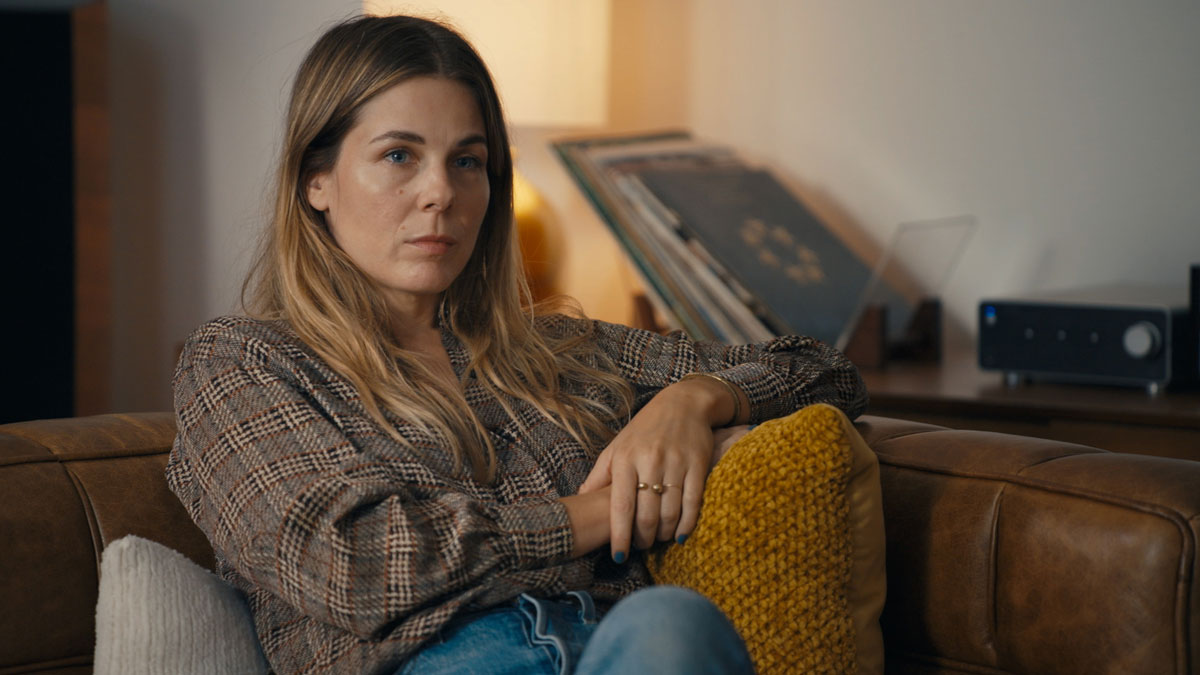
Keep This Between UsKeep This Between Us (Freeform)Honestly, something that I really learned in this documentary is how to extend my compassion to people that I felt had hurt me, or weren’t coming forward, or I felt like had victim blamed me at some point, because we’re all sort of just trying to survive this experience that really is done to us, is not our own responsibility.

Everybody reacts to trauma in a different way. You go into some of the ways people respond.

Teenage girls are kids. Kids act like s***. They’re learning how to be communicative and adults, and it’s okay for teenagers to point the finger at each other. It’s our job as adults to say, “Hey, this is why this is not okay. This is how you apologize. This is how you accept responsibility.” … That’s the problem here is that we treat the teenagers, who get into these situations, the same way that we treat the adults who created the situation. 

Why hasn’t there been action on abuse and grooming in education? Not that there’s exactly been a reckoning, but at least we’re having conversations about these issues in other areas like Hollywood and sports. Why haven’t we talked about it in education so much yet, do you think?

I wondered that the entire time, and I don’t know that I totally have an answer. I have lots of ideas. I think there are a lot more moving parts in the educational system. I think that there are a lot of people who have interest in taking care of their own. I think that there is a huge conservative element to this, which is people don’t want to deal with this kind of shame. 

There is a lot of shame associated with teenage girls being abused by their teachers. I think there’s part of it that’s the whole cover up, and the conspiracy about what is actually happening, and the whole passing the trash aspect. We all know what that means now. It’s become so ubiquitous, that term. There is that aspect of it. I’m not meaning to diminish that that’s a huge part of this, but I think there is another part, which is the biggest part: the shame.

“Our society puts so much judgment on the girls.”

It’s why the administrations go to the parents, and say, “We know that this is happening. We don’t want this splashed on the news. You don’t want to shame your daughter. You don’t want your daughter to lose her scholarship, so let’s just pass this teacher on to another school, and just call it good.” That’s why it continues to happen. I think a lot of that is because our society puts so much judgment on the girls. The girls feel like they have so much to lose by coming forward, that it’s better just to shove this under the rug. 

The biggest thing that I’m trying to change is [to emphasize] you’re not bad, you’re not dirty, you’re not a slut. You didn’t do anything wrong. [It’s] the person that did the thing that’s wrong. That’s what I’m trying to change.

One of the things that I think will always stick with me is how the documentary conceptualizes what happens long term when you’re groomed as a child. How it impacts your whole life. What does someone lose when they’re groomed this way?

The things that I learned when I was in high school were things that had to be sometimes unlearned in college. The way that I learned about history, or the way that I learned about how to relate to other people in my small community. Those were things that when I went to college, I learned, “Oh, I didn’t…” — my teachers were maybe teaching a certain kind of history. Maybe these things weren’t true. That same thing is the exact thing that happens when you’re groomed. You’re being taught things when your mind is malleable. Those things stick with you until you unlearn them. 

The problem is that we don’t have a lot of models for unlearning grooming as adult women. In fact, we’re greater groomed by society because they take the way that we are groomed to be polite, or to defer to men, or to be pretty, or whatever it is that we need to be for society — they take those things and they build on them. This has been happening for so long that I think when the #MeToo movement came around, that was really one of the first times that we realized how deeply this was ingrained in us as children. 

For me, being groomed in this particular way as a child, made me believe that I was in service to my male sexual partners. Maybe that’s a sensational thing to say, but I did not understand how to honor myself in those kinds of ways. That philosophy then extended to what I believed I was emotionally entitled to in a relationship. It extended to what I thought I was entitled to in my career, and the way that I interact with my male peers, and I am in a male dominated field; I’m a film director. Once I started realizing how deeply this thing was ingrained in every single one of my interactions, it was depressing for me. It was overwhelming. It took me a long time to unravel. I’m still unraveling it. I think there’s something to be said about us being groomed by society, but so much of it was to do with how one person isolated me, and then told me what he thought was the way that I should relate to my sexual partners, and to the greater world.


Want a daily wrap-up of all the news and commentary Salon has to offer? Subscribe to our morning newsletter, Crash Course.


Your reality is shaped in a certain way by a certain person with power over you. It takes a long time to unlearn that shaping.

Yeah. Do I say this because he told me I should? Do I like this kind of music because he liked it? Every single part of your personality is called into question. You don’t really understand that until you’ve been groomed as a kid. You don’t understand what that feels like. To call your entire person into question.

“Keep This Between Us” is streaming on Freeform and next day on Hulu. Watch a trailer below via YouTube:


A shrinking Lake Powell could herald an even worse water crisis in the Southwest’s future

As climate change worsens, Americans who live in the Southwest will be hit very, very hard: experts predict that large cities like Phoenix and Las Vegas are going to be uninhabitable within decades, as will the surrounding metropolitan areas in their home states of Arizona and Nevada. Those regions are expected to overheat, like an oven with a temperature that constantly rises; by contrast, as the water cycle intensifies, there is apt to be more flash floods like the ones which already occurred in St. Louis, Mo. and throughout the state of Kentucky.

Already, there are some omens pointing to the Southwest’s harsh future: in particular, Lake Powell, the second largest artificial reservoir in the United States, at least, in terms of its maximum water capacity. Connected to the Colorado River, Lake Powell provides water and electricity (through hydroelectric power) to 4 to 5 million acres of southwestern farmland, the metropolitan areas of Phoenix and Las Vegas, and the Los Angeles and San Diego metropolises — the two largest metropolitan areas of southern California.

That is why experts are so concerned by the news that Lake Powell is shrinking. As of late August, Lake Powell is filled to only 26 percent of its capacity, the smallest it has been since 1967. Just as sobering, nearby Lake Mead is only at 28 percent of its capacity, while the Colorado River system is only at 34 percent.

The low water levels across these reservoirs are a direct consequence of man-made climate change, scientists attest. 

“The connection is direct,” Dr. Michael E. Mann, a distinguished professor of atmospheric science at Penn State University, told Salon by email. “The aridification of the western U.S. Is a long predicted consequence of human caused warming. The drop in levels of Lake Mead and Lake Powell are very clear indicators of this trend because they integrate the hydrological balance over many years.”

Lake Powell is filled to only 26 percent of its capacity, the smallest it has been since 1967.

Daniel L. Swain, PhD, a climate scientist at the Institute of the Environment & Sustainability at the University of California, Los Angeles, wrote to Salon that climate change can be blamed for roughly 40% to 50% of the severity of the megadrought currently afflicting the Southwest. He mainly attributed this to the rising temperatures themselves, as the increased heat causes the atmosphere to suck more water up and reduces the amount of mountain precipitation that falls as snow.

“The shrinking of Lake Powell is due to a number of factors, including the climate change-induced drying noted above, increasing human demand for water in the Basin, and various specific water and dam operation decisions over the years,” Swain explained. “The net effect is that there’s far more demand for Colorado River water than there is actual water in the Colorado River system at this point — and the gap continues to widen as supply dwindles and demand rises”


Want more health and science stories in your inbox? Subscribe to Salon’s weekly newsletter The Vulgar Scientist.


The undersupply of water is going to have a dire effect on the roughly 60 million people who inhabit that part of the country. According to Ali S. Akanda, an associate professor and graduate director of civil and environmental engineering at the University of Rhode Island, the situation has already affected Lake Powell’s appeal as a tourist and recreational site — “for example, the Grand Canyon National Park and the famous river exploration activities are all dependent on water releases from Lake Powell.” But that is just the tip of the iceberg.

“A more significant impact will be on the native reservation communities (Navajo and others) in this dry and arid Lake Powell watershed, who have very limited water infrastructure to begin with,” Akanda told Salon. “Their sources of income, customs, culture, and overall way of life will be deeply impacted if the lake dries up entirely.” He also noted that the water in that area is “hotly contested,” and many highly populated regions will suffer if there is less water.

“A drying Lake Powell will also mean the downstream users in Arizona and Mexico will have no more water flowing from the upstream,” Akanda told Salon, adding that Los Angeles gets approximately 20% of its water from the Lake Powell region. This will have a negative effect on “agriculture, power production, fisheries and ecosystems across the southern part of the Colorado basin,” Akanda noted.

Mann said that the American west will suffer as water dries up.

“It will become increasingly difficult for people in the western US to meet their freshwater needs as supply continues to decrease and population and demand increase,” Mann told Salon. “These trends are on a tragic collision course, under scoring the urgency once again of concerted action on climate.”

“We’re careening toward an even more dire water crisis than has already transpired.”

But will this year’s dried-up Colorado basin be a permanent situation, something that we might see every year in the future? Swain was unsure. “That’s honestly a good question, and no one really knows the answer,” Swain mused. “But it looks like we’re probably going to find out the hard way, since we’re careening toward an even more dire water crisis than has already transpired.”

Kevin Trenberth, climate scientist and author of the book “The Changing Flow of Energy Through the Climate System” explained to Salon by email that when it comes to the Southwest and climate change, one has to remember that every region of the planet has natural variability that will influence how it is affected by Earth’s warming.

“The places affected most at any time are caused not-so-much by climate change, but by natural variability, and the biggest source is the El Niño phenomenon,” Trenberth told Salon. El Niño is the term for a recurring weather pattern that causes higher air pressure in the Western Pacific; some El Niño years result in more water in the Colorado River, and some El Niño years have drastically less water, according to Arizona Republic reporters. Usually, scientists can predict El Niño year a few months before it occurs. Researchers say it can spark droughts in Australia and increase rain and floods in parts of the U.S. and South America. 

El Niño’s corollary, La Niña, refers to an inverse phenomenon, as Trenberth explained. “We have been in a La Niña state for two years now, and going into a third. This favors a storm track across the US that is pushed northwards in general and much drier conditions in the Southwest. So for Lake Powell, it means both the La Niña and global climate change are conspiring against the water levels.”

Yet, in a somewhat ironic twist, the same natural variability that is currently causing the Southwest to dry out may one day have the opposite effect.

“The next El Niño, probably next year, but a year away, could well bring much more rain to the Southwest, and next thing you know there are floods in California and houses toppling into the ocean along the coast!” Trenberth observed. “That is also affected by the winds and sea swells and waves pounding the coast. It is not guaranteed, and even recently there has been some flooding rains in the Southwest, against the more general run.”

Building bold flavors and reducing food waste with fermentation

When we cook, we tend to only use part of each ingredient, leaving skins, stalks, fronds or peels unused and throwing away roughly a quarter of what we buy. But there’s a lot of flavor potential in those scraps, and with a little creativity and some simple tricks it’s easy to unlock. Using as much of each ingredient as you can helps you reduce your carbon footprint, but also helps save money on groceries too, making it a win-win for you and the environment.

There are many different ways to repurpose food scraps that might otherwise end up in the bin, including dehydration, making sauces and pestos, quick pickling, soup stocks, and fermentation. I’ve been teaching classes on reducing food waste for years, and fermentation is always one of the processes that students get most excited about. Here I have pulled together some of my students’ favorite fermentation tricks for reducing waste in the kitchen. I call these pickles, vinegars, drinks and seasoning “scrappy ferments” as a fun way to showcase creative low waste cooking.

Why fermentation?

Fermentation refers to a whole range of different processes for transforming food, resulting in everything from sauerkraut to cheese to vinegar to wine to miso paste. It is a process in which beneficial  bacteria, yeasts, or other microorganisms break down and acidify food, transforming and preserving it. And, it’s an incredibly powerful way to turn your food scraps into something delicious.

It helps to shift your mindset toward whole ingredient cooking: In other words, instead of seeing a carrot as just the root, also think about the tops and peels. What other ingredients do they remind you of? How can you use them in similar ways?

Fermentation is incredibly helpful here because it can transform texture as well as flavor: those carrot fronds can go from raw greens to pesto or a garnish. Tough scraps like broccoli stems can become crunchy-but-not-hard pickles. And, we can either ferment the scraps themselves, like in the lactofermentation recipes below, or we can use the scraps to infuse liquid, like in the recipes for stone fruit vinegar or scrappy booze.

Lactofermentation

Lactofermentation, which is a specific type of fermentation that uses lactic-acid-producing bacteria to preserve foods, is incredibly easy to do, and the result is pleasantly sour, probiotic pickles with a satisfying zing. You can make classic whole pickles (think full sour deli pickles) or use stems and ends like broccoli stems, kale stems, or even carrots that are starting to go soft.

Unlike refrigerator pickles, where a vinegar-based brine is poured over veggies that are then kept in the fridge, these pickles are made with just salt, water and your veggies, which sit out at room temperature to sour as they ferment. To make fermented pickles, just mix up a brine that’s between 2-5% salt (I do ~2 tbsp per quart of water), using plain sea salt or kosher salt. Pack your ingredients into a jar, pour the room temperature brine on top until they’re completely submerged, and allow to ferment at room temperature until they have a flavor you enjoy: I recommend a short ferment on things like kale, which get funky quickly, while other veggies can ferment for several days or even a week.

The same method can be used for hot sauce, too: If you’ve got hot peppers that are on the brink of going bad, along with overripe peaches or other stone fruit, carrot peels, or herbs, you can ferment them just like you do with pickles. The only difference is that you let it ferment until everything is soft, then simply toss it in a blender (brine and all!) and blend to the consistency you want.

You can make a scrappy sort of sauerkraut, too, from your stems, ends, and other leftover bits of raw produce which fermentation expert Sandor Katz calls kraut-chi: just use whatever dense, leafy greens, grated root veggies, or sliced stems and ends to make a delicious fermented condiment: Just use the same method you would use for cabbage sauerkraut.

The most important tip with any ferment is to keep your fruits and veggies below the brine so they ferment safely: I like to pack them in mason jars, close the lid, then carefully open it each day to check their progress. Once they’re ready, simply store them in the fridge.

Infusions

In addition to starting your own fermentation process, you can also infuse your scraps — steep them — in other ferments: vinegar or alcohol. I love making fruit vinegars for sweet and savory applications or to use as a shrub, a sweet and sour drinking vinegar, in cocktails and mocktails, and I make spicy and savory vinegars too (a personal favorite is one made with strawberry and jalapeno tops).

In summer, stone fruit vinegar is a refreshing choice for seasonal food and drink: To make it, just take your overripe peachesplums, or other stone fruits, pit them, and drop them in a jar. Add vinegar to cover and let the mixture steep for two to four weeks, then strain and store in the fridge.

Scrappy booze, or low-waste alcohol infusions, are another favorite and made essentially the same way: Take your flavorful food scraps (like overripe fruit, herb stems, etc.) and add them to a jar, pouring over a neutral spirit (like vodka) to cover. Let the mixture steep for two to four weeks, then strain. You can have a lot of fun experimenting here: I’ve made food scrap-infused vermouth and gin-inspired drinks when I had a lot of herb stems on hand, and you can swap out the vodka for bourbon to make a delicious peach or strawberry infused drink.

Seasoning powders

Sometimes, you’ll ferment a fruit or veggie and the flavor is great, but the texture is not. Or, you strain those peaches from your stone fruit vinegar and wonder what to do with the fruit now. Before you throw any of it in the compost bin, turn to your dehydrator (or your oven set to the lowest temperature) to make a flavorful, fun seasoning to sprinkle on your finished dishes, or to use in place of store-bought seasoning blends in marinades, dressings and sauces. Those dehydrated pickled peaches can be ground up and used as a fun garnish for drinks and desserts, too. These seasoning blends are one of my signature low waste moves and a favorite of my students because they’re easy, taste great and can even make unique gifts. Ask my dad! He is a huge fan.

To make your own seasoning blend, just dehydrate your ingredients until they’re bone dry: You don’t want any moisture left in them. Then, using a mortar and pestle, food processor, or a coffee grinder (not the same one you use for your coffee), grind it into a powder. Store in airtight jars.

A whole world of creativity

These suggestions are just the tip of the iceberg for scrappy ferments, and can help you explore new flavors and tap into your culinary creativity while reducing waste. Fermentation helps not only with preservation and reuse, but with flavor, unlocking the flavors found in your ingredients and bringing a whole new dimension of its own.

Trump demands “new election immediately” in bizarre Truth Social rant

Former President Donald Trump on Monday called for a redo of the 2020 election in an angry rant on his financially imperiled Twitter knockoff app Truth Social.

At 11:39 a.m., Trump stated that he should be declared the winner of the contest that he lost in a landslide to President Joe Biden:

So now it comes out, conclusively, that the FBI BURIED THE HUNTER BIDEN LAPTOP STORY BEFORE THE ELECTION knowing that, if they didn’t, ‘Trump would have easily won the 2020 Presidential Election.’ This is massive FRAUD & ELECTION INTERFERENCE at a level never seen before in our Country. REMEDY: Declare the rightful winner or, and this would be the minimal solution, declare the 2020 Election irreparably compromised and have a new Election, immediately!

Trump’s outrage stemmed from Facebook founder Mark Zuckerberg’s revelation to podcaster Joe Rogan last Thursday that the Federal Bureau of Investigation warned Zuckerberg that articles relating to Hunter Biden’s laptop were pieces of Russian propaganda. Facebook then suppressed posts about the president’s son and his computer.

The FBI said in a statement after Zuckerberg’s interview with Rogan that it “routinely notifies U.S. private sector entities, including social media providers, of potential threat information, so that they can decide how to better defend against threats.”

The FBI also told Fox Business that “foreign threat indicators to help them protect their platforms and customers from abuse by foreign malign influence actors.”

Ex-FBI official worried Trump exposed secrets: “Every competent” spy agency targeted Mar-a-Lago

According to the former deputy Assistant Director of the FBI’s Counterintelligence Division, a myriad of foreign intelligence services were, and still are, focused on getting access to Donald Trump’s Mar-a-Lago resort which makes the shocking revelation that he kept top secret documents there even more disturbing.

Speaking with MSNBC host Katie Phang, ex-FBI agent Peter Strzok said the Florida resort was a hotbed of intrigue.

“Do you agree that it is a possibility that the Russians, especially with that very tight cozy connection that the Russians have had through [Vladimir] Putin with Donald Trump, that they would have been interested and possibly tried to infiltrate Mar-a-Lago to get to some of that data? ” host Phang asked.

“Katie, absolutely the Russians but not just the Russians,” the former FBI official replied.

“Any competent foreign intelligence service, whether those belonging to China, those belonging to Iran, Cuba, certainly including Russia are all interested and are interested in gaining access to Mar-a-Lago,” he continued. “Which, especially considering the information coming out right now about the absolute lack of any control or memorialization of who gets access to Mar-a-Lago at any given time, particularly in the context of the fact it appears the classified documents were strewn all over the facility and not just in the storage room.”

“Classified documents were recovered from his office, from the pine hall, from a multitude of places,” he elaborated. “So, if you are a foreign intelligence service, yes, of course regardless of the knowledge of classified documents being there, the intelligence services are going to have been trying to gain access.”

Watch below or at this link.

Fellow’s 5 best products to elevate your coffee experience — Sponsored

Since its first crowdfunding campaign in 2013, Fellow has taken the coffee world by storm. With each successive product launch, it has consistently delivered a new best-in-class entry for coffee enthusiasts to get hyped about, while also making great coffee more approachable for the average drinker. Beyond the Carter Move Mugs, which I recently wrote about, these are my favorite Fellow products from years of using and testing the entire lineup.

Fellow is perhaps best known for its Stagg kettle. While the control a gooseneck brings is indispensable for pourover coffee, it’s also typically one of the ugliest appliances in a kitchen. Stagg’s EKG, on the other hand, is a work of art with an intuitive one-button operation that you’ll be proud to display. Temperature is controllable to the degree and heating is fast. It comes in pink, there are optional wooden handles and there may or may not be a video game built into the LCD display. From $165.

(courtesy of Fellow)

Meet the electric pour-over kettle for coffee-lovers.

With variable temperature control, 1200 watts for a quick heat time and a world of features for ultimate control, this is the pour-over kettle perfected.

BUY FOR $165

Are Fellow’s Stagg Tasting Glasses the most fragile glassware I’ve ever tested? Absolutely. Do I keep buying more when I break them? Absolutely.

The Stagg glasses were the first Fellow product I owned, and while I certainly don’t have my originals anymore, I’ve never found a double-walled glass I enjoyed drinking out of half as much as these. Their size in the hand is just right, and the lip is perfect. I also can’t argue with Fellow — the shape makes the coffee taste better. $40/pair.

(courtesy of Fellow)

Great coffee has finally met its glass.

These glasses feature a flared lip that delivers coffee to your entire palate, allowing you to taste the full spectrum of flavors.

BUY FOR $40

It was inevitable and highly anticipated that Fellow would eventually try its hand at a coffee grinder. The Ode, its minimalist, quiet, extremely usable take is award winning — and my new daily driver. Thoughtful touches, like a magnetic grind catcher, automatic stop and a knock switch, make the Ode fun to use and easy to clean, while the flat burrs and focus on brewed coffee make for an incredible cup. It’s not the tidiest grinder I’ve ever used, but it’s the best for brewed coffee. From $300.

Fellow’s Atmos Vacuum Canisters are by no means just for coffee, but a good vacuum-sealed vessel is crucial in keeping your beans fresh until grinding. The Atmos is available in clear and opaque options, as well as in multiple colorways. A few twists every few days will keep the contents as oxygen-free as possible, so you don’t lose out on flavor later. From $30.

(courtesy of Fellow)
Keep coffee fresher for longer.
This airtight coffee canister features a simple twist mechanism to remove air and prevent oxidation, which means your coffee — or snacks, sweets and “herbs” — lasts up to 50% longer.

BUY FROM $40

Of course, you can’t have great coffee without . . . great coffee. Fellow’s text-based no-commitment shopping model has become my favorite way to restock fresh beans. Roughly weekly, Fellow will send out a text with the latest coffee offering, and you simply reply with the number of bags you want. Fellow provides a wealth of information about the coffee, along with brewing recommendations. Occasionally, limited promotions will include bundles with travel mugs and other goods. The roasters are the best of the best, including my all-time favorite, Onyx, and pricing is typically around $20/bag.

(courtesy of Fellow)
Yes, weekly coffee offerings by text message.
A rotation of Fellow’s latest coffee obsessions, updated seasonally and whenever a new roast wows them.

BAGS FOR ~$20

Salon Food writes about stuff we think you’ll like. Salon has affiliate partnerships, so we may get a share of the revenue from your purchase.

Ron Johnson complains his own constituents “think I’m a tool of Vladimir Putin”

Sen. Ron Johnson, R-Wis., suggested over the weekend that Democrats are engaging in voter suppression because many people in Wisconsin believe he is a “tool” of Russia.

During a Sunday interview on Fox News, host Maria Bartiromo argued that there was reason to “distrust and question” the honesty of elections.

“That was part of what went on in 2020,” she told Johnson. “People were questioning. Well, can we trust them? We know what they just did in the Russia collusion hoax.”

“You say they are interfering with your election!” the host exclaimed, “because of these smears on you.”

Bartiromo added: “Tell me about your opponent and why you believe you are being smeared and this is the result: 50% for [Mandela] Barnes, 46% for Johnson in the Wisconsin senate race [polls].”

Johnson claimed Democrats “interfered in the 2020 election far greater than anything Russia or China could ever do.”

The senator said that Democrats leaked a briefing about his connections to Russia.

“Basically saying that I’m a tool of Russia, which I am not,” Johnson remarked. “It’s a completely false accusation. The Wisconsin press picks that up and [some] people in Wisconsin think I’m a tool of Vladimir Putin.”

“Nothing could be further from the truth,” he insisted. “But they have smeared me publicly and they just might impact the 2022 election here in Wisconsin as well. Because, let’s face it, Maria, they do not want me reelected because I would be chairman on the permanent subcommittee on investigations. They know I will investigate their corruption.”

Watch the video clip below from Fox News.

“One of the worst offenders”: Palin spreads more misinformation than any GOP candidate, study shows

During the George W. Bush and Barack Obama years, many Republicans steered clear of far-right conspiracy theorist Alex Jones and Infowars. Even Bill O’Reilly, then a Fox News host, was overtly contemptuous of Jones. But during Donald Trump’s presidency, Infowars was granted White House press credentials; the Trump White House treated Infowars much more respectfully than it treated CNN or the New York Times. Conspiracy theorists, once shunned by Republicans, became much more accepted in the GOP — and some Republican members of Congress, including Rep. Marjorie Taylor Greene and Rep. Lauren Boebert, have promoted QAnon conspiracy theories.

According to analysis and research reported in the Washington Post, conspiracy theories and misinformation haven’t become less common among Republicans in the post-Trump era. Instead, the problem has become even worse.

In an article published on August 29, researchers Maggie Macdonald and Megan A. Brown explain, “Over the last several years, there’s been a considerable increase in media coverage about misinformation and conspiracy theories in politics. Former President Donald Trump falsely claimed the 2020 election was stolen, and his January 6 ‘Stop the Steal’ rally led some supporters to attack the U.S. Capitol. Members of Congress, including Rep. Marjorie Taylor Greene (R-Ga.) and Rep. Lauren Boebert (R-Colo.), have repeatedly shared COVID-19 misinformation and embraced QAnon conspiracy theories. And more than 100 Republican candidates in the 2022 midterms continue to promote Trump’s election fraud claims.”

Macdonald and Brown, both of whom are researchers for New York University’s Center for Social Media and Politics, pose the question, “Are candidates for Congress actually sharing more misinformation in 2022 than 2020?” And they answer their own question with a “yes,” citing “analysis of congressional candidates’ Facebook posts.”

“We found that politicians in the 2022 election are sharing more links to unreliable news sources than they did in 2020, and the increase appears to be driven by nonincumbent Republican candidates,” Macdonald and Brown report. “Measuring misinformation on social media is complicated. With billions of posts per day on platforms like Facebook and Twitter, it would be impossible to examine each one for misinformation. Instead, to approximate the level of misinformation shared by political candidates, we relied on NewsGuard, a nonpartisan organization that provides trust ratings for news sources online.”

The researchers continue, “NewsGuard uses several point-based criteria to assess a site’s credibility and transparency, giving each site a score from 0 to 100 based on how well it adheres to those standards. NewsGuard considers those rated at 60 and above, which include such sources as The Washington Post, New York Times and CNN, to be reliable news sites. It considers those rated under 60, which include Breitbart and Daily Kos, to be unreliable. We then examined the NewsGuard scores for news sources shared by Democratic and Republican primary and general election candidates for Congress in 2020 and 2022.”

Macdonald and Brown report that from January-July 2020, 8 percent of the links shared by “Republican congressional candidates” came from “sites rated as unreliable, on average each day.”

“Two years later, Republican candidates were leaning much more on unreliable news sources,” according to Macdonald and Brown. “From January to July 2022, on average each day, 36 percent of news that Republican candidates shared came from unreliable sites, while that was true for only 2 percent of news shared by Democratic candidates each day.”

One of the worst offenders when it comes to sharing misinformation, according to the researchers, is former Alaska Gov. Sarah Palin, who is running for a seat in the U.S. House of Representatives.

“As of July 12, 2022, (Palin) has shared 849 links to unreliable sources, out of 853 total, for more than 99 percent of her shared sources this year,” Macdonald and Brown note. “Palin mostly shares blog posts from her own website, which NewsGuard rates as unreliable. The next closest is Rob Cornicelli, a Republican running in New York, who has shared 88 links to unreliable sources, or 65 percent of his total.”

Trump reportedly snipes at Ron DeSantis for “ripping off” his style: He’s “stealing” from me!

According to a report from Rolling Stone, former president Donald Trump has been alternately raging at and ridiculing Ron DeSantis, (R-Fla.) as the Florida governor has been rising as his heir apparent.

The former president, as well as his family, have been sniping at the Florida Republican by claiming he has been “stealing” from Trump, by which they mean he has been appropriating Trump’s mannerisms when giving speeches as he sets in motion his bid for the 2024 GOP presidential nomination.

According to Rolling Stones’ Asawin Suebsaeng, in the past few months Trump “… has repeatedly ridiculed DeSantis for ripping off the ex-president’s style.”

As one Trump associate told Rolling Stone, “There was this time, maybe a year ago that I remember him making fun of [DeSantis] for doing similar hand gestures and motions. He called it ‘stealing’ from him and [to paraphrase] described it as a lame impression of Trump.”

The report adds, “Trump has a distinctive (and much-satirized) way of gesticulating while casually talking, delivering political speeches, or even ‘firing‘ contestants on his former game show. The sources note that when Trump has seen video clips of DeSantis speaking at public events over the past year and a half, the former president has scornfully mocked the ascendant Florida Republican for appearing to imitate Trump’s body language, movements, and even, at times, speaking rhythm. One of the other sources recalls Trump joking at a dinner event earlier this year that he’d ought to sue DeSantis for copyright infringement.”

Adding credence to their complaints, longtime GOP donor Dan Eberhart suggested, “DeSantis certainly mimics Trump’s style, rhetoric and body language. DeSantis’ bombastic style seems to be ripped straight out of a Donald Trump style guide. Trump proved that Republican voters want a fighter and DeSantis aims to deliver.”

Suebsaeng adds that “Trump — who behind closed doors trashes DeSantis as charisma-free — has even toyed with launching a 2024 presidential campaign near the governor’s mansion in Florida, which would double as an obvious effort to troll DeSantis. The ex-president has been taking stock of who he feels is sticking with him, and who might defect to Team DeSantis, in ‘the Fox News primary,’ and has singled out hosts and informal Trump advisers, like Laura Ingraham, as possible future defectors.”

You can read more here.

“That’s fascist”: Alarm after Trump shares Truth Social warning of “riots in the streets”

Former President Donald Trump on Sunday shared a video on his struggling Twitter knockoff Truth Social of Sen. Linsey Graham, R-S.C., warning of “riots” in the streets if he is indicted.

Graham issued the warning during an interview with Fox News host Trey Gowdy, a former Republican congressman, days after a partially redacted FBI affidavit revealed that investigators had probable cause to believe Trump violated laws related to classified documents, record preservation and obstruction of justice.

“If there is a prosecution of Donald Trump for mishandling classified information after the Clinton debacle… there’ll be riots in the streets,” Graham told Gowdy, who led the infamous House GOP Benghazi hearings.

“Most Republicans, including me, believes when it comes to Trump, there is no law. It’s all about getting him,” Graham later added.

A three-year federal investigation into Hillary Clinton’s use of a private email server for government business cleared her of criminal wrongdoing. Ivanka Trump and Jared Kushner both used private email accounts and messaging apps to conduct government business while working in the Trump White House. Trump, meanwhile, refused to turn over classified documents to the National Archives after repeated warnings from the government, according to the FBI.

Trump shared the video of Graham warning of “riots” on Truth Social shortly after the interview.

Trump’s team has similarly issued warnings to Attorney General Merrick Garland of potential unrest as the Justice Department investigates why he refused to return classified documents. One of Trump’s attorneys after the raid told Jay Bratt, the head of the DOJ National Security Division’s counterintelligence unit, his supporters were growing “angry.”

“President Trump wants the Attorney General to know that he has been hearing from people all over the country about the raid. If there was one word to describe their mood, it is ‘angry,'” the unidentified attorney told Bratt, according to a court motion filed by Trump’s lawyers. “The heat is building up. The pressure is building up. Whatever I can do to take the heat down, to bring the pressure down, just let us know.”

Trump issued a similar message on Truth Social over the weekend.

“The Raid on my home, Mar-a-Lago, is one of the most egregious assaults on democracy in the history of our Country which is, by the way, going to places, in a very bad way, it has never seen before!” Trump wrote on Saturday.

Harvard Law School professor Laurence Tribe compared the post to Trump’s message to Garland.

“Like his recent message to AG Garland suggesting that he could help Garland turn down the ‘heat’ if only DOJ would back off,” he tweeted.

Conservative attorney George Conway, a prominent Trump critic, wrote that the former president is “essentially threatening the country with violence if the laws are applied to him.”

Rep. Bill Pascrell Jr., D-N.J., shared the clip of Graham’s warning on his Twitter feed.

“Top [R]epublicans would rather torch America in violent riots than lose an election or face any accountability for their crimes,” he wrote. “That’s fascist.”


Want a daily wrap-up of all the news and commentary Salon has to offer? Subscribe to our morning newsletter, Crash Course.


MSNBC host Joe Scarborough, a former Republican Florida lawmaker and ex-Trump ally, called out Graham for downplaying the Jan. 6 Capitol riot while warning of “riots in the future, coming from Republicans, coming from his party, coming from Trump Donald Trump supporters.”

“The irony is so rich, these people that talked about riots, Black Lives Matter riots, it’s all they talk about… Yet they’re fine when Trump riots are actually putting democracy at risk, when they’re trying to overturn an election result,” he said. “Lindsey is even fine threatening riots, saying, you know, Trump supporters will riot in the streets, there will be violence if he is held to account, if he broke the law.”

Scarborough added that while Trump and his supporters believe he is above the law, his supporters certainly are not.

“Lindsey, if you are trying to stir up Republican riots, if you think Republicans are going to riot in the street, Republicans are going to riot in the street, they’re not above the law,” he said. “They’ll be arrested. They’ll go through the same thing that people who listened to Donald Trump on Jan. 6 are going through.”

Trump’s threats of riots and violence show he’s desperate, knows legal case is weak

It appears that we are in for another week of pins and needles waiting for court filings in the case of Donald Trump’s stolen classified documents which prompted the FBI to get them to a safe place away where odd wandering MAGA fans and foreign spies can’t get to them. The affidavit for the warrant was released last week and showed that the government had tried for months to get Trump to give the documents back and he either lied saying everything had been returned or made fatuous excuses as to why the government had no claim to them.

Next week we can expect that the Department of Justice will respond to a different judge’s request on Trump’s behalf that they show why they don’t need to appoint a special master to determine if any of the documents should be shielded by executive privilege. If so, that could take months, so Trump’s usual delaying tactics may succeed once again. But, importantly, that’s the only success he’s having at the moment.

Trump and the Republicans originally thought the FBI search would be a big help to his and the party’s political fortunes so they immediately jumped upon it, screeching that the FBI was acting like the Gestapo and predicting the beginning of a civil war. Florida Gov. Ron DeSantis, a Republican, superciliously declared “the raid on [Mar-a-Lago] is another escalation in the weaponization of federal agencies against the regime’s political opponents.!” But it’s not looking like the big winner they thought it was. CBS News polled the question last week and found that a large majority, including 20% of Republicans, believe the search was done to protect national security, not to persecute Trump.

Then this week the Sunday news shows suddenly had trouble finding Republicans who were willing to compare the FBI to the East German Stasi or the Department of Justice’s decision action to Stalin’s Great Purge.

Retiring Senator Roy Blunt, appearing on ABC’s “This Week,” reluctantly admitted that “he should have turned the documents over and apparently had turned a number of documents over” before petulantly whining about the government waiting until it was close to the election before seizing them. (The government, from nearly all accounts, was trying to give the former president a way out of the mess and he refused to take it.) And more directly to Blunt’s complaint, Trump is just a disgruntled former employee at this point sitting on a bunch of highly sensitive national security documents at his resort hotel, he’s not on any ballot in November. Both New Hampshire Gov. Chris Sununu and Maryland Gov. Larry Hogan, both widely touted as moderate Republicans, also hemmed and hawed that maybe the FBI did the right thing but then maybe they didn’t and that we need transparency but that it’s difficult since this is a matter of national security. Their discomfort was palpable.


Want a daily wrap-up of all the news and commentary Salon has to offer? Subscribe to our morning newsletter, Crash Course.


Nobody knows just how bad this thing will turn out to be. Since that first day when the entire GOP participated in their mass primal scream, we’ve learned that Trump had stashed at least 700 documents, some of them marked with the most top secret designations that exist. That’s very difficult for the party that’s been chanting “lock her up” for the past five years to defend.

Trump, meanwhile, has been throwing everything at the wall on this one and none of it seems to be sticking. The political benefits aren’t materializing while the legal threat he faces is so very real. So he’s now deploying his most dangerous strategy, one he hinted at right after the search when he sent a cryptic message to Attorney General Merrick Garland:

President Trump wants the attorney general to know that he has been hearing from people all over the country about the raid. If there was one word to describe their mood, it is ‘angry,’ The heat is building up. The pressure is building up. Whatever I can do to take the heat down, to bring the pressure down, just let us know.”

According to the New York Times, this strange message had the senior leadership at the FBI “befuddled.” I actually doubt that. These are people who prosecute mobsters all the time and they know a veiled threat when they see it. And it’s certainly not the first time they’ve encountered it with Trump. They are in the midst of the largest investigation in history with the January 6 insurrection cases which are a direct result of his incitement. He was letting the Attorney General know that he might have to unleash his mob again if they pursue this case and they know it.

The man is a criminal and he’s blatantly asserting that he is immune from the laws that govern the rest of us.

This isn’t the first time he’s made that threat, either, and in the past he was more explicit. At a rally in Texas last January he ranted about the various legal threats he is facing, telling the cheering throng:

“If these radical, vicious, racist prosecutors do anything wrong or corrupt we are going to have in this country the biggest protests we have ever had.”

Remember, he called Jan. 6 a “protest” too. And at that same rally, he promised to pardon all the insurrectionists.

After Trump and the Republicans went on their tirade about the Mar-a-Lago search there were numerous threats against FBI agents, with one actual assault resulting in a devoted MAGA follower being killed by police. The extremists are exercised and Trump continues to egg them on. Posting on his Truth Social site he degrades and defames the FBI and the Department of Justice in the lurid terms he usually reserves for Democrats and the media. Holding nothing back, he’s daily making a case for an armed uprising. For instance:

“The law enforcement of our Country has become that of a Third World Nation, and I do not believe the people will stand for it ― between Fraudulent Elections, Open Borders, Inflation, giving our Military to the Enemy, and so much more ― how much are we all expected to take?”

He posted this to his social media site on Sunday:

FBI Director Christopher Wray called the threats “dangerous and deplorable.” And while I do think that talk of outright civil war is hyperbolic, threats of street violence and domestic terrorism are all too real.

Unfortunately, this strategy seems to be catching on with his toadies and minions in the party:

This is, of course, the source of Trump’s power and it is powerful.

Unfortunately, this strategy seems to be catching on with his toadies and minions in the party

There is no doubt that the DOJ and law enforcement as well as the courts are aware that he has a rabid following that has demonstrated its willingness to commit violence on his behalf. But at some point, they will have no choice but to act if they want to preserve what’s left of the government’s integrity. The man is a criminal and he’s blatantly asserting that he is immune from the laws that govern the rest of us.

The fact that Trump is leveraging this particular power to incite violence around these legal cases is a sign of weakness. He cannot persuade anyone who isn’t already persuaded and party officials are with him only out of fear or as long as he is useful to them. Calling for riots in the streets is a nuclear option that may or may not detonate the way he thinks it will. But it has the potential to blow the country apart either way. 

Trump’s followers are delusional and dangerous — but don’t call them hypocrites

Throughout his presidency and beyond, Donald Trump has proven to be a public menace, quite possibly the most dangerous person in the world. His evident crimes and other acts of perfidy, both as president and subsequently, are almost too numerous to list: collusion with a hostile foreign power to subvert an election, conspiracy to obstruct justice, a coup attempt that involved a terrorist attack on the Capitol, incitements to political violence, fraudulent claims and conspiracy theories about election fraud, democide through willful negligence and corruption during the pandemic, using the office of the president to personally enrich himself, and extortion or blackmail against the leaders of Ukraine, possibly leading to the Russian invasion. 

It’s important to understand that Trump’s followers and voters love him because of his wrongdoing and disregard for the rule of law and democracy, not despite those things.

Trump is at long last under investigation by the Department of Justice for a variety of offenses involving the highly classified documents he stored at Mar-a-Lago, including obstruction charges and violations of the Espionage Act. More than two weeks after the FBI searched Trump’s residence and recovered numerous boxes of documents, the seriousness of these charges is coming into focus. At the Guardian, reporter Hugo Lowell writes: “The details contained in the affidavit used to secure a warrant to search Mar-a-Lago … offered the clearest insight yet into the basis for the FBI’s seeking permission to search the resort”:

[T]he FBI needed to forcibly retrieve the United States government’s most sensitive secrets, especially after it came to suspect Trump and his team were holding on to classified documents despite repeated efforts — including with a subpoena — to secure their return.

Most pressing, according to the affidavit, was that the FBI had identified probable cause that documents containing national defense information were scattered across Mar-a-Lago, potentially jeopardizing intelligence gathering and revealing the identities of human clandestine sources…. the affidavit … also showed how Trump had previously retained government secrets at Mar-a-Lago after he was no longer president.

The FBI noted that after Trump finally returned around a dozen boxes of materials to the National Archives this year, an FBI triage found 184 unique classified documents, including 25 marked top secret, 92 marked secret, 67 marked confidential, and some with Trump’s distinctive handwriting.

The documents also included some with markings like “SI” for special intelligence, “HCS” for intelligence from human clandestine sources, “NOFORN”, for “Not Releasable to Foreign Nationals”, “FISA” for the “Foreign Intelligence Surveillance Act”, and “ORCON”, which restricts non-US dissemination.

In a front-page story last Friday, the New York Times highlighted the potential life-and-death consequences of the kinds of documents described in the FBI’s affidavit, noting that some of this information came from highly classified sources who risk “imprisonment or death stealing the secrets of their own governments”:

Their identities are among the most closely protected information inside American intelligence and law enforcement agencies. Losing even one of them can set back American foreign intelligence operations for years.

Clandestine human sources are the lifeblood of any espionage service. This helps explain the grave concern within American agencies that information from undercover sources was included in some of the classified documents recently removed from Mar-a-Lago … raising the prospect that the sources could be identified if the documents got into the wrong hands….

C.I.A. espionage operations inside numerous hostile countries have been compromised in recent years when the governments of those countries have arrested, jailed and even killed the agency’s sources.

Last year, a top-secret memo sent to every C.I.A. station around the world warned about troubling numbers of informants being captured or killed, a stark reminder of how important human source networks are to the basic functions of the spy agency.

During the early part of last decade, the Chinese government dismantled the C.I.A.’s network of sources within China — crippling the agency’s spying operations in the country for years. Source networks in Iran and Pakistan have also been compromised, prompting the agency to ask its case officers and analysts to redouble the efforts to protect the identities of spies and informants.

Even a single source, if well placed, can be of amazing importance to the spy agency. When one informant, critical to the intelligence assessment that President Vladimir V. Putin of Russia favored the election of Mr. Trump, had to be extracted and resettled in Virginia, the C.I.A. was, for a time, left somewhat in the dark about senior levels of Kremlin decision-making.

Experts quoted by the Telegraph were even more explicit about the possible implications of Donald Trump’s alleged crimes:

Steve Hall, former CIA chief of Russia operations, said: “That’s basically information from human spies. ‘HCS’ stuff, basically, means there’s information in those boxes in the basement in Mar-a-Lago that pertain to, or potentially came from, human sources, human spies.

“In the case of human sources, they usually get imprisoned, or if it’s Russia or another authoritarian society they’re oftentimes simply executed. That type of information is incredibly sensitive.”

He added: “As a former CIA guy it sends chills up and down my spine that there’s HCS information in somebody’s basement. It’s really, really bad.”

Harry Litman, a former US attorney, said such documents were “radioactive”. He told CNN: “The top secret stuff…can get people killed. it is completely alarming.”

It appears possible that Trump may finally face justice. Writing at the Daily Beast, national security lawyer Bradley Moss predicted that Trump “will be indicted by a federal grand jury”: 

You heard me right: I believe Trump will actually be indicted for a criminal offense. Even with all its redactions, the probable cause affidavit published today by the magistrate judge in Florida makes clear to me three essential points:

(1) Trump was in unauthorized possession of national defense information, namely properly marked classified documents.

(2) He was put on notice by the U.S. Government that he was not permitted to retain those documents at Mar-a-Lago.

(3) He continued to maintain possession of the documents (and allegedly undertook efforts to conceal them in different places throughout the property) up until the FBI finally executed a search warrant earlier this month.

That is the ball game, folks. Absent some unforeseen change in factual or legal circumstances, I believe there is little left for the Justice Department to do but decide whether to wait until after the midterms to formally seek the indictment from the grand jury….

Get the popcorn ready either way.

Predictably, Trump continues to protest he did nothing wrong — and continues to incite acts of violence by his followers. Public opinion and other research shows that a majority of Republicans refuse to believe that Trump has committed any crimes — and also support his coup attempt, the attack on the Capitol on Jan. 6, 2021, and the Big Lie about the 2020 election.

Fascism at its core is unrestrained and corrupt power that manifests through violence, destruction, collective mental pathology and greed. As part of that dynamic, fascism and other forms of authoritarianism create a state of malignant normality in which right and wrong are inverted — if they are even understood to exist independent of the Great Leader and his movement’s collective will and desires. In that political imaginary, good and bad, right and wrong, and ethics and morality more generally are a function of ideology and politics, not something outside them.

As such, in the alternate universe of MAGA and the larger right-wing echo chamber, it is categorically impossible to see Donald Trump as a criminal or law-breaker.


Want a daily wrap-up of all the news and commentary Salon has to offer? Subscribe to our morning newsletter, Crash Course.


For Trump’s followers, anything and everything he does amounts to “fighting for people like them” and defending “their values” — those of “real America” — against the imagined enemy of the moment, whether that is “wokeness,” the Black Lives Matter movement, LGBTQ equality, Muslims, immigrants or something else. 

Trump’s followers and other neofascists do not simply reject the concept that rule of law should apply to all people equally; rather, they understand the law as a weapon they can use to impose their will on others. Such logic is a defining feature of fascism. In recent comments to Salon, historian Federico Finchelstein addressed this:

His [Trump’s] threats of violence should be taken very seriously, because dictatorship and even fascism seem to be the endgame of Trumpism. In Nazi Germany, the “truth” of the leader was judicially constructed to the full extent as a replacement for more rational forms of law. Juridical truth was equated with the transcendental nature of the leader. Hitler famously represented himself as “the supreme judge of the Nation.” The result was the destruction of legality.

[Pro-Nazi philosopher] Carl Schmitt … fully understood the Nazi notion of truth when he stated that Hitler was “not subjected to justice” but rather constituted the highest form of justice.

It is clear that Trump conceives of himself as a supreme judge in that specific fascist sense, which replaces justice with the leader’s corrupt and narcissistic sense of legality.

Trumpism, like fascist movements of the past, is a type of political personality cult. In such a relationship, followers identify with the leader in a deeply intimate way as an extension of their own ego, identity and self. The movement takes on its own type of collective energy and identity in which the individual is subsumed. Social psychologists and other experts have documented how that group dynamic works to diffuse individual responsibility and ultimately encourage antisocial and other destructive behavior, up to and including murder and genocide.

In the MAGA alternate universe, it is categorically impossible to see Donald Trump as a criminal or law-breaker. Anything and everything he does is understood as “fighting for people like us.”

These feelings explain why Trumpists are willing to use violence to defend their leader. By extension, Trump’s political enemies present an existential threat to members of the political cult. In that unhealthy relationship the leader’s pathologies — in the case of Trump, sociopathy if not outright psychopathy — are mirrored by the followers in an escalating feedback loop.

Trump’s followers therefore identify with his lawbreaking and other antisocial behavior, while also being compelled to rationalize it as both necessary and good. Love for Donald Trump and what he represents becomes the means and medium through which his followers resolve that cognitive dissonance.

By email, Shawn Rosenberg, a professor of political science and psychology at UC Irvine, wrote that the desire for an “anti-democratic strongman and disregard for rule of law are very strongly associated with: 1) populism, 2) seeing a homogeneous people as desirable or necessary, 3) being anti-Black, antisemitic and anti-immigrant, 4) having a simple dualistic, black/white view of political issues and morality and 5) being anti-elite.”

Too many liberals, progressives, Democrats, centrists, and others outside of the MAGAverse love to accuse Trump and the right-wing movement of being hypocrites or applying a double standard for their own behavior. This is an absurd claim: In reality, the Trumpists and Republican fascists do not hold any norms or standards beyond winning at all costs. To call them hypocrites assumes that they care and might somehow change their behavior. It is a waste of time and energy.

Reece Peck, a professor of media culture at College of Staten Island and the author of “Fox Populism: Branding Conservatism as Working Class,” offered these insights about the role of the right-wing propaganda machine in creating our “post-truth” political battlefield:

Rupert Murdoch’s Fox News did more to partisanize American journalism than any other news organization in the 21st century. Within the hyper-partisan news market Fox did so much to create, the choice being offered is not one between disinterested, unbiased news versus interested, biased news as was the case in the past. Rather the choice now is between two types of interested styles of journalism, one that helps “our” side and one that helps “their” side. Following this partisan-tribal logic, Fox’s top opinion hosts strive to show how their news analyses are indeed biased, precisely because they support the interest of Donald Trump, who serves as a proxy for the conservative base.

Like Trump, conservative media endows journalistic interpretations with the capability to determine the nation’s destiny, a media power so menacing that Fox hosts deemed countering the negative press Trump was receiving for his handling of the Covid-19 crisis more important than the physical threat of the outbreak itself.

Once a news audience begins to conceptualize journalism as a winner-take-all, political-ideological war, pointing out the hypocrisies and intellectual inconsistencies (e.g., Blue Lives Matter vs. Defund the FBI) of their favorite politicians and media personalities becomes a fruitless endeavor. If leftists have any chance of capturing segments of the conservative coalition — namely the ones that respond to anti-elitist framing over ethno-nationalist messaging — it will be because they devised more compelling moral narratives and aesthetic news styles, not better fact-sheets and info-graphics.

Unfortunately, even after six years, too many Democrats and others who are supposedly fighting to defend American democracy still do not understand the fundamental nature of Trump, the Republican-fascists and their movement — and what must be done to defeat it for all time. Shouting “hypocrites!” at fascists and other authoritarians is the behavior of those who know that they are doomed. It is akin to the desperation felt by those who scream “History will judge!” as they are being ground under.

The fascist fever-dream is intoxicating for Trump’s followers, who thrill to his lawlessness and his crimes against democracy and human decency. Very few of them realize that the fascist fever-dream and its fumes is ultimately toxic to them as well.

At Donald Trump’s rallies, he has many times recited a poem about a poisonous snake that a woman invites into her home when she finds it freezing outside on a cold night. Once revived, the snake bites her. “Why would you do that,” she wails, “when I just saved your life?” The snake replies, “You knew what I was when you took me in.”

Trump uses this fable to serve his own purposes, but its real meaning is clear: He is that snake. Like other demagogues and would-be tyrants, Trump has no use for anyone but himself. If we know anything about him, we know that at some point he will turn against even his most adoring followers and most loyal members of his inner circle. Whenever Trump believes it convenient or necessary, they will become the new enemy. 

It is a small, faint comfort of history that those who support fascism and other forms of political evil are eventually devoured by the machine and madness they helped to feed, nurture and protect. Unfortunately, that fascist beast, be it here in America or in other parts of the world at other times, consumes the innocent and the good before it feasts on its own people and caretakers.

American Muslims are successful, optimistic and patriotic: But Islamophobia is worse than ever

On Aug. 17, 2021, two days after the fall of Kabul to the Taliban, videos circulated of terrified Afghans clinging to airplanes as they were taking off, jam-packed with refugees in their cargo bays. Then we saw images of bodies falling tragically from those planes to their death. The fall of Kabul was harrowing to watch and those were some of its most disturbing images, but they paled in comparison to what came next.

T-shirts. Not just any T-shirts. The slogan type, that get printed on-demand when you order them. These T-shirts, which showed up, for example, on Etsy, featured silhouettes of two people falling from a military-style aircraft with a header that read “Kabul Skydiving Club” and below, “Est. 2021.” The product description read: “Featuring the scene of the plane flying in the sky and suddenly, there are two people falling from it, the Kabul Skydiving Club Shirt is officially becoming a phenomenon and goes viral on the Internet!”

Imagine a similar type of shirt being sold with silhouetted images of people jumping out of the burning Twin Towers with the slogan “WTC Skydiving Club, Est. 2001.” Would you buy that?

To be fair, the “Kabul Skydiving Club” T-shirts were met with swift condemnation in the social media community, forcing Etsy to eventually remove them from the site, though they can still be found on other platforms. But the really disturbing part of the story is the fact that they existed at all, and what it reveals about the toxic nature of Islamophobia. If you can imagine the “Kabul Skydiving Club” shirts, but can’t imagine a Twin Towers equivalent, then you already see my point.

The reason for this stark disparity in compassion lies not just in the stereotyping of Muslims; it is because the stereotyping is completely dehumanizing. Recall that in the 20-year war in Afghanistan there were numerous stories of U.S. and allied military personnel committing outrageous human rights violations. In addition to the state-sanctioned torture and murder of Afghans in places like the Bagram airbase, in 2010 five U.S. Army soldiers were charged with murdering three Afghans and collecting body parts as trophies, in 2012, Army Staff Sgt. Robert Bales massacred 16 civilians in Kandahar, and in 2012 a video surfaced of four Marines urinating on dead Afghans.  

But that’s not even all of it. One of the men caught in that video said, a year later, that he’d gladly do it again. An Al Jazeera article noted that in the wake of the Kandahar massacre, mainstream news failing to even mention the names of the victims. Again and again, we saw not just the reporting of a war crime, but also evidence of a profound inability to see the Afghan people as human, or even living creatures deserving of care. As a point of comparison, imagine what would have happened if soldiers had been recorded peeing on dead cats and then bragging that they’d do it again.

Back on U.S. soil, Islamophobia mirrored these acts, even if the generalized level of hate was less violent. Political scientist Costas Panagopoulos conducted a study released in 2006 showing that public sentiment toward Muslims in the United States combined low levels of awareness of basic elements of Islam with growing anxiety and antipathy towards the community.

But here’s the thing: As horrible as it has been to document the rampant Islamophobia in the United States since the attacks on the World Trade Center in 2001, one would have expected that, with the distance of time, some of the aggressive stereotyping of the Muslim community might wane. That hasn’t happened. Instead, it is both on the rise and increasing its spread across American society.

It would be a mistake to think that 9/11 marked the starting point for U.S. Islamophobia. In fact, Khaled Beydoun, author of “American Islamophobia,” notes that structural Islamophobia dates back to the 18th century. Yet there is little doubt that after 9/11 Islamophobia spiked and was then exacerbated by the unabashed disparaging of the American Muslim community by the Trump administration. Faiza Patel notes that Trump’s “vitri­olic anti-Muslim campaign rhet­oric was a preview for an unprecedentedly Islamo­phobic admin­is­tra­tion.”


Want a daily wrap-up of all the news and commentary Salon has to offer? Subscribe to our morning newsletter, Crash Course.


What’s especially concerning now is that the Biden administration has not led to any significant reduction in Islamophobia. If anything, as evidenced by a number of recent studies, American Islamophobia has only become more entrenched, more normalized and more widespread. In May 2022, the Council on American-Islamic Relations (CAIR) reported a 9% increase in the number of civil rights complaints it received from Muslims in the United States since 2020.

Islamophobia in the U.S. is also highly funded. In June 2022, CAIR found that from 2017-19, roughly $105.9 million was poured into 26 Islamophobia network groups to spread misinformation and conspiracy theories about Muslims and Islam.

New research by a team at Rice University shows that Muslims in America are five times more likely to experience police harassment due to their religion compared to those of other faiths: “The post-9/11 geopolitical environment has created a tense relationship with law enforcement for Muslim American communities. Many Muslim Americans fear state-sanctioned police surveillance through actions such as online tracking, airport security, routine stops, or monitoring within religious spaces.”

Last week, the Institute for Social Policy and Understanding released a status report with data from a nationally representative poll capturing a snapshot of diverse American Muslim experiences and trends over time. The report finds an alarming degree of Islamophobia in U.S. society. For example, nearly half of Muslims, or 46 percent. reported encountering religious discrimination from a social media platform.

The ISPU’s recent data includes two additional findings of great concern. First, Islamophobia is increasing within the Muslim community, particularly among young Muslims. ISPU finds that “internalized Islamophobia is more prevalent among younger Muslims, who have lived the majority of their lives after 9/11/2001, in a country that has demonized their identity in popular culture, news media, political rhetoric, and in policy.”

The group also note an alarming spike in Islamophobia within the white Muslim community, “who are also the most likely to report experiencing ‘regular’ religious discrimination.” They suggest that this internalized racism may be “a defense mechanism against the trauma of bigotry.”

Secondly, Islamophobia is on the rise in schools. The ISPU report notes that 48 percent of Muslim families with school-age children reported a child who faced religious-based bullying in the past year. This degree of bullying is starkly higher than that of other communities: Only13 percent of Jewish families and 18 percent of the general public report school bullying. One-fifth of Muslim families report that the bullying occurred practically every day. 

These findings are confirmed by CAIR, which also found extremely high levels of school bullying for Muslim American children. In Massachusetts, for example, 61 percent of children report being made fun of, verbally insulted or abused for being Muslim. They report that such incidents always spike around the anniversary of 9/11.

Extreme levels of Islamophobia in the U.S. point to more than just a problem of negative stereotyping. They reinforce the way that Muslims have been dehumanized, characterized as less than human. If prejudice is attributing common negative qualities to an entire group, dehumanization is doing so in a way that strips the group of its humanity entirely.

Islamophobia in the U.S., then, is an example of dehumanization, not prejudice. This dehumanization explains why the successes and accomplishments of the American Muslim community remain eclipsed by a culture of hate. For example, the ISPU report notes that American Muslims are job creators: “Self-employed Muslims employ an average of eight workers, resulting in at least an estimated 1.37 million American jobs created.” And they are overall highly educated, with 46 percent of American Muslims over age 25 reporting a college degree.

American Muslims also serve in the military on par with other groups. White Muslims, in fact, are more likely than white Americans in general to serve in the military (17 percent vs. 11 percent).

Perhaps even more striking is the finding that, despite suffering extreme levels of Islamophobia, American Muslims are more likely than all other groups to express optimism about the direction of the country. Positive sentiments about the U.S. are shared by 48 percent of Muslims, 31 percent of Jews, 24 percent of Catholics, 17 percent of Protestants, a startlingly low 4 percent of white evangelicals, 17 percent of the nonaffiliated and 18 percent of the general public overall.

Moreover, despite reporting higher levels of voter repression, American Muslims vote. In fact, ISPU reports that the harder it is for Muslim Americans to vote, the higher their intentions to do so. Voter registration among Muslims has climbed significantly, from 60 percent in 2016 to 81 percent in 2022, on par with the general public (84 percent).

Despite misperceptions of the Muslim community as violent and a threat, it turns out that Muslims Americans reject violence against civilians at a higher rate than white evangelicals (80 percent vs. 62 percent). Pew Research has found, in fact, that more Muslim Americans believe in the “American Dream” than the general public. Do these findings suggest that American Muslims love their country despite considerable evidence that it hates them in return? If Muslim Americans are active, engaged and patriotic citizens working to make U.S. society better, why has that story been so deeply buried?

Again and again, widely shared negative perceptions of Muslim Americans do not match what Muslim Americans themselves believe, or the value they bring to American society. That leads us to the real takeaway from these recent studies: The problem isn’t just rampant Islamophobia; it is the narrowness of the representation of Muslims as either demonized villains or helpless victims. Dehumanizing representations like the “Kabul Skydiving Club” shirts can produce only two real reactions: mocking approval or concerned outrage. In both scenarios, the diverse and complex humanity of the community is displaced by nothing more than a black silhouette.

The ISPU report ends by suggesting that the media should “portray Muslim communities accurately and creatively, keeping in mind the impact of trope-perpetuating media on Muslim self-concept, and public acceptance of prejudiced and anti-democratic policies.”

What would happen if we replaced the images of dehumanized Muslims being bullied, dismembered, mocked and peed on with images of Muslims creating jobs, graduating from college, voting and serving their country? But of course that kind of humanized representation doesn’t fit on a T-shirt.

Ted Cruz bashes “slacker baristas” now benefitting from Biden’s student debt relief

U.S. Sen. Ted Cruz took a thrashing from progressives on Friday after he underhandedly acknowledged that President Joe Biden’s move this week to cancel up to $20,000 in student loan debt per borrower is likely to help Democrats in the upcoming 2022 midterm elections.

“If you are that slacker barista who wasted seven years in college studying completely useless things, now has loans, and can’t get a job, Joe Biden just gave you 20 grand,” Cruz said on his Verdict podcast.

“Maybe you weren’t gonna vote in November,” he added, “and suddenly you just got 20 grand, and if you can get off the bong for a minute and head down to the voting station, or just send in your mail-in ballot that the Democrats have helpfully sent you, it could drive up turnout, particularly among young people.”

Responding to Cruz’s remarks, U.S. Sen. Bernie Sanders (I-Vt.) tweeted “this is what a leading Republican thinks of young ‘slacker’ Americans who took out loans to go to college.”

Educator Chris Williams tweeted: “Apparently myself, a public school teacher who joined the Peace Corps out of college, and currently with over 20k in student loans after graduating in 2009, is a slacker according to Ted Cruz. Good to know.”

Status Coup podcaster Jordan Chariton said on Twitter, “I’ve interviewed many ‘slacker baristas’ who work much harder and are MUCH smarter than Ted Cruz.”

Cruz has been a vociferous critic of student debt relief. On Wednesday, he issued a statement condemning Biden’s move and dubiously claiming on Twitter that it would “cost every taxpayer an average of $2,100.”

It was far from Cruz’s first questionable—if not downright false—tweet, which have run the gamut from defending former President Donald Trump’s “Big Lie” that Democrats stole the 2020 presidential election to claiming that the Biden administration was going to fund the distribution of free crack pipes.

Trump’s lawyer believes Mar-a-Lago raid happened because Liz Cheney lost primary

Former President Donald Trump’s personal lawyer Jenna Ellis claimed on Sunday morning’s edition of Newsmax’s Wake Up America that the Federal Bureau of Investigation executed a search warrant at Trump’s Mar-a-Lago retreat in Palm Beach, Florida on Monday, August 8th because Congresswoman Liz Cheney (R-Wyoming) lost her primary race to Trump-backed challenger Harriet Hageman.

The Cheney-Hagemen contest occurred on Tuesday, August 16th, more than a week after the FBI recovered hundreds of extremely sensitive documents from Trump’s estate.

“This is yet another next thing in the line of what the Democrats are targeting President Trump with,” Ellis, a constitutional law attorney, griped without providing any supporting evidence.

“Look, we’re not hearing anything about January 6th anymore,” Ellis proclaimed. “The timing of this is so suspicious because right after Liz Cheney loses her primary, and everything about the January 6th Committee is going away, now this raid happens.”

Cheney is the Vice Chair of the House Select Committee to Investigate the January 6th Attack on the United States Capitol, which revealed its findings in eight public hearings over the summer. While future proceedings have not yet been scheduled, the bipartisan panel is continuing its probe into Trump’s role in the deadly insurrection.

Ellis added that the Justice Department’s criminal pursuit of Trump “is the next mantra. This is the next thing that [Representative] Eric Swalwell [D-California] is tweeting, saying, ‘the walls are closing in.'”

Watch below:

How gay rodeos upend assumptions about life in rural America

The misguided assumption that rural America is hopelessly backward and bigoted erases centuries of same-sex relationships in rural communities. It tells young queer people that they must flee their rural hometowns to far-flung cities in order to find safety and acceptance.

That’s why we see so much value in the work of photographer Luke Gilford. For “National Anthem,” his collection of images on display at Manhattan’s SN37 Gallery, Gilford photographed participants in the International Gay Rodeo Association. Many of his subjects have fought for decades to be seen as legitimate riders in the rodeo world, bringing their rural sensibilities and queerness to arenas across the country.

As scholars of gender, sexuality and the American West, we’ve spent years studying gay rodeoers. Through the Gay Rodeo Oral History Project and other research, we’ve been able to highlight the experiences of Gilford’s subjects and reveal the complexities of rural America.

We know that queer people have always belonged in rural places and have always participated in rural traditions. And we hope that the unashamed presentation of queer, rural rodeoers refutes the lazy dichotomy of the urban queer progressive versus the rural homophobic conservative.

The fantasy of the straight, white cowboy

The cowboy has long stood as a symbol of American values and virile masculinity. But this understanding of the cowboy hides a more complex reality.

Cowboys were once the outcasts of Victorian American society. They tended to be poor nomads, and ranch work and cattle drives attracted a racially diverse workforce, including Black, Hispanic, Indigenous and Chinese residents of the American West.

As the frontier way of life faded in the late 19th century, a nostalgia for cowboys soon emerged in American culture. Artists like Frederic Remington and entertainers like Buffalo Bill Cody glorified them through their art and Wild West shows.

By the 1950s and 1960s, movie Westerns featured actors like John Wayne and Clint Eastwood. Nearly all of these depictions portrayed the cowboy as white, straight and male. Black and Indigenous cowboys, as well as women riders, gradually disappeared from the national imagination.

The origins of gay rodeo

The symbolism and iconography surrounding cowboys matters a great deal. In the 20th century, the American West became intimately associated with a national American identity. The image of the cowboy, if he looked and acted a certain way, determined who could and couldn’t be a “real” American.

Yet many queer people living in rural areas in the 1970s and 1980s refused to relinquish their claim to a rural – and an American – identity.

They were inspired, in a way, by the emergence of the urban cowboy phenomenon in fashion, film and country music. The cowboy was just one of the models of desirable masculinity that emerged in the post-World War II era for gay men. Urban gay bars adopted country-western motifs, attracting a clientele of urban “wannabe” cowboys and rural transplants looking for a community that reminded them of home. Soon, there was a real enthusiasm and appetite among queer people for a rodeo of their own.

Phil Ragsdale, a businessman from Reno, Nevada, organized the first gay rodeo in 1976 as a fundraiser, with proceeds benefiting the local senior center and the Muscular Dystrophy Association. The National Reno Gay Rodeo took place annually from 1976 until 1985, drawing tens of thousands of spectators. In 1985, the International Gay Rodeo Association formed, bringing together other gay rodeo associations, standardizing rules and creating a formal circuit for participants.

Rural queer folk went on to create other spaces that could exist beyond the imagined restraints of rural and urban life: gay country-western bars, square dances and clogging groups.

Though not all gay rodeoers come from rural backgrounds, many do. They often describe leaving their own small towns and rural communities for queer life in the city. Rather than encountering a comforting sanctuary, some found it difficult to fit in.

In an interview for the Gay Rodeo Oral History Project, gay rider Joe Rodriguez described the discomfort he felt upon moving to San Fransisco: “It was day and night coming from a rural community where I grew up, moving to the city, but it still wasn’t right, wasn’t the right fit.”

He didn’t feel at home in the city until he found a community with other queer cowboys.

The space between

Homophobes tended to condemn gay rodeo as an attack on the cowboy’s traditional place in American culture. Gay men were thought to be too effeminate and too weak to don the same getup as John Wayne.

Opposition intensified with the AIDS epidemic, along with the rise of an emboldened political and religious right. Four years after the first gay rodeo, America elected Ronald Reagan, a stalwart conservative who played cowboys on the silver screen, as its 40th president.

Gay rodeoers struggled to withstand the tide of discrimination and tragedy.

As gay rodeoers worked tirelessly to raise money for charity, some non-LGBTQ organizations started refusing to accept donations from rodeos affiliated with the International Gay Rodeo Association.

Death and loss became a fact of life.

“I had a lot of friends,” recalled a rodeoer named Brian Helander, “and I can say that of probably 100 people that I would call friends, probably three of those survived.”

Yet as self-proclaimed “queer cowfolx,” they continued to occupy spaces they were told they had no right to, and they filled their rodeo arenas with same-sex dances, camp rodeo events and drag entertainers to raise money for AIDS and other LGBTQ organizations. In creating a space that allowed for overlapping – and sometimes conflicting – identities, gay rodeoers have upended some of the long-held understandings of queerness.

Above all, they’ve made it their mission to rupture ossified notions about who has the right to lay claim to the identity of cowboy – and, by extension, American.

Rebecca Scofield, Associate Professor of History; Chair of the Department of History, University of Idaho and Elyssa Ford, Associate Professor of History, Northwest Missouri State University

This article is republished from The Conversation under a Creative Commons license.

Inside Jennifer Aniston’s feud with her “petty” mother which left them not speaking for years

Just because someone’s life might look perfect on our TV screens, doesn’t mean there isn’t trouble behind closed doors. For actress Jennifer Aniston, she’s previously said that the reason she was able to deal with fame and the spotlight as she became a household name with “Friends” was because of her mother. But not exactly because her mom, late actress/model Nancy Dow, was supportive.

In contrast, Aniston explained that because her mom sat “comfortably in victimhood” throughout her childhood, she had an example of who she didn’t want to be as an adult. So what exactly happened between the 53-year-old star and her late mother? The actress has been pretty open about their “toxic” relationship.

In a 2015 interview with The Hollywood Reporter, Aniston gave fans a glimpse into her relationship with her mom, including some experiences that left them not speaking for years. Though the actress has not confirmed how long they weren’t on speaking terms, The Things claims it was for a whopping 15 years.

“She had a temper. I can’t tolerate that,” Aniston said of her mother. “If I get upset, I will discuss [things]. I will never scream and get hysterical like that. [But] I was never taught that I could scream. One time, I raised my voice to my mother, and I screamed at her, and she looked at me and burst out laughing. She was laughing at me [for] screaming back. And it was like a punch in my stomach.”

Aniston added:

“She was critical. She was very critical of me. Because she was a model, she was gorgeous, stunning. I wasn’t. I never was. I honestly still don’t think of myself in that sort of light, which is fine. She was also very unforgiving. She would hold grudges that I just found so petty.”

According to multiple sources, Aniston chose not to invite her mom to her weddings to Brad Pitt in 2000 and Justin Theroux in 2015. Dow had given a few interviews about her relationship with Aniston throughout the years, even writing a tell-all book in 1999 called “Mother to Daughter to Friends: A Memoir.” As for Aniston’s wedding to Theroux, however, Dow seemed supportive despite not attending. “I think it’s wonderful!” she told Radar Online.

Aniston and Dow were said to have made up a couple of years before Dow’s death, and since her passing it seems the “Murder Mystery” star has come to understand her mom’s behavior a little better. In a 2018 interview with Elle, Aniston said:

“My mom said those things because she really loved me. It wasn’t her trying to be a b***h or knowing she would be making some deep wounds that I would then spend a lot of money to undo. She did it because that was what she grew up with.”

Jennifer Aniston‘s openness to share her experiences with the world is one of the things fans appreciate her the most.

Climate change is making the new school year harder in all kinds of ways

We drove slowly down the congested street toward my daughter’s new dorm last week, past the throng of local high school students ambling toward their first day of the academic year. It was a sunny, warm California morning. By midday, the temperature would rise to 106 degrees Fahrenheit. The next day, it would hit 109°F. The forecast for Houston today is near 100°. For Las Vegas, 101°. For Phoenix, 102°, with a “real feel” of 108°. For New Orleans, it’s only 85° — with heavy rain. Across the country this month, accelerating climate change has meant that students from kindergarten to college are returning to school in some of the most extreme weather on record. Who can think, let alone learn, in conditions like that?

As a northeasterner, I’ve long associated back to school with the cooler, brisker days of pumpkin spice season. I knew college would be a different experience for my west coast-bound daughter. Yet I hadn’t considered just how different until we walked around her campus that first day, where a handful of students who were outside braving the weather staggered around like zombies. The buildings were all generously air conditioned, but just getting around felt like an endurance test, one designed to sap energy and concentration.


Want more health and science stories in your inbox? Subscribe to Salon’s weekly newsletter The Vulgar Scientist.


We’ve known for a long time that heat is brutal on the body.

“In extreme heat, the body goes into shock,” says Rosmy Barrios, MD, a medical advisor for Health Reporter and a regenerative medicine specialist. “Both students and teachers may feel dizzy and irritable. This is due to increased blood flow to dilated blood vessels and fluid loss due to intense sweating.”

“In such conditions, it is difficult to learn and concentrate.”

“When the body’s internal temperature rises above the normal limit,” she continues, “you start to sweat more and more intensively, dizziness increases, and you feel extreme fatigue. The symptoms resemble a fever, and almost everyone who has experienced it knows that mental work can be impossible in such a state.”

Heat also affects your mind in all kinds of unique ways. A 2018 study reported in Frontiers in Physiology notes higher temperatures appear to lead to slower reaction times, and diminished attention and retention. As far back as as 2003, the International Journal of Hyperthermia was looking at “the effects of heat stress on cognitive performance” in the workplace, and reporting that while “simple tasks are less vulnerable to heat stress,” more complex ones, “such as vigilance, tracking and multiple tasks” — you know, like the functions involved in learning — “show signs of performance decrement.”

And, in case you missed that 2017 issue of the Journal of Environmental Economics and Management that covered “the effects of summer heat on academic achievement,” other research shows a measurable downtick in math and English test scores on days above 93 degrees, against scores on days ten degrees cooler. As Joe Allen, director of the Harvard Healthy Buildings Program, told NPR in 2018, “There’s evidence that our brains are susceptible to temperature abnormalities. It’s a little bit akin to the frog in the boiling water… a slow, steady — largely imperceptible — rise in temperature, and you don’t realize it’s having an impact on you.”

Working indoors in cooler environments helps ameliorate some of the problems, of course, but the physiological effects of heat don’t immediately disappear the moment a student walks into some full blast AC. And for those don’t have that luxury, the heat can profoundly affect academic performance. Unsurprisingly, it’s lower income kids and Black and Hispanic kids who bear the worst consequences.

Indeed, after a global 2020 study in Nature Human Behavior found a correlation between higher temperatures and lower test scores, the authors noted another finding — a profound racial gap in whose scores were affected. Researcher R. Jisung Park told the New York Times that the results “seemed to reflect the fact that minority students are less likely to have air-conditioning at school and at home… causing a gradual and cumulative toll on those students’ ability to absorb their lessons.” Writing for Grist last year, Nathanael Johnson reported that “Most school districts need major building-system repairs, like heating, ventilation, and air conditioning updates. Some of those are schools… that have never had air conditioning before.”

Climate change poses other serious potential hazards to education, if you’re willing to connect the dots. The Association for Psychological Science warns of a link between rising temperatures and violence. It estimates that each 1 degree Celsius increase in average temperature (roughly 2 degrees Fahrenheit) “a fairly conservative estimate of climate change in the following decades — will likely yield a 6% increase in violent crime rates.” The United Nations further warns that because of factors like displacement, girls and women will bear the brunt of that violence. And after you’ve spent a day driving around in a California town where there’s a wildfire warning and a flooding warning at the same time (because climate change isn’t just about heat), you understand intimately the threat of abrupt evacuation that a growing number of us face. Worried about school safety now? Anybody think turning up the temperature will make it better?

Climate change is also eroding our sleep cycles, which is terrible for everyone but affects students uniquely, accounting in some studies for nearly 25% of the variation in academic performance.

“45% of respondents said their feelings about climate change negatively affected their daily life and functioning.”

Then there’s the omnipresent and very real anxiety our kids feel about this overheated planet we’re leaving them. A 2021 Lancet study of 10,000 children and young people around the world found that “59% were very or extremely worried” about climate change and “45% of respondents said their feelings about climate change negatively affected their daily life and functioning.”

“They know, and they’re angry,” says Heather White, activist and founder of the nonprofit One Green Thing and author of the book of the same name. “They feel abandoned, for lack of better word. And they’re understandably worried.”

What can we do? Tim Mohin, who has worked with the Senate and Environmental Protection Agency on policies like the Clean Air Act and is now the chief sustainability officer for Persefoni AI says that schools need to adjust to the reality of climate in much the same way that have to the threat of shootings. “Why are we starting school in August?” he asks. The heat isn’t just about class time and test taking either, he notes, citing the new challenges of maintaining school athletics in untenable weather. We’re beginning to recognize that changing the hour school starts could help our kids have a better educational experience; it’s time to do the same with the school calendar.

We can invest in realistic initiatives to cool things down. “There are some interesting studies that having trees in urban areas can actually reduce temperature by nine degrees Fahrenheit,” says Heather White. “Supporting urban forests and urban parks is really important. Climate change is a public health issue. And it’s a children’s health issue. We need to have these these options in order to create safer places for students to learn.”

If we want our kids of all ages to have a positive school experience — one that includes being well rested, being as free from anxiety and the threat of violence as possible, being able to play sports, and simply being able to concentrate and remember — we have to acknowledge the role of climate change in all of those things. Getting an education is hard enough; extreme weather is only making it that much harder. In my daughter’s college town, she’s currently finishing her first week of classes. And she tells me it’s “only” going to be 99 degrees Fahrenheit today.


The secret ingredient in the world’s very best pancakes is mac and cheese

I had dined at Shopsin’s many times before the owner finally yelled at me. Long before “The Bear” made having a volatile personality a sexy quality in the food industry, Kenny Shopsin was operating his family-run downtown restaurant on equal measures of inventiveness and irascibility. Until his death in 2018, Shopsin tirelessly took umbrage with large dining parties, fussy orderers and general complainers. It was always worth it.

The menu stretched on for pages and bent heavily in a sandwiches and eggs direction, but I usually opted for the pancakes — abundant, golden, thick, impossible to finish.

Fortunately, Shopsin’s still exists, and it’s still a family-operated, if less cantankerous, experience for hungry patrons. But when I want a Shopsin’s-like meal without leaving the house, I can throw together one of the restaurant’s most iconic dishes without a fuss.

Macaroni and cheese and pancakes, what more do you need to know? If you like carbs inside of carbs, if you like cheese upon cheese, this is the meal for you. The traditional Shopsin’s method involves plain elbow noodles, but I always seem to have a container of the leftover Kraft stuff lurking in the back of the fridge — and I prefer the extra cheese boost.

Trust me, there’s no better endgame for leftover mac and cheese. And if you use all-in-one pancake mix, you can have these in your belly in minutes and spend the rest of the day in a state of blissful satiation.

Obviously, these are equally decadent for breakfast, brunch, or lunch, and they’ll be a huge hit with the frittata-jaded friends in your orbit. If you like living dangerously, you can also sandwich two pancakes between eggs and bacon, as they do Shopsin’s for a delicacy as confrontational — and ingenious — as its inventor.

***

Inspired by Shopsin’s

Macaroni and Cheese Pancakes
Yields
 10 – 12 servings
Prep Time
 10 minutes
Cook Time
 20 minutes

Ingredients

  • Peanut or similar neutral oil 
  • Butter 
  • 3 cups prepared pancake batter, from a mix or homemade
  • 1 heaping cup cooked macaroni and cheese,  warm or room temperature 
  • 1 1/4 cups shredded cheddar, or your preferred cheese


Directions

  1. Preheat the oven to 250 degrees and set aside a large sheet pan.
  2. Heat a large skillet over medium heat. Add a thin coating of oil and heat until just shimmering, then add a pat of butter.
  3. Spoon out the batter in roughly 4-inch circles until it bubbles, about 1 to 3 minutes. Don’t crowd the pan. 
  4. When the batter is bubbling, drop 1 tablespoon or so of the macaroni and cheese onto each pancake, followed by a sprinkle of cheese.
  5. Turn the pancakes over and cook another 1 to 2 minutes. Press down on them to cook evenly.
  6. Remove to the sheet pan and keep warm in the oven.
  7. Repeat with the rest of the batter. Add a little more oil and butter to the skillet as needed.
  8. Serve warm with maple syrup, hot sauce or both.

Cook’s Notes

Not sure of what pancake mix to grab? I reach for Bisquick.

Salon Food writes about stuff we think you’ll like. Salon has affiliate partnerships, so we may get a share of the revenue from your purchase.

The culinary traditions of Northern Europe’s only indigenous people

The road into Huuva Hideaway narrows the closer you get to Liehittäjä — a village just south of the Arctic Circle populated almost exclusively by 22 relatives of the Huuva family. Liehittäjä is deep into Sápmi country — the cultural home of what many consider to be mainland Europe’s only indigenous people, the Sámi. Tragically, the narrative of modern Sámi history mirrors that of other indigenous peoples in the Americas and Oceania.

Although never the victims of a physical genocide, many Sámi do consider themselves the victims of a cultural genocide perpetrated by the nation states they suddenly found their homes in — namely Norway, Sweden, Finland, and Russia. Similar to indigenous peoples in the United States and Canada, Sámi were forcibly sent to boarding schools and discouraged from speaking their language or practicing their religion. Racial scientists would force Sámi children to undress for photographs and measure different parts of their body for “research.” Historically nomadic, many Sámi were also forced to quit reindeer herding and live in permanent settlements.

Today, there’s a resurging interest in traditional Sámi culture led by the descendants of those who were forced to bury their roots and heritage. They’re people like Henry Huuva, the son of a Sámi man whose lineage in the region stretches back generations, and his children who are rekindling their connection to their roots in their own way. There’s Erica, the silversmith herding reindeer with her husband in the northern mountains as her Sámi ancestors would have, Christian and Ramona, who’ve both studied the Sámi language in university, and the youngest, Maja, who recently completed schooling in a Sámi handicrafts program in Jokkmokk three hours west. (You speak in time, not distances here.)

Although the Huuva family could very easily keep to themselves in their remote corner of Sápmi, they’ve instead decided to open their doors and welcome travelers in to learn more about their culture — above all, Sámi cuisine.

Imagine sipping on a refreshing cocktail made of ingredients pulled right from the surrounding forest, which doubles as a pantry. Flames burst from the nearby grill as the suovas (smoked reindeer meat) hit the rack. All the while, the husband and wife duo of Henry and Pia Huuva are telling stories, sharing their home and food with visitors like me. Tucked deep into the pine and spruce forests of Sápmi, it’s easy to get swept up in the fairytale ambiance of their aptly named Huuva Hideaway.

The husband and wife duo first launched Huuva Hideaway in 2010 with the goal of sharing Sámi hospitality, culture, food, and storytelling. Following the pandemic, they came back with “Huuva Hideaway 2.1” to welcome guests from Dubai to India into one of their two guest homes.

The property includes a space where they host their outdoor dinners: here’s a lavvu, a Sámi tipi or tent traditionally made of reindeer hides and wooden poles similar in design to their Native American cousins, and a long picnic table next to a modest, rustic pavilion with a grill. At the head of it all, where the grass grows into a forest mixed with pines, spruces, and birch, is a small bar with a “Huuva Hideaway” sign hanging above.

Henry heads straight for the grill while Pia collects cloudberries and prepares mocktails inspired by their natural surroundings. Sápmi doesn’t have the most fertile soil in the world , but blueberries and cloudberries are plentiful and ready to pick during long summer days.

Meat, specifically reindeer and moose, is a cornerstone of Sámi cuisine. Pia says she likes to ask guests how many freezers they have at home (she has 9). Per, Henry’s cousin who’s joined us, chimes in. “I have 11.”

Slaughter takes place in the fall before the biting temperatures and dark days of winter sweep across the region. Freezers keep the meat, root vegetables, and fruit fresh until the cycle repeats itself the following year.

“The most important thing about Sámi food culture is to take care of everything,” says Henry, as he chops a slab of raw reindeer meat into long strips. “Whether you’re eating fish, meat, or vegetables, you cannot waste anything.”

Henry is making suovas, aka smoked reindeer meat, that he’ll place in a skillet with butter and onions. I ask Henry and Per, a cookbook author himself, if there are any tricks to the dish.

“You take the meat, you salt it, and then you hang it outside in the tipi and smoke it,” says Henry. “Put the wood on the stove and smoke it a little bit, so you get that flavor right in the meat. It takes maybe four days to smoke. You can’t rush it.” No spices are added and for Per, even the onions aren’t essential.

“You don’t want to take away from the flavor of the meat,” he says.

That simplicity stretches through other dishes, like gúrpi (a cured mixture of leftover reindeer meat), and the blood pancakes Henry playfulls calls “bloodlinies” (pronounced like a mishmash of “blood” and “blini”). These can be, and have traditionally been, eaten on their own, but Pia hands out some freshly picked berries to go with the gúrpi and dresses the blood pancakes with red onion, red cabbage, lingonberry, and crème fraiche. But Per, indifferent to the seemingly obligatory fusion of modern Western cuisine, doesn’t need the additional accouterments.

“The meat is very good,” he says, his gaze honed in on the dish. “It doesn’t need anything else.”

Twenty-year-old Maja Huuva usually joins for the festivities when she’s in town, dressed in traditional Sámi clothing with bright red trim on a solid, navy blue coat. She shares her cultural knowledge with guests and some of the Sámi clothing and accessories she’s made, like her reindeer shoes or leather bag.

Currently, she spends her time between Liehittäjä and Jokkmokk — a Sámi cultural hub where she currently works. Unlike her father, whose parents encouraged him not to mention his Sámi identity with strangers, Maja doesn’t remember a specific moment in which she learned of her heritage.

“It’s just always been there,” she says. “It’s never been new.”

Good food has also been a constant in Maja’s life, to the point where she now considers herself a picky eater when she’s away from home. The aforementioned suovas and arctic char are what she looks forward to most.

“I’m a bit spoiled because I have my dad who makes really good food,” she says. “He’s my biggest inspiration in food.”

It’s a theme I notice among the children, some of whom are even vegetarians — unless, of course, they’re eating their father’s cooking. There’s no ambiguity behind the meat when it’s coming from Henry. Nothing is packaged or shipped with a colorful collection of labels promising that the product is “bio” or “organic.” You don’t need to be as concerned with the well being of the workers behind the meal because Henry is your reindeer herder, your moose hunter, and your butcher — and he’s pretty damn happy about it.

Unlike most 20 year olds, Maja seems to have her future pretty well planned out. She’d like to stay in or near her hometown — definitely within Sápmi — and continue to learn more about her cultural heritage to pass on to her future children.

“I want the knowledge to stay,” she says. “Because if I don’t learn, then the knowledge can’t move on to the next generation.”

Trader Joe’s 6 best items for easy school lunches

Back-to-school season is officially here, meaning it’s time to say goodbye to summer and welcome the return of endless piles of homework.

Whether it’s spending hours shopping for new school supplies or preparing for early morning alarms, the start of a new school year is undoubtedly stressful. Luckily, packing school lunches doesn’t have to be, thanks to Trader Joe’s wide selection of delicious lunch foods and snacks.

From fresh fruits to frozen meals and hearty spreads, here are the top 6 items to pack for school lunches, according to a handful of Redditors — who are also regular shoppers at the California-based retailer.

This list adds to Salon Food’s growing library of supermarket guides. If you’re looking to satisfy your sweet tooth, check out the 7 best baked goods at Trader Joe’s right now.

01
Uncured Salame di Parma Mild Salami
Trader Joe's Salame di Parma Mild SalamiTrader Joe’s Salame di Parma Mild Salami (Photo courtesy of Ashlie D. Stevens)

Imported from Parma, Italy, Trader Joe’s Uncured Salame is pre-sliced and perfect in sandwiches, salads or miniature charcuterie boards. Per user u/eveningtrain, the salami pairs well with cheese — like individual Brie bites — and crackers, like Trader Joe’s creamy tomato soup-seasoned crackers, to make a homemade rendition of classic Lunchables.
 
“I also often include a few olives (pitted to not annoy myself with stuff to throw away while on lunch) and small dill pickles, but I recommend putting them into a bowl lined with paper towel to dry them off when packing lunch because the brine does get on other things (I usually pack them next to meat which tastes good if it gets a little brine),” u/eveningtrain continued.
 
They also recommend adding dried fruits, such as pure mango, dried cherries or dried tangerines, or fresh berries to the mix for added sweetness.
02
Raspberries & Cream, Meyer Lemon & Cream Yogurt Cups
Raspberries Cream Meyer Lemon Cream YogurtsRaspberries Cream Meyer Lemon Cream Yogurts (Photo courtesy of Ashlie D. Stevens)

These personal-sized yogurt cups can be enjoyed on their own or as a parfait topped with fresh fruit, granola, cinnamon and a drizzle of honey. They can also be enjoyed alongside cereal or snack bars, like Trader Joe’s Dark Chocolate, Nuts and Sea Salt Bar.
 
For a complete meal, user u/Smile_Anyway_9988 suggests packing the yogurt cups with pinwheel sandwiches — which include rolled & cut spinach tortilla stuffed with lunch meat, cheese and a thin layer of mayo or pesto sauce — and cut up veggies.
  
In addition to the raspberry and Meyer lemon flavors, the yogurt cups are available in both strawberry and banana cream flavors. 
03
Sunflower Seed Spread
Sunflower Seed SpreadSunflower Seed Spread (Photo courtesy of Ashlie D. Stevens)

A satisfying alternative to peanut butter — and other nut butters that may be banned from school cafeterias — sunflower seed butter is the perfect spread to include in both sweet and savory sandwiches. 


User u/Nhadalie recommends making sunflower seed sandwiches with chopped bananas, cinnamon and honey. Similarly, u/ronnysmom suggests spreading the butter on sprouted bread and pairing it with a cup of yogurt and cut up Persian cucumbers, strawberries and mandarin oranges.


“This was [a] daily lunch for my son for years and years,” they added. “[His school was] a non-peanut facility but once I explained that this was Sunflower seed butter, not only did they OK it, their director went and bought Sunflower Seed butter from TJ’s and added it to the school’s snack offerings!”

04
Garlic Indian Style Flatbread
Garlic Flavored Indian Style FlatbreadGarlic Indian Style Flatbread (Photo courtesy of Ashlie D. Stevens)

Trader Joe’s Garlic Flatbread, akin to Garlic naan, pairs well with frozen curries — like TJ’s cult-favorite Paneer Tikka Masala with Spinach Basmati Rice. It can also be used as a base for individual pizzas, adorned with cheese, sauce, onions, veggies and other toppings of your choice!
 
Another great way to enjoy TJ’s flatbread is to make them into naan crackers. Simply slice the flatbread into small squares, lay them on a baking sheet lined with parchment paper, brush the breads with olive oil and bake them in the oven for approximately 15 minutes. The crackers can then be paired with cheese, olives and the ever-popular Trader Joe’s variety of champagne grapes.  
05
Champagne Grapes
Champagne GrapesChampagne Grapes (Photo courtesy of Ashlie D. Stevens)

Speaking of champagne grapes, these small & seedless grape varieties are a must-have in school lunches! The grapes can be added into salads, like a Greek-inspired grape and feta salad. Simply whisk together extra-virgin olive oil, lemon juice, sea salt and pepper in one large mixing bowl. Then add in the grapes, mixed greens and halved cherry tomatoes and finish it off with a spoonful of crumbled feta.


Champagne grapes are also great in cheese and charcuterie boards or with a medley of fresh berries. They can also be eaten on their own or with a generous sprinkle of sugar!

06
Cheese & Green Chile Tamales
Cheese Green Chile TamalesCheese Green Chile Tamales (Photo courtesy of Ashlie D. Stevens)

Frozen foods, like Trader Joe’s Cheese & Green Chile Tamales, are a quick & easy meal option for school lunches. Many Redditors recommend the tamales because they are tasty, filling and incredibly easy to prepare — just pop them in the microwave for 3 to 4 minutes, then pop them in your lunchbox and you’re all set.


According to TJ’s, the tamales are “an easily portable food…fit for the gods” because they are so darn tasty! Each tamale contains Monterey Jack cheese, spicy green chiles, and red chile purée, all stuffed inside corn masa and hand-wrapped in corn husks.” 


Want more great food writing and recipes? Subscribe to Salon Food’s newsletter.


Salon Food writes about stuff we think you’ll like. Salon has affiliate partnerships, so we may get a share of the revenue from your purchase. 

“House of the Dragon” and the question of queens

“House of the Dragon” aspires to treat its women better than the creators of “Game of Thrones.” That shouldn’t be that tough in some respects, considering the goodwill its producers earned by assuring us that it wouldn’t present rape as an entertainment device.

Others will take a bit more effort to overcome, like the original’s tendency to present women in power as dangerous and lacking the temperament to lead, the exception being Sansa Stark. Before she could be named Queen in the North, the writers decided she had to be manipulated and brutalized. Ultimately she got the job because no male Stark was around to run the place.

The Starks are barely mentioned in the Targaryen-focused prequel, but the specter of e-e-evil Daenerys looms large in viewers’ minds, especially over Princess Rhaenyra Targaryen (currently played by Milly Alcock), heir to the Iron Throne . . . for now.

By naming his daughter as his heir instead of passing rulership to his brother Daemon (Matt Smith), King Viserys I (Paddy Considine) avoids placing rulership of the Seven Kingdoms into the hands of someone with little regard for human life. But Rhaenyra was not his first choice either. Had the boy Viserys’ wife had been carrying lived, the title would have passed to him.

But the king’s choice is also risky, as several of his lords have counseled him. Her gender alone, they claim, is enough for the throne’s enemies to perceive weakness. In contrast, all her stillborn little brother would have had to do was keep breathing after he’d been ripped out of his mother’s body, and Viserys’ legacy would be secure.

George R.R. Martin writes his female characters with complexity in the “A Song of Ice and Fire” book series and “Fire & Blood” – the Targaryen history upon which “House of the Dragon” is based – although he certainly doesn’t resist sexualizing them either. (That said, “Game of Thrones” executive producers D.B. Weiss and David Benioff were far worse when it came to objectifying its actors.)

But several details in “Fire & Blood” don’t make it into the narration that opens the prequel, voiced by the adult version of Rhaenyra (Emma D’Arcy). In that setup, Rhaenyra tells the story of her father having been chosen to succeed The Old King Jaehaerys the Conciliator, despite his elder cousin Rhaenys (Eve Best) having a better claim. What she doesn’t explain is that its strength isn’t due to Rhaenys’ age, but her father Aemon’s. He was the older of Jaehaerys sons and set to inherit the throne.

House of the DragonPaddy Considine in “House of the Dragon” (Ollie Upton / HBO)
Viserys is an even-keeled ruler but even the nobles somewhat insensitively acknowledge that Rhaenys would have served the realm equally as well by dubbing her the Queen Who Never Was. Jaehaerys’ queen and partner in rulership, Alysanne, was so angered by the decision that she left him for a time:

“A ruler needs a good head and a true heart,” she famously told the king. “A cock is not essential. If Your Grace truly believes that women lack the wit to rule, plainly you have no further need of me.”

Best carries the sting of that insult in her character’s stony expression, along with much more that the show has yet to reveal, and might choose to change.

Here’s what the book tells us: After Aemon died, Jaehaerys awarded Rhaenys’ son’s birthright, Dragonstone, to his second-born, Baelon. And when Baelon died, instead of risking revolt, he let the country’s lords play the collective ax man and dash his granddaughter’s hope of succession.

“Rhaenys, a woman, would not inherit the Iron Throne,” Rhaenyra said, before imparting the truth behind the pageant. “Jaehaerys called the Great Council to prevent a war being fought over his succession. For he knew the cold truth: the only thing that could tear down the House of the Dragon was itself.”

“House of the Dragon” has an opportunity to question why the idea persists that women are unsuited to hold the highest seat of political power.

Martin’s stories are inspired by true events from the feudal era of European history, which explains why the succession rules in Westeros follow the British interpretation of primogeniture, in which first-born sons inherit the wealth and titles of kings and nobles. (Parliamentary representatives, in collaboration with Queen Elizabeth II, passed the Succession to the Crown Act in 2013, changing the existing law to an absolute primogeniture system, which means the throne can now pass to the first-born heir, regardless of gender.)

From a writer’s point of view, this creates fertile possibilities to explore the motivations of second sons; Martin named an army of mercenaries after that concept.

But it also creates a fascinating opportunity for “House of the Dragon” to question why the idea persists, at least in American culture, that women are unsuited to hold the highest seat of political power.

House of the DragonPaddy Considine, Eve Best and Steve Toussaint in “House of the Dragon” (Ollie Upton / HBO)

The Iron Throne is fictional; and for the time being our nation is still a democracy. The rules of Westeros are based on past customs, for most of us at least, that view a woman’s power as a contractual tool to merge dynasties.

It’s also true that our media influences the way we think about longstanding assumptions and traditions. Rhaenyra’s political ambition, and her wisdom, are familiar to us, even admirable. She is insistent on proving her power as a leader, negotiator, and ambassador on top of being the named successor because she has to show all of Westeros that she’s capable, not just the men advising her father.

As the named heir, she also enjoys a status Rhaenys was never afforded. Assuming that the multiple dragons on this show are an armory’s worth of Chekhov’s guns, these women are not destined to help each other. Even in a world without dragons – our world – they have no reason to do so.

But through them, “House of the Dragon” has a worthy opportunity to show us the ways we miss out when patriarchal governing systems push down or hold back capable women who aren’t psychologically compromised or sociopaths, and who dare to go after power and leadership roles they deserve.

The women who are taken most seriously in “Game of Thrones” survived brutal men, or in the cases of Arya Stark, Brienne of Tarth, and Yara Greyjoy, trained to be the physical equals of men, or better, on the battlefield. Neither Arya nor Brienne harbors any desire to rule, and in the books, Yara (who’s originally named Asha) is laughed out of Iron Islands’ Kingsmoot, the council gathered to select a new ruler.


Want a daily wrap-up of all the news and commentary Salon has to offer? Subscribe to our morning newsletter, Crash Course.


As for the ones who do: Cersei deceives her way to the throne, eventually sacrificing her own children, along with half of King’s Landing, to take it for herself.  Daenerys goes mad with it. Sansa gets to be Queen because there is no other option; also, she proves she’s invested in keeping her people alive, which is more than the North can say about the previous Lord of Winterfell.

Martin has long insisted Westeros isn’t any more misogynistic than Western history and the modern world have proven to be, and certainly the men we’ve seen in that hard seat weren’t heroes. Indeed, Viserys is the first actual good guy we’ve seen sit on those blades.

If “House of the Dragon” really does want to give its women a fairer shake, though, let’s hope that intention extends to the way it paints its princesses and queens, both the ones that never were or may never be. Ultimately, they may not win; Rhaenyra’s ominous introduction hints the tale may lurch that way. But maybe this time their defeat won’t be attributed to their unsuitability to rule. 

New episodes of “House of the Dragon” air Sundays at 9 p.m. on HBO and stream on HBO Max.

Scientists manipulated bats’ social relationships — and watched them go from strangers to friends

On 29th August 2019, Lilith, a vampire bat housed in the Smithsonian Tropical Research Institute in Panama, died, leaving behind a pup. Curiously, for Gerry Carter and Imran Razik — the scientists studying these bats — BD, another bat in the colony, whom Lilith had met only two months ago, adopted her pup. In that two-month span, BD and Lilith had evidently formed a close bond. While this is not the first instance of adoption exhibited by vampire bats (or in the animal kingdom), it does raise a peculiar question: if natural selection is about maximizing one’s genetic legacy, what does a bat get out of raising the children of an unrelated bats?

Vampire bats are highly social animals, for whom “blood relative” takes on a whole new meaning. Roosting in groups, they spend a large portion of their waking time grooming each other, and even regurgitating food — i.e., blood — for the benefit of a few special friends. Gerry Carter, an assistant professor at Ohio State University, is trying to unravel the mysteries of vampire bat friendships.  Carter’s findings get us closer to understanding how and why cooperative friendships form in social animals, including humans.

Carter’s journey with bats began with a fragment of a memory. 

“It had a rubber band on its mouth,” he said, describing the fruit bat he saw at age two on a trip with his mother to her native Philippines. “My mother is from an indigenous tribe in the Philippines, and she used to hunt flying foxes when she was a kid. Her family ate them.” Carter explained. This memory re-emerged when, in elementary school, he saw the same bat in an encyclopedia. “From then on, I was obsessed with bats,” Carter mused. After twenty years of studying vampire bats, Carter continues to be fascinated by these animals.

Common vampire bats – the species Carter works with — live in colonies of 8-12 in a tree or a cave. Typically, Carter says, the female bats stick around the colonies, while males leave within the first year. This leads to an interesting social structure. “

“You get these female social networks that form,” Carter says, “and males fight for territory and access to females.  Even the most dominant male doesn’t monopolize paternity.” Apart from the maternal lines of mother-daughters-granddaughters, members of a colony are mostly unrelated to each other. 

Sometimes, an “unrelated” female may join the colony and start forming her social network. This would be an ideal situation for Carter to study the formation of new relationships forming in the wild but that would be hard, he says, “you would have to be there the moment a new individual joins a group.”

Not only did these bats begin grooming each other, they continued to do so after Razik released them back into the larger cage where they had the option of spending time with more familiar bats. 

So, they brought common vampire bats into a flight cage on the edge of forest at the Smithsonian Tropical Research Institute, where Gerry’s student Imran Razik has spent most of his PhD manipulating the social milieu of bats. Their captive colony usually has 20 to 40 bats, all of whom have names. Thanks to Razik’s manipulations, Lilith and BD met; began grooming each other; and, soon enough, were throwing up bits of food for one another.

Lilith and BD weren’t an anomaly. By observing hundreds of manipulated interactions, Razik and Carter learned that vampire bats go from being strangers to friends by mutual grooming. In rare instances, this turns into a food-sharing relationship. Every bat has a set of food sharing partners and a set of grooming partners.

In another set of experiments, Razik forced bats from three different sites in Panama to spend time together in a small cage for 114 days. Not only did these bats begin grooming each other, they continued to do so after Razik released them back into the larger cage where they had the option of spending time with more familiar bats. Considering bats can’t go more than two days without food, having  food-sharing partners has an obvious advantage. So why bother with grooming partners at all? 

To explain this, Carter analogizes their situation to human relationships.  

“If you’re a person living in a small town where everybody is born and dies [there], you may want to have strong relationships at the expense of diversifying your network. But if you were in a situation like in a college or an academic conference, where you have no idea which individuals are going to stick around, you may want to diversify. If you have only two relationships and those individuals die or leave, you are left with nobody.”


Want more health and science stories in your inbox? Subscribe to Salon’s weekly newsletter The Vulgar Scientist.


Bats in a colony have different kinds of networks that comprise a mix of relatives and non-relatives, food-sharing partners and grooming partners.  When Carter’s group took away the key food donors of some of their captive bats, those who had previously fed non-relatives did much better because they had a larger support network to which they could turn. According to Carter’s hypothesis, friendships with non-relatives act as an insurance against tough times (or, in this case, insurance against manipulative scientists). He calls it the social bet-hedging hypothesis, and it may explain why natural selection has favored relationships that don’t directly maximize an individual’s genetic legacy, i.e., offspring. In the extreme case of BD and Lilith, the latter directly benefited from having a non-relative as a food-sharing partner. 

While the social bet-hedging hypothesis is intriguing, it doesn’t necessarily explain how a bat goes about forming its own social network or even why BD adopted Lilith’s pup. Carter, who has spent hundreds of hours watching bats and several more poring over data collected by his students, is determined to get to the bottom of these mysteries.

In the future, he hopes to understand how bats ensure cooperation and suppress conflict. “I think that’s interesting to think about both in vampire bats and human relationships,” Carter says.  “We have amazing skills for social networking, manipulation and cooperation. I don’t think we’re doing most of that in a conscious way.”  

Loaded as we are with political baggage, we struggle to understand our own, human propensity to cooperate and compete. Studying highly cooperative winged mammals could provide insight into our own social dynamics.


Lauren Boebert has gone to a place of “lesbian dance theory” in an attempt to slam Biden

In a recent appearance on Fox News, Rep Lauren Boebert (R-CO) weighed in on President Biden’s student loan forgiveness plan and, in doing so, provided a quote that has caused ripples of discourse throughout the weekend.

“How the heck can Joe Biden call America-first conservatives a threat to Democracy with a straight face and a dry diaper? He’s the one who has allowed millions to invade our southern border,” Boebert said to Fox. “He’s the one who is robbing hard-working Americans to pay for Karen’s daughter’s degree in lesbian dance theory.”

Boebert, who is often referenced as being someone who dropped out of high school, is receiving a great deal of backlash for her “lesbian dance theory” comment, and her general views towards Biden’s student loan forgiveness plan.

“In response to Lauren Boebert being upset about college student loan relief, the GED Council of America has agreed to refund her $24.99,” jokes one commenter on Twitter

“Conservatives always frame objectively cool hypotheticals as the worst things ever,” says Caleb Dume. “Lesbian Dance Theory sounds cool as s**t, actually.”

“Just a reminder, Lauren Boebert will not be serving brunch today after church,” another commenter quips, along with a photo of what was once Boebert’s Shooters, a gun-themed restaurant that went under due to a dispute with the property’s landlord.


Want a daily wrap-up of all the news and commentary Salon has to offer? Subscribe to our morning newsletter, Crash Course.


“A lot of far right politicians end up saying stuff that just sounds like a movie I’d watch: lesbian dance theory, cyborg slaves of Satan, overeducated under-loved millennials microwaving dinner with their cats, etc,” says writer Juliet Bennett Rylah

“Opinion | I am the chair of the Department of Lesbian Dance Theory at Oberlin. Here’s why I’ll be voting for Ron DeSantis in 2024,” Tweets the parody account New York Times Pitchbot.

“I don’t know what the hell this lady is talking about, but I absolutely would have gone to college if they were teaching lesbian dance theory. I could argue that today, I’d be dean of this department,” says Arlan Hamilton, author and founder of Backstage Capital.

“Biden promised an assault weapons ban if Democrats control Congress after the midterms,” Boebert said on Saturday. “He may as well promise two scoops of free ice cream to everyone since that is NOT happening. Americans are going to show Democrats the door in November.”