Spring Sale: Get 1 Year, Save 58%

I can’t stop snacking on this matzo toffee

Big Little Recipe has the smallest-possible ingredient list and big everything else: flavor, creativity, wow factor. That means five ingredients or fewer — not including water, salt, black pepper, and certain fats (like oil and butter), since we’re guessing you have those covered. Inspired by the column, the Big Little Recipes cookbook is available now.


Decades after she started making it, my mom can’t remember where this recipe came from. Maybe she got it from her mom, or a magazine, or her mom got it from a magazine. Who knows?

There are thousands and thousands of recipes for matzo toffee online. A lot of them look a lot like ours, from the ingredient list to the short-enough-to-fit-on-an-index-card instructions. Even the specifics I can’t make sense of.

Take, for example, “4-6 matzo – unsalted.” Why the range? When four? When five? When six? Who knows?

Many recipes call for just that, “4-6,” no explanation. It’s evidence that this crispy-crunchy Passover favorite comes from the same publication, only to be claimed by innumerable American Jews, like my mom, like me. So it goes with holiday recipes and traditions. They belong to us, but only sort of.

Based on the timing and similarities to my mom’s index card, it’s safe to say that Marcy Goldman’s recipe, first published in the mid 1980s in The Montreal Gazette (and later printed in “A Treasury of Jewish Holiday Baking“), was the source. As Leah Koenig writes in Tablet, “Goldman’s matzo buttercrunch is among the most popular, and most copied, Passover desserts made by home cooks.”

I could have typed up my mom’s index card and called it a Big Little Recipe and done. All you need are matzo, of course, and brown sugar, butter, and chocolate (plus toasted pecans if you’re my mom). But I couldn’t help myself.

I switched the unsalted matzo to salted, the unsalted butter to salted, and, yeah, a pinch of flaky salt on top too. Toffee is too sweet for its own good. The salt provides balance, like one kid on a seesaw joined by another. Same reason why I also switched from semisweet chocolate to dark — the darker, the better.

They’re little adjustments that make a big difference, yielding the salty-bitter-sweet combo I crave. What I didn’t change, and wouldn’t dare, was how stupid-easy it is to make. The sort of dessert that you don’t have to stress about if you’re hosting a whole hoopla for Passover.

And even if you’re not celebrating Passover — who doesn’t want another easy dessert?

***

Recipe: Salted Matzo Toffee

Yields
6-12 servings
Prep Time
10 minutes
Cook Time
20 minutes

Ingredients

  • 6 salted matzos
  • 1 cup (226 grams) salted butter (or unsalted butter plus 1/2 teaspoon kosher salt)
  • 1 cup (213 grams) dark brown sugar
  • 1 1/3 cups (226 grams) bittersweet chocolate chips or chopped (the darker, the better)
  • Flaky salt, optional
  • Your pick of toppings (see Author Notes), optional


Directions

  1. Heat the oven to 375°F. Line two rimmed sheet pans with parchment. Evenly divide the matzo between the sheet pans, breaking up the pieces as needed to fit.
  2. Combine the butter and brown sugar in a saucepan over medium heat. Once the butter is melted, boil for about 2 minutes until the mixture is homogeneous and slightly thickened, like caramel sauce. 
  3. Evenly pour the toffee on top of the matzo, spreading with an offset or silicone spatula to cover. Bake for 10 to 15 minutes, until bubbly all over. Remove from the oven. 
  4. Immediately sprinkle the chocolate on top of the toffee. Let sit for a few minutes, until the chocolate effortlessly melts with the swoosh of an offset spatula. Spread the chocolate to evenly cover. If you’re opting for toppings, sprinkle them on top now. 
  5. Let cool until no longer hot, then transfer to the fridge to cool completely. Break or chop into pieces. In an airtight container or tightly wrapped, this keeps well in the freezer for up to 1 month.

“Beyond our wildest dreams”: Scientists find fossil from dinosaur that died the day the asteroid hit

Scientists believe they have discovered a fossilized time capsule from the exact day when Earth transformed from being a verdant, dinosaur-ridden world to a soot-covered apocalyptic hellscape. Within that time capsule was a very well-preserved dinosaur leg from a dinosaur that scientists believe died that spring day, some 66 million years ago.

The discovery, which was made at the Tanis dig site in North Dakota, will be discussed in more detail in a BBC documentary narrated by David Attenborough titled “Dinosaurs: The Final Day.” A version of the documentary will be broadcast on PBS in the United States next month. While the findings have yet to be published in a peer-reviewed scientific journal, scientists are very excited about the discovery and the prospect of what information it might hold.

“The time resolution we can achieve at this site is beyond our wildest dreams … this really should not exist and it’s absolutely gobsmackingly beautiful,” ​​Phillip Manning, a professor of natural history at the University of Manchester, told BBC Radio 4’s Today according to The Guardian. “I never dreamt in all my career that I would get to look at something a) so time-constrained; and b) so beautiful, and also tells such a wonderful story.”

RELATED: Tyrannosaurs hunted in packs: study

Manning called the leg the “ultimate dinosaur drumstick.”

“When Sir David looked at ‘[the leg], he smiled and said ‘that is an impossible fossil’. And I agreed,” Manning said.

Manning added that the scientists also discovered the remains of fish that had breathed in debris from the Chicxulub crater, a heavily eroded 90-mile wide impact site located on Mexico’s Yucatán Peninsula, which is widely believed to be the origin point for whatever triggered the mass extinction event. While there is scientific consensus that something hit the Earth that fateful day, there are different theories about exactly what — most believe it was either an asteroid or a comet.


Want more health and science stories in your inbox? Subscribe to Salon’s weekly newsletter The Vulgar Scientist.


Scientists were able to date the finding due to the presence of the debris that rained down for a period of time right after the impact happened.

“We’ve got so many details with this site that tell us what happened moment by moment, it’s almost like watching it play out in the movies,” said Robert DePalma, the University of Manchester graduate student who led the Tanis dig. “You look at the rock column, you look at the fossils there, and it brings you back to that day.”

Additional fossilized remains that the scientists found were the remains of a turtle, skin from a triceratops, a pterosaur embryo inside its egg, and perhaps a fragment on the impactor itself. According to the New York Times, the fragments within two of the spherules were “wildly different,” DePalma said.

“They were not enriched with calcium and strontium as we would have expected,” DePalma said, which could suggest that the impactor was an asteroid. However, scientists won’t jump to conclusions until the samples are thoroughly analyzed and published in peer-reviewed journals.

“This is like a dinosaur C.S.I.,” DePalma said. “Now, as a scientist, I’m not going to say, ‘Yes, 100 percent, we do have an animal that died in the impact surge,’ [but] ‘Is it compatible?’ Yes.”

The mass extinction event caused by the Chixclub impact led to the end of the Cretaceous era — and the end of the dinosaurs — paving the way for mammals, which were then mostly small, rat-like creatures, to become one of the dominant large life forms on Earth. The extinction event killed approximately 75 percent of life on Earth, though some sea creatures and burrowing animals, including early mammals, were better-suited to wait out the brief wave of superheated air caused by the impact which fanned out across the planet.

Though the precise date is not known, it is remarkable how much scientists have been able to glean from evidence as to what happened on the day of the great extinction. At the same dig site, DePalma’s team previously found fish specimens who appear to have died on the day of the impact and whose bone structure indicates that it was spring or early summer when the impact occurred.

Read more on dinosaurs:

John Oliver vows to unleash his “creepy” blackmail on Congress

On HBO’s “Last Week Tonight,” host John Oliver said he found a “creepy” but entirely legal way to blackmail lawmakers — and intends to use it. 

The segment started with Oliver discussing the unsettling experience of receiving targeted advertisements after making a credit card purchase online. “We have all found ourselves targeted by ads for something oddly specific and thought, ‘How on Earth did they know to show me that?'” the host said. 

Oliver digs into the explanation behind this phenomenon, telling the audience data brokers collect individuals’ personal information online and resell it to interested companies who then use it to market their products. Data brokers and the companies they sell information to “operate in a sprawling, unregulated ecosystem which can get very creepy, very fast,” says Oliver. 

The collected data is sometimes placed into packages based on categories such as “Ambitious Singles,” “Couples With Clout,” and “Kids and Cabernet.” Real names that Oliver jokes “sound like immediately green-lit shows on TLC.”

Data packages can be made around medical ailments or sexual preferences, real examples include “Suffering Seniors” and “Help Needed—I Am 90 Days Behind With Bills.” One of these companies Epsilon settled a lawsuit for $150 million after selling data for 30 million people to scammers targeting senior citizens. 

Oliver points to one case where a stalker killed a former classmate after finding her through information he purchased from a data broker for $45. Federal agencies have also purchased data to carry out investigations leading to arrests and deportations. 

“Your privacy should be the default setting here,” said Oliver. “There should be legal fixes to this.” While individuals can take steps to make their internet searchers more secure, advocates say what is needed is a comprehensive federal security law. 

“When congress’s own privacy is at risk, they somehow find a way to act,” said Oliver. The ‘Last Week Tonight’ host then revealed he paid for data on traits shared by Congressmen within five miles of the US Capitol. Oliver said the data identified specific lawmakers with problematic search histories including clicks on links for “Do you want to read Ted Cruz erotic fiction” and “Can you vote twice?” from within the US Capitol. 

“If you happen to be a legislator who is feeling a little nervous right now about whether your information is in this envelope and you’re terrified about what I might do with it, you might want to channel that worry into making sure that I can’t do anything,” said Oliver. “Sleep well!”

Watch the full clip here: 

How to blanch green beans so they actually stay crisp

If you were turned off by canned green beans as a kid, let me assure you: Fresh green beans are nothing like those greying soggy beans floating in murky water. When cooked properly (aka not boiled to death), green beans are a vibrant vegetable that can perk up pasta, get sprinkled into a salad, or stand alone as a side dish. Here’s the best way to blanch green beans so they’re actually appealing.

To blanch green beans, fill a large pot of water, set over high heat, and bring it to a boil. Salt the water (per quart of water, estimate a tablespoon of kosher salt), which will bring the green beans to life and enhance their flavor. Once the water is boiling, add the beans and cook for two to three minutes. While the beans are cooking, fill a large bowl with cold water and ice. As soon as the beans are done cooking, transfer them immediately to the ice bath to stop the cooking process and preserve their bright green color. Leave the beans in the bowl of ice water for a few minutes before removing them with tongs. From here, toss them with butter and lemon zest, put them toward pasta, or use them as the base for everyone’s favorite (OK, maybe not everyone’s) Thanksgiving side dish: green bean casserole.

You can also freeze blanched green beans for future use. Once they’re entirely cool, transfer them on top of a few layers of paper towels or a clean dish towel and pat them dry to remove any excess moisture. Once dry, place them on a lined sheet tray or plate them and stick it in the freezer; lay them down in a single layer to avoid the beans sticking together. Once frozen, transfer the beans to a container or airtight freezer bag for permanent storage Frozen vegetables like green beans are best eaten within three to six months. While they’re not unsafe to eat after that period, their quality will start to deteriorate.

“The View” sounds the alarm on Trump: “Wake up, America, because our national nightmare is not over”

A few days after Donald Trump revealed that he wanted to march to the Capitol alongside his supporters, he once again attempted to absolve himself of any guilt during a Saturday night rally in Selma, North Carolina in which he claimed to be “the most honest human being that God has ever created.” As expected, “The View” hosts weigh in on these claims during Monday’s show.

They also discuss the House select committee that is investigating Jan. 6 and its recent findings — Donald Trump Jr. reportedly texted former White House chief of staff Mark Meadows plans and ideas to keep his father in power, per CNN — and warn that another Trump presidency is in the works.

RELATED: Trump rules out Pence as his 2024 running mate: “I don’t think the people would accept” him

“What more do they need to charge these people with a crime?” asks Joy Behar. “Can some patriotic American please go to the Justice Department and wake up Merrick Garland?”

The panel agree that the lack of consequences is upsetting and ultimately, a major reason why Trump will run again for president in 2024.

“More concerning than that is he is actually stacking state Houses, Secretary of State offices and members of the U.S. House of Representatives,” says guest co-host Alyssa Farah Griffin, who previously served as the White House Director of Strategic Communications in the Trump administration. “So if he runs again and loses, he will have the levers of government in place to try to once again steal power.”

Griffin emphasizes that now is the time to keenly pay attention to Trump’s plans for the future, which will only prove to be detrimental. “Wake up, America, because our national nightmare is not over,” she adds.

Co-host Sara Haines questions the lack of action against Trump, who was blatantly caught on video extending his support to an ardent mob of rioters, and asks if Americans — and members of the Republican party — are now numb to his scandals.  


Want a daily wrap-up of all the news and commentary Salon has to offer? Subscribe to our morning newsletter, Crash Course.


“It feels like there’s no sense of urgency and there should be a sense of urgency because elections are coming,” Ana Navarro agrees, emphasizing that if Republicans do gain control of the House, they’ll immediately remove the Jan. 6 committee. “We are running out of time . . . and I think Americans feel very frustrated and have no faith in the process.”

Griffin then jumps in and asks why “credible Republicans” are not challenging Trump and his lies.

“Don’t hold your breath,” Behar states bluntly. “Don’t hold your breath.”

Watch the discussion below, via YouTube:

More stories you might like:

Jared Kushner’s Saudi payday: $2 billion deal with prince came months after exiting White House

Donald Trump’s son-in-law, Jared Kushner, brokered a $2 billion deal for his private equity firm with the Saudi crown prince last summer, according to a bombshell New York Times report.

The deal, which was finalized six months after Trump left the White House, reportedly came despite serious misgivings within Crown Prince Mohammed bin Salman’s inner circle.

Kushner reportedly secured the massive cash injection for his Affinity Partners, a private equity firm established months after his tenure as a White House advisor. Kushner’s deal reportedly culminates multiple meetings between him and various Saudi leaders, with whom he developed relationships during his time in office.

Back in November, the Times reported Kushner was looking to raise money from numerous countries along the Persian Gulf, like Saudi Arabia, the United Arab Emirates and Qatar. The ex-Trump official was apparently rebuffed by both the UAE and Qatar, leading him to seek financing from Saudi Arabia’s chief sovereign wealth fund.  

Kushner, who has run businesses in both real estate and media, has no apparent experience in private equity. And during the deal-making process, the former Trump advisor reportedly made numerous unconventional requests with the Saudi government, causing trepidation with the fund’s screening committee.

RELATED: Jared Kushner raising Saudi cash after cozying up to crown prince while working for Trump: report

According to the Times, the committee’s members – which span current and former heads of Saudi Aramco, Dow Chemical, the Saudi Central Bank, and Saudi Industrial Development Fund – all voted against proceeding with the deal. Members of the panel cited both Kushner’s lack of experience in private equity as well as his exorbitant asset management fees. But for reasons that remain unclear, the crown prince unilaterally overruled the committee. 


Want a daily wrap-up of all the news and commentary Salon has to offer? Subscribe to our morning newsletter, Crash Course.


According to SEC filings made last month, Affinity Partners manages roughly $2.5 billion in assets, meaning that the Saudi investment comprises the vast majority of the firm’s wealth. 

Numerous ethics experts have come forward to criticize the deal, suggesting that Kushner may have used his position as a White House advisor to plant seeds for a deal that would be struck after leaving office. 

Robert Weissman, president of the nonprofit group Public Citizen, told the Times that Kushner’s relationship with the Saudis is “extremely troubling.”

Kushner’s posture toward the Saudi government, he said, “makes the business partnership appear even more to be both a reward to, and an investment in, Kushner.”

RELATED: US says Saudi prince approved killing of journalist Jamal Khashoggi, mum on Jared Kushner role

Government ethics expert Walter Shaub echoed similar concerns, tweeting, “Makes you wonder if Jared did something with his official authority for MBS before leaving government to earn that investment.”

Real estate lobby tries to water down bill that cracks down on Russian oligarchs’ money laundering

The powerful real estate lobby appears to be siding with oligarchs in opposing tougher new laws that would prevent them from hiding their assets in U.S. property purchases.

Even before Russian President Vladimir Putin sent troops into Ukraine Washington lawmakers were crafting legislation that would shred the secrecy veil that hides the identities of foreign nationals who purchase billions of dollars of U.S. real estate every year. Momentum for those reforms only has grown since Russia’s invasion and the worldwide focus on seizing oligarchs’ assets.

Politico reports that House Financial Services Chair Maxine Waters (D-Calif.) soon plans to introduce legislation to strengthen anti-corruption laws related to the industry. And Sen. Sheldon Whitehouse (D-R.I.), is pressuring the Treasury unit known as FinCEN (Financial Crimes Enforcement Network), to craft strict rules to cut down on money laundering through property holdings.

“American real estate can’t be a dark repository for oligarch money,” Whitehouse told Politico.

But the National Association of Realtors (NAR), the industry’s biggest lobbying group, is resisting powerful reforms, instead calling for “tailored reforms that address specific issues,” according to spokesperson Patrick Newton.

“This approach focuses on illegal activity while minimizing any negative impact on the real estate economy, which makes up nearly one-fifth of the overall U.S. economy,” Newton said. “NAR has confidence that targeted and effective policy will prevail in the rule-making process.”

NAR has a huge stake in the issue. According to its own industry research, foreigners made up 8.6 percent of all commercial buyers in 2021 and 59 percent of commercial real estate transactions in the U.S. that included buyers from overseas involved all-cash purchases between 2016 and 2020.

Under today’s laws, anyone, including a foreign national, can form an anonymous company and have that entity use cash to purchase residential or commercial real estate. That’s one way oligarchs and others have been parking their money in the U.S. That’s a key reason that Treasury Secretary Janet Yellen said in December, “There’s a good argument that, right now, the best place to hide and launder ill-gotten gains is actually the United States.”

The goal of the GOP’s QAnon-influenced “groomer” troll: More political violence

Here is the most important thing to remember about the word “groomer”: Exactly zero percent of the people flinging the word at progressives care one bit about child abuse. This is all just pure, uncut trolling. It’s never meant as a sincere concern or accusation. Indeed, the deep unfairness of the word “groomer” is the point. What right-wing trolls want more desperately than anything else is to “trigger” liberals. Falsely accusing someone of heinous crimes, while unimaginative, is a crude-but-effective way to bully people. 

So in the past month, there’s been a rapid escalation of conspiracy theories falsely accusing Democrats of being somehow pro-pedophilia. The proximate twin causes are the confirmation hearings of Justice Ketanji Brown Jackson to the Supreme Court and Florida passing a “don’t say gay” bill clearly meant to force LGBTQ teachers and students back into the closet. In the former, Republicans led by slime monster Sen. Josh Hawley of Missouri spent the hearing falsely accusing Jackson of going light on sentences for child molesters. In the latter, Republicans defending the law have taken to suggesting that anyone who opposes it is a pedophile. Soon, a generalized accusation that Democrats and even companies that are mildly pro-LGBTQ want to “groom” children spread across Fox News.

RELATED: Florida Republicans revive deadly “queers recruit” myth with passage of “don’t say gay” bill 

Falsely accusing someone of heinous crimes, while unimaginative, is a crude-but-effective way to bully people. 

Much digital ink has been spilled, for good reason, on how this nonsense is both about pandering to the QAnon cult and encouraging more Republican voters to be Q-curious. After all, QAnon espouses a conspiracy theory that Democrats secretly run a blood-drinking pedophilia cult that worships Satan. So any Republican leaders and pundits chattering about “grooming” and other false allegations around the subject of child abuse are clearly nodding in the direction of QAnon. 

But the extreme bad faith built into the slur “groomer” is also critical to understanding what Republicans are doing here.

Looking at Google Trends, what’s clear is that there hasn’t even been a surge of searches for phrases like “groomer” or “grooming,” which is what you’d expect if people were sincerely concerned and trying to learn more about the subject. Instead, the audience for this nonsense, just like the people who peddle it, understands that the accusations are made in bad faith. Indeed, the obvious falsity of it amplifies the sadistic satisfaction for those who throw the term around. The pleasure is in being able to bully liberals by knowingly saying terrible, false things, and reveling in the helplessness of the targets to stop the lies. There’s a real “quit hitting yourself” childish urge to bully behind it, coupled with the typically high levels of psychological projection from the party that actually coddles sexual predators and child abusers


Want more Amanda Marcotte on politics? Subscribe to her newsletter Standing Room Only.


It’s also about creating a permission structure to take the bullying to the next level. The thing about “owning the liberals” as a political motivation is that there comes a time when harassment and abuse aren’t satisfying enough, and only violence will do.

On his Friday night show, Fox News host Tucker Carlson made this call to violence explicit, asking men to “go in and thrash the teacher” for allegedly teaching “sex values.” Republicans have defined “sex values” so broadly as to include anodyne behaviors like “being married to someone of the same sex” or “letting kids talk about same-sex parents on the playground.” Same-sex couples merely existing in public has been redefined as “grooming” by Breitbart. So it follows that what Carlson is asking his viewers to do is to beat up teachers for being gay, or even for just accepting that gay people exist. About three-quarters of elementary school teachers are female, as well, so Carlson’s call to violence must be understood as calling on men to beat up women for the “crime” of accepting that some kids have LGBTQ family members and friends. 

RELATED: Why is the right so obsessed with bathroom issues? Behind the new wave of anti-LGBTQ attacks

That is, at its heart, what all this relentless “groomer” talk from Republicans is fundamentally about: More political violence — and not just towards Democrats.

Indeed, as the Carlson rant shows, teachers are swiftly becoming a primary target dangled out in front of rabid right-wingers looking for someone to be violent towards. The wildly popular right-wing pundit Candace Owens also targeted teachers when she recently declared: “We must not give these freaks and predators so much as one inch.”

As Tess Owen at Vice reports, the MAGA base is hearing this message encouraging violence against teachers. “On one pro-Trump forum, users have made threats against teachers, especially LGBTQ teachers, saying ‘Hang them all’ and ‘Groomers get the rope,'” she reports.  

It’s also about creating a permission structure to take the bullying to the next level

And as journalist Lindsay Beyerstein pointed out on Twitter, for all the public fascination with QAnon’s child abuse conspiracy theories, the obsession with imaginary child sex trafficking isn’t really the point of QAnon. What actually drives QAnon, Beyerstein pointed out, “is a fantasy about liquidating political enemies.” 

Beyerstein explains that “underneath all the claptrap about child trafficking and white rabbits and mole people, it’s the promise that Trump will murder their foes during The Storm.”


Want more Amanda Marcotte on politics? Subscribe to her newsletter Standing Room Only.


The fantasies about child sex trafficking are about constructing a moral justification for what is, at its heart, a desire to murder people for objecting to Donald Trump’s fascist political project. It’s really no different than Vladimir Putin’s empty lies painting Ukrainians as “Nazis” to justify genocide against them. Or, for that matter, the actual Nazis clinging to the Protocols of the Elders of Zion to justify the Holocaust. It’s about propping up a narrative, no matter how ridiculous, that allows villains to believe they’re the good guys, even though what they long for is mass murder. 

This entire “groomer” discourse from Republicans is about taking the violent ideology of QAnon and spreading it throughout the GOP base. Whatever individual Republican leaders think they’re accomplishing with this hardly matters. This is absolutely an extension of the same impulse that drove Trump to bring his most virulent followers to the Capitol on January 6, knowing full well that they were drunk on conspiracy theories and the hope that stopping the electoral college vote count would lead to his installation as president.

Republican leaders and right-wing pundits are increasingly comfortable with the idea of using political violence to intimidate the larger public into complying with ideologies only held by a small fraction of Americans. There are two and a half more years until Trump makes his big play to steal the 2024 election. And with two and a half years to go of Republicans stoking right-wing violence to back his play, the situation could get very dire indeed. 

Fiona Hill details how Trump Jan. 6 scheme was years in the making: “This was Trump pulling a Putin”

Fiona Hill realized long before Jan. 6, 2021, that Donald Trump intended to remain in power no matter what voters wanted.

The foreign policy expert who testified against Trump at his first impeachment trial said she was alarmed by the former president’s clear preference for authoritarian rule, and she overheard him trash democracy in conversations with other world leaders, reported the New York Times Magazine.

“He would constantly tell world leaders that he deserved a redo of his first two years,” Hill said. “He’d say that his first two years had been taken away from him because of the ‘Russia hoax, and he’d say that he wanted more than two terms.”

The reporter suggested that Trump’s rants were meant as a joke, but Hill disagreed.

“He clearly meant it,” Hill said.

Trump’s longtime friend David Cornstein, a jeweler that he appointed as his ambassador to Hungary, often said the former president expressed admiration for that country’s right-wing authoritarian leader.

“Ambassador Cornstein openly talked about the fact that Trump wanted the same arrangement as Viktor Orban,” Hill said, “where he could push the margins and stay in power without any checks and balances.”

Hill said she realized after Trump survived his first impeachment over his extortion scheme against Ukraine that the former president intended to steal the 2020 election.

“In real time, I was putting things together,” she said. “The domestic political errands, the way Trump had privatized foreign policy for his own purposes. It was this narrow goal: his desire to stay in power, irrespective of what other people wanted.”

Hill was working on her memoir on the morning of the Jan. 6 insurrection when a friend told her to turn on the television, where she saw Trump’s supporters violently storming the U.S. Capitol as Congress certified Joe Biden’s election win — and it all became clear to her.

“I saw the thread,” Hill said. “The thread connecting the Zelensky phone call to Jan. 6, and I remembered how, in 2020, Putin had changed Russia’s Constitution to allow him to stay in power longer. This was Trump pulling a Putin.”

Trump fans angered by his endorsement of Dr. Oz

Members of the MAGA-verse are fuming over Donald Trump’s endorsement of Mehmet Oz, the celebrity doctor running for U.S. Senate, claiming that Oz is a closet liberal who does not fundamentally gel with the “America First” agenda. 

The cascade of outrage came last Saturday, after Trump released an official statement backing Oz as a Senate candidate to represent the state of Pennsylvania, whose Republican senator, Pat Toomey, is resigning.  

“I have known Dr. Oz for many years, as have many others, even if only through his very successful television show,” Trump said. “He has lived with us through the screen and has always been popular, respected and smart.”

“Dr. Oz is smart, tough, and will never let you down, therefore he has my Complete and Total Endorsement,” the former president added. 

Trump’s endorsement drew an immediate wave of fury from his loyal fanbase.

RELATED: Dr. Oz and wife thought they’d hung up — got caught raging against “f**king girl reporter”

“I have enormous respect for President Trump,” tweeted Sean Parnell, who dropped out of the Pennsylvania Senate race in November over abuse allegations from his estranged wife. “But I’m disappointed by this. Oz is the antithesis of everything that made Trump the best president of my lifetime – he’s the farthest thing from America First & he’d be very bad for PA.”

Rep. Mo Brooks, R-Ala., claimed that Trump had endorsed Oz because the former president is “surrounded himself by staff who are on [Senate Minority Leader Mitch] McConnell’s payroll & hostile to the MAGA agenda. Everybody telling Trump who to endorse in primaries works for The Swamp.”


Want a daily wrap-up of all the news and commentary Salon has to offer? Subscribe to our morning newsletter, Crash Course.


Right-wing commentator John Cardillo also joined the chorus, calling Trump’s latest imprimatur a “horrible call.”

“Trump’s endorsement of Dr. Oz is inexcusable,” Cardillo tweeted. He just put his political capital behind an anti-gun pro-abortion open borders Hollywood liberal. Oz will be another Mitt Romney in the Senate.”

Meanwhile, Breitbart News’ Joel Pollak wrote went a step further, claiming that Trump “could lose America First conservatives” over the endorsement. 

RELATED: Dr. Oz is officially running for U.S. Senate in Pennsylvania

The Pennsylvania Senate race is set to be officially held on May 17. Oz faces a crowded field of primary opponents, including Dave McCormick, a Republican former hedge fund executive and Republican businessman Jeff Bartos. Among those running in the Democratic primary are Pennsylvania Lt. Gov. John Fetterman; and U.S. Rep. Conor Lamb, D-Penn. 

According to a recent poll by The Hill Pennsylvania, McCormick is currently leading Oz by a slim margin in the Republican primary. 

After Oz’s campaign announcement, there was a significant GOP consternation over just how aligned Oz really is with the Republican agenda. In the past, the TV personality, who hails from the liberal elite of Hollywood, has supported abortion rights as well as the Affordable Care Act

Texas DA drops murder charge against woman accused of self-induced abortion after reading actual law

After charging a woman with murder over a self-induced abortion, forcing her to spend three days in jail and drawing national attention, Starr County officials announced Sunday they would change course and move to dismiss the case.

Lizelle Herrera was arrested Thursday and held in jail on a $500,000 bond, court records show. She was released on bail Saturday, according to jail records and a local abortion fund. The district attorney had presented the possible murder charge to a grand jury last month, leading to her indictment and arrest, before his Sunday announcement.

“In reviewing applicable Texas law, it is clear that Ms. Herrera cannot and should not be prosecuted for the allegation against her,” Gocha Allen Ramirez, the district attorney in Starr County, said in a news release.

Few details on the case have been made public, including how the abortion was performed and how far along the pregnancy had been. Ramirez’s news release said a hospital reported the January abortion to the Starr County Sheriff’s Department, prompting the criminal investigation and murder indictment.

It’s also unclear under which statute Herrera was charged. Texas law exempts a pregnant person from being charged with murder or any lesser homicide charge for an abortion. The pregnant person is also typically excluded from lesser criminal charges if abortion laws are broken, as state laws instead target the provider.

“For pregnant people, the rule in the state of Texas has essentially always been, since the beginning of criminalization of abortion, that the pregnant person can not be prosecuted,” said Elizabeth Sepper, a law professor at the University of Texas at Austin.

Herrera’s lawyer, Calixtro Villarreal, declined to comment on the case Sunday.

Herrera’s arrest, first reported by The Monitor in McAllen, quickly became national news, in part because Texas lawmakers recently passed a law to prohibit abortions after about six weeks of pregnancy. But that law, which went into effect in September, doesn’t have any criminal repercussions. Instead, enforcement of the law can only be carried out by private citizens who may sue abortion providers and anyone involved in helping someone get an abortion after fetal cardiac activity is detected.

Last year, Texas also narrowed the window in which physicians are allowed to give abortion-inducing medication to patients from 10 weeks to seven weeks into pregnancy and banned mailing such drugs. But again, pregnant patients are not subject to criminal enforcement under the new law, according to statute. Accused providers would face possible lower-level felony charges, which carry a maximum punishment of two years in state jail.

Dana Sussman with the National Advocates for Pregnant Women said that because of the recent anti-abortion laws in Texas, Herrera’s arrest was unconstitutional but “somewhat expected.”

“What the laws in Texas and elsewhere claim to be doing is criminalizing the provision of certain types of care,” she told The Texas Tribune on Friday. “But what we know is the reality from our cases, and from what we’ve seen in the past and we’re currently seeing, is that the people who actually experienced pregnancy will also face criminalization.”

Sepper, who specializes in gender and health law, said there have been cases in other states of anti-abortion prosecutors seeking to expand criminalization against people who had abortions, for instance on child neglect charges. She said it appeared Starr County officials knew “what message this might send to other people capable of becoming pregnant in the area, to tell them that they could face criminal consequences.”

Despite pursuing a murder charge originally, Ramirez said Sunday he hoped his dismissal will make “clear that Ms. Herrera did not commit a criminal act under the laws of the State of Texas.”

“Although with this dismissal Ms. Herrera will not face prosecution for this incident, it is clear to me that the events leading up to this indictment have taken a toll on Ms. Herrera and her family,” he said.

Disclosure: The University of Texas at Austin has been a financial supporter of The Texas Tribune, a nonprofit, nonpartisan news organization that is funded in part by donations from members, foundations and corporate sponsors. Financial supporters play no role in the Tribunes journalism. Find a complete list of them here.

Ukraine in perspective: Is war in Europe shocking and unusual? Hardly

Excuse me if I wander a little today — and if it bothers you, don’t blame me, blame Vladimir Putin.  After all, I didn’t decide to invade Ukraine, the place my grandfather fled almost 140 years ago. I suspect, in fact, that I was an adult before I even knew such a place existed. If I could be accused of anything, maybe you could say that, for most of my life, I evaded Ukraine.

All of us are, in some fashion, now living inside the shockwaves from the Russian president’s grotesque invasion and from a war taking place close to the heart of Europe.  I was not quite one year old in May 1945 when World War II in Europe ended, along with years of carnage unparalleled on this planet. Millions of Russianssix million Jews, God knows how many French, British, Germans, Ukrainians and … well, the list just goes on and on … died and how many more were wounded or displaced from their homes and lives. Given Adolf Hitler’s Germany, we’re talking about nothing short of a hell on Earth. That was Europe from the late 1930s until 1945.

In the more than three-quarters of a century since then, with the exception of the brief Soviet invasions of Hungary in 1956 and Czechoslovakia in 1968, a civil war (with outside intervention) in the early 1990s in the former Yugoslavia, as well as warring in marginal places like Chechnya, Europe has been the definition of peaceful. Hence, the shock of it all. Believe me, it wouldn’t have been faintly the same if Vladimir Putin had invaded Kazakhstan or Afghanistan or … well, you get the idea. In fact, in 1979, when the leaders of the Soviet Union did indeed send the Red Army into Afghanistan and again, just over two decades later, when George W. Bush and crew ordered the U.S. military to invade the same country, there were far too few cries of alarm, assumedly because it hadn’t happened in the heart of Europe and who the hell cared (other, of course, than the Afghans in the path of those two armies).

RELATED: Trump’s trashing of Ukraine pays off for Russia: Republicans vote to reject NATO — and democracy

Now, the Vlad has once again turned part of Europe into a war-torn nightmare, a genuine hell on earth of fire and destruction. He’s blasted out significant parts of major cities, sent more than four million Ukrainians fleeing the country as refugees, and uprooted at least 6.5 million more in that land. Consider it a signal measure of the horror of the moment that more than half of all Ukrainian children have, in some fashion, been displaced. Since that country became the focus of staggering media attention here (in coverage terms, it’s as if every day were the day after the 9/11 attacks), since it became more or less the only story on Earth, little surprise that it also came to seem like a horror, a crime, of an essentially unparalleled sort, an intrusion beyond all measure. The shock has been staggering. You just don’t do that, right?

The heartland of war, historically speaking

Strangely enough, though, the Russian president’s gross act fits all too horribly into a far larger and longer history of Europe and this planet. After all, until 1945, rather than being a citadel of global peace, order and European Union-style cooperation, that continent was regularly a hell of war, conflict and slaughter.

You could, of course, go back to at least 460 B.C., when the 15-year Peloponnesian War between the Greek city states of Athens and Sparta began in an era that has long been considered the “dawn of civilization.” From then on through Roman imperial times, war, or rather wars galore, lay at the heart of that developing civilization. 

Whether you’re talking about Vikings raiding England, English kings invading France, the Napoleonic wars or the slaughterhouse of World War I, Europe is the heartland of global conflict.

Once you get to the later history of Europe, whether you’re talking about Vikings raiding England or English kings like Henry V fighting it out in France (read your Shakespeare!) in what came to be known as the Hundred Years’ War; whether you’re thinking about the Thirty Years’ War in medieval Europe, in which millions are believed to have perished; the bloody Napoleonic wars of the early 19th century, including that self-proclaimed French emperor’s invasion of Russia; or, of course, World War I, an early 20th-century slaughterhouse, stretching from France again deep into Russia, not to speak of civil conflicts like the Spanish Civil War of the 1930s, you’re talking about a genuine heartland of global conflict. (And keep in mind that Ukraine was all too often involved.)


Want a daily wrap-up of all the news and commentary Salon has to offer? Subscribe to our morning newsletter, Crash Course.


In the years since World War II, especially here in the United States, we’ve grown far too used to a world in which wars (often ours) take place in distant lands, thousands of miles from the heart of true power and civilization (as we like to think of it) on this planet. In the 1950s with the Korean War, as well as in the 1960s and 1970s in Vietnam, Laos and Cambodia, war, fought by the U.S. and its allies was a significantly Asian phenomenon. In the 1980s and 1990s, the crucial locations were South Asia and the Middle East. In this century, once again, they were in South Asia, the Greater Middle East and also Africa.

And of course, in the history of this planet, so many of the wars fought “elsewhere” ever since the Middle Ages were sparked by European imperial powers, as well as that inheritor of the European mantle of empire, the United States. Looked at in the largest historical framework possible, you might even say that, in some fashion, modern war as we’ve known it was pioneered in Europe.

Worse yet, as soon as the Europeans were able to travel anywhere else, what’s come to be known all too inoffensively as “the age of discovery” began. With their wooden sailing ships loaded with cannons and troops, they essentially pursued wars around the world in the grimmest fashion possible, while attempting to dominate much of the planet via what came to be known as colonialism. From the genocidal destruction of native peoples in North America (a legacy the United States inherited in the “New World” from its colonial mentors in the “Old World”) to the Opium Wars in China, from the Sepoy Mutiny in India to the repression of the Mau Mau rebellion in Kenya, the Europeans functionally exported extreme violence of many kinds globally in a way that would undoubtedly have impressed the ancient Greeks and Romans.

From the Portuguese and Spanish empires of the 16th century to the English and French empires of the 19th and early 20th centuries to the more recent American empire (though never referred to that way here) and the Russian one as well, the world was, in those years, flooded with a kind of violence with which Vladimir Putin would undoubtedly have been comfortable indeed.  In fact, from the Peloponnesian War on, it’s been quite a Ukrainian-style story, a veritable European (and American) feast of death and destruction on an almost unimaginable scale.

The afterlife of war

In 2022, however, simply claiming that war in Ukraine or anywhere else is just the same old thing would be deceptive indeed.  After all, we’re on a planet that neither the Greeks, the Romans, Henry V, Napoleon or Hitler could ever have imagined. And for that you can thank, at least in part, that runaway child of Europe, the United States, while recalling one specific day in history: Aug. 6, 1945. That, of course, was the day a single bomb from a B-29 Superfortress bomber transformed the Japanese city of Hiroshima into rubble, while obliterating 70,000 or more of its inhabitants.

In the decades since, the very idea of war has, sadly enough, been transformed into something potentially all-too-new, whether in Europe or anywhere else, as long as it involves any of the planet’s nine nuclear powers. Since 1945, as nuclear weapons spread across the planet, we’ve threatened to export everyday war of the sort humanity has known for so long to heaven, hell and beyond. In some sense, we may already be living in the afterlife of war, though most of the time we don’t know it. Don’t think it’s something odd or a strange accident that, when things began to go unexpectedly poorly for them, the Vlad’s crew promptly started threatening to use nuclear weapons if the Russians, instead of conquering Ukraine, were pushed into some desperately uncomfortable corner. As the deputy chairman of Russia’s security council, Dmitry Medvedev, put it recently,

We have a special document on nuclear deterrence. This document clearly indicates the grounds on which the Russian Federation is entitled to use nuclear weapons … [including] when an act of aggression is committed against Russia and its allies, which jeopardized the existence of the country itself, even without the use of nuclear weapons, that is, with the use of conventional weapons.

And keep in mind that Russia today has an estimated 4,477 nuclear warheads, more than 1,500 of them deployed, including new “tactical” nukes, each of which might have “only” perhaps one-third the power of the bomb that obliterated Hiroshima and so might be considered battlefield weaponry, though of an unimaginably devastating and dangerous sort. And mind you, Vladimir Putin publicly oversaw the testing of four nuclear-capable ballistic missiles just before he launched his present war. Point made, so to speak. Such threats mean nothing less than that, whether we care to realize it or not, we’re now in a strange and threatening new world of war, given that even a nuclear exchange between regional powers like India and Pakistan could create a nuclear winter on this planet, potentially starving a billion or more of us to death. 

Honestly, if you think about it, could you even imagine a stranger or more dangerous world? Consider it an irony of the first order, for instance, that the U.S. has spent years focused on trying to keep the Iranians from making a single nuclear weapon (and so becoming the 10th country to do so), but not — not for a day, not for an hour, not for a minute — on keeping this country from producing ever more of them.

Take, for instance, the new intercontinental ballistic missile, the Ground-Based Strategic Deterrent, or GBSD, that the Pentagon is planning to build to replace our current crop of land-based nukes at an estimated price tag of $264 billion (and that’s before the cost overruns even begin). And that, in turn, is just a modest part of its full-scale, three-decade-long “modernization” program for its nuclear “triad” of land, sea and air-based weapons that could, in the end, cost $2 trillion in taxpayer funds to ensure that this country would be capable of destroying not only this planet but more like it.

In a country that can’t find a red cent to invest in so many things Americans truly need, both parties in Congress agree that ever more staggering sums should be spent on the military.

And just to put that in context: in a country that can’t find a red cent to invest in so many things Americans truly need, the one thing that both parties in Congress and the president (whoever he may be) can agree on is that ever more staggering sums should be spent on a military that’s fought a series of undeclared wars around the planet in this century in a remarkably unsuccessful fashion, bringing hell and high water to places like Afghanistan and Iraq, just as Vladimir Putin so recently did to Ukraine.

So don’t just think of the Russian president as some aberrant oddball or autocratic madman who appeared magically at the disastrous edge of history, forcing his way into our peaceful lives. Unfortunately, he’s a figure who should be familiar indeed to us, given our European past. Shakespeare would have had a ball with the Vlad. And while he’s brought hell on Earth to Europe, given the way his top officials have raised the issue of nuclear weaponry, we should imagine ourselves in both an all-too-familiar and an all-too-new world.

Historically speaking, Europe should be thought of as the heartland of the history of war, but today, sadly enough, it should also potentially be considered a springboard into eternity for all of us.

Copyright 2022 Tom Engelhardt

Follow TomDispatch on Twitter and join us on Facebook. Check out the newest Dispatch Books, John Feffer’s new dystopian novel, “Songlands” (the final one in his Splinterlands series), Beverly Gologorsky’s novel “Every Body Has a Story” and Tom Engelhardt’s “A Nation Unmade by War,” as well as Alfred McCoy’s “In the Shadows of the American Century: The Rise and Decline of U.S. Global Power” and John Dower’s “The Violent American Century: War and Terror Since World War II.”

Read more on the conflict in Ukraine:

Elon Musk abruptly reverses plan to join Twitter board amid “background check”

It was revealed last week that Elon Musk purchased a 9.2 percent stake in Twitter for nearly $3 billion. Since then, he has been spinning ideas around with Twitter polls and comments about how to change the website, which has blocked white supremacists, neo-Nazis and Donald Trump after they violated the site’s terms of service.

Now, however, Twitter CEO Parag Agrawal is revealing that Musk won’t have anything to do with the board after all. 

In a statement released late Sunday night, Agrawal said that despite their previous comments, Musk was not on the board and it was for the best. 

“The board and I had many discussions about Elon joining the board, and with Elon directly. We were excited to collaborate and clear about the risks. We also believed that having Elon as a fiduciary of the company where he, like all board members, has to act in the best interests of the company and all our shareholders, was the best path forward. The board offered him a seat,” the statement said.

“We announced on Tuesday that Elon would be appointed to the board contingent on a background check and formal acceptance. Elon’s appointment to the board became officially effective 4/9, but Elon shared that same morning that he will no longer be joining the board. I believe this is for the best. We have and will always value input from our shareholders, whether they are on our board or not. Elon is our biggest shareholder and we will remain open to his input,” the statement also said. 

You can read the full comments below:

“Really stupid or really corrupt”: State Department reveals Trump’s foreign gift records are missing

The Trump administration failed to provide records of gifts that former President Donald Trump, Vice President Mike Pence and other administration officials received from foreign governments in 2020, according to the State Department.

The State Department in a report set to be published in the Federal Register this week said that the Executive Office of the President did not turn over information about gifts that Trump and his family received from foreign leaders in 2020. The report also said that the General Services Administration (GSA) similarly failed to provide information about gifts received by Pence and White House aides. The department said it requested the missing information from the GSA and the National Archives and Records Administration but was told that “potentially relevant records” were restricted, according to the report.

The revelation comes amid a slew of reports about the Trump administration’s handling of sensitive materials that are governed by federal law or the Presidential Records Act, which requires official documents and gifts to be preserved by the government. The National Archives earlier this year retrieved 15 boxes of materials that were improperly removed from the White House, including what Trump once described as “love letters” from North Korean dictator Kim Jong-un. Some of the documents were classified or labeled “top secret,” according to the archives, while others had been torn up and had to be taped back together. The House Jan. 6 committee is also investigating a gap of nearly eight hours in Trump’s phone records on the day of the Capitol riot.

“It’s flagrant and it looks terrible,” Richard Painter, the former ethics chief in the George W. Bush administration, told The New York Times of the missing gift records. “Either it was really stupid or really corrupt.”

RELATED: FBI probes “secret” docs at Mar-a-Lago — suggesting a “criminal investigation” is already underway

Federal law requires each federal agency to submit a list of gifts worth more than $415 received from foreign governments to the State Department. Though Trump’s travel was limited in 2020 due to the pandemic, he flew to India and Switzerland, where he received a bust of Gandhi and a sculpture of Gandhi’s “three monkeys” metaphor, among other items. He also hosted more than a dozen foreign leaders at the White House.

“The only reason you don’t keep the perfunctory records that every administration is readily equipped to keep is because you intend to violate the law,” argued former U.S. Attorney Joyce White Vance, a law professor at the University of Alabama.

The State Department report said that the Office of the Chief of Protocol, which was run by a Trump appointee, failed to ask the White House for a list of Trump’s gifts before he left office and the White House did not turn one over. “As a result, the data required to fully compile a complete listing for 2020 is unavailable,” the report said in a footnote, adding that there had been a “lack of adequate recordkeeping pertaining to diplomatic gifts” going back to Trump’s first year in office.

A $5,800 bottle of Japanese whiskey given to Mike Pompeo has gone missing, while white tiger and cheetah furs gifted to the Trump White House turned out to be fakes.

The State Department’s inspector general revealed in November that tens of thousands of dollars in gifts given to Trump administration officials had gone missing, including a $5,800 bottle of Japanese whiskey given to Secretary of State Mike Pompeo and a commemorative gold coin received by another department official. The Times also reported last year that Trump administration officials had kept white tiger and cheetah furs gifted to the White House by Saudi Arabia, potentially running afoul of the Endangered Species Act, though they were ultimately turned over to the Interior Department (which determined they were fake). The administration also failed to disclose that Trump’s son-in-law Jared Kushner received two swords and a dagger from the Saudi government, though Kushner ultimately paid $47,920 for them and other gifts a month after Trump left office, according to the Times.

Painter told the Times that the failure to disclose foreign gifts violates the foreign emoluments clause of the Constitution, which makes it illegal to accept unapproved gifts from foreign officials. But Painter acknowledged that the emoluments clause is “toothless and has no criminal or civil penalties,” according to the Times, making it difficult to hold a former federal official accountable.


Want a daily wrap-up of all the news and commentary Salon has to offer? Subscribe to our morning newsletter, Crash Course.


Trump could still face legal trouble from his administration’s handling of materials. The House Oversight Committee is investigating the removal of classified materials to Mar-a-Lago, as well as other reports that Trump ripped up sensitive documents and may have flushed documents down a toilet in the White House residence. The Justice Department is also investigating the removal of the classified documents.

The House select committee investigating Jan. 6 meanwhile has increasingly focused on the gap in the White House phone logs, which came during the period when Trump supporters stormed and invaded the Capitol in an effort to stop the certification of his election loss.

The Times reported on Sunday that the panel has concluded there is enough evidence to make a criminal referral against Trump to the DOJ but members of the committee are split on doing so over concerns that it might make the investigation appear overly partisan. A federal judge overseeing a case related to records sought by the committee found last month that Trump “more likely than not” had violated federal laws in his post-election scheme.

Rep. Liz Cheney, R-Wyo., the vice-chair of the committee, told CNN on Sunday that the committee has not made a final decision on a DOJ referral but acknowledged that the panel believes Trump violated federal law.

“I think that it is absolutely the case, it’s absolutely clear that what President Trump was doing, what a number of people around him were doing, that they knew it was unlawful. They did it anyway,” Cheney said. “I think what we have seen is a massive and well-organized and well-planned effort that used multiple tools to try to overturn an election.”

Read more:

“Trump knew exactly what was going on”: Inside the thinking of the Jan. 6 committee

The House select committee investigating the events of Jan. 6, 2021, was convened more than a year ago. Between the work of that committee, the FBI, various criminal and civil investigations, media interviews, books and other reporting, a great deal of information is now known about what happened that day and how.  

Basic facts suggest that Donald Trump, his inner circle, senior members of the Republican Party and various other right-wing operatives worked together as part of a plan to nullify the results of the 2020 presidential election and keep Trump in power — in defiance of the popular will of the American people and in violation of the law.

As reported last Friday by CNN, this plot to keep Trump in power began months before that day in January. Donald Trump Jr. reportedly told White House chief of staff Mark Meadows on Nov. 5, 2020 — two days after the presidential election, which was still officially undecided — “We have operational control Total leverage.…Moral High Ground POTUS must start 2nd term now.”

Here are further details from CNN’s report:

Immediately before his text to Meadows describing multiple paths for challenging the election, Trump Jr. texted Meadows the following: “This is what we need to do please read it and please get it to everyone that needs to see it because I’m not sure we’re doing it.”

The November 5 text message outlines a strategy that is nearly identical to what allies of the former President attempted to carry out in the months that followed. Trump Jr. makes specific reference to filing lawsuits and advocating recounts to prevent certain swing states from certifying their results, as well as having a handful of Republican state houses put forward slates of fake “Trump electors.”…

Trump Jr. also texts Meadows that Congress could intervene on January 6 and overturn the will of voters if, for some reason, they were unable to secure enough electoral votes to tip the outcome in Trump’s favor using the state-based strategy.

That option, according to Trump Jr.’s text, involves a scenario where neither Biden nor Trump have enough electoral votes to be declared a winner, prompting the House of Representatives to vote by state party delegation, with each state getting one vote.

“Republicans control 28 states Democrats 22 states,” Trump Jr. texts. “Once again Trump wins.”

“We either have a vote WE control and WE win OR it gets kicked to Congress 6 January 2021,” he texts Meadows.

Trump Jr. ends his November 5 text by calling for a litany of personnel moves to solidify his father’s control over the government by putting loyalists in key jobs and initiate investigations into the Biden family.

The attack on the Capitol by thousands of Trump’s followers on Jan. 6, 2021, was not a spontaneous or random event. We now know from Department of Justice filings and other evidence — and what may be the most documented crime scene in American history — that the attack was wholly predictable if not premeditated, and that the goal of Trump’s followers, which included various right-wing paramilitary groups, was to stop the certification of the election in Joe Biden’s favor. In total, the Capitol assault was an integral part of the plot to keep Trump in power.

RELATED: How democracy dies: When it comes to Jan. 6, the American people can’t handle the truth

At this point in the House select committee’s investigation into the events of Jan. 6, the questions are not focused on “unknown unknowns.” Instead, the focus is clear: To paraphrase a famous line from the Watergate investigation of the 1970s, what did Donald Trump know and when did he know it?

Once that question is finally answered, a larger and more important one will need to be resolved if American democracy is to survive neofascism, the Trump regime and the lawlessness of the current Republican Party. That question is whether there is any room for justice in America, under the conditions we now face. Will Donald Trump and the other members of the coup cabal be criminally indicted and then face prosecution for their evident crimes against American democracy and the rule of law?

To gain some insight into that question, I recently spoke with Hugo Lowell, congressional reporter for the Guardian, who has been closely following the House select committee’s investigation. In this conversation, Lowell provides an overview of the committee’s many months of work and what its members appear to have concluded to this point.

He also shares what he sees as the consensus of the available facts about the events of Jan. 6, and says it is increasingly clear that Trump knew about the plot to keep him in power and was an integral part of it.

Lowell also offers details about the logic behind the House committee’s decision not to hold televised hearings (so far), and why the committee is unlikely to subpoena congressional Republicans who may have been involved in the events of Jan. 6. Toward the end of this conversation, Lowell shares his worries that however damning the conclusions reached by the Jan. 6 committee may be about Trump’s coup attempt, it ultimately may not matter in terms of shaping American public opinion about that day’s events.

What is the tone of the committee? What does it feel like to be there monitoring these developments?

It feels like you are on the edge of history, and I don’t say that lightly. It feels like that because, especially in the last couple of weeks, you can tell that there’s an urgency in the air. I believe that the committee knows that time is not on their side, and they now have had about eight months of solid investigative work behind them. They know a great deal about the Jan. 6 attack, the events that led up to it, and the genesis of the events. They’re really getting towards the end now.

There’s an urgency in the air. I believe the committee knows that time is not on their side — but they’re really getting towards the end now.

When you talk to members of the committee and people on the staff, it feels like they are getting close to the end. There is an energy to the way that the investigation is being described now that was not there when it began. The dots are starting to be connected now. It feels palpable, especially when you’re around the members and you’re around the actual work that’s being done.

What was the logic behind the decision not to hold televised hearings, at least to this point? That seems like a huge missed opportunity.

The public hearings are likely going to happen in May. The crux of the committee’s decision-making is that the investigation has never been a made-for-TV process. The investigation is really complicated. There are about half a dozen teams and they are separated by specialty. They’re looking at different things. The teams are working separately but also together when needed. Untangling all of the events from the November election through to Jan. 6 and past that day is very complicated. In my opinion, the approach taken by the committee to make sense of all this is probably the smartest way they could have done it. Ultimately, there are so many moving parts, and it wasn’t the kind of investigation that was suited to daily television or having people testify in open hearings.

Much of how the Jan. 6 committee’s report is going to get put together is by threading together the different pieces of evidence, what the investigation has revealed and how it all comes together. What one of my sources has indicated to me is that the committee and staff have been working really hard. They work from 8 in the morning through to midnight some nights. It just hasn’t been the kind of investigation that is suited to constant public testimony and hearings. But I think that phase is coming, and in that phase they’re going to show how all the pieces link together.

What is the overall narrative so far in terms of the investigation? If you were to present this for television, what would the broad strokes of the story be?

I would highlight two aspects. The evidence so far points to the fact that Donald Trump knew and oversaw what happened on Jan. 6. Trump knew in advance about these different elements that came together to form both the political element of his plan, which was to have Pence throw the election, and the violence that took place on Jan. 6. They haven’t got all the evidence yet.

The evidence points to the fact that Donald Trump knew and oversaw what happened. He knew about the political element of the plan, and also about the violence on Jan. 6.

The reason why the American people should care about the events of Jan. 6 is because it was systematic, it was all encompassing and it increasingly feels like a corruption of the entire federal government. Donald Trump laid the groundwork for that to happen over his four years in office, and that should serve as a warning both to the American people and for democracy at large.

What are the remaining unknowns in this investigation?

There are still questions about the plan that Peter Navarro, the former Trump adviser, referred to as the “Green Bay Sweep.” Where did this plan originate? When did it start? Who came up with it? These are key questions if we want to understand how Jan. 6 and that plan came together. The Green Bay Sweep was a plan that involved having Pence stop or delay the certification on Jan. 6, which would have thrown the country into a constitutional crisis. There is no doubt about that outcome. If that plan had come to pass, there probably would have been civil disorder across the country. The ramifications of the Green Bay Sweep are that huge.

There are counter-narratives being offered in some circles that 1) the events of Jan. 6 were not really a coup because there were no guns involved and 2) that this was a “mob” and not coordinated. Based on the hearings and the evidence, what is your response to such claims?

There are Justice Department indictments for malicious conspiracy in part because these militia groups brought weapons with them to Washington, D.C., with the intent to use them. The DOJ would not be moving ahead with those indictments if there was not overwhelming evidence. Moreover, the Capitol police found pipe bombs on the campus on Jan. 6. Capitol police and other law enforcement also found additional weapons.

RELATED: The DOJ is prosecuting Capitol insurrectionists — and dismantling GOP lies about Jan. 6

We know for a fact that there were weapons on Jan. 6. We know some of the Capitol rioters had weapons on them, including guns. In fact, we know this because one of the rioters dropped his gun on the floor and reached down to pick it up again. That was captured by the security cameras. The idea that the events of Jan. 6 were just a bunch of hooligans who came with baseballs bats or something is nonsense.

As to the claim that Jan. 6 was just a whole bunch of lone actors and these events were uncoordinated, the committee increasingly has evidence to disprove that. The committee is not at a point yet where it can overwhelmingly prove a conspiracy. They may never get to that point. However, the way that the events of Jan. 6 unfolded and the communications that took place between the militia groups and the Willard Hotel suggest that these happenings were not spontaneous.

What do we know about the actual right-wing paramilitaries, and in particular the group who appeared to be highly organized and came with zip ties to “arrest” members of Congress?

The Department of Justice indictments reveal that the Oath Keepers and the Proud Boys went to the Capitol with a plan. Even if you do not believe what the DOJ is saying for whatever reason, then the way those men were operating — and in fact some of the people on those teams were ex-military — shows that they knew what they were doing on Jan. 6.

Why is the committee not calling Mike Pence to testify?

Much of this comes down to the political realities of the Jan. 6 committee. This investigation is not happening in a vacuum. There are political considerations they have to take into account. What would it mean to subpoena Republican members of Congress? Or a former vice president?

For several weeks the committee has been trying to decide what to do about Mike Pence. They want Pence to come in. They’ve made that clear to his lawyers, and they’ve made that clear to his aides. If Pence is not willing to testify, the only other option left is to subpoena him. I do not believe the committee thinks it’s worth taking that step. They already have a lot of evidence from Pence’s aides, whether that’s Greg Jacob or Keith Kellogg, about what went down that day.

The only thing they can’t get without talking to Pence are his own conversations with Trump. But I think the committee has gotten to the point now where they don’t need the actual substance or the word-by-word play of all those conversations. The committee knows the general summary, because the aides know to a large degree what was being said.

For several weeks, the committee has been trying to decide what to do about Mike Pence. They do not want the inevitable political circus that comes with subpoenaing a former vice president.

For the committee’s purposes, it sounds like that is going to be sufficient. What the committee does not want is the inevitable political circus that comes with subpoenaing a former vice president. And of course Trump would characterize that as a political witch hunt, and it would indeed become a circus. The Jan. 6 committee has really tried to avoid that outcome from the very beginning, because it would undercut the legitimacy of what they are doing.

Why is the committee not making a criminal referral to the Department of Justice? These are exceptional circumstances and demand such a response.

The committee has not taken a formal decision on what to do yet. In fact, they are months from making that decision. In my opinion, it is premature to conclude that the committee is definitely not going to do criminal referrals. There are several open questions before the committee, of which this is one. I think if they have information that warrants a criminal referral, they will definitely do it. The chairman has been quite clear about that.

How is the judge’s decision in California that Donald Trump more likely than not committed crimes in connection with the events of Jan. 6 impacting the committee’s work and energy?

That decision has been one of the biggest boosts to the investigation to date. It helps the committee get witnesses to come in to talk and it enforces other decisions. The judge’s decision also really helped the committee to push back against lawsuits from those individuals who did not their records turned over to the committee. That ruling in and of itself was a victory for the committee.

Another narrative about Jan. 6 is that these events were really not that serious because Donald Trump is a hapless idiot who didn’t really know what was happening, and that these concerns about a coup or conspiracy are much exaggerated because of that. What do we actually know?

Trump knew exactly what was going on. In the book “Peril,” it was reported that Trump called Bannon the night before the insurrection. I reported separately for The Guardian that Trump, that same night, also called the lawyers at the Willard Hotel and Rudy Giuliani and Boris Epshteyn, and had separate conversations with them. We know that these are separate conversations because Giuliani made such a big deal about only having lawyers on legal calls to protect attorney-client privilege. We know that Trump was in direct contact with the Willard Hotel. I know the general substance of that call with the lawyers, which was that we need to find a way to stop the certification from taking place the following day.


Want a daily wrap-up of all the news and commentary Salon has to offer? Subscribe to our morning newsletter, Crash Course.


That came about because Mike Pence had already communicated to Trump the night before the Capitol attack that he wasn’t going to play ball. He wasn’t going to follow through with Eastman’s plan to effectively either throw the election to the House under the 12th Amendment, or unilaterally declare votes for Biden invalid and decertify the results of a certain state by himself.

Because Pence had already communicated that to Trump the night before, Trump then goes and calls up the Willard, which is where all the action was. Donald Trump knew exactly who to call up to complain. He knew exactly who to call to say, “What are we going to do next? What is our fallback plan?” So the idea that Trump had no idea what was going on, it’s frankly nonsense.

Where are we with the phone log story and the missing seven hours?

We are closer to establishing where those phone call records went than we were when the records were first released. Those seven hours are the most crucial time. It is quite interesting: The gap in the presidential call logs start when Donald Trump leaves the president’s residence in the morning and goes to the Oval Office. The calls resume again when he returns to the residence.

RELATED: Raskin says Trump call log gap “suspiciously tailored” as Jan. 6 panel weighs “criminal referral”

I believe we can see those presidential call logs from Jan. 6 as reflecting the calls he made in the residence. We don’t know what Trump was doing and what his actions were in those seven hours as the Capitol was being overrun, the most crucial time. We know that he made several calls in that period that are not reflected on the call log. We know that he called Kevin McCarthy. We know he called Sen. Mike Lee by mistake, when trying to get to Sen. Tommy Tuberville. The call to Mike Lee was done on a White House number.

It is a central question as to what was taking place on Jan. 6, whether the Trump administration had bad intent and deliberately tried to hide those records, or whether they were just poor record keepers. But either way, that gap in the phone logs increasingly appears to be a crucial part of this puzzle.

Will Republican members of Congress who may have been involved in the Jan. 6 events be called to testify before the committee?

I reported back in January that the select committee was reluctant to subpoena Republican members of Congress — for the same reason, incidentally, that former Congressman Trey Gowdy didn’t want to subpoena Democrats when he led the Benghazi committee. The reality is that Congress is hyper-partisan. Everything’s political. The committee seems to think if it starts subpoenaing Republican members of Congress there will be intense blowback in the next Congress, particularly if the Democrats lose the majority.

Republicans are already talking about impeaching Biden. They’re already talking about launching investigations into Hunter Biden. It’s going to be Republican investigation central into the Biden administration. One might argue that the Republicans are going to do all these investigations anyway. But I think the committee doesn’t want to provoke it any more than it has to. Therefore, if the committee can learn about what really happened on Jan. 6 through other means than calling Republican members of Congress to testify, they don’t want to have to go there.

I do get the sense that if they feel like they have no other choice, they will take that route. But for the moment, at least, there does not seem to be much enthusiasm to subpoena Republican members of Congress.

A basic question: How do we explain to the American people whether this was a coup or not? How is the Jan. 6 committee approaching this question? Is there a possibility it was somehow something else?

If you ask Rep. Jamie Raskin, a committee member, what happened on Jan. 6 was a “self-coup.” This was the existing government of the United States trying to take down, in many respects, the existing government of the United States, in order to make themselves the next government of the United States. I agree with Raskin’s definition. These events were internal White House political operatives going out of their way to return Donald Trump to the presidency, using unlawful means that connected to both a) a political scheme, and b) violence.

What everyone has to remember is that Trump lost the election, but wanted to return to office at any cost. If it meant the end of democracy, that’s small change. He doesn’t care.

We like to get caught up in definitions. We like to talk about whether this was a coup or not — what everyone has to remember is that Trump lost the election. Trump wanted to return to office at any cost. If it meant the end of democracy, it meant the end of democracy. That’s small change to Trump. He doesn’t care. If Trump got back into the Oval Office through a successful coup, even if it meant the end of American democracy, he would not have cared. That is the main takeaway here.

It has been reported that the Oath Keepers had stockpiled weapons at a hotel near the Capitol and were preparing for a days-long battle. Some members of these right-wing groups were apparently under the impression that they would not be punished. Where are we with that story?

There are two parallel investigations happening at the same time. There is a congressional investigation through the Jan. 6 committee, and there is also the investigation that encompasses the FBI and Department of Justice. They are sometimes uncovering information that the other investigation is not. I am focused on the Jan. 6 committee. I have seen that the FBI has made these allegations in the court filings.

I have no reason to believe it’s not true. I don’t personally have reporting on those matters, but I do believe that it speaks to the fact that these events were coordinated. Clearly one does not simply believe that one is going to get pardoned or somehow let off the hook after staging a quick reaction force across the river from the nation’s capital — what they were calling “1776,” as in another American revolution — to overthrow the seat of American government to return their preferred candidate to office even though he lost.

It just speaks to the coordination. These filings speak to intent as well. There was an intent on Jan. 6 to have some type of coordinated attack. You don’t wake up in the morning and think, “Oh, I’m just going to carry weapons with me, drive all the way down to the Capitol, and stash them in case they’re going to have a gun battle.” There were also pipe bombs. The fact that there were weapons around and the fact that weapons were stashed, to me, screams conspiracy from the start. One does not just prepare with no reason for a battle or some sort of war and crazy protest.

Is the committee investigating the role of Mike Flynn, Steve Bannon and others in Trump’s inner circle?

The committee is definitely looking at them. They are looking at everything which leads up to Jan. 6. For my own reporting purposes, I focus very much on: What did Trump know and when did he know it? But the committee, with all of its resources and all of its expansive investigative powers, is looking at every single facet related to Jan. 6. That does include the rhetoric and the genesis of the claims which propelled the entire “Stop the Steal” movement, Trump’s speech on Jan. 6 and the actual storming of the Capitol in itself.

Mike Flynn was at the center of all of that, but we are not sure if Flynn was at the center of the Willard Hotel plan. We’re not sure if Flynn knew about that plan. Steve Bannon did appear to know about this. In fact, Bannon has talked openly about the plan. He and Navarro have both credited each other as knowing in advance what would happen with the “Green Bay Sweep.” Both say they were intimately involved. The committee now has to tie all these threads together and construct a picture of the events that led to the Capitol attack.

What does the public evidence suggest about what Trump knew and when he knew it?

I believe that Donald Trump knew by mid-December. His operatives were putting together a plan, or several plans, to put him back in office. He knew by the start of January about the plan to violate the Electoral Count Act, which was unlawful, and to have Pence insert himself into the certification process to return him the presidency. In total, Trump knew weeks before Jan. 6 the broad brushstrokes of what was going to happen. Closer to Jan. 6, I also believe that Donald Trump knew of the violence or the potential disruption by force of the certification. I do believe that the committee has reached that conclusion.

Once the committee issues its final report, will the American people even care about what happened on Jan. 6?

Half the population will care. The other half will not care.

Is there anything the committee could do, in terms of the framing and presentation of their findings, that could make more people care about this dire threat to the country?

I really don’t know. I don’t know because people who think Trump incited an insurrection already believe that. People who don’t believe that already don’t believe it. There is nothing the committee will do that is going to change their mind. If the committee comes out with evidence that suggests Trump was responsible for a criminal conspiracy of some sort, or perhaps even seditious conspiracy, the people who already love Trump are going to dismiss that as the results of a partisan witch hunt just like impeachment.

On the flip side, if the committee doesn’t find enough evidence to make any sort of criminal referral or anything major that they can put in their report, people who think Trump already incited the attacks are still going to think Trump incited the attack, regardless of what the committee says.

This committee and the work they are doing, I think, is less about the here and now, and more about what they are leaving for posterity, to show that at least some people were determined to find the truth of what happened on Jan. 6, and the final report was the product of their work.

That is all a congressional committee can do. They don’t have the power to prosecute. They don’t have the power to convict people, or even to indict people. All they can do is lay what their investigation has uncovered out for the American people. Whether someone chooses to believe it or not — I don’t know if people can overcome their political persuasions, especially in this day and age. Maybe in a different era. But as the last year and a half has shown, that’s a very difficult task.

Read more on America’s 45th president and his struggle:

West Virginia activists blockade coal-waste power plant that helped make Joe Manchin rich

Organizers of the “Coal Baron Blockade” protest, which targeted Democratic Sen. Joe Manchin’s coal empire over the weekend, reported that state police almost immediately began arresting campaigners who assembled in Grant Town, West Virginia.

“Sen. Joe Manchin’s policies hurt poor people and hurt our environment so deeply that activists are ready to put themselves on the line,” tweeted the Poor People’s Campaign, which joined grassroots group West Virginia Rising and other organizations in the blockade.

Hundreds of campaigners participated in the blockade of Grant Town Power Plant, which receives coal waste from Enersystems, the company owned by the West Virginia senator’s son. Manchin earns $500,000 per year from Enersystems — “making a very lucrative living off the backs of West Virginians,” said Maria Gunnoe, an organizer of the action, this week.

“This is what the fight for a habitable planet looks like in real time,” said Jeff Goodell, author of “The Water Will Come” (and Salon contributor), of the dozens of campaigners who risked arrest.

Speakers and other participants highlighted the need for a just transition away from fossil fuels including coal, carrying signs that read “Solidarity with all coal workers.”

“My dad worked in a chemical plant until he died of the exposure,” said Holly Bradley, a ninth-generation West Virginian. “We can all find common ground, but Joe Manchin is making it impossible.”

While profiting from the Grant Town Power Plant, Manchin has obstructed President Biden’s domestic agenda while progressives, including Sen. Bernie Sanders, I-Vt., and Rep. Pramila Jayapal, D-Wash., have worked to pass the Build Back Better Act.


Want a daily wrap-up of all the news and commentary Salon has to offer? Subscribe to our morning newsletter, Crash Course.


The senator refused to back the bill if it included the Clean Electricity Performance Program (CEPP), a key climate provision that would give federal grants to utilities which increase the electricity they get from renewable sources. Manchin also objected to the extended Child Tax Credit, paid family leave and other anti-poverty measures.

About 70% of Manchin’s own constituents benefited from the Child Tax Credit last year, and the West Virginia Center on Budget and Policy found that an extension of the monthly payments “would drive an historic reduction in child poverty, lifting 22,000 West Virginia children above the poverty line.”

Manchin’s ties to Grant Town Power Plant have only worsened the financial burdens faced by West Virginians, which the senator showed little interest in lessening last year as he refused to back the Build Back Better Act. As Politico reported in February:

By 2006, when Manchin was governor, the plant’s owners went before the West Virginia Public Service Commission and claimed it was on the verge of shutting down.

The commission, then chaired by Jon McKinney, a Manchin appointee, raised the rate that Grant Town could charge for its electricity from $27.25 per megawatt to $34.25. They also gave the plant a way to stay in business longer, by extending its power purchase agreement with FirstEnergy by eight years to 2036.

Those changes still reverberate today. West Virginia has seen some of the highest electricity rate increases in the nation. Its loyalty to coal is one reason for that.

In addition to costing West Virginians tens of millions of dollars for higher electricity, said Appalachians Against Pipelines on Saturday, “the air pollution released by Manchin’s coal company is causing nine deaths per year.”

“Yet it’s the people willing to put their bodies on the line for the world’s future being rounded up and handcuffed right now,” the group tweeted.

Read more on Sen. Joe Manchin, big defender of Big Coal:

RBG comes back to joke with KBJ in SNL sketch

Deceased former Supreme Court Justice Ruth Bader Ginsburg was among a number of trailblazing Americans who returned from the dead to give advice to Ketanji Brown Jackson on NBC’s “Saturday Night Live.”

The skit started with President Joe Biden talking with Jackson in the Oval Office.

“I was happy to do my part,” Jackson said. “Work twice as hard as a white man my entire life, then spend a week listening to Ted Cruz call me a pedophile.”

Biden left her alone in the Oval Office, suggesting she imagine the people who came before her. And Ruth Bader Ginsburg appeared.

“I know your confirmation process put you through the ringer, but in the end, you know, people did the right thing. I mean, I was confirmed to the Senate 96-3,” she said. “So what was your vote?”

“53-47,” Jackson said.

“Whoa,” Ginsburg replied.

“Yeah, a lot walked out and one guy kept asking me if babies are racist?” Jackson said.

“Ted Cruz?” Ginsburg asked.

“You know it was,” Jackson replied.

Also making an appearance were former Justice Thurgood Marshall, abolitionist leader Harriet Tubman, and baseball great Jackie Robinson.

Watch:

Marjorie Taylor Greene gives anti-LGBTQ rant (again)

U.S. Rep. Marjorie Taylor Greene (R-GA) delivered an unhinged, massively anti-LGBTQ attack on Friday, in an attempt to rev up her base with the latest far-right-wing outrage du jour. Like many Republicans, Greene has dug up old anti-gay tropes, fear-mongering lies about transgender people, and wrapped it all up in “concern” for the nation and its children.

One of the more stunning claims Greene made was that “Women are murdering and mutilating their own babies through the twin horrors of abortion and transgenderism.”

“Like you, I was shocked when I heard that Fox News had hired Bruce Jenner to be its newest female political contributor,” Greene begins. “We remember Jenner winning an Olympic gold in 1976, and from the front of the Wheaties box, but today, Jenner believes he is a woman. I’d love to know which female contributors were passed over, or perhaps even made redundant to clear space for Fox’s newest star transgender commentator.”

“For many of us it felt like the last day in women’s history,” she claimed.

Greene says she feels “disgust as men have taken over women’s sports, robbing women and girls of their rightful accomplishments,” as she derides swimmer “Lea Thomas’s muscular frame towering over his female competitors,” and she misgenders her.

Greene goes on to blast apparently CPAC, the Conservative Political Action Conference, for allowing “drag queens and transsexuals” to “parade around the halls.”

She uses terms like “transsexuals,” and warns of “gay men with crossdressing fetishes” hosting “drag queen story hour for impressionable young children,” while warning that “cross dressing and gender disruption is one of the hallmarks of a civilization and rapid decline.”

“Our armed forces seem to care more about naming ships after gay pedophiles like Harvey Milk than ensuring our readiness for conflict with China and Russia,” she cried. There is no evidence Milk was a pedophile, and the Navy named a ship after him in 2016 – six years ago.

“Everywhere you look the signs of decadence and decay are consuming our once-great institutions,” she claimed. “Mom and Dad have been replaced by Chasten and Pete Buttigieg and their designer babies. Our society is sick and the symptoms are easy to see,” she lamented, never once looking inward.

“Killing Eve” boss on that shocking finale: “It just felt like the most truthful end”

If you heard a resounding collective scream this weekend, that may be because “Killing Eve” has come to an end. 

When the BBC America series began in 2018, it breathed new life into Sandra Oh’s career. After a decade on “Grey’s Anatomy,” Oh returned to TV, but this time in a life-changing lead role playing title character Eve Polastri, an intelligence agent in England who becomes obsessed with the idea of a killer named Villanelle.

At the same time, “Killing Eve” catapulted Jodie Comer into the stratosphere, as she attacked her role as a hired assassin, making the character of Villanelle lovable, misunderstood and strange, not to mention a fashion icon. Is it any wonder that Eve becomes obsessed with Villanelle herself, once she meets her? And keeps on meeting her over the course of four seasons. (Sometimes, knives were involved.)

“Killing Eve” may have turned Comer into a star, but it reminded viewers why Oh is one – and then gave her the platform to show it.

Related: For the “Killing Eve” final season, Eve is “embracing a more Villanelle side of herself”

It was hard to exactly pin down Villanelle and Eve’s relationship for a long time, as it was hard to classify the show, which eluded explanation. The best stories always do. The Atlantic described “Killing Eve” in 2016, the year of its premiere, as “tricky to categorize.” But even in its first season, the show seemed prescient, “point[ing] to where television is heading,” according to The Atlantic: “Concepts that might once have been impossible sells to networks or premium cable have proven their potential on other platforms, making outlandish, outré, and oddball pitches more appealing.” 

“Killing Eve” was all three. Based on a series of thriller novellas by British writer Luke Jennings and adapted by “Fleabag” creator and star Phoebe Waller-Bridge, the show was quirky, dark (so much death), but also funny and emotional, with the central relationship between the two women at its black heart. Of course, they would fall in love. Of course, love is not always easy. Or possible. 

Sandra Oh on “Killing Eve” (Olly Courtney/BBC America)And on Sunday it has come to an end, the culmination of four seasons that started with such fanfare, surprise and promise. The cat-and-mouse, will-they-won’t-they relationship between Villanelle and Eve kept viewers returning, as did the twisty psychological turns that asked us to look at our deepest desires.

Audiences get one such desire realized in the finale: Eve and Villanelle together as a couple. They first team up on a mad stolen-RV road trip bent on a mission to kill the members of The Twelve. But along the way, they finally come together as bloodthirsty equals . . . and lovers, sharing a kiss and more. Unfortunately, just as their self-appointed homicidal mission is done, and they enjoy a celebratory hug on the deck of a boat, Villanelle is shot. The two jump overboard to evade gunfire, but it’s too late. They part ways in the water.

Salon spoke with this season’s head writer Laura Neal about the characters’ final journeys, getting Villanelle and Eve together at last –  and that shocking ending.

This interview has been edited for length and clarity.

One of the things I love about this season is that Villanelle and Eve get to be together. But they’re together in their own way, and it’s slow and seems natural. Was it a challenge to figure out the right way for them to finally get that time?

It was both a challenge and also a real joy. On one hand, it was a challenge because I think there’s a nervousness about seeing them too much together, in case a magic bubble pops and the kind of tension that fuels their relationship dissipates. I think that was helped by it being the final episode, knowing this was the last time we were ever going to see these two characters interact with each other. 

“She is steeped in killing. It felt appropriate that her end would be bloody in some way.”

I also think the mechanics of the plot, where they find themselves geographically, and also, of course, emotionally, allows them to spend time with each other in a way that we’ve never been able to see them spend time with each other before. There’s a kind of intimacy to their relationship in Episode 8 that feels possible only because of the unique dynamics of that episode. 

When it came down to writing it, I thought it was going to be hard, those scenes, and they turned out to be some of the most joyous scenes to be able to write the whole season. Maybe part of me was sort of itching to get them together, and then I was able to do it just for that episode.

It felt like the logical way it would happen. They’re on this road trip.

The idea of them on a road trip always tickled us because we were like, who would drive? The two of them stuck in a car together – who would pick the music? The practicality of them being forced into a domestic situation always really tickled us as writers.

Like Bonnie and Clyde.

Exactly, but with rebels.

Jodie Comer as Villanelle in “Killing Eve” (David Emery/BBC America)Well, it wasn’t totally unexpected, of course, given the kind of character she is, but it was still a shock when Villanelle was shot at the end. On a show like this one, where it feels like nobody is safe, anything could happen at any time, what were the conversations like about choosing characters’ ultimate fates? Were there other scenarios in your heads for the ending, like Eve dying? Or both of them dying? Or both of them living? How did you decide that this ending was the one?
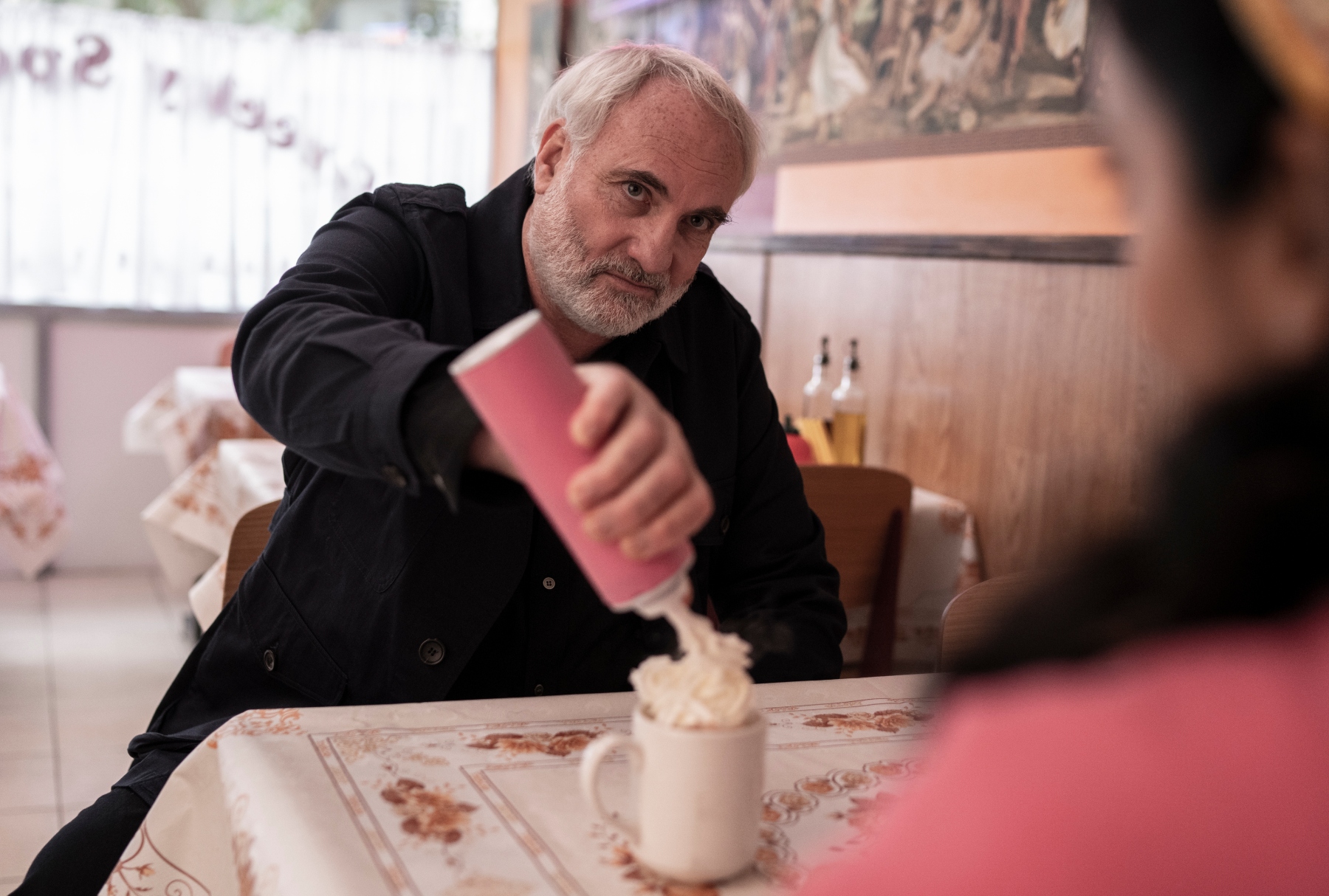
We discussed all of those scenarios. All of the ones you just said. We had really serious long conversations about it because we wanted to make sure that the one we went with was the right one. And I think the reason we went with this one is because it just felt like the most truthful end to both of these characters’ stories. Especially with Villanelle. We had a lot of discussions with Jodie about Villanelle, and what the most satisfying end point for her was.

“Villanelle is too enormous a character to be contained on an earthly plane.”

I think there are a couple of things that felt really important. One is that this is a character who has doled out so much violence herself in her life, and so much pain and destruction. She is steeped in killing. It felt appropriate that her end would be bloody in some way. 

On the other hand, we liked the idea of her finally achieving something that she wanted to achieve, which is an act of goodness. And I think in her death, she achieves that act of goodness. She pushes Eve off of the boat and she saves Eve in that moment. She does this selfless thing that I think she talks about wanting to do in Episodes 1 and 2, and she can never quite find the right way to do it. So, even though her ending in some ways is tragic, I also think in some ways it’s triumphant, because she proves to herself and to Eve –  and to the audience almost –  that she can change, and that feels really emotional, I think, for me especially writing it.

It was very emotional watching it too, for sure. Lots of emotions. That leads into my next question, which is: do you feel this is Villanelle’s full journey? She did complete that last mission, and she also dispatched The Twelve, as she said she was going to do. But she’s gotten out of desperate situations before. I know, in the books, she fakes her own death. Is this really it for Villanelle? Is this her final journey?

I think in some sense, it’s her final journey. I do believe that Villanelle is dead. But the way I’ve always looked at it is: Villanelle is too enormous a character to be contained on an earthly plane, and she doesn’t so much die as she transcends. She becomes this celestial being. It’s almost like that’s what she’s destined for. She isn’t destined to walk among the earth with people like you and I; she’s destined for something greater, and when she achieves her mission of killing The Twelve, it’s almost like, “Well, what next?” For me, the answer is: something that’s not on this earth. 

That’s how I look at it, and there’s a couple of allusions to that, even in the way the ending is shot.

I wanted to talk about that, how Villanelle and Eve almost touch, kind of like Michelangelo’s “Creation of Adam.” Was that intentional, to try to bring back the religious iconography of Villanelle? 

“You can’t train people to be monsters and not expect them to act monstrously towards you.”

For sure. I wanted that to have a real sense of scale, and I wanted there to be a nod back to Episodes 1 and 2. For ages, I really wanted to put this scene in where you have the return of the vision from Episode 2, and you see Villanelle as the vision at the very, very end. 

But it turned out, we didn’t really need that because we could incorporate all of those visual references into the end scene itself. So, like you say, there’s the fingertips almost touching, and there’s also the blood billowing out that looks like angel wings. There’s this kind of celestial light. I think it packs that last moment with hints that Villanelle is kind of ascending rather than dying, if you know what I mean.

We also have the tarot card reading, which I thought was such a great move. And so evocative, that Villanelle’s future is the sun.

I had such fun writing that scene. That scene was there right from the very original iteration of Episode 8. It felt really fun to toy with this idea of fate and spirituality when it comes to their relationship. And then of course, to kind of subvert that by giving an egotistical character the reading of: oh, you are going to become the sun! It just felt so appropriate for Villanelle. And then of course, to foreshadow Eve’s death and to have that flipped at the end.

Kim Bodnia on “Killing Eve” (David Emery/BBC America)

I also wanted to talk about Konstantin (Kim Bodnia), who’s a fan favorite, and who became one of my personal favorites too. This time, we did see his end, and we did see the body, unlike Villanelle. In fact, Pam (Anjana Vasan) embalmed him, which is so weird and loving. What was the thought process behind deciding his character’s end?

We liked the idea that finally, he’s cornered. Finally, here’s a situation he can’t get out of. We always see him wriggle out of situations. We loved the idea of this is the one situation he can’t wriggle out of.

“Villanelle instilled a boldness in Eve to be the person she has always been, but has perhaps been afraid of showing the world.”

And I love the tragedy as well of, actually, this is the moment where we see him emotionally opened up a little bit in a way that we haven’t really seen him before. It feels like he’s actually understanding himself more as a person and he’s understanding what’s important to him. And it feels like he’s reaching for a life that isn’t this. But of course, the life that he’s established for himself catches up with him. 

You can’t train people to be monsters and not expect them to act monstrously towards you, so I do think there’s an inevitability to his end. But also we wanted to make sure that the method of his death felt suitably Konstantin. So, the idea that it’s with a pizza cutter, a kind of ridiculous object, felt fitting for him as a character who has given us so much humor over the seasons.

And he tells Pam he’s proud of her.

They act that scene so well, the first time I saw that, I just couldn’t, I couldn’t take it. I think it’s beautiful the way they’ve both done that.

When learning The Twelve’s backstory, we were treated to a younger version of Konstantin, played by the actor’s own son, which I didn’t know at first. I thought, “Wow, he’s really good. That laugh is perfect.” What was it like when you realized Louis Bodnia would be cast to play a younger version of his father’s role?

We always knew that Konstantin – that Kim [Bodnia], sorry – had a son. So, even when we conceived that role, that idea came to us quite early. We were so pleased to be able to get [Louis]. It was tricky with COVID and getting him over here, but he does have the laugh down to a T, which feels like one of the most important things. And there is a familial resemblance. It just felt fun. The Carolyn-Konstantin relationship is such a joy to watch. There is so much mystery about their past, so it felt really fun to be able to dive into that, as it’s the final season, and just answer some of those questions.

Fiona Shaw on “Killing Eve” (David Emery/BBC America)

And to have the viewer slowly realize who these people are, and what their place is. I did want to talk about Carolyn (Fiona Shaw), because she ends up better than I thought she would. Although, of course, of all the characters, Carolyn’s going to end up on her feet. There has been speculation that the flashback of a younger Carolyn is maybe the inspiration for a spinoff, or some other series?

I’m afraid I know absolutely nothing about that. It’s speculation as far as I know.

Maybe it’s just hopeful, that we’ll see them again. There are some questions still unresolved at the end of the show. We don’t know everything. For example, we don’t know explicitly who killed Carolyn’s son Kenny (Sean Delaney). What was the reasoning behind leaving questions like that open to interpretation?

I think part of the joy of the show is some of the ambiguity, so we didn’t want to answer every question. I also think we had to choose what were the important questions to answer. And it felt like a focus on the Eve-Villanelle relationship was perhaps more important than finally revealing exactly who The Twelve are. 

Also, in terms of the Carolyn and the who killed Kenny question, for me what feels important is the revelation that it doesn’t really matter to Carolyn who killed Kenny. It matters that she has an excuse to behave in the way that she wants to behave. It felt appropriate not to come down definitively on that, because, really, the story point is: this is a woman who just needs a reason to behave like this rather than needs to understand that, and then she’ll rest. She’ll never rest.


Want a daily wrap-up of all the news and commentary Salon has to offer? Subscribe to our morning newsletter, Crash Course.


Could you talk about the ways that Eve changed by the end? By knowing Villanelle, by getting to love her and be loved by her, by having these extreme experiences? I mean, Eve kills by the end. She’s become a person who kills for the people she loves.

For me, the thing that Eve learns is how to act without fear and how to act without shame, and I think that’s what attracted her to Villanelle in the first place. And that’s what Villanelle gives her. It’s a kind of like Villanelle instilled a boldness in Eve to be the person she has always been, but has perhaps been afraid of showing the world. And that, to me, feels very inspiring, as a woman watching the show, that Eve can take that from Villanelle, albeit via extremely violent roots.

More stories like this:

“House of the Dragon” star Matt Smith would return to “Doctor Who”

We’re rapidly approaching a new era of “Doctor Who.” Jodie Whittaker will play the Doctor for two more episodes, the first of which is out this Easter, before she makes way for a new star. We don’t know who it will be, but we do know that Russell T. Davies, who revived “Doctor Who” back in 2005, is returning as showrunner. There’s a lot happening, and with the show coming up on its 60th anniversary next year, fans expect fireworks. Perhaps Davies will bring back some of the stars for a big blowout?

They sound down for it. Just the other day, Karen Gillan — who played the companion Amy Pond during Matt Smith’s tenure as the Eleventh Doctor — said she would return if she had the right costars, particularly Smith and Arthur Darvill (Rory). Smith, at least, sounds like he’s in.

It’s Gone Viral: Presents” recently asked Smith, who will play Daemon Targaryen on HBO’s upcoming “Game of Thrones” prequel series, if he would rather star in a “Morbius” sequel alongside Jared Leto or return to the role of Doctor, and Smith didn’t have to think about it too hard. “‘Doctor Who,'” he said. “‘Doctor Who‘s the best. ‘Doctor Who’s the best part in the world, you know.”

Matt Smith: Playing the Doctor is “unbeatable”

Smith is currently starring in “Morbius,” where he plays the villain to Jared Leto’s also-kind-of-a-villain-but-nicer vampire doctor protagonist. Reviews on that one have been rough, so maybe it’s natural that he’d rather return to the Doctor Whoniverse. “That’s not to say I wouldn’t love to be in a “Morbius” sequel with Jared because I would,” Smith continued, “but, you know, the Doctor’s the Doctor – unbeatable. All part of the plan.”

We’ll have to see what the Doctor Who producers have in store. In the meantime, you can see Matt Smith in “Morbius” starting April 1. And “House of the Dragon” comes out on August 21. He has a busy year.

“The control I thought I had was one big fat illusion”: When crisis makes you not yourself anymore

There is a moment in Mary Laura Philpott’s beautiful, very funny “Bomb Shelter: Love, Time, and Other Explosives” where she must resign herself to being a Baby Spice. After taking an online quiz that determines her identity within the iconic girl group, she bristles at the label, takes a different Spice Girl quiz, and comes up Baby again.

It’s not easy being Baby in a world that’s Scary in every sense of the word. It’s hard hanging on to your most joyful self when you have been through the most difficult, devastating moments of your life. And after Philpott’s teenage son experienced an abrupt medical crisis, the author of “I Miss You When I Blink” found herself reckoning with the hard truth that she had lost some semblance of control. “All I want to do is take care of everyone I love, but I can’t do it,” she laments. That feeling may be familiar to those of us who have experienced medical crises, either in ourselves or among our families, that are random or completely outside of our ability to control. 


Want more health and science stories in your inbox? Subscribe to Salon’s weekly newsletter The Vulgar Scientist.


Such abrupt and random crises test not only faith, but one’s resolve. How does one stay hopeful after hardship? How can we let such experiences deepen our empathy, instead of raising up our walls? 

Philpott speaks from personal experience, and she has some ideas. In “Bomb Shelter,” she contemplates the imperfect art of letting go, and discovers what turtles can teach us about life. Salon talked to Philpott recently via Zoom about optimism, meditation and nurturing our truest Spice Girls. 

This conversation has been edited and condensed for clarity.

Like you, I am a Baby Spice. And then life comes along and throws you these things that make you realize, “Oh my God, I’m really very out of control.”

Yeah. I have no control over anything. All the control I thought I had was one big fat illusion.

I want to ask you about that metaphor of the bomb shelter, which in your family’s case is literal. Why was that the thing that you wanted to pin this book on?

“Bomb Shelter” was not the original title for this book. The original title was “Hello From Upside Down,” which is now the title of the second chapter, when I’m lying on the floor and looking at everything upside down. But when I got to the chapter about my dad and about that actual underground secret fallout shelter, I got to the end of writing and I said, “What am I going to call this chapter? I think I’ve got to call it Bomb Shelter.”

As I typed the words on that document, I thought, “This is the title for the book. This is the whole thing.” It has that tension of opposites that runs throughout the whole book. Bomb and shelter. It has that illusion of control. Bomb shelter? Is there really such thing as a bomb shelter? I mean, yes. But in the case of the one my dad was working in that was meant for nuclear war, it’s, I hate to say this, kind of fruitless. You can go into that bomb shelter and you seem safe while you’re down in there. But if the whole world has actually just been atomic bombed and you come out, you’re not going to be okay when you get out.

RELATED: I love being a Girl Dad

It’s a temporary illusion of safety. I loved that it was just two words. I loved the soft consonants and the hard consonants. I loved that it meant I could put a turtle on the cover. Frank, the turtle, has just a couple of cameos in the book. I loved the image of the turtle, how he is this little, soft animal in a hard shell. The turtle has something that we don’t have, which is that built-in protective mechanism. We’re just these little water balloons made of skin. We have to create our own protective mechanism.

It reminded me also of that saying that when you have a child, you walk around with your heart on the outside of your body. It’s terrifying in a way that is also kind of abstract until you have that real crisis. Until you have that, “I’ve seen my kid fall and I’ve taken her to the emergency room and I’m really scared now.”

I’m breaking out in a cold sweat as you’re saying that. It’s true, it’s all hypothetical until that moment where you’re like, “CPR. CPR. How does CPR work? I’ve got to remember how CPR works,” or, “911, where’s the phone?” When it happens, then you just feel how absolutely vulnerable we all are. And helpless.

I remember feeling like, the wheels are going to come off me once we get past the crisis and she’s going to be okay.

Now I’m not okay, ever again.

It changes you.

Forever.

When we went to college orientation, there was another mom in the front row asking, “So how close is the closest hospital? Where are the hospitals?” and sobbing. I went up to her afterwards and said, “I feel like you and I have some things we could talk about.” 

You find them. I have found them among people I already knew, because you don’t talk about this all the time. I have found those other parents who have been here. Women I’ve known for years and years and years, somehow we managed to give out this signal and pick up on it like, “By the way, did you know that my adult daughter has diabetes that means she can never sleep alone and everywhere she ever goes she has to know where the hospital is?” Somehow, it’s almost like you can see it in the eyes of other people.

You say, “Everybody has something.” While everybody does have something, there are people who’ve had a specific experience of going through trauma, and are also thinking, “But I l want to be happy. I want to be hopeful. I want to believe in good things. I want to be the fun one.” When bad stuff happens you’re like, “Who am I now? How do I go forward?”

I want to be myself again. That’s the exact emotional plot of “Bomb Shelter” with me as the main character. It’s that journey of, “Now how do I get up every day? How do I reconcile these two forces that have always been in my mind, the anxiety and the optimism?” But now it’s come to blows, and the anxiety is screaming, “Everybody’s in danger all the time.” My optimism is going, “If we believe that we’ll never get out of bed.” It just ratchets up the stakes of everything. It’s both discomforting and comforting, but where “Bomb Shelter” lands is admitting and accepting that I don’t have control and admitting and accepting that yes, this awful thing is true.

Everyone’s going to die. Everyone is in danger. I cannot protect the people I love forever. That is a fact. I hate it, but it’s a fact. But the more I sit with it and accept it, this struggle becomes less violent because I’m not fighting against reality any more. There’s a part of my mind that does this magical thinking where I’m like, “If I just want it bad enough, I can make it true. If I just want it to be true, love is enough to keep everybody safe.” No. There’s no amount of wanting that to be true that will make it a fact. Letting go of that helps me let go of everything else a little bit. It helps me let go of these children who are now turning into adults and going out into the world where I can’t physically protect them all the time.

It helps me let go of this struggle over my parents getting older and seeing that they don’t have as much time left on this earth as they used to. And the fact that I’m getting older. I mean, every day I look in the mirror and I’m like, “Who are you? I don’t know.” Accepting that impossibility, as much as I hate it, gives me calm and lets me move past it a little bit and go, “I’m not going to be able to change that. I might as well move into this day and see what I can feel good about.”

Being able to go, “I can be sad and feel out of control, but as long as I can keep trying to point my compass back back towards some degree of hope and happiness, I can do it.”

And the things that we can’t control feel so big. I find, on the mornings when I can’t get out of bed, it’s because I’m thinking, “I will never be able to stop climate change. I cannot stop this war. I cannot find a way to prevent death.” Huge, enormous things. Of course I can’t do any of this. What gets me out of bed is going, “Okay, but here’s some things I can do. And they’re small and probably from afar, they look meaningless, but they matter.”

It matters for me to get up and go out in my yard and make sure there’s a fresh dish of water for the animals. To come home and do my work that’s going to go out in the world and someone’s going to read it and they’re going to feel better. To make something for dinner for whoever happens to be in the house tonight that is healthy and will maybe give them another day on earth. Focusing on the little things that I can do and make a difference for other people. That helps a little bit too, I think.

One of the things you write about is that when you are in that spiral of anxiety, then your eye is not on the ball. You can lose sight of so many other things, which is unproductive. 

It’ll wear your engine out. Okay, I’ve got my eye on this person, but wait, I’ve got to get my eye over here too. Thinking that it is important that I am attending to every single person and every single issue, because that’s the only way things will be safe. That is just the recipe for exhaustion and burnout and misery.

You can’t be a biblically accurate angel.

This is a personal book, but it resonates for the people who weren’t already pessimistic. It resonates for the people who are not competitive about suffering. 

No, I don’t want to be in the adversity Olympics at all. I don’t even want to qualify.

How do we take ownership of our optimism and hope?

You can’t change other people, which is the lesson I continue to learn again and again and again in the world. But if I’m going to get through this life without melting into a puddle of anxious misery, I’ve got to find every little sparkling bit of joy I can along the way. Everyone’s little sparkling bits of joy are different. For me, it can come from really goofy things. It makes me happy to put on a really bright color. It makes me happy to talk to pets. When I’m walking down the street, I greet every dog I walk by and maybe that’s weird, it gives me joy.

By the time I get to my destination, I feel better because I’ve talked to 12 dogs. These little things that make my day better. It’s not anybody else’s business if they think that’s silly. I need to believe that the world is a place full of little sparkling tidbits of joy, because I’m letting my children who are now becoming adults go out there. I need to believe that they are walking around in a world that has little pieces of joy everywhere and nice people and friendly pets and whatever it is, that’s going to bring them happiness along the way. I need to believe that’s the world we’re walking around in. So I look for evidence that it is.

It’s hard because we know that this is a generation that is struggling with its mental health, more than any other. I wonder what our role as parents then is to model for them, that what they are experiencing is real and unique, but also that happiness and joy and those little sparkling bits are out there.

They’re out there. And they’ve also just been through the weirdest past two years of development. Whether they’re little bitty kids or they’re teenagers, or they’re the ones who went off to college during pandemic and had to experience that. What is that going to do to them long term? I don’t know.

I keep thinking it’s our job to be as hopeful as possible, that pessimism is not an option. So how do you balance that? I want to ask you because you still feel anxious. You still feel sad. You still have to let in the grief for the person you were. You still have to let in the legitimate concerns about COVID, about politics.

I have to be realistic. I can’t be in denial of reality. As much as I am naturally drawn to seeing that horror now because I see it everywhere, I do have to look for the good stuff at the same time.

I write in the book kind of jokingly about meditation and how I’ve tried to use meditation to help still my mind. But I’m not kidding. I keep coming back to meditation. I cannot do it without a guided thing in my ear doing it or me. I don’t have that much control over my brain, but I do keep coming back to it because it’s that practice of stillness and taking stock of what is actually happening right now around you, versus trying to somehow absorb everything that’s happening everywhere and letting that all in it once. That stillness practice is really helpful.

More parenting stories: 

Meet the six collaborators who were “central to the success” of Julia Child

Everything’s coming up Julia Child recently seems. In January, I spoke with co-directors Betsy West and Julie Cohen about their documentary, “Julia,” which had, at the time, just been shortlisted for an Oscar. Earlier this month, both the Food Network and HBO launched Julia Child-themed series. In these projects, and in American culture at large, Julia Child is the unquestionable star. 

But in her new book, “Warming Up Julia Child: The Remarkable Figures Who Shaped a Legend,” Pulitzer Prize finalist Helen Lefkowitz Horowitz peels back the curtain on an unexplored part of Julia Child’s life — the formidable team of six she collaborated with to shape her legendary career. 

Related: Julia and Paul Child’s marriage was “a true feminist love story,” directors of “Julia” doc say

Horowitz spoke with Salon about her approach to researching this book, Julia Child’s unexpected disdain for (certain types of) television and how destiny led her to write a previously underexplored story about pop culture’s favorite chef. 

This interview has been lightly edited for length and clarity. 

Ashlie Stevens: I was really inspired by the lens through which you wrote about Julia Child’s life in this book — by turning the spotlight onto six of her collaborators. What inspired you to approach it this way? 

Helen Horowitz: The book has a curious beginning. I mean, I think this is true of many books, and many authors. I started wanting to pay a tribute to my own editor of three books at Knopf, Jane Garrett, who had just retired, so I was going to write a book about editors. 

I thought, “How do you do this?” And I had no clue. So, I went to the Schlesinger Library, which is very near where I live in Cambridge. I looked up an editor that I’d heard about, Judith Jones. At that point, the acting director invited me to lunch…and she said, “Oh, I know you’re looking at Judith Jones, but you absolutely must look at Paul Child’s papers.”

So, I went back after lunch and I called for a box and started reading them. Paul offered such rich commentary on the daily life that he and Julia were living. He frequently wrote about those who Julia worked and socialized with. Well, it took me a while to shift some gears — probably a number of weeks — but I knew some of the literature of Julia Child, especially the works of Laura Shapiro and the letters of Julia Child and Avis DeVoto, edited by Joan Reardon.

But I was beginning to see in Paul’s letters something else and this is what caught my attention: the important relationship that Julia was establishing with other people as well. That led me in a new direction with the book and it put Julia Child at the center. 

What I came to feel was that Julia could have clearly made it on her own, but central to the success she experienced were six people. I think my book appropriately changes our view of her creativity without diminishing anything that she accomplished. I mean, she is who she is — and one of her great strengths was her capacity for friendship. 

AS: A part of the book that really delighted me was your recounting how Avis and Julia developed sort of this transatlantic partnership where they sent each other items back and forth. Julia also counted on Avis for input about the American cookbook and culinary market; what did Julia find out through that process? 

HH: Well, one concern Julia had was everything had to be done quickly. There was a great deal of emphasis put on convenience and speed and she really wanted to stop women from using canned vegetables and all the conveniences that were being advertised. Avis, as a wonderful cook herself, believed in that. She spent much of her days at the stove and oven. 

Avid, did, however, clue Julia into new products like the blender, for example. She also knew about the availability of goods in the markets and what spices you could get. One thing she constantly emphasized was that many women did not have servants. Therefore, the result of that was you needed to create for them recipes that they could keep in the oven. Julia found ways to think about that and it was very important in the development of the cookbook. 

AS: Talk to me a little bit about the challenges of researching William A. Koshland, who was responsible for administration at Knopf. 

HH: Well, I think the main thing about Koshland was that he didn’t really want to be known. He served as the unofficial manager at the Knopf publishing firm. Of course, Alfred and Blanche Knopf were the heads and they made all the decisions about what books were to be published, ultimately. But how do you sort of work around them without their knowing it? 

Related: Flashcards, shoestring budgets and butter: How “The French Chef” came to be

To put it gently, he was just very, very clever and he didn’t want to be known at all. That said, I happen to be very lucky in my friendships. [The Sintons and Koshland families were connected as relatives] and through JB Jackson, the subject of an earlier book, I had met a Mrs. Sinton who had a son named John. This was a cousin of Koshland’s, so I called him up and said, “What do you know about your cousin, William Koshland?” And he said, “Well, why do you want to know?” 

“Let’s put it this way. I don’t know if I was destined. But I was certainly fortunate to have the contacts that I had, and, and who were very generous in offering the information.”

I told him that he was very important in the life of Julia Child and I was working on a book about it…I learned [Bill] was a gay man who had a partner who was the cook in the household, and that he was very interested in food and his partner was a superb cook. That got me to sort of a deeper understanding of him. Then I was actually able to find more about Koshland because he went to Exeter and he went to Harvard and I was able to find him in the archives. 

You know, that was just luck on my part. It happened again with Ruth Lockwood. It turned out I knew her daughter, so that was good luck on my part again. 

AS: It sounds like you were destined to write this book. 

HH: Let’s put it this way. I don’t know if I was destined. But I was certainly fortunate to have the contacts that I had, and, and who were very generous in offering the information, and in some cases documents. So, that was wonderful.

AS: One of the things that I also found particularly interesting in this book is that it makes clear that Julia Child had a conflicted relationship with the idea of television. When she told Avis she had finally purchased one, she said there were programs on there she wouldn’t submit a dog to watching. In your research, what do you think finally propelled her to be on television herself? 

HH: Educational television. She and Paul discovered WGBH and its existence. This was a time in which public television was just coming into its own. 

At the point in which she was interested in public television, there was beginning to be a network of the east coast of stations. Of course, over the years, this grew and grew and grew to what we have today. And she and Paul came to really appreciate it and the good news programs. They had concerts and some series that were important. 

As I outline in my book, there was a person she and Paul knew from their time in Paris when Paul was at the embassy named Beatrice Braude. She was working at WGBH at that point and she really helped her develop a fairly formal proposal to WGBH. I mean, I watched the first two episodes of the “Julia” program on television and it’s a very different story being presented. I don’t want to diss it because I enjoyed it very much, but nonetheless as a history, it’s not accurate. There was a very careful preparation and [Julia] had insiders who helped her at the station. 

AS: So as you mention, everything is kind of “coming up Julia” recently. There’s the new HBO series about her life, a documentary that premiered a few months ago and a new Food Network program centered on her recipes. Why do you think that is and what do you think is the key to Julia’s long lasting appeal? 

HH: One thing is that all of Julia’s shows are available on YouTube and you can continue to watch them. I mainly watched them in preparation for the book. But right now, we have a relatively new way of being able to see things from the past that were not previously available. 

Additionally, over the last two years with COVID, there has been a lot of interest in the home arts like gardening, decorating — all the stuff that has kept people active and enjoying life during COVID. I think cooking is one of those things. The truth is, when you turn to “The French Chef,” it’s very entertaining. 

And the truth is the recipes work, right? They were tested and they do work. So what can I say? I mean, “Mastering the Art of French Cooking” is a valuable book today.

If you’re interested in reading more of Horowitz’s work, you can check out an excerpt of “Warming Up Julia Child” here, or purchase a copy of the book here


Read more stories about Julia Child:


Mascarpone cheese has a life outside of tiramisu

You probably know mascarpone cheese as a key player in tiramisu, the chocolatey, espresso-infused layered Italian dessert. But it’s so much more than that. Make extra creamy scrambled eggs by folding mascarpone cheese into the mix or spread it on a piece of toast and top it with smoked salmon and chives.

But what exactly is mascarpone cheese? And how is it different from sour cream, cream cheese, or crème fraîche . . . or is it? Mascarpone is essentially an Italian version of cream cheese, though with a slightly higher fat content; mascarpone must have 40% fat, while cream cheese only needs to have 33%. Cream cheese is also tangier than mascarpone, which tends toward the richer side of things. In fact, mascarpone most closely resembles French crème fraîche. Both are soured by lactic culture, but mascarpone is a little sweeter and milder. That’s why it’s so prominent in sweet desserts; while sour cream, for example, can certainly add body and richness to cheesecakecoffee cake, and pound cake, it isn’t exactly a flavor most home bakers put front and center (the exception being this wildly delicious Peach and Sour Cream Ice Cream from Alice Medrich).

All this to say, mascarpone is a lot more versatile than we give it credit for. It works quite well in both sweet and savory dishes. But every so often, you may struggle to find mascarpone cheese in some grocery stores. Rather than abandoning ship altogether, take a peek inside your refrigerator. Mascarpone cheese is surprisingly easy to make, so you don’t even need to run out to a specialty grocery store to track some down. In short, all you need to do is bring heavy cream to a simmer on the stovetop; add a little bit of lemon juice and continue to heat it for a few more minutes, then let it cool. Strain it over cheesecloth and chill it in the refrigerator overnight before using.

We know that mascarpone cheese can transform sweet things like sorbet, carrot cake, lemon pie, cupcakes, and fruit blintzes. But what about creamy pasta, risotto, soups, and roasted vegetables? Turns out mascarpone can work wonders with savory recipes, too. Here are so many ways to take advantage of mascarpone’s ultra-creaminess to make your savory meals surprisingly rich — with very minimal effort (promise).

Our Go-To Mascarpone Cheese Recipes

1. Smear it

Use mascarpone on a bagel in lieu of cream cheese for a next-level smoked salmon supreme, or spread it on seedy rye toast to make open-faced sandwiches. Some topping suggestions:

  • Smoked trout and pickled red onions
  • Cucumbers, salt, and sesame seeds
  • Roasted or sautéed mushrooms (or any leftover roasted vegetables hanging in your fridge)
  • Thinly shaved asparagus and lemon juice

Stuart Brioza’s Mushrooms in Pickle-Brine Butter

2. Make soup

Add it to freehand puréed vegetable soups for maximum richness with minimum work. Good news: just a spoonful will go a long way here. Or use mascarpone as a creamy garnish to cool the heat of spicy tomato soup and add a creamy touch to summery gazpachos. Bonus: it looks super pretty when you swirl it in with your spoon.

Barbara Lynch’s Spicy Tomato Soup

3. Spread it

Spread it onto pizza in lieu of tomato sauce, or dollop small spoonfuls onto just-out-of-the-oven-‘za for creamy, melty pockets, sort of like the inside of burrata. May I suggest dolloping some onto a margherita to make it uber fancy, or spreading it thinly onto dough and topping it with shaved summer squash and mint?

Mascarpone also works very well as a creamy layer in savory tartsespecially if those tarts involve blistered vegetables like eggplant and zucchini and lots of herbs. Or juicy tomatoes. Or incorporate it into a gratin, especially if that gratin contains cauliflower or hearty greens. Just spread a little between the vegetable layers with a spoon, or else dollop it on top.

Chard Gratin

4. Scramble it

Add mascarpone to your scrambled eggs. I know I’m starting to sound like a broken record here, but it will make them incredibly rich and special, and so much better than your average Wednesday morning scramble, even though they take no extra time. Merrill Stubbs likes to whip mascarpone into her eggs pre-scramble, but I like to add it halfway through the cook time so that I come across melty cheese pockets mid-bite. (Side note: Melty Cheese Pockets would make a great band name.) If you’re feeling fancy, you can also use a swipe of mascarpone as a filling for an omelet, especially if there are already some peas and chives or mint involved.

Soft Scrambled Eggs

5. Stir it

When stirred into risottos and pastas just before serving, mascarpone melts into the silkiest, luxurious one-ingredient sauce. You can even stir a few spoonfuls to finish grits or polenta for an extra creamy touch. Try adding it to nutty cauliflower risotto, using it in place of cream for a springy green pasta, or incorporating it into your next baked noodle creation.

I usually like to keep things simple, tossing my pasta of choice with some olive oil, garlic, and herbs in a pan with a little pasta water, maybe adding in some vegetables. Once a glossy sauce develops, I’ll add in a few spoonfuls of mascarpone and let it melt, coating each noodle in a creamy sauce that’s slightly sweet and nutty and pretty much begging to be covered in more herbs and a grating of Parmesan. It’s also excellent stirred into a simple tomato sauce, and will stretch and enhance a pesto like nobody’s business.

Instant Pot Polenta

Savory recipes with mascarpone

Campanelle with Asparagus, Hazelnuts, and Mascarpone

Asparagus, treated right. This pasta dish — any curly, short shape does the trick — features a whole pound of greenery. Lemony mascarpone melts into an effortless sauce, while toasted hazelnuts add crunch.

Heirloom Tomato and Lemon Mascarpone Tart

Like a fresh fruit tart, but savory. Multihued heirloom tomatoes take center stage here, supported by a lush, creamy bed of mascarpone. Serve with the emerald green basil oil alongside, so everyone can drizzle (and keep drizzling) as they eat.

Pasta with Air-Fryer Mascarpone Mushrooms

A very good thing to do with your air fryer: Combine mushrooms with onion, garlic, cream, and, of course, mascarpone, then let the appliance do its magic. The result is a creamy, vegetarian pasta sauce to repeat whenever you need something cozy.

Chilled Beet and Mascarpone Soup with Balsamic

Is there anything more refreshing than a chilly bowl of soup on a scorching summer day? We think not. This one is all about beets — a root vegetable that’s as earthy as it gets. Mascarpone adds some much-needed creaminess — the extra dollop on top is optional but, you know, not really.

Mascarpone Mushroom Marsala with Noodles

Another mascarpone-sauced pasta with mushrooms because the combo is just that good. This recipe leans on marsala, a fortified Italian wine that’s always happy to help out with dinner. Feel free to increase the parsley — its brightness is a breezy respite from all the richness.

Prosciutto, Pear, Mascarpone and Red Onion Tart

Sweet pears, salty prosciutto, and sharp red onion sound A++ on their own. But then you add in a buttery, crumbly tart crust and mascarpone mixed with herbes de Provence (an aromatic French spice blend often made with thyme, basil, rosemary, marjoram, and tarragon, depending on the recipe). Oh yes.

One of the greatest legacies left by “The Godfather” was basic instructions on how to make dinner

This revelation comes courtesy of a mid-progress taste check on a marinara sauce made with homegrown tomatoes. It’s important for you to know about the tomatoes’ origins because it explains my surprise at discovering that the sauce was missing its typical sweetness, the main reason to grow your own tomatoes in the first place.

Unable to figure out how to amend this problem, my husband asked, “Did you add sugar? It’s supposed to have sugar.” I thought he was joking but, no, he was dead serious.

Then he cited his source: “That’s how Clemenza says to do it in ‘The Godfather.’

“Did you add sugar? That’s how Clemenza says to do it in ‘The Godfather.'”

Fifty years after “The Godfather” debuted in theaters, it remains a masterpiece of storytelling and cinematic technique and a trove of career-making performances. So influential is Francis Ford Coppola’s telling of Michael Corleone’s mob boss origin story that the origin story of the film is becoming its own series called “The Offer,” premiering in late April on Paramount+. The movie has many lessons to teach the steep costs of attaining and retaining power, what a man gains and loses from pledging his loyalty to his family’s greatness above all else.

RELATED: We snagged the recipe for Carmine’s hearty Italian meatballs

However, as my husband showed me, even a person who doesn’t live and die by Coppola’s masterpiece may somehow have learned how to make Peter Clemenza’s sauce.

If you don’t, just watch this scene for some basic instructions.

Peter “Leave the gun. Take the cannoli” Clemenza (played by Richard S. Castellano) was a loyal killer for the Corleone family, but he also won everyone’s love the old-fashioned way: through their stomachs. To Michael Corleone, he was a trusted adviser and full of wisdom, but perhaps nothing as useful as how to cook for a (grouchy, fully armed) crowd.

You’ll notice the man was not specific about measurements, which is why so many versions of this recipe are floating around out there. This one tweaks a classic Sicilian-style version shared with me many years ago by a friend’s lovely mother who took pity on one of my first attempts to make sauce using fresh garden tomatoes.

“You never know, you might have to cook for 20 guys someday.”

Clemenza’s trick may be sugar – and even though I’ve been using the same sweetener-free marinara recipe for many years, he was right about that boost – but the greater accomplishment of that scene is to plant a recipe into the brains of millions of folks without them knowing it. Even if you’re a person like my spouse who doesn’t cook that often, if you can remember the outline of what he says in that scene, then you know how to make a very basic gravy.


Want more great food writing and recipes? Subscribe to Salon Food’s newsletter, The Bite.


This scene is useful for everyone, as Clemenza tells Michael,  because “You never know, you might have to cook for 20 guys someday.”

Here’s our version, along with a line-by-line breakdown. You can use this sauce on spaghetti or other pastas. Without meatballs, it’s a great sauce to use in lasagna. But if have a terrific meatball hook-up, why deny yourself that pleasure?

“You see, you start out with a little bit of oil. Then you fry some garlic.”

Pretty self-explanatory save for a few details, including the amount of garlic to use. I love garlic, so I never use less than six cloves. Mince or finely chop the garlic and saute it until golden. Watch it closely to make sure the garlic doesn’t burn; the difference between an aromatic, crisp golden hue and a pot-ruining charcoal is a matter of breaths.

“Then you throw in some tomatoes, tomato paste, you fry it; you make sure it doesn’t stick. You get it to a boil . . .”

Clemenza loves to use the word “fry.”

Clemenza loves to use the word “fry,” but we get his point. The acid in the tomato juice deglazes the pan, which is why I like whole canned tomatoes; it approximates the texture of my garden crop. In the movie scene he uses two large cans of tomatoes and two smaller cans of tomato paste. Depending on how much meat you use, how many people you’re feeding and how wet of a sauce you prefer, you might want a third can handy. (If you have access to fresh, homegrown tomatoes, you can simply remove the skins from them by submerging them in boiling hot water until you see them split, then rubbing them off with your fingers. Slice and remove the seeds if you want; I don’t. )
Leave the lid off, bring it to a simmer and reduce the sauce to your preferred thickness.

” . . . You shove in all your sausage and your meatballs.”

Clemenza probably isn’t making his own meatballs – not because he couldn’t, but you know he knows a guy, and who has the time? This recipe is about keeping it easy. As for the sausage and meatballs, cook them separately so you can “shove” them in closer to the finish. As an option, vegetarians, you can leave out the meat or use whatever protein substitute you’d like. Just be sure to amp up your seasonings.

“Add a little bit o’ wine, and a little bit of sugar, and that’s my trick.”

Once you’ve mixed in the sausages and the meatballs and let all their lovely flavorings and fat incorporate into the sauce, add the wine. Give that a few moments to insinuate its flavor into the mix, and then add your sweetener.

Clemenza uses sugar; I find that a squeeze of honey in my sauce both balances out the acidity and adds whatever “oomph” is missing from my tomatoes. Canned ones will almost certainly need that boost, but if you’re lucky enough to grow your own, or have access to some great heirlooms when they’re in season, you might not need as much.

One more lesson from that scene: Before you eat this with people you care about, let them know you love them “with all-a your heart.” It makes the meal that much sweeter.

More stories like this: