Spring Sale: Get 1 Year, Save 58%

Where to buy boar, rabbit and other wild game meat

Before my family moved to Maine back in the mid ’90s, I’d only ever had chicken, beef, and pork, with the odd bit of duck and lamb on special occasions. Once we settled in and made friends with folks, I had my first taste of game meat — specifically, deer and moose. Hunting was, and continues to be, a big thing where I grew up. Every November, the handful of our friends that hunted would bag a deer, and we’d inevitably end up with some of it in our freezer. Because of that, I’ve always associated winter with venison stew.

It’s been a long time since I last lived in Maine, but I still get those annual cravings for venison. A few years back, I wondered if I could get my hands on venison online, along with any of the other types of game meat I’d since been lucky enough to try. As always, my old pal the internet provided a bounty of options. Here are my three favorite places to buy wild game meat.

1. Fossil Farms (Boonton, NJ)

This supplier originally started as an ostrich farm back in 1997. As its customer base grew, so did demand for other game meats, and they currently offer (in my experience) the widest selection of game meats of any online supplier. I asked why they’re called Fossil Farms, assuming I’d get an answer about prehistoric hunters. As it turns out, “Fossil” is what founders Lance and Todd Appelbaum call their father, who advised them, “You don’t have to be the biggest, just be the best at what you do!” The company is named after him.

House favorites include ostrich steaks, of course, but they also recommend their bison short ribs, braised and pulled for nachos, tacos, and chili, as well as their kangaroo loin and wild boar tenderloin. Personally? I’m a huge fan of their semi-boneless quails. And if you’re not sure where to start, or how to prepare a certain cut, everyone on staff has culinary experience. Give them a call, and whoever picks up will be happy to geek out about food with you.

2.  Broken Arrow Ranch (Ingram, TX)

Founded in 1983, this supplier had an unconventional start. “My dad used to carry venison around in a cooler, walking the streets of NYC and Chicago, to get chefs to taste his meat,” says Broken Arrow Ranch owner Chris Hughes. Originally a wholesaler for restaurants, they opened their supply to individual customers in 2007. Beyond wild and farmed venison, they’ve expanded their offerings to include locally sourced wild boar, Bandera quail, and lamb. Hughes’ favorite cut is the venison osso buco, especially in the colder months, and I’m inclined to agree. Although venison is known for being a leaner meat than beef, I’d take venison osso buco over beef any day. After a long braise, it’s just as tender and even more flavorful than any osso buco I’ve had before.

3. FarmFoods Market (Los Altos, CA)

Founded out of a desire to know exactly where her meat was coming from, FarmFoods Market COO Janna Land originally specialized in sourcing grass-fed beef from local farms. FarmFoods Market now works with several small farms across the country, and as demand for their products has increased, so has its selection. In addition to beef, pork, and chicken, you can now buy elk, venison, bison, wild boar, rabbit, and yak. While the beef is fantastic (grass-fed beef really is a delight), I recommend the yak—it’s wonderful in stews and curries.

Still game for more?

From the pandemic, a roadmap for lowering the costs of medicine

Just under a decade ago, health care analysts at a pair of U.K.-based financial firms identified a trend they playfully referred to as “Eroom’s Law.” The name was an inversion of “Moore’s Law,” the observation that computers and transistors tend to become exponentially faster and cheaper over time. Unlike its better-known counterpart, Eroom’s Law observed that since at least the mid-20th century, the inflation-adjusted cost to bring a new drug to market in the U.S. has been doubling roughly every nine years. Some pharmaceutical companies now report that development costs for a new medicine routinely exceed a billion dollars. Undoubtedly, these rising costs have contributed to surging prescription drug prices, a problem that has escalated to crisis proportions in recent years.

Through our research at the intersection of drug development and policy, we’ve unearthed inefficiencies in the development, regulation, and distribution of prescription drugs — all of which likely contribute to Eroom’s Law. But over the past year, we’ve also seen what drug development can look like when it’s freed from those inefficiencies. As the public and private sectors have galvanized to deploy new treatments for Covid-19, they’ve not only shown us that Eroom’s Law can be broken; they’ve shown us how to break it.

The decades-long trend of rising drug prices described by Eroom’s Law is in part a result of regulatory inefficiencies. Like the federal tax code, the U.S. Food and Drug Administration’s review process for new medicines has grown increasingly onerous over time, with drug makers being asked to perform an ever-growing number of procedures and clinical measurements to win approval. Arguably, the agency has overreacted to high profile safety lapses such as that of the arthritis medication Vioxx, which was pulled from the market when research linked the drug to an increased risk of heart attack and stroke. In the wake of the Vioxx debacle, the FDA began requiring extensive cardiac monitoring during clinical trials, as well as extensive monitoring of drugs following approval. Such regulatory reactions are well-meaning, but reminiscent of the old adage that military planners are always fighting the last war, not the one to come. The mounting testing and paperwork burdens led one Eli Lilly executive to quip that were the required documentation for a drug approval application to be printed out and stacked, it would reach taller than the Empire State Building. In recognition of this over-reaction, the FDA has begun revising some of the regulations, as evidenced by updated guidance conveyed in March 2020.

Last year, however, as Covid-19 spawned a global crisis, the FDA embraced a more nimble and innovative regulatory posture — and a more open exchange of information with the companies and institutions working to discover, develop, and deploy new treatments for the disease. Early on, the agency pledged not only to expedite reviews of the final data packages submitted at the end of each three-phase clinical trial, but also to rapidly review preliminary data provided before and during a trial’s first phase. The improved communication and coordination set the tone for a collaborative approach between the public and private sectors, and it helped pave the way for a Covid-19 vaccine to be developed in a fraction of the time required to develop previous vaccines. 

Moving forward, it should be possible to streamline this process even further. One important step will be to assess which of the vast data and testing requirements for drug approval are critical for ensuring safety and efficacy, and which are merely box-checking exercises. In recent decades, for example, the FDA — scarred by episodes like the Vioxx debacle and buoyed by scientists’ increased understanding of the body — has pressed drug makers to demonstrate increasingly rigorous understanding of the mechanisms by which their medicines work. Yet, one might argue that these guidelines reflect either hubris or naivete: The vast majority of safe and effective drugs were approved despite uncertainty about their mechanisms of action. Even today, scientists do not completely understand how acetaminophen works, yet the world is a far healthier place for having this drug.

In some high-profile cases during the pandemic, the FDA leaned less on mechanistic proof of effectiveness and more on empirical indicators, such as patient survival rates. For instance, when objective data revealed that the steroid dexamethasone helped severely ill patients survive what might otherwise have been deadly coronavirus infections, the FDA was quick to support the drug’s use, despite scientists having only a speculative understanding of how the steroid works against the disease. To be sure, the FDA must continue to prioritize its mandate to protect patients and clinical trial volunteers. But the pandemic has shown that safety and speed need not be an either-or proposition.

That said, the inefficiencies in drug development clearly do not end with the FDA. As we write in an upcoming book, private sector efforts to sidestep Eroom’s Law — for instance, by consolidating and outsourcing — have often backfired, reinforcing the upward cost trend instead of reversing it. The premium that one company pays to acquire another can eventually get passed down to consumers; companies that dismantle their internal capabilities in favor of outsourcing find themselves at the mercy of contractors, whose prices have gone up and who, as an industry, have also been undergoing consolidation. The rapidly rising costs of these activities may soon threaten the industry’s very ability to develop new medicines to combat public health threats.

As we move through the vaccine-rollout phase of the pandemic, the business activities of retail distributors, the pharmacy benefit managers who serve as middlemen between insurers and drug makers, and others involved in the proverbial last mile of prescription medicine distribution will also come under scrutiny. These industries have been criticized for opaque billing and pricing practices that make it all but impossible for customers and manufacturers to know a medicine’s true sticker price. Indeed, this lack of transparency has led many pharmaceutical executives to claim that distributors profit more from medicines than do the manufacturers themselves; pharmacy benefit managers, in turn, lay the blame in the lap of pharmaceutical companies.

Despite this finger-pointing, there’s reason to be optimistic about the future of the prescription drug market. If industry stakeholders and regulators heed the lessons of the pandemic, 2020 might be remembered not only as the year scientists, regulators, and private companies galvanized to battle the biggest public health threat of our time, but also as the dawn of a new era in the development of medicines for diseases new and old. That is, it might be remembered as the year Eroom’s Law met its match.

* * *

Michael S. Kinch is associate vice chancellor, professor of biochemistry and molecular biophysics, and director of the Centers for Research Innovation in Biotechnology & Drug Discovery at Washington University in St. Louis. He is co- author of the upcoming book from Simon & Schuster, “The Price of Health.”

Lori Weiman is a communications and business consultant. She is also a writer and the co-author of the upcoming book “The Price of Health.”

This article was originally published on Undark. Read the original article.

Poet Martín Espada: “The imagination is absolutely critical to political activism”

A rare constancy of the human experience is poetry. No matter how much people degrade each other in the quest for power, profit, or a false sense of security, and irrespective of how far some try to push poetry off the cliff, poets will stand at the ready, pen in hand. 

The world of letters, and particularly the United States, is fortunate that for the past four decades one of those poets in Martín Espada. Operating under a grand, Whitmanesque vision of poetic possibilities, Espada pulls together the political and personal into one literary constellation, flashing lights that expose both injustice and opportunities for solidarity.

Espada was born and raised in Brooklyn, New York, and followed the example of his father, a photographer and leader in the Puerto Rican civil rights movement, by striving to create a hybrid of advocacy and art. He spent his early years focusing more on the former as a tenant lawyer in Chelsea, Massachusetts, often representing non-English speaking Puerto Ricans facing eviction and suffering the exploitation of greedy landlords or an inadequate public housing system. His first book of poetry, “The Immigrant Iceboy’s Bolero,” was published in 1982. Since then, he was published more than 20 books as a poet, essayist, editor, and translator. Among many awards, he has received the Ruth Lilly Poetry Prize and the International Latino Book Award. 

His newest book, “Floaters,” features poems that deal with hate crimes, poverty, and immigration, but also love, grief, and remembrance. “Floaters” is a brilliant collection of poems that anger, delight, amuse, and shatter. 

I interviewed Espada over Zoom about his work, and more broadly, poetry, politics, and activism. 

You’ve said that you often have the intention to explain when you are writing a poem. Given how many of your poems deal with sociopolitical subject matter, could you walk me through how your poems begin with the specific, but then still possess the mystery and artistry that we associate with poetry?

I am a storyteller at heart. I am a narrative poet. I intend to communicate clearly, and this means there will be some attempt at explanation. This is especially true if I am telling a story that comes from a cultural, political, or historical experience outside the “mainstream” experience of many readers. That is a position to which I am accustomed. As much as I write for and about certain communities, I am always aware that other readers are going to be dealing with the unfamiliar. There are names, places, dates, history, politics, poetics, an entire perspective many will encounter for the first time. I want to communicate without sacrificing my identity or the art. I remember doing an interview with the great Nicaraguan poet-priest, Ernesto Cardenal, in 1982. I was stunned when he said, “The first duty of the poet is to write well.” This was the major poet of revolutionary Nicaragua. I remember, as a young, would-be revolutionary, being taken aback by that statement. But he was right. We have a duty to write well so we can best tell a story that may otherwise remain untold. In the service of that untold story, I pay attention to the art. As for mystery: I know where I’m going, but I don’t know how I’m getting there. I know what I want to say, but I don’t know how I’m going to say it. I don’t know what language I will use, what image I will call upon, or what metaphor will become central to the telling. I know that I want to tell this tale, reveal a hidden history or a forgotten injustice. It’s like having a map, but not having a map.

You mention making references or describing something that an audience won’t easily understand or appreciate. That seems to emphasize representation. In your new book, “Floaters,” the second section of poems – “Asking Questions of the Moon” – falls into a tradition of your poetry that gives representation – to Puerto Ricans, to the tenants who were your clients. What do you feel, in addition to first and foremost, writing well, is your responsibility as the poet attempting to represent something particular to a general audience, especially considering that it will have political implications?

Issues of representation are always complex, thorny, and difficult. Yet, consider the alternative: silence. Consider the alternative: disappearance. Consider the alternative: dehumanization. Representation comes naturally in my work as a poet, in part, because it was an essential characteristic of my work as a tenant lawyer for Su Clínica Legal in Chelsea, Massachusetts. I didn’t stop to contemplate the dilemma of representation when I was standing in front of a judge. My client was on the verge of being evicted, being made homeless, and didn’t understand a word in court. Keep in mind that the language of the law is the language of power, designed to render its victims dizzy. Imagine being doubly removed from that language of power if you don’t even speak English. It was a natural step for me to stand up in court and speak on behalf of those who could not speak for themselves. In fact, there was an ethical imperative. Can you imagine if I went into to court, and said, “Excuse me, Your Honor, I lack the authority to speak,” and sat down? I would have been disbarred. There isn’t much of a leap from what I did as a lawyer to what I do as a poet if I write a poem that documents the struggle of those without the opportunity to be heard.

Now, I don’t sit down in the morning at my computer screen to search for a headline that will provoke a storm of poetic outrage. There is usually some tangible connection with the subject of the poem. You mention one poem about my own life experience, “Asking Questions of the Moon.” I’m an adolescent playing the outfield and pondering a girl’s gently racist inquiry about my Puerto Rican identity when a baseball smacks me in the eye. Another poem in that section contemplates my father’s raucous activism in Brooklyn — and then his quiet death years later. There are poems in the first section about migrants from México and Central America, including the title poem. There is a poem about my legal work at Su Clínica and an encounter with a bigoted cab driver, called “Jumping Off the Mystic Tobin Bridge.” There is usually a tangible connection that not only allows me to follow the dictum, “Write what you know,” but gives me an emotional bridge to cross when I write about the subject.

You describe the law as the “language of power.” The poet Susanna Childress in very creative and clever ways talks about the “utility of poetry.” If law is the language or power, what is the utility of poetry?

I can tell you that the common ground is precision. Whether I am speaking the language of law or the language of poetry, there is an obligation to be precise. One word out of place, and everything may collapse. That can happen in a will or contract or a poem. As far as the utility of poetry goes: people find poetry useful all the time. We, as a society, crave meaning. In the absence of words that matter, we hunger for words that matter. We are bombarded with euphemisms, whether these euphemisms are political, commercial, or legal. We endure a barrage of words that do not mean what they supposedly mean. Poetry makes an appearance in places and moments where people crave meaning deeply. At one point, I did six memorial services in 12 months. People, in that moment, seek a way to make sense of something senseless: death. They crave meaning. Thus, they call upon poets. The same is true of weddings. I’ve done my share of weddings. That is the other end of the spectrum, a celebration, but, again, the participants crave meaning. Poetry fills that longing.

We live in an age when, ironically, we’re buried in words. We are subject to more words and images than ever, yet they come at such a high rate of speed. We see these words and images scrolling past us, only to see those words and images pushed aside to make room for the next flurry of words and images. What poetry enables us to do is to savor, to taste the words that will sustain us, in contrast with that sense of the meaningless that confronts us every day.

When I spoke to Rita Dove, she said that poetry “deals with the unremarked upon.” Your reference to death reminds me of that idea. There are several poems in “Floaters” that deal with some measure of the unremarked upon – whether it is racism, something historical – and you bring it to bear in your poetry. Is casting light upon the unremarked upon also part of the utility of the poet?

Absolutely. Often, what I intend to do when I deal with “the unremarked upon” is to humanize the dehumanized. For example, we see statistics about what’s going on right now at the southern border, numbers and more numbers. These abstractions don’t move us as they should. They don’t connect us as human beings with other human beings. If I can deal with “the unremarked upon” by presenting the faces or voices of one migrant family, that means humanizing the dehumanized. Then again, sometimes I deal with the remarked upon to accomplish the same ends. Óscar Alberto Martínez Ramírez and Angie Valeria Martínez Ávalos were two Salvadoran migrants, father and daughter, who drowned crossing the Río Grande on June 23, 2019. A photograph of their bodies went viral. Óscar and Valeria, as they came to be known, were remarked upon. There was outrage, grief —and trutherism. An anonymous post in the “I’m 10-15” Border Patrol Facebook group charged that the photograph had been faked. The same post referred to the drowned migrants as “floaters,” a term used by certain members of the Border Patrol to describe those who drown crossing over. The title poem of my book, “Floaters,” responds to the viral photograph of Óscar and Valeria, to their death by drowning, to the charges of fakery, to the use of the slur “floaters” itself. I wrote the poem to deal with the remarked upon.

Now, almost two years later, the same poem deals with “the unremarked upon.” We see something, register horror — and forget. On the first anniversary of the drowning, I wanted to post that poem on social media, and connect it with a story in the media that would mark the anniversary. There was nothing. I noticed, as time passed and I would read that poem in public, that people were already forgetting. It is a given that what we are talking about today we may not be talking about tomorrow, and almost certainly not talking about a year from now. When I write a poem, it may appear that I am commenting journalistically on the events of the day. However, what begins as journalism soon becomes history and then becomes oblivion. This is how I remember. This is how I observe the unobserved. To come full circle, there are migrants dying right now on the border, be it river or desert. We just aren’t saying their names. 

You’re reminding me of the connection that always exists, as Albert Camus wrote, between rebellion and love. The singer/songwriter, John Condron, often says, “Sometimes the best protest song is a love song.” The last section of poems in “Floaters” are homage poems to people you knew, you loved. There is no contradiction or disharmony between those poems and the earlier poems in the book that are directly political. Is the connective tissue memory?

You could say that the connective tissue is memory. You could also say that the connective tissue is forgetting. I don’t want people to forget. Maybe it’s gesture of futility. It’s not as if I can alert the entire world to the existence of people I want the world to remember. You refer to love. At the risk of coming off “sentimental,” which is considered a great sin among contemporary poets, I’d say this is a book grounded in such passions. I am best known as a political poet. You see the political poems in the first section of the book, dealing with immigrants and racism. There is a middle section of love poems dedicated to my wife, Lauren Marie Schmidt, a poet in her own right, as well as a novelist and high school teacher. There’s even a wedding sonnet in there. There are persona poems that are absolutely ridiculous. I have a poem in the voice of a Galapagos tortoise by the name of Lonesome George. From these poems of love, it’s a logical transition into the poems of homage in the last section. Most of these are elegies, a form I know well, since so many I’ve loved have died, since I’ve been called upon so often to speak at memorials, including the memorial for my father, Frank Espada. He makes an appearance at the end of the book in the poem, “Letter to My Father.” This is not only a poem for him, but for the island of Puerto Rico — and his hometown of Utuado in the mountains — in the aftermath of Hurricane María and Trump’s disgraceful neglect. There is a poem for Luis Garden Acosta, friend and mentor, a brilliant organizer and the co-founder of El Puente, “The Bridge,” a multi-service community center in the Williamsburg section of Brooklyn. He died a couple of years ago. This was my way of remembering him, but also telling a good story. 

The elegy is not only a lament. The idea is to recall the vision, the blood and heartbeat that energized that human being. Only in the last stanza of the poem for Luis do I even mention his death. What I want people to take away is Luis in resplendent life. In an elegy, for me, death is necessary but not sufficient. What is the life force that made the person indelible?

You have one poem, “I Now Pronounce You Dead,” that deals directly with capital punishment, but also the effect of memory, which is so often haunting.

Of course, nearly everything we do in our society, we measure in dollars and cents, according to profit and loss. Poetry is an art form that usually refuses to be so measured. I write poetry not for the sake of transaction, but for communion. When I read an elegy in public, invariably someone will approach me and say, “Yes, I lost someone too.” The poem forms a bridge where we cross back and forth to one another. Once, in Boston, I read a series of elegies I wrote about my father, who died in 2014. A young woman came up to me and said, “I am glad you read those poems about your father. I lost my father too.” I said, “I’m sorry. When?” She said, “Wednesday.” 

You use the word, “haunting.” We’re all haunted. When Hurricane María struck Puerto Rico, the only person I wanted to talk to was my dead father, or, more specifically, his ashes in a box on my bookshelf. In “Letter to My Father,” I call upon him to rise against Trump. That’s what it means to be haunted. In fact, there is a poem in my previous book, “Vivas to Those who Have Failed,” to my father, called, “Haunt Me.” I’m inviting him in. Most people want to keep the ghosts at arm’s length. I invite them in. The dead have as much to say to us as the living do. 

Returning to the idea of “life force,” in your poem, “Ode to the Soccer Ball Sailing Over a Barbed-Wire Fence,” you write about teenagers playing soccer in an immigrant detention facility, and you have a beautiful imagining of where the soccer ball might travel – how it might not only emancipate them, but serve as a mechanism of justice in the world. Imagination is obviously essential to poetry, but how important is it to politics? It seems so much of our politics suffers under a deficit of imagination.

This is why most people find political discourse so damned dull. It so often centers around policies and the partisan. The imagination is absolutely critical to political activism, illuminating the vision of a world that does not yet exist. Vision is hope, and hope is fuel for the activist. What we imagine now might become concrete reality in this lifetime or the next. There are times when we wait decades or centuries for change, and then suddenly (or so it appears), there is change. We must be able to envision a world that isn’t here yet. Those who do so will be accused of utopianism. Guilty as charged. This reminds me of  Eduardo Galeano’s “Window on Utopia.” Galeano writes: “Utopia is on the horizon. I move two steps closer; it moves two steps away. I walk ten steps, and the horizon runs ten steps further away. As much as I walk, I’ll never reach it. What good is utopia? That’s what: it’s good for walking.” Even if we don’t get where we want to go, the vision moves us in the direction of justice, and ultimately makes for a more just society.

Back to your question: Poetry invigorates the imagination. When they bring me to speak at a demonstration, a rally, a community center, an urban high school, an ELL (or English Language Learners) program, they are bringing me there to invigorate the imagination. They are bringing me to raise hell. I gladly accept that responsibility. 

Do you believe that American culture’s fine arts, our poets have become too antiseptic and detached from the processes and activities you are referencing? Do you believe that our poets are not sufficiently in the streets?

Poets often accept their own marginality. We live in a mercantile culture, and there is no price tag on a poem. Poetry is famously unprofitable; therefore, poets accept this sense of being marginalized. Poets engage in self-mockery because we internalize this idea of our own irrelevance. It is easier to confine ourselves to circles of the academy or the intelligentsia. I believe poets are better than that. We are much more capable than that. 

I can’t speak for all poets. As Robert Creeley put it, “Thankfully, a plurality of poetries exists.” Some poets write poems that will never go beyond those circles because those poems are not designed to do anything else. But for those of us who are poets and participants, poets and activists, poets and citizens, it is incumbent upon us to get out there. We must face that challenge of transcending barriers. I have read everyplace you can imagine. My first reading happened at the bar where I was the bouncer. I once did a reading at El Matador Tortilla Factory in Grand Rapids, Michigan. I once did a reading for young amateur boxers, mostly Puerto Rican, at the Windham Boxing Club in Willimantic, Connecticut. Every year I do readings at The Care Center in Holyoke, Massachusetts, a program for adolescent mothers, mostly Puerto Rican, who have dropped out of the public school system. Those community programs bring me back where I belong. Some people may think of these as non-traditional audiences. I think they are the most traditional of all because they go back to the idea of poetry as an oral and communal art form, which it was in the ancient world and continues to be in the present. 

Sherman Alexie once said that if you want to help people, write poems about them, and sing songs for them. Do you think that’s true?

It requires a leap of faith, but political poetry is, paradoxically, a matter of faith, just as political activism is a matter of faith. The fact is that, when I write a poem or read a poem aloud, I have no idea what will happen because of that poem. You cannot quantify the impact of a poem. You cannot label it or box it, weigh it or measure it. I put the poem in the world, and it takes wing.

I will cite a professor of mine from the University of Wisconsin in Madison where I got my Bachelor’s Degree in History. His name was Herbert Hill. Hill was the National Labor Director of the NAACP. He was one of those responsible for Title VII of the Civil Rights Act of 1964, dealing with discrimination in employment. He would say to us, “Ideas have consequences.” Simply, yet elegantly expressed. 

I don’t know what consequences my ideas in poetic form will have, but I do believe in the truth that Herbert Hill expressed: Ideas have consequences.

Scientists have isolated the gene behind one of the deadliest forms of breast cancer

Breast cancer is the most commonly diagnosed form of cancer among American women. In 2021 alone, roughly 281,550 new cases of invasive breast cancer and 49,290 new cases of non-invasive breast cancer are likely to be diagnosed in the United States, according to a breast cancer advocacy nonprofit. Among female breast cancer patients in this country, roughly 43,600 are expected to die.

As one of the most common cancers, a breakthrough in breast cancer research has the potential to save a huge number of lives. Now, a new study has pinpointed how the highest-mortality breast cancer is actually triggered — research that has huge implications for prevention in the future.

According to a study published in the scientific journal Nature Communications, researchers in Australia have discovered a gene which triggers a sub-group of hormone sensitive breast cancers that are especially deadly and difficult to treat. Hormone sensitive breast cancers are those that grow in response to hormones like estrogen or progesterone. They are often treated with hormone therapy and usually have a better prognosis than breast cancers which are not hormone-sensitive. There is a small percentage of hormone sensitive breast cancers, however, that the Australian researchers discovered are extremely aggressive and have the highest mortality rate among all the breast cancer types.

The group of researchers, led by Harry Perkins Institute of Medical Research epigeneticist Dr. Pilar Blancafort, explain that they isolated a gene that causes the body to produce unusually large amounts of a unique protein called AAMDC. This protein can stimulate tumor growth within the especially deadly group of hormone sensitive breast cancers. Moreover, traditional treatments for hormone sensitive breast cancer could actually make them worse for patients who have this gene.

“We began by taking data from a major genomic study in Stanford USA of thousands of breast cancers and looked at the worst types in that group of previously unidentified cancers,” Dr. Blancafort explained in an official statement. “By analyzing this sub-group, we discovered these aggressive cancers have extra copies of a particular oncogene (cancer causing gene) and we found this gene is used to make a cancer driving protein (AAMDC) at higher than normal levels.”

Blancafort added, “This amplification of the gene that makes the AAMDC cancer driving protein is found on a particular chromosome – chromosome 11 – in about 10% of all breast cancers.” Blancafort pointed out that this gene amplification also exists in prostate, ovarian, lung and other types of cancer, acting as a sort of shield that protects cancer cells from medicines that try to destroy them.


Want more science stories in your inbox? Subscribe to Salon’s weekly newsletter The Vulgar Scientist.


“Importantly we can now find these cancers by looking for high levels of AAMDC in the tumor cells,” Blancafort said in her statement. “This protein is not like any other yet discovered, it is unique.”

As Science Alert explains, breast cancer researchers in 2012 created a classification system known as Integrative Clustering (IntClust) to split up breast cancer types into 10 subgroups so that scientists could better understand and treat them. Because of this system, scientists were able to notice that one cluster of cancers called IntClust2 had an unusually poor prognosis, even though it was estrogen receptor-positive. This prompted them to learn more about those types of cancers and, ultimately, discover that roughly 25 percent of the tumors in that category had higher quantities of AAMDC. When AAMDC levels were reduced in mouse breast cancer cells, those cancers suddenly became more treatable.

The case for a COVID commission: Accountability for Trump is the only way to keep Americans safe

In our cynical political world, presidential commissions, like Senate Select Committees or on occasion Joint Congressional Committees convened for a specific purpose, are generally considered graveyards for controversial issues the political leadership just wants to sweep under the rug. Blue Ribbon Commissions, which tend to be manned by outsiders with specific expertise, have a little bit more credibility because of their independence although they don’t have any authority of their own. But on the whole, because various presidents and congressional leaders have created so many commissions which led nowhere or resulted in little change, the people don’t put much stock in them.

There are exceptions, however. The most recent example is the 9/11 Commission, established by congressional legislation and signed by President George W. Bush to investigate the circumstances that led to the terrorist attacks and offer recommendations for change. It was staffed by former officials and experts of both parties and was chaired by former Governor Thomas Keane, a Republican from New Jersey, and Lee Hamilton, a former Democratic congressman from Indiana. They issued a report that resulted in some major changes (for better and worse) in the federal government.

The investigation’s most memorable moment came in 2004, during a public hearing, in which commission member Richard Ben-Veniste questioned the National Security Adviser Condoleeza Rice about whether the administration had any advance warning. And this came out:

BEN-VENISTE. Isn’t it a fact, Dr. Rice, that the Aug. 6 P.D.B. warned against possible attacks in this country? And I ask you whether you recall the title of that P.D.B.

RICE. I believe the title was “Bin Laden Determined To Attack Inside the United States.” 

9/11 was one of the worst catastrophes to ever befall our country and everyone understood that there had to be some come kind of independent investigation into what went wrong. There were legitimate criticisms of the report the commission produced and there were many questionable actions taken by the government that were not adequately addressed, but for the most part, the report was taken seriously. There were too many lives lost and too much fear and trauma to sweep it under the rug. The results of that failure by the government and the subsequent debacle of the Iraq War still haunt us 20 years later.

So what are we going to do about the latest debacle at the hands of yet another Republican president who couldn’t seem to take the warnings of impending disaster seriously?

The country had already been through an ongoing political crisis with the election of the manifestly unfit Donald Trump and his bizarre and incompetent administration for three long years when we were hit with a deadly crisis of epic proportions. The COVID-19 pandemic is not over yet, of course, and we will not know the true scope of the carnage for quite some time. But we already know that the U.S. response to the crisis during its first year was atrocious. What we don’t yet know is just how much of the illness and death can be attributed to the Trump administration’s ineptitude and reflexively hyper-political decisions.

According to Dr. Deborah Birx, the Trump administration’s COVID task force coordinator, the number of needless deaths number in the hundreds of thousands.

https://youtu.be/naKirLVszao

Birx is a flawed messenger, of course. I wrote about her conflicts and unsuitability for the job before. But her testimony in this recent CNN special hosted by Dr. Sanjay Gupta, along with that of other top doctors who worked on the administration’s task force, painted a picture of dysfunction that was shocking even for those of us who followed the story in detail as it was unfolding. The Trump administration was the leakiest in history, but the point of view from these particular players offered a different angle. Even if it was mostly an attempt to make themselves look better — and there was certainly an element of that — it was still stunning.

For instance, Dr. Robert R. Redfield, the former CDC director said that Health and Human Services Secretary Alex Azar and his staff pressured him to alter scientific reports, specifically those that reported mortality rates. The former FDA Commissioner, Dr. Stephen Hahn, described his relationship with Azar as “strained” after the secretary unilaterally revoked the FDA’s power to regulate COVID tests. Trump’s testing czar, Admiral Brett Giroir, admitted that the administration lied when they said there were millions of tests. Dr. Anthony Fauci, director of the National Institute of Allergy and Infectious Diseases, said he knew they were in trouble when he saw that Trump had tweeted “liberate Michigan!” in contravention of everything they were trying to do. And Birx said that Trump told her in April that he would never allow the country to be shut down again.

But it wasn’t just President Trump’s self-serving focus on “optics” and magical thinking. The fact is that despite years of predictions of a coming plague from scientists, the U.S. was totally unprepared. Dr. Robert Kadlec, former U.S. assistant secretary of Health and Human Services under Trump explained: “When we started the pandemic in January, we really didn’t know what the status of the supply chain was. We didn’t know what hospitals had on hand. We didn’t know what the state supplies were. We didn’t even know what the commercial distributors had on their shelves.”

Clearly, the systems for dealing with a national public health emergency simply didn’t exist. And there certainly was no plan. When you add this to all we know about the potential corruption of Jared Kushner’s involvement, the Fox News quack doctors like Scott Atlas who were brought in by Trump to tell him what he wanted to hear as well as dozens of other revelations about how the government dropped the ball, if there was ever a situation that required a Blue Ribbon Commission, this would be it.

It’s not just about the death toll from this disaster, although that would be enough reason to do it. A full “autopsy” is necessary so that the government can prepare for the next one, which every one of those doctors insists is inevitable.

Unfortunately, it’s hard to imagine how such a thing could be put together considering our divided nation and the ongoing devotion of the Republican Party to Donald Trump. The 9/11 Commission called upon respected elder statesmen from both parties who all saw the job as an important mission for the good of the country. It is impossible to imagine any Democrats who would be acceptable to the Republicans or any Republicans who would be willing to buck the party to criticize Donald Trump. So I’m afraid it’s likely that this massive tragedy will pass into history without any official reckoning from the American government. We’ll just have to hope that when the next pandemic hits our shores we’ll have better luck than we did this time. Don’t throw away your masks.  

My husband is vaccinated. I’m not. And that’s causing a rift

Dear Pandemic Problems,

My husband, who is vaccinated, wants his friends and family over to our home — inside — even though I have not been vaccinated. I take care of my elderly parents, who have not been vaccinated and have medical issues. Even after I get vaccinated, I still will not feel completely safe because they are not 100% effective. I just cannot take a chance with my health. My husband does not feel the same way and I’m worried that this will cause problems that will just get worse. Please help with any advice!

Sincerely,

Under Stress & Unvaccinated

Dear Under Stress & Unvaccinated,

The vaccine, and the varying ability of any one individual to access it, is certainly creating stressful social situations in households around the country. Answering the question as to who can mingle with whom can be confusing and anxiety-provoking. And as public health recommendations are continually evolving, it’s hard to stay on top of all the latest information.

In other words, no wonder you’re stressed.

Please know before I go any further in answering your question that you are not alone in this predicament. There are plenty of relationships that are navigating new territory as we continue down this transitional phase — such as, in your case, when half of a couple if vaccinated, and the other half is not. I’m hopeful it will get better once a majority of us are vaccinated.

But if I’m being honest, Under Stress & Unvaccinated, I’m concerned about you and your situation. You say that your husband, that person that is supposed to be your partner in life until death do you part, wants to have his friends and family over — inside and unmasked. He’s vaccinated, but you’re not. And, you take care of your unvaccinated elderly parents.

Now, you didn’t note if these people coming inside — unmasked — are vaccinated or not. That is an important missing detail, but I’d like to lay out the risk for you for both situations. If they’re all vaccinated, there is a lower risk of you getting COVID-19. According to the Centers for Disease Control and Prevention (CDC), vaccinated people can visit a single unvaccinated household, indoors, without anyone wearing masks and there is a low risk of SARS-CoV-2 transmission.

However, if any these guests are unvaccinated, this would be a very high-risk situation and put you and your parents’ lives in danger.

I’m not a marriage expert, but your husband’s behavior would be concerning even if he were merely your roommate. I suspect that your husband isn’t listening to you, and it sounds like he’s being a bit callous. My first piece of advice would be to have an honest conversation about how you feel and your fears about infection — fears which are fully justified.

Take a page from psychotherapist Esther Perel, and stay focused on the task of communication. Sit down and have a conversation where both of you are able to express your concerns and be heard. Talk only about how you’re going to start socializing again, and how that works with each of you vaccination statuses. My hope is that you can reach a compromise. Could your husband have people over outside? In the garage? Or go to their homes, instead? Perhaps everyone would remain masked throughout the visit?

If he is unable to compromise, I would suggest seeing a therapist. People are often hesitant to go to couples’ counseling, but I know that it can work wonders.

I may be wrong, but I sense there is a deep fear in you about re-entering the world, and you’ve been deeply afraid of losing your loved ones to this virus. That is 100 percent understandable. I know it’s a scary time, and yes, none of the vaccines are 100 percent effective against catching COVID-19. But they are all — as of now — nearly 100 percent effective in preventing severe disease and hospitalization. That means that even if people who are vaccinated contract COVID-19, the virus will be more like a cold, and less like a life-threatening disease.

I hope you can have a productive conversation with your husband. I hope that he hears your fears, and he’s willing to compromise. But mostly, I hope you know you’re not alone.

Sincerely,

Pandemic Problems

“Pandemic Problems” is a weekly advice column devoted to answering readers’ COVID-related questions — often with help from epidemiologists, philosophy professors or therapists — who weigh in on how to “do the right thing.”  Do you have a pandemic problem? Email Nicole Karlis at nkarlis@salon.com. Peace of mind and collective commiseration awaits.

How to get your kitchen windows squeaky clean and streak-free

We’re not exactly sure why, but cleaning the windows is one of those tasks that gets put off until the absolute last minute. And by last minute, we mean: It’s 9 a.m. and your in-laws are visiting at 10 a.m. — the counters have been scrubbed, the beds are made, the floor has been vacuumed — but the light coming into your home remains . . . mottled.

Okay so maybe it’s because for many of us, this means getting up on a ladder outside our windows, and for others, it simply doesn’t seem doable at all in a 5th floor walkup (hello, city-dwellers). Unfortunately though, we’ve all got to face it at some point, since there’s nothing that makes a space feel bigger and brighter than cleaning the windows.

Plus, it’s been a long winter of kicked-up street salt, stay-inside days, and dirt gripping onto water marks. You’ll be amazed to see how much more light comes in once those layers of grime has been removed. I’m also happy to report it only took me about five minutes to clean each window, aka, no excuses!

When cleaning your windows, aim for early in the morning or late in the day — anytime the sun isn’t directly hitting them: You’ll be able to see the streaks better when it’s not as bright, and the heat of the sun can dry the water or cleaning solution you’re using onto the window before you have the chance to wipe it off (read: streaky windows).

I learned the hard way that if you start by spraying a cleaning solution on your window, and use a rag to wipe it up, you will end up with smeared dirt. Don’t be like me; here’s how to do it right:

* * *

What you’ll need:

  • A large bucket or pot
  • Warm water
  • White vinegar (which, added to your tub of water, helps sanitize and cut grime)
  • A large sponge
  • A squeegee
  • A few rags
  • Several sheets of newspaper
  • Window cleaner like Windex or a natural cleaning solution of 1:1 water to vinegar (I found the Windex to work slightly better)

* * *

What you’ll do:

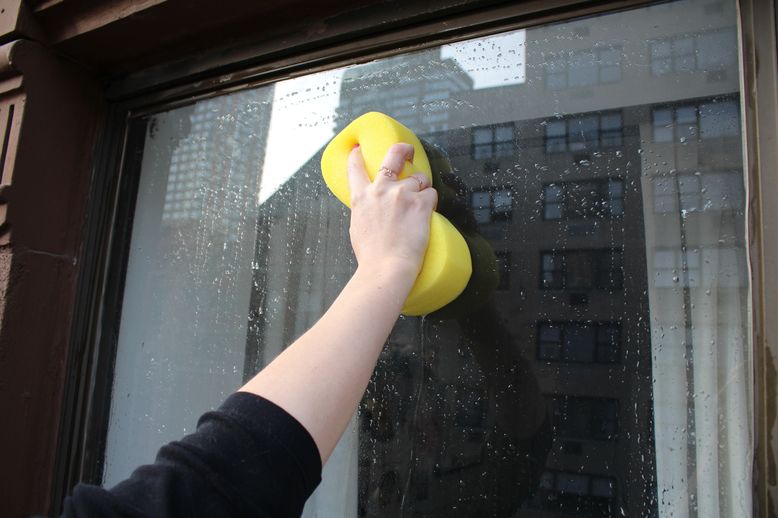
1. Sponge the glass with vinegar water.

Fill your bucket with a gallon of warm water, add 1 cup white vinegar, and then soak your sponge in it completely. Wipe the sponge across the window in an S-motion (get to one side, then turn around and go the opposite way, one row down). Dunk your sponge as needed, but do this fairly quickly so the water on the windows doesn’t have time to dry before you wipe it off; if needed, do your window in sections. Be especially careful to get flush against the top of the window — it’s easy to miss this spot!

Photo by Jonah Ollman

2. Squeegee the solution away.

Slightly wet a squeegee (a dry squeegee will skip against glass) and follow the path you made with the sponge, being careful to wipe all of the water away. You can use a clean cloth to dot at the excess liquid and lines left, but I found that the using the squeegee alone left the fewest streaks.

Photo by Jonah Ollman

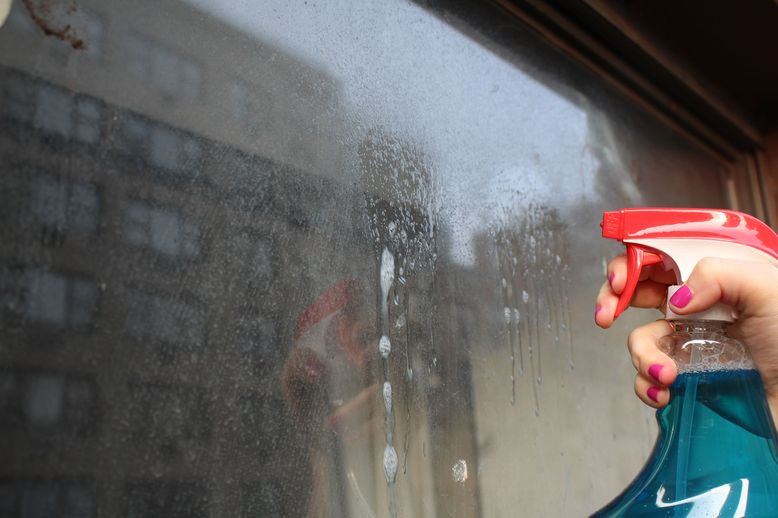
3. Spray the glass with cleaner.

Once you’ve cleaned the first layer of grime of your window, there’s still more fun to be had. Spray a stronger mix of 1:1 water and vinegar (or Windex, or glass cleaner) at your window, so that the solution covers most of the glass. (I found Windex to work better, but if you have pets — or kids — who frequently lick outdoor windows, vinegar may be the best route for you.)

Photo by Jonah Ollman

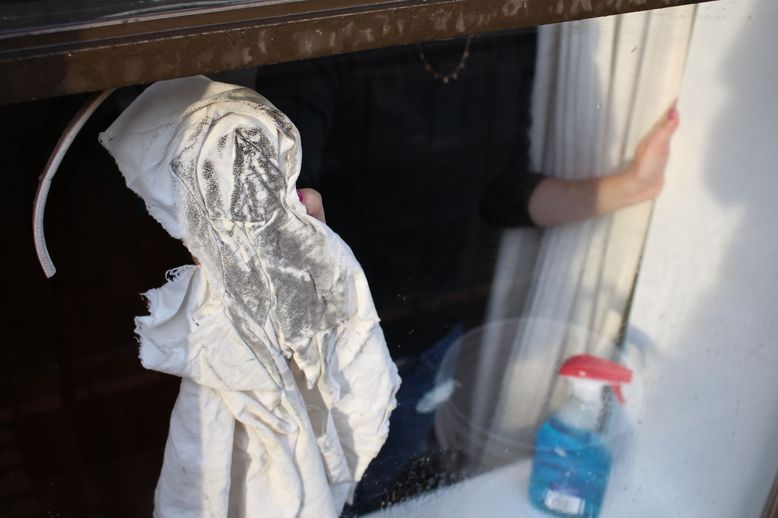
4. Wipe it away with a rag.

Using a clean rag, wipe the cleaning solution across the window and window hardware — you’ll be able to see how much grime is still left!

Photo by Jonah Ollman

5. Give it a once-over using newspaper.

Once the window is mostly dry, bunch up a piece of newspaper and wipe any remaining liquid off — this will ensure that it’s streak-free. (Don’t use newspaper to wipe the cleaning solution off at the first go, as it will get wet and pill-y, and fall apart.)

* * *

For the inside windows:

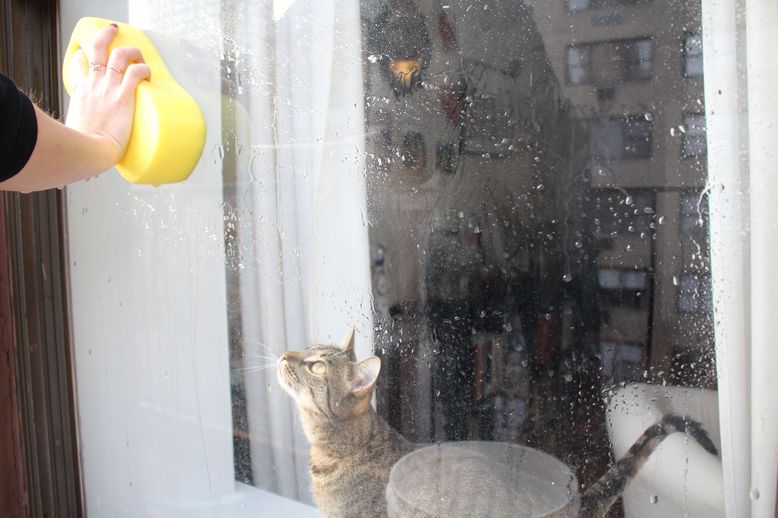
It’s just as important to clean the inside of your windows as it is to clean the outside — miscellaneous marks from pets’ noses and finger prints, combined with natural dust, pile up make them dirty (see photo above). But they will not, hopefully, be nearly as dirty as your outside windows, which means you can skip a few steps this go-around — you don’t even need a bucket!

  1. Either spray a natural solution of 1:1 water to vinegar or Windex at your window so that it roughly covers most of the window. (If you used Windex outside, it might be worth using a natural solution indoors since there isn’t nearly as much grime to cut through and this is what you’ll be breathing in for the next few days. For the record, I used Windex — this is a no-judgement zone.)
  2. As you did outside, use a clean rag to wipe the cleaning solution across the window and over all window hardware.
  3. Once you’ve mostly dried the window with the clean rag, bunch up newspaper to wipe off any remaining liquid.

Added bonus: Your cat will have the time of her life.

Added bonus: Your cat will have the time of her life.

* * *

For the unreachables:

Because my fire escape is only in front of two windows, I have two windows on either side of the escape that I couldn’t reach by hand. The best way to clean unreachable outdoor windows is to do the process listed above, but using extendable handle squeegees and sponges. But, since I live in a New York City apartment that barely has room for a 5-gallon bucket, let alone an extendable squeegee pole, I opted for the next best thing: my Swiffer Wet Mop.

While my outdoor windows could have been less streaky, I’m happy to report that the Swiffer worked just fine, in a pinch — and better yet, it got rid of the pigeon poop I’ve been staring at for the better part of the year!

Rachel Maddow walks through bonkers Republican scandal that led to Matt Gaetz sex trafficking probe

MSNBC host Rachel Maddow said that she scrapped her Tuesday show to walk viewers through the bonkers scandal that led to the allegations about Rep. Matt Gaetz, R-Fla., being involved in a sexual relationship with an underage teen.

As far as it is understood now, it began with Josh Greenberg, a Seminole County Tax Collector who ousted a long-term incumbent tax collector in the county in 2016.

According to reports, Greenberg hired six people that were part of his wedding party in 2015.

“I am not sure that’s how you are supposed to staff up the tax collector’s office,” Maddow confessed. “An investigation found that he issued $1.9 million in contracts from his office to people who were his own close friends and business partners. Again, this is the tax collector’s office. A county audit found that for some reason, within months of taking office, he started spending public money for that office on guns and ammunition and body armor and drones. The tax collector’s office in Seminole County, Florida, needs drones? OK.”

By June 2017, after he’d been in office for several months, Greenberg said that all tax collector staff would begin carrying guns.

“He wanted them to wear their guns at work,” Maddow explained. “To go along with their tax collector’s office badges. This is like the office that collects license fees and stuff. This is not like some SWAT team agency with frontline Wyatt Earps out there defending the streets. But the guy elected to that office after hiring his groomsmen to come in and run the place buys all these guns and body armor and ammo and drones, tells everybody in the office they need to wear guns at work to go along with their badges? Why did he want that?”

At one point, he pulled someone over, claiming she was speeding, an odd claim given his office doesn’t deal with anything involving traffic violations.

When someone filed to run against Greenberg, he arranged for someone to make a fake rape accusation. A collection of Proud Boys in the area then promoted the conspiracy all over the internet.

Maddow cited reports from The Orlando Sentinal, which detailed Greenberg’s “frequent anti-Muslim social media posts and his posts posing with far-right white nationalist types. He ended up posting things online about his friendship with President Trump’s longtime political advisor and convicted felon Roger Stone.”

Then there was his relationship with Gaetz.

“Where things get rough for the Seminole county tax collector is June of last year,” Maddow explained. Federal agents come to his house to arrest him for, among other things, allegedly stalking a local man who was going to run against him for a county tax collector.

So, “federal agents show up at his house last summer to arrest him on the stalking charges, and things get worse because what do they find when they come to arrest him at his house? I will read it from The Orlando Sentinel. ‘The day he was indicted for stalking a little rival, Joel Greenberg had several stolen IDs in his work vehicle, a pair of fake IDs in his wallet and materials for making more in his office. Evidence he was regularly abusing his position to steal unwitting constituents’ identities, according to federal authorities. Inside the tax collector’s work vehicle, agents found his backpack, which held three licenses from Canada, Virginia and Florida belonging to Seminole County residents who recently obtained new Florida licenses. Employees told agents they had seen Greenberg taking surrendered licenses from the agency’s shred basket prying to their destruction.”

Prosecutors said that he was stealing the old IDs and turning them into IDs to use for himself. He had many of them for several states.

“Why do you need a whole bunch of fake identities? And why was he also, according to prosecutors, trying to figure out how to falsify concealed firearms permits, as well?” Maddow asked. “Do you have any idea how many things could go wrong all at once if you just elected the wrong guy tax collector of all things? Who knew what mischief could be made out of a single job like that?”

By August of 2020, when the investigators went through his computers and electronic devices, that’s when they found evidence of sex trafficking. That’s where the Matt Gaetz problem begins.

You can watch the video below via YouTube:

Georgia Republicans supported voting buses and drop boxes — until Trump and the GOP started losing

Some Georgia Republicans who promoted Fulton County’s mobile voting buses last year voted to restrict them after the party lost the state’s presidential and Senate races.

The Election Integrity Act of 2021, Georgia’s sweeping election reform law, has widely been described as a “voter suppression” effort, largely prompted by baseless allegations of election fraud spread by former President Trump and his allies. President Joe Biden and other Democrats have compared the law to those of the Jim Crow era, and numerous voting rights groups have already sued to strike down key measures they argue will disproportionately impact voters of color. The law bans the use of Fulton County’s mobile voting buses and restricts the use of absentee ballot drop boxes, among many other measures that affect virtually every aspect of the state’s election laws.

Some Republican legislators who voted in favor of the bill promoted the use of voting buses and drop boxes in 2020 — before abruptly deciding to oppose them after Donald Trump became the first Republican to lose Georgia since 1992 and the party lost both Senate seats for the first time in more than two decades amid record voter turnout. Many of them cited voter concerns about election integrity — a common GOP talking point as the party pushes hundreds of new voting restrictions across the country — even though those concerns are the result of the party’s own fear-mongering about unfounded voter fraud claims.

“Last year Georgia Republicans promoted the very same early voting practices that they are now decrying as voter fraud,” Jessica Floyd, president of the Democratic American Bridge PAC, said in a statement to Salon. “Republicans had no concerns about mobile voting and ballot drop boxes when they were encouraging their own supporters to use them. But when Black voters use the exact same early voting practices, Republicans consider it fraud. Let’s be clear, Republicans are doing this because they know they can’t win if they don’t rig the game. Georgia voters will hold these hypocritical politicians accountable for their blatantly racist attempt to rig future elections.”

Fulton County, a heavily Black Democratic stronghold targeted by Trump and his allies with spurious allegations of irregularities, bought the mobile voting buses last year in response to long lines at polling places, which are partly the result of the state closing hundreds of polling places since the Supreme Court gutted the Voting Rights Act in 2013. But the new law bars the county from using them unless the governor declares an emergency.

State Rep. Jan Jones, the speaker pro tem of the state House, joined fellow Republicans in stoking groundless concerns about absentee voting when she signed onto House Majority Leader Jon Burns’ letter raising doubts about the state’s signature verification process, even though Republican Secretary of State Brad Raffensperger’s has said there was “no evidence presented of any issues” with the process. Jones urged voters to use the Fulton County mobile buses in October, before voting to ban them after her party lost the three major statewide elections.

Fulton County’s mobile voter bus will be in Milton today. ALL Fulton County voters can go and vote early. The mobile voter bus will be at Hopewell Baptist Church until 6:00PM. Go Vote! #VoteEarly #gapol

Posted by Jan Jones on Wednesday, October 14, 2020

State Rep. Chuck Martin, another signatory, promoted the buses on two separate occasions in October, touting that they work just like “other early voting sites.”

Fulton County Mobile Voter Bus is at Hopewell Baptist Church today from 8:00am – 6:00pm, today, October 14th! Working…

Posted by Chuck Martin on Wednesday, October 14, 2020

Aklima Khondoker, Georgia state director of the voting rights group All Voting Is Local, said the mobile voting ban “reeks of discrimination” against the “most ethnically diverse county in the state.”

The law “bans buses for early voting,” she tweeted. “Only Fulton County used buses in 2020. This helped thousands of voters cast their ballots, when lines were too long, and county staff were strained for resources. Disallowing them would disenfranchise thousands of black and brown voters.”

Other Republican lawmakers promoted absentee ballot drop boxes, which were installed for the first time amid the coronavirus pandemic, before voting to allow them in future elections while restricting their use. The law limits ballot drop boxes to one per every 100,000 active voters or one for every early voting site, whichever is smaller, and requires the boxes to be set up inside early voting sites accessible only during early voting days and hours instead of round-the-clock outside government property.

State Rep. Bonnie Rich, who questioned the integrity of absentee ballots despite no evidence of fraud, promoted the drop boxes on Facebook before voting to restrict them.

State Rep. Don Parsons, who signed onto Burns’ letter, promoted ballot drop boxes on Facebook and said he used one himself before voting to restrict them.

“It works great, and we even received notification that the ballots were received and processed,” he wrote.

Jo and I requested our absentee ballots thru the SOS web portal, received them, marked, them, and deposited them in a…

Posted by Don Parsons on Saturday, December 19, 2020

Parsons disputed that the law restricts the use of drop boxes but rather “provides for them to be used.”

“I do believe the drop boxes worked great,” he said in an email to Salon. “However, the use of drop boxes were not provided for and were not allowed in Georgia law” until last week’s bill was signed, he added.

“The use of drop boxes in 2020 was made possible by the Governor’s Emergency Declaration which provided leeway for the county elections offices to take measures, due to COVID, to encourage voters to use absentee voting in order to limit the number of voters in close proximity in the physical polling places,” Parsons wrote. “The Governor’s Emergency Declaration is no longer in effect. I am happy to report that with enactment of the [Election Integrity Act], the use of drop boxes are allowed by law, with rules and standardization for their use and deployment. The statute also provides for flexibility in the event of any future emergency events.”

Republican Gov. Brian Kemp, who signed the bill into law last week, used a ballot drop box that would be restricted under current rules in November.

A lawsuit filed by Democratic attorney Marc Elias on behalf of the New Georgia Project, Black Voters Matter and Rice Inc. on Thursday argued that the restrictions on drop boxes as well as the voter ID requirement, ban on mobile voting buses and other provisions violate the First and 14th amendments.

“These provisions lack any justification for their burdensome and discriminatory effects on voting,” the lawsuit argues. “Instead, they represent a hodgepodge of unnecessary restrictions that target almost every aspect of the voting process but serve no legitimate purpose or compelling state interest other than to make absentee, early, and election-day voting more difficult — especially for minority voters.”

Numerous other lawmakers who signed Burns’ letter stoking unfounded fears about the signature verification process voted in favor of the sweeping bill that Republicans justified by citing voter concerns, including state Reps. Sharon Cooper, Matt Dollar, Karen Mathiak, Chuck Efstration, Houston Gaines, Marcus Wiedower, Mike Cheokas, Gerald Greene, Ron Stephens and Darlene Taylor. Mathiak has even falsely claimed that the state found “illegal votes.”

All those lawmakers voted to pass the bill despite repeated reviews of the signature verification process that prompted Trump and his allies to pressure Raffensperger to throw out legal votes. The Republican-led legislature introduced dozens of proposed restrictions in response to the specious concerns and ultimately adopted a revised version of its omnibus reform bill, while excluding even more controversial provisions that sought to ban no-excuse absentee voting entirely and restrict Sunday voting, which is disproportionately used by Black churchgoers.

The law strips Raffensperger of some of his authority after he pushed back against the fictitious fraud claims, which were repeatedly discredited by multiple audits, recounts and law enforcement investigations. Many Republicans specifically raised concerns about Cobb County, another Atlanta-area Democratic stronghold. An audit of 10% of the ballots cast in the county found just two ballots with mistakes. The law removes Raffensperger as the chair of the State Election Board and replaces him with an appointee selected by the Republican-led legislature and gives the board the power to take over local election offices, in a move understood as targeting predominantly Black and Democratic Atlanta-area counties.

The new law will require voters to include their state ID number or a copy of their ID to cast absentee ballots. The law restricts the amount of time voters have to request absentee ballots from 180 days to 11 weeks and bans state and local governments from sending absentee ballot applications to voters that did not request them. The law also requires voters to return their absentee ballots two weeks before Election Day instead of by the Friday before Election Day. Counties will also begin mailing absentee ballots three weeks later, beginning four weeks before the election.

The law expands early in-person voting access in most rural counties while leaving metropolitan counties largely unaffected. But the law also shortens the interval for mandated runoff elections from nine weeks to four weeks after Democrats Raphael Warnock and Jon Ossoff both defeated Republican incumbents in January runoff elections for Georgia’s two U.S. Senate seats.

The New Georgia Project lawsuit argues that Raffensperger praised the state’s existing laws allowing no-excuse absentee voting, at least three weeks of in-person voting, and automatic voter registration as the “gold standard” last year. “But now that that system facilitated record turnout in the 2020 general election and the 2021 U.S. Senate runoff elections, the General Assembly has acted to radically and unjustifiably punish the electorate, by dramatically curtailing it,” the lawsuit says.

The complaint goes on to cite racial disparities in socioeconomic status, housing and employment, arguing that “the Voter Suppression Bill disproportionately impacts Black voters, and interacts with these vestiges of discrimination in Georgia to deny Black voters (an) equal opportunity to participate in the political process and/or elect a candidate of their choice.”

A separate lawsuit filed by the Georgia NAACP, Georgia Coalition for the People’s Agenda, League of Women Voters of Georgia, GALEO Latino Community Development Fund, Common Cause and the Lower Muskogee Creek Tribe similarly argues that the law is the “culmination of a concerted effort to suppress the participation of Black voters and other voters of color by the Republican State Senate, State House, and Governor.”

“Unable to stem the tide of these demographic changes or change the voting patterns of voters of color, these officials have resorted to attempting to suppress the vote of Black voters and other voters of color in order to maintain the tenuous hold that the Republican Party has in Georgia,” the lawsuit says. “In other words, these officials are using racial discrimination as a means of achieving a partisan end. These efforts constitute intentional discrimination in violation of the Constitution and Section 2 of the Voting Rights Act.”

Joe Biden is a war president — fighting plague, economic crisis and fascism

Joe Biden is a war president, fighting enemies on at least three fronts.

With the American Rescue Plan, Biden and the Democrats are trying to end a plague that has killed at least 550,000 people in the United States.

The American economy is in ruins because of the COVID pandemic which has left at least 10 million Americans unemployed. (The actual number is much higher.) At least 10 million renters are behind by $5,000 or more. Food insecurity has dramatically increased. What social scientists and medical professionals describe as “deaths of despair” — largely meaning drug and alcohol overdoses and suicides — have also increased because of the misery and isolation of the pandemic.

Biden’s third campaign is a battle to save American democracy from the Republican Party and its allies, who in 43 states across the country — most notably Georgia — are dramatically changing voting laws, in an obvious effort to stop Black and brown people and other key members of the Democratic Party’s coalition from voting.

Writing at FiveThirtyEight, Perry Bacon Jr. sharply and neatly summarizes this reality: “Put another way: Georgia Republicans didn’t come out of the 2020 elections with a goal of finding new messages or policies to appeal to Georgia’s growing population of people of color. They instead opted to imply that these voters participated in the Georgia elections in improper ways that should be prevented in the future. The Washington Post suggests in its motto that ‘Democracy Dies in Darkness.’ But based on the actions of much of today’s Republican Party, it might be more accurate to say it’s dying right out in the open daylight.”

Because the Republican Party cannot win free and fair elections, it is now trying to create a new Jim Crow-style apartheid for 21st-century America. For Republicans, the only type of democracy that is legitimate is white democracy. Unfortunately, such Herrenvolk white supremacist politics are not an outlier in American history. In reality, for most of the country’s history Black and brown people have not been able to vote or otherwise participate in the polity as equal members with whites. The Republican Party, and the white right more generally, are once again proving to be revanchists, throwbacks, driven by the worst type of primitive bigotry, who want the United States to return to the worst aspects of its past. They long to turn America into a living nightmare for Black and brown people while recreating a “whites only” utopia for racists and white supremacists.

Given the United States’ changing racial demography and the social and economic costs of white supremacy and other forms of discrimination, the Republicans’ Jim Crow dreams pose an existential threat to the country’s prosperity, security and leadership role in the world.

As historian Timothy Snyder writes in his newsletter, “Voter suppression is racist authoritarianism. Making it impossible means starting from the principle that it is everyone’s individual responsibility to vote — and America’s collective responsibility to make it as easy as possible for every citizen to vote.”

As with Jim and Jane Crow in prior decades, these white supremacists in nice suits are also aided in their anti-democratic campaign by paramilitaries and other political hooligans wearing camouflage — or simply polo shirts and khaki pants. 

As Ruth Marcus of the Washington Post writes, there is nothing subtle about this Republican attack on democracy, which must be understood as “a product of GOP desperation to retain or regain power”:

Alice O’Lenick, chairwoman of the Gwinnett County election board, didn’t mince words about the need to tighten up voting rules in Georgia. After the “terrible elections cycle” in 2020, when Republicans lost both Georgia Senate seats and Biden won the state’s electoral votes, “I’m like a dog with a bone,” she told fellow Republicans in January. “I will not let them end this session without changing some of these laws. They don’t have to change all of them, but they’ve got to change the major parts so that we at least have a shot at winning.”

Conservative lawyer Michael Carvin, representing the Republican National Committee in an Arizona voting rights case before the Supreme Court earlier this month, was equally transparent — and transactional. When Justice Amy Coney Barrett asked why the RNC was involved in the case — in particular, why it had an interest in preventing people from having their votes counted if they were cast in the wrong precinct — Carvin didn’t bother to pretend this was about anything other than partisan politics.

“Because it puts us at a competitive disadvantage relative to Democrats,” he said.

“Politics is a zero-sum game, and every extra vote they get through unlawful interpretations of [the Voting Rights Act] hurts us.”

A shot at winning. Politics as zero-sum game. Proof positive that this isn’t about the phantom menace of voter fraud. It’s about making it as hard as possible for voters who aren’t inclined in Republicans’ favor to have their ballots cast or counted. 

President Biden responded last week to Georgia’s new anti-voting and anti-democracy law, describing it as “un-American,” an “atrocity” and an example of “Jim Crow in the 21st century.” During his White House press conference on Thursday, Biden also said that “the Republican voters I know find this despicable.”

But as a war president fighting to save American democracy, Biden must not show weakness, or offer his adversaries any opportunities to counterattack. He risks being overly generous in his assessment of their intent and goodwill. In fact, his assessment of Republican voters is entirely too kind.

Public opinion and other research consistently show that Republicans and other right-leaning voters (especially Trump supporters) do not favor multiracial democracy. There is an abundance of evidence in support of that conclusion. 

For example, a majority of Republicans believe (or at least claim to believe) Trump’s “Big Lie” that the 2020 presidential election was somehow “stolen” by Biden and the Democrats. Other polling and research shows that Republican voters believe that voter fraud, vote theft and other irregularities were rampant — especially in Black and brown cities and other Democratic areas of the country.

Republicans also support the imposition of new Jim Crow voting restrictions in Georgia and other parts of the country — although as philosopher Jason Stanley explained in a recent interview with Salon, they have managed to convince themselves that such white supremacist laws are “protecting” and “securing” the vote.

Other research shows that Republicans and Trumpists are willing to destroy American democracy if white people are no longer the most dominant and powerful group. The Jan. 6 coup attack on the Capitol was a literal and symbolic rejection of Joe Biden and Kamala Harris’ victory and the very idea of multiracial democracy in America. A large percentage of Republicans supported the Capitol attack.

Law enforcement and other experts warn there will likely be a violent right-wing terrorist insurgency campaign, which may continue for years, as a backlash against the country’s increasing racial and ethnic diversity. To make matters worse, political scientists and other researchers have shown that there is a growing base of support for such a right-wing violent insurgency among middle-class white Americans.

There is other public opinion and social science research that demonstrates how white Republicans hold the delusional belief that they are the “real victims” of racism in America and that “reverse racism” against whites is a bigger societal problem than racism against Black and brown people.

Approximately 40 percent of Americans hold authoritarian values or show considerable agreement with them. White Republicans, especially Trump supporters, are more likely to exhibit such personal traits and values than are Democrats.

As president of the United States, Joe Biden must serve as the country’s cheerleader, civic priest and counselor, conscience and guardian. The public’s response to his efforts to defeat the COVID pandemic and the misery it has caused has been overwhelmingly positive. After all, Biden is obeying the most fundamental rule of politics: Give the people what they want.

He has chosen to be a uniter, determined to transcend the Republican Party’s obstruction and assaults on democracy and the common good, in hopes of healing a country that has been badly broken and divided by Donald Trump’s neofascist regime and movement. 

Those intentions are noble. But Biden must still confront the fact that there are tens of millions of Americans, most of them white Republicans, who do not believe in multiracial democracy — are willing to betray it or destroy it in order to maintain their real and perceived individual and group power. This is an existential dilemma for the United States, one that has bedeviled and threatened the country’s stability and future since before the founding. How Joe Biden chooses to respond to an America divided by racism and white supremacy — and by an attempted fascist coup — will be his legacy.

At this early point in his presidency, Biden has waged a successful campaign on two fronts, in seeking to control the pandemic and resuscitate the economy. But it may well be the third front — the centuries-long battle against American racism and white supremacy — where he and the Democratic Party are outflanked, with disastrous results for them and the entire country, in the 2022 midterms and beyond.

White supremacy and the filibuster: From John C. Calhoun to Mitch McConnell

Mitch McConnell’s claim that “the filibuster is the essence of the Senate” has been tossed aside by his opponents as bad history, violently inconsistent with how Jefferson, Hamilton or Madison aimed to structure the Senate, and perhaps even unconstitutional. All true. But what McConnell’s screed should remind us is that the filibuster has always been the essence of the politics of white supremacy — even as it now poses a broader threat to democracy itself.

McConnell draws on a playbook stretching back to John C. Calhoun, who as vice president in 1841 forged the filibuster into a conscious instrument to block majoritarian democracy as part of his project of creating a durable framework for slavery in a nation he knew would eventually vote against it. Calhoun, generations of Southern senators and now McConnell have shared a determination that majority votes should not be the last word in the United States. Privileged minorities should be able to override the will of the entire people — if their interests are endangered. Yes, Calhoun was focused on slavery and race, but his first filibuster was over national banking. The interest he sought to  protect from a national majority was that of the South as a region, extending beyond slavery to issues like tariffs.  

Chuck Schumer’s attempts to shame McConnell for being anti-democratic — by seeking to shrink the electorate instead of persuading it — thus land flat on the right. McConnell is tapping  into one of conservatism’s deep obsessions: How can America avoid majoritarian democracy? And Calhoun, who was twice vice president and twice almost president, devised the precise answer that McConnell is deploying today. When McConnell refers to “consensus,” he doesn’t mean compromise that generates broad acceptance across divergent perspectives within a single electorate. He means that certain important subgroups — such as those who owned human beings as chattel, in Calhoun’s day — should be allowed to veto legislation, however large the popular majority that favored it. Jefferson had asserted, “It is my principle that the will of the majority should always prevail” but Calhoun twisted this by asking, “Which minority cares the most?”

White supremacists have always been the exemplar of such a protected group. Calhoun devised his doctrine to protect them, calling such a system “concurrent majorities.” (He envisaged them as interest groups, not political parties — his major difference with McConnell.)

Calhoun passed the torch to the leaders of the secession movement who then rooted the theory of the Confederacy in the soil of concurrent majorities. The Confederate constitution was thoroughly imbued with Calhoun’s doctrine. As the Civil War drew to an end, Jefferson Davis made clear that he would not accept majority rule: “We seceded to rid ourselves of the rule of the majority…. Neither current events nor history shows that the majority rules, or ever did rule.”

After the Civil War, the Reconstruction Amendments were intended to make America a democracy where the male majority ruled, regardless of race. This vision was subverted, using Calhoun’s example, by repeated Senate filibusters blocking legislation to implement civil rights, a power specifically granted Congress by their authors. The justification? That “states” were a protected minority entitled to nullify majority decisions — in other words, the very issue that the Civil War was supposed to have settled!

The deep logic of filibuster and “concurrent majority” theory alike is the grant of  white minority rights denied to an African-American minority. Carrying out Calhoun’s theory  as he envisaged requires deciding, a priori, that one race is entitled to greater deference than the other. (This exact logic led the Supreme Court to conclude, in the infamous Dred Scott decision, that to sustain the rights of slaveowners it was unavoidable to declare that Americans of African descent had no rights at all.) On matters of racial justice, defenders of the filibuster have always argued that reducing current inequalities between two groups required a supermajority, while sustaining inequality required only a robust minority. 

White supremacists sustained this doctrine throughout the 20th century. Civil rights bill after civil rights bill went down in the Senate, throttled by the filibuster and defended with the argument, as Mississippi’s Theodore Bilbo put it, that “a mob is a majority; without the filibuster the minority would be at the mercy of the majority.” Bilbo’s fears, of course, were not for the rights for the majority of Mississippians — the state was still 50% Black, and during the Jim Crow period African Americans had been a majority. The all-white political structure was the minority whose concurrence Bilbo demanded.

The broader conservative application of the concurrent majority concept was most clearly articulated by the John Birch Society after World War II with its singular focus on one goal: “America is a Republic, not a democracy. Let’s keep it that way.” But outside the South, ideological conservatives were too few in the Senate to otherwise abuse the filibuster. 

The conventional wisdom after 1965 was that the debate about white supremacy — and the stain that most Americans thought it had laid on our national identity — had been ended by the civil rights movement, specifically the passage of the Voting Rights Act. But while explicit arguments for restricting access to the franchise by ethnic minorities, the poor or immigrants largely vanished, stripping the filibuster of its obvious racist identity actually made possible its contemporary weaponization.

Insisting on a Senate supermajority had been a challenging, expensive and rare option almost exclusively put in play to defend Jim Crow and white privilege. Now it became a strategic but routine Senate procedure, first deployed by Bob Dole to hamstring the Clinton administration and then by Harry Reid against George W. Bush. Finally, with Obama’s election, Mitch McConnell unleashed the full force of the 60-vote loophole and imposed upon the Senate the very supermajority the founding fathers had specifically rejected. The toxin that Calhoun had first injected into the Senate to counter the future threat of majority rule now found its moment. The virus spread.

While  the filibuster — the essence of Mitch McConnell’s Senate — is the most powerful weapon the right-wing opponents of democracy have seized, Republicans in 2020 are deploying the full panoply of anti-democratic strategies devised over two and a quarter centuries by Calhoun’s followers. The most important campaigns being waged by conservatives at this moment emphasize the spread of gerrymandered districts, purged voter rolls, legalized bribery, a politicized judiciary, state pre-emption of local home rule and crippling the executive authority of majoritarian governors, even Republican ones.

Every tool is designed to reduce the ability of the majority to govern. Changing voting rules or Senate processes such that the minority can prevail over the majority is a feature, not a bug. If endless voting lines in minority precincts in Georgia creates an opportunity to  influence voters by offering them water, why else is the solution to make offering water a felony, rather than offering those citizens adequate numbers of voting booths?

Yes, the motivations may be — as some Republicans conceded in a Senate hearing last week — that if every American could vote easily, Republicans would lose because they are a minority. But Schumer’s complaint about derailing majority rule, for many conservatives, misses the point. Some on the American right doesn’t think the majority deserves to rule.  Even more of it believes that voting and participation in governance are privileges to be earned, not rights to be protected.  That’s their understanding of “the consent of the governed.” Mitch McConnell now has the Senate that John Calhoun always schemed for. That is the dilemma facing American democracy.

Pandemic-related medical waste is polluting our oceans

Soiled light-blue face masks, muddy, broken or flittering in the bushes, are a ubiquitous sight in the pandemic-era urban landscape. Indeed, of the billions of personal protective equipment objects manufactured to keep the world’s population safe, much of said trash ultimately migrates into our oceans, or in some cases other bodies of water. 

According to a report released on Tuesday by the nonprofit environmental advocacy group Ocean Conservancy, their network of International Coastal Cleanup (ICC) partners and volunteers found more than 107,000 pieces of PPE (personal protective equipment) polluting the planet’s beaches and waterways in the second half of 2020. This included not only face masks but also face shields, gloves and sanitizing wipes. Among the volunteers surveyed by the nonprofit, 94% saw PPE pollution at a cleanup; more than 80% said that face masks were the most common form of PPE pollution that they discovered; and 37% reported that they found PPE actually submerged within various bodies of water.

Ocean Conservancy also noted in its report that, because of COVID-19 era limitations in how partners and volunteers could effectively collect data, the 107,000 pieces recorded is almost certainly a significant undercount. Given that plastic pollution was already a significant problem before the pandemic, this raises serious questions about how the increased use of PPE has worsened the crisis.

“We know there is evidence of face masks’ elastic straps entangling animals,” Nick Mallos, senior director of Ocean Conservancy’s Trash Free Seas program, told Salon. “We know again that microplastics in the environment are taken up by animals — small and large, including fish and shellfish — for human consumption. So many of the mechanisms of impact and risk associated with PPE are the same ones that we have seen from every day plastics that have been littering in our beaches and waterways for decades.”


Want more science stories in your inbox? Subscribe to Salon’s weekly newsletter The Vulgar Scientist.


Allison Schutes, director of Ocean Conservancy’s International Coastal Cleanup, said the PPE issue is magnifying the problem of plastic pollution, which she noted is “already a significant crisis” when it comes to plastic pollution.

“We know that a lot of these single use plastics are always on our Top 10 list,” when it comes to International Coastal Cleanup, Schutes explained. “These are the items that are found year after year. In 2019 alone over 5 million food wrappers were found and collected and documented, over 2 million plastic beverage bottles, and over 1 million straws.”

The deluge of PPE pollution, and the fact that individuals and governments have done very little to address it even as we confront other ramifications of the pandemic, could have far-reaching consequences.

“It’s really something that we all individually are going to have a role to play, but it’s also important and imperative for our companies and our governments to take a strong role in helping us really mitigate and solve this crisis,” Schutes told Salon.

Overall, the COVID-19 pandemic has a mixed effect on Earth’s ecology, and in some cases it has been arguably beneficial: For instance, many climatologists believe there was a roughly 7% decrease in greenhouse gas emissions in 2020 compared to 2019 because people traveled less due to pandemic restrictions. At the same time, the scourge of plastic pollution poses just as much of a threat to the future of the human species as does climate change. There is mounting evidence that chemicals found in many plastics are linked to infertility (particularly plummeting sperm counts) and birth defects.

Despite this, plastic pollution continues to worsen, with an Australian study last year finding plastic in 100 percent of five different types of seafood.

While it remains to be seen what can be done about this problem overall, Ocean Conservancy does have some advice about how individuals can more responsible dispose of their PPE.

“In terms of PPE, we can all make sure we have properly snipped those elastic bands [on our masks] when you’re done,” Mallos told Salon, alluding to how animals can get entangled in them. “For restaurants, make sure you’re reducing the amount of plastics you’re serving right now during the pandemic when delivery and takeout is at its highest.” He also urged governments to enact legislation like the Break Free From Plastic Pollution Act of 2021, which aims to heavily regulate and ultimately phase out dangerous plastics. “We really need action from the individual all the way up to global policy,” Mallos added.

Fox News guest calls Tucker Carlson a conspiracy theorist while appearing on network

Mercedes Schlapp, host of the Conservative Political Action Conference, became angry on Tuesday after a Fox News guest called her a “grifter.”

During a discussion on Fox News, Schlapp objected to the idea of “vaccine passports” even though the Biden administration has said that it has no plans to implement the policy.

Schlapp accused Democrats of having an “illogical mentality” because they oppose voter ID requirements.

But liberal podcast host Chris Hahn pointed out that the idea of vaccine credentials is being driven by the private sector.

“But Republicans, like everything else they’ve done during this horrible crisis we’ve been through, are pushing these conspiracy theories that the government is trying to control you, which is causing some of their followers not to get vaccinated,” Hahn explained. “People like Tucker Carlson, like Jim Jordan, like Mercedes right here, right now casting doubt on the fact that — or trying to convince people that the government is somehow watching you, that is very irresponsible.”

“It is time for conservatives in this country to acknowledge that we have a crisis and start joining the fight to end it and stop spreading lies about what’s going on in this country,” he added. “It is devastating this country and blood is on the hand of the former guy and others who support him.”

Schlapp went ballistic.

“You’re not going to call Tucker Carlson a conspiracy theorist!” she shouted. “That is wrong. That is what democrats do.”

“He is and you are,” Hahn shot back.

“I’m not going to put up with this!” Schlapp exclaimed. “I stand for freedom. I stand for the freedom of the American people.”

“No you don’t,” Hahn insisted. “You’re a grifter. This is ridiculous.”

At that point, Fox News host Gillian Turner instructed her guests to stop “the name-calling.”

“But I’m not going to allow Chris — he does this all the time — to call me, to call Tucker Carlson a liar,” Schlapp objected.

“We don’t do name-calling,” Turner agreed.

“We have every right to make this decision!” Schlapp ranted. “We are a country that has a Constitution.”

You can watch the video below via YouTube:

Amazon’s vigorous PR attacks ahead of union vote underscore just how frightened it is: experts

As Amazon warehouse workers in Alabama move closer toward a union vote, the massive online retailer is ratcheting up its aggressive attacks in opposition to the initiative. According to labor and antitrust experts, the pushback shows just how worried the eCommerce giant is about employees unionizing.

Over the last several days, a number of Amazon workers have engaged in online debates with high-profile lawmakers as they detail their concerns about the company’s “working conditions, tax policies and threats to break up Big Tech,” CNBC reports.

At the time, Amazon and Dave Clark, the company’s CEO worldwide consumer, had responded to a number of critical tweets. But the situation escalated when the company began directly responding to criticism with tweets defending the company’s practices. In fact, Amazon directly responded to Sen. Elizabeth Warren, D-Mass., and Rep. Mark Pocan, D-Wisc.

Amazon also fiercely denied that workers are “forced to urinate in bottles as a result of the demands of the job” although there is detailed documentation of the disturbing practice.

The aggressive tweets, which reportedly came as a directive from Amazon CEO Jeff Bezos, appear to underscore a deeper internal problem.

CNBC reports that “labor and antitrust experts say the tweets and the pressure from Bezos to fight back indicate Amazon is increasingly concerned about the looming union vote in Alabama, which is set to heat up this week.” Now, experts are weighing in.

Tom Kochan, a Massachusetts Institute of Technology (MIT) professor of industrial relations, work, and employment insists the Twitter tirade suggests Amazon will do “everything they can to convince the workforce that they should vote against the union.”

“These are clearly anti-union messages,” Kochan said. “[The messages] are carefully constructed to try and stay within what is allowed under the National Labor Relations Act, so that the National Labor Relations Board doesn’t eventually rule against them and either call for another election, or if it’s most egregious, they could issue a bargaining order and say that Amazon has to negotiate with the union.”‘

Stacy Mitchell, a co-director of the Institute for Local Self-Reliance, has also pushed back against Amazon’s labor practices. “Even if the union drive doesn’t succeed, this whole unionization effort advances a public conversation about the fact that we need to do something about Amazon’s power,” Mitchell said.

Kochan went on to explain why Amazon is aggressively pushing back against the idea of workers unionizing and how it could impact the company’s level of control.

“If a union comes in, they’re going to demand fair conditions to reduce the stress and the pace, and that might require more staffing,” Kochan said. “It may require a different pace of work per individual. That’s the key.”

Kochan added, “Amazon may possibly win this battle, we don’t know, but they’re going to lose this war for support of the public,” he said. “It comes at a time when Congress is looking very, very carefully at these very big companies and this is going to be part of that debate.”

Giada De Laurentiis’ crispy Amalfi lemon chicken is an easy weeknight meal that makes you feel fancy

With the days getting longer and the weather beginning to warm up, now is the perfect time to start making bright, citrusy dishes that remind us of summer heat  .and all of the seasonal fruits that come along with it.

Giada De Laurentiis‘ recipe for Amalfi Lemon chicken is right on the money when it comes to these vibrant flavors. That, plus the straightforward prep makes this a new go-to dish to add to your dinner rotation. Lucky for us, the chef recently shared the recipe from her new book, “Eat Better, Feel Better,” on social media. 

Giada writes, “Lemon? Check. Crispy skin? The delicious smell of fresh herbs as the bird roasts? Easy enough to make on a weeknight? Check, check, and check again. This recipe ticks all the boxes for me, and I’m sure it will for you as well.”

We can always count on Giada to give us options, and here the cut of the chicken is up to you. Giada suggests spatchcocked chickens, which come without backbones. This can make it easier to open your chicken flat on your baking sheet (and you’ll soon see why this is important). If you’re a fan of dark meat or the familiar, you can also substitute chicken thighs and breasts.

In this dish, the secret sauce is a lemony, salty rub that comes together by mixing lemon zest, thyme, rosemary and salt together in a small bowl. The rub goes on the flesh of the chicken, as well as underneath the skin. Then, lay the chicken atop a “rack” formed from making a bed of lemons on a rimmed baking sheet. A healthy amount of olive oil aids the cooking process

Finally, roast your poultry for 40 to 45 minutes in a 450-degree oven, basting every 10 or 15 minutes with the juices from the pan until everything becomes golden brown. Don’t throw the lemon pulp and the juices out; make a sauce to drizzle over the chicken before digging in.

Once again, Giada gives us another bold dinner that’s easy enough for a weeknight yet flavorful enough for a special occasion. For recipe here.

For more of our favorite recipes from Giada, check out: 

Salon Food writes about stuff we think you’ll like. Salon has affiliate partnerships, so we may get a share of the revenue from your purchase.

Biden takes aim at anti-Asian hate crimes after Tammy Duckworth blasts “offensive” White House call

White House press secretary Jen Psaki announced a series of executive actions responding to the rise of anti-Asian hate crimes and vowed that the administration will soon appoint a member of the Asian American and Pacific Islander community who will oversee policy and outreach, after Sen. Tammy Duckworth, D-Ill., continued to criticize the lack of AAPI representation in the Cabinet.

The White House initially said it would create a new AAPI “liaison” position after Duckworth and Sen. Mazie Hirono, D-Hawaii — the first Asian woman to serve in the Senate — threatened to block President Joe Biden’s sub-Cabinet and judicial appointments because the administration had failed to name any members of the AAPI community to the Cabinet. The senators backed off their threat after the announcement but Duckworth renewed her criticism of the administration in an interview with CBS News Monday.

Duckworth, the first woman of Thai descent elected to Congress, said her ultimatum came after a call in which White House officials responded to her concerns about the lack of representation by citing Vice President Kamala Harris’ South Asian roots.

“The folks in the administration actually brought up her name and said, ‘Well, you have Kamala, you don’t need really any other Asians in the Cabinet,'” Duckworth told the outlet. “And I thought, wow, that’s really offensive. You wouldn’t say we have a white male president, there shouldn’t be any more white male members of the Cabinet. Why would you say that to someone from the Asian community?”

A reporter cited the interview during Tuesday’s White House press briefing, noting that the administration still has not responded to the AAPI community’s demands for representation at the leadership levels in the executive branch.

“We’ve had a range of conversations with Sen. Duckworth since that call which happened about a week ago, including a commitment to naming a high-level member of the AAPI community to a position in the White House,” Psaki said. “And that’s something we’re working to do through consultation with a range of officials. That person will be a commissioned officer and will be working on both policy and outreach. As soon as we have a name, we will share it with all of you.”

Duckworth in the interview welcomed the move.

“I am so pleased that they’re putting somebody in the White House … who will help us navigate these issues and bring up issues of real concern to Asian-Americans like the underreporting of violence against Asians,” she said

Though Biden’s 15 Cabinet heads do not include members of the AAPI community, he did appoint Katherine Tai as the first Asian American U.S. trade representative, which is a Cabinet-level position. He also nominated Neera Tanden, who is Indian-American, to head the Office of Management and Budget, another Cabinet-level position, but her nomination was shot down by Republicans and Sen. Joe Manchin, D-W.Va., over her history of “mean tweets.”

AAPI advocacy groups have called for Biden to do more in response to the rise of hate crimes directed at Asian Americans, urging him to direct the Justice Department to investigate and prosecute anti-AAPI racism and back legislation focusing on hate crimes, like Hirono’s COVID-19 Hate Crimes Act, which would assign a DOJ office to focus on COVID-19 related hate crimes. A recent analysis by the Center for the Study of Hate and Extremism at California State University, San Bernardino, found that overall hate crimes dropped 7% in the 16 largest cities in 2020 — but those targeting Asian Americans increased by nearly 150%.

Psaki on Tuesday also touted the Biden administration’s actions to respond to the rise of anti-Asian violence and bigotry on the heels of a mass shooting in three Atlanta-area spas that killed eight people, including six Asian women.

The White House said in a news release on Tuesday that Biden will reinstate the White House Initiative on Asian Americans and Pacific Islanders, which was first established in the Clinton administration, and expand the initiative to focus on anti-Asian bias and violence. The White House said Biden will “appoint a permanent Director to lead the Initiative in the coordination of policies across the federal government impacting Asian American, Native Hawaiian, and Pacific Islander communities.”

The Department of Health and Human Services will also use $49.5 million from the American Rescue Plan to fund “community based, culturally specific services and programs” aimed at supporting AAPI survivors of sexual assault and domestic violence.

The Justice Department will restart the Civil Rights Division’s Hate Crimes Enforcement and Prevention Initiative focusing on hate crimes against the AAPI community and the FBI will improve data reporting of anti-Asian hate crimes, the White House said. The FBI will also boost training to better identify anti-Asian bias crimes and provide civil rights training to local law enforcement agencies to recognize and report anti-Asian bigotry.

Biden previously issued a memo in his first week in office condemning racism against the AAPI community and highlighting former President Donald Trump’s xenophobic statements.

“I think there’s no question that some of the damaging rhetoric that we saw during the prior administration, blaming — calling COVID, you know, the ‘Wuhan virus’ or other things led to, you know, perceptions of the Asian-American community that are inaccurate, unfair, that have elevated threats against Asian Americans, and we’re seeing that around the country,” Psaki said.

The memo instructed all federal agencies to ensure that official actions and documents “do not exhibit or contribute to racism, xenophobia, and intolerance against Asian Americans and Pacific Islanders” and instructs the Secretary of Health and Human Services to issue best practices for “advancing cultural competency, language access, and sensitivity towards Asian Americans and Pacific Islanders in the context of the Federal Government’s COVID-19 response.” The memo also instructs the Justice Department to expand collection of data and public reporting of crimes against the AAPI community.

“There is no doubt that our community is still at risk. I applaud President Biden for recognizing our community’s pain and taking concrete actions to protect AAPI individuals from violence and root out anti-Asian bias while also supporting the victims of hate crimes,” Duckworth said in a statement in response to Biden’s new actions.

Psaki on Tuesday also vowed that the “administration will meet with AAPI leaders to hear their input on how we can play the most constructive role possible in the community” and highlighted Biden’s remarks following the Georgia shootings.

“Too many Asian Americans have been walking up and down the streets and worrying, waking up each morning the past year feeling their safety and the safety of their loved ones are at stake,” Biden said after meeting with members of the AAPI community in the wake of the attacks. “They’ve been attacked, blamed, scapegoated, and harassed. They’ve been verbally assaulted, physically assaulted, killed. … The conversation we had today with the AAPI leaders, and that we’re hearing all across the country, is that hate and violence often hide in plain sight. And it’s often met with silence. That’s been true throughout our history, but that has to change — because our silence is complicity. We cannot be complicit. We have to speak out. We have to act.”

HBO’s “Last Cruise” doc of that fateful quarantined cruise ship is a harrowing metaphor for inequity

Early in the new HBO documentary “The Last Cruise” – about the COVID-19 outbreak on board the cruise ship docked and quarantined outside Japan – crew member Dede Samsul Faud, a dishwasher from Indonesia, makes a simple statement: “For people who have never worked on a cruise ship and think their job is stressful, it’s nothing compared to this.” 

While Faud took the job on the Diamond Princess to see the world, he’s frank about the fact that the hours are long, the pay isn’t great — one of the pastry chefs on board takes home less than $1,000 a month — and the quarters are cramped. Using his smartphone, Faud records a video of his cabin. It’s big enough for a single bed and two shelves, which he has crammed with foodstuffs like coffee packets, instant noodles and chili flakes. Cheap sustenance and hits of flavor for the long, monotonous days onboard. 

Contrast this with footage of the guest cabins on deck, captured by guests who are either eager to hold onto the memory or to show off on social media (I’m guessing a bit of both). They’re spacious in comparison to Faud’s, with king-sized beds, walk-in closets and bowls of fresh fruit that are refreshed as needed. 

This kind of sharp social stratification is the often unspoken underbelly of most facets of the hospitality industry; the person who serves you champagne at a Michelin-starred restaurant is probably sweating making rent that month. However in “The Last Cruise,” both the crew and the passengers are set to take an unprecedented trip. The documentary opens on Jan. 20, 2020, when there were only four confirmed cases of the novel coronavirus in the entire world. 

By the time everyone eventually exits the ship on March 1, 712 people onboard had tested positive for the virus. 

Over the course of 40 minutes, director Hannah Olson, who was also behind HBO’s 2020 documentary “Baby God,” shows the steep, almost dystopian, descent from footage of passengers line dancing together on the main deck and picking around items on the buffet, to videos of infectious disease specialists in white hazmat suits slapping “COVID-19” signs on the rooms of infected passengers, over and over again, until entire hallways are covered. 

Watching  “The Last Cruise” a year into the pandemic is in part, as Salon’s Melanie McFarland wrote in her review of Netflix’s “Marriage or Mortgage,” almost like being in a time machine, “albeit a cruel one with no doors and a single window that doesn’t open and through which your warning wails of ‘NOOOOOO!’ will never be heard.” One cannot watch “The Last Cruise” without the lurking disquiet of the tragedy coming for these revelers.

The six Americans that Olson spotlights in the film are initially enthused about being on the ship, the most consistently upbeat being Mark and Jerri Jorgensen, a couple with palpable megachurch attendee energy who run an in-patient treatment center for sex and pornography addition. Their couple’s motto, it should be noted, is “Live in the present and do not be a victim.” 

Even as murmurs of the virus begin hitting international news stations, the passengers are in a whole other, separately contained, world — swimming in the on-deck pool, taking Zumba classes and ordering room service. But, as viewers, we know where this is going, and by Feb. 3, after a stop in Hong Kong, a passenger is diagnosed with the novel coronavirus. 

The captain comes over the loudspeaker and assures passengers that “The situation is under control and there’s no reason for concerns.” Days pass and people continue to sign up for group activities. It’s in the middle of what appears to be a swing dancing competition that the captain comes over the loudspeaker again and orders passengers to return to their cabins, where they will be quarantined for weeks. 

In telling the story of “The Last Cruise,” Olson had two big challenges to overcome as a filmmaker. The first is that she was working with primarily found footage, of which the majority was cell phone tape and social media videos that had been taken by passengers and crew on the ship. 

The quality of that footage is often far from professional, but as the videos transition from snippets that were meant to record a vacation into diaries from the frontline of the pandemic — during which answers are few and anxieties about basic survival are rising — the result is more poignant than what could ever be captured through contemporary reenactments. 

And, to her credit, Olson does a pretty seamless job of organizing and editing the footage so as to streamline the narrative. The documentary is told chronologically, with black cue cards occasionally popping up to indicate how many days people have been held onboard and how many people, as of that day, are infected. She focuses on contributions from less than a dozen characters, and augments their videos from their time on the Diamond Princess with present-day interviews. 

They’re the narrators of their own harrowing slice of the early pandemic, which is like watching a horror film unfold in real time. 

The Last Cruise

Olson also smartly presents the story in such a way that the subplot she laid early in the film about the differences in the cruise experience for the crew and the passengers increasingly comes to the forefront of the documentary, eventually becoming the main narrative. 

While the passengers are watching “Groundhog Day” (really) in their cabins and recording themselves doing TikTok challenges to bide the time, crewmembers are putting in back-breaking 12-hour days spent disinfecting the ship. And while some of the American passengers record critiques of the room service they’re receiving in quarantine, like a slice of pie that had gelled over in the cooler and a hearty bowl of stew, members of the crew are increasingly worried they won’t make it off the ship alive. “We felt like only the rich would be taken care of,” one crew member told Olson. 

This helps mitigate the second challenge “The Last Cruise” faced, one that any nonfiction media that will emerge about the pandemic will face in the coming years. For most of us, the way in which we personally experienced the pandemic is still so fresh and so raw, and likely will be for some time. For that reason, broad strokes and impersonal recountings of 2020 will likely fall flat. 

“The Last Cruise,” however, succeeds, despite a short runtime, in creating a narrative that in its specificity — thanks in large part to that hyper-personal found footage, and the inherently contained nature of the scene — serves as a metaphor for the larger themes of inequity that have pervaded pandemic response over the last year. 

This isn’t to say that “The Last Cruise” is out to shame the wealthier passengers on the ship. That’s not the case, at all, actually. The narrative treats every one of its characters with complete respect and sheds light on their individual traumas, like when Mike and Jerri Jorgensen are eventually separated after only one of them contracts COVID. 

But by elevating the crew members’ experiences — bringing them above-deck, if you will — the documentary raises much-needed questions about who has ready and consistent access to medical treatment, whose jobs are truly essential and what that means about their perceived worth in society, and how access to financial means could determine your very real chances at survival in a global crisis. 

These are questions with which our society will still have to grapple, even as hope may be swelling in some communities as vaccination rates increase and infection rates plateau, making “The Last Cruise” some of the most essential viewing from our time in the pandemic. 

“The Last Cruise” premieres on Tuesday, March 30 at 9 p.m. on HBO and will stream on HBO Max.


Charles Koch among several GOP donors worried the Republican war on voting will backfire: report

The GOP’s war on voting, while raging on in red states across the country, remains incredibly unpopular — and Republican megadonors are reportedly growing nervous. 

Republican operatives are making a strategic pivot in their efforts to combat the For the People Act or H.R. 1, dismissing the notion of a broad messaging campaign to instead exert pressure on Congress to kill the bill, according to a private call obtained by The New Yorker. In the call, a policy adviser to Sen. Mitch McConnell, R-Ky., and several prominent right-wing advocacy groups expressed distress over the broad public support behind H.R. 1, the Democratic-backed ethics and voting overhaul that proponents claim will enshrine the electoral system in unprecedented transparency and accountability.  

According to the New Yorker’s Jane Meyer, the participants of the call “conceded that the bill, which would stem the flow of dark money from such political donors as the billionaire oil magnate Charles Koch, was so popular that it wasn’t worth trying to mount a public-advocacy campaign to shift opinion.”

“Instead,” she explained, “a senior Koch operative said that opponents would be better off ignoring the will of American voters and trying to kill the bill in Congress.”

On the call, Kyle McKenzie, the research director for Stand Together, a Koch-backed advocacy group, reportedly aired out concerns over the broad-based conservative support for H.R. 1. “There’s a large, very large, chunk of conservatives who are supportive of these types of efforts,” he warned. According to public opinion testing conducted by Stand Together, he noted, attempting to “engage with the other side” –– or combating the idea that the bill “stops billionaires from buying elections” –– is a losing battle. The only way to defeat it, he concluded, is by GOP obstructionism. 

A small but vocal collection of conservative advocacy groups are nevertheless publicly campaigning against donor disclosure –– a provision H.R. 1 would mandate –– on account of potential harassment. For example, members on the call such as Gretchen Reiter, the senior vice-president of communications for Stand Together; Steve Donaldson, a policy adviser to McConnell; and Heather Lauer, the executive director of People United for Privacy, are expressly against donor disclosure for that very reason. 

However, as the New Yorker noted, “Advocates for greater transparency in political spending argue that there is no serious evidence of any such harassment.”

Many conservative advocacy groups are already holding the Congress’s feet to the fire. Groups like Heritage Action, Tea Party Patriots Action, Family Research Council, and Freedom Workers held a rally in West Virginia urging Sen. Joe Manchin, D-W.Va., a conservative Democrat, to break ranks and oppose the bill, Meyer noted. 

According to Heritage Action press secretary Noah Weinrich, “The filibuster is really the only thing standing in the way of progressive far-left policies like H.R. 1, which is Pelosi’s campaign to take over America’s elections.”

Liz Hempowicz, Director of Public Policy at The Project of Government Oversight, echoed a similar sentiment. “I think the bill will pass the House,” she recently told Salon’s Igor Derysh. “I think the Senate is a big question mark. It really comes down to whether Democrats are going to get rid of the filibuster.”

However, Democrats are not unilaterally sold on nuking the filibuster. Both Sens. Manchin and Kyrsten Sinema, D-Ariz., have expressed an unwillingness to scrap it, rendering the 51-vote majority needed to do so untenable. 

Last week, Manchin threw his support behind H.R. 1, but expressed that he still wants bipartisan support. “Pushing through legislation of this magnitude on a partisan basis may garner short-term benefits,” he said in a statement, “but will inevitably only exacerbate the distrust that millions of Americans harbor against the U.S. government.”

“Rick and Morty” Season 5 trailer revives the intergalactic madness that we’ve been missing

The cheerful, nihilistic fourth season of “Rick and Morty” premiered all the way back in November 2019, and fans of the show have been anxiously waiting for the next installment. Now, the mystery of how long they need to wait is over. Adult Swim released the “Rick and Morty” Season 5 trailer on Tuesday, along with announcing a June 20 premiere date, just in time for the summer solstice.

And suppose a whole season of new risky, cross-dimensional adventures isn’t enough for you. In that case, you’re in luck because June 20 has also been officially declared “Rick and Morty Day,” a day that promises all of the behind-the-scenes footage and other “special surprises” that your heart desires.  

For those unfamiliar with the Dan Harmon and Justin Roiland show, “Rick and Morty” follows a timid adolescent, Morty, and his genius, sociopathic, alcoholic, mad-scientist grandfather, Rick, as they embark on wild missions and misadventures across the universe. These trips to other galaxies and encounters with different alien species aren’t without consequence. More often than not, Rick and Morty’s lives get put in danger, and Rick’s blasé, selfish attitude never fails to disrupt the dynamic between him, his daughter (Morty’s mother), Morty’s father, and Morty’s sister, Summer. Along they way they also created a furor over McDonald’s Szechuan sauce and stoked controversy when QAnon latched on to an old video from one of the show’s co-creators.

While specific plotlines haven’t yet been revealed, the trailer below is chock-full of the usual cynical humor, strange-looking creatures with strong personalities, and good old-fashioned animated violence. There are also notable nods to “Hellraiser,” costumes reminiscent of Voltron, and lots of creative fetish wear. Regardless of specifics, the new season of “Rick and Morty” is guaranteed to deliver its fans the dose of absurdity they’ve not-so-patiently been waiting for. 

And that’s just the start of more “Rick and Morty” to come. In 2018, Adult Swim ordered 70 more episodes of the show, a number that can keep the series running for 10 seasons. Woo-hoo! In the meantime, you can prep by rewatching old episodes on HBO Max.

The new season of “Rick and Morty” premieres Sunday, June 20 at 11 p.m. on Adult Swim. The first four seasons are currently available for streaming on HBO Max. 

Large landlords’ profits rose during coronavirus pandemic: report

Although many large landlords have complained that the federal eviction moratorium—which on Monday was extended through the end of June—harms them financially, an analysis published by CBS MoneyWatch revealed that major property owners have largely realized profits, some of them massive, during the coronavirus pandemic. 

For example, CBS found that Invitation Homes, the nation’s largest renter of single-family residences, enjoyed its most profitable year ever in 2020, despite the moratorium. Established in 2012 by the private equity firm Blackstone in order to purchase tens of thousands of homes whose previous owners were expelled due to foreclosure during the Great Recession, Invitation Homes collected $50 million more last year than in 2019, a 30% increase. Invitation Homes’ stock price reflected its profitable year, with the company’s shares soaring 64% last year. 

Invitation Homes isn’t alone. Mid-America Apartment Communities, which owns around 100,000 units, saw operating profits increase by 60% last year, by far the company’s biggest-ever increase. 

Figures from the real estate data firm Trepp also show that apartment owners have relatively low mortgage delinquency rates compared with other property owners, CBSsaid. In January, just 2.3% of apartment building owners were behind on their rent, compared with 19% of hotel and 13% of mall proprietors. 

Apartment building owners are also expected to reap further benefits from the nearly $50 billion in rental assistance included in the American Rescue Plan, the $1.9 trillion pandemic recovery and relief bill signed into law by President Joe Biden earlier this month. 

Diane Yentel, president of the advocacy group National Low Income Housing Coalition, told CBS the assertion by some landlords that the rent moratorium should end because it is causing financial hardship “is very hard to make.” 

“Some of the larger landlords had access to other resources or protections, including the Paycheck Protection loans and forbearance programs,” said Yentel. “With the latest stimulus bill, Congress has now put in billions in rental assistance, with most of that money going straight to landlords. So help is on the way. It is essential that the federal eviction moratorium is extended, at least until these emergency funds are expended.”

The new analysis came on the same day that the U.S. Centers for Disease Control and Prevention (CDC) extended (pdf) the moratorium—which has protected around 20 million households during the pandemic and was set to expire on Wednesday—through June 30. 

“The Covid-19 pandemic has presented a historic threat to the nation’s public health,” said CDC Director Dr. Rochelle Walensky in a statement announcing the extension. “Keeping people in their homes and out of crowded or congregate settings—like homeless shelters—by preventing evictions is a key step in helping to stop the spread of Covid-19.”

Yentel welcomed the renters’ reprieve, tweeting that “extending the moratorium is clearly necessary and appropriate.”

“The pandemic isn’t over, 10 million families are behind on rent, and it will take months to distribute $46 billion in rental assistance to address arrears and prevent evictions,” she said. 

The progressive advocacy group Center for Popular Democracy also hailed the extension. In a statement, Jennifer Epps-Addison, the organization’s co-executive director, said that “this critical public health measure is life-changing for millions of families on the brink of eviction. While those facing housing insecurity are breathing a sigh of relief today, it is vital to acknowledge that the moratorium does not do nearly enough to ensure that tenants are protected from evictions during a pandemic.”

“The people deserve more,” she added. 

Monday’s CDC announcement came at the start of the National Week of Action, a campaign by the Center for Popular Democracy, Green New Deal Network, One PA, Action NC, Make the Road Nevada, and other activists calling on elected officials “to develop bold plans to address the converging climate and housing disasters.”

Republican anger over “vaccine passports” ignores similar requirement already exists

Conservatives are outraged over reports that the Biden administration is considering the adoption of a nationwide “vaccine passport” program that would track one’s vaccination status and allow private companies to restrict entry into spaces from airplanes to restaurants if a person hasn’t been vaccinated. Right-wing pundits quickly reacted by calling the idea an infringement on the “freedom” they hold dear as Americans.

On Monday, Florida Republican Governor Ron DeSantis blasted the idea and vowed to utilize an executive order to halt it from being implemented in his state. “It’s completely unacceptable for either the government or the private sector to impose upon you the requirement that you show proof of vaccine to just simply be able to participate in normal society,” DeSantis stated. “You want the fox to guard the henhouse? I mean, give me a break,” the governor continued. “I think this is something that has huge privacy implications. It is not necessary to do.”

Republican Congresswoman Lauren Boebert of Colorado ranted about the passport being a “privacy” concern, tweeting, “Vaccine passports are meant to control what you can do, where you can go, and how much the government can know about your activities. Privacy is a right.” Congressman Madison Cawthorn added, “America will NEVER become a ‘show your papers’ society.” Rep. Marjorie Taylor Greene, the Georgia Republican infamous for her QAnon affiliation, called the idea of a vaccine passport a sign of “Biden’s Mark of the Beast.” Referring to something as the “mark of the beast” relates to a biblical passage from the Book of Revelations that notes something is evil or demonic in nature. Notably, not too long ago, MyPillow CEO Mike Lindell used the analogy, calling the coronavirus vaccine “mark of the beast.” 

Other right-wing pundits ripped into the idea, calling the safety measure a “violation of individual freedom.” 

“Vaccine passports are a violation of individual freedom and a dangerous privacy risk regardless of the entity mandating their use,” Federalist co-founder Ben Domenech tweeted. “Vaccine passports but no voter ID. Lol. Clown country,” white nationalist friendly congressman Paul Gosar remarked. Former Trump lawyer Jenna Ellis, attempting to own the liberals, wrote: “The same leftists pushing vaccine passports are the same people claiming voter ID is racist. There is no actual principle or consistency behind the left’s agenda except total control.” Right-wing pundit Jesse Kelly also commented that vaccine passports would lead to a communist victory. “You must play offense, or you will lose to the communists. Freedom is not something you acquire by practicing it,” he declared

 https://twitter.com/RandPaul/status/1376888483927756800

Fox News host Tucker Carlson railed against the idea of “vaccine passports,” but not too long ago, Fox News contributor Dr. Marc Siegel was promoting the idea of the card as a way to get back to normal. 

The idea of documentation being mandated to allow someone to enter onto a property for the safety of the public’s health isn’t necessarily a novel idea, as elementary to high schools in the United States have long required students to be vaccinated and show proof of such to be enrolled at the institution. Another similar comparison to that of a “vaccine passport” would be “vaccine cards,” which are already circulated and used by international travelers. “Vaccine passports are not a new idea. Frequent international travelers might be familiar with vaccine cards, which are typically a yellow paper showing a persons’ vaccinations. Certain areas require proof of vaccination against illnesses like yellow fever or tuberculosis,” U.S. News and World Reports noted

As for if “vaccine passports” become the way of the future, one Stanford University professor believes so. “I think they are going to be pretty broadly adopted for certain activities, and it looks like air travel will be one of the first,” Stanford University professor Dr. David Studdert told Salon in February. “I think there’s a certain inevitability to them, but the question that I think many of us are wondering about is whether the government will get involved here, and offer some sort of public program.”

Republicans have become more fascist since Jan. 6 — and they blame liberals for it

For a brief, shining moment after Donald Trump incited an insurrection on the Capitol on January 6, it seemed that the forces of rising authoritarianism in America might be curtailed, shamed by the violence that had been unleashed by their lies and bitterness over losing the election. But nope, Republicans have quickly reverted back. After all, the fundamental problem facing the Republican party and the larger American right hasn’t been resolved. They still know full well that their ideology is unpopular, their arguments are indefensible, and that the only way they can hold onto power is by gutting the ability of the voters to throw them out. And so, as the past month has shown, conservatives are not only becoming more fascistic in the aftermath of the riot but more shameless about their intentions.

The GOP war on voting has become the number one priority, with a bevy of conservative groups reorienting their organizing around keeping Americans away from ballots. Republicans are leaning into the racist signaling around the voter suppression efforts, and when confronted with it, they barely bother to defend themselves, mainly because there is no moral defense possible. There’s lip-smacking from the right about “voter fraud” — which they continue to fail to show is a problem, much less one that voter suppression efforts will fix — but these excuses are pro forma, and you can tell their hearts aren’t in it. 

Instead of trying to sell their behavior as good and righteous, instead, conservatives are coalescing around a different excuse: The liberals are making them do it! They don’t want to be fascists, you see, but gosh darn it, they have no choice!


Want more Amanda Marcotte on politics? Subscribe to her newsletter Standing Room Only.


This excuse was most clearly articulated for a large audience on Tucker Carlson’s Fox News show last week. His guest, Jesse Kelly, ranted that he is “worried” — and by “worried”, he means he’s threatening — that the “right is going to pick a fascist” because “if we’re going to be all treated like criminals and all subject to every single law, while antifa/Black Lives Matter guys go free and Hunter Biden goes free, then the right’s going to take drastic measures.”

Carlson, far from pushing back on this “don’t make us hit you” threat, performed his idiotic mouth-open fake serious face, as if this was an intellectual discussion about something happening beyond his control. In reality, his show is a nightly blast of encouragement at his fans to embrace their more fascistic yearnings. 

The more “intellectual” version of this argument was rolled out by Glenn Ellmers at the American Mind blog of the Claremont Institute, a fairly prestigious conservative think tank that is oriented around the task of putting an intellectualized gloss on the reactionary impulses of the right. In the piece, Ellmers argues openly that “most people living in the United States today” — by which he clearly and explicitly means Democratic voters — “are not Americans in any meaningful sense of the term.”

Defining most Americans as non-American, of course, is about justifying an all-out assault on their rights and freedoms. As progressive writer John Ganz wrote in his lengthy rebuttal to Ellmers, this is a “radically anti-democratic conceit of delegitimizing the citizenship of the majority of the country.” But Ellmers, like Kelly, pretends to say this more in sorrow than anger, claiming that the left has forced this turn towards fascism (though he pretends it isn’t fascism) because the liberal majority does “not believe in, live by, or even like the principles, traditions, and ideals that until recently defined America as a nation and as a people.”

In this argument, of course, only the right gets to decide what counts as a legitimate American value. It’s closed-loop logic: You are technically free, but only if you live your life in a way prescribed by the religious right. You’re allowed to vote, but only if you vote for Republicans. But can freedom really be freedom if it’s stripped away from you the second you actually use your freedom? Of course not. This kind of illogic allows authoritarians to claim to be “pro-freedom” while refusing people real freedom. 


Want more Amanda Marcotte on politics? Subscribe to her newsletter Standing Room Only.


On his recent call to Laura Ingraham’s Fox News show, Trump understandably made headlines with lies about the Capitol insurrectionists, who he falsely claimed were “zero threat”, even though they killed on Capitol police officer, traumatized two to the point of suicide, and left 140 injured. But equally disturbing was the way Trump justified the violence, even as he pretended not to see it. 

“When I look at antifa and what they did to Washington,” he whined, “and what they did to other locations, and the destruction, and frankly the killing and the beating up of people, and nothing happens to them whatsoever? Why aren’t they going after antifa?”

Of course, this is more lies. Research shows that 98% of the Black Lives Matter protests were peaceful, and that police were often the instigators of the violence. But Trump’s lie serves a purpose. Like Kelly and Ellmers, Trump is setting up the claim that violence and fascism are not something that conservatives are choosing willingly, but something they’ve been forced to embrace. You know, because “antifa” and the “beating up of people,” most of which resides in the fevered conservative’s imagination rather than reality. 

As Adam Serwer at the Atlantic recently noted, from the very beginning of Trump’s presidency, conservatives perceived him as “a punishment” and would “respond to any perceived liberal excess with a simple phrase: ‘This is why Trump won.'” They knew that it was wrong to vote for Trump, that it made them bad people to do it, but insisted that they were forced into this immoral position by alleged liberal excesses, most of which were silly, made up entirely or wildly exaggerated. (Literally, conservatives justified the immoral choice to vote for Trump by citing the existence of veggie burgers, gay rights demonstrators twerking, and Disneyland removing a “humorous” display about selling women into prostitution.) Now that logic has exploded all over the right, being used to justify all their own grotesque, fascistic, or anti-democratic behavior. 

In a sense, nothing is new about this.

Despite all the chest-thumping authoritarians do, they’re all cowards at heart, prone to whining and playing the victim, no matter how silly the pretense. Nazis had their own version of this, with their false “stabbed in the back” narrative they used to justify their genocidal desires. From the very beginning of Trump’s presidency, groups like the Proud Boys would openly trawl through liberal cities, trying to provoke a fight, so they could claim victimhood and use that as justification for violence. They can never just admit that they want to be fascists. Instead, they whine and blame someone else for their own immoral desires. 

What’s scary about this particular moment is that kind of illogic is starting to spread even more rapidly through conservative media. Trump’s two-and-a-half-month-long coup effort may have failed to secure him a second term, but it did instill a widespread sense on the right that they were entitled to win the election. Since other voters “stole” the election by voting for Joe Biden, conservatives increasingly claim justification for ending democracy. If you reject people’s right to prefer one candidate over another, however, you never believed in democracy in the first place. 

All about minari, the peppery, bright, wonderful vegetable

If you haven’t seen “Minari” yet, drop everything now and go watch it. Writer-director Lee Isaac Chung’s award-winning semi-autobiographical film is a profoundly moving tale of a multigenerational Korean American family setting down roots in the Arkansas Ozarks of the 1980s. The father, Jacob (played by Steven Yeun), dreams of success as a farmer after a decade of grueling labor in the poultry industry in California. But the move strains the family’s bonds, particularly on the arrival of Jacob’s mother-in-law Soonja (played by the legendary Youn Yuh-jung), from South Korea. Amidst the current wave of anti-Asian hate crimes across the country, part of a long legacy of violence toward, and erasure of, Asian communities and identities within the broader American story, this film is all the more powerful and urgent.

Once you have finished watching “Minari,” though, the next thing you should do is eat it. The film’s namesake, which halmoni Soonja plants on the bank of a stream early in the film, is a hollow-stemmed, leafy vegetable with a green, peppery flavor and a hint of bitterness. As director Chung explains, “[t]he interesting thing about it is that it’s a plant that will grow very strongly in its second season after it has died and come back. So there’s an element of that in the film . . . It’s a poetic plant in a way for me.” It is also delicious. If this is the first you’re hearing about minari (or “Minari”), let this serve as an introduction.

* * *

What is minari?

A species of water dropwort, minari, also known as Korean watercress, water celery, water parsley, or Java water dropwort, is a vegetable found in temperate and tropical climes across Asia. As in the film, it grows rampant along the banks of streams and over damp ground, requiring little attention. According to Irene Yoo, writing for Slate, it is also believed to have medicinal properties, with a detoxifying effect. Importantly, there are several other species of water dropwort that are extremely poisonous, so it is unwise to forage unless properly trained.

In South Korean cooking, it is commonly the stems of the minari plant that are used as a vegetable and herb in kimchi, bibimbap, fish stews, and a variety of namul (a category of side dishes made with leafy green vegetables). Though some suggest substituting parsley, which looks similar to minari, the flavor is quite different.

Minari can be found in many Korean grocery stores when it’s in season, typically in early spring. It also may be available in other local produce markets serving Chinese, Japanese, or Korean communities. Or if you live near a stream, try buying some seeds and growing it yourself. You might be surprised by the results, particularly if you can wait a year.

* * *

Minari recipes

Once you get your hands on a bundle of minari, there are countless ways to prepare it. Try it in this classic napa cabbage kimchi, or this particularly light haemul pajeon, perfect for spring. Or keep it simple, and serve it as a namul along with rice and other banchan.

However it’s prepared, minari will bring a wonderfully bright, peppery note to the table. As Soonja sings to her grandson in one particularly poignant moment of the film, “minari, minari, wonderful, wonderful.”

Related recipes:

What the fraught “Elizabeth & Margaret” relationship can tell us about Prince William and Harry

“Whatever they do, they’re always going to be second billing,” says author Andrew Morton. It’s a tale as old as time — family dynamics and siblings jockeying for favor and position. Just with tiaras.

The British royals have been a recurring subject for nearly four decades of author Andrew Morton’s career, most notably with the 1992 bestseller “Diana: Her True Story.” Now, he returns to the Windsors with the intimate, often surprising “Elizabeth & Margaret” (March 30, Grand Central Publishing). It’s a story of an ancient institution reckoning itself with the modern era, but it’s also an examination of the intimate relationship between two sisters, one of whom happens to have her face on her country’s money.

Salon spoke recently to Morton about the Windsors, what “The Crown” didn’t show and why he thinks the monarchy has never been more secure.

You have been covering this family for decades now. I want to know what the mystique is for you. What keeps you returning to the Firm?

It’s a very interesting question, actually. I did stop doing it for a while. I was doing more celebrity biographies for quite a long time, and then I realized that there’s no point being 24 hours ahead of TMZ. I found the Royal family fascinating. What I’ve been doing in my most recent biographies is to look at them more from a historical angle as well. 

Why do I write about the Royal family so extensively? Well, they have such an impact on the culture and on the structure of British society. The events in a nation are often marked by the way-points of the monarchy. For, example, when the Queen was crowned in 1953, the people talked about a new Elizabethan age. Then in the 1980s, we talked about the Diana period as having changed society. And then, of course, you’ve got the funeral with Diana, and the death of Diana in 1997, which really exposed the underpinnings of our society.

People were sobbing, wailing, and mourning Diana more than they would their own families. It shows you the cultural and sociological changes in society. It’s a great benchmark for how we, as a society, have changed and are changing.

I’ll tell you why I’m fascinated with them, Andrew. Because it’s a story of family. It’s still a story of siblings, and parents, and love affairs, and missed connections, played out within the context of history.

Yes. I certainly agree with that. It is history with a human face.

We see our own families in other relationships. The relationship between Elizabeth and Margaret, or the relationship between Harry and William. You see it time and time again in the Royal family. They exemplify what’s going on in your own family and in society. The playwright Alan Bennett says that all families are unique and that’s what makes them families. There is that element as well.

It would be wrong to think that we live like the Queen, or families are the same. There’s always that mirror, but it’s not really like the family that you have. Probably the Murdochs or the Trumps are probably nearer, because they’re more of a dynasty.

I do think that we all can understand that feeling of, “I don’t want to go into the family business,” or, “I don’t want to define myself by my parents,” or, “My sister gets more attention than I do.” Going back to this primal relationship, what surprised you in your research? 

I have to say what really surprised me was the intimacy that they had with regards to the Townsend affair. If you recall, Peter Townsend and Princess Margaret wanted to marry. She was asked to wait until she was 25. The common pathology articulated in “The Crown” was that Margaret was jumped upon by her sister, the Prime Minister and the church, to stop her from marrying the man that she loved. It was this kind of forlorn love affair.

What surprised me was that the Queen and the Prime Minister Anthony Eden, had bent over backwards to facilitate the marriage. What Margaret didn’t do was tell her lover that actually, “The penalties for us marrying are pretty minor. I’ve got to give up my position in succession to the throne. As for the rest of it, you might get a title, and you might get some money from the civil list.”

I found that a very interesting aspect of the Queen’s relationship with Margaret. She was prepared to have the monarchy attacked, stained, to be criticized as it were, for the sake of her sister’s happiness. I think that’s one of the misunderstandings as well, about the relationship between these two.

Margaret was essentially very loyal to her sister. But also throughout her life, the Queen was very careful to try and ensure that her sister, who she’d seen so unhappy at times, had a happier life.

In the way that that story was depicted in “The Crown,” you get to have two villains. Elizabeth is the villain who thwarts her sister; Margaret is the villain who selfishly can’t walk away from all of the glamour and all of the prestige. In reality, it’s actually a very simple, almost boring story, which is about two people whose love cools.

After two years of not seeing him, you can appreciate why their love cooled. They had built up new friendships, and new interests, and gone their separate ways. That’s where, as well, looking at the family as a family, or looking at individuals as individuals you think, “How would it be if I was in the situation, where I couldn’t see the woman I loved for two years, apart from a brief 40-minute meeting at someone’s house? Would I still feel the same kind of passion, as I did two years before?” As you quite rightly say, she and Townsend basically fell out of love.

Showing the care that these two sisters gave to each other throughout this very delicate negotiation illustrates one of the central themes of this book, and of your work in general. It’s very easy to create binary narratives. We see it now with Kate and Meghan. It’s easy to say, “Who’s the good guy? Who’s the bad guy? Who gets to be the villain this week? Who gets to be the hero this week?”

I start off, the first of the chapter or so, talking about this kind of dynamic. The fact that Margaret herself, recognizes that she’s supposed to be the evil, the dark sister compared to the Queen. What struck me is they were both different, but also, very alike, and they were united by that. How many siblings have spent so much time in each other’s pockets for such a long period of time?

It’s a relationship where, of necessity, your lives are entwined. Your choices are dependent upon, literally, the decisions of your siblings. It’s the family business. 

And the interesting thing is how they both flower, when they are apart from one another. They’re given some space to grow. You can also see that with William and Harry. Even though they’ve fallen out, they’ve given themselves space to grow separately, and that will make for, as it were, a healthier plant.

I love when the sisters are out in the crowd, unrecognized, at the end of the war. What an unprecedented moment of freedom that must have been for people who have spent their entire lives under the microscope.

The other point of that is just how difficult it was for them just to actually engineer that on that historic day for them. Certainly, Princess Elizabeth was just trying convince their father to let them out, even under escort, to just see the other side of the world, the other side of the coin. It’s one of the recurring themes of the Queen, always looking out at what other people are thinking. Each side was curious about the other. It’s almost like a zoo.

Yet when you think of the scrutiny that they were under as young women, it is absolutely nothing to what we saw a generation later. In what ways do you think the relationship of Margaret and Elizabeth carving their own paths impacted the way that their children and their grandchildren are conducting themselves in the world now?

It’s very, very different, first off. Elizabeth and Margaret were brought up and educated in a palace, away from the rest of the world. That’s very important, in that they had the sense of the outside world that was very, very controlled. For the new generation of Royals, obviously apart from Diana, all of them were commoners. They’d all been educated in the real world; they’ve had a taste of the real world. 

In a way, Elizabeth and Margaret are the last of that generation, that were educated apart from the rest of society. It gave them both a strength and also a profound naivety.

None of us can really fathom the degree of sheltering. What do you think when you look at the younger generation, and you look at that relationship between William and Harry? 

With William and Harry, we have similar characteristics to Elizabeth and Margaret. Margaret was seen as the glamorous one, the fun one, the rebellious one. Who could we be also talking about? We’re talking about Harry and William. But also William, as he said himself, “can’t put his arm around Harry any longer.” That’s his phrase.

The Queen, or as Princess Elizabeth, was always putting her arm around Margaret, because she was the naughty one, the one who got into mischief. In later life, she was putting her arm around her, because her marriage failed, and she went off the rails, to a degree. It’s exactly the same as well, that Margaret and Harry were both part of the main Royal family.

Then Elizabeth married, William married, and then they [the siblings] become secondary. Whatever they do, they’re always going to be second billing. Whatever they do, it doesn’t matter. He [Harry] could be a brilliant concert pianist. He will never be No. 1 in the Royal family. Margaret nailed it. She said, “I don’t mind being called the King’s daughter, but I don’t want to be called the Queen’s sister.”

I had never thought about that dynamic. It’s primal. It’s the first book of the Bible. The competition between brothers and sisters.

You have to ask yourself, “How far has Harry decided to leave the Royal family, and his wife to leave the Royal family, because they felt they should get top billing?” They weren’t getting it, because of the way that the Palace is structured, and will always be structured, by the way. It will happen to George, and Charlotte, and Louie. There is built-in redundancy in the Royal family. The No. 2 very quickly becomes No. 6 as a new family goes forth.

The closest equivalent we have anywhere else in the world is in the world of business, and the son who is going to take over.

The fascinations with Murdoch, the succession and so on. But they are unstructured fascinations. They’re about personality and ability. Whereas, this is just by birth.

Margaret is the one who is less known, less remembered. What influence do you think her legacy is, in terms of how we look at the Royals, and in terms of how the Royals look at the world? What do you think she did for the family?

Before Margaret came along, there had been no divorces for 400 years. So they had to make them confront divorce, and in doing so, they had to confront the changing mores of the times. In a way, part of the definition of the Queen’s reign has been about marriage, about love, about loyalty, and about divorce. It is one of the defining characteristics of this reign. And Margaret was the one who was a trailblazer, to that degree.

It’s very clear that here in the U.S., we are as obsessed with this family as well. But my taxes don’t go to pay for their lifestyle.

That’s exactly what I was going to say. They say it’s a bit like an aged aunt who comes to stay. It’s all right for a couple of weeks, but if you’re paying for them for year after year, then you start to take a different tack. That’s been one of the criticisms of the Royal family, over the years, about their cost. You don’t get that in America. People are just intrigued to know, “What is Prince So-and-So doing?”

Do you think that this family has an expiration date, in terms of the entity, as it looks now?

The entity, as it is now, looks very secure, to be perfectly honest with you. I would say that it’s never been more secure, because it is trimmed down. Andrew is no longer part of it, for all the reasons we know about. Harry and Meghan are no longer part of it. So you’re down to the trunk, to the main family. Going forward, people will just look to the immediate family, rather than seeing, on the Queen’s birthday or the King’s birthday, a whole load of people on the balcony at Buckingham Palace. 

When you think of England, you think of this family. There is that sense of deep, deep, deep history that, “This is a family that Shakespeare was writing plays about.” There’s just nothing else like that culturally. And we do continue to see ourselves reflected in their petty dramas.

Rebecca West said that the Royal family is ourselves behaving well, but actually I would disagree. I would turn Rebecca West on her head, and say it’s ourselves behaving badly. Because who would have thought that the future King and Queen would go on primetime TV and confess their various adulteries? 

There was no need for Prince Charles or Princess Diana to go on TV and confess adultery. That was a proactive thing. There’s a difference between having an affair and not saying anything about it, which is the normal way. Then, having an affair and telling the world about it, which is the Windsor way. Hence, my phrase about Rebecca West. That is them behaving carelessly, actually as well.

I’ve always said that the Royal family are a bit like the “births, marriages and deaths” column of a local newspaper. We’re fascinated when they get married, fascinated by them when they’re born, but in the middle bit, they’ve got to make it interesting.

Elizabeth & Margaret; Andrew Morton