Spring Sale: Get 1 Year, Save 58%

Judge delays alleged January 6 rioter trial, citing “real possibility” of Trump pardons

A federal judge granted a requested delay in January 6 defendant William Pope’s criminal trial on Thursday, citing the “real possibility” that a pardon from Donald Trump would render the proceedings moot.

According to CNN, US District Judge Rudolph Contreras claimed in a hearing that the possibility of widespread pardons for accused and convicted U.S. Capitol rioters made him consider conserving the court's limited "resources."

Trump has promised to pardon January 6 rioters, claiming in October that the bunch “peacefully and patriotically” marched on the Capitol in a “day of love.”

Trump-appointed Judge Carl Nichols asked federal prosecutors on Thursday whether the incoming Department of Justice would continue prosecuting cases under Trump, pushing a trial date past Trump's inauguration date when they couldn’t answer, per Politico. 

But not every judge presiding over a January 6 case believes the court should preemptively take pardons into account. One D.C. judge moved forward with sentencing two riot participants on Thursday.

“Whatever the President-elect may or may not do with respect to some of those convicted for their conduct at the Capitol on Jan. 6, 2021, is irrelevant to the court’s independent obligations and legal responsibilities under Article III of the Constitution,” US District Judge Paul Friedman said in a Thursday order.

“Make America Healthy Again”: Trump taps RFK Jr. to lead Department of Health and Human Services

Donald Trump has nominated Robert F. Kennedy Jr. to lead the Department of Health and Human Services in his second term.

In a post to X on Thursday, Trump said he was "thrilled" to nominate the anti-vaccine activist and former presidential candidate to the post.

“For too long, Americans have been crushed by the industrial food complex and drug companies who have engaged in deception, misinformation, and disinformation when it comes to Public Health,” Trump wrote. "Mr. Kennedy will restore these Agencies to the traditions of Gold Standard Scientific Research, and beacons of Transparency, to end the Chronic Disease epidemic, and to Make America Great and Healthy Again!"

Kennedy is known for pushing conspiracy theories and crank science. He's been a vocal skeptic of vaccines for decades and opposes drinking water fluoridation. If confirmed in the role, he will steer the massive public health agency that includes the Centers for Disease Control and Prevention and the National Institute of Health.

The latest in Trump’s series of controversial nominations is surprising but not entirely unexpected. Trump transition co-chair Howard Lutnick said that Kennedy would not be given the nom in October. Trump himself has repeatedly said that he'd offer the role to RFK, however.

In an October rally at Madison Square Garden, Trump said he would give Kennedy a mandate to “go wild on medicines,” and he took a moment in his election victory speech to say that RFK would be going to Washington with him.

“Go have a good time, Bobby,” Trump said.

6 facts from Netflix’s Elvis comeback documentary “Return of the King”

Elvis Presley is eternal.

In recent years, the allure of the rock and roll musician has been reignited with movies like "Elvis" and "Priscilla" pulling back the veil on the triumph and tragedy of the legend. Long after his death in 1977, his legacy has lived on through his music and famous family members: the late Lisa Marie Presley, his granddaughter Riley Keough and ex-wife Priscilla Presley

However, what gets lost in all the conversation and controversy surrounding the Presley family is Elvis' artistry. Netflix's documentary "Return of the King: The Fall and Rise of Elvis" puts the spotlight on one of music's greatest acts, leading up to a landmark career moment — Elvis' 1968 NBC Comeback Special. Directed by Jason Hehir, the documentary takes audiences through an intimate look at Elvis' career struggles and how he made it back on top by staying true to his artistry and sense of self.

Here are some of the most fascinating bits of music history shared in "Return of the King: The Fall and Rise of Elvis":

01
Elvis' anxiety almost ruined the special, reveals Baz Luhrmann
The Return of the King: The Rise and Fall of Elvis PresleyThe Return of the King: The Rise and Fall of Elvis Presley (Netflix)

Baz Luhrmann, the director of the Oscar-nominated film "Elvis," revealed a glimpse of Elvis's mindset moments prior to his career-reviving special.


Elvis told his director, "I can't go out there. I can't do it." The director pushed him to go out there as the crowd was rushing into the stage, and the singer was already wearing a leather two-piece outfit.


The director said, "I'll tell you what. You go out there and if you don't like it, I'll pretend the tapes were destroyed."


That act pushed the fading star into performing even though he was nervous that the special could potentially further jeopardize his career.

02
Elvis's inspiration stemmed from listening to Black churches as a child
The Return of the King: The Rise and Fall of Elvis PresleyThe Return of the King: The Rise and Fall of Elvis Presley (Netflix)

"Back in those days music is very segregated. Most music that we heard was all Black, and it was rhythm and blues: B.B. King, Little Richard. White people was playing Pat Boone and the McGuire Sisters, we weren't really interested in that kind of music," musician Darlene Love, who was one of Elvis' friends and collaborators, shared.


She explained Elvis' southern background had connections to the Black community. Love said, "I asked him, 'How did you come about really loving Black people's music?' He said he would go around Black churches and just stand at the windows and listen to their music.'"


Love also shared that Elvis' performance style spurred everyone to say things like "Oh, he's trying to be Black. But he really wasn't. That was just how he was."

03
Priscilla reveals her ex-husband's career frustrations
The Return of the King: The Rise and Fall of Elvis PresleyThe Return of the King: The Rise and Fall of Elvis Presley (Netflix)

When Elvis returned from deployment in Germany, his music career took a nosedive even though he was in successful musicals like "Blue Hawaii." In fact, he was featured in several Hollywood pictures that he wasn't interested in and felt the movies made him a laughing stock. This then led the musician to reject live performances for seven years.


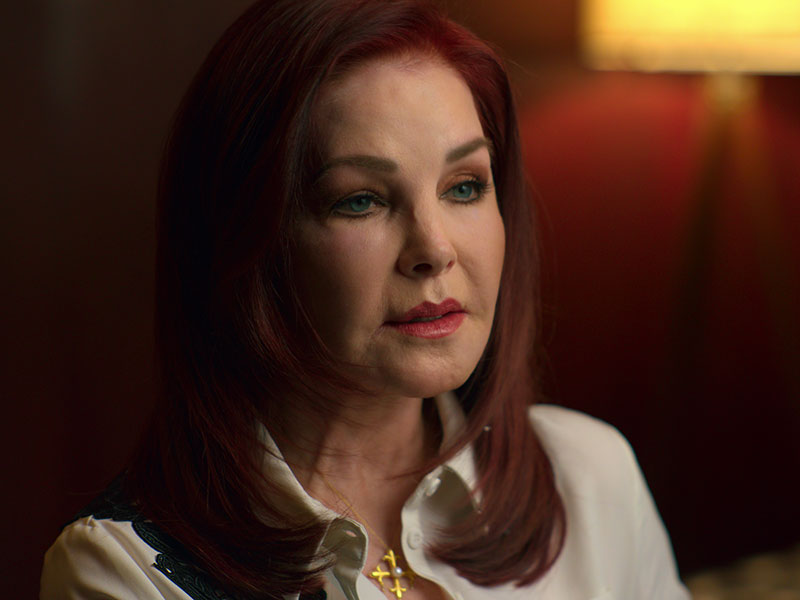
Priscilla Presley opened up about her ex-husband's career stagnancy. She shared, "I'd know he'd be very angry. I saw him throw so many scripts across the room. Frustration, anger and lost a little bit on where his career was going. Because those were not the roles he wanted."


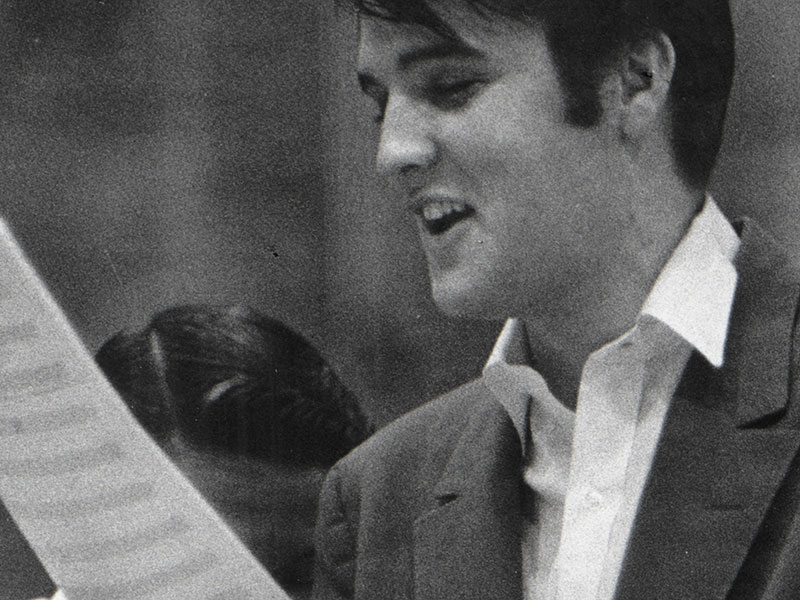
In an archival recording, Elvis can be heard explaining having a lack of agency in his acting career. "Hollywood's image of me was wrong, and I knew it. And I couldn't do anything about it. I didn't know what to do. I just felt like I was obligated to things I didn't fully believe in," he said.

04
The Beatles were nervous visiting Elvis in Bel Air
The Return of the King: The Rise and Fall of Elvis PresleyThe Return of the King: The Rise and Fall of Elvis Presley (Netflix)

When the Beatles came to the United States, members of the young British group wanted to meet Elvis.


Priscilla recalled, "The Beatles came to our house in Bel Air, which was a funny evening.


"When they did come in they were so nervous. In fact, Elvis sat down on the couch, John Lennon and Paul McCartney just stared at him," Priscilla laughed. 


"Never said a word. Just looked at him. They were so nervous, and Elvis basically was saying, 'Well, if you're not gonna talk . . .' He turned on the TV. They were just mesmerized by him," she said.


Lennon later told talent manager Jerry Schilling that he didn't dare to tell Elvis that his sideburns almost got him kicked out of high school. Lennon said, "We wouldn't be here today if it wasn't for him."

05
The plan for Elvis' special changed drastically in development
The Return of the King: The Rise and Fall of Elvis PresleyThe Return of the King: The Rise and Fall of Elvis Presley (Netflix)

When the public had counted Elvis out, he began focusing on Gospel music, married Priscilla and had a child, Lisa-Marie Presley. 


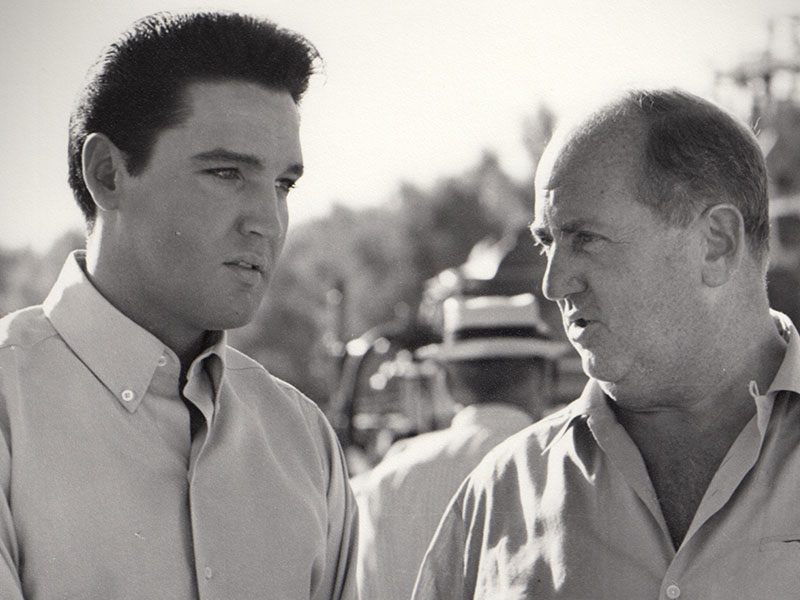
However, his NBC '68 music special was being run by his overbearing manager Colonel Tom Parker. The original production of the special was incorporated with skits, sketches and kitschy acting.


But the director, Steve Binder found that a raw unfiltered and stripped-back musical version of Elvis is what the audience should see. His manager rejected this but Binder was relentless and eventually Parker let up.


Despite all the setbacks, Elvis was finally going to have a real music moment. But the star was incredibly nervous for the public to see him this way. Another great musician, Bruce Springsteen shared in the documentary, "[Elvis] was going where his destiny was leading him."

06
 

The '68 special was lightning in a bottle

The Return of the King: The Rise and Fall of Elvis PresleyThe Return of the King: The Rise and Fall of Elvis Presley (Netflix)

Elvis' comeback was glorious for the people who got to experience it in real time. Priscilla recalled she sat at the top of the stage so she could see everything. "He came onstage, he was like, 'Wow.' . . . That was the first time I saw him perform, and I went 'Whoa. This is what it's about?'"


Springsteen also recalled watching it as a child on his television at home. He said, "That was the rebirthing of Elvis Presley. It was a reintroduction not just to who he had been, but to who he could be."


An audience member from the special said, "It was breathtaking."


Singing songs like "Jailhouse Rock," "Burning Love," "If I Can Dream" and many more, Elvis made the most of his comeback special's comeback, which became a landmark in music history. 

 "Return of the King: The Fall and Rise of Elvis" is now available to stream on Netflix.

Bill Clinton talks Monica Lewinsky affair fallout and controversy over apology: “I meant it then”

Former President Bill Clinton is ready to share his thoughts about his 1998 affair with former White House intern Monica Lewinsky in his new memoir "Citizen."

At the center of one biggest political scandals, Clinton opened up about his "frustration" about being questioned about his affair and the emotional state during the firestorm that followed. The former president even acknowledged that he had never directly apologized to Lewinsky.

In his new book, "Citizen," to be released on Nov. 19, Clinton ventures through his post-presidential years, including a 2018 NBC interview where Clinton was questioned about his apology to Lewinsky, the Guardian reports.

In the interview, journalist Craig Melvin asked Clinton about the #MeToo movement and then read Lewinsky's column about the impact the #MeToo movement had on her perceptions of sexual harassment. Melvin asked Clinton if he felt any differently about the incident now.

In "Citizen," Clinton wrote, “I said, ‘No, I felt terrible then.’ ‘Did you ever apologize to her?’ I said that I had apologized to her and everybody else I wronged. I was caught off guard by what came next. ‘But you didn’t apologize to her, at least according to folks that we’ve talked to.’ I fought to contain my frustration as I replied that while I’d never talked to her directly, I did say publicly on more than [one] occasion I was sorry.”

Clinton wrote in "Citizen" that the interview “was not my finest hour." He explained he wasn't prepared to be accused of not apologizing at all to Lewinsky. However, he did note that NBC later added a clip in the interview of Clinton addressing religious leaders in 1999 and apologizing to his family, Lewinsky and her family and the American people. “I meant it then and I mean it today,” he wrote.

“The stuff that he eats is really… bad”: RFK Jr. slams Trump’s fast-food diet

Robert F. Kennedy Jr. has made it clear that he’s not a fan of soon-to-be-president Donald Trump’s eating habits. The former independent presidential candidate, who is slated to secure a top health role in Trump’s administration, appeared on Tuesday’s episode of “The Joe Polish Show” podcast, where he called Trump’s diet “poison.”

“The stuff that he eats is really, like, bad,” Kennedy said. “Campaign food is always bad, but the food that goes onto that airplane is like just poison. You have a choice between — you don’t have the choice, you’re either given KFC or Big Macs. That’s when you’re lucky and then the rest of the stuff I consider kind of inedible.”

It’s no secret that Trump loves fast food. According to his former campaign manager Corey Lewandowski, Trump’s go-to order at McDonald’s is “two Big Macs, two Filet-O-Fish and a chocolate malted.” However, Trump’s son-in-law Jared Kushner said it’s actually a “McDonald’s Big Mac, Filet-o-Fish, fries and a vanilla shake.”

In anticipation of Election Day, Trump was seen working the fry station during a viral visit to a McDonald’s in Pennsylvania. He also sold McDonald’s-themed campaign shirts, fittingly emblazoned with the slogan “MAGADonald's.”

Kennedy added that Trump seldom drinks water and instead, has a penchant for sugary, carbonated beverages: “And then he [drinks] Diet Coke. I was with Dana White the other day . . . he’s very close to Trump, they’ve had a relationship for 20 years through UFC. He said that sometimes he’ll sit through a fight with Trump — and he’s [there for] five hours [during] the fight — and said he has never seen Trump drink a glass of water. Never.”

Senators want to see House Ethics Committee report on Gaetz following attorney general nom

Senators from both parties are asking to see the House Ethics Committee's findings about former Florida Representative Matt Gaetz.

Gaetz resigned from the House on Wednesday after being nominated by Donald Trump to serve as attorney general in the president-elect's second term. Gaetz's resignation ended a years-long probe by the committee that looked into allegations of sexual misconduct with a minor and illicit drug use.

The House Ethics Committee was reportedly readying a vote to release their potentially damning report on Friday. The committee lost its jurisdiction over Gaetz with his resignation, making an official release of the report unlikely.

Asked on Thursday if he would make an effort to see the report, Senator John Cornyn, R-Texas, said he would “absolutely” do so before confirming the pick.

“I don't want there to be any limitation at all on what the Senate could consider,” Cornyn told reporters.

BREAKING: Senate Republicans want to see the House Ethics Report concerning Matt Gaetz's sex trafficking allegations.

[image or embed]

— Aaron Parnas (@aaronparnas.bsky.social) November 14, 2024 at 1:32 PM

Senate Judiciary Chair Dick Durbin, D-Ill., demanded the report remain intact and be turned over to his chamber. In a statement, Durbin questioned the timing of Gaetz’s resignation and emphasized the Senate’s need to analyze its findings.

“I am calling on the House Ethics Committee to preserve and share their report and all relevant documentation on Mr. Gaetz with the Senate Judiciary Committee,” Durbin wrote. “We cannot allow this valuable information from a bipartisan investigation to be hidden from the American people.”

John Stamos calls “Full House” co-star Dave Coulier “my brother” after learning of cancer diagnosis

Uncle Jesse and Uncle Joey are forever family.

"Full House" stars and friends John Stamos and Dave Coulier's bond is as strong as ever. This was made apparent after Coulier revealed on Wednesday he had been diagnosed with stage 3 non-Hodgkin lymphoma, reports People.

After the actor shared his diagnosis with the world, Stamos took to Instagram to show his longtime co-star some love and appreciation in a series of photos and videos. The photos are from different points of the pair's decades-long friendship from the "Full House" days to the present day, including an image of late "Full House" star Bob Saget. The caption read, "My brother from day 1. Love you @dcoulier and I’ll be by your side through it all."

https://www.instagram.com/p/DCVAGa0SnY1/?img_index=9

The 65-year-old Coulier told People Magazine that he received his diagnosis after an infection caused swelling in his lymph nodes. "I went from, I got a little bit of a head cold to I have cancer, and it was pretty overwhelming. This has been a really fast roller coaster ride of a journey," he said. Coulier shared that immediately after his diagnosis in October he began chemotherapy and shaved his head as a “preemptive strike."

Coulier was also on "The Today Show" with Hoda Kotb to share his experience. "I'm treating this as a journey. If I can help people get a breast exam, a colonoscopy, or a prostate exam. Go do it because, for me, early detection meant everything," he urged.

During that appearance, weatherman Al Roker, who also had cancer in 2020, hugged Coulier and told him he loved him.

https://www.instagram.com/p/DCUK0Fwxm4L/

FBI raids home of Polymarket CEO Shayne Coplan

FBI agents on Wednesday raided the home of Shayne Coplan, founder and CEO of the election-betting platform Polymarket.

Agents seized Coplan's phone and electronics at his home in New York City, Polymarket said. The company is under investigation for allegedly allowing U.S.-based users to bet, Bloomberg reported

Polymarket users can buy and sell shares to predict everything from election results to whether TikTok will be banned. The platform is popular with the cryptocurrency community. It has only been available to people outside the U.S., but Coplan told CNBC after the election that he hoped to expand.

The site gained attention in recent weeks after bettors put Trump's odds of winning the Nov. 5 presidential election sharply higher than those of Vice President Kamala Harris, despite opinion polls that showed a much closer race. A French trader reportedly won nearly $50 million after predicting Trump would win the popular vote, the Wall Street Journal reported.

Polymarket said the FBI raid was "obvious political retribution by the outgoing administration against Polymarket for providing a market that correctly called the 2024 presidential election." 

Coplan had not been arrested or taken into custody, the company told Reuters. 

The FBI has declined comment. 


“Say Nothing” ambitiously breaks open a story of resistance and disillusionment during the Troubles

Say Nothing” begins in a state of knotted tension: an introductory voiceover by Lola Petticrew’s resolute Dolours Price lets us know we’re walking in on a fight between the British and the Irish, “the same old s**te,” that’s spanned 800 years.

Shortly after this cold open we cut to the early aughts when a nameless interviewer (Seamus O'Hara) sits across from Dolours (Maxine Peake). The man is working to compile an oral history of the Troubles for Boston College's Belfast Project. Dolours, a former Provisional Irish Republican Army militant, is visibly nervous. She's a movie star's wife at this point in her story, well past her days of setting bombs in the name of struggle.

She also knows what happens to old soldiers with loose lips.

Her interviewer tries to reassure her. “The stuff I’ll be asking you about is all ancient history,” he says.  

“Not to them,” says Dolours. Watching from a perch in the surveillance age, her reticence is understandable. We also understand the pain resulting from a refusal to bring dark history into the light. 

Say NothingSay Nothing (FX)

Dolours Price is but one person. Maybe she's also a stand-in for a nation perpetually haunted by the Troubles, the violent escalation between Northern Ireland's Catholics and Protestant loyalists through which “Say Nothing” travels. As young adults Dolours (Petticrew) and Marian Price (Hazel Doupe) become swept up in a movement that caught fire in the late 1960s and tore through the ‘70s, ‘80s and most of the '90s. 

By the early aughts an older, wiser Dolours is disillusioned with the meaninglessness of so much bloodshed and pondering what it means to have so many spent matches poking her from inside her pockets.

Peake’s staid and knowing portrayal stands in contrast and complement to that of Petticrew, whose resolute manner vacillates between a flinty swagger and true anguish. Petticrew leads us through Dolours' youth through her and Marian's harrowing imprisonment. In scenes showing Dolours' commitment to the mission clashing with her affection for her friends, the actor’s stoic expressiveness is heartbreaking. 

Television exploits our memory gaps, willful or unintended, by churning out period action dramas centered on history’s giant conflicts, most related to World War II. Unlike that endlessly commodified conflict, these chapters in Ireland’s history don’t turn up in most history teaching. Those who learn about them at all do so via family or community lore.

Say NothingSay Nothing (FX)

This silence, evoked by the title, describes the organizational omerta under which the IRA operated and the unspoken agreement between its operatives and the people they lived among. In one scene a little boy sits near an IRA soldier watching British officers quietly roll up in vehicles and doesn’t flinch as the man runs off and bullets whiz by his head. When you’ve lived your whole life under that order, seeing and saying nothing becomes a survival plan.

“Say Nothing” is a historical limited series about a war fought in neighborhood streets and on doorsteps, in a country the rest of the world believes is at peace. Like Patrick Radden Keefe’s 2018 book, it takes an inside view of that era, using the 1972 disappearance of Jean McConville (Judith Roddy) to represent the collateral damage caused by the IRA’s acts. 

Members of the paramilitary force insist their cause is a righteous continuance of resistance to British rule extending back to the Norman invasion in the 12th century. McConville, a widow ripped from her home as her 10 crying children helplessly watch, personifies what happens when the battlefield extends into civilian neighborhoods. Innocents inevitably become the bycatch.

Since “Say Nothing” primarily unfolds through Dolours’ perception, the question of whether McConville is an informant hangs over these nine episodes. We see a widow struggling to raise her kids in West Belfast’s Divis Flats, a public housing complex. But the Price sisters trust their fellow Unknowns, especially Brendan Hughes (Anthony Boyle), known as “The Dark,” and Gerry Adams (Josh Finan), the leader calling the shots from behind the scenes.

One can certainly discuss this limited series divorced from other critically acclaimed shows, but it’s more interesting to view it as part of a continuum that speaks to our present, whether thematically or parabolically. 

FX’s highest profile and most acclaimed limited series before “Say Nothing” is “Shogun,” a reimagining of a Reagan-era bestseller told from the Japanese perspective. This worthwhile corrective avoided its predecessor’s white savior trap, and it also seduced the audience into rooting for an isolationist authoritarian. 

We need your help to stay independent

We might think of “Say Nothing,” then, as the bitter clarifier to an entertainment landscape that romanticizes imperialism as corseted spectacles a la “Bridgerton” and “Mary and George” — or, through modern dramas like “The Crown" that style colonialist dominance as weighty and defined by duty and despair.

The Ireland of Dolours and Marian’s youth in “Say Nothing” is a hardscrabble place where circumstances led to them being raised on a diet of war stories. Fighting with the IRA is in their blood. Their father, Albert (Stuart Graham), has retired, as has their mother, Chrissie (Kerri Quinn), although she still hides guns in her gardening soil. 

Raised on a steady diet of war stories, and with a chain-smoking aunt who gave her eyesight and two arms to the cause, the pair join the IRA intending to do more than secretarial work. So they’re assigned a secret organization dubbed The Unknowns, under whose banner they rob banks and run explosives through border checkpoints, eventually pulling off a larger-scale bombing that earns them top status in the organization’s “brothers-in-arms” culture.

When you’ve lived your whole life under that order, seeing and saying nothing becomes a survival plan.

Derry Girls” director Mike Lennox infuses a necessary liveliness into a dark story that links to present concerns in more ways than simply thematic. The content recorded on Belfast Project tapes was meant as a historical record of a history left intentionally untold, guaranteed anonymity for its participants, who were assured they’d only be released after the last interviewee died. 

Say NothingSay Nothing (FX)

A major thread in the story implicates the very much still alive Gerry Adams, who became the leader of the Sinn Féin political party in 1983, as the man who ordered Jean McConville’s kidnapping as a high-ranking IRA leader. But as the disclaimer attached to each episode tells us, and the fictionalized versions of Adams played by Finan and, later, Michael Colgan, insist, all allegations that he was ever part of the IRA are false. 


Want a daily wrap-up of all the news and commentary Salon has to offer? Subscribe to our morning newsletter, Crash Course.


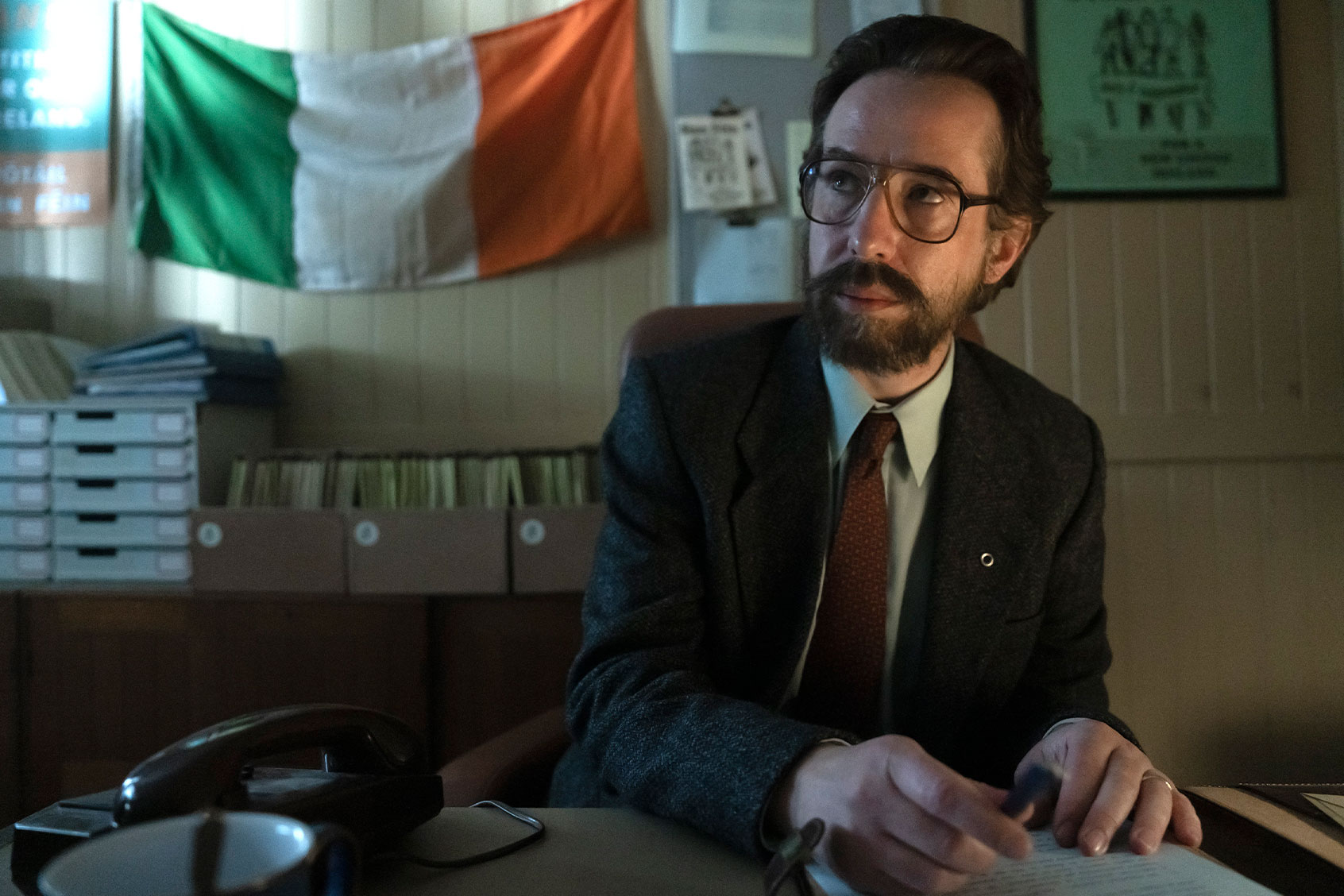
Obviously the adaptation's creator Joshua Zetumer and Keefe, an executive producer, land on the side that insists he played a key role in the IRA. Moreover, the script transitions him, through Finan’s effective performance, from a gawky, bespectacled nerd putting on airs, into an unctuous political predator. 

“Say Nothing” is a heavy watch, and it remains to be seen whether American viewers will be in the mood to dive into a drawn-out resistance story so soon after an election won by a governing force eager to bring to heel millions of his countrymen, whether economically or by force. 

But captivating performances by Peake, Petticrew, Doupe and a fiery Boyle deliver us through the darkness of the days and years captured in its nine installments. Modern life in the West is an expanding raft of the consequences resulting from pretending to be finished with history, only to find its unreconciled chapters won’t let us be. 

Erasing people’s stories diminishes their humanity. Intensely thoughtful adaptations like this restore it, opening our eyes to corners of recent history we’d otherwise miss and benefit from knowing. 

All nine episodes of "Say Nothing" debut Thursday, Nov. 14 on Hulu.

The Onion buys Alex Jones’ Infowars at bankruptcy auction for undisclosed sum

The Onion, a satirical news site that satirizes current affairs and the journalists who cover it, said on Thursday that it had won the bankruptcy auction to control Infowars and other media outlets founded by Alex Jones, a far-right peddler of conspiracy theories.

Representatives from The Onion told the New York Times that its bid was sanctioned by the families of the victims of the Sandy Hook Elementary School mass shooting, who successfully sued Jones for $1.4 billion in a defamation lawsuit. The families sued Jones after he falsely claimed that the shooting was a false flag to justify the confiscation of Americans' firearms.

The Sandy Hook lawsuit drove Jones to bankruptcy, and a Houston judge ruled that Infowars and other assets owned by Jones could be auctioned off to pay off his creditors. It was The Onion's bid that prevailed, though it declined to tell news outlets how much it paid.

Jones announced the sale himself Thursday morning.

“I just got word 15 minutes ago that my lawyers and folks met with the U.S. trustee over our bankruptcy this morning and they said they are shutting us down even without a court order this morning,” he wrote on social media. “I don’t know what’s going to happen, but I’m going to be here until they come and turn the lights off."

The lights will turn back on in January 2025, when Infowars is relaunched as a parody of itself that mocks “weird internet personalities” likes Jones who traffic conspiracy theories and health supplements, according to The Onion.

“We thought this would be a hilarious joke. This is going to be our answer to this no-guardrails world where there are no gatekeepers and everything’s kind of insane," Ben Collins, chief executive of The Onion’s parent company, Global Tetrahedron, told the Times.

In the lead up to acquiring Infowars, Collins, a former NBC News reporter, said he had spoken to Sandy Hook victims' family members, who he said expressed support for the bid. “They’re all human beings with senses of humor who want fun things to happen and want good things to take place in their lives,” he said. “They want to be part of something good and positive too.”

Cruise line offers 4-year escape from Trump, if you can afford it

Need a break from another Trump presidency? You can cruise around the world for the next four years, if your bank account can handle it. 

Residential cruise operator Villa Vie Residences invites travelers onto the Villa Vie Odyssey for a journey that ranges from one to four years, with stops in more than 400 destinations, USA Today reports. So if the midterm elections are an improvement over the most recent one, you can return to America after the next two years. 

The company touted the trips in a news release days after Trump won another term. The Nov. 5 election results weren't mentioned in the release, and the round-the-world journey was created before the election. 

Travelers can choose from a "1-Year Escape from Reality," a "2-Year Mid-Term Selection," a "3-Year Everywhere but Home" and a "4-Year Skip Forward," the release said. 

“Villa Vie Odyssey will be spending a month in the Caribbean before embarking on a 4-month South American journey featuring 2 Panama Canal transits, 2 World Wonders, the Chilean Fjords, an Antarctic sail-by, Carnival in Rio and an 8-day endeavor deep into the Amazon River,” it said. 

Rates for double occupancy cabins range from $49,999 per person for a one-year journey to $159,999 per person for a four-year trip, according to the company's website. Single-occupancy cabins start at $79,999 for one year and $255,999 for four years. 

Americans' interest in getting away has risen since the election. Reuters reports that Google searches for "move to Canada" surged 1,270% in the 24 hours after polls closed on the East Coast. Searches about moving to New Zealand climbed nearly 2,000%, and those for Australia jumped 820%, per Reuters.

The United Kingdom and Japan also were high on the list of destinations, CNBC reported.

How abortion funds are preparing for another Trump presidency

On Halloween night, as kids went trick or treating across the U.S., the Chicago Abortion Fund (CAF) hosted an emergency gathering for supporters and funders. The goal was to raise more funds to meet the increasing demand to access abortion care, regardless of who would win the presidential election the following week.

“CAF has spent all year growing our development capacity and sounding the alarm of the abortion access current crisis, and specifically the funding crisis,” Qudsiyyah Shariyf, the interim executive director of the Chicago Abortion Fund, told Salon. “We knew then that regardless of the election’s outcome, we need increased investment in our organization.”

Despite bans and anti-abortion policies, the actual number of abortions aren’t decreasing. According to a Monthly Abortion Provision Study, researchers found that the number of abortions in the U.S. increased by 10 percent in 2023 compared to 2020 and that year, abortion numbers were at their highest in over a decade. The Guttmacher Institute attributed the increased access to telehealth and financial support to the rise in spite of abortion bans.

More recently, a report published by #WeCount in October 2024 found a small but consistent increase in the national monthly number of abortions since October 2023, even in states with restrictive gestational limits. 

“As abortion bans strip away access, the need for abortion care continues,” said Alison Norris, MD, PhD, #WeCount Co-Chair and professor at The Ohio State University’s College of Public Health and co-principal investigator of the Ohio Policy Evaluation Network.

"Abortion funds are committed no matter what, to ensure that people still have access to the abortion care that they want and need on their own terms,"

But an impending Trump presidency comes at a time when abortion funds have already been forced to slash budgets as the reproductive rights landscape has rapidly changed across the U.S. In 2024, the National Abortion Federation and Planned Parenthood’s Justice Fund had to cut their budgets from giving 50 percent assistance to people to 30 percent with no exceptions. When asked how abortion funds are preparing, Oriaku Njoku, the executive director of the National Network of Abortion Funds (NNAF), told Salon that abortion funds are resilient. This time around, as they have before, they will rely on their community and network of supporters. It’s both “familiar,” and “unfamiliar terrain,” Njoku said. 

“Abortion funds are committed no matter what, to ensure that people still have access to the abortion care that they want and need on their own terms,” Njoku said. “It may look different, it may feel different, but that's the reality — even in the most restrictive times, people have still found a way to navigate through increasingly complex barriers to access abortion care.”

When one or two states make abortions harder to access, it affects states where abortions remain legal. A 2023 study published in JAMA Network Open found the number of out-of-state residents seeking abortions in Massachusetts rose to 37 percent in the four months after Dobbs. Some patients traveled from as far away as Texas. That’s where abortion funds come in. They help arrange travel, which can cost thousands of dollars, and provide funding for people who need to access care in states where abortion care is no longer accessible. But over the last couple of years, since the Supreme Court ruled on Dobbs v. Jackson Women's Health Organization which led to more abortion bans across the country, abortion funds have been pushed to the brink. Some are even running out of money.

Alisha Dingus, the development director at the DC Abortion Fund, told Salon the effects over the last two years will take decades to overcome. 


Want more health and science stories in your inbox? Subscribe to Salon's weekly newsletter Lab Notes.


“Even if we weren't dealing with a hostile administration, someone couldn't snap their fingers and restore all the access we have lost over the past two years,” Dingus said. “There are now states with no clinics or abortion providers — it will take years or decades to make abortion accessible again in places like Missouri, which voted to overturn their abortion ban."

Now, in the aftermath of the election, abortion funds also have to prepare for a landscape where abortion access is severely limited. For example, in Florida since the state’s Amendment 4 didn’t pass, despite 57 percent of voters in favor of it. It wasn't enough for the measure reach its 60 percent majority threshold, therefore abortion access will remain limited in the south. According to Florida’s law, it remains a felony to perform or actively participate in an abortion six weeks after gestation, with limited exceptions that are designed to be difficult to use and frequently act as another burden for patients to overcome. Njoku said the next step for abortion funds in the wake of the Amendment 4 results is to gain more support for the next time a similar vote comes up, and that requires a deeper understanding of why some voters cast ballots for Trump as president and in favor of Amendment 4.

“Is the shared value between those voters autonomy, and self-determination, which is inherently a reproductive justice value?” Njoku said. Once organizers can tap into those values and find a “shared understanding,” the goal is to have an “overwhelming majority” to win a similar measure in the future. 

In the state of Missouri, Amendment 3 passed, which will enshrine the right to an abortion in the state constitution and overturn the state’s current ban. Despite a loss in Florida, this would hypothetically ease the pressure on abortion funds by expanding access. However, as Dingus said, advocates say it will likely take time for that to be felt throughout abortion fund networks.

We need your help to stay independent

“It is undeniable that abortion access is popular,” Shariyf, from CAF, told Salon. “However, the long-term impacts of clinic closures on the abortion access ecosystem, means that despite the win of the Missouri ballot measure, it will be years before Missouri is able to offer abortion care at the scale that Missourans need.”

Shariyf pointed out how there was only one abortion clinic in the state before the total ban went into effect.

“Hope Clinic in Granite City, Iliinois, just across the river from St. Louis, continues to see the vast majority of their patients traveling from out of state, most of them from Missouri,” Shariyf said. “We do not anticipate that the Missouri ballot initiative will have an immediate or drastic impact on those numbers.” 

In Arizona, voters passed Proposition 139 amending the state constitution to provide a fundamental right to abortion. Shariyf said hopefully this state will serve as “an essential resource” in the Southwest, including Texas. 

Ultimately, abortion funds are focused on the future and maintaining access where and when they can throughout the United States. 

“A lot of money was spent on political campaigns and ballot initiatives and now we are in a reality where for the next four years, all we can hope is for things not to get worse,” Dingus said. “And that means many people will still be forced to travel to places like DC for abortion care.”

Alarm spreads over Trump’s pick of Tulsi Gabbard to lead the US intelligence community

Former Rep. Tulsi Gabbard, D-Hawaii, has been picked by President-elect Donald Trump to oversee the U.S. intelligence community. While Trump had long been expected to pick an "outsider" for the role of national intelligence director, some elected officials were still caught off-guard by the selection of someone who has no formal intelligence experience.

Gabbard, who was a Democrat until 2022 but critical of her party long before that, endorsed Trump in the 2024 election. In a statement announcing her selection, Trump said that Gabbard would bring a “a fearless spirit” to the intelligence agencies and secure “peace through strength.”

Others are not so sure. Gabbard, a lieutenant colonel in the Army Reserve who served in Iraq, has long been critical of foreign policy establishment. Her deeply skeptical views of most U.S. foreign policy, including support for Ukraine, sympathy for dictators like Vladimir Putin and Bashar al-Assad in Syria and embrace of various conspiracy theories has earned her many critics who say that she would not pass muster in a Senate confirmation process.

Gabbard, like many other "America First" proponents, exempts Israel from her quasi-isolationist critiques, once describing pro-Palestine protesters as puppets of a "radical Islamist organization" and serving as a keynote speaker at a conference hosted by Christians United for Israel. But one senior former intelligence official told Politico that allies like Israel would still have "serious qualms" about Gabbard.

Gabbard, who served in the Hawaii National Guard and then joined an Army reserve unit that was deployed to Iraq, has said that her skepticism of intervention was rooted in her experience from serving in a war that she saw as unnecessary and costly. But critics on both sides of the aisle say that far from just advocating for restraint, she has embraced talking points from militaristic autocrats like Assad and Putin, and as overseer of 18 spy agencies would undermine national security and the international order. Under former President Barack Obama, she called for escalating the U.S. war on terror, accusing the president of failing to target extremist rebel factions in Syria.

"Her politics, which are otherwise incoherent, tend to be sympathetic to these two strongmen, painting America as the problem and the dictators as misunderstood," wrote anti-Trump conservative and former Naval War College professor Tom Nichols in an op-ed published by The Atlantic.

"This is a disaster for US security & alliances. Of all Trump's decisions so far, might be the worst. Tulsi Gabbard has consistently parroted pro-Putin propaganda. Director of National Intelligence is a critical position for which she has absolutely no experience and skill," Thomas Judeau, professor at the University of Ottawa, wrote in an X post.

Some senators “shocked” by Matt Gaetz selection — but GOP warming to AG pick to avoid angering Trump

Like any other would-be autocrat, President-elect Donald Trump is selecting people for key positions overseeing the military and legal system based not on objective merits but their personal loyalty to one man: in this case, a 78-year-old Republican who felt betrayed in his first term when more-or-less qualified cabinet officials would balk at some of his more extreme demands. This time, he’s saying with his early picks, there will be no one second guessing the leader or, in the words of his son, thinking they “know better” than a man with the nuclear codes.

The nomination of former Rep. Matt Gaetz, R-Fla., who resigned from Congress on Wednesday, is the clearest sign yet that Trump intends to govern as an authoritarian who will use all the levers of the state to harass his critics and avowed opponents. Gaetz graduated from William & Mary Law School but otherwise has no experience that would suggest he’s qualified to lead the Department of Justice.

"Matt will end Weaponized Government, protect our Borders, dismantle Criminal Organizations and restore Americans’ badly-shattered Faith and Confidence in the Justice Department," Trump proclaimed.

There is no shortage of right-wing lawyers who would love to serve as attorney general and do just that. Ken Paxton, currently Texas’ attorney general, would have been a perfect MAGA pick: In 2020, he sued to disenfranchise those who voted for President Joe Biden in an effort to keep the loser of that year’s election in power; he has since sued the Biden administration no less than a hundred times and has used his office to go after groups that provide aid to immigrants; he’s even ordered raids on the homes of his political opponents, including an 87-year-old member of a Latino civil rights group he baselessly accused of voter fraud.

Gaetz, however, is unsurpassed in his sycophancy. Elected in 2016, he has draped himself in the Trump flag perhaps more than any other member of Congress, past or present, even boasting that he met his wife at Mar-a-Lago, where he’s a regular fixture. He is also compromised: Former House Speaker Kevin McCarthy, R-Calif., accused Gaetz of having sex with a 17-year-old and the department he’s been nominated to lead investigated him for sex trafficking, with witnesses saying that the former lawmaker attended drug-fueled parties with underage girls (he was never charged with a crime).

The House Ethics Committee had also investigated the accusations against Gaetz and was due to release its findings this week. By nominating Gaetz, and him subsequently resigning from Congress, Trump helped a loyalist avoid potential embarrassment, if not worse: As Gaetz is no longer a member of the House, the House can no longer issue a report about him.

Having an attorney general with so much potentially compromising dirt on him could be an asset, it being hard to say “no” to someone would could arguably ruin you. It’s also a test, intentional or not: Just how loyal is the rest of the GOP?

Gaetz, as a man, appears to be widely detested by his former colleagues, given the number willing to publicly lambaste him. The guy “is literally worse than the gum on the bottom of my shoe,” Rep. Max Miller, R-Ohio, told CNN on Wednesday. Former Rep. Barbara Comstock, R-Va., likewise called the pick “absurd,” saying the selection of Gaetz — along with the nomination of former Rep. Tulsi Gabbard, D-Hawaii, for director of national intelligence — suggests Trump is filling his cabinet with “Putinists and pedophiles.”

But House Speaker Mike Johnson, R-La., struck a different tone. Gaetz, he claimed, was an “accomplished attorney,” despite his thin legal resume, and “a reformer in his mind and heart.”

“I think he’ll bring a lot to the table,” the Louisiana Republican said.

We need your help to stay independent

But the Senate is where lawmakers’ opinion really matters. It is the upper chamber and its narrow Republican majority that will have to confirm Trump’s cabinet picks (although Trump is also urging his allies there to just let him name people to his cabinet via recess appointments). The reception Wednesday was chilly.

Sen. Susan Collins, R-Maine, said she was “shocked” by the nomination, saying it reaffirmed the need for the Senate to hold on to its constitutional duty of providing “advice and consent.” Sen. Lisa Murkowski, R-Alaska, charged that Gaetz is simply “not a serious candidate.” That’s two votes that area already iffy; Trump can hardly afford to lose two more.

But there were also immediate signs that Republicans may be willing to put aside their misgivings and give their president-elect a win. Last year, Sen. Markwayne Mullin, R-Okla., accused Gaetz of showing his fellow lawmakers videos of “girls he had slept with,” saying he “bragged about how he would crush ED medicine and chase it with an energy drink so he could go all night.”

On Wednesday? Mullin said he was open to voting for someone he had previously described as a shameless pervert.

“You know, Matt Gaetz and I, there’s no question that we’ve had our differences,” Mullin told CNN. However, “I completely trust President Trump’s decision-making on this one,” he continued, saying only that Gaetz would have to address any concerns during his confirmation hearings.

But would Republicans, who just saw their leader sweep every battleground state and narrowly win the popular vote, be willing to derail a second Trump presidency — and invite his rage — by actually denying him one of his most important cabinet picks? As Axios put it Thursday: “President-elect Trump is daring Senate Republicans to defy him.”

Those senators are likely to be familiar with how defying Trump worked out for Sen. Mitt Romney, R-Utah, who is now on his way to retirement. In 2024, skepticism that might have previously lasted a whole news cycle now evaporates the same day. Sen. Lindsey Graham, R-S.C., for example, wasn’t sold on Gaetz as of Wednesday morning: “I’ll have to think about that one,” he told CNN. By Wednesday evening, on Fox News, Graham was rallying the troops: “To every Republican, give Matt a chance.”


Want a daily wrap-up of all the news and commentary Salon has to offer? Subscribe to our morning newsletter, Crash Course.


Graham, who similarly criticized Trump before learning to love the MAGA movement, knows how important this pick is to his to party’s leader. And Trump picked Gaetz for a reason, as one advisor to the president-elect explained to The Bulwark’s Marc Caputo.

“None of the attorneys had what Trump wants, and they didn’t talk like Gaetz,” the adviser said of the competition for attorney general. “Everyone else looked at AG as if they were applying for a judicial appointment. They talked about their vaunted legal theories and constitutional bulls**t. Gaetz was the only one who said, ‘Yeah, I’ll go over there and start cuttin’ f***in’ heads.’”

It is possible that the Republican-led Senate holds confirmation hearings and decides, at the end, to defy their president and reject his pick to take on the “Deep State” and his many “enemies from within.” Perhaps Gaetz, now out of a job, will have to settle for a position that doesn’t require Senate confirmation — or a gig on Newsmax.

After nearly a decade of this, though, anyone who has bet good money on elected Republicans standing up to Trump has already gone broke.

House ethics panel was preparing to release a damning report on Matt Gaetz

The House Ethics Committee was set to release a report detailing the findings of an investigation into former Rep. Matt Gaetz's alleged sexual misconduct and illicit drug use on Friday, but President-elect Donald Trump's selection of the Florida Republican to be attorney general abruptly deprived the panel of its jurisdiction.

Gaetz, a Trump loyalist, resigned from his House seat on Wednesday, effectively ending the ethics investigation that has harried him for years, a Republican official familiar with the matter told The New York Times. According to that official, Gaetz repeatedly offered combative replies to the committee's questions, delaying the investigation for months. The publication of the findings was further delayed by a House rule that blocks the release of negative reports so close to an election.

The Justice Department opened its own respective Gaetz investigations in 2021, looking into allegations that Gaetz had a sexual relationship with a 17-year-old girl, attended drug-fueled sex trafficking parties, misused state identification records, converted campaign funds for personal use and accepted gifts prohibited by House rules, among other transgressions. The Justice Department closed its investigation last year without filing charges against Gaetz; the Ethics Committee then opened its own inquiry.

Gaetz, who led the successful effort to depose former House Speaker Kevin McCarthy in 2023, claimed that the investigations were punishment for his defiance. “I am the most investigated man in the United States Congress,” Gaetz said as the House investigation began.

Now that Gaetz has left Congress in anticipation of joining Trump's administration as the highest law enforcement officer in the country, the House GOP's thin majority will be short another seat, which will be filled via special election. Still, many of Gaetz's colleagues were glad to see him go.

"Most people in there are giddy about it. Get him out of here,” Rep. Max Miller, R-Ohio, told the Times. He added that Trump probably appointed Gaetz to reward him for his loyalty. Before Gaetz's resignation was announced, he said, the House was prepared to expel him just as they did former Rep. George Santos, R-N.Y., last year.

Gaetz now faces the prospect of Senate hearings as part of his confirmation process. Many GOP senators told the Times that they were stunned by the choice.

Trump savors victory — but the storm is coming. Will the media stand up?

On Wednesday, President-elect Donald Trump made his “victorious” return to the White House and shook hands with President Joe Biden.

A short time later, Trump nominated Rep. Matt Gaetz of Florida as attorney general. No, that’s not a headline from The Onion, though it’s bound to be fuel for ongoing skits on “Saturday Night Live.” Seriously. Who talked Trump out of nominating “the late, great” Hannibal Lecter? But wait, there’s more: Former Democratic congresswoman (and 2020 presidential candidate) Tulsi Gabbard has been nominated as director of national intelligence — making her, perhaps, the biggest oxymoron of the many morons being nominated by Trump to fill out his new administration. 

We are deep in darkness, before a four-year storm that, according to those Trump has already appointed to his staff, will be replete with violence against immigrants, overwhelming tariffs, profuse and criminal lies, the further fracturing of our country, a desecration of the Constitution and many other forms of villainy — all of which will be conveniently blamed on Joe Biden and the Democrats in an unending stream of calumnious statements backed up by Elon Musk on his de facto state media operation.

Meanwhile, as the Republicans are talking about eating cats and dogs, the Democrats are eating their own.

Look at the withering commentary from Bernie Sanders: “It’s not just Kamala,” he said. “It’s a Democratic Party which increasingly has become a party of identity politics, rather than understanding that the vast majority of people in this country are working class. This trend of workers leaving the Democratic Party started with whites, and it has accelerated to Latinos and Blacks.”

Many Democrats now say their party went too far left and are declaring that “woke is broke.”

Jon Stewart called that “crap,” at least to some extent, arguing that Democrats by and large campaigned like old-style Republicans. They certainly brought out disaffected members of the GOP to campaign for Kamala Harris. In 2016, Hillary Clinton, while accepting the nomination in Philadelphia, told the Democratic convention that if you had supported the party of Reagan, you were with the Democrats. So Stewart has a point. So does Sanders. 

Meanwhile, the New York Times, in a “news” article — I use that term very lightly and broadly — gave us their opinion about a “depressed and demoralized Democratic Party,” which has begun a “painful slog into a largely powerless future.”

There’s nothing like opinion parading as facts to make you happy. Want a salient fact that’s often overlooked? We don’t vote. As important as this election was, about half of all registered voters didn’t show up to the polls. A statistical minority of voters consistently elect our presidents.

Do we talk about that in the press? Not enough.

Want a salient fact that’s often overlooked? We don’t vote. As important as this election was, about half of all registered voters didn’t show up to the polls.

Instead, we talk out of our collective posteriors. Take, for example, Jeffrey Toobin of CNN. Trump announced the creation of something he called the Department of Government Efficiency on Tuesday, and said it would be run by Musk and Vivek Ramaswamy. Let us put aside for a moment that Trump assigned two people to head up a department concentrating on efficiency.

Toobin said live, on CNN, that the pair would have limited success because “there is a very boring and very important law called the Administrative Procedures Act, which governs how the government moves along in terms of changing how it works.” He predicted that Musk and Ramaswamy will become bored and quit their advisory roles because of the massive red tape involved in changing the government.

He might be right about that. But why am I listening to Toobin say anything? What he did on a video conference call should have been the end of his career. He’s an unserious man trying to comment on serious issues. Maybe he’s perfect for the Trumpian times in which we live. But, more importantly, he’s seriously mistaken about how bad things can get.

Musk responded to his new job by posting on X that the “merch” will be great. Yes, good government is all about the merch.

We need your help to stay independent

Understand, after the sound and fury, what we’re really seeing here: Trump placing people in power who will be subservient to him, even more so than in 2016. The reason is clear.

The Supreme Court gave Trump the right to take any “official” action with impunity. If Trump decides to strike, and he will, SCOTUS will back him up. All Musk and Ramaswamy have to do is say, “Hey boss, we think you should cut … [fill in the blank].” Trump takes that “official” action and the Supreme Court backs him up. End of story. He has unlimited immunity for anything that falls under that enormous umbrella. 

Of course, Toobin is part of a much bigger problem that’s ongoing in the press. Until Ronald Reagan threw out the fairness doctrine and all restrictions on media ownership (which was followed by similar actions from every succeeding president), people mostly trusted their newspapers, along with radio and TV news. 

Cause and effect. 

We are long overdue for a reintroduction of the guidelines that offered some degree of trust in the fourth estate. 

Calling for that type of regulation would actually support free speech, destroy media monopolies and provide us with a fertile ground of vetted facts that could lead to cogent, meaningful discussion on issues of public debate. Allowing social media platforms to publish disinformation, often anonymously, promotes dishonesty and maximizes profits for those platforms at the expense of the audience they exploit. Worse yet, it poisons the well of information from which we all drink. 

Going forward, if you want reliable information you have to reintroduce the regulations that stress facts over profits. These regulations must include social media. And no, that is not censorship. 

If you want reliable information, you have to reintroduce regulations that stress facts over profits. These regulations must include social media. And no, that is not censorship. 

It’s a promotion of facts over dangerous propaganda. Once upon a time, we all understood this. There is a lot of nuance on this issue. You can’t shout fire in a crowded theater when there is no fire. Libel and slander are not protected speech, but satire most certainly is. Courts of law decide the areas of disagreement. Anti-SLAPP laws protect small and independent publishers against corporate bullies. But please: Keep on tweeting out simplistic, misleading or downright false accusations in anonymity. That’s so helpful in solving difficult and important problems — by further dividing the electorate at public expense, while the rich keep getting richer.

But the way things are right now, do not expect the members of the press to stand up in great numbers against Trump. Their bread is buttered by publicly fellating him and his minions whenever possible.

Those who do stand up to him have the deck stacked against them in this corporate environment. Some journalists have wondered whether our lives could be in danger if we push back against Trump. 

That’s a complicated question too, and the answer demands nuance.

I covered the first Trump administration, all four years of it. I had to defeat him three times in federal court to keep my press pass, which his administration tried to take away. That was the greatest threat we faced from Trump, honestly: kicking us out of the White House.

He routinely called us “fake news” and insulted us. But I never feared for my life from Trump or his staff, some of whom were highly professional and tried against all odds to get information to the press corps — unlike the Biden administration, which routinely ignored us and paid a high price for doing so. 

It was Trump’s supporters, often angry and stirred up by him, who were dangerous to our physical well-being. Some of us, through our news organizations, had to foot the bill for private security at various Trump rallies. 

Going forward, I expect it to get a lot more strident this time around. 

With the Supreme Court backing him, Trump will ban reporters the administration deems “fake news” or “enemies of the people.” He might yank press passes with impunity. He will manage the press personally, and try to make sure he gets exactly the reporting he wants.

I believe he will kneecap the White House Correspondents Association, by ignoring our recommendations and requests and possibly taking over assignment of seats in the Brady Briefing Room — traditionally the province of the WHCA. 

Interactions with the press will be tightly controlled and will give the appearance Trump wants to maintain — being the man of the people — while limiting his interactions with journalists to those of whom he approves. That’s what he did most recently on the campaign trail.

I can also envision that his antagonism toward reporters might extend to a variety of criminal, civil and financial investigations.

But honestly, no, I do not see physical risk from Trump in the offing. He won’t need to do that.

If that happens, it will come from his supporters.


Want a daily wrap-up of all the news and commentary Salon has to offer? Subscribe to our morning newsletter, Crash Course.


Trump has named Taylor Budowich as a deputy chief of staff in charge of communications and personnel. Budowich played a significant role in the campaign and in Trump’s leadership PAC, Save America, and also served as CEO of the super PAC that’s actually called MAGA Inc. 

Budowich has no formal training or experience in communications, but has effectively communicated and amplified Trump’s frequent lies. In June 2022, as the House select committee on the Jan. 6 insurrection began holding public hearings, Budowich told Insider: “The entire MAGA movement is united against this illegitimate committee and will work to ensure President Trump is defended against yet another Democrat show trial.”

The next month, as the Center for Media and Democracy reports, when committee co-chair Liz Cheney announced that Trump had attempted to contact an unnamed witness who was set to testify, Budowich shot back by tweet: “The media has become pawns of the Unselect Committee. Liz Cheney continues to traffic in innuendos and lies that go unchallenged, unconfirmed, but repeated as fact because the narrative is more important than the truth.”

What a joy it’s going to be trying to decipher whatever is said by whoever becomes Trump’s press secretary, with Budowich in charge behind the scenes. Don’t expect any enlightenment from those of us in the press room. Budowich and his staff will act as blunt-force trauma, applied to reporters.

Meanwhile, Trump’s choices just keep getting worse, and weirder. He picked Pete Hegseth, a Fox News host, for defense secretary. That’s going to go over great with the Joint Chiefs. It is already being reported that “Hegseth is undoubtedly the least qualified nominee for SecDef in American history.” Was Carrot Top not available?

Others were quoted as saying, literally, “Who the f**k is this guy?” Well, he looks like a poor man’s Josh Brolin — with more makeup. 

Indeed. Who the f**k is he — and who are we? And we are all together.

Remember this: Trump is a client of Elon Musk. Musk is a client of Vladimir Putin. One Putin ally has said publicly that Trump has “obligations” to those who brought him into power.

As the Democrats try to climb over a continually lower bar with no success, the rest of us should remember that.

Our democracy is dead.

Long live our democracy.

The Ghosts of John Tanton

Reporting Highlights

  • Tanton’s Network: Today’s contentious immigration debate is the construct of one man’s effort to halt overpopulation, brace for climate change and preserve “European” culture.
  • Green Hate: Now climate change is amplifying environmental concerns that have always run through the white supremacy and the anti-immigration movements.
  • Eco-Fascism: Experts warn that extremists who seize on global warming to justify violence are part of a far right trend to reclaim environmentalism as their own.

These highlights were written by the reporters and editors who worked on this story.

Patrick Crusius worried that Texas — hot and dry and facing climate calamity — was being overrun by immigrants. For his entire life he’d watched as Allen, Texas, the upper-middle-class Dallas suburb where he grew up, more than doubled in size, with quick-built mansions and car-choked freeways. Crusius, 21 years old, with wavy dark brown hair, sparse stubble collecting on his round chin, was awkward and introverted. He spent eight hours a day on his computer. He learned to hate the influence of megacorporations and the culture of consuming cheap goods that he thought they fostered, and he detested the waste and pollution that came with it. He brooded over the dwindling supplies of clean water and that too many people were competing for too little of it. But more than anything he had come to hate Hispanic migrants, who had turned his overwhelmingly white town into a nearly-half ethnic one. He wanted to keep them out. “#BuildTheWall is the best way that @POTUS has worked to secure our country so far!” he tweeted in 2017. In a world of constraints and an environment under stress, why should he have to share with them?

Crusius bought a semiautomatic rifle online and 1,000 rounds of hollow-point 7.62 x 39 mm ammunition. On Aug. 3, 2019, he got into his gray Honda Civic and drove nearly 10 hours toward El Paso, Texas. Entering the city, he turned into the Cielo Vista Walmart Supercenter parking lot. By some accounts, he wanted a snack, but after briefly going into the store filled with Hispanic shoppers, he returned to his car, posted a vitriolic 2,400-word manifesto to the extremist social media site 8chan and got the gun. He shot 45 people, ultimately killing 23, eight of them Mexican citizens. “This attack is a response to the Hispanic invasion of Texas,” Crusius wrote. “I am simply defending my country from cultural and ethnic replacement brought on by an invasion.”

In his manifesto, which he titled “The Inconvenient Truth” — a seeming nod to Al Gore’s documentary about the climate crisis — he wrote that “water sheds around the country, especially in agricultural areas, are being depleted.” Americans would never change their habits of consumption, he asserted, but new immigrants would only consume more, rising to this country’s standard of living and expanding the net environmental burden on the world. “Urban sprawl creates inefficient cities which unnecessarily destroys millions of acres of land,” he continued. “If we can get rid of enough people, then our way of life can become more sustainable.”

I arrived at the Cielo Vista Walmart three weeks later to find flowers and pictures and memorials adorning a quarter-mile chain-link fence erected around the store’s perimeter and a city still in shock. I had been investigating climate change as a new driver of both large-scale migration around the world and of potential conflict. Traveling through the mountains of Guatemala, El Salvador and Mexico, I heard accounts of migrants suffering shortages of food and climate-driven despair that had forced them to move. Worldwide, the number of displaced people has been climbing alongside what appears to be the rising severity of disasters, and research suggests that by later this century as much as one-third of civilization — billions of people — could be facing the kind of heat and drought that had prohibited most human settlement for thousands of years. If humankind’s uncharted venture into the hottest and most unpredictably chaotic environment in history was to be marked by a new era of global migration, how would never-ending pressure on the U.S. border weigh on the politics and divisions of this country?

Across the country, fear and tension about environmental threats were boiling beneath the surface.

Crusius’ manifesto was striking because he considered the crushing squeeze of environmental degradation — the very changes that would be amplified by climate change — on communities, but from the opposite perspective. His fear that white Americans were being replaced by an army of invaders who must be repelled seemed to me symptoms of a reactive white supremacy, exacerbated by worries over scarcity brought on by the radically changing environment.

But there was something even more significant: For a generation, conservatives — not just the far right, which Crusius appeared to identify with — had propelled the notion that climate change was a hoax fabricated so the government could impose new restrictions on the economy and society. Yet Crusius hadn’t denied climate change at all. Instead, he seemed to claim its impacts were themselves arguments justifying his violence. I wanted to understand why and, by extension, what it said about the rise and threat of American extremism as the world warms.

After El Paso I began investigating how a border crisis, rising temperatures, disasters and the swirling political reactions to them were affecting the agendas and vigilante campaigns of the far right. I spoke with dozens of actors, militia leaders, secessionists, gun-rights advocates, immigration control activists and self-identified white nationalists. I reviewed more than 14,000 pages of letters and internal documents from the anti-immigration movement.

What I found suggested that Crusius’ grievances were neither isolated nor unique. Across the country, fear and tension about environmental threats were boiling beneath the surface. The people I spoke with largely said that climate change was real and urgent. In their hands it became a weapon to justify their agendas — or at least a useful tool to expand their movements. Some were struggling under the concussions of wildfires and drought. They believe that water and land are becoming scarcer, forcing them to hoard and defend those resources. And they hold onto a nostalgic view for the way American life was in the 1950s, when there were half as many people, and nearly 90% of them were white.

One thing stood out: The roots of their sentiments lay in concerns that the United States has become overpopulated. Almost everyone I spoke with placed the blame on immigrants, holding the view, as Crusius did, that dark-skinned people from the global south are surging northward to overwhelm white Christians, what’s become known as the “great replacement theory.” For many, this argument over population and immigration had become a battle over whether Americans want to live in a diverse society.

This fall, the great replacement theory and the immigration crisis at the border have vaulted to the top of many voters’ concerns. While violence and persecution and economic opportunity remain the primary drivers pushing migrants into the U.S., the evidence increasingly also points to climate change as a growing factor. Yet immigration is still largely seen as separate from the environmental stresses contributing to it, and scrutiny of the far right has largely missed its intertwining with the climate crisis.

The gaps hint that a critical flash point of America’s political impasse may be misunderstood. The intensifying economic and environmental pressures of the warming climate are now beginning to drive new wedges into old divisions. That flash point foretells an America becoming more polarized the hotter things get, more sharply divided between its rural and urban communities and more hateful and more dangerous. It suggests we’re entering an era of climate nationalism, where the right could be poised to reclaim climate change as an issue of its own. As Jared Taylor, the white supremacist and founder of the New Century Foundation, put it when we met this year, a new wave of “eco-supremacists” is emerging.

Crusius’ manifesto, though, wasn’t just evidence of that shift. His declarations were also eerily familiar. I realized I’d read them in the archives of one man — a man who died less than three weeks before Crusius’ crime but who, decades before, foresaw this collision of climate change and nativist fears coming and used it to set the country on its precarious course, creating the most powerful anti-immigrant organizations in the country today. It was through this history — and the story of this man, a Sierra Club environmentalist, a doctor, a father — that I suspected the clues to future strife in a hotter world might be found, because the conflicts unfolding now seemed to be the fruition of his work. The more I studied Crusius’ manifesto, the more I realized that I was also reading the imprints of a ghost, the ghost of John Tanton.

John Tanton grew up as an all-American farm boy in an almost mythologically quaint version of America. He was tall and brawny, with leafy brown hair. In a picture probably from the late 1940s he wears a flannel shirt tucked into trousers. He played football and baseball and was a top scorer on his district-champion basketball team and took his life lessons about the natural limits of the world from the challenges of managing crop rotations in the family fields near Saginaw Bay. Tanton gravitated to science — not to the fundamentalist Evangelical United Brethren Church of his mother — and eventually studied medicine. He met his wife, Mary Lou, in 1956, brunette and pretty, wearing bobby socks at a fraternity mixer at Michigan State.

Tanton also had an early and lucid understanding that climate change would exacerbate the country’s immigration conundrum, and it ultimately framed his life’s work.

As Tanton aged, his face would square, his dark hair turning white. He often wore wire-rimmed glasses, and his jaw jutted forward, as if clenched. It was a hint of the sternness of the ideas that became his hallmark, if not his personality, which his friends described as gentle. In one interview a videographer follows him outside the home he moved to with his wife in the tiny northern Michigan town of Petoskey, where he had begun to practice as an eye surgeon. Tanton kindles a small fire of twigs inside a metal pitcher, while expounding for the camera about ecology and overpopulation. Then he gently squeezes a bellow, pouring smoke into the hives of honeybees in his garden. He took a similarly methodical approach to dismantling the notion that the United States should continue to be a beacon for immigrants.

Tanton wasn’t just a malignant force against immigration. Virtually unknown is that Tanton also had an early and lucid understanding that climate change would exacerbate the country’s immigration conundrum, and it ultimately framed his life’s work. In 1989, when climate politics was still fledgling, he warned that the effects of warming were going to prove explosive along America’s borders — and that, left unresolved, communities could disintegrate into violence. Global warming would “put strictures on the economic growth that has been the great social salve that has kept some groups, in some measure, from each other’s throats,” he told his close friend Otis Graham, the University of California, Santa Barbara, historian. “We’re entering a time when the pie is not going to enlarge as rapidly … a time when there is going to be heightened group conflict.”

Later, he declared outright that climate change, among other reasons, would require the United States to rethink its immigration policy. Deforestation and flooding in Bangladesh, the collapse of Black Sea fisheries, the desertification of sub-Saharan Africa and “a nearly endless list” of other issues, he said, would drive human migration. He imagined a future in which “resources and livable conditions are scarce. Scarcity is the rule, and requires a degree of self-interest. Population problems are beyond solution by migration. No habitable unclaimed lands remain.”

Tanton cultivated these views as patiently as he cultivated his garden. From the time he moved to remote Michigan, he brought the world to him, amassing thousands of books and corresponding with the savants who resonated the most — Garrett Hardin, the ecologist from University of California, Santa Barbara, and Richard Lamm, the environmentalist and three-term governor of Colorado, among them. They found him intellectually engaging, admired his provocative curiosity and became his friends. Some would visit Tanton, joining him on long walks in the wooded hills above the Lake Michigan shoreline and talking for hours. He organized salons. In many ways, nature became Tanton’s religion, and the mission to protect it consumed him. He co-founded one of the state’s first conservation organizations, the Little Traverse Conservancy. His friends describe him as a charismatic orator, who spoke softly and possessed wells of energy for the issues he cared about most.

Early on, the cause was reining in the world’s population — the United States’ population, in particular. Tanton began working with the group Zero Population Growth, which posited that stabilizing the number of people on the planet was the best way to save the environment, and became its national president. (With his wife, Tanton also started a local chapter of Planned Parenthood.) In 1968, Hardin wrote his essay “The Tragedy of the Commons,” which warned that population growth will outpace the gains of conservation as people overuse the planet’s resources. The same year, the Sierra Club helped publish the bestseller “The Population Bomb” by Stanford professor Paul Ehrlich and his wife, Anne, a Stanford scientific researcher, which argued that saving the planet was a numbers game.

Much of the American environmental movement shared this sense of urgency. The Union of Concerned Scientists, the National Wildlife Federation, Earth First and The Wilderness Society, among others, all published articles or ran campaigns against runaway population growth well into the late 1990s. But it was the Sierra Club, influenced by its first executive director, David Brower, that emerged as a leading proponent of the notion that the earth had a carrying capacity — that there was an optimum number for the planet’s population to be held at. Tanton, a long-standing member of the Sierra Club’s Michigan chapter, became the head of the organization’s national population committee.

Here’s where Tanton’s personal history becomes essential to understanding America’s recent resurgence of immigrant hate. Even as he built an environmental legacy, Tanton was privately thinking more and more not just about the size of the population but about how to preserve what he described as the distinctiveness of European people. In 1975, he wrote a paper titled “The Case for Passive Eugenics” and would later, in a letter to eugenicist Robert Graham, a millionaire businessman known for starting a sperm bank for geniuses, clarify his goals. “Do we leave it to individuals to decide that they are the intelligent ones who should have more kids?” he asked. “More troublesome, what about the less intelligent, who logically should have less?”

Around this time, a fundamental demographic shift occurred: New births no longer exceeded deaths in the United States. The population should have begun to stabilize, except there was a new form of growth: immigration. The population, then at around 211 million, continued to expand, and many who at first worried for the carrying capacity of the planet became preoccupied with walling off the country and keeping the global population at bay. For Tanton, “population” became a euphemism for “immigration.” With time, “immigrant” would become a euphemism for “nonwhite.” Long before the great replacement theory became a dominant strain among mainstream conservatives — nearly 7 out of 10 Republicans have said the theory had merit — Tanton, while not using those words, began to define the term. We’ve been thinking so much about “how many” come to this country, he would write, it’s time to think about “who.”

When Tanton blended ecology with eugenics and immigration, he was digging up the two-century-old principles of Thomas Malthus, who first theorized that human population growth would lead to poverty and suffering. Tanton drew on the views of some of America’s most influential environmentalists. Sierra Club founder John Muir rhapsodized about the purity of wilderness, supporting the push to protect Yosemite’s lands from the “dirty” influence of the native tribes who inhabited it. In the early 1900s, the conservationist and anthropologist Madison Grant, who helped establish Glacier National Park and the Bronx Zoo, wrote pseudoscientific tomes about the coming extinction of white people. The Nazis used some of the same references, braiding environmental purity and racial purity. Hitler himself is said to have called Grant’s book, “The Passing of the Great Race,” about European racial superiority, “my bible.”

Tanton resurrected these sentiments and dressed them in liberal arguments about sustainability. It was an environmental appeal he crafted not just in earnest — which he certainly was — but also because he thought it was one of the strongest rationales that the United States should remain predominantly white.

All of this might have remained in the realm of intellectual exploit had Tanton not begun to formalize and evangelize his beliefs. Between 1979 and 1997, Tanton launched or helped create more than eight organizations aimed at curtailing immigration or preserving English-speaking culture, building an unparalleled modern force for shaping the debate about who should and should not be allowed into the United States. Among the most prominent is the Federation for American Immigration Reform, or FAIR, which has since become one of the nation’s largest and most influential immigration control advocacy groups. In 1982, Tanton started U.S. Inc., an umbrella nonprofit created to fundraise for his initiatives. Three years later the Center for Immigration Studies was spun off from FAIR in the hope of creating a nonpartisan immigration think tank. Tanton also published and, for many years, edited The Social Contract, a magazine that served as a clearinghouse for his ideas.

Between 1979 and 1997, Tanton launched or helped create more than eight organizations aimed at curtailing immigration or preserving English-speaking culture.

He diligently befriended Cordelia Scaife May, an heiress to Andrew Mellon’s fortunes who funded forest preservation across Pennsylvania and believed in curtailing population growth, endearing himself to her with gauzy appeals. “Dear Cordy,” he wrote to her. “We should foster diversity between nations, not within them.” She gave him hundreds of thousands of dollars, and then, after her death, her Colcom Foundation, named after the bleak and satirical novel “Cold Comfort Farm,” continued to donate to Tanton’s organizations — more than $150 million.

Tanton’s belief that mass immigration would supplant white America had one particular focus: He saw it as a threat to the country’s ecology and ultimately to the consensus among environmentalists about preserving the purity of that ecology. That’s why, he thought, the immigration fight had to be taken up inside the conservation movement itself, by what is viewed as America’s most prominent environmental organization, an organization that would have the moral authority to bring difficult messages to the public. “The Sierra Club may not want to touch the immigration issue,” he wrote in a 1986 memo. “But the immigration issue is going to touch the Sierra Club!”

On a spring morning in 2002, the Sierra Club’s leaders gathered at the historic Ralston White Retreat, tucked between towering redwood trees on the side of Mount Tamalpais, high above the San Francisco Bay. Carl Pope, the club’s longtime executive director, was present, as was Robert Cox, the club’s former president, who still served on the board. The board had just sworn in its newest members, including an astronomy professor from the University of California, Los Angeles, named Ben Zuckerman. With curly hair receding above his broad forehead and an energetic grin, Zuckerman was effectively Tanton’s Trojan horse.

Six years earlier, the club’s board had declared the club neutral on issues of immigration. To a sizable portion of members, the decision was an abomination, and it provoked a mutiny. A faction formed a splinter group called Sierrans for U.S. Population Stabilization, or SUSPS, and assembled a roster of notable supporters including the Harvard evolutionary biologist E.O. Wilson. Tanton offered thousands of dollars to fund the group’s efforts, but it was Zuckerman who led the charge. In 1998, he and the SUSPS members pushed an initiative that would be put to a membership vote: Should the Sierra Club formally stand against immigration, because it was a stand against population growth and environmental decline? “They wanted to be able to say, ‘This is not just a conservative cause, this is a liberal cause as well,’” Pope told me.

The Sierra Club fractured under the weight of the debate. Sixty percent of the club’s members rejected the initiative, but tens of thousands of members voted for it, demonstrating the reach of Tanton’s worldview. Brower himself soon resigned from the Sierra Club board in protest over what he saw as its refusal to consider immigration’s effect on population growth.

One afternoon shortly after the vote, members of the splinter group gathered outside of San Francisco, hiking through the chaparrals of the San Bruno hills, and plotted what to do next. They recognized that the club’s direct democratic process — and its annual elections of three members of its 15-person board — was a vulnerability, and they assembled the first stages of a plan: a hostile takeover. It would take several years of quiet, painstaking work, and it would begin with Zuckerman’s ascent.

Zuckerman maintains that Tanton was not the mastermind behind the Sierra Club effort. But he worked closely with Tanton’s protégé Roy Beck and attended national gatherings of Tanton-affiliated groups. He even visited Tanton at his Michigan home. Through these years, Zuckerman was also the vice president of a separate Tanton-aligned organization called Californians for Population Stabilization, which had received funding from the Pioneer Fund, a far-right political group known for its support of eugenics.

That morning in Mill Valley in 2002 was the moment of Zuckerman’s success. Throughout his campaign, Cox told me, Zuckerman had downplayed his anti-immigration views, and he had succeeded in quieting his opponents. But once Zuckerman was sworn in, Cox said, he began pressing the immigration question again. “He hid his agenda,” Cox told me. Just weeks later — despite a new board policy forbidding him from advocating on immigration issues — Zuckerman railed against the club’s co-directors in an interview with the Los Angeles Times Magazine, saying they can’t “save species and wetlands and so on when there are a billion Americans.” Later that summer he led a discussion about population and the border at a board retreat in Michigan, and at the next board meeting, according to the minutes, he continued to press the issue, saying that “immigration drives us to higher fertility.”

Zuckerman, like others involved with the early argument that population growth was a threat to the environment, vehemently denied prejudice against immigrants and did not advocate violence. He maintains that his work always arose from a genuine concern that more people will place an unsustainable burden on the planet. “You should not stop doing the right thing for the right reasons because somebody else is doing the right thing for the wrong reasons,” he told me. Nonetheless, he found common cause with people who prioritized race and eugenics.

The following year more board members were elected who were sympathetic to the anti-immigration cause, and the SUSPS members found themselves within reach of the votes to command the organization. The plan was for Lamm, who was chair of FAIR’s advisory board, and Frank Morris, who was on the Center for Immigration Studies board, to run for seats in 2004, along with a Cornell University environmental scientist named David Pimentel, who had written extensively for The Social Contract.

This was a period in which Tanton himself was veering in an increasingly extremist and overtly racist direction. He published an English translation of “The Camp of the Saints,” a French novel written by Jean Raspail. The plot centers on thousands of impoverished Indian farmers who commandeer a fleet and sail, dirty, uncivilized and desperate, to France, where a small resistance is all that stands in the way from their overrunning the country. It would become a treatise for the far right and help solidify the great replacement theory into popular discourse.

Taylor would later publish “White Identity,” warning that white people will be marginalized by other races if they do not defend themselves.

U.S. Inc. provided financial support for Peter Brimelow, a former Forbes journalist, to write “Alien Nation” — a book Tanton helped edit and that would go on to shape the white supremacy movement. Brimelow, who refers to himself as a civic nationalist, then launched a website devoted to discussions of racial identity, which he called VDare, after Virginia Dare, supposedly the first English baby to be born on American soil. Brimelow received a list of questions for this article but declined to comment.

Tanton was also drawing closer to Jared Taylor, whose writings about the superiority of white people had earned him a zealous following. Taylor had become a regular at Tanton’s salons, which were growing into an annual conference with dozens of prominent anti-immigration activists meeting at a Marriott hotel outside of Washington, D.C. Tanton admired Taylor’s 1992 book about the failure of affirmative action to fix race relations. When Taylor would later publish “White Identity,” warning that white people will be marginalized by other races if they do not defend themselves, Tanton would write to him: “You are saying a lot of things that need to be said.”

As the campaign for the votes of the Sierra Club’s 750,000 members grew more rancorous, Zuckerman sent board members an article from Brimelow’s VDare, about how Latinos were spreading disease and crime and that “Hispandering” politicians were encouraging it, Cox recalled. (Zuckerman acknowledged the article was from “a right-wing” site but told me he did not recall it being racist.) Cox, who had never heard of VDare, dove into the site, finding a trove of pseudoscientific articles on such subjects as measuring skull sizes and comparing Northern European and African head shapes to determine intelligence. He began recognizing connections: FAIR and the Center for Immigration Studies had links to Brimelow; Lamm chaired the advisory board of FAIR, and Morris sat on the board of the center. A letter the Sierra Club received from the Southern Poverty Law Center alerted him that they all had ties to Tanton. For the first time, Cox and Pope both saw that the internecine battle appeared coordinated. “It was like, ‘Oh my fucking God.’” Pope told me. “I mean it moved from a five-alarm fire to nuclear war.”

Old guard members of the board began to campaign against Tanton’s proxies. While the Southern Poverty Law Center publicly branded the takeover attempt as racist, news broke that a wealthy California investor, David Gelbaum, had pledged $100 million on the condition that the club never stand against immigration. The internal election spilled into public view, with an op-ed appearing in The New York Times, and 13 of the club’s past presidents wrote an open letter decrying the anti-immigrant candidates as bigots. Lamm and Pimentel are no longer alive. Morris, who is Black, called claims of racism preposterous and said it was a campaign of guilt by association. “They were trying to paint us with the Tanton stain,” he told me.

In a last-ditch effort, Tanton’s network began its own efforts to whip votes. In the fall of 2003, The Social Contract ran an ad encouraging its readers to join the Sierra Club so that they could help elect “leaders who will redirect this vital organization toward genuine environmental stewardship.” FAIR’s newsletter published the same ad. VDare encouraged its readers to “join the Sierra Club NOW and have your vote influence this debate. … The prize is enormous.”

It wasn’t enough. All three candidates lost — Lamm received just 13,000 votes — bringing an end to what Pope described as the first modern battle to bring white supremacy into mainstream America under the guise of environmentalism. It might have seemed an obscure, even parochial, battle, but America’s right wing was watching. For them, it was an epic loss, one that Ann Coulter, Tucker Carlson and others would still be mourning a decade later.

Having lost the backing of the Sierra Club, America’s anti-immigration movement turned more explicitly to climate change — and to one of Zuckerman’s Sierra Club colleagues, Leon Kolankiewicz, an environmental planner versed in sprawl and impact studies and a longtime proponent of the idea that the planet had a limited carrying capacity. Kolankiewicz took a job with Roy Beck, the Tanton protégé and former Washington editor of The Social Contract, who went on to found a slightly less strident “immigration reform” organization called NumbersUSA.

Kolankiewicz, for one, was fascinated by studies of the carbon legacy of families — the emerging notion that a person’s carbon footprint would multiply through generations and that the best way to reduce emissions was to have one less child. It got him thinking about the inverse: Could he quantify how much carbon increased with that extra child? If so, what was the difference between a new child born in the United States and someone arriving from abroad?

His answer helped the Tanton organizations reframe immigration squarely in global warming terms: Newcomers to the United States were making climate change worse, because as they increased their consumption here, their carbon emissions would increase, too.

It was a logical notion but shaky science. Other researchers cautioned that just because the country’s total emissions can be divided by the number of people inside its borders does not mean that each person contributes the same amount. In fact, America’s rich are responsible for an enormous proportion of the global emissions causing climate change, even as per capita emissions are rising in many other countries.

But the Tanton network pressed on anyway. In August 2008, the Center for Immigration Studies promoted Kolankiewicz’s research, publishing a joint study arguing that “immigration to the United States significantly increases world-wide CO2 emissions.” In a subsequent paper it argued that climate change was “the most important environmental challenge facing the world.” The reports began introducing the rhetoric of climate change straight into the heart of the far right’s vocabulary. Kolankiewicz told me he and Beck hoped to resurface issues of overpopulation and distinguish the fight against mass immigration from prejudice against immigrants. Both disavowed racism and violence.

But the movement seemed to be experimenting: What would happen if you took Tanton’s warnings about population and the climate and merged them with people’s fears of outsiders and paranoia about the limits of resources? What would happen if you truly turned the immigration debate into an environmental debate?

In February 2010, as Republicans gathered for the prestigious annual Conservative Political Action Conference, or CPAC, at the Marriott Wardman Park Hotel in Washington, D.C., the Center for Immigration Studies’ longtime executive director, Mark Krikorian, sat on a panel about immigration reform in front of a packed audience, along with Robert Rector from the Heritage Foundation and Steve King, the lightning-rod congressman from Iowa. Near the end of the session someone in the audience asked why the center was publishing reports about climate change if it was a hoax?

Krikorian, who declined to be interviewed for this story, offered the group a simple yet telling answer: The climate issue was a potent opportunity. He saw it as a wedge that could scare — and divide — the American left on immigration. The suggestion was that by doing so the Center for Immigration Studies would give liberals reason to support hard-line immigration controls and perhaps also offer conservatives an avenue to fold global warming into their narratives of a country under assault.

Stephen Miller, the principal architect of President Donald Trump’s immigration policy, flooded editors with research from the Center for Immigration Studies.

By then, the groups that Tanton had helped found had become larger than Tanton, who was in his mid-70s and diagnosed with Parkinson’s disease, and they had achieved mainstream power. FAIR created a political action committee and channeled money to up-and-coming Republicans. It hired Kellyanne Conway’s Washington firm, The Polling Company, to gauge nationwide sentiment about immigrants. NumbersUSA ran a grassroots robo-fax campaign that helped kill George W. Bush’s bipartisan immigration overhaul. FAIR’s affiliate legal organization worked to draft a bill in Arizona that gave law enforcement the right to stop people for proof of citizenship. In 2010, the Center for Immigration Studies helped torpedo the DREAM Act, forestalling the possibility that Congress might protect young people brought to the United States as children. And the groups gained a certain legitimacy — they were cited hundreds of times by six of the largest U.S. news outlets, including The New York Times.

All these efforts helped launch Tanton’s words and arguments into the flea market of American ideas. Now, politicians, newscasters, podcast hosts and white nationalists were picking up his ideas about pollution and scarcity, immigration and global warming, that fit their agendas, swirling them together with historical tropes about ecology and racist thought and conspiracy theories, not sure, necessarily, where the ideas had come from but eager to trade on their currency.

Some of those ideas could be found in the right-wing website Breitbart News, where Stephen Miller, the principal architect of President Donald Trump’s immigration policy, flooded editors with research from the Center for Immigration Studies. The site posted dozens of articles about climate-driven disasters each year, and while it often denied warming, it was full of stories about resource scarcity and food shortages and migrants, too, all published near numerous stories about the great replacement theory.

Tanton’s ideas could also be found in the proclamations of the prominent “alt-right” white nationalist leader Richard Spencer. In 2014, three years before he led the torchlight march at the Unite the Right white supremacist rally in Charlottesville, Virginia, Spencer tweeted, “Is not population control and reduction the obvious solution to the ravages of climate change?” In his Charlottesville manifesto, he wrote, “We have the potential to become nature’s steward or its destroyer.” When I spoke with Spencer recently, his views had only firmed. “If we bring everyone on the planet into an American lifestyle,” he said, “there first off might not be much planet left, and at the very least, the kind of degradation that might entail would be tremendous and horrifying.”

And Tanton’s ideas could be heard on Fox News. “The left used to care about the environment, the land, the water, the animals,” Tucker Carlson said on his show on Dec. 17, 2018. “They understood that America is beautiful because it is open and uncrowded. Not so long ago, environmentalists opposed mass immigration. They knew what the costs were. They still know. But they don’t care.” He also talked about the great replacement theory on at least 400 shows, often citing FAIR reports and hosting Center for Immigration Studies staff as guests. Ann Coulter, lamenting the Sierra Club’s rejection of immigration issues, wrote an article headlined “Your Choice — A Green America Or A Brown America” for VDare in advance of Earth Day in 2017 and then tweeted that “I’m fine with pretending to believe in global warming if we can save our language, culture & borders.” She later told Fox’s Jeanine Pirro that “you can shoot invaders.”

Half a world away, Brenton Tarrant had been absorbing similar ideas and decided to act on them. On March 15, 2019, inspired in part by a 2011 shooting in Norway and frustrated by what he described as the overtaking of white people by immigrants in New Zealand, Tarrant entered two mosques in the city of Christchurch and shot 91 people, killing 51 of them. There is no evidence that Tarrant has read or even heard of Tanton, but in his 74-page manifesto, which he titled “The Great Replacement,” he was drawing on nearly identical notions.

He pointed to “White Genocide.” He described climate change and immigration as parts of the same problem and decried “rampant urbanization and industrialization, ever expanding cities and shrinking forests, a complete removal of man from nature.” To Tarrant, conserving the purity of lands was indistinguishable from conserving white European ideals and beliefs. And he was well aware of the particular pressures at the United States border. “When the white population of the USA realizes the truth of the situation, war will erupt,” he wrote. “Soon the replacement of the whites within Texas will hit its apogee.”

Patrick Crusius read Tarrant’s words and felt similarly. His attack in El Paso unfolded four and a half months later. In his manifesto he pointed to many of those same reasons, and they were familiar. John Tanton had said them, and the reasoning had been echoed by Leon Kolankiewicz and Roy Beck and NumbersUSA and Tanton’s other organizations. They were endorsed again the week after the massacre, as if they were not shocking but the logical evolution of four decades of messaging that, until that terrible August day, had failed to land. In an interview with The Washington Post, Mark Krikorian, the Center for Immigration Studies’ executive director, denounced Crusius’ killings, but he described his manifesto as “remarkably well-written for a 21-year-old loner.”

“If you have a guy who is going to be angry about immigration, have a killer offering reasons for shooting up immigrants,” he asked, “how could he not use reasons that have already been articulated by legitimate sources?”

In January, I drove through an affluent community of country roads, hobby farms and sprawling hilly yards outside of Fairfax, Virginia, to the home of Jared Taylor. For three decades Taylor had worked to advance eugenicist ideas. He was both an old associate of Tanton’s and a leading proponent of the great replacement theory. Several years ago, when climate change was beginning to emerge in the vernacular of the extreme right, Taylor’s publications began to reflect his own thoughts on the implications of the warming world.

He wrote the foreword to a dystopian French climate-focused analysis called “Convergence of Catastrophes,” which predicts an era of unprecedented migration and political destabilization. In 2017, his magazine, American Renaissance, under an anonymous byline, ran an article titled “What Does it Mean for Whites if Climate Change is Real?” which asked, “Are we preparing for agricultural disruption in some areas and new opportunities in others? Do we have the legal framework to deal with ‘climate refugees’?” And the magazine had conducted a survey of 578 white Americans, finding that 38% of those who identified as “racial conservatives” said there was ample scientific evidence of climate change — a leap beyond the roughly 23% of Republicans who say they believe it is a threat.

If Tanton’s efforts had shaped the present — turning concerns about overpopulation and climate change into a proxy battle for defending a white majority on an imperiled continent — I hoped that Taylor might help me understand where this battle was headed.

Taylor is 73 years old and a graduate of Yale. He is fluent in French and Japanese. He has a monkish buzz cut, a mustache and a healthy stubble. He greeted me wearing gray felt slippers, green pants and a rust-colored down vest at the door of the large brick home that he had lived in for the past 22 years. Taylor had agreed to be interviewed, but he had some conditions: I could not describe the interior of his home, the books on his shelves, the pictures on his walls. He appeared relaxed, wrapping a white scarf around his neck and reclining with legs crossed and a hot mug of coffee.

They’re "a particularly virulent, violent form of white preservationists."

“The climate is certainly changing,” he had told me when we’d first arranged to meet, and “it will certainly drive immigration.” Now, in person, he picked up where he had left off. He framed his highest priority — the preservation of the white race — in environmental, even ecological, terms. Immigration is a battle for habitat and species. White people are an endangered breed, fighting to delay their extinction. The great replacement theory is a statistical fact, being cemented into reality. Just look at the crisis at the U.S.-Mexico border. Climate change, he added, “is just going to add to whatever pressures we already have.”

Then he offered a warning: What happened with Crusius was going to happen again and again. “I’m surprised they’re not more of these guys,” he said. Like Krikorian, Taylor described Crusius’ actions as “fantastically stupid.” But he can explain them. Crusius was like all the great preservationists “maintaining what is and what is beautiful for the benefit of future generations.” In this way, he was also like Tanton, Taylor said in a subsequent conversation, who found his own “quasi-racial consciousness” through his environmental enlightenment.

“This kind of completely unhinged, brutal and horrible reaction is inevitable in the conditions under which we live,” he said. The status quo has failed to protect Crusius’ community, and the logical response was vigilantism. That’s how Crusius must have felt. And the terrorists that came after him — like Payton Gendron, the self-declared “eco-fascist” who killed 10 Black shoppers in a Tops Friendly Market in Buffalo, New York, in 2022 and described his crime as a pursuit of “green nationalism.” And the terrorists who Taylor believes are still to come. They’re “a particularly virulent, violent form of white preservationists,” he said.

As we spoke, I thought about the surging activity I’d been seeing online. “The planet can be saved if non-Whites return to their countries, and if we can reduce their populations,” wrote Stephenm85 in 2020, on Stormfront, one of the largest and most influential global social media and publishing sites for Nazi sympathizers. “Let the savage non-Europeans die out without food and allow the intelligent non-Europeans [to] be close to each other away from us.” A 2022 study examining eco-fascist sentiments on Stormfront identified more than 10,000 similar comments across hundreds of threads, some of which had been viewed more than 4 million times. The research, published in the journal Studies in Conflict and Terrorism, found that in 70% of the posts deemed to be the most substantive, the writers “accepted or exploited climate change.”

Actual antagonistic and intimidating shows of force were increasing, too, if subtly. In July 2020, an alt-right group called the New Jersey European Heritage Association began tacking up posters in Pennsylvania warning that immigration would turn the first world into “the third”; the former was pictured as bucolic green hills, the latter as a smog-choked traffic jam. In 2023, White Lives Matter Network marched in Manlius, New York, holding pickets that read “Save the Swans, End Immigration.” This past February, the Wyoming Active Club, a white supremacist organization, plastered stickers around Campbell County in the northeast part of the state that pictured mountain forests and said, “Preserve Nature, End Immigration.” They were all part of what the Anti-Defamation League and the Southern Poverty Law Center described as a marked uptick in white supremacist activity, a small but growing portion of which is environmentally focused.

But however menacing, these were still just protests, and if Taylor was right about an approaching era of violence — something more widespread and systemic than the lone-wolf terrorism of a wayward man like Crusius — it was still unclear what the actual danger looked like. None of the academic and security experts I spoke with knew how to answer this. The rising threat is theoretical, until it isn’t.

I’d come across a guy named Mike Mahoney, a 20-something rising star in white nationalist circles who worked for Breitbart News and accompanied Milo Yiannopoulos, Breitbart’s firebrand tech editor, on his speaking tours. In 2019, going by his byline of “Mike Ma,” he self-published a novel called “Harassment Architecture,” which glorifies those lone-wolf acts of terror, picking up on strains of Ted Kaczynski, the Unabomber, who expressed fears about the future “greenhouse effect” and disavowed modernity and its consumerist culture.

The book drew a following, and Mahoney launched the “Pine Tree Party,” using the same symbol of a pine tree derived from the Christian Nationalist banner “An Appeal to Heaven” that could be seen during the Jan. 6, 2021, assault on the U.S. Capitol and would later be flown outside the vacation home of Supreme Court Justice Samuel Alito. The Pine Tree Party’s mission is environmental, broad and violent. “We will teach ourselves to respect and rely on nature,” someone who identified himself as Mahoney wrote on Telegram. “We will beat up anime kids. … We will bring the American family back to the woods, back to self-sufficiency. … We will oust illegal immigrants with zero mercy.”

The national security journal Homeland Security Today warned that the Pine Tree Party “is quickly accelerating, recruiting, and pushing the ideological bounds to promote infrastructure damage and violence now directly.” Attempts to reach Mahoney by phone and through social media were not successful. As recently as May, a Telegram account ostensibly linked to the party posted a video calling for the violent toppling of electrical towers and the destruction of power grids.

The ideas represented an evolution. They were virulent and undeniably scary. Graham Macklin, a researcher at the Center for Research on Extremism at the University of Oslo, has written that what connects these far-right groups is the view that liberals are disconnected from “wild nature” — a Kaczynski term. This is part of an emerging eco-fascist belief, he said, that the right must now take stewardship of the environment.

This is where Macklin and other counterterrorism experts warn the United States could be headed: The harsher and more challenging the environment gets and the more destructive and expensive the impacts become, the more climate change may be seized as the dominion of the right. Denialism is slowly being replaced by something more pragmatic — and a lot closer to what Taylor had described as eco-supremacy.

Put another way, Taylor explained to me, today’s acceptance of climate change on the far right — and, inevitably, he said, among conservatives writ large — is ushering in a more clear-eyed view of what lies ahead for America, one that accepts the possibility, even the necessity, of sacrifice. Consider those sacrifices a compromise in the name of self-preservation, he said. But the people most strident about protecting this version of America — the showered-with-abundance and historically white version — they will not accept sacrifices only to give away what is gained to outsiders, he told me.

In that way, the determination to keep outsiders from entering the country is, in fact, a truer and, Taylor offers, renewed form of environmentalism. That was, after all, Crusius’ original gambit. “Many people think that the fight for America is already lost,” Crusius wrote. “They couldn’t be more wrong. This is just the beginning.”

Correction Oct. 21, 2024: This story originally misstated the length of Brenton Tarrant’s manifesto. It was 74 pages, not 239.

Clarification, Oct. 21, 2024: This article has been updated to clarify that Patrick Crusius used 7.62 x 39 mm ammunition.

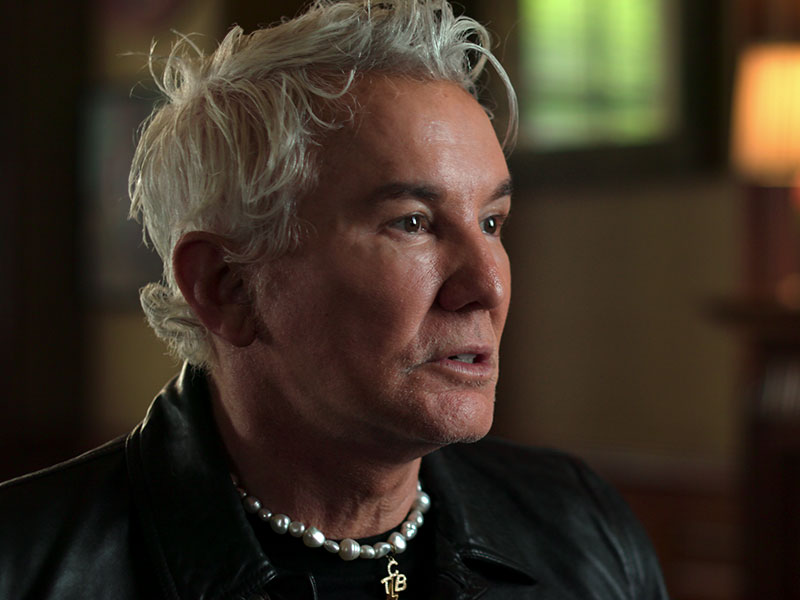
The stock market is riding a “red wave” with policy risks, analysts say

Market analysts say the stock market's momentum following the 2024 election could continue, driven by steady economic growth, strong corporate earnings and expectations for further interest rate cuts by the Federal Reserve. But concerns remain that a shift in policies could affect inflation rates.

The U.S. market typically rises after presidential elections regardless of which party wins, and it surged after former President Donald Trump won another term and Republicans took control of the U.S. Senate. The Dow Jones Industrial Average, the S&P 500 and the tech-focused Nasdaq Composite closed at record highs last weekwith most stocks edging upward this week following a pause on Tuesday. On Wednesday, the GOP won enough seats to control the U.S. House.

Sam Stovall, chief investment strategist at CFRA Research, said the "red wave period" is “the best scenario for a Republican president (when it comes to the stock market)." Stovall cited historical data showing that during similar "red wave" periods, the stock market gained an average of nearly 13% annually and increased 75% of the time.

In apparent response to the GOP wins, small-cap stocks, along with financial and traditional energy sectors — including oil, gas and coal — performed particularly well following the election and may continue to benefit from anticipated new policies, such as corporate tax cuts, reduced regulatory oversight for financial institutions and fewer environmental restrictions on fossil fuel production.

We need your help to stay independent

However, certain policy proposals may pose economic risks. Trump has repeatedly pledged to impose a 60% tariff on Chinese-made goods and a 10% to 20% tariff on imports from other countries, a position he used to court voters in the manufacturing sectors. Economists have warned that such tariffs could drive up consumer prices as companies pass on higher costs, potentially worsening inflation and putting further interest rate cuts on hold. Columbia Sportswear recently told the Washington Post it is set to raise prices due to potential tariff impacts.

Inflation has already been a major concern for U.S. consumers, reaching a peak of 9.1% in June 2022 due to pandemic-related supply chain disruptions. Although it has since moderated, inflation remains a key issue for voters, with many citing dissatisfaction with rising prices as a factor in their support for Trump.

Industries such as automotive, electronics and apparel retail could face significant pressures under his proposed tariffs, according to a report by asset management company Janus Henderson. Trump’s proposed immigration policy, which includes mass deportations, could further strain the economy by tightening labor markets, driving up wages and adding to inflationary pressures, analysts have said — particularly in low-wage industries like agriculture, construction and food service.

The Peterson Institute for International Economics forecasts that, combined with steep tariffs and mass deportation, these measures could lead to lower national income, reduced employment and inflation rates between 6% and 9.3% by 2026.

Despite these risks, market experts suggest investors should focus on the economic environment and company fundamentals, as political factors tend to have a short-lived impact on the stock market and policy changes require time to be implemented.

"Earnings growth is a much bigger driver than merely election outcomes or who’s in control"

“Our data have shown us over time, it’s really still about the economy, and earnings growth is a much bigger driver than merely election outcomes or who’s in control,” said Rob Haworth, senior investment strategy director for U.S. Bank Asset Management.

The U.S. economy grew at a healthy 2.8% annualized rate in the third quarter, driven by robust consumer spending, which expanded at a 3.7% pace. This, combined with modest business investment spending, serves as the foundation for a favorable earnings environment, Haworth said.

Major tech companies such as Alphabet, Microsoft, Meta Platforms, Amazon and Apple reported strong third-quarter earnings, with revenue exceeding expectations across the board.

In a move to boost the economy as inflation cools, the Federal Reserve on Nov. 7 cut its benchmark interest rate by 25 basis points as expected, following a September rate cut. Another rate reduction is anticipated in December.

These factors collectively make equities more appealing than fixed-income investments like bonds, analysts say. Technology stocks, in particular, are expected to drive future gains, fueled by growth potential in artificial intelligence.

“A lot of people like to use a baseball analogy. Some say we’re in the early innings. Well, our analysts think we’re still in batting practice, meaning we are not even in the game yet,” CFRA’s Stovall noted.

While pointing out the stock market traditionally performs the best from November through April, typically gaining about 7%, Stovall cautioned about a potential decline in 2025. Since the beginning of the bull market in late 2022, the market has grown 70%, meaning many stocks are now trading at premiums, which could make further growth in its third year more challenging, he added.

Fox News host Pete Hegseth as defense secretary: Perfect symbol of phony MAGA masculinity

When considering the reasons why Donald Trump picked a Fox News blowhard to run the near-trillion-dollar U.S. military, it's important to remember that our TV-addicted president-elect favors a strong jawline over concerns like skills or experience. Pete Hegseth may be "the least qualified nominee for SecDef in American history," as the founder of Independent Veterans of America said on Twitter. He may not "have any background whatsoever" in defense policy, as Rep. Adam Smith of Washington, the top Democrat on the House Armed Services Committee, told Politico. But Hegseth, with his heavily gelled hair and impressive bone structure, looks a lot like a movie star of Trump's 1950s childhood. CNN reporter Alayna Tree confirmed that those cheekbones were a major factor in this pick: “Trump also thinks he has the look,” one source told her. 

Trump's contempt for the actual work of the military is well documented. One does not need to be a big fan of war to find it disgusting that Trump calls people "suckers and losers" for the hard, often thankless work of serving in the military. It's no surprise that he'd rather give a key Cabinet seat to someone he likes to look at, rather than someone who can serve the interests of military personnel. It also appears that Hegseth is one of a long list of flat-out trolling nominations for Trump's second term, which also includes Rep. Matt Gaetz of Florida as attorney general or Fox News substitute host (and onetime Hawaii congresswoman) Tulsi Gabbard as director of national intelligence. The goal here seems to be finding people who are uniquely unfit for these jobs, both to rile up liberals and to flush out any Republicans with remaining loyalties to the concept of responsible governance. 

But while being handsome and totally unqualified got Hegseth the job, it's unfair to say those are the only things he brings to the table. He also embodies the type of masculinity Trump and the MAGA movement loves: One that desperately wants to appear strong, but reveals itself to be weak and brittle given a moment's investigation. Hegseth is the ultimate in cubic zirconia manhood. 

Reporting suggests that Trump was especially enamored with Hegseth's skill at whining, and especially about how easily threatened he is by women, people who are different, and any demands that he learn stuff or reckon with new ideas. Hegseth served in the Army, a history he has channeled into endless moaning about the supposedly "woke" military. He has complained about military recruitment ads that feature diverse service members, arguing that the threat of being exposed to different kinds of people would scare off "guys in Kentucky and Colorado and Ohio." It's a drum he beats repeatedly, arguing that "patriots" — meaning, of course, white men — are unwilling to serve lest they be exposed to "CRT, DEI nonsense, all the gender nonsense." All those words function as right-wing euphemisms for workplaces where people of color, LGBTQ people and women are treated equally. 

While he's oblique about the reasons, it appears Hegseth couldn't hack it in the Army, either. He complained in his book that the Army "spit me out," adding, "I didn’t want this Army anymore either." It is reminiscent of every guy who says "you're not that hot" when a woman turns him down. 


Want more Amanda Marcotte on politics? Subscribe to her newsletter Standing Room Only.


Hegseth envisions the military as a safe space for straight white men, where their fantasy of inherent superiority is carefully protected from real-world evidence that other people are strong, smart and capable. It's reminiscent of Elon Musk's Texas compound, where he can play out his fantasies of being a feudal king behind walls that shield him from the scary real world. Or Peter Thiel's "seasteading" dream of an island nation where he and his buddies could be lordlings, carefully separated from the ordinary people who frighten them. For that matter, it's like Trump talking big while hiding out in Mar-a-Lago. MAGA leaders are  bunch of men whose notion of masculine strength amounts to small children playing cops-and-robbers under a nanny's supervision. 

Banning women from combat roles epitomizes the MAGA version of manhood, where weakness gets reskinned as "toughness," mostly through aesthetic trickery and outright deceit.

With Hegseth, this is obvious in his longing to kick women out of combat roles. He falsely claims that "standards have lowered" to let women in, and that "men in those positions are more capable." The truth, however, is the opposite. As Barack Obama explained when the military first opened up combat roles for women, the urban and guerrilla nature of most modern warfare means that female service members were already "in a war theater" and "at great risk." But while many women were performing the duties of combat soldiers, they weren't getting the promotions or pay that go with that status. 

Banning women from combat roles epitomizes the MAGA version of manhood, where weakness gets reskinned as "toughness," mostly through aesthetic trickery. Women will keep on doing the work of combat jobs, but will be denied the titles, honors and rewards of doing so, just to prop up the illusion that only men have the toughness to handle it. The real purpose here is to insulate the snowflake-fragile egos of men who cannot feel mighty unless a woman pretends — or is forced to pretend — that she's weak. It's a direct substitution of fool's gold for the real thing. 

Of course, valuing the fake over the real is Donald Trump's modus operandi. In the real world, he's a failed businessman who repeatedly filed for bankruptcy after losses so huge that even decades of fraud and two cash infusions amounting to nearly a billion dollars couldn't safeguard him. But on TV, he plays a successful rich guy because he has all the props, from fancy cars to private jets to a boardroom that was actually a set built for his "reality" TV show. His idea of what makes someone a "Christian" is waving a Bible around, but never reading it. As president, he loved the pomp of a military parade, but hated facing the real people who serve — and are sometimes hurt or killed in real-world combat. Trump isn't just a simulacrum, but one that feels nothing but contempt for the real thing, which often has less surface glamour than his gold-painted fakes. 

In that spirit, it's no surprise that Hegseth's model for the ideal military man is not a real person from history or even someone he knows, but a movie character. In his typically whiny book "The War on Warriors: Behind the Betrayal of the Men Who Keep Us Free," Hegseth writes, "Our ‘elites’ are like the feckless drug-addled businessmen at Nakatomi Plaza, looking down on Bruce Willis’s John McClane in ‘Die Hard,’" adding, "But there will come a day when they realize they need John McClane."

No one "needs" John McClane. He is a make-believe tough guy, built out of special effects and the comedic acting skills of Bruce Willis. But this kind of ludicrous fantasy allows Hegseth to elide the deep paradox of his argument. He wants us to imagine straight male American soldiers are "honorable, powerful and deadly," but also portrays them as too feeble to handle the diverse modern military. He believes they must be sheltered from any evidence that people with different identities can be strong, too. So he retreats to this phony masculine idea of "strength," constructed through Hollywood magic. It's like a little boy's dream, created to avoid the underwhelming reality of MAGA manhood.

Trump’s win was “an epic failure of every major institution” — especially the media

Donald Trump and his MAGA movement steamrolled Kamala Harris and the Democrats. Although the final vote totals will be fairly close, Trump won all seven key battleground states, and swept the "blue wall" across the Midwest. He increased his support significantly among Democratic base voters, most notably Latino men, and performed better than expected among Black men. Despite the Supreme Court's Dobbs decision, which overturned Roe v. Wade, women did not rise up unanimously to stop Trump. According to exit polls, he won a majority of white women, just as he did in 2020.

In the most basic sense, the 2024 election can be understood as a referendum on the direction of America and the future of pluralistic multiracial democracy. Its results were not uplifting. Today’s Democratic Party, the mainstream news media and other defenders of political “normalcy” have few answers for the cultural force and energy of Trump's brand of right-wing populism. In too many ways, they appear locked in an echo chamber, largely talking to each other and convincing themselves that all intelligent and rational people agree with them. 

One significant element of this failure is a reluctance to understand or recognize that today’s Republican Party is more of a front organization than a traditional political party. This is from Hannah Arendt's "Origins of Totalitarianism":

The world at large … usually gets its first glimpse of a totalitarian movement through its front organizations. The sympathizers, who are to all appearances still innocuous fellow-citizens in a nontotalitarian society, can hardly be called single-minded fanatics; through them, the movements make their fantastic lies more generally acceptable, can spread their propaganda in milder, more respectable forms, until the whole atmosphere is poisoned with totalitarian elements which are hardly recognizable as such but appear to be normal political reactions or opinions. The fellow-traveler organizations surround the totalitarian movements with a mist of normality and respectability that fools the membership about the true character of the outside world as much as it does the outside world about the true character of the movement. The front organization functions both ways: as the facade of the totalitarian movement to the nontotalitarian world, and as the facade of this world to the inner hierarchy of the movement.

Ultimately, Trump's 2024 victory reflects exactly that kind of failure of imagination and comprehension. America and the world are changing rapidly; the Democrats, the media and the mainstream political class cannot keep up. In an attempt to make sense of Trump’s victory, our collective emotions in this time of trouble and dread, what this election reveals about American values and character, and what comes next when Trump takes power in January, I recently spoke with a range of experts. 

Katherine Stewart is the author of "The Power Worshippers: Inside the Dangerous Rise of Religious Nationalism."

I have written three books about the movement that brought Donald Trump to power. My forthcoming book, "Money, Lies, and God: Inside the Movement to Destroy American Democracy," is a dissection of that movement. For those of us immersed in this research, the election results may be disappointing and alarming, but it’s not like we didn’t see it coming. Many people have not been paying attention to the movement that brought Trump to power, and may not be aware of the misinformation bubble that it has funded.

One issue with the mainstream media is that they don’t often go to the places where this movement is happening. One of those places is the local church and their larger networks. Prior to the election, we got a lot of stories about the Democratic Party's ground operations, which often involve strangers knocking on doors. The Christian nationalist turnout machine is much more robust, and it brings huge numbers of extremely reliable voters to the Republican side. Getting messages about who to vote for from your pastor or faith leader, who you trust, is much more effective than getting that message from a stranger. A lot of Americans voted for Trump simply because their pastor told them that Republicans are “people with ethics” and Democrats want to destroy families.

But we shouldn’t simply focus on media failures. The fact that a convicted criminal and credibly accused rapist, who has attempted to overthrow an election, was elected again represents an epic failure of nearly every major institution in our society. It represents a failure of the judicial system to hold this individual genuinely accountable. It represents a failure of much of the education system to help students discern the difference between news and propaganda. It represents a failure of the Republican Party to filter out candidates who are egregiously unfit for office. Trump’s victory in this historic election where the future of the country’s democracy is at stake and greatly imperiled also represents a failure of large parts of the American public to understand their basic duties as citizens.

What Trump is offering to his supporters is pretty close to pure poison — lies, grievance and division. But here’s the thing: Just because they voted for him doesn’t mean that his policies are going to benefit them in any substantial material way. Because most of these policies will not. We can all imagine a leader who appeals to identity issues like religion and immigration while pursuing a program of genuine economic reform. But Trump has married his demagoguery to an extreme right-wing agenda that calls for disinvestment in public projects and public benefits, replacing federal employees with Trump loyalists, breaking alliances with our more liberal allies while forging stronger ties with reactionary regimes.

"What Trump is offering his supporters is pretty close to pure poison — lies, grievance and division. But just because they voted for him doesn’t mean that his policies are going to benefit them."

This 2024 election is a referendum on the character of the Trump-voting public, and let’s not make it nice. They place minimal value on respect for truth and democratic institutions. They are more interested in punishing other people than in advancing the common good. They have a remarkable tolerance for crass and bullying behavior, care little for empathy and ethics, and are incapable of weighing basic facts about public life.

What happens next, with Trump becoming president? I think the big question, which is hard to answer now, is how serious members of the incoming administration are, regarding the agenda they put forward. If they do attempt to impose the agenda of Project 2025 or the America First Policy Institute, I expect it will lead pretty quickly to major blowback and significant damage. If they get even halfway toward the kind of mass deportation they talk about, for example, it’s going to be brutal and incredibly ugly — and will cost American taxpayers a lot of money. That, and the reaction to what they do, will drive what happens next. 

Dr. Gary Slutkin is an epidemiologist formerly with the World Health Organization, where he founded the Intervention Unit, which designed innovations in epidemic control. He is credited with discovering the scientific basis for diagnosing and managing violence as a contagious disease and is the founder of the NGO Cure Violence Global

I am pausing to regroup with myself, to try to understand what happened more fully and proceed more capably. I pause by going quiet and walking in nature. The brain then works on things on its own. The emergency was the last few weeks; now we have a new situation. On medical wards, things can take turns and you still have to figure out how to help right things. 

Many in the news media live in their own bubbles, do not really collect information or understand their best roles. We would be better served if they were educators and explainers, rather than reactors to daily news. They are easily distracted and taken advantage of. They don’t understand disinformation and propaganda. Most importantly, they don’t have priority themes or frames and are commonly in the wrong frame. The correct frame for this election was not how entertaining or outrageous anyone is, or how well one side or another is doing. It was: What is authoritarianism, how does it work, and what are the outcomes? Some of the educational matters missing still include how to understand lies, insults and dehumanization, why that is done, how it affects the brain and what to do about it.

When fighting epidemics, the media would cover me or the group I work with, when what we needed was to educate the public on the problem itself. For example, what is AIDS, or COVID, or epidemic violence? How is it transmitted or not transmitted? How can you protect yourself and interrupt the spread? In this case, it would be preferable for the media to educate us on our rights, and what it’s like to have those rights taken away; on the value of pluralism versus uniformity; what it’s like to be an immigrant, which not a bad thing but a hard thing. And most urgently now, how violence, lies and cruelty work in and on our brains, and how to stop it. 

The media are looking at Trump and his followers superficially and judgmentally. We need a different level of thinking and analysis, as Einstein advised. This level considers understanding fears, and how they are inflamed and manipulated. Our brain flaws need to be better understood by the public, because they are being manipulated. 

Eastern teachers who have taught in the U.S. have recognized that in the West people generally don’t feel good enough about themselves. This was a total surprise to find that this exists in a culture. The Dalai Lama has said there is no Tibetan word for this disorder. It is also clear to people from other cultures that Americans can be relatively loud, expect things to be given to them, and are pushy and individualistic. We also blame others for our problems, which is more universal. 

I am most immediately concerned about possible deportations, raids and camps, and restrictions of people’s rights. We must condemn hate and protect individuals and groups who might be targeted. We need to stop the forces of violence that have been unleashed. We all need education and training in stopping violence.

Jen Senko is an documentary filmmaker, activist and author. She directed the 2015 documentary "The Brainwashing of My Dad."

I’m not sure I can characterize what I’m feeling. It is a combination of numbness and a stubborn determination to both protect myself and carry on. As for managing my feelings, I’m careful and selective as to what news or information I consume. It’s far less than it was before the election, and devoid of almost any cable TV news. I nourish a sense of satisfaction with the simple accomplishments of the day; getting up early, making coffee for my mom and me, walking, performing some activism, reminding myself that “movement of the muscles overcomes the defeatist babble of the brain.”

"Because I’ve heard so many others talking about fighting back, I find myself more in that spirit now. I stay involved with groups that are committed to fighting back. This sustains me and has given me courage and hope."

When I do feel overwhelmed, I’ll sit completely still and look out the window at trees. I avoid indulging in “rage porn” and limit myself to only what is helpful to know. But because I’ve heard so many others talking about fighting back, I find myself surprisingly more in that spirit now. I stay involved with groups that are committed to fighting back. This sustains me and has given me courage and hope. Before the election, I thought that if Trump won or managed a successful coup, I would just withdraw. I would burrow and seek refuge in reading narrative stories and watching movies. But others determined to fight have revived that spirit in me. 

The media got it wrong in many ways. Since 1969, Republicans have railed against the “liberal media,” deploying a “complaint machine” to intimidate and guilt-trip the press. Any perceived display of liberal bias was quickly attacked, so the media got the message and gradually acquiesced until liberals and their point of view were marginalized. By now it's partly reflex, operating from a fear of being called liberal. Some may be under the mistaken impression that if they curry favor now, maybe they will be spared retribution under a Trump presidency. In fascism, this never works. Acquiescing here and there won’t suffice. Fascists and authoritarians want complete control and 24/7 propaganda. 

The most critical point is simple: Corporate media refuses to understand that its own power and influence are the reason millions of Americans believe lies about immigrants, crime-ridden cities and evil, traitorous Democrats. Right-wing media now dominates with its lies, while corporate media has failed to counterbalance the right-wing narrative. Once people accept these lies as truth, their minds seek only information that confirms these beliefs, and social media algorithms push them even deeper into this distorted worldview.


Want a daily wrap-up of all the news and commentary Salon has to offer? Subscribe to our morning newsletter, Crash Course.


For those of us who did not vote for Trump, do not “pre-obey,” as Timothy Snyder says. Remember, they are bullies testing their strength. They talk tough, but we must stand up to them. There is strength in numbers, so consider joining a group that aligns with your values and inspires you.

For those Americans who did vote for him, brace yourselves. It’s going to be a rough ride. You will be told, despite evidence to the contrary, that everything is better than ever. You’ll be told that the economy Biden left is because of Trump. You may experience cognitive dissonance. You may eventually see that you’ve been bamboozled, or you may continue to descend into the mass psychosis gripping the American mind. If you ever come out of it, we’ll be waiting for you on the other side.

D. Earl Stephens is the author of “Toxic Tales: A Caustic Collection of Donald J. Trump’s Very Important Letters." His website is Enough Already.

I am furious, but I have no regrets. I didn’t do enough in 2016 and I made sure that wouldn’t happen again. If the majority of my country is fine with an America-attacking vulgar racist, whose only true talent is the ability to somehow always go lower, I find it terribly sad and wildly dangerous. Anybody who stood up for what most certainly is good and right and decent should be plenty proud of themselves right now. Good people kicking themselves and pointing fingers isn’t helping. Brush yourselves off and stay in the fight.

I encourage pro-democracy people to engage with like-minded folks and hash it all out. Gold will be mined in these conversations. There is strength in numbers, and people need more than ever to understand they are not alone. Millions of lives are literally on the line, and my job as an old white man is to make damn sure people know there are privileged people like me who are not only not giving up, but standing by to help. We must have skin in the game. 

"I am astonished that I convinced myself that a woman of color could actually be president of the United States. A country that supports such a vulgar man isn’t capable of electing such a qualified woman."

The news media was not just wrong about the election but is largely to blame for Trump winning. I have been reading media postmortems on the election and not one has blamed itself for this mess we are in. They treated it all like some terrible board game when they should have been sounding the alarms and giving the most menacing threat in American history the editorial weight it deserved. As a career journalist, it will always be impossible for me to reckon with this. I call them out today, and will continue to do so in the future. Democracy needs more bandwidth. I could stand to see some sane, good-hearted billionaires funding independent journalism that reports on the extreme threat to our country. If democracy-supporting billionaires even exist.

Misogyny and racism powered Trump’s victory. Looking in the rearview mirror, I am astonished that I convinced myself that a woman of color could actually be president of the United States. A country that supports such a vulgar man isn’t capable of electing such a qualified woman. And one other thing: Listen to the quiet. It is the quiet ones who are the scariest. There is a lot of quiet support for Trump out there that is constantly missed in all these polls.

Finally, one thing that is being missed badly, in my opinion, is that more Americans identify as independents than they do as Republicans or Democrats. This year, more independents leaned right than ever before. As Gallup reported in January, the parties were closely matched, but Democrats were "clearly in a weaker position than they have been in any recent election year.”

This turned out to be an ominous warning. Truth does not matter one bit in politics, and Republicans understand this. They ran on the issue of crime, even though it is down. Goods are too expensive, mostly because of corporate monopolies and concentration. Democrats should have offered a solution to inflation and price gouging. In a year or so, you can expect Trump to take credit for the programs Biden and the Democrats put into place, which is going to be the most insulting thing of all. Democrats must get better at communicating at a fourth-grade level and reaching people where they are. We have the strongest economy in the world right now — Republicans would have been shouting this nonstop from the rooftops. I blow hot and cold with Bernie Sanders, but he is the only person on the left who knows how to connect with that kind of punch.

If there’s any good news, the only person who has proven able to consistently stop Trump is Trump himself. He’ll invariably overreach, and fail. There are still far too many people who will pick him back up.

“The most lethal force in the world”: Heritage founder takes victory lap amid Project 2025 fallout

NEW YORK — Kevin Roberts, the president of the right-wing think tank The Heritage Foundation, took a victory lap at a lavish party on Tuesday night, selling his book and vision for a transformed country on the march against China to a crowd of conservative elites.

The book launch for Roberts’ “Dawn’s Early Light” was originally scheduled for release on Sept. 24 of this year. The book was delayed, however, after Project 2025, the foundation's vision for recreating the United States in its image, became a central talking point in the presidential campaign. The fact that Vice President-elect JD Vance wrote the foreward for Roberts’ book only doubly raised its profile, so the group punted the book’s release until after the election.

At the penthouse bar at the luxurious Kimberly Hotel on East 50th Street in Manhattan, some reporters were told to “Go to hell” and others from conservative outlets were welcomed. Roberts sat down with Fox News Host Brian Kilmeade in front of a packed room of conservative donors and activists.

“Americans want to wake up in a normal country again,”  Roberts began, likely euphemistically referring to Project 2025’s plan to all but erase federal protections and anti-discrimination measures based on gender identity and sexual orientation.

Roberts went on to say that his desire to transform America was rooted in childhood trauma. His brother committed suicide at just 15 years old in 1983, his parents divorced and his “hometown of Lafayette, Louisiana was going through the oil bust.” In Roberts’ telling, this trauma was enabled by “big government” and its proponents. 

“What JD Vance saw a little bit later, is what tens of millions of Americans are facing now, because of the opioid crisis, and frankly, not because of ill intention by people who want big government, I'm going to ascribe good motives there, but government has displaced the very factors that allowed me to flourish: family, friends, communities, churches, civic organizations,” Roberts said.

These individual issues also appear in Project 2025. The plan's answer to the oil bust is to tear down barriers protecting public land, allowing oil and gas companies to expand their operations there. Many of the Project 2025 partner organizations have called for either restricting or eliminating no-fault divorce.

We need your help to stay independent

Roberts proceeded to name the “uni-party” as the real enemy, in a move that would have felt at home at one of Robert Kennedy Jr.’s campaign events, saying: “The institution in DC that stands in the way is not the Democrat Party or the Republican Party or just K Street. It is this antagonist known as the uni-party.”

In Roberts’ analysis, Trump represents a break from the establishment, despite some of his recent cabinet appointments, like reported Secretary of State pick Sen. Marco Rubio, R-Fla., and that Trump has been a Republican power broker since 2012, when Sen. Mitt Romney, R-Utah, traveled to New York during his presidential campaign to seek Trump’s endorsement.

As part of Roberts’ plan to rebel against the uni-party, he called on the incoming administration to fully embrace and enlarge the military-industrial complex. While gesturing to free markets, he called on Vance to implement an industrial policy rooted in the defense industry, which would, in some ways, continue President Joe Biden’s project of military Keynesianism. 

According to Roberts, the United States needs to build up “the most lethal force in the world,” a force Roberts claims he would like to be “the most sparingly used.” However, Roberts said that the purpose of this even larger military would be “confronting” with China.

“And one of the things that I talk about extensively, as you know Brian, in the book, is confronting the Chinese Communist Party. You and I are both sons of the Reagan Revolution,” Roberts said. “We understood the Soviet Union was an existential threat, certainly with its nuclear capabilities, it was, and Russia is, but China is even more sinister. It's more insidious in what they have done under this communist regime.”


Want a daily wrap-up of all the news and commentary Salon has to offer? Subscribe to our morning newsletter, Crash Course.


Roberts cited vague notions of “self-government” as the driving force in his desire for the United States to confront China. Self-government, which he says would give way to a “golden era of conservative policy reform.”

While the Heritage Foundation did not write the GOP's platform, the think tank is undoubtedly influential in Republican policymaking. By their own calculation, Trump enacted some 64% of their recommendations in his budget in 2018, for example.

As attendees mingled after Roberts’ interview with Kilmeade, they exchanged expectations for the incoming Trump administration. Some hoped he would follow through on his dovish campaign rhetoric, others thought he might escalate conflict in the Middle East. 

In conversations with Salon, many expressed hope that Trump might take up their own pet issue, like dismantling the administrative state, ending diversity initiatives or directing public funds to religious schools. When asked what their priority would be for a second Trump term, no one cited tariffs or tax cuts.

While there was a sense of victory in the air, the cracks in Trump’s coalition also shined through. Disagreements between the self-fashioned libertarians, neoconservatives and nationalists previewed the factions vying for power within the Republican Party, factions which stand to come to the forefront in his next term. 

Russia’s dark web markets prove the drug war can’t be won

Puff-Puff (or Khapochka, meaning a short drag from a joint or a cigarette) is a young, beautiful (insofar as I can tell behind her mask) woman in her mid-twenties and, in her own words, “a drug courier from Russia, blogger and just an idol of millions.” She entered the drug trade as a side hustle while completing her studies and now blogs about her lifestyle on her Telegram channel, Courier in a Skirt, where she chats with fans and answers their questions. 

“To be honest, the idea [to start a blog] was given to me by one person on Telegram,” she told me. “I thought and realized that I really have something to tell people, and it’s also more about talking openly about that part of my life that you can’t discuss with family and friends. After all, it’s better to ask advice on how to best bake pot cookies in a chat of like-minded people, and not from your mother, right?”

Her job begins by collecting wholesale consignments from her anonymous paymasters, which she then weighs into smaller packages and hides around the city for their customers. 

“Two years ago I got a job in a new shop,” she recalled. “I was assigned a master stash, the product located somewhere in the forest not far from the main road. I calmly collected it and placed it inside a fake fire extinguisher, the type you can find on AliExpress. I was driving away as though nothing had happened when I saw a patrol car. They stopped me, checked my documents, then asked if I was carrying anything illegal. I said no, of course not, but they decided to inspect my car anyway. Naturally, they checked the boot, but didn’t touch the fire extinguisher. They wished me a pleasant trip and let me be on my way.”  

"I was assigned a master stash, the product located somewhere in the forest not far from the main road."

Just like the United States, Russia has been waging a war on drugs. In certain prison camps, up to 80% of residents are confined under Article 228 of the Criminal Code – which bans certain narcotics – nicknamed “the peoples’ statute,” as more citizens are incarcerated for it than any other, many serving over ten year stints for first-time offenses. Prison conditions are tough; torture is rife. And yet, over 10,000 Russians keep dying from drug overdoses each year, a toll which has more than doubled since 2019. 

This failure to cope lies partly with the changing nature of the drug market itself. A new report by the Global Initiative Against Transnational Organized Crime, for which I acted as a researcher, explores this new underworld, which may give us a clue for where the worldwide drug scene is headed next.

Buying dope in Russia was like anywhere else in the ‘90s and 2000s. You’d have to visit a certain area (Roma gypsy villages stood in for “the hood” with their open-air drug bazaars) to score, or ask a friend — who may or may not be working with the cops to get the law off their back. Like their American counterparts, Russian police operate on a system of quotas, and to meet those demands a common tactic was to catch a low-level seller or user, then put the squeeze on them till they turn in their buddies. They, in turn, sell out their supplier until, sooner or later, everyone’s working for The Man. You never knew if you’re being set up for a sting.


Want more health and science stories in your inbox? Subscribe to Salon's weekly newsletter Lab Notes.


Now everything’s gone digital. While selling drugs online is far from new — in fact, the very first thing bought and sold on the Internet was a bag of weed — no nation has so wholeheartedly embraced e-shopping for their preferred pick-me-ups as the Russians. The U.S. government estimates that in 2021, 80% of cryptocurrency transactions across the whole dark web took place through Hydra, Russia’s then-reigning cyber-cartel. 

Much of Hydra’s interface would have looked familiar to anyone who’s used the dark web marketplace Silk Road or its myriad knock-off clones: you can glance through the forums and customer reviews to check which pills and powders will rock your socks off and which will leave you feeling worse than Uma Thurman in “Pulp Fiction.”

But what made Hydra unique was not only its monopoly but also its distribution system, which revolved around stashing gear in out-of-the-way hiding spots like a coke-dealing Easter Bunny — or Puff-Puff.

“In other countries, illegal online drug markets employ the post to send drugs. In Russia, the post is extremely slow and unreliable, so local dealers came up with a new and more efficient way of distribution,” explained sociologist Alex Knorre.

What made Hydra unique was not only its monopoly but also its distribution system, which revolved around stashing gear in out-of-the-way hiding spots like a coke-dealing Easter Bunny.

“It is extremely easy,” Knorre continued. “You can order online anytime, chances are good you have many available drugs in your city, and you can pay for it using a credit card or QIWI [a common ATM-like way to send cash]. You receive the coordinates to pick up the package soon after the payment – and just collect it somewhere.”

The dark web thus removed the need to consort with Addidas-wearing gopniks (thugs.) Plug not picking up their phone? No problem — anyone with a laptop and a wi-fi connection could buy or sell. The anonymity of everyone involved was guaranteed by the encrypted TOR browser. Developed by the U.S. Navy to protect their comms, the browser’s code was made public in the mid-2000s and TOR became a nonprofit aimed at helping activists in authoritarian regimes bypass the censors. It also enabled the darknet and all its hackers, pedophiles and drug dealers.

Russia is the second-largest country in the world by TOR usage, accounting for 15% of all traffic. While the Kremlin has tried blocking the service, results have been mixed at best — and nowadays TOR is less necessary, as there are plenty of mirrors on the clear web. Between dead drops and TOR, this meant unlike traditional drug rings, no one actually has to meet face-to-face, shielding the operation from undercovers, turncoats and stool pigeons. 

Then there’s changing tastes. Since the late ‘80s, the favorite forbidden stupefiant of Russians had long been heroin, which arrived from Afghanistan via the mountainous, impoverished Central Asian land of Tajikistan, a smuggling route overseen by organized crime and corrupt security chiefs. As the Taliban cracks down on the industry, this market threatens to be replaced by synthetics in Europe, risking a fentanyl crisis like the U.S. is currently straining under.

While opioids are still abundant for now, they’ve been overtaken in popularity by synthetic stimulants; chiefly mephedrone, a speedy cathinone cooked in clandestine labs with raw materials sourced from China. Hydra played no small part in this trend, selling DIY drug-making kits.

A similar phenomenon is unfolding in America as well. A recent Reuters investigation demonstrated how easy it is to purchase enough precursors — the chemicals used to make synthetics – to produce three million fentanyl tablets, sourced online from unscrupulous Chinese companies for a mere $3,600 worth of Bitcoin. The packages smoothly evaded customs and were delivered straight to mailboxes in New York, New Jersey and Mexico City. Although the Reuters reporters disposed of the fentanyl precursors, it’s not difficult to combine them using a simplified synthesis known as the Gupta method, which one Mexican narco described being as easy as “making chicken soup.”

This is just one of innumerous examples of how synthetics are the wave of the future: anyone cyber-savvy enough can acquire the equipment and ingredients, which are easier to hide and can better withstand the local weather than a coca crop or a poppy plantation, effectively democratizing the drug trade away from Mafia-esque syndicates. 

The more a nation invests in border security, the more attractive it becomes to traffickers, because greater risks entail greater rewards. But small-time producers already situated within a country’s borders can saturate the market. Consider cocaine, which retailed on Hydra for nearly $100 a gram, versus mephedrone, costing a measly 13 bucks. If law enforcement’s goal is to discourage consumption by forcing dealers to raise their prices, they’re falling far behind.

Clamping down on precursors is a game of Whac-A-Mole. Should precursors be banned (already a tricky proposition since they’re commonly used for legit products like perfume), Chinese manufacturers will sell pre-precursors: even more obscure, unregulated chemicals. And if Beijing cleans up its chemical industry, the business may simply move to India, where corruption can be even more endemic, or perhaps another country.

We need your help to stay independent

All the above isn’t to say that there haven’t been (pyrrhic) victories. In April 2022, the German federal police, acting on information from their American colleagues, seized the servers hosting Hydra, replacing its banner with their logo and retrieving $25 million in Bitcoin. There was a momentary confusion. At first, buyers hoped the platform would be resurrected and reappear in some form. New platforms could be scammers or police stings. Hand-to-hand sales enjoyed a brief revival, but more so in small towns and rural areas. Customers missed the convenience and stability of Hydra. 

Then, gradually, replacements began arising, with names like MEGA, WayAway, OMG!, Solaris, BlackSprut and Kraken — many of which were staffed by veterans of Hydra. A digital turf war erupted over Hydra’s displaced clientele. Unlike the drug war in Mexico, however, there were no headless corpses hanging off bridges. Instead, battles were fought with hackers, data breaches and server shutdowns.

So that’s an improvement, at least. If only more teardrop-tattooed cartel enforcers knew how to code. But fundamentally, the crux of the problem persists. The Kremlin and the White House rarely see eye-to-eye, but for now, both uphold the status quo of the war on drugs. 

“[Legalization] will happen when people stop drinking vodka,” Puff-Puff weighed in. "In the meantime, this is not financially profitable for those who manage everything. It would be enough to decriminalize marijuana or abolish laws that imprison people for ten years for six grams of buds. But these are political things that I try not to get involved in.”

“There would be a backlash”: Harris reportedly skipped Rogan podcast over staff’s fears of reaction

An adviser to Doug Emhoff claimed Wednesday that Vice President Kamala Harris skipped an opportunity to appear on Joe Rogan's podcast over fears of a progressive "backlash."

“There was a backlash with some of our progressive staff that didn’t want her to be on it, and how there would be a backlash,” said Jennifer Palmieri, an adviser to Harris' husband Doug Emhoff, per the Financial Times.

The host of "The Joe Rogan Experience" has shared several reasons why an interview with Harris never materialized. In the weeks before Election Day, he shared that he refused to do an on-site interview while Harris was campaigning. On Tuesday, Rogan said that Harris' campaign put the kibosh on certain topics during a potential interview, which led him to decline. 

"They had, I don’t know how many conversations with my folks, but multiple conversations giving different dates, different times, different this, different that," Rogan said. "I think they had requirements on things that she didn't want to talk about, she didn't want to talk about marijuana legalization, which I thought was hilarious." 

If true, the ban on legalization talk would be strange. Harris' campaign pushed marijuana legalization as a plank of their campaign in its closing days.

Palmieri, for her part, said the will they-won't they news cycle created a "weird dynamic" between the campaign and Rogan.

"All of a sudden he’s on his heels about how his audience is going to react to this, and the demands that they were going to put on him to be tough on her,” she shared while speaking at a conference organized by The Clearing House.

Donald Trump and JD Vance both appeared on Rogan's podcast while on the campaign trail. Rogan officially endorsed Trump on the Monday before the election and has encouraged the president-elect to strive for unity over revenge in his second administration. 

Gaetz’s attorney general nomination met with shock from lawmakers

Donald Trump's nomination of fellow Florida Republican Matt Gaetz for attorney general has caused shock among several of Gaetz's fellow lawmakers.

The president-elect announced his pick to head up the Department of Justice in a Truth Social post on Wednesday, and the bipartisan pushback against the widely disliked representative from Chipley was swift.

On CNN, Sen. Chris Murphy, D-Ct., called the nomination a “red alert moment for American Democracy” and conveyed the shock he saw in the upper chamber. 

“You could literally hear the jaws dropping to the floor of Republican senators who are now going to be in a position to stand up to Donald Trump in a way that they have been unwilling to," Murphy told Jake Tapper.
"[Gaetz] will implement Donald Trump’s transition of the Department of Justice from an agency that stands up for all of us to an agency that is simply an arm of the White House designed to persecute and prosecute Trump’s political enemies." 

Reporters for Punchbowl News and the Washington Post said the reactions from Republican and Democratic lawmakers ranged from surprise to amusement. 

Sen. Susan Collins, R-Maine, told reporter Max Cohen she was "shocked at the nomination.” Sen. Joe Manchin, I-W.Va, said that “no one could believe" the news. Sen. Chuck Grassley, R-Iowa, reportedly fell completely silent when confronted with questions about the nom. Sen. Kevin Cramer, R-N.D., offered some local color, calling the Gaetz pick an "uff da." 

"I don't know what to make of it," he said.

Rep. Mike Simpson, R-Idaho, offered the most blunt reaction. According to Huffington Post reporter Jonathan Nicholson, he responded to the news with an incredulous "Are you sh**tin' me?"

Sen. Thom Tillis, R-N.C., said that Gaetz faces an uphill battle, telling reporter Burgess Everett that they're "not going to get a single Democrat" to vote for his confirmation.

Despite the seeming resistance to his nomination, Speaker of the House Mike Johnson shared that Gaetz has already tendered his resignation from the House.