Spring Sale: Get 1 Year, Save 58%

Elon Musk claims he’s leaving politics — no one should believe him

With great excitement this week, the story tore through the press: Billionaire Elon Musk is leaving the government! May 28 and 29, the headlines were dominated by reports that the chainsaw-wielding head of the Department of Government Efficiency (DOGE) was resigning from his position in government. Musk himself hustled to sell the story by giving shame-faced interviews, seeding the notion that he and Donald Trump had a contentious break-up, claiming he's "disappointed" by Trump and complaining about being the administration's "whipping boy." 

If it all seems familiar, that's because we've been through this cycle before. In late March and early April, we were treated to a round of "Musk is leaving" headlines, which helped temporarily boost the sinking stock price of his car company, Tesla. His exit didn't take. In late April, Musk again dramatically announced his departurepromising Tesla shareholders that "my time allocation to DOGE will drop significantly." We were treated to another round of "Musk is leaving, we swear" stories in early May, complete with colorful details of the billionaire saying he'll miss sleeping over at the White House and eating ice cream with Trump. But somehow, he kept not going away. Musk was on camera in the Oval Office during Trump's racist ambush of South African President Cyril Ramaphosa last week. 

Earlier this week, Tesla faced another bleak financial report. European sales fell by half in the past year, even as other electric car companies saw robust growth. Investors got antsy again, and the growing pressure led a group of pension fund leaders to write to the Tesla board, demanding that they force Musk to return to work. Like clockwork, Musk once again announced his departure from DOGE to return to Tesla, going on CBS with an "Occupy Mars" T-shirt and telling the Washington Post he's refocusing his efforts on his alleged mission to send human beings to Mars. 


Want more Amanda Marcotte on politics? Subscribe to her newsletter Standing Room Only.


Credulously repeating Musk's claims that he's leaving the government, as far too many media outlets have done, helps Musk soothe the frayed nerves of his investors. However, it is not good journalism, and not just because the past few months have shown that Musk's farewells mean nothing. Musk's entire history shows that the man's word is worth less than nothing. Musk built his tremendous wealth not through innovation, tech genius, or business acumen, but on his skill at blowing smoke. 

Musk's entire history shows that the man's word is worth less than nothing. Musk built his tremendous wealth not through innovation, tech genius, or business acumen, but on his skill at blowing smoke.

Wired, which has been one of the few outfits reliably reporting on Musk with the proper levels of skepticism, published a critical article Tuesday laying out how Musk has more in common with PT Barnum than Thomas Edison. As Carlton Reid demonstrates, for a shocking 19 years, Musk has kept investor cash flowing by making bold predictions of dazzling products on the horizon in the next year or two. Musk promised self-driving cars, fast travel that could get you from Boston to New York City "in less than half an hour," an army of intelligent robot servants, self-charging cars, brain chips for intelligence enhancement, and affordable family cars. None of it happened, but Musk keeps pitching new ideas and making false promises so fast that investors forget how he failed to deliver on all these exciting past promises.  

Musk understands that people will buy anything if they want to believe your nonsense badly enough. Tesla investors are especially vulnerable to false reassurances. The truth is too hard to accept: they bet a fortune on a bad horse. Tesla's sales aren't going down because Musk isn't spending enough time at work. It's because his hard turn to the right — including his infamous quacks-like-a-Nazi salute at a Trump rally — poisoned his brand with the left-leaning customer base of Tesla.

The protest movement against him, called "Tesla takedown," has also been successful at generating viral stories that make it seem embarrassing to own a Tesla. Just this week, for instance, pundit Chris Cillizza displayed the lack of self-awareness he's known for with a bratty article at the Daily Beast, complaining about "vandalism" inflicted on his Tesla. A photo of the alleged "vandalism" was helpfully shared in the article:

Also: for the record, the image below is the note taped to Chris’ car that he describes as “defacing” and “vandalism” I like the Beast so I choose to believe they let him write this to humiliate himself.

[image or embed]

— TACOHat (@kenwhite.bsky.social) May 28, 2025 at 7:20 PM

Cillizza whines, "Not everything has to be political." But now there's a reason to shun the Tesla beyond just opposition to fascism, or the fact that they're ugly and hard to fix. It's also because it's the car of crybabies. Musk himself is the biggest crybaby of all, telling the Washington Post, "People were burning Teslas. Why would you do that? That’s really uncool." This is the same Musk who spent months gloating about how he's ruining the lives of thousands of people with his reckless attacks on federal employees. This is the same Musk who shrugged off reports that his cuts are killing people. There is little doubt he feels the suffering of a vandalized Tesla far more than a child who is starving to death because he destroyed USAID. 

It's this ego that allows us to predict with confidence that Musk's departure is fake and, as he has done in previous iterations of this story, he will sneak his way back into the White House. He's too addicted to the power and attention he gets from politics to live the boring life of a respectable businessman focused on responsible management. Even before DOGE, Musk had a frightful habit of posting online, often tweeting 100 times a day. I can't manage that even on weekend days when I'm bored on my couch. There's no way he was working at his official jobs full-time, as there's a very public record showing he spent most of his days online engaging with far-right content. While he's trying to perform discipline now, mostly tweeting about his businesses, it's unlikely he'll be able to keep up the ruse for too long. Musk, like Trump, is too narcissistic. Like Trump, he won't be able to stay away from the firehose of ego gratification provided by being a leader in the MAGA cult. 

Members-only clubs are charging wild prices — and they’re booming

Zero Bond isn’t the kind of place you stumble onto: It’s the kind of place you already know about. There’s no sign on its building in downtown Manhattan, and no way to know what’s beyond its heavy black doors unless your name is on the list.

It’s the kind of place where, on a cold December night in 2023, Taylor Swift slipped past security with Blake Lively, Zoë Kravitz and Jack Antonoff, the entire party disappearing into candlelit booths before the outside world even realized they were there.

Newer social clubs like this are thriving in New York City and elsewhere, even as membership fees climb into the six figures and waitlists stretch for months. At the lower price point, Zero Bond's annual fees are $4,400, with a $5,000 initiation fee if you're 45 or older (the price drops significantly if you're younger). At the higher end, Aman New York's initiation fee is a staggering $200,000, plus a $15,000 annual fee — all for access to swanky restaurants, lounges and spas. Even money might not be enough at some clubs: The Core Club is difficult to crack, even with $100,000. Casa Cipriani's strict vetting process excludes the wealthy if they aren’t the right kind of rich. 

Expensive private clubs have grown since the pandemic: Donald Trump Jr.'s new club in Washington, D.C. has a $500,000 membership fee, along with a waitlist. Clubs have expanded in Palm Beach, where the rich migrated in recent years; in Houston, they're trying to compete with the New York and Los Angeles club scene. The global social club market is projected to reach $25.8 billion by 2027, with an annual growth rate of 11.2% from 2022 to 2027, according to market research company Mordor Intelligence.

But these members-only circles are more than expensive schmoozing — they're a business model, a status symbol and a growing part of the luxury market. Some offer sanctuary from the public eye; others, a carefully curated network designed to block off access. And a rocky economy doesn't deter traffic. 

“When the economy is down, people with wealth are a little bit more not as comfortable walking around into random places,” said Chris, a longtime member at Zero Bond who requested anonymity. “So they prefer to have private environments.”

We need your help to stay independent

The demand is clear: At Soho House, once the crown jewel of the modern private club movement, membership has ballooned to 267,494 members worldwide, as reported by the company at the end of 2024. 

But exclusivity only works when it feels rare. “If the club maximizes profits, you want to have as many members as possible. But then if it gets too crowded, it loses its exclusivity,” said Joseph Foudy, an economics professor at New York University’s Stern School of Business.

Setha Low, an anthropologist and professor at the City University of New York Graduate Center and longtime researcher of social spaces, warns this mindset indicates a shift in how people define belonging. 

“I see it as part of the broader pattern of social fragmentation,” Low said, “and particularly the rise of wanting to be with ‘people like us.'”

Like gated communities, secured high-rises and private security services, the clubs reflect a growing separation between social classes that erodes the idea of a shared public space.

“Class separation and social fragmentation lead to even less of a sense that we are all part of a larger whole,” Low said. “And we can see that reflected in our politics and society today.” 

Paying big to belong

Joining these elite groups isn’t just about money — it’s about who you know, and often how they can help you. 

If you ask Chris why he belongs to Zero Bond and two other private clubs, he doesn't talk about the cocktails or the interiors, though they are impeccable. He doesn't mention the low hum of conversation, the smell of polished leather and aged whiskey, the celebrities and business moguls or the way the city outside seems to dissolve when he steps through the door.

Instead, he’ll tell you it’s an investment that has paid dividends — whether at The Core Club, which counts former New York City Mayor Michael Bloomberg as a frequent visitor, or at the New York Classic Car Club, which caters to those who prefer networking over the rumble of vintage engines.

For Chris, the clubs eliminate the friction found in high-stakes networking. The people he meets aren’t just acquaintances — they’re future business partners. Deals that would typically require negotiation, fees and structured agreements happen naturally over dinner.

"It’s totally like you get your [return on investment] within a couple months. Whatever you spend to join, you’ll make it back"

“It’s totally like you get your [return on investment] within a couple months,” he said. "Whatever you spend to join, you’ll make it back.”

The glamour of Zero Bond extends beyond business, but Chris sees a clear divide between those who buy into its celebrity culture and those who don’t.

"When we hang out, someone will ask, ‘You guys want me to bring Jay-Z?’ And they’ll say no,” he added, laughing. “People like to be around celebrities, (but to them) it’s a liability. Too chaotic, too many photos, too much attention.”

For Roger Vincent, private clubs are more about practicality and convenience. Vincent, chief investment officer and founder of Summation Capital and a former investment officer for Cornell University’s endowment, joined Soho House in the early 2000s when it opened near his home in the West Village. "It was a lot of fun," he recalled. 

“It was great to have an outdoor swimming pool in Manhattan," he said. "It felt like part of that wave of new, young clubs that were coming in and disrupting the old ones.”

Later, while working in Midtown, he switched to the University Club. When he took a role at Cornell, he joined the Cornell Club to show school spirit. Now he's at the Yale Club — it's next to his commute through Grand Central Station, and his Dartmouth degree allows him to join. 

But unlike Chris, Vincent is skeptical about the business value of clubs. 

“I don’t think that many people are making exclusive relationships there,” he said. “It’s not some secret place where all the good business is happening. It’s just a meeting place.”

Exclusivity is a draw

It might make financial sense for members-only spots to sell more memberships. But that would defeat the purpose of those who prefer to make it nearly impossible to join. Zero Bond keeps a waitlist that's believed to be at least 10,000 while allowing only a few hundred new members in per year. 

"You could sell twice as many easily by making it a little less exclusive, and you'd make more money, but you would undermine the brand over time"

“You could sell twice as many easily by making it a little less exclusive, and you'd make more money, but you would undermine the brand over time,” said Fouday, the economic professor from Stern business school. 

Over time, only the most exclusive clubs will survive, he said, fueled by "a sliver of people" who can afford them. "And by that I mean something like a Cipriani or potentially Aman — just an enormous amount of global wealth where people don't bat an eye dropping hundreds of thousands. It's the mid-range ones that suffer."

Dan Kim, a creative director at New York advertising agency McCann, has considered leaving his mid-range club, Dumbo House, an outpost of Soho House in Brooklyn. When he joined, he felt like he had found a well-kept secret.

“There was the whole 'wow' factor, the views,” he said, remembering the place as understated, creative and a little bit off the radar when it opened in 2018.

He soon became a fan of Berenjak, an Italian pop-up restaurant tucked inside the club. “I remember thinking, it was empty, it was kind of nice. No one is here yet,” he said.

Soon, reservations were impossible to get — even for him. "People understand what it is now. It did numbers," he said. “I tried to go back and they turned me away — as a member. Because I didn’t book through their system.”

That shift — from a laid-back, members-first experience to a tightly managed operation catering to the masses — is the reason his relationship with private clubs has changed.

“The crowd is different. It used to be people who just knew this was the place to be. Now, it feels like a scene," he said. “It used to be chill — like you’d find a quiet corner, have a drink, run into someone interesting. Now there’s always a DJ. It’s always loud. It’s not the same.”

For some clubs, profits take priority

Soho House once maintained a strict membership policy that favors creative professionals. In 2010, the club conducted a membership purge, barring finance professionals from renewing and turning it into a corporate networking hub.

The club’s position has changed in recent years. Membership has expanded, and it now accepts a broader range of applicants — as long as they can afford it.

Which raises the question: Has exclusivity become more flexible?

If so, Soho House is reaping the profits. As of the fourth quarter of 2024, membership had grown to 212,447, a 73% increase from the beginning of 2022. Total members across Soho House & Co. reached 271,541, with a record-high waitlist, according to reports on its website.

But ultra-exclusive clubs that haven't changed course aren't hurting. 

"People are moving to a model where professional success, social media, profile matter more to membership, like at Zero Bond," Foudy said. 

That means even money isn’t always guaranteed to provide access. 

"My guess is there are rich people that have not been allowed into Zero Bond," Foudy said.

“Most transparent f**king body on Earth”: Weiner defends Pelosi stock trading

Former Congressman Anthony Weiner defended legislators’ ability to trade stocks during a fiery back-and-forth on "The Adam Friedland Show."

The disgraced lawmaker has been out of the public eye since he was sentenced to prison for sending illicit text messages to a minor. Though Weiner hasn't worked on Capitol Hill for more than a decade, he still felt the need to defend his colleagues when Friedland made a remark about former House Speaker Nancy Pelosi’s apparent success trading stocks.

“Every f**king piece of legislation is incredibly public, and anyone who’s investing based on pieces of legislation is not going to do very well,” Weiner said.

Friedland pressed Weiner on whether investing in companies that could be affected by pending legislation might constitute a conflict of interest. The one-time New York representative said he did not, leading to an incredulous outburst from the host.

“What the f**k are you talking about?” Friedland asked.

“Because every f**king piece of legislation is incredibly public and anyone who’s investing based on pieces of legislation is not going to do very well,” Weiner argued.

Weiner—currently attempting another political comeback by running for New York City Council—accused Friedland of having a “bumper sticker” and “wafer-thin” knowledge of politics.

“If you want to say that rich people become members of Congress, bounce off other rich people, have information and investment opportunities that normal Mrs. Krapaluci doesn’t have, 100% right,” he said. “But it has nothing to do with the work of Congress, with being in a committee and saying, hmm, this line 17 here, which no one can read, says that we’re going to start investing in AI, I’m going to go invest in AI. That’s bullshit.”

The two men also traded thoughts on Weiner’s scandals and his role in Donald Trump’s 2016 election victory. Weiner argued that the firestorm surrounding his explicit messages and photos, sent to multiple women and once accidentally posted to social media, might not have caused such a stir in 2025. 

He pushed back against the idea that he bears partial responsibility for Trump’s victory. Then-FBI Director James Comey reopened an investigation into Hillary Clinton's use of a private email server after finding related material on Weiner’s laptop.

“The butterfly effect was not me, it was Comey—it was what Comey did with that,” Weiner said. “My point is, he could’ve had it for six months and held onto it. It was weeks. It was not that close to the election.”

Watch the interview below:

Update: In a statement, a spokesperson for former House Speaker Nancy Pelosi said she has nothing to do with stock trades made by her husband, Paul: “Speaker Pelosi does not own any stocks, and she has no prior knowledge or subsequent involvement in any transactions.” 

Source? I made it up: RFK Jr.’s MAHA report cites fabricated studies

Robert F. Kennedy, Jr.'s Make America Healthy Again commission released its first report last week, which it called a “groundbreaking assessment” of the drivers of childhood chronic diseases. Close study of the publication found one little problem in MAHA's analysis, however: several of the studies it cited do not exist.

A report from the political news site NOTUS found that MAHA misrepresented findings of existing reports and outright fabricated several others. NOTUS found multiple instances of named reports that contained links that did not work, were not findable through online searches, and were not published in the issues of the journals listed in the MAHA report. In some cases, the listed authors or the institutions for which they work said that they had never written the cited studies. 

Epidemiologist Katherine Keyes was cited by the MAHA Report to back up claims of widespread anxiety and depression among adolescents. When reached by the outlet, she said she'd never authored the study.

“The paper cited is not a real paper that I or my colleagues were involved with,” Keyes shared.. 

One author named in the report called the commission’s conclusions over-generalized and a “tremendous leap of faith” from his research. Another said that the “conclusions in the report are not accurate and the journal reference is incorrect.”

White House Press Secretary Karoline Leavitt downplayed the reported inaccuracies on Thursday, attributing them to "formatting issues" and saying that the report would be updated.

“The federal government is gone”: Under Trump, the fight against extremists is up to the states

Under the watchful gaze of security guards, dozens of people streamed through metal detectors to enter Temple Israel one evening this month for a town hall meeting on hate crimes and domestic terrorism.

The cavernous synagogue outside of Detroit, one of several houses of worship along a suburban strip nicknamed “God Row,” was on high alert. Police cars formed a zigzag in the driveway. Only registered guests were admitted; no purses or backpacks were allowed. Attendees had been informed of the location just 48 hours in advance.

The intense security brought to life the threat picture described onstage by Michigan Attorney General Dana Nessel, the recipient of vicious backlash as a gay Jewish Democrat who has led high-profile prosecutions of far-right militants, including the kidnapping plot targeting the governor. Nessel spoke as a slideshow detailed her office’s hate crimes unit, the first of its kind in the nation. She paused at a bullet point about working “with federal and local law enforcement partners.”

“The federal part, not so much anymore, sadly,” she said, adding that the wording should now mention only state and county partners, with help from Washington “TBD.”

“The federal government used to prioritize domestic terrorism, and now it’s like domestic terrorism just went away overnight,” Nessel told the audience. “I don’t think that we’re going to get much in the way of cooperation anymore.”

Across the country, other state-level security officials and violence prevention advocates have reached the same conclusion. In interviews with ProPublica, they described the federal government as retreating from the fight against extremist violence, which for years the FBI has deemed the most lethal and active domestic concern. States say they are now largely on their own to confront the kind of hate-fueled threats that had turned Temple Israel into a fortress.

The White House is redirecting counterterrorism personnel and funds toward President Donald Trump’s sweeping deportation campaign, saying the southern border is the greatest domestic security threat facing the country. Millions in budget cuts have gutted terrorism-related law enforcement training and shut down studies tracking the frequency of attacks. Trump and his deputies have signaled that the Justice Department’s focus on violent extremism is over, starting with the president’s clemency order for militants charged in the storming of the U.S. Capitol on Jan. 6, 2021.

On the ground, security officials and extremism researchers say, federal coordination for preventing terrorism and targeted violence is gone, leading to a state-level scramble to preserve efforts no longer supported by Washington, including hate-crime reporting hotlines and help with identifying threatening behavior to thwart violence.

This year, ProPublica has detailed how federal anti-extremism funding has helped local communities avert tragedy. In Texas, a rabbi credited training for his actions ending a hostage-taking standoff. In Massachusetts, specialists work with hospitals to identify young patients exhibiting disturbing behavior. In California, training helped thwart a potential school shooting.

Absent federal direction, the fight against violent extremism falls to a hodgepodge of state efforts, some of them robust and others fledgling. The result is a patchwork approach that counterterrorism experts say leaves many areas uncovered. Even in blue states where more political will exists, funding and programs are increasingly scarce.

“We are now going to ask every local community to try to stand up its own effort without any type of guidance,” said Sharon Gilmartin, executive director of Safe States Alliance, an anti-violence advocacy group that works with state health departments.

Federal agencies have pushed back on the idea of a retreat from violent extremism, noting swift responses in recent domestic terrorism investigations such as an arson attack on Democratic Pennsylvania Gov. Josh Shapiro in April and a car bombing this month outside a fertility clinic in California. FBI officials say they’re also investigating an attack that killed two Israeli Embassy staff members outside a Jewish museum in Washington in a likely “act of targeted violence.”

Federal officials say training and intelligence-sharing systems are in place to help state and local law enforcement “to identify and respond to hate-motivated threats, such as those targeting minority communities.”

The Justice Department “is focused on prosecuting criminals, getting illegal drugs off the streets, and protecting all Americans from violent crime,” said a spokesperson. “Discretionary funds that are not aligned with the administration’s priorities are subject to review and reallocation.” The DOJ is open to appeals, the spokesperson said, and to restoring funding “as appropriate.”

In an email response to questions about specific cuts to counterterrorism work, White House spokesperson Abigail Jackson said Trump is keeping promises to safeguard the nation, “whether it be maximizing the use of Federal resources to improve training or establishing task forces to advance Federal and local coordination.”

Michigan, long a hotbed of anti-government militia activity, was an early adopter of strategies to fight domestic extremism, making it a target of conservative pundits who accuse the state of criminalizing right-wing organizing. An anti-Muslim group is challenging the constitutionality of Nessel’s hate crimes unit in a federal suit that has dragged on for years.

In late December, after a protracted political battle, Michigan adopted a new hate crime statute that expands an old law with additions such as protections for LGBTQ+ communities and people with disabilities. Right-wing figures lobbed threatening slurs at the author, state Rep. Noah Arbit, a gay Jewish Democrat who spoke alongside Nessel at Temple Israel, which is in his district and where he celebrated his bar mitzvah.

Arbit acknowledged that his story of a hard-fought legislative triumph is dampened by the Trump administration’s backsliding. In this political climate, Arbit told the audience, “it is hard not to feel like we’re getting further and further away” from progress against hate-fueled violence.

The politicians were joined onstage by Cynthia Miller-Idriss, who leads the Polarization & Extremism Research & Innovation Lab at American University and is working with several states to update their strategies. She called Michigan a model.

“The federal government is gone on this issue,” Miller-Idriss told the crowd. “The future right now is in the states.”

“The only diner in town”

Some 2,000 miles away in Washington state, this month’s meeting of the Domestic Extremism and Mass Violence Task Force featured a special guest: Bill Braniff, a recent casualty of the Trump administration’s about-face on counterterrorism.

Braniff spent the last two years leading the federal government’s main office dedicated to preventing “terrorism and targeted violence,” a term encompassing hate-fueled attacks, school shootings and political violence. Housed in the Department of Homeland Security, the Center for Prevention Programs and Partnerships treated these acts as a pressing public health concern.

Part of Braniff’s job was overseeing a network of regional coordinators who helped state and local advocates connect with federal resources. Advocates credit federal efforts with averting attacks through funds that supported, for example, training that led a student to report a gun in a classmate’s backpack or programs that help families intervene before radicalization turns to violence.

Another project helped states develop their own prevention strategies tailored to local sensibilities; some focus on education and training, others on beefing up enforcement and intelligence sharing. By early this year, eight states had adopted strategies, eight others were in the drafting stage and 26 more had expressed interest.

Speaking via teleconference to the Seattle-based task force, Braniff said the office is now “being dismantled.” He resigned in March, when the Trump administration slashed 20% of his staff, froze much of the work and signaled deeper cuts were coming.

“The approach that we adopted and evangelized over the last two years has proven to be really effective at decreasing harm and violence,” Braniff told the task force. “I’m personally committed to keeping it going in Washington state and in the rest of the nation.”

A Homeland Security spokesperson did not address questions about the cuts but said in an email that “any suggestion that DHS is stepping away from addressing hate crimes or domestic terrorism is simply false.”

Since leaving government, Braniff has joined Miller-Idriss at the extremism research lab, where they and others aspire to build a national network that preserves an effort once led by federal coordinators. The freezing of prevention efforts, economic uncertainty and polarizing rhetoric in the run-up to the midterm elections create “a pressure cooker,” Braniff said.

Similar discussions are occurring in more than a dozen states, including Maryland, Illinois, California, New York, Minnesota and Colorado, according to interviews with organizers and recordings of the meetings. Overnight, grassroots efforts that once complemented federal work have taken on outsized urgency.

“When you’re the only diner in town, the food is much more needed,” said Brian Levin, a veteran extremism scholar who leads California’s Commission on the State of Hate.

Levin, speaking in a personal capacity and not for the state panel, said commissioners are “pedaling as fast as we can” to fill the gaps. Levin has tracked hate crimes since 1986 and this month released updated research showing incidents nationally hovering near record highs, with sharp increases last year in anti-Jewish and anti-Muslim targeting.

The commission also unveiled results of a study conducted jointly with the state Civil Rights Department and UCLA researchers showing that more than half a million Californians — about 1.6% of the population — said they had experienced hate that was potentially criminal in nature, such as assault or property damage, in the last year.

Prevention workers say that’s the kind of data they can no longer rely on the federal government to track.

“For a commission like ours, it makes our particular mission no longer a luxury,” Levin said.

Hurdles loom

Some state-level advocates wonder how effectively they can push back on hate when Trump and his allies have normalized dehumanizing language about marginalized groups. Trump and senior figures have invoked a conspiracy theory imagining the engineered “replacement” of white Americans, as the president refers to immigrants as “poisoning the blood” of the country.

Trump uses the “terrorist” label primarily for his political targets, lumping together leftist activists, drug cartels and student protesters. In March, he suggested that recent attacks on Tesla vehicles by “terrorists” have been more harmful than the storming of the Capitol.

“The actions of this administration foment hate,” Maryland Attorney General Anthony Brown, a Democrat, told a meeting last month of the state’s Commission on Hate Crime Response and Prevention. “I can’t say that it is solely responsible for hate activity, but it certainly seems to lift the lid and almost encourages this activity.”

A White House spokesperson rejected claims that the Trump administration fuels hate, saying the allegations come from “hoaxes perpetrated by left-wing organizations.”

Another hurdle is getting buy-in from red states, where many politicians have espoused the view that hate crimes and domestic terrorism concerns are exaggerated by liberals to police conservative thought. The starkest example is the embrace of a revisionist telling of the Capitol riots that plays down the violence that Biden-era Justice Department officials labeled as domestic terrorism.

The next year, citing First Amendment concerns, Republicans opposed a domestic terrorism-focused bill introduced after a mass shooting targeting Black people in Buffalo, N.Y.

The leader of one large prevention-focused nonprofit that has worked with Democratic and Republican administrations, speaking on condition of anonymity because of political sensitivities, said it’s important not to write off red states. Some Republican governors have adopted strategies after devastating attacks in their states.

A white supremacist’s rampage through a Walmart in El Paso in 2019 — the deadliest attack targeting Latinos in modern U.S. history — prompted Texas Gov. Greg Abbott to create a domestic terrorism task force. And in 2020, responding to a string of high-profile attacks including the Parkland high school mass shooting, Florida Gov. Ron DeSantis released a targeted violence prevention strategy.

The pitch is key, the nonprofit director said. Republican officials are more likely to be swayed by efforts focused on “violence prevention” than on combating extremist ideologies. “Use the language and the framing that works in the context you’re working in,” the advocate said.

Still, gaps will remain in areas such as hate crime reporting, services for victims of violence and training to help the FBI keep up with the latest threats, said Miller-Idriss, the American University scholar.

“What feels awful about it is that there’s just entire states and communities who are completely left out and where people are going to end up being more vulnerable,” she said.

Cautionary tale from Michigan

On a summer night in 1982, Vincent Chin was enjoying his bachelor party when two white auto workers at a nightclub outside of Detroit targeted him for what was then called “Japan bashing,” hate speech stemming from anger over Japanese car companies edging out American competitors.

The men, apparently assuming the Chinese-born Chin was Japanese, taunted him with racist slurs in a confrontation that spiraled into a vicious attack outside the club. The men beat 27-year-old Chin with a baseball bat, cracking his skull. He died of his injuries four days later and was buried the day after his scheduled wedding date.

Asian Americans’ outrage over a judge’s leniency in the case — the assailants received $3,000 fines and no jail time — sparked a surge of activism seeking tougher hate crime laws nationwide.

In Michigan, Chin’s killing inspired the 1988 Ethnic Intimidation Act, which was sponsored by a Jewish state lawmaker, David Honigman from West Bloomfield Township. More than three decades later, Arbit — the Jewish lawmaker representing the same district — led the campaign to update the statute with legislation he introduced in 2023 and finally saw adopted in December.

“It felt like kismet,” Arbit told ProPublica in an interview a few days after the event at Temple Israel. “This is the legacy of my community.”

But there’s a notable difference. Honigman was a Republican. Arbit is a Democrat.

“It’s sort of telling,” Arbit said, “that in 1988 this was a Republican-sponsored bill and then in 2023 it only passed with three Republican votes.”

Some Republicans argued that the bill infringes on the First Amendment with “content-based speech regulation.” One conservative state lawmaker told a right-wing cable show that the goal is “to advance the radical transgender agenda.”

Arbit said it took “sheer brute force” to enact new hate crimes laws in this hyperpartisan era. He said state officials entering the fray should be prepared for social media attacks, doxing and death threats.

In the summer of 2023, Arbit was waylaid by a right-wing campaign that reduced his detailed proposal to “the pronoun bill” by spreading the debunked idea it would criminalize misgendering someone. Local outlets fact-checked the false claims and Arbit made some 50 press appearances correcting the portrayal — but they were drowned out, he said, by a “disinformation storm” that spread quickly via right-wing outlets such as Breitbart and Fox News. The bill languished for more than a year before he could revive it.

In December 2024, the legislation passed the Michigan House 57-52, with a single Republican vote. By contrast, Arbit said, the bill was endorsed by an association representing all 83 county prosecutors, the majority of them Republicans. Those who see the effects up close, he said, are less likely to view violent extremism through a partisan lens.

“These are real security threats,” Arbit said. “Shouldn’t we want a society in which you’re not allowed to target a group of people for violence?”

“And Just Like That,” midlife’s a crisis for everyone on TV except rich, gay men

Three seasons into our collective “And Just Like That . . ." journey, let us hope, if not assume, that few of us are watching for the life hacks. The fashion is impractical, the lifestyles unsustainable, and the New York dating scene is . . . depicted realistically, from what I'm told.

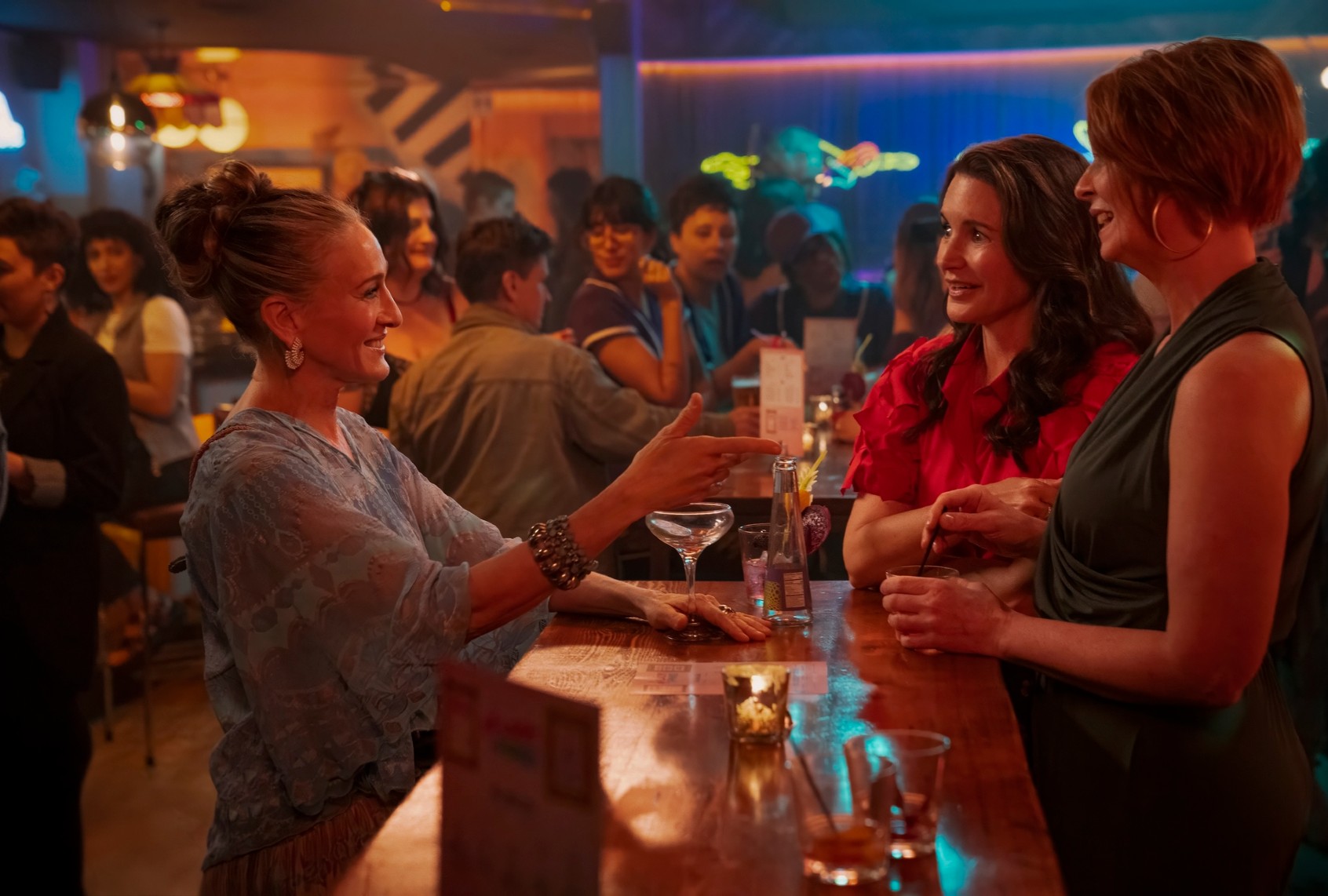
For the most part, the continuing adventures of Carrie Bradshaw (Sarah Jessica Parker), Miranda Hobbes (Cynthia Nixon) and Charlotte York Goldenblatt (Kristin Davis) are fantasies. New friendships with other 50-somethings blossom effortlessly, although Season 3 winnows the lunch crew expansion pack to the recently introduced Seema Patel (Sarita Choudhury) and Charlotte’s schoolyard bud Lisa Todd Wexley (Nicole Ari Parker).

Careers, for those who still need them, are easily obtained and maintained. Ditto for real estate. There are no inappropriate fashion choices. Only in this show could a woman of a certain age stroll through a public space with a collapsed gingham cervical cap on her head and have strangers behave as if nothing is amiss.

Indeed, the only obstacles to this quintet’s sustained bliss are fear and malaise.

Sarah Jessica Parker, Kristin Davis and Cynthia Nixon in "And Just Like That…" (Craig Blankenhorn/Max)Although the third season sheds a lot of faulty parts and second-rate baggage, Carrie’s still devoted (or, some would say, chained) to her long-distance relationship with Aidan Shaw (John Corbett), which places her at a disadvantage. Charlotte and Lisa struggle to keep up with their ascending careers and the other moms at their children’s fancy school, while their husbands, Harry (Evan Handler) and Herbert (Chris Jackson), thirst to score cool points on the ‘gram. Miranda is, as ever, Miranda. She’s more palatable this season, but still does dumb things, like give her number to a smitten tourist played by Rosie O'Donnell.
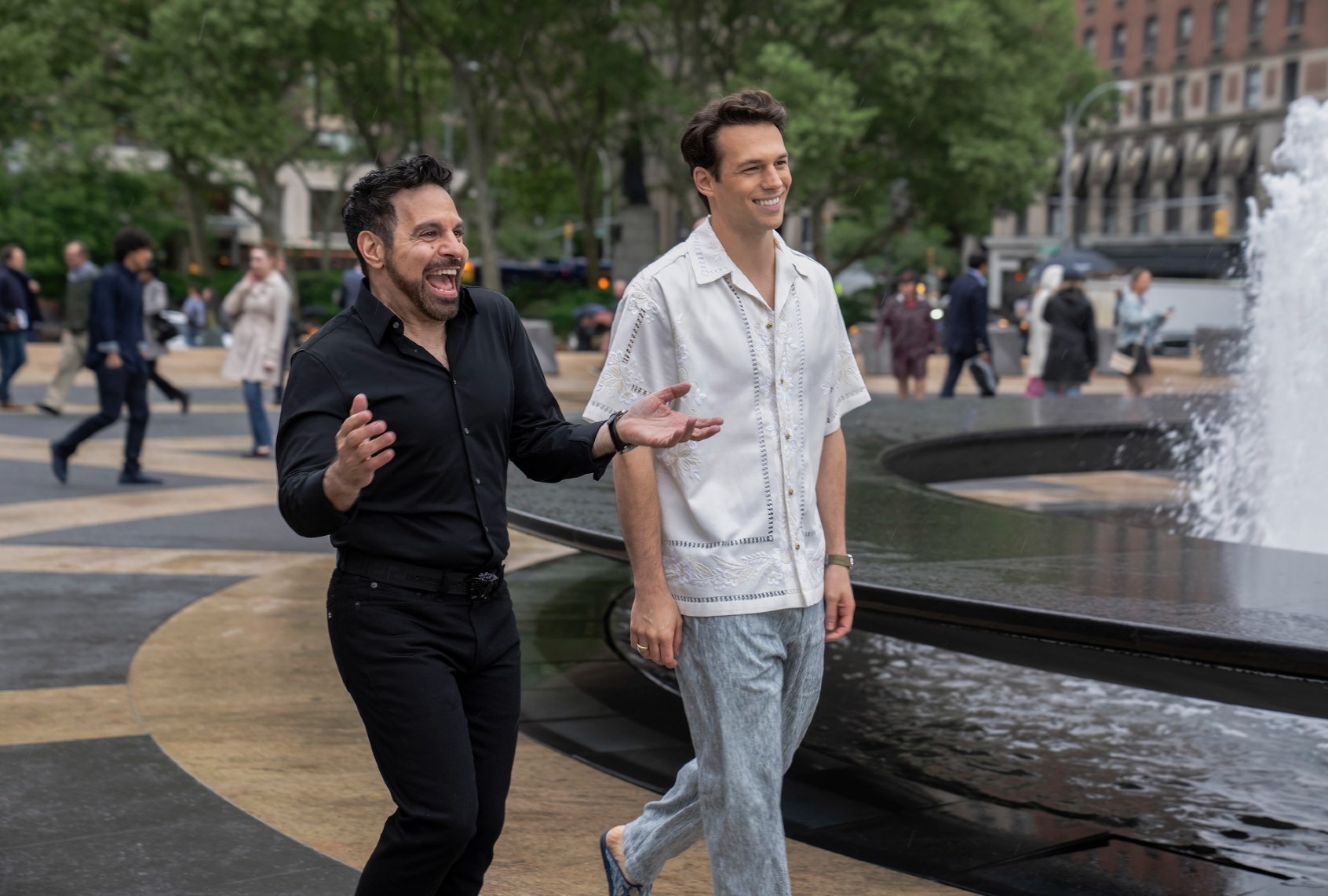
The only person who seems to be thriving in all life quadrants — life, love, mood and career – is Anthony Marentino, Mario Cantone’s still-putting-up-with-this gay best friend.

Ah, yes – the gay BFF, that old trope. Back in the early '00s, Anthony and Carrie’s arm candy, Stanford Blatch (the late Willie Garson), were the poster models for everything we came to despise about the stereotype. There's a searing piece on this very site titled "Why "Sex and the City" is bad for the gays" that unerringly spells out everything that's wrong with these two individually and as a couple. 

Anthony, circa 2025, is part of an expanding TV argument that the group that is best at handling middle age is gay, wealthy men. That is not to say TV dresses up the “sophomore years” of life, as Seema calls them, to be free of aches and pains for anybody.

The author, former Salon editor Thomas Rogers, describes them as "tragically asexual helpmates whose main role has always been to provide relationship advice to the show's straight female characters, fling b****y quips, or let their flamboyant outfits serve as a visual punch line." Anthony, he continues, "is the worst kind of shallow, fashion-grubbing gay minstrel." Rogers isn't wrong.

“And Just Like That” hasn’t entirely exorcised that image, although Anthony has been updated to add something more to the mix than the bracing splash of tartness flavoring Charlotte’s simple syrup personality. He's a little less shallow, but so is everyone else. He's also mired in a minor subplot, but at least he has six seasons of history for us to draw upon. None of the 2021 additions to the cast can say the same.

Anthony still isn't where we want him to be. But in this emotionally turbulent economy, I'd rather be in his shoes than anyone else's on this show. 

Mario Cantone and Sebastiano Pigazzi in "And Just Like That…" (Craig Blankenhorn/Max)Anthony, circa 2025, is part of an expanding TV argument that the group that is best at handling middle age is gay, wealthy men. That is not to say TV dresses up the “sophomore years” of life, as Seema calls them, to be free of aches and pains for anybody.

The return of “And Just Like That,” the sustained popularity of “The Four Seasons” on Netflix, and the word-of-mouth celebration of Hulu’s “Mid-Century Modern” strike a chord because they brim with situational accuracy that makes the not-quite-old, queer and straight alike, feel simultaneously seen and attacked.

In “Four Seasons,” Steve Carell’s Nick decides to blow up his 25-year marriage to Anne (Kerri Kenney-Silver) while his fellow college buddies Kate (Tina Fey), Jack (Will Forte) and Danny (Colman Domingo) are visiting his country home. The cause of marital death, according to Nick, is boredom. “And Just Like That” already slogged through this withered territory via Steve and Miranda in what may be the show’s most realistic depiction of two people giving up on each other.

But the new season ventures into the relationship version of the Great Dismal Swamp as Carrie, an attractive, independently wealthy 50-something woman who’s already had hip surgery, agrees to refrain from contacting Aidan regularly or dating anyone else for five years. This is all so he can coddle his sulky, wild teenage son while expecting Carrie to limit all extracurricular cuddles to her adopted kitty, Shoe.

As the third season begins, everyone’s bedroom is some version of sexless or erotically deprived, even Seema’s, due to work-life imbalance, or the dreaded performance issues. Everyone, that is, except Anthony, who has kept his roses watered.  

Anthony has a thriving bakery business staffed by well-endowed hunks in too-tight denim uniforms. His poet boyfriend Giuseppe (Sebastiano Pigazzi) is blessed with a baguette in his pants and never gives the audience a reason to question the state of their union.

Marco Calvani, Colman Domingo, Tina Fey and Will Forte in "The Four Seasons" (Netflix). Similarly devoted are “The Four Seasons” couple, Danny and his husband Claude (Marco Calvani), another doting Italian whose main flaw is that he’s too attentive to Danny’s needs. Who needs warm grapes in Tuscany, besides Diane Lane? If you are a gay man with the resources to commandeer a brownstone, you can land yourself a “timeless Italian beauty,” as Claude refers to himself, in the 212, 646 or 332.
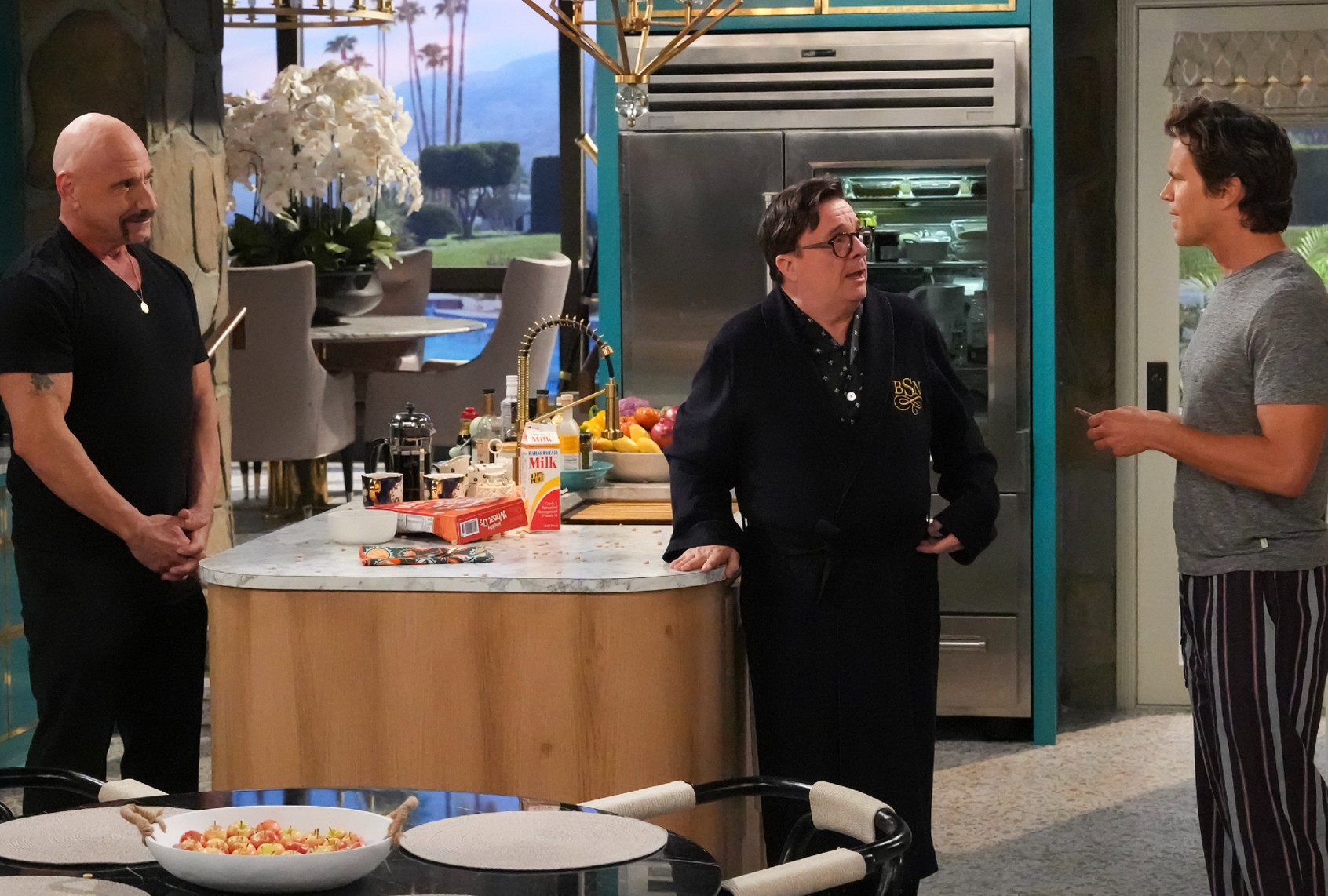
Other area codes must settle for a tastefully decorated ranch far beyond New York’s city limits, like the one Nathan Lane’s Bunny Schneiderman shares with his mother in Palm Springs on “Mid-Century Modern.”

The Manhattan single lives of Miranda and Carrie, separately and together more often this season than previously, are marginally more compelling but also vanilla and, in Carrie’s case, kind of gross.

Done and dusted is Miranda’s disastrous affair with unfunny comic Che Diaz (Sara Ramirez) and her friendship with Professor Nya Wallace (Karen Pittman). That part is a shame. Nobody enjoyed Che’s company, but Nya had room for expansion. (Pittman decided against waiting for that to happen and chose her more substantive roles on  “The Morning Show” and “Forever” instead.)

Bruno Amato, Nathan Lane and Matt Bomer in "Mid-Century Modern" (Disney/Chris Haston). Miranda is still shading in her lesbian identity. On a show that has yet to figure out how to write well-rounded queer women or non-white people who aren’t politicians or famous documentary directors, that could take forever.
As for Carrie’s drama, it only takes a few seconds of watching Aidan licking his palm before tickling his tackle to make a person appreciate the classy way Big gave Carrie her freedom. Mr. Big’s exit hurt, but it did not assault our eyeballs.

Anthony and Giuseppe, in contrast, are faring just fine. We don’t see enough of them, but that much is obvious.

We need your help to stay independent

When Seema complains, “Why is it gay men never do for me what they say they’re going to do for me?” and Carrie echoes that frustration a few scenes later with, “Why can no gay man ever give you what you’re expecting?” we should recognize this as a kind of progress. For once, the show that normalized the idea of the homosexual man as an accessory is letting us know that its high-heeled heroines are not the suns around which all of gaydom revolves.

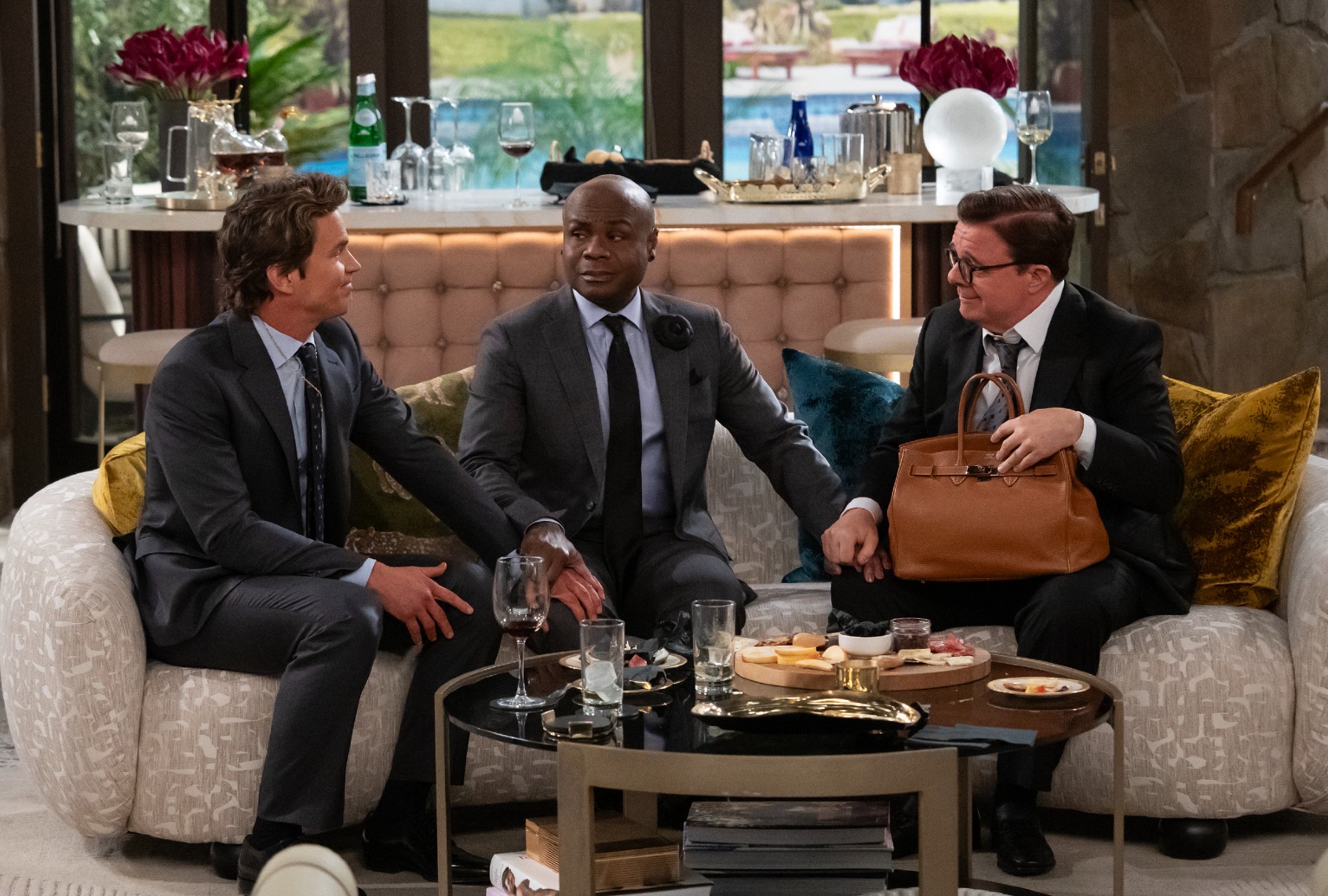
“Mid-Century Modern” takes that notion a step further. Women are to be cared for, but only if they’re family – and only under duress. Otherwise, they are comic relief. Lane’s Bunny is the dramatic Alpha in “Mid-Century Modern” to his closest confidantes, Arthur (Nathan Lee Graham) and Jerry (Matt Bomer), who come together after their other close friend dies.

For once, the show that normalized the idea of the homosexual man as an accessory is letting us know that its high-heeled heroines are not the suns around which all of gaydom revolves.

Since Bunny has money and rooms, and Arthur and Jerry have little tying them to the places they call home, Bunny invites them to move in with him and his elderly mother, Sybil (the late Linda Lavin, in her final role).

Jerry works as a flight attendant, while Vogue recently tossed aside Arthur, its former fashion columnist. Both were once married or partnered up, but now they’re all living single and happy to partake in Bunny’s bottomless bar and wine cellar. None are concerned about meeting obligations to anybody but themselves and the people they love.

The familiar fuzziness of “And Just Like That” and “Mid-Century Modern” could have something to do with their shared creative DNA with classic sitcoms that promote the strength of platonic love as life’s true treasure and a shield against romantic disappointment.

Matt Bomer, Nathan Lee Graham and Nathan Lane in "Mid-Century Modern" (Disney/Chris Haston). Max Mutchnick and David Kohan co-created “Mid-Century Modern,” and its comedic timing and glib patter are reminiscent of their previous and more famous collaboration, “Will & Grace.” But the sitcom’s true progenitor is “The Golden Girls,” which is also the spiritual forebear to “Sex and the City.”  

It’s easy to match Bunny, Jerry and Arthur’s respective personalities to their retired Miami counterparts – dim, gentle Jerry is the Rose in this bunch, for instance – but that's not why the show works.  

Mutchnick and Kohan define these men's lives on their own terms, much in the way they wrote Eric McCormack’s Will to take up space apart from Debra Messing’s Grace, making him a scene partner instead of a sidekick.

“Will & Grace” further subverted the gay bestie trope by assigning Will his own gay best friend, Sean Hayes’ Jack. And Jack has a wealthy straight woman pet to entertain him in Megan Mullally’s Karen Walker.  

Karen’s relationship with her husband Stan is supported by booze and conspicuous consumption; he is absent to the degree that we never entirely see him onscreen.

Marco Calvani, Kerri Kenney-Silver and Colman Domingo in "The Four Seasons" (Netflix)“Four Seasons” and “Mid-Century Modern” aren't that bleak. Both paint wedlock as a fortunate state, when it works. When it doesn’t, it turns into a tarpit in which a person could find themselves trapped.

Scratch that – those are the dangers that heterosexual unions pose.

Life post-divorce is represented in “Mid-Century Modern” by Bunny’s sister Mindy (Pamela Adlon), something of an aimless wreck who Bunny resolves to help onto her feet, which neither Jack nor Arthur appreciate. Mindy is bracingly funny but also masculine enough to intimidate Jerry, the delicate peacock in this gilded birdcage.

The merry unions in “And Just Like That” are more grounded and secure, but also dull. Not that there’s a problem with that – most stable marriages are dull, to outsiders anyway.

“Four Seasons” and “Mid-Century Modern” aren't that bleak. Both paint wedlock as a fortunate state, when it works. When it doesn’t, it turns into a tarpit in which a person could find themselves trapped. Scratch that – those are the dangers that heterosexual unions pose.

But who would watch a show about Charlotte and Harry, and LTW and Herbert, living and loving and occasionally hooting in support of their friend’s corny a cappella outfit? Nobody.

Mild marital dysfunction is at least relatable, if the sustained popularity of “The Four Seasons” can be counted as a sign. Where Miranda and Steve evoked a nation’s worth of wincing and self-examination, Kate and Jack resemble millions of devoted heterosexual duos who aren’t exactly the model of hot monogamy. “Complaining is their version of having sex,” as Danny puts it.

Fey, Lang Fisher, and Tracey Wigfield adapted “The Four Seasons” from Alan Alda’s 1981 film, which didn’t feature a same-sex couple. (Like "Sex and the City" edition Anthony, it was a product of its time.) But it’s also a kind of tale we’ve seen before in moody premium cable telefilms, like  2001’s “Dinner with Friends.” In that long-ago HBO drama, Greg Kinnear’s philandering husband chucks aside Toni Collette’s devoted but defeated wife. Their friends, played by Dennis Quaid and Andie MacDowell, brood about what that means for their marriage.

Nick’s decision has a similar effect, to some degree. Kate, Jack and Danny are understandably freaked out by his bomb drop, but the person who doesn’t lose his calm is Claude. When Danny and Kate fill him in on the possible emerging crisis, Claude simply blinks and shrugs. “Oh well!” he says. “I mean, people say things all the time, but who knows what they will really do?”


Want a daily wrap-up of all the news and commentary Salon has to offer? Subscribe to our morning newsletter, Crash Course.


This is Claude’s philosophy, but it’s also the guiding principle of his and Danny’s partnership and part of what makes their extensively realized subplot the show’s best.

Claude and Danny’s breezy version of commitment isn’t presented as a trait of queer relationships so much as a quality of an understanding partnership. After all, they have their issues, too. Danny runs from his problems, including serious health scares. He'd rather fly off to Miami than get a simple heart procedure, or spend three months in Austin, Texas, where he can smoke and devour fatty foods in peace, rather than work out his communication breakdown with his husband.

Claude is smothering and compulsively sprinkles sunshine on everything, including tragedies. That works most of the time, especially in the bedroom. “You don’t know my husband. He gets happy from the outside in,” Claude says, explaining that all he needs is good food, oral sex and a long nap. “Everything is fixed. Everything’s fixed!” No, it's not.

Colman Domingo and Marco Calvani in "The Four Seasons" (Netflix)But it beats Carrie’s depressing love life. Honestly, here is a woman with enough money in her bank account to ditch Country Lurch for all time and settle into the glamorous life of a cat lady on par with the late, great Karl Lagerfeld. Instead, she fakes an orgasm during a phone sex session while her Virginia Slim erupts in the cab of his rusty truck.
Season 3 introduces Carrie’s prewar apartment in Gramercy Park as the elegant newcomer to the “And Just Like That” band. It includes an outdoor space that, for reasons, Carrie is obligated to replant from scratch. This is an apt metaphor for the show’s reset and the middle-age ideal: a late summer harvest that can be sweet but is prone to drought and blight nevertheless. We might plant hopes for luscious flowers and fruits, only for berries and daisies to arrive in abundance instead of melons and Casablanca lilies.

Smaller plants can be resilient, and we’re wise to appreciate them. Verdant gardens a few houses away still make us wonder what we should be doing differently.

Although the women in “And Just Like That” are a better hang than they were in past seasons, and Anthony’s character development is rising like his bread, I’d rather enjoy a TV relationship closer to what Danny and Claude in "The Four Seasons" have carved out for themselves. “Life is scary,” Claude tells Danny. “It’s also beautiful. That’s why we have each other. So we can go through it together.”

He’s talking about their marriage, apart from the rest of their friend ensemble, and as co-leading men in a romantic comedy staged entirely for and by them.

"And Just Like That…" premieres Thursday, May 29 on HBO Max. "The Four Seasons" is currently streaming on Netflix. "Mid-Century Modern" is currently streaming on Hulu.

“A bewildering gamut of schemes”: Democrats press Trump for information on “crypto con” dinner

A top House Democrat is demanding more information about President Donald Trump’s recent dinner for investors in his crypto meme coin

Rep. Jaime Raskin, D-Md., the ranking member on the House Judiciary Committeeis calling on the president to release the names of attendees at the May 22 gala, which was billed as “the most exclusive invitation in the world.” 

“Publication of this list will also let the American people know who is putting tens of millions of dollars into our President’s pocket so we can start to figure out what — beyond virtually worthless memecoins — they are getting in exchange for all this money,” Raskin wrote in a letter to Trump, which was first reported by The Washington Post. 

The event was attended by the top 220 investors in digital currency. The invitees spent an average of more than $1 million on the coin, according to NBC News, with the top holders spending north of $10 million.

“Profiting off the memecoin is just the latest in a bewildering gamut of schemes in which you and your family have profited after your return to office,” Raskin wrote. “Entities affiliated with The Trump Organization control 80% of the entire supply of $TRUMP coins—1 billion coins in total— and stand to reap the lion’s share of any profits from the venture,” he added. 

Raskin’s probe is the latest example of congressional Democrats targeting Trump’s blurring of lines between his official role and his private business interests, including his meme coin, a form of online currency that is based on online jokes and holds no actual value.

“Nowhere is Trump’s blatant disregard and disrespect for the rule of law more apparent than in the way he has exploited the office of the presidency to promote shady, fraudulent crypto ventures that hold no real value, and serve no true purpose other than to pad his pockets,” Rep. Maxine Waters, D-Calif,, the ranking member on the House Financial Services Committee, said in a statement last week. “Trump’s crypto con is not just a scam to target investors. It’s also a dangerous backdoor for selling influence over American policies to the highest foreign bidder.” Waters concurrently introduced a bill that would prevent the President, Vice President, or members of Congress from profiting from cryptocurrencies. 

White House Press Secretary Karoline Leavitt has rejected accusations of a conflict of interest, arguing that they are invalid because Trump attended the dinner in his personal time and it was not, officially, “a White House dinner.” 

Death, sexual violence and human trafficking: The global fallout from killing USAID

American diplomats in at least two countries have recently delivered internal reports to Washington that reflect a grim new reality taking hold abroad: The Trump administration’s sudden withdrawal of foreign aid is bringing about the violence and chaos that many had warned would come.

The vacuum left after the U.S. abandoned its humanitarian commitments has destabilized some of the most fragile locations in the world and thrown refugee camps further into unrest, according to State Department correspondence and notes obtained by ProPublica.

The assessments are not just predictions about the future but detailed accounts of what has already occurred, making them among the first such reports from inside the Trump administration to surface publicly — though experts suspect they will not be the last. The diplomats warned in their correspondence that stopping aid may undermine efforts to combat terrorism.

In the southeastern African country of Malawi, U.S. funding cuts to the United Nations’ World Food Programme have “yielded a sharp increase in criminality, sexual violence, and instances of human trafficking” within a large refugee camp, U.S. embassy officials told the State Department in late April. The world’s largest humanitarian food provider, the WFP projects a 40% decrease in funding compared to last year and has been forced to reduce food rations in Malawi’s sprawling Dzaleka refugee camp by a third.

To the north, the U.S. embassy in Kenya reported that news of funding cuts to refugee camps’ food programs led to violent demonstrations, according to a previously unreported cable from early May. During one protest, police responded with gunfire and wounded four people. Refugees have also died at food distribution centers, the officials wrote in the cable, including a pregnant woman who died under a stampede. Aid workers said they expected more people to get hurt “as vulnerable households become increasingly desperate.”

“It is devastating, but it’s not surprising,” Eric Schwartz, a former State Department assistant secretary and member of the National Security Council during Democratic administrations, told ProPublica. “It’s all what people in the national security community have predicted.”

“I struggle for adjectives to adequately describe the horror that this administration has visited on the world,” Schwartz added. “It keeps me up at night.”

In response to a detailed list of questions, a State Department spokesperson said in an email: “It is grossly misleading to blame unrest and violence around the world on America. No one can reasonably expect the United States to be equipped to feed every person on earth or be responsible for providing medication for every living human.”

The spokesperson also said that “an overwhelming majority” of the WFP programs that the Trump administration inherited, including those in Malawi and Kenya, are still active.

But the U.S. funds the WFP on a yearly basis. For 2025, the Trump administration so far hasn’t approved any money in either country, forcing the organization to drastically slash food programs.

In Kenya, for example, the WFP will cut its rations in June down to 28% — or less than 600 calories a day per person — a low never seen before, the WFP’s Kenya country director Lauren Landis told ProPublica. The WFP’s standard minimum for adults is 2,100 calories per day.

“We are living off the fumes of what was delivered in late 2024 or early 2025,” Landis said. On a recent visit to a facility treating malnourished children younger than 5, she said she saw kids who were “walking skeletons like I haven’t seen in a decade.”

We need your help to stay independent

Since taking office, President Donald Trump has pledged to restore safety and security around the world. At the same time, his administration, working alongside Elon Musk’s Department of Government Efficiency, swiftly dismantled the U.S. Agency for International Development, canceling thousands of government-funded foreign aid programs they considered wasteful. More than 80% of USAID’s operations were terminated, which crippled lifesaving humanitarian efforts around the world.

Musk, who did not respond to a request for comment, has said that DOGE’s cuts to humanitarian aid have targeted fraudulent payments to organizations but are not contributing to widespread deaths. “Show us any evidence whatsoever that that is true,” he said recently. “It’s false.”

For decades, American administrations run by both parties saw humanitarian diplomacy, or “soft power,” as a cost-effective measure to help stabilize volatile but strategically important regions and provide basic needs for people who might otherwise turn to international adversaries. Those investments, experts say, help prevent regional conflict and war that may embroil the U.S. “If you don’t fund the State Department fully, then I need to buy more ammunition,” Jim Mattis, who was defense secretary during Trump’s first administration, told Congress in 2013 when he led U.S. Central Command.

Food insecurity has long been closely linked with regional turmoil. But despite promises from Secretary of State Marco Rubio that lifesaving operations would continue amid widespread cuts to foreign aid, the Trump administration has terminated funding to WFP for several countries. Nearly 50% of the WFP’s budget came from the U.S. in 2024.

Since February, U.S. officials throughout the developing world have issued urgent warnings forecasting that the Trump administration’s decision to suddenly cut off help to desperate populations could exacerbate humanitarian crises and threaten U.S. national security interests, records show. In one cable, diplomats in the Middle East communicated concerns that stopping aid could empower groups like the Taliban and undermine efforts to address terrorism, the narcotics trade and illegal immigration. The shift may also “significantly de-stabilize the transitioning” region and “only serve to benefit ISIS’ standing,” officials warned in other correspondence. “It could put US troops in the region at risk.”

Embassies in Africa have delivered similar messages. “We are deeply concerned that suddenly discontinuing all USAID counter terrorism-focused stabilization and humanitarian programs in Somalia … will immediately and negatively affect U.S. national security interests,” the U.S. embassy in Mogadishu, Somalia, wrote in February. USAID’s role in helping the military prevent newly liberated territory — “purchased at a high cost of blood and treasure” — from getting back into the hands of terrorists “is indisputable, and irreplaceable,” the officials added.

The embassy in Nigeria described how stop-work orders had caused lapses in oversight that put U.S. resources at risk of being diverted to criminal or terrorist groups. (A February whistleblower complaint alleged USAID-purchased computers were stolen from health centers there.) And U.S. officials said the Kenyan government “faces an impending humanitarian crisis for over 730,000 refugees” without additional resources, as local officials struggle to confront al-Shabaab, a major terrorist threat in the region, while also maintaining security inside the country’s refugee camps.

In early April, Jeremy Lewin — an attorney in his late 20s with no prior government experience who is currently in charge of the State Department’s Office of Foreign Assistance and running USAID operations — ordered the end of WFP grants altogether in more than a dozen countries. (Amid outcry, he later reinstated a few of them.) The State Department spokesperson said the agency was responding on Lewin’s behalf.

In Kenya, the WFP expects a malnutrition crisis after rations are cut to a fourth of the standard minimum, Landis said. She is also concerned about the security of her staff, who already travel with police escorts, given the likelihood that there will be more protests and that al-Shabaab might make further incursions into the camps.

In order for the U.S. to deliver its usual food aid to Kenya by the end of the year, it needed to be put on a boat already, Landis said. That has not happened.

In recent days, South Sudanese refugees in Ethiopia have begged a visiting government delegation from the U.S. not to cut food rations any further, according to a cable documenting the visit. Aid workers in another group of camps in North Africa reported that they expect to run out of funding by the end of May for a program that fights malnutrition for 8,600 pregnant and nursing mothers.

Despite being one of the poorest countries in the world, Malawi has been a relative beacon of stability in a region that’s seen numerous civil wars and unrest in recent decades. Yet in early March, officials there warned Washington counterparts that cuts to the more than $300 million USAID planned to provide to the country in aid a year would dramatically increase “the effects of the worsening economy already in motion.”

At the time, 10 employees from a USAID-funded nonprofit had recently shown up unannounced at USAID’s offices in the capital Lilongwe asking for their unpaid wages after the U.S. froze funding. The group left without incident, and it’s unclear if they were paid, but officials reported that they expected countries around the world would face similar issues and were closely monitoring for “increased risks to the safety and security of Embassy personnel.” (Former employees at another nonprofit in a nearby country also raided their organization “out of desperation for not being paid,” according to State Department records.)


Want a daily wrap-up of all the news and commentary Salon has to offer? Subscribe to our morning newsletter, Crash Course.


An hour’s drive from the nation’s capital, Dzaleka is a former prison that was transformed into a refugee camp in the 1990s to house people fleeing war in neighboring Mozambique. In the decades since, it has ballooned, filling with people running from conflicts in Democratic Republic of Congo, Rwanda and Burundi. The camp, which was built to hold around 10,000, is now home to more than 55,000 people.

Iradukunda Devota, a refugee from Burundi, came to Malawi when she was 3 and has lived at Dzaleka for 23 years. She now works for Inua Advocacy, which provides legal services and advocates on behalf of refugees in the camp. She said tension is high amid rumors that food and other aid will be cut further. Since 2023, the Malawi government has prohibited refugees from living or working outside the camp, and there has already been an increase in crime and substance abuse after food was cut earlier this year. “This is happening because people are hungry,” Devota told ProPublica. “They have nowhere to turn to.”

Now, the Malawi government is likely to close its borders to refugees in response to the funding crisis and congestion in Dzaleka, the WFP’s country representative told the State Department, according to agency records.

Diplomats continue to warn the Trump administration of even worse to come. The WFP expects to suspend food assistance in Dzaleka entirely in July.

“The WFP anticipates violent protests,” the embassy told State Department officials, “which could potentially embroil host communities and refugees, and targeting of UN and WFP offices when the pipeline eventually breaks.”

ProPublica plans to continue covering USAID, the State Department and the consequences of ending U.S. foreign aid. We want to hear from you. Reach out via Signal to reporters Brett Murphy at +1 508-523-5195 and Anna Maria Barry-Jester at +1 408-504-8131.

Trump 2.0 falls apart before our eyes

On Wednesday, Donald Trump went nuts when a reporter asked him about a Wall Street acronym mentioning him and his tariff policy: “TACO” or “Trump always chickens out."

The president had threatened to raise tariffs on European goods last Friday, but later backed off. “It’s called negotiations,” Trump hissed at a reporter who asked him about it Wednesday. “Don’t ever say what you said. That’s a nasty question.” Those who witnessed Trump’s meltdown were not overly impressed. His past behavior is filled with worse tantrums in front of reporters. 

“I really think he lost it a long time ago,” a pool reporter said.

Apparently, it only took Elon Musk, who officially left the Trump administration on Wednesday, 128 days with the president to come to that same conclusion. A true genius. 

Late Wednesday night, Trump was handed his biggest loss when the U.S. Court of International Trade ruled his unilateral tariffs on nearly all U.S. trading partners illegal. Call it Liberation Day. 

The day before, Trump stayed home, didn’t see the press and the sum total of his contribution to society was 10 rage tweets on Truth Social, threatening California, Canada, and Vladimir Putin, while praising himself and blaming Joe Biden for everything wrong on the planet.

Critics say it was the highlight of Trump’s second administration.

The second verse may be the same as the first, but in Donald Trump’s case, it’s a lot louder and far more dangerous the second time around.

Few stand against the man for whom an overwhelming majority of people in this country cannot stand. Not only would he be the last person invited to a neighborhood barbecue, but inevitably, the police would have to remove him from the property, along with his traveling crew of sycophants who hang on his every word in order to feed their empty souls.

This soulless group of feckless individuals consists of racists, misogynists, bed wetters, train spotters, and a guy who once painted his bald head to make it look like he had hair. The backstories of those on staff and in Trump’s Cabinet would make “The Exorcist” seem like “The Sound of Music.” They’ve never climbed any mountain, but have been damaged on every turn, and have turned the raw feelings of inadequacy, loathing and self-doubt into something powerful — yet dark. If they hadn’t gone all “Sith Lord” on us, many would find their message inspiring. Many still do.

The point is that Trump makes it personal to try and keep you from the reality that what he’s doing has repercussions far beyond the current case. 

Many also do not, and that doesn’t bother Don. The anger of his enemies is the fuel that feeds him and he’s been fairly effective at taking advantage of his dissenters in every possible way. The reality is there’s no morality involved. Just victory. Divide and conquer. Enter the fractured and tattered remains of the Democratic Party. This is a political party that has posted a 1-2 win-loss record against Trump. Through its own efforts, millions of Americans were driven into Trump’s arms because they thought him to be a more reasonable alternative. That says a hell of a lot about the state of the Democratic Party, but even more about the “average” American voter. In what reality is Trump the “reasonable” alternative? Oh right. No morality involved. I already said that. 

Both political parties are wretched in the extreme. The Republicans still have no heart. The Democrats still have no head and they continue to beat their heads against the nearest fencepost, thinking that somehow things will change. God bless them. They mean well, even if they will cancel you for your inability to recognize the righteousness of their cause.

That’s still better than being subjugated to poverty and slavery for an eternity by a party whose members openly cheer the dismantling of education, social services and health care. But barely.

Trump’s ability to warp reality works to some extent because of this corrosive political environment. His status is nearly mythical with those who purchased his gold athletic shoes, golf balls and four different colors of their favorite “MAGA” hat — in red, white, gold and black. Sorry. No blue.

We need your help to stay independent

This is more troubling as Trump’s mental decline becomes more obvious. While he may enjoy being on the lips of millions, if not billions of people on the planet, it is not because he is an inspiration. I hope Jake Tapper is not destined to write another book and do another mea culpa tour to explain how we all missed Trump’s dementia this time around while we focused on his first book about Joe Biden.

If Joe Biden slipped into senility, Donald Trump has fallen precipitously into it. He is the equivalent of the Alzheimer’s patient screaming, “You kids get off my lawn,” when he’s actually standing in line to get his flu shot at the retirement center against the advice of his own worm-ridden doctor.

Trump has said, “just say it and they’ll believe it” so much that he now believes it — as do millions of voters who’ve ingested way too many microplastics. Those voters are the equivalent of Robin Williams imitating a six-year-old sticking their tongue out and hissing, “I know you are but what am I?” You can substitute Pee Wee Herman for Williams and still hear the same thing.

Donald Trump is an angry old man at war with everything in his life, including the reality he can’t accept and his greatest fans will never admit: Donald Trump is the ultimate loser. He is a shriveled husk devoid of empathy. He’s Johnny Ringo — a man that “has got a great big hole, right in the middle of him. He can never kill enough, or steal enough, or inflict enough pain to ever fill it.” Ringo wanted revenge for being born and would kill for it. Trump wants the same revenge, but he wants to twist reality enough to make us all suffer for him.

That speaks to one of the greatest needs we have in this country: To counteract Donald Trump, we need a viable, independent media that cannot be leveraged by government contracts and other entanglements. It should be well-staffed with experienced, seasoned reporters from every facet of life. Yeah, I know, it’s mostly a pipe dream, but there are those who are trying to keep that dream alive.

I’d naively like to consider that I have, in some minor way, contributed to the cause of free speech and constitutional rights, but I love what CBS reporter Scott Pelley spoke about before a group of Wake Forest graduates recently. “Power can rewrite history with grotesque false narratives. It can make criminals heroes and heroes criminals,” and more importantly,  “Power can change the definition of the words we use to describe reality.”

Former Tea Party congressman Joe Walsh, a frequent critic of the president, said the embarrassing incident just last week when Trump made the President of South Africa sit through a presentation condemning his government by using manipulated photographs of murdered “white farmers” was yet another new low point. “Trump’s greatest legacy is the destruction of truth,” Walsh said. 

The eunuchs in Congress haven’t stopped him from this destruction. The House is too busy passing the “One Big Beautiful Bill,” knowing it will explode the national debt and take away services for millions of their voters, but hoping and praying the Senate will save them from themselves by defeating or diluting it. 


Want a daily wrap-up of all the news and commentary Salon has to offer? Subscribe to our morning newsletter, Crash Course.


If Trump doesn’t get what he wants, the House Republicans will blame the Democrats and the RINOS in the Senate, while Trump will find a way to pin it all on Joe Biden. If he, or his crew (including his interchangeable moronic sons), get to mention Hunter Biden’s laptop while denigrating Dr. Jill Biden’s inability to diagnose cancer, although she holds a doctorate in English instead of medicine, the president will consider it a trifecta win. He will retire to the residence to consume a bag of McDonalds hamburgers, fries, chase it down with a Coca-Cola and finish it off with pink Starbursts and Tootsie Rolls — at least if Press Secretary Karoline Leavitt was accurate when she told a group of children who recently gathered in the Brady Briefing Room that those were Trump’s favorite sweets.

The federal judiciary, NPR, some attorneys and Harvard University are at this moment the lynchpins of resistance to this madness. Pelley has the megaphone. We should listen. Harvard has at least two lawsuits pending against the Trump administration after it effectively tried to gut American post-secondary education by holding back billions of dollars in funding and banning foreign exchange students, thus making an example out of one of the most prestigious universities in the world. That’s the easiest way to get the rest to bow — take out the leader.

The second verse may be the same as the first, but in Donald Trump’s case, it’s a lot louder and far more dangerous the second time around.

We all may have our differences with Harvard that go beyond “I didn’t make the rowing team,” but Harvard and other major universities are international havens that help to provide education and the experience of living in America to millions who might otherwise never see this country in a sympathetic light. Education and living in the United States are hand-in-hand experiences that bring the best and the brightest to our country. In return, our country reaps benefits that escape Trump because those experiences cannot be expressed in dollars. 

NPR is fighting hard to keep its funding to report on these and other issues as Trump tries to destroy any voice he cannot control. Ted Boutrous, who represented both former CNN anchor Jim Acosta and myself when we had our press passes suspended by the first Trump regime, filed suit against the current administration this week on behalf of NPR after Trump signed an executive order effectively ending its funding. “The Executive Order is blatantly unconstitutional. It contravenes the will of Congress and violates the constitutional rights of NPR and its member stations,” Boutrous said. “The Public Broadcasting Act and the First Amendment both protect the editorial independence of NPR and local public radio stations that receive federal funding from precisely this kind of governmental interference. And, by seeking to halt federal funding to NPR, the Executive Order harms not only NPR and its member stations, but also the tens of millions of Americans across the country who rely on them for news and cultural programming, and vital emergency information.” 

Trump doesn’t care and Boutrous described the president’s activity bluntly: “It is not always obvious when the government has acted with a retaliatory purpose in violation of the First Amendment. ‘But this wolf comes as a wolf.’”

While some attorneys and large, seemingly prestigious law firms (well, until they caved) have bowed to Trump, some like National Security and FOIA attorney Mark Zaid have decided to fight Trump’s increasingly delusional take on the powers of the Executive Branch.

Zaid has represented Republicans and Democrats over the years. He’s fiercely independent, but because he represented a whistleblower key to President Trump’s first impeachment, Trump stripped Zaid’s security clearance. That prompted a suit.

“No American should lose their livelihood, or be blocked as a lawyer from representing clients, because a president carries a grudge toward them or who they represent,”  Zaid said in a statement. “This isn’t just about me. It’s about using security clearances as political weapons.”

The point is that Trump makes it personal to try and keep you from the reality that what he’s doing has repercussions far beyond the current case. 

Donald Trump’s ultimate goal: A reality in which he controls every corner of our lives; dictating what we read, who we spend time with, how we worship, what entertainment we can watch, our ability to speak our mind, dissent and challenge his government.

God knows we cannot let his reality become ours. I, for one, am not a chicken taco fan. 

Civil rights attorney Damon Hewitt on how Trump’s DOJ created “an invitation to discrimination”

Donald Trump is America’s first White president. He is advancing a revolutionary project to end multiracial pluralistic democracy. As a practical day-to-day matter, this means protecting the power, influence, and privileges of white people over Black people and other non-whites.

The evidence about the role that white racism and white racial resentment played in Donald Trump’s return to power is overwhelming: contrary to the disproved narrative, it was racism and not “working class” anxiety that overdetermined white support for Donald Trump and the MAGA movement.

Donald Trump was able to use that energy to fuel his ascent back to the White House, where he is now “governing” as an autocrat who has aspirations to be a dictator. In a 2018 op-ed essay in The New York Times, Charles Blow described this appeal as: “Trump is man-as-message, man-as-messiah. Trump support isn’t philosophical but theological. Trumpism is a religion founded on patriarchy and white supremacy.” As such, Donald Trump will (and is) amplify his racist policies and behavior to maintain control and power when/if he faces pushback from the American people.

Donald Trump’s authority and power are being used not just against non-whites but against white people — including his own MAGA people — as well. To that point, Trump’s “big beautiful bill” that is being forced through Congress by his supplicant MAGA Republicans will take away hundreds of billions (and likely trillions) of dollars from the country’s social safety net by cutting programs such as Social Security, Medicare, Medicaid, and the Affordable Care Act and then transferring it to the plutocrats and kleptocrats. As President Johnson so wisely observed and warned, “If you can convince the lowest white man he's better than the best colored man, he won't notice you're picking his pocket. Hell, give him somebody to look down on, and he'll empty his pockets for you.”

Ultimately, the power of white elites to use white racism and white racial resentment to influence and otherwise convince and compel white Americans to support policies and engage in behavior(s) that actually causes them harm is older than the nation itself.

Damon Hewitt is the President and Executive Director of the Lawyers’ Committee for Civil Rights Under Law. Before joining the Lawyers’ Committee for Civil Rights, Hewitt served as lead counsel on litigation and policy matters and supervised teams of lawyers and non-lawyers at the NAACP Legal Defense and Educational Fund.

In this wide-ranging conversation, Hewitt explains how the struggle to defend democracy and civil rights in the Age of Trump will be a marathon and not the sprint of a few years between elections and campaigns. He also explains how if American democracy was a type of medical patient, they would be very sick and in need of long-term, sustained care because the rise of Trumpism and authoritarian populism reflects much deeper acute systemic problems.

"Trump's election, twice, is also a reminder that social progress is not linear and that the country's democratic institutions and infrastructure are more fragile than many of the country's leaders — as well as average Americans — wanted to admit."

Hewitt warns that the Trump administration’s assaults on democracy, freedom, democratic institutions, civil rights, the rule of law, and the Constitution will not be limited to just “those people” (i.e. “illegal aliens,” “migrants,” Black and brown people, the LGBTQ community and other marginalized groups) but will soon target the American people as a whole with drastically negative consequences for most, if not all, areas of their lives.

How are you feeling? How are you managing on the day-to-day given the worsening state of American democracy and rising authoritarianism? You lead an organization that is committed to defending civil rights. You are literally at ground zero right now.

It is challenging. This crisis is a test of our collective stamina for what is a marathon and not a sprint. I think about my work as being part of a generational struggle. The baton was passed to us, and we’d best not drop it. Defending civil rights can be exhausting — and that is in the best of times. But as I tell my team here at the Lawyers’ Committee for Civil Rights Under Law, “we must have joy amidst the struggle.” I said that before Trump's return to power, and that principle is much more important now. There is a profound sense of urgency among those who are working in this space in civil society. We are not in a moment where we can just wait three and a half years, and things are automatically going to get better once we have a new president. Part of the approach to stopping these assaults on democracy, the rule of law, and civil rights is a type of harm reduction model. We are trying to slow down that overflowing sewer, the flooding of the zone.

You summoned the type of therapeutic language that is necessary to understand that this American democracy and society are very sick and in pain. Using that framework and metaphor, if America in the Age of Trump is the patient and you are the doctor, how would you assess its health? 

That is an amazing metaphor. Very powerful. As I see it, the patient has probably gone to an urgent care center when they actually need to see a specialist — or more likely multiple specialists. The patient needs to have an entire program of care, but they have been avoiding the doctor because they are afraid to do the work of taking care of themselves properly. They don't want to take the medicine or follow through on the treatments because it won't be easy. The patient does not want to change their diet. Getting better is going to require lots of hard work, and it is going to hurt. But guess what? If the patient stays sick, it is going to hurt even more. Denial is very powerful in America. There are large numbers of people and institutions who actually believe that they can just put their heads down and it will all be fine. It won't be. A big part of the denial is not realizing or admitting that you can continue to get sicker, that your health can devolve, the disease can and likely will get worse if left untreated. 

One of the largest and most critical mistakes that the mainstream political class and news media types continue to make, years into the Age of Trump, is to not understand how Trump's ascent is the result of much deeper and far older problems and systemic failures in this society. This is more than a failure of imagination, it is a choice at this point.

One of the root causes of this crisis is deep social inequality and financial precarity. There was a time when having a high school diploma and getting a job with a pension was a formula to be part of the solid middle class in this country. Now, a college degree or even an advanced degree is often a formula for little to no upward economic mobility. In the United States, we have a generation of young people who are now much less likely to be better off than their parents economically. We are mired in reverse social mobility. If one believes that progress in this country is linear and upward, such a reality is jarring and enraging.

This helps to explain why there is a cohort among the American public who is attracted to both Bernie Sanders and Donald Trump. Both of them are very different in terms of politics and values. However, they both symbolize and channel rage at a system that is not working for a larger and growing number of Americans. And of course, racism is a deep part of the rise of Trumpism and the MAGA movement. The data is clear in that regard. Racism is not just a stain on the American social fabric, it is a deep and indelible part of that fabric. The inability of law and public policy in this country to keep up with the shifting, evolving manifestations of racism is leaving a lot of people disaffected as well.

Looking at the white backlash and white frontlash, the rolling back of decades of progress along the color line, I have been asking myself what year is it really? Do Trump and his MAGA forces and their allies want to return the country to the 1950s? The Gilded Age? Even earlier? As the joke goes, Black people can't really mess with time machines. That is also true of many other groups, too — even if they are in denial about how precarious their rights and freedoms and personhood truly have been historically and continue to be in this country.

Here is a thought experiment: Tell me a year when hundreds of 1000s of people took the streets in peaceful protest, when elected officials obstructed justice when it came to racism, when the President of the United States had to take to the airwaves to talk about the importance of voting rights not just for Black people, but all people in the country, when people who fought for racial justice had to worry about their physical safety and surveillance. That year was 1963. That is the year the Lawyers’ Committee for Civil Rights Under Law was founded. But what I am describing could have been any of the last few years, too.

You are correct. It does feel like we are in a time warp in this country right now, and in the last few years. It is very disorienting. Trump's election, twice, is also a reminder that social progress is not linear and that the country's democratic institutions and infrastructure are more fragile than many of the country's leaders — as well as average Americans — wanted to admit. After the Civil War, there was Reconstruction. Reconstruction was one of the most radical and successful experiments in expanding democracy in American history. The civil rights movement and its victories were a second Reconstruction. The United States is going to need a third Reconstruction to begin to heal from the damage that is now being caused and the deeper problems that got us to this democracy crisis.  

To that point, Black Americans and other nonwhites have only been equal citizens under the law in this country for about 60 years.

One can make a compelling argument that the Civil Rights Act and Voting Rights Act were the nation's birth certificate. America as a modern nation was born from those laws, and the project of democracy has been expanding access and protecting all Americans and their right to the franchise. That was only 60 or so years ago. America's experiment in democracy is very young. The American democratic experiment and its fruits and legacy are very much imperiled now.

I have also been thinking a great deal about the work of the legal scholar Lani Guinier and her concept of "political race" and how Black and brown people are the miners' canaries in American society. She passed away in 2022. A great loss. What does it mean to be the "miner's canary" in the Age of Trump and his return to power?

I was a research assistant for Lani Guinier during my first year of law school. To be the miner's canary means that the experiences of Black people are a prism through which to see a whole wide range of inequalities, beyond race, in this society. Inequality and other forms of marginalization and identity overlap and intersect. We have tons of data and all manner of empirical and other forms of evidence that show how race and racism structure American society and people's life outcomes and other opportunities and experiences. But to the miner's canary, if we make conditions better for the canary to survive, if not thrive in that metaphorical mine, we are making it better for just about everyone else too. The harsh reality about the miner's canary is that it often ends up dying. That is the signal for everybody else to get out of that mine right now because the air is poisonous. Black people are the miners' canaries in American society who are dying younger and at higher rates from a range of causes directly and indirectly related to racism and other forms of inequality and oppression. And guess what? Those premature deaths are a warning to everyone else. We are interconnected.

Black people were that miner's canary warning, very loudly, that Donald Trump's return to the White House would be a disaster for all Americans and an existential threat to the future of the country's democracy and freedom. There were other alarm-sounders as well. For example, the relatively small number of people with a prominent public platform who kept trying to warn the American people about what would happen if Trump was elected to a second term. How come those tens of millions of Americans who put Trump back in the White House did not listen to these grave warnings — warnings that have now come true?

I will preface my answer by saying that the Lawyers’ Committee for Civil Rights Under Law is a non-partisan organization. Looking at the data, I have concluded that the 2024 election was largely decided by how a few million people who voted for the Democrats in 2020 decided not to vote at all this time. Trump also won a larger percentage of the Latino vote. He also expanded his base marginally among young black men. There are also single-issue voters who ignored all of the other, much more important issues regarding the future of American democracy and our rights and freedoms. Trump would tell Black Americans, What do you have to lose by voting for me and not the Democrats? Well, it turns out a whole lot. 

We need your help to stay independent

Those Black folks who switched over to Trump were a marginal but key part of his victory. However, we cannot and should not ignore how Donald Trump won a majority of white women. He has now done this three times. We need to ask white women as a group how they can continue to support Donald Trump given his personal behavior and values, the "Access Hollywood" tape, his treatment of Hillary Clinton and then Kamala Harris and powerful women more generally? Trump's support for taking away women's most fundamental civil rights to control their own bodies? How does a woman look her daughter in the eye and tell her she voted for such a man?

What is the state of the rule of law right now in this country?

The rule of law has been exposed as being much more fragile than was commonly believed or hoped. The law is the connective tissue of our society and institutions, and norms. Our democratic system works because the leaders respect the opinions of the courts even if they do not personally agree with them. Donald Trump and his administration and the right-wing have increasingly rejected those norms about how the law works in the American democratic system. It is different, but perhaps the closest analog might be so-called "massive resistance" in the South and some other parts of the United States to the mandate of Brown v. Board of Education, where school districts refused to integrate, sometimes they were shutting down entire schools or districts to avoid compliance. There were even these fake legal theories known as "interposition" to resist the courts' orders about civil rights.

Donald Trump as president, has repeatedly shown that he only cares about himself and not preserving, upholding, or protecting the country's democratic institutions, of which the rule of law (and equality under it) and justice are central. I have been speaking with retired federal judges about what could potentially happen if the executive branch loses in court and then refuses to respect the outcome. Or what if an officeholder loses an election and refuses to respect the people's will? Their answers were not comforting. At the end of the day, we still rely on the collective instinct of a few good people in the right places so that things don't fall apart in this country and our democracy. But it could all easily collapse. It has happened many times in other countries. The rule of law is not on strong ground with Trump 2.0. That’s why we must all devote a good deal of attention and energy to upholding it and fighting back against efforts to erode it.

What is your reaction to how the Trump administration has remade the Office of Civil Rights to focus on protecting the supposedly trampled-upon rights of White right-wing Christians and "oppressed" white people more broadly?

This is about much more than just a simple shifting of policy priorities. That happens with new administrations and is relatively routine. What the Trump administration is doing is turning empirical reality and the facts upside down. It is like gravity being reversed. The Civil Rights Division has long been known as the crown jewel of the Department of Justice. The reason that the Department of Justice was created was to enforce federal civil rights laws. What the Trump administration is doing is taking away the avenues for redress and protection for people who have suffered real injustice and violations of their rights. Moreover, the actual laws and procedures that have been developed over decades to protect the civil rights of marginalized people — and by extension all people in this country — are being weaponized to serve Trump and the larger radical political project that seeks to take away equality under the law for all people.

For example, the Department of Education's Office for Civil Rights (OCR) has been waging a campaign of threats and over-the-top rhetoric to falsely imply that Title VI of the Civil Rights Act prohibits efforts by K-12 school districts and colleges to further diversity, equity, inclusion, and accessibility. By issuing threatening press releases, diatribes masquerading as policy guidance, current OCR leadership is not trying to enforce the law. They are actually trying to remake the law by elevating their own warped interpretations of Supreme Court precedent in the recent higher education admissions cases to cover nearly every aspect of school environments.

At the same time that the Department of Education is engaged in this campaign of intimidation requiring school communities to scramble, and teachers and administrators to be fearful, the Department of Education has also shuttered 7 of its 12 regional civil rights offices, leaving school communities in Texas, Ohio, California and many other states without anyone to call when a child faces discrimination at school. This simultaneous weakening and weaponization of civil rights infrastructure has left school districts are scrambling to meet the Department's demands while at the same time leaving parents and students who have been bullied at school because of their race, or are not receiving necessary services in relation to a disability, with no one in government to call for assistance.

In another attack on multiracial, pluralistic democracy, the Trump administration recently ordered that the Office of Civil Rights reject what is known as “disparate impact” as evidence of racism and other forms of discrimination. They have also ended investigations and monitoring of police thuggery and brutality and other abuses of the civil rights.

While destroying and subverting the civil rights infrastructure, the administration also aims to unravel essential civil rights legal frameworks for addressing modern-day discrimination. Today, structural racism built into the norms and policies of institutions is harder to prove as intentional disparate treatment, but it can be proved through a legal standard called disparate impact. The Supreme Court first recognized disparate impact as a form of discrimination in 1971 and has since repeatedly upheld cases brought under that standard. Disparate impact liability is an essential tool that has been utilized for decades to enforce civil rights protections for individuals who are harmed by policies that appear neutral on their face but which are shown to erect barriers to opportunity for people from certain groups.

Through Executive Order, the Trump administration has claimed that disparate impact liability is unlawful. It has called for immediate repeal of all “racial nondiscrimination” regulations under Title VI of the Civil Rights Act that contemplate disparate-impact liability, directed agencies to assess pending investigations, lawsuits, and consent judgments that rely on disparate-impact liability and deprioritize enforcement of claims alleging disparate impact discrimination, and directed the Department of Justice to target state laws, regulations, policies, or practices that relate to disparate-impact. The administration's aim here is to destroy the foundation of civil rights protections in this country — to erode guardrails preventing discrimination in housing, lending, employment, education, healthcare, and other areas of life. It’s like declaring “open season” for racism — an invitation to discrimination.

Recently, the Trump administration turned reality and facts upside down again when it abandoned ongoing Justice Department investigations into police misconduct in cities all across America. This sweeping announcement even included two cities–Louisville and Minneapolis–that had already voluntarily agreed to make critical reforms to their police policies and practices to mitigate instances of police violence against its citizens. This police misconduct was not speculative, it was reality. We know this because the Justice Department thoroughly investigated these police departments and then made its findings public.

The timing of this announcement makes these actions even more troubling. The Trump administration made this announcement just days before the five-year mark of the lynching of George Floyd by a Minneapolis Police Officer, and on the same day, Trump claimed that South Africa engaged in genocide against white Afrikaner farmers. Make no mistake, the Trump administration is making clear its view about whether Black lives matter. But upside down or not, a fact is still a fact. The findings from those police misconduct investigations cannot be easily swept under the rug.

If the Trump administration and the larger revolutionary right-wing, as seen with Project 2025 for example, gets its way, what will America look like? What do you want to prepare people for?

In the infamous Dred Scott decision, Supreme Court Justice Taney, speaking for the majority, said that the Negro has no rights which the white man is bound to respect. Well, that's how everybody in this country is going to feel. You will have no rights that Trump and the federal government are bound to respect. If you are an American citizen or if you have legal status to be in this country, you could be picked up off the street or taken from your home and put on a plane to some foreign prison. Sure, there are provisions in the Bill of Rights and Constitution prohibiting such a thing, but the Trump administration doesn't care about that. It may start there, and many Americans will incorrectly convince themselves that they are "good people" and haven't committed any crimes, so they are safe. They are not. Once one group is targeted or fundamental rights are taken away, then it is a slippery slope. Again, this is why the treatment of Black people in America is like the canary in the coal mine. The mistreatment of Black people is a harbinger of the mistreatment of all Americans.

Voting rights will be taken away next. The Republicans and their allies on the state and local level are already systematically targeting the voting rights of Black and brown people — and white people as well — who support the Democratic Party. Many people in this country are going to learn the painful lesson that once the government says that you have no rights it is bound to respect that not just their political freedoms and civil rights will be constrained by their ability to have a happy life and to be fulfilled if not thrive will be taken away too. The destitution will not just be political and moral, it will be economic too. Under such an autocratic, if not outright authoritarian regime, the rich get richer and the poor get even poorer, and the middle class shrinks and disappears. 

Stephen Miller’s deportation machine is failing — and he’s furious

The country, we were told, is awash with millions upon millions of undocumented criminals and straight-up crazy people, permitted by Democrats and their open borders to roam the land and terrorize the law-abiding white people they were meant to replace.

“There’s been almost 10 million people that have entered this country in the last three years,” Secretary of State Marco Rubio told an interviewer during the 2024 presidential campaign.

“Consider that Joe Biden allowed approximately 20 million illegal aliens into our country,” Vice President J.D. Vance claimed more recently, jockeying for influence within the MAGA world and deciding that “20” sounded twice as bad as “10.”

“THE SCUM THAT SPENT THE LAST FOUR YEARS TRYING TO DESTROY OUR COUNTRY … ALLOWED 21,000,000 MILLION PEOPLE TO ILLEGALLY ENTER OUR COUNTRY,” President Donald Trump posted even more recently, dropping the liberal-coded “approximately” and adding a million souls to the sum because he can.

In reality, which still holds some influence in our aggressively-online world, there are about 11 million undocumented people in the U.S., total. And despite all-caps propaganda to the contrary, they as a class “have substantially lower crime rates than native-born citizens,” according to a 2020 study; they even commit fewer crimes, on average, than fully legal immigrants — those who came here “the right way.”

“Relative to undocumented immigrants, U.S.-born citizens are over 2 times more likely to be arrested for violent crimes, 2.5 times more likely to be arrested for drug crimes, and over 4 times more likely to be arrested for property crimes,” according to the research, published by the Proceedings of the National Academy of Sciences.

That’s why Stephen Miller is so mad: an administration that wants nothing more than to parade millions of brown bodies onto military aircraft and out of the country — a MAGA team that promised its voters nothing less than “mass deportations now” — is having a tough time actually finding the hardened criminals the last folks supposedly let in. In April, the Trump administration deported more than 17,200 people; that’s up 29% from a year but it’s far below the pace necessary to meet the stated goal of one million deportees a year (and per NBC News, more than half of those now in ICE detention have no criminal record whatsoever).

Thus, that anger. In a May 28 piece, Axios reported that Miller, the president’s top aide, was livid at ICE officials, insisting that they are the reason why the desired spectacle is failing to materialize. “Miller demanded that field office directors and special agents in charge get arrest and deportation numbers up as much as possible,” the outlet reported, with the new target being 3,000 arrests a day, or about a million a year. “Miller's directive and tone had people leaving the meeting feeling their jobs could be in jeopardy if the new targets aren't reached,” according to two sources who attended the meeting with Miller.

Before, when campaigning against the status quo, it was all so easy and obvious: Venezuelan gangs had taken over an entire apartment complex in Aurora, Colorado, according to MAGA organs like Fox News, while marauding Haitians had conquered much of Ohio — and no one was doing anything about it! Start by rounding up the 400 billion illegals let in under Biden, the story went, and it will once again be safe to drive your big truck into Manhattan.

We need your help to stay independent

Since Jan. 20, however, even the Trump administration has been forced to concede, with its lack of mass arrests, that a micro-narco state was not, in fact, established in the city of Aurora, nor were the immigrants who took factory jobs in Ohio a public menace demanding immediate deportations (the administration has thus far settled for revoking Venezuelans’ and Haitians’ protected legal status). Put simply: There are fewer undocumented people in the U.S. than is claimed by people who are far more likely, statistically, to have felony convictions on their record.

What has happened, instead, is ICE agents appearing at immigration hearings, faces covered as if they were members of a paramilitary organization and not taxpayer-funded public servants, and making a big show of arresting the low-hanging fruit. Along with that, of course, has been a lot of lying, suggesting the ramp-up to “mass deportations soon” will likewise be conducted without shame.

“I watched a planeload of people unload at Gitmo that were pedophiles,” Department of Homeland Security Secretary Kristi Noem said in a February appearance on Fox News, back when the U.S. military base in Cuba was the go-to gulag for the Trump administration. But of the several hundred people sent to Guantánamo Bay, DHS could not identify a single such sex offender when pressed by Salon.


Want a daily wrap-up of all the news and commentary Salon has to offer? Subscribe to our morning newsletter, Crash Course.


Noem likewise misled when she jetted in for a photo op at the El Salvador prison now being used to house immigrants removed from the United States (the publicly stated sentence, without charge or trial, is life imprisonment). “This facility is one of the tools in our toolkit that we will use if you commit crimes against the American people,” Noem said, describing those sent there as the “worst of the worst.”

But the shirtless inmates who were assembled behind her for the occasion were not those sent there by the U.S., nor those who were the “worst of the worst.” An investigation by CBS News found that three-fourths of the 238 Venezuelans sent there have no criminal record — anywhere in the world. The New York Times likewise revealed that the Trump administration, realizing it had mistakenly included a Salvadoran man, Kilmar Abrego Garcia, on one of its rendition flights, immediately set to work on smearing him as a leader of a criminal gang, MS-13, despite the fact “that nobody seemed to know if it was true.”

The Trump administration’s failures, then, are no comfort. What we have seen so far — arresting mothers and fathers and slandering them as murderers and rapists — will ramp up with $150 billion in enforcement efforts, as federal agents, just trying to meet their arrest quotas, focus on the easy to grab and not the hard-to-find. But there will not and can never be victory: There will always be a need for an enemy, and for treachery, the Trump administration is certain to find Democrats, judges and activists to blame if mass deportations, now and forever, fail to make MAGA voters well and truly happy with their lives.

We can take solace, only, in that Stephen Miller can cause harm, but he will never truly fulfill his dull vision of a homogeneous, white America. And he will always be angry.

Animals are talking — will the legal system listen?

The character of Dr. Dolittle, who "walks with the animals, talks with the animals," was the central figure in an early 20th century series of children's books written by Hugh Lofting, acting as a kind of personal antidote to his trauma of experiencing the worst of humanity in the trenches of World War I. "A fox has his rights, the same as you and I have," the eponymous physician-turned-animal doctor said in one book. But Dr. Doolittle is eccentric and, of course, fiction.

Increasingly, however, talking with the animals is becoming less of a fantasy. This doesn’t just invite some fantastic conversations, but recontexualizes the rights we allot to non-human creatures. The past decade has brought a slew of new findings that are changing our understanding of animal consciousness and communication. A new study on complex communication in chimps and another about bonobos' surprising language abilities, and recent findings about how sperm whale communication works, all suggest some animals have complex communication abilities that actually resemble human language in important ways. As AI and bioacoustics, as well as other clever new techniques, bring us ever closer to talking with animals or at least listening in on their conversations — should we prepare to update the way legal systems deal with animals?

"Compositionality, in a nutshell: It's the fact that we can combine meaningful units into larger structures whose meaning is derived from the meaning of the units," Mélissa Berthet, a researcher in primatologist and linguistics at the University of Zurich, who studied bonobos in Democratic Republic of Congo (they are only found in the wild in forests in DRC, south of the Congo river) over an 8-month period, explained to Salon in a video interview. Combining units of language in meaningful ways is one of the hallmarks of what human language does, and it’s evidence of this in a number of animals that suggests we might not be able to use signs of language as a filter to separate humans, who get certain rights, from animals, who don’t.

The University of Zurich team observed a group of bonobos from a project by local biologists that had habituated the animals over 10 to 15 years, depending on the group. This meant that the animals were used to having humans around them, but Berthet's group, like the local scientists, avoided interfering with their behavior and did their best to avoid any disturbance. With this work, the hope is that the animals use essentially the same "dictionary" as they would use if there were no humans present.

"I really think the meaning is not really impacted," Berthet said, though she allows that they may perhaps talk — gossip? — about humans more than they would otherwise do.

There are two kinds of compositionality. In the first, and most common, individual units (like words, for humans), are combined to produce meaning. This is called trivial compositionality, and it has been observed in animals in the past. In the second kind, thought to only exist in humans, when you put two units together, the meaning of one unit will modify the meaning of the other. For example, in the phrase "a blue dress," the word blue has actually modified the word dress, giving it a different meaning than it had before. This kind is called non-trivial compositionality, and it allows us to create complex utterances.

We need your help to stay independent

"So far, it was thought that in animals, when they could do compositionally, it was mostly restricted to trivial compositionally … we wanted to see whether bonobos had compositionally, whether it was something that was common in their vocal system. So here we took an approach that is a bit different from former studies, because usually people would investigate one combination, and here we managed to investigated all the combinations of their vocal system." This was possible, Berthet said, because they succeeded in adapting a linguistic method used in humans to the study of animal communications.

"The idea was to see whether compositionally in other species can be as extensive as in humans. Because, like I said, humans use compositionally all the time. We create very long sentences. And so we did it with bonobos. And what was interesting is that we found that four of their combinations are compositional, and all the core types that they have, so all the units can be combined in a compositional structure. So it's basically like all their words can occur in sentences, just like in humans, we can put any words in a sentence, and they can really do the same. And so for us, this is really amazing, because it shows that even though they have a very limited vocabulary, they can really use them and combine them extensively," Berthet explained.

But it got better.

"Among those four combinations that were compositional," Berthet went on, "we found that three of them were non-trivial. And again, this is very big, because for us, it's the first time that we really managed to show that animals can have non-trivial compositionality. So I think what it really means, in general, is that, first, humans are not the only species that can do non-trivial compositionally. Second, other animals can also use compositionally a lot. It's not just about one combination in their own system, that could be a coincidence."

All this suggests that the last common ancestor of chimpanzees, bonobos and humans likely also produced compositional structures.

"Compositionality is very common in human language. We use it all the time, and for some people, it's really a hallmark of human language. And there are some species that do a bit of compositionality, but it's always very limited," said Berthet.  

The finding that among combination types, four are compositional, means they can convey information in a flexible way just like us. 

"It's basically like all their words can occur in sentences, just like in humans, we can put any words in a sentence, and they can really do the same"

"So it's basically like all their words can occur in sentences, just like in humans, we can put any words in a sentence, and they can really do the same."

About those whales

We have indeed known for a while that whales are intelligent creatures, with their own eerie and complex form of sound-based communication. Since the 1970s, humans have been entranced by the songs of humpback whales, for example. But another kind of whale communication, among the very social if less musical sperm whales, has more recently become a focus of research into exactly how whale communication, or language, might work. 

Sperm whales use a series of clicks, called codas, to communicate. Until last year, though, we couldn't really say how this form of communication — distinctly different, even alien, to our own — actually works to convey information. We had already used machine intelligence to analyze the codas, recorded using bioacoustics, and determined that both the clicks and the intervals between clicks are important. The question has been, though, how can a system of clicks and spaces, with some 150 individual coda types, defined by their characteristic sequences of inter-click intervals found globally (with different clans or groups of whales using a far smaller number), account for the social and behavioral complexity seen in these animals? Surely there must be some other factor dividing up the use of different codas to allow for more complex ways to combine them?

In recent years, our technological ability to listen in on whales has grown in leaps and bounds. So too, as a result, has our understanding of their unique forms of communication, which turns out, in the sperm whale at least, to be structured, complex, and expressive.

Last year, a group of researchers applied machine learning to the largest existing data set of sperm whale codas, ​​from The Dominica Sperm Whale Project, to demonstrate that sperm whale codas can be sensitive to how they are used — that is, the context created by surrounding codas may change a given coda's intended meaning, just the way words in human sentences create a context that indicate, or change, the intended meaning of a given word. And they also showed that sperm whale codas are indeed combinatorial, similar to the compositionally shown by bonobos and chimps.

The researchers, members of Project CETI, used 8719 codas recorded over 13 years ending in 2018 from the Eastern Caribbean 1 (EC-1) clan, a group of 400 sperm whales. Clans are known to have their own culture, developing unique behaviors and repertoires of coda types. Over those years, Dominica Sperm Whale Project researchers manually recorded codas, while over the last four, Project CETI scientists studied EC-1’s coda repertoire using aerial drones, small computers attached by suction cups (called D-tags or acoustic biologging tags), synced underwater microphones in their hundreds, and swimming robots. The data collected in this way was then analyzed using machine learning, allowing for the sort of complex analysis needed to find patterns indiscernible to the human ear, and in no way similar to what we might expect from our knowledge of human or even primate communication.

"When analysing codas exchanged between whales, we observe fine-grained modulation of inter-click intervals relative to preceding codas, as well as modification of standard coda types via the addition of an extra click. We term these contextual features rubato and ornamentation. Next, we show that the coda repertoire has combinatorial structure: in addition to rubato and ornamentation, codas’ rhythms and tempos can independently be discretised into a small number of categories or types," the researchers wrote in Nature Communications this time last year. Essentially, these different features allow for coda repertoire to act as a kind of phonetic alphabet.

Project CETI doesn’t actually aim to talk with whales, but to listen in and translate what they’re saying — ideally with permission, if they reach a point where they can understand if permission is given or withheld. The project itself is a non-profit organization funded by partners that include Amazon Web Services, Google Research, and the MOTH (More-Than-Human-Life) Program at NYU Law, which advises on the ethics and permission part, as well as universities in Canada, the U.S., the U.K. and, notably, given some of the technology involved, in Israel

"We show that all four features are sensed and acted upon by participants in the vocal exchanges, and thus constitute deliberate components of the whale communication system rather than unconscious variation. Rhythm, tempo, rubato and ornamentation can be freely combined, together enabling whales to systematically synthesize an enormous repertoire of distinguishable codas," they explain. The whales could put together long, finely detailed sequences of all of these features.

Chimp talk

Catherine Crockford, of the Max Planck Institute for Evolutionary Anthropology, an author of the new study, sees this combinatorial system as perhaps representing a transitional or intermediate phase between animal calls and language as seen in humans. Whether the chimps’ bigrams should be considered like human units of communication, similar to words, or simple phrases that can be combined in longer sentences, or even like the ideograms used in some human writing is, Crockford told Salon in an email interview, the million-dollar question.

“They do differ from words and sentences, but exactly how they differ is what we are trying to figure out — and involves knotty philosophical issues, like are the signals fully arbitrary, like words are; are they intentionally produced to convey a specific message to others; are they learned; what meaning is really conveyed — these are all questions several teams of scientists are trying to address in animals,” she said.

But complex communication involving compositional structures and even a degree of syntax (or word order that plays a role in determining meaning, as in human language) isn't just a mammal thing. Just as we've had to gradually acknowledge that it's not only humans, then not only primates, that are capable of complex "sentence" structures that flexibly convey meaning — whether this represents something like a transitional evolutionary phase between animal calls and human-type language, or something complex and sophisticated enough to be considered a language of its own — we now have to further expand our understanding. As it turns out, the only living descendants of the dinosaurs also seem to combine in complex ways to produce an array of meanings. Among birds, the Japanese tit offers the first experimental evidence for compositional syntax in any non-human species. 

Meanwhile, the southern pied babbler does not, in fact, merely babble. By playing back so-called "mobbing sequences", combinations of calls by which the birds seem to recruit other group members in response to danger and watching the reaction, scientists were able determine that the combination of two calls used for other purposes communicates information about the context — danger — and the requested action — "let's get together and fight" — in a form of rudimentary compositionally. These findings of two birds that combine individual "alarm" and "recruitment" calls to  express a more complex idea using the two idea units suggests that syntax may in fact be more widespread than we thought.

OK, so what do they talk about?

This, Crockford said, is the most fascinating question. 

“Chimps are highly social and intelligent. They have close friends and family that they like to spend the day with and nest together with at night. But they live in dense forest where it’s incredibly easy to lose each other without using sound. So their calls have become quite context-specific to firstly, tell others what they are doing: ‘I'm resting’, 'I'm travelling’, so others know how to find them. Then they have specific calls to recruit others — to help in a hunt, to join them at food, to help them chase off a leopard or nasty neighbours — each call different. Then they have a bunch of specific calls they give when interacting with others to keep the interaction going longer, such as laughing during play, or teeth clacking during grooming,” Crockford said.

"It seems they can combine two meanings together into an utterance, for example, 'rest' and 'food', which may translate into something like 'I'm staying longer at this food patch'. Telling others what you are doing helps others decide if they want to stay and do it with you or move on"

And as they work on those bigrams, the researchers are beginning to understand call combinations. “It seems they can combine two meanings together into an utterance, for example, 'rest' and 'food', which may translate into something like 'I'm staying longer at this food patch'. Telling others what you are doing, helps others decide if they want to stay and do it with you or move on. Such utterances probably mainly help bond partners to coordinate their activities in the dense forest vegetation so that they can stay together for longer,” Crockford added.

By contrast, Berthet notes that bonobo communication focuses mostly on getting the group together. This makes sense, as the highly social, matriarchal primates live in fission-fusion societies, which means that they split up into smaller groups to forage during the day, then get back together again as a larger group. 

And whales? We don’t know enough yet to say, but they seem to be gossips, the matriarchal and matrilineal society of sperm whales apparently consisting of a bunch of yentas who chit-chat all day long, talking over each other about anything and nothing for the sake of being together, while the adult men, though stereotyped as loners, may hang out together, perhaps sharing their own feelings with close friends, on the high seas. Shane Gero, the Canadian whale biologist who founded the Dominica Sperm Whale Project twenty years ago and is now biology lead for Project CETI, told NPR last year that “it's hard not to see cousins playing while chatting … to not see moms hand over to a babysitter and exchange a few words before walking out the door, so to speak, to go eat in the deep ocean."

Time to catch up

The structures that determine our relationships with animals and their status in relation to humans were all developed many years before we understood just how much some of them are like us. Like us, that is, in areas that have historically been important in determining these things among humans, such as showing compassion for our fellows, cooperation, strategic use of tools, culture and language. We might also note that plenty of research in human psychology — not to mention our apparent failure as a species to sustainably manage the ecosystems that in turn sustain us and all life on Earth — has demonstrated that our own claims to rationality and consciousness are, well, less impressive than previously advertised.

As Anne Benvenuti, a professor emerita of Psychology and Philosophy at Cerro Coso Community College in California, put it in a 2016 paper in the International Journal of Law and Psychiatry, "While convergent research on animal cognition, emotion, and behavior has increasingly pointed in the direction of animal “personhood,” interdisciplinary research in human cognition has simultaneously confirmed Sigmund Freud's hypothesis that not only are human beings not always self-aware and rational, but also the human unconscious mind motivates much of human behavior; and that human consciousness is fragmented at best." 

Language is a big part of this. Back in the 1870s, Oxford professor Friedrich Max Müller argued that "there is between the whole animal kingdom on the one side, and man, even in his lowest state, on the other, a barrier which no animal has ever crossed, and that barrier is —language." The lack of flexible and open-ended communication, which occurs by means of combinatorial structures or compositionality that allows us to put just about any idea into language, was seen as the great barrier. Increasingly, this barrier is being eroded.

 We still don't have evidence that bonobos want to be able to inherit property or that political participation is important to sperm whales. But we now know that many animals use complex communication systems that allow them to function as groups, or communities, and that they are able to express motivation, desire, fear and harm, all feelings that have political dimensions when they are threatened.

"Understanding the way [bonobos] communicate is also a way to understand what is important to them and what matters and what is relevant. So I think this is actually very important in terms of how we see them under the law"

"Understanding the way [bonobos] communicate is also a way to understand what is important to them and what matters and what is relevant. So I think this is actually very important in terms of how we see them under the law. I hope it will help," said Berthet, who noted that when we started to understand that whales actually have a very complex language of their own, interest grew in protecting them. Bonobos, whose only wild populations are all in Democratic Republic of Congo, are highly endangered.

"It's an area of the world that is really under a lot of threats because of all the mining and the logging. So I really hope that if we show that they have complex communication, that somehow they resemble humans in some respect, and that they have this intelligence, I might say, then I hope it will help to have concrete actions to really preserve them," Berthet said.

Meanwhile, the very artificial intelligence that is increasingly allowing us to eavesdrop on animals is increasingly showing us that our own intelligence may one day be truly topped by machines, if not by the often very different but perhaps equally complex and meaningful intelligence of our fellow animals. Add the examples from psychology and the bungle we're making of the Earth we "manage," and humans don't have good evidence to put ourselves at the top of some kind of evolutionary hierarchy after all. And then this accumulating research into compositional language increasingly supports the idea that many animals are complex, sensitive and flexible thinkers.

"This simple fact calls for a rethinking of foundational concepts in law and health sciences," Benvenuti wrote, nearly a decade before these latest findings.

“We now realize,” Crockford said about the chimpanzees, “that to understand the complexity of animal 'languages', we need to study the animals' natural communication — what they communicate to each other. In the wild, chimps for example use specific calls for a number of contexts they never experience in captivity — they have a specific bark to recruit others to hunt, and other calls for territorial defense.” 

While the moratorium that currently exists on using chimpanzees in research in western countries, at least, is a good first step, it’s not enough. And rethinking rights could also allow us to increasingly understand our animal brethren, in a kind of virtuous circle.

“We're just beginning to understand the complexity of chimp communication — as they have become critically endangered. As they are hunted by humans for the pet trade and for meat, and their forests are destroyed, their communities are broken up, risking that they lose their local cultures,” Crockford said. “If we do not find a way to stop their decline due to human disturbance, we may never get to understand the complexities of their communication.”

“Liberation Day” is cancelled: Trump’s global tariffs ruled illegal

A federal court ruled that Donald Trump overstepped his authority when he attempted to set unilateral 10% tariffs on nearly all U.S. trading partners. 

The U.S. Court of International Trade said that the president's emergency powers justification for the tariffs didn't pass muster, in a ruling issued on Wednesday. The three-judge panel objected to the Trump administration's argument that the International Emergency Economic Powers Act granted "unbounded tariff authority" to the executive branch. In their ruling, they called for a narrow reading of the act and the powers it grants.

"The President’s assertion of tariff-making authority in the instant case, unbounded as it is by any limitation in duration or scope, exceeds any tariff authority delegated to the President under IEEPA," they wrote. "The Worldwide and Retaliatory tariffs are thus ultra vires and contrary to law."

White House spokesperson Kush Desai bashed the ruling, saying that Trump should be able to use "every lever of executive power to address this crisis."

“It is not for unelected judges to decide how to properly address a national emergency,” he said.

The ruling is merely the latest judicial hindrance to Trump's second-term agenda. The president lashed out at his foes in the judiciary on Memorial Day, calling them "USA-hating judges" in a post to Truth Social.

"HAPPY MEMORIAL DAY TO ALL, INCLUDING THE SCUM THAT SPENT THE LAST FOUR YEARS TRYING TO DESTROY OUR COUNTRY THROUGH WARPED RADICAL LEFT MINDS… AND THROUGH JUDGES WHO ARE ON A MISSION TO KEEP MURDERERS, DRUG DEALERS, RAPISTS, GANG MEMBERS, AND RELEASED PRISONERS FROM ALL OVER THE WORLD, IN OUR COUNTRY," he wrote. "HOPEFULLY THE UNITED STATES SUPREME COURT, AND OTHER GOOD AND COMPASSIONATE JUDGES THROUGHOUT THE LAND, WILL SAVE US FROM THE DECISIONS OF THE MONSTERS WHO WANT OUR COUNTRY TO GO TO HELL."

“Well-deserving Americans”: Trump pardons convicted reality TV fraudsters Todd, Julie Chrisley

Donald Trump officially pardoned Todd and Julie Chrisley on Wednesday, freeing the former reality TV stars from combined sentences of 19 years in prison on tax evasion and fraud charges. 

The Chrisleys were the attractions at the center of USA Network's "Chrisley Knows Best," a series that followed the wealthy real estate developers for 10 seasons.

In 2022, the couple were convicted over what prosecutors called a "fifteen-year fraud spree." The couple was found to have duped banks into granting them millions of dollars in loans via the use of falsified bank statements and outright lies. Todd and Julie were sentenced to 12 years and 7 years in prison, respectfully, and ordered to pay more than $17 million in restitution.

Trump's pardons wipe the slate clean for the pair of former television stars. In a statement, Deputy Press Secretary Harrison Fields said that the Chrisleys' "sentences were far too harsh."

“The President is always pleased to give well-deserving Americans a second chance, especially those who have been unfairly targeted and overly prosecuted by an unjust justice system," Fields said.

The president called the Chrisleys' daughter, Savannah, from the Oval Office on Tuesday to inform her of the pardon. 

"Your parents are going to be free and clean," Trump said, in a video posted to X.

The Chrisleys weren't the only notable prisoners to have their sentences cut short by Trump this week. He commuted the federal life sentence of Gangster Disciples founder Larry Hoover. Hoover will be moved out of federal prison, following the commutation, as he was also convicted on a state-level murder charge.

“The federal government has done its part. Now it’s time for the State of Illinois to finish the job," Hoover's attorney Justin Moore told the Chicago Sun-Times.

“You call that chickening out?”: Trump bristles at Wall Street’s TACO talk over tariffs

Trying to predict Donald Trump's economic policy decisions from one moment to the next is a fool's errand.

The president sees paying other countries for goods and then receiving those goods as a sucker's deal and granting him the power to make unilateral decisions on U.S. trade has roiled the markets over the last few months.  Seeking some serenity with the dealmaker-in-chief upending decades-long understandings and agreements, Wall Street has found its zen in a truism: Trump will always back down before anything too horrible happens. 

This maxim has been abbreviated to TACO, which stands for Trump Always Chickens Out. It's a market-oriented spin on the Zoomer-beloved "Nothing ever happens" meme and one that Trump was blissfully unaware of before Wednesday. While taking questions from reporters, Trump was pressed on the idea that all his monetary sabre-rattling leads to nothing.

Trump took offense at the term, calling the question "nasty" and saying he's merely working through the art of the deal. Where others might see Trump balking from his initial global tariff regime, the president said he's merely coming in with a strong starting position and working toward something more realistic. 

“I’ve never heard that. You mean because I reduced China from 145 percent that I set down to 100, and then down to another number, and I said you have to open up your whole country?” Trump said. "You call that chickening out?" 

"It's called negotiation, you set a number," he continued. "I set a ridiculous high number, and I go down a little bit."

Trump went on to say that the U.S. was a "dead country" before his tariff scheme, pushing the idea that former President Joe Biden was getting ripped off by the country's long-standing trade deficit. 

The president has repeatedly pushed back the implementation date of his planned tariffs on important trading partners, citing trade deals in the works that rarely seem to materialize. Still, he bristled at the idea that he would ever back down from his stated goals. 

"Don't ever say what you said," he admonished reporters.

Caitlin Clark and Angel Reese’s rivalry reveals the ugly side of the WNBA’s rise

In their 2025 WNBA season opening, highly anticipated contest against each other, Caitlin Clark and Angel Reese squared off in a game heavily promoted by ESPN. Clark’s Indiana Fever hosted Reese’s Chicago Sky on May 18 as the league looked to further capitalize on the new swell of visibility that these two young stars have helped usher in. It was the continuation of a two-year rivalry that has crossed over into mainstream pop and political culture discourse, starting with Reese’s LSU 2023 national championship game win over Clark’s Iowa. The Hawkeyes got a bit of revenge in last spring’s college tournament, followed by Clark’s Fever winning three of the four games against Reese’s Chicago squad in their 2024 WNBA rookie season. 

Maybe this would be a time where the biggest storylines from their latest contest would just focus on their game. But with Indiana up 56-42 in the second quarter, Clark prevented Reese from scoring an easy layup by grabbing her by the stomach and lightly shoving her to the floor. Reese, a passionate, prideful forward, immediately got up to yell at her shorter rival. Indiana’s center Aliyah Boston got in between the two to prevent a direct altercation and Clark was given a flagrant foul penalty. That competitive tension is something very normal in not just women’s basketball, but in men’s basketball and all sports in general. It’s part of the WNBA’s appeal and growing popularity. Yet instead of quickly moving on from that entertaining exchange, a new cesspool of anti-Black bile was spewed at Reese online following the Sky’s blowout 93-58 defeat to the Fever. It was alleged that Reese faced racist taunts during the game at Gainbridge Fieldhouse in Indianapolis. 

The hatred towards Reese has been undeniable for anyone viewing the Clark-Reese story with good faith objectivity. One of the more outspoken critics of Reese is former NFL quarterback turned sports commentator Robert Griffin III. Immediately after Clark's flagrant foul on Reese, and Reese’s furious reaction towards it, Griffin tweeted out, "Angel Reese HATES Caitlin Clark." There was no criticism or negative viewpoint, however, from the 2011 Heisman Trophy winner for Clark despite her committing the bush league act on Reese. 

Griffin is part of a class of men who have only started watching the WNBA for Clark, instead of collectively appreciating the many amazing players in the best women’s basketball league ever. And they use cheering for her as a subtle cover to also criticize, mis-analyze or belittle the rest of the players in the majority Black women’s league. So much for supporting women in sports. Griffin’s enthusiasm for the popular Clark masks his subtle disdain for Reese. And he subjected the Baltimore native to more brutal online hate in shamefully casting her with the same tired “angry Black woman” characterizations, while positioning Clark as the defenseless, innocent one. 

Thankfully there was another former NFL player, and ironically another Clark, in Griffin’s former studio colleague Ryan Clark who held him accountable for his problematic perspective on Reese. The thoughtful commentator slammed Griffin’s irresponsible words and added how bizarre it was for Griffin to deliver his ridiculous drivel about Reese while his white Estonian wife, Grete, sat behind him. 

"The one thing we know about RGIII is he is not having conversation at home about what Black women have to endure in this country," Ryan Clark said of Griffin’s rant against Reece. "When is the last time within your household you've had a conversation about what she's dealing with? You haven't been able to do that because in both of your marriages, you've been married to white women. You haven't had opportunities to have those conversations to educate you on what they're feeling, what Black women deal, what they're seeing when they think of a young Angel Reese and the whole time he's mimicking Angel Reese and bobbling his head and moving his neck while he's doing this whole piece, his wife is in the back "amen'ing" and clapping." 

That blunt honesty from Clark to his former ESPN Monday Night Football desk mate has led to their own public, personal feud forming being its own side story, further encapsulating how the Reese-Clark situation has become so incendiary at this point.

We need your help to stay independent

Following Griffin’s inflammatory words about Reese inevitably came the right-wing ridiculous takes on her. 

“Caitlin Clark BULLIES THE BULLY That Is Angel Reese,” Fox-backed sports gaslighting online outlet Outkick celebrated.  

“Reece hates the player who has made her rich and famous,” the universally hated misogynist and regular producer of misogynoir, Jason Whitlock, spewed

The short tempered founder of Barstool, Dave Portonoy, who called Reese a “classless piece of s–t” after her taunt back at Clark (for her own cocky behavior) during that 2023 national title game, urged his fellow Clark fans to never like Reese.  

The latest online swell of anti-Reese takes led to the WNBA having to issue a statement monitoring the online hate and investigate the alleged in-person arena hate towards the 23-year-old forward. “They understand that this is a priority,” Reese said of the WNBA last week. “I believe that every player in this league deserves to be treated with respect and wants to come to work and just have fun and have a great environment to work at.”

In encouraging news, the league announced on Tuesday that they were not able to "substantiate” any racist fan behavior at that game towards Reese. Sadly though, social media and the rest of the internet isn’t lacking in that. 

Two days after the game, Clark, like she did several times last year, gave her usual surface-level repudiation of any hatred around her, the Fever and the WNBA. Her Fever coach, Stephanie White, simply urged fans the message “don’t be a jerk” towards their league. Although those bare minimum words are welcomed, both Clark and White could take a page from Los Angeles Sparks rookie coach Lynne Roberts on how to deliver the best solidarity message from white WNBA figures to Reese and all their other Black counterparts.

“It’s a league of predominantly African-American women, and we need to be a space that’s safe and that empowers everybody,” Roberts said, when asked about the league’s anti-hate campaign. “And I think, you know, there’s a lot of eyes on our league right now, and we need to make sure that we’re carrying that banner with seriousness and sincerity.”


Want a daily wrap-up of all the news and commentary Salon has to offer? Subscribe to our morning newsletter, Crash Course.


The popularity of Reese’s unapologetic persona has ascended at such a swift rate daily amongst Black women in the last two years, as she has become her own crossover pop culture star, garnering commercial deals with the likes of McDonald’s and her own popular podcast. It has also elicited endless amounts of anti-Black women hate towards her and anyone else who isn’t buddy-buddy professionally or personally with Clark. Meanwhile, the ratings for the Sky-Fever season opener recorded the highest ratings ever for any WNBA game, with 3.1 million people watching.

But the only way a healthy resolution to this unprecedented growth of women’s basketball can be achieved is if all parties, fans, media, WNBA staff and players, fully acknowledge and consistently work to eradicate the blatant and subtle anti-Black narratives placed on Reese and other Black players.

June 7 in Chicago was supposed to be the next time Angel Reese and Caitlin Clark’s teams faced each other again, but Clark has been ruled out for at least the next two weeks with a quadricep strain. It will be a temporary reprieve, at least, from this recent matchup producing the same annoying toxicity around it, a toxicity that should not be tolerated around and in the WNBA, no matter how many more eyeballs are on it.

“Zig when others zag”: Here’s how to save big on summer vacation this year

Americans, as a group, are not known globally as a vacation-loving culture, unlike in Europe and other parts of the world where it’s expected for the work pace to slow down, to take weeks or even months off and then breeze back into the office in late August with a tan and the smell of seaside in your hair.

Growing up in southern Russia, summer was serious business for my family. Every summer, since the year I was born until the age of 13, was spent at a resort in the Black Sea that my grandfather managed. Imagine a Soviet version of the White Lotus experience: greeting guests, handing out towels, taking them on tours to see the waterfalls. Every child’s dream.

On planet America, things are little different. Only 46% of U.S. adults are planning a summer trip this year compared to 45% last year, according to data compiled by Bankrate. Go us!

Of course, it’s not just cultural custom holding Americans back — the availability of paid vacation is also a factor, and cost is the biggest reason for staying home, with 65% of non-travelers saying they just can’t afford it, according to Bankrate.

But if you’re willing to do a bit of research, plan ahead and stay open-minded, you still might find some options for taking a break.

“Flexibility is key. Zig when others zag: If you go to the most popular places at the most popular times, it's going to be crowded and expensive,” said Ted Rossman, senior industry analyst, Bankrate.com. “But if you're willing and able to be flexible, that's how you can save.”

We need your help to stay independent

He suggests cashing in credit card rewards, frequent flyer miles or hotel points for free travel. 

What if you don’t have accumulated points or miles? Check with a friend or relative who might, as these points do expire. Later this month my family is going on a quick staycation at Wyndham Hotel, booked entirely with my generous friend’s points she offered us, since they are due to expire at the end of June.

When you speak to a lot of travel experts and free-travel aficionados, flexibility is a recurring theme. 

“I'm a big fan of letting the deal dictate when and where you go,” Rossman said. “This might mean traveling somewhere during the off-season or shoulder season. Or driving instead of flying. Or taking an early flight or a late flight or a connecting flight.”

Rachael Levine, financial adviser and travel content creator, says flexibility is key when it comes to the dates of travel or the city that you choose. She is planning a family trip to Spain in early September, for example, to escape the demand and the high prices of July and August. 

Don't travel into debt

Levine advises not ruling out international travel when you look for affordable trips and looking at current currency exchange rates when booking travel, as you can find destinations that have a lower cost of living than the U.S. and where the U.S. dollar is particularly strong.

"I'm a big fan of letting the deal dictate when and where you go"

“Using your everyday spending to book flights and hotels either directly through credit card portals or transferring them to hotel and airline partners — that is a very common way to keep your overall cost low,” she said. “As long as you’re paying off balances in full every month on these credit cards, that is a very budget-friendly way to introduce travel into your life.”

It’s the sky-high interest rate travel credit cards and other too-good-to-be-true travel offers that you have to watch out for.

“I always caution people about leaning on travel credit cards that get a lot of press in order to finance these large trips because interest on credit cards are exorbitant and can be a slippery slope that is hard to get out of,” she noted.

Musk, splitting with Trump, says he’s “disappointed” by the GOP’s “massive spending bill”

Tesla CEO Elon Musk is voicing displeasure with House Republicans over their recently passed reconciliation plan.

"I was disappointed to see the massive spending bill, frankly, which increases the budget deficit, not just decreases it, and undermines the work that the DOGE team is doing," Musk told CBS News, referring to his Department of Government Efficiency.

Last week, House Republicans approved a massive tax-and-spending package that includes dramatic cuts to Medicaid, the federal program that provides health care to millions of low-income Americans. The plan, passed without any Democratic support, calls for imposing work requirements on Medicaid recipients and slashes grants to states that had expanded the pool of eligible participants.

But despite taking an ax to social spending, the Republican reconciliation plan would also dramatically increase the federal deficit. An analysis from the University of Pennsylvania found that the bill would increase the federal deficit by at least $2.8 trillion over the next decade. According to the nonpartisan Congressional Budget Office, the finally number could even be as high as $3.8 trillion.

That is largely due to the tax cuts included in the bill, which disproportionately benefit higher-income households. The process of collecting tax revenue is also likely to be adversely affected by layoffs at the IRS imposed by Musk and his DOGE operatives.

Speaking to CBS, Musk, who has claimed he is reducing his involvement in GOP politics to focus on his duties at Tesla, blamed Republicans for failing to further slash federal spending — and, implicitly, President Donald Trump, who has endorsed the bill.

"I think a bill can be big or it can be beautiful, but I don't know if it can be both," Musk said. "My personal opinion."

We treat corporations like living things with rights. Why not rivers?

English writer Robert Macfarlane is often described as a nature and travel writer, but that label barely scratches the surface. His work — spanning books and collaborations with artists, musicians, documentarians and now, rivers themselves — is far more expansive. His latest book, "Is A River Alive?," asks that question not metaphorically but urgently, inviting us to rethink our relationship with the natural world at a fundamental level.

Macfarlane’s writing has always resisted easy categorization. Across his many books, including the dense and wondrous "Underland," he takes in everything around him with fluid, impeccably crafted prose —somehow managing to hold together science, myth, memory and movement in a single voice.

His third book, "The Wild Places," set the tone for much of what followed: adventure, the exploration of wild landscapes (in this case, within the British Isles), and a reverence for language—unsurprising from a former Oxford English don. His earlier works include the acclaimed "Mountains of the Mind: A History of a Fascination" and a scholarly study of plagiarism and originality in 19th-century English literature. Today, Macfarlane lives just outside Cambridge and is a fellow of the university’s Emmanuel College.

Yet his work has never stayed cloistered within academia. From a forthcoming choral libretto premiering in Finland to a graphic novel retelling of the "Epic of Gilgamesh," Macfarlane’s creative orbit keeps expanding. His writing remains mobile, poetic, and deeply human. Even in his bestselling book about language, "The Lost Words: A Spell Book," co-created with artist Jackie Morris, there’s a sense of play and resistance —reviving nature-related words that had been dropped from a British children’s dictionary due to disuse among increasingly nature-alienated kids.

We need your help to stay independent

Now, in "Is A River Alive?," that linguistic and ecological urgency deepens. The book challenges our default tendency to objectify the natural world—even as we grant legal personhood to corporations and intellectual property. As Macfarlane wrote in 2017's "The Lost Words ":

“We’ve got more than 50% of species in decline. And names, good names, well used can help us see and they help us care. We find it hard to love what we cannot give a name to. And what we do not love we will not save.”


This interview has been compiled, and edited for length, from Macfarlane’s written responses to initial questions, followed by a video conversation between Salon’s correspondent in Toronto, and the author's home in Cambridge, England. It kicked off with a good five minutes about the local weather and our varied relationships to climate, and another five on local elections in the United Kingdom and the Labour Party’s missteps, and moved on from there.

Do you see this book as fundamentally being about Rights of Nature/more-than-human rights? Or something else? 

Five years ago, I scribbled three quick questions to myself in a notebook: ‘Can a forest think? Does a mountain remember? Is a river alive?’. It was the last of these which wouldn’t let me go, and propelled me into years of travel to places in the world where rivers are being ‘imagined otherwise’. That’s to say, where rivers are recognised as alive, enlivening presences in story, art and law, rather than –– as Isaac Newton put it –– ‘brute inanimate matter’. River as life-force, not dead resource. I want readers to imagine rivers as having lives, deaths and, yes, even rights –– and to see what flows from such a radical re-imagining. So I suppose you could say that ‘fundamentally’, the book is an enquiry into the nature of life and the life of nature. That, at least, is its source, its philosophical spring. The fascinating legal question of the ‘rights of nature’ is a downstream rapid. 

In my country, England, all our rivers are dying. There isn’t a single river in the country in good overall health, according to Environment Agency standards. Flowing water has become first undrinkable, then unswimmable, and now in places even untouchable without falling sick. This desperate crisis is one of imagination as well as of legislation: we have forgotten that our fate flows with that of rivers, and always has. 

"It has long been in the interests of certain kinds of power to deem the living world dead, in order the better to extract from it. Power therefore also has an interest in suppressing worldviews which perceive land and water as animate presences."

Rivers need new stories telling about them –– and some of those stories are very old. I went in search of those stories. To attach a brief political context to such ideas: it has long been in the interests of certain kinds of power to deem the living world dead, in order the better to extract from it. Power therefore also has an interest in suppressing worldviews which perceive land and water as animate presences. ‘Find their river and slit its throat’, writes the Mojave American poet Natalie Diaz in her brilliant poem ‘The First Water is The Body’, ventriloquising the shock-doctrine of colonists seeking to control colonised populations. What is murdered when you slit a river’s throat is both the practical access to drinkable water and, metaphysically, a way of being in the world. Seventeenth-century Spanish colonists in the ‘New World’ literally flogged animism out of those they conquered: anyone who referred to a river as alive was sentenced to a hundred lashes in the street by what was chillingly known as the commission for the ‘Extirpation of Idolatry’.

In England during the Reformation it was not only the altars that were stripped, but also sites in the landscape which were associated with animacy. Rivers, streams and springs were particularly targeted: springs were filled in, chapels built to worship the healing power of water were razed, and those who made pilgrimages to spring-sites were placed on trial at regional assizes.
 

When I spoke with one of the lawyers involved in the Atrato River case some years after the decision, she told me they were surprised the judge ruled in their favor. That it was surprisingly easy. The hard part, she said, has been implementation. That also seems to be the case since the Los Cedros decision, and with some of the other successful RoN cases. Could you address the significant discrepancy between good laws and poor implementation? 

Such an important question. The ‘implementation gap’, as lawyers refer to it. As it happens, César Rodriguez-Garavito –– the brilliant Colombian human rights and Rights of Nature lawyer who is central to the Ecuadorian section of the book –– was himself involved in the implementation of the Atrato ruling; and yes, it has been hard, very hard, not least given the de facto absence of the state in the upper regions of that river where illegal mining and narcotraficantes [drug traffickers] work hand in hand with one another. Of course, implementation gaps aren’t endemic to Rights of Nature rulings; they happen all over law and governance. As such, the practical difficulties of implementation shouldn’t in my view be used to invalidate the philosophical-jurisprudential radicalism of the best Rights of Nature judgments. In the Los Cedros case, the Ecuadorian Constitutional Court ruled in the winter of 2021 that a mining concession which looked set utterly to destroy an intact area of largely primary cloud-forest (an area of miraculous abundance and diversity of life) would violate the rights of the forest and its rivers to exist and to flourish –– as guaranteed by the four Rights of Nature articles which have been present in the Ecuadorian Constitution since 2008.

The ruling itself is a beautiful document, conceptually and stylistically –– and a very powerful one. The mining companies were forced to abandon all activities immediately, and make good any initial damage. So this was largely a case of harm forestalled rather than harm halted: implementation is easier in such cases, as no ‘making good’ is required. Nevertheless, it is an ongoing effort –– one with which I have become closely involved –– to ensure that the ruling is adhered to and upheld in both letter and spirit. The mining companies continue to circle, hungrily.

"The mining companies were forced to abandon all activities immediately, and make good any initial damage … Nevertheless, it is an ongoing effort … to ensure that the ruling is adhered to and upheld in both letter and spirit. The mining companies continue to circle, hungrily."

I give this answer in the same week as the Goldman Prize –– the Nobel of environmental activism –– has been won by the brilliant Peruvian river defender Mari Luz Canaquiri Murayari for her work using the Rights of Nature to defend the life of the Marañon River in Peru. She and her fellow activists won a landmark legal victory declaring the Marañón River a rights-bearing entity, and secured protections for its ecological integrity. There’s a terrific recent interview with her by Katie Surma, in which Mari first lays out the central, clear vision of relatedness that exists between her people and the river: ‘For us, the river isn’t just a body of water. It’s sacred. It’s fundamental. […] If the river gets sick, we all get sick. That’s why we protect it […] when something happens to the river, it isn’t just an environmental issue, it affects everything.’ But (and) she then goes on to note that the legal victory is just a start; implementation is the next challenge: ‘We’re organizing, holding meetings and workshops, and preparing to meet with the government. To make this real, we need technical advice, and we need funding.’ 

You describe this book as being co-written with the rivers. How was the writing process, and this sense of co-authorship with your subject, different from the way you see any other subject (often environmental, often about beloved entities) you've written about before?
 

I truly mean this claim of co-authorship with rivers. I could not have written it –– could not have thought it –– without the sustained encounters I had with (and on, and in) rivers. My notebook pages are wet and blotched by water! As you’ll know from the final pages, too –– in an incident which took me utterly by surprise –– I experienced almost literally what it was like to write with a river. To acknowledge water’s indubitable force as a co-creator seems to me a very straightforward thing, even though copyright law in almost every jurisdiction denies the moral authorship of the living world in respect of art. Certainly, from its early days onwards, this book has felt like no other.

Writing it has been a torrential experience –– like wading upstream in a fast-flowing river, often unsure of footing, but following the clear, strong path of the water. There’s been a ceaseless flow of rivers, cases, encounters, surprises, ideas, contacts and legal cases. Now, a year on from finishing writing, the currents still flow on: I remain closely involved with lives and fates of four of the rivers at the book’s heart: the Río Los Cedros in the Ecuadorian cloud-forest, the Mutehekau Shipu in north-eastern Quebec, Ennore Creek in Chennai and the fragile little chalk-stream which rises in a spring-site a mile from my house here in Cambridge, England, and flows through my years and through the book’s pages.

We need your help to stay independent

You talk about “hydropoetics”, and through the book, there’s a lot about rhythms and cycles. At one point you talk about being “cloud makers with every exhalation”. There are little bits all through that kind of hint at a water cycle. And I wanted to hear how intentional that is.

I'd love to just say that it's really nice to talk about language and form, I'm doing perhaps less, less of that than than I might be doing, just because, as it were, the politics and the ideas of it are so forwards and kind of urgent in lots of ways, as well as being very, very old. So there's an intentional answer to this. And then I suppose where it gets really interesting is where intentionality leaves the room. I had a very clear sense that I wanted the water cycle to kind of circulate through it as it were, and a sense that we are part of that water cycle. And the water cycle now is not just a geophysical but also a sort of moral and political and bodily phenomenon for us as humans. And so it's really nice that people like you notice that sense of us as cloud makers, the little metaphoric embeddings of that pattern.

Then, I guess just hydrologically, or geomorphologically, we begin and end at the spring site [a chalk spring, an extremely rare ecosystem, near Macfarlane’s Cambridge home], so that the book turns full circle in that sense. And between that, it does start up in the cloud forests and then end up back more or less at the sea, at the Gulf of St Lawrence. And of course, it doesn't follow that purely, but there is that sense of a return to source. But of course, a great deal has flowed between the first spring and the last, as it were. And then, of course, there's a sort of explicit wrangle all the way through, a tussle with this idea of finding grammars of animacy for different sort of water – water worlds, water rhythms – and this slow realization that water does not speak with a single voice, does not utter with one tongue and each different sort of system required its own different anima, grammar and response.

So the cloud forest is sort of reticulating and branching and tributary making, shall we say, and then the circulatory qualities of Chennai, where I really had to come to the realization that water is continually metamorphosing itself In Chennai, in the bodies that it inhabits, human and landscape, and then, and then just this turbulence and relentless, powerful flow, undammed flow of the Mutehekau Shipu. And of course, that's where language really gets rivered and really, whole new orders of punctuation arrive – often their absence – and orders leave. And then I guess there's the unintentional part of the answer, which I won’t spend too long on.

But to say that what happens at the gorge, which, of course, is a thing we speak with a part of the body, as well as a structure in the land, and then the epilogue [at the chalk spring]. But with both, there was no premeditating. The gorge happened more or less as best I could write it down. And then, yeah, I thought the book was finished with, “I am rivered,” as you would. Although I did wonder whether to put a full stop there or not. In the end, I did. Probably I shouldn't have. And then I came back, and a few days later, I ran up to the springs, and the epilogue just sort of formed itself in my mind's eye… and I went home and more or less wrote it down. So yeah, highly intentional sort of hydrological poetics, and then, and then two complete surprises. 

[Note: Macfarlane uses the term "Ecozoic," a word coined by Catholic priest and writer Thomas Berry in the early 80s to describe a future era he imagined when humans will live harmoniously with rather than dominate other living things and the cycles of nature, and an antidote to our current Eremocene –the Age of Loneliness – which is biologist E.O. Wilson’s term for this age that others have called the Anthropocene, a world shaped by humans.]

How optimistic are you that we will reach the Ecozoic before we drive ourselves, as well as countless other creatures, extinct?

There’s a kind of dialectic, dual track of braiding of hope and futility that runs all the way through the book. It's partly the sort of realpolitik of the chalk network that I live on, which is just this spectacularly rare ecosystem. 

Two hundred of them in the world, you said?

Yeah, it is a kind of Great Barrier Reef. But it's also sludged up with filamental algae and sewage slime. It's over abstracted. It's sluggish. It has high turbidity. It has invasive species. And this whole kind of thriving living network of a more or less unique, contemporary ecosystem is so fragile that it might not survive. Like it just might not survive towards the end of this century. So I suppose, yes, the springs are flowing, but I was up at them five times last week, partly to see what's happening to them in the drought, this early spring drought, which is not a great time, obviously, and they're really low. And the augmentation pump, that kind of life support system that they are on, is working already and there was even a sort of heart monitor device floating in the water. And all this happens just 500 yards from one of the biggest hospitals in Europe. So there's this, parallel I just can't get away from, of human lives on life support and a spring on life support.

Over the years of writing this book, I’ve come to reflect that despair is a luxury, but hope is a discipline. By which I mean something like this: in the course of these journeys, I saw people working in immensely challenging situations to restore both the lives of rivers and those who live with rivers, human and more-than-human. What right would I have, in my circumstances, to lapse into the passivity of despair, having witnessed the ardour and courage with which such people have pursued their struggles? As my inspirational friend Rebecca Solnit put it in her recent ‘Piece For Hard Times’: ‘They want you to feel powerless and to surrender and to let them trample everything and you are not going to let them. You are not giving up, and neither am I. The fact that we cannot save everything does not mean we cannot save anything and everything we can save is worth saving.’ And ‘hope is a discipline’, (an echo of a Tim Winton line) because change requires both the ability to dream alternative, better, more just futures and the work required to realise such futures. This circles us back round to how we close the implementation gap, perhaps.

To what extent do you think that the paradigm shift required for us to live in a relationship of equality and interdependence with the natural world needs us to take on animist ways of thinking, an interest in trading jokes with whales, a desire to speak of rivers using pronouns, or even the fervent love of nature of someone who lives closely with it or for whom its study is a profession or a way or life? To what extent does it require individual immersion in nature and a felt sense of our inseparability from it?

Language is a world-shaping force. Grammar embeds frames of perception which in turn inform action. In English we ‘it’ the living world; the objectifying, de-personalizing pronoun. In English, there is no verb ‘to river’ –– but what could be more of a verb than a river?! I have come to prefer to speak of rivers ‘who’ flow (as, in fact, the French do); recognising rivers’ presence and force as story-tellers, history-keepers and lifelines. To call a river a person is not to anthropomorphize water, but rather to widen and deepen the category of ‘person’.

Such seemingly minor adjustments matter, it seems to me, because the ascendant worldview in the US at present is a profoundly, intensely de-animating one. The new Trump administration is committed to the assetization of everything. Doug Burgum described public lands as ‘America’s Balance Sheet’ in his Senate confirmation hearings. The EPA is rolling back regulations designed to protect and ensure clean water and clean air. Forms of relation with land and water which exceed the fiscal are being flattened towards extinction. At such times, imagination and language –– ways of dreaming and speaking otherwise –– become more, not less, vital. Oh –– and personally I have no wish to trade jokes with whales! I hope their spectacular language system and communication history remains intact, encrypted and separate from our own.

For now at least, I simply don’t trust humans with the ethical responsibilities that would come from being able to ‘speak whale.'

Can a city still surprise you? Atlanta did

I’ve been to Atlanta more times than I can count, but always for work — conferences, book tours, days spent in hotel meeting rooms and local mechanic shops.

This spring, I finally carved out time to enjoy the city itself. After attending the Women in Auto Care leadership conference—my fifth year running, and the biggest yet with 400 women from around the globe—I stuck around for a few extra days of reservations, spa treatments, and aimless wandering.

A stomach bug sidelined a few of my reservations, but the meals I did manage to enjoy made a strong case for booking another trip soon. Buford Highway, Virgil’s Gullah Kitchen and UMI will have to wait for next time.

But first: what I did manage to eat, see and savor.

Hotels

LoewsFirst: the peach BBQ wings from room service. Perfectly sticky, sweet-savory, and exactly what I wanted after a long travel day—they were a surprisingly delightful introduction to the Loews Atlanta Hotel.

That set the tone. The hotel itself is grand but welcoming, with a sleek 26-story glass façade, marble-and-granite lobby, and expansive suites with floor-to-ceiling windows overlooking the city. The beds are wildly comfortable (ideal for recovery, culinary or otherwise), and the staff were gracious and efficient from check-in to checkout. It's also well located—central and walkable to major attractions and Piedmont Park.

The hotel’s Exhale Spa offers a full floor of treatments. I tried the glow body scrub and massage, which followed a limb-by-limb approach: scrubbed, wiped, then massaged one section at a time. It wasn't quite the traditional sequence I’d expected, and left a touch of grit behind, but the massage itself was wonderful and the overall experience left me relaxed and recharged.

We need your help to stay independent

Signia by Hilton Atlanta: My HydraFacial at Spa Signia was the highlight of my stay. The esthetician was warm, conversational, and left my skin feeling genuinely refreshed and hydrated—a rare but welcome outcome after days of travel and conference air. The spa also offers a full menu of services, including massages, waxing, manicures, and pedicures.

The rest of the Signia by Hilton experience was more mixed. With 976 rooms stretched across 40 stories, the hotel operates more like a convention hub than a traditional stay. The room itself was lovely—my bed was comfortable, and the view of Atlanta (including the Mercedes-Benz Stadium) was truly impressive. There's even an outdoor pool with skyline views.

But size has its drawbacks. Wait times for service ran long, and staff interactions felt more clinical than warm. During my visit, a convention, limited valet, and general crowding from the adjacent stadium created a kind of urban molasses. If you’re attending an event next door, it’s undeniably convenient. Otherwise, the congestion might test your patience.

Aerial direct overhead photo Georgia State Capitol Building Atlanta circa 2023 (Getty Images / elixmizioznikov)
Restaurants

Lazy Betty: Walking into the dimly lit and bustling Michelin-starred Lazy Betty, you’re in for a real treat. My favorite bites included a stuffed squab with farro, black trumpet mushroom relish, and huckleberry, as well as a whimsical dish called “The Truffle Hunt.” Presented in a tray lined with greenery, it was designed to resemble mushrooms growing from the forest floor, with pomme purée, black truffle, potato “soil,” and pickled hon-shimeji. I added the caviar service to my tasting menu, since the accompaniments sound really interesting (scallion pancakes, anyone?) but it didn’t quite live up to my expectations. 

Choose from two tasting menus—six or ten courses—with a multi-course vegetarian option available as well. Named after Chef and co-owner Ron Hsu’s mother, Lazy Betty serves up innovative, beautifully composed dishes in a leisurely, relaxed fashion, with dinner taking as long as three and a half hours. I dined alone, and while solo meals often mean rushed pacing, that simply wasn’t the case here; the experience felt calm, intentional and unhurried.

Georgia peaches (Getty Images/ Christina Gessler)Georgia BoyTucked away at the back of Southern Belle is Georgia Boy, an immersive and whimsical dining experience from Chef Joey Ward. You’ll be greeted and led to the back of the restaurant for a cocktail in the library, then whisked through a secret doorway into an intimate space where each dish is prepared and served by a well-choreographed team. There are three or four seatings each night for a blind tasting menu of 14 to 16 courses, with optional beverage pairings.

I cannot express enough how innovative, thoughtful, and flat-out delicious every course was. One standout, the Apple Smacks “cereal,” arrives in a custom Georgia Boy box with roasted foie gras “milk.” A five-bite exploration of Georgia beef showcases every part of the animal—complete with a View-Master offering a behind-the-scenes look at the cattle’s origin. And a sun-choke sundae with truffle, salted caramel, and caviar sent my taste buds on a dramatic, escalating adventure.

The non-alcoholic beverage pairing was easily the best I’ve ever had (and I don’t drink much, so I’m always on the lookout for a good one). It started with a margarita that outshone any alcoholic version I’ve tried—I’m still salivating just thinking about it.

A note on accessibility: Georgia Boy primarily offers high-top seating at a shared table, but a comfortable low-top table is available upon request (which is where we sat).

Sublime DoughnutsSublime doughnuts is the place to be if you’re craving a sweet treat in the middle of the night (or any time, really). They have three locations in Atlanta: one that’s Kosher, another that’s open 24 hours and a stall in the Mercedes-Benz Stadium. Their extensive donut menu has 30 variations, including chocolate wildberry fritter, salt and vinegar, red velvet cake and orange dream star. What’s available at any given time will depend, but you’ll certainly find a wonderful donut to enjoy. 

Activities

Graffiti Class: Studio W.I.P. Sip and Spray is a fun way to enjoy an evening indoors, whether you’re escaping from the heat or cold (it was below freezing on my visit!), and bring home a creative memento from your visit to Atalanta. In a large open studio set up with canvases, an instructor will teach you the basics of graffiti art before letting you try your hand. There’s lots of fun stencils to choose from, so even if you’re not the natural you hoped, you’ll still end up with a masterpiece. 

Trump diverts military valor to himself

Over the Memorial Day weekend, Trump spent some time with the people he called suckers and losers of both the future and the past. He delivered the commencement address at West Point, and rambled on for a good hour reprising the trophy wives and yachts story he told the Boy Scouts back in 2017 and boasting about his felonies, saying, "I went through more investigations than Alphonse Capone, and now I'm talking to you as president, can you believe this?" This was his lesson in perseverance to the graduates: no matter how many crimes you commit, you too can become president.

He said he didn't have time to do the traditional handshake of the graduating seniors because he's dealing with important national security issues in Russia and China. Luckily, he is able to do that from the golf course where he was seen later that afternoon.

The next day, he delivered a Memorial Day address at Arlington National Cemetery in which he shared with all the people who were there mourning their loved ones that he was glad that he hadn't won his second term until now because he "got the World Cup and the Olympics." I'm sure that was very comforting.

I know all Americans were very moved by his Memorial Day message to the country:

Trump is very interested in military pomp and circumstance these days. A couple of weeks ago, he declared May 8 a holiday, celebrating the Victory in WWII as they do in Europe and Russia, stating that it "was only accomplished because of us." No one advised him, I guess, that America also fought the Japanese in WWII and they didn't surrender until August. But, whatever. I guess we'll just change that. Nobody will notice. He also declared that Nov. 11 would be called Victory in WWI Day, but was later told that we already celebrate it as Veterans Day. Apparently veterans are very touchy about changing that and Trump seems to have dropped it.

He just loves a parade, and now he's going to get one on his birthday.

We've never been a country that ritually staged big military parades yearly, although it's not unprecedented to do it in the wake of specific military victories. Certainly, we've never done it to show off military gear to impress our adversaries and allies with our massive manly equipment. There's no word on whether we'll be doing that every May 8 going forward, but we're going to be celebrating the 250th anniversary of the Army on June 14, which just happens to land on Trump's 79th birthday. How serendipitous?

The New York Times reports:

The current plan involves a tremendous scene in the center of Washington: 28 M1A1 Abrams tanks (at 70 tons each for the heaviest in service); 28 Stryker armored personnel carriers; more than 100 other vehicles; a World War II-era B-25 bomber; 6,700 soldiers; 50 helicopters; 34 horses; two mules; and a dog.

It's estimated to cost somewhere in the vicinity of $45 million, not counting the clean-up and repairs of the streets that the tanks are likely to destroy. I'm sure they can cut some more children's health care somewhere in the budget to pay for it.

We need your help to stay independent

There are no plans for the soldiers to sing "Happy Birthday, Mr. President," but the Golden Knights, a paratrooper team, will land in front of the reviewing stand and present him with a flag. And who knows, maybe they're planning a surprise.

The lore has it that Trump saw the Bastille Day celebration in France in 2017 and has been agitating for one ever since. According to the Times, in his first term, the Pentagon pushed back with then-Defense Secretary Jim Mattis quipping that he would “rather swallow acid," but this time, everyone figures they'd better give Trump what he wants. I think Trump's desire for the big military parade goes back much farther than that.

Trump's father sent Donald to military school because he was spoiled and out of control. But he still made sure that his son had plenty of privileges that other students did not have. He even got him a big promotion to one of the top ranks despite not having done anything to earn it. According to the great book "Lucky Loser" by Russ Buettner and Susanne Craig, he failed in that job but not by being belligerent and abusive, as you might imagine. He failed because he was negligent and didn't do the job, locking himself in his room and letting the lower ranks run roughshod over the younger kids. After one of his charges roughed up a lower-classman and Trump was nowhere to be found, he was finally removed from his post.

But Daddy intervened again. According to this excerpt of the book in Vanity Fair, he actually ended up leading the parade. Literally. The cadets marched every year in the Columbus Day parade and somehow the orders came down that Trump would be leading it, despite the fact that it was traditionally given to the top officer in the school, which he certainly was not:

Whatever the reason, on October 12, 1963, Donald led the specially assembled company of cadets down Fifth Avenue, past some of the premiere addresses in the city of his birth. Some of the cadets marching behind him wondered how it could be that Trump was in front and Witek, the highest-ranking cadet in the school and the senior class president, marched behind him. Trump arrived first at St. Patrick’s Cathedral, where he met Cardinal Francis Spellman. Donald would always claim marching in the front of the parade was evidence of his “elite” status at the academy.

Trump famously avoided the Vietnam War and the rumors are that, once again, his father paid for a doctor to say he had bone spurs. Years later, he told Howard Stern that avoiding STDs during the 90s was his personal Vietnam. He said he felt "like a great and very brave soldier." So it's not as if he never served.

As president, he doesn't much care for underachievers in the ranks and has no respect for military leadership. He's not interested in history, tradition or what the armed services really do. He once marched down 5th Avenue leading the cadets and to him, that's real military service. He just loves a parade, and now he's going to get one on his birthday. Maybe they'll surprise him with the Medal of Honor he was talked out of giving himself in the first term. 

American soft power is evaporating in the Age of Trump

With the Oval Office looking more like a middle school classroom every day, let’s recall the way, once upon a time, we responded to childhood taunts from a playground bully. You remember how it goes. Your nemesis says mockingly that you’re a this-or-that and you shout back: “Takes one to know one!” Indeed, it does. This month, Microsoft founder Bill Gates said of his fellow billionaire Elon Musk: “The world’s richest man has been involved in the deaths of the world’s poorest children.”

Elaborating, Gates explained that Musk, as head of his self-created Department of Government Efficiency (DOGE), had decided to put “USAID in the wood chipper” by cutting 80% of its global humanitarian programs and that, he pointed out, will mean “millions of additional deaths of kids.” To help undo the damage, Gates announced that he’ll be spending down his own $200 billion fortune over the next 20 years to promote public health in Asia and Africa so that “children [are] not being malnourished or women not bleeding to death or girls not getting H.I.V.”

Amid the blizzard of executive orders and bizarre budgetary decisions pouring out of the Trump White House, Gates put his finger on the cuts that really matter, the ones that will do lasting damage — not just to their unfortunate victims but to America’s sense of global leadership as well.

In President Donald Trump’s transactional diplomacy, only the hard power of mineral deals, gifted airplanes, or military might matters. And yet, as we learned in the Cold War years, it’s much easier to exercise world leadership with willing followers won over by the form of diplomacy scholars have dubbed “soft power.” As the progenitor of the concept, Harvard Professor Joseph Nye, put it: “Seduction is always more effective than coercion. And many of our values, such as democracy, human rights, and individual opportunity, are deeply seductive.” He first coined the term in 1990, just as the Cold War was ending, writing that “when one country gets other countries to want what it wants,” that “might be called co-optive or soft power, in contrast with the hard or command power of ordering others to do what it wants.” In his influential 2004 book, Soft Power: The Means to Success in World Politics, Nye argued that, in our world, raw military power had been superseded by soft-power instruments like reliable information, skilled diplomacy, and economic aid.

Actually, soft power is seldom soft. Indeed, Spanish steel might have conquered the New World in the sixteenth century, but its long rule over that vast region was facilitated by the appeal of a shared Christian religion. When Britain’s global turn came in the nineteenth century, its naval dominion over the world’s oceans was softened by an enticing cultural ethos of commerce, language, literature, and even sports. And as the American century dawned after World War II, its daunting troika of nuclear-armed bombers, missiles, and submarines would be leavened by the soft-power appeal of its democratic values, its promise of scientific progress, and its humanitarian aid that started in Europe with the Marshall Plan in 1948.

Even in these uncertain times, one thing seems clear enough: Donald Trump’s sharp cuts to this country’s humanitarian aid will ensure that its soft power crumbles, doing lasting damage to its international standing.

The Logic of Foreign Aid

Foreign aid — giving away money to help other nations develop their economies — remains one of America’s greatest inventions. In the aftermath of World War II, Europe had been ravaged by six years of warfare, including the dropping of 2,453,000 tons of Allied bombs on its cities, after which the rubble was raked thanks to merciless ground combat that killed 40 million people and left millions more at the edge of starvation.

Speaking before a crowd of 15,000 packed into Harvard Yard for commencement in June 1947, less than two years after that war ended, Secretary of State George Marshall made an historic proposal that would win him the Nobel Peace Prize. “It is logical,” he said, “that the United States should do whatever it is able to do to assist in the return of normal economic health in the world, without which there can be no political stability and no assured peace.” Instead of the usual victor’s demand for reparations or revenge, the U.S. gave Europe, including its defeated Axis powers, $13 billion in foreign aid that would, within a decade, launch that ruined continent on a path toward unprecedented prosperity.

What came to be known as the Marshall Plan was such a brilliant success that Washington decided to apply the idea on a global scale. Over the next quarter century, as a third of humanity emerged from the immiseration of colonial rule in Africa and Asia, the U.S. launched aid programs designed to develop the fundamentals of nationhood denied to those countries during the imperial age. Under the leadership of President John F. Kennedy, who had campaigned on a promise to aid Africa’s recovery from colonial rule, disparate programs were consolidated into the U.S. Agency for International Development (USAID) in 1961.  

At the outset, USAID’s work was complicated by Washington’s Cold War mission. It would sometimes even serve as a cover for CIA operations. Just a few years after the Cold War ended in 1991, however, U.S.A.I.D. was separated from the State Department and its diplomatic aim of advancing U.S. interests.

Then refocused on its prime mission of global economic development, USAID would, in concert with the World Bank and other development agencies, become a pioneering partner in a multifaceted global effort to improve living conditions for the majority of humanity. Between 1950 and 2018, the portion of the world’s population living in “extreme poverty” (on $1.90 per day) dropped dramatically from 53% to just 9%. Simultaneously, U.S.A.I.D. and similar agencies collaborated with the U.N.’s World Health Organization (WHO) to eradicate smallpox and radically reduce polio, ending pandemics that had been the scourge of humanity for centuries. Launched in 1988, the anti-polio campaign, the Centers for Disease Control and Prevention estimates, spared 20 million children worldwide from serious paralysis.

Behind such seemingly simple statistics, however, lay years of work by skilled USAID specialists in agriculture, nutrition, public health, sanitation, and governance who delivered a multifaceted array of programs with exceptional efficiency. Not only would their work improve or save millions of lives, but they would also be winning loyal allies for America at a time of rising global competition.

And Along Comes DOGE

Enter Elon Musk, chainsaw in hand. Following President Trump’s example of withdrawing from the World Health Organization on inauguration day, Musk started his demolition of the federal government by, as he put it, “feeding USAID into the wood chipper.” As his DOGE hirelings prowled the agency’s headquarters in the weeks after inauguration, Musk denounced that largely humanitarian organization as “evil” and a “viper’s nest of radical-left Marxists who hate America.” Without a scintilla of evidence, he added, “USAID is a criminal organization. Time for it to die.”

With head-spinning speed, his minions then stripped the USAID logo from its federal building, shut down its website, purged its 10,000 employees, and started slashing its $40 billion budget for delivering aid to more than 100 nations globally. The White House also quickly transferred what was left of that agency back to the State Department, where Secretary of State Marco Rubio spent six weeks slashing 83% of its global humanitarian programs, reducing 6,200 of them to about 1,000.

As U.S.A.I.D.’s skilled specialists in famine prevention, public health, and governance stopped working, the pain was soon felt around the world, particularly among mothers and children. In Colombia, the agency had spent several billion dollars to settle a decades-long civil war that killed 450,000 people by mapping 3.2 million acres of uncharted lands so that the guerrillas could become farmers. That work, however, was suddenly halted dead in its tracks — project incomplete, money wasted, threat of civil conflict again rising. In Asia, the end of U.S.A.I.D. support forced the World Food Program to cut by half the already stringent food rations being provided to the million Rohingya refugees confined in miserable, muddy camps in Bangladesh — forcing them to survive on just $6.00 a month per person.

In Africa, the aid cuts are likely to prove catastrophic. Departing USAID officials calculated that they would be likely to produce a 30% spike in tuberculosis, a deadly infectious disease that already kills 1.25 million people annually on this planet and that 200,000 more children would likely be paralyzed by polio within a decade. In the eastern Congo, where a civil war fueled by competition over that region’s rare-earth minerals has raged for nearly 30 years, the U.S. was the “ultra dominant” donor. With USAID now shut down, 7.8 million Congolese war refugees are likely to lose food aid and 2.3 million children will suffer from malnutrition. In war-torn Sudan, U.S. aid sustained more than 1,000 communal kitchens to feed refugees, all of which have now closed without any replacements.

With 25 million of the world’s 40 million H.I.V. patients in Africa, cuts to USAID’s health programs there, which had reduced new infections by half since 2010, now threaten that progress. In South Africa, a half-million AIDS patients are projected to die, and in Congo, an estimated 15,000 people could die within the next month alone. Moreover, ending USAID’s Malaria Initiative, which has spent $9 billion since President George W. Bush launched it in 2005, essentially ensures that, within a year, there will be 18 million more malaria infections in West Africa and 166,000 more likely deaths.

On March 3rd, with such dismal statistics piling up, Elon Musk insisted that “no one has died as a result of a brief pause to do a sanity check on foreign aid funding. No one.”

Writing from Sudan just 12 days later, however, New York Times columnist Nicholas Kristof reported that Peter Donde, a 10-year-old child infected with AIDS at birth, had just died. A USAID program launched by President Bush called PEPFAR had long provided drugs that were estimated to have saved 26 million lives from AIDS (Peter’s among them) until Musk’s cuts closed the humanitarian agency. Kristof reported that the end of U.S. funding for AIDS treatment in Africa means “an estimated 1,650,000 people could die within a year without American foreign aid.” Why, he asked, should Americans spend even 0.24% of their Gross National Product on programs that keep poor children alive? Answering his own question, he wrote that the demolition of U.S.A.I.D. “means that the United States loses soft power and China gains.”

Indeed, Dr. Diana Putman, USAID’s former assistant administrator for Africa, argues that the agency’s programs have been the chief currency for U.S. ambassadors in negotiations with developing nations. “Their leverage and ability to make a difference in terms of foreign policy,” she explained, “is backed up by the money that they bring, and in the Global South that money is primarily the money that USAID has.”

The Loss of Soft Power

In short, globally, the sharp cuts to USAID’s humanitarian programs represent a crippling blow to America’s soft power at a time when great-power competition with Beijing and Moscow has reemerged with stunning intensity.

We need your help to stay independent

In back-handed testimonials to USAID’s success, the world’s autocrats celebrated the agency’s demise, particularly the end of the $1.6 billion — about 4% of its annual budget — that it devoted to pro-democracy initiatives. “Smart move,” said former Russian Prime Minister Dmitri Medvedev. On X (formerly Twitter), Hungarian strongman Viktor Orbán announced that he “couldn’t be happier that @POTUS, @JDVance, @elonmusk are finally taking down this foreign interference machine.” Expressing his joy, Orbán offered a “Good riddance!” to USAID programs that helped “independent media thrive” and funneled funds to the “opposition campaign” in Hungary’s 2022 parliamentary elections. Similarly, El Salvador’s de facto dictator, Nayib Bukele, complained that USAID’s pro-democracy funds had been “funneled into opposition groups, NGOs with political agendas, and destabilizing movements.”

Offering even more eloquent testimony to USAID’s past efficacy, China has moved quickly to take over a number of the abolished agency’s humanitarian programs, particularly in Southeast Asia, where Beijing is locked in an intense strategic rivalry with Washington over the South China Sea. Writing in the journal Foreign Affairstwo public health specialists observed that “a U.S. retreat on global health, if sustained, will indeed open the door for China to exploit the abrupt, chaotic withdrawal of U.S. programs in… Southeast Asia, and it may do the same in Latin America.” 

Last February, only a week after Washington canceled $40 million that had funded U.S.A.I.D. initiatives for child literacy and nutrition in Cambodia, Beijing offered support for strikingly similar programs, and its ambassador to Phnom Penh said, “Children are the future of the country and the nation.” Making China’s diplomatic gains obvious, he added: “We should care for the healthy growth of children together.” Asked about this apparent setback during congressional hearings, Trump’s interim USAID deputy administrator, Pete Marocco, evidently oblivious to the seriousness of U.S.-China competition in the South China Sea, simply dismissed its significance out of hand.

Although the dollar amount was relatively small, the symbolism of such aid programs for children gave China a sudden edge in a serious geopolitical rivalry. Just two months later, Cambodia’s prime minister opened new China-funded facilities at his country’s Ream Naval Base, giving Beijing’s warships preferential access to a strategic port adjacent to the South China Sea. Although the U.S. has spent a billion dollars courting Cambodia over the past quarter-century, China’s soft-power gains are now clearly having very real hard-power consequences.

In neighboring Vietnam, USAID has worked for several decades trying to heal the wounds of the Vietnam War, while courting Hanoi as a strategic partner on the shores of the South China Sea. In building a “comprehensive strategic partnership,” manifest in today’s close trade relations, USAID played a critical diplomatic role by investing in recovering unexploded American munitions left over from that war, cleaning up sites that had been polluted by the defoliant Agent Orange, and providing some aid to the thousands of Vietnamese who still suffer serious birth defects from such toxic chemicals. “It is through these efforts that two former enemies are now partners,” said former Senator Patrick Leahy. “People in the Trump administration who know nothing and care less about these programs are arbitrarily jeopardizing relations with a strategic partner in one of the most challenging regions of the world.”

A Global Turn Toward Hard Power

Although the demolition of USAID and sharp cuts to economic aid will have consequences for the world’s poor that can only be called tragic, it’s but one part of President Trump’s attack on the key components of America’s soft power — not only foreign aid, but also reliable information and skilled diplomacy. In March, the president signed an executive order shutting down the U.S. Agency for Global Media, including organizations like Voice of America and Radio Free Europe that had been broadcasting in 50 languages worldwide, reaching an estimated 360 million people in nations often without reliable news and information.

A month later, the White House Office of Management and Budget proposed a 50% cut to the State Department’s budget, closing diplomatic missions and completely eliminating funds for international organizations like NATO and the U.N. While the actual implementation of those cuts remains uncertain, the State Department is already dismissing 20% of its domestic workforce, or about 3,400 employees, including a significant number of Foreign Service officers, special envoys, and cyber-security specialists. Add it all up and, after just 100 days in office, President Trump is well on his way to demolishing the three critical elements for America’s pursuit of global soft power.

Already, the erosion of U.S. influence is manifest in recent criticism of this country, unprecedented in its bitterly acrid tone, even among longstanding allies. “Europe is at a critical turning point in its history. The American shield is slipping away,” warned veteran French legislator Claude Malhuret in a March 4th speech, from the floor of France’s Senate that soon won a remarkable 40 million views worldwide. “Washington has become Nero’s court, with an incendiary emperor, submissive courtiers, and a ketamine-fueled buffoon in charge of purging the civil service.”

With such cutting critiques circulating in the corridors of power from Paris to Tokyo, Washington will soon be left with only the crudest kind of coercion as it tries to exercise world leadership. And, as Professor Nye reminds us, leadership based solely on coercion is not really leadership at all.

Welcome to Planet Trump in the year 2025.

Tulsi Gabbard grows to become Donald Trump’s most dangerous attack dog

Donald Trump's conspiracist base is restless these days, still irate that they never got the "Epstein files" they were promised. Futile efforts to keep the conspiracists happy have seemingly become the full-time job of multiple top-level law and intelligence figures in the administration. Over the weekend, FBI director Kash Patel and deputy director Dan Bongino tried to distract the MAGA masses by promising FBI investigations into a baggie of cocaine found at the White House in 2023 and, more disturbingly, the pipe bombs planted at DNC and RNC headquarters on January 6, 2021. Their efforts are about fueling baseless right-wing myths that President Joe Biden used drugs or that the FBI was trying to frame the January 6 rioters. Still, there is little reason to believe Patel and Bongino can do much to keep the MAGA base happy, especially as their "investigations" are unlikely to produce the desired evidence for the conspiracy theories. 

Unfortunately, the same cannot be said for the director of national intelligence, Tulsi Gabbard. Her latest foray in generating red meat to stoke the paranoia of Trump supporters isn't just dishonest, but downright dangerous. Late last week, without the mainstream media noticing, Gabbard started pushing the flat-out lie that President Joe Biden was labeling Americans as "terrorists" because they opposed COVID-19 mitigation measures like masks and vaccines. Biden did no such thing, but by pushing this lie, Gabbard is, whether she intends to or not, encouraging the radicalization that does lead to domestic terrorism. 

This myth that Biden was targeting Republican voters for spreading COVID-19 disinformation functions as a distraction for the MAGA audience from their own culpability in Trump's war on free speech.

Gabbard started stoking this conspiracy theory by declassifying a memo from federal law enforcement detailing the role that COVID-19 disinformation played in encouraging domestic terrorism. For those who bother to read the 2021 memo, the report isn't surprising, but simply stating the obvious fact that far-right extremists "threatened or plotted violence against the healthcare sector and state and local government officials" in 2020. The memo anticipated that there could be another round of such violence in 2021 in response to the COVID-19 vaccine. But far from equating all anti-vaccine folks with terrorists, the memo was specific about the threat, noting that members of organized militias and white supremacist groups have been using anti-vaccine sentiment as an excuse for violent threats. The average anti-vaccination MAGA rube is not part of this memo. They may be disease vectors, but no, the FBI did not think they were terrorists. 


Want more Amanda Marcotte on politics? Subscribe to her newsletter Standing Room Only.


Gabbard knows that Trump voters aren't exactly the reading types, and they will never bother to read this memo. So she and her minions in the MAGA press have been pretending this document was a pretext by the Biden administration to go after Republican voters who didn't break the law. On Fox News on Friday, she told Will Cain that this was an "ominous" plot by the Biden administration to target people for "using their First Amendment rights" and to label them a "domestic terror threat."

This is a lie. The memo explicitly states, "The mere advocacy of political or social positions, political activism, use of strong rhetoric, or generalized philosophical embrace of violent tactics may not constitute violent extremism and are constitutionally protected." The document highlights the way that COVID-19 conspiracy theories are being used to encourage violence, so law enforcement is aware of the threats to schools, government officials, and healthcare providers to protect them. 

Gabbard's conspiracy theory creates a victim narrative that extremists can use to justify violence.

Gabbard keeps shamelessly lying about this. She retweeted right-wing pundit Michael Shellenberger's declaration that "the Biden administration viewed millions of Americans as a terrorist threat." She also retweeted Cain insisting that the Bdien administration labeled "some COVID-19 opponents 'domestic violent extremists,'" as if it was their views on COVID-19 alone that drew the label. In reality, the memo clearly states that the focus is on people who are already a threat, such as militia members or white supremacists, and how they are using pandemic disinformation to justify violence. Gabbard's conspiracy theory is spreading rapidly across the MAGA media and through social media influencers, with nary a one admitting that no one was actually arrested under Biden for mere speech. 

The same, of course, cannot be said of Trump, whose administration has been arresting innocent people for no other reason than their political opinions. Tufts student Rümeysa Öztürk, Columbia graduate Mahmoud Khalil, and Columbia student Mohsen Mahdawi were all jailed in recent months for the non-crime of speaking out against Israel's war on Gaza. All three are non-citizens, and the administration is claiming broad authority to deport them for their political opinions. Öztürk and Mahdawi have been released. Khalil is still fighting, worried Israel will kill him if he's deported

This myth that Biden was targeting Republican voters for spreading COVID-19 disinformation functions as a distraction for the MAGA audience from their own culpability in Trump's war on free speech. They can tell themselves that Biden did it first, and somehow that makes it okay for Trump to arrest people who have broken no laws, simply because they voice opinions he doesn't like. Gabbard is cynically using the power of her office to put an official stamp of approval on this lie, all with a smug expression, knowing her audience wants to believe it so badly they won't bother to learn the facts. 

But this conspiracy theory isn't just an immoral rationalization of Trump's assault on free speech. By putting this out there, Gabbard is also encouraging more violent extremism. As with Trump's pardons of the Jan. 6 rioters, Gabbard's actions send the message that the administration will shield domestic terrorists and other dangerous people by minimizing their actions. Extremists are more likely to take violent action if they believe they have official support like this. 

Gabbard's conspiracy theory also creates a victim narrative that extremists can use to justify violence. Her story is that they are innocent people unjustly targeted by the nefarious Biden administration. Having been recast as victims, any violence they commit now can be narrated as "self-defense" against the imaginary Democrats coming for their free speech rights. If this seems hyperbolic, it's a good time to remember that Trump's false claims that the election was "stolen" from Republican voters inspired the insurrection at the Capitol on Jan. 6. Gabbard is no doubt aware that her dishonesty isn't just gross, but dangerous. She either doesn't care, or, like Trump, finds it useful to keep feeding the delusions of the scariest people in the MAGA movement. 

“The swamp has won”: DeSantis throws in lot with DOGE as Musk influence wanes

If you're trying to predict an outcome in national politics, the chalk is always the opposite of whatever Ron DeSantis throws in behind. 

Sensing that Elon Musk's influence in D.C. is waning, the Florida governor rushed to support the Department of Government Efficiency figurehead on Tuesday. DeSantis laid into Congress for their lack of movement on DOGE's cost-slashing suggestions.

"I don’t think there’s any question that DOGE fought the swamp—and so far, the swamp has won," DeSantis said during a bill-signing ceremony. "And that’s just unfortunate, but I don’t think you can look at this any other way."

DeSantis lamented the treatment that Musk received in Washington, calling the general repulsion felt by other members of Trump's inner circle and the press "a little frustrating."

"Elon Musk went into this DOGE effort… he was getting lampooned. I mean, like they’re firebombing his Tesla dealerships, media smearing him relentlessly. His business has suffered," he said. 

Recent reports about grumbling inside the White House and Musk's own statements suggest he's eyeing the exit. Many of the mass layoffs spearheaded by DOGE have been reversed or temporarily stayed by the courts. Still, DeSantis'  heel instincts are pushing him toward a defense of the billionaire to generate cheap heat, which came in handy at a WWE event over Memorial Day weekend.