Help keep Salon independent

Reuniting Daryl Dixon with his soul mate in “The Book of Carol”: Lofty aspirations, grounded results

All great stories can be dragged down by fan service. No matter how lofty the concept, regardless of how successfully it launches, the gravitational pull of “giving the people what they want” has a way of loosening the bolts on an otherwise tight fuselage. 

The Walking Dead: Daryl Dixon —The Book of Carol" is not immune to this, although the second leg of Daryl Dixon’s journey isn’t an unpleasant ride-along either. Whatever its shortcomings are minimized by the general amiability of its mission, placing Norman Reedus’ craggy and decidedly atheistic biker inside of a story where the force driving the good guys is spiritual belief. 

When last we saw Daryl and his road companions Isabelle (Clémence Poésy) and a boy named Laurent (Louis Puech Scigliuzzi), they’d reached safety in Normandy, where a multi-faith community vowed to protect Laurent, who they believe is a messiah. It was an apt and sunny resolution to that part of the story, although Daryl still needed to get home.

But as soon as showrunner David Zabel teased that Melissa McBride’s Carol Peletier would join the story in the finale’s post-credits scene, there was reason to be equally intrigued and somewhat worried. The brilliance of “Daryl Dixon” is how its circumstances forced Reedus' character, a creature torn between group loyalty and loneliness, to figure out where he fits not just within his group, but in the world.

Losing Daryl in the French countryside, a place where no one knows him and he doesn’t understand the language, forced him to confront that question and his reasons for going on.

Within that self-examination resides a broader parable about the belief’s power in fueling hope, that essential ingredient of survival. There’s also a hefty helping of American nonsense concerning French culture; just as we take it as a given that coyotes, cockroaches and Cher will survive the apocalypse, it seems that Zabel and the writers envision that the French will always find a way to cabaret, even if civilization has fallen.

Nevertheless, the undercurrent of faith made what could have been another glum odyssey surprisingly moving at times, broadening not only the title character’s range but showing off Reedus’ too.

The Walking Dead: Daryl DixonMelissa McBride as Carol Peletier in "The Walking Dead: Daryl Dixon" (Emmanuel Guimier/AMC)Adding McBride’s Carol to this postcard doesn’t necessarily threaten to diminish that. Instead, what “Book of Carol” proves is that she’s as deserving of a full solo act as he is. That concept’s marketability in a franchise with a male-skewing audience is probably limited. Plus, the Internet loves the idea of Daryl and Carol together even if they’re not, you know, together.
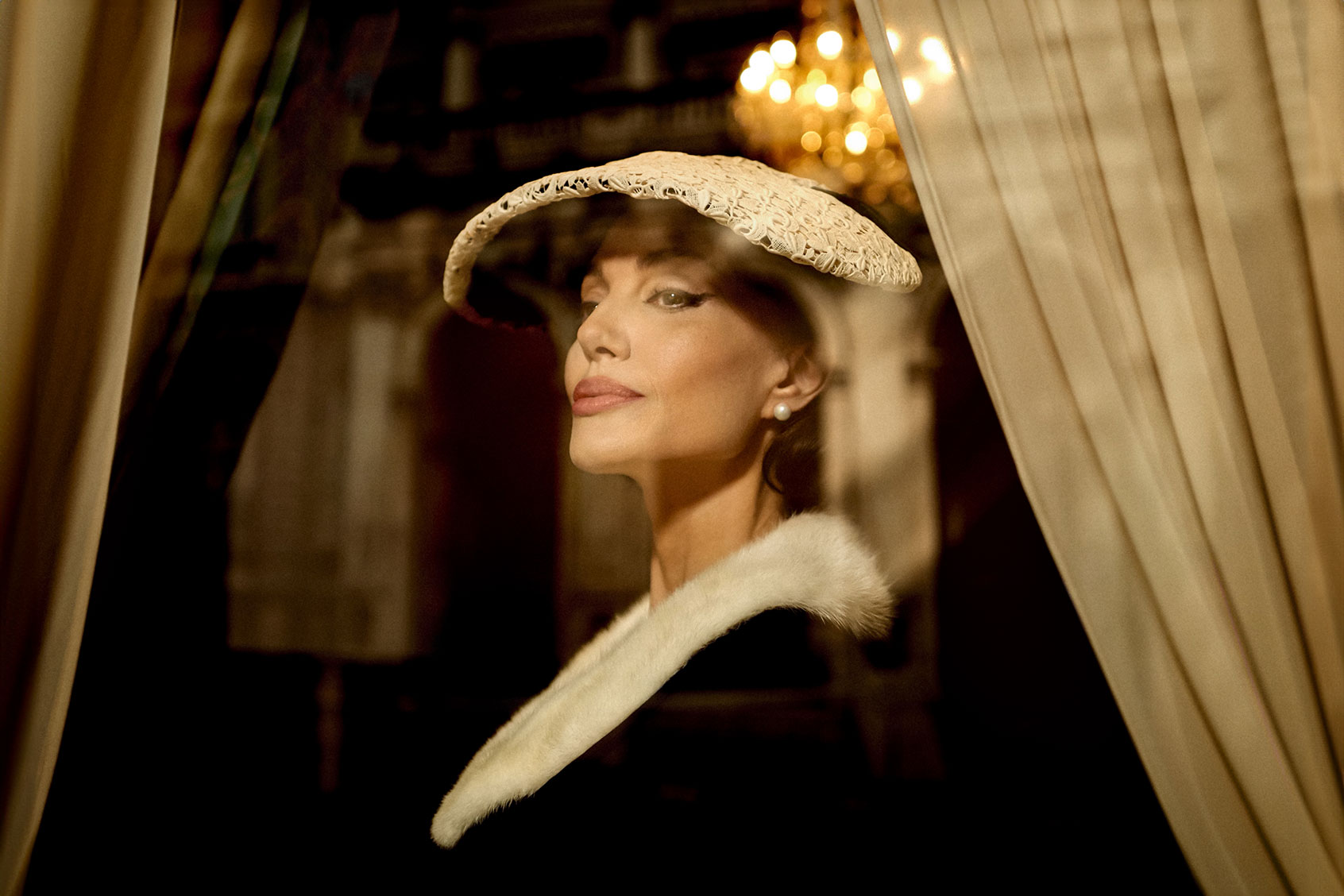
All the afterlife spinoffs of “The Walking Dead” ride the appeal of core duos whether they be oppositional (as with Maggie and Negan in “Dead City”) or romantic (Rick and Michonne in “The Ones Who Live”). 

Daryl and Carol share a different bond, something more than family but not quite amorous. They’re also versions of survivors that don’t neatly fit into the popular fantasy of brute strength and frontier gutsiness. 

Daryl looks and acts that part, certainly, but both his and Carol’s survival training came by way of living through abuse. With Carol, we saw that evolution from a placating wife and grieving mother into someone acutely aware of how strangers see her, and the ways that she can use their assumptions to her advantage. That’s what makes McBride singularly compelling in playing her – she’s constantly holding Carol’s danger and determination under a gossamer veil of meekness.

We need your help to stay independent

“I’m a friendly!” she peeps as she walks into a camp full of road pirates, hands up, distracting them with the appearance of fear and softness. Not long afterward, they’re cowering at her feet as she robs them.

Her broader arc in “Book of Carol” has to do with facing her greatest trauma and the moment that haunts her incessantly. The millions of people who watched “The Walking Dead” early in its run can guess what that is, but if you’ve forgotten, these episodes have several moments where Carol is gripped by PTSD at the sight of a barn door. 

The writers take a few steps to tease out the way that cruel tragedy sharpened Carol’s survival tactics, forcing a spiritual reckoning when she exploits to win the trust of Ash (Manish Dayal), a kind man Carol uses to fulfill her self-assigned mission.  

But that inward gaze is less of a consideration than lubrication on the mechanics of getting Carol from Point A, i.e. North America, to Point B, France, albeit with a comically strange layover culminating in what is a comic fanboy’s dream, or his biggest nightmare.

Her and Daryl’s paths run parallel until about midway through the six-episode season, which is blessedly expedient as such stories go. By then, the meaning of what worked so well in Season 1 begins to fall apart. 

“The Book of Carol” takes the first season’s examination of faith and filters it through the tainting influence of religion as a means of control, which fits the brand; nothing seemingly wholesome in “The Walking Dead” ever is. 


Want a daily wrap-up of all the news and commentary Salon has to offer? Subscribe to our morning newsletter, Crash Course.


This turn also forces what could have been a thoughtful and provocative storyline to rush to a conclusion that deteriorates the story with impressive velocity. Their reunion straddles conflicts with Anne Charrier’s nouveau-fascist Genet and deeply philosophical disagreements with Isabelle and Daryl’s new host Losang (Joel de la Fuente), a pair of antagonists who prove to be disposable.

Luckily for AMC – and “TWD” diehards, I guess – most of the audience isn’t watching these shows for their explorations of philosophy or thoughtful parsing of what it means to believe in something greater than yourself, for good or ill. It is probably enough of a thrill to watch Daryl dispatch with zombies and despots using a medieval flail, or Carol stalk around centuries-old French villages like a commando. 

In essence, “The Book of Carol” lacks the layered heft those who were pleasantly surprised by the previous chapter might have expected. But in keeping with the overall theme of this side mission, there’s hope: Season 3 is already in production, giving us another chance to meet Daryl and Carol in a storyline that makes them equal partners. 

"The Walking Dead: Daryl Dixon —The Book of Carol" premieres at 9 p.m. Sunday, September 29 on AMC.

Fighting hunger in a growing crisis: How City Harvest is responding to New York City’s rising needs

As the cost of living in New York City continues to rise, so too does the demand for food assistance, with food pantry visits reaching unprecedented levels. At the helm of City Harvest, the city’s largest food rescue organization, Jilly Stephens is confronting this crisis head-on. 

Since 2019, City Harvest has scaled its operations to distribute millions of pounds of fresh food to communities in need, but the demand only grows — a reality that was only further reflected through the a recent report from the USDA which revealed that 8 million families, or 13.5% of U.S. households, struggled to access enough food, marking the highest levels of food insecurity in nearly a decade. 

In speaking with Salon Food, Stephens discusses the economic forces behind the surge in food insecurity, the role of nutrition education and new initiatives like the Produce Pals program, which aims to make healthy eating more accessible for families across the city. With City Harvest now serving a record number of New Yorkers, Stephens also reflects on the organization's evolving strategies and the critical policy changes that could help combat hunger on a local and national scale.

This interview has been lightly edited for length and clarity. 

With food pantry visits at a record high and the cost of living rising, what specific economic factors are driving the increased demand for food assistance in New York City?

One primary reason that we are seeing such a high rate of food insecurity is the cost of living. In New York City, 50% of working-age households are struggling to make ends meet. The costs that everyday New Yorkers are grappling with, like for food, rent and childcare, are extremely high, and wage increases, particularly for the lowest-income New Yorkers, have not kept pace. Additionally, during the pandemic’s peak, there were vital government supports — like the expanded child tax credit — that kept many families afloat economically. Those programs have since gone away, making it that much harder for New Yorkers to afford basic necessities, including fresh food.  

Could you expand on the Produce Pals initiative and how school-based food distribution programs have impacted the fight against food insecurity? How does providing fresh produce specifically benefit students and their families?

This fall, we are launching City Harvest Produce Pals, a school-based food distribution program providing free, fresh fruits and vegetables to students and their families at some New York City schools where we offer nutrition and culinary education programming. Once a month, City Harvest, in partnership with the school, will distribute free bags of nutritious, versatile produce, like sweet potatoes, apples, and onions to students.

"In a city where 1 in 4 children do not always know where their next meal is coming from, increasing access to food —and especially fruits and vegetables — is critical."

In a city where 1 in 4 children do not always know where their next meal is coming from, increasing access to food —and especially fruits and vegetables — is critical. We know how busy families with school-aged children can be. By distributing free food directly at schools, Produce Pals aims to make food distribution as convenient as possible for families so that students have access to the nutritious foods they need to thrive. And by combining free produce distribution with nutrition and culinary education programming, City Harvest is also ensuring that families have the skills to prepare those foods into delicious, affordable meals.   

What role does nutrition education play in addressing long-term food insecurity, and what are the key takeaways from your culinary education programs?

At City Harvest, we want to make sure that the foods we are bringing into communities are nutritious — 75% of the food that we rescue and deliver is fresh produce. We also want to make sure that people have the skills and knowledge to prepare and enjoy the nutritious foods that we distribute, so we equip our neighbors with the tools they need to incorporate healthy eating into their daily lives. At our Mobile Markets—which are free, farmers’ market-style food distribution sites located in neighborhoods across New York City that lack access to affordable produce—we offer free cooking demonstrations so community members can learn how to prepare the produce they are receiving, some varieties of which may be unfamiliar. We also partner with community organizations, senior centers and schools in all five boroughs to offer free Nutrition and Culinary Education classes for students, adults, and seniors.

We need your help to stay independent

In a recent survey of community members who completed one or more of our Nutrition and Culinary Education classes, 77% said they plan to incorporate more vegetables into their diets. We’ve heard from families that thanks to our Nutrition and Culinary Education programs, they feel more comfortable shopping on a budget, know how to read food labels, and are more confident cooking using healthy swaps. 

You’ve mentioned the need for greater government intervention. In your opinion, what local, state or federal policy changes would have the most immediate impact on alleviating food insecurity?

Our priority at the local level is funding for the Community Food Connection, or CFC.  CFC helps support food pantries and soup kitchens across New York City, and we are pleased that the City ultimately restored funding for CFC — and actually increased it slightly to $58 million — after threatening to cut the program in half. But the City can do even more, and we hope that future funding for CFC is responsive to the very high level of need we’re seeing. 

At the state level, last year, we successfully advocated for modest increases to both HPNAP (Hunger Prevention and Nutrition Assistance Program) and Nourish New York. Because of increased demand and the success of the program, including the quality of the food and the benefits to farmers, the State should be investing even more. I also want to applaud the state for increasing the Empire State child tax credit. We know that when you put money in people’s pockets, they can stretch their budgets further. Repeated, sustained efforts like this are essential to ending food insecurity.

Federally, our priority is advocating for a strong Farm Bill that makes SNAP (Supplemental Nutrition Access Program), formerly known as food stamps, and other anti-hunger measures more robust and inclusive. SNAP is a critical lifeline for the nearly 1.8 million New York City residents that rely on SNAP for food. We saw during the pandemic how effective legislation like enhanced child tax credits and expanded SNAP benefits could be at lifting millions of New Yorkers out of poverty and increasing access to food. On top of that, every $1 of SNAP translates into about $1.50 of economic activity at local bodegas and supermarkets, making the program a huge economic driver across the city.

City Harvest is known for being innovative in its approach to food distribution. Are there any new strategies or partnerships you’re exploring to keep up with the growing demand for food assistance?

Right now, food insecurity rates in New York City are the highest on record. To meet the extraordinary level of need in our city, City Harvest has this year identified several neighborhoods that have faced historic disinvestment and continue to experience high rates of diet-related diseases. We are focusing on strengthening existing partnerships with food pantries and soup kitchens operating in these communities. By making strategic investments in these partner sites to increase their operational capacity—in other words, to help these partners build the capacity to distribute more food—together we can distribute even more fresh produce to community members living in these historically marginalized neighborhoods.

"Right now, food insecurity rates in New York City are the highest on record"

In addition, we are also placing a strategic focus on procurement and distribution of culturally responsive foods, in close partnerships with the food pantries and soup kitchens that we serve. We want our neighbors across New York City to have access to nutritious foods that fit their religious and cultural preferences, and to be able to get these items — for free — at locations convenient to their homes and places of work. 

How has City Harvest adjusted its operations or scaled its initiatives to respond to the 1 million additional food pantry visits per month since 2019?

We are doing as much as we can to meet the persistently high need for food assistance in New York City, even as our operating costs have increased. This year City Harvest will rescue more than 81 million pounds of high-quality, nutritious food that would otherwise go to waste and deliver this, for free, to soup kitchens and food pantries across the five boroughs so that New Yorkers have the food they need to thrive. That’s nearly 30% more food than we were rescuing and delivering pre-pandemic.

Lastly, what can individuals and communities do to best support City Harvest’s mission and combat food insecurity in New York?

The best way to support our work is by donating funds, so we can continue to rescue and deliver more food for our neighbors in need. Every $1 donated to City Harvest can help feed two New Yorkers for a day. We’re also always in need of volunteers. You can learn more and get involved by visiting cityharvest.org

“Not even worried”: Bill Maher is sure Trump is “definitely going to lose”

HBO host Bill Maher on Friday predicted that former President Donald Trump would “definitely” lose.

Maher discussed the possibility of Trump winning the election with a panel including author Fran Lebowitz, commentator Ian Bremmer and Israeli historian Yuval Noah Harari.

“Give us a few weeks. You never know. We still don’t know if we are going to repeat that mistake,” Bremmer said.

“We’re not. I’ve already put my marker down on that,” Maher replied.

“You’re not even worried about it?” asked Lebowitz.

“No, not at all,” Maher replied. “No, no, no. He’s definitely going to lose. You can just feel it.”

“I hope you’re right,” Lebowitz said.

Still, Maher predicted that the polls would continue to be “even.”

“I promise you. Don’t worry. Don’t think about it. I don’t think about it,” he said. “And then, even if he does win, well you wouldn’t have gone through all that stress.”

“Hateful” and “harmful”: Trump blasted for calling Kamala Harris “mentally disabled”

Former President Donald Trump on Saturday falsely called Vice President Kamala Harris “mentally disabled” after Democrats accused him of cognitive decline.

Trump attacked Harris over border security, calling her “mentally impaired” while blaming her for crimes committed by immigrants.

“Kamala is mentally impaired. If a Republican did what she did, that Republican would be impeached and removed from office, and rightfully so, for high crimes and misdemeanors,” he said during a speech in Prairie du Chien, Wis.

“Joe Biden became mentally impaired. Kamala was born that way. She was born that way. And if you think about it, only a mentally disabled person could have allowed this to happen to our country,” he continued.

Maria Town, CEO and president of the American Association of People with Disabilities, said Trump’s remarks “say far more about him and his inaccurate, hateful biases against disabled people than it does about Vice President Harris, or any person with a disability.”

“Trump holds the ableist, false belief that if a person has a disability, they are less human and less worthy of dignity,” she said in a statement to The Washington Post. “These perceptions are incorrect, and are harmful to people with disabilities.”

“There can be nothing worse”: Trump demands Kamala Harris impeachment on Truth Social

Former President Donald Trump on Saturday called for Vice President Kamala Harris to be impeached following her visit to the U.S.-Mexico border.

Harris traveled to the border town of Douglas, Ariz., where she accused Trump of “playing political games” on immigration.

“I reject the false choice that suggests we must choose either between securing our border and creating a system that is orderly, safe and humane,” Harris said, according to The Guardian. “We can and we must do both.”

Trump after the visit misrepresented new statistics about immigrants and crime to attack Harris.

“Even the LameStream Media is mocking Comrade Kamala Harris for her pathetic attempt yesterday to justify her HORRIBLE performance at the Border. 14,000 CONVICTED thugs and slimeballs who have committed MURDER have been allowed to enter our Country, totally unvetted and unchecked, and roam free to KILL AGAIN…And they will kill again, over and over, and wreak havoc like never seen before,” Trump wrote on Truth Social, even though the numbers include people who entered the country under his administration as well.

“We don’t know anything about them,” Trump continued. “Kamala is a FOOL to have let this happen to our beautiful USA. It is totally unjustifiable, there can be nothing worse! She should be IMPEACHED for what she as [sic] done to our Country!”

As CNN’s fact-check noted, the numbers Trump referred to are not specifically about people who have entered the country under the Biden-Harris administration but rather noncitizens who entered under any administration — including Trump’s — and who were convicted of a crime at some point and are now living in the country on the ICE “non-detained docket” because their country won’t let them be deported there. The list also includes people who are still serving their sentences but are not being held in immigration detention.

“The data in this letter is being misinterpreted,” a Homeland Security spokesperson told CNN. “The data goes back decades; it includes individuals who entered the country over the past 40 years or more, the vast majority of whose custody determination was made long before this Administration. It also includes many who are under the jurisdiction or currently incarcerated by federal, state or local law enforcement partners.”

Chappell Roan’s statements raise the question: Why do we need to know who celebrities vote for?

Chappell Roan has already made it pretty clear that she would prefer for the public to stay out of her personal life, so why is there an increased demand for her — and other celebrities — to publicly specify which presidential candidate she plans to vote for? 

Throughout her meteoric rise to fame, there has been a barrage of online posts analyzing, dissecting and prosecuting every interview of the 26-year-old singer, with many public grievances against Roan centering on the "Good Luck Babe!" singer's politics.

Roan — who grew up in the Midwest and identifies as a lesbian — is a vocal progressive, championing causes like the pro-Palestine movement and various LGBTQ+ causes by supporting local drag queens and denouncing growing transphobic laws against children and people across the United States. She even refused to perform at the White House during Pride Month due to the Biden administration's Gaza foreign policy.

Roan's leftist political stance — shared by many other Gen Zers — has caused a stir online, with critics viewing her disapproval of both major political parties in the presidential election as playing "both sides." This has led to the false assumption that Roan is a Republican, despite her widely reported progressive stances, and the heat of the discourse caused her to drop out of the All Things Go Music Festival, where she was scheduled to perform over the weekend. 

“I apologize to people who have been waiting to see me in NYC & DC this weekend at All Things Go, but I am unable to perform,” Roan wrote in a post to Instagram on Friday. “Things have gotten overwhelming over the past few weeks and I am really feeling it. I feel pressures to prioritize a lot of things right now and I need a few days to prioritize my health.”

But why did it have to come to this?

As Roan has established ironclad boundaries with the entertainment industry, her fans and the internet, she has been facing an unrelenting stream of criticism deadset on silencing her sense of personhood and progressive politics and values. Despite the white noise and the growing parasocial hatred inflicted on Roan, she isn't an artist who can be muzzled — in actuality, it has only made her beliefs more steadfast in a political system and discourse that grows increasingly unruly.

Roan says there are "problems on both sides" — and there are

Unfortunately for Roan, an interview with The Guardian where she stated her gripes with the U.S. government was clipped online and spurred a growing hate campaign against the singer. In the interview, she explained her disillusionment with the American political system, saying, “I have so many issues with our government in every way. There are so many things that I would want to change. So I don’t feel pressured to endorse someone."

Accusations of the singer's views ignited discourse online over one particular part of that interview where she said, "There’s problems on both sides. I encourage people to use your critical thinking skills, use your vote – vote small, vote for what’s going on in your city.” 

“How are you queer, an ardent defender of the drag community and somehow a ‘both sides are bad’ person?” a post with millions of impressions prodded in the wake of the controversy surrounding that.

Others compared the situation to the outrage around Taylor Swift's friendship with potential Trumper, Brittany Mahomes

“The same people giving Chappell the benefit of the doubt and not attacking her character for her ‘neutral’ stance in this very crucial U.S. election were crucifying Taylor for greeting [Brittany Mahomes] at an event and not providing an endorsement on their chosen timeline. got it," one person wrote in a post to X.

Attempting to clarify her statement about not endorsing Harris, a heated and frustrated Roan took to TikTok to reiterate her political stances in two videos, which only added to the controversy. 

She explained that “endorsing and voting are completely different," saying, "I don’t agree with a lot of what is going on with, like, policies. Like, obviously, f**k the policies on the right, but also f**k some of the policies on the left. That’s why I can’t endorse.”

“I’m not gonna settle for what the options are that are in front of me, and you are not gonna make me feel bad for that,” Roan added. “So yeah, I’m voting for f***ing Kamala, but I’m not settling for what has been offered, because that’s questionable.”

The singer emphasized that there is room for nuance when discussing the issues of a two-party system, saying, “So yeah, there are huge problems on both. You know what is right and wrong and so do I. F**k Trump for fucking real, but f**k some of the s**t that has gone down in the Democratic party that has failed people like me and you — and, more so, Palestine, and more so, every marginalized community in the world.”

Aimed at her critics, who claim she is playing both sides, Roan said, “No, no, no, this is not me playing both sides. This is me questioning both sides because this is what we have in front of us."

The singer received the brunt of America's jarring political discourse. It has become so warped that Roan was pushed to the brink to clarify herself to people looking to misinterpret her words when her track record speaks for itself. Roan's politics have been far from neutral — they have, actually, been the most consistent thing about her platform.

Roan told Rolling Stone that she originally planned to agree to the White House gig but would refuse to perform and protest by reading “poems from Palestinian women."

"I am not going to be a monkey for Pride,” she said. Worth noting here that the current administration walked back a statement about gender-affirming surgery for trans children a month after she was asked to perform at the White House.

“Thank God I didn’t go because they just made a huge statement about trans kids," she said at that time.

Roan isn't the only young progressive person concerned about trans rights, Palestinian liberation and rights, and the U.S.'s involvement in the war in Gaza. Gen Zers like Roan have similar views.

Pew Research Center stated in a study that young Americans under 30 are more likely to sympathize with the Palestinian plight. The research also found that 36% of people found the Biden administration favored Israel over Palestine. This has posed a threat to Democrats' grasp of the presidency in the 2024 election because young people were a large key voting block that secured Biden's win against Donald Trump in 2020.

Roan pointed out in her statement, “There is no way I can stand behind some of the left’s completely transphobic and completely genocidal views." Despite young people's dissatisfaction with the political system, Roan stated she doesn't "want people to settle with what we have" but still encouraged people to vote because it "is all we have right now in the system, and so I encourage it yet again."

People in our political discourse will habitually lament about single-issue voters every election cycle — ignoring the importance of acknowledging that these progressive struggles are all connected. Single-issue voters — conservative, liberal and independent— have helped protect and ratify abortion laws across the Midwest. These supposed single-issue voters are shaping election results as there is a growing movement in the uncommitted voting bloc. These voters are determined to bolster their voices about the war in Gaza and the U.S.'s continued involvement, which many worry will not change if Harris is in office as she is viewed by some as a staunch Israel supporter.

Harris' policies should be criticized by the likes of someone like Roan, who is a visible figure in our zeitgeist. Moreover, Harris has openly reiterated her support for fracking, stricter immigration policies and expanding our military. And yet, Harris has made for entertaining television as a more palpable politician than Biden, with her boisterous laugh, “brat summer" memes and even using Roan's song "Femininomenon" in TikToks.

Why do people care about celebrity endorsements anyway?

The baffling response to Roan's progressive politics is a part of this need for celebrities to perform left-leaning politics. Long before Swift became viewed by many as the ideal liberal celebrity, the singer was famously mum on politics, which led to years of speculation about her being a secret conservative. Swift surprised everyone by coming out as a Democrat during the 2018 midterms. But even Swift, who is perceived as the good liberal, gets rightfully skewered for her ties to Trump-supporting Mahomes.

While it makes sense that a superstar like Swift is held to higher standards about her politics than someone so new to fame as Roan is, it has become disheartening to see the only way the Democratic Party can rally its voters is to appeal to our American fascination with celebrity. Democrats are also urging Reggaeton artist Bad Bunny to endorse Harris to help her secure swing states like Pennsylvania that hold the third biggest population of Puerto Ricans outside of the territory. 

We need your help to stay independent

Despite this pressure to perform politics, artists like Roan have rejected celebrity entirely and the additional responsibilities that come with the job. This makes her progressive stance on LGBTQ+ and Palestinian rights all the more personal and commendable. As Teen Vogue writer and editor Lex McMenamin wrote, "It should be a good thing that Roan is unwilling to use her platform to sell out any one marginalized identity just to throw her name in for a presidential candidate."

Even though people are lampooning the progressive for her refusal to endorse a candidate, her refusal and exasperation with our political and Hollywood systems show us Roan is questioning what is normalized to demand from a celebrity. Her noncompliance with what is expected is a gnarly insight into our sense of entitlement to her. Roan herself is engaging in our political discourse the way we all should with critical thought, nuance and lived experience as a marginalized person.

"That’s not normal. That’s weird," she said in a TikTok last month talking about fans encroaching on her personal boundaries— little did she know how bad it could get, or how political. 

Will Trump try to end democracy? Yes — but these scholars claim he can’t pull it off

Shortly after Donald Trump won the 2016 presidential election, I contacted Alastair Smith and Bruce Bueno de Mesquita, the two NYU political scientists who, several years before that, co-authored a book entitled "The Dictator's Handbook," which outlines a novel theory of how political leaders — whether they are democratically elected politicians, unelected autocrats, or somewhere in between — acquire and hold onto power. I wanted to explore the question of what a Trump presidency might mean for the future of American democracy, which seems even more urgent eight years later. 

My interview with Smith and de Mesquita, published in early 2017 by Salon, was surprisingly hopeful in tone. De Mesquita expressed the view that the United States is a “mature democracy,” and “mature democracies don’t become authoritarian.” Even though Trump had clear authoritarian and even fascist tendencies, the authors reassured me that our democratic institutions would survive — and in large part, they were right. Despite Trump’s “Big Lie” about the 2020 election and the Jan. 6 insurrection, Joe Biden took his seat in the Oval Office and reversed some of Trump’s anti-democratic policies, such as the “Schedule F” executive order aimed at turning the entire executive branch into a political instrument. While countries like ours may “oscillate a bit and become more or less democratic,” de Mesquita said, there has “never” in history been a mature democracy that has slid into authoritarianism, dictatorship or autocracy. It just doesn’t happen.

Well, OK. But what about this time around? What if Trump gets elected again? As many have noted, Trump entered the White House in 2017 completely unprepared for the job. That won’t be the case if he moves back in next January: Despite his disavowal of Project 2025, he will immediately begin to implement many of its proposals, most notably by replacing much of the “deep state” (i.e., nonpartisan federal employees who are hired and promoted based on competence and expertise) with MAGA loyalists. Trump has also threatened to punish political opponents, journalists and other voices of dissent, whom he has called “vermin” and “scum.” In July, he reposted an image on Truth Social calling for a televised military tribunal of former Republican congresswoman Liz Cheney, who voted to impeach Trump after the Jan. 6 insurrection and then helped lead the resulting congressional investigation.

Worse yet, the Supreme Court’s recent ruling on presidential immunity removes many barriers to potential presidential misconduct. If Trump returns to office, he could — according to some interpretations of that decision — literally order the assassination or imprisonment of his rivals with zero legal consequences. He could get away with almost everything he’s fantasized about doing since he was first elected. So there seems to be a significant and realistic chance that Trump could become an autocrat who rigs future elections, locks up dissidents and pursues vicious retribution against his perceived enemies. 

Faced with mounting anxiety about the future of our democracy, I contacted Smith and de Mesquita once again to get their take on a possible Trump 2.0 administration. Since a second Trump term would almost certainly be much worse than the first, I was curious as to whether they had changed any of their views. Are they still hopeful, or do they now believe that Trump and his MAGA cronies could actually destroy our democracy and replace it with an autocratic state headed by Dear Leader?

Smith and de Mesquita told me that the biggest reason our democracy will survive [a second Trump term] is because Trump’s policies will likely cause so much damage that they’ll ignite massive protests, uprisings and unrest.

As with our first interview, the conversation was fascinating, insightful, unsettling and, yes, ultimately optimistic. They told me that, on the one hand, there’s virtually no chance that America will lose its democracy, even if Trump is elected and acts on his most destructive instincts, unconstrained by the law. Mature democracies just don’t collapse into authoritarianism, they insist, and that remains true today no less than it did in 2016. On the other hand, Smith and de Mesquita told me, one of the biggest reasons that our democracy will survive is because Trump’s policies will likely cause so much damage that they’ll ignite massive protests, uprisings and unrest across the U.S., ultimately leading to his downfall.

As Smith told me when we spoke last month, people “should have concerns” about what Trump will do if he regains power. But it’s precisely “because of those concerns," he continued, "that Trump destroying our democracy isn’t going to happen.” He added: “I envision the number of people who would be demonstrating if Trump wins the election, if the Republicans were to win both houses, making Tahrir Square in Egypt — the 'Arab Spring' demonstrations in 2011 — look small. And those protests succeeded in bringing down the autocratic Mubarak government.” If Trump tries to restrict voting, as he probably will, that will only further energize the pro-democracy opposition. Ultimately, Trump's efforts to seize and hold power “will fail,” de Mesquita told me, for the same reason that public pressure during the 1960s ended the Jim Crow laws and ended legal segregation. 

Perhaps surprisingly, the authors don't believe that only those on the political left will protest a future Trump administration. “Even among his supporters,” de Mesquita said, “they would quickly see how bad another Trump presidency was for them. … They’d see their welfare diminished, and will be on the streets” with everyone else. In other words, Trump 2.0 will likely be so disastrous that Trump will lose some of his base. They might still support his alleged policies, to some extent, but they will be so negatively impacted by the broader decline of our country that they’ll turn against the man they voted for. This has already happened to some extent, as Smith notes:

I remember, four years ago, biking around up in the Catskills where I love to go, and there are some neighborhoods that are clearly Trump neighborhoods. There were some spectacularly good displays of Trump flags and “melt the snowflakes,” etc. — displays on the side of the street, very creative stuff. I mean, not that I agree with it! But it was spectacularly well done. Things hanging from cranes with “Go Trump,” everything. This year, I’ve noticed those neighborhoods — there are very few signs up. Just a lot of people who backed Trump and probably still sort of like the policies he had. It’s just like, they don’t want to erode the democracy that they have.

I asked Smith and de Mesquita to elaborate on why they feel so confident that U.S. democracy would survive a second Trump term. Couldn’t the “democratic backsliding” that we’ve seen in Hungary and Poland — or, heck, the backsliding seen in Germany during the Weimar Republic — happen here, too? Why exactly has no “mature democracy” ever collapsed into autocracy, and why couldn't that change?

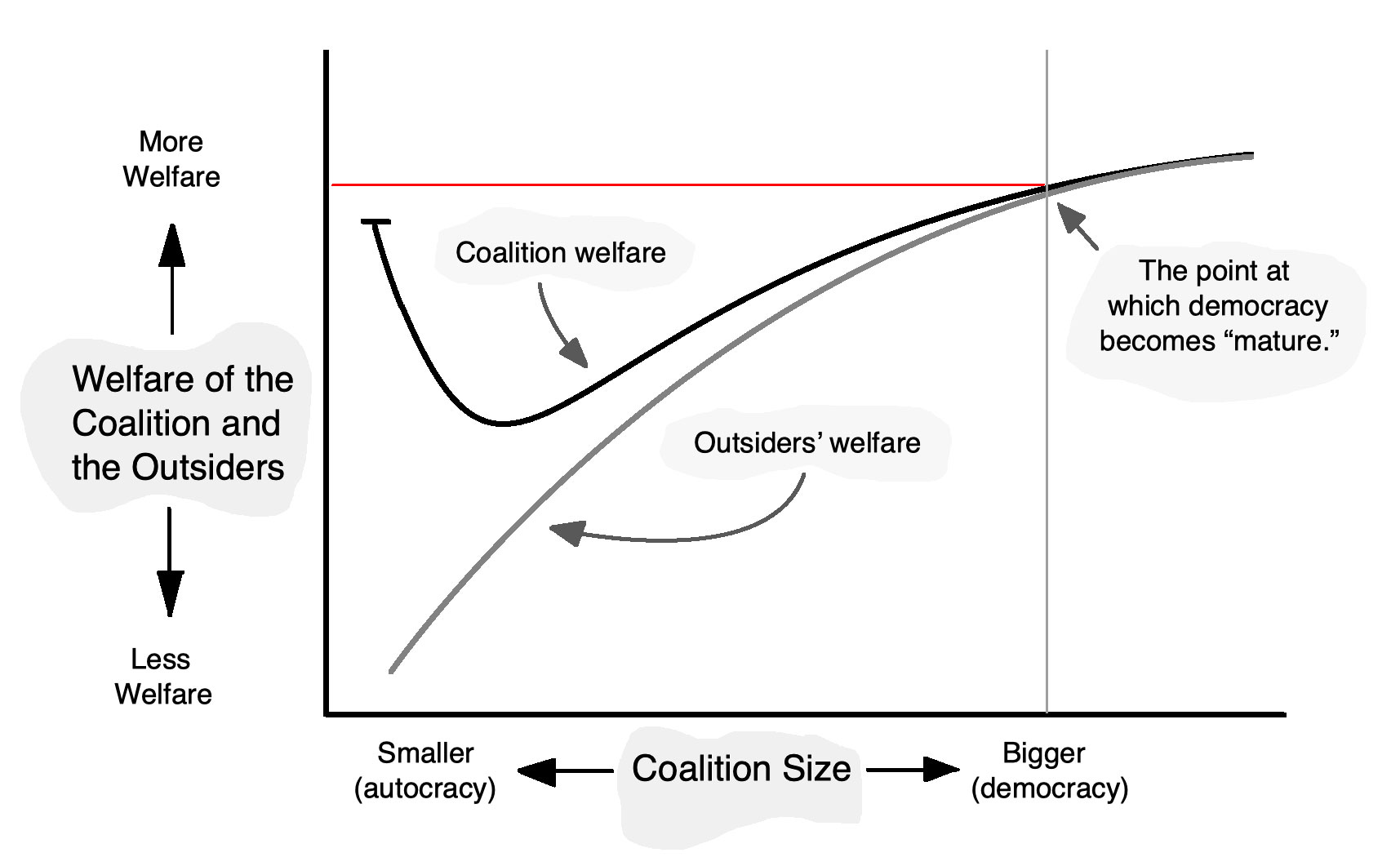
A key part of their explanation comes from the “swoosh” graph below, which Smith and de Mesquita present in the 2022 edition of "The Dictator’s Handbook." (I present a modified version here, with their approval.) This graph is deceptively insightful, and once you understand what it means, you might come to share their confidence as well.

On the up-down axis is the welfare of two groups: the "coalition," meaning those who support the political leader in power, and the "outsiders," meaning those who oppose the leader. On the left-right axis is the size of this coalition of supporters.

Welfare of Coalition and Outsiders GRAPH (Émile P. Torres)In an autocracy, all that’s required for the leader to stay in power is for him or her to keep a small group of cronies happy — think of the oligarchs and military leaders in Vladimir Putin’s Russia, or the inner circle of Kim Jong-un’s North Korea. The leader secures the loyalty of this tiny coalition through corrupt practices, often heavily taxing the outsiders (in other words, most of the society) and then redistributing this wealth to cronies in the form of “private goods” for them. Hence, the essential supporters of these autocrats are given special access to expensive cars, luxury apartments, the best schools for their children, family vacations on the beach and so on. For the cronies, life is pretty darn good, while everyone else in society struggles to get by.
Trump 2.0 will likely be so disastrous, the authors claim, that Trump will lose some of his base. They might still support his policies, but they will be so negatively impacted that they’ll turn against the man they voted for.

If this coalition expands, the number of people the leader would need to keep happy will also increase. As a result, the welfare of the leader’s cronies begins to decline. Why? Because there’s only so much money for the leader to throw around, and the more people there are on the gravy train, the less there is for each individual insider. People in the coalition, therefore, oppose such an expansion: They don’t want to share the private goods they’ve become accustomed to receiving. It’s a kind of local minimum in which autocratic societies sometimes get stuck, although it’s not impossible to escape that trap, and in fact the number of autocratic countries has declined over the past century and a half while the number of democratic countries has risen. (Nearly everyone lived in autocratic states in 1850, while just over 50% of countries today are more or less democratic.)

So moving from the left side of the graph to the right side is painful for the leader’s supporters, who will likely resist this transition. It’s clearly not in their interest to share their private goods with a new group of folks. But if the coalition’s size keeps expanding long enough, past that big dip in the graph, living conditions will start to improve — not just for the supporters, but for the opposition as well. Why? Because, if the political leader wants to stay in power, he or she will have to keep an ever-larger number of people happy. The best way to do that is to implement policies that provide “public goods” that benefit society in general, in contrast to private goods that go to only a few people in particular. If you’re Kim Jong-un, you only have to please a few hundred people or so. But if you’re president of the United States, you have to please, at a bare minimum, many millions of people to keep your job.

To put this a different way, it would be far too expensive to give out special benefits and private goods to all your supporters, because there are just too many of them. Instead, you begin to implement policies that make everyone (or at least a majority) better off, which by definition also benefits your supporters. If this works, it keeps your supporters happy enough to vote for you again the next time around, and might also lead some non-supporters to flip sides. As Smith told me during our conversation, such public goods include a wide range of things, including “national defense and a clean environment and law and order and efficient highway systems and those kinds of communications and … freedoms.” Society becomes more productive, in other words, and everyone wins.

The shift from the left side to the right side of the graph corresponds to the political process of democratization, meaning that more people get a say in whether the leader stays in power and, in turn, that whether they remain in power largely depends on the type and amount of public goods they provide the people. Such goods are the only feasible way to improve the lives of your supporters, while also — by virtue of these being public goods — benefiting members of the opposition. That’s why everyone wins: Democracies are good for most people in society, whereas autocracies, by and large, are only good for a small group of elites.


Want a daily wrap-up of all the news and commentary Salon has to offer? Subscribe to our morning newsletter, Crash Course.


This leads us to one of the most important parts of Smith and de Mesquita’s graph: the inconspicuous gray line on the right. Look at where it intersects with the welfare lines of the “coalition” and “outsiders.” Then follow the horizontal pinkish line to the far left side of the graph. Notice that the welfare of everyone in society, to the right of the gray line, is better than the welfare of even the most privileged supporters in an autocracy, on the far left. In other words, the average person is overall better off in a highly democratized state than even the most privileged cronies in a dictatorship.

Smith and de Mesquita classify any country that falls to the right of that gray line as a “mature democracy,” and their surprising claim is that it has never happened that a country in that position on the graph has slid all the way to the far left — no mature democracy has ever become an autocracy.

Trump could cause the collapse of democracy after all — not because the U.S. will slide into authoritarianism, but because modern civilization as a whole will crumble amid the climate catastrophe.

The reasoning behind this makes sense as they lay it out: As the coalition supporting a would-be autocrat becomes smaller and the society becomes less democratic, money collected by the government is increasingly diverted from funding public goods to the “pet projects or secret bank accounts” of the leader, to quote Smith and de Mesquita in "The Dictator’s Handbook." As de Mesquita told me during our recent conversation, “When you’re past that point where the gray line intersects with the other two lines … you can’t make the coalition better off by shrinking it. You can’t even make a few of its members better off by shrinking it, and you can’t make the people better off, either. Only the leader can get better off.” So that kind of shift is likely to produce significant resistance from everyone, including, eventually, the leader’s own supporters.

So Smith and de Mesquita believe that the probability that our democracy will collapse during a possible Trump 2.0 presidency is virtually zero. Yes, Trump will almost certainly try to force the U.S. from the right of the graph to the left — and he may succeed to some unpleasant extent. But his policies will hurt so many people that even folks in the MAGA movement, they believe, will start to defect. His autocratic efforts will ultimately fail as tens of millions of people protest in the streets every month. And if you don't believe that such protests can be effective, Smith would point out, once again, that the mass protests in 2011 in Egypt did take down the autocratic regime of longtime president Hosni Mubarak. He summarized this point in our conversation:

Just think about the level of accountability. If we made the president accountable to fewer people, then the president's policies take on a "private goods" flavor. There are more corruption opportunities for cronies and less work and fewer resources are directed to rewarding the people. So you have to make this trade-off. Imagine being a Trump supporter: If you let Trump have a smaller coalition, he’s going to produce fewer public goods. Now, you might get more private goods, but fewer of the resources are going to reward you, and more are going to reward Trump and his private agenda.

So the way the trade-off goes, particularly in a productive society, is that you would be better off getting no private goods but getting the public goods under the opposition leader, rather than taking this mix [of slightly more private goods but much fewer public goods]. So you might like the policies under Trump, but Trump’s not working very hard — as opposed to, under Biden or Harris you might not like the policies, but they’re working hard to produce public goods for you.

The fact that mature democracies don’t collapse into authoritarianism, even under the leadership of wannabe dictators like Donald Trump, points to a crucial asymmetry in the graph: While autocracies can and do become democracies, and while some democracies can become autocracies, mature democracies never cross from the far right of the graph to the far left. This should give progressives and liberals, who fear Trump’s threat to our country, reason for hope — although, as Smith and de Mesquita made clear during our conversation, a Trump 2.0 presidency would self-destruct precisely because of all the terrible harm it would cause. So buckle up.

Even if our democracy can survive another Trump electoral victory, there are plenty of other reasons one might worry about America’s future. The most obvious of those concerns climate change: If Trump returns to the White House, he will almost certainly dismantle most or all climate mitigation efforts, as expressly advocated by Project 2025. Perhaps, then, he could cause the collapse of democracy after all — not because the U.S. will slide into authoritarianism with Trump on a golden throne, but because modern civilization as a whole will crumble amid the climate catastrophe. In either case, the authors of "The Dictator's Handbook" argue that even Trump supporters will lose if he wins. Let's hope enough of them figure that out.

Why Republican attacks on Kamala Harris’ family keep falling flat

That moment during last month’s Democratic National Convention when Gus Walz was openly overcome with joy and pride was beautiful. The lovely expression of emotion from the son of Democratic vice presidential nominee Tim Walz was made all the more poignant after we all learned about his neurodivergence. Many men have since discussed the importance of getting comfortable with their emotions. 

That was only one moment of breathtaking family values from the Democratic ticket. Republicans have worked to undermine that image of healthy and loving families ever since. 

At a recent Trump campaign rally, Arkansas Gov. Sarah Huckabee Sanders claimed that her children keep her humble, telling the audience that “unfortunately, Kamala Harris doesn’t have anything keeping her humble.” Harris’ stepchildren, in this equation, equal nothing. That’s of course contemptible, but it’s also a complete lie.

Harris' stepchildren call her Momala. 

For those of you who did not grow up in Yiddish-infused households, let me briefly explain: the suffix -eleh is a diminutive term of affection. “Come here, Daniel” means “Come here.” “Come here, Danieleh” means “Oy get over here you delicious thing I have such a hug for you!” In the Harris-Emhoff family, the obvious rhyme asserted itself, so her family name is certainly clever. But don’t focus on the cleverness: focus on the affection.

When I see this affection, I remember the introduction into my own family of step-parents — so many step-parents! You don’t need me to tell you that blended families are hard. They can be brutal. Step-parents care for children who almost certainly meet them at first with suspicion if not resentment or even outright hostility. Figuring out who’s who, how this will work and what we call each other is a long negotiation that commonly never stops. Talk about keeping you humble! I have two step-parents whom I rarely call by that name. They entered too late — I think of them rather as my parents’ spouses, and it’s fine, and the love finds its own way, as does the family.

Harris has an enormous resume, with skills as an attorney, an orator and a policymaker. But what makes her stand out to me is Momala: words of love from her stepchildren.

Kamala Harris’s step-children calling her by an affectionate name that plays on the word “Mom”? This evidences a household that has all the love it needs — and all the humility. It shows step-parents and stepchildren who have found their own way and clearly love each other. They show affection and laugh together, and compared to the family values we see among their opponents — the Trump family’s cold stares and awkward, A-frame stage hugs come quickly to mind, as does Vance’s scorn for families that do not contain children — they look like the rest of us: joking, touching, communicating through glance and smile. We’re sure they have the same bickers and feuds we all have, too, and that’s comforting. They act like us. They are a stepfamily, but they are a happy family. So many of us know: that’s not easy. That’s not always the case. Any blended family that has found a way — through the awkwardness and frustration and unfamiliarity — to affection, even to love? 

They worked for that. They earned that. They built that.

We need your help to stay independent

Harris has an enormous resume, with skills as an attorney, an orator and a policymaker. But what makes her stand out to me is Momala: words of love from her stepchildren. That shows that the people who know her best love her. You can’t fake that.

When the "Addams Family" movies came out decades ago, the main joke was that this strange-looking family was actually the most functional family we could find: the parents loved each other, the family members were unfailingly kind to one another, they stood together when the harsh outside world unthinkingly mocked them. 

At the top of the Democratic ticket, we see two families that love each other, that are kind to one another, that stand together when the harsh outside world unthinkingly mocks them.

Just as the chants of “USA!” seem to indicate the Democrats are reclaiming their share of patriotism, these families at the top of the ballot show that Democrats are reclaiming their status as defenders of family values.

Can we still prevent global catastrophe? Yes — by fighting corporate power, now

Humanity cannot — now — avoid troubled and turbulent times. Extreme events will powerfully influence the course ahead, the shape of things to come after the turmoil. They could help or hinder: provide the moral force for urgent action or preoccupy us with crisis management. 

Writers like Rebecca Solnit and Junot Diaz have described the revelatory, and potentially revolutionary, nature of disasters. Not only can they bring out the best in us, and connect and empower us, but they also lay bare the social conditions and choices that often cause or contribute to disasters, delivering a societal shock that makes change possible. 

In the process of causing things to fall apart, Diaz says, apocalyptic catastrophes also give us “a chance to see aspects of our world that we as a society seek to run from, that we hide behind veils of denial." Apocalypses are also opportunities: “chances for us to see ourselves, to take responsibility for what we see, to change.”

The next 20 years will settle this issue. We will know by then the extent to which we are locked into global crises, and if so, what we can do to minimize their impacts and to shape the world that lies on the far side. 

I made these comments in a 2012 essay entitled “Whatever happened to Western civilization?” in the Futurist, the magazine of the U.S.-based World Future Society. The essay was itself a reflection on a 1993 Futurist essay, “The West’s deepening cultural crisis.”

So are disasters, piling one upon another, providing the moral force for urgent action? Well, we haven’t had to wait 20 years to see the choice we have made between deep systemic change and the management of specific calamities. As I feared, governments have become shockingly irrelevant in failing to match their responses to the magnitude of the challenges facing us (what I call a "scale anomaly" or "scale discrepancy"). 

This is despite the growing evidence and the insistent warnings by experts that we risk societal and civilizational collapse — and even evidence that collapse has already begun. Governments have, instead, become ever more preoccupied with trying to deal with a growing cascade of natural, social and political upheavals, some of their own making, others the result of intensifying global trends.

Running out of time to save the world

This situation has made me reconsider what we should do about our predicament. One theme of my work has been culture and its importance to human well-being and futures. (My 1993 Futurist essay focused on how modern Western culture is failing us, including arguing that the many serious problems we faced — seemingly intractable economic difficulties, a widening social gulf, worsening environmental degradation — were fundamentally problems of culture, of beliefs and moral priorities.) 

Cultures define and describe how we see the world and our place in it — and so how we live and behave. In a sense, cultures "permit," and so limit, what we can do. As I outlined in an earlier Salon essay, we need to remake Western culture if we are to meet the challenges confronting us. The magnitude of this transformation is akin to that from the Middle Ages to the Enlightenment, from the medieval mind to the modern mind. We face another rupture in our view of ourselves that will change profoundly how we live. 

I now accept, however, that that window has closed, at least for now. The shift in political consciousness to focus on dealing with specific disasters and calamities — fires, floods, wars, economic upheavals — means there is no longer the scope for a deep dialogue about cultural transformation.  We need a new emphasis.

The magnitude of the transformation we now face is akin to that from the Middle Ages to the Enlightenment. We face another rupture in our view of ourselves that will change profoundly how we live. 

I feel the same way about the recommendations of the recent roundtable report “A World Call to Action,” by the Club of Rome and the Council for the Human Future. It states, “Humanity is facing its greatest emergency, a crisis consisting of many, interlinked, catastrophic risks”; adds, “The crisis is already here, and will get worse”; and concludes, “Together, these risks endanger our ability to maintain a civilization, possibly even to survive as a species”.

The report says the crisis is vast, complex and interconnected. It will affect everyone on Earth for generations to come. There is at present no plan of action to resolve it, nor even a concerted effort to develop one:

This "polycrisis" is an interconnected web of challenges including climate change, biodiversity loss, global poisoning, food insecurity, resource depletion, retreat from democracy, nuclear proliferation, spread of war, uncontrolled use of AI, misinformation, economic, social and gender inequality, rising inequity, failing healthcare systems and geopolitical instability.

The report’s recommendations include a World Plan of Action, a U.N. People’s Assembly, an Earth System Council, an Earth System Treaty and an Alliance of Partners for the Planet, People and Peace.

However, the times are no longer conducive to such actions. And even if these structures were established, they would not be effective enough to avert our fate. Witness the current impotence of the United Nations in the face of the many global challenges, and the despair of its secretary-general, António Guterres, who has said that with climate change, “Humanity has opened the gates of hell.”

As one of the roundtable participants, Jem Bendell, a sustainability expert and author of "Breaking Together," puts it: "Convening elite collaboration accentuates the illegitimate and ill-informed agendas of corporate and bureaucratic officials…. Calling for action to prevent collapse requires ignoring or downplaying the last eight years of data, which indicate modern societies worldwide are already at various stages of fracture and there is a momentum in their trajectories."

Corporate crimes against humanity

The times now demand a much sharper, simpler, more radical focus: an all-out revolt against the power of corporations. Of course, many activists already see themselves doing this. But it is not the way debate and action are framed in mainstream politics, the media or science. For example, debate about climate change focuses on the science of global warming and international and national efforts to reduce emissions of greenhouse gases, notably carbon dioxide.

A greater awareness of corporate power and its abuse has advantages: This awareness is already in the public mind and the structures and procedures of action already exist; they just need to be massively scaled up. The attention to corporate harm also brings into focus the wide range of societal changes that we need to improve and sustain the quality of human life, not just, for example, climate change. It allows us to target specific wrongdoing, while drawing attention to their common roots.

Many Industries have worked relentlessly and ruthlessly to defend themselves against evidence of harm by sowing scientific doubt about the evidence, buying influence and shifting blame. They use the tactics and strategies developed by tobacco companies in countering smoking restrictions.

Writer George Monbiot warns that we face the greatest predicament humankind has ever confronted: the erosion and possible collapse of our life support systems, the speed and scale of which have taken even scientists by surprise. Yet the effort to persuade people of the need for action is not working. One reason, he says, is those who job it is to do this are "massively outgunned":

For every pound or dollar spent on persuasion by an environmental charity or newspaper, the oil, chemicals, automotive, livestock and mining sectors will spend a thousand. They snap up the cleverest and most devious communicators to craft their messages, offering salaries no one else can afford.

Monbiot says that after retreating over the last decade or so, climate and environmental science denial is back with a vengeance, fueled by corporate and political campaigns — many of which operate below the radar — and amplified by social media. Governments sit and watch, he says, as tiny warriors flail in the face of the corporate army. “We cannot build social consensus without the state. Where is it?”

The evidence that fossil fuel companies have been working behind the scenes to delay the transition to renewable energy, including spreading false stories about electric vehicles, is just the latest example of their subterfuge. 

The fossil fuel industry knew about the contribution of fossil fuels to global warming decades ago but chose to spread lies so it could continue to make massive profits. It also opposed the introduction of unleaded gasoline (or "petrol," in much of the English-speaking world), causing untold harm to children in particular. (As a science journalist, I was involved in the campaign to remove lead from petrol in Australia in the 1980s.) The evidence that fossil fuel companies have been working behind the scenes to delay the transition to renewable energy, including spreading false stories about electric vehicles, is just the latest example of the subterfuge. 

The arms industry, through the military-industrial complex, promotes and profits hugely from war, including in Ukraine and Gaza. Chandran Nair, the founder and CEO of the Global Institute for Tomorrow, says the world needs to wake up to the fact that the global military-industrial complex poses a grave threat to civilization:

We have failed to keep in check an industry that needs wars, death, and destruction to grow.… It poses an existential threat to world peace because it has captured — at least partially — the political economy of the most powerful country on the planet: the United States, the modern-day military state.”

On a matter I don’t fully understand, the big banks (whose practices caused the global financial crisis of 2008, and which were bailed out by governments and largely escaped punishment) are contributing to what banking expert Ellen Brown has described as a “ticking time bomb” or “casino” based on financial derivatives valued as high as several quadrillion dollars. (A quadrillion is one thousand trillion.) This far exceeds global GDP, which amounted to about $100 trillion in 2022. Investor Warren Buffett famously labeled derivatives as “financial weapons of mass destruction.”

More broadly, a massive and growing media marketing complex culturally "manufactures" modern high-consumption lifestyles, which are inimical to the environment and to human health and well-being. Increasingly, the mainstream media have become agents of propaganda for failed government, corporate excess and unhealthy, unsustainable lifestyles. There is increasing surveillance, censorship (including self-censorship) and suppression of dissent.

The growing influence of social media and the tech billionaires who own them is another concern that is testing government power. As media scholars Matthew Ricketson and Andrew Dodd warn:

Is the world better off with tech bros like [Elon] Musk who demand unlimited freedom and assert their influence brazenly, or old-style media moguls who spin fine-sounding rhetoric about freedom of the press and exert influence under the cover of journalism? That’s a question for our times that we should probably begin grappling with.

Nothing here is new. Corporate greed and ruthlessness have been around for centuries, including their role in colonization and the building of empires. The shocking history of the East India Company, which transformed itself from an international trading company into an aggressive colonial power between 1600 and 1874, is a classic example. And activists, journalists and academics have long worked to expose these corporate crimes.


Want a daily wrap-up of all the news and commentary Salon has to offer? Subscribe to our morning newsletter, Crash Course.


To cite one recent example, in “Silent Coup: How Corporations Overthrew Democracy,” investigative journalists Claire Provost and Matt Kennard reveal how transnational companies have been able to challenge and even overrule various state actions — and threaten our ability to respond to existential threats like climate change and nuclear war. 

They explore the international investment treaties that protect corporate profits; the foreign aid and global welfare system that nourishes corporations and helps them expand; the special economic zones that exploit poor workers, especially women; and corporations’ use of private armies and security forces to get their way.

The critical need to tackle corporate power

We must, then, use every nonviolent means — legislation, legal action, protest, civil disobedience, public humiliation — to reduce or even eliminate the political power of corporations, especially the huge global corporations which hold so much sway over democracy, government and our lives, and so often act against our common interests.

Some of their actions should be considered crimes against humanity, in that the term has been used to condemn acts that “shock the conscience of mankind." These acts include human-made environmental disasters, with the intention behind such a definition being either to register moral outrage or to suggest that they be recognized formally as legal offenses.

The link between my interest in culture and corporate malfeasance is through ideology. Culture has been said to exert a pervasive but diffuse influence on actions, providing the underlying assumptions of an entire way of life. In unsettled times, cultural change can become focused into an ideological contest, in which ideologies exert a powerful, clearly articulated but more restricted basis for social action. Today we are dealing, in the West, with the dominant influence of neoliberalism (a form of capitalism), which has captured government in the interests of those with money and power.

My aim in this essay is to strengthen the message that the destructive behavior of global corporations, set within the context of this ideological dominance and the threat to human civilization, needs to become the focus of political debate and action. If I have been slow to come to this position it is because my background is in science, not politics, and I chose to focus my own work on the less discussed, more fundamental drivers of humanity’s predicament.

I watched the presidential debate between Donald Trump and Kamala Harris. For me, the most striking feature was that neither candidate showed any awareness of the need for fundamental changes in American society and Western civilization (although Trump did mention America’s decline and the peril of nuclear war). Harris affirmed her support for the military several times, contrasting her position with Trump's. As a retired general has reportedly said, "She’s more hard-line than most people think."

For me, the most striking feature of the debate between Trump and Harris was that neither candidate showed any awareness of the need for fundamental changes in American society and Western civilization.

No matter who the president or presidential aspirant, and no matter their politics, gender or race, American politics remains captured by the status quo, dominated by corporate interests. Corporations are so deeply embedded in all our lives, and we depend so much on them for jobs and consumer goods and services, it is nigh impossible to draw back far enough to see how much we are controlled, even enslaved, by them. Explanations for the growing institutional mistrust and political alienation dwell on specifics such as cost of living, not on this deep dependency.

Yet the dependency runs both ways, and is a means for challenging corporate abuses of power. A study of nonviolent action by Dalilah Shemia-Goeke finds that multinational corporations are deeply entangled with states in reciprocal relationships of dependence. While this puts constraints on the ability of states to regulate corporations, power imbalances between business and society can be redressed when people withdraw the support on which corporate entities depend.

Shemia-Goeke reports that corporations depend on workers, consumers, investors, insurers, legislators and others: “When these constituencies withdraw their consent and support … their ability to pursue their goals and their power erodes.” Her case studies show how civil society campaigns have tackled the dependence of corporations on people and activated the latent power of people.   

In "Silent Coup," Provost and Kennard conclude:

Overall what we uncovered was dark, and suggested that much less is up for grabs in national political debates and elections than we’re led to believe — and that many of the scandals that occupy our media may actually be quite small in comparison to the silent coup that has been enacted against our democracies. But we also saw light. Around the world — as well as in historical archives — we had met and learned about people resisting these trends, and pushing for safer, healthier and more democratic futures.

In a 2022 Salon essay, I argued that a deep and dangerous divide exists in liberal democracies between people’s concerns about their lives, their country and their future, and the proclivities and preoccupations of mainstream politics and news media. The cultures of politics and journalism are too short-sighted and narrow-minded to face up to our predicament. They can’t see it, or if they can see it, they can’t imagine what it takes to address it. The same can be said for corporate culture.

For all my working life of over 50 years, scientists and others have declared each decade to be a time of reckoning for human civilization and our planet. As each decade passes without the necessary action, we declare the next decade to be the decisive one; we are still doing it. Now it is the 2020s that we claim to be the last chance to avert catastrophic consequences, with climate change uppermost in our minds.

In my 2012 essay in the Futurist, I concluded that we might no longer be able to get out of the mess we were creating for ourselves, but we could get through it. There was still plenty to dream of, and to strive for. 

Today, hope remains, unreasonable, hanging by a thread.

TV mom Emily Gilmore was a “tough piece of work,” and that’s why Kelly Bishop loved her

Kelly Bishop is not a mom in real life, but that doesn't mean she doesn't know a thing or two about how to be one. Emily Gilmore was "kind of a tough piece of work," she said reflecting on her stand-out role as the matriarch on the perennially wholesome early aughts comedy-drama "Gilmore Girls." "She's going to say what she means and try to get what she wants, and I love a woman like that."

And that's exactly the sort of woman Bishop is during our "Salon Talks" conversation. Her sparkling verve — which fans know through her portrayal of Emily — has seen different iterations across her accomplished career.

During our chat, Bishop shared stories, from her early days as a dancer in New York, during which she held a leading role in the original production of "A Chorus Line," to playing Baby's mom in the '80s classic, "Dirty Dancing." Bishop's life, now chronicled in "The Third Gilmore Girl," is a testament to the ultra-rare quality of knowing exactly who you are.

Watch my "Salon Talks with the Tony Award-winning dancer and beloved actor to hear more about why she decided not to have children, how therapy has changed her life and why dogs have always been her closest companions.

This conversation has been lightly edited for clarity and length.

At the recent Emmy Awards, there was a discussion about TV moms and how their role has evolved over time. How would you describe Emily Gilmore as a TV mom?

She's a different kind of TV mom from the ones I grew up with, with "Leave It To Beaver" and things like that. She's definitely a mother, but she's kind of a tough piece of work, and I'd imagine there are more mothers like that on television now. But she was rather unusual, and yet it's played off so beautifully with Lorelai and Rory and that nice relationship. So you'd have two different kinds of moms.

"I don't audition anymore, I refuse to do it. I've done it enough."

Fans do love Emily for her honesty and for her strong sense of self. What did you love most about her?

She was just fun to play. She's strong and doesn't worry about hurting people's feelings, really. And she's going to say what she means and try to get what she wants, and I love a woman like that.

"Gilmore Girls" creator Amy Sherman-Palladino wrote the foreword of your memoir. She saw many, many actresses read for the role of Emily, saying that she would basically know her when she walked in. Can you talk about the experience of trying out for that role and how you felt once you'd actually gotten it?

I really worked on that role. I don't audition anymore; I refuse to do it. I've done it enough. At this point in my life, I say, "They know what I look like. They know what I can do. If they want me, they can hire me. If not, just leave me alone." But I worked hard on [the "Gilmore Girls' audition] and always did because I believe as an actor, a major part of your job is to do the words as written, to present what the author wanted.

And so, I really worked on that role. And in a sense, almost knew it without the pages, which I also did at other auditions. I would walk in with the pages, but I wouldn't put them down because I thought that would indicate that this is my final performance. If you see me holding pages, this is my work in progress. But I was kind of giving my final performance or what it was at that point. So it made it a stronger presentation, and I went in, I did it. I thought I nailed it. I thought it was good. And then I left.

There were a couple of other women there for the same role. I went home. And you wait for a little bit. And I was waiting and waiting and waiting and waiting and calling my agent, saying, "Have you heard from them?" And as it turns out, she really was looking for the Rory and Lorelai characters. They were the leads of the show. What I didn't know is that she had already decided, and I thought, "Well, are they going to call me back out to California and have me read for the studio?" They didn't do that and I'm going, "I'm kind of giving up hope here."

"Lauren is truly like a daughter to me."

I asked Amy about it probably a couple of years later. I said, "How many other women?" Because I was always curious about who I was up against that I didn't know. She said, "We saw a lot of women. I told them that I'd already found you and so just to stop bothering me with that." But I didn't know that. So I was waiting and waiting. Then finally my agent called and said, "You won't have to go to California to read for the studio." And I was like, "Uh oh." He said, "Because they're offering you the job." And I went, "Oh! OK, cool." So that's how I got it. I thought I did a really good audition. I just didn't know. You don't know.

Emily Gilmore comes alive through her relationships with her daughter Lorelai, granddaughter Rory, and husband Richard. What were your favorite things about working with that cast?

Lauren [Graham] is truly like a daughter to me now. We hit it off from day one, we just got along great. I love her acting, I love her intelligence and her sense of humor. Alexis [Bledel] was much more shy, partly because she was kind of a new actress. She wasn't used to the banter and the camaraderie and all of that. So I got to know her somewhat, but not a lot. And Edward Herrmann was a dream. He was my age, a theater actor, and it was just a joy to work with him.

You won respective Tony Awards on the same night in 1976.

I remember looking in the drawer at my house, and it was an old newspaper clipping, all yellowed. And I looked at it and I went, "Oh my God. We won the same night." And there we are standing there. 

You've shared that his death in 2014 had a really profound impact on you and on Emily as a character.

We had gone to Austin to do a big television, theater, film thing. The "Gilmore Girls" part was Alexis and myself and Lauren Graham and Amy. We'd had a little question-and-answer period in the theater and somebody asked about where our lives would be now. I said, "If he were with us, I would say probably very much the same place, keep moving on doing the same thing. But now that he's gone, this is a whole new world for Emily. This is completely different."

Then when we did the reboot and they gave me the story, there was some place to go with it, something to explore. So, in a peculiar way, it made it really good for me as much as I would not have chosen that. Amy's father had died a couple of years before, and I know that that was hard on her, but I think she had observed her mother being a widow. She had that information to put into Emily's character, and I just went with it. I thought she had some wonderful stuff in there.

There are quite a few animals featured in the book. You write about how you and your German Shepherd, Venus, were close companions and that you tend to prefer the company of animals to humans. Have animals always been a part of your life?

"If she weren't my therapist, I think I'd want her to be my friend."

They have. When I was growing up, my first memories as a little girl were. . . there was a Pekingese that I used to tease relentlessly, and she used to bite me. My mother, rightly so, yelled at me because I was bothering the dog. Not long after that, we had a beautiful English setter named Pete who apparently had come to the door. This is before my memories even, but literally one Christmas Eve [he] came to the door. They later found the owner of that dog, but he apparently came to the house and saw how happy the dog was and just said, "You take him." Then I remember we adopted a pair of Siamese cats that had become homeless somehow. So we had cats. And that just kind of continued.

When I went to New York as a dancer at 18 years old, I had to leave the current dog behind. I just thought it was hard on dogs and hard on you to have a dog in the city. When I was married in my first marriage, and I didn't really want to have a pet or didn't want to have a dog, he had to go off and get this puppy. He brought this puppy home and I said, "I really, really don't want a dog." My feeling is that he didn't buy it, he traded it for a rifle, apparently. I didn't even know he had a rifle. He was a compulsive gambler and a bit of a philanderer, and I thought, I know what he was doing. "She'll stay home and take care of this puppy and I can run around and do what I want," which is exactly what [happened]. But that dog was magnificent. She was great. And then I picked up a couple of cats in Vegas prior to that. So I've always had animals around me.

You write so beautifully of your relationship with your second husband, Lee Leonard. You've said that after his passing, you're looking for serenity, and you've spoken openly about your mental health journey and working with a cognitive behavioralist. What's been the biggest benefit of therapy for you?

I gave myself the gift in "A Chorus Line" because I was finally making money on a regular basis and I wanted to explore a little bit more about myself, mainly because I kept finding myself in a relationship where I would hit the three-year mark and want to be out of there. "I'm bored, I'm bored, I'm bored." I thought, "Now this is a pattern. So we've got to break this pattern." Since I had the money and my dearest friend was seeing this therapist and I saw her improvement, I thought, "OK, I'll go to him." It was several sessions in before he explained to me that he was a strict Freudian, which meant I was supposed to come three times a week for five years. Wasn't part of my plan. [Laughter.]

"I had very sophisticated thoughts when I was a child."

I never went three times a week. I went twice a week for quite a while and grew a lot and learned a lot. I think it always helps an actor to explore psychology because that's where we go when we're trying to find a character. I benefited so much from that and felt that actually, I probably wouldn't have gotten together with Lee if I hadn't done that because he was a pretty powerful man. And I think I would've been intimidated by him. So I had changed that much.

Then, after he passed, and I was horrified by it but expected it, I was trying to find the new me. Peace of mind, serenity, focus, I'm not looking for happy, I don't want to love. And somebody told me about a therapist, that's a cognitive behavioralist, that she was going to who had helped her. So I said, "See if your doctor knows anyone out in my area where I live," and he recommended this woman whom I just have such a good time with. She even explained to me, "It is not psychoanalysis. I'm going to talk to you. I'm not going to make you just sit there and talk to me." So there's a lot of exchange going on. She has suggestions, and so she's very comfortable. If she weren't my therapist, I think I'd want her to be my friend.

You observe in your memoir that you and Lee were both on the same page about not wanting to have children, and Emily and Lorelai do have a pretty fraught relationship. Did playing an iconic TV mom ever make you think differently about motherhood in general?

It didn't. I had made that decision when I was a child for some reason. I had very sophisticated thoughts when I was a child. More, it was because I wanted a career, I wanted to dance, I wanted freedom, and I knew the responsibility of having a child. A child becomes priority, as they should, and I wasn't ready for that. But I gave myself permission to change my mind, and I figured you have to do it by the time you're 35. Realizing in those days we didn't have a lot of the testing we have where you find out if the fetus is healthy and everything. I thought 35 seemed to change things. I got around that age, and of course, I had that unfortunate abortion and still knew I did not want to have children.

The odd thing is that when Lee and I were on our very first date, and it was just dinner, we had a very long discussion about the fact that he didn't want to have children. He explained to me that he had dated and been together with several women who he was really fond of, that he could be quite madly in love with them, but they wanted to have a family. And he knew he wasn't built for that. He does have a daughter whom he loves and who lives with me now, but that was not his plan. So that was a great relief to me, a great relief. I didn't have to worry about that to the point where a year after we were married, I went ahead and had tubal ligation because he didn't want kids, I didn't want kids. Let's just fix it.

Your career began notably on Broadway as a dancer. You originated the role of Sheila in "A Chorus Line." What was it like transitioning from dancing to acting?

It's exactly what I wanted to do. The last few years of my chorus life, I was trying to figure out how to maneuver myself into principal roles. They would naturally have to be in musicals because I was a musical performer, but I'm not a singer. I knew that that was a little tricky. If you want a principal role in a musical, you should be able to sing. I can sing. I just am not a singer. And things just evolve. If you find the right role, it is more of a character role. That was starting to happen for me, but then we did that tape session that turned into "A Chorus Line," and it was a perfect situation because to me, it was a play with music.

I was acting in it, that was my job, and the nice thing was I knew how to dance and I was a very good dancer. It just opened the door because the show was, even if I hadn't won the Tony Award, that show was huge. It took over the world, and it even saved New York in my mind because New York was really in dire straits talking about bankruptcy. The spirit of New York was so depressed, and somehow that show, I don't think it was only that show, but we were involved and it just kind of revived things. Stuff started happening and coming back and forth, all of us who were in that show, it was so beneficial.

You also starred in "Dirty Dancing" as Baby's mother, Marjorie. In the book, you say that working on the last number in that movie, "I've Had The Time Of My Life" encapsulated the whole experience of being a part of that film. What memories come to mind when you hear that song?

It's always that last scene, which we shot forever and ever and ever, and I was perfectly happy to sit there for another two weeks and shoot it. Jerry Orbach was just a remarkable man and a wonderful actor, but very, very bright, and he sort of hung around with me. Then I started realizing he would take off for a week, and I was there [on set] in either Virginia or North Carolina, and thought, "Why am I staying here? I don't do any scenes without him." So I started leaving and going home the same week he did. And of course, people think there's something funny going on between us, which there wasn't.

There's a golf scene in "Dirty Dancing," and the golf club there was just so happy to have us. I didn't have my clubs with me and he didn't have his, but they let us come on the course, gave us a cart, and loaned us clubs. We didn't have to pay for anything, and we got to play golf, that was great fun.

There were just so many nice people involved. I really enjoyed the crew, and I always have appreciated them, but I just never got to know them when I was just popping in and out doing a role. So it was just a good feeling.

You look so glamorous in all the photographs in "The Third Gilmore Girl." What was it like to take a trip back down memory lane as you compiled all those photos for the book?

That was the fun of it. I knew I wanted a lot of photographs, but I didn't know what was really appropriate. I knew there were certain ones I absolutely wanted in there, so I managed to, with the help of my publisher, hire a photo archivist. She came over to my house and went through all the stuff that I have, and took a lot of stuff with her.

And then I found out I had to pay royalties to a lot of people who had a picture of me like the New York Public Library and the Martha Swope estate. That even happened with the lyrics in the book "At The Ballet." Somebody else owns those lyrics. I had to pay royalties, and I'm going, "Wait a minute, that's my story. Those are my words, and I have to pay you?" But I wanted to put them in the book because I thought they blended nicely with the story. So yeah, the pictures, I would've put more in if I could, but I was happy with what we selected and agreed to it.

Angelina Jolie shines in “Maria,” with a star power too grand for CGI constraints

Whether she’s trapped in the flat, digital picture of a Marvel movie or buried under showy prosthetics and CGI in a Disney franchise, Angelina Jolie has always been a star able to transcend hindrances that would easily hold lesser actors back. Still, watching someone with such sheer magnetism fight against intellectual property’s many constraints feels disheartening. Films like “The Eternals” and “Maleficent” still sport Jolie’s typical charisma, but their stories are often too thin and tidy to showcase what she can really do. Jolie hasn’t had a chance to demonstrate the full scope of her talents in far too long, which is precisely why her star turn in Pablo Larraín’s “Maria” is bound to turn heads: It’s a performance that only someone of true, old-fashioned movie star caliber could pull off.

Larraín’s film finishes the director’s triptych of contemplative, women-focused biopics, this time honing in on Greek opera legend Maria Callas. “Maria” is just as thoughtful, studied, and occasionally peculiar as 2016’s “Jackie” and 2021’s Spencer.” But in his latest, Larrain’s ruminations on a more traditional idea of celebrity are less stirring than those quiet portraits of figures like Jacqueline Kennedy and Princess Diana, whose lives and careers sparked controversy because of their proximity to politics. “Maria” is still a tragedy in its own right, just one that finds its subject with greater control over her own fate. That autonomy keeps “Maria” from being a thematic gut punch about predestination like Larraín’s other outings, but Jolie’s stunning central performance makes up for what the film’s story lacks. Watching her is a singularly captivating, intimate experience, like strolling around a museum after hours, when no one else is there, free to admire the renowned beauty and artistry at your own pace.

How fitting, then, that “Maria” begins like a gallery view of the mythic soprano’s storied history. We’re treated to glimpses of a life—career, fame and adoration—as it flits past our eyes. Callas’ was an existence so full of elegance that Larraín’s images threaten to spill out from the screen, unable to contain such splendor. That is, until we find ourselves in September 1977, with Callas’ lifeless body splayed out on the floor, utterly devoid of all the grandeur. It’s a stark but necessary contrast given how regularly Callas’ incredible career was dogged by sadness and scandal. 

Like Larrain’s other films focused on notable figures of the recent past, “Maria” is meditative and slow, a delicate examination of a public figure at her most formative impasse. Screenwriter Steven Knight jumps back to the final week of Callas’ life, during which the singer was entrenched in isolation following the decline of her beloved voice. With her instrument out of whack, Maria is separated from the gift that gave her life purpose, relying on her loyal housemaid Bruna (Alba Rohrwacher) and her assistant Ferruccio (Pierfrancesco Favino) to keep her mind in shape. But at this stage of her life, Callas’ mental stability has become questionable. “What’s real and what’s not real are my business,” Maria tells Ferruccio early in the film. “Doctors label revelation as an illness, when in fact, it is a sanity they don’t understand.”


Want a daily wrap-up of all the news and commentary Salon has to offer? Subscribe to our morning newsletter, Crash Course.


Every line of dialogue falls gingerly from Jolie’s lips as if it were uttered by a happy mistake.

Maria is inundated by visions, products of her steady mental wane and the abuse of prescription medication. But Knight, Larraín, and Jolie are all careful to avoid reducing Callas to an over-the-top ableist stereotype or portraying her as the ruthless prima donna tigress the media painted her as. Sure, Maria strides around her massive Paris apartment, stowing pills in the pockets of her jackets and dressing gowns, and asking her piano to be moved for no other reason than to give her day a change of scenery. But we understand that she is in control, even if her hallucinations are worsening. She envisions her sedative brand, Mandrex, as a young journalist (Kodi Smit-McPhee), to whom she gives unfiltered access. When the personification of Mandrex asks her why she’s allowing him to make a film about the end of her life, Maria tells him that she wants an aria as part of her third act.

Every line of dialogue falls gingerly from Jolie’s lips as if it were uttered by a happy mistake. She does not mimic Callas’ voice and mannerisms, but exudes all of their diva energy. In this case (and in most), that’s highly preferable. Biopics should not be a lookalike contest, where audiences gawk at the screen, inspecting the performance with opera binoculars to see just how closely an actor can come to mirroring their real-life subject. With so much of Callas’ later life happening away from the public eye, Jolie is free to create her own myth, and she brings an effervescence to Maria that is nothing short of hypnotic. This is the striking presence that a film about Maria Callas necessitates, and Jolie commands the camera just as Callas commanded her audience.

MariaAngelina Jolie as Maria Callas in "Maria" (Pablo Larraín/Netflix)“Maria” stresses Callas’ penchant for adulation to remind the viewer of how crippling it can be when stardom fades away. But it wasn’t just the absence of her adoring public that hurt Callas, an inability to use her preeminent voice scarred her just as much. Knight’s screenplay deftly equates talent to torture, allowing us to understand Callas’ pain without vividly depicting her suffering. When her voice fails her, it’s heartbreaking to watch. Here is a legend who spent her life subservient to her art, unable to conjure the miracles that defined her existence. But when Knight’s screenplay burrows into the unearthed memories tormenting Maria, he strikes a powerful connection between trauma and art that helps the film sing as it nears its finish line.
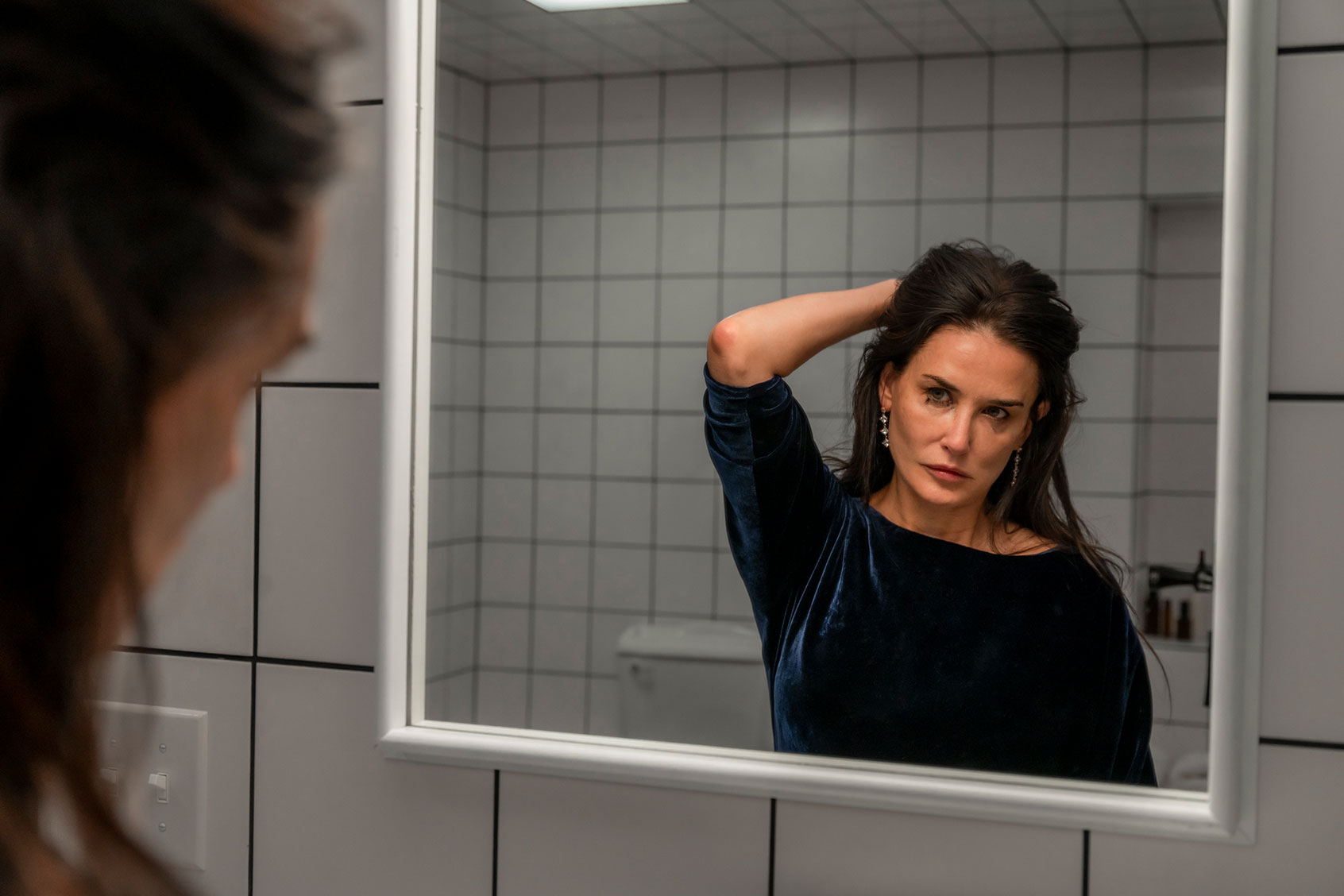
If the rest of “Maria” could retain that grasp, it would be a closer contender for one of the best films of the year. While it’s certainly a compelling look at its subject, the movie suffers from the spoils of the same vanity Callas was plagued by. “Maria” is remarkably shot, shining with vivid yellows and greens against statuesque Parisian architecture, but it spends too much time bathing in its beauty. Flashbacks of Callas’ romances—most notably with the insistent Aristotle Onassis (Haluk Bilginger)—creep over the film like a slow, champagne-soaked, jazzy haze. What initially seems like seduction begins to feel like sedation, and the movie nearly loses itself in its drowsy rhythm. 

That is until Maria opens her mouth to sing, and that marvelous, unmistakable voice fills the room once more. While Jolie studied opera for seven months to prepare for the role, her vocals are mixed into Callas’ recordings, though that doesn’t make these sequences any less impressive as Jolie radiantly recreates the stoic force that made Callas a legend. This level of singing, which requires such precision and technicality, is so undeniable that it reminds us of why opera is such a treasured, traditional art: You don’t have to understand it to appreciate it. An opera doesn’t require an intricate plot or dazzling tricks, only that its stars enthrall their audience with their breathtaking talent in the moments that count. The same goes for “Maria,” where a comprehensive narrative would only distract from Jolie’s sensational performance. The film may lull periodically, but all else fades away when the prima donna takes center stage for her aria.

"Maria" streams Dec. 11 on Netflix.

“Sicily, My Sweet”: Victoria Granof discusses the importance of taking risks and her new cookbook

“Oh, my God. Don’t tell me you just arrived three weeks ago and you’re exploring now. I have to tell you where to go,” Victoria Granof tells me less than five minutes into our first conversation over the phone. 

We’re talking about restaurants I must visit in Gowanus — the neighborhood I currently reside in after moving from Washington, D.C. to New York City —and the nearby Red Hook, Granof’s neighborhood. There’s Claro, an Oaxacan restaurant that makes everything by hand, including the masa, cheese, chorizo and moles. There’s Hoek, a pizza joint in Granof’s neck of the woods that serves up Roman-style, wood-fired pies alongside a view of the Statue of Liberty. And there’s ACQ BREAD CO. (short for anti-conquest bread Co.), a small-yet-outspoken bakery that operates out of a townhouse in Carroll Gardens.

If there’s anything that I took away from our conversation, it’s that Granof really knows food. For her, food isn’t merely an entity of sustenance — it’s an art form. Granof attended culinary school and trained as a pastry chef before she fell in love with her current professions as a food stylist, recipe developer and visual director. As for how she got into the food media industry, Granof says, “It’s a fun story.”

Granof has since worked with various big-name publications like Food & Wine, Vogue and InStyle. Her clientele includes DoorDash, Häagen-Dazs, Perrier, Smirnoff and Nespresso, just to name a few.

Granof’s latest project is a cookbook, titled “Sicily, My Sweet: Love Notes to an Island, with Recipes for Cakes, Cookies, Puddings, and Preserves.” It includes recipes for meyer lemon and bay leaf gelato, jasmine-scented almond milk mousse and fruit pudding made from white melon and orange blossom. Each recipe is accompanied by beautiful food photography — which highlights Granof’s craft — personal anecdotes and in-depth write-ups.

In anticipation of the book’s October release, I spoke with Granof about her personal relationship with baking, her favorite childhood dessert and her fondest memory of working with one of the greatest photographers of the 20th century, Irving Penn.

This interview has been lightly edited for length and clarity. 

Tell me a little bit about “Sicily, My Sweet.” What was the inspiration behind the book? 

It’s actually my second book on Sicilian sweets. My first one was [published] about 20 years ago and it came out the day before September 11. I went on a book tour and everybody wanted to know where I was when the towers fell, so that kind of got lost. At that point, I was just starting my career in New York. I moved from LA and I hadn't done anything here. It was just a fluke that I got that book deal at all. I hadn't done enough styling. I hadn't gotten enough experience in the world and in food and in New York and anything like that. 

It wasn't really the book that I wanted to do. The substance was there, but visually it was awful. Since then, I've always wanted to go back and do it the way I knew it should have been done, and that is what “Sicily, My Sweet” is. I was really fortunate to get Hardie Grant, a great publisher who has supported the vision and visuals for this book. They let me make it as crazy looking as I wanted to.

The cover for this book is incredibly stunning — I know they say don’t judge a book by its cover, but this book’s cover grabbed my attention! What was the creative direction behind the cover?

I would say it's a very strong cover. And it's very in your face and bold and beautiful — it’s just unabashedly beautiful. It's not shy and neither is Sicily, you know. I wanted the book to look different as well as feel different and really portray Sicily as distinct from other parts of Italy. What inspired me to do this was as much kind of a visual exploration and a visual statement for myself as it was just exploring Sicily and pastries and desserts. 

I feel like cookbooks — I’m going off on a bit of a tangent, but maybe not — used to be the solution to problems. I think — and this is very subjective because I’m in food media — that food books and cookbooks can become art books. The culinary arts have become an actual art form that people can appreciate passively. You can read cookbooks just for the beauty of them and the information and not for cooking a recipe. I think the culinary arts are reaching that point, where you can watch the Food Network and not ever want to cook anything in the same way that you can buy a cookbook and not want to bake anything. It was in that spirit that I created this.

What’s so fun about this book is that in addition to the beautiful visuals, each recipe is accompanied by a brief story or a little history lesson. How did you find that balance between storytelling and recipe development?

I laugh and I say that Sicily is kind of pre-art-directed and so are all the pastries. That's fundamentally what really appealed to me about specifically doing books on pastries. There is so much history just built into every pastry and why it’s there, in Sicily specifically, and it’s so caught up in the history and the different civilizations that have been there. There’s a political and social reason for almost every pastry there. And so it’s built into it. There's no recipe for something without a reason for it being there.

Why focus on Sicily specifically?

It's a personal thing. Here's a bit of a history lesson: My family was originally from Sicily, and we're talking before the Spanish Inquisition of 1492. Sicily, at the time, was part of the Spanish Empire. The Alhambra Decree ordered the expulsion of Jews from Spain and all of its territories and possessions, including Sicily. My family was one of those families. They fled to the Ottoman Empire — Turkey and Greece…that’s where they settled.

I grew up with food, language and cultures that I thought might be Turkish. So, I went to Turkey because I was interested in my roots. But when I arrived and explored the country, I went, “Oh, wait, this isn't it.” I mean, it's nice here, but this isn't what I was looking for. And it puzzled me. 

Then, purely by chance, I was working as a pastry chef and had read about this pastry chef in Sicily, this older woman who was lamenting the fact that it was a dying art because none of the younger people wanted to learn how to make pastries. I thought, “Oh, I want to go do that!” I literally just went on a whim and found her. And I realized that she was Sicilian and had the key to all the things that I have remembered culturally. 


Want more great food writing and recipes? Subscribe to Salon Food's newsletter, The Bite.


Take me through your culinary journey. What has your career in food been like? And how did you find your way into food styling?

It's a fun story! My mom, who worked as a lawyer, was very active in the women's movement. And so when I said I wanted to become a chef, she was appalled. At the time — this is in the early 90s — cooking in a kitchen was still menial labor. It wasn’t the art form that it's become or the expression it’s become. It was a struggle. Instead of doing that, I went to art school, which somehow was more respectable, and studied visual arts. I then worked as a designer with architects and in my spare time, I would bake for restaurants. In the middle of the night, I would bake and sell them to these places. And I realized I really, really loved it. So, I lied my way into my first job. And then from there, I trained as a pastry chef and then I went to culinary school.

At one point, I was working in a restaurant and one of the investors was a photographer, a food photographer. They fixed me up with him and I met him at his studio once. He was shooting a cookbook and there was this woman there who was cooking and arranging the food for the camera. I wondered, “Who is she?” and later, was told she was a food stylist. He gave me the names of stylists to assist and then, I assisted one. 

I was working with Bon Appétit magazine, which was still in Los Angeles at the time. They said they would send me to New York to shoot covers with the photographers because, I guess, they saw something special in me. And then one day, I just decided, “I think this is where I need to be.” So, that’s how I got into food styling! I also worked collaboratively, I should say, with the photographer, Irving Penn. Together we did the food photographs for Vogue for 10 years.

Was there a specific photo shoot or encounter with Irving Penn that was incredibly memorable?

Oh, my God, so many of them! Well actually, my very first job with him: It’s an image of my hand wearing a latex glove, holding an enormous lobster claw, and my other hand has a little antique hammer smacking it against the claw to break it. That was the very first time I ever worked with him. He didn’t even call me by name. But it was also the first time I spoke out for myself. Maybe it was a naïveté of youth? I don’t know, but it didn’t occur to me to just keep my mouth shut. During the shoot, Penn said he didn’t have anyone to hold the lobster. And I said, “Oh, I can hold it.” My hands in one of his pictures, you know, it’s just one of those things!

I also got to make those creative decisions. And he approved them. I was the one who got to source that 47-year-old lobster in the photograph. I also rented some antique hammers from a prop house. It was just the first time where I was making creative decisions. I was speaking out for myself. I was working with a master. I felt really good about that moment. Like, “Oh, I can really do this.”

Is there a favorite dish (or even dessert) you enjoyed eating growing up?

My grandmother used to make these little, savory turnovers with meat inside and chopped-up hard-boiled eggs. And there’s one thing my mom did make that I really liked. She used to call it her “frustration meal.” It would be — it’s crazy — spaghetti with butter, parmesan and cottage cheese. It's actually really good.

What do you hope readers will take away from “Sicily, My Sweet”?

I'm deeply involved in the theory of chromophobia right now, which is fear of color. My belief, shared by a couple of people who are beginning to write about it, is that color is being drained out of elitist Western society and lack of color has become kind of an unspoken identifier for an elite, white community. The chicest thing is, you know, a black dress or a white sofa or a silver car. And when that segment of the population starts talking about color, it’s really kind of a veiled reference to something foreign. It means “not like us,” and that’s become this unspoken subliminal message that is very disturbing to me.

I do hope that color in this book loses its power as that kind of a signifier and instead, is an empowering statement. I also hope readers realize that Sicily is different from other parts of Italy for really important reasons. A lot of it has to do with it having been conquered by all these different civilizations that left their mark on the food and the pastries. And I hope readers [are encouraged] to explore it a little more. But don’t travel there in droves and ruin it! Just appreciate it passively.

Helene ravages 5 states, leaves at least 50 dead and millions without power

Helene made landfall Thursday night in Florida’s Big Bend region as a record-breaking Category 4 hurricane. It hit the state with 140 mph winds and ultimately blew through five states, flattening communities and bringing life-threatening floods. Now, on Saturday morning, at least 50 deaths have been reported as a result of the storm, while NBC News reports nearly “3.3 million customers woke up without power in South Carolina, North Carolina, Georgia, Florida and Ohio.” 

Meanwhile, more than 400 roads remain closed in Western North Carolina. 

On Saturday morning, President Joe Biden approved an emergency declaration for Tennessee, among other states, after the remnants of Hurricane Helene are expected to stall over the region this weekend, bringing an additional 1 to 2 inches of rain on top of already-catastrophic flooding that has left swaths of the Southern United States underwater. “Although rainfall amounts will be light, areas that received excessive rainfall from Helene may see isolated aggression of excessive runoff,” the National Weather Service office in Greenville-Spartanburg said Saturday morning.

This comes after about 100,000 residents were already urged to seek higher ground overnight as the Nolichucky Dam in Greene County — which is on the North Carolina border — was on the brink of “imminent breach,” according to USA Today

Per CNN, National Guardsmen have already begun rescue efforts across Florida, North Carolina, Georgia and Alabama, while the Biden administration has also mobilized more than 1,500 federal personnel to support communities affected by Helene. 

N.C. gubernatorial candidate Mark Robinson hospitalized with second-degree burns

North Carolina Lt. Gov. Mark Robinson was hospitalized on Friday night “following an incident at a campaign event” at the Mayberry Truck Show and Parade in Mount Airy, according to Mike Lonergan, the communications director for Robinson’s gubernatorial campaign. 

As first reported by NewsNation and later verified by CNN, Robinson — who is North Carolina’s Republican nominee for governor — was treated for second-degree burns at Northern Regional Hospital. Law enforcement told CNN the burns “stemmed from an accident” at the automotive show and “no foul play was involved.” His appearance at the Mayberry Truck Show and Parade was one of several events Robinson attended on Friday. 

According to Robinson’s team, the candidate is in good condition and good spirits. 

Robinson has chosen to continue his campaign amid the fallout of a bombastic CNN report that revealed the lieutenant governor identified himself as a "Black Nazi" in a series of lewd posts he made on a pornographic website, where he also defended slavery. 

Throughout his campaign, former president Donald Trump has supported Robinson, whom he once described as “Martin Luther King on steroids,” and has yet to withdraw his endorsement of the candidate. However, as multiple outlets reported, Trump did not mention Robinson during a recent campaign stop in North Carolina. 


Who created the “constitutional sheriff” myth? Hint: It’s not in the Constitution

Four years ago, George Floyd’s murder and the resulting months of demonstrations brought unprecedented scrutiny to the deeply problematic practices of American policing. Yet one key figure — the county sheriff — barely got any attention, while the focus was on large urban police departments. Since then, sheriffs have since become significant figures on the populist right, epitomized in the mythical notion of the "constitutional sheriff," which sails right past the fact that the word “sheriff” appears nowhere in the U.S. Constitution. 

In an effort to restore a certain balance, two quite different books on the historic and present-tense role of sheriffs have been published in the same month. The first, "The Power of the Badge: Sheriffs and Inequality in the United States," by Emily M. Farris and Mirya R. Holman (author interview here), is a rigorously synthetic work of political science that contains some telling specific details, but whose core strength lies in tying them together.  

The second of these books, "The Highest Law in the Land: How the Unchecked Power of Sheriffs Threatens Democracy" by journalist and attorney Jessica Pishko, is primarily a book of reportage centered on Pishko's own work and others', with a significant historical look-back. It’s largely focused on how the right's constitutional-sheriff myth has served to intensify threats to democracy in the 21st century, even as sheriffs claim to be veritable beacons of democracy. This book's core strength lies in curating the specific details to reveal deeper, broader connections, and showing more than telling. 

Pishko begins her book with a small meeting in a church 90 minutes north of Phoenix, and notes, “Part of understanding the appeal of the county sheriff and the far-right movement the office inspires requires understanding these parts of the country, places where the U.S. Constitution remains revered, but the people making the laws feel far away.”

As that passage shows, Pishko has the capacity and willingness to understand why the constitutional sheriff movement is so appealing to some, but she’s also razor-sharp in sorting through its contradictions. To bring those contradictions sharply into focus, I recently interviewed Pishko and largely focused on two key figures: Richard Mack, founder of the Constitutional Sheriffs and Peace Officers Association and primary architect of the myth, and Mark Lamb, an Arizona sheriff who has successfully managed to bring Mack’s radical ideas much closer to the mainstream. Pishko also looks back to early influences like Cleon Skousen and forward to the involvement of the Claremont Institute's hard-right intellectuals, explores how different strands of right-wing ideology became intertwined with sheriff mythology and examines potential paths forward.

This interview has been edited for clarity and length.

The subtitle of your book suggests that sheriffs pose a threat to democracy, but that's primarily about how their power has been mobilized over the last 30 to 40 years, most notably through the "constitutional sheriff" movement. I'd like to begin by asking you about two key figures in this story, Richard Mack and Mark Lamb, both who they are and who they imagine themselves to be. First there's Mack, who you say "has his own imaginary history," with a made-up tale about Rosa Parks. 

In his telling, Rosa Parks gets on the bus and she's very tired. The bus is full and she sits in the whites-only section of the bus, and the bus driver calls the police and says, "You need to move this woman from the bus." In Mack's telling, which is very emotional with a lot of pathos, like he's going to cry, the imaginary sheriff comes and asks Rosa Parks if he can escort her home. He escorts Rosa Parks home and gets her something to eat. Sometimes they stop for a burger. So instead of throwing her off the bus, this imaginary sheriff takes her under his wing, buys her a hamburger, tells her how much he wants to help her and her family, and then escorts her home. 

That's his imaginary version of what the good sheriff would have done. He would not have arrested Rosa Parks for sitting on the bus, but rather would have shown her a great deal of care and concern. 

How does that story contrast with real history?

In the real story, Rosa Parks intentionally wanted to start the bus boycott, for Black residents to boycott the buses. She did not need saving. In the real version, Rosa Parks is a powerful figure in the civil rights movement. She decided to make this move in order to make a point and start a bus boycott.

So what this shows about Richard Mack is that, in his eyes, one of the appeals of the constitutional sheriff movement is that they represent a sort of gentility that doesn't exist in policing anymore. The idea that the sheriff is a gentle helper of damsels in distress, rather than some sort of code enforcer. That's what Richard Mack wants to see sheriffs as — community helpers, not running in with guns a-blazing or SWAT teams, but rather this chivalrous vision. That's one of the things that struck me about it, this very old-timey chivalrous idea. 

"In Richard Mack's telling, which is very emotional, the imaginary sheriff comes and asks Rosa Parks if he can escort her home. He escorts Rosa Parks home and gets her something to eat. Sometimes they stop for a burger."

What he wants to convey is that the sheriff is there to help community members who are in distress, particularly when they feel that their civil rights are being violated. What's interesting about this is that Richard Mack, in his monologues, will go on to talk about Rosa Parks the tax protester, Rosa Parks the gun owner. He compares Amish people who don't want the FDA to regulate some of their medical products, people who want to own machine guns — he presents them as like Rosa Parks because they are people for whom big government or the deep state is infringing upon their civil rights, and the sheriff is there, this chivalrous figure who will come in and help them.

The other reason that's a gross warping of Rosa Parks and civil rights history in the United States is that the demand of civil rights protesters was not for less federal government, but indeed more federal government. The ask from civil rights protesters was not that government leave them alone, as Richard Mack would say, leave them alone, but rather that the federal government would enforce federal laws which require desegregation, which require due process and equal rights. So it's this interesting way of twisting the civil rights movement to better suit the constituents of the constitutional sheriffs and the sheriff themselves. 

And how does that high-minded wish-casting contrast with Richard Mack's actual history?

He came upon being a sheriff almost because he had tried many other things. He was born in Provo, Utah. He wanted to be an FBI agent but didn't pass the test. He says his father was an FBI agent, which is very common among Mormons. So he became a police officer in Provo. He says he did not like being a police officer in Provo, because he did not like writing tickets. He describes his job as being a meter maid. 

In his telling, he left the police around the time he went to a speech by Cleon Skousen, an anti-communist far-right figure who thought that local law enforcement should be doing more to root out communism. Mack was inspired to move to rural Arizona and run for sheriff, which he did, and he won. He served about two terms there. The area where he was sheriff did not have a lot of crimes, so there was not necessarily a lot for him to do. During his second term, he was recruited by the NRA to join a lawsuit against the United States over the Brady bill, and this is where he began his claim to fame.

We need your help to stay independent

After this lawsuit, which was actually named after Jay Printz, a Montana sheriff, not Richard Mack, he went on the road to kind of make his name. But what actually happened was that because of this lawsuit, the residents of his county voted him out. They didn't want him anymore. Then he ran for sheriff in Utah and didn't win, ran for the Senate and didn't win, ran for the House of Representatives in Texas, didn't win. He lost a bunch of elections. He ran a fake reality-show campaign for president, it was on Showtime. So he cycled around, basically not winning any elections, and over time met up with other people on the far right, people like Stuart Rhodes, who founded the Oath Keepers, the people who founded the Three Percenters.

He eventually found like-minded people he could go on the road with and talk about this idea of the "constitutional sheriff," which he seems to have developed over time. This was the idea that local county sheriffs would serve as an important figure on the far right, to protect, as he says, individuals from the federal government.

Mack may have talked about this imaginary connection with Rosa Parks, but you argue that it was the right-wing reaction to the first Black president that gave him real-world support.

It was certainly the election of Barack Obama that helped Mack consolidate his theory about the constitutional sheriff. It also inspired people like Stuart Rhodes, who worked on Ron Paul's campaign for president. Mack was also a supporter of Ron Paul, so they also met in the midst of this sort of libertarian Tea Party movement.  

"The residents of his county voted [Mack] out. Then he ran for sheriff in Utah and didn't win, ran for the Senate and didn't win, ran for the House of Representatives, didn't win. He cycled around, basically not winning any elections, and over time met up with other people on the far right."

This thing about the Rosa Parks story is that he uses it as a way to deflect [charges of] racism. One of the people that Mack has defended was Randy Weaver, a central figure in the 1992 Ruby Ridge standoff, whose wife and infant son were killed by federal agents. There's this moment, right after Obama was elected, where Richard Mack is giving an interview and asks the interviewer to talk to Randy Weaver. He says that Randy Weaver is not a racist and like Rosa Parks, he wanted to be left alone. He puts the reporter on the phone with Randy Weaver, who starts yelling about Barack Obama and says, "Well, I certainly am a white supremacist!" Richard Mack quickly takes the phone back, and is like, "No, no, no, Randy Weaver is not a white supremacist." So you can understand how "Randy Weaver is like Rosa Parks" is very appealing to more people, while Randy Weaver the white supremacist is not so appealing.

Mack is a key figure in getting this movement started, but Mark Lamb plays a more central role. How did he get involved and how has he shaped it over time?

Mark Lamb was elected [as sheriff of Pinal County, Arizona] in 2016. He did not have a lot of law enforcement experience. He ran a pretty bare-bones campaign. He was running on very core conservative issues. He ran on gun rights, he ran on an anti-abortion platform. He did not run on many law enforcement issues. The prior sheriff was well known for being very anti-immigrant. He tried to run for Senate, had to drop out because of a scandal. So Lamb was elected as an individual people knew very little about. But once he came into office and Trump was elected, he realized that he could align himself with Trump and the MAGA movement, and began to pursue what I think was probably his real goal, which was a career in reality television. 

He did a variety of reality-based shows in his county, and over time he adopted a new persona. He got a hat, he stopped wearing a uniform, he started wearing a big belt buckle and button-down shirts and a flack vest. Over time, people in the GOP in Arizona realized that he would be a very useful avatar. So in 2020, Lamb got picked up to start an organization called Protect American Now, which does not seem to exist anymore. Once Lamb started running for Senate [a campaign he lost], they lost steam. I think what Lamb wanted to do was re-create something like the constitutional sheriff movement, but make it more politically relevant and also attach it much more to modern media.

"Mark Lamb realized that he could align himself with the MAGA movement, and began to pursue his real goal, which was a career in reality television. He adopted a new persona: He stopped wearing a uniform, he started wearing a big belt buckle and button-down shirts and a flak vest."

Richard Mack is from a different generation of the far right, and is not the most modern person. He's not actually the biggest fan of Donald Trump, he's not attuned to the MAGA movement. Social media is not his scene.  So I think Lamb wanted to be a flashier version. Also, the department Lamb runs is much larger, maybe the third or fourth largest in Arizona. He's really bringing more cachet to this movement, because he is in a purple state, contested territory, close to the issues of immigration and guns. So he really just adopted that and used it as a springboard to run for Senate. He lost. I think his next move — he seems to be placing himself to let go into media or TV. It might depend on who wins the presidency. 

Beyond these major figures, you dive into a confluence of different issues, including the COVID pandemic as well as guns and immigration. These are all issues where sheriffs have found themselves increasingly playing a central role. So what stands out as the through-line of these different stories? 

Honestly, you can trace the through-line as something like far-right populism. Sheriffs are populist — they're elected on the local level. They're much more conservative than other elected officials on the county level. The other thing is that sheriffs are tied to counties and land, not tied to cities. If you have 200 people or 2 million people [in a county], you still have an elected sheriff. That means a sheriff may or may not represent a lot of people, but they can still get noticed at the state level and even on the federal level.

As I argue in the book, they also serve as avatars of the far right. Because they are elected, they're permitted to speak on political issues. Initially, sheriffs, like all law enforcement, did not support the civilian ownership of firearms. But over time the NRA and Gun Owners of America — which Mack was also part of — discovered that sheriffs were useful for the civilian gun ownership movement, because sheriffs are sort of the populist link between the people and the government. At this point, the vast majority of sheriffs support something like an unlimited Second Amendment. If you look at court filings by various sheriffs groups, they are consistently arguing that civilians should have more access to firearms, not less.  

That may strike you as an unusual position for sheriff associations to take, but this is a specific legal movement which argues that the position of sheriffs is that it's undemocratic to restrict access to firearms. So they're promoting this populist idea that individuals should have access to whatever firearms they want, because it is undemocratic to do otherwise, and that sheriffs, as democratically elected officials, are the ones looking out for the people. 

I think we saw something similar in terms of COVID, when sheriffs suddenly were out there in the forefront when business closures and mask mandates happened. Honestly, from what I saw on the ground, some sheriffs were not sure how to respond. This was a position they had not been in before. But groups like the CSPOA and other right-wing groups, militia-style groups, went to sheriffs and said, "We don't think you can enforce these," and sheriffs were pretty eager to say, "Yeah, you're right, we can't enforce these." Richard Mack went around telling sheriffs they ought not to enforce church closures and mask mandates, so sheriffs suddenly found themselves right-wing heroes for allowing churches to stay open, for not arresting people for not wearing masks.


Want a daily wrap-up of all the news and commentary Salon has to offer? Subscribe to our morning newsletter, Crash Course.


We see the same thing with voter fraud. Sheriffs are not normally involved in voting or election investigations, but as this became a popular far-right issue, sheriffs became recruited into the fray. The same with immigration. Of course Donald Trump is very anti-immigrant, so they were easily recruited. There were a lot of anti-immigrant groups who have been working to recruit sheriffs for a long time, so there was an underlying structure that was already primed. 

You also write about some of the most egregious violations committed by sheriffs and the various attempts at reform. What are the prospects for real reform, beyond the piecemeal one-sheriff-at-a-time approach, which has mixed results at best? 

I want to say first that for a long time it has been very important to many groups of people — particularly Black and brown communities — to elect sheriffs that more closely match their views. The backlash to electing Black sheriffs in particular has always been very intense, and we still see that today. North Carolina, a few years ago, elected a handful of Black sheriffs who were Democrats. Today we see the North Carolina Sheriff Association making rules that would require sheriffs to cooperate with ICE. As soon as a sheriff is elected who's not white and conservative, sheriffs mobilize to make sure that they can't be progressive. 

During the pandemic, "Richard Mack went around telling sheriffs they ought not to enforce church closures and mask mandates, so sheriffs suddenly found themselves right-wing heroes for allowing churches to stay open."

People say the easiest way to change sheriffs is through elections, but the problem is, first, it's very difficult to elect new sheriffs. Sheriffs have so much power in hiring and firing that it's easy for them to fire opponents. Sheriffs are plugged into local power structures, they understand who's in power and who's not, so they quickly understand who's going to get them votes and who's not. Because a sheriff's mandate is so large — they control wide swathes of things, they not only handle evictions, they run jails, sometimes they sell off seized assets like cars or firearms. So sheriffs get large donations from groups that have interests in everything the sheriff does. Sheriffs in many places can dispense a large number of contracts—everything from medical care in the jail to technology to who does the linens to the architecture firm, to the gun range they use. So all these groups have a vested interest in who the sheriff is. 

Some states are trying to regulate sheriffs to some degree. I spoke with people in Washington state who have who have a number of constitutional sheriffs and have tried very hard to implement state structures. The challenge there is that on the state level, sheriff associations are extremely powerful. They do a lot of lobbying and because they are law enforcement agencies, lawmakers are inclined to believe what they say. 

So I think it's really hard. But we see that in all areas of criminal justice reform right now. We see that some reforms, like body cams, aren't working very well. In my opinion, because the sheriff's power is so large and diffuse, one way to think about defunding or reducing the power perspective would be to start to remove responsibilities from the sheriff, to take away some of these projects the sheriffs do, which are ways that they continue to get power and influence and money. 

There's so much more to your book that we didn't get into, so my last question is wide open: What's the most important question I didn't ask, and what's the answer? 

I think the most important question is, "Why does it matter whether sheriffs are right-wing or not?" I think it's a fair question. While a lot of people probably aren't attuned to who their sheriff is, we know that sheriffs can do a lot, because they are legitimate law enforcement. They can execute search warrants, they can send SWAT teams to people's houses. They can evict people with SWAT teams if they feel like it. If you are in a county where the sheriff doesn't feel like enforcing red-flag laws and you ask the sheriff to do it, he won't do it. You have little to no recourse, because under United States law, law enforcement officers — all of them — have no obligation to keep people safe. There's no affirmative obligation. So if sheriffs choose to selectively apply this, as many do, there is no tenet of law that can require them to do so. 

This is a big failing in terms of United States policing, but it matters a great deal for people on the ground. I point to jails in particular because they are very dangerous. People die. I think it really shows the lie at the root of this "sheriff for the people" movement. If constitutional sheriffs or right-wing sheriffs really were for the people, and their goal was to protect the everyday citizen, then why are they allowing people to die in their jails? Why are pregnant women giving birth on the floor of jail cells? Why are people killing themselves? I say, well, if you are for the people, then why are you not for the most vulnerable people who are in your custody and care right now?   

How the hard work of wooing “Uncommitted” voters could make history

A small band of activists was ready when leaders of the “Uncommitted movement” in Wisconsin and Michigan issued a statement last week urging their followers to cast their ballots against Donald Trump. It was a step in the right direction, even if it stopped short of an outright endorsement of Vice President Kamala Harris. On Monday, the band of activists released a video ad aimed at those same “Uncommitted” voters. The ad was designed to complete the logic of their leaders’ announcement, making explicit to those voters how important it is to cast their ballots for Harris.  

The video’s narrative is simple. A diverse group of adults young and old are out for a pizza dinner on election night. The festive mood is interrupted by a breaking news alert on TV: “It’s now looking likely that Trump has beaten Harris for the White House.” 

The newscaster then recounts a few likely scenarios for  Inauguration Day — Trump saying he’ll be a dictator on Day One, terminating the Constitution, using the Justice Department to prosecute his enemies or Navy Seal Team Six to assassinate them. Woeful, a young woman at the table reacts: “I should have voted.”

Could a few activists producing a video affect an entire election by inspiring so-called uncommitteds to rethink their hesitation to vote atop the ticket? Yes, Virginia, politically engaged individuals working together to get other people to vote might just change history.

Here’s the background. The “Uncommitted movement” organized this spring in Michigan and Wisconsin to persuade college students, progressives and Arab Americans to vote “uncommitted” in those states’ Democratic primaries, rather than for Joe Biden. They did so to protest Netanyahu’s bombing of schools, hospitals and homes in Gaza, and the Biden administration supplying the bombs to do it.

As the Washington Post reported last month:

In Michigan, home to the nation’s largest Arab American communities, 13.3 percent of Democratic primary voters selected “uncommitted.” In Wisconsin, where Biden won in 2020 by roughly 20,000 votes, more than double that number signaled the same status. And in Pennsylvania, where the margin is expected to be just as razor-thin, about 60,000 people wrote in some version of not-Biden. All three states carry outsize importance in determining November’s winner.

Earlier this year Eva Paterson, a lifelong civil rights activist, watched the “Uncommitted” movement form and grow. With unerring foresight, she committed to producing a video for the general election aimed at these voters in key battleground states. Paterson built her “little engine that could,” a team of fellow activists that formed a tiny PAC they named Bardo — the Buddhist term for the transitional space between death and rebirth. On a shoestring budget of $150,000, Bardo did polling to test issues that most affected undecided voters, hired a scriptwriter, a production company and an animator, who collaborated with a playwright, civil rights attorneys, law professors and a young voter of color from a swing state to create the ad they called “Election Night.” They were delighted to see last week’s important announcement in which @uncommittedmvmt did three things: 

  1. Urged a vote against Trump whom they said “would accelerate the killing in Gaza.” 
  2. Recommended against voting for third-party candidates like Jill Stein, a stalking horse for Republicans.
  3. And avoided recommending against voting for Harris, even though they declined to endorse her.

They wanted the vice president to separate herself from Biden’s policy, but they simultaneously recognized that urging people not to vote for Harris could well elect Trump. They recognize that as president, he will only create more chaos, death and destruction.

We need your help to stay independent

Enter the Bardo video with its message that squares the circle: Those who want a ceasefire and peace that preserves Gaza have but one practical choice — to vote for Harris. Not voting won’t do. Trump, by contrast, has told Netanyahu to “finish the job.”

The digital campaign is timed to reach these “Uncommitteds,” and other “undecided” younger voters, as early voting starts in Michigan, Wisconsin and Pennsylvania. The same audience will receive the video in Arizona, Nevada, North Carolina and Georgia. According to its developers, in the first three days after its release, the video reached 750,000 users on their mobile devices, tablets and connected TVs across thousands of websites, apps and streaming services, where young people get their news. 

The cumulative result of all these efforts can be far greater than the sum of its parts: A Kamala Harris presidency offers the only hope for lasting peace, a two-state solution and the preservation of our own rights, including the right to vote, to speak freely and to make private family decisions without the government’s intrusion. Like the Bardo activists, may all of us who care do something, small or large, to advance the rebirth of American freedom.

Even Republicans alarmed by new Georgia election rules — but experts worry “nothing will be done”

Even Republicans are ringing alarm bells about the last-minute changes Georgia’s State Election Board is making to election procedures in the state. Despite a multiple challenges to the new rules — which could sow chaos in the election — many are doubtful that any action will be taken to clarify the state’s rules before Election Day.

Earlier this week, a group of Republican and independent attorneys and interested parties penned a letter to Governor Brian Kemp, Attorney General Christopher Carr and Secretary of State Brad Raffensperger expressing concern about the recent rulemaking of Georgia’s State Elections Board.

The board is an unelected five-member body charged with ensuring “the fair, legal, and orderly” administration of elections across Georgia as well as keeping uniform electoral procedures across the state’s 159 counties. This year, however, a three-member pro-Trump majority consisting of Rick Jeffares, Janice Johnston and Janelle King, passed a spate of new election rules that even has Republicans concerned.

The two rules that have raised the most eyebrows are the “reasonable inquiry” rule, passed in August, and a hand-count rule passed last week. The first rule allows county election officials to conduct a “reasonable inquiry” — an undefined term — before certifying the results of an election. This rule appears to defy state law, which says county officials “shall” certify the vote.

The second rule requires three separate election workers to hand count the total number of paper ballots in each of Georgia’s 2,400 precincts, which counted some 5 million votes in 2020. They also require the poll workers to sort the ballots into stacks of 50 for the purposes of the hand count.

In the eyes of the 16 signatories of the letter, the hand-count rule “risks delaying certification, which could prevent Georgia from certifying election returns by December 11, 2024.” In an earlier letter, the group of conservatives concluded that “No reasonable observer could conclude that these three people are upholding that duty, according to the complaints,” noting that former President Donald Trump himself had praised the board at a rally where Johnston was in a front row seat and stood up to receive applause from both the crowd and Trump.

Richard Painter, a former Republican White House ethics lawyer who now teaches law at the University of Minnesota, told Salon that he sees these rules as “artificial delays” put in place so that Trump and his surrogates can spread their own theories about what he characterized as “mythical fraud” and cast doubt on the results of the election in the event of a Trump loss, adding that “if you see a story on Fox News about fraud, suddenly you can hold up the results.”

“We have not ever overturned an election in a court because of real fraud or real deprivation of voting rights,” Painter said.  “It would be incredibly ironic [to overturn an election based on unsubstantiated claims of fraud] when we had literally a century when voters who were supposed to be allowed to vote couldn’t vote.”

Painter said, however, that he suspected any action from state officials in Georgia such as Kemp, Raffensperger or Carr would be more likely after the election, rather than before.

“Regardless of what the intention is, the effect is that it will create chaos."

The problem with taking action after the election, in the opinion of Natalie Crawford, a former Republican county commissioner and the executive director of Georgia First, is that these rules pave the way for inconsistent election procedures across the state.

“Regardless of what the intention is, the effect is that it will create chaos,” Crawford said. “The State Elections Board has passed rules that are vague and undefined and, regardless of what the intention is, it sets up the system for chaos. They’re not providing in these rules any strict guidance to require that these processes are done uniformly across all 159 counties.”

In Crawford’s opinion, the State Elections Board is attempting “to legislate by rulemaking.” She pointed to a rule they passed requiring the video surveillance of locations with a ballot drop-box after the polls close. The Georgia General Assembly recently considered this policy and decided against implementing it. The State Elections Board, however, decided to pass the rule itself.

“The law is very clear, they cannot create rules that are more restrictive or expansive than what is state law. Their role is to ensure compliance with election law,” Crawford said.

Crawford’s group, Georgia First, which is focused on election access and security, has signaled that it plans to file amicus briefs in two pending court cases against the State Election Board, one filed by a Republican group and the other by Democratic groups. Both are challenging the new State Elections Board rules.

A representative from the governor’s office said in response to a question about the recent State Election Board rules that the governor’s office has no authority to remove members of the board until there have been formal charges filed against them. They added that Kemp does not have the authority to overrule the board under the current circumstances. The governor’s office was not able to give further comment for this article due to Hurricane Helene.

We need your help to stay independent

There are currently two court cases pending in Georgia concerning the recent rule changes. One, filed in Fulton County by a Republican-led group, Eternal Vigilance Action, is seeking to have the state courts prevent the board from enforcing the rules in question, arguing that they created rules without sufficient guidelines from the general assembly.

In a filing Thursday, the group amended its suit to address the hand-count requirement as well as the “reasonable inquiry” rule. The suit is set to be heard by Fulton County Superior Court Judge Thomas Cox on Oct. 4. The group is asking the court to either overturn the rules or put them on hold until after the election.

The second suit, filed by the National Democratic Committee and the Democratic Party of Georgia is set to be heard at a bench trial on Oct. 1. They are also seeking to have the rules thrown out.

The Georgia attorney general’s office previously issued a warning to the State Elections Board, indicating that they saw the then-proposed rules as “very likely exceed the Board’s statutory authority and in some instances appear to conflict with the statutes governing the conduct of elections.”

“The board risks passing rules that may easily be challenged and determined to be invalid,” Senior Assistant Attorney General Elizabeth Young wrote in the memo. “There are several proposed rules before the board that appear to either impermissibly conflict with or otherwise expand the scope of Georgia statutes.”


Want a daily wrap-up of all the news and commentary Salon has to offer? Subscribe to our morning newsletter, Crash Course.


Ty Cobb, a former White House lawyer to Trump and a signatory of the letter warning about the rules, told Salon that “I worry that nothing will be done,” despite the push to challenge these rules.

“These unlawful and unlawfully enacted rules really need to be clarified soon,” Cobb said, adding that there “will be real confusion and controversy on voting day if no action is taken.”

In Cobb’s opinion, Georgia officials were more likely to take action after the election than before, an opinion shared by Painter and Crawford. Painter indicated that he thought the detente between Kemp and Trump would last through Election Day, a reading of the situation shared by Stuart Gerson, an assistant attorney general who served under former President George H.W. Bush.

“I think challenges to the Georgia rule itself are very well placed, especially in light of the fact that the security and accuracy of voting machines has been affirmed time and time again,” Gerson said.

Gerson also believes that the federal judiciary is well equipped to handle the post-election blitz of litigation expected from the Trump camp, citing the 65 challenges brought by pro-Trump groups after the 2020 election. 

While there have been exceptions to the judiciary’s impartiality, like U.S. District Judge Aileen Cannon’s handling of the Trump documents case in Florida, Gerson said, “in the election law area, you have to say the judges have acted quite independently,” adding, “I hope that continues with the challenges we’re going to see.”

Rise of the “crypto voter”: The surprising group that could swing the election

The crypto world hit a major milestone earlier this year with the approval of Bitcoin and Ethereum ETFs, a clear sign that digital assets are gaining traction on Wall Street and Main Street alike. As traditional financial institutions come around, more Americans are eyeing cryptocurrencies as a serious investment option, signaling a shift in the financial landscape that could impact the presidential race.

“It has been clear throughout this election cycle in the United States that cryptocurrency is a bigger priority for both parties than it has been in the past, which is exciting to see from an industry growth perspective,” says Hany Rashwan, co-founder and CEO of 21Shares, one of the biggest issuers of the cryptocurrency exchange-traded products globally.

Vice President and Democratic nominee Kamala Harris made her first public comments on crypto earlier this month, telling donors in New York that her administration would "invest in America's future" by supporting digital assets and other technologies while ensuring consumer protections, according to Bloomberg. Harris’ remarks signal that Democrats, like Republicans, are beginning to embrace the crypto industry.

While both presidential campaigns are stepping up their efforts to win over crypto voters, there is still a long road ahead to craft comprehensive Web3 policy that would make the U.S. competitive in the world, according to industry analysts who are closely watching the race.

“We have seen Harris and Trump both trying to use crypto and befriend crypto. It looks like they want to tap into the community,” says Art Malkov, a New York-based advisor at Columbia University’s Lab to Market Blockchain accelerator and co-founder of the Web3Lab accelerator. Malkov noted that the crypto market has reached a critical mass of adoption and development that it can no longer be ignored by mainstream politicians.

“We got the election speeding up the process where now Harris cannot afford not embrace crypto because Trump is embracing it,” he says. 

This may prove to be a landmark year in the history of crypto development and mainstream adoption. In a House Financial Services Committee hearing on Sept. 24, Rep. Maxine Waters, the top Democrat on the committee, said she wants to "strike a grand bargain on stablecoins" before the end of the year, as reported by The Block. This follows two years of bipartisan negotiations on a bill to create a regulatory framework for stablecoins — which are typically pegged to another currency or reserve — and could signal  potential progress in crypto regulation as the year comes to a close.

Morningstar’s Bryan Armour says it has already been a “pivotal year” for crypto adoption by US investors. He notes IShares Bitcoin Trust became the fastest exchange-traded fund (ETF) to reach $10 billion in assets under management, and spot bitcoin ETFs already reached a total of $50 billion in net assets as of Sept. 10. 

“It's remarkable to think of an industry that is about 15 years old and now it's a part of one of our leading parties’ platforms,” says Patrick Kirby, policy counsel at Crypto Council for Innovation, noting that crypto has become a legitimate campaign issue for the first time in American presidential history. “It's important to remind ourselves, as an industry and for folks interested in this space, just how far we've come.” 

“Crypto swing states could emerge given the close nature of many of the races."

Together with traditional institutions that have warmed up to crypto this year, about 40% of American adults now own crypto, a jump from 30% in 2023, according to recent data compiled by Security.org. Bitcoin ETF approval has certainly been a big boost in confidence, with 21% of non-owners saying they’re more likely to invest in cryptocurrency now given the exchange-traded fund wrapper. 

In a major milestone for the crypto world, the Securities and Exchange Commission approved the launch of several Bitcoin ETFs in January, allowing shares in trusts holding Bitcoin to be traded on SEC-regulated exchanges.

Then in May, the SEC unexpectedly approved proposals for the first spot Ethereum ETFs. Spot Ethereum ETFs will directly hold Ether, the second-largest cryptocurrency after Bitcoin, allowing investors to own a share of the cryptocurrency through grantor trusts.

In addition to milestone crypto products getting approvals, lawmakers came together in May to pass the Financial Innovation and Technology for the 21st Century Act, which proposes a regulatory framework for digital assets in the United States. 

It’s an important milestone as the bill aims to provide clarity for the digital asset industry while mandating cooperation between regulatory agencies to avoid duplicate regulations. It assigns oversight responsibilities to the Commodity Futures Trading Commission (CFTC) for assets on decentralized blockchains and to the SEC for those on non-decentralized blockchains, with specific criteria for each category. 

Still, there is plenty of uncertainty about the next steps and the future of this bill. It’s not just the top of the ticket and federal regulation that will matter in the November election, the makeup of Congress and relevant committees will play a crucial role in shaping America’s crypto policy in months to come.

We need your help to stay independent

Increasingly, lawmakers are looking to address this growing interest and demand for crypto products at the state level as well. 

State legislatures have been actively engaging with digital asset regulation, as evidenced by the introduction of more than 165 bills this year in current legislative sessions, according to data compiled by Crypto Council for Innovation. These proposed laws cover a wide range of topics within the cryptocurrency and blockchain space, addressing issues such as stablecoin standards and cryptocurrency mining. 

Notably, about 70% of these bills have either successfully passed or remain under active consideration, indicating a strong momentum in state-level efforts to establish regulatory frameworks for digital assets.

State governments are actively shaping crypto policy through new laws and regulations, according to a report by Crypto Council for Innovation. 

“Crypto swing states could emerge given the close nature of many of the races,” Liz Mills of Crypto Council for Innovation wrote in a report. “Crypto voters want politicians to set clear rules for cryptocurrency, providing investors with choices and allowing the sector to continue to grow and create jobs.”

Trump going all-in on crypto

Republicans have been especially proactive in recognizing digital currencies markets as an important issue, as recent polling shows crypto becoming a significant issue for many voters. Among Republicans not initially planning to vote for former President Donald Trump, 13% said his support for crypto increased their likelihood of voting for him. Additionally, 38% of non-white Republican supporters reported feeling more excited to vote for Trump due to his pro-crypto stance.

Trump is aggressively courting crypto-friendly voters ahead of the 2024 election, releasing a new batch of NFT trading cards in August and promoting a cryptocurrency project run by his sons. 

This marks a significant reversal from his previous skepticism of cryptocurrencies, with Trump now dubbing himself the "crypto president." 

There are some questions about whether the new venture is more grift than digital innovation.

In a speech at a bitcoin conference in July, Trump pledged that, if elected, his administration would retain all bitcoin held by the U.S. government, as reported by Axios. This sentiment aligns with the "hodl" mentality popular among cryptocurrency enthusiasts. 

“For too long, our government has violated the cardinal rule that every bitcoiner knows by heart, never sell your bitcoin,” Trump said at the event.

Trump also promised to fire SEC Chair Gary Gensler on his first day in office, a statement that received enthusiastic applause from the audience.

In the absence of a comprehensive crypto policy plan, Trump’s agenda is a compilation of promises and crypto ventures that seem poised to benefit the Trump family. His latest DeFi project, World Liberty Financial, aims to promote U.S. dollar dominance through widespread adoption of dollar-pegged stablecoins in decentralized finance, according to CoinTelegraph

The venture has hinted at a partnership with Aave, which is a decentralized finance (DeFi) protocol that operates on the Ethereum blockchain. Trump’s latest project positions itself as a way to maintain America's financial leadership globally, though details remain scarce and the project has already been targeted by scammers and hackers.

Notably, there are some questions about whether the new venture is more grift than digital innovation. A white paper obtained by CoinDesk earlier this month showed World Liberty Financial's ownership structure relies on a "governance" token, with 70% allocated to insiders like Trump and his sons—a proportion described as "significantly higher-than-normal" for such ventures.

Still, crypto enthusiasts and advocates – from crypto billionaires, CEOs and the Winklevoss twins – are backing Trump and see his presidency as favorable to the industry’s continued development. Kraken co-founder and CEO Jesse Powell is one of the corporate leaders who has publicly supported Trump's crypto venture by donating $1 million in Ethereum to the former president, describing him as the "only pro-crypto major party candidate" in a post on X.


Want a daily wrap-up of all the news and commentary Salon has to offer? Subscribe to our morning newsletter, Crash Course.


Harris campaign catching up

According to Fortune's reporting, Coinbase CFO Alesia Haas confirmed that Future Forward, Kamala Harris's official super PAC, has onboarded with Coinbase Commerce to accept cryptocurrency donations. 

This move by Kamala Harris's super PAC to accept cryptocurrency donations via Coinbase Commerce marks a significant departure from the Biden administration's generally cautious stance on crypto, potentially signaling a shift in Democratic policy.

“She has not rolled out the details yet, but she has made overtures that she would like to drive crypto legislation,” Haas said, noting she was “cautiously optimistic.”  

While the Harris campaign published more of its policy priorities ahead of the presidential debate on Sept. 10, few details were disclosed when it comes to crypto policy. The Harris campaign declined to elaborate further.

Harris on Wednesday vowed to invest in the industry so that the United States would "remain dominant" in the blockchain space.

There are still plenty of market risks associated with cryptocurrencies, outside of regulatory clarity and framework. 

As the latest milestones have been encouraging to crypto advocates, the U.S. still has a lot of catching up to do compared to other advanced economies when it comes to formulating its digital asset policy.

“The US has a less mature regulatory framework in place for cryptocurrency than other countries, particularly those in Europe where there is greater clarity around crypto regulations and buy-in from politicians,” says Hany Rashwan, CEO of 21Shares, which has been operating in Europe for the last seven years.

Cryptocurrencies’ recent poor performance, volatility and a flat debut for spot ethereum ETFs are also stalling adoption, according to Morningstar’s Bryan Armour.

“Unfortunately, we're seeing the US lag behind: We saw the European Union, Singapore, Hong Kong, the U.K. put different regulatory frameworks in place,” says Kirby of Crypto Council for Innovation. “We're seeing momentum on the US side, but no comprehensive market structure bill has become law yet and there's still an opportunity to catch up."

The scariest moments in “The Substance” have nothing to do with blood and guts

When I walked into a local movie theater on New York’s Lower East Side to see “The Substance” last weekend, I did so in an uncharacteristic way, knowing hardly anything about the film before planting myself in a seat.

I knew vaguely that it was a science fiction psychological thriller starring Demi Moore and Margaret Qualley, and was pegged to the perennial relevance of the beauty industry (and society more broadly) selling women products designed to make them both acknowledge and feel bad about their age. What I did not know was that it was a body horror movie, a genre I find myself largely inexperienced with, despite my general affinity for spooky content. 

Coralie Fargeat’s “The Substance” tells the story of Elisabeth Sparkle (Moore), a middle-aged former Hollywood aerobics star who has been ousted by her employer, a sleazeball-suited type named Harvey who Dennis Quaid plays a little too well. Feeling deflated about her languishing career — and for basically being called old parts by her boss — Elisabeth orders “The Substance,” a serum that enables her to “give birth” to the younger, hotter version of herself: Sue (Qualley.) The serum works wonders, but there’s a hyper-caveat. The user must remember their oneness with their new spawn and obey the weekly body swap, lest some seriously unwanted side effects occur.

Before seeing “The Substance,” I considered myself to be generally thick-skinned about blood and guts. When it comes to the body horror aspect of it all, “The Substance” delivers on all fronts, from its heightened satire, squelching and crackling sound effects, and revved-up visuals. We hear cracking bones, see a pile of entrails, watch Sue suture Elisabeth’s back, and get an uncomfortable close-up of Harvey frenetically masticating beady-eyed shrimp. It’s all designed to make our stomachs roil, and it definitely does. 

While watching Sue’s back unzip as a guy she brought home undoes her snakeskin bodysuit, giving way to a cascading waterfall of bloody organs, I leaned over to my boyfriend between slitted fingers held in front of my eyes and said, “I don’t think I could ever be a surgeon.”

And yet, for all of “The Substance”’s stomach-flipping, ear-plugging content, what left me the most affected by the film was the raw emotion it engendered. I found myself unable to hold back free-flowing tears when, in the movie’s third act, Elisabeth — now a decrepit and balding hunchback — pleads with Sue (whom she’s just tried to terminate) to regain consciousness. She begs her supple, pouty-lipped counterpart to come back to life — Sue is slated to host a New Year’s Eve live event. “Please,” Elisabeth pleads, telling Sue that she’s the only part of her that’s worth anything, that anyone cares about. And the soul-crushingly sad thing is, Fargeat intends to have us understand that Elisabeth’s observation is entirely spot on. All comes crashing into real-world focus when one considers Moore’s seemingly intentional casting. The “St. Elmo’s Fire” and “G.I. Jane” actor has been pilloried over the course of her decades-long career, specifically in regard to her body and cosmetic surgeries. 


Want a daily wrap-up of all the news and commentary Salon has to offer? Subscribe to our morning newsletter, Crash Course.


Much of Moore’s 2019 memoir, “Inside Out,” details the extreme measures she took during her peak days of stardom to maintain her physique. She experienced long bouts of disordered eating and exercised excessively in an effort to mold her body to industry standards. 

“I think there was a general sense about certain expectations, in particular coming out of the ’80s and the ’90s where there was a greater pressure for perfection,” Moore said in an interview with the New York Times published earlier this month. “If you look at any advertising, everything was very clean and perfect, and there wasn’t any body inclusivity. There was a more extreme standard of beauty that existed, and I did, as I wrote in the book, personally experience being told to lose weight on quite a few films before I ever even had my children. And again, those were humiliating experiences, but the true violence was what I was doing to myself, the way in which I tortured myself, did extreme crazy exercise, weighed and measured my food because I was putting all of my value of who I was into how my body was, how it looked, and giving other people’s opinion more power than myself.”

The SubstanceThe Substance (Courtesy of MUBI)The actor also told The Times that it wasn’t until after shooting for G.I. Jane wrapped that she finally experienced a “huge shift” and came to terms with how harsh beauty standards had actually impacted her.

“… I had manipulated my body, I had changed it multiple times, through just pure force and discipline, and when I finished that film, I was so kind of worn down in this battle that I had been in that I finally surrendered,” Moore said. “And I feel like I just started to ask to be my natural size because I didn’t know what it was. I literally couldn’t go in a gym. I couldn’t control food in that way, and I really experienced the gift of surrender.”

It’s a gross hyper-fixation with women’s bodies and what they do to alter them, a focus which lands ironically nine out of ten times given that many body modifications are done in an effort to combat age and physicality-related criticisms. 

When Elisabeth is effectively discarded by her boss, her fans, and society, The Substance — at first pass — seems like the hyperbolic answer. And yet, though “The Substance” trafficks in deep, deep absurdism (particularly its uber-grotesque ending with the decapitated, blood-spewing Elisasue), its huge success comes from its ability to force us to confront just how real all of its craziness is. In “The Substances”’s final moments, As Elisabeth’s blob of flesh comes to rest on her Hollywood Star, bathed in the warm glow of memories of her past fame, I was terrified. The sense of validation she clearly feels, evidenced by the serene smile on her face, after putting her body and mind through unimaginable turmoil is a relatable sentiment many if not most women will shudder at, long after they leave the theater. 

“Comet of the century” will be visible for first time in 80,000 years. Here’s how to glimpse it

The passing of a comet can bring feelings of either dread or wonder. A mysterious celestial event known as the Star of Bethlehem — which was said to have accompanied the birth of Jesus Christ — could have been a comet because it appeared so suddenly, stayed for so long and was seen crossing the sky. More recently, science fiction movies like "Deep Impact" depict comets the size of Mount Everest on a collision course with Earth, prompting more contemporary characterizations of apocalyptic scenarios.

Yet throughout late September and mid-October, a person can watch a much-anticipated comet known as Tsuchinshan-ATLAS (official name: C/2023 A3) with neither religious awe nor fear of existential doom. The most important thing you'll need to know where to look and have a good view of the horizon, according to Nick Moskovitz, an astronomer at Lowell Observatory in Flagstaff, Arizona.

"It should be bright enough to see with the naked eye, kind of starting today through early next week before it gets too close to the Sun," Moskovitz told Salon. "It'll be visible as a very early morning comet. So you have to get up right before sunrise for maybe an hour or so, and look off to the eastern horizon. You need to be able to see a good vantage all the way to the eastern horizon. And again, about an hour before sunrise, you may be able to see it."

This will be helpful throughout the weekend, but by Monday folks in the northern hemisphere will not be able to easily spot Tsuchinshan-ATLAS again for the next few days. The good news for them is that, around Oct. 12, Tsuchinshan-ATLAS is expected to be visible again all over the planet.

According to Astronomy Magazine, it may be a "more productive option" for northern hemispheric stargazers to plan on catching Tsuchinshan-ATLAS both this weekend and in mid-October, since the latter occasion could prove more fortuitous. After passing within the boundaries of the constellation Virgo, Tsuchinshan-ATLAS will go on a trajectory through Serpens and the constellation Ophiuchus before eventually, on Oct. 28th, lying just south of the second-brightest star in the constellation Ophiuchus, magnitude 2.8 Cebalrai. Some are predicting it will be so bright, it could be the "comet of the century."


Want more health and science stories in your inbox? Subscribe to Salon's weekly newsletter Lab Notes.


"You really need a good view of the horizon to be able to catch it and kind of know where to look."

Yet this is not to say that it will be easy to spot Tsuchinshan-ATLAS on any of these occasions — at least without a trusty pair of binoculars or low-powered telescope. Moskovitz ruefully noted that the comet can be "pretty hard to see, actually, because it's essentially a daytime comet, which means as it gets brighter over the next few weeks, it's going to be close to the Sun. The Sun, as you might imagine, acts as a big source of glare that makes it hard to see small and faint things nearby."

We need your help to stay independent

Despite these disadvantages, stargazers should count their blessings. This is the first time that Tsuchinshan-ATLAS will be visible without a telescope in 80,000 years, which is how long it takes to orbit the Sun. It has likely been around for a long time, which makes comets like this even more intriguing to astronomers.

"Comets are really interesting because they're kind of what we think of as pristine relics of the ancient solar system," Moskovitz said. "Back before there were even planets around the Sun, there were what we would call planetesimals, the very building blocks that created and built up the planets that we have today. And comets are some of these leftover relics of that time in the very early era of the solar system. So by studying objects like this comet, we can understand what the conditions were like when they formed and what kind of materials were involved."

“This is an anthem”: Stevie Nicks’ new feminist single is tied to overturning of Roe v. Wade

Stevie Nicks has released a new single, "The Lighthouse," inspired by the 2022 overturning of landmark 1973 reproductive health decision, Roe v. Wade. 

The former "Fleetwood Mac" singer shared the importance of the track, her first single in four years, in a statement, per USA Today. “It seemed like overnight people were saying, ‘What can we, as a collective force, do about this?’ For me, it was to write a song. It took a while because I was on the road. Then early one morning I was watching the news on TV and a certain newscaster said something that felt like she was talking to me, explaining what the loss of Roe v. Wade would come to mean. I wrote the song the next morning and recorded it that night."

“I have often said to myself: This may be the most important thing I ever do, to stand up for the women of the United States and their daughters and granddaughters — and the men that love them," the singer continued. "This is an anthem.”

With lyrics that encourage listeners to "get mad" and remember that “they’ll take your power unless you stand up," "The Lighthouse" speaks fiercely to women living amid a time when access to often life-saving reproductive health care is in imminent jeopardy.

“All the rights that you had yesterday are taken away / And now you’re afraid / You should be afraid,” Nicks sings. “Because everything I fought for long ago in a dream is gone.”

She continues, “Don’t let it happen again / I have my scars, you have yours / Don’t let them take your power / Don’t leave it alone in the final hours.”


Want a daily wrap-up of all the news and commentary Salon has to offer? Subscribe to our morning newsletter, Crash Course.


The U.S. Supreme Court reversed Roe v. Wade in June of 2022, following a leaked draft of a majority opinion written by Justice Samuel Alito that Politico published in May. ​"We hold that Roe and Casey must be overruled," Alito wrote in the document. "It is time to heed the Constitution and return the issue of abortion to the people's elected representatives."

"Roe was egregiously wrong from the start," the justice added. "Its reasoning was exceptionally weak, and the decision has had damaging consequences. And far from bringing about a national settlement of the abortion issue, Roe and Casey have enflamed debate and deepened division."

Nicks in the single's accompanying video sings from the perch of a lighthouse, cut alongside images of people at real-life rallies holding pro-choice signs with slogans like, "Never Again" and "The most violent element in society is ignorance."

The singer is slated to perform "The Lighthouse" on the October 12 episode of "Saturday Night Live," which will see pop star Ariana Grande host. As noted by Variety, this will mark Nicks' second appearance on the late-night sketch comedy show, with the first occurring in 1983 when she was promoting her second album. 

Though Nicks has not openly endorsed Vice President Kamala Harris in the 2024 presidential race, she has heavily hinted at supporting the Democratic nominee. Earlier this month, following Taylor Swift's endorsement of the Veep, Nicks took to Instagram to encourage her followers to vote. 

"As my friend @taylorswift so eloquently stated, now is the time to research and choose the candidate that speaks to you and your beliefs. Only 54 days left until the election. Make sure you are registered to vote! Your vote in this election may be one of the most important things you ever do." Nicks signed off on the post as a  "Childless Dog Lady," an ostensible reference to a comment made by former president Donald Trump's Republican running mate, Sen. JD Vance, Ohio. For her part, Swift signed off on her endorsement of Harris as "Childless Cat Lady."

“Misinformation superspreaders”: Elon Musk is personally boosting conspiracy theorists on X

Tesla CEO Elon Musk is a prolific spreader and amplifier of misinformation on his social media platform X, formerly Twitter, a new report alleges.

An analysis from NewsGuard shows that Musk has advanced at least 17 false narratives from the group’s misinformation database, from sharing a video promoting the narrative that Haitians eat pets to accusing Democrats of "importing voters." The billionaire also frequently amplifies some of the platform’s worst offenders in terms of spreading false claims: of the five accounts he interacts with most frequently, four are "misinformation superspreaders" who have grown their followings as a result.

One account, @EndWokeness, which spread racist lies about Haitian immigrants, experienced a 30% follower count bump in the six months in which Musk repeatedly boosted it. Another, @libsoftiktok, whose anti-LGBTQ+ rhetoric inspired bomb threats at a children's hospital and who falsely claimed that schools had provided litter boxes to children who identify as cats, saw a 14.8% growth in their following.

On Tuesday, Musk engaged with a report from @EndWokeness criticizing George Soros’ company's acquisition of a radio station group, writing “Crazy” in a quote-tweet that’s been viewed 29 million times. 

Two other accounts that experienced massive boosts from Musk either amplified or outright invented conspiracy theories suggesting that Vice President Kamala Harris’ campaign adopted a Nazi slogan; that Ukraine sold weapons to Hamas; and that Venezuelan immigrants had overtaken an apartment complex.

The amplifications come amid concerns that Musk, who has taken an increasingly extreme tone, has an enormously wide-reaching platform.

Musk, who has raised concerns with recent posts that appeared to encourage violence against Harris and President Joe Biden, boasts nearly 200 million followers on X, a 19% increase since January of this year.

In comparison, NewsGuard’s analysis found that some of the largest mainstream accounts on the platform, including legacy media outlets, saw stagnant growth or follower declines. 

The analysis follows past findings from the Center for Countering Digital Hate, which in August published a report identifying 50 instances of Musk posting false election claims in 2024, accruing nearly 1.2 billion views. Musk lost a July 2023 lawsuit against the center in which he accused it of conspiring to drive advertisers off his X platform.

Musk, who initially purchased Twitter with the purported intention of increasing transparency and freedom of speech on the platform, oversaw a rise in hateful content and lies on the platform while making moderation tweaks to crack down on some speech, banning words like “cisgender” from X.  

Musk has also reportedly used the X platform to stop the spread of information he finds disagreeable, censoring recent reporting on Trump campaign documents hacked by the Iranian government, suspending pro-Harris organizations on the platform and flagging unflattering reports about the Trump campaign as spam in recent weeks.

Biden “doubling down” on asylum restrictions despite alleged violation of international law

President Joe Biden’s administration will bolster a sweeping restriction on immigrants seeking asylum at the southern border, making it less likely that the changes will be reversed any time soon, CBS News reports.

A June order initially restricted asylum-seeking entries to a quota of just 2,500 crossings per day and closed the border altogether after certain thresholds were reached. The new order will extend those restrictive quotas indefinitely.

Per CBS, the Biden administration could announce the extension of the policy, which sent border crossings to a four-year low in July, as early as Monday. The administration has not announced those plans yet, but officials touted the success of the June rules, which ended the longstanding U.S. policy of accepting asylum applications more broadly.

The tweak came as former President Donald Trump attacked President and then-candidate Biden for rising asylum claims, attempting to frame the race around immigration.

Immigrant justice advocates criticized the rightward shift earlier in the summer, sentiments that were echoed Friday. Some criticized the cap on asylum-seekers as a violation of U.S. and international law, which guarantees the right to seek protection.

“This asylum ban is illegal. It endangers the lives of asylum seekers and subjects refugees with the strongest claims to life without a future, for no merits-based reason,” Anwen Hughes, director of legal strategy for refugee programs at the advocacy group Human Rights First, wrote on X.

The ACLU, which had initiated a lawsuit over the June policy, is still suing the Biden administration over the restrictions.

“The administration is unfortunately doubling down on a patently unlawful rule that is putting people in grave danger and will hopefully be blocked by the courts in our lawsuit,” Lee Gelernt, an attorney for the ACLU, told CBS News.

Harris leads Trump in every battleground state except Georgia, per new Bloomberg poll

A poll of swing states by Bloomberg News/Morning Consult shows that Vice President Kamala Harris now leads by 7 points in Nevada, 5 points in Pennsylvania, 3 points in Arizona, Michigan, and Wisconsin, and 2 points in North Carolina. In Georgia, she and former President Donald Trump are tied.

Despite Harris’ leads in key battleground states, her advantages are all within the poll’s statistical margin of error, highlighting the narrow margins this year’s race will be. Still, her 3-point advantage across all seven battleground states suggests momentum is on her side, as that lead is up from the 1-point advantage she had last month, Bloomberg reported.

According to the poll, voters continue to say that the economy is their top priority. However, when likely voters were asked which candidate they trusted more to handle the cost of everyday goods, the results were practically a tie, with 47% preferring Trump to 46% for Harris. In earlier polls, Trump had enjoyed a decisive lead on the issue.

Harris can also boast an 11-point lead among likely voters on the question of who they trust to help the middle class. The results suggest that Harris is benefitting from her recent focus on economic policy, along with ads from her allies and super PACs that have bombarded battleground states with information on her tax plans.