Help keep Salon independent

Anna Delvey says she’ll take “nothing” from her experience on “Dancing with the Stars”

Anna Delvey didn't mince words as she bid adieu to "Dancing With the Stars," after being eliminated from the show on Tuesday.

When host Julianne Hough asked what Delvey would take away from the short-lived experience — having danced in only two rounds of the competition — the convicted con artist bluntly replied, "Nothing."

"There you have it, absolutely nothing," Hough said smiling. 

“You had fun, stop it," said co-host Alfonso Ribeiro. 

Delvey's dance partner, internet personality and professional dancer Ezra Sosa, appeared surprised by the reply, raising his eyebrows and shaking his head while smiling. The pair were axed after receiving a score of 17/30 for their dance routine to "Suddenly I See" by KT Tunstall. Actor Tori Spelling and her partner Pasha Pashkov were also sent packing. 

Delvey's casting on the show was the subject of considerable controversy, given that the 33-year-old was sentenced to four to 12 years in prison in 2019 for posing as a German heiress and defrauding wealthy individuals, banks and hotels of hundreds of thousands of dollars. Her week-one performance on "Dancing with the Stars" received a tepid reaction from fans on social media, who criticized her lack of energy. In a TikTok posted on Monday, Sosa shared that Delvey had not taken the online evaluations lightly.

"On my end, I was feeling so much positivity," he said in the video. "On my partner’s end, she wasn’t receiving the same. I think the hardest part of my day after (the) press line, she was reading the comments and we couldn’t find her. They finally found her in the bathroom. She was crying. I’ve never seen her like that, and it broke my heart."

Delvey clarified her feelings before her Tuesday performance in a pre-recorded clip. "After dancing, I was really happy. But when I went online, I was reading all these comments and I just felt really upset," she said. "I’m used to people who feel negatively about me. I get upset for a short moment of time but then I just move on."

Senator expresses “heightened” concern that foreign governments could exploit ties to Jared Kushner

The Senate Finance Committee is stepping up its investigation of Affinity Partners, an investment firm owned by former President Donald Trump's son-in-law and advisor Jared Kushner that has been receiving funds from Saudi Arabia and other foreign governments. Committee Chairman Ron Wyden, D-Oregon, said new findings suggest the firm could amount to a compensation scheme designed to skirt federal disclosure requirements. 

"While I appreciate Affinity’s cooperation in this matter thus far, the information provided has heightened my concerns that investments in funds managed by Affinity create unprecedented conflicts of interest, and that Affinity’s investors may not be motivated by commercial considerations, but rather the opportunity to funnel foreign government money to members of President Trump’s family, namely Jared Kushner and Ivanka Trump," Wyden wrote in a letter to the company.

According to a press release from the committee, its investigation has found that Affinity pocketed as much as $157 million from foreign clients, including $87 million from the Saudi government alone. While Affinity is not unique among investment firms in charging fees for committed funds, the release noted that its fee structure is unusually high, especially in light of current market trends and "the relative inexperience of Kushner and the firm’s Trump-connected employees in the industry." Reporting by news outlets has found that most of Kushner's investors are people he worked with as a senior advisor in Trump's White House.

As of July 2024, Affinity generated no return on investment and deployed only a small amount of capital, with not "a penny of earnings" going back to its clients, per the committee. Saudi Arabia's own investment advisors deemed Affinity to be "unsatisfactory in all aspects," only to be overruled by a board led by Crown Prince Mohammed bin Salman.

But the firm could provide something else for its investors: leverage over a potential Trump administration through Kushner and Affinity's cadre of employees connected to the previous Trump White House. Affinity confirmed that investors, including foreign government officials, have worked with the company on real estate deals and can renegotiate their investment plans or withdraw all of their funds starting in August 2026, giving them influence over the finances of a potential second-term president's family.

The Finance Committee uncovered this trove of information via investigative tools and public reporting rather than legally-required disclosure, as a loophole appears to have allowed Affinity to take undisclosed money from foreign actors for "investment advisory services."

In his letter, Wyden asked 21 separate questions to Affinity regarding their financial dealings, with answers expected no later than October 9.

“Missouri lynched another innocent Black man”: Marcellus Williams executed despite prosecutor’s plea

The state of Missouri executed 55-year-old inmate Marcellus Williams on Tuesday night, despite calls from both the prosecutor's office and the victim's family to halt his execution.

Williams, who was convicted of the 1998 murder of Felicia Gayle, was put to death by lethal injection at 6:10 pm CT on Tuesday, according to the Missouri Department of Corrections. He maintained his innocence throughout his 23 years in prison.

The execution came after a string of last-minute attempts to spare Williams' life. His attorneys filed a number of appeals, citing jury selection bias and a lack of DNA evidence on the murder weapon. The U.S. Supreme Court, the final body that could have stopped Williams’ execution, then denied his attorneys' last request on Tuesday, with all three liberal justices dissenting.

The decision by the high court's right-wing majority came after Missouri’s Supreme Court and Republican Gov. Michael Parson also rejected requests to delay the execution.

“Mr. Williams has exhausted due process and every judicial avenue, including over 15 hearings attempting to argue his innocence and overturn his conviction. No jury nor court, including at the trial, appellate, and Supreme Court levels, have ever found merit in Mr. Williams’ innocence claims,” Parson said in a statement.

Since January, St. Louis prosecuting attorney Wesley Bell had sought to block Williams’ execution, stating that prosecutors had earlier made “constitutional errors” that contributed to Williams’ murder conviction. New evidence suggested Williams was “actually innocent," he said.

“Marcellus Williams should be alive today. There were multiple points in the timeline that decisions could have been made that would have spared him the death penalty,” Bell wrote in a statement following the execution. “If there is even the shadow of a doubt of innocence the death penalty should never be an option. This outcome did not serve the interests of justice."

The family of Felicia Gayle also opposed Williams’ execution.

A devout Muslim, Williams’ final statement was “All praise be to Allah in every situation!" The father of two was described by his attorneys as “extraordinary." He spent much of his time in prison studying Islam and writing poetry. He was known to many as “Khaliifah,” which means "leader" in Arabic. 

We need your help to stay independent

One of Williams' attorneys, Larry Komp, said in a statement that his death will result in an “erosion of public confidence in the system.” 

“Transparency is a hallmark of Democracy, and it is woefully missing here,” Komp wrote. “To us, Khaliifah was an inspiration. We aspire to his level of faith, to his integrity, and to his complete devotion to the people in his life. He was fiercely protective of the people he loved, and he loved deeply.”

Attorneys, politicians and criminal rights activists across the country condemned the decision to proceed with the execution. Reps. Cori Bush, D-Mo., and Alexandria Ocasio-Cortez, D-N.Y., called for the death penalty to be abolished following Williams’ execution. 

“Governor Mike Parson shamefully allowed an innocent man to be executed tonight. We must abolish this flawed, racist, inhumane practice once and for all. Rest in power, Marcellus Williams,” Bush wrote.

Former Georgia Congresswoman Renitta Shannon wrote that the Supreme Court’s decision not to block Williams’ execution is indicative of larger systemic issues within America’s criminal justice system. 

“What does it say about our legal system when the U.S. Supreme Court refuses to stop an execution even when the county prosecuting agency that handled the original trial files a brief in support of a stay and supports vacating the entire conviction?” she wrote in a post on X. “I sincerely hope that the conversation about #MarcellusWilliams is very far from being over. I hope this execution politically haunts every elected official in #Missouri and beyond who supported it or didn’t care enough to raise their voice about it.”

The NAACP said Williams’ death harkened back to the days of Jim Crow and racist terrorism.

"Tonight, Missouri lynched another innocent Black man," the civil rights group stated in a post on X.  "Governor Parson had the responsibility to save this innocent life, and he didn’t. The NAACP was founded in 1909 in response to the barbaric lynching of Black people in America — we were founded exactly because of people like Governor Parson who perpetuate violence against innocent Black people. We will hold Governor Parson accountable. When DNA evidence proves innocence, capital punishment is not justice — it is murder."

Williams’ death is Missouri’s third execution this year.

Alex Jones’ Infowars assets “will now be sold at auction” to pay for damages to Sandy Hook families

A bankruptcy judge ruled Tuesday that a court-appointed trustee can proceed with plans to dissolve Alex Jones' media company and auction off its assets, with the proceeds going to families of the 2012 Sandy Hook school shooting victims. Attorneys representing those families told NPR that the decision is “a significant step forward” toward a “fair and equitable” resolution for the families, who sued Jones for inciting harassment against them by repeatedly claiming that the shooting was a false-flag operation in which no one actually died.

Free Speech Systems (FSS), the Jones-owned parent company of his far-right conspiracy website InfoWars, "will now be sold at auction, meaning Alex Jones will no longer own or control the company he built,” said attorney Chris Mattei. “This brings the families closer to their goal of holding him accountable for the harm he has caused."

The sale of Jones' assets will help contribute to the $1.5 billion in damages he owes to the families. But almost certainly won't be enough: Court filings indicate that a mere $8 million will be distributed among the families by the end of the process.

Meanwhile, FSS is already being stripped bare — production equipment, domain names and product trademarks from the InfoWars vitamin and supplement store are already listed for sale. The store, which sold products like "Super Male Vitality" and "Brain Force Plus," netted most of the company's revenue and its loss will be keenly felt.

The sale process will begin with sealed bids, followed by open auctions on Nov. 13 and Dec. 10. While the bidders are unknown, Christoper Murray, the bankruptcy trustee, said in court that several parties have expressed interest in buying FSS scraps, including Jones' X account. While some parties might want to ride the vitamin and supplement profit train or simply kill the company, the heightened interest over Jones' intellectual property indicates that many more want it to live on.

“What that suggests to me is that the highest monetary bidders are going to be entities who want to take this brand and run with it in some way,” University of Florida bankruptcy law professor Chris Hampson told NPR. That would mean someone “in the right wing media ecosystem that would have a ready-made audience for them.”

Even if Jones reclaims control of an ostensibly new entity, his team and some of the Sandy Hook families are continuing talks over a deal that would bar Jones from continuing to mention the school shooting.

Republicans are following JD Vance off the gender gap cliff

As a politician, Donald Trump has always exhibited a very creepy form of paternalism. He often says things like "No one has done as much for the Black community as I did" or "I've been better for Jews than anyone in history." It's as if he's bestowing on the people a special gift from the king and they should be grateful to him personally. Of course, his boasts are always lies so they tend to fall on deaf ears, but it reveals how he sees himself as president.

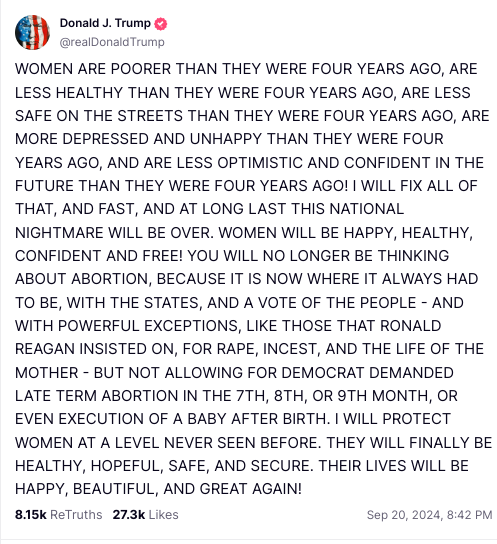
Although he's long exhibited this rhetorical tic, in recent days he's really outdone himself. Sounding much more like a cult leader than a politician in a modern democracy, the passages in his speeches about women are downright disturbing. It started with a weird Truth Social post:

The womenfolk are depressed but Big Daddy Trump is going to fix all that and they'll be so happy they won't even think about abortion. "THEY WILL FINALLY BE HEALTHY, HOPEFUL, SAFE AND SECURE. THEIR LIVES WILL BE HAPPY BEAUTIFUL AND GREAT AGAIN." All that's missing is "OR ELSE!"

You'll note that he said he will "protect women at a level never seen before" as if women are abandoned children who are desperate for him to come and rescue them from all their travails. When was the last time you heard a major politician in America infantilize women like this? It sounds like something out of the 19th century.

He took this all a step further in his speeches over the weekend making it clear that this is an official campaign message delivered from the teleprompter (with a few off-the-cuff embellishments.) In this rendition, women are complete basketcases, barely able to function which, for some bizarre reason, is why they care about abortion rights.

It truly does have the tenor of a patriarchal cult leader speaking to his followers.

He went on like this for a while, complaining that all women are talking about is abortion (because they are so unhappy, unhealthy and depressed) but he's going to make it all better. It's beyond condescending, but as my colleague Amanda Marcotte points out, it betrays Trump's frustration that women aren't falling in line as they are supposed to do so he's resorted to speaking to them as if they're children.

This is yet another example of the influence of Hungary's Viktor Orbán on the politics of the far right in America.

It's profoundly insulting although you cannot help but notice the wild cheering from the women in his audience ecstatic at the idea of Dear Leader "protecting" them. (Why anyone would believe that a man who is on tape bragging about assaulting women and has been found liable for it in a court of law is some kind of "protector" is beyond me.)

But at one point in the speech as he was defending the GOP's record on IVF (even though the congressional Republicans just voted unanimously against a bill that would protect the right to the procedure) he made this comment:

We want beautiful babies in our country! We want you to have your beautiful, beautiful, perfect baby. We want those babies and we need them.

We want those babies and we need them? Who is we? And why do we need them?

We need your help to stay independent

Has he been chatting with JD Vance? Because while Trump may just be clumsily trying to finesse the abortion issue and shrink the massive gender gap with his creepy rhetoric, Vance has some very well-developed thoughts on that issue. As we all know, Vance has extreme contempt for childless women. In fact, in his view they are to blame for many of the problems in modern life because they are, you guessed it, so unhappy:

That wasn't a one-off comment. He has thought deeply about this and (at least for the moment, until he changes his identity again) it very much informs his political philosophy. He believes that women who don't bear children should not be full citizens and perhaps aren't even fully human. Like his close pals at the Heritage Foundation who put together Project 2025, his platform is one which would give massive government incentives only to heterosexual couples with large families while also discouraging outside child care. (Who needs it when mom stays home and the otherwise useless post-menopausal grandma is forced to help?)

Vance's contempt has caught on big in GOP circles. Sarah Huckabee Sanders, Arkansas' Aunt Lydia from The Handmaid's Tale, made a snide comment the other day about Kamala Harris not having birthed her own children. (She's a stepmother to two kids.) And Ohio Senate candidate Bernie Moreno whined over the weekend about suburban women wanting to have abortions all the time — and wondering why any woman over 50 would care. It's catching on.

Much of this is just good old-fashioned sexism and patriarchal yearning but there is more to it than that. Vance has been pushing pronatalism for some time, which gets us back to Trump's blathering about how he wants women to be happy and content so they can have beautiful babies because "we need babies."


Want a daily wrap-up of all the news and commentary Salon has to offer? Subscribe to our morning newsletter, Crash Course.


A couple of months ago the New Yorker's Margaret Talbot wrote a long, definitive piece on Vance's pronatalist views which she defined this way:

Pronatalism typically combines concerns about falling birth rates with anti-immigration and anti-feminist ideas. It champions not just having children but having many—large families for the sake of large families, reproduction for reproduction’s sake. Except that, in this world view, not all reproduction is equal. Pronatalism favors native-born baby makers.

Now it makes more sense, doesn't it? Vance's hostility to women who haven't given birth fits right in with the rest of this pronatalist agenda, particularly when it comes to immigration and the Great Replacement Theory which pushes for native-born women to have more children to alleviate the need for immigrant labor which pollutes the culture. It also keeps women in their place which is just as important as keeping the bloodlines pure.

This is yet another example of the influence of Hungary's Viktor Orbán on the politics of the far right in America. Vance is a big fan and has endorsed Orbán's policies to raise Hungary’s birth rate (and marginalize non-traditional families, particularly those that are blended and LGBTQ+.) Vance may not be the only influential member of the far right pushing these views (Tucker Carlson is another) but he's probably the most powerful elected politician in America to make it a central part of his philosophy.

I doubt seriously that Donald Trump has even the slightest awareness of the ideological underpinnings of the speeches he's giving about being women's "protector" and saying "we need babies." He's not exactly an intellectual. But whoever is writing them certainly is and that person is pushing a JD Vance/Project 2025 agenda whether Trump knows it or not.


Trump’s transformation into a religious totem turns Christian nationalism toxic

Public opinion polls show that 47 percent of registered voters support Donald Trump in the 2024 election. This appears to be both Trump’s basement and ceiling of support. Like a cult leader, he has a near-iron grip on his MAGA supporters and the Republican Party. Trump can attempt a coup, channel Hitler, be convicted of multiple criminal felons, publicly praise tyrants, promise to become America’s first dictator for “day one” of his return to power in 2025 and threaten his “enemies” with "retribution." 

The adoration and loyalty that his MAGA supporters— and Republicans and right-leaning independents more broadly — show for Trump is a cause of great consternation and frustration for Democrats. While a new public opinion poll from CBS/YouGov shows that Kamala Harris continues to gain momentum, the race remains a statistical tie in the key battleground states that will determine the final outcome in the Electoral College. Experts continue to warn that the 2024 election, at this point, is the closest in recent history.

In an attempt to better understand this apparent political stalemate, what the actual data reveals as opposed to the mostly useless “vibes” that many are preoccupied with, and what it may all mean for the future of American democracy, I recently spoke with Robert P. Jones, president and founder of the Public Religion Research Institute. Jones is the author of the New York Times bestseller "The Hidden Roots of White Supremacy and the Path to a Shared American Future" (now available in paperback with a new afterword) as well as "White Too Long: The Legacy of White Supremacy in American Christianity."

In this conversation, Jones explains the almost mythical and divine role that Trump occupies in the collective minds of white right-wing Christians. Jones also discusses his new research which shows the frightening overlaps between white right-wing Christians and support for authoritarianism and political violence as seen on Jan. 6 and its implications for the future of American democracy and society in the Age of Trump and beyond.

This interview has been edited for clarity and length

What story are the polls telling us about the 2024 election?

So far in the 2024 election cycle, the polling for the presidential election has told us only one thing that we can say with confidence: The contest remains a dead heat.

Because of the Electoral College, the national polls are irrelevant. At the state level, despite the breathless headlines of “Trump leading by three” or “Harris up by two,” we have yet to see either candidate pull into a lead that is firmly outside the margin of error in the polling averages in any swing state. There are also typically 5-6 percentage points of respondents who either refuse the vote question or say they remain undecided. The state polls are also of limited help with understanding subgroups because of smaller sample sizes. For example, if you wanted to understand Black voters in Michigan, even with a poll of 1,000 voters, you’d likely have at most 150 African Americans in the sample and estimates of their opinions would have a margin of error of +/- 10 percentage points. 

The most obvious, but perhaps also most surprising thing particularly given Donald Trump’s increasingly outright racist and erratic rhetoric, is how little the voting patterns have shifted since 2020 or even 2016. For example, despite everything Trump has done and even been convicted of, there’s no evidence of any erosion of support for Trump among white Christians or white frequent churchgoers. It’s a good indicator of what a death grip partisanship has on American voters.

The news media is obsessed with novelty and the “new” in the “news.” When you look at Trump and Trumpism in longer, and much more important historical and cultural terms, how are you making sense of this crisis?

As dangerous as Trump is for democracy, he is a symptom, not the disease. While we at PRRI are continually taking the pulse of contemporary public opinion, those results can only be fully understood when placed in historical context. There are clear historical throughlines. For example, the authoritarian tactics currently deployed by Trump have historical precedents both in the US and in early 20th century Europe. PRRI’s most recent study, "One Leader Under God: The Connection Between Authoritarianism and Christian Nationalism in America." tapped the sociological literature that arose to understand the rise of fascism in Europe in the early 20th century. 

"The transformation of Trump from a person to a symbol is the key to understanding the power of the MAGA movement and the internal logic of its upside-down world."

In "The Hidden Roots of White Supremacy and the Path to a Shared American Future," I also connected the dots between the threat of Christian nationalism we are facing today and 500 years of Christian doctrine going back to the European colonial period. This deeper historical context helps us see that many of the perplexing features of our current conflicts are new occurrences of old unresolved questions. Today, the changing demographics of the country has thrown us back to a fundamental question: Are we a pluralistic democracy, in which everyone stands on equal footing regardless of race or religion, or are we a white Christian nation, a kind of promised land for European Christians?

What do we know about Trump’s messianic martyr appeal for his White Christian right-wing followers? 

Trump has long played into the idea that he was specially chosen by God to save the country from evil and destruction. This appeal is straight out of the authoritarian playbook. Even before the two attempts on his life, he was using language that directly compared himself to a messianic figure who was being wounded and persecuted on behalf of his righteous followers. He made this case overtly last spring in a speech to the National Religious Broadcasters, an organization created by leaders of communications outlets that operate specifically in the white evangelical world. His language was not subtle: "I'm a very proud Christian, actually. I’ve been very busy fighting and, you know, taking the the bullets, taking the arrows. I'm taking 'em for you. And I'm so honored to take 'em. You have no idea. I'm being indicted for you….And in the end, they're not after me. They're after you. I just happen to be standing in the way.” 

He’s continued to use this language that evokes the theological logic of substitutionary atonement, where he bravely offers himself to be sacrificed on behalf of his followers. But Trump the messiah promises to bring not love or righteousness, but the restoration of power to white Christians in a changing America. In the same speech, Trump made a promise to his white evangelical followers: "I get in there, you're gonna be using that power at a level that you've never used it before. It's gonna bring back the churchgoer…. We're gonna bring it back. And I really believe it's the biggest thing missing from this country. It's the biggest thing missing. We have to bring back our religion. We have to bring back Christianity in this country.” Trump’s white Christian base has largely remained with him not because they necessarily believe he is one of them but because they believe he’ll restore what they see as their rightful place of power in a white Christian America. At root, Trump’s appeal to white Christians is not his values, but his value for achieving their Christian nationalist ends.

Donald Trump is a symbol, not just a man. Trumpism and American neofascism will exist for a long time after he is gone. The hope-peddlers and happy-pill sellers in the news media and political class are doing the American people a great disservice by not emphasizing this fact.

I recently wrote about the social psychology of this phenomenon. The transformation of Trump from a person to a symbol is the key to understanding the power of the MAGA movement and the internal logic of its upside-down world. It is true that every presidential candidate becomes, to some extent, a symbol or totem. We read into their biographies and project onto their bodies a broader set of principles, values and worldviews. But typically, in healthier times than ours, the connection between a candidate’s character and actions on the one hand, and their idealized symbolic projection on the other, remains visible and therefore functional. Any significant misstep may be enough to break the magical, often fragile social spell that binds the person to the symbol.

We need your help to stay independent

When the leader becomes the totem, no transgression is capable of separating him from his acolytes. A totem can’t lie or be vulgar. A totem doesn’t have marriage vows that can be violated. A totem can’t sexually assault a woman. A totem can’t commit fraud. A totem can’t betray an oath to the Constitution. A totem has no innate human characteristics at all. It is a mirror, reflecting the collective fears and aspirations of the group, who both generate its image and receive it back reinforced. And this is why Trump the totem, much more than Trump the man, poses such a unique danger to democracy and the rule of law.

Your new polling and other work examine the role of the authoritarian personality in support for Donald Trump and his neofascist MAGA movement, specifically among white Christians. How do you define “authoritarianism” in this new research? What do we know about authoritarianism and “conservatives” in the Age of Trump? 

PRRI recently released a groundbreaking new study, "One Leader Under God: The Connection Between Authoritarianism and Christian Nationalism in America," based on more than 5,000 interviews with Americans this summer. Revisiting work first developed over concerns about the rise of fascism in early 20th century Germany and Italy (e.g., in Theodor Adorno et al’s 1950 classic "The Authoritarian Personality"), PRRI developed a Right-Wing Authoritarianism Scale (RWAS) based on agreement with four highly correlated measures of authoritarian attitudes. PRRI finds that 43% of Americans score high or very high on the RWAS, compared with 37% who score low or very low; two in ten Americans qualify as having mixed opinions (20%).

But these attitudes are not evenly distributed across the political or religious landscape. Republicans are clear outliers. Two-thirds of Republicans score high on the RWAS (67%), compared with only 35% of independents and 28% of Democrats. Notably, Republicans who hold favorable views of Trump are nearly twice as likely as those with unfavorable views of Trump to score high on the RWAS (75% vs. 39%). In short, this study demonstrates how overwhelmingly the authoritarian impulse has taken over the Republican Party.

Donald Trump’s strongest supporters have consistently been white Christians. What does your new research reveal about authoritarian values and members of that group?

White evangelical Protestants (64%) are the religious group most likely to score high on the RWAS, followed by slim majorities of Hispanic Protestants (54%) and white Catholics (54%). As a reminder, each of these groups also strongly supported Donald Trump in the 2020 election: 84% of white evangelical Protestants; 56% of other non-white/non-Black Protestants, and 57% of white Catholics. No other religious groups have majorities scoring high on the RWAS.

The PRRI study clearly shows how these authoritarian orientations — so pronounced among Republicans and their white evangelical Protestant base—translate into concrete attitudes and support for actions that undermine our democracy.  Just two examples. First, nearly half of white evangelical Protestants (48%) and nearly four in ten Republicans (39%) agree with the theocratic vision of Christian dominionism, that “God wants Christians to take control of the ‘seven mountains’ of society, including the government, education, media and others.” Second, nearly half of Republicans (49%) — and a majority of Republicans with a favorable view of Trump (55%) — agree that “Because things have gotten so far off track in this country, we need a leader who is willing to break some rules if that's what it takes to set things right.” Four in ten white evangelicals (40%) also support rule-breaking by a strong leader.

How is support for authoritarianism correlated with support for political violence among White Christians? 

About one-quarter of Republicans (27%) — and 32% of Republicans with a favorable view of Trump — agree that “Because things have gotten so far off track, true American patriots may have to resort to violence in order to save the country.” Republican support for potential political violence is twice as high as Americans overall (14%) and three times higher than Democrats (8%). Nearly one in four white evangelical Protestants (23%) also express potential support for political violence.

The PRRI authoritarianism survey also provided two disturbing measures of the lengths Trump’s base supporters may be willing to go to ensure he returns to power.

  • One in four Republicans (24%) — 29% of Republicans with a favorable view of Trump—and one in five white evangelical Protestants (20%) agree that “If Donald Trump is not confirmed as the winner of the 2024 election, he should declare the results invalid and do whatever it takes to assume his rightful place as president.”
  • One in four Republicans (24%) — and 27% of Republicans with a favorable view of Trump — agree that “if the 2024 presidential election is compromised by voter fraud, everyday Americans will need to ensure the rightful leader takes office, even if it requires taking violent actions.” One in five white evangelical Protestants (18%) also agree with this sentiment.

Is Christian nationalism, at this point, a violent ideology? Is support for violence as a means of bringing about the end of multiracial pluralistic secular democracy and society almost a prerequisite for such beliefs? 

Christian nationalists are more likely than other Americans to think about politics in apocalyptic terms and are about twice as likely as other Americans to believe political violence may be justified. Nearly four in ten Christian nationalism adherents (38%) and one-third of sympathizers (33%) agree that “Because things have gotten so far off track, true American patriots may have to resort to violence to save the country,” compared with only 17% of Christian Nationalism skeptics and 7% of rejecters.


Want a daily wrap-up of all the news and commentary Salon has to offer? Subscribe to our morning newsletter, Crash Course.


The danger of the Christian nationalist worldview is that it raises the stakes of political contests exponentially, transposing political opponents into existential enemies. Politics are no longer understood to be disagreements between fellow citizens of goodwill but to be apocalyptic battles over good and evil, fought by agents of God against agents of Satan. Political opponents should not just be defeated in fair electoral contests but should be jailed, exiled, attacked, or even killed.

How does your new research inform our understanding of Project 2025 and the larger neofascist plan that Trump and his MAGAfied Republicans will implement to end America’s multiracial pluralistic democracy?

The most disturbing thing about Project 2025 isn’t its extreme policy and political recommendations but the way it marshals Christian nationalist commitments to distort beyond all recognition fundamental American values like life, liberty and the pursuit of happiness. The following passage in the Foreword should send chills up the spines of all Americans who value our Constitution and the freedoms we hold dear in our democracy:

When the Founders spoke of the “pursuit of Happiness,” what they meant might be understood today as in essence “pursuit of Blessedness.” That is, an individual must be free to live as his Creator ordained — to flourish. Our Constitution grants each of us the liberty to do not what we want, but what we ought. This pursuit of the good life is found primarily in family — marriage, children, Thanksgiving dinners, and the like.

If you read this passage quickly, it’s possible to miss the rhetorical sleight of hand at play here — one that substitutes an impoverished conception of liberty that is captive to a conservative Christian nationalist determination of the good life for true individual liberty that is determined by each citizen. There is a powerful normative white Christian worldview lurking in those images (and a non-coincidental resonance with JD Vance’s problematic claims about marriage and children). If Trump succeeds in getting elected and implementing Project 2025, I’m sure he’ll still speak about life, liberty and the pursuit of happiness. But the rest of us will only be free to do what they believe we ought.

What positive role, if any, can “Christians” play in the pro-democracy movement?

While the authoritarian and Christian nationalist MAGA movement has captured a supermajority of white evangelical Protestants and majorities of both white non-evangelical Protestants and white Catholics, these Trump-leaning white Christian groups are not the only face of Christianity in America. In fact, even combined, all white Christians only comprise 41% of Americans today. Approximately one in four Americans are nonwhite Christians who have a very different history, one that supports rather than opposes an inclusive democracy. And even within white Christian contexts, there are groups such as Christians Against Christian Nationalism that are facing this threat to democracy and to the Christian faith itself directly.

The good news is that while three in 10 Americans are either Christian nationalism adherents or sympathizers, two-thirds of the country rejects this anti-democratic ideology. And among Americans under the age of 50, opposition rises to nearly three-fourths. So, this is not an ascendant movement but a desperate, last-ditch effort to secure minority rule in the face of a rapidly diversifying nation.


Donald Trump and Bernie Moreno rage at “crazy” female voters who refuse to fall in line

As Steve Kornacki of NBC News explained Monday, the polling gender gap between Vice President Kamala Harris and Donald Trump is "off the charts." New polling by NBC shows a 58% to 37% split among with women overwhelmingly favoring Harris in the presidential race, while men back Trump 52% to 40%. Taken together, that's a shocking 33-point gender gap between men and women. 

This is hopeful news for a few reasons. Harris leads among women by a wider margin than Trump leads among men, pushing her ahead in the national poll. Women tend to vote more often than men and, in fact, have turned out in higher numbers in every presidential election since 1980. There's every reason to believe that trend will continue, as concerns about abortion bans continue to activate female voters in large numbers. Perhaps it's no surprise that Trump is screaming at women voters as if he were accusing a soon-to-be-ex-wife of ingratitude. 

"You will be protected, and I will be your protector," recently procliamed the man who was found liable for sexual assault by a jury in 2023. In a tone that sounded like a bad actor playing a hypnotist in a bad movie, Trump intoned, "You will no longer be thinking about abortion." He then protested, "That's all they talk about, abortion," adding, "The fake news keeps saying women don’t like me."


Want more Amanda Marcotte on politics? Subscribe to her newsletter Standing Room Only.


Alencia Johnson, a former adviser to Joe Biden's campaign, reacted on CNN by saying, "So disgusting," adding that the diatribe reminded her that Trump is a "predator." Jonathan Chait of New York magazine wrote that Trump "sounds like a domestic abuser," who is gaslighting women by telling them their concerns about abortion rights aren't real. "It's like he's talking through the locked basement door to the pregnant woman he's imprisoned," wrote blogger Rude Pundit on Threads

This was not an off-the-cuff riff from Trump. It echoed an earlier all-caps Truth Social post, where he repeated the command to women, "YOU WILL NO LONGER BE THINKING ABOUT ABORTION." Nor is Trump the only Republican candidate lashing out in rage against women for disobeying the right-wing thought police. Fake MBA-holder and Ohio Senate candidate Bernie Moreno has also pronounced women's concern about abortion rights to be "crazy." 

"Sadly, by the way, there’s a lot of suburban women, a lot of suburban women that are like, ‘Listen, abortion is it. If I can’t have an abortion in this country whenever I want, I will vote for anybody else,'" Moreno said at a Warren County town hall. "It’s a little crazy, by the way, but — especially for women that are like past 50 — I’m thinking to myself, ‘I don’t think that’s an issue for you.'”

Former South Carolina governor Nikki Haley, who is as anti-abortion as these fellow Republicans, thought it was unwise of Moreno to tell women they're "crazy" for caring about abortion rights. "Are you trying to lose the election?" she asked on Twitter

Trump outlines what he expects of women: to be compliant, smiling, uncomplaining objects that serve him without protest. When women show flashes of having minds of their own, however, he reacts with rage.

What ties Trump and Moreno's rants together is a deep resentment that they have to care what women think at all. In his speech, Trump can't hide his irritation that women's legitimate concerns about health care access are interrupting what he cares about, like his bizarre fantasies about cat-eating immigrants. His order to women to "be happy, healthy, confident and free" was delivered in angry tones that made clear this is more a threat than a promise. As Chait notes, "Why do I get the feeling Trump has made a version of this spiel in his personal life?" In other words, Trump doesn't actually think he'll make American women healthy or confident, but he believes that if he wins he'll have the power to force them to pretend otherwise. 

Moreno's whining is rooted in the same assumption: Women are here to serve his interests, so it's outrageous that women insist not just on the right to bodily autonomy, but the right to think for themselves. In response, feminists are understandably tempted to turn to evidence and statistics to "prove" that women aren't "crazy" to care about abortion. About one in four American women will have an abortion in their lifetime. Even women who think they would never willingly abort a pregnancy understand they are still at risk of rape, or might need emergency treatment for a failing pregnancy. Moreno's snark about post-menopausal women also showed a failure to imagine women as full humans with functioning brains. Even if you can't personally get pregnant, other people in your life are likely still at risk. Some women may even — gasp! — have empathy for the suffering of strangers. Many were upset, for instance, by the stories of two women in Georgia who died because of the state's abortion ban. It's easy to imagine that those women could have been one's own daughters, friends, students, neighbors or coworkers. 

We need your help to stay independent

But it feels a bit dirty to even write out all the reasons women should be "allowed" to care about this issue. There's a simpler issue at stake: Trump and Moreno are not the boss of the ladies. Oh, they clearly think they should be. Their tone and rhetoric indicate a deep belief that women's beliefs, concerns and hopes should be of no consequence. Nor are they outliers in the GOP. It took revelations about North Carolina Lt. Gov. Mark Robinson calling himself a "black NAZI" for Republicans to finally cut him loose in that state's gubernatorial race. Previous comments calling for an end to women's suffrage and declaring that women should be "led" by men, however, were just fine. This is a party that has captured by the Christian right, after all, which is organized largely around a belief in male "headship" over women. 

It makes sense that most media outlets, in covering Trump's "protector" remarks, highlighted his history of sexual assault, which he bragged about on tape and was established in a court of law. The irony is just too much: a sexual predator declaring himself to be the "protector" of people he likes to assault. But in fact his rant exposes the sexist attitudes that feed his impulse toward sexual violence. Trump outlines what he expects of women: to be compliant, smiling, uncomplaining objects that serve him without protest. When women show flashes of having minds of their own, however, he reacts with rage. He spent the entire debate with Harris glowering at having to tolerate this woman talking back to him. And of course, when journalist E. Jean Carroll laughed at him, however gently, he responded by violently assaulting her in a department store dressing room. 

For all the GOP talk about women being "crazy," the polls show that the majority of women have their heads screwed on straight, preferring a pro-choice Democrat like Harris to Trump's authoritarian madness. It's scary, however, that so many men are on board with the Trump agenda, even though abortion bans and other such draconian policies hurt men, too. Talking down to women like they're dummies still appeals to a slim majority of men, it appears, even at the cost of bringing Trump's chaos back into power. 

Experts warn that mental health is a $282 billion “macroeconomic crisis”

As income inequality continues to soar in the United States, researchers are working to more comprehensively measure the relationship between capitalism and declining mental health – an effort that experts say could help policymakers develop more effective solutions to the widespread mental health struggles plaguing Americans.

Americans’ collective mental health has been worsening for years. In 2023, the White House said the nation faced “a mental health crisis,” with 40% of U.S. adults having experienced depression or anxiety in 2021. That year, Gallup estimated that 22% of Americans experienced depression or anxiety severe enough to disrupt daily activities for two weeks or longer. Roughly a third of adolescents in the U.S. have an anxiety disorder, and in 2023, nearly one in five U.S. teens experienced a major depressive episode.  

In 2024, 43% of Americans said they feel more anxious than they did in 2023, according to the American Psychiatric Association’s annual mental health poll. Last year, 37% of Americans reported higher levels of anxiety compared to 32% in 2022. The latest data from the National Institutes of Health shows that 23% of the population, or approximately 57 million Americans, experiences some form of mental illness. 

“We genuinely see that a huge proportion of the population is severely affected and suffering from mental health issues,” Aleh Tsyvinski, professor of economics at Yale University, told Salon. “If this is not a macroeconomic crisis, then it's hard for me to think about what else may be a macroeconomic crisis.”

Tsyvinski, alongside researchers Boaz Abramson and Job Boerma, recently published a “first-of-its-kind” study and model that measures the economic impact of Americans’ mental health struggles. Published as a working paper by the National Bureau of Economic Research in April, the model indexes for three characteristics of mental illnesses – rumination, negative thinking and reinforced behaviors – and attempts to measure how those characteristics affect a person’s consumption, job choice, savings and portfolio choices.

“We don't have a quantitative, macroeconomic framework to study mental illness,” Abramson told Salon. “And that is a necessary thing if you want to evaluate policies that try to improve mental health.” 

Measured as economic output, the study estimates that Americans’ mental health struggles collectively cost the U.S. economy $282 billion every year – the economic loss of the average recession

"A bidirectional relationship" between mental health and money

The NBER study is currently a “working paper;” meaning it hasn’t yet been published in a peer-reviewed journal. Over the next few months, the coauthors will present their research at symposiums and conferences around the U.S., where they’ll receive feedback and engage in discussions with fellow researchers. If things go according to its coauthors’ hopes, the study will be published in a top macroeconomic journal in a few years.

“We sort of get some pushback,” Abramson said. “What we're doing is new in macroeconomics. But our goal is not only to write this paper, but actually to construct a quantitative framework for studying … the interaction between mental health and the financial conditions of individuals and of the economy.”

For decades, a dominant approach among social scientists and epidemiologists has been to study socioeconomic factors, like income or homeownership, as individual and independent data points without “considering the broader social system,” Jerzy Eisenberg-Guyot, a research scientist and assistant professor of epidemiology at New York University, told Salon. 

“Mental health impacts your financial stress, but also, financial stress impacts your mental health.”

But in recent years, several studies have attempted to challenge that approach. In 2015, Sociology of Health and Illness published a study – titled “Anxious? Depressed? You might be suffering from capitalism” – that suggests “traditional indicators of socioeconomic status,” such as income, education or homeownership, are “incomplete,” in part because those factors “rise from numerous political and economic processes,” which may themselves have “significant and direct effects on health.” 

“Research has not tended to emphasize the causes of socioeconomic inequality, but rather the effects of socioeconomic position on health,” the study states. 

A 2022 paper in Community Mental Health Journal outlines how the country's steadily increasing rates of mental illness over the past 15 years – as well as increases in deaths from suicide, overdose and complications of alcoholism – “are due to neoliberal capitalist policies and ideologies.” 

And in 2023, researchers from University College London, the Icahn School of Medicine at Mount Sinai and other institutions presented a framework for a field of neuroscience that “can and should illuminate the effects of neoliberal capitalism on the brains and minds of the population living under such socioeconomic systems.”

The relationship "that causes the health inequities"

Eisenberg-Guyot coauthored a chapter on capitalism’s mental health impacts in the 2022 Oxford Textbook of Social Psychiatry, defining capitalism as “a socioeconomic system characterized by the private ownership of the means of production and the exploitation and domination of wage labor for profit.” 

Life under that socioeconomic system, Eisenberg-Guyot said, can lead to a society built on “more and less powerful groups struggling for control over resources.”

“So far as employers are driven to increase profits and lower workers' wages, profits and employers can come at the expense of workers’ health,” Eisenberg-Guyot said. “That structured relationship between employers and workers is what causes health inequities, because the wealth of employers relates sort of inversely to labor costs, and positively to labor effort.”

We need your help to stay independent

Between 1979 and 2019, wages for the lowest tenth percentile of earners rose just 3% after inflation. And in the 41-year stretch from 1979 to 2020, U.S. workers’ productivity went up 61.8% – while wages grew by 17.5%.

Economic anxiety feels uniquely high. Earlier this year, household credit card debt hit a record high $1.14 trillion. Nearly 40% of Americans don’t think they’ll ever be able to afford to buy a house, and 70% of the workers surveyed in a 2024 MarketWatch research report said they’re “taking steps to prepare for a layoff.”  

In a 2023 study published by the American Psychological Association, 63% of U.S. adults said money was “a significant source of stress” in their lives. Among 18-34-year-olds, that figure rose to 82%. Nearly one in three Americans are “just getting by financially” and costs of “day to day expenses” were among the top financial stressors for 61% of U.S. adults in 2023.

And among U.S. adults who have gone to therapy or visited a psychiatrist in the last year, 59% say they’re worried about losing access to mental healthcare. Separately, nearly 40% of U.S. adults with health insurance worry about losing that insurance.  

"Recognition can be empowering"

One novel element of the NBER study is its attempt to measure how mental illness impacts the way we spend and earn money. Individuals experiencing symptoms of mental illness, the study indicates, tend to work fewer hours overall, invest less in things like housing and stocks and pursue fewer high-earning jobs. Those behaviors typically translate to lower earnings, the study found, which further limits one’s ability to treat their mental illness. 

“We have a bidirectional relationship between financial stress and mental health,” Abramson said. “Mental health impacts your financial stress, but also, financial stress impacts your mental health.”

Discussions about rising rates of mental illness and proposed solutions are often centered on making therapy more affordable or otherwise accessible. But these researchers told Salon that a significant goal driving their work is to create smarter, more effective approaches to improving overall mental health that address the crisis’ root causes.

“The response is always to want more treatment, more therapists, the whole gamut of professionals, instead of looking to see why on earth has our society produced this level of problems,” Richard Wilkinson, a prominent epidemiologist and public health researcher, told Salon. 


Want a daily wrap-up of all the news and commentary Salon has to offer? Subscribe to our morning newsletter, Crash Course.


Wilkinson, alongside Kate Pickett, wrote “The Spirit Level,” a groundbreaking work on the intersection of capitalism and mental health. Published in 2009, the book analyzed public health information and “demonstrated conclusively the pernicious effects of economic inequality,” according to The Guardian, which put it at No. 79 on its list of The 100 Best Books of the 21st Century.   

While therapy is a proven tool to improve mental health – 75% of individuals who seek out therapy report benefits – it’s often pitched as a catch-all solution to a comprehensive, systemic problem that requires more than one solution, experts say. 

In 2022, nearly a quarter of Americans said they had seen a therapist in the past year. Teletherapy became a $1.4 billion industry in 2022 – a quick ascent from the $418 million ecosystem that existed in 2018. In 2023, psychiatrists reported an overall increase in the severity of their patients’ symptoms, and found patients required longer-than-average courses of treatment. “Psychologists are often working at the limits of their capacity and levels of burnout are high,” a 2023 report found.

 “Therapy Isn't Fixing America's Mental Health Crisis,” Time Magazine declared in 2023. That more people than ever are going to therapy – yet rates of anxiety and depression remain stubbornly high – suggests other interventions may be useful, experts say. 

“We need to bring the same level of quantitative, theoretical rigor, based on the frontier of research in psychiatry, to the question of macroeconomics and mental health that we bring to the question of whether the interest rate should be decreased by quarter point,” Tsyvinski said.

One small intervention that can help individuals in the near-term? The simple act of recognizing that forces outside our control affect our mental health, which can help individuals understand that they aren’t “to blame,” so to speak, for their mental health struggles, says Eisenberg-Guyot. 

“Pointing to the role of structural factors in mental illness, instead of blaming it on individual shortcomings, I imagine, can be sort of empowering for people,” Eisenberg-Guyot said. “Obviously, it's not totally emancipatory to realize that, because you still wish you could address the structural factors … But maybe some recognition can be empowering."

Ellen DeGeneres’ Netflix special addresses her controversies, but fails to square with them

2020 was an unforgettable year, but not only because it saw the onset of a global pandemic. It was the year that saw the genesis of internet cancel culture, in which social media became the arbiter of often contested "justice" for a swath of influencers, celebrities, politicians, and the like.

None felt the sting of 2020's cancel culture more acutely than comedian and talk show host Ellen DeGeneres, who, along with her eponymous talk-variety show, was taken down by the phenomenon when it was revealed that she — known largely for her "Be kind" show sign off — was in fact a very "mean" person and boss. During that year's spring and summer seasons, DeGeneres and her plucky show were hit with numerous reports from ex-employees detailing alleged mistreatment and misconduct, racist behavior, intimidation, sexual misconduct, (which was said to have been committed by her executive producers), pay reduction, and more, leading to an investigation by WarnerMedia.

"The Ellen DeGeneres Show" ultimately shuttered after 19 seasons in May of 2022.

Given the intense impact of cancel culture on the broader zeitgeist — an effect that seems to show no signs of slowing down — it's no surprise that several comedians have elected to regurgitate their cancellable offenses as fodder for their Netflix stand-up specials (and not merely because everyone seems to have one now.) Take John Mulaney's 2023 "Baby J: A Wide-Ranging Conversation," which honed in on the comedian's addiction to cocaine, Percocet, and Klonopin. Mulaney turned his trip to rehab into material, ragging on himself by recounting stories from the height of his addiction, such as an intervention staged by A-lister friends of his.

But when it comes to DeGeneres' new comedy special, "For Your Approval," the discussion of her own cancellable offenses doesn't land as cleanly. 

"For Your Approval," which is DeGeneres' self-proclaimed final hurrah, starts on a relatively self-indulgent and self-pitying note. We see DeGeneres sitting in front of a dressing room mirror before she gets up and begins making her way toward the stage. As she does, she's overlaid by a video montage chronicling the rise and fall (times two) of her career — a projection of her first time on Johnny Carson's "Tonight Show," footage from her '90s sitcom, her cancellation after coming out as a lesbian, instructions from her "Finding Nemo" character — Dory — to "Just keep swimming" and more. The sharp cut to DeGeneres' quiet, relaxed, crewneck-sweater demeanor makes this intro all the more disjointed. 

Between little "yeahs" and "yups," she offers her audience a few bits about failing at a parallel parking job, how annoying windshield wipers are, and the beauty of butterflies' metamorphosis (all of which seem to be benign attempts to connect her own experience with departing from daytime TV.)


Want a daily wrap-up of all the news and commentary Salon has to offer? Subscribe to our morning newsletter, Crash Course.


When DeGeneres gets into the meat of her special, she addresses it head-on . . . but doesn't go further than that.

"I got kicked out of show business," she says, claiming that "mean people" can't exist in the industry. But she doesn't elaborate, instead, complementing her observation with a similar one later on that you "can't be gay in show business."

"Mean, old, and gay. I was the triple crown," DeGeneres says. 

DeGeneres' failure to acknowledge those affected by her leadership failings makes it hard to empathize with her situation.

She goes on to detail her immaturity as a boss with an anecdote about a button in her office that would release fake snakes from the ceiling, explaining herself away by saying that she "didn't want to be a boss" in the first place. The reason? “I didn’t go to business school. I went to Charlie’s Chuckle Hut.” It's a hardly convincing logic. 

And while her observations about the rampant homophobia that plagued her and her professional trajectory in the first half of her career are absolutely well-founded, DeGeneres' failure to acknowledge those affected by her leadership failings makes it hard to empathize with her situation.

It becomes harder still when she attempts to patch up the empathy chasm with a delineation between male and female bosses. "Women are raised in a different way," DeGeneres says, before sharing a personal moment about growing up in a neglectful home, and having OCD and ADD. Certainly, DeGeneres' audience is aware of the stark gender discrepancies in how bosses of the opposite sex are treated and expected to act — she doesn't need to lecture them on this front. What she needed to do was, instead, address her own inadequacies as a boss and her failure to protect her staff, which have nothing to do with her gender, but rather her sense of investment in her people. 

Plus, as Salon's Melanie McFarland noted in a commentary about comedians who have reaped the unexpected benefits of cancel culture, DeGeneres' industry ousting "mostly amounts to a time-out." How canceled can you be when you're still collecting the literal and figurative benefits of a Netflix special? 

"What about the egos and self-esteem of the more than 47 former employees who detailed their painful experiences to BuzzFeed, some of whom left the business after working for “Ellen”? DeGeneres’ audience was thinking about them, too," McFarland argued. 

Given that DeGeneres kicks off "For Your Approval" with the candid observation that she does, in fact, care what people think about her, the concluding messages in the special register as deeply discordant. 

“I’m happy not being a boss or a brand or a billboard, just a multifaceted person,” she says.

So if Ellen still cares what we think, her 70 minutes of standup might have been better spent by actually grappling with her peccadilloes, rather than using them to fan the flames of her own ego. While she tries to convince us that she's self-salvaged her reputation by caring just the right amount (which, by her definition, means not at all), "For Your Approval" seems to plead with its audience for exactly that. 

How can I stop using food to cope with negative emotions?

Have you ever noticed changes in your eating habits when you are sad, bored or anxious?

Many people report eating either more, or less, as a way of helping them to cope when they experience difficult emotions.

Although this is a very normal response, it can take the pleasure out of eating, and can become distressing and bring about other feelings of shame and self-criticism.

Adding to the complexity of it all, we live in a world where diet culture is unavoidable, and our relationship to eating, food and body image can become complicated and confusing.


Emotional eating is common

"Emotional eating" refers to the eating behaviors (typically eating more) that occur in response to difficult emotions.

Research shows around 20% of people regularly engage in emotional eating, with a higher prevalence among adolescents and women. In a study of more than 1,500 adolescents, 34% engaged in emotional eating while sad and 40% did so while anxious.

Foods consumed are often fast-foods and other energy-dense, nutrient-poor convenience foods.


Stress, strong emotions and depression

For some people, emotional eating was simply a habit formed earlier in life that has persisted over time.

But other factors might also contribute to the likelihood of emotional eating. The physiological effects of stress and strong emotions, for example, can influence hormones such as cortisol, insulin and glucose, which can also increase appetite.

Increased impulsivity (behaving before thinking things through), vulnerability to depression, a tendency to ruminate and difficulties regulating emotions also increase the likelihood of emotional eating.


So what do you do?

First, know that fluctuations in eating are normal. However, if you find that the way you eat in response to difficult emotions is not working for you, there are a few things you can do.

Starting with small things that are achievable but can have a huge impact, such as prioritizing getting enough sleep and eating regularly.

Then, you can start to think about how you handle your emotions and hunger cues.


Expand your emotional awareness

Often we label emotions as good or bad, and this can result in fear, avoidance, and unhelpful coping strategies such as emotional eating.

But it's also important to differentiate the exact emotion. This might be feeling isolated, powerless or victimized, rather than something as broad as sad.

By noticing what the emotion is, we can bring curiosity to what it means, how we feel in our minds and bodies, and how we think and behave in response.


Tap into your feelings of hunger and fullness

Developing an intuitive way of eating is another helpful strategy to promote healthy eating behaviours.

Intuitive eating means recognizing, understanding and responding to internal signals of hunger and fullness. This might mean tuning in to and acknowledging physical hunger cues, responding by eating food that is nourishing and enjoyable, and identifying sensations of fullness.

Intuitive eating encourages flexibility and thinking about the pleasure we get from food and eating. This style of eating also allows us to enjoy eating out with friends, and sample local delicacies when travelling.

It can also reduce the psychological distress from feeling out of control with your eating habits and the associated negative body image.


When is it time to seek help?

For some people, the thoughts and behaviors relating to food, eating and body image can negatively impact their life.

Having the support of friends and family, accessing online resources and, in some instances, seeing a trained professional, can be very helpful.

There are many therapeutic interventions that work to improve aspects associated with emotional eating. These will depend on your situation, needs, stage of life and other factors, such as whether you are neurodivergent.

The best approach is to engage with someone who can bring compassion and understanding to your personal situation, and work with you collaboratively. This work might include:

  • unpacking some of the patterns that could be underlying these emotions, thoughts and behaviours
  • helping you to discover your emotions
  • supporting you to process other experiences, such as trauma exposure
  • developing a more flexible and intuitive way of eating.

One of the dangers that can occur in response to emotional eating is the temptation to diet, which can lead to disordered eating, and eating disorder behaviors. Indicators of a potential eating disorder can include:

  • recent rapid weight loss
  • preoccupation with weight and shape (which is usually in contrast to other people's perceptions)
  • eating large amounts of food within a short space of time (two hours or less) and feeling a sense of loss of control
  • eating in secret
  • compensating for food eaten (with vomiting, exercise or laxatives).

Evidence-based approaches can support people experiencing eating disorders. To find a health professional who is informed and specializes in this area, search the Butterfly Foundation's expert database.


If this article has raised issues for you, or if you're concerned about someone you know, call Lifeline on 13 11 14, or the Butterfly Foundation on 1800 ED HOPE
(1800 33 4673).
The Conversation

Inge Gnatt, PhD Candidate, Lecturer in Psychology, Swinburne University of Technology

This article is republished from The Conversation under a Creative Commons license. Read the original article.

Jimmy Kimmel drags Donald and Melania Trump for their merch ventures

As the election cycle heats up with only 41 days until Nov. 5, Jimmy Kimmel scorched Donald and Melania Trump's attempts to bolster the Republican's base by selling pricey MAGA merchandise. 

During Kimmel's Monday evening monologue on "Jimmy Kimmel Live," the comedian got a lot of material out of Trump's announcement of an "official" silver coin with the former president's face on it.

“The Trump coin, it should be noted, costs $100. It contains $31 worth of silver,” Kimmel said. “What captures the essence of Donald Trump more than charging the fans who love him most three times more than a coin is worth?”

Kimmel joked, “$100 for a Chuck E. Cheese token with his head on it.”

The comedian also poked fun at the coin being made of silver instead of gold. “It’s the perfect gift to send him when he comes in second in November,” he said. “We are in the final stretch of the election, when the candidates are supposed to be making their final push to run this country, and this nut’s having a yard sale.”

Kimmel went on to joke that even Trump's wife, Melania, has been cashing in on the election momentum by selling MAGA items. 

“You have Melania, who’s hawking a $600 ‘Vote Freedom’ necklace right now,” Kimmel said, describing the necklace as “Lady Liberty on the front and nothing behind it, just like Melania herself.”

Martha Stewart says Ina Garten was “extremely unfriendly” to her when she went to prison

There may be some beef between two big — and beloved — names in the world of food entertainment. Martha Stewart recently spoke out against her longtime food television peer, Ina Garten, due to an "unfriendly" incident that took place during the early aughts.

Earlier this month, the New Yorker published a profile on Garten in anticipation of the October release of her new memoir, “Be Ready When the Luck Happens.” In it, Garten discussed the early beginnings of her successful career — which can be credited to the first issue of Stewart’s magazine “Martha Stewart Living” — and her budding relationship, both professional and personal, with Stewart.

According to Garten, she and Stewart lost touch after the latter purchased a property in Bedford, New York, and spent much of her time there. Stewart, however, said the duo didn’t part ways so amicably.

“When I was sent off to Alderson Prison, she stopped talking to me,” Stewart told "The New Yorker’s" Molly Fischer. “I found that extremely distressing and extremely unfriendly.”

In March 2004, Stewart was found guilty of conspiracy, obstruction and two counts of lying to federal investigators in connection with an insider trading scheme. She was sentenced in July 2004 to five months in prison, along with five months of home confinement and two years of supervised probation. 

Garten “firmly denied” Stewart’s claim, per "The New Yorker." Stewart’s longtime publicist, Susan Magrino, later clarified that Stewart was “not bitter at all and there’s no feud.”


Want more great food writing and recipes? Subscribe to Salon Food's newsletter, The Bite.


News of tensions between Garten and Stewart comes after the latter threw shade at the former’s advice to “drink more large cosmos” amid the COVID-19 pandemic. “I do not agree about taking to drink to cope with things like the pandemic,” Stewart told People back in 2022. “To me that's not charming.” What she considers charming includes “continuing to work really hard, to be as productive as I possibly can be, to enjoy my grandchildren,” she added.

Garten’s playful advice was shared as a comment under a now-deleted New Year's Instagram post from Reese Witherspoon, in which the actor shared a few of her healthy daily habits, including drinking more water and getting at least eight hours of sleep. Garten responded cheekily, saying, “To quote Reese Witherspoon, that sounds great but I'm probably not doing any of those things! LOL!!”

She went on to outline her “formula” for staying sane during the pandemic. It includes four things: drinking more large cosmos, staying up late watching addictive streaming series, staying in bed in the morning playing Sudoko instead of reading a good book and spending more time (safely) with people you love.

Whoopi Goldberg says Janet Jackson deserves “a little grace” for Kamala Harris race comment

Whoopi Goldberg is standing up for Janet Jackson after the singer's baffling denial of Vice President Kamala Harris' race in a recent interview with The Guardian.

On Tuesday's episode of "The View," the host and former co-star of Jackson's in the movie "For Colored Girls" addressed the controversy surrounding the singer questioning Harris' race, asking for leniency for Jackson.

When asked about the possibility of the U.S. having its first Black female president in Harris, Jackson told The Guardian, "Well, you know what they supposedly said? She's not Black. That's what I heard. That she's Indian. Her father's white."

Goldberg defended Jackson, saying, "Sometimes people get it wrong, and they’re wrong! They made a mistake; they were wrong. It happens," adding that Jackson is not a "political animal."

"Anybody who says it doesn't happen to every one of us, multiracial or not, we all do it. So OK, a little grace for the girl. A little grace for the girl," Goldberg said.

However, co-host Ana Navarro did not agree with Goldberg. Navarro pushed back, "She's got every right to not like Kamala Harris if she doesn't want to. What she did was spread misinformation. And I think it's very irresponsible when you have a platform, the way Janet Jackson does, to use that platform carelessly to spread misinformation based on a racist allegation by Donald Trump."

Harris, who is biracial — Indian and Jamaican — has been at the center of her political opponent Donald Trump also questioning her race. Last month, Trump said at the National Association for Black Journalists convention about Harris, "I didn't know she was Black until a number of years ago when she happened to turn Black."

“We want the judge to issue arrest warrants”: Haitian group sues over Trump-Vance smear campaign

A Haitian nonprofit representing the community in Springfield, Ohio has filed a lawsuit against former President Donald Trump and Sen. JD Vance, R-Ohio, accusing them of knowingly spreading false claims about legal immigrants eating cats and dogs, the Associated Presss reported

In Ohio, private citizens can file lawsuits demanding that authorities enforce criminal law. In its lawsuit, the Haitian Bridge Alliance, a group that advocates on behalf of immigrants from Haiti, noted that the Republican presidential ticket has spread lies that have resulted in bomb threats, harassment and the disruption of public services.

"Their persistence and relentlessness, even in the face of the governor and the mayor saying this is false — that shows intent," attorney Subodh Chandra told FOX 8 on Tuesday. "It’s knowing, willful flouting of criminal law.”

The lawsuit asks the Clark County Municipal Court to confirm that there is probable cause to investigate Trump and Vance, FOX 8 reported.

“We want the judge to issue arrest warrants for Trump and Vance immediately, there is probable cause,” Chandra said. He added that the U.S. Supreme Court’s immunity ruling will not benefit the former president as he is currently a private citizen.

Over 30 bomb threats have been labeled against state and local government buildings and schools in Springfield since Trump and Vance began spreading falsehoods about the roughly 20,000 Haitian immigrants living there. Trump and Vance’s lies have disrupted the lives of all in the city, especially those Haitian residents, who say they fear for their safety. Mayor Rob Rue himself has received death threats.

“The Haitian community is suffering in fear because of Trump and Vance’s relentless, irresponsible, false alarms and public services have been disrupted,” Chandra said in a statement. “Trump and Vance must be held accountable to the rule of law. Anyone else who wreaked havoc the way they did would have been arrested by now.”

During an interview with CNN’s Dana Bash, Vance admitted to spreading the falsehoods that have wreaked such havoc on the Haitian community, saying: “If I have to create stories so that the American media actually pays attention to the suffering of the American people, then that's what I'm going to do." He has since falsely claimed that the murder rate is rising in Springfield, implying it is due to Haitians; in fact, the murder rate peaked under Trump and no Haitian immigrant in Springfield has ever been charged with homicide.

Lactaid Milk has been recalled because it may contain “trace amounts” of an undeclared allergen

Lactaid Milk, the popular lactose-free dairy beverage, has been recalled because it may contain an undeclared allergen.

HP Hood, the manufacturer of Lactaid Milk products, along with the Food and Drug Administration (FDA), issued a voluntary recall of 96-ounce containers of Lactaid Milk that may contain “trace amounts of almond, which is not listed on the label,” the FDA said in a Sept. 20 announcement.

Those who may be allergic or severely sensitive to almonds may “run the risk of serious or life-threatening allergic reaction if they consume these products,” the FDA added. At this time, no illnesses have been reported.

The recalled containers of Lactaid Milk were shipped to retailers and wholesalers between Sept. 5 and Sept. 18 in Alabama, Colorado, Connecticut, Florida, Georgia, Iowa, Illinois, Indiana, Kansas, Kentucky, Louisiana, Maryland, Michigan, Minnesota, Missouri, Mississippi, North Carolina, Nebraska, New Jersey, New York, Ohio, Oklahoma, Pennsylvania, Texas, Virginia, Wisconsin and Wyoming. Specific products include whole, 2%, 1%, fat-free and calcium-enriched milk.   

“HP Hood, the manufacturer of Lactaid Milk products, has long recognized consumer and public health concerns related to the potential presence of undeclared allergens in food products,” a representative for the company shared with ABC in a statement. “Hood’s allergen and sanitation management programs are aligned with all regulatory and industry standards.”

Russian propagandists spread Trump and the GOP’s false claims about migrant voting

A recently unsealed FBI affidavit revealed that Russian websites have been spreading disinformation about the 2024 election, aligning their propaganda with GOP’s false narratives about migrants voting, Talking Points Memo reported.

In April, back when Joe Biden was still running for re-election, an article purportedly from "The Washington Post” claimed that the president “needs migrants” to win the 2024 election. It falsely claimed that the Democratic Party had “smuggled over 320,000 illegals by plane through several airports last year," echoing charges made by former President Donald Trump and his allies. “The Democrats are determined to win elections at any cost so they can continue to fuel wars around the world. Therefore, they promote uncontrolled illegal migration in every possible way,” the article read.

But the article was Russian propaganda, posted on a website that mimicked the appearance of The Washington Post, complete with a real Post journalist's name in the byline. The article featured made-up quotes that could be found nowhere else online, according to Talking Points Memo, which reviewed an archived version of the fake site.

The story was posted on “washingtonpost.pm,” a web domain that the Justice Department determined is linked to a “Russian government directed” influence campaign called “Doppleganger.” An FBI affidavit, filed in the Eastern District of Pennsylvania, flagged the spoof Post site as just one of 32 domains that the U.S. government identified as part of a Kremlin propaganda initiative. All the sites have been take down.

“The propaganda did not identify, and in fact purposefully obfuscated, the Russian government or its agents as the source of the content,” read the press release released by the Justice Department announcing the domain seizure. “The perpetrators extensively utilized ‘cybersquatted’ domains, a method of registering a domain intended to mimic another person or company’s website … to publish Russian government messaging falsely presented as content from legitimate news media organizations.”

In addition to the fake news story, the Russian propaganda campaign also spread claims by Stephen Miller, a former Trump aide who has spread false claims about immigrants and U.S. elections, Talking Points Memo reported.

Brett Favre tells Congress that he has been diagnosed with Parkinson’s disease

Former NFL quarterback Brett Favre has been diagnosed with Parkinson's disease, he told Congress on Tuesday as part of testimony about his involvement in a welfare corruption scandal in Mississippi. 

In 2022, welfare funds from the state of Mississippi were redirected to fund speaking engagements from Favre, as well as projects at the University of Southern Mississippi, Favre’s alma mater. The former Green Bay Packers star was accused of being paid $1.1 million for speeches he did not make and for lobbying for $5 million in state funds to be used to build a new volleyball facility at USM. 

He was also an investor in a biotech company connected to the case that was developing concussion treatments.

"Sadly, I also lost an investment in a company that I believed was developing a breakthrough concussion drug I thought would help others, and I’m sure you’ll understand why it’s too late for me because I’ve recently been diagnosed with Parkinson’s," Favre said before the House Ways and Means Committee.

While it's unclear if Favre’s diagnosis is related to his 20 seasons playing in the NFL, the former player experienced “thousands” of concussions throughout his football career, he said.

A 2020 study published in Family Medicine and Community Health found that even a single concussion can increase a person’s likelihood of being diagnosed with Parkinson’s by 57%. 

As for the alleged corruption, Favre maintains that he didn’t know the payments he received for speaking engagements came from the Temporary Assistance for Needy Families (TANF) program. He has since repaid the state $1.1 million. He has not been charged with a crime.

“The challenges my family and I have faced over the last three years — because certain government officials in Mississippi failed to protect federal TANF funds from fraud and abuse, and are unjustifiably trying to blame me, those challenges have hurt my good name and are worse than anything I faced in football,” Favre said Tuesday.

Jon Stewart condemns the US and Israel’s “wanton rocketing” Middle East war policies

Jon Stewart is not backing down from critiquing Prime Minister Benjamin Netanyahu and President Joe Biden for their bullish policies in Gaza — and now in Lebanon — almost a year since the October 7 attacks, which led to the deaths of 40,000 Palestinians.

"The Daily Show" host, who is hot off an Emmy win, opened the show highlighting the "full cognitive dissonance and language calisthenics" used to describe the Middle East over the last "I don't know, four, five, six, 10,000 years." This is following Israel's recent attacks on Lebanon which Stewart, using Netanyahu's own words, said was the “wanton rocketing” of other nations.

The show then played a clip from CNN of an Axios foreign policy reporter explaining Israel and the U.S.'s policy as: "de-escalation through escalation."

Stewart yelled, "Or, as that is sometimes called, war! . . . Do you even hear yourself? De-escalation through escalation, where have I heard—” Stewart then pulled out copies of George Orwell’s "1984," Kurt Vonnegut’s "Slaughterhouse-Five" and the comic book collection "Garfield Fat Cat 3-Pack" as the punchline to his point.

"But here's the worst part. The country that is providing all the bombs to the Middle East seems to have no idea when these bombs would be used," he added.

Moreover, Stewart highlighted various statements from the U.S. and foreign policy officials who have feigned ignorance saying the U.S. was unaware when Israel would deploy these bombs, claiming, "it was not involved in these incidents." Although, in August, the Biden administration approved $20 billion in weapons for Israel, CBS News reported. However, the U.S.'s involvement stops short of brokering peace while sending weapons. Stewart noted that talks had failed numerous times over the last year due to hardline policies and a lack of interest from Netanyahu and his right-wing agenda.

"I've criticized Netanyahu! What have I done?" Stewart joked.

While various clips from Fox News pundits called out people for criticizing the prime minister, Stewart also pointed out that many Israelis have also grown exasperated with Netanyahu's policies and refusal to end the war in Gaza.

Calling out the hypocrisy around critiquing Israel, Stewart joked, "What anti-Semites the former prime minister of Israel and defense minister are!"

He continued, "But still people are going to see this segment and go 'All right, maybe Israel isn't perfect. But criticizing them feeds the fire. Don't you worry about anti-Semitism?' And to that, I say, no. I believe anti-Semitism will be fine. But from what I've experienced, it's very resilient. And it's not really tied to any event, or war, or activity, or reality. For God's sake, Kanye thought we ruined his Adidas deal!"

We need your help to stay independent

Stewart said, "Anti-Semitism will survive this war like it survived all wars going back to the brave Hebrews at Masada."

"Maybe I'm wrong. Maybe blaming the Jews from the Black Death to the Spanish Inquisition to the space lasers will all go away if Israel does right. And peace will reign and people will no longer baselessly blame the Jews when things don't work out exactly the way they want them to."

The host then played a clip from Donald Trump stating this election's importance and then following that up with, "In my opinion, the Jewish people would have a lot to do with the loss if I'm at 40%"

To this, Stewart yelled, "Son of a b***h!"

"The Daily Show" airs Monday through Thursday at 11 p.m. ET on Comedy Central and streams on Paramount+.

Project 2025 architect Kevin Roberts killed a neighbor’s dog with a shovel, former colleague says

The head of a right-wing think tank that authored the Project 2025 agenda for a second Donald Trump presidency has been accused of beating a dog to death with a shovel, The Guardian reported.

Kevin Roberts, president of the Heritage Foundation, allegedly told colleagues that he killed the dog because its barking was disturbing his family. The alleged incident occurred in 2004 when Roberts was an assistant history professor at New Mexico State University.

“My recollection of his account was that he was discussing in the hallway with various members of the faculty, including me, that a neighbor’s dog had been barking pretty relentlessly and was, you know, keeping the baby and probably the parents awake and that he kind of lost it and took a shovel and killed the dog. End of problem,” Kenneth Hammond, chair of the history department, told The Guardian.

Multiple sources at the university also described Roberts recounting the incident at a dinner at his home.

Roberts, however, tells a very different story: “This is a patently untrue and baseless story backed by zero evidence. In 2004, a neighbor’s chained pit bull attempted to jump a fence into my backyard as I was gardening with my young daughter. Thankfully, the owner arrived in time to restrain the animal before it could get loose and attack us.”

According to Hammond, most university staff were liberal and chose to keep their distance from Roberts because of his conservative Republican background. When he told them about killing a neighbor's dog, many didn’t ask further questions because “people were not eager to engage with him over this.”

“It sounded like a pretty crazy thing to do and people didn’t want to get into it at that point," Hammond said.

Roberts is not the first prominent Republican to garner media attention for their treatment of animals. South Dakota Gov. Kristi Noem, in a book published earlier this year, detailed how she killed her 14-month wirehair pointer because the puppy was proving too hard to train.

A new study unpacks the last 485 million years of Earth’s temperature history

Climate change deniers inaccurately claim that Earth's rapidly rising temperatures are the mere product of natural cycles. Scientific experts have long explained that, although Earth does experience natural cycles, they do not explain how the average carbon dioxide level in the atmosphere is 419 parts per million, as opposed to the preindustrial level of 280 parts per million. 

Now a study in the journal “Science” provides illuminating new context about the history of Earth's temperatures — and illustrates precisely how the current spike is the result of humanity's overuse of fossil fuels.

"As a scientist, I’m always cautious of the word 'prove,' but our work demonstrates the important role that atmospheric carbon dioxide (CO2) concentrations play in controlling Earth’s temperature," Emily Joan Judd, the lead study author and paleontologist at the Smithsonian National Museum of Natural History, said to Salon.

"We know that today – and in the recent past – CO2 and temperature are directly linked; however, over really long-time scales – like hundreds of millions of years – other influences, such as the fact that the sun is getting progressively brighter, also play a role in modulating climate,” Judd continued. 

While climate change deniers seize on external variables like these to cast doubt on humanity’s culpability in the current crisis, they ignore the broader context about our planet’s history.” 

"We find a strong relationship between CO2 concentrations and average global temperatures across nearly the whole 485-million-year long record," Judd said. "This was surprising because it suggests that other factors, such as changes in Earth’s albedo (i.e., how reflective it is) or other greenhouse gas (e.g., methane) may have helped balance the impact of the increasing brightness of the sun and implies that atmospheric CO2 concentrations play an even bigger role in regulating Earth’s climate than previously thought."

Dr. Michael E. Mann — a climatologist at the University of Pennsylvania who was not involved in the study but discussed these topics in depth in his 2023 book "Our Fragile Moment” — described the new paper as "a solid study" that “makes a compelling case” for something he’s been saying for some time, “namely that we shouldn’t rule out possible ‘hothouse feedbacks’ that might lead to greater warming that many climate models predict under a scenario of climate policy inaction.” 

He continued: “That having been said, I’ve also warned that the paleoclimate record also suggests that climate models might not be capturing very well certain feedbacks [e.g. related to the 'El Nino' phenomenon] that could actually lessen the warming somewhat." 

For example, in Mann's 2021 article for the journal PNAS, he showed evidence that anthropogenic warming may cause a La Niña-like response.

“Given that, the model assimilation approach used by the authors could bias their results toward overly warm responses to past increases in greenhouse gas concentrations,” Mann said, adding he discussed such potential data assimilation approaches in this 2021 Science article


Want more health and science stories in your inbox? Subscribe to Salon's weekly newsletter Lab Notes.


While Mann remains a bit skeptical about the numbers, he said that it is certainly true that higher earth system sensitivity (ESS) is relevant to the current climate policy debate “because continued fossil fuel building will elevate global temperatures for many centuries or even millennia, wherein the slower feedbacks that contribute to ESS become more important."

Perhaps more importantly, the study demonstrates that the world has consistently been hotter when carbon dioxide levels in the atmosphere have been higher. As such, it further confirms the peril facing humanity as fossil fuel emissions continue to raise carbon dioxide levels in the atmosphere.

"These glimpses into ancient warmer worlds provide clues about what may be to come as anthropogenic emissions actively warm our planet today and into the future," Judd said. "Our work also demonstrates a strong correlation between global temperature at CO2 concentrations across the Phanerozoic, highlighting the important role of this greenhouse gas in controlling Earth’s temperature." 

"Earth's resilience does not directly translate to our own ability to adapt and thrive in the face of human-caused climate change."

The Earth today is like an icehouse, with ice sheets at both poles and comparatively lower carbon dioxide concentrations, but this has been rare rather than commonplace through the planet's history.

"This finding, in and of itself, isn’t really new — I suspect any Earth scientist who has ever taught an introductory Earth History class could tell you this — we’re just one of the first to quantify, or put numbers to it," Judd said. "It is concerning knowing that climate deniers and climate skeptics and climate delayers will inevitably point to this and say, 'See! We have nothing to worry about.' I want to stress that line of thinking is reductive, misinformed and neglects the most important aspect of the current climate crisis, which is rate: How fast CO2 and temperature change." 

However, because humans are pumping greenhouse gasses into the air at such a rapid rate, it is unlikely that most species will have enough time to adapt to the warmer temperatures.

"What is happening today is particularly problematic because, just like humans, the organisms that we share our planet with are adapted [to] the cold," Judd said. "They are not equipped to handle warmer conditions and the rate of change is too fast for evolution to keep pace." 

Similarly, humans evolved to thrive in colder societies, which is why they often establish their populations close to water sources and near sea level.

"As we observe the Earth warming at a rapid pace within human time scales, we are faced with challenges such as more frequent and intense storms, more frequent and intense droughts and floods, rising sea levels, and, ultimately, a reduction in habitable and arable land," Judd said. "Earth's resilience does not directly translate to our own ability to adapt and thrive in the face of human-caused climate change."

Kamala Harris calls for eliminating the Senate filibuster to restore “reproductive freedom”

Vice President Kamala Harris called for eliminating the filibuster in the Senate to pass federal legislation protecting abortion rights on Tuesday, Politico reported.

The Democratic presidential nominee expressed her support for ending the 60-vote threshold necessary to push legislation in the Senate, known as filibuster. 

“I think we should eliminate the filibuster for Roe,” Harris said on Wisconsin Public Radio, “and get us to the point where 51 votes would be what we need to actually put back in law the protections for reproductive freedom and for the ability of every person and every woman to make decisions about their own body and not have their government tell them what to do.”

While Trump has boasted about overturning Roe v Wade, stripping women of the freedom to determine what happens to their bodies, Harris has repeatedly advanced her support of reproductive rights. The Harris campaign has blamed the GOP nominee and his three appointed Supreme Court justices for ending the national right to abortion until fetal viability.

But in the Senate, the filibuster prevents the Democratic majority from protecting abortion rights, with legislation generally requiring 60 votes to pass the upper chamber. Eliminating the filibuster could allow a 50-50 Senate to restore abortion rights, provided there is a Democratic vice president to cast the tie-breaking vote.

From sex to surrealism: Gregg Araki on the legacy of his “Teen Apocalypse Trilogy”

Gregg Araki followed up his 1992 breakout hit, “The Living End” — about two HIV+ lovers (Craig Gilmore and Mike Dytri) on the run — with his “Teen Apocalypse Trilogy.” These three films — “Totally F***ed Up,” (1993) “The Doom Generation,” (1995) and “Nowhere,” (1997) — are now getting released as a set by the Criterion Collection in a 4K UHD + Blue-Ray Special Edition on September 24. It is the perfect time to revisit these gems about jaded teens trapped in a hedonistic vortex.

The six queer teens in “Totally F***ed Up” struggle not with their sexuality — at a time when it was dangerous to be openly gay — but with finding and keeping love. The emotions ring true as the characters experience sex and setbacks, and Araki films “Totally F***d Up” with dramatic scenes as well as the actors talking in direct address as they play out their romances and hookups.

“The Doom Generation” has a different tone as lovers Jordan White (James Duval, who appears as the lead in all three films) and Amy Blue (Rose McGowan) meet Xavier Red (Johnathon Schaech) one fateful night. After a murder occurs, the trio hit the road, holing up in cheap hotels for sex and a series of bizarre and violent encounters. Araki’s lurid film culminates in a shocking episode, brilliantly shot with a strobe effect.

“Nowhere” is far more playful as more than a dozen teens try, with varying degrees of success, to have sex. Perhaps it is the overwhelming sense that “the end is near” that prompts the characters to explore their sexual fantasies, but “Nowhere” is easily the horniest film in the trilogy—quite an accomplishment given the palpable sexual tension in “The Doom Generation,” and all the desire on display in “Totally F***ed Up.”

But what is most notable about the Teen Apocalypse Trilogy is Araki’s brash, take-no-prisoners style, which plays up both the gore and the sexuality in equal — and at times offensive — measure. The dialogue consists of teen angst vernacular, and it can be off-putting too, with rude insults and numerous euphemisms for sex and genitalia. But this —call it childish glee — is part of Araki’s style along with his fabulous soundtracks (The The, My Life with The Thrill Kill Kult, and Cocteau Twins, etc.) and fun celebrity cameos (Christopher Knight! Lauren Tewes! Heidi Fleiss!).

These films separately and together provide a shrewd snapshot of 1990s nihilism. Araki spoke with Salon about his teenage angst and his "Teen Apocalypse Trilogy." 

The following interview has been edited for length and clarity.

Did you set out to make these films as a trilogy, or did it happen organically?

It was very organic. “Totally F***ed Up” was its own thing. I wanted to do a queer remake of “Masculine/Feminine,” which is probably my all-time favorite Godard movie. [Araki named his characters in “The Living End” Jon and Luke after Jean-Luc Godard]. “Totally F***ed Up” was about the problems and issues young gay people were facing in the homophobic '90s. It was cast with non-actors. Gilbert Luna, who plays Steven, was the roommate of a friend of Andrea’s [Sperling, the producer]. We had a dramalogue. From there, the experience of making that movie — we shot for 6 months, because we were just shooting weekends — hanging out with those kids inspired me to make the other films in the trilogy. I wrote the parts in “The Doom Generation” and “Nowhere” for Jimmy [Duval.] 


Want a daily wrap-up of all the news and commentary Salon has to offer? Subscribe to our morning newsletter, Crash Course.


As someone who has been watching your films since the early '90s — I still remember seeing “Long Weekend (O’ Despair)” and “Three Bewildered People in the Night” at a film festival here in Philly — I wrote you and you sent me back envelopes with all these crazy designs all over them. 

Save those, because when I die, they will be worth a fortune! I used to make these collages on my mail with pictures and captions. That’s cool that you’ve seen “Long Weekend.” That’s the rare movie, like a hidden Beatles album. “Three Bewildered People” played on PBS at like 2 o’clock in the morning and there are VHS copies floating around. It was screened at Outfest in 2000-something. But “Long Weekend” is super rare. One day I’m going to release it as an Easter Egg. People have seen everything but “Long Weekend.” Those that have seen it, like that 500 people — are true, true, true fans. 

Yes, I think of the trilogy, I like “Totally F***ed Up” best because it gives me the feels I had watching “Long Weekend (O’ Despair),” “Three Bewildered People in the Night” and “The Living End.” 

“Totally F***ed Up” is the most heartfelt and raw and primal, like my early movies. 

How do you think these films — which deal with issues of queer teen suicide, homophobia, AIDS and ennui, during a time when it was dangerous to be gay — hold up now?

It’s interesting because it’s sadly still relevant. Things in the trilogy like the homophobia, AIDS-phobia, violence, and f***ing Nazis in “Doom Generation” should be so passe now. There is footage of Jesse Helms in “Totally F***ed Up,” and he is such an icon for that phobia and hatred. Thankfully he’s dead, now there are a million Jesse Helms. He’s bred like a hydra. There is gay marriage now, which is awesome, and more acceptance of queer people. Gen Z is very fluid and the stigma of being bisexual or pansexual is better than it was back then, but so many of those themes and the alienation — not just queer alienation but of being young, feeling different, and being an outsider — is almost more relevant today. It was so fascinating when Jimmy [Duval] and I were doing screenings that the audience was almost all new. So many young kids, like teenagers — I was wondering how do you know about this movie? It is interesting how the trilogy has lived on in the culture and been passed on like bootlegs. Now you can get it in 4K and it looks gorgeous. It’s amazing that these movies have lived on for so long and are still resonating with people. 

What can you say about how you depicted queer teen sexuality and sexual fluidity back in the mid-1990s? 

It’s funny because when we remastered “Living End,” in 2008 — that film was so controversial and shocking; the gay sex was so extreme. When I saw it in 2008, it was so quaint and so restrained. By 1990s standards — 1992 when we did “The Living End,” seeing two guys kiss was shocking. It was a different world. It was before “Will & Grace” and “Ellen.” 

Yes, I couldn’t sleep the night before I saw “The Living End,” because I was so excited to see it. I recall just having to catch my breath during the scene with X on the bed in “The Doom Generation” because I just couldn’t take it. It was trailblazing at the time. We just were not seeing films like this back in the 1990s. The queer teen coming-of-age films were nothing like your movies. It was important you made these films for a gay audience.

It was very much me doing my own thing and expressing myself and doing things that no one else was doing. That was “Doom Generation” and “Nowhere” and “Totally F***ed Up,” too — nobody was making movies like that. Those movies have their influences, and they are clear, but movies like that are still very unique in the culture. This may be why younger audiences today are responding to them. You can’t just watch films like them on Netflix. There is a whole genre of film for queer young people, like “Red, White, and Royal Blue,” but it’s a big gap between those coming-of-age queer comedies and “Nowhere.”

That’s why I think the sex was really progressive. We didn’t see explicit sex, but it felt explicit.

I was looking at [Madonna’s] “Sex” book which came out in 1992, the same year as “The Living End,” which shocked me that it was that long ago. That notion of sex that is authentic and unapologetic and free. It wasn’t burdened with guilt or shame and anxiety. It’s more actual liberation that was such an important part of my upbringing and my sensibility and what I was feeling as a young person. I was not raised religious, and I am so grateful to my parents for that because I didn’t have that burden of fire and brimstone and guilt and you’re going to hell. It let me be free to explore myself and figure out who I was, what I liked, and who I liked. I wasn’t in that prison that so many young people are raised with. 

Gregg Araki's Teen Apocalypse TrilogyGregg Araki's Teen Apocalypse Trilogy (Courtesy of the Criterion Collection)One of the characters in “The Doom Generation” says, “There isn’t a place for us in this world,” suggesting how teens/queer youth feel. In “Nowhere,” Dark feels lost, and later says, “Our generation will witness the end of everything.” Can you talk about the theme of belonging in your trilogy?
People have told me that the trilogy movies have saved their life. They grew up in some sh***y town in some red state and it was a lifeline to see these people who were different. They felt like outsiders, or they didn’t belong. The notion that there is a world out there, and a chosen family, and a place for you — it’s just not in your sh***y town with all the homophobia and all the bigotry. You have to get old enough and grow up and escape and go to a place where there are people like you, or there is your chosen family and people can love and accept you for how you are. That’s very much a part of “Totally F***ed Up.” These six kids come together and make a family. In “Doom” and “Nowhere,” they don’t fit in in this world, but they are looking for where they do fit in and who they fit in with. That is such a huge theme of the trilogy and growing up. 

The films all feature realism and surrealism and are different in tone and genre. Can you talk about striking a balance between showing things as they really are and telling stories that are outrageous, gory, and stylish? 

It is definitely something I’ve always been interested in in my movies, this notion that cinema is so close to a dream world. David Lynch is, obviously, such a huge idol and his films have been such a huge influence on me. But this notion of being caught between dream and reality and what’s fantasy/not fantasy makes for a cinematic universe that is so expressive. I’m not a big fan of mumblecore and documentary realism with ugly lighting. 

I notice the shift between these films in the trilogy and your earlier films. But then you played with this further with “Smiley Face” and “Kaboom!” that played with reality in ways that are more exaggerated….

I don’t go to the movies to see reality. I want to see a vision and escape somewhere. That’s why, as the trilogy wears on, the movies get more expressionistic and more stylized with the costumes, the sets and the colors. I don’t want to make reality, but the important thing though is that it is in a stylized, surreal world. The emotions and acting and what the characters are going through are all super-real to me. It is not making fun or camp. Those emotions are genuine and authentic. That is what makes the films resonate. 

We have to talk about your incredible soundtracks. How does music inform your films?

Alternative music is such a huge part of my life. It’s my main source of inspiration. As an undergrad in college in 1978-82, there was literally the explosion of new wave music and punk rock. It all happened in the most formative period of my life. There was an explosion of creativity, rebellion and anti-establishment. Those new wave bands had all that androgyny and weird queer stuff going on. It was queer and cool to be different and the outsider. It was finding your tribe and family. This music inspired me to make movies. That’s why my movies are the way they are, because of those soundtracks. “The Doom Generation,” that was my Nine Inch Nails movie. I was into industrial music and was so angry. Every movie had a different vibe. “Nowhere” was pop psychedelic, Chemical Brothers and Britpop. “Splendor” was a whole electronica rave-y kind of vibe. As I was getting into all this music it was impacting the sensibility of the movies themselves. That’s why “The Doom Generation” is so intense. 

I am guessing you were an angsty teenager? How do you think teens today can relate to your film? 

Not as much as a teenager. More in my 20s and early 30s. Gus Van Sant [recalled] us meeting in this period, around 1989-1990, and what he remembered was me being so miserable at the time, smoking Doral cigarettes. I wore a tattered leather jacket. I was so full of existential angst, but that was what I was going through at that period.

Well, I’m glad you made these films so you could get it out of your system.

It is cool that these films preserve this. I am not like that anymore, but when I see these movies, it’s like, Holy S***! They are a time machine taking me back to who I was at that exact moment in my life. I am so grateful for the ability to do that and that the films still exist, now in glorious 4K.

“The Teen Apocalypse Trilogy” is available from the Criterion Collection on September 24.

Crypto industry spends $38 million to help Ohio’s Bernie Moreno flip the Senate to Republicans

Crypto investors and companies have spent more than $38 million to boost Ohio Republican Bernie Moreno’s Senate run, The Washington Post reported Monday. 

Moreno, a car salesman-turned-politician who recently said women’s focus on abortion rights is “a little crazy,” is a vocal supporter of cryptocurrency. A former currency owner himself, Moreno has promised to be a defender of the industry if elected to the Senate.

“Forever politicians like Sherrod Brown and Joe Biden don't understand the first thing about crypto and are totally unqualified to regulate it. They are obsessed with destroying crypto because they hate American innovation,” Moreno wrote in a post on X. “I'll lead the fight to defend crypto in the US Senate."

In August, the super PAC Defend American Jobs flooded Ohio with ads positioning Moreno as a candidate who would defend jobs and protect communities. Earlier this month, Rolling Stone reported that Defend American Jobs is a subsidiary of Fairshake, a super PAC funded primarily by three crypto giants: Coinbase, Andreessen Horowitz, and Ripple. 

Crypto executives and investors see Moreno’s election as an opportunity to flip the Senate in their favor and oust one of the industry’s strongest critics, Sen. Sherrod Brown, D-Ohio.

Brown is the chairman of the Senate Banking Committee and is deeply skeptical of cryptocurrency. He supported efforts by Sen. Elizabeth Warren, D-Mass., to highlight crypto’s connection to terrorist financing, giving the industry all the more reason to support Moreno. 

“Big crypto companies are looking to make big profits. They are desperate to reach as many Americans as they can,” Brown said in a speech to the Senate Banking Committee following the 2022 SuperBowl, which featured a variety of cryptocurrency ads. “They brought in celebrities and gimmicks to make crypto sound exciting and daring and profitable, but the ads left a few things out. They didn’t mention the fraud, the scams, and the outright theft."

Brown and Moreno are in a tight race, which will likely prove to be crucial in deciding who controls the Senate after November. A recent poll conducted by ActiVote shows Moreno leads Brown by 2 points, the first time the Republican has taken the lead this election season.

A New York Republican flipped his district red, then hired his mistress and his fiancé’s daughter

A Republican congressman from New York could be in breach of House ethics rules after he hired both a woman he was having an affair and his fiancée's daughter to work in his office, The New York Times reported Monday.   

Rep. Anthony D’Esposito, R-N.Y., comes from a family of local Republican officials, his break into politics thanks in part due to his connections with a group of powerful Republicans in Nassau County, who are famous for hiring their friends and family into local government.

He appears to have followed that tradition as a lawmaker. In 2022, D'Esposito hired his fiancée's daughter to work as a special assistant in his district office, paying her about $3,000 a month. He later hired a woman he was having an affair with, Devin Faas, adding her to the payroll in the same district office. Faas was paid $2,000 for a part-time job, but payments stopped when D’Esposito’s fiancee found out about the affair, four sources told The Times.

Both women’s employment cost taxpayers about $29,000.

The House of Representatives prohibits its members from employing family or spouses; it also prohibits members from engaging in sexual relations with an employee under their supervision, potentially putting D’Esposito in breach of the House Code of Official Conduct.

“A Member, Delegate, or Resident Commissioner may not engage in a sexual relationship with any employee of the House who works under the supervision of the Member, Delegate, or Resident Commissioner,” the code reads.

D’Esposito told The New York Post his personal life “has never interfered” with his work as a congressman. He did not deny hiring either woman.

“The latest political tabloid garbage being peddled by The New York Times is nothing more than a slimy, partisan ‘hit piece’ designed to distract Long Islanders from Democrats’ failing record on border security, the economy, and foreign policy,” D’Esposito told The New York Post.

The congressman is set to face Democrat Laura Gillen for a tight race come November. In 2020, Biden won the district — which spans from Queens to Long Island's South Shore — by 14 points. But in 2022, the typically blue district flipped red and elected D'Esposito.