Help keep Salon independent

“Organized conspiracy”: Experts warn Trump allies on Georgia election board are “sowing chaos”

Allies of former President Donald Trump on the Georgia state election board are stirring up chaos by passing new mandates ahead of the November election in a bid to dissuade voters and overwhelm local election officials, election experts warn.

The Georgia elections board passed a handful of rule changes this month that election officials across the state have decried as unnecessary and burdensome.

One rule, passed by a 3-2 partisan line vote Aug. 19, would allow county election board members to delay the certification of votes by investigating discrepancies between ballots cast and the number of voters. 

The board the same day also advanced a rule requiring those ballots to be counted by hand. 

And earlier in August, the board adopted a rule to allow local election boards to conduct a “reasonable inquiry” of election results – without defining what exactly that means. 

The Georgia Association of Voter Registration and Election Officials, which represents over 500 officials across the estate, asked the board to stop making sweeping rule changes in the weeks leading to the election.

Cathy Woolard, former Chair of the Fulton County Board of Registrations & Elections, said normally, the association itself would have come to the board to ask for particular changes – well ahead of an election cycle.

“That has not happened in any of these rule petitions,” she said on a call with reporters this week organized by advocacy group Fair Fight Action. “They have come from citizens who, generally speaking, have been, I hate to say it, but election deniers and activists who have kind of continued to stir the pot and have dialogue that there's something wrong with our elections.”

She continued: “This is 159 counties, election administrators and people who do the work day in, day out. When they come back and say: ‘You know, we don't need this. This doesn't clarify something. This is going to be a problem for us, just in terms of the logistics.’ And then they run roughshod over that and vote and with a partisan split. You have a problem there.”

Patrise Perkins-Hooker, the former chair of the Fulton County Board of Registration and Elections, said the changes are driven solely by partisanship – in favor of Trump.

“As they become more politicized, they have become a political weapon of parties, a preference to undo the confidence in the election system, to raise doubt about the election system so they become much more politicized in their approach, and these rule making things are just evidence of it,” Perkins-Hooker said on the call with reporters.

Perkins-Hooker, a county attorney for Fulton County, pointed out that research shows voter fraud is rare and that Georgia in particular has a solid reputation for handling elections. 

“if there is nothing, if there's no problem, and we've had courts say there's no problem in the conduct of elections in Georgia, why do you need all of these rules?” she said. 

She said political and outside influence is driving election board decisions – not what’s in the best interest of Georgians. 

“What has happened with the SEB is it has been populated by public comment from people who will believe our election system is flawed, and they want to curtail the free access of voters to elect their candidates,” she said.

The Trump allies on the Georgia Election Board are focusing on a little-known part of the voting process: certification.

Local election officials are tasked with certifying election results as a ministerial duty under statute. 

Certification doesn't happen until local election officials have repeatedly verified the results during the canvas and audit process — which includes everything from cross-checking ballots and tallies against voter lists to verifying signatures on mail-in ballots. States can address suspected errors and fraud with mechanisms from recounts, to audits, to evidentiary hearings before state election boards.

State laws make it clear that election officials have no discretion to refuse to certify election results,

Legal experts have told Salon that they expect courts will reject any efforts by local officials to question election results and delay certification.

Those experts say they’re more concerned about the role of state legislatures and the Trump-friendly Supreme Court coming to Trump's aid as he sows the kind of discord and doubt in the nation’s electoral processes that preceded the violence in the U.S. Capitol on Jan. 6, 2021.

Woolard said it’s likely that Trump allies who try to delay certification will end up outvoted by other local board members.

“You may have counties where there's a lot of attention right now, like Fulton County, where they most likely will be outvoted, because we understand what certification is,” she said. “But then you have other counties, where we might not be focused, perhaps maybe a county like Coffee County, where they might actually not certify the election.”

Still, she’s concerned about counties that might not certify and the confusion and disorder that could be unleashed. 

“It gets back to that sowing chaos problem that you know that's happening to this day, quite frankly,” she said.

We need your help to stay independent

Woolard said when she was previously director of the Fulton County board, the two Republicans and three Democrats on the board almost always ruled unanimously.

“We identified things that we needed to look into, and including things that were brought from my Republican colleagues, but we still came to a measured conclusion,” she said. “Now we have the same partisan split, but we have two people who aren't voting for certification, who are entertaining notions of things that are being brought from other counties, from the Republican Party, from groups that don't have anything to do with what is before us in terms of administering an election.”

ProPublica revealed that election deniers, through the rightwing Election Integrity Network, have secretly pushed a rule adopted by the state election board to make it easier to delay certification.

Woolard said she and other election officials are highly concerned about how the rule changes could throw election preparations into disarray.

“Getting ready to run an election like in Fulton County, we have 1000 volunteers, 250 Election Day precincts,” Wollard said. “Our traffic is a nightmare, and we're having the same deadlines and time concerns in smaller counties that you know might have 1000 voters. We have 800,000 voters. It becomes very challenging to get about the work of running those elections when you're constantly having this barrage of craziness that has nothing to do with what is before you as set out by law.”

She said our society often considers such logistical concerns will just get worked out at the end of the day. 

“That's sort of a concern that we don't pay a lot of attention to, because you just assume it's all going to go right,” she said. “But you know, what we do logistically is amazing, and it's set up by state law. We follow it to the letter, even when it's challenging. But then you throw all this other stuff on top of it that our staff has to deal with, and you really run the risk that you're creating the potential for a failure that you know could have been avoided if people had time to actually do their work.”

Fair Fight Action CEO Lauren Groh-Wargo said even if votes end up certified at the end of the day, election deniers allied with Trump may achieve their overriding goal of stowing disinformation and distrust in the voting system. 

“Their disinformation is already disenfranchising American citizens by getting it into law,” she said. 

She pointed out that Trump allies are trying to invalidate categories of ballots, including provisional, out-of-precinct ballots. 

“That is a successful strategy,” she said. “That is successfully disenfranchising voters. Number one, we have to take it seriously from that way, because it's moving into statute.”

Groh-Wargo said the U.S. has seen more voter suppression, anti-voting bills passed in this country's history in 2021 and 2023 than any time before. 

She said the Trump effort in 2020 to pressure local officials to switch votes to him was alarming and noted that while some members of the Trump “voter suppression architecture” have ended up pleading guilty, the system moves slowly, and voters must understand both their rights and how local election officials have worked for years to develop a trustworthy system. 

“Having gone through what we all went through four years ago, we take it seriously and know the power that these disinformation narratives have, and are ready for them to try to execute on all of this at a higher level,” she said. “Because the big difference from four years ago is that the MAGA, anti-voting election deniers, they have moved their way into so many local boards and state, state election boards all over the country. And so we know there's an organized conspiracy, but we also know there are all those rogue actors.”

The end of the abolition era: Democrats quietly drop their opposition to the death penalty

What a difference four years make. In 2020 the Democratic Party took an aggressively anti-death penalty position.

Not so this year.

In 2020 Joe Biden pledged that if he was elected president he would stop federal executions, propose legislation to abolish the death penalty at the federal level, and provide incentives for states to follow suit. “Because we can’t ensure that we get these cases right every time,” candidate Biden tweeted, “we must eliminate the death penalty.”

That year the party also voiced its opposition to the death penalty in its platform.

This year marks a striking contrast. So far Democrats have been silent about capital punishment. To date, Kamala Harris, its 2024 nominee, has said nothing about capital punishment. Moreover, as an article in The Huffington Post points out, “This year’s platform marks the first time since 2004 the platform has not mentioned the death penalty.” In fact, the only mention of it in this year’s Democratic National Convention was made by four members of the so-called ExoneratedFive. They were convicted of a crime they did not commit in 1989, and they reminded the delegates that Donald Trump had called for their execution

The Democrats’ silence about capital punishment does not represent a principled retreat, but rather an understandable strategic calculation.  Nonetheless, it is a missed opportunity to advance the abolitionist cause.

For a long time, Democrats were afraid to talk about the death penalty or embrace that cause. They lived with the traumatic memory of the way that issue was used against Michael Dukakis, their 1988 presidential candidate.

That trauma was still evident sixteen years later when the 2004 Democratic platform didn’t mention the death penalty. Instead, it sounded law and order themes and promised, “To keep our streets safe for our families” and to “support tough punishment of violent crime.” 

Four years later, the platform changed its tone and criticized the way the death penalty was administered. As part of being “smart on crime,” it pledged to fight “inequalities in our criminal justice system,” including in the use of capital punishment.

“We believe,” it said, “that the death penalty must not be arbitrary.” It went on to argue that DNA testing “should be used in all appropriate circumstances, defendants should have effective assistance of counsel. In all death row cases,  thorough post-conviction reviews should be available.”

We need your help to stay independent

In 2012, the platform continued that theme. It noted that “in the last four years, rates of serious crimes, like murder, rape, and robbery, have reached 50-year lows” and again focused on problems in the death penalty system. Still, it said nothing about whether the punishment itself should be ended.

That changed in 2016, when as the Huffington Post points out, “the Democratic Party became the country’s first major political party to formally call for abolishing the death penalty.”The 2016 platform put the death penalty position out front as part of a commitment to reforming the “criminal justice system and ending mass incarceration.” It committed the party to abolishing the death penalty which it said “has proven to be a cruel and unusual form of punishment. It has no place in the United States of America.” The Democratic platform explained that “The application of the death penalty is arbitrary and unjust. The cost to taxpayers far exceeds those of life imprisonment. It does not deter crime, and exonerations show a dangerous lack of reliability for what is an irreversible punishment.”

2020 again committed the party to a broad criminal justice reform agenda including “root(ing) out structural and systemic racism in our criminal justice system and our society.”That is one of the reasons why the Democrats reiterated that year that the party “continue(ed) to support abolishing the death penalty.” In addition, every Democratic presidential candidate in 2020 openly opposed capital punishment —including Kamala Harris. 

“I’ve long been opposed to the death penalty. It is deeply immoral, irreversible, and ineffective. And if we are going to transform our country’s broken criminal justice system, we must be fearless — unafraid to speak hard truths” Harris said at the time. She called the death penalty “deeply immoral, irreversible, and ineffective. And if we are going to transform our country’s broken criminal justice system, we must be fearless — unafraid to speak hard truths.” Then the freshman senator from California, Harriscalled on her party “to speak some hard truths about this immoral practice.” Those truths included the fact that “as many 1 in 10 people prosecuted with a death penalty conviction has been exonerated.”

Harris also pointed out that “the death penalty is far more likely to be carried out against people of color, people with mental illness, and people who could not afford to pay for legal counsel at trial.” She claimed that “abolishing (capital punishment) just makes financial sense.”

She concluded that “This failed system is immoral,” and promised that “as President I would lead the fight to end it. It’s simply the right thing to do.”

Harris went on to join President Biden in leading the first administration in American history to openly and publicly oppose the death penalty and advocate its abolition.

As the Democratic Party position evolved, so did the national conversation about capital punishment. From 2004 to 2021, that conversation changed considerably

Death sentences and executions declined significantly as did public support for the death penalty. The decline in support has been particularly significant among Democrats.

The country has come a long way from what happened when Dukakis came out against the death penalty and when Donald Trump wanted the young men formerly known as the Central Park Five executed. Of course, it is impossible to say for sure exactly how much the opposition of the Democratic Party and Democratic leaders mattered in bringing about those changes. But both were, no doubt, important in helping to make opposition to capital punishment a respectable, mainstream position in this country. Just as what the Democratic Party said about the death penalty mattered in the past, it matters what it says now and throughout the 2024 campaign. But it will matter even more if Kamala Harris becomes president next year and has the chance to fulfill the promise she made in 2019 and 2020 to “lead the fight to end it.

Tim Walz’s sobriety is a success story. Why doesn’t he talk about it more?

Gov. Tim Walz's story is a recovery success story. He had a pretty embarrassing event with alcohol and the police, and after some tough love from his wife, a “gut check moment”, he decided to not drink again. Then he didn’t. Now he’s on the world stage with a family that cries out of pride for him. Love it. No notes. Wish my story was that clear and accomplished early on. More so, I wish this story for everyone who needs it.  

And in usual fashion, when pressed, very little else is discussed beyond “Oh, I don’t drink anymore” — which for the average civilian, I totally appreciate. Stigma is real and, as much as I wish it wasn’t so, there are consequences from coming out as sober.  

But Walz is not in an average place at all. He’s a person with lived experience who can help remove stigma with a few choice words. And why does the stigma around drugs matter? He can talk about it from a personal place.

Furthermore, an increasing amount of people are dying from drug overdoses in the U.S. today than at any point in modern history, and research has demonstrated that effective stigma reduction efforts normalize substance use disorder diagnosis, treatment and recovery while increasing outreach by those with substance use disorder to supportive services. 

So, the more people talk about it – especially those in power with lived experience — the more people realize it’s not so weird to get help. The more people live. 

The more people talk about it – especially those in power with lived experience — the more people realize it’s not so weird to get help.

24 million people live in recovery in the United States and we are (currently) not a organized voting block. We don’t buy music together, we don’t support movies together, etc., mainly because we lack public leadership. We have Robert Downey Jr. and he’s apparently now Dr. Doom and doing a Broadway show, so he’s busy.  

Not only are we not organized, we don’t often get mention. We didn’t get referenced in either candidates acceptance speech, even though addiction is the number one killer of people ages 18 to 45. The ultimate non-partisan issue, put on the back burner by both parties as approximately 108,000 people die a year.  

But the blame is also on us. Non-organized groups that don’t tap into their collective voting power typically don’t get what they want. Shocking, I know. Because addiction affects everyone, all genders, all races, all socio-economic levels, we are the political cause that is oddly the most American. I’ve attended AA meetings in New Orleans where I was the only one not in drag, and I’ve attended meetings in Ohio, where my flannel was actually a little boring, and I can honestly say they were both the same meeting. 


Want more health and science stories in your inbox? Subscribe to Salon's weekly newsletter Lab Notes.


AA would tell you that anonymity is the spiritual foundation of our sobriety, and so you should stay quiet. I would remind folks, that while you are free to believe whatever you believe, another truth is dead people don’t recover. So if we can speak up and keep them alive, I’m happy to then argue about any and all things sobriety.  

Governor Walz can change all that. He can own his recovery, tell us his full story, how he did it, how he does it on a daily basis, how he has a phenomenal family who hasn’t ever seen him drink. He has a success story, one of the best I’ve seen. He can tell us that recovery is possible. 

We all love a midwestern dad for being empathetic, helpful, present, for spreading joy. We trust them.  

If Walz openly talked about being sober, we’d love him more. More importantly, 24 million voters would feel less alone. Most importantly, with the removal of stigma, less Americans would die.  

Let’s do it Tim. Tell us. 

Doctor charged in Matthew Perry’s death pleads guilty

Mark Chavez, a California doctor charged in “Friends” star Matthew Perry’s 2023 death, pleaded guilty on Friday to conspiracy to distribute ketamine.

The actor was found dead in a hot tub in his Pacific Palisades home last year primarily due to a ketamine overdose and subsequent drowning, per a toxicology report. 

Five individuals, including Chavez, were charged in connection with Perry’s death earlier this month. Others include celebrity dealer “Ketamine Queen” Jasveen Sangha and Dr. Salvador Plasencia, who pleaded not guilty, and Perry's assistant Kenneth Iwamasa, who pleaded guilty earlier this month.

Plasencia and Sangha are slated for October trials, according to The Wrap. Per prosecutors, the five engaged in distributing and administering ketamine to Perry, despite his addiction.

"They knew what they were doing was wrong,” U.S. Attorney Martin Estrada said when the five were charged, adding that they “took advantage of Mr. Perry’s addiction issues to enrich themselves.”

Chavez’s plea on one federal charge, and admission to diverting the vials of ketamine from his clinic that contributed to Perry’s death, could land him up to 10 years behind bars. Iwamasa, who injected Perry with ketamine infusions regularly in the weeks leading up to his death, including the dose taken before his death, faces up to 15 years.

Perry’s death, which shocked his close friends and former co-stars in October of last year, came amid a period of depression and anxiety for the actor, who had turned to ketamine infusion therapy in the weeks before he passed.

Trump campaign official says Harris “did not look presidential” in interview

Jason Miller, a senior advisor to Donald Trump’s campaign, said on Friday that he thought Vice President Kamala Harris “did not look presidential” in her first interview as nominee for president.

“There's a certain threshold that you have to meet when you're looking presidential. Can you lead this country? Other candidates in the past have had it. I don't see that with Kamala Harris,” Miller, who was accused of hiding income to avoid paying child support in 2021, said to Newsmax.

Miller, who on Thursday attempted to deny an incident involving the Trump campaign at Arlington National Cemetery after Trump had already acknowledged it, went on to label Harris’ answers to questions from CNN's Dana Bash — largely focused on attacks from opposers and not specific policy details — as “vague,” and added that “she had no good answers.”

The slam mirrored a post from Ohio Senator and vice presidential nominee JD Vance on Thursday likening Harris’ interview to Miss Teen USA contestant Caitlin Upton’s pageant performance, a comparison which attracted scrutiny both for its misogyny and for making light of the incident, which Upton said caused her to become suicidal.

Harris, the first Black woman atop a major party presidential ticket, has faced a barrage of smears, including everything from “not presidential” to “not very smart” to “became Black.”

But when asked about the attacks on her identity, Harris simply said they were a part of the “same old tired playbook.” 

Similarly, the Harris campaign has pushed back on doubts about Harris’ credentials and “presidential” optics, centering her record as a prosecutor and as vice president.

In reversal, Trump won’t back Florida abortion ban repeal amendment

Donald Trump announced his opposition to a Florida ballot initiative to restore some abortion access in the state after it enacted a restrictive six-week ban, providing a long-awaited final answer to a question he publicly flip-flopped on.

“I’ll be voting no,” Trump told Fox News on Friday, falsely claiming that Democrat-led states were allowing abortions “in the ninth month” and “after birth,” while adding that he didn’t fully agree with the state’s current six-week ban, which has few exceptions in cases of rape or incest, requiring additional legal and medical documentation.

The comments were somewhat of a reversal from a Thursday statement on the initiative, in which he seemed to endorse the idea that the state’s current abortion ban called for more legal protections for women.

“I'm going to be voting that we need more than six weeks," Trump said when asked about the measure, which would have superseded Governor Ron Desantis’ six-week abortion ban, which went into effect in May.

Trump’s comments sparked massive backlash from the conservative, pro-life factions that form the core of his support, prompting his campaign to issue a sudden backtrack on Thursday evening.

The flip-flop is one of many instances in which Trump has taken opposing positions on abortion policy since he took credit for ending Roe v. Wade. Trump, who takes policy cues from multiple groups calling for a nationwide abortion ban, has at times claimed he would veto such a policy, a promise that garnered scrutiny from pro-choice politicians.

Trump’s Republican National Committee platform, released in July, also included anti-choice “fetal personhood” language, suggesting that the former president supported an abortion ban nationwide.

Harris-Walz interview delivers CNN a ratings slam dunk

Vice President Kamala Harris and Minnesota Governor Tim Walz’s first televised interview since becoming the Democratic nominees gave CNN a huge ratings boom.

The interview, airing on the cable network and online on Max, drew in an average of 5.987 million viewers during its 45-minute run, per Nielsen data, trouncing programming on rival networks Fox News and MSNBC, which drew fewer viewers combined.

The ratings bump was CNN’s second major programming event of the summer, after a presidential debate between former President Donald Trump and President Joe Biden, which drew 47.9 million viewers, a 20-year debate low.

Harris and Walz were touring rural Georgia on a campaign bus Thursday following the Democratic National Convention, during which Harris saw a ratings victory, drawing in 26.2 million viewers to her acceptance speech, nearly a million more than Trump’s RNC address.

During the interview, CNN’s Dana Bash pressed Harris on her past policy changes and racial identity, echoing attacks lobbed at the vice president from the Trump campaign, but largely avoided giving the duo a chance to answer on substantive policy questions.

Harris spoke about the moment in which President Biden exited the race, noting that she was with family, and defended their administration’s economic record, which saw the Dow Jones Industrial Average creep to an all-time high on Friday.

The interview featuring Harris and Walz together, mirroring typical joint interviews for tickets following party conventions, was the vice president’s first since President Biden’s mid-July decision to pass the torch to Harris.

RNC chair calls out Trump’s election claims: “The president can tell stories”

Republican National Committee co-chair and 2020 election denier, Michael Whatley, pushed back on Donald Trump’s suggestion that he could have won California if Jesus himself had counted ballots.

“If Jesus Christ came down and was the vote counter, I would win California, OK?” Trump told Dr. Phil in a Tuesday interview.

Fox LA anchor Elex Michaelson asked Whatley — who shares the mantle atop the RNC with Lara Trump, the former president’s daughter-in-law — to explain the comments, which cast doubt onto California election legitimacy.

Whatley initially sanitized Trump’s comments as mostly accurate, if not “a little bit of a stretch,” before Michaelson pushed back.

“Trump lost here by close to 5 million votes. Do you have evidence that he actually won this state, that there were 5 million more people that voted for him that weren’t counted?” Michaelson asked.

“No . . . You know, I mean, the president can tell stories at any time, but that’s . . . look, I think the key is that we want to make the point that it is very important for us to have election security protection in place, that we are going to protect the ballot,” Whatley said.

Whatley, framing Trump’s insistence that he would have won California if it weren’t for some form of cheating as “stories,” seemingly agreed with Michaelson that narratives insisting voters’s voices won’t be counted were harmful.

But Whatley, who is backing an RNC effort to install over a hundred thousand poll watchers in precincts around the country, has a record of denying the 2020 election, a feature that contributed to Trump’s support for his RNC leadership.

A history of the Smiths’ beef: Morrissey and Johnny Marr’s political divide

If you were looking for a Smiths reunion after Liam and Noel Gallagher from Oasis unexpectedly tabled their decades-long beef — you're out of luck.

The British rock band made of up Morrissey, Johnny Marr, Andy Rourke and Mike Joyce has been broken up for nearly four decades, and frontmen Morrissey and Marr have publicly stated their resistance to a reunion, due to their frayed relationship. After the band's breakup in 1987, Morrissey and Marr have ventured into solo careers and have hardly spoken to each other. In May 2023, Rourke died from pancreatic cancer.  Despite loss of the band's bassist and the animosity between Morrissey and Marr, fans are still clamoring for the Smiths will ever get back together. 

Here's a look at the bandmates' rocky history to see just how far-fetched it is to wish for any sort of reconciliation, much less a reunion.

The initial breakup

The Smiths changed the landscape of British rock in their short five years together. Starting their career in 1982, the indie rock band released four albums with Marr leaving the band right before the release of their fourth and final album "Strangeways, Here We Come."

Far Out Magazine reported that there were several reasons why the band decided to split up but it began with Marr's decision to take a pause from the band. The guitar player said he was exhausted from the relentless schedule of writing, recording and touring. Not long after, Marr quit the band permanently. There were whispers that Marr left the band because Morrissey was annoyed with Marr for working with other musicians. Marr clarified that it was not personal tension with Morrissey that caused him to leave. 

However, the guitarist told The Guardian in 2016 that reflecting on the band's split, most of it stemmed from the lack of management, which caused financial and business strains. Morrissey has also confirmed this perspective. The Smiths had a series of managers in their five years together. The role was eventually passed on to Marr, who was only 23 when the band split.

“It’s what split the band up. To this day, I haven’t met anyone who thinks a major rock group should be managed by the 23-year-old guitar player,” Marr said. “We were deemed unmanageable. When we fired managers, I always had to deal with it. I wasn’t prepared to do it, and so it became untenable. There was no way forward.”

In an interview with Rolling Stone, Marr stated that the differing personalities between himself and Marr made the Smiths a great band until it wasn't. 

“The differences in personalities are what often make for interesting chemistry, and, inevitably, [with] the differences in personality come [the] point when those things are gonna stop forward motion, I guess. I suppose as well; me and Morrissey just saw our futures differently,” Marr said.

The political divide between Marr and Morrissey 

Beyond that initial split, Marr and Morrissey's differing values kept them apart. In 2016 at the height of the Brexit movement, Morrissey caused controversy with the Smiths' fans with his stance supporting on the Brexit decision and conservative U.K. politician Nigel Farage. Farage has been criticized for being the architect behind Brexit and fanning anti-immigration rhetoric in Europe.

Morrissey said, “As for Brexit, the result was magnificent, but it is not accepted by the BBC or Sky News because they object to a public that cannot be hypnotised by BBC or Sky nonsense. These news teams are exactly the same as Fox and CNN in that they all depend on public stupidity in order to create their own myth of reality. Watch them at your peril!"

Not long after Morrissey's comments, Marr said on Sky News about a reunion: “I can only really speak for myself, I don’t feel like it’s necessary at all really.  I really like moving forward. Myself and Andy play together when I’m over in New York . . . he plays a couple of songs with me and that’s always really nice, but that’s really as far as it needs to go I think.”

When asked about Morrissey's Brexit comments, Marr said that his and his bandmate "probably don’t have much ideologically in common anymore."

Marr continued, “I always forget about that. That’s just stuff that I hear secondhand. If it is the case that he’s pro-Farage, then there would be a slight drawback in that I think, as anyone can imagine.”

This came shortly after Marr had written his memoir "Set The Boy Free," in which he shared that in 2008 the pair had thought about reuniting the band after a successful conversation about their past and future. However, Marr said, "Suddenly there was radio silence. Our communication ended, and things went back to how they were and how I expect they always will be."

Social media beef

A few years later, when rumors of the band reuniting popped up again, Marr responded cheekily to a tweet, “Nigel Farage on guitar."

In 2022, Morrissey wrote an open letter on his blog to Marr, asking him to "stop using my name as click-bait." 

"We haven't known each other for 35 years – which is many lifetimes ago," he said.

Morrissey said Marr "persistently, year after year, decade after decade" blamed him for everything from a tsunami to "the dribble on your grandma's chin."

Marr responded, "an 'open letter' hasn't really been a thing since 1953."

He said it was "all 'social media' now. Also, this fake news business . . . a bit 2021 yeah?"

We need your help to stay independent

Reunion?

According to an Aug. 29 post on Morrissey's blog, the Smiths were offered a deal to tour worldwide in the group next year. 

“Morrissey said yes to the offer, Marr ignored the offer,” the statement said. “Morrissey undertakes a largely sold-out tour of the USA in November."

After the Oasis reunion, one Smiths fan tweeted, "If Oasis can do it The Smiths can too (I'm delusional)." Not deigning to give a serious answer, Marr responded with a photo of Farage, a dig at Morrissey's vocal far-right support of the politician. 

Controversial Trump biopic still slated for pre-election release, despite objections

Donald Trump may not succeed in his efforts to bury a Cannes-debuted biopic depicting his rise to the top of the New York real estate scene. 

According to Deadline, “The Apprentice,” which follows Trump's early career and personal life, including a scene depicting the spousal rape of his then-wife Ivana, is still slated for a pre-November U.S. release, despite a May cease and desist, and efforts from Trump-backing Hollywood elites.

Deadline, which notes Oct. 11 as a likely release date, explained that a Dan Snyder-owned distribution company stalled the release due to the former Washington football team owner’s reported upset with the film’s portrayal of Trump. But with a plan to buy out Snyder’s group from the film, at a 40% markup, “The Apprentice” may just see the light of day.

The controversial biopic, featuring Marvel’s Sebastian Stan and “Succession” star Jeremy Strong as Trump and mentor Roy Cohn, is set to be distributed by Briarcliff Entertainment, which rolled out past releases from Michael Moore and others.

The release inside the U.S. and international markets still faces a tough path, though distributors plan to show it at select film festivals after it reportedly left Cannes audiences stunned.

Trump’s campaign denied the film’s depiction back in May, calling the rape scene “pure malicious defamation” in a statement to Variety. But Trump, who was found civilly liable for sexually abusing writer E. Jean Carroll by a New York court, hadn’t initiated any legal action to block the film’s release beyond a cease and desist letter, suggesting he may not have a case.

From Hugh Grant to Emma Thompson, “It was on everyone’s checklist to make a Merchant Ivory film”

Director James Ivory and producer Ismail Merchant made 43 films together between 1961 and 2007. They worked with screenwriter Ruth Prawer Jhabvala and composer Richard Robbins on more than half of them. Director Stephen Soucy’s valentine of a documentary “Merchant Ivory” recounts their remarkable partnership as well as individual moments in their lives and careers. 

"Merchant Ivory gave a lot of actors, like Hugh Grant, their first major roles."

Interviews with many of the actors who worked on their films provide illuminating observations about the couple’s distinctive brand of cinema. Helena Bonham Carter, describes the filmmaking team as having a “symbiotic” relationship. Actress Emma Thompson sees “The Remains of the Day,” which she starred in for the filmmakers, as being “about people in disguise . . . because of society and culture,” and explains how that theme spoke to her as well as to Merchant, Ivory and Jhabvala.

Soucy focuses on the highs of Merchant and Ivory’s films, which began in the 1960s with films like “The Householder” and “Shakespeare-Wallah,” and developed over the next two decades before their 1985 adaptation of E.M. Forster’s “A Room with a View” became an unqualified success. Suddenly, Merchant and Ivory were household names, and two subsequent Forster adaptations, “Maurice” and “Howards End,” as well as their screen version of Kazuo Ishiguro’s “The Remains of the Day,” cemented their reputation as impeccable filmmakers. 

“Merchant Ivory” also features sidebars with living authors Tama Janowitz (“Slaves of New York”) and Peter Cameron (“The City of Your Final Destination”), whose books were adapted for the screen as the filmmakers moved away from the period costume dramas. However, both critics and audiences were mostly unimpressed with the couple’s later features 

In a recent interview, director Stephen Soucy spoke with Salon about his thoughts on the films of Merchant Ivory and his documentary, “Merchant Ivory.” 

Merchant and Ivory complemented each other in both work and life. Why do you think they were able to sustain such a long and marvelous career and relationship? 

I think they realized they had a really good thing going. There was a much stronger commitment on the business side of their lives. Once Merchant Ivory productions became an entity, they were just driven to keep that going. In the 1990s, when Merchant wanted to direct his own films, and the company was making two feature films a year. They were partners in life and partners in business. They came up with the idea of having an open relationship not too long after they got together in 1961. I know from research that I did for the film — I rummaged through James Ivory’s basement, and I found letters between them after they first met — and you could track the trajectory of their relationship. I saw when things were coming to an end. Merchant Ivory productions held their partnership together. 

Howards EndHowards End (Cohen Media Group)You assemble an extraordinary roster of talent, from Vanessa Redgrave and Hugh Grant to Emma Thompson and Helena Bonham Carter to talk about their collaborations with Merchant Ivory. What surprised you about their anecdotes and experiences? There are some juicy comments. 
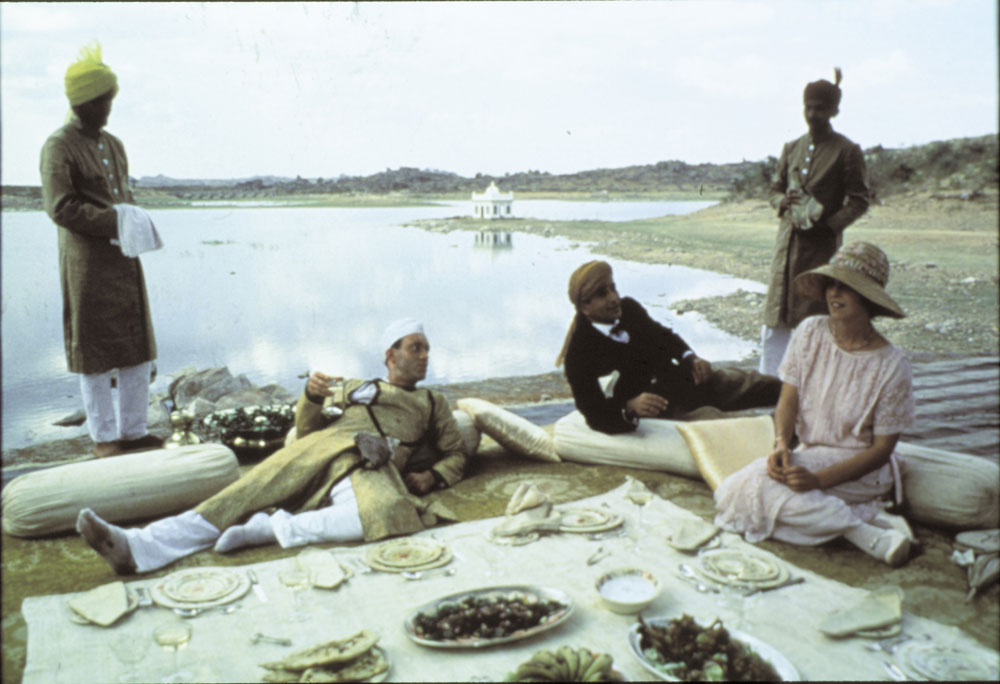
Emma Thompson saying, “After you worked on a Merchant Ivory film, everybody says never again.” That rings true for some people, but not others. Carol Hemming, Merchant Ivory’s makeup and hair person, worked with them from “The Bostonians” through to “The City of Your Final Destination,” with memorable stops at “Jefferson in Paris,” and “Howards End” and “A Room with a View.” So, a lot of the people behind the camera were dedicated and looked at a Merchant Ivory film as an opportunity for more quality work. Helena Bonham Carter did “A Room with a View,” but there wasn’t a good role for her [again] until “Howards End.”  When they wanted to do “Le Divorce,” Ivory was interested in casting Emma Thompson, and she wasn’t interested in a role and didn’t come back after “The Remains of the Day.” 

Everyone has their stories and their own recollections. With Vanessa Redgrave, a piece of footage that I wasn’t able to include in my film featured Ismail and James interviewed about casting Vanessa in “Howards End.” At first, Vanessa wasn’t interested in taking that role on, but then Ismail asked, “What would it take for you to do this role?” Vanessa said, “You double what you offered me, and I’ll do it.” And Ismail said, “Yes. Done. You’re in the film.” Everyone had a different anecdote that pertained to their own careers. Hugh Grant told a crazy story — I have bonus material on the MerchantIvoryfilm.com website — about supporting “Maurice” at the Venice Film Festival. James Ivory took a nap in Hugh’s hotel room and accidentally used his hemorrhoid cream to brush his teeth instead of the toothpaste. That was only something Hugh Grant could tell. 

The filmmakers are masters of literary adaptation, thanks in no small part to Ruth Prawer Jhabvala. Their films featured the most gorgeous costumes and art direction. Why do you think they are so popular?

We did an event at Laemmle Royal [in Los Angeles] and this woman in her early 70s came up to me and said, “I love your documentary, but it makes me sad, because they don’t make films like this anymore.” She called out something that I hadn’t thought about — the fact that Merchant Ivory brought the caliber of these actors together to do these films. All these actors wanted to work with Merchant Ivory. Gwyneth Paltrow in “Jefferson in Paris,” Naomi Watts in “Le Divorce” or Laura Linney in “The City of Your Final Destination.” There was a time everyone wanted to be in a Merchant Ivory film. I think it’s the brand. I think the beauty of these films, and that they made these beautiful films for low, low, low budget. But everyone knows Merchant Ivory would put this incredible quality up on the screen, and everyone wanted to be a part of that. It was on everyone’s checklist to make a Merchant Ivory film. Anthony Hopkins went back again and again and again until he got to “The City of Your Final Destination,” and then ended up suing them. But he was all-in on that film. 

Heat and DustHeat and Dust (Cohen Media Group)I think “Heat and Dust” as quintessential Merchant Ivory. It was a bridge between their Indian cinema period and their British heritage or period films that came after. What do you think about this film as a template for their distinct brand of cinema? It is arguably, most typical of their work. 

I wish I could have taken a deeper dive on “Heat and Dust.” There are many things about that film that exemplified Merchant Ivory. Ismail Merchant started that film with only 30% of the budget. He ran around panicked trying to secure the additional 70%. It was typical action on a Merchant Ivory set — not having enough money; agents and managers telling their people to stop working because the money is not coming in; and Ismail having to finagle through it and his making a curry dinner on the grounds of some gorgeous palace that they couldn’t get into, but everyone wanted to see. 

“Heat and Dust” is based on Ruth’s Booker prize-winning novel which illustrated her incredible talents as a writer. She was a novelist first and foremost. The screenplays were almost secondary for her; they were a job she was hired to do. The film itself was made on a limited budget, but they captured the beauty of India in that film. Greta Scacchi starred in that film, and it was her first major film role. How many times did that happen?  “A Room with a View” was Helena Bonham Carter’s second film after “Lady Jane.”  Merchant Ivory gave a lot of actors, like Hugh Grant, their first major roles. 

The BostoniansThe Bostonians (Cohen Media Group

“The Bostonians” got an Oscar nomination for Vanessa Redgrave, but the film never quite had the visibility of many films they made after. Why do you think that was? 

I think it was ahead of its time. Merchant Ivory didn’t shy away from the relationship between Madeleine Potter and Vanessa Redgrave’s characters. It was front and center. They seemed to be ahead of curve of LGBT representation in film. They weren’t known for that. Even with “Maurice.” It was more about the beauty of their films. They started prepping “The Bostonians” for PBS. It was going to be made for television, and somehow, it was unplugged from PBS, bur they already started pre-production, so they decided, we’ll make it as a Merchant Ivory film. It was meant to be something much more limited than what it became.

“A Room with a View” was the filmmaker’s breakout success. Why do you think that was the film that connected with viewers? 

I think it’s the timing of things. Sometimes you make a film, and everything comes together. The casting on the film. Three-time Academy Award-winning costume designer Jenny Beavan said about that film, “Nobody had any idea the music was going to be as gorgeous as it was.” The beauty of production design. It was the first film that Tony Pierce-Roberts shot. He was a really good match for James Ivory. That’s when they used cranes and do tracking shots and move it around. The cinematography on “A Room with a View” was really kind of a breakout – and all of these things together, Helena Bonham Carter and Daniel Day-Lewis, all of it worked. It was the biggest success for an art-house film. Another thing about it was that Ruth Prawer Jhabvala wrote a perfect screenplay. Merchant Ivory are known for their literary adaptations, but having a novelist like Ruth doing the adaptations made a big difference for all of the books.

A Room With a ViewA Room With a View (Cohen Media Group)

“Maurice,” their subsequent feature, was also very respected, even though many questioned why the filmmakers who could have done almost anything after “A Room with a View,” would make a gay film at that time. Folks actually questioned why they did this. What are your thoughts about this project? 

"I saw myself on screen."

It was Jim Ivory who drove “Maurice.” I partner that film with Jim in my film. It was his vision to do it. He knew the time was now for that. We have to remember. That was the peak of the AIDS crisis in 1986-'87. Remarkably, he had the vision to do it and thought this was the time and it might not come around again. Ruth wasn’t as interested in doing it; she thought it was a subpar Forster novel. But there was something about that story at that time that it was important to make. It didn’t have a phenomenal theatrical release. But I think it found its audience. I saw it on VHS, and I saw myself on screen. I think a lot of people had that reaction. I think it’s the Merchant Ivory film that has had the biggest, most important impact on an audience over time. 

“Maurice” is another example of a film they had to take a pause on during shooting because they ran out of money. That scene where Scudder (Rupert Graves) is supposed to get on the boat was shot after they finished the main production. There were so many stories of a Merchant Ivory film that had to stop because they ran out of money. James Ivory gives Ismail the lion’s share of the credit for always getting the money in these fiercely independent productions. They were starting from zero on a lot of their films. They didn’t make a lot of money off “A Room with a View.” Most of [the profits] went to the distributor. When they were prepping for “Maurice,” Ismail had to raise almost the entire budget. People should be in awe that Ismail brought every single film over the finish line. None were abandoned. They were always finished and released in theaters. 

MauriceMaurice (Cohen Media Group)“Howards End,” their third Forster adaption, is considered their masterpiece. It was followed by the exceptional “The Remains of the Day.” What observations do you have on how Merchant and Ivory worked at the height of their powers? 
You said it. They were at the height of their powers at that point. There is a shorthand that comes from working with the same people over and over again. They were a well-oiled machine. I’d also say, the material itself was a perfect match for Merchant Ivory. “Remains of the Day” was supposed to be a Mike Nichols’ film, and Meryl Streep wanted to play Miss Kenton, and she was angry she didn’t get the role. She tried to get Ivory to hire her. But he went with Emma Thompson. 

I actually have considerable fondness for “Slaves of New York,” an atypical Merchant Ivory production. I also thought highly of “A Soldier’s Daughter Never Cries,” but these more contemporary films and a few others, like “Le Divorce,” didn’t connect with audiences, and sometimes not even with critics. Do you think Merchant and Ivory were pigeonholed, or that they reached their pinnacle and fell off? 

I think it was the type of stories that they were drawn to make at that point, which, again, were often based on books. With “Slaves of New York,” Tama wanted to do the screenplay on that. If Ruth had agreed to write that . . .

I don’t see Ruth writing “The Slaves of New York”!

Tama even said in our interview that she wished she hadn’t been so adamant about writing that screenplay solo because she was out of her element. That film is such a time capsule for New York. Would you say “Slaves of New York” is flawed?

No. I think it is underrated, ignored and unloved. It’s episodic, because it is based on interconnected short stories, but the cast is fantastic — Bernadette Peters, Mercedes Ruehl, Mary Beth Hurt and Steve Buscemi. I’m always disappointed that film did not do better. 

You also mentioned “A Soldier’s Daughter Never Cries,” which is a very ambitious and a very good film. “Surviving Picasso” and “Jefferson in Paris” didn’t connect, and I think that the critics had significant issues with those films, but maybe not “Soldier’s Daughter.” The first draft of the screenplay for “Jefferson in Paris” was 350 pages, and they kept paring it down and cutting. There were too many threads in that film, and they tried to tell too many pieces of the story. It didn’t come together. Whereas “Soldier’s Daughter” stands up story-wise and screenplay-wise. I think it’s a wonderful film. 

When I saw “The White Countess,” I was bored. I didn’t connect with it. I also wasn’t connecting with Anthony Hopkins’ performance in “Surviving Picasso.” I think a lot of people who loved Merchant Ivory went to see every single film, but coming away disappointed with those later films. That’s how they lost a big part of their audience. People wanted to see “Howards End” and “The Remains of the Day,” and they weren’t being served up those films. Merchant Ivory made the films they wanted to make. They were done with that period and moved on. Ismail started directing his own feature films.   

What Merchant Ivory film do you think folks should see, and why?

For me, “Maurice.” I think it stands the test in time. The message of that film was super important for James Ivory. He felt “A Room with a View” and “Maurice” were like two sides of a coin. Watching Lucy Honeychurch [Helena Bonham Carter’s character in “A Room with a View”] choose to marry for love and then to see James Wilby as Maurice makes his own decision to go down that path resonates still. It’s hard to choose just one Merchant Ivory film. If you are looking for a Merchant Ivory film for who Merchant Ivory was going to be, I would take a look at “Shakespeare-Wallah.” It really is the one Indian film that absolutely holds up and is the model for what Merchant Ivory became. My favorite movie, however, is “Howards End.” That’s the one that is “perfect in every way.” That was the film that pushed me to go to film school. I saw that and “The Remains of the Day” back-to-back and those were the kinds of film I wanted to make. 

“Merchant Ivory” opens in select theaters Aug. 30, with a national expansion to follow.


Elon Musk now says mail-in ballots are “insane,” but that’s how he voted in California

Earlier this year, Elon Musk slammed voting by mail, calling it “insane” and falsely suggesting it is linked to widespread election fraud. However, Musk's own voting record, obtained by NBC News, shows that the tech tycoon voted twice by mail prior to moving out of California in 2020.

In November 2016, the records show that Musk voted by mail from his primary residence at the time, in Los Angeles, and then again in the November 2018 midterm election. 

State records also show that the billionaire has only cast ballots in two elections in the 18 years he was eligible to vote in California. The South African-born Musk first became eligible to vote in 2002 when he became a U.S. citizen.

Despite his limited participation in the U.S. electoral system, Musk has posed as an expert on his social media website, X.

“In the USA, you don’t need government issued ID to vote and you can mail in your ballot. This is insane,” he wrote in January 2024. In reality, it is standard practice, including in the state of California, for first-time voters to mail copies of their IDs with their ballots; identification is also required when people register to vote.

In May, Musk also falsely claimed that voting by mail was generally “not allowed” before the COVID-19 pandemic broke out. “Widespread voting by mail (not allowed before the scamdemic) makes proving fraud almost impossible," he claimed

When NBC News reached out to Musk for a comment about his voting history, the X and Tesla CEO returned to his right-wing talking points.

“Voting by mail has been recognized as an invitation to fraud throughout the world,” he claimed in an email.

According to the Bipartisan Policy Center, the number of people voting by mail has increased steadily since the 1980s and "is a safe, secure, and reliable voting method used by voters of all political parties."

"Mail ballot envelopes typically require a voter’s signature, identification number, or other identifying information," the center notes. And before it is counted, "election officials check to make sure that the signature or identification number matches that which is on file."

Kamala Harris reveals Biden’s endorsement came over pancakes and bacon

In the Harris-Walz campaign, food has emerged as an unexpectedly resonant theme. Vice President Kamala Harris has showcased her culinary skills through the YouTube series “Cooking with Kamala,” while coverage of Tim Walz has frequently highlighted his award-winning hotdishes. But food's role extends beyond mere symbolism. In a new interview with CNN, Harris revealed that it was over a meal that she first learned of President Joe Biden’s decision to end his reelection bid and endorse her as his successor.

"My family was staying with us, and including my baby nieces, and we had just had pancakes," Harris said in the Thursday interview. The children were in the middle of asking for more breakfast — “Auntie, can I have more bacon?” — when “the phone rang, and it was Joe Biden.” 

Harris continued: “He told me what he had decided to do and I asked him, ‘Are you sure?’ And he said, ‘Yes.’ And that’s how I learned about it.” 

This summer, Biden was under growing pressure to drop out amid fears that his health was impaired and he wouldn’t be a competitive candidate against former president Donald Trump. In the interview with CNN, Harris said she felt. Biden’s presidency would be looked back upon with admiration and appreciation. 

“I think history is going to show… in so many ways it was transformative,” she said.

Celebrate clams at their best with this unique, robustly flavored tomato-based clam chowder

I have been schooled on many things while spending time along the east coast between Cumberland Island, Georgia and Cape Hatteras, North Carolina — and one such thing is chowder.

Recently, I made the acquaintance of a now-septuagenarian, a self-described “former” salty sailor, who sailed across the Atlantic on a thirty-some-odd-foot sailboat, and he said it best while sitting alongside my husband and me at our favorite place to eat in Oriental, North Carolina when he passionately proclaimed, “Chowder is a big damn deal”! 

That’s chow-DER, by the way, not chow-DAH, and he is right. Chowder is a huge deal all along the Atlantic coast.

Fish chowder, conch (whelk) chowder, seafood chowder, New England style (white) chowder, red (Manhattan) style, Hatteras style (broth based), and a new one for me: Red Inlet Style Chowder, a spicier version that might have originated in Murrell’s Inlet (or perhaps some other inlet . . . or maybe Beaufort . . . It is low country chowder, but from the Inlet??). Chowder is everywhere in these parts and is taken seriously, but the details, and there are many, can be hard to follow.  

I have learned that every chowder has a story, and most every restaurant serves some type for which they are proud. It is like a competition or way of setting each institution apart. Conversations abound about every version of this hearty seafood-based, mystery soup of sorts, particularly regarding where each originated and what ingredients belong and are authentic. (Bacon drippings may be the only thing that connects them all.) 

From the perspective of an outsider looking in, I am convinced neither the cooks nor the consumers keep the facts straight, and I use “facts” loosely. I listen and pay close attention, and I can report with certainty that there is a lot of overlap, doublespeak and downright misinformation that gets spouted about when talk of chowder gets going, but I, for one, will not be correcting anyone, that is for sure.         

But let me back up. My husband, Tom, bought a boat — that is where my story begins. He bought a boat in North Carolina. And instead of bringing his new girl home to Alabama, he decided to keep her where she was: in the charming little town of Oriental, a place with more boats than people, nestled within the inner banks of Pamlico County along the Neuse River, not far from New Bern.

We need your help to stay independent

Oriental is quirky and charming and tiny — like maybe 800-residents-tiny — and other than a hit-or-miss pizza joint, the only place to get a good dinner is M&M’s Cafe, a long-standing family owned restaurant whose staff make you feel like a regular as soon as you step through the door.

Over the last six months or so, Tom and I have spent several two to three week stints on the boat, and unless we are anchored out somewhere along the Intracoastal Waterway between Pamlico Sound and Albemarle Sound or have ventured south down towards Beaufort, we eat dinner most evenings at M&M’s. Like a well rehearsed play, we have our routine: We arrive early, take seats at the bar, and enjoy what we have come to call an “Oriental-pour,” a glass of wine filled to the absolute tip-top. Within our first few sips, we are greeting and acknowledging the same folks we saw the previous evening, or the night before that, or the last three or four in a row. M&M’s really is the only game in town.   

Perhaps it is the “Oriental-pours” or the simple realization that despite our disparate backgrounds and not always being in the same season of life as our barstool cohorts, everyone we meet in this little town is here for the same reason, and that reason includes a boat. Conversations flow easily at M&M’s and meander through all sorts of subjects from the most surface to sometimes the achingly deep. I admit to frequently nodding along in feigned understanding of which Banks (Inner or Outer), Sound (there are a few), Island, Inlet, Point, Cape, or -boro (there are so many towns that end in -boro) is being referenced, but I do not have to know the area any better than I do to be moved, entertained, or enlightened by the stories, experiences, and recommendations shared.

Red Inlet Style Clam Chowder is one of the best chowders I have ever had the pleasure of tasting. It is uniquely spicy, and although I am not yet a chowder judging professional, Tom most definitely is. He wholeheartedly gives this chowder two thumbs up and believes it is hands down one of the best he has tasted. 


Want more great food writing and recipes? Subscribe to Salon Food's newsletter, The Bite.


Given to me one evening at M&M’s by our fellow bar-dining dinner companion, Mabel, I knew this recipe was going to be something special by the way she lit up while telling me about it. She said she trekked to Murrell’s Inlet almost daily for it from her family’s summer place in close by Isle of Palm where she spent so many summers of her life.

After finding out I wrote about food, she went to a great deal of trouble to get the exact amounts and directions for me so that I could share it properly. Between phone calls, texts, and other interruptions to her meal, she made sure of all the details. Like I knew it would be, it is a spectacularly delicious chowder and I know you are going to love it.

Thanks, Mabel! Hope to see you again soon at the bar.  

Red “Inlet Style” Clam Chowder
Yields
6 to 8 servings
Prep Time
20 minutes
Cook Time
2 to 3 hours

Ingredients

**6 to 8 slices of bacon (see cook’s notes for alternative if desired)

2 onions, peeled and cut into a small dice

2 potatoes, diced

1 750g box or 28 oz can diced tomatoes

1/3 cup catsup

1 8-ounce bottle clam juice

2 tablespoons Heinz 57

2 tablespoons Worcestershire

2 teaspoons brown sugar

1/2 teaspoon salt

1/4 teaspoon ground black pepper

4 to 6 shakes hot sauce, like Crystal Hot Sauce

2 to 3 stalks celery, thinly diced

2 1/2 cups water

3 to 4 cans minced clams, undrained

Dry sherry 


Directions

  1. Fry bacon in soup pot, and once cooked, remove onto paper towels to drain and cool, leaving drippings in pot.
  2. Cook onions and potatoes in drippings over medium low until soft, about 8 to 10 minutes.
  3. While onions and potatoes cook, blend tomatoes, catsup, clam juice, Heinz 57, Worcestershire, sugar, hot sauce, salt, pepper, and crumbled bacon using either an immersion blender or food processor.
  4. Add tomato mixture to soup pot, along with celery and water, and cook over low heat about an hour with lid vented on one side of soup pot.
  5. Add clams and continue simmering on low another hour or so before adjusting seasonings.
  6. Serve with crusty French bread or plain crackers and have plenty of dry sherry available to add to individual bowls.
  7. My bacon-free version: Swirl 3 to 4 tablespoons olive oil in soup pot and heat over low. Add a hefty shake of smoked paprika and a light sprinkling of salt before adding onions and potatoes. Continue following recipe above. Add 1 tablespoons maple syrup and an additional bit of smoked paprika to the tomato mixture before blending. Continue to follow the recipe and adjust smoked paprika and/or maple syrup after simmering for at least an hour, if needed for a rich smoky flavor.

Cook's Notes

Sherry: Have plenty on hand, especially if you are hosting sailors. Dry sherry makes most any chowder better, especially red chowders. Start with a tablespoon per bowl, but do not be scared to add a great deal more.

Sugar/Sweetener: Regardless of whether you choose the bacon or bacon-free option, you must add a heavy pinch of sugar to this chowder to balance the acidity of the tomatoes. If you choose the bacon-free option, use both sugar and maple syrup.

Simmering the chowder: If you cook on a gas stove, simmering can be too hot. If you have a hot stove, cook at lowest setting for a bit, then cover and turn off the heat. Cycle the heat off and on so as not to scorch the chowder.

Before serving, cover and turn off the heat and allow to rest a bit before reheating to desired temperature before ladling into bowls.

“The water is still a place for me”: Ali Truwit’s Paralympics journey post-shark attack

Former Division I swimmer Ali Truwit is set to make her Paralympic debut in Paris. A little more than a year ago, she never would have imagined she'd be there.

While celebrating her college graduation from Yale University with friends in Turks and Caicos last May, Truwit was attacked by a shark, leading to a forced amputation of her foot and part of her lower leg. 

"I was conscious for the whole attack," Truwit said in an interview with PEOPLE. "My parents were in the United States at the time. I called my mom — well, the nurse called her — and I got on the phone and said, 'Mom, I . . . ,' and I couldn't even get the words out. I knew if I said the words, I would just . . . I was trying really hard to stay conscious, so I handed the phone to my friend Sophie who had to tell my mom."

"I went on the plane to Turks and Caicos with a five-year plan of my life and knew what my life was going to look like, and left on a medical evacuation plane not sure if I was going to live," the 24-year-old added.

And yet, despite the intensity of Truwit's ordeal, she got back into the pool a mere three months after undergoing a Targeted Muscle Reinnervation (TMR) surgery with a new plan: The 2024 Paralympics. 

https://www.instagram.com/p/C_OyZ1OpZ0s/?img_index=1

https://www.instagram.com/p/C_GcZAeJHle/?img_index=1

“I had lost enough, and anything that was on the table for me to regain, I was going to fight to regain it,” Truwit, who is part of the S10 Paralympics classification system, said, per the Olympics official website. “I didn’t want to lose a limb and my love of the water, too.” A key part of retaining that love included consistent therapy, both physically and emotionally. “The more I worked at it, the flashbacks reduced and the pain lessened,” Truwit shared of her therapy journey. 

"I felt like I had lost a lot in the shark attack that I wasn't going to get back. Like, my foot is not coming back. So the things that I could fight to get back, I decided I was going to do that," Truwit told PEOPLE. 

In the wake of the attack, Truwit decided to launch the organization Stronger Than You Think to provide support and empowerment for people without limbs and for their loved ones. "I started Stronger Than You Think to help people in need of financial assistance with their prosthetics as well as to help people become water safe," reads a portion of Truwit's statement on the foundation's website.

Now, Truwit will compete in the 100-meter freestyle event on Sunday, Sept. 1. A multitude of family and friends will be present to cheer her on, she said, noting, "The list goes on and on." 

"To think about the fact that a year and a week ago, I was taking my first steps in a prosthetic leg. It was so painful and scary and hard. I had to relearn how to walk at 23 years old," Truwit said. 

"Now to think that a year later I'm going to be walking down the Champs-Élysées at the opening ceremonies as a Paralympian is just a crazy kind of moment. I think I'm actually typically someone who's pretty forward-looking and constantly setting new goals. This go around, I definitely have goals for Paris, but also just really making sure I take a moment to feel really proud of how far I've come in a year. So I'm feeling proud.

“For anyone going through traumatic experiences or unexpected life events, we’re all still powerful, even as we are changed,” Truwit told NBC. “The water is still the place for me and it’s still a place that shows me my power and my strength.”


Georgia election workers, falsely accused of fraud, seek total control of Rudy Giuliani’s assets

Two Georgian election workers who worked in Fulton County during the 2020 election requested the federal court to give them control of Rudy Giuliani’s asset so they can fulfill the $146 million defamation judgment against him.

Wandrea ArShaye “Shaye” Moss and her mother, Ruby Freeman, were thrust into the center of national attention when former President Donald Trump and his allies falsely accused them of masterminding a fake ballot scheme, PBS reported.

Giuliani, the former president's lawyer at the time, repeatedly insinuated that election workers in the county, which is home to Atlanta, tampered with the vote count to hand the election to President Joe Biden.

Trump and his allies, like Giuliani, based their arguments on a video posted by a conservative PAC that showed election workers, including Moss and her mother, putting ballots into “suitcases,” which USA Today along with other factor-checkers revealed were absentee ballots being placed into storage containers, as they assumed that particular day’s counting was done.

“I’ve lost my name and I’ve lost my reputation. I’ve lost my sense of security all because a group of people people starting with Number 45 and his ally Rudy Giuliani decided to scapegoat me and my daughter, Shaye, to push their own lies about how the presidential election was stolen,” Freeman said in a video testimony to the committee, PBS reported.

Now Moss and Freeman want to see justice be served for the ridicule they incurred including death threats and harassment. 

The document reads: “In this motion, Plaintiffs seek two remedies to which they are entitled under New York law: an order requiring Mr. Giuliani to turn over personal property in his possession in satisfaction of the judgment, and an order appointing Plaintiffs as receivers with the power to take possession of, and sell, both real and personal property that Mr. Giuliani does not turn over.”

The request comes about a month after a court rejected Giuliani's attempt to file for bankruptcy after being found guilty of defamation last year, thus allowing the election workers to seek out the $148 million they are owed. Still, they are likely to receive far less than that, the former New York City mayor having disclosed just $10.6 million in assets to the bankruptcy court, The Hill reported.

“Mr. Giuliani has spent years evading accountability for his actions — first in litigation in the U.S. District Court for the District of Columbia, and then in chapter 11 bankruptcy proceedings that Mr. Giuliani commenced in this District,” an attorney for the mother-daughter duo, Aaron Nathan, wrote in a Friday court filing. “Now that Mr. Giuliani’s bankruptcy case has been dismissed, Plaintiffs are finally in a position to receive a measure of compensation by enforcing their judgment.”

Dems, listen to Eminem’s one-man culture war

Eminem presents himself as a one-man culture war on his latest, "The Death of Slim Shady." The album has been universally panned by critics and yet debuted at No. 1 on the Billboard 200. It’s a populist album. 

Critics complain that Eminem has exhausted his material. After all, he’s already killed Slim Shady off — twice. Anticipating their responses, Slim Shady raps to Marshall Mathers, “Now they’re saying you lack ire, that’s why your satire backfires.” Many of the album’s references are tired: imitations of "South Park’s" Cartman, potshots at Caitlyn Jenner and Christopher Reeve. He returns to culture war standards from transgender rights to fat shaming. His response to critics sounds like Eminem during his imperial phase, that period in a pop career when anything an artist releases will be both a hit and a cultural phenomenon: “This my s**t, I'm going to spit it how I wanna spit it / Whoever gets offended, suck a d**k and f**k a critic.” For Eminem, that phase was 1999 through 2004. Is Eminem stuck in the past? Yes and no. 

Two months before the album’s release, Mathers published a mock obituary for Slim Shady in the Detroit Free Press. “His complex and tortured experience [has] come to a close," the obit reads, “and the legacy he leaves behind is no closer to resolution than the manner in which this character departed this world.” Jordan Bassett, writing for NME, is more insightful than most: “Eminem is attempting to have it both ways here – to emulate his 2000s hits while lampooning Shady as a cultural relic.” This may be true, but it’s not a full description of the album, which is doing something new. 

Whereas previous material represented Eminem and his alter ego in relative harmony, the album stages an extended rap battle between creator and creation: Marshall Mathers and Slim Shady. The rush of lewd and offensive lyrics spew from the mouth of Slim Shady while Eminem tries to rein him in. Shady’s adenoidal whine is nowhere to be found on this record, replaced with a sinister, very adult scowl. The album’s lyrics reveal an artist at war with himself.

There's times when I lay down to sleep
I argue with myself
Am I the only one who thinks this way?

A one-man culture war is a lonely thing to be. Marshall Mathers wants company. Eminem’s latest satirizes the culture wars tying the nation up in knots — as well as his participation in them. Like so much of Eminem’s music, "The Death of Slim Shady" cannily reflects a cultural moment. Mathers is bored, as exhausted and confused as a lot of us. He’s bored with a doppelganger that traps him in an apparently endless series of culture war sniping. Not just bored, but tired, afraid. He raps, “I see the fear in your eyes, America.” Americans listening to this album might say the same to its maker. 

"The Death of Slim Shady" cannily reflects a cultural moment.

It’s not true that Eminem lacks the capacity for new material, new stories. When Slim Shady isn’t around – and his appearances have diminished over time – the artist’s repertoire stretches. The anthemic carpe diem of 2002’s “Lose Yourself” is one example of many: the exploration of domestic abuse in his duet with Rihanna, 2010’s “Love the Way You Lie”; his anti-Trump cypher at the 2017 BET Awards; his many songs to his daughter Hailie, from 2002’s “Hailie’s Song” to “Temporary,” the track that introduces "The Death of Slim Shady’s" denouement; depression on the single “Beautiful” from 2019’s "Relapse," an album about addiction.

In fact, Slim Shady has been largely on hiatus since 2004. It’s more accurate to say Eminem resurrects him than to argue that he’s been using him as a crutch for 25 years. Still, it’s fair to ask Eminem, as Basset does, “We get it – Slim Shady was a shocking character. Now that he’s dead, how about getting some new material?” Over the next several weeks, the country will be asking the same of the Democratic Party. 

We need your help to stay independent

Upon the album’s release, the so-called left was losing the culture wars, in large part because they’ve been meeting Trump’s brand of thoughtless, deceptive certainty with more of the same. One problem with culture wars is an insistence on premature resolution. They goad people into taking extreme – often simplistic – stances on issues whose complexity is way beyond our capacity to resolve. From Gaza to abortion, people express certainty when confusion and doubt are in order. As if searching for an antidote to all this certainty, Eminem made an album expressing his uncertainty. Then Joe Biden shattered certainty by bowing out of the election. 

Enter Kamala Harris and Tim Walz – a man you can imagine listening to Eminem. With their sharp campaign and electric convention, the Democrats are hitting notes they’ve flubbed since the Tea Party declared a monopoly on populism. They’re addressing the feelings of the American people. Though he doesn’t go as hard as Eminem, Barack Obama expressed the ambivalence and ambiguity that comes with the job. “To make progress on the things we care about, the things that really affect people’s lives, we need to remember that we’ve all got our blind spots and contradictions and prejudices," he said in his convention speech. Obama, like Eminem, is addressing the fear in the eyes of Americans. But neither of them is running for office. 

In her convention speech, Harris is more buoyant, expressing her promise to expand the middle class with certainty:

And we are charting — and we are charting a new way forward. Forward to a future with a strong and growing middle class because we know a strong middle class has always been critical to America’s success, and building that middle class will be a defining goal of my presidency.

It’s a big promise, to reverse the increasing income inequality at the heart of the global economy. As David Sirota has pointed out, there’s a disconnect between the populist message and corporate sponsorship of the convention. In his writing for "The Lever," Sirota has made a beat out of covering the many ways both parties put the profits of corporations before the people they serve. At this convention, the Democrats are eschewing the contradiction by condemning corporate greed. To be fair, you have to say a thing before you can make it real, before you can build policy out of it. 

But building policy involves confronting contradictions politicians aren’t willing to express to the public. Contradictions are difficult for them, especially in a polarized world driven by online expressions of angry certainty from both sides. For an artist, contradictions provide motive; Eminem built his career on them. On “Habits,” this album’s second track, he raps with astonishing verbal dexterity, “So all my statements are basically contradictive (What?) / Like using the F-word for gay is wrong and offensive (What?)?” Parenthetical questions throughout the song represent the artist arguing with himself. (For what it’s worth, Eminem eschewed that particular F-word since a beef with Tyler the Creator in 2018 – and insisted he is not homophobic for at least a decade before that.

On “Lucifer,” he lands a Candace Owens diss, making it clear where he doesn't stand politically:

I ain't gon' throw the fact b***h forgot she was Black back at her
In a cute MAGA hat with her brand-new White Lives Matter shirt (Haha, nope)
Or say this MAGA dirtbag in a skirt.

In a response, Owens has been widely declaring she feels sorry for him because he’s obviously a closeted gay man. She doesn’t seem to realize queerness is no longer his kryptonite. Shady wants homophobia from his maker, but Mathers refuses.   

Eminem may be bored with Slim Shady, but despite the album title and the obituary, he can’t quite kill him off. “Guilty Conscience II,” the album’s climactic battle between Mathers and Slim, ends with a Frankenstein moment, banishing his creation with a bullet to the head. But in the skit that follows, Marshall Mathers casts the murder as a dream, a trope Eminem has used throughout his career to inject ambiguity into the scenarios he spins. Critics have found the device cheap, too easy – and, frankly, an artist of Eminem’s verbal dexterity can do better. Mathers can’t kill Slim because the character lives in his nervous system. There’s another reason, too: As long as poverty is rampant in America, Slim will crawl his way back. His obit, after all, refers to a lack of resolution around both his death and his legacy.             

Building policy involves confronting contradictions politicians aren’t willing to express to the public. . . . Eminem built his career on them.

In his book "White Poverty: How Exposing Myths about Race and Class Can Reconstruct American Democracy" Reverend William J. Barber argues that the culture wars mask the rampant poverty in the world’s richest nation. He writes, “The problem in American politics isn’t that poor white people vote against interests, so much as it is that poor people don’t have anyone to express their interests.” Eminem knows that because he grew up poor in America. He’s has been expressing the interests of the poor for 25 years. Trump and Vance, separately and now together, have been pretending to the same for close to a decade. The Democrats are just getting started. 

Since at least 2013, when he launched his “Moral Mondays” campaign in North Carolina, Barber has been calling on Americans – and, crucially, our leaders – to recognize that white poverty is built into systemic racism. For Barber, the culture wars are a distraction from the fact that “nearly half of Americans – people of every race, creed, and region – are united by the experience of being poor.” When enslaved Black people made crops cheap, poor white farmers suffered because they couldn’t compete; white supremacists push the myth that the success of Black people and immigrants are responsible for white poverty. Barber tells a more accurate story about poverty in America: “The issues impact poor people [like Slim Shady, like Marshall Mathers well into adulthood]” are not “matters of right and left, but right versus wrong.” As Pete Buttigieg told Barber and his congregation in 2019, “Rev, I’m probably not supposed to say this. I might get in trouble for saying it here. But the reason we don’t talk about poverty is that the consultants tell us not to.” When Alexandria Ocasio-Cortez talks about “working people,” she uses euphemistic code for poor people.

Is there room for Slim Shady in the vision of America we heard at the DNC? If the answer is yes, Eminem might just be able to kill him off. In the meantime, he haunts the album because he haunts American culture. On a skit near the end of the album, Slim sounds like he’s crawling out of a grave, groaning like Tolkien’s Golem:

Been waiting a long time for this s**t,
Long time no see, 
Thought you got rid of my a**, huh?

Then he croaks the hook from the album’s first single, “Houdini,” a riff on the chorus of Steve Miller’s “Abracadabra”:

Half a bag of Viagra, 
I’m gonna reach around and grab ya, 
Bruh,
Sometimes I wonder if my homie’s gay, 
Wait, where’d everybody go?

We hear footsteps leaving the scene. He’s lost the magic.

Eminem is no lover of politicians. But he is a genuine hater of Donald Trump. If you listen closely to "The Death of Slim Shady," you can hear an artist tired not just of himself, but of the partisan warfare Trump stokes. American disaffection crosses parties. Eminem upends them — easier to do in art than politics. While we’re stuck with the two-party system, Harris and Walz are catching on as they veer toward populism. They must appeal to the millions of Americans buying this album. If they can do that, they have a chance of winning the presidential and down-ballot elections — and moving beyond impasses of the culture wars toward productive policy. The Harris-Walz ticket must not simply look new, it must be new. 

The radical change hinted at but not quite promised at the convention seems beyond reach. Slim Shady wouldn’t buy it. But as Pete Buttigieg — Shady’s opposite in just about every way imaginable – reminded us on the convention stage that marriage equality and mainstream cultural representation of LGBTQ people seemed impossible just a couple of decades ago. And LGBTQ rights are no anomaly. As Heather Cox Richardson writes on Substack, “I keep coming back to the Ernest Hemingway quote about how bankruptcy happens. He said it happens in two stages, first gradually and then suddenly. But the more I think about it, the more I think maybe democracy happens the same way, too: slowly, and then all at once.” Think the Rove v. Wade, the New Deal or the abolition of slavery. Her words rang through my mind as I witnessed the crowds dancing to the riff from “Lose Yourself” as Michigan delegates pledged their votes for Harris and Walz: “You only get one shot, one chance to blow / This opportunity comes once in a lifetime, yo.” The joy of the convention was infectious and necessary. People need motivation to join in on the hard work of grass roots organizing necessary to make the most of a sudden opportunity for cultural change. It’s on all of us to work to make a new chapter in the American story possible.

One might go so far as to make an analogy between the fatigue that led to Biden’s retreat from the election and Eminem’s decision to kill off Slim Shady.

Eminem is not bored with his craft. Even as they pan the album’s themes, most critics admit that Eminem’s rhymes are as deft as ever. He experiments with new tones and cadences; the beats bounce, the production is subdued, but innovative. The album is packed full of infectious hooks. It’s streamed by millions because it’s so damn listenable. In other words, populist. A politician’s craft requires rhetoric and policy. Policies that make the radical change Barber, Robinson, and Sirota imagine will require passing laws and making policy. This is a job Joe Biden excels at (think The American Rescue Plan, new gun laws, and the infrastructure bill). Without a super majority or serious filibuster reform in the Senate, the bills – abortion, affordable housing, lowering drug costs, the minimum wage – Harris promises to sign will never make it to her desk. How refreshing would it be if she and Walz ignored their consultants and addressed the challenge directly? What if they addressed what Biden was not able to get done: raising the minimum wage; solving the border crisis; meeting our stated climate goals? Might they appear more trustworthy if they confessed to the ambiguities, ambivalence and contradictions their jobs entail? 

It works for Eminem. His track record is solid when it comes to pumping his fans through admissions of failure. It’s a weird move – especially in hip-hop – for an artist to explore his own artistic ennui. It’s honest, but difficult to hear. It requires close listening to hear the internal conflict of a middle-aged artist who feels his youthful poverty no matter how rich he gets. Politicians want to send broad messages, not subtle ones. They avoid the doubt, fatigue and frustration that dominate "The Death of Slim Shady." One might go so far as to make an analogy between the fatigue that led to Biden’s retreat from the election and Eminem’s decision to kill off Slim Shady. 


Want a daily wrap-up of all the news and commentary Salon has to offer? Subscribe to our morning newsletter, Crash Course.


The five songs that follow the shooting of Slim Shady are mostly about money. The two strongest explore typical American problems, with a sincerity more characteristic of an Eminem interview than his music. On “Temporary,” a song about his own mortality, he worries he’s neglected Hailie and the other three children he raised because he worked too much. “Somebody Save Me” opens with a dialogue between Mathers and his daughter Alaina. She pleads with her opiate-hazed father to eat. Hip-hop country artist Jelly Roll sings the song’s title and hook. It’s not Marshall Mathers, sober since 2008, who needs saving. It’s a refrain that the coalition of poor people of all races Barber envisions might chant. Jelly Roll, a white artist embraced by country radio and hip-hop culture, croons the yearning chorus like he’s addressing a coalition – one the “new” Democratic Party hopes to appeal to.

The reception of "The Death and Slim Shady" makes it clear that Eminem has the popular vote, but not the delegates. The Democrats will need both. As they consider this, the party might want to add Eminem’s latest to the DNC playlist


“Rigged and worthless”: Trump trashes Fox News over poll that shows Harris leading in swing states

Donald Trump is lashing out at Fox News over its latest polls that show him losing to Vice President Kamala Harris in key battleground states.

In a post on Truth Social, the former president fumed that the recent polls are “rigged and worthless.” Those polls, conducted Aug. 23-26, show Harris beating Trump in Arizona by 1 point and by 2 points in Nevada and Georgia, while being down by just 1 point in North Carolina, a state the former president won in 2016 and 2020.

Trump supported his attack with an internal campaign memo that noted Fox News' polling has been inaccurate in the past, including in 2020, when it underestimated Trump's support in some swing states.

While it is true that Fox News' polling was off in 2020, it is also true that President Joe Biden did in fact win three of the four states that its surveys showed him winning. It should be noted that even though Harris appears to be in the lead in many key states, the race is still very tight and her leads are within the margin of error.

Fox's polling is consistent with other recent surveys. Bloomberg released its own swing state polling this week with similar results, showing Harris has a 2 point lead among registered voters across seven swing states. According to Bloomberg, Harris leads by 4 points in Pennsylvania, 8 points in Wisconsin, 2 points in North Carolina, 3 points in Michigan, 4 points in Nevada, 2 points in Georgia, and 1 point in Arizona.

Vance says he’s “not going to apologize” for sexist post comparing Harris to a teenage beauty queen

Donald Trump's running mate, Sen. JD Vance, was confronted by CNN host John Berman Friday morning for posting a video of former South Carolina beauty queen Caitlin Upton struggling to answer a question and comparing her performance to Kamala Harris ahead of her CNN interview Thursday night, Mediaite reported

In his post, the GOP vice presidential candidate mockingly wrote, “BREAKING: I have gotten ahold [sic] of the full Kamala Harris CNN interview,” attaching a 2007 video of Upton, then 18, that has long served as fodder for mockery on the internet. 

When Berman informed Vance that the negative attention Upton initially received from the video had pushed her to become “very, very depressed” and considered "suicide," as she revealed in a 2015 New York Magazine interview, Vance said he didn't know and pivoted to admitting that he has sometimes messed up.

However, his tone soon shifted as he doubled down on his ridicule, downplaying the information he was provided about Upton’s mental health and defending the need to “have some fun,” saying politics has turned “lame.” 

At the same time, Vance said that people should focus less on his meme — of a woman being made into a joke — and instead focus on how some families can’t afford groceries. 

“There’s nothing that says that we can’t tell some jokes along the way while we deal with the very serious business of bringing back our public policy,” Vance asserted.

Berman followed up: “I just want to be clear, though. You said you didn’t know. Would you like to apologize to Caitlin Upton for posting that up there last night, given what you’ve now learned?”

Vance declined. “John, I’m not going to apologize for posting a joke," he said, "but I wish the best for Caitlin.”

How John Roberts reshaped the law — and gutted the Voting Rights Act

Chief Justice John Roberts famously promised to be a modest caller of balls and strikes during his confirmation hearings two decades ago. In their occasional public appearances, Supreme Court justices always insist that the high court doesn’t do politics or policy but simply interprets the Constitution.

Yet on the rare occasions when we get a glimpse behind the court’s closed doors, the discussions over cases sometimes look much more like the grubby negotiations that take place in smoke-filled congressional rooms than high-minded, neutral applications of the law.

The latest peek around the velvet curtains comes from always-wired CNN Supreme Court reporter Joan Biskupic. Her latest scoops from the court’s just-completed term included the stunning inside story of the decision in Moyle v. United States, which preserved, at least temporarily, access to abortions in Idaho during emergency situations.

In January, the court allowed Idaho’s abortion ban to take effect, prior to a full hearing in April. Yet by the spring, Justices Brett Kavanaugh and Amy Coney Barrett, along with Roberts, had second thoughts — whether because of the intricacies of the case or because they wished to hit a pre-election pause button on additional abortion decisions that polls showed to be unpopular.

As Biskupic vividly narrates the story, the backroom dealings take on the form of a political thriller, complete with shifting alliances, hard-nosed negotiations and lingering bitterness from the jilted conservatives left behind as Roberts, Barrett and Kavanaugh flirted behind enemy lines.

It’s a compelling look at how the sausage is made within an institution that has long insisted it’s not making sausage at all, but is far above such things, a white-tablecloth, fine-dining establishment where such trimmings would never enter the kitchen. The reality, of course, is entirely different. The Supreme Court is hardly a court of law at all. It is best understood as a third political branch of government, but one that unlike the other two consists of just nine unelected people with lifetime appointments, no ethics code and zero accountability, who deliberate in private and explain little.

The justices would rather obscure this reality, which is why stories like these are so rare but so valuable. It’s reminiscent of an important Voting Rights Act case that preceded the infamous Shelby County ruling, setting up the end of the procedure known as "pre-clearance." In the 2009 Northwest Austin case, the court heard an audacious challenge to the VRA’s crucial enforcement mechanism that required states with the worst history of racial vote suppression to get any changes to election laws approved in advance by the Department of Justice or a federal court in Washington.

A tiny water district on the outskirts of Austin, Texas, bristled under this constraint and challenged the provision, since it represented a new neighborhood with no history of transgressions at all. The lower federal courts, however, reviewed the 2006 reauthorization of the VRA and found that the district was not eligible to be removed from pre-clearance, and that Congress had produced a voluminous report of nearly 16,000 pages explaining why pre-clearance remained proper and needed.

It’s difficult to understand exactly what version of the law the court applied in Northwest Austin. Judges often deny that they are robed politicians sitting on a bench, but the horse-trading here shows something closer to the reality. Roberts wrote a near-unanimous decision for a court that appeared deeply divided, based on oral arguments. The district was allowed to bail out of coverage. Pre=clearance survived for the time being, however, in an apparent win for the liberal justices. Roberts was hailed as a master of judicial statesmanship for reaching consensus.

Almost everyone also agrees that it wasn’t law.

“They made a deal,” said Edward Blum, an attorney who helped bring the water district’s challenge.

“It’s a compromise,” said Debo Adegbile, then an NAACP litigator who defended the VRA before the Court.

“It wasn’t exactly a principled constitutional decision,” said Judge David Tatel, who wrote the lower federal court’s decision that Roberts overturned.

But what no one noticed amid the horse-trading was that Roberts had laid a slow-motion trap. The liberal justices scarcely noticed what they signed onto. The chief justice wrote that “things had changed in the South,” and to make that implausible case cited statistics that could just as easily have been used to prove that pre-clearance was working.

The Supreme Court is hardly a court of law at all. It is best understood as a third political branch of government, but one that consists of just nine unelected people with lifetime appointments and zero accountability.

For his masterstroke, however, Roberts created his own doctrine of “equal sovereignty” among states by equating it with the “equal footing” doctrine that governs the admission of new states, and then declared this new invention to be historic and fundamental. He did this by cutting and pasting from an earlier Voting Rights Act decision that reached the opposite conclusion, and used an ellipsis to edit out the part that ruled otherwise and turn the meaning of the precedent inside out. 

Four years later, Roberts would draw on all this — ignoring, in the process, the thousands of pages that showed clear congressional intent to extend pre-clearance — to end it altogether in the 5-4 decision rendered in Shelby County v. Holder. A nearly unanimous vote in both houses of Congress had extended preclearance and the VRA just seven years earlier. Roberts laid the groundwork to gut the most successful civil rights legislation in American history all by himself, behind closed doors, accountable to no one at all. 


Want a daily wrap-up of all the news and commentary Salon has to offer? Subscribe to our morning newsletter, Crash Course.


Roberts entered office citing his modesty and adherence to institutional norms. He has acted instead with massive hubris and ambition, yet somehow the myth of the straight-shooting Midwestern umpire endures. 

As Joe Biden and Senate Democrats have reintroduced important Supreme Court reforms, it’s important that stories like Biskupic’s and the saga of Northwest Austin are part of the conversation. This Supreme Court is not behaving like a court: Private horse-trading is no way to determine the law. Neither, of course, is packing a court with partisan ideologues. At the moment, we have a court where nine individuals with lifetime appointments weigh important issues behind closed doors. The public has no idea what is happening, let alone who is paying for the justices' family vacations, real estate, or tuition bills. That kind of power, and that level of secrecy, has no place in a democracy. Neither does a court that wishes to rule in permanent supremacy over the elected branches of government.

Nancy Mace says Trump, found liable for sexual abuse, will protect “survivors of rape”

Rep. Nancy Mace, R-S.C., says she is voting for GOP presidential candidate Donald Trump because she’s a woman and and he will protect women like herself “who are survivors of rape,” she said during a Fox News interview on Thursday, The Daily Beast reported

The comment came after Mace was asked how she feels about “the whole gender thing" as a factor in this year’s election. The lawmaker reiterated her support for the former president, despite a jury finding Trump liable for raping writer E. Jean Carroll.

The South Carolina representative, a survivor of sexual assault herself, doubled down on why she would vote for Trump despite his record on women, listing policies that she found relevant: “lowering taxes for the middle class, expanding the child care tax credit, looking at the spending of the federal government" (Trump ran up the national debt twice as fast as President Joe Biden, per a recent analysis).

“I’m voting for Donald Trump because I want to be sure that biological men aren’t in the locker room showering next to my underage daughter,” she added. “I want to make sure men aren’t stealing women’s achievements in sports or academics or their scholarships, and that’s why, as a woman, I support Donald Trump.”

Mace’s comments — defending a man who has been publicly accused of sexual misconduct, including both groping and rape, by at least 25 other women in the last five decades — come after she clasehd with ABC’s “This Week” host George Stephanopoulos when he questioned her support for Trump after the E. Jean Carroll verdict.

Mace deflected by claiming Stephanopolous was shaming her as a survivor.

“I will tell you that I was raped at the age of 16, and any rape victim will tell you I’ve lived for 30 years with an incredible amount of shame,” she argued. “I didn’t come forward because of that judgment and shame that I felt, and it’s a shame that you will never feel, George, and I’m not going to sit here on your show and be asked a question meant to shame me about another potential rape victim. I’m not going to do that.”

“Hail Mary”: Trump’s latest attempt to delay his hush money sentence “will likely fail,” experts say

Donald Trump’s lawyers don’t necessarily believe, deep down in their hearts, that his New York felony conviction for fraudulently covering up hush payments to an adult film star is really a matter of official, presidential business — one that demands the federal courts intervene to uphold “the balanced power structure of our Republic.” But what they know is that making the argument could at least delay the former president’s sentencing in the case, currently scheduled for Sept. 18.

In a 64-page document filed with a U.S. district court Thursday evening, attorneys Todd Blanche and Emil Bove argue, not for the first time, that Judge Alvin K. Hellerstein should take over the case and bring a halt to the state proceedings, which if allowed to continue will “cause direct and irreparable harm to President Trump,” who they describe as “the leading candidate in the 2024 presidential election” (Vice President Kamala Harris presently enjoys a 3.4% lead in the national race, according to 538’s polling average).

As The New York Times noted, Hellerstein rejected a similar argument from Trump’s lawyers last year, made after Trump was indicted. “Hush money paid to an adult film star is not related to a president’s official acts,” he ruled. Now, though, Trump is armed with a ruling from the Supreme Court’s right-wing majority asserting that the former president enjoys presumptive immunity for “official acts”; his lawyers argue that means his 34 felony convictions should be thrown out because prosecutors presented evidence from meetings that took place just after Trump entered the White House.

“This is a Hail Mary by Trump’s team that will likely fail,” Renato Mariotti, a former federal prosecutor, said of the latest filing on social media. “Trump is just trying to push off the criminal sentencing.”

Again, the short-term aim with this filing is not to persuade, although that would certainly be welcome, but to postpone. Indeed, Blanche and Bove close their request for the court to take over the case by also asking it to confirm that New York Judge Juan Merchan “may not sentence President Trump during litigation over this removal [to federal court].”

Trump’s legal team is also asking Judge Merchan to delay the former president’s sentencing, which was originally scheduled for July, “until after the election” (Merchan will also rule on whether to set the verdict aside, in light of the immunity ruling, on Sept. 16). If Trump wins, the argument can then be that no state has the authority to imprison a sitting president.

Lisa Rubin, a legal correspondent with MSNBC, noted that Trump’s latest filing “reads like a bid to prevent any sentencing hearing from going forward.” That assessment is based not as much on the content of the filing as the timing: just over two weeks before the sentencing hearing, but nearly two months after the Supreme Court immunity ruling that it cites.

We need your help to stay independent

According to Rubin, the filing could well be rejected without so much as a hearing because of a glaring omission within: it asks the court to suspend Trump’s sentencing while the argument is litigated, but fails to note the legal requirement for that to happen — that the Republican candidate’s lawyers must have first requested and obtained an order from a federal court granting them “permission to file [this] late notice.”

“My guess is that Hellerstein could reject [this] removal notice on that basis alone,” Rubin wrote.

As for the substance: “even if it was timely,” argued Joyce Vance, a former U.S. attorney who teaches law at the University of Alabama, it’s absurd to believe “a debt Trump incurred while campaigning becomes presidential business if he discussed it or tweeted about it once in the {White House].” That, she said, is “not how it works.”

Prior to July 2024, however, most legal experts also thought it unlikely that a president would, in the eyes of the Supreme Court, effectively stand above the law and be immune from criminal prosecution for nearly anything tangentially related to their “official” duties; that notion, after all, is nowhere to be found in a U.S. Constitution drafted by people who, for all their faults, were opposed to the idea of a monarch.

The Trump legal team may not convince Judge Hellerstein, but the ultimate arbiter of whether Trump can be sentenced and served up to four years in prison may well prove to be six conservative justices on the nation’s highest court.

Trump campaign insists he still has no position on Florida’s abortion rights ballot measure

Donald Trump’s campaign is trying to walk back the Republican candidate's comments on a Florida ballot initiative that would restore abortion access after they triggered an anti-choice firestorm.

Trump, who repeatedly took credit for the Supreme Court’s decision to overturn Roe v. Wade, voiced support on Thursday for the Florida ballot initiative to overturn the state's restrictive six-week ban. That came after he was asked if he’d vote in favor of the amendment.

“I'm going to be voting that we need more than six weeks," Trump said.

But Trump’s campaign was quick to enter damage control mode and walk back the candidate’s support.

“Trump has not yet said how he will vote on the ballot initiative in Florida, he simply reiterated that he believes six weeks is too short,” Karoline Leavitt, a spokesperson for the Trump campaign, clarified in a statement hours after the comment.

The retraction came as Trump’s core right-wing base melted down over Trump’s apparent change of heart.

“Trump has lost his way on the abortion issue. Voting in favor of an amendment to allow abortion up to the point of birth is insanity,” conservative influencer T.J. Moe wrote on social media, falsely describing the Florida measure, which protects abortion access up to the point of viability. “He had the chance to go down as the ultimate champion of life after overturning Roe. He’s destroying that entirely.”

Florida is one of at least 10 states that will vote on abortion access via ballot initiative in November, including the key swing states of Arizona and Nevada, where the measures are expected to increase Democratic turnout.

The media’s double standard comes for Kamala Harris — and misses

Ah, the lazy, crazy days of August during a presidential election year are upon us. That's traditionally when the political press decides that the Democratic candidate has not been accessible enough to them, so they spend weeks badgering them for interviews and demanding press conferences while insinuating that the candidate must be hiding something.

Recall the 2016 cycle when, during the month of August, the press had a collective tantrum because Hillary Clinton's staffers roped her off as she walked in a parade in order to keep reporters and photographers from turning the event into a paparazzi-style scrum. I wrote at the time:

Aaron Blake recounted the event in all its chilling detail and then rather sheepishly admitted that nobody in America really gives a damn about how Hillary Clinton treats the press. (A point I made a month ago.) After all, the press is held in only slightly higher esteem by the public than loan sharks and puppy mill operators. The thinly veiled threat underneath all this outrage is that the media will react to being treated badly by giving the candidate bad press, but it's pretty clear that train left the station a long time ago when it comes to Clinton, so the cost-benefit analysis probably doesn't argue in favor of the campaign giving a damn either.

You could not blame her. That election year was the worst. It was the "but her emails" campaign and we all know how the political media dropped the ball on that. They hysterically chased rumors that Clinton had brain damage and was hiding serious health issues, demanding that she open her medical records to the public and share the details of every doctor visit. (They were all too happy, however, to rely on Dr. Feelgood for a laughable rundown of Donald Trump's health.)

As far as we can tell, the mainstream media never accepted their culpability in that shocking upset despite their knowledge that it was their ridiculous obsession and relentless pursuit out of a desire to get the "scoop" that finally brought Hillary Clinton down. And if they weren't that far gone, they did think it was good sport since they were sure that Donald Trump couldn't possibly win. The consequences of their collective behavior were world-changing.

This year we've had another version of that same dynamic with the relentless demands earlier in the year for President Biden to sit down for an interview with the New York Times. In retrospect, it's clear that they were looking to confirm the rumors of his alleged incapacity, which he ended up confirming on his own in a debate that his team pushed for. But the imperiousness of the Times in their quest to expose him is still galling.

Take, for example, this interview of Times editor Joe Kahn with Semafor back in April in which he was asked about a comment by former Obama White House official Dan Pfeiffer, who said of the press: “They do not see their job as saving democracy or stopping an authoritarian from taking power.” Kahn replied:

To say that the threats of democracy are so great that the media is going to abandon its central role as a source of impartial information to help people vote — that’s essentially saying that the news media should become a propaganda arm for a single candidate, because we prefer that candidate’s agenda

Needless to say, Pfeiffer wasn't talking about Biden or Trump's policy agenda. He was talking about the "Big Agenda" to destroy democracy (Project 2025?) which Kahn made clear later that he really doesn't see as a problem. He went on to say that the paper's job is to write about what people care about and democracy is way down the list after immigration and crime. He sounded very sanguine about Trump winning another term. Keep in mind, though, that at this moment he and his reporters and editorialists were pounding on Biden over his age. Now that might very well be a legitimate line of inquiry, but when you pursue that line without also probing the increasingly unhinged behavior of Donald Trump (who is also elderly) you give away the game.

We need your help to stay independent

Biden was hostile to the Times and other members of the elite press because they refused to give him credit for a somewhat miraculous economic recovery (ostensibly because of vibes) and dogged him about his advanced age. Trump, on the other hand, lives for media attention, even though he rarely says anything that makes sense, so they see him as a candidate playing by the rules because he makes himself available to spout his gibberish.

I had thought when Biden finally withdrew and Harris became the nominee that they might be satisfied and give Harris some running room. (They have done that with certain Democratic candidates they like.) But that was not to be. Sure, she's running against someone who is getting in fights with the Army, flip-flopping so violently it's only a matter of time before he comes out for Medicare for All and a 60% tax on millionaires but they don't seem to be bothered much by it. Rather than the relentless, focused coverage we saw with "butheremails" and "Biden is old" they're covering him like just another candidate. As Kahn said in that interview:

It’s our job to cover the full range of issues that people have. At the moment, democracy is one of them. But it’s not the top one — immigration happens to be the top [of polls], and the economy and inflation is the second. Should we stop covering those things because they’re favorable to Trump and minimize them?

Talk about missing the forest for the trees. Trump's "ideas" about all those things are, to use a technical term, cracked. More importantly, there is a massive story unfolding before our very eyes in which one of America's political parties has turned itself into an authoritarian cult led by a convicted criminal. All those "issues" Kahn believes are so important to present in a fair unbiased manner are informed by this much more important story. Whether or not Americans are going to go along with Trump's dark, foreboding vision of the future or will choose something normal is what this election is about.


Want a daily wrap-up of all the news and commentary Salon has to offer? Subscribe to our morning newsletter, Crash Course.


Last night Harris and her running mate Tim Walz appeared on CNN for an interview. When it was announced, many people criticized the dual appearance, suggesting that she needed Walz to lean on so she must be weak. But it's actually a tradition for the ticket to appear together for a big interview, often right after the convention. (The press knows that, they just played dumb.)

(Former President Bush even refused to meet without Vice President Cheney for the interview by the 9/11 Commission. Talk about a crutch.)

Harris and Walz gave a very predictable, anodyne interview. They are both experienced politicians and know how to do these things. As usual, they had to spend about half the time rebutting right-wing smears, dutifully regurgitated by the host Dana Bash. Harris clearly did not need Walz as a crutch and he was his usual charming self when called upon. They got into some policy details, both seemed comfortable, and that was it. It was hard to see what all the media frenzy was about.

But it hasn't ended. Almost immediately there were calls for a press conference. Maybe she should just do one like Trump does: Say anything she wants for an hour and then just take three or four questions and call it a day. They seem perfectly satisfied when he does it.