Spring Offer: Get 1 Year, Save 58%

“A volcano you’d be setting off”: Legal experts say Kim Davis could help chip away at LGBTQ+ rights

A broad swath of legal experts told Salon that they doubt that former Kentucky clerk Kim Davis’ longshot strategy to get the Supreme Court to overturn its pivotal 2015 same-sex marriage ruling will work in one fell swoop – but they say Davis’ argument could fuel future attacks on LGBTQ+ rights down the road.

Davis, a former Rowan County clerk who believes same-sex marriage violates her religious beliefs, refused to issue marriage certificates to same-sex couples with her signature on it after the Supreme Court’s 5-4 ruling in Obergefell v. Hodges

Even as legal experts express optimism that Davis’ case alone won’t overturn same-sex marriage, they said it’s grown precarious to try and predict the conservative supermajority’s next steps.

“I always expected it to come back, and I knew she would have something to do with it."

“Nothing is safe from the attack of the conservative majority on this court,” University of Chicago Law School professor Mary Anne Case said. “They can cut precedents down at will. And that means it's hard to know what the law is and will be.”

Nine years later, Davis’ legal team is still in court fighting $100,000 in damages she owes to a same-sex couple – and now her lawyers are fulfilling their promise to argue that the Supreme Court should overturn Obergefell. Her lawyers are pointing to the court’s 2022 Dobbs decision, which overruled the 50-year-old precedent set by Roe v. Wade and found that abortion was not “deeply rooted in the nation’s history and tradition.”

“Obergefell was wrong when it was decided and it is wrong today,” reads the 73-page brief filed on Davis’ behalf by the evangelical nonprofit Liberty Counsel in the U.S. Court of Appeals for the Sixth District this week.

THE FAMILIES WHO SUED FOR EQUAL RIGHTS

Over a dozen same-sex couples had sued seeking the right to have recognized marriages in the lawsuits consolidated into the Obergefell case, which held that the Fourteenth Amendment requires states to license and recognize same-sex marriage.

The plaintiffs included Jim Obergefell, who got married in 2013 in Maryland to his late husband John Arthur, who was diagnosed with amyotrophic lateral sclerosis, or ALS. 

The lack of a protected right to same-sex marriage cast a shadow on their life together and beyond. He said when Arthur ended up in a Catholic hospital in the nineties for respiratory arrest, he worried: “Had they not been able to save him, I would have been completely prevented from saying goodbye to him, to being part of the decision-making process.” 

Once they returned to Ohio after getting married, they learned that Arthur’s death certificate couldn’t list Obergefell as his surviving spouse. 

And as Arthur declined, they learned his grandfather had specified that only direct descendants and their spouses could be buried or memorialized in their family plot.

“So, here’s a spot to inter his ashes or to memorialize him,” Obergefell recalled to Salon. “Had I wanted the spot next to it, they, the cemetery, were well within their rights to say: ‘No, we can't, sorry, Jim, we can put John there, but not you.’”

Joseph Vitale, a reinsurance industry professional who was also part of the Obergefell cases, said that when he and his husband finalized their adoption of their son in New York, Ohio declined to provide them a birth certificate that listed both Vitale and his husband Rob Talmas as the boy’s father.

“It was a very good outcome for my son, because now he realizes what an adoptive parent will go through to make sure that that son is legally recognized,” Vitale said, adding: “My kid walks around with his head, you know, held high as a result of that court case.”

Obergefell said since the Supreme Court ruling came down, he’s talked to thousands of people who have cheered its extension of human rights. 

“People showing me photos of their spouse, their husband, their wife, their children, who are queer,” he said. “And the young woman telling me that if it weren't for marriage equality, if it weren't for Obergefell v. Hodges, she would have committed suicide. All it does is give people a sense of belonging, a sense of family, the same rights and protections as others, and it gives them hope and a reason to keep living.”

He said that learning of the latest twist in Davis’ legal fight angered and terrified him. 

Particularly, he said, at a time when the conservative supermajority on the Supreme Court has veered to overturning established precedents.

“The pushback against that, the fight to undermine our right to marry the person we love, it started immediately,” Obergefell said. “And this is just a continuation of that, and now it is being supported and directed by Supreme Court justices.”

He added: “They clearly don't care about precedent, and they will turn whatever they personally not, not based on truly the law, but based on their personal attitudes, beliefs and prejudices, they will overturn laws. They will overturn previous decisions. And every right we enjoy in this country is at risk.”

Robbie Kaplan, the lawyer who successfully argued the 2013 Supreme Court ruling that struck down part of the 1996 Defense of Marriage Act, told Salon that “it is hardly a surprise” that Davis would try to overturn Obergefell “given the invitation to do so in Dobbs.”

Still, Kaplan said “a ruling like that would be shocking, even for this Supreme Court.”

“The equal dignity of gay people is too firmly established in the hearts and minds of the overwhelming majority of Americans,” Kaplan said. “But that doesn’t mean that the Supreme Court won’t continue to chip away at the right by allowing people like Kim Davis, who hold religious beliefs against marriage equality, to refuse to bake cakes, create websites, or even provide marriage licenses to gay couples.”

WHERE THE SUPREME COURT STANDS

Obergefell and others said they have had to turn to the transcripts of Supreme Court justice confirmation hearings and dry, sometimes long-winded opinions, concurrences and dissents for insight into whether their right to be a family could disappear.

Three sitting justices dissented from the Obergefell ruling and slammed it as legislating from the bench: Chief Justice John Roberts and Justices Samuel Alito and Clarence Thomas.

In the decision overturning Roe v. Wade, Alito chastised dissenting judges for warning the ruling would threaten rights to contraception, same-sex marriage and sexual conduct with members of the same sex.

“This obsession that the religious right has on queer people – why is this such a focus?”

“Nothing in this opinion should be understood to cast doubt on precedents that do not concern abortion,” reads the majority opinion authored by Alito.

Alito wrote that “rights regarding contraception and same-sex relationships are inherently different from the right to abortion,” which he said uniquely involves “potential life.”

Justice Brett Kavanaugh specifically denied that the Dobbs decision overrules, threatens or casts doubt on the contraception and marriage precedents – including the right to interracial marriage.

But the three dissenting judges said “no one should be confident” that the Dobbs opinion won’t impact cases linked to “other settled freedoms involving bodily integrity, familial relationships and procreation.”

“The majority could write just as long an opinion showing, for example, that until the mid-20th century, 'there was no support in American law for a constitutional right to obtain [contraceptives],'" reads the dissent by Justices Sonia Sotomayor and Elena Kagan and former Justice Stephen Breyer.

Roberts also dissented from the part of the majority opinion overturning Roe. He criticized the majority for “repudiating a constitutional right we have not only previously recognized, but also expressly reaffirmed.”

Still, Obergefell pointed out that Justices Amy Coney Barrett, Neil Gorsuch and Brett Kavanaugh all acknowledged that Roe v. Wade – and Obergefell – was a precedent in their confirmation hearings, and then later joined the majority Dobbs ruling. 

Gorsuch, Barrett and Kavanaugh also talked about how courts should carefully weigh how overruling a precedent could impact the lives of people who rely on them.

“So why on earth should we believe anything they say about any other existing decision, any other right that has been affirmed and that we enjoy in this country?” Obergefell questioned.

He said religious beliefs shouldn’t allow discrimination against others – and questioned how Davis would have felt if a clerk who didn't believe in divorce had cited her religious beliefs when refused to issue her a marriage certificate for her second, third or fourth marriage.

“This obsession that the religious right has on queer people – why is this such a focus?” he asked. “It feels like their every thought, they wake up, and all they're thinking about queer people, what they do in their home, their families, what rights they have or don't have. What is the obsession? And what happened to the golden rule, treat others the way you’d like to be treated?”

We need your help to stay independent

WHAT WILL THE SUPREME COURT DO?

In all, 14 legal experts told Salon that there’s little evidence that a majority of justices on the conservative Supreme Court are inclined to overturn the ruling – in part because of the particularities of Davis’ case.

“Whatever may come of Obergefell in the long run in this case, there's virtually no chance, bordering on zero, that the court would use this as the vehicle to reconsider Obergefell,” said University of Louisville Louis D. Brandeis School of Law professor Samuel Marcosson.

University of California Davis School of Law professor Aaron Tang said Davis’ argument simply doesn’t test Obergefell.

“This case doesn't squarely present the question about whether a state can constitutionally define marriage between man and woman without violating the 14th Amendment,” he said. “This case is about whether a county clerk could be sued for money damages for denying a marriage license.”

Conservative groups trying to invoke Thomas’ concurrence have faced “the procedural problem of how do you get that issue back up to the court,” Georgetown Law professor Paul Smith said.

“There's no state out there that's refusing to marry same sex couples because they've been told by the Supreme Court they have to,” Smith said. “This is an indirect way to get Obergefell up before the Supreme Court.”

George Washington Law emeritus professor Ira Lupu said the bold legal strategy fuels Liberty Counsel’s coffers.

“They make money by fighting for people like Kim Davis, and the case gets a whole lot more attention when they say that – not just that she shouldn't have to pay damages or attorney fees,” Lupu said.

Liberty Counsel did not respond to Salon’s request for comment.

LONG-TERM FIGHT AGAINST SAME-SEX MARRIAGE

“By the time she gets it to the Supreme Court, Trump might have appointed some new justices. And then she would be likely to do better.”

Meanwhile, legal experts warned that Davis’ legal gambit against Obergefell – based in part on the Supreme Court’s ruling overturning Roe v. Wade. – could help lay the groundwork for future attacks on the right to same-sex marriage, as well as other rights.

“In some ways, the strategy around abortion by conservatives for a very long time was to hollow out rights protected by Roe and Casey,” Yale Law School professor Douglas NeJaime said, referring to abortion rulings. “I think you see that happening with Obergefell. Is there a point at which the hollowing out no longer seems to be the main strategy and the outright refutation is?”

Marcosson said he’s worried a sympathetic appeals judge could reject Davis’ latest appeal while at the same time arguing that in light of Dobbs, Davis raises “serious questions” about the validity of Obergefell.

“It could begin to plant the seeds of the courts chipping away at Obergefell, and that I think is what the lawyers for Kim Davis could be thinking,” he said.

Other court cases have already called into question Obergefell, experts warned.

In the Supreme Court’s 2021 Fulton v. City of Philadelphia case, the justices said that Philadelphia violated the First Amendment’s Free Exercise Clause by refusing to contract with Catholic Social Services to provide foster care services unless the provider agreed to certify same-sex couples as foster parents.

“The Supreme Court says you have to allow that agent to openly discriminate against same-sex marriages, which is contrary to the holding of Obergefell,” Yale Law School professor William Eskridge said. “it's not an overrule, it's a chip based on religious liberty.”

Koppelman said it’s possible that Davis’ arguments eventually reach an even more sympathetic majority on the court, if Trump is elected.

“We know she has some sympathetic ears on the Supreme Court,” he said. “By the time she gets it to the Supreme Court, Trump might have appointed some new justices. And then she would be likely to do better.”

RIGHT TO RELIGIOUS ACCOMMODATIONS

Several experts said they thought it’s more likely for the Supreme Court to take up Davis’ religious accommodation argument. 

Davis – who served five nights in jail for defying a federal court order – has unsuccessfully argued she had qualified immunity protecting her from the couples suing her.

Davis has also argued that under state law, she should have received religious accommodation from having to issue marriage certificates after the 2015 ruling. 

Case called Davis’ religious accommodation argument “one of her better and more important arguments.” 

“Kim Davis has tried these same arguments with the appellate court, and the Supreme Court, many times over the last decade, and has failed every time."

Davis has argued that Kentucky has a history of accommodating clerks who wanted to opt out of issuing hunting and fishing licenses. Former Gov. Steve Beshear also let his attorney general opt out of defending a marriage law. And by November 2015, a gubernatorial executive order allowed clerks to remove their names from marriage certificates.

Case and other observers said Davis could win her fight by pointing to pandemic-era Supreme Court rulings boosting religious liberties.

“In the decade since she first asked for this accommodation, the Supreme Court has gotten much more constitutionally aggressive about who is entitled to a religious accommodation under what circumstance,” Case said.

Northwestern Law professor Aaron Koppelman said: “The law of religious liberty has become twisted enough that one can make that claim just about any time.”

Still, Koppelman said she still might not win on religious accommodations.

“In Kim Davis's case, the state isn't ordering her to do anything. This is Ermold suing her because she denied them a marriage license to which she was entitled,” Koppelman said, referring to the plaintiff in the case.

And legal experts also pushed back on the implications of allowing government officials to selectively choose which laws to carry out.

“It's a really radical notion – the idea that she should have a constitutional right to religious freedom that gives her the power as a government official to decide which law she's going to enforce, which people she's going to serve and not serve,” Georgetown Law professor Paul Smith said. “That would be an unprecedented expansion of the First Amendment into an area where it really makes no sense. Police officers only have to enforce laws consistent with their religion? What about people in government office who say their religion tells them Black and white people shouldn’t work together?”

THOMAS’ INVITATION TO DAVIS

Davis hasn’t had a lot of luck before the Supreme Court so far.

“Kim Davis has tried these same arguments with the appellate court, and the Supreme Court, many times over the last decade, and has failed every time,” said University of Louisville Louis D. Brandeis School of Law professor and civil rights lawyer Dan Canon.

For starters, the Supreme Court in 2015 rejected Davis’ request to allow her to continue refusing marriage licenses. 

And in 2020, Justice Clarence Thomas authored the Supreme Court’s statement denying Davis’ request for the court to weigh in on her petition that argued the Sixth Circuit was reading too much into Obergefell.

Thomas said Davis’ petition “implicates important questions about the scope of our decision in Obergefell, but it does not cleanly present them.”

Still, Thomas spoke strongly against Obergefell, saying: “the Court read a right to same-sex marriage into the Fourteenth Amendment, even though that right is found nowhere in the text.”

Then in the 2022 Dobbs decision, Thomas called for the Court to reconsider cases including Obergefell and other precedents that concern due process rights.

He also included Griswold v. Connecticut, which protects contraceptive rights, and Lawrence v. Texas, which protects the right to engage in private sexual acts.

Thomas said the Dobbs’ decision didn’t require justices to decide whether “our entire Fourteenth Amendment jurisprudence must be preserved or revised.”

But, Thomas said: “After overruling these demonstrably erroneous decisions, the question would remain whether other constitutional provisions guarantee the myriad rights that our substantive due process cases have generated.”

“Justice Thomas issued an invitation to advocates – like the advocates in this case – to make these claims,” Franke said. “They heard that invitation, and they're doing it.”


Want more Amanda Marcotte on politics? Subscribe to her newsletter Standing Room Only.


ATTACKS ON THE FOURTEENTH AMENDMENT

For years, there’s been controversy about the extent to which a single sentence in the Fourteenth Amendment protects constitutional rights, what those rights are – and which part of the sentence protects what.

That sentence reads: “No State shall make or enforce any law which shall abridge the privileges or immunities of citizens of the United States; nor shall any State deprive any person of life, liberty, or property, without due process of law; nor deny to any person within its jurisdiction the equal protection of the laws.”

For nearly 60 years, a body of Supreme Court cases have protected constitutional rights based on definitions of due process, liberty and equal protection under the Fourteenth Amendment.

Originalists including Thomas, who believe the text of the Constitution is paramount, have blasted the Supreme Court’s reliance on due process rights in particular. 

Thomas has said substantive due process “lacks any basis in the Constitution” and amounts to judicial activism.

“In practice, the Court’s approach for identifying those ‘fundamental’ rights ‘unquestionably involves policymaking rather than neutral legal analysis,’” Thomas wrote.

"If they would have the stomach, the chutzpah, the nerve to overturn Obergefell – that would be a volcano you'd be setting off."

Other landmark Supreme Court rulings that rely on due process rights include Loving v. Virginia, which struck down state laws barring interracial marriages. 

In Loving, the justices held that marriage is “one of the vital personal rights essential to the orderly pursuit of happiness by free men.” The majority opinion also struck down interracial marriage bans based on concerns about equal protection. 

In his dissent to Obergefell, Thomas wrote that the suggestions that “anti-miscegenation laws are akin to laws defining marriage as between one man and one woman is both offensive and inaccurate.”

Thomas said that Loving did not define marriage as “the union of a man and woman of the same race.”

Thomas argued that anti-miscegenation laws were passed as part of laws authorizing slavery.

“Laws defining marriage as between one man and one woman do not share this sordid history,” Thomas wrote in a footnote. “The traditional definition of marriage has prevailed in every society that has recognized marriage throughout history.”

For Obergefell himself, he said he believes that Thomas twists his legal arguments to support interracial marriage while excluding same-sex marriage – all based on his religious belief.

“His own marriage exists solely because of Loving versus Virginia, so he merely ignores that,” Obergefell said.

The Due Process Clause served as a “primary basis for Justice Kennedy's cases on gay rights. including Obergefell – the right to decide who your spouse is, which your government cannot interfere with,” Smith said.

“That's always been an argument the conservatives on the court don't like very much,” Smith said.

Marcosson said the court could use the “deeply rooted” logic in Alito’s Dobbs opinion to revisit a whole host of privacy cases – including the same-sex marriage ruling.

“The logic was about whether a right was grounded in history and tradition and recognized at the time of the Constitution or at the very least going back into the 18th and 19th centuries,” Marcosson said. “So all of the modern privacy jurisprudence, whether same-sex marriage or contraception, is just as modern in any meaningful way as Roe v. Wade was. So the logic of the reason the court said Roe was wrong also could at some point call into question Obergefell.” 

Smith said at the end of the day, the justices could simply protect same-sex marriage rights under the 14th Amendment’s Equal Protection clause instead – a move that could be harder for conservative justices to argue against.

“There’s a good reason to think if they ever reach the question that they say: Obergefell came out the right way for the wrong reasons,” Smith said. 

Smith said the justices could rely on their reasoning in the 2020 case Bostock v. Clayton County, which held that an employer who fires a worker for being gay or transgender violates Title VII of the Civil Rights Act of 1964. 

Following Thomas’ dissent, Congress passed the Respect for Marriage Act, which requires all U.S. states and the federal government to recognize same-sex and interracial marriages.

“Even if it was overruled, what the Respect for Marriage Act says is that states are not required to marry people if they don't want to – but they’re required to respect marriages from other states,” Smith said. “So if Kentucky stopped marrying same-sex couples, they could go across the river to Ohio. It’s another reason for the court to say: ‘Why do we want to get into this?’”

OBERGEFELL’S FAR-REACHING IMPACT 

In 2022, nearly 1.3 million same-sex households lived in the U.S. – including about 740,500 married couples, according to an analysis of U.S. Census data by Salon.

The number of married same-sex couples has more than doubled from nearly 335,000 in 2014.

Legal experts agreed that overruling the right to same-sex marriage would have wide-ranging consequences for families nationwide – and said that justices are traditionally wary to overrule precedents that could cause chaos.

“Under this Supreme Court, at this moment in time, with Obergefell 10 years old, if they would have the stomach, the chutzpah, the nerve to overturn Obergefell – that would be a volcano you'd be setting off,” Lupu said.

“Couples who got married, their rights, creditors, banks who had mortgages,” Marcosson said, referring to the far-reaching issues the Supreme Court may want to avoid disrupting.

Overruling Obergefell could create huge headaches for the courts and the government, said Yale Law School professor William Eskridge, who from 1990 to 1995 represented a gay couple suing for recognition of their same-sex marriage. 

“It would just open up a hornet's nest,” Eskridge said. “I don't think the majority are inclined to. It would create a massive headache for them and the lower courts. What do you do in the states that never have recognized marriage until after Obergefell?”

Eskridge said by late fall 2014, plaintiffs filing federal lawsuits against state bans on same-sex marriage began piling up court victories. As the Supreme Court declined to take up numerous same sex marriage cases, the number of states with marriage equality increased from 19 to about 35.

“What would we do about those federal decisions that came in 2014?” Eskridge said. “Sorting all of that out would require massive federal litigation, and constant business in the Supreme Court.”

The majority opinion in Dobbs called abortion “unique” – which Eskridge said could suggest the Supreme Court would be more reluctant to strike a ruling on same-sex marriages, which lacks the sort of massive opposition campaign pushed by abortion opponents.

“You have a big chunk of the country who thinks it's murder to have an abortion,” Eskridge said. 

In contrast, same-sex marriage may be viewed as “contrary to God's will.”

“We've now had almost 10 years since Obergefell,” he said. “There's been no locusts, there's been no disaster… This is not a natural calamity. if you're pro-life, Roe v. Wade was a calamity. This is one of the worst things to happen in human history.”

Eskridge said he doubted a court that’s faced ethics concerns and punted controversial decisions on abortion cases this year would want to bring any “more heat” on itself by taking up Obergefell.

“Do they really want to spend their time doing that?” Eskridge said. “The short answer is no, and the long answer is not at all.”

Vitale said he remembers standing on a stage outside of the Stonewall Inn in Greenwich Village in the wake of the Obergefell ruling, and declaring:  “We won the battle. But the war is not over.”

He said after hearing Davis’ plan, he thought: “Wow, that took a little bit longer than I thought.”

“I always expected it to come back, and I knew she would have something to do with it,” he said.

Who is the American neo-Nazi supposedly mentoring Ireland’s far right?

Until late last year, Ireland seemed like an outlier among European nations in remaining relatively immune from anti-immigrant bigotry and far-right politics, despite waves of recent migration from Ukraine, the Middle East, North Africa and elsewhere — a startling cultural shift in a country better known for centuries of poverty, repression and large-scale emigration.

Well, not anymore. There is still no significant far-right party in Irish politics, but the illusion of social harmony was shattered last Nov. 23, when an anti-immigrant protest in Dublin erupted into a night of violent riots that made worldwide headlines. A mob of perhaps 500 people surged through the central city for hours, looting and vandalizing shops and setting fire to buses, a light-rail tram and police cars. 

The inciting incident was understandably disturbing, especially in a society with relatively little violent crime: A homeless man, initially but incorrectly identified as an undocumented immigrant, seriously injured a five-year-old girl and an adult in a knife attack outside the girl’s school. But what accelerated the rioting was just as disturbing: widespread and perhaps deliberate misinformation on social media, including rumors that the attacker was a foreign national or an Islamic terrorist, that one or more children had been killed, and that the Irish army had been deployed on the streets. 

None of that was true. Almost the only bright spot of this traumatic episode is that one of the three men who overpowered and subdued the attacker was himself a recent immigrant, a delivery driver from Brazil. He became the focus of a GoFundMe campaign called “Buy Caio Benicio a pint,” which raised more than $300,000. 

But the underlying facts are less important than what the November carnage unleashed, which artist and activist Adam Doyle (aka “Spicebag”) has called “widespread, albeit currently ‘low-intensity,’ civil unrest,” language that deliberately echoes the officialese used to describe the 30-year guerrilla conflict in British-ruled Northern Ireland that ended in 1998. There have been a series of heated protests and confrontations at migrant facilities all over the country, recently culminating in pitched battles between demonstrators and police outside a former paint factory in Coolock, a bleak and impoverished district on the northern outskirts of Dublin.

The questions now tormenting Irish society will sound familiar to Americans, although the historical context is different: How much do these events represent ingrained racism and xenophobia, and how much do they reflect worsening economic inequality, the failures of neoliberal policy and the justifiable if misdirected anger of poor and working-class communities who feel abandoned or left behind? Beyond that, who is fueling the rise of the Irish far right, and how? Is it a “lunatic, hooligan faction,” in the words of Ireland’s police commissioner, or something more organized and more sinister?

The global right, including its overtly racist factions, has long been fascinated and puzzled by Ireland, which plays an exaggerated role in pseudo-Celtic white supremacist fantasy, although in actual 21st-century reality it remains a highly tolerant and progressive society despite its troubled history. Many right-wing spokespeople seized on the November violence and its aftermath as an opportunity; one could fill thousands of words with the idiotic, ill-informed social media posts from Elon Musk, Boris Johnson and many others.

Whenever far-right movements crop up around the world, everyone looks to America for seeds, roots and germs, understandably enough. It's almost surprising that the emerging Irish far right bears no visible fingerprints of Steve Bannon, MAGA-world's currently imprisoned Svengali, nor of the right-wing parties of mainland Europe. Irish Times reporter Conor Gallagher has succeeded in identifying one far-right American activist who seems to be involved in "mentoring" the Irish anti-immigrant movement — if only as a long-distance adviser, via Zoom — but even that description may be overly flattering.

How and why racist right-wing zealots in Ireland made contact with Frank Silva, a California man in his mid-60s who now goes by Frank L. DeSilva and is the author of numerous self-published, self-glorifying books for sale on Amazon, is anyone’s guess. His author bio reports "a lifetime of intense searching, challenging the great Ideas of politics, Philosophy, History, Social Science, and matters of race." (The third installment of his four-volume series “Poems of Love and Light” is subtitled “Of Magick, Masks, and Masquerades.” Do not recommend.) To coin a phrase, a bit of American hustle was likely involved.

Gallagher’s reporting is both admirable and highly accurate as far as it goes, but to describe Silva as “a former senior member of the Ku Klux Klan” and “a prominent figure in the US white supremacist movement of the 1980s” may amount to falling for the hustle a little too hard. At most, Silva was a fringe figure in a series of white supremacist and neo-Nazi groups in the early ‘80s, never an important player. 

How and why right-wing zealots in Ireland made contact with Frank Silva, a man in his mid-60s who now goes by Frank L. DeSilva and is the author of numerous self-published, self-glorifying books for sale on Amazon, is anyone’s guess.

It’s true that Silva served more than a dozen years in federal prison for his involvement with The Order, a notorious neo-Nazi gang that murdered a Jewish talk-show host and supposedly plotted a violent "Aryan" revolution. But from this distance, he looks like a movement stooge who was swept up in the enthusiasm and big talk but never did anything more ambitious than running errands for the leadership. No evidence was ever presented that Silva personally engaged in any of The Order’s violent crimes or robberies. In a 1985 UPI article about the 10 defendants in the Seattle racketeering trial that brought down The Order, Silva is last on the list. His alleged offenses are not enumerated, and he’s described only as a 26-year-old “cement worker and tile installer” from Los Angeles.

Several archival sources identify Silva as a “former leader” or member of the Klan, but there too the paper trail is exceedingly thin. In early-’80s Southern California, the KKK was an insignificant, not-quite-underground protest movement unconnected to any national organization, and there’s no clear evidence that Silva ever held a leadership role. His one and only documented Klan action was his presence at a 1983 cross burning in a racially mixed suburban neighborhood — an odious hate crime, to be sure, but one clearly organized by more prominent white supremacists (and only a misdemeanor at the time).


Want a daily wrap-up of all the news and commentary Salon has to offer? Subscribe to our morning newsletter, Crash Course.


Somehow or other, Silva wound up presenting himself as a senior statesman of fringe far-right activism in Zoom calls (according to Gallagher’s reporting), imparting wisdom with an even less impressive Irish activist named Stephen Butler, who has pronounced himself “a bit of a national socialist” and issued the usual kinds of screeds suggesting that, through some unexplained but devious mechanism, the Jews are to blame for Ireland’s immigration difficulties.

Perhaps this story is reassuring, to an admittedly limited extent. Ireland’s crisis is real, as is the rest of Europe’s, not to mention America’s. But Frank Silva and/or DeSilva, the author of “Song of Albion: Rise of the West: Volume II” (which has exactly two Amazon reviews, both for five stars) looks more like a guy trying to boost a fading personal brand than the instigator of a global race war that will reverse the tides of history.

Salon reached out to Silva via social media and received no response. We are relieved to report, however, that he is not the same Frank Silva, now deceased, who played “Killer Bob” in David Lynch’s legendary TV series “Twin Peaks.” That would have been truly alarming.

Bottom-feeding sea cucumbers may seem unimportant, but without these weirdos our oceans might die

From their bizarre name to their blobby worm shape to the fact that its anus is also a mouth, sea cucumbers are some of the most outlandish things in the ocean. There are more than 1,700 species in the world, each one as otherworldly as the next, most shaped like the titular vegetable (a cucumber), albeit covered in leathery skin and with featuring strange branch-like appendages. It is difficult to imagine that such a creature can even exist, much less be prevalent all over the ocean floor. They're even commonly eaten by humans.

Yet a recent study in the Biodiversity Data Journal, reinforces the idea that sea cucumbers are more than aquatic curiosities; they actually serve an important role in protecting the ocean from human activity.

The researchers describe a newly-discovered sea cucumber that has pale pink violet skin and 214 zig-zagging tube feet. Enjoying a life of crawling the ocean floor to gobble up fish waste, algae and various organic matter, the newly-dubbed Synallactes mcdanieli is named after Canadian naturalist Neil McDaniel. Importantly, the new sea cucumber also does its part to protect the sea from the ravages of human activity like global heating and pollution.

"The world's oceans are under unprecedented pressure from overfishing, habitat destruction and pollution."

"Knowing the mega-diversity of the ocean is a huge task. The world's oceans are under unprecedented pressure from overfishing, habitat destruction and pollution," study co-author Dr. Francisco A. Solís Marín from the Instituto de Ciencias del Mar y Limnología told Salon. "Sea cucumbers are invertebrates that predominantly feed on detritus and other organic matter and excrete inorganic nitrogen and phosphorous, these helps to reduce the acidity in the ocean and subsequently reduces the negative effects of this phenomenon to other animals and plants."

The news cannot come too soon, as the ocean can use all of the help it can get. In addition to being plagued with suspicious amounts of violence and death, the fishing industry is one of the main contributors to oceanic plastic pollution, which produces massive trash islands of plastic trash that eventually filters into human food. Eight million tons of plastic pollution enter the environment every year, while the ocean is clogged with discarded fishing gear and other industrial pollution.

Even if their contribution is to only take a bite out of the larger pollution pie, every nibble a sea cucumber makes a difference — and we would definitely miss them if they were to ever go away.

"It will have a huge impact if they disappear from the ocean," Marin said. "They help to [produce] oxygen the first 19-20 cm of the ocean floor. They help to clean the water to make it more transparent. Already they have been overfished because they are a delicacy in Asia, and because of their pharmaceutical properties."

This can help fight ocean acidification and ocean pollution. As Marin explained, "Their actions reduce organic loads and redistribute surface sediment, and the inorganic nitrogen and phosphorus they excrete enhances the benthic habitat."


Want more health and science stories in your inbox? Subscribe to Salon's weekly newsletter Lab Notes.


"It will have a huge impact if they disappear from the ocean."

Furthermore, a February paper published in the journal Nature ascertained that sea cucumbers are essential to maintaining the health of coral reefs. As the authors point out, coral diseases are causing coral reefs to enter a state of decline all over the world. In particular, the Acroporid corals (which constitute roughly one-quarter of all Pacific coral species) are endangered because of the rise of these diseases, many of them exacerbated by climate change. But there are other risks as well.

"Coral diseases are commonly sediment-associated and could be exacerbated by overharvest of sea cucumber detritivores that clean reef sediments and may suppress microbial pathogens as they feed," the authors write. "Here we show, via field manipulations in both French Polynesia and Palmyra Atoll, that historically overharvested sea cucumbers strongly suppress disease among corals in contact with benthic sediments. Sea cucumber removal increased tissue mortality of Acropora pulchra by ~370% and colony mortality by ~1500%."

In other words, we really can't understate the importance of sea cucumbers in the web of life. If they die off, they tend to take a lot of other things down with it. Yet there is still a lot we don't know about sea cucumbers, which often have new things to teach us. Earlier this month, for example, a Croatian scientist discovered a rare type of sea cucumber — that is, an albino one.

We need your help to stay independent

“In scientific literature, there aren’t very many recorded findings of albino sea cucumbers anywhere in the world," Pero Ugarković from the Institute of Oceanography and Fisheries told Morski.hr. "One of the rare sightings was precisely from the northern Adriatic back in 2006, when an albino sea cucumber of the species Ocnus planci was observed."

This highlights the last problem with humanity's destruction of Earth's oceans: Our species knows very little about the world around us, and there are no doubt many new types of sea cucumbers that we could discover if only they are around long enough to be found.

"The fact that we still discovering new species of shallow marine invertebrates in Alaska and Canada, It tells us how important it continues to be to explore our oceans and learn more about our resources," Marin said. "Scientists estimate that 91 percent of ocean species have yet to be classified, and that more than eighty percent of our ocean is unmapped, unobserved, and unexplored."

Speaker Mike Johnson and Elon Musk blast Olympics for being offensive to Christians

Speaker Mike Johnson (R-La.) issued a statement on Saturday, lashing out at the Olympics for being offensive to Christians, and he's not the only one watching the festivities and coming away with the feeling that the production thus far has a Satanic vibe — in line with the conservative response to another major sporting event, the 2023 Super Bowl, when people like Donald Trump Jr. called Rihanna's halftime show a work of the devil.

“Last night’s mockery of the Last Supper was shocking and insulting to Christian people around the world who watched the opening ceremony of the Olympic Games,” Johnson wrote in a post on X, in response to the very goth, very metal production crafted by opening ceremony director, Thomas Jolly.

As The Hill points out, the opening ceremony in Paris on Friday included a group of performers, some of them in drag, in a scene some believe to resemble the da Vinci painting, “The Last Supper.” This, combined with headless Marie Antoinette singing along with metal band Gojira, led to a great deal of pearl clutching. 

In further response to the opening ceremony, "conscientious objector" Natalie F Danelishen flooded her social media feed with literal objections while sharing multiple photos of the very thing she was objecting to, such as performers in drag.

"Reject degeneracy!" Danelishen writes in a post that was co-signed by Elon Musk, who added, "This was extremely disrespectful to Christians." 

As Royal FM 94.3 points out in a tweet of their own, "The Olympics and NBC are using copyright claims to remove videos of the controversial opening ceremony, sparking outrage over the suppression of criticism."

Although offended by the content, Danelishen and Musk took issue with its removal, calling it "Orwellian" and an "overzealous application of DMCA."


“What a mistake!”: Joan Chen reflects on career, from “Twin Peaks” regrets to “Dìdi” redemption

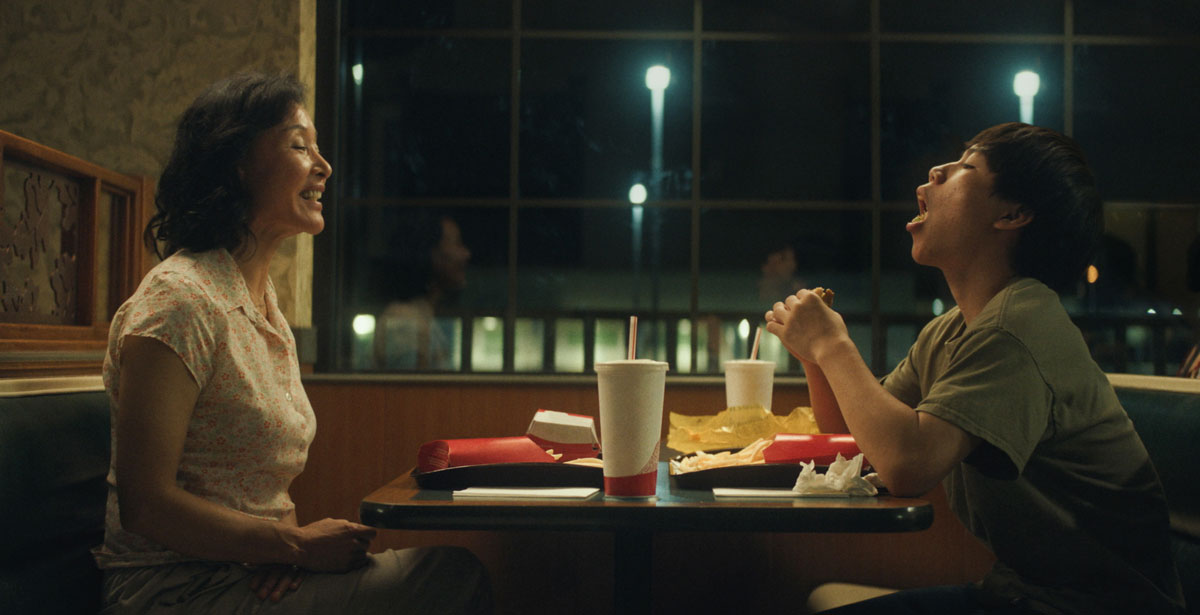
“Dìdi,” (a term of endearment meaning younger brother) is what Chungsing Wang (Joan Chen) calls her son (Izaac Wang), but this Taiwanese teenager in Freemont, Calif., prefers his American name, Chris. This is one of the many conflicts Chris has with his mom, who embarrasses him in front of his friends or nags him about studying — especially since her friends’ kids are overachieving.

Writer/director Sean Wang’s debut feature “Dìdi,” based on his own life, is mostly Chris’ story. Set in 2008, the film amuses as it depicts the 13-year-old hanging out with his friends, chatting online, fumbling in his efforts to kiss his attractive classmate Madi (Mahaela Park) and filming skaters over the course of a summer. But it is the mother/son drama that provides “Dìdi” – which won the Sundance Film Festival Audience Award – with its big emotions. 

"What is a good mother? It’s not an easy job."

Chungsing means well and doing her best, which is not easy. She is a de facto single mother given that her husband is working overseas. Her household is chaotic, with Chris fighting with his older sister, Vivian (Shirley Chen), who is going off to college in the fall, and Chungsing fighting with her mother-in-law Nǎi Nai (Zhang Li Hua; director Sean Wang’s grandmother). 

Joan Chen imbues Chungsing with a poignancy that is affecting. She is a woman who dreams of being a painter but has to settle for “an ordinary life.” It may be that she is taking her own frustrations out on her children as she wants them to achieve, but she does not have much of a support system. She is not aware of how her well-meaning efforts to help her kids may be alienating them.

It is wonderful to see Chen, who makes films in Asia and America, in “Dìdi.” The Chinese actress has had a remarkable career, which includes playing the wife of the title character in the Oscar-winning epic “The Last Emperor,” followed by portraying Jocelyn Packard in David Lynch’s cult series “Twin Peaks,” and directing films including “Xiu Xiu: The Sent-Down Girl,” and “Autumn in New York.” Chen talked with Salon about playing Chungsing and the power of being a mother. 

DidiDidi (Focus Features)

What do you recall about being a teenager? 

My teen years were so different from any teenagers here. I grew up [in China] in a very restrictive environment during the Cultural Revolution and in material poverty in a way. Most of the time I was thinking about food. I’m sure there was the same kind of desire to fit in and be liked. I remember wanting to join the Youth League to be a better Revolutionary than anyone else. Then at 14, I started to appear in films. So, I never had the chance to rebel. It was not something that we did at that time; it just wasn’t doable. 

I did later direct a coming-of-age film, “Xiu Xiu: The Sent Down Girl,” but that was completely different to any other coming-of-age story. That different upbringing and growing up with such a narrow horizon — then to immigrate to the United States — that life experience did inform my role in “Didi” somewhat. That is where I came from and I am trying to raise two children, like in the film.

We need your help to stay independent

Chungsing has a very moving speech at the end of “Dìdi.” It helps Chris see his mom in a different light. What do you recall about your relationship with your children?

My children were teens not too long ago. We had a lot of fraught times, and misunderstandings, and a lot of drama, definitely. I feel I didn’t know what the right thing to do was. I wanted to be a good mother, but I made mistakes. I felt like I was hurting the ones I most love and least want to hurt. Being an immigrant, you are often not sure of the ground you stand on and you really don’t know how to raise two American children. I went through that struggle myself. Sean [Wang]’s mom took it all in with more forbearance and patience and resilience than I did. Performing this character gave me the chance to do it again. My younger daughter was with me throughout the shoot and helped out on set. That was memorable for me because of that. She was with me, at the monitor, and saw the feelings that poured out of me. That was partially to redeem myself. It felt so cathartic for me and helped her understand that her mother did want to do the best for her. That was a great opportunity for me to do that.  

Chungsing wants the best for her kids and tries her best, but she isn’t always effective. Her nagging does not inspire Didi. She annoys or embarrasses him. What did you think about Chungsing’s parenting and her relationship with her son? 

Every scene expresses a different facet of her life. She is taking care of the family singlehandedly, caring for old and young. She is stuck in two worlds, being a “bad” daughter-in-law, and with two children who fight and rebel. Their world is so strange to her. Chungsing wants to be a good mother but feels she is failing in it. She is trying her best. And she is trying to fulfill herself as an artist [painter]. This is typical of so many immigrant mothers.

Do you think Chungsing is a good mother?

I think she is. Chris has a realization that she is there for him. But what is a good mother? 

That is really my question: what is a good mother? Every mother makes mistakes — except mine, I will have to say on the record.

You are so sweet! [Laughs] It is extremely hard to give your children freedom, and to protect them, give them discipline, and safety and enough thrills in life. It is not easy. You are forever burdened with the expectation that this person who came through you should blossom into something. You have an expectation that they should somehow change the world and make a difference. You are weighed down by this hope for the rest of your life. In my mother’s last stage, I was 60, and she was still looking at me for improvement. That is a law of nature. What is a good mother? It’s not an easy job. 

“Dìdi” deals with the model minority issues Asian Americans face. What observations or experiences do you have with this perception?

"'Twin Peaks' was one of the best TV shows in history."

Chungsing is like many Asian mothers that I know. Not all are helicopter moms or tiger moms. That is stereotypical. She represents a lot of Asian moms whose children are their dreams. Oftentimes, people immigrated for their children. Not that they wanted to be more successful in the United States, but because they imagined and envisioned a broader horizon for their children. 

As a mother, Sean’s mom was really wise and patient. She let her son come into his own. I had a little more fear. I made decisions based on fear and misunderstanding. I do recognize your children are more important than anything else. They are the roots you put down in this strange land. They make you American. Otherwise, you never feel that you are American even though you immigrated and have an American passport.

DidiDidi (Focus Features)Did you get to meet Sean’s mom?
She was on the set every day. We shot in Sean’s house, and we are in her backyard. She and I talked a lot and became friends. We exchanged so much about our experiences being an immigrant mother bringing up American children. I had Sean’s mom record every line. Many of these lines did come from her. She was the inspiration. I wanted to see what snippets I could incorporate to channel her spirit. That was a fun exercise to help me create a character. If I hadn’t met her, I would not have that. In her gentleness, she had that quiet strength. She was not as forceful as I would have been. I channeled mannerism and spirit. 

You have had a remarkable career, working with  Wayne Wang (“Dim Sum: A Little Bit of Heart”), Bernardo Bertolucci (“The Last Emperor”), Ang Lee (“Lust, Caution”) and of course, David Lynch ‘s cult hit, “Twin Peaks.” You have also directed films and are the executive producer of “Dìdi.” I fondly remember seeing you in “Turtle Beach.” Can you talk about your career? 

I loved the novel “Turtle Beach,” and I really wanted to do that film. I requested time and again for David Lynch to write me out of “Twin Peaks” so I could go and make “Turtle Beach.”  What a mistake! “Twin Peaks” was one of the best TV shows in history. I don’t always make the right choice. My character in “Twin Peaks” ended up trapped in a wood knob. I so much wanted [Josie] to be resurrected, but it didn’t happen. So, I do not always make wise decisions. With “Dìdi,” it was a simple decision. I loved the script. I never had the chance to express what I went through with my teenagers until this film. 


Want a daily wrap-up of all the news and commentary Salon has to offer? Subscribe to our morning newsletter, Crash Course.


We are seeing more visibility for Asian women with films like “Minari,” and “Everything Everywhere All at Once” winning Oscars. What are your thoughts on how the industry has — or has not — changed over the past decades?

I think things have improved. When I started out in Hollywood in the 1980s, there were almost no opportunities. You couldn’t find any characters that looked like me at all, and nowadays there are so many more. This year, at my age, all of a sudden, I became so busy with so many roles. It has changed for the better. The attention paid to the Oscars — back when “The Last Emperor” won nine Oscars, it didn’t cross anyone’s mind that you could consider the actors at all. Lately, it’s different. After Michelle Yeoh and “Minari,” things are more hopeful, and I’m fortunate that I am still here. I am also very fortunate that I can go back to China to make films there regularly. I work both countries, and Australia. I can travel to different cultures to work. 

“Didi” opens in New York and Los Angeles on July 26, with a nationwide release on Aug.16.

In her national debut Kamala Harris was better TV than Donald Trump’s rerun. Can she keep it up?

Only recently did it occur to me that Donald Trump may not have been filmed chatting with children while he was president. “Thank God,” you may be thinking – either that or, “Why would he?” It’s a fair question. The thought wouldn’t have crossed my mind either, if not for a video featuring kids interviewing Kamala Harris that circulated hours after she announced her candidacy.

The clip is five years old, dating back to her first presidential run before Joe Biden secured the nomination and asked her to be his running mate. Her grade school-aged interviewers may not have been child actors, but they were obviously selected for their ability to engage with Harris.

The candidate does not talk down to them or robotically deliver the “right” answers. Instead, she speaks in a way that is both validating and comforting.

In one exchange with a small girl, Harris doesn’t simply state her plans to enact gun control legislation. She asks her, “What do you think the rules should be?” When the child proposes “running a test to see if they’re going to be responsible with the guns or not," Harris affirms her with, “That is excellent. And that’s called background checks.”

All campaigning is theater. These scenes are particularly effective at playing up Harris’ empathy. Some of her junior interviewers looked like they needed comforting, and she provided her version of that, especially to one who expressed her fears about global warming and school shootings. “Here’s the motivation: you,” she says. “You motivate me.”

You’d be right to call this emotionally manipulative. That’s the point. Every visual medium relies on gripping our emotions, television above all. That video lives on Harris’ content-rich YouTube channel beside others featuring her talking and cooking with celebrities and fellow politicians, staged and posted moments that highlight her humanity.

Viewed another way, however, Harris’ conversations with children also showcase her aptitude as an ensemble player.

The ancient wisdom that TV makes its stars as opposed to the other way around underscores the audience’s will to uplift some stories and cast away others. And while it’s incautious to make any definitive predictions from the center of the culture’s euphoria, the early signs point to a favorable trend for Harris.

Charli XCX co-signed her candidacy. The Harris campaign officially joined TikTok to increase Gen Z voters' enthusiasm. We’re already swimming in memes.  And there's no reason to try anything embarrassing like Hillary Clinton’s stiff whip and nae nae  moves on “Ellen” back in 2015. There's enough existing footage of Harris dancing well and laughing honestly to feed the social media beat for the next 100 or so days. Besides, ignoring the memes is the right strategy; that part will take care of itself as long as she keeps producing good TV.

Helpfully the guest spots are materializing, with an appearance on the season finale of "RuPaul's Drag Race" already in the books. But even her campaign kick-off in Wisconsin was deemed a home run. Harris followed that with an Indianapolis rally counterprogrammed against Trump’s in North Carolina.

Trump’s campaign has so far shown itself to be a looping rerun.

And Trump, TV creature that he is, used this match-up to revert to the signature the catchphrase of “The Apprentice” character that has served him best: successful businessman.  “Kamala, you’re fired! Get outta here, you’re fired!” he barked on Wednesday to thunderous applause.

This presidential campaign cycle meets us in a swamp of TV revivals and franchise overload perpetuated by the audience’s preference for familiarity. This environment would have favored Trump if Joe Biden hadn’t bowed out of the race. Trump could have reheated the audience's nostalgia for that role of a lifetime Mark Burnett handed him with “The Apprentice." Never mind that he was heavily directed to approximate competent leadership.

Viewers believed the illusion, and he expanded that mythmaking from there — headlining WrestleMania 23 in 2007 under the banner “The Battle of the Billionaires,” and ingratiating himself to Fox News hosts.   

Republicans may not have viewed that July 13 assassination attempt as such a gift if he hadn’t pumped his fist in the air in full awareness of the cameras around him. The image has since drawn comparisons to the famous photo of U.S. Marines raising the American flag on Iwo Jima in World War II, plugging into the grand American story of resolve and power.

Against the 81-year-old Biden, Trump appeared powerful as long as he didn’t open his mouth. But all still frames quickly wash away in the 24-hour news cycle, especially when there are better moving images lifted by voice and feeling.

Repeats and revivals have limits on their ability to keep an audience interested, and Trump’s campaign has so far shown itself to be a looping rerun. The speeches remain the same along with his obsession over crowd size; to a man who measures his success by ratings, the number of bodies in seats matters more than the freshness of his message.

Still, he’s aware of how important looks are in a race that was never about policy and always focused on appearances.

We need your help to stay independent

“The fake news is talking about lying Kamala as if she's the savior of our country, that she's so brave,” he said to his North Carolina supporters. “I've never seen a turnaround like this. Three weeks ago, four weeks ago, she was the worst politician in America. Now they say, ‘Isn’t it amazing? Look at her. She is so beautiful. She’s so magnificent.’”

After this, he alleges that her rally at Milwaukee's West Allis Central High School, which attracted more than 3,000 in a space with a capacity of 3,600, was sparsely attended while he regularly draws crowds of "25, 30, 40, 50, 60 – 70,000!"

These claims usually don’t stand up to fact-checking, but disregard that to focus instead on his comment about Harris' appeal. A common tell of Trump is his tendency to say exactly what it is that he fears most about his opponents in his ramblings while painting that asset as a negative. To a man obsessed with appearances, a telegenic and competent woman is deadly.

The catchphrase of “We’re not going back” might need a little work, but it'll do in a 100-day pinch.

But Harris’ advantage in cornering the attention economy isn’t just about her looks. It’s about what she represents. Left without his old chants of “Lock her up,” which lost their zing after his 34 felony convictions – which Harris’ supporters swiftly claimed — Trump wants to rewind 20 years to the peak of his TV popularity.

Back then he nailed the part of a singular, domineering authority and persuaded too many people that bullying is a sign of power. He had some help, performing during a TV golden age of anti-heroes personified by Tony Soprano and Vic Mackey of “The Shield.” People never would have lumped "The Apprentice" in the same category as any prestige shows in their day. Squinting into our rearview, though, we might better understand how the lionizing of those fictions legitimized the mirage of Trump’s success and capability.

Successful TV elicits feelings and cements itself in memory. Enough of us recall the slow agony of those seasons between 2016 and 2020 acutely enough to gravitate toward Harris’ message of moving forward. Trump never left the stage, but neither did he fundamentally alter his script to suit the mood of a broadcast audience exhausted by anger, vengeance and brutish incoherence.


Want a daily wrap-up of all the news and commentary Salon has to offer? Subscribe to our morning newsletter, Crash Course.


Optimism delivered stalwartly and peppered with a bright smile might prove to be a winning alternative. The catchphrase of “We’re not going back” might need a little work, but it'll do in a 100-day pinch.

Harris is right to remind the public of everything she is and represents versus Trump’s convictions and record of fraud, grievance and comfort with political violence. But television doesn’t reward granular specificity with data. Hillary Clinton and Biden were both reminded of that, which Harris can learn from, along with the strong meme invasion being waged on her behalf.

The creator of that viral “brat” video only includes a few seconds of audio featuring Harris expressing her love of Venn diagrams, you’ll notice. A bite-size is enough to convey that she knows what a Venn diagram is. The context in which she says that is moot. What matters more is the joy woven through it.

Trump can’t replicate that any more than he can distract undecided voters from noticing that he is now the oldest presidential nominee in history. And that will serve Harris as she persuades America that she's preferable living room company to a former host whose game show was canceled years ago. Her YouTube channel videos may be years old, but the telling part is that neither she nor the topics addressed therein have aged all that noticeably. Trump is still campaigning on deportation and meanness, and experienced gun violence first hand. Instead of it humbling him, it only made him crueler.

And yes, it’ll help to have Maya Rudolph delivering the punchlines she wouldn’t dare to on “Saturday Night Live” and the ladies of “The View” setting her up to successfully explain her party’s policy planks. Those opportunities are no doubt coming, and Harris should avail herself of each one – except, maybe, for a return trip to “The Drew Barrymore Show.”

Through it all we’ll be looking for how well Harris can sustain our excitement about the role she’s been handed, the part of someone who understands her job is to lead an ensemble the size of a nation instead of insisting on being the whole show.

Kamala Harris spokesperson issues statement on Trump’s “strange speech” at TPUSA

From her coconut tree memes to her upcoming appearance on "RuPaul’s Drag Race" to her new account on TikTok, Kamala Harris seems to be making a targeted beeline for those youthful votes, and effective evidence of this strategy can even be found in the wording and general tone of her press releases.

In a statement on Donald Trump’s "strange speech" at an event hosted by the conservative Christian organization Turning Point Action on Friday night, Harris for President Spokesperson James Singer writes: 

“Tonight, Donald Trump couldn’t pronounce words, insulted the faith of Jewish and Catholic Americans, lied about the election (again), lied about other stuff, bragged about repealing Roe, proposed cutting billions in education funding, announced he would appoint more extremist judges, revealed he planned to fill a second Trump term with more criminals like himself, attacked lawful voting, went on and on and on, and generally sounded like someone you wouldn’t want to sit near at a restaurant – let alone be President of the United States."

Picking up on the punchy and youthful tone of the statement, BBC News reporter Carl Nasman weighed in with a post to social media, writing, "Talk about a massive vibe shift: Trump 'generally sounded like someone you wouldn't want to sit near at a restaurant – let alone be President.' Could you imagine a press release like this from Biden?"

“America can do better than the bitter, bizarre, and backward looking delusions of criminal Donald Trump," Singer continues in his statement, which caught the eye of many other reporters, along with Nasman. "Vice President Kamala Harris offers a vision for America's future focused on freedom, opportunity, and security.”

In Trump's speech, referenced by Singer, he repeatedly called Harris a “bum,” as The Hill points out, but as a recent poll reported on by Axios highlights, Harris is "significantly more popular among America’s youngest voters than President Biden," with the Axios/Generation Lab poll showing that "45% of young people say they have an extremely or somewhat favorable opinion of Harris," which could do considerable damage to Trump's odds, come election day. 

Chef Kévin D’Andrea on “Top Chef” friendships, must-have ingredients and the summer Olympics

Much like working as a chef in any restaurant kitchen, no matter the caliber or cuisine, "Top Chef" can be a particularly unique and rigorous experience. In many cases, a general sense of grit and toughness is the norm, oftentimes calcified after years and years of tense kitchen interactions, incredibly frenzied cooking, frantic moments and immense stressors.

This is often shown throughout "Top Chef," too, particularly during certain challenges, like Restaurant Wars or the Mise en Place Race, as well as any moment of the finale cook.

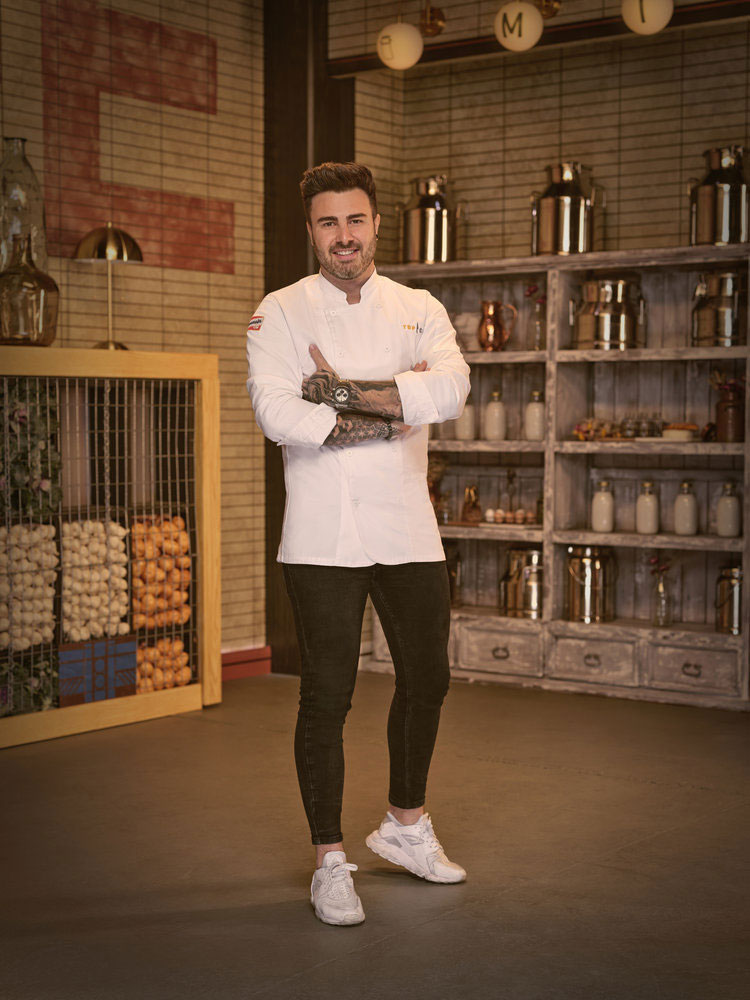
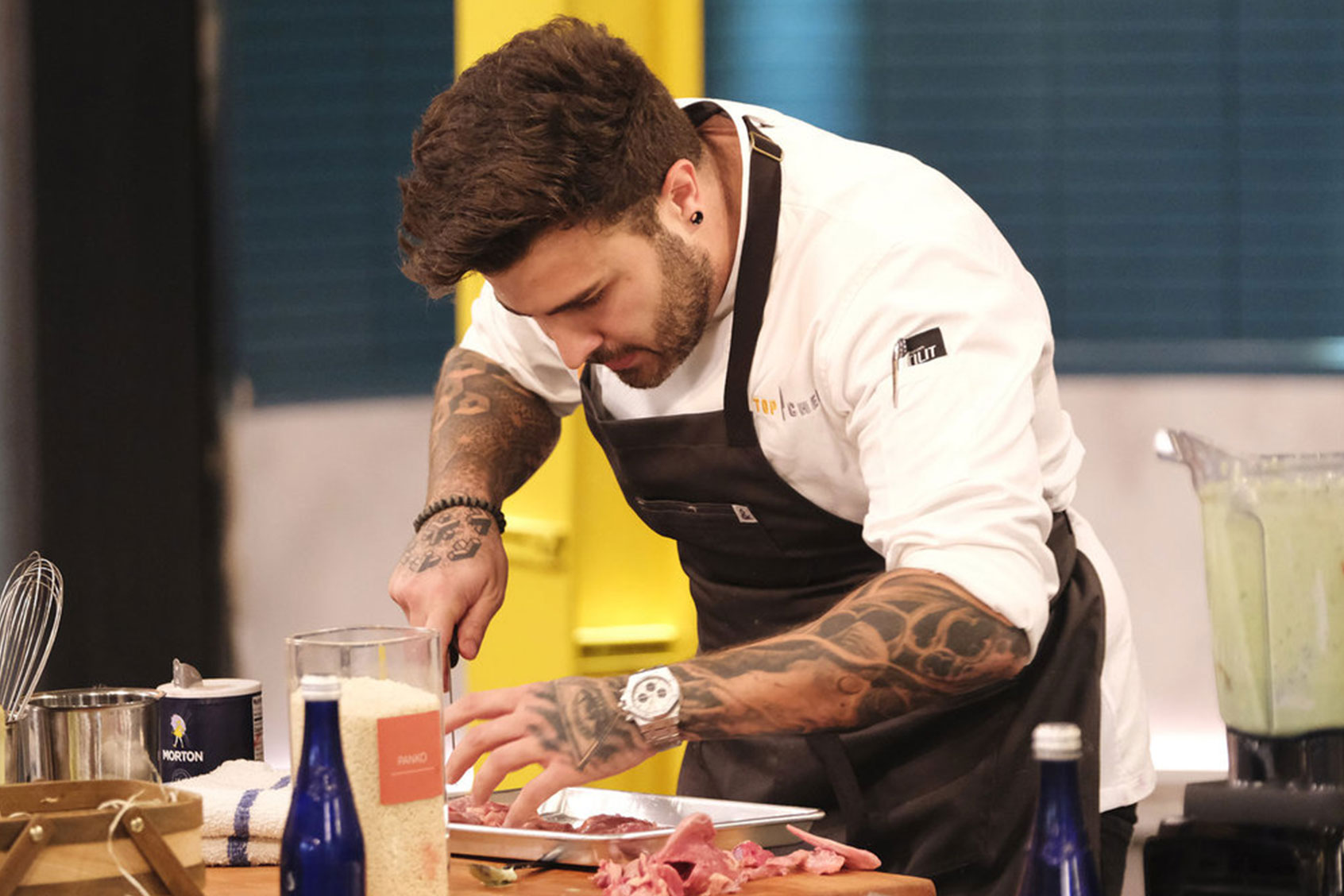
For Chef Kevin D'Andrea, though, he added a certain je ne sais quoi, if you will — nodding to his birthplace — oftentimes contributing a sense of levity, a bright smile, a wink and a nod. In both the competition proper and also Last Chance Kitchen, D'Andrea was consistent a bright spot, often adding humor and lightness in a competition show that often times finds itself lacking such ebullience. In addition, he made some pretty stupendous dishes, too, combining his culinary background and expertise with his previous experiences on "Top Chef France" to make him quite the well-rounded cheftestant.

Bravo and NBCU must have also been a fan of this energy and have since capitalized on D'Andrea's French heritage, culinary knowledge and on-camera charisma in order to highlight the many athletes competing in the Summer Olympics in Paris: a new Peacock show called "Breaking Baguettes," hosted by D'Andrea.

As per Eric Goodman with NBC Olympics, "Top Chef’s charming, whisk-wielding, sports-crazed French cuisine master is inviting U.S. Olympians into his kitchen to get a front row seat to the food of his home nation, France, in the brand new series 'Breaking Baguettes.'"

With a fun title clearly a nod to the custom of "breaking bread," the show slight subverts the custom: As Goodman says, "Inside each [baguette] is a hidden slip of paper – fortune cookie style – with a spicy question for either Chef Kevin or one of his special guests." You can tune into "Breaking Baguettes" now on Peacock or on the NBC Sports YouTube channel.

Salon Food recently spoke with Chef D'Andrea about his experience on "Top Chef," his close-knit friendship with fellow competitor Chef Manny Barella, "Breaking Baguettes" and much more.

Top ChefKevin D’Andrea on "Top Chef" (Stephanie Diani/Bravo)
The following interview has been lightly edited for clarity and length.

Hi! Did you do any sort of special preparations for "Top Chef?" How did your previous "Top Chef" experience aid in your experience? 

Yes, absolutely! I worked on training myself within the time limits and I also watched other seasons. As a finalist on Top Chef France, I also was in the unique position to be able to pull from past experience.

What would you say is your favorite or best moment of the competition?

Definitely my birthday! It came around while filming and Manny Barella organized a big surprise dinner with the whole family. It was a magical moment.

Was there anything about competing on the show that you didn't anticipate? Either from the competition standpoint itself, from the television perspective, or perhaps even from watching yourself back after months have passed? 

Being in the unique position to have competed on Top Chef internationally, I was likely the most prepared for the style of the show and for watching myself back. It’s always a little out of body to see yourself on screen, but the experience is unlike anything else. 

Lots of credit goes to the "Top Chef" team who made us feel comfortable and safe through the duration of filming.

Top ChefKevin D'Andrea on "Top Chef" (David Moir/Bravo)Did you have a favorite challenge? Conversely, was there a challenge you really didn’t enjoy? 

I really enjoyed the chaos challenge – that was my favorite! There wasn’t a challenge I specifically didn’t enjoy. Even when I was eliminated, I was proud to be leaving after making some of the best risotto they’d experienced on the show.

Which dish were you proudest of?

In Madison, I made a warm praline chocolate mousse for the duality challenge that I was really proud of. I had a great feeling about that dish and the feedback from the judges, including Dominique Crenn who was a judge when I came in second on Top Chef France, was really positive. 

What was the critique you received during the show that you learned the most from? 

"Top Chef" gives you the once-in-a-lifetime opportunity to receive input, advice and support from the judges and renowned chefs. I tried to take each bit of helpful critique to heart. 

Top ChefLaura Ozyilmaz and Kevin D’Andrea on "Top Chef" (David Moir/Bravo)
Do you have a number-one favorite ingredient to work with? 

I cannot exist without garlic and fresh herbs.

What stands out for you as a formative moment that got you into cooking or food at large? 

When I went to culinary school at 16, my professor, Mr. Troin believed in me, and he was the only one. Most people, including myself, considered me a lost cause – bad at school and completely lost. Mr. Troin helped me understand the love of cooking and the appreciation for focusing on something to become someone in life.

Congratulations on "Breaking Baguettes" (love the name, by the way!) How did the show come about? 

Thank you! Breaking Baguettes is so much fun! I am a huge fan of sports and especially the Olympics. When NBC contacted me about doing this amazing series for the Summer Olympics, I couldn’t say “yes” fast enough. 

Tell me a bit about Foliepops?

Foliepop's is a French patisserie located in Austin, Texas where we make delicious pastries — particularly the Tartelette. Foliepop’s Tartelettes are shortbread cookies with creamy fillings and topped with milk, dark or white chocolate. They come in a variety of decadent flavors like: chocolate, lemon, raspberry, peanut, caramel and chai. Right now, the Foliepop’s Tartelettes are available in HEB stores across Central Texas and our goal is to make the Tartelettes available nationwide! 

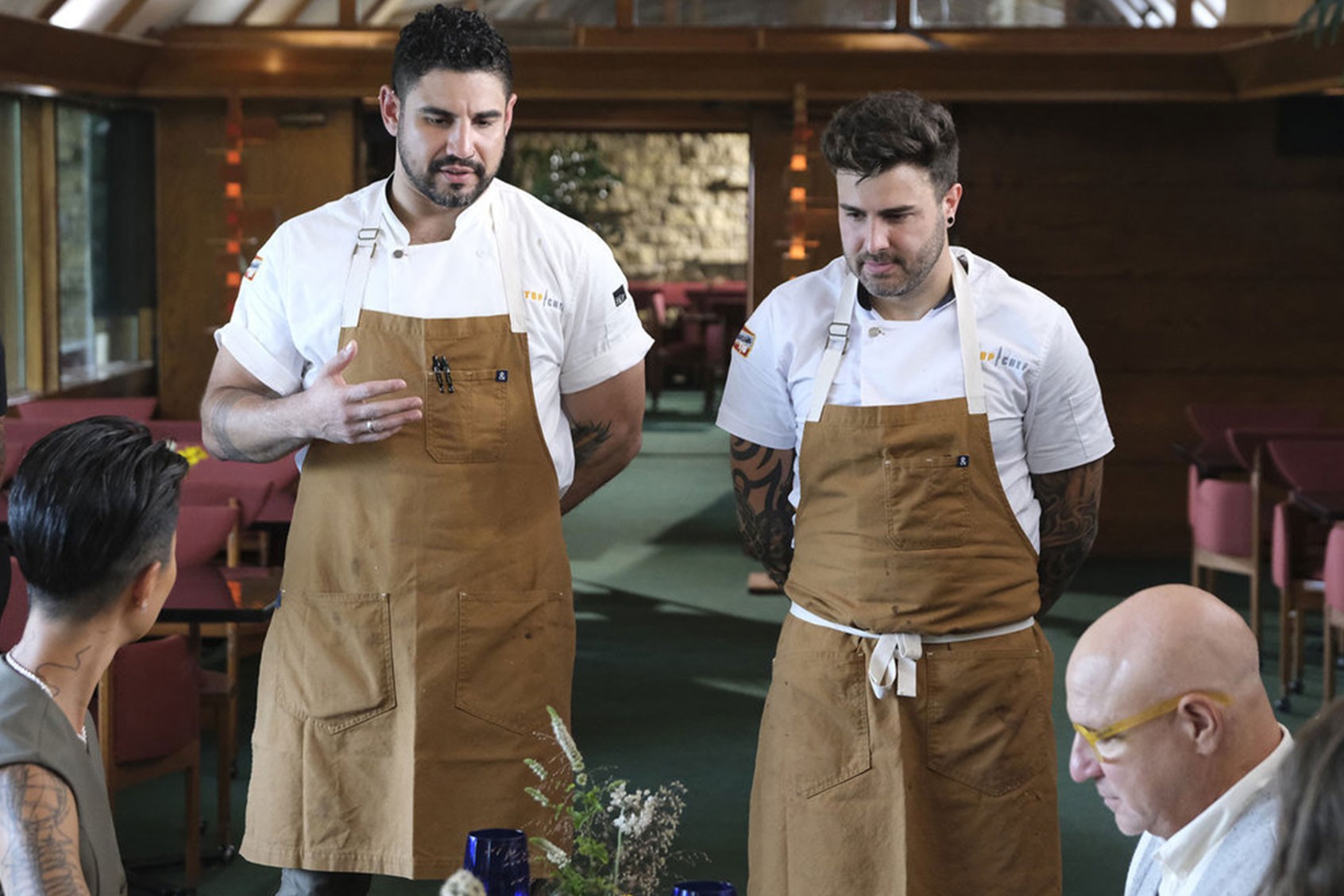
Top ChefManuel "Manny" Barella Lopez, Kevin D'Andrea and Tom Colicchio on "Top Chef" (David Moir/Bravo)

I'm always a sucker for a "Top Chef" friendship and I thought the fun bond you had with Manny was so great and brought such levity to the show. What do you think helped the two of you to connect?

Manny is more than a friend — he became family. In fact, I just went to Denver to celebrate his wedding! When we walked in for the very first episode, Manny was just in front of me in the line to head in. We needed to be quiet, but he had his hands behind his back, so I high fived him. When I did, he turned around and smiled. I winked back and it was instant friendship. As we continued to get to know each other, we discovered that we’d been through a lot of similar experiences, including immigrating to the U.S. and working our way up. 

What’s next for you?

I am heading home to Paris for the Olympics where some exciting things are in the works! Hope to share more on that, soon!

And, I’m looking forward to growing the presence and availability of Foliepop’s Tartelettes nationwide.

Beyoncé introduces 2024 Team USA Olympians in signature fashion

In terms of A-list glitz and glamor, the 2024 Olympic Games are off to a strong start. 

On Friday, the Olympic opening ceremony dropped massive gifts in viewer's laps with performances by Celine Dion, Lady Gaga, and headless Marie Antoinette, prompting an opportunity to ponder: How could it get any better than this? And no, don't say the actual sports of it all, because Beyoncé . . . Beyoncé is the answer to that question.

In a roughly 2-minute and 30-second clip that is making the rounds on social media Saturday, Mrs. Carter introduces the 2024 Team USA Olympians in signature fashion, remixing her single “YA YA” from her "Cowboy Carter" album, with Simone Biles and other members of the women’s and men's gymnastics team's joining in.

“We wanna welcome you to the 2024 Summer Olympic games!" Beyoncé says in the clip, wearing a stars and stripes ensemble capped off with a very patriotic cowboy hat, as is her thing now.

“That pride, and that joy, that’s what gets me about this team," she says, name-dropping the top stars of each sport this year. "And that’s what makes me believe in this team. And that’s why I can’t wait to see what they pull off over these next 16 days. America, give it up for Team USA, the very best of who we are.”

As People highlights in their coverage of the clip, Team USA’s Instagram account dubbed the surprise introduction as the “#Beylympics.”

Watch here:


Police’s “Synchronicity” 40th anniversary deluxe box set pops with energy

Online prognosticator Rick Beato recently opined that in 2100, acts like the Beatles, Nirvana, Queen, and, yes, the Police will still be in heavy rotation when it comes to celebrating the rock era. Beato makes a solid, data-supported case. But as a college professor who teaches popular music, I have observed that today’s students seem just as besotted, if not more so, with Pink Floyd and Led Zeppelin

So will the Police, those purveyors of white reggae with just five studio albums to their name, really ply their way into the next century? The new deluxe box set for "Synchronicity," the band’s megaselling 1983 LP, certainly makes a strong case of its own. Back in the day, the Grammy-winning album was propelled by a quartet of hit singles in “Every Breath You Take,” “King of Pain,” “Wrapped Around Your Finger” and “Synchronicity II.” If you were in earshot of a radio at the time, “Every Breath You Take” was embedded in your daily soundtrack. 

As it happened, it was a minor miracle that the Police reunited at all to create "Synchronicity." The band had long been plagued by interpersonal rancor — lead singer Sting and drummer Stewart Copeland were the principal combatants. But the results speak for themselves, with the group abandoning its reggae roots for an album that brims with the atmospherics, jazz hues and world music that would characterize Sting’s solo career.

I am delighted to report that the deluxe edition of "Synchronicity" will be a joy for older fans and newly minted Police aficionados alike. I have long been dissatisfied with the original digital versions of the LP, which often sounded muted. The new version, remastered from the original tapes, outpaces earlier editions in every respect. The album absolutely pops with energy. 

And folks who enjoy generous helpings of ancillary material will not be disappointed. The super deluxe version not only includes the remastered album, but numerous outtakes and demo recordings that amount to some 84 tracks. Listening to the various takes of “Synchronicity II” as it snakes its way through the production process is worth the price of admission in and of itself. You can literally follow along as new layers of terror and intrigue accrue as Sting relates his mysterious tale about the primordial slime that gathers in the heart of “a dark Scottish lake.”

Will music lovers still be seeking out the Police in droves in 2100? I honestly haven’t got a clue. Predicting the multitudinous sociocultural shifts that are bound to occur between now and then is a fool’s errand. But I know this: as long as humans have ears and access to the world’s digitized back catalog, the Police will find devoted adherents. 

Beyond Harris and Trump: Swing Left forecasts “sea change” — and possible Democratic sweep

As the national political dialogue has grown increasingly chaotic, conflicted and unmoored from basic facts, political junkies may have begun to wonder if they’re the crazy ones. The so-called reality-based community seems to be imploding, with the media treating a thin-skinned would-be strongman with multiple felony convictions as the almost-inevitable victor of an election where, in all likelihood, he will fall short of a popular-vote majority for the third straight time.

That may all have changed with President Biden’s abrupt withdrawal from the race and a surge of enthusiasm and fundraising for Vice President Kamala Harris, his anointed replacement. On the other hand, it may not. The recent Supreme Court decision on presidential immunity serves as a reminder that the supposed institutions of democracy will not save us. It’s the people who will save it, if anything does. 

Salon once again turned to Swing Left for a reality check on how people outside the Beltway media bubble are trying to do just that. Since its founding within days of Trump’s inauguration and the Women’s March in 2017 (Salon story here), Swing Left has been a vehicle for turning anxiety into action. Now, with more than a million members and 400 groups nationwide, and with political anxiety at or near record highs recently, the organization claims its activism is surging as well. Continuing our coverage spanning the years, I spoke by Zoom with Swing Left executive director Yasmin Radjy. Our original conversation occurred before Biden withdrew from the race, but Radjy revisited her comments after that. This transcript has been edited for clarity and length.

In January, I spoke with you and others at Swing Left about your plans for 2024. Since then there's been lots of drama and turmoil in the media and partisan politics, culminating in Joe Biden dropping out of the race. But we haven’t heard much about non-party organizations and grassroots activists who do critical campaign work, along with long-term community organizing. So tell me how Swing Left sees this election now. 

At Swing Left, we channel the energy of grassroots volunteers and donors to help Democrats up and down the ballot, and we focus on the most competitive tipping-point races that swing the national balance of power. That’s what we’ve been about from the very beginning. We started in 2017-18 with the House, but we were founded at the very beginning to oppose Donald Trump and MAGA extremism and we are facing a challenge again, just at different levels of the ballot.  

The 12 “super states” that we're focused on include eight that are focused up and down the ballot, from the presidential level down to the state legislature. And so in canvassing, in letter-writing, in donations and phone banks later on, we're focused at all levels of the ballot in those states: Arizona, Georgia, Michigan, Nevada, New Hampshire, North Carolina, Pennsylvania and Wisconsin. We have to win those to win a federal trifecta which remains our goal, even as political winds keep changing. The two states where we also focus on the Senate side are Ohio and Montana, and then California and New York on the House side. 

I’m most interested in the inside perspective, what you’re doing and seeing. But I think it’s important for folks to understand your strategic perspective in a more detail. While the House is just part of this, it’s the most legible part. So how would you explain what you’re aiming to accomplish?

Democrats narrowly lost the U.S. House majority in 2022 by just 6,675 votes across a handful of competitive districts. Now Democrats need to net just four seats to flip control. That goal is well within reach if we invest in the most competitive, winnable races. 

Swing Left is targeting 24 House seats, 10 of which are in New York and California – two of the super-states we’re investing in the most heavily this cycle. Some of the candidates we’re paying extra attention to are those coming out of primaries held later in the year, especially those who are contesting House seats that flipped to Republicans in 2022. They’ll need more support in volunteer recruitment and fundraising in order to mount effective campaigns, but these seats are primed for Democratic candidates to take them back. These candidates include John Mannion (New York’s 22nd district), Janelle Bynum (Oregon’s 5th district) and the eventual Democratic nominee for Arizona’s 1st district, about whom we’ll have more information at the end of the month.

We also have a larger slate of “red-to-blue” candidates that we’re focusing on as well, including George Whitesides (Calif. 27), Adam Gray (Calif. 13), Adam Frisch (Colo. 3), Mondaire Jones (N.Y. 17), Ashley Ehasz (Pa. 1) and Laura Gillen (N.Y. 4). 

How have things changed from 2020 and 2022? 

The really big difference from 2020 is that we’re going all-in on canvassing. For obvious reasons, we couldn't do that in 2020. As we debriefed with campaigns, they shared how much that negatively impacted their races, and as we talked to volunteers, they saw this election as essential to get back out and talk to voters face to face, particularly because of the sharpness around issues like abortion. So we started canvassing early this cycle, much more in a way that resembles 2018. The key difference being that we're focused on those broad levels of the ballot, like in 2020, whereas in 2018 it was just the House. 

"On abortion, Republicans and independents are open to the perspective of Democratic candidates, are open to conversations with canvassers and are moving across the commitment spectrum faster than our canvassers had ever experienced."

Right now our level of volunteer engagement is 90% higher than this moment in 2018. And that was a moment where the zeitgeist was all about volunteers getting out talking to voters face-to-face, how that was going to be transformational. We’re seeing bigger numbers now, in a way that's just not getting a lot of airtime. What we’re experiencing at the doors [before and after the Trump-Biden debate], is a lot of movement in our direction and a lot of openness to substantive and long face-to-face conversations, which we were used to in 2018 but were absent in 2020, both because of COVID and because we see less focus on face-to-face in general in politics. So we’re really heartened to see that. We’re feeling really optimistic about that engagement. 

Can you be more specific about what you’re hearing? 

I did a round of conversations with a number of our highest-performing volunteer-led groups around the country, after the debate [but before Biden’s withdrawal]. Biden and the debate were almost never coming up. And if they were coming up, it was very much in passing. This is in communities of color, in swing Republican or independent white suburban districts, across our super-states. 

The two issues that were coming up consistently were the economy and abortion. On abortion, Republicans and independents who folks are talking to door-to-door are open to the perspective of Democratic candidates, are open to conversations with canvassers and are moving across the commitment spectrum faster than our canvassers had ever experienced in their political lives. Some of them started in 2017, some started before that. 

And then, on the economy, they're starting out really skeptical of Democrats and as canvassers are engaging with them in conversations about how the economy is moving, trying to bring that to earth in terms of the personal lived experiences of people, they are much more open to the Democrats’ perspective. Now, with Kamala Harris being the new presumptive nominee, we expect these issues — reproductive rights and the economy — to remain front and center in our conversations with voters. What’s more, early polls are indicating that voters have even greater openness to Harris on these issues than they did to Biden.

So that covers the voters. What about your own people? How are they feeling?

Even prior to the debate, our national numbers on volunteer retention and recruitment have been way high up, the sort of numbers we expected to see in September. Our local groups have said that the most consistent feedback is that volunteers feel like we're not giving them enough to do, rather than that they’re not feeling motivated. 

That's not to say that folks have not been anxious — in fact, before the debate, anxiety was the main emotion motivating our volunteers and donors. But it's been a starker contrast than I expected between what we've been reading and seeing and experiencing in our media bubbles versus what our volunteers on the ground are feeling and hearing from voters. 

Since President Biden decided to withdraw as a candidate, we’ve seen an immediate mood shift – and anxiety has been replaced with excitement as the driving motivator for volunteers and donors. That excitement is anchored first and foremost in a commitment to defeating Donald Trump and MAGA extremism down ballot. But that excitement is also about Kamala Harris as the presumptive nominee, and about what appears to be a real moment of unity in the party after a tough couple of weeks. This has translated into concrete action among our members: Over 3,000 of our grassroots donors raised more than $530,000 in the 48 hours after Joe Biden ended his candidacy, including more than $200,000 to our Swing Left Presidential Fund, which will benefit the eventual Democratic nominee. 

"Since President Biden decided to withdraw, we’ve seen an immediate mood shift – and anxiety has been replaced with excitement as the driving motivator for volunteers and donors."

We’ve also seen the two best weeks all year in terms of Swing Left volunteer sign-ups: over 4,250 unique volunteers signed up for at least one shift, and our affiliate organization Vote Forward had over 550,000 voters adopted for its national letter-writing campaigns, with 200,000 of them in the 72 hours after Biden’s announcement. Additionally, we had over 1,000 people join a virtual call we organized last Monday to outline how they can allocate their time and money to have maximum impact in key battleground races, further highlighting people’s enthusiasm and eagerness.

This is one of those sea-change moments that could propel Democrats to a victory up and down the ballot. 

For weeks there was a conversation about Biden damaging down-ticket candidates, but among activists there’s been a growing awareness of a reverse-coattails effect. In states like Ohio, as David Pepper has argued, Democrats have been damaged by not running full slates in state legislative races. What have you seen?

We believe that reverse coattails are essential to pay attention to. That's part of why we anchored on a super-state approach. On our nonpartisan affiliate side, Vote Forward, we did some research in Nevada last cycle on the reverse-coattails effect of volunteer handwritten letters. This was for the Nevada secretary of state race, and we had some clear evidence that those letters didn't just turn out people to vote for the Democratic nominee for secretary of state. They also had on an upward impact on the U.S. Senate candidate. So we've seen real evidence of this, this is not just an academic theory but rather something that we've been testing and investing in. 

Thinking specifically about state legislative races, I live in Southern California, so I'm especially sensitive to Arizona, where our SEIU local has had heavy involvement for years. What can you say about that?

At the state level, Republicans have played the long game for decades, building power in state legislatures. This has had significant national implications, allowing them to pass extreme anti-democratic legislation and draw favorable, gerrymandered districts. As painful as it is to admit, Democrats must learn from their patience and long-term focus — and learn fast.

Every two years, the most political attention is paid to federal races, but it's crucial that Democratic volunteers and donors help to continue to make progressive gains at the state level. There are a number of chambers in key states where Democrats could break a GOP trifecta (in New Hampshire), protect a recently formed Democratic trifecta (in Michigan) or continue to make consequential gains (in Pennsylvania and Arizona). There’s also a layering effect at play here: driving out voters for top-of-the-ticket races and down-ballot contests helps us win at both levels.

This also extends to key gubernatorial races, including in North Carolina, where a Democratic governor (in this case, current nominee Josh Stein) could serve as a crucial check on Republican majorities in both houses of the legislature. Stein’s opponent [Republican Lt. Gov. Mark Robinson] is also wildly extreme, virulently anti-LGBTQ+ and opposes reproductive freedom.  

Broadly speaking, we can think of political campaigns in terms of what stays the same, or stays on the same trajectory, and what changes unexpectedly. So what stands out in the first category, and then in the second? 

Abortion remains extremely salient and front of mind for voters. I know that was a big question mark as the distance increased after the Dobbs decision. Would the salience of that issue decrease and other issues become more front of mind? We are finding that it remains top of mind, in the eight presidential super-states, but also in New York, California, Ohio and Montana. That's something that I'm heartened to see, that's been really consistent from very early in the cycle and is not wavering.  

In terms of an unexpected challenge, the change in nominee means we have an unprecedentedly short runway to support the Democratic nominee. That means our priority is setting up the Democratic nominee with the necessary support, resources and infrastructure to defeat MAGA extremism. 

Of course, all signs point to that nominee being Kamala Harris, a fact which makes this short runway more manageable, as the transition of the Biden campaign to the Harris campaign couldn’t have been smoother. To that end, our members have been reaching out en masse to share their excitement at the strong level of unity they’re experiencing and observing, a feeling which inspires great confidence among volunteers and donors.

Tell me about the status of races on your watchlist. How are those changing? 

At this point in the cycle, we often expand our list of targets based on confidence that our tipping-point candidates are on stable footing. However, given the uncertainty facing our priority candidates, we are not ready to take our foot off the gas in directing resources to our existing House map. We’re hearing from top-priority House candidates that donors are not investing the resources they otherwise would, due to uncertainty around the top of the ticket. In contrast, we at Swing Left are exceeding expectations in grassroots fundraising for those same candidates. Swing Left plays a vital role here as a trusted, honest broker connecting these candidates with the grassroots funds and volunteers that they may be unable to secure themselves.

Our House watchlist is constantly evolving as we adjust our ratings based on what we are hearing from partners, available public data and our own internal metrics. This month, we will likely move a few races off our House watchlist – both to activate as new targets or because we believe time and resources would be best spent elsewhere. Our goal is to not be reactive to the political winds, but to synthesize the information available to guide grassroots volunteers and supporters on where they can fight for races that have the best chance of winning. 

What can you tell me about the motivation of your grassroots leaders and activists? 

In every survey we've done of our members, abortion is No. 1, democracy is No. 2 and every other issue is a significant step down from those two issues. Those are the dominant issues — they were in 2022, they were in 2023 and they’ve remained that way in 2024. Obviously the word “democracy” entails a lot, in terms of what's motivating people underneath that. I would say that from the beginning, since Swing Left was founded, Donald Trump is the motivator for why people are paying attention and beginning to take action. And in terms of their sense of agency and participating as organizers day in and day out, it's often those down-ballot races. So the House is our most popular level of the ballot, both for donors and for volunteers, in part because we have a lot of members in New York and California and those are the closest races to them. 

But I think the other thing is that it’s so easy to feel a lack of agency in this media ecosystem. There is so much doom surrounding people that I think what motivates our volunteers is feeling like they can't control everything but they can control some things. So participating, whether it's knocking on doors, writing letters or donating what they can, and understanding the return on that investment, especially in those down ballot races, that's what motivates them to keep doing it. 

"In every survey we've done of our members, abortion is No. 1, democracy is No. 2 and every other issue is a significant step down. Those are the dominant issues."

A number of our volunteers have updated our organization's motto of “turning anxiety into action” into “turning enthusiasm into action.” I think that’s a great summary of the vibe shift folks are experiencing on the ground. Of course, news cycles can change on a dime, and given the high stakes of this election and the greater Republican unity behind an extreme platform, there’s still plenty to worry about. But we’re optimistic that our volunteers and donors will be able to weather the storm at even greater levels. They now have new wind in their sails. 

We know that the elections up and down ballot will be very close and likely come down to a few thousand votes in a few key states and districts. But we have a fighting chance and we need to do everything that we can. There is just too much at stake to do anything but, like, lean in as hard as we can to take action. 

As you just said, a consistent theme of Swing Left from the beginning has been providing a way to turn voters’ anxiety into action. How has doing that changed? 

When we first started, it was clear that our primary first line of defense was to win back the House. Folks didn't need a whole lot of communication or education on the why — that was really clear. It was just, “Tell us which races can benefit the most at this moment from our time and our money.”

I think the biggest shift has been making sure that people have enough information to be able to walk and chew gum at all different levels of the ballot, but without the kind of information overload that leads to paralysis. A lot of what we hear from our volunteers and donors is that they feel inundated with so much information, whether it's from other organizations, whether it's from campaigns, whether it's from the press, that they just don't know how to prioritize. 


Want a daily wrap-up of all the news and commentary Salon has to offer? Subscribe to our morning newsletter, Crash Course.


So our biggest shift has been doing more information about the relative impact of time and money and different levels of the ballot, and also people's different abilities to participate. Someone in San Francisco cannot canvass seven days a week in the Central Valley if they work and have a family. So how do we help them with their time budget on the Wednesday nights that they have available? Or someone who has already given the maximum of their budget, has never volunteered before and that feels sort of paralyzing or scary — how do they participate or go canvass where they're going to feel comfortable? So I'd say that communication has just become a bit more layered because it's different levels of the ballot.

Swing Left was born in emergency mode. That’s different now, isn’t it?

In 2018 everyone was in emergency mode. All of a sudden they opened up their pocketbooks as wide as they could, invested all the time that they possibly had. Right now we’re in the marathon period, not the sprint. So getting people what they need to sustain their action as a long-term investment requires more communication rather than a rapid-response moment. 

If people reach out to you and want to get involved for the first time, what do you ask of them?

"In 2018 everyone was in emergency mode. They opened up their pocketbooks as wide as they could, invested all the time that they possibly had. Right now we’re in the marathon period, not the sprint."

They can sign up to volunteer or donate or a combination thereof. We are here to help make that process as easy as possible and as aligned with their budget of time and money as is feasible. We really see ourselves on the fundraising side as a donor advisor for the masses, so no one should feel stuck about where to give in terms of candidate priorities. On the volunteer side, whether someone is seasoned or brand-new to politics — and whether they have a lot of time or a little time — we’re here to help them connect with a community of other people who believe that the antidote to anxiety is action. 

What's the most important question I didn't ask? And what's the answer?

I think we talked about this in our conversation in January, but Swing Left's one million members run the gamut of progressives, centrists, people in swing states, people in blue states. The Democratic coalition is demographically and ideologically very reflected in who our members are. There are pretty different perspectives about what should happen at the top of the ballot, different perspectives on the future direction of the party. Our folks have not be distracted by those in a way that’s been really impressive. They're discussing those things, as anybody does, at the dinner table and in their group meetings. They read the news, they share articles, etc. But they are really, really focused and their level of commitment to outcomes — to doing everything we possibly can to win majorities — supersedes their personal sentiments, including frustrations, heartbreak, stress and anxiety, all those other things.

I feel really, really hopeful. There's a lot we cannot control, and who knows what's around the corner. But the focus, resilience and dedication of our volunteers is really amazing and unwavering. So even as we've hit major headwinds in the past few weeks, we’ve seen a growth in participation, in donations, in participation of volunteers. I think that's because this is the home for people who believe that the antidote to anxiety is action and that’s their ideology more than anything else. So I feel, certainly, a whole range of emotions, but really hopeful in a way that doesn't feel pollyanna-ish in this moment of turbulence.

Experts confirm chimpanzees interrupt each other, gesticulating wildly just like humans

When people talk to each other, their conversations usually include many fast twists. Humans do not naturally talk in Shakespearean soliloquies, but by regularly interrupting and wildly gesticulating. The conventional wisdom is that our chats will take major turns roughly every 200 milliseconds — and new research in the journal Current Biology reveals that chimpanzees do the same thing.

"They would go back and forth with ‘groom me,’ ‘no you groom me,’ ‘no me’ for ages before one would finally give in and make the first move."

"Chimpanzees also engage in rapid signal-to-signal turn-taking during face-to-face gestural exchanges" to roughly the same extent as humans, the authors write. "This correspondence between human and chimpanzee face-to-face communication points to shared underlying rules in communication." The authors speculate that this could be due to chimpanzees and humans sharing the same ancestors or because they coincidentally developed similar strategies for coordinating interactions and managing competition to communicate.

The scientists learned this by gathering data on chimpanzee “conversations” across five wild communities in East Africa, ultimately including more than 8,500 gestures for 252 individuals. The scientists specifically focused on the turn-taking and conversational patterns of their chimpanzee subjects. Ultimately they learned that 14% of communicative interactions included multiple exchanges — from as few as two individuals to as many as seven — of gesticulation and interruption.

Study co-author Dr. Catherine Hobaiter, who works at the University of St. Andrews' School of Psychology and Neuroscience, observed this directly during her research.

"I remember watching two big males in a sort of grooming stand-off, where they’ll both end up grooming each other but the goal is not to be the first to groom, as that loses you a little social prestige," Hobaiter said. "They would go back and forth with ‘groom me,’ ‘no you groom me,’ ‘no me’ for ages before one would finally give in and make the first move." Chimpanzees behave similarly when courting each other, as "It can take sustained effort at times for a male to persuade a female he is worthy of her time."

Budongo Conservation Field Station ChimpanzeesGroup of chimpanzees including mothers, juveniles, subadults, and infants grooming and playing at the Budongo Conservation Field Station in Uganda. (Photo by Catherine Hobaiter)

Scientists who study chimpanzee communication suspected that these exchanges occurred frequently, but it has been difficult to acquire reliable data documenting it. Like humans, chimpanzees who spend most of their days around the same group of individuals do not need a lot of back and forth in their communication. As a result, "It has taken us decades to have a large enough dataset to really start to investigate this aspect of their communication," Hobalter said.

By contrast, primatologists had plenty of information about physical manifestations of chimpanzee intelligence. For decades, scholars have chronicled chimpanzees as they use tools or play with toys. It is easier to observe those signs of intelligence than something more subtle, like the nuances of communication.

"Our exploration of chimpanzee culture has often been focused on their tool use, but human culture includes so much of our social behavior, our language, songs, dances, fashions . . . we’re starting to see more and more evidence that other ape species might share that capacity for individual and cultural expression in their communication too," Hobaiter said.


Want more health and science stories in your inbox? Subscribe to Salon's weekly newsletter Lab Notes.


"We’re starting to see more and more evidence that other ape species might share that capacity for individual and cultural expression."

For scientists to translate and comprehend these chimpanzee cultures, however, they must first understand how they communicate with each other. Fortunately, just as humans follow certain consistent rules when talking with each other, chimpanzees that talk to one another engage in the same basic behaviors.

"We knew chimpanzees exchanged gestures, and we knew that — in humans — conversations across different languages both share a common tight timing, just 200 milliseconds between turns, and show small but consistent cultural differences," Hobaiter said. "Japanese speakers take fast turns. Danes take slower ones."

Until this recent study, however, scientists did not know for sure if chimpanzees would share these timing structures in their own conversations. The chimpanzees did exactly that, right down to showing the slight cultural variations that add spice and enrichment to human cultures.

"We had no idea that we’d also see these small but consistent group differences," Hobaiter said. "In our case it’s the Sonso chimpanzees in north-western Uganda that are the slow turn-takers."

In addition to helping humans learn more about chimpanzees, the study may also help us learn more about ourselves.

"As well as being a great example of another parallel between humans and other apes, it’s also a good reminder that we sometimes need to look beyond superficially similar behavior to see those shared characteristics," Hobaiter said. "For example, we often compare spoken language with other species’ vocalizations. But we can express language in many forms, and there’s no reason to assume that other species have a vocal-bias in their communication. In chimpanzees the fast-paced turn-taking so characteristic of language is found in their gestures."

She speculated that we might be missing similar communication nuances in other animals: "Could we see turn-taking in color signaling in octopuses?!"

Profile of a would-be American assassin: Trump shooter straddles the political divide

Although Thomas Mathew Crooks was a young man, he does not fit the profile of a one-off mass shooter seeking some type of revenge or infamy. Nor do I think that he was suffering from delusions of grandeur like his target Donald Trump, or that Crooks thought that he could or would become some kind of superhero if he succeeded.

If Crooks was obsessed with politics, there is no evidence of it on or offline. Nor did he have a social history of family abuse or neglect. Crooks' one commonality with some of those other shooters appears to be a high-powered semiautomatic weapon used in his intentional attempt to assassinate presidential candidate Trump and in the unintentional killing of one individual and the injuring of three other innocent bystanders.

After conducting more than 100 interviews, searching the suspect’s home and vehicle, and cracking into his cellphone and other devices, the FBI is still searching for the shooter’s motive. This is at least in part due to the fact that there is no evidence so far in his biography that conforms with the forensic profile typically portraying these shooters as deranged or mentally ill and/or ideologically driven. It is also due in part because Crooks appears to have been acting alone or was not a part of some kind of conspiracy  — real or imagined — to kill the former president. In the case of a real conspiracy, most people would have viewed it as rationally and ideologically motivated. In the case of an imaginary conspiracy, as irrationally or psychologically motivated.

Importantly, the FBI has learned that Crooks, a native of Bethel Park, PA, had spent time checking out the Republican convention site in Milwaukee and the Democratic convention site in Chicago. Indicating that the shooter may have had the leading presidential candidates of both major parties in his crosshairs. This also suggests that he could have had different reasons for killing either of these two candidates to accomplish the same objective that I am speculating was to prevent Donald Trump from winning the 2024 presidential election.

However, besides the photos in his phone of Biden and Trump there were photos of House of Representatives Speaker Mike Johnson, R-La., and Minority Leader Hakeem Jeffries, D-N.Y., which may or may not have been related to his motive in Butler, Pennsylvania. In this analysis of Crooks’ motive, I have chosen to ignore those other photos as not being necessarily relevant to the attempted assassination of candidate Trump. We also know that Crooks had searched online about other mass shooters including Ethan Crumbley, who suffered from a range of mental health conditions when he killed four classmates in 2021 at Oxford High School in Michigan. We also know from testimony on Wednesday that FBI Director Christopher A. Wray admitted to lawmakers that Crooks had Googled, “how far away” Lee Harvey Oswald was from John F. Kennedy on November 22, 1963, when from the nearby Texas School Book Depository, he assassinated the president. 

This type of searching, especially by highly organized serial killers and rapists, or one-off shooters as in this case, is not unusual. Both before and after there was the Internet, those who have engaged in these types and other related antisocial high-profile killings have often studied the methods and mistakes of those who have come before them. And whose shoulders, so to speak, they stand upon and sometimes, as well, pay tribute to. A tradition dating at least as far back as Jack the Ripper and his serial killing of five prostitutes in late 19th-century London.

We also know from multiple law enforcement sources that investigators found a bulletproof vest, three fully loaded magazines and two remote-controlled explosive devices in Crooks’ car. In his residence, another bulletproof vest and remote-controlled explosive device as well as a 3D printer was found. It is possible that the vests and explosives were to be used for something far more sinister and less rational than the attempted assassination of Trump, as investigators have speculated. In any case, at the time of the shooting, Crooks was not wearing a vest or carrying any explosives.

We also have learned from eyewitness accounts that before he got up on the roof of the building where shootings occurred and he was killed by a sharpshooting sniper, Crooks had been moving about the grounds with the use of a rangefinder to measure various heights and distances that could have been of use to him or another potential shooter. Investigators have also learned that on the day of the attempted assassination, Crooks flew a drone over the grounds on a reconnaissance mission to obtain an overview of the buildings and rooftops that may have helped to select the unoccupied building of secret service persons with the slanted rooftop 130 meters away from Trump.

We also know from Wray’s testimony that Crooks “used a rifle with a collapsible stock” that may have helped him to conceal the weapon before he was up on the roof and where there were eight shells found from his fired weapon. 

From what the FBI has learned so far, they believe that Crooks was working alone but they have not ruled out the possibility that others may have been involved.  

There were rally attendees on the day of the assassination who claimed on ABC News that there was also a person or second shooter moving around on the top of the nearby water tower. Of course, that individual may very well have been another sniper working to protect the presidential candidate. To my knowledge, neither the FBI or Secret Service have publicly commented about this. If true, that second person may have disappeared without a trace. 

One issue that was difficult to answer from the day of the shooting was whether or not Trump’s ear had been grazed by a bullet. At his Congressional testimony on Wednesday, Wray suggested that the FBI is still not convinced that Trump was struck by a bullet rather than a piece of shrapnel, a statement the agency walked back on Friday, concluding after a push from Speaker Mike Johnson that a bullet, or a fragment from a bullet, did the damage to the former president's ear. To date, Trump has still not released his medical records.

Assuming that Crooks was indeed working by himself, then I expect the FBI will ultimately conclude that the young man was not ideologically motivated, as revealed by the usual conspiratorial or manifesto postings on social media. This does not rule out the possibility that Crooks was politically motivated as in “the political is personal” and the “personal is political.” 

On the day of the shooting, Crooks had taken the day off from work as a dietary assistant where he had told his boss that he “had something to do” and he told his fellow workers that he would see them on Sunday, knowing in all likelihood that he would never see them again. This timeline, in combination with other biographical information that has been gathered and now constitutes Crooks’ “working personality,” along with a panoply of theories to choose from that animate unlawful murderers excluding those crimes of passion, provide the data for building my conjectural motive for the attempted assassination of Trump.

We have a behavioral profile as far as we know that is not consistent with one who has been a victim of bullying growing up. There was one televised interview with a former classmate who maintains that Crooks was “bullied” on a regular basis at least before college. Although there is no other corroboration for this claim that I am aware of. 

We need your help to stay independent

What we have also learned from those persons who knew him in his neighborhood, his workplace and at college was that Crooks was a quiet person and not outgoing. He also kept to himself, like about one-quarter of his fellow post-adolescent generation of peers. However, he was not a “loner” in the traditional sense because Crooks belonged to a gun club as, well as a math club where he regularly interacted with the same people. We have also learned that Crooks was a highly intelligent person who excelled in both mathematics and physics.

Folks knew Crooks as a polite, respectful, and decent human being. We also know that he grew up in a pro-gun, libertarian family with Trump signs in the front yard. When Crooks turned 18, he registered as a Republican the same as his father. He also appears to have made a $15 donation to the Progressive Turnout Project on Inauguration Day in 2021, suggesting that he did not approve of Trump’s attempts to steal the election or the president’s inspired assault on the Capitol two weeks before.  

Based on these facts I can draw some inferences and speculate that Crooks straddled the political divide. He was not necessarily pro-Democrat or pro-Republican, nor do I believe that he was an Independent. In other words, within the context of this failed assassination, I suspect that his personal politics transcended party affiliation or identification. Rather, this was more of a transactional shooting of a transactional former and future president motivated – at the time – by Trump’s likely upcoming victory – as indicated not so much by the polls but by the more reliable odds or betting makers.    


Want a daily wrap-up of all the news and commentary Salon has to offer? Subscribe to our morning newsletter, Crash Course.


In other words, given the existential threat that Trump and his allies pose to the rule of law and to constitutional democracy as well as their enhanced capacity a second time around to establish — not without a fight from the Democrats — the first authoritarian state within the U.S. based upon the 900 plus pages of Project 2025. A manifesto or playbook written by the Heritage Foundation and many Trumpers from the first administration, coupled with the favorable Trump legal rulings by SCOTUS and by federal courts as in the dismissal of the classified documents case by Judge Aileen Cannon, and in combination will be taking America on a pilgrimage back to the days of the 1873 Comstock Act when both racism and misogyny unequivocally ruled. 

For these and related reasons, I believe that Crooks decided to intervene, if he could, and impede this trajectory back to the darkest days of America’s caste system at work. Theoretically, Crooks’ motivation to kill the former president could be understood as a classic case of “altruistic suicide” or the sacrificing of one’s own life “in order to serve or benefit others, for the good of the group, or to preserve the traditions and honor of a society.” 

Sonya Massey killing underscores disproportionate police violence against Black and disabled people

Sonya Massey's last words before a Sangamon County Sheriff's Office deputy shot and killed her in her Springfield, Illinois, home earlier this month were, "I'm sorry." 

The 36-minute body camera footage released Monday depicting her July 6 killing showed her interaction with the officers she called for help began calmly enough. At times, it even appeared to veer into light-hearted conversation as they responded to her 1 a.m. local time report of a possible home invasion. But the tone changed suddenly just under 15 minutes into the exchange after the 36-year-old Black woman went to remove a pot of boiling water from her stove at the direction of Deputy Sean Grayson, who informed her with a laugh as she did so that he was distancing himself to get away "from your steaming hot water."

"Away from the hot steaming water? Oh, I'll rebuke you in the name of Jesus," she replied with a seemingly playful tone before repeating the phrase more neutrally in response to the officer's confusion. 

“You better f**king not or I swear to God I’ll f**king shoot you in the f**king face,” Grayson said suddenly, drawing his firearm.

Massey crouched behind the counter with her hands raised. She apologized, though nothing she had done up to this point appeared to warrant one. Still, it didn't matter. Within seconds, Grayson fired three shots, striking her just under the eye. He'd go on to make clear to his colleagues he believed he'd opened fire on an imminent threat, call her a crazy "f***ing b***ch" and reject the other deputy's attempt to render aid to Massey because "she's done."

"From looking at the bodycam footage, it's clear that the space is not a space of distress in the sense that it's somebody's home. The pace and everything about the video that I saw did not seem that the police officer was under distress, either," said Christen Smith, a professor of anthropology and African American studies at Yale whose research focuses on gendered anti-Black state violence. "It just seems to me that the threat that was perceived was simply the threat of a Black woman and not anything else, and that's something that we need to really think about."  

In a press conference Monday, civil rights attorney Ben Crump, who is representing Massey's family, said that she had previously experienced mental health challenges but did not show any aggression. Massey's family also confirmed she had previously been diagnosed with paranoid schizophrenia, according to The Guardian. "She needed a helping hand,” Crump said. “She didn’t need a bullet to the face."

Just as her family and community mourn their loss and Americans decry the brutality she faced with cries of "Say Her Name," Massey's killing underscores the disproportionate amount of police violence that Black people and disabled people face in the United States — and the reality that Black disabled Americans, like Massey, bear the brunt of it. 

According to the Washington Post's database on deadly police shootings, Black Americans are shot at a rate disproportionate to the size of their population in the U.S., which amounts to just 14 percent, and are killed by police at more than twice the rate of white Americans. 

Outcomes for disabled people were similarly gruesome. A 2015 Ruderman Foundation report estimated that one-third to half of police use-of-force incidents involved a person with a disability, while according to the Center for American Progress, 50 percent of people killed by law enforcement are disabled. 

Though empirical data on the outcomes of police interactions with individuals who are both Black and disabled is sparse, the disproportionately high rates of negative outcomes for people in either group suggest it would be high for those who occupy both, Lily Robin, a senior research associate in the Urban Institute's Justice Policy Center who uses she/they pronouns, told Salon. 

"It's important to just recognize that individual and systemic racism and ableism are really the drivers there," they said, adding that the negative outcomes for Black disabled Americans are "not just because Black people with disabilities belong to both groups that are disproportionately targeted by police violence, but also because there's an experience of unique racism and ableism interacting in ways that we don't, as a society, always recognize."

We need your help to stay independent

Unconscious bias and officer training are two of the factors contributing to law enforcement's more frequent killings of Black Americans, explained Susan Nembhard, who is also a senior research associate for UI's Justice Policy Center. Those determinants also work together because the racism "woven into a lot of our institutions," combined with the "history of dehumanization and violent stereotypes" of Black people, can inform the officers' perspective and approach.

"When officers are trained to use deadly force in response to fearing for their lives, that subconscious bias can really end up being a mediator for how police violence for Black people and other minorities or other marginalized groups are impacted," she told Salon, describing police violence as a "public health crisis."

For disabled people, Robin added, officers' lack of training on recognizing various disabilities and responding to people with disabilities, and reliance on "command and control" tactics for noncompliance contribute to their poor interaction outcomes with police. 

Those issues compound for Black people with disabilities, whose disability, Robin said, society often neglects to consider in the first place due to their race. In encounters with police, they face a higher risk of arrest — with disabled Black Americans having double the risk of being arrested by age 28 compared to their white disabled counterparts —experiencing other forms of mental or physical harm and death.

Racism in healthcare and the education system can also play a role because it can lead to a misdiagnosis of disability and under-diagnosis of disability in Black communities, which in turn impacts access to quality treatment and services, she explained. 

"In our society, disability is completely stigmatized, and the compounding of the stigma of disability alongside the compounding stigma of Blackness makes it so that Black disabled people are particularly seen as problematic in the eyes of the state and a threat because, for whatever reason, Black disabled bodies are really marked as grotesque," Smith told Salon, pointing to the 1984 New York City police shooting of Eleanor Bumpurs.

Police shot and killed Bumpurs, an elderly Black woman with a mental health history who officers had been informed days prior had been experiencing a mental health crisis, with a shotgun after she wielded a knife against them during their blundered attempt to evict her from her apartment. According to The New York Times, her death sparked outrage and prompted the then-police commissioner to revise official guidelines for interacting with who they referred to as "emotionally disturbed people." 

In 2016, the fatal police shooting of Deborah Danner, a 66-year-old Black woman who had schizophrenia and whom police had been called to aid previously, became a harrowing callback to Bumpurs' killing. She, too, had been shot in a confrontation with police after a neighbor called 911 to report she had been acting erratically. 

The swath of other Black disabled victims of police violence — among them Eric Garner, who had asthma, diabetes and a heart conditionFreddie Gray, who had been diagnosed with ADHD and had lead-poisoning as a child; Tanisha Anderson, a 37-year-old Black woman with bipolar disorder and heart disease who died while being restrained by police amid a mental health crisis; and George Floyd, who had a heart condition, hypertension and the sickle cell trait  further illustrate what Smith highlighted as the "irony" that the vulnerability that comes with disability is "exactly what puts you in a position to be killed more often."  

"Disability comes in so many different forms that are visible and invisible, and yet there's a consistency with the way that Black disabled people are treated and killed by the police, no matter what kind of disability you have," Smith said. "So to say that, 'Oh, it's because somebody's making a brisk movement because they have [Tourette Syndrome]' or, 'Oh, they're having a psychiatric crisis because they have bipolar disorder,' is to skip over the fact that, no matter what kind of disability people have, whether it be one that make them immobile or one that makes them create brisk movements, we're always seen as a threat."


Want a daily wrap-up of all the news and commentary Salon has to offer? Subscribe to our morning newsletter, Crash Course.


In Massey's case, she argued, Grayson's behavior and reference to her as a crazy "f***ing b***ch" demonstrated "he's not perceiving her as a human being" in the moment but rather treating her and shooting her "like an animal in the literal sense. And I think that we have to consider the ways that disability is a marker of disposability in our society. We absolutely cannot discard that; Blackness and disability are markers of disposability in our society."

Christy Lopez, a former deputy chief in the special litigation section of the Justice Department's civil rights division, told Salon that Massey's killing "really underscores the need for a non-police response," like a mental health team or other unarmed alternative first responders who can be called to "come in and take over" should officers belatedly find themselves responding to a possible psychiatric crisis. 

The background of the deputy who killed Massey also presented a "huge red flag" that should have disqualified him from getting the job at the Sangamon County Sheriff's Office to begin with, suggested Lopez, who is also a professor from practice at Georgetown University Law School. Grayson had previously pleaded guilty to two DUI charges, been discharged from the Army for "serious misconduct" and bounced between six different law enforcement jobs over the course of four years before his latest role, according to HuffPost

Grayson's hiring appears "possibly reflective of a downgrade in standards," which raises questions around who else the sheriff's office has hired, Lopez said, noting that constant pushes to hire more police often lead to the "types of hires that are consistent with the facts we know here." 

"Any police department should take this as a wake up call, making sure that they don't have a person like this," she said. "Not only are you saving the Sonia Massey's from police officers like this, but you're saving police officers from themselves". 

"To shoot someone like that because you're afraid of getting water on you, no matter how hot it is, to me, indicates that there's a certain amount of dehumanization or othering going on, and [Grayson's] language reinforces that belief," Lopez added. "She's a 'f***ing b***ch,' she's 'crazy,' not someone who's deserving of the same dignity and safety as other people like that — to me, that [language is] very much consistent with that."

Grayson was fired and charged on July 17 with three counts of first degree murder, aggravated battery with a firearm and official misconduct. A judge ordered he be held without bond pending the start of his trial on Aug. 26 because his actions demonstrated "such a departure from the expectations of a civil society," according to The Associated Press

Though such consequences are still uncommon for an officer to face, Lopez said those kind of repercussions were much less common 10 to 20 years ago, showing some form of improvements in accountability.

"The only reason that we really know about this incident is because at least one of those officers turned on their bodycam," she said. "Ten years ago that didn't happen. There weren't bodycams. Officers were getting away without turning them on. The officer would have written their report. It might have been a lie. Even if it was truthful, it wouldn't have the same resonance. We wouldn't know about this incident. And this officer was charged, criminally charged. That didn't used to happen even for shootings like this."

The other officer's attempt to administer aid to Massey after the shooting — in contrast with Grayson's comment about not wasting his med kit — also reflected an improvement in police response that would have been scarce a decade or two ago, she explained. Still, those "small comforts" don't change the fact that Grayson should have never opened fire on Massey to begin with.

"We know we aren't really investing in and caring enough about preventing these sorts of incidents to do what we know will prevent them, the kinds of hiring decisions, the kinds of firing decisions, the kinds of training decisions, as well as the kind of alternative first response decisions that will prevent anyone else from having to die like Sonya Massey did," Lopez said. "We should be beyond that." 

Numbers game: Is math the language of nature or just a human construct?

Nearly twenty years after I graduated high school and my last calculus class, I still get that nightmare where I’m at the exam for a calculus course I somehow forgot to attend, or that I faked my way through with absolutely no idea what was going on. When I wake up, I have a hard time being sure it wasn’t all real.

But actual students actually working to grasp calculus, algebra or trigonometry can’t say for sure whether or not they are studying “real” stuff either. Even though so much of our world relies on math – from algorithms to rocket engineering to cash registers to mathematical equations describing real phenomena in the universe – there isn’t yet a consensus on whether math is actually objectively real or just some stuff humans invented.

Indeed, within the sub-field of philosophy of mathematics, mathematicians, philosophers and quantum physicists advance and argue about theories regarding the “realness” of numbers and the logical systems by which they are used in mathematics. The views on this range from “the universe is pure mathematics” to “mathematics is an internally-consistent logical construct with no relation to real things in the real world.” Much of the discussion depends on the historical development of mathematical thought and scientific understanding — but digging deeper into the question might challenge our assumptions about not only the nature of numbers, but the nature of the universe itself. Or it might inspire us to take up math.

Dr. Penelope Maddy, who is ​​a professor emeritus of logic and philosophy of science and mathematics at U.C. Irvine, is a prominent American philosopher of logic, science and mathematics known for her work on mathematical realism. Simply put, it’s the idea that mathematics exists independently of human cognition and that we discovered math rather than inventing it. “Realism in Mathematics” was the title of Maddy’s first book, published in 1990, followed by “Naturalism in Mathematics” published in 1997, which explores mathematical naturalism. These days, she sees herself as having landed somewhere between the two extremes.

“In the days of Galileo and Newton, it wasn't unreasonable to regard mathematics as the language of the Great Book of Nature,” Maddy explained in an email interview with Salon. “But over the course of the 19th Century, developments in both mathematics and science undermined this view.” 

Euclidean geometry remains “true” in one of a wide range of possible “abstract mathematical spaces.”

Geometry as developed by Euclid, she said, was once thought to be “a unique collection of undeniable truths about physical space.” But then non-Euclidean geometries were developed and so Euclidean geometry was reduced to one competing theory among many. When Einstein was able to hang his physical ideas about gravity (known as  general relativity) on the mathematical structure provided by a different kind of geometry, Riemannian geometry, that could have been curtains for what was once considered Euclid’s undeniable truth about the real world.

Indeed, after Einstein, Euclidean geometry might be understood as a falsified theory of physical spacetime, Maddy told Salon. But, as she explains further in “Defending the Axioms: on the Philosophical Foundations of Set Theory,” her 2011 book about set-theory axioms (the fundamental assumptions that allow for mathematical proofs) mathematicians “rescued” Euclid. They now describe Euclidean geometry as, sure, not applicable to physical space, but not false overall — it remains “true” in one of a wide range of possible “abstract mathematical spaces.”

“Mathematical theories are protected from empirical falsification by positing a special realm of abstracta about which they remain true”, Maddy writes.


Want more health and science stories in your inbox? Subscribe to Salon's weekly newsletter Lab Notes.


Even at this point, Maddy told Salon, we could still see mathematics as conveying the literal truth about the world: “Mathematics may offer us many more options than we imagined, but the one that fits, fits perfectly. That comforting idea came under pressure when the burgeoning and wildly successful field of applied differential equations — the leading tool of physical sciences at the time (and still central) — turned out to be based on an effective 'smoothing out' of a complicated and chaotic atomic microworld.” 

In “Defending the Axioms,” Maddy describes the way we’ve gone from mathematics being seen by Plato as an eternal form, like truth or beauty, to identifying math and science as almost one discipline, or at least equals working together, from the time of the scientific revolution onward, to beginning to accept that math and the real world might diverge significantly, thanks to the introduction of new mathematical concepts like n-dimensional spaces and negative numbers in the first half of the 19th Century. And then on to 20th Century empiricism in which the practices of the scientific method are brought to bear on mathematical questions.

Having used such thinking to dismiss empty philosophical language such as Heidegger’s “the Nothing itself nothings,” which Vienna Circle philosopher Rudolf Carnap ridiculed as a pseudostatement, Carnap’s fellow logical positivists now feared that because there are no conditions under which mathematics it could be tested empirically, it might not count as science. They concluded that math must be more linguistics than anything else, with its statements or axioms needing internal logic but not requiring any relationship with the outside world to be valid. And then – skipping a bunch of mathematical and philosophical history – here we are today, with our chaotic quantum mechanics microworld.

It’s up to applied mathematicians and physical scientists, Maddy said, to figure out which mathematical description of abstract structures can be adapted to capture which phenomena in the real world, to determine what sort of fudges and idealizations will allow for that adaptation, and to explain why or when it’s reasonable – "benign," as she put it — to make those fudges or idealizations.

Mind you, it’s not that quantum mechanics is too wacky to be described mathematically.

Carnap’s fellow logical positivists now feared that because there are no conditions under which mathematics it could be tested empirically, it might not count as science.

“Mathematized quantum mechanics is one of the most successful and precise physical theories we have,” Maddy emphasized. “What we don't understand, for now, is why it works so well. That is, what worldly phenomena are responsible for its success? Some people react to this by limiting the goals and capabilities of science — it's just an instrument for generating predictions, say — but this seems to me an overreaction. No doubt understanding the quantum world is a challenge, and it may even be that our human intellect can't do it, but that's no reason to conclude that it isn't latching onto something in the world.”

It’s just that, in her view, mathematics also includes descriptions of structures that, by contrast, do not latch onto something in the world. Plato, similarly, thought that in addition to describing real stuff in the real world, mathematics described "real" stuff that nevertheless didn’t exist as a physical object in the real world — abstract structures that exist outside time and space.

This is Platonism, and since most mathematicians believe the concepts they study are “real” — they can agree on precisely what a particular concept consists of in order to talk about it and work on it and describe as elegantly as possible —most mathematicians today are Platonist to at least some degree. On the other hand, they might really be formalists. Formalism, as set out by those math-saving logical positivists, and others, is where mathematics focuses on axioms — basic assumptions accepted as true, about which you can make inferences using specific rules, resulting in proofs, or theorems, deduced from inferences made about the axioms. The content of the axioms — their so-called “mathematical objects” — are whatever the axiom defines them to be.

Thus there’s no need for a relationship between those objects and the physical world, and the non-philosophers can happily pursue abstract mathematics without worrying about the issue. But such formalism — while having basically rewritten the practice of mathematics in the 20th Century —  side steps rather than actually solving the philosophical problem of why there sometimes seems to be such a relationship, and sometimes does not. Maddy has pointed out that while mathematics were historically developed in an attempt to solve real-world problems, we tend to focus on the successes, forgetting how often mathematical answers to such problems have failed or or only been arrived at after a long process of trial and error.

Thus the fact that mathematics are sometimes useful in solving problems in the real world doesn’t really tell us anything about whether or not mathematical objects are necessarily objectively real.

Then again, what if the universe just is mathematics? The name Max Tegmark is associated with this extreme version of Platonism or of mathematical realism: what he called the ‘mathematical universe hypothesis’ in his 2014 book, “Our Mathematical Universe: My Quest for the Ultimate Nature of Reality.” He’s not fazed by those developments in math and physics since the 19th Century that Dr. Maddy described. Never mind mathematics’ "amazing effectiveness" at describing and addressing problems in the real world: the fact is, in his hypothesis, the real world is mathematical structures.

Tegmark, a Swedish-American astrophysicist who works at MIT and heads up a non-profit focused on the existential risk of advanced AI, explores this brain-melting idea in the context of another one: the existence of a nested series of multiverses. It can, however, it can be challenging to fellow scientists and theoreticians as well as the rest of us to grasp what statements like the following, from "Our Mathematical Universe," actually mean: “We’re on a planet in a galaxy in a universe that I think is in a doppelgänger-laden Level I multiverse in a more diverse Level II multiverse in a quantum-mechanical Level III multiverse in a Level IV multiverse of all mathematical structures.”

After some back-and-forth with Salon, Tegmark ultimately wasn’t able to make time for an interview, suggesting that our Level 1 multiverse is a busy place in human terms, however elegant its mathematical structures may be.

"Mathematics may offer us many more options than we imagined, but the one that fits, fits perfectly."

To U.K. polymath Raymond Tallis, a retired physician and author of numerous books of philosophy, fiction and science, the problem with the mathematical universe hypothesis isn’t, as some of Tegmark’s critics have variously argued, just one of clarity, falsifiability or tautology (circular arguments: all mathematical structures are real, and everything that exists mathematically has a real existence in the real universe… which is a mathematical structure.) Regardless of the dubious logical strength of his hypothesis, Tegmark is just missing something pretty important, in Tallis’ view.

As are Pythagoras (“All is number”), Aristotle, Plato and Galileo, all of whom saw in the principles of mathematics, in Aristotle’s words, “the principles of all things.”

What’s lacking, argues Tallis in an article on the bizarre effectiveness of mathematics, are those aspects of reality that “resist mathematization.” In a video interview with Salon, Tallis explained it very simply. Say you describe a table in the form of mathematical formulae. You know its dimensions, its weight or mass, perhaps the chromaticity and luminance of how its color might appear to an average human viewer (color being a prime example of a thing that exists more in the mind than in and of itself). You might describe it in terms of the atomic structure of the wood it’s made of. None of this will get you very far, though, Tallis said: “The table basically disappears and is replaced by its quantity.”

This sounds much like cosmologist Andrew Liddle, in his review of Tegmark’s book in Nature, writing: “It is impressive how far Tegmark can carry you until, like a cartoon character running off a cliff, you wonder whether there is anything holding you up.”

The consequence of these scenarios is “We drain the universe of qualities. But it gets worse,” Tallis said. Worse is that you get yourself into “a situation where you couldn’t tell the difference between the universe and nothing.”

Is it possible, though, that rather than being circular arguments or an argument that ultimately misses the point of what makes reality real, that we are challenged in grasping the idea that the universe is math — our instinctive reluctance to accept that a table might be adequately defined by mathematics — by our own cognitive limits, which make us insist on cosmically irrelevant qualities of this table of ours (in philosophy, these non-mathematical aspects of a thing are actually called its "secondary qualities"), rather than the important stuff — what we’d consider the more quantitative or mathematical aspects of a thing.

We need your help to stay independent

So, might a true, meaningful description of that table actually be one that leaves out petty human concerns? After all, the mathematics that we use was derived by human brains, just as the technology we use to observe and understand the world is. Even the Platonists, who believe a mathematical concept is real if they can reach consensus about what it is, are working with brains limited by results of natural selection operating on natural variation in the environments in which we evolved.

“It doesn't follow [from the fact that we have such limits] that we can't work hard to see the world as clearly as we can,” Maddy explained. “Sometimes we can even see around some pretty basic cognitive structures.” As when Einstein pushed us to see that both time and space are relative, not absolute. 

“Understanding quantum mechanics might require us to look around even more basic cognitive mechanisms,” Maddy hinted, “like the very idea of relatively stable objects with relatively stable properties. Kant would say we can't do it, but he would have said the same about Euclidean geometry.”

In the words of British mathematician Marcus du Sautoy: “It’s not a boring place to be, the mathematical world. It’s an extraordinary place; it’s worth spending time there.”

Whether or not that’s a real place. Or an imaginary place. Or maybe even every place.

FBI now saying it was a bullet, or a fragment of one, that hit Trump’s ear

Since the attempt on his life by shooter Thomas Matthew Crooks at a rally in Butler, Pennsylvania on July 13, Donald Trump has maintained that his ear was injured by a bullet discharged by Crooks' weapon, which narrowly missed killing him. And now the FBI thinks so too. 

Since the assassination attempt, up until this point, there was a great deal of back and forth as to whether a bullet indeed caused Trump's injuries, or if shrapnel had struck his ear, causing it to bleed and require the use of a bandage for quite some time. 

On Wednesday, FBI Director Christopher Wray told representatives during a Congressional committee hearing that he did not conclusively rule out the possibility that Trump was hit by a bullet, but could not be sure. But in a statement that followed days later, the FBI concluded that yes, it was a bullet.

According to The New York Times, "After Speaker Mike Johnson questioned Mr. Wray’s comments on Thursday, the FBI said in a statement that it was examining bullet fragments, and law enforcement officials said the bureau was trying to determine whether it was a bullet or a piece of one." 

“What struck former President Trump in the ear was a bullet, whether whole or fragmented into smaller pieces, fired from the deceased subject’s rifle,” the FBI said in a conclusive statement.

On Friday, The New York Times published an analysis that strongly suggested Trump was grazed by the first of the eight bullets fired by Crooks.

“She’s a vocal athlete”: Celine Dion opens the Olympics with a stunning Eiffel Tower performance

The 2024 Summer Olympics was off to a rollicking start in Paris on Friday, beginning with an innovative opening ceremony blending sports with fashion, art, politics and music. It was capped off by the long-awaited return of Celine Dion to the world stage.

But before she made her triumphant return, Paris gave the audience plenty of dazzling entertainment. For the first time in Olympic history, the opening ceremony took place not in a stadium, but on water, upon Paris' famous Seine River with 85 boats gliding down the waterway, carrying athletes from 206 nations, cheering and smiling despite the rainy weather. In keeping with tradition, Team USA's boat —comprised of 594 athletes representing 46 states — was situated near the end of the procession. The United States will be hosting the next summer Games in Los Angeles in 2028.

The festivities began with French soccer legend Zinedine Zidane carrying the Olympic torch underground to the Métro subway before passing it off to a group of kids. The kids come upon a mysterious and masked ferryman who takes them down the river to the ceremony. A burst of blue, white, and red smoke — reflecting the colors of the French flag — then appeared over the Seine. 

It's this masked, hooded ferryman who becomes a torchbearer and an ongoing figure in the opening ceremony narrative as they traverse Paris. Torch in hand, the person leapfrogged across rooftops of Parisian buildings, dodged musket fire during a reenactment of the French Revolution and passed through hallways at the Louvre Museum. The masked figure eventually discovered the Mona Lisa has been stolen, which led to an adventure to try and retrieve it. The journey included galloping across the Seine on a glimmering horse and eventually delivering the Olympic flag.

Concurrent with the flotilla of athletes was a series of musical performances, starting with superstar Lady Gaga, who performed a rendition of Zizi Jeanmaire’s “Mon Truc en Plumes," or “My Thing With Feathers.” Flanked by a group of backup dancers dressed in all black and carrying pink feather fans, a similarly befeathered Gaga sang and danced at the foot of the Seine. Following her performance, she took to her Instagram to share her thoughts. 

"I feel so completely grateful to have been asked to open the Paris @Olympics 2024 this year. I am also humbled to be asked by the Olympics organizing committee to sing such a special French song—a song to honor the French people and their tremendous history of art, music, and theatre," the singer wrote. "Although I am not a French artist, I have always felt a very special connection with French people and singing French music — I wanted nothing more than to create a performance that would warm the heart of France, celebrate French art and music, and on such a momentous occasion remind everyone of one of the most magical cities on earth — Paris." 

"We rented pom poms from Le Lido archive—a real French cabaret theater," Gaga explained. "We collaborated with Dior to create custom costumes, using naturally molted feathers. I studied French choreography that put a modern twist on a French classic. I rehearsed tirelessly to study a joyful French dance, brushing up on some old skills — I bet you didn’t know I used to dance at a 60’s French party on the lower east side when I was first starting out! I hope you love this performance as much as I do. And to everyone in France, thank you so much for welcoming me to your country to sing in honor of you — it’s a gift I’ll never forget! Congratulations to all the athletes who are competing in this year’s Olympic Games! It is my supreme honor to sing for you and cheer you on!! Watching the Olympic Games always makes me cry! Your talent is unimaginable. Let the games begin!"

https://www.instagram.com/p/C95VospTkcE/?img_index=1

French metal band Gojira delivered one of the most energetic performances of the ceremony — mixing music from the musical "Les Miserables," rock-centric sounds and classical opera — from the Conciergerie, the residence of French kings in medieval times. The band stood on ledges outside the windows of the building while pyrotechnics lit up the foreground. Other apertures were filled with images of the famously guillotined French Queen Marie Antoinette holding her severed head. The segment was notably kicked off by the ringing of Notre Dame's bells, marking the first time the bells have sounded since a 2019 fire ravaged the cathedral. 

French-Malian singer Aya Nakamura was another headliner who lent her talents to the ceremony from a bridge across from the Seine. Dressed in a gilded feather outfit, the singer performed a version of her song, "Djadja" on a bridge across the Seine.

In a separate emotional tribute, Juliette Armanet sang "Imagine" by John Lennon and Yoko Ono — a song that has been performed at numerous Olympic ceremonies since the 1996 Atlanta, Georgia Games — atop a floating barge next to pianist Sofiane Pamart playing a piano engulfed in flames. As the song concluded, NBC displayed a message: "We stand and call for peace."

Among the final torchbearers of the evening was Charles Coste, the oldest living French Olympic medalist. As noted by NBC, Coste is a centenarian born in 1924 — the last time France hosted the Olympics (before the Games were split between Summer and Winter). He earned his country a gold medal in 1948 when he won the team pursuit cycling event in London. 

The evening culminated with the moment so many fans have been waiting for, Celine Dion's first public performance since halting her tour amid her struggles with Stiff Person Syndrome (SPS). Dion was first diagnosed with the rare and progressive neurological disorder in 2022 and has battled a litany of physical symptoms that have inhibited powerhouse vocal abilities from operating as usual. In June, Dion appeared before a New York audience at a screening of "I Am: Celine Dion," an intimate documentary that revealed the depth of her health plight. 

This was the second time the French-Canadian singer had headlined at the Olympic opening ceremony. Nearly 20 years ago, Dion sang her song, "The Power of the Dream," at the 1996 Summer Games.

From the platform midway up the iconic Eiffel Tower, Dion — wearing a diamond-encrusted gown with glittering fringe — exuded strength and resilience as she belted out Edith Piaf's "Hymne à l’amour," or "Hymn to Love." Arms outstretched to Olympians and her fans alike, Dion at several points during the song appeared to become emotional. She never faltered, however, and as her voice soared in the night, the Eiffel Tower — embossed with the five interlaced Olympic rings — glittered in the background.

Immediately following Dion's performance, singer Kelly Clarkson — who, along with former NFL player Peyton Manning and sports commentator Mike Tirico served as NBC's broadcast team for the ceremony — was emotionally overwhelmed. “People don’t know her story, what she’s been going through physically," Clarkson eventually said.

“She’s a vocal athlete – she’s incredible.”


“So metal”: Headless Marie Antoinette steals the show at Paris Olympics opening ceremony

In an interview with British Vogue ramping up to the Paris Olympics opening ceremony on Friday, artistic director Thomas Jolly spoke of the Olympic ceremonies as being "a celebration of being alive,” but he managed to pull off a delightfully morbid — and extremely metal — production that paid bloody tribute to a historically famous dead lady, Marie Antoinette. A headless Marie Antoinette, to be more specific.

Aiming to “play with” but also “challenge” French cliché in the opening, he nailed the landing there, shocking some and delighting many others with what Vulture aptly describes in their coverage as "a full musical, metal–opera–Cameron Mackintosh mash-up tribute to … the guillotine," featuring "decapitated faces painted clown-white [singing] the French revolutionary song “Ça ira” alongside the heavy-metal band Gojira" — the first metal band to ever play at the Olympic Games — during the “Liberté” portion of the ceremony. 

The headless figures depicting the 18th century Queen Marie Antoinette performing along the Seine river embankment outside the Conciergerie, where the queen was held captive during the French Revolution, inspired CNN's Jake Tapper to do a funny little tweet in the key of Charli XCX, writing, "Headless Marie Antoinette is brat" in a widely shared post to social media.

Tough for even Celine Dion to beat in her ceremony performance, I'd say. 

Clips of the performance are being rapidly yanked off of X and YouTube, due to copyright, but you can see snippets of headless Marie Antoinette on TikTok and via small edits, like the one below:

JD Vance refers to Jan. 6 “QAnon Shaman” as “a fun guy to have a beer with,” in resurfaced video

JD Vance is making headlines for a variety of unanticipated reasons this week — accused of both making love to a literal couch and searching online for sex-specific dolphin content. And the hits keep coming.

Amidst rumblings that Donald Trump is perhaps regretting choosing Vance as his running mate — now that Biden has made way for a stronger match with whomever the presumptive Democratic nominee, Kamala Harris, taps to join at her side in any upcoming debates — Vance's background is being heavily researched, and much of it is being served up as easy "not this guy" fodder.

The latest in a string of derogatory Vance content is a resurfaced clip from a 2023 event, in which Trump's #2 is shown referring to Jacob Chansley, AKA the Jan. 6  "QAnon Shaman," as a "fun guy" who got a bad rap for his participation in the Capitol riot.

"This guy who was sentenced to four years in prison for literally walking around in the Capitol . . . We were taught it was a crazy guy with, like, the bullhorns, you know what I'm talking about? He looked like he’d be a fun guy to have a beer with, right? The Q shaman, that's what they called this guy," Vance says in the clip, which can be seen below.

Chansley pleaded guilty to obstructing Congress during the insurrection and was ultimately sentenced to 41 months in prison. He was granted early release from federal prison in March 2023 and transferred to a halfway house in Arizona to serve until his release on May 25, 2023.  

Investigators slam Bill Barr for “unusual” statement that lent false credence to Trump fraud claims

Former Attorney General Bill Barr was personally involved in the decision to release a misleading Justice Department statement on the eve of the 2020 election, falsely claiming there was voter fraud because nine mail-in ballots for Donald Trump were found discarded in a dumpster in Pennsylvania, according to an inspector general’s report released Thursday, CNN reported.

On September 23, 2020, Barr told Trump at a White House event  that seven of the nine recovered ballots were "marked for Trump," which is something that was not made public yet. In commenting on a case he wasn't bringing charges over, he violated the Department of Justice guidelines; the very next day, Trump revealed the information shared with him on a national radio show and the Department of Justice issued a statement.

Investigators concluded that the discarding of the ballots in Luzerne County, Pennsylvania, was a mistake by a contractor and no charges were ever filed. 

The inspector general's report slammed Barr for breaking with department protocol.

“Nearly every DOJ lawyer we interviewed — both career employees and Trump Administration political appointees — emphasized how ‘unusual’ it would be for the department to issue a public statement containing details about an ongoing criminal investigation, particularly before any charges are filed,” the report said.  “As one then U.S. Attorney told us: ‘If [we] don’t have a charge, we don’t say anything about an investigation; we just don’t do that.’”

Although Barr didn't technically break the law, he crossed the line simply for clear political purposes. His department's announcement of an investigation came as Trump was spinning the false narrative that the election would be rigged because of mail-in ballots.

Kamala Harris breaks records with massive, celebrity-filled Zoom fundraisers

Presumptive Democratic nominee Kamala Harris amassed a record number of Zoom attendees for a series of celebrity-filled fundraisers that have garnered millions of dollars donations, according to The Hollywood Reporter.

The Zoom calls began Sunday when over 44,000 Black women got on a call to hype supporters for Harris’ historic run for president. That call attracted attention from celebrities such as actresses Yvette Nicole Brown and Jennifer Lewis, resulting in more than $1.5 million being raised for the Harris campaign. The movement continued with another call featuring 50,000 Black men, followed by hype-fundraiser Zooms for white women, LGBTQ+ people, South Asian supporters and so on. 

The call for white women Harris supporters Thursday night gathered around 100,000 participants, testing the limits of Zoom as the call dropped in and out. Those kicked off the Zoom chose to watch the live stream on YouTube, where over 25,000 supporters also joined the call, the Hollywood Reporter explained.

That call, which raised over $1.8 million, included celebrities such as Katie McGrath, Connie Britton and Pink.

“When Biden stepped down from his run for president and endorsed Kamala Harris, the world blew up. Did you feel it? It was seismic, cosmic, even. It was, for sure, bigger than we are,” Britton, who starred in the NBC series "Friday Night Lights," said on the call, the Wrap reported.

The South Asian call was joined by actress and comedian Mindy Kaling, while the LGBTQ+ call included George Takei, Zachary Quinto, Raven Simone, Sophia Bush, Ashlyn Harris, Brian Michael Smith, and Justin Tranter.

Tranter, co-writer of Chapell Roan’s “Good Luck Babe,” alone pledged to donate $20,000.


Israeli official criticizes Kamala Harris for speaking out about “dead children” in Gaza

An Israeli official criticized U.S. Vice President Kamala Harris for speaking out about the plight of Palestinians — the death toll is estimated at over 39,000 civilians — and calling for a quick end to the war in Gaza, claiming such remarks would only delay a ceasefire.

Harris, the presumptive Democratic nominee, expressed concerns about the war after meeting with Israeli Prime Minister Netanyahu on Thursday. 

The unnamed Israeli official claimed that Harris’ comments could be misinterpreted by Hamas as evidence of a divide between the U.S. and Israel “and thus push a deal into the distance,” Reuters reported.

In her remarks following the meeting with Netanyahu, Harris said: “What has happened in Gaza over the past nine months is devastating. The images of dead children and desperate hungry people fleeing for safety, sometimes displaced for the second, third or fourth time,” the Guardian reported. “There has been hopeful movement in the talks to secure an agreement on this deal, and as I just told Prime Minister Benjamin Netanyahu, it is time to get this deal done."

Acknowledging Israel’s right to defend itself and denouncing Hamas as a dangerous terrorist organization, the vice president explained that it mattered how Israel chose to defend itself. “We cannot look away in the face of these tragedies [in Gaza],” Harris said. “We cannot allow ourselves to become numb to the suffering and I will not be silent.”

On Wednesday, Netanyahu called for more U.S. military aid for Israel, claiming that it would be the best way to restore peace to Gaza and ensure the release of hostages held by Hamas, The Guardian reported. Meanwhile, overwhelming global pressure has begun to mount as critics of the Israeli prime minister — including the families of hostages — accuse Netanyahu of prolonging the war for political purposes.


Biden-Harris Administration proposes $575 million in funding to boost coastal climate resilience

President Biden's administration announced on Friday they wish to invest $575 million in projects to help coastal communities adapt to climate change.

The proposal, which would fall under the National Oceanic and Atmospheric Administration (NOAA)'s Climate-Ready Coasts initiative, would fund 19 projects along the seaboard and Great Lakes regions. Overall the investments would cover 15 states, as well as the U.S. Virgin Islands and Micronesia.

"This is a historic investment in our nation’s climate resilience, the largest in the history of the Commerce Department, and a key piece of the Biden-Harris Administrations’ ambitious climate agenda," Secretary of Commerce Gina Raimondo said in a statement. "Thanks to this Administration’s commitment to investing in America, we’re going to continue to help underserved communities across the country develop and implement new strategies to protect themselves from flooding, storm surge, and extreme weather events.”

Biden's announcement comes on the heels of the Democratic Party shifting its focus from boosting his candidacy for reelection to backing his Vice President, Kamala Harris, as the new nominee. In a statement to Salon, Harris campaign spokesperson Seth Schuster said that a Harris administration would continue Biden's climate change policies.

“No one will fight harder to address the climate crisis than Vice President Harris. She’s proud to have delivered the most significant climate legislation in American history with President Biden, creating hundreds of thousands of new jobs and lowering costs for hard working families, while Donald Trump continues to call climate change a 'hoax' and promises to gut the IRA and ship those jobs overseas," Schuster said. "The Vice President will ensure we continue the essential work to save our planet by defeating climate-denier-in-chief Donald Trump this November."

Why does food taste so bland in space? The answer may be loneliness

A recent, world-first study looking into common food aromas may explain why astronauts claim meals taste bland in space and find it difficult to fulfill their nutritional needs. 

Researchers at the Royal Melbourne Institute of Technology (RMIT) in Australia found that spatial perception can greatly impact how people smell different aromas and, in turn, taste various flavors. Amongst astronauts, a greater sense of loneliness and isolation while on the International Space Station (ISS) can influence how they smell and taste their food, the study reported.

“What we're going to see in the future with the Artemis missions are much longer missions, years in length, particularly when we go to Mars, so we really need to understand the problems with diet and food and how crew interact with their food,” Gail Iles, former astronaut instructor and co-researcher from RMIT School of Science, said in a statement from the university.

Previous studies examined the phenomenon of fluid shift, which states that astronauts experience taste differently due to the lack of gravity. This causes bodily fluids to move upwards towards the head rather than flow down towards the feet, thus causing a blocked nose along with facial swelling which obstructs one's sense of smell and taste.

Now, researchers are saying there may be more reasons why meals taste so bland in space. The study, published in the International Journal of Food Science and Technology, sampled 54 adults and looked at how their perception of lemon essential oil, vanilla and almond extracts changed from normal environments on Earth to a space environment — simulated using virtual reality goggles. Researchers found that vanilla and almond aromas were perceived as more intense in the ISS-simulated environment, while the lemon scent remained unchanged.


Want more great food writing and recipes? Subscribe to Salon Food's newsletter, The Bite.


Both the vanilla and almond extracts contain an organic compound called benzaldehyde, which researchers said could explain the change in perceptions and an individual’s sensitivity to particular smells. 

“A greater sense of loneliness and isolation may also play a role, and there are implications from this study around how isolated people smell and taste food,” said Dr. Julia Low, a fellow co-researcher on the study. 

“One of the long-term aims of the research is to make better tailored foods for astronauts, as well as other people who are in isolated environments, to increase their nutritional intake closer to 100%,” she added. “The results of this study could help personalize people's diets in socially isolated situations, including in nursing homes, and improve their nutritional intake.”