Spring Offer: Get 1 Year, Save 58%

“It starts with dreaming”: “Walking Dead” boss on manipulation, haircuts and a Richonne future

Inevitable endings don’t necessarily negate our enjoyment of them, and the culmination of “The Walking Dead: The Ones Who Live” proves that. From the moment Michonne  (Danai Gurira) set out to find Rick (Andrew Lincoln) we knew they’d reunite and mow down anyone who got in their way, living or dead.

Less predictable was how quickly they’d fell this universe’s largest foe, the Civic Republic Military, and those who stood for it. Jadis (Pollyanna McIntosh) had it coming after years of needling Rick and threatening his family. But when Michonne spelled out the plan for taking down the CRM to her as she lay dying, that mission sounded as if it would take at least another season of this spinoff. Turns out they only had to chop the head off the snake. 

Besides, showrunner Scott Gimple was only promised six episodes and not necessarily a tomorrow. Therefore, like Lieutenant Col. Donald Okafor (Craig Tate) and Nat (Matthew August Jeffers) before him, we primarily came to know the intimidating General Beale (Terry O’Quinn) by reputation as opposed to screen time.

At the CRM’s Cascade base where Rick surrendered, per his and Michonne’s plan, Beale efficiently spelled out the secretive Echelon briefing, which amounted to a justification for destroying Portland, the only other surviving city that's under the impression the CRM is its ally.

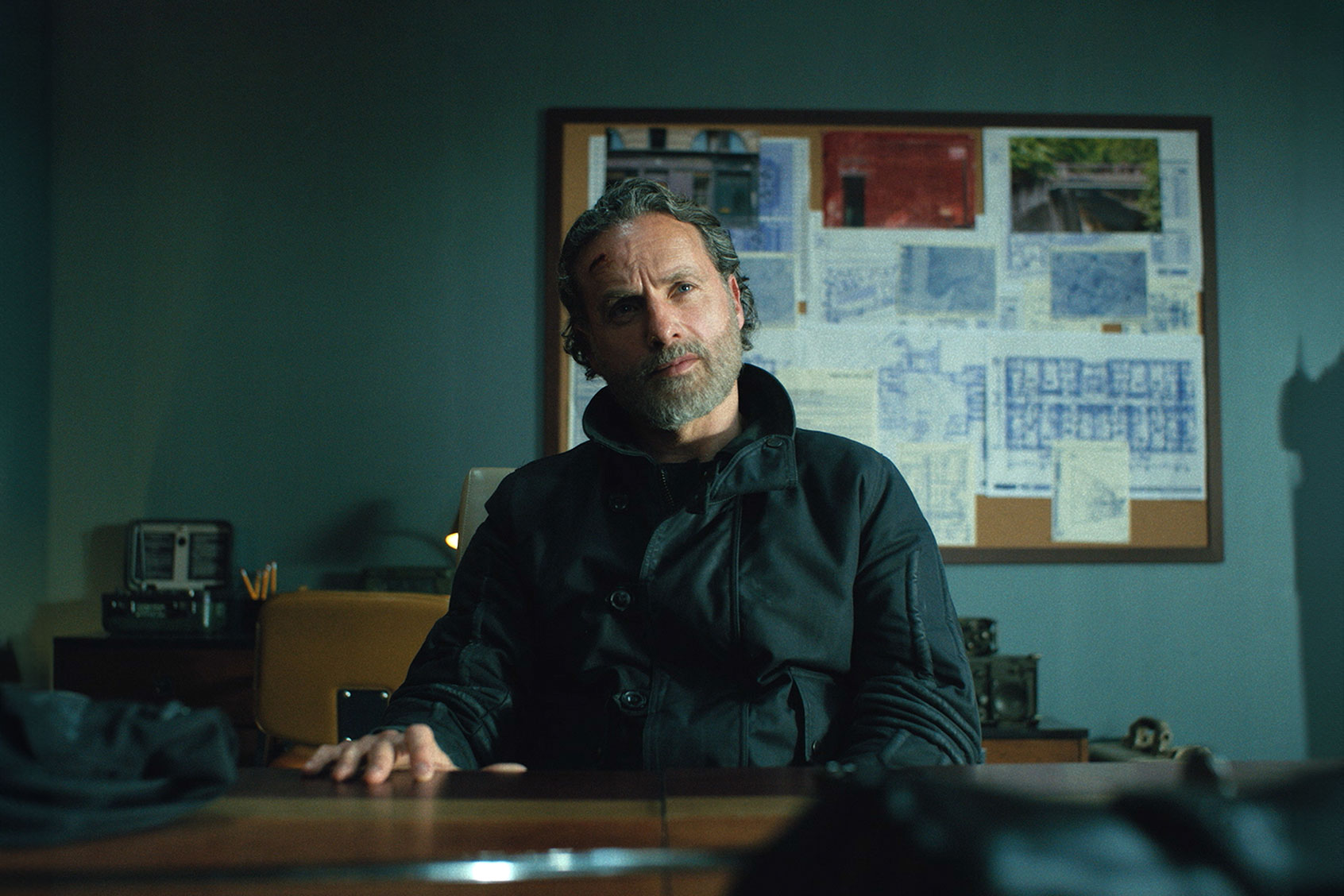
The Walking Dead: The Ones Who LiveAndrew Lincoln on "The Walking Dead: The Ones Who Live" (AMC)

The soldiers would save a small percentage of Portland's children and its commanders would lie to Philadelphia’s citizens about what happened. Beale shares a few very assured-sounding statistics with Rick concerning humanity’s low survivability to justify his actions, explaining that it comes down to numbers.

While this is happening, Michonne has infiltrated a presentation where an officer is informing the shock troops about the plan already underway in Portland. 

From the moment Michonne set out to find Rick, we knew they’d reunite and mow down anyone who got in their way, living or dead.

After they'd killed everyone in Portland the military would dissolve the civilian government in Philadelphia and assume control. “The stakes are too high for freedom,” he tells Rick before oiling up his ego by implying that he sees him as the potential face of this supposedly benevolent version of martial law. 

For a moment it looks like Rick is on the verge of buying in. Not for long, since the sword Beale places in front of Rick, on which he’s to swear his loyalty, is soon in Michonne's hands after he kills Beale. (Quite the wedding gift!) Rick and Michonne meet up in a tent full of chlorine gas tanks, mask up, and rig a zombiefied Beale and another nameless dead soldier to make them explode after they've escaped. 

Alas, they're delayed by Rick's former CRM buddy Pearl (Lesley-Ann Brandt) just long enough to have a knock-down, drag-out faceoff that ends with a grudge match between her and Michonne.

The “Ones Who Live” finale is an economically paced action movie whose narrative amounts to the heroes and villains delivering morality-defining lines when they're not throwing punches. “We will burn things to bring things back,” Beale says, later intoning, “The sword that kills is the sword that brings life.”

“In a dead world, love is dead,” Pearl hisses to Michonne, only to be defeated as Michonne says the line that should be on this show's poster: “Love doesn’t die.”

It was always going to end this way because, like Rick and Michonne tell each other, “This is the s**t we do.” Both Philadelphia and Alexandria are saved. The Grimeses get home to their kids.  “The End”? Gimple hopes not, but the franchise’s chief content officer takes nothing for granted. He recognizes there are stories yet to be told and acknowledges hearing fans’ complaints about not getting enough time with Okafor, Nat or other characters.

In this season-closing conversation, Gimple addressed the challenge of telling a long-anticipated love story in six episodes, closing the book on a few significant characters, whether we’ll see more of Rick and Michonne’s story and the surprising origin story of one of the worst haircuts on TV.

The following interview has been edited for length and clarity.

When we spoke before, you mentioned that the way that people connect with characters has changed. There are two major characters that a lot of people got to know after "The Walking Dead." One is Jadis, who was in the main series as Anne, but then came back in “World Beyond.” And then Beale, who generated a lot of excitement because of the mystery surrounding him, which increased with the casting of Terry O’Quinn. You had six episodes to tell this story, and you brought in these characters, introduced Beale, and then brought their stories to an end by the finale. Can you talk about that decision? 

I mean, these six episodes, which, by the way, six episodes felt incredibly constraining. For somebody who has made 80 episodes of “The Walking Dead” in a row, as a showrunner, and then even more in my position of Chief Content Officer, six episodes felt like, “Whoa, how do you do that?” But I felt that on [“Daryl Dixon,”] I felt that on “Dead City.”

What would your ideal number of episodes be?

I'm not sure. I mean, it's a different world now. You and I were talking about that. It's a different world now.  I didn't really have any numbers in it. And even before that, it was a series of movies. But still, you can't even count on a series of movies. It was a movie and hopefully things go great. 

We did want to make it a very complete “beginning, middle, and end” entertainment. And though I think there might be a lot of different sort of dangling story avenues to investigate, it wasn't the kind of thing where there was going to be a post-credits sequence of like, “Hey, and then this happens.” We wanted to make it a very, very complete journey for the characters and the audience. And to that end, the finality of those characters, the finality of many characters through this story was part of that. 

I was gratified and horrified at how much the audience loved some of the characters we had and were angry about losing them after an episode. I was proud that they liked them that much. And I felt bad that I was putting them through it so much, but it's critical that those characters be resonant, and that Okafor affected Rick so deeply to set him on the path that he was on, and that Nat and Bailey and Aiden affect Michonne so deeply and set her on the path that she was on. And those are divergent paths. But yeah, it was all about making it a complete single entertainment.

Were you surprised at the reaction people had at seeing Jadis return? I mean, I know people reacted to her haircut.

Yeah. Well, I did too.

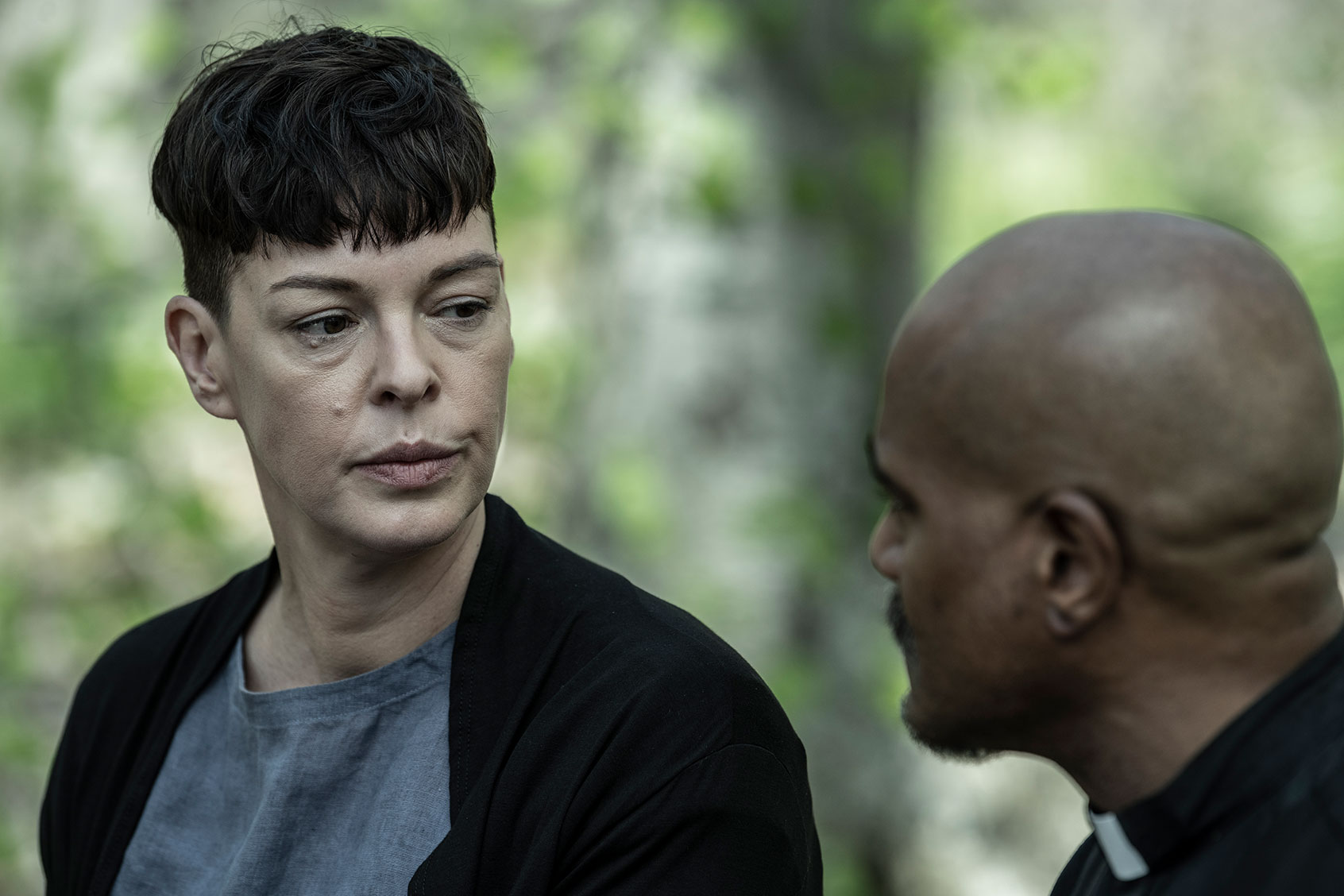
The Walking Dead: The Ones Who LivePollyanna McIntosh and Seth Gilliam in "The Walking Dead: The Ones Who Live" (AMC)Let's talk about that a little bit. Why that choice? 

The haircut? Oh, I can tell you very easily. OK, I think I'm giving you a haircut history. I think Pollyanna basically had the Jadis haircut for a reason when she initially auditioned. Or it was close to it. And I don't know if that set a precedent or something. But when Matt Negrete and I were working on “World Beyond” and it was incredible Pollyanna was coming to play with us — oh my god, I was so excited. I love working with her. She's brilliant. 

And Matt and I are talking about, OK, so what’s the approach with her character? We’re talking about this and also her role within CRM. And Pollyanna is like, “Cool, I have the haircut.” And it's like, “Wait, what?” Because we hadn't talked about it, and she had cut it, and it was like, “OK . . . well . . . that's the haircut.” And so, the haircut was a distinct choice by Pollyanna that I wholeheartedly supported. I don't know if I would have gotten there. As for the disparaging line that I wrote for Rick, she was a very good sport about it. I talked to her beforehand. 

So yeah, the haircut is an epic story of production. But I support Pollyanna 100%. She’s a brilliant storyteller.

We need your help to stay independent

This was also the culmination of Jadis’ story. You gave her a little bit of, perhaps not absolution, but some explanation if not redemption, by bringing back Seth Gilliam and Father Gabriel. Why was that important?

I think it was absolution, in a way. 

"What I find fascinating about bad guys like that is they think they're the good guys."

A lot of times, with villains it's like, oh, you just want to have this moment of redemption. But the truth of the matter is in Five, I think the reason that she was bad at killing Rick and Michonne, was because she didn't want to kill Rick and Michonne. Because that isn't really who she is. And those two, and probably Father Gabriel even more, remind her and touch upon who she really is. And that she was thrust into this role that she was very good at. In the apocalypse, she's very good at surviving. She's a creative survivor. She's an ambitious survivor. I mean, she makes her life into a story. 

But in the end, she's done some horrible things, brutal things, terrible things. She's been party to awful things that she felt she needed to do to survive. But she couldn't kill that part of her that was a real person. And Gabriel, more than anyone, knew that. I love what Seth did with what we gave him. But in the end, you know, she liked him. And that was her undoing. And she liked Rick. I mean, she could have just left him on the riverbank. Or she could have called him an “A” but she changed her mind. And she put herself in an incredible amount of vulnerability. So, yeah. Anne won.

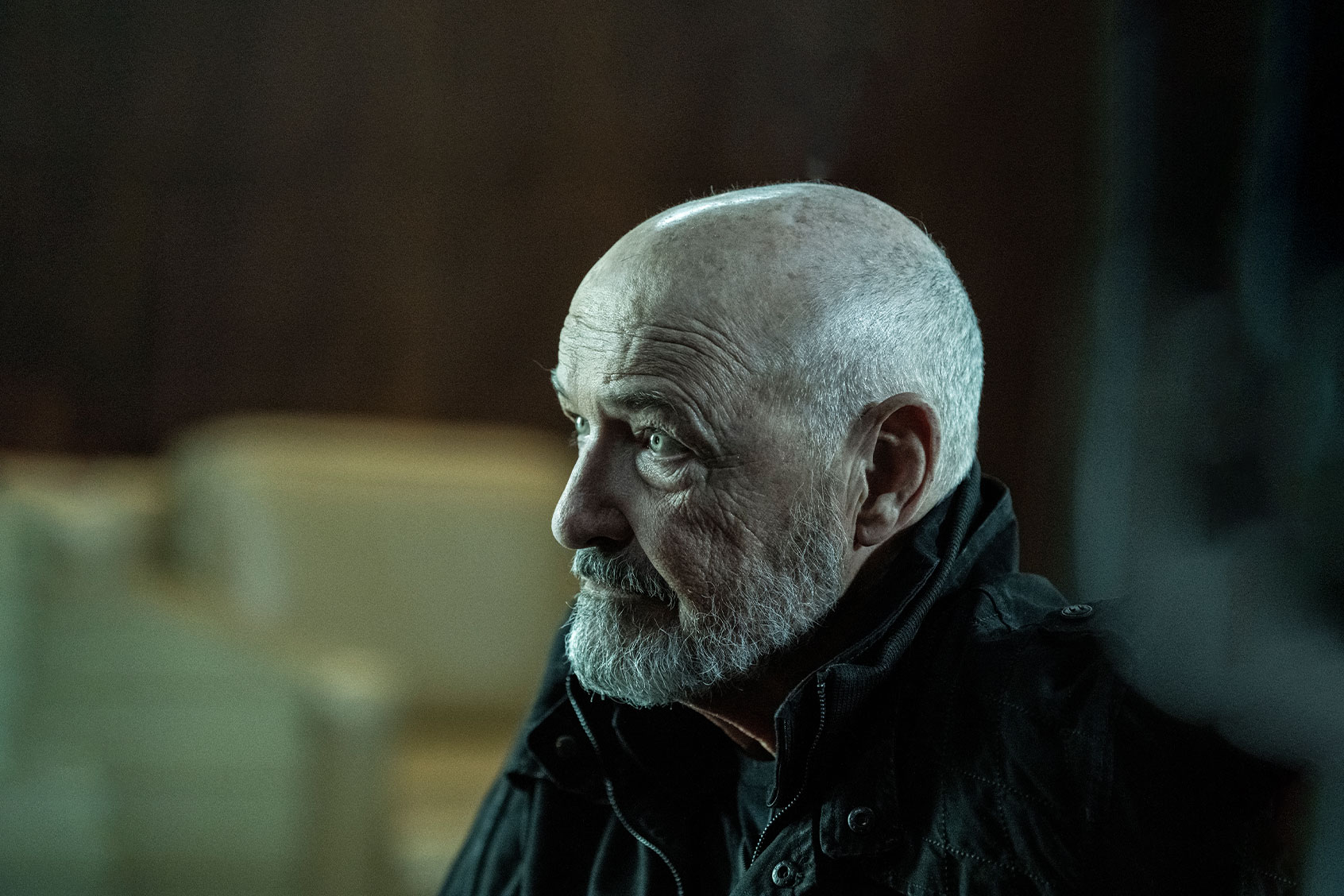
The Walking Dead: The Ones Who LiveTerry O'Quinn on "The Walking Dead: The Ones Who Live" (AMC)Let’s talk about the ending, how things culminated with Beale’s plan, and how it may relate to where we are now in America. There are a number of worst-case scenarios being discussed in terms of our political destiny, however that goes. 

And the thing about Beale is he seems very reasonable. He breaks down the numbers, and he is very clear in his mission, saying things like “This is not a time for freedom,” emphasizing that [the CRM] has to take care of their own. It made me wonder whether anything going on in the world influenced what you wrote for that scene. 

I had a rueful chuckle there, and it's only because some ways, I wish that it came from the world rather than like, we're doing this thing. 

I mean, really, in my mind, this was the ultimate expression of Shane's point of view from the first two seasons, it's a very basic, very basic thing of pragmatism. But that's where some of the worst acts of humanity have come from. Pragmatism. 


Want a daily wrap-up of all the news and commentary Salon has to offer? Subscribe to our morning newsletter, Crash Course.


Now, I do believe, and this is important, that Beale believes the information he had was correct. That doesn't even let him off the hook. Not a bit. But I think what we face in the world today is oftentimes a manipulation of the facts, or looking away from the facts to benefit one side. And, you know, that's one of the biggest challenges we have as humans moving forward, is just all of us living in the same reality. 

Obviously, I think anybody who watches the show would agree there's a real existential threat to living in that world, right? And that's what makes the story interesting to me. Are you holding on to your humanity, or are you not? Then with what Jadis says, what Beale said, they feel that they're being benevolent. That’s what I find fascinating about bad guys like that, is they think they're the good guys. I think we're facing something in the world that's a little different now. There's a lot of manipulation towards people's own ends. I do think Beale was a horrific character, but I did believe he wanted to save the world.

As you pointed out, there was no after-credit sequence like the one we saw with Carol at the end of “Daryl Dixon.” This very much looks like "Happily Ever After, The End." Everything's been connected. Are we done with Rick and Michonne? Do we have a supergroup situation coming up? 

I've said that I very much dream of that sort of thing. And it starts with dreaming. You know, we are not such a big organization that we can lock down things. We're the little train that could, but we did. This show was a dream, and it took seven years — seven years of different configurations and iterations to get there. I don't want to do that again, taking seven years. I’m not trying to freak people out. But I'm sure it'll take a minute. And you know, I'm just going back into the lab and think on things. It isn't just for me though. It isn't just up to me to come up with the fizzy lifting drinks. There are a lot of factors that come into play, but I am getting ready for it. And I'm doing it as fanfiction now. We'll see what happens. 

The most anti-science belief you can hold is that science is a religion

“Fringe”, “weird” and “unthinkable” are perfectly acceptable descriptors any science writer might use when rightfully denouncing some hare-brained professor’s paper that suggests, for instance, the North American sasquatch is the leading driver of climate change, or that Elvis Presley and Tupac Shakur are responsible for kidnapping Shelly Miscavige. Science journalism has a job to do — and that includes verbally smacking the pseudoscience out of academic hustlers to defend the dignity of both the reader and the science. We stan a scientific diss track in this shop, and I’d gladly lend my pen to such a cause.

But when science writers dismiss robustly-debated philosophical theories this way — like panpsychism, one well-known theory about the possible nature of subjective consciousness even in inanimate objects — they look less like erudite champions of empirical truth, and more like a Victorian drawing room full of phrenologists scoffing at William James’ notions of psychology while proclaiming that “there isn't a single head-bump of evidence to support this theory.”

At least, that’s what they looked like this past week when Popular Mechanics science writer Stav Dimitropoulos offered a fresh bit of nuanced reporting on the renewed popular interest around the philosophical theory of panpsychism. To grossly oversimplify, the theory posits that consciousness isn’t just the currently scientifically-inexplicable emergent property of a human brain as many consider it now, but a property of pretty much any self-organizing system of material things. Panpsychism’s principles stretch back to human’s earliest notions of classical philosophy but have also evolved right alongside the sciences (like, you know, theories within humanities disciplines do).

Panpsychism winks at us from our species’ inquisitive past and seems to ask, “Aren’t you the same hairless apes that once laughed at a guy for suggesting all matter was ultimately made of vibration?

Its core concepts have been advocated for by the likes of Nobel Prize winner Roger Penrose, as well as physicists like Author Eddington and David Bohm, and even William James himself. As a theory, panpsychism challenges us to consider whether we featherless bipeds might be thinking a bit too primitively when we assume objectively extant concepts we have no real way to quantify — like consciousness — can only be produced by neuronal sparks of the electrified hamburger meat between our ears.

Panpsychism winks at us from our species’ inquisitive past and seems to ask, “Aren’t you the same hairless apes that once laughed at a guy for suggesting all matter was ultimately made of vibration? Do you think your primitive little frontal cortex is equivalent to the skull of Zeus, and that the totality of all possible wisdom springs from it fully armored as Athena?” 


Want more health and science stories in your inbox? Subscribe to Salon's weekly newsletter Lab Notes.


When fuzzy terms like “artificial superintelligence” are getting tossed around to describe black-box processes of a computer network you can pay to be your girlfriend, I’d say panpsychism’s questions are worth more than an embarrassingly tone-deaf snicker from science writers. Similarly well-timed amid all the recent heady research into quantum mechanics, Dimitropoulos’ rather eloquent piece invites readers to examine the current limits of material physics’ theories and see what the brainiacs in humanities departments have to say about self-awareness and the mind’s role in the wider universe.

But judging by the frantic oinking of science writers who quickly piggybacked off her click-traffic, you’d have thought the article was a crayon-scrawled defense of flat-earthers. Seemingly affronted by the possibility that a philosophical theory might offer a uniquely interdisciplinary approach to a problem that physics was never asked nor meant to solve alone, a gaggle of presumably muttonchopped science writers eagerly charged into the latest skirmish of a decades-old fray between philosophers and physicists.

In overindulgent headlines and ill-advised body-copy, would be defenders of the faith of Scientism gleefully celebrated missing the entire point of panpsychism across some widely circulating and uninformed articles that I’d rather not further promote.

We need your help to stay independent

It’s disappointing to see but not a surprise. A lack of curiosity about the possibilities of consciousness is the hallmark of anti-science attitudes, even among those appointed to herald the sober inquiry of an awe-striking world of which the human race is but one fleeting member. And to do this job right — hell, to even get beyond our own trembling ontological frailty long enough to learn something about this existence — we have to fight anti-science attitudes in every quarter, even our own. 

We should start with our own beliefs. To that end, the most anti-science belief you can hold isn’t that the earth is flat, that consciousness may be more than human thought, or that existence may be more than we can quantify at the moment — it’s that science is a religion. And when you treat science like a religion, like a framework for limiting the interpretation of the world’s possibilities, rather than like a framework for discovering those possibilities — you stop writing science journalism and you start writing Scientism apologia.

When your congregation zealously overestimates the epistemological functionality of empiricism in the work of logical positivism, you trap the conversation of science and consciousness in your lethally boring Vienna wagon-Circling. And in this way, yes, you insult the dignity of both the reader and the science. 

An earlier version of this article originally appeared in Salon's Lab Notes, a weekly newsletter from our Science & Health team.

Trump’s Bibles get the “SNL” treatment

James Austin Johnson donned the blond hair, blue suit and red tie to play Donald Trump on "Saturday Night Live," before busting out an "exclusive" Trump Bible.

The Easter Sunday eve episode featured the Trump Bible sketch in its cold open. 

"Basically, yes," Johnson as Trump says after a villager asks, "Is it Jesus?"

"That's just a thing I do now," Johnson's Trump says of his comparisons to Jesus. 

"Look at this new Bible. Made from 100% Bible,” Johnson goes on to say in his Trump voice. "You’re going to love my new and, I would say, even better Bible. It comes with everything you like from Bible. Like the story of Easter, which primarily concerns Jesus. Not so much the bunny. I kept waiting for the bunny to show up. He never showed up. That’s OK.”

“As you know, I love Bible. It’s my favorite book. I’ve definitely read it. My favorite part is probably the ending. How it all wraps up.”

Watch the sketch below, via NBC:

“It should be like Nagasaki and Hiroshima”: GOP congressman says Gaza comparison is out of context

A Republican congressman is not walking back recent comments he made seemingly comparing Gaza to the Japanese cities of Nagasaki and Hiroshima.

At a March 25 town hall in Dundee, Michigan, Republican Rep. Tim Walberg argued against the Biden administration delivering humanitarian aid to Gaza, which remains under an Israeli blockade, via U.S. military cargo ships. In order to transport the aid to land, the U.S. built a temporary pier off the coast of the besieged enclave.

"You're putting our troops in harms way," Walberg said of President Biden.

The GOP congressman then followed that up by calling for a cessation to humanitarian aid, arguing that helping to feed civilians only prolongs the war.

“I don’t think any of our aid that goes to Israel to support our greatest ally, arguably maybe in the world, to defeat Hamas and Iran and Russia, and probably North Korea’s in there, and China, too, with them helping Hamas — we shouldn’t be spending a dime on humanitarian aid. It should be like Nagasaki and Hiroshima. Get it over quick. The same should be in Ukraine. Defeat Putin quick.”

On Sunday, the congressman released a statement attempting to clarify his comparison.

“As a child who grew up in the Cold War Era, the last thing I’d advocate for would be the use of nuclear weapons. In a shortened clip, I used a metaphor to convey the need for both Israel and Ukraine to win their wars as swiftly as possible, without putting American troops in harm’s way,” Walberg said. “My reasoning was the exact opposite of what is being reported: the quicker these wars end, the fewer innocent lives will be caught in the crossfire. … The use of this metaphor, along with the removal of context, distorted my message, but I fully stand by these beliefs and stand by our allies.”

When Walberg traveled to Uganda last year to urge the African nation to "stand firm" on "death to gays" law, he said, “I expect some pushback, but I’m not gonna give in to them.”

With “Parish” Giancarlo Esposito is finally the lead. If only this vehicle were worthy of his talent

The shadow cast by “Breaking Bad” is inky, far-reaching and difficult, but not impossible, to escape. A few of “Parish” lead Giancarlo Esposito’s co-stars have tried with varying degrees of success. Bryan Cranston’s movie career avails him of some variety, but on Showtime’s “Your Honor” he plays another version of a good man pushed to commit evil for the sake of protecting his family.

Bob Odenkirk and Aaron Paul steered out of the derivative prestige trap to some degree, with Paul showing entirely different sides on “Westworld” and “BoJack Horseman,” and Odenkirk blending his comedy chops with his dramatic range on “Lucky Hank,” one of those fine shows we wish we’d kept watching.

Esposito, though, contends with a separate problem from his co-stars in that his singularly brilliant Gus Fring spans two shows, “Breaking Bad” and “Better Call Saul,” and created a mold from which he's still freeing himself.

Fring is a dapper, eternally composed villain possessed of a calm that drapes an outer layer of sinister over a performance that screams warnings without saying much at all. Gus speaks with a suave efficiency that lends an elegance to his villainy. That was also true of Moff Gideon in “The Mandalorian” as Stanley Johnston – “with a T!” – the wealthy American wolf hunting crooked aristocrats in Guy Ritchie's London, as seen in "The Gentlemen."

All of these are co-starring roles, each further cementing Esposito’s reputation of being the best reason to watch anything he’s in regardless of quality.

“Parish” is no different, and entirely too much like many dramas gunning to earn the “premium TV” label by emulating other critically acclaimed shows.

Like “Your Honor" it is an American adaptation of a foreign format — in this case a British show called "The Driver." The main distinction is that Esposito is the lead as opposed to the sideman, a designation that he should have received much earlier in his career. His command of Gracián Parish’s stony resolve behind the wheel is captivating in the opening episode when he glides through a dangerous chase through New Orleans with ease, improvising at turn after turn to escape the cops, refusing to lose his cool.

Gray, as he’s known, thought he’d left all that behind. (Yep, it’s one of those.) The former wheelman retired 18 years ago to run a luxury car service in New Orleans. But business has dried up, and he’s struggling to pay his mortgage.

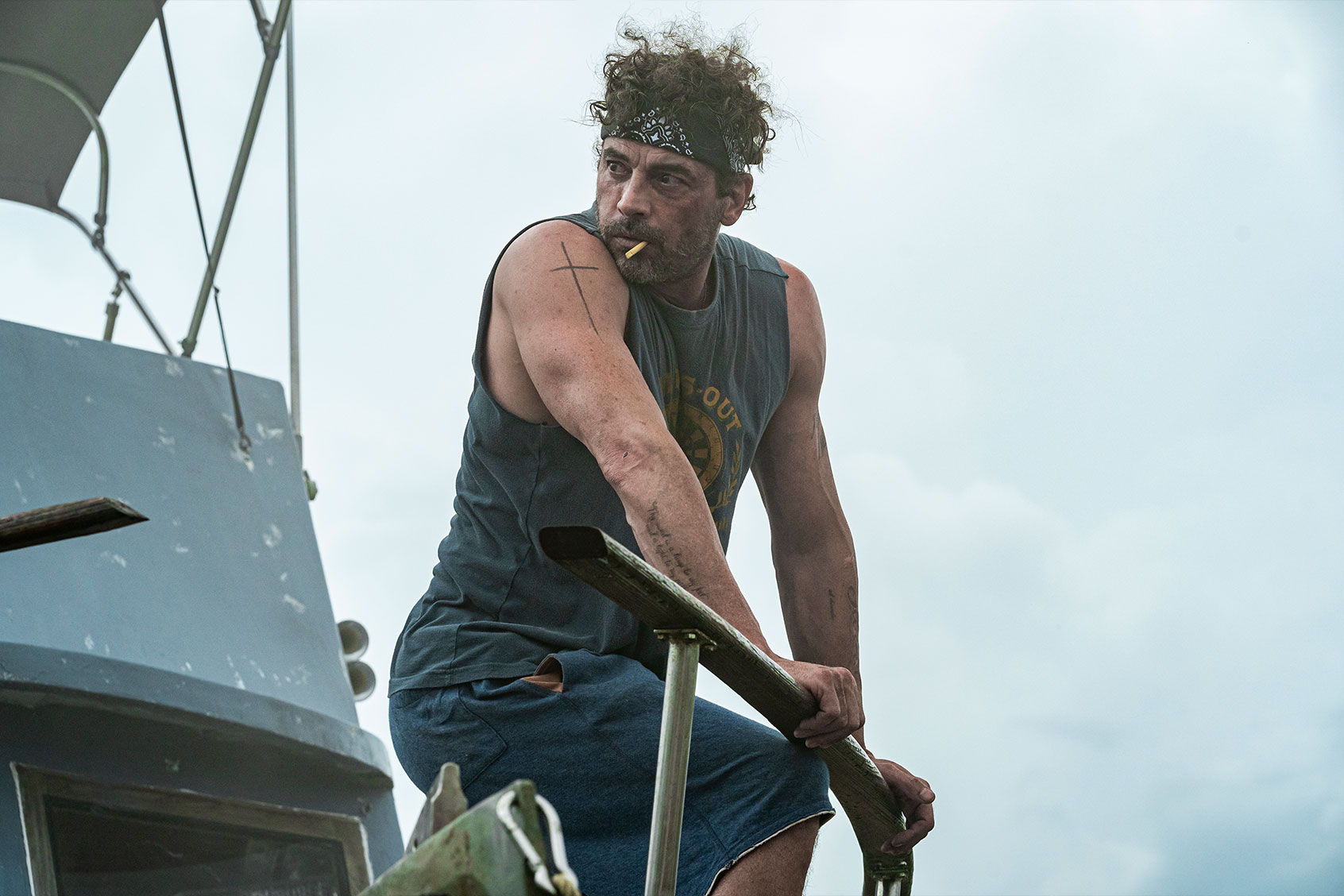
ParishSkeet Ulrich in "Parish" (AMC)

So when his old partner in crime Colin (a very sweaty and bestubbled Skeet Ulrich) resurfaces with a frantic request to help him with a mess he’s slipped into with a Zimbabwean crime family, Gray steps up with the standard “OK, but just this once” agreement, which will surely be true this time!

Colin has run afoul of the Tongais, a family of human traffickers headed in the city by The Horse (Zackary Momoh), whose sister Shamiso (Bonnie Mbuli) counsels him as his capricious brother Zenzo (Ivan Mbakop) tries his patience, are establishing themselves in local business and politics as they exploit workers they lure to the states with promises of helping them gain citizenship.  

We need your help to stay independent

In Gray, Horse sees an experienced, even-keeled potential ally who’s also exploitable; Shamiso does some digging and finds out he’s mourning the killing of his teenage son on top of the money problems. This leads to the good old "offer Gray can’t refuse" coupled with his confidence in knowing he’s the only man who can do what they require – you know, a specific set of skills, and so on, and so forth.

Competent copycat dramas abound these days, making this show’s place on the lower side of the quality scale’s midrange fairly typical. Esposito puts in maximum effort, muscling out a performance that exhibits his full range of dramatic capability despite prosaic scripts stringing together phrases you’ve heard in other shows and movies, and not necessarily superior ones.

The first two episodes set a speed that the middle hours downshift to the show's detriment.

Still, he warms substantially in scenes where he transitions from all business into a father and husband struggling to anchor his relationships with his daughter Makayla (Arica Himmel), who’s still navigating her grief over losing her brother, and his equally bereft wife Rose (Paula Malcolmson). They’re ready to leave the city for a fresh start, and with the bills piling up, cashing in what chips they still have makes sense.

The writers very quickly bump Gray’s family life from the shotgun seat to the back until we nearly forget they’re around. That’s a shame for a performer of Malcolmson’s caliber.

Like most of the other cast, she makes what we can of her screen time. Mbuli and Momoh similarly make watching worthwhile – Mbuli especially, both for her evil queen regalness and Shamiso’s enviable wardrobe. The Tongais are if nothing else models of aspirational style, which is the least a show like this can contribute to our weekly conversations.

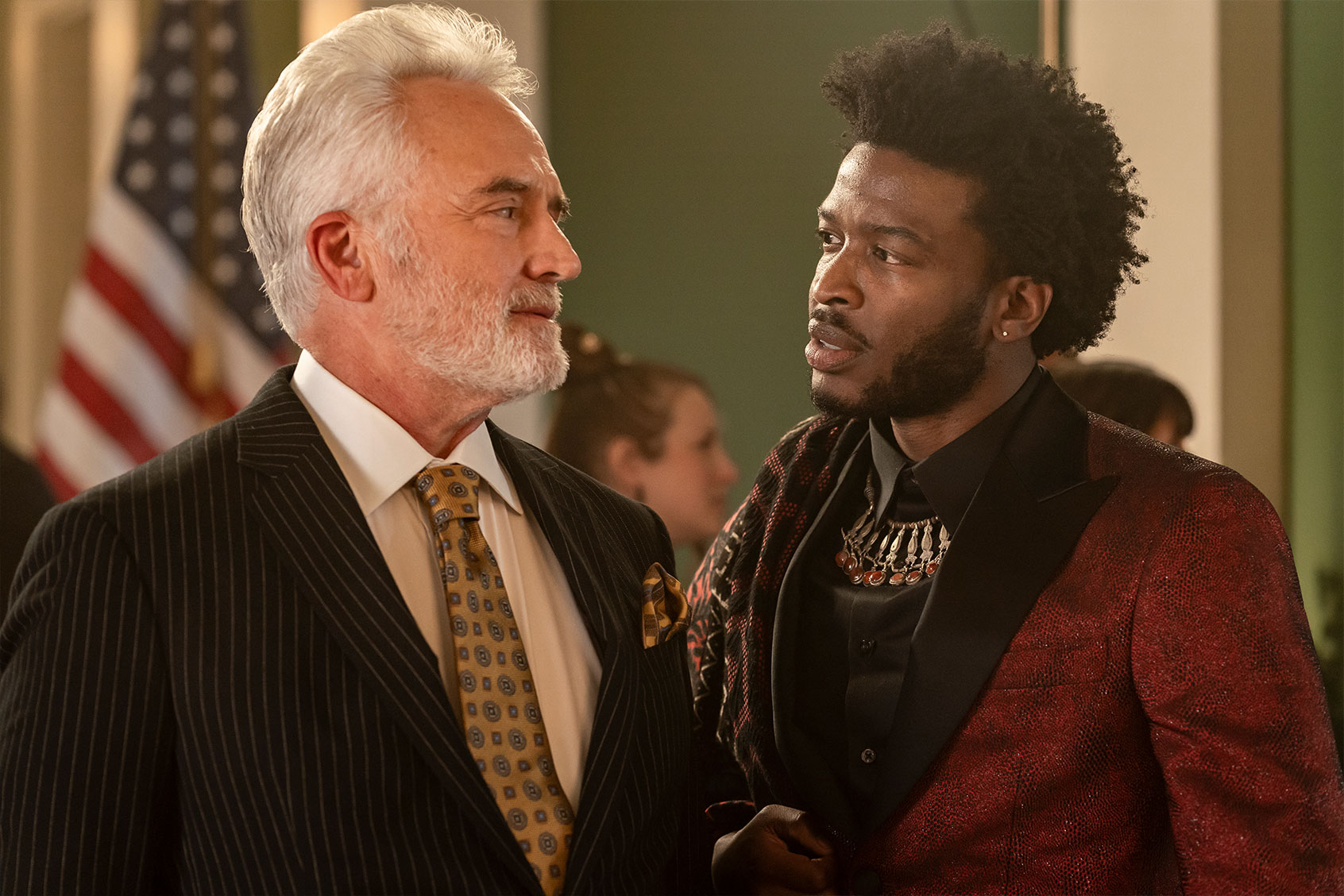
ParishBradley Whitford and Zackary Momoh in "Parish" (AMC)

They both draw and seize our attention alongside Esposito. That’s still a poor excuse for failing to develop other characters, including Amanda Brugel’s Sister Anne whose role amounts to little more than an expositional prop, and Bradley Whitford’s businessman, mainly there to add some local color to all the corruption.

For the viewer, though, the real shortcoming is the plot’s inconsistent pacing. Despite the standard body disposal and accompanying sidekick freakout, and a side journey designed to crack the hero’s mask of assuredness, the first two episodes set a speed that the middle hours downshift to the show's detriment.

This is one example of the drama's divided depiction of New Orleans. On the one hand, there's the cosmopolitan view of the Tongais, whose culture is one not often featured on TV. But then you have Gray stumbling through a random carnival parade, as if to play to the tourist stereotype. We should consider ourselves lucky that the appropriated accents aren't dripping with Northern gumbo, i.e. the kind that punishes us instead of lending flavor.

The fifth episode returns to form but if the sagging energy leads you to bow out before then you can’t be blamed for that. I suppose the fault lies instead with series co-creators Sunu Gonera and Danny Brocklehurst, who helmed the first two episodes before Gonera was swiftly excised from the production related to a sexual assault allegation.

That would cast a cloud over any series, but it’s especially unfortunate that it happened on one announcing Esposito as a worthy lead. Who can say whether that added an unwelcome drag to the season’s narrative cohesion? We can only judge what’s shown onscreen.

The six episodes allotted to “Parish” require a narrative discipline that simply isn’t in play, and Esposito’s talent demands original writing that rarely presents itself here. He’s excellent despite this lack – so much that it makes you want better for him. Maybe “Parish” will lead to more worthy projects, if not a second season that, fate willing, smooths out the rough patches and holes in its opening length of track.

"Parish" premiere at 10:15 p.m. Sunday, March 31. New episodes air at 9 p.m. Sundays starting on April 7.

“Never forget”: Trump unloads on Republican “cowards and weaklings” in Easter Sunday meltdown

Donald Trump's Easter Sunday message to his followers on Truth Social was a simple command: "Never forget."

The former president fumed at retiring House Republicans, specifically sharing a report of Wisconsin Republican Rep. Mike Gallagher's recent decision to not seek another term despite pleas from GOP leadership in the House. Gallagher announced that he will instead step down on April 19, leaving the seat vacant until 2025. Republicans currently only have a four-seat majority in the House.

"Never forget our cowards and weaklings!" Trump wrote Sunday morning. "Such a disgrace."

While trapped in his office during the Jan. 6, 2021 attack on the Capitol by Trump's MAGA followers, Gallagher made a direct appeal to Republican members of Congress who objected to certifying the 2020 presidential election.

“The objectors, over the last two days, have told me there is no problem having a debate: ‘We know we’re not going to succeed. So we’re just going to object. We’re going to have a debate,’” Gallagher said in the video, adding that other Republicans claimed, “There will be no cost to this effort.”

He continued: “This is the cost of countenancing an effort by Congress to overturn the election and telling thousands of people that there is a legitimate shot of overturning the election today, even though you know that is not true.”

Gallagher begged his colleagues to “call it off.” Now the congressman, who was first elected in 2016, is calling it quits as Republicans prepare to nominate Donald Trump, who on Sunday seemingly compared himself to Jesus Christ, for president for a third time. 

Israel and the Puritans: A dangerous historical romance

"Humankind cannot bear very much reality," T.S. Eliot wrote in the first of his Four Quartets. Today’s Israel-Hamas war and America's own increasingly warlike divisions are forcing some of us to bear realities we haven’t borne quite so heavily before. Some of those realities involve attitudes against Jews that Eliot held and that may have become menacing again — as have the recent frantic efforts to censure antisemitism itself, sometimes in ways that risk prompting even worse antisemitism. 

But larger eruptions of hatred and mayhem in America’s increasingly divided, uncivil society are driven not by antisemitism or by today's Jews, nor by the riptides of global capital and technology and the desperate migrations and belligerent nationalisms that they accelerate. More than most of us recognize, they’re driven by ancient religious passions that figured deeply in Israel’s and America's origins. Both nations’ professedly “liberal” and civic-republican cultures are profoundly and perhaps fatally conflicted, in ways that prompt not only news headlines but also biblically resonant upheavals, even when the participants don’t consider themselves religious at all. 

Some of these conflicts have generated the Trump phenomenon, but Donald Trump and his media heralds, political acolytes and allies — including most evangelical Christians and many Orthodox Jews — aren’t the progenitors of these conflicts; they’re carriers of a deeper plague. Similarly, the belligerent Jewish nationalists who currently govern the State of Israel are accelerants of a doom-eager Zionism that isn’t new in history and that some of the Bible's own prophets condemned.

Few of us can bear very much of such realities, whether in America or in Israel. I want to make a few observations about the origins of America's obsession with the Israeli-Palestinian conflict.

The 17th-century English Calvinists who colonized lands that they called New England and Virginia, and whose 18th-century legatees participated in founding the American republic, pursued strategies remarkably similar to those of today’s Israeli settlers in the West Bank and today's military invaders of Gaza, some of whom claim a divine mandate and others a “manifest destiny” to impose one ethno-religious identity at the expense of longtime inhabitants.

In retrospect, American Puritans seem almost to have been "copying" today’s Israeli Zionists, tactic for tactic and pious justification for pious justification. Even more remarkably, Puritans justified what they were doing not by looking ahead 300 years but by looking back more than two millennia, emulating biblical Israelites' "Hebrew republic" so intensely that they called themselves the “New Israel” and New England their “Zion.” They even put the Hebrew phrase Urim v’tumim, — meaning, approximately, “Light and Truth,” or “Light and Purity," taken from the breastplate of the high priest in the Jerusalem temple — on the seal of Yale College, founded in 1701.

The ”settler-colonial” paradigm (or accusation) touted by today's American progressives in attacking Israel certainly fits the early American Puritans, who had no ancestral roots or claims on the lands they were settling and seizing. Yet their pivot backward toward ancient Israelites’ divinely promised “Zion” has infected America’s civic-republican culture in ways that still drive Protestants’ and Jews’ obsessions with Israel's presence in the Middle East.

In retrospect, American Puritans seem almost to have been "copying" today’s Israeli Zionists 300 years ahead of time, tactic for tactic and pious justification for pious justification.

I experienced that strange convergence as late as the 1950s, growing up in Longmeadow, Massachusetts, an old Puritan town whose public school teachers still passed on echoes and remnants of its origins. I was also learning biblical Hebrew two afternoons a week in a nearby synagogue and, more intensively, in eight years of Jewish summer camp. When I entered Yale in 1965, in the twilight of its own Puritan ethos, I could read the Hebrew-lettered motto on its seal, and I knew that Yale’s president during my years there, Kingman Brewster Jr., himself born in Longmeadow, was a direct descendant of Elder William Brewster, the minister on the Mayflower in 1620.

Yale University logo seen displayed on a tabletYale University logo seen displayed on a tablet. (Photo Illustration by Igor Golovniov/SOPA Images/LightRocket via Getty Images)

In June 1967, you could have found me standing in line outside the Jewish Agency in Manhattan, hoping to register as a noncombatant in the Six-Day War. Not yet 21, I needed parental permission, which I didn’t get, so I didn't go. But two years later, I was in Haifa and the Galilee with a small movement for Arab-Jewish cooperation, holding intense conversations with Palestinian citizens of Israel, as I’ve recounted in "The New Jews," an anthology of essays by young American-Jewish activists of that time that I co-edited with the late scholar of Hebrew literature Alan Mintz. My own story only matters here because it showed me some origins of today’s controversy that are overlooked or mishandled by American Christians and Jews who are reckless with historical narratives, mythical or scholarly.

Ever since Jews’ own origin story, in Genesis 12:1, announced that God had told Abraham to “Go from your country [Ur, in Mesopotamia] and your kindred and your father’s house to the land that I will show you,” Jews have unsettled, stimulated and exasperated other peoples because they had unsettled and uprooted themselves ever since their own “Abrahamic,” pivotal, “axial” break in human consciousness and conventions, becoming a tribe that negates a lot of what’s usually tribal in pursuing something broader.

A lot of this has been “too much” reality for many people and peoples to bear — Jews as well as non-Jews. The word “Hebrew” —ivry — means “He passed over,” as in crossing borders that are metaphysical and cultural as well as geographical, to pursue universal knowledge and justice across time as well as space. Many Americans and Israelis consider such pursuits essential to the Enlightenment, not to religion. But Abraham’s grandson Jacob, demanding to know the terms of the mission, wrestled with an angel for a whole night until the angel released him at dawn without an answer and renamed him Yisrael, which means, “He contends with God.”

That’s a myth for all of us, believers or not. Ancient Hebrews’ uprooting from Ur and their contentions elsewhere figured centrally in America’s own beginnings as a “nation of immigrants,” a land of clean breaks and fresh starts, and they figure now in our preoccupations with the Gaza war: From the biblical Abraham to Abraham Lincoln and beyond, the Hebraic origins of the American republic still matter, even as the country is becoming more gnostic, agnostic or libertarian, and less Hebraic and covenantal.

So let me make a few more observations about the original Jewish “axial” break from other traditions, and then about how New England Puritans transported that break into what has become our fraught, disintegrating civic-republican culture.

Jewish sublimity and its discontents

In the Genesis myth, Abraham doesn’t only leave Ur; he smashes its idols and even prepares to sacrifice his own son Isaac at the command of a hidden but omnipotent Interlocutor. Equally puzzling, the command is rescinded at the last minute, even as Abraham is preparing to obey it by binding his trusting son and raising his hand to strike the fatal blow. The father’s grief and loneliness are broken by the angel Gabriel, bringing a ram to substitute for Isaac in the offering. But Abraham has other disputes with God (over God's decision to obliterate the corrupt cities of Sodom and Gomorrah, for example, killing many innocents). And Yisrael contends with God ever after. 

These biblical accounts of the human spirit’s estrangements from nature turn the latter’s enticements into signs of human futility: A central prayer in the liturgy of Yom Kippur, the Day of Atonement, originated the claim that “man’s origin is dust, and his destiny is dust,” depicting every individual life “as a fragile potsherd, as the grass that withers, as the flower that fades, as the fleeting shadow, as the passing cloud, as the wind that blows, as the floating dust, and even as a dream that vanishes.”

Such a scourging faith projects the faithful into a vast unknown between humans and their unknowable, sometimes irascible God. Its baring of human self-awareness prompts yearnings like Jacob’s to know God’s will and to identify human pursuits with transformations of a world that isn’t wholly indifferent to their efforts, so long as they keep a covenant that limits and repurposes tribal reliance on blood and soil.

“The Jewish nation is the nation of time, in a sense which cannot be said of any other nation,” the German Protestant theologian Paul Tillich explained in 1938:

It represents the permanent struggle between time and space. … It has a tragic fate when considered as a nation of space like every other nation, but as the nation of time, because it is beyond the circle of life and death, it is beyond tragedy. The people of time … cannot avoid being persecuted, because by their very existence they break the claim of the gods of space, who express themselves in will to power, imperialism, injustice, demonic enthusiasm, and tragic self-destruction. The gods of space, who are strong in every human soul, in every race and nation, are afraid of the Lord of Time, history, and justice, are afraid of his prophets and followers.

Afraid, indeed: “The eternal silence of these infinite spaces terrifies me,” wrote Blaise Pascal, a French contemporary of the Puritans. That Jews have negated much of what’s tribal yet haven’t disappeared as a “tribe” themselves, at least in many other people's minds, has angered some followers of Judaism's derivative religions, Christianity and Islam, which claim to have superseded the Jewish faith and to have relieved humankind of having to bear too much reality in this fallen world.

“How odd of God to choose the Jews,” quipped journalist William Norman Ewer a century ago, capturing the mix of antipathy and admiration they have provoked ever since Judaism prompted its “axial” break in Western consciousness. You don’t need to “believe in” that break, in the religious sense, to notice that Jews have stimulated and exasperated other peoples among whom they’ve sojourned.

“How odd of God to choose the Jews,” quipped William Norman Ewer a century ago, capturing the mix of antipathy and admiration they have provoked ever since Judaism prompted its “axial” break in Western consciousness.

Christianity and Islam also acknowledge the Hebraic separation of spirit from nature: “We are all, in all places, strangers and pilgrims, travelers and sojourners,” intoned Robert Cushman, a contemporary of the Elder William Brewster and an organizer of the Pilgrims’ voyage, in a sermon he delivered in 1622. Islam commemorates Abraham’s readiness to sacrifice Isaac in a holiday, the Feast of the Sacrifice, that honors Abraham’s obedience and celebrates Isaac’s release.

But in Judaism’s judgment, these derivative religions fudge the starkness and sublimity of the separation of spirit from nature: In "Dark Riddle: Hegel, Nietzsche, and the Jews," Israeli philosopher Yirmiyahu Yovel writes that Christians have depicted God “as a suffering, agonizing man, but thereby… transformed a human need into a theological principle that ends with an illusion” and “a false consolation.” For two millennia, Christians have intoned, “My kingdom is not of this world” and “Baptized in Christ, there is no Jew or Greek,” while sitting on golden thrones over armed states whose national identities are rooted even more deeply in ties of "blood and soil" than Jewish “tribal” identity has ever been.

Yet the Hebrew Bible shows that Hebrews were as terrified of existential uprootedness as Blaise Pascal or any Christian king. Even as Exodus recounts God revealing the terms of his covenant to Moses on the summit of Mount Sinai, the chosen people are busy fabricating and worshiping a Golden Calf at the foot of the mountain. Later they turn to kingly and materialistic protections against their wandering. Zionism appears in several historical periods as an attempt to return to and possess the promised land, the latest attempt provoked partly by an urgent need to escape rising persecution and even extinction.

But returning does not guarantee succeeding. For three millennia, Jews have invoked a “return” to Jerusalem from exile and a deliverance from “the Lord of time, history and justice” poetically and ritually, but not always really. Yet Jews have indeed returned at times to tribal or national service to “gods of space, who express themselves in will to power, imperialism, injustice, demonic enthusiasm, and tragic self-destruction.”

The Bible itself recognizes such ambivalence. In the Book of Samuel, Israelites importune its eponymous judge to “Give us a king to rule over us, like all the other nations.” Although that demand displeases not only Samuel but God, Samuel and the Israelites commit genocidal assaults against neighboring Canaanites, Amalekites and Philistines:

Remember what the Amalekites did to you… [when] they met you on your journey and attacked all who were lagging behind; they had no fear of God. When the Lord your God gives you rest from all the enemies around you in the land he is giving you to possess as an inheritance, you shall blot out the name of Amalek from under heaven. [Deuteronomy 25]

Then Samuel said, ‘Bring me Agag king of the Amalekites.’ Agag came to him cheerfully, for he thought, “Surely the bitterness of death is past.” But Samuel declared: ‘As your sword has made women childless, so your mother will be childless among women.’ And Samuel hacked Agag to pieces before the Lord at Gilgal. [1 Samuel 15]

Eight centuries before Christ, and 28 centuries before the Netanyahu government waged war against Hamas in Gaza, the prophet Amos said, “For the three transgressions of Gaza, Yea, for four, I will not reverse [its punishment]: Because they carried away captive a whole captivity [of Israelites] to deliver them up to Edom. So I will send a fire on the wall of Gaza, and it shall devour the palaces thereof; … and the remnant of the Philistines shall perish, Saith the Lord.”

So the militarized nationalism of today’s Zionists can be understood as another such reversion, reinforced in 2018 by the Knesset’s "Basic Law" declaring that Israel is “the Nation-State of the Jewish People,” and greatly diminishing it as a liberal democracy.

Such contradictory, conflicted uprootings and re-rootings have given Jews their atypical mobility, marginality and occasional magnificence and malfeasance, breeding some tough, defiant spirits, not only in Moses and Jesus but also in Karl Marx, Sigmund Freud, Albert Einstein and J. Robert Oppenheimer, inventor of the atomic bomb and self-avowed “destroyer of worlds.” The Jew as interloper, living marginally in homogeneous societies but flourishing and sometimes predominating in pluralistic and open ones — agile, entrepreneurial, walking on eggshells and thinking fast – has sometimes seemed most “at home” in media of exchange, whether of information, money, merchandise, music, math, medicine or scientific discovery. Confirmation of their prominence in those realms is presented sociologically and lyrically in anthropologist Yuri Slezkine’s "The Jewish Century."

That Jews, unlike Puritans, actually do have ancestors in their “promised land” was confirmed in 1947 by the discovery of scrolls transcribed in Hebrew and buried in caves near the Dead Sea seven centuries before Islam existed and before Arabic was spoken in the region. That complicates the “settler-colonial” paradigm, which applies readily to English Puritans but more ambiguously to Jews. Yet those passages also contain prophetic warnings that Israelites’ territorial claims were contingent on keeping the covenant sealed at Sinai — or, as we might put it now, on transcending narrow tribalism to meet a higher, more universal standard. If they didn’t, God would punish them at the hands of their enemies:

Woe to those who are at ease in Zion, and to those who feel secure on the mountain of Samaria, the notable men of the first of the nations, to whom the house of Israel comes! …. Go down to Gath of the Philistines. Are you better than these kingdoms? Or is their territory greater than your territory, O you who put far away the day of disaster and bring near the seat of violence? Woe to those who lie on beds of ivory and stretch themselves out on their couches, … who drink wine in bowls and anoint themselves with the finest oils, but are not grieved over the ruin of Joseph! [Amos 6]

The reluctant but overwhelmed prophet Isaiah reported that God would punish the Israelite elites’ arrogance by destroying their Zion "until the cities lie ruined and without inhabitant, until the houses are left deserted and the fields ruined and ravaged, until the Lord has sent everyone far away and the land is utterly forsaken."

How America’s Puritans became the “new Israel”

Puritans tried to Hebraize their Christian quest for personal salvation in Christ by grounding it in covenanted communities of law and collective discipline. But they had to reconcile their attraction to the gods of space and power with the biblical prophetic condemnations of it. Those condemnations were useful enough when Puritans faced defeats at the hands of the enemies they called “Indians,” reminding them that God had sometimes used the Israelites’ enemies to punish the chosen people for their sins. Puritans' days of “fasting and humiliation” were essentially rituals of atonement, meant to affirm the participants’ righteousness — in the Puritans’ case, their conviction that they had superseded Israel.

It's remarkable how closely the early American Puritan strategies, including mass murder, anticipated those of today’s Zionist settlers on the West Bank and the IDF in Gaza. In 1637, Puritan soldiers surrounded a major settlement of Connecticut’s Pequot people as Puritan leader John Mason “snatched a torch from a wigwam and set fire to the village, which, owing to the strong wind blowing, was soon ablaze,” according to James Truslow Adams’ 1921 Pulitzer-winning "The Founding of New England":

“In the early dawn of that May morning, as the New England men stood guard over the flames, five hundred men, women, and children were slowly burned alive.” Ministers of Christ saluted one another “in the Lord Jesus,” some of them profiting directly from selling surviving Pequot boys and girls into slavery.

A few decades later, in 1676, future Harvard president Increase Mather urged and then celebrated a genocide of the Narragansett people, declaring, in his chronicle of "The Warr with the Indians in New England":

The Heathen People amongst whom we live, and whose Land the Lord God of our Fathers hath given to us for a rightfull Possession, have at sundry times been plotting mischievous devices against that part of the English Israel which is seated in these goings down of the Sun…. And we have reason to conclude that salvation is begun [because] there are two or 3000 Indians who have been either killed, or taken, or submitted themselves to the English…. [T]he Narragansetts are in a manner ruined… who last year were the greatest body of Indians in New England, and the most formidable Enemy which hath appeared against us. But God hath consumed them by the word, & by Famine and by sickness …

Gregory Michna, a historian of that war, writes, “Just as [the biblical] Canaan was wrested from the hands of heathens through sacral violence… the Rev. Joshua Moodey advocated infanticide as a wartime strategy, writing that 'The Bratts of Babylon may more easily be dasht against the Stones, if we take the Season for it, but if we let them grow up they will become more formidable, and hardly Conquerable.’”

It's remarkable how closely the early American Puritan strategies, including mass murder, anticipated those of today’s Zionist settlers on the West Bank and the IDF in Gaza.

Indigenous people made retaliatory attacks against the English, including an infamous 1704 example in Deerfield, Massachusetts, by the measures of its time nearly as horrifying as last October’s Hamas attack on Israel. The Deerfield attack has figured deeply in my own moral imagination ever since a February morning in 1957, when my fourth-grade class — some of them descendants of the original Puritan settlers — sat on the floor, with the lamps turned off for effect, as Miss Ethel Smith stood before us in the pale, wintry light and told us that on another cold February morning, 250 years earlier, howling, hatchet-wielding “Indians” had slaughtered nearly 20 English settlers of Deerfield, 40 miles upriver from us, and then force-marched nearly a hundred more through the frigid wilderness to captivity in Canada.

The captives included Deerfield minister John Williams and his family. Two of his children were killed in the attack and his wife, Eunice, became weak on the trek north and fell down a ravine, tumbling into a river that swept her away. Williams’ account of that personal and communal calamity, all the more harrowing for its self-sacrificing affirmations of faith amid crucifixion, was published as "The Redeemed Captive Returning to Zion" soon after he and his son Stephen returned to Massachusetts in a hostage exchange. His account rivaled John Bunyan’s "The Pilgrim’s Progress" as a parable and primer for the Puritans’ holy but dangerous errand into the “howling wilderness,” as the historian John Demos recounts in "The Unredeemed Captive; A Family Story of Early America," highlighting Williams' daughter's refusal to leave her Native captors to rejoin the English world.

Williams' son Stephen later became the minister of Longmeadow’s Congregational church, which stands 100 yards from the classroom where Ethel Smith told us about his captivity. The great Puritan theologian Jonathan Edwards visited him there in 1740, and a year later Stephen Williams rode the five miles south from Longmeadow to Enfield, Connecticut, to hear Edwards preach his (in)famous sermon, “Sinners in the Hands of an Angry God,” and write an eyewitness account of its listeners’ writhing reactions.

My belief that this matters may be overdetermined by the fact that, 200-plus years later, I bicycled along Williams Street every weekday, passing the church where Edwards had visited Williams, on my way to and from Miss Smith’s classroom. (Fifty-eight years after that, in 2014, I wrote a quasi-puritanical jeremiad for Salon about the American republic’s dimming prospects. I wasn’t thinking of Edwards at the time, but the New Yorker’s Hendrik Hertzberg tweeted in response, “Jim Sleeper is the Jonathan Edwards of American civic culture — and that’s a compliment.”)

Miss Smith didn’t tell us that the English had included some rogues, swindlers and mountebanks who drove the expulsions and massacres of Pequots, Pocumptucs, Mohawks, Narragansetts, Wampanoags and Abenakis. Despite their proclaimed good intentions, the settlers’ land hunger generated duplicitous trade and land deals, alongside pious missions to convert indigenous people into “praying Indians.” James Truslow Adams explains that

as the whites increased in numbers and comparative power, and as their first fears of the savages, and the desire to convert them, gave place to dislike, contempt, spiritual indifference, and self-confidence… it was no longer considered necessary to treat with the Indian as an equal…. [T]he lands of the [Indians] gradually came to be looked upon as reservations upon which their native owners were allowed to live until a convenient opportunity, or the growing needs of the settlers, might bring about a farther advance.

Today’s Israeli settlers on the West Bank might take note and take caution. So might American patriots who have forgotten these and other precedents for our present civic-republican crisis. Even the Rev. Stephen Williams, a redeemed captive who returned from the attack on Deerfield in 1704, wound up owning Black slaves as his house servants in Longmeadow, as recent Harvard graduate Michael Baick recounts in a fascinating senior essay.

How America’s founders invoked biblical Hebrews

In the latter half of the 17th century, Cotton Mather, the son of Increase Mather and a tribune and chronicler of the Massachusetts Bay Puritans, learned Hebrew and studied the Old Testament to confirm that New England “fulfills the type of Israel materially.” Mather wrote that his Puritans, like the Hebrews making the Exodus from Egypt, had fled “slavery,” in their case under the Church of England, to establish communities “for the exercise of the Protestant religion, according to the light of their consciences, in the desarts of America.”

In 1771, the young James Madison, then a future framer and president, stayed on for a year at the College of New Jersey (later known as Princeton), to study Hebrew and Puritan theology.

In 1776, Benjamin Franklin proposed that the great seal of the United States depict "Moses in the Dress of a High Priest standing on the Shore, and Extending his Hand Over the Sea, Thereby Causing the Same to Overwhelm Pharaoh." (The Continental Congress chose instead the Masonic-inspired seal now on every dollar bill.)

In 1809, John Adams, a descendant of New England Puritans and by then a former president, wrote, “I will insist that the Hebrews have done more to civilize Men than any other Nation. If I were an Atheist and believed in blind eternal Fate, I should still believe that Fate had ordained the Jews to be the most essential Instrument for civilizing the Nations.” Adams employed that “instrument” to advance something like the Hebrews’ covenant, writing in the preamble to the Massachusetts constitution, “The body politic is … a social compact, by which the whole people covenants with each citizen, and each citizen with the whole people, that all shall be governed by certain laws for the common good.”

Note what that entails: A civic-republican society is secured not only by institutional and legal authority but also by “understandings” that cannot merely be legislated. Nor can a civic-republican social compact be rooted ultimately in ties of “blood and soil,” the infamous German shorthand for ethno-racial, quasi-familial bonds that sustain a sense of intimacy among people who share what historian Benedict Anderson called “imagined community.” Rather, a civic-republican society must be based on a covenant, a semi-spiritual agreement among autonomous individuals to hold one another to certain public virtues and norms that neither the liberal state nor “the free market” can nourish or defend. Something additional, or foundational, is required — a civil society that relies not just on the rule of law but on the kind of “social compact" described by Adams. 

A civic-republican society is secured not only by institutional and legal authority but also by “understandings” that cannot merely be legislated. Such a social compact cannot be rooted ultimately in ties of “blood and soil.”

Covenants require extralegal agreements, or traditions of trust, even among their competing participants, as much as they require laws that are otherwise too easily undercut by their enforcers. Thanks to such extralegal traditions, citizens accused of having broken the covenant are assured of hearings before a group of their peers, where they are informed of the charges against them and enabled to rebut or disprove the charges, if they can. A truly covenanted society cannot punish someone who hasn’t been convicted in such a process. A civic-republican society relies on an overriding sense of trust, even amid substantive disagreements among citizens. Thomas Hooker, the 17th-century “father of Connecticut,” invoked the model of the biblical “Hebrew Republic” in Election Day sermons to the settlers of that church-state, whose separation of religion and public law would come later.

In 1869, the British critic Matthew Arnold observed that Protestant Americans had internalized Hebraism’s scourging demands for “conduct and obedience” and “strictness of conscience”:

To walk staunchly by the best light one has, to be strict and sincere with oneself, not to be of the number… who say and do not, to be in earnest – …. this discipline has been nowhere so effectively taught as in the school of Hebraism…. [T]he intense and convinced energy with which the Hebrew, both of the Old and of the New Testament, threw himself upon his ideal, and which inspired the incomparable definition of the great Christian virtue, Faith — the substance of things hoped for, the evidence of things not seen — this energy of faith in its ideal has belonged to Hebraism alone.

“From Maine to Florida and back again, all America Hebraizes,” Arnold wrote, and Hebraic intrepidity and prickly fidelity indeed characterized the training of many American leaders and followers at prep schools like Groton, whose founding rector, Endicott Peabody, was a Puritan descendant. His students included Franklin D. Roosevelt, who continued to correspond with Peabody even after becoming president.

In 1987, historian Shalom Goldman discovered that George W. Bush’s great-uncle five generations removed, the Rev. George Bush, was the first teacher of Hebrew at New York University in 1835 and the author of a book on Islam, "A Life of Mohammed," which pronounced the prophet an imposter. In 1844, the Rev. Bush wrote "The Valley of the Vision, or The Dry Bones Revived," interpreting the biblical Book of Ezekiel to prophesy the return of the Jews to Palestine.

I don’t know whether George W. Bush has read his ancestor’s exegesis, but Barack Obama cited Ezekiel in his 2008 speech on race, recalling that at his Trinity Church in Chicago (a branch of the Puritans' Congregational Church), “Ezekiel’s field of dry bones” was one of the “stories — of survival, and freedom, and hope” — that “became our story, my story; the blood that had spilled was our blood, the tears our tears.”


Want a daily wrap-up of all the news and commentary Salon has to offer? Subscribe to our morning newsletter, Crash Course.


Obama seemed to want to weave back into America’s civic-republican fabric some tough old threads of Abrahamic, covenantal faith. Now that we’re looking through gaping holes in that fabric, the republic’s fate seems more contingent than ever on its founders’ hope that it could rely on “strictness of conscience” and citizens’ inner beliefs as strongly as on their outward performances and interests.

Much from those origins still animated American civic culture during my childhood but has gone missing during the 70 years since Miss Smith’s pronouncements implanted in an impressionable nine-year-old some of the old Puritan (and Hebraic) discipline. Even John Adams’ civic-republican culture seems to have given way to personalistic strains in evangelical Christianity and in the republic’s Lockean heritage.

It would be wrong for today’s faltering, formerly “mainline” Congregationalists, Presbyterians and other Protestants to displace onto today’s Israel their own discomfort about soulless neoliberalism or reactionary tribalism. If we could reweave older, stronger threads into our civic-republican fabric, we might remember that claims on sacred soil and blood are contingent on upholding principles that can’t be defended, much less inculcated, by armies and wealth alone.

Wherefore? Where to?
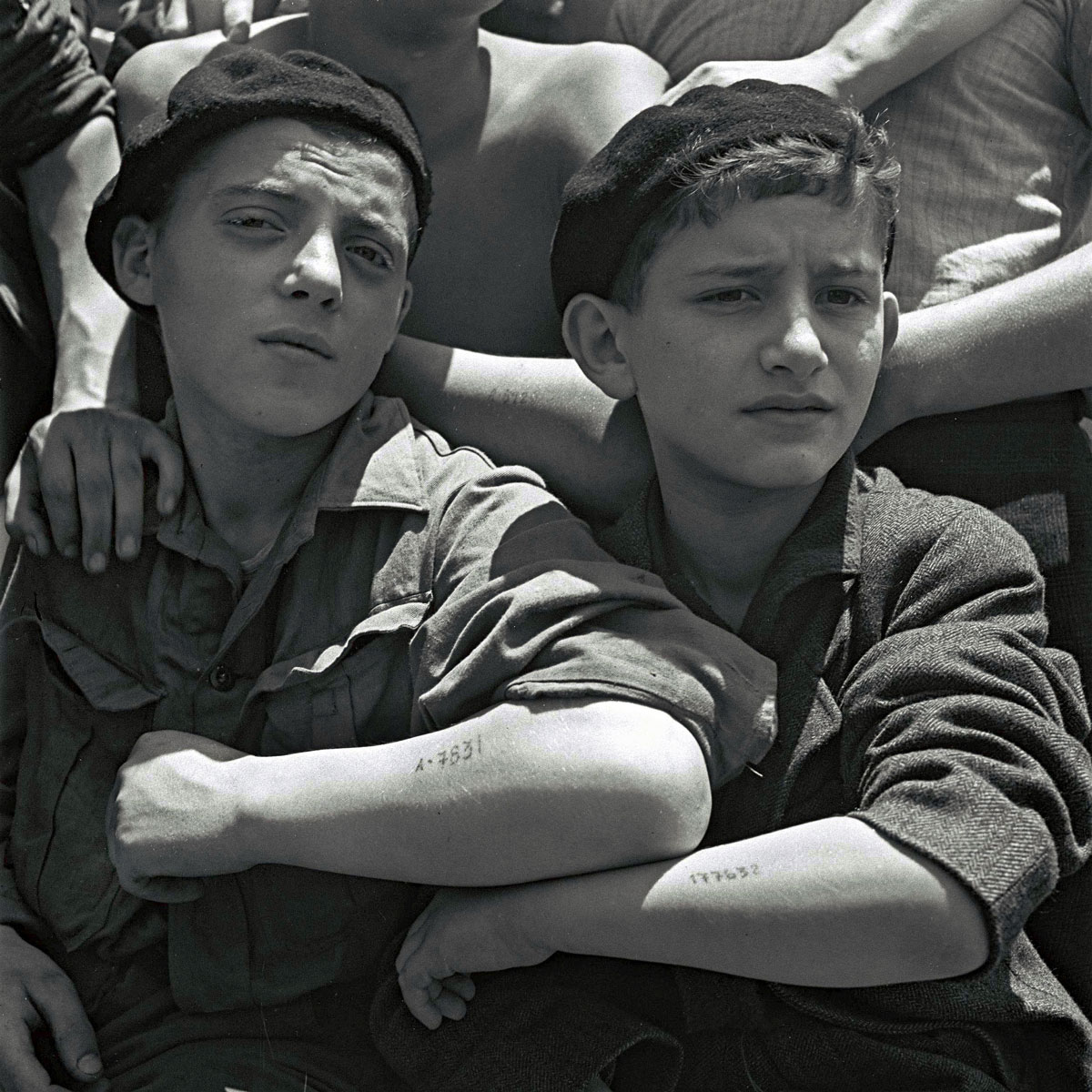
Jewish youth from Auschwitz at Haifa portJewish youth rescued from the Auschwitz Nazi concentration camp show their camp tattooes on their forearms on board the refugee immigration ship Mataroa July 15, 1945 at Haifa port. (Zoltan Kluger/GPO via Getty Images)

Many Jews of my generation grew up with photos like this, not as historical curiosities but as reminders of what we might not have escaped had we been born a decade or so earlier in the Europe of our grandparents, instead of in postwar America. Jews who have facilitated but also challenged modernity’s dislocations have often become targets of others’ fear and resentment, thanks to what George Steiner called their role as “a moral irritant and insomniac” and an interlocutor “of the darkest impulses of man.”

Steiner considered that status “an honor beyond honors,” but some Jews who have been persecuted, or haunted by memories of persecution, resort to sinuous subservience to established powers, especially in times of populist frustration and backlash. The Jew as fixer or apologist for the powerful — suspicious and opportunistic, legally and commercially underhanded, contemptuous of detractors – has been a stereotype too often earned by those who believed that such behavior would serve them in societies hostile to progressive, humanitarian hopes.

And not only Jews. Consider Rep. Elise Stefanik of New York, current chair of the House Republican Conference, a Roman Catholic who has become an energetic self-appointed alarmist against American antisemitism. Spearheading the now-infamous Dec. 5 House committee hearing on what she claimed was “the rot of antisemitism” in student protests against Israel’s attack on Gaza, Stefanik took liberties with her own constitutionally protected freedom of speech to accuse protesters of taking liberties with theirs. A con woman who grabs opportunities where she sees them, she demanded that university presidents at the hearing answer “yes or no” to a hypothetical accusation about campus protesters: “Does calling for the genocide of Jews violate Harvard’s rules of bullying and harassment?” She landed a politically decisive blow against the presidents of Penn and Harvard, but also against America’s civic-republican culture.

Protesters who shout “From the river to the sea" or "globalize the intifada,” or who hold Israel “entirely responsible” for Hamas’ violence, may be historically uninformed or politically immature. But they're not “calling for the genocide of the Jews.” They’re accusing Jews of committing genocide. Stefanik likely understood that they have a plausible, if debatable, case, but flipped the script to make their intentions seem genocidal and their university presidents seem like enablers. Not incidentally, she also bolstered conservatives’ long-running campaign to blame liberal university leaders for ruining liberal education.

Protesters who shout “From the river to the sea" or "globalize the intifada” may be historically uninformed or politically immature. But they're not “calling for the genocide of the Jews.” They’re accusing Jews of committing genocide.

A more honest investigation would blame “free market” pressures on colleges that distort students’ expectations of higher education and incline its administrators and faculty to train them as indebted buyers and sellers, not as citizens who should be equipped to interrogate conventional arrangements rather than facilitating them. While twisting the meaning of “intifada,” which denotes “shaking off” or “resisting,” to make it seem genocidal, Stefanik implicitly twisted Donald Trump’s insurrectionary speech of Jan. 6, 2021, in the opposite direction, as if denying he had incited the riotous assault that tried to block the certification of his 2020 defeat.

When Harvard president Claudine Gay answered Stefanik’s genocide question by saying that although she found antisemitic speech “personally abhorrent,” Harvard would punish it only if it crossed the line “into conduct that amounts to bullying, harassment, intimidation,” she unintentionally reinforced Stefanik’s charge that antisemitic speech always constitutes bullying, harassment and intimidation, and that Gay’s reluctance to say so was an unpardonable moral failure. 

These attempts to scourge antisemitism, ironically enough, amount to a new “coddling of the American mind.” As former Labor Secretary Robert Reich cautions, the reflexive anti-antisemitism of meddlesome university donors, “many of them Jewish, many from Wall Street, could fuel the very antisemitism they claim to oppose, based on the age-old stereotype of wealthy Jewish bankers controlling the world.”

Much the same could be said of opportunistic politicians like Stefanik (Jewish or otherwise), whose quest for short-term tactical gains may spawn longer-term dangers: Overreaching anti-antisemitism endangers our larger civic culture, already buckling under pressures that a Republican like Stefanik eagerly obscures. 

As an undergraduate, Stefanik lived in Harvard’s Winthrop House, named partly for John Winthrop, first governor of the Massachusetts Bay Colony, who organized its public celebration of the genocide of the Pequots. Two years before Stefanik urged a Harvard president to resign, she herself had been urged to resign from the advisory board of the Harvard Kennedy School’s Institute of Politics because of her support for Trump's efforts to overturn the 2020 election, including her “public assertions about voter fraud… that have no basis in evidence, and… public statements about court actions related to the election that are incorrect," in the words of the school's dean. After Stefanik refused to resign and was removed by the board, she said it was a “badge of honor to join the long line of leaders who have been boycotted, protested, and canceled by colleges and universities across America…. The decision by Harvard's administration to cower and cave to the woke Left will continue to erode diversity of thought, public discourse, and ultimately the student experience." 

There's no question that Hamas’ intentions toward Jews are genocidal and nihilistic, and that it's a despotic, destructive force for the Palestinians under its rule. That doesn’t cancel out the historical reality that Winthrop, Mather and other English settlers who founded Harvard and our republic were as genocidal as the biblical Hebrews they self-consciously modeled themselves upon. Condemning only one side’s bloodlust, or blaming American campus protesters for (allegedly) defending it, while ignoring the other side’s equivalent nihilism serves neither justice nor a civic-republican ethos that began on this continent with Puritan efforts to balance personal autonomy with strong community. Such selective outrage can only intensify the pathologies of Nakba-traumatized Palestinians and Holocaust-traumatized Jews who play fast and loose with Americans’ grievances and hopes.

What Adam Shatz has called "vengeful pathologies" inflame not only those tied ancestrally or materially to one or another side in this war but also those with no such ties or interests who protest it more passionately than numerous more devastating conflicts in recent memory. Thousands of American young people didn't take to the campus quads to condemn the killing of approximately 100,000 civilians and more than a million combatants in the 1980s Iran-Iraq war. Very few seemed to lose sleep over the murder of tens of thousands of Chechens in Russia's “counter-insurgency” war of the 2000s, which Human Rights Watch called "unparalleled in the area since World War II for its scope and destructiveness."

American young people didn't take to campus quads to condemn the killing of 100,000 civilians in the 1980s Iran-Iraq war, or the murder of tens of thousands of Chechens in Russia's “counter-insurgency” war of the 2000s.

These and other recent horrors are surely as hideous as the IDF’s killing of more than 30,000 Gazans, including many women and children, and the destruction of their homes, schools and hospitals. We should also note the unmatched sadism of Hamas’ body-camera footage depicting the murder of 1,200 or so Israelis, most of them civilians, some of whom were forced to watch family members killed or brutalized before being slaughtered themselves. Campus organizations, churches, labor unions and social justice advocates who mobilized against Israel's retaliatory attacks have said very little about Hamas’ evident strategy of using thousands of Palestinian civilians as human shields. 

Some explanations for this are plausible but not entirely convincing. One is that U.S. efforts on Israel’s behalf reflect the foreign policy establishment’s effort to manage largely unmanageable upheavals in the post-World War II order. Another is that globalized communications, commerce and finance have enabled a new regime of profiteering and power-grabbing by an array of bad actors: social media managers, demagogues, propagandists and lobbyists for authoritarian regimes. Those developments have undermined the promise of democracy that seemed to emerge during the “Arab Spring” rebellions of 2011. Authoritarians have adapted the new technologies to serve what William J. Dobson calls “The Dictator’s Learning Curve.” 

A more plausible but still inadequate answer contends that young Americans protesting the Gaza war are indulging a form of politics that privileges their zeal to “find themselves” in moralistic posturing and ideological positioning. “This concern for the Palestinians is not a matter of anti-Semitism so much as it is a reflection of self-absorption,” Shatz wrote in The Nation in 2014. "Palestinians are for the radical Western left what Algerians were for Third World’ists…: natural-born resisters, fighting not only Israel but its imperial patrons…. Palestine is still ‘the question’ because it holds up a mirror to us. ‘Too many people want to save Palestine’ one activist said to me. But it could just as well be said that too many people want to be saved by Palestine.”

An “all-consuming preoccupation with America and Israel,” Shatz continued, has left some progressives “strangely incurious about the crimes for which the West can’t be blamed and the developments, such as the politicization of sectarian identity, that are shaking the region far more profoundly than the Israeli-Palestinian arena.” Why aren’t progressives who champion freedom of speech, conscience, sexual identity and reproductive choice chanting, “From Tehran to Tripoli, Muslims will be free”?

My criticism of the left is not meant to excuse the Zionist movement and Israel's degrading treatment of Palestinians since at least the 1930s, when leaders such as Ze’ev Jabotinsky were unapologetically racist, or since 1967, when Israel conquered and occupied Gaza and the West Bank. But I also cannot condemn Israel uniquely, when it is invoked by Americans whose ancestors destroyed Indigenous peoples and enslaved millions of Africans. "Forgetfulness, and I would even say historical error, are essential in the creation of a nation,” noted Ernst Renan, the 19th-century scholar of Semitic languages and civilizations. Equally “essential,” it would seem, are demagogic leaders who safeguard their own nations' false memories by ginning up moralistic condemnations of other peoples’ vengeful pathologies.

A wiser and more effective strategy might begin by acknowledging that no nation’s emergence has ever been morally innocent, and by seeking honest explanations and answers, even when they're painful. Several courageous American Jewish writers have tried to do this.

Former liberal Zionist Peter Beinart has said that Israel is committing a sin in Gaza and the West Bank that “cannot be atoned for,” and has held instructive public conversations with young Palestinian activists and thinkers such as Ahmed Moor. New York Times columnist Ezra Klein has held reflective, informative conversations with Palestinian and Israeli thinkers such as Amjad Iraqi and Yossi Klein Halevi. Roger Berkowitz, director of the Hannah Arendt Center at Bard College, has explained why changes in the nature and dimensions of war have ended its plausibility as a “solution” to conflicts such as the Israeli-Palestinian impasse. Shatz’s account of Frantz Fanon’s personal life and political work, "The Rebel’s Clinic," rescues Fanon’s advocacy of anti-colonial violence from the reductionist mischaracterizations of his Western fan club.

Whenever religion presumes to rule with state power, as the Puritans did and as today’s Christian nationalists intend to do, it becomes odious no matter what its Grand Inquisitors say in its defense. Yet without a faith deeper than legalism, our society will wither and die.

These and other Jewish writers exemplify another irony: The ancient, axial, proto-cosmopolitan breakthrough drives even secular, liberal Jews who are passionate about America, not just because their own forebears escaped the European nightmare but also because the Hebraic emphasis on a communal covenant has figured so decisively in the American republic’s own history. Free of Calvinist preoccupations with personal salvation, and also largely free of rabbinical constraints, they are more “Jewish” than ever, in the sense that they strive to strengthen a covenant that entwines personal renewal with public progress.

William Faulkner famously observed that “The past is never dead; it’s not even past.” From the biblical Abraham breaking Ur’s idols to Abraham Lincoln forcing a bloody “new birth of freedom,” and from Bill Clinton's 1992 campaign for a “New Covenant” to Barack Obama’s “Change we can believe in,” America’s political culture has repeatedly invoked a past whose threads we need to re-weave somehow, if the republic is to be kept from dissolving into a neoliberal free-for-all or tumbling into the Trumpian abyss.

Such a re-weaving might acknowledge that the vagaries of finance capital and intrusive consumer marketing have hollowed out the civic-republican culture planted by the Puritans, which sustained what G.K. Chesterton would later call “a nation with the soul of a church,” one that relies on citizens’ deep spiritual faith without imposing any particular ecclesiastical doctrine.

But whenever religion presumes to rule with state power, as the Puritans did and as today’s Christian nationalists intend to do, it becomes odious no matter what its Grand Inquisitors say in its defense. Yet without a faith deeper than legalism, our society will wither and die. As we deplete the stored-up moral capital of the Hebraic-Calvinist covenant, we risk losing the old civic faith which taught that resistance to tyranny is obedience to God. Let's give the biblical authors credit for taking the sublimity of our loss straight up instead of chasing false consolations. Our best hope of transcending realities that seem too much to bear may come from bearing them and seeing them for what they are, not for imagining them as we wish them to be.

Trans visibility outside the narrative of violence

Today is International Trans Day of Visibility, a day when all of us are asked to recognize and celebrate the transgender, non-binary, and two spirit communities. I hope you will take a moment to do so. 

And if you do, you will probably recognize that our communities are in a familiar political spot. Trans people, especially our young people, are fighting for our lives against a conservative movement obsessed with trans eradication. Ten years after the Transgender Tipping Point, we remain on edge, balanced over the cracked earth of America’s cultural fault lines; our future uncertain but our hope steady that we can prevent falling into the abyss.

Republican-led states across the nation are making every effort to strip transgender, non-binary, and two spirit people of our civil rights. In 2024, we’ve already seen more than 300 anti-LGBTQ+ bills introduced nationwide, promising that we will near, if not surpass the record 500 introduced in 2023. 

Not only are the bills numerous in 2024, but the policies are more cruel and dehumanizing than ever. To be sure the classics remain: banning access to healthcare, blocking our right to the bathroom, erasing our existence from schools and public life. But we are now also seeing attempts to treat affirming parents as child abusers, and affirming teachers as sex offenders. We’re seeing a rapid escalation in prohibiting trans people from legally existing at all. Such violent legislation brings violent ends; in their triumphs our community dies.  The nation mourns the death of Nex Benedict in Oklahoma. In my home state, we lament the loss Savannah Ryan Williams; I am certain the trans folks in your state hold on their lips the names of lost loved ones.

We are living in a terrifying, violent moment for trans, non-binary, and Two Spirit people. There is no way to avoid that reality. In Minnesota we are using our DFL trifecta and Queer Legislator’s Caucus to build a refuge for trans people as best we can. But safety is always relative. Here, as everywhere, it is dangerous to be trans. And it is even more dangerous to pretend otherwise. 

This is the dominant narrative of trans life in America is violence. And for very good reason. But on this Trans Day of Visibility, please also see that the dominant narrative is not the entire narrative of this community. 

Our community is surviving, even thriving. There is data to support this. For example: Trans elected representation increases every year. There are now around 90 trans, non-binary and Two Spirit elected officials in the United States, across all levels of government. That’s amazing. Representation is an unqualified good for every community! But it is not enough. 

We also need healthcare. The National Center For Trans Equality just released their massive survey of 92,000 people across America, of whom 95% reported they were ‘more satisfied’ in their lives after transition. Again. That is amazing. And it’s happening literally everywhere.  In every corner of this country there are courageous and defiant communities living and loving and building a visionary new future, just by existing. THAT is the other narrative of trans life in America.

The political fight being waged over our small, weird and wonderful community is preposterously out of hand, friends. There is no logic or compassion sustaining the movement for our eradication. 

We are +/- 1% of this nation. We are trying to live. We did not choose to have our entire existence politicized. That choice was made by the conservative movement that message-tested for an enemy and found trans kids could be used as a potent political target in the quest for power. That’s why we are here. They did this. Not us. We are not the threat. We are the answer this nation has been waiting for.

We need your help to stay independent

Trans, nonbinary, and Two Spirit people are the artists creating a new world of possibility and joy and freedom. I am so grateful to be trans and alive; words cannot tell you what it means to be me in my fullness. And I invite you to come with us into this fullness. To quote the poet Andrea Gibson, “come, become beside me.” Walk with us into a new kind of future where individuals and communities can build something beautiful together rather than decimate and devour each other for the fleeting rewards of power.

Trans liberation does not require anything other than to let us be us. It is a simple yet transformational request from our small demographic to all of yours. Rather than continuing the effort to erase trans identity, use this moment to discover who you are, who you could be, what freedom might be found in doing so. You need not be trans for our liberation to be yours. In being who we are there is undoubtedly room for you to be who you are.

It is time to leave the old ways behind, and move into something brighter, and bolder than this tired political story. Let us put on our Easter eyes, and see an entirely new land of hope and possibility. Let’s leave in the past the subjugation, persecution and dehumanization of those who are different. There is no lasting virtue or good to come from holding power over the suffering of others. I speak not just for my community, but for every community that lives under this threat: Black, brown, Jew, Muslim, undocumented, gay, lesbian, Palestinian.

I hope you hear the power of this possibility. This isn’t the soupy liberal message of a yard sign. We are fighting for something more than feelings and ephemeral identities. We are losing our rights and our lives. On this Trans Day of Visibility, please see this moment of our existence not as an imagined threat to your freedom, but embodying democracy’s fullest realization: that one small slice of humanity can turn the violence upside down, turn power on its head. That we can claim for ourselves our own liberation, and through our liberation you can find yours. If you will let us.

Why Easter brings me back to church

“Please — come join us in the cafeteria after Mass has concluded!”

Father Ariel’s jaunty voice echoed from where he was standing at the slabbed marble pulpit, as he smiled out at the congregation. His family, who had arrived from the Philippines in droves to celebrate his 50th birthday, beamed from the first several rows of glossy, varnished pews. 

I’m not an atheist per se, but trying to find an equilibrium with faith has undoubtedly become a game of mental Tetris.

Mid-morning light filtered through stained glass depicting saints and the Stations of the Cross, casting soft pinks and blues and greens across the church: our local parish, St. James. Sun illuminated the top of Father Ariel’s head, and behind him, a domed mural of the stages of Jesus’ life — his birth in a manger, his crucifixion atop Calvary, and his resurrection after emerging from a stone sepulchre — seemed to swell higher with every slow, measured note of music from the raftered choir.

It was a Sunday morning in April, not exactly Easter but right around the time. The smell of incense — a combination of frankincense and myrrh — leached from every corner of the space, creating a somewhat soporific effect. I pictured my family, friends and neighbors gently falling asleep to its bitter, powdery aroma, like Dorothy did in the poppy field. Everything felt buoyant and peaceful.

My family and many other parishioners — mainly gentle, geriatric hordes — joined Father Ariel with his multitude of relatives in my middle-school cafeteria for an authentic Filipino feast. Side dishes of pearly quail eggs, roasted fish and meats, bright salads and an array of desserts adorned every inch of table space, the very same where I ate many peanut butter and jelly sandwiches in my youth. At the center of it all was a huge roast pig, or lechón, with delicate, crisped skin. I looked at the pig’s face, then at the people ambling around the dingy, linoleum floors, and immediately felt love. 

This was nearly 10 years ago, back during a time when I went to Church every Sunday and consistently prayed to God. I don’t consider myself a particularly religious person anymore. I’m not an atheist per se, but trying to find an equilibrium with faith has undoubtedly become a game of mental Tetris. Sure, Jesus seemed like a pretty cool guy — to me, his message has always unequivocally been "love,” in a broader sense. I’m on board with that. 

But I still remain immensely put off by how Catholicism’s sordid underbelly has blended into sociopolitical life, underpinning the dismantling of women’s reproductive rights and enabling sexual abusers. I find myself still clinging to it largely because it’s woven tightly into many people I love. It’s a perturbing relationship; I feel as though my continued shunning of organized religion has in a sense estranged me from the memory of some very important people. 

And yet, Easter and springtime always bring me back to church. I find myself craving, not exactly the scriptures and the teachings embedded in them, but how the space evokes the memories of people I love — chiefly my maternal grandmother and my mom — and an inclusive sense of community. 

A deeply spiritual person, my grandma — born in a small Bolivian jungle village called Riberalta — spent her teenage years living in a convent with a U.S.-based congregation of nuns performing foreign missionary work. She was readying to enter the sisterhood when she met my grandfather, a Sicilian and civil engineer volunteering with a Catholic mission group to help build new infrastructure in Riberalta. They returned to America together and settled in Bayonne, New Jersey, joined in a union forged out of a shared devotion to God and each other.

Though my mom didn’t pray a daily rosary or make pilgrimages to Lourdes like my grandma, she was deeply affected by her religious upbringing, a heritage she inculcated her five children with through weekly mass, and offering up nightly intentions along with prayers before dinner: family and friends who were sick or had died, poverty and homelessness, wartime conflict, our cat Sweet Pea’s hypothyroidism. 

In my grandmother’s house and my own, the iconography of Jesus and other religious figures was everywhere, peppering walls and mantelpieces alongside family photos and wedding albums. Each time one of my more than 25 cousins or I received a sacrament — Baptism, First Holy Eucharist, Confirmation — a sprawling, family-wide party followed, usually at an Italian restaurant with a generically benevolent, pot-bellied owner who would toddle around and ask, “How yous all likin’ the food?” And of course, there was always a large white sheet cake, piped in bubbled fonts: “God Bless ____!” 

Seeing as my mom’s eight siblings were spread out across central New Jersey, I essentially ran the gauntlet of various Catholic parishes in our area for different holidays and events. I had my favorite churches. St. James retained the top position. Then came St. Michael’s, a red-bricked church that was famous for its live-animal manger display during the Christmas season. Holy Cross — located in one of the more affluent towns in my county — had a stunning interior, but its reputation had always been somewhat sullied in my mind from a 2006 embezzlement incident

While I was able to evade formal liturgical participation, my three younger sisters were all urged to be altar servers, helping St. James’ priests — mostly middle-aged men from the Phillippines and India — prepare and proceed with weekly Sunday mass. One sister recalled a time when she and another altar server accidentally spilled open a bag of already-consecrated Eucharist wafers as they were preparing for mass in the wood-paneled sacristy. 

“Oh! Uh, don’t worry girls — I’ll consume these later,” the priest said when he walked in and saw them scooping the body of Christ off the floor and into Ziploc bags. 

Another time several years ago, my family was running late for Easter Sunday mass, half of us with our hair still wet. “Overflow,” an usher posted outside the church doors said as we approached, jerking his thumb toward the rear parking lot where the grammar school was located. Given that creasters (Catholics who only attend church on Christmas and Easter) come out of the woodwork every winter and spring, tardy worshippers are forced to attend the secondary service, held in the gymnasium or auditorium. 

From my seat in a metal folding chair, nostalgia washed over me as the priest carried a gold crucifix across the same floor where I’d once played dodgeball, toward the makeshift altar where I’d watched classmates act out a rendition of “The Little Mermaid.”

I feel as though my continued shunning of organized religion has in a sense estranged me from the memory of some very important people.

I spent last Easter in Newport, Rhode Island with my family for a short holiday vacation. The weekend was oceanic cliffs and Gilded Age mansions and a kaleidoscopic assortment of saltwater taffy. On Easter Sunday, we walked from our quaint bed and breakfast to St. Mary’s, Our Lady of the Isle, where JFK and Jackie O wed in September of 1953. We took turns waiting outside with our two Great Pyrenees, who had reaped the benefits of Newport’s reputation for being dog-friendly.

Ahead of the homily, the part of the service when the priest explains the Gospel reading in further detail, I elected to relieve my mom of dog duty, knowing she wouldn’t want to miss the crux of the mass. 

As I turned toward the door to trade off with her, the sharp New England morning air — and an emotional pang — made me bristle. I didn’t want to leave. Mashed tightly in hard-backed pews alongside other Catholics, loyalists and creasters alike, I felt a distinct sense of calm. The very same that came to me years ago as I gazed at a pig’s snout.

This Easter, we’ll be going back to St. James. Father Ariel is no longer at the parish — I don’t know many of the priests there anymore, my connection to the parish steadily eroded by distance, time and sheer obstinance on my part. It’s an elegiac relationship, compounded by the recent passing of my grandmother, who embodied holiness and unadulterated love in every sense. 

And while I may not take the time to philosophize about my salvation on Sunday, I’m certain I’ll think of her and what my being there would mean to her. For me, that’s enough to return every spring. 

The “martyrdom” of Donald J. Trump

Donald Trump has repeatedly shown that he can reasonably be described as evil. Yet, white “Christian” evangelicals are among his most loyal, stalwart, and enthusiastic supporters. Moreover, when his behavior and character are evaluated relative to the Christian mythological framework, Trump is actually much closer to being the Antichrist than some type of divine savior in the mold of Jesus Christ and chosen by God as a type of messiah and prophet. In reality, this superficial tension is easily resolved: The relationship between Donald Trump and his fascist MAGA movement and the Christian Right is transactional. Trump is a type of weapon and cudgel for them to create an American apartheid theocratic plutocracy.

In exchange, Trump receives the votes and other support to ascend, again, to the White House – this time as the country’s first dictator – where upon taking power he will proclaim that he was chosen by God. My prediction here is not a spoiler but a preview. During these last few months, Trump has repeatedly made such statements about his divinity and being God’s emissary on Earth.

Earlier this week, Donald Trump took the next logical step in his fascist god complex and megalomania. He is now selling Bibles to his MAGA flock and any other sad and desperate soul who would buy such a thing.

At the time of this writing, Donald Trump owes more than 500 million dollars in fines and legal expenses. Trump will be able to use the money from selling Bibles for his personal and other expenses.  

In a video on his Truth Social disinformation social media platform last Tuesday, Trump described his “exclusive” Bibles, and why they matter so much to him, in the following way: "It's very important and very important to me. I want to have a lot of people have it. You have to have it for your heart, for your soul.”

The relationship between Donald Trump and his fascist MAGA movement and the Christian Right is transactional.

In a post on X/Twitter, his niece, Mary Trump, was very clear and unambiguous about Trump’s Bible-selling hustle: “He’s never prayed in his life [if] that were a real bible, it would burst into a ball of flame.”

On Monday, Donald Trump, who has repeatedly and publicly proclaimed that he is a “Christian”, committed blasphemy by appearing to suggest that his being held accountable by the law for his many obvious crimes is somehow equivalent to the persecution of Jesus Christ and what the latter suffered in the Easter resurrection myth.

In an attempt to better understand Trump’s Bibles and how they relate to Christofascism, the Trumpocene, the MAGA cult, and the larger democracy crisis, I recently spoke to a range of experts.

These interviews have been lightly edited for clarity and length

Jared Yates Sexton is a journalist and author of the new book "The Midnight Kingdom: A History of Power, Paranoia, and the Coming Crisis."

From the moment Trump announced his candidacy he's leaned heavily into heresy. The only religion he's ever known has been Norman Vincent Peale's Prosperity Gospel, which is itself a venal, disgusting twisting cooked up to serve the wealthy and punish the poor. Now, not only is Trump openly calling himself Christ, he's peddling Christian Nationalist Bible's too gaudy and embarrassing for QVC. Unfortunately, this isn't just offensive but evidence of a worsening situation. This is a cult. Full stop. And though its popularity may be dwindling, that's when cults get weird and especially dangerous. They've killed for him already, and there's no telling what they're capable of once the heat gets hotter.

Marcel Danesi is Professor Emeritus of linguistic anthropology and semiotics at the University of Toronto. His new book is "Politics, Lies and Conspiracy Theories: A Cognitive Linguistic Perspective."

There is now a deeply embedded belief among many of Trump’s followers that he was chosen to save the world. It has become a core theme in all kinds of conspiracy theories, and a “thought form” in groupthink that is resistant to most counter-arguments. Trump’s role in the world among a large number of his religious followers in particular is perceived to be that of a victimized spiritual warrior, who is being persecuted and tormented by the sinister deep state, as he awaits the “storm” that will finally catapult him to the seat of power permanently, allowing him to guide the world correctly. Trump has continually portrayed himself to this demographic as a Messianic figure, who is fulfilling a divine mission—a pseudo-narrative that he has promoted himself whenever he thought it would be effective. Comparing his plight as a criminal defendant to that of Jesus is part of his overall performative politics, which revolves around a pseudo-morality script in which he, like Jesus, is persecuted for seeing through the evil deep state.

But this is not the only “character” that Trump presents to his diverse audiences. He has always been a consummate chameleon performer, playing to different audiences with different characters, but uniting them all under the rubric of victimization. As Machiavelli cynically, but accurately, wrote, “It is necessary [for a despot] to know how to be a great pretender and dissembler…a deceiver will always find someone who is willing to be deceived.”

As for Trump announcing that he is going to sell Bibles? What can anyone expect from a huckster, who will peddle anything and anyone to line his pockets? The danger is that he will keep doing it if he wins—but he will NOT!!!

Rich Logis is an ex-MAGA activist and Founder of Leaving MAGA.

No one could look at Donald Trump’s campaign and logically conclude that he is running to win. He shuns non-MAGA voters. He falsely blames vote-by-mail (favored by both Democrats and Republicans) for voter fraud. He is now hawking Bibles inscribed with “God Bless the U.S.A.”

Why, then, is he running? To potentially avoid prison, yes. But it goes beyond this: it’s martyrdom. Does he believe that he is a martyr protected by the armor of God? I find that unlikely; it’s all slapstick comedy: Posing as a Christ-like figure is so outlandish and absurd, my fear is that it will be laughed off as “Trump is just being Trump.”

Trump is a political pervert: he’s perverted patriotism by jingoistically pairing it with Judaic-Christian theocracy, in an unholy matrimony. He is a QVC presidential candidate; he’s Jake LaMotta singing out of tune to the same audience nightly. Yes, all the world’s a stage, and for all their invective against Hollywood, MAGA and the far right are America’s premier political performers.

I maintain that most MAGA Americans are good people, deep down. But they don’t realize that they’re not in on the joke, and there is the challenge of reconciling this with their unapologetic support of a candidate who hasn’t made an occasionally indefensible remark, but has a library’s worth.

I am not blameless, either, as I was a devoted MAGA volunteer activist from 2015–22. Amongst some other reasons for leaving MAGA, I could no longer, in good conscience, justify the unjustifiable about Trump and MAGA (especially the nonstop mythology about a stolen 2020 election).

We need your help to stay independent

Trump masks his abhorrent rhetoric in the cloak of godliness because with God on his side, he’s infallible. I neither defend my past, or anyone’s current, ignorance. It must be emphasized, however, that MAGA Americans have been traumatized by MAGA and the right-wing; they perpetually feel desperate and panicked, as I once did. As I came to painfully realize: Trump the golden calf is no messiah or savior. Let’s not depend on the courts or Constitution to prevent a second Trump presidency, which would irreparably damage our democracy. Get registered, get others registered (ask me for help, if necessary) and vote. As the Book of Romans instructs: be patient in affliction. I believe many MAGA Americans will eventually have their epiphany that they—as I once did—worshiped a false prophet.

A blessed Easter to all who celebrate. For Christians, especially, who remain silent over Trump’s blasphemous Bible salesman schtick: do you find it appropriate and acceptable that Trump would adulterate the Good Book during the holiest, most blessed weekend for Christians?

Ephesians 5:11:

Take no part in the unfruitful works of darkness, but instead expose them.

Dr. Lance Dodes is a former clinical professor of psychiatry at Harvard Medical School and a training and supervising analyst emeritus at the Boston Psychoanalytic Society and Institute.

Donald Trump’s recently comparing himself with Jesus as a saintly man unfairly accused, and trying to sell King James Bibles with the incredibly grandiose come-on that they are “the only bible endorsed by Donald Trump” shows that his deeply malignant narcissism remains as severe as ever, and may be becoming worse as he is faced with more limitations to his grandiosity. Trump’s recent threats against the country with a “bloodbath” if he is not returned to power is another sign of how deeply pathological he is, and how enormously dangerous it would be if he were to regain power. Our country has never seen anything like this, but it is strikingly familiar from the rise of Hitler and other populist tyrants.  

Easter sunrise: It’s time for evangelicals to dump Trump and return to Christ

Nothing is quite as nice as an Easter Sunday sunrise service on a New England small-town beach. One year during my ministry, I was in charge of officiating such a service, and on that morning everything seemed to go perfectly — including the pancake breakfast that followed! Easter in New England usually aligns with warmer weather, longer days, hope and new possibilities. These days, however, it sometimes appears that the sun is setting on the true message of Easter for too many American Christians, as the true church is replaced by a church led by Donald Trump.

Easter is, as you surely know, a celebration of the resurrection of a fallen leader who rises again. I have begun to realize that a terrible thing is happening across this country during this Easter season as false evangelical pastors head to the pulpit to align Trump, of all people, with the role of Jesus Christ. As Jesus was falsely accused, they preach, Trump must be as well. This is of course absurd, yet it is believed or at least espoused by many evangelical leaders.  

The prevailing message deliivered by these false teachers is that God has chosen this deeply flawed man to save the American evangelical church from its enemies. According to this distorted gospel, it doesn't matter if Trump preaches an anti-Christian political agenda while spewing hateful messages. The only thing that matters is that Trump, as they claim, is God’s guy. This has resonance for believers in a number of ways: I fully support the creed that God indeed only calls sinners to lead his church, and I am profoundly grateful that God can still use a sinner like myself. But Donald Trump has not called by God to lead the church, although he may have been placed before the church as a test of faith. Far too many wealthy evangelical ministers are happy to follow Trump anywhere he leads, as long as their invitations to the White House, their tax-exempt status and the tax cuts delivered to the one percent keep on coming. 

According to this distorted gospel, it doesn't matter if Trump preaches an anti-Christian political agenda while spewing hate. The only thing that matters is that Trump, according to them, is God’s guy.

I recently heard Trump’s leading apostle in the evangelical church, Dr. Robert Jeffress, preach about the meaning behind Easter. He told a story from his childhood, saying that he once found a way to enter the Oval Office during a school field trip to the White House. A family friend was a Secret Service agent, he said, which allowed the young Jeffress to gain access to this center of power. The lesson of this sermon was meant to be that we all need Christ's help to gain access to the kingdom of heaven. That's a necessary foundation of the Christian faith, but it also involves the realization that everyone needs grace, mercy, forgiveness and humility. As I perceive it, Pastor Jeffress has traded in those Christian principles for access to the White House, this time as an adult and in a very different context. In that sense, he has turned his back on the message of Christ and turned toward the message of Trump.  

Easter is also a lesson in sacrifice. When I played college football I was one of those big guys on the offensive line who smashed into the other big guys so the running back could score. It can be a painful experience, with little or no glory. I apparently suffered several concussions, required shoulder surgery and will suffer from back pain for the rest of my life, but I am still grateful for my time playing football. I learned about sacrifice, teamwork, hard work and the quiet joy a person can feel when you know you have made sacrifices for other people and the greater good. That is a huge missing ingredient in the evangelical church as reshaped by Donald Trump. The church of Trump is entirely about the glory of Trump, the worship of Trump and celebrating the greatness of Trump. In Trump’s church, everyone else is sacrificed so Trump can score.

The Easter message is a message of salvation, first and foremost, but also of condemnation. Hypocrisy should be condemned, especially among those who use religion falsely, such as today's evangelical leadership. Salvation, on the other hand, is offered to everyone else. In 1 Corinthians 5 — "one Corinthians," as Donald Trump would say — scripture plainly teaches that the church should mind its own business and clean up its own house: "What business is it of mine to judge those outside the church? Are you not to judge those inside? God will judge those outside. Expel the wicked person from among you.” With this in mind, I am calling for the church to expel those leaders who worship at the altar of Trump, as they have tried to expel the true teachings of Christ.


Want a daily wrap-up of all the news and commentary Salon has to offer? Subscribe to our morning newsletter, Crash Course.


I still love the sunrise service on Easter morning. One of my favorite stories from the life of Jesus (as told in John 21) is set on Easter morning, after his resurrection. From the shore of the Sea of Galilee, Jesus saw a group of his disciples out fishing from a boat. They had been out all night without catching anything. Jesus called out, telling them to try throwing the nets on the other side of the boat. I am sure these experienced fishermen, not recognizing Jesus at that moment, were frustrated or baffled by such ridiculous advice. But when they did as he told them, their nets were so full of fish they could hardly drag them up again. The American evangelical church has been throwing its nets on the wrong side of the political boat for far too long. Those nets are empty, and the spiritual hole in the church has been filled by self-serving hypocrites eager to pervert the gospel to serve Trump. It is long past time to throw the nets on the other side of the boat, and return to the teachings of Christ. Those who claim to follow Jesus must turn back to the faith of self-sacrifice, love, grace, mercy, forgiveness, humility and the hope of an eternal sunrise. That would be a true Easter resurrection.

Before reaching the ocean, the Colorado River becomes a trickle. New research reveals where it goes

The Colorado River is a 1,450-mile-behemoth, its raging waters carving their way through seven U.S. and two Mexican states. It is arguably the central attraction of the Grand Canyon, one of the world's most famous natural wonders. But it does more than look beautiful — some forty million people depend on the river for their water and hydroelectric power, not to mention the fish and wildlife who also share it with us.

But this massive river, the seventh largest in the nation, is drying up. In fact, these days it rarely even reaches the ocean anymore. This has Brian Richter, the World Wildlife Fund's President of Sustainable Waters, extremely worried. A recent study that he co-authored in the journal Communications Earth & Environment found humans are consuming so much of the Colorado River's water that they are putting it in danger. And if we don't lessen their use of the waters, the researchers warn, there could be "truly catastrophic consequences for the 40 million people that depend on this river and all those that visit."

The authors used primary data about the use of the Colorado River's ample waters from 2000 to 2019. After running the data through models with information about crops and other relevant variables, the scientists figured out a water budget based on how much water people consumed that precious resource during that timeframe. Every type of human use was considered, from agricultural and industrial uses to municipal lines bringing running water to a thirsty populace.

"There could be 'truly catastrophic consequences for the 40 million people that depend on this river and all those that visit.'"

The conclusion was "Irrigated agriculture is responsible for 74% of direct human uses and 52% of overall water consumption," the author write. "Water consumed for agriculture amounts to three times all other direct uses combined. Cattle feed crops including alfalfa and other grass hays account for 46% of all direct water consumption."

In other words, our obsession with beef and dairy is a big chunk of this equation, as Richter's previous research in Nature Sustainability has shown. The stakes could not be higher, as illustrated by the current status of the Colorado River. As the latest study describes the situation, "barely a trickle of water is left of the iconic Colorado River of the American Southwest as it approaches its outlet in the Gulf of California in Mexico after watering many cities and farms along its 2330-kilometer course."

As Richter told Salon, "Our estimates suggest that water consumption exceeds the river’s annual replenishment by about 20% over the past two decades. To make up that deficit, we’ve raided the water stored in America’s two largest reservoirs – Lake Mead and Lake Powell – and by the end of 2022 those reservoirs were three-quarters empty."

If this consumption continues unabated, millions of Americans and Mexicans in the affected areas will start to feel the strain. Water will become more scarce for food growers, leading to scarcities that will radiate beyond the immediately impacted regions. Local residents will need to start rationing water to prevent widespread shortages — and even those measures may only prove sporadically effective.

The underlying cause of this impending dilemma is, as Richter explains, "It simply takes an awful lot of water to grow our food." In fact, Richter said that roughly 90% of all the water consumed for direct human use is applies to irrigated agriculture, and Big Agriculture is not likely to relinquish its privileges any time soon. In the Colorado River Basin, for example, the farmers "hold some of the highest-priority water rights, so this dominant water use for agriculture is not likely to change too quickly, or without compensation for giving up some portion of farmer’s water rights."


Want more health and science stories in your inbox? Subscribe to Salon's weekly newsletter Lab Notes.


"It simply takes an awful lot of water to grow our food."

The farmers are not without some valid reason for feeling a sense of ownership over the river. When the Bureau of Reclamation was established in 1902, the American government paid for dams and farms to irrigate nearby farms, as well as store the spring runoff. The very concept of public use of the Colorado River implies the rights of American society's most important industry, its agricultural sector, to avail itself of its resources.

Then, in 1922, the Colorado River Compact was established so that the seven American basin states could divide the water fairly amongst themselves between the Upper and Lower Basins. So for more than a century, businesses in the American west have been taught that the government exists to help them profit from nature's resources — not impose limitations.

Colorado River Dolores River irrigate alfalfa fieldsWater from the Dolores River, a tributary to the Colorado River, is used to irrigate alfalfa fields near Bedrock, Colorado. (Photo courtesy of Brian Richter)

Yet those limitations are becoming increasingly necessary. Edith Zagona, director of the University of Colorado's Center for Advanced Decision Support for Water and Environmental Systems, traces the current crisis back to the latter half of the 20th century. That was a time when previously minor population centers, either in or near the Basin, began to grow, including now-major metropolitan areas like Los Angeles, Las Vegas, Denver, Albuquerque and Phoenix. Those residents need water not just for their urban infrastructure, but for the increasing amounts of food they will need to consume from the nearby agricultural sector.

"The emergence of large urban populations has put a pressure on the use of the water," Zagona said. "Due to the priority water rights laws, farmers have had most of the senior water rights on the river. But cities are typically able to pay more for water than agriculture, so there has been a shift in water use from [agriculture] to urban due to cities buying senior water rights from farmers."

This cycle persists today. Zagona added that as states develop their water use infrastructure, they increasingly focus on urban water use, which competes with agriculture for water just as much as environmental services and Indigenous water rights.

Another variable further exacerbates the Colorado River's water depletion problem — climate change.

leafy green vegetables in a crop fieldMore than 90% of the leafy green vegetables consumed by Americans in wintertime comes from the Imperial Irrigation District in California. (Photo courtesy of Brian Richter)

"Hotter temperatures increase evaporation and evapotranspiration, and decrease soil moisture," said law professor Mark Squillace at University of Colorado Law School. "All of this contributes to making less water available. The loss of soil moisture is a particularly worrisome problem because it results in much less runoff into reservoirs."

When the snow melts it is absorbed by the dry soil, causing a major reduction in runoff. As a result, "climate scientist have found that the Colorado River basin is experiencing high temperature increases than other parts of the West," Squillace said.

Zagona, who described climate change models as being "conflicting in their projections about overall changes in precipitation in the Basin, [with] some projections showing more and some less on average," ultimately agreed that "the warming trend is agreed on, and will affect the runoff, i.e., the water that ends up in the river."

Richter also emphasized that climate change is a factor that negatively impacts the Colorado River's ability to serve human populations.

"Climate scientists estimate that the river has already lost about 10% of its water flow due to climate warming," Richter said. "They caution that we should expect loss of another 10 to 30% by mid-century, so the necessary reductions in water use will become greater and greater with time."

There are solutions to this problem. According to Sharon B. Megdal, director of the University of Arizona's Water Resources Research Center, the new information from this paper is not that agriculture uses a large proportion of the Colorado River's water, but rather the details of that consumption.

Colorado River cattle-feed cropsIrrigation of cattle-feed crops (alfalfa and grass hay) accounts for one-third of all water consumed from the Colorado River, including within the Imperial Irrigation District of California. (Photo courtesy of Brian Richter)

"While there are opportunities to modify agricultural practices in terms of irrigation methods and crops grown, these changes will not happen overnight," Medgal said. "There are pilot projects and efforts to incentive irrigation efficiency."

Felicia Marcus, a visiting fellow at Stanford University’s Water in the West Program and an attorney and consultant for the Water Policy Group, offered more details on what kinds of projects can help people cope with the "freight train of pain coming down the climate change track."

"We need to be far more precise with our use of water for everything — urban, agriculture, industry, etc," Marcus said. "We are far more wasteful than we need to be, and modern technologies (sensors, remote sensing from space, drip irrigation and other precision irrigation, recycling, etc.) can help us get there. But we have to invest, and we have to accelerate adoption. Adaptation is the name of the game here, which requires a more clear-eyed vision of the risks vs. continuing to tinker at the edges."

She added that there are "good people" working on this problem, but that it is still important for the government to step in.

We need your help to stay independent

"The federal government’s role in helping that happen is huge — they can create the urgency that gives state and water agency negotiators the backbone, or excuse, to make the hard calls," Marcus said. "Again, it is political suicide to look like you are giving water up to someone else, or even to letting the river be a river. On the other hand, if you are forced to by the legitimate power of the federal government, there is more room to move."

There are examples of how governments — federal or otherwise — can help with the problem. In a 2022 paper for the Journal of Water Resources Planning and Management, Richter documented how "cities dependent on the Colorado River have experienced rapid population increases (+24%) but they have miraculously been able to reduce their use of water by 18%" thanks to water conservation strategies like variable water-pricing structures, turf removal and toilet replacement rebates and other plumbing retrofits.

"We need to see commensurate reductions in water use on farms," Richter said. "To accomplish this, we are going to need to help farmers make a transition to crops that require less water, and we’ll need to shrink farmland to some degree as well. We must do this smartly, with careful planning, so that we don’t lose productive cropland and impact food security."

Biden is cool with Transgender Day of Visibility falling on Easter — Republicans freaking out

The first International Transgender Day of Visibility was on March 31, 2009 and has been celebrated on the same day of the year from then on. But this year, since it happens to fall on Easter Sunday, certain people are losing their minds about it. Especially Republicans.

On Friday, the White House made the following announcement:

“I, Joseph R. Biden Jr., president of the United States of America, by virtue of the authority vested in me by the Constitution and the laws of the United States, do hereby proclaim March 31, 2024, as Transgender Day of Visibility. I call upon all Americans to join us in lifting up the lives and voices of transgender people throughout our Nation and to work toward eliminating violence and discrimination against all transgender, gender nonconforming, and nonbinary people.”

And judging by the response, you would think that Biden proclaimed this Sunday International Worship Satan Day.

Trump’s national press secretary, Karoline Leavitt, is asking for an apology from the White House for this day falling on the same day it always has, which has nothing at all to do with Biden, writing, “We call on Joe Biden’s failing campaign and White House to issue an apology to the millions of Catholics and Christians across America who believe tomorrow is for one celebration only — the resurrection of Jesus Christ.” And others like her fell right in line.

In a post to X (formerly Twitter) from Monica Crowley, Former Assistant Secretary of the Treasury, she writes, The “president” has proclaimed Easter Sunday as “Transgender Day of Visibility." This is a spiritual war. See it & understand it. Fast."

And Rep. Marjorie Taylor Greene clocks into the discourse with, "Biden and the Democrats decided Easter – the Holy Day of our Savior’s Resurrection – as transgender day of visibility. There is no length Biden and the Democrats won’t go to to mock your faith, and to thumb his nose at God. We know that Christ is King and God will not be mocked, just like we know Joe Biden isn’t really the one calling the shots in the White House. Psalm 37:13: ‘but the Lord laughs at the wicked, for he knows their day is coming.’"

Creating a whole video to explain how these folks are misguided, political commentator Brian Krassenstein writes, "To the ignorant people claiming that The White House and Biden are Satan for 'declaring Easter Sunday as Transgender Day of Visibility,' every March 31st for the last 15 years, including 4 years under Trump was International Transgender Day of Visibility. In 2029 when Easter happens to fall on April Fools Day will you all claim that whoever is President then must think that Easter is a Joke? At least inform yourselves before jumping on the ignorance bandwagon."

Watch here:

Former national security adviser says Trump “doesn’t have the brains” to be a dictator

Having worked as Donald Trump's National Security Adviser from April 2018 to September 2019, John Bolton has seen enough to form a concrete opinion on the man. And his opinion is that the former president isn't that sharp. Or at least not as sharp as he'd have us believe.

In a recent interview with Conservative French outlet Le Figaro, Bolton fielded questions on whether or not he viewed Trump as having dictatorial tendencies, sprung from recent comments made on the campaign trail where the GOP frontrunner has said as much himself.

“He hasn’t got the brains! He’s a property developer for God’s sake!” Bolton said in response.

Trump has made a habit out of serving up praise for foreign leaders of nations the U.S. is at odds with, boasting about receiving "beautiful letters” from North Korean leader Kim Jong-Un and calling Chinese President Xi Jinping a “very good person.” But Bolton doesn't place him in the same category, for the reasons mentioned above.

“Trump, when he has an idea, comes back to it again and again, then gets distracted, forgets, but eventually comes back to it and acts on it. That’s why leaving NATO is a real possibility. A lot of people think it’s just a negotiating tool, but I don’t think so,” Bolton said. 


“It’s a weird dance” playing the “Victim”: When trauma-seekers pigeonhole writers of color

It took award-winning author Andrew Boryga 10 years to write his debut novel "Victim," which was published in March.

When I talked to Boryga recently about spending so much time on the project, and if it would have taken that long if it wasn't so personal, he said, “I really wanted to get it right. I really wanted to not cut any corners.

“I wanted to write something that I felt would not only be entertaining,” Boryga continued, “But hopefully start a conversation, and get people thinking.” 

And this is exactly what Boryga has accomplished. His words have appeared in The New Yorker, The Atlantic, The Paris Review, The Daily Beast, in addition to other publications and he has been awarded various prizes from Cornell University, The Michener Foundation and The Society of Professional Journalists.

"Victim" tells the tale of Javi, a talented young writer from the Bronx, who quickly finds out that playing the victim is a valuable way to fast-track his nonexistent career into literary greatness. Javi does have some personal trauma, like witnessing his father’s murder and seeing his best friend Gio choose the streets, which eventually gets him incarcerated. However, Javi grossly fabricates his role in all of this and enjoys the rewards until they blow up in his face. 

"Victim" is at its best when explaining entry points and how hood politics work, and can serve as a guide to those hungry to publish minority pain and trauma, but disappear when positive stories from the same communities surface. 

Read the Q&A of our conversation below to learn more about "Victim," how Boryga made the transition from the Bronx to a career in journalism and who has the right to tell what kinds of stories. 

This transcript has been lightly edited for length and clarity.

Welcome, welcome. So first I want to say congratulations on a wonderful debut. Thank you for doing this. And I want to get right into it, man. How'd you come up with "Victim"?

Man, it was a long journey, brother. I started it 10 years ago, and it was really this friendship story at the center of it, Gio and Javi, trying to write about two kids that came from the same neighborhood in the Bronx, who just took really different paths in life.

And that was something I was obsessed with, because I had a lot of friends I grew up with who went to drugs or gangs and then I went to Cornell. And I went to these nice, fancy places, and I had a lot of survivor's guilt. 

So I was trying to write this story about these two kids. And then that story just kept evolving. And I started writing for these publications, and dealing with editors who were like, "Oh, OK, you're from this background, you can write about these things. Let me get you to write more and more."

And at first I'm like, "OK, this is cool." But then I'm like, "Oh wait, this is all you want me to write about, isn't it? OK." And I don't know, man, and I would talk to a lot of people, writers of color too, especially, who were going through the same thing. And I'm like, this is weird. What is this about?

And so I started, Javi became somebody who turned to this ulterior version of me, who, instead of being weirded out about it like I was, just pulling back, he was like, "Nah, I'm going to give them exactly what they want, and I'm going to play my cards right and pimp this out to get where I wanted to be."

This story is definitely connected to almost any Black celebrity or public figure story. And if you pull back and think about it, it's what the American dream is.

Yeah, I think it is an American Dream story. It's like, Javi, he's trying to get his version of it, and he realizes, these are the cards that are handed to me, and he realizes what, if he wants to get where he wants to be, this is what he has to do. And he decides to just pimp it out. 

And so I don't know, I think a lot of the country, we're all trying to sell a certain version of ourselves.  Whether you're in corporate America, or you're a politician, politicians do this stuff all the time. You know what I mean? They always talk about their rags-to-riches backgrounds.

"And it's very difficult, especially as a writer of color, or even a writer just from a background where you're connected to these big news stories in a way that other writers are not. How do you play these cards?"

It's such a smart book, because it left me thinking about a whole lot of different things. One was, without Javi's backstory, does he make it in publishing? What is his trajectory and what is his road to publishing? 

He probably has no career. It's going to be a lot harder to break in. Again, he's a smart kid and he is like, all right, this is my way in.

And you don't get room to grow.

You have no latitude to write some weird s**t. You can't be like the Black David Foster Wallace or whatever. You know what I mean? You got to just write about the police shootings. It's like, what the f**k?

But on the other side, it's like, he is someone who goes to these newsrooms, and he's like, I could play this because I know you can't call me on it because you don't even know.  And so it's like this weird balance that I was trying to get at, where it's like, you want to get these opportunities, you want to write these stories, and you're also moving in this world where it's like people don't really understand you. But at the same time, you're trying to be authentic, and to yourself, and what your goals are.

And it's very difficult, especially as a writer of color, or even a writer just from a background where you're connected to these big news stories in a way that other writers are not. How do you play these cards? It's not something I necessarily have the answers to, but I was trying to explore all that. Because that was definitely my journey as well.

Whenever something tragic with Puerto Rico came up, or in the Bronx, it's like, "OK, he's the guy." It's like, well . . .

We need your help to stay independent

If it wasn't such a personal story, would it have taken you 10 years?

Probably, because I really wanted to get it right. I really wanted to not cut any corners. I wanted to write something that I felt would not only be entertaining, but hopefully start a conversation and get people thinking. And to me, that's the ultimate goal.

I read, like Paul Betty is a writer of mine I love, and I look up to him. And people still talk about "The Sellout." And that's a book that's like, I aspire to do something like that because those are the things that last. So I was in the Bronx yesterday for my reading with Ernesto Quiñonez who wrote "Bodega Dreams," and it's like, that book was 20 years old. I read it the other day, just to get ready for our conversation. I'm like, this is still so good and it's so relevant to today. And so that s**t takes time. It takes time.

I think people are going to be talking about this book for a long time. Can you talk about the structure? You give it to us in the beginning, and then we get a chance to see it unfold.

Ah, man, that's so cool to hear you say that, man. But yeah, the structure, that took a while to land because I tried to write it as just a straight narrative before, but then I realized, for this to work and to pull people in, I had to write it as a memoir.

And Javi has gone through his downfall and is looking back, and he has the perspective to fill in the gaps. Whereas, if I was just writing it as he was going through it, it'd be weird to have the commentary. I think the commentary gives it, from Javi's perspective as a memoir, gives it another layer, where it's like he's telling you what he did, he's trying to explain his moves, but also calling people out at the same time.

Yes. We trust him because the worst thing that could happen to him has happened.

It already happened, yes.

He's going back and telling us. So now it's like, what reason do you have to lie now? 

But then, the other thing about it that I liked about that memoir structure is, I imagine if Jussie Smollett, somebody like that wrote a memoir, it's like everyone's going to read it, but everyone's going to be looking for the part where it's like, man . . . 

"I think it's, first of all, newsrooms are not diverse. They're just not. It's plainly obvious. And you look at whatever stats you want, they're really not."

I think it also made me laugh so hard, because I've been that Black person in white newsrooms, like Javi. But at the same time, I did all the street stuff. What would you say to a newsroom that lacks diversity while trying to be diverse? 

I think it's, first of all, newsrooms are not diverse. They're just not. It's plainly obvious. And you look at whatever stats you want, they're really not. And when they do grow more and more diverse, I think they tend to go to the same three schools or whatever. And I don't know, I just wish that the newsrooms looked a little bit more, almost honestly, like they used to. They used to be more of a blue-collar profession. You know what I mean?

You would have, maybe unfortunately, not as many Black and brown people in the newsroom, but they would be people from the neighborhoods that they actually covered. And I don't know, it's just weird to get a kid who's talented, and pigeonhole them to writing about some topic that you feel the rest of the newsroom doesn't know about.

The other way it should be, you should send those other people out there, so that they can become more well-rounded and allow this kid to become more well-rounded as well. Give them the weird culture story that they might want to write. And I don't know, I guess just not pigeonholing people. And if I want to write something different, it's like, I'm not going to get those same opportunities.

So I really think it's important to just try to, if you get a talented person from a marginalized background, just look at them as a talented person, not just like, OK, this could be my Puerto Rico kid story.

Oh, then I'm crying laughing. It's like, them hipsters, they annoying as f**k, man. But look, we want them clicks. 

We do.

We want that hipster money, and we want them to pack out those book events. We want all of that.

Yeah, it's a weird, like I said, it's really cool to talk to you, because I've seen your growth and everything, and I loved your pictures. And I'm like, all right, you were really connected to life back home, and now you're really doing this. There's not many people like that in the literary world. So I've always respected you for that, because it's like, it's a weird jump to make. 

And it's something that I always thought about, even though I wasn't even at your level or anything like that. But it's like you're trying to stay true, but you're also trying to progress, and work with these people who don't come from where you come from. It's a weird dance for writers like us.

And I think this is the most brilliant part on the book, and if you can elaborate on it, it'd be perfect.

Of course. 

I can already see, insert whatever big Black, POC, whatever intellectual saying, "The hood is not that bad." And when you read this book, that's not the message. The message is clearly about entry point. 

And I'm only saying this because I had conversations with Black scholars in the past, who was like, "Why do you guys write about trauma so much? Why do you talk about trauma so much? Talk about joy. Joy."

Yeah, man. No, I love that you picked up on that, man, because that's huge for me. That was my upbringing, man. Again, the entry point you're saying, if you were an outsider looking in, you're like, "Damn, he just came from this poor neighborhood. Everyone was poor. We had a single mom. It was like . . ." But it was like, in my reality, I was blessed.

My dad wasn't around. We had family members involved in drugs, and killed, and all types of stuff in Puerto Rico. We had a lot of tragedy. But my mom was a great single mom, you know what I mean? She would take me to the bookstore, she would support me. She would make sure I stay out of trouble.

I look back and I'm like, I was the fortunate one. And I still think that. Or even on a money level – I tell this all the time; people laugh, but it's the truth – I didn't know I was poor until I went to Cornell.

You don't know.

I didn't know, bro. I knew people with eviction notices and shit, so I didn't have that. We never had an eviction notice. We paid the rent late, but like . . .

Yes, what was that moment? I'm going to tell you my moment when I found out, and you tell me your moment when you found out. My moment I found out when somebody asked me where do I summer? And I'm like, "What does that mean? What are you talking about? 

What you mean? Yeah, I work, I work. That happened to me too. I would go there, and they'd be like . . . because I got there and it's like, we just finished the summer. So the question they always ask, "Oh, what'd you do this summer?" That's the orientation question.

Right.

And everyone's like, "Oh, I was yachting," and whatever, places I never heard of. And, "I was skiing over here, and I was doing this. And I did some mission trip to Africa," and I was like, "I was a shipping clerk on 42nd Street, going to UPS store every day, making money." I don't know. It was weird.

And then I had kids who lived next to me, they had so much money, obscenely amount. They had their tuition paid for by their parents, and then they would get a G a month just to f**king spend on whatever, a couple G's a month. Or they drove a Mini Cooper on campus and were 18. I was like, "Damn."

And then I would tell my stories of my family and stuff, and then the same thing, you get these looks on their face like, "Oh wow, so your dad wasn't around?" You're like, "Oh, you shared your bedroom your whole life?" And I was like, "Yeah, but it was cool. It was a big bedroom." You know what I mean? I would never look at it like that, but then all of a sudden I was getting this reaction.

And it makes you start to look at yourself differently. And it's like, now you're given this message, like, "Oh, you had it so hard. You're a victim." Or you're like, I don't know. And it was this weird shift, where all of a sudden I had to start to see myself differently, and learn to come back around and be like, "No, no, no, I'm just going to be, 'That is me, but so what?'" But I don't know, it's a weird thing that happens to you. And it can f**k you up psychologically.


Want a daily wrap-up of all the news and commentary Salon has to offer? Subscribe to our morning newsletter, Crash Course.


Nobody wants to be a monolith, but then everybody's working super hard to try to group people. And you just have to stop.

Even with some of these terms, like POC, or BIPOC, I understand what the sensibility of it is, to try to do, but it's like you're grouping people, massive groups of people that are not same. You know what I mean?

So to me, a big claim I'm trying to make in the book is just evaluate and listen to each other as individuals, and relate as individuals, and allow people to express their individual story. Because when you try to make someone the spokesperson for this wide group of people, that doesn't make any sense.

There's no the white voices. Nah, it's like you have a million white writers in Brooklyn, writing all types of stories, and no one ever thinks of them as like, "OK, he's the white voice."

The voice. The voice of the white people.

Yeah, the voice of the whites. It's like, what?

The book was fire, man. Congratulations.

Thank you so much, man.


“Vegan halo”: Why the boxed macaroni and cheese market is increasingly going plant-based

Amid the Great Depression, Grant Leslie, a St. Louis, Missouri, salesman, came up with the ingenious idea of selling packaged macaroni pasta alongside cheese. The meal itself was cheap yet palatable and nourishing. So, Leslie went about attaching packets of grated cheese to boxes of pasta, which quickly became a huge hit.

In 1937, Kraft took inspiration from Leslie and introduced its own brand of boxed macaroni and cheese. Priced at less than 20 cents per box, Kraft’s newfound, nonperishable product was revered as an affordable option for Americans looking to feed their families. Kraft sold over 8 million boxes in just one year and has since enjoyed many successes — both during times of hardship and prosperity.

Kraft Mac & Cheese remains a favorite comfort food amongst budget-conscious consumers today. The packaged food item may not be the healthiest meal option available, but it does offer something that’s simple to make and delicious. Then, in November, news of the brand’s first-ever plant-based product made headlines. Called “Kraft NotMac&Cheese,” the new mac and cheese alternative is currently available in two flavors — original and white cheddar with shells — each priced at $3.49 per box. It’s also made in partnership with TheNotCompany, Inc., a food-tech company producing plant-based alternatives to animal-based food products.

While many may regard boxed mac and cheese as junk food, Kraft is not alone in adapting their formula to be more focused on customers’ health and dietary goals. 


The company faces competition from several pasta-focused brands that have marketed themselves as healthy options. Goodles, the noodle company that partnered with “Wonder Woman” star Gal Gadot in 2021 and contains added fiber and protein, sells two plant-based mac and cheese items: the gluten-free Vegan Be Heroes pasta and the Vegan Is Believin’ pasta. Banza, Daiya and Annie’s also offer similar dairy-free products. 

A simple trip to the supermarket shows just how much the macaroni and cheese aisle has expanded in recent years, with a kaleidoscopic array of products touting the nutritional benefits of their contents. But how did we get to the point where boxed macaroni and cheese is now a health food (or at least a “healthier” food than it used to be)? 

A large part of this development mimics the way the overall market has adapted to meet customers’ increasing interest in plant-based eating. 

“The Kraft Heinz Not Company creates plant-based versions of fan-favorite foods that taste like the real thing, yet don’t require people to drastically change their eating habits,” said Lucho Lopez-May, CEO of The Kraft Heinz Not Co., per Food Business News. “Leveraging the strengths of both companies, we’re offering the creamy and comforting experience Kraft Mac & Cheese fans have loved for over 85 years — without the dairy.”

We need your help to stay independent

Kraft’s latest initiative is part of an ongoing trend of boxed mac and cheese brands embracing veganism. Plant-based product sales surged 44.5% in 2022 to an astounding $8 billion, according to the Plant-Based Foods Association. Studies show that consumers also have a huge appetite for vegan goods. And many are even intent on eating more plant-based foods.

Last year, market research firm Wakefield Research surveyed 1,000 nationally representative U.S. adults for Saputo Dairy USA's Vitalite dairy-free cheese brand. The firm found that a third (31%) of Americans substituted meat, cheese or dairy with a plant-based alternative in an average of eight meals a week. It also revealed that 34% of Americans expressed some interest in adopting a vegan lifestyle, and 18% said they’d be more open to doing so if they could make non-vegan exceptions, “which indicates that the plant-based food market has room to grow.”


Want more great food writing and recipes? Subscribe to Salon Food's newsletter, The Bite.


This is especially true among younger consumers. Multiple studies have shown that Gen Z is consuming less meat and dairy than prior generations and are making purchasing decisions based on those preferences as the Brightfield Group, a marketing research firm, noted in 2023

“Although Gen Z is not any more vegan or vegetarian than other generations, almost 60% of these consumers report that plant-based foods are not only better for the environment but also healthier,” they wrote. “Even over the last year, [data] reveals a decline in purchases of traditional animal-based products. With about a 9% decline in purchases of bacon (pork) and a 7% decline in purchases of chicken, it's clear that Gen Z's preferences are making an impact.” 

In 2019, The Guardian described a phenomenon called the “vegan halo” effect, by which companies that have gone plant-based have reaped the rewards: boosts in sales. Indeed that’s what the Kraft Heinz Company (KHC) seeks to accomplish as it looks to satisfy changing consumer tastes for processed foods. KHC, which previously admitted that some of its most iconic products have become “a little bit dusty,” has since been innovating its selection of foods in hopes of increasing the company’s net sales by $2 billion through 2027.

Kraft’s all-new vegan cheese sauce is made with fava bean protein and coconut oil powder, and has a “similar taste, look and feel to dairy-based mac and cheese,” the company told CNN. Those who have taste-tested Kraft NotMac&Cheese said they were pleasantly surprised. The texture and consistency “were nearly identical” to the dairy version, but its taste “was not nearly as similar,” said one reviewer for The Kitchn. In fact, the taste was described as “almost sweet,” akin to a butternut squash mac and cheese and not the Kraft Original.

Kraft NotMac&Cheese is certainly catching the attention of its consumers. As for whether it will fare well and help boost company profits, only time will tell.

VP Kamala Harris praises Beyoncé for reclaiming country music’s Black roots

After receiving a considerable about of backlash for performing alongside the Chicks at the 2016 Country Music Awards, where they collaborated on a rendition of “Daddy Lessons” off her album "Lemonade," Beyoncé went ahead and gathered up some of the genre's legends — Willie Nelson, Dolly Parton and Linda Martell — for the release of her latest full-length, "Cowboy Carter," which VP Kamala Harris recently referred to as an inspiration. So take THAT, CMA.

In a post to X (formerly Twitter) on the day the album was released, Harris expresses her appreciation to the artist directly, writing, "Beyoncé: Thank you for reminding us to never feel confined to other people's perspective of what our lane is. You have redefined a genre and reclaimed country music’s Black roots.Your music continues to inspire us all."

And Harris isn't the only official toe-tapping to the album. In a post of her own, Michigan Gov. Gretchen Whitmer (D) shares a cute clip of herself kicking up her feet on her desk, having swapped out heels with cowboy boots, along with the caption, "Michigan, are you tuned into KNTRY radio? #CowboyCarter."

Despite the trolling from country fans doubting that Beyoncé could pull it off, she is the first Black woman to top Billboard's country chart. 

“Not quite”: Trump’s First Amendment argument in Ga. case “unlikely” to work, experts say

A lawyer for Donald Trump argued on Thursday that the 10 felony charges against the former president in his Georgia election interference case should be dismissed, citing First Amendment protections.

That argument came during a nearly two-hour hearing before Fulton County Superior Court Judge Scott McAfee, held in response to a filing from Trump and two pretrial motions from former Georgia Republican Party chair David Shafer, a co-defendant in the sprawling RICO case. Thursday's proceedings marked the first hearing since McAfee declined to remove Fulton County District Attorney Fani Willis from the case over allegations that she improperly benefited from her romantic relationship with special prosecutor Nathan Wade, who has since resigned

“There is nothing alleged factually against President Trump that is not political speech,” Trump's lead attorney Steve Sadow told the court, according to The Associated Press. A sitting president voicing concerns about an election constitutes the "height of political speech," Sadow added, arguing that such speech is protected under the First Amendment even if it includes false statements. 

Legal experts say that argument is distinctly unlikely to hold up against the law.

"The argument we heard yesterday from one of Trump's attorneys was basically, 'You can say whatever you want and it's free speech,' when that's not quite what the law holds," Melissa Redmon, a University of Georgia law professor and former prosecutor in Fulton and Clayton counties, told Salon. "I mean, you can say what you want, but that doesn't mean you don't get prosecuted if that speech is an integral part of criminal conduct."

It's true that, under the First Amendment, making false statements is not a criminal act in itself, Atlanta-based criminal defense attorney Andrew Fleischman told Salon. He cited the 2012 U.S. v. Alvarez Supreme Court decision, which ruled that a 2005 law that criminalized "falsely claiming military honors" was unconstitutional. Such conduct with "an angle for personal gain" could indeed be criminalized, Fleischman elaborated.  

He believed it was "unlikely," however, that a judge would find that decision protected Trump's alleged conduct in the Georgia case, since the Supreme Court in Alvarez specifically held that false statements to government officials could be prosecuted."

"The argument we heard yesterday from one of Trump's attorneys was basically, 'You can say whatever you want and it's free speech.' That's not quite what the law holds."

Sadow repeatedly argued that the charges against Trump, which include making false statements in various contexts, should be dismissed because the First Amendment protected everything the former president had said. Sadow further claimed that the district attorney's office was seeking prosecute Trump only on the basis that his allegations about the 2020 election were "false," as CNN reports.

“What this court has to decide is the state’s position that fraud or false statements, under these circumstances … is that enough?” Sadow said of the counts against Trump. “The mere fact that it’s false is all that they have. … There’s no allegation beyond the fact that those statements are made.”

Fulton County prosecutor Donald Wakeford, however, countered Sadow's arguments, refuting the notion that Trump's false statements being false were central to the D.A.'s prosecution.  

“It’s not just that they were false. It’s not that the defendant has been hauled into a courtroom because the prosecution doesn’t like what he said,” Wakeford said, adding that Trump, like any other citizen, is free to voice his opinions and lodge legitimate protests. “What he is not allowed to do is to employ his speech and his expression and his statements as part of a criminal conspiracy to violate Georgia’s RICO statute, to impersonate public officers, to file false documents, to make false statements to the government.”

We need your help to stay independent

Prosecutors are arguing that Trump's speech in this case is unprotected by the First Amendment "because it's integral to criminal conduct," Fleischman explained. "Sometimes this doesn't work, like when you punish someone for burning an American flag. More often, it does work: Haggling with a prostitute is speech, but it's also part of a crime."

Wakeford also noted that a similar argument raised in Trump's federal election interference case had been rejected. U.S. District Judge Tanya Chutkan, who is overseeing the case brought in Washington, D.C., by special counsel Jack Smith, wrote in a December ruling that “it is well established that the First Amendment does not protect speech that is used as an instrument of a crime.”

“Defendant is not being prosecuted simply for making false statements … but rather for knowingly making false statements in furtherance of a criminal conspiracy and obstructing the electoral process,” Chutkan continued.

McAfee issued no ruling on Thursday and did not indicate when he may do so. But Redmon and Fleischman both said they believed it's not likely that the judge will rule in Trump's favor on the First Amendment matter. 

"I think that Judge McAfee will find the same" as Chutkan did, Redmon said, adding that Trump's argument "hasn't worked for him in other cases so far." There seems to be "consensus that this would not bar prosecution" of the former president, she concluded. 

Willis charged Trump and 18 other defendants last year under Georgia's expansive anti-racketeering statute, accusing the group of conspiring to overturn Trump's 2020 electoral defeat in the state through a scheme involving the appointment of illegitimate electors, whose false credentials would be forwarded to Congress.


Want a daily wrap-up of all the news and commentary Salon has to offer? Subscribe to our morning newsletter, Crash Course.


All the defendants were charged with violating the anti-racketeering law, along with numerous other counts. Four defendants from the original group have since reached plea deals with Fulton County prosecutors. Trump and the remaining co-defendants have pleaded not guilty. 

While McAfee has not yet set a trial date, Willis has requested the trial begin in August, the same month that Trump will presumably receive the presidential nomination at the Republican National Convention.

Redmon does not expect the trial to begin earlier than this fall, and said it could take considerably longer than that. The judge still has a number of "routine" pretrial motions and indictment challenges pending, she observed, and potential appeals of those decisions in an unprecedented case such as this are likely to delay the calendar still further.

"You'll see a few more of these before we get to a posture of getting closer to trial," Redmon said, adding that she doesn't expect any delays to result from McAfee's hearings or rulings but from whether he allows appeals of such issues, as he did with the matter of Willis' potential disqualification.

Last week, McAfee approved the Trump team's certificate of immediate review, allowing them to appeal his decision allowing Willis to remain on the case. Trump's attorneys filed that appeal Friday, and the appellate court now has 45 days to determine whether it will take up their challenge. 

Because the case has several "issues of first impression," matters that are unique to the case and don't have much "case law to govern how the judge should decide," Redmon said, she would "not be surprised" if some of McAfee's decisions are appealed and decided even before the court begins jury selection.

"I think that's what's going to delay the beginning of the trial," she said, predicting that it might not begin before the spring of 2025, a full year from now.

The least villainous thing about Trump is his weight

It sounds like the set-up for a joke: Former president Donald Trump, while mired in a Gordian knot of legal and financial setbacks, has partnered with country music singer Lee Greenwood to sell a $60 “God Bless the USA” Bible, which they announced would be for sale the week before Easter. 

Named as a reference to Greenwood’s most well-known song, and heralded as the “only Bible endorsed by President Trump,” the special-edition book incorporates both song lyrics and reprints of American political documents into the copy surrounding the scripture. As both a seminary drop-out and someone living in a city saturated with Second City alum, I recognize this as one of those rare moments — one that is nearly glowing from the white-hot hypocrisy of a pugilistic, racist former steak salesman who cheated on his wife with an adult film actress now peddling Bibles  — in which the punchlines truly write themselves. 

However, instead of lambasting Trump for his pretense and posturing, many talk show hosts and commentators simply defaulted to jokes about his weight. For instance, in his Tuesday episode of “The Tonight Show,” Jimmy Fallon launched into his Trump impression, saying of the Bible: “It’s my favorite book right after ‘Captain Underpants’ and The Cheesecake Factory menu.” 

Earlier that day, when discussing the blasphemous nature of the release, “The View” host Joy Behar joked: "The last time he was on his knees, he was looking to pick up a french fry.” 

Mocking Trump about his appearance isn’t new, of course. Jokes regarding his hair, skin tone and waistline were all de rigueur during the lead-up to his first election, which should only serve to reinforce a major point: The least villainous thing about Trump is his weight. In choosing to focus on that, even in passing, instead of his alleged criminal activities, delusions of grandeur and fascist dog whistles, really only accomplishes two things. It minimizes the real social and political issues at stake in this election, while also contributing to weight-based stigma which research continues to show is dangerous for people, regardless of where one falls on the political spectrum. 

Like any halfway-decent salesman, Trump is a master of diversions. In her 2020 New Yorker story, “Trump Is a Superspreader — of Distraction,” Susan B. Glasser wrote about the insidious ways he used half-truths, full lies and a bevy of deflections to draw attention away from the many, many Americans dying of during the early days of the COVID-19 pandemic: 

Trump right now is mass-proliferating diversions, from last week’s spurious “Obamagate” to this week’s threat to withhold federal funds from Democratic-led states that make it easier for voters to cast ballots by mail this fall. If it seems as though Trump is generating more controversies than usual these days, that’s because he is. He is a superspreader of distraction. It’s an excellent way to make one forget, at least for a while, about the death and economic destruction currently rampaging across the country. 

Four years later, Trump faces 91 felony counts across two state courts and two different federal districts — but is also the leading Republican candidate in the race to become the next president. Through sneaker launches and Bible releases, it’s apparent that he’s trying to distract from his legal woes (and, as some commentators have pointed out, potentially raise money for the associated costs). He doesn’t need help in casting attention from his prior presidential record, nor his alleged crimes, to something as superficial as his appearance. Didn’t we learn our lesson last time?

Underpinning all of the jokes about Trump’s weight is another set of uncomfortable questions: Why is being fat funny? Why is it a physical state that seemingly deserves mockery or derision? Teasing out the hows and whys of weight-based discrimination is complex, and often ignores how structural inequities, such as limited access to healthy foods, safe opportunities for physical activity and affordable healthcare can contribute to weight-related disparities.  

At the core of the issue, though, is that we live in a society that has long prized thinness as an key indicator of health, success and beauty. Media, advertising and the entertainment industry frequently perpetuate these ideals, leading to the stigmatization of individuals who do not fit into these narrow standards. In a 2021 episode of the podcast “Mental Note” from the Eating Recovery Center & Pathlight Mood & Anxiety Center, actress Jen Ponton spoke about what she called the public view of “fat industriousness” and how that impacts people in larger bodies. 

We need your help to stay independent

“If you compare them side by side with a thin individual, the kinds of bias that come up for people are going to include laziness, stupidity, sloth, waste, slovenliness,” Ponton said. “The default is that fat people are also just dirty, filthier, there's a savagery, there's a stupidity and savagery that's attributed to fatness that is reinforced literally everywhere, from Homer Simpson to the way that we treated the president who just left the office, someone whom I am all about criticizing up and down, and good riddance. However, I will say that the way people focused on his body making him incompetent is so damaging and unfair.” 

The implications of that vein of criticism spread beyond just how Trump and those in his circle perceive him. As Chrissy Stockton put it in the headline in her viral Harper’s Bazaar article from three years prior, “When You Call Trump Fat, You’re Actually Calling Me Ugly.” 

“Body shaming is now part of our media diet as we read articles about how we miss Obama because he wasn’t fat, gleefully laugh as naked statues of Trump (complete with micro-penis) appear in public, and engage in debates and collective fascination over how much the president weighs,” Stockton wrote. “To be a fat person in the midst of all of this, trying to convince myself that I am worthy and lovable while existing in this body, is a fight I honestly lose a lot of days.” 

As Stockton points out, some people who engage in body-shaming mistakenly believe they are motivating others to become healthier, despite research showing that most often isn’t the case and can in fact do the opposite. “Individuals with obesity tend to internalize this stigma, reducing confidence in their ability to lose weight,” write researchers Melody Fulton, Sriharsha Dadana and Vijay N. Srinivasan in “Obesity, Stigma, and Discrimination.” 

“Weight stigma is also associated with an increased risk of depression, anxiety, suicidal thoughts, and low self-esteem,” they continue. “Weight stigma negatively impacts individuals' eating patterns with one study demonstrating that exposing overweight or obese individuals to weight stigma increased their calorie consumption. These negative psychological and behavioral effects, including more frequent binge eating and reduced physical activity, put obese individuals at a higher risk for cardiovascular disease, diabetes, and stroke.”

There are other people, though, who engage in body-shaming specifically to be malicious, which ironically is a common tactic of Trump’s. Going into this next election season, let’s be better than him.


What is “pink cocaine” or “tuci,” the drug Diddy allegedly had smuggled on a jet?

Among the many drugs Sean “Diddy” Combs allegedly consumed — and had his staff procure for him — was tuci, an obscure street drug concoction nicknamed “pink cocaine,” according to a lawsuit filed by his former producer Rodney Jones. 

Jones, who alleged Combs sexually assaulted him while he was producing Comb’s “The Love Album,” filed the $30 million lawsuit in Federal District Court in Manhattan in February, amending it with additional allegations earlier this week.

Jones saId Combs’ chief of staff Kristina Khorram “required all employees, from the butler to the chef to the housekeepers, to walk around with a black Prada pouch or fanny pack filled with cocaine, GHB [a depressant drug], ecstasy [sometimes sold as MDMA], marijuana gummies (100 – 250 mg’s each), and tuci (a pink drug that is a combination of ecstasy and cocaine).”

“Khorram wanted Mr. Combs' drug of choice immediately ready when he asked for it,” the lawsuit alleges.

Last April, Combs and Jones were rehearsing for the Something in the Water music festival in Virginia, when Jones alleged Combs did some cocaine in his dressing room and wanted tuci. However, Brendan Paul, Combs’ alleged drug mule who is facing felony drug possession charges, forgot to bring tuci, so Khorram had rapper Yung Miami fly the drug from Miami on Combs’ jet, according to the lawsuit.

Through his lawyer Shawn Holley, Combs denied the claims outlined in the initial lawsuit, describing them as “pure fiction.”

Tussi; Pink CocaineBags containing a powder known as Tussi or pink cocaine are pictured in Medellin, Colombia, on April 2, 2022. (JOAQUIN SARMIENTO/AFP via Getty Images)

But what is tuci in the first place – and why is it popping off as a party drug in some circles? 

"It can contain any drug. Every batch is different."

The little-known drug has cropped up in the Latin American street drug supply over the last few years, typically sold as a neon pink powder, according to a 2022 report from the United Nations Office on Drugs and Crime. While the name, also spelled tusi and tucci may be a shortened version of 2C-B — a stimulant and psychedelic first synthesized in the 1970s — tested samples of tuci typically don't contain 2C-B, but rather a mix of ketamine, MDMA and caffeine. Despite being nicknamed “pink cocaine,” it rarely contains cocaine, though it is typically snorted.

While it’s hard to quantify how much tuci is entering the North American drug supply, it has been detected in Vancouver, New York, Miami and in several European countries. Services in Europe and Canada that test street drugs have issued alerts about tuci, warning people that it’s very difficult to predict its true contents.


Want more health and science stories in your inbox? Subscribe to Salon's weekly newsletter Lab Notes.


“It can contain any drug. Every batch is different,” said U.K-based drug checking service the Loop, in a tuci warning to drug users in August 2022. “Be extra cautious if mixing drugs because you might not know how you will react to that mixture.”

In a text blast viewed by Salon, a New York-based dealer recently advised customers he was selling “something new” called “ducey,” which he described as “pink euphoric snow.” (Snow is a nickname for cocaine.)

Get Your Drugs Tested, a Vancouver-based harm reduction service, said a sample of tuci they tested last weekend came back positive for MDMA, ketamine and multiple benzodiazepines (sedative drugs like Xanax.)

We need your help to stay independent

A Toronto-based journalist, who requested anonymity, told Salon she frequently encountered people using tuci while backpacking in Medellin, Colombia in December.

“It was like a combination of stuff that dealers had leftover that wasn’t enough to make up a gram but they would combine it and dye it pink and make it marketable and then sell it,” she said.

At a party one night in late December, she said several people were on tuci and seemed “really happy.” 

“It looked like an intense MDMA high, they were super sweaty, dancing,” she said.

However, one man in the group had a bad reaction to the drug, and was unable to stand or sit up straight for hours.

“His eyes were rolling to the back of his head,” she said. “He kept trying to throw up but he couldn’t throw up, couldn’t really get words out … That’s what kind of scared me.”

A 2023 VICE documentary on tuci in Medellin found sales of the drug was so lucrative there, it has spawned a new wave of traffickers dubbed neo-narcos, selling grams for $10 to $16 each. Matt Shea, the host of the documentary, uncovered how dyeing this random mixture of drugs pink is little more than marketing strategy concocted by cartels and described the substance as a “frankenstein drug.”

Jones’ lawsuit didn’t detail how often Combs consumed tuci, but said Khorram ordered her assistants to keep Combs “high” off gummies and pills. Jones also accused Combs and his associates, described by the lawsuit as “the Combs Rico Enterprise,” of procuring, transporting and distributing ecstasy, cocaine, GHB, ketamine, marijuana, mushrooms and tuci in and around the U.S.

While Paul has been arrested, and federal agents have raided two of Combs’ homes, Combs has not yet been charged with any crimes.

Trump shares violent image of Biden tied-up in the back of a pickup truck

A day after Donald Trump attended a wake for NYC Police Officer Jonathan Diller, who was fatally shot during a traffic stop on Monday, he's found an on-brand way to seemingly show his support for law enforcement agents while cosigning a violent attack on President Biden at the same time.

During the wake, Trump spoke to over a dozen police officers and family members proclaiming the need for the country to “get back to law and order,” according to The New York Times. But in a post to Truth Social, he seems to celebrate the opposite, recirculating a clip of a pickup truck in Long Island decorated with thin blue line flags and a decal of what appears to be a bound and kidnapped Biden on the tailgate, creating the illusion that the president is trapped inside.

In contrast to giving the thumbs-up to roughing-up Biden, the post made just before the one mentioned above shows photos of Trump being embraced by Diller's friends and family members at the wake, along with praise for the GOP frontrunner being "an absolute stand up man" continuing to call for the change that is needed.


In “Cowboy Carter,” Beyoncé converts us to the religion of country music

"My un-American life," Beyoncé had crooned in the opener in Act I of her "Renaissance" project. At first glance, it's a lyric that may not mean much. However, it grants us insight into the harsh rejection the pop musician had previously faced in the country music industry and larger conservative America.

In 2016, when Beyoncé released the acclaimed "Lemonade," it became her most successful project as a genre-bending artist. However, country music gatekeepers were deadset on excluding the musician from the genre that traditionally features predominantly white artists – mostly because of an electric performance of her country track, "Daddy Lessons" performed with the Chicks during that year's CMA Awards.

No matter how strong the performance or the undeniable influence of Black people on country music, Beyoncé was met with a harsh and racist backlash. The response was so toxic that the CMAs scrubbed the performance from all its platforms. Conservatives spewed similar racist sentiments during the singer's 2016 Superbowl half-time show performance, labeling Beyoncé and the performance as "un-American."

The criticisms around her identity and Americanness have haunted the musician's music and image for a better part of a decade. But in "Cowboy Carter," Beyoncé isn't afraid to take the bruising rejection and turn it into a career- and history-defining album. Ever the clever songwriter, she pushes the criticism even further with the soulful opener, "American Requiem," asking what does it actually mean to be an American?

The pop star boldly answers the question in her highly anticipated venture into country. Her eighth studio album, a 27-track Western epic, "Cowboy Carter" took the artist over five years to make she said. "It's been really great to have the time and the grace to be able to take my time with it." That much is clear in the 1 hour, 19 minute project.

Breaking down "Cowboy Carter"

In her long-awaited journey into the genre, Beyoncé acts as a country music purist as she sits behind a curtain, weaving in and out the narrative of her life. And like many Black Americans, her origins begin in the South. As she sings in "American Requiem" against reverberating acoustic guitar and piercing vocals, she is the "grandbaby of a moonshine man" in Gadsden, Alabama. She's got "folk in Galveston, rooted in Louisiana." But it's also true that there's rejection in the spaces she felt were supposed to be hers too, singing that they, "Used to say I spoke, 'Too country'/And the rejection came, said 'I wasn't country 'nough.'" 

She pushes back with unrelenting force: "If that ain't country, tell me what is?/ Plant my bare feet on solid ground for years. They don't, don't know how hard I had to fight for this."

The Texas pop diva said herself that "Cowboy Carter" was born out of an experience she "had years ago where I did not feel welcome . . . and it was very clear that I wasn’t. But, because of that experience, I did a deeper dive into the history of Country music and studied our rich musical archive."

None of "Cowboy Carter" is for the people who rejected her. An example of this is the pop star's soft cover of "Blackbird," the 1968 Beatles hit, a protest song Paul McCartney wrote inspired by the Black women in Little Rock Nine. Beyoncé elevates the classic song by featuring country music's emerging powerhouse Black women: Tanner Adell, Brittney Spencer, Tiera Kennedy and Reyna Roberts. The blend of vocal harmonies and symbolism will leave you awestruck and almost croaking.

https://www.instagram.com/p/C4s6Zr7rlwA/

The great experiment in "Cowboy Carter" is Beyoncé has entirely reimagined what country music has the potential to look and sound like. Committing to the Beyoncé-ification of country music isn't an exclusive endeavor but rather enlists the genre's greats like Willie Nelson, Dolly Parton and Linda Martell. She does it through a fictional AM radio station called KUNTry in which the country icons act as the announcers for the album's tracks, and it feels like the angels greeting you at the gates of heaven, ready to usher you into an enlightened, higher plane. Cinephiles may feel listening to "Cowboy Carter" is akin to a heavenly experience since Beyoncé had noted that each song on the album is a reimagining of Western films like "Five Fingers For Marseilles," "Urban Cowboy," "The Hateful Eight, "Space Cowboys," "The Harder They Fall" and "Killers of the Flower Moon."

The previously released singles "16 Carriages" and "Texas Hold 'Em" are only minuscule markers of "Cowboy Carter's" weight and versatility. In "Bodyguard," Beyoncé stuns in a silky smooth folksy jam, reminiscent of Fleetwood Mac and its frontwoman Stevie Nicks. In the interlude "Dolly P," Parton references "Jolene" with, "You know that hussy with the good hair you sing about?/ Reminded me of someone I knew back when." It then transitions to the long-awaited cover of Parton's 1973 hit, which is an peak example of showmanship from Beyoncé's genre-defying craft. She tells the other woman, "Jolene, I know I’m a queen, Jolene/I’m still a Creole banjee b***h from Louisianne (Don't try me)." But then surprisingly, in the bridge, the singer brings in a male choir to answer her call and response. It's a quippy, murderous take on Parton's classic. 

Another frightening and unexpected murder ballad is "Daughter" where the singer breaks into the 18th-century opera song “Caro Mio Ben." Her writing has never been crisper as she sings:

Your body laid out on these filthy floors
Your bloodstains on my custom coutures
Bathroom attendant let me right in
She was a big fan.

The experimental hip-hop track, "Spaghettii," features rapper Shaboozey and Martell. Martell, who was the first critically successful Black female county artist, suffered at the hands of white supremacist gatekeepers in the country genre in the South during the late '60s and '70s. Martell narrates about the confinement of genres: 

Genres are a funny little concept, aren't they?
Yes, they are
In theory, they have a simple definition that's easy to understand
But in practice, well, some may feel confined

Beyoncé brings on former Disney pop-country starlet, Miley Cyrus for the guitar and banjo ballad, "II Most Wanted." The pop powerhouses are in their country bag when they affirm their eternal love for their partners, "I'll be your shotgun rider until the day I die." Cyrus' raspy vocals juxtapose against Beyoncé's soulful and piercing falsetto. "Levii's Jeans" is a funky, bluesy and sultry love song featuring rap/folk crossover artist Post Malone.

The pair croon to their lovers:

Oh, girl, I wish I was your Levi's jeans
The way you poppin' out my phone
I love you down to the bone

While the album could do without a few tracks, the standout is "Ya Ya." The track is a homage to the Queen of Rock and Roll, the late Tina Turner. Beyoncé even emulates Turner's electric growl and energy. "Ya Ya" even gives hits of the Beach Boys and Elvis Presley. The pop star commands and controls every second of the rock-inspired song as she calls in the claps, drums and the live instruments that follow her lead.

Finally, Beyoncé reiterates her identity, telling people to stop looking for a "new America": 

My family lived and died in America, hm
Good ole USA, s**t (Good ole USA)
Whole lotta red in that white and blue, huh
History can't be erased, oh-oh

It's in "Tyrant" where Beyoncé gets real weird — so weird it's challenging and most importantly fun. A fiddle against a traditional trap beat made for the club, the star sings, "Tyrant every time I ride it, every time I ride it/Make it look so good, try to justify it." However, in the album's closer, "Amen," Beyoncé reaches God. A choir of just her own layered vocals back her sweeping, religious-tinged soprano voice.

An organ reverberates against her immaculate vocals, she asks for forgiveness and mercy. In "Amen," the singer eventually loops back to the themes and statements she posed about identity in "American Requiem":

Say a prayer for what has been
We'll be the ones to purify our Fathers' sins
American Requiem
Them old ideas (Yeah) are buried here (Yeah)
Amen (Amen)

It's clear in "Cowboy Carter" that Beyoncé has spent decades of her decorated musical career mastering her craft and it's paid off. No one else could make an album as expansive and almost eternal as "Cowboy Carter." The pop star honors Black music history with subtle care and protection as she becomes a part of the same history she admires and draws inspiration from. It's for all the singing cowboys, the Blaxploitation films, the chitlin' circuits across the segregated South. It's for her ancestors, her lineage and all the invisible Black Southerners who have shaped the fabric of American culture, society and institutions. It's not a political album but it can't help but force us to question the value, significance and everlasting impact of Southern Black art and experience. Best of all, we can do it while throwing a hoedown or twerking just like Beyoncé.

Costco is cracking down on its food court after receiving complaints of overcrowding from members

Costco is making changes to its store policy so that only paying members can enjoy its food court offerings. The big-box retailer is once again cracking down on its food court following complaints of overcrowding from several Costco members.

In an interview with Axios, Costco’s chief financial officer Richard Galanti said starting April 8, locations with outside food courts will require membership cards to purchase menu items. Simply put, non-members will no longer be able to revel in the low prices of Costco’s famed hot dog-soda combo, Double Chocolate Chunk Cookie, Chicken Bake and more without buying its basic membership.

“One of the challenges is that some of the food courts have gotten so busy, particularly if it’s near some office buildings or construction sites,” Galanti said earlier this month. “We were getting member complaints.”

The change doesn’t apply to Costco locations with indoor food courts since member IDs are checked at the door, Galanti added.

Costco’s crackdown on its food court along with its strict membership enforcement comes after the retailer introduced new card scanners back in January. Members are now required to scan their cards at select store entrances in an effort to prohibit membership sharing and keep non-members out of Costco stores.

It’s no surprise why Costco is pushing for more people to join its membership program, considering that members help boost the company’s profits. Membership fees accounted for $4.6 billion, or 73% of Costco's total profit in 2023, CBS News reported

In recent weeks, Costco customers have taken to social media to share pictures of signs at their local stores notifying customers of the upcoming food court policy change. Signs have already been spotted at locations in Washington, California, Maryland and Florida.


Want more great food writing and recipes? Subscribe to Salon Food's newsletter, The Bite.


“Effective April 8, 2024, an active Costco membership card will be required to purchase items from our food court,” read a sign spotted in a Silver Spring, Maryland, Costco by a Reddit user. “You can join today. Please see our membership counter for details.” The same sign was also spotted in an Orlando Costco by a separate user.

Costco’s basic membership costs $60 annually. Its exclusive membership, which includes perks like an annual 2% reward and Costco services discounts, costs $120 annually.

Last summer, Costco began asking members for their photo IDs in addition to their membership cards at self-checkout registers. “We don't feel it's right that non-members receive the same benefits and pricing as our members,” the retailer told CBS News at the time.

I thought I had partied at Freaknik

The PTSD that comes with living through weekly shootings, teenage funerals and that third-world American experience in general makes phone alerts scary. This is what happens when you grow up in a rough environment. A phone chirping and glowing past 1 a.m. is a horror film scene because you know that no good news is waiting on the other side. 

I was in bed reading myself to sleep, my wife next me, "Law and Order: SVU"-ing herself to sleep, when my phone buzzed and buzzed. Not again, I thought.

“Who is that?" she said, well aware of my trauma and the bad news that hunts me. 

I picked it up, punched the text bubble and gave a quick skim. No one is dead.

“There's a Freaknik documentary coming out,” I laughed. “The young kids don’t want to see their moms twerking, and my older homies don’t want to caught acting crazy on camera.” 

We giggled and dozed off. I already knew the doc was coming but got a kick out of some of the reactions in my group chats. As a collective, everyone was excited about the film. 

Hulu has since released "Freaknik: The Greatest Party Never Told," the Mass Appeal P. Frank Williams-directed documentary. Freaknik started in the '80s as a small outdoor party for Black students in Atlanta who couldn't always afford to travel home over Spring Break but quickly grew into a cultural phenomenon, big enough to shut down the entire city by the '90s. Industry heavy hitters and hip-hop legends Luther Campbell and Jermaine Dupri are among the film's producers. The two also appear on camera and take us down memory lane, to before we had iPhone apps, Eventbrite or group chats that made us aware of the parties. This was truly an era where you had to be in the know or risked being left out. I didn't get a lot right as a child, but I was always in the know.

* * *

“Yo, y'all wanna roll down Freaknik? We tryin' be like 40 deep down there,” Hawk said to me, DI and Willie. Hawk was an older guy from these projects where I used to like to play basketball. He was a trendsetter, a street philosopher on government conspiracy theories, most importantly, he was fly. That dude had all the new Jordans first, introduced us to Avirex leather jackets but scolded us if we wore Avirex clothes, because “they only make good leather coats and nothing else.” He even had access to lookbooks and catalogs. Who had access to lookbooks and catalogs from designers back in the '90s? Hawk did, that's who. 

I was 16. Willie was two years younger and greener than a frog holding a cucumber. DI was one year older than me and maybe more mature than us all. He wasn't trendy. He wore Timberlands all year round and constantly listened to music. It's kind of like music was the only thing that would allow him to function.

DI didn't really have structure. He lived with his mom, but she had her own issues that didn't require clocking a 17-year-old. Besides, where we were from 17 was a man anyway, at least to the system.

“We gotta go. I heard Atlanta was crazy,” DI said.  

“I can’t,” Willie answered instantly. “My grandma would flip out.” 

“You can’t do nothin',” DI spat back. “Like come on, man. You gotta grow up at some point!” 

I quickly said I was down before it turned into a thing. The three of us came from three different kinds of households. While I had parents who sometimes required explanations for things like me venturing to Atlanta, I also had freedom. The freedom to stay at a friend's house for extended amounts of time, the freedom to not call or check in daily, the freedom for me to shoot to Atlanta, and get back without anyone noticing. DI didn't really have structure. He lived with his mom, but she had her own issues that didn't require clocking a 17-year-old. Besides, where we were from 17 was a man, at least to the system. 

Willie was being raised by his grandparents. His mother had a new man she started a new family with. His grandparents were strict, like overseers on a slave plantation — he couldn't really go anywhere, stay out too late or wear anything too flashy. So I knew he wouldn't be going down, and a conversation about him participating would be a tremendous waste of time. 

“There’s no time to bulls**t,” Hawk said. “Y'all gotta be ready because you gonna see the girl of your dream 1,000 times in one weekend. So many dream girls, you won’t have a dream girl anymore.” 

Willie stomped off. DI and I grew evil grins. 

Freaknik: The Wildest Party Never ToldFreaknik: The Wildest Party Never Told (Hulu)A few days later, our trio was chilling on the block, talking Freaknik, when Hawk and light-skinned Desmond, who we called Des, walked over. 

Des, who was my age, had attended with Hawk and those older guys a year before. He couldn’t stop talking about Freaknik. He didn't have a car his first time out, but now owned a gold Acura Legend with gold BBS rims and peanut butter-colored leather. He also had custom sheepskin chair covers for the front and back. Those Legends seated four to five people comfortably. I told him I had all the gas money, if me and DI could roll down with him. 

“I wanted you to come anyway, boy, keep ya money,” Des laughed, waving a wad of cash at me. “Just bring your best fit, because you will never see this amount of badass girls all together in one spot.” 

Des explained Freaknik as a Mecca of beauty. A place where our smarts and looks or the amount of game we had didn’t matter because there were so many women. Tall women, short women, genius women, fun women, serious women — every shade of Blackness, in bikinis, in booty shorts, in love, in lust with us. Writing this now feels awful, and out of control. But you must remember this was 1996. I was 16 and as tall as I was gullible. 

“You see, most guys who go don’t have money,” Des continued, waving his cash, digging into his sock to reveal another fluffy green stack of bills. “They be sleeping on people's couches and in tents like bums. We gonna have 10-star luxury suites with champagne and all that!” 

My eyes widened as Willie buried both of his hands deep into his palms, and said something like, “Man, f**k my grandparents!” 

I can’t remember my actual response, but I probably agreed with him, which was messed up because his grandparents did the best they could. 1996 was an extremely violent year in Baltimore City. If you weren't using drugs coming, then you were selling them going as you floated in between the 333 homicides that happened in our small city that year. Honestly, Willie's grandparents were just trying to protect him the best way they knew.

* * *

Fashion was the first and maybe the most important step for this big trip. There was no online shopping or social media, and the trends didn't run together like they do now. You dressed based on what was sold in your region. Our region was big on Guess jeans, Boss, Polo by Ralph Lauren, Nautica and Tommy Hilfiger. As far as sneakers, we always rocked Air Jordans, Nike Uptempos, Nike Air Max and New Balance. DI and I, both street kids, both with pockets full of street money, went to Downtown Locker Room, Macy’s and Hecht’s and blew thousands on our outfits. We were ready. 

Well, I was ready. DI got booked for drug possession a few days before we were supposed to leave. Spring Break rolled around, and I was in the back of Des’ Legend next to a stranger that Hawk stuck with us. Des was behind the wheel, and his cousin who didn't speak much, sat in the front holding a map. 

It was easy for me to sleep, because Des was the best driver, especially to be so young. He drove us to New York often, where we’d use to get our Pelle Pelles and now Avirexs. The previous summer he drove us from a basketball tournament in New York all the way down to Virginia Beach, and still had enough energy to party as soon as we pulled up to our hotel.

Hawk’s plan wasn't perfect, because we weren’t 40 deep, but there were about 12 guys from East and West Baltimore linked up and headed down 95 South to Atlanta. It should be about a 10-to-11-hour trip if you are only stopping for gas and bathroom breaks, but we were young and immature, so we drank too much, stopped too much, burned down the fast food stands at rest stops then did it over and over again. None of our stops were coordinated; you’d think everyone would go to the bathroom at one particular exit, but we couldn't get it together. We complained to each other about the frequent stops but never stopped stopping. 

The new documentary gave me a chance to relive that trip, making me realize that we've probably spent more time in the car than at wild parties.

Des’ sound system and 12-disc CD changer was my favorite part of the trip, because Nas had music out and Biggie had music out and Wu-Tang had music out and Tupac had music out and Mobb Deep had music out and AZ had music out. I imagine we had to sound like a ghetto chorus as we gunned down the highway because we knew all the words to "Ready to Die," and all the words to "Doe or Die," and all the words to "If I Die 2Nite." And we sang and sang and sang. DI would’ve been in heaven, just by being on the open road and zoning out to our favorite artists. Instead, he was in a cell. 

Unfortunately for us, a lot of singing would occur, because we arrived and saw that Freaknik should have been called Trafficnik. The only cool thing about being stuck in traffic was sometimes girls would jump on the hoods of cars and dance for those of us who could do nothing but inch forward down along the busy streets.

The new documentary gave me the chance to relive that trip, making me realize that we probably spent more time in the car than at wild parties. I do remember the Olympic signs all around town, but we had no idea at that particular time what that could have meant to our trip. As a character on the documentary put it, and I'm paraphrasing, “Freaknik brought millions to Atlanta. The Olympics will bring billions.” 

Some people in the film credited Atlanta winning the bid to host the 1996 Summer Olympics with the beginning of the end of Freaknik. The party used to take place at Piedmont Park until popularity and outsiders from around the country made it a citywide thing. To combat the traffic from Black outsiders, the city of Atlanta attempted to block off many exits, which caused the nightmarish traffic. 

Freaknik: The Wildest Party Never ToldFreaknik: The Wildest Party Never Told (Hulu)But I would say that our presence played a major part in Freaknik's decline as well, because I wasn't supposed to be there. According to the film, and the founders of the event, Freaknik was a party hosted for college students who couldn't afford to go home over Spring Break. It grew into a destination for Black college students across the country while remaining fun and innocent as it was sexy. 

So how does a pack of teenage drug dealers, drug dealer affiliates and street runners — who had no plans of attending college at the time and thought all of that Greek life stuff was the corniest thing anyone could ever do — end up at this party? The answer is simple: nothing sells like the combination of sex and beautiful people who are looking to have a good time. We were told that took place in Atlanta over Spring Break, and we all wanted in. 

My very presence, I believe, helped turn Freaknik from a healthy gathering of young intellectuals into I don't know what. I didn't have a gun on me, but I'm 1000 percent sure some of my friends did, and some of them were always eager to use them. Baltimore had a reputation for being a city of gunslingers, and some of those guys were very excited about keeping that stereotype alive and well. 

When we finally got out of traffic, we found our way into a few parties. I will say that Des wasn't lying. Freaknik was the Mecca of beautiful women who all seemed to have one thing in common: They were all out of my league. 

These cultured women were dancing, having fun and turning up, but who were they? And better yet, who was I to insert myself into their reality? I didn't trust them. I couldn't trust them. I liked plenty of them, but not enough to talk to them. And what if they had boyfriends who were jealous, boyfriends down with college and church who would have to face my friends who were gangsters? A conflict between my homeboys and those college kids could have ended badly. 

I remember thinking about talking to some of the women just so the trip wouldn't be a total waste, but then changing my mind because what if a woman wanted me to go to a hotel? And what if I follow her to the hotel and she tried to set me up and have some guys rob me and take all my money like some of the women do to horny out-of-towners back home in Baltimore? I spent most of my night checking my money, patting my pocket like it was on fire, making sure my knot was still there. I spent most of my time people-watching the partiers, people-watching others talk, wondering what their conversations were about, and noticing some of the guys I came with having fun, while other guys looked just as paranoid as me. I wasn't in the right headspace to be at Freaknik. I probably should have canceled the trip once DI was arrested. 

Wille sat alone on the corner when Des dropped me off after the trip. 

“Yo, I want to know everything!” Willie said. “Don’t skip any details!” 

“Willie, my boy,” I grinned. “You missed the best trip ever.” 

Eventually, I told him the truth, but I had to get a laugh out of the situation. 

What's funny is I hate festivals now, probably because I tried to grow up too fast and insert myself in places for adults. What’s not funny is the Hulu documentary taught me that I actually didn't go to Freaknik. Yes, I was at the wild event, but the glory years had passed long before I ever got a chance to attend.