Spring Offer: Get 1 Year, Save 58%

The U.S. government defended the overseas business interests of baby formula makers at kids’ expense

LOPBURI, Thailand — When Gustun Aunlamai arrived at school at age 4, he was so overweight that his teacher worried he’d have trouble breathing during naptime. His arms and legs were thick. His mouth peeked out from two ballooning cheeks. He moved slowly.

Throughout his toddler years, Gustun had regularly asked his parents to refill his bottle with his favorite “milk” — a type of formula made especially for kids his age. And they were happy to oblige. Sumet Aunlamai and Jintana Suksiri, who lived in a rural province north of Bangkok, had carefully chosen the brand.

Like other Thai parents, they’d been bombarded by formula advertising on television, online and in grocery stores, where a rainbow of boxes and canisters of powdered toddler milk featured teddy bears in graduation caps and giveaways like toys or diapers. It cost far more than cow’s milk but promised to make Gustun stronger and smarter.

What Jintana didn’t know, as Gustun chugged the formula and his weight neared 70 pounds, was that her son’s choice drink had sparked an international feud.

In 2017, Thai health experts tried to stop aggressive advertising for all formula — including that made for toddlers. Officials feared company promotions could mislead parents and even persuade mothers to forgo breastfeeding, depriving their children of the vital health benefits that come with it. At the time, Thailand’s breastfeeding rate was already among the lowest in the world.

But the $47 billion formula industry fought back, enlisting the help of a rich and powerful ally: the United States government.

Over 15 months, U.S. trade officials worked closely with formula makers to wage a diplomatic and political pressure campaign to weaken Thailand’s proposed ban on formula marketing, a ProPublica investigation found.

U.S. officials delivered a letter to Bangkok asking pointed questions, including whether the legislation was “more trade restrictive than necessary.” They also lodged criticisms in a bilateral trade meeting with Thai authorities and on the floor of the World Trade Organization, where such complaints can lead to costly legal battles.

Thai officials argued the new regulation would protect mothers and babies. In the end, though, the Thai government backed down. It banned advertising for infant formula but allowed companies to market formula for toddlers like Gustun — one of the industry’s most profitable and dubious products. The final law also slashed penalties for violators.

“Our law is really weak and enforcement is really weak,” said Dr. Siriwat Tiptaradol, who championed the proposed ban as a former adviser to Thailand’s health minister, in an interview in Bangkok. “I was upset and disappointed.”

The U.S. endeavor in Thailand was part of a decadeslong, global effort to protect the United States’ significant formula production and export business. ProPublica reviewed thousands of pages of emails and memos by U.S. officials, letters to foreign ministries, correspondence from industry groups and academic research. We also interviewed health experts and government leaders in nearly two dozen countries, including former U.S. officials.

Together, the reporting shows the U.S. government repeatedly used its muscle to advance the interests of multinational baby formula companies, such as Mead Johnson and Abbott, while thwarting the efforts of Thailand and other developing countries to safeguard the health of their youngest children.

Just last March, at a meeting in Dusseldorf, Germany, U.S. officials opposed a reference to formula advertising bans in a new international food standard for toddler milk. The move came after industry lobbying.

At the center of many efforts was the Office of the United States Trade Representative, which advises the president on trade policy. Emails show its staff in regular contact with formula makers and their industry groups through meetings, calls and position papers — which the industry used to hammer its objections to regulations around the world. “Mead Johnson and other infant formula producers have been very vocal, expressing concerns to the Thai and U.S. governments about what they feel is the imminent passage of this measure,” U.S. officials wrote in 2016 as Thailand considered its formula marketing ban.

Officials with the USTR and other trade-focused agencies, including those within the U.S. Department of Agriculture, then echoed those positions in communications with other countries or in international forums like the WTO, the documents showed.

“The U.S. is highly influential,” said Dr. Robert Boyle, a doctor at Imperial College London who has researched international formula use.

In many places, the lobbying appeared to succeed. Hong Kong, for example, watered down some of its formula regulations after objections from U.S. trade officials, who said in a draft letter that the rules “could result in significant commercial loss for U.S. companies.” And a proposal in Indonesia stalled after questions from the U.S. at the WTO.

Notably, such advocacy has not only hindered local attempts to stop formula marketing that critics say is misleading or even predatory, but it has also undermined the work of U.S. foreign aid and health officials, who have long supported breastfeeding across the globe. They call it “one of the highest returns on investment of any development activity” because of its well-documented benefits for babies’ health and cognitive growth.

“I think it is shocking,” said Jane Badham, an independent nutrition consultant and expert in child feeding who works internationally. “One doesn’t realize how much this kind of interference is happening.”

The meddling broke into public view in 2018, when officials from the Trump administration were accused of threatening to withhold military aid from Ecuador if the country didn’t drop its proposed resolution in support of breastfeeding at the World Health Organization; the U.S. ambassador later denied making threats. But ProPublica’s investigation found that the scope of the interference far exceeded that incident and continues today under the Biden administration. In fact, Ecuador and Thailand were just two stops on a worldwide crusade against regulation that has spanned Republican and Democratic presidential administrations and touched more than a dozen countries, including South Africa, Guatemala and Kenya, as well as Southeast Asian nations such as the Philippines, Malaysia and Vietnam.

Neither Abbott nor Mead Johnson responded to requests for interviews or to detailed questions from ProPublica. The latter’s parent company, Reckitt, also did not respond to our request for comment.

USTR officials declined to be interviewed for this story. In response to written questions, an agency spokesperson said in a statement that under President Joe Biden, the trade agency has emphasized respecting the role of foreign governments in deciding the appropriate regulatory approach, including with respect to infant formula. USTR has been committed “to making sure our trade policy works for people — not blindly advancing the will of corporations,” the statement said.

That has meant moving the office “away from the formerly standard view that too often deemed legitimate regulatory initiatives as trade barriers,” the spokesperson said, adding that the move has “enervated” corporate players who have been used to “getting their way at USTR for decades.”

The spokesperson, however, declined to provide examples of the new approach in relation to formula. She also declined to respond to questions about government documents that show the trade office under Biden working with other federal agencies to pursue the same playbook on formula as prior administrations.

In 2021, for example, officials complained to Filipino trade authorities about stricter formula marketing rules they considered “overkill,” and expressed fears about regulatory “spillover” elsewhere in Southeast Asia. In Kenya, they sought to strike a provision in a proposed formula advertising ban after an industry group sent USTR a paper seeking its deletion.

Public health officials are increasingly raising concerns about toddler milk, especially as companies deploy advertising for products using bold — and, critics say, often unsupported — health claims.

In October, the American Academy of Pediatrics published a new report warning about the marketing for toddler formula. “Products that are advertised as ‘follow-up formulas,’ ‘weaning formulas’ or ‘toddler milks and formulas’ are misleadingly promoted as a necessary part of a healthy child’s diet,” said Dr. George Fuchs III, a lead author of the study. The drinks are worse than infant formula for babies under 1 year, he said, and “offer no benefit over much less expensive cow’s milk in most children older than age 12 months.”

Unlike infant formula, toddler milks are not regulated by the Food and Drug Administration. Nutrition experts have warned about hefty doses of sweeteners and sodium in some brands.

The Infant Nutrition Council of America, a formula industry group, defended toddler drinks, saying they “can contribute to nutritional intake and potentially fill nutrition gaps for children 12 months and older.”

Toddler milk made up just 11% of all formula sales in the United States in 2023, but it was much more popular abroad, according to Euromonitor, which tracks sales data. Worldwide, it made up 37% of sales. In Thailand, it accounted for more than half.

The country is now struggling to address the consequences of the law’s weakening, researchers and officials say. More than 1 in 10 Thai children under 5 years old face what researchers call a “double burden of malnutrition” that leaves some struggling with obesity and others lagging behind growth targets. Increased breastfeeding could help address both problems.

“You go to school and see a lot of kids are overweight,” said Dr. Somsak Lolekha, president of the Royal College of Pediatricians of Thailand and the Pediatric Society of Thailand. “We have a big problem in Thailand.”

Targeting “the Sippy Cups of the World”

Formula is one of only two products with international recommendations to prohibit its marketing. The other is tobacco.

The warning dates to 1981, when the nations that make up the governing body of the WHO passed the International Code of Marketing of Breast-Milk Substitutes. It aimed to stop all promotion of drinks meant to replace breast milk.

The move followed reports in the 1970s that thousands of infants in impoverished countries were falling ill and dying after drinking formula.

Not only were mothers using costly formula to replace breast milk, which would have given their babies better immunity, but the water parents mixed milk powder with was sometimes contaminated, leading to life-threatening bacterial infections and diarrhea. Overdiluted formula was causing severe malnutrition, too. Activists called for a boycott of the world’s biggest formula maker, Nestlé, which had heavily promoted its products in developing countries.

During the height of the controversy, an average 212,000 babies in low- and middle-income countries died preventable deaths linked to formula use annually, an academic paper circulated by the National Bureau of Economic Research estimated last year. (Nestlé disputed the research and said it was the first formula company to incorporate the WHO recommendations into its marketing policy in 1982.)

The United States cast the sole “no” vote against the international code, with the Reagan administration citing First Amendment protections on advertising. The Washington Post quoted a senior federal official who resigned over the decision, saying it would be “seen in the world as a victory for corporate interests.”

To be sure, formula was crucial for babies who didn’t have access to breast milk. But for those who did, public health experts feared aggressive advertising and free samples would derail a critical cycle. Once babies start drinking formula regularly, research shows, their mothers’ breast milk supply can drop.

“The evidence is strong,” a WHO and UNICEF report explains. “Formula milk marketing, not the product itself, disrupts informed decision-making and undermines breastfeeding and child health.”

In the years since the international code was adopted, at least 144 countries have sought to enshrine its voluntary restrictions into laws that bar formula marketing in stores, hospitals and elsewhere. Despite poor enforcement in many places, the laws have had measurable benefits. Studies have shown that countries that adopted marketing bans saw their breastfeeding rates rise, and more breastfeeding is in turn linked to fewer infant deaths. It also reduces mothers’ risk of certain cancers.

Baby formula manufacturers responded to slower growth in infant formula sales by creating products for older babies and toddlers — age groups that fell outside most regulations.

“We have a proven global demand-creation model,” Greg Shewchuk, Mead Johnson’s head of global marketing, told investors in 2013. “Capture baby very early on, often before it’s born, hold onto them through feeding and their feeding challenges and extend them as long as possible.”

Mead, which was based in the United States until a British company bought it in 2017, termed the strategy A-R-E: Acquisition, Retention, Extension.

To make toddler products more attractive to parents, who usually just gave their kids cheaper cow’s milk beginning at age 1, formula makers began adding nutritional supplements like DHA, an omega-3 fatty acid found in fish and algae with purported benefits for brain and eye health.

The claims, however, are unproven. Studies have found no definitive link between babies’ brain and eye development and DHA supplementation, a 2017 meta-analysis of 15 studies found, according to Cochrane, a nonprofit that supports systematic reviews of health research. In fact, breastfed babies perform better on intelligence tests.

Still, formula companies used additives like DHA “as a hook to expand their market share,” said Peter Buzy, CFO and treasurer of Martek Biosciences Corp., which produced DHA, at an analysts’ meeting in 2004. “Really targeting, you know, the sippy cups of the world.”

A spokesperson for the Infant Nutrition Council of America defended the health and nutrition claims, saying they “are based on science and medical research and meet all legal, regulatory and nutritional science requirements.”

The marketing worked. Toddler milk has overtaken infant formula in worldwide sales, according to Euromonitor. Global toddler milk sales have grown by 25% since 2013, to almost $20 billion. A little less than two gallons of toddler milk can cost $30 or more, compared with around $3.94 a gallon for regular milk in the U.S.

For formula manufacturers, the popularity of the product had another benefit: It helped them circumvent local rules against marketing infant formula. By using similar logos, colors or fonts across product lines, legal advertisements for toddler milk effectively promoted baby formula too, even in places where it was subject to a marketing ban. Nutrition experts and advocates called the tactic “cross-promotion.”

During the past decade, sales of regular infant formula grew about 10% worldwide, to $15 billion.

A Focus on Developing Nations

In 2014, Jintana gave birth to the couple’s first child, whom they nicknamed “Captain” after a soccer player.

The family lived in military housing in Lopburi, a rural province two hours north of Bangkok whose capital city is world famous for its flourishing monkey population. With Sumet serving in the Army, Jintana took time off from her job in customer relations to care for the newborn.

She breastfed Captain until it was time to return to work three months later. The couple shopped for formula. Health claims formula makers listed on packages were “very important,” Sumet said through a translator. They settled on a product called Dumex that promised to strengthen Captain’s brain, immunity and eyes. It was made by the French giant, Danone, which boasts that the brand “has happily raised generations of Thais.”

Millions of women like Jintana had been entering the workforce in developing regions such as Southeast Asia. The big six transnational companies that make most of the world’s baby formula saw this as a boon.

For Mead Johnson, the maker of Enfamil, the benefits of developing economies were twofold. “Firstly, in most countries, breastfeeding is incompatible with women participating fully in the workforce,” CEO Kasper Jakobsen said in a 2013 earnings call. “And, secondly, as women participate in the workforce, that creates a rapid increase in the number of dual-income families that can afford more expensive, premium nutrition products.”

By then, Thailand was Mead’s fifth-biggest market worldwide. And Southeast Asia was well on its way to becoming more important to the formula industry than the U.S. and European markets combined.

As business boomed, advocates lambasted the industry for its practices. Mead employees, for example, allegedly bribed health care workers at government hospitals in China so they would recommend the company’s formula to new mothers — charges the company ultimately resolved with a $12 million settlement in 2015; the company did not admit or deny regulators’ findings in the agreement. Danone faced similar allegations from Chinese media related to the brand Captain and Gustun drank, Dumex. Danone said at the time that it accepted responsibility for the lapses and suspended the program involved, according to the BBC.

The industry maintained close relationships with the medical establishment in Thailand, too. One pediatrician and advocate for breastfeeding, Dr. Sutheera Uerpairojkit, told ProPublica that two decades ago, she saw formula companies offer doctors and medical staff trips abroad in exchange for giving patients free samples and collecting their data. Some took the trips. Sutheera did not participate.

Thailand adopted the international code in 1984 — but only as a voluntary measure. Over the years, Siriwat and others pushed for tougher formula marketing restrictions without success. In one meeting, he and colleagues at the Thai health ministry pressed formula companies to comply with the voluntary rules, which they’d routinely broken. The businesses resisted. “One company said, ‘If I do not violate, I cannot compete with other companies,’” Siriwat recalled in September.

“That makes me very angry,” he said, remembering how he stormed out of the room.

By 2014, with Thailand’s breastfeeding rate at only 12%, according to one survey, Siriwat persuaded the health minister to seek legislation to formally ban marketing infant and toddler formula. He wanted the new law to include enforcement and penalties for violators.

The WHO, a United Nations agency promoting health, wanted more countries to pursue such measures. Its staff in 2016 released new recommendations on ending the promotion of formula products for toddlers, as well as infants. In theory, that guidance could help countries like Thailand fend off trade complaints about new marketing bans. And an endorsement by the WHO’s member nations would underscore the recommendations’ importance.

But public health wasn’t the only concern as nations prepared to vote.

U.S. Intervention on a Global Stage

The WHO effort alarmed formula makers, which worried that it would kick off a new round of laws against formula marketing. “That’s what’s at stake by a new measure that’s being proposed by the WHO, without any scientific evidence,” Audrae Erickson, a Mead Johnson lobbyist, told a trade association crowd.

Industry groups scrambled to arrange meetings with high-level officials in Washington. “Clearly, the potential economic and international trade implications from this proposed draft guidance are quite significant,” the pro-industry Infant Nutrition Council of America said in a letter to an FDA official in 2016.

That year, companies and trade groups connected to commercial milk formula, including Abbott Laboratories and Nestlé, spent almost $7 million lobbying U.S. officials about WHO matters, after a decade in which their lobbying disclosures had not mentioned the organization at all, a study found.

The industry’s outreach spanned Washington. The Infant Nutrition Council of America, for instance, lobbied the Senate, House and USTR — as well as the commerce, state, agriculture and health departments, lobbying records show. The efforts attracted the attention of leaders in both parties, including House Speaker Paul Ryan, who called President Barack Obama about the issue, according to records obtained by ProPublica.

Inside the administration, USTR took up the formula industry’s cause. “USTR does not support issuance of the guidance or resolution” on toddler milk, wrote Jennifer Stradtman, a USTR official, in an email to other federal officials. Furthermore, she wrote, her office “will not be able to accept” any resolution that encouraged WHO member countries to convert any of the guidance into law.

It wasn’t the first time the USTR sided with industry despite public health concerns: In 2013, a group of Democratic senators scolded U.S. Trade Representative Michael Froman for a proposal to help tobacco companies use trade law to “subvert” tobacco control measures — a stance the lawmakers called “deplorable and a serious threat to global public health.”

In the debate over toddler milk, officials from Froman’s office repeatedly questioned science, prompting a fight with public health officials, internal documents show.

In one exchange, then-USTR lawyer Sally Laing objected to a sentence from the guidance that said research suggests food preferences are established early in life.

“Unsupported,” Laing wrote.

Health officials pushed back on that, as well as other USTR edits. “MUST NOT DELETE,” the Centers for Disease Control and Prevention protested in all caps, arguing that key language in the resolution was, in fact, backed by scientific evidence. But such concerns appeared to get lost in the debate, as those sentences were ultimately struck from the text.

Meanwhile, as WHO member nations gathered to vote in Geneva, formula lobbyists had U.S. officials “on speed dial” and urged them to weaken the WHO resolution, said Jimmy Kolker, who led the negotiations for the U.S. as an assistant secretary in the Health and Human Services Department.

And the industry’s agents appeared to have inside knowledge. A baby-formula industry association lobbyist cornered Kolker. “From her approach, it was obvious to me that she had been forwarded an internal, very-limited-distribution USG email,” he wrote in an email to other U.S. government officials. “This is unacceptable and makes our job as negotiators significantly more difficult.”

In the end, the United States delegation persuaded WHO nations not to “endorse” their staffs’ own recommendations. Instead, the body voted only that it “welcomes with appreciation” the guidance — language that undercut its utility. The resolution, lacking the weight of an official endorsement, left many nations puzzled over whether it would help neutralize trade complaints.

“That has caused a lot of confusion,” said Laurence Grummer-Strawn, a WHO official who focuses on child feeding and former nutrition chief for the CDC. “What does that really mean?”

Stradtman and Laing could not be reached for comment. Froman did not respond to requests for comment, and a USTR spokesperson declined to comment on the office’s actions during the WHO debate. In a general statement, the spokesperson said that “with regard to infant formula, USTR, in conjunction with others in the interagency, work to uphold and advocate for policy and regulatory decisions that are based on science.”

The practical impact of the resolution’s weakened wording became clear within months, when the U.S. and other dairy producers like Australia and Canada accused Thailand of attempting to obstruct trade with its marketing ban. Thai officials argued their country had a “strong need for a regulation,” saying the “sales promotion” of milk formula for babies and toddlers contributed to the nation’s low rate of breastfeeding. But when it referenced the WHO’s guidance and resolution to support its position at the WTO, the U.S. countered that those measures did not amount to “an international standard.”

When the Thai National Legislative Assembly finally passed its formula marketing measure in April 2017, the provisions that the U.S. and its allies — plus some Thai doctors and industry lobbyists — had complained about most loudly were either watered down or gone entirely. Lawmakers had reduced the maximum criminal penalty for violations from three years in prison to one year in prison and the maximum fine from about $8,730 to $2,910, a USDA document shows.

The law banned the marketing of infant formula and outlawed cross-promotion, but it still allowed advertising on products for 1- to 3-year-olds.

At a June 2017 meeting of the WTO, the U.S. called the changes “a welcome modification.”

“Addicted to the Bottle”

The next year, Sumet and Jintana celebrated the birth of their second child, Gustun. As she had with her firstborn, Jintana breastfed Gustun until he was 3 months old, then started him on formula so she could go back to work.

The couple diligently followed the “stages” prescribed by Dumex, which came in a cheery red package: Stage 1 formula when Gustun was an infant, Stage 2 when he was an older baby and Stage 3 when he became a toddler. He craved formula, and his parents, believing it was healthy, always gave him more. By the time he was 3, he reached his peak weight of about 66 pounds — the same as an average9-year-old. He was drinking six or seven bottles a day, each holding about 12 ounces of toddler milk.

Jintana wasn’t worried at first as Gustun grew pudgy. His brother, Captain, had been big, too — almost 60 pounds — at the same age. But when Gustun started school in person after the pandemic, his teachers were concerned. They had seen others arrive, as one put it, “addicted to the bottle.” The weight slowed Gustun down during movement time, his teacher Tida Rakrukrob said through a translator. “He would move slowly and was less active compared to other children,” she said.

When another teacher posted a video on TikTok showing herself comforting and talking with Gustun one day, it went viral — receiving 732,000 likes and many comments about how cute he was. But his teacher’s concern with his difficulty moving led his parents to bring him to see a doctor, who tested him for a hormone imbalance and checked him for diabetes. The tests came back negative. The parents reduced the fried food, dessert and snacks Gustun ate.

The biggest change the family made, though, was eliminating toddler formula from his diet. His school gave him cow’s milk instead, as it did for other children.

Gustun’s extra weight began to disappear.

Looking back, Jintana said she thinks he gained so much “because of the toddler milk.”

Today at age 6, Gustun is no longer on a restricted diet — he can eat fried food and dessert — and weighs 35 pounds, about half of what he weighed at the peak of his Dumex consumption. He is more outgoing at school, Jintana said, and plays soccer with his older brother every day. Captain lost a similar amount of weight after switching to cow’s milk at school and is now 9 and slim, weighing around 51 pounds.

One Monday in September, the brothers — both in soccer jerseys — kicked a ball back and forth in the driveway of the family’s brightly painted red house. Gustun, who has a lightning bolt shaved into his hairline, chased the ball and tried to get it away from his brother, who darted about quickly, tapping it from foot to foot.

“Now, his movement is perfect,” his mother said.

Danone, the company that makes Dumex, said in a statement that while breast milk offers children the best nutritional start, “50 years of scientific research into nutritional needs in early life underpins our products, and we do not make claims that have not been backed up by scientific research.” The company said that research has shown that toddler milk can provide nutrition and help improve the diet of children age 1 and older, reducing the risk of iron and vitamin D deficiency.

“We encourage parents to follow the guidelines on pack when using our products, which are carefully calibrated so that babies and infants receive the right amount of nutrients they need each day from our products,” the company said.

“The Tactic is ‘I Will Violate Your Law’”

Thailand’s marketing restrictions have done little to curb practices like cross-promotion, said Nisachol Cetthakrikul, who has worked in the Thai health ministry and studied the law.

Indeed, at two supermarkets in Bangkok, shiny walls of powdered formula boxes seven shelves high greeted shoppers on a warm day in September. There were few differences between packages for products intended for babies and those intended for toddlers.

Formula makers and stores offered steep discounts for toddler milk, calling one a “Mommy Fair Shock Deal.” An offer on one shelf told parents if they spent about $87 on Hi-Q1 toddler formula, made by Danone, they could receive a free yellow and blue swing set worth about $27. Other offers included a clay “pizza dough cooking fun set,” a toy keyboard and microphone, and even a pushable “speedcar trolley” that a toddler could sit in.

A 2022 study led by Nisachol found 227 instances of formula marketing that violated the law.

The government has levied fines for violations, but Thailand’s health ministry doesn’t name offenders. “The tactic is ‘I will violate your law,’” Siriwat said, “‘and prepare the budget for the fine.’”

Thai health authorities have tried to fight back by raising parents’ awareness of the benefits of breastfeeding. The health ministry, for example, erected billboards saying “breast milk is medicine” and called doctors to a meeting to urge them to promote breastfeeding among their patients. But these campaigns are no match for the formula companies’ massive spending on marketing, Siriwat said.

While Thailand’s exclusive breastfeeding rate for babies six months or younger rebounded to about 29% in 2022, UNICEF found, it is still far short of the WHO’s target of at least 50% by 2025. The country’s rates of obesity and stunting for children 5 and under are higher today than they were in 2016, the year before the watered-down formula law passed.

Dr. Somsak Lolekha, president of the Thai pediatric society, said formula isn’t the only reason for children’s weight problems. But it plays a big role, he said, because it’s so easy to drink — a point that tracks with studies showing that babies who breastfeed longer are less likely to become obese and develop diabetes than those who drink formula.

Last summer, Thailand joined more than 100 nations at the WHO’s headquarters in Geneva to explore ways to fight unethical formula marketing. Attendees sat at long tables in a sleek, modern auditorium. Like other nations’ representatives, Dr. Titiporn Tuangratananon, an official with Thailand’s health ministry, declared her intentions on brightly colored paper posted at the front of the room: “Fully control” the marketing of formula to young children, and “Increase + expand enforcement.”

In an interview, Titiporn said health officials are trying to update the country’s marketing rules — including making some forms of toddler formula advertising, such as giveaways, discounts and free samples, illegal.

But that could ultimately prove difficult in a country that is now the seventh-largest market in the world for formula.

In fact, according to Titiporn, the government has already been deluged by public comments critical of its regulatory efforts. She suspected the pro-marketing remarks, some of which had been repeatedly copied and pasted, came from representatives of the formula industry.

“We know that it’s not real,” Titiporn said. “It’s not the real mothers.”

ProPublica is a Pulitzer Prize-winning investigative newsroom. Sign up for The Big Story newsletter to receive stories like this one in your inbox.
“No logical explanation”: Expert accuses SDNY of acting in “bad faith” after Trump trial delayed

Federal prosecutors just this month turned over more than 100,000 pages of evidence in response to former President Donald Trump's January request in his New York hush-money case, leading to a delay in the trial. But a new report indicates the Justice Department has been withholding similar documents from the public for years. 

Michael Cohen, the former president's ex-fixer who is expected to be a key witness in Manhattan District Attorney Alvin Bragg's criminal case against Trump, had been requesting for more than two years many of the same records that federal prosecutors at the Southern District of New York, who worked on an earlier version of Bragg's investigation, just released to Trump, The Daily Beast reports.

Cohen, who collaborated with journalist Brian Karem to request evidence from the Justice Department and FBI, had largely been met with resistance from the DOJ in his efforts to obtain the records.

The revelation comes a week after Judge Juan Merchan, who is overseeing the case, granted a 30-day delay in the Manhattan trial, which was slated to begin Monday, to allow Trump's legal team to review the swath of materials. 

Southern District federal prosecutors have "no logical explanation for the disparate responses" to Cohen and Trump's request for records, Bennett Gershman, a former New York prosecutor and current Pace University law professor told Salon. 

While it's difficult to parse motives for prosecutors' actions, Gershman said, "it seems to me that throughout this case the federal prosecutors have been acting in bad faith in resisting not only Cohen and Karem’s efforts to obtain the documents, but also the same repeated efforts by the Manhattan District Attorney’s office to obtain the materials."

"Their claims that the materials were 'sensitive,' that they needed to consult dozens of other overlapping agencies, and that they had more important prosecutorial responsibilities to attend to appears to me pretextual, especially since they were able to respond to Trump’s request with alacrity and did not offer any excuses," he added. 

Southern District of New York federal prosecutors' decision to drop thousands of pages of evidence has plunged the case into turmoil just weeks before trial, now expected to begin as early as mid-April. Bragg's office has placed blame on Trump for waiting until earlier this year to request these records, while lawyers for Trump claim the rollout shows the district attorney was holding back exculpatory evidence, according to The Daily Beast. 

In December 2021, journalist and Salon columnist Brian Karem filed a Freedom of Information Act request for records related to the investigation into the 2016 Stormy Daniels hush-money cover-up and subsequent prosecution carried out by the U.S. Attorney's Office at the Southern District of New York, doing so with express permission from Cohen. After not hearing back from the office, Karem sued.

In court filings, the FBI in New York later "identified over 450,000 pages of potentially responsive material” and told Karem they'd begin turning over 500 pages a month to him in August 2022. 

The FBI, however, did not start producing those records, which are marked "unclassified," to Cohen until March 11 of this year, The Daily Beast reports. The batch the FBI turned over amounted to merely 32 pages. 

That same week, the Southern District of New York had delivered 73,193 documents about the same investigation to Trump's legal team after having expedited a request from his lead defense lawyer, Todd Blanche, who sought information that could undermine Bragg's case and Cohen's credibility. 

State court filings show that the Southern District has turned over 119,000 pages for Trump this month alone, while a source familiar with the situation told The Daily Beast that, as of this week, the sum has risen to up to 200,000 pages. 

Why federal prosecutors "stonewalled Cohen and Karem" by refusing their request is unclear, Gershman said. He speculated, however, that it could stem from "the decision of then-Attorney General Barr, and his subservience to Trump," the Southern District of New York having a "virulent dislike" of Cohen, or the Southern District of New York attempting "to undermine what looks like a successful prosecution of Trump by the New York DA after what many observers believe to be SDNY’s serious blunder in not charging Trump along with Cohen."

We need your help to stay independent

The only "real legal basis" as to why federal prosecutors waited to produce the documents to Cohen would be if "the documents didn't exist at the time of the request," Neama Rahmani, a former federal prosecutor, told Salon. 

The government has to produce documents covered by "three broad categories," he explained: exculpatory records, which would show "either Trump or Cohen is actually innocent," any record that could be used to "impeach" or discredit a witness, and prior witness statements.

Cohen, he explained, was "entitled" to the information while his case was pending in 2018, but after its conclusion, what information he and Karem would be entitled to depends on the "smaller universe" the Freedom of Information Act covers.

"Cohen was prosecuted, and Trump was not, so there may have been significant documents that relate to why Trump wasn't prosecuted," Rahmani said. "I don't know if that necessarily would be relevant to Cohen."

The Southern District's failure to turn over those records could pose a "huge problem" for the government, however, depending on what was disclosed to Cohen during his prosecution and what the documents contain, Rahmani added.    

"If the Department of Justice had these documents in their possession and didn't produce it in the Michael Cohen case, that's a discovery violation," he said. "That may be grounds to overturn a conviction."

Trump's attorneys are using the evidence drop to accuse Bragg of withholding relevant case information for his office's benefit and arguing he should have previously obtained the records. The move also boosts Trump's aim of discrediting Cohen.

But whether the documents were in the district attorney's "possession, custody or control" is what really matters, Rahmani said, noting that "two different sovereigns [and] two different prosecutors" are handling the related records.


Want a daily wrap-up of all the news and commentary Salon has to offer? Subscribe to our morning newsletter, Crash Course.


Bragg's office has staunchly denied Trump's claims he violated information-sharing rules. Instead, he's argued that Trump's team is rolling out another tactic by requesting mostly duplicative or irrelevant documents from federal prosecutors, leading to the trial timing that Assistant District Attorney Matthew Colangelo called "a function of defendant’s own delay.”

Prosecutors in the district attorney's office said in a Thursday filing they "engaged in good faith and diligent efforts to obtain relevant information" from federal prosecutors before Trump's indictment last spring, according to The New York Daily News

Federal prosecutors turned over a selection of documents to Bragg but did not provide seized data from Cohen's phones “because it would be unduly burdensome and because [the DA] had” already obtained Cohen's phones, the filing said. Bragg's office later made follow-up requests the government did not fulfill, they said in the filing. 

“These extensive efforts easily distinguish the circumstances here from cases where the People ‘made no attempt’ to obtain potentially relevant materials before filing a certificate of compliance,” Assistant District Attorney Matthew Colangelo wrote in the Thursday filing. 

Outside of the procedural delay to review the records, Rahmani doesn't see the government's rollout of documents having any impact on Bragg's case against Trump. 

What outcome may arise depends on how Judge Merchan will respond to Trump's "wild and frivolous" claims against Bragg's office, Gershman added. Merchan is expected to hear arguments about the documents on Monday. 

"As the case stands now, and regardless of the 'blame game,' the defense apparently has everything it needs to go forward with the trial. If they need some extra time to review the documents the judge may likely go along with their request," Gershman said, adding: "I haven’t seen anything in the defense claims that would cause the judge to accept their baseless claims."

“Alarm bells” ringing after abortion and IVF bans, with fears that contraception could be next

Earlier this month, the 5th Circuit Court of Appeals upheld a Texas law that requires parental consent for minors to obtain contraception. 

A three-judge panel affirmed a 2022 ruling from the U.S. District Judge Matthew Kacsmaryk in Amarillo, Texas, that stopped one of the only ways for teens and adolescents in the state to have access to birth control, in confidence, via federally funded clinics under Title X. Since 1970, Title X has provided free birth control to anyone across the country regardless of age, immigration status or income. First created with bipartisan support during the Nixon administration, Title X has now become a target from anti-abortion advocates.

In 2019, the Trump administration implemented a new rule that forced some Planned Parenthood clinics to drop out of the program (the rule was later reversed by the Biden Administration). ​​But the 5th Circuit’s ruling upheld a Texas law that requires parental consent, which many said was in conflict with the goals of the federally-funded Title X program that guaranteed privacy to minors. While Texas law requires minors to get parental permission, Title X clinics were previously exempt from that law.

If this case were to escalate to the U.S. Supreme Court, and the 5th Circuit’s ruling was upheld, it could eventually restrict access to birth control to adolescents and teens nationwide.

“Adolescents in Texas really can't get services without parental permission, even in Title X clinics that are federally funded,” Dr. Cynthia Harper, a professor in the Obstetrics, Gynecology and Reproductive Sciences department at the University of California-San Francisco, told Salon. “You can see that sets up a direct conflict between the federal and the state.”

When it comes to Title X clinics, Harper emphasized that most adolescents are encouraged to have discussions with their parents— but there’s a difference between requiring it, and helping make it happen.


Want more health and science stories in your inbox? Subscribe to Salon's weekly newsletter Lab Notes.


If the 5th Circuit and Judge Kacsmaryk sound familiar, it’s because it’s a similar trajectory that the case Alliance for Hippocratic Medicine v. FDA, which concerns the abortion drug mifepristone, has taken. As one source warned to the Texas Tribune, if this case were to escalate to the U.S. Supreme Court, and the 5th Circuit’s ruling was upheld, it could eventually restrict access to birth control to adolescents and teens nationwide. 

“The concern is that the Supreme Court really has their own ideas on issues of reproductive rights that don't align with everyone's in the country and that they would take the opportunity to restrict access to contraception for adolescents if they had a case before them,” Harper said. “And I think people are right to be concerned about that.”

“They came for abortion first. Now it’s IVF, and next it’ll be birth control.”

Certainly access to contraception is on the minds of many people. After Alabama’s state Supreme Court ruled that frozen embryos were “extrauterine children” putting the practice of IVF in jeopardy in the state, Hillary Clinton shared her thoughts in a post on X, formerly known as Twitter. “They came for abortion first,” Clinton said. “Now it’s IVF, and next it’ll be birth control.”

When asked how vulnerable access to contraception is in the United States right now, Harper said her response today is different from what her response would have been before Dobbs. 

“As we've seen, there is a lot of eagerness, politically and legally, to restrict reproductive rights,” Harper said. How far politicians will get remains unknown, but the Supreme Court could be a pathway to that. 

Brigitte Amiri, deputy director of ACLU's Reproductive Freedom Project, told Salon that the “alarm bells” people are sounding are warranted. However, she emphasized that while the Texas case could go to the Supreme Court, that the case itself is an outlier. 

“This is the only court that has found that the Title X statute does not protect confidentiality of access for minors,” Amiri said. “All other courts that have considered the question have found unanimously that contraception access for minors and the Title X program must be protected.”

She added that the potential effect could be limited because it’s a question of Texas state law, and no other states require parental consent for medical care. As explained by Guttmacher Institute, the last few decades states have expanded minors’ ability to consent to health care themselves. A trend reflecting the 1977 U.S. Supreme Court ruling in Carey v. Population Services International that affirmed the constitutional right to privacy for a minor to obtain contraceptives.

But the question in the Texas case will ultimately be whether state or federal law should be followed when it comes to parental consent for contraception access. Amiri said there are a number of states that could require parental consent to access birth control and could pass them in the near future, which could restrict access to birth control to minors in some states. 

“I think that we are seeing the beginning of the campaign from the other side to eliminate access to birth control, and one of the first stepping stones that they are taking is minors' access to contraception,” Amiri said. “It is not the only avenue in which they are seeking to destroy access to contraception, but it is one of the primary focuses of the other side right now.”

We need your help to stay independent

Amiri said she is concerned that the Texas case is part of the campaign in “a coordinated effort” to get a case to the Supreme Court and have them overturn the right to privacy for contraception for minors — just as they did for access to abortions by overturning Roe v. Wade. 

Notably, this comes at a time when over-the-counter birth control is available for the first time in the United States. Anyone, regardless of age, can buy it. Amiri said her first thought was that this option will be a “lifeline” to adolescents in Texas. 

“They'll be able to walk into a pharmacy to get birth control and that's huge,” Amiri said. “This is one of the places where this is tremendous progress, and could be a game changer, but it's not to say that it means that we don't need the other forms of prescription contraception available and accessible to everybody, including minors.”

Kevin Bacon to return to “Footloose” high school as special guest on prom day

In the summer of 1983, Kevin Bacon toe-tapped up and down the halls of Payson High School in Payson, Utah while filming "Footloose," and 41 years later, he's returning to the school to make a special appearance on prom day — visiting one last time before the school relocates to a new building after the academic year.

In a recent segment on “Today,” it was described how the school's students launched a social media campaign using the hashtag #BaconToPayson to woo the actor to the event, posting clips of themselves recreating scenes from the film. And they accomplished what they set out to do.

“I have been so impressed with everything that’s been going on there with this crazy idea to get me to come back,” Bacon said in a video to the students. “I’ve been amazed at the work that all of you have been putting into this, with the musical and the flash mobs and the re-creations . . . It hasn’t gone unnoticed by me, not to mention the fact that you tied in SixDegrees.org, our foundation, and are trying to figure out ways to give back to your community. It’s really inspirational, so thank you. Thank you. And I’m gonna come. I gotta come!”

Watch here:


Royals comment on Kate Middleton’s cancer diagnosis

Following the news that Kate Middleton is undergoing chemotherapy after being diagnosed with cancer — a fact she revealed herself via a video statement released on Friday, putting to rest the conspiracy theories that had been circulating over the past weeks regarding her whereabouts — members of the royal family are issuing statements of their own, expressing their support.

"We wish health and healing for Kate and the family, and hope they are able to do so privately and in peace," Prince Harry and Meghan Markle (the Duke and Duchess of Sussex) said in a statement shared with PEOPLE. And joining in, via a spokesperson for Buckingham Palace, King Charles III said he is "so proud of Catherine for her courage in speaking as she did," adding that he has "remained in the closest contact with his beloved daughter-in-law throughout the past weeks," as they both were in and out of the hospital.

Outside of Middleton's family, many others in her periphery are stepping forward to offer kind words, with White House press secretary Karine Jean-Pierre saying, “Our thoughts are with the Duchess of Cambridge and her family members and friends during this incredibly difficult time.” Elsewhere from the White House, Jill Biden kept it short and sweet in a message to X (formerly Twitter) writing, "You are brave, and we love you."


Trump refers to AG Letitia James as having an “ugly mouth” and “low IQ” in Truth Social rant

On Monday, Donald Trump will be called upon to pay the $454 million judgment in his New York fraud case or post bond in order to appeal the ruling. And amidst a frenzy of claimed attempts to secure funds from a variety of lenders,  with his lawyers telling the court that all efforts have been denied, Trump is still finding the time to rail against New York Attorney General Letitia James and Judge Arthur Engoron on social media.

Taking to his preferred platform, Truth Social, Trump re-circulated a string of insults in self-defense of his financial situation on Friday — the same day he boasted of having almost $500 million in cash, while still dragging his feet on that $454 million judgment — writing: 

Arthur Engoron is a Rogue Judge who was intimidated by the big, nasty, and ugly mouth of Leticia James, considered by many to be the WORST Attorney General in the U.S. She is a Low IQ individual who campaigned for Governor, using my name, and got TROUNCED. She and her PUPPET Engoron, who valued Mar-a-Lago at $18,000,000 when it is worth 50 to 100 times that amount, have destroyed all business prospects for New York State, that is already dying, or dead. But have no fear —When I become the 47th President, we will MAKE NEW YORK GREAT AGAIN!

As for that $500 million in cash he posted about earlier in the day, Trump says he intends to use that for his campaign; presumably if James doesn't get to it first.  

People can’t stop bringing up the 23-year age gap in Aaron Taylor-Johnson’s marriage

Aaron Taylor-Johnson's biggest known role is playing Pietro Maximoff, aka Quicksilver, from the Marvel Cinematic Universe. Others may know him from the sweet British teen film "Angus, Thongs and Perfect Snogging" or the vigilante film "Kick-Ass." But outside of his filmography, what has shadowed the 33-year-old actor's career is the chatter and speculation about his 23-year age gap with wife and director Sam Taylor-Johnson.

The pair met in 2008 during the production of Sam's directorial debut, "Nowhere Boy," the story of John Lennon before he achieved fame with the Beatles. She was 41 at the time, while Aaron – who was portraying a teenage Lennon – turned 18 in June that year. In a joint interview with Harper's Bazar in 2019 the two claimed that there was “no funny business at all” during filming. 

However, a year later, Aaron proposed to Sam. “As soon as we finished [filming], he told me he was going to marry me,” Sam said. “We had never been on a date or even kissed.” The couple was married in 2012.

Now, despite their 12-year marriage and the birth of two daughters, their 23-year age gap continues to be tabloid fodder, with online speculation centered on allegations of Aaron being groomed. This endless rumor mill, including gossip about cheating, has prompted the actor to address the fascination with his relationship.

In a recently published Rolling Stone interview, Johnson explained as a child actor who started in the industry at age 6, he's led a mature life. He said, “What you gotta realize is that what most people were doing in their twenties, I was doing when I was 13.”

He further alluded to the frenzy surrounding his marriage at an early age: “You’re doing something too quickly for someone else? I don’t understand that. What speed are you supposed to enjoy life at? It’s bizarre to me,” he said.   

Throughout his career, various publications have repeatedly asked the actor about his marriage. In 2009 at the height of press for "Nowhere Boy," Aaron told the Irish Independent, "It's not unusual. I'm an old soul, and she's a young soul. We don't see an age gap, we just see each other."

He continued, "People have their judgments and opinions, and it's almost like other people live by a rule book and I don't."

In an interview with the Sunday Times, Sam said that Aaron had an "old soul" comparing him to the ageless character Benjamin Button "because he has — on the outside — such youth, and on the inside, he is so wise and settled." She also told The Daily Beast that she "doesn't worry" about the age-gap discourse because "We’ve been together for over a decade now, so I feel like it is less of a conversation for people."

However, this has not stopped the couple from being raked over the coals, with people alleging grooming behavior had transpired in their relationship since they met when Aaron was nearly a minor. RAINN describes grooming as manipulative behavior that an adult abuser uses to gain access to a potential young victim to coerce a child into a relationship.

Aaron Taylor-Johnson's comments in Rolling Stone have outraged people online, who are confused that he is defending his marriage when they perceive him to have been forced into a relationship. 


“Children should be protected”: Josh Peck addresses Drake Bell abuse revealed in “Quiet on Set”

Josh Peck has shared his thoughts on the sexual abuse allegations made by his former Nickelodeon co-star Drake Bell in Investigation Discovery's, "Quiet on Set: The Dark Side of Kids TV." The new four-part docuseries focuses on Dan Schneider — the creator of several popular Nickelodeon shows from the late '90s through the mid-2000s — and the reportedly toxic and abusive culture he created for staffers and cast members on numerous sets.

As part of "Quiet on Set," Bell, who was a cast member on Schneider's "The Amanda Show" prior to "Drake and Josh," shared that he was sexually abused by his dialogue and acting coach, Brian Peck (unrelated to Josh Peck), when he was 15 years old. Brian Peck was arrested in April of 2003 and ultimately pleaded no contest to oral copulation with a minor under 16 and performing a lewd act with a 14- or 15-year-old by a person 10 years older. At the time, Bell was only listed as John Doe — "Quiet on Set" marked the first time Bell had shared his story publicly. 

On Wednesday, Bell took to social media to allay concerns over Josh Peck's ostensible silence after numerous social media users hit out at Josh Peck in the comments of a recently posted, per TMZ. 

“I just want to clear something up," Bell said in a video shared on TikTok. "I’ve noticed a lot of comments on some of Josh’s TikToks and some of his posts. I just want to let you guys know that . . . processing this and going through this is a really emotional time, and a lot of it is very, very difficult. So not everything is put out to the public.

“But I just want you guys to know that [Josh] has reached out to me, and it’s been very sensitive," Bell continued. "But he has reached out to talk with me and helped me work through this and has been really, really great. So just wanted to let you guys know that and to take it a little easy on him." 

On Thursday, Peck posted a statement to Instagram to echo that he had connected with Bell and offer a few remarks of his own. 

"I finished the 'Quiet on Set' documentary and took a few days to process it," Josh Peck said. "I reached out to Drake privately, but want to give my support for the survivors who were brave enough to share their stories of emotional and physical abuse on Nickelodeon sets with the world.

"Children should be protected," he continued. "Reliving this publicly is incredibly difficult, but I hope it can bring healing for the victims and their families as well as necessary change to our industry."

https://www.instagram.com/p/C4yYDQgrefk/

Along with Josh Peck, Nancy Sullivan, the actor who played Bell's mother on "Drake and Josh," also commented. "They weren't my real kids, but I'll always love them," Sullivan wrote in the caption of an Instagram post showing an image of a young Bell. "It broke my heart into a million pieces to hear just how much Drake was holding inside while we were working together. I was both devastated and proud seeing the man he's grown into sit down on camera and bravely tell his truth.

"Past abuse doesn't define us, and it has no right to rule our lives, I know that putting this burden down will free him in so many ways," she continued. "I hope memories of the joy he had on our shows will someday greatly overshadow the pain. Sending love to Drake for a deep healing and for a rich and beautiful life ahead."

https://www.instagram.com/p/C4urzuhukox/

This low-stakes “Road House” remake makes us miss the Patrick Swayze original

The 1989 film “Road House” is a classic; one of the greatest good-bad movies ever made. It gave post-“Dirty Dancing” Patrick Swayze an iconic role as Dalton, a bouncer with a Ph.D. in Philosophy (from NYU, no less). Swayze, with his poofy '80s hair and khaki pants was suave. He did Tai Chi (shirtless and sweaty, ‘natch), mostly drank black coffee and emphasized the importance of being kind. He only flexed his muscles when provoked, and when he did, he would “seal your fate,” by aiming for the knee. 

This remake of “Road House” has a chiller vibe than the 1989 film which was rough, mean and hungry.

The original “Road House” also featured more broken bottles and glass per minute than arguably any film in cinema history. And then there was Ben Gazzara admirably going all out, especially in a scene with a Monster Truck. Even Sam Elliott as Dalton’s mentor Wade provides the film with some zhuzh. “Road House” was rowdy (dozens of fights!) and raunchy (a striptease at the bar!) and utterly ridiculous. Of course it developed a loyal cult following, and almost everyone who sees it gives it a chef’s kiss.

Prime Video's remake of "Road House" sadly pales in comparison — in part because takes itself far too seriously, and its changes fail to improve a perfect original.

In this version directed by Doug Liman, Dalton (Jake Gyllenhaal) is recruited by Frankie (Jessica Williams) to be the muscle at her bar The Road House in the Florida Keys. (The original was set in Missouri and the Double Deuce bar from that film is now a restaurant next to a bookshop Dalton visits when he gets off the bus in Glass Key.)

Dalton, who sleeps in his car and is suicidal at the start of the film, reluctantly takes the job, but he handles the bar’s unruly clientele with aplomb and a few well-placed punches and kicks. Dalton even drives his victims to the hospital, which is where he meets Ellie (Daniela Melchior), a doctor who thinks he is a “rage-filled d**khead who hurts people for fun.” Dalton corrects her and says he does it for money. 

So far, so what? This remake of “Road House” has a chiller vibe than the 1989 film which was rough, mean and hungry. And 2024 Dalton has a bemused smile on his face as he cracks bones and cracks wise. He enjoys a Cuban coffee and sleeps on a houseboat where he has nightmares about his days as a UFC fighter when he killed an opponent in the ring. 

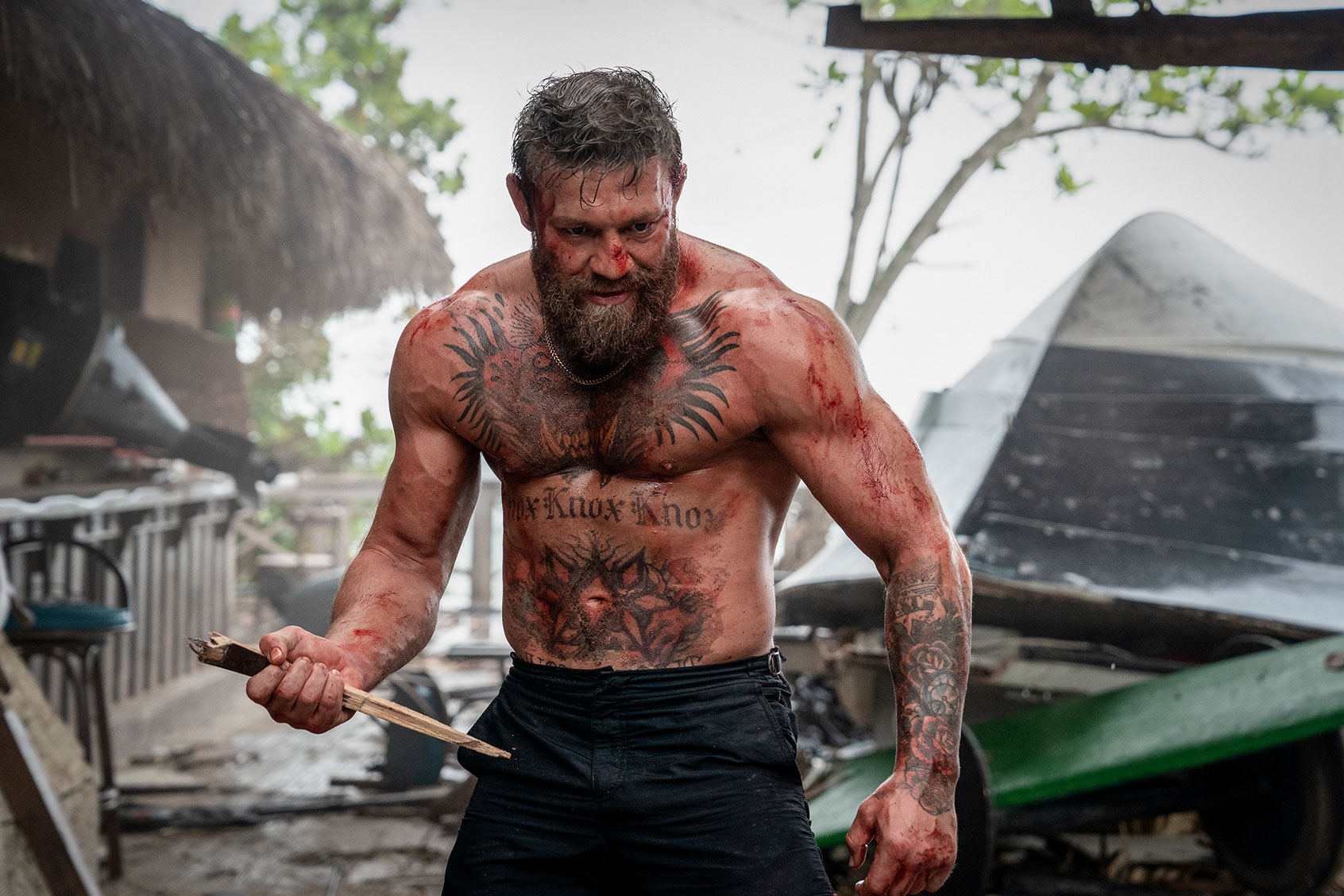
The plot kicks in as Ben Brandt (Billy Magnussen) wants to get rid of Dalton so he can take over the Road House to realize his dream of building a resort. If only his henchmen weren’t so inept! Ben, a struggling but determined alpha male, also ignores his incarcerated father’s efforts to execute a plan that would get rid of Dalton. Enter Knox (MMA fighter Conor McGregor in his film debut) a brawler who is first seen wearing only shoes, socks and a smile as he struts through the streets before heading to Glass Key, Florida. 

Road HouseConor McGregor in "Road House" (Laura Radford/Prime Video)Knox injects some fun into this lackluster film because McGregor has taken a page out of Jason Momoa’s playbook that says to always be outrageously entertaining. He steals every scene by bulldozing everything in his path. He has fun swinging a golf club around and taking out all comers. The fights between Knox and Dalton are the film’s highlight, especially the one-on-one encounter in the film’s finale. Watching the shirtless Gyllenhaal and McGregor wrestle, punch, kick, stab and do everything but kiss each other may look tough and sweaty but it is almost as homoerotic as “Brokeback Mountain.” 
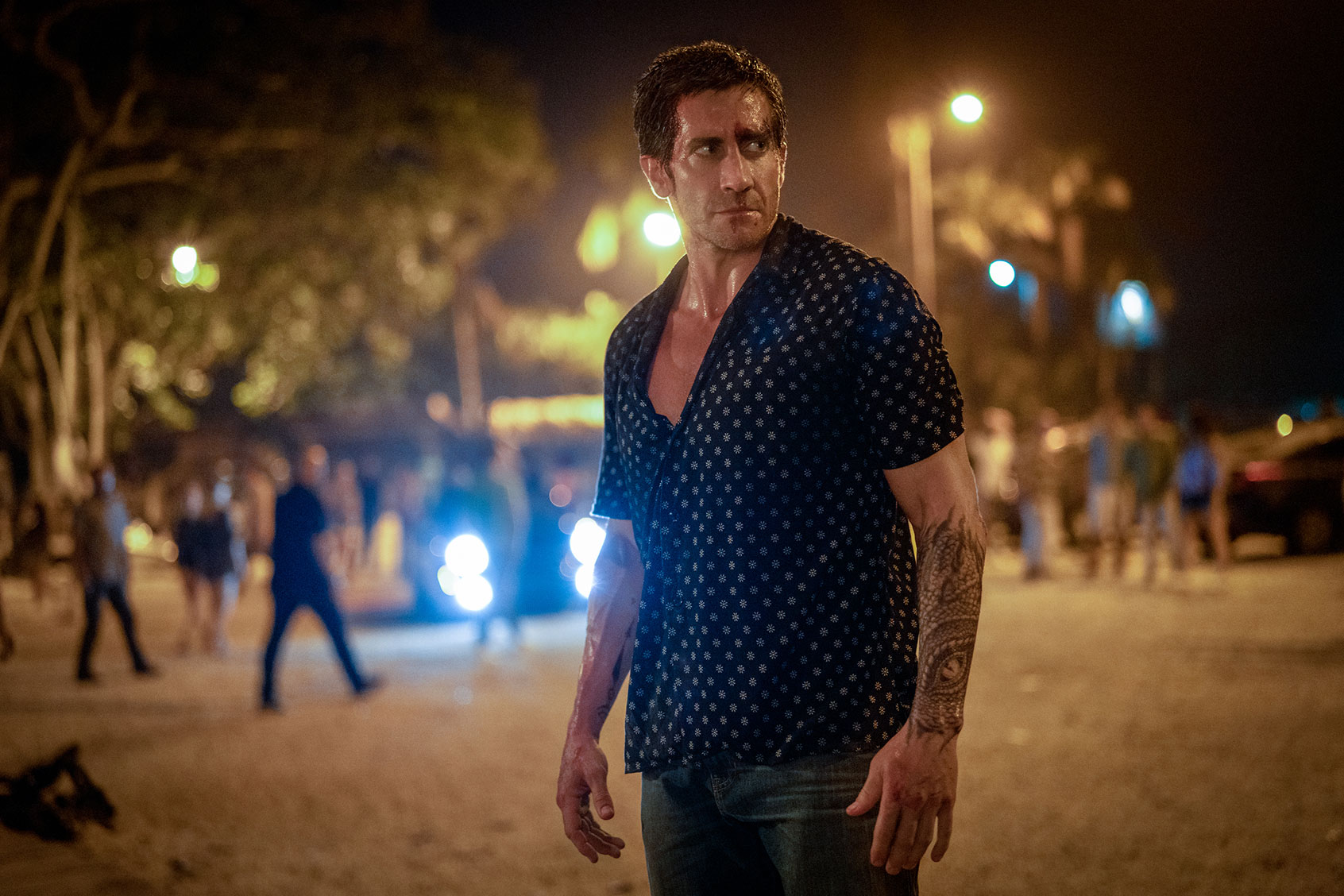
Unfortunately, this “Road House” drags leading up to this exciting set piece. First, there is the romance between Dalton and Ellie, which feels perfunctory. It is more cringy than sweet seeing her flirt with him over how to pronounce “conch.” Ellie’s dad, known as Big Dick (Joaquim de Almeida) is the Sheriff in Glass Key, and he is squarely in Ben’s pocket. Big Dick takes Dalton in for questioning, which only makes him double down on wanting to save the Road House. Moreover, everyone tells the bouncer to bounce out of town.

In the title role, Jake Gyllenhaal is thoroughly charming using duct tape to seal a knife wound in one scene.

But Dalton is a man of honor, and he can’t do that. Besides, Ben is not as nasty as Ben Gazzara‘s villain in the original — even if he does send Dalton a message by burning down the local bookstore Dalton frequents. The stakes here just feel really low. 

Another problem with this remake is that more action takes place outside the Road House than in the titular establishment. Dalton dispatches a guy on his houseboat or has a fight on Ben’s luxury yacht. There are a few scuffles and tussles in Frankie’s bar, but mostly the setting is used to showcase a series of musicians. (The film’s soundtrack is pretty catchy.) At least a little subplot about a large container of cash provides some satisfaction.

Road HouseJake Gyellenhaal in "Road House" (Laura Radford/Prime Video)In the title role, Jake Gyllenhaal is thoroughly charming using duct tape to seal a knife wound in one scene, and he exudes finesse taking out the dozens of guys who want to take him out. Dalton’s character, however, is underdeveloped, and Gyllenhaal delivers more action than emotion, but he acquits himself well as Dalton is pummeled or hit by a car. 

In support, Magnussen dials up his bad guy too high, although it is fun to see him getting angry while being shaved on his boat in uncalm waters. His best moment is perhaps his most restrained — when he quietly menaces Dalton at the bar one night. 

“Road House” 2024 feels more like an update to an original that didn’t need revising. It keeps the romance chaste, features an appealing diverse cast and skips the Sam Elliot mentor character altogether. At least the Florida setting is picturesque. 

Nevertheless, Patrick Swayze’s Dalton could kick Jake Gyllenhaal’s Dalton’s butt any day. Now, that would be something to watch.

“Road House” is now streaming on Prime Video.


Kate Middleton reveals cancer diagnosis, says she is undergoing chemotherapy

After months of speculation and conspiracies regarding Kate Middleton's whereabouts and health following a major planned abdominal surgery in January, the Princess of Wales on Friday issued a public video statement to the world to clarify her situation: a cancer diagnosis. 

"I wanted to take this opportunity to say thank you, personally, for all the wonderful messages of support and for your understanding whilst I have been recovering from surgery," the royal said in a video shared to X/Twitter by the account she shares with her husband, Prince William, the heir to the British throne. "It has been an incredibly tough couple of months for our entire family, but I’ve had a fantastic medical team who have taken great care of me, for which I am so grateful.

"In January, I underwent major abdominal surgery in London, and at the time, it was thought that my condition was non-cancerous," Middleton continued. "The surgery was successful. However, tests after the operation found cancer had been present. My medical team therefore advised that I should undergo a course of preventative chemotherapy and I am now in the early stages of that treatment.

"This of course came as a huge shock, and William and I have been doing everything we can to process and manage this privately for the sake of our young family," she added. "As you can imagine, this has taken time. It has taken me time to recover from major surgery in order to start my treatment.

"But, most importantly, it has taken us time to explain everything to George, Charlotte and Louis in a way that is appropriate for them, and to reassure them that I am going to be OK," Middleton said, referring to the three young children she shares with William. "As I have said to them; I am well and getting stronger every day by focusing on the things that will help me heal; in my mind, body and spirits."

Middleton also seemed to attempt to put to rest rumors that her relationship with her husband had grown fraught, after it was speculated that he was having an affair with Rose Hanbury. "Having William by my side is a great source of comfort and reassurance too. As is the love, support and kindness that has been shown by so many of you. It means so much to us both. We hope that you will understand that, as a family, we now need some time, space and privacy while I complete my treatment. My work has always brought me a deep sense of joy and I look forward to being back when I am able, but for now I must focus on making a full recovery."

"At this time, I am also thinking of all those whose lives have been affected by cancer," the royal concluded. "For everyone facing this disease, in whatever form, please do not lose faith or hope. You are not alone."

In February, Middleton's father-in-law, King Charles III, was diagnosed with cancer. While Buckingham Palace did not disclose what type of cancer the 75-year-old king has, a statement shared at the time of the diagnosis indicated that “during The King’s recent hospital procedure for benign prostate enlargement, a separate issue of concern was noted,” and that "subsequent diagnostic tests have identified a form of cancer.”

Store-bought is fine — except when it comes to chicken stock

"Top Chef" is back! And with its return comes a new host, a new batch of contestants and, of course, new challenges. This week, in the first Elimination round, the chefs each drew a knife bearing the name of a judge, who gave their groups instructions. Longtime judge Tom Colicchio asked his group to roast a whole chicken and compose a dish with both white and dark meat. Gail Simmons, who now also serves as the show's executive producer as well as judge, instructed her chefs to make a stuffed pasta. 

Meanwhile, "Top Chef" winner-and-alum-turned-host Kristen Kish asked her group to make a soup with rich, fully-developed flavor. Of course, all of these culinary tasks are difficult to executive under a time-crunch, which is why it was noteworthy when (spoiler alert) the week's first overall victor, Manuel "Manny" Barella, decided to bypass any shortcuts. “I’m not doing store-bought chicken stock," he said. "Especially not for the soup challenge.”

His decision paid off. Manny — an early favorite of mine who was born in Mexico and currently resides in Denver — captured the judge's attention with his comforting, enriching green pozole with chicken and charred salsa verde.

At judges' table, Gail herself notes that Manny's pozole is "packed full of comfort but [he] made it so elegant." 

Making homemade chicken stock sometimes tends to be thought of as being either precious or a project. There are numerous articles and online debates about whether the time and effort are worth the end result, especially on a consistent basis. But if you're a soup-lover, I'd argue that you really owe it to yourself to give it a try. As this week’s ‘Top Chef’ winner showed us, homemade stock doesn’t have to take all day and is worth the effort

Manny made his from-scratch stock in a pressure cooker  but you don't need to do that, of course (unless you have an instant pot and would like to!)

Homemade stock is excellent: Gelatinous, with a richer mouthfeel, deeper flavor and more concentration that you would anticipate. If you were to sneak a peek at the chicken stock at practically any restaurant, you'd see that it is jiggly and viscous, packed with gelatin  very unlike the loose, liquid-y "stock" in cartons lining your grocery store shelves. As Noah Galuten as Eater puts it, stock is "that golden, translucent, endlessly versatile nectar with tiny circles of fat shimmering on its surface."


Want more great food writing and recipes? Subscribe to Salon Food's newsletter, The Bite.


This, of course, also has an impact on the final dish: As J. Kenji López-Alt told Galuten, "A homemade stock will thicken and intensify as it reduces, while a store-bought stock will remain thin and watery until it completely boils away.”

This also, obviously, impacts not only the consistency of the final result — but also the flavor. López-Alt said, “mainly because the amount of actual meat, connective tissue, and bones used to make store-bought stock is much lower than one would typically use for homemade stock.”

So, knowing all of this, why not make it at home? 

I'm a fan of Better Than Bouillon but legitimate, homemade stock is genuinely insurmountable. Furthermore, you can always make a ton and then freeze some of it off. 

To further contextualize, though, let's get into the distinction. At Epicurious, Zoe Denenberg differentiates between broth, stock and bone broth. Broth is "made by simmering water with vegetables, aromatics and sometimes animal meat and/or bones for a short period," while stock is "made by simmering water with vegetables, aromatics, and animal bones (sometimes roasted and sometimes with meat still attached) for a slightly longer time, usually 4 to 6 hours." Lastly, bone broth is a "hybrid" of the two, sometimes cooked for as long as 24 hours. It's also good to note that stock is typically made from just bones  either as-is or even roasted off in the oven  while a broth is basically chicken soup, simmering a whole chicken in some water, aromatics and vegetables and lightly flavoring the liquid. 

We need your help to stay independent

This is really more of a process or technique than it is a recipe, so I'd rather present it that way. 

What you need

  • Chicken bones: These can be leftover from a roasted chicken, entirely raw, or preferably roasted off raw bones. You can also use just chicken backs and wings.
  • A slew of aromatics and fresh produce: Anything from your typical mirepoix ingredients like carrot, celery and onion to garlic, leeks, herbs (thyme, parsley, bay leaves), peppercorns, and the like)
  • A ton of water
  • Gelatin: Totally optional, but if you're only using chicken breasts or don't have any bones on hand — feel free to add some unflavored, unsweetened gelatin to really bulk up the consistency of your stock, making it more akin to the traditional stock.

Method

In the largest pot you have, you want to cook the bones and water only at first (simply cover the bones entirely with the water), cook for an hour or two, then once the scum is is skimmed off as the impurities rise to the top, add your vegetables and aromatics. You can then cook for however long you want, of course, but aim for a minimum of two to three hours or so. 

Use whatever strainer you have: Perhaps a fine-mesh, a collander set over another pot or — if you happen to inexplicably have access to a restaurant — a tamis or a chinois.

It's a perfect recipe to have simmering in the background while working from home or having a weekend in. Your final result should have a rich mouthfeel, deeper flavor, should make a super-rich demi-glace once reduced and not just aimlessly cook off into nothingness. Be sure to cool stock completely before pouring into jars, quart containers or other storage. This should last for months in the freezer and a good week in the fridge.

If this is all still to much for you, feel free to go "semi-homemade" ala Sandra Lee with a box or two of store-bought stock, some Better than Bouillon, bouillon cubes or powders, vegetables, aromatics and maybe a chicken breast or two. This will make an enriched stock that beats out store-bought but doesn't require some of the more involved components of a full, from-scratch stock making process.

As far as how to use this? Soups, stews, fortifying rich pan sauces, cooking grains or beans, reducing into demi-glaces, to braise or poach proteins or vegetables, in risotto, to glaze produce, in stuffings or fillings — the list truly goes on and on. 

Episode Takeaways

  • I appreciated David's energy, his candor, his oddly anachronistic lingo (why did he feel like he was straight out of 2012?). He felt like a personality we would've seen in one of the early seasons of "Top Chef" and I think that that's one of the things I feel "Top Chef" is currently missing, to be frank. 
  • I also enjoyed seeing Kristen coming into her own — though I am partial to Padma's hosting and mellifluous voice guiding both us and the cheftestants through the show (but to be fair, Kristen has hosted for one hour of "Top Chef" while Padma hosted for 19 seasons, so I'm sure she'll grow into it). I'm also thrilled that "Pack your knives and go" remains a part of the lore! I would've been bummed had that been cut.
  • Beyond Manny, I also loved Michelle's energy. I liked Danny, Kaleena and Kevin, too, though Savannah is my dark horse for no reason other than the fact that I always tend to root for under-edited female competitors on reality shows and because she made an avoglemono sauce. We barely saw Charly, Laura, or Alisha and Rasika and Valentine didn't make too much of an impression. I was intrigued that Amanda got such great praise in a random scene, but that didn't seem to translate during the elimination challenge. Dan was the customary "hometown guy" and Kenny seemed earnest and good-natured.
  • I'm not entirely sure how I feel about the Quick Fire and immunity rule change? I'm also interested to see if Last Chance Kitchen comes back around. We'll see.

“It’s just food”: Why the closure of a Portland pho restaurant is sparking discrimination complaints

A "potentially discriminatory" city code is now being revisited due to a recent backlash of complaints after a Vietnamese restaurant in Portland, Oregon was closed.

As reported by Emi Tuyetnhi Tran of NBC News, the pho restaurant received "anonymous odor complaints" that were filed to the city officials. The restaurant, Pho Gabo, closed in early February after facing the threat of a hefty fine. Since then, though, city officials "halted all subsequent investigations of odor code violations related to food establishments in order to re-examine the policy."

The restaurant's owner, Eddie Dong, told NBC News that the initial complaints "caught him off guard" since he had been operating the restaurant for over five years. He also operates two other Pho Gabo locations nearby. Tran notes that there is a "sole complainer," who reportedly lives near the restaurant, but this person hasn't been identified as of yet. “They complained to the city and the city came down," Dong said. "They say ‘odor,’ but it’s just food, grilling meat.”

The Portland odor code states "continuous, frequent, or repetitive odors may not be produced. The odor threshold is the point at which an odor may just be detected." This, of course, can be very subjective — and some are concerned that can leave room for complaints driven by racist or xenophobic motivations.


Want more great food writing and recipes? Subscribe to Salon Food's newsletter, The Bite.


Tran noted that the restaurant had been visited "at least 10 different" times within the past few years and the original complaints were made back in 2022. Dong has since "tried a number of fixes" throughout the kitchen, from hoods and exhaust system to charcoal filters, going as far as "cooking meat at his other locations and driving it to the Northeast Portland restaurant" — but this did not stop the complaints.

We need your help to stay independent

"After the last inspection, Dong said that the city ordered him to either close the restaurant or pay a $4,000 fine," Train wrote. "He added that if he did not close the restaurant, he would face an additional $3,600 fine."

This then resulted in the restaurant's closing on February 3.

Dong is still paying rent on the building and is entirely unclear on when — or if — he may even be able to reopen the establishment which is resulting in thousands of dollars of lost revenue (around $80,000, according to Tran). He also has not been advised of any next steps, further complicating the frustrations. 

Portland commissioner Carmen Rubio wrote on X, formerly Twitter, that she was "alarmed" to learn of the closure back on March 6. Tran also writes that the existence of the code itself is "potentially discriminatory" and has resulted in "some Asian American lawmakers raising questions about whether this ia discriminatory incident."

On March 6, Nguyen and four other Asian-American and Vietnamese representatives in Oregon released a statement stating that the code "is discriminatory and unfair, particularly to more vulnerable communities," according to Tran, writing that "the city’s odor code is discriminatory and not objective by any known standards, leaving out certain, minority-owned small businesses,”

“He’ll never leave”: Why Trump’s dynasty, built on corruption and violence, won’t end with him

No, you’re not being hyperbolic if you say MAGA is a fascist movement. You're just being accurate. That was one of the biggest points made by NYU historian Ruth Ben-Ghiat, author of the book "Strongmen: Mussolini to the Present," during our recent "Salon Talks" conversation.

Ben-Ghiat explained that Donald Trump is leading a “right-wing counterrevolution against the loss of white male privilege,” aimed at taking America back to the time when women, nonwhite people and non-Christians “knew their place.” 

But what truly defines MAGA as fascist, Ben-Ghiat said — rather than just right-wing — is its use of violence. “Fascists believe that violence is the way to change history,” she told me. We saw that clearly enough on Jan. 6, 2021, with the attack on the Capitol mean to keep Trump in power despite his loss in the 2020 election.

What is most worrisome going forward, Ben-Ghiat suggested, is Trump’s defense of the Jan. 6 attackers as “hostages” and his promises to pardon them, which seek to change "the perception of violence." Trump’s message to his loyal followers, she said, is that “violence is sometimes morally necessary and even righteous, and even patriotic.” That, she added, is “what we call sacralizing violence, giving violence a kind of ritual, religious tone.”

Ben-Ghiat sees Trump’s promise to pardon the Jan. 6 insurrectionists as intended to inspire his supporters to commit future acts of violence if that can help him win. The implied promise is that if they commit violent acts and Trump regains the White House, he'll pardon them too. That's straight out of the autocrat's playbook, Ben-Ghiat says: "All authoritarians use pardons” and manipulate the justice system to maintain power.  

Ben-Ghiat says she's not trying to scare us, only to prepare us for what we're likely to see between now and November — and for a good while after that if Trump wins. Too many Americans still don't believe, Ben-Ghiat warns, that "it can happen here" — "it" being a fascist takeover. History tells us those people are wrong.

Watch my full conversation with Ruth Ben-Ghiat here or read a transcript of our conversation below, edited for length and clarity.

You’ve been discussing and studying this issue for years, but it seems even more important than ever to talk about authoritarianism.

It's incredible that it could be upon us. Here's Trump saying he's going to be a "dictator for day one," but we know that they're never dictators for day one. They never relinquish their powers, so it's extremely important to understand what we're up against.

Despite Trump saying he wants to be a dictator and facing 91 felony counts for his attempted coup, the GOP base and millions of Americans still love him. What do you take from that?

Sadly, in history, when these charismatic demagogues come to power, they use emotions to manipulate people. Trump says, "I love you" to his people. He told them he loved them on Jan. 6. He builds a personality cult so he poses as the victim, which is really important because not only are all his crimes presented as persecutions by the "deep state," but saying he's being persecuted makes his followers feel protective of him.

You have quotes from MAGA people saying, "Oh, it's so distressing. We have to be there for him." That's what Jan. 6 was. It was many things. It was a violent coup attempt. But he was a leader in distress and he called on people, he brought them to the rally and they responded. They were trying to rescue him. This happens in history. I have quotes in “Strongmen” with people, actual fascists sitting in jail in 1945, where they're like, "Oh, I was completely magnetized by Mussolini. I didn't realize what was going on." So that's how I see it.

Is history warning us about the fact that Trump has not been held accountable by the system? There was such a long delay in investigating him. He's finally charged and now he's using his lawyers to manipulate the system to keep him on the ballot, and maybe not have any of the serious criminal trials before Election Day.

It's very disheartening, and no one is going to save the American people. My mantra has always been, "Never underestimate the American people." We had the Women's March, we had Black Lives Matter. These were the largest protests in history, and they led to electoral [change] in the midterms in 2018 and 2022. 

We've got to do it. We can't depend on our institutions, which is very sad in a democracy. But our democracy has been so damaged, including the Supreme Court with Justice Thomas who wouldn't recuse himself. There's a whole attempt to delegitimize democracy, and not just Joe Biden, but the whole system. So we have to do this from the ground up.

From an academic point of view, is MAGA an authoritarian movement? Is it a fascist movement? Where does it fall?

It's pretty fascist.

Why?

The reason I wrote “Strongmen” was to have this 100-year history of authoritarianism, almost all right-wing, because that's my specialty. Obviously communists had a higher body count than fascism, so I could have put them in there, but for narrative and other reasons, I focus on the right wing. Fascism was the first stage of authoritarianism, but it continued in different forms, like the Cold War military dictatorships. 

Trump is very similar to Mussolini in many ways. It checks all the boxes, where it's this huge right-wing counterrevolution against the loss of white male privilege, and it's to save civilization, and the whole "great replacement" theory, which is big in the MAGA base, the idea that nonwhites and non-Christians are having too many babies: We're going to be extinguished. Mussolini talked about this too. You can track a whole series of checkpoints and talking points, and they're pretty much the same.

What's the core of fascism? And why do you, as an academic, look at MAGA and say, "Yep, it's now fascist"?

Mussolini actually was a great sloganeer. He created fascism and had one very simple definition. He called it "a revolution of reaction." Both those things are true because it upends everything. It disrupts everything. It uses violence. Fascists believe that violence is the way to change history. Rep. Matt Gaetz of Florida, he came to the Iowa State Fair to help Trump in the summer. People are eating their corn dogs, there's kids there, and he says, "Only through force will we bring change to corrupt D.C." This is after the coup that tried to do that. So that's the revolution part. People are given permission to be their most violent selves, their worst selves. It's a collapse of morals.

The reaction is what I was saying before, where you want to turn the clock back to "the good old days." MAGA wants to make the nation "great again" by going back to times when women knew their place, as did nonwhites and non-Christians, so things were as they should be. This is part of authoritarianism, which is also a set of attitudes about child-rearing, about traditions, about male authority. All of that, Trump says, is threatened, and so the MAGA base is responding to that.

As an expert in authoritarianism, when you hear Donald Trump defending the people who attacked the Capitol, calling them "hostages" and saying they've been treated unfairly, pledging to pardon them, does that raise red flags for you? And if it does, what does it mean?

Totally. One of the major things that fascists did, and that Trump is doing — he's been doing this through his rallies with frightening relentlessness — is to change the perception of violence. To get people to see that violence is not negative, including violence against your neighbors, or that you're going to look the other way when your neighbor's deported. Violence is sometimes morally necessary and even righteous, and even patriotic. He has used his rallies since 2015, and I wrote about this in my report for the Jan. 6 committee, where he'd say, "Oh, in the old days we used to be able to beat people up and nothing happened." This is thug talk. This is part of fascism. 

"To have an autocracy, you need people to be cruel. You need them to think that solidarity and empathy and kindness are for weak people. That's totally fascist."

So Jan. 6 becomes this righteous "Stop the Steal." The people who have been arrested become patriots. He almost is doing what we call sacralizing violence, giving violence a kind of ritual, religious tone. In his rallies, he has the Jan. 6 prisoners choir sing. This is totally fascist. Trump has these fascist spectacles. 

I wrote an essay for Lucid when he kicked off his campaign at Waco, Texas. What a choice! He had the choir and the spectacle of it reminded me of Hitler's Nuremberg rally. I think I entitled my essay, for my Substack newsletter, "Triumph of the Will, Waco Version." He knows exactly what he's doing because he's a showman, he's a man of TV, he's a man of the camera. It's really scary and it really works. That's what all of that is about. The pardons are about encouraging people to do more violence, thinking that they're not going to pay any consequences. That's actually the essence of authoritarianism and fascism: You arrange government so that you can be violent and corrupt, and get away with it.

When Trump says "I'm going to pardon you for committing these crimes," then the message becomes "If you commit crimes for me as we get closer to the election, I will do the same for you."

That's right. We also want to talk about not just Trump, but the enablers. So Rep. Paul Gosar, who should not be anywhere near government, in my opinion, who hangs out with Nazis, he was promising people pardons to get all the thugs he knew, all the right-wingers who were violent, to come on Jan. 6 — promising them pardons because Trump had just pardoned all these violent people like Roger Stone and Michael Flynn and [Steve] Bannon. That's the environment.

All authoritarians use pardons because why do you want people sitting in jail, the worst people in the world, who are for you the best people, when they could be serving you? So Mussolini, Pinochet, they all use pardons to free up the people they need. It's really awful, but this is where we are.

The fact that you know all this, does it scare you more?

I do. It's a little eerie that things are unfolding exactly as they have — well, not exactly as they have in the past because it always looks different, which is why some people don't see it coming. Because no, we're not 1930s Germany, even though Trump's saying, "I hope the economy crashes," which is the Hitler playbook. But it redoubles my mission to speak out and to warn people. The challenge is to reach more people now, reach the people who usually don't vote, who have no idea. 

There was a poll that was very disturbing that said, I forgot what percent, a lot of Americans have never heard Trump's authoritarian declarations. They'd never heard any of that, and some of them don't know about his crimes because they don't follow the news at all.

As a historian, are you concerned that there are Americans who sincerely believe it can't happen here? "It" being fascism, authoritarianism and the end to self-determination as a people.

Oh, absolutely. Even when I'm speaking to people, and these are people who have come to hear me, so they know what I'm about, when I say things like, "The GOP is an autocratic entity, or it's become autocratic" — I don't use the word fascist often — you can see that they're kind of, “Well, this is a little exaggerated.” It's like a mental divide between what we hear about abroad and what we are. In the meantime, they're going to pick their kid up from school, they're going to the gym, and they don't have any conception of how their lives would be affected. So it just seems like some blathering by a professor, and that is frustrating.

Sticking to Trump and what he says, at a rally recently, he mocked President Biden's stutter. At another rally last year, he made fun of Paul Pelosi, Nancy Pelosi's husband, a man in his 80s who was hit in the head with a hammer. Trump doing that is one thing, but what is more bone-chilling to me is when he did that, the crowd cheered and laughed. With Biden's stutter, the crowd cheered and laughed. What does that indicate to you?

This is part of his re-marketing of violence as positive. That's the Pelosi part. There's a reason that threats to members of Congress and their families are up like 400%. 

Mocking the speech impediment is about cruelty. To have an autocracy, you need people to be cruel. You need them to think that solidarity and empathy and kindness are for weak people. That's totally fascist. That's what fascism is. In fact, Mussolini, who, like Hitler, read Nietzsche, the philosopher of the Übermensch and all that, and took away from it that if somebody is weak and they're on a cliff, you should just push them because they're useless to society. That's the philosophy. Trump also made fun, years ago, of a New York Times reporter with a disability. And the disabled, just to take that theme for a second, have always been persecuted by fascists and others.

When Biden gave the State of the Union address, he raised the alarm about Trump. What more should he be doing, in talking about Trump, to alert our fellow Americans?

I was glad that he was doing that. You have to respond forcefully. This whole thing partly includes Putin's maneuvers in Ukraine. Biden came to office and in his first press conference said, "We've got to prove democracy works." So from the very beginning, he was going to not only save democracy in our country, but prove it works abroad and stop these people.

"Personality cults, they're like plants. You've got to water them, you got to tend to them and they need the person to be viable and active."

He had a summit with Putin in the summer of 2021. They sat there and Putin was placed as an equal visually, and they had the globe between them. It was in Geneva. I looked at Putin — because I live in these people's heads, unfortunately — and I got a really bad feeling. He was also being grilled by the U.S. press, including by female journalists, and he didn't like that at all. He was put on the spot by a female American journalist. I thought, “This is bad,” because there was something about him. So that night I wrote for my Lucid newsletter that Putin could become very reckless over the next months because he felt extremely threatened that Biden was there instead of Trump. It was a nightmare for him that Trump didn't win. He was risking a lot. 

Then we know what happened. He went into Ukraine and before that, he and China made a formal alliance. And so all of this, one way to read it is it's because of Biden's commitment to democracy. Now, after Jan. 6, he's there. He almost didn't make it into office, but now he's there and we're at the showdown. I think he needs to be even more forceful, but at least he's stepped up.

Trump recently invited Viktor Orbán, the prime minister of Hungary, to Mar-a-Lago. He said, "There's no one that's a better or smarter leader than Viktor Orbán. He's fantastic." What alarm bells go off when you hear that?

Trump has actually been conditioning Americans to see authoritarian leaders like Orbán as positive role models, as well as saying, "I'm going to be a dictator." One of the interesting things he said after that was that Orbán is a "non-controversial leader because he says, 'This is the way it's going to be,' and everybody accepts it, end of discussion." So what Trump is saying is that literally being a dictator, dictating what you're going to do and everybody just submits, shouldn't be controversial. It's how it's going to be.

He's using these visits not just to curry favor with these autocrats and whatever dirty deals they're going to have — and it's all about Putin, because Orbán is a client of Putin — but he's using these occasions to keep indoctrinating Americans that this is the leadership they're going to have.

It resonates with some folks in the base. I see interviews where people are like, "Yes, he'll be a dictator just in the beginning to get everything right." And you're like, "You are not upset that he'll be a dictator because he'll be your dictator." That's the way it is. If Biden said, "I want to be a dictator," the right would go ballistic, as they should.

They already say he's a dictator. That's what I call the upside-down world of authoritarianism. Marjorie Taylor Greene and others talk about the “Biden regime.” Mussolini did this: Liberal democracy is tyranny, fascism is freedom. Then we get all the way to Auschwitz, where the gates of said, "Work will set you free." That's the upside-down world of authoritarianism.

We're seven or eight months out from the election right now. As we get closer, do you have concerns about violence by the MAGA movement? 

"The essence of authoritarianism and fascism is that you arrange government so that you can be violent and corrupt, and get away with it."

I do, because they're being egged on. There was a news item out of Kansas, where there was a Republican fundraiser and they were using an effigy of Biden and encouraging people to attack it. This kind of violence against anybody who is trying to hold Trump accountable or protect democracy could easily, because of our lax gun laws, happen as the election nears.

If Trump loses in 2024, do you expect a similar scenario as we saw after 2020? Even a call for another Jan. 6-style attack?

I do. Sometimes I'll have these thoughts and then they come to me and I'm like, “Oh, that's not good.” It's very interesting, when a president loses and a new one's going to come in, there's a transition team. That transition team is activated after the election is known. Project 2025, which has tens of thousands of people, 70 organizations, it bills itself as a transition team. Probably millions of dollars are being spent with giant staffs to plan a transition as though they think that whatever happens, they're coming into power. So that is disturbing, and that's a part of Project 2025 we haven't thought about. Why are they doing all this if it's going to be a free and a fair election, and they could lose?

It's important for President Biden, as a defender of democracy, to adhere to democratic norms. Right now, there’s a debate about whether Biden should give him the standard national intelligence briefing. Do you think that is it in the nation's best interests for Biden to adhere to this tradition that goes back to the time of Truman or, given the threat that Trump presents — and that he's actually charged with felonies for mishandling classified documents — should Biden not give him the briefing? 

Somebody who has instigated a violent coup to overthrow the government and kept classified documents in the bathroom of his private residence is not exactly trustworthy. It's not just Trump, it's also Jared Kushner. We need to be investigating how he came out of the Trump administration immediately into the hands of the Saudis. It's a whole flow of illicit money and networks. Absolutely he cannot be briefed. If that happens, that's actually very naive.

If Trump wins in 2024, do you think he would leave office peacefully in 2028?

No. He'll never leave, and if he falls ill or something, there's other Trumpers waiting in the wings. It's a dynasty. You could even see they're talking about Jared Kushner as secretary of state, which would be perfect for crime, for corruption. You don't know what will happen, but they build dynasties, and Trump has always had a family business. His two sons are not exactly equipped to take on high public office, but there are other people around. Lara Trump was just put in charge of the Republican National Committee so that every penny will go to [the Trump campaign]. This is classic corruption. So it could be anyone. It could be Lara Trump, who knows? As long as they keep control.

How's this going to end if Trump ends up being convicted, he loses the election, he's convicted and put in prison? With authoritarian movements from the past, do you have any guide? Does that weaken the movement, or no?

Yeah, there are polls showing that if he's actually convicted and sent to jail, he may become irrelevant. We can contrast what has happened after Jan. 6 here with Brazil, where they had a military coup in 1964. They had over 20 years of horrible dictatorship, with torture and all kinds of things, that only ended in 1985. The political class, the judges, they all know. They were there, or their parents were there.

Brazil had its own insurrection, on Jan. 8 [in 2023], but the former president [Jair Bolsonaro] has been banned from politics until 2030, so his popularity is going down. Same thing happened in Italy without an insurrection: Silvio Berlusconi had over 20 indictments and 14 major corruption trials. He was finally convicted two years after he left office and banned from politics for five years. That's when his amazing, formidable personality cult shriveled. Because personality cults, they're like plants. You've got to water them, you got to tend to them, and they need the person to be viable and active. If they're in jail or they're banned from politics, that's what you need to end them. So I hope to goodness that happens.

Kristen Kish emerges victorious again on “Top Chef,” this time as its host

One ingredient can change a dish's entire profile. That isn't what the producers of "Top Chef" wanted in choosing Kristen Kish to succeed Padma Lakshmi, the veteran culinary competition's heart and soul for 20 seasons before her 2023 exit. Like any acclaimed establishment, the show's goal is to maintain continuity of service and standards. Kish confidently fulfills that mission in the 21st season's premiere.

Still, the distinctions between Kish and her predecessor are many, none more obvious than the way she delivers the show's signature heartbreaker for the first time. When Kish says, "Please pack your knives and go" to the first Milwaukee-season cheftestant sent home, her tone is direct and even-keeled, entirely businesslike.

There's no slight furrowing of the brow or regret in her voice, nothing that could be read as disappointment. It's the delivery of someone who has been exactly in that person's shoes and appreciates that the kindest cleaving is clean — and so fast that you don't even feel how sharp it is as it opens the flesh.

The receiver accepts the bad news with grace and humor, adding as Kish shakes their hand, "We've made history," before pointing to themselves and noting, "Your first person to [be] eliminated."

Kish’s "Top Chef" tenure begins with what might be one of the smoothest baton passes from a revered host of a long-running show to a new one yet. That said, it's not as if we were expecting otherwise. The audience already knows and admires Kish, the unstoppable Season 10 underdog eliminated in that run's "Restaurant Wars," only to battle her way back to win the Top Chef title.

In 2012, Kish became only the second woman to win the Top Chef title, which is significant in itself. Throughout her season, she showed integrity, arriving at the competition with her close friend Stephanie Cmar, never throwing fellow competitors under the bus and accepting failure with composure.

All that, along with her telegenic personality, ignited the TV side of her career. Kish went on to co-host "36 Hours" for the Travel Channel, and since 2021, she has appeared on several culinary shows, including "Fast Foodies" for TruTV and co-presenting with Alton Brown on "Iron Chef: Quest for a Legend" on Netflix.

My viewing palate favors her adventures on National Geographic's "Restaurants at the End of the World," which showcased the breadth of her personality, adventurous nature and humane vision. "[F]ood is a vehicle to help tell a story," Kish shared on a 2023 "Salon Talks" about her Nat Geo show, "but really we're creating a relationship with another human being."

To their benefit, the people who watch and compete on "Top Chef" already have a relationship with Kish, but for some, it's also intimidating.

Kristen Kish’s "Top Chef" tenure begins with what might be one of the smoothest baton passes from a revered host of a long-running show to a new one yet.

Kaleena Bliss, who comes to the competition series as the Chicago Athletic Association's executive chef, admiringly calls Kish a "badass," and as a fellow Korean adoptee, an inspiration. "But it is a little bit of a double-edged sword that she's competed before" because, she says, Kish will notice any half-measures.

Along with Kish's arrival, the show has tweaked a few of its rules and benefits. The first tweak the contestants discover is Quickfire Challenges no longer award immunity from elimination, replacing that with cash prizes instead. To motivate everyone to perform at a high level at all times, immunity is instead rewarded to each week's winner.

Regrettably, for the person packing their knives, the first contest skips the Quickfire round. But that chef could have saved themselves in the Elimination Cook-Off, in which the lowest-scoring trio had the opportunity to save themselves by making a good plate of food out of everyone else's leftovers in only 20 minutes. That is something any decent home chef can do under pressure, but not while cameras are running and three judges are watching them work.

Our culinary knowledge and literacy have increased vastly since "Top Chef" premiered in 2006 — and in no small part because of it. Food Network may have had a 13-year head start, but it catered to home chefs and bakers. Bravo’s hit takes us inside professional kitchens and the minds of working chefs like no other show did before, though "Hell's Kitchen" premiered first.

Our culinary knowledge and literacy have increased vastly since "Top Chef" premiered in 2006 — and in no small part because of it.

"Top Chef" provides an alternative to Gordon Ramsay's abusive intimidations that define "Hell's Kitchen" and any of his other shows where he’s not judging child chefs. Restaurants aren't easy places to work, and as "The Bear" revealed through its hero's PTSD-induced kitchen nightmares, there are more bosses like Ramsay out there than ones who are serenely exacting like Kish or Lakshmi before her.

But watching those types of screamers isn't escapist or motivating to some of us, especially viewers who watch shows like "Top Chef" to expand their knowledge base in the kitchen or to simply have a better grasp of what high-quality cuisine should taste like.

Lakshmi never worked in professional kitchens like these contestants, but as a culinary enthusiast and cookbook author, she knows and loves the craft enough for the pros to respect her. And she wasn't wrathful.

Her gentleness brought balance to the table she shared with fellow judges Gail Simmons and Tom Colicchio. Simmons, like Lakshmi, built her expertise as a food writer but wasn't tasked with the brutal duty of gently shattering an up-and-coming chef's dreams.

We need your help to stay independent

That job falls to Kish, whose experience explains her empathy. Some scenes show her sensory recall of the competition's stress as it echoes in her body. She wonders why she's getting goosebumps while watching the competitors hustle around the flames and steel for the first time, before answering her own question with a laugh: "I just got nervous for them, I think."

Kish smiles as brightly as she introduces the elimination cook-off because she's lived through that, too, and won. She doesn't say that boastfully, conveying an understanding of what it's like to be knocked to the lowest rung of a ladder and fight to stay alive.

"She has a different relationship with them," Simmons said of Kish and the new crop of contestants on a recent episode of "Salon Talks." "She really understands what they're going through. She addresses them differently, but also she inspired us to make a lot of other changes to the game and to really up the ante."

And Kish does this from the start, when she confides in the contestants who aren't James Beard Award winners and haven't worked with acclaimed chefs that she didn't have those accolades on her resume when she first stepped up to "Top Chef," either.


Want a daily wrap-up of all the news and commentary Salon has to offer? Subscribe to our morning newsletter, Crash Course.


"Season 10, I had on my resume, three cook jobs, and I was a current sous chef," she tells them. "So as much as it is amazing that you guys have all come so far in your career, once you get into the Top Chef kitchen, really, quite frankly it does not matter at all."

This, however, only makes us like Kish more, cementing that producers made the right choice in entrusting her with a seat at this table.

"Top Chef" airs at 9 p.m. Wednesday on Bravo and streams on Peacock.

Matt Gaetz worries House may “end up with a Democrat” speaker after MTG files to oust Mike Johnson

Rep. Marjorie Taylor Greene, R-Ga., on Friday filed a motion to oust Speaker Mike Johnson as the House voted to avoid a government shutdown, NBC News reports.

Greene did not file the motion as privileged, which would force a vote within two days, but could notice it as privileged after the House returns from a two-week recess on April 9. Greene said she filed the motion because Johnson forced a vote on multiple continuing resolutions and funding bills to keep the government running.

“This is a betrayal of the American people. This is a betrayal of Republican voters,” Greene told reporters.

“I filed the motion to vacate today but it’s more of a warning and a pink slip … I do not wish to inflict pain on our conference and to throw the House in chaos but this is basically a warning and it’s time for us to go through the process, take our time, and find a new speaker of the House,” she said.

Raj Shah, a spokesman for Johnson, told NBC News the speaker’s focus is "on governing. He will continue to push conservative legislation that secures our border, strengthens our national defense and demonstrates how we’ll grow our majority."

Johnson was elected speaker after former Speaker Kevin McCarthy, R-Calif., was ousted by a far-right group led by Rep. Matt Gaetz, R-Fla. But Gaetz said he would not support Greene’s motion.

“If we vacated this speaker, we’d end up with a Democrat.  When I vacated the last one, I made a promise to the country that we would not end up with the Democrat speaker. And I was right. I couldn’t make that promise again,” he told reporters.

“We’d have Republicans cross over. I worry that we’ve got Republicans who would vote for Hakeem Jeffries at this point,” he added. “I really do. I take no joy in saying that. But you can only vacate the speaker if you know that the party leadership won’t change hands. I knew that with certainty last time. I don’t know it with certainty this time.”

2024 “Dirty Dozen” guide reveals the top 12 fruits and vegetables containing the most pesticides

The Environmental Working Group (EWG), a nonprofit organization committed to promoting healthy living and eating, has released its self-described “Dirty Dozen” list for 2024. The list itself ranks non-organic produce items with the most pesticides using data from the U.S. Department of Agriculture (USDA) and the Food and Drug Administration (FDA).

“This year, EWG determined that 75 percent of all conventional fresh produce sampled had residues of potentially harmful pesticides,” according to the organization. “But for items on the Dirty Dozen, a whopping 95 percent of samples contain pesticides.”

The USDA and FDA conducted tests on 47,510 samples of 46 fruits and vegetables. Of those produce items, 12 fruits and vegetables were most contaminated with pesticides. They include strawberries; spinach; kale, collard and mustard greens; grapes; peaches; pears; nectarines; apples; bell and hot peppers; cherries; blueberries and green beans.

Per the EWG, four of the five pesticides found most frequently on the Dirty Dozen are fungicides — namely fludioxonil, pyraclostrobin, boscalid and pyrimethanil. Fungicides are typically applied on produce after harvest to prevent fungal diseases and mold growth. High concentrations of fungicides, however, may be harmful to the endocrine system, although more studies are necessary to understand just how dangerous they are to human health.

The EWG recommended consumers buy organic versions of produce items on the Dirty Dozen as they contain lower pesticide residues compared to non-organic items.

On abandoning “fattertainment”: Why the way we talk about childhood obesity matters

In Oprah Winfrey’s recent primetime TV program, “An Oprah Special: Shame, Blame and the Weight Loss Revolution,” the talk show host sat down with Maggie Ervie and her mother to discuss adolescents using blockbuster drugs like Ozempic and Wegovy to lose weight. At just 13 years of age, Ervie underwent bariatric surgery and was prescribed Victoza, a GLP-1 agonist that was an early predecessor of today’s most common anti-obesity medications

Ervie’s story and its recent spotlight on Winfrey’s special — which portrays obesity as a chronic disease instead of a character flaw — reinforces why the way we talk about childhood obesity matters, especially in the Ozempic era.

Throughout her career, Winfrey has advocated for and elevated conversations surrounding weight health. The entertainment mogul herself fell victim to nasty media scrutiny surrounding her body. “For 25 years, making fun of my weight was [a] national sport,” she recalled, adding that she was ridiculed on every late-night talk show and on tabloid covers. Her special, Winfrey explained, centered on abandoning shame, specifically shame felt by those who are overweight and those who choose to use medications to help lose weight and maintain it.

“I come to this conversation in the hope that we can start releasing the stigma and the shame and the judgment to stop shaming other people for being overweight or how they choose to lose, or not lose weight, and more importantly to stop shaming ourselves,” Winfrey said.

Winfrey’s coverage of obesity hasn’t been perfect in every instance. Many will note her infamous 1988 segment, in which she wheeled out a wagon onstage containing 67 pounds of animal fat after losing 67 pounds on an all-liquid diet. Others will point to older episodes of her show, wherein she shared outdated advice on how to lose weight fast. 

But what Winfrey has largely consistently managed to get right is her approach to childhood obesity. In her recent special and in old episodes of “The Oprah Winfrey Show,” Winfrey allows children to speak candidly about their weight, often showing in raw detail how obesity takes a toll on them mentally, socially and physically. 

In a 2009 episode, Winfrey staged an intervention for sixteen teenagers living with obesity in hopes of helping them take control of their health with guided assistance from medical counselors and professionals. “We wanted to challenge them to take part in a grueling eight-hour intervention where they confront the reasons why they're overweight,” Winfrey said. “As you hear from them, you'll understand how they got here goes way beyond junk food.” The emotional episode essentially provided a safe space for the teenagers, showing them that they weren’t alone in their fight. It also opened viewers’ eyes to what living with obesity truly entails. Those who could relate said they saw themselves in many of the teens’ personal stories, while others said they were moved by Winfrey’s humanizing showcase.


Want more great food writing and recipes? Subscribe to Salon Food's newsletter, The Bite.


In 1995, Winfrey hosted a similar episode that focused on three young girls who spoke about their struggles with weight loss after previously writing to Winfrey about insecurities regarding their weight. “With cameras following the families in crisis, as well as candid conversations live in the studio, the children and their mothers address the emotional roadblocks that contribute to childhood obesity,” the episode’s description read.

“By providing solutions, rather than showcasing problems, the show hopes to use the power of broadcasting in a positive manner,” it continued. 

Such was the case on her recent weight loss special. 

In addition to highlighting the science behind GLP-1 agonists (short for glucagon-like peptide 1 agonists), Winfrey dedicated one segment to childhood obesity. Obesity amongst children and teens remains a major public health crisis in the US. According to data from the Centers for Disease Control and Prevention (CDC), 19.7% of adolescents and children in the U.S. — approximately 14.7 million individuals — are obese. Worldwide, more than 1 billion people suffer from obesity — 650 million 

Weight-loss drugs like Ozempic and Wegovy are surging in popularity, thanks to the internet. And as of recently, they’re being utilized by children as young as 12. NBC News reported that the American Academy of Pediatrics now allows young patients to take prescription weight-loss drugs, a decision that has been met with fierce disapproval. Last year, the reputable group added anti-obesity medications as part of its guidelines for treating obesity in children ages 12 and up. Behavioral and lifestyle changes are still considered “the first line of treatment,” but for some children, they aren’t enough to help lose weight. Medications, in those cases, can help patients ultimately attain success.

Weight and obesity are understandably very sensitive topics — childhood obesity, even more so. But unfortunately, conversations about the medical condition remain incredibly hard — and uncomfortable — due to fatphobia in the media we consume. In 2014, researchers at the University of North Carolina at Chapel Hill found at least one instance of stigma about fat people in 70 percent of the children’s movies they analyzed, per The Huffington Post. In “Kung Fu Panda,” Master Shifu complains, “Look at you! This fat butt, flabby arms…and this ridiculous belly!” upon meeting the film’s protagonist, a giant panda named Po Ping. Similarly, in “Shrek The Third,” Puss in Boots wails, “At least you don't look like some kind of bloated roadside piñata! You really should think about going on a diet!” Researchers also mentioned “Harry Potter and the Half-Blood Prince” and “Wall-E.”

Of course, the study contained several limitations. Many of the films featured anthropomorphized animals, as opposed to humans, and some ultimately tackled the weight-based stigma in the end. Regardless, the limitations don’t diminish the fact that such rhetoric is still inherently harmful. Especially considering that weight-based bullying is still a common form of bullying that many children experience in schools. A 2019 study conducted by researchers at the Uniformed Services University of the Health Sciences in Bethesda, Md., and the National Institutes of Health found that making fun of children for their weight is linked to increased weight gain well into adulthood, NPR reported. Increased teasing also leads to more weight gain, the study added.

That’s all to say that words matter — and how childhood obesity should be discussed matters, too. 

Cash-strapped Trump diverts donations from RNC to pay mounting legal bills after angry denials

Former President Donald Trump’s new fundraising agreement with the Republican National Committee diverts a portion of donations to a PAC that pays his legal bills before any money gets to the party, according to The New York Times.

The Times flagged an invitation to a major upcoming dinner for the new Trump 47 Committee asking donors to contribute up to $814,600 to attend. The invitation shows that the first $6,600 of the donation will go to Trump’s campaign, the next $5,000 would go to the Save America PAC that paid over $50 million in legal bills last year, and the next $413,000 go to the RNC, followed by dozens of state parties.

The agreement comes as Save America is burning an average of $5 million a month in legal payments for Trump and his co-defendants and allies. It also comes after Trump’s allies, including daughter-in-law Lara Trump, took over the RNC and purged dozens of officials.

Trump officials previously “angrily pushed back” on claims that the RNC would help defray Trump’s legal costs, the Times noted.

Conservative attorney George Conway pointed out that the “funds are not going through the RNC at all; they’re just being diverted away from it and directly into the PAC paying the legal fees, even though presumably the RNC is playing a central role in raising the money.”

Trump is also directing 10% of every dollar his campaign raises to his PAC, up from 1% earlier in his campaign.

Trump cashes in on Truth Social “meme stock” — but can’t use the money to pay $454 million penalty

Shareholders voted on Friday to approve a merger between former President Donald Trump’s media company and Digital World Acquisition Corp. to take the company public, The New York Times reports.

The company, which owns Trump’s Truth Social platform, will trade on the stock market. The deal is expected to inject more than $300 million into Trump Media, which has “all but exhausted its available cash,” and allow Truth Social to keep operation, according to the report.

The deal puts the company’s valuation at more than $5 billion, meaning Trump’s personal stake will be worth more than $3 billion, according to the report.

The deal comes as Trump faces a Monday deadline to pay the $454 million judgment in his New York fraud case or post bond in order to appeal the ruling. But Trump can’t use the cash from the deal to pay the penalty because he is restricted for six months from selling any of his shares or using them as collateral for a loan, The Times reported, though he could ask the board of the merged company to waive that rule for him.

“Any lockup change or waiver will be decided by the post-merger company’s board, which will be stacked with Trump allies,” The Washington Post reported, including Trump’s son Donald Jr., and former administration officials Robert Lighthizer, Linda McMahon and Kash Patel.

But even if Trump gets a waiver, he wouldn’t be able to sell more than a small fraction of his stake at any given time — up to 1% of the outstanding shares every quarter, Politico reported. And if he eventually seeks to unload a large quantity of stock it could scare off investors and hurt the company’s value because “it’s simply trading on Trump’s name,” Kristi Marvin, founder of research firm SPACInsider, told the outlet.

“Critics have said Trump Media is a ‘meme stock’ with a more than $6 billion valuation they say is out of sync with its financial outlook. Trump Media lost $49 million in the first nine months of last year and brought in $3.4 million in revenue,” the Post reported.

“I’m hoping it sets some people free”: Megan Fox opens up about plastic surgery, beauty standards

Megan Fox, the blue-eyed and dark-haired starlet known for her roles in films like "Transformers" and "Jennifer's Body," once held the crown as the sexiest woman in the world (as voted upon by readers of the men's magazine FHM). She the person to whom "Love Is Blind" contestants compare themselves so their love interest behind a wall can visualize their attractiveness.  

"She's young, she's hot, she's a rising star and her sex appeal has definitely transformed this year's list. She's got a great future ahead of her," said FHM Online U.S. Editor JR Futrell told Reuters in 2008.

The public obsession with Fox's looks and sex appeal has led to endless speculation about her body, including about what kind of work cosmetic work she has done. It's this level of scrutiny that has led to Fox in recent years to reveal that she has a complicated relationship with her body. Last year, the actress even told Sports Illustrated that she suffers from body dysmorphia and she doesn't "ever see myself the way other people see me." 

"There's never a point in my life where I loved my body, never, ever," she said. 

In hopes of destigmatizing plastic surgery and the unrealistic beauty standards projected onto women — and quite frankly Fox herself, even as the former "sexiest woman in the world" — Fox shared on the popular podcast "Call Her Daddy" a list of procedures she has had done on her body. 

Fox began the podcast by saying, "I'm just gonna go through all the things that I've done because I feel like there's this stigma and I'm not going to win. However, I'm hoping it sets some people free." 

Then the actress explained that she had her breasts augmented she was in her early 20s.

"I had them redone after I was done breastfeeding my kids," she continued. "I had to have them redone very recently because [with] the first set, I didn't have enough body fat to disguise [them], you could see the rippling of the implant, so I had to switch them out to this set."

Host Alex Cooper joined in and asked, other than Botox and filler, what else Fox had done. Fox shared that she also undergone every laser treatment "you could possibly think."

Fox continued that she "had my nose done when I was in my early 20s. I've literally been accused of having six, seven, or eight rhinoplasty surgeries — which is impossible, your nose would get necrosis and fall off. I haven't had a rhinoplasty since I was, I'm gonna say, 23."

We need your help to stay independent

However, Megan said there was one procedure she wouldn't talk about. She said, "There's one thing I had done that I'm gatekeeping, sorry. It was really good, and it's not a known plastic surgery."

While Fox hasn't had a face or brow lift or the popular procedure known as the Brazilian Butt Lift, the actress didn't rule out a brow and facelift in the future.

The actress' transparency shows that attitudes towards plastic surgery are changing and becoming more widely accepted as 24% of the American population reportedly has had some form of cosmetic procedure, according to MedEsthetics Magazine. It highlights how crucial aesthetics and beauty are still heavily important aspects of our society and the entertainment industry which certainly doesn't let women age. However, people like Fox are examples showing us how beauty can be made, shaped and paid for but for a hefty price tag even if they are a beauty standard.

“Totally baffling”: Ex-Trump lawyer calls Judge Cannon’s orders “fundamentally unhinged”

Former Trump White House lawyer Ty Cobb blasted U.S. District Judge Aileen Cannon over her handling of the former president’s classified documents case.

Cannon this week ordered Trump’s attorneys and special counsel Jack Smith’s team to submit competing jury instructions, including one that hinges on the Trump team’s claim that the Presidential Records Act gave him authority to deem government records as personal property — a theory widely rejected by legal experts.

“This is a remarkable misunderstanding of the applicable law,” Cobb told CNN on Thursday. “It’s embarrassing. She’s been struggling so dramatically in this case ever since the start when… she butchered the special master decision and the 11th Circuit took her to task for it. This is a totally baffling position.”

Cobb called the theory that the Presidential Records Act, which requires the president to turn over materials from his administration to the National Archives, gives Trump the right to keep records is “absurd on its face.”

“There’s no legal support for that, but she has put Jack Smith in a position of trying to draft jury instructions in advance that would posit that question to the jury. I think that it is such a fundamental error,” Cobb said, adding that Cannon’s rulings “provide a basis for seeking her recusal,” though the 11th Circuit Court of Appeals would have to sign off.

“A month ago, she ordered the identities of witnesses to be disclosed and Jack Smith pointed out to her that that was just not allowable,” Cobb said. “It’s really remarkable some of the things that she’s done that are just fundamentally unhinged.”

Cobb predicted that Cannon does not have “any intention of letting this case come to trial before the election.”

“And to her credit, this is not the only case that she has made fundamental errors in,” he added. “To her credit, she could merely be incompetent.”

“Dumbest thing he could’ve done”: Experts say Trump’s Truth Social brag could backfire in court

Former President Donald Trump claimed on Truth Social that he has tons of cash days after his lawyers asked a court to stay his $454 million New York fraud judgment because he could not secure a bond.

“THROUGH HARD WORK, TALENT, AND LUCK, I CURRENTLY HAVE ALMOST FIVE HUNDRED MILLION DOLLARS IN CASH, A SUBSTANTIAL AMOUNT OF WHICH I INTENDED TO USE IN MY CAMPAIGN FOR PRESIDENT,” Trump claimed on Friday. “THE OFTEN OVERTURNED POLITICAL HACK JUDGE ON THE RIGGED AND CORRUPT A.G. CASE, WHERE I HAVE DONE NOTHING WRONG, KNEW THIS, WANTED TO TAKE IT AWAY FROM ME, AND THAT’S WHERE AND WHY HE CAME UP WITH THE SHOCKING NUMBER WHICH, COUPLED WITH HIS CRAZY INTEREST DEMAND, IS APPROXIMATELY $454,000,000.”

Trump’s claim came days after his lawyers told a court he was unable to secure a bond to appeal the $454 million fraud judgment against him.

“Trump now claims that he has almost $500 million in cash, but his lawyers recently told the appellate court that he has no means to post a $454 million bond,” tweeted former federal prosecutor Renato Mariotti. “One of them is lying, and you can expect the court to ask Trump’s lawyers about this.”

“This is so dumb—now he can’t claim hardship to get a stay. AG Tish James can help herself, including to this supposed money!” wrote CNN legal analyst Norm Eisen.

Former Watergate prosecutor Nick Akerman agreed that the post was “the dumbest thing he could have possibly done.”

“That is a direct admission by him that he has the money,” he told CNN in a clip flagged by Mediaite. “Now, keep in mind, even with this operating money or cash that he supposedly has, if he doesn’t pony up and put up a bond, Letitia James is going to be able to go in and basically put restraining orders on all of his bank accounts. Everything that relates to him and all of that money is going to be tied up and frozen. So if he’s really got that money, he’s got to put it up.”

Martyrs to the MAGA cause: Trump follows Hitler’s steps with glorification of Jan. 6

You get the feeling that among the jaded Beltway establishment there is a belief that the horrified reaction against Trump's Hitler analogies is just a bit overwrought. Sure it's discussed and analyzed but there's a perfunctory vibe about it that makes it seem as if it's just another of those "Trump says the darnedest stuff" things. And sure, the idea that he's been studying Hitler's speeches because he once had a book of them is a stretch (even though he has said that Hitler "did some good things") because Trump doesn't study anything. He is an instinctive autocrat and he's got a few people around him who do understand the power of fascist imagery. Contrary to popular belief, much of the most outrageous rhetoric Trump spews at his rallies isn't off the cuff, it's scripted. 

So now we've all absorbed the comments about immigrants "poisoning our country" and calling his political opponents "vermin." He said that if he doesn't win there will be a bloodbath and everyone responded that it was taken out of context, as if he doesn't promise political violence if he loses (or is convicted of one of his many crimes) all the time.

But if there's one thing that absolutely validates the concerns of many of us and demonstrates that this isn't just about Trump's usual verbal incontinence: his glorification of the Jan. 6 rioters as patriots.

Trump now opens every rally with a recording of the so-called "January 6 choir" — a group of inmates held in the DC jail on felony charges related to the insurrection — singing the National Anthem with a voiceover by Trump himself droning the Pledge of Allegiance. (They actually released it as a recording and a bunch of deluded cultists bought it.)

He used this version of the anthem at his very first rally this cycle, which he held in Waco Texas, the site of one of the right's most infamous clashes with the government, the Branch Davidian standoff back in 1993 (which I wrote about last year.) They weren't subtle about the message. They even played footage of the insurrection on the big screens behind Trump with the discordant strains of the inmate choir over it while everyone held their hands over their hearts. This was not a coincidence. They understood the symbolism of choosing that location to proclaim the Jan. 6 criminals to be martyrs to the MAGA cause. 

Simply put, this is how it's done. Fascism, that is. 

We need your help to stay independent

Lately, Trump's taken to saluting when they play the J6 version of the song rather than putting his hand over his heart in the usual manner. And at a recent rally in Ohio, this absurd ritual was introduced by what sounded like a WWE announcer bellowing “Ladies and gentlemen, please rise for the horribly and unfairly treated Jan. 6 hostages." I'm only surprised the man didn't yell, "Let's get ready to ruuumble!" as Trump strutted around the stage. '

This rank political bastardization of the Star Spangled Banner by exalting criminals who beat police officers and sacked the U.S. Capitol, from the man who ranted endlessly about NFL players taking a knee during the National Anthemmay be the most audacious troll ever attempted. 

Trump has called for their release on numerous occasions, and if he wins the election, he said he's committed to pardoning convicted Jan. 6 rioters on his first day in office. This rank political bastardization of the Star Spangled Banner by exalting criminals who beat police officers and sacked the U.S. Capitol, from the man who ranted endlessly about NFL players taking a knee during the National Anthem, may be the most audacious troll ever attempted. 

But it's more than just another Trump troll. By creating martyrs out of insurrectionists, Trump is deploying a very potent propaganda tool, one that was perfected by, yes, Adolph Hitler during his rise to power exactly a hundred years ago.


Want a daily wrap-up of all the news and commentary Salon has to offer? Subscribe to our morning newsletter, Crash Course.


In 1923, Hitler led a violent uprising that we all know as the Munich Beer Hall Putsch. Four cops were killed along with 16 of Hitler's followers, known as "brownshirts' (not to be confused with Mussolini's "blackshirts" — or Trump's "red hats.") For years they were held up as martyrs to the Nazi cause just as Trump is now selling the January 6 criminals as "hostages" (which he only started to do after October 7th in the most grotesque inversion of Nazi propaganda ever.) 

But the most famous Nazi martyr, the Ashli Babbit of his day if you will, was a young anti-communist brownshirt by the name of Horst Wessel who was a known violent brawler in the pitched street battles between left and right during those days. He was killed by a couple of his Communist enemies after which Joseph Goebbels, Hitler's Stephen Miller/Steve Bannon, made him famous by filming his PR stunt funeral march and distributing it all over the country. He was a household name through the "The Horst Wessel" song, which became an alternate German National Anthem. Goebbels even got the churches to play it because young Horst was such a good Christian and a downright great Nazi.

Those of you who've seen Leni Riefenstahl's movie about Hitler's biggest rallies at Nuremberg, "Triumph of the Will," will recognize it as the song everyone sings during the ecstatic climax. Trump's rallies aren't as elegantly staged nor do they draw the same size crowds but the intention is the same. He may not have actually read that book of Hitler speeches but he didn't need to. Trump's a natural.

Losing hippos could throw entire ecosystems out of balance. Here’s how we can still save them

The hippopotamus, often simply referred to as a hippo, is a creature that fascinates and delights those who are fortunate enough to witness it in its natural habitat. These semi-aquatic mammals, known for their massive bodies, wide-open mouths and almost serene existence in the waters of sub-Saharan Africa, are not just wonders of nature's design but also vital components of their ecosystems. 

The hippopotamus is native to sub-Saharan Africa, dwelling in rivers, lakes, and mangrove swamps. Despite their broad distribution, hippos face numerous threats that have led to declining numbers. Habitat loss due to agriculture, human settlement and industry is a significant factor. Additionally, hippos are poached for their meat and ivory (found in their teeth), further impacting their populations. Currently, the International Union for Conservation of Nature (IUCN) lists the hippo as vVulnerable, with estimates suggesting there are between 115,000 and 130,000 individuals left in the wild. This classification underscores the pressing need for effective conservation measures to prevent their slide toward endangerment.

Acknowledging the critical role hippos play in their ecosystems and the various challenges threatening their existence, a collaborative effort among conservationists, governmental bodies and non-governmental organizations (NGOs) has led to the launch of numerous initiatives aimed at safeguarding these splendid animals. Among these efforts is the notable "Save the Hippos" campaign, which also marked the inception of World Hippo Day in 2016. This campaign, along with others, highlights the concerted actions taken to ensure the protection and preservation of hippos across their natural habitats.

The survival of the hippopotamus is intricately linked to the health of Africa's freshwater ecosystems and the communities that depend on them.

Anti-poaching measures, such as increased patrolling of protected areas and the implementation of stricter laws against poaching and ivory trade, are critical components of these efforts. Additionally, habitat restoration projects seek to reclaim and protect natural habitats for hippos and other wildlife. Community-based conservation is another vital strategy, involving local communities in conservation efforts and providing them with sustainable alternatives to hunting and habitat encroachment. International cooperation is also essential, as the conservation of hippos requires cross-border efforts due to their habitat spanning multiple countries.

Conservationists are also employing innovative technologies to monitor hippo populations and their habitats. Satellite imagery, drone surveillance and GPS tracking are tools that help gather data on hippo numbers, movements and health, which is crucial for making informed conservation decisions.


Want more health and science stories in your inbox? Subscribe to Salon's weekly newsletter Lab Notes.


Hippos are the third-largest living land mammals after elephants and white rhinos. An adult male can weigh up to 3,200 kilograms (about 7,000 pounds), with females slightly smaller. Despite their bulk, hippos are surprisingly graceful in the water, where they spend most of their time. Their specific gravity allows them to sink and walk or run along the bottom of rivers and lakes. Hippos are well adapted to their aquatic lifestyle, with eyes, ears and nostrils located high on their heads, enabling them to breathe and look around while mostly submerged. Their large mouths, which can open up to 180 degrees, reveal large canines and incisors used primarily for defense.

A unique feature of hippos is their thick, hairless skin, which secretes a natural sunscreen, often referred to as "blood sweat," to protect them from the sun's harsh rays. This oily red secretion is not only a sunblock but also has antiseptic properties, helping to keep wounds clean and free from infection. This adaptation is crucial for their survival in the hot, sunny environments they inhabit.

Hippos are highly social animals, living in groups known as pods, bloats or schools, which can consist of anywhere from 10 to 30 individuals, though larger groups of up to 100 hippos are not uncommon. These groups are typically made up of females with their young and a few non-breeding males, with a dominant male leading the group. The dominant male has exclusive breeding rights within the group, and his authority is established and maintained through displays of strength and aggression.

Additionally, hippos spend a significant amount of time in the water, where their social interactions occur. They communicate through grunts, bellows and wheezes, a form of vocalization that plays a crucial role in the dynamics of the group. Despite their peaceful appearance, hippos can be quite aggressive, especially if they feel threatened. This aggression is most commonly observed between males fighting over territory or breeding rights.

We need your help to stay independent

The Way Forward

The survival of the hippopotamus is intricately linked to the health of Africa's freshwater ecosystems and the communities that depend on them. As such, the conservation of hippos is not just about saving an iconic species; it's about preserving the balance of ecosystems and the well-being of human populations as well. The challenges are significant, but with continued effort, awareness and international support, the future for hippos can be bright. It's a testament to the resilience of nature and the power of collective action aimed at protecting our planet's remarkable biodiversity.

The hippopotamus, with its unique physical characteristics, significant ecological role, and the challenges it faces, is a symbol of the broader issues of wildlife conservation and environmental stewardship. By understanding more about these gentle giants, we can appreciate their place in the natural world and the importance of efforts to ensure their survival. Let's hope that future generations will have the opportunity to marvel at these incredible animals, not just in pictures or documentaries, but thriving in their natural habitats, a lasting legacy of our commitment to conservation.